CN111879969A - Medium-high frequency elliptical hinge double-fiber grating acceleration sensor and measurement method - Google Patents
Medium-high frequency elliptical hinge double-fiber grating acceleration sensor and measurement method Download PDFInfo
- Publication number
- CN111879969A CN111879969A CN202010896491.8A CN202010896491A CN111879969A CN 111879969 A CN111879969 A CN 111879969A CN 202010896491 A CN202010896491 A CN 202010896491A CN 111879969 A CN111879969 A CN 111879969A
- Authority
- CN
- China
- Prior art keywords
- fiber grating
- sensor
- high frequency
- elliptical hinge
- acceleration sensor
- Prior art date
- Legal status (The legal status is an assumption and is not a legal conclusion. Google has not performed a legal analysis and makes no representation as to the accuracy of the status listed.)
- Granted
Links
- 239000000835 fiber Substances 0.000 title claims abstract description 71
- 230000001133 acceleration Effects 0.000 title claims abstract description 46
- 238000000691 measurement method Methods 0.000 title claims abstract description 4
- 230000035945 sensitivity Effects 0.000 claims abstract description 57
- 230000004044 response Effects 0.000 claims description 10
- 230000008859 change Effects 0.000 claims description 9
- 238000005457 optimization Methods 0.000 claims description 9
- 230000009471 action Effects 0.000 claims description 8
- 238000002474 experimental method Methods 0.000 claims description 8
- 238000012360 testing method Methods 0.000 claims description 7
- 238000005259 measurement Methods 0.000 claims description 6
- 229910000639 Spring steel Inorganic materials 0.000 claims description 3
- 239000000463 material Substances 0.000 claims description 3
- 239000013307 optical fiber Substances 0.000 claims description 3
- 230000009286 beneficial effect Effects 0.000 claims description 2
- 230000005540 biological transmission Effects 0.000 claims description 2
- 230000000694 effects Effects 0.000 claims description 2
- 238000000034 method Methods 0.000 abstract description 7
- 230000008901 benefit Effects 0.000 abstract description 6
- 230000033001 locomotion Effects 0.000 abstract description 5
- 230000009977 dual effect Effects 0.000 abstract 1
- 238000004458 analytical method Methods 0.000 description 12
- 238000004088 simulation Methods 0.000 description 9
- 238000010586 diagram Methods 0.000 description 6
- 238000012544 monitoring process Methods 0.000 description 5
- 230000007423 decrease Effects 0.000 description 4
- 230000005284 excitation Effects 0.000 description 4
- 238000012986 modification Methods 0.000 description 3
- 230000004048 modification Effects 0.000 description 3
- 238000012545 processing Methods 0.000 description 3
- 230000003068 static effect Effects 0.000 description 3
- 238000013461 design Methods 0.000 description 2
- 230000036541 health Effects 0.000 description 2
- 238000003754 machining Methods 0.000 description 2
- 238000011160 research Methods 0.000 description 2
- 238000004364 calculation method Methods 0.000 description 1
- 238000006880 cross-coupling reaction Methods 0.000 description 1
- 230000007123 defense Effects 0.000 description 1
- 230000007812 deficiency Effects 0.000 description 1
- 230000006866 deterioration Effects 0.000 description 1
- 238000011161 development Methods 0.000 description 1
- 238000005516 engineering process Methods 0.000 description 1
- 230000008676 import Effects 0.000 description 1
- 230000006872 improvement Effects 0.000 description 1
- 238000009440 infrastructure construction Methods 0.000 description 1
- 239000007769 metal material Substances 0.000 description 1
- 230000003287 optical effect Effects 0.000 description 1
- 238000010206 sensitivity analysis Methods 0.000 description 1
- 238000012795 verification Methods 0.000 description 1
Images


Classifications
-
- G—PHYSICS
- G01—MEASURING; TESTING
- G01P—MEASURING LINEAR OR ANGULAR SPEED, ACCELERATION, DECELERATION, OR SHOCK; INDICATING PRESENCE, ABSENCE, OR DIRECTION, OF MOVEMENT
- G01P15/00—Measuring acceleration; Measuring deceleration; Measuring shock, i.e. sudden change of acceleration
- G01P15/02—Measuring acceleration; Measuring deceleration; Measuring shock, i.e. sudden change of acceleration by making use of inertia forces using solid seismic masses
- G01P15/03—Measuring acceleration; Measuring deceleration; Measuring shock, i.e. sudden change of acceleration by making use of inertia forces using solid seismic masses by using non-electrical means
-
- G—PHYSICS
- G01—MEASURING; TESTING
- G01H—MEASUREMENT OF MECHANICAL VIBRATIONS OR ULTRASONIC, SONIC OR INFRASONIC WAVES
- G01H9/00—Measuring mechanical vibrations or ultrasonic, sonic or infrasonic waves by using radiation-sensitive means, e.g. optical means
- G01H9/004—Measuring mechanical vibrations or ultrasonic, sonic or infrasonic waves by using radiation-sensitive means, e.g. optical means using fibre optic sensors
-
- G—PHYSICS
- G01—MEASURING; TESTING
- G01P—MEASURING LINEAR OR ANGULAR SPEED, ACCELERATION, DECELERATION, OR SHOCK; INDICATING PRESENCE, ABSENCE, OR DIRECTION, OF MOVEMENT
- G01P21/00—Testing or calibrating of apparatus or devices covered by the preceding groups
-
- Y—GENERAL TAGGING OF NEW TECHNOLOGICAL DEVELOPMENTS; GENERAL TAGGING OF CROSS-SECTIONAL TECHNOLOGIES SPANNING OVER SEVERAL SECTIONS OF THE IPC; TECHNICAL SUBJECTS COVERED BY FORMER USPC CROSS-REFERENCE ART COLLECTIONS [XRACs] AND DIGESTS
- Y02—TECHNOLOGIES OR APPLICATIONS FOR MITIGATION OR ADAPTATION AGAINST CLIMATE CHANGE
- Y02T—CLIMATE CHANGE MITIGATION TECHNOLOGIES RELATED TO TRANSPORTATION
- Y02T90/00—Enabling technologies or technologies with a potential or indirect contribution to GHG emissions mitigation
Landscapes
- Physics & Mathematics (AREA)
- General Physics & Mathematics (AREA)
- Measurement Of Mechanical Vibrations Or Ultrasonic Waves (AREA)
Abstract
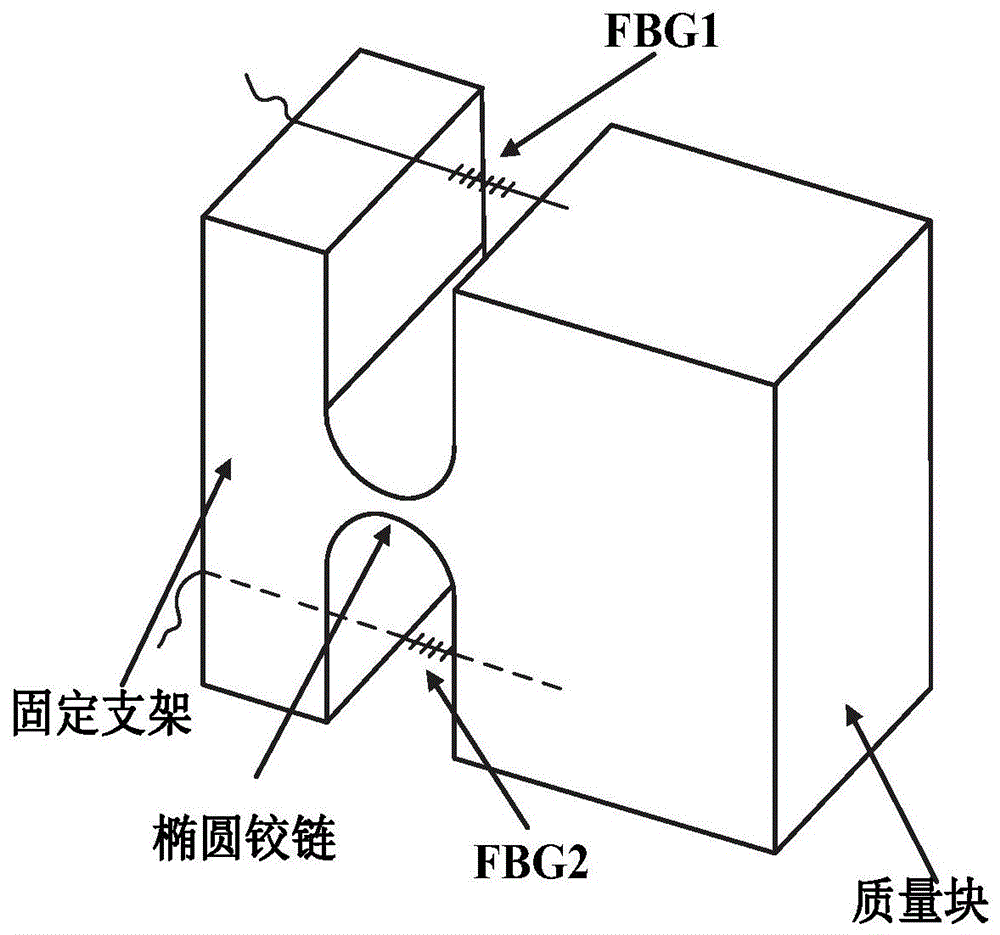
本公开提出了一种中高频椭圆铰链双光纤光栅加速度传感器及测量方法,包括:椭圆铰链、固定支架及质量块;所述椭圆铰链的一端与固定支架固连,所述椭圆铰链的另一端连接至质量块;所述固定支架及质量块上下表面分别在同一平面上,同一平面的固定支架及质量块之间且位于椭圆铰链正上方及正下方分别粘贴有光纤光栅。基于椭圆铰链的中高频双FBG加速度传感器,在保证高精度的前提下,利用椭圆铰链运动范围大的优势[12],提高传感器的灵敏度,并采用差分法对反射波长进行解调,达到灵敏度倍增的目的。
The present disclosure proposes a medium-high frequency elliptical hinge double fiber grating acceleration sensor and a measurement method, including: an elliptical hinge, a fixed bracket and a mass block; one end of the elliptical hinge is fixedly connected to the fixed bracket, and the other end of the elliptical hinge is connected to to the mass block; the upper and lower surfaces of the fixed bracket and the mass block are respectively on the same plane, and fiber gratings are respectively pasted between the fixed bracket and the mass block on the same plane and located directly above and below the elliptical hinge. The medium and high frequency dual FBG acceleration sensor based on elliptical hinge, on the premise of ensuring high precision, takes advantage of the large range of motion of the elliptical hinge to improve the sensitivity of the sensor, and uses the differential method to demodulate the reflected wavelength to double the sensitivity the goal of.
Description
技术领域technical field
本公开属于加速度传感器技术领域,尤其涉及一种中高频椭圆铰链双光纤光栅加速度传感器及测量方法。The present disclosure belongs to the technical field of acceleration sensors, and in particular relates to a medium and high frequency elliptical hinge double fiber grating acceleration sensor and a measurement method.
背景技术Background technique
本部分的陈述仅仅是提供了与本公开相关的背景技术信息,不必然构成在先技术。The statements in this section merely provide background information related to the present disclosure and do not necessarily constitute prior art.
高铁、高架桥等基础设施建设正在逐步推进,但是铁路、桥梁中的高频振动会严重影响结构健康。加速度是用来描述物体振动的参量之一,可以通过测量加速度来反映大型结构的振动情况。光纤布拉格光栅(Fiber Bragg Grating,FBG)加速度传感器作为一种无源器件,与传统机电式加速度传感器相比,具有测量灵敏度高、电磁不敏感、可分布式测量等优点,非常适合应用于监测大型结构的中高频振动。Infrastructure construction such as high-speed railways and viaducts is gradually advancing, but high-frequency vibrations in railways and bridges will seriously affect the structural health. Acceleration is one of the parameters used to describe the vibration of objects, and the vibration of large structures can be reflected by measuring acceleration. Fiber Bragg Grating (FBG) accelerometer, as a passive device, has the advantages of high measurement sensitivity, electromagnetic insensitivity, and distributed measurement compared with traditional electromechanical accelerometers. It is very suitable for monitoring large-scale Medium and high frequency vibration of the structure.
中高频振动是导致桥梁、隧道等大型结构发生劣化的主要原因,利用光学传感器获取物体振动频率是监测大型结构高频振动的重要手段。近年来,随着FBG传感技术的不断发展,FBG加速度传感器成为一个全新的研究方向,并且广泛应用于地震监测、石油化工、国防安全、大型工程和基础设施的健康监测等领域。王宏亮等人研制了一种等强度双悬臂梁的光纤光栅加速度传感器,利用ANSYS确定传感器的最优参数,并实现50Hz以下的低频信号的实时监测,灵敏度为20.85pm/m.s-2。贾振安等人研制了一种悬臂梁式光纤光栅振动传感器,该传感器的谐振频率为90Hz,平坦区域为10-50Hz,传感器灵敏度为121pm/g2。OmPrakash等人设计了一种新型的双L悬臂的光纤布拉格光栅加速度传感器,与单L悬臂梁式光纤光栅加速度传感器相比,该设计不仅增加了灵敏度,而且实现了温度自补偿,传感器的灵敏度为406.7pm/g。Gutiérrez N等人报道了一种基于六角形空心圆柱的光纤光栅加速度传感器,该传感器的特点是小型化、重量轻,但是这种设计降低了传感器的灵敏度,实验验证该传感器的灵敏度仅为19.65pm/g。Medium and high frequency vibration is the main reason for the deterioration of large structures such as bridges and tunnels. Using optical sensors to obtain the vibration frequency of objects is an important means to monitor the high frequency vibration of large structures. In recent years, with the continuous development of FBG sensing technology, FBG accelerometers have become a new research direction, and are widely used in seismic monitoring, petrochemical, national defense, health monitoring of large-scale projects and infrastructure. Wang Hongliang et al. developed a fiber grating acceleration sensor with equal intensity double cantilever beams, using ANSYS to determine the optimal parameters of the sensor, and realize real-time monitoring of low-frequency signals below 50Hz, with a sensitivity of 20.85pm/ms -2 . Jia Zhenan et al. developed a cantilever fiber grating vibration sensor, the resonant frequency of the sensor is 90Hz, the flat region is 10-50Hz, and the sensor sensitivity is 121pm/g 2 . OmPrakash et al. designed a new double-L cantilever fiber Bragg grating accelerometer. Compared with the single-L cantilever fiber Bragg grating accelerometer, the design not only increases the sensitivity, but also realizes temperature self-compensation. The sensitivity of the sensor is 406.7pm/g. Gutiérrez N et al. reported a fiber grating accelerometer based on a hexagonal hollow cylinder. The sensor is characterized by miniaturization and light weight, but this design reduces the sensitivity of the sensor. The experimental verification The sensitivity of the sensor is only 19.65pm /g.
另外,中高频传感器的一个特点就是频率和灵敏度成反比,早期的此类传感器因上述客观条件和当时的解调设备精度不足等原因没有测量具体的灵敏度,近年来报道的中高频光纤光栅加速度传感器的灵敏度普遍不高。光纤光栅加速度传感器的研究多集中在中低频范围,对中高频光纤光栅加速度传感器的研究相对较少。In addition, one of the characteristics of medium and high frequency sensors is that the frequency and sensitivity are inversely proportional. Due to the above objective conditions and the lack of accuracy of the demodulation equipment at the time, the early sensors did not measure the specific sensitivity. In recent years, the medium and high frequency fiber grating acceleration sensors reported The sensitivity is generally not high. The research on fiber grating accelerometers is mostly concentrated in the mid-low frequency range, and there are relatively few studies on mid- and high-frequency fiber grating accelerometers.
发明内容SUMMARY OF THE INVENTION
为克服上述现有技术的不足,本公开提供了一种中高频椭圆铰链双光纤光栅加速度传感器,在保证高精度的前提下,利用椭圆铰链运动范围大的优势,提高传感器的灵敏度。In order to overcome the above-mentioned deficiencies of the prior art, the present disclosure provides a medium-high frequency elliptical hinge double fiber grating acceleration sensor, which improves the sensitivity of the sensor by taking advantage of the large movement range of the elliptical hinge on the premise of ensuring high precision.
为实现上述目的,本公开的一个或多个实施例提供了如下技术方案:To achieve the above purpose, one or more embodiments of the present disclosure provide the following technical solutions:
第一方面,公开了一种中高频椭圆铰链双光纤光栅加速度传感器,包括:椭圆铰链、固定支架及质量块;In a first aspect, a medium-high frequency elliptical hinge double fiber grating acceleration sensor is disclosed, comprising: an elliptical hinge, a fixed bracket and a mass block;
所述椭圆铰链的一端与固定支架固连,所述椭圆铰链的另一端连接至质量块;One end of the elliptical hinge is fixedly connected with the fixing bracket, and the other end of the elliptical hinge is connected to the mass;
所述固定支架及质量块上下表面分别在同一平面上,同一平面的固定支架及质量块之间且位于椭圆铰链正上方及正下方分别粘贴有光纤光栅。The upper and lower surfaces of the fixing bracket and the mass block are respectively on the same plane, and fiber gratings are respectively pasted between the fixing bracket and the mass block on the same plane and located directly above and below the elliptical hinge.
上述椭圆铰链、固定支架及质量块三者是在同一块金属材料上直接切割出来的。位置关系见图1,三者材质相同,均为弹簧钢。固定支架起一个固定传感器和粘贴光纤的作用,椭圆铰链作为弹性元件。质量块用来提供牛顿第三定律的惯性。The above-mentioned elliptical hinge, fixed bracket and mass block are directly cut from the same piece of metal material. The positional relationship is shown in Figure 1. The three materials are the same, all of which are spring steel. The fixing bracket acts as a fixed sensor and sticks the optical fiber, and the elliptical hinge acts as an elastic element. The mass is used to provide the inertia of Newton's third law.
第二方面,公开了一种中高频椭圆铰链双光纤光栅加速度传感器的测量方法,包括:In a second aspect, a method for measuring a medium and high frequency elliptical hinge double fiber grating acceleration sensor is disclosed, including:
振动时,质量块在惯性力的作用下以椭圆铰链的质点为中心转动,同时带动上下光纤光栅产生伸缩形变,进而引起光纤光栅的反射波长发生漂移;When vibrating, the mass block rotates around the mass point of the elliptical hinge under the action of inertial force, and at the same time drives the upper and lower fiber gratings to produce telescopic deformation, thereby causing the reflection wavelength of the fiber grating to drift;
其中,在同一时刻,一根光纤光栅拉伸,另外一根光纤光栅收缩,将两根光纤光栅的反射波长做差求得波长漂移量;Among them, at the same time, one fiber grating stretches and the other fiber grating shrinks, and the wavelength shift is obtained by taking the difference between the reflected wavelengths of the two fiber gratings;
通过解调中心波长的变化情况获取中心波长变化量即波长漂移量和加速度之间的关系。By demodulating the variation of the central wavelength, the relationship between the variation of the central wavelength, that is, the wavelength drift, and the acceleration is obtained.
具体的,传感器测量的是在振动信号的作用下FBG产生的波长漂移量。测量步骤:将传感器固定在振动台上,同时将上下两根FBG连接在波长解调仪和数采上。当振动台振动的时候,波长解调仪解调出每一时刻的波长,再经过数采将数据输入到电脑中。Specifically, the sensor measures the wavelength shift generated by the FBG under the action of the vibration signal. Measurement steps: Fix the sensor on the vibrating table, and connect the upper and lower FBGs to the wavelength demodulator and data acquisition at the same time. When the vibration table vibrates, the wavelength demodulator demodulates the wavelength at each moment, and then the data is input into the computer through data acquisition.
数据处理:首先将采集回来的数据进行预处理,去除掉粗大误差。然后利用MATLAB软件计算波长漂移量的峰峰值,得到单FBG的灵敏度。最后用同样的方法找到双FBG下的波长漂移量,计算得到双FBG的灵敏度。Data processing: First, preprocess the collected data to remove gross errors. Then use MATLAB software to calculate the peak-to-peak value of the wavelength shift to obtain the sensitivity of a single FBG. Finally, the same method is used to find the wavelength shift under the double FBG, and the sensitivity of the double FBG is calculated.
以上一个或多个技术方案存在以下有益效果:One or more of the above technical solutions have the following beneficial effects:
本公开技术方案基于椭圆铰链的中高频双FBG加速度传感器,在保证高精度的前提下,利用椭圆铰链运动范围大的优势,提高传感器的灵敏度,并采用差分法对反射波长进行解调,达到灵敏度倍增的目的。The technical solution of the present disclosure is based on a medium and high frequency double FBG acceleration sensor based on an elliptical hinge. On the premise of ensuring high precision, the sensitivity of the sensor is improved by taking advantage of the large movement range of the elliptical hinge, and the differential method is used to demodulate the reflected wavelength to achieve the sensitivity. multiplication purpose.
本发明附加方面的优点将在下面的描述中部分给出,部分将从下面的描述中变得明显,或通过本发明的实践了解到。Advantages of additional aspects of the invention will be set forth in part in the description which follows, and in part will become apparent from the description which follows, or may be learned by practice of the invention.
附图说明Description of drawings
构成本公开的一部分的说明书附图用来提供对本公开的进一步理解,本公开的示意性实施例及其说明用于解释本公开,并不构成对本公开的不当限定。The accompanying drawings that constitute a part of the present disclosure are used to provide further understanding of the present disclosure, and the exemplary embodiments of the present disclosure and their descriptions are used to explain the present disclosure and do not constitute an improper limitation of the present disclosure.
图1为本公开实施例传感器结构示意图;FIG. 1 is a schematic structural diagram of a sensor according to an embodiment of the present disclosure;
图2为本公开实施例传感器结构振动模型;FIG. 2 is a structural vibration model of a sensor according to an embodiment of the present disclosure;
图3为本公开实施例椭圆铰链长半轴b、短半轴c对灵敏度、谐振频率的影响;Fig. 3 is the influence of the semi-major axis b and semi-minus c of the elliptical hinge on the sensitivity and the resonant frequency according to the embodiment of the disclosure;
图4仿真实例静应力仿真分析图;Figure 4. The static stress simulation analysis diagram of the simulation example;
图5仿真实例模态仿真分析图;Fig. 5 modal simulation analysis diagram of simulation example;
图6仿真实例谐响应仿真分析图;Fig. 6 simulation example harmonic response simulation analysis diagram;
图7传感器灵敏度标定实验系统图;Figure 7 is a diagram of the sensor sensitivity calibration experiment system;
图8加速度传感器时域响应曲线图;Fig. 8 Time-domain response curve of the acceleration sensor;
图9灵敏度线性拟合图。Figure 9 Sensitivity linear fit plot.
具体实施方式Detailed ways
应该指出,以下详细说明都是示例性的,旨在对本公开提供进一步的说明。除非另有指明,本文使用的所有技术和科学术语具有与本公开所属技术领域的普通技术人员通常理解的相同含义。It should be noted that the following detailed description is exemplary and intended to provide further explanation of the present disclosure. Unless otherwise defined, all technical and scientific terms used herein have the same meaning as commonly understood by one of ordinary skill in the art to which this disclosure belongs.
需要注意的是,这里所使用的术语仅是为了描述具体实施方式,而非意图限制根据本公开的示例性实施方式。如在这里所使用的,除非上下文另外明确指出,否则单数形式也意图包括复数形式,此外,还应当理解的是,当在本说明书中使用术语“包含”和/或“包括”时,其指明存在特征、步骤、操作、器件、组件和/或它们的组合。It should be noted that the terminology used herein is for the purpose of describing specific embodiments only, and is not intended to limit the exemplary embodiments according to the present disclosure. As used herein, unless the context clearly dictates otherwise, the singular is intended to include the plural as well, furthermore, it is to be understood that when the terms "comprising" and/or "including" are used in this specification, it indicates that There are features, steps, operations, devices, components and/or combinations thereof.
在不冲突的情况下,本公开中的实施例及实施例中的特征可以相互组合。The embodiments of this disclosure and features of the embodiments may be combined with each other without conflict.
本实施例公开了一种基于椭圆铰链的中高频双FBG加速度传感器,在保证高精度的前提下,利用椭圆铰链运动范围大的优势,提高传感器的灵敏度,并采用差分法对反射波长进行解调,达到灵敏度倍增的目的。通过传感器理论模型分析传感器的灵敏度和谐振频率,采用MATLAB和ANSYS软件对传感器的结构参数进行优化及仿真分析得到传感器的结构参数。研制传感器,并通过传感器标定实验,验证并分析实验结果。This embodiment discloses a medium and high frequency double FBG acceleration sensor based on an elliptical hinge. On the premise of ensuring high precision, the sensitivity of the sensor is improved by taking advantage of the large movement range of the elliptical hinge, and the differential method is used to demodulate the reflected wavelength. , to achieve the purpose of doubling the sensitivity. The sensitivity and resonant frequency of the sensor are analyzed by the theoretical model of the sensor, and the structural parameters of the sensor are optimized and simulated by MATLAB and ANSYS software to obtain the structural parameters of the sensor. Develop sensors, and verify and analyze the experimental results through sensor calibration experiments.
具体的,本实施例公开了一种中高频椭圆铰链双光纤光栅加速度传感器,参见附图1所示,光纤光栅加速度传感器由椭圆铰链、两根FBG、质量块、固定支架组成。Specifically, this embodiment discloses a mid-high frequency elliptical hinge double fiber grating acceleration sensor. Referring to FIG. 1 , the fiber grating acceleration sensor is composed of an elliptical hinge, two FBGs, a mass block, and a fixed bracket.
其中,FBG一上一下粘贴在质量块和固定支架之间,FBG的两端在粘贴时施加相等的预应力,以防止出现啁啾效应。Among them, the FBG is pasted up and down between the mass block and the fixed bracket, and the two ends of the FBG are applied with equal prestress during pasting to prevent the chirp effect.
椭圆铰链的一端与固定支架固连,所述椭圆铰链的另一端连接至质量块;One end of the elliptical hinge is fixedly connected with the fixing bracket, and the other end of the elliptical hinge is connected to the mass;
固定支架及质量块上下表面分别在同一平面上,同一平面的固定支架及质量块之间且位于椭圆铰链正上方及正下方分别粘贴有光纤光栅。The upper and lower surfaces of the fixed bracket and the mass block are respectively on the same plane, and the fiber grating is respectively pasted between the fixed bracket and the mass block on the same plane and located directly above and below the elliptical hinge.
FBG中心波长的漂移即波长漂移量和应变紧密相关,两者之间的关系可以表示为The drift of the central wavelength of the FBG, that is, the amount of wavelength drift is closely related to the strain, and the relationship between the two can be expressed as

式中,Pe为有效弹光系数,通常取值为0.15-0.22,ΔλB是光纤布拉格光栅的中心波长在应变作用下的漂移量,ε为光纤布拉格光栅产生的轴向应变。where P e is the effective elastic-optic coefficient, usually 0.15-0.22, Δλ B is the drift of the center wavelength of the fiber Bragg grating under strain, and ε is the axial strain generated by the fiber Bragg grating.
传感器的结构尺寸及力学模型如图2所示。以一根FBG为例,分析传感器的理论灵敏度。在传感器的竖直方向施加大小为g,方向向上的加速度时,由牛顿第三运动定律可知,质量块以铰链为中心振动。The structure size and mechanical model of the sensor are shown in Figure 2. Take a FBG as an example to analyze the theoretical sensitivity of the sensor. When an acceleration of magnitude g is applied in the vertical direction of the sensor and the direction is upward, it can be known from Newton's third law of motion that the mass block vibrates with the hinge as the center.
由力矩平衡方程,可得From the moment balance equation, we can get

式中,m为质量块的质量,d为质量块质心到铰链中心的距离,k为光纤弹性系数,l为光纤的伸长量,h为质量块的高度,K为铰链的转动刚度,θ为铰链的转动角度。where m is the mass of the mass block, d is the distance from the mass center of the mass block to the hinge center, k is the elastic coefficient of the fiber, l is the elongation of the fiber, h is the height of the mass block, K is the rotational stiffness of the hinge, θ is the rotation angle of the hinge.
铰链的转动刚度为The rotational stiffness of the hinge is

其中in

式中,E为材料的弹性模量,w为铰链的厚度,s=c/t,c为椭圆铰链的短半轴,t为铰链间最小厚度。传感器灵敏度S为光纤光栅的中心波长变化量Δλ和加速度a之比,即In the formula, E is the elastic modulus of the material, w is the thickness of the hinge, s=c/t, c is the short semi-axis of the elliptical hinge, and t is the minimum thickness between the hinges. The sensor sensitivity S is the ratio of the center wavelength change Δλ of the fiber grating to the acceleration a, namely

式中,Pe为弹光系数,λB为光栅的中心波长,εf为光纤应变,Δl为光纤的伸长量。以上是单FBG的灵敏度分析,因为双FBG是一上一下对称粘贴,在同一时刻,一根FBG拉伸,另外一根FBG必然收缩。两根FBG的反射波长的变化情况相反,因此,将两根FBG的反射波长做差求得波长漂移量,得到传感器灵敏度为单FBG加速度传感器灵敏度的2倍。where P e is the elastic-optic coefficient, λ B is the center wavelength of the grating, ε f is the fiber strain, and Δl is the fiber elongation. The above is the sensitivity analysis of a single FBG, because the double FBG is symmetrically pasted one above the other. At the same time, one FBG stretches and the other FBG shrinks. The changes of the reflection wavelengths of the two FBGs are opposite. Therefore, the wavelength shift is obtained by taking the difference of the reflection wavelengths of the two FBGs, and the sensitivity of the sensor is twice the sensitivity of the single FBG acceleration sensor.
传感器谐振频率分析:Sensor resonance frequency analysis:
传感器的另一个重要参数是谐振频率F,它与传感器能够测量的频率范围密切相关,一般而言,传感器谐振频率越高,传感器可测频率范围越大。设质量块绕铰链中心转动的转动惯量为J,椭圆铰链的转动角度为θ。Another important parameter of the sensor is the resonant frequency F, which is closely related to the frequency range that the sensor can measure. Generally speaking, the higher the resonant frequency of the sensor, the larger the frequency range that the sensor can measure. Let the moment of inertia of the mass block rotating around the hinge center be J, and the rotation angle of the elliptical hinge be θ.
系统的谐振频率为The resonant frequency of the system is

其中转动惯量J为where the moment of inertia J is

结构参数对传感器性能的影响:Influence of structural parameters on sensor performance:
由式(5)、(6)可知,两点粘贴式的FBG加速度传感器光栅长度l只与灵敏度有关,与谐振频率无关,并且光纤光栅越短,灵敏度越高。此外,传感器的灵敏度和谐振频率与椭圆铰链的长半轴b、短半轴c和厚度t等尺寸密切相关。传感器制作材料选用弹簧钢,其密度为7800kg/m3,弹性模量为2.1E11 Pa,传感器厚12mm,光纤的弹性模量为7.2E10 Pa,有效弹光系数为0.22,光纤光栅的中心波长为1553nm,长度l为5mm。It can be seen from equations (5) and (6) that the grating length l of the two-point-stick FBG acceleration sensor is only related to the sensitivity, and has nothing to do with the resonant frequency, and the shorter the fiber grating, the higher the sensitivity. In addition, the sensitivity and resonant frequency of the sensor are closely related to the dimensions of the major semi-axis b, minor semi-axis c and thickness t of the elliptical hinge. The sensor is made of spring steel with a density of 7800kg/m 3 , an elastic modulus of 2.1E11 Pa, a sensor thickness of 12mm, an elastic modulus of the optical fiber of 7.2E10 Pa, an effective elastic-optic coefficient of 0.22, and the center wavelength of the fiber grating is 1553nm, the length l is 5mm.
讨论在不同的铰链厚度t下,灵敏度和谐振频率随长半轴b、短半轴c的变化。令质量块的质量m=18.72g,b,c∈(0,10)单位为mm,当椭圆铰链的厚度t分别为0.2mm、0.6mm、1mm时,得到的灵敏度和谐振频率变化情况如图3所示。Discuss the variation of sensitivity and resonant frequency with long semi-axis b and short semi-axis c under different hinge thickness t. Let the mass of the mass m=18.72g, the unit of b, c∈(0,10) is mm, when the thickness t of the elliptical hinge is 0.2mm, 0.6mm, and 1mm, respectively, the obtained sensitivity and resonance frequency change as shown in the figure 3 shown.
由图3可知,当椭圆铰链的参数发生改变时,传感器的灵敏度和谐振频率均发生变化。当椭圆铰链的长半轴b增大时,传感器的灵敏度增大,谐振频率减小;当椭圆铰链的短半轴c增大时,传感器的灵敏度减小,谐振频率增大;当椭圆铰链的厚度t增大时,传感器灵敏度增大,谐振频率减小。因而需要对椭圆铰链的结构参数进一步优化,得到最优的灵敏度和谐振频率。It can be seen from Figure 3 that when the parameters of the elliptical hinge change, the sensitivity and resonant frequency of the sensor both change. When the long semi-axis b of the elliptical hinge increases, the sensitivity of the sensor increases and the resonant frequency decreases; when the short semi-axis c of the elliptical hinge increases, the sensitivity of the sensor decreases and the resonant frequency increases; When the thickness t increases, the sensitivity of the sensor increases and the resonant frequency decreases. Therefore, it is necessary to further optimize the structural parameters of the elliptical hinge to obtain the optimal sensitivity and resonance frequency.
结构参数优化:Structural parameter optimization:
为了得到最优的灵敏度和谐振频率,采用MATLAB软件的优化工具箱对传感器的椭圆铰链长半轴b、短半轴c和厚度t进行优化。首先对铰链的刚度式(3)中的u进行简化,当式(4)中的s∈(1,7)时,运用MATLAB对参数s进行多项式拟合,可得:In order to obtain the optimal sensitivity and resonant frequency, the optimization toolbox of MATLAB software is used to optimize the long semi-axis b, short semi-axis c and thickness t of the sensor's elliptical hinge. Firstly, u in the stiffness equation (3) of the hinge is simplified. When s∈(1,7) in equation (4), the parameter s is polynomially fitted with MATLAB, and we can get:
F(x)=0.0003574x4-0.007678x3+0.06342x2-0.2615x+0.7126 (8)F(x)=0.0003574x 4 -0.007678x 3 +0.06342x 2 -0.2615x+0.7126 (8)
式(8)的拟合确定系数和均方差分别为0.9997和0.00124,这两个值充分说明了数据拟合的合理性,将式(8)带入式(4)中,再利用MATLAB进行参数优化。设定传感器的灵敏度和谐振频率为目标参数,以椭圆铰链的长半轴b、短半轴c和厚度t的取值为约束条件,结合MATLAB优化工具箱建立优化模型,考虑到传感器的尺寸和加工的可能性,得到优化模型为The fitting determination coefficient and mean square error of formula (8) are 0.9997 and 0.00124, respectively. These two values fully illustrate the rationality of data fitting. The formula (8) is brought into formula (4), and then MATLAB is used to carry out the parameters. optimization. Set the sensitivity and resonant frequency of the sensor as the target parameters, take the long semi-axis b, short semi-axis c and thickness t of the elliptical hinge as constraints, and establish an optimization model combined with the MATLAB optimization toolbox, taking into account the size and size of the sensor and The possibility of machining, the optimized model is obtained as
MAX S (9)MAX S (9)

由优化结果可知,当椭圆铰链长半轴b为2.578mm,短半轴c为2.081mm,椭圆铰链的厚度t为0.7919mm时,可得到最优的灵敏度和谐振频率。考虑到机械加工精度问题,最终b、c和t的取值分别为2.6mm、2.1mm和0.8mm。It can be seen from the optimization results that when the semi-major axis b of the ellipse hinge is 2.578mm, the semi-axis c is 2.081mm, and the thickness t of the ellipse hinge is 0.7919mm, the optimal sensitivity and resonance frequency can be obtained. Taking into account the machining accuracy, the final values of b, c and t are 2.6mm, 2.1mm and 0.8mm, respectively.
ANSYS仿真ANSYS Simulation
采用上述分析与优化得到的结构参数对传感器进行建模,并导入ANSYS进行仿真分析。首先将模型导入ANSYS静应力仿真工具中,对传感器模型的固定支架施加固定约束,对传感器整体施加标准地球重力加速度g(g=9.8m/s2)的外部载荷,得到模型的应变云图如图4所示。可以看出传感器自由端产生的形变最大,并且向固定端逐渐减小,自由端的最大形变量为0.56μm。The sensor is modeled with the structural parameters obtained from the above analysis and optimization, and imported into ANSYS for simulation analysis. First, import the model into the ANSYS static stress simulation tool, impose fixed constraints on the fixed support of the sensor model, and apply an external load of standard earth gravitational acceleration g (g=9.8m/s 2 ) to the whole sensor, and the strain cloud diagram of the model is obtained as shown in the figure 4 shown. It can be seen that the deformation at the free end of the sensor is the largest, and gradually decreases towards the fixed end, and the maximum deformation at the free end is 0.56 μm.
依据静应力分析的结果对传感器模型进行模态分析,如图5所示,得到的一阶模态、二阶模态的谐振频率分别为764.82Hz、5101.4Hz。如图5(a)所示,一阶模态为简谐振动,表明传感器模型在外界激励作用下沿Y轴产生振动。如图5(b)所示,二阶模态为转动振型,表明传感器模型在外界激励作用下沿X轴产生转动。通过比较各阶模态数据发现,一阶模态频率与二阶模态的谐振频率相差较大,表明该结构传感器的交叉耦合小,可以有效降低交叉干扰。According to the results of static stress analysis, the sensor model is modal analysis, as shown in Figure 5, the obtained resonant frequencies of the first-order mode and the second-order mode are 764.82Hz and 5101.4Hz, respectively. As shown in Fig. 5(a), the first-order mode is a simple harmonic vibration, indicating that the sensor model vibrates along the Y-axis under the action of external excitation. As shown in Fig. 5(b), the second-order mode is a rotational mode shape, indicating that the sensor model rotates along the X-axis under the action of external excitation. By comparing the modal data of each order, it is found that the resonant frequency of the first-order modal is quite different from the resonant frequency of the second-order modal, which indicates that the cross-coupling of the structural sensor is small, which can effectively reduce the cross-interference.
最后对模型进行谐响应分析,对传感器模型的固定支架施加固定约束,分析传感器模型在不同频率的正弦载荷作用下的系统动态响应。设置频率变化为0-900Hz,步长为10Hz,正弦载荷大小为2g,得到的传感器动态响应如图6所示。Finally, the harmonic response of the model is analyzed, and fixed constraints are imposed on the fixed bracket of the sensor model to analyze the system dynamic response of the sensor model under the action of sinusoidal loads of different frequencies. The frequency change is set to 0-900Hz, the step size is 10Hz, and the sinusoidal load size is 2g. The obtained dynamic response of the sensor is shown in Figure 6.
由图6可知,传感器的谐振频率约为780Hz,且在500Hz以下曲线相对平缓,有利于实现中高频的测量。It can be seen from Figure 6 that the resonant frequency of the sensor is about 780Hz, and the curve is relatively flat below 500Hz, which is conducive to the realization of medium and high frequency measurements.
传感器标定实验:Sensor calibration experiment:
为了确保传感器在500Hz以下具有良好的性能,需要对加速度传感器进行灵敏度标定实验。传感器灵敏度标定实验系统主要由振动测试系统和信号解调系统两部分组成,如图7所示。振动测试系统包括振动台、信号发生器、信号放大器等;信号解调系统包括波长解调仪、计算机等;设计的传感器底座与振动台之间通过螺栓紧密相连。FBG的反射光波通过传输光纤介入环形器,最终输送至解调仪,解调出光波波长变化所携带的信息,实验环境温度为25℃。In order to ensure that the sensor has good performance below 500Hz, it is necessary to perform a sensitivity calibration experiment on the acceleration sensor. The sensor sensitivity calibration experimental system is mainly composed of two parts, the vibration test system and the signal demodulation system, as shown in Figure 7. The vibration test system includes a vibration table, a signal generator, a signal amplifier, etc.; the signal demodulation system includes a wavelength demodulator, a computer, etc.; the designed sensor base and the vibration table are closely connected by bolts. The reflected light wave of the FBG is inserted into the circulator through the transmission fiber, and finally sent to the demodulator to demodulate the information carried by the wavelength change of the light wave. The experimental environment temperature is 25 °C.
响应特性分析:为测试传感器响应特性,将振动台的输出频率设置为325Hz,加速度的输出幅值设置为1g,得到其输出频率对应光纤光栅加速度传感器响应的时域曲线,如图8所示。Analysis of response characteristics: In order to test the response characteristics of the sensor, the output frequency of the shaking table is set to 325Hz, and the output amplitude of the acceleration is set to 1g, and the time domain curve of the response of the output frequency corresponding to the fiber grating acceleration sensor is obtained, as shown in Figure 8.
由图8可知,传感器具有良好的输出频率响应。在每一时刻,光纤光栅加速度传感器上、下两根光纤的中心波长变化量大小相等且方向相反。It can be seen from Figure 8 that the sensor has a good output frequency response. At each moment, the central wavelength changes of the upper and lower two fibers of the fiber grating acceleration sensor are equal in magnitude and opposite in direction.
传感器灵敏度线性分析:Sensor sensitivity linear analysis:
在传感器灵敏度线性测试中,选取160Hz和325Hz对传感器施加正弦激励信号,加速度的测试范围从0.1g增加到2.0g,步长为0.1g。测得传感器在相同激振频率不同加速度下的波长漂移量,通过拟合波长漂移量和加速度之间的线性关系,得到传感器的灵敏度拟合曲线,如图9所示。In the sensor sensitivity linear test, 160Hz and 325Hz are selected to apply a sinusoidal excitation signal to the sensor, and the test range of acceleration is increased from 0.1g to 2.0g, and the step size is 0.1g. The wavelength drift of the sensor under the same excitation frequency and different accelerations is measured. By fitting the linear relationship between the wavelength drift and the acceleration, the sensitivity fitting curve of the sensor is obtained, as shown in Figure 9.
由图9可知,振动频率为160Hz时,单光纤灵敏度为40.83pm/g,拟合确定系数R2=0.9987,双光纤差分灵敏度为90.91pm/g,拟合确定系数R2=0.9988。振动频率为325Hz时,单光纤灵敏度为59.22pm/g,拟合确定系数R2=0.9956,双光纤差分灵敏度为132.53pm/g,拟合确定系数R2=0.9962。It can be seen from Figure 9 that when the vibration frequency is 160 Hz, the single-fiber sensitivity is 40.83pm/g, the fitting determination coefficient R 2 =0.9987, the dual-fiber differential sensitivity is 90.91pm/g, and the fitting determination coefficient R 2 =0.9988. When the vibration frequency is 325Hz, the single-fiber sensitivity is 59.22pm/g, the fitting determination coefficient R 2 =0.9956, the dual-fiber differential sensitivity is 132.53pm/g, and the fitting determination coefficient R 2 =0.9962.
实验结果分析:将传感器灵敏度标定实验的结果同理论灵敏度值对比,发现存在3%的误差,但已能够满足工程应用的需求。推测存在误差的原因:(1)理论分析部分采用MATLAB软件对式(4)进行线性拟合时存在误差,且进行理论计算时选取的数据都是近似值;(2)传感器在机械加工时由于加工设备的精度不足、加工时温度不可控等原因导致椭圆铰链存在加工误差。Analysis of experimental results: Comparing the results of the sensor sensitivity calibration experiment with the theoretical sensitivity value, it is found that there is an error of 3%, but it can meet the needs of engineering applications. The reason for the error is speculated: (1) There is an error in the linear fitting of equation (4) using MATLAB software in the theoretical analysis part, and the data selected in the theoretical calculation are all approximate values; Insufficient precision of equipment and uncontrollable temperature during processing lead to processing errors of elliptical hinges.
本公开实施例子提出了一种基于椭圆铰链的中高频加速度传感器,并通过传感器灵敏度标定实验对优化的结果进行了分析和验证。实验结果表明,灵敏度约为132pm/g,可测频率范围为80-495Hz,传感器的谐振频率约为780Hz。另外,实验进一步验证了双光纤差分解调法可以成倍提高传感器的灵敏度,为监测大型结构的中高频的振动提出一种新思路。The embodiment of the present disclosure proposes a medium and high frequency acceleration sensor based on an elliptical hinge, and analyzes and verifies the optimized result through a sensor sensitivity calibration experiment. The experimental results show that the sensitivity is about 132pm/g, the measurable frequency range is 80-495Hz, and the resonant frequency of the sensor is about 780Hz. In addition, the experiment further verifies that the dual-fiber differential demodulation method can double the sensitivity of the sensor, and proposes a new idea for monitoring the medium and high frequency vibration of large structures.
当传感器处于静止状态时,上下光纤光栅不受力,因此光纤中心波长不会发生变化。当传感器振动时,质量块在惯性力的作用下以椭圆铰链的质点为中心转动,同时带动上下FBG产生伸缩形变,进而引起FBG的反射波长发生漂移。最终,通过解调中心波长的变化情况获取中心波长变化量即波长漂移量和加速度之间的关系。When the sensor is at rest, the upper and lower fiber gratings are not stressed, so the center wavelength of the fiber does not change. When the sensor vibrates, the mass block rotates around the mass point of the elliptical hinge under the action of inertial force, and at the same time drives the upper and lower FBGs to produce telescopic deformation, which in turn causes the reflection wavelength of the FBG to drift. Finally, by demodulating the variation of the central wavelength, the relationship between the variation of the central wavelength, that is, the wavelength drift, and the acceleration is obtained.
以上所述仅为本公开的优选实施例而已,并不用于限制本公开,对于本领域的技术人员来说,本公开可以有各种更改和变化。凡在本公开的精神和原则之内,所作的任何修改、等同替换、改进等,均应包含在本公开的保护范围之内。The above descriptions are only preferred embodiments of the present disclosure, and are not intended to limit the present disclosure. For those skilled in the art, the present disclosure may have various modifications and changes. Any modification, equivalent replacement, improvement, etc. made within the spirit and principle of the present disclosure shall be included within the protection scope of the present disclosure.
上述虽然结合附图对本公开的具体实施方式进行了描述,但并非对本公开保护范围的限制,所属领域技术人员应该明白,在本公开的技术方案的基础上,本领域技术人员不需要付出创造性劳动即可做出的各种修改或变形仍在本公开的保护范围以内。Although the specific embodiments of the present disclosure have been described above in conjunction with the accompanying drawings, they do not limit the protection scope of the present disclosure. Those skilled in the art should understand that on the basis of the technical solutions of the present disclosure, those skilled in the art do not need to pay creative efforts. Various modifications or variations that can be made are still within the protection scope of the present disclosure.
Claims (10)
Priority Applications (1)
| Application Number | Priority Date | Filing Date | Title |
|---|---|---|---|
| CN202010896491.8A CN111879969B (en) | 2020-08-31 | 2020-08-31 | A medium-high frequency elliptical hinge double-fiber grating acceleration sensor and its measurement method |
Applications Claiming Priority (1)
| Application Number | Priority Date | Filing Date | Title |
|---|---|---|---|
| CN202010896491.8A CN111879969B (en) | 2020-08-31 | 2020-08-31 | A medium-high frequency elliptical hinge double-fiber grating acceleration sensor and its measurement method |
Publications (2)
| Publication Number | Publication Date |
|---|---|
| CN111879969A true CN111879969A (en) | 2020-11-03 |
| CN111879969B CN111879969B (en) | 2023-04-14 |
Family
ID=73198966
Family Applications (1)
| Application Number | Title | Priority Date | Filing Date |
|---|---|---|---|
| CN202010896491.8A Expired - Fee Related CN111879969B (en) | 2020-08-31 | 2020-08-31 | A medium-high frequency elliptical hinge double-fiber grating acceleration sensor and its measurement method |
Country Status (1)
| Country | Link |
|---|---|
| CN (1) | CN111879969B (en) |
Cited By (9)
| Publication number | Priority date | Publication date | Assignee | Title |
|---|---|---|---|---|
| CN112629642A (en) * | 2020-12-07 | 2021-04-09 | 中国航空工业集团公司北京长城计量测试技术研究所 | Optical fiber sensing system for vibration test of flow channel in engine |
| CN113670429A (en) * | 2021-08-13 | 2021-11-19 | 重庆大学 | Fiber grating transformer winding vibration acceleration sensor and processing method thereof |
| CN114001813A (en) * | 2021-11-04 | 2022-02-01 | 中国科学院半导体研究所 | accelerometer |
| CN114166333A (en) * | 2021-12-14 | 2022-03-11 | 武汉理工大学三亚科教创新园 | Device and method for measuring seabed vibration signals |
| CN114217092A (en) * | 2021-12-15 | 2022-03-22 | 武汉理工大学 | FBG acceleration sensor based on diaphragm and elliptical hinge |
| CN116203280A (en) * | 2023-03-17 | 2023-06-02 | 江汉大学 | Flexible hinge fiber bragg grating acceleration sensor and measuring method |
| CN116499576A (en) * | 2023-06-27 | 2023-07-28 | 山东省计算中心(国家超级计算济南中心) | A fiber grating vibration sensor and its measurement method |
| CN116990546A (en) * | 2023-06-25 | 2023-11-03 | 中国计量大学 | A dual-fiber Bragg grating acceleration sensor based on arc cycloidal hinge and its calibration method |
| CN120333511A (en) * | 2025-06-20 | 2025-07-18 | 湖北大学 | A high-frequency FBG sensor for a symmetrical elliptical flexible hinge and a monitoring method thereof |
Citations (6)
| Publication number | Priority date | Publication date | Assignee | Title |
|---|---|---|---|---|
| JP2010078489A (en) * | 2008-09-26 | 2010-04-08 | Nagano Keiki Co Ltd | Fiber optic sensor |
| CN103076465A (en) * | 2013-01-15 | 2013-05-01 | 西北大学 | Double-half-hole-beam differential type fiber bragg grating acceleration sensor |
| CN105116168A (en) * | 2015-10-14 | 2015-12-02 | 山东省科学院激光研究所 | Three-dimensional FBG (fiber bragg grating) acceleration sensor based on flexure hinges |
| CN106814216A (en) * | 2017-01-24 | 2017-06-09 | 武汉理工大学 | The round flexible hinge optical fibre grating acceleration sensor of Integral direct |
| CN110108901A (en) * | 2019-06-17 | 2019-08-09 | 天津师范大学 | Accelerate fiber grating acceleration sensor and the application of monitoring for hull |
| CN111505337A (en) * | 2020-04-30 | 2020-08-07 | 中山市精量光电子科技有限公司 | A Temperature-Insensitive Elliptical Hinge Fiber Bragg Grating Accelerometer |
-
2020
- 2020-08-31 CN CN202010896491.8A patent/CN111879969B/en not_active Expired - Fee Related
Patent Citations (6)
| Publication number | Priority date | Publication date | Assignee | Title |
|---|---|---|---|---|
| JP2010078489A (en) * | 2008-09-26 | 2010-04-08 | Nagano Keiki Co Ltd | Fiber optic sensor |
| CN103076465A (en) * | 2013-01-15 | 2013-05-01 | 西北大学 | Double-half-hole-beam differential type fiber bragg grating acceleration sensor |
| CN105116168A (en) * | 2015-10-14 | 2015-12-02 | 山东省科学院激光研究所 | Three-dimensional FBG (fiber bragg grating) acceleration sensor based on flexure hinges |
| CN106814216A (en) * | 2017-01-24 | 2017-06-09 | 武汉理工大学 | The round flexible hinge optical fibre grating acceleration sensor of Integral direct |
| CN110108901A (en) * | 2019-06-17 | 2019-08-09 | 天津师范大学 | Accelerate fiber grating acceleration sensor and the application of monitoring for hull |
| CN111505337A (en) * | 2020-04-30 | 2020-08-07 | 中山市精量光电子科技有限公司 | A Temperature-Insensitive Elliptical Hinge Fiber Bragg Grating Accelerometer |
Cited By (12)
| Publication number | Priority date | Publication date | Assignee | Title |
|---|---|---|---|---|
| CN112629642A (en) * | 2020-12-07 | 2021-04-09 | 中国航空工业集团公司北京长城计量测试技术研究所 | Optical fiber sensing system for vibration test of flow channel in engine |
| CN113670429A (en) * | 2021-08-13 | 2021-11-19 | 重庆大学 | Fiber grating transformer winding vibration acceleration sensor and processing method thereof |
| CN114001813A (en) * | 2021-11-04 | 2022-02-01 | 中国科学院半导体研究所 | accelerometer |
| CN114001813B (en) * | 2021-11-04 | 2023-04-07 | 中国科学院半导体研究所 | Accelerometer |
| CN114166333A (en) * | 2021-12-14 | 2022-03-11 | 武汉理工大学三亚科教创新园 | Device and method for measuring seabed vibration signals |
| CN114166333B (en) * | 2021-12-14 | 2024-05-07 | 武汉理工大学三亚科教创新园 | A device and method for measuring seabed vibration signals |
| CN114217092A (en) * | 2021-12-15 | 2022-03-22 | 武汉理工大学 | FBG acceleration sensor based on diaphragm and elliptical hinge |
| CN116203280A (en) * | 2023-03-17 | 2023-06-02 | 江汉大学 | Flexible hinge fiber bragg grating acceleration sensor and measuring method |
| CN116990546A (en) * | 2023-06-25 | 2023-11-03 | 中国计量大学 | A dual-fiber Bragg grating acceleration sensor based on arc cycloidal hinge and its calibration method |
| CN116499576A (en) * | 2023-06-27 | 2023-07-28 | 山东省计算中心(国家超级计算济南中心) | A fiber grating vibration sensor and its measurement method |
| CN116499576B (en) * | 2023-06-27 | 2023-09-12 | 山东省计算中心(国家超级计算济南中心) | Fiber bragg grating vibration sensor and measuring method thereof |
| CN120333511A (en) * | 2025-06-20 | 2025-07-18 | 湖北大学 | A high-frequency FBG sensor for a symmetrical elliptical flexible hinge and a monitoring method thereof |
Also Published As
| Publication number | Publication date |
|---|---|
| CN111879969B (en) | 2023-04-14 |
Similar Documents
| Publication | Publication Date | Title |
|---|---|---|
| CN111879969B (en) | A medium-high frequency elliptical hinge double-fiber grating acceleration sensor and its measurement method | |
| CN110531111B (en) | A fiber grating acceleration sensor with temperature compensation and its measurement method | |
| Li et al. | A high-sensitivity FBG accelerometer based on a bearing | |
| Zhang et al. | 2-D medium–high frequency fiber Bragg gratings accelerometer | |
| CN111812355B (en) | A low stress sensitivity silicon microresonant accelerometer structure | |
| CN115308437B (en) | Low-frequency FBG acceleration sensor based on symmetrical cantilever beam and manufacturing method thereof | |
| Xiong et al. | Fiber Bragg grating-based three-axis vibration sensor | |
| Jiang et al. | A Fiber Bragg Grating accelerometer with cantilever beam | |
| CN111879970A (en) | Temperature-insensitive FBG acceleration sensor and method based on strain chirp effect | |
| Qiu et al. | A miniaturized low-frequency FBG accelerometer based on symmetrical cantilever beam | |
| Lei et al. | A high-precision two-dimensional micro-accelerometer for low-frequency and micro-vibrations | |
| Qiu et al. | Bearing-based FBG acceleration sensor for low-frequency vibration measurement | |
| Luo et al. | A fiber Bragg grating accelerometer based on Y-shaped symmetrical beam structure | |
| Teng et al. | High-sensitivity dual-FBG acceleration sensor for low frequency vibration measurement | |
| Zhang et al. | A triaxial dual FBG accelerometer that can be used for seismic wave detection | |
| CN212872521U (en) | Medium-high frequency elliptical hinge double-fiber grating acceleration sensor and calibration experiment system | |
| Wang et al. | Resonant-frequency-adjustable fiber Bragg grating accelerometer based on extra transverse force loading | |
| Nguyen et al. | A symmetrical dual-mass block fiber Bragg grating vibration sensor based on a V-shaped flexible hinge | |
| Chang et al. | Fiber bragg grating accelerometer based on asymmetric shaped flexible hinge structure | |
| CN112016234B (en) | Mechanical pendulum, test system and test method of differential capacitance seismometer | |
| Chen et al. | Design and experimental Validation of an FBG accelerometer using Cantilever-Hinge structures | |
| Wang et al. | MEMS-based monolithic three-axis fiber-optic acceleration sensor | |
| Xu et al. | Development of a Fiber Bragg Grating accelerometer based on a tandem single-notched hinge structure | |
| Qiu et al. | A low-frequency FBG accelerometer based on dual mass | |
| Hong et al. | A study on double-cantilever miniaturized FBG acceleration sensors for low-frequency vibration monitoring |
Legal Events
| Date | Code | Title | Description |
|---|---|---|---|
| PB01 | Publication | ||
| PB01 | Publication | ||
| SE01 | Entry into force of request for substantive examination | ||
| SE01 | Entry into force of request for substantive examination | ||
| CB03 | Change of inventor or designer information | ||
| CB03 | Change of inventor or designer information |
Inventor after: Qiu Zhongchao Inventor after: Li Yanan Inventor after: Hong Li Inventor after: Sun Rui Inventor after: Meng Juan Inventor after: Han Zhiming Inventor before: Hong Li Inventor before: Sun Rui Inventor before: Li Yanan Inventor before: Meng Juan Inventor before: Han Zhiming Inventor before: Qiu Zhongchao |
|
| TA01 | Transfer of patent application right | ||
| TA01 | Transfer of patent application right |
Effective date of registration: 20230327 Address after: 100081 No.5 Minzu University South Road, Haidian District, Beijing Applicant after: INSTITUTE OF GEOPHYSICS, CHINA EARTHQUAKE ADMINISTRATION Applicant after: Institute of Disaster Prevention Address before: 065201 no.465 Xueyuan street, Yanjiao Development Zone, Sanhe City, Langfang City, Hebei Province Applicant before: Institute of Disaster Prevention |
|
| GR01 | Patent grant | ||
| GR01 | Patent grant | ||
| CF01 | Termination of patent right due to non-payment of annual fee | ||
| CF01 | Termination of patent right due to non-payment of annual fee |
Granted publication date: 20230414 |