CN111867679A - SETDB1 histone methyltransferase inhibitors for cancer combination therapy - Google Patents
SETDB1 histone methyltransferase inhibitors for cancer combination therapy Download PDFInfo
- Publication number
- CN111867679A CN111867679A CN201980017211.7A CN201980017211A CN111867679A CN 111867679 A CN111867679 A CN 111867679A CN 201980017211 A CN201980017211 A CN 201980017211A CN 111867679 A CN111867679 A CN 111867679A
- Authority
- CN
- China
- Prior art keywords
- setdb1
- cancer
- immune checkpoint
- cells
- histone methyltransferase
- Prior art date
- Legal status (The legal status is an assumption and is not a legal conclusion. Google has not performed a legal analysis and makes no representation as to the accuracy of the status listed.)
- Pending
Links
- 206010028980 Neoplasm Diseases 0.000 title claims abstract description 134
- 101000684609 Homo sapiens Histone-lysine N-methyltransferase SETDB1 Proteins 0.000 title claims abstract description 111
- 201000011510 cancer Diseases 0.000 title claims abstract description 74
- 238000002648 combination therapy Methods 0.000 title description 8
- 239000003697 methyltransferase inhibitor Substances 0.000 title 1
- 239000003112 inhibitor Substances 0.000 claims abstract description 72
- 238000011282 treatment Methods 0.000 claims abstract description 38
- 229940123309 Immune checkpoint modulator Drugs 0.000 claims abstract description 31
- 102100023696 Histone-lysine N-methyltransferase SETDB1 Human genes 0.000 claims description 81
- 102000037982 Immune checkpoint proteins Human genes 0.000 claims description 64
- 108091008036 Immune checkpoint proteins Proteins 0.000 claims description 64
- 230000014509 gene expression Effects 0.000 claims description 59
- 239000003446 ligand Substances 0.000 claims description 46
- 238000000034 method Methods 0.000 claims description 30
- 102100028785 Tumor necrosis factor receptor superfamily member 14 Human genes 0.000 claims description 25
- 102000037865 fusion proteins Human genes 0.000 claims description 25
- 108020001507 fusion proteins Proteins 0.000 claims description 25
- 102000005962 receptors Human genes 0.000 claims description 24
- 108020003175 receptors Proteins 0.000 claims description 24
- 108010061593 Member 14 Tumor Necrosis Factor Receptors Proteins 0.000 claims description 23
- 238000002560 therapeutic procedure Methods 0.000 claims description 20
- 230000002401 inhibitory effect Effects 0.000 claims description 19
- -1 TIM-3TIGIT Proteins 0.000 claims description 18
- 102100024586 Tumor necrosis factor ligand superfamily member 14 Human genes 0.000 claims description 18
- 108060003951 Immunoglobulin Proteins 0.000 claims description 16
- 239000000556 agonist Substances 0.000 claims description 16
- 102000018358 immunoglobulin Human genes 0.000 claims description 16
- 201000001441 melanoma Diseases 0.000 claims description 16
- 102100029822 B- and T-lymphocyte attenuator Human genes 0.000 claims description 15
- 229940045513 CTLA4 antagonist Drugs 0.000 claims description 15
- 108010036115 Histone Methyltransferases Proteins 0.000 claims description 15
- 102000011787 Histone Methyltransferases Human genes 0.000 claims description 15
- 108090000994 Catalytic RNA Proteins 0.000 claims description 14
- 102000053642 Catalytic RNA Human genes 0.000 claims description 14
- 102100039498 Cytotoxic T-lymphocyte protein 4 Human genes 0.000 claims description 14
- 101000764622 Homo sapiens Transmembrane and immunoglobulin domain-containing protein 2 Proteins 0.000 claims description 14
- 102100026224 Transmembrane and immunoglobulin domain-containing protein 2 Human genes 0.000 claims description 14
- 108091092562 ribozyme Proteins 0.000 claims description 14
- 229940126546 immune checkpoint molecule Drugs 0.000 claims description 13
- 102100022153 Tumor necrosis factor receptor superfamily member 4 Human genes 0.000 claims description 12
- 102100024263 CD160 antigen Human genes 0.000 claims description 11
- 102100027207 CD27 antigen Human genes 0.000 claims description 11
- 102100036008 CD48 antigen Human genes 0.000 claims description 11
- 101000761938 Homo sapiens CD160 antigen Proteins 0.000 claims description 11
- 101000914511 Homo sapiens CD27 antigen Proteins 0.000 claims description 11
- 102100020943 Leukocyte-associated immunoglobulin-like receptor 1 Human genes 0.000 claims description 11
- 102100024216 Programmed cell death 1 ligand 1 Human genes 0.000 claims description 11
- 101710165473 Tumor necrosis factor receptor superfamily member 4 Proteins 0.000 claims description 11
- 230000004936 stimulating effect Effects 0.000 claims description 11
- 102100038077 CD226 antigen Human genes 0.000 claims description 10
- 101000884298 Homo sapiens CD226 antigen Proteins 0.000 claims description 10
- 101100256745 Homo sapiens SETDB1 gene Proteins 0.000 claims description 10
- 101000914514 Homo sapiens T-cell-specific surface glycoprotein CD28 Proteins 0.000 claims description 10
- 108010043610 KIR Receptors Proteins 0.000 claims description 10
- 102100027213 T-cell-specific surface glycoprotein CD28 Human genes 0.000 claims description 10
- 101000716130 Homo sapiens CD48 antigen Proteins 0.000 claims description 9
- 108010065158 Tumor Necrosis Factor Ligand Superfamily Member 14 Proteins 0.000 claims description 9
- 239000000074 antisense oligonucleotide Substances 0.000 claims description 9
- 238000012230 antisense oligonucleotides Methods 0.000 claims description 9
- 108010074708 B7-H1 Antigen Proteins 0.000 claims description 8
- 101000863873 Homo sapiens Tyrosine-protein phosphatase non-receptor type substrate 1 Proteins 0.000 claims description 8
- 108010069381 Platelet Endothelial Cell Adhesion Molecule-1 Proteins 0.000 claims description 8
- 108091027967 Small hairpin RNA Proteins 0.000 claims description 8
- 108020004459 Small interfering RNA Proteins 0.000 claims description 8
- 102100029948 Tyrosine-protein phosphatase non-receptor type substrate 1 Human genes 0.000 claims description 8
- 108010025001 leukocyte-associated immunoglobulin-like receptor 1 Proteins 0.000 claims description 8
- 101000984186 Homo sapiens Leukocyte immunoglobulin-like receptor subfamily B member 4 Proteins 0.000 claims description 7
- 101000596234 Homo sapiens T-cell surface protein tactile Proteins 0.000 claims description 7
- 102100025578 Leukocyte immunoglobulin-like receptor subfamily B member 4 Human genes 0.000 claims description 7
- 108091034117 Oligonucleotide Proteins 0.000 claims description 7
- 102100035268 T-cell surface protein tactile Human genes 0.000 claims description 7
- 108090000765 processed proteins & peptides Proteins 0.000 claims description 7
- 150000003384 small molecules Chemical class 0.000 claims description 7
- 102100038078 CD276 antigen Human genes 0.000 claims description 6
- 101150013553 CD40 gene Proteins 0.000 claims description 6
- 101100407308 Mus musculus Pdcd1lg2 gene Proteins 0.000 claims description 6
- 108700030875 Programmed Cell Death 1 Ligand 2 Proteins 0.000 claims description 6
- 102100024213 Programmed cell death 1 ligand 2 Human genes 0.000 claims description 6
- 102100040678 Programmed cell death protein 1 Human genes 0.000 claims description 6
- 102100040245 Tumor necrosis factor receptor superfamily member 5 Human genes 0.000 claims description 6
- 102100038929 V-set domain-containing T-cell activation inhibitor 1 Human genes 0.000 claims description 6
- 102000004196 processed proteins & peptides Human genes 0.000 claims description 6
- 239000004055 small Interfering RNA Substances 0.000 claims description 6
- 108091023037 Aptamer Proteins 0.000 claims description 5
- 206010006187 Breast cancer Diseases 0.000 claims description 5
- 108090000342 C-Type Lectins Proteins 0.000 claims description 5
- 102000003930 C-Type Lectins Human genes 0.000 claims description 5
- 101710185679 CD276 antigen Proteins 0.000 claims description 5
- 101001102797 Homo sapiens Transmembrane protein PVRIG Proteins 0.000 claims description 5
- 101000666896 Homo sapiens V-type immunoglobulin domain-containing suppressor of T-cell activation Proteins 0.000 claims description 5
- 102100024616 Platelet endothelial cell adhesion molecule Human genes 0.000 claims description 5
- 102100039630 Transmembrane protein PVRIG Human genes 0.000 claims description 5
- 108010079206 V-Set Domain-Containing T-Cell Activation Inhibitor 1 Proteins 0.000 claims description 5
- 102100038282 V-type immunoglobulin domain-containing suppressor of T-cell activation Human genes 0.000 claims description 5
- 208000026310 Breast neoplasm Diseases 0.000 claims description 4
- 101001109508 Homo sapiens NKG2-A/NKG2-B type II integral membrane protein Proteins 0.000 claims description 4
- 101000611936 Homo sapiens Programmed cell death protein 1 Proteins 0.000 claims description 4
- 102100040061 Indoleamine 2,3-dioxygenase 1 Human genes 0.000 claims description 4
- 102100022682 NKG2-A/NKG2-B type II integral membrane protein Human genes 0.000 claims description 4
- 229920001184 polypeptide Polymers 0.000 claims description 4
- 102100022464 5'-nucleotidase Human genes 0.000 claims description 3
- 102100027138 Butyrophilin subfamily 3 member A1 Human genes 0.000 claims description 3
- 102100028667 C-type lectin domain family 4 member A Human genes 0.000 claims description 3
- 102100029722 Ectonucleoside triphosphate diphosphohydrolase 1 Human genes 0.000 claims description 3
- 101000678236 Homo sapiens 5'-nucleotidase Proteins 0.000 claims description 3
- 101000984934 Homo sapiens Butyrophilin subfamily 3 member A1 Proteins 0.000 claims description 3
- 101000766908 Homo sapiens C-type lectin domain family 4 member A Proteins 0.000 claims description 3
- 101001012447 Homo sapiens Ectonucleoside triphosphate diphosphohydrolase 1 Proteins 0.000 claims description 3
- 101000971533 Homo sapiens Killer cell lectin-like receptor subfamily G member 1 Proteins 0.000 claims description 3
- 101001138062 Homo sapiens Leukocyte-associated immunoglobulin-like receptor 1 Proteins 0.000 claims description 3
- 101000971513 Homo sapiens Natural killer cells antigen CD94 Proteins 0.000 claims description 3
- 101000679903 Homo sapiens Tumor necrosis factor receptor superfamily member 25 Proteins 0.000 claims description 3
- 102100021457 Killer cell lectin-like receptor subfamily G member 1 Human genes 0.000 claims description 3
- 102100021462 Natural killer cells antigen CD94 Human genes 0.000 claims description 3
- 101100215487 Sus scrofa ADRA2A gene Proteins 0.000 claims description 3
- 102100022203 Tumor necrosis factor receptor superfamily member 25 Human genes 0.000 claims description 3
- 239000012472 biological sample Substances 0.000 claims description 3
- 208000005017 glioblastoma Diseases 0.000 claims description 3
- 229940076155 protein modulator Drugs 0.000 claims description 3
- 229940122825 Histone methyltransferase inhibitor Drugs 0.000 claims description 2
- 208000017604 Hodgkin disease Diseases 0.000 claims description 2
- 208000021519 Hodgkin lymphoma Diseases 0.000 claims description 2
- 208000010747 Hodgkins lymphoma Diseases 0.000 claims description 2
- 101000834898 Homo sapiens Alpha-synuclein Proteins 0.000 claims description 2
- 101000864344 Homo sapiens B- and T-lymphocyte attenuator Proteins 0.000 claims description 2
- 101000652359 Homo sapiens Spermatogenesis-associated protein 2 Proteins 0.000 claims description 2
- 208000008839 Kidney Neoplasms Diseases 0.000 claims description 2
- 206010058467 Lung neoplasm malignant Diseases 0.000 claims description 2
- 101710089372 Programmed cell death protein 1 Proteins 0.000 claims description 2
- 206010038389 Renal cancer Diseases 0.000 claims description 2
- 208000005718 Stomach Neoplasms Diseases 0.000 claims description 2
- 206010017758 gastric cancer Diseases 0.000 claims description 2
- 201000010982 kidney cancer Diseases 0.000 claims description 2
- 201000008906 kidney fibrosarcoma Diseases 0.000 claims description 2
- 201000005202 lung cancer Diseases 0.000 claims description 2
- 208000020816 lung neoplasm Diseases 0.000 claims description 2
- 238000002360 preparation method Methods 0.000 claims description 2
- 201000011549 stomach cancer Diseases 0.000 claims description 2
- 206010044412 transitional cell carcinoma Diseases 0.000 claims description 2
- 108010021064 CTLA-4 Antigen Proteins 0.000 claims 1
- 101000801234 Homo sapiens Tumor necrosis factor receptor superfamily member 18 Proteins 0.000 claims 1
- 102100033627 Killer cell immunoglobulin-like receptor 3DL1 Human genes 0.000 claims 1
- 102000017578 LAG3 Human genes 0.000 claims 1
- 101150030213 Lag3 gene Proteins 0.000 claims 1
- 102100033728 Tumor necrosis factor receptor superfamily member 18 Human genes 0.000 claims 1
- 229940045799 anthracyclines and related substance Drugs 0.000 claims 1
- IJJVMEJXYNJXOJ-UHFFFAOYSA-N fluquinconazole Chemical compound C=1C=C(Cl)C=C(Cl)C=1N1C(=O)C2=CC(F)=CC=C2N=C1N1C=NC=N1 IJJVMEJXYNJXOJ-UHFFFAOYSA-N 0.000 claims 1
- 230000001568 sexual effect Effects 0.000 claims 1
- 210000004027 cell Anatomy 0.000 description 84
- 210000001744 T-lymphocyte Anatomy 0.000 description 66
- 108090000623 proteins and genes Proteins 0.000 description 44
- 230000000694 effects Effects 0.000 description 26
- 210000004443 dendritic cell Anatomy 0.000 description 25
- 102000004169 proteins and genes Human genes 0.000 description 23
- 241000699670 Mus sp. Species 0.000 description 22
- 235000018102 proteins Nutrition 0.000 description 21
- 101100519207 Mus musculus Pdcd1 gene Proteins 0.000 description 20
- 230000005764 inhibitory process Effects 0.000 description 18
- 239000000427 antigen Substances 0.000 description 17
- 108091007433 antigens Proteins 0.000 description 17
- 102000036639 antigens Human genes 0.000 description 17
- 239000003814 drug Substances 0.000 description 15
- 230000011664 signaling Effects 0.000 description 15
- 108010033040 Histones Proteins 0.000 description 14
- 150000007523 nucleic acids Chemical class 0.000 description 14
- 101710144268 B- and T-lymphocyte attenuator Proteins 0.000 description 13
- 210000001266 CD8-positive T-lymphocyte Anatomy 0.000 description 13
- 229940076838 Immune checkpoint inhibitor Drugs 0.000 description 13
- 102100032101 Tumor necrosis factor ligand superfamily member 9 Human genes 0.000 description 13
- 230000006870 function Effects 0.000 description 13
- 239000012274 immune-checkpoint protein inhibitor Substances 0.000 description 13
- 238000001727 in vivo Methods 0.000 description 13
- 230000037361 pathway Effects 0.000 description 13
- 239000013598 vector Substances 0.000 description 13
- 108091032973 (ribonucleotides)n+m Proteins 0.000 description 12
- 102000037984 Inhibitory immune checkpoint proteins Human genes 0.000 description 12
- 108091008026 Inhibitory immune checkpoint proteins Proteins 0.000 description 12
- 101000597780 Mus musculus Tumor necrosis factor ligand superfamily member 18 Proteins 0.000 description 12
- 102100035283 Tumor necrosis factor ligand superfamily member 18 Human genes 0.000 description 12
- OIRDTQYFTABQOQ-KQYNXXCUSA-N adenosine Chemical compound C1=NC=2C(N)=NC=NC=2N1[C@@H]1O[C@H](CO)[C@@H](O)[C@H]1O OIRDTQYFTABQOQ-KQYNXXCUSA-N 0.000 description 12
- 230000004044 response Effects 0.000 description 12
- 108020004414 DNA Proteins 0.000 description 11
- 101000831007 Homo sapiens T-cell immunoreceptor with Ig and ITIM domains Proteins 0.000 description 11
- 102100024834 T-cell immunoreceptor with Ig and ITIM domains Human genes 0.000 description 11
- 102100034922 T-cell surface glycoprotein CD8 alpha chain Human genes 0.000 description 11
- 230000001404 mediated effect Effects 0.000 description 11
- 210000000822 natural killer cell Anatomy 0.000 description 11
- 210000004881 tumor cell Anatomy 0.000 description 11
- 229940126547 T-cell immunoglobulin mucin-3 Drugs 0.000 description 10
- 230000004913 activation Effects 0.000 description 10
- 239000012830 cancer therapeutic Substances 0.000 description 10
- 238000000338 in vitro Methods 0.000 description 10
- 230000001965 increasing effect Effects 0.000 description 10
- 239000013612 plasmid Substances 0.000 description 10
- 230000001225 therapeutic effect Effects 0.000 description 10
- 102100034458 Hepatitis A virus cellular receptor 2 Human genes 0.000 description 9
- 101710083479 Hepatitis A virus cellular receptor 2 homolog Proteins 0.000 description 9
- 102000002698 KIR Receptors Human genes 0.000 description 9
- 241000700605 Viruses Species 0.000 description 9
- 230000008901 benefit Effects 0.000 description 9
- 230000000903 blocking effect Effects 0.000 description 9
- 239000003795 chemical substances by application Substances 0.000 description 9
- 238000004519 manufacturing process Methods 0.000 description 9
- 239000000203 mixture Substances 0.000 description 9
- 210000003289 regulatory T cell Anatomy 0.000 description 9
- 229940124597 therapeutic agent Drugs 0.000 description 9
- 230000004614 tumor growth Effects 0.000 description 9
- 102000006947 Histones Human genes 0.000 description 8
- 101000868279 Homo sapiens Leukocyte surface antigen CD47 Proteins 0.000 description 8
- 102100032913 Leukocyte surface antigen CD47 Human genes 0.000 description 8
- 102100029740 Poliovirus receptor Human genes 0.000 description 8
- 108010029485 Protein Isoforms Proteins 0.000 description 8
- 102000001708 Protein Isoforms Human genes 0.000 description 8
- 230000001086 cytosolic effect Effects 0.000 description 8
- 210000001151 cytotoxic T lymphocyte Anatomy 0.000 description 8
- 239000012634 fragment Substances 0.000 description 8
- 230000012010 growth Effects 0.000 description 8
- 108020004999 messenger RNA Proteins 0.000 description 8
- 238000012552 review Methods 0.000 description 8
- UCSJYZPVAKXKNQ-HZYVHMACSA-N streptomycin Chemical compound CN[C@H]1[C@H](O)[C@@H](O)[C@H](CO)O[C@H]1O[C@@H]1[C@](C=O)(O)[C@H](C)O[C@H]1O[C@@H]1[C@@H](NC(N)=N)[C@H](O)[C@@H](NC(N)=N)[C@H](O)[C@H]1O UCSJYZPVAKXKNQ-HZYVHMACSA-N 0.000 description 8
- 230000008685 targeting Effects 0.000 description 8
- NMUSYJAQQFHJEW-KVTDHHQDSA-N 5-azacytidine Chemical compound O=C1N=C(N)N=CN1[C@H]1[C@H](O)[C@H](O)[C@@H](CO)O1 NMUSYJAQQFHJEW-KVTDHHQDSA-N 0.000 description 7
- 241000702421 Dependoparvovirus Species 0.000 description 7
- 101000638251 Homo sapiens Tumor necrosis factor ligand superfamily member 9 Proteins 0.000 description 7
- 101000851370 Homo sapiens Tumor necrosis factor receptor superfamily member 9 Proteins 0.000 description 7
- 102000016397 Methyltransferase Human genes 0.000 description 7
- 108060004795 Methyltransferase Proteins 0.000 description 7
- 102000037602 Platelet Endothelial Cell Adhesion Molecule-1 Human genes 0.000 description 7
- 102000051614 SET domains Human genes 0.000 description 7
- 108700039010 SET domains Proteins 0.000 description 7
- 108060008683 Tumor Necrosis Factor Receptor Proteins 0.000 description 7
- 102100036856 Tumor necrosis factor receptor superfamily member 9 Human genes 0.000 description 7
- 230000001270 agonistic effect Effects 0.000 description 7
- 229960002756 azacitidine Drugs 0.000 description 7
- 210000003719 b-lymphocyte Anatomy 0.000 description 7
- 238000002619 cancer immunotherapy Methods 0.000 description 7
- 150000001875 compounds Chemical class 0.000 description 7
- 102000006639 indoleamine 2,3-dioxygenase Human genes 0.000 description 7
- 108020004201 indoleamine 2,3-dioxygenase Proteins 0.000 description 7
- 239000002609 medium Substances 0.000 description 7
- 230000009467 reduction Effects 0.000 description 7
- 230000001105 regulatory effect Effects 0.000 description 7
- 238000010361 transduction Methods 0.000 description 7
- 230000026683 transduction Effects 0.000 description 7
- 102000003298 tumor necrosis factor receptor Human genes 0.000 description 7
- 241001430294 unidentified retrovirus Species 0.000 description 7
- 230000003612 virological effect Effects 0.000 description 7
- 230000003442 weekly effect Effects 0.000 description 7
- 102000040650 (ribonucleotides)n+m Human genes 0.000 description 6
- 108010082808 4-1BB Ligand Proteins 0.000 description 6
- 239000002126 C01EB10 - Adenosine Substances 0.000 description 6
- 101001137987 Homo sapiens Lymphocyte activation gene 3 protein Proteins 0.000 description 6
- 102100020862 Lymphocyte activation gene 3 protein Human genes 0.000 description 6
- 241001465754 Metazoa Species 0.000 description 6
- 229960005305 adenosine Drugs 0.000 description 6
- 238000003776 cleavage reaction Methods 0.000 description 6
- 230000001419 dependent effect Effects 0.000 description 6
- 238000011161 development Methods 0.000 description 6
- 230000018109 developmental process Effects 0.000 description 6
- 239000012636 effector Substances 0.000 description 6
- 239000002955 immunomodulating agent Substances 0.000 description 6
- 230000001024 immunotherapeutic effect Effects 0.000 description 6
- 238000009169 immunotherapy Methods 0.000 description 6
- 230000003993 interaction Effects 0.000 description 6
- 210000004698 lymphocyte Anatomy 0.000 description 6
- 210000002540 macrophage Anatomy 0.000 description 6
- 102000039446 nucleic acids Human genes 0.000 description 6
- 108020004707 nucleic acids Proteins 0.000 description 6
- 230000007017 scission Effects 0.000 description 6
- NMUSYJAQQFHJEW-UHFFFAOYSA-N 5-Azacytidine Natural products O=C1N=C(N)N=CN1C1C(O)C(O)C(CO)O1 NMUSYJAQQFHJEW-UHFFFAOYSA-N 0.000 description 5
- 101150051188 Adora2a gene Proteins 0.000 description 5
- 108020000948 Antisense Oligonucleotides Proteins 0.000 description 5
- 102100032937 CD40 ligand Human genes 0.000 description 5
- 230000007067 DNA methylation Effects 0.000 description 5
- 201000008808 Fibrosarcoma Diseases 0.000 description 5
- 102100038970 Histone-lysine N-methyltransferase EZH2 Human genes 0.000 description 5
- 101000889276 Homo sapiens Cytotoxic T-lymphocyte protein 4 Proteins 0.000 description 5
- 101000882127 Homo sapiens Histone-lysine N-methyltransferase EZH2 Proteins 0.000 description 5
- 108091028043 Nucleic acid sequence Proteins 0.000 description 5
- 206010057249 Phagocytosis Diseases 0.000 description 5
- 230000006044 T cell activation Effects 0.000 description 5
- 230000005867 T cell response Effects 0.000 description 5
- 108060008682 Tumor Necrosis Factor Proteins 0.000 description 5
- 150000001413 amino acids Chemical group 0.000 description 5
- 210000000612 antigen-presenting cell Anatomy 0.000 description 5
- 230000003915 cell function Effects 0.000 description 5
- 230000010261 cell growth Effects 0.000 description 5
- 230000002950 deficient Effects 0.000 description 5
- 208000037265 diseases, disorders, signs and symptoms Diseases 0.000 description 5
- 229940079593 drug Drugs 0.000 description 5
- 230000005746 immune checkpoint blockade Effects 0.000 description 5
- 230000028993 immune response Effects 0.000 description 5
- 230000003834 intracellular effect Effects 0.000 description 5
- 235000018977 lysine Nutrition 0.000 description 5
- 125000003588 lysine group Chemical group [H]N([H])C([H])([H])C([H])([H])C([H])([H])C([H])([H])C([H])(N([H])[H])C(*)=O 0.000 description 5
- 230000007246 mechanism Effects 0.000 description 5
- 230000011987 methylation Effects 0.000 description 5
- 238000007069 methylation reaction Methods 0.000 description 5
- 238000011275 oncology therapy Methods 0.000 description 5
- 239000002245 particle Substances 0.000 description 5
- 229960002621 pembrolizumab Drugs 0.000 description 5
- 230000008782 phagocytosis Effects 0.000 description 5
- 108010048507 poliovirus receptor Proteins 0.000 description 5
- 230000002195 synergetic effect Effects 0.000 description 5
- 238000012360 testing method Methods 0.000 description 5
- 210000001519 tissue Anatomy 0.000 description 5
- 238000001890 transfection Methods 0.000 description 5
- 102000003390 tumor necrosis factor Human genes 0.000 description 5
- 108010029697 CD40 Ligand Proteins 0.000 description 4
- 102000004190 Enzymes Human genes 0.000 description 4
- 108090000790 Enzymes Proteins 0.000 description 4
- KDXKERNSBIXSRK-UHFFFAOYSA-N Lysine Natural products NCCCCC(N)C(O)=O KDXKERNSBIXSRK-UHFFFAOYSA-N 0.000 description 4
- 239000004472 Lysine Substances 0.000 description 4
- 108700011259 MicroRNAs Proteins 0.000 description 4
- 241000699666 Mus <mouse, genus> Species 0.000 description 4
- 201000003793 Myelodysplastic syndrome Diseases 0.000 description 4
- 229930182555 Penicillin Natural products 0.000 description 4
- JGSARLDLIJGVTE-MBNYWOFBSA-N Penicillin G Chemical compound N([C@H]1[C@H]2SC([C@@H](N2C1=O)C(O)=O)(C)C)C(=O)CC1=CC=CC=C1 JGSARLDLIJGVTE-MBNYWOFBSA-N 0.000 description 4
- 108010003723 Single-Domain Antibodies Proteins 0.000 description 4
- 238000007792 addition Methods 0.000 description 4
- 235000001014 amino acid Nutrition 0.000 description 4
- 230000000259 anti-tumor effect Effects 0.000 description 4
- 238000003556 assay Methods 0.000 description 4
- 210000004369 blood Anatomy 0.000 description 4
- 239000008280 blood Substances 0.000 description 4
- 210000001185 bone marrow Anatomy 0.000 description 4
- 230000015556 catabolic process Effects 0.000 description 4
- 230000000295 complement effect Effects 0.000 description 4
- 230000003013 cytotoxicity Effects 0.000 description 4
- 231100000135 cytotoxicity Toxicity 0.000 description 4
- 238000006731 degradation reaction Methods 0.000 description 4
- 238000001514 detection method Methods 0.000 description 4
- 201000010099 disease Diseases 0.000 description 4
- 230000001973 epigenetic effect Effects 0.000 description 4
- 239000012091 fetal bovine serum Substances 0.000 description 4
- 210000000987 immune system Anatomy 0.000 description 4
- 230000001939 inductive effect Effects 0.000 description 4
- 230000002757 inflammatory effect Effects 0.000 description 4
- 230000004048 modification Effects 0.000 description 4
- 238000012986 modification Methods 0.000 description 4
- 210000001616 monocyte Anatomy 0.000 description 4
- 229960003301 nivolumab Drugs 0.000 description 4
- 229940049954 penicillin Drugs 0.000 description 4
- 239000012071 phase Substances 0.000 description 4
- 230000008569 process Effects 0.000 description 4
- 230000035755 proliferation Effects 0.000 description 4
- RXWNCPJZOCPEPQ-NVWDDTSBSA-N puromycin Chemical compound C1=CC(OC)=CC=C1C[C@H](N)C(=O)N[C@H]1[C@@H](O)[C@H](N2C3=NC=NC(=C3N=C2)N(C)C)O[C@@H]1CO RXWNCPJZOCPEPQ-NVWDDTSBSA-N 0.000 description 4
- 230000002829 reductive effect Effects 0.000 description 4
- 229960005322 streptomycin Drugs 0.000 description 4
- 230000004083 survival effect Effects 0.000 description 4
- 238000003786 synthesis reaction Methods 0.000 description 4
- 230000014616 translation Effects 0.000 description 4
- 241000588724 Escherichia coli Species 0.000 description 3
- 108700039887 Essential Genes Proteins 0.000 description 3
- 102100031351 Galectin-9 Human genes 0.000 description 3
- 101710121810 Galectin-9 Proteins 0.000 description 3
- 102000003964 Histone deacetylase Human genes 0.000 description 3
- 108090000353 Histone deacetylase Proteins 0.000 description 3
- 101000633784 Homo sapiens SLAM family member 7 Proteins 0.000 description 3
- 101710120843 Indoleamine 2,3-dioxygenase 1 Proteins 0.000 description 3
- OUYCCCASQSFEME-QMMMGPOBSA-N L-tyrosine Chemical compound OC(=O)[C@@H](N)CC1=CC=C(O)C=C1 OUYCCCASQSFEME-QMMMGPOBSA-N 0.000 description 3
- 206010025323 Lymphomas Diseases 0.000 description 3
- 108091054437 MHC class I family Proteins 0.000 description 3
- 241001529936 Murinae Species 0.000 description 3
- 102100035488 Nectin-2 Human genes 0.000 description 3
- 102100029198 SLAM family member 7 Human genes 0.000 description 3
- 230000006052 T cell proliferation Effects 0.000 description 3
- 102100026890 Tumor necrosis factor ligand superfamily member 4 Human genes 0.000 description 3
- 239000004480 active ingredient Substances 0.000 description 3
- 230000002411 adverse Effects 0.000 description 3
- 239000005557 antagonist Substances 0.000 description 3
- 125000000637 arginyl group Chemical group N[C@@H](CCCNC(N)=N)C(=O)* 0.000 description 3
- 239000003153 chemical reaction reagent Substances 0.000 description 3
- 230000009089 cytolysis Effects 0.000 description 3
- 238000012217 deletion Methods 0.000 description 3
- 230000037430 deletion Effects 0.000 description 3
- 230000004069 differentiation Effects 0.000 description 3
- 238000005516 engineering process Methods 0.000 description 3
- 238000003114 enzyme-linked immunosorbent spot assay Methods 0.000 description 3
- 238000002474 experimental method Methods 0.000 description 3
- 238000009472 formulation Methods 0.000 description 3
- ZDXPYRJPNDTMRX-UHFFFAOYSA-N glutamine Natural products OC(=O)C(N)CCC(N)=O ZDXPYRJPNDTMRX-UHFFFAOYSA-N 0.000 description 3
- 238000009396 hybridization Methods 0.000 description 3
- 230000036039 immunity Effects 0.000 description 3
- 230000001506 immunosuppresive effect Effects 0.000 description 3
- 230000002779 inactivation Effects 0.000 description 3
- 238000010348 incorporation Methods 0.000 description 3
- 108091008042 inhibitory receptors Proteins 0.000 description 3
- 230000010354 integration Effects 0.000 description 3
- 208000032839 leukemia Diseases 0.000 description 3
- 210000000066 myeloid cell Anatomy 0.000 description 3
- 208000002154 non-small cell lung carcinoma Diseases 0.000 description 3
- 238000004806 packaging method and process Methods 0.000 description 3
- 150000004713 phosphodiesters Chemical class 0.000 description 3
- 239000013600 plasmid vector Substances 0.000 description 3
- 239000000047 product Substances 0.000 description 3
- 230000000069 prophylactic effect Effects 0.000 description 3
- 238000011160 research Methods 0.000 description 3
- 239000002924 silencing RNA Substances 0.000 description 3
- 239000007787 solid Substances 0.000 description 3
- 230000000638 stimulation Effects 0.000 description 3
- 238000007920 subcutaneous administration Methods 0.000 description 3
- 208000024891 symptom Diseases 0.000 description 3
- OUYCCCASQSFEME-UHFFFAOYSA-N tyrosine Natural products OC(=O)C(N)CC1=CC=C(O)C=C1 OUYCCCASQSFEME-UHFFFAOYSA-N 0.000 description 3
- 239000013603 viral vector Substances 0.000 description 3
- JVJGCCBAOOWGEO-RUTPOYCXSA-N (2s)-2-[[(2s)-2-[[(2s)-2-[[(2s)-2-[[(2s)-4-amino-2-[[(2s,3s)-2-[[(2s,3s)-2-[[(2s)-2-azaniumyl-3-hydroxypropanoyl]amino]-3-methylpentanoyl]amino]-3-methylpentanoyl]amino]-4-oxobutanoyl]amino]-3-phenylpropanoyl]amino]-4-carboxylatobutanoyl]amino]-6-azaniumy Chemical compound OC[C@H](N)C(=O)N[C@@H]([C@@H](C)CC)C(=O)N[C@@H]([C@@H](C)CC)C(=O)N[C@@H](CC(N)=O)C(=O)N[C@H](C(=O)N[C@@H](CCC(O)=O)C(=O)N[C@@H](CCCCN)C(=O)N[C@@H](CC(C)C)C(O)=O)CC1=CC=CC=C1 JVJGCCBAOOWGEO-RUTPOYCXSA-N 0.000 description 2
- IIQKYWMOMQWBER-VIFPVBQESA-N (2s)-2-amino-3-(1-benzofuran-3-yl)propanoic acid Chemical compound C1=CC=C2C(C[C@H](N)C(O)=O)=COC2=C1 IIQKYWMOMQWBER-VIFPVBQESA-N 0.000 description 2
- GAUUPDQWKHTCAX-VIFPVBQESA-N (2s)-2-amino-3-(1-benzothiophen-3-yl)propanoic acid Chemical compound C1=CC=C2C(C[C@H](N)C(O)=O)=CSC2=C1 GAUUPDQWKHTCAX-VIFPVBQESA-N 0.000 description 2
- AWLWPSSHYJQPCH-VIFPVBQESA-N (2s)-2-amino-3-(6-nitro-1h-indol-3-yl)propanoic acid Chemical compound [O-][N+](=O)C1=CC=C2C(C[C@H](N)C(O)=O)=CNC2=C1 AWLWPSSHYJQPCH-VIFPVBQESA-N 0.000 description 2
- ZADWXFSZEAPBJS-JTQLQIEISA-N 1-methyl-L-tryptophan Chemical compound C1=CC=C2N(C)C=C(C[C@H](N)C(O)=O)C2=C1 ZADWXFSZEAPBJS-JTQLQIEISA-N 0.000 description 2
- VFTRKSBEFQDZKX-UHFFFAOYSA-N 3,3'-diindolylmethane Chemical compound C1=CC=C2C(CC=3C4=CC=CC=C4NC=3)=CNC2=C1 VFTRKSBEFQDZKX-UHFFFAOYSA-N 0.000 description 2
- YIPRQTYMJYGRER-UHFFFAOYSA-N 3-aminonaphthalene-1-carboxylic acid Chemical compound C1=CC=CC2=CC(N)=CC(C(O)=O)=C21 YIPRQTYMJYGRER-UHFFFAOYSA-N 0.000 description 2
- 208000024893 Acute lymphoblastic leukemia Diseases 0.000 description 2
- 208000014697 Acute lymphocytic leukaemia Diseases 0.000 description 2
- 108020005544 Antisense RNA Proteins 0.000 description 2
- 101001005269 Arabidopsis thaliana Ceramide synthase 1 LOH3 Proteins 0.000 description 2
- 101001005312 Arabidopsis thaliana Ceramide synthase LOH1 Proteins 0.000 description 2
- 208000023275 Autoimmune disease Diseases 0.000 description 2
- 208000032791 BCR-ABL1 positive chronic myelogenous leukemia Diseases 0.000 description 2
- 238000011740 C57BL/6 mouse Methods 0.000 description 2
- 108010038940 CD48 Antigen Proteins 0.000 description 2
- 108091033409 CRISPR Proteins 0.000 description 2
- 101100463133 Caenorhabditis elegans pdl-1 gene Proteins 0.000 description 2
- 201000009030 Carcinoma Diseases 0.000 description 2
- 208000010833 Chronic myeloid leukaemia Diseases 0.000 description 2
- 102000004127 Cytokines Human genes 0.000 description 2
- 108090000695 Cytokines Proteins 0.000 description 2
- 230000035131 DNA demethylation Effects 0.000 description 2
- 241000991587 Enterovirus C Species 0.000 description 2
- 102100031690 Erythroid transcription factor Human genes 0.000 description 2
- 101710100588 Erythroid transcription factor Proteins 0.000 description 2
- 241000206602 Eukaryota Species 0.000 description 2
- 102100035943 HERV-H LTR-associating protein 2 Human genes 0.000 description 2
- 208000002250 Hematologic Neoplasms Diseases 0.000 description 2
- 102000008949 Histocompatibility Antigens Class I Human genes 0.000 description 2
- 101710168120 Histone-lysine N-methyltransferase SETDB1 Proteins 0.000 description 2
- 101100005713 Homo sapiens CD4 gene Proteins 0.000 description 2
- 101001021491 Homo sapiens HERV-H LTR-associating protein 2 Proteins 0.000 description 2
- 101000615488 Homo sapiens Methyl-CpG-binding domain protein 2 Proteins 0.000 description 2
- 101000633786 Homo sapiens SLAM family member 6 Proteins 0.000 description 2
- 101000914484 Homo sapiens T-lymphocyte activation antigen CD80 Proteins 0.000 description 2
- 101000648507 Homo sapiens Tumor necrosis factor receptor superfamily member 14 Proteins 0.000 description 2
- 108010067060 Immunoglobulin Variable Region Proteins 0.000 description 2
- 102000017727 Immunoglobulin Variable Region Human genes 0.000 description 2
- 102100021317 Inducible T-cell costimulator Human genes 0.000 description 2
- 108010050904 Interferons Proteins 0.000 description 2
- 102000014150 Interferons Human genes 0.000 description 2
- 102000043129 MHC class I family Human genes 0.000 description 2
- 102100021299 Methyl-CpG-binding domain protein 2 Human genes 0.000 description 2
- 101100256746 Mus musculus Setdb1 gene Proteins 0.000 description 2
- 208000033761 Myelogenous Chronic BCR-ABL Positive Leukemia Diseases 0.000 description 2
- 102000002356 Nectin Human genes 0.000 description 2
- 108060005251 Nectin Proteins 0.000 description 2
- 208000015914 Non-Hodgkin lymphomas Diseases 0.000 description 2
- 108010042215 OX40 Ligand Proteins 0.000 description 2
- 108010079855 Peptide Aptamers Proteins 0.000 description 2
- 208000006664 Precursor Cell Lymphoblastic Leukemia-Lymphoma Diseases 0.000 description 2
- 208000006265 Renal cell carcinoma Diseases 0.000 description 2
- 108091028664 Ribonucleotide Proteins 0.000 description 2
- MEFKEPWMEQBLKI-AIRLBKTGSA-N S-adenosyl-L-methioninate Chemical compound O[C@@H]1[C@H](O)[C@@H](C[S+](CC[C@H](N)C([O-])=O)C)O[C@H]1N1C2=NC=NC(N)=C2N=C1 MEFKEPWMEQBLKI-AIRLBKTGSA-N 0.000 description 2
- 102100031778 SH2 domain-containing protein 1B Human genes 0.000 description 2
- 102100029197 SLAM family member 6 Human genes 0.000 description 2
- 240000004808 Saccharomyces cerevisiae Species 0.000 description 2
- 208000003837 Second Primary Neoplasms Diseases 0.000 description 2
- 241000700584 Simplexvirus Species 0.000 description 2
- 101000668858 Spinacia oleracea 30S ribosomal protein S1, chloroplastic Proteins 0.000 description 2
- 101000898746 Streptomyces clavuligerus Clavaminate synthase 1 Proteins 0.000 description 2
- 108091027544 Subgenomic mRNA Proteins 0.000 description 2
- 108091008874 T cell receptors Proteins 0.000 description 2
- 102000016266 T-Cell Antigen Receptors Human genes 0.000 description 2
- 102100027222 T-lymphocyte activation antigen CD80 Human genes 0.000 description 2
- 102100036407 Thioredoxin Human genes 0.000 description 2
- 102100023935 Transmembrane glycoprotein NMB Human genes 0.000 description 2
- 102100040653 Tryptophan 2,3-dioxygenase Human genes 0.000 description 2
- 101710136122 Tryptophan 2,3-dioxygenase Proteins 0.000 description 2
- 239000002253 acid Substances 0.000 description 2
- 238000011374 additional therapy Methods 0.000 description 2
- 238000004458 analytical method Methods 0.000 description 2
- 230000005975 antitumor immune response Effects 0.000 description 2
- 210000000481 breast Anatomy 0.000 description 2
- 210000004899 c-terminal region Anatomy 0.000 description 2
- 208000035269 cancer or benign tumor Diseases 0.000 description 2
- 230000023402 cell communication Effects 0.000 description 2
- 230000024245 cell differentiation Effects 0.000 description 2
- 230000005754 cellular signaling Effects 0.000 description 2
- 238000010367 cloning Methods 0.000 description 2
- 239000003184 complementary RNA Substances 0.000 description 2
- 230000000139 costimulatory effect Effects 0.000 description 2
- 108091008034 costimulatory receptors Proteins 0.000 description 2
- 230000016396 cytokine production Effects 0.000 description 2
- 229950007409 dacetuzumab Drugs 0.000 description 2
- 230000007423 decrease Effects 0.000 description 2
- 239000003937 drug carrier Substances 0.000 description 2
- 210000003162 effector t lymphocyte Anatomy 0.000 description 2
- 210000002889 endothelial cell Anatomy 0.000 description 2
- 210000003238 esophagus Anatomy 0.000 description 2
- 239000013613 expression plasmid Substances 0.000 description 2
- 239000013604 expression vector Substances 0.000 description 2
- 230000009368 gene silencing by RNA Effects 0.000 description 2
- 238000001415 gene therapy Methods 0.000 description 2
- 239000003862 glucocorticoid Substances 0.000 description 2
- 210000003958 hematopoietic stem cell Anatomy 0.000 description 2
- 210000000777 hematopoietic system Anatomy 0.000 description 2
- 238000013537 high throughput screening Methods 0.000 description 2
- 230000002519 immonomodulatory effect Effects 0.000 description 2
- 229940044680 immune agonist Drugs 0.000 description 2
- 239000012651 immune agonist Substances 0.000 description 2
- 238000003119 immunoblot Methods 0.000 description 2
- 229940072221 immunoglobulins Drugs 0.000 description 2
- 239000007924 injection Substances 0.000 description 2
- 238000002347 injection Methods 0.000 description 2
- 238000011081 inoculation Methods 0.000 description 2
- 229940079322 interferon Drugs 0.000 description 2
- 238000001990 intravenous administration Methods 0.000 description 2
- 229960005386 ipilimumab Drugs 0.000 description 2
- 229950004563 lucatumumab Drugs 0.000 description 2
- 210000004072 lung Anatomy 0.000 description 2
- 239000003550 marker Substances 0.000 description 2
- 210000003071 memory t lymphocyte Anatomy 0.000 description 2
- 125000002496 methyl group Chemical group [H]C([H])([H])* 0.000 description 2
- 108091023818 miR-7 stem-loop Proteins 0.000 description 2
- 239000002679 microRNA Substances 0.000 description 2
- 230000001613 neoplastic effect Effects 0.000 description 2
- 210000004498 neuroglial cell Anatomy 0.000 description 2
- 108010028606 nuclear factor Y Proteins 0.000 description 2
- 230000001991 pathophysiological effect Effects 0.000 description 2
- 238000002823 phage display Methods 0.000 description 2
- 239000008194 pharmaceutical composition Substances 0.000 description 2
- 229950010131 puromycin Drugs 0.000 description 2
- ZADWXFSZEAPBJS-UHFFFAOYSA-N racemic N-methyl tryptophan Natural products C1=CC=C2N(C)C=C(CC(N)C(O)=O)C2=C1 ZADWXFSZEAPBJS-UHFFFAOYSA-N 0.000 description 2
- 230000010076 replication Effects 0.000 description 2
- 239000002336 ribonucleotide Substances 0.000 description 2
- 125000002652 ribonucleotide group Chemical group 0.000 description 2
- 239000000523 sample Substances 0.000 description 2
- 230000019491 signal transduction Effects 0.000 description 2
- 239000002904 solvent Substances 0.000 description 2
- 230000006641 stabilisation Effects 0.000 description 2
- 238000011105 stabilization Methods 0.000 description 2
- 210000000130 stem cell Anatomy 0.000 description 2
- 239000000126 substance Substances 0.000 description 2
- 239000006228 supernatant Substances 0.000 description 2
- 238000001356 surgical procedure Methods 0.000 description 2
- 108060008226 thioredoxin Proteins 0.000 description 2
- 210000001685 thyroid gland Anatomy 0.000 description 2
- 230000000699 topical effect Effects 0.000 description 2
- 238000013518 transcription Methods 0.000 description 2
- 230000035897 transcription Effects 0.000 description 2
- 238000012546 transfer Methods 0.000 description 2
- 230000001052 transient effect Effects 0.000 description 2
- 238000013519 translation Methods 0.000 description 2
- 108091007466 transmembrane glycoproteins Proteins 0.000 description 2
- 238000002054 transplantation Methods 0.000 description 2
- 208000029729 tumor suppressor gene on chromosome 11 Diseases 0.000 description 2
- 241000701161 unidentified adenovirus Species 0.000 description 2
- 239000003981 vehicle Substances 0.000 description 2
- 230000009385 viral infection Effects 0.000 description 2
- 238000001262 western blot Methods 0.000 description 2
- DGVVWUTYPXICAM-UHFFFAOYSA-N β‐Mercaptoethanol Chemical compound OCCS DGVVWUTYPXICAM-UHFFFAOYSA-N 0.000 description 2
- WMBWREPUVVBILR-WIYYLYMNSA-N (-)-Epigallocatechin-3-o-gallate Chemical compound O([C@@H]1CC2=C(O)C=C(C=C2O[C@@H]1C=1C=C(O)C(O)=C(O)C=1)O)C(=O)C1=CC(O)=C(O)C(O)=C1 WMBWREPUVVBILR-WIYYLYMNSA-N 0.000 description 1
- FPJGLSZLQLNZIW-VIFPVBQESA-N (2s)-2-amino-3-(4-methyl-1h-indol-3-yl)propanoic acid Chemical compound CC1=CC=CC2=C1C(C[C@H](N)C(O)=O)=CN2 FPJGLSZLQLNZIW-VIFPVBQESA-N 0.000 description 1
- KZDNJQUJBMDHJW-VIFPVBQESA-N (2s)-2-amino-3-(5-bromo-1h-indol-3-yl)propanoic acid Chemical compound C1=C(Br)C=C2C(C[C@H](N)C(O)=O)=CNC2=C1 KZDNJQUJBMDHJW-VIFPVBQESA-N 0.000 description 1
- GDMRVYIFGPMUCG-JTQLQIEISA-N (2s)-2-azaniumyl-3-(6-methyl-1h-indol-3-yl)propanoate Chemical compound CC1=CC=C2C(C[C@H](N)C(O)=O)=CNC2=C1 GDMRVYIFGPMUCG-JTQLQIEISA-N 0.000 description 1
- DEVSOMFAQLZNKR-RJRFIUFISA-N (z)-3-[3-[3,5-bis(trifluoromethyl)phenyl]-1,2,4-triazol-1-yl]-n'-pyrazin-2-ylprop-2-enehydrazide Chemical compound FC(F)(F)C1=CC(C(F)(F)F)=CC(C2=NN(\C=C/C(=O)NNC=3N=CC=NC=3)C=N2)=C1 DEVSOMFAQLZNKR-RJRFIUFISA-N 0.000 description 1
- BJHCYTJNPVGSBZ-YXSASFKJSA-N 1-[4-[6-amino-5-[(Z)-methoxyiminomethyl]pyrimidin-4-yl]oxy-2-chlorophenyl]-3-ethylurea Chemical compound CCNC(=O)Nc1ccc(Oc2ncnc(N)c2\C=N/OC)cc1Cl BJHCYTJNPVGSBZ-YXSASFKJSA-N 0.000 description 1
- UGWULZWUXSCWPX-UHFFFAOYSA-N 2-sulfanylideneimidazolidin-4-one Chemical class O=C1CNC(=S)N1 UGWULZWUXSCWPX-UHFFFAOYSA-N 0.000 description 1
- 229940093768 3,3'-diindolylmethane Drugs 0.000 description 1
- 235000010045 3,3'-diindolylmethane Nutrition 0.000 description 1
- UZOVYGYOLBIAJR-UHFFFAOYSA-N 4-isocyanato-4'-methyldiphenylmethane Chemical compound C1=CC(C)=CC=C1CC1=CC=C(N=C=O)C=C1 UZOVYGYOLBIAJR-UHFFFAOYSA-N 0.000 description 1
- LDCYZAJDBXYCGN-VIFPVBQESA-N 5-hydroxy-L-tryptophan Chemical compound C1=C(O)C=C2C(C[C@H](N)C(O)=O)=CNC2=C1 LDCYZAJDBXYCGN-VIFPVBQESA-N 0.000 description 1
- 229940000681 5-hydroxytryptophan Drugs 0.000 description 1
- KVNPSKDDJARYKK-JTQLQIEISA-N 5-methoxytryptophan Chemical compound COC1=CC=C2NC=C(C[C@H](N)C(O)=O)C2=C1 KVNPSKDDJARYKK-JTQLQIEISA-N 0.000 description 1
- HUNCSWANZMJLPM-UHFFFAOYSA-N 5-methyltryptophan Chemical compound CC1=CC=C2NC=C(CC(N)C(O)=O)C2=C1 HUNCSWANZMJLPM-UHFFFAOYSA-N 0.000 description 1
- XHLKOHSAWQPOFO-UHFFFAOYSA-N 5-phenyl-1h-imidazole Chemical compound N1C=NC=C1C1=CC=CC=C1 XHLKOHSAWQPOFO-UHFFFAOYSA-N 0.000 description 1
- YMEXGEAJNZRQEH-UHFFFAOYSA-N 6-Fluoro-DL-tryptophan Chemical compound FC1=CC=C2C(CC(N)C(O)=O)=CNC2=C1 YMEXGEAJNZRQEH-UHFFFAOYSA-N 0.000 description 1
- QTBSBXVTEAMEQO-UHFFFAOYSA-M Acetate Chemical compound CC([O-])=O QTBSBXVTEAMEQO-UHFFFAOYSA-M 0.000 description 1
- 102000007469 Actins Human genes 0.000 description 1
- 108010085238 Actins Proteins 0.000 description 1
- 208000031261 Acute myeloid leukaemia Diseases 0.000 description 1
- 241000702423 Adeno-associated virus - 2 Species 0.000 description 1
- 102000007471 Adenosine A2A receptor Human genes 0.000 description 1
- 108010085277 Adenosine A2A receptor Proteins 0.000 description 1
- 108010088751 Albumins Proteins 0.000 description 1
- 102000009027 Albumins Human genes 0.000 description 1
- 102000002260 Alkaline Phosphatase Human genes 0.000 description 1
- 108020004774 Alkaline Phosphatase Proteins 0.000 description 1
- 108700028369 Alleles Proteins 0.000 description 1
- 108020004491 Antisense DNA Proteins 0.000 description 1
- 102100022717 Atypical chemokine receptor 1 Human genes 0.000 description 1
- 208000010839 B-cell chronic lymphocytic leukemia Diseases 0.000 description 1
- 208000003950 B-cell lymphoma Diseases 0.000 description 1
- 241000894006 Bacteria Species 0.000 description 1
- 206010005003 Bladder cancer Diseases 0.000 description 1
- 108091003079 Bovine Serum Albumin Proteins 0.000 description 1
- 208000003174 Brain Neoplasms Diseases 0.000 description 1
- 235000011331 Brassica Nutrition 0.000 description 1
- 241000219198 Brassica Species 0.000 description 1
- 238000011814 C57BL/6N mouse Methods 0.000 description 1
- 229940116741 CD137 agonist Drugs 0.000 description 1
- 229940123205 CD28 agonist Drugs 0.000 description 1
- 229940123189 CD40 agonist Drugs 0.000 description 1
- 229940122551 CD40 antagonist Drugs 0.000 description 1
- 102100025221 CD70 antigen Human genes 0.000 description 1
- 210000001239 CD8-positive, alpha-beta cytotoxic T lymphocyte Anatomy 0.000 description 1
- 238000010354 CRISPR gene editing Methods 0.000 description 1
- 102000014914 Carrier Proteins Human genes 0.000 description 1
- 231100000023 Cell-mediated cytotoxicity Toxicity 0.000 description 1
- 206010057250 Cell-mediated cytotoxicity Diseases 0.000 description 1
- 201000005262 Chondroma Diseases 0.000 description 1
- 201000009047 Chordoma Diseases 0.000 description 1
- 108091026890 Coding region Proteins 0.000 description 1
- 206010009944 Colon cancer Diseases 0.000 description 1
- 208000001333 Colorectal Neoplasms Diseases 0.000 description 1
- 108020004635 Complementary DNA Proteins 0.000 description 1
- 102000053602 DNA Human genes 0.000 description 1
- 108010041986 DNA Vaccines Proteins 0.000 description 1
- 239000012650 DNA demethylating agent Substances 0.000 description 1
- 229940045805 DNA demethylating agent Drugs 0.000 description 1
- 229940021995 DNA vaccine Drugs 0.000 description 1
- 241000450599 DNA viruses Species 0.000 description 1
- 108090000626 DNA-directed RNA polymerases Proteins 0.000 description 1
- 102000004163 DNA-directed RNA polymerases Human genes 0.000 description 1
- 241000255581 Drosophila <fruit fly, genus> Species 0.000 description 1
- 101100445834 Drosophila melanogaster E(z) gene Proteins 0.000 description 1
- 239000006144 Dulbecco’s modified Eagle's medium Substances 0.000 description 1
- 102000001301 EGF receptor Human genes 0.000 description 1
- 238000002965 ELISA Methods 0.000 description 1
- 108020004437 Endogenous Retroviruses Proteins 0.000 description 1
- 102400001368 Epidermal growth factor Human genes 0.000 description 1
- 101800003838 Epidermal growth factor Proteins 0.000 description 1
- YQYJSBFKSSDGFO-UHFFFAOYSA-N Epihygromycin Natural products OC1C(O)C(C(=O)C)OC1OC(C(=C1)O)=CC=C1C=C(C)C(=O)NC1C(O)C(O)C2OCOC2C1O YQYJSBFKSSDGFO-UHFFFAOYSA-N 0.000 description 1
- 102000003951 Erythropoietin Human genes 0.000 description 1
- 108090000394 Erythropoietin Proteins 0.000 description 1
- 208000006168 Ewing Sarcoma Diseases 0.000 description 1
- 108700024394 Exon Proteins 0.000 description 1
- 108010008177 Fd immunoglobulins Proteins 0.000 description 1
- WMBWREPUVVBILR-UHFFFAOYSA-N GCG Natural products C=1C(O)=C(O)C(O)=CC=1C1OC2=CC(O)=CC(O)=C2CC1OC(=O)C1=CC(O)=C(O)C(O)=C1 WMBWREPUVVBILR-UHFFFAOYSA-N 0.000 description 1
- 108700039691 Genetic Promoter Regions Proteins 0.000 description 1
- 208000007569 Giant Cell Tumors Diseases 0.000 description 1
- 102000006395 Globulins Human genes 0.000 description 1
- 108010044091 Globulins Proteins 0.000 description 1
- 102000003886 Glycoproteins Human genes 0.000 description 1
- 108090000288 Glycoproteins Proteins 0.000 description 1
- 102100039620 Granulocyte-macrophage colony-stimulating factor Human genes 0.000 description 1
- 208000012766 Growth delay Diseases 0.000 description 1
- 108091007417 HOX transcript antisense RNA Proteins 0.000 description 1
- 241000713858 Harvey murine sarcoma virus Species 0.000 description 1
- 102100031573 Hematopoietic progenitor cell antigen CD34 Human genes 0.000 description 1
- 108010088652 Histocompatibility Antigens Class I Proteins 0.000 description 1
- 108010027412 Histocompatibility Antigens Class II Proteins 0.000 description 1
- 102000018713 Histocompatibility Antigens Class II Human genes 0.000 description 1
- 102000008157 Histone Demethylases Human genes 0.000 description 1
- 108010074870 Histone Demethylases Proteins 0.000 description 1
- 108010016918 Histone-Lysine N-Methyltransferase Proteins 0.000 description 1
- 102000000581 Histone-lysine N-methyltransferase Human genes 0.000 description 1
- 102100027770 Histone-lysine N-methyltransferase KMT5B Human genes 0.000 description 1
- 102100027788 Histone-lysine N-methyltransferase KMT5C Human genes 0.000 description 1
- 102100029235 Histone-lysine N-methyltransferase NSD3 Human genes 0.000 description 1
- 102100028998 Histone-lysine N-methyltransferase SUV39H1 Human genes 0.000 description 1
- 102100039489 Histone-lysine N-methyltransferase, H3 lysine-79 specific Human genes 0.000 description 1
- 108700005087 Homeobox Genes Proteins 0.000 description 1
- 101000678879 Homo sapiens Atypical chemokine receptor 1 Proteins 0.000 description 1
- 101000934356 Homo sapiens CD70 antigen Proteins 0.000 description 1
- 101000746373 Homo sapiens Granulocyte-macrophage colony-stimulating factor Proteins 0.000 description 1
- 101000777663 Homo sapiens Hematopoietic progenitor cell antigen CD34 Proteins 0.000 description 1
- 101001008821 Homo sapiens Histone-lysine N-methyltransferase KMT5B Proteins 0.000 description 1
- 101001008824 Homo sapiens Histone-lysine N-methyltransferase KMT5C Proteins 0.000 description 1
- 101000634046 Homo sapiens Histone-lysine N-methyltransferase NSD3 Proteins 0.000 description 1
- 101000696705 Homo sapiens Histone-lysine N-methyltransferase SUV39H1 Proteins 0.000 description 1
- 101000963360 Homo sapiens Histone-lysine N-methyltransferase, H3 lysine-79 specific Proteins 0.000 description 1
- 101001019455 Homo sapiens ICOS ligand Proteins 0.000 description 1
- 101000917858 Homo sapiens Low affinity immunoglobulin gamma Fc region receptor III-A Proteins 0.000 description 1
- 101000917839 Homo sapiens Low affinity immunoglobulin gamma Fc region receptor III-B Proteins 0.000 description 1
- 101001008816 Homo sapiens N-lysine methyltransferase KMT5A Proteins 0.000 description 1
- 101000616502 Homo sapiens Phosphatidylinositol 3,4,5-trisphosphate 5-phosphatase 1 Proteins 0.000 description 1
- 101000851176 Homo sapiens Pro-epidermal growth factor Proteins 0.000 description 1
- 101000707218 Homo sapiens SH2 domain-containing protein 1B Proteins 0.000 description 1
- 101000633778 Homo sapiens SLAM family member 5 Proteins 0.000 description 1
- 101000984753 Homo sapiens Serine/threonine-protein kinase B-raf Proteins 0.000 description 1
- 101001018021 Homo sapiens T-lymphocyte surface antigen Ly-9 Proteins 0.000 description 1
- 101000652338 Homo sapiens Transcription factor Sp1 Proteins 0.000 description 1
- 101000955999 Homo sapiens V-set domain-containing T-cell activation inhibitor 1 Proteins 0.000 description 1
- 241000701044 Human gammaherpesvirus 4 Species 0.000 description 1
- 208000023105 Huntington disease Diseases 0.000 description 1
- 102100034980 ICOS ligand Human genes 0.000 description 1
- 229940043367 IDO1 inhibitor Drugs 0.000 description 1
- 102000037978 Immune checkpoint receptors Human genes 0.000 description 1
- 108091008028 Immune checkpoint receptors Proteins 0.000 description 1
- 108010054477 Immunoglobulin Fab Fragments Proteins 0.000 description 1
- 102000001706 Immunoglobulin Fab Fragments Human genes 0.000 description 1
- 108010021625 Immunoglobulin Fragments Proteins 0.000 description 1
- 102000008394 Immunoglobulin Fragments Human genes 0.000 description 1
- 101710205775 Inducible T-cell costimulator Proteins 0.000 description 1
- 206010061218 Inflammation Diseases 0.000 description 1
- 102100037850 Interferon gamma Human genes 0.000 description 1
- 108010074328 Interferon-gamma Proteins 0.000 description 1
- 102000013691 Interleukin-17 Human genes 0.000 description 1
- 108050003558 Interleukin-17 Proteins 0.000 description 1
- ZDXPYRJPNDTMRX-VKHMYHEASA-N L-glutamine Chemical compound OC(=O)[C@@H](N)CCC(N)=O ZDXPYRJPNDTMRX-VKHMYHEASA-N 0.000 description 1
- LCGISIDBXHGCDW-VKHMYHEASA-N L-glutamine amide Chemical compound NC(=O)[C@@H](N)CCC(N)=O LCGISIDBXHGCDW-VKHMYHEASA-N 0.000 description 1
- QIVBCDIJIAJPQS-VIFPVBQESA-N L-tryptophane Chemical compound C1=CC=C2C(C[C@H](N)C(O)=O)=CNC2=C1 QIVBCDIJIAJPQS-VIFPVBQESA-N 0.000 description 1
- 241000713666 Lentivirus Species 0.000 description 1
- 108091007460 Long intergenic noncoding RNA Proteins 0.000 description 1
- 102100029185 Low affinity immunoglobulin gamma Fc region receptor III-B Human genes 0.000 description 1
- 208000031422 Lymphocytic Chronic B-Cell Leukemia Diseases 0.000 description 1
- 241000124008 Mammalia Species 0.000 description 1
- 102000012750 Membrane Glycoproteins Human genes 0.000 description 1
- 108010090054 Membrane Glycoproteins Proteins 0.000 description 1
- 206010027476 Metastases Diseases 0.000 description 1
- 108091080995 Mir-9/mir-79 microRNA precursor family Proteins 0.000 description 1
- 102100024193 Mitogen-activated protein kinase 1 Human genes 0.000 description 1
- 102100023482 Mitogen-activated protein kinase 14 Human genes 0.000 description 1
- 241000713869 Moloney murine leukemia virus Species 0.000 description 1
- 241000204795 Muraena helena Species 0.000 description 1
- 101100018603 Mus musculus Ifi204 gene Proteins 0.000 description 1
- 101100046526 Mus musculus Tnf gene Proteins 0.000 description 1
- 101000652339 Mus musculus Transcription factor Sp1 Proteins 0.000 description 1
- 102100027771 N-lysine methyltransferase KMT5A Human genes 0.000 description 1
- 101150065403 NECTIN2 gene Proteins 0.000 description 1
- 108091008758 NR0A5 Proteins 0.000 description 1
- 102100038082 Natural killer cell receptor 2B4 Human genes 0.000 description 1
- 101710141230 Natural killer cell receptor 2B4 Proteins 0.000 description 1
- 102100035487 Nectin-3 Human genes 0.000 description 1
- 108010047956 Nucleosomes Proteins 0.000 description 1
- 108010019759 OVA 323-339 Proteins 0.000 description 1
- 201000010133 Oligodendroglioma Diseases 0.000 description 1
- 102000015636 Oligopeptides Human genes 0.000 description 1
- 108010038807 Oligopeptides Proteins 0.000 description 1
- 208000001715 Osteoblastoma Diseases 0.000 description 1
- 206010033128 Ovarian cancer Diseases 0.000 description 1
- 206010061535 Ovarian neoplasm Diseases 0.000 description 1
- 102000014160 PTEN Phosphohydrolase Human genes 0.000 description 1
- 108010011536 PTEN Phosphohydrolase Proteins 0.000 description 1
- 241001631646 Papillomaviridae Species 0.000 description 1
- 208000018737 Parkinson disease Diseases 0.000 description 1
- 102000004861 Phosphoric Diester Hydrolases Human genes 0.000 description 1
- 108090001050 Phosphoric Diester Hydrolases Proteins 0.000 description 1
- 108091000080 Phosphotransferase Proteins 0.000 description 1
- 208000007913 Pituitary Neoplasms Diseases 0.000 description 1
- 206010035226 Plasma cell myeloma Diseases 0.000 description 1
- 241001505332 Polyomavirus sp. Species 0.000 description 1
- 229920001213 Polysorbate 20 Polymers 0.000 description 1
- 102000055027 Protein Methyltransferases Human genes 0.000 description 1
- 108700040121 Protein Methyltransferases Proteins 0.000 description 1
- 241000125945 Protoparvovirus Species 0.000 description 1
- VSWDORGPIHIGNW-UHFFFAOYSA-N Pyrrolidine dithiocarbamic acid Chemical compound SC(=S)N1CCCC1 VSWDORGPIHIGNW-UHFFFAOYSA-N 0.000 description 1
- 238000012228 RNA interference-mediated gene silencing Methods 0.000 description 1
- 102000004229 RNA-binding protein EWS Human genes 0.000 description 1
- 108090000740 RNA-binding protein EWS Proteins 0.000 description 1
- 108091030071 RNAI Proteins 0.000 description 1
- 201000000582 Retinoblastoma Diseases 0.000 description 1
- 206010038997 Retroviral infections Diseases 0.000 description 1
- 241000714474 Rous sarcoma virus Species 0.000 description 1
- 101710097986 SH2 domain-containing protein 1B Proteins 0.000 description 1
- 101150036449 SIRPA gene Proteins 0.000 description 1
- 102100029216 SLAM family member 5 Human genes 0.000 description 1
- 108010017324 STAT3 Transcription Factor Proteins 0.000 description 1
- 108010041897 SU(VAR)3-9 Proteins 0.000 description 1
- 201000010208 Seminoma Diseases 0.000 description 1
- 102100027103 Serine/threonine-protein kinase B-raf Human genes 0.000 description 1
- 102100024040 Signal transducer and activator of transcription 3 Human genes 0.000 description 1
- 108700015968 Slam family Proteins 0.000 description 1
- FAPWRFPIFSIZLT-UHFFFAOYSA-M Sodium chloride Chemical compound [Na+].[Cl-] FAPWRFPIFSIZLT-UHFFFAOYSA-M 0.000 description 1
- 108010090804 Streptavidin Proteins 0.000 description 1
- 108091008035 T cell costimulatory receptors Proteins 0.000 description 1
- 230000024932 T cell mediated immunity Effects 0.000 description 1
- 230000037453 T cell priming Effects 0.000 description 1
- 102100033447 T-lymphocyte surface antigen Ly-9 Human genes 0.000 description 1
- 101150056647 TNFRSF4 gene Proteins 0.000 description 1
- 102100030246 Transcription factor Sp1 Human genes 0.000 description 1
- 102000004887 Transforming Growth Factor beta Human genes 0.000 description 1
- 108090001012 Transforming Growth Factor beta Proteins 0.000 description 1
- DFBIRQPKNDILPW-CIVMWXNOSA-N Triptolide Chemical compound O=C1OCC([C@@H]2C3)=C1CC[C@]2(C)[C@]12O[C@H]1[C@@H]1O[C@]1(C(C)C)[C@@H](O)[C@]21[C@H]3O1 DFBIRQPKNDILPW-CIVMWXNOSA-N 0.000 description 1
- QIVBCDIJIAJPQS-UHFFFAOYSA-N Tryptophan Natural products C1=CC=C2C(CC(N)C(O)=O)=CNC2=C1 QIVBCDIJIAJPQS-UHFFFAOYSA-N 0.000 description 1
- 108091005906 Type I transmembrane proteins Proteins 0.000 description 1
- 108091005956 Type II transmembrane proteins Proteins 0.000 description 1
- 102100033019 Tyrosine-protein phosphatase non-receptor type 11 Human genes 0.000 description 1
- 101710116241 Tyrosine-protein phosphatase non-receptor type 11 Proteins 0.000 description 1
- 102100021657 Tyrosine-protein phosphatase non-receptor type 6 Human genes 0.000 description 1
- 101710128901 Tyrosine-protein phosphatase non-receptor type 6 Proteins 0.000 description 1
- 208000007097 Urinary Bladder Neoplasms Diseases 0.000 description 1
- 241000700618 Vaccinia virus Species 0.000 description 1
- 108010053099 Vascular Endothelial Growth Factor Receptor-2 Proteins 0.000 description 1
- 102100033177 Vascular endothelial growth factor receptor 2 Human genes 0.000 description 1
- IMGTYEJTVRXGLW-UHFFFAOYSA-N Verticillin A Natural products C=1C=CC=C2C=1NC1N3C(=O)C(N(C4=O)C)(C)SSC34C(O)C21C1(C2O)C3=CC=CC=C3NC1N1C(=O)C3(C)SSC12C(=O)N3C IMGTYEJTVRXGLW-UHFFFAOYSA-N 0.000 description 1
- 108020000999 Viral RNA Proteins 0.000 description 1
- 208000036142 Viral infection Diseases 0.000 description 1
- JLCPHMBAVCMARE-UHFFFAOYSA-N [3-[[3-[[3-[[3-[[3-[[3-[[3-[[3-[[3-[[3-[[3-[[5-(2-amino-6-oxo-1H-purin-9-yl)-3-[[3-[[3-[[3-[[3-[[3-[[5-(2-amino-6-oxo-1H-purin-9-yl)-3-[[5-(2-amino-6-oxo-1H-purin-9-yl)-3-hydroxyoxolan-2-yl]methoxy-hydroxyphosphoryl]oxyoxolan-2-yl]methoxy-hydroxyphosphoryl]oxy-5-(5-methyl-2,4-dioxopyrimidin-1-yl)oxolan-2-yl]methoxy-hydroxyphosphoryl]oxy-5-(6-aminopurin-9-yl)oxolan-2-yl]methoxy-hydroxyphosphoryl]oxy-5-(6-aminopurin-9-yl)oxolan-2-yl]methoxy-hydroxyphosphoryl]oxy-5-(6-aminopurin-9-yl)oxolan-2-yl]methoxy-hydroxyphosphoryl]oxy-5-(6-aminopurin-9-yl)oxolan-2-yl]methoxy-hydroxyphosphoryl]oxyoxolan-2-yl]methoxy-hydroxyphosphoryl]oxy-5-(5-methyl-2,4-dioxopyrimidin-1-yl)oxolan-2-yl]methoxy-hydroxyphosphoryl]oxy-5-(4-amino-2-oxopyrimidin-1-yl)oxolan-2-yl]methoxy-hydroxyphosphoryl]oxy-5-(5-methyl-2,4-dioxopyrimidin-1-yl)oxolan-2-yl]methoxy-hydroxyphosphoryl]oxy-5-(5-methyl-2,4-dioxopyrimidin-1-yl)oxolan-2-yl]methoxy-hydroxyphosphoryl]oxy-5-(6-aminopurin-9-yl)oxolan-2-yl]methoxy-hydroxyphosphoryl]oxy-5-(6-aminopurin-9-yl)oxolan-2-yl]methoxy-hydroxyphosphoryl]oxy-5-(4-amino-2-oxopyrimidin-1-yl)oxolan-2-yl]methoxy-hydroxyphosphoryl]oxy-5-(4-amino-2-oxopyrimidin-1-yl)oxolan-2-yl]methoxy-hydroxyphosphoryl]oxy-5-(4-amino-2-oxopyrimidin-1-yl)oxolan-2-yl]methoxy-hydroxyphosphoryl]oxy-5-(6-aminopurin-9-yl)oxolan-2-yl]methoxy-hydroxyphosphoryl]oxy-5-(4-amino-2-oxopyrimidin-1-yl)oxolan-2-yl]methyl [5-(6-aminopurin-9-yl)-2-(hydroxymethyl)oxolan-3-yl] hydrogen phosphate Polymers Cc1cn(C2CC(OP(O)(=O)OCC3OC(CC3OP(O)(=O)OCC3OC(CC3O)n3cnc4c3nc(N)[nH]c4=O)n3cnc4c3nc(N)[nH]c4=O)C(COP(O)(=O)OC3CC(OC3COP(O)(=O)OC3CC(OC3COP(O)(=O)OC3CC(OC3COP(O)(=O)OC3CC(OC3COP(O)(=O)OC3CC(OC3COP(O)(=O)OC3CC(OC3COP(O)(=O)OC3CC(OC3COP(O)(=O)OC3CC(OC3COP(O)(=O)OC3CC(OC3COP(O)(=O)OC3CC(OC3COP(O)(=O)OC3CC(OC3COP(O)(=O)OC3CC(OC3COP(O)(=O)OC3CC(OC3COP(O)(=O)OC3CC(OC3COP(O)(=O)OC3CC(OC3COP(O)(=O)OC3CC(OC3COP(O)(=O)OC3CC(OC3CO)n3cnc4c(N)ncnc34)n3ccc(N)nc3=O)n3cnc4c(N)ncnc34)n3ccc(N)nc3=O)n3ccc(N)nc3=O)n3ccc(N)nc3=O)n3cnc4c(N)ncnc34)n3cnc4c(N)ncnc34)n3cc(C)c(=O)[nH]c3=O)n3cc(C)c(=O)[nH]c3=O)n3ccc(N)nc3=O)n3cc(C)c(=O)[nH]c3=O)n3cnc4c3nc(N)[nH]c4=O)n3cnc4c(N)ncnc34)n3cnc4c(N)ncnc34)n3cnc4c(N)ncnc34)n3cnc4c(N)ncnc34)O2)c(=O)[nH]c1=O JLCPHMBAVCMARE-UHFFFAOYSA-N 0.000 description 1
- 238000002679 ablation Methods 0.000 description 1
- 230000002159 abnormal effect Effects 0.000 description 1
- 239000003070 absorption delaying agent Substances 0.000 description 1
- 230000035508 accumulation Effects 0.000 description 1
- 238000009825 accumulation Methods 0.000 description 1
- FSQKKOOTNAMONP-UHFFFAOYSA-N acemetacin Chemical compound CC1=C(CC(=O)OCC(O)=O)C2=CC(OC)=CC=C2N1C(=O)C1=CC=C(Cl)C=C1 FSQKKOOTNAMONP-UHFFFAOYSA-N 0.000 description 1
- 229960004892 acemetacin Drugs 0.000 description 1
- 230000003213 activating effect Effects 0.000 description 1
- 230000000996 additive effect Effects 0.000 description 1
- 150000003838 adenosines Chemical class 0.000 description 1
- 238000003314 affinity selection Methods 0.000 description 1
- TXUZVZSFRXZGTL-QPLCGJKRSA-N afimoxifene Chemical compound C=1C=CC=CC=1C(/CC)=C(C=1C=CC(OCCN(C)C)=CC=1)/C1=CC=C(O)C=C1 TXUZVZSFRXZGTL-QPLCGJKRSA-N 0.000 description 1
- 230000000735 allogeneic effect Effects 0.000 description 1
- 125000003277 amino group Chemical group 0.000 description 1
- 230000003321 amplification Effects 0.000 description 1
- 239000003242 anti bacterial agent Substances 0.000 description 1
- 230000000844 anti-bacterial effect Effects 0.000 description 1
- 230000001093 anti-cancer Effects 0.000 description 1
- 230000000692 anti-sense effect Effects 0.000 description 1
- 230000001147 anti-toxic effect Effects 0.000 description 1
- 230000006023 anti-tumor response Effects 0.000 description 1
- 229940121375 antifungal agent Drugs 0.000 description 1
- 239000003429 antifungal agent Substances 0.000 description 1
- 230000009831 antigen interaction Effects 0.000 description 1
- 239000003816 antisense DNA Substances 0.000 description 1
- 238000011398 antitumor immunotherapy Methods 0.000 description 1
- 230000006907 apoptotic process Effects 0.000 description 1
- 238000013459 approach Methods 0.000 description 1
- 239000007864 aqueous solution Substances 0.000 description 1
- 210000001130 astrocyte Anatomy 0.000 description 1
- 230000005784 autoimmunity Effects 0.000 description 1
- 230000035578 autophosphorylation Effects 0.000 description 1
- 230000001580 bacterial effect Effects 0.000 description 1
- 210000003651 basophil Anatomy 0.000 description 1
- 210000003445 biliary tract Anatomy 0.000 description 1
- 239000011230 binding agent Substances 0.000 description 1
- 108091008324 binding proteins Proteins 0.000 description 1
- 230000004071 biological effect Effects 0.000 description 1
- 230000033228 biological regulation Effects 0.000 description 1
- 230000015572 biosynthetic process Effects 0.000 description 1
- 206010005084 bladder transitional cell carcinoma Diseases 0.000 description 1
- 201000001528 bladder urothelial carcinoma Diseases 0.000 description 1
- 238000004820 blood count Methods 0.000 description 1
- 210000000988 bone and bone Anatomy 0.000 description 1
- 210000002798 bone marrow cell Anatomy 0.000 description 1
- 210000004556 brain Anatomy 0.000 description 1
- 230000001925 catabolic effect Effects 0.000 description 1
- 230000003197 catalytic effect Effects 0.000 description 1
- 230000020411 cell activation Effects 0.000 description 1
- 238000004113 cell culture Methods 0.000 description 1
- 230000030833 cell death Effects 0.000 description 1
- 230000011712 cell development Effects 0.000 description 1
- 230000022534 cell killing Effects 0.000 description 1
- 230000004663 cell proliferation Effects 0.000 description 1
- 230000005890 cell-mediated cytotoxicity Effects 0.000 description 1
- 108091092356 cellular DNA Proteins 0.000 description 1
- 230000001413 cellular effect Effects 0.000 description 1
- 230000007969 cellular immunity Effects 0.000 description 1
- 238000005119 centrifugation Methods 0.000 description 1
- 210000003679 cervix uteri Anatomy 0.000 description 1
- PZPPOCZWRGNKIR-PNVYSBBASA-N chaetocin Chemical compound N([C@@H]1N2C(=O)[C@]3(CO)SS[C@]2(C(N3C)=O)C2)C3=CC=CC=C3[C@]12[C@@]12C[C@]3(SS4)C(=O)N(C)[C@]4(CO)C(=O)N3[C@H]2NC2=CC=CC=C12 PZPPOCZWRGNKIR-PNVYSBBASA-N 0.000 description 1
- PZPPOCZWRGNKIR-UHFFFAOYSA-N chaetocin Natural products C1C2(C(N3C)=O)SSC3(CO)C(=O)N2C2NC3=CC=CC=C3C21C12CC3(SS4)C(=O)N(C)C4(CO)C(=O)N3C2NC2=CC=CC=C12 PZPPOCZWRGNKIR-UHFFFAOYSA-N 0.000 description 1
- 238000012512 characterization method Methods 0.000 description 1
- 238000006243 chemical reaction Methods 0.000 description 1
- 208000032852 chronic lymphocytic leukemia Diseases 0.000 description 1
- 238000000749 co-immunoprecipitation Methods 0.000 description 1
- 230000007699 co-inhibitory pathway Effects 0.000 description 1
- 238000000576 coating method Methods 0.000 description 1
- 210000001072 colon Anatomy 0.000 description 1
- 238000011289 combination cancer immunotherapy Methods 0.000 description 1
- 230000001276 controlling effect Effects 0.000 description 1
- 238000007796 conventional method Methods 0.000 description 1
- 230000004940 costimulation Effects 0.000 description 1
- 125000004122 cyclic group Chemical group 0.000 description 1
- 230000001351 cycling effect Effects 0.000 description 1
- OOTFVKOQINZBBF-UHFFFAOYSA-N cystamine Chemical compound CCSSCCN OOTFVKOQINZBBF-UHFFFAOYSA-N 0.000 description 1
- 229940099500 cystamine Drugs 0.000 description 1
- UHDGCWIWMRVCDJ-ZAKLUEHWSA-N cytidine Chemical class O=C1N=C(N)C=CN1[C@H]1[C@H](O)[C@@H](O)[C@H](CO)O1 UHDGCWIWMRVCDJ-ZAKLUEHWSA-N 0.000 description 1
- 230000000120 cytopathologic effect Effects 0.000 description 1
- 210000005220 cytoplasmic tail Anatomy 0.000 description 1
- 230000001472 cytotoxic effect Effects 0.000 description 1
- 238000002784 cytotoxicity assay Methods 0.000 description 1
- 231100000263 cytotoxicity test Toxicity 0.000 description 1
- 230000003247 decreasing effect Effects 0.000 description 1
- 239000012649 demethylating agent Substances 0.000 description 1
- 230000017858 demethylation Effects 0.000 description 1
- 238000010520 demethylation reaction Methods 0.000 description 1
- 239000000412 dendrimer Substances 0.000 description 1
- 229920000736 dendritic polymer Polymers 0.000 description 1
- 239000005547 deoxyribonucleotide Substances 0.000 description 1
- 125000002637 deoxyribonucleotide group Chemical group 0.000 description 1
- 238000013461 design Methods 0.000 description 1
- 230000000368 destabilizing effect Effects 0.000 description 1
- AAOVKJBEBIDNHE-UHFFFAOYSA-N diazepam Chemical compound N=1CC(=O)N(C)C2=CC=C(Cl)C=C2C=1C1=CC=CC=C1 AAOVKJBEBIDNHE-UHFFFAOYSA-N 0.000 description 1
- 229960003529 diazepam Drugs 0.000 description 1
- 208000035475 disorder Diseases 0.000 description 1
- 239000002612 dispersion medium Substances 0.000 description 1
- 230000002222 downregulating effect Effects 0.000 description 1
- 230000003828 downregulation Effects 0.000 description 1
- 239000006196 drop Substances 0.000 description 1
- 238000009509 drug development Methods 0.000 description 1
- 238000007876 drug discovery Methods 0.000 description 1
- 239000003596 drug target Substances 0.000 description 1
- 230000009977 dual effect Effects 0.000 description 1
- 235000013399 edible fruits Nutrition 0.000 description 1
- 229940056913 eftilagimod alfa Drugs 0.000 description 1
- 230000008030 elimination Effects 0.000 description 1
- 238000003379 elimination reaction Methods 0.000 description 1
- 230000012202 endocytosis Effects 0.000 description 1
- 230000002357 endometrial effect Effects 0.000 description 1
- 239000003623 enhancer Substances 0.000 description 1
- 230000002255 enzymatic effect Effects 0.000 description 1
- 229940116977 epidermal growth factor Drugs 0.000 description 1
- 229940030275 epigallocatechin gallate Drugs 0.000 description 1
- 238000009162 epigenetic therapy Methods 0.000 description 1
- QTTMOCOWZLSYSV-QWAPEVOJSA-M equilin sodium sulfate Chemical compound [Na+].[O-]S(=O)(=O)OC1=CC=C2[C@H]3CC[C@](C)(C(CC4)=O)[C@@H]4C3=CCC2=C1 QTTMOCOWZLSYSV-QWAPEVOJSA-M 0.000 description 1
- 230000008029 eradication Effects 0.000 description 1
- 229940105423 erythropoietin Drugs 0.000 description 1
- 235000020776 essential amino acid Nutrition 0.000 description 1
- 239000003797 essential amino acid Substances 0.000 description 1
- 238000011156 evaluation Methods 0.000 description 1
- 230000017188 evasion or tolerance of host immune response Effects 0.000 description 1
- 230000005713 exacerbation Effects 0.000 description 1
- 208000021045 exocrine pancreatic carcinoma Diseases 0.000 description 1
- 239000000284 extract Substances 0.000 description 1
- 239000012530 fluid Substances 0.000 description 1
- 210000000232 gallbladder Anatomy 0.000 description 1
- 108091006104 gene-regulatory proteins Proteins 0.000 description 1
- 102000034356 gene-regulatory proteins Human genes 0.000 description 1
- 238000012248 genetic selection Methods 0.000 description 1
- PCHJSUWPFVWCPO-UHFFFAOYSA-N gold Chemical compound [Au] PCHJSUWPFVWCPO-UHFFFAOYSA-N 0.000 description 1
- 239000010931 gold Substances 0.000 description 1
- 229910052737 gold Inorganic materials 0.000 description 1
- 208000024908 graft versus host disease Diseases 0.000 description 1
- 210000003714 granulocyte Anatomy 0.000 description 1
- 230000003394 haemopoietic effect Effects 0.000 description 1
- 210000003128 head Anatomy 0.000 description 1
- 230000035876 healing Effects 0.000 description 1
- 210000002443 helper t lymphocyte Anatomy 0.000 description 1
- 102000057664 human SETDB1 Human genes 0.000 description 1
- 210000003917 human chromosome Anatomy 0.000 description 1
- 230000004727 humoral immunity Effects 0.000 description 1
- 210000004408 hybridoma Anatomy 0.000 description 1
- 210000003692 ilium Anatomy 0.000 description 1
- 230000036737 immune function Effects 0.000 description 1
- 230000008102 immune modulation Effects 0.000 description 1
- 230000008088 immune pathway Effects 0.000 description 1
- 102000027596 immune receptors Human genes 0.000 description 1
- 108091008915 immune receptors Proteins 0.000 description 1
- 238000003018 immunoassay Methods 0.000 description 1
- 238000003364 immunohistochemistry Methods 0.000 description 1
- 238000001114 immunoprecipitation Methods 0.000 description 1
- 230000001976 improved effect Effects 0.000 description 1
- 238000000099 in vitro assay Methods 0.000 description 1
- 238000011534 incubation Methods 0.000 description 1
- IVYPNXXAYMYVSP-UHFFFAOYSA-N indole-3-methanol Chemical compound C1=CC=C2C(CO)=CNC2=C1 IVYPNXXAYMYVSP-UHFFFAOYSA-N 0.000 description 1
- 208000015181 infectious disease Diseases 0.000 description 1
- 230000002458 infectious effect Effects 0.000 description 1
- 230000008595 infiltration Effects 0.000 description 1
- 238000001764 infiltration Methods 0.000 description 1
- 208000027866 inflammatory disease Diseases 0.000 description 1
- 230000004054 inflammatory process Effects 0.000 description 1
- 238000001802 infusion Methods 0.000 description 1
- 230000000977 initiatory effect Effects 0.000 description 1
- 238000003780 insertion Methods 0.000 description 1
- 230000037431 insertion Effects 0.000 description 1
- 238000002743 insertional mutagenesis Methods 0.000 description 1
- 230000010468 interferon response Effects 0.000 description 1
- 238000007917 intracranial administration Methods 0.000 description 1
- 210000005024 intraepithelial lymphocyte Anatomy 0.000 description 1
- 238000010255 intramuscular injection Methods 0.000 description 1
- 239000007927 intramuscular injection Substances 0.000 description 1
- 238000007912 intraperitoneal administration Methods 0.000 description 1
- 239000007928 intraperitoneal injection Substances 0.000 description 1
- YCUNOXSUHVGZRI-XMHBHJPISA-N isorhamnetin 7-O-beta-D-glucopyranoside Chemical class C1=C(O)C(OC)=CC(C2=C(C(=O)C3=C(O)C=C(O[C@H]4[C@@H]([C@@H](O)[C@H](O)[C@@H](CO)O4)O)C=C3O2)O)=C1 YCUNOXSUHVGZRI-XMHBHJPISA-N 0.000 description 1
- 239000007951 isotonicity adjuster Substances 0.000 description 1
- 210000003734 kidney Anatomy 0.000 description 1
- 230000002147 killing effect Effects 0.000 description 1
- 230000003902 lesion Effects 0.000 description 1
- 210000000265 leukocyte Anatomy 0.000 description 1
- 150000002632 lipids Chemical class 0.000 description 1
- 239000002502 liposome Substances 0.000 description 1
- 210000004185 liver Anatomy 0.000 description 1
- 208000022080 low-grade astrocytoma Diseases 0.000 description 1
- 229920002521 macromolecule Polymers 0.000 description 1
- 230000036210 malignancy Effects 0.000 description 1
- 210000004962 mammalian cell Anatomy 0.000 description 1
- 238000007726 management method Methods 0.000 description 1
- 238000013507 mapping Methods 0.000 description 1
- 230000010534 mechanism of action Effects 0.000 description 1
- 239000012528 membrane Substances 0.000 description 1
- 206010027191 meningioma Diseases 0.000 description 1
- 230000009401 metastasis Effects 0.000 description 1
- 230000001394 metastastic effect Effects 0.000 description 1
- 208000037819 metastatic cancer Diseases 0.000 description 1
- 208000011575 metastatic malignant neoplasm Diseases 0.000 description 1
- 206010061289 metastatic neoplasm Diseases 0.000 description 1
- 108091047084 miR-9 stem-loop Proteins 0.000 description 1
- 108091070501 miRNA Proteins 0.000 description 1
- 210000000274 microglia Anatomy 0.000 description 1
- 238000013508 migration Methods 0.000 description 1
- 230000005012 migration Effects 0.000 description 1
- 230000003278 mimic effect Effects 0.000 description 1
- 238000010172 mouse model Methods 0.000 description 1
- 201000010879 mucinous adenocarcinoma Diseases 0.000 description 1
- 210000003205 muscle Anatomy 0.000 description 1
- 238000002703 mutagenesis Methods 0.000 description 1
- 231100000350 mutagenesis Toxicity 0.000 description 1
- 230000035772 mutation Effects 0.000 description 1
- 201000000050 myeloid neoplasm Diseases 0.000 description 1
- 210000004985 myeloid-derived suppressor cell Anatomy 0.000 description 1
- KKFHAJHLJHVUDM-UHFFFAOYSA-N n-vinylcarbazole Chemical compound C1=CC=C2N(C=C)C3=CC=CC=C3C2=C1 KKFHAJHLJHVUDM-UHFFFAOYSA-N 0.000 description 1
- 210000000581 natural killer T-cell Anatomy 0.000 description 1
- 229930014626 natural product Natural products 0.000 description 1
- GVUGOAYIVIDWIO-UFWWTJHBSA-N nepidermin Chemical compound C([C@@H](C(=O)N[C@@H]([C@@H](C)CC)C(=O)NCC(=O)N[C@@H](CCC(O)=O)C(=O)N[C@@H](CCCNC(N)=N)C(=O)N[C@@H](CS)C(=O)N[C@@H](CCC(N)=O)C(=O)N[C@@H](CC=1C=CC(O)=CC=1)C(=O)N[C@@H](CCCNC(N)=N)C(=O)N[C@@H](CC(O)=O)C(=O)N[C@@H](CC(C)C)C(=O)N[C@@H](CCCCN)C(=O)N[C@@H](CC=1C2=CC=CC=C2NC=1)C(=O)N[C@@H](CC=1C2=CC=CC=C2NC=1)C(=O)N[C@@H](CCC(O)=O)C(=O)N[C@@H](CC(C)C)C(=O)N[C@@H](CCCNC(N)=N)C(O)=O)NC(=O)CNC(=O)[C@@H](NC(=O)[C@@H](NC(=O)[C@H](CS)NC(=O)[C@H](CC(N)=O)NC(=O)[C@H](CS)NC(=O)[C@H](C)NC(=O)[C@H](CC=1C=CC(O)=CC=1)NC(=O)[C@H](CCCCN)NC(=O)[C@H](CC(O)=O)NC(=O)[C@H](CC(C)C)NC(=O)[C@H](C)NC(=O)[C@H](CCC(O)=O)NC(=O)[C@@H](NC(=O)[C@H](CC=1C=CC(O)=CC=1)NC(=O)[C@H](CCSC)NC(=O)[C@H](CS)NC(=O)[C@@H](NC(=O)CNC(=O)[C@H](CC(O)=O)NC(=O)[C@H](CC=1NC=NC=1)NC(=O)[C@H](CC(C)C)NC(=O)[C@H](CS)NC(=O)[C@H](CC=1C=CC(O)=CC=1)NC(=O)CNC(=O)[C@H](CC(O)=O)NC(=O)[C@H](CC=1NC=NC=1)NC(=O)[C@H](CO)NC(=O)[C@H](CC(C)C)NC(=O)[C@H]1N(CCC1)C(=O)[C@H](CS)NC(=O)[C@H](CCC(O)=O)NC(=O)[C@H](CO)NC(=O)[C@H](CC(O)=O)NC(=O)[C@H](CO)NC(=O)[C@@H](N)CC(N)=O)C(C)C)[C@@H](C)CC)C(C)C)C(C)C)C1=CC=C(O)C=C1 GVUGOAYIVIDWIO-UFWWTJHBSA-N 0.000 description 1
- 208000007538 neurilemmoma Diseases 0.000 description 1
- 238000006386 neutralization reaction Methods 0.000 description 1
- 108091027963 non-coding RNA Proteins 0.000 description 1
- 102000042567 non-coding RNA Human genes 0.000 description 1
- 210000004967 non-hematopoietic stem cell Anatomy 0.000 description 1
- 238000003199 nucleic acid amplification method Methods 0.000 description 1
- 210000001623 nucleosome Anatomy 0.000 description 1
- 239000002773 nucleotide Substances 0.000 description 1
- 125000003729 nucleotide group Chemical group 0.000 description 1
- 210000000056 organ Anatomy 0.000 description 1
- 210000001672 ovary Anatomy 0.000 description 1
- 230000002018 overexpression Effects 0.000 description 1
- LDCYZAJDBXYCGN-UHFFFAOYSA-N oxitriptan Natural products C1=C(O)C=C2C(CC(N)C(O)=O)=CNC2=C1 LDCYZAJDBXYCGN-UHFFFAOYSA-N 0.000 description 1
- 108010068338 p38 Mitogen-Activated Protein Kinases Proteins 0.000 description 1
- 210000000496 pancreas Anatomy 0.000 description 1
- 208000008443 pancreatic carcinoma Diseases 0.000 description 1
- 238000004091 panning Methods 0.000 description 1
- 210000003668 pericyte Anatomy 0.000 description 1
- 230000002093 peripheral effect Effects 0.000 description 1
- 230000002688 persistence Effects 0.000 description 1
- 230000000144 pharmacologic effect Effects 0.000 description 1
- 238000009520 phase I clinical trial Methods 0.000 description 1
- 125000001997 phenyl group Chemical group [H]C1=C([H])C([H])=C(*)C([H])=C1[H] 0.000 description 1
- 150000003905 phosphatidylinositols Chemical class 0.000 description 1
- 150000008300 phosphoramidites Chemical class 0.000 description 1
- 102000020233 phosphotransferase Human genes 0.000 description 1
- 235000010486 polyoxyethylene sorbitan monolaurate Nutrition 0.000 description 1
- 239000000256 polyoxyethylene sorbitan monolaurate Substances 0.000 description 1
- 238000011176 pooling Methods 0.000 description 1
- 230000034190 positive regulation of NF-kappaB transcription factor activity Effects 0.000 description 1
- OXCMYAYHXIHQOA-UHFFFAOYSA-N potassium;[2-butyl-5-chloro-3-[[4-[2-(1,2,4-triaza-3-azanidacyclopenta-1,4-dien-5-yl)phenyl]phenyl]methyl]imidazol-4-yl]methanol Chemical compound [K+].CCCCC1=NC(Cl)=C(CO)N1CC1=CC=C(C=2C(=CC=CC=2)C2=N[N-]N=N2)C=C1 OXCMYAYHXIHQOA-UHFFFAOYSA-N 0.000 description 1
- 230000003389 potentiating effect Effects 0.000 description 1
- 229940002612 prodrug Drugs 0.000 description 1
- 239000000651 prodrug Substances 0.000 description 1
- 230000001737 promoting effect Effects 0.000 description 1
- 210000002307 prostate Anatomy 0.000 description 1
- 230000004952 protein activity Effects 0.000 description 1
- 238000002331 protein detection Methods 0.000 description 1
- 230000004853 protein function Effects 0.000 description 1
- 238000010791 quenching Methods 0.000 description 1
- 238000003127 radioimmunoassay Methods 0.000 description 1
- 230000007420 reactivation Effects 0.000 description 1
- 230000007115 recruitment Effects 0.000 description 1
- 239000006215 rectal suppository Substances 0.000 description 1
- 210000000664 rectum Anatomy 0.000 description 1
- 238000006722 reduction reaction Methods 0.000 description 1
- 230000015736 regulation of phagocytosis Effects 0.000 description 1
- 238000007634 remodeling Methods 0.000 description 1
- 230000001718 repressive effect Effects 0.000 description 1
- 230000000241 respiratory effect Effects 0.000 description 1
- 108091008146 restriction endonucleases Proteins 0.000 description 1
- 210000001525 retina Anatomy 0.000 description 1
- 230000001177 retroviral effect Effects 0.000 description 1
- 238000010839 reverse transcription Methods 0.000 description 1
- 238000003757 reverse transcription PCR Methods 0.000 description 1
- 238000002702 ribosome display Methods 0.000 description 1
- 229960004641 rituximab Drugs 0.000 description 1
- 102220080600 rs797046116 Human genes 0.000 description 1
- 230000003248 secreting effect Effects 0.000 description 1
- 238000002864 sequence alignment Methods 0.000 description 1
- 210000002966 serum Anatomy 0.000 description 1
- 238000009097 single-agent therapy Methods 0.000 description 1
- 210000003491 skin Anatomy 0.000 description 1
- 239000011780 sodium chloride Substances 0.000 description 1
- 239000007790 solid phase Substances 0.000 description 1
- 241000894007 species Species 0.000 description 1
- 239000007921 spray Substances 0.000 description 1
- 206010041823 squamous cell carcinoma Diseases 0.000 description 1
- 210000002784 stomach Anatomy 0.000 description 1
- 239000000758 substrate Substances 0.000 description 1
- 230000009469 supplementation Effects 0.000 description 1
- 230000002459 sustained effect Effects 0.000 description 1
- 230000008961 swelling Effects 0.000 description 1
- 230000007761 synergistic anti-cancer Effects 0.000 description 1
- 239000011885 synergistic combination Substances 0.000 description 1
- 210000001550 testis Anatomy 0.000 description 1
- 150000003573 thiols Chemical class 0.000 description 1
- RYYWUUFWQRZTIU-UHFFFAOYSA-K thiophosphate Chemical compound [O-]P([O-])([O-])=S RYYWUUFWQRZTIU-UHFFFAOYSA-K 0.000 description 1
- 229940094937 thioredoxin Drugs 0.000 description 1
- 210000002303 tibia Anatomy 0.000 description 1
- 239000003104 tissue culture media Substances 0.000 description 1
- 230000000451 tissue damage Effects 0.000 description 1
- 231100000827 tissue damage Toxicity 0.000 description 1
- 230000005100 tissue tropism Effects 0.000 description 1
- 230000001988 toxicity Effects 0.000 description 1
- 231100000419 toxicity Toxicity 0.000 description 1
- 230000009261 transgenic effect Effects 0.000 description 1
- 102000027257 transmembrane receptors Human genes 0.000 description 1
- 108091008578 transmembrane receptors Proteins 0.000 description 1
- 230000032258 transport Effects 0.000 description 1
- YKUJZZHGTWVWHA-UHFFFAOYSA-N triptolide Natural products COC12CC3OC3(C(C)C)C(O)C14OC4CC5C6=C(CCC25C)C(=O)OC6 YKUJZZHGTWVWHA-UHFFFAOYSA-N 0.000 description 1
- 229960004799 tryptophan Drugs 0.000 description 1
- 230000005747 tumor angiogenesis Effects 0.000 description 1
- 230000005740 tumor formation Effects 0.000 description 1
- 210000004981 tumor-associated macrophage Anatomy 0.000 description 1
- 241001529453 unidentified herpesvirus Species 0.000 description 1
- 210000000689 upper leg Anatomy 0.000 description 1
- 229950005972 urelumab Drugs 0.000 description 1
- 210000003932 urinary bladder Anatomy 0.000 description 1
- 201000005112 urinary bladder cancer Diseases 0.000 description 1
- 210000001635 urinary tract Anatomy 0.000 description 1
- VBEQCZHXXJYVRD-GACYYNSASA-N uroanthelone Chemical compound C([C@@H](C(=O)N[C@H](C(=O)N[C@@H](CS)C(=O)N[C@@H](CC(N)=O)C(=O)N[C@@H](CS)C(=O)N[C@H](C(=O)N[C@@H]([C@@H](C)CC)C(=O)NCC(=O)N[C@@H](CC=1C=CC(O)=CC=1)C(=O)N[C@@H](CO)C(=O)NCC(=O)N[C@@H](CC(O)=O)C(=O)N[C@@H](CCCNC(N)=N)C(=O)N[C@@H](CS)C(=O)N[C@@H](CCC(N)=O)C(=O)N[C@@H]([C@@H](C)O)C(=O)N[C@@H](CCCNC(N)=N)C(=O)N[C@@H](CC(O)=O)C(=O)N[C@@H](CC(C)C)C(=O)N[C@@H](CCCNC(N)=N)C(=O)N[C@@H](CC=1C2=CC=CC=C2NC=1)C(=O)N[C@@H](CC=1C2=CC=CC=C2NC=1)C(=O)N[C@@H](CCC(O)=O)C(=O)N[C@@H](CC(C)C)C(=O)N[C@@H](CCCNC(N)=N)C(O)=O)C(C)C)[C@@H](C)O)NC(=O)[C@H](CO)NC(=O)[C@H](CC(O)=O)NC(=O)[C@H](CC(C)C)NC(=O)[C@H](CO)NC(=O)[C@H](CCC(O)=O)NC(=O)[C@@H](NC(=O)[C@H](CC=1NC=NC=1)NC(=O)[C@H](CCSC)NC(=O)[C@H](CS)NC(=O)[C@@H](NC(=O)CNC(=O)CNC(=O)[C@H](CC(N)=O)NC(=O)[C@H](CC(C)C)NC(=O)[C@H](CS)NC(=O)[C@H](CC=1C=CC(O)=CC=1)NC(=O)CNC(=O)[C@H](CC(O)=O)NC(=O)[C@H](CC=1C=CC(O)=CC=1)NC(=O)[C@H](CO)NC(=O)[C@H](CO)NC(=O)[C@H]1N(CCC1)C(=O)[C@H](CS)NC(=O)CNC(=O)[C@H]1N(CCC1)C(=O)[C@H](CC=1C=CC(O)=CC=1)NC(=O)[C@H](CO)NC(=O)[C@@H](N)CC(N)=O)C(C)C)[C@@H](C)CC)C1=CC=C(O)C=C1 VBEQCZHXXJYVRD-GACYYNSASA-N 0.000 description 1
- 210000004291 uterus Anatomy 0.000 description 1
- 210000001215 vagina Anatomy 0.000 description 1
- 201000001384 vagina sarcoma Diseases 0.000 description 1
- 229950001067 varlilumab Drugs 0.000 description 1
- 210000003556 vascular endothelial cell Anatomy 0.000 description 1
- IMGTYEJTVRXGLW-DGCYEQIUSA-N verticillin a Chemical compound S([C@](N(C1=O)C)(C)C(=O)N2[C@H]3NC=4C5=CC=CC=4)S[C@]21[C@@H](O)[C@]53[C@@]1([C@@H]2O)C3=CC=CC=C3N[C@@H]1N1C(=O)[C@]3(C)SS[C@@]12C(=O)N3C IMGTYEJTVRXGLW-DGCYEQIUSA-N 0.000 description 1
- 230000005925 viral mimicry Effects 0.000 description 1
- AIFRHYZBTHREPW-UHFFFAOYSA-N β-carboline Chemical class N1=CC=C2C3=CC=CC=C3NC2=C1 AIFRHYZBTHREPW-UHFFFAOYSA-N 0.000 description 1
Images


Classifications
-
- A—HUMAN NECESSITIES
- A61—MEDICAL OR VETERINARY SCIENCE; HYGIENE
- A61K—PREPARATIONS FOR MEDICAL, DENTAL OR TOILETRY PURPOSES
- A61K39/00—Medicinal preparations containing antigens or antibodies
- A61K39/395—Antibodies; Immunoglobulins; Immune serum, e.g. antilymphocytic serum
- A61K39/39533—Antibodies; Immunoglobulins; Immune serum, e.g. antilymphocytic serum against materials from animals
- A61K39/3955—Antibodies; Immunoglobulins; Immune serum, e.g. antilymphocytic serum against materials from animals against proteinaceous materials, e.g. enzymes, hormones, lymphokines
-
- A—HUMAN NECESSITIES
- A61—MEDICAL OR VETERINARY SCIENCE; HYGIENE
- A61K—PREPARATIONS FOR MEDICAL, DENTAL OR TOILETRY PURPOSES
- A61K31/00—Medicinal preparations containing organic active ingredients
- A61K31/33—Heterocyclic compounds
- A61K31/395—Heterocyclic compounds having nitrogen as a ring hetero atom, e.g. guanethidine or rifamycins
- A61K31/55—Heterocyclic compounds having nitrogen as a ring hetero atom, e.g. guanethidine or rifamycins having seven-membered rings, e.g. azelastine, pentylenetetrazole
- A61K31/551—Heterocyclic compounds having nitrogen as a ring hetero atom, e.g. guanethidine or rifamycins having seven-membered rings, e.g. azelastine, pentylenetetrazole having two nitrogen atoms, e.g. dilazep
- A61K31/5513—1,4-Benzodiazepines, e.g. diazepam or clozapine
- A61K31/5517—1,4-Benzodiazepines, e.g. diazepam or clozapine condensed with five-membered rings having nitrogen as a ring hetero atom, e.g. imidazobenzodiazepines, triazolam
-
- A—HUMAN NECESSITIES
- A61—MEDICAL OR VETERINARY SCIENCE; HYGIENE
- A61K—PREPARATIONS FOR MEDICAL, DENTAL OR TOILETRY PURPOSES
- A61K31/00—Medicinal preparations containing organic active ingredients
- A61K31/70—Carbohydrates; Sugars; Derivatives thereof
- A61K31/7088—Compounds having three or more nucleosides or nucleotides
- A61K31/7105—Natural ribonucleic acids, i.e. containing only riboses attached to adenine, guanine, cytosine or uracil and having 3'-5' phosphodiester links
-
- A—HUMAN NECESSITIES
- A61—MEDICAL OR VETERINARY SCIENCE; HYGIENE
- A61K—PREPARATIONS FOR MEDICAL, DENTAL OR TOILETRY PURPOSES
- A61K31/00—Medicinal preparations containing organic active ingredients
- A61K31/70—Carbohydrates; Sugars; Derivatives thereof
- A61K31/7088—Compounds having three or more nucleosides or nucleotides
- A61K31/713—Double-stranded nucleic acids or oligonucleotides
-
- A—HUMAN NECESSITIES
- A61—MEDICAL OR VETERINARY SCIENCE; HYGIENE
- A61K—PREPARATIONS FOR MEDICAL, DENTAL OR TOILETRY PURPOSES
- A61K45/00—Medicinal preparations containing active ingredients not provided for in groups A61K31/00 - A61K41/00
- A61K45/06—Mixtures of active ingredients without chemical characterisation, e.g. antiphlogistics and cardiaca
-
- A—HUMAN NECESSITIES
- A61—MEDICAL OR VETERINARY SCIENCE; HYGIENE
- A61P—SPECIFIC THERAPEUTIC ACTIVITY OF CHEMICAL COMPOUNDS OR MEDICINAL PREPARATIONS
- A61P35/00—Antineoplastic agents
-
- A—HUMAN NECESSITIES
- A61—MEDICAL OR VETERINARY SCIENCE; HYGIENE
- A61K—PREPARATIONS FOR MEDICAL, DENTAL OR TOILETRY PURPOSES
- A61K39/00—Medicinal preparations containing antigens or antibodies
- A61K2039/505—Medicinal preparations containing antigens or antibodies comprising antibodies
-
- A—HUMAN NECESSITIES
- A61—MEDICAL OR VETERINARY SCIENCE; HYGIENE
- A61K—PREPARATIONS FOR MEDICAL, DENTAL OR TOILETRY PURPOSES
- A61K39/00—Medicinal preparations containing antigens or antibodies
- A61K2039/505—Medicinal preparations containing antigens or antibodies comprising antibodies
- A61K2039/507—Comprising a combination of two or more separate antibodies
-
- A—HUMAN NECESSITIES
- A61—MEDICAL OR VETERINARY SCIENCE; HYGIENE
- A61K—PREPARATIONS FOR MEDICAL, DENTAL OR TOILETRY PURPOSES
- A61K38/00—Medicinal preparations containing peptides
-
- C—CHEMISTRY; METALLURGY
- C07—ORGANIC CHEMISTRY
- C07K—PEPTIDES
- C07K16/00—Immunoglobulins [IGs], e.g. monoclonal or polyclonal antibodies
- C07K16/18—Immunoglobulins [IGs], e.g. monoclonal or polyclonal antibodies against material from animals or humans
- C07K16/28—Immunoglobulins [IGs], e.g. monoclonal or polyclonal antibodies against material from animals or humans against receptors, cell surface antigens or cell surface determinants
- C07K16/2803—Immunoglobulins [IGs], e.g. monoclonal or polyclonal antibodies against material from animals or humans against receptors, cell surface antigens or cell surface determinants against the immunoglobulin superfamily
- C07K16/2827—Immunoglobulins [IGs], e.g. monoclonal or polyclonal antibodies against material from animals or humans against receptors, cell surface antigens or cell surface determinants against the immunoglobulin superfamily against B7 molecules, e.g. CD80, CD86
Landscapes
- Health & Medical Sciences (AREA)
- Life Sciences & Earth Sciences (AREA)
- Chemical & Material Sciences (AREA)
- Medicinal Chemistry (AREA)
- Animal Behavior & Ethology (AREA)
- Veterinary Medicine (AREA)
- Public Health (AREA)
- General Health & Medical Sciences (AREA)
- Pharmacology & Pharmacy (AREA)
- Epidemiology (AREA)
- Biochemistry (AREA)
- Molecular Biology (AREA)
- General Chemical & Material Sciences (AREA)
- Chemical Kinetics & Catalysis (AREA)
- Nuclear Medicine, Radiotherapy & Molecular Imaging (AREA)
- Organic Chemistry (AREA)
- Immunology (AREA)
- Engineering & Computer Science (AREA)
- Bioinformatics & Cheminformatics (AREA)
- Mycology (AREA)
- Endocrinology (AREA)
- Microbiology (AREA)
- Medicines That Contain Protein Lipid Enzymes And Other Medicines (AREA)
- Pharmaceuticals Containing Other Organic And Inorganic Compounds (AREA)
- Medicines Containing Antibodies Or Antigens For Use As Internal Diagnostic Agents (AREA)
Abstract
本发明涉及H3K9组蛋白甲基转移酶SETDB1抑制剂与至少一种免疫检查点调节剂联合使用在治疗癌症中的用途。The present invention relates to the use of H3K9 histone methyltransferase SETDB1 inhibitor in combination with at least one immune checkpoint modulator in the treatment of cancer.
Description
技术领域technical field
本发明涉及癌症的治疗,具体涉及SETDB1抑制剂与免疫检查点治疗联合的用途。The present invention relates to the treatment of cancer, in particular to the use of a SETDB1 inhibitor in combination with immune checkpoint therapy.
背景技术Background technique
免疫检查点是指免疫系统中固有的大量抑制途径和刺激途径,这些途径对于维持自我耐受以及调节外周组织中生理免疫反应的持续时间和幅度至关重要,从而最大限度地减少附带的组织损伤。事实上,抑制和刺激信号之间的平衡决定了淋巴细胞的激活,从而调节了免疫反应(Pardoll DM,Nat Rev Cancer.2012Mar 22;12(4):252-64)。Immune checkpoints refer to the numerous inhibitory and stimulatory pathways inherent in the immune system that are critical for maintaining self-tolerance and regulating the duration and magnitude of physiological immune responses in peripheral tissues, thereby minimizing collateral tissue damage . In fact, the balance between inhibitory and stimulatory signals determines the activation of lymphocytes, thereby regulating the immune response (Pardoll DM, Nat Rev Cancer. 2012 Mar 22;12(4):252-64).
现在清楚,肿瘤共选择(co-opt)某些免疫检查点途径作为免疫抵抗的主要机制,特别是抵抗肿瘤抗原特异性的T细胞。许多免疫检查点由于通过配体-受体相互作用启动,它们可以很容易被抗体阻断或被重组形式的配体或受体调节。因此,两者均导致抗原特异性T细胞反应扩增的共刺激受体的激动剂或抑制信号的拮抗剂是目前临床测试中的主要试剂。It is now clear that tumors co-opt certain immune checkpoint pathways as a major mechanism of immune resistance, especially against tumor antigen-specific T cells. Since many immune checkpoints are activated through ligand-receptor interactions, they can be easily blocked by antibodies or modulated by recombinant forms of ligands or receptors. Therefore, agonists of costimulatory receptors or antagonists of inhibitory signals, both of which lead to expansion of antigen-specific T cell responses, are the main agents currently in clinical testing.
在此背景下,癌症免疫治疗被视为癌症治疗领域的突破,从靶向肿瘤转变为靶向免疫系统(Couzin-Frankel J.,Science.2013Dec20;342(6165):1432-3)。使用抗CTLA-4、PD1和PD-L1的抗体阻断免疫检查点具有良好的临床效果和可管理的安全性。In this context, cancer immunotherapy is regarded as a breakthrough in the field of cancer treatment, shifting from targeting the tumor to targeting the immune system (Couzin-Frankel J., Science. 2013 Dec20;342(6165):1432-3). Blockade of immune checkpoints with antibodies against CTLA-4, PD1, and PD-L1 has good clinical outcomes and a manageable safety profile.
然而,只有小部分患者对这种治疗有反应,因此,需要通过新的方法和/或通过将抗检查点抗体与其他治疗相结合,来改善癌症免疫治疗(参见Jenkins RW等,BJC 2018118,9-16和Sharma P等,Cell2017168(4):707-723)。此外,抗检查点抗体可诱导副作用,主要是自身免疫,因此施用有助于降低施用剂量以及后续不良事件的联合治疗仍有宝贵的医疗助益。However, only a small proportion of patients respond to this treatment, therefore, there is a need to improve cancer immunotherapy through new approaches and/or by combining anti-checkpoint antibodies with other treatments (see Jenkins RW et al, BJC 2018118, 9 -16 and Sharma P et al. Cell 2017168(4):707-723). In addition, anti-checkpoint antibodies can induce side effects, mainly autoimmunity, so there is still a valuable medical benefit in the administration of combination therapy that helps reduce the administered dose and subsequent adverse events.
“表观遗传”被定义为由DNA或组蛋白的化学变化引起的基因表达的可遗传改变。表观遗传事件包括DNA甲基化、组蛋白共价修饰和非共价机制,如组蛋白变体整合、核小体定位和重塑。"Epigenetics" is defined as heritable changes in gene expression caused by chemical changes in DNA or histones. Epigenetic events include DNA methylation, histone covalent modifications, and non-covalent mechanisms such as histone variant integration, nucleosome positioning, and remodeling.
组蛋白赖氨酸和精氨酸残基的甲基化受两类具有相反活性的酶调节:组蛋白甲基转移酶和组蛋白去甲基化酶。Methylation of histone lysine and arginine residues is regulated by two classes of enzymes with opposing activities: histone methyltransferases and histone demethylases.
组蛋白甲基转移酶(HMT)是组蛋白修饰酶(例如,组蛋白-赖氨酸N-甲基转移酶和组蛋白-精氨酸N-甲基转移酶),其催化一个、两个或三个甲基转移至组蛋白的赖氨酸和精氨酸残基。甲基的连接主要发生在组蛋白H3和H4的特定赖氨酸或精氨酸残基上。赖氨酸特异性组蛋白甲基转移酶的类别进一步细分为含SET域和不含SET域。已有大量文献记载组蛋白H3的N-末端赖氨酸残基的甲基化,特别是在第4、9、27、36和79位形成单、双或三甲基化的赖氨酸。目前已描述了30多种组蛋白甲基转移酶。Histone methyltransferases (HMTs) are histone-modifying enzymes (eg, histone-lysine N-methyltransferases and histone-arginine N-methyltransferases) that catalyze one, two Or three methyl groups are transferred to lysine and arginine residues of histones. The attachment of methyl groups occurs mainly at specific lysine or arginine residues of histones H3 and H4. The class of lysine-specific histone methyltransferases is further subdivided into SET domain-containing and SET domain-free. Methylation of the N-terminal lysine residues of histone H3 has been extensively documented, particularly at
表观遗传因素与癌症、炎性疾病和自身免疫疾病有关,并且在过去几年被认为是有希望的药物开发靶标。甲基化组蛋白H3或H4的各种赖氨酸残基的几种组蛋白甲基转移酶的活性与癌症有关,例如MLL、SMYDD3、G9a、Suv39H1、STDB1、EZH2、NSD3、DNS1、DOT1L、SET8、SUV420H1、SUV420H2。相反,各种脱甲基酶也参与癌症(Morera L等,Targeting histonemethyltransferases and demethylases in clinical trials for cancer therapy,Clinical Epigenetics2016;8:57)。组蛋白甲基转移酶抑制剂EZH2已被提议用于治疗复发性或难治性B细胞淋巴瘤(Nature.2012Dec 6;492(7427):108-12)。目前DNA甲基转移酶(DNMT)或组蛋白脱乙酰酶(HDAC)的抑制剂也被批准临床用于血液系统恶性肿瘤的治疗。两种胞苷类似物,氮杂胞苷(5-氮杂胞苷或氮杂)和地西泮,掺入DNA后非特异性地抑制DNA甲基转移酶活性,导致DNA甲基化丢失。这两种药物均被批准用于骨髓增生异常综合征(MDS)患者。体内和体外的若干研究表明,Aza治疗导致DNA甲基化减少,尽管脱甲基程度似乎有限(Magnus Tobiasson等,Comprehensive mapping of the effects of azacitidine onDNA methylation,repressive/permissive histone marks and gene expression inprimary cells from patients with MDS and MDS related disease Oncotarget,2017,Vol.8,(No.17),pp:28812-28825)。Epigenetic factors have been implicated in cancer, inflammatory diseases, and autoimmune diseases, and have been recognized as promising drug development targets in the past few years. The activities of several histone methyltransferases that methylate various lysine residues of histone H3 or H4 are associated with cancer, such as MLL, SMYDD3, G9a, Suv39H1, STDB1, EZH2, NSD3, DNS1, DOT1L, SET8, SUV420H1, SUV420H2. Conversely, various demethylases are also involved in cancer (Morera L et al. Targeting histonemethyltransferases and demethylases in clinical trials for cancer therapy, Clinical Epigenetics 2016;8:57). The histone methyltransferase inhibitor EZH2 has been proposed for the treatment of relapsed or refractory B-cell lymphoma (Nature. 2012 Dec 6;492(7427):108-12). Inhibitors of DNA methyltransferase (DNMT) or histone deacetylase (HDAC) are currently approved clinically for the treatment of hematological malignancies. Two cytidine analogs, azacytidine (5-azacytidine or aza) and diazepam, nonspecifically inhibit DNA methyltransferase activity upon incorporation into DNA, resulting in loss of DNA methylation. Both drugs are approved for patients with myelodysplastic syndrome (MDS). Several studies in vivo and in vitro have shown that Aza treatment results in reduced DNA methylation, although the extent of demethylation appears to be limited (Magnus Tobiasson et al., Comprehensive mapping of the effects of azacitidine on DNA methylation, repressive/permissive histone marks and gene expression in primary cells from patients with MDS and MDS related disease Oncotarget, 2017, Vol. 8, (No. 17), pp: 28812-28825).
最近还提议将DNMT或HDAC的抑制剂与其他癌症治疗方法(例如免疫疗法)联合使用(WO2015035112,Chiapinelli KB等,Cell.2015Aug 27;162(5):974-86;Licht JD,Cell.2015Aug 27;162(5):938-9,但另请参见如前所述的Sharma P等,Cell 2017)。事实上,已表明,DNA脱甲基试剂可引发实体肿瘤产生T细胞介导的免疫反应,因此可与抗肿瘤免疫治疗例如检查点抑制剂协同作用(Roulois D,Yau HL,De CarvalhoDD.Pharmacological DNA demethylation:Implications for cancer immunotherapy.Oncoimmunology.Oncoimmunology.2016;5(3):e1090077)。此外,附带的临床发现表明,经5-氮杂胞苷预处理的非小细胞肺癌患者对后续抗PD1治疗具有更好的临床反应(JuergensRA,Wrangle J,Vendetti FP,Murphy SC,Zhao M,Coleman B,Sebree R,Rodres K,HookerCM,Franco N等,Combination epigenetic therapy has efficacy in patients withrefractory advanced non-small cell lung cancer.Cancer Discov 2011;1:598-607),并且黑色素瘤小鼠模型(B16)对5-氮杂胞苷加抗CTLA4的组合的反应确实优于单独的5-氮杂胞苷或单独的抗CTLA4(参见Chiappinelli KB等,Inhibiting DNA Methylation Causesan Interferon Response in Cancer via dsRNA Including EndogenousRetroviruses.Cell 2015;162:974-86;以及Roulois D等,DNA-Demethylating AgentsTarget Colorectal Cancer Cells by Inducing Viral Mimicry by EndogenousTranscripts.Cell 2015;162:961-973;PMID:26317465)。The use of inhibitors of DNMT or HDAC in combination with other cancer treatments such as immunotherapy has also recently been proposed (WO2015035112, Chiapinelli KB et al. Cell. 2015 Aug 27; 162(5): 974-86; Licht JD, Cell. 2015 Aug 27 ; 162(5):938-9, but see also Sharma P et al, Cell 2017, supra). In fact, DNA demethylation agents have been shown to elicit T-cell-mediated immune responses in solid tumors and thus synergize with anti-tumor immunotherapies such as checkpoint inhibitors (Roulois D, Yau HL, De Carvalho DD. Pharmacological DNA demethylation: Implications for cancer immunotherapy. Oncoimmunology. Oncoimmunology. 2016;5(3):e1090077). Furthermore, incidental clinical findings suggest that 5-azacytidine-pretreated NSCLC patients have better clinical responses to subsequent anti-PD1 therapy (Juergens RA, Wrangle J, Vendetti FP, Murphy SC, Zhao M, Coleman B, Sebree R, Rodres K, Hooker CM, Franco N et al., Combination epigenetic therapy has efficacy in patients with refractory advanced non-small cell lung cancer. Cancer Discov 2011;1:598-607), and a mouse model of melanoma (B16) The response to the combination of 5-azacytidine plus anti-CTLA4 was indeed better than 5-azacytidine alone or anti-CTLA4 alone (see Chiappinelli KB et al., Inhibiting DNA Methylation Causesan Interferon Response in Cancer via dsRNA Including Endogenous Retroviruses. Cell 2015; 162: 974-86; and Roulois D et al., DNA-Demethylating Agents Target Colorectal Cancer Cells by Inducing Viral Mimicry by Endogenous Transcripts. Cell 2015; 162: 961-973; PMID: 26317465).
然而,这类表观遗传调节剂在癌症免疫和免疫治疗中的作用仍知之甚少。事实上,脱甲基试剂的作用是多样的,而其再激活预测或调节反应的基因的识别仍难以实现。通常情况下,使用5-氮杂胞苷(一种DNMT)治疗的免疫调节作用是复杂的,并且取决于临床环境和患者类型(参见
因此,仍然需要实施可改进癌症免疫治疗的效力而不良副作用有限的联合治疗。Therefore, there remains a need to implement combination therapies that can improve the efficacy of cancer immunotherapy with limited adverse side effects.
发明概述SUMMARY OF THE INVENTION
本发明人首次证明,在不存在SETDB1的情况下,免疫检查点调节剂的抗肿瘤效果极大增强。具体地,他们表明,出乎意料地,尽管单独的抗PD1治疗或抑制SETDB1具有仅中等或甚至缺乏抗肿瘤效果,但它们的组合导致大量且持续的肿瘤生长抑制。此外,本发明人还出乎意料地提出,免疫检查点抑制剂(例如抗PD1或抗PDL1)与SETDB1抑制的联合将比与Suv39H1的联合更显著有效,尽管已表明后者的联合协同改进抗PD1的效率。这一观察结果相当令人惊讶,因为已知两种甲基转移酶能三甲基化H3K9。如上所述,许多表观遗传因素已被描述并可能参与癌症的发展。目前的结果表明,无法根据其在病理生理级联反应中的已知的单独作用来预期潜在治疗靶标之间的协同组合的鉴定。The present inventors have demonstrated for the first time that the anti-tumor effect of immune checkpoint modulators is greatly enhanced in the absence of SETDB1. Specifically, they showed that, unexpectedly, while anti-PD1 treatment or inhibition of SETDB1 alone had only moderate or even lack of antitumor effect, their combination resulted in substantial and sustained tumor growth inhibition. Furthermore, the inventors have also unexpectedly proposed that the combination of an immune checkpoint inhibitor (eg anti-PD1 or anti-PDL1) with SETDB1 inhibition would be significantly more effective than the combination with Suv39H1, although the latter combination has been shown to synergistically improve resistance to efficiency of PD1. This observation is rather surprising since two methyltransferases are known to trimethylate H3K9. As mentioned above, many epigenetic factors have been described and may be involved in the development of cancer. The present results suggest that the identification of synergistic combinations between potential therapeutic targets cannot be expected based on their known individual roles in the pathophysiological cascade.
因此,本发明涉及一种H3K9组蛋白甲基转移酶SETDB1的抑制剂与至少一种免疫检查点蛋白调节剂联合用于治疗患者癌症的用途。Accordingly, the present invention relates to the use of an inhibitor of H3K9 histone methyltransferase SETDB1 in combination with at least one immune checkpoint protein modulator for the treatment of cancer in a patient.
定义:definition:
如本文所用,“治疗”定义为向患者施加或施用治疗剂或治疗剂组合(例如SETDB1的抑制剂和/或免疫检查点调节剂),或向来自患有癌症的患者的分离的组织或细胞系施加或施用所述治疗剂,目的是治愈、愈合、减轻、缓解、改变、补救、改善、改进或影响癌症或癌症的任何症状。特别地,术语“治疗”是指降低或减轻至少一种与如癌症相关的不良临床症状,例如疼痛、肿胀、低血细胞计数等。As used herein, "treatment" is defined as the administration or administration of a therapeutic agent or combination of therapeutic agents (eg, an inhibitor of SETDB1 and/or an immune checkpoint modulator) to a patient, or to isolated tissue or cells from a patient with cancer The therapeutic agent is applied or administered for the purpose of curing, healing, alleviating, alleviating, altering, remedying, ameliorating, ameliorating or affecting cancer or any symptom of cancer. In particular, the term "treating" refers to reducing or alleviating at least one adverse clinical symptom associated with, eg, cancer, eg, pain, swelling, low blood cell counts, and the like.
在另一个实施方案中,术语“治疗”是指减缓或逆转肿瘤性不受控制的细胞增殖的进展,即缩小现有肿瘤和/或中止肿瘤生长。In another embodiment, the term "treating" refers to slowing or reversing the progression of neoplastic uncontrolled cell proliferation, ie shrinking existing tumors and/or halting tumor growth.
术语“治疗”还指在受试者的癌症或肿瘤细胞中诱导凋亡。The term "treating" also refers to inducing apoptosis in cancer or tumor cells in a subject.
术语“治疗”在本文中也用于预防性地施用治疗剂的上下文中。The term "treatment" is also used herein in the context of the prophylactic administration of a therapeutic agent.
术语“有效剂量”定义为足以达到或至少部分达到所需效果的量。术语“治疗有效剂量”定义为足以在已经患有该疾病的患者中治愈或至少部分阻止该疾病及其并发症的量。术语“患者”包括接受预防性治疗或治疗性治疗的人和其他哺乳动物受试者。The term "effective dose" is defined as an amount sufficient to achieve, or at least partially achieve, the desired effect. The term "therapeutically effective dose" is defined as an amount sufficient to cure or at least partially prevent the disease and its complications in a patient already suffering from the disease. The term "patient" includes human and other mammalian subjects receiving prophylactic or therapeutic treatment.
如本文所用,术语“治疗有效方案”是指用于施用根据本发明的一种或多种疗法(即,SETDB1的抑制剂和至少一个免疫检查点调节剂)的给药、定时、频率和持续时间的方案,其用于治疗和/或控制癌症或其症状。在特定实施方案中,该方案获得以下结果中的一个、两个、三个或更多个:(1)癌细胞群的稳定、减少或消除;(2)肿瘤或赘生物的生长的稳定或减少;(3)肿瘤形成的减少;(4)原发性、区域性和/或转移性癌症的根除、去除或控制;(5)死亡率的降低;(6)无疾病、无复发、无恶化和/或总体生存期、持续时间或比率的增加;(7)响应率、响应持续时间或响应或缓解的患者数量的增加;(8)住院率的降低,(9)住院时间的减少,(10)肿瘤的尺寸得以维持并且不会增加或增加小于10%、优选小于5%、优选小于4%、优选小于2%,和(11)缓解患者数量的增加。As used herein, the term "therapeutically effective regimen" refers to the dosing, timing, frequency and duration of administration of one or more therapies according to the invention (ie, an inhibitor of SETDB1 and at least one immune checkpoint modulator) A regimen of time for the treatment and/or management of cancer or its symptoms. In certain embodiments, the regimen achieves one, two, three or more of the following results: (1) stabilization, reduction or elimination of cancer cell populations; (2) stabilization of tumor or neoplasm growth or reduction; (3) reduction in tumor formation; (4) eradication, removal or control of primary, regional and/or metastatic cancer; (5) reduction in mortality; (6) no disease, no recurrence, no Exacerbation and/or increase in overall survival, duration or rate; (7) increase in response rate, duration of response, or number of patients in response or remission; (8) decrease in hospitalization rate, (9) decrease in length of hospital stay, (10) tumor size is maintained and does not increase or increases by less than 10%, preferably less than 5%, preferably less than 4%, preferably less than 2%, and (11) increases in the number of patients in remission.
如本文所用,在本发明的上下文中,术语“联合”或“联合施用”是指向患者施用SETDB1的抑制剂和至少一种免疫检查点调节剂,以获得癌症治疗益处。在施用的上下文中,术语“联合”还可以指当与至少一种免疫检查点调节剂一起使用时SETDB1抑制剂的预防用途。术语“联合”的使用不限制向受试者施用疗法(例如,SETDB1和至少一种免疫检查点调节剂)的顺序。一种疗法可以在向已经患有、正在患有或易患癌症的患者施用第二种疗法(例如1分钟、5分钟、15分钟、30分钟、45分钟、1小时、2小时、4小时、6小时、12小时、24小时、48小时、72小时、96小时、1周、2周、3周、4周、5周、6周、8周或12周)之前、与此同时、或(例如1分钟、5分钟、15分钟、30分钟、45分钟、1小时、2小时、4小时、6小时、12小时、24小时、48小时、72小时、96小时、1周、2周、3周、4周、5周、6周、8周或12周)之后施用。以一定顺序并在一定时间间隔内向患者施用所述疗法,以使所述疗法可以一起起作用。在具体实施方案中,以一定顺序并在一定时间间隔内向受试者施用所述疗法,使得与其他施用方式相比,它们提供增加的益处。任何额外疗法都可以与其他额外疗法以任何顺序进行施用。As used herein, in the context of the present invention, the term "combination" or "combination administration" refers to the administration of an inhibitor of SETDB1 and at least one immune checkpoint modulator to a patient to obtain a cancer therapeutic benefit. In the context of administration, the term "combination" can also refer to the prophylactic use of a SETDB1 inhibitor when used with at least one immune checkpoint modulator. The use of the term "combination" does not limit the order in which a therapy (eg, SETDB1 and at least one immune checkpoint modulator) is administered to a subject. One therapy can be administered to a patient who already has, is suffering from, or is susceptible to cancer (e.g., 1 minute, 5 minutes, 15 minutes, 30 minutes, 45 minutes, 1 hour, 2 hours, 4 hours, 6 hours, 12 hours, 24 hours, 48 hours, 72 hours, 96 hours, 1 week, 2 weeks, 3 weeks, 4 weeks, 5 weeks, 6 weeks, 8 weeks, or 12 weeks) before, at the same time, or ( For example 1 minute, 5 minutes, 15 minutes, 30 minutes, 45 minutes, 1 hour, 2 hours, 4 hours, 6 hours, 12 hours, 24 hours, 48 hours, 72 hours, 96 hours, 1 week, 2 weeks, 3 weeks, 4 weeks, 5 weeks, 6 weeks, 8 weeks, or 12 weeks). The therapies are administered to the patient in a sequence and at intervals so that the therapies can work together. In specific embodiments, the therapies are administered to a subject in a sequence and at intervals such that they provide increased benefit compared to other modes of administration. Any additional therapy can be administered in any order with other additional therapies.
本发明的这些结果为用SETDB1的抑制剂和至少一种免疫检查点调节剂(诸如抗PD-1抗体)双重治疗患者建立了基础。这两种疗法无需同时提供,也可以依次提供,例如以SETDB1抑制剂开始,然后是免疫检查点调节。因此,如本文所用,表述“H3K9组蛋白甲基转移酶SETDB1的抑制剂与至少一种免疫检查点调节剂联合使用在治疗癌症中的用途”可与表述“至少一种免疫检查点调节剂与H3K9组蛋白甲基转移酶SETDB1的抑制剂联合使用在治疗癌症中的用途”互换使用。These results of the present invention establish the basis for dual treatment of patients with an inhibitor of SETDB1 and at least one immune checkpoint modulator, such as an anti-PD-1 antibody. The two therapies do not need to be delivered simultaneously, but can also be delivered sequentially, such as starting with a SETDB1 inhibitor, followed by immune checkpoint modulation. Thus, as used herein, the expression "use of an inhibitor of the H3K9 histone methyltransferase SETDB1 in combination with at least one immune checkpoint modulator in the treatment of cancer" may be combined with the expression "at least one immune checkpoint modulator with Use of Inhibitors of the H3K9 Histone Methyltransferase SETDB1 in Combinations in the Treatment of Cancer" used interchangeably.
如本文所使用的术语“协同”、“协同的”或“协同作用”描述了量级大于各作用总和的作用。在本发明的一些实施方案中,同时配合使用SETDB1抑制剂和免疫检查点调节剂可对患者的赘生物病症和/或细胞生长提供协同治疗作用。例如,如果使用SETDB1抑制剂减少10%的肿瘤生长,且仅使用免疫检查点调节剂减少20%的肿瘤生长,那么减少赘生物或肿瘤的生长的累加作用将是减少30%。因此,相比之下,当同时使用SETDB1抑制剂和免疫检查点调节剂时,协同作用将使肿瘤或赘生物的生长减少至大于30%的任何程度。The terms "synergistic", "synergistic" or "synergistic effect" as used herein describe an effect of an order of magnitude greater than the sum of the individual effects. In some embodiments of the invention, concomitant use of a SETDBl inhibitor and an immune checkpoint modulator may provide a synergistic therapeutic effect on a patient's neoplastic disorder and/or cell growth. For example, if a SETDB1 inhibitor reduces tumor growth by 10%, and an immune checkpoint modulator alone reduces tumor growth by 20%, the additive effect of reducing the growth of neoplasms or tumors will be a 30% reduction. Thus, in contrast, when a SETDB1 inhibitor and an immune checkpoint modulator are used concurrently, synergy will reduce tumor or neoplasm growth to any degree greater than 30%.
如本文所用,术语“抗体”是指包括至少一个免疫球蛋白可变区的蛋白质,例如提供免疫球蛋白可变域或免疫球蛋白可变域序列的氨基酸序列。例如,抗体可包括重(H)链可变区(在本文中简称为VH)和轻(L)链可变区(在本文中简称为VL)。在另一个实例中,抗体包括两个重(H)链可变区和两个轻(L)链可变区。术语“抗体”涵盖抗体的抗原结合片段(例如,单链抗体、Fab片段、F(ab')2片段、Fd片段、Fv片段和dAb片段)以及完整的抗体,例如完整的和/或IgA、IgG(例如,IgG1、IgG2、IgG3、IgG4)、IgE、IgD、IgM型(及其亚型)的全长免疫球蛋白。免疫球蛋白的轻链可以是κ或λ型。在一个实施方案中,抗体被糖基化。抗体可以对抗体依赖性细胞毒性和/或补体介导的细胞毒性起作用,或者对这些活性中的一种或两种都不起作用。As used herein, the term "antibody" refers to a protein that includes at least one immunoglobulin variable region, eg, an amino acid sequence that provides an immunoglobulin variable domain or immunoglobulin variable domain sequence. For example, an antibody may include a heavy (H) chain variable region (referred to herein as VH) and a light (L) chain variable region (referred to herein as VL). In another example, the antibody includes two heavy (H) chain variable regions and two light (L) chain variable regions. The term "antibody" encompasses antigen-binding fragments of antibodies (eg, single-chain antibodies, Fab fragments, F(ab')2 fragments, Fd fragments, Fv fragments, and dAb fragments) as well as intact antibodies, such as intact and/or IgA, Full-length immunoglobulins of the IgG (eg, IgGl, IgG2, IgG3, IgG4), IgE, IgD, IgM types (and subtypes thereof). The light chains of immunoglobulins can be of the kappa or lambda type. In one embodiment, the antibody is glycosylated. Antibodies may act against antibody-dependent cytotoxicity and/or complement-mediated cytotoxicity, or against either or both of these activities.
发明详述Detailed description of the invention
SETDB1抑制剂SETDB1 inhibitor
如本文所用,术语“SET结构域二分支1”或“SETDB1”或“H3K9组蛋白甲基转移酶SETDB1”(也称为ESET、KG1T、KIAA0067、KMT1E、TDRD21)具有其在本领域中的通常含义,并且是指将组蛋白H3(H3K9)第9位的赖氨酸甲基化的组蛋白甲基转移酶(Loyola A等,EMBOReports.2009;10(7):769-775;Gurard-Levin ZA等,Annu Rev Biochem.2014;83:487-517)。As used herein, the term "
SETDB1是涉及组蛋白甲基化的含有SET结构域的蛋白质成员,其存在于所有真核生物中。该蛋白家族的特征在于一个由约130个氨基酸组成的SET结构域,其以三种果蝇蛋白抑制因子—variegation 3-9(Su(var)3-9)、zeste增强子(E(z))和同源盒基因调节子trithorax(Trx)命名。在此过程中,SET结构域使用共因子S-腺苷-L-甲硫氨酸(SAM)甲基化赖氨酸残基的ε-氨基。SETDB1 is a member of SET domain-containing proteins involved in histone methylation that is present in all eukaryotes. This family of proteins is characterized by a SET domain consisting of about 130 amino acids, which functions as a repressor of three Drosophila proteins—variegation 3-9 (Su(var)3-9), zeste enhancer (E(z) ) and the homeobox gene regulator trithorax (Trx). In this process, the SET domain methylates the ε-amino group of lysine residues using the cofactor S-adenosyl-L-methionine (SAM).
人SETDB1基因(在Ensembl数据库中参考ENSG00000143379)位于人染色体1q21上。人SETDB1基因由三种同种型组成。同种型1由包含所有完整的结构域并且广泛表达的最长的转录物编码。与同种型1相比,同种型2是一种较短的蛋白(由于在3’编码区使用替代的框架内拼接位点);而同种型3与同种型1相比,具有明显较短的C-端,并且缺少HMT结构域和SET结构域。The human SETDB1 gene (reference ENSG00000143379 in the Ensembl database) is located on human chromosome 1q21. The human SETDB1 gene consists of three isoforms.
包括3种同种型(通过选择性剪接产生)的SETDB1蛋白在UNIPROT中编号为Q15047。该蛋白(同种型1,定义为标准序列)由1291个氨基酸组成并且分子量为143.1kDa。人和小鼠SETDB1基因在氨基酸水平上显示92%的相似性并且包含22个外显子。SETDB1包含一个C末端区,其构成参与组蛋白甲基化的进化保守SET、前SET和后SET结构域。SET结构域的催化活性嵌入前SET和后SET结构域。小鼠SETDB1基因的启动子区含有丰富的GC含量,并含有与作为表征化管家基因的GATA结合因子1(GATA-1)、核因子Y(NF-Y)和特异性蛋白1(Sp-1)的结合区域。The SETDB1 protein comprising 3 isoforms (generated by alternative splicing) is identified in UNIPROT as Q15047. The protein (
根据本发明,通用术语SETDB1还包括人SETDB1蛋白的所有同系物。According to the present invention, the generic term SETDB1 also includes all homologs of the human SETDB1 protein.
根据本发明,SETDB1抑制剂可选自任何天然化合物,或者不具有抑制SETDB1活性或基因表达的能力。According to the present invention, the SETDB1 inhibitor may be selected from any natural compound, or may not have the ability to inhibit SETDB1 activity or gene expression.
化合物的抑制活性可使用各种方法来测定,如Greiner D.等人Nat ChemBiol.2005Aug;l(3):143-5或Eskeland,R.等人Biochemistry43,3740-3749(2004)中所述。通常地,SETDB1抑制剂是指与施用所述化合物之前或不施用相比,抑制受试者(或体外细胞)的SETDB1活性至少20%、30%、40%、50%、60%,优选超过70%,甚至更优选超过80%、超过90%、超过95%、超过99%或甚至100%(对应于未检测到的活性)的化合物。The inhibitory activity of a compound can be determined using various methods, as described in Greiner D. et al. Nat ChemBiol. 2005 Aug; 1(3):143-5 or Eskeland, R. et al. Biochemistry 43, 3740-3749 (2004). Generally, a SETDB1 inhibitor is one that inhibits the SETDB1 activity of a subject (or cells in vitro) by at least 20%, 30%, 40%, 50%, 60%, preferably more than 20%, compared to before or without administration of the compound 70%, even more preferably more than 80%, more than 90%, more than 95%, more than 99% or even 100% (corresponding to undetectable activity) of the compounds.
SETDB1抑制剂可选自有机小分子、适配子、胞内抗体、多肽或H3K9组蛋白甲基转移酶SETDB1基因表达的抑制剂(Bennett RL,Licht JD.““Targeting Epigenetics inCancer.Annu Rev Pharmacol Toxicol”Annu Rev Pharmacol Toxicol.2018Jan 6;58:187-207;Karanth AV等人,“Emerging role of SETDB1 as a therapeutic target”Expert Opin Ther Targets.2017Mar;21(3):319-331)。SETDB1 inhibitors can be selected from organic small molecules, aptamers, intrabodies, polypeptides or inhibitors of H3K9 histone methyltransferase SETDB1 gene expression (Bennett RL, Licht JD. "Targeting Epigenetics in Cancer. Annu Rev Pharmacol Toxicol" "Annu Rev Pharmacol Toxicol. 2018 Jan 6;58:187-207; Karanth AV et al., "Emerging role of SETDB1 as a therapeutic target" Expert Opin Ther Targets. 2017 Mar;21(3):319-331).
通常,H3K9-组蛋白甲基转移酶SETDB1抑制剂是一种有机小分子。术语“有机小分子”指与大小与通常在药物中使用的有机分子相当的分子。该术语不包括生物大分子(例如,蛋白质、核酸等)。优选的有机小分子的尺寸范围为至多约5000Da,更优选至多2000Da,最优选至多约1000Da。Generally, the H3K9-histone methyltransferase SETDB1 inhibitor is a small organic molecule. The term "small organic molecule" refers to a molecule that is comparable in size to organic molecules commonly used in medicine. The term does not include biological macromolecules (eg, proteins, nucleic acids, etc.). Preferred small organic molecules range in size up to about 5000 Da, more preferably up to 2000 Da, and most preferably up to about 1000 Da.
在一个具体实施方案中,H3K9组蛋白甲基转移酶SETDB1抑制剂可以是光辉霉素(也称为普卡霉素,MIT)(Ryu H等,“ESET/SETDB1gene expression and histone H3(K9)trimethylation in Huntington's disease”;Proc Natl Acad Sci USA.2006Dec 12;103(50):19176-81)。在一些实施方案中,光辉霉素可与胱胺结合。In a specific embodiment, the H3K9 histone methyltransferase SETDB1 inhibitor may be fucoidin (also known as prucamycin, MIT) (Ryu H et al., "ESET/SETDB1 gene expression and histone H3(K9) trimethylation in Huntington's disease"; Proc Natl Acad Sci USA. 2006 Dec 12;103(50):19176-81). In some embodiments, fucomycin can be conjugated to cystamine.
新的小分子抑制剂的鉴定可根据该领域的传统技术实现。目前鉴定命中化合物的主要方法是使用高通量筛选(HTS)。小分子试剂可从小分子库中鉴定,所述小分子库可从商业来源获得,例如AMRI(Albany,N.Y.)、AsisChem Inc.(Cambridge,Mass.)、TimTec(Newark,Del.)或从现有技术中已知的库获得。The identification of new small molecule inhibitors can be accomplished according to conventional techniques in the field. The current primary method for identifying hits is to use high-throughput screening (HTS). Small molecule reagents can be identified from small molecule libraries available from commercial sources such as AMRI (Albany, N.Y.), AsisChem Inc. (Cambridge, Mass.), TimTec (Newark, Del.) or from existing Obtained from libraries known in the art.
在另一个实施方案中,SETDB1抑制剂是适配子。适配子是在分子识别方面代表抗体的替代物的一类分子。适配子是寡核苷酸或寡肽序列,其具有以高亲和力和特异性识别几乎任何种类的靶分子的能力。这类配体可通过随机序列文库的指数富集(SELEX)通过配体的系统进化来分离,如Tuerk C.和Gold L.,1990所述。所述随机序列文库可通过DNA的组合化学合成获得。在该文库中,每个成员都是唯一序列的线性低聚物,其任选地被化学修饰。此类分子的可能修饰、用途和优势已在Jayasena S.D.,1999中进行了综述。肽适配子由被平台蛋白(诸如大肠杆菌硫氧还蛋白A)展示的受构象约束的抗体可变区组成,所述蛋白通过两种杂交方法从组合文库中选择(Colas P,Cohen B,Jessen T,Grishina I,McCoy J,Brent R.“Genetic selection of peptide aptamers that recognize and inhibitcyclin-dependent kinase 2”.Nature.1996Apr 11;380(6574):548-50)。In another embodiment, the SETDB1 inhibitor is an aptamer. Aptamers are a class of molecules that represent an alternative to antibodies in terms of molecular recognition. Aptamers are oligonucleotide or oligopeptide sequences that have the ability to recognize almost any kind of target molecule with high affinity and specificity. Such ligands can be isolated by phylogenetic evolution of ligands by exponential enrichment of random sequence libraries (SELEX), as described by Tuerk C. and Gold L., 1990. The random sequence library can be obtained by combinatorial chemical synthesis of DNA. In this library, each member is a linear oligomer of unique sequence, optionally chemically modified. Possible modifications, uses and advantages of such molecules have been reviewed in Jayasena S.D., 1999. Peptide aptamers consist of conformationally constrained antibody variable regions displayed by platform proteins such as E. coli thioredoxin A, which were selected from combinatorial libraries by two hybridization methods (Colas P, Cohen B, Jessen T, Grishina I, McCoy J, Brent R. "Genetic selection of peptide aptamers that recognize and inhibitcyclin-
根据本发明的细胞中SETDB1抑制还可以通过胞内抗体实现。胞内抗体是在同一细胞中产生后在细胞内与其抗原结合的抗体(例如参见以下综述,Marschall AL,Dübel Sand
可以通过从现有的杂交瘤克隆中克隆相应的cDNA来生成胞内抗体,或更方便的是,新的scFvs/Fab可以选自体外展示技术(诸如噬菌体展示),该技术从发作起提供编码抗体的必要基因,并允许对抗体精细特异性进行更详细的预先设计。另外,可以采用细菌-、酵母-、哺乳动物细胞表面展示和核糖体展示。但是,用于选择特异性抗体的最常用的体外展示系统是噬菌体展示。在称为淘选(亲和力选择)的过程中,通过将抗体噬菌体库与抗原一起孵育来选择重组抗体噬菌体。重复该过程数次,以得到包含针对几乎任何可能的靶标的特异性抗原结合剂的富集抗体库。迄今,体外组装的重组人抗体文库已经产生了数千种新型重组抗体片段。要注意的是,通过细胞质胞内抗体敲低特定蛋白质的前提是通过抗体结合将抗原中和/失活。已经出现了产生合适抗体的五种不同方法:1)体内选择真核生物(诸如酵母)和原核生物(诸如大肠杆菌)中的功能性胞内抗体(抗原依赖性和独立性);2)产生抗体融合蛋白以改进胞质稳定性;3)使用特定的框架以改进胞质稳定性(例如,通过在稳定的抗体框架中嫁接CDR或引入合成的CDR);4)使用单结构域抗体以改进胞质稳定性;和5)选择不含二硫键的稳定的胞内抗体。在如上所述的Marschall,A.L et al.,mAbs 2015中特别详细地描述了那些方法。Intrabodies can be generated by cloning the corresponding cDNAs from existing hybridoma clones, or more conveniently, the new scFvs/Fabs can be selected from in vitro display techniques (such as phage display) that provide coding from onset essential genes for antibodies and allow for more detailed pre-engineering of the fine specificity of antibodies. In addition, bacterial-, yeast-, mammalian cell surface display and ribosome display can be employed. However, the most commonly used in vitro display system for the selection of specific antibodies is phage display. In a process called panning (affinity selection), recombinant antibody phage is selected by incubating the antibody phage pool with antigen. This process is repeated several times to obtain an enriched antibody library containing specific antigen binding agents against almost any possible target. To date, in vitro assembled recombinant human antibody libraries have yielded thousands of novel recombinant antibody fragments. It is important to note that knockdown of a specific protein by cytoplasmic intrabody presupposes neutralization/inactivation of the antigen by antibody binding. Five different methods of producing suitable antibodies have emerged: 1) in vivo selection for functional intrabodies (antigen-dependent and independent) in eukaryotes (such as yeast) and prokaryotes (such as E. coli); 2) production Antibody fusion proteins to improve cytoplasmic stability; 3) use of specific frameworks to improve cytoplasmic stability (eg, by grafting CDRs or introducing synthetic CDRs in a stable antibody framework); 4) use of single domain antibodies to improve cytoplasmic stability; and 5) selection of stable intrabodies that do not contain disulfide bonds. Those methods are described in particular detail in Marschall, A.L et al., mAbs 2015, supra.
胞内抗体最常用的形式是scFv,其由短而灵活的接头序列(通常为(Gly4Ser)3)保持在一起的H链和L链可变抗体结构域(VH和VL)组成,以避免需要分别表达和组装完整IgG或Fab分子的2条抗体链。或者,已经使用了Fab格式,其另外包含重链的C1结构域和轻链的恒定区。最近,描述了一种新的胞内抗体的可能形式,scFab。scFab形式有望将可用的Fab基因更容易地亚克隆到细胞内表达载体中,但是,与完善的scFv形式相比,是否提供任何优势还有待观察。除scFv和Fab外,双特异性形式已用作胞内抗体。与单特异性抗体对应物相比,靶向ER的双特异性Tie-2x VEGFR-2抗体具有延长的半衰期。开发了双特异性跨膜胞内抗体作为特定形式以同时识别表皮生长因子的胞内和胞外表位,结合相关单特异性抗体的独特特征,即抑制自身磷酸化和配体结合。The most commonly used form of intrabodies is the scFv, which consists of H and L chain variable antibody domains (VH and VL) held together by a short, flexible linker sequence (usually (Gly4Ser)3) to avoid the need for The 2 antibody chains of a complete IgG or Fab molecule are expressed and assembled, respectively. Alternatively, a Fab format has been used, which additionally contains the C1 domain of the heavy chain and the constant region of the light chain. Recently, a new possible format of intrabody, scFab, was described. The scFab format promises easier subcloning of usable Fab genes into intracellular expression vectors, however, it remains to be seen whether they offer any advantages over the well-established scFv format. In addition to scFv and Fab, bispecific formats have been used as intrabodies. The ER-targeting bispecific Tie-2x VEGFR-2 antibody has an extended half-life compared to its monospecific antibody counterpart. Bispecific transmembrane intrabodies were developed as specific formats to recognize both intracellular and extracellular epitopes of epidermal growth factor, combining the unique features of related monospecific antibodies, namely inhibition of autophosphorylation and ligand binding.
特别适用于细胞质表达的另一种胞内抗体形式是衍生自骆驼或由一个人VH结构域或人VL结构域组成的单结构域抗体(也称为纳米抗体)。这些单结构域抗体通常具有有利的特性,例如高稳定性;良好的溶解性;易于文库克隆和选择;在大肠杆菌和酵母中的高表达产量。Another format of intrabodies that are particularly suitable for cytoplasmic expression are single domain antibodies (also known as nanobodies) derived from camelids or consisting of a human VH domain or a human VL domain. These single domain antibodies generally have advantageous properties such as high stability; good solubility; ease of library cloning and selection; high expression yields in E. coli and yeast.
用表达质粒转染或用重组病毒进行病毒转导后,可以在靶细胞内表达胞内抗体基因。典型地,选择旨在提供最佳的胞内抗体转染和生产水平。可以通过免疫印迹检测产生的抗体来分析成功的转染和随后的胞内抗体产生,但是,为了评估正确的胞内抗体/抗原相互作用,可以使用与相应抗原和胞内抗体表达质粒瞬时共转染的HEK 293细胞提取物的共免疫沉淀。After transfection with an expression plasmid or viral transduction with a recombinant virus, intrabody genes can be expressed in target cells. Typically, selection is made to provide optimal levels of intrabody transfection and production. Successful transfection and subsequent intrabody production can be analyzed by immunoblotting detection of antibodies produced, however, to assess the correct intrabody/antigen interaction, transient cotransfection with the corresponding antigen and intrabody expression plasmid can be used. Co-immunoprecipitation of stained HEK 293 cell extracts.
如本文所用,与未诱导抑制的情况相比,SETDB1基因表达的抑制包括SETDB1基因或由所述SETDB1基因编码的蛋白的任何表达或蛋白质活性或水平的降低。与未通过抑制靶向的SETDB1基因表达或SETDB1蛋白水平相比,该降低可为至少20%、30%、40%、50%、60%、70%、80%、90%、95%、99%。H3K9组蛋白甲基转移酶SETDB1基因表达的抑制剂也可以选自反义寡核苷酸构建体、siRNA、shRNA、微小RNA(miRNA)和核酶。As used herein, inhibition of SETDB1 gene expression includes a reduction in any expression or protein activity or level of the SETDB1 gene or a protein encoded by the SETDB1 gene as compared to no inhibition. The reduction can be at least 20%, 30%, 40%, 50%, 60%, 70%, 80%, 90%, 95%, 99 compared to SETDB1 gene expression or SETDB1 protein levels not targeted by inhibition %. Inhibitors of H3K9 histone methyltransferase SETDB1 gene expression can also be selected from antisense oligonucleotide constructs, siRNAs, shRNAs, microRNAs (miRNAs) and ribozymes.
包括反义RNA分子和反义DNA分子的反义寡核苷酸将直接阻断H3K9-组蛋白甲基转移酶SETDB1的翻译,从而阻止蛋白质翻译或增加mRNA降解,从而降低H3K9-组蛋白甲基转移酶SETDB1的水平及其在细胞中的活性。例如,可以例如通过常规磷酸二酯技术合成至少约15个碱基并与编码H3K9-组蛋白甲基转移酶SETDB1的mRNA转录物序列的独特区域互补的反义寡核苷酸,并通过例如静脉内注射或输注施用。使用反义技术特异性抑制序列已知的基因的基因表达的方法是本领域众所周知的(例如,参见美国专利号6,566,135;6,566,131;6,365,354;6,410,323;6,107,091;6,046,321;和5,981,732)。Antisense oligonucleotides including antisense RNA molecules and antisense DNA molecules will directly block translation of the H3K9-histone methyltransferase SETDB1, thereby preventing protein translation or increasing mRNA degradation, thereby reducing H3K9-histone methylation Levels of the transferase SETDB1 and its activity in cells. For example, antisense oligonucleotides of at least about 15 bases complementary to a unique region of the mRNA transcript sequence encoding the H3K9-histone methyltransferase SETDB1 can be synthesized, for example, by conventional phosphodiester techniques, and injected intravenously, for example, by Administration by intramuscular injection or infusion. Methods of specifically inhibiting gene expression of genes of known sequence using antisense technology are well known in the art (eg, see US Pat. Nos. 6,566,135; 6,566,131; 6,365,354; 6,410,323; 6,107,091; 6,046,321; and 5,981,732).
小抑制性RNA(siRNA)也可以用作表达抑制剂以用于本发明。SETDB1基因表达可以通过使受试者或细胞与小双链RNA(dsRNA)或引起小双链RNA产生的载体或构建体接触来降低,从而使SETDB1-组蛋白甲基转移酶基因表达被特异性抑制(即RNA干扰或RNAi)。对于序列已知的基因,选择合适的dsRNA或dsRNA编码载体的方法是本领域众所周知的(例如,参见Tuschl,T.et al.(1999);Elbashir,S.M.et al.(2001);Hannon,GJ.(2002);McManus,MT.et al.(2002);Brummelkamp,TR.et al.(2002);美国专利号6,573,099和6,506,559;和国际专利公开号WO 01/36646、WO 99/32619和WO01/68836)。有利地,本发明的siRNA的全部或部分磷酸二酯键是经保护的。通常使用本领域已知的方法通过化学途径来实现这种保护。例如,磷酸二酯键可以通过硫醇或胺官能团或通过苯基保护。例如,有利地,本发明的siRNA的5'-和/或3'-末端也使用上述保护磷酸二酯键的技术来保护。siRNA序列有利地包含至少十二个连续的二核苷酸或其衍生物。Small inhibitory RNAs (siRNAs) can also be used as expression inhibitors for use in the present invention. SETDB1 gene expression can be reduced by contacting the subject or cell with small double-stranded RNA (dsRNA) or a vector or construct that causes the production of small double-stranded RNA, so that SETDB1-histone methyltransferase gene expression is specifically Inhibition (ie RNA interference or RNAi). For genes whose sequences are known, methods of selecting an appropriate dsRNA or dsRNA-encoding vector are well known in the art (see, eg, Tuschl, T. et al. (1999); Elbashir, S.M. et al. (2001); Hannon, GJ (2002); McManus, MT. et al. (2002); Brummelkamp, TR. et al. (2002); US Patent Nos. 6,573,099 and 6,506,559; and International Patent Publication Nos. WO 01/36646, WO 99/32619 and WO01 /68836). Advantageously, all or part of the phosphodiester linkages of the siRNA of the present invention are protected. This protection is typically achieved chemically using methods known in the art. For example, phosphodiester linkages can be protected by thiol or amine functional groups or by phenyl groups. For example, advantageously, the 5'- and/or 3'-terminus of the siRNA of the invention is also protected using the techniques described above for protecting phosphodiester bonds. The siRNA sequence advantageously comprises at least twelve consecutive dinucleotides or derivatives thereof.
如本文所用,相对于本发明核酸序列的术语“siRNA衍生物”是指与促红细胞生成素或其片段具有至少90%,优选至少95%,例如至少98%,更优选至少98%的同一性百分比的任何核酸。As used herein, the term "siRNA derivative" with respect to a nucleic acid sequence of the invention means at least 90%, preferably at least 95%, eg at least 98%, more preferably at least 98% identical to erythropoietin or a fragment thereof percent of any nucleic acid.
如本文所用,两个核酸序列之间的表达“同一性百分比”是指在待比较的两个序列之间,以所述序列的最佳比对获得的相同核酸的百分比,该百分比纯粹是统计的,并且这两个序列之间的差异随机分布在核酸序列上。如本文所用,“最佳比对”或“优化比对”是指所确定的同一性百分比(见下文)最高的比对。通常通过比较根据最佳比对事先已经比对的这些序列来实现两个核酸序列之间的序列比较;该比较是在比较段上实现的,以便识别和比较相似的局部区域。除了手动操作外,还可以通过使用由SMITH和WATERMAN开发的全局同源性算法(Ad.App.Math.,vol.2,p:482,1981)、通过使用由NEDDLEMAN和WUNSCH开发的局部同源性算法(J.Mol.Biol,vol.48,p:443,1970)、通过使用由PEARSON和LIPMAN开发的相似性方法(Proc.Natl.Acd.Sci.USA,vol.85,p:2444,1988)、通过使用采用这些算法的计算机软件(Wisconsin Genetics software Package,Genetics Computer Group,575ScienceDr.,Madison,WI USA中的GAP、BESTFIT、BLAST P、BLAST N、FASTA、TFASTA)、通过使用MUSCLE多重比对算法(Edgar,Robert C,Nucleic Acids Research,vol.32,p:1792,2004)来实现最佳序列比对。为了获得最佳的局部比对,最好使用BLAST软件。通过比较优化比对的这两个序列来测定两个核酸序列之间的同一性百分比,为了获得这两个序列之间的优化比对,核酸序列相对于参考序列能够包含添加或缺失。通过以下计算同一性百分比:测定这两个序列之间相同位置的数目,然后将该数目除以比较位置的总数目,然后将所得结果乘以100以获得这两个序列之间的同一性百分比。As used herein, the expression "percent identity" between two nucleic acid sequences refers to the percentage of identical nucleic acids obtained with an optimal alignment of the sequences between the two sequences being compared, the percentage being purely statistical , and the differences between the two sequences are randomly distributed over the nucleic acid sequence. As used herein, an "optimal alignment" or "optimized alignment" refers to an alignment with the highest determined percent identity (see below). Sequence comparison between two nucleic acid sequences is typically accomplished by comparing these sequences that have been previously aligned according to optimal alignment; the comparison is performed over the compared segments in order to identify and compare similar local regions. In addition to manual manipulation, it is also possible by using the global homology algorithm developed by SMITH and WATERMAN (Ad.App.Math., vol.2, p:482, 1981), by using the local homology developed by NEDDLEMAN and WUNSCH sex algorithm (J.Mol.Biol, vol.48, p:443, 1970), by using the similarity method developed by PEARSON and LIPMAN (Proc.Natl.Acd.Sci.USA, vol.85, p:2444, 1988), by using computer software employing these algorithms (GAP, BESTFIT, BLAST P, BLAST N, FASTA, TFASTA in Wisconsin Genetics software Package, Genetics Computer Group, 575 Science Dr., Madison, WI USA), by using MUSCLE multiple ratios Algorithms (Edgar, Robert C, Nucleic Acids Research, vol. 32, p: 1792, 2004) were used to achieve optimal sequence alignment. For the best local alignment, it is best to use BLAST software. The percent identity between two nucleic acid sequences is determined by comparing the two sequences in an optimal alignment, which can contain additions or deletions relative to a reference sequence in order to obtain an optimal alignment between the two sequences. The percent identity is calculated by determining the number of identical positions between the two sequences, then dividing this number by the total number of compared positions, and multiplying the result by 100 to obtain the percent identity between the two sequences .
shRNA(短发卡RNA)也可用作本发明中使用的表达抑制剂。shRNA (short hairpin RNA) can also be used as an expression inhibitor used in the present invention.
微小RNA(miRNA)是小的(约21-23个核苷酸)非编码RNA,其通过与部分互补位点的碱基配对在转录后调节目标基因的表达,从而通过抑制翻译或通过诱导mRNA的降解来防止蛋白质积聚。这些特性使其成为抑制蛋白质翻译的可能工具。根据本发明,miRNA可选自miR7和miR9(Juanjuan Zhao等,“MicroRNA-7:a promising new target in cancertherapy”,Cancer Cell International 2015;15:103;Zhang H等,“MiR-7,inhibitedindirectly by lincRNA HOTAIR,directly inhibits SETDB1”和“reverses the EMT ofbreast cancer stem cells by downregulating the STAT3 pathway.”StemCells.2014Nov;32(11):2858-68,另请参见Archana Venkataramana Karanth等,“Emerging role of SETDB1 as a therapeutic target”Expert Opinion onTherapeutics targets 2017)。MicroRNAs (miRNAs) are small (~21-23 nucleotides) non-coding RNAs that post-transcriptionally regulate the expression of target genes by base-pairing with partially complementary sites, either by inhibiting translation or by inducing mRNA degradation to prevent protein accumulation. These properties make it a possible tool for inhibiting protein translation. According to the present invention, miRNA can be selected from miR7 and miR9 (Juanjuan Zhao et al., "MicroRNA-7: a promising new target in cancer therapy", Cancer Cell International 2015; 15:103; Zhang H et al., "MiR-7, inhibited indirectly by lincRNA" HOTAIR, directly inhibits SETDB1" and "reverses the EMT of breast cancer stem cells by downregulating the STAT3 pathway." StemCells. 2014 Nov;32(11):2858-68, see also Archana Venkataramana Karanth et al, "Emerging role of SETDB1 as a therapeutic target” Expert Opinion on Therapeutics targets 2017).
核酶也可以用作表达抑制剂以用于本发明。核酶是能够催化RNA特异性切割的酶促RNA分子。核酶的作用机制涉及核酶分子与互补靶标RNA的序列特异性杂交,接着是内切核酸切割。因此,特异且有效地催化H3K9-组蛋白甲基转移酶SETDB1 mRNA序列的内切核酸切割的工程化发夹或锤头基序核酶分子在本发明的范围内是有用的。首先通过扫描靶分子的核酶切割位点来初步鉴定任何潜在的RNA靶标中的特定核酶切割位点,这些位点典型地包括以下序列:GUA、GUU和GUC。一旦鉴定,就可以评估对应于含有切割位点的靶基因区域的约15-20个核糖核苷酸之间的短RNA序列的预测结构特征,诸如二级结构,这会使寡核苷酸序列不合适。Ribozymes can also be used as expression inhibitors for use in the present invention. Ribozymes are enzymatic RNA molecules capable of catalyzing the specific cleavage of RNA. The mechanism of action of ribozymes involves sequence-specific hybridization of the ribozyme molecule to complementary target RNA, followed by endonucleic acid cleavage. Accordingly, engineered hairpin or hammerhead motif ribozyme molecules that specifically and efficiently catalyze endonucleic acid cleavage of the H3K9-histone methyltransferase SETDB1 mRNA sequence are useful within the scope of the present invention. Specific ribozyme cleavage sites in any potential RNA target are initially identified initially by scanning the target molecule for ribozyme cleavage sites, which typically include the following sequences: GUA, GUU, and GUC. Once identified, short RNA sequences between about 15-20 ribonucleotides corresponding to the region of the target gene containing the cleavage site can be evaluated for predicted structural features, such as secondary structure, which will allow the oligonucleotide sequence Not suitable.
可用作表达抑制剂的反义寡核苷酸和核酶均可通过已知方法制备。这些包括用于化学合成的技术,例如通过固相亚磷酰胺化学合成。或者,可以通过体外或体内转录编码RNA分子的DNA序列来产生反义RNA分子。可以将这种DNA序列掺入多种载体中,这些载体掺入了合适的RNA聚合酶启动子(诸如T7或SP6聚合酶启动子)。可以引入本发明寡核苷酸的各种修饰作为增加细胞内稳定性和半衰期的手段。可能的修饰包括但不限于在分子的5'和/或3'末端添加核糖核苷酸或脱氧核糖核苷酸的侧翼序列,或在寡核苷酸骨架内使用硫代磷酸酯或2'-0-甲基而不是磷酸二酯酶连锁。Both antisense oligonucleotides and ribozymes useful as expression inhibitors can be prepared by known methods. These include techniques for chemical synthesis, such as by solid-phase phosphoramidite chemical synthesis. Alternatively, antisense RNA molecules can be generated by in vitro or in vivo transcription of a DNA sequence encoding the RNA molecule. This DNA sequence can be incorporated into a variety of vectors incorporating suitable RNA polymerase promoters (such as T7 or SP6 polymerase promoters). Various modifications of the oligonucleotides of the invention can be introduced as a means of increasing intracellular stability and half-life. Possible modifications include, but are not limited to, the addition of flanking sequences of ribonucleotides or deoxyribonucleotides at the 5' and/or 3' ends of the molecule, or the use of phosphorothioate or 2'- O-methyl rather than phosphodiesterase linkage.
本发明的反义寡核苷酸、siRNA、shRNA和核酶可单独或与载体结合在体内递送。从最广泛的意义上讲,“载体”是能够促进反义寡核苷酸、siRNA、shRNA或核酶核酸向细胞,优选向表达H3K9-组蛋白甲基转移酶SETDB1的细胞转移的媒介。优选地,相对于将导致不存在载体的降解程度,载体将核酸运输至降解降低的细胞。通常,可用于本发明的载体包括但不限于质粒、噬菌粒、病毒、衍生自病毒或细菌来源的其他媒介,这些媒介已经通过反义寡核苷酸、siRNA、shRNA或核酶核酸序列的插入或掺入而被操纵。病毒载体是优选的载体类型,包括但不限于来自以下病毒的核酸序列:逆转录病毒,诸如莫洛尼鼠白血病病毒、哈维鼠肉瘤病毒、鼠乳腺肿瘤病毒和劳斯肉瘤病毒;腺病毒,腺伴随病毒;SV40型病毒;多瘤病毒;爱泼斯坦-巴尔病毒;乳头瘤病毒;疱疹病毒;牛痘病毒;脊髓灰质炎病毒;和R A病毒(诸如逆转录病毒)。人们可以容易地采用未命名但本领域已知的其他载体。The antisense oligonucleotides, siRNA, shRNA and ribozymes of the invention can be delivered in vivo alone or in combination with a carrier. In the broadest sense, a "vector" is a vehicle capable of facilitating the transfer of an antisense oligonucleotide, siRNA, shRNA or ribozyme nucleic acid to a cell, preferably to a cell expressing the H3K9-histone methyltransferase SETDB1. Preferably, the vector transports the nucleic acid to cells with reduced degradation relative to a degree of degradation that would result in the absence of the vector. In general, vectors useful in the present invention include, but are not limited to, plasmids, phagemids, viruses, other vectors derived from viral or bacterial sources that have been engineered by antisense oligonucleotides, siRNAs, shRNAs, or ribozyme nucleic acid sequences. manipulated by insertion or incorporation. Viral vectors are a preferred type of vector and include, but are not limited to, nucleic acid sequences from the following viruses: retroviruses, such as Moloney murine leukemia virus, Harvey murine sarcoma virus, murine mammary tumor virus, and Rous sarcoma virus; adenoviruses, Adeno-associated virus; SV40 type virus; polyoma virus; Epstein-Barr virus; papilloma virus; herpes virus; vaccinia virus; poliovirus; and RA virus (such as retrovirus). One can readily employ other vectors that are not named but known in the art.
优选的病毒载体基于其中非必需基因已被目标基因替代的非细胞病性真核病毒。非细胞病性病毒包括逆转录病毒(例如慢病毒),其生命周期涉及将基因组病毒RNA逆转录成DNA,随后将原病毒整合到宿主细胞DNA中。逆转录病毒已被批准用于人类基因治疗试验。最有用的是那些复制缺陷型逆转录病毒(即,能够引导所需蛋白质的合成,但是不能制造感染性颗粒)。这种遗传改变的逆转录病毒表达载体对于体内基因的高效转导具有一般用途。Kriegler,1990和Murry,1991提供了产生复制缺陷型逆转录病毒的标准方案(包括将外源遗传物质掺入质粒、转染衬有质粒的包装细胞、由包装细胞系生产重组逆转录病毒、从组织培养基中收集病毒颗粒以及用病毒颗粒感染靶细胞)。Preferred viral vectors are based on non-cytopathic eukaryotic viruses in which non-essential genes have been replaced by genes of interest. Non-cytopathic viruses include retroviruses (eg, lentiviruses) whose life cycle involves the reverse transcription of genomic viral RNA into DNA, followed by the integration of the provirus into host cell DNA. Retroviruses have been approved for human gene therapy trials. The most useful are those replication-deficient retroviruses (ie, capable of directing the synthesis of desired proteins, but not capable of making infectious particles). Such genetically altered retroviral expression vectors have general utility for efficient transduction of genes in vivo. Kriegler, 1990 and Murry, 1991 provide standard protocols for the production of replication-defective retroviruses (including incorporation of foreign genetic material into plasmids, transfection of plasmid-lined packaging cells, production of recombinant retroviruses from packaging cell lines, Viral particles are collected in tissue culture media and target cells are infected with viral particles).
对于某些应用而言,优选的病毒是腺病毒和腺相关病毒(AAV),它们是已被批准用于人类基因治疗的双链DNA病毒。目前,已知12种不同的AAV血清型(AAV1-12),每种都具有不同的组织嗜性(Wu,Z Mol Ther 2006;14:316-27)。重组AAV衍生自依赖性细小病毒AAV2(Choi,VW J Virol 2005;79:6801-07)。可以将腺相关病毒1-12型工程化为复制缺陷型,并且能够感染多种细胞类型和物种(Wu,Z Mol Ther 2006;14:316-27)。它还具有如下优点:诸如热和脂质溶剂稳定性;包括造血细胞的多种谱系细胞的高转导频率;并且没有过度感染抑制作用,因此可以进行多个系列的转导。据报道,腺相关病毒可以以位点特异性方式整合到人细胞DNA中,从而使插入诱变的可能性和特征在于逆转录病毒感染的插入基因表达的可变性最小。另外,在没有选择压力的情况下,在组织培养中对野生型腺相关病毒感染进行了100次以上传代,这表明腺相关病毒基因组整合是相对稳定的事件。腺相关病毒也可以染色体外的方式起作用。For certain applications, the preferred viruses are adenoviruses and adeno-associated viruses (AAV), which are double-stranded DNA viruses approved for human gene therapy. Currently, 12 different AAV serotypes (AAV1-12) are known, each with different tissue tropisms (Wu, Z Mol Ther 2006; 14:316-27). Recombinant AAV is derived from dependent parvovirus AAV2 (Choi, VW J Virol 2005;79:6801-07). Adeno-associated virus types 1-12 can be engineered to be replication deficient and capable of infecting a variety of cell types and species (Wu, Z Mol Ther 2006; 14:316-27). It also has advantages such as thermal and lipid solvent stability; high frequency of transduction of cells of various lineages including hematopoietic cells; and lack of hyperinfection inhibition, so multiple series of transductions can be performed. Adeno-associated viruses have been reported to integrate into human cellular DNA in a site-specific manner, thereby minimizing the potential for insertional mutagenesis and the variability in expression of inserted genes that characterize retroviral infection. Additionally, wild-type adeno-associated virus infection was performed for more than 100 passages in tissue culture in the absence of selection pressure, suggesting that adeno-associated virus genome integration is a relatively stable event. Adeno-associated viruses can also act in an extrachromosomal manner.
其他载体包括质粒载体。质粒载体已在本领域中广泛描述,并且是本领域技术人员众所周知的。例如参见Sambrook等,1989。在最近几年中,质粒载体已被用作用于将抗原编码基因体内递送至细胞的DNA疫苗。它们对此特别有利,因为它们没有与许多病毒载体相同的安全问题。但是,这些具有与宿主细胞相容的启动子的质粒可以表达来自质粒内可操作编码的基因的肽。一些常用的质粒包括pBR322、pUC18、pUC19、pRC/CMV、SV40和pBlueScript。其他质粒是本领域普通技术人员众所周知的。另外,可以使用限制酶和连接反应来定制设计质粒,以去除和添加特定的DNA片段。可以通过各种肠胃外、粘膜和局部途径递送质粒。例如,可以通过肌内、皮内、皮下或其他途径注射DNA质粒。也可以通过鼻内喷雾剂或滴剂、直肠栓剂和口服施用。也可以使用基因枪将其施用于表皮或粘膜表面。可以将质粒提供于水溶液中,将其干燥至金颗粒上,或者与另一种DNA递送系统结合,包括但不限于脂质体、树状聚合物、蜗状递送载体和微包封。Other vectors include plasmid vectors. Plasmid vectors have been widely described in the art and are well known to those skilled in the art. See, eg, Sambrook et al., 1989. In recent years, plasmid vectors have been used as DNA vaccines for the in vivo delivery of antigen-encoding genes to cells. They're especially good for this because they don't have the same safety concerns as many viral vectors. However, these plasmids with promoters compatible with the host cell can express peptides from genes operably encoded within the plasmids. Some commonly used plasmids include pBR322, pUC18, pUC19, pRC/CMV, SV40 and pBlueScript. Other plasmids are well known to those of ordinary skill in the art. Additionally, restriction enzymes and ligation reactions can be used to custom design plasmids to remove and add specific DNA fragments. Plasmids can be delivered by various parenteral, mucosal and topical routes. For example, DNA plasmids can be injected intramuscularly, intradermally, subcutaneously, or by other routes. It can also be administered by intranasal spray or drops, rectal suppositories, and by mouth. It can also be applied to epidermal or mucosal surfaces using a gene gun. Plasmids can be provided in an aqueous solution, dried onto gold particles, or combined with another DNA delivery system including, but not limited to, liposomes, dendrimers, snail-like delivery vehicles, and microencapsulation.
根据本发明的反义寡核苷酸、siRNA、shRNA或核酶核酸序列通常在异源调节区(例如异源启动子)的控制下。所述启动子可以对Muller神经胶质细胞、小胶质细胞、内皮细胞、周细胞和星形胶质细胞具有特异性。例如,可以通过谷氨酰胺合成酶基因的启动子获得Muller神经胶质细胞中的特异性表达。例如,所述启动子也可以是病毒启动子,诸如CMV启动子或任何合成的启动子。The antisense oligonucleotide, siRNA, shRNA or ribozyme nucleic acid sequence according to the invention is generally under the control of a heterologous regulatory region (eg a heterologous promoter). The promoter may be specific for Muller glial cells, microglia, endothelial cells, pericytes and astrocytes. For example, specific expression in Muller glial cells can be obtained by the promoter of the glutamine synthase gene. For example, the promoter can also be a viral promoter, such as a CMV promoter or any synthetic promoter.
在本发明中,与其他组蛋白甲基转移酶如EZH2、G9A Suv39H1或Suv39H2相比,根据本发明的H3K9组蛋白甲基转移酶SETDB1的抑制剂优选对H3K9组蛋白甲基转移酶SETDB1具有选择性。“选择性”是指抑制剂的亲和力比其他组蛋白甲基转移酶的亲和力高至少10倍,优选25倍,更优选100倍,甚至优选500倍。In the present invention, the inhibitor of H3K9 histone methyltransferase SETDB1 according to the present invention preferably has a selection for the H3K9 histone methyltransferase SETDB1 compared to other histone methyltransferases such as EZH2, G9A Suv39H1 or Suv39H2 sex. "Selective" means that the affinity of the inhibitor is at least 10-fold higher than the affinity of other histone methyltransferases, preferably 25-fold, more preferably 100-fold, even preferably 500-fold.
通常,本发明的SETDB1抑制剂的IC50小于20M,优选小于10M,更优选小于5M,甚至更优选小于1M,特别是小于0.5M或小于0.1M。并且通常,SETDB1抑制剂对于其他甲基转移酶(例如EZH2、G9A、Suv39H1或Suv39H2)尤其是对于H3K9甲基转移酶的IC50大于5M,特别是大于10M,大于20M,甚至大于50M。例如,本发明的抑制剂对于SETDB1的ID50可小于1M,特别是小于0.5M,而对于其他甲基转移酶(例如EZH2、G9A、Suv39H1或Suv39H2),尤其是对于H3K9甲基转移酶,其ID50可大于10M,特别是大于20M。Typically, the SETDB1 inhibitors of the invention have an IC50 of less than 20M, preferably less than 10M, more preferably less than 5M, even more preferably less than 1M, especially less than 0.5M or less than 0.1M. And generally, SETDB1 inhibitors have IC50s greater than 5M, especially greater than 10M, greater than 20M, even greater than 50M for other methyltransferases (eg EZH2, G9A, Suv39H1 or Suv39H2), especially for H3K9 methyltransferases. For example, an inhibitor of the invention may have an ID50 of less than 1M, especially less than 0.5M for SETDB1, while for other methyltransferases (eg EZH2, G9A, Suv39H1 or Suv39H2), especially for H3K9 methyltransferases, The ID 50 may be greater than 10M, especially greater than 20M.
优选地,根据本发明的SETDB1的抑制剂不选自雷公藤甲素、毛壳素和轮枝孢菌素A。Preferably, the inhibitor of SETDB1 according to the present invention is not selected from triptolide, chaetocin and verticillin A.
免疫检查点调节剂immune checkpoint modulators
如本文所用,术语“免疫检查点蛋白”(也称为免疫检查点分子)具有其本领域的一般含义,并且是指由T细胞和/或NK细胞表达的分子,其调高信号(刺激性检查点分子)或者调低信号(抑制性检查点分子)。最优选地,根据本发明,免疫检查点分子至少由T细胞表达。As used herein, the term "immune checkpoint protein" (also referred to as an immune checkpoint molecule) has its ordinary meaning in the art and refers to a molecule expressed by T cells and/or NK cells that upregulates signaling (stimulatory checkpoint molecules) or down-regulate the signal (inhibitory checkpoint molecules). Most preferably, according to the present invention, immune checkpoint molecules are expressed by at least T cells.
免疫检查点分子在本领域中被认为构成类似于CTLA-4和PD-1依赖性途径的免疫检查点途径。本发明的免疫检查点分子特别描述于Pardoll,2012.Nature Rev Cancer 12:252-264;Mellman et al.,2011.Nature 480:480-489;Chen L&Flies DB,Nat.Rev.Immunol.2013April;13(4):227-242,和Kemal Catakovic,Eckhard Klieser etal.,“T cell exhaustion:from pathophysiological basics to tumor immunotherapy”Cell Communication and Signaling 2017,15:1)。免疫检查点分子的实例主要涵盖CD27、CD40、OX40、GITR、ICOS、TNFRSF25、41BB、HVEM、CD28、TMIGD2、CD226、2B4(CD244)and ligandCD48、B7-H6 Brandt(NK配体)、LIGHT(CD258、TNFSF14)、CD28H、A2AR、B7-H3、B7-H4、BTLA、CTLA-4、CD277、IDO、KIRs、PD-1s、LAG-3、TIM-3TIGIT、VISTA、CD96、CD112R、CD160、CD244(或2B4)DCIR(C型凝集素表面受体)、ILT3、ILT4(免疫球蛋白样转录物)、CD31(PECAM-1)(Ig-样R家族)、CD39、CD73、CD94/NKG2、GP49b(免疫球蛋白超家族)、KLRG1、LAIR-1(白细胞相关的免疫球蛋白样受体1)CD305、PD-L1和PD-L2和SIRPα。Immune checkpoint molecules are considered in the art to constitute an immune checkpoint pathway similar to the CTLA-4 and PD-1 dependent pathways. Immune checkpoint molecules of the invention are particularly described in Pardoll, 2012. Nature Rev Cancer 12:252-264; Mellman et al., 2011. Nature 480:480-489; Chen L & Flies DB, Nat. Rev. Immunol. 2013 April; 13 (4):227-242, and Kemal Catakovic, Eckhard Klieser et al., “T cell exhaustion: from pathophysiological basics to tumor immunotherapy” Cell Communication and Signaling 2017, 15:1). Examples of immune checkpoint molecules mainly cover CD27, CD40, OX40, GITR, ICOS, TNFRSF25, 41BB, HVEM, CD28, TMIGD2, CD226, 2B4 (CD244) and ligand CD48, B7-H6 Brandt (NK ligand), LIGHT (CD258 , TNFSF14), CD28H, A2AR, B7-H3, B7-H4, BTLA, CTLA-4, CD277, IDO, KIRs, PD-1s, LAG-3, TIM-3TIGIT, VISTA, CD96, CD112R, CD160, CD244 ( or 2B4) DCIR (C-type lectin surface receptor), ILT3, ILT4 (immunoglobulin-like transcript), CD31 (PECAM-1) (Ig-like R family), CD39, CD73, CD94/NKG2, GP49b ( immunoglobulin superfamily), KLRG1, LAIR-1 (leukocyte-associated immunoglobulin-like receptor 1), CD305, PD-L1 and PD-L2, and SIRPα.
抑制性检查点分子的非限制性实例包括A2AR、B7-H3、B7-H4、BTLA、CTLA-4、CD277、IDO、KIRs、PD-1、LAG-3、TIM-3TIGIT、VISTA、CD96、CD112R、CD160、DCIR(C型凝集素表面受体)、ILT3、ILT4(免疫球蛋白样转录物)、CD31(PECAM-1)(Ig-样R家族、CD39、CD73、CD94/NKG2、GP49b(免疫球蛋白超家族)、KLRG1、LAIR-1(白细胞相关的免疫球蛋白样受体1)、CD305、PD-L1和PD-L2。Non-limiting examples of inhibitory checkpoint molecules include A2AR, B7-H3, B7-H4, BTLA, CTLA-4, CD277, IDO, KIRs, PD-1, LAG-3, TIM-3TIGIT, VISTA, CD96, CD112R , CD160, DCIR (C-type lectin surface receptor), ILT3, ILT4 (immunoglobulin-like transcript), CD31 (PECAM-1) (Ig-like R family, CD39, CD73, CD94/NKG2, GP49b (immunoglobulin-like transcript) globulin superfamily), KLRG1, LAIR-1 (leukocyte-associated immunoglobulin-like receptor 1), CD305, PD-L1, and PD-L2.
配体是腺苷的腺苷A2a受体(A2aR)被认为是癌症治疗中的重要检查点,因为导致A2a受体活化的免疫微环境中的腺苷是负的免疫反馈环,并且肿瘤微环境具有相对高浓度的腺苷。A2aR可以被阻断腺苷结合的抗体或腺苷类似物所抑制,其中一些腺苷类似物对A2aR具有相当的特异性。这些药物已用于帕金森病的临床试验。Adenosine A2a receptors (A2aR) whose ligands are adenosine are considered important checkpoints in cancer therapy because adenosine in the immune microenvironment leading to A2a receptor activation is a negative immune feedback loop, and the tumor microenvironment with relatively high concentrations of adenosine. A2aR can be inhibited by antibodies or adenosine analogs that block adenosine binding, some of which are quite specific for A2aR. These drugs have been used in clinical trials for Parkinson's disease.
B7家族是重要的膜结合配体家族,其结合共刺激性受体和抑制性受体。B7家族的所有成员及其已知配体均属于免疫球蛋白超家族。许多受体尚未被鉴定。B7-H3(也称为CD276)最初被认为是一种共刺激性分子,但现在被认为是共抑制性分子。B7-H4(也称为VTCN1)由肿瘤细胞和肿瘤相关的巨噬细胞表达,并在肿瘤逃逸中起作用。The B7 family is an important family of membrane-bound ligands that bind co-stimulatory and inhibitory receptors. All members of the B7 family and their known ligands belong to the immunoglobulin superfamily. Many receptors have not yet been identified. B7-H3 (also known as CD276) was originally thought to be a co-stimulatory molecule, but is now considered a co-inhibitory molecule. B7-H4 (also known as VTCN1) is expressed by tumor cells and tumor-associated macrophages and plays a role in tumor escape.
CD160是糖蛋白磷脂酰肌醇(GPI)锚定的具有受限的表达谱的Ig超家族蛋白成员,所述表达谱限于CD56dim CD16+NK细胞、NKT细胞、γδT细胞、缺乏CD28表达的细胞毒性CD8+T细胞、小部分的CD4+ T细胞和所有上皮内淋巴细胞。CD160与经典MHC I和非经典MHC I的结合增强了NK和CD8+CTL功能。但是,显示疱疹病毒进入介体(HVEM/TNFRSF14)与CD160的结合可介导CD4+ T细胞增殖和TCR介导的信号传导的抑制。CD160 is a glycoprotein phosphatidylinositol (GPI)-anchored Ig superfamily protein member with a restricted expression profile limited to CD56dim CD16+ NK cells, NKT cells, γδT cells, cytotoxicity lacking CD28 expression CD8+ T cells, a small fraction of CD4+ T cells and all intraepithelial lymphocytes. Binding of CD160 to canonical and non-canonical MHC I enhances NK and CD8+ CTL function. However, it was shown that the binding of the herpesvirus entry mediator (HVEM/TNFRSF14) to CD160 can mediate CD4+ T cell proliferation and inhibition of TCR-mediated signaling.
HVEM(疱疹病毒进入介体)蛋白是一种双分子开关,其结合共刺激性LT-刺激性入介体)蛋和共抑制性受体BTLA/CD160。T细胞上的共抑制性受体BTLA和/或CD160与在DC或Tregs上表达的HVEM的接合将负信号转导到T细胞,该信号被T细胞上的HVEM与DC上表达的LIGHT或更可能在其他激活的T细胞上表达的LIGHT直接接合后传递的共刺激性信号所抵消(T-T细胞合作)。HVEM与BTLA和CD160在HVEM/LIGHT途径内的相互作用占优势,反之亦然,这可能是由于配体/受体亲和力差异以及细胞分化的不同阶段的细胞类型上这些分子的差异表达模式所致。LIGHT、BTLA和CD160具有基本不同的结合亲和力,并且在与HVEM受体相互作用时占据空间上不同的位点,这使HVEM能够用作分子开关。当这些不同的受体和配体同时存在时,LIGHT/HVEM和HVEM/BTLA/CD160相互作用的净效应决定了响应的结果(参见M.L.del Rio.果体和配体同时存在时,分子的差异表达模式所致。腺苷。:1)asics totumor immunotherapye 480:480-489;Chen L&Flies DB,Nat.Rev.Immunol.10;87)。The HVEM (Herpesvirus Entry Mediator) protein is a bimolecular switch that binds the co-stimulatory LT-stimulatory mediator) protein and the co-inhibitory receptor BTLA/CD160. Engagement of the co-inhibitory receptors BTLA and/or CD160 on T cells to HVEM expressed on DCs or Tregs transduces a negative signal to T cells that is mediated by HVEM on T cells with LIGHT expressed on DCs or more This may be counteracted by co-stimulatory signals transmitted following direct engagement of LIGHT expressed on other activated T cells (T-T cell cooperation). Interactions of HVEM with BTLA and CD160 within the HVEM/LIGHT pathway predominate and vice versa, possibly due to differences in ligand/receptor affinity and differential expression patterns of these molecules on cell types at different stages of cell differentiation . LIGHT, BTLA and CD160 have fundamentally different binding affinities and occupy spatially distinct sites when interacting with the HVEM receptor, which enables HVEM to function as a molecular switch. When these different receptors and ligands are present together, the net effect of the LIGHT/HVEM and HVEM/BTLA/CD160 interactions determines the outcome of the response (see M.L. del Rio. Molecular differences in the presence of fruit bodies and ligands Expression pattern. Adenosine.: 1) asics totumor immunotherapye 480:480-489; Chen L & Flies DB, Nat. Rev. Immunol. 10; 87).
B和T淋巴细胞衰减器(BTLA),也称为CD272,也具有HVEM作为其配体。BTLA T细胞在其配体HVEM存在下被抑制。在人CD8+T细胞从初始细胞到效应细胞表型分化过程中,BTLA的表面表达逐渐下调,但是肿瘤特异性人CD8+ T细胞表达高水平的BTLA(KennethM.Murphy et al.Balancing co-stimulation and inhibition with BTLA andHVEM.Nature Reviews Immunology 2006,6,671-681)。The B and T lymphocyte attenuator (BTLA), also known as CD272, also has HVEM as its ligand. BTLA T cells were inhibited in the presence of their ligand HVEM. During the differentiation of human CD8+ T cells from naive cells to an effector cell phenotype, surface expression of BTLA is gradually downregulated, but tumor-specific human CD8+ T cells express high levels of BTLA (Kenneth M. Murphy et al. Balancing co-stimulation and inhibition with BTLA and HVEM. Nature Reviews Immunology 2006, 6, 671-681).
CTLA-4(细胞毒性T淋巴细胞相关蛋白4,也称为CD152)是第一个被临床靶向的免疫检查点。它仅在T细胞上表达。已经提出它在T细胞表面上的表达通过在结合CD80和CD86中竞争CD28以及主动向T细胞递送抑制性信号而减弱了T细胞的活化。Treg细胞上CTLA-4的表达用于控制T细胞增殖。CTLA-4 (cytotoxic T lymphocyte-associated protein 4, also known as CD152) was the first immune checkpoint to be clinically targeted. It is only expressed on T cells. Its expression on the surface of T cells has been proposed to attenuate T cell activation by competing for CD28 in binding CD80 and CD86 and by actively delivering inhibitory signals to T cells. Expression of CTLA-4 on Treg cells is used to control T cell proliferation.
Ig样转录物-3和-4(ILT3和ILT4)是单核细胞、巨噬细胞和DC均表达的抑制性受体。尚不知道相应的ILT3配体,但是由于ILT3能直接抑制T淋巴细胞功能,因此其可能在T细胞上表达。在几种癌症中,已发现ILT3通过削弱T细胞响应来介导免疫逃逸机制。此外,表达ILT4的DC阻断了有效的CTL分化,这是肿瘤使用的一种机制,其可上调ILT4以逃脱免疫系统(Vasaturo A et al.,Front Immunol.2013;4:417)。Ig-like transcripts -3 and -4 (ILT3 and ILT4) are inhibitory receptors expressed by monocytes, macrophages and DCs. The corresponding ILT3 ligand is not known, but since ILT3 directly inhibits T lymphocyte function, it is likely to be expressed on T cells. In several cancers, ILT3 has been found to mediate immune escape mechanisms by impairing T cell responses. Furthermore, DCs expressing ILT4 blocked efficient CTL differentiation, a mechanism used by tumors to upregulate ILT4 to escape the immune system (Vasaturo A et al., Front Immunol. 2013; 4:417).
血小板内皮细胞粘附分子-1(PECAM-1),也称为CD31,是免疫球蛋白(Ig)基因超家族的I型跨膜糖蛋白成员,其含有六个细胞外Ig结构域和两个基于胞质免疫受体酪氨酸的抑制性基序(ITIM)。PECAM-1仅限于内皮细胞和造血系统细胞(参见Newman DK,Fu G,AdamsT,et al.The adhesion molecule PECAM-1enhances the TGFβ-mediated inhibition ofT cell function.Science signaling.2016;9(418):ra27)。Platelet endothelial cell adhesion molecule-1 (PECAM-1), also known as CD31, is a type I transmembrane glycoprotein member of the immunoglobulin (Ig) gene superfamily that contains six extracellular Ig domains and two Cytoplasmic immunoreceptor tyrosine-based inhibitory motif (ITIM). PECAM-1 is restricted to endothelial cells and cells of the hematopoietic system (see Newman DK, Fu G, AdamsT, et al. The adhesion molecule PECAM-1 enhances the TGFβ-mediated inhibition of T cell function. Science signaling. 2016;9(418):ra27 ).
LAIR-1在初始T细胞中以非常高和相对均匀的水平表达,但在记忆T细胞中以较低且更不均匀的水平表达。LAIR-1由287个氨基酸的I型跨膜糖蛋白组成,具有单个胞外C2型Ig样结构域和具有两个ITIM基序的胞质结构域。LAIR-1可通过C末端Csk、一种或多种磷酸酶SHIP、SHP-1或SHP-2的募集来抑制TCR介导的信号,并在一定程度上通过p38 MAP激酶抑制信号传导和ERK信号传导(Thaventhiran T et al.(2012)J Clin Cell Immunol S12:004)。LAIR-1 is expressed at very high and relatively homogeneous levels in naive T cells, but at lower and more heterogeneous levels in memory T cells. LAIR-1 consists of a 287 amino acid type I transmembrane glycoprotein with a single extracellular C2-type Ig-like domain and a cytoplasmic domain with two ITIM motifs. LAIR-1 inhibits TCR-mediated signaling through the recruitment of C-terminal Csk, one or more of the phosphatases SHIP, SHP-1, or SHP-2, and to a certain extent, signaling and ERK signaling through p38 MAP kinase Conduction (Thaventhiran T et al. (2012) J Clin Cell Immunol S12:004).
IDO1(吲哚胺2,3-二加氧酶1)是一种色氨酸分解代谢酶。一种相关的免疫抑制酶。另一个重要的分子是TDO,色氨酸2,3-二加氧酶。已知IDO1抑制T和NK细胞,产生并激活Treg和髓样来源的抑制细胞,并促进肿瘤血管生成。IDO1 (
KIR(杀伤细胞免疫球蛋白样受体)是抑制性受体的辫状类别,其基于结构可分为两类:杀伤细胞免疫球蛋白样受体(KIR)和C型凝集素受体(II型跨膜受体)。虽然许多受体在T细胞和APC上表达,但最初将这些受体描述为NK细胞杀伤活性的调节剂。许多KIR对MHCI类分子的子集具有特异性,并具有等位基因特异性。KIRs (killer immunoglobulin-like receptors) are a braided class of inhibitory receptors that can be divided into two categories based on structure: killer cell immunoglobulin-like receptors (KIRs) and C-type lectin receptors (II type transmembrane receptor). Although many receptors are expressed on T cells and APCs, these receptors were originally described as modulators of NK cell killing activity. Many KIRs are specific for a subset of MHC class I molecules and are allele-specific.
LAG3(淋巴细胞激活基因3)具有MHC II类分子作为其配体,该分子在一些上皮癌中被上调,但也在浸润肿瘤的巨噬细胞和树突状细胞中表达。该免疫检查点通过作用于Treg细胞以及直接作用于CD8+ T细胞来抑制免疫应答。LAG3 (lymphocyte activation gene 3) has as its ligand an MHC class II molecule that is upregulated in some epithelial cancers but also expressed in tumor-infiltrating macrophages and dendritic cells. This immune checkpoint suppresses immune responses by acting on Treg cells and directly on CD8+ T cells.
PD-1是程序性死亡1(PD-1)受体,具有两个配体PD-L1和PD-L2。该检查点是于2014年9月获得FDA批准的Merck&Co.黑色素瘤药物Keytruda的靶标。靶向PD-1的优势在于它可以在肿瘤微环境中恢复免疫功能。PD-1 is a programmed death 1 (PD-1) receptor with two ligands, PD-L1 and PD-L2. The checkpoint is the target of Merck & Co.'s melanoma drug Keytruda, which was approved by the FDA in September 2014. The advantage of targeting PD-1 is that it restores immune function in the tumor microenvironment.
TIM-3是T细胞免疫球蛋白结构域和粘蛋白结构域3(也称为B7H5)的简称简称,其配体为半乳糖凝集素9,其在活化的人CD4+T细胞上表达并调节Th1和Th17细胞因子。TIM-3通过与其配体半乳糖凝集素-9相互作用触发细胞死亡,从而用作Th1/Tc1功能的负性调节剂。TIM-3 is short for T cell immunoglobulin domain and mucin domain 3 (also known as B7H5), and its ligand is
VISTA(T细胞活化的V结构域Ig抑制剂的简称),也称为c10orf54、PD-1H、DD1α、Gi24、Dies1和SISP1,是NCR B7家族的成员,代表了免疫治疗的新靶标。鼠VISTA是具有单个IgV结构域的I型跨膜蛋白,其与其B7亲属具有序列同源性,其中保守片段被认为对IgV稳定性至关重要。VISTA在初始T细胞上表达,而PD-1和CTLA-4则不表达,这可能表明VISTA在甚至更早的T细胞启动阶段起着抑制T细胞活性的功能。VISTA在T细胞和APC上都表达,在髓样细胞上具有高表达。VISTA受造血系统限制,并且在多种癌症模型中,仅在浸润肿瘤的白细胞上检测到VISTA,而在肿瘤细胞上未检测到VISTA。这种独特的表面表达模式表明,VISTA可能在不同阶段起到限制T细胞免疫的作用。已证明VISTA可以发挥配体和受体功能。首先,VISTA可以作为配体来负调节T细胞活化。其次,已证明VISTA用作T细胞上的受体从而负调节其活性。与野生型(WT)CD4+ T细胞相比,VISTA-/-CD4+ T细胞对多克隆和抗原特异性刺激的影响更加强烈,从而导致IFN多、TNF多和IL-17A的增殖和产生增加。抗VISTA单一疗法可在多种临床前模型:B16OVA黑色素瘤、B16-BL6黑色素瘤、MB49膀胱癌和PTEN/BRAF诱导型黑色素瘤中减少肿瘤的生长(参见Deng J,Le Mercier I,Kuta A,Noelle RJ.“A NewVISTA on combination therapy for negative checkpoint regulator blockade.JImmunother Cancer.2016Dec 20;4:86.doi:10.1186/s40425-016-0190-5.eCollection2016.Review;see also Kathleen M.Mahoney et al.,“Combination cancerimmunotherapy and new immunomodulatory targets”.Nature Reviews Drug Discovery2015;14:561–584)。VISTA (short for V-domain Ig inhibitor of T cell activation), also known as c10orf54, PD-1H, DD1α, Gi24, Dies1, and SISP1, is a member of the NCR B7 family and represents a novel target for immunotherapy. Murine VISTA is a type I transmembrane protein with a single IgV domain that shares sequence homology with its B7 relative, with conserved segments thought to be critical for IgV stability. VISTA is expressed on naive T cells, but not PD-1 and CTLA-4, which may suggest that VISTA functions to suppress T cell activity at an even earlier stage of T cell priming. VISTA is expressed on both T cells and APCs, with high expression on myeloid cells. VISTA is restricted by the hematopoietic system, and in multiple cancer models, VISTA was detected only on tumor-infiltrating leukocytes, but not on tumor cells. This unique surface expression pattern suggests that VISTA may act to limit T-cell immunity at different stages. VISTA has been shown to exert both ligand and receptor functions. First, VISTA can act as a ligand to negatively regulate T cell activation. Second, VISTA has been shown to act as a receptor on T cells to negatively regulate their activity. Compared to wild-type (WT) CD4+ T cells, VISTA-/- CD4+ T cells were more strongly affected by polyclonal and antigen-specific stimulation, resulting in increased proliferation and production of IFN-rich, TNF-rich, and IL-17A. Anti-VISTA monotherapy reduces tumor growth in multiple preclinical models: B16OVA melanoma, B16-BL6 melanoma, MB49 bladder cancer, and PTEN/BRAF-induced melanoma (see Deng J, Le Mercier I, Kuta A, Noelle RJ. "A NewVISTA on combination therapy for negative checkpoint regulator blockade. JImmunother Cancer. 2016
CD96、CD226(DNAM-1)和TIGIT属于与Nectin和Nectin样蛋白相互作用的新兴的受体家族。CD226激活天然杀伤(NK)细胞介导的细胞毒性,而据报道TIGIT可抵消CD226。CD96, CD226 (DNAM-1) and TIGIT belong to an emerging family of receptors that interact with Nectin and Nectin-like proteins. CD226 activates natural killer (NK) cell-mediated cytotoxicity, whereas TIGIT is reported to counteract CD226.
CD96与CD226竞争CD155结合并通过直接抑制来限制NK细胞功能(Christopher JChan et al.,“The receptors CD96 and CD226 oppose each other in the regulationof natural killer cell functions”,Nature Immunology 2014 15,431-438)。CD96 competes with CD226 for CD155 binding and restricts NK cell function through direct inhibition (Christopher JChan et al., "The receptors CD96 and CD226 oppose each other in the regulation of natural killer cell functions", Nature Immunology 2014 15, 431-438).
TIGIT也称为具有Ig和ITIM结构域的T细胞免疫受体,或VSTM3。TIGIT/VSTM3通常由活化的T细胞、调节性T(Treg)细胞和天然杀伤(NK)细胞表达。脊髓灰质炎病毒受体(CD155/PVR)和Nectin-2(CD112)以及CD 113已被鉴定为相关配体。TIGIT/VSTM3与分子CD226和CD96竞争分别与CD155/PVR和CD112结合,但在所有各自的受体-配体组合中,TIGIT/VSTM3对CD155/PVR表现出最强的亲和力。TIGIT在体内抑制T细胞活化(参见KarstenMahnke et al.TIGIT-CD155 Interactions in Melanoma:A Novel Co-InhibitoryPathway with Potential for Clinical Intervention.Journal of InvestigativeDermatology.2016;136:9–11)。TIGIT is also known as T cell immune receptor with Ig and ITIM domains, or VSTM3. TIGIT/VSTM3 is normally expressed by activated T cells, regulatory T (Treg) cells, and natural killer (NK) cells. The poliovirus receptor (CD155/PVR) and Nectin-2 (CD112) and CD113 have been identified as relevant ligands. TIGIT/VSTM3 competes with the molecules CD226 and CD96 for binding to CD155/PVR and CD112, respectively, but of all the respective receptor-ligand combinations, TIGIT/VSTM3 exhibits the strongest affinity for CD155/PVR. TIGIT inhibits T cell activation in vivo (see Karsten Mahnke et al. TIGIT-CD155 Interactions in Melanoma: A Novel Co-Inhibitory Pathway with Potential for Clinical Intervention. Journal of Investigative Dermatology. 2016;136:9-11).
配体为PVRL2的CD112R(PVRIG)是脊髓灰质炎病毒受体样蛋白的成员,其优先在T细胞上表达并抑制T细胞受体介导的信号。CD112R (PVRIG), whose ligand is PVRL2, is a member of the poliovirus receptor-like protein, which is preferentially expressed on T cells and inhibits T cell receptor-mediated signaling.
刺激性检查点分子的非限制性实例包括CD27、CD40L、OX40、GITR、ICOS、TNFRSF25、41BB、HVEM、CD28、TMIGD2和CD226、2B4(CD244)及其配体CD48、B7-H6 Brandt(NK配体)、CD28H和LIGHT(CD258、TNFSF14)。Non-limiting examples of stimulatory checkpoint molecules include CD27, CD40L, OX40, GITR, ICOS, TNFRSF25, 41BB, HVEM, CD28, TMIGD2 and CD226, 2B4 (CD244) and their ligands CD48, B7-H6 Brandt (NK ligand). body), CD28H and LIGHT (CD258, TNFSF14).
CD27、CD40L、OX40、GITR、ICOS、HVEM、2B4(CD244)及其配体CD48、B7-H6 Brandt(NK配体)、LIGHT(CD258、TNFSF14)、CD28H和TNFSF25是刺激性检查点分子,其是肿瘤坏死因子(TNF)受体超家族(TNFSF)的成员。TNFRSF蛋白在B和T细胞发育、存活和抗肿瘤免疫应答中起重要作用。另外,一些TNFRSF与Treg细胞的失活有关。因而,TNFRSF激动剂可激活肿瘤免疫力,并且其与免疫检查点疗法的结合是有希望的。在临床试验中已评估了几种可作为TNFRSF激动剂的抗体(Shiro Kimbara and Shunsuke Kondo,“Immune checkpoint andinflammation as therapeutic targets in pancreatic carcinoma”,World JGastroenterol.2016Sep 7;22(33):7440–7452,see also for review Watts TH.TNF/TNFR family members in costimulation of T cell responses.Annu RevImmunol.2005;23:23-68.)。CD27, CD40L, OX40, GITR, ICOS, HVEM, 2B4 (CD244) and its ligands CD48, B7-H6 Brandt (NK ligand), LIGHT (CD258, TNFSF14), CD28H and TNFSF25 are stimulatory checkpoint molecules that It is a member of the tumor necrosis factor (TNF) receptor superfamily (TNFSF). TNFRSF proteins play important roles in B and T cell development, survival and antitumor immune responses. Additionally, some TNFRSFs are associated with inactivation of Treg cells. Thus, TNFRSF agonists can activate tumor immunity and their combination with immune checkpoint therapy is promising. Several antibodies as TNFRSF agonists have been evaluated in clinical trials (Shiro Kimbara and Shunsuke Kondo, "Immune checkpoint and inflammation as therapeutic targets in pancreatic carcinoma", World JGastroenterol. 2016 Sep 7;22(33):7440–7452, See also for review Watts TH. TNF/TNFR family members in costimulation of T cell responses. Annu Rev Immunol. 2005;23:23-68.).
CD27支持初始T细胞的抗原特异性扩增,并且对于T细胞记忆的产生至关重要。CD27也是B细胞的记忆标志物。CD27的活性受其配体CD70在淋巴细胞和树突状细胞上的瞬时可用性管理。已知CD27共刺激可抑制Th17效应细胞功能。CD27 supports antigen-specific expansion of naive T cells and is critical for the generation of T cell memory. CD27 is also a memory marker for B cells. The activity of CD27 is governed by the transient availability of its ligand CD70 on lymphocytes and dendritic cells. CD27 co-stimulation is known to inhibit Th17 effector cell function.
CD40:CD40L途径是一种影响体液和细胞介导的免疫的共刺激途径。CD40L(也称为CD154)在激活后不久主要在T辅助细胞上表达。受体2B4(CD244)属于免疫球蛋白超家族(IgSV)内的信号传导淋巴细胞激活分子(SLAM)亚家族。该家族的所有成员在其胞质尾部均含有两个或多个基于免疫受体酪氨酸的开关基序(ITSM),包括受体CD229、CS1、NTB-A和CD84[92]。在CD8+ T细胞上激活后,2B4通过NK细胞、γδ、γ细胞嗜碱性粒细胞和单核细胞表达,并与淋巴和髓样细胞上的CD48以高亲和力结合(Kemal Catakovic et al.,CellCommunication and Signaling201715:1)。The CD40:CD40L pathway is a costimulatory pathway that affects both humoral and cell-mediated immunity. CD40L (also known as CD154) is mainly expressed on T helper cells shortly after activation. Receptor 2B4 (CD244) belongs to the Signaling Lymphocyte Activating Molecule (SLAM) subfamily within the immunoglobulin superfamily (IgSV). All members of this family contain two or more immunoreceptor tyrosine-based switch motifs (ITSMs) in their cytoplasmic tails, including the receptors CD229, CS1, NTB-A and CD84 [92]. After activation on CD8+ T cells, 2B4 is expressed by NK cells, γδ, γ cells, basophils, and monocytes, and binds with high affinity to CD48 on lymphoid and myeloid cells (Kemal Catakovic et al., Cell Communication and Signaling201715:1).
TNFSF14/LIGHT/CD258表现出可诱导的表达,并与单纯疱疹病毒(HSV)糖蛋白D竞争由T淋巴细胞表达的受体疱疹病毒进入介体(HVEM/TNFRSF14),其是人和小鼠TNF超家族中最近鉴定的成员。TNFSF14/LIGHT/CD258是由激活的T细胞、单核细胞和粒细胞以及未成熟DC产生的29-kD II型跨膜蛋白。在体外,HVEM/LIGHT免疫检查点途径诱导有效的不依赖CD28共刺激活性,导致NF-κB活化、IFN-γ和其他细胞因子的产生以及响应于同种异体DC的T细胞增殖。体内阻断研究显示HVEM/LIGHT免疫检查点途径参与促进溶细胞性T细胞对肿瘤的响应和GVHD的发育,并且T细胞内TNFSF14/LIGHT/CD258的转基因过表达导致T细胞扩增并引起多种严重的自身免疫疾病(Qunrui Ye et al.J Exp Med.2002Mar 18;195(6):795–800)。TNFSF14/LIGHT/CD258 exhibits inducible expression and competes with herpes simplex virus (HSV) glycoprotein D for the receptor herpesvirus entry mediator (HVEM/TNFRSF14) expressed by T lymphocytes, which is a human and mouse TNF The most recently identified member of the superfamily. TNFSF14/LIGHT/CD258 is a 29-kD type II transmembrane protein produced by activated T cells, monocytes and granulocytes, and immature DCs. In vitro, the HVEM/LIGHT immune checkpoint pathway induces potent CD28-independent costimulatory activity leading to NF-κB activation, production of IFN-γ and other cytokines, and T cell proliferation in response to allogeneic DCs. In vivo blockade studies have shown that the HVEM/LIGHT immune checkpoint pathway is involved in promoting cytolytic T cell responses to tumors and the development of GVHD, and transgenic overexpression of TNFSF14/LIGHT/CD258 in T cells leads to T cell expansion and causes multiple Severe autoimmune disease (Qunrui Ye et al. J Exp Med. 2002 Mar 18;195(6):795-800).
CD28H在所有初始T细胞上组成性表达。B7同源物5(B7-H5)被鉴定为CD28H的特异性配体。B7-H5组成性地存在于巨噬细胞中,并可在树突状细胞上被诱导。B7-H5/CD28H相互作用通过AKT依赖的信号级联反应选择性地共同刺激人T细胞的生长和细胞因子的产生(Zhu Y et al.,Nat Commun.2013;4:204)。CD28H is constitutively expressed on all naive T cells. B7 homologue 5 (B7-H5) was identified as a specific ligand for CD28H. B7-H5 is constitutively present in macrophages and can be induced on dendritic cells. The B7-H5/CD28H interaction selectively co-stimulates human T cell growth and cytokine production through an AKT-dependent signaling cascade (Zhu Y et al., Nat Commun. 2013; 4:204).
OX40(也称为CD134)以OX40L或CD252作为其配体。像CD27一样,OX40促进效应和记忆T细胞的扩增,但是,OX40也具有抑制T调控细胞分化和活性的能力,并且还可以调节细胞因子的产生。OX40作为药物靶标的价值主要在于以下事实:即在T细胞受体接合后瞬时表达,它仅在炎症性病变内最近被抗原激活的T细胞上调。抗OX40单克隆抗体已显示在晚期癌症中具有临床效用(Weinberg AD,Morris NP,Kovacsovics-Bankowski M,Urba WJ,CurtiBD(November 1,2011)."Science gone translational:the OX40 agonist story".Immunol Rev.244(1):218–31)。OX40 (also known as CD134) has OX40L or CD252 as its ligand. Like CD27, OX40 promotes the expansion of effector and memory T cells, however, OX40 also has the ability to inhibit T-regulatory cell differentiation and activity and can also regulate cytokine production. The value of OX40 as a drug target lies primarily in the fact that, transiently expressed after T cell receptor engagement, it is only up-regulated by T cells that have recently been activated by the antigen within inflammatory lesions. Anti-OX40 monoclonal antibodies have been shown to have clinical utility in advanced cancer (Weinberg AD, Morris NP, Kovacsovics-Bankowski M, Urba WJ, CurtiBD (November 1, 2011). "Science gone translational: the OX40 agonist story". Immunol Rev .244(1):218–31).
GITR是糖皮质激素诱导的TNFR家族相关基因的简称,其促进T细胞扩增,包括Treg扩增。GITR的配体(GITRL)主要在抗原呈递细胞上表达。GITR抗体已显示可通过失去Treg谱系稳定性来促进抗肿瘤响应(参见Nocentini G,Ronchetti S,Cuzzocrea S,Riccardi C(May1,2007)."GITR/GITRL:more than an effector T cell co-stimulatory system".Eur J Immunol.37(5):1165–9)。GITR is short for glucocorticoid-induced TNFR family related genes, which promote T cell expansion, including Treg expansion. The ligand for GITR (GITRL) is mainly expressed on antigen presenting cells. GITR antibodies have been shown to promote antitumor responses by destabilizing the Treg lineage (see Nocentini G, Ronchetti S, Cuzzocrea S, Riccardi C (May 1, 2007). "GITR/GITRL: more than an effector T cell co-stimulatory system ". Eur J Immunol. 37(5):1165–9).
ICOS是诱导型T细胞共刺激剂的简称,也称为CD278,其在活化的T细胞上表达。它的配体是ICOSL,主要在B细胞和树突状细胞上表达。该分子似乎在T细胞效应功能中很重要(Burmeister Y,Lischke T,Dahler AC,Mages HW,Lam KP,Coyle AJ,Kroczek RA,HutloffA(January 15,2008)."ICOS controls the pool size of effector-memory andregulatory T cells".J Immunol.180(2):774–782)。ICOS is short for inducible T cell costimulator, also known as CD278, which is expressed on activated T cells. Its ligand is ICOSL, which is mainly expressed on B cells and dendritic cells. This molecule appears to be important in T cell effector function (Burmeister Y, Lischke T, Dahler AC, Mages HW, Lam KP, Coyle AJ, Kroczek RA, Hutloff A (January 15, 2008)."ICOS controls the pool size of effector- memory and regulatory T cells". J Immunol. 180(2):774–782).
属于B7-CD28超家族的另一刺激性检查点分子特别是CD28本身和TGMID2。Another stimulatory checkpoint molecule belonging to the B7-CD28 superfamily is in particular CD28 itself and TGMID2.
CD28在几乎所有的人CD4+ T细胞和大约一半的所有CD8 T细胞中组成性表达。与它的两个配体(在树突状细胞上表达的CD80和CD86)结合促进T细胞扩增。CD28 is constitutively expressed on almost all human CD4+ T cells and about half of all CD8 T cells. Binding to its two ligands (CD80 and CD86 expressed on dendritic cells) promotes T cell expansion.
TMIGD2(也称为CD28同源物)通过与其配体HHLA2相互作用来调节T细胞功能;其是新鉴定的B7家族成员。TMIGD2蛋白在所有初始T细胞和大多数天然杀伤(NK)细胞上组成性表达,但在T调控细胞或B细胞上不表达(参见Yanping Xiao and Gordon J.Freeman,“Anew B7:CD28 family checkpoint target for cancer immunotherapy:HHLA2”,ClinCancer Res.2015May 15;21(10):2201–2203)。TMIGD2 (also known as the CD28 homolog) regulates T cell function by interacting with its ligand HHLA2; it is a newly identified member of the B7 family. TMIGD2 protein is constitutively expressed on all naive T cells and most natural killer (NK) cells, but not on T regulatory cells or B cells (see Yanping Xiao and Gordon J. Freeman, "Anew B7:CD28 family checkpoint target for cancer immunotherapy: HHLA2", ClinCancer Res. 2015 May 15;21(10):2201–2203).
CD137配体(CD137L;也称为4-1BBL和TNFSF9)主要在专业抗原呈递细胞(APC)(诸如树突状细胞、单核细胞/巨噬细胞和B细胞)上表达,且其表达在这些细胞激活期间被上调。但是,其表达已在多种造血细胞和非造血细胞上被证明。通常,4-1BBL/CD137L在许多类型的细胞上组成性表达,但除少数类型的细胞外,其表达水平较低。有趣的是,4-1BBL/CD137L与CD137(也称为4-1BB和TNFRSF9)在各种类型的细胞中共表达,但CD137/4-1BB的表达通过两个分子之间的顺式相互作用强烈下调4-1BBL/CD137L的表达,导致4-1BBL/CD137L的内吞(参见Byungsuk Kwon et al.Is CD137Ligand(CD137L)“Signaling a Fine Tunerof Immune Responses?”Immune Netw.2015Jun;15(3):121-124)。The CD137 ligand (CD137L; also known as 4-1BBL and TNFSF9) is predominantly expressed on professional antigen presenting cells (APCs) such as dendritic cells, monocytes/macrophages and B cells, and its expression in these Upregulated during cell activation. However, its expression has been demonstrated on a variety of hematopoietic and non-hematopoietic cells. In general, 4-1BBL/CD137L is constitutively expressed on many cell types, but at low levels except for a few types of cells. Interestingly, 4-1BBL/CD137L is co-expressed with CD137 (also known as 4-1BB and TNFRSF9) in various cell types, but the expression of CD137/4-1BB is strong through a cis-interaction between the two molecules Downregulation of 4-1BBL/CD137L expression results in endocytosis of 4-1BBL/CD137L (see Byungsuk Kwon et al. Is CD137Ligand(CD137L) "Signaling a Fine Tuner of Immune Responses?" Immune Netw. 2015 Jun;15(3):121 -124).
最后,根据本发明的其他免疫检查点分子还包括CD244(或2B4)和SIRPα。Finally, other immune checkpoint molecules according to the invention also include CD244 (or 2B4) and SIRPα.
2B4/CD244是信号传导淋巴细胞活化分子(SLAM)相关受体家族的成员,也称为SLAMF4和CD244。SLAM家族的所有成员都具有相似的结构,包括胞外域、跨膜区和富含酪氨酸的胞质区。2B4和CD48免疫检查点途径可导致通过两个受体的信号传导。B细胞中的CD48/SLAMF2信号传导导致同型粘附、增殖和/或分化、炎症效应分子的释放以及同种型类别转换。此外,所有这些过程也都通过CD48/SLAMF2连接在T细胞中引发,其中促进它们的活化和/或细胞毒性。2B4信号传导需要信号传导淋巴细胞激活分子(SLAM)相关蛋白(SAP)或EWS活化的转录本2(EAT-2;也称为SH2D1B)。在CD8 T细胞和NK细胞中,据报道2B4/CD244发挥正负调节作用(还参见Sebastian Stark.“2B4(CD244),NTB-A and CRACC(CS1)stimulatecytotoxicity but no proliferation in human NK cells”.Int.Immunol.2006 18(2):241-247)。2B4/CD244 is a member of the signaling lymphocyte activation molecule (SLAM)-related receptor family, also known as SLAMF4 and CD244. All members of the SLAM family share a similar structure, including an extracellular domain, a transmembrane region, and a tyrosine-rich cytoplasmic region. The 2B4 and CD48 immune checkpoint pathways can lead to signaling through both receptors. CD48/SLAMF2 signaling in B cells results in homotypic adhesion, proliferation and/or differentiation, release of inflammatory effector molecules, and isotype class switching. Furthermore, all these processes are also initiated in T cells via the CD48/SLAMF2 junction, which promotes their activation and/or cytotoxicity. 2B4 signaling requires signaling lymphocyte activation molecule (SLAM)-associated protein (SAP) or EWS-activated transcript 2 (EAT-2; also known as SH2D1B). In CD8 T cells and NK cells, 2B4/CD244 has been reported to play a positive and negative regulatory role (see also Sebastian Stark. "2B4(CD244), NTB-A and CRACC(CS1) stimulatecytotoxicity but no proliferation in human NK cells". Int . Immunol. 2006 18(2):241-247).
CD47是具有多种功能的细胞表面糖蛋白,包括通过结合巨噬细胞和树突状细胞特异性蛋白信号调节蛋白α(SIRP alpha)调节吞噬作用。SIRPα与CD47的结合(作为SIRPα和CD47免疫检查点途径),通过启动抑制吞噬作用的信号传导,实质上向巨噬细胞发送了“不要吃我”的信息。CD47的表达增加被认为是癌细胞逃避免疫检测和吞噬作用的机制。用抗CD47阻断抗体将CD47靶向癌细胞可以促进巨噬细胞在体外的吞噬作用。此外,在非霍奇金淋巴瘤的体内异种移植模型中,使用与利妥昔单抗治疗协同的抗CD47阻断抗体进行治疗,以促进体外吞噬作用并消除癌细胞。进一步的结果表明,CD47表达在多种人实体瘤类型中增加,并且用抗CD47抗体阻断SIRPα和CD47免疫检查点途径可以促进体外实体瘤细胞的吞噬作用,并减少体内实体瘤的生长(参见Martina Seiffert et al.“Signal-regulatoryproteinα(SIRPα)but not SIRPβis involved in T-cell activation,binds toCD47with high affinity,and is expressed on immature CD34+CD38-hematopoieticcells”.2001;Blood:97(9))。CD47 is a cell surface glycoprotein with multiple functions, including regulation of phagocytosis by binding to the macrophage- and dendritic cell-specific protein signal regulator protein alpha (SIRP alpha). Binding of SIRPα to CD47 (as the SIRPα and CD47 immune checkpoint pathway) essentially sends a "don't eat me" message to macrophages by initiating signaling that inhibits phagocytosis. Increased expression of CD47 is thought to be a mechanism by which cancer cells evade immune detection and phagocytosis. Targeting CD47 to cancer cells with an anti-CD47 blocking antibody can promote phagocytosis by macrophages in vitro. Furthermore, in an in vivo xenograft model of non-Hodgkin lymphoma, treatment with an anti-CD47 blocking antibody synergized with rituximab treatment to promote phagocytosis and eliminate cancer cells in vitro. Further results show that CD47 expression is increased in multiple human solid tumor types and that blocking the SIRPα and CD47 immune checkpoint pathways with anti-CD47 antibodies can promote phagocytosis of solid tumor cells in vitro and reduce solid tumor growth in vivo (see Martina Seiffert et al. "Signal-regulatory proteinα (SIRPα) but not SIRPβ is involved in T-cell activation, binds to CD47 with high affinity, and is expressed on immature CD34+CD38-hematopoietic cells". 2001; Blood:97(9)).
如本文所用,表述“免疫检查点蛋白的调节剂”或“检查点调节剂癌症免疫治疗剂”(两种表达在本发明的意义上可以互换使用)具有本领域的一般含义,并且是指抑制免疫抑制性检查点蛋白(抑制性免疫检查点抑制剂或免疫检查点抑制剂,如前所述)的功能或刺激刺激性检查点蛋白(可互换使用的刺激性免疫检查点激动剂或免疫检查点激动剂)的功能的任何化合物。抑制包括功能降低和完全阻断。As used herein, the expressions "modulator of immune checkpoint proteins" or "checkpoint modulator cancer immunotherapeutics" (the two expressions are used interchangeably in the sense of the present invention) have their ordinary meaning in the art and refer to Inhibit the function of an immunosuppressive checkpoint protein (inhibitory immune checkpoint inhibitor or immune checkpoint inhibitor, as previously described) or stimulate a stimulatory checkpoint protein (interchangeably used stimulatory immune checkpoint agonist or immune checkpoint agonist). Inhibition includes reduced function and complete blockade.
免疫检查点调节剂包括肽、抗体、融合蛋白、核酸分子和小分子。对于某些免疫检查点蛋白(即免疫途径基因产物),也考虑使用此类基因产物的拮抗剂或激动剂,以及此类基因产物的小分子调节剂。Immune checkpoint modulators include peptides, antibodies, fusion proteins, nucleic acid molecules and small molecules. For certain immune checkpoint proteins (ie, immune pathway gene products), antagonists or agonists of such gene products are also contemplated, as well as small molecule modulators of such gene products.
优选的免疫检查点抑制剂或激动剂是特异性识别免疫检查点蛋白或其配体的抗体或融合蛋白,如前所述。Preferred immune checkpoint inhibitors or agonists are antibodies or fusion proteins that specifically recognize immune checkpoint proteins or their ligands, as previously described.
根据本发明,针对同一分子的不同表位或同一肿瘤细胞上的不同靶标的各种抗体混合物;可使用双特异性或多特异性抗体(Corraliza-Gorjón I,Somovilla-Crespo B,Santamaria S,Garcia-Sanz JA,Kremer L.New Strategies Using AntibodyCombinations to Increase Cancer Treatment Effectiveness.Frontiers inImmunology.2017;8:1804;Liu H,Saxena A,Sidhu SS,Wu D.Fc Engineering forDeveloping Therapeutic Bispecific Antibodies and Novel Scaffolds.FrontImmunol.2017Jan 26;8:38.doi:10.3389/fimmu.2017.00038.eCollection2017.Review.)。According to the invention, various mixtures of antibodies directed against different epitopes of the same molecule or different targets on the same tumor cell; bispecific or multispecific antibodies can be used (Corraliza-Gorjón I, Somovilla-Crespo B, Santamaria S, Garcia - Sanz JA, Kremer L. New Strategies Using Antibody Combinations to Increase Cancer Treatment Effectiveness. Frontiers in Immunology. 2017;8:1804; Liu H, Saxena A, Sidhu SS, Wu D. Fc Engineering for Developing Therapeutic Bispecific Antibodies and Novel Scaffolds. FrontImmunol. 2017 Jan 26;8:38.doi:10.3389/fimmu.2017.00038.eCollection2017.Review.).
可以通过将如上所述的检查点分子与免疫球蛋白的可结晶片段(Fc)区融合来制备用作免疫检查点调节剂的融合蛋白。优选地,抗体是单克隆抗体。Fusion proteins useful as immune checkpoint modulators can be prepared by fusing a checkpoint molecule as described above to a crystallizable fragment (Fc) region of an immunoglobulin. Preferably, the antibody is a monoclonal antibody.
许多免疫检查点抑制剂和激动剂是本领域已知的,并且与这些已知的免疫检查点蛋白调节剂类似,可以在(不远的)将来开发替代的免疫检查点调节剂,并与根据本发明的SETDB1抑制剂联合使用。Numerous immune checkpoint inhibitors and agonists are known in the art, and similar to these known immune checkpoint protein modulators, alternative immune checkpoint modulators could be developed in the (near) future, with The SETDB1 inhibitors of the present invention are used in combination.
根据本发明的免疫检查点调节剂导致免疫系统的活化,特别是导致抗原特异性T细胞响应的扩增。特别地,施用本发明的免疫检查点调节剂以增强受试者中CD8+ T细胞的增殖、迁移、留存和/或细胞毒活性,特别是增强受试者的CD8+ T细胞的肿瘤浸润。如本文所用,“CD8+T细胞”具有其本领域的一般含义,并且是指在其表面表达CD8的T细胞的子集。它们受MHC I类限制,并具有细胞毒性T细胞的功能。“CD8+ T细胞”也称为细胞毒性T淋巴细胞(CTL)、T-杀伤细胞、溶细胞性T细胞、CD8+ T细胞或杀伤性T细胞。CD8抗原是免疫球蛋白超基因家族的成员,并且是主要组织相容性复合物I类限制性相互作用中的关联识别元件。免疫检查点调节剂增强T CD8细胞杀伤活性的能力可以通过本领域众所周知的任何测定来确定。典型地,所述测定是体外测定,其中使CD8+ T细胞与靶细胞(例如,被CD8+ T细胞识别和/或裂解的靶细胞)接触。Immune checkpoint modulators according to the invention lead to activation of the immune system, in particular to the expansion of antigen-specific T cell responses. In particular, immune checkpoint modulators of the invention are administered to enhance proliferation, migration, persistence and/or cytotoxic activity of CD8+ T cells in a subject, particularly to enhance tumor infiltration of CD8+ T cells in a subject. As used herein, "CD8+ T cells" has its ordinary meaning in the art and refers to the subset of T cells that express CD8 on their surface. They are MHC class I restricted and function as cytotoxic T cells. "CD8+ T cells" are also known as cytotoxic T lymphocytes (CTL), T-killer cells, cytolytic T cells, CD8+ T cells, or killer T cells. The CD8 antigen is a member of the immunoglobulin supergene family and is a cognate recognition element in major histocompatibility complex class I restricted interactions. The ability of an immune checkpoint modulator to enhance the killing activity of T CD8 cells can be determined by any assay well known in the art. Typically, the assay is an in vitro assay in which CD8+ T cells are contacted with target cells (eg, target cells recognized and/or lysed by CD8+ T cells).
例如,可以选择本发明的免疫检查点调节剂的能力,以在相同效应子:靶细胞之比下,使用与本发明的免疫检查点抑制剂接触的CD8+T细胞或CD8T细胞系,使CD8+ T细胞的特异性裂解增加超过约20%,优选至少约30%,至少约40%,至少约50%,或更多的特异性裂解。经典细胞毒性测定的方案的实例是常规的。For example, an immune checkpoint modulator of the invention can be selected for its ability to make CD8+ T cells or CD8 T cell lines contacted with an immune checkpoint inhibitor of the invention at the same effector:target cell ratio Specific lysis of T cells is increased by more than about 20%, preferably at least about 30%, at least about 40%, at least about 50%, or more specific lysis. Examples of protocols for classical cytotoxicity assays are routine.
根据本发明的至少一种免疫检查点调节剂可以是抑制性免疫检查点分子和/或刺激性免疫检查点分子的调节剂。At least one immune checkpoint modulator according to the present invention may be a modulator of inhibitory immune checkpoint molecules and/or stimulatory immune checkpoint molecules.
例如,检查点调节剂癌症免疫治疗剂可以是阻断通过活化的T淋巴细胞(诸如细胞毒性T淋巴细胞相关蛋白4(CTLA4)和程序性细胞死亡1(PDCD1,最常被称为PD-1)或通过NK细胞(如杀伤细胞免疫球蛋白样受体(KIR)家族的各个成员)表达的免疫抑制受体(即抑制性免疫检查点)(的拮抗剂)的试剂,或阻断这些受体(诸如PD-1配体CD274(最常被称为PD-L1或B7-H1))的主要配体的试剂。For example, a checkpoint modulator cancer immunotherapeutic agent can be a cancer immunotherapeutic agent that blocks activation of T lymphocytes such as cytotoxic T lymphocyte-associated protein 4 (CTLA4) and programmed cell death 1 (PDCD1, most commonly referred to as PD-1) ) or by agents of (antagonists of) immunosuppressive receptors (i.e., inhibitory immune checkpoints) expressed by NK cells (such as various members of the killer cell immunoglobulin-like receptor (KIR) family), or by blocking these receptors Reagents that are major ligands of ligands such as the PD-1 ligand CD274 (most commonly referred to as PD-L1 or B7-H1).
在一些实施方案中,检查点阻断癌症免疫治疗剂选自下组:抗CTLA4抗体、抗PD1抗体、抗PDL1抗体、抗PDL2抗体、抗TIM-3抗体、抗LAG3抗体、抗-IDO1抗体、抗TIGIT抗体、抗B7H3抗体、抗B7H4抗体、抗BTLA抗体、抗B7H6抗体、抗CD86抗体、抗Gal9抗体、抗HVEM抗体、抗CD28抗体、抗-A2aR抗体、抗CD80抗体、抗KIR抗体、A2aR药物(特别是腺苷类似物)、抗DCIR(C型凝集素表面受体)抗体、抗ILT3抗体、抗ILT4抗体、抗CD31(PECAM-1)抗体、抗CD39抗体、抗CD73抗体、抗CD94/NKG2抗体、抗GP49b抗体、抗KLRG1抗体、抗LAIR-1抗体、抗CD305抗体及其组合。在某些实施方案中,检查点阻断癌症免疫治疗剂是抗PD-1或抗PD-L1抗体。In some embodiments, the checkpoint blockade cancer immunotherapeutic agent is selected from the group consisting of anti-CTLA4 antibody, anti-PD1 antibody, anti-PDL1 antibody, anti-PDL2 antibody, anti-TIM-3 antibody, anti-LAG3 antibody, anti-IDO1 antibody, Anti-TIGIT Antibody, Anti-B7H3 Antibody, Anti-B7H4 Antibody, Anti-BTLA Antibody, Anti-B7H6 Antibody, Anti-CD86 Antibody, Anti-Gal9 Antibody, Anti-HVEM Antibody, Anti-CD28 Antibody, Anti-A2aR Antibody, Anti-CD80 Antibody, Anti-KIR Antibody, A2aR Drugs (especially adenosine analogs), anti-DCIR (C-type lectin surface receptor) antibodies, anti-ILT3 antibodies, anti-ILT4 antibodies, anti-CD31 (PECAM-1) antibodies, anti-CD39 antibodies, anti-CD73 antibodies, anti-CD94 /NKG2 antibody, anti-GP49b antibody, anti-KLRG1 antibody, anti-LAIR-1 antibody, anti-CD305 antibody, and combinations thereof. In certain embodiments, the checkpoint blockade cancer immunotherapeutic agent is an anti-PD-1 or anti-PD-L1 antibody.
抗CTLA-4抗体的实例描述于美国专利号:5,811,097;5,811,097;5,855,887;6,051,227;6,207,157;6,682,736;6,984,720;和7,605,238。一种抗CDLA-4抗体是替西木单抗(ticilimumab,CP-675,206)。在一些实施方案中,抗CTLA-4抗体是依匹莫单抗(也称为10D1,MDX-D010),一种结合CTLA-4的完全人单克隆IgG抗体。Examples of anti-CTLA-4 antibodies are described in US Pat. Nos.: 5,811,097; 5,811,097; 5,855,887; 6,051,227; 6,207,157; 6,682,736; 6,984,720; One anti-CDLA-4 antibody is ticilimumab (CP-675,206). In some embodiments, the anti-CTLA-4 antibody is ipilimumab (also known as 10D1, MDX-D010), a fully human monoclonal IgG antibody that binds CTLA-4.
PD-1和PD-L1抗体的实例描述于美国专利号:7,488,802;7,943,743;8,008,449;8,168,757;8,217,149,以及PCT公布的专利申请号:WO03042402,WO2008156712,WO2010089411,WO2010036959,WO2011066342,WO2011159877,WO2011082400,和WO2011161699。在一些实施方案中,PD-1阻断剂包括抗PD-L1抗体。在某些其他实施方案中,PD-1阻断剂包括抗PD-1抗体和类似的结合蛋白,诸如纳武单抗(MDX 1106,BMS 936558,ONO4538),一种通过其配体PD-L1和PD-L2结合PD-1并阻断PD-1激活的完全人gG4抗体;派姆单抗(MK-3475或SCH 900475),一种抗PD-1的人源化单克隆IgG4抗体;CT-011,一种结合PD-1的人源化抗体;AMP-224是B7-DC的融合蛋白;抗体Fc部分;用于PD-L1(B7-H1)阻断的BMS-936559(MDX-1105-01)。PD-1和PD-L1抗体的实例描述于美国专利号:7,488,802;7,943,743;8,008,449;8,168,757;8,217,149,以及PCT公布的专利申请号:WO03042402,WO2008156712,WO2010089411,WO2010036959,WO2011066342,WO2011159877,WO2011082400,和WO2011161699 . In some embodiments, the PD-1 blocker includes an anti-PD-L1 antibody. In certain other embodiments, PD-1 blockers include anti-PD-1 antibodies and similar binding proteins, such as nivolumab (MDX 1106, BMS 936558, ONO4538), an agent that binds PD-L1 via its ligand Fully human gG4 antibody that binds PD-1 to PD-L2 and blocks PD-1 activation; Pembrolizumab (MK-3475 or SCH 900475), a humanized monoclonal IgG4 antibody against PD-1; CT -011, a humanized antibody that binds PD-1; AMP-224 is a fusion protein of B7-DC; antibody Fc portion; BMS-936559 (MDX-1105) for PD-L1 (B7-H1) blockade -01).
其他免疫检查点抑制剂包括淋巴细胞激活基因3(LAG-3)抑制剂,诸如IMP321(一种可溶性Ig融合蛋白)(Brignone et al.,2007,J.Immunol.179:4202-4211)。Other immune checkpoint inhibitors include lymphocyte activation gene 3 (LAG-3) inhibitors, such as IMP321, a soluble Ig fusion protein (Brignone et al., 2007, J. Immunol. 179:4202-4211).
其他免疫检查点抑制剂包括B7抑制剂,诸如B7-H3和B7-H4抑制剂,尤其是抗B7-H3抗体MGA271(Loo et al.,2012,Clin.Cancer Res.July 15(18)3834)。Other immune checkpoint inhibitors include B7 inhibitors, such as B7-H3 and B7-H4 inhibitors, especially the anti-B7-H3 antibody MGA271 (Loo et al., 2012, Clin. Cancer Res. July 15(18) 3834) .
还包括TIM3(T细胞免疫球蛋白结构域和粘蛋白结构域3)抑制剂(Fourcade etal.,2010,J.Exp.Med.207:2175-86and Sakuishi et al.,2010,J.Exp.Med.207:2187-94)。如本文所用,术语“TIM-3”具有本领域的一般含义,并且是指含有T细胞免疫球蛋白和粘蛋白结构域的分子3。因此,本文所用的术语“TIM-3抑制剂”是指可抑制TIM-3功能的化合物、物质或组合物。例如,抑制剂可抑制TIM-3的表达或活性,调节或阻断TIM-3信号传导途径和/或阻断TIM-3与其天然配体半乳糖凝集素-9的结合。对TIM-3具有特异性的抗体是本领域众所周知的,并且典型地在WO2011155607、WO2013006490和WO2010117057中描述。Also included are TIM3 (T cell immunoglobulin and mucin domain 3) inhibitors (Fourcade et al., 2010, J. Exp. Med. 207:2175-86 and Sakuishi et al., 2010, J. Exp. Med. .207:2187-94). As used herein, the term "TIM-3" has its ordinary meaning in the art and refers to T-cell immunoglobulin and mucin domain-containing molecule 3. Accordingly, the term "TIM-3 inhibitor" as used herein refers to a compound, substance or composition that inhibits the function of TIM-3. For example, an inhibitor can inhibit the expression or activity of TIM-3, modulate or block the TIM-3 signaling pathway, and/or block the binding of TIM-3 to its natural ligand Galectin-9. Antibodies specific for TIM-3 are well known in the art and are typically described in WO2011155607, WO2013006490 and WO2010117057.
在一些实施方案中,免疫检查点抑制剂是吲哚胺2,3-二加氧酶(IDO)抑制剂,优选IDO1抑制剂。IDO抑制剂的实例在WO2014150677中描述。IDO抑制剂的实例包括但不限于1-甲基-色氨酸(IMT)、β-(3-苯并呋喃基)-丙氨酸,β-(3-苯并(b)噻吩基)-丙氨酸)、6-硝基色氨酸、6-氟色氨酸、4-甲基色氨酸、5-甲基色氨酸、6-甲基色氨酸、5-甲氧基色氨酸、5-羟基色氨酸、吲哚3-甲醇、3,3'-二吲哚基甲烷、表没食子儿茶素没食子酸酯、5-Br-4-Cl-吲哚基1,3-二乙酸酯、9-乙烯基咔唑、阿西美辛、5-溴色氨酸、5-溴吲哚基二乙酸酯、3-氨基萘甲酸、吡咯烷二硫代氨基甲酸酯、4-苯基咪唑(芸苔宁衍生物)、硫代乙内酰脲衍生物、β-咔啉衍生物或芸苔抗毒素衍生物。优选地,IDO抑制剂选自1-甲基色氨酸、β-(3-苯并呋喃基)-丙氨酸、6-硝基-L-色氨酸、3-氨基萘甲酸和β-[3-苯并(b)噻吩基]-丙氨酸或其衍生物或前药。In some embodiments, the immune checkpoint inhibitor is an
在一些实施方案中,免疫检查点抑制剂是抗TIGIT(T细胞免疫球蛋白和ITIM结构域)抗体。In some embodiments, the immune checkpoint inhibitor is an anti-TIGIT (T cell immunoglobulin and ITIM domain) antibody.
在一些实施方案中,免疫检查点抑制剂是抗VISTA抗体,优选单克隆抗体(LinesJL,Sempere LF,Wang L,et al.VISTA is an immune checkpoint molecule for human Tcells.Cancer research.2014;74(7):1924-1932.doi:10.1158/0008-5472.CAN-13-1504)。In some embodiments, the immune checkpoint inhibitor is an anti-VISTA antibody, preferably a monoclonal antibody (LinesJL, Sempere LF, Wang L, et al. VISTA is an immune checkpoint molecule for human Tcells. Cancer research. 2014; 74 (7 ): 1924-1932.doi:10.1158/0008-5472.CAN-13-1504).
在一个优选实施方案中,检查点调节剂癌症免疫治疗剂是CTLA4阻断抗体,诸如伊匹木单抗、PD-1阻断抗体(诸如尼古拉单抗或派姆单抗)、PDL-1阻断抗体或其组合。典型地,检查点调节剂癌症免疫治疗剂是PD-1阻断抗体(诸如尼古拉单抗或派姆单抗),或PDL-1阻断抗体。In a preferred embodiment, the checkpoint modulator cancer immunotherapeutic agent is a CTLA4 blocking antibody, such as ipilimumab, a PD-1 blocking antibody (such as nicolazumab or pembrolizumab), PDL- 1 blocking antibody or a combination thereof. Typically, the checkpoint modulator cancer immunotherapeutic agent is a PD-1 blocking antibody (such as nicolazumab or pembrolizumab), or a PDL-1 blocking antibody.
检查点调节剂癌症免疫治疗剂还可以是激活由活化的T淋巴细胞或NK细胞表达的刺激性免疫检查点受体的试剂,或模拟这些受体的主要配体并且还导致抗原特异性T细胞响应扩增的试剂。Checkpoint Modulators Cancer immunotherapeutics can also be agents that activate stimulatory immune checkpoint receptors expressed by activated T lymphocytes or NK cells, or mimic the major ligands of these receptors and also lead to antigen-specific T cells Reagents that respond to amplification.
因此,检查点调节剂癌症免疫治疗剂通常典型地是激动性抗体,尤其是针对如上所述的刺激性免疫检查点分子的单克隆激动性抗体,例如选自下组:激动性抗-4-1BB、-OX40、-GITR、-CD27、-ICOS、-CD40L、-TMIGD2、-CD226、-TNFSF25、-2B4(CD244)、-CD48、-B7-H6 Brandt(NK配体)、-CD28H、-LIGHT(CD258、TNFSF14)和-CD28抗体。Thus, checkpoint modulator cancer immunotherapeutics are typically typically agonistic antibodies, especially monoclonal agonistic antibodies directed against stimulatory immune checkpoint molecules as described above, eg selected from the group consisting of agonistic anti-4- 1BB, -OX40, -GITR, -CD27, -ICOS, -CD40L, -TMIGD2, -CD226, -TNFSF25, -2B4(CD244), -CD48, -B7-H6 Brandt (NK ligand), -CD28H, - LIGHT (CD258, TNFSF14) and -CD28 antibodies.
检查点激动剂癌症免疫治疗剂也可以是融合蛋白,例如4-1BB-Fc融合蛋白、Ox40-Fc融合蛋白、GITR-Fc融合蛋白、CD27-Fc融合蛋白、ICOS-Fc融合蛋白、CD40L-Fc融合蛋白、TMIGD2-Fc融合蛋白、CD226-Fc融合蛋白、TNFSF25-Fc融合蛋白、CD28-Fc融合蛋白、2B4(CD244)融合蛋白、CD48融合蛋白、B7-H6 Brandt(NK配体)融合蛋白、CD28H融合蛋白和LIGHT(CD258,TNFSF14)融合蛋白。Checkpoint agonist cancer immunotherapeutics can also be fusion proteins, eg, 4-1BB-Fc fusion protein, Ox40-Fc fusion protein, GITR-Fc fusion protein, CD27-Fc fusion protein, ICOS-Fc fusion protein, CD40L-Fc fusion protein Fusion protein, TMIGD2-Fc fusion protein, CD226-Fc fusion protein, TNFSF25-Fc fusion protein, CD28-Fc fusion protein, 2B4 (CD244) fusion protein, CD48 fusion protein, B7-H6 Brandt (NK ligand) fusion protein, CD28H fusion protein and LIGHT (CD258, TNFSF14) fusion protein.
几种4-1BB激动剂显示出在人癌症中应用的巨大潜力。例如,抗4-1BB的完全人源化mAb BMS-666513已完成了其在患有黑色素瘤、肾细胞癌和卵巢癌的患者中的抗癌性能的I和II期试验(Sznol M,Hodi FS,Margolin K,McDermott DF,Ernstoff MS,Kirkwood JM,et al.Phase I study of BMS-663513,a fully human anti-CD137 agonist monoclonalantibody,in patients(pts)with advanced cancer(CA).J Clin Oncol 26:2008(May20suppl;abstr 3007)。Several 4-1BB agonists show great potential for application in human cancer. For example, the fully humanized mAb BMS-666513 against 4-1BB has completed phase I and II trials of its anticancer properties in patients with melanoma, renal cell carcinoma and ovarian cancer (Sznol M, Hodi FS). , Margolin K, McDermott DF, Ernstoff MS, Kirkwood JM, et al. Phase I study of BMS-663513, a fully human anti-CD137 agonist monoclonalantibody, in patients(pts) with advanced cancer(CA). J Clin Oncol 26: 2008 (May 20suppl; abstr 3007).
目前正在开发7种OX40激动剂,其中6种采用完全人单克隆抗体的形式来解决小鼠抗体的问题。一种OX40L-Fc融合蛋白MEDI6383也正在经历临床评估;这将2个OX40L分子连接到免疫球蛋白的可结晶片段(Fc)区域的一部分。在临床前测试中,融合蛋白似乎比OX40抗体具有更强的作用,这可能是因为它除了激活T细胞外还可以激活树突状细胞和血管内皮细胞。Ox40激动剂的实例包括MEDI6469、MEDI6383、MEDI0652、PF-04515600、MOXP0916、GSK3174998、INCAGNO 1949。Seven OX40 agonists are currently in development, six of which are in the form of fully human monoclonal antibodies to address the mouse antibody problem. An OX40L-Fc fusion protein, MEDI6383, is also undergoing clinical evaluation; this links two OX40L molecules to a portion of the crystallizable fragment (Fc) region of an immunoglobulin. In preclinical testing, the fusion protein appeared to have a stronger effect than the OX40 antibody, likely because it activated dendritic cells and vascular endothelial cells in addition to T cells. Examples of Ox40 agonists include MEDI6469, MEDI6383, MEDI0652, PF-04515600, MOXP0916, GSK3174998, INCAGNO 1949.
已开发出针对GITR的激动性抗体,诸如人源化抗人GITR mAb(TRX518.TolerxInc.Agonistic antibodies to human glucocorticoid-induced tumor necrosisfactor receptor as potential stimulators of T cell immunity for the treatmentof cancer and viral infections.Expert Opin Ther Patents.2007;17:567–575,seealso Schaer DA,Murphy JT,Wolchok JD.Modulation of GITR for cancerimmunotherapy.Curr Opin Immunol.2012Apr;24(2):217-24)。Agonistic antibodies against GITR have been developed, such as the humanized anti-human GITR mAb (TRX518. TolerxInc. Agonistic antibodies to human glucocorticoid-induced tumor necrosisfactor receptor as potential stimulators of T cell immunity for the treatment of cancer and viral infections. Expert Opin Ther Patents. 2007; 17:567-575, see also Schaer DA, Murphy JT, Wolchok JD. Modulation of GITR for cancerimmunotherapy. Curr Opin Immunol. 2012 Apr;24(2):217-24).
作为CD27激动性抗体的一个实例,TNF家族的另一个成员包括完全人1F5 mAb,其目前正处于CD-B-1127(varlilumab)B细胞恶性肿瘤、黑色素瘤和肾细胞癌的I期临床试验中(分析目前正在临床试验中的抗CD27单克隆抗体(mAb)的特性)(Vitale LA,He L-Z,Thomas LJ et al.2012Development of a human monoclonal antibody for potentialtherapy of CD27-expressing lymphoma and leukemia.Clin.Cancer Res.18(14),3812–3821)。As an example of a CD27 agonistic antibody, another member of the TNF family includes the fully human 1F5 mAb, which is currently in Phase I clinical trials for CD-B-1127 (varlilumab) in B-cell malignancies, melanoma, and renal cell carcinoma (Analysis of the properties of anti-CD27 monoclonal antibodies (mAbs) currently in clinical trials) (Vitale LA, He L-Z, Thomas LJ et al. 2012 Development of a human monoclonal antibody for potentialtherapy of CD27-expressing lymphoma and leukemia. Clin. Cancer Res. 18(14), 3812–3821).
在单试剂研究中,激动性CD40 mAb的初始临床试验显示出极有希望的结果,且没有致残毒性。迄今,已经在临床试验中研究了四种CD40 mAb:CP-870,893(Pfize和VLST)、dacetuzumab(Seattle Genetics)、Chi Lob 7/4(University of Southampton)和lucatumumab(Novartis)(Vonderheide RH,Flaherty KT,Khalil M,Stumacher MS,BajorDL,Hutnick NA,et al.Clinical activity and immune modulation in cancerpatients treated with CP-870,893,a novel CD40 agonist monoclonal antibody.JClin Oncol.2007;25:876–83;Khubchandani S,Czuczman MS,Hernandez-IlizaliturriFJ.Dacetuzumab,a humanized mAb against CD40 for the treatment ofhematological malignancies.Curr Opin Investig Drugs.2009;10:579–87;JohnsonPW,Steven NM,Chowdhury F,Dobbyn J,Hall E,Ashton-Key M,et al.A Cancer ResearchUK phase I study evaluating safety,tolerability,and biological effects ofchimeric anti-CD40 monoclonal antibody(MAb),Chi Lob 7/4.J Clin Oncol.2010;28:2507;Bensinger W,Maziarz RT,Jagannath S,Spencer A,Durrant S,Becker PS,et al.Aphase 1study of lucatumumab,a fully human anti-CD40 antagonist monoclonalantibody administered intravenously to patients with relapsed or refractorymultiple myeloma.Br J Haematol.2012;159:58-66)。In single-agent studies, initial clinical trials of agonistic CD40 mAbs showed extremely promising results without disabling toxicity. To date, four CD40 mAbs have been studied in clinical trials: CP-870,893 (Pfize and VLST), dacetuzumab (Seattle Genetics), Chi Lob 7/4 (University of Southampton) and lucatumumab (Novartis) (Vonderheide RH, Flaherty KT , Khalil M, Stumacher MS, Bajor DL, Hutnick NA, et al. Clinical activity and immune modulation in cancerpatients treated with CP-870,893, a novel CD40 agonist monoclonal antibody. JClin Oncol. 2007;25:876–83;Khubchandani S, Czuczman MS, Hernandez-Ilizaliturri FJ. Dacetuzumab, a humanized mAb against CD40 for the treatment of hematological malignancies. Curr Opin Investig Drugs. 2009;10:579–87; Johnson PW, Steven NM, Chowdhury F, Dobbyn J, Hall E, Ashton-Key M , et al.A Cancer ResearchUK phase I study evaluating safety, tolerability, and biological effects of chimeric anti-CD40 monoclonal antibody (MAb), Chi Lob 7/4. J Clin Oncol. 2010; 28: 2507; Bensinger W, Maziarz RT, Jagannath S, Spencer A, Durrant S, Becker PS, et al. Aphase 1 study of lucatumumab, a fully human anti-CD40 antagonist monoclonalantibody administered intravenously to patients with relapsed or refracto rymultiple myeloma. Br J Haematol. 2012;159:58-66).
检查点激动剂癌症免疫治疗剂也可以是抗ICOS激动剂单克隆抗体(Kutlu Elpek,Christopher Harvey,Ellen Duong,Tyler Simpson,Jenny Shu,Lindsey Shallberg,MattWallace,Sriram Sathy,Robert Mabry,Jennifer Michaelson,and Michael Briskin,Abstract A059:Efficacy of anti-ICOS agonist monoclonal antibodies inpreclinical tumor models provides a rationale for clinical development ascancer immunotherapeutics;Abstracts:CRI-CIMT-EATI-AACR InauguralInternational Cancer Immunotherapy Conference:Translating Science intoSurvival;September 16-19,2015;New York,NY),或抗CD28激动剂抗体(尤其是与抗PD-1免疫疗法联合使用,参见T cell costimulatory receptor CD28 is a primary targetfor PD-1–mediated inhibition),还参见综述Melero I,Hervas-Stubbs S,Glennie M,Pardoll DM,Chen L.Nat Rev Cancer.2007Feb;7(2):95-106。Checkpoint agonist cancer immunotherapeutics can also be anti-ICOS agonist monoclonal antibodies (Kutlu Elpek, Christopher Harvey, Ellen Duong, Tyler Simpson, Jenny Shu, Lindsey Shallberg, Matt Wallace, Sriram Sathy, Robert Mabry, Jennifer Michaelson, and Michael Briskin, Abstract A059:Efficacy of anti-ICOS agonist monoclonal antibodies inpreclinical tumor models provides a rationale for clinical development ascancer immunotherapeutics;Abstracts:CRI-CIMT-EATI-AACR InauguralInternational Cancer Immunotherapy Conference:Translating Science into Survival;September 16-19,2015; New York, NY), or anti-CD28 agonist antibodies (especially in combination with anti-PD-1 immunotherapy, see T cell costimulatory receptor CD28 is a primary target for PD-1–mediated inhibition), see also review Melero I, Hervas - Stubbs S, Glennie M, Pardoll DM, Chen L. Nat Rev Cancer. 2007 Feb;7(2):95-106.
根据本发明,可以将一种以上的免疫检查点蛋白的调节剂与根据本发明的SUV39H1的抑制剂联合使用。例如,可以将至少一种抑制性免疫检查点抑制剂(诸如抗PD-1或抗PD-L1)的调节剂与至少一种如上所述的刺激性免疫检查点激动剂联合使用。在ChenL&Flies B的综述中特别描述了共刺激和共抑制性免疫检查点分子(上述的Nat revImmuno.,2013)。According to the present invention, modulators of more than one immune checkpoint protein can be used in combination with inhibitors of SUV39H1 according to the present invention. For example, at least one modulator of an inhibitory immune checkpoint inhibitor (such as anti-PD-1 or anti-PD-L1) can be used in combination with at least one stimulatory immune checkpoint agonist as described above. Co-stimulatory and co-suppressive immune checkpoint molecules are specifically described in a review by Chen L & Flies B (Nat rev Immuno., 2013, supra).
患者patient
通常,根据本发明的患者是哺乳动物,优选人。Typically, the patient according to the present invention is a mammal, preferably a human.
通常地,所述患者患有癌症、或处于缓解或处于癌症的风险中。处于缓解中的患者通常是癌症已得到治疗(例如通过手术移除)且不再存在的患者。因此,通常地,本发明的联合治疗可以向已经经历了治疗性或初级手术的患者施用。Typically, the patient has cancer, or is in remission or at risk for cancer. A patient in remission is usually one whose cancer has been treated (eg, removed by surgery) and is no longer present. Thus, in general, the combination therapy of the present invention may be administered to patients who have undergone therapeutic or primary surgery.
根据本发明的癌症由一部分机体中异常细胞的不受控制的分裂引起。Cancer according to the invention is caused by the uncontrolled division of abnormal cells in a part of the body.
癌症可以是实体癌或影响血液的癌症(即白血病)。白血病包括例如急性髓细胞性白血病(AML)、慢性髓细胞性白血病(CML)、急性淋巴细胞性白血病(ALL)和慢性淋巴细胞性白血病(包括各种淋巴瘤,例如套细胞性淋巴瘤、霍奇金氏淋巴瘤或非霍奇金氏淋巴瘤)。The cancer can be a solid cancer or a cancer that affects the blood (ie, leukemia). Leukemias include, for example, acute myeloid leukemia (AML), chronic myeloid leukemia (CML), acute lymphocytic leukemia (ALL), and chronic lymphocytic leukemia (including various lymphomas such as mantle cell Chikin's lymphoma or non-Hodgkin's lymphoma).
实体癌症通常涉及由细胞不受控制的分裂导致的恶性生长或肿瘤。实体癌主要包括影响选自以下器官之一的癌症:结肠、视网膜(如成视网膜细胞瘤)、直肠、皮肤(如黑色素瘤,特别是晚期黑色素瘤)、子宫内膜、气道(包括喉癌)、胆囊和胆道、肺(包括非小细胞肺癌)、子宫、骨(如成骨肉瘤、软骨瘤、尤因氏肉瘤、纤维肉瘤、巨细胞瘤、精原细胞瘤和脊索瘤)、肝、肾、食道、胃、膀胱(包括膀胱尿路上皮癌和泌尿道癌)、胰腺、子宫颈、脑(如脑膜瘤、胶质母细胞瘤、低度星形细胞瘤、少突胶质细胞瘤、垂体瘤、神经鞘瘤和转移性脑癌)、卵巢、乳房(如粘液癌)、头颈区、睾丸、前列腺和甲状腺。术语癌症还包括可能影响皮肤、肺、甲状腺、乳房、食管或阴道的鳞状细胞癌,以及纤维肉瘤。在一些实施方案中,本发明的组合优选靶向黑色素瘤、成胶质细胞瘤、呼吸道癌、乳腺癌、肺癌、尿路上皮癌、霍奇金氏淋巴瘤、肾癌、纤维肉瘤和胃癌。Solid cancers often involve malignant growths or tumors that result from uncontrolled division of cells. Solid cancers primarily include cancers affecting one of the following organs: colon, retina (eg, retinoblastoma), rectum, skin (eg, melanoma, especially advanced melanoma), endometrial, airway (including laryngoma) ), gallbladder and biliary tract, lung (including non-small cell lung cancer), uterus, bone (eg, osteoblastoma, chondroma, Ewing's sarcoma, fibrosarcoma, giant cell tumor, seminoma, and chordoma), liver, Kidney, esophagus, stomach, bladder (including bladder urothelial carcinoma and urinary tract carcinoma), pancreas, cervix, brain (eg, meningioma, glioblastoma, low-grade astrocytoma, oligodendroglioma , pituitary tumors, schwannomas, and metastatic brain cancers), ovaries, breasts (eg, mucinous carcinomas), head and neck regions, testes, prostate, and thyroid. The term cancer also includes squamous cell carcinomas that can affect the skin, lung, thyroid, breast, esophagus, or vagina, and fibrosarcoma. In some embodiments, the combinations of the present invention preferably target melanoma, glioblastoma, respiratory cancer, breast cancer, lung cancer, urothelial cancer, Hodgkin's lymphoma, renal cancer, fibrosarcoma, and gastric cancer.
剂量dose
优选地,SETDB1抑制剂和免疫检查点调节剂为有效剂量。Preferably, the SETDB1 inhibitor and immune checkpoint modulator are in effective doses.
典型地,本发明的联合治疗方案(即SETDB1抑制剂和至少一种免疫检查点调节剂)是治疗有效的。当前可用的疗法及其剂量、施用途径和推荐用法在本领域中是已知的,并且已经在诸如Physician's Desk Reference(第60版,2006)的文献中进行了描述。施用途径包括肠胃外、静脉内、皮下、颅内、肝内、结节内、输尿管内、输尿管下、皮下和腹膜内。Typically, a combination therapy regimen of the invention (ie, a SETDB1 inhibitor and at least one immune checkpoint modulator) is therapeutically effective. Currently available therapies and their dosages, routes of administration and recommended usage are known in the art and have been described in documents such as the Physician's Desk Reference (60th Edition, 2006). Routes of administration include parenteral, intravenous, subcutaneous, intracranial, intrahepatic, intranodular, intraureteral, subureteral, subcutaneous, and intraperitoneal.
本发明的一种或多种试剂(例如,SETDB1抑制剂和免疫检查点调节剂)的剂量可以由本领域技术人员确定,并且在发生任何并发症的情况下也可以由个别医生调整。The dosage of one or more of the agents of the invention (eg, SETDBl inhibitors and immune checkpoint modulators) can be determined by one of skill in the art, and can also be adjusted by the individual physician in the event of any complications.
联合疗法combination therapy
在一个特定实施方案中,循环疗法涉及施用第一癌症治疗剂一段时间,随后施用第二癌症治疗剂一段时间,任选地,随后施用第三癌症治疗剂一段时间等,并重复该顺序施用,即循环,以减少对癌症治疗剂之一的耐药性的发展,以避免或减少癌症治疗剂之一的副作用和/或改进癌症疗法的功效。In a particular embodiment, cyclic therapy involves administration of a first cancer therapeutic for a period of time, followed by a second cancer therapeutic for a period of time, optionally followed by a third cancer therapeutic for a period of time, etc., and repeating this sequential administration, That is, cycling to reduce the development of resistance to one of the cancer therapeutics, to avoid or reduce side effects of one of the cancer therapeutics and/or to improve the efficacy of the cancer therapy.
当典型地以治疗有效的方案向患者同时施用本发明的两种联合治疗时,术语“同时”不限于在完全相同的时间施用癌症治疗剂,而是意味着它们以一定的顺序和时间间隔向受试者施用,以使它们可以一起发挥作用(例如,与以其他方式施用相比,可以协同作用以提供增加的益处)。例如,两种治疗剂可以同时或在不同时间点以任何顺序依次施用;但是,如果不是同时施用,他们应在足够近的时间内施用,以提供所需的治疗效果,最好以协同作用的方式施用。可以以任何合适的形式和通过任何合适的途径分别施用联合癌症治疗剂。当联合癌症治疗剂的组分不在同一药物组合物中施用时,应理解它们可以以任何顺序向需要其的受试者施用。例如,第一治疗有效方案可以在向需要其的患者施用根据本发明的第二癌症治疗剂(例如5分钟、15分钟、30分钟、45分钟、1小时、2小时、4小时、6小时、12小时、24小时、48小时、72小时、96小时、1周、2周、3周、4周、5周、6周、8周或12周)之前、与此同时、或(例如5分钟、15分钟、30分钟、45分钟、1小时、2小时、4小时、6小时、12小时、24小时、48小时、72小时、96小时、1周、2周、3周、4周、5周、6周、8周或12周)之后施用。When the two combination therapies of the present invention are typically administered to a patient simultaneously in a therapeutically effective regimen, the term "simultaneously" is not limited to administering the cancer therapeutic agents at exactly the same time, but rather means that they are administered in a certain order and time interval to the The subject is administered so that they can act together (eg, act synergistically to provide an increased benefit as compared to administration in other ways). For example, two therapeutic agents may be administered simultaneously or sequentially in any order at different time points; however, if not simultaneously, they should be administered in close enough time to provide the desired therapeutic effect, preferably in a synergistic manner method of application. The combined cancer therapeutics can be administered separately in any suitable form and by any suitable route. When the components of the combination cancer therapeutic are not administered in the same pharmaceutical composition, it is understood that they can be administered in any order to a subject in need thereof. For example, a first therapeutically effective regimen can be administered to a patient in need thereof with a second cancer therapeutic according to the invention (eg, 5 minutes, 15 minutes, 30 minutes, 45 minutes, 1 hour, 2 hours, 4 hours, 6 hours, 12 hours, 24 hours, 48 hours, 72 hours, 96 hours, 1 week, 2 weeks, 3 weeks, 4 weeks, 5 weeks, 6 weeks, 8 weeks, or 12 weeks) before, at the same time, or (e.g., 5 minutes , 15 minutes, 30 minutes, 45 minutes, 1 hour, 2 hours, 4 hours, 6 hours, 12 hours, 24 hours, 48 hours, 72 hours, 96 hours, 1 week, 2 weeks, 3 weeks, 4 weeks, 5 weeks, 6 weeks, 8 weeks, or 12 weeks) after administration.
优选地,将SETDB1抑制剂与根据本发明的免疫检查点调节剂联合施用导致协同的抗癌作用。Preferably, the combined administration of a SETDB1 inhibitor with an immune checkpoint modulator according to the invention results in a synergistic anticancer effect.
多组分试剂盒制剂Multi-component kit preparation
本申请还涵盖含有如前所述的SETDB1抑制剂和如上所述的至少一种免疫检查点调节剂的制剂,作为在癌症治疗中同时、分开或依次使用的联合制剂。根据这种“多组分试剂盒(kit-of-parts)”形式的制剂,各个活性化合物(即SETDB1抑制剂和至少一种免疫检查点调节剂)代表治疗剂并在物理上是分开的,前提是同时、分别或依次使用这些化合物产生的如本文所述新的和出乎意料的联合治疗效果是彼此独立的化合物不能获得的。实际上,如以下结果所示,所要求保护的活性成分联合并不仅仅代表已知试剂的总和,而是具有令人惊讶的有价值的特性的新联合,即联合的抗肿瘤作用比单独使用那些活性成分时观察到的抗肿瘤作用的简单添加要重要得多。The present application also encompasses formulations comprising a SETDB1 inhibitor as previously described and at least one immune checkpoint modulator as described above, as a combined formulation for simultaneous, separate or sequential use in cancer therapy. According to this formulation in a "kit-of-parts" format, the individual active compounds (ie, the SETDB1 inhibitor and at least one immune checkpoint modulator) represent therapeutic agents and are physically separate, Provided that the simultaneous, separate or sequential use of these compounds produces novel and unexpected combined therapeutic effects as described herein that cannot be obtained with the compounds independently of each other. In fact, as shown by the following results, the claimed combination of active ingredients does not simply represent the sum of the known agents, but a new combination with a surprisingly valuable property, namely that the anti-tumor effect of the combination is greater than that of single use The observed antitumor effects of those active ingredients are far more important when simple additions are made.
因此,可以将两种活性成分配制成单独的组合物或配制成唯一组合物。Thus, the two active ingredients may be formulated as separate compositions or as the sole composition.
根据本发明的治疗剂可以适当地配制并通过公认的用于这种递送的任何方式引入受试者或细胞环境中。Therapeutic agents according to the present invention may be suitably formulated and introduced into a subject or cellular environment by any means recognized for such delivery.
这种组合物典型地包括试剂和药学上可接受的载体。如本文所用,术语“药学上可接受的载体”包括与药物施用相容的盐水、溶剂、分散介质、包衣、抗细菌和抗真菌剂、等渗剂和吸收延迟剂等。也可以将补充活性化合物掺入组合物中。Such compositions typically include an agent and a pharmaceutically acceptable carrier. As used herein, the term "pharmaceutically acceptable carrier" includes saline, solvents, dispersion media, coatings, antibacterial and antifungal agents, isotonic and absorption delaying agents, and the like, compatible with pharmaceutical administration. Supplementary active compounds can also be incorporated into the compositions.
将药物组合物配制成与其预期的施用途径相容。施用途径的实例包括肠胃外施用,例如静脉内、皮内、皮下、口服(例如吸入)、透皮(局部)、跨粘膜和直肠施用。Pharmaceutical compositions are formulated to be compatible with their intended route of administration. Examples of routes of administration include parenteral, eg, intravenous, intradermal, subcutaneous, oral (eg, inhalation), transdermal (topical), transmucosal, and rectal administration.
治疗方法treatment method
本发明还涉及一种治疗癌症患者的方法,其中所述方法包括联合施用SETDB1抑制剂和至少一种如上所述的免疫检查点调节剂。通常,根据治疗有效的方案施用所述联合施用。The present invention also relates to a method of treating a cancer patient, wherein the method comprises the combined administration of a SETDBl inhibitor and at least one immune checkpoint modulator as described above. Typically, the combined administration is administered according to a therapeutically effective regimen.
在患者中,特别是在本申请中定义的患者中,表明SETDB1的表达是高度可变的(参见Cuellar T L等,JCB 2017,https://doi.org/10.1083/jcb.201612160)。本申请的结果现在进一步证明,在不存在SETDB1的情况下,免疫检查点调节剂(例如抗PD1或抗PDL1)的活性极大增强。In patients, particularly those defined in this application, the expression of SETDB1 has been shown to be highly variable (see Cuellar TL et al, JCB 2017, https://doi.org/10.1083/jcb.201612160). The results of the present application now further demonstrate that the activity of immune checkpoint modulators such as anti-PD1 or anti-PDL1 is greatly enhanced in the absence of SETDB1.
因此,在一个实施例中,本发明还涉及将患者分类为响应于或不响应于免疫检查点治疗的方法。通常地,所述方法包括测定所述患者中SETDB1的表达水平。可将SETDB1的表达水平与参考数据比较。通常,如果SETDB1的表达低于所述参考数据,则可将患者可分类为响应于免疫检查点治疗。或者,如果与所述参考数据相比,SETDB1的表达增加,则可将患者分类为低响应于免疫检查点治疗,并可用本申请中定义的SETDB1抑制剂和至少一种免疫检查点调节剂的组合来治疗。Accordingly, in one embodiment, the present invention also relates to a method of classifying a patient as responsive or not responsive to immune checkpoint therapy. Typically, the method comprises determining the expression level of SETDB1 in the patient. Expression levels of SETDB1 can be compared to reference data. Generally, if the expression of SETDB1 is lower than the reference data, the patient can be classified as responsive to immune checkpoint therapy. Alternatively, a patient can be classified as low responsive to immune checkpoint therapy if the expression of SETDB1 is increased compared to the reference data, and can be treated with an inhibitor of SETDB1 and at least one immune checkpoint modulator as defined herein combination to treat.
通常,可从患者的生物样品测定患者中SETDB1的表达。生物样品指本领域通常已知的生物组织、细胞或流体样品(例如血浆或血液样品)。Typically, the expression of SETDB1 in a patient can be determined from a biological sample of the patient. A biological sample refers to a biological tissue, cell or fluid sample (eg plasma or blood sample) as generally known in the art.
参考数据可从参考样品中测定的SETDB1表达获得。参考样品可从无癌症的受试者或在较早的时间点的同一患者(例如,在任何癌症治疗之前或在癌症发作之前)获得。参考样品通常也可以通过汇集来自多个受试者的样品以产生平均人群内的标准而获得,其中标准代表个体人群中的SETDB1的平均水平。因此,以这种方式获得的标准中的SETDB1水平代表普通人群或患病(通常患有癌症或特定类型的癌症)人群中该标记物的平均水平。Reference data can be obtained from SETDB1 expression measured in reference samples. Reference samples can be obtained from subjects without cancer or from the same patient at an earlier time point (eg, before any cancer treatment or before the onset of cancer). Reference samples can also typically be obtained by pooling samples from multiple subjects to generate a standard within an average population, where the standard represents the average level of SETDB1 in a population of individuals. Thus, the SETDB1 level in the standard obtained in this way represents the average level of this marker in the general population or the diseased (usually with cancer or specific type of cancer) population.
SETDB1的检测可通过检测多肽或多肽的mRNA转录物的其片段的表达的任何方式获得。这种检测方法为本领域技术人员所熟知,并涉及传统的蛋白质检测技术,例如免疫组织化学、Western blot分析、免疫印迹、酶联免疫吸附、免疫沉淀、侧流免疫检测、放射免疫测定和转录物表达水平,例如通过PCR程序、RT-PCR、印迹杂交分析、RNAese保护测定等测量信使RNA(mRNA)的表达。Detection of SETDB1 can be obtained by any means of detecting the expression of the polypeptide or a fragment of the polypeptide's mRNA transcript. Such detection methods are well known to those skilled in the art and involve traditional protein detection techniques such as immunohistochemistry, Western blot analysis, immunoblotting, ELISA, immunoprecipitation, lateral flow immunoassay, radioimmunoassay and transcription mRNA expression levels, eg, messenger RNA (mRNA) expression is measured by PCR procedures, RT-PCR, blot hybridization analysis, RNAese protection assays, and the like.
根据以下实验结果将进一步说明本发明。The present invention will be further illustrated according to the following experimental results.
附图说明Description of drawings
图1:用WT、Suv39h1-/-或SETDB1-/-B16OVA黑色素瘤细胞移植WT小鼠。当肿瘤可触知时(2毫米×2毫米),用抗PDL1治疗处理动物,每周两次测量肿瘤体积。Figure 1: Transplantation of WT mice with WT, Suv39h1 -/- or SETDB1 -/- B16OVA melanoma cells. When tumors were palpable (2 mm x 2 mm), animals were treated with anti-PDL1 treatment and tumor volumes were measured twice weekly.
图2:用WT、Suv39h-/-或SETDB1-/-B16OVA黑色素瘤细胞移植WT C57BL6小鼠。当肿瘤可触知时(2毫米×2毫米),用抗PD1抗体治疗每周两次处理动物,并每周两次测量肿瘤体积。Figure 2: Transplantation of WT C57BL6 mice with WT, Suv39h -/- or SETDB1 -/- B16OVA melanoma cells. When tumors were palpable (2 mm x 2 mm), animals were treated with anti-PD1 antibody twice weekly and tumor volumes were measured twice weekly.
图3:树突状细胞中Setdb1的丧失增强干扰素刺激基因(ISG)的表达并促进肿瘤排斥。(a)LPS处理指定时间后,ISG、Ifi204和Skivl2在SETDB1+/+(左起3个柱状图)和SETDB1-/-(右起3个柱状图)中的表达。(b)使用Lox-cre系统在树突状细胞中条件性切除了SETDB 1的小鼠(CD11cre+SETDB1Flox/Flox(SETDB 1-/-))和CD11cre-SETDB1Flox/Flox(SETDB1+/+)中MCA肿瘤的生长。Figure 3: Loss of Setdb1 in dendritic cells enhances interferon-stimulated gene (ISG) expression and promotes tumor rejection. (a) Expression of ISG, Ifi204 and Skivl2 in SETDB1 +/+ (3 bars from left) and SETDB1 -/- (3 bars from right) after LPS treatment for the indicated times. (b) Mice with conditional ablation of
图4:含有SETDB1-/-树突状细胞的小鼠对PD-1介导的肿瘤排斥更具响应性。给图2中的SETDB1+/+和SETDB1-/-小鼠接种MCA-OVA纤维肉瘤细胞,每周三次测量肿瘤大小。当肿瘤变得可触知时施用PD-1。Figure 4: Mice containing SETDB1 -/- dendritic cells are more responsive to PD-1-mediated tumor rejection. SETDB1 +/+ and SETDB1 -/- mice in Figure 2 were inoculated with MCA-OVA fibrosarcoma cells, and tumor size was measured three times a week. PD-1 was administered when tumors became palpable.
图5:在具有Setdb1-/-树突状细胞的小鼠中,增强的肿瘤排斥需要CD8+ T细胞。在SETDB1+/+和SETDB1-/-小鼠中每周三次测量MCA-OVA肿瘤。当肿瘤变得可触知时施用抗CD8抗体。Figure 5: CD8 + T cells are required for enhanced tumor rejection in mice with Setdb1 -/- dendritic cells. MCA-OVA tumors were measured three times a week in SETDB1 +/+ and SETDB1 -/- mice. Anti-CD8 antibodies were administered when tumors became palpable.
具体实施方式Detailed ways
小鼠mouse
先前描述的(Collins 2015)携带位于Setdb1第4外显子侧翼的loxP位点的小鼠品系(Setdb1tm1a(EUCOMM)Wtsi)从EUCOMM获得,并与CD11cre+小鼠(B6.Cg-Tg(Itgax-cre)1-1Reiz/J;杰克逊实验室)杂交以生成具有DC特异性缺失的小鼠。Setdb1tm1a(EUCOMM)Wtsi小鼠也与表达他莫西芬诱导型cre的小鼠杂交Jax,B6;129-Gt(ROSA)26Sortm1(cre/ERT)Nat/J)以提供组织供体,用于生成条件性Setdb1-/-BMDC。ERT-cre+Suv39h1WT/WT骨髓作为对照。C57Bl/6N小鼠最初来自查尔斯河实验室。A previously described (Collins 2015) mouse strain carrying a loxP site flanking Setdb1 exon 4 (Setdb1tm1a(EUCOMM)Wtsi) was obtained from EUCOMM and compared with CD11cre + mice (B6.Cg-Tg(Itgax- cre) 1-1 Reiz/J; Jackson Laboratory) crossed to generate mice with DC-specific deletions. Setdb1tm1a(EUCOMM)Wtsi mice were also crossed with mice expressing tamoxifen-inducible cre Jax,B6;129-Gt(ROSA)26Sor tm1(cre/ERT)Nat/J ) to provide tissue donors with To generate conditional Setdb1 -/- BMDC. ERT-cre + Suv39h1 WT/WT bone marrow served as control. The C57Bl/6N mice were originally from Charles River Laboratories.
细胞培养和刺激Cell Culture and Stimulation
将骨髓来源的树突状细胞在20ng/ml GMCSF(Miltenyi)中在补充有10%胎牛血清(Eurobio)、盘尼西林/链霉素、50μMβ-巯基乙醇、最低非必需氨基酸和2mM谷氨酰胺(均来自Life Technologies)的IMDM(VWRI3390)(I-10培养基)中培养。简而言之,通过离心法从髂骨、股骨和胫骨中的每两个中收集新鲜的骨髓。将500万个骨髓细胞接种在未处理的10cm平板(VWR)上,在10ml I-10培养基中培养。在第3天添加额外的10ml I-10培养基,随后在第6天收集和补充10ml。在4℃的PBS(REF)中培养5分钟后,于第8天收获BMDC集群,然后在未处理的6孔平板(Sigma M9062-100EA)的2ml无GMCSF的I-10培养基中以每孔2x10⁶个细胞进行刺激。对于setdb 1-/-BMDC的产生,通过在培养的第3天加入20nb 4-OH-他莫昔芬诱导Cre介导的缺失,所述培养基在第6天补充并维持至第8天收集。用LPS(100ng/ml)在指定时间进行细胞刺激;Invivogen,tlrl-3pelps)。Bone marrow-derived dendritic cells were grown in 20 ng/ml GMCSF (Miltenyi) supplemented with 10% fetal bovine serum (Eurobio), penicillin/streptomycin, 50 μM β-mercaptoethanol, minimal non-essential amino acids and 2 mM glutamine ( All were cultured in IMDM (VWRI3390) (I-10 medium) from Life Technologies). Briefly, fresh bone marrow was collected by centrifugation from each of the ilium, femur, and tibia. Five million bone marrow cells were seeded on untreated 10 cm plates (VWR) and cultured in 10 ml of I-10 medium. An additional 10 ml of I-10 medium was added on day 3, followed by collection and supplementation of 10 ml on day 6. After 5 min incubation in PBS (REF) at 4°C, BMDC colonies were harvested on day 8 and then plated in 2 ml of GMCSF-free I-10 medium per well in untreated 6-well plates (Sigma M9062-100EA) 2x10 6 cells were stimulated. Cre-mediated depletion was induced by the addition of 20 nb 4-OH-tamoxifen on day 3 of culture for the generation of
MCA101MCA101 OVA表达肿瘤测定、免疫治疗和IFNγELISPOTOVA expressing tumor assays, immunotherapy and IFNγ ELISPOT
使一种先前验证的肿瘤细胞株MCA101-sOVA1(分泌可溶性OVA的纤维肉瘤)在补充有10%FBS(eurobo)、100μg/ml盘尼西林/链霉素、β-巯基乙醇、2mM L-谷氨酰胺和潮霉素的Roswell Park Memorial Institute(Thermo Fisher,10687010)中生长。通过将对数生长期培养物胰蛋白酶化来收获细胞,并以105个细胞/100μl重悬于冷PBS中,用于皮内注射至受体小鼠的右侧。肿瘤在4-5天内可见,此后每两天测量一次,直至它们达到1000mm3(计算为0.5*W*W*L,W为肿瘤宽度,L为肿瘤长度)。通过每周三次的腹膜内注射递送PBS中的100μg的抗PD-1(Bio X Cell,RMP1-14)或抗CD8(Bio X Cell,53-6.72)至实验结束。在肿瘤接种后第13天从小鼠收集血液,并在无菌H2O中进行快速(5秒)RBC裂解,随后用10倍的PBS淬灭,达到最终的1倍浓度。每孔预涂布的ELISPOT平板(Fisher Scientific,MAIPS4510)铺板105个细胞,并与MHC I肽(SIINFEKL Invivogen OVA 257-264)、MHCII肽(OVA 323-339)或非特异性抗原HSA(人血清清蛋白)在37℃下过夜培养。第二天,在TBS 0.05%Tween20中冲洗平板,并按照制造商的方案(ThermoFisher,KMC4021C)进行IFNγELISPOT。链霉亲和素碱性磷酸酶购自Invivogen,底物购自Bio-Rad(1706432)。A previously validated tumor cell line, MCA101-sOVA 1 (soluble OVA-secreting fibrosarcoma) was grown in supplemented 10% FBS (eurobo), 100 μg/ml penicillin/streptomycin, β-mercaptoethanol, 2 mM L-glutamine amide and hygromycin at Roswell Park Memorial Institute (Thermo Fisher, 10687010). Cells were harvested by trypsinization of log phase cultures and resuspended in cold PBS at 10 5 cells/100 μl for intradermal injection into the right side of recipient mice. Tumors were visible within 4-5 days and were measured every 2 days thereafter until they reached 1000 mm3 (calculated as 0.5*W*W*L, where W is tumor width and L is tumor length). 100 μg of anti-PD-1 (Bio X Cell, RMP1-14) or anti-CD8 (Bio X Cell, 53-6.72) in PBS were delivered by intraperitoneal injection three times a week until the end of the experiment. Blood was collected from mice on
生产用于CRISPR/Cas9诱变的慢病毒颗粒Production of lentiviral particles for CRISPR/Cas9 mutagenesis
将HEK293-T细胞在添加有10%FBS(eurobo)和100μg/ml青霉素/链霉素的Dulbecco's改良伊格尔培养基中保存。将8.105个接种在6孔板中,用1g psPax2、0.4g VSV-G包装载体和1.6μg克隆入pCRISP-puro-v2载体的sgRNA转染。转染后14小时更换培养基。36小时后收集病毒上清液,过滤并立即用于B16-OVA细胞的转导。HEK293-T cells were maintained in Dulbecco's modified Eagle's medium supplemented with 10% FBS (eurobo) and 100 μg/ml penicillin/streptomycin. 8.10 5 were seeded in 6-well plates and transfected with 1 g psPax2, 0.4 g VSV-G packaging vector and 1.6 μg sgRNA cloned into pCRISP-puro-v2 vector. The medium was changed 14 hours after transfection. Viral supernatants were collected after 36 hours, filtered and used immediately for transduction of B16-OVA cells.
所用sgRNA序列为:The sgRNA sequences used were:
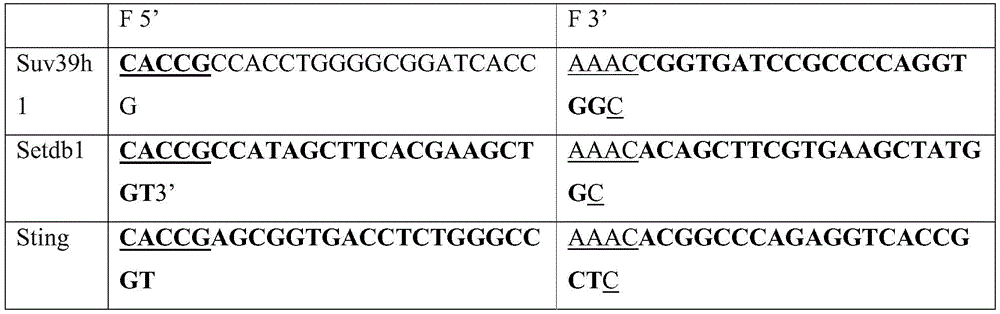
产生Suv39h1和Setdb1缺陷型B16OVA肿瘤细胞Generation of Suv39h1 and Setdb1-deficient B16OVA tumor cells
将表达B16-F10 OVA的黑色素瘤细胞在补充有10%FBS、100g/ml青霉素/链霉素和谷氨酰胺的Roswell Park Memorial Institute(RPMI)中保存。将2.5.105个接种在6孔板中。接种后24小时,用2ml新制备的病毒上清液替换培养基,并在预加热至30℃的离心机中旋转平板30分钟,2500rpm。转导后24小时更换培养基,并且转导后48小时向细胞中加入嘌呤霉素(2μg/ml,invivogen)。Melanoma cells expressing B16-F10 OVA were maintained in Roswell Park Memorial Institute (RPMI) supplemented with 10% FBS, 100 g/ml penicillin/streptomycin and glutamine. Inoculate 2.5.10 5 in 6-well plates. Twenty-four hours after inoculation, the medium was replaced with 2 ml of freshly prepared viral supernatant, and the plates were spun for 30 min in a centrifuge preheated to 30 °C, 2500 rpm. The medium was changed 24 hours after transduction and puromycin (2 μg/ml, invivogen) was added to the cells 48 hours after transduction.
用嘌呤霉素筛选细胞两周,之后通过蛋白免疫印迹(Suv39h1抗体,CellSignalling Technology、Setdb1抗体来自Abcam)检查蛋白表达。Cells were screened with puromycin for two weeks before protein expression was checked by Western blot (Suv39h1 antibody, CellSignalling Technology, Setdb1 antibody from Abcam).
对于肿瘤实验,将2.5x10⁵个适当基因型的肿瘤细胞皮下注射至C57BL6/J受者(6-8周雌性)。当肿瘤可触知时(通常在注射后5天),每周用200μg抗PDL1(Bio X Cell,10F9G2)或抗PDL 1(PD-1(Bio X Cell,RMP1-14)150g)处理动物两次。使用电子卡尺每周两次测量肿瘤,当肿瘤达到1000mm3体积(计算为0.5*W*W*L,W为肿瘤宽度,L为肿瘤长度)时,处死动物。For tumor experiments, 2.5x10⁵ tumor cells of the appropriate genotype were injected subcutaneously into C57BL6/J recipients (6-8 week old females). When tumors were palpable (usually 5 days after injection), animals were treated twice weekly with 200 μg of anti-PDL1 (Bio X Cell, 10F9G2) or anti-PDL 1 (PD-1 (Bio X Cell, RMP1-14) 150 g) Second-rate. Tumors were measured twice weekly using electronic calipers, and animals were sacrificed when tumors reached a volume of 1000 mm3 (calculated as 0.5*W*W*L, where W is tumor width and L is tumor length).
参考文献references
1Zeelenberg,I.S.et al.Targeting tumor antigens to secreted membranevesicles in vivo induces efficient antitumor immune responses.Cancer research68,1228-1235,doi:10.1158/0008-5472.CAN-07-3163(2008).1 Zeelenberg, I.S. et al. Targeting tumor antigens to secreted membranevesicles in vivo induces efficient antitumor immune responses. Cancer research 68, 1228-1235, doi: 10.1158/0008-5472. CAN-07-3163 (2008).
结果result
相比WT或Suv39h1-/-B16OVA细胞,SETDB1-/-B16OVA细胞对抗PDL1处理更敏感SETDB1 -/- B16OVA cells were more sensitive to anti-PDL1 treatment than WT or Suv39h1 -/- B16OVA cells
Suv39h1-/-或Setdb1-/-B16 OVA细胞,一种鼠黑色素瘤的同基因模型,其在B6小鼠中过继转移后生长速度与WT B16 OVA细胞相似或略快(参见图1A与1C)。Suv39h1 -/- or Setdb1 -/- B16 OVA cells, a syngeneic model of murine melanoma, grew at rates similar to or slightly faster than WT B16 OVA cells following adoptive transfer in B6 mice (see Figures 1A and 1C) .
与WT对照相比,抗PDL1处理在抑制Suv39h1-/-或SETDB1-/-B16OVA细胞生长方面非常有效。事实上,抗PD-L1处理本身在控制WT B16OVA细胞生长方面效率低下,仅略微提高了存活率。Anti-PDL1 treatment was highly effective in inhibiting the growth of Suv39h1 -/- or SETDB1 -/- B16OVA cells compared to WT controls. In fact, anti-PD-L1 treatment itself was inefficient in controlling the growth of WT B16OVA cells and only marginally improved survival.
抗PD-L1处理导致Suv39h1-/-B16OVA细胞生长减少。与此形成鲜明对比,抗PD-L1对SETDB1-/-B16OVA细胞生长的影响更为强烈,因为在60%以上的小鼠中观察到完全排斥。Anti-PD-L1 treatment resulted in decreased growth of Suv39h1 -/- B16OVA cells. In stark contrast, the effect of anti-PD-L1 on the growth of SETDB1 -/- B16OVA cells was stronger, as complete rejection was observed in more than 60% of mice.
结果表明,肿瘤细胞中SETDB1的失活增加用抗PDL1抗体进行检查点阻断治疗的功效,并且突出肿瘤细胞中的Setdb1抑制与检查点阻断治疗相结合的重要性。The results demonstrate that inactivation of SETDB1 in tumor cells increases the efficacy of checkpoint blockade therapy with anti-PDL1 antibodies and highlights the importance of combining Setdb1 inhibition in tumor cells with checkpoint blockade therapy.
与WT B16OVA细胞相比,SETDB1-/-B16OVA细胞对抗PD1处理高度敏感SETDB1 -/- B16OVA cells are highly sensitive to anti-PD1 treatment compared to WT B16OVA cells
为进一步探索Setdb1缺陷型肿瘤对检查点阻断的响应,用WT或Setdb1-KO B16OVA细胞注射WT C57BL6小鼠。当肿瘤可触知时,动物每周两次接受抗PD1抗体处理。正如预期,B16OVA细胞完全不响应于抗PD1处理。尽管Setdb1缺失本身不会导致任何肿瘤生长延迟,但Setdb1缺陷型肿瘤细胞高度响应于抗PD1处理(图2)。To further explore the response of Setdb1-deficient tumors to checkpoint blockade, WT C57BL6 mice were injected with WT or Setdb1-KO B16OVA cells. When tumors were palpable, animals were treated with anti-PD1 antibody twice weekly. As expected, B16OVA cells did not respond to anti-PD1 treatment at all. Although Setdb1 deletion itself did not cause any tumor growth delay, Setdb1-deficient tumor cells were highly responsive to anti-PD1 treatment (Figure 2).
在树突状细胞(DC)中携带Setdb1-/-条件性突变的小鼠更好地控制了肿瘤生长,并Mice carrying Setdb1 -/- conditional mutations in dendritic cells (DCs) had better control of tumor growth and 且对抗检查点治疗的响应比同窝对照更强and stronger responses to anti-checkpoint therapy than littermate controls
Setdb1-/-骨髓来源的树突状细胞(BMDC)响应于LPS处理产生更多的干扰素刺激基因(ISG),表明更强的炎性表型。为了在体内测试该表型的潜在生理相关性,我们将表达CD11c-cre的小鼠与SETDB1Flox/Flox小鼠组合,以选择性缺失DC中的SETDB1,并向其接种MCA-OVA纤维肉瘤细胞。CD11c-cre阴性的小鼠作为WT同窝对照。与Setdb1+/+小鼠相比,Setdb1-/-小鼠更有效地控制了肿瘤生长(图3)。这表明增强的SETDB1-/-髓系细胞的炎性/Isg反应促进了更好的肿瘤排斥。Setdb1 -/- bone marrow-derived dendritic cells (BMDC) produced more interferon-stimulated genes (ISGs) in response to LPS treatment, indicating a stronger inflammatory phenotype. To test the potential physiological relevance of this phenotype in vivo, we combined CD11c-cre-expressing mice with SETDB1 Flox/Flox mice to selectively delete SETDB1 in DCs and inoculated them with MCA-OVA fibrosarcoma cells . CD11c-cre-negative mice served as WT littermate controls. Setdb1 -/- mice controlled tumor growth more effectively than Setdb1 +/+ mice (Figure 3). This suggests that enhanced inflammatory/Isg responses of SETDB1 -/- myeloid cells promote better tumor rejection.
使用在DC中条件性缺失SETDB1的相同小鼠品系,我们进行了与图3类似的肿瘤实验,但施用抗PD-1或PBS作为对照(图4)。我们观察到,Setdb1-/-小鼠对抗PD-1介导的肿瘤排斥的响应明显更强,表明联合抗PD-1治疗和抑制DC中的Setdb1的潜在益处。Using the same mouse strain conditionally deleted for SETDB1 in DCs, we performed tumor experiments similar to Figure 3, but administered anti-PD-1 or PBS as controls (Figure 4). We observed that Setdb1 -/- mice responded significantly more to anti-PD-1-mediated tumor rejection, suggesting a potential benefit of combined anti-PD-1 therapy and inhibition of Setdb1 in DCs.
为了测试在SETDB1-/-小鼠增强的肿瘤排斥中对CD8+ T细胞的需求,我们通过每周施用抗CD8+抗体来耗尽它们。CD8+ T细胞的消耗显著增加了WT和KO动物的肿瘤负荷,这是控制MCA肿瘤排斥需要CD8+ T细胞。此外,这些数据将SETDB1-/-表型与CD8+ T细胞联系起来(图5)。To test the requirement for CD8 + T cells in enhanced tumor rejection in SETDB1 -/- mice, we depleted them by weekly administration of anti-CD8 + antibodies. Depletion of CD8 + T cells significantly increased tumor burden in WT and KO animals, which is required for control of MCA tumor rejection. Furthermore, these data link the SETDB1 -/- phenotype to CD8 + T cells (Figure 5).
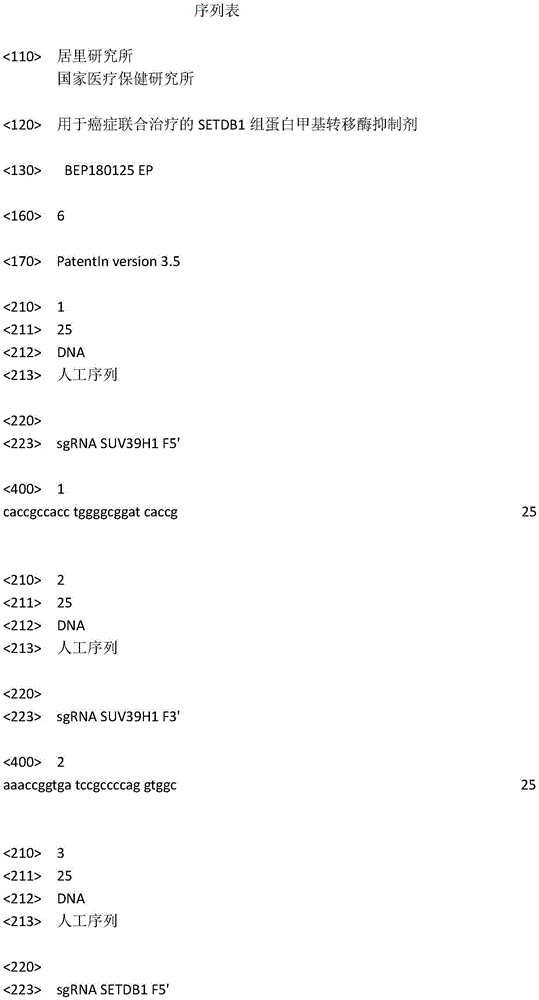

Claims (13)
Applications Claiming Priority (3)
| Application Number | Priority Date | Filing Date | Title |
|---|---|---|---|
| EP18305234 | 2018-03-06 | ||
| EP18305234.9 | 2018-03-06 | ||
| PCT/EP2019/055536 WO2019170727A1 (en) | 2018-03-06 | 2019-03-06 | Inhibitor of setdb1 histone methyltransferase for use in cancer combination therapy |
Publications (1)
| Publication Number | Publication Date |
|---|---|
| CN111867679A true CN111867679A (en) | 2020-10-30 |
Family
ID=61691418
Family Applications (1)
| Application Number | Title | Priority Date | Filing Date |
|---|---|---|---|
| CN201980017211.7A Pending CN111867679A (en) | 2018-03-06 | 2019-03-06 | SETDB1 histone methyltransferase inhibitors for cancer combination therapy |
Country Status (6)
| Country | Link |
|---|---|
| US (1) | US20200405853A1 (en) |
| EP (1) | EP3762105A1 (en) |
| JP (1) | JP2021517127A (en) |
| CN (1) | CN111867679A (en) |
| CA (1) | CA3090620A1 (en) |
| WO (1) | WO2019170727A1 (en) |
Cited By (1)
| Publication number | Priority date | Publication date | Assignee | Title |
|---|---|---|---|---|
| CN115247175A (en) * | 2021-11-25 | 2022-10-28 | 南京启真基因工程有限公司 | Construction of SETDB1 Gene Mutated Epigenetic Disorder Model Gene Editing System in Pig Nuclear Transplantation Donor Cells and Its Application |
Families Citing this family (3)
| Publication number | Priority date | Publication date | Assignee | Title |
|---|---|---|---|---|
| KR102110963B1 (en) * | 2018-07-19 | 2020-05-14 | 한국과학기술원 | Composition for regulating cancer cell division or differentiation comprising setdb1 or setdb1 inhibitor |
| CN116209676A (en) | 2020-06-22 | 2023-06-02 | 恩格姆生物制药公司 | LAIR-1 binders and methods of use thereof |
| CA3260139A1 (en) * | 2022-07-13 | 2024-01-18 | The Council Of The Queensland Institute Of Medical Research | Novel inhibitors of histone methyltransferase nuclear localisation |
Citations (1)
| Publication number | Priority date | Publication date | Assignee | Title |
|---|---|---|---|---|
| CN107750166A (en) * | 2015-06-16 | 2018-03-02 | 默克专利股份有限公司 | Combination therapy with PD‑L1 antagonists |
Family Cites Families (42)
| Publication number | Priority date | Publication date | Assignee | Title |
|---|---|---|---|---|
| US5855887A (en) | 1995-07-25 | 1999-01-05 | The Regents Of The University Of California | Blockade of lymphocyte down-regulation associated with CTLA-4 signaling |
| US6051227A (en) | 1995-07-25 | 2000-04-18 | The Regents Of The University Of California, Office Of Technology Transfer | Blockade of T lymphocyte down-regulation associated with CTLA-4 signaling |
| US5811097A (en) | 1995-07-25 | 1998-09-22 | The Regents Of The University Of California | Blockade of T lymphocyte down-regulation associated with CTLA-4 signaling |
| US6207157B1 (en) | 1996-04-23 | 2001-03-27 | The United States Of America As Represented By The Department Of Health And Human Services | Conjugate vaccine for nontypeable Haemophilus influenzae |
| US6506559B1 (en) | 1997-12-23 | 2003-01-14 | Carnegie Institute Of Washington | Genetic inhibition by double-stranded RNA |
| AUPP249298A0 (en) | 1998-03-20 | 1998-04-23 | Ag-Gene Australia Limited | Synthetic genes and genetic constructs comprising same I |
| US6566131B1 (en) | 2000-10-04 | 2003-05-20 | Isis Pharmaceuticals, Inc. | Antisense modulation of Smad6 expression |
| US6410323B1 (en) | 1999-08-31 | 2002-06-25 | Isis Pharmaceuticals, Inc. | Antisense modulation of human Rho family gene expression |
| US6107091A (en) | 1998-12-03 | 2000-08-22 | Isis Pharmaceuticals Inc. | Antisense inhibition of G-alpha-16 expression |
| US5981732A (en) | 1998-12-04 | 1999-11-09 | Isis Pharmaceuticals Inc. | Antisense modulation of G-alpha-13 expression |
| US6682736B1 (en) | 1998-12-23 | 2004-01-27 | Abgenix, Inc. | Human monoclonal antibodies to CTLA-4 |
| US6046321A (en) | 1999-04-09 | 2000-04-04 | Isis Pharmaceuticals Inc. | Antisense modulation of G-alpha-i1 expression |
| ATE354655T1 (en) | 1999-08-24 | 2007-03-15 | Medarex Inc | HUMAN ANTIBODIES TO CTLA-4 AND THEIR USES |
| US7605238B2 (en) | 1999-08-24 | 2009-10-20 | Medarex, Inc. | Human CTLA-4 antibodies and their uses |
| GB9927444D0 (en) | 1999-11-19 | 2000-01-19 | Cancer Res Campaign Tech | Inhibiting gene expression |
| JP2003526367A (en) | 2000-03-16 | 2003-09-09 | ジェネティカ インコーポレイテッド | RNA interference method and RNA interference composition |
| US6365354B1 (en) | 2000-07-31 | 2002-04-02 | Isis Pharmaceuticals, Inc. | Antisense modulation of lysophospholipase I expression |
| US6566135B1 (en) | 2000-10-04 | 2003-05-20 | Isis Pharmaceuticals, Inc. | Antisense modulation of caspase 6 expression |
| EP1456652A4 (en) | 2001-11-13 | 2005-11-02 | Dana Farber Cancer Inst Inc | AGENTS MODULATING IMMUNE CELL ACTIVITY AND METHODS OF USE THEREOF |
| JP4511943B2 (en) | 2002-12-23 | 2010-07-28 | ワイス エルエルシー | Antibody against PD-1 and use thereof |
| PL2161336T5 (en) | 2005-05-09 | 2017-10-31 | Ono Pharmaceutical Co | Human monoclonal antibodies to programmed death 1(PD-1) and methods for treating cancer using anti-PD-1 antibodies alone or in combination with other immunotherapeutics |
| CN104356236B (en) | 2005-07-01 | 2020-07-03 | E.R.施贵宝&圣斯有限责任公司 | Human monoclonal antibody against programmed death ligand 1 (PD-L1) |
| CA2691357C (en) | 2007-06-18 | 2014-09-23 | N.V. Organon | Antibodies to human programmed death receptor pd-1 |
| US8168757B2 (en) | 2008-03-12 | 2012-05-01 | Merck Sharp & Dohme Corp. | PD-1 binding proteins |
| CA2998281C (en) | 2008-09-26 | 2022-08-16 | Dana-Farber Cancer Institute, Inc. | Human anti-pd-1 antobodies and uses therefor |
| EP4331604B9 (en) | 2008-12-09 | 2025-07-23 | F. Hoffmann-La Roche AG | Anti-pd-l1 antibodies and their use to enhance t-cell function |
| US9040286B2 (en) * | 2009-02-03 | 2015-05-26 | Children's Medical Center Corporation | Diagnosis and treatment of cancer |
| ES2629337T3 (en) | 2009-02-09 | 2017-08-08 | Inserm - Institut National De La Santé Et De La Recherche Médicale | Antibodies against PD-1 and antibodies against PD-L1 and uses thereof |
| US8647623B2 (en) | 2009-04-10 | 2014-02-11 | Kyowa Hakko Kirin Co., Ltd | Method for treatment of blood tumor using anti-TIM-3 antibody |
| US20130017199A1 (en) | 2009-11-24 | 2013-01-17 | AMPLIMMUNE ,Inc. a corporation | Simultaneous inhibition of pd-l1/pd-l2 |
| WO2011082400A2 (en) | 2010-01-04 | 2011-07-07 | President And Fellows Of Harvard College | Modulators of immunoinhibitory receptor pd-1, and methods of use thereof |
| JP6158511B2 (en) | 2010-06-11 | 2017-07-05 | 協和発酵キリン株式会社 | Anti-TIM-3 antibody |
| CA2802344C (en) | 2010-06-18 | 2023-06-13 | The Brigham And Women's Hospital, Inc. | Bi-specific antibodies against tim-3 and pd-1 for immunotherapy in chronic immune conditions |
| US8907053B2 (en) | 2010-06-25 | 2014-12-09 | Aurigene Discovery Technologies Limited | Immunosuppression modulating compounds |
| WO2013006490A2 (en) | 2011-07-01 | 2013-01-10 | Cellerant Therapeutics, Inc. | Antibodies that specifically bind to tim3 |
| CN105209443B (en) | 2013-03-15 | 2018-08-07 | 百时美施贵宝公司 | Indoleamine 2,3-dioxygenase (IDO) inhibitors |
| EP2813571A1 (en) * | 2013-06-13 | 2014-12-17 | Institut d'Investigació Biomèdica de Bellvitge (IDIBELL) | Method for the treatment of lung cancer |
| US10966998B2 (en) | 2013-09-05 | 2021-04-06 | The Johns Hopkins University | Cancer therapy via a combination of epigenetic modulation and immune modulation |
| US10696745B2 (en) * | 2015-06-11 | 2020-06-30 | Wuxi Biologics (Shanghai) Co. Ltd. | Anti-PD-L1 antibodies |
| KR101966351B1 (en) * | 2016-06-08 | 2019-04-08 | 한국과학기술연구원 | Quinoline derivatives for inhibiting histone methyltransferases and use thereof |
| US10669338B2 (en) * | 2016-06-17 | 2020-06-02 | Immunomedics, Inc. | Anti-PD-1 checkpoint inhibitor antibodies that block binding of PD-L1 to PD-1 |
| MA45406A (en) * | 2016-06-17 | 2019-04-24 | Epizyme Inc | EZH2 INHIBITORS TO TREAT CANCER |
-
2019
- 2019-03-06 CN CN201980017211.7A patent/CN111867679A/en active Pending
- 2019-03-06 US US16/978,285 patent/US20200405853A1/en active Pending
- 2019-03-06 CA CA3090620A patent/CA3090620A1/en active Pending
- 2019-03-06 EP EP19707836.3A patent/EP3762105A1/en active Pending
- 2019-03-06 JP JP2020546502A patent/JP2021517127A/en active Pending
- 2019-03-06 WO PCT/EP2019/055536 patent/WO2019170727A1/en not_active Ceased
Patent Citations (1)
| Publication number | Priority date | Publication date | Assignee | Title |
|---|---|---|---|---|
| CN107750166A (en) * | 2015-06-16 | 2018-03-02 | 默克专利股份有限公司 | Combination therapy with PD‑L1 antagonists |
Non-Patent Citations (3)
| Title |
|---|
| ARCHANA VENKATARAMANA KARANTH等: "Emerging role of SETDB1 as a therapeutic target" * |
| DONGJUN PENG等: "Epigenetic silencing of TH1-type chemokines shapes tumour immunity and immunotherapy" * |
| JULIA MANTAJ等: "From Anthramycin to Pyrrolobenzodiazepine (PBD)-Containing Antibody–Drug Conjugates (ADCs)" * |
Cited By (1)
| Publication number | Priority date | Publication date | Assignee | Title |
|---|---|---|---|---|
| CN115247175A (en) * | 2021-11-25 | 2022-10-28 | 南京启真基因工程有限公司 | Construction of SETDB1 Gene Mutated Epigenetic Disorder Model Gene Editing System in Pig Nuclear Transplantation Donor Cells and Its Application |
Also Published As
| Publication number | Publication date |
|---|---|
| JP2021517127A (en) | 2021-07-15 |
| US20200405853A1 (en) | 2020-12-31 |
| CA3090620A1 (en) | 2019-09-12 |
| WO2019170727A1 (en) | 2019-09-12 |
| EP3762105A1 (en) | 2021-01-13 |
Similar Documents
| Publication | Publication Date | Title |
|---|---|---|
| US20240216388A1 (en) | Inhibitor of suv39h1 histone methyltransferase for use in cancer combination therapy | |
| AU2022231657B2 (en) | Compositions and Methods for Treating Cancer | |
| JP7109789B2 (en) | Compositions and methods for TCR reprogramming using fusion proteins | |
| CN110494558B (en) | GAMMA DELTA T cells and methods of enhancing their tumoricidal activity | |
| CN108137670A (en) | NY-ESO-1 specific TCRs and methods of use thereof | |
| CN111867679A (en) | SETDB1 histone methyltransferase inhibitors for cancer combination therapy | |
| JP2023524811A (en) | Compositions and methods for TCR reprogramming using CD70-specific fusion proteins | |
| CN115884781A (en) | Compositions and methods for enhancing immune responses | |
| WO2022086620A1 (en) | Psma-targeted immunotherapies for cancers | |
| CN120882754A (en) | Methods of treating cancer with lymphotoxin beta-receptor agonists | |
| HK40032310A (en) | Compositions and methods for treating cancer | |
| WO2023133424A2 (en) | Compositions and methods for tcr reprogramming using fusion proteins and anti-pd-1 fusion peptides | |
| HK40032310B (en) | Compositions and methods for treating cancer | |
| HK40076914A (en) | Compositions and methods for tcr reprogramming using fusion proteins | |
| WO2022063947A1 (en) | Combination of p2y6 inhibitors and immune checkpoint inhibitors |
Legal Events
| Date | Code | Title | Description |
|---|---|---|---|
| PB01 | Publication | ||
| PB01 | Publication | ||
| SE01 | Entry into force of request for substantive examination | ||
| SE01 | Entry into force of request for substantive examination | ||
| WD01 | Invention patent application deemed withdrawn after publication | ||
| WD01 | Invention patent application deemed withdrawn after publication |
Application publication date: 20201030 |