[go: up one dir, main page]

CN111808763B - Palmatolyis obovatus yeast for producing carotenoid and application thereof - Google Patents

Palmatolyis obovatus yeast for producing carotenoid and application thereof Download PDF

Info

Publication number
CN111808763B
CN111808763B CN202010891562.5A CN202010891562A CN111808763B CN 111808763 B CN111808763 B CN 111808763B CN 202010891562 A CN202010891562 A CN 202010891562A CN 111808763 B CN111808763 B CN 111808763B
Authority
CN
China
Prior art keywords
rhodotorula
carotenoid
strain
carotenoids
yeast
Prior art date
Legal status (The legal status is an assumption and is not a legal conclusion. Google has not performed a legal analysis and makes no representation as to the accuracy of the status listed.)
Active
Application number
CN202010891562.5A
Other languages
Chinese (zh)
Other versions
CN111808763A (en
Inventor
程仕伟
仉倩
门一波
董全行
李雯
刘金艳
曾世婕
Current Assignee (The listed assignees may be inaccurate. Google has not performed a legal analysis and makes no representation or warranty as to the accuracy of the list.)
Ludong University
Original Assignee
Ludong University
Priority date (The priority date is an assumption and is not a legal conclusion. Google has not performed a legal analysis and makes no representation as to the accuracy of the date listed.)
Filing date
Publication date
Application filed by Ludong University filed Critical Ludong University
Priority to CN202010891562.5A priority Critical patent/CN111808763B/en
Publication of CN111808763A publication Critical patent/CN111808763A/en
Application granted granted Critical
Publication of CN111808763B publication Critical patent/CN111808763B/en
Active legal-status Critical Current
Anticipated expiration legal-status Critical

Links

Images

Classifications

    • CCHEMISTRY; METALLURGY
    • C12BIOCHEMISTRY; BEER; SPIRITS; WINE; VINEGAR; MICROBIOLOGY; ENZYMOLOGY; MUTATION OR GENETIC ENGINEERING
    • C12NMICROORGANISMS OR ENZYMES; COMPOSITIONS THEREOF; PROPAGATING, PRESERVING, OR MAINTAINING MICROORGANISMS; MUTATION OR GENETIC ENGINEERING; CULTURE MEDIA
    • C12N1/00Microorganisms, e.g. protozoa; Compositions thereof; Processes of propagating, maintaining or preserving microorganisms or compositions thereof; Processes of preparing or isolating a composition containing a microorganism; Culture media therefor
    • C12N1/14Fungi; Culture media therefor
    • C12N1/145Fungal isolates
    • CCHEMISTRY; METALLURGY
    • C12BIOCHEMISTRY; BEER; SPIRITS; WINE; VINEGAR; MICROBIOLOGY; ENZYMOLOGY; MUTATION OR GENETIC ENGINEERING
    • C12RINDEXING SCHEME ASSOCIATED WITH SUBCLASSES C12C - C12Q, RELATING TO MICROORGANISMS
    • C12R2001/00Microorganisms ; Processes using microorganisms
    • C12R2001/645Fungi ; Processes using fungi
    • CCHEMISTRY; METALLURGY
    • C12BIOCHEMISTRY; BEER; SPIRITS; WINE; VINEGAR; MICROBIOLOGY; ENZYMOLOGY; MUTATION OR GENETIC ENGINEERING
    • C12PFERMENTATION OR ENZYME-USING PROCESSES TO SYNTHESISE A DESIRED CHEMICAL COMPOUND OR COMPOSITION OR TO SEPARATE OPTICAL ISOMERS FROM A RACEMIC MIXTURE
    • C12P23/00Preparation of compounds containing a cyclohexene ring having an unsaturated side chain containing at least ten carbon atoms bound by conjugated double bonds, e.g. carotenes

Landscapes

  • Life Sciences & Earth Sciences (AREA)
  • Chemical & Material Sciences (AREA)
  • Organic Chemistry (AREA)
  • Engineering & Computer Science (AREA)
  • Zoology (AREA)
  • Wood Science & Technology (AREA)
  • Health & Medical Sciences (AREA)
  • Genetics & Genomics (AREA)
  • Bioinformatics & Cheminformatics (AREA)
  • Biochemistry (AREA)
  • Biotechnology (AREA)
  • General Engineering & Computer Science (AREA)
  • Microbiology (AREA)
  • General Health & Medical Sciences (AREA)
  • Mycology (AREA)
  • Medicinal Chemistry (AREA)
  • Botany (AREA)
  • Tropical Medicine & Parasitology (AREA)
  • Virology (AREA)
  • Biomedical Technology (AREA)
  • Chemical Kinetics & Catalysis (AREA)
  • General Chemical & Material Sciences (AREA)
  • Micro-Organisms Or Cultivation Processes Thereof (AREA)
  • Preparation Of Compounds By Using Micro-Organisms (AREA)

Abstract

本发明公开了一株产类胡萝卜素的双倒卵形红酵母及其应用,已保藏于中国微生物菌种保藏管理委员会普通微生物中心,保藏编号为CGMCC No.20126,保藏日期为2020年6月22日。本发明所提供的双倒卵形红酵母ZQ38属于海洋微生物来源,是天然类胡萝卜素的优良生产菌株,该菌株不产毒素,为非重组菌,安全性高,符合食品安全要求;培养要求简单,发酵条件易控制,营养需求低且类胡萝卜素产率高,该菌株在类胡萝卜素的生物合成方面具有广阔的应用前景。

Figure 202010891562

The present invention discloses a carotenoid-producing strain of Rhodotorula diobovatus and its application, which have been deposited in the General Microbiology Center of the China Microorganism Culture Collection and Administration Commission, with the preservation number of CGMCC No. 20126 and the preservation date of June 22, 2020 . The Rhododendron bismuth ZQ38 provided by the invention belongs to marine microbial sources and is an excellent production strain of natural carotenoids. The strain does not produce toxins, is a non-recombinant bacteria, has high safety and meets food safety requirements; The conditions are easy to control, the nutritional requirements are low, and the yield of carotenoid is high, and the strain has broad application prospects in the biosynthesis of carotenoids.

Figure 202010891562

Description

Palmatolyis obovatus yeast for producing carotenoid and application thereof
Technical Field
The invention belongs to the technical field of marine microorganisms, and particularly relates to a carotenoid-producing double-inverted-oval rhodotorula separated from a marine environment.
Background
Carotenoids (Carotenoids) are a class of 40-carbon isoprenoid polymers that change in color due to a difference in the number of conjugated double bonds, with the color shifting toward red as the number of conjugated double bonds increases. Carotenoids are recognized worldwide as antioxidants, are excellent food additives and nutritional supplements, and are widely applied to the fields of food, cosmetics, medicines, feeds and the like.
Carotenoids are produced mainly by chemical synthesis, biosynthesis and natural extraction. The carotenoid prepared by a chemical synthesis method has the problem of solvent residue and the like, and the food safety problem is more and more concerned by society, so people are forced to find a more green preparation method. Although carotenoids extracted from natural sources are highly safe, their low content results in a complex process for extracting carotenoids and high cost. Therefore, the method for producing carotenoid by the biological synthesis method of microbial fermentation is a relatively economic production mode with high yield and high safety, and becomes a new research hotspot for preparing carotenoid.
The raw material for producing the carotenoid by microbial fermentation has wide sources, low cost, no influence of seasons, simple fermentation process, high production efficiency, stable coloring, and natural and safe property. In the technical field of producing carotenoids by microbial fermentation, cryptococcus, rhodotorula, of the yeast family, is particularly widely concerned due to the fact that the yeast does not produce toxins and has high safety.
Disclosure of Invention
In order to solve the problems, the invention obtains a rhodotorula marinum producing carotenoid by screening, and determines the screened strain to be rhodotorula obovata producing carotenoid through identification.
The technical scheme provided by the invention is as follows: a Rhodotorula obovatus for producing carotenoid, named Rhodotorula obovatusRhodotorula diobovataThe biological preservative is preserved in the China general microbiological culture Collection center, the preservation number is CGMCC number 20126, the preservation time is 6 months and 22 days in 2020, and the preservation address is Beijing in China.
Another object of the present invention is the use of the Rhodotorula obovatus for the production of carotenoids.
The Rhodotorula obovata ZQ38 of the invention is separated from the natural growing undaria pinnatifida skin in the seawater environment of Qingdao city in Shandong province, the growing bacterial colony on WL nutrient agar medium is of medium size, circular or oval shape, the surface is smooth and moist, the middle part is raised, the bacterial colony edge is neat, and the color is uniform, and the color is brick red; the shape of the somatic cell is circular or oval under the observation of a microscope, and the somatic cell is multilateral budding.
The double-inverted-oval rhodotorula ZQ38 of the invention is easy to culture, grows well on yeast extract peptone glucose medium (YPD) and WL nutrient agar medium, has low nutrient requirement, and can be normally cultured at 20-35 ℃.
The invention has the beneficial effects that: the invention is the double-inverted-egg-shaped rhodotorula yeast from natural habitat, does not produce toxin, is non-recombinant bacteria, has high safety and meets the food safety requirement; the culture requirement is simple, the fermentation condition is easy to control, the nutrition requirement is low, the carotenoid yield is high, and the strain has wide application prospect in the carotenoid biosynthesis aspect.
Drawings
FIG. 1 is a graph of growth characteristics of Rhodotorula obovata ZQ38 on WL nutrient agar medium;
FIG. 2 is a characteristic view of Rhodotorula obovata ZQ38 observed by a microscope.
Detailed Description
The following examples are given for the detailed implementation and specific operation of the present invention, but the scope of the present invention is not limited to the following examples.
Example 1: screening of rhodotorula benthica producing carotenoids
1. Preparation of the culture Medium
1) The screening culture medium of the rhodotorula benthamii is a WL nutrient agar culture medium: 5g/L yeast powder, 5g/L peptone, 50g/L glucose, 0.55g/L monopotassium phosphate, 0.425g/L potassium chloride, 0.125g/L calcium chloride, 0.125g/L magnesium sulfate, 0.0025g/L ferric chloride, 0.0025g/L manganese sulfate, 0.022g/L bromocresol green, 20g/L agar powder, 0.1g/L chloramphenicol, and the pH value is 6.5. The culture medium is prepared from aged seawater, autoclaved at 115 deg.C for 20min, and poured into a flat plate for use, wherein bromocresol green and chloramphenicol are separately added when the sterilized culture medium is cooled to 65 deg.C.
2) The screening culture medium for producing the carotenoid comprises the following components: 20g/L glucose, 2g/L ammonium sulfate, 1g/L potassium dihydrogen phosphate, 0.5g/L magnesium sulfate, 1g/L calcium chloride, 5g/L yeast powder and old seawater, and has natural pH.
2. Screening of the marine rhodotorula: taking 5g of undaria pinnatifida naturally growing in a seawater environment, adding the undaria pinnatifida which is sterilized in advance and filled with 500mL of seawater into a triangular flask, shaking for 5min, performing gradient dilution, coating the mixture on a WL nutrient agar culture medium, culturing for 4d in a constant-temperature shaking table at 28 ℃, selecting strains with smooth and moist surfaces and red colors of bacterial colonies, and performing multiple scribing and purification on a WL nutrient agar culture medium plate to obtain pure strain culture.
3. Screening of rhodotorula benthica for producing carotenoid: selecting a ring of screened rhodotorula benthica, adding a sterilized carotenoid production screening culture medium, wherein the liquid loading capacity is 100mL/500mL, culturing in a constant temperature shaking table at 200r/min and 28 ℃ for 72h, and then determining the carotenoid content and the dry weight of thalli.
4. Determination of carotenoid content: centrifuging the fermentation liquor at 4000 r/min for 15 min, removing supernatant, washing thallus precipitate with distilled water for 2-3 times, centrifuging, removing supernatant, and oven drying the thallus-containing centrifuge tube in an oven at 55 deg.C to constant weight. Weighing 0.1g of rhodotorula benthica dried to constant weight, adding 2.4 mL of 3mol/L hydrochloric acid, standing at room temperature for 1h, heating in a boiling water bath for 4 min, rapidly cooling with ice water, centrifuging at 4000 r/min for 10 min, discarding the supernatant, washing the precipitate with water, centrifuging again, and repeating for 2 times to obtain cell fragments. Adding 10mL acetone solution into cell debris, vortex shaking at room temperature for 15 min, centrifuging at 4000 r/min for 10 min, collecting supernatant, repeatedly leaching for 2 times to obtain supernatant as carotenoid extract, and measuring light absorption value of the extract at 475 nm. Carotenoid content (μ g/g dry cell) = a × D × V/0.16 × W, where a is absorbance at 475nm, D is dilution factor, V is acetone amount (mL), W is yeast weight (g), and 0.16 is molar extinction coefficient of carotenoid.
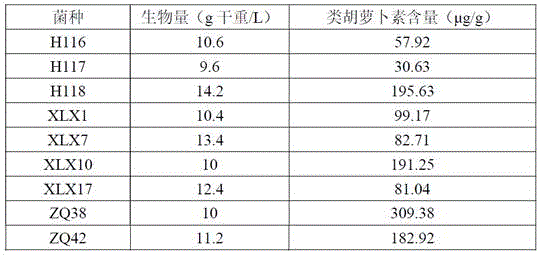
The carotenoid yield of the screened strains is shown in table 1, wherein the carotenoid yield of the strain ZQ38 is the highest among 9 strains of rhodotorula benthica obtained by screening and detected, and reaches 309.38 mug/g.
TABLE 1 screening of the carotenoid content of Rhodotorula marinus
Figure 417675DEST_PATH_IMAGE001
Example 2: genus identification of Rhodotorula marinus ZQ38
Morphological characteristics: as shown in figure 1, the rhodotorula benthica ZQ38 grows on WL nutrient agar medium to have a medium-sized colony, a circular or oval shape, a smooth and wet surface, a raised middle part, regular edges of the colony, uniform color and brick red color; as shown in FIG. 2, the cell morphology of the bacterial cells was observed by microscope to be circular or oval, and the cells were obtained by multilateral budding.
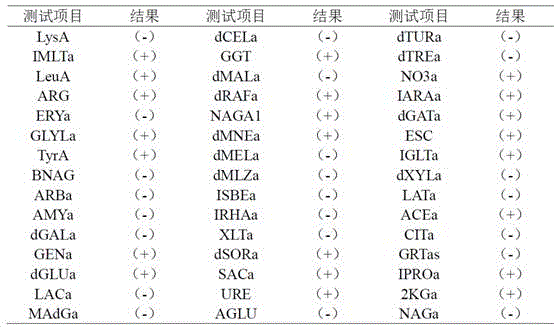
Physiological and biochemical identification is carried out through a full-automatic microorganism analyzer, the test and identification results are shown in table 2, the physiological and biochemical characteristics of the rhodotorula are met, and the rhodotorula obovata is preliminarily judged.
TABLE 2 physiological and biochemical identification results of Rhodotorula benthica ZQ38
Figure 334816DEST_PATH_IMAGE002
26S rDNA D1/D2 region sequence analysis of rhodotorula benthica ZQ 38: extracting genome DNA of a strain ZQ38 by a CTAB method, and amplifying by adopting a universal primer pair for amplifying 26S rDNA D1/D2 region sequences, wherein the amplification procedure is as follows: 10 min at 94 ℃; 30 s at 94 ℃, 30 s at 50 ℃, 1 min at 72 ℃ and 35 cycles; 10 min at 72 ℃. And (3) carrying out agarose gel electrophoresis on the PCR product, cutting a required DNA band by using the electrophoresis result of the PCR product, and carrying out sequencing by a company after recovering by using a gel recovery kit. The 26S rDNA gene sequence obtained by sequencing has a length of 618bp, and the alignment analysis of BLAST on GenBank finds that the strain and the gene sequence are comparedRhodotorula diobovata(NG 042340.1) the 26S rDNA sequences were highly similar and were judged to be identical (degree of similarity 99.67%).
Combining the morphological, physiological and biochemical indexes and the molecular identification result to determine that the rhodotorula benthica ZQ38 is the rhodotorula obovata (Rhodotorula diobovata)。
The specific gene sequence is shown in a sequence table.
Example 3: fermentation production of carotenoid by using double-reverse oval rhodotorula ZQ38
1) Activating strains: the Rhodotorula obovata ZQ38 strain preserved on the slant was picked to 1 ring, inoculated into a 50mL/250mL Erlenmeyer flask, and activated and cultured at 28 ℃ for 48 hours at 200 r/min. Activation medium used: 20g/L glucose, 20g/L peptone, 10g/L yeast powder and aged seawater, wherein the pH is natural, and the sterilization is carried out for 20min at 115 ℃.
2) Production of carotenoids by fermentation
Using a preferred fermentation medium 1: 15g/L of sucrose, 2g/L of ammonium sulfate, 1g/L of monopotassium phosphate, 0.5g/L of magnesium sulfate, 1g/L of calcium chloride, 5g/L of yeast powder and old seawater, wherein the pH is natural, the liquid filling amount is 100mL/500mL, and the sterilization is carried out for 20min at 121 ℃. Inoculating activated strain with 6% (v/v) inoculum size, fermenting and culturing in constant temperature shaker at 28 deg.C and rotation speed of 200r/min for 3d, extracting carotenoid according to the method of example 1, and determining carotenoid content in the fermented sample to be 461.86 μ g/g.
Using preferred fermentation medium 2: 20g/L of cane sugar, 5g/L of ammonium sulfate, 2g/L of magnesium sulfate and aged seawater, the pH value is 6, the liquid filling amount is 100mL/500mL, and the sterilization is carried out for 20min at 121 ℃. Inoculating activated strain with 10% (v/v) inoculum size, fermenting and culturing in constant temperature shaking table at 28 deg.C and rotation speed of 160r/min for 3d, extracting carotenoid according to the method of example 1, and determining carotenoid content in the fermented sample to be 503.75 μ g/g.
Using a preferred fermentation medium 3: 20g/L of sucrose, 4g/L of ammonium sulfate, 1g/L of peptone, 1.5g/L of magnesium sulfate, 0.5g/L of calcium chloride and aged seawater, wherein the pH value is 6.5, the liquid loading amount is 100mL/500mL, and the sterilization is carried out for 20min at 121 ℃. Inoculating activated strain with 8% (v/v) inoculum size, fermenting and culturing in constant temperature shaking table at 28 deg.C and rotation speed of 180r/min for 3d, extracting carotenoid according to the method in example 1, and determining carotenoid content in the fermented sample to be 582.93 μ g/g.
It should be understood that parts of the specification not set forth in detail are well within the prior art. The above examples are only for describing the preferred embodiments of the present invention, and are not intended to limit the scope of the present invention, and various modifications and improvements made to the technical solution of the present invention by those skilled in the art without departing from the spirit of the present invention should fall within the protection scope defined by the claims of the present invention.
Sequence listing
<110> university of Ludong
<120> a double-inverted-egg-shaped rhodotorula yeast strain for producing carotenoid and application thereof
<130> 2020
<160> 1
<170> SIPOSequenceListing 1.0
<210> 1
<211> 618
<212> DNA
<213> Rhodotorula yeast (Rhodotorula diobouata)
<400> 1
gcatatcaaa agcggaggaa aagaaactaa caaggattcc cctagtagcg gcgagcgaag 60
cgggaagagc tcaaatttat aatctggcac cttcggtgtc cgagttgtaa tctctagaag 120
tgttttccgc gttggaccgc acacaagtct gttggaatac agcggcatag tggtgaaacc 180
cccgtatatg gtgcggacgc ccagcgcttt gtgatacact ttcaatgagt cgagttgttt 240
gggaatgcag ctcaaattgg gtggtaaatt ccatctaaag ctaaatattg gcgagagacc 300
gatagcgaac aagtaccgtg agggaaagat gaaaagcact ttggaaagag agttaacagt 360
acgtgaaatt gttggaaggg aaacgcttga agtcagactt gcttgccgga gcttgcttcg 420
gtttgcaggc cagcatcagt tttccggggt ggataatgac ggtttgaagg tagcagtctc 480
ggctgtgtta tagctttccg ttggatacgc cctgggggac tgaggaacgc agcgtgcttt 540
ttgcgaaaga ctcgtctttt tcacgcttag gatgctggtg gaatggcttt aaacgacccg 600
tcttgaaacc acggacca 618

Claims (2)

1. A rhodotorula obovata for producing carotenoid is characterized in that the rhodotorula obovata is named by classificationRhodotorula diobovataThe strain is preserved in China general microbiological culture Collection center with the preservation number of CGMCC No.20126, the preservation time is 22 months 6 in 2020, and the preservation address is Beijing in China.
2. Use of the Rhodotorula obovata as claimed in claim 1 for the production of carotenoids.
CN202010891562.5A 2020-08-31 2020-08-31 Palmatolyis obovatus yeast for producing carotenoid and application thereof Active CN111808763B (en)

Priority Applications (1)

Application Number Priority Date Filing Date Title
CN202010891562.5A CN111808763B (en) 2020-08-31 2020-08-31 Palmatolyis obovatus yeast for producing carotenoid and application thereof

Applications Claiming Priority (1)

Application Number Priority Date Filing Date Title
CN202010891562.5A CN111808763B (en) 2020-08-31 2020-08-31 Palmatolyis obovatus yeast for producing carotenoid and application thereof

Publications (2)

Publication Number Publication Date
CN111808763A CN111808763A (en) 2020-10-23
CN111808763B true CN111808763B (en) 2021-01-22

Family

ID=72859166

Family Applications (1)

Application Number Title Priority Date Filing Date
CN202010891562.5A Active CN111808763B (en) 2020-08-31 2020-08-31 Palmatolyis obovatus yeast for producing carotenoid and application thereof

Country Status (1)

Country Link
CN (1) CN111808763B (en)

Families Citing this family (2)

* Cited by examiner, † Cited by third party
Publication number Priority date Publication date Assignee Title
CN115895922B (en) * 2022-12-19 2024-04-02 云南大学 Rhodotorula graminea for high-yield carotenoid and application thereof
CN117305141A (en) * 2023-10-12 2023-12-29 鲁东大学 Method for preparing double-inverted oval rhodotorula live bacteria preparation by taking high-salt soy sauce lees as base material through fermentation

Citations (2)

* Cited by examiner, † Cited by third party
Publication number Priority date Publication date Assignee Title
CN104928199A (en) * 2015-07-01 2015-09-23 青岛大学 Copper-enriching rhodotorula benthica strain of high-yield carotenoid and fermentation cultivation method thereof
CN108531408A (en) * 2017-03-06 2018-09-14 福建大北农水产科技有限公司 One plant of rhodotorula mucilaginosa new strains and probiotics

Family Cites Families (3)

* Cited by examiner, † Cited by third party
Publication number Priority date Publication date Assignee Title
FI126781B (en) * 2015-05-25 2017-05-31 Neste Corp Methods for continuous production of microorganisms
CN108531409B (en) * 2017-03-06 2022-06-03 福建大北农水产科技有限公司 High-density fermentation method of rhodotorula benthica
CN110923156B (en) * 2019-12-11 2021-09-21 自然资源部第三海洋研究所 Yeast Y5 for resisting aquatic pathogenic bacteria and producing lipase, separation method and application thereof, feed additive and preparation method thereof

Patent Citations (2)

* Cited by examiner, † Cited by third party
Publication number Priority date Publication date Assignee Title
CN104928199A (en) * 2015-07-01 2015-09-23 青岛大学 Copper-enriching rhodotorula benthica strain of high-yield carotenoid and fermentation cultivation method thereof
CN108531408A (en) * 2017-03-06 2018-09-14 福建大北农水产科技有限公司 One plant of rhodotorula mucilaginosa new strains and probiotics

Also Published As

Publication number Publication date
CN111808763A (en) 2020-10-23

Similar Documents

Publication Publication Date Title
WO2020181765A1 (en) Geomyces mutant strain and application thereof
CN111808763B (en) Palmatolyis obovatus yeast for producing carotenoid and application thereof
CN102586151B (en) High-yield polysaccharide strain and method for producing polysaccharide by utilizing strain through fermentation
CN107267401B (en) Mucor strain and application thereof in fermenting green brick tea
CN104630076B (en) High yield amylase monascus parpureus Went(Monascus purpureus)The bacterial strains of Mp 42 and its application
CN108823101B (en) Anthocyanin producing strain CH18 and application thereof
CN1124350C (en) Strain of Penicillium oxalicum var. armenia and its application
CN105331548B (en) A kind of lilac mushroom strain and its liquid strain and preparation method
CN110616150B (en) High-yield polysaccharide eupatorium adenophorum endophytic fungus and application thereof
CN102174414B (en) Application of new morchella costata M8-13 liquid fermentation substance in development of health-care products and medicaments
CN112175887A (en) A kind of Verticillium dahlia endosymbiotic bacteria Brevimonas and its application
CN107674841A (en) A kind of Aureobasidium pullulans of high yield polymalic acid and application thereof
CN103865841B (en) A kind of bacillus aceticus and the fruit vinegar utilizing apricot skin slag solid state fermentation to prepare thereof
CN102337225A (en) Preparation method of high-nitrogen fresh yeast and extract
CN106995789B (en) Resveratrol zymocyte and application thereof
CN120158404A (en) A Priesterol bacterium and a method for producing PHA by semi-solid fermentation using the bacterium
CN103361278A (en) Athelia rolfsii and method for preparing scleroglucan fermentation broth by adopting athelia rolfsii
CN119410511A (en) A high-yield lactic acid strain and its application
CN115029274B (en) New strain of genus Sphaerococcus for producing carotenoid and its use
CN107058409B (en) A kind of method and application of catalyzing natural anthocyanin to convert protocatechuic acid with microbial whole cell
CN106434435A (en) Acetobacter indonesiensis and application in accelerating separation and settlement of mung bean starch
CN110218662A (en) A kind of thermophilic low temperature produces fragrant characteristic U.S. pole plum surprise yeast outstanding and its application
TWI714258B (en) Preparation method for improving phycoerythrin yield
CN111117923B (en) A new strain Gj-4 of Lahenia aquatica with the function of degrading pectin
CN107118972B (en) Can liquid fermentation produce pectin Solidago Canadensis endogenetic fungus and its application

Legal Events

Date Code Title Description
PB01 Publication
PB01 Publication
SE01 Entry into force of request for substantive examination
GR01 Patent grant
GR01 Patent grant
PE01 Entry into force of the registration of the contract for pledge of patent right

Denomination of invention: A carotenoid producing double inverted egg red yeast and its application

Effective date of registration: 20211216

Granted publication date: 20210122

Pledgee: Yantai financing guarantee Group Co.,Ltd.

Pledgor: LUDONG University

Registration number: Y2021980015152

PC01 Cancellation of the registration of the contract for pledge of patent right

Date of cancellation: 20220317

Granted publication date: 20210122

Pledgee: Yantai financing guarantee Group Co.,Ltd.

Pledgor: LUDONG University

Registration number: Y2021980015152