CN111801405A - Lubricating oil composition and viscosity modifier for lubricating oil - Google Patents
Lubricating oil composition and viscosity modifier for lubricating oil Download PDFInfo
- Publication number
- CN111801405A CN111801405A CN201980016497.7A CN201980016497A CN111801405A CN 111801405 A CN111801405 A CN 111801405A CN 201980016497 A CN201980016497 A CN 201980016497A CN 111801405 A CN111801405 A CN 111801405A
- Authority
- CN
- China
- Prior art keywords
- lubricating oil
- copolymer
- oil composition
- viscosity
- ethylene
- Prior art date
- Legal status (The legal status is an assumption and is not a legal conclusion. Google has not performed a legal analysis and makes no representation as to the accuracy of the status listed.)
- Pending
Links
Images

Classifications
-
- C—CHEMISTRY; METALLURGY
- C10—PETROLEUM, GAS OR COKE INDUSTRIES; TECHNICAL GASES CONTAINING CARBON MONOXIDE; FUELS; LUBRICANTS; PEAT
- C10M—LUBRICATING COMPOSITIONS; USE OF CHEMICAL SUBSTANCES EITHER ALONE OR AS LUBRICATING INGREDIENTS IN A LUBRICATING COMPOSITION
- C10M143/00—Lubricating compositions characterised by the additive being a macromolecular hydrocarbon or such hydrocarbon modified by oxidation
- C10M143/08—Lubricating compositions characterised by the additive being a macromolecular hydrocarbon or such hydrocarbon modified by oxidation containing aliphatic monomer having more than 4 carbon atoms
-
- C—CHEMISTRY; METALLURGY
- C10—PETROLEUM, GAS OR COKE INDUSTRIES; TECHNICAL GASES CONTAINING CARBON MONOXIDE; FUELS; LUBRICANTS; PEAT
- C10M—LUBRICATING COMPOSITIONS; USE OF CHEMICAL SUBSTANCES EITHER ALONE OR AS LUBRICATING INGREDIENTS IN A LUBRICATING COMPOSITION
- C10M107/00—Lubricating compositions characterised by the base-material being a macromolecular compound
- C10M107/02—Hydrocarbon polymers; Hydrocarbon polymers modified by oxidation
- C10M107/04—Polyethene
-
- C—CHEMISTRY; METALLURGY
- C08—ORGANIC MACROMOLECULAR COMPOUNDS; THEIR PREPARATION OR CHEMICAL WORKING-UP; COMPOSITIONS BASED THEREON
- C08L—COMPOSITIONS OF MACROMOLECULAR COMPOUNDS
- C08L23/00—Compositions of homopolymers or copolymers of unsaturated aliphatic hydrocarbons having only one carbon-to-carbon double bond; Compositions of derivatives of such polymers
- C08L23/02—Compositions of homopolymers or copolymers of unsaturated aliphatic hydrocarbons having only one carbon-to-carbon double bond; Compositions of derivatives of such polymers not modified by chemical after-treatment
- C08L23/04—Homopolymers or copolymers of ethene
- C08L23/08—Copolymers of ethene
- C08L23/0807—Copolymers of ethene with unsaturated hydrocarbons only containing four or more carbon atoms
- C08L23/0815—Copolymers of ethene with unsaturated hydrocarbons only containing four or more carbon atoms with aliphatic 1-olefins containing one carbon-to-carbon double bond
-
- C—CHEMISTRY; METALLURGY
- C08—ORGANIC MACROMOLECULAR COMPOUNDS; THEIR PREPARATION OR CHEMICAL WORKING-UP; COMPOSITIONS BASED THEREON
- C08L—COMPOSITIONS OF MACROMOLECULAR COMPOUNDS
- C08L91/00—Compositions of oils, fats or waxes; Compositions of derivatives thereof
-
- C—CHEMISTRY; METALLURGY
- C10—PETROLEUM, GAS OR COKE INDUSTRIES; TECHNICAL GASES CONTAINING CARBON MONOXIDE; FUELS; LUBRICANTS; PEAT
- C10M—LUBRICATING COMPOSITIONS; USE OF CHEMICAL SUBSTANCES EITHER ALONE OR AS LUBRICATING INGREDIENTS IN A LUBRICATING COMPOSITION
- C10M143/00—Lubricating compositions characterised by the additive being a macromolecular hydrocarbon or such hydrocarbon modified by oxidation
- C10M143/02—Polyethene
-
- C—CHEMISTRY; METALLURGY
- C10—PETROLEUM, GAS OR COKE INDUSTRIES; TECHNICAL GASES CONTAINING CARBON MONOXIDE; FUELS; LUBRICANTS; PEAT
- C10M—LUBRICATING COMPOSITIONS; USE OF CHEMICAL SUBSTANCES EITHER ALONE OR AS LUBRICATING INGREDIENTS IN A LUBRICATING COMPOSITION
- C10M2203/00—Organic non-macromolecular hydrocarbon compounds and hydrocarbon fractions as ingredients in lubricant compositions
- C10M2203/10—Petroleum or coal fractions, e.g. tars, solvents, bitumen
- C10M2203/102—Aliphatic fractions
- C10M2203/1025—Aliphatic fractions used as base material
-
- C—CHEMISTRY; METALLURGY
- C10—PETROLEUM, GAS OR COKE INDUSTRIES; TECHNICAL GASES CONTAINING CARBON MONOXIDE; FUELS; LUBRICANTS; PEAT
- C10M—LUBRICATING COMPOSITIONS; USE OF CHEMICAL SUBSTANCES EITHER ALONE OR AS LUBRICATING INGREDIENTS IN A LUBRICATING COMPOSITION
- C10M2205/00—Organic macromolecular hydrocarbon compounds or fractions, whether or not modified by oxidation as ingredients in lubricant compositions
- C10M2205/02—Organic macromolecular hydrocarbon compounds or fractions, whether or not modified by oxidation as ingredients in lubricant compositions containing acyclic monomers
- C10M2205/022—Ethene
-
- C—CHEMISTRY; METALLURGY
- C10—PETROLEUM, GAS OR COKE INDUSTRIES; TECHNICAL GASES CONTAINING CARBON MONOXIDE; FUELS; LUBRICANTS; PEAT
- C10M—LUBRICATING COMPOSITIONS; USE OF CHEMICAL SUBSTANCES EITHER ALONE OR AS LUBRICATING INGREDIENTS IN A LUBRICATING COMPOSITION
- C10M2205/00—Organic macromolecular hydrocarbon compounds or fractions, whether or not modified by oxidation as ingredients in lubricant compositions
- C10M2205/02—Organic macromolecular hydrocarbon compounds or fractions, whether or not modified by oxidation as ingredients in lubricant compositions containing acyclic monomers
- C10M2205/022—Ethene
- C10M2205/0225—Ethene used as base material
-
- C—CHEMISTRY; METALLURGY
- C10—PETROLEUM, GAS OR COKE INDUSTRIES; TECHNICAL GASES CONTAINING CARBON MONOXIDE; FUELS; LUBRICANTS; PEAT
- C10M—LUBRICATING COMPOSITIONS; USE OF CHEMICAL SUBSTANCES EITHER ALONE OR AS LUBRICATING INGREDIENTS IN A LUBRICATING COMPOSITION
- C10M2209/00—Organic macromolecular compounds containing oxygen as ingredients in lubricant compositions
- C10M2209/02—Macromolecular compounds obtained by reactions only involving carbon-to-carbon unsaturated bonds
- C10M2209/08—Macromolecular compounds obtained by reactions only involving carbon-to-carbon unsaturated bonds containing monomers having an unsaturated radical bound to a carboxyl radical, e.g. acrylate type
- C10M2209/084—Acrylate; Methacrylate
-
- C—CHEMISTRY; METALLURGY
- C10—PETROLEUM, GAS OR COKE INDUSTRIES; TECHNICAL GASES CONTAINING CARBON MONOXIDE; FUELS; LUBRICANTS; PEAT
- C10M—LUBRICATING COMPOSITIONS; USE OF CHEMICAL SUBSTANCES EITHER ALONE OR AS LUBRICATING INGREDIENTS IN A LUBRICATING COMPOSITION
- C10M2223/00—Organic non-macromolecular compounds containing phosphorus as ingredients in lubricant compositions
- C10M2223/02—Organic non-macromolecular compounds containing phosphorus as ingredients in lubricant compositions having no phosphorus-to-carbon bonds
- C10M2223/04—Phosphate esters
- C10M2223/045—Metal containing thio derivatives
-
- C—CHEMISTRY; METALLURGY
- C10—PETROLEUM, GAS OR COKE INDUSTRIES; TECHNICAL GASES CONTAINING CARBON MONOXIDE; FUELS; LUBRICANTS; PEAT
- C10N—INDEXING SCHEME ASSOCIATED WITH SUBCLASS C10M RELATING TO LUBRICATING COMPOSITIONS
- C10N2010/00—Metal present as such or in compounds
- C10N2010/02—Groups 1 or 11
-
- C—CHEMISTRY; METALLURGY
- C10—PETROLEUM, GAS OR COKE INDUSTRIES; TECHNICAL GASES CONTAINING CARBON MONOXIDE; FUELS; LUBRICANTS; PEAT
- C10N—INDEXING SCHEME ASSOCIATED WITH SUBCLASS C10M RELATING TO LUBRICATING COMPOSITIONS
- C10N2010/00—Metal present as such or in compounds
- C10N2010/04—Groups 2 or 12
-
- C—CHEMISTRY; METALLURGY
- C10—PETROLEUM, GAS OR COKE INDUSTRIES; TECHNICAL GASES CONTAINING CARBON MONOXIDE; FUELS; LUBRICANTS; PEAT
- C10N—INDEXING SCHEME ASSOCIATED WITH SUBCLASS C10M RELATING TO LUBRICATING COMPOSITIONS
- C10N2020/00—Specified physical or chemical properties or characteristics, i.e. function, of component of lubricating compositions
- C10N2020/01—Physico-chemical properties
- C10N2020/011—Cloud point
-
- C—CHEMISTRY; METALLURGY
- C10—PETROLEUM, GAS OR COKE INDUSTRIES; TECHNICAL GASES CONTAINING CARBON MONOXIDE; FUELS; LUBRICANTS; PEAT
- C10N—INDEXING SCHEME ASSOCIATED WITH SUBCLASS C10M RELATING TO LUBRICATING COMPOSITIONS
- C10N2020/00—Specified physical or chemical properties or characteristics, i.e. function, of component of lubricating compositions
- C10N2020/01—Physico-chemical properties
- C10N2020/02—Viscosity; Viscosity index
-
- C—CHEMISTRY; METALLURGY
- C10—PETROLEUM, GAS OR COKE INDUSTRIES; TECHNICAL GASES CONTAINING CARBON MONOXIDE; FUELS; LUBRICANTS; PEAT
- C10N—INDEXING SCHEME ASSOCIATED WITH SUBCLASS C10M RELATING TO LUBRICATING COMPOSITIONS
- C10N2030/00—Specified physical or chemical properties which is improved by the additive characterising the lubricating composition, e.g. multifunctional additives
- C10N2030/02—Pour-point; Viscosity index
-
- C—CHEMISTRY; METALLURGY
- C10—PETROLEUM, GAS OR COKE INDUSTRIES; TECHNICAL GASES CONTAINING CARBON MONOXIDE; FUELS; LUBRICANTS; PEAT
- C10N—INDEXING SCHEME ASSOCIATED WITH SUBCLASS C10M RELATING TO LUBRICATING COMPOSITIONS
- C10N2030/00—Specified physical or chemical properties which is improved by the additive characterising the lubricating composition, e.g. multifunctional additives
- C10N2030/08—Resistance to extreme temperature
-
- C—CHEMISTRY; METALLURGY
- C10—PETROLEUM, GAS OR COKE INDUSTRIES; TECHNICAL GASES CONTAINING CARBON MONOXIDE; FUELS; LUBRICANTS; PEAT
- C10N—INDEXING SCHEME ASSOCIATED WITH SUBCLASS C10M RELATING TO LUBRICATING COMPOSITIONS
- C10N2030/00—Specified physical or chemical properties which is improved by the additive characterising the lubricating composition, e.g. multifunctional additives
- C10N2030/68—Shear stability
-
- C—CHEMISTRY; METALLURGY
- C10—PETROLEUM, GAS OR COKE INDUSTRIES; TECHNICAL GASES CONTAINING CARBON MONOXIDE; FUELS; LUBRICANTS; PEAT
- C10N—INDEXING SCHEME ASSOCIATED WITH SUBCLASS C10M RELATING TO LUBRICATING COMPOSITIONS
- C10N2040/00—Specified use or application for which the lubricating composition is intended
- C10N2040/25—Internal-combustion engines
-
- C—CHEMISTRY; METALLURGY
- C10—PETROLEUM, GAS OR COKE INDUSTRIES; TECHNICAL GASES CONTAINING CARBON MONOXIDE; FUELS; LUBRICANTS; PEAT
- C10N—INDEXING SCHEME ASSOCIATED WITH SUBCLASS C10M RELATING TO LUBRICATING COMPOSITIONS
- C10N2040/00—Specified use or application for which the lubricating composition is intended
- C10N2040/25—Internal-combustion engines
- C10N2040/252—Diesel engines
-
- C—CHEMISTRY; METALLURGY
- C10—PETROLEUM, GAS OR COKE INDUSTRIES; TECHNICAL GASES CONTAINING CARBON MONOXIDE; FUELS; LUBRICANTS; PEAT
- C10N—INDEXING SCHEME ASSOCIATED WITH SUBCLASS C10M RELATING TO LUBRICATING COMPOSITIONS
- C10N2040/00—Specified use or application for which the lubricating composition is intended
- C10N2040/25—Internal-combustion engines
- C10N2040/255—Gasoline engines
-
- C—CHEMISTRY; METALLURGY
- C10—PETROLEUM, GAS OR COKE INDUSTRIES; TECHNICAL GASES CONTAINING CARBON MONOXIDE; FUELS; LUBRICANTS; PEAT
- C10N—INDEXING SCHEME ASSOCIATED WITH SUBCLASS C10M RELATING TO LUBRICATING COMPOSITIONS
- C10N2040/00—Specified use or application for which the lubricating composition is intended
- C10N2040/25—Internal-combustion engines
- C10N2040/255—Gasoline engines
- C10N2040/26—Two-strokes or two-cycle engines
-
- C—CHEMISTRY; METALLURGY
- C10—PETROLEUM, GAS OR COKE INDUSTRIES; TECHNICAL GASES CONTAINING CARBON MONOXIDE; FUELS; LUBRICANTS; PEAT
- C10N—INDEXING SCHEME ASSOCIATED WITH SUBCLASS C10M RELATING TO LUBRICATING COMPOSITIONS
- C10N2070/00—Specific manufacturing methods for lubricant compositions
Landscapes
- Chemical & Material Sciences (AREA)
- Chemical Kinetics & Catalysis (AREA)
- Organic Chemistry (AREA)
- Oil, Petroleum & Natural Gas (AREA)
- General Chemical & Material Sciences (AREA)
- Health & Medical Sciences (AREA)
- Medicinal Chemistry (AREA)
- Polymers & Plastics (AREA)
- Lubricants (AREA)
Abstract
润滑油组合物,其含有来自乙烯的结构单元的含有比例为70~90摩尔%、且特性粘度[η]为0.3~1.0dl/g的乙烯·α‑烯烃共聚物(A)。
A lubricating oil composition comprising an ethylene-α-olefin copolymer (A) having a structural unit derived from ethylene in a proportion of 70 to 90 mol% and an intrinsic viscosity [η] of 0.3 to 1.0 dl/g.
Description
技术领域technical field
本发明涉及润滑油组合物及润滑油用粘度调节剂。The present invention relates to a lubricating oil composition and a viscosity modifier for lubricating oil.
背景技术Background technique
石油制品通常具有温度变化时粘度大幅变化的所谓粘度的温度依赖性。例如,对于被用于汽车的润滑油而言,优选粘度的温度依赖性小。因此,在润滑油中,出于减小粘度的温度依赖性的目的,使用了可溶于润滑油基油的某种类的聚合物作为粘度调节剂。Petroleum products generally have a so-called temperature dependence of viscosity in which the viscosity changes greatly with a change in temperature. For example, for lubricating oils used for automobiles, it is preferable that the temperature dependence of the viscosity is small. Therefore, in lubricating oil, some kind of polymer soluble in lubricating base oil is used as a viscosity modifier for the purpose of reducing the temperature dependence of viscosity.
作为润滑油用粘度调节剂,广泛使用了乙烯·α-烯烃共聚物,为了进一步改善润滑油的性能均衡性,进行了各种改良(例如,参见专利文献1)。As viscosity modifiers for lubricating oils, ethylene-α-olefin copolymers are widely used, and various improvements have been made in order to further improve the performance balance of lubricating oils (for example, see Patent Document 1).
近年来,从石油资源的减少、地球变暖这样的环境问题考虑,要求提高汽车的燃油效率,以期减少废气污染物质、CO2的排放量。基于润滑油而实现的节油与润滑机械的物理改良相比,性价比优异,因此,作为重要的节油技术而被期待,针对基于润滑油来提高燃油效率的要求日益升高。In recent years, in view of environmental problems such as the reduction of petroleum resources and global warming, it is required to improve the fuel efficiency of automobiles in order to reduce emissions of exhaust pollutants and CO 2 . Compared with the physical improvement of lubricating machinery, the fuel saving realized by lubricating oil is excellent in cost performance, so it is expected as an important fuel saving technology, and the demand for improving fuel efficiency by lubricating oil is increasing.
例如,润滑油的100℃时的运动粘度的低粘度化对于提高燃油效率是有效的。For example, lowering the kinematic viscosity of lubricating oil at 100° C. is effective for improving fuel efficiency.
另外,发动机、变速器中的动力损失可分为滑动部处的摩擦损失和因润滑油的粘性而导致的搅拌损失。尤其是,作为基于发动机油而实现节油的对策之一,可举出这些损失的减少。低粘度化对于减少发动机油的这些损失而言是有效的。In addition, the power loss in the engine and the transmission can be divided into friction loss at the sliding portion and stirring loss due to the viscosity of the lubricating oil. In particular, reduction of these losses can be mentioned as one of the measures to achieve fuel saving based on engine oil. Lowering the viscosity is effective for reducing these losses of engine oil.
上述专利文献1并非发动机用润滑油,而是汽车用·产业用变速器油、动力转向油、液压油等动力传输系统用润滑油。对于动力传输系统用润滑油而言,由于不会频繁更换,因而需要高耐久性。另一方面,对于发动机用润滑油而言,从成本观点考虑,需要使润滑油用粘度调节剂的使用量小;从燃料效率观点考虑,需要同时实现低温及高温时的润滑特性,但是,由于更换频率高,因而不需要像动力传输系统用润滑油那种程度的高耐久性。因此,两者所要求的性能不同。The above-mentioned patent document 1 is not lubricating oil for engines, but lubricating oil for power transmission systems such as automobile and industrial transmission oil, power steering oil, and hydraulic oil. For lubricating oils for power transmission systems, high durability is required because they are not changed frequently. On the other hand, with regard to lubricating oil for engines, it is necessary to reduce the usage amount of the viscosity modifier for lubricating oil from the viewpoint of cost, and from the viewpoint of fuel efficiency, it is necessary to realize lubricating characteristics at low temperature and high temperature at the same time. The frequency of replacement is high, so high durability is not required like that of lubricating oils for power transmission systems. Therefore, the required performance of the two is different.
现有技术文献prior art literature
专利文献Patent Literature
专利文献1:国际公开第2006/101206号Patent Document 1: International Publication No. 2006/101206
发明内容SUMMARY OF THE INVENTION
发明所要解决的课题The problem to be solved by the invention
本发明的一个课题在于提供经低粘度化的润滑油组合物。An object of the present invention is to provide a lubricating oil composition with a reduced viscosity.
另外,对于润滑油而言,优选运动粘度的剪切稳定性优异,但根据本申请的发明人的研究,仍不能说已能充分提供具有良好的剪切稳定性、并且100℃时的运动粘度小的润滑油。因此,本发明的一个课题在于提供剪切稳定性优异、并且100℃时的运动粘度小的润滑油组合物、及润滑油用粘度调节剂。In addition, it is preferable for lubricating oils to have excellent shear stability of kinematic viscosity, but according to the research of the present inventors, it cannot be said that the kinematic viscosity at 100°C can be sufficiently provided with good shear stability. Small lube. Therefore, an object of the present invention is to provide a lubricating oil composition having excellent shear stability and a low kinematic viscosity at 100° C., and a viscosity modifier for lubricating oil.
另外,本发明的另一个课题在于提供成本低、且在低温至高温的温度范围内能均衡性良好地同时实现润滑特性、因而节油性能优异的发动机用润滑油组合物、及用于发动机用润滑油的粘度调节剂。Another object of the present invention is to provide a lubricating oil composition for an engine which is low in cost, can achieve a good balance of lubricating properties in a temperature range from a low temperature to a high temperature, and thus is excellent in fuel saving performance, and is used for an engine. Viscosity modifier for lubricating oils.
用于解决课题的手段means of solving problems
本申请的发明人为了解决上述课题而进行了研究。结果发现,利用以下所述的润滑油组合物能解决上述课题,从而完成了本发明。本发明涉及例如以下的[1]~[11]。The inventors of the present application have conducted studies in order to solve the above-mentioned problems. As a result, the inventors found that the above-mentioned problems can be solved by the lubricating oil composition described below, and completed the present invention. The present invention relates to, for example, the following [1] to [11].
[1]润滑油组合物,其含有来自乙烯的结构单元的含有比例为70~90摩尔%、且特性粘度[η]为0.3~1.0dl/g的乙烯·α-烯烃共聚物(A)。[1] A lubricating oil composition containing an ethylene-α-olefin copolymer (A) having a content ratio of 70 to 90 mol % of ethylene-derived structural units and an intrinsic viscosity [η] of 0.3 to 1.0 dl/g.
[2]如前述[1]所述的润滑油组合物,其中,前述共聚物(A)为来自乙烯的结构单元的含有比例大于70摩尔%且为90摩尔%以下、且特性粘度[η]为0.3~1.0dl/g的、乙烯与碳原子数为4以上的α-烯烃的共聚物。[2] The lubricating oil composition according to the above [1], wherein the copolymer (A) has a content ratio of ethylene-derived structural units of more than 70 mol % and 90 mol % or less, and has an intrinsic viscosity [η] A copolymer of ethylene and an α-olefin having 4 or more carbon atoms in an amount of 0.3 to 1.0 dl/g.
[3]如前述[1]或[2]所述的润滑油组合物,其中,前述共聚物(A)为利用差示扫描型量热计(DSC)测得的熔点为100℃以下或观测不到熔点的共聚物。[3] The lubricating oil composition according to the above [1] or [2], wherein the copolymer (A) has a melting point measured by a differential scanning calorimeter (DSC) of 100° C. or less or an observation Copolymers with less than melting point.
[4]如前述[1]~[3]中任一项所述的润滑油组合物,其还含有润滑油基油(B)。[4] The lubricating oil composition according to any one of the above [1] to [3], which further contains a lubricating oil base oil (B).
[5]如前述[1]~[4]中任一项所述的润滑油组合物,其为发动机油。[5] The lubricating oil composition according to any one of the above [1] to [4], which is an engine oil.
[6]润滑油用粘度调节剂,其含有来自乙烯的结构单元的含有比例大于70摩尔%且为90摩尔%以下、且特性粘度[η]为0.3~1.0dl/g的、乙烯与碳原子数为4以上的α-烯烃的共聚物。[6] A viscosity modifier for lubricating oil, which contains ethylene and carbon atoms in a proportion of more than 70 mol % and 90 mol % or less of a structural unit derived from ethylene, and an intrinsic viscosity [η] of 0.3 to 1.0 dl/g Copolymers of α-olefins having a number of 4 or more.
[7]如前述[1]所述的润滑油组合物,其100℃时的运动粘度为7.4~14.7mm2/s,所述润滑油组合物用于发动机。[7] The lubricating oil composition according to the above [1], which has a kinematic viscosity at 100° C. of 7.4 to 14.7 mm 2 /s, which is used in an engine.
[8]如前述[1]或[7]所述的润滑油组合物,其中,前述共聚物(A)为利用差示扫描型量热计(DSC)测得的熔点为100℃以下或观测不到熔点的共聚物,所述润滑油组合物用于发动机。[8] The lubricating oil composition according to the above [1] or [7], wherein the copolymer (A) has a melting point measured by a differential scanning calorimeter (DSC) of 100° C. or lower or an observation Submelting copolymers, the lubricating oil compositions are used in engines.
[9]如前述[1]、[7]或[8]所述的润滑油组合物,其中,前述共聚物(A)中,来自乙烯的结构单元的含有比例为79~90摩尔%,所述润滑油组合物用于发动机。[9] The lubricating oil composition according to the above [1], [7] or [8], wherein the content ratio of the structural unit derived from ethylene in the copolymer (A) is 79 to 90 mol %, so The lubricating oil composition is used in an engine.
[10]如前述[1]、[7]~[9]中任一项所述的润滑油组合物,其还含有润滑油基油(B),所述润滑油组合物用于发动机。[10] The lubricating oil composition according to any one of the aforementioned [1], [7] to [9], which further contains a lubricating oil base oil (B), which is used in an engine.
[11]用于发动机用润滑油的粘度调节剂,其含有来自乙烯的结构单元的含有比例为79~90摩尔%、特性粘度[η]为0.3~1.0dl/g的乙烯·α-烯烃共聚物。[11] A viscosity modifier for engine lubricating oil, which contains an ethylene-α-olefin copolymer having a content ratio of 79 to 90 mol % of ethylene-derived structural units and an intrinsic viscosity [η] of 0.3 to 1.0 dl/g thing.
发明的效果effect of invention
通过本发明,可提供经低粘度化的润滑油组合物。例如,通过本发明,可提供剪切稳定性优异、并且100℃时的运动粘度小的润滑油组合物、和可合适地用于这样的润滑油组合物的制造的粘度调节剂。另外,通过本发明,可提供成本低、且在低温至高温的温度范围内能均衡性良好地同时实现润滑特性、因而节油性能优异的发动机用润滑油组合物、及用于发动机用润滑油的粘度调节剂。According to the present invention, a low-viscosity lubricating oil composition can be provided. For example, according to the present invention, a lubricating oil composition having excellent shear stability and a low kinematic viscosity at 100° C., and a viscosity modifier that can be suitably used for production of such a lubricating oil composition can be provided. In addition, according to the present invention, it is possible to provide a lubricating oil composition for an engine, which is low in cost, can achieve lubricating properties in a well-balanced temperature range from a low temperature to a high temperature, and thus is excellent in fuel saving performance, and a lubricating oil for an engine. viscosity modifier.
附图说明Description of drawings
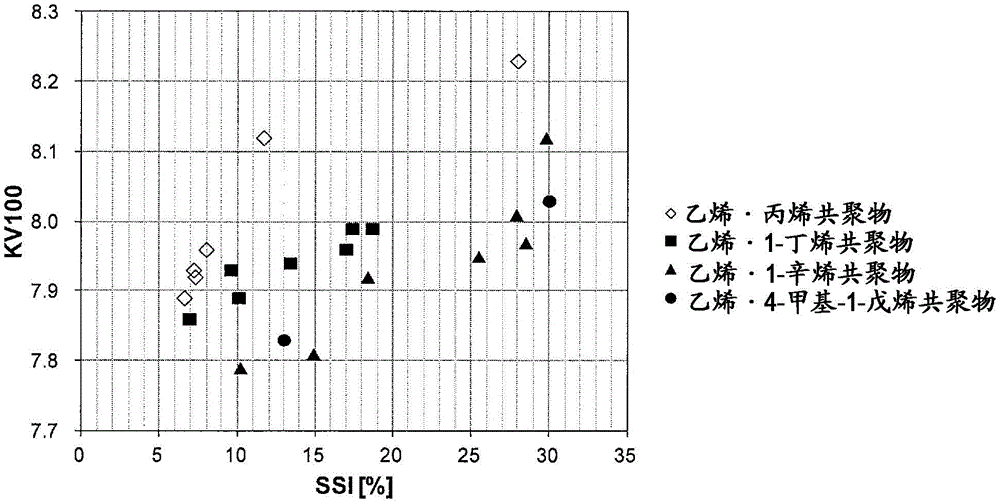
[图1]图1为针对实施例B、实施例C及比较例B中得到的润滑油组合物对剪切稳定性(SSI)及100℃时的运动粘度(KV100)进行绘制而得到的图。1 is a graph obtained by plotting shear stability (SSI) and kinematic viscosity (KV100) at 100° C. for the lubricating oil compositions obtained in Example B, Example C, and Comparative Example B .
具体实施方式Detailed ways
以下,对本发明的具体实施方式进行说明。Hereinafter, specific embodiments of the present invention will be described.
本说明书中,数值范围“n1~n2”是指n1以上且n2以下。此处,n1为前述数值范围的下限值,n2为前述数值范围的上限值。In this specification, the numerical range "n 1 to n 2 " means n 1 or more and n 2 or less. Here, n 1 is the lower limit value of the aforementioned numerical range, and n 2 is the upper limit value of the aforementioned numerical range.
[润滑油组合物][lubricating oil composition]
本发明的润滑油组合物含有特定的乙烯·α-烯烃共聚物(A),优选还含有润滑油基油(B)。此处,共聚物(A)可作为润滑油用粘度调节剂发挥功能。The lubricating oil composition of the present invention contains a specific ethylene/α-olefin copolymer (A), and preferably further contains a lubricating oil base oil (B). Here, the copolymer (A) can function as a viscosity modifier for lubricating oil.
对于本发明的润滑油组合物而言,在一个实施方式中,用于发动机。这种情况下,共聚物(A)可作为发动机用润滑油的粘度调节剂发挥功能。In one embodiment, the lubricating oil composition of the present invention is used in an engine. In this case, the copolymer (A) can function as a viscosity modifier for engine lubricating oil.
<乙烯·α-烯烃共聚物(A)><Ethylene/α-olefin copolymer (A)>
对本发明中使用的乙烯·α-烯烃共聚物(A)(以下,也称为“共聚物(A)”)进行说明。对于共聚物(A)而言,来自乙烯的结构单元的含有比例为70~90摩尔%,且特性粘度[η]为0.3~1.0dl/g。The ethylene/α-olefin copolymer (A) (hereinafter, also referred to as "copolymer (A)") used in the present invention will be described. In the copolymer (A), the content ratio of the structural unit derived from ethylene is 70 to 90 mol %, and the intrinsic viscosity [η] is 0.3 to 1.0 dl/g.
以下,关于共聚物(A),对作为优选方式的第1方式的共聚物及第2方式的共聚物进行说明。Hereinafter, with regard to the copolymer (A), the copolymer of the first embodiment and the copolymer of the second embodiment will be described as preferred embodiments.
对于共聚物(A)而言,在第1方式中,为至少乙烯与碳原子数为4以上的α-烯烃的共聚物。通过使用具有来自碳原子数为4以上的α-烯烃的结构单元作为共聚单体单元的共聚物(A),存在能得到剪切稳定性优异、并且100℃时的运动粘度小的润滑油组合物的趋势。In the first aspect, the copolymer (A) is a copolymer of at least ethylene and an α-olefin having 4 or more carbon atoms. By using a copolymer (A) having a structural unit derived from an α-olefin having 4 or more carbon atoms as a comonomer unit, there is a lubricating oil combination that is excellent in shear stability and has a low kinematic viscosity at 100° C. trend of things.
作为构成第1方式中的共聚物(A)的碳原子数为4以上的α-烯烃,可举出例如1-丁烯、1-戊烯、1-己烯、4-甲基-1-戊烯、1-庚烯、1-辛烯、1-癸烯、1-十一碳烯、1-十二碳烯、1-十三碳烯、1-十四碳烯、1-十五碳烯、1-十六碳烯、1-十七碳烯、1-十八碳烯、1-十九碳烯、1-二十碳烯等碳原子数为4~20,优选碳原子数为4~12,更优选碳原子数为5~8的α-烯烃。另外,α-烯烃可以为直链状,也可具有支链。α-烯烃中,从向润滑油组合物赋予低的100℃时的运动粘度及良好的剪切稳定性的方面考虑,优选1-丁烯、1-辛烯、4-甲基-1-戊烯,更优选1-辛烯、4-甲基-1-戊烯。Examples of the α-olefin having 4 or more carbon atoms constituting the copolymer (A) in the first aspect include 1-butene, 1-pentene, 1-hexene, and 4-methyl-1- Pentene, 1-heptene, 1-octene, 1-decene, 1-undecene, 1-dodecene, 1-tridecene, 1-tetradecene, 1-pentadecene Carbene, 1-hexadecene, 1-heptadecene, 1-octadecene, 1-nonadecene, 1-eicosene, etc. have 4 to 20 carbon atoms, preferably the number of carbon atoms is 4 to 12, more preferably an α-olefin having 5 to 8 carbon atoms. In addition, the α-olefin may be linear or branched. Among the α-olefins, 1-butene, 1-octene, and 4-methyl-1-pentene are preferred from the viewpoint of imparting low kinematic viscosity at 100° C. and good shear stability to the lubricating oil composition. alkene, more preferably 1-octene, 4-methyl-1-pentene.
共聚物(A)可具有1种或2种以上来自α-烯烃的结构单元。The copolymer (A) may have one kind or two or more kinds of α-olefin-derived structural units.
对于第1方式中的共聚物(A)而言,来自乙烯的结构单元(乙烯单元)的含有比例大于70摩尔%且为90摩尔%以下,优选为72摩尔%以上,更优选为74摩尔%以上;另外,优选为89摩尔%以下,更优选为88摩尔%以下。该含有比例为前述下限值以上时,润滑油组合物存在剪切稳定性提高的趋势,为前述上限值以下时,存在在油中的溶解性及低温贮藏稳定性优异的趋势。In the copolymer (A) in the first aspect, the content ratio of the structural unit (ethylene unit) derived from ethylene is more than 70 mol % and 90 mol % or less, preferably 72 mol % or more, and more preferably 74 mol % above; and, preferably, 89 mol% or less, more preferably 88 mol% or less. When the content ratio is greater than or equal to the aforementioned lower limit value, the lubricating oil composition tends to improve shear stability, and when it is less than or equal to the aforementioned upper limit value, the lubricating oil composition tends to be excellent in solubility in oil and low-temperature storage stability.
对于第1方式中的共聚物(A)而言,来自碳原子数为4以上的α-烯烃的结构单元(α-烯烃单元)的含有比例优选为10摩尔%以上且低于30摩尔%,更优选为11摩尔%以上,进一步优选为12摩尔%以上;另外,更优选为28摩尔%以下,进一步优选为26摩尔%以下。In the copolymer (A) in the first aspect, the content ratio of the structural unit (α-olefin unit) derived from an α-olefin having 4 or more carbon atoms is preferably 10 mol % or more and less than 30 mol %, 11 mol% or more is more preferable, 12 mol% or more is more preferable, and 28 mol% or less is more preferable, and 26 mol% or less is more preferable.
对于共聚物(A)而言,在第2方式中,为至少乙烯与α-烯烃的共聚物。第2方式的共聚物(A)作为发动机用润滑油组合物的成分而言是优选的。In the second aspect, the copolymer (A) is at least a copolymer of ethylene and an α-olefin. The copolymer (A) of the second aspect is preferable as a component of the lubricating oil composition for an engine.
作为构成第2方式中的共聚物(A)的α-烯烃,可举出例如丙烯、1-丁烯、1-戊烯、1-己烯、4-甲基-1-戊烯、1-庚烯、1-辛烯、1-癸烯、1-十一碳烯、1-十二碳烯、1-十三碳烯、1-十四碳烯、1-十五碳烯、1-十六碳烯、1-十七碳烯、1-十八碳烯、1-十九碳烯、1-二十碳烯等碳原子数为3~20,优选碳原子数为3~12的α-烯烃。另外,α-烯烃可以为直链状,也可具有支链。α-烯烃中,从向发动机用润滑油组合物赋予良好的低温粘度特性及剪切稳定性的方面考虑,优选丙烯。Examples of the α-olefin constituting the copolymer (A) in the second aspect include propylene, 1-butene, 1-pentene, 1-hexene, 4-methyl-1-pentene, 1- Heptene, 1-octene, 1-decene, 1-undecene, 1-dodecene, 1-tridecene, 1-tetradecene, 1-pentadecene, 1- Hexadecene, 1-heptadecene, 1-octadecene, 1-nonadecene, 1-eicosene, etc. have 3 to 20 carbon atoms, preferably 3 to 12 carbon atoms Alpha-olefins. In addition, the α-olefin may be linear or branched. Among the α-olefins, propylene is preferable from the viewpoint of imparting favorable low-temperature viscosity characteristics and shear stability to the lubricating oil composition for an engine.
共聚物(A)可具有1种或2种以上来自α-烯烃的结构单元。The copolymer (A) may have one kind or two or more kinds of α-olefin-derived structural units.
对于第2方式中的共聚物(A)而言,来自乙烯的结构单元(乙烯单元)的含有比例为70~90摩尔%,优选大于70摩尔%,更优选为72摩尔%以上,进一步优选为74摩尔%以上,特别优选为79摩尔%以上;另外,优选为89摩尔%以下,更优选为88摩尔%以下,进一步优选为86摩尔%以下。该含有比例为前述下限值以上时,润滑油组合物存在CCS粘度降低、而且剪切稳定性提高的趋势,为前述上限值以下时,存在在油中的溶解性及低温贮藏稳定性优异的趋势。In the copolymer (A) in the second aspect, the content ratio of the structural unit (ethylene unit) derived from ethylene is 70 to 90 mol %, preferably more than 70 mol %, more preferably 72 mol % or more, and still more preferably 74 mol % or more, particularly preferably 79 mol % or more, and preferably 89 mol % or less, more preferably 88 mol % or less, and still more preferably 86 mol % or less. When the content ratio is greater than or equal to the aforementioned lower limit value, the lubricating oil composition tends to decrease in CCS viscosity and improve shear stability, and when it is equal to or less than the aforementioned upper limit value, the lubricating oil composition has excellent solubility in oil and low-temperature storage stability. the trend of.
对于第2方式中的共聚物(A)而言,来自α-烯烃的结构单元(α-烯烃单元)的含有比例优选为10~30摩尔%,更优选为11摩尔%以上,进一步优选为12摩尔%以上,特别优选为14摩尔%以上;另外,优选小于30摩尔%,更优选为28摩尔%以下,进一步优选为26摩尔%以下,特别优选为21摩尔%以下。In the copolymer (A) in the second aspect, the content ratio of the structural unit (α-olefin unit) derived from α-olefin is preferably 10 to 30 mol %, more preferably 11 mol % or more, and still more preferably 12 mol % or more. mol% or more, particularly preferably 14 mol% or more; and preferably less than 30 mol%, more preferably 28 mol% or less, still more preferably 26 mol% or less, particularly preferably 21 mol% or less.
来自乙烯的结构单元的含有比例为以来自构成共聚物(A)的单体(例如,乙烯、碳原子数为4以上的α-烯烃或α-烯烃、其他单体)的结构单元的总量作为100摩尔%时的值。The content ratio of structural units derived from ethylene is the total amount of structural units derived from monomers constituting the copolymer (A) (for example, ethylene, α-olefin having 4 or more carbon atoms, α-olefin, and other monomers). The value at 100 mol%.
作为其他单体,可举出例如环状烯烃、芳香族乙烯基化合物、共轭二烯、非共轭多烯、官能化乙烯基化合物、含有羟基的烯烃、卤代烯烃。作为环状烯烃、芳香族乙烯基化合物、共轭二烯、非共轭多烯、官能化乙烯基化合物、含有羟基的烯烃及卤代烯烃,可举出例如日本特开2013-169685号公报的[0035]~[0041]段中记载的化合物。Examples of other monomers include cyclic olefins, aromatic vinyl compounds, conjugated dienes, non-conjugated polyenes, functionalized vinyl compounds, hydroxyl group-containing olefins, and halogenated olefins. Examples of cyclic olefins, aromatic vinyl compounds, conjugated dienes, non-conjugated polyenes, functionalized vinyl compounds, hydroxyl-containing olefins, and halogenated olefins include, for example, Japanese Patent Laid-Open No. 2013-169685. Compounds described in paragraphs [0035] to [0041].
共聚物(A)的特性粘度[η]为0.3~1.0dl/g,优选为0.3dl/g以上且低于1.0dl/g,更优选为0.35~0.99dl/g,特别优选为0.40~0.98dl/g。特性粘度[η]为前述下限值以上时,存在以下趋势:通过添加少量的共聚物(A),从而使润滑油组合物的后述的HTHS粘度提高,并且,CCS粘度降低;另外,为前述上限值以下时,存在以下趋势:润滑油组合物的剪切稳定性提高,并且,100℃时的运动粘度降低。The intrinsic viscosity [η] of the copolymer (A) is 0.3 to 1.0 dl/g, preferably 0.3 dl/g or more and less than 1.0 dl/g, more preferably 0.35 to 0.99 dl/g, particularly preferably 0.40 to 0.98 dl/g. When the intrinsic viscosity [η] is greater than or equal to the aforementioned lower limit value, the addition of a small amount of the copolymer (A) tends to increase the HTHS viscosity of the lubricating oil composition, which will be described later, and to decrease the CCS viscosity; When it is below the said upper limit value, there exists a tendency for the shear stability of a lubricating oil composition to improve, and for the kinematic viscosity at 100 degreeC to fall.
特性粘度[η]可于135℃、在十氢化萘中测定。Intrinsic viscosity [η] can be measured in decalin at 135°C.
对于来自乙烯的结构单元的含有比例大于70摩尔%且为90摩尔%以下、且特性粘度[η]为0.3~1.0dl/g的第1方式的共聚物(A)而言,即使其在润滑油组合物中的添加量少,也能充分发挥粘度调节效果,因此,从成本方面考虑是优异的。In the copolymer (A) of the first embodiment, the content ratio of the structural unit derived from ethylene is more than 70 mol % and 90 mol % or less, and the intrinsic viscosity [η] is 0.3 to 1.0 dl/g. Even if the amount of addition to the oil composition is small, the viscosity-adjusting effect can be sufficiently exhibited, and therefore, it is excellent in terms of cost.
对于来自乙烯的结构单元的含有比例为70~90摩尔%,尤其是79~90摩尔%,特性粘度[η]为0.3~1.0dl/g的第2方式的共聚物(A)而言,即使其在润滑油组合物中的添加量少,也能充分发挥粘度调节效果,因此,从成本方面考虑是优异的。In the copolymer (A) of the second embodiment, the content ratio of the structural unit derived from ethylene is 70 to 90 mol %, especially 79 to 90 mol %, and the intrinsic viscosity [η] is 0.3 to 1.0 dl/g. The addition amount to the lubricating oil composition is small, and the viscosity adjustment effect can be sufficiently exhibited, so it is excellent from the viewpoint of cost.
共聚物(A)优选为利用差示扫描型量热计(DSC)测得的熔点为100℃以下或观测不到熔点的共聚物,更优选为熔点为95℃以下或观测不到熔点的共聚物。如果是这样的方式,则可有助于降低润滑油组合物的CCS粘度。The copolymer (A) is preferably a copolymer whose melting point measured by a differential scanning calorimeter (DSC) is 100°C or less or no melting point is observed, and more preferably a copolymer whose melting point is 95°C or less or no melting point is observed. thing. If so, it can help reduce the CCS viscosity of the lubricating oil composition.
以上物性的详细测定条件记载于实施例栏中。The detailed measurement conditions of the above physical properties are described in the column of Examples.
共聚物(A)例如可通过使用包含含有钒、锆、钛、铪等过渡金属的化合物、和选自有机铝化合物、有机铝氧化合物(organoaluminum oxy compounds)及离子化离子性化合物中的至少1种的催化剂,使至少乙烯与α-烯烃进行共聚来制造。作为此时使用的烯烃聚合用催化剂,可举出例如国际公开第00/34420号中记载的催化剂。The copolymer (A) can be obtained by using, for example, a compound containing transition metals such as vanadium, zirconium, titanium, and hafnium, and at least one selected from the group consisting of organoaluminum compounds, organoaluminum oxy compounds, and ionizing ionic compounds. This kind of catalyst is produced by copolymerizing at least ethylene and α-olefin. As a catalyst for olefin polymerization used at this time, the catalyst described in International Publication No. 00/34420 is mentioned, for example.
共聚物(A)可使用1种或2种以上。Copolymer (A) can be used 1 type or 2 or more types.
本发明的润滑油组合物、例如发动机用润滑油组合物中的共聚物(A)的含有比例通常为组合物总量的0.1~5.0质量%,优选为组合物总量的0.2~4.0质量%,特别优选为组合物总量的0.3~3.0质量%。本发明中,利用共聚物(A)而实现的调节组合物粘度的效果高,因此,通过仅使用少量共聚物(A),就能得到充分的效果,因此从成本的观点考虑是优选的。The content ratio of the copolymer (A) in the lubricating oil composition of the present invention, for example, the lubricating oil composition for an engine, is usually 0.1 to 5.0 mass % of the total composition, preferably 0.2 to 4.0 mass % of the total composition , particularly preferably 0.3 to 3.0 mass % of the total composition. In the present invention, since the effect of adjusting the viscosity of the composition by the copolymer (A) is high, sufficient effects can be obtained by using only a small amount of the copolymer (A), which is preferable from the viewpoint of cost.
<润滑油基油(B)><Lube base oil (B)>
本发明的润滑油组合物、例如发动机用润滑油组合物优选还含有润滑油基油(B)(以下,也称为“基油(B)”)。关于基油(B),可以没有限制地使用通常可作为发动机用润滑油基油等润滑油基油而使用的基油,可举出例如矿物油、合成油。作为基油(B),可使用矿物油与合成油的共混物。The lubricating oil composition of the present invention, for example, the lubricating oil composition for an engine preferably further contains a lubricating oil base oil (B) (hereinafter, also referred to as "base oil (B)"). As the base oil (B), a base oil generally used as a lubricating oil base oil such as a lubricating oil base oil for engines can be used without limitation, and examples thereof include mineral oil and synthetic oil. As base oil (B), it is possible to use a blend of mineral oil and synthetic oil.
基油(B)的100℃时的运动粘度通常为1~50mm2/s,优选为1.5~40mm2/s,更优选为2~30mm2/s。The kinematic viscosity at 100°C of the base oil (B) is usually 1 to 50 mm 2 /s, preferably 1.5 to 40 mm 2 /s, and more preferably 2 to 30 mm 2 /s.
矿物油通常经过脱蜡等精制工序而使用,根据精制的方法,有若干等级,本等级由API(美国石油协会)分类进行规定。通常使用包含0.5~10质量%的蜡组分的矿物油。例如,可使用通过加氢裂化(hydrocracking)精制法制造的倾点低、粘度指数高、以异链烷烃为主体的组成的高度精制油。通常可使用40℃时的运动粘度为10~200mm2/s的矿物油。Mineral oil is usually used through a refining process such as dewaxing, and there are several grades depending on the refining method, and this grade is defined by the API (American Petroleum Institute) classification. A mineral oil containing a wax component of 0.5 to 10% by mass is usually used. For example, a highly refined oil having a low pour point, a high viscosity index, and a composition mainly composed of isoparaffins produced by a hydrocracking refining method can be used. Usually, a mineral oil having a kinematic viscosity at 40°C of 10 to 200 mm 2 /s can be used.
作为合成油,可举出例如聚α-烯烃;多元醇酯、邻苯二甲酸二辛酯、癸二酸二辛酯等二酯类;聚亚烷基二醇。Examples of synthetic oils include polyα-olefins; polyol esters, diesters such as dioctyl phthalate, and dioctyl sebacate; and polyalkylene glycols.
表1中示出被分类为各组的润滑油基油的特性。Table 1 shows the properties of the lubricating base oils classified into each group.
[表1][Table 1]

*1:按照ASTM D2270(JIS K2283)测定*1: Measured according to ASTM D2270 (JIS K2283)
*2:按照ASTM D3238测定*2: Measured according to ASTM D3238
*3:按照ASTM D4294(JIS K2541)测定*3: Measured according to ASTM D4294 (JIS K2541)
*4:饱和烃组分低于90(体积%)且硫组分低于0.03质量%、或者饱和烃组分为90(体积%)以上且硫组分高于0.03质量%的矿物油也被包含在组(I)中。*4: Mineral oils with a saturated hydrocarbon component of less than 90 (vol %) and a sulfur component of less than 0.03 mass %, or a saturated hydrocarbon component of 90 (vol %) or more and a sulfur component of more than 0.03 mass % were also used Included in group (I).
表1中的聚-α-烯烃为至少使碳原子数为10以上的α-烯烃作为原料单体而进行聚合而得到的烃聚合物,可举出例如使1-癸烯聚合而得到的聚癸烯。The poly-α-olefin in Table 1 is a hydrocarbon polymer obtained by polymerizing at least an α-olefin having 10 or more carbon atoms as a raw material monomer, and for example, a polymer obtained by polymerizing 1-decene is exemplified. Decene.
作为基油(B),优选属于组(II)或组(III)的矿物油、或属于组(IV)的聚-α-烯烃。与组(I)相比,组(II)及组(III)存在蜡浓度少的趋势。在属于组(II)或组(III)的矿物油中,优选100℃时的运动粘度为1~50mm2/s的矿物油。The base oil (B) is preferably a mineral oil belonging to group (II) or group (III), or a poly-α-olefin belonging to group (IV). Compared with the group (I), the group (II) and the group (III) tended to have less wax concentration. Among the mineral oils belonging to group (II) or group (III), those having a kinematic viscosity at 100°C of 1 to 50 mm 2 /s are preferred.
作为基油(B),尤其是从低温特性方面考虑,优选具有选自下述(B0-1)~(B0-2)中的一种或两种特性。The base oil (B) preferably has one or two properties selected from the group consisting of the following (B0-1) to (B0-2) from the viewpoint of low-temperature properties.
(B0-1)100℃时的运动粘度为2~10mm2/s,优选为3~8mm2/s。运动粘度在上述范围内时,得到的润滑油组合物的流动性和润滑性优异。运动粘度在上述范围内时,得到的发动机用润滑油组合物的CCS粘度优异。(B0-1) The kinematic viscosity at 100°C is 2 to 10 mm 2 /s, preferably 3 to 8 mm 2 /s. When the kinematic viscosity is within the above range, the obtained lubricating oil composition is excellent in fluidity and lubricity. When the kinematic viscosity is within the above range, the obtained engine lubricating oil composition has excellent CCS viscosity.
(B0-2)粘度指数为90以上,优选为100以上。对于粘度指数的上限没有特别限制,例如为160或130。粘度指数为90以上时,作为发动机用润滑油基油等润滑油基油是特别有用的。(B0-2) The viscosity index is 90 or more, preferably 100 or more. The upper limit of the viscosity index is not particularly limited, for example, 160 or 130. When the viscosity index is 90 or more, it is particularly useful as a lubricating base oil such as a lubricating base oil for engines.
上述特性可利用下述方法测定。The above-mentioned properties can be measured by the following methods.
100℃时的运动粘度:ASTM D445(JIS K2283)中记载的方法。Kinematic viscosity at 100°C: The method described in ASTM D445 (JIS K2283).
粘度指数:ASTM D2270(JIS K2283)中记载的方法。Viscosity index: The method described in ASTM D2270 (JIS K2283).
基油(B)可使用1种或2种以上。As the base oil (B), one type or two or more types can be used.
本发明的润滑油组合物,例如发动机用润滑油组合物中的基油(B)的含有比例通常为组合物总量的50质量%以上,优选为组合物总量的70质量%以上,特别优选为组合物总量的80质量%以上,基油(B)的含有比例的上限可根据共聚物(A)及添加剂的量划定。The content ratio of the base oil (B) in the lubricating oil composition of the present invention, for example, the lubricating oil composition for an engine, is usually 50 mass % or more of the total composition, preferably 70 mass % or more of the total composition, especially It is preferably 80% by mass or more of the total composition, and the upper limit of the content ratio of the base oil (B) can be defined by the amount of the copolymer (A) and the additive.
将本发明的润滑油组合物作为润滑油添加剂组合物(所谓的浓缩物)使用的情况下,前述润滑油组合物可以以共聚物(A)为1~50质量份、基油(B)为50~99质量份(其中,将共聚物(A)与基油(B)的合计作为100质量份)的比率含有所述共聚物(A)和基油(B)。前述比率优选为共聚物(A)为2~40质量份、基油(B)为60~98质量份的范围,更优选为共聚物(A)为3~30质量份、基油(B)为70~97质量份的范围。When the lubricating oil composition of the present invention is used as a lubricating oil additive composition (so-called concentrate), the above-mentioned lubricating oil composition may contain 1 to 50 parts by mass of the copolymer (A) and the base oil (B) as The copolymer (A) and the base oil (B) are contained in a ratio of 50 to 99 parts by mass (wherein the total of the copolymer (A) and the base oil (B) is taken as 100 parts by mass). The aforementioned ratio is preferably in the range of 2 to 40 parts by mass of the copolymer (A) and 60 to 98 parts by mass of the base oil (B), and more preferably 3 to 30 parts by mass of the copolymer (A) and the base oil (B) It is the range of 70-97 mass parts.
需要说明的是,将本发明的润滑油组合物作为润滑油添加剂组合物(所谓的浓缩物)使用的情况下,通常,不包含后述的添加剂或根据需要在0.01~1质量%、优选0.05~0.5质量%的范围内含有后述的抗氧化剂。通过在前述润滑油添加剂组合物中配合根据需要的基油(B)和后述的添加剂,从而可作为发动机用润滑油组合物等润滑油组合物使用。In addition, when the lubricating oil composition of the present invention is used as a lubricating oil additive composition (so-called concentrate), it is usually 0.01 to 1 mass %, preferably 0.05 mass %, if necessary, without the additives described later. The antioxidant mentioned later is contained in the range of -0.5 mass %. The said lubricating oil additive composition can be used as a lubricating oil composition, such as a lubricating oil composition for engines, by mix|blending a base oil (B) and an additive mentioned later as needed.
<其他成分(添加剂)><Other ingredients (additives)>
本发明的润滑油组合物、例如发动机用润滑油组合物可含有除了共聚物(A)及基油(B)以外的其他成分(添加剂)。作为其他成分,可举出例如共聚物(A)以外的其他粘度调节剂、倾点下降剂、清净分散剂、抗磨剂、消泡剂、抗氧化剂、摩擦调节剂、颜色稳定剂、防锈剂、防蚀剂及金属钝化剂。The lubricating oil composition of the present invention, for example, the lubricating oil composition for an engine may contain other components (additives) other than the copolymer (A) and the base oil (B). Examples of other components include viscosity modifiers other than the copolymer (A), pour point depressants, detergent dispersants, antiwear agents, antifoaming agents, antioxidants, friction modifiers, color stabilizers, and rust inhibitors. agents, corrosion inhibitors and metal passivators.
作为其他粘度调节剂,可举出例如聚异丁烯类、聚甲基丙烯酸酯类、二烯聚合物类、聚烷基苯乙烯类、经酯化的苯乙烯-马来酸酐共聚物类、链烯基芳烃共轭二烯共聚物类及聚烯烃类、氢化SBR(苯乙烯丁二烯橡胶)、SEBS(苯乙烯乙烯丁烯苯乙烯嵌段共聚物)等聚合物。还具有分散性及/或抗氧化性的多功能性的粘度调节剂是已知的,可以任选地使用。Examples of other viscosity modifiers include polyisobutylenes, polymethacrylates, diene polymers, polyalkylstyrenes, esterified styrene-maleic anhydride copolymers, alkenes Polyaromatic conjugated diene copolymers and polyolefins, hydrogenated SBR (styrene butadiene rubber), SEBS (styrene ethylene butene styrene block copolymer) and other polymers. Multifunctional viscosity modifiers that also have dispersibility and/or oxidation resistance are known and may optionally be used.
作为倾点下降剂,可举出例如烷基化萘、(甲基)丙烯酸烷基酯的共聚物/聚合物、富马酸烷基酯与乙酸乙烯酯的共聚物、α-烯烃聚合物、α-烯烃与苯乙烯的共聚物。特别优选(甲基)丙烯酸烷基酯的共聚物/聚合物。Examples of pour point depressants include alkylated naphthalene, copolymers/polymers of alkyl (meth)acrylates, copolymers of alkyl fumarate and vinyl acetate, α-olefin polymers, Copolymers of alpha-olefins and styrene. Copolymers/polymers of alkyl (meth)acrylates are particularly preferred.
作为清净分散剂,可举出例如磺酸钙、磺酸镁等磺酸盐系;酚盐;水杨酸盐;琥珀酰亚胺;苄基胺。润滑油组合物中的典型的清净分散剂的量没有特别限制,只要能发挥本发明的效果即可,通常为1~10质量%,优选为1.5~9.0质量%,更优选为2.0~8.0质量%。需要说明的是,上述量全部基于在清净分散剂中无油(即,在它们中不存在以往所供给的稀释油)的状态。Examples of the detergent and dispersant include sulfonates such as calcium sulfonate and magnesium sulfonate; phenate; salicylate; succinimide; benzylamine. The amount of the typical detergent and dispersant in the lubricating oil composition is not particularly limited as long as the effect of the present invention can be exhibited, and it is usually 1 to 10% by mass, preferably 1.5 to 9.0% by mass, and more preferably 2.0 to 8.0% by mass %. In addition, the said quantity is all based on the state in which there is no oil in the detergent dispersant (that is, the diluent oil conventionally supplied does not exist in them).
作为抗磨剂,可举出硫代磷酸金属盐类、磷酸酯类及它们的盐类、含有磷的羧酸类·酯类·醚类·酰胺类;以及亚磷酸盐等之类的含有磷的抗磨剂/耐特压剂。通常,上述抗磨剂为二烷基二硫代磷酸锌(ZDP)。典型的ZDP可包含11质量%的P(基于无油的状态计算),作为优选的量,可举出0.09~0.82质量%。作为不含磷的抗磨剂,可举出硼酸酯类(包括硼酸环氧化物类)、二硫代氨基甲酸酯化合物类、含有钼的化合物类、及硫化烯烃类。另外,含有磷的抗磨剂没有特别限制,只要能发挥本发明的效果即可,通常可以以提供0.01~0.2质量%、优选0.015~0.15质量%、更优选0.02~0.1质量%、进一步优选0.025~0.08质量%的磷的量存在。Examples of the antiwear agent include phosphorothioate metal salts, phosphoric acid esters and their salts, phosphorus-containing carboxylic acids, esters, ethers, and amides; and phosphorus-containing phosphites such as phosphites. antiwear/extreme pressure agent. Typically, the aforementioned antiwear agent is zinc dialkyldithiophosphate (ZDP). A typical ZDP may contain 11 mass % of P (calculated based on an oil-free state), and 0.09-0.82 mass % is mentioned as a preferable amount. Examples of the phosphorus-free antiwear agent include boronic acid esters (including boronic acid epoxides), dithiocarbamate compounds, molybdenum-containing compounds, and sulfurized olefins. In addition, the phosphorus-containing antiwear agent is not particularly limited, as long as the effect of the present invention can be exhibited, and it is usually 0.01 to 0.2 mass %, preferably 0.015 to 0.15 mass %, more preferably 0.02 to 0.1 mass %, and still more preferably 0.025 mass %. Phosphorus was present in an amount of -0.08 mass %.
作为消泡剂,可举出例如二甲基硅氧烷、硅胶分散体等硅系消泡剂;醇系消泡剂、酯系消泡剂。Examples of the antifoaming agent include silicon-based antifoaming agents such as dimethylsiloxane and silica gel dispersion; alcohol-based antifoaming agents and ester-based antifoaming agents.
作为抗氧化剂,可举出例如2,6-二叔丁基-4-甲基苯酚等酚系抗氧化剂;二辛基二苯胺等胺系抗氧化剂。抗氧化剂的典型的量当然还取决于具体的抗氧化剂及各自的有效性,但示例的总量可以成为0.01~5质量%、优选0.15~4.5质量%、更优选0.2~4质量%。此外,可以存在1种以上的抗氧化剂,抗氧化剂的特定组合可能会相对于所组合的抗氧化剂的效果总体而产生协同效果。Examples of the antioxidant include phenol-based antioxidants such as 2,6-di-tert-butyl-4-methylphenol; and amine-based antioxidants such as dioctyldiphenylamine. Typical amounts of antioxidants also depend on the specific antioxidants and their respective effectiveness, of course, but the total amount exemplified may be 0.01 to 5 mass %, preferably 0.15 to 4.5 mass %, and more preferably 0.2 to 4 mass %. In addition, one or more antioxidants may be present, and a specific combination of antioxidants may produce a synergistic effect with respect to the effect of the combined antioxidants as a whole.
作为防锈剂,可举出例如羧酸、羧酸盐、酯、磷酸。作为防蚀剂,可举出例如苯并三唑系、噻二唑系、咪唑系的化合物。As a rust inhibitor, a carboxylic acid, a carboxylate, an ester, and phosphoric acid are mentioned, for example. As a corrosion inhibitor, the compound of a benzotriazole type, a thiadiazole type, and an imidazole type is mentioned, for example.
本发明的润滑油组合物(例如发动机用润滑油组合物)含有添加剂的情况下的含有比例没有特别限制,将基油(B)和所有添加剂的总量作为100质量%时,作为添加剂的总含有比例,通常大于0质量%,优选为1质量%以上,更优选为3质量%以上;通常为40质量%以下,优选为30质量%以下,更优选为20质量%以下。When the lubricating oil composition of the present invention (for example, a lubricating oil composition for an engine) contains an additive, the content ratio is not particularly limited, and the total amount of the additive is taken as 100% by mass when the total amount of the base oil (B) and all additives is taken as 100% by mass. The content ratio is usually more than 0 mass %, preferably 1 mass % or more, more preferably 3 mass % or more, and usually 40 mass % or less, preferably 30 mass % or less, and more preferably 20 mass % or less.
<润滑油组合物、发动机用润滑油组合物的制造方法><The production method of lubricating oil composition and engine lubricating oil composition>
本发明的润滑油组合物,例如发动机用润滑油组合物可通过利用现有已知的方法,例如将共聚物(A)、根据需要的基油(B)及添加剂混合来制备。共聚物(A)由于容易处理,因而可作为基油(B)中的浓缩物而任意地供给。The lubricating oil composition of the present invention, for example, the lubricating oil composition for an engine, can be prepared by using a conventionally known method, for example, by mixing the copolymer (A), the base oil (B) and additives as required. Since the copolymer (A) is easy to handle, it can be optionally supplied as a concentrate in the base oil (B).
<润滑油组合物的物性><Physical properties of lubricating oil composition>
对于本发明的润滑油组合物而言,例如,为了改善高温时的发动机工作中的燃油效率,优选高温低剪切速度下的粘度低。即,本发明的润滑油组合物的100℃时的运动粘度通常为50mm2/s以下,优选为1~40mm2/s,更优选为2~30mm2/s。The lubricating oil composition of the present invention is preferably low in viscosity at high temperature and low shear rate, for example, in order to improve fuel efficiency during engine operation at high temperature. That is, the kinematic viscosity at 100° C. of the lubricating oil composition of the present invention is usually 50 mm 2 /s or less, preferably 1 to 40 mm 2 /s, and more preferably 2 to 30 mm 2 /s.
另外,本发明的润滑油组合物具有针对例如发动机开始工作时及工作中的剪切力的稳定性(例如可通过后述的剪切稳定性指数(Shear Stability Index,SSI)来评价)。Moreover, the lubricating oil composition of this invention has stability (for example, it can be evaluated by the Shear Stability Index (SSI) mentioned later) with respect to the shearing force at the time of starting the engine operation and during operation, for example.
另外,对于本发明的润滑油组合物而言,例如作为发动机油使用的情况下,优选滑动部处的摩擦损失和因润滑油的粘性而导致的搅拌损失小。对于发动机用润滑油而言,为了保护高温时的发动机工作中的滑动部,优选具有能在高温高剪切速度下维持润滑性(保持油膜)的粘度(例如可通过后述的高温高剪切(High Temperature High Shear,HTHS)粘度来评价)。In addition, when the lubricating oil composition of the present invention is used, for example, as an engine oil, it is preferable that the friction loss at the sliding portion and the stirring loss due to the viscosity of the lubricating oil be small. The lubricating oil for an engine preferably has a viscosity capable of maintaining lubricity (maintaining an oil film) at high temperature and high shear rate in order to protect sliding parts during engine operation at high temperature (for example, a high temperature and high shear rate described later can be used for lubricating oil) (High Temperature High Shear, HTHS) viscosity to evaluate).
本发明的润滑油组合物、尤其是含有第1方式的共聚物(A)的润滑油组合物的以上各物性的均衡性优异,具体而言,具有低的100℃时的运动粘度和良好的剪切稳定性。The lubricating oil composition of the present invention, particularly the lubricating oil composition containing the copolymer (A) of the first aspect, is excellent in the balance of the above physical properties, and specifically, has a low kinematic viscosity at 100° C. and a good Shear stability.
因此,本发明的润滑油组合物例如可作为汽车用发动机油、大型车辆用柴油发动机用润滑油、船舶用柴油发动机用润滑油、二冲程发动机用润滑油、自动变速装置用及手动变速器用润滑油、齿轮润滑油以及润滑脂等,注入至多种已知的任何机械装置中。Therefore, the lubricating oil composition of the present invention can be used, for example, as engine oil for automobiles, lubricating oil for diesel engines for large vehicles, lubricating oil for marine diesel engines, lubricating oil for two-stroke engines, lubricating oils for automatic transmissions, and lubricating oils for manual transmissions. Oils, gear oils, and greases, etc., are injected into any of a variety of known mechanical devices.
以下,对含有第2方式的共聚物(A)的发动机用润滑油组合物(以下,也称为“本发明的发动机用润滑油组合物”)进行说明。Hereinafter, an engine lubricating oil composition (hereinafter, also referred to as "the engine lubricating oil composition of the present invention") containing the copolymer (A) of the second embodiment will be described.
对于发动机用润滑油而言,优选滑动部处的摩擦损失和因润滑油的粘性而导致的搅拌损失小。对于发动机用润滑油而言,优选的是,为了保护高温时的发动机工作中的滑动部,具有能在高温高剪切速度下维持润滑性(保持油膜)的粘度(例如,可通过后述的高温高剪切(High Temperature High Shear,HTHS)粘度来评价),并且,为了改善低温时的发动机开始工作时的燃油效率,低温高剪切速度下的粘度小(例如,可通过后述的冷启动模拟器(Cold Cranking Simulator,CCS)粘度来评价)。In the lubricating oil for an engine, the friction loss at the sliding portion and the stirring loss due to the viscosity of the lubricating oil are preferably small. The lubricating oil for an engine preferably has a viscosity that can maintain lubricity (retain oil film) at high temperature and high shear rate in order to protect the sliding part during engine operation at high temperature (for example, it can be obtained by the following-mentioned High temperature and high shear (High Temperature High Shear, HTHS) viscosity), and, in order to improve the fuel efficiency at the start of engine operation at low temperature, the viscosity at low temperature and high shear rate is small (for example, it can be obtained by the cooling process described later. Start the simulator (Cold Cranking Simulator, CCS) viscosity to evaluate).
另外,为了改善高温时的发动机工作中的燃油效率,高温低剪切速度下的粘度优选在特定的范围内。例如,运动粘度越低,则粘性阻力越减小,因此,对于节油是有效的。另一方面,运动粘度过低时,油膜变薄,有时润滑性差。为了满足它们的均衡性,优选100℃时的运动粘度在特定的范围内。即,本发明的发动机用润滑油组合物的100℃时的运动粘度通常为7.4~14.7mm2/s,优选为7.5~14.5mm2/s,更优选为7.6~14.0mm2/s。In addition, in order to improve fuel efficiency during engine operation at high temperature, the viscosity at high temperature and low shear rate is preferably within a specific range. For example, the lower the kinematic viscosity, the smaller the viscous resistance, which is effective for fuel saving. On the other hand, when the kinematic viscosity is too low, the oil film becomes thin and the lubricity may be poor. In order to satisfy these balance, it is preferable that the kinematic viscosity at 100 degreeC exists in a specific range. That is, the kinematic viscosity at 100°C of the engine lubricating oil composition of the present invention is usually 7.4 to 14.7 mm 2 /s, preferably 7.5 to 14.5 mm 2 /s, and more preferably 7.6 to 14.0 mm 2 /s.
另外,发动机用润滑油优选具有针对发动机开始工作时及工作中的剪切力的稳定性(例如,可通过后述的剪切稳定性指数(Shear Stability Index,SSI)来评价)。In addition, it is preferable that the lubricating oil for an engine has stability (for example, it can be evaluated by the Shear Stability Index (SSI) mentioned later) with respect to the shear force at the time of starting the engine operation and during operation.
对于本发明的发动机用润滑油组合物而言,以上各物性的均衡性优异,尤其是具有低CCS粘度、特定的运动粘度、和良好的剪切稳定性。因此,本发明的发动机用润滑油组合物例如作为汽油发动机油及柴油发动机油等发动机油是有用的,具体而言,作为汽车用汽油发动机、摩托车用汽油发动机、大型车辆用柴油发动机、船舶用柴油发动机等发动机用的发动机油是有用的。The engine lubricating oil composition of the present invention is excellent in the balance of the above physical properties, and particularly has low CCS viscosity, specific kinematic viscosity, and good shear stability. Therefore, the engine lubricating oil composition of the present invention is useful as, for example, engine oils such as gasoline engine oil and diesel engine oil, and specifically, as gasoline engines for automobiles, gasoline engines for motorcycles, diesel engines for large vehicles, ships It is useful to use engine oil for engines such as diesel engines.
[润滑油用粘度调节剂][Viscosity modifier for lubricating oil]
本发明的润滑油用粘度调节剂含有前述的第1方式的乙烯与碳原子数为4以上的α-烯烃的共聚物(A)。第1方式的共聚物(A)的优选条件如上所述。The viscosity modifier for lubricating oil of the present invention contains the copolymer (A) of ethylene and an α-olefin having 4 or more carbon atoms according to the first aspect. Preferable conditions of the copolymer (A) of the first embodiment are as described above.
本发明的润滑油用粘度调节剂中的第1方式的共聚物(A)的含有比例通常为5质量%以上,优选为25质量%以上,更优选为50质量%以上。The content ratio of the copolymer (A) of the first aspect in the viscosity modifier for lubricating oil of the present invention is usually 5% by mass or more, preferably 25% by mass or more, and more preferably 50% by mass or more.
对于本发明的润滑油用粘度调节剂而言,可以还含有选自前述的基油(B)及添加剂中的至少1种,只要共聚物(A)的含有比例在上述范围内即可。The viscosity modifier for lubricating oil of the present invention may further contain at least one selected from the aforementioned base oil (B) and additives, as long as the content ratio of the copolymer (A) is within the above-mentioned range.
[用于发动机用润滑油的粘度调节剂][Viscosity modifier for engine lubricating oil]
本发明的用于发动机用润滑油的粘度调节剂含有前述的第2方式的乙烯·α-烯烃共聚物(A)。此处,前述共聚物(A)中的来自乙烯的结构单元的含有比例为79~90mol%。共聚物(A)的其他优选条件如上所述。The viscosity modifier for engine lubricating oil of the present invention contains the ethylene/α-olefin copolymer (A) of the second aspect described above. Here, the content ratio of the structural unit derived from ethylene in the said copolymer (A) is 79-90 mol%. Other preferred conditions for the copolymer (A) are as described above.
本发明的粘度调节剂中的第2方式的共聚物(A)的含有比例通常为5质量%以上,优选为25质量%以上,更优选为50质量%以上。The content rate of the copolymer (A) of the 2nd aspect in the viscosity modifier of this invention is 5 mass % or more normally, Preferably it is 25 mass % or more, More preferably, it is 50 mass % or more.
对于本发明的粘度调节剂而言,可以还含有选自前述的基油(B)及添加剂中的至少1种,只要共聚物(A)的含有比例在上述范围内即可。The viscosity modifier of the present invention may further contain at least one selected from the aforementioned base oil (B) and additives, as long as the content ratio of the copolymer (A) is within the above-mentioned range.
[实施例][Example]
以下,基于实施例进一步具体地说明本发明,但本发明不受这些实施例的限制。Hereinafter, the present invention will be described in more detail based on examples, but the present invention is not limited by these examples.
[共聚物的物性][Properties of Copolymers]
共聚物的各种物性按照以下方式测定。Various physical properties of the copolymer were measured as follows.
<特性粘度[η](dl/g)><Intrinsic viscosity [η] (dl/g)>
共聚物的特性粘度[η]使用十氢化萘溶剂、于135℃进行测定。具体而言,将共聚物的粉末、颗粒或树脂块约20mg溶解于十氢化萘15ml中,在135℃的油浴中测定比粘度ηsp。向该十氢化萘溶液中追加十氢化萘溶剂5ml,进行稀释,然后同样地操作,测定比粘度ηsp。进一步重复进行2次该稀释操作,求出将浓度(C)外推至0时的ηsp/C的值作为特性粘度(参见下式)。The intrinsic viscosity [η] of the copolymer was measured at 135°C using a decalin solvent. Specifically, about 20 mg of the powder, granule or resin block of the copolymer was dissolved in 15 ml of decalin, and the specific viscosity ηsp was measured in an oil bath at 135°C. To this decalin solution, 5 ml of decalin solvent was added and diluted, and the specific viscosity ηsp was measured in the same manner. This dilution operation was further repeated twice, and the value of ηsp/C when the concentration (C) was extrapolated to 0 was obtained as the intrinsic viscosity (see the following formula).
[η]=lim(ηsp/C)(C→0)[η]=lim(ηsp/C)(C→0)
<乙烯单元的含有比例(C2含量)><Content ratio of ethylene unit (C2 content)>
关于乙烯·α-烯烃共聚物中的来自乙烯的结构单元的含有比例及来自α-烯烃的结构单元的含有比例(摩尔%),利用13C-NMR波谱的分析求出。The content ratio of the ethylene-derived structural unit and the content ratio (mol%) of the α-olefin-derived structural unit in the ethylene/α-olefin copolymer were determined by analysis of 13 C-NMR spectrum.
(测定装置)(measurement device)
Bruker BioSpin Corp.制AVANCEIII500CryoProbe Prodigy型核磁共振装置AVANCEIII500CryoProbe Prodigy NMR device manufactured by Bruker BioSpin Corp.
(测定条件)(measurement conditions)
测定核:13C(125MHz)Assay core: 13 C (125MHz)
测定模式:单脉冲质子宽带去耦Measurement Mode: Single Pulse Proton Broadband Decoupling
脉冲宽度:45°(5.00μ秒)Pulse width: 45° (5.00μsec)
点数:64kPoints: 64k
测定范围:250ppm(-55~195ppm)Measuring range: 250ppm (-55~195ppm)
重复时间:5.5秒Repeat time: 5.5 seconds
累积次数:512次Cumulative times: 512 times
测定溶剂:邻二氯苯/苯-d6(4/1v/v)Determination solvent: o-dichlorobenzene/benzene-d 6 (4/1v/v)
试样浓度:ca.60mg/0.6mLSample concentration: ca.60mg/0.6mL
测定温度:120℃Measurement temperature: 120℃
窗函数:指数(exponential)(BF:1.0Hz)Window function: exponential (BF: 1.0Hz)
化学位移基准:苯-d6(128.0ppm)。Chemical shift reference: Benzene - d6 (128.0 ppm).
<DSC测定><DSC measurement>
乙烯·α-烯烃共聚物的熔点是使用利用铟标准进行了校正的SII公司制差示扫描型量热计(X-DSC7000)并按照以下方式进行测定的。The melting point of the ethylene-α-olefin copolymer was measured as follows using a differential scanning calorimeter (X-DSC7000) manufactured by SII Corporation calibrated with an indium standard.
在铝制DSC坩埚上,称量测定样品(乙烯·α-烯烃共聚物)直至成为约10mg。将盖卷边压合至坩埚,成为密闭气氛,得到样品坩埚。将样品坩埚配置在DSC池内,并配置空的铝坩埚作为参比。在氮气气氛下,将DSC池以10℃/分钟从30℃(室温)升温至150℃(第一升温过程)。接下来,于150℃保持5分钟,然后,以10℃/分钟进行降温,将DSC池冷却至-100℃(降温过程)。于-100℃保持5分钟,然后,将DSC池以10℃/分钟升温至150℃(第二升温过程)。On an aluminum DSC crucible, the measurement sample (ethylene·α-olefin copolymer) was weighed until it reached about 10 mg. The lid was crimped to the crucible to form a closed atmosphere to obtain a sample crucible. The sample crucible was placed in the DSC cell, and an empty aluminum crucible was placed as a reference. Under a nitrogen atmosphere, the DSC cell was heated from 30°C (room temperature) to 150°C at 10°C/min (first heating process). Next, after holding at 150°C for 5 minutes, the temperature was lowered at 10°C/min, and the DSC cell was cooled to -100°C (cooling process). After holding at -100°C for 5 minutes, the DSC cell was heated up to 150°C at 10°C/min (second heating process).
将第二升温过程中得到的焓曲线的熔融峰顶温度作为熔点(Tm)。熔融峰存在2个以上时,将最大的峰温度定义为Tm。需要说明的是,所谓观测不到熔点,表示是非晶性的。The melting peak top temperature of the enthalpy curve obtained in the second heating process was taken as the melting point (Tm). When two or more melting peaks exist, the maximum peak temperature is defined as Tm. It should be noted that when the melting point is not observed, it means that it is amorphous.
[润滑油组合物的物性][Properties of Lubricating Oil Composition]
<高温高剪切(High Temperature High Shear,HTHS)粘度><High Temperature High Shear (HTHS) Viscosity>
润滑油组合物的HTHS粘度(150℃)基于ASTM D4683、在150℃、106s-1的条件下测定。需要说明的是,对于HTHS粘度而言,根据SAE粘度分类,规定了用于保护发动机的下限粘度。因此,为了对润滑油组合物的节油性的优劣进行确认,以HTHS粘度成为同等程度的方式进行配合,对润滑油组合物的各种粘度特性进行比较。The HTHS viscosity (150°C) of the lubricating oil composition is measured under the conditions of 150°C, 10 6 s -1 based on ASTM D4683. In addition, regarding HTHS viscosity, the lower limit viscosity for protecting an engine is prescribed|regulated based on SAE viscosity classification. Therefore, in order to confirm the merits and demerits of the oil-saving properties of the lubricating oil composition, various viscosity characteristics of the lubricating oil composition were compared so that the HTHS viscosity would become the same.
<100℃时的运动粘度(KV)><Kinematic viscosity (KV) at 100°C>
基于ASTM D445测定润滑油组合物的100℃时的运动粘度(KV)。需要说明的是,在对HTHS粘度为同等程度的润滑油组合物进行比较的情况下,润滑油组合物的前述运动粘度越小,则润滑油组合物的高温时的节油性越优异。另一方面,运动粘度过低时,有时润滑性差。为了满足它们的均衡性,有时优选运动粘度在特定的范围内。The kinematic viscosity (KV) at 100°C of the lubricating oil composition was measured based on ASTM D445. In addition, when comparing lubricating oil compositions with the same HTHS viscosity, the smaller the kinematic viscosity of the lubricating oil composition, the more excellent the oil-saving performance at high temperature of the lubricating oil composition. On the other hand, when the kinematic viscosity is too low, the lubricity may be poor. In order to satisfy their balance, it is sometimes preferable that the kinematic viscosity is within a specific range.
<冷启动模拟器(Cold Cranking Simulator,CCS)粘度><Cold Cranking Simulator (CCS) viscosity>
基于ASTM D5393,测定润滑油组合物的CCS粘度(-35℃)。CCS粘度可用于曲柄轴中的低温时的滑动性(启动性)的评价。CCS粘度越小,则表示润滑油的低温粘度(低温特性)越优异。需要说明的是,在对HTTS为同等程度的润滑油组合物进行比较的情况下,润滑油组合物的CCS粘度越小,则润滑油组合物的低温时的节油性(低温启动性)越优异。Based on ASTM D5393, the CCS viscosity (-35°C) of the lubricating oil composition was determined. The CCS viscosity can be used for evaluation of slidability (startability) at low temperature in crankshafts. The smaller the CCS viscosity, the better the low-temperature viscosity (low-temperature characteristics) of the lubricating oil. In addition, when comparing lubricating oil compositions with HTTS of the same degree, the lower the CCS viscosity of the lubricating oil composition, the better the oil-saving performance (low-temperature start-up performance) at low temperature of the lubricating oil composition. Excellent.
<剪切稳定性指数(Shear Stability Index,SSI)><Shear Stability Index (SSI)>
利用以JPI-5S-29-88规定为参考的超声波法测定润滑油组合物的SSI。向润滑油组合物照射超声波,由照射前后的运动粘度下降率来测定SSI。SSI为由于润滑油中的共聚物成分在滑动的情况下承受剪切力而导致分子链被切断从而导致的运动粘度下降的尺度。SSI值越大,则表示运动粘度的下降越大。The SSI of the lubricating oil composition was measured by the ultrasonic method with reference to the regulations of JPI-5S-29-88. Ultrasonic waves were irradiated to the lubricating oil composition, and SSI was measured from the rate of decrease in kinematic viscosity before and after irradiation. SSI is a measure of the decrease in kinematic viscosity caused by the shearing force of the copolymer component in the lubricating oil when the molecular chain is cut off. The larger the SSI value, the greater the decrease in kinematic viscosity.
(测定装置)(measurement device)
US-300TCVP型超声波剪切稳定度试验装置(Primtech制)US-300TCVP ultrasonic shear stability test device (manufactured by Primtech)
(测定条件)(measurement conditions)
振动频率:10KHzVibration frequency: 10KHz
试验温度:40℃Test temperature: 40℃
照射喇叭位置:液面下2mmIrradiation horn position: 2mm below the liquid surface
(测定方法)(test methods)
采集30ml试样至试样容器中,通过4.2V的输出电压照射超声波30分钟。测定超声波照射前后的试样油的100℃时的运动粘度,利用以下所示的式子,求出SSI。A 30 ml sample was collected into a sample container, and ultrasonic waves were irradiated with an output voltage of 4.2 V for 30 minutes. The kinematic viscosity at 100° C. of the sample oil before and after the ultrasonic irradiation was measured, and the SSI was obtained by the formula shown below.
SSI(%)=100×(Vo-Vs)/(Vo-Vb)SSI(%)=100×(Vo-Vs)/(Vo-Vb)
Vo:超声波照射前的100℃时的运动粘度(mm2/s)Vo: Kinematic viscosity at 100°C before ultrasonic irradiation (mm 2 /s)
Vs:超声波照射后的100℃时的运动粘度(mm2/s)Vs: Kinematic viscosity at 100°C after ultrasonic irradiation (mm 2 /s)
Vb:将润滑油用粘度调节剂的成分量(下述聚合例中得到的乙烯·α-烯烃共聚物)调节至0质量%的润滑油组合物或发动机油(润滑油组合物)的100℃时的运动粘度(mm2/s)Vb: 100° C. of a lubricating oil composition or an engine oil (lubricating oil composition) in which the component amount of the viscosity modifier for lubricating oil (ethylene-α-olefin copolymer obtained in the following polymerization example) was adjusted to 0 mass % Kinematic viscosity at (mm 2 /s)
[聚合例1A、1B][Polymerization Example 1A, 1B]
以下,记载乙烯·α-烯烃共聚物的聚合例。需要说明的是,为了确保分析及润滑油调节剂评价所需要的量,有时实施多次聚合。Hereinafter, a polymerization example of the ethylene/α-olefin copolymer will be described. In addition, in order to ensure the quantity required for analysis and evaluation of a lubricating oil conditioner, a plurality of times of polymerization may be performed.
作为催化剂使用的由下述式表示的化合物(1)利用已知方法合成。The compound (1) represented by the following formula used as a catalyst is synthesized by a known method.
[化学式1][Chemical formula 1]

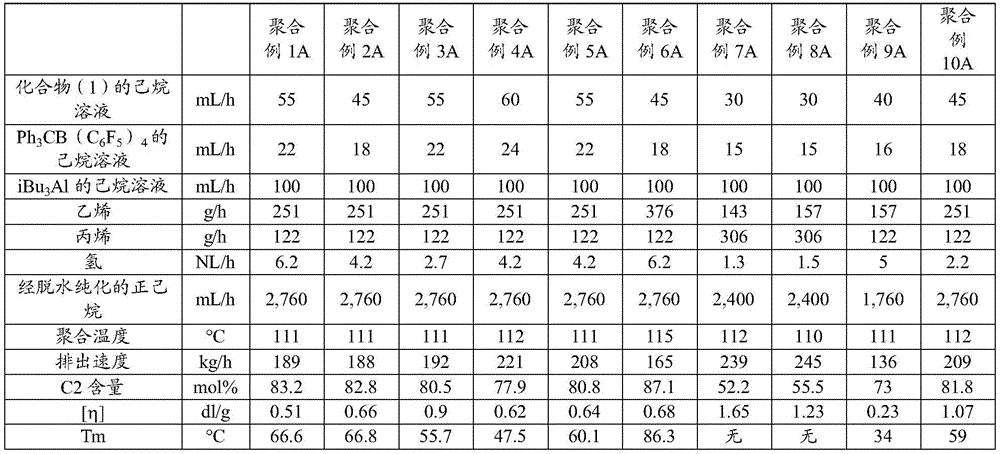
向经充分氮气置换的容积为0.95L的带有搅拌叶片的加压连续聚合反应器的一个供给口中,分别以55mL/小时、22mL/小时、100mL/小时的流量连续地供给上述化合物(1)的己烷溶液(0.020mmol/L)、三苯基碳鎓四(五氟苯基)硼酸盐(也记为Ph3CB(C6F5)4)的己烷溶液(0.2mmol/L)、三异丁基铝(也记为iBu3Al)的己烷溶液(5.0mmol/L)。同时,向连续聚合反应器的其他供给口中,以251g/小时的流量连续地供给乙烯,以122g/小时的流量连续地供给丙烯,以6.2NL/小时的流量连续地供给氢。从前述聚合反应器的两个供给口和最上部的口,以2,760mL/小时的总流量连续地供给经脱水纯化的正己烷,在聚合温度为111℃、总压为3.6MPa-G(G=表压)、搅拌转速为700rpm的条件下连续地进行溶液聚合。在被设置在聚合反应器外周的夹套中流通制冷剂,由此,进行聚合反应热的除去。The above-mentioned compound (1) was continuously supplied to one supply port of a pressurized continuous polymerization reactor with a stirring blade of 0.95 L and a volume of 0.95 L that had been fully nitrogen-substituted hexane solution (0.020mmol/L), triphenylcarbonium tetrakis (pentafluorophenyl) borate (also referred to as Ph 3 CB(C 6 F 5 ) 4 ) hexane solution (0.2 mmol/L) ), triisobutylaluminum (also referred to as iBu 3 Al) in hexane solution (5.0 mmol/L). At the same time, ethylene was continuously supplied at a flow rate of 251 g/hour, propylene was continuously supplied at a flow rate of 122 g/hour, and hydrogen was continuously supplied at a flow rate of 6.2 NL/hour to other supply ports of the continuous polymerization reactor. From the two supply ports and the uppermost port of the aforementioned polymerization reactor, dehydrated and purified n-hexane was continuously supplied at a total flow rate of 2,760 mL/hour at a polymerization temperature of 111° C. and a total pressure of 3.6 MPa-G (G = gauge pressure), and the solution polymerization was carried out continuously under the conditions of a stirring rotation speed of 700 rpm. The heat of polymerization reaction is removed by flowing a refrigerant through a jacket provided on the outer periphery of the polymerization reactor.
以将压力维持在3.6MPa-G的方式,介由被设置在聚合反应器最上部的排出口,按照以乙烯·丙烯共聚物计为189kg/小时的速度将通过在上述条件下进行聚合而生成的包含乙烯·丙烯共聚物的己烷溶液连续地排出。将得到的聚合溶液投入至大量的甲醇中,使乙烯·丙烯共聚物析出。而后,于180℃使该乙烯·丙烯共聚物进行1小时减压干燥。将得到的聚合物的性状示于表2A及表2-1B。Produced by polymerizing under the above conditions at a rate of 189 kg/hour in terms of the ethylene-propylene copolymer through the discharge port provided in the uppermost part of the polymerization reactor so that the pressure is maintained at 3.6 MPa-G The hexane solution containing the ethylene-propylene copolymer was continuously discharged. The obtained polymerization solution was put into a large amount of methanol to deposit an ethylene-propylene copolymer. Then, the ethylene-propylene copolymer was dried under reduced pressure at 180°C for 1 hour. The properties of the obtained polymers are shown in Table 2A and Table 2-1B.
[聚合例2A~10A][Polymerization Examples 2A to 10A]
除了如表2A中记载的那样来变更聚合条件之外,与聚合例1A同样地进行。其中,聚合例7A及8A中,使用了上述化合物(1)的己烷溶液(0.038mmol/L)、Ph3CB(C6F5)4的己烷溶液(0.30mmol/L)、iBu3Al的己烷溶液(5.0mmol/L)。Except having changed the polymerization conditions as described in Table 2A, it carried out similarly to Polymerization Example 1A. Among them, in Polymerization Examples 7A and 8A, a hexane solution (0.038 mmol/L) of the above-mentioned compound (1), a hexane solution (0.30 mmol/L) of Ph 3 CB(C 6 F 5 ) 4 , and iBu 3 were used Al in hexane solution (5.0 mmol/L).
[表2A][Table 2A]
表2ATable 2A
[聚合例2B~22B][Polymerization Examples 2B to 22B]
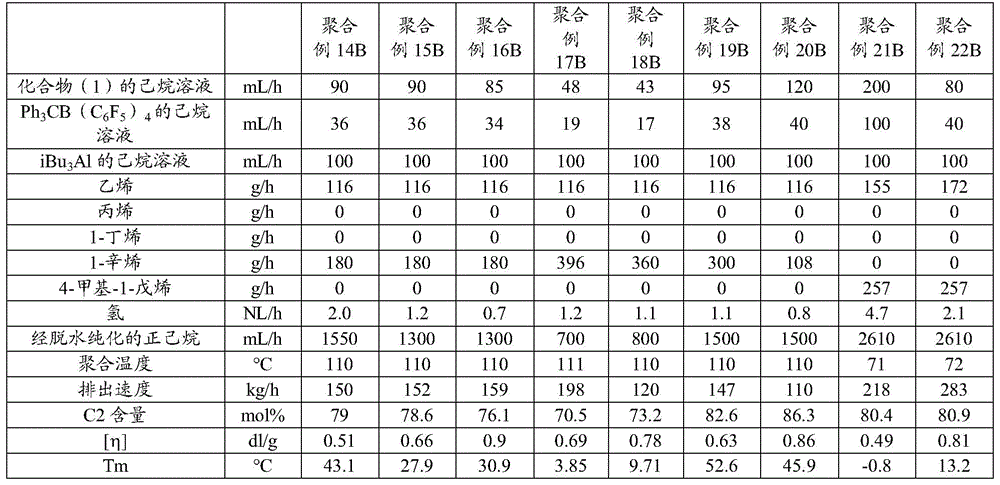
除了如表2-1B及2-2B中记载的那样来变更聚合条件之外,与聚合例1B同样地进行。其中,聚合例6B中,使用了上述化合物(1)的己烷溶液(0.038mmol/L)、Ph3CB(C6F5)4的己烷溶液(0.30mmol/L)、iBu3Al的己烷溶液(5.0mmol/L)。另外,聚合例21B及22B中,使用了上述化合物(1)的己烷溶液(0.015mmol/L)、Ph3CB(C6F5)4的己烷溶液(1.2mmol/L)、iBu3Al的己烷溶液(5.0mmol/L)。另外,代替丙烯,在聚合例7B~13B中,使用了1-丁烯作为共聚单体,在聚合例14B~20B中,使用了1-辛烯作为共聚单体,在聚合例21B及22B中,使用了4-甲基-1-戊烯作为共聚单体。It carried out similarly to Polymerization Example 1B except having changed the polymerization conditions as described in Table 2-1B and 2-2B. Among them, in Polymerization Example 6B, a hexane solution (0.038 mmol/L) of the above-mentioned compound (1), a hexane solution (0.30 mmol/L) of Ph 3 CB(C 6 F 5 ) 4 , and iBu 3 Al were used. Hexane solution (5.0 mmol/L). In addition, in Polymerization Examples 21B and 22B, a hexane solution (0.015 mmol/L) of the above-mentioned compound (1), a hexane solution (1.2 mmol/L) of Ph 3 CB(C 6 F 5 ) 4 , and iBu 3 were used Al in hexane solution (5.0 mmol/L). In addition, instead of propylene, 1-butene was used as a comonomer in Polymerization Examples 7B to 13B, and 1-octene was used as a comonomer in Polymerization Examples 14B to 20B. In Polymerization Examples 21B and 22B, 1-octene was used as a comonomer. , 4-methyl-1-pentene was used as a comonomer.
[表2-1B][Table 2-1B]
表2-1BTable 2-1B

[表2-2B][Table 2-2B]
表2-2BTable 2-2B
[实施例A及比较例A][Example A and Comparative Example A]
使用上述的聚合例中得到的乙烯·丙烯共聚物作为润滑油用粘度调节剂,制备润滑油组合物。以润滑油组合物的150℃时的HTHS成为2.6mPa·s左右的方式,调节乙烯·丙烯共聚物的添加量。A lubricating oil composition was prepared using the ethylene-propylene copolymer obtained in the above-mentioned polymerization example as a viscosity modifier for lubricating oil. The addition amount of the ethylene-propylene copolymer was adjusted so that the HTHS at 150° C. of the lubricating oil composition would be about 2.6 mPa·s.
配合组成如下所述。The compounding composition is as follows.
API组(III)基油(“Yubase-4”,SK Lubricants公司制,100℃时的运动粘度:4.212mm2/s,粘度指数:123)API group (III) base oil ("Yubase-4", manufactured by SK Lubricants, kinematic viscosity at 100°C: 4.212 mm 2 /s, viscosity index: 123)
添加剂*:8.64质量%Additive * : 8.64% by mass
倾点下降剂:0.3质量%Pour point depressant: 0.3% by mass
(聚甲基丙烯酸酯“LUBRAN 165”,东邦化学工业公司制)(Polymethacrylate "LUBRAN 165", manufactured by Toho Chemical Industry Co., Ltd.)
乙烯·丙烯共聚物:0.53~2.92质量%(如表3A所示)Ethylene-propylene copolymer: 0.53 to 2.92 mass % (as shown in Table 3A)
合计100.0(质量%)Total 100.0 (mass %)
注(*)添加剂=包含Ca及Na的过碱性清净剂、含有N的分散剂、胺性[aminic]及酚性的抗氧化剂、二烷基二硫代磷酸锌类、摩擦调节剂、及消泡剂的以往的GF-5用发动机油用添加剂组合。Note (*) Additives = overbased detergents containing Ca and Na, dispersants containing N, aminic and phenolic antioxidants, zinc dialkyldithiophosphates, friction modifiers, and A combination of additives for conventional engine oils for GF-5 as an antifoaming agent.
将评价结果示于表3A。The evaluation results are shown in Table 3A.
[表3A][Table 3A]
表3ATable 3A

[实施例B、实施例C及比较例B][Example B, Example C and Comparative Example B]
使用上述聚合例中得到的乙烯·α-烯烃共聚物作为润滑油用粘度调节剂,制备润滑油组合物。以润滑油组合物的150℃时的HTHS成为2.6mPa·s左右的方式,调节乙烯·α-烯烃共聚物的添加量。A lubricating oil composition was prepared using the ethylene/α-olefin copolymer obtained in the above-mentioned polymerization example as a viscosity modifier for lubricating oil. The addition amount of the ethylene/α-olefin copolymer was adjusted so that the HTHS at 150° C. of the lubricating oil composition was about 2.6 mPa·s.
配合组成如下所述。The compounding composition is as follows.
API组(III)基油(“Yubase-4”,SK Lubricants公司制,100℃时的运动粘度:4.212mm2/s,粘度指数:123)API group (III) base oil ("Yubase-4", manufactured by SK Lubricants, kinematic viscosity at 100°C: 4.212 mm 2 /s, viscosity index: 123)
添加剂*:8.64质量%Additive * : 8.64% by mass
倾点下降剂:0.3质量%Pour point depressant: 0.3% by mass
(聚甲基丙烯酸酯“LUBRAN 165”,东邦化学工业公司制)(Polymethacrylate "LUBRAN 165", manufactured by Toho Chemical Industry Co., Ltd.)
乙烯·α-烯烃共聚物:0.63~1.44质量%(如表3B所述)Ethylene·α-olefin copolymer: 0.63 to 1.44 mass % (as described in Table 3B)
合计100.0(质量%)Total 100.0 (mass %)
注(*)添加剂=包含Ca及Na的过碱性清净剂、含有N的分散剂、胺性[aminic]及酚性的抗氧化剂、二烷基二硫代磷酸锌类、摩擦调节剂、及消泡剂的以往的GF-5用发动机油用添加剂组合。Note (*) Additives = overbased detergents containing Ca and Na, dispersants containing N, aminic and phenolic antioxidants, zinc dialkyldithiophosphates, friction modifiers, and A combination of additives for conventional engine oils for GF-5 as an antifoaming agent.
将评价结果示于表3B。The evaluation results are shown in Table 3B.
[表3B][Table 3B]
表3BTable 3B

图1中,示出针对实施例B、实施例C及比较例B中得到的润滑油组合物、将剪切稳定性(SSI)及100℃时的运动粘度(KV100)进行绘制而得到的图。在对具有同等程度的剪切稳定性(SSI)的实施例B(乙烯·1-丁烯共聚物,乙烯·1-辛烯共聚物、乙烯·4-甲基-1-戊烯共聚物)、与实施例C及比较例B(乙烯·丙烯共聚物)进行比较的情况下,实施例B的KV100低,更优异。In FIG. 1, the graph obtained by plotting the shear stability (SSI) and the kinematic viscosity (KV100) at 100° C. for the lubricating oil compositions obtained in Example B, Example C, and Comparative Example B is shown . Example B (ethylene·1-butene copolymer, ethylene·1-octene copolymer, ethylene·4-methyl-1-pentene copolymer) with the same degree of shear stability (SSI) . When compared with Example C and Comparative Example B (ethylene-propylene copolymer), the KV100 of Example B is lower and more excellent.
Claims (11)
Applications Claiming Priority (5)
| Application Number | Priority Date | Filing Date | Title |
|---|---|---|---|
| JP2018079175 | 2018-04-17 | ||
| JP2018-079176 | 2018-04-17 | ||
| JP2018-079175 | 2018-04-17 | ||
| JP2018079176 | 2018-04-17 | ||
| PCT/JP2019/016255 WO2019203210A1 (en) | 2018-04-17 | 2019-04-16 | Lubricating oil composition and viscosity modifier for lubricating oil |
Publications (1)
| Publication Number | Publication Date |
|---|---|
| CN111801405A true CN111801405A (en) | 2020-10-20 |
Family
ID=68240138
Family Applications (1)
| Application Number | Title | Priority Date | Filing Date |
|---|---|---|---|
| CN201980016497.7A Pending CN111801405A (en) | 2018-04-17 | 2019-04-16 | Lubricating oil composition and viscosity modifier for lubricating oil |
Country Status (5)
| Country | Link |
|---|---|
| US (1) | US11655428B2 (en) |
| EP (1) | EP3783087B1 (en) |
| JP (1) | JP7189941B2 (en) |
| CN (1) | CN111801405A (en) |
| WO (1) | WO2019203210A1 (en) |
Families Citing this family (2)
| Publication number | Priority date | Publication date | Assignee | Title |
|---|---|---|---|---|
| JP7291525B2 (en) * | 2019-04-16 | 2023-06-15 | 三井化学株式会社 | Viscosity modifier for lubricating oil and lubricating oil composition |
| WO2023054440A1 (en) | 2021-09-30 | 2023-04-06 | 三井化学株式会社 | Lubricating oil composition |
Citations (5)
| Publication number | Priority date | Publication date | Assignee | Title |
|---|---|---|---|---|
| CN1494582A (en) * | 2001-11-01 | 2004-05-05 | ������ѧ��ʽ���� | Lubricating oil additives and lubricating oil compositions |
| JP2005307099A (en) * | 2004-04-26 | 2005-11-04 | Mitsui Chemicals Inc | Driving system-lubricating oil composition |
| CN101146899A (en) * | 2005-03-25 | 2008-03-19 | 三井化学株式会社 | Viscosity modifier for lubricating oil for power transmission system and lubricating oil composition for power transmission system |
| CN106103506A (en) * | 2014-03-28 | 2016-11-09 | 三井化学株式会社 | Viscosity modifier for lubricating oil, additive for lubricant composition and lubricant oil composite |
| WO2017082182A1 (en) * | 2015-11-09 | 2017-05-18 | 三井化学株式会社 | Viscosity modifier for lubricating oils, additive composition for lubricating oils, and lubricating oil compositions |
Family Cites Families (6)
| Publication number | Priority date | Publication date | Assignee | Title |
|---|---|---|---|---|
| JP3287085B2 (en) | 1993-11-30 | 2002-05-27 | 三井化学株式会社 | Lubricating oil additive composition and method for producing the same |
| ID20056A (en) | 1997-01-31 | 1998-09-17 | Mitsui Chemicals Inc | LUBRIC OIL, COMPOSITION LUBRIC OIL AND COMPOSITION OF OIL FUEL |
| JP4384292B2 (en) | 1998-06-19 | 2009-12-16 | 出光興産株式会社 | Ethylene copolymer, process for producing the same, resin composition containing the same, molded article, and lubricating oil |
| DE69926015T2 (en) | 1998-12-09 | 2006-05-18 | Mitsui Chemicals, Inc. | VIKOSITY CHANGERS FOR LUBRICATING OILS AND LUBRICATING OIL COMPOSITION |
| JP5965664B2 (en) | 2012-02-20 | 2016-08-10 | 三井化学株式会社 | Surface protective film and method of manufacturing semiconductor device using the same |
| EP3124505B1 (en) | 2014-03-28 | 2025-03-19 | Mitsui Chemicals, Inc. | Ethylene/alpha-olefin copolymer and lubricating oil |
-
2019
- 2019-04-16 EP EP19787977.8A patent/EP3783087B1/en active Active
- 2019-04-16 WO PCT/JP2019/016255 patent/WO2019203210A1/en not_active Ceased
- 2019-04-16 US US17/044,846 patent/US11655428B2/en active Active
- 2019-04-16 JP JP2020514385A patent/JP7189941B2/en active Active
- 2019-04-16 CN CN201980016497.7A patent/CN111801405A/en active Pending
Patent Citations (5)
| Publication number | Priority date | Publication date | Assignee | Title |
|---|---|---|---|---|
| CN1494582A (en) * | 2001-11-01 | 2004-05-05 | ������ѧ��ʽ���� | Lubricating oil additives and lubricating oil compositions |
| JP2005307099A (en) * | 2004-04-26 | 2005-11-04 | Mitsui Chemicals Inc | Driving system-lubricating oil composition |
| CN101146899A (en) * | 2005-03-25 | 2008-03-19 | 三井化学株式会社 | Viscosity modifier for lubricating oil for power transmission system and lubricating oil composition for power transmission system |
| CN106103506A (en) * | 2014-03-28 | 2016-11-09 | 三井化学株式会社 | Viscosity modifier for lubricating oil, additive for lubricant composition and lubricant oil composite |
| WO2017082182A1 (en) * | 2015-11-09 | 2017-05-18 | 三井化学株式会社 | Viscosity modifier for lubricating oils, additive composition for lubricating oils, and lubricating oil compositions |
Also Published As
| Publication number | Publication date |
|---|---|
| JPWO2019203210A1 (en) | 2021-04-01 |
| EP3783087B1 (en) | 2022-11-09 |
| US20210130725A1 (en) | 2021-05-06 |
| JP7189941B2 (en) | 2022-12-14 |
| WO2019203210A1 (en) | 2019-10-24 |
| EP3783087A4 (en) | 2021-12-29 |
| EP3783087A1 (en) | 2021-02-24 |
| US11655428B2 (en) | 2023-05-23 |
Similar Documents
| Publication | Publication Date | Title |
|---|---|---|
| KR101485227B1 (en) | Viscosity modifier for lubricating oils, additive composition for lubricating oils, and lubricating oil composition | |
| JP4634300B2 (en) | Lubricating oil composition and lubricating oil for internal combustion engine | |
| CN102482612A (en) | lubricating oil composition | |
| CN103415605B (en) | high viscosity lubricant composition | |
| WO2006101206A1 (en) | Viscosity control agent for lubricant for power transfer system and lubricant composition for power transfer system | |
| JP7752693B2 (en) | lubricating oil composition | |
| CN111801405A (en) | Lubricating oil composition and viscosity modifier for lubricating oil | |
| CN111621355B (en) | Lubricant composition for gear oil | |
| CN110546246A (en) | Lubricating oil composition for internal combustion engine | |
| JP4620966B2 (en) | Drive system lubricating oil composition | |
| US11873462B2 (en) | Lubricating oil composition | |
| JP2010090252A (en) | Lubricant composition | |
| JP6325894B2 (en) | Lubricating oil composition for internal combustion engines | |
| JP2012500315A (en) | Lubricating composition | |
| JP7219663B2 (en) | Viscosity modifier for lubricating oil and lubricating oil composition | |
| JP7291525B2 (en) | Viscosity modifier for lubricating oil and lubricating oil composition | |
| JP7715544B2 (en) | lubricating oil composition | |
| WO2025252603A1 (en) | Lubricating oil composition |
Legal Events
| Date | Code | Title | Description |
|---|---|---|---|
| PB01 | Publication | ||
| PB01 | Publication | ||
| SE01 | Entry into force of request for substantive examination | ||
| SE01 | Entry into force of request for substantive examination |