Disclosure of Invention
In order to solve the problem that the monocular vision inertial odometer scheme has extra unobservability to cause inaccurate pose estimation of the mobile robot and further cannot construct a high-accuracy map under certain conditions, the invention adds a wheel speed meter sensor and plane constraint information on the basis of the monocular vision inertial odometer scheme, provides a positioning and mapping method of the mobile robot, and can improve the positioning precision and mapping accuracy of the mobile robot.
Based on the purpose, the technical scheme of the invention is as follows:
providing a method for positioning and mapping a mobile robot, the mobile robot comprising a mobile robot body, a monocular camera, an IMU sensor and a wheel speed sensor, the monocular camera lens being directed directly in front of the mobile robot body, wherein the IMU sensor comprises an IMU accelerometer and an IMU gyroscope;
processing each frame of image acquired by the monocular camera to obtain a processing value of the monocular camera, performing pre-integration on the measurement value of the IMU sensor between every two adjacent frames of images to obtain a processing value of the IMU sensor, and performing pre-integration on the measurement value of the wheel speed meter sensor between every two adjacent frames of images to obtain a processing value of the wheel speed meter sensor;
adding the processing values of the monocular camera, the IMU sensor and the wheel speed meter sensor into a sliding window; acquiring a processing value of a sliding window, and initializing the pose of the mobile robot, the coordinates of the characteristic points, the IMU gyroscope deviation, the linear velocity and the scale factor;
and after the initialization is successful, constructing a factor graph model to obtain a state value to be estimated, and performing nonlinear optimization on the processing value of the sliding window and the state value to be estimated to minimize a residual error item to obtain the pose and the map of the mobile robot.
The method for successfully finishing initialization of the pose of the mobile robot, the coordinates of the feature points, the deviation of the IMU gyroscope, the linear velocity and the scale factor comprises the following steps: initializing the pose of the mobile robot, the coordinates of the feature points, the IMU gyroscope deviation, the linear velocity and the scale factor, updating the sliding window if the initialization fails, and then acquiring the processing value of the sliding window again until the initialization is successful.
And after the pose and the map of the mobile robot are obtained, updating the sliding window, and performing nonlinear optimization on the updated processing value and the state value to be estimated of the sliding window again to obtain the updated pose and the map of the mobile robot.
The updating uses the same method, specifically, the latest two frames in the sliding window are read, whether the last frame is a key frame or not is judged, if so, the processing values of the monocular camera, the IMU sensor and the wheel speed meter sensor of the oldest key frame in the sliding window are deleted, and the processing values of the monocular camera, the IMU sensor and the wheel speed meter sensor of the current frame are reserved; if the current frame is not the key frame, deleting the processing value of the monocular camera of the current frame, and keeping the processing values of the IMU sensor and the wheel speed meter sensor.
The processing values of the monocular camera and the IMU sensor are obtained through the existing algorithm; the processing value of the wheel speed meter sensor is obtained by constructing a motion measurement model, a measurement pre-integration model, an error propagation model and a covariance propagation model of the wheel speed meter sensor.
The method for initializing the deviation of the IMU gyroscope comprises the following steps: the method comprises the steps of obtaining two adjacent key frames in a sliding window, reading the rotation amount of a monocular camera coordinate system, an IMU sensor coordinate system and a wheel speed meter sensor coordinate system in the key frames at each key frame moment, respectively constructing a least square equation according to the rotation amount of the monocular camera coordinate system and the IMU sensor coordinate system and the rotation amount of the monocular camera coordinate system and the wheel speed meter sensor coordinate system, summing and averaging the obtained values, and initializing the deviation of the IMU gyroscope.
The method for initializing the linear velocity and the scale factor comprises the following steps: acquiring two adjacent key frames in a sliding window, and reading pre-integration translation amount and speed variation amount of an IMU sensor and a wheel speed meter sensor in the key frames; and translation amount, speed variation amount and gravity component of the monocular camera; and constructing a least square equation by using the pre-integration translation amount and the speed variation of the IMU sensor and the wheel speed meter sensor and the translation amount, the speed variation and the gravity component of the monocular camera, and initializing the linear speed and the scale factor.
The method for constructing the factor graph model to obtain the state value to be estimated comprises the following steps: the residual term includes: IMU sensor residual error, wheel speed meter sensor residual error, monocular camera residual error and plane residual error; the state value to be estimated of each key frame sliding window comprises: translation amount, speed, rotation amount, IMU accelerometer deviation, IMU gyroscope deviation and characteristic point inverse depth under a world coordinate system; the residual error of the IMU sensor restrains the translation amount, the rotation amount, the speed, the deviation of an IMU accelerometer and the deviation of an IMU gyroscope in the world coordinate system; the wheel speed meter sensor restricts the translation amount and the rotation amount under the world coordinate system and external parameters from the IMU sensor to the wheel speed meter; the monocular camera residual constrains the inverse depth, translation amount, rotation amount, speed and IMU accelerometer deviation, IMU gyroscope deviation and external parameters from the IMU to the monocular camera under the world coordinate system; the plane residual error restricts the translation amount and the rotation amount under the world coordinate system; and finishing the construction factor graph model to obtain a state value to be estimated.
The IMU residual error and the monocular vision residual error are obtained by using VINS-Mono, and the wheel speed meter residual error and the plane constraint residual error are obtained by using the method disclosed by the invention.
Specifically, wheel speed residual error
The formula is as follows:
plane constrained residual rplThe formula is as follows:
the invention has the following beneficial effects:
the invention provides a robust initialization method, which improves the positioning precision and accuracy of the mobile robot, and in addition, the invention also provides an edge updating method, which can effectively reduce the calculated amount and reduce the calculation burden of the robot.
The above and other objects, advantages and features of the present invention will become more apparent to those skilled in the art from the following detailed description of specific embodiments thereof, which is to be read in connection with the accompanying drawings.
Detailed Description
In order to make the aforementioned objects, features and advantages of the present invention comprehensible, embodiments accompanied with figures are described in detail below. In the following description, numerous specific details are set forth in order to provide a thorough understanding of the present invention, but the present invention may be practiced in many ways different from those described herein, and it will be apparent to those skilled in the art that similar modifications may be made without departing from the spirit of the invention, and the invention is therefore not limited to the specific embodiments disclosed below.
Before describing the present invention, the following description is made of the symbols appearing herein:
representing noisy measurements, such as: if it is not
The linear velocity of the robot along the advancing direction under the coordinate system of the wheel speed meter, namely the real value, is represented
The method comprises the steps of (1) representing the size of a linear velocity with noise of the robot along the advancing direction under a coordinate system of a wheel speed meter, namely a measured value;
representing a rotation matrix from the M coordinate system to the N coordinate system,
is composed of
In the form of a quaternion expression of (c),
indicating the amount of translation from the M coordinate system to the N coordinate system,
representing a transformation matrix from the M coordinate system to the N coordinate system. M and N include: world coordinateSystem W, IMU coordinate system B, camera coordinate system C, wheel speed meter coordinate system O; the IMU coordinate system at the time of acquiring the k-th frame image is denoted by b
kThe coordinate system of the camera at the time of acquiring the image of the k-th frame is denoted by c
kThe wheel speed coordinate system when the k frame image is acquired is represented as o
k。
For example:
a rotation matrix representing the coordinate system from the IMU to the wheel speed meter coordinate system,
is composed of
In the form of a quaternion expression of (c),
representing the amount of translation from the IMU coordinate system to the wheel speed meter coordinate system.
A transformation matrix representing the coordinate system of the wheel speed meter from the IMU coordinate system
And
composition is carried out;
representing a rotation matrix from the IMU coordinate system to the camera coordinate system,
is composed of
In the form of a quaternion expression of (c),
representing the amount of translation from the IMU coordinate system to the camera coordinate system.
Representing a transformation matrix from the IMU coordinate system to the camera coordinate system, by
And
and (4) forming.
A jacobian matrix representing vector N with respect to vector M.
The invention provides a method for positioning and mapping a mobile robot, as shown in fig. 1, the mobile robot comprises a mobile robot main body 1, a monocular camera 2, an IMU sensor 3 and a wheel speed meter sensor 4, wherein the IMU sensor comprises an IMU gyroscope and an IMU accelerometer, a lens of the monocular camera 2 faces to the right front of the mobile robot main body 1, before the mobile robot moves, the monocular camera 2 needs to be calibrated to obtain internal parameters thereof, including focal length, principal point and distortion parameter, and the calibration method adopts a method commonly used in the industry, such as a Zhang friend calibration method; the distance between the left and right wheels of the wheel speed meter sensor 4 is measured in meters, and finally the reliability of the IMU sensor 3 is checked.
The IMU coordinate system that determines the first keyframe moment is the world coordinate system, establishing the coordinate system between the monocular camera, the IMU sensor, and the wheel speed sensor as shown in fig. 1. The method for judging the key frame comprises the following steps: and if the average parallax between the frame and the previous key frame is large enough or the number of the tracked feature points is lower than a threshold value, judging that the frame is the key frame.
Fig. 2 is a schematic flow chart of the positioning and mapping method of the present invention. The method acquires the measured values of the monocular camera, the IMU sensor and the wheel speed meter sensor, processes the measured values and acquires the processed values of the monocular camera, the IMU sensor and the wheel speed meter sensor. Specifically, each frame of image acquired by the monocular camera is processed to obtain a processing value of the monocular camera; pre-integrating the IMU sensor measurement value between every two frames of images to obtain a processing value of the IMU sensor; and pre-integrating the measured value of the wheel speed meter sensor between every two frames of images to obtain a processed value of the wheel speed meter sensor.
Adding the processing values of the monocular camera, the IMU sensor and the wheel speed meter sensor into a sliding window, then acquiring the processing value of the sliding window, and initializing the pose of the mobile robot, the coordinate of the characteristic point, the IMU gyroscope deviation, the linear speed and the scale factor; and after the initialization is successful, obtaining a state value to be estimated through a construction factor graph model, and performing nonlinear optimization on the processing value of the sliding window and the state value to be estimated to minimize a residual error item to obtain the pose and the map of the mobile robot.
If a frame with enough feature matching number and enough parallax is not found in the frames in the sliding window, or the rotation amount of the pose and the three-dimensional coordinates of the environmental feature points cannot be calculated, initialization failure can be caused; and if the initialization fails, updating the sliding window, and acquiring the processing value of the sliding window again for initialization after the updating is completed until the initialization is successful.
Meanwhile, in order to avoid the problem that the calculation amount is increased due to the excessive number of frames in the sliding window and the calculation burden of the mobile robot is increased, after the pose and the map of the mobile robot are obtained, the sliding window still needs to be updated, and then the nonlinear optimization minimization residual error item is performed on the processing value of the updated sliding window and the state value to be estimated again to obtain the updated pose and the map of the mobile robot.
Specifically, the sliding window updating method is as follows: the sliding window comprises monocular camera processing values of a plurality of key frames, processing values of all IMU sensors and wheel speed meter sensors at a plurality of key frame moments, processing values of the monocular camera processing values of the latest two frames, processing values of the IMU sensors and the wheel speed meter sensors, the two frames with the shortest time and the second shortest time in the sliding window are read, namely the latest two frames, judging whether the last frame, namely the frame with the second shortest storage time, is a key frame, if so, the processing values of the monocular camera, IMU sensor and wheel speed sensor of the oldest keyframe are deleted, namely deleting the processing value of the key frame with the longest storage time in the current sliding window, and reserving the processing values of the monocular camera, the IMU sensor and the wheel speed meter sensor of the current frame, due to deletion of the oldest key frame, all the processing values of the IMU sensor and the wheel speed meter sensor between the key frame with the longest storage time and the next longest key frame are deleted; if the current frame is not the key frame, deleting the processing value of the monocular camera of the current frame, and keeping the processing values of the IMU sensor and the wheel speed meter sensor, wherein the updating method is called marginalization.
The method comprises the steps that processing values of a monocular camera and an IMU sensor are obtained through the existing algorithm, each frame of image obtained by the monocular camera is processed through a VINS-Mono algorithm, the processing value of the monocular camera is obtained, specifically, feature extraction, tracking and matching are carried out on the image shot by the monocular camera through a KLT sparse optical flow algorithm, then an abnormal matching pair is eliminated through RANSAC, the three-dimensional coordinate of a feature point and the camera pose are calculated through triangulation, and finally the processing value of the monocular camera is further optimized through the minimized reprojection error;
the invention uses the VINS-Mono algorithm to carry out pre-integration on the IMU sensor measurement value between every two adjacent frame images to obtain the processing value of the IMU sensor.
In addition, the invention constructs a motion measurement model, a measurement pre-integration model, an error propagation model and a covariance propagation model of the wheel speed meter sensor to process the measured value of the wheel speed meter sensor, and obtains the processed value of the wheel speed meter sensor.
Specifically, the motion measurement model of the wheel speed sensor of the invention is as follows:
wherein k represents the acquisition wheel speed meterTime stamp of the measurement.
And
the coordinate system of the wheel speed meter indicates the size of the linear speed and the heading angular speed of the robot with noise along the advancing direction, namely measured values.
And
the linear velocity and the course angular velocity of the robot along the advancing direction are represented, namely real values. n is
rAnd n
lThe measurement noise of the right wheel encoder and the measurement noise of the left wheel encoder are Gaussian white noise respectively. l denotes a distance between the left wheel encoder and the right wheel encoder.
The measurement pre-integration model of the wheel speed meter sensor is as follows:
because the acquisition frequency of the wheel speed sensor measurement value is far greater than the acquisition frequency of the monocular camera to acquire images, the wheel speed sensor measurement value between every two adjacent frame images is pre-integrated. The pre-integration model of the present invention is as follows:
wherein,
and
the real values of the rotation matrix and the translation amount from the moment i to the moment j in the IMU coordinate system,
the real value of the rotation matrix from the moment i to the moment k-1 in the IMU coordinate system,
and the real value of the rotation matrix from the moment k-1 to the moment k in the IMU coordinate system.
And
the rotation matrix and translation from the IMU coordinate system to the wheel speed meter coordinate system. Δ t is the time interval between two adjacent frames of images. exp () < lambda > is the exponential mapping of lie algebra to lie groups.
The integral measurement terms of rotation and translation and the error terms can be separated according to a first order taylor expansion. The formula (3) and the formula (4) can be expressed by the formula (5) and the formula (6). Wherein,
and
and (4) rotation matrixes and translation quantities with errors from i moment to j moment in the IMU coordinate system, namely measured values.
And
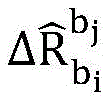
and (3) accumulating a rotation error term and a translation error term from the moment i to the moment j of the wheel speed meter under an IMU coordinate system.
Is right jacobian.
Then, by separating the measurement term and the error term in the measurement pre-integration model, a rotation error term can be obtained
And a translation error term
Namely, the error propagation model of the wheel speed meter sensor is specifically as follows:
further, the accumulated error term can be represented in a matrix form, and equation (7) represents the conversion of the accumulated error from time i to time k to the accumulated error from time i to time k +1 through the rotation and translation at time k + 1.
Finally, the covariance of the error term can be calculated according to the formula (7), and the covariance propagation model of the wheel speed meter sensor of the invention can be obtained:
thus, the error term
Obeying a Gaussian distribution
After the processing values of the monocular camera, the IMU sensor and the wheel speed meter sensor are obtained through the method, the processing values are added into the sliding window, and the robot pose, the coordinates of the characteristic points, the IMU gyroscope, the scale factors and the linear speed are initialized, wherein the robot pose comprises the rotation amount and the translation amount of the robot pose.
Generally, initialization has four steps as follows:
(1) firstly, initializing the rotation amount and the translation amount of the pose of the robot and the three-dimensional coordinates of characteristic points in the environment by the SFM technology of a monocular camera, wherein the rotation amount refers to the rotation amount of a coordinate system of the monocular camera relative to a world coordinate system, the translation amount refers to the translation amount of the coordinate system of the monocular camera relative to the world coordinate system, and similarly, the rotation amount and the translation amount of an IMU sensor and a wheel speed meter sensor respectively refer to the rotation amount and the translation amount of the IMU sensor relative to the world coordinate system and the rotation amount and the translation amount of the wheel speed meter sensor relative to the world coordinate system;
(2) then initializing a gyroscope bias using a rotation amount constraint that causes rotation of the monocular camera coordinate system relative to the world coordinate system to be equal to rotation of the IMU coordinate system relative to the world coordinate system and to rotation of the wheel speed meter coordinate system relative to the world coordinate system;
(3) then, by using the precondition that the translation amount constraint and the gravity vector component in the plane motion are basically unchanged, a linear least square equation is constructed to jointly optimize the linear speed and the scale factor, so that the IMU pre-integral amount in the sliding window, the pre-integral amount of the wheel speed meter and the translation amount calculated by the monocular camera are aligned, wherein the translation amount constraint refers to the translation of a camera coordinate system relative to a world coordinate system, which should be equal to the translation of the IMU coordinate system relative to the world coordinate system, which should also be equal to the translation of the wheel speed meter coordinate system relative to the world coordinate system; because the present invention is directed to planar motion, the gravity vector is a component of the vertical direction of the camera that is substantially invariant; the scale factor is used for restoring the original size of the scene, because the monocular camera cannot acquire the real size of the scene, the original size of the scene is restored through the scale factor;
(4) finally, because the length of the gravity vector cannot be guaranteed to be unchanged, the length constraint of the gravity vector needs to be added, and the gravity direction is further optimized. Therefore, the robot pose corrected by the scale factor and the coordinates of the feature points in the environment are obtained.
The processing method of the steps (1) and (4) uses the prior art, specifically, the step (1) uses the SFM technology of the monocular camera to initialize the pose of the robot and the coordinates of the feature points, and the step (4) adds the initialization of the modular length constraint, and is a method using the VINS-Mono algorithm.
The method for initializing the gyroscope deviation by utilizing the rotation amount constraint in the step (2) of the invention comprises the following steps:
acquiring two continuous key frames in a sliding window, wherein the moments of the two frames are k and k +1 respectively, and converting the rotation amount of the obtained monocular camera from the moment k to the moment k +1 into the IMU coordinate system by utilizing the equal relation between the pre-integral rotation amount of the IMU between the two adjacent key frames and the rotation amount of the monocular camera between the two adjacent key frames under the IMU coordinate system and utilizing the equal relation between the pre-integral rotation amount of the wheel speed meter between the two adjacent key frames and the rotation amount of the monocular camera between the two adjacent key frames under the wheel speed meter coordinate system, wherein the pre-integral rotation amount of the IMU from the moment k to the moment k +1 should be equal to the pre-integral rotation amount of the IMU from the moment k to the moment k; the resulting monocular camera rotation from time k to time k +1 is translated into the wheel speed coordinate system and should also be equal to the pre-integrated rotation of the wheel speed from time k to time k + 1. Thus, the following least squares equation is constructed:
wherein,
is the set of all key frames within the sliding window.
And the quaternion representation forms of the rotation amount from the moment k +1 to the moment k under an IMU coordinate system, a wheel speed meter coordinate system and a monocular camera coordinate system respectively.
Indicating the amount of rotation with the error,
representing the amount of rotation after IMU gyroscope bias correction, b
gkRepresenting the amount of change in IMU gyroscope bias from time k +1 to k.
The IMU gyroscope bias obtained by equation (8) is recorded as
The IMU gyroscope bias obtained from equation (9) is recorded as
The final initial value of the IMU gyroscope bias is then
This value is then used to again correct the pre-integrated rotation of the IMU.
Then, by using the precondition that the translation amount constraint and the gravity vector component in the plane motion are basically unchanged, the method for constructing the linear least square equation to jointly optimize the linear velocity and the scale factor in the step (3) of the invention comprises the following steps:
first, a state quantity to be estimated is determined as
Wherein,
and the linear speed of the robot under an IMU coordinate system at the k-th key frame moment in the sliding window is shown. Considering two consecutive key frame times k and k +1 in the sliding window, there are the following equations:
wherein,
each row of (a) represents, in turn, the pre-integrated translation amount, the speed variation amount, and the gravity component calculated by the monocular camera SFM of the IMU sensor and the wheel speed sensor from time k +1 to time k.
Indicates that the amount of translation and the amount of speed change calculated by the monocular camera SFM from time k +1 to time k are at x
IAnd (4) the component below, and converting to an IMU coordinate system.
A rotation matrix representing the coordinate system from the coordinate system at the moment of monocular camera 0 to the coordinate system at the moment of IMU coordinate system k,
a rotation matrix representing the coordinate system from the moment k +1 of the IMU coordinate system to the moment of the monocular camera 0. g represents the local gravitational acceleration, Δ t
kRepresenting the time interval from time instant k +1 to k, s being a scale factor,
is the measured value of the translation from the k +1 moment to the k moment under the IMU coordinate system,
is the measured value of the linear velocity from the moment k +1 to the moment k under the IMU coordinate system,
is the measured value of the translation from the k +1 moment to the k moment under the coordinate system of the wheel speed meter,
the real value of the translation from the k +1 moment to the k moment under the coordinate system of the monocular camera.
The following least square equation is constructed by combining the formula (10) and the formula (11) by utilizing the relationship that the IMU pre-integration translation amount between two adjacent key frames is equal to the monocular camera translation amount between two adjacent key frames in the IMU coordinate system and utilizing the relationship that the wheel speed meter pre-integration translation amount between two adjacent key frames is equal to the monocular camera translation amount between two adjacent key frames in the wheel speed meter coordinate system
Then, linear optimization is carried out through an SVD method, and x is solvedIAnd obtaining the linear velocity and the scale factor.
After the pose, the feature point coordinates, the IMU sensor, the scale factors and the linear velocity of the robot are initialized successfully, nonlinear optimization is carried out on a state value to be estimated and a processing value in a sliding window, the state value to be estimated is obtained in a mode of constructing a factor graph model minimized residual error item, then a least square equation minimized residual error item is constructed on the state value to be estimated and the processing value in the sliding window, and a map and the pose of the robot are obtained, wherein the specific method comprises the following steps:
the nonlinear optimization aims to accurately estimate the pose of the robot, the three-dimensional coordinates and the external parameters of the feature points, and correct the deviation of an IMU accelerometer and a gyroscope. The invention represents the variable to be estimated by x:
wherein n and m represent the number of key frames and the number of feature points in the current sliding window. x is the number of
kIn (1)
b
a,b
gAnd respectively representing the translation amount, the speed, the rotation amount, the IMU accelerometer deviation and the IMU gyroscope deviation of the robot of the kth key frame in the sliding window in a world coordinate system. Lambda [ alpha ]
lIndicating the inverse depth of the ith feature point when it was first observed.
The resulting factor graph is shown in FIG. 3. The point in the factor graph, i.e., the circle in the graph, is the variable χ to be estimated. And edges in the factor graph, namely squares in the graph, and residual items comprise IMU residual, wheel speed meter residual, monocular vision residual and plane residual. In the figure lambda
1~λ
mRepresenting inverse depth, p
1q
1~p
nq
nRepresenting translation and rotation, v
1b
1~v
nb
nIndicating linear velocity and IMU bias, where IMU bias refers to IMU accelerometer bias and IMU gyroscope bias,
an external reference representing the IMU to the wheel speed meter, namely a transformation matrix of the IMU coordinate system to the wheel speed meter coordinate system,
an extrinsic parameter representing the IMU to monocular camera, i.e., a transformation matrix of the IMU coordinate system to the camera coordinate system.
In the factor graph model of the invention, IMU residual error restricts translation amount and rotation amount
And linear velocity, IMU accelerometer bias, and IMU gyroscope bias
b
a,b
g。
The residual error of the wheel speed meter restricts the translation amount and the rotation amount
And IMU to wheel speed meter external reference
Monocular vision residual constrains the inverse depth lambda of its observed feature points
lIMU to monocular camera external reference
Amount of translation and amount of rotation
And linear velocity, IMU accelerometer bias, and IMU gyroscope bias
b
a,b
g。
Plane residual error restricts translation amount and rotation amount
Then, a series of processing values in a sliding window are obtained through a monocular camera, an IMU and a wheel speed meter sensor, and the following least square equation is established:
wherein, { r
p,H
pThe priori information left by the marginalization, i.e. the sliding window update method of the present invention.
r
plCorresponding to IMU residual error, wheel speed meter residual error, monocular vision residual error and plane constraint residual error respectively,
Representing the noisy measurements of the IMU, the wheel speed meter and the monocular camera, respectively, from time k +1 to time k, in their respective coordinate systems. Wherein,
and
is obtained by using a VINS-Mono algorithm.
Σ
plThe covariance of the IMU residual error, the covariance of the wheel speed meter residual error, the covariance of the monocular vision residual error and the covariance of the plane constraint residual error are respectively corresponded.
The jth feature point representing the ith key frame in the sliding window, and the feature point occurring at least twice within the sliding window.
The present invention calculates the wheel speed residual and the plane constraint residual, as described in detail below.
Calculating residual error of the wheel speed meter:
considering the k to k +1 th key frames in the sliding window, the noisy rotation and translation measurement values of the wheel speed meter sensor, and the difference of the rotation and translation values to be estimated in the world coordinate system (IMU 0 th frame coordinate system) converted into the wheel speed meter coordinate system, namely the wheel speed meter residual error, are expressed by the following form:
where log () is the conversion of lie groups into lie algebras, i.e. the conversion of rotation matrices into rotation vectors,
is shown inThe translation amounts of the 0 th and K +1 th key frame robots in a world coordinate system,
representing the rotation matrix of the robot under the world coordinate system at the K < th > and the K +1 < th > key frames,
is that
The transpose matrix of (a) is,
represents the translation amount from the k +1 moment to the k moment in the wheel speed coordinate system,
to represent
Is measured by the measurement of (a) a,
a rotation matrix from the time k +1 to the time k in the wheel speed coordinate system is shown,
to represent
Is measured.
Thus, the least squares equation constructed by the nonlinear optimization equation (14) is solved using the gauss-newton method here. When using the gauss-newton method, it is necessary to know the inverse of the residual term to the state quantity to which it is related, i.e. the residual jacobian.
The wheel speed residual jacobian is calculated as follows:
the calculation of the wheel speed meter residual between the k-th to the k + 1-th key frames in the sliding window involves the amount of rotation translation of the k-th frame and the k + 1-th frame, and in addition, the external reference between the wheel speed meter and the IMU. Thus, the wheel speed meter residual jacobian includes
Calculation of plane constraint residuals:
because the robot involved in the invention is a differential mobile robot moving in a plane, the roll angle and the pitch angle in the Euler angle corresponding to the rotation matrix are almost zero values, and the movement in the vertical direction is also almost zero values. Thus, a plane constraint residual can be constructed as follows
Wherein,
respectively representing the rotation matrixes of the robot under a world coordinate system at the 1 st and the k-th key frame time,
respectively showing the translation amounts of the robot in a world coordinate system at the 1 st and the k-th key frame time,
respectively represent
The transposed matrix of (2). ()
rollAnd ()
pitchRoll and pitch angles representing euler angles corresponding to the rotation matrix. ()
zThe vertical component representing the amount of translation.
Thus, the least squares equation constructed by the nonlinear optimization equation (14) is solved using the gauss-newton method here. When using the gauss-newton method, it is necessary to know the inverse of the residual term to the state quantity to which it is related, i.e. the residual jacobian.
The plane constrained residual jacobian is calculated as follows:
the calculation of the plane constraint residual between the k-th to the k + 1-th key frames in the sliding window involves the amount of rotation translation of the k-th frame and the k + 1-th frame.
And minimizing a residual error item by a Gauss-Newton method in nonlinear optimization to finally obtain the optimized pose of the robot, the coordinates of the characteristic points, the IMU deviation and the external parameters among the sensors.
The invention obtains the processing values of a monocular camera and an IMU sensor through a VINS-Mono algorithm, obtains the processing values of a wheel speed meter sensor by using a motion measurement model, a measurement pre-integration model, an error propagation model and a covariance propagation model of the invention, then adds the processing values into a sliding window, initializes the pose of a robot and the three-dimensional coordinates of characteristic points in the environment through the SFM technology of the monocular camera, initializes the deviation, the linear velocity and the scale factors of the IMU gyroscope of the robot by using the method described in the invention, optimizes the gravity direction by using the method in the VINS-Mono, constructs a factor graph model to obtain the state value to be estimated after the initialization is successful, obtains the processing values of the monocular camera, the IMU sensor and the wheel speed meter sensor, constructs a least square equation minimization residual error term for the state value to be estimated and the processing values, namely performs nonlinear optimization on the processing values in the state value to be estimated and the sliding window, the IMU residual error and the monocular vision residual error are obtained by using VINS-Mono, the wheel speed meter residual error and the plane constraint residual error are obtained by using the method, and finally the pose and the map of the robot are obtained. And (4) updating the information in the sliding window along with the entry of the new processing value into the sliding window, so that the step of nonlinear optimization is repeated, namely, the nonlinear optimization is carried out on the previously obtained state value to be estimated and the updated processing value of the sliding window, and the pose and the map of the updated robot are obtained.
Thus, it should be appreciated by those skilled in the art that while a number of exemplary embodiments of the invention have been illustrated and described in detail herein, many other variations or modifications consistent with the principles of the invention may be directly determined or derived from the disclosure of the present invention without departing from the spirit and scope of the invention. Accordingly, the scope of the invention should be understood and interpreted to cover all such other variations or modifications.