CN111788302A - Modified T cells and their uses - Google Patents
Modified T cells and their uses Download PDFInfo
- Publication number
- CN111788302A CN111788302A CN201880089733.3A CN201880089733A CN111788302A CN 111788302 A CN111788302 A CN 111788302A CN 201880089733 A CN201880089733 A CN 201880089733A CN 111788302 A CN111788302 A CN 111788302A
- Authority
- CN
- China
- Prior art keywords
- cells
- expression
- cell
- tcr
- dna
- Prior art date
- Legal status (The legal status is an assumption and is not a legal conclusion. Google has not performed a legal analysis and makes no representation as to the accuracy of the status listed.)
- Pending
Links
Images


Classifications
-
- A—HUMAN NECESSITIES
- A61—MEDICAL OR VETERINARY SCIENCE; HYGIENE
- A61P—SPECIFIC THERAPEUTIC ACTIVITY OF CHEMICAL COMPOUNDS OR MEDICINAL PREPARATIONS
- A61P35/00—Antineoplastic agents
-
- C—CHEMISTRY; METALLURGY
- C12—BIOCHEMISTRY; BEER; SPIRITS; WINE; VINEGAR; MICROBIOLOGY; ENZYMOLOGY; MUTATION OR GENETIC ENGINEERING
- C12N—MICROORGANISMS OR ENZYMES; COMPOSITIONS THEREOF; PROPAGATING, PRESERVING, OR MAINTAINING MICROORGANISMS; MUTATION OR GENETIC ENGINEERING; CULTURE MEDIA
- C12N15/00—Mutation or genetic engineering; DNA or RNA concerning genetic engineering, vectors, e.g. plasmids, or their isolation, preparation or purification; Use of hosts therefor
- C12N15/09—Recombinant DNA-technology
- C12N15/11—DNA or RNA fragments; Modified forms thereof; Non-coding nucleic acids having a biological activity
-
- A—HUMAN NECESSITIES
- A61—MEDICAL OR VETERINARY SCIENCE; HYGIENE
- A61K—PREPARATIONS FOR MEDICAL, DENTAL OR TOILETRY PURPOSES
- A61K40/00—Cellular immunotherapy
- A61K40/10—Cellular immunotherapy characterised by the cell type used
- A61K40/11—T-cells, e.g. tumour infiltrating lymphocytes [TIL] or regulatory T [Treg] cells; Lymphokine-activated killer [LAK] cells
-
- A—HUMAN NECESSITIES
- A61—MEDICAL OR VETERINARY SCIENCE; HYGIENE
- A61K—PREPARATIONS FOR MEDICAL, DENTAL OR TOILETRY PURPOSES
- A61K40/00—Cellular immunotherapy
- A61K40/30—Cellular immunotherapy characterised by the recombinant expression of specific molecules in the cells of the immune system
- A61K40/31—Chimeric antigen receptors [CAR]
-
- A—HUMAN NECESSITIES
- A61—MEDICAL OR VETERINARY SCIENCE; HYGIENE
- A61K—PREPARATIONS FOR MEDICAL, DENTAL OR TOILETRY PURPOSES
- A61K40/00—Cellular immunotherapy
- A61K40/40—Cellular immunotherapy characterised by antigens that are targeted or presented by cells of the immune system
- A61K40/41—Vertebrate antigens
- A61K40/42—Cancer antigens
-
- A—HUMAN NECESSITIES
- A61—MEDICAL OR VETERINARY SCIENCE; HYGIENE
- A61P—SPECIFIC THERAPEUTIC ACTIVITY OF CHEMICAL COMPOUNDS OR MEDICINAL PREPARATIONS
- A61P35/00—Antineoplastic agents
- A61P35/02—Antineoplastic agents specific for leukemia
-
- C—CHEMISTRY; METALLURGY
- C07—ORGANIC CHEMISTRY
- C07K—PEPTIDES
- C07K14/00—Peptides having more than 20 amino acids; Gastrins; Somatostatins; Melanotropins; Derivatives thereof
- C07K14/435—Peptides having more than 20 amino acids; Gastrins; Somatostatins; Melanotropins; Derivatives thereof from animals; from humans
- C07K14/705—Receptors; Cell surface antigens; Cell surface determinants
- C07K14/70503—Immunoglobulin superfamily
- C07K14/7051—T-cell receptor (TcR)-CD3 complex
-
- C—CHEMISTRY; METALLURGY
- C12—BIOCHEMISTRY; BEER; SPIRITS; WINE; VINEGAR; MICROBIOLOGY; ENZYMOLOGY; MUTATION OR GENETIC ENGINEERING
- C12N—MICROORGANISMS OR ENZYMES; COMPOSITIONS THEREOF; PROPAGATING, PRESERVING, OR MAINTAINING MICROORGANISMS; MUTATION OR GENETIC ENGINEERING; CULTURE MEDIA
- C12N5/00—Undifferentiated human, animal or plant cells, e.g. cell lines; Tissues; Cultivation or maintenance thereof; Culture media therefor
- C12N5/06—Animal cells or tissues; Human cells or tissues
- C12N5/0602—Vertebrate cells
- C12N5/0634—Cells from the blood or the immune system
- C12N5/0636—T lymphocytes
-
- C—CHEMISTRY; METALLURGY
- C12—BIOCHEMISTRY; BEER; SPIRITS; WINE; VINEGAR; MICROBIOLOGY; ENZYMOLOGY; MUTATION OR GENETIC ENGINEERING
- C12N—MICROORGANISMS OR ENZYMES; COMPOSITIONS THEREOF; PROPAGATING, PRESERVING, OR MAINTAINING MICROORGANISMS; MUTATION OR GENETIC ENGINEERING; CULTURE MEDIA
- C12N9/00—Enzymes; Proenzymes; Compositions thereof; Processes for preparing, activating, inhibiting, separating or purifying enzymes
- C12N9/14—Hydrolases (3)
- C12N9/16—Hydrolases (3) acting on ester bonds (3.1)
- C12N9/22—Ribonucleases [RNase]; Deoxyribonucleases [DNase]
-
- A—HUMAN NECESSITIES
- A61—MEDICAL OR VETERINARY SCIENCE; HYGIENE
- A61K—PREPARATIONS FOR MEDICAL, DENTAL OR TOILETRY PURPOSES
- A61K39/00—Medicinal preparations containing antigens or antibodies
- A61K2039/57—Medicinal preparations containing antigens or antibodies characterised by the type of response, e.g. Th1, Th2
- A61K2039/572—Medicinal preparations containing antigens or antibodies characterised by the type of response, e.g. Th1, Th2 cytotoxic response
-
- A—HUMAN NECESSITIES
- A61—MEDICAL OR VETERINARY SCIENCE; HYGIENE
- A61K—PREPARATIONS FOR MEDICAL, DENTAL OR TOILETRY PURPOSES
- A61K39/00—Medicinal preparations containing antigens or antibodies
- A61K2039/80—Vaccine for a specifically defined cancer
- A61K2039/804—Blood cells [leukemia, lymphoma]
-
- A—HUMAN NECESSITIES
- A61—MEDICAL OR VETERINARY SCIENCE; HYGIENE
- A61K—PREPARATIONS FOR MEDICAL, DENTAL OR TOILETRY PURPOSES
- A61K48/00—Medicinal preparations containing genetic material which is inserted into cells of the living body to treat genetic diseases; Gene therapy
- A61K48/005—Medicinal preparations containing genetic material which is inserted into cells of the living body to treat genetic diseases; Gene therapy characterised by an aspect of the 'active' part of the composition delivered, i.e. the nucleic acid delivered
-
- C—CHEMISTRY; METALLURGY
- C12—BIOCHEMISTRY; BEER; SPIRITS; WINE; VINEGAR; MICROBIOLOGY; ENZYMOLOGY; MUTATION OR GENETIC ENGINEERING
- C12N—MICROORGANISMS OR ENZYMES; COMPOSITIONS THEREOF; PROPAGATING, PRESERVING, OR MAINTAINING MICROORGANISMS; MUTATION OR GENETIC ENGINEERING; CULTURE MEDIA
- C12N15/00—Mutation or genetic engineering; DNA or RNA concerning genetic engineering, vectors, e.g. plasmids, or their isolation, preparation or purification; Use of hosts therefor
- C12N15/09—Recombinant DNA-technology
- C12N15/11—DNA or RNA fragments; Modified forms thereof; Non-coding nucleic acids having a biological activity
- C12N15/113—Non-coding nucleic acids modulating the expression of genes, e.g. antisense oligonucleotides; Antisense DNA or RNA; Triplex- forming oligonucleotides; Catalytic nucleic acids, e.g. ribozymes; Nucleic acids used in co-suppression or gene silencing
- C12N15/1138—Non-coding nucleic acids modulating the expression of genes, e.g. antisense oligonucleotides; Antisense DNA or RNA; Triplex- forming oligonucleotides; Catalytic nucleic acids, e.g. ribozymes; Nucleic acids used in co-suppression or gene silencing against receptors or cell surface proteins
-
- C—CHEMISTRY; METALLURGY
- C12—BIOCHEMISTRY; BEER; SPIRITS; WINE; VINEGAR; MICROBIOLOGY; ENZYMOLOGY; MUTATION OR GENETIC ENGINEERING
- C12N—MICROORGANISMS OR ENZYMES; COMPOSITIONS THEREOF; PROPAGATING, PRESERVING, OR MAINTAINING MICROORGANISMS; MUTATION OR GENETIC ENGINEERING; CULTURE MEDIA
- C12N2310/00—Structure or type of the nucleic acid
- C12N2310/10—Type of nucleic acid
- C12N2310/20—Type of nucleic acid involving clustered regularly interspaced short palindromic repeats [CRISPR]
-
- C—CHEMISTRY; METALLURGY
- C12—BIOCHEMISTRY; BEER; SPIRITS; WINE; VINEGAR; MICROBIOLOGY; ENZYMOLOGY; MUTATION OR GENETIC ENGINEERING
- C12N—MICROORGANISMS OR ENZYMES; COMPOSITIONS THEREOF; PROPAGATING, PRESERVING, OR MAINTAINING MICROORGANISMS; MUTATION OR GENETIC ENGINEERING; CULTURE MEDIA
- C12N2510/00—Genetically modified cells
Landscapes
- Health & Medical Sciences (AREA)
- Life Sciences & Earth Sciences (AREA)
- Chemical & Material Sciences (AREA)
- Engineering & Computer Science (AREA)
- General Health & Medical Sciences (AREA)
- Organic Chemistry (AREA)
- Genetics & Genomics (AREA)
- Biomedical Technology (AREA)
- Zoology (AREA)
- Public Health (AREA)
- Veterinary Medicine (AREA)
- Animal Behavior & Ethology (AREA)
- Wood Science & Technology (AREA)
- Bioinformatics & Cheminformatics (AREA)
- Biotechnology (AREA)
- Immunology (AREA)
- Epidemiology (AREA)
- Molecular Biology (AREA)
- Medicinal Chemistry (AREA)
- General Engineering & Computer Science (AREA)
- Biochemistry (AREA)
- Microbiology (AREA)
- Cell Biology (AREA)
- Pharmacology & Pharmacy (AREA)
- Hematology (AREA)
- Nuclear Medicine, Radiotherapy & Molecular Imaging (AREA)
- General Chemical & Material Sciences (AREA)
- Chemical Kinetics & Catalysis (AREA)
- Biophysics (AREA)
- Plant Pathology (AREA)
- Physics & Mathematics (AREA)
- Oncology (AREA)
- Proteomics, Peptides & Aminoacids (AREA)
- Gastroenterology & Hepatology (AREA)
- Toxicology (AREA)
- Micro-Organisms Or Cultivation Processes Thereof (AREA)
- Medicines Containing Material From Animals Or Micro-Organisms (AREA)
- Developmental Biology & Embryology (AREA)
- Virology (AREA)
Abstract
Description
技术领域technical field
本发明涉及TCR/CD3复合物表达被降低或消除的修饰的T细胞,及其制备方法。还包括用于过继性疗法和治疗疾病,例如癌症、感染或自身免疫性疾病的包含所述修饰的T细胞的药物组合物。The present invention relates to modified T cells whose expression of the TCR/CD3 complex is reduced or eliminated, and a method for preparing the same. Also included are pharmaceutical compositions comprising the modified T cells for adoptive therapy and treatment of diseases such as cancer, infection or autoimmune diseases.
背景技术Background technique
T细胞在控制肿瘤和病原体感染方面具有重要作用。过继性T细胞疗法是一种恢复免疫能力的新型有前途的治疗方法。靶向CD19的嵌合抗原受体(CAR)T细胞在B细胞白血病和淋巴瘤患者中获得了持久的缓解。然而,这种T细胞疗法的主要障碍在于从每个患者定制生产CAR T细胞。T cells play an important role in controlling tumor and pathogen infection. Adoptive T-cell therapy is a novel and promising therapeutic approach to restore immunity. Chimeric antigen receptor (CAR) T cells targeting CD19 achieve durable remissions in patients with B-cell leukemia and lymphoma. However, the main obstacle to this T cell therapy is the custom production of CAR T cells from each patient.
这种患者特异性的自体范例是大规模应用CAR技术的主要限制因素,因为它需要由熟练的团队,用符合GMP要求的专门设施或对集中式加工系统进行大量投资进行。另外,由于CAR T产品制备所固有的延迟使得不能立即给药,从而损害对大多数重症患者有利的结果。此外,对于因先前化疗而淋巴细胞严重减少的患者而言,制备自体产品可能不可行。This patient-specific autologous paradigm is a major limiting factor for the large-scale application of CAR technology, as it needs to be performed by skilled teams, with specialized GMP-compliant facilities, or with large investments in centralized processing systems. In addition, the delays inherent in the manufacture of CAR T products prevent immediate administration, compromising the favorable outcomes for most critically ill patients. In addition, the preparation of autologous products may not be feasible for patients with severe lymphopenia due to prior chemotherapy.
为了克服这个障碍,“现成的”第三方产品可以用作通用的供体资源。在过继转移同种异体产品之前,必须防止由T细胞表面的T细胞受体(TCR)复合物引起的移植物抗宿主病(GvHD)。To overcome this obstacle, "off-the-shelf" third-party products can be used as a common donor resource. Graft-versus-host disease (GvHD) caused by T cell receptor (TCR) complexes on the surface of T cells must be prevented before adoptive transfer of allogeneic products.
研究表明,通过破坏α/βT细胞中的TCR组分(α或β链),TCR/CD3复合物的表达被破坏,导致同种异体T细胞的GvHD作用被消除(Laurent等,2015;Ren等,2016)。已经报道了其中α或β链被破坏的T细胞在治疗各种疾病例如癌症、感染或自身免疫疾病中的成功应用。例如,Cellectis报告称,用TCRα链敲除的CAR T细胞治疗小儿急性淋巴细胞白血病(ALL)患者成功消除了癌细胞并预防了GvHD(Waseem等,2017)。在此,发明人发现,除TCRα或β链外,破坏包括CD3γ链、CD3δ链和CD3ε链以及CD247ζ链在内的CD3组分也可以破坏T细胞中的TCR/CD3复合物,从而消除α/βT细胞的GvHD作用。令人惊讶地,发明人进一步观察到,破坏CAR T细胞中的CD3γ、CD3δ和CD3ε和CD247ζ增强了其中央记忆表型和肿瘤杀伤能力,特别是与TCRα或β链破坏的CAR T细胞相比。Studies have shown that by disrupting the TCR component (alpha or beta chain) in alpha/beta T cells, the expression of the TCR/CD3 complex is disrupted, resulting in abrogation of the GvHD effect of allogeneic T cells (Laurent et al., 2015; Ren et al. , 2016). The successful use of T cells in which the alpha or beta chain is disrupted has been reported in the treatment of various diseases such as cancer, infections or autoimmune diseases. For example, Cellectis reported that treatment of pediatric acute lymphoblastic leukemia (ALL) patients with TCRα chain knockout CAR T cells successfully eliminated cancer cells and prevented GvHD (Waseem et al., 2017). Here, the inventors found that in addition to TCRα or β chains, disruption of CD3 components including CD3γ, CD3δ and CD3ε chains and CD247ζ chains can also disrupt TCR/CD3 complexes in T cells, thereby eliminating α/CD3 GvHD role of beta T cells. Surprisingly, the inventors further observed that disrupting CD3γ, CD3δ, and CD3ε and CD247ζ in CAR T cells enhanced their central memory phenotype and tumor killing ability, especially compared to TCRα or β chain disrupted CAR T cells. .
发明内容SUMMARY OF THE INVENTION
因此,在第一个方面,本发明涉及一种修饰的T细胞,其中通过抑制或消除选自CD3γ、CD3δ、CD3ε和CD247ζ的至少一种基因的表达以破坏TCR/CD3复合物的表达水平。在进一步的实施方案中,根据本发明的修饰的T细胞进一步显示TCRα和/或β基因的表达被抑制或消除。Thus, in a first aspect, the present invention relates to a modified T cell wherein the expression level of the TCR/CD3 complex is disrupted by inhibiting or eliminating the expression of at least one gene selected from the group consisting of CD3γ, CD3δ, CD3ε and CD247ζ. In a further embodiment, the modified T cells according to the present invention further exhibit suppressed or eliminated expression of TCRα and/or β genes.
本发明还涉及包含根据本发明的修饰的T细胞的药物组合物。在进一步的实施方案中,所述药物组合物用于治疗或预防癌症、感染或自身免疫性疾病。The present invention also relates to pharmaceutical compositions comprising modified T cells according to the present invention. In a further embodiment, the pharmaceutical composition is for the treatment or prevention of cancer, infection or autoimmune disease.
例如,可以用修饰的T细胞治疗的癌症包括但不限于急性淋巴细胞性白血病(ALL)、慢性淋巴细胞性白血病(CLL)、急性骨髓性白血病(AML)、乳腺癌、肺癌、结直肠癌、胃癌、胰腺癌、卵巢癌、转移性腺癌、肝转移瘤、肉瘤、骨肉瘤、神经母细胞瘤、黑色素瘤、间皮瘤、胶质母细胞瘤、神经胶质瘤、恶性神经胶质瘤、肝细胞癌、非小细胞肺癌(NSCLC)、神经节神经母细胞瘤、脑癌、肾癌和前列腺癌癌症。可以用修饰的T细胞治疗的传染病包括但不限于病毒、细菌、真菌和寄生虫引起的感染。可以用修饰的T细胞治疗的自身免疫性疾病包括但不限于I型糖尿病、腹腔疾病、Graves病、炎症性肠病、多发性硬化症、牛皮癣、类风湿关节炎、Addison病、
在第二个方面,本发明涉及增强T细胞的中央记忆表型的方法,其包括通过在所述T细胞中抑制或消除选自CD3γ、CD3δ、CD3ε和CD247ζ的至少一种基因的表达以破坏TCR/CD3复合物的表达水平。在进一步的实施方案中,根据本发明的方法进一步包括抑制或消除TCRα和/或β基因的表达。In a second aspect, the present invention relates to a method of enhancing the central memory phenotype of T cells, comprising disrupting the expression of at least one gene selected from the group consisting of CD3γ, CD3δ, CD3ε and CD247ζ by inhibiting or eliminating in said T cells Expression levels of the TCR/CD3 complex. In a further embodiment, the method according to the present invention further comprises inhibiting or eliminating the expression of TCRα and/or β genes.
在第三个方面,本发明涉及增强T细胞的肿瘤杀伤能力的方法,其包括通过在所述T细胞中抑制或消除选自CD3γ、CD3δ、CD3ε和CD247ζ的至少一种基因的表达以破坏TCR/CD3复合物的表达水平。在进一步的实施方案中,根据本发明的方法进一步包括抑制或消除TCRα和/或β基因的表达。In a third aspect, the present invention relates to a method for enhancing the tumor-killing ability of T cells, comprising disrupting TCR by inhibiting or eliminating expression of at least one gene selected from the group consisting of CD3γ, CD3δ, CD3ε and CD247ζ in said T cells /CD3 complex expression level. In a further embodiment, the method according to the present invention further comprises inhibiting or eliminating the expression of TCRα and/or β genes.
在第四个方面,本发明涉及消除T细胞的GvHD作用的方法,其包括通过在所述T细胞中抑制或消除选自CD3γ、CD3δ、CD3ε和CD247ζ的至少一种基因的表达破坏TCR/CD3复合物的表达水平。在进一步的实施方案中,根据本发明的方法进一步包括抑制或消除TCRα和/或β基因的表达。In a fourth aspect, the present invention relates to a method of eliminating the GvHD effect of T cells, comprising disrupting TCR/CD3 by inhibiting or eliminating expression in said T cells of at least one gene selected from the group consisting of CD3γ, CD3δ, CD3ε and CD247ζ expression level of the complex. In a further embodiment, the method according to the present invention further comprises inhibiting or eliminating the expression of TCRα and/or β genes.
在一个实施方案中,可以使用本领域中的任何技术来抑制或消除靶基因的表达,包括但不限于基因突变、RNA介导的抑制、DNA基因编辑、RNA编辑、碱基编辑等。In one embodiment, the expression of the target gene can be inhibited or eliminated using any technique known in the art, including but not limited to gene mutation, RNA-mediated inhibition, DNA gene editing, RNA editing, base editing, and the like.
在一个实施方案中,通过以下来实现根据本发明的TCR/CD3复合物的破坏:在选自CD3γ、CD3δ、CD3ε和CD247ζ的至少一种基因中引入基因突变,该基因突变导致所述选定基因的表达被抑制或消除。基因突变的实例包括但不限于敲除突变、截短突变、点突变、错义突变、取代突变、移码突变、插入突变、重复突变、扩增突变、易位突变或反向突变,以及导致相应基因活性降低或失活的任何其他基因突变。在靶基因中产生至少一个突变的方法是本领域众所周知的,包括但不限于随机诱变和筛选、定点诱变、PCR诱变、插入诱变、物理诱变、化学诱变和辐射。可以使用以下进行特异性的或随机的诱变,例如使用合适的物理或化学诱变剂,使用合适的寡核苷酸,使DNA序列进行PCR产生的诱变或其任意组合。物理和化学诱变剂的实例包括但不限于紫外线(UV)辐射、羟胺、N-甲基-N'-硝基-N-亚硝基胍(MNNG)、N-甲基-N'-亚硝基胍(NTG)O-甲基羟胺、亚硝酸、甲烷磺酸乙酯(EMS)、亚硫酸氢钠、甲酸和核苷酸类似物。当使用这样的试剂时,通常如下进行诱变:在合适的条件下,在选择的诱变剂存在下孵育待诱变的植物细胞或组织,然后选择表现出靶基因表达降低或不表达的突变体。In one embodiment, disruption of the TCR/CD3 complex according to the invention is achieved by introducing a genetic mutation in at least one gene selected from the group consisting of CD3γ, CD3δ, CD3ε and CD247ζ which results in said selected Gene expression is suppressed or eliminated. Examples of genetic mutations include, but are not limited to, knockout mutations, truncation mutations, point mutations, missense mutations, substitution mutations, frameshift mutations, insertion mutations, repeat mutations, amplification mutations, translocation mutations, or reverse mutations, and Any other gene mutation that reduces or inactivates the corresponding gene. Methods for generating at least one mutation in a target gene are well known in the art and include, but are not limited to, random mutagenesis and screening, site-directed mutagenesis, PCR mutagenesis, insertional mutagenesis, physical mutagenesis, chemical mutagenesis, and radiation. Specific or random mutagenesis can be performed using, for example, PCR-generated mutagenesis of DNA sequences using suitable physical or chemical mutagenizing agents, using suitable oligonucleotides, or any combination thereof. Examples of physical and chemical mutagens include, but are not limited to, ultraviolet (UV) radiation, hydroxylamine, N-methyl-N'-nitro-N-nitrosoguanidine (MNNG), N-methyl-N'-nitroso Nitroguanidine (NTG) O-methylhydroxylamine, nitrous acid, ethyl methanesulfonate (EMS), sodium bisulfite, formic acid and nucleotide analogs. When such agents are used, mutagenesis is generally performed by incubating the plant cell or tissue to be mutagenized in the presence of the selected mutagen under suitable conditions, and then selecting for mutations that show reduced or no expression of the target gene body.
在一个实施方案中,通过RNA介导的抑制选自CD3γ、CD3δ、CD3ε和CD247ζ的至少一种基因的表达水平来实现根据本发明的TCR/CD3复合物的破坏。特别地,所述RNA介导的对靶基因表达的抑制是通过以下来实现:将编码与靶基因的转录序列基本上相同或基本上互补的RNA分子或其片段的多核苷酸引入植物细胞,其中所述多核苷酸导致所述植物中靶基因的表达受抑制。本发明的范围还涵盖构建体,所述构建体包含编码与靶基因的转录序列基本上相同或基本上互补的RNA分子或其片段的多核苷酸,其中所述构建体的表达导致靶基因在所述植物中的表达受抑制。In one embodiment, disruption of the TCR/CD3 complex according to the invention is achieved by RNA-mediated inhibition of the expression level of at least one gene selected from the group consisting of CD3γ, CD3δ, CD3ε and CD247ζ. In particular, the RNA-mediated inhibition of target gene expression is achieved by introducing into a plant cell a polynucleotide encoding an RNA molecule or fragment thereof that is substantially identical or substantially complementary to the transcribed sequence of the target gene, wherein the polynucleotide results in the inhibition of expression of the target gene in the plant. Also within the scope of the present invention are constructs comprising polynucleotides encoding RNA molecules or fragments thereof that are substantially identical or substantially complementary to the transcribed sequence of the target gene, wherein expression of the construct results in the target gene in Expression in the plant is inhibited.
本领域技术人员知道,根据本发明的多核苷酸不需要具有100%的序列互补性,但至少足以提供这样的RNA分子,所述RNA分子允许与从靶基因或靶基因的DNA转录的RNA杂交以形成双链体,从而允许基因沉默机制。因此,在实施方案中,将多核苷酸片段设计成与CD3γ、CD3δ、CD3ε和CD247ζ靶基因序列或从靶基因转录的信使RNA中的18个或更多个连续核苷酸的序列基本上相同或基本上互补。“基本上相同”是指当与靶基因或从靶基因转录的RNA中的18个或更多个连续核苷酸的序列相比时,具有100%的序列同一性或至少约83、84、85、86、87、88、89、90、91、92、93、94、95、96、97、98或99%同一性;“基本上互补”是指当与靶基因或从靶基因转录的RNA中的18个或更多个连续核苷酸的序列相比时,具有100%的序列互补性或至少约83、84、85、86、87、88、89、90、91、92、93、94、95、96、97、98或99%的序列互补性。在一些实施方案中,将多核苷酸分子设计成与给定靶基因的一个等位基因或一个家族成员具有100%的序列同一性或互补性。It is known to those skilled in the art that the polynucleotides according to the present invention need not have 100% sequence complementarity, but are at least sufficient to provide RNA molecules that allow hybridization with RNA transcribed from the target gene or the DNA of the target gene to form duplexes, allowing for gene silencing mechanisms. Thus, in embodiments, polynucleotide fragments are designed to be substantially identical to CD3γ, CD3δ, CD3ε and CD247ζ target gene sequences or sequences of 18 or more contiguous nucleotides in messenger RNA transcribed from target genes or substantially complementary. "Substantially identical" means having 100% sequence identity or at least about 83, 84, 85, 86, 87, 88, 89, 90, 91, 92, 93, 94, 95, 96, 97, 98 or 99% identical; "substantially complementary" means when 100% sequence complementarity or at least about 83, 84, 85, 86, 87, 88, 89, 90, 91, 92, 93 when compared to sequences of 18 or more contiguous nucleotides in the RNA , 94, 95, 96, 97, 98 or 99% sequence complementarity. In some embodiments, the polynucleotide molecule is designed to have 100% sequence identity or complementarity to an allele or a family member of a given target gene.
许多RNA介导的抑制方法是本领域已知的。在RNA介导的抑制方法中使用的RNA分子的非限制性实例包括但不限于反义RNA、miRNA、siRNA和长的非编码RNA。反义RNA是单链RNA,与细胞中转录的信使RNA(mRNA)链互补。当反义RNA在细胞中表达时,它会与特定的信使RNA分子结合并使之失活。siRNA是双链RNA分子,长度为20-25个碱基对。当分离成单链并整合到活性RISC复合物中后,它与其靶标mRNA碱基配对并诱导靶标mRNA的裂解,从而阻止将其用作翻译模板。miRNA是通常约21个核苷酸的小RNA,能够通过与靶蛋白的mRNA结合来调节靶基因表达,从而导致靶蛋白mRNA的去稳定化或翻译抑制,最终导致靶蛋白mRNA的降低。目标蛋白。选择和设计用于基因抑制的siRNA和miRNA的方法是本领域众所周知的。长的非编码RNA(长ncRNA或IncRNA)是长于200个核苷酸的非蛋白质编码转录本(Perkel,BioTechniques,54(6):301-304(2013))。与在不同物种中表现出强烈保守性的许多小RNA相比,长ncRNA通常缺乏强烈的保守性。根据长ncRNA在基因组中与蛋白质编码基因的接近程度,可以将其分为五类:有义、反义、双向、内含子和基因间,其通过多种机制调节基因表达,例如通过基因转录(例如,通过基因特异性转录调节和基础转录机制调节)、转录后调节(例如,通过mRNA剪接,翻译和siRNA指导的基因调控)或通过表观遗传调控。Numerous methods of RNA-mediated inhibition are known in the art. Non-limiting examples of RNA molecules used in RNA-mediated inhibition methods include, but are not limited to, antisense RNA, miRNA, siRNA, and long noncoding RNA. Antisense RNA is single-stranded RNA that is complementary to the messenger RNA (mRNA) strand transcribed in the cell. When antisense RNA is expressed in a cell, it binds to and inactivates specific messenger RNA molecules. siRNAs are double-stranded RNA molecules 20-25 base pairs in length. When separated into single strands and integrated into the active RISC complex, it base-pairs with its target mRNA and induces cleavage of the target mRNA, preventing its use as a translation template. miRNAs are small RNAs, usually about 21 nucleotides, that can regulate the expression of target genes by binding to the mRNA of the target protein, resulting in destabilization or translational inhibition of the target protein mRNA, and ultimately the decrease of the target protein mRNA. target protein. Methods of selecting and designing siRNAs and miRNAs for gene suppression are well known in the art. Long noncoding RNAs (long ncRNAs or IncRNAs) are non-protein-coding transcripts longer than 200 nucleotides (Perkel, BioTechniques, 54(6):301-304 (2013)). In contrast to many small RNAs that exhibit strong conservation across species, long ncRNAs often lack strong conservation. Long ncRNAs can be classified into five categories according to their proximity in the genome to protein-coding genes: sense, antisense, bidirectional, intronic, and intergenic, which regulate gene expression through various mechanisms, such as through gene transcription (eg, by gene-specific transcriptional regulation and by basal transcriptional machinery), post-transcriptionally (eg, by mRNA splicing, translation, and siRNA-directed gene regulation), or by epigenetic regulation.
在一个实施方案中,通过使用核酸酶来基因编辑选自CD3γ、CD3δ、CD3ε和CD247ζ的至少一种基因来实现根据本发明的TCR/CD3复合物的破坏。核酸酶的非限制性实例包括但不限于大范围核酸酶、锌指核酸酶(ZFN)、基于转录激活子样效应子的核酸酶(TALEN)和用于成簇规则间隔的短回文重复序列(CRISPR/Cas)系统的Cas酶。在一个优选的实施方案中,通过CRISPR/Cas系统获得根据本申请的修饰的T细胞。In one embodiment, disruption of the TCR/CD3 complex according to the invention is achieved by gene editing of at least one gene selected from the group consisting of CD3γ, CD3δ, CD3ε and CD247ζ using nucleases. Non-limiting examples of nucleases include, but are not limited to, meganucleases, zinc finger nucleases (ZFNs), transcription activator-like effector-based nucleases (TALENs), and short palindromic repeats for clustered regularly spaced repeats (CRISPR/Cas) system Cas enzyme. In a preferred embodiment, the modified T cells according to the present application are obtained by the CRISPR/Cas system.
在微生物物种中常见的大范围核酸酶具有独特的特性,即具有非常长的识别序列(>14bp),因此使其天然具有很高的特异性。但是,实际上没有机会找到对特定DNA序列起作用所需的确切的大范围核酸酶。为了克服这一挑战,已经使用诱变和高通量筛选方法来创建识别独特序列的大范围核酸酶变体。其他人已经能够融合各种大范围核酸酶并产生识别新序列的杂合酶。还有其他人尝试以一种称为合理设计的大范围核酸酶的方法来改变大范围核酸酶的DNA相互作用氨基酸,以设计序列特异性的大范围核酸酶。The meganucleases commonly found in microbial species have the unique property of having very long recognition sequences (>14 bp), thus making them naturally highly specific. However, there is virtually no chance of finding the exact meganuclease needed to act on a particular DNA sequence. To overcome this challenge, mutagenesis and high-throughput screening methods have been used to create meganuclease variants that recognize unique sequences. Others have been able to fuse various meganucleases and generate hybrid enzymes that recognize new sequences. Still others have attempted to design sequence-specific meganucleases by altering the DNA-interacting amino acids of meganucleases in a method known as rationally designed meganucleases.
锌指核酸酶(ZFN)以模块方式识别目标DNA:每种蛋白质由至少三个锌指结构域组成,并且单个锌指结构域与3bp序列相互作用,使其成为理想的可编程序列特异性DNA结合蛋白Zinc finger nucleases (ZFNs) recognize target DNA in a modular fashion: each protein consists of at least three zinc finger domains, and a single zinc finger domain interacts with a 3bp sequence, making it ideal for programmable sequence-specific DNA binding protein
在2011年,TALEN成为ZFN的竞争替代物。与锌指不同,TALE蛋白中的每个重复结构域都识别一个碱基。可以将四个不同的重复结构域混合并匹配以创建新的DNA结合蛋白,这些蛋白可以与FokI结构域连接以创建一类新的可编程靶标DNA核酸酶。这些分子能够在特定的基因组位点进行精确的靶向和切割,以生成双链断裂(DSB),然后进行非同源末端连接(NHEJ)或同源定向修复(HDR)介导的修复,从而实现精确的基因组编辑。In 2011, TALEN became a competing alternative to ZFN. Unlike zinc fingers, each repeat domain in TALE proteins recognizes one base. Four different repeat domains can be mixed and matched to create new DNA-binding proteins that can be linked to FokI domains to create a new class of programmable target DNA nucleases. These molecules enable precise targeting and cleavage at specific genomic loci to generate double-strand breaks (DSBs) followed by non-homologous end joining (NHEJ) or homology-directed repair (HDR)-mediated repair, resulting in Enable precise genome editing.
使用ZFN和TALEN的研究已导致重要的科学发现和治疗方法的发展。实际上,使人原代T细胞中的HIV共受体C-C趋化因子受体5型(CCR5)失效的基于ZFN的HIV治疗目前正在临床试验中,并显示出了巨大的希望。但是,这些基于蛋白质的基因组工程系统对靶标DNA序列的识别取决于蛋白质序列。因此,对于每个特定的靶标DNA序列,都需要繁琐复杂的蛋白质工程和优化,并且将许多这些蛋白质递送到细胞中以同时进行多重遗传操作具有挑战性。由于这些困难,它们在大规模基因组操作或基因筛选中的使用受到限制。Research using ZFNs and TALENs has led to important scientific discoveries and the development of therapeutic approaches. Indeed, ZFN-based HIV treatments that disable the HIV co-receptor C-C chemokine receptor type 5 (CCR5) in human primary T cells are currently in clinical trials and show great promise. However, the recognition of target DNA sequences by these protein-based genome engineering systems depends on the protein sequence. Thus, tedious and complex protein engineering and optimization is required for each specific target DNA sequence, and it is challenging to deliver many of these proteins into cells for multiple genetic manipulations simultaneously. Because of these difficulties, their use in large-scale genome manipulation or genetic screening is limited.
CRISPR技术源自II型CRISPR系统。II型CRISPR系统将来自入侵DNA的序列整合到细菌宿主基因组内以阵列编码的CRISPR重复序列之间。来自CRISPR重复序列阵列的转录物被加工成CRISPR RNA(crRNA)(Deltcheva等,2011),每个都包含一个从入侵DNA转录的可变序列(即“原间隔子”序列),以及部分CRISPR重复序列。每个crRNA与称为反转录CRISPR RNA(tracrRNA)(Deltcheva等,2011)的第二RNA杂交,这两个RNA与Cas9 DNA核酸内切酶形成复合物(Jinek等,2012)。crRNA的原间隔子编码部分将Cas9引导至互补的靶标DNA序列,并且如果与称为原间隔子相邻基序(PAM)的短序列相邻,则切割DNA。化脓性链球菌的II型CRISPR系统已用于诱导序列特异性双链断裂(DSB)和靶向基因组编辑。2012年,Jinek等人首次证明化脓性链球菌的Cas9蛋白(SpCas9)可以与tracrRNA-crRNA RNA复合体结合,在体外通过crRNA和靶标DNA之间的Watson-Crick碱基配对在靶标DNA序列处诱导DSB(Jinek等,2012)。这项研究还表明,指导Cas9结合并切割特定的DNA序列不需要RNA复合物。通过使用设计的单向导RNA(sgRNA)可以轻松实现该过程。CRISPR technology is derived from the Type II CRISPR system. Type II CRISPR systems integrate sequences from invading DNA between array-encoded CRISPR repeats within the bacterial host genome. Transcripts from CRISPR repeat arrays are processed into CRISPR RNA (crRNA) (Deltcheva et al., 2011), each of which contains a variable sequence (i.e., "protospacer" sequence) transcribed from invading DNA, as well as partial CRISPR repeats sequence. Each crRNA hybridizes to a second RNA called reverse transcribed CRISPR RNA (tracrRNA) (Deltcheva et al., 2011), which forms a complex with the Cas9 DNA endonuclease (Jinek et al., 2012). The protospacer-encoding portion of the crRNA guides Cas9 to a complementary target DNA sequence and, if adjacent to a short sequence called a protospacer-adjacent motif (PAM), cleaves the DNA. The type II CRISPR system of Streptococcus pyogenes has been used to induce sequence-specific double-strand breaks (DSBs) and targeted genome editing. In 2012, Jinek et al. demonstrated for the first time that the Cas9 protein of Streptococcus pyogenes (SpCas9) can bind to the tracrRNA-crRNA RNA complex and induce in vitro induction at the target DNA sequence through Watson-Crick base pairing between crRNA and target DNA. DSB (Jinek et al., 2012). The study also showed that an RNA complex is not required to direct Cas9 to bind and cut specific DNA sequences. This process is easily accomplished by using designed single guide RNAs (sgRNAs).
几项研究报道了使用不同方案成功使用CRISPR/Cas9系统破坏T细胞中B2m、PD1、CTLA4、CCR5、CXCR4、Lag3等的效率,范围从7%到90%以上。除了天然II型CRISPR外,近年来还发现了新型V型CRISPR。迄今为止,经过实验测试的V型CRISPR系统包括使用以下效应蛋白,这些效应蛋白已被重新命名为Cas12a-e:Cas12a(也称为Cpf1;V-A亚型)、Cas12b(也称为C2c1;V-B亚型)、Cas12c(也称为C2c3;V-C亚型)、Cas12d(也称为CasY;V-D亚型)和Cas12e(也称为CasX;V-E亚型),它们在进化上都与Cas9不同。设计包含针对靶基因的特异性sgRNA的CRISPR/Cas9系统并将其递送的方法是本领域已知的。例如,可以通过用编码Cas和sgRNA的质粒转染,通过非整合病毒例如腺病毒和腺病毒相关病毒(AAV),通过Cas核糖核蛋白(RNP)或通过电穿孔来递送系统。Several studies have reported the efficiency of successfully disrupting B2m, PD1, CTLA4, CCR5, CXCR4, Lag3, etc. in T cells using the CRISPR/Cas9 system using different protocols, ranging from 7% to over 90%. In addition to the natural type II CRISPR, new type V CRISPRs have also been discovered in recent years. To date, experimentally tested V-type CRISPR systems include the use of the following effector proteins, which have been renamed Cas12a-e: Cas12a (also known as Cpf1; V-A subtype), Cas12b (also known as C2c1; V-B subtype) type), Cas12c (also known as C2c3; V-C subtype), Cas12d (also known as CasY; V-D subtype), and Cas12e (also known as CasX; V-E subtype), all of which are evolutionarily distinct from Cas9. Methods for designing and delivering CRISPR/Cas9 systems containing specific sgRNAs for target genes are known in the art. For example, the system can be delivered by transfection with plasmids encoding Cas and sgRNA, by non-integrating viruses such as adenovirus and adeno-associated virus (AAV), by Cas ribonucleoprotein (RNP), or by electroporation.
还可以使用Argonaute(Ago)蛋白来实现基因编辑。所有RNA干扰途径使用小的单链RNA(ssRNA)分子将Argonaute(Ago)家族蛋白引导至互补的ssRNA靶标:RNA引导的RNA干扰。Daan C等人证明,嗜热栖热菌(Thermus thermophilus)的Ago(TtAgo)是外源DNA摄入和传播的屏障。尽管与其真核同类物在结构上同源,TtAgo在宿主防御中通过DNA引导的DNA干扰发挥作用。2017年,伊利诺伊斯的一个小组声称使用另一种来自嗜热古细菌(Pyrococcusfuriosus)的Argonaute蛋白(PfAgo)作为人工限制性酶和向导DNA来编辑DNA(Enghiad等,2017)。Gene editing can also be achieved using the Argonaute (Ago) protein. All RNA interference pathways use small single-stranded RNA (ssRNA) molecules to direct Argonaute (Ago) family proteins to complementary ssRNA targets: RNA-guided RNA interference. Daan C et al. demonstrated that the Ago (TtAgo) of Thermus thermophilus is a barrier to the intake and spread of foreign DNA. Despite being structurally homologous to its eukaryotic congeners, TtAgo functions in host defense through DNA-directed DNA interference. In 2017, an Illinois group claimed to use another Argonaute protein (PfAgo) from the thermophilic archaea (Pyrococcus furiosus) as an artificial restriction enzyme and guide DNA to edit DNA (Enghiad et al., 2017).
在一个实施方案中,通过RNA编辑选自CD3γ、CD3δ、CD3ε和CD247ζ的至少一种基因的转录物来实现根据本发明的TCR/CD3复合物的破坏。RNA编辑是转录后的过程,通过该过程,细胞机器可以对RNA分子内的特定核苷酸序列进行离散变化,从而增强RNA和蛋白质的多样性(Gott和Emeson,2000)。RNA编辑可能涉及核碱基修饰,例如由胞苷脱氨酶介导的胞苷向尿苷的转化,或涉及作用于RNA的腺苷脱氨酶(ADAR)的腺苷向肌苷的转化,以及非模板核苷酸的添加和插入。也有报道称,包含Cas13a的CRISPR系统用于靶向敲除内源转录本,敲除水平与RNA干扰相当,且特异性更高(Abudayyeh等,2017)。In one embodiment, disruption of the TCR/CD3 complex according to the invention is achieved by RNA editing of the transcript of at least one gene selected from the group consisting of CD3γ, CD3δ, CD3ε and CD247ζ. RNA editing is the post-transcriptional process by which cellular machinery can make discrete changes to specific nucleotide sequences within RNA molecules, thereby enhancing RNA and protein diversity (Gott and Emeson, 2000). RNA editing may involve nucleobase modifications, such as cytidine deaminase-mediated conversion of cytidine to uridine, or adenosine to inosine conversion involving adenosine deaminase (ADAR) acting on RNA, as well as the addition and insertion of non-template nucleotides. It has also been reported that a Cas13a-containing CRISPR system was used to target knockdown of endogenous transcripts at levels comparable to RNA interference with higher specificity (Abudayyeh et al., 2017).
在一个实施方案中,根据本申请的T细胞是T细胞、CAR T细胞、TCR T细胞、病毒特异性T细胞、NTK细胞、肿瘤浸润淋巴细胞、造血干细胞或多能干细胞。In one embodiment, the T cells according to the present application are T cells, CAR T cells, TCR T cells, virus specific T cells, NTK cells, tumor infiltrating lymphocytes, hematopoietic stem cells or pluripotent stem cells.
提供以下定义以更好地定义本发明并指导本领域普通技术人员实施本发明。除非另有说明,否则术语应根据相关领域的普通技术人员的常规用法来理解。The following definitions are provided to better define the present invention and to guide those of ordinary skill in the art in practicing the invention. Unless otherwise stated, terms are to be understood according to conventional usage by one of ordinary skill in the relevant art.
如本文所用,术语“TCR”或“T细胞受体”是指在T细胞或T淋巴细胞的表面上发现的分子,其负责将抗原片段识别为与主要组织相容性复合物(MHC)分子结合的肽。TCR由两条不同的蛋白质链组成(即,它是一个异二聚体)。在95%的人T细胞中,TCR由一条α链和一条β链(α/βT细胞)组成,而在5%的人T细胞中,TCR由γ链和δ链组成(γ/δT细胞)。术语“TCR T细胞”是指表达转基因TCR的T细胞。As used herein, the term "TCR" or "T cell receptor" refers to a molecule found on the surface of T cells or T lymphocytes that is responsible for recognizing antigenic fragments as major histocompatibility complex (MHC) molecules bound peptides. The TCR consists of two distinct protein chains (ie, it is a heterodimer). In 95% of human T cells, the TCR consists of one alpha chain and one beta chain (alpha/beta T cells), while in 5% of human T cells the TCR consists of gamma and delta chains (gamma/delta T cells) . The term "TCR T cells" refers to T cells expressing a transgenic TCR.
如本文所用,术语“CD3”是指有助于激活细胞毒性T细胞(CD8+初始T细胞)和T辅助细胞(CD4+初始T细胞)的T细胞共受体。它由蛋白质复合物组成,包含四条不同的链。在哺乳动物中,复合物包含一条CD3γ链、一条CD3δ链和两条CD3ε链。As used herein, the term "CD3" refers to a T cell co-receptor that helps activate cytotoxic T cells (CD8+ naive T cells) and T helper cells (CD4+ naive T cells). It consists of protein complexes containing four distinct chains. In mammals, the complex contains one CD3γ chain, one CD3δ chain, and two CD3ε chains.
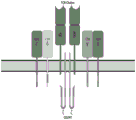
如本文所用,“TCR/CD3复合物”是涉及GvHD作用的蛋白质复合物,并且由可变的TCR受体α和β链以及三个二聚体信号模块CD3δ/ε、CD3γ/ε、CD247ζ/ζ或ζ/η组成(见图1)。每个亚基跨膜结构域中的可电离残基形成相互作用的极性网络,将复合物结合在一起。由于TCR的胞质尾非常短,不太可能参与信号传导,因此这些信号分子对于将信号从触发的TCR传到细胞中至关重要。当TCR与抗原肽和MHC(肽/MHC)结合时,通过信号传导(即,由相关酶、共受体、特异性衔接子分子以及激活或释放的转录因子介导的一系列生化事件)激活T淋巴细胞。As used herein, a "TCR/CD3 complex" is a protein complex involved in the action of GvHD and consists of variable TCR receptor alpha and beta chains and three dimeric signaling modules CD3δ/ε, CD3γ/ε, CD247ζ/ ζ or ζ/η composition (see Figure 1). Ionizable residues in the transmembrane domain of each subunit form a polar network of interactions that hold the complex together. Since TCRs have very short cytoplasmic tails and are unlikely to be involved in signaling, these signaling molecules are critical for transmitting signals from triggered TCRs into cells. When TCR binds to antigenic peptides and MHC (peptide/MHC), it is activated by signaling (ie, a series of biochemical events mediated by related enzymes, co-receptors, specific adaptor molecules, and activated or released transcription factors) T lymphocytes.
术语“DNA基因编辑”是指一种基因工程,其中在活生物体的基因组中插入、删除、修饰或替换DNA。在2018年,进行此类编辑的常用方法是使用工程核酸酶或“分子剪刀”。这些核酸酶在基因组中的期望位置产生位点特异性双链断裂。诱导的双链断裂通过非同源末端连接(NHEJ)或同源重组(HR)修复,从而导致靶向突变(“编辑”)。截至2015年,已使用了四个工程化核酸酶家族:大范围核酸酶、锌指核酸酶(ZFN)、基于转录激活子的基于效应子的核酸酶(TALEN)和成簇的规则间隔的短回文重复(CRISPR/Cas9)系统。The term "DNA gene editing" refers to a type of genetic engineering in which DNA is inserted, deleted, modified or replaced in the genome of a living organism. In 2018, the common way to do this type of editing is to use engineered nucleases, or "molecular scissors." These nucleases produce site-specific double-strand breaks at desired locations in the genome. Induced double-strand breaks are repaired by non-homologous end joining (NHEJ) or homologous recombination (HR), resulting in targeted mutation ("editing"). As of 2015, four families of engineered nucleases have been used: meganucleases, zinc finger nucleases (ZFNs), transcription activator-based effector-based nucleases (TALENs), and clustered regularly spaced short nucleases Palindromic repeat (CRISPR/Cas9) system.
最初“CRISPR”被描述为含有短的重复的碱基序列的原核DNA片段。在回文重复中,两个方向上的核苷酸序列相同。每个重复之后是先前暴露于外源DNA(例如病毒或质粒)的间隔DNA的短片段。CRISPR基因座通常由以下组成:CRISPR相关(Cas)基因的簇集和签名CRISPR阵列--一系列由与外部遗传元件(原间隔子)中的序列相对应的可变序列(间隔子)隔开的重复序列(直接重复)。尽管Cas基因被翻译成蛋白质,但大多数CRISPR阵列首先被转录为单个RNA,然后再加工成较短的CRISPR RNA(crRNA),从而指导某些Cas酶的溶核活性以降解目标核酸。Originally "CRISPR" was described as a segment of prokaryotic DNA containing short repetitive base sequences. In a palindromic repeat, the nucleotide sequence is the same in both directions. Each repeat is followed by a short segment of spacer DNA previously exposed to exogenous DNA (eg, virus or plasmid). CRISPR loci typically consist of clusters and signatures of CRISPR-associated (Cas) genes CRISPR arrays -- a series separated by variable sequences (spacers) that correspond to sequences in external genetic elements (protospacers) repeat sequence (direct repeat). Although Cas genes are translated into proteins, most CRISPR arrays are first transcribed into single RNAs, which are then processed into shorter CRISPR RNAs (crRNAs) that direct the nucleolytic activity of certain Cas enzymes to degrade target nucleic acids.
术语“CRISPR/Cas系统”是指赋予对外源遗传元件(诸如质粒和噬菌体中存在的那些)的抗性并提供一种形式的获得性免疫的原核免疫系统。通常,CRISPR/Cas系统至少包含Cas内切核酸酶和向导RNA。带有间隔区序列的RNA可以帮助Cas(CRISPR相关)蛋白识别并切割外源DNA。The term "CRISPR/Cas system" refers to a prokaryotic immune system that confers resistance to foreign genetic elements, such as those present in plasmids and bacteriophages, and provides a form of adaptive immunity. Typically, a CRISPR/Cas system contains at least a Cas endonuclease and a guide RNA. RNAs with spacer sequences can help Cas (CRISPR-associated) proteins recognize and cut foreign DNA.
术语“向导RNA”或“gRNA”通常是指一种RNA分子,其将Cas核酸内切酶引导至靶基因座并与靶基因座内的互补序列特异性杂交,从而在该核酸内切酶的作用下引起靶基因座的双链断裂。gRNA包括但不限于crRNA、sgRNA和其他嵌合向导RNA,例如caRNA、csRNA、catRNA。术语“单向导RNA”或“sgRNA”是指通过将crRNA和tracrRNA分子融合为“单向导RNA”而设计的人工工程化RNA,当与Cas9蛋白结合使用时,它可以找到并切割向导RNA特异性的DNA靶标。The term "guide RNA" or "gRNA" generally refers to an RNA molecule that guides a Cas endonuclease to a target locus and specifically hybridizes to a complementary sequence within the target locus, thereby placing the Cas endonuclease within the target locus. Causes double-strand breaks at the target locus. gRNAs include, but are not limited to, crRNA, sgRNA, and other chimeric guide RNAs, such as caRNA, csRNA, catRNA. The term "single guide RNA" or "sgRNA" refers to an artificially engineered RNA designed by fusing crRNA and tracrRNA molecules into a "single guide RNA" that, when combined with the Cas9 protein, can find and cleave guide RNA specificity DNA target.
在典型的CRISPR系统中,向导RNA是crRNA,其通常包含直接重复序列和间隔子序列。“直接重复序列”是指在CRISPR基因座内由可变序列(间隔子)隔开的重复序列。“间隔子”是指插入到由入侵的病毒或质粒DNA产生的CRISPR基因座(称为“原型间隔子”)中的病毒DNA。野生型Cas9的间隔序列为20bp长,而野生型Cpf1的crRNA的全长间隔子为24bp。在随后的入侵中,crRNA会将Cas蛋白引导至入侵的原间隔子序列。但是,除非有相邻的PAM序列,否则Cas蛋白不会切割原间隔子序列。细菌CRISPR基因座中的间隔子不包含PAM序列,因此不会被核酸酶切割。但是,入侵病毒或质粒中的原间隔子包含PAM序列,因此将被Cas内切核酸酶切割。为了编辑基因,合成向导RNA以执行识别在3'端具有PAM序列的基因序列的功能。In a typical CRISPR system, the guide RNA is a crRNA, which usually contains direct repeats and spacer sequences. "Direct repeats" refer to repeats separated by variable sequences (spacers) within a CRISPR locus. "Spacer" refers to viral DNA inserted into a CRISPR locus (called a "protospacer") produced by invading viral or plasmid DNA. The spacer sequence of wild-type Cas9 is 20 bp long, while the full-length spacer of the crRNA of wild-type Cpf1 is 24 bp. During subsequent invasion, the crRNA guides the Cas protein to the invading protospacer sequence. However, the Cas protein does not cleave the protospacer sequence unless there is an adjacent PAM sequence. Spacers in bacterial CRISPR loci do not contain PAM sequences and are therefore not cleaved by nucleases. However, protospacers in invading viruses or plasmids contain PAM sequences and will therefore be cleaved by Cas endonucleases. To edit genes, guide RNAs are synthesized to perform the function of recognizing gene sequences with a PAM sequence at the 3' end.
术语“碱基编辑”是指一种新的基因组编辑技术,该技术通过利用与脱氨酶融合的催化死Cas蛋白(dCas),将目标基因组位点处的特定DNA碱基直接且不可逆地转化为另一种碱基。重要的是,在DNA的情况下,这不需要双链断裂(DSB)就可以实现。由于许多遗传性疾病源于点突变,因此这项技术对人类健康和疾病的研究具有重要意义(Landrum,M.J.等,2015)。The term "base editing" refers to a new genome editing technology that directly and irreversibly converts specific DNA bases at target genomic loci by utilizing catalytically dead Cas proteins (dCas) fused to deaminase for another base. Importantly, in the case of DNA, this can be achieved without the need for double-strand breaks (DSBs). Since many genetic diseases arise from point mutations, this technique has important implications for the study of human health and disease (Landrum, M.J. et al., 2015).
术语“CAR”或“嵌合抗原受体”是指将任意特异性移植到免疫效应细胞(例如T细胞)上的工程化受体。通常,这些受体用于将单克隆抗体的特异性移植到T细胞上,逆转录病毒载体可促进其编码序列的转移。受体之所以称为嵌合体,是因为它们由不同来源的部分组成。The term "CAR" or "chimeric antigen receptor" refers to an engineered receptor of any specificity engrafted onto immune effector cells (eg, T cells). Typically, these receptors are used to graft the specificity of monoclonal antibodies onto T cells, and retroviral vectors facilitate transfer of their coding sequences. Receptors are called chimeras because they are made up of parts from different sources.
术语“CAR T细胞”或“嵌合抗原受体T细胞”是指具有嵌合抗原受体的工程化T细胞,其对选定的靶标具有预定的特异性。CAR T细胞一旦遇到靶标(例如癌细胞),就会通过诸如以下机制来破坏癌细胞:广泛刺激细胞增殖,增加细胞对其他活细胞的毒性程度(即,细胞毒性)以及通过使免疫系统细胞分泌的且对生物体内其他细胞有影响的因子产量增加。The term "CAR T cell" or "chimeric antigen receptor T cell" refers to an engineered T cell with a chimeric antigen receptor that has a predetermined specificity for a selected target. Once CAR T cells encounter a target (eg, a cancer cell), they destroy the cancer cell by mechanisms such as extensive stimulation of cell proliferation, increased cell toxicity to other living cells (i.e., cytotoxicity), and by making immune system cells Increased production of factors that are secreted and have effects on other cells in the organism.
术语“中央记忆T(TCM)细胞”是指表达CD45RO、C-C趋化因子受体7型(CCR7)和L-选择蛋白(CD62L)的T细胞。中央记忆T细胞也具有中等至高表达的CD44。这种记忆亚群通常在淋巴结和外周循环中发现。TCM细胞被认为具有与记忆细胞干细胞相关的某些特性。由于称为STAT5的重要转录因子的高磷酸化水平,TCM细胞显示出自我更新的能力。在小鼠中,与最终分化的效应细胞相比,TCM细胞已在几种不同的模型系统中显示出针对病毒、细菌和癌症的出色保护。据报道,在CAR T细胞中,更年轻的中央记忆表型与增强的持久性和更广泛的增殖能力有关。因此,增强中央记忆表型对于CAR T细胞的性质将是有益的,特别是当所述CART细胞用于治疗疾病时。The term "central memory T (TCM) cells" refers to T cells expressing CD45RO, C-C chemokine receptor type 7 (CCR7) and L-selectin (CD62L). Central memory T cells also have moderate to high expression of CD44. This memory subset is usually found in lymph nodes and peripheral circulation. TCM cells are thought to have certain properties associated with memory cell stem cells. TCM cells display the ability to self-renew due to high phosphorylation levels of an important transcription factor called STAT5. In mice, TCM cells have shown excellent protection against viruses, bacteria and cancer in several different model systems compared to terminally differentiated effector cells. In CAR T cells, a younger central memory phenotype has been reported to be associated with enhanced persistence and broader proliferative capacity. Therefore, enhancing the central memory phenotype would be beneficial for the properties of CAR T cells, especially when the CAR T cells are used to treat disease.
术语“截短的sgRNA”或“较短的sgRNA”是指靶标互补性区域长度小于20个核苷酸的较短的sgRNA,可在不牺牲中靶基因组编辑效率的情况下将某些脱靶位点处的不希望的突变降低5,000倍或更多。研究表明,使用具有17、18或19个互补核苷酸的间隔子序列的较短或截短的sgRNA不会降低平台的靶向范围,因为具有17、18或19个互补核苷酸的靶位点每个都会以与具有20个互补核苷酸的那些相同的频率出现在随机DNA中。The term "truncated sgRNA" or "shorter sgRNA" refers to shorter sgRNAs with regions of target complementarity less than 20 nucleotides in length that allow some off-target sites without sacrificing on-target genome editing efficiency Unwanted mutations at the point are reduced by a factor of 5,000 or more. Studies have shown that the use of shorter or truncated sgRNAs with spacer sequences of 17, 18 or 19 complementary nucleotides does not reduce the targeting range of the platform, as targets with 17, 18 or 19 complementary nucleotides The sites will each appear in random DNA with the same frequency as those with 20 complementary nucleotides.
附图说明Description of drawings
图1:示出了TCR/CD3复合物的结构。Figure 1: shows the structure of the TCR/CD3 complex.
图2:分别用靶向TCRα链、CD247ζ链、CD3ε链、CD3γ链和CD3δ链的sgRNA破坏TCR/CD3复合物。Figure 2: Disruption of TCR/CD3 complexes with sgRNAs targeting TCRα chain, CD247ζ chain, CD3ε chain, CD3γ chain and CD3δ chain, respectively.
图3:TCRα链、CD247ζ链、CD3ε链、CD3γ链和CD3δ链敲除的T细胞的中央记忆表型。Figure 3: Central memory phenotype of TCRα chain, CD247ζ chain, CD3ε chain, CD3γ chain and CD3δ chain knockout T cells.
图4:TCRα链、CD247ζ链、CD3ε链、CD3γ链和CD3δ链敲除的T细胞的细胞毒性。n=3,通过学生T检验,*P<0.05。Figure 4: Cytotoxicity of TCRα chain, CD247ζ chain, CD3ε chain, CD3γ chain and CD3δ chain knockout T cells. n=3, *P<0.05 by Student's t-test.
具体实施方式Detailed ways
仅出于说明的目的提供以下实施例,而不以任何方式限制本发明的保护范围。The following examples are provided for illustrative purposes only and do not limit the scope of the present invention in any way.
实施例1.CAR T细胞中的TCR/CD3复合物破坏Example 1. TCR/CD3 complex disruption in CAR T cells
分别将由T7启动子驱动的编码靶向TCRα、CD247ζ、CD3ε、CD3γ和CD3δ的sgRNA的序列克隆进BH-MSG载体。The sequences encoding sgRNAs targeting TCRα, CD247ζ, CD3ε, CD3γ and CD3δ, respectively, driven by the T7 promoter, were cloned into the BH-MSG vector.
进行RNA体外转录(IVT)之前,将Cas9和sgRNA质粒线性化。将IVT RNA存储于-80℃的无核酸酶的小瓶中,用于单次使用。用mMESSAGE mMACHINE T7ULTRA试剂盒(LifeTechnologies,AM1345,Carlsbad,CA)体外转录Cas9 mRNA。用HiScribeTM T7 High YieldRNA Synthesis试剂盒(NEB)转录sgRNA。Cas9 and sgRNA plasmids were linearized prior to in vitro RNA transcription (IVT). IVT RNA was stored in nuclease-free vials at -80°C for single use. Cas9 mRNA was transcribed in vitro using the mMESSAGE mMACHINE T7ULTRA kit (Life Technologies, AM1345, Carlsbad, CA). The sgRNAs were transcribed with HiScribe™ T7 High YieldRNA Synthesis Kit (NEB).
为制备修饰的CAR T细胞,通过Ficoll-PaqueTM PREMIUM(GE healthcare)用白细胞分离术从健康志愿者供体分离原代人CD4和CD8 T细胞。然后,先用CD3/CD28磁珠激活T细胞1填,再用表达CAR的慢病毒转导。之后,用OPTI-MEM洗涤CAR T细胞3次,并重悬于OPTI-MEM(Invitrogen)中,终浓度为1-3×10⁸个细胞/ml。在第3天,用BTX Agile Pulse Max电转仪(Harvard Apparatus BTX)在360V、1ms下将20ug Cas9 mRNA电转进细胞,并在第4天电转进分别靶向TCRα、CD247ζ、CD3ε、CD3γ和CD3δ的各种sgRNA。每2天分离细胞。用空载体电转的细胞用作对照(Mock)。To prepare modified CAR T cells, primary human CD4 and CD8 T cells were isolated from healthy volunteer donors using leukapheresis by Ficoll-Paque™ PREMIUM (GE healthcare). Then, T cells were activated with CD3/CD28 magnetic beads, and then transduced with CAR-expressing lentivirus. Afterwards, CAR T cells were washed 3 times with OPTI-MEM and resuspended in OPTI-MEM (Invitrogen) at a final concentration of 1-3×10 8 cells/ml. On
电转后,立即将细胞放入1ml预热的培养基中,并在IL-2(300IU/ml)存在下,于37℃、5%CO2下培养。为富集细胞,于4℃下将用Auto MACS缓冲液洗涤的CAR T细胞与CD3微珠(Miltenyi Biotec,130-050-101)一起孵育15分钟。洗涤2次后,将细胞通过LD柱(MiltenyiBiotec),收集通过级分以待后用。Immediately after electroporation, cells were placed in 1 ml of pre-warmed medium and cultured in the presence of IL-2 (300 IU/ml) at 37°C, 5% CO2. To enrich for cells, CAR T cells washed with Auto MACS buffer were incubated with CD3 microbeads (Miltenyi Biotec, 130-050-101) for 15 minutes at 4°C. After 2 washes, cells were passed through an LD column (Miltenyi Biotec) and the passage fraction was collected for later use.
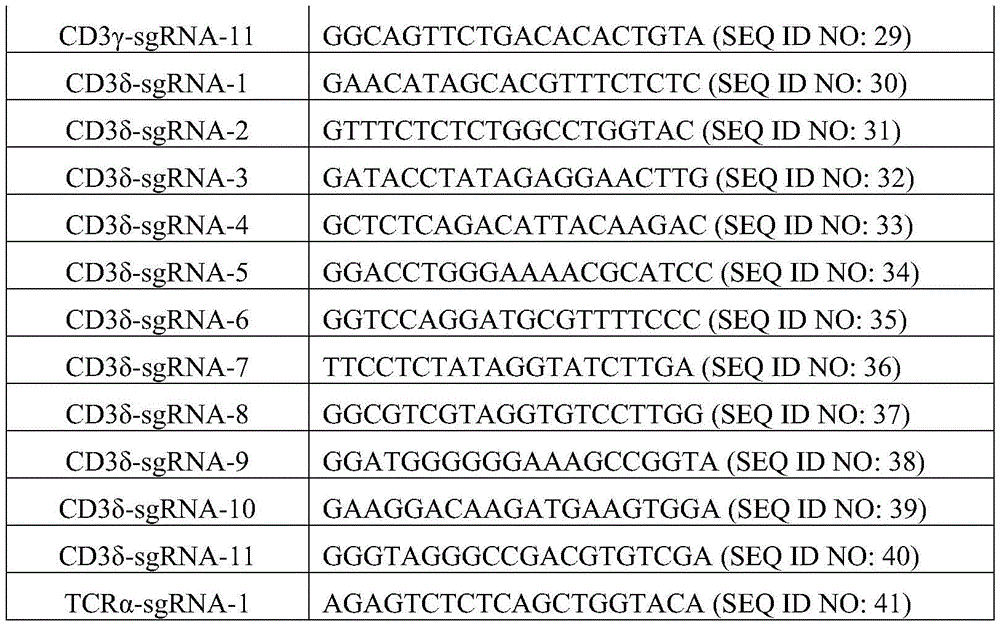
实施例中所用的sgRNA的间隔子序列选自下表1。The spacer sequences of the sgRNAs used in the examples are selected from Table 1 below.
表1.靶向TCRα、CD247ζ、CD3ε、CD3γ和CD3δ基因的sgRNA的间隔子序列Table 1. Spacer sequences of sgRNAs targeting TCRα, CD247ζ, CD3ε, CD3γ and CD3δ genes

实施例2.修饰的CAR T细胞中TCR/CD3复合物的表达Example 2. Expression of TCR/CD3 complexes in modified CAR T cells
据报道,破坏α/βT细胞中的TCR组分(α或β链)可导致TCR/CD3复合物表达的丧失,从而阻止同种异体T细胞的GvHD作用。我们假设TCR/CD3复合物的完整性需要TCR组分、CD3组分和CD247ζ的完全组装。Disruption of the TCR component (α or β chain) in α/β T cells has been reported to result in loss of expression of the TCR/CD3 complex, thereby preventing GvHD effects of allogeneic T cells. We hypothesized that the integrity of the TCR/CD3 complex requires complete assembly of the TCR components, CD3 components and CD247ζ.
因此,为了测试CD3组分和CD247ζ的破坏是否可能导致TCR/CD3复合物的破坏,我们通过CRISPR基因编辑敲除了CD3组分(包括CD3γ、CD3δ和CD3ε)和CD247ζ。Therefore, to test whether disruption of CD3 components and CD247ζ might lead to disruption of the TCR/CD3 complex, we knocked down CD3 components (including CD3γ, CD3δ, and CD3ε) and CD247ζ by CRISPR gene editing.
根据实施例1中描述的方法获得修饰的CAR T细胞。提取修饰的CAR T细胞的基因组DNA,对位于靶位点两侧的PCR产物进行Sanger测序,以确认在DNA链上的靶标编辑。还通过TIDE(跟踪Indel,DE composition)软件分析了结果。证实了TCRα、CD247ζ、CD3ε、CD3γ和CD3δ基因中的基因组破坏和插入(数据未显示)。Modified CAR T cells were obtained according to the method described in Example 1. The genomic DNA of the modified CAR T cells was extracted, and the PCR products flanking the target site were subjected to Sanger sequencing to confirm the target editing on the DNA strand. The results were also analyzed by TIDE (Track Indel, DE composition) software. Genome disruptions and insertions in the TCRα, CD247ζ, CD3ε, CD3γ and CD3δ genes were demonstrated (data not shown).
接下来,通过流式细胞术用APC抗CD3抗体(目录号555335,BD Biosciences)染色来测量TCR/CD3表达。Next, TCR/CD3 expression was measured by flow cytometry staining with APC anti-CD3 antibody (Cat. No. 555335, BD Biosciences).
图2显示了流式细胞仪的结果,其中以CD3阴性细胞的数量表示TCR/CD3表达。如图2所示,在Mock电转组中几乎没有CD3阴性细胞群,但用针对TCRα链、不同CD3组分和CD247ζ的CRISPR观察到了有效的基因消除。这些结果表明,敲除CD3组分和CD247ζ也可以消除TCR/CD3复合物在T细胞中的表达。Figure 2 shows the results of flow cytometry, in which TCR/CD3 expression is expressed as the number of CD3 negative cells. As shown in Figure 2, there were few CD3-negative cell populations in the Mock electroporation group, but efficient gene ablation was observed with CRISPR targeting the TCRα chain, different CD3 components, and CD247ζ. These results suggest that knockdown of CD3 components and CD247ζ also abolished TCR/CD3 complex expression in T cells.
实施例3.测定修饰的CAR T细胞的表型Example 3. Determination of the phenotype of modified CAR T cells
为了测量CD3组分和CD247ζ破坏的T细胞的中央记忆表型,通过流式细胞术测定CD45RO和CD62L的表达。结果如图3所示。To measure the central memory phenotype of CD3 fraction and CD247ζ disrupted T cells, the expression of CD45RO and CD62L was determined by flow cytometry. The results are shown in Figure 3.
令人惊讶地,我们发现CD247ζ、CD3ε和CD3γ敲除的CAR T细胞比TCRα敲除的CAR T细胞表现出更多的CD45RO和CD62L双阳性中央记忆表型。具体地,在模拟T细胞群中大约有31.9%的CD45RO和CD62L双阳性中央记忆细胞。在TCRα基因敲除的细胞中,CD45RO和CD62L双阳性细胞群减少至13.1%。然而,与TCRα敲除相比,CD247ζ、CD3ε和CD3γ破坏的T细胞包含更高数量的CD45RO和CD62L双阳性中央记忆细胞,其水平相当于Mock T细胞。还注意到,CD3δ敲除导致与TCRα相当的中央记忆表型。Surprisingly, we found that CD247ζ, CD3ε, and CD3γ knockout CAR T cells exhibited more CD45RO and CD62L double-positive central memory phenotypes than TCRα knockout CAR T cells. Specifically, there were approximately 31.9% CD45RO and CD62L double-positive central memory cells in the mock T cell population. In TCRα knockout cells, the CD45RO and CD62L double-positive cell population was reduced to 13.1%. However, CD247ζ, CD3ε, and CD3γ disrupted T cells contained higher numbers of CD45RO and CD62L double-positive central memory cells at levels comparable to Mock T cells compared with TCRα knockdown. It was also noted that CD3δ knockout resulted in a central memory phenotype comparable to TCRα.
已知更年轻的CAR T细胞中央记忆表型与持久性增强和更广泛的增殖能力有关,因此对于延长CAR T细胞的能力将是有益的。因此,该数据表明,CD247ζ、CD3ε和CD3γ破坏比TCRα破坏更有利于制备有效的通用CAR T细胞。Younger CAR T cell central memory phenotypes are known to be associated with enhanced persistence and broader proliferative capacity and thus would be beneficial for prolonging CAR T cell capacity. Thus, this data suggests that CD247ζ, CD3ε, and CD3γ disruption is more beneficial than TCRα disruption for generating potent universal CAR T cells.
实施例4测定修饰的CAR T细胞的细胞毒性Example 4 Determination of Cytotoxicity of Modified CAR T Cells
为了检测TCR/CD3破坏是否会影响CAR T细胞的效应子功能,将修饰的CAR T细胞与Nalm6靶细胞进行共培养。具体地,通过改良版本的基于萤光素酶的CTL测定检测修饰的CART细胞的细胞毒性,其中制备并使用了Nalm6肿瘤细胞。将所得的Nalm6细胞以1X10⁵个细胞/mL的浓度重悬在R10培养基中,并与修饰的CAR T细胞在37℃孵育过夜。然后,将100μL的混合物转移至96孔黑色发光计板。接下来,添加100μL的底物,并立即测定发光。结果如图4所示。To test whether TCR/CD3 disruption affects the effector function of CAR T cells, modified CAR T cells were co-cultured with Nalm6 target cells. Specifically, the cytotoxicity of modified CART cells was tested by a modified version of the luciferase-based CTL assay, in which Nalm6 tumor cells were prepared and used. The resulting Nalm6 cells were resuspended in R10 medium at a concentration of 1X10 cells/mL and incubated with the modified CAR T cells overnight at 37°C. Then, 100 μL of the mixture was transferred to a 96-well black luminometer plate. Next, 100 μL of substrate was added and luminescence was measured immediately. The results are shown in Figure 4.
令人惊讶地,发现修饰的CAR T细胞在靶标特异性杀伤中表现出显著差异。尤其是,尽管Mock和TCRα链敲除的CAR T细胞之间没有显著差异,但CD247ζ、CD3ε和CD3δ敲除的CAR T细胞显示出显著更高的体外裂解能力,而CD3γ敲除的CAR T细胞表现出与TCRα敲除的CART细胞相当的杀伤能力。Surprisingly, modified CAR T cells were found to exhibit significant differences in target-specific killing. In particular, although there was no significant difference between Mock and TCRα chain knockout CAR T cells, CD247ζ, CD3ε, and CD3δ knockout CAR T cells showed significantly higher in vitro lytic capacity, while CD3γ knockout CAR T cells Showed a killing ability comparable to TCRα knockout CART cells.
综上所述,所有这些数据表明,CD3γ、CD3δ和CD3ε以及CD247ζ破坏导致与TCR组分(TCRα链或β链)破坏同样有效的TCR/CD3复合物消融,同时表现出更高的中央记忆表型和增强的目标肿瘤的杀伤能力。Taken together, all these data suggest that CD3γ, CD3δ and CD3ε, and CD247ζ disruption lead to ablation of the TCR/CD3 complex that is as effective as disruption of TCR components (TCR α chain or β chain), while exhibiting higher central memory tables type and enhanced killing ability of target tumors.
序列表sequence listing
<110> 南京北恒生物科技有限公司<110> Nanjing Beiheng Biotechnology Co., Ltd.
<120> 修饰的T细胞及其用途<120> Modified T cells and their uses
<160> 41<160> 41
<170> SIPOSequenceListing 1.0<170> SIPOSequenceListing 1.0
<210> 1<210> 1
<211> 20<211> 20
<212> DNA<212> DNA
<213> Artificial Sequence(Artificial Sequence)<213> Artificial Sequence (Artificial Sequence)
<400> 1<400> 1
gtggaaggcg cttttcaccg 20
<210> 2<210> 2
<211> 20<211> 20
<212> DNA<212> DNA
<213> Artificial sequence(Artificial Sequence)<213> Artificial sequence (Artificial Sequence)
<400> 2<400> 2
aaaggacaag atgaagtgga 20
<210> 3<210> 3
<211> 20<211> 20
<212> DNA<212> DNA
<213> Artificial sequence(Artificial Sequence)<213> Artificial sequence (Artificial Sequence)
<400> 3<400> 3
tttcaccgcg gccatcctgc 20
<210> 4<210> 4
<211> 20<211> 20
<212> DNA<212> DNA
<213> Artificial sequence(Artificial Sequence)<213> Artificial sequence (Artificial Sequence)
<400> 4<400> 4
caggcacagt tgccgattac 20
<210> 5<210> 5
<211> 20<211> 20
<212> DNA<212> DNA
<213> Artificial sequence(Artificial Sequence)<213> Artificial sequence (Artificial Sequence)
<400> 5<400> 5
gatggaatcc tcttcatcta 20
<210> 6<210> 6
<211> 20<211> 20
<212> DNA<212> DNA
<213> Artificial sequence(Artificial Sequence)<213> Artificial sequence (Artificial Sequence)
<400> 6<400> 6
gacgcccccg cgtaccagca 20
<210> 7<210> 7
<211> 20<211> 20
<212> DNA<212> DNA
<213> Artificial sequence(Artificial Sequence)<213> Artificial sequence (Artificial Sequence)
<400> 7<400> 7
ggcacagttg ccgattacag 20
<210> 8<210> 8
<211> 20<211> 20
<212> DNA<212> DNA
<213> Artificial sequence(Artificial Sequence)<213> Artificial sequence (Artificial Sequence)
<400> 8<400> 8
gggcactcac tggagagttc 20gggcactcac tggagagttc 20
<210> 9<210> 9
<211> 20<211> 20
<212> DNA<212> DNA
<213> Artificial sequence(Artificial Sequence)<213> Artificial sequence (Artificial Sequence)
<400> 9<400> 9
ggcctctgcc tcttatcagt 20
<210> 10<210> 10
<211> 20<211> 20
<212> DNA<212> DNA
<213> Artificial sequence(Artificial Sequence)<213> Artificial sequence (Artificial Sequence)
<400> 10<400> 10
gcctcttatc agttggcgtt 20gcctcttatc agttggcgtt 20
<210> 11<210> 11
<211> 20<211> 20
<212> DNA<212> DNA
<213> Artificial sequence(Artificial Sequence)<213> Artificial sequence (Artificial Sequence)
<400> 11<400> 11
gatgaggatg ataaaaacat 20
<210> 12<210> 12
<211> 20<211> 20
<212> DNA<212> DNA
<213> Artificial sequence(Artificial Sequence)<213> Artificial sequence (Artificial Sequence)
<400> 12<400> 12
gaacttttat ctctacctga 20
<210> 13<210> 13
<211> 20<211> 20
<212> DNA<212> DNA
<213> Artificial sequence(Artificial Sequence)<213> Artificial sequence (Artificial Sequence)
<400> 13<400> 13
ccatataaag tctccatctc 20
<210> 14<210> 14
<211> 20<211> 20
<212> DNA<212> DNA
<213> Artificial sequence(Artificial Sequence)<213> Artificial sequence (Artificial Sequence)
<400> 14<400> 14
ttgacatgcc ctcagtatcc 20
<210> 15<210> 15
<211> 20<211> 20
<212> DNA<212> DNA
<213> Artificial sequence(Artificial Sequence)<213> Artificial sequence (Artificial Sequence)
<400> 15<400> 15
ggggcttcgc ggtaaagttg 20
<210> 16<210> 16
<211> 20<211> 20
<212> DNA<212> DNA
<213> Artificial sequence(Artificial Sequence)<213> Artificial sequence (Artificial Sequence)
<400> 16<400> 16
ggggggcttc gcggtaaagt 20ggggggcttc gcggtaaagt 20
<210> 17<210> 17
<211> 20<211> 20
<212> DNA<212> DNA
<213> Artificial sequence(Artificial Sequence)<213> Artificial sequence (Artificial Sequence)
<400> 17<400> 17
ggctggtggg ttgcccccaa 20
<210> 18<210> 18
<211> 20<211> 20
<212> DNA<212> DNA
<213> Artificial sequence(Artificial Sequence)<213> Artificial sequence (Artificial Sequence)
<400> 18<400> 18
gggccccagg ccggcggtga 20
<210> 19<210> 19
<211> 20<211> 20
<212> DNA<212> DNA
<213> Artificial Sequence<213> Artificial Sequence
<400> 19<400> 19
actttggccc agtcaatcaa 20
<210> 20<210> 20
<211> 20<211> 20
<212> DNA<212> DNA
<213> Artificial sequence(Artificial Sequence)<213> Artificial sequence (Artificial Sequence)
<400> 20<400> 20
gtgtatgact atcaagaaga 20
<210> 21<210> 21
<211> 20<211> 20
<212> DNA<212> DNA
<213> Artificial sequence(Artificial Sequence)<213> Artificial sequence (Artificial Sequence)
<400> 21<400> 21
tgactatcaa gaagatggtt 20
<210> 22<210> 22
<211> 20<211> 20
<212> DNA<212> DNA
<213> Artificial sequence(Artificial Sequence)<213> Artificial sequence (Artificial Sequence)
<400> 22<400> 22
aatatcacat ggtttaaaga 20
<210> 23<210> 23
<211> 20<211> 20
<212> DNA<212> DNA
<213> Artificial sequence(Artificial Sequence)<213> Artificial sequence (Artificial Sequence)
<400> 23<400> 23
tttaaagatg ggaagatgat 20
<210> 24<210> 24
<211> 20<211> 20
<212> DNA<212> DNA
<213> Artificial sequence(Artificial Sequence)<213> Artificial sequence (Artificial Sequence)
<400> 24<400> 24
gaatctggga agtaatgcca 20
<210> 25<210> 25
<211> 20<211> 20
<212> DNA<212> DNA
<213> Artificial sequence(Artificial Sequence)<213> Artificial sequence (Artificial Sequence)
<400> 25<400> 25
agtcatacac cttaaccaag 20
<210> 26<210> 26
<211> 20<211> 20
<212> DNA<212> DNA
<213> Artificial sequence(Artificial Sequence)<213> Artificial sequence (Artificial Sequence)
<400> 26<400> 26
ggtggagttc gccagtcgag 20
<210> 27<210> 27
<211> 20<211> 20
<212> DNA<212> DNA
<213> Artificial sequence(Artificial Sequence)<213> Artificial sequence (Artificial Sequence)
<400> 27<400> 27
ggaatgccaa ggaccctcga 20
<210> 28<210> 28
<211> 20<211> 20
<212> DNA<212> DNA
<213> Artificial sequence(Artificial Sequence)<213> Artificial sequence (Artificial Sequence)
<400> 28<400> 28
ggactatcaa gaagatggtt 20
<210> 29<210> 29
<211> 20<211> 20
<212> DNA<212> DNA
<213> Artificial sequence(Artificial Sequence)<213> Artificial sequence (Artificial Sequence)
<400> 29<400> 29
ggcagttctg acacactgta 20
<210> 30<210> 30
<211> 20<211> 20
<212> DNA<212> DNA
<213> Artificial sequence(Artificial Sequence)<213> Artificial sequence (Artificial Sequence)
<400> 30<400> 30
gaacatagca cgtttctctc 20gaacatagca cgtttctctc 20
<210> 31<210> 31
<211> 20<211> 20
<212> DNA<212> DNA
<213> Artificial sequence(Artificial Sequence)<213> Artificial sequence (Artificial Sequence)
<400> 31<400> 31
gtttctctct ggcctggtac 20
<210> 32<210> 32
<211> 20<211> 20
<212> DNA<212> DNA
<213> Artificial sequence(Artificial Sequence)<213> Artificial sequence (Artificial Sequence)
<400> 32<400> 32
gatacctata gaggaacttg 20
<210> 33<210> 33
<211> 20<211> 20
<212> DNA<212> DNA
<213> Artificial sequence(Artificial Sequence)<213> Artificial sequence (Artificial Sequence)
<400> 33<400> 33
gctctcagac attacaagac 20
<210> 34<210> 34
<211> 20<211> 20
<212> DNA<212> DNA
<213> Artificial sequence(Artificial Sequence)<213> Artificial sequence (Artificial Sequence)
<400> 34<400> 34
ggacctggga aaacgcatcc 20
<210> 35<210> 35
<211> 20<211> 20
<212> DNA<212> DNA
<213> Artificial sequence(Artificial Sequence)<213> Artificial sequence (Artificial Sequence)
<400> 35<400> 35
ggtccaggat gcgttttccc 20
<210> 36<210> 36
<211> 20<211> 20
<212> DNA<212> DNA
<213> Artificial sequence(Artificial Sequence)<213> Artificial sequence (Artificial Sequence)
<400> 36<400> 36
ttcctctata ggtatcttga 20
<210> 37<210> 37
<211> 20<211> 20
<212> DNA<212> DNA
<213> Artificial sequence(Artificial Sequence)<213> Artificial sequence (Artificial Sequence)
<400> 37<400> 37
ggcgtcgtag gtgtccttgg 20
<210> 38<210> 38
<211> 20<211> 20
<212> DNA<212> DNA
<213> Artificial sequence(Artificial Sequence)<213> Artificial sequence (Artificial Sequence)
<400> 38<400> 38
ggatgggggg aaagccggta 20
<210> 39<210> 39
<211> 20<211> 20
<212> DNA<212> DNA
<213> Artificial sequence(Artificial Sequence)<213> Artificial sequence (Artificial Sequence)
<400> 39<400> 39
gaaggacaag atgaagtgga 20
<210> 40<210> 40
<211> 20<211> 20
<212> DNA<212> DNA
<213> Artificial sequence(Artificial Sequence)<213> Artificial sequence (Artificial Sequence)
<400> 40<400> 40
gggtagggcc gacgtgtcga 20
<210> 41<210> 41
<211> 20<211> 20
<212> DNA<212> DNA
<213> Artificial sequence(Artificial Sequence)<213> Artificial sequence (Artificial Sequence)
<400> 41<400> 41
agagtctctc agctggtaca 20agagtctctc agctggtaca 20
Claims (17)
Applications Claiming Priority (1)
| Application Number | Priority Date | Filing Date | Title |
|---|---|---|---|
| PCT/CN2018/116624 WO2020103013A1 (en) | 2018-11-21 | 2018-11-21 | Modified t cells and uses thereof |
Publications (1)
| Publication Number | Publication Date |
|---|---|
| CN111788302A true CN111788302A (en) | 2020-10-16 |
Family
ID=70774272
Family Applications (1)
| Application Number | Title | Priority Date | Filing Date |
|---|---|---|---|
| CN201880089733.3A Pending CN111788302A (en) | 2018-11-21 | 2018-11-21 | Modified T cells and their uses |
Country Status (3)
| Country | Link |
|---|---|
| US (1) | US20200377878A1 (en) |
| CN (1) | CN111788302A (en) |
| WO (1) | WO2020103013A1 (en) |
Families Citing this family (1)
| Publication number | Priority date | Publication date | Assignee | Title |
|---|---|---|---|---|
| KR20240058915A (en) * | 2021-09-10 | 2024-05-07 | 카이트 파마 인코포레이티드 | Replacement Generation of Allogeneic Human T Cells |
Citations (1)
| Publication number | Priority date | Publication date | Assignee | Title |
|---|---|---|---|---|
| CN104395463A (en) * | 2012-04-30 | 2015-03-04 | 达特茅斯大学理事会 | T cell receptor deficient T cell composition |
Family Cites Families (4)
| Publication number | Priority date | Publication date | Assignee | Title |
|---|---|---|---|---|
| US8956828B2 (en) * | 2009-11-10 | 2015-02-17 | Sangamo Biosciences, Inc. | Targeted disruption of T cell receptor genes using engineered zinc finger protein nucleases |
| AU2014281031B2 (en) * | 2013-06-17 | 2020-05-21 | Massachusetts Institute Of Technology | Delivery, use and therapeutic applications of the CRISPR-Cas systems and compositions for targeting disorders and diseases using viral components |
| ES2983094T3 (en) * | 2014-10-31 | 2024-10-21 | Univ Pennsylvania | Alteration of gene expression in CAR-T cells and their uses |
| WO2016126608A1 (en) * | 2015-02-02 | 2016-08-11 | Novartis Ag | Car-expressing cells against multiple tumor antigens and uses thereof |
-
2018
- 2018-11-21 CN CN201880089733.3A patent/CN111788302A/en active Pending
- 2018-11-21 WO PCT/CN2018/116624 patent/WO2020103013A1/en not_active Ceased
-
2020
- 2020-08-11 US US16/990,407 patent/US20200377878A1/en not_active Abandoned
Patent Citations (1)
| Publication number | Priority date | Publication date | Assignee | Title |
|---|---|---|---|---|
| CN104395463A (en) * | 2012-04-30 | 2015-03-04 | 达特茅斯大学理事会 | T cell receptor deficient T cell composition |
Non-Patent Citations (2)
| Title |
|---|
| JAMES S.等: "Comment on \"A Novel Thymoma-Associated Immunodeficiency with Increased Naive T Cells and Reduced CD247 Expression\"", 《THE JOURNAL OF IMMUNOLOGY》, vol. 195, no. 8, pages 3505, XP055710996, DOI: 10.4049/jimmunol.1501667 * |
| PETROS CHRISTOPOULOS等: "A Novel Thymoma-Associated Immunodeficiency with Increased Naive T Cells and Reduced CD247 Expression", 《JOURUAD OF IMMUUODOGY》, vol. 194, no. 7, pages 3045 - 3053, XP055710995, DOI: 10.4049/jimmunol.1402805 * |
Also Published As
| Publication number | Publication date |
|---|---|
| WO2020103013A1 (en) | 2020-05-28 |
| US20200377878A1 (en) | 2020-12-03 |
Similar Documents
| Publication | Publication Date | Title |
|---|---|---|
| US12398193B2 (en) | Targeted replacement of endogenous T cell receptors | |
| JP7698828B2 (en) | Methods and compositions for editing RNA | |
| CN110168078B (en) | Genetically modified NK-92 cells with reduced CD96/TIGIT expression | |
| US20250290101A1 (en) | Lymphohematopoietic engineering using cas9 base editors | |
| WO2017070429A1 (en) | Methods involving editing polynucleotides that encode t cell receptor | |
| CN106566838A (en) | MiR-126 full-length gene knockout kit based on CRISPR-Cas9 technology and application thereof | |
| US20220145333A1 (en) | Improved process for integration of dna constructs using rna-guided endonucleases | |
| US20210130817A1 (en) | Gene Editing System and Gene Editing Method | |
| JP2024534720A (en) | Methods for producing genetically modified cells | |
| US20200377878A1 (en) | Modified t cells and uses thereof | |
| US20250222103A1 (en) | Immune cells with combination gene perturbations | |
| Hirneise | Developing a CRISPR-Mediated Knockout TCR Human T Cell Line for Use in Cloning Antigen-Specific T Cell Receptors | |
| Voytas et al. | Page. Evaluation of TCR Gene Editing achieved by TALENs, CRISPR/Cas9 and megaTAL nucleases | |
| Knipping et al. | 562. Modification of TCR Specificity by TALEN and CRISPR | |
| HK40012324A (en) | Genetically modified nk-92 cells with decreased cd96/tigit expression | |
| BR112020008201B1 (en) | In vitro or ex vivo method for editing the genome of a primary human T cell, composition, T cell population, and use of a T cell. |
Legal Events
| Date | Code | Title | Description |
|---|---|---|---|
| PB01 | Publication | ||
| PB01 | Publication | ||
| SE01 | Entry into force of request for substantive examination | ||
| SE01 | Entry into force of request for substantive examination | ||
| RJ01 | Rejection of invention patent application after publication | ||
| RJ01 | Rejection of invention patent application after publication |
Application publication date: 20201016 |