CN111778113B - Antimicrobial detergent composition - Google Patents
Antimicrobial detergent composition Download PDFInfo
- Publication number
- CN111778113B CN111778113B CN202010666472.6A CN202010666472A CN111778113B CN 111778113 B CN111778113 B CN 111778113B CN 202010666472 A CN202010666472 A CN 202010666472A CN 111778113 B CN111778113 B CN 111778113B
- Authority
- CN
- China
- Prior art keywords
- antimicrobial
- solution
- detergent composition
- antimicrobial agent
- agent
- Prior art date
- Legal status (The legal status is an assumption and is not a legal conclusion. Google has not performed a legal analysis and makes no representation as to the accuracy of the status listed.)
- Active
Links
- 239000000203 mixture Substances 0.000 title abstract description 52
- 239000003599 detergent Substances 0.000 title abstract description 43
- 230000000845 anti-microbial effect Effects 0.000 title abstract description 31
- 239000004599 antimicrobial Substances 0.000 abstract description 69
- 239000004744 fabric Substances 0.000 abstract description 57
- 229920000728 polyester Polymers 0.000 abstract description 47
- 229920000570 polyether Polymers 0.000 abstract description 32
- 230000008021 deposition Effects 0.000 abstract description 25
- XLYOFNOQVPJJNP-UHFFFAOYSA-N water Chemical compound O XLYOFNOQVPJJNP-UHFFFAOYSA-N 0.000 abstract description 20
- 239000004094 surface-active agent Substances 0.000 abstract description 14
- 239000002904 solvent Substances 0.000 abstract description 11
- 239000008367 deionised water Substances 0.000 abstract description 9
- 229910021641 deionized water Inorganic materials 0.000 abstract description 9
- ISWSIDIOOBJBQZ-UHFFFAOYSA-N phenol group Chemical group C1(=CC=CC=C1)O ISWSIDIOOBJBQZ-UHFFFAOYSA-N 0.000 abstract description 6
- 230000007928 solubilization Effects 0.000 abstract description 5
- 238000005063 solubilization Methods 0.000 abstract description 5
- 239000000243 solution Substances 0.000 description 67
- RTZKZFJDLAIYFH-UHFFFAOYSA-N Diethyl ether Chemical compound CCOCC RTZKZFJDLAIYFH-UHFFFAOYSA-N 0.000 description 26
- DNIAPMSPPWPWGF-UHFFFAOYSA-N Propylene glycol Chemical compound CC(O)CO DNIAPMSPPWPWGF-UHFFFAOYSA-N 0.000 description 16
- 238000003756 stirring Methods 0.000 description 15
- BYNQFCJOHGOKSS-UHFFFAOYSA-N diclosan Chemical compound OC1=CC(Cl)=CC=C1OC1=CC=C(Cl)C=C1 BYNQFCJOHGOKSS-UHFFFAOYSA-N 0.000 description 14
- -1 alkylbenzene sulfonate Chemical class 0.000 description 13
- LYCAIKOWRPUZTN-UHFFFAOYSA-N Ethylene glycol Chemical compound OCCO LYCAIKOWRPUZTN-UHFFFAOYSA-N 0.000 description 12
- LFQSCWFLJHTTHZ-UHFFFAOYSA-N Ethanol Chemical compound CCO LFQSCWFLJHTTHZ-UHFFFAOYSA-N 0.000 description 11
- KFZMGEQAYNKOFK-UHFFFAOYSA-N Isopropanol Chemical compound CC(C)O KFZMGEQAYNKOFK-UHFFFAOYSA-N 0.000 description 10
- 150000001875 compounds Chemical class 0.000 description 10
- 229920000056 polyoxyethylene ether Polymers 0.000 description 10
- 229940051841 polyoxyethylene ether Drugs 0.000 description 10
- 238000000034 method Methods 0.000 description 9
- KWIUHFFTVRNATP-UHFFFAOYSA-N glycine betaine Chemical compound C[N+](C)(C)CC([O-])=O KWIUHFFTVRNATP-UHFFFAOYSA-N 0.000 description 8
- 238000002360 preparation method Methods 0.000 description 8
- 229960004063 propylene glycol Drugs 0.000 description 8
- 238000005406 washing Methods 0.000 description 7
- 238000005303 weighing Methods 0.000 description 7
- HEMHJVSKTPXQMS-UHFFFAOYSA-M Sodium hydroxide Chemical compound [OH-].[Na+] HEMHJVSKTPXQMS-UHFFFAOYSA-M 0.000 description 6
- 239000003795 chemical substances by application Substances 0.000 description 6
- 239000000835 fiber Substances 0.000 description 6
- 229920000742 Cotton Polymers 0.000 description 5
- QAOWNCQODCNURD-UHFFFAOYSA-L Sulfate Chemical compound [O-]S([O-])(=O)=O QAOWNCQODCNURD-UHFFFAOYSA-L 0.000 description 5
- 150000002191 fatty alcohols Chemical class 0.000 description 5
- 239000002736 nonionic surfactant Substances 0.000 description 5
- 239000000126 substance Substances 0.000 description 5
- CFCVHJRJEWDVOG-UHFFFAOYSA-N 4-chloro-2,3-dimethylphenol Chemical compound CC1=C(C)C(Cl)=CC=C1O CFCVHJRJEWDVOG-UHFFFAOYSA-N 0.000 description 4
- WKBOTKDWSSQWDR-UHFFFAOYSA-N Bromine atom Chemical compound [Br] WKBOTKDWSSQWDR-UHFFFAOYSA-N 0.000 description 4
- ZAMOUSCENKQFHK-UHFFFAOYSA-N Chlorine atom Chemical compound [Cl] ZAMOUSCENKQFHK-UHFFFAOYSA-N 0.000 description 4
- 125000000217 alkyl group Chemical group 0.000 description 4
- 239000003945 anionic surfactant Substances 0.000 description 4
- 229960003237 betaine Drugs 0.000 description 4
- GDTBXPJZTBHREO-UHFFFAOYSA-N bromine Substances BrBr GDTBXPJZTBHREO-UHFFFAOYSA-N 0.000 description 4
- 229910052794 bromium Inorganic materials 0.000 description 4
- 229910052801 chlorine Inorganic materials 0.000 description 4
- 239000000460 chlorine Substances 0.000 description 4
- XBDQKXXYIPTUBI-UHFFFAOYSA-N dimethylselenoniopropionate Natural products CCC(O)=O XBDQKXXYIPTUBI-UHFFFAOYSA-N 0.000 description 4
- 150000002009 diols Chemical class 0.000 description 4
- 235000019387 fatty acid methyl ester Nutrition 0.000 description 4
- 230000002209 hydrophobic effect Effects 0.000 description 4
- 230000006872 improvement Effects 0.000 description 4
- 238000002156 mixing Methods 0.000 description 4
- 125000001997 phenyl group Chemical group [H]C1=C([H])C([H])=C(*)C([H])=C1[H] 0.000 description 4
- YPFDHNVEDLHUCE-UHFFFAOYSA-N propane-1,3-diol Chemical compound OCCCO YPFDHNVEDLHUCE-UHFFFAOYSA-N 0.000 description 4
- 239000002888 zwitterionic surfactant Substances 0.000 description 4
- WEVYAHXRMPXWCK-UHFFFAOYSA-N Acetonitrile Chemical compound CC#N WEVYAHXRMPXWCK-UHFFFAOYSA-N 0.000 description 3
- MRUAUOIMASANKQ-UHFFFAOYSA-N cocamidopropyl betaine Chemical compound CCCCCCCCCCCC(=O)NCCC[N+](C)(C)CC([O-])=O MRUAUOIMASANKQ-UHFFFAOYSA-N 0.000 description 3
- 229940073507 cocamidopropyl betaine Drugs 0.000 description 3
- SZXQTJUDPRGNJN-UHFFFAOYSA-N dipropylene glycol Chemical compound OCCCOCCCO SZXQTJUDPRGNJN-UHFFFAOYSA-N 0.000 description 3
- 238000001035 drying Methods 0.000 description 3
- 239000001963 growth medium Substances 0.000 description 3
- 230000005764 inhibitory process Effects 0.000 description 3
- 230000003993 interaction Effects 0.000 description 3
- 239000007788 liquid Substances 0.000 description 3
- 230000008569 process Effects 0.000 description 3
- 238000012360 testing method Methods 0.000 description 3
- 125000004178 (C1-C4) alkyl group Chemical group 0.000 description 2
- OAYXUHPQHDHDDZ-UHFFFAOYSA-N 2-(2-butoxyethoxy)ethanol Chemical compound CCCCOCCOCCO OAYXUHPQHDHDDZ-UHFFFAOYSA-N 0.000 description 2
- HZAXFHJVJLSVMW-UHFFFAOYSA-N 2-Aminoethan-1-ol Chemical compound NCCO HZAXFHJVJLSVMW-UHFFFAOYSA-N 0.000 description 2
- 241000894006 Bacteria Species 0.000 description 2
- 102000004190 Enzymes Human genes 0.000 description 2
- 108090000790 Enzymes Proteins 0.000 description 2
- IAYPIBMASNFSPL-UHFFFAOYSA-N Ethylene oxide Chemical group C1CO1 IAYPIBMASNFSPL-UHFFFAOYSA-N 0.000 description 2
- ARIWANIATODDMH-UHFFFAOYSA-N Lauric acid monoglyceride Natural products CCCCCCCCCCCC(=O)OCC(O)CO ARIWANIATODDMH-UHFFFAOYSA-N 0.000 description 2
- CDBYLPFSWZWCQE-UHFFFAOYSA-L Sodium Carbonate Chemical compound [Na+].[Na+].[O-]C([O-])=O CDBYLPFSWZWCQE-UHFFFAOYSA-L 0.000 description 2
- XEFQLINVKFYRCS-UHFFFAOYSA-N Triclosan Chemical compound OC1=CC(Cl)=CC=C1OC1=CC=C(Cl)C=C1Cl XEFQLINVKFYRCS-UHFFFAOYSA-N 0.000 description 2
- 125000003282 alkyl amino group Chemical group 0.000 description 2
- 150000001412 amines Chemical class 0.000 description 2
- 150000007942 carboxylates Chemical class 0.000 description 2
- 239000002738 chelating agent Substances 0.000 description 2
- 229940125904 compound 1 Drugs 0.000 description 2
- 229940126214 compound 3 Drugs 0.000 description 2
- 229940125898 compound 5 Drugs 0.000 description 2
- 238000006482 condensation reaction Methods 0.000 description 2
- 229920001577 copolymer Polymers 0.000 description 2
- 238000005520 cutting process Methods 0.000 description 2
- 235000014113 dietary fatty acids Nutrition 0.000 description 2
- ZBCBWPMODOFKDW-UHFFFAOYSA-N diethanolamine Chemical compound OCCNCCO ZBCBWPMODOFKDW-UHFFFAOYSA-N 0.000 description 2
- 238000010790 dilution Methods 0.000 description 2
- 239000012895 dilution Substances 0.000 description 2
- 125000000118 dimethyl group Chemical group [H]C([H])([H])* 0.000 description 2
- MOTZDAYCYVMXPC-UHFFFAOYSA-N dodecyl hydrogen sulfate Chemical compound CCCCCCCCCCCCOS(O)(=O)=O MOTZDAYCYVMXPC-UHFFFAOYSA-N 0.000 description 2
- 229940043264 dodecyl sulfate Drugs 0.000 description 2
- 150000002148 esters Chemical class 0.000 description 2
- 239000000194 fatty acid Substances 0.000 description 2
- 229930195729 fatty acid Natural products 0.000 description 2
- 229930182470 glycoside Natural products 0.000 description 2
- 229910017053 inorganic salt Inorganic materials 0.000 description 2
- 238000004900 laundering Methods 0.000 description 2
- 229940071145 lauroyl sarcosinate Drugs 0.000 description 2
- JRZJOMJEPLMPRA-UHFFFAOYSA-N olefin Natural products CCCCCCCC=C JRZJOMJEPLMPRA-UHFFFAOYSA-N 0.000 description 2
- 239000002304 perfume Substances 0.000 description 2
- 125000000951 phenoxy group Chemical group [H]C1=C([H])C([H])=C(O*)C([H])=C1[H] 0.000 description 2
- 239000000049 pigment Substances 0.000 description 2
- 229920002503 polyoxyethylene-polyoxypropylene Polymers 0.000 description 2
- 239000003755 preservative agent Substances 0.000 description 2
- 230000002335 preservative effect Effects 0.000 description 2
- 235000019260 propionic acid Nutrition 0.000 description 2
- 239000002994 raw material Substances 0.000 description 2
- 239000011734 sodium Substances 0.000 description 2
- KKEYFWRCBNTPAC-UHFFFAOYSA-L terephthalate(2-) Chemical compound [O-]C(=O)C1=CC=C(C([O-])=O)C=C1 KKEYFWRCBNTPAC-UHFFFAOYSA-L 0.000 description 2
- 238000012546 transfer Methods 0.000 description 2
- 230000002087 whitening effect Effects 0.000 description 2
- ZHTRFSJGUKYTPR-UHFFFAOYSA-N 2-octyl-1,2-thiazolidin-4-one Chemical compound CCCCCCCCN1CC(=O)CS1 ZHTRFSJGUKYTPR-UHFFFAOYSA-N 0.000 description 1
- OSDLLIBGSJNGJE-UHFFFAOYSA-N 4-chloro-3,5-dimethylphenol Chemical compound CC1=CC(O)=CC(C)=C1Cl OSDLLIBGSJNGJE-UHFFFAOYSA-N 0.000 description 1
- QJRVOJKLQNSNDB-UHFFFAOYSA-N 4-dodecan-3-ylbenzenesulfonic acid Chemical compound CCCCCCCCCC(CC)C1=CC=C(S(O)(=O)=O)C=C1 QJRVOJKLQNSNDB-UHFFFAOYSA-N 0.000 description 1
- 229920001817 Agar Polymers 0.000 description 1
- USFZMSVCRYTOJT-UHFFFAOYSA-N Ammonium acetate Chemical compound N.CC(O)=O USFZMSVCRYTOJT-UHFFFAOYSA-N 0.000 description 1
- 239000005695 Ammonium acetate Substances 0.000 description 1
- JEEMARBVRFDNCF-UHFFFAOYSA-N C1(=C2C(=CC=C1)S(=O)(=O)OC(C(C1=CC=CC=C1)OS2(=O)=O)C2=CC=CC=C2)C2=CC=CC=C2.[Na] Chemical compound C1(=C2C(=CC=C1)S(=O)(=O)OC(C(C1=CC=CC=C1)OS2(=O)=O)C2=CC=CC=C2)C2=CC=CC=C2.[Na] JEEMARBVRFDNCF-UHFFFAOYSA-N 0.000 description 1
- 239000003109 Disodium ethylene diamine tetraacetate Substances 0.000 description 1
- ZGTMUACCHSMWAC-UHFFFAOYSA-L EDTA disodium salt (anhydrous) Chemical compound [Na+].[Na+].OC(=O)CN(CC([O-])=O)CCN(CC(O)=O)CC([O-])=O ZGTMUACCHSMWAC-UHFFFAOYSA-L 0.000 description 1
- 206010035664 Pneumonia Diseases 0.000 description 1
- 241000191967 Staphylococcus aureus Species 0.000 description 1
- 238000010521 absorption reaction Methods 0.000 description 1
- 239000004480 active ingredient Substances 0.000 description 1
- 239000008272 agar Substances 0.000 description 1
- 230000004075 alteration Effects 0.000 description 1
- 235000019257 ammonium acetate Nutrition 0.000 description 1
- 229940043376 ammonium acetate Drugs 0.000 description 1
- 230000000844 anti-bacterial effect Effects 0.000 description 1
- 230000001580 bacterial effect Effects 0.000 description 1
- 230000003385 bacteriostatic effect Effects 0.000 description 1
- 238000004061 bleaching Methods 0.000 description 1
- 238000009835 boiling Methods 0.000 description 1
- 239000003153 chemical reaction reagent Substances 0.000 description 1
- 229960005443 chloroxylenol Drugs 0.000 description 1
- 230000001112 coagulating effect Effects 0.000 description 1
- 229940125782 compound 2 Drugs 0.000 description 1
- 238000012258 culturing Methods 0.000 description 1
- 238000005202 decontamination Methods 0.000 description 1
- 230000003588 decontaminative effect Effects 0.000 description 1
- 238000001514 detection method Methods 0.000 description 1
- 235000019301 disodium ethylene diamine tetraacetate Nutrition 0.000 description 1
- 239000012153 distilled water Substances 0.000 description 1
- SYELZBGXAIXKHU-UHFFFAOYSA-N dodecyldimethylamine N-oxide Chemical compound CCCCCCCCCCCC[N+](C)(C)[O-] SYELZBGXAIXKHU-UHFFFAOYSA-N 0.000 description 1
- 230000000694 effects Effects 0.000 description 1
- 238000010828 elution Methods 0.000 description 1
- 238000002474 experimental method Methods 0.000 description 1
- 238000001914 filtration Methods 0.000 description 1
- 239000008233 hard water Substances 0.000 description 1
- 230000005923 long-lasting effect Effects 0.000 description 1
- 239000000463 material Substances 0.000 description 1
- 239000002609 medium Substances 0.000 description 1
- 239000000693 micelle Substances 0.000 description 1
- 244000005700 microbiome Species 0.000 description 1
- 238000012986 modification Methods 0.000 description 1
- 230000004048 modification Effects 0.000 description 1
- ONJQDTZCDSESIW-UHFFFAOYSA-N polidocanol Chemical compound CCCCCCCCCCCCOCCOCCOCCOCCOCCOCCOCCOCCOCCO ONJQDTZCDSESIW-UHFFFAOYSA-N 0.000 description 1
- 229920000642 polymer Polymers 0.000 description 1
- 239000002244 precipitate Substances 0.000 description 1
- 239000000047 product Substances 0.000 description 1
- 238000010992 reflux Methods 0.000 description 1
- 238000000926 separation method Methods 0.000 description 1
- 229910052708 sodium Inorganic materials 0.000 description 1
- 229910000029 sodium carbonate Inorganic materials 0.000 description 1
- 239000002689 soil Substances 0.000 description 1
- 230000001954 sterilising effect Effects 0.000 description 1
- 239000012137 tryptone Substances 0.000 description 1
- 238000002137 ultrasound extraction Methods 0.000 description 1
- 239000002699 waste material Substances 0.000 description 1
Classifications
-
- C—CHEMISTRY; METALLURGY
- C11—ANIMAL OR VEGETABLE OILS, FATS, FATTY SUBSTANCES OR WAXES; FATTY ACIDS THEREFROM; DETERGENTS; CANDLES
- C11D—DETERGENT COMPOSITIONS; USE OF SINGLE SUBSTANCES AS DETERGENTS; SOAP OR SOAP-MAKING; RESIN SOAPS; RECOVERY OF GLYCEROL
- C11D1/00—Detergent compositions based essentially on surface-active compounds; Use of these compounds as a detergent
- C11D1/66—Non-ionic compounds
- C11D1/83—Mixtures of non-ionic with anionic compounds
-
- C—CHEMISTRY; METALLURGY
- C11—ANIMAL OR VEGETABLE OILS, FATS, FATTY SUBSTANCES OR WAXES; FATTY ACIDS THEREFROM; DETERGENTS; CANDLES
- C11D—DETERGENT COMPOSITIONS; USE OF SINGLE SUBSTANCES AS DETERGENTS; SOAP OR SOAP-MAKING; RESIN SOAPS; RECOVERY OF GLYCEROL
- C11D3/00—Other compounding ingredients of detergent compositions covered in group C11D1/00
- C11D3/16—Organic compounds
- C11D3/37—Polymers
- C11D3/3703—Macromolecular compounds obtained otherwise than by reactions only involving carbon-to-carbon unsaturated bonds
- C11D3/3715—Polyesters or polycarbonates
-
- C—CHEMISTRY; METALLURGY
- C11—ANIMAL OR VEGETABLE OILS, FATS, FATTY SUBSTANCES OR WAXES; FATTY ACIDS THEREFROM; DETERGENTS; CANDLES
- C11D—DETERGENT COMPOSITIONS; USE OF SINGLE SUBSTANCES AS DETERGENTS; SOAP OR SOAP-MAKING; RESIN SOAPS; RECOVERY OF GLYCEROL
- C11D1/00—Detergent compositions based essentially on surface-active compounds; Use of these compounds as a detergent
- C11D1/38—Cationic compounds
- C11D1/52—Carboxylic amides, alkylolamides or imides or their condensation products with alkylene oxides
-
- C—CHEMISTRY; METALLURGY
- C11—ANIMAL OR VEGETABLE OILS, FATS, FATTY SUBSTANCES OR WAXES; FATTY ACIDS THEREFROM; DETERGENTS; CANDLES
- C11D—DETERGENT COMPOSITIONS; USE OF SINGLE SUBSTANCES AS DETERGENTS; SOAP OR SOAP-MAKING; RESIN SOAPS; RECOVERY OF GLYCEROL
- C11D1/00—Detergent compositions based essentially on surface-active compounds; Use of these compounds as a detergent
- C11D1/88—Ampholytes; Electroneutral compounds
- C11D1/94—Mixtures with anionic, cationic or non-ionic compounds
-
- C—CHEMISTRY; METALLURGY
- C11—ANIMAL OR VEGETABLE OILS, FATS, FATTY SUBSTANCES OR WAXES; FATTY ACIDS THEREFROM; DETERGENTS; CANDLES
- C11D—DETERGENT COMPOSITIONS; USE OF SINGLE SUBSTANCES AS DETERGENTS; SOAP OR SOAP-MAKING; RESIN SOAPS; RECOVERY OF GLYCEROL
- C11D11/00—Special methods for preparing compositions containing mixtures of detergents
- C11D11/0094—Process for making liquid detergent compositions, e.g. slurries, pastes or gels
-
- C—CHEMISTRY; METALLURGY
- C11—ANIMAL OR VEGETABLE OILS, FATS, FATTY SUBSTANCES OR WAXES; FATTY ACIDS THEREFROM; DETERGENTS; CANDLES
- C11D—DETERGENT COMPOSITIONS; USE OF SINGLE SUBSTANCES AS DETERGENTS; SOAP OR SOAP-MAKING; RESIN SOAPS; RECOVERY OF GLYCEROL
- C11D3/00—Other compounding ingredients of detergent compositions covered in group C11D1/00
- C11D3/02—Inorganic compounds ; Elemental compounds
- C11D3/04—Water-soluble compounds
- C11D3/044—Hydroxides or bases
-
- C—CHEMISTRY; METALLURGY
- C11—ANIMAL OR VEGETABLE OILS, FATS, FATTY SUBSTANCES OR WAXES; FATTY ACIDS THEREFROM; DETERGENTS; CANDLES
- C11D—DETERGENT COMPOSITIONS; USE OF SINGLE SUBSTANCES AS DETERGENTS; SOAP OR SOAP-MAKING; RESIN SOAPS; RECOVERY OF GLYCEROL
- C11D3/00—Other compounding ingredients of detergent compositions covered in group C11D1/00
- C11D3/16—Organic compounds
- C11D3/20—Organic compounds containing oxygen
- C11D3/2003—Alcohols; Phenols
- C11D3/2006—Monohydric alcohols
- C11D3/2017—Monohydric alcohols branched
-
- C—CHEMISTRY; METALLURGY
- C11—ANIMAL OR VEGETABLE OILS, FATS, FATTY SUBSTANCES OR WAXES; FATTY ACIDS THEREFROM; DETERGENTS; CANDLES
- C11D—DETERGENT COMPOSITIONS; USE OF SINGLE SUBSTANCES AS DETERGENTS; SOAP OR SOAP-MAKING; RESIN SOAPS; RECOVERY OF GLYCEROL
- C11D3/00—Other compounding ingredients of detergent compositions covered in group C11D1/00
- C11D3/16—Organic compounds
- C11D3/20—Organic compounds containing oxygen
- C11D3/2003—Alcohols; Phenols
- C11D3/2006—Monohydric alcohols
- C11D3/2024—Monohydric alcohols cyclic; polycyclic
-
- C—CHEMISTRY; METALLURGY
- C11—ANIMAL OR VEGETABLE OILS, FATS, FATTY SUBSTANCES OR WAXES; FATTY ACIDS THEREFROM; DETERGENTS; CANDLES
- C11D—DETERGENT COMPOSITIONS; USE OF SINGLE SUBSTANCES AS DETERGENTS; SOAP OR SOAP-MAKING; RESIN SOAPS; RECOVERY OF GLYCEROL
- C11D3/00—Other compounding ingredients of detergent compositions covered in group C11D1/00
- C11D3/16—Organic compounds
- C11D3/20—Organic compounds containing oxygen
- C11D3/2003—Alcohols; Phenols
- C11D3/2041—Dihydric alcohols
- C11D3/2044—Dihydric alcohols linear
-
- C—CHEMISTRY; METALLURGY
- C11—ANIMAL OR VEGETABLE OILS, FATS, FATTY SUBSTANCES OR WAXES; FATTY ACIDS THEREFROM; DETERGENTS; CANDLES
- C11D—DETERGENT COMPOSITIONS; USE OF SINGLE SUBSTANCES AS DETERGENTS; SOAP OR SOAP-MAKING; RESIN SOAPS; RECOVERY OF GLYCEROL
- C11D3/00—Other compounding ingredients of detergent compositions covered in group C11D1/00
- C11D3/16—Organic compounds
- C11D3/20—Organic compounds containing oxygen
- C11D3/2068—Ethers
-
- C—CHEMISTRY; METALLURGY
- C11—ANIMAL OR VEGETABLE OILS, FATS, FATTY SUBSTANCES OR WAXES; FATTY ACIDS THEREFROM; DETERGENTS; CANDLES
- C11D—DETERGENT COMPOSITIONS; USE OF SINGLE SUBSTANCES AS DETERGENTS; SOAP OR SOAP-MAKING; RESIN SOAPS; RECOVERY OF GLYCEROL
- C11D3/00—Other compounding ingredients of detergent compositions covered in group C11D1/00
- C11D3/16—Organic compounds
- C11D3/20—Organic compounds containing oxygen
- C11D3/2075—Carboxylic acids-salts thereof
- C11D3/2079—Monocarboxylic acids-salts thereof
-
- C—CHEMISTRY; METALLURGY
- C11—ANIMAL OR VEGETABLE OILS, FATS, FATTY SUBSTANCES OR WAXES; FATTY ACIDS THEREFROM; DETERGENTS; CANDLES
- C11D—DETERGENT COMPOSITIONS; USE OF SINGLE SUBSTANCES AS DETERGENTS; SOAP OR SOAP-MAKING; RESIN SOAPS; RECOVERY OF GLYCEROL
- C11D3/00—Other compounding ingredients of detergent compositions covered in group C11D1/00
- C11D3/16—Organic compounds
- C11D3/20—Organic compounds containing oxygen
- C11D3/2075—Carboxylic acids-salts thereof
- C11D3/2086—Hydroxy carboxylic acids-salts thereof
-
- C—CHEMISTRY; METALLURGY
- C11—ANIMAL OR VEGETABLE OILS, FATS, FATTY SUBSTANCES OR WAXES; FATTY ACIDS THEREFROM; DETERGENTS; CANDLES
- C11D—DETERGENT COMPOSITIONS; USE OF SINGLE SUBSTANCES AS DETERGENTS; SOAP OR SOAP-MAKING; RESIN SOAPS; RECOVERY OF GLYCEROL
- C11D3/00—Other compounding ingredients of detergent compositions covered in group C11D1/00
- C11D3/16—Organic compounds
- C11D3/24—Organic compounds containing halogen
-
- C—CHEMISTRY; METALLURGY
- C11—ANIMAL OR VEGETABLE OILS, FATS, FATTY SUBSTANCES OR WAXES; FATTY ACIDS THEREFROM; DETERGENTS; CANDLES
- C11D—DETERGENT COMPOSITIONS; USE OF SINGLE SUBSTANCES AS DETERGENTS; SOAP OR SOAP-MAKING; RESIN SOAPS; RECOVERY OF GLYCEROL
- C11D3/00—Other compounding ingredients of detergent compositions covered in group C11D1/00
- C11D3/16—Organic compounds
- C11D3/26—Organic compounds containing nitrogen
- C11D3/33—Amino carboxylic acids
-
- C—CHEMISTRY; METALLURGY
- C11—ANIMAL OR VEGETABLE OILS, FATS, FATTY SUBSTANCES OR WAXES; FATTY ACIDS THEREFROM; DETERGENTS; CANDLES
- C11D—DETERGENT COMPOSITIONS; USE OF SINGLE SUBSTANCES AS DETERGENTS; SOAP OR SOAP-MAKING; RESIN SOAPS; RECOVERY OF GLYCEROL
- C11D3/00—Other compounding ingredients of detergent compositions covered in group C11D1/00
- C11D3/16—Organic compounds
- C11D3/34—Organic compounds containing sulfur
- C11D3/349—Organic compounds containing sulfur additionally containing nitrogen atoms, e.g. nitro, nitroso, amino, imino, nitrilo, nitrile groups containing compounds or their derivatives or thio urea
-
- C—CHEMISTRY; METALLURGY
- C11—ANIMAL OR VEGETABLE OILS, FATS, FATTY SUBSTANCES OR WAXES; FATTY ACIDS THEREFROM; DETERGENTS; CANDLES
- C11D—DETERGENT COMPOSITIONS; USE OF SINGLE SUBSTANCES AS DETERGENTS; SOAP OR SOAP-MAKING; RESIN SOAPS; RECOVERY OF GLYCEROL
- C11D3/00—Other compounding ingredients of detergent compositions covered in group C11D1/00
- C11D3/16—Organic compounds
- C11D3/37—Polymers
- C11D3/3703—Macromolecular compounds obtained otherwise than by reactions only involving carbon-to-carbon unsaturated bonds
- C11D3/3707—Polyethers, e.g. polyalkyleneoxides
-
- C—CHEMISTRY; METALLURGY
- C11—ANIMAL OR VEGETABLE OILS, FATS, FATTY SUBSTANCES OR WAXES; FATTY ACIDS THEREFROM; DETERGENTS; CANDLES
- C11D—DETERGENT COMPOSITIONS; USE OF SINGLE SUBSTANCES AS DETERGENTS; SOAP OR SOAP-MAKING; RESIN SOAPS; RECOVERY OF GLYCEROL
- C11D3/00—Other compounding ingredients of detergent compositions covered in group C11D1/00
- C11D3/16—Organic compounds
- C11D3/38—Products with no well-defined composition, e.g. natural products
- C11D3/386—Preparations containing enzymes, e.g. protease or amylase
- C11D3/38618—Protease or amylase in liquid compositions only
-
- C—CHEMISTRY; METALLURGY
- C11—ANIMAL OR VEGETABLE OILS, FATS, FATTY SUBSTANCES OR WAXES; FATTY ACIDS THEREFROM; DETERGENTS; CANDLES
- C11D—DETERGENT COMPOSITIONS; USE OF SINGLE SUBSTANCES AS DETERGENTS; SOAP OR SOAP-MAKING; RESIN SOAPS; RECOVERY OF GLYCEROL
- C11D3/00—Other compounding ingredients of detergent compositions covered in group C11D1/00
- C11D3/43—Solvents
-
- C—CHEMISTRY; METALLURGY
- C11—ANIMAL OR VEGETABLE OILS, FATS, FATTY SUBSTANCES OR WAXES; FATTY ACIDS THEREFROM; DETERGENTS; CANDLES
- C11D—DETERGENT COMPOSITIONS; USE OF SINGLE SUBSTANCES AS DETERGENTS; SOAP OR SOAP-MAKING; RESIN SOAPS; RECOVERY OF GLYCEROL
- C11D3/00—Other compounding ingredients of detergent compositions covered in group C11D1/00
- C11D3/48—Medical, disinfecting agents, disinfecting, antibacterial, germicidal or antimicrobial compositions
-
- C—CHEMISTRY; METALLURGY
- C11—ANIMAL OR VEGETABLE OILS, FATS, FATTY SUBSTANCES OR WAXES; FATTY ACIDS THEREFROM; DETERGENTS; CANDLES
- C11D—DETERGENT COMPOSITIONS; USE OF SINGLE SUBSTANCES AS DETERGENTS; SOAP OR SOAP-MAKING; RESIN SOAPS; RECOVERY OF GLYCEROL
- C11D1/00—Detergent compositions based essentially on surface-active compounds; Use of these compounds as a detergent
- C11D1/02—Anionic compounds
- C11D1/12—Sulfonic acids or sulfuric acid esters; Salts thereof
- C11D1/22—Sulfonic acids or sulfuric acid esters; Salts thereof derived from aromatic compounds
-
- C—CHEMISTRY; METALLURGY
- C11—ANIMAL OR VEGETABLE OILS, FATS, FATTY SUBSTANCES OR WAXES; FATTY ACIDS THEREFROM; DETERGENTS; CANDLES
- C11D—DETERGENT COMPOSITIONS; USE OF SINGLE SUBSTANCES AS DETERGENTS; SOAP OR SOAP-MAKING; RESIN SOAPS; RECOVERY OF GLYCEROL
- C11D1/00—Detergent compositions based essentially on surface-active compounds; Use of these compounds as a detergent
- C11D1/02—Anionic compounds
- C11D1/12—Sulfonic acids or sulfuric acid esters; Salts thereof
- C11D1/29—Sulfates of polyoxyalkylene ethers
-
- C—CHEMISTRY; METALLURGY
- C11—ANIMAL OR VEGETABLE OILS, FATS, FATTY SUBSTANCES OR WAXES; FATTY ACIDS THEREFROM; DETERGENTS; CANDLES
- C11D—DETERGENT COMPOSITIONS; USE OF SINGLE SUBSTANCES AS DETERGENTS; SOAP OR SOAP-MAKING; RESIN SOAPS; RECOVERY OF GLYCEROL
- C11D1/00—Detergent compositions based essentially on surface-active compounds; Use of these compounds as a detergent
- C11D1/66—Non-ionic compounds
- C11D1/72—Ethers of polyoxyalkylene glycols
-
- C—CHEMISTRY; METALLURGY
- C11—ANIMAL OR VEGETABLE OILS, FATS, FATTY SUBSTANCES OR WAXES; FATTY ACIDS THEREFROM; DETERGENTS; CANDLES
- C11D—DETERGENT COMPOSITIONS; USE OF SINGLE SUBSTANCES AS DETERGENTS; SOAP OR SOAP-MAKING; RESIN SOAPS; RECOVERY OF GLYCEROL
- C11D1/00—Detergent compositions based essentially on surface-active compounds; Use of these compounds as a detergent
- C11D1/66—Non-ionic compounds
- C11D1/75—Amino oxides
-
- C—CHEMISTRY; METALLURGY
- C11—ANIMAL OR VEGETABLE OILS, FATS, FATTY SUBSTANCES OR WAXES; FATTY ACIDS THEREFROM; DETERGENTS; CANDLES
- C11D—DETERGENT COMPOSITIONS; USE OF SINGLE SUBSTANCES AS DETERGENTS; SOAP OR SOAP-MAKING; RESIN SOAPS; RECOVERY OF GLYCEROL
- C11D1/00—Detergent compositions based essentially on surface-active compounds; Use of these compounds as a detergent
- C11D1/88—Ampholytes; Electroneutral compounds
- C11D1/90—Betaines
-
- C—CHEMISTRY; METALLURGY
- C11—ANIMAL OR VEGETABLE OILS, FATS, FATTY SUBSTANCES OR WAXES; FATTY ACIDS THEREFROM; DETERGENTS; CANDLES
- C11D—DETERGENT COMPOSITIONS; USE OF SINGLE SUBSTANCES AS DETERGENTS; SOAP OR SOAP-MAKING; RESIN SOAPS; RECOVERY OF GLYCEROL
- C11D2111/00—Cleaning compositions characterised by the objects to be cleaned; Cleaning compositions characterised by non-standard cleaning or washing processes
- C11D2111/10—Objects to be cleaned
- C11D2111/12—Soft surfaces, e.g. textile
Landscapes
- Chemical & Material Sciences (AREA)
- Organic Chemistry (AREA)
- Engineering & Computer Science (AREA)
- Chemical Kinetics & Catalysis (AREA)
- Oil, Petroleum & Natural Gas (AREA)
- Wood Science & Technology (AREA)
- Life Sciences & Earth Sciences (AREA)
- Health & Medical Sciences (AREA)
- Emergency Medicine (AREA)
- Inorganic Chemistry (AREA)
- Agricultural Chemicals And Associated Chemicals (AREA)
- Detergent Compositions (AREA)
- Treatments For Attaching Organic Compounds To Fibrous Goods (AREA)
Abstract
The invention relates to the field of detergents, and discloses an antimicrobial detergent composition which comprises the following components in percentage by mass: polyester polyether polymer accounting for 0.1-10% of the composition, antimicrobial agent with halogenated phenol structure accounting for 0.01-2% of the composition, surfactant accounting for 10-50% of the composition and solvent; and the pH of a 1% deionized water solution of the detergent composition is 7.0-9.0. The polyester polyether polymer is introduced into the composition, so that the deposition efficiency of the antimicrobial agent with a halogenated phenol structure on the fabric can be improved, the solubilization of the surfactant in the detergent can be weakened, and the more remarkable and durable antimicrobial effect can be realized.
Description
Technical Field
The present invention relates to the field of detergents, and in particular to an antimicrobial detergent composition.
Background
As consumer standards of living increase, detergents are focused on their functionality in addition to the conventional need for stain removal. The outbreak of new coronary pneumonia causes consumers to pay special attention to the antimicrobial function of detergents. In addition to the instant killing and washing of microorganisms on fabrics during the laundering process, consumers also desire that laundered fabrics retain their antimicrobial/bacteriostatic effects for extended periods of time. There is a need for an antimicrobial agent in a detergent that effectively deposits onto fabrics during the laundering process. The basic function of the detergent is to remove soil, and the main active ingredient of the detergent is surfactant which can elute substances on the fabrics and then is discharged along with the bleaching solution in the rinsing process. This is in contradiction to the deposition of the antimicrobial agent on the fabric, so that the deposition efficiency of the antimicrobial agent on the fabric is low, most of the antimicrobial agent is not deposited and is discharged with the rinsing liquid, not only affecting the long-lasting antimicrobial effect of the detergent composition, but also causing a lot of waste and possibly causing a burden on the environment. Antimicrobial efficacy of antimicrobial agents containing halophenol structures, such as chloroxylenol and the like, is known, and such materials are generally poorly water soluble and tend to leach out of solution and deposit onto fabrics. But its deposition efficiency is greatly affected due to the solubilization of the surfactant. Accordingly, there is a need to develop detergent compositions that improve the efficiency of deposition of antimicrobial agents comprising halophenol structures onto fabrics.
Disclosure of Invention
In order to solve the above technical problems, the present invention provides an antimicrobial detergent composition. The polyester polyether polymer is introduced into the composition, so that the deposition efficiency of the antimicrobial agent with a halogenated phenol structure on the fabric can be improved, the solubilization of the surfactant in the detergent can be weakened, and the more remarkable and durable antimicrobial effect can be realized.
The specific technical scheme of the invention is as follows:
in a first aspect, the present invention provides an antimicrobial detergent composition comprising the following components in percentage by mass:
polyester polyether polymer accounting for 0.1-10% of the composition,
0.01-2% of the composition of an antimicrobial agent having a halophenol structure,
surfactant 10-50% of the composition,
a solvent.
And the pH of a 1% deionized water solution of the detergent composition is 7.0-9.0.
Antimicrobial agents having a halophenol structure are known to have excellent antimicrobial effects, but such antimicrobial agents are poor in water solubility. Surfactants in the detergent will solubilize the antimicrobial agent and thus affect the efficiency of deposition of the antimicrobial agent onto the fabric. The polyester polyether polymer is an amphiphilic copolymer capable of being deposited on polyester cloth, and a hydrophobic chain segment of the amphiphilic copolymer contains a large number of benzene rings. The inventors have found that when a polyester polyether polymer is formulated with an antimicrobial agent having a halophenol structure in a detergent at a specific concentration, the antimicrobial agent having a halophenol structure can interact with the polyester polyether polymer both through hydrophobic interactions and through pi-pi stacking. The polyester polyether polymer can be efficiently deposited on the fabric, and simultaneously, the deposition of the antimicrobial agent on the fabric is also facilitated, and the deposition efficiency is improved.
Preferably, the polyester polyether polymer and the antimicrobial agent having a halophenol structure are mixed in advance according to the following steps:
a) dissolving an antimicrobial agent with a halogenated phenol structure into alcohol ether to prepare a solution A with the concentration of 20-40 wt%;
b) dissolving polyester polyether polymer into alcohol ether to prepare solution B with the concentration of 40-70 wt%;
c) stirring and mixing the solution A and the solution B to obtain a uniform solution;
d) slowly adding water into the uniform solution obtained in the step c) and stirring to obtain a uniform compound solution.
The present inventors have further found that the deposition efficiency of an antimicrobial agent can be further greatly improved by mixing both in advance under the above-mentioned specific conditions, uniformly mixing both in an alcohol ether solvent, slowly adding dropwise a poor solvent of the antimicrobial agent, water, under controlled conditions so that the hydrophobic interaction and pi-pi stacking between benzene rings of the antimicrobial agent and a polyester polyether polymer are sufficiently enhanced, forming a complex first, and then adding the complex to a detergent composition. This is probably because the complex formed by the two is relatively stable, and can further reduce the solubilization of the surfactant to the antimicrobial agent, facilitating the deposition of the antimicrobial agent onto the fabric along with the polyester polyether polymer. The conditions for preparing the complex are controlled so that the antimicrobial agent precipitates significantly from the system and does not form a stable complex solution.
Preferably, in the step a) and the step b), the alcohol ether is one or more of isopropanol, 1, 2-propylene glycol, dipropylene glycol, diethylene glycol butyl ether and ethylene glycol;
preferably, in step c), the mass ratio of the polyester polyether polymer to the antimicrobial agent is 1: 1-20: 1, and the mass ratio of the alcohol ether to the antimicrobial agent is 3: 1-10: 1;
preferably, in the step d), the mass ratio of the alcohol ether to the water is 1: 1-3: 1.
Preferably, the polyester polyether polymer is a type of polymer that can be deposited onto the polyester cloth from a wash solution and is a product known in the art and commercially available. Preferably, the polyester polyether polymer has a fabric-philic segment formed by a condensation reaction of a terephthalate and a diol, and further comprises a hydrophilic segment comprising a segment composed of ethylene oxide repeat units. Preferably, the diol is one or more of ethylene glycol, 1, 2-propylene glycol and 1, 3-propylene glycol. Particularly effective polyester polyether polymers may be the Rele-O-Tex series of Solvay, the TexCare SRN series of Craine.
Preferably, the antimicrobial agent having a halophenol structure has the following structure:

wherein each X is independently selected from chlorine or bromine, a is 1, 2 or 3; each Y is independently selected from C1-C4 alkyl or halophenoxy, and b is 1, 2 or 3.
Preferably, the structure of the halogenated phenoxy group is Wherein each Z is independently selected from chlorine or bromine and c is 1, 2 or 3.
Further preferably, the antimicrobial agent is selected from one or more of 5-chloro-2- (2, 4-dichlorophenoxy) phenol, chlorodimethylphenol, and 5-chloro-2- (4-chlorophenoxy) phenol. More preferably, the antimicrobial agent is 5-chloro-2- (4-chlorophenoxy) phenol, available under the trade name Tinosan HP100 from BASF.
Preferably, the surfactant comprises one or more of an anionic surfactant, a nonionic surfactant, and a zwitterionic surfactant.
Further, anionic surfactants include, but are not limited to: fatty alcohol-polyoxyethylene ether sulfate, fatty alcohol-polyoxyethylene ether carboxylate, linear alkylbenzene sulfonate, olefin sulfonate, fatty acid salt, fatty acid methyl ester sulfonate, lauric acid monoglyceride sulfate, lauroyl sarcosinate and dodecyl sulfate.
Further, nonionic surfactants include, but are not limited to: one or more of alkyl glycoside, cocamide monoethanolamine, cocamide diethanolamine, fatty alcohol polyoxyethylene ether, fatty alcohol polyoxyethylene polyoxypropylene ether, fatty acid methyl ester ethoxylate, oil ester ethoxylate and fatty amine polyoxyethylene ether.
Further, zwitterionic surfactants include, but are not limited to: one or more of alkyl dimethyl betaine, cocamidopropyl betaine, alkyl dimethyl sulfoethyl betaine, alkyl amino propionic acid and alkyl dimethyl amine oxide.
Preferably, the detergent composition further comprises one or more of a chelating agent, a whitening agent, an anti-redeposition agent, an enzyme preparation, a preservative, an inorganic salt, an anti-dye transfer agent, a perfume and a pigment.
In a second aspect, the present invention also provides a method of pretreating or treating a fabric,
the above antimicrobial detergent composition is added to water at a dilution of at least 300 times to form a wash liquor, which is then contacted with the fabric.
Preferably, the fabric comprises chemical fibers. Further, the chemical fiber is polyester fiber.
Compared with the prior art, the invention has the following technical effects: in the antimicrobial detergent composition of the present invention, the deposition rate of the antimicrobial agent on the fabric can be improved by using the polyester polyether polymer in combination with the antimicrobial agent having a halophenol structure, and if the two are previously mixed in a specific manner to form a complex, the deposition efficiency of the antimicrobial agent can be further improved, and the antimicrobial effect of the detergent composition can be further enhanced.
Detailed Description
The present invention will be further described with reference to the following examples.
General examples
An antimicrobial detergent composition comprises the following components in percentage by mass:
polyester polyether polymer accounting for 0.1-10% of the composition,
0.01-2% of the composition of an antimicrobial agent having a halophenol structure,
surfactant 10-50% of the composition,
a solvent.
And the pH of a 1% deionized water solution of the detergent composition is 7.0-9.0.
Preferably, the polyester polyether polymer and the antimicrobial agent having a halophenol structure are mixed in advance according to the following steps:
a) dissolving an antimicrobial agent with a halogenated phenol structure into alcohol ether to prepare a solution A with the concentration of 20-40 wt%;
b) dissolving polyester polyether polymer into alcohol ether to prepare solution B with the concentration of 40-70 wt%;
c) stirring and mixing the solution A and the solution B to obtain a uniform solution;
d) slowly adding water into the uniform solution obtained in the step c) and stirring to obtain a uniform compound solution.
Preferably, the alcohol ether is one or more of isopropanol, 1, 2-propylene glycol, dipropylene glycol, diethylene glycol butyl ether and ethylene glycol; the mass ratio of the polyester polyether polymer to the antimicrobial agent is 1: 1-20: 1, and the mass ratio of the alcohol ether to the antimicrobial agent is 3: 1-10: 1; the mass ratio of the alcohol ether to the water is 1: 1-3: 1.
Preferably, the polyester polyether polymer has a fabric-philic segment formed by a condensation reaction of a terephthalate and a diol, and further comprises a hydrophilic segment comprising a segment composed of ethylene oxide repeat units. Preferably, the diol is one or more of ethylene glycol, 1, 2-propylene glycol and 1, 3-propylene glycol. Particularly effective polyester polyether polymers may be the Rele-O-Tex series of Solvay, the TexCare SRN series of Craine.
Preferably, the antimicrobial agent having a halophenol structure has the following structure:
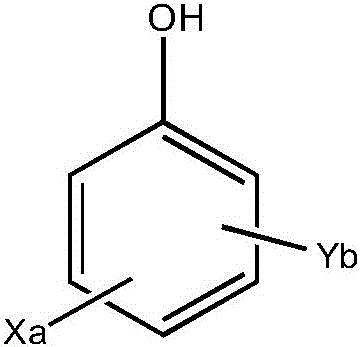
wherein each X is independently selected from chlorine or bromine, a is 1, 2 or 3; each Y is independently selected from C1-C4 alkyl or halophenoxy, and b is 1, 2 or 3.
Preferably, the structure of the halogenated phenoxy group is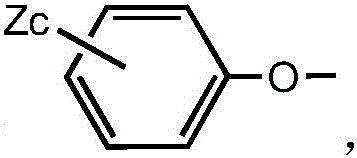 Wherein each Z is independently selected from chlorine or bromine and c is 1, 2 or 3.
Further preferably, the antimicrobial agent is selected from one or more of 5-chloro-2- (2, 4-dichlorophenoxy) phenol, chlorodimethylphenol, and 5-chloro-2- (4-chlorophenoxy) phenol. More preferably, the antimicrobial agent is 5-chloro-2- (4-chlorophenoxy) phenol, available under the trade name Tinosan HP100 from BASF.
Preferably, the surfactant comprises one or more of an anionic surfactant, a nonionic surfactant, a zwitterionic surfactant.
Further, anionic surfactants include, but are not limited to: fatty alcohol-polyoxyethylene ether sulfate, fatty alcohol-polyoxyethylene ether carboxylate, linear alkylbenzene sulfonate, olefin sulfonate, fatty acid salt, fatty acid methyl ester sulfonate, lauric acid monoglyceride sulfate, lauroyl sarcosinate and dodecyl sulfate.
Further, nonionic surfactants include, but are not limited to: one or more of alkyl glycoside, cocamide monoethanolamine, cocamide diethanolamine, fatty alcohol polyoxyethylene ether, fatty alcohol polyoxyethylene polyoxypropylene ether, fatty acid methyl ester ethoxylate, oil ester ethoxylate and fatty amine polyoxyethylene ether.
Further, zwitterionic surfactants include, but are not limited to: one or more of alkyl dimethyl betaine, cocamidopropyl betaine, alkyl dimethyl sulfoethyl betaine, alkyl amino propionic acid and alkyl dimethyl amine oxide.
Preferably, the detergent composition further comprises one or more of a chelating agent, a whitening agent, an anti-redeposition agent, an enzyme preparation, a preservative, an inorganic salt, an anti-dye transfer agent, a perfume and a pigment.
A method of pretreating or treating fabrics by adding said antimicrobial detergent composition to water at a dilution of at least 300 to form a wash liquor and then contacting the wash liquor with the fabrics. Preferably, the fabric comprises chemical fibers. Further, the chemical fiber is polyester fiber.
Detailed description of the preferred embodiments and test experiments
The cloth samples used in the invention are pure cotton white cloth and polyester white cloth. Before use, the cloth sample is respectively pretreated to remove organic matters on the fabric. Cutting the white cloth into cloth pieces of 6cm multiplied by 6cm, boiling in 5g/L sodium carbonate solution for 1h, rinsing for multiple times, performing reflux treatment with isopropanol for 3 h, rinsing, and drying for later use.
The antimicrobial agent was measured using UPLC-PDA technology using pure water, acetonitrile, 200mmol/L ammonium acetate as the mobile phase, a C18 column as the separation column, a gradient elution procedure to separate out the antimicrobial agent, and detection of the antimicrobial agent in PDA mode. Taking 5-chloro-2- (4-dichlorophenoxy) phenol as an example, the peak-off time is 10.5min, and the maximum ultraviolet absorption wavelength is 278 nm. A standard curve of the antimicrobial agent was prepared following the same procedure, with concentrations ranging from 0.5ppm to 50 ppm.
The antimicrobial agent deposited on the fabric was measured using the following method:
1. with a hardness of 250ppm (Ca)2+∶Mg2+3: 2), adding 10g of cloth sample into 1L of 0.2% antimicrobial detergent solution, washing for 20min at 120rpm and 30 ℃ in a vertical decontamination machine, rinsing for 2 times, taking out the cloth sample, and drying in the air. The washing was repeated 5 times.
2. 5g of the cloth sample treated in step 1 was weighed and collected by ultrasonic extraction of the antimicrobial agent from the cloth sample with 25ml of isopropanol.
3. And (3) filtering the extract liquor in the step (2) by using an oily filter head with the diameter of 0.22 mu m, detecting by using UPLC-PDA, quantifying according to a standard curve, and converting to obtain the quality of the antimicrobial agent deposited on the fabric.
The deposition rate of the antimicrobial agent was calculated according to the following formula:

antimicrobial performance testing of detergent compositions:
A. cutting the polyester white cloth into round cloth pieces with diameter of 20mm, and sterilizing for 15min by pressure steam for later use. 100ml of 0.2% detergent solution is prepared in a sterilized conical flask by using sterilized 250ppm hard water, 3 round cloth pieces are put in the detergent solution, and the detergent solution is simulatively washed for 20min in a constant-temperature shaking box at 30 ℃. The washing solution was then discarded, rinsed 2 times with 100ml of sterile distilled water, the disc was removed and dried at room temperature for 24 h. The washing was repeated 5 times.
B. Preparing culture medium with bacteria, weighing 25g tryptone soy agar medium, coagulating, and sucking 1ml Staphylococcus aureus liquid (10 ml)6cfu/ml) on the culture medium, shaking the culture dish back and forth to completely and uniformly cover the surface with the bacterial liquid, and drying for 15min for later use.
C. And D, sticking the round cloth piece dried in the step A on the surface of the culture medium with bacteria, and culturing for 24h at 37 ℃. The diameter of the antibacterial ring (including the diameter of the circular piece) was measured with a vernier caliper and recorded, and the test was repeated 3 times to average.
Some of the reagent information used in the examples is as follows:
and (3) LAS: linear alkyl benzene sulfonic acid;
AES: sodium fatty alcohol polyoxyethylene ether sulfate;
AEO-9: fatty alcohol polyoxyethylene ether, the average degree of polyoxyethylation is 9;
CAB: cocamidopropyl betaine;
EDTA-2 Na: disodium ethylene diamine tetraacetate;
and (3) CBS: sodium diphenylethylene biphenyl disulfonate;
SRP: a polyester polyether polymer;
OA-12: dodecyl dimethyl amine oxide;
OIT: n-octyl isothiazolinone.
The preparation process of the compound 1 solution is as follows: preparing 5-chloro-2- (4-chlorophenoxy) phenol and SRP into solutions with mass fractions of 30% and 50% respectively by using 1, 2-propylene glycol as a solvent; weighing 10g of 30% 5-chloro-2- (4-chlorophenoxy) phenol solution and 30g of 50% SRP solution, and uniformly stirring; slowly dropping 20g of deionized water into the mixture solution, and uniformly stirring to obtain a compound 1 solution.
The preparation process of the complex 2 solution is as follows: preparing 5-chloro-2- (4-chlorophenoxy) phenol and SRP into solutions with mass fractions of 20% and 70% respectively by using 1, 2-propylene glycol as a solvent; weighing 10g of 20% 5-chloro-2- (4-chlorophenoxy) phenol solution and 10g of 70% SRP solution, and uniformly stirring; slowly dropwise adding 5g of deionized water into the mixture solution, and uniformly stirring to obtain a compound 2 solution.
TABLE 1 composition of antimicrobial detergent compositions

The pH of the above systems was adjusted to 8.0. + -. 0.5 with 32% sodium hydroxide solution.
Table 2 antimicrobial deposition rate results for antimicrobial agents in antimicrobial detergent compositions
| Example 1 | Example 2 | Example 3 | Example 4 | Example 5 | Example 6 | |
| Pure cotton white cloth | 7.12% | 7.18% | 7.21% | 9.53% | 9.59% | 9.67% |
| Degree of improvement | / | 0.84% | 1.26% | / | 0.42% | 1.47% |
| Polyester white cloth | 6.42% | 6.65% | 7.05% | 6.76% | 7.12% | 7.68% |
| Degree of improvement | / | 3.58% | 9.81% | / | 5.32% | 13.61% |
As can be seen from the above table, the polyester polyether polymer only slightly increased the antimicrobial agents on the pure cotton white cloth. On the polyester cloth, the introduction of the polyester polyether polymer in the composition can obviously improve the deposition rate of the antimicrobial agent. And the polyester polyether polymer and the antimicrobial agent are mixed in advance to form a compound, and then the compound is added into the composition, so that the deposition rate of the HP100 on the polyester cloth can be further remarkably improved. This indicates that the polyester polyether polymer can aid in the deposition of the antimicrobial agent onto fabrics, especially polyester cloths.
TABLE 3 antimicrobial Effect of detergent compositions
| (mm) | Example 1 | Example 2 | Example 3 | Example 4 | Example 5 | Example 6 |
| Pure cotton white cloth | 24.4 | 24.6 | 24.8 | 23.5 | 23.5 | 23.8 |
| Polyester white cloth | 22.0 | 22.8 | 23.9 | 21.9 | 22.5 | 23.6 |
The larger the zone of inhibition, the wider the spread of the antimicrobial agent on the fabric, and the better the durable antimicrobial effect of the fabric. The difference of the deposition rate of the antimicrobial agent on the pure cotton cloth is not large, so the difference of the size of the inhibition zone is not obvious. The deposition rate of the antimicrobial agent on the polyester cloth washed by the detergent composition added with the polyester polyether polymer is obviously increased, and particularly, the polyester polyether polymer and the antimicrobial agent are mixed in advance to form a compound, so that the inhibition zone after washing is obviously increased, and the antimicrobial effect of the fabric is more excellent.
The preparation process of the compound 3 solution is as follows: firstly, respectively preparing chlorodimethylphenol and SRP into solutions with mass fractions of 40% and 40% by using isopropanol as a solvent; weighing 10g of 40% chlorodimethylphenol solution and 10g of 40% SRP solution, and uniformly stirring; 4g of deionized water is slowly dropped into the mixture solution, and the mixture solution is evenly stirred to obtain a compound 3 solution.
The preparation process of the compound 4 solution is as follows: firstly, dipropylene glycol is used as a solvent to prepare a solution with the mass fraction of 20 percent and a solution with the mass fraction of 60 percent from 5-chloro-2- (4-chlorophenoxy) phenol and SRP respectively; weighing 10g of 20% 5-chloro-2- (4-chlorophenoxy) phenol solution and 30g of 60% SRP solution, and uniformly stirring; slowly dropping 10g of deionized water into the mixture solution, and uniformly stirring to obtain a compound 4 solution.
Table 4 composition of antimicrobial detergent composition

The pH of the above systems was adjusted to 8.0. + -. 0.5 with 32% sodium hydroxide solution.
TABLE 5 deposition Rate results of antimicrobial Agents in antimicrobial detergent compositions
| Example 7 | Example 8 | Example 9 | Example 10 | Example 11 | Example 12 | |
| Polyester white cloth | 3.25% | 3.41% | 3.56% | 4.25% | 4.74% | 5.31% |
| Degree of improvement | / | 4.92% | 9.54% | / | 11.53% | 24.94% |
As can be seen from the above table, the antimicrobial agents with the halophenol structure can interact with the polyester polyether polymer, and the deposition rate on the polyester cloth is obviously improved, especially the complex is formed and then added. Furthermore, in order to reduce the solubilization of the antimicrobial agent by the surfactant during washing, the amount of the nonionic surfactant at the low critical micelle concentration in the composition should not be too high (less than or equal to 25% of the total mass of the surfactant).
The preparation process of the compound 5 solution is as follows: preparing 5-chloro-2- (4-chlorophenoxy) phenol and SRP into solutions with mass fractions of 30% and 50% respectively by using 1, 2-propylene glycol as a solvent; weighing 10g of 30% 5-chloro-2- (4-chlorophenoxy) phenol solution and 5g of 50% SRP solution, and uniformly stirring; slowly dropwise adding 5g of deionized water into the mixture solution, and uniformly stirring to obtain a compound 5 solution.
OIT has antimicrobial activity, but does not contain benzene rings in its structure.
The preparation process of the compound 6 solution is as follows: preparing OIT and SRP into solutions with the mass fractions of 30% and 50% respectively by using 1, 2-propylene glycol as a solvent; weighing 10g of 30% OIT solution and 30g of 50% SRP solution, and uniformly stirring; slowly dropping 20g of deionized water into the mixture solution, and uniformly stirring to obtain a compound 6 solution.
TABLE 6 composition of antimicrobial detergent compositions

TABLE 7 deposition Rate results of antimicrobial Agents in antimicrobial detergent compositions
| Example 13 | Example 14 | Example 15 | Example 16 | Example 17 | Example 18 | |
| Polyester white cloth | 5.25% | 5.28% | 5.37% | 6.37% | 6.35% | 6.51% |
| Degree of improvement | / | 0.57% | 2.28% | / | -0.31% | 2.19% |
As can be seen from the above table, when the weight ratio of the polyester polyether polymer to the antimicrobial agent having a halophenol structure is not within the defined range, it is difficult to effectively increase the deposition rate of the antimicrobial agent on the fabric. And OIT does not contain benzene ring in molecule, although the OIT can act with SRP through hydrophobic interaction, due to the existence of the surfactant in the system, the formed compound has poor stability, and the final deposition rate is not obviously increased.
The raw materials and equipment used in the invention are common raw materials and equipment in the field if not specified; the methods used in the present invention are conventional in the art unless otherwise specified.
The above description is only a preferred embodiment of the present invention, and is not intended to limit the present invention, and all simple modifications, alterations and equivalents of the above embodiments according to the technical spirit of the present invention are still within the protection scope of the technical solution of the present invention.
Claims (9)
1. An antimicrobial detergent composition characterized by: the paint comprises the following components in percentage by mass:
polyester polyether polymer accounting for 0.1-10% of the composition,
0.01-2% of the composition of an antimicrobial agent having a halophenol structure,
surfactant 10-50% of the composition,
a solvent;
and the pH value of 1% deionized water solution of the detergent composition is 7.0-9.0;
the polyester polyether polymer has a fabric-philic segment formed by a condensation reaction of a terephthalate and a diol, and a hydrophilic segment comprising a segment consisting of ethylene oxide repeat units;
the polyester polyether polymer and the antimicrobial agent with the halogenated phenol structure are mixed in advance according to the following steps:
a) dissolving an antimicrobial agent with a halogenated phenol structure into alcohol ether to prepare a solution A with the concentration of 20-40 wt%;
b) dissolving polyester polyether polymer into alcohol ether to prepare solution B with the concentration of 40-70 wt%;
c) stirring and mixing the solution A and the solution B to obtain a uniform solution;
d) slowly adding water into the uniform solution obtained in the step c) and stirring to obtain a uniform compound solution.
2. The antimicrobial detergent composition according to claim 1, wherein:
in the steps a) and b), the alcohol ether is one or more of isopropanol, 1, 2-propylene glycol, dipropylene glycol, diethylene glycol butyl ether and ethylene glycol; and/or
In the step c), the mass ratio of the polyester polyether polymer to the antimicrobial agent is 1: 1-20: 1, and the mass ratio of the alcohol ether to the antimicrobial agent is 3: 1-10: 1; and/or
In the step d), the mass ratio of the alcohol ether to the water is 1: 1-3: 1.
3. The antimicrobial detergent composition according to claim 1, wherein:
the antimicrobial agent having a halophenol structure has the following structure:

wherein each X is independently selected from chlorine or bromine, a is 1, 2 or 3;
each Y is independently selected from C1-C4 alkyl or halophenoxy, and b is 1, 2 or 3.
4. The antimicrobial detergent composition according to claim 3, wherein:
the diol is one or more of ethylene glycol, 1, 2-propylene glycol and 1, 3-propylene glycol; and/or
The structure of the halogenated phenoxy is Wherein each Z is independently selected from chlorine or bromine and c is 1, 2 or 3.
5. The antimicrobial detergent composition according to claim 4, wherein: the antimicrobial agent is selected from one or more of 5-chloro-2- (2, 4-dichlorophenoxy) phenol, chlorodimethylphenol and 5-chloro-2- (4-chlorophenoxy) phenol.
6. The antimicrobial detergent composition according to claim 1, wherein: the detergent composition further comprises one or more of a chelating agent, a whitening agent, an anti-redeposition agent, an enzyme preparation, a preservative, an inorganic salt, an anti-dye transfer agent, a perfume and a pigment.
7. A method of pretreating or treating a fabric characterized by: adding the antimicrobial detergent composition according to any one of claims 1 to 6 to water at a dilution of at least 300 to form a wash liquor, and then contacting the wash liquor with the fabric.
8. The method of claim 7, wherein: the fabric contains chemical fibers.
9. The method of claim 8, wherein: the chemical fiber is polyester fiber.
Priority Applications (3)
| Application Number | Priority Date | Filing Date | Title |
|---|---|---|---|
| CN202010666472.6A CN111778113B (en) | 2020-07-10 | 2020-07-10 | Antimicrobial detergent composition |
| US17/762,090 US12344822B2 (en) | 2020-07-10 | 2021-05-06 | Antimicrobial detergent composition comprising a polyester-polyether polymer and a halogenated phenol antimicrobial agent mixture |
| PCT/CN2021/091838 WO2022007491A1 (en) | 2020-07-10 | 2021-05-06 | Antimicrobial detergent composition |
Applications Claiming Priority (1)
| Application Number | Priority Date | Filing Date | Title |
|---|---|---|---|
| CN202010666472.6A CN111778113B (en) | 2020-07-10 | 2020-07-10 | Antimicrobial detergent composition |
Publications (2)
| Publication Number | Publication Date |
|---|---|
| CN111778113A CN111778113A (en) | 2020-10-16 |
| CN111778113B true CN111778113B (en) | 2021-07-16 |
Family
ID=72768405
Family Applications (1)
| Application Number | Title | Priority Date | Filing Date |
|---|---|---|---|
| CN202010666472.6A Active CN111778113B (en) | 2020-07-10 | 2020-07-10 | Antimicrobial detergent composition |
Country Status (3)
| Country | Link |
|---|---|
| US (1) | US12344822B2 (en) |
| CN (1) | CN111778113B (en) |
| WO (1) | WO2022007491A1 (en) |
Citations (13)
| Publication number | Priority date | Publication date | Assignee | Title |
|---|---|---|---|---|
| CN1309688A (en) * | 1998-07-15 | 2001-08-22 | 罗狄亚化学公司 | Terephthalic polyester composition and its use as soil release agent |
| CN1888041A (en) * | 2006-07-26 | 2007-01-03 | 广州立白企业集团有限公司 | Fabric detergent |
| CN1949971A (en) * | 2004-03-23 | 2007-04-18 | 西巴特殊化学制品控股公司 | Fungicidal detergent compositions |
| CN101323822A (en) * | 2008-07-22 | 2008-12-17 | 浙江理工大学 | Polyester-containing fabric multi-functional washing auxiliaries and its preparation method and use |
| WO2010069732A1 (en) * | 2008-12-16 | 2010-06-24 | Unilever Plc | Improvements relating to fabric treatment compositions |
| JP2011190368A (en) * | 2010-03-15 | 2011-09-29 | Lion Corp | Liquid detergent composition for clothes |
| WO2014029479A1 (en) * | 2012-08-18 | 2014-02-27 | Clariant International Ltd | Use of polyesters in washing and cleaning agents |
| CN103781892A (en) * | 2011-08-24 | 2014-05-07 | 荷兰联合利华有限公司 | Improvements in Polymers, Deposition Aids, Targeted Benefit Agents, and Substrate Treatment Compositions |
| WO2017051776A1 (en) * | 2015-09-24 | 2017-03-30 | ライオン株式会社 | Liquid cleaning agent composition |
| CN106635497A (en) * | 2016-12-12 | 2017-05-10 | 广州立白企业集团有限公司 | Detergent composition |
| CN108300591A (en) * | 2018-01-19 | 2018-07-20 | 纳爱斯浙江科技有限公司 | A kind of detergent composition and preparation method thereof with antibacterial functions |
| CN109715775A (en) * | 2016-09-23 | 2019-05-03 | 狮王株式会社 | Liquid detergent |
| WO2019112041A1 (en) * | 2017-12-08 | 2019-06-13 | ライオン株式会社 | Perfume composition |
Family Cites Families (5)
| Publication number | Priority date | Publication date | Assignee | Title |
|---|---|---|---|---|
| US20040120915A1 (en) * | 2002-12-19 | 2004-06-24 | Kaiyuan Yang | Multifunctional compositions for surface applications |
| US8021436B2 (en) * | 2007-09-27 | 2011-09-20 | The Procter & Gamble Company | Cleaning and/or treatment compositions comprising a xyloglucan conjugate |
| US20160000080A1 (en) * | 2011-08-04 | 2016-01-07 | Clariant International Ltd. | Compositions containing isosorbide monoester and aliphatic vicinal diols |
| PL3088502T3 (en) * | 2015-04-29 | 2018-10-31 | The Procter & Gamble Company | Method of treating a fabric |
| US11512264B2 (en) * | 2020-07-08 | 2022-11-29 | The Procter & Gamble Company | Liquid detergent composition |
-
2020
- 2020-07-10 CN CN202010666472.6A patent/CN111778113B/en active Active
-
2021
- 2021-05-06 US US17/762,090 patent/US12344822B2/en active Active
- 2021-05-06 WO PCT/CN2021/091838 patent/WO2022007491A1/en not_active Ceased
Patent Citations (13)
| Publication number | Priority date | Publication date | Assignee | Title |
|---|---|---|---|---|
| CN1309688A (en) * | 1998-07-15 | 2001-08-22 | 罗狄亚化学公司 | Terephthalic polyester composition and its use as soil release agent |
| CN1949971A (en) * | 2004-03-23 | 2007-04-18 | 西巴特殊化学制品控股公司 | Fungicidal detergent compositions |
| CN1888041A (en) * | 2006-07-26 | 2007-01-03 | 广州立白企业集团有限公司 | Fabric detergent |
| CN101323822A (en) * | 2008-07-22 | 2008-12-17 | 浙江理工大学 | Polyester-containing fabric multi-functional washing auxiliaries and its preparation method and use |
| WO2010069732A1 (en) * | 2008-12-16 | 2010-06-24 | Unilever Plc | Improvements relating to fabric treatment compositions |
| JP2011190368A (en) * | 2010-03-15 | 2011-09-29 | Lion Corp | Liquid detergent composition for clothes |
| CN103781892A (en) * | 2011-08-24 | 2014-05-07 | 荷兰联合利华有限公司 | Improvements in Polymers, Deposition Aids, Targeted Benefit Agents, and Substrate Treatment Compositions |
| WO2014029479A1 (en) * | 2012-08-18 | 2014-02-27 | Clariant International Ltd | Use of polyesters in washing and cleaning agents |
| WO2017051776A1 (en) * | 2015-09-24 | 2017-03-30 | ライオン株式会社 | Liquid cleaning agent composition |
| CN109715775A (en) * | 2016-09-23 | 2019-05-03 | 狮王株式会社 | Liquid detergent |
| CN106635497A (en) * | 2016-12-12 | 2017-05-10 | 广州立白企业集团有限公司 | Detergent composition |
| WO2019112041A1 (en) * | 2017-12-08 | 2019-06-13 | ライオン株式会社 | Perfume composition |
| CN108300591A (en) * | 2018-01-19 | 2018-07-20 | 纳爱斯浙江科技有限公司 | A kind of detergent composition and preparation method thereof with antibacterial functions |
Also Published As
| Publication number | Publication date |
|---|---|
| US20220348846A1 (en) | 2022-11-03 |
| US12344822B2 (en) | 2025-07-01 |
| CN111778113A (en) | 2020-10-16 |
| WO2022007491A1 (en) | 2022-01-13 |
Similar Documents
| Publication | Publication Date | Title |
|---|---|---|
| CN112227071B (en) | Antimicrobial softener composition | |
| KR101972620B1 (en) | Liquid cleaning agent, liquid bleaching composition, and disinfectant composition | |
| RS56349B1 (en) | Laundry detergent | |
| JP6770964B2 (en) | Liquid cleaning agent composition | |
| JP6749378B2 (en) | Antibacterial laundry detergent composition | |
| KR20040002848A (en) | Surface-active compositions | |
| CN110903918B (en) | Antibacterial fabric detergent composition | |
| JP6676351B2 (en) | Liquid detergent composition for clothing | |
| EP2519623B2 (en) | Phosphate substitutes for membrane-compatible cleaning and/or detergent compositions | |
| JP5908471B2 (en) | Textile treatment composition for deodorant soil removal | |
| CN111778113B (en) | Antimicrobial detergent composition | |
| EP3106507A1 (en) | Liquid laundry detergent composition for clothing | |
| JP6563318B2 (en) | Liquid detergent composition for clothing | |
| JP2020176264A (en) | Liquid cleaning agent composition for textile products | |
| CN114933937A (en) | Lasting antibacterial washing gel bead composition and washing gel bead | |
| JP6523435B2 (en) | Liquid cleaning agents for textiles | |
| JP5684613B2 (en) | Liquid bleach | |
| JP2018039869A (en) | Liquid detergent composition for clothing | |
| JP2024094799A (en) | Microplastic fiber reducing agent composition for textiles | |
| US6309471B1 (en) | Rapid removal of iodine stains | |
| WO2023153339A1 (en) | Liquid cleaning agent composition | |
| JP2004027031A (en) | Liquid cleaning composition for coating and cleaning, product and cleaning method | |
| JP4566314B2 (en) | Liquid detergent composition | |
| RU2798937C1 (en) | Composition of synthetic detergent with antibacterial effect | |
| JP2001214197A (en) | Liquid detergent composition |
Legal Events
| Date | Code | Title | Description |
|---|---|---|---|
| PB01 | Publication | ||
| PB01 | Publication | ||
| SE01 | Entry into force of request for substantive examination | ||
| SE01 | Entry into force of request for substantive examination | ||
| GR01 | Patent grant | ||
| GR01 | Patent grant | ||
| TR01 | Transfer of patent right |
Effective date of registration: 20211022 Address after: 310051 room 2101, floor 21, No. 736, Jiangshu Road, Changhe street, Binjiang District, Hangzhou, Zhejiang Patentee after: NICE ZHEJIANG TECHNOLOGY Co.,Ltd. Patentee after: NICE GROUP Co.,Ltd. Address before: 310051 room 2101, 21 / F, 736 Jiangshu Road, Binjiang District, Hangzhou City, Zhejiang Province Patentee before: NICE ZHEJIANG TECHNOLOGY Co.,Ltd. |
|
| TR01 | Transfer of patent right |