CN111757354B - A multi-user slice resource allocation method based on competitive game - Google Patents
A multi-user slice resource allocation method based on competitive game Download PDFInfo
- Publication number
- CN111757354B CN111757354B CN202010543434.1A CN202010543434A CN111757354B CN 111757354 B CN111757354 B CN 111757354B CN 202010543434 A CN202010543434 A CN 202010543434A CN 111757354 B CN111757354 B CN 111757354B
- Authority
- CN
- China
- Prior art keywords
- user
- slice
- node
- link
- power consumption
- Prior art date
- Legal status (The legal status is an assumption and is not a legal conclusion. Google has not performed a legal analysis and makes no representation as to the accuracy of the status listed.)
- Active
Links
Images


Classifications
-
- H—ELECTRICITY
- H04—ELECTRIC COMMUNICATION TECHNIQUE
- H04W—WIRELESS COMMUNICATION NETWORKS
- H04W24/00—Supervisory, monitoring or testing arrangements
- H04W24/02—Arrangements for optimising operational condition
-
- H—ELECTRICITY
- H04—ELECTRIC COMMUNICATION TECHNIQUE
- H04L—TRANSMISSION OF DIGITAL INFORMATION, e.g. TELEGRAPHIC COMMUNICATION
- H04L41/00—Arrangements for maintenance, administration or management of data switching networks, e.g. of packet switching networks
- H04L41/08—Configuration management of networks or network elements
- H04L41/0896—Bandwidth or capacity management, i.e. automatically increasing or decreasing capacities
-
- H—ELECTRICITY
- H04—ELECTRIC COMMUNICATION TECHNIQUE
- H04L—TRANSMISSION OF DIGITAL INFORMATION, e.g. TELEGRAPHIC COMMUNICATION
- H04L41/00—Arrangements for maintenance, administration or management of data switching networks, e.g. of packet switching networks
- H04L41/08—Configuration management of networks or network elements
- H04L41/0895—Configuration of virtualised networks or elements, e.g. virtualised network function or OpenFlow elements
-
- H—ELECTRICITY
- H04—ELECTRIC COMMUNICATION TECHNIQUE
- H04L—TRANSMISSION OF DIGITAL INFORMATION, e.g. TELEGRAPHIC COMMUNICATION
- H04L41/00—Arrangements for maintenance, administration or management of data switching networks, e.g. of packet switching networks
- H04L41/14—Network analysis or design
- H04L41/142—Network analysis or design using statistical or mathematical methods
-
- H—ELECTRICITY
- H04—ELECTRIC COMMUNICATION TECHNIQUE
- H04M—TELEPHONIC COMMUNICATION
- H04M15/00—Arrangements for metering, time-control or time indication ; Metering, charging or billing arrangements for voice wireline or wireless communications, e.g. VoIP
- H04M15/61—Arrangements for metering, time-control or time indication ; Metering, charging or billing arrangements for voice wireline or wireless communications, e.g. VoIP based on the service used
-
- H—ELECTRICITY
- H04—ELECTRIC COMMUNICATION TECHNIQUE
- H04M—TELEPHONIC COMMUNICATION
- H04M15/00—Arrangements for metering, time-control or time indication ; Metering, charging or billing arrangements for voice wireline or wireless communications, e.g. VoIP
- H04M15/70—Administration or customization aspects; Counter-checking correct charges
- H04M15/765—Linked or grouped accounts, e.g. of users or devices
-
- H—ELECTRICITY
- H04—ELECTRIC COMMUNICATION TECHNIQUE
- H04M—TELEPHONIC COMMUNICATION
- H04M15/00—Arrangements for metering, time-control or time indication ; Metering, charging or billing arrangements for voice wireline or wireless communications, e.g. VoIP
- H04M15/80—Rating or billing plans; Tariff determination aspects
- H04M15/8016—Rating or billing plans; Tariff determination aspects based on quality of service [QoS]
-
- H—ELECTRICITY
- H04—ELECTRIC COMMUNICATION TECHNIQUE
- H04W—WIRELESS COMMUNICATION NETWORKS
- H04W24/00—Supervisory, monitoring or testing arrangements
- H04W24/06—Testing, supervising or monitoring using simulated traffic
-
- H—ELECTRICITY
- H04—ELECTRIC COMMUNICATION TECHNIQUE
- H04W—WIRELESS COMMUNICATION NETWORKS
- H04W4/00—Services specially adapted for wireless communication networks; Facilities therefor
- H04W4/24—Accounting or billing
-
- H—ELECTRICITY
- H04—ELECTRIC COMMUNICATION TECHNIQUE
- H04W—WIRELESS COMMUNICATION NETWORKS
- H04W72/00—Local resource management
- H04W72/50—Allocation or scheduling criteria for wireless resources
- H04W72/53—Allocation or scheduling criteria for wireless resources based on regulatory allocation policies
-
- H—ELECTRICITY
- H04—ELECTRIC COMMUNICATION TECHNIQUE
- H04W—WIRELESS COMMUNICATION NETWORKS
- H04W28/00—Network traffic management; Network resource management
- H04W28/16—Central resource management; Negotiation of resources or communication parameters, e.g. negotiating bandwidth or QoS [Quality of Service]
Landscapes
- Engineering & Computer Science (AREA)
- Signal Processing (AREA)
- Computer Networks & Wireless Communication (AREA)
- Mathematical Analysis (AREA)
- Mathematical Optimization (AREA)
- Mathematical Physics (AREA)
- Probability & Statistics with Applications (AREA)
- Pure & Applied Mathematics (AREA)
- Physics & Mathematics (AREA)
- General Physics & Mathematics (AREA)
- Algebra (AREA)
- Business, Economics & Management (AREA)
- Accounting & Taxation (AREA)
- Quality & Reliability (AREA)
- Data Exchanges In Wide-Area Networks (AREA)
Abstract
Description
技术领域technical field
本发明涉及计算机技术领域,具体涉及一种基于竞争博弈的多用户切片资源分配方法。The invention relates to the field of computer technology, in particular to a multi-user slice resource allocation method based on a competitive game.
背景技术Background technique
随着科学技术的发展,人们的生产,生活方式发生着巨大的变化,尤其是通信技术的发展,推动者人类社会发生着翻天覆地的变化。计算机网络将人们的地域的限制无限的缩小,许多产业由线下转为线上,在线课程,视频会议,智能医疗,工业互联网等提出,推动了各行各业的发展。未来,随着通信理论和通信技术的发展,将会从更深的层次促进社会的发展,改善人们的生活。With the development of science and technology, great changes have taken place in people's production and way of life, especially the development of communication technology, which promotes earth-shaking changes in human society. The computer network has reduced people's geographical restrictions infinitely, and many industries have changed from offline to online. Online courses, video conferences, intelligent medical care, industrial Internet, etc. have been proposed, which has promoted the development of all walks of life. In the future, with the development of communication theory and communication technology, it will promote social development from a deeper level and improve people's lives.
网络兴始之初,都是利用有线网络进行数据传输。有线网络具有较高的稳定性,可靠性和数据传输速率使得其在军事及商业领域得到广泛的应用。然而,有线网络的基础设施部署成本高,维护困难,资源利用率低,地域限制等缺陷也逐渐显现出来。近年来由于无线网络技术的发展,无线网络越来越普及,打破了传统有限网络的地域的限制,成为了当今网络发展的主流方向。从1G和2G只支持语音和文字业务,到3G和4G的商用,支持视频业务,无线网络传输的数据量呈现爆炸式的增长,现有的移动通信系统已经越来越难以人们的需求。因此,5G网络技术被提上了商用的议程。5G网络对数据传输的各项性能提出了更高的要求,包括低时延,高带宽,高可靠等,网络切片作为5G网络的关键技术,对网络切片资源管理分配进行研究具有重要意义,而云无线接入网(Could Radio Access Network,C-RAN)作为一种新的无线网接入架构,其扩展性强,资源集中部署,时延低等特点,使其成为5G网络的关键架构。因此在有限的资源下,对网络切片资源进行管理分配,提供高效的网络服务具有重要的现实和指导意义,其主要体现在以下几个方面:At the beginning of the network, the data transmission was carried out by using the wired network. The high stability, reliability and data transmission rate of wired network make it widely used in military and commercial fields. However, the infrastructure deployment cost of wired network is high, maintenance is difficult, resource utilization is low, and defects such as geographical restrictions are gradually emerging. In recent years, due to the development of wireless network technology, wireless networks have become more and more popular, breaking the geographical restrictions of traditional limited networks and becoming the mainstream direction of today's network development. From 1G and 2G that only support voice and text services, to the commercial use of 3G and 4G, which supports video services, the amount of data transmitted by wireless networks has exploded, and the existing mobile communication systems have become increasingly difficult to meet people's needs. Therefore, 5G network technology has been put on the commercial agenda. 5G network puts forward higher requirements for various performances of data transmission, including low latency, high bandwidth, high reliability, etc. As a key technology of 5G network, network slicing is of great significance to research on network slicing resource management and allocation. Cloud Radio Access Network (C-RAN), as a new wireless network access architecture, has the characteristics of strong scalability, centralized deployment of resources, and low latency, making it a key architecture of 5G networks. Therefore, under limited resources, it has important practical and guiding significance to manage and allocate network slicing resources and provide efficient network services, which are mainly reflected in the following aspects:
(1)各种新兴产业对网络各项性能的要求越来越高,包括低时延,高带宽,高可靠等,传统尽力而为的模式已经不能满足用户的需求,加强网络资源的管理对用户具有重要的意义;(1) Various emerging industries have higher and higher requirements for network performance, including low latency, high bandwidth, high reliability, etc. The traditional best-effort model can no longer meet the needs of users. Strengthening the management of network resources users are significant;
(2)应用类型的增多和用户数目的急剧增长,网络运营商试图通过增加基站部署来满足用户的需求,但是,这样导致了资源利用率的降低。加强对网络资源的管理,能够降低网络成本,提高资源利用率;(2) With the increase of application types and the rapid growth of the number of users, network operators try to meet the needs of users by increasing the deployment of base stations, but this leads to a decrease in resource utilization. Strengthening the management of network resources can reduce network costs and improve resource utilization;
(3)密集的网络部署架构使得小区间干扰严重,避免或者减少小区间信号干扰,加强网络资源的管理,成为当今研究的热点;(3) The dense network deployment structure makes the inter-cell interference serious, avoiding or reducing the inter-cell signal interference, and strengthening the management of network resources, which has become the focus of current research;
(4)频谱资源的匮乏,实现频谱资源的共享,对网络资源的管理具有重要的意义。(4) The lack of spectrum resources, realizing the sharing of spectrum resources is of great significance to the management of network resources.
C-RAN架构是接入网侧一种新的网络架构,将基带处理单元(BaseBand Unit,BBU)进行集中,形成基带处理资源池(BBU Pool),然后对其进行统一的管理和分配。C-RAN中“C”主要有四层含义:集中化处理(Centralized),协作式无线(Cooperative Radio),实时云架构(Real-time Cloud Infrastructure)和绿色(Clean)。C-RAN可以有效的减少设备部署的成本,实现对网络资源的动态调度,提供一种低成本,易扩展,高带宽的无线网络架构,在应用领域和研究领域都具有广泛的意义。C-RAN具有以下几个优势:The C-RAN architecture is a new network architecture on the access network side. Baseband processing units (BaseBand Units, BBUs) are centralized to form a baseband processing resource pool (BBU Pool), which is then managed and allocated uniformly. "C" in C-RAN mainly has four meanings: centralized processing (Centralized), cooperative radio (Cooperative Radio), real-time cloud architecture (Real-time Cloud Infrastructure) and green (Clean). C-RAN can effectively reduce the cost of equipment deployment, realize dynamic scheduling of network resources, and provide a low-cost, easy-to-expand, high-bandwidth wireless network architecture, which has broad significance in both application and research fields. C-RAN has the following advantages:
(1)C-RAN是一个环境友好的绿色节能的网络基础设施。C-RAN通过对基带处理单元的集中化处理,使得基站的数量大大减少,降低了网络建设成本,而且能够大幅度减少站点支持设备的电力消耗,降低了网络能耗。协作无线电技术的发展有效的解决了RRHs之间的干扰问题,大大增加了RRH的部署密度,减少了数据传输的能耗。(1) C-RAN is an environment-friendly, green and energy-saving network infrastructure. Through centralized processing of baseband processing units, C-RAN greatly reduces the number of base stations, reduces network construction costs, and can greatly reduce the power consumption of site support equipment and network energy consumption. The development of cooperative radio technology effectively solves the problem of interference between RRHs, greatly increases the deployment density of RRHs, and reduces the energy consumption of data transmission.
(2)C-RAN提高了网络的容量。C-RAN中BBU的集中化管理构成了BBU资源池,虚拟基站可以共享该网络中的所有用户的信号,流量,提高资源频谱的利用效率。(2) C-RAN improves the capacity of the network. The centralized management of BBUs in C-RAN constitutes a BBU resource pool. The virtual base station can share the signals and traffic of all users in the network and improve the utilization efficiency of resource spectrum.
(3)C-RAN提升了网络的负载均衡能力。C-RAN可以自适应的处理用户的非均匀流量。一个BBU资源池对于其覆盖范围内的流量进行集中处理,能够满足用户非均匀的流量需求。(3) C-RAN improves the load balancing capability of the network. C-RAN can adaptively handle the non-uniform traffic of users. A BBU resource pool centrally processes the traffic within its coverage area, which can meet the non-uniform traffic demand of users.
(4)C-RAN中毫米波频段技术的发展。5G切片网络中高网络容量和高数据传输速率需要有相应的频谱作为保障。低频段频谱资源的缺乏,需要开辟新的频谱资源来满足用户的需求,毫米波技术能够整合MIMO技术实现多载波束缚,大大提升了频谱的使用效率。(4) Development of millimeter wave frequency band technology in C-RAN. The high network capacity and high data transmission rate in the 5G slicing network require corresponding spectrum as a guarantee. The lack of low-frequency spectrum resources requires the development of new spectrum resources to meet the needs of users. Millimeter wave technology can integrate MIMO technology to achieve multi-carrier confinement, which greatly improves the efficiency of spectrum use.
本申请发明人在实施本发明的过程中,发现相对于传统的网络架构,C-RAN架构具有巨大的优势,但是,在C-RAN架构下对网络切片资源进行管理分配存在一些挑战,主要表现在以下几个方面::In the process of implementing the present invention, the inventor of the present application found that the C-RAN architecture has great advantages compared with the traditional network architecture. However, there are some challenges in the management and allocation of network slice resources under the C-RAN architecture. In the following areas:
用户对网络切片的估值与网络切片本身的价值存在一定的关系,难以在现有的模型中得到体现,这为用户合理分配网络切片资源提出更高的挑战。此外,对网络切片的资源管理分配,往往是针对单用户多运营商的情况,对多用户多运营商的场景研究很少。The user's valuation of network slices has a certain relationship with the value of the network slice itself, which is difficult to be reflected in the existing model, which poses a higher challenge for users to reasonably allocate network slice resources. In addition, the resource management and allocation of network slices is often aimed at the situation of single-user and multi-operator, and there is little research on the scenario of multi-user and multi-operator.
由此可知,现有技术中的方法存在对于多用户资源分配效果难以保证的技术问题。It can be seen from this that the method in the prior art has the technical problem that it is difficult to guarantee the effect of resource allocation for multiple users.
发明内容SUMMARY OF THE INVENTION
本发明提出了一种基于竞争博弈的多用户切片资源分配方法,用于解决或者至少部分解决现有技术中的方法存在的分配效果不佳的技术问题。The present invention proposes a multi-user slice resource allocation method based on a competitive game, which is used to solve or at least partially solve the technical problem of poor allocation effect existing in the methods in the prior art.
为了解决上述技术问题,本发明公开了一种基于竞争博弈的多用户切片资源分配方法,包括:In order to solve the above technical problems, the present invention discloses a multi-user slice resource allocation method based on a competitive game, including:
S1:将系统建模为虚拟基础设施服务提供商VInP和用户两层架构,VInP层包括多个VInP和用户层包括多个用户;S1: Model the system as a virtual infrastructure service provider VInP and user two-layer architecture, the VInP layer includes multiple VInPs and the user layer includes multiple users;
S2:分别构建VInP效用模型和用户效用模型;S2: Build VInP utility model and user utility model respectively;
S3:将切片资源分配划分为节点和链路,分别构建节点功耗模型和链路功耗模型;S3: Divide slice resource allocation into nodes and links, and build a node power consumption model and a link power consumption model respectively;
S4:根据VInP效用模型、节点功耗模型和链路功耗模型,确定VInP的收益,根据用户效用模型、节点功耗模型和链路功耗模型确定用户端的收益;S4: Determine the revenue of the VInP according to the VInP utility model, the node power consumption model and the link power consumption model, and determine the revenue of the user terminal according to the user utility model, the node power consumption model and the link power consumption model;
S5:根据VInP的收益和用户端的收益,计算切片的总收益,将切片的总收益作为网络模型;S5: Calculate the total revenue of the slice according to the revenue of VInP and the revenue of the client, and use the total revenue of the slice as the network model;
S6:对网络模型进行求解,将VInP作为卖家,用户作为买家,卖家根据切片资源总数确定初始价格,买家对切片进行投标,采用竞争博弈机制对切片资源进行分配。S6: Solve the network model, take VInP as the seller and the user as the buyer, the seller determines the initial price according to the total number of slice resources, the buyer bids on the slice, and uses the competitive game mechanism to allocate the slice resources.
在一种实施方式中,S2中构建VInP效用模型为:In one embodiment, the VInP utility model constructed in S2 is:
G(p,q)=pq-cq (1)G(p,q)=pq-cq(1)
其中,p表示VInP给出的切片资源的初始单价,q表示VInP分配的切片资源数量,c表示切片资源的成本单价;Among them, p represents the initial unit price of slice resources given by VInP, q represents the number of slice resources allocated by VInP, and c represents the cost unit price of slice resources;
用户效用模型为:The user utility model is:
F(p,q)=u(q)-l(p,q)+v(q) (2)F(p,q)=u(q)-l(p,q)+v(q) (2)
其中,u(q)表示用户获取切片资源所产生的效用,l(p,q)表示用户的资源支出成本,v(q)表示用户满意度,u(q)=wln(1+q),l(p,q)=pq,
在一种实施方式中,S3中节点功耗模型的构建具体包括:In one embodiment, the construction of the node power consumption model in S3 specifically includes:
计算单个节点功耗:Calculate the power consumption of a single node:

其中,pi表示切片接入节点i的链路功耗,

根据单个节点功耗,计算一个切片的节点功耗:Calculate the node power consumption of a slice based on the power consumption of a single node:

其中,
根据切片的节点功耗确定节点价格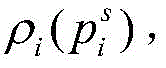

在一种实施方式中,S3中的链路功耗模型的构建具体包括:In one embodiment, the construction of the link power consumption model in S3 specifically includes:
计算链路e的带宽:Calculate the bandwidth of link e:

其中,网络控制器计算出满足用户需求的从源节点到目的节点的Ls条备选路径,从源节点到目的节点的路径用Ψ表示,共有O条,备选路径包含在从源节点到目的节点的所有路径中,用Θ表示,即


根据链路e的带宽计算链路价格

在一种实施方式中,S4中根据VInP效用模型、节点功耗模型和链路功耗模型,确定VInP的收益,包括:In one embodiment, in S4, according to the VInP utility model, the node power consumption model and the link power consumption model, the income of the VInP is determined, including:
确定VInP对于切片s所获得的效用:Determine the utility obtained by VInP for slice s:

其中,φs(xs,ps,ρ)r表示VInP提供切片的收费,
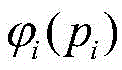


根据VInP对于切片s所获得的效用,确定VInP的收益:Determine the benefit of VInP based on the utility that VInP obtains for slice s:

其中,服务端收益最大,即满足Among them, the benefit of the server is the largest, that is, to meet the

s.t.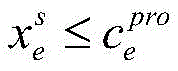

其中,


在一种实施方式中,S4中根据用户效用模型、节点功耗模型和链路功耗模型,确定用户的收益,包括:In one embodiment, in S4, the user's benefit is determined according to the user utility model, the node power consumption model and the link power consumption model, including:
确定用户的效用:Determine the utility of the user:
Us(r)=ws log(1+r) (8)U s (r)=w s log(1+r) (8)
其中,ws表示用户的服务质量请求等级,r表示数据传输速率;Among them, ws represents the user 's service quality request level, and r represents the data transmission rate;
根据节点功耗模型和链路功耗模型,确定用户构建切片的费用:According to the node power consumption model and the link power consumption model, determine the cost for users to construct slices:

其中,


根据用户的效用和用户构建切片的费用,确定用户端的收益,即用户端购买所有切片的总收益:According to the user's utility and the user's cost of constructing slices, determine the user's revenue, that is, the total revenue of the user's purchase of all slices:

其中,使得下式最大:where the following equation is maximized:

s.t.


在一种实施方式中,S5具体包括:In one embodiment, S5 specifically includes:
根据VInP的收益和用户端的收益,计算切片的总收益:Calculate the total revenue of the slice according to the revenue of VInP and the revenue of the client:

s.t.
其中,约束条件是用户请求节点和链路约束,VInP端响应节点和带宽约束。Among them, the constraints are the user request node and link constraints, and the VInP end responds node and bandwidth constraints.
在一种实施方式中,S6中采用竞争博弈机制对切片资源进行分配时,采用基于互信息的竞争博弈策略,将用户端的收益作为用户对切片的估值,将VInP的收益作为切片本身的估值,将用户对切片的估值a当成一个随机变量,切片本身的价值也是一个随机变量p,a与p存在一定的关系,I(a,p)表示切片估值与本身价值的相关性的大小。In one embodiment, when a competitive game mechanism is used to allocate slice resources in S6, a competitive game strategy based on mutual information is used, and the revenue of the user terminal is used as the user's valuation of the slice, and the revenue of VInP is used as the valuation of the slice itself. The value of the slice is regarded as a random variable by the user, and the value of the slice itself is also a random variable p. There is a certain relationship between a and p, and I(a, p) represents the correlation between the slice valuation and its own value. size.
本申请实施例中的上述一个或多个技术方案,至少具有如下一种或多种技术效果:The above-mentioned one or more technical solutions in the embodiments of the present application have at least one or more of the following technical effects:
本发明针对多用户的网络切片资源分配方法,网络切片资源分配建模为虚拟基础设施服务提供商(VInP)和用户两层架构,VInP和用户建立各自的效用模型。利用经济学的边际效益对用户的收益模型进行建模,通过考虑用户请求资源与实际分配资源的关系来对用户满意度进行建模。利用协作竞争机制来对资源价格和分配资源数量进行调整,使得最后达到纳什均衡。相对于其他博弈策略来说,用户的效用得到了提升;针对于多个用户请求同一个网络切片资源,节点能耗和链路的选择在切片资源分配中占有重要的作用,把切片建模为节点和链路的组合,多个用户对切片进行投标,利用竞争博弈策略,为用户分配切片资源,因此可以改善切片资源的分配效果。The present invention is directed to a multi-user network slice resource allocation method. The network slice resource allocation is modeled as a virtual infrastructure service provider (VInP) and a user two-layer architecture, and the VInP and the user establish their own utility models. The user's revenue model is modeled using the marginal benefit of economics, and the user satisfaction is modeled by considering the relationship between the user's requested resources and the actual allocated resources. The cooperative competition mechanism is used to adjust the resource price and the allocated resource quantity, so as to finally reach the Nash equilibrium. Compared with other game strategies, the utility of users has been improved; for multiple users requesting the same network slice resources, node energy consumption and link selection play an important role in the allocation of slice resources. The slice is modeled as The combination of nodes and links, multiple users bid on slices, and use the competitive game strategy to allocate slice resources to users, so the allocation effect of slice resources can be improved.
进一步地,提出利用互信息反应估值与价值之间的关系,通过调整投标策略,得到切片资源分配方案。最后通过实验证明该方案下节点和链路资源的利用率得到提高,引入互信息使得系统更早的达到纳什均衡,提高网络效益。Further, it is proposed to use mutual information to reflect the relationship between valuation and value, and to obtain a slice resource allocation scheme by adjusting the bidding strategy. Finally, the experiment proves that the utilization rate of node and link resources is improved under this scheme, and the introduction of mutual information makes the system reach Nash equilibrium earlier and improves network efficiency.
附图说明Description of drawings
为了更清楚地说明本发明实施例或现有技术中的技术方案,下面将对实施例或现有技术描述中所需要使用的附图作简单地介绍,显而易见地,下面描述中的附图是本发明的一些实施例,对于本领域普通技术人员来讲,在不付出创造性劳动的前提下,还可以根据这些附图获得其他的附图。In order to illustrate the embodiments of the present invention or the technical solutions in the prior art more clearly, the following briefly introduces the accompanying drawings that need to be used in the description of the embodiments or the prior art. Obviously, the drawings in the following description are For some embodiments of the present invention, for those of ordinary skill in the art, other drawings can also be obtained according to these drawings without creative efforts.
图1是本发明提供的一种基于竞争博弈的多用户切片资源分配方法的整体流程图;Fig. 1 is the overall flow chart of a kind of multi-user slice resource allocation method based on competitive game provided by the present invention;
图2是本发明在竞争博弈过程中拍卖系统的模型框架图;Fig. 2 is the model frame diagram of the auction system in the competitive game process of the present invention;
图3是采用三种方法得到的节点利用率曲线图;Figure 3 is a graph of node utilization obtained by three methods;
图4是采用三种方法得到的链路利用率曲线图;Fig. 4 is the link utilization curve diagram that adopts three kinds of methods to obtain;
图5是采用三种方法得到的VInP效益曲线图。Figure 5 is a graph of the VInP benefit curve obtained using the three methods.
具体实施方式Detailed ways
本发明提出了一种基于竞争博弈的多用户切片资源分配方法,可以用于多永不切片资源分配,并且改善了分配效果。The invention proposes a multi-user slice resource allocation method based on a competitive game, which can be used for multi-never slice resource allocation and improves the allocation effect.
为了达到上述效果,本发明的技术方案是:In order to achieve the above-mentioned effects, the technical scheme of the present invention is:
1.针对多用户多VInP的场景进行研究。提出了一种基于用户满意度的C-RAN架构下网络切片资源分配管理方法,将网络切片资源分配问题建模为VInP和用户两层架构,在构建用户效用模型同时,提出了用户对分配资源满意度的一种量化方式,最大化用户的效用函数。1. Research on multi-user multi-VInP scenarios. This paper proposes a network slice resource allocation management method under the C-RAN architecture based on user satisfaction. The network slice resource allocation problem is modeled as a VInP and user two-layer architecture. While building the user utility model, it proposes that users allocate resources to each other. A measure of satisfaction that maximizes the user's utility function.
2考虑到节点和链路对网络的影响,构建了一种基于互信息的C-RAN架构下网络切片资源分配管理模型。用户对网络切片资源进行竞争,针对用户对切片的估值与切片本身的价值存在一定联系,提出了基于互信息的网络切片资源管理方案。2 Considering the impact of nodes and links on the network, a network slice resource allocation management model based on mutual information is constructed under the C-RAN architecture. Users compete for network slice resources. Aiming at the connection between the user's evaluation of slices and the value of slices, a network slice resource management scheme based on mutual information is proposed.
为使本发明实施例的目的、技术方案和优点更加清楚,下面将结合本发明实施例中的附图,对本发明实施例中的技术方案进行清楚、完整地描述,显然,所描述的实施例是本发明一部分实施例,而不是全部的实施例。基于本发明中的实施例,本领域普通技术人员在没有做出创造性劳动前提下所获得的所有其他实施例,都属于本发明保护的范围。In order to make the purposes, technical solutions and advantages of the embodiments of the present invention clearer, the technical solutions in the embodiments of the present invention will be clearly and completely described below with reference to the accompanying drawings in the embodiments of the present invention. Obviously, the described embodiments These are some embodiments of the present invention, but not all embodiments. Based on the embodiments of the present invention, all other embodiments obtained by those of ordinary skill in the art without creative efforts shall fall within the protection scope of the present invention.
本实施例提供了一种基于竞争博弈的多用户切片资源分配方法,该方法包括:This embodiment provides a multi-user slice resource allocation method based on a competitive game, and the method includes:
S1:将系统建模为虚拟基础设施服务提供商VInP和用户两层架构,VInP层包括多个VInP和用户层包括多个用户;S1: Model the system as a virtual infrastructure service provider VInP and user two-layer architecture, the VInP layer includes multiple VInPs and the user layer includes multiple users;
S2:分别构建VInP效用模型和用户效用模型;S2: Build VInP utility model and user utility model respectively;
S3:将切片资源分配划分为节点和链路,分别构建节点功耗模型和链路功耗模型;S3: Divide slice resource allocation into nodes and links, and build a node power consumption model and a link power consumption model respectively;
S4:根据VInP效用模型、节点功耗模型和链路功耗模型,确定VInP的收益,根据用户效用模型、节点功耗模型和链路功耗模型确定用户端的收益;S4: Determine the revenue of the VInP according to the VInP utility model, the node power consumption model and the link power consumption model, and determine the revenue of the user terminal according to the user utility model, the node power consumption model and the link power consumption model;
S5:根据VInP的收益和用户端的收益,计算切片的总收益,将切片的总收益作为网络模型;S5: Calculate the total revenue of the slice according to the revenue of VInP and the revenue of the client, and use the total revenue of the slice as the network model;
S6:对网络模型进行求解,将VInP作为卖家,用户作为买家,卖家根据切片资源总数确定初始价格,买家对切片进行投标,采用竞争博弈机制对切片资源进行分配。S6: Solve the network model, take VInP as the seller and the user as the buyer, the seller determines the initial price according to the total number of slice resources, the buyer bids on the slice, and uses the competitive game mechanism to allocate the slice resources.
具体来说,C-RAN架构下,对网络资源进行切片,将物理网络映射成具有特定功能虚拟网络,通过对网络切片频谱资源的分配使得网络的效益达到最大。系统建模为多个虚拟基础设施服务提供商(VInP),多个用户两层架构。VInP作为有限的资源池,是网络切片的拥有者,VInP依据市场信息做出定价策略,其目标是使得本身的效益达到最高。用户端根据网络状态和自身需求的需要向上层申请一定数量的资源,使其满足自身的需求。对于VInP层希望利用有限的资源获取最大的收益,而下层的用户层希望用最少的代价获取最大的资源数量。上下两层进行一个博弈的过程,最后使得系统达到纳什平衡。Specifically, under the C-RAN architecture, network resources are sliced, the physical network is mapped into a virtual network with specific functions, and the network slicing spectrum resources are allocated to maximize the benefits of the network. The system is modeled as multiple virtual infrastructure service providers (VInPs), multiple users, and a two-tier architecture. As a limited resource pool, VInP is the owner of network slices. VInP makes pricing strategies based on market information, and its goal is to maximize its own benefits. The client applies a certain amount of resources to the upper layer according to the network status and its own needs, so that it can meet its own needs. For the VInP layer, it hopes to use limited resources to obtain the maximum benefit, while the lower user layer hopes to obtain the maximum number of resources with the least cost. The upper and lower layers carry out a game process, and finally make the system reach Nash equilibrium.
请参见图1,为一种基于竞争博弈的多用户切片资源分配方法的整体流程图;Please refer to FIG. 1 , which is an overall flow chart of a multi-user slice resource allocation method based on a competitive game;
如图1所示,开始阶段,用户和VInP分别建立自己的效用模型。对于网络切片资源存在一个初始价格,即网络资源总量越多,初始价格越低。然后对节点功耗和链路进行建模,得到关于节点和链路的网络切片,最后,对节点模型和链路模型进行求解,得到对于用户请求的网络切片数,即资源数量,网络模型求解即由拍卖师确定最终的网络切片资源分配方案。As shown in Figure 1, in the initial stage, users and VInPs establish their own utility models respectively. There is an initial price for network slicing resources, that is, the more total network resources, the lower the initial price. Then, the node power consumption and link are modeled to obtain network slices about nodes and links. Finally, the node model and link model are solved to obtain the number of network slices requested by the user, that is, the number of resources, and the network model is solved. That is, the auctioneer determines the final network slice resource allocation plan.
在一种实施方式中,S2中构建VInP效用模型为:In one embodiment, the VInP utility model constructed in S2 is:
G(p,q)=pq-cq (1)G(p,q)=pq-cq(1)
其中,p表示VInP给出的切片资源的初始单价,q表示VInP分配的切片资源数量,c表示切片资源的成本单价;Among them, p represents the initial unit price of slice resources given by VInP, q represents the number of slice resources allocated by VInP, and c represents the cost unit price of slice resources;
用户效用模型为:The user utility model is:
F(p,q)=u(q)-l(p,q)+v(q) (2)F(p,q)=u(q)-l(p,q)+v(q) (2)
其中,u(q)表示用户获取切片资源所产生的效用,l(p,q)表示用户的资源支出成本,v(q)表示用户满意度,u(q)=wln(1+q),l(p,q)=pq,
具体来说,对于切片s,s∈S,假设一共有n个用户,有m个VInP。第i个用户所请求的资源量为mi,为理想的资源分配数量。第j个VInP所提供分配的资源数量qj,且qj<mi,一般用户请求资源数量总是大于VInP分配的资源数量。第j个VInP能够分配给用户的资源总量为Qj,且qj<Qj,分配资源数量小于资源总量,第j个VInP提供的资源单价为pj,资源单价与资源总量有关,可表示为:Specifically, for a slice s, s∈S, suppose there are n users in total, and there are m VInPs. The amount of resources requested by the i-th user is m i , which is the ideal resource allocation. The number of resources allocated by the jth VInP q j , and q j < m i , generally the number of resources requested by the user is always greater than the number of resources allocated by the VInP. The total amount of resources that the j-th VInP can allocate to users is Q j , and q j <Q j , the amount of allocated resources is less than the total amount of resources, the unit price of resources provided by the j-th VInP is p j , and the unit price of resources is related to the total amount of resources , which can be expressed as:

其中b为常数,用户选择交易的VInP时,需要对资源单价和资源数量进行考虑,资源单价越小,用户效用越高,请求资源数量与VInP所能分配的资源数量之差越小,用户的满意度越高,因此,第i个用户选择交易的VInP可以表示为:Among them, b is a constant. When the user selects the VInP for the transaction, the resource unit price and resource quantity need to be considered. The higher the satisfaction is, therefore, the VInP of the i-th user’s choice of transaction can be expressed as:

然后通过与第j个VInP进行协同竞争得到最优的价格策略,即得到用户i对于切片s的最优价格。Then, the optimal price strategy is obtained through cooperative competition with the jth VInP, that is, the optimal price of user i for slice s is obtained.
为了研究方便,讨论第j个VInP与第i用户进行价格协作竞争的场景,在协作竞争的过程是对资源价格和分配资源数量进行改变,最后达到一种纳什均衡。VInP给出资源的初始单价为p,VInP分配的资源数量为q。用户请求的资源数量为m,q<m。初始价格与资源总数有关,即资源总数越大,初始价格越小,即:For the convenience of research, we discuss the scenario where the jth VInP and the ith user conduct price cooperative competition. In the process of cooperative competition, the price of resources and the quantity of allocated resources are changed, and finally a Nash equilibrium is reached. The initial unit price of resources given by VInP is p, and the quantity of resources allocated by VInP is q. The number of resources requested by the user is m, q<m. The initial price is related to the total number of resources, that is, the larger the total number of resources, the smaller the initial price, namely:

因此,对于VInP,其效用模型为资源售价与资源成本之差,如公式(1)所示。Therefore, for VInP, its utility model is the difference between resource selling price and resource cost, as shown in formula (1).
对于用户,考虑了用户满意度对效用函数的影响,效用函数由三部分组成,即获取资源所产生的效用,资源支出成本和用户满意度。获取资源所产生的效用,用u(x)表示,表示分配x数量的资源所带来的收益,本发明采用一种保守型的效用函数表示,即对数函数作为资源的效用函数,表达式为:For users, the effect of user satisfaction on the utility function is considered. The utility function consists of three parts, namely, the utility generated by acquiring resources, the resource expenditure cost and the user satisfaction. The utility generated by the acquisition of resources, represented by u(x), represents the benefits brought by allocating x amount of resources. The present invention adopts a conservative utility function to represent, that is, the logarithmic function is used as the utility function of the resource, and the expression for:
u(q)=wln(1+q) (15)u(q)=wln(1+q) (15)
w为大于0的常数,表示用户权重。该效用函数的含义是对于用户分配一定量的资源就基本能够满足用户的需求,但当分配资源足够大时,用户的收益的增长速度会随这分配资源的增多而下降。用户的资源的支出成本为资源单价与分配资源数量之积,可以表示为:w is a constant greater than 0, representing the user weight. The meaning of the utility function is that a certain amount of resources allocated to the user can basically meet the user's needs, but when the allocated resources are large enough, the growth rate of the user's income will decrease with the increase of the allocated resources. The user's resource expenditure cost is the product of the resource unit price and the allocated resource quantity, which can be expressed as:
l(p,q)=pq (16)l(p,q)=pq(16)
用户满意度是用户对资源分配方案的一种感性认识,本发明对用户满意度进行了量化,用户满意度可以由用户请求资源数量与VInP分配给用户的资源量来表示:User satisfaction is a kind of perceptual understanding of the user to the resource allocation scheme. The present invention quantifies the user satisfaction. User satisfaction can be represented by the amount of resources requested by the user and the amount of resources allocated to the user by VInP:

分配的资源数量增加,用户的体验会更好,用户的满意度也会增加。当分配的资源数量减少时,用户的满意度也在逐渐减少,当用户的分配资源数量为0时,用户满意度也为0。则用户请求资源的总收益为F(p,q),可以表示为公式(2)的形式。As the number of resources allocated increases, the user experience will be better and user satisfaction will increase. When the number of allocated resources decreases, the user's satisfaction also gradually decreases, and when the number of users' allocated resources is 0, the user's satisfaction is also 0. Then the total revenue of the resource requested by the user is F(p,q), which can be expressed in the form of formula (2).
对于系统模型而言,需要对用户和VInP分别进行效用模型建立,通过对用户和VInP建立各自的效用的分析,得到系统的效用模型。用户根据VInP的价格策略调整自己的购买的资源数量,最优化自身效用函数,而VInP根据用户购买的资源数量对资源价格进行调整,最优化资源自身效用函数,如此反复,最终达到纳什均衡。当VInP定价过高,会导致过多的资源闲置,造成资源的浪费,而定价过低又会导致整个网络的负载过大,影响用户的体验性能。因此,在博弈的过程中,需要制定合理的价格和购买资源数量使VInP和用户都能满足自身的需求For the system model, it is necessary to establish the utility model of the user and the VInP respectively, and obtain the utility model of the system by analyzing the respective utility of the user and the VInP. The user adjusts the amount of resources purchased according to the price strategy of VInP, and optimizes its own utility function, while VInP adjusts the resource price according to the amount of resources purchased by the user, optimizes the utility function of the resource itself, and so on, and finally reaches the Nash equilibrium. When the VInP price is too high, too many resources will be idle, resulting in a waste of resources. If the price is too low, the entire network will be overloaded, affecting user experience and performance. Therefore, in the process of the game, it is necessary to formulate reasonable prices and purchase resources so that both VInP and users can meet their own needs.
在一种实施方式中,S3中节点功耗模型的构建具体包括:In one embodiment, the construction of the node power consumption model in S3 specifically includes:
计算单个节点功耗:Calculate the power consumption of a single node:

其中,pi表示切片接入节点i的链路功耗,

根据单个节点功耗,计算一个切片的节点功耗:Calculate the node power consumption of a slice based on the power consumption of a single node:

其中,
根据切片的节点功耗确定节点价格

具体来说,对于网络切片资源,节点能耗和链路的选择在切片资源分配中占主导作用。节点和链路作为网络底层的基础设施,节点能耗和链路的选择对于构建一个满足用户需求的网络切片具有重要意义。C-RAN架构下对网络切片资源分配,需要对节点和链路进行建模。网络控制器通过SDN和NFV技术管理底层网络,将物理网络映射为虚拟网络,形成一个具有特定功能的网络切片,可以用一个节点和链路的有序组合表示,各切片之间逻辑上相互隔离,物理上共享下层的基础设施。底层网络可以表示为一个有向图G(Ν,ξ),其中N={i|i=1,2,…,N}表示节点集合,ξ={e|e=1,2,…L}表示链路集合。对于用户的请求,通过切片匹配原则,进行切片的建立,切片的集合可以表示为S={s|s=1,2…n},n表示切片的数量。一个切片可能满足一个用户的需求,也可能满足多个用户的需求,因此存在多用户对同一个切片资源竞争的情况。Specifically, for network slicing resources, node energy consumption and link selection play a dominant role in slicing resource allocation. Nodes and links are the underlying infrastructure of the network, and the selection of node energy consumption and links is of great significance for building a network slice that meets user needs. The allocation of network slice resources under the C-RAN architecture requires modeling of nodes and links. The network controller manages the underlying network through SDN and NFV technology, maps the physical network into a virtual network, and forms a network slice with specific functions, which can be represented by an ordered combination of nodes and links, and the slices are logically isolated from each other , physically sharing the underlying infrastructure. The underlying network can be represented as a directed graph G(Ν,ξ), where N={i|i=1,2,...,N} represents the set of nodes, ξ={e|e=1,2,...L} Represents a link set. For the user's request, through the slice matching principle, the slice is established, and the set of slices can be expressed as S={s|s=1, 2...n}, where n represents the number of slices. A slice may meet the needs of one user or multiple users, so there is a situation where multiple users compete for the same slice resource.
网络节点的能耗对于切片的建立具有重要的作用。网络中节点的选择不仅需要满足用户服务质量请求,而且还要使得系统的功耗达到最低。根据香农公式,节点i的传输速率可以表示为:The energy consumption of network nodes plays an important role in the establishment of slices. The selection of nodes in the network not only needs to meet the user's service quality requirements, but also minimize the power consumption of the system. According to Shannon's formula, the transmission rate of node i can be expressed as:

其中,

在考虑系统的整个功效时,主要分为两个部分,即节点发送数据所消耗的功率,节点接收数据所消耗的功率,当接入第i个节点时,1≤i≤n,单个节点功耗可建模为公式(3)的形式。When considering the overall efficacy of the system, it is mainly divided into two parts, namely, the power consumed by the node to send data and the power consumed by the node to receive data. When accessing the i-th node, 1≤i≤n, the power of a single node The consumption can be modeled in the form of Equation (3).
对于发送节点,其发射功耗

对于接收节点i,需要对信号进行滤波,整形,放大,模数转换等,则其接收功耗可表示为:For the receiving node i, the signal needs to be filtered, shaped, amplified, analog-to-digital conversion, etc., then its receiving power consumption can be expressed as:

其中,Mi表示第i个节点的天线数量,


通过对网络能耗进行建模,在对节点进行选择时,不仅需要满足用户的服务质量需求,同时要保证节点能耗达到最低。对于网络切片资源分配,不仅需要对节点进行管理,而且还需要对链路进行管理,需要对链路进行规划,提升系统的性能。By modeling the network energy consumption, when selecting nodes, it is not only necessary to meet the service quality requirements of users, but also to ensure that the node energy consumption is minimized. For network slicing resource allocation, not only nodes need to be managed, but also links need to be managed, and links need to be planned to improve system performance.
在一种实施方式中,S3中的链路功耗模型的构建具体包括:In one embodiment, the construction of the link power consumption model in S3 specifically includes:
计算链路e的带宽:Calculate the bandwidth of link e:

其中,网络控制器计算出满足用户需求的从源节点到目的节点的Ls条备选路径,从源节点到目的节点的路径用Ψ表示,共有O条,备选路径包含在从源节点到目的节点的所有路径中,用Θ表示,即



根据链路e的带宽计算链路价格


具体来说,对于切片s∈S,用户进行请求,网络控制器计算出满足用户需求的从源节点到目的节点的Ls条备选路径,从源节点到目的节点的路径用Ψ表示,共有O条,备选路径包含在从源节点到目的节点的所有路径中,用Θ表示,即


链路e的带宽计算公式为公式(5),则链路价格是链路带宽的函数,可表示为
为了满足用户的时延的要求,网络控制器首先为每个用户分配一条备选路径,网络时延只包括链路传播时延,排队时延和虚拟网络功能的处理时延。Liu等人提出了一种新的框架,利用通用处理器的并行化能力,对虚拟网络功能实例的处理时延进行了建模,通过依次搜索一组可行区域来求解全局最优解。因此,给定用户请求的时延要求,通过计算备选路径和虚拟网络功能的处理时延可以得到该用户总的时延预算,从而保证用户的时延要求。接下来对网络备选路径(链路)的选择进行介绍。In order to meet the user's delay requirement, the network controller first allocates an alternative path for each user. The network delay only includes the link propagation delay, queuing delay and processing delay of the virtual network function. Liu et al. proposed a new framework that exploits the parallelization capabilities of general-purpose processors to model the processing latency of virtual network function instances, and solves the global optimal solution by sequentially searching a set of feasible regions. Therefore, given the delay requirement of the user's request, the total delay budget of the user can be obtained by calculating the processing delay of the alternative path and the virtual network function, thereby ensuring the user's delay requirement. Next, the selection of network alternative paths (links) is introduced.
不同用户对网络的时延的要求是不同的,为保证网络切片的时延要求,控制器为每个用户计算出一条满足其延迟预算要求的备选路径。网络切片是通过虚拟化将一个物理网络分成多个虚拟的逻辑网络,针对不同的用户,对每个用户的业务请求进行建模,形成单源单汇的最小费用流问题。对于给定网络N=(s,t,V,A,C,U),其中s表示起点,t表示终点,V为网络节点的集合,A为网络中链路的集合,C为单位费用,U为网络中链路的流量上界,0为网络的流量下界,计算从源节点到目的节点流值为v的最小费用流x。对于这种单源单汇的网络,其中网络容量满足条件且转运节点流量守恒,但流值小于v的流称为可行流。网络N中可行流x对应的残量网络可以表示为N(x)=(s,t,A(x),C(x),U(x)),Different users have different requirements for network delay. In order to ensure the delay requirements of network slicing, the controller calculates an alternative path for each user that meets its delay budget requirements. Network slicing is to divide a physical network into multiple virtual logical networks through virtualization. For different users, the service requests of each user are modeled to form the minimum cost flow problem of single source and single sink. For a given network N=(s,t,V,A,C,U), where s is the starting point, t is the ending point, V is the set of network nodes, A is the set of links in the network, C is the unit cost, U is the upper bound of the flow of the link in the network, 0 is the lower bound of the network flow, calculate the minimum cost flow x with the flow value v from the source node to the destination node. For such a single-source, single-sink network, where the network capacity satisfies the conditions and the flow of transit nodes is conserved, but the flow value is less than v is called a feasible flow. The residual network corresponding to the feasible flow x in the network N can be expressed as N(x)=(s, t, A(x), C(x), U(x)),
A(x)={(i,j)|(i,j)∈A,xij<uij}∪{(i,j)|(j,i)∈A,xji>0} (22)A(x)={(i,j)|(i,j)∈A,x ij <u ij }∪{(i,j)|(j,i)∈A,x ji >0} (22)


其中,i表示节点i,j表示节点j,c为单位费用,x表示流值,则cij(x)表示流值为x流量经过节点i与节点j之间的链路的单位流量费用,xij表示经过节点i与节点j之间的链路的流量,uij表示经过节点i与节点j之间的链路的流量上界。其中i,j表示相邻节点。Among them, i represents node i, j represents node j, c is the unit cost, x represents the flow value, then c ij (x) represents the unit flow cost of the flow value x traffic passing through the link between node i and node j, x ij represents the traffic passing through the link between node i and node j, and u ij represents the upper bound of the traffic passing through the link between node i and node j. where i and j represent adjacent nodes.
则从源节点s到终节点t流值为v的最小费用流问题可以表示如下:Then the minimum cost flow problem from source node s to end node t with flow value v can be expressed as follows:

s.t.
0≤xij≤uij,(i,j)∈A0≤x ij ≤u ij ,(i,j)∈A
公式(25)是用单位流量费用诚意流量,然后求和得到总的费用。Equation (25) is to use the unit traffic cost sincerity flow, and then sum up to get the total cost.
利用原始-对偶算法,引入对偶变量π,z,则上述问题的对偶问题可以表示为:Using the primal-dual algorithm and introducing dual variables π, z, the dual problem of the above problem can be expressed as:

s.t.πi-πj-zij≤cij,(i,j)∈Astπ i -π j -z ij ≤c ij ,(i,j)∈A
zij≥0,(i,j)∈Az ij ≥0,(i,j)∈A
对于上述问题的可行解满足互补松弛条件,即The feasible solution to the above problem satisfies the complementary relaxation condition, namely
xij(πi-πj-zij-cij)=0,(i,j)∈A (27)x ij (π i -π j -z ij -c ij )=0,(i,j)∈A (27)
zij(xij-uij)=0,(i,j)∈A (28)z ij (x ij -u ij )=0,(i,j)∈A (28)
其中πi可以表示为节点i的势。原始-对偶算法的的核心思想是从网络的任意一个可行流出发,其流值x≤v,对网络中链路上的流值进行增加和对节点上的势进行修改,通过对网络中链路和节点进行迭代直至得到满足约束条件的流量x。通常原始-对偶算法是沿着链路πi-πj=cij的方向进行流量的增广,通过计算残量网络N(x)中满足πi-πj=cij的链路组成的子网N0(x),在子网中寻找增广链路进行增广。其中N0(x)可以表示为:where π i can be expressed as the potential of node i. The core idea of the primal-dual algorithm is to start from any feasible flow in the network, whose flow value x≤v, increase the flow value on the link in the network and modify the potential on the node. The paths and nodes are iterated until a flow x that satisfies the constraints is obtained. Usually the original-dual algorithm is to augment the traffic along the direction of the link π i -π j =c ij , by calculating the links in the residual network N(x) that satisfy π i -π j =c ij . Subnet N 0 (x), find an augmentation link in the subnet for augmentation. where N 0 (x) can be expressed as:

当子网N0(x)找不到增广链路缺流值小于v是,修改节点上的势,并且使修改后的势满足上述约束条件,算法步骤可总结为如下形式:When the sub-network N 0 (x) cannot find the augmented link lacking current value less than v, modify the potential on the node, and make the modified potential satisfy the above constraints, the algorithm steps can be summarized as follows:
第一步:在网络N=(s,t,V,A,C,U)任取一源点为s,终点为t的可行流x,并且令初始势π=0。The first step: in the network N=(s, t, V, A, C, U), take any feasible flow x with source point s and end point t, and let the initial potential π=0.
第二步:当可行流x≥v时,算法结束,找到网络中所要求的流值为v的最小费用流x;当可行流x<v时,在残量网络N(x)中,更新链路费用cijπ=cij-πi+πj,计算从源节点到节点i的最短路径长d(i),更新πi=πi-d(i)。Step 2: When the feasible flow x≥v, the algorithm ends, find the minimum cost flow x with the required flow value v in the network; when the feasible flow x<v, in the residual network N(x), update Link cost c ij π=c ij -π i +π j , calculate the shortest path length d(i) from the source node to node i, and update π i =π i -d(i).
第三步:在残量网络N0(x)中重新计算从节点s到节点最大流。若该最大流为0,则问题无解。否则,沿着上述计算的最大流链路进行增广,继续第一步的操作。Step 3: Recompute the maximum flow from node s to node in the residual network N 0 (x). If the maximum flow is 0, the problem is unsolved. Otherwise, the augmentation is performed along the maximum flow link calculated above, and the operation of the first step is continued.
对算法的时间复杂度进行分析,从上述算法步骤中可以看出,循环迭代的过程是对网络中链路的流值和节点上链路的势进行修改,总迭代次数小于等于min(nU,nC),而网络中计算最短路径算法的时间复杂度为S(n,m,C),计算最大流算法的时间复杂度为M(n,m,U),则该算法的时间复杂度可以表示为O(min{nU,nC}[S(n,m,nC)+M(n,m,U)])。The time complexity of the algorithm is analyzed. It can be seen from the above algorithm steps that the process of loop iteration is to modify the flow value of the link in the network and the potential of the link on the node, and the total number of iterations is less than or equal to min(nU, nC), and the time complexity of calculating the shortest path algorithm in the network is S(n,m,C), and the time complexity of calculating the maximum flow algorithm is M(n,m,U), then the time complexity of the algorithm can be Expressed as O(min{nU,nC}[S(n,m,nC)+M(n,m,U)]).
在一种实施方式中,S4中根据VInP效用模型、节点功耗模型和链路功耗模型,确定VInP的收益,包括:In one embodiment, in S4, according to the VInP utility model, the node power consumption model and the link power consumption model, the income of the VInP is determined, including:
确定VInP对于切片s所获得的效用:Determine the utility obtained by VInP for slice s:

其中,φs(xs,ps,ρ)r表示VInP提供切片的收费,


根据VInP对于切片s所获得的效用,确定VInP的收益:Determine the benefit of VInP based on the utility that VInP obtains for slice s:

其中,服务端收益最大,即满足Among them, the benefit of the server is the largest, that is, to meet the

s.t.

其中,


具体来说,通过对节点能耗和链路进行建模,网络切片由节点和链路形成的虚拟网络。VInP作为网络切片的拥有者,用户作为切片的投标者,需要根据节点信息和链路信息建立各自的效用模型。Specifically, by modeling node energy consumption and links, the network slices the virtual network formed by nodes and links. As the owner of the network slice, and the user as the bidder of the slice, VInP needs to establish its own utility model according to the node information and link information.
对于VInP而言,其收益函数可表示为提供切片的收费与网络提供服务的开销之差,VInP对于切片所获得的效用可表示为公式(6)。
在一种实施方式中,S4中根据用户效用模型、节点功耗模型和链路功耗模型,确定用户的收益,包括:In one embodiment, in S4, the user's benefit is determined according to the user utility model, the node power consumption model and the link power consumption model, including:
确定用户的效用:Determine the utility of the user:
Us(r)=ws log(1+r) (8)U s (r)=w s log(1+r) (8)
其中,ws表示用户的服务质量请求等级,r表示数据传输速率;通过公式(8)来表示对数据传输速率与用户效用的关系。Among them, ws represents the user 's service quality request level, and r represents the data transmission rate; the relationship between the data transmission rate and the user's utility is represented by formula (8).
根据节点功耗模型和链路功耗模型,确定用户构建切片的费用:According to the node power consumption model and the link power consumption model, determine the cost for users to construct slices:

其中,


根据用户的效用和用户构建切片的费用,确定用户端的收益,即用户端购买所有切片的总收益:According to the user's utility and the user's cost of constructing slices, determine the user's revenue, that is, the total revenue of the user's purchase of all slices:

其中,使得下式最大:where the following equation is maximized:

s.t.


具体来说,通过对节点能耗和链路进行建模,网络切片由节点和链路形成的虚拟网络。VInP作为网络切片的拥有者,用户作为切片的投标者,需要根据节点信息和链路信息建立各自的效用模型。Specifically, by modeling node energy consumption and links, the network slices the virtual network formed by nodes and links. As the owner of the network slice, and the user as the bidder of the slice, VInP needs to establish its own utility model according to the node information and link information.
对于用户的效用主要由两部分组成,接受数据服务所产生的效用和占用资源所花费的费用。具体如公式(8)所示,其中ws表示用户的服务质量请求等级,即对传输速率的要求,用户对传输速率的要求越高,其产生的收益也就越大,r表示数据传输速率。用户构建切片s所需支付的费用为购买节点所支付的费用与购买链路所支付的费用之和,可表示为公式(9)。The utility for users is mainly composed of two parts, the utility generated by receiving data services and the cost of occupying resources. Specifically, as shown in formula (8), where ws represents the user 's service quality request level, that is, the request for the transmission rate. The higher the user's request for the transmission rate, the greater the revenue it generates, and r represents the data transmission rate. . The fee that the user needs to pay for constructing the slice s is the sum of the fee paid by the purchase node and the fee paid by the purchase link, which can be expressed as formula (9).
需要说明的是,切片是网络控制器提供的,VInP和用户作为网络中上下两层实体,都希望构建的切片使自身效用最大。用户构建切片就是对于用户而言,购买该网络切片的收益或者支出。It should be noted that slices are provided by the network controller. VInP and users, as the upper and lower layers of entities in the network, hope that the constructed slices can maximize their utility. The user-built slice is the income or expense for the user to purchase the network slice.
在一种实施方式中,S5具体包括:In one embodiment, S5 specifically includes:
根据VInP的收益和用户端的收益,计算切片的总收益:Calculate the total revenue of the slice according to the revenue of VInP and the revenue of the client:

s.t.
其中,约束条件是用户请求节点和链路约束,VInp端响应节点和带宽约束。Among them, the constraints are the user request node and link constraints, and the VInp terminal responds to the node and bandwidth constraints.
具体来说,为了使总体效益达到最大,VInP为多个用户提供切片资源,用户通过建立自己的效用函数,来对切片进行估价,不同的用户对同一网络切片的估值是不同的,通过对网络切片的竞争博弈来实现对网络切片资源的分配。Specifically, in order to maximize the overall benefit, VInP provides slice resources for multiple users. Users establish their own utility functions to evaluate slices. Different users have different evaluations of the same network slice. The competitive game of network slicing is used to realize the allocation of network slicing resources.
网络模型的构建是对网络切片资源分配的基础。上述对问题模型的建立,链路价格与切片占用链路量有关,节点的价格业与切片占用节点资源有关,对于用户f分配了切片s,用户提出的数据流在多条路径l1,l2,…,lk上分别以速率r1,r2,…,rk进行数据传输,如果每条链路的价格和每个节点的价格是固定的,对切片路径l的单价ρ(l)可以定义为发送单位数据所占用的链路资源和节点资源之和,用

则用户的目标函数可以表示为:Then the user's objective function can be expressed as:

为了使的目标函数最大化,则用户f的最优的数据传输速率可以表示为:In order to maximize the objective function of , the optimal data transmission rate of user f can be expressed as:

这样,那么切片s的资源分配是不变的,一直在价格最低的路径上进行传输,造成资源的浪费。这样虽然对于切片s中其各个资源的单价是最便宜的,但其最后的收益却不一定是最大的。本发明利用拍卖算法方式对切片中的链路资源和节点资源进行拍卖,多个用户对切片资源进行竞争,从而实现效益的最大化。用户需求在满足自身需求的同时用最小的代价接入网络,VInP则为用户提供定制切片服务的同时提升网络经济效益,在该问题中,系统将切片资源分配问题建模为拍卖系统问题,系统根据多个用户的提交的价格,即投标信息,决定对链路资源和节点资源分配策略,使得系统总体效益达到最大。In this way, the resource allocation of slice s is unchanged, and it is always transmitted on the path with the lowest price, resulting in a waste of resources. In this way, although the unit price of each resource in slice s is the cheapest, the final benefit is not necessarily the greatest. The invention uses an auction algorithm to auction link resources and node resources in slices, and multiple users compete for slice resources, thereby maximizing benefits. User needs can access the network at the minimum cost while meeting their own needs. VInP provides users with customized slicing services while improving network economic benefits. In this problem, the system models the slicing resource allocation problem as an auction system problem. According to the prices submitted by multiple users, that is, bidding information, the allocation strategy for link resources and node resources is decided to maximize the overall benefit of the system.
在一种实施方式中,S6中采用竞争博弈机制对切片资源进行分配时,采用基于互信息的竞争博弈策略,将用户端的收益作为用户对切片的估值,将VInP的收益作为切片本身的估值,将用户对切片的估值a当成一个随机变量,切片本身的价值也是一个随机变量p,a与p存在一定的关系,I(a,p)表示切片估值与本身价值的相关性的大小。In one embodiment, when a competitive game mechanism is used to allocate slice resources in S6, a competitive game strategy based on mutual information is used, and the revenue of the user terminal is used as the user's valuation of the slice, and the revenue of VInP is used as the valuation of the slice itself. The value of the slice is regarded as a random variable by the user, and the value of the slice itself is also a random variable p. There is a certain relationship between a and p, and I(a, p) represents the correlation between the slice valuation and its own value. size.
下面具体介绍,本发明在网络模型求解过程中采用的竞争博弈分配策略:Introduce in detail below, the competition game allocation strategy that the present invention adopts in the network model solving process:
网络切片资源的分配,多个用户对VInP提出请求,VInP可以通过拍卖算法来实现多用户之间对切片资源的竞争博弈。切片价值与用户对切片评估价值具有一定的关系,可以利用互信息来表示二者的关系,在进行竞争博弈的过程中充分考虑二者的关系,来对切片资源竞争拍卖。In the allocation of network slicing resources, multiple users make requests to VInP, and VInP can realize the competitive game of slicing resources among multiple users through the auction algorithm. The slice value has a certain relationship with the user's evaluation value of the slice. Mutual information can be used to represent the relationship between the two, and the relationship between the two can be fully considered in the process of competitive game to compete and auction slice resources.
其中,在竞争博弈过程中拍卖系统的模型框架图如图2所示,不同的用户作为竞标者向VInP提交请求,不同节点资源和链路资源的投标价格是不同的,用户的目的是在满足自身性能要求的同时支付最低的价格,服务提供商希望通过拍卖网络资源使得自身效益达到最大。用户之间通过竞争博弈策略来确定自身的投标价格,即式(40)。最后由拍卖师确定切片资源最终的归属。Among them, the model frame diagram of the auction system in the competitive game process is shown in Figure 2. Different users submit requests to VInP as bidders, and the bidding prices of different node resources and link resources are different. While paying the lowest price while meeting its own performance requirements, service providers hope to maximize their own benefits by auctioning network resources. Users determine their own bidding prices through a competitive game strategy, that is, formula (40). Finally, the auctioneer determines the final ownership of the slice resources.
(1)基于互信息的博弈策略(1) Game strategy based on mutual information
切片价值与用户对切片评估价值具有一定的关系,可以利用互信息来表示二者的关系,本章提出基于互信息的博弈策略。互信息作为一种相似性度量,能够描述出两个变量的相关性[,当两个变量间的互信息值越大,则说明相关性越大。互信息的概念来源于信息论,用于描述两个变量间的统计相关性,通常由信息熵表示。信息熵最早由香农提出,用来衡量变量含有信息量的多少。假设P(X)表示事件X发生的概率,则信息熵的定义为:The slice value has a certain relationship with the user's evaluation value of the slice. Mutual information can be used to represent the relationship between the two. This chapter proposes a game strategy based on mutual information. Mutual information, as a similarity measure, can describe the correlation between two variables [, when the value of mutual information between two variables is greater, the greater the correlation is. The concept of mutual information comes from information theory and is used to describe the statistical correlation between two variables, usually represented by information entropy. Information entropy was first proposed by Shannon to measure the amount of information a variable contains. Assuming that P(X) represents the probability of event X, the information entropy is defined as:

信息熵是一个统计量,它衡量了一个变量的不确定性。一个变量的不确定性越大,相应的信息熵越大。因此变量等概率发生时,信息熵达到最大值;当变量已概率为1发生时,信息熵达到最小值0。联合熵是度量一个联合分布的随机系统的不确定度,是观察一个多个随机变量的随机系统获得的信息量。定义为:Information entropy is a statistic that measures the uncertainty of a variable. The greater the uncertainty of a variable, the greater the corresponding information entropy. Therefore, when the variable occurs with equal probability, the information entropy reaches the maximum value; when the variable occurs with a probability of 1, the information entropy reaches the minimum value of 0. Joint entropy measures the uncertainty of a jointly distributed random system, and is the amount of information obtained by observing a random system of multiple random variables. defined as:

其中,x和y是X和Y的特定值,相应地,P(x,y)是这些值一起出现的联合概率。互信息表示两个变量与是否有关系,以及关系的强弱。互信息越大,变量之间的相关性越强。可以将互信息看作相关系数在高维非线性情况下的推广。假设H(A)和H(B)分别为用户A和B的信息熵,H(A,B)表示两个用户的联合熵,则互信息定义为:I(A,B)=H(A)+H(B)–H(A,B)互信息描述了两个用户的统计独立程度,如果A和B相互独立,则I(A,B)=0,如果A和B完全依赖或完全包含则H(A)=H(B)=H(A,B),此时互信息最大。where x and y are specific values of X and Y, and correspondingly, P(x,y) is the joint probability of these values appearing together. Mutual information indicates whether there is a relationship between two variables and the strength of the relationship. The greater the mutual information, the stronger the correlation between variables. Mutual information can be viewed as a generalization of the correlation coefficient in the case of high-dimensional nonlinearity. Assuming that H(A) and H(B) are the information entropy of users A and B respectively, and H(A, B) is the joint entropy of the two users, the mutual information is defined as: I(A,B)=H(A )+H(B)–H(A,B) mutual information describes the degree of statistical independence of two users, if A and B are independent of each other, then I(A,B)=0, if A and B are completely dependent or completely If it is included, H(A)=H(B)=H(A,B), and the mutual information is the largest at this time.
在本发明的博弈中,本发明将用户对切片的估值a当成一个随机变量,切片本身的价值也是一个随机变量p,a与p存在一定的关系,I(a,p)表示切片估值与本身价值的相关性的大小。In the game of the present invention, the present invention regards the user's valuation a of the slice as a random variable, and the value of the slice itself is also a random variable p, a and p have a certain relationship, I(a, p) represents the slice valuation The magnitude of the correlation with its own value.
不同的用户作为竞标者向VInP提交请求,不同节点资源和链路资源的投标价格是不同的,用户的目的是在满足自身性能要求的同时支付最低的价格,服务提供商希望通过拍卖网络资源使得效益达到最大。假设第k个用户分配第l个网络切片所获得网络效益为akl,对于拍卖系统而言,要使得系统的整体网络效益达到最大,第k个业务流可分配的网络切片的集合为A(k),若A(k)=φ,则说明请求不可达,拒绝访问,否则,在集合A(k)中根据用户投标信息为第k个用户选择最佳的分配方案。用集合B表示第k个用户与第l个网络切片的二元组,即Different users submit requests to VInP as bidders, and the bidding prices for different node resources and link resources are different. The purpose of users is to pay the lowest price while meeting their own performance requirements. Service providers hope to auction network resources to make Benefit is maximized. Assuming that the network benefit obtained by the kth user allocating the lth network slice is a kl , for the auction system, in order to maximize the overall network benefit of the system, the set of network slices that can be allocated by the kth service flow is A ( k), if A(k)=φ, it means that the request is unreachable and the access is denied, otherwise, the best allocation scheme is selected for the kth user in the set A(k) according to the user bidding information. Use the set B to represent the tuples of the kth user and the lth network slice, i.e.
B={(k,l)|l∈A(k),k=1,2,…,n} (35)B={(k,l)|l∈A(k),k=1,2,…,n} (35)
对于投标信息的集合S是第k个用户与第l个网络切片的二元组的集合,若为空集,则需要重新创建切片,否则对定制化的网络切片进行拍卖,对于集合S满足一下几点:For the set S of bidding information, it is the set of two-tuples of the kth user and the lth network slice. If it is an empty set, the slice needs to be recreated. Otherwise, the customized network slice is auctioned. For the set S, satisfy the following requirements: What time is it:
①对于
②对于用户的每个业务流k,至多

通过拍卖算法对网络资源进行拍卖,满足ε互补松弛条件,即对于分配S和切片的价值向量p=(p1,p2,…,pn)满足:The network resources are auctioned through the auction algorithm, which satisfies the ε complementary relaxation condition, that is, for the value vector p=(p 1 ,p 2 ,...,p n ) of the allocation S and slices, it satisfies:

则说明第k个用户分配第l个网络切片时,网络效益最大。若对于每个网络切片都满足ε补松弛上述条件,则称S和P满足ε补松弛条件。在拍卖的过程中网络切片的价格不会下降,迭代开始已经分配网络切片的用户最后仍处于被分配状态。拍卖过程主要分为拍卖投标阶段和拍卖分配阶段。It means that when the kth user allocates the lth network slice, the network benefit is the greatest. If the above conditions of ε-complementary relaxation are satisfied for each network slice, then S and P are said to satisfy the ε-complementary relaxation conditions. The price of network slices will not drop during the auction process, and users who have allocated network slices at the beginning of the iteration are still in the allocated state at the end. The auction process is mainly divided into the auction bidding stage and the auction allocation stage.
(2)拍卖投标阶段(2) Auction bidding stage
第k个用户循环遍历A(k)中的所有网络切片,计算出最佳的网络切片,其下标为lk,即The kth user loops through all network slices in A(k), and calculates the best network slice, whose subscript is l k , that is,

则对于第k个用户投标的预期收益为vk,可以表示为:Then the expected return for the k-th user bidding is v k , which can be expressed as:

寻找lk以外的其他网络切片,使得第k个用户的收益达到最大,用wk表示,即:Find other network slices other than lk to maximize the profit of the kth user, which is represented by wk , namely:

wk表示受益次大值。w k represents the next largest value of benefit.
若集合A(k)只包含一个网络切片l,则wk=-∞,则第k个用户对于第lk个网络切片所投的标可以表示为If the set A(k) contains only one network slice l, then wk = -∞, then the target cast by the kth user for the lkth network slice can be expressed as

第k个用户对网络切片l的投标调整与互信息相关,当用户对切片的估值与切片本身的价值相近,即相关性越强,则用户可以适当对价格进行调整,若二者相关性越弱,则说明请求的切片并非自己想要的切片,投标价格不会发生很大的变化。The user's bid adjustment for network slice l is related to mutual information. When the user's valuation of the slice is similar to the value of the slice itself, that is, the stronger the correlation, the user can adjust the price appropriately. If the two are correlated The weaker it is, it means that the requested slice is not the slice you want, and the bid price will not change much.
(3)拍卖分配阶段(3) Auction allocation stage
对于一个网络切片的可能满足多个业务流的网络性能要求,因此需要从投标信息中选取最佳的一个进行分配,第l个网络切片的投标信息的集合用Pl表示,找到出价最高的一个pl,更新集合S,将(k,l)替换为(kl,l)。For a network slice that may meet the network performance requirements of multiple service flows, it is necessary to select the best one from the bidding information for allocation. The set of bidding information of the lth network slice is represented by P l , and find the one with the highest bid. p l , update the set S, replacing (k, l ) with (kl,l).

通常对于投标的用户有两种选择,一种是投标中只包含一个未分配的用户,类似于求解非线性方程组的Gauss-Seidel方法,适用于在串行环境下进行计算;另一种投标中包含所有未分配的用户,类似于求解非线性方程组的Jacobi方法,适用于在并行环境下进行计算。在投标迭代过程中,投标价格每次至少增加ε,即Usually there are two options for bidding users, one is that the bid contains only one unassigned user, similar to the Gauss-Seidel method of solving nonlinear equations, suitable for calculation in a serial environment; the other bidding Contains all unassigned users, similar to the Jacobi method for solving nonlinear systems of equations, suitable for computing in a parallel environment. During the bidding iteration process, the bid price increases by at least ε each time, i.e.

每次迭代结束,对网络切片进行新的分配,使得收到投标的网络切片被分配到一个开始时未被分配的业务流中。在拍卖算法的过程中,能够保持ε补松弛条件得到满足,即在开始时分配和价值向量满足ε补松弛,在迭代结束后仍然满足。业务流的每次投标会使得业务流预期的收益vk减少ε,或者不变。当预期收益不变时,说明至少存在两个网络切片,使得业务流收益为vk,其中
该投标算法中ε的尺度对算法运行时间有很大的影响,一般开始时取一个较大的ε值,然后随着投标信息的迭代,ε逐渐减小,最终的


其中,ε0是ε的初值,θ是大于1的整数。Among them, ε 0 is the initial value of ε, and θ is an integer greater than 1.
当该拍卖算法没有可行解时,若不加以条件的限制,系统并不知道问题本身是无可行解,还是问题难解,因此需要一定的约束条件,对于拍卖算法一个不可行的判断依据是初始时vk存在一个下界,最终的迭代使得vk不得低于这个下界。When the auction algorithm does not have a feasible solution, if there is no conditional restriction, the system does not know whether the problem itself has no feasible solution or the problem is difficult to solve. Therefore, certain constraints are required. An infeasible judgment basis for the auction algorithm is the initial When v k has a lower bound, the final iteration makes v k not lower than this lower bound.
下面通过具体的示例,对本发明提供出的方法与现有方法进行比较,来验证本发明的资源分配效果。将本发明提出的方案(CC)与斯坦伯格博弈分配策略(StackelbergGame,SG),动态资源分配方案(Dynamic Allocation,DA)进行比较。The following specific examples are used to compare the method provided by the present invention with the existing method to verify the resource allocation effect of the present invention. The scheme (CC) proposed by the present invention is compared with the Steinberg game allocation strategy (Stackelberg Game, SG) and the dynamic resource allocation scheme (Dynamic Allocation, DA).
如图3所示,对于节点而言,初始阶段,由于斯坦伯格博弈策略(SG)利用leader-followers模式对资源进行分配,节点利用率较高,动态资源分配策略根据用户请求动态的分配资源,节点利用率相对较高。但是随着迭代次数的增加,SG并未考虑多用户对资源竞争的情况,多用户之间并不存在主从关系,这样会使得节点利用率相对较低。对于动态资源分配策略(DA)而言,每次都是尽力而为的满足用户的需要,这样得到节点利用率相对较低。CC充分考虑了用户之间对资源竞争的关系,并且利用互信息将用户与切片之间的关系进行连接,使得节点利用率的得到提高。As shown in Figure 3, for nodes, in the initial stage, due to the Steinberg game strategy (SG) using the leader-followers mode to allocate resources, the node utilization rate is high, and the dynamic resource allocation strategy dynamically allocates resources according to user requests. , the node utilization is relatively high. However, as the number of iterations increases, SG does not consider the multi-user competition for resources, and there is no master-slave relationship between multiple users, which will make the node utilization relatively low. For the dynamic resource allocation strategy (DA), every effort is made to meet the needs of users, so that the node utilization rate is relatively low. CC fully considers the relationship between users on resource competition, and uses mutual information to connect the relationship between users and slices, so that the node utilization rate is improved.
如图4所示,对于链路的利用率而言,三种方案随着迭代次数的增加而增加。对于DA资源分配方案而言,链路资源的价格不发生变化,网络控制器优先分配价格便宜的链路,随着迭代次数的增加,关键链路的网络容量很快达到限制,使得链路资源的利用率达到最大。但是对于CC和SG而言,用户和VInP之间进行博弈,网络控制器根据博弈策略动态地分配链路资源,链路价格根据网络状态动态地进行调整,避免关键链路的出现,使得网络中链路的利用率得到提高。CC通过对网络链路进行建模,链路的价格与链路分配带宽有关,使得网络链路的利用率得到提高。As shown in Figure 4, for link utilization, the three schemes increase with the number of iterations. For the DA resource allocation scheme, the price of link resources does not change, and the network controller preferentially allocates cheap links. As the number of iterations increases, the network capacity of key links quickly reaches the limit, making link resources utilization is maximized. However, for CC and SG, users and VInPs play a game, the network controller dynamically allocates link resources according to the game strategy, and the link price is dynamically adjusted according to the network state to avoid the appearance of key links and make the network Link utilization is improved. By modeling the network link, the price of the link is related to the bandwidth allocated by the link, so that the utilization rate of the network link is improved.
如图5所示,对三种网络切片资源方案进行对比。对于VInP的收益,迭代初期,二者差异不大,随着迭代次数的增加,基于博弈理论的资源分配方案的优势便体现出来,CC和SG中VInP的收益大于DA中VInP的收益。由于CC中利用互信息理论,将切片本身的价值与用户对切片的估值进行联系,对竞争博弈策略进行调整,VInP的效用更早地达到最大值。As shown in Figure 5, three network slicing resource schemes are compared. As for the income of VInP, in the early stage of iteration, there is little difference between the two. As the number of iterations increases, the advantages of the resource allocation scheme based on game theory are reflected. The income of VInP in CC and SG is greater than that of VInP in DA. Due to the use of mutual information theory in CC, the value of the slice itself is linked with the user's valuation of the slice, and the competitive game strategy is adjusted, the utility of VInP reaches its maximum value earlier.
总体来说,本发明针对多用户的网络切片资源分配方法,网络切片资源分配建模为虚拟基础设施服务提供商(VInP)和用户两层架构,VInP和用户建立各自的效用模型。利用经济学的边际效益对用户的收益模型进行建模,通过考虑用户请求资源与实际分配资源的关系来对用户满意度进行建模。利用协作竞争机制来对资源价格和分配资源数量进行调整,使得最后达到纳什均衡。相对于其他博弈策略来说,用户的效用得到了提升,并用实验验证的纳什均衡的存在性;针对于多个用户请求同一个网络切片资源,节点能耗和链路的选择在切片资源分配中占有重要的作用,把切片建模为节点和链路的组合,多个用户对切片进行投标,利用竞争博弈策略,为用户分配切片资源,用户对切片的估值即为效用函数,提出利用互信息反应估值与价值之间的关系,通过调整投标策略,得到切片资源分配方案。最后通过实验证明该方案下节点和链路资源的利用率得到提高,引入互信息使得系统更早的达到纳什均衡,提高网络效益。In general, the present invention aims at a multi-user network slice resource allocation method. The network slice resource allocation is modeled as a virtual infrastructure service provider (VInP) and a user two-tier architecture, and the VInP and the user establish their own utility models. The user's revenue model is modeled using the marginal benefit of economics, and the user satisfaction is modeled by considering the relationship between the user's requested resources and the actual allocated resources. The cooperative competition mechanism is used to adjust the resource price and the allocated resource quantity, so as to finally reach the Nash equilibrium. Compared with other game strategies, the user's utility has been improved, and the existence of Nash equilibrium has been verified by experiments; for multiple users requesting the same network slice resource, the node energy consumption and link selection are in the slice resource allocation. It plays an important role. The slice is modeled as a combination of nodes and links. Multiple users bid on the slice. The competitive game strategy is used to allocate slice resources to users. The user's evaluation of the slice is the utility function. The information reflects the relationship between valuation and value, and by adjusting the bidding strategy, the slice resource allocation plan is obtained. Finally, the experiment proves that the utilization rate of node and link resources is improved under this scheme, and the introduction of mutual information makes the system reach Nash equilibrium earlier and improves network efficiency.
尽管已描述了本发明的优选实施例,但本领域内的技术人员一旦得知了基本创造性概念,则可对这些实施例做出另外的变更和修改。所以,所附权利要求意欲解释为包括优选实施例以及落入本发明范围的所有变更和修改。Although the preferred embodiments of the present invention have been described, additional changes and modifications to these embodiments may occur to those skilled in the art once the basic inventive concepts are known. Therefore, the appended claims are intended to be construed to include the preferred embodiment and all changes and modifications that fall within the scope of the present invention.
显然,本领域的技术人员可以对本发明实施例进行各种改动和变型而不脱离本发明实施例的精神和范围。这样,倘若本发明实施例的这些修改和变型属于本发明权利要求及其等同技术的范围之内,则本发明也意图包含这些改动和变型在内。Obviously, those skilled in the art can make various changes and modifications to the embodiments of the present invention without departing from the spirit and scope of the embodiments of the present invention. Thus, provided that these modifications and variations of the embodiments of the present invention fall within the scope of the claims of the present invention and their equivalents, the present invention is also intended to include such modifications and variations.
Claims (8)










Priority Applications (3)
| Application Number | Priority Date | Filing Date | Title |
|---|---|---|---|
| CN202010543434.1A CN111757354B (en) | 2020-06-15 | 2020-06-15 | A multi-user slice resource allocation method based on competitive game |
| PCT/CN2021/100188 WO2021254349A1 (en) | 2020-06-15 | 2021-06-15 | Multi-user slice resource allocation method based on competitive game |
| US17/797,049 US11716748B2 (en) | 2020-06-15 | 2021-06-15 | Multi-user slice resource allocation method based on competitive game |
Applications Claiming Priority (1)
| Application Number | Priority Date | Filing Date | Title |
|---|---|---|---|
| CN202010543434.1A CN111757354B (en) | 2020-06-15 | 2020-06-15 | A multi-user slice resource allocation method based on competitive game |
Publications (2)
| Publication Number | Publication Date |
|---|---|
| CN111757354A CN111757354A (en) | 2020-10-09 |
| CN111757354B true CN111757354B (en) | 2021-07-20 |
Family
ID=72676374
Family Applications (1)
| Application Number | Title | Priority Date | Filing Date |
|---|---|---|---|
| CN202010543434.1A Active CN111757354B (en) | 2020-06-15 | 2020-06-15 | A multi-user slice resource allocation method based on competitive game |
Country Status (3)
| Country | Link |
|---|---|
| US (1) | US11716748B2 (en) |
| CN (1) | CN111757354B (en) |
| WO (1) | WO2021254349A1 (en) |
Families Citing this family (21)
| Publication number | Priority date | Publication date | Assignee | Title |
|---|---|---|---|---|
| WO2021240753A1 (en) * | 2020-05-28 | 2021-12-02 | 日本電信電話株式会社 | Estimation device, estimation method, and estimation program |
| CN111757354B (en) | 2020-06-15 | 2021-07-20 | 武汉理工大学 | A multi-user slice resource allocation method based on competitive game |
| CN112866368B (en) * | 2021-01-12 | 2022-03-18 | 北京邮电大学 | Air-ground remote Internet of things design method and system |
| CN113300882B (en) * | 2021-05-08 | 2022-04-26 | 北京科技大学 | A data collection and transmission method and device for material big data |
| CN113537968B (en) * | 2021-06-08 | 2022-03-18 | 复旦大学 | A Game Theory-Based Method for Processing Transaction Requests in Payment Channel Networks |
| CN113840333B (en) * | 2021-08-16 | 2023-11-10 | 国网河南省电力公司信息通信公司 | Methods, devices, electronic equipment and storage media for power grid resource allocation |
| CN114340017B (en) * | 2022-03-17 | 2022-06-07 | 山东科技大学 | A heterogeneous network resource slicing method with hybrid services of eMBB and URLLC |
| CN114786260A (en) * | 2022-04-14 | 2022-07-22 | 清华大学 | Slice resource allocation method and device based on 5G network |
| CN114978277B (en) * | 2022-04-24 | 2023-06-27 | 北京邮电大学 | Cross-domain resource allocation method in non-ground network based on network slicing |
| CN115209555B (en) * | 2022-06-10 | 2023-04-07 | 广西壮族自治区通信产业服务有限公司技术服务分公司 | Game theory-based network slicing and computing resource allocation method and system |
| CN115967629B (en) * | 2022-12-19 | 2023-11-03 | 众芯汉创(北京)科技有限公司 | Data communication system based on 5G communication network slicing division |
| CN116390099B (en) * | 2023-03-31 | 2025-06-13 | 杭州电子科技大学 | A resource allocation method for intelligent reflective surfaces based on game theory |
| CN116319603B (en) * | 2023-04-06 | 2025-11-28 | 国网山东省电力公司济南供电公司 | Resource allocation method based on network slice |
| CN116634598B (en) * | 2023-07-25 | 2023-10-31 | 中国人民解放军军事科学院系统工程研究院 | Method for adjusting cluster broadcasting business competition window of unmanned aerial vehicle based on potential game |
| CN118827584B (en) * | 2023-09-11 | 2026-01-20 | 清华大学 | A method, apparatus, electronic device, and medium for allocating computing power network resources. |
| CN117098239B (en) * | 2023-10-17 | 2024-03-19 | 国网信息通信产业集团有限公司 | Power scene-oriented wireless resource double-layer isolation distribution method and system |
| CN117132091B (en) * | 2023-10-27 | 2024-01-23 | 北京首钢气体有限公司 | Nitrogen production energy distribution method and equipment based on optimized segmentation of liquid nitrogen production curve |
| CN117648179A (en) * | 2023-11-23 | 2024-03-05 | 北京菱云科技有限公司 | Resource allocation method, device, electronic equipment and storage medium |
| CN117295077B (en) * | 2023-11-24 | 2024-02-13 | 北京航空航天大学 | Multi-cell cooperative multiple access ground-air data transmission method |
| CN119485216B (en) * | 2024-11-18 | 2025-10-28 | 重庆邮电大学 | Resource auction method for multi-base-station multi-slice scene of Internet of vehicles |
| CN120803757B (en) * | 2025-09-17 | 2025-11-18 | 山东正云信息科技有限公司 | Data center resource regulation and control method, system, program product and storage medium |
Family Cites Families (23)
| Publication number | Priority date | Publication date | Assignee | Title |
|---|---|---|---|---|
| CN101127700A (en) * | 2007-08-16 | 2008-02-20 | 武汉理工大学 | Grid Resource Scheduling Method Based on Network Bandwidth and User Cost |
| CN102076025B (en) * | 2011-01-04 | 2013-06-05 | 南京邮电大学 | Stackeberg game-based cognitive network resource allocation method |
| CN102711129B (en) * | 2012-06-13 | 2018-08-03 | 南京中兴新软件有限责任公司 | The determination method and device of net planning parameter |
| US9015212B2 (en) * | 2012-10-16 | 2015-04-21 | Rackspace Us, Inc. | System and method for exposing cloud stored data to a content delivery network |
| CN103826306B (en) * | 2014-01-28 | 2017-04-05 | 北京邮电大学 | A kind of descending dynamic interference coordination method in highly dense set network based on game |
| US10713494B2 (en) * | 2014-02-28 | 2020-07-14 | Second Spectrum, Inc. | Data processing systems and methods for generating and interactive user interfaces and interactive game systems based on spatiotemporal analysis of video content |
| CN104348695B (en) * | 2014-10-31 | 2017-12-26 | 北京邮电大学 | A kind of mapping method of virtual network and its system based on artificial immune system |
| US20160253339A1 (en) * | 2015-02-26 | 2016-09-01 | Bittitan, Inc. | Data migration systems and methods including archive migration |
| US10015685B2 (en) * | 2015-12-04 | 2018-07-03 | Hon Hai Precision Industry Co., Ltd. | Network infrastructure and software defined remote radio head controller |
| US10142994B2 (en) * | 2016-04-18 | 2018-11-27 | Electronics And Telecommunications Research Institute | Communication method and apparatus using network slicing |
| CN105915304B (en) * | 2016-05-31 | 2018-04-17 | 西安交通大学 | A kind of system integration project demonstration and verification method towards satellite mobile communication |
| US20180124626A1 (en) * | 2016-11-03 | 2018-05-03 | Mediatek Inc. | Method of Data Transmission and Reception in Random Access Procedure |
| CN106714093B (en) * | 2017-02-22 | 2019-12-13 | 重庆邮电大学 | A cellular D2D communication joint user access and slice division method |
| US11051210B2 (en) * | 2017-04-28 | 2021-06-29 | NEC Laboratories Europe GmbH | Method and system for network slice allocation |
| CN108111931B (en) * | 2017-12-15 | 2021-07-16 | 国网辽宁省电力有限公司 | A virtual resource slice management method and device for a power optical fiber access network |
| CN111742525B (en) * | 2018-02-19 | 2022-02-25 | 华为技术有限公司 | Multi-cloud VPC routing and registration |
| CN109121105A (en) * | 2018-09-17 | 2019-01-01 | 河海大学 | A Markov Game-Based Reinforcement Learning Method for Operator Competitive Slicing |
| CN109195186A (en) | 2018-09-17 | 2019-01-11 | 河海大学 | A kind of network slice access intensified learning method based on evolutionary Game |
| US10841964B2 (en) * | 2018-11-27 | 2020-11-17 | Verizon Patent And Licensing Inc. | Systems and methods for RAN slicing in a wireless access network |
| CN109857546B (en) * | 2019-01-03 | 2021-02-02 | 武汉理工大学 | Multi-server mobile edge computing unloading method and device based on Lyapunov optimization |
| CN110111189B (en) * | 2019-05-14 | 2023-07-25 | 重庆大学 | Online combined resource allocation and payment method based on double-sided auction |
| CN110351608A (en) * | 2019-07-18 | 2019-10-18 | 中国传媒大学 | A kind of radio and television users viewing behavior data slicer system, framework and method |
| CN111757354B (en) | 2020-06-15 | 2021-07-20 | 武汉理工大学 | A multi-user slice resource allocation method based on competitive game |
-
2020
- 2020-06-15 CN CN202010543434.1A patent/CN111757354B/en active Active
-
2021
- 2021-06-15 US US17/797,049 patent/US11716748B2/en active Active
- 2021-06-15 WO PCT/CN2021/100188 patent/WO2021254349A1/en not_active Ceased
Also Published As
| Publication number | Publication date |
|---|---|
| US11716748B2 (en) | 2023-08-01 |
| WO2021254349A1 (en) | 2021-12-23 |
| US20230077176A1 (en) | 2023-03-09 |
| CN111757354A (en) | 2020-10-09 |
Similar Documents
| Publication | Publication Date | Title |
|---|---|---|
| CN111757354B (en) | A multi-user slice resource allocation method based on competitive game | |
| CN111163519B (en) | A wireless body area network resource allocation and task offloading method for maximizing system revenue | |
| Du et al. | Two-tier matching game in small cell networks for mobile edge computing | |
| CN111641973B (en) | Load balancing method based on fog node cooperation in fog computing network | |
| CN108200610B (en) | Crowd-sensing resource allocation method using distributed game | |
| CN111405587B (en) | A virtual wireless network resource allocation method based on channel pricing | |
| Liwang et al. | Overbooking-empowered computing resource provisioning in cloud-aided mobile edge networks | |
| Xiao et al. | Multi-round auction-based resource allocation for edge computing: Maximizing social welfare | |
| CN112948116B (en) | A Cooperative Computing Resource Allocation Method for Edge Computing Based on Online Incentives | |
| Ou et al. | Two-tier resource allocation for multitenant network slicing: A federated deep reinforcement learning approach | |
| Habiba et al. | A reverse auction model for efficient resource allocation in mobile edge computation offloading | |
| Sun et al. | Competitive pricing for resource trading in sliced mobile networks: A multi-agent reinforcement learning approach | |
| Iosifidis et al. | Challenges in auction theory driven spectrum management | |
| Mohamed et al. | Profitable and scalable MEC: reputation-based service replication via stackelberg game | |
| Wang et al. | Auction pricing-based task offloading strategy for cooperative edge computing | |
| Wang et al. | Auction-based profit maximization offloading in mobile edge computing | |
| Li et al. | Incentive-driven task offloading and collaborative computing in device-assisted MEC networks | |
| CN119718577B (en) | Task allocation and scheduling method based on multi-round auction | |
| Zu et al. | An auction-based mechanism for task offloading in fog networks | |
| CN114205828B (en) | Special spectrum resource sharing system and method based on alliance block chain | |
| CN108391257B (en) | A resource allocation method based on auction theory in social network D2D scenario | |
| CN116501484A (en) | A Game Theory-Based Resource Allocation Method for Mobile Edge Computing | |
| Lin et al. | Double Auction Mechanism for Cooperative Swarm Learning in Internet of Vehicles | |
| Yuan et al. | Auction mechanism based multi-agent drl for multi-service placement in mobile edge computing | |
| Sun et al. | Dual resource joint auction algorithm for 5g multiple access edge computing with system utility guarantee |
Legal Events
| Date | Code | Title | Description |
|---|---|---|---|
| PB01 | Publication | ||
| PB01 | Publication | ||
| SE01 | Entry into force of request for substantive examination | ||
| SE01 | Entry into force of request for substantive examination | ||
| GR01 | Patent grant | ||
| GR01 | Patent grant |