CN111754976B - Rhythm control voice synthesis method, system and electronic device - Google Patents
Rhythm control voice synthesis method, system and electronic device Download PDFInfo
- Publication number
- CN111754976B CN111754976B CN202010705955.2A CN202010705955A CN111754976B CN 111754976 B CN111754976 B CN 111754976B CN 202010705955 A CN202010705955 A CN 202010705955A CN 111754976 B CN111754976 B CN 111754976B
- Authority
- CN
- China
- Prior art keywords
- phoneme
- prosodic
- model
- fundamental frequency
- tacotron2
- Prior art date
- Legal status (The legal status is an assumption and is not a legal conclusion. Google has not performed a legal analysis and makes no representation as to the accuracy of the status listed.)
- Active
Links
- 238000001308 synthesis method Methods 0.000 title claims abstract description 14
- 230000033764 rhythmic process Effects 0.000 title description 3
- 238000000034 method Methods 0.000 claims abstract description 41
- 239000013598 vector Substances 0.000 claims abstract description 38
- 230000015572 biosynthetic process Effects 0.000 claims description 26
- 238000003786 synthesis reaction Methods 0.000 claims description 26
- 238000012549 training Methods 0.000 claims description 26
- 230000006870 function Effects 0.000 claims description 19
- 230000002457 bidirectional effect Effects 0.000 claims description 13
- 230000008569 process Effects 0.000 claims description 13
- 239000011159 matrix material Substances 0.000 claims description 11
- 230000011218 segmentation Effects 0.000 claims description 8
- 230000009467 reduction Effects 0.000 claims description 7
- 239000000284 extract Substances 0.000 claims description 6
- 238000013507 mapping Methods 0.000 claims description 5
- 238000006243 chemical reaction Methods 0.000 claims description 4
- 238000000605 extraction Methods 0.000 claims description 3
- 230000037433 frameshift Effects 0.000 claims description 3
- 238000001228 spectrum Methods 0.000 description 7
- 238000001914 filtration Methods 0.000 description 5
- 238000004364 calculation method Methods 0.000 description 4
- 230000008859 change Effects 0.000 description 4
- 238000005516 engineering process Methods 0.000 description 4
- 238000010586 diagram Methods 0.000 description 3
- 230000009466 transformation Effects 0.000 description 3
- 238000013528 artificial neural network Methods 0.000 description 2
- 230000006872 improvement Effects 0.000 description 2
- 230000007246 mechanism Effects 0.000 description 2
- 230000002194 synthesizing effect Effects 0.000 description 2
- 238000004458 analytical method Methods 0.000 description 1
- 230000009286 beneficial effect Effects 0.000 description 1
- 238000013144 data compression Methods 0.000 description 1
- 238000013461 design Methods 0.000 description 1
- 238000002474 experimental method Methods 0.000 description 1
- 230000003993 interaction Effects 0.000 description 1
- 230000007774 longterm Effects 0.000 description 1
- 239000000203 mixture Substances 0.000 description 1
- 238000012986 modification Methods 0.000 description 1
- 230000004048 modification Effects 0.000 description 1
- 230000001537 neural effect Effects 0.000 description 1
- 238000012545 processing Methods 0.000 description 1
- 230000000306 recurrent effect Effects 0.000 description 1
- 238000011160 research Methods 0.000 description 1
- 230000001020 rhythmical effect Effects 0.000 description 1
Images


Classifications
-
- G—PHYSICS
- G10—MUSICAL INSTRUMENTS; ACOUSTICS
- G10L—SPEECH ANALYSIS TECHNIQUES OR SPEECH SYNTHESIS; SPEECH RECOGNITION; SPEECH OR VOICE PROCESSING TECHNIQUES; SPEECH OR AUDIO CODING OR DECODING
- G10L13/00—Speech synthesis; Text to speech systems
- G10L13/02—Methods for producing synthetic speech; Speech synthesisers
-
- G—PHYSICS
- G10—MUSICAL INSTRUMENTS; ACOUSTICS
- G10L—SPEECH ANALYSIS TECHNIQUES OR SPEECH SYNTHESIS; SPEECH RECOGNITION; SPEECH OR VOICE PROCESSING TECHNIQUES; SPEECH OR AUDIO CODING OR DECODING
- G10L13/00—Speech synthesis; Text to speech systems
- G10L13/02—Methods for producing synthetic speech; Speech synthesisers
- G10L13/04—Details of speech synthesis systems, e.g. synthesiser structure or memory management
-
- G—PHYSICS
- G10—MUSICAL INSTRUMENTS; ACOUSTICS
- G10L—SPEECH ANALYSIS TECHNIQUES OR SPEECH SYNTHESIS; SPEECH RECOGNITION; SPEECH OR VOICE PROCESSING TECHNIQUES; SPEECH OR AUDIO CODING OR DECODING
- G10L13/00—Speech synthesis; Text to speech systems
- G10L13/08—Text analysis or generation of parameters for speech synthesis out of text, e.g. grapheme to phoneme translation, prosody generation or stress or intonation determination
- G10L13/10—Prosody rules derived from text; Stress or intonation
Landscapes
- Engineering & Computer Science (AREA)
- Computational Linguistics (AREA)
- Health & Medical Sciences (AREA)
- Audiology, Speech & Language Pathology (AREA)
- Human Computer Interaction (AREA)
- Physics & Mathematics (AREA)
- Acoustics & Sound (AREA)
- Multimedia (AREA)
- Compression, Expansion, Code Conversion, And Decoders (AREA)
Abstract
本申请涉及一种韵律控制语音合成方法、系统和电子装置,其中所述方法包括:对待合成文本进行正则获取语言学特征和音素序列;将所述音素序列输入Tacotron2模型的编码器;将编码结果和所述语言学特征输入韵律参数预测模型,预测待合成文本的韵律参数,获得音素级别的时长和DCT参数化基频;将所述音素级别时长和DCT参数化基频映射为二维向量,与所述编码结果拼接输入Tacotron2的解码器,输出韵律声学特征序列;将所述韵律声学特征序列送入声码器合成语音信号。该方法通过使用DCT参数化的基频和时长,使得Tacotron2模型中能够引入额外的语言学特征来辅助韵律的控制,并且该方法使得模型能够收敛,更加具有解释性。该方法相比其他方法更加鲁棒,对于长句更加稳定。
The present application relates to a prosodic control speech synthesis method, system and electronic device, wherein the method includes: regularizing the text to be synthesized to obtain linguistic features and phoneme sequences; inputting the phoneme sequences into the encoder of the Tacotron2 model; encoding the result Input the prosodic parameter prediction model with the linguistic features, predict the prosodic parameters of the text to be synthesized, obtain the phoneme-level duration and the DCT parameterized fundamental frequency; map the phoneme-level duration and the DCT parameterized fundamental frequency into a two-dimensional vector, The coded result is spliced and input into the Tacotron2 decoder, and the prosodic acoustic feature sequence is output; the prosodic acoustic feature sequence is sent to a vocoder to synthesize a speech signal. This method enables the Tacotron2 model to introduce additional linguistic features to assist the control of prosody by using the fundamental frequency and duration parameterized by DCT, and this method enables the model to converge and be more interpretable. This method is more robust than other methods and is more stable for long sentences.
Description
技术领域technical field
本申请涉及语音合成技术领域,特别涉及一种韵律控制语音合成方法、系统及电子装置。The present application relates to the technical field of speech synthesis, in particular to a prosody-controlled speech synthesis method, system and electronic device.
背景技术Background technique
语音合成技术是将输入的文本转换为语音的重要技术,也是人机交互领域的一个重要研究内容。Speech synthesis technology is an important technology for converting input text into speech, and it is also an important research content in the field of human-computer interaction.
声谱预测网络(以下简称Tacotron2)的发明在英文上很大的提升了将输入的文本转换为语音的自然度。但是当移植到中文上使用时,由于中文汉字的稀疏性,存在韵律不稳定的现象。目前的中文语音合成技术主流做法是输入端的输入为从中文文本提取的音素序列,但由于在字音转换过程损失了很多与分词和词性相关的信息,使得Tacotron2模型不能收敛。其他改进的方案如在输入端加入韵律相关特征等在输入上的改动也会容易导致Tacotron2模型不能收敛。The invention of the acoustic spectrum prediction network (hereinafter referred to as Tacotron2) has greatly improved the naturalness of converting input text into speech in English. However, when transplanted to Chinese, due to the sparseness of Chinese characters, there is a phenomenon of unstable rhythm. The current mainstream practice of Chinese speech synthesis technology is that the input at the input end is a phoneme sequence extracted from Chinese text, but due to the loss of a lot of information related to word segmentation and part of speech during the word-to-sound conversion process, the Tacotron2 model cannot converge. Other improved solutions, such as adding prosody-related features to the input, will easily cause the Tacotron2 model to fail to converge.
发明内容Contents of the invention
本申请的目的在于克服传统的中文端到端网络利用Tacotron2将输入的中文文本转换为语音时存在韵律不稳定的问题。The purpose of this application is to overcome the problem of unstable prosody when the traditional Chinese end-to-end network uses Tacotron2 to convert the input Chinese text into speech.
为了实现上述目的,本申请提供了一种韵律控制语音合成方法、系统和电子装置,基于DCT参数化基频和时长来实现韵律控制。In order to achieve the above object, the present application provides a prosodic control speech synthesis method, system and electronic device, which implement prosodic control based on DCT parameterized fundamental frequency and duration.
第一方面,本申请提供了一种韵律控制语音合成方法,包括:对待合成文本进行正则获取语言学特征和音素序列;将所述音素序列输入Tacotron2模型的编码器;将编码结果和所述语言学特征输入韵律参数预测模型,预测待合成文本的韵律参数,获得音素级别的时长和DCT参数化基频;将所述音素级别时长和DCT参数化基频映射为二维向量,与所述编码结果拼接输入Tacotron2的解码器,输出韵律声学特征序列;将所述韵律声学特征序列送入声码器合成语音信号。In the first aspect, the present application provides a prosodic control speech synthesis method, comprising: regularizing the text to be synthesized to obtain linguistic features and phoneme sequences; inputting the phoneme sequences into the encoder of the Tacotron2 model; Input the prosodic parameter prediction model of academic feature, predict the prosodic parameter of text to be synthesized, obtain the duration of phoneme level and DCT parametric fundamental frequency; The described phoneme level duration and DCT parametric fundamental frequency are mapped into two-dimensional vector, and described encoding The results are concatenated and input to the decoder of Tacotron2, and the prosodic acoustic feature sequence is output; the prosodic acoustic feature sequence is sent to the vocoder to synthesize the speech signal.
在一个可能的实施方式中,所述方法还包括预训练Tacotron2模型,包括:以音素序列为输入,以帧级别的多维声学特征为输出训练Tacotron2模型,获得具有音素序列与所述声学特征的对应关系的上下文权重矩阵。In a possible implementation, the method further includes pre-training the Tacotron2 model, including: taking phoneme sequences as input, and using frame-level multi-dimensional acoustic features as output to train the Tacotron2 model, and obtaining correspondences between phoneme sequences and the acoustic features. The context weight matrix for the relation.
在一个可能的实施方式中,所述预测待合成文本的韵律参数,包括:基于预训练Tacotron2模型获得的所述上下文权重矩阵,使用以下公式获得音素对应的帧数:In a possible implementation, the predicting the prosodic parameters of the text to be synthesized includes: based on the context weight matrix obtained by the pre-trained Tacotron2 model, using the following formula to obtain the number of frames corresponding to the phoneme:
Ni=∑jWij N i =∑ j W ij
其中Ni表示所述音素序列中第i个音素对应的帧数,Wij表示第j帧声学特征对应于第i个音素的概率;计算log(Ni)获得所述音素级别的时长;计算N阶的离散余弦变换的系数e=[e0,e1...eT-1]T的基频为:Wherein N i represents the number of frames corresponding to the i-th phoneme in the phoneme sequence, and W ij represents the probability that the j-th frame acoustic feature corresponds to the i-th phoneme; calculate log (N i ) to obtain the duration of the phoneme level; calculate The coefficient e=[e 0 , e 1 ... e T -1 ] of the N-order discrete cosine transform is:

其中,D(t)为逆离散余弦变换时的第t帧的向量:Among them, D (t) is the vector of the tth frame during the inverse discrete cosine transform:

在一个可能的实施方式中,所述方法还包括Tacotron2网络和韵律参数预测模型联合训练的步骤,具体包括:以帧级别的音素序列和音素级别的语言学特征为输入,以多维声学特征为输出;以训练过程中最小绝对误差作为韵律参数预测损失函数;以训练过程中输出的声学特征与帧级别声学特征的最小均方误差作为声学特征重建损失;将韵律参数预测损失函数与声学特征重建损失加权求和作为最终损失函数;根据最终损失函数更新网络参数,对Tacotron2模型和韵律参数预测模型进行联合训练;在前50epoch的训练中将损失权重设为零,在训练时损失权重不断增加,到0.1为止。In a possible implementation, the method further includes the step of jointly training the Tacotron2 network and the prosodic parameter prediction model, which specifically includes: taking frame-level phoneme sequences and phoneme-level linguistic features as input, and taking multi-dimensional acoustic features as output ; The minimum absolute error in the training process is used as the prosody parameter prediction loss function; the minimum mean square error between the output acoustic features and the frame-level acoustic features during the training process is used as the acoustic feature reconstruction loss; the prosody parameter prediction loss function and the acoustic feature reconstruction loss The weighted sum is used as the final loss function; the network parameters are updated according to the final loss function, and the Tacotron2 model and the prosody parameter prediction model are jointly trained; the loss weight is set to zero in the first 50 epoch training, and the loss weight is continuously increased during training. up to 0.1.
在一个可能的实施方式中,在所述预训练Tacotron2模型或联合训练之前还包括:从单一说话人语音数据库提取帧级别的音素序列、多维声学特征以及音素级别的语言学特征;其中,所述多维声学特征提取时的帧移为10ms;所述多维声学特征为20维,包括:18维bark倒谱系数、1维基频参数和1维基频相关系数;所述音素级别的语言学特征为5维,包括:当前音素在字中的位置、当前字在词中的位置,当前词的词性,句子中词语的个数和当前句子的类型。In a possible implementation, before the pre-training Tacotron2 model or joint training, it also includes: extracting frame-level phoneme sequences, multidimensional acoustic features, and phoneme-level linguistic features from a single speaker voice database; wherein, the The frame shift during multi-dimensional acoustic feature extraction is 10ms; the multi-dimensional acoustic feature is 20 dimensions, including: 18-dimensional bark cepstral coefficient, 1-dimensional fundamental frequency parameter and 1-dimensional fundamental frequency correlation coefficient; the linguistic feature of the phoneme level is 5 dimension, including: the position of the current phoneme in the word, the position of the current character in the word, the part of speech of the current word, the number of words in the sentence and the type of the current sentence.
在一个可能的实施方式中,所述对待合成文本进行正则获取语言学特征和音素序列,包括:利用分词工具获得所述待合成文本的分词结果和词性标注,提取语言学特征;通过字音转换获得所述待合成文本的音素序列。In a possible implementation, the regular acquisition of linguistic features and phoneme sequences of the text to be synthesized includes: using a word segmentation tool to obtain word segmentation results and part-of-speech tags of the text to be synthesized, and extracting linguistic features; The phoneme sequence of the text to be synthesized.
在一个可能的实施方式中,将所述音素级别时长和DCT参数化基频映射为二维向量,与所述编码结果拼接输入解码器,输出韵律声学特征序列,包括:将所述音素级别时长和DCT参数化基频降维映射为二维向量,与所述编码结果拼接在一起后送入解码器,输出韵律声学特征序列。In a possible implementation, the phoneme-level duration and the DCT parameterized fundamental frequency are mapped to a two-dimensional vector, and the encoding result is concatenated and input into a decoder, and the prosodic acoustic feature sequence is output, including: the phoneme-level duration and DCT parameterized fundamental frequency dimensionality reduction mapping into a two-dimensional vector, which is spliced together with the encoding result and then sent to a decoder to output a prosodic acoustic feature sequence.
第二方面,本申请提供了一种韵律控制语音合成系统,用于实现上述实施例所述的语音合成方法,包括所述Tacotron2模型和所述韵律参数预测模型;所述Tacotron2模型对待合成文本的语言学特征和音素序列进行编码和解码处理;所述Tacotron2模型包括编码器和解码器,所述编码器用于将获取的音素序列编码提取高维表征,将编码结果和所述语言学特征输入韵律参数预测模型;所述韵律参数预测模型,用于根据所述编码结果和所述语言学特征进行韵律参数预测,获得音素级别的时长和DCT参数化基频,将所述音素级别时长和DCT参数化基频映射为二维向量,与所述编码结果拼接输入所述解码器;所述解码器,用于将拼接的二维向量和编码结果解码,输出韵律声学特征序列,将所述韵律声学特征序列送入声码器合成语音信号。In a second aspect, the present application provides a prosodic control speech synthesis system, which is used to implement the speech synthesis method described in the above embodiment, including the Tacotron2 model and the prosody parameter prediction model; Linguistic features and phoneme sequences are encoded and decoded; the Tacotron2 model includes an encoder and a decoder, and the encoder is used to encode the acquired phoneme sequences to extract high-dimensional representations, and input the encoding results and the linguistic features into prosody Parameter prediction model; the prosody parameter prediction model is used to perform prosodic parameter prediction according to the encoding result and the linguistic features, obtain phoneme-level duration and DCT parameterized fundamental frequency, and combine the phoneme-level duration and DCT parameters Mapping the fundamental frequency into a two-dimensional vector, splicing with the encoding result and inputting the decoder; the decoder is used to decode the spliced two-dimensional vector and the encoding result, output a prosodic acoustic feature sequence, and convert the prosodic acoustic The feature sequence is sent to the vocoder to synthesize the speech signal.
在一个可能的实施方式中,所述韵律参数预测模型包括双向的LSTM单元、第三线性投影单元、降维单元和连接单元;所述双向的LSTM单元用于对所述编码结果和所述语言学特征进行计算,用最小绝对误差作为损失函数,生成隐状态;所述第三线性投影单元用于根据所述隐状态预测韵律参数,获得音素级别的时长和DCT参数化基频;所述降维单元用于将所述音素级别时长和所述DCT参数化基频映射为二维向量;所述连接单元用于将所述二维向量和所述编码结果拼接输入所述解码器。In a possible implementation, the prosodic parameter prediction model includes a bidirectional LSTM unit, a third linear projection unit, a dimensionality reduction unit, and a connection unit; the bidirectional LSTM unit is used to compare the encoding result and the language The hidden state is generated by using the minimum absolute error as a loss function; the third linear projection unit is used to predict the prosodic parameters according to the hidden state, and obtain the duration of the phoneme level and the DCT parameterized fundamental frequency; the descending The dimension unit is used to map the phoneme-level duration and the DCT parameterized fundamental frequency into a two-dimensional vector; the connection unit is used to concatenate the two-dimensional vector and the encoding result into the decoder.
第三方面,本申请提供了一种电子装置,包括存储器和处理器;所述处理器用于执行所述存储器所存储的计算机执行指令,所述处理器运行所述计算机执行指令执行上述任意一实施例所述的韵律控制语音合成方法。In a third aspect, the present application provides an electronic device, including a memory and a processor; the processor is configured to execute computer-executed instructions stored in the memory, and the processor executes the computer-executed instructions to perform any one of the above implementations The prosody-controlled speech synthesis method described in the example.
本申请实施例提出的韵律控制语音合成方法、系统和电子装置,所述方法通过使用DCT参数化的基频和时长,使得Tacotron2模型中能够引入额外的语言学特征来辅助韵律的控制,并且该方法使得模型能够收敛,更加具有解释性。该方法相比其他方法更加鲁棒,对于长句更加稳定。The prosodic control speech synthesis method, system and electronic device proposed in the embodiments of the present application, the method uses the DCT parameterized fundamental frequency and duration, so that additional linguistic features can be introduced into the Tacotron2 model to assist prosody control, and the The method enables the model to converge and is more interpretable. This method is more robust than other methods and is more stable for long sentences.
附图说明Description of drawings
为了更清楚地说明本申请披露的多个实施例的技术方案,下面将对实施例描述中所需要使用的附图作简单地介绍,显而易见地,下面描述中的附图仅仅是本申请披露的多个实施例,对于本领域普通技术人员来讲,在不付出创造性劳动的前提下,还可以根据这些附图获得其它的附图。In order to more clearly illustrate the technical solutions of multiple embodiments disclosed in this application, the accompanying drawings that need to be used in the description of the embodiments will be briefly introduced below. Obviously, the accompanying drawings in the following description are only disclosed in this application. For multiple embodiments, those of ordinary skill in the art can also obtain other drawings based on these drawings without any creative effort.
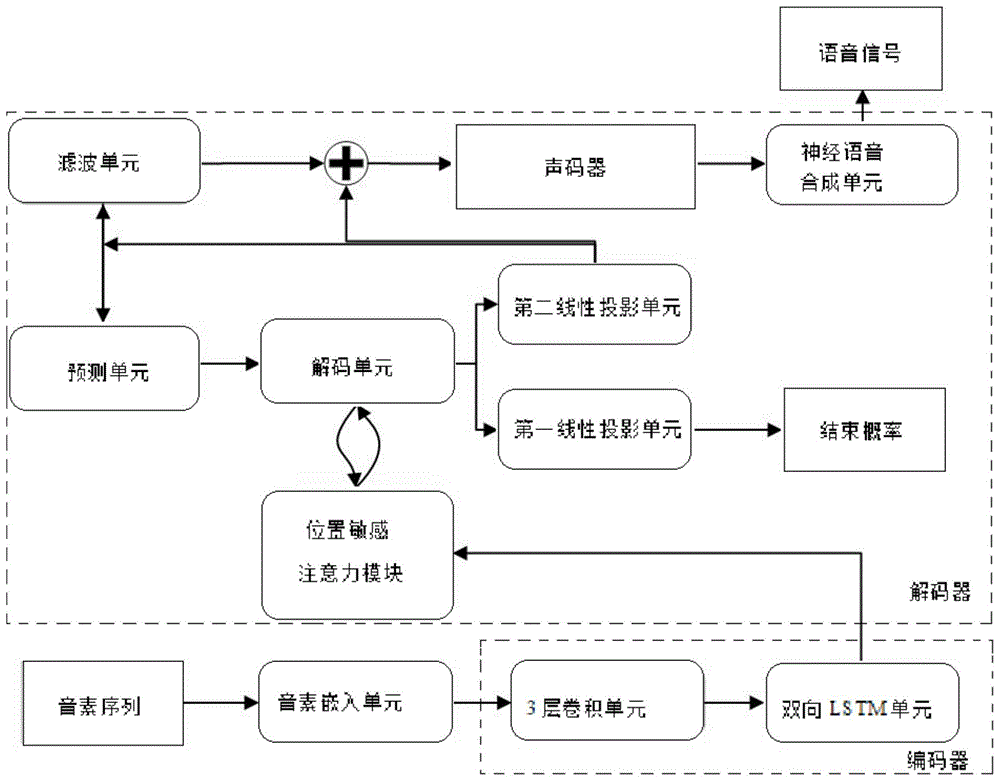
图1为传统的声谱预测网络Tacotron2模型结构图;Figure 1 is a structural diagram of the traditional acoustic spectrum prediction network Tacotron2 model;
图2为声谱预测网络Tacotron2中位置敏感注意力模块输出的注意力机制结果;Figure 2 is the result of the attention mechanism output by the position-sensitive attention module in the sound spectrum prediction network Tacotron2;
图3为本申请一个实施例提供的韵律控制语音合成方法流程图Fig. 3 is a flow chart of the prosody control speech synthesis method provided by one embodiment of the present application
图4为本申请一个实施例提供的韵律控制语音合成模型结构图;FIG. 4 is a structural diagram of a prosodic control speech synthesis model provided by an embodiment of the present application;
图5为本申请一个实施例提供的韵律控制语音合成系统训练流程图。Fig. 5 is a flow chart of training the prosody-controlled speech synthesis system provided by an embodiment of the present application.
具体实施方式Detailed ways
下面通过附图和实施例,对本申请的技术方案做进一步的详细描述。The technical solutions of the present application will be described in further detail below with reference to the drawings and embodiments.
在描述本申请实施例提供的方案之前,先对本申请的发明构思作以下说明。Before describing the solutions provided by the embodiments of the present application, the inventive concept of the present application will be explained as follows.
图1为传统的Tacotron2模型结构;如图1所示,Tacotron2模型结构包含编码器(encoder)和解码器(decoder),编码器将输入的音素序列编码成固定长度的向量,解码器再将该固定长度的向量解码生成声谱序列,利用位置敏感注意力模块(LocationSensitive Attention)“关注”向量的不同部分,自动学习出声学特征与音素序列的对应关系。Figure 1 is a traditional Tacotron2 model structure; as shown in Figure 1, the Tacotron2 model structure includes an encoder (encoder) and a decoder (decoder), the encoder encodes the input phoneme sequence into a fixed-length vector, and the decoder then converts the The fixed-length vector decoding generates the sound spectrum sequence, and the location-sensitive attention module (LocationSensitive Attention) is used to "focus" on different parts of the vector, and automatically learn the correspondence between the acoustic features and the phoneme sequence.
具体地,Tacotron2的编码器(decoder)是一个3层卷积单元(3 Conv Laywes)后跟一个双向LSTM单元(Bidirectional Lstm)形成的模块。在Tacotron2中3层卷积单元给予了神经网络类似于N-gram感知上下文的能力,由于实践中RNN很难捕获长时依赖,因此Tacotron2使用3层卷积单元获取上下文,使得模型对不发音字符更为鲁棒(如'know'中的'k')。Specifically, the encoder (decoder) of Tacotron2 is a module formed by a 3-layer convolution unit (3 Conv Laywes) followed by a bidirectional LSTM unit (Bidirectional Lstm). In Tacotron2, the 3-layer convolution unit gives the neural network the ability to perceive context similar to N-gram. Since it is difficult for RNN to capture long-term dependencies in practice, Tacotron2 uses 3-layer convolution units to obtain context, so that the model can recognize silent characters. More robust (like the 'k' in 'know').
具体地,将音素序列(Phoneme Sequence)映射至音素嵌入单元(PhonemeEmbedding),音素嵌入的音素序列先送入3层卷积单元以提取前后音素信息,然后送入双向的LSTM单元中生成编码器隐状态,编码器隐状态生成后,就会将其送入位置敏感注意力模块(Location Sensitive Attention)。Specifically, the phoneme sequence (Phoneme Sequence) is mapped to the phoneme embedding unit (PhonemeEmbedding), and the phoneme embedded phoneme sequence is first sent to the 3-layer convolution unit to extract the front and back phoneme information, and then sent to the bidirectional LSTM unit to generate the encoder hidden State, after the hidden state of the encoder is generated, it will be sent to the location sensitive attention module (Location Sensitive Attention).
位置敏感注意力模块用作编码器和解码器的桥接,本质是由一个上下文权重向量组成的矩阵。位置敏感注意力模块能够自动学习出声学特征与音素序列的对应关系,输出上下文向量。The position-sensitive attention module is used as a bridge between the encoder and the decoder, and is essentially a matrix composed of a context weight vector. The position-sensitive attention module can automatically learn the correspondence between acoustic features and phoneme sequences, and output context vectors.
在Tacotron2模型中,注意力计算(attention computation)发生在每一个解码单元(2LSTM Layers)时间步上。位置敏感注意力模块Location Sensitive Attention,通过累加注意力权重,了解它已经学习到的位置敏感信息,使得Tacotron2模型能在音素序列中顺序持续进行并且避免重复预测语音或漏掉预测的语音。In the Tacotron2 model, attention computation occurs at each decoding unit (2LSTM Layers) time step. The location-sensitive attention module Location Sensitive Attention, by accumulating attention weights, understands the location-sensitive information it has learned, so that the Tacotron2 model can continue sequentially in the phoneme sequence and avoid repeating or missing predicted speech.
图2为位置敏感注意力模块输出的注意力机制结果;如下图2所示,纵轴是音素序列(Encoder timestep),横轴是帧级别的声学特征(Decoder time step),例如,输入句子中的第5个音素对应第50帧的声学特征。Figure 2 shows the results of the attention mechanism output by the position-sensitive attention module; as shown in Figure 2 below, the vertical axis is the phoneme sequence (Encoder timestep), and the horizontal axis is the frame-level acoustic feature (Decoder time step). For example, in the input sentence The 5th phoneme of corresponds to the acoustic feature of the 50th frame.
解码器(decoder)是一个自回归的循环神经网络。具体地,Tacotron2模型解码器包括预测单元(2Layer Pre-Net)、解码单元(2LSTM Layers)、第一线性投影单元、第二线性投影单元(Linear projection)、滤波单元(5 Conv Layer Post-Net)、LPCNet单元和声码器(Vocoder features)。解码过程从输入上一步的输出声学特征或上一步的真实的声学特征帧到预测单元开始,预测单元的输出与使用上一个解码步骤中经注意力计算而得的上下文向量做拼接,在解码单元中解码,解码输出进行注意力计算生成新的上下文向量,最后新的上下文向量在解码单元的解码后,送入第一、第二线性投影单元以预测输出。输出有两种形式,第一线性投影单元输出韵律声学特征序列,韵律声学特征序列为真实声谱帧,第二线性投影单元输出结束概率(stop token),结束概率用来决定解码过程是否结束。韵律声学特征序列输入滤波单元(5Conv Layer Post-Net)滤波后与韵律声学特征序列拼接输入声码器经过神经语音合成单元LPCNet后合成语音信号(Waveform Samples)。The decoder is an autoregressive recurrent neural network. Specifically, the Tacotron2 model decoder includes a prediction unit (2Layer Pre-Net), a decoding unit (2LSTM Layers), a first linear projection unit, a second linear projection unit (Linear projection), a filtering unit (5 Conv Layer Post-Net) , LPCNet unit and Vocoder (Vocoder features). The decoding process starts from the input of the output acoustic features of the previous step or the real acoustic feature frame of the previous step to the prediction unit. The output of the prediction unit is concatenated with the context vector calculated by attention in the previous decoding step. In the decoding unit In decoding, the decoded output performs attention calculation to generate a new context vector, and finally the new context vector is sent to the first and second linear projection units after decoding by the decoding unit to predict the output. There are two forms of output. The first linear projection unit outputs a rhythmic acoustic feature sequence, which is a real sound spectrum frame. The second linear projection unit outputs a stop token, which is used to determine whether the decoding process is over. The prosodic acoustic feature sequence is input to the filter unit (5Conv Layer Post-Net) after filtering and concatenated with the prosodic acoustic feature sequence and input to the vocoder to synthesize the speech signal (Waveform Samples) after passing through the neural speech synthesis unit LPCNet.
如背景技术的内容所述,基于Tacotron2模型,端到端的中文语音合成很大的提升了自然度,但由于中文汉字的稀疏性,在合成中文语音时会存在韵律不稳定的问题。为解决上述问题,通常采用音素序列作为输入,但在字音转换过程损失很多分词和词性相关的信息。为了显式建模韵律,能够通过引入额外的输入实现对韵律直接控制,且使得模型更具解释性,可以考虑引入音素对应帧数和离散余弦变换参数化的基频(DCT F0),分别来表示时长和基频的变化趋势,对时长乘上系数能够控制语音倍速,对DCT F0乘上系数能够控制发音的饱满度,即语音的抑扬顿挫。在原有Tacotron2模型基础上,构建韵律预测网络,将编码结果和韵律预测网络提取的时长和基频拼接成韵律向量一起送入解码器,以此来解决中文端到端的韵律不稳定问题。使用额外输入的语言学特征(Context Feature)提取的音素对应帧数和离散余弦变换参数化的基频可以更好的控制韵律,且使得模型更具解释性。As described in the background technology, based on the Tacotron2 model, the end-to-end Chinese speech synthesis greatly improves the naturalness, but due to the sparseness of Chinese characters, there is a problem of unstable rhythm when synthesizing Chinese speech. To solve the above problems, phoneme sequences are usually used as input, but a lot of word segmentation and part-of-speech related information is lost in the process of word-to-phonetic conversion. In order to explicitly model the prosody, it is possible to directly control the prosody by introducing an additional input, and to make the model more interpretable, you can consider introducing the phoneme corresponding frame number and the discrete cosine transform parameterized fundamental frequency (DCT F0), respectively. Indicates the change trend of the duration and fundamental frequency. Multiplying the duration by the coefficient can control the speed of the voice, and multiplying the DCT F0 by the coefficient can control the fullness of the pronunciation, that is, the cadence of the voice. On the basis of the original Tacotron2 model, a prosodic prediction network is built, and the encoding result and the duration and fundamental frequency extracted by the prosody prediction network are concatenated into a prosodic vector and sent to the decoder together to solve the problem of end-to-end prosody instability in Chinese. Using additional input linguistic features (Context Feature) to extract phoneme corresponding frame number and discrete cosine transform parameterized fundamental frequency can better control prosody and make the model more interpretable.
离散余弦变换(DCT)是对实信号定义的一种变换,变换后在频域中得到的也是一个实信号。DCT有一个很重要的性质是能量集中特性,大多数自然信号比如声音、图像的能量都集中在离散余弦变换后的低频部分,因而DCT在声音、图像数据压缩中得到了广泛的使用。由于DCT是从DFT推导出来的另一种变换,因此许多DFT的属性在DCT中仍然是保留下来的。基于此,使用一个有限个数的离散余弦变换的系数(简称DCT系数)来获取音素级别的基频变化模式,能够拟合一个音素序列的基频曲线。Discrete cosine transform (DCT) is a transformation defined for real signals, and what is obtained in the frequency domain after transformation is also a real signal. A very important property of DCT is the energy concentration characteristic. The energy of most natural signals such as sound and image is concentrated in the low-frequency part after discrete cosine transform, so DCT is widely used in sound and image data compression. Since DCT is another transformation derived from DFT, many properties of DFT are still preserved in DCT. Based on this, using a finite number of discrete cosine transform coefficients (DCT coefficients for short) to obtain the fundamental frequency change pattern at the phoneme level can fit the fundamental frequency curve of a phoneme sequence.
综上所述,为了解决在合成中文语音时会存在韵律不稳定的问题,发明人考虑对声谱预测网络Tacotron2模型进行改进,改进思路如下:To sum up, in order to solve the problem of unstable prosody when synthesizing Chinese speech, the inventor considers improving the Tacotron2 model of the sound spectrum prediction network. The improvement idea is as follows:
首先,对单一说话人数据库提取帧级别的声学特征、音素序列和音素级别的语言学特征,预训练声谱预测网络Tacotron2模型,获得代表音素与声学特征的对应关系的上下文权重矩阵以及编码器的输出。First, extract frame-level acoustic features, phoneme sequences, and phoneme-level linguistic features from the single-speaker database, pre-train the acoustic spectrum prediction network Tacotron2 model, and obtain the context weight matrix representing the correspondence between phonemes and acoustic features and the encoder's output.
然后,基于上下文权重矩阵,提取韵律参数,韵律参数包括音素级别时长(Duration)和音素级别的DCT参数化基频(F0 Representation)。Then, based on the context weight matrix, prosodic parameters are extracted, and the prosodic parameters include phoneme-level duration (Duration) and phoneme-level DCT parameterized fundamental frequency (F0 Representation).
接着,构建韵律参数预测模型,其输入包括声学特征网络中编码器的输出和语言学特征,使用最小绝对误差损失函数优化输出,输出结果是DCT参数化基频和时长;Next, construct a prosodic parameter prediction model, whose input includes the output of the encoder in the acoustic feature network and linguistic features, and optimize the output using the minimum absolute error loss function, and the output is the DCT parameterized fundamental frequency and duration;
再接着,构建韵律控制语音合成模型,具体地,可以在Tacotron2模型基础上,增加韵律参数预测模型,并对Tacotron2模型和韵律参数预测模型进行联合训练,获得训练好的韵律控制语音合成模型。Next, construct a prosodic control speech synthesis model. Specifically, a prosodic parameter prediction model can be added on the basis of the Tacotron2 model, and the Tacotron2 model and the prosody parameter prediction model can be jointly trained to obtain a trained prosody control speech synthesis model.
在进行语音合成时,将待合成文本进行正则,送入训练好的韵律控制语音合成模型,预测语音的韵律声学特征,将该韵律声学特征送入声码器合成语音信号。When performing speech synthesis, the text to be synthesized is regularized and sent to the trained prosodic control speech synthesis model to predict the prosody-acoustic features of the speech, and the prosody-acoustic features are sent to the vocoder to synthesize speech signals.
以上就是本申请的发明构思,基于该发明构思就可以得到本申请实施例提供的技术方案,以下对本申请实施例进行详细阐述。The above is the inventive concept of the present application. Based on the inventive concept, the technical solutions provided by the embodiments of the present application can be obtained. The embodiments of the present application will be described in detail below.
图3为本申请实施例提供的语音合成方法流程图,所述方法的执行主体可以为具有处理能力的设备,服务器或者系统或者装置。如图3所示,所述方法包括:对待合成文本进行正则获取语言学特征(Context feature)和音素序列(Phoneme Sequence);将所述音素序列输入Tacotron2模型的编码器;将编码结果和所述语言学特征输入韵律参数预测模型,预测待合成文本的韵律参数,获得音素级别的时长和DCT参数化基频;将音素级别时长和DCT参数化基频映射为二维向量,与编码结果拼接输入Tacotron2的解码器,输出韵律声学特征序列;将韵律声学特征序列送入声码器合成语音信号。下面针对每一步骤进行具体分析。Fig. 3 is a flow chart of the speech synthesis method provided by the embodiment of the present application, and the subject of execution of the method may be a device with processing capability, a server, or a system or device. As shown in Figure 3, the method includes: regularizing the text to be synthesized to obtain linguistic features (Context feature) and phoneme sequence (Phoneme Sequence); inputting the phoneme sequence into the encoder of the Tacotron2 model; encoding the result and the Input the linguistic features into the prosodic parameter prediction model, predict the prosodic parameters of the text to be synthesized, and obtain the phoneme-level duration and DCT parameterized fundamental frequency; map the phoneme-level duration and DCT parameterized fundamental frequency into a two-dimensional vector, and splicing input with the encoding result The decoder of Tacotron2 outputs the prosodic acoustic feature sequence; the prosodic acoustic feature sequence is sent to the vocoder to synthesize the speech signal. The following is a detailed analysis of each step.
S301,对待合成语音的文本进行正则获取音素序列和语言学特征。S301. Regularize the text to be synthesized to obtain phoneme sequences and linguistic features.
具体地,待合成语音的文本首先通过字音转换获得其音素序列,再利用分词工具获得分词结果和词性标注,并提取其语言学特征,用以预测韵律声学特征。Specifically, the text to be synthesized first obtains its phoneme sequence through phonetic conversion, then uses word segmentation tools to obtain word segmentation results and part-of-speech tagging, and extracts its linguistic features to predict prosodic acoustic features.
S302,将音素序列输入Tacotron2模型的编码器。S302. Input the phoneme sequence into the encoder of the Tacotron2 model.
图4为本申请实施例提供的韵律控制语音合成模型示意图;如图4所示,从待合成语音的文本中提取的音素序列输入韵律控制语音合成模型后,经过音素嵌入单元映射后的音素序列进入编码器(Encoder)进行编码。Fig. 4 is a schematic diagram of the prosodic control speech synthesis model provided by the embodiment of the present application; as shown in Fig. 4, after the phoneme sequence extracted from the text to be synthesized is input into the prosody control speech synthesis model, the phoneme sequence mapped by the phoneme embedding unit Enter the encoder (Encoder) to encode.
需要说明的是该韵律控制语音合成模型中的编码器与Tacotron2模型中的编码器相同,包括一个3层卷积单元和一个双向的LSTM单元。It should be noted that the encoder in the prosody control speech synthesis model is the same as the encoder in the Tacotron2 model, including a 3-layer convolution unit and a bidirectional LSTM unit.
经过音素嵌入单元映射后音素序列先送入3层卷积单元以提取前后音素信息,然后送入双向的LSTM中生成隐状态,输出编码结果。After being mapped by the phoneme embedding unit, the phoneme sequence is first sent to the 3-layer convolution unit to extract the front and back phoneme information, and then sent to the bidirectional LSTM to generate a hidden state and output the encoding result.
S303,将编码结果和语言学特征输入韵律参数预测模型,预测待合成文本的韵律参数,获得音素级别的时长和DCT参数化基频。S303. Input the encoding result and linguistic features into the prosodic parameter prediction model, predict the prosodic parameters of the text to be synthesized, and obtain the phoneme-level duration and DCT parameterized fundamental frequency.
继续如图4所示,将S302输出的编码结果和S301提取语言学特征送入双向的LSTM单元(3Bidirectional Lstm)和第三线性投影单元(Linear projection),用最小绝对误差作为损失函数,预测待合成语音的文本的韵律参数,预测出的韵律参数包括音素级别的时长(Duration)和DCT参数化基频(F0 Representation)。Continue as shown in Figure 4, send the encoding result output by S302 and the linguistic features extracted by S301 to the bidirectional LSTM unit (3Bidirectional Lstm) and the third linear projection unit (Linear projection), use the minimum absolute error as the loss function, and predict The prosody parameters of the text of the synthesized speech, the predicted prosody parameters include phoneme-level duration (Duration) and DCT parameterized fundamental frequency (F0 Representation).
S304,将音素级别时长和DCT参数化基频映射为二维向量,与编码结果拼接输入解码器,输出韵律声学特征序列。S304, mapping the phoneme-level duration and the DCT parameterized fundamental frequency into a two-dimensional vector, concatenating the encoded result and inputting it into a decoder, and outputting a prosodic acoustic feature sequence.
继续如图4所示,将音素级别时长和DCT参数化基频送入降维单元(BottleneckLayer)映射到二维空间后,送入连接单元(Concatenate)与编码器的结果拼接在一起后送入解码器(Decoder),输出韵律声学特征序列。Continue as shown in Figure 4, send the phoneme-level duration and DCT parameterized fundamental frequency to the dimensionality reduction unit (BottleneckLayer) to map to the two-dimensional space, and send it to the connection unit (Concatenate) to splicing with the result of the encoder and then send it to Decoder, which outputs prosodic acoustic feature sequences.
在该韵律控制语音合成模型中解码器(Decoder)与Tacotron2模型中的解码器相同。解码的过程与Tacotron2模型解码过程相同,不再赘述。The decoder (Decoder) in the prosodic control speech synthesis model is the same as that in the Tacotron2 model. The decoding process is the same as the Tacotron2 model decoding process, and will not be repeated here.
S305,将所述韵律声学特征序列送入声码器合成语音信号。S305. Send the prosodic acoustic feature sequence to a vocoder to synthesize a speech signal.
在上述语音合成的方法中,韵律控制语音合成模型是在Tacotron2模型基础上增加韵律参数预测模型,在训练时分为两步进行训练,首先预训练Tacotron2模型,基于训练Tacotron2模型时获得的上下文权重矩阵可以构建韵律参数预测模型。然后再对Tacotron2模型和韵律参数预测模型进行联合训练,获得训练好的韵律控制语音合成模型。In the above speech synthesis method, the prosodic control speech synthesis model is based on the Tacotron2 model and the prosodic parameter prediction model is added. The training is divided into two steps for training. First, the Tacotron2 model is pre-trained, based on the context weight matrix obtained during the training of the Tacotron2 model A prosodic parameter prediction model can be constructed. Then the Tacotron2 model and the prosodic parameter prediction model are jointly trained to obtain a trained prosody-controlled speech synthesis model.
图5为本申请实施例提供的韵律控制语音合成模型训练流程图;,训练具体步骤如图5所示。FIG. 5 is a flow chart of prosodic control speech synthesis model training provided by the embodiment of the present application; the specific training steps are shown in FIG. 5 .
S401,对获得的单一说话人语音数据库提取帧级别的多维声学特征、音素序列以及音素级别的语言学特征。S401. Extract frame-level multidimensional acoustic features, phoneme sequences, and phoneme-level linguistic features from the obtained single-speaker speech database.
其中,帧级别的多维声学特征共20维,包括:18维bark倒谱系数、1维基频参数和1维基频相关系数。音素级别的语言学特征共5维,包括:当前音素在字中的位置、当前字在词中的位置,当前词的词性,句子中词语的个数,当前句子的类型。声学特征提取时的帧移为10ms。Among them, the frame-level multi-dimensional acoustic features have a total of 20 dimensions, including: 18-dimensional bark cepstral coefficients, 1-dimensional fundamental frequency parameters and 1-dimensional fundamental frequency correlation coefficients. There are five dimensions of linguistic features at the phoneme level, including: the position of the current phoneme in the word, the position of the current character in the word, the part of speech of the current word, the number of words in the sentence, and the type of the current sentence. The frame shift during acoustic feature extraction is 10ms.
S402,以音素序列为输入,以帧级别的多维声学特征为输出,训练所述Tacotron2模型,获得具有音素序列与声学特征的对应关系的上下文权重矩阵W。S402. Using phoneme sequences as input and frame-level multi-dimensional acoustic features as output, train the Tacotron2 model to obtain a context weight matrix W with correspondences between phoneme sequences and acoustic features.
S403,基于预训练Tacotron2模型获得的所述上下文权重矩阵,提取韵律参数包括音素级别时长(Duration)和音素级别的DCT参数化基频(F0 Representation),其中,音素级别时长代表韵律中的音素时长,音素级别的DCT参数化基频代表基频变化趋势。具体步骤如下:S403, based on the context weight matrix obtained by the pre-trained Tacotron2 model, extract prosodic parameters including phoneme-level duration (Duration) and phoneme-level DCT parameterized fundamental frequency (F0 Representation), wherein the phoneme-level duration represents the phoneme duration in the prosody , the fundamental frequency of the DCT parameterization at the phoneme level represents the variation trend of the fundamental frequency. Specific steps are as follows:
基于上下文权重矩阵W,使用以下公式获得音素对应的帧数:Based on the context weight matrix W, the frame number corresponding to the phoneme is obtained using the following formula:
Ni=∑j Wij (1)N i =∑ j W ij (1)
其中Ni表示第i个音素对应的帧数,Wij表示第j帧对应于第i个音素的概率,计算log(Ni)得到音素级别时长。Where N i represents the number of frames corresponding to the i-th phoneme, W ij represents the probability that the j-th frame corresponds to the i-th phoneme, and log(N i ) is calculated to obtain the duration of the phoneme level.
使用一个有限个数的离散余弦变换的系数(简称DCT系数)来获取音素级别的基频变化模式。具体步骤如下:A finite number of discrete cosine transform coefficients (abbreviated as DCT coefficients) are used to obtain the fundamental frequency change pattern at the phoneme level. Specific steps are as follows:
假设s=[s0,s1...sT-1]T表示T帧基频曲线,c=[c0,c1...cT-1]T表示对应的相关系数,N阶的DCT系数e=[e0,e1...eT-1]T计算公式如下:Suppose s=[s 0 ,s 1 ...s T-1 ] T represents the fundamental frequency curve of T frame, c=[c 0 ,c 1 ...c T-1 ] T represents the corresponding correlation coefficient, N order The calculation formula of DCT coefficient e=[e 0 ,e 1 ...e T-1 ] T is as follows:

重建的基频曲线表示为:The reconstructed fundamental frequency curve is expressed as:

计算逆DCT时的第t帧的向量D(t):The vector D (t) of the tth frame when calculating the inverse DCT:

此方程的解在一阶导数为零处取得,解DCT系数为:The solution of this equation is obtained where the first derivative is zero, and the DCT coefficients of the solution are:

可以使用4阶DCT系数来表示基频曲线变化趋势,4阶DCT能较好地获得平滑的基频曲线,而更高阶数则会对基频过拟合。The 4th-order DCT coefficient can be used to represent the change trend of the fundamental frequency curve. The 4th-order DCT can better obtain a smooth fundamental frequency curve, while higher order numbers will overfit the fundamental frequency.
S404,构建韵律参数预测模型,如图4所示,韵律参数预测模型包括一个双向的LSTM单元(3Bidirectional Lstm)和一个线性投影单元组成,使用最小绝对误差作为损失函数。输入包含编码器的结果和提取的语言学特征。S404. Construct a prosodic parameter prediction model. As shown in FIG. 4 , the prosodic parameter prediction model includes a bidirectional LSTM unit (3Bidirectional Lstm) and a linear projection unit, using the minimum absolute error as a loss function. The input contains the result of the encoder and the extracted linguistic features.
以Tacotron2模型中编码结果和语言学特征为输入,通过双向的LSTM单元(3Bidirectional Lstm)和线性投影单元(Linear projection),用最小绝对误差作为损失函数,预测待合成语音的文本的韵律参数,预测的韵律参数包括音素级别的时长(Duration)和DCT参数化基频(F0 Representation)。Taking the coding results and linguistic features in the Tacotron2 model as input, through the bidirectional LSTM unit (3Bidirectional Lstm) and linear projection unit (Linear projection), using the minimum absolute error as the loss function, predict the prosody parameters of the text to be synthesized, and predict The prosodic parameters include phoneme-level duration (Duration) and DCT parameterized fundamental frequency (F0 Representation).
S405,以S401提取的音素序列和音素级别的语言学特征为输入,以S401提取的帧级别声学特征为输出,对Tacotron2模型和韵律参数预测模型进行联合训练。S405, taking the phoneme sequence and phoneme-level linguistic features extracted in S401 as input, and taking the frame-level acoustic features extracted in S401 as output, jointly training the Tacotron2 model and the prosodic parameter prediction model.
计算训练过程中输出的声学特征与真实的帧级别声学特征的最小均方误差,以最小均方误差作为声学特征重建损失。Calculate the minimum mean square error between the acoustic features output during the training process and the real frame-level acoustic features, and use the minimum mean square error as the acoustic feature reconstruction loss.
将韵律参数预测损失函数与声学特征重建损失加权求和为最终损失函数,在联合训练过程中,并更新网络参数,最后获得训练好的韵律控制语音合成模型。The weighted sum of prosodic parameter prediction loss function and acoustic feature reconstruction loss is the final loss function. During the joint training process, the network parameters are updated, and finally the trained prosodic control speech synthesis model is obtained.
韵律参数预测模型(Prosody Prediction Network)和Tacotron2模型是联合训练的,为了避免韵律参数预测模型减缓模型对齐,所以在前50epoch的训练中将韵律参数预测模型的损失权重设为零,在50epoch之后损失权重不断增加,到0.1为止。The prosody parameter prediction model (Prosody Prediction Network) and the Tacotron2 model are jointly trained. In order to prevent the prosody parameter prediction model from slowing down the model alignment, the loss weight of the prosody parameter prediction model is set to zero in the first 50epoch training, and the loss weight of the prosody parameter prediction model is set to zero after 50epoch. The weight keeps increasing until it reaches 0.1.
韵律控制语音合成模型与Tacotron2相比,除了原有的编码结果,还显式的引入韵律参数,韵律参数包括音素级别时长(Duration)和音素级别的DCT参数化基频(F0Representation),将二者映射到一个二维空间后与原有的编码结果拼接在一起后送入解码器。实验表明,韵律参数预测模型输出的韵律参数能够实现对语音信号韵律的修改,对音素级别时长乘上系数能够控制语音信号的倍速,对DCT F0乘上系数能够控制语音信号发音的饱满度,即语音信号的抑扬顿挫。Compared with Tacotron2, the prosodic control speech synthesis model explicitly introduces prosodic parameters in addition to the original coding results. Prosodic parameters include phoneme-level duration (Duration) and phoneme-level DCT parameterized fundamental frequency (F0Representation). After being mapped to a two-dimensional space, it is stitched together with the original encoding result and sent to the decoder. Experiments show that the prosody parameters output by the prosody parameter prediction model can modify the prosody of the speech signal, multiplying the phoneme-level duration by a coefficient can control the double speed of the speech signal, and multiplying the DCT F0 by a coefficient can control the fullness of the speech signal, namely The cadence of the speech signal.
采用本申请实施例提出的韵律控制语音合成方法合成语音韵律更加自然,而且相较于Tacotron2模型,本方法更加鲁棒,解决了跳字和重复的错误。Using the prosody-controlled speech synthesis method proposed in the embodiment of the present application to synthesize speech prosody is more natural, and compared with the Tacotron2 model, this method is more robust and solves the errors of word skipping and repetition.
另一方面,本申请实施例提供一种韵律控制语音合成系统,用于实现上述任意实施例提出的律控制语音合成方法,包括Tacotron2模型和韵律参数预测模型。On the other hand, an embodiment of the present application provides a prosodic-controlled speech synthesis system, which is used to implement the method for prosodic-controlled speech synthesis proposed in any of the foregoing embodiments, including a Tacotron2 model and a prosody parameter prediction model.
返回图4所示,Tacotron2模型包括编码器和解码器,编码器对待合成文本进行正则获取的音素序列编码,将编码结果和对待合成文本进行正则获取的语言学特征输入韵律参数预测模型。Returning to Figure 4, the Tacotron2 model includes an encoder and a decoder. The encoder encodes the phoneme sequence that is normally obtained from the text to be synthesized, and inputs the encoding result and the linguistic features that are regularly obtained from the text to be synthesized into the prosodic parameter prediction model.
韵律参数预测模型根据所述编码结果和语言学特征进行韵律参数预测,获得音素级别的时长和DCT参数化基频,将音素级别时长和DCT参数化基频映射为二维向量与编码结果拼接输入解码器。The prosodic parameter prediction model performs prosodic parameter prediction based on the encoding results and linguistic features, obtains the phoneme-level duration and DCT parameterized fundamental frequency, maps the phoneme-level duration and DCT parameterized fundamental frequency into two-dimensional vectors and splicing input with the encoding results decoder.
解码器将拼接的二维向量和编码结果解码,输出韵律声学特征序列,将韵律声学特征序列送入声码器合成语音信号。The decoder decodes the concatenated two-dimensional vector and the encoding result, outputs the prosodic acoustic feature sequence, and sends the prosodic acoustic feature sequence to the vocoder to synthesize the speech signal.
其中,韵律参数预测模型包括双向的LSTM单元、第三线性投影单元、降维单元和连接单元。Among them, the prosody parameter prediction model includes a bidirectional LSTM unit, a third linear projection unit, a dimensionality reduction unit and a connection unit.
具体地,将Tacotron2模型编码器的编码结果和待合成文本提取的语言学特征输入双向的LSTM单元进行计算,用最小绝对误差作为损失函数,生成隐状态;第三线性投影单元根据隐状态预测韵律参数,获得音素级别的时长和DCT参数化基频;降维单元将音素级别时长和DCT参数化基频映射为二维向量;连接单元将二维向量与编码结果拼接输入Tacotron2模型解码器。Specifically, the encoding result of the Tacotron2 model encoder and the linguistic features extracted from the text to be synthesized are input into the two-way LSTM unit for calculation, and the minimum absolute error is used as the loss function to generate the hidden state; the third linear projection unit predicts the prosody according to the hidden state Parameters to obtain the phoneme-level duration and DCT parameterized fundamental frequency; the dimensionality reduction unit maps the phoneme-level duration and DCT parameterized fundamental frequency to a two-dimensional vector; the connection unit splices the two-dimensional vector and the encoding result into the Tacotron2 model decoder.
具体地,Tacotron2模型解码器包括预测单元、解码单元、第一线性投影单元、第二线性投影单元、滤波单元、LPCNet单元和声码器;预测单元将上一个解码步骤中第一线性投影单元输出的韵律声学特征序列转换为二维向量输出至解码单元;解码单元,用于将二维向量与编码结果经注意力计算而得的上下文向量做拼接,输出新的上下文向量至第一和第二线性投影单元;第一线性投影单元将所述新的上下文向量进行线性投影,输出韵律声学特征序列;第二线性投影单元输出结束概率,决定解码过程是否结束;滤波单元将所述韵律声学特征序列进行滤波;声码器将滤波后韵律声学特征序列经过LPCNet单元后合成语音信号。Specifically, the Tacotron2 model decoder includes a prediction unit, a decoding unit, a first linear projection unit, a second linear projection unit, a filtering unit, an LPCNet unit, and a vocoder; the prediction unit outputs the first linear projection unit in the previous decoding step The prosodic acoustic feature sequence is converted into a two-dimensional vector and output to the decoding unit; the decoding unit is used to concatenate the two-dimensional vector and the context vector obtained by the attention calculation of the encoding result, and output the new context vector to the first and second a linear projection unit; the first linear projection unit performs linear projection on the new context vector, and outputs a prosodic acoustic feature sequence; the second linear projection unit outputs an end probability to determine whether the decoding process is over; the filtering unit converts the prosodic acoustic feature sequence Filtering; the vocoder synthesizes the speech signal after the filtered prosodic acoustic feature sequence is passed through the LPCNet unit.
第三方面,本申请实施例提供一种电子装置,包括存储器和处理器;所述处理器用于执行所述存储器所存储的计算机执行指令,所述处理器运行所述计算机执行指令执行上述任意实施例所述的韵律控制语音合成方法。In a third aspect, an embodiment of the present application provides an electronic device, including a memory and a processor; the processor is configured to execute computer-executed instructions stored in the memory, and the processor executes the computer-executed instructions to perform any of the above implementations The prosody-controlled speech synthesis method described in the example.
本领域普通技术人员应该还可以进一步意识到,结合本文中所公开的实施例描述的各示例的单元及算法步骤,能够以电子硬件、计算机软件或者二者的结合来实现,为了清楚地说明硬件和软件的可互换性,在上述说明中已经按照功能一般性地描述了各示例的组成及步骤。这些功能究竟以硬件还是软件方式来执轨道,取决于技术方案的特定应用和设计约束条件。本领域普通技术人员可以对每个特定的应用来使用不同方法来实现所描述的功能,但是这种实现不应认为超出本申请的范围。Those of ordinary skill in the art should further realize that the units and algorithm steps of the examples described in conjunction with the embodiments disclosed herein can be implemented by electronic hardware, computer software, or a combination of the two. In order to clearly illustrate the hardware and software interchangeability, the composition and steps of each example have been generally described in terms of functions in the above description. Whether these functions are executed by means of hardware or software depends on the specific application and design constraints of the technical solution. Those of ordinary skill in the art may implement the described functionality using different methods for each particular application, but such implementation should not be considered as exceeding the scope of the present application.
结合本文中所公开的实施例描述的方法或算法的步骤可以用硬件、处理器执轨道的软件模块,或者二者的结合来实施。软件模块可以置于随机存储器(RAM)、内存、只读存储器(ROM)、电可编程ROM、电可擦除可编程ROM、寄存器、硬盘、可移动磁盘、CD-ROM、或技术领域内所公知的任意其它形式的存储介质中。The steps of the methods or algorithms described in connection with the embodiments disclosed herein may be implemented by hardware, software modules executed by a processor, or a combination of both. Software modules can be placed in random access memory (RAM), internal memory, read-only memory (ROM), electrically programmable ROM, electrically erasable programmable ROM, registers, hard disk, removable disk, CD-ROM, or any other Any other known storage medium.
以上所述的具体实施方式,对本申请的目的、技术方案和有益效果进行了进一步详细说明,所应理解的是,以上所述仅为本申请的具体实施方式而已,并不用于限定本申请的保护范围,凡在本申请的精神和原则之内,所做的任何修改、等同替换、改进等,均应包含在本申请的保护范围之内。The specific implementation manners described above have further described the purpose, technical solutions and beneficial effects of the application in detail. It should be understood that the above descriptions are only specific implementation modes of the application and are not intended to limit the scope of the application. Scope of protection: All modifications, equivalent replacements, improvements, etc. made within the spirit and principles of this application shall be included within the scope of protection of this application.
Claims (10)


Priority Applications (1)
| Application Number | Priority Date | Filing Date | Title |
|---|---|---|---|
| CN202010705955.2A CN111754976B (en) | 2020-07-21 | 2020-07-21 | Rhythm control voice synthesis method, system and electronic device |
Applications Claiming Priority (1)
| Application Number | Priority Date | Filing Date | Title |
|---|---|---|---|
| CN202010705955.2A CN111754976B (en) | 2020-07-21 | 2020-07-21 | Rhythm control voice synthesis method, system and electronic device |
Publications (2)
| Publication Number | Publication Date |
|---|---|
| CN111754976A CN111754976A (en) | 2020-10-09 |
| CN111754976B true CN111754976B (en) | 2023-03-07 |
Family
ID=72710110
Family Applications (1)
| Application Number | Title | Priority Date | Filing Date |
|---|---|---|---|
| CN202010705955.2A Active CN111754976B (en) | 2020-07-21 | 2020-07-21 | Rhythm control voice synthesis method, system and electronic device |
Country Status (1)
| Country | Link |
|---|---|
| CN (1) | CN111754976B (en) |
Families Citing this family (38)
| Publication number | Priority date | Publication date | Assignee | Title |
|---|---|---|---|---|
| CN112164379B (en) * | 2020-10-16 | 2025-04-18 | 腾讯科技(深圳)有限公司 | Audio file generation method, device, equipment and computer-readable storage medium |
| CN116457870B (en) * | 2020-10-21 | 2025-11-11 | 谷歌有限责任公司 | Parallelization Tacotron non-autoregressive and controllable TTS |
| CN112086086B (en) * | 2020-10-22 | 2024-06-25 | 平安科技(深圳)有限公司 | Speech synthesis method, device, equipment and computer readable storage medium |
| CN112420016B (en) * | 2020-11-20 | 2022-06-03 | 四川长虹电器股份有限公司 | Method and device for aligning synthesized voice and text and computer storage medium |
| CN112542153B (en) * | 2020-12-02 | 2024-07-16 | 北京沃东天骏信息技术有限公司 | Duration prediction model training method and device, speech synthesis method and device |
| CN112712789B (en) * | 2020-12-21 | 2024-05-03 | 深圳市优必选科技股份有限公司 | Cross-language audio conversion method, device, computer equipment and storage medium |
| CN113409757B (en) * | 2020-12-23 | 2025-04-22 | 腾讯科技(深圳)有限公司 | Audio generation method, device, equipment and storage medium based on artificial intelligence |
| CN113555000A (en) * | 2020-12-30 | 2021-10-26 | 腾讯科技(深圳)有限公司 | Acoustic feature conversion and model training method, device, equipment and medium |
| CN112786013B (en) * | 2021-01-11 | 2024-08-30 | 北京有竹居网络技术有限公司 | Libretto or script of a ballad-singer-based speech synthesis method and device, readable medium and electronic equipment |
| CN112885367B (en) * | 2021-01-19 | 2022-04-08 | 珠海市杰理科技股份有限公司 | Fundamental frequency acquisition method, device, computer equipment and storage medium |
| CN112927674B (en) * | 2021-01-20 | 2024-03-12 | 北京有竹居网络技术有限公司 | Speech style transfer method, device, readable medium and electronic device |
| CN115223539B (en) * | 2021-03-30 | 2025-02-25 | 暗物智能科技(广州)有限公司 | A Hausa speech synthesis method and system |
| CN113129862B (en) * | 2021-04-22 | 2024-03-12 | 合肥工业大学 | Voice synthesis method, system and server based on world-tacotron |
| CN113178188B (en) * | 2021-04-26 | 2024-05-28 | 平安科技(深圳)有限公司 | Speech synthesis method, device, equipment and storage medium |
| CN113450761B (en) * | 2021-06-17 | 2023-09-22 | 清华大学深圳国际研究生院 | A parallel speech synthesis method and device based on variational autoencoders |
| CN113257221B (en) * | 2021-07-06 | 2021-09-17 | 成都启英泰伦科技有限公司 | Voice model training method based on front-end design and voice synthesis method |
| CN113506562B (en) * | 2021-07-19 | 2022-07-19 | 武汉理工大学 | End-to-end voice synthesis method and system based on fusion of acoustic features and text emotional features |
| CN113838452B (en) * | 2021-08-17 | 2022-08-23 | 北京百度网讯科技有限公司 | Speech synthesis method, apparatus, device and computer storage medium |
| CN113793598B (en) * | 2021-09-15 | 2023-10-27 | 北京百度网讯科技有限公司 | Training method of voice processing model, data enhancement method, device and equipment |
| CN113889070B (en) * | 2021-09-30 | 2025-11-18 | 北京搜狗科技发展有限公司 | A speech synthesis method, apparatus, and apparatus for speech synthesis. |
| CN113808579B (en) * | 2021-11-22 | 2022-03-08 | 中国科学院自动化研究所 | Detection method, device, electronic device and storage medium for generating speech |
| CN113948062B (en) * | 2021-12-20 | 2022-08-16 | 阿里巴巴达摩院(杭州)科技有限公司 | Data conversion method and computer storage medium |
| CN114512121B (en) * | 2022-02-16 | 2025-12-30 | 北京百度网讯科技有限公司 | Speech synthesis methods, model training methods and devices |
| CN114495902B (en) * | 2022-02-25 | 2025-10-17 | 北京有竹居网络技术有限公司 | Speech synthesis method, device, computer readable medium and electronic equipment |
| CN114267363B (en) * | 2022-03-03 | 2022-05-24 | 中国科学院自动化研究所 | Voice adversarial sample generation method and device, electronic device and storage medium |
| CN114765023A (en) * | 2022-03-24 | 2022-07-19 | 北京捷通华声科技股份有限公司 | Speech synthesis method, device, electronic equipment and readable storage medium |
| CN114724538B (en) * | 2022-03-30 | 2025-01-07 | 上海工程技术大学 | A parallel speech synthesis method based on prosodic features, device, medium and equipment |
| CN114882868A (en) * | 2022-05-05 | 2022-08-09 | 浙江猫精人工智能科技有限公司 | Speech synthesis, emotion migration, interaction method, storage medium, and program product |
| CN115410550B (en) * | 2022-06-02 | 2024-03-26 | 北京听见科技有限公司 | Fine granularity prosody controllable emotion voice synthesis method, system and storage medium |
| CN115101049B (en) * | 2022-07-09 | 2025-06-24 | 昆明理工大学 | End-to-end Vietnamese speech synthesis method guided by dependency structure knowledge |
| CN115273805B (en) * | 2022-07-29 | 2025-09-16 | 平安科技(深圳)有限公司 | Prosody-based speech synthesis method and apparatus, device, and medium |
| CN116665636B (en) * | 2022-09-20 | 2024-03-12 | 荣耀终端有限公司 | Audio data processing method, model training method, electronic device, and storage medium |
| CN115662390A (en) * | 2022-09-28 | 2023-01-31 | 海信视像科技股份有限公司 | Model training method, prosodic boundary prediction method, device and electronic equipment |
| CN116092473A (en) * | 2023-02-10 | 2023-05-09 | 平安科技(深圳)有限公司 | Prosodic labeling model, training method of prosodic prediction model and related equipment |
| CN118737117B (en) * | 2023-03-28 | 2026-02-03 | 大众酷翼(北京)科技有限公司 | Vehicle-mounted space gain voice synthesis method, device, equipment and storage medium |
| CN118782018A (en) * | 2023-04-03 | 2024-10-15 | 科大讯飞股份有限公司 | Speech synthesis method, device, equipment and storage medium |
| CN116631372B (en) * | 2023-07-07 | 2025-12-16 | 中国平安人寿保险股份有限公司 | Speech synthesis method, speech synthesis device, electronic device, and storage medium |
| CN120783764A (en) * | 2025-09-09 | 2025-10-14 | 鞍钢集团自动化有限公司 | Speech recognition method and system based on large language model |
Citations (3)
| Publication number | Priority date | Publication date | Assignee | Title |
|---|---|---|---|---|
| JP2002251196A (en) * | 2001-02-26 | 2002-09-06 | Kenwood Corp | Device and method for phoneme processing, and program |
| CN106157948A (en) * | 2015-04-22 | 2016-11-23 | 科大讯飞股份有限公司 | A kind of fundamental frequency modeling method and system |
| CN110534089A (en) * | 2019-07-10 | 2019-12-03 | 西安交通大学 | A Chinese Speech Synthesis Method Based on Phoneme and Prosodic Structure |
-
2020
- 2020-07-21 CN CN202010705955.2A patent/CN111754976B/en active Active
Patent Citations (3)
| Publication number | Priority date | Publication date | Assignee | Title |
|---|---|---|---|---|
| JP2002251196A (en) * | 2001-02-26 | 2002-09-06 | Kenwood Corp | Device and method for phoneme processing, and program |
| CN106157948A (en) * | 2015-04-22 | 2016-11-23 | 科大讯飞股份有限公司 | A kind of fundamental frequency modeling method and system |
| CN110534089A (en) * | 2019-07-10 | 2019-12-03 | 西安交通大学 | A Chinese Speech Synthesis Method Based on Phoneme and Prosodic Structure |
Non-Patent Citations (1)
| Title |
|---|
| 一种基于Tacotron 2的端到端中文语音合成方案;王国梁,陈梦楠,陈蕾;《华东师范大学学报(自然科学版)》;20190731(第2019(04)期);全文 * |
Also Published As
| Publication number | Publication date |
|---|---|
| CN111754976A (en) | 2020-10-09 |
Similar Documents
| Publication | Publication Date | Title |
|---|---|---|
| CN111754976B (en) | Rhythm control voice synthesis method, system and electronic device | |
| CN113345415B (en) | Speech synthesis method, device, equipment and storage medium | |
| CN113506562A (en) | End-to-end speech synthesis method and system based on fusion of acoustic features and text emotional features | |
| CN113707127B (en) | Speech synthesis method and system based on linear self-attention | |
| WO2025077495A1 (en) | Audio synthesis method and apparatus, audio synthesis model training method and apparatus, electronic device, computer readable storage medium, and computer program product | |
| CN115394287A (en) | Mixed language speech recognition method, device, system and storage medium | |
| WO2023102929A1 (en) | Audio synthesis method, electronic device, program product and storage medium | |
| WO2023245389A1 (en) | Song generation method, apparatus, electronic device, and storage medium | |
| CN113539268A (en) | End-to-end voice-to-text rare word optimization method | |
| CN119580700B (en) | Speech synthesis method, device, computer equipment and storage medium | |
| CN114299918A (en) | Acoustic model training and speech synthesis method, device and system, and storage medium | |
| CN114446278A (en) | Speech synthesis method and apparatus, device and storage medium | |
| CN114974218A (en) | Voice conversion model training method and device and voice conversion method and device | |
| CN115966197A (en) | Speech synthesis method, speech synthesis device, electronic equipment and storage medium | |
| CN114203151B (en) | Related methods and related devices and equipment for training speech synthesis models | |
| CN116129853A (en) | Training method of speech synthesis model, speech synthesis method and related equipment | |
| CN113053356A (en) | Voice waveform generation method, device, server and storage medium | |
| CN118298803A (en) | Speech cloning method | |
| CN116778907A (en) | Multi-mode-based speech synthesis method, device, equipment and storage medium | |
| CN120164454B (en) | A low-delay speech synthesis method, device, equipment and medium | |
| CN114141259B (en) | Speech conversion method, apparatus, device, storage medium, and program product | |
| CN113628630B (en) | Information conversion method and device based on coding and decoding network and electronic equipment | |
| CN114724538A (en) | Prosodic feature-based parallel speech synthesis method and device, medium and equipment | |
| CN115206281A (en) | A speech synthesis model training method, device, electronic device and medium | |
| CN114267330B (en) | Speech synthesis method, device, electronic device and storage medium |
Legal Events
| Date | Code | Title | Description |
|---|---|---|---|
| PB01 | Publication | ||
| PB01 | Publication | ||
| SE01 | Entry into force of request for substantive examination | ||
| SE01 | Entry into force of request for substantive examination | ||
| GR01 | Patent grant | ||
| GR01 | Patent grant | ||
| TR01 | Transfer of patent right | ||
| TR01 | Transfer of patent right |
Effective date of registration: 20241014 Address after: 100190, No. 21 West Fourth Ring Road, Beijing, Haidian District Patentee after: INSTITUTE OF ACOUSTICS, CHINESE ACADEMY OF SCIENCES Country or region after: China Address before: 100190, No. 21 West Fourth Ring Road, Beijing, Haidian District Patentee before: INSTITUTE OF ACOUSTICS, CHINESE ACADEMY OF SCIENCES Country or region before: China Patentee before: BEIJING KEXIN TECHNOLOGY Co.,Ltd. |