CN111693423B - Goaf permeability coefficient inversion method based on genetic algorithm - Google Patents
Goaf permeability coefficient inversion method based on genetic algorithm Download PDFInfo
- Publication number
- CN111693423B CN111693423B CN201910188690.0A CN201910188690A CN111693423B CN 111693423 B CN111693423 B CN 111693423B CN 201910188690 A CN201910188690 A CN 201910188690A CN 111693423 B CN111693423 B CN 111693423B
- Authority
- CN
- China
- Prior art keywords
- population
- individual
- fitness
- value
- goaf
- Prior art date
- Legal status (The legal status is an assumption and is not a legal conclusion. Google has not performed a legal analysis and makes no representation as to the accuracy of the status listed.)
- Active
Links
- 238000000034 method Methods 0.000 title claims abstract description 37
- 230000035699 permeability Effects 0.000 title claims abstract description 35
- 230000002068 genetic effect Effects 0.000 title claims abstract description 25
- 238000004422 calculation algorithm Methods 0.000 title claims abstract description 23
- 238000009826 distribution Methods 0.000 claims abstract description 8
- 238000004364 calculation method Methods 0.000 claims description 13
- 230000035772 mutation Effects 0.000 claims description 11
- 210000000349 chromosome Anatomy 0.000 claims description 7
- 238000005457 optimization Methods 0.000 claims description 6
- 108700028369 Alleles Proteins 0.000 claims description 4
- 238000003491 array Methods 0.000 claims description 3
- 238000009423 ventilation Methods 0.000 abstract description 2
- 239000012530 fluid Substances 0.000 description 3
- 230000008859 change Effects 0.000 description 2
- 238000005516 engineering process Methods 0.000 description 2
- 238000005259 measurement Methods 0.000 description 2
- 238000000691 measurement method Methods 0.000 description 2
- 238000012986 modification Methods 0.000 description 2
- 230000004048 modification Effects 0.000 description 2
- 238000012360 testing method Methods 0.000 description 2
- 230000009286 beneficial effect Effects 0.000 description 1
- 239000003245 coal Substances 0.000 description 1
- 238000002485 combustion reaction Methods 0.000 description 1
- 238000004590 computer program Methods 0.000 description 1
- 238000011161 development Methods 0.000 description 1
- 238000011545 laboratory measurement Methods 0.000 description 1
- 238000004519 manufacturing process Methods 0.000 description 1
- 230000002265 prevention Effects 0.000 description 1
- 230000008569 process Effects 0.000 description 1
- 239000011435 rock Substances 0.000 description 1
- 230000002269 spontaneous effect Effects 0.000 description 1
- 238000010998 test method Methods 0.000 description 1
Images


Classifications
-
- G—PHYSICS
- G01—MEASURING; TESTING
- G01N—INVESTIGATING OR ANALYSING MATERIALS BY DETERMINING THEIR CHEMICAL OR PHYSICAL PROPERTIES
- G01N15/00—Investigating characteristics of particles; Investigating permeability, pore-volume or surface-area of porous materials
- G01N15/08—Investigating permeability, pore-volume, or surface area of porous materials
Landscapes
- Chemical & Material Sciences (AREA)
- Dispersion Chemistry (AREA)
- Physics & Mathematics (AREA)
- Health & Medical Sciences (AREA)
- Life Sciences & Earth Sciences (AREA)
- Analytical Chemistry (AREA)
- Biochemistry (AREA)
- General Health & Medical Sciences (AREA)
- General Physics & Mathematics (AREA)
- Immunology (AREA)
- Pathology (AREA)
- Feedback Control In General (AREA)
- Management, Administration, Business Operations System, And Electronic Commerce (AREA)
Abstract
Description
技术领域technical field
本发明涉及矿井通风技术领域,尤其涉及一种基于遗传算法的采空区渗透系数反演方法。The invention relates to the technical field of mine ventilation, in particular to a method for inversion of goaf permeability coefficient based on genetic algorithm.
背景技术Background technique
矿井采空区的物理结构具有复杂性、多变性。采空区中某一处岩石受应力产生的形变都会导致整个采空区中渗透系数的变化。对于采空区中所有气体流动的状态产生巨大影响。若不能掌握采空区中渗透系数以及气体流动规律。易造成瓦斯、火灾等事故。研究采空区内渗透系数可判定采空区自然发火位置、建立预测理论。而上述渗透系数可利用本方法通过与遗传算法结合反演得出,对防止意外灾害发生、提高矿井采空区整体安全系数有重大意义。The physical structure of mine goaf is complex and variable. The deformation caused by the stress of a certain rock in the goaf will lead to the change of the permeability coefficient in the whole goaf. It has a huge impact on the state of all gas flows in the goaf. If the permeability coefficient and gas flow law in the goaf cannot be mastered. It is easy to cause gas, fire and other accidents. Studying the permeability coefficient in the goaf can determine the natural ignition position of the goaf and establish a prediction theory. The above-mentioned permeability coefficients can be obtained by using this method combined with the genetic algorithm, which is of great significance for preventing accidental disasters and improving the overall safety factor of mine goafs.
目前渗透系数的测定方法主要分“实验室测定”和“野外现场测定”两大类。但是将这种方法用于采空区中,由于渗流介质和边界条件往往都比较复杂,要想用解析公式求解渗透系数或渗透张量则尤为困难。此外目前的测试方法还存在实际应用困难、费用高,同时现场测试又存在着数据离散、代表性不强、时机延迟等问题。At present, the measurement methods of permeability coefficient are mainly divided into two categories: "laboratory measurement" and "field field measurement". However, when this method is used in gobs, since the seepage medium and boundary conditions are often complex, it is very difficult to use analytical formulas to solve the permeability coefficient or permeability tensor. In addition, the current test method still has difficulties in practical application and high cost. At the same time, there are problems such as discrete data, weak representativeness, and timing delay in field testing.
发明内容Contents of the invention
本发明要解决的技术问题是针对上述现有技术的不足,提供一种基于遗传算法的采空区渗透系数反演方法,本发明方法简单易实施、人为干预少、耗时短,并且对于反演出的结果有较好的准确性。The technical problem to be solved by the present invention is to provide a method for inversion of goaf permeability coefficient based on genetic algorithm, which is simple and easy to implement, with less human intervention and short time-consuming, and is suitable for inversion. The results of the show have better accuracy.
为解决上述技术问题,本发明所采取的技术方案是:In order to solve the problems of the technologies described above, the technical solution adopted in the present invention is:
本发明提供一种基于遗传算法的采空区渗透系数反演方法,包括如下步骤:The invention provides a goaf permeability coefficient inversion method based on a genetic algorithm, comprising the following steps:
步骤1:随机生成关于渗透系数K的二进制种群,设定种群大小为m,即种群中有m个个体,并进行种群初始化,将种群中二进制个体Ui转化为十进制数Ai,再对Ai进行大小范围的限定;通过调整种群中每个个体染色体长度来控制遗传算法寻优范围,形成初代种群D0={d1,d2…di…dm},其中i表示个体在种群中的编号,1≤i≤m;Step 1: Randomly generate a binary population with respect to the permeability coefficient K, set the population size to m, that is, there are m individuals in the population, and perform population initialization, convert the binary individual U i in the population into a decimal number A i , and then set A i limits the size range; by adjusting the chromosome length of each individual in the population to control the optimization range of the genetic algorithm to form the first generation population D 0 ={d 1 ,d 2 …d i …d m }, where i means that the individual is in the population The number in , 1≤i≤m;
步骤2:设定期望值K0,通过二维稳定渗流数值计算方法中的有限体积法解算出采空区速度场数值V;Step 2: Set the expected value K 0 , and calculate the velocity field value V of the goaf through the finite volume method in the two-dimensional stable seepage numerical calculation method;
步骤3:将种群代入二维稳定渗流数值计算方法中的有限体积法,将种群中每一个个体对应求解出一组速度场分布数值Vij,其中i表示个体在种群中的编号,j表示迭代次数;Step 3: Substituting the population into the finite volume method in the two-dimensional stable seepage numerical calculation method, and solving a set of velocity field distribution values V ij for each individual in the population, where i represents the number of the individual in the population, and j represents iteration frequency;
步骤4:计算V与Vij间的欧式距离OP;Step 4: Calculate the Euclidean distance OP between V and V ij ;

式中x1q表示V中第q个个体,x1q代表Vij中第q个个体,N为个体总数,OP为两数组间的欧氏距离;OP值小,则表示两矩阵数值相似度高;In the formula, x 1q represents the qth individual in V, x 1q represents the qth individual in V ij , N is the total number of individuals, OP is the Euclidean distance between the two arrays; if the OP value is small, it means that the numerical similarity between the two matrices is high ;
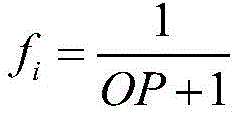
适应度函数设定,将计算出的欧式距离带入表达式:The fitness function is set, and the calculated Euclidean distance is brought into the expression:

适应度fi的大小,代表种群中第i个个体的适应度大小;适应度fi值大,表示OP小,则速度场数值Vij与V近似;反之,则表示此种群个体适应度低;The size of the fitness f i represents the fitness of the i-th individual in the population; a large value of the fitness f i means that the OP is small, and the value of the velocity field V ij is similar to V; otherwise, it means that the individual fitness of the population is low ;
步骤5:根据步骤4,开始迭代选择出适应度最高的个体;在每次迭代计算完毕后,判断是否满足终止条件,若满足终止条件中的任意一条,则可停止迭代,得到最优个体Kb和最优适应度fi获得最优解;若无法满足终止条件,则进行步骤6;Step 5: According to step 4, start to iterate and select the individual with the highest fitness; after each iteration is calculated, judge whether the termination condition is satisfied, if any one of the termination conditions is satisfied, the iteration can be stopped to obtain the optimal individual K b and the optimal fitness f i to obtain the optimal solution; if the termination condition cannot be met, proceed to step 6;
终止条件为:The termination condition is:
一、当迭代到某一个个体的适应度值大于人为设定的适应度值时,则该个体为最优解;1. When the fitness value of an individual is iterated to be greater than the artificially set fitness value, the individual is the optimal solution;
二、种群迭代次数达到人为设定的最大迭代步数时,则取当前种群中适应度值最高的个体作为最优解。2. When the number of population iterations reaches the artificially set maximum number of iteration steps, the individual with the highest fitness value in the current population is taken as the optimal solution.
步骤6:执行遗传算法的选择操作;在步骤5迭代计算后获得的种群中选择适应度值最高的个体优先复制,作为种群Dl中的个体,其中l代表种群编号,l=1,2,3,…;然后根据适应度函数确定每个个体的适应度值,确定每个个体被选择的概率Pi,根据概率Pi选取适应度较大的个体,一次选取一个个体,选取m-1次,得到包含m个个体的种群Dl;Step 6: Execute the selection operation of the genetic algorithm; in the population obtained after iterative calculation in step 5, select the individual with the highest fitness value to be copied first, as the individual in the population Dl, where l represents the population number, l=1, 2, 3, ...; then determine the fitness value of each individual according to the fitness function, determine the probability Pi of each individual being selected, select individuals with higher fitness according to the probability Pi , select one individual at a time, and select m-1 times , to obtain a population D l containing m individuals;
步骤7:将种群Dl中的个体进行遗传算法中的交叉、变异操作;采用单点交叉的方法将两条染色体中的等位基因互换,设置交叉概率pc,同时设置变异率pm,将变异率设置为小数值,生成种群Dl′;执行步骤8;Step 7: Perform the crossover and mutation operations in the genetic algorithm on the individuals in the population D1 ; use the single-point crossover method to exchange the alleles in the two chromosomes, set the crossover probability pc, and set the mutation rate pm at the same time, set The mutation rate is set to a small value to generate a population D l '; perform step 8;
步骤8:重复步骤3至步骤5,若满足终止条件,则输出最优个体与最优适应度;若不满足终止条件,则将种群编号l加1,更新种群编号l,执行步骤6至步骤7;Step 8: Repeat steps 3 to 5. If the termination condition is met, then output the optimal individual and optimal fitness; if the termination condition is not met, add 1 to the population number l, update the population number l, and perform steps 6 to 1 7;
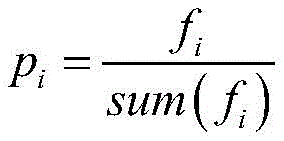
所述步骤6中概率Pi的公式如下:The formula of the probability P i in the step 6 is as follows:

其中sum(fi)为此代种群中所有个体适应度之和。Where sum(f i ) is the sum of fitness of all individuals in this generation population.
采用上述技术方案所产生的有益效果在于:本发明提供的一种基于遗传算法的采空区渗透系数反演方法,本方法利用遗传算法随机生成关于渗透系数K的种群,通过适应度函数设置,代代逼近渗透系数预期值,从而得到较为精确的采空区渗透系数。采空区内部结构复杂多变,多孔介质区渗透系数的改变时刻影响着采空区内部流体流动状态。研究采空区内渗透系数反演,掌握气体流动规律对防治采空区内煤炭自燃具有重要意义,它是判定采空区自然发火位置、建立预测理论的基础,并可为采空区火灾防治技术的开发提供指导;本发明提出的反演方法在某种程度上解决了目前渗透系数测定方法中所暴露出来的费用高、数据代表性差、耗时长等弊端。运用迭代反演的思想原则,结合遗传寻优方法来修改初始模型,代代寻优;体现了本发明反演渗透系数方法简单、人为干预少、耗时短等优点。并且对于反演出的结果有较好的准确性。The beneficial effect produced by adopting the above-mentioned technical scheme is: a kind of goaf seepage coefficient inversion method based on genetic algorithm provided by the present invention, this method utilizes genetic algorithm to randomly generate the population about the seepage coefficient K, set by fitness function, The expected value of the permeability coefficient is approximated from generation to generation, so as to obtain a more accurate permeability coefficient of the goaf. The internal structure of the goaf is complex and changeable, and the change of the permeability coefficient in the porous medium area always affects the fluid flow state inside the goaf. It is of great significance to study the inversion of the permeability coefficient in the goaf and master the law of gas flow in the prevention and control of coal spontaneous combustion in the goaf. The development of technology provides guidance; the inversion method proposed by the invention solves the disadvantages of high cost, poor data representativeness and long time consumption exposed in the current permeability coefficient measurement method to a certain extent. Using the principle of iterative inversion, combined with the genetic optimization method to modify the initial model, and search for optimization from generation to generation; this embodies the advantages of the present invention, such as simple method for inverting permeability coefficient, less human intervention, and short time consumption. And it has better accuracy for the inversion result.
附图说明Description of drawings
图1为本发明实施例提供的采空区渗透系数反演方法的流程图;Fig. 1 is the flowchart of the goaf permeability coefficient inversion method provided by the embodiment of the present invention;
图2为本发明实施例提供的迭代反演过程中适应度随迭代次数变化图;FIG. 2 is a figure showing the variation of fitness with the number of iterations in the iterative inversion process provided by the embodiment of the present invention;
具体实施方式detailed description
下面结合附图和实施例,对本发明的具体实施方式作进一步详细描述。以下实施例用于说明本发明,但不用来限制本发明的范围。The specific implementation manners of the present invention will be further described in detail below in conjunction with the accompanying drawings and embodiments. The following examples are used to illustrate the present invention, but are not intended to limit the scope of the present invention.
本发明利用基于CFD(计算流体力学)的数值方法对采空区速度场进行解算得出的采空区速度分布数值,设定适应度函数,构建了基于遗传寻优的采空区渗透系数迭代反演模型。对采空区渗透系数进行反演研究。理论上说,矿井采空区结构为三维的复杂多变情况,但为了简化计算,排除不必要的干扰因素,所以本实施例中仅考虑采空区中的二维变化;The present invention uses the numerical method based on CFD (computational fluid dynamics) to calculate the goaf velocity distribution value obtained by solving the goaf velocity field, sets the fitness function, and constructs the goaf permeability coefficient iteration based on genetic optimization inversion model. Inversion study on the permeability coefficient of the gob. Theoretically speaking, the mine goaf structure is a three-dimensional complex and changeable situation, but in order to simplify the calculation and eliminate unnecessary interference factors, only two-dimensional changes in the goaf are considered in this embodiment;
如图1所示,本实施例的方法如下所述。As shown in FIG. 1 , the method of this embodiment is as follows.
本发明提供一种基于遗传算法的采空区渗透系数反演方法,包括如下步骤:The invention provides a goaf permeability coefficient inversion method based on a genetic algorithm, comprising the following steps:
步骤1:随机生成关于渗透系数K的二进制种群,设定种群大小为m,即种群中有m个个体,并进行种群初始化,将种群中二进制个体Ui转化为十进制数Ai,再对Ai进行大小范围的限定;通过调整种群中每个个体染色体长度来控制遗传算法寻优范围,形成初代种群D0={d1,d2…di…dm},其中i表示个体在种群中的编号,1≤i≤m;Step 1: Randomly generate a binary population with respect to the permeability coefficient K, set the population size to m, that is, there are m individuals in the population, and perform population initialization, convert the binary individual U i in the population into a decimal number A i , and then set A i limits the size range; by adjusting the chromosome length of each individual in the population to control the optimization range of the genetic algorithm to form the first generation population D 0 ={d 1 ,d 2 …d i …d m }, where i means that the individual is in the population The number in , 1≤i≤m;
首先将种群中二进制个体Ui转化为十进制数Ai(i∈(1,500)),再通过下列表达式对Ai进行取值范围的限定,生成di;First, the binary individual U i in the population is converted into a decimal number A i (i∈(1,500)), and then the value range of A i is limited by the following expression to generate d i ;
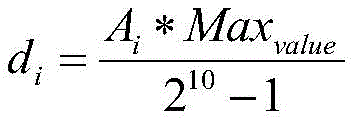
其中Maxvalue代表di的取值上限,需人为设定;Among them, Max value represents the upper limit of the value of d i , which needs to be set artificially;
本实施例中限定Maxvalue=1,即在[0,1]的范围内对预期值进行寻优反演;In this embodiment, Max value = 1 is defined, that is, an optimal inversion is performed on the expected value within the range of [0, 1];
本实施例中m=500;In the present embodiment, m=500;
步骤2:设定期望值K0,通过二维稳定渗流数值计算方法中的有限体积法解算出采空区各控制单元速度场数值V;(由于在采空区数值解法中采空区边界条件的设定,速度场解算结果V为一个400*100的数组,下文中的速度场解算结果与V形式一致);Step 2: Set the expected value K 0 , and calculate the velocity field value V of each control unit in the goaf through the finite volume method in the two-dimensional stable seepage numerical calculation method; Set, the velocity field solution result V is an array of 400*100, the velocity field solution result in the following is consistent with the form of V);
二维稳定渗流数值计算方法中的有限体积法即为采空区解算的数值方法;The finite volume method in the numerical calculation method of two-dimensional stable seepage is the numerical method for solving the goaf;
步骤3:将种群代入二维稳定渗流数值计算方法中的有限体积法,种群中每一个个体对应求解出一组速度场分布数值Vij,其中i表示个体在种群中的编号,j表示迭代次数;Step 3: Substituting the population into the finite volume method in the two-dimensional stable seepage numerical calculation method, each individual in the population correspondingly solves a set of velocity field distribution values V ij , where i represents the number of the individual in the population, and j represents the number of iterations ;
需要说明:对预期值与种群进行采空区速度场解算时,应保持除渗透系数外其余边界条件设置均保持相同;Need to explain: When calculating the velocity field of the goaf for the expected value and population, the settings of other boundary conditions should be kept the same except for the permeability coefficient;
本发明中所得到的速度场解算结果为一个由采空区各点速度值组成的数组,规模大小与设定的采空区长宽边界在数值上相等。即若设定采空区边界大小为400m*100m则最终得到速度场解算结果V为400*100个速度值所组成的数组。The velocity field calculation result obtained in the present invention is an array composed of the velocity values of each point in the goaf, and its scale is numerically equal to the set length and width boundaries of the goaf. That is, if the boundary size of the gob is set to 400m*100m, the velocity field calculation result V will be an array composed of 400*100 velocity values.
步骤4:计算V与Vij间的欧式距离OP;以判断遗传算法每一代中的速度场分布数值与V之间的近似程度;Step 4: Calculate the Euclidean distance OP between V and V ij ; to judge the degree of approximation between the velocity field distribution value and V in each generation of the genetic algorithm;

式中x1q表示V中第q个个体,x1q代表Vij中第q个个体,N为个体总数,OP为两数组间的欧氏距离;OP值越小,则表示两矩阵数值相似度越高;In the formula, x 1q represents the qth individual in V, x 1q represents the qth individual in V ij , N is the total number of individuals, OP is the Euclidean distance between the two arrays; the smaller the value of OP, the numerical similarity between the two matrices higher;
适应度函数设定,将计算出的欧式距离带入表达式:The fitness function is set, and the calculated Euclidean distance is brought into the expression:
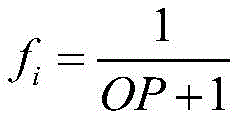
适应度fi的大小,代表种群中第i个个体的适应度大小;适应度fi值越大,表示OP越小,则速度场数值Vij与V越近似;反之,则表示此种群个体适应度越低;The size of the fitness f i represents the fitness of the i-th individual in the population; the larger the value of the fitness f i , the smaller the OP, and the closer the velocity field value V ij is to V; otherwise, it means that the population individual The lower the fitness;
步骤5:根据步骤4,开始迭代选择出适应度最高的个体;在每次迭代计算完毕后,判断是否满足终止条件,若满足终止条件中的任意一条,则可停止迭代,得到最优个体Kb和最优适应度fi获得最优解;若无法满足终止条件,则进行步骤6;Step 5: According to step 4, start to iterate and select the individual with the highest fitness; after each iteration is calculated, judge whether the termination condition is satisfied, if any one of the termination conditions is satisfied, the iteration can be stopped to obtain the optimal individual K b and the optimal fitness f i to obtain the optimal solution; if the termination condition cannot be met, proceed to step 6;
终止条件如下:The termination conditions are as follows:
一、当迭代到某一个个体的适应度值大于人为设定的适应度值时,则该个体为最优解;1. When the fitness value of an individual is iterated to be greater than the artificially set fitness value, the individual is the optimal solution;
二、种群迭代次数达到人为设定的最大迭代步数时,则取当前种群中适应度值最高的个体作为最优解;2. When the number of population iterations reaches the artificially set maximum number of iteration steps, the individual with the highest fitness value in the current population is taken as the optimal solution;
步骤6:执行遗传算法的选择操作;将步骤5迭代计算后获得的种群中适应度值最高的个体优先复制,作为种群Dl中的个体,其中l代表种群编号,l=1,2,3,…;然后根据适应度函数确定每个个体的适应度值,确定每个个体被选择的概率Pi=fi/sum(fi),其中sum(fi)代表此代种群中所有个体适应度之和;根据概率Pi,选取适应度较大的个体,一次选取一个个体,选取m-1次,得到包含m个个体的种群Dl;Step 6: Execute the selection operation of the genetic algorithm; the individual with the highest fitness value in the population obtained after the iterative calculation in step 5 is preferentially copied as the individual in the population Dl, where l represents the population number, l=1,2,3 , ...; then determine the fitness value of each individual according to the fitness function, and determine the probability that each individual is selected Pi=fi/sum(f i ), where sum(f i ) represents the fitness of all individuals in this generation population sum; according to the probability P i , select individuals with greater fitness, select one individual at a time, and select m-1 times to obtain a population D l containing m individuals;
步骤7:将种群Dl中的个体进行遗传算法中的交叉、变异操作;采用单点交叉的方法将两条染色体中的等位基因互换,设置交叉概率pc,同时设置变异率pm,将变异率设置为小数值,生成种群Dl′;执行步骤8;Step 7: Perform the crossover and mutation operations in the genetic algorithm on the individuals in the population D1 ; use the single-point crossover method to exchange the alleles in the two chromosomes, set the crossover probability pc, and set the mutation rate pm at the same time, set The mutation rate is set to a small value to generate a population D l '; perform step 8;
步骤8:重复步骤3至步骤5,若满足终止条件,则输出最优个体与最优适应度;若不满足终止条件,则将种群编号l加1,更新种群编号l,执行步骤6至步骤7。Step 8: Repeat steps 3 to 5. If the termination condition is met, then output the optimal individual and optimal fitness; if the termination condition is not met, add 1 to the population number l, update the population number l, and perform steps 6 to 1 7.
本实施例中按照采空区渗透系数分布情况为例进行详细说明,由于旨在探究方法的可行性,本发明举出的例子中:设定除工作面外,采空区各处渗透系数恒定为K=0.01。使用遗传算法生成每代500个体的种群进行迭代。In this embodiment, according to the distribution of the goaf permeability coefficient as an example, it will be described in detail. Because the feasibility of the method is intended to be explored, in the example given by the present invention: it is set that the permeability coefficients are constant everywhere in the goaf except the working face. It is K=0.01. A genetic algorithm is used to generate a population of 500 individuals per generation for iteration.
本发明采用最大迭代次数的终止条件,设定最大迭代次数为150代,当迭代次数达到150代时输出最优适应度以及最优个体。设定采用单点交叉的方法将两条染色体中的等位基因互换,设定交叉概率pc=0.6。此外在设置变异率时,为保证种群中个体维持在一个较高的适应度的条件,应将其设置为一个十分小的数字,设定变异概率pm=0.01。The present invention adopts the termination condition of the maximum number of iterations, sets the maximum number of iterations to 150 generations, and outputs the optimal fitness and the optimal individual when the number of iterations reaches 150 generations. It is assumed that the alleles in the two chromosomes are exchanged by a single-point crossover method, and the crossover probability pc=0.6 is set. In addition, when setting the mutation rate, in order to ensure that the individuals in the population maintain a high fitness condition, it should be set to a very small number, and the mutation probability pm=0.01.
经过如图2所示的迭代,最终达到150代最大迭代次数时,输出适应度fi值,fi=0.94799。fi值不断趋近于1,符合本发明预期趋势。反演得到的最终结果Kb=0.00977517。After the iterations shown in Figure 2, when the maximum number of iterations reaches 150 generations, the fitness f i value is output, f i =0.94799. The f i value is constantly approaching 1, which is in line with the expected trend of the present invention. The final result obtained by the inversion is K b =0.00977517.
利用设定的预期值K0=0.01,计算此反演方法的相对误差,σ=(预测值-真实值)/真实值,得到σ=0.023。即相对误差小于3%。因此便可以认为实现了渗透系数的反演。通过本方法得到的采空区渗透系数,便可以来对于生产工作进行指导作用,明确采空区渗透系数,对于掌握采空区流体流动状态,采空区气体浓度分布等采空区内部信息有着重大意义。对于预测火灾发生位置,防治部分区域瓦斯超限等行为有指导意义。同时,借助计算机程序的高效快捷性,避开了现存渗透系数测试方法中耗时长、费用高等缺点。促进计算机方法在系数测量领域的运用。Using the set expected value K 0 =0.01, the relative error of this inversion method is calculated, σ=(predicted value−true value)/real value, and σ=0.023 is obtained. That is, the relative error is less than 3%. Therefore, it can be considered that the inversion of the permeability coefficient has been realized. The permeability coefficient of the goaf obtained by this method can be used to guide the production work, clarify the permeability coefficient of the goaf, and play a role in mastering the internal information of the goaf such as the fluid flow state of the goaf and the gas concentration distribution of the goaf. Great significance. It has guiding significance for predicting the location of fire occurrence and preventing gas overrun in some areas. At the same time, with the help of the high efficiency and quickness of the computer program, the shortcomings of the existing permeability coefficient testing methods such as long time consumption and high cost are avoided. Promote the use of computer methods in the field of coefficient measurement.
最后应说明的是:以上实施例仅用以说明本发明的技术方案,而非对其限制;尽管参照前述实施例对本发明进行了详细的说明,本领域的普通技术人员应当理解:其依然可以对前述实施例所记载的技术方案进行修改,或者对其中部分或者全部技术特征进行等同替换;而这些修改或者替换,并不使相应技术方案的本质脱离本发明权利要求所限定的范围。Finally, it should be noted that: the above embodiments are only used to illustrate the technical solutions of the present invention, rather than to limit them; although the present invention has been described in detail with reference to the foregoing embodiments, those of ordinary skill in the art should understand that: it can still be Modifications are made to the technical solutions described in the foregoing embodiments, or equivalent replacements are made to some or all of the technical features; these modifications or replacements do not make the essence of the corresponding technical solutions depart from the scope defined by the claims of the present invention.
Claims (2)

Priority Applications (1)
| Application Number | Priority Date | Filing Date | Title |
|---|---|---|---|
| CN201910188690.0A CN111693423B (en) | 2019-03-13 | 2019-03-13 | Goaf permeability coefficient inversion method based on genetic algorithm |
Applications Claiming Priority (1)
| Application Number | Priority Date | Filing Date | Title |
|---|---|---|---|
| CN201910188690.0A CN111693423B (en) | 2019-03-13 | 2019-03-13 | Goaf permeability coefficient inversion method based on genetic algorithm |
Publications (2)
| Publication Number | Publication Date |
|---|---|
| CN111693423A CN111693423A (en) | 2020-09-22 |
| CN111693423B true CN111693423B (en) | 2023-01-13 |
Family
ID=72475645
Family Applications (1)
| Application Number | Title | Priority Date | Filing Date |
|---|---|---|---|
| CN201910188690.0A Active CN111693423B (en) | 2019-03-13 | 2019-03-13 | Goaf permeability coefficient inversion method based on genetic algorithm |
Country Status (1)
| Country | Link |
|---|---|
| CN (1) | CN111693423B (en) |
Citations (4)
| Publication number | Priority date | Publication date | Assignee | Title |
|---|---|---|---|---|
| CN104299053A (en) * | 2014-10-13 | 2015-01-21 | 国家电网公司 | Method for selecting optimal path of power distribution and utilization communication network based on genetic algorithm |
| CN106326988A (en) * | 2016-09-06 | 2017-01-11 | 景德镇陶瓷大学 | Improved genetic algorithm for complex computing based on fast matching mechanism |
| CN107038306A (en) * | 2017-04-14 | 2017-08-11 | 哈尔滨工业大学 | A kind of optimal Latin hypercube experimental design method based on self-adapted genetic algorithm |
| CN108549770A (en) * | 2018-04-13 | 2018-09-18 | 西安理工大学 | The adaptive inversion method of Parameters for Rockfill Dams based on QGA-MMRVM |
Family Cites Families (1)
| Publication number | Priority date | Publication date | Assignee | Title |
|---|---|---|---|---|
| US10280722B2 (en) * | 2015-06-02 | 2019-05-07 | Baker Hughes, A Ge Company, Llc | System and method for real-time monitoring and estimation of intelligent well system production performance |
-
2019
- 2019-03-13 CN CN201910188690.0A patent/CN111693423B/en active Active
Patent Citations (4)
| Publication number | Priority date | Publication date | Assignee | Title |
|---|---|---|---|---|
| CN104299053A (en) * | 2014-10-13 | 2015-01-21 | 国家电网公司 | Method for selecting optimal path of power distribution and utilization communication network based on genetic algorithm |
| CN106326988A (en) * | 2016-09-06 | 2017-01-11 | 景德镇陶瓷大学 | Improved genetic algorithm for complex computing based on fast matching mechanism |
| CN107038306A (en) * | 2017-04-14 | 2017-08-11 | 哈尔滨工业大学 | A kind of optimal Latin hypercube experimental design method based on self-adapted genetic algorithm |
| CN108549770A (en) * | 2018-04-13 | 2018-09-18 | 西安理工大学 | The adaptive inversion method of Parameters for Rockfill Dams based on QGA-MMRVM |
Non-Patent Citations (1)
| Title |
|---|
| 《矿井通风阻力系数反演研究》;邓立军;《中国博士学位论文全文数据库(工程科技Ⅰ辑)》;20170215(第02期);全文 * |
Also Published As
| Publication number | Publication date |
|---|---|
| CN111693423A (en) | 2020-09-22 |
Similar Documents
| Publication | Publication Date | Title |
|---|---|---|
| CN111441767B (en) | Oil reservoir production dynamic prediction method and device | |
| CN105444923B (en) | Mechanical thermometric instrument error prediction method based on genetic algorithm optimization least square method supporting vector machine | |
| CN116611350B (en) | Oil well acidizing measure effect prediction method based on transfer learning | |
| CN113935556B (en) | Temperature sensor optimal arrangement method based on DNA genetic algorithm | |
| CN114512191A (en) | Penicillin concentration prediction method based on migration component analysis | |
| CN116384238A (en) | A simulation method, device and equipment for an engine centrifugal pump | |
| CN112307536A (en) | Dam seepage parameter inversion method | |
| CN115099406A (en) | Stratum pressure inversion method and device based on multivariate time sequence | |
| CN117150925A (en) | An inverse analysis method of mechanical parameters of rock mass in high and steep slopes of hydropower projects | |
| CN110441815B (en) | Simulated annealing Rayleigh wave inversion method based on differential evolution and block coordinate descent | |
| CN118335211A (en) | A method for constructing a dynamic thickening flame model optimized by artificial intelligence | |
| Xiong et al. | A new adaptive multi-fidelity metamodel method using meta-learning and Bayesian deep learning | |
| CN111693423B (en) | Goaf permeability coefficient inversion method based on genetic algorithm | |
| CN112749488A (en) | Cellulose biological ink viscosity characteristic prediction method | |
| CN114912291B (en) | New monitoring point arrangement method and device for hydraulic model verification of water supply network | |
| Dong et al. | A new method for predicting CO2 minimum miscibility pressure MMP based on deep learning | |
| CN114996947A (en) | Three-dimensional oil reservoir numerical simulation method | |
| CN120995579A (en) | Simulation-based aerodynamic shape design method and device for aircraft | |
| CN109493360A (en) | A kind of method that man-made features random shape point automatically generates contour of building | |
| CN114037006A (en) | Typical daily load curve generation method for power system | |
| Gao et al. | Shape optimization of bi-directional flow passage components based on a genetic algorithm and computational fluid dynamics | |
| CN113468466A (en) | Multi-working-condition one-dimensional wave equation solving method based on neural network | |
| CN118030027B (en) | A method and device for identifying a dominant flow path in a geothermal fracture reservoir | |
| CN115470887B (en) | Coal mine tunneling working face gas emission quantity prediction method based on KPCA-POA-LSTM model | |
| Vatandoust et al. | DLDNN: Deterministic Lateral Displacement Design Automation by Neural Networks |
Legal Events
| Date | Code | Title | Description |
|---|---|---|---|
| PB01 | Publication | ||
| PB01 | Publication | ||
| SE01 | Entry into force of request for substantive examination | ||
| SE01 | Entry into force of request for substantive examination | ||
| GR01 | Patent grant | ||
| GR01 | Patent grant |