[go: up one dir, main page]

CN111631640B - Application method of detection device capable of judging condition of robot walking surface - Google Patents

Application method of detection device capable of judging condition of robot walking surface Download PDF

Info

Publication number
CN111631640B
CN111631640B CN202010456875.8A CN202010456875A CN111631640B CN 111631640 B CN111631640 B CN 111631640B CN 202010456875 A CN202010456875 A CN 202010456875A CN 111631640 B CN111631640 B CN 111631640B
Authority
CN
China
Prior art keywords
robot
walking surface
detection device
application method
value
Prior art date
Legal status (The legal status is an assumption and is not a legal conclusion. Google has not performed a legal analysis and makes no representation as to the accuracy of the status listed.)
Active
Application number
CN202010456875.8A
Other languages
Chinese (zh)
Other versions
CN111631640A (en
Inventor
张苗苗
陈浩森
白玲
Current Assignee (The listed assignees may be inaccurate. Google has not performed a legal analysis and makes no representation or warranty as to the accuracy of the list.)
Zhuhai Yiwei Technology Co Ltd
Original Assignee
Zhuhai Amicro Semiconductor Co Ltd
Priority date (The priority date is an assumption and is not a legal conclusion. Google has not performed a legal analysis and makes no representation as to the accuracy of the date listed.)
Filing date
Publication date
Application filed by Zhuhai Amicro Semiconductor Co Ltd filed Critical Zhuhai Amicro Semiconductor Co Ltd
Priority to CN202010456875.8A priority Critical patent/CN111631640B/en
Publication of CN111631640A publication Critical patent/CN111631640A/en
Application granted granted Critical
Publication of CN111631640B publication Critical patent/CN111631640B/en
Active legal-status Critical Current
Anticipated expiration legal-status Critical

Links

Images

Classifications

    • AHUMAN NECESSITIES
    • A47FURNITURE; DOMESTIC ARTICLES OR APPLIANCES; COFFEE MILLS; SPICE MILLS; SUCTION CLEANERS IN GENERAL
    • A47LDOMESTIC WASHING OR CLEANING; SUCTION CLEANERS IN GENERAL
    • A47L11/00Machines for cleaning floors, carpets, furniture, walls, or wall coverings
    • A47L11/24Floor-sweeping machines, motor-driven
    • AHUMAN NECESSITIES
    • A47FURNITURE; DOMESTIC ARTICLES OR APPLIANCES; COFFEE MILLS; SPICE MILLS; SUCTION CLEANERS IN GENERAL
    • A47LDOMESTIC WASHING OR CLEANING; SUCTION CLEANERS IN GENERAL
    • A47L11/00Machines for cleaning floors, carpets, furniture, walls, or wall coverings
    • A47L11/40Parts or details of machines not provided for in groups A47L11/02 - A47L11/38, or not restricted to one of these groups, e.g. handles, arrangements of switches, skirts, buffers, levers
    • AHUMAN NECESSITIES
    • A47FURNITURE; DOMESTIC ARTICLES OR APPLIANCES; COFFEE MILLS; SPICE MILLS; SUCTION CLEANERS IN GENERAL
    • A47LDOMESTIC WASHING OR CLEANING; SUCTION CLEANERS IN GENERAL
    • A47L11/00Machines for cleaning floors, carpets, furniture, walls, or wall coverings
    • A47L11/40Parts or details of machines not provided for in groups A47L11/02 - A47L11/38, or not restricted to one of these groups, e.g. handles, arrangements of switches, skirts, buffers, levers
    • A47L11/4011Regulation of the cleaning machine by electric means; Control systems and remote control systems therefor
    • AHUMAN NECESSITIES
    • A47FURNITURE; DOMESTIC ARTICLES OR APPLIANCES; COFFEE MILLS; SPICE MILLS; SUCTION CLEANERS IN GENERAL
    • A47LDOMESTIC WASHING OR CLEANING; SUCTION CLEANERS IN GENERAL
    • A47L11/00Machines for cleaning floors, carpets, furniture, walls, or wall coverings
    • A47L11/40Parts or details of machines not provided for in groups A47L11/02 - A47L11/38, or not restricted to one of these groups, e.g. handles, arrangements of switches, skirts, buffers, levers
    • A47L11/4061Steering means; Means for avoiding obstacles; Details related to the place where the driver is accommodated
    • BPERFORMING OPERATIONS; TRANSPORTING
    • B25HAND TOOLS; PORTABLE POWER-DRIVEN TOOLS; MANIPULATORS
    • B25JMANIPULATORS; CHAMBERS PROVIDED WITH MANIPULATION DEVICES
    • B25J11/00Manipulators not otherwise provided for
    • B25J11/008Manipulators for service tasks
    • BPERFORMING OPERATIONS; TRANSPORTING
    • B25HAND TOOLS; PORTABLE POWER-DRIVEN TOOLS; MANIPULATORS
    • B25JMANIPULATORS; CHAMBERS PROVIDED WITH MANIPULATION DEVICES
    • B25J11/00Manipulators not otherwise provided for
    • B25J11/008Manipulators for service tasks
    • B25J11/0085Cleaning
    • GPHYSICS
    • G01MEASURING; TESTING
    • G01NINVESTIGATING OR ANALYSING MATERIALS BY DETERMINING THEIR CHEMICAL OR PHYSICAL PROPERTIES
    • G01N21/00Investigating or analysing materials by the use of optical means, i.e. using sub-millimetre waves, infrared, visible or ultraviolet light
    • G01N21/17Systems in which incident light is modified in accordance with the properties of the material investigated
    • G01N21/55Specular reflectivity
    • GPHYSICS
    • G01MEASURING; TESTING
    • G01NINVESTIGATING OR ANALYSING MATERIALS BY DETERMINING THEIR CHEMICAL OR PHYSICAL PROPERTIES
    • G01N21/00Investigating or analysing materials by the use of optical means, i.e. using sub-millimetre waves, infrared, visible or ultraviolet light
    • G01N21/17Systems in which incident light is modified in accordance with the properties of the material investigated
    • G01N21/55Specular reflectivity
    • G01N2021/558Measuring reflectivity and transmission

Landscapes

  • Engineering & Computer Science (AREA)
  • Mechanical Engineering (AREA)
  • Robotics (AREA)
  • General Health & Medical Sciences (AREA)
  • Analytical Chemistry (AREA)
  • Biochemistry (AREA)
  • Physics & Mathematics (AREA)
  • General Physics & Mathematics (AREA)
  • Immunology (AREA)
  • Pathology (AREA)
  • Chemical & Material Sciences (AREA)
  • Life Sciences & Earth Sciences (AREA)
  • Health & Medical Sciences (AREA)
  • Manipulator (AREA)

Abstract

本发明公开了一种可判断机器人行走面状况的检测装置的应用方法,该应用方法包括以下步骤:S1:确定检测装置与行走面的初始距离为L,机器人行走,检测装置中的远红外发射器和近红外发射器检测行走面;S2:检测装置中的红外接收器接收行走面反射的由远红外发射器和近红外发射器发出的反射信号的强度值E1和E2;S3:机器人根据E1和E2的关系判断行走面状况。通过检测两个红外灯反射的信号强度的差值,来判断机器人的行走面状况,使机器人可以根据不同的行走面进行不同的应对,抗干扰性强。

Figure 202010456875

The invention discloses an application method of a detection device capable of judging the condition of a walking surface of a robot. The application method includes the following steps: S1: determine the initial distance between the detection device and the walking surface as L, the robot walks, and the far-infrared emission in the detection device S2: the infrared receiver in the detection device receives the intensity values E1 and E2 of the reflected signals emitted by the far-infrared emitter and the near-infrared emitter reflected by the walking surface; S3: the robot according to E1 The relationship with E2 judges the walking surface condition. By detecting the difference between the signal strengths reflected by the two infrared lamps, the walking surface of the robot can be judged, so that the robot can respond differently according to different walking surfaces, with strong anti-interference.

Figure 202010456875

Description

Application method of detection device capable of judging condition of robot walking surface
Technical Field
The invention relates to the technical field of autonomous mobile robots, in particular to an application method of a detection device capable of judging the condition of a walking surface of a robot.
Background
With the development of technologies and the pursuit of people for comfortable life, autonomous mobile robots increasingly enter people's lives, such as accompanying robots, sweeping robots and the like. In the walking process of the robot, generally, whether a barrier or a step exists on a walking route is only checked, the condition of a walking surface on which the robot is walking is not detected, and when a ridge or a carpet appears on the walking surface, the robot cannot climb up but cannot be detected, is blocked and stops working; or, when a low surface appears on the walking surface, if the fall of the low surface is small, the robot can be clamped in the low surface if the robot falls into the low surface, and the fall prevention device of the robot can not be detected due to the small fall of the low surface. Therefore, the existing robot needs to be additionally provided with a detection device for detecting the condition of the walking surface of the robot, and an application method of the detection device is set according to detection data of the detection device.
Disclosure of Invention
In order to solve the problems, the invention provides an application method of a detection device capable of judging the condition of a walking surface of a robot, and the method can enable the robot detection device to accurately detect the condition of the walking surface. The specific technical scheme of the invention is as follows:
an application method of a detection device capable of judging the condition of a robot walking surface comprises the following steps: s1, determining that the initial distance between the detection device and the walking surface is L, the robot walks, and the far infrared emitter and the near infrared emitter in the detection device detect the walking surface; s2, the infrared receiver in the detecting device receives the intensity values E1 and E2 of the reflected signals sent by the far infrared emitter and the near infrared emitter which are reflected by the walking surface; and S3, judging the state of the walking surface by the robot according to the size relation between E1 and E2. The robot can judge the condition of the walking surface by comparing the magnitude relation of the two detected numerical values, and has the advantages of few numerical values needing to be calculated, high calculation speed and strong functions.
In one or more aspects of the invention, before determining L, the robot obtains a variation curve of intensity values E1 and E2 of the reflected signal according to a variation of the height a of the detection device and the walking surface.
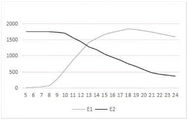
In one or more aspects of the present invention, E1 increases and then decreases as the height a of the far infrared emitter and the walking surface increases, and E2 decreases as the height a of the near infrared emitter and the walking surface increases. The values of E1 and E2 are different along with the change of the height, and compared with the values of E1 and E2, the influence of environmental factors on detection results is reduced, and the anti-interference performance is stronger.
In one or more aspects of the present invention, based on the values of E1 and E2 on the variation curve, when the robot detects that E1 < E2, the robot determines that the walking surface is a rising surface.
In one or more aspects of the invention, based on the values of E1 and E2 on the variation curve, when the robot detects that E1= E2 and E1 and E2 are not equal to zero, the robot determines that the walking surface is a plane.
In one or more aspects of the invention, based on the values of E1 and E2 on the variation curve, when the robot detects that E1 is greater than the preset value Ea and E2 is less than 1/2 of E1, the robot determines that the walking surface is a falling surface.
In one or more aspects of the present invention, based on the values of E1 and E2 on the variation curve, when the robot detects that E1 is smaller than the preset value Ea and E2 is smaller than the preset value Eb, the robot determines that the walking surface is a falling surface. By detecting and comparing the intensity values of the reflected signals of the two infrared emitters, a rising surface or a falling surface with a small height difference can be detected, and the robot is prevented from being stuck in the planes.
In one or more aspects of the invention, the preset value Ea is a value of any E1 when the height between the detection device and the walking surface is greater than 10 cm.
In one or more aspects of the invention, the preset value Ea is a value of any E1 when the height between the detection device and the walking surface is greater than 10 cm; the preset value Eb is a value of any E2 when the height between the detection device and the walking surface is larger than 10 cm. In life, the height of the step is about 10cm, so that the height of the cliff is set to be 10cm, the value of the preset value only needs to exceed the value of 10cm, the value range is flexible, the change can be carried out according to the actual value, and the strain capacity of the robot is improved.
In one or more aspects of the invention, the robot acquires the infrared reflectance of the walking surface based on the sum of E1 and E2. The robot can acquire the infrared reflectivity of the walking surface, the measured infrared reflectivity can be used as reference for other sensors, and the detection accuracy of the sensors is improved.
Drawings
FIG. 1 is a flow chart of a method of application of the robotic inspection device of the present invention;
FIG. 2 is a schematic structural diagram of the robot detection device of the present invention;
FIG. 3 is a graph of E1 and E2 in an embodiment of the invention;
FIG. 4 is a table of signal strength versus height A for a reflected signal in accordance with an embodiment of the present invention.
Detailed Description
Reference will now be made in detail to the embodiments of the present invention, examples of which are illustrated in the accompanying drawings, wherein like reference numerals refer to the same or similar elements or elements having the same or similar functions throughout.
In the description of the present invention, it should be noted that, for the terms of orientation, such as "central", "lateral", "longitudinal", "length", "width", "thickness", "upper", "lower", "front", "rear", "left", "right", "vertical", "horizontal", "top", "bottom", "inner", "outer", "clockwise", "counterclockwise", etc., it indicates that the orientation and positional relationship shown in the drawings are based on the orientation or positional relationship shown in the drawings, and is only for the convenience of describing the present invention and simplifying the description, but does not indicate or imply that the device or element referred to must have a specific orientation, be constructed in a specific orientation, and be operated without limiting the specific scope of protection of the present invention.
Furthermore, if the terms "first" and "second" are used for descriptive purposes only, they are not to be construed as indicating or implying relative importance or implicitly indicating the number of technical features. Thus, a definition of "a first" or "a second" feature may explicitly or implicitly include one or more of the feature, and in the description of the invention, "at least" means one or more unless specifically defined otherwise.
In the present invention, unless otherwise explicitly defined or limited, the terms "assembled", "connected" and "connected" should be construed broadly and include, for example, fixed connections, detachable connections or integral connections; mechanical connection is also possible; the two elements can be directly connected or connected through an intermediate medium, and the two elements can be communicated with each other. The specific meanings of the above terms in the present invention can be understood by those of ordinary skill in the art according to specific situations.
In the present invention, unless otherwise specified and limited, "above" or "below" a first feature may include the first and second features being in direct contact, and may also include the first and second features not being in direct contact but being in contact with each other through another feature therebetween. Also, the first feature being "above," "below," and "above" the second feature includes the first feature being directly above and obliquely above the second feature, or simply an elevation which indicates a level of the first feature being higher than an elevation of the second feature. The first feature being "above", "below" and "beneath" the second feature includes the first feature being directly below or obliquely below the second feature, or merely means that the first feature is at a lower level than the second feature.
The technical scheme and the beneficial effects of the invention are clearer and clearer by further describing the specific embodiment of the invention with the accompanying drawings of the specification. The embodiments described below are exemplary and are intended to be illustrative of the invention, but are not to be construed as limiting the invention.
Referring to fig. 1, an application method of a detection device capable of determining a condition of a walking surface of a robot includes the following steps: s1, determining that the initial distance between the detection device 1 and the walking surface is L, the robot walks, and the far infrared emitter 2 and the near infrared emitter 3 in the detection device detect the walking surface; s2, the infrared receiver 4 in the detection device receives the intensity values E1 and E2 of the reflected signals sent by the far infrared emitter 2 and the near infrared emitter 3 and reflected by the walking surface; and S3, judging the state of the walking surface by the robot according to the size relation between E1 and E2. The walking surface condition of the robot is judged by detecting and comparing the magnitude relation of the intensity values of the reflected signals of the two infrared transmitters, so that the robot can respond differently according to different walking surfaces, and the anti-interference performance is high. According to fig. 2, the detecting device 1 comprises an infrared receiver 4, a far infrared emitter 2 and a near infrared emitter 3, the far infrared emitter 2 and the near infrared emitter 3 are arranged on the detecting device 1 at different emitting angles, and the intersection points of the central lines of the far infrared emitter 2 and the near infrared emitter 3 and the central line of the infrared receiver 4 are respectively arranged on different planes, the near infrared emitter 3 is arranged between the infrared receiver 4 and the far infrared emitter 2, the detecting device 1 is simple in structure, low in production cost and powerful in function.
In one embodiment, L is an initial distance between the detection device and the walking surface, a is a height between the detection device and the walking surface, and the height a changes according to a change in the distance between the detection device and the walking surface during the walking process of the robot. Before the robot determines L, the robot acquires intensity values E1 and E2 of the reflected signals according to the change of the height A, and the change curves are shown in figure 3, wherein the abscissa of the change curve is the height between the detection device and the walking surface, and the ordinate is the intensity of the reflected signals of the far infrared emitter 2 and the near infrared emitter 3. E1 increases and then decreases as the height a of the far infrared emitter 2 and the walking surface increases, and E2 decreases as the height a of the near infrared emitter 3 and the walking surface increases. Starting from zero, A is out of the detection ranges of E1 and E2, E1 is smaller than E2, when A is a specific value, E1 and E2 are equal, then E1 is larger than E2 until the detection ranges of E1 and E2 are exceeded, the values of E1 and E2 both tend to be zero or equal to zero, and when A is out of the detection ranges of E1 and E2, the judgment of whether E1 and E2 are equal is only affected. Based on the relationship between the height A on the change curve and the heights E1 and E2, the value of L is set, the difference value between E1 and E2 is within a certain range B, E1 and E2 are far larger than zero, E1= E2 is set, then A is approximately equal to L, and therefore when the difference value between E1 and E2 is within the set range B, the walking surface encountered by the robot is a plane. When E1 < E2 and the difference between the two is not within the set range B, the walking surface encountered by the robot is a lifting surface. When E1 is larger than a preset value Ea, and E2 is smaller than 1/2 of E1, or when E1 is smaller than the preset value Ea, and E2 is smaller than a preset value Eb, the walking surface encountered by the robot is a falling surface, the preset value Ea is a numerical value of any E1 when the height of the detection device 1 and the walking surface is larger than 10cm, and the preset value Eb is a numerical value of any E2 when the height of the detection device 1 and the walking surface is larger than 10 cm. And the robot executes corresponding operation according to the height difference between the walking surface and the junction. The robot performs corresponding operations including at least continuing walking, stopping walking, walking along a boundary, or turning back. The self-possessed function of the robot can influence the adaptability of the robot to the walking surface, for example, the sweeping robot needs to be attached to the sweeping surface as much as possible, can walk on the plane all the time, meets the walking surface with height difference to prevent being blocked, generally enables the sweeping robot to walk along the boundary of the height difference, and can stop walking or turn back when meeting a step or at the edge of a table; if the robot is a disinfection robot, the robot does not need to be tightly attached to a walking surface, and the robot can continuously walk on the walking surface of the type when encountering the walking surface with smaller height difference, carpet, ridge or pit, and thus the walking of the robot is not greatly influenced. The detection result of the robot is more accurate by a method of firstly acquiring detection data and then detecting; the robot can help different robots to carry out different operations in the same situation through the detection data, and the application range is wide. The robot obtains the infrared reflectivity of the walking surface based on the sum of E1 and E2, the sum of E1 and E2 is divided by the sum of the emission signal intensity of the far infrared emitter and the near infrared emitter to be the infrared reflectivity, and the measured infrared reflectivity can be used as reference for other sensors, so that the accuracy of data detection is improved.
As one embodiment, the table in fig. 4 is the amplified detection data obtained by installing the detecting device 1 on the sweeper, and the distance in the table is the height a of the detecting device 1 and the walking surface, and the height a that makes the values of E1 and E2 equal can be changed by the placing angle of the far infrared emitter 2 and the near infrared emitter 3 on the detecting device 1, and it is more suitable to adjust the placing angle of the far infrared emitter 2 and the near infrared emitter 3 on the detecting device 1 to set the distance L to any one of 12mm to 15mm according to the distance that the sweeper needs to keep close to the walking surface. According to the table values, as the height A increases, the E1 increases to reach the peak value and then decreases; e2 decreases as height a increases. When L is 15mm, the machine meets the convex surface with the height of more than 2mm, the height A is reduced to be less than 13mm of the intersection point, and at the moment, E1 < E2, so E1 < E2, and the machine is judged to meet the convex surface, and the convex surface can be a carpet or an over threshold. When the value of E1 is greater than 10, and E2 is less than 1/2 for E1; or when the value of E1 is less than 10 and the value of E2 is less than 3, and the condition that any one of the two is met, the robot is judged to encounter the concave surface, and the robot falls when driving to the concave surface. When the height A is 100 mm, E1 is 21 and E2 is 4. At this time, the near-emission feedback signal E2 sharply decreases to be close to 0, the far-emission feedback signal E1 still reaches 21, and E1 is greater than 2E2, the first condition is met, and the signal is judged to fall; when the height A is far larger than 100 mm, the value of E1 is smaller than 10, and the value of E2 is smaller, so that the condition 2 is met, and the falling is judged; the values of E1 and E2 for the black running surface do not satisfy either condition 1 or condition 2, and are not judged to fall, thereby reducing the influence of the black running surface on the detection result. In other cases, the difference between E1 and E2 is within a certain range, and the change in height a is small, so E1 is set equal to E2, and the walking surface of the robot is a plane. The robot reduces the judgment range of the concave surface, and reduces the influence of uneven walking surface on the detection result.
In the description of the specification, reference to the description of "one embodiment", "preferably", "an example", "a specific example" or "some examples", etc., means that a particular feature, structure, material, or characteristic described in connection with the embodiment or example is included in at least one embodiment or example of the invention, and schematic representations of the terms in this specification do not necessarily refer to the same embodiment or example. Furthermore, the particular features, structures, materials, or characteristics described may be combined in any suitable manner in any one or more embodiments or examples. The connection mode connected in the description of the specification has obvious effects and practical effectiveness.
With the above structure and principle in mind, those skilled in the art should understand that the present invention is not limited to the above embodiments, and modifications and substitutions based on the known technology in the field are within the scope of the present invention, which should be limited by the claims.

Claims (8)

1.一种可判断机器人行走面状况的检测装置的应用方法,其特征在于,机器人在确定L前,机器人根据检测装置与行走面的高度A的变化获取反射信号的强度值E1和E2的变化曲线,该应用方法包括以下步骤:1. the application method of the detection device that can judge the situation of the walking surface of the robot, it is characterized in that, before the robot determines L, the robot obtains the intensity value E1 of the reflected signal and the variation of E2 according to the change of the height A of the detection device and the walking surface curve, the application method includes the following steps: S1:确定检测装置与行走面的初始距离为L,机器人行走,检测装置中的远红外发射器和近红外发射器检测行走面;S1: determine that the initial distance between the detection device and the walking surface is L, the robot walks, and the far-infrared transmitter and the near-infrared transmitter in the detection device detect the walking surface; S2:检测装置中的红外接收器接收行走面反射的由远红外发射器和近红外发射器发出的反射信号的强度值E1和E2;S2: the infrared receiver in the detection device receives the intensity values E1 and E2 of the reflected signals emitted by the far-infrared transmitter and the near-infrared transmitter reflected by the walking surface; S3:机器人根据E1和E2的大小关系判断行走面状况;S3: The robot judges the walking surface condition according to the size relationship between E1 and E2; 其中,E1会随着远红外发射器与行走面的高度A的增加而先增加后减小,E2会随着近红外发射器与行走面的高度A的增加而减小。Among them, E1 will first increase and then decrease with the increase of the height A of the far-infrared emitter and the walking surface, and E2 will decrease with the increase of the height A of the near-infrared emitter and the walking surface. 2.根据权利要求1所述的可判断机器人行走面状况的检测装置的应用方法,其特征在于,基于变化曲线上E1和E2的值,当机器人检测到E1<E2时,机器人判断行走面为升起面。2. The application method of the detection device capable of judging the condition of the walking surface of the robot according to claim 1, wherein, based on the values of E1 and E2 on the change curve, when the robot detects that E1<E2, the robot judges that the walking surface is Raised face. 3.根据权利要求1所述的可判断机器人行走面状况的检测装置的应用方法,其特征在于,基于变化曲线上E1和E2的值,当机器人检测到E1=E2且E1和E2不等于零时,机器人判断行走面为平面。3. the application method of the detection device that can judge the condition of the robot walking surface according to claim 1 is characterized in that, based on the value of E1 and E2 on the change curve, when the robot detects that E1=E2 and E1 and E2 are not equal to zero , the robot judges that the walking surface is a plane. 4.根据权利要求1所述的可判断机器人行走面状况的检测装置的应用方法,其特征在于,基于变化曲线上E1和E2的值,当机器人检测到E1大于预设值Ea,且E2小于E1的1/2时,机器人判断行走面为跌落面。4. the application method of the detection device that can judge the condition of the robot walking surface according to claim 1, is characterized in that, based on the value of E1 and E2 on the change curve, when the robot detects that E1 is greater than preset value Ea, and E2 is less than When E1 is 1/2, the robot determines that the walking surface is the falling surface. 5.根据权利要求1所述的可判断机器人行走面状况的检测装置的应用方法,其特征在于,基于变化曲线上E1和E2的值,当机器人检测到E1小于预设值Ea, E2小于预设值Eb时,机器人判断行走面为跌落面。5. the application method of the detection device that can judge the condition of the robot walking surface according to claim 1, is characterized in that, based on the value of E1 and E2 on the change curve, when the robot detects that E1 is less than the preset value Ea, E2 is less than the preset value Ea. When the value Eb is set, the robot determines that the walking surface is the falling surface. 6.根据权利要求4所述的可判断机器人行走面状况的检测装置的应用方法,其特征在于,所述预设值Ea为当检测装置与行走面的高度大于10cm时任一E1的数值。6 . The application method of the detection device capable of judging the condition of the walking surface of the robot according to claim 4 , wherein the preset value Ea is the value of any E1 when the height of the detection device and the walking surface is greater than 10 cm. 7 . 7.根据权利要求5所述的可判断机器人行走面状况的检测装置的应用方法,其特征在于,所述预设值Ea为当检测装置与行走面的高度大于10cm时任一E1的数值;所述预设值Eb为当检测装置与行走面的高度大于10cm时任一E2的数值。7. The application method of the detection device that can judge the condition of the robot walking surface according to claim 5, wherein the preset value Ea is the numerical value of any E1 when the height of the detection device and the walking surface is greater than 10cm; The preset value Eb is any value of E2 when the height between the detection device and the walking surface is greater than 10 cm. 8.根据权利要求1所述的可判断机器人行走面状况的检测装置的应用方法,其特征在于,机器人基于E1和E2的和来获取行走面的红外反射率。8 . The application method of the detection device capable of judging the condition of the walking surface of the robot according to claim 1 , wherein the robot obtains the infrared reflectivity of the walking surface based on the sum of E1 and E2 .
CN202010456875.8A 2020-05-26 2020-05-26 Application method of detection device capable of judging condition of robot walking surface Active CN111631640B (en)

Priority Applications (1)

Application Number Priority Date Filing Date Title
CN202010456875.8A CN111631640B (en) 2020-05-26 2020-05-26 Application method of detection device capable of judging condition of robot walking surface

Applications Claiming Priority (1)

Application Number Priority Date Filing Date Title
CN202010456875.8A CN111631640B (en) 2020-05-26 2020-05-26 Application method of detection device capable of judging condition of robot walking surface

Publications (2)

Publication Number Publication Date
CN111631640A CN111631640A (en) 2020-09-08
CN111631640B true CN111631640B (en) 2022-06-14

Family

ID=72323764

Family Applications (1)

Application Number Title Priority Date Filing Date
CN202010456875.8A Active CN111631640B (en) 2020-05-26 2020-05-26 Application method of detection device capable of judging condition of robot walking surface

Country Status (1)

Country Link
CN (1) CN111631640B (en)

Families Citing this family (2)

* Cited by examiner, † Cited by third party
Publication number Priority date Publication date Assignee Title
CN112764033B (en) * 2020-12-24 2024-03-08 珠海格力电器股份有限公司 Distance detection method and device and mobile robot
CN116224982A (en) * 2022-11-30 2023-06-06 华能清能通榆电力有限公司 An obstacle avoidance system and control method

Family Cites Families (6)

* Cited by examiner, † Cited by third party
Publication number Priority date Publication date Assignee Title
US8412377B2 (en) * 2000-01-24 2013-04-02 Irobot Corporation Obstacle following sensor scheme for a mobile robot
KR20090019480A (en) * 2007-08-21 2009-02-25 에이스로봇 주식회사 Floor detection method of robot cleaner and robot cleaner
CN104245244B (en) * 2012-09-21 2016-01-20 艾罗伯特公司 Proximity Sensing on Mobile Robots
CN108115647A (en) * 2016-11-30 2018-06-05 广东大仓机器人科技有限公司 Robot that uses infrared ranging to identify road depressions in front of wheels
CN207020534U (en) * 2017-05-31 2018-02-16 珠海市一微半导体有限公司 Based on how infrared robot obstacle-avoiding device
CN109895143A (en) * 2019-02-28 2019-06-18 深圳市鑫益嘉科技股份有限公司 Terminal anti-fall method, device, equipment and computer readable storage medium

Also Published As

Publication number Publication date
CN111631640A (en) 2020-09-08

Similar Documents

Publication Publication Date Title
CN108958254B (en) Self-moving robot
CN217592704U (en) Combined surface type sensor and robot cleaner
CN111796290B (en) Ground detection method, ground detector and autonomous mobile device
CN111631640B (en) Application method of detection device capable of judging condition of robot walking surface
CN108020844B (en) Cliff detection method and robot
CN109602341B (en) Cleaning robot falling control method and chip based on virtual boundary
US20210386262A1 (en) Method of surface type detection and robotic cleaner configured to carry out the same
CN111631641B (en) Robot anti-falling detection method
US20140034834A1 (en) Mirror reflection processing method for position sensitive detector device
KR101985188B1 (en) Moving robot and driving method for the moving robot
KR20090019480A (en) Floor detection method of robot cleaner and robot cleaner
CN110141160A (en) Method for cleaning along wall surface by cleaning robot and cleaning robot
CN111035322A (en) Ground recognition method and device and sweeping robot
US20210186289A1 (en) Ultrasonic sensor and robot cleaner equipped therewith
CN111857153A (en) A distance detection device and sweeping robot
KR20120018248A (en) A vacuum cleaner
KR20090096009A (en) Robot cleaner
KR101229106B1 (en) The distance perception infrared ray sensor which uses the multiplex reception department
CN207020534U (en) Based on how infrared robot obstacle-avoiding device
CN111633648B (en) Detection method for detecting convex surface by robot, chip and cleaning robot
US11234571B2 (en) Cleaning robot and material identification method thereof
CN110353570A (en) Autonomous actions device and its avoidance method
KR20220021980A (en) Cleaning robot and controlling method thereof
CN205941900U (en) Distance measuring sensor reaches from mobile device
CN113303733B (en) Cleaning robot

Legal Events

Date Code Title Description
PB01 Publication
PB01 Publication
SE01 Entry into force of request for substantive examination
CB02 Change of applicant information

Address after: 519000 2706, No. 3000, Huandao East Road, Hengqin new area, Zhuhai, Guangdong

Applicant after: Zhuhai Yiwei Semiconductor Co.,Ltd.

Address before: Room 105-514, No.6 Baohua Road, Hengqin New District, Zhuhai City, Guangdong Province

Applicant before: AMICRO SEMICONDUCTOR Co.,Ltd.

GR01 Patent grant
GR01 Patent grant
CP03 Change of name, title or address

Address after: 519000 Guangdong Province Zhuhai City Hengqin New District Zhi Shui Road 88 Office 1508

Patentee after: Zhuhai Yiwei Technology Co., Ltd.

Country or region after: China

Address before: 519000 2706, No. 3000, Huandao East Road, Hengqin new area, Zhuhai, Guangdong

Patentee before: Zhuhai Yiwei Semiconductor Co.,Ltd.

Country or region before: China