CN111586785B - A clustering routing method for cross-media heterogeneous unmanned swarm system - Google Patents
A clustering routing method for cross-media heterogeneous unmanned swarm system Download PDFInfo
- Publication number
- CN111586785B CN111586785B CN202010288234.6A CN202010288234A CN111586785B CN 111586785 B CN111586785 B CN 111586785B CN 202010288234 A CN202010288234 A CN 202010288234A CN 111586785 B CN111586785 B CN 111586785B
- Authority
- CN
- China
- Prior art keywords
- node
- cluster
- cluster head
- nodes
- usv
- Prior art date
- Legal status (The legal status is an assumption and is not a legal conclusion. Google has not performed a legal analysis and makes no representation as to the accuracy of the status listed.)
- Expired - Fee Related
Links
- 238000000034 method Methods 0.000 title claims abstract description 35
- 241000854291 Dianthus carthusianorum Species 0.000 claims abstract description 119
- 230000006854 communication Effects 0.000 claims abstract description 57
- 238000004891 communication Methods 0.000 claims abstract description 53
- 230000005540 biological transmission Effects 0.000 claims abstract description 8
- 230000004044 response Effects 0.000 claims description 40
- 238000012790 confirmation Methods 0.000 claims description 22
- XLYOFNOQVPJJNP-UHFFFAOYSA-N water Substances O XLYOFNOQVPJJNP-UHFFFAOYSA-N 0.000 claims description 17
- 230000008569 process Effects 0.000 claims description 16
- 101100172132 Mus musculus Eif3a gene Proteins 0.000 claims description 3
- 230000005236 sound signal Effects 0.000 claims 2
- 230000006855 networking Effects 0.000 abstract description 6
- 230000004083 survival effect Effects 0.000 abstract description 2
- 230000008901 benefit Effects 0.000 description 4
- 238000010586 diagram Methods 0.000 description 4
- 238000002121 ultrasonic speckle velocimetry Methods 0.000 description 3
- 238000013461 design Methods 0.000 description 2
- 238000012806 monitoring device Methods 0.000 description 2
- 238000012544 monitoring process Methods 0.000 description 2
- 230000003044 adaptive effect Effects 0.000 description 1
- 230000009286 beneficial effect Effects 0.000 description 1
- 238000006243 chemical reaction Methods 0.000 description 1
- 238000005516 engineering process Methods 0.000 description 1
- 238000002474 experimental method Methods 0.000 description 1
- 230000007246 mechanism Effects 0.000 description 1
- 230000000630 rising effect Effects 0.000 description 1
- 238000012360 testing method Methods 0.000 description 1
Images


Classifications
-
- H—ELECTRICITY
- H04—ELECTRIC COMMUNICATION TECHNIQUE
- H04W—WIRELESS COMMUNICATION NETWORKS
- H04W40/00—Communication routing or communication path finding
- H04W40/02—Communication route or path selection, e.g. power-based or shortest path routing
-
- H—ELECTRICITY
- H04—ELECTRIC COMMUNICATION TECHNIQUE
- H04W—WIRELESS COMMUNICATION NETWORKS
- H04W74/00—Wireless channel access
- H04W74/08—Non-scheduled access, e.g. ALOHA
- H04W74/0808—Non-scheduled access, e.g. ALOHA using carrier sensing, e.g. carrier sense multiple access [CSMA]
- H04W74/0816—Non-scheduled access, e.g. ALOHA using carrier sensing, e.g. carrier sense multiple access [CSMA] with collision avoidance
-
- H—ELECTRICITY
- H04—ELECTRIC COMMUNICATION TECHNIQUE
- H04W—WIRELESS COMMUNICATION NETWORKS
- H04W76/00—Connection management
- H04W76/40—Connection management for selective distribution or broadcast
-
- H—ELECTRICITY
- H04—ELECTRIC COMMUNICATION TECHNIQUE
- H04W—WIRELESS COMMUNICATION NETWORKS
- H04W84/00—Network topologies
- H04W84/18—Self-organising networks, e.g. ad-hoc networks or sensor networks
-
- H—ELECTRICITY
- H04—ELECTRIC COMMUNICATION TECHNIQUE
- H04W—WIRELESS COMMUNICATION NETWORKS
- H04W84/00—Network topologies
- H04W84/02—Hierarchically pre-organised networks, e.g. paging networks, cellular networks, WLAN [Wireless Local Area Network] or WLL [Wireless Local Loop]
- H04W84/04—Large scale networks; Deep hierarchical networks
- H04W84/08—Trunked mobile radio systems
-
- Y—GENERAL TAGGING OF NEW TECHNOLOGICAL DEVELOPMENTS; GENERAL TAGGING OF CROSS-SECTIONAL TECHNOLOGIES SPANNING OVER SEVERAL SECTIONS OF THE IPC; TECHNICAL SUBJECTS COVERED BY FORMER USPC CROSS-REFERENCE ART COLLECTIONS [XRACs] AND DIGESTS
- Y02—TECHNOLOGIES OR APPLICATIONS FOR MITIGATION OR ADAPTATION AGAINST CLIMATE CHANGE
- Y02D—CLIMATE CHANGE MITIGATION TECHNOLOGIES IN INFORMATION AND COMMUNICATION TECHNOLOGIES [ICT], I.E. INFORMATION AND COMMUNICATION TECHNOLOGIES AIMING AT THE REDUCTION OF THEIR OWN ENERGY USE
- Y02D30/00—Reducing energy consumption in communication networks
- Y02D30/70—Reducing energy consumption in communication networks in wireless communication networks
Landscapes
- Engineering & Computer Science (AREA)
- Computer Networks & Wireless Communication (AREA)
- Signal Processing (AREA)
- Mobile Radio Communication Systems (AREA)
Abstract
Description
技术领域technical field
本发明属于异构无人集群系统组网领域,主要涉及在空-海跨介质环境下UAV(Unmanned Aerial Vehicle,无人机)、USV(Unmanned Surface Vehicle,无人船)、UUV(Unmanned Underwater Vehicle,无人潜航器)三种无人节点集群系统的分簇与路由方法。The invention belongs to the field of heterogeneous unmanned swarm system networking, and mainly relates to UAV (Unmanned Aerial Vehicle, unmanned aerial vehicle), USV (Unmanned Surface Vehicle, unmanned ship), UUV (Unmanned Underwater Vehicle) in an air-sea cross medium environment , Unmanned Submarine Vehicle) clustering and routing methods for three unmanned node cluster systems.
背景技术Background technique
为获取海上资源,无论是在民用领域还是军用领域,各个国家越来越重视空海环境下的系统作业能力,对基于空海环境下拥有空中UAV、水面USV、水下UUV的全方位无人集群系统需求日益上升。该无人集群系统具有跨介质通信、节点集群化、节点类型异构、网络类型异构等特点,故设计适用于空海环境下的跨介质异构无人集群系统组网方法,使得空海环境下的无人集群系统能够有效完成跨介质异构网络通信,具有重要意义。In order to obtain maritime resources, whether in the civilian or military field, various countries are paying more and more attention to the system operation capability in the air-sea environment, and have a comprehensive unmanned swarm system with aerial UAV, surface USV, and underwater UUV based on the air-sea environment. Demand is rising. The unmanned swarm system has the characteristics of cross-media communication, node clustering, node type heterogeneity, and network type heterogeneity. The unmanned swarm system can effectively complete the cross-media heterogeneous network communication, which is of great significance.
空海环境下,现有协同通信系统的技术方法主要为建立由空中无人机节点,水面浮标节点,水下无人潜航器节点构成的跨介质通信系统,当数据需要由空中无人机节点传输至水下无人潜航器节点时,浮标节点将会作为中继节点将空中的无线电信号进行转化,向水下无人潜航器节点发送声信号。In the air-sea environment, the technical methods of the existing collaborative communication system are mainly to establish a cross-media communication system composed of aerial UAV nodes, surface buoy nodes, and underwater UUV nodes. When the data needs to be transmitted by the aerial UAV nodes. When reaching the underwater unmanned vehicle node, the buoy node will act as a relay node to convert the radio signal in the air, and send the acoustic signal to the underwater unmanned vehicle node.
以下文献介绍了目前空海环境下,跨介质异构系统通信技术的方法:The following literatures introduce the methods of communication technology for cross-media heterogeneous systems in the current air-sea environment:
[1]Zheng S,Wang X,Jiang W,et al.Lake trial of an underwater acousticcross-media network testbed[C]//IEEE International Conference on SignalProcessing.IEEE,2017.[1] Zheng S, Wang X, Jiang W, et al.Lake trial of an underwater acousticcross-media network testbed[C]//IEEE International Conference on SignalProcessing.IEEE, 2017.
[2]专利“一种跨介质通信的海空协同监测系统及其使用方法”.中国专利,公开号:107231181A,公告日:2017-10-03.[2] Patent "A sea-air collaborative monitoring system for cross-media communication and its use method". Chinese Patent, Publication No.: 107231181A, Announcement Date: 2017-10-03.
文献[1]提出了一种跨介质通信系统并进行了实际测试,在一个湖中安装了四个水下节点,一个水面节点,并在湖岸安装了一个地面节点,使用其中一个水下节点向其他三个水下节点发送声信号,其他三个水下节点接收该声信号并转发至水面节点,水面节点接收该声信号并转化为无线电信号发送至地面节点。该实验表明水下声通信的速率远低于水上无线电通信速率。文献[2]提出了一种跨介质通信的海空协同监测系统,包括水下监测装置、水面监测装置和浮标中继装置。Literature [1] proposed a cross-medium communication system and carried out practical tests. Four underwater nodes, one surface node were installed in a lake, and a ground node was installed on the lake shore, and one of the underwater nodes was used to communicate with the system. The other three underwater nodes send acoustic signals, the other three underwater nodes receive the acoustic signals and forward them to the surface nodes, and the surface nodes receive the acoustic signals and convert them into radio signals and send them to the ground nodes. This experiment shows that the rate of underwater acoustic communication is much lower than the rate of underwater radio communication. Reference [2] proposed a sea-air cooperative monitoring system for cross-media communication, including underwater monitoring device, surface monitoring device and buoy relay device.
上述文献存在以下问题:The above literature has the following problems:
(1)集中讨论单个水上节点-单个水面节点-单个水下节点的跨介质通信方法设计,尚未对大规模的UAV、USV、UUV组成的集群化异构跨介质系统进行组网方式设计,缺乏有效的组网方式。(1) Focus on the design of the cross-medium communication method of a single above-water node-single surface node-single underwater node. The network design of the clustered heterogeneous cross-media system composed of large-scale UAVs, USVs, and UUVs has not yet been carried out. effective networking.
(2)由于系统存在水上节点、水面节点、水下节点三类不同的节点和空气与水两种不同的通信介质,且水介质中声信号的传输速率远低于空气介质中无线电信号传输速率,如果仅仅利用水面节点完成介质转换的中继通信任务,那么在节点数目较多的情况下,水下节点将无法利用空气介质中无线电信号的性能优势来提高水下节点的远距离传输性能,从而降低整个系统的通信性能。(2) Since the system has three types of nodes: water nodes, surface nodes, and underwater nodes, and two different communication media, air and water, and the transmission rate of acoustic signals in the water medium is much lower than the transmission rate of radio signals in the air medium , if only the surface nodes are used to complete the relay communication task of medium conversion, then in the case of a large number of nodes, the underwater nodes will not be able to take advantage of the performance advantages of radio signals in the air medium to improve the long-distance transmission performance of underwater nodes. As a result, the communication performance of the entire system is reduced.
(3)系统没有分簇思想,在大规模节点环境下节点间产生的通信碰撞较高,且路由开销较大,对于节点能量没有考虑负载均衡,不能有效延长网络生存时间。(3) The system does not have the idea of clustering. In the large-scale node environment, the communication collision between nodes is high, and the routing overhead is large. The load balance is not considered for the node energy, which cannot effectively prolong the network survival time.
发明内容SUMMARY OF THE INVENTION
鉴于现有技术方法都只关注于单独的UAV,USV,UUV节点单条数据链的跨介质传输方式,而没有从多节点角度出发,考虑集群化跨介质节点间的通信方法。本发明提供了一种适用于跨介质异构集群系统分簇方法,能够使得UAV、USV、UUV节点实现簇头通信范围全覆盖,簇头分布不重叠,且使得靠近USV节点的UAV、UUV节点更有机会成为簇头,为跨介质通信提供更多链路选择。In view of the fact that the prior art methods only focus on the cross-media transmission mode of a single data chain of a single UAV, USV, and UUV node, and do not consider the communication method between clustered cross-media nodes from the perspective of multiple nodes. The present invention provides a clustering method suitable for a cross-media heterogeneous cluster system, which enables UAV, USV and UUV nodes to achieve full coverage of the communication range of cluster heads, the distribution of cluster heads does not overlap, and enables UAV and UUV nodes close to USV nodes More opportunities to become cluster heads, providing more link options for cross-media communication.
本发明技术方法为一种跨介质异构无人集群系统分簇路由方法,该方法包含以下步骤:The technical method of the present invention is a cluster routing method for a cross-media heterogeneous unmanned swarm system, and the method comprises the following steps:
步骤1:节点判断自身类型,根据UAV,USV,UUV的分类执行下一步操作;Step 1: The node judges its own type and performs the next operation according to the classification of UAV, USV and UUV;
如果是USV节点则进入步骤2,且USV节点下列过程中,均同时产生无线电信号和声信号,实现水上和水下介质的全方位广播通信;If it is a USV node, go to step 2, and in the following processes of the USV node, both radio signals and acoustic signals are generated at the same time, so as to realize all-round broadcast communication between water and underwater media;
如果是UAV节点则在等待T3时间后,若收到来自USV的簇头确认广播包,则进入步骤3,若未收到USV的簇头确认广播包,则进入步骤2;If it is a UAV node, after waiting for T 3 time, if it receives the cluster head confirmation broadcast packet from the USV, then go to step 3, if it does not receive the cluster head confirmation broadcast packet of the USV, then go to step 2;
如果是UUV节点则在等待T4时间后,若收到来自USV的簇头确认广播包,则进入步骤4,若未收到USV的簇头确认广播包,则进入步骤2;If it is a UUV node, after waiting for T4 time, if it receives the cluster head confirmation broadcast packet from the USV, then go to step 4 , if it does not receive the cluster head confirmation broadcast packet from the USV, then go to step 2;
其中,T3<T4;Wherein, T 3 <T 4 ;
步骤2:节点优先进行分簇操作,随机产生0-1的随机数值,如果该数字小于阈值T(n),则成为步骤3,否则成为进入步骤5;Step 2: The node first performs the clustering operation, and randomly generates a random value of 0-1. If the number is less than the threshold T(n), it becomes step 3, otherwise it becomes step 5;
T(n)计算公式如下:The formula for calculating T(n) is as follows:
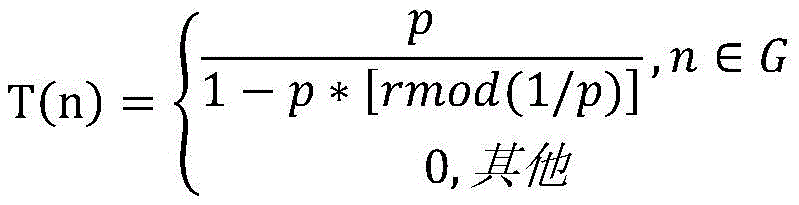
其中,p为预期的簇头百分比,在分簇开始前设定簇头产生概率p(0<p<1),r为当前轮数,G是最近1/p轮里没有成为簇头的节点的集合,mod为求余运算,rmod(1/p)表示r除以(1/p)的余数;Among them, p is the expected cluster head percentage, set the cluster head generation probability p (0<p<1) before clustering starts, r is the current number of rounds, and G is the node that has not become a cluster head in the last 1/p rounds The set of , mod is the remainder operation, and rmod(1/p) represents the remainder of dividing r by (1/p);
步骤3:节点成为预备簇头节点,生成0-100之间的随机整数A1,向通信范围内节点发送簇头竞争广播包,其中簇头竞争广播包中含有随机数A1,等待T1时间;若在T1时间内收到其他节点发送的簇头竞争广播包,则根据簇头竞争广播包内容,记录收到的随机数A2、A3、A4……An;若节点未收到簇头竞争广播包或者生成随机数A1≥A2、A3、A4……An,则进入步骤4;若节点生成随机数A1<A2、A3、A4……An,进入步骤5;Step 3: The node becomes a preparatory cluster head node, generates a random integer A 1 between 0 and 100, and sends a cluster head competition broadcast packet to the nodes within the communication range, wherein the cluster head competition broadcast packet contains a random number A 1 , waiting for T 1 time; if the cluster head competition broadcast packet sent by other nodes is received within the time T1, the received random numbers A 2 , A 3 , A 4 . . . A n are recorded according to the content of the cluster head competition broadcast packet ; if the node If the cluster head competition broadcast packet is not received or the random numbers A 1 ≥ A 2 , A 3 , A 4 ...... A n are generated, go to step 4; if the node generates random numbers A 1 <A 2 , A 3 , A 4 ...... ...A n , go to step 5;
步骤4:节点成为簇头节点,向通信范围内的节点发送簇头确认广播包,进入步骤7;Step 4: The node becomes the cluster head node, and sends the cluster head confirmation broadcast packet to the nodes within the communication range, and goes to step 7;
步骤5:节点成为预备簇成员节点,若收到簇头确认广播包的数量n=1,记录该簇头节点信息,成为簇成员节点;若收到的簇头确认广播包的数量n>1,记录所收到的簇头广播包所属簇头节点信息,加入信号强度最大的簇头确认广播包所属簇头节点簇群,成为网关节点,进入步骤7;若未收到簇头确认广播包,进入步骤6;Step 5: The node becomes a standby cluster member node. If the number of broadcast packets confirmed by the cluster head is n=1, the information of the cluster head node is recorded and becomes a cluster member node; if the number of broadcast packets received by the cluster head is n>1 , record the information of the cluster head node to which the received cluster head broadcast packet belongs, join the cluster head with the highest signal strength to confirm the cluster head node cluster to which the broadcast packet belongs, become the gateway node, and go to step 7; if the cluster head confirmation broadcast packet is not received , go to step 6;
步骤6:节点成为游离节点,发送超时应答包,若在T2时间内收到超时应答包,则判断超时应答包来源,若包含簇头,则选择信号最强的簇头超时应答包所属节点作为簇头,若不包含簇头,则进入步骤4;若在T2时间内未收到超时应答包,则重复步骤6;Step 6 : The node becomes a free node and sends a timeout response packet. If the timeout response packet is received within T2 time, the source of the timeout response packet is determined. If the cluster head is included, the node to which the cluster head timeout response packet with the strongest signal belongs is selected. As the cluster head, if the cluster head is not included, then go to step 4; if the timeout response packet is not received within T 2 time, repeat step 6;
步骤7:完成分簇过程后,节点若接收游离节点的超时广播包,则发送超时应答包;簇内节点之间采用TDMA(Time Division Multiple Access,时分多址),簇成员之间通过簇头转发的方式完成通信,其中簇内节点包括:簇头、簇成员节点;Step 7: After the clustering process is completed, if the node receives the timeout broadcast packet of the free node, it will send the timeout response packet; TDMA (Time Division Multiple Access, time division multiple access) is used between the nodes in the cluster, and the cluster members pass through the cluster head. The communication is completed by forwarding, wherein the nodes in the cluster include: the cluster head and the cluster member nodes;
步骤8:簇间节点采用CSMA/CA(Carrier Sense Multiple Access withCollision Avoid,带有冲突避免的载波侦听多路访问),簇间节点包括:簇头、网关节点,其中USV节点在通信过程中,若有发包任务,将在同一时刻,向水上网络发送无线电信号,向水下网络发送声波信号;USV节点将全程接收来自水上的无线电信号与水下的声信号;当某簇群所属节点需要与其他簇群节点进行通信时,由簇头节点在通信范围内向网络广播RREQ广播帧,其他节点第一次收到RREQ广播帧请求后,记录该RREQ广播帧源节点信息,判断自身是否为目的节点,若为目的节点,进入步骤10,否则进入步骤9;Step 8: The inter-cluster nodes use CSMA/CA (Carrier Sense Multiple Access with Collision Avoid, carrier sense multiple access with collision avoidance). The inter-cluster nodes include: the cluster head and the gateway node. The USV node is in the communication process. If there is a task of sending a package, it will send radio signals to the water network and acoustic signals to the underwater network at the same time; USV nodes will receive radio signals from the water and underwater acoustic signals throughout the process; when a node to which a cluster belongs needs to communicate with When other cluster nodes communicate, the cluster head node broadcasts the RREQ broadcast frame to the network within the communication range. After receiving the RREQ broadcast frame request for the first time, other nodes record the source node information of the RREQ broadcast frame to determine whether it is the destination node. , if it is the destination node, go to step 10, otherwise go to step 9;
由于节点只对第一次收到的RREQ广播帧进行记录、判断、与回应,故在链路建立时,当前环境下传输时效性最佳的链路将会成为本次通信的链路;(即在远距离通信任务下,水声-无线电-水声较水声-水声-水声的远距离多跳跨介质链路更易形成)。Since the node only records, judges, and responds to the RREQ broadcast frame received for the first time, when the link is established, the link with the best transmission timeliness in the current environment will become the link for this communication; ( That is, under the long-distance communication task, the underwater acoustic-radio-underwater sound is easier to form than the long-distance multi-hop cross-media link of underwater acoustics-underwater acoustics-underwater acoustics).
步骤9:若该节点为网关节点或簇头节点,则继续转发该RREQ路由请求;否则删除该条RREQ广播帧,释放存储空间;Step 9: if the node is a gateway node or a cluster head node, continue to forward the RREQ routing request; otherwise, delete the RREQ broadcast frame and release the storage space;
步骤10:目的节点生成RREP应答帧,广播至通信范围内节点,若其余节点收到RREP应答帧,判断该RREP应答帧单向链路节点是否为自身,若是,则向步骤8中记录的RREQ广播帧源节点信息发送RREP应答帧,完成反向路由链路建立;否则,删除该条RREP应答帧,释放存储空间;Step 10: The destination node generates a RREP response frame and broadcasts it to the nodes within the communication range. If the other nodes receive the RREP response frame, it is determined whether the one-way link node of the RREP response frame is itself; The source node information of the broadcast frame sends a RREP response frame to complete the establishment of the reverse routing link; otherwise, delete the RREP response frame and release the storage space;
步骤11:RREP应答帧发送至源节点,完成链路建立,源节点按照建立的链路发送数据包,完成通信;Step 11: The RREP response frame is sent to the source node to complete the link establishment, and the source node sends data packets according to the established link to complete the communication;
步骤12:等待T5时间,进入下一轮簇头选举,所有节点清除簇头、簇成员、网关身份,进入步骤1;Step 12 : Wait for T5 time, enter the next round of cluster head election, all nodes clear the cluster head, cluster member, gateway identities, and enter step 1;
其中,T3<T4<<T5。Wherein, T 3 <T 4 <<T 5 .
上述步骤1-步骤7算法流程图如图4所示。The algorithm flow chart of the above steps 1-7 is shown in FIG. 4 .
如上所述,本发明跨介质异构无人集群系统分簇路由方法,具有以下有益效果:As mentioned above, the present invention has the following beneficial effects:
1.本发明具备大规模跨介质异构无人集群系统组网功能,能够为大规模集群化的UAV、USV、UUV提供有效的跨介质组网方法。1. The present invention has a large-scale cross-media heterogeneous unmanned cluster system networking function, and can provide an effective cross-media networking method for large-scale clustered UAVs, USVs, and UUVs.
2.本发明具备跨介质异构无人集群系统分簇功能,能够使得空海环境下的不同节点根据自身特性完成自适应分簇,确定簇头节点、簇成员、网关节点。簇头节点的选举与轮换,能够有效均衡节点的网络负载,延长网络生存时间。2. The present invention has the clustering function of the cross-media heterogeneous unmanned swarm system, which enables different nodes in the air-sea environment to complete adaptive clustering according to their own characteristics, and determine the cluster head node, cluster member and gateway node. The election and rotation of cluster head nodes can effectively balance the network load of nodes and prolong the network lifetime.
3.本发明的分簇方法将使得USV优先完成分簇过程,并使得靠近“USV-簇头节点”的UAV节点更有可能成为“UAV-簇头节点”,靠近“USV-簇头节点”的UUV节点直接成为“UUV-簇头节点”,这将使得跨介质通信链路数量增多,提高跨介质通信的稳定性。3. The clustering method of the present invention will make the USV preferentially complete the clustering process, and make the UAV nodes close to the "USV-cluster head node" more likely to become the "UAV-cluster head node", close to the "USV-cluster head node". The UUV node directly becomes the "UUV-cluster head node", which will increase the number of cross-media communication links and improve the stability of cross-media communication.
4.本发明具备跨介质异构无人集群系统簇间与簇内路由功能,能够使得系统的路由开销降低,节点间通信的碰撞概率降低。由于USV的水上水下同时通信,链路建立时采用了时间优先的建立机制,能够使得水下节点有效利用空气介质中无线电信号性能优势建立跨介质通信链路,以提高远距离水下节点间通信的速率。4. The present invention has inter-cluster and intra-cluster routing functions in a cross-media heterogeneous unmanned cluster system, which can reduce the routing overhead of the system and reduce the collision probability of communication between nodes. Due to the simultaneous communication between the water and the water of the USV, the time-priority establishment mechanism is adopted when the link is established, which enables the underwater nodes to effectively use the radio signal performance advantages in the air medium to establish a cross-medium communication link, so as to improve the long-distance underwater nodes. rate of communication.
附图说明Description of drawings
图1为跨介质异构无人集群系统USV分簇示意图。Figure 1 is a schematic diagram of USV clustering in a cross-media heterogeneous unmanned swarm system.
图2为跨介质异构无人集群系统分簇完成示意图。Figure 2 is a schematic diagram of the completion of clustering of a cross-media heterogeneous unmanned swarm system.
图3为跨介质异构无人集群系统路由过程示意图。FIG. 3 is a schematic diagram of the routing process of the cross-media heterogeneous unmanned swarm system.
图4为跨介质异构无人集群系统分簇算法流程示意图。FIG. 4 is a schematic diagram of the clustering algorithm flow of the cross-media heterogeneous unmanned swarm system.
具体实施方式Detailed ways
为使本发明的目的、技术方法和优点更加清楚,下面结合实施方式和附图,对本发明作进一步地详细描述。In order to make the objectives, technical methods and advantages of the present invention clearer, the present invention will be further described in detail below with reference to the embodiments and accompanying drawings.
如图1所示,空海环境下,共存在3架UAV,4艘USV,6艘UUV。As shown in Figure 1, in the air-sea environment, there are 3 UAVs, 4 USVs, and 6 UUVs.
步骤1:节点判断自身类型,根据UAV,USV,UUV的分类执行下一步操作;Step 1: The node judges its own type and performs the next operation according to the classification of UAV, USV and UUV;
如果是USV节点则进入步骤2,且USV节点下列过程中,均同时产生无线电信号和声信号,实现水上和水下介质的全方位广播通信;If it is a USV node, go to step 2, and in the following processes of the USV node, both radio signals and acoustic signals are generated at the same time, so as to realize all-round broadcast communication between water and underwater media;
如果是UAV节点则在等待T3时间后,若收到来自USV的簇头确认广播包,则进入步骤3,若未收到USV的簇头确认广播包,则进入步骤2;If it is a UAV node, after waiting for T 3 time, if it receives the cluster head confirmation broadcast packet from the USV, then go to step 3, if it does not receive the cluster head confirmation broadcast packet of the USV, then go to step 2;
如果是UUV节点则在等待T4时间后,若收到来自USV的簇头确认广播包,则进入步骤4,若未收到USV的簇头确认广播包,则进入步骤2;If it is a UUV node, after waiting for T4 time, if it receives the cluster head confirmation broadcast packet from the USV, then go to step 4 , if it does not receive the cluster head confirmation broadcast packet from the USV, then go to step 2;
其中,T3<T4;Wherein, T 3 <T 4 ;
步骤2:节点优先进行分簇操作,随机产生0-1的随机数值,如果该数字小于阈值T(n),则成为步骤3,否则成为进入步骤5;Step 2: The node first performs the clustering operation, and randomly generates a random value of 0-1. If the number is less than the threshold T(n), it becomes step 3, otherwise it becomes step 5;
T(n)计算公式如下:The formula for calculating T(n) is as follows:

其中,p为预期的簇头百分比,设定簇头产生概率p=0.08,r为当前轮数,G是最近1/p轮里没有成为簇头的节点的集合,mod为求余运算,rmod(1/p)表示r除以(1/p)的余数;Among them, p is the expected cluster head percentage, set the cluster head generation probability p = 0.08, r is the current number of rounds, G is the set of nodes that have not become cluster heads in the last 1/p round, mod is the remainder operation, rmod (1/p) represents the remainder of dividing r by (1/p);
步骤3:节点成为预备簇头节点,生成0-100之间的随机整数A1,向通信范围内节点发送簇头竞争广播包,其中簇头竞争广播包中含有随机数A1,等待T1时间;若在T1时间内收到其他节点发送的簇头竞争广播包,则根据簇头竞争广播包内容,记录收到的随机数A2、A3、A4……An;若节点未收到簇头竞争广播包或者生成随机数A1≥A2、A3、A4……An,则进入步骤4;若节点生成随机数A1<A2、A3、A4……An,进入步骤5;Step 3: The node becomes a preparatory cluster head node, generates a random integer A 1 between 0 and 100, and sends a cluster head competition broadcast packet to the nodes within the communication range, wherein the cluster head competition broadcast packet contains a random number A 1 , waiting for T 1 time; if the cluster head competition broadcast packet sent by other nodes is received within T1 time, the received random numbers A 2 , A 3 , A 4 . . . A n are recorded according to the content of the cluster head competition broadcast packet ; if the node If the cluster head competition broadcast packet is not received or random numbers A 1 ≥ A 2 , A 3 , A 4 ...... An are generated, then go to step 4; if the node generates random numbers A 1 <A 2 , A 3 , A 4 ...... ...A n , go to step 5;
步骤4:节点成为簇头节点,向通信范围内的节点发送簇头确认广播包,进入步骤7;Step 4: The node becomes the cluster head node, and sends the cluster head confirmation broadcast packet to the nodes within the communication range, and goes to step 7;
步骤5:节点成为预备簇成员节点,若收到簇头确认广播包的数量n=1,记录该簇头节点信息,成为簇成员节点;若收到的簇头确认广播包的数量n>1,记录所收到的簇头广播包所属簇头节点信息,加入信号强度最大的簇头确认广播包所属簇头节点簇群,成为网关节点,进入步骤7;若未收到簇头确认广播包,进入步骤6;Step 5: The node becomes a standby cluster member node. If the number of broadcast packets confirmed by the cluster head is n=1, the information of the cluster head node is recorded and becomes a cluster member node; if the number of broadcast packets received by the cluster head is n>1 , record the information of the cluster head node to which the received cluster head broadcast packet belongs, join the cluster head with the highest signal strength to confirm the cluster head node cluster to which the broadcast packet belongs, become the gateway node, and go to step 7; if the cluster head confirmation broadcast packet is not received , go to step 6;
步骤6:节点成为游离节点,发送超时应答包,若在T2时间内收到超时应答包,则判断超时应答包来源,若包含簇头,则选择信号最强的簇头超时应答包所属节点作为簇头,若不包含簇头,则进入步骤4;若在T2时间内未收到超时应答包,则重复步骤6;Step 6 : The node becomes a free node and sends a timeout response packet. If the timeout response packet is received within T2 time, the source of the timeout response packet is determined. If the cluster head is included, the node to which the cluster head timeout response packet with the strongest signal belongs is selected. As a cluster head, if the cluster head is not included, then go to step 4; if the timeout response packet is not received within T 2 time, repeat step 6;
步骤7:如图2,完成分簇过程后,节点若接收游离节点的超时广播包,则发送超时应答包;簇内节点之间采用TDMA(Time Division Multiple Access,时分多址),簇成员之间通过簇头转发的方式完成通信,其中簇内节点包括:簇头、簇成员节点;Step 7: As shown in Figure 2, after the clustering process is completed, if the node receives the timeout broadcast packet of the free node, it will send the timeout response packet; TDMA (Time Division Multiple Access, time division multiple access) is used between nodes in the cluster, and the cluster members The communication is completed by means of cluster head forwarding, wherein the nodes in the cluster include: the cluster head and the cluster member nodes;
步骤8:簇间节点采用CSMA/CA(Carrier Sense Multiple Access withCollision Avoid,带有冲突避免的载波侦听多路访问),簇间节点包括:簇头、网关节点,其中USV节点在通信过程中,若有发包任务,将在同一时刻,向水上网络发送无线电信号,向水下网络发送声波信号;USV节点将全程接收来自水上的无线电信号与水下的声波信号;当某簇群所属节点需要与其他簇群节点进行通信时,由簇头节点在通信范围内向网络广播RREQ广播帧,其他节点第一次收到RREQ广播帧请求后,记录该RREQ广播帧源节点信息,判断自身是否为目的节点,若为目的节点,进入步骤10,否则进入步骤9;Step 8: The inter-cluster nodes use CSMA/CA (Carrier Sense Multiple Access with Collision Avoid, carrier sense multiple access with collision avoidance). The inter-cluster nodes include: the cluster head and the gateway node. The USV node is in the communication process. If there is a task of sending a package, it will send radio signals to the aquatic network and acoustic signals to the underwater network at the same time; the USV node will receive radio signals from the water and underwater acoustic signals throughout the process; when a node to which a cluster belongs needs to communicate with When other cluster nodes communicate, the cluster head node broadcasts the RREQ broadcast frame to the network within the communication range. After receiving the RREQ broadcast frame request for the first time, other nodes record the source node information of the RREQ broadcast frame to determine whether it is the destination node. , if it is the destination node, go to step 10, otherwise go to step 9;
由于节点只对第一次收到的RREQ广播帧进行记录、判断、与回应,故在链路建立时,当前环境下传输时效性最佳的链路将会成为本次通信的链路;(即在远距离通信任务下,水声-无线电-水声较水声-水声-水声的远距离多跳跨介质链路更易形成)。Since the node only records, judges, and responds to the RREQ broadcast frame received for the first time, when the link is established, the link with the best transmission timeliness in the current environment will become the link for this communication; ( That is, under the long-distance communication task, the underwater acoustic-radio-underwater sound is easier to form than the long-distance multi-hop cross-media link of underwater acoustics-underwater acoustics-underwater acoustics).
步骤9:若该节点为网关节点或簇头节点,则继续转发该RREQ路由请求;否则删除该条RREQ广播帧,释放存储空间;Step 9: if the node is a gateway node or a cluster head node, continue to forward the RREQ routing request; otherwise, delete the RREQ broadcast frame and release the storage space;
步骤10:目的节点生成RREP应答帧,广播至通信范围内节点,若其余节点收到RREP应答帧,判断该RREP应答帧单向链路节点是否为自身,若是,则向步骤8中记录的RREQ广播帧源节点信息发送RREP应答帧,完成反向路由链路建立;否则,删除该条RREP应答帧,释放存储空间;Step 10: The destination node generates a RREP response frame and broadcasts it to the nodes within the communication range. If the other nodes receive the RREP response frame, it is determined whether the one-way link node of the RREP response frame is itself; The source node information of the broadcast frame sends a RREP response frame to complete the establishment of the reverse routing link; otherwise, delete the RREP response frame and release the storage space;
步骤11:如图3,RREP应答帧发送至源节点,完成链路建立,源节点按照建立的链路发送数据包,完成通信;Step 11: As shown in Figure 3, the RREP response frame is sent to the source node to complete the link establishment, and the source node sends data packets according to the established link to complete the communication;
步骤12:等待T5时间,进入下一轮簇头选举,所有节点清除簇头、簇成员、网关身份,进入步骤1;Step 12 : Wait for T5 time, enter the next round of cluster head election, all nodes clear the cluster head, cluster member, gateway identities, and enter step 1;
其中,T3<T4<<T5;Wherein, T 3 <T 4 <<T 5 ;
上述步骤1-步骤7算法流程图如图4所示。The algorithm flow chart of the above steps 1-7 is shown in FIG. 4 .
本发明特点在于:The present invention is characterized in that:
步骤1中,USV节点在分簇路由过程中,同时采用水上无线电信道与水下声波信道参与分簇与路由过程;USV节点直接进入分簇过程,UAV节点与UUV节点,会等待对应时间后进入分簇过程;靠近“USV-簇头节点”的UAV节点更有可能成为“UAV-簇头节点”,靠近“USV-簇头节点”的UUV节点直接成为“UUV-簇头节点”,这将使得跨介质通信链路数量增多。In step 1, the USV node uses both the water radio channel and the underwater acoustic channel to participate in the clustering and routing process during the clustering routing process; the USV node directly enters the clustering process, and the UAV node and UUV node will wait for the corresponding time before entering. Clustering process; UAV nodes close to "USV-cluster head nodes" are more likely to become "UAV-cluster head nodes", and UUV nodes close to "USV-cluster head nodes" directly become "UUV-cluster head nodes", which will This increases the number of cross-media communication links.
步骤3中,节点会成为预备簇头节点,向通信范围内发送簇头节点竞争广播包,并根据接收的簇头节点竞争广播包内容区别,确定自身是否成为簇头或者预备簇头节点。In step 3, the node will become the preliminary cluster head node, send the cluster head node competition broadcast packet to the communication range, and determine whether it becomes the cluster head node or the preliminary cluster head node according to the difference of the content of the received cluster head node competition broadcast packet.
步骤5中,节点会成为预备簇成员节点,根据收到的簇头确认广播包数量,确定自身是否成为簇成员节点、网关节点、或者游离节点。In step 5, the node will become a standby cluster member node, and according to the number of received cluster head confirmation broadcast packets, determine whether it becomes a cluster member node, a gateway node, or a free node.
步骤6中,节点会成为游离节点,发送超时广播包,并等待其他节点回复超时应答包。In step 6, the node will become a free node, send timeout broadcast packets, and wait for other nodes to reply timeout response packets.
步骤8中,USV节点在通信过程中,若有发包任务,将在同一时刻,向水上网络发送无线电信号,向水下网络发送声波信号;USV节点将全程接收来自水上的无线电信号与水下的声波信号。节点只对第一次收到的RREQ广播帧进行记录、判断、与回应。In step 8, if the USV node has a packet sending task during the communication process, it will send radio signals to the water network and acoustic signals to the underwater network at the same time; the USV node will receive the radio signals from the water and the underwater network in the whole process. sonic signal. The node only records, judges, and responds to the RREQ broadcast frame received for the first time.
步骤9中,非目标的簇头节点与网关节点将会继续完成RREQ广播帧的转发任务,非目标的簇成员节点将不再参与该RREQ广播帧的转发任务。In step 9, the non-target cluster head node and gateway node will continue to complete the forwarding task of the RREQ broadcast frame, and the non-target cluster member nodes will no longer participate in the forwarding task of the RREQ broadcast frame.
步骤12中,等待T5时间,进入下一轮簇头选举,其等待时间的数值关系满足T3<T4<<T5。In step 12, wait for T 5 time, enter the next round of cluster head election, and the numerical relationship of the waiting time satisfies T 3 <T 4 <<T 5 .
Claims (1)

Priority Applications (1)
| Application Number | Priority Date | Filing Date | Title |
|---|---|---|---|
| CN202010288234.6A CN111586785B (en) | 2020-04-14 | 2020-04-14 | A clustering routing method for cross-media heterogeneous unmanned swarm system |
Applications Claiming Priority (1)
| Application Number | Priority Date | Filing Date | Title |
|---|---|---|---|
| CN202010288234.6A CN111586785B (en) | 2020-04-14 | 2020-04-14 | A clustering routing method for cross-media heterogeneous unmanned swarm system |
Publications (2)
| Publication Number | Publication Date |
|---|---|
| CN111586785A CN111586785A (en) | 2020-08-25 |
| CN111586785B true CN111586785B (en) | 2022-10-11 |
Family
ID=72118856
Family Applications (1)
| Application Number | Title | Priority Date | Filing Date |
|---|---|---|---|
| CN202010288234.6A Expired - Fee Related CN111586785B (en) | 2020-04-14 | 2020-04-14 | A clustering routing method for cross-media heterogeneous unmanned swarm system |
Country Status (1)
| Country | Link |
|---|---|
| CN (1) | CN111586785B (en) |
Families Citing this family (6)
| Publication number | Priority date | Publication date | Assignee | Title |
|---|---|---|---|---|
| CN113037804B (en) * | 2021-02-03 | 2022-09-20 | 中国人民解放军军事科学院国防科技创新研究院 | Heterogeneous unmanned cluster communication resource virtualization method and system |
| CN113037395B (en) * | 2021-02-25 | 2023-02-03 | 航天时代(青岛)海洋装备科技发展有限公司 | Overwater and underwater cross-domain unmanned equipment cooperative operation method |
| CN114326824B (en) * | 2022-03-16 | 2022-06-03 | 电子科技大学 | Heterogeneous high-density hybrid unmanned aerial vehicle cluster topology control method based on bionic algorithm |
| CN116170860B (en) * | 2023-04-20 | 2023-07-07 | 成都泰格微波技术股份有限公司 | Ad hoc network method for antenna ad hoc network system |
| CN118382120B (en) * | 2024-06-21 | 2024-10-25 | 中国电子科技集团公司第二十八研究所 | Method for constructing unmanned bee colony anti-destruction topological structure based on connected graph |
| CN119071876A (en) * | 2024-09-11 | 2024-12-03 | 电子科技大学 | An adaptive hierarchical clustering method for cross-domain communication networks |
Citations (10)
| Publication number | Priority date | Publication date | Assignee | Title |
|---|---|---|---|---|
| CN101835099A (en) * | 2010-04-23 | 2010-09-15 | 西安电子科技大学 | Routing Method for Large-Scale Sensor Networks Based on Clustering and RREP Broadcasting |
| CN104539374A (en) * | 2014-12-09 | 2015-04-22 | 桂林电子科技大学 | Hybrid networking method based on water surface sensor network-underwater sound sensor network |
| CN104792957A (en) * | 2015-03-31 | 2015-07-22 | 浙江理工大学 | Multi-parameter online water quality monitoring system and method based on wireless sensor network |
| WO2017030362A1 (en) * | 2015-08-18 | 2017-02-23 | 가천대학교 산학협력단 | Clustering method for wireless sensor network |
| CN107548029A (en) * | 2017-08-21 | 2018-01-05 | 河海大学常州校区 | AUV methods of data capture in a kind of underwater sensing network based on sea water stratification |
| CN108112048A (en) * | 2017-12-28 | 2018-06-01 | 重庆邮电大学 | Recognize a kind of efficiency route protocol based on stability in sensor network |
| CN109861762A (en) * | 2019-03-07 | 2019-06-07 | 哈尔滨工程大学 | A system and method for cross-media covert communication based on acousto-optic |
| WO2019125235A1 (en) * | 2017-12-18 | 2019-06-27 | Telefonaktiebolaget Lm Ericsson (Publ) | Methods and apparatus for wireless device communication |
| TW201926104A (en) * | 2017-12-01 | 2019-07-01 | 美商達奇威克士公司 | Systems and methods for operation of a secure unmanned vehicle ecosystem |
| CN110933641A (en) * | 2019-12-04 | 2020-03-27 | 山东省科学院海洋仪器仪表研究所 | Heterogeneous node cooperative sensing system and method for offshore self-organizing network |
Family Cites Families (2)
| Publication number | Priority date | Publication date | Assignee | Title |
|---|---|---|---|---|
| EP3395010B1 (en) * | 2015-12-26 | 2020-08-26 | Intel Corporation | Distributed framework for resilient machine-to-machine system management |
| US10524308B2 (en) * | 2018-05-31 | 2019-12-31 | Peyman Neamatollahi | Method for decentralized clustering in wireless sensor networks |
-
2020
- 2020-04-14 CN CN202010288234.6A patent/CN111586785B/en not_active Expired - Fee Related
Patent Citations (10)
| Publication number | Priority date | Publication date | Assignee | Title |
|---|---|---|---|---|
| CN101835099A (en) * | 2010-04-23 | 2010-09-15 | 西安电子科技大学 | Routing Method for Large-Scale Sensor Networks Based on Clustering and RREP Broadcasting |
| CN104539374A (en) * | 2014-12-09 | 2015-04-22 | 桂林电子科技大学 | Hybrid networking method based on water surface sensor network-underwater sound sensor network |
| CN104792957A (en) * | 2015-03-31 | 2015-07-22 | 浙江理工大学 | Multi-parameter online water quality monitoring system and method based on wireless sensor network |
| WO2017030362A1 (en) * | 2015-08-18 | 2017-02-23 | 가천대학교 산학협력단 | Clustering method for wireless sensor network |
| CN107548029A (en) * | 2017-08-21 | 2018-01-05 | 河海大学常州校区 | AUV methods of data capture in a kind of underwater sensing network based on sea water stratification |
| TW201926104A (en) * | 2017-12-01 | 2019-07-01 | 美商達奇威克士公司 | Systems and methods for operation of a secure unmanned vehicle ecosystem |
| WO2019125235A1 (en) * | 2017-12-18 | 2019-06-27 | Telefonaktiebolaget Lm Ericsson (Publ) | Methods and apparatus for wireless device communication |
| CN108112048A (en) * | 2017-12-28 | 2018-06-01 | 重庆邮电大学 | Recognize a kind of efficiency route protocol based on stability in sensor network |
| CN109861762A (en) * | 2019-03-07 | 2019-06-07 | 哈尔滨工程大学 | A system and method for cross-media covert communication based on acousto-optic |
| CN110933641A (en) * | 2019-12-04 | 2020-03-27 | 山东省科学院海洋仪器仪表研究所 | Heterogeneous node cooperative sensing system and method for offshore self-organizing network |
Non-Patent Citations (7)
| Title |
|---|
| An Application-Specific Protocol Architecture for Wireless Microsensor Networks;Wendi B. Heinzelman;《IEEE TRANSACTIONS ON WIRELESS COMMUNICATIONS》;20021231;全文 * |
| Development of Algal Bloom Removal System Using Unmanned Aerial Vehicle and Surface Vehicle;SUNGWOOK JUNG;《IEEE Access》;20171018;全文 * |
| Energy efficient dynamic clustering routing protocol in underwater wireless sensor networks;R.M. Gomathi;《Networking and Virtual Organisations》;20200131;全文 * |
| Lake trial of an underwater acoustic cross-media network testbed;Siyuan Zheng;《IEEE》;20171231;全文 * |
| Study on Dynamic Behavior of Unmanned Surface Vehicle-Linked Unmanned Underwater Vehicle System for Underwater Exploration;Mai The Vu;《Sensor》;20200229;全文 * |
| Unmanned Underwater Vehicle (UUV) Information Study;Yannick Allard;《TECHNOLOGIES》;20141128;全文 * |
| 跨介质通信系统链路设计;张锦灿;《声学技术》;20190430;全文 * |
Also Published As
| Publication number | Publication date |
|---|---|
| CN111586785A (en) | 2020-08-25 |
Similar Documents
| Publication | Publication Date | Title |
|---|---|---|
| CN111586785B (en) | A clustering routing method for cross-media heterogeneous unmanned swarm system | |
| Teekaraman et al. | Energy analysis on localization free routing protocols in UWSNs | |
| Khan et al. | A multi-layer cluster based energy efficient routing scheme for UWSNs | |
| CN101013926B (en) | Method and system for network communication of wireless sensor | |
| CN111065145A (en) | A Q-learning ant colony routing method for underwater multi-agents | |
| CN110519818B (en) | Cluster topology-based method for realizing opportunistic routing protocol of underwater acoustic sensor network | |
| CN111083758A (en) | High-energy-efficiency sound-electricity cooperative transmission network routing system and method | |
| CN113904735B (en) | Cross-medium networking communication equipment | |
| CN113438709B (en) | Network access method, device and system for marine ship equipment | |
| Qu et al. | In-band full-duplex communications for underwater acoustic networks | |
| CN115051759B (en) | A physical-layer acoustic-electric fusion cross-water-air interface/medium communication system and method | |
| CN110740487B (en) | An energy-efficient and obstacle-avoiding underwater routing method | |
| CN111278079A (en) | Hierarchical cooperative routing method and system for underwater self-organizing network | |
| Jiang et al. | Opportunistic hybrid routing protocol for acoustic-radio cooperative networks | |
| Doukkali et al. | Analysis of MAC protocols for underwater acoustic data networks | |
| Kumar et al. | A collision aware priority level medium access control protocol for underwater acoustic sensor networks | |
| Zheng et al. | Lake trial of an underwater acoustic cross-media network testbed | |
| Yang et al. | A mobility based architecture for underwater acoustic sensor networks | |
| CN116208929A (en) | A communication module, communication method and system for underwater environment perception | |
| CN115278771A (en) | Multi-hop underwater acoustic communication network conflict avoidance time slot allocation method | |
| Jin et al. | FCFS: A Dual-Channel and Reservation-Based MAC Protocol for Underwater Acoustic Networks | |
| Sajid et al. | SMPC: Singular division of multipath power control tree based routing protocol for underwater wireless sensor networks | |
| Xie et al. | TR-DBR: Cross-Layer Routing Protocol for Underwater Acoustic Sensor Networks Integrating TRMAC and DBR | |
| CN110337130B (en) | An Anti-jamming Green Underwater Flow Routing Method Based on Virtual Routing Holes | |
| CN119449688B (en) | Improved AODV routing method for marine cross-media acoustic and electrical cooperative networks |
Legal Events
| Date | Code | Title | Description |
|---|---|---|---|
| PB01 | Publication | ||
| PB01 | Publication | ||
| SE01 | Entry into force of request for substantive examination | ||
| SE01 | Entry into force of request for substantive examination | ||
| GR01 | Patent grant | ||
| GR01 | Patent grant | ||
| CF01 | Termination of patent right due to non-payment of annual fee |
Granted publication date: 20221011 |
|
| CF01 | Termination of patent right due to non-payment of annual fee |