CN111569159B - Ureteral catheter and preparation method thereof - Google Patents
Ureteral catheter and preparation method thereof Download PDFInfo
- Publication number
- CN111569159B CN111569159B CN201910117021.4A CN201910117021A CN111569159B CN 111569159 B CN111569159 B CN 111569159B CN 201910117021 A CN201910117021 A CN 201910117021A CN 111569159 B CN111569159 B CN 111569159B
- Authority
- CN
- China
- Prior art keywords
- ureteral catheter
- water
- photocurable polymer
- unit containing
- ureteral
- Prior art date
- Legal status (The legal status is an assumption and is not a legal conclusion. Google has not performed a legal analysis and makes no representation as to the accuracy of the status listed.)
- Active
Links
- 238000002360 preparation method Methods 0.000 title abstract description 5
- 230000001050 lubricating effect Effects 0.000 claims abstract description 41
- 230000000844 anti-bacterial effect Effects 0.000 claims abstract description 39
- 238000006243 chemical reaction Methods 0.000 claims abstract description 18
- 230000000845 anti-microbial effect Effects 0.000 claims abstract description 9
- 238000002425 crystallisation Methods 0.000 claims abstract description 5
- 230000008025 crystallization Effects 0.000 claims abstract description 5
- 238000001179 sorption measurement Methods 0.000 claims abstract description 5
- 238000007710 freezing Methods 0.000 claims abstract description 4
- 230000008014 freezing Effects 0.000 claims abstract description 4
- 239000000178 monomer Substances 0.000 claims description 56
- 229920000642 polymer Polymers 0.000 claims description 47
- 239000008199 coating composition Substances 0.000 claims description 24
- YMWUJEATGCHHMB-UHFFFAOYSA-N Dichloromethane Chemical compound ClCCl YMWUJEATGCHHMB-UHFFFAOYSA-N 0.000 claims description 21
- XLYOFNOQVPJJNP-UHFFFAOYSA-N water Substances O XLYOFNOQVPJJNP-UHFFFAOYSA-N 0.000 claims description 18
- 150000003242 quaternary ammonium salts Chemical group 0.000 claims description 16
- 239000002904 solvent Substances 0.000 claims description 16
- UHOVQNZJYSORNB-UHFFFAOYSA-N Benzene Chemical compound C1=CC=CC=C1 UHOVQNZJYSORNB-UHFFFAOYSA-N 0.000 claims description 15
- RTZKZFJDLAIYFH-UHFFFAOYSA-N Diethyl ether Chemical compound CCOCC RTZKZFJDLAIYFH-UHFFFAOYSA-N 0.000 claims description 15
- 239000003242 anti bacterial agent Substances 0.000 claims description 14
- LFQSCWFLJHTTHZ-UHFFFAOYSA-N Ethanol Chemical group CCO LFQSCWFLJHTTHZ-UHFFFAOYSA-N 0.000 claims description 13
- XEKOWRVHYACXOJ-UHFFFAOYSA-N Ethyl acetate Natural products CCOC(C)=O XEKOWRVHYACXOJ-UHFFFAOYSA-N 0.000 claims description 13
- CSCPPACGZOOCGX-UHFFFAOYSA-N Acetone Chemical compound CC(C)=O CSCPPACGZOOCGX-UHFFFAOYSA-N 0.000 claims description 12
- YXFVVABEGXRONW-UHFFFAOYSA-N Toluene Chemical compound CC1=CC=CC=C1 YXFVVABEGXRONW-UHFFFAOYSA-N 0.000 claims description 12
- -1 hydroxyalkyl ester Chemical class 0.000 claims description 12
- WHNWPMSKXPGLAX-UHFFFAOYSA-N N-Vinyl-2-pyrrolidone Chemical compound C=CN1CCCC1=O WHNWPMSKXPGLAX-UHFFFAOYSA-N 0.000 claims description 10
- IAZDPXIOMUYVGZ-UHFFFAOYSA-N Dimethylsulphoxide Chemical compound CS(C)=O IAZDPXIOMUYVGZ-UHFFFAOYSA-N 0.000 claims description 8
- FOIXSVOLVBLSDH-UHFFFAOYSA-N Silver ion Chemical compound [Ag+] FOIXSVOLVBLSDH-UHFFFAOYSA-N 0.000 claims description 8
- 125000000217 alkyl group Chemical group 0.000 claims description 8
- NIXOWILDQLNWCW-UHFFFAOYSA-M Acrylate Chemical compound [O-]C(=O)C=C NIXOWILDQLNWCW-UHFFFAOYSA-M 0.000 claims description 7
- HEDRZPFGACZZDS-UHFFFAOYSA-N Chloroform Chemical compound ClC(Cl)Cl HEDRZPFGACZZDS-UHFFFAOYSA-N 0.000 claims description 6
- VZCYOOQTPOCHFL-OWOJBTEDSA-N Fumaric acid Chemical compound OC(=O)\C=C\C(O)=O VZCYOOQTPOCHFL-OWOJBTEDSA-N 0.000 claims description 6
- 125000001246 bromo group Chemical group Br* 0.000 claims description 6
- VLKZOEOYAKHREP-UHFFFAOYSA-N hexane Substances CCCCCC VLKZOEOYAKHREP-UHFFFAOYSA-N 0.000 claims description 6
- FPYJFEHAWHCUMM-UHFFFAOYSA-N maleic anhydride Chemical compound O=C1OC(=O)C=C1 FPYJFEHAWHCUMM-UHFFFAOYSA-N 0.000 claims description 6
- 239000000463 material Substances 0.000 claims description 6
- VZCYOOQTPOCHFL-UHFFFAOYSA-N trans-butenedioic acid Natural products OC(=O)C=CC(O)=O VZCYOOQTPOCHFL-UHFFFAOYSA-N 0.000 claims description 6
- 229910052709 silver Inorganic materials 0.000 claims description 5
- 239000004332 silver Substances 0.000 claims description 5
- WHNPOQXWAMXPTA-UHFFFAOYSA-N 3-methylbut-2-enamide Chemical compound CC(C)=CC(N)=O WHNPOQXWAMXPTA-UHFFFAOYSA-N 0.000 claims description 4
- HRPVXLWXLXDGHG-UHFFFAOYSA-N Acrylamide Chemical compound NC(=O)C=C HRPVXLWXLXDGHG-UHFFFAOYSA-N 0.000 claims description 4
- XDTMQSROBMDMFD-UHFFFAOYSA-N Cyclohexane Chemical compound C1CCCCC1 XDTMQSROBMDMFD-UHFFFAOYSA-N 0.000 claims description 4
- FXHOOIRPVKKKFG-UHFFFAOYSA-N N,N-Dimethylacetamide Chemical compound CN(C)C(C)=O FXHOOIRPVKKKFG-UHFFFAOYSA-N 0.000 claims description 4
- ZMXDDKWLCZADIW-UHFFFAOYSA-N N,N-Dimethylformamide Chemical compound CN(C)C=O ZMXDDKWLCZADIW-UHFFFAOYSA-N 0.000 claims description 4
- CTQNGGLPUBDAKN-UHFFFAOYSA-N O-Xylene Chemical compound CC1=CC=CC=C1C CTQNGGLPUBDAKN-UHFFFAOYSA-N 0.000 claims description 4
- ISWSIDIOOBJBQZ-UHFFFAOYSA-N Phenol Chemical compound OC1=CC=CC=C1 ISWSIDIOOBJBQZ-UHFFFAOYSA-N 0.000 claims description 4
- BQCADISMDOOEFD-UHFFFAOYSA-N Silver Chemical compound [Ag] BQCADISMDOOEFD-UHFFFAOYSA-N 0.000 claims description 4
- 150000001408 amides Chemical class 0.000 claims description 4
- GDTBXPJZTBHREO-UHFFFAOYSA-N bromine Substances BrBr GDTBXPJZTBHREO-UHFFFAOYSA-N 0.000 claims description 4
- 229910052794 bromium Inorganic materials 0.000 claims description 4
- 229960001701 chloroform Drugs 0.000 claims description 4
- 229910052736 halogen Inorganic materials 0.000 claims description 4
- 239000008096 xylene Substances 0.000 claims description 4
- GAWIXWVDTYZWAW-UHFFFAOYSA-N C[CH]O Chemical group C[CH]O GAWIXWVDTYZWAW-UHFFFAOYSA-N 0.000 claims description 3
- CERQOIWHTDAKMF-UHFFFAOYSA-N Methacrylic acid Chemical compound CC(=C)C(O)=O CERQOIWHTDAKMF-UHFFFAOYSA-N 0.000 claims description 3
- OFOBLEOULBTSOW-UHFFFAOYSA-N Propanedioic acid Natural products OC(=O)CC(O)=O OFOBLEOULBTSOW-UHFFFAOYSA-N 0.000 claims description 3
- 239000004433 Thermoplastic polyurethane Substances 0.000 claims description 3
- XTXRWKRVRITETP-UHFFFAOYSA-N Vinyl acetate Chemical compound CC(=O)OC=C XTXRWKRVRITETP-UHFFFAOYSA-N 0.000 claims description 3
- 239000002253 acid Substances 0.000 claims description 3
- 150000007942 carboxylates Chemical class 0.000 claims description 3
- 150000001732 carboxylic acid derivatives Chemical class 0.000 claims description 3
- 150000001733 carboxylic acid esters Chemical class 0.000 claims description 3
- 229920001971 elastomer Polymers 0.000 claims description 3
- 239000000806 elastomer Substances 0.000 claims description 3
- 125000001495 ethyl group Chemical group [H]C([H])([H])C([H])([H])* 0.000 claims description 3
- 239000001530 fumaric acid Substances 0.000 claims description 3
- 229920001903 high density polyethylene Polymers 0.000 claims description 3
- 239000004700 high-density polyethylene Substances 0.000 claims description 3
- 150000003951 lactams Chemical class 0.000 claims description 3
- 229920000092 linear low density polyethylene Polymers 0.000 claims description 3
- 239000004707 linear low-density polyethylene Substances 0.000 claims description 3
- VZCYOOQTPOCHFL-UPHRSURJSA-N maleic acid Chemical compound OC(=O)\C=C/C(O)=O VZCYOOQTPOCHFL-UPHRSURJSA-N 0.000 claims description 3
- 239000011976 maleic acid Substances 0.000 claims description 3
- 125000002496 methyl group Chemical group [H]C([H])([H])* 0.000 claims description 3
- 239000005020 polyethylene terephthalate Substances 0.000 claims description 3
- 229920000139 polyethylene terephthalate Polymers 0.000 claims description 3
- 239000004800 polyvinyl chloride Substances 0.000 claims description 3
- 229920000915 polyvinyl chloride Polymers 0.000 claims description 3
- 238000007711 solidification Methods 0.000 claims description 3
- 230000008023 solidification Effects 0.000 claims description 3
- 229920002803 thermoplastic polyurethane Polymers 0.000 claims description 3
- 150000008064 anhydrides Chemical class 0.000 claims description 2
- 238000004519 manufacturing process Methods 0.000 claims description 2
- 125000005843 halogen group Chemical group 0.000 claims 1
- 238000000576 coating method Methods 0.000 abstract description 23
- 239000011248 coating agent Substances 0.000 abstract description 22
- 238000000016 photochemical curing Methods 0.000 abstract description 4
- 230000007774 longterm Effects 0.000 abstract description 2
- 229920001187 thermosetting polymer Polymers 0.000 abstract 1
- KFZMGEQAYNKOFK-UHFFFAOYSA-N Isopropanol Chemical compound CC(C)O KFZMGEQAYNKOFK-UHFFFAOYSA-N 0.000 description 12
- 238000000034 method Methods 0.000 description 12
- 239000000243 solution Substances 0.000 description 12
- 241000894006 Bacteria Species 0.000 description 9
- 239000007788 liquid Substances 0.000 description 9
- 210000000626 ureter Anatomy 0.000 description 9
- 238000001723 curing Methods 0.000 description 8
- 239000003999 initiator Substances 0.000 description 7
- 150000003254 radicals Chemical class 0.000 description 7
- 230000001954 sterilising effect Effects 0.000 description 7
- 238000004659 sterilization and disinfection Methods 0.000 description 7
- OZAIFHULBGXAKX-UHFFFAOYSA-N 2-(2-cyanopropan-2-yldiazenyl)-2-methylpropanenitrile Chemical compound N#CC(C)(C)N=NC(C)(C)C#N OZAIFHULBGXAKX-UHFFFAOYSA-N 0.000 description 6
- WEVYAHXRMPXWCK-UHFFFAOYSA-N Acetonitrile Chemical compound CC#N WEVYAHXRMPXWCK-UHFFFAOYSA-N 0.000 description 6
- LYCAIKOWRPUZTN-UHFFFAOYSA-N Ethylene glycol Chemical compound OCCO LYCAIKOWRPUZTN-UHFFFAOYSA-N 0.000 description 6
- PEDCQBHIVMGVHV-UHFFFAOYSA-N Glycerine Chemical compound OCC(O)CO PEDCQBHIVMGVHV-UHFFFAOYSA-N 0.000 description 6
- OKKJLVBELUTLKV-UHFFFAOYSA-N Methanol Chemical compound OC OKKJLVBELUTLKV-UHFFFAOYSA-N 0.000 description 6
- DNIAPMSPPWPWGF-UHFFFAOYSA-N Propylene glycol Chemical compound CC(O)CO DNIAPMSPPWPWGF-UHFFFAOYSA-N 0.000 description 6
- 206010038419 Renal colic Diseases 0.000 description 6
- 230000000694 effects Effects 0.000 description 6
- 239000000203 mixture Substances 0.000 description 6
- 239000000523 sample Substances 0.000 description 6
- 239000000126 substance Substances 0.000 description 6
- 238000012360 testing method Methods 0.000 description 6
- GJKGAPPUXSSCFI-UHFFFAOYSA-N 2-Hydroxy-4'-(2-hydroxyethoxy)-2-methylpropiophenone Chemical compound CC(C)(O)C(=O)C1=CC=C(OCCO)C=C1 GJKGAPPUXSSCFI-UHFFFAOYSA-N 0.000 description 5
- 239000000654 additive Substances 0.000 description 5
- 230000001580 bacterial effect Effects 0.000 description 5
- 125000001997 phenyl group Chemical group [H]C1=C([H])C([H])=C(*)C([H])=C1[H] 0.000 description 5
- 238000010526 radical polymerization reaction Methods 0.000 description 5
- 208000031868 Calculus ureteric Diseases 0.000 description 4
- LRHPLDYGYMQRHN-UHFFFAOYSA-N N-Butanol Chemical compound CCCCO LRHPLDYGYMQRHN-UHFFFAOYSA-N 0.000 description 4
- AMQJEAYHLZJPGS-UHFFFAOYSA-N N-Pentanol Chemical compound CCCCCO AMQJEAYHLZJPGS-UHFFFAOYSA-N 0.000 description 4
- 208000000014 Ureteral Calculi Diseases 0.000 description 4
- 125000002947 alkylene group Chemical group 0.000 description 4
- 239000001257 hydrogen Substances 0.000 description 4
- 229910052739 hydrogen Inorganic materials 0.000 description 4
- 230000000977 initiatory effect Effects 0.000 description 4
- 239000000047 product Substances 0.000 description 4
- 239000004094 surface-active agent Substances 0.000 description 4
- 238000004383 yellowing Methods 0.000 description 4
- ZMANZCXQSJIPKH-UHFFFAOYSA-N Triethylamine Chemical compound CCN(CC)CC ZMANZCXQSJIPKH-UHFFFAOYSA-N 0.000 description 3
- 239000004599 antimicrobial Substances 0.000 description 3
- 239000012965 benzophenone Substances 0.000 description 3
- 230000015572 biosynthetic process Effects 0.000 description 3
- 150000001875 compounds Chemical class 0.000 description 3
- 239000008367 deionised water Substances 0.000 description 3
- 229910021641 deionized water Inorganic materials 0.000 description 3
- 125000000524 functional group Chemical group 0.000 description 3
- 150000002367 halogens Chemical group 0.000 description 3
- 150000002431 hydrogen Chemical class 0.000 description 3
- 150000003384 small molecules Chemical class 0.000 description 3
- 238000001029 thermal curing Methods 0.000 description 3
- QNODIIQQMGDSEF-UHFFFAOYSA-N (1-hydroxycyclohexyl)-phenylmethanone Chemical compound C=1C=CC=CC=1C(=O)C1(O)CCCCC1 QNODIIQQMGDSEF-UHFFFAOYSA-N 0.000 description 2
- JHXJMPVUVKIGKC-UHFFFAOYSA-N 1-(4-tert-butylphenyl)-2-hydroxy-2-methylpropan-1-one Chemical compound CC(C)(C)C1=CC=C(C(=O)C(C)(C)O)C=C1 JHXJMPVUVKIGKC-UHFFFAOYSA-N 0.000 description 2
- QPXVRLXJHPTCPW-UHFFFAOYSA-N 2-hydroxy-2-methyl-1-(4-propan-2-ylphenyl)propan-1-one Chemical compound CC(C)C1=CC=C(C(=O)C(C)(C)O)C=C1 QPXVRLXJHPTCPW-UHFFFAOYSA-N 0.000 description 2
- XMLYCEVDHLAQEL-UHFFFAOYSA-N 2-hydroxy-2-methyl-1-phenylpropan-1-one Chemical compound CC(C)(O)C(=O)C1=CC=CC=C1 XMLYCEVDHLAQEL-UHFFFAOYSA-N 0.000 description 2
- IAYPIBMASNFSPL-UHFFFAOYSA-N Ethylene oxide Chemical compound C1CO1 IAYPIBMASNFSPL-UHFFFAOYSA-N 0.000 description 2
- VEXZGXHMUGYJMC-UHFFFAOYSA-N Hydrochloric acid Chemical compound Cl VEXZGXHMUGYJMC-UHFFFAOYSA-N 0.000 description 2
- QIGBRXMKCJKVMJ-UHFFFAOYSA-N Hydroquinone Chemical compound OC1=CC=C(O)C=C1 QIGBRXMKCJKVMJ-UHFFFAOYSA-N 0.000 description 2
- 239000000980 acid dye Substances 0.000 description 2
- 150000001298 alcohols Chemical class 0.000 description 2
- 239000007864 aqueous solution Substances 0.000 description 2
- RWCCWEUUXYIKHB-UHFFFAOYSA-N benzophenone Chemical compound C=1C=CC=CC=1C(=O)C1=CC=CC=C1 RWCCWEUUXYIKHB-UHFFFAOYSA-N 0.000 description 2
- 125000002915 carbonyl group Chemical group [*:2]C([*:1])=O 0.000 description 2
- 239000003795 chemical substances by application Substances 0.000 description 2
- 239000003086 colorant Substances 0.000 description 2
- 238000004440 column chromatography Methods 0.000 description 2
- 238000005336 cracking Methods 0.000 description 2
- 239000012043 crude product Substances 0.000 description 2
- 230000007547 defect Effects 0.000 description 2
- 239000003599 detergent Substances 0.000 description 2
- 238000003618 dip coating Methods 0.000 description 2
- 239000012949 free radical photoinitiator Substances 0.000 description 2
- 238000010528 free radical solution polymerization reaction Methods 0.000 description 2
- 238000010438 heat treatment Methods 0.000 description 2
- 210000003734 kidney Anatomy 0.000 description 2
- 239000000314 lubricant Substances 0.000 description 2
- 150000007523 nucleic acids Chemical class 0.000 description 2
- 102000039446 nucleic acids Human genes 0.000 description 2
- 108020004707 nucleic acids Proteins 0.000 description 2
- 125000004430 oxygen atom Chemical group O* 0.000 description 2
- 239000000049 pigment Substances 0.000 description 2
- 229920000867 polyelectrolyte Polymers 0.000 description 2
- 229920002635 polyurethane Polymers 0.000 description 2
- 239000004814 polyurethane Substances 0.000 description 2
- 230000008569 process Effects 0.000 description 2
- 239000011347 resin Substances 0.000 description 2
- 229920005989 resin Polymers 0.000 description 2
- YGSDEFSMJLZEOE-UHFFFAOYSA-N salicylic acid Chemical group OC(=O)C1=CC=CC=C1O YGSDEFSMJLZEOE-UHFFFAOYSA-N 0.000 description 2
- 238000002791 soaking Methods 0.000 description 2
- 239000000344 soap Substances 0.000 description 2
- 239000007787 solid Substances 0.000 description 2
- 238000003786 synthesis reaction Methods 0.000 description 2
- 238000010998 test method Methods 0.000 description 2
- 239000002562 thickening agent Substances 0.000 description 2
- 238000002627 tracheal intubation Methods 0.000 description 2
- 239000001993 wax Substances 0.000 description 2
- 238000009736 wetting Methods 0.000 description 2
- 239000000080 wetting agent Substances 0.000 description 2
- HJIAMFHSAAEUKR-UHFFFAOYSA-N (2-hydroxyphenyl)-phenylmethanone Chemical compound OC1=CC=CC=C1C(=O)C1=CC=CC=C1 HJIAMFHSAAEUKR-UHFFFAOYSA-N 0.000 description 1
- 238000005160 1H NMR spectroscopy Methods 0.000 description 1
- SMZOUWXMTYCWNB-UHFFFAOYSA-N 2-(2-methoxy-5-methylphenyl)ethanamine Chemical compound COC1=CC=C(C)C=C1CCN SMZOUWXMTYCWNB-UHFFFAOYSA-N 0.000 description 1
- JKNCOURZONDCGV-UHFFFAOYSA-N 2-(dimethylamino)ethyl 2-methylprop-2-enoate Chemical compound CN(C)CCOC(=O)C(C)=C JKNCOURZONDCGV-UHFFFAOYSA-N 0.000 description 1
- NIXOWILDQLNWCW-UHFFFAOYSA-N 2-Propenoic acid Natural products OC(=O)C=C NIXOWILDQLNWCW-UHFFFAOYSA-N 0.000 description 1
- LSTRKXWIZZZYAS-UHFFFAOYSA-N 2-bromoacetyl bromide Chemical compound BrCC(Br)=O LSTRKXWIZZZYAS-UHFFFAOYSA-N 0.000 description 1
- OMIGHNLMNHATMP-UHFFFAOYSA-N 2-hydroxyethyl prop-2-enoate Chemical compound OCCOC(=O)C=C OMIGHNLMNHATMP-UHFFFAOYSA-N 0.000 description 1
- FRIBMENBGGCKPD-UHFFFAOYSA-N 3-(2,3-dimethoxyphenyl)prop-2-enal Chemical compound COC1=CC=CC(C=CC=O)=C1OC FRIBMENBGGCKPD-UHFFFAOYSA-N 0.000 description 1
- 239000004342 Benzoyl peroxide Substances 0.000 description 1
- OMPJBNCRMGITSC-UHFFFAOYSA-N Benzoylperoxide Chemical compound C=1C=CC=CC=1C(=O)OOC(=O)C1=CC=CC=C1 OMPJBNCRMGITSC-UHFFFAOYSA-N 0.000 description 1
- 229910014033 C-OH Inorganic materials 0.000 description 1
- 125000006577 C1-C6 hydroxyalkyl group Chemical group 0.000 description 1
- BVKZGUZCCUSVTD-UHFFFAOYSA-L Carbonate Chemical compound [O-]C([O-])=O BVKZGUZCCUSVTD-UHFFFAOYSA-L 0.000 description 1
- 201000006306 Cor pulmonale Diseases 0.000 description 1
- 229910014570 C—OH Inorganic materials 0.000 description 1
- 108010043121 Green Fluorescent Proteins Proteins 0.000 description 1
- UFHFLCQGNIYNRP-UHFFFAOYSA-N Hydrogen Chemical compound [H][H] UFHFLCQGNIYNRP-UHFFFAOYSA-N 0.000 description 1
- CSNNHWWHGAXBCP-UHFFFAOYSA-L Magnesium sulfate Chemical compound [Mg+2].[O-][S+2]([O-])([O-])[O-] CSNNHWWHGAXBCP-UHFFFAOYSA-L 0.000 description 1
- BAPJBEWLBFYGME-UHFFFAOYSA-N Methyl acrylate Chemical compound COC(=O)C=C BAPJBEWLBFYGME-UHFFFAOYSA-N 0.000 description 1
- 229910002651 NO3 Inorganic materials 0.000 description 1
- NHNBFGGVMKEFGY-UHFFFAOYSA-N Nitrate Chemical compound [O-][N+]([O-])=O NHNBFGGVMKEFGY-UHFFFAOYSA-N 0.000 description 1
- 208000002193 Pain Diseases 0.000 description 1
- 206010036595 Premature delivery Diseases 0.000 description 1
- 208000001647 Renal Insufficiency Diseases 0.000 description 1
- 206010040047 Sepsis Diseases 0.000 description 1
- UIIMBOGNXHQVGW-UHFFFAOYSA-M Sodium bicarbonate Chemical class [Na+].OC([O-])=O UIIMBOGNXHQVGW-UHFFFAOYSA-M 0.000 description 1
- 244000028419 Styrax benzoin Species 0.000 description 1
- 235000000126 Styrax benzoin Nutrition 0.000 description 1
- 235000008411 Sumatra benzointree Nutrition 0.000 description 1
- 206010000210 abortion Diseases 0.000 description 1
- 231100000176 abortion Toxicity 0.000 description 1
- 150000008065 acid anhydrides Chemical class 0.000 description 1
- 230000004913 activation Effects 0.000 description 1
- 230000001154 acute effect Effects 0.000 description 1
- 150000001266 acyl halides Chemical class 0.000 description 1
- 150000001412 amines Chemical class 0.000 description 1
- 238000000149 argon plasma sintering Methods 0.000 description 1
- 125000003118 aryl group Chemical group 0.000 description 1
- QVGXLLKOCUKJST-UHFFFAOYSA-N atomic oxygen Chemical compound [O] QVGXLLKOCUKJST-UHFFFAOYSA-N 0.000 description 1
- 125000000751 azo group Chemical group [*]N=N[*] 0.000 description 1
- 230000009286 beneficial effect Effects 0.000 description 1
- 229960002130 benzoin Drugs 0.000 description 1
- 235000019400 benzoyl peroxide Nutrition 0.000 description 1
- 230000002146 bilateral effect Effects 0.000 description 1
- 239000012620 biological material Substances 0.000 description 1
- 230000001680 brushing effect Effects 0.000 description 1
- 238000012662 bulk polymerization Methods 0.000 description 1
- 238000004364 calculation method Methods 0.000 description 1
- 229910052799 carbon Inorganic materials 0.000 description 1
- 125000004432 carbon atom Chemical group C* 0.000 description 1
- 230000008859 change Effects 0.000 description 1
- 125000003636 chemical group Chemical group 0.000 description 1
- 239000013626 chemical specie Substances 0.000 description 1
- 230000001684 chronic effect Effects 0.000 description 1
- 230000000536 complexating effect Effects 0.000 description 1
- 238000010276 construction Methods 0.000 description 1
- 238000001816 cooling Methods 0.000 description 1
- 238000007334 copolymerization reaction Methods 0.000 description 1
- 238000012258 culturing Methods 0.000 description 1
- 125000004093 cyano group Chemical group *C#N 0.000 description 1
- 125000000113 cyclohexyl group Chemical group [H]C1([H])C([H])([H])C([H])([H])C([H])(*)C([H])([H])C1([H])[H] 0.000 description 1
- 230000006378 damage Effects 0.000 description 1
- 238000006356 dehydrogenation reaction Methods 0.000 description 1
- 238000001212 derivatisation Methods 0.000 description 1
- ISAOCJYIOMOJEB-UHFFFAOYSA-N desyl alcohol Natural products C=1C=CC=CC=1C(O)C(=O)C1=CC=CC=C1 ISAOCJYIOMOJEB-UHFFFAOYSA-N 0.000 description 1
- 206010012601 diabetes mellitus Diseases 0.000 description 1
- 201000010099 disease Diseases 0.000 description 1
- 208000037265 diseases, disorders, signs and symptoms Diseases 0.000 description 1
- 238000004090 dissolution Methods 0.000 description 1
- 238000009826 distribution Methods 0.000 description 1
- 239000003814 drug Substances 0.000 description 1
- 229940079593 drug Drugs 0.000 description 1
- 238000001035 drying Methods 0.000 description 1
- 239000000975 dye Substances 0.000 description 1
- 238000004043 dyeing Methods 0.000 description 1
- 239000003480 eluent Substances 0.000 description 1
- 239000000839 emulsion Substances 0.000 description 1
- 238000007720 emulsion polymerization reaction Methods 0.000 description 1
- 230000007613 environmental effect Effects 0.000 description 1
- 230000002349 favourable effect Effects 0.000 description 1
- 239000007850 fluorescent dye Substances 0.000 description 1
- 235000019382 gum benzoic Nutrition 0.000 description 1
- 239000012456 homogeneous solution Substances 0.000 description 1
- 150000002432 hydroperoxides Chemical class 0.000 description 1
- 239000005457 ice water Substances 0.000 description 1
- 238000005286 illumination Methods 0.000 description 1
- 208000015181 infectious disease Diseases 0.000 description 1
- 230000003993 interaction Effects 0.000 description 1
- 238000012688 inverse emulsion polymerization Methods 0.000 description 1
- 230000007794 irritation Effects 0.000 description 1
- 239000012948 isocyanate Substances 0.000 description 1
- 150000002513 isocyanates Chemical class 0.000 description 1
- 201000006370 kidney failure Diseases 0.000 description 1
- 210000000244 kidney pelvis Anatomy 0.000 description 1
- 239000004816 latex Substances 0.000 description 1
- 229920000126 latex Polymers 0.000 description 1
- 238000005461 lubrication Methods 0.000 description 1
- 238000005259 measurement Methods 0.000 description 1
- 238000010907 mechanical stirring Methods 0.000 description 1
- QSHDDOUJBYECFT-UHFFFAOYSA-N mercury Chemical compound [Hg] QSHDDOUJBYECFT-UHFFFAOYSA-N 0.000 description 1
- 229910052753 mercury Inorganic materials 0.000 description 1
- 230000005012 migration Effects 0.000 description 1
- 238000013508 migration Methods 0.000 description 1
- 239000012046 mixed solvent Substances 0.000 description 1
- 238000002156 mixing Methods 0.000 description 1
- 239000002105 nanoparticle Substances 0.000 description 1
- QJGQUHMNIGDVPM-UHFFFAOYSA-N nitrogen group Chemical group [N] QJGQUHMNIGDVPM-UHFFFAOYSA-N 0.000 description 1
- 230000003287 optical effect Effects 0.000 description 1
- 150000001451 organic peroxides Chemical class 0.000 description 1
- 239000001301 oxygen Substances 0.000 description 1
- 229910052760 oxygen Inorganic materials 0.000 description 1
- FJKROLUGYXJWQN-UHFFFAOYSA-N papa-hydroxy-benzoic acid Natural products OC(=O)C1=CC=C(O)C=C1 FJKROLUGYXJWQN-UHFFFAOYSA-N 0.000 description 1
- 238000011056 performance test Methods 0.000 description 1
- 230000000144 pharmacologic effect Effects 0.000 description 1
- 238000000053 physical method Methods 0.000 description 1
- 238000006116 polymerization reaction Methods 0.000 description 1
- 239000002244 precipitate Substances 0.000 description 1
- BWJUFXUULUEGMA-UHFFFAOYSA-N propan-2-yl propan-2-yloxycarbonyloxy carbonate Chemical compound CC(C)OC(=O)OOC(=O)OC(C)C BWJUFXUULUEGMA-UHFFFAOYSA-N 0.000 description 1
- 108090000623 proteins and genes Proteins 0.000 description 1
- 102000004169 proteins and genes Human genes 0.000 description 1
- 230000005855 radiation Effects 0.000 description 1
- 238000003847 radiation curing Methods 0.000 description 1
- 238000011084 recovery Methods 0.000 description 1
- 230000009467 reduction Effects 0.000 description 1
- 230000008085 renal dysfunction Effects 0.000 description 1
- 230000002441 reversible effect Effects 0.000 description 1
- 229960004889 salicylic acid Drugs 0.000 description 1
- 230000035939 shock Effects 0.000 description 1
- 238000001542 size-exclusion chromatography Methods 0.000 description 1
- HPALAKNZSZLMCH-UHFFFAOYSA-M sodium;chloride;hydrate Chemical class O.[Na+].[Cl-] HPALAKNZSZLMCH-UHFFFAOYSA-M 0.000 description 1
- 230000007928 solubilization Effects 0.000 description 1
- 238000005063 solubilization Methods 0.000 description 1
- 238000001228 spectrum Methods 0.000 description 1
- 238000009987 spinning Methods 0.000 description 1
- 238000005507 spraying Methods 0.000 description 1
- 239000004575 stone Substances 0.000 description 1
- 125000001424 substituent group Chemical group 0.000 description 1
- 150000003457 sulfones Chemical class 0.000 description 1
- 150000003462 sulfoxides Chemical class 0.000 description 1
- 238000010557 suspension polymerization reaction Methods 0.000 description 1
- 238000002636 symptomatic treatment Methods 0.000 description 1
- 238000010345 tape casting Methods 0.000 description 1
- GJBRNHKUVLOCEB-UHFFFAOYSA-N tert-butyl benzenecarboperoxoate Chemical compound CC(C)(C)OOC(=O)C1=CC=CC=C1 GJBRNHKUVLOCEB-UHFFFAOYSA-N 0.000 description 1
- 150000003512 tertiary amines Chemical group 0.000 description 1
- 150000003568 thioethers Chemical class 0.000 description 1
- 230000001988 toxicity Effects 0.000 description 1
- 231100000419 toxicity Toxicity 0.000 description 1
- 238000012546 transfer Methods 0.000 description 1
- 230000007704 transition Effects 0.000 description 1
- WFKWXMTUELFFGS-UHFFFAOYSA-N tungsten Chemical compound [W] WFKWXMTUELFFGS-UHFFFAOYSA-N 0.000 description 1
- 229910052721 tungsten Inorganic materials 0.000 description 1
- 239000010937 tungsten Substances 0.000 description 1
- 210000003708 urethra Anatomy 0.000 description 1
- 229910052724 xenon Inorganic materials 0.000 description 1
- FHNFHKCVQCLJFQ-UHFFFAOYSA-N xenon atom Chemical compound [Xe] FHNFHKCVQCLJFQ-UHFFFAOYSA-N 0.000 description 1
Images


Classifications
-
- A—HUMAN NECESSITIES
- A61—MEDICAL OR VETERINARY SCIENCE; HYGIENE
- A61L—METHODS OR APPARATUS FOR STERILISING MATERIALS OR OBJECTS IN GENERAL; DISINFECTION, STERILISATION OR DEODORISATION OF AIR; CHEMICAL ASPECTS OF BANDAGES, DRESSINGS, ABSORBENT PADS OR SURGICAL ARTICLES; MATERIALS FOR BANDAGES, DRESSINGS, ABSORBENT PADS OR SURGICAL ARTICLES
- A61L29/00—Materials for catheters, medical tubing, cannulae, or endoscopes or for coating catheters
- A61L29/08—Materials for coatings
- A61L29/085—Macromolecular materials
-
- A—HUMAN NECESSITIES
- A61—MEDICAL OR VETERINARY SCIENCE; HYGIENE
- A61L—METHODS OR APPARATUS FOR STERILISING MATERIALS OR OBJECTS IN GENERAL; DISINFECTION, STERILISATION OR DEODORISATION OF AIR; CHEMICAL ASPECTS OF BANDAGES, DRESSINGS, ABSORBENT PADS OR SURGICAL ARTICLES; MATERIALS FOR BANDAGES, DRESSINGS, ABSORBENT PADS OR SURGICAL ARTICLES
- A61L29/00—Materials for catheters, medical tubing, cannulae, or endoscopes or for coating catheters
- A61L29/08—Materials for coatings
- A61L29/10—Inorganic materials
- A61L29/106—Inorganic materials other than carbon
-
- A—HUMAN NECESSITIES
- A61—MEDICAL OR VETERINARY SCIENCE; HYGIENE
- A61L—METHODS OR APPARATUS FOR STERILISING MATERIALS OR OBJECTS IN GENERAL; DISINFECTION, STERILISATION OR DEODORISATION OF AIR; CHEMICAL ASPECTS OF BANDAGES, DRESSINGS, ABSORBENT PADS OR SURGICAL ARTICLES; MATERIALS FOR BANDAGES, DRESSINGS, ABSORBENT PADS OR SURGICAL ARTICLES
- A61L29/00—Materials for catheters, medical tubing, cannulae, or endoscopes or for coating catheters
- A61L29/14—Materials characterised by their function or physical properties, e.g. lubricating compositions
- A61L29/16—Biologically active materials, e.g. therapeutic substances
-
- A—HUMAN NECESSITIES
- A61—MEDICAL OR VETERINARY SCIENCE; HYGIENE
- A61L—METHODS OR APPARATUS FOR STERILISING MATERIALS OR OBJECTS IN GENERAL; DISINFECTION, STERILISATION OR DEODORISATION OF AIR; CHEMICAL ASPECTS OF BANDAGES, DRESSINGS, ABSORBENT PADS OR SURGICAL ARTICLES; MATERIALS FOR BANDAGES, DRESSINGS, ABSORBENT PADS OR SURGICAL ARTICLES
- A61L2300/00—Biologically active materials used in bandages, wound dressings, absorbent pads or medical devices
- A61L2300/10—Biologically active materials used in bandages, wound dressings, absorbent pads or medical devices containing or releasing inorganic materials
- A61L2300/102—Metals or metal compounds, e.g. salts such as bicarbonates, carbonates, oxides, zeolites, silicates
- A61L2300/104—Silver, e.g. silver sulfadiazine
-
- A—HUMAN NECESSITIES
- A61—MEDICAL OR VETERINARY SCIENCE; HYGIENE
- A61L—METHODS OR APPARATUS FOR STERILISING MATERIALS OR OBJECTS IN GENERAL; DISINFECTION, STERILISATION OR DEODORISATION OF AIR; CHEMICAL ASPECTS OF BANDAGES, DRESSINGS, ABSORBENT PADS OR SURGICAL ARTICLES; MATERIALS FOR BANDAGES, DRESSINGS, ABSORBENT PADS OR SURGICAL ARTICLES
- A61L2300/00—Biologically active materials used in bandages, wound dressings, absorbent pads or medical devices
- A61L2300/40—Biologically active materials used in bandages, wound dressings, absorbent pads or medical devices characterised by a specific therapeutic activity or mode of action
- A61L2300/404—Biocides, antimicrobial agents, antiseptic agents
-
- A—HUMAN NECESSITIES
- A61—MEDICAL OR VETERINARY SCIENCE; HYGIENE
- A61L—METHODS OR APPARATUS FOR STERILISING MATERIALS OR OBJECTS IN GENERAL; DISINFECTION, STERILISATION OR DEODORISATION OF AIR; CHEMICAL ASPECTS OF BANDAGES, DRESSINGS, ABSORBENT PADS OR SURGICAL ARTICLES; MATERIALS FOR BANDAGES, DRESSINGS, ABSORBENT PADS OR SURGICAL ARTICLES
- A61L2300/00—Biologically active materials used in bandages, wound dressings, absorbent pads or medical devices
- A61L2300/60—Biologically active materials used in bandages, wound dressings, absorbent pads or medical devices characterised by a special physical form
- A61L2300/602—Type of release, e.g. controlled, sustained, slow
-
- A—HUMAN NECESSITIES
- A61—MEDICAL OR VETERINARY SCIENCE; HYGIENE
- A61L—METHODS OR APPARATUS FOR STERILISING MATERIALS OR OBJECTS IN GENERAL; DISINFECTION, STERILISATION OR DEODORISATION OF AIR; CHEMICAL ASPECTS OF BANDAGES, DRESSINGS, ABSORBENT PADS OR SURGICAL ARTICLES; MATERIALS FOR BANDAGES, DRESSINGS, ABSORBENT PADS OR SURGICAL ARTICLES
- A61L2300/00—Biologically active materials used in bandages, wound dressings, absorbent pads or medical devices
- A61L2300/60—Biologically active materials used in bandages, wound dressings, absorbent pads or medical devices characterised by a special physical form
- A61L2300/606—Coatings
-
- A—HUMAN NECESSITIES
- A61—MEDICAL OR VETERINARY SCIENCE; HYGIENE
- A61L—METHODS OR APPARATUS FOR STERILISING MATERIALS OR OBJECTS IN GENERAL; DISINFECTION, STERILISATION OR DEODORISATION OF AIR; CHEMICAL ASPECTS OF BANDAGES, DRESSINGS, ABSORBENT PADS OR SURGICAL ARTICLES; MATERIALS FOR BANDAGES, DRESSINGS, ABSORBENT PADS OR SURGICAL ARTICLES
- A61L2420/00—Materials or methods for coatings medical devices
- A61L2420/06—Coatings containing a mixture of two or more compounds
Landscapes
- Health & Medical Sciences (AREA)
- Life Sciences & Earth Sciences (AREA)
- General Health & Medical Sciences (AREA)
- Epidemiology (AREA)
- Animal Behavior & Ethology (AREA)
- Public Health (AREA)
- Veterinary Medicine (AREA)
- Chemical & Material Sciences (AREA)
- Inorganic Chemistry (AREA)
- Engineering & Computer Science (AREA)
- Biomedical Technology (AREA)
- Medicinal Chemistry (AREA)
- Molecular Biology (AREA)
- Materials For Medical Uses (AREA)
Abstract
The invention relates to a ureteral catheter and a preparation method thereof. The ureteral catheter has at least one lubricious antimicrobial layer formed on a surface thereof. Preferably, the lubricating antibacterial layer is formed by means of photocuring, thermosetting, chemical reaction, physical adsorption, crystallization or freezing. The ureteral catheter has good long-term hydrophilic lubricating property, high-efficiency antibacterial property, excellent biological safety, high surface coating firmness and uniform coating.
Description
Technical Field
The invention belongs to the field of medical appliances, and particularly relates to the field of ureteral catheters with lubricating antibacterial layers.
Background
Ureteral calculus with intractable renal colic is very common clinically. Part of patients with ureteral calculus and renal colic have inaccurate curative effect due to conventional treatment, renal dysfunction and urogenic sepsis can be caused when the recovery drainage of the affected side kidney is not timely during renal colic, renal failure can be caused by bilateral ureteral calculus and isolated renal colic, the renal colic of pregnant women can cause abortion and premature delivery, and patients with renal colic complicated with basic diseases such as diabetes, chronic cardiopulmonary disease and the like can suffer from urogenic shock and death. Except symptomatic treatment and drug stone removal, ureteroscope lithotripsy and nephrocentesis fistulization drainage, reverse ureteral intubation drainage under a cystoscope and indwelling endoureteral stent are also common operations in the treatment of patients with acute ureteral calculus obstruction. The conventional ureter retrograde intubation and the indwelling internal stent under the cystoscope can realize drainage of part of the kidney and ureter of a patient to relieve the pain of the patient. Ureteral catheters are typically placed in the renal pelvis using a cystoscope and are passed out through the urethra, and invasive procedures during placement sometimes cause some damage to surrounding tissues, and after placement, they are prone to sloughing and often become a source of infection. Thus, a lubricious and antimicrobial treatment of the ureteral catheter is required.
In the prior art, the lubrication and antibacterial treatment of the surface of the ureteral catheter has not been applied on a large scale, and the patents on the surface are less.
Acta biomaterials, 2012,8, 1869-1880 exemplifies the construction of an antimicrobial coating on a urological catheter by dip coating the surface with a layer of salicylic acid-bearing polyurethane, but since it is a physical method of constructing a functional coating on the catheter surface, there is a risk of the coating peeling off and it cannot be used for a long time.
Disclosure of Invention
Problems to be solved by the invention
In order to overcome the defects and shortcomings of the prior art, the invention provides the ureteral catheter with the long-acting hydrophilic lubricating antibacterial layer, which has good long-term lubricating performance and antibacterial performance, excellent biological safety, high surface coating firmness and uniform coating.
Means for solving the problems
The present invention provides a ureteral catheter having at least one lubricious antimicrobial layer formed on a surface thereof,
the lubricating antibacterial layer is formed by a coating composition containing a photocurable polymer and an antibacterial agent, the photocurable polymer is formed by copolymerizing a water-soluble polymerizable photosensitive monomer and a hydrophilic monomer, and the water-soluble polymerizable photosensitive monomer contains: 1) a unit containing a photosensitive structure; 2) a unit containing a quaternary ammonium salt structure; 3) a unit containing an unsaturated bond structure; the unit containing a photosensitive structure is linked to the unit containing a quaternary ammonium salt structure at least through-C (═ O) -and the unit containing an unsaturated bond structure is linked to the unit containing a photosensitive structure through the unit containing a quaternary ammonium salt structure.
According to the ureteral catheter, the mass concentration of the photocurable polymer in the coating composition is 0.5-10%, preferably, the mass concentration is 2.5-7.5%, and more preferably, 5%; the mass concentration of the antibacterial agent in the coating composition is 0.01 to 5%, preferably 0.8 to 2%.
According to the ureteral catheter, the light-curable polymer is dissolved in a solvent, and the solvent is preferably one or more of water, low molecular weight alcohol, ethyl acetate, N-hexane, dichloromethane, trichloromethane, N-dimethylformamide, N-dimethylacetamide, dimethyl sulfoxide, acetone, diethyl ether, toluene, benzene, xylene, cyclohexane and phenol.
According to the ureteral catheter of the present invention, the water-soluble polymerizable photosensitive monomer has a structure of general formula (I):
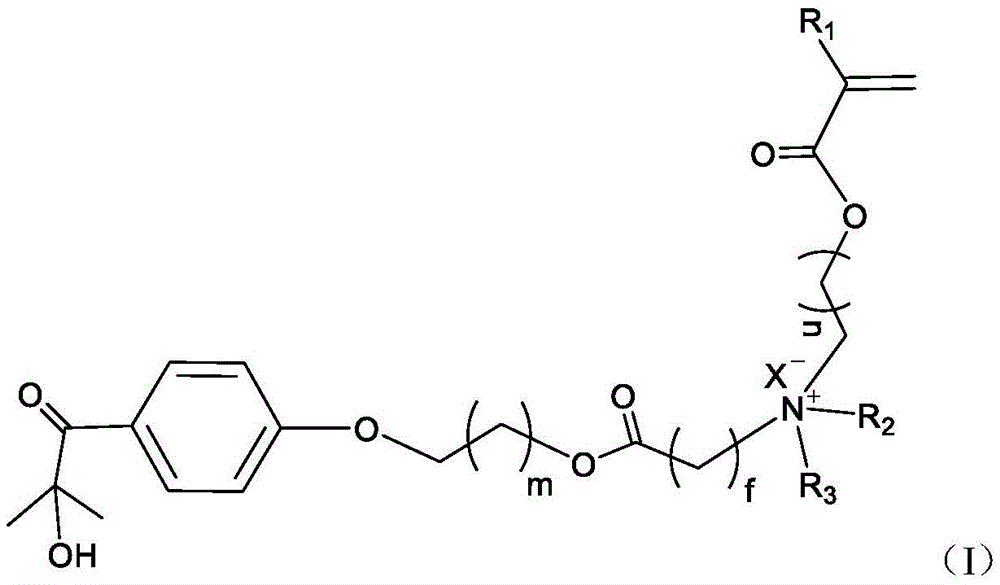
wherein: r1=CH3Or H; r2And R3Each independently selected from a straight chain alkyl group of 1 to 20C atoms or a branched chain alkyl group having 3 to 20C atoms; x is halogen; n is 1-10; m is 1-4; f is 1-3; preferably, R2And R3Similarly, X is bromo, n ═ 1, m ═ 1, f ═ 1; more preferably, R2And R3Is methyl or ethyl, X is bromine, n is 1, m is 1, and f is 1.
According to the ureteral catheter, the hydrophilic monomer comprises one or more of unsaturated carboxylic acid or carboxylate, unsaturated carboxylic ester, unsaturated acid hydroxyalkyl ester, unsaturated anhydride, unsaturated amide, unsaturated lactam and alkylene oxide; preferably, the hydrophilic monomer comprises one or more of (meth) acrylic acid, (meth) acrylamide, vinyl pyrrolidone, hydroxyethyl (meth) acrylate, vinyl acetate, ethylene oxide, maleic acid, maleic anhydride, fumaric acid, fumaric anhydride, dimethylacrylamide; more preferably, the hydrophilic monomer is selected from vinylpyrrolidone.
According to the ureteral catheter, the antibacterial agent is one or more of silver ions, silver nanoparticles or silver nanorods, and preferably, the antibacterial agent is silver nanoparticles.
According to the ureteral catheter, the molar concentration of the water-soluble polymerizable photosensitive monomer in the photocurable polymer is 0.08-12%, preferably 0.5-8%, further preferably 3-7.5%, more preferably 3-5%, and most preferably 4%.
According to the ureteral catheter, the thickness of the lubricating antibacterial layer is in the range of 1-20 μm, preferably in the range of 2-15 μm, and more preferably in the range of 2-10 μm.
According to the ureteral catheter, the material of the ureteral catheter comprises one or more of thermoplastic polyurethane elastomer, PVC, HDPE, LLDPE and PET.
The invention also provides a method for preparing a ureteral catheter according to the invention, wherein: at least one layer of the lubricating antibacterial layer is formed on the surface of the ureteral catheter, and preferably the lubricating antibacterial layer is formed by means of photocuring, thermocuring, chemical reaction, physical adsorption, crystallization or freezing.
ADVANTAGEOUS EFFECTS OF INVENTION
Compared with the prior art, the invention has the beneficial effects that:
and (I) curing a stable and uniform lubricating antibacterial layer on the surface of the ureteral catheter in a curing mode.
And (II) the constructed hydrophilic lubricating surface not only can effectively endow the pipe with lubricating performance, but also can effectively resist the adsorption of nonspecific proteins and bacteria.
And (III) the silver ions loaded on the surface can be continuously and slowly released during the use period, so that the function of stable and long-acting sterilization is achieved.
Drawings
Fig. 1 is a statistical map of surface bacterial densities for the ureteral catheter of example 1.
Fig. 2 is a fluorescent staining chart showing the surface bactericidal effect of the ureteral catheter in example 1 (green represents live bacteria, and red represents dead bacteria).
Fig. 3 is a statistical chart of the surface sterilization efficiency of the ureteral catheter of example 1.
Detailed Description
The technical solution of the present invention will be described in detail with reference to the following examples.
The term "monomer" in the present invention means any chemical species that can be characterized by a chemical formula with polymerizable groups (including (meth) acrylate groups) that can be polymerized into oligomers or polymers to increase molecular weight. The molecular weight of the monomers can generally be calculated simply from the given formulae.
Hereinafter, when a moiety of a molecule is described as "optionally substituted" or "substituted", this means that the moiety may be substituted with one or more substituents selected from the group consisting of: c1-C6Linear, branched or cyclic alkyl, aryl, -OH, -CN, halogen, amine, amide, alcohol, ether, thioether, sulfone and derivatives thereof, sulfoxide and derivatives thereof, carbonate, isocyanate, nitrate and acrylate.
The term "unit" in the present invention means not only a functional group (e.g., photosensitive group, quaternary ammonium salt group, unsaturated group) but also an additional chemical group having a small influence on the functional group, such as alkyl group, alkylene group, etc.
The term "polymer" in the present invention means a molecule containing two or more repeating units, and specifically, a polymer may be formed from two or more monomers which may be the same or different, and when used in the present invention, the term also includes oligomers or prepolymers. The term "molecular weight" in the present invention refers to the number average molecular weight (Mn), defined as Mn as determined by light scattering, optionally in combination with size exclusion chromatography SEC.
The term "curing" is understood in the present invention as: physical or chemical hardening or solidification, or curing by chemical reaction, such as radiation curing, thermal curing or curing with the addition of curing molecules, initiators, by any method such as heating, cooling, drying, crystallization.
The term "photocuring" in the present invention can be achieved by the following exemplary means: the photoinitiation process occurs via irradiation with light or UV radiation in the wavelength range from 100nm to 600 nm. Illumination sources that may be used are sunlight or artificial lamps or lasers. For example, high, medium or low pressure mercury lamps and xenon and tungsten lamps are advantageous. Also excimer, solid state and diode based lasers are advantageous. Diode-based light sources are generally advantageous for initiating chemical reactions.
< ureteral catheter >
The present invention provides a ureteral catheter having at least one lubricious antimicrobial layer formed on a surface thereof.
< coating composition >
In the present invention, the lubricating antibacterial layer is formed of a coating composition containing a photocurable polymer and an antibacterial agent, the photocurable polymer being formed by copolymerizing a water-soluble polymerizable photosensitive monomer and a hydrophilic monomer.
Water-soluble polymerizable photosensitive monomer
The water-soluble polymerizable photosensitive monomer of the present invention contains: 1) a unit containing a photosensitive structure; 2) a unit containing a quaternary ammonium salt structure; 3) a unit containing an unsaturated bond structure; the unit containing a photosensitive structure is linked to the unit containing a quaternary ammonium salt structure at least through-C (═ O) -and the unit containing an unsaturated bond structure is linked to the unit containing a photosensitive structure through the unit containing a quaternary ammonium salt structure.
The molecular structure of the water-soluble polymerizable photosensitive monomer contains quaternary ammonium salt ions and double bonds besides a photoinitiation unit (namely a unit of a photosensitive structure), so that the photosensitive monomer has water solubility and polymerizability, has good compatibility with aqueous resin, and can be polymerized onto a macromolecular chain of the resin, thereby effectively overcoming the defect that small molecules are easy to migrate to the surface of a product.
In one embodiment of the invention, the unit containing a photoactive structure is derived from a cleavage-type hydroxybenzophenone photoinitiator, preferably a substituted or unsubstituted α -hydroxyalkylbenzophenone photoinitiator. More specifically, the α -hydroxyalkylphenone-based photoinitiator has the general formula (II): r3-Ph-C(=O)-C(R1)(R2)OH(II)。
Wherein: r1、R2Independently selected from hydrogen, C1-C6Alkyl, phenyl, C1-C6Alkoxy or R1、R2Together with the carbon atom to which they are attached form a cyclohexyl ring; r3Selected from hydrogen, C1-C6Alkyl radical, C1-C6Alkoxy radical, C1-C6Hydroxyalkyl, -OCH2CH2-OR4;R4Selected from hydrogen, C1-C6An alkyl group.
Specifically, the α -hydroxyalkylbenzone-type photoinitiator may be selected from 2-hydroxy-2-methyl-1-phenyl-1-propanone, 1-hydroxy-cyclohexyl-phenyl-methanone, 2-hydroxy-4' - (2-hydroxyethoxy) -2-methylpropiophenone, 2-hydroxy-2-methyl-1- (4-isopropylphenyl) -1-propanone, 2-hydroxy-2-methyl-1- (4-tert-butylphenyl) -1-propanone; preferably, selected from any one of 2-hydroxy-2-methyl-1-phenyl-1-propanone, 1-hydroxy-cyclohexyl-phenyl-methanone, 2-hydroxy-4' - (2-hydroxyethoxy) -2-methylpropiophenone, 2-hydroxy-2-methyl-1- (4-isopropylphenyl) -1-propanone, 2-hydroxy-2-methyl-1- (4-tert-butylphenyl) -1-propanone; from the viewpoint of improving the initiating activity and yellowing resistance, 2-hydroxy-4' - (2-hydroxyethoxy) -2-methylpropiophenone is more preferable.
The alpha-hydroxyalkyl benzophenone photoinitiator contains carbonyl and alpha-hydroxyl double-active functional groups, so that the photoinitiator has active chemical properties and strong derivatization capability, is suitable for common photopolymerization systems, and is more suitable for emulsion or latex photopolymerization systems and water-soluble photopolymerization systems. The photoinitiator belongs to a cracking type free radical photoinitiator, but has good yellowing resistance and thermal stability compared with other common cracking type photoinitiators such as benzoin ethers, and has high photoinitiation activity and good yellowing resistance compared with hydrogen abstraction type free radical photoinitiators such as Benzophenone (BP). The inventor of the present invention found that when the photosensitive structural unit of the present invention is derived from an α -hydroxyalkylbenzone photoinitiator, the photoinitiator has better photoinitiation efficiency, yellowing resistance and thermal stability than other types of photoinitiators, and has reduced volatility, wherein the effect of 2-hydroxy-4' - (2-hydroxyethoxy) -2-methylpropiophenone is particularly prominent. The inventor conjectures that because the benzene ring in the structure is directly linked with oxygen atoms, two independent electrons on the oxygen atoms can be conjugated with the benzene ring, so that the electron density of the benzene ring is increased, the probability of excited transition of the electrons is increased, and the electrons and other groups (such as nitrogen-containing groups and unsaturated double bonds) are acted together, so that the photoinitiation activity is greatly improved; while the reduction in volatility is associated with the benzene ring having a long side chain.
The existence of the quaternary ammonium salt can greatly improve the water solubility and simultaneously has certain antibacterial property. The unit containing a quaternary ammonium salt structure contains a quaternary ammonium salt group, and may contain several alkylene groups in addition to the quaternary ammonium salt group.
The unit having an unsaturated bond structure may be a polymerizable group having a double bond. Such reactive groups may allow the photoactive unit to be incorporated into the backbone of the polymer in the form of a repeating unit via free radical polymerization. The unit having an unsaturated bond structure may be selected from units having a (meth) acrylate group. The existence of the polymerizable group can overcome the problems of toxicity and high mobility of the conventional small-molecule photoinitiator, promote the photoinitiator to be anchored in a polymer network, improve the material performance by copolymerizing with other monomers, and inhibit the undesirable volatilization caused by the residue of the small-molecule photoinitiator.
In a preferred embodiment of the present invention, the unit having a photosensitive structure is directly bonded to the quaternary ammonium salt structure through a carbonyl group (-C (═ O) -), and the unit having an unsaturated bond structure is directly bonded to the unit having a photosensitive structure through a structural unit having a quaternary ammonium salt. The connection mode provides the greatest opportunity for interaction among all structural units, is favorable for energy transfer, can generate free radical active species more and more quickly, and improves the initiation efficiency.
In a preferred embodiment of the present invention, the water-soluble polymerizable photosensitive monomer has a structure of the general formula (I):

wherein: r1=CH3Or H; r2And R3Each independently selected from a straight chain alkyl group of 1 to 20C atoms or a branched chain alkyl group having 3 to 20C atoms; x is halogen; n is 1-10; m is 1-4; f is 1-3; preferably, R2And R3Similarly, X is bromo, n ═ 1, m ═ 1, f ═ 1; more preferably, R2And R3Is methyl or ethyl, X is bromine, n is 1, m is 1, and f is 1. The choice of the groups and the molecular chain length in the general formula mainly depends on the requirements of viscosity, initiation rate and mobility of the comprehensive product.
Further preferably, suitable water-soluble polymerizable photosensitive monomers according to the present invention include one or more compounds of the following structure:
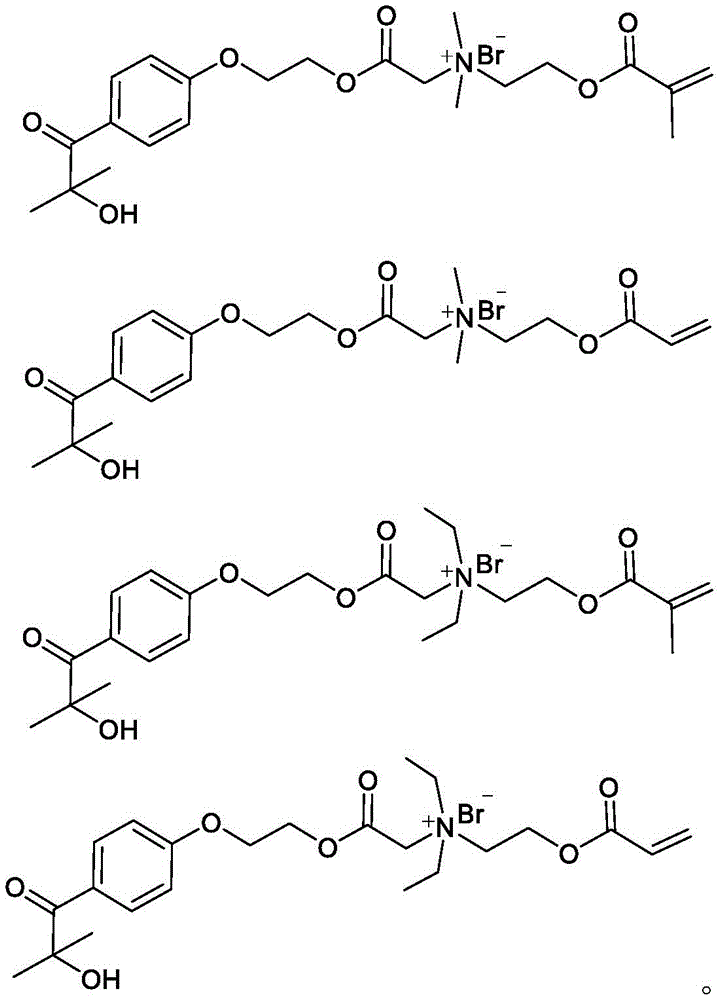
the water-soluble polymerizable photosensitive monomer is obtained by performing acyl halide treatment on the molecular terminal of a compound containing a photosensitive structure and then reacting the compound with (methyl) acrylate containing a tertiary amine group.
Illustratively, the reaction scheme of the water-soluble polymerizable photosensitive monomer is as follows:
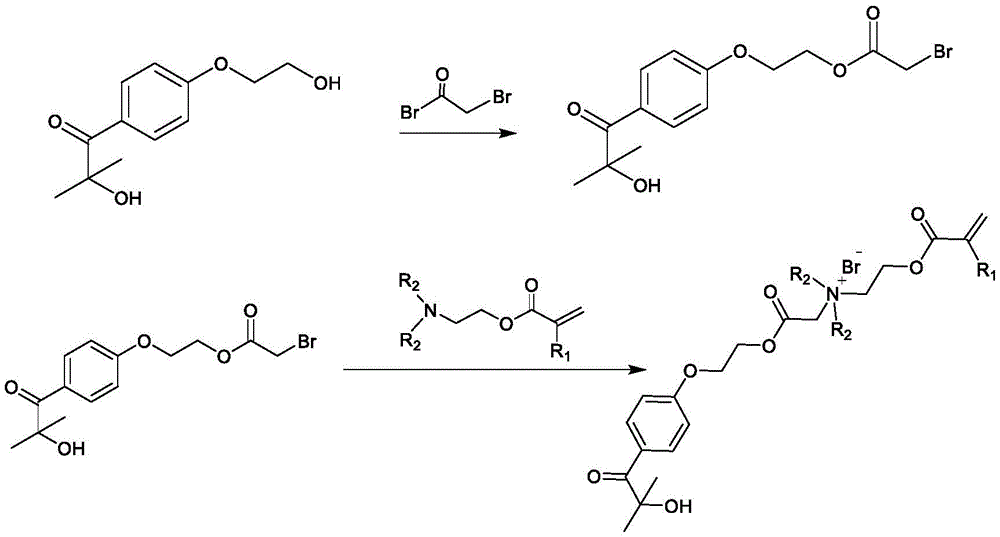
wherein R is1And R2The same as the definition in the general formula (I).
Preferably, the molar concentration of the water-soluble polymerizable photosensitive monomer in the photocurable polymer is 0.08-12%, preferably 0.5-8%, further preferably 3-7.5%, more preferably 3-5%, and most preferably 4%. The lowest friction (about 0.125N) was achieved with this particular molar concentration and the friction hardly increased with increasing number of cycles, without a significant increase in friction over 30 cycles.
Hydrophilic monomers
The hydrophilic monomer is a monomer which can dissolve 1g or more in 100g of water at 25 ℃. The water-soluble polymerizable photosensitive monomer and the hydrophilic monomer are copolymerized to obtain the photocurable polymer with hydrophilicity. The hydrophilic monomer is mainly to provide hydrophilicity to the polymer.
The hydrophilic monomer comprises one or more of unsaturated carboxylic acid or carboxylate, unsaturated carboxylic ester, unsaturated acid hydroxyalkyl ester, unsaturated acid anhydride, unsaturated amide, unsaturated lactam and alkylene oxide.
Illustratively, hydrophilic monomers include, but are not limited to, one or more of (meth) acrylic acid, (meth) acrylamide, vinyl pyrrolidone, hydroxyethyl (meth) acrylate, vinyl acetate, ethylene oxide, maleic acid, maleic anhydride, fumaric acid, fumaric anhydride, dimethylacrylamide; preferably, the hydrophilic monomer comprises one or more of acrylic acid, acrylamide, dimethylacrylamide, hydroxyethyl acrylate, vinyl pyrrolidone.
Among the above hydrophilic monomers, the structure of vinylpyrrolidone (NVP) gives it and its polymers special properties: it is easy to polymerize, and the polymer has excellent hydrophilicity, complexing ability, good physiological compatibility, chemical stability and no irritation to skin; has strong solubilization, can increase the water solubility of some substances which are basically insoluble in water but have pharmacological activity, and is suitable for medical use. Thus, a more preferred hydrophilic monomer for the present invention is vinyl pyrrolidone. The present invention has also surprisingly found that when vinylpyrrolidone is used as the hydrophilic monomer, the resulting hydrophilic coating has a better lubricating effect, which is highlighted by low friction and little change in friction with increasing cycle number.
Polymerisation
The photocurable polymer in the present invention is prepared by a radical polymerization method, including but not limited to general radical polymerization and living controlled radical polymerization, and preferably, the photocurable polymer is prepared by a general radical polymerization method. The photocurable polymer is prepared in a medium, including but not limited to solution polymerization, emulsion polymerization, inverse emulsion polymerization, suspension polymerization, bulk polymerization, and from the viewpoint of easy operation, the photocurable polymer is preferably prepared by solution polymerization, and from the viewpoint of environmental protection, the photocurable polymer is more preferably prepared by copolymerization in an aqueous solution. In one embodiment of the present invention, a water-soluble polymerizable photosensitive monomer and a hydrophilic monomer are dissolved in water, a radical initiator is added into the system, oxygen is removed, and a reaction is performed at a certain temperature to obtain the photocurable polymer.
The monomer is preferably contained in the aqueous solution in a concentration of between 10% and 50%, more preferably between 10% and 30%, still more preferably between 12% and 20% by weight of the solution.
The radical initiator in the polymerization reaction means a substance which generates radicals upon application of activation energy, and includes heat-activated initiators such as organic peroxides, organic hydroperoxides and azo compounds. Representative examples of such initiators include, but are not limited to, benzoyl peroxide, t-butyl perbenzoate, diisopropyl peroxydicarbonate, cumene hydroperoxide, azobisisobutyronitrile, and the like, with the free radical initiator being azobisisobutyronitrile in one preferred embodiment of the invention. The thermal initiators are generally used in amounts of from 0.01 to 5%, preferably from 0.02 to 0.05%, based on the monomers.
The photocurable polymer preferably has a number average molecular weight of at least 5 ten thousand, preferably a relatively high molecular weight, for reduced migration, but preferably 100 ten thousand or less for ease of application of the coating. In order to obtain a hydrophilic coating having good lubricating properties even after many cycles, the photocurable polymer preferably has a number average molecular weight of 5 to 70 ten thousand, more preferably 10 to 50 ten thousand, and most preferably 30 to 40 ten thousand.
The photocurable polymer is present in the coating composition at a concentration of 0.5-10% by mass, preferably at a concentration of 2.5-7.5% by mass, more preferably at a concentration of 5% by mass.
Antibacterial agent
In the present invention, the antibacterial agent is one or more of silver ions, silver nanoparticles or silver nanorods, and the mass concentration thereof in the coating composition is 0.01 to 5%, preferably 0.8 to 2%.
In a preferred embodiment of the present invention, the coating composition comprises the photocurable polymer, an antimicrobial agent, a solvent, and optional components.
The solvent is present in the coating composition at a mass concentration of 90 to 99.5%, preferably at a mass concentration of 92.5 to 97.5%, more preferably at 95%.
Solvent(s)
Any solvent that allows the coating composition having hydrophilicity to be applied to the surface is sufficient for the coating composition. Preferably, the solvent is one or a mixture of solvents that can dissolve the photocurable polymer to form a homogeneous solution. Examples of the solvent include one or more of water, low molecular weight alcohols (methanol, ethanol, isopropanol, butanol, pentanol, ethylene glycol, propylene glycol, glycerol, etc.), ethyl acetate, N-hexane, dichloromethane, chloroform, N-dimethylformamide, N-dimethylacetamide, dimethylsulfoxide, acetone, diethyl ether, toluene, benzene, xylene, cyclohexane, phenol. For uniform dissolution and mixing, low cost and no pollution, the solvent is preferably a mixture of water and isopropanol, preferably the volume ratio of water to isopropanol is 1:10-10:1, more preferably the volume ratio of water to isopropanol is 1:5-5:1, most preferably 2:3-3: 2.
Optional Components
Lubricating additives such as surfactants, waxes, lubricants, soaps, and detergents may also be added to the coating composition as desired. These lubricity additives do not increase the osmolarity of the coating too much, but can increase lubricity on wetting and reduce adhesion, their low solubility in water helping to retain them in the coating. Other additives may include support polymers, polyelectrolytes, wetting agents, leveling agents, defoamers, coalescing aids, thickeners, pigments, colorants, surfactants, and the like. Preferably, the coating composition according to the embodiment of the present invention can obtain good lubricity and fastness without adding additional optional components in addition to the photocurable polymer, the antibacterial agent, and the solvent.
< preparation of ureteral catheter >
The invention also provides a preparation method of the ureteral catheter, wherein: at least one layer of the lubricating antibacterial layer is formed on the surface of the ureteral catheter, and preferably the lubricating antibacterial layer is formed by means of photocuring, thermocuring, chemical reaction, physical adsorption, crystallization or freezing.
Formation of lubricating antimicrobial layer
Preferably, the lubricating antibacterial layer can be coated on the surface of the ureteral catheter under the condition that the ureteral catheter is completely dry and semi-dry.
As a non-limiting example, the lubricating antimicrobial layer can be formed in the following manner.
An appropriate amount of the photocurable polymer (preferably 0.5 to 10% by mass based on the total amount of the coating composition) and the antibacterial agent (preferably 0.01 to 5% by mass based on the total amount of the coating composition) are weighed and dissolved in one or more solvents selected from water, low molecular weight alcohols (methanol, ethanol, isopropanol, butanol, pentanol, ethylene glycol, propylene glycol, glycerol, etc.), ethyl acetate, N-hexane, dichloromethane, chloroform, N-dimethylformamide, N-dimethylacetamide, dimethylsulfoxide, acetone, diethyl ether, toluene, benzene, xylene, cyclohexane, and phenol.
Lubricating additives such as surfactants, waxes, lubricants, soaps, and detergents may also be added to the coating composition as desired. These lubricationsAdditives do not increase the osmolarity of the coating too much, but can increase lubricity on wetting and reduce adhesion, their low solubility in water helping to keep them in the coating. Other additives may include support polymers, polyelectrolytes, wetting agents, leveling agents, defoamers, coalescing aids, thickeners, pigments, antimicrobial agents, colorants, surfactants, and the like. Soaking ureter catheter in a material barrel containing the coating liquid composition, standing for 2-7min, and pulling the catheter at a speed of 0.5-1cm/s, wherein the coating method can be one or more of brushing, dip coating, spray coating, pouring coating and knife coating, the coating liquid composition is coated on the surface of ureter catheter, and the ureter catheter with the coating liquid has ultraviolet intensity of 5-25mW/cm2Irradiating by an ultraviolet lamp for 3-5min for curing, and airing the cured sample in the air to obtain the ureteral catheter with the lubricating antibacterial layer. The thickness of the lubricious antimicrobial layer on the ureteral catheter is preferably in the range of 1-20 μm.
The thickness of the lubricating antibacterial layer can be controlled by the following method: changing the soak time, changing the draw-off rate, or changing the viscosity of the coating composition and the number of coating steps.
Materials suitable for use in the production of ureteral catheters include polymers, for example, one or more of thermoplastic polyurethane elastomers, PVC, HDPE, LLDPE, PET, and the like.
Examples
The present invention is described below by way of examples, which are not exhaustive, as those skilled in the art will appreciate that the examples are illustrative only.
Test method
Testing of surface friction force:
the ureteral catheter is clamped by using a double-clamping piece, the clamping piece is placed in deionized water, a certain pressure is applied through the clamping piece, and the force required for lifting the ureteral catheter is tested to obtain a surface friction force test result. The clamping force used was 300g, the pull rate was 10mm/s, and the test cycle was 30 times.
Surface antibacterial test:
firstly, a ureteral catheter sample with a length of 1-2cm, a non-lubricating antibacterial layer and a lubricating antibacterial layer is selected. Coli (ATCC700926) was cultured overnight at 37 ℃ in sterile LB solution, and the bacterial solution was diluted with sterile PBS solution so that the Optical Density (OD) was 0.01 as measured at 600 nm. Transferring 40 mu L of diluted bacterial liquid to the surface of a ureteral catheter sample without a lubricating antibacterial layer and the surface of the ureteral catheter sample with the lubricating antibacterial layer, culturing for 3 hours at 37 ℃, then dripping SYTO 9 green fluorescent nucleic acid dye liquid and PI red fluorescent nucleic acid dye liquid (1:1) on the surface of the sample, dyeing for 15 minutes in a dark condition, sucking the dye liquid on the surface of the sample material by using filter paper, observing and photographing under a fluorescent microscope, wherein green represents live bacteria, red represents dead bacteria, and counting and calculating the surface bacterial density and the sterilization efficiency. The calculation formula of the sterilization efficiency is as follows:
the sterilization efficiency is (number of dead bacteria/total number of bacteria) × 100%
Example 1
The method comprises the following steps:
(1) synthesis of water-soluble polymerizable photosensitive monomer
22.4g (100mmol) of 2-hydroxy-4' - (2-hydroxyethoxy) -2-methylpropiophenone and 10.6g (105mmol) of triethylamine were weighed out, dissolved in 100mL of dichloromethane, placed in a 250mL flask, and placed in an ice-water bath to be sufficiently dissolved. A solution of 9.1mL bromoacetyl bromide (21.1g, 105mmol) in methylene chloride was slowly added dropwise to the flask over 1 h. After 0.5h of reaction under ice-bath conditions, the temperature was raised to room temperature and the reaction was continued for 10 h. After the reaction, the reaction solution was cooled to room temperature, the crude product was dissolved in dichloromethane, washed with saturated brine, hydrochloric acid (1M) and saturated sodium bicarbonate in this order for 2 times, dried over anhydrous magnesium sulfate overnight, filtered and the solvent was spin-dried, and column chromatography was performed using ethyl acetate and n-hexane as eluent to purify the crude product to obtain 28.8g of 2-hydroxy-4' - (2-hydroxyethoxybromoacetate) -2-methylpropiophenone as a white solid with a yield of 84%.
6.9g (20mmol) of 2-hydroxy-4' - (2-hydroxyethoxybromoacetate) -2-methylpropiophenone and 0.05g of hydroquinone were dissolved in 50mL of acetonitrile and placed in a 250mL flask, and sufficiently dissolved. A solution of 50mL dimethylaminoethyl methacrylate (3.2g, 20mmol) in acetonitrile was slowly added dropwise to the flask, and the temperature was raised to 60 deg.CThe reaction is carried out for 12 hours. And (3) after the reaction is finished, the solvent is dried in a spinning mode, the product is precipitated by using anhydrous ether, and the product is purified by column chromatography to obtain 10g of water-soluble polymerizable photosensitive monomer which is shown in the structural formula 1 and is light yellow viscous liquid, wherein the yield is 100%. Nuclear magnetic hydrogen spectrum (1H NMR) results were as follows:
1.35ppm(m,6H,CH3-C-OH),1.98ppm(m,3H,CH3-C=),3.30ppm(m,6H,CH3-N),3.48ppm(m,2H,-CH2-N),4.2ppm(s,2H,O=C-CH2-),4.44-4.6ppm(m,6H,-CH2-O),6.4-6.5ppm(m,2H,=CH2) 7.01-7.94ppm (m,4H, benzene ring).
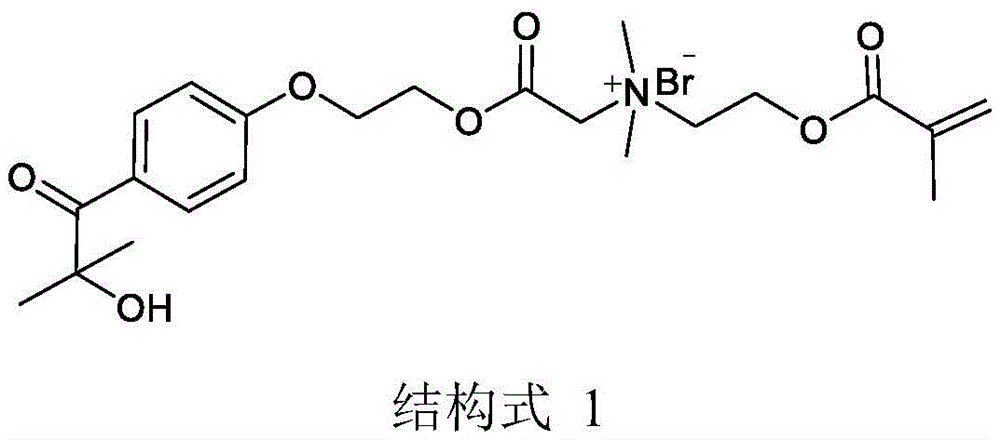
(2) Synthesis of Photocurable polymers
106.7g (0.96mol) of vinylpyrrolidone, 16.9g (0.04mol) of the above-mentioned water-soluble polymerizable photosensitive monomer, and 0.0618g (mass fraction based on the total amount of the monomers: 0.05%) of azobisisobutyronitrile were weighed into a 1-L round-bottomed flask, and 700mL of deionized water was added thereto and dissolved by mechanical stirring. General formula of solution N2And (3) deoxidizing for 30min, and putting the reaction bottle into a 65 ℃ oil bath for heating to start the reaction. After 6h of reaction, the reaction solution was taken down and cooled to room temperature, precipitated in 95% ethanol, and the precipitate was dried in an oven at 35 ℃ for 36h in the dark. The polymer thus obtained had a number average molecular weight Mn of 39.6 ten thousand and a molecular weight distribution PDI of 1.91 as determined by GPC.
Step two: solidifying of lubricating antibacterial layer on surface of ureter catheter
5g of photocurable polymer (Mn is 39.6 ten thousand, and the mole fraction of the water-soluble polymerizable photosensitive monomer is 4%) and silver nanoparticles with the mass concentration of 0.8% are weighed and added into 95g of deionized water/isopropanol mixed solvent (the volume ratio is 1:1), and the mixture is stirred away from light for 18h to be dissolved. The resulting solution was a colorless clear solution.
The surface of the polyurethane ureteral catheter is wiped clean by dust-free paper dipped with 75% ethanol, and then is dried. Soaking the ureter catheter in the material cylinder containing the coating liquid composition, standing for 1min, pulling out the ureter catheter at 0.5cm/s, and coating liquidIrradiating ureter catheter with ultraviolet lamp for 5min for curing treatment with ultraviolet intensity of 10mW/cm2The ureteral catheter rotation speed was 4 rpm. The cured samples were air dried. The thickness of the lubricating antibacterial layer prepared by the process is within 2-10 mu m.
Step three: measurement of surface Friction force
The ureteral catheter obtained was tested by the aforementioned surface friction test method, and the results are shown in table 1.
TABLE 1
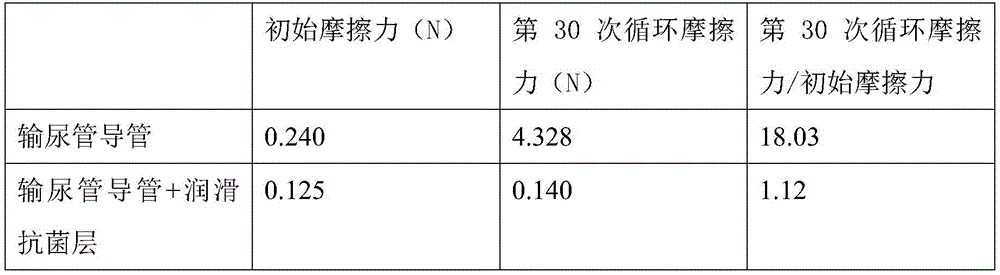
It can be seen that, in the invention, by forming the lubricating antibacterial layer on the ureteral catheter, the surface friction of the ureteral catheter can be greatly reduced (the 30 th cycle friction is small, and the 30 th cycle friction/initial friction is kept within 2 times), and the lubricating performance is greatly improved.
Step four: surface antibacterial property test
The surface antibacterial performance test method is adopted for testing, the surface bacterial density is shown in figure 1, the viable bacteria and the dead bacteria are shown in figure 2, and the surface sterilization efficiency is shown in figure 3 (the surface sterilization efficiency is 99.9%).
Examples 2 to 7
In the second step of example 1, a series of coating compositions (examples 2 to 7, respectively) were prepared using different silver nanoparticle concentrations. Other procedures were performed as in example 1, and the lubricating property and antibacterial property of the prepared ureteral catheter were evaluated, and the results are shown in table 2.
TABLE 2 Effect of different concentrations of silver nanoparticles on the coating Properties of ureteral catheters

As can be seen from table 2, a firm lubricating antibacterial layer can be formed on the surface of the ureteral catheter by the method, and the prepared lubricating antibacterial layers are firm and have high bactericidal rate for silver nanoparticles with different concentrations.
Claims (24)
1. A ureteral catheter, characterized in that the ureteral catheter has formed on its surface at least one lubricious antimicrobial layer,
the lubricating antibacterial layer is formed by a coating composition containing a photocurable polymer and an antibacterial agent, the photocurable polymer is formed by copolymerizing a water-soluble polymerizable photosensitive monomer and a hydrophilic monomer, and the water-soluble polymerizable photosensitive monomer contains: 1) a unit containing a photosensitive structure; 2) a unit containing a quaternary ammonium salt structure; 3) a unit containing an unsaturated bond structure; the unit containing a photosensitive structure is linked to a unit containing a quaternary ammonium salt structure at least through-C (═ O) -and the unit containing an unsaturated bond structure is linked to the unit containing a photosensitive structure through the unit containing a quaternary ammonium salt structure.
2. The ureteral catheter of claim 1,
the mass concentration of the photocurable polymer in the coating composition is 0.5-10%;
the mass concentration of the antibacterial agent in the coating composition is 0.01-5%.
3. The ureteral catheter of claim 2,
the photocurable polymer is present in the coating composition at a concentration of 2.5-7.5% by mass.
4. The ureteral catheter of claim 2,
the photocurable polymer was present in the coating composition at a concentration of 5% by mass.
5. The ureteral catheter of claim 2,
the mass concentration of the antibacterial agent in the coating composition is 0.8-2%.
6. The ureteral catheter according to claim 1 or 2,
the photo-curable polymer is dissolved in a solvent, wherein the solvent is one or more of water, low molecular weight alcohol, ethyl acetate, N-hexane, dichloromethane, trichloromethane, N-dimethylformamide, N-dimethylacetamide, dimethyl sulfoxide, acetone, diethyl ether, toluene, benzene, xylene, cyclohexane and phenol.
7. The ureteral catheter according to claim 1 or 2,
the water-soluble polymerizable photosensitive monomer has a structure of general formula (I):

wherein: r1=CH3Or H; r2And R3Each independently selected from a straight chain alkyl group of 1 to 20C atoms or a branched chain alkyl group having 3 to 20C atoms; x is halogen; n is 1-10; m is 1-4; f is 1-3.
8. The ureteral catheter according to claim 7, wherein in formula (I), R is2And R3Similarly, X is bromine, n is 1, m is 1, and f is 1.
9. The ureteral catheter according to claim 7, wherein in formula (I), R is2And R3Is methyl or ethyl, X is bromine, n is 1, m is 1, and f is 1.
10. The ureteral catheter according to claim 1 or 2, wherein:
the hydrophilic monomer comprises one or more of unsaturated carboxylic acid or carboxylate, unsaturated carboxylic ester, unsaturated acid hydroxyalkyl ester, unsaturated anhydride, unsaturated amide and unsaturated lactam.
11. The ureteral catheter of claim 10, wherein:
the hydrophilic monomer comprises one or more of (meth) acrylic acid, (meth) acrylamide, vinyl pyrrolidone, hydroxyethyl (meth) acrylate, hydroxypropyl (meth) acrylate, vinyl acetate, maleic acid, maleic anhydride, fumaric acid, fumaric anhydride, and dimethylacrylamide.
12. The ureteral catheter of claim 10, wherein:
the hydrophilic monomer is selected from vinyl pyrrolidone.
13. The ureteral catheter according to claim 1 or 2, wherein: the antibacterial agent is one or more of silver ions, silver nano particles or silver nano rods.
14. The ureteral catheter of claim 13, wherein: the antibacterial agent is silver nanoparticles.
15. The ureteral catheter according to claim 1 or 2, wherein: the molar concentration of the water-soluble polymerizable photosensitive monomer in the photocurable polymer is 0.08-12%.
16. The ureteral catheter of claim 15, wherein: the molar concentration of the water-soluble polymerizable photosensitive monomer in the photocurable polymer is 0.5-8%.
17. The ureteral catheter of claim 15, wherein: the molar concentration of the water-soluble polymerizable photosensitive monomer in the photocurable polymer is 3-7.5%.
18. The ureteral catheter of claim 15, wherein: the molar concentration of the water-soluble polymerizable photosensitive monomer in the photocurable polymer is 3-5%.
19. The ureteral catheter of claim 15, wherein: the molar concentration of the water-soluble polymerizable photosensitive monomer in the photocurable polymer was 4%.
20. The ureteral catheter according to claim 1 or 2, wherein: the thickness of the lubricating antibacterial layer is in the range of 1-20 mu m.
21. The ureteral catheter of claim 20, wherein: the thickness of the lubricating antibacterial layer is in the range of 2-15 mu m.
22. The ureteral catheter of claim 20, wherein: the thickness of the lubricating antibacterial layer is in the range of 2-10 mu m.
23. The ureteral catheter according to claim 1 or 2, wherein: the material of the ureteral catheter comprises one or more of thermoplastic polyurethane elastomer, PVC, HDPE, LLDPE and PET.
24. The method of making a ureteral catheter according to any of claims 1 to 23, wherein:
at least one lubricating antibacterial layer is formed on the surface of the ureteral catheter, and the lubricating antibacterial layer is formed by light solidification, heat solidification, chemical reaction, physical adsorption, crystallization or freezing.
Priority Applications (1)
| Application Number | Priority Date | Filing Date | Title |
|---|---|---|---|
| CN201910117021.4A CN111569159B (en) | 2019-02-15 | 2019-02-15 | Ureteral catheter and preparation method thereof |
Applications Claiming Priority (1)
| Application Number | Priority Date | Filing Date | Title |
|---|---|---|---|
| CN201910117021.4A CN111569159B (en) | 2019-02-15 | 2019-02-15 | Ureteral catheter and preparation method thereof |
Publications (2)
| Publication Number | Publication Date |
|---|---|
| CN111569159A CN111569159A (en) | 2020-08-25 |
| CN111569159B true CN111569159B (en) | 2022-03-11 |
Family
ID=72122365
Family Applications (1)
| Application Number | Title | Priority Date | Filing Date |
|---|---|---|---|
| CN201910117021.4A Active CN111569159B (en) | 2019-02-15 | 2019-02-15 | Ureteral catheter and preparation method thereof |
Country Status (1)
| Country | Link |
|---|---|
| CN (1) | CN111569159B (en) |
Families Citing this family (2)
| Publication number | Priority date | Publication date | Assignee | Title |
|---|---|---|---|---|
| CN113189315B (en) * | 2021-04-13 | 2024-01-23 | 山东省医疗器械产品质量检验中心 | In vitro dynamic model for evaluating antibacterial activity of antibacterial catheter and application method thereof |
| CN120860334A (en) * | 2025-09-29 | 2025-10-31 | 江苏百赛飞生物科技有限公司 | Ureteral stent with zwitterionic coating and preparation method thereof |
Citations (6)
| Publication number | Priority date | Publication date | Assignee | Title |
|---|---|---|---|---|
| WO1995004839A2 (en) * | 1993-07-27 | 1995-02-16 | Target Therapeutics, Inc. | Method of pretreating metal for polymer coating |
| CN2778285Y (en) * | 2005-03-28 | 2006-05-10 | 山东百多安医疗器械有限公司 | Antibacterial super slippery urethral catheter |
| CN102471630A (en) * | 2009-07-24 | 2012-05-23 | 关西涂料株式会社 | Aqueous coating composition and method for forming multilayer coating film |
| CN103289499A (en) * | 2013-06-05 | 2013-09-11 | 中山大学 | Light-curing hydrophilic lubricating coating as well as preparation method and using method thereof |
| CN103703030A (en) * | 2013-09-06 | 2014-04-02 | 北京英力科技发展有限公司 | Low mobility photoinitiator |
| CN108607151A (en) * | 2018-05-21 | 2018-10-02 | 青岛杰圣博生物科技有限公司 | A kind of antibiotic catheters and preparation method thereof |
Family Cites Families (1)
| Publication number | Priority date | Publication date | Assignee | Title |
|---|---|---|---|---|
| US7056533B2 (en) * | 2000-08-15 | 2006-06-06 | Surmodics, Inc. | Medicament incorporation matrix |
-
2019
- 2019-02-15 CN CN201910117021.4A patent/CN111569159B/en active Active
Patent Citations (6)
| Publication number | Priority date | Publication date | Assignee | Title |
|---|---|---|---|---|
| WO1995004839A2 (en) * | 1993-07-27 | 1995-02-16 | Target Therapeutics, Inc. | Method of pretreating metal for polymer coating |
| CN2778285Y (en) * | 2005-03-28 | 2006-05-10 | 山东百多安医疗器械有限公司 | Antibacterial super slippery urethral catheter |
| CN102471630A (en) * | 2009-07-24 | 2012-05-23 | 关西涂料株式会社 | Aqueous coating composition and method for forming multilayer coating film |
| CN103289499A (en) * | 2013-06-05 | 2013-09-11 | 中山大学 | Light-curing hydrophilic lubricating coating as well as preparation method and using method thereof |
| CN103703030A (en) * | 2013-09-06 | 2014-04-02 | 北京英力科技发展有限公司 | Low mobility photoinitiator |
| CN108607151A (en) * | 2018-05-21 | 2018-10-02 | 青岛杰圣博生物科技有限公司 | A kind of antibiotic catheters and preparation method thereof |
Non-Patent Citations (5)
| Title |
|---|
| PHOTOINITIATORS WITH FUNCTIONAL GROUPS. PART IV. WATER-SOLUBLE PHOTOINITIATORS;S. KNAUS等;《Journal of Macromolecular Science, Part A: Pure and Applied Chemistry》;20060922;第A33卷(第7期);第869-881页 * |
| Synthesis and antibacterial activity of 3-benzylamide derivatives as FtsZ inhibitors;Zhongping Hua等;《Bioorganic & Medicinal Chemistry Letters》;20170217;第27卷;第1215-1222页 * |
| Synthesis of dual-functional copolymer with orthogonally photosensitive groups;Xu, LB等;《Journal of polymer science part A——polymer chemistry》;20130331;第51卷(第5期);第1854-1858页 * |
| 亲水润滑涂料的制备及在医用聚氨酯导管中的应用;封亮廷等;《应用化工》;20170510;第46卷(第05期);1017-1019、1023 * |
| 聚丙烯接枝改性综述;余聪等;《江西化工》;20101215(第4期);第10-13页 * |
Also Published As
| Publication number | Publication date |
|---|---|
| CN111569159A (en) | 2020-08-25 |
Similar Documents
| Publication | Publication Date | Title |
|---|---|---|
| CN109384882B (en) | Photocurable polymers, coating compositions based thereon, and hydrophilic lubricious coatings and articles | |
| EP3819288B1 (en) | Photocurable hydrophilic polymer, and coating composition, hydrophilic lubricating coating and article based on the same | |
| TWI507429B (en) | Polymer-bound bisacylphosphine oxides | |
| CN111514380B (en) | Ureteral stent and preparation method thereof | |
| CN111569159B (en) | Ureteral catheter and preparation method thereof | |
| CN110857372B (en) | Catheter | |
| CN113694261B (en) | Antibacterial composite coating and preparation method and product thereof | |
| CN113698535A (en) | Polymer, composition, coating thereof and product | |
| WO2019020805A1 (en) | PHOTOINITIATORS FOR LIGHT-CURING COMPOSITIONS | |
| CN111514378B (en) | Central venous catheter, preparation method thereof and medical device comprising same | |
| CN111603614B (en) | Catheter and preparation method thereof | |
| CN111514432B (en) | Microcatheter, method of making the same and medical device comprising the same | |
| CN109384684B (en) | Water-soluble polymerizable photosensitive monomer and preparation method and application thereof | |
| CN111514379B (en) | Central venous catheter placed through peripheral vein and preparation method thereof | |
| KR20200107270A (en) | Shape memory polymer, preparation method thereof, and the use of the same | |
| CN110835307B (en) | Polymerizable photosensitive monomer, photosensitive polymer based on polymerizable photosensitive monomer and biomaterial surface modification method | |
| CN119185668B (en) | A photocurable material and an aqueous humor drainage device and its preparation method | |
| JP7562060B2 (en) | Polymers, resin compositions and medical materials | |
| CN116426188A (en) | Coating composition for medical device surface, coating and use of the coating for medical device surface | |
| RU2801357C2 (en) | Resin composition suitable for printing and printing methods | |
| WO2026025070A1 (en) | Coatings for medical devices | |
| CN110062629A (en) | The radiopaque polymer of radiopacity with enhancing | |
| JP5146945B2 (en) | Antithrombogenic coating agent and medical device | |
| CN115109187A (en) | Hydrophilic polymer for inhibiting generation of bacterial biofilm as well as preparation method and application thereof | |
| JP2012029833A (en) | Antithrombotic coating agent and medical instrument |
Legal Events
| Date | Code | Title | Description |
|---|---|---|---|
| PB01 | Publication | ||
| PB01 | Publication | ||
| SE01 | Entry into force of request for substantive examination | ||
| SE01 | Entry into force of request for substantive examination | ||
| GR01 | Patent grant | ||
| GR01 | Patent grant |