CN111556757A - Platform Oncolytic Carriers for Systemic Delivery - Google Patents
Platform Oncolytic Carriers for Systemic Delivery Download PDFInfo
- Publication number
- CN111556757A CN111556757A CN201880085079.9A CN201880085079A CN111556757A CN 111556757 A CN111556757 A CN 111556757A CN 201880085079 A CN201880085079 A CN 201880085079A CN 111556757 A CN111556757 A CN 111556757A
- Authority
- CN
- China
- Prior art keywords
- virus
- oncolytic
- nucleic acid
- modified
- exogenous nucleic
- Prior art date
- Legal status (The legal status is an assumption and is not a legal conclusion. Google has not performed a legal analysis and makes no representation as to the accuracy of the status listed.)
- Pending
Links
Images


Classifications
-
- A—HUMAN NECESSITIES
- A61—MEDICAL OR VETERINARY SCIENCE; HYGIENE
- A61K—PREPARATIONS FOR MEDICAL, DENTAL OR TOILETRY PURPOSES
- A61K35/00—Medicinal preparations containing materials or reaction products thereof with undetermined constitution
- A61K35/66—Microorganisms or materials therefrom
- A61K35/76—Viruses; Subviral particles; Bacteriophages
- A61K35/768—Oncolytic viruses not provided for in groups A61K35/761 - A61K35/766
-
- A—HUMAN NECESSITIES
- A61—MEDICAL OR VETERINARY SCIENCE; HYGIENE
- A61K—PREPARATIONS FOR MEDICAL, DENTAL OR TOILETRY PURPOSES
- A61K38/00—Medicinal preparations containing peptides
- A61K38/16—Peptides having more than 20 amino acids; Gastrins; Somatostatins; Melanotropins; Derivatives thereof
- A61K38/43—Enzymes; Proenzymes; Derivatives thereof
- A61K38/46—Hydrolases (3)
- A61K38/47—Hydrolases (3) acting on glycosyl compounds (3.2), e.g. cellulases, lactases
-
- A—HUMAN NECESSITIES
- A61—MEDICAL OR VETERINARY SCIENCE; HYGIENE
- A61P—SPECIFIC THERAPEUTIC ACTIVITY OF CHEMICAL COMPOUNDS OR MEDICINAL PREPARATIONS
- A61P35/00—Antineoplastic agents
-
- C—CHEMISTRY; METALLURGY
- C07—ORGANIC CHEMISTRY
- C07K—PEPTIDES
- C07K14/00—Peptides having more than 20 amino acids; Gastrins; Somatostatins; Melanotropins; Derivatives thereof
- C07K14/435—Peptides having more than 20 amino acids; Gastrins; Somatostatins; Melanotropins; Derivatives thereof from animals; from humans
- C07K14/705—Receptors; Cell surface antigens; Cell surface determinants
- C07K14/715—Receptors; Cell surface antigens; Cell surface determinants for cytokines; for lymphokines; for interferons
- C07K14/7158—Receptors; Cell surface antigens; Cell surface determinants for cytokines; for lymphokines; for interferons for chemokines
-
- C—CHEMISTRY; METALLURGY
- C12—BIOCHEMISTRY; BEER; SPIRITS; WINE; VINEGAR; MICROBIOLOGY; ENZYMOLOGY; MUTATION OR GENETIC ENGINEERING
- C12N—MICROORGANISMS OR ENZYMES; COMPOSITIONS THEREOF; PROPAGATING, PRESERVING, OR MAINTAINING MICROORGANISMS; MUTATION OR GENETIC ENGINEERING; CULTURE MEDIA
- C12N15/00—Mutation or genetic engineering; DNA or RNA concerning genetic engineering, vectors, e.g. plasmids, or their isolation, preparation or purification; Use of hosts therefor
- C12N15/09—Recombinant DNA-technology
- C12N15/63—Introduction of foreign genetic material using vectors; Vectors; Use of hosts therefor; Regulation of expression
- C12N15/79—Vectors or expression systems specially adapted for eukaryotic hosts
- C12N15/85—Vectors or expression systems specially adapted for eukaryotic hosts for animal cells
- C12N15/86—Viral vectors
-
- C—CHEMISTRY; METALLURGY
- C12—BIOCHEMISTRY; BEER; SPIRITS; WINE; VINEGAR; MICROBIOLOGY; ENZYMOLOGY; MUTATION OR GENETIC ENGINEERING
- C12N—MICROORGANISMS OR ENZYMES; COMPOSITIONS THEREOF; PROPAGATING, PRESERVING, OR MAINTAINING MICROORGANISMS; MUTATION OR GENETIC ENGINEERING; CULTURE MEDIA
- C12N7/00—Viruses; Bacteriophages; Compositions thereof; Preparation or purification thereof
-
- C—CHEMISTRY; METALLURGY
- C12—BIOCHEMISTRY; BEER; SPIRITS; WINE; VINEGAR; MICROBIOLOGY; ENZYMOLOGY; MUTATION OR GENETIC ENGINEERING
- C12N—MICROORGANISMS OR ENZYMES; COMPOSITIONS THEREOF; PROPAGATING, PRESERVING, OR MAINTAINING MICROORGANISMS; MUTATION OR GENETIC ENGINEERING; CULTURE MEDIA
- C12N9/00—Enzymes; Proenzymes; Compositions thereof; Processes for preparing, activating, inhibiting, separating or purifying enzymes
- C12N9/14—Hydrolases (3)
- C12N9/24—Hydrolases (3) acting on glycosyl compounds (3.2)
- C12N9/2402—Hydrolases (3) acting on glycosyl compounds (3.2) hydrolysing O- and S- glycosyl compounds (3.2.1)
- C12N9/2474—Hyaluronoglucosaminidase (3.2.1.35), i.e. hyaluronidase
-
- C—CHEMISTRY; METALLURGY
- C12—BIOCHEMISTRY; BEER; SPIRITS; WINE; VINEGAR; MICROBIOLOGY; ENZYMOLOGY; MUTATION OR GENETIC ENGINEERING
- C12N—MICROORGANISMS OR ENZYMES; COMPOSITIONS THEREOF; PROPAGATING, PRESERVING, OR MAINTAINING MICROORGANISMS; MUTATION OR GENETIC ENGINEERING; CULTURE MEDIA
- C12N2710/00—MICROORGANISMS OR ENZYMES; COMPOSITIONS THEREOF; PROPAGATING, PRESERVING, OR MAINTAINING MICROORGANISMS; MUTATION OR GENETIC ENGINEERING; CULTURE MEDIA dsDNA viruses
- C12N2710/00011—Details
- C12N2710/24011—Poxviridae
- C12N2710/24111—Orthopoxvirus, e.g. vaccinia virus, variola
- C12N2710/24132—Use of virus as therapeutic agent, other than vaccine, e.g. as cytolytic agent
-
- C—CHEMISTRY; METALLURGY
- C12—BIOCHEMISTRY; BEER; SPIRITS; WINE; VINEGAR; MICROBIOLOGY; ENZYMOLOGY; MUTATION OR GENETIC ENGINEERING
- C12N—MICROORGANISMS OR ENZYMES; COMPOSITIONS THEREOF; PROPAGATING, PRESERVING, OR MAINTAINING MICROORGANISMS; MUTATION OR GENETIC ENGINEERING; CULTURE MEDIA
- C12N2710/00—MICROORGANISMS OR ENZYMES; COMPOSITIONS THEREOF; PROPAGATING, PRESERVING, OR MAINTAINING MICROORGANISMS; MUTATION OR GENETIC ENGINEERING; CULTURE MEDIA dsDNA viruses
- C12N2710/00011—Details
- C12N2710/24011—Poxviridae
- C12N2710/24111—Orthopoxvirus, e.g. vaccinia virus, variola
- C12N2710/24141—Use of virus, viral particle or viral elements as a vector
- C12N2710/24143—Use of virus, viral particle or viral elements as a vector viral genome or elements thereof as genetic vector
-
- C—CHEMISTRY; METALLURGY
- C12—BIOCHEMISTRY; BEER; SPIRITS; WINE; VINEGAR; MICROBIOLOGY; ENZYMOLOGY; MUTATION OR GENETIC ENGINEERING
- C12Y—ENZYMES
- C12Y302/00—Hydrolases acting on glycosyl compounds, i.e. glycosylases (3.2)
- C12Y302/01—Glycosidases, i.e. enzymes hydrolysing O- and S-glycosyl compounds (3.2.1)
- C12Y302/01035—Hyaluronoglucosaminidase (3.2.1.35), i.e. hyaluronidase
-
- Y—GENERAL TAGGING OF NEW TECHNOLOGICAL DEVELOPMENTS; GENERAL TAGGING OF CROSS-SECTIONAL TECHNOLOGIES SPANNING OVER SEVERAL SECTIONS OF THE IPC; TECHNICAL SUBJECTS COVERED BY FORMER USPC CROSS-REFERENCE ART COLLECTIONS [XRACs] AND DIGESTS
- Y02—TECHNOLOGIES OR APPLICATIONS FOR MITIGATION OR ADAPTATION AGAINST CLIMATE CHANGE
- Y02A—TECHNOLOGIES FOR ADAPTATION TO CLIMATE CHANGE
- Y02A50/00—TECHNOLOGIES FOR ADAPTATION TO CLIMATE CHANGE in human health protection, e.g. against extreme weather
- Y02A50/30—Against vector-borne diseases, e.g. mosquito-borne, fly-borne, tick-borne or waterborne diseases whose impact is exacerbated by climate change
Landscapes
- Health & Medical Sciences (AREA)
- Life Sciences & Earth Sciences (AREA)
- Chemical & Material Sciences (AREA)
- Organic Chemistry (AREA)
- Genetics & Genomics (AREA)
- Engineering & Computer Science (AREA)
- Zoology (AREA)
- General Health & Medical Sciences (AREA)
- Bioinformatics & Cheminformatics (AREA)
- Wood Science & Technology (AREA)
- Medicinal Chemistry (AREA)
- General Engineering & Computer Science (AREA)
- Biochemistry (AREA)
- Virology (AREA)
- Biotechnology (AREA)
- Microbiology (AREA)
- Biomedical Technology (AREA)
- Molecular Biology (AREA)
- Veterinary Medicine (AREA)
- Immunology (AREA)
- Pharmacology & Pharmacy (AREA)
- Animal Behavior & Ethology (AREA)
- Public Health (AREA)
- Biophysics (AREA)
- Proteomics, Peptides & Aminoacids (AREA)
- Gastroenterology & Hepatology (AREA)
- Epidemiology (AREA)
- Chemical Kinetics & Catalysis (AREA)
- Plant Pathology (AREA)
- General Chemical & Material Sciences (AREA)
- Nuclear Medicine, Radiotherapy & Molecular Imaging (AREA)
- Mycology (AREA)
- Cell Biology (AREA)
- Toxicology (AREA)
- Oncology (AREA)
- Physics & Mathematics (AREA)
- Medicines Containing Material From Animals Or Micro-Organisms (AREA)
- Micro-Organisms Or Cultivation Processes Thereof (AREA)
- Medicinal Preparation (AREA)
- Medicines That Contain Protein Lipid Enzymes And Other Medicines (AREA)
Abstract
Description
交叉引用cross reference
本申请要求2017年10月31日提交的第62/579,517号美国临时申请的权益,该美国临时申请通过引用整体并入本文。This application claims the benefit of US Provisional Application No. 62/579,517, filed October 31, 2017, which is incorporated herein by reference in its entirety.
援引并入incorporated by reference
本说明书中所提及的所有出版物、专利、专利申请和NCBI登录与均通过引用并入本文,其程度犹如具体地且单独地指出每个单独的出版物、专利或专利申请均通过引用而并入,并且犹如以其整体阐述。在本文所用的术语与所并入的参考文献中定义的术语之间存在冲突的情况下,以本公开的定义为准。All publications, patents, patent applications and NCBI entries mentioned in this specification are incorporated herein by reference to the same extent as if each individual publication, patent or patent application was specifically and individually indicated to be incorporated by reference Incorporated, and as if set forth in its entirety. In the event of a conflict between a term used herein and a term defined in an incorporated reference, the definitions in the present disclosure will control.
发明内容SUMMARY OF THE INVENTION
本公开的一个方面提供了经修饰的溶瘤病毒,其包含编码趋化因子受体、可能能够降解透明质酸的膜结合蛋白、能够降解透明质酸的微生物蛋白质或其任意组合的外源核酸。One aspect of the present disclosure provides a modified oncolytic virus comprising an exogenous nucleic acid encoding a chemokine receptor, a membrane-bound protein potentially capable of degrading hyaluronic acid, a microprotein capable of degrading hyaluronic acid, or any combination thereof .
在一些实施方案中,所述趋化因子可包括CXCR4和CCR2中的至少一种。In some embodiments, the chemokine can include at least one of CXCR4 and CCR2.
在一些实施方案中,所述经修饰的溶瘤病毒可包含可以编码膜结合蛋白的外源核酸。在一些实施方案中,所述编码膜结合蛋白的外源核酸可以编码透明质酸酶。在一些实施方案中,所述透明质酸酶可以是PH-20。在一些实施方案中,所述PH-20可以是GPI锚定的。在一些实施方案中,所述经修饰的溶瘤病毒可包含可以编码微生物蛋白质的外源核酸。在一些实施方案中,所述微生物蛋白质包括分泌的透明质酸酶。在一些实施方案中,所述分泌的透明质酸酶包括HysA、lin、sko、rv中的至少一种或其任意组合。在一些实施方案中,所述微生物蛋白质包括HysA。In some embodiments, the modified oncolytic virus can comprise exogenous nucleic acid that can encode a membrane-bound protein. In some embodiments, the exogenous nucleic acid encoding a membrane-bound protein can encode a hyaluronidase. In some embodiments, the hyaluronidase can be PH-20. In some embodiments, the PH-20 can be GPI-anchored. In some embodiments, the modified oncolytic virus can comprise exogenous nucleic acid that can encode a microprotein. In some embodiments, the microprotein comprises secreted hyaluronidase. In some embodiments, the secreted hyaluronidase comprises at least one of HysA, lin, sko, rv, or any combination thereof. In some embodiments, the microprotein comprises HysA.
在一些实施方案中,所述修饰可以增强所述病毒的包膜细胞外形式(EEV)的产生。In some embodiments, the modification can enhance the production of the enveloped extracellular form (EEV) of the virus.
在一些实施方案中,所述经修饰的溶瘤病毒可以在病毒的基因组中包含修饰。在一些实施方案中,所述修饰可包含B5R基因的突变或缺失,其中所述缺失是部分缺失。在一些实施方案中,所述修饰可包括B5R基因的SCR区域中的突变或缺失,其中所述SCR区域包含SCR1、SCR3、SCR4或其任意组合,并且其中所述SCR区域不包含SCR2。In some embodiments, the modified oncolytic virus may comprise modifications in the genome of the virus. In some embodiments, the modification may comprise a mutation or deletion of the B5R gene, wherein the deletion is a partial deletion. In some embodiments, the modification can include a mutation or deletion in the SCR region of the B5R gene, wherein the SCR region comprises SCR1, SCR3, SCR4, or any combination thereof, and wherein the SCR region does not comprise SCR2.
在一些实施方案中,所述经修饰的溶瘤病毒可包含B5R基因的缺失,并且所述缺失可以是B5R基因的部分缺失。In some embodiments, the modified oncolytic virus can comprise a deletion of the B5R gene, and the deletion can be a partial deletion of the B5R gene.
在一些实施方案中,所述经修饰的溶瘤病毒可以在所述病毒的基因组中包含修饰,其中所述修饰可包含A52R基因的突变或缺失。在一些实施方案中,所述修饰可包含A52R基因的缺失。In some embodiments, the modified oncolytic virus can comprise a modification in the genome of the virus, wherein the modification can comprise a mutation or deletion of the A52R gene. In some embodiments, the modification may comprise deletion of the A52R gene.
在一些实施方案中,所述经修饰的溶瘤病毒进一步在所述病毒的基因组中包含至少一个额外的修饰,其中所述额外的修饰可包括另外的病毒基因的突变或缺失。In some embodiments, the modified oncolytic virus further comprises at least one additional modification in the genome of the virus, wherein the additional modification may include mutation or deletion of additional viral genes.
在一些实施方案中,所述另外的病毒基因可包括F13L、A36R、A34R、A33R、B8R、B18R、SPI-1、SPI-2、B15R、VGF、E3L、K3L、A41L、K7R和N1L及其功能域或片段或变体中的至少一种,或其任意组合。In some embodiments, the additional viral genes can include F13L, A36R, A34R, A33R, B8R, B18R, SPI-1, SPI-2, B15R, VGF, E3L, K3L, A41L, K7R and N1L and their functions at least one of a domain or fragment or variant, or any combination thereof.
在一些实施方案中,所述经修饰的溶瘤病毒可以进一步包含至少一种额外的外源核酸。In some embodiments, the modified oncolytic virus can further comprise at least one additional exogenous nucleic acid.
在一些实施方案中,所述至少一种额外的外源核酸可包含编码蛋白质或其片段的核酸序列,所述蛋白质或其片段:调节NFκB(NF-kappaB)信号传导,促进肿瘤中的组织液压力(IFP)的降低,调节STAT3介导的基因激活,促进T细胞活化,促进NK细胞向病毒感染的细胞的吸引,调节病毒感染的细胞的代谢程序,调节病毒感染的细胞对脂肪酸的摄取,促进MDSC的治疗靶向,或其任意组合。In some embodiments, the at least one additional exogenous nucleic acid can comprise a nucleic acid sequence encoding a protein or fragment thereof that: modulates NFkappaB (NF-kappaB) signaling, promotes interstitial fluid pressure in tumors (IFP) reduction, regulates STAT3-mediated gene activation, promotes T cell activation, promotes the attraction of NK cells to virus-infected cells, modulates the metabolic program of virus-infected cells, regulates fatty acid uptake by virus-infected cells, promotes Therapeutic targeting of MDSC, or any combination thereof.
在一些实施方案中,所述至少一种额外的外源核酸可包括编码HMGB1、PIAS3、IL15、IL15-Rα、LIGHT、ITAC、CXXXC趋化分子、CCL5及其功能域或片段或变体中的至少一种或其任意组合的核酸。In some embodiments, the at least one additional exogenous nucleic acid may comprise a nucleic acid encoding HMGB1, PIAS3, IL15, IL15-Rα, LIGHT, ITAC, CXXXC chemotactic molecule, CCL5, and functional domains or fragments or variants thereof at least one nucleic acid or any combination thereof.
在一些实施方案中,所述经修饰的溶瘤病毒可包含:(a)编码CXCR4和CCR2中的至少一种的外源核酸;和(b)编码透明质酸酶的外源核酸。In some embodiments, the modified oncolytic virus can comprise: (a) an exogenous nucleic acid encoding at least one of CXCR4 and CCR2; and (b) an exogenous nucleic acid encoding a hyaluronidase.
在一些实施方案中,所述经修饰的溶瘤病毒可包含:(a)编码CXCR4和CCR2中的至少一种的外源核酸;和(b)B5R基因的突变或缺失。In some embodiments, the modified oncolytic virus may comprise: (a) an exogenous nucleic acid encoding at least one of CXCR4 and CCR2; and (b) a mutation or deletion of the B5R gene.
在一些实施方案中,所述经修饰的溶瘤病毒可包含:(a)编码透明质酸酶的外源核酸;和(b)B5R基因的突变或缺失。In some embodiments, the modified oncolytic virus may comprise: (a) an exogenous nucleic acid encoding a hyaluronidase; and (b) a mutation or deletion of the B5R gene.
在一些实施方案中,所述经修饰的溶瘤病毒可包含:(a)编码CXCR4和CCR2中的至少一种的外源核酸;(b)编码透明质酸酶的外源核酸;和(c)B5R基因的突变或缺失。In some embodiments, the modified oncolytic virus can comprise: (a) an exogenous nucleic acid encoding at least one of CXCR4 and CCR2; (b) an exogenous nucleic acid encoding a hyaluronidase; and (c) ) mutation or deletion of the B5R gene.
在一些实施方案中,所述经修饰的溶瘤病毒可包含:(a)编码CXCR4和CCR2中的至少一种的外源核酸;和(b)所述另外的病毒基因的突变或缺失,所述另外的病毒基因可包括F13L、A36R、A34R、A33R、B8R、B18R、SPI-1、SPI-2、B15R、VGF、E3L、K3L、A41L、K7R、N1L及其功能域或片段或变体中的至少一种,或其任意组合。In some embodiments, the modified oncolytic virus can comprise: (a) an exogenous nucleic acid encoding at least one of CXCR4 and CCR2; and (b) a mutation or deletion of the additional viral gene, whereby The additional viral genes may be included in F13L, A36R, A34R, A33R, B8R, B18R, SPI-1, SPI-2, B15R, VGF, E3L, K3L, A41L, K7R, N1L, and functional domains or fragments or variants thereof. at least one, or any combination thereof.
在一些实施方案中,所述经修饰的溶瘤病毒可包含:(a)编码透明质酸酶的外源核酸;和(b)所述另外的病毒基因的突变或缺失,所述另外的病毒基因可包括F13L、A36R、A34R、A33R、B8R、B18R、SPI-1、SPI-2、B15R、VGF、E3L、K3L、A41L、K7R、N1L及其功能域或片段或变体中的至少一种,或其任意组合。In some embodiments, the modified oncolytic virus may comprise: (a) an exogenous nucleic acid encoding a hyaluronidase; and (b) a mutation or deletion of the additional viral gene, the additional virus The gene may comprise at least one of F13L, A36R, A34R, A33R, B8R, B18R, SPI-1, SPI-2, B15R, VGF, E3L, K3L, A41L, K7R, N1L and functional domains or fragments or variants thereof , or any combination thereof.
在一些实施方案中,所述经修饰的溶瘤病毒可包含:(a)编码CXCR4和CCR2中的至少一种的外源核酸;(b)编码透明质酸酶的外源核酸;和(c)所述另外的病毒基因的突变或缺失,所述另外的病毒基因可包括F13L、A36R、A34R、A33R、B8R、B18R、SPI-1、SPI-2、B15R、VGF、E3L、K3L、A41L、K7R、N1L及其功能域或片段或变体中的至少一种,或其任意组合。In some embodiments, the modified oncolytic virus can comprise: (a) an exogenous nucleic acid encoding at least one of CXCR4 and CCR2; (b) an exogenous nucleic acid encoding a hyaluronidase; and (c) ) mutation or deletion of the additional viral gene, which may include F13L, A36R, A34R, A33R, B8R, B18R, SPI-1, SPI-2, B15R, VGF, E3L, K3L, A41L, At least one of K7R, N1L and functional domains or fragments or variants thereof, or any combination thereof.
在一些实施方案中,所述经修饰的溶瘤病毒可包含:(a)编码CXCR4和CCR2中的至少一种的外源核酸;(b)B5R基因的突变或缺失;和(c)所述另外的病毒基因的突变或缺失,所述另外的病毒基因可包括F13L、A36R、A34R、A33R、B8R、B18R、SPI-1、SPI-2、B15R、VGF、E3L、K3L、A41L、K7R、N1L及其功能域或片段或变体中的至少一种,或其任意组合。In some embodiments, the modified oncolytic virus can comprise: (a) an exogenous nucleic acid encoding at least one of CXCR4 and CCR2; (b) a mutation or deletion of the B5R gene; and (c) the Mutations or deletions of additional viral genes, which may include F13L, A36R, A34R, A33R, B8R, B18R, SPI-1, SPI-2, B15R, VGF, E3L, K3L, A41L, K7R, N1L and at least one of its functional domains or fragments or variants, or any combination thereof.
在一些实施方案中,所述经修饰的溶瘤病毒可包含:(a)编码透明质酸酶的外源核酸;(b)B5R基因的突变或缺失;和(c)所述另外的病毒基因的突变或缺失,所述另外的病毒基因可包括F13L、A36R、A34R、A33R、B8R、B18R、SPI-1、SPI-2、B15R、VGF、E3L、K3L、A41L、K7R、N1L及其功能域或片段或变体中的至少一种,或其任意组合。In some embodiments, the modified oncolytic virus can comprise: (a) an exogenous nucleic acid encoding a hyaluronidase; (b) a mutation or deletion of the B5R gene; and (c) the additional viral gene The additional viral genes may include F13L, A36R, A34R, A33R, B8R, B18R, SPI-1, SPI-2, B15R, VGF, E3L, K3L, A41L, K7R, N1L and their functional domains or at least one of fragments or variants, or any combination thereof.
在一些实施方案中,所述经修饰的溶瘤病毒可包含:(a)编码CXCR4和CCR2中的至少一种的外源核酸;(b)编码透明质酸酶的外源核酸;(c)B5R基因的突变或缺失;和(d)所述另外的病毒基因的突变或缺失,所述另外的病毒基因可包括F13L、A36R、A34R、A33R、B8R、B18R、SPI-1、SPI-2、B15R、VGF、E3L、K3L、A41L、K7R、N1L及其功能域或片段或变体中的至少一种,或其任意组合。In some embodiments, the modified oncolytic virus can comprise: (a) an exogenous nucleic acid encoding at least one of CXCR4 and CCR2; (b) an exogenous nucleic acid encoding a hyaluronidase; (c) A mutation or deletion of the B5R gene; and (d) a mutation or deletion of the additional viral gene, which may include F13L, A36R, A34R, A33R, B8R, B18R, SPI-1, SPI-2, At least one of B15R, VGF, E3L, K3L, A41L, K7R, N1L and functional domains or fragments or variants thereof, or any combination thereof.
在一些实施方案中,所述经修饰的溶瘤病毒可包含:(a)编码CXCR4和CCR2中的至少一种的外源核酸;和(b)至少一种额外的外源核酸,其编码HMGB1、PIAS3、IL15、IL15-Rα、LIGHT、ITAC、CXXXC趋化分子、CCL5及其功能域或片段或变体中的至少一种,或其任意组合。In some embodiments, the modified oncolytic virus can comprise: (a) an exogenous nucleic acid encoding at least one of CXCR4 and CCR2; and (b) at least one additional exogenous nucleic acid encoding HMGB1 At least one of , PIAS3, IL15, IL15-Rα, LIGHT, ITAC, CXXXC chemotactic molecules, CCL5 and functional domains or fragments or variants thereof, or any combination thereof.
在一些实施方案中,所述经修饰的溶瘤病毒可包含:(a)编码透明质酸酶的外源核酸;和(b)至少一种额外的外源核酸,其编码HMGB1、PIAS3、IL15、IL15-Rα、LIGHT、ITAC、CXXXC趋化分子、CCL5及其功能域或片段或变体中的至少一种,或其任意组合。In some embodiments, the modified oncolytic virus can comprise: (a) an exogenous nucleic acid encoding a hyaluronidase; and (b) at least one additional exogenous nucleic acid encoding HMGB1, PIAS3, IL15 , at least one of IL15-Rα, LIGHT, ITAC, CXXXC chemotactic molecules, CCL5 and functional domains or fragments or variants thereof, or any combination thereof.
在一些实施方案中,所述经修饰的溶瘤病毒可包含:(a)编码CXCR4和CCR2中的至少一种的外源核酸;(b)编码透明质酸酶的外源核酸;和(c)至少一种额外的外源核酸,其编码HMGB1、PIAS3、IL15、IL15-Rα、LIGHT、ITAC、CXXXC趋化分子、CCL5及其功能域或片段或变体中的至少一种,或其任意组合。In some embodiments, the modified oncolytic virus can comprise: (a) an exogenous nucleic acid encoding at least one of CXCR4 and CCR2; (b) an exogenous nucleic acid encoding a hyaluronidase; and (c) ) at least one additional exogenous nucleic acid encoding at least one of HMGB1, PIAS3, IL15, IL15-Rα, LIGHT, ITAC, CXXXC chemotactic molecules, CCL5 and functional domains or fragments or variants thereof, or any of them combination.
在一些实施方案中,所述经修饰的溶瘤病毒可包含:(a)编码CXCR4和CCR2中的至少一种的外源核酸;(b)B5R基因的突变或缺失;和(c)至少一种额外的外源核酸,其编码HMGB1、PIAS3、IL15、IL15-Rα、LIGHT、ITAC、CXXXC趋化分子、CCL5及其功能域或片段或变体中的至少一种,或其任意组合。In some embodiments, the modified oncolytic virus can comprise: (a) an exogenous nucleic acid encoding at least one of CXCR4 and CCR2; (b) a mutation or deletion of the B5R gene; and (c) at least one of An additional exogenous nucleic acid encoding at least one of HMGB1, PIAS3, IL15, IL15-Rα, LIGHT, ITAC, CXXXC chemotactic molecule, CCL5, and functional domains or fragments or variants thereof, or any combination thereof.
在一些实施方案中,所述经修饰的溶瘤病毒可包含:(a)编码透明质酸酶的外源核酸;(b)B5R基因的突变或缺失;和(c)至少一种额外的外源核酸,其编码HMGB1、PIAS3、IL15、IL15-Rα、LIGHT、ITAC、CXXXC趋化分子、CCL5及其功能域或片段或变体中的至少一种,或其任意组合。In some embodiments, the modified oncolytic virus can comprise: (a) an exogenous nucleic acid encoding a hyaluronidase; (b) a mutation or deletion of the B5R gene; and (c) at least one additional exogenous A source nucleic acid encoding at least one of HMGB1, PIAS3, IL15, IL15-Rα, LIGHT, ITAC, CXXXC chemotactic molecule, CCL5, and functional domains or fragments or variants thereof, or any combination thereof.
在一些实施方案中,所述经修饰的溶瘤病毒可包含:(a)编码CXCR4和CCR2中的至少一种的外源核酸;(b)编码透明质酸酶的外源核酸;(c)B5R基因的突变或缺失;和(d)至少一种额外的外源核酸,其编码HMGB1、PIAS3、IL15、IL15-Rα、LIGHT、ITAC、CXXXC趋化分子、CCL5及其功能域或片段或变体中的至少一种,或其任意组合。In some embodiments, the modified oncolytic virus can comprise: (a) an exogenous nucleic acid encoding at least one of CXCR4 and CCR2; (b) an exogenous nucleic acid encoding a hyaluronidase; (c) A mutation or deletion of the B5R gene; and (d) at least one additional exogenous nucleic acid encoding HMGB1, PIAS3, IL15, IL15-Rα, LIGHT, ITAC, CXXXC chemotactic molecule, CCL5, and functional domains or fragments or variants thereof at least one of them, or any combination thereof.
在一些实施方案中,所述经修饰的溶瘤病毒可包含:(a)编码CXCR4和CCR2中的至少一种的外源核酸;(b)编码透明质酸酶的外源核酸;(c)B5R基因的突变或缺失;(d)所述另外的病毒基因的突变或缺失,所述另外的病毒基因可包括F13L、A36R、A34R、A33R、B8R、B18R、SPI-1、SPI-2、B15R、VGF、E3L、K3L、A41L、K7R、N1L及其功能域或片段或变体中的至少一种,或其任意组合;和(e)至少一种额外的外源核酸,其编码HMGB1、PIAS3、IL15、IL15-Rα、LIGHT、ITAC、CXXXC趋化分子、CCL5及其功能域或片段或变体中的至少一种,或其任意组合。In some embodiments, the modified oncolytic virus can comprise: (a) an exogenous nucleic acid encoding at least one of CXCR4 and CCR2; (b) an exogenous nucleic acid encoding a hyaluronidase; (c) Mutation or deletion of B5R gene; (d) mutation or deletion of said additional viral gene, said additional viral gene may include F13L, A36R, A34R, A33R, B8R, B18R, SPI-1, SPI-2, B15R , VGF, E3L, K3L, A41L, K7R, N1L and at least one of functional domains or fragments or variants thereof, or any combination thereof; and (e) at least one additional exogenous nucleic acid encoding HMGB1, PIAS3 , at least one of IL15, IL15-Rα, LIGHT, ITAC, CXXXC chemotactic molecules, CCL5 and functional domains or fragments or variants thereof, or any combination thereof.
在一些实施方案中,所述透明质酸酶包括PH-20。在一些实施方案中,所述透明质酸酶包括HysA。在一些实施方案中,所述经修饰的溶瘤病毒可进一步包含编码病毒VH1蛋白的外源核酸。In some embodiments, the hyaluronidase comprises PH-20. In some embodiments, the hyaluronidase comprises HysA. In some embodiments, the modified oncolytic virus may further comprise an exogenous nucleic acid encoding a viral VH1 protein.
在一些实施方案中,所述经修饰的溶瘤病毒可包含编码病毒VH1蛋白的外源核酸,其中所述外源核酸可来自痘病毒的基因组,其中所述痘病毒可能不是痘苗病毒。在一些实施方案中,所述痘病毒可包括麻疹病毒、脊髓灰质炎病毒、痘病毒、痘苗病毒、腺病毒、腺相关病毒、单纯疱疹病毒、水疱性口炎病毒、呼肠孤病毒、新城疫病毒、塞内卡病毒、慢病毒、门哥病毒或粘液瘤病毒(myxomavir)。In some embodiments, the modified oncolytic virus can comprise exogenous nucleic acid encoding a viral VH1 protein, wherein the exogenous nucleic acid can be derived from the genome of a poxvirus, wherein the poxvirus may not be a vaccinia virus. In some embodiments, the poxvirus can include measles virus, polio virus, pox virus, vaccinia virus, adenovirus, adeno-associated virus, herpes simplex virus, vesicular stomatitis virus, reovirus, Newcastle disease Virus, Seneca virus, lentivirus, Mengo virus or myxomavir.
在一些实施方案中,所述病毒基因组可包含胸苷激酶基因。在一些实施方案中,所述病毒基因组中可以缺失胸苷激酶基因。In some embodiments, the viral genome may comprise a thymidine kinase gene. In some embodiments, the thymidine kinase gene can be deleted from the viral genome.
在一些实施方案中,所述经修饰的溶瘤病毒可进一步包含来自单纯疱疹病毒的胸苷激酶基因。In some embodiments, the modified oncolytic virus can further comprise a thymidine kinase gene from herpes simplex virus.
在一些实施方案中,与其他方面相同但不包含本文公开的修饰的溶瘤病毒相比,所述经修饰的溶瘤病毒表现出增强的肿瘤内和肿瘤间扩散、增强的免疫逃避、增强的肿瘤特异性复制、增强的肿瘤靶向递送。In some embodiments, the modified oncolytic virus exhibits enhanced intratumoral and intertumoral spread, enhanced immune evasion, enhanced Tumor-specific replication, enhanced tumor-targeted delivery.
在一些实施方案中,所述经修饰的溶瘤病毒可包括痘苗病毒、腺相关病毒、腺病毒、呼肠孤病毒、慢病毒、单纯疱疹病毒、水疱性口炎病毒、门哥病毒或粘液瘤病毒。在一些实施方案中,所述经修饰的溶瘤病毒可以是痘苗病毒。In some embodiments, the modified oncolytic virus can include vaccinia virus, adeno-associated virus, adenovirus, reovirus, lentivirus, herpes simplex virus, vesicular stomatitis virus, Mengo virus, or myxoma Virus. In some embodiments, the modified oncolytic virus can be a vaccinia virus.
本公开的另一方面提供了一种溶瘤痘苗病毒,其可以包含以下至少两项:(a)增强所述病毒的肿瘤内和肿瘤间扩散的修饰;(b)增强所述病毒的全身递送的修饰;(c)增强所述病毒的肿瘤特异性复制的修饰;和(d)增强所述病毒的免疫逃避的修饰。Another aspect of the present disclosure provides an oncolytic vaccinia virus that may comprise at least two of: (a) modifications that enhance intratumoral and intertumoral spread of the virus; (b) enhance systemic delivery of the virus (c) a modification that enhances tumor-specific replication of the virus; and (d) a modification that enhances immune evasion of the virus.
本公开的又一方面提供了一种溶瘤痘苗病毒,其可包含编码蛋白质或其片段的外源核酸,该蛋白质或其片段增强肿瘤的细胞外基质(ECM)的降解。Yet another aspect of the present disclosure provides an oncolytic vaccinia virus that may comprise exogenous nucleic acid encoding a protein or fragment thereof that enhances the degradation of the extracellular matrix (ECM) of a tumor.
在所述溶瘤痘苗病毒的一些实施方案中,所述增强ECM降解的蛋白质或其片段可以是透明质酸酶。在一些实施方案中,所述透明质酸酶可以是膜结合的透明质酸酶,如PH-20。在一些实施方案中,所述PH-20可以是GPI锚定的。在一些实施方案中,所述透明质酸酶可以是微生物透明质酸酶,如HysA。In some embodiments of the oncolytic vaccinia virus, the protein or fragment thereof that enhances ECM degradation may be hyaluronidase. In some embodiments, the hyaluronidase can be a membrane-bound hyaluronidase, such as PH-20. In some embodiments, the PH-20 can be GPI-anchored. In some embodiments, the hyaluronidase can be a microbial hyaluronidase, such as HysA.
在一些实施方案中,所述溶瘤痘苗病毒可包含以下至少一项:(a)增强所述病毒的肿瘤内和肿瘤间扩散的修饰;(b)增强所述病毒的全身递送的修饰;(c)增强所述病毒的肿瘤特异性复制的修饰;和(d)增强所述病毒的免疫逃避的修饰。In some embodiments, the oncolytic vaccinia virus can comprise at least one of: (a) modifications that enhance intratumoral and intertumoral spread of the virus; (b) modifications that enhance systemic delivery of the virus; ( c) modifications that enhance tumor-specific replication of the virus; and (d) modifications that enhance immune evasion of the virus.
本公开的又一方面提供了一种溶瘤痘苗病毒,其可包含编码趋化因子受体的外源核酸,其中从所述病毒表达所述趋化因子受体增强了所述病毒的全身递送。Yet another aspect of the present disclosure provides an oncolytic vaccinia virus that can comprise exogenous nucleic acid encoding a chemokine receptor, wherein expression of the chemokine receptor from the virus enhances systemic delivery of the virus .
在一些实施方案中,所述趋化因子可包括CXCR4和CCR2中的至少一种。In some embodiments, the chemokine can include at least one of CXCR4 and CCR2.
在一些实施方案中,所述溶瘤痘苗病毒可包含编码所述趋化因子受体的外源核酸,并且可进一步包含以下至少之一:(a)增强肿瘤的ECM的降解的修饰;和(b)增强EEV形式的所述病毒的产生的修饰。In some embodiments, the oncolytic vaccinia virus can comprise an exogenous nucleic acid encoding the chemokine receptor, and can further comprise at least one of: (a) a modification that enhances degradation of the ECM of the tumor; and ( b) Modifications that enhance the production of the virus in EEV form.
本公开的又一方面提供了一种溶瘤痘苗病毒,其可以在所述病毒的基因组中包含增强EEV形式的所述病毒的产生的第一修饰,并且包含至少一种以下进一步的修饰:(a)增强所述病毒的肿瘤内和肿瘤间扩散的修饰;(b)增强所述病毒的全身递送的修饰;(c)增强所述病毒的肿瘤特异性复制的修饰;和(d)增强所述病毒的免疫逃避的修饰。Yet another aspect of the present disclosure provides an oncolytic vaccinia virus that can comprise a first modification in the genome of the virus that enhances production of the virus in an EEV form, and comprises at least one of the following further modifications: ( a) Modifications that enhance intratumoral and intertumoral spread of the virus; (b) Modifications that enhance systemic delivery of the virus; (c) Modifications that enhance tumor-specific replication of the virus; and (d) Modifications that enhance all Modification of immune evasion of the virus.
在一些实施方案中,所述第一修饰可包含B5R基因的突变或缺失。In some embodiments, the first modification may comprise a mutation or deletion of the B5R gene.
在一些实施方案中,所述溶瘤痘苗病毒可包含另外的病毒基因的突变或缺失,其中所述另外的病毒基因可包括F13L、A36R、A34R、A33R、B8R、B18R、SPI-1、SPI-2、B15R、VGF、E3L、K3L、A41L、K7R、N1L和A52R及其功能域或片段或变体中的至少一种,或其任意组合。In some embodiments, the oncolytic vaccinia virus can comprise mutations or deletions of additional viral genes, wherein the additional viral genes can include F13L, A36R, A34R, A33R, B8R, B18R, SPI-1, SPI- 2. At least one of B15R, VGF, E3L, K3L, A41L, K7R, N1L and A52R and functional domains or fragments or variants thereof, or any combination thereof.
在一些实施方案中,所述溶瘤痘苗病毒可进一步包含编码蛋白质或其片段的核酸序列,所述蛋白质或其片段:调节NFκB信号传导,促进组织液压力(IFP)的降低,调节STAT3介导的基因激活,促进T细胞活化,促进NK细胞向病毒感染的细胞的吸引,调节病毒感染的细胞的代谢程序,调节病毒感染的细胞对脂肪酸的摄取,促进MDSC的治疗靶向,或其任意组合。In some embodiments, the oncolytic vaccinia virus may further comprise a nucleic acid sequence encoding a protein or fragment thereof that: modulates NFκB signaling, promotes reduction in interstitial fluid pressure (IFP), modulates STAT3-mediated Gene activation, promotion of T cell activation, promotion of NK cell attraction to virus-infected cells, modulation of the metabolic program of virus-infected cells, modulation of fatty acid uptake by virus-infected cells, promotion of therapeutic targeting of MDSCs, or any combination thereof.
在一些实施方案中,所述至少一种额外的外源核酸可包括编码HMGB1、PIAS3、IL15、IL15-Rα、LIGHT、ITAC、CXXXC趋化分子、CCL5及其功能域或片段或变体中的至少一种或其任意组合的核酸。In some embodiments, the at least one additional exogenous nucleic acid may comprise a nucleic acid encoding HMGB1, PIAS3, IL15, IL15-Rα, LIGHT, ITAC, CXXXC chemotactic molecule, CCL5, and functional domains or fragments or variants thereof at least one nucleic acid or any combination thereof.
在一些实施方案中,所述溶瘤痘苗病毒可包含:(a)编码CXCR4和CCR2中的至少一种的外源核酸;和(b)编码透明质酸酶的外源核酸。In some embodiments, the oncolytic vaccinia virus can comprise: (a) an exogenous nucleic acid encoding at least one of CXCR4 and CCR2; and (b) an exogenous nucleic acid encoding a hyaluronidase.
在一些实施方案中,所述溶瘤痘苗病毒可包含:(a)编码CXCR4和CCR2中的至少一种的外源核酸;和(b)B5R基因的突变或缺失。In some embodiments, the oncolytic vaccinia virus may comprise: (a) an exogenous nucleic acid encoding at least one of CXCR4 and CCR2; and (b) a mutation or deletion of the B5R gene.
在一些实施方案中,所述溶瘤痘苗病毒可包含:(a)编码透明质酸酶的外源核酸;和(b)B5R基因的突变或缺失。In some embodiments, the oncolytic vaccinia virus may comprise: (a) an exogenous nucleic acid encoding a hyaluronidase; and (b) a mutation or deletion of the B5R gene.
在一些实施方案中,所述溶瘤痘苗病毒可包含:(a)编码CXCR4和CCR2中的至少一种的外源核酸;(b)编码透明质酸酶的外源核酸;和(c)B5R基因的突变或缺失。In some embodiments, the oncolytic vaccinia virus can comprise: (a) an exogenous nucleic acid encoding at least one of CXCR4 and CCR2; (b) an exogenous nucleic acid encoding a hyaluronidase; and (c) B5R Mutation or deletion of a gene.
在一些实施方案中,所述溶瘤痘苗病毒可包含:(a)编码CXCR4和CCR2中的至少一种的外源核酸;和(b)所述另外的病毒基因的突变或缺失,所述另外的病毒基因可包括F13L、A36R、A34R、A33R、B8R、B18R、SPI-1、SPI-2、B15R、VGF、E3L、K3L、A41L、K7R、N1L、A52R及其功能域或片段或变体中的至少一种,或其任意组合。In some embodiments, the oncolytic vaccinia virus can comprise: (a) an exogenous nucleic acid encoding at least one of CXCR4 and CCR2; and (b) a mutation or deletion of the additional viral gene, the additional The viral genes can include F13L, A36R, A34R, A33R, B8R, B18R, SPI-1, SPI-2, B15R, VGF, E3L, K3L, A41L, K7R, N1L, A52R and functional domains or fragments or variants thereof. at least one, or any combination thereof.
在一些实施方案中,所述溶瘤痘苗病毒可包含:(a)编码透明质酸酶的外源核酸;和(b)所述另外的病毒基因的突变或缺失,所述另外的病毒基因可包括F13L、A36R、A34R、A33R、B8R、B18R、SPI-1、SPI-2、B15R、VGF、E3L、K3L、A41L、K7R、N1L、A52R及其功能域或片段或变体中的至少一种,或其任意组合In some embodiments, the oncolytic vaccinia virus may comprise: (a) an exogenous nucleic acid encoding a hyaluronidase; and (b) a mutation or deletion of the additional viral gene, which may be Including at least one of F13L, A36R, A34R, A33R, B8R, B18R, SPI-1, SPI-2, B15R, VGF, E3L, K3L, A41L, K7R, N1L, A52R and functional domains or fragments or variants thereof , or any combination thereof
在一些实施方案中,所述溶瘤痘苗病毒可包含:(a)编码CXCR4和CCR2中的至少一种的外源核酸;(b)编码透明质酸酶的外源核酸;和(c)所述另外的病毒基因的突变或缺失,所述另外的病毒基因可包括F13L、A36R、A34R、A33R、B8R、B18R、SPI-1、SPI-2、B15R、VGF、E3L、K3L、A41L、K7R、N1L、A52R及其功能域或片段或变体中的至少一种,或其任意组合。In some embodiments, the oncolytic vaccinia virus can comprise: (a) an exogenous nucleic acid encoding at least one of CXCR4 and CCR2; (b) an exogenous nucleic acid encoding a hyaluronidase; and (c) the Mutations or deletions of the additional viral genes, which may include F13L, A36R, A34R, A33R, B8R, B18R, SPI-1, SPI-2, B15R, VGF, E3L, K3L, A41L, K7R, At least one of N1L, A52R, and functional domains or fragments or variants thereof, or any combination thereof.
在一些实施方案中,所述溶瘤痘苗病毒可包含:(a)编码CXCR4和CCR2中的至少一种的外源核酸;(b)B5R基因的突变或缺失;和(c)所述另外的病毒基因的突变或缺失,所述另外的病毒基因可包括F13L、A36R、A34R、A33R、B8R、B18R、SPI-1、SPI-2、B15R、VGF、E3L、K3L、A41L、K7R、N1L、A52R及其功能域或片段或变体中的至少一种,或其任意组合。In some embodiments, the oncolytic vaccinia virus can comprise: (a) an exogenous nucleic acid encoding at least one of CXCR4 and CCR2; (b) a mutation or deletion of the B5R gene; and (c) the additional Mutations or deletions of viral genes, the additional viral genes may include F13L, A36R, A34R, A33R, B8R, B18R, SPI-1, SPI-2, B15R, VGF, E3L, K3L, A41L, K7R, N1L, A52R and at least one of its functional domains or fragments or variants, or any combination thereof.
在一些实施方案中,所述溶瘤痘苗病毒可包含:(a)编码透明质酸酶的外源核酸;(b)B5R基因的突变或缺失;和(c)所述另外的病毒基因的突变或缺失,所述另外的病毒基因可包括F13L、A36R、A34R、A33R、B8R、B18R、SPI-1、SPI-2、B15R、VGF、E3L、K3L、A41L、K7R、N1L、A52R及其功能域或片段或变体中的至少一种,或其任意组合。In some embodiments, the oncolytic vaccinia virus may comprise: (a) an exogenous nucleic acid encoding a hyaluronidase; (b) a mutation or deletion of the B5R gene; and (c) a mutation of the additional viral gene or deletion, the additional viral genes may include F13L, A36R, A34R, A33R, B8R, B18R, SPI-1, SPI-2, B15R, VGF, E3L, K3L, A41L, K7R, N1L, A52R and functional domains thereof or at least one of fragments or variants, or any combination thereof.
在一些实施方案中,所述溶瘤痘苗病毒可包含:(a)编码CXCR4和CCR2中的至少一种的外源核酸;(b)编码透明质酸酶的外源核酸;(c)B5R基因的突变或缺失;和(d)所述另外的病毒基因的突变或缺失,所述另外的病毒基因可包括F13L、A36R、A34R、A33R、B8R、B18R、SPI-1、SPI-2、B15R、VGF、E3L、K3L、A41L、K7R、N1L、A52R及其功能域或片段或变体中的至少一种,或其任意组合。In some embodiments, the oncolytic vaccinia virus may comprise: (a) an exogenous nucleic acid encoding at least one of CXCR4 and CCR2; (b) an exogenous nucleic acid encoding a hyaluronidase; (c) a B5R gene and (d) mutations or deletions of said additional viral genes, which may include F13L, A36R, A34R, A33R, B8R, B18R, SPI-1, SPI-2, B15R, At least one of VGF, E3L, K3L, A41L, K7R, N1L, A52R, and functional domains or fragments or variants thereof, or any combination thereof.
在一些实施方案中,所述溶瘤痘苗病毒可包含:(a)编码CXCR4和CCR2中的至少一种的外源核酸;和(b)至少一种额外的外源核酸,其编码HMGB1、PIAS3、IL15、IL15-R、LIGHT、ITAC、CXXXC趋化分子、CCL5及其功能域或片段或变体中的至少一种,或其任意组合。In some embodiments, the oncolytic vaccinia virus can comprise: (a) an exogenous nucleic acid encoding at least one of CXCR4 and CCR2; and (b) at least one additional exogenous nucleic acid encoding HMGB1, PIAS3 , at least one of IL15, IL15-R, LIGHT, ITAC, CXXXC chemotactic molecules, CCL5 and functional domains or fragments or variants thereof, or any combination thereof.
在一些实施方案中,所述溶瘤痘苗病毒可包含:(a)编码透明质酸酶的外源核酸;和(b)至少一种额外的外源核酸,其编码HMGB1、PIAS3、IL15、IL15-R、LIGHT、ITAC、CXXXC趋化分子、CCL5及其功能域或片段或变体中的至少一种,或其任意组合。In some embodiments, the oncolytic vaccinia virus can comprise: (a) an exogenous nucleic acid encoding a hyaluronidase; and (b) at least one additional exogenous nucleic acid encoding HMGB1, PIAS3, IL15, IL15 - at least one of R, LIGHT, ITAC, CXXXC chemotactic molecules, CCL5 and functional domains or fragments or variants thereof, or any combination thereof.
在一些实施方案中,所述溶瘤痘苗病毒可包含:(a)编码CXCR4和CCR2中的至少一种的外源核酸;(b)编码透明质酸酶的外源核酸;和(c)至少一种额外的外源核酸,其编码HMGB1、PIAS3、IL15、IL15-R、LIGHT、ITAC、CXXXC趋化分子、CCL5及其功能域或片段或变体中的至少一种,或其任意组合。In some embodiments, the oncolytic vaccinia virus can comprise: (a) an exogenous nucleic acid encoding at least one of CXCR4 and CCR2; (b) an exogenous nucleic acid encoding a hyaluronidase; and (c) at least An additional exogenous nucleic acid encoding at least one of HMGB1, PIAS3, IL15, IL15-R, LIGHT, ITAC, CXXXC chemotactic molecule, CCL5 and functional domains or fragments or variants thereof, or any combination thereof.
在一些实施方案中,所述溶瘤痘苗病毒可包含:(a)编码CXCR4和CCR2中的至少一种的外源核酸;(b)B5R基因的突变或缺失;和(c)至少一种额外的外源核酸,其编码HMGB1、PIAS3、IL15、IL15-R、LIGHT、ITAC、CXXXC趋化分子、CCL5及其功能域或片段或变体中的至少一种,或其任意组合。In some embodiments, the oncolytic vaccinia virus can comprise: (a) an exogenous nucleic acid encoding at least one of CXCR4 and CCR2; (b) a mutation or deletion of the B5R gene; and (c) at least one additional The exogenous nucleic acid encoding at least one of HMGB1, PIAS3, IL15, IL15-R, LIGHT, ITAC, CXXXC chemotactic molecule, CCL5 and functional domains or fragments or variants thereof, or any combination thereof.
在一些实施方案中,所述溶瘤痘苗病毒可包含:(a)编码透明质酸酶的外源核酸;(b)B5R基因的突变或缺失;和(c)至少一种额外的外源核酸,其编码HMGB1、PIAS3、IL15、IL15-R、LIGHT、ITAC、CXXXC趋化分子、CCL5及其功能域或片段或变体中的至少一种,或其任意组合。In some embodiments, the oncolytic vaccinia virus can comprise: (a) an exogenous nucleic acid encoding a hyaluronidase; (b) a mutation or deletion of the B5R gene; and (c) at least one additional exogenous nucleic acid , which encodes at least one of HMGB1, PIAS3, IL15, IL15-R, LIGHT, ITAC, CXXXC chemotactic molecules, CCL5 and functional domains or fragments or variants thereof, or any combination thereof.
在一些实施方案中,所述溶瘤痘苗病毒可包含:(a)编码CXCR4和CCR2中的至少一种的外源核酸;(b)编码透明质酸酶的外源核酸;(c)B5R基因的突变或缺失;和(d)至少一种额外的外源核酸,其编码HMGB1、PIAS3、IL15、IL15-R、LIGHT、ITAC、CXXXC趋化分子、CCL5及其功能域或片段或变体中的至少一种,或其任意组合。In some embodiments, the oncolytic vaccinia virus may comprise: (a) an exogenous nucleic acid encoding at least one of CXCR4 and CCR2; (b) an exogenous nucleic acid encoding a hyaluronidase; (c) a B5R gene and (d) at least one additional exogenous nucleic acid encoding HMGB1, PIAS3, IL15, IL15-R, LIGHT, ITAC, CXXXC chemotactic molecules, CCL5 and functional domains or fragments or variants thereof at least one, or any combination thereof.
在一些实施方案中,所述溶瘤痘苗病毒可包含:(a)编码CXCR4和CCR2中的至少一种的外源核酸;(b)编码透明质酸酶的外源核酸;(c)B5R基因的突变或缺失;(d)所述另外的病毒基因的突变或缺失,所述另外的病毒基因可包括F13L、A36R、A34R、A33R、B8R、B18R、SPI-1、SPI-2、B15R、VGF、E3L、K3L、A41L、K7R、N1L、A52R及其功能域或片段或变体中的至少一种,或其任意组合;和(e)至少一种额外的外源核酸,其编码HMGB1、PIAS3、IL15、IL15-Rα、LIGHT、ITAC、CXXXC趋化分子、CCL5及其功能片段或域或变体中的至少一种,或其任意组合。In some embodiments, the oncolytic vaccinia virus may comprise: (a) an exogenous nucleic acid encoding at least one of CXCR4 and CCR2; (b) an exogenous nucleic acid encoding a hyaluronidase; (c) a B5R gene (d) mutation or deletion of the additional viral gene, the additional viral gene may include F13L, A36R, A34R, A33R, B8R, B18R, SPI-1, SPI-2, B15R, VGF , at least one of, E3L, K3L, A41L, K7R, N1L, A52R and functional domains or fragments or variants thereof, or any combination thereof; and (e) at least one additional exogenous nucleic acid encoding HMGB1, PIAS3 , at least one of IL15, IL15-Rα, LIGHT, ITAC, CXXXC chemotactic molecules, CCL5 and functional fragments or domains or variants thereof, or any combination thereof.
一个方面提供了一种溶瘤痘苗病毒,其包含可编码趋化因子受体、能够降解透明质酸的蛋白质或其任意组合的外源核酸。在一些实施方案中,所述蛋白质是能够降解透明质酸的蛋白质,其中该蛋白质包括PH-20或HysA。One aspect provides an oncolytic vaccinia virus comprising exogenous nucleic acid encoding a chemokine receptor, a protein capable of degrading hyaluronic acid, or any combination thereof. In some embodiments, the protein is a protein capable of degrading hyaluronic acid, wherein the protein comprises PH-20 or HysA.
一个方面提供了一种经修饰的溶瘤病毒,其可包含A52R基因的突变或缺失。在一些实施方案中,所述经修饰的溶瘤病毒可包含A52R基因的缺失。One aspect provides a modified oncolytic virus that may comprise a mutation or deletion of the A52R gene. In some embodiments, the modified oncolytic virus may comprise a deletion of the A52R gene.
在一些实施方案中,所述经修饰的溶瘤病毒可包含可编码趋化因子受体、能够降解透明质酸的蛋白质或其任意组合的外源核酸。在一些实施方案中,所述经修饰的溶瘤病毒可包含可编码趋化因子受体的外源核酸,其中所述趋化因子受体可包括CXCR4或CCR2。在一些实施方案中,所述经修饰的溶瘤病毒可包含编码能够降解透明质酸的蛋白质的外源核酸,其中所述蛋白质可包括膜结合的透明质酸酶或分泌的透明质酸酶。在一些实施方案中,所述经修饰的溶瘤病毒可包含可编码膜结合的透明质酸酶的外源核酸,其中所述膜结合的透明质酸酶可以是PH-20。在一些实施方案中,所述PH-20可以是GPI锚定的。在一些实施方案中,所述经修饰的溶瘤病毒可包含可编码分泌的透明质酸酶的外源核酸,其中所述分泌的透明质酸酶可以是HysA。In some embodiments, the modified oncolytic virus may comprise exogenous nucleic acid encoding a chemokine receptor, a protein capable of degrading hyaluronic acid, or any combination thereof. In some embodiments, the modified oncolytic virus can comprise exogenous nucleic acid encoding a chemokine receptor, wherein the chemokine receptor can include CXCR4 or CCR2. In some embodiments, the modified oncolytic virus can comprise exogenous nucleic acid encoding a protein capable of degrading hyaluronic acid, wherein the protein can comprise a membrane-bound hyaluronidase or a secreted hyaluronidase. In some embodiments, the modified oncolytic virus can comprise exogenous nucleic acid encoding a membrane-bound hyaluronidase, wherein the membrane-bound hyaluronidase can be PH-20. In some embodiments, the PH-20 can be GPI-anchored. In some embodiments, the modified oncolytic virus can comprise an exogenous nucleic acid encoding a secreted hyaluronidase, wherein the secreted hyaluronidase can be HysA.
一个方面提供了一种经修饰的溶瘤病毒,其可包含K7R基因的突变或缺失。在一些实施方案中,所述经修饰的溶瘤病毒可包含K7R基因的缺失。在一些实施方案中,所述经修饰的溶瘤病毒可进一步包含可编码细胞因子的外源核酸、可编码细胞因子受体的外源核酸和可编码趋化因子的外源核酸中的至少一种。在一些实施方案中,所述经修饰的溶瘤病毒包含可编码细胞因子的外源核酸,其中所述细胞因子可包括IL15。在一些实施方案中,所述经修饰的溶瘤病毒可包含可编码细胞因子受体的外源核酸,其中所述细胞因子受体可包括IL15-Rα。在一些实施方案中,所述经修饰的溶瘤病毒可包含可编码趋化因子的外源核酸,其中所述趋化因子可包括CCL5。在一些实施方案中,所述经修饰的溶瘤病毒可进一步包含编码HMGB1、PIAS3、LIGHT、ITAC、CXXXC趋化分子及其功能域或片段或变体中的至少一种或其任意组合的外源核酸。在一些实施方案中,所述经修饰的溶瘤病毒可进一步包含另外的病毒基因的突变或缺失,所述另外的病毒基因包括F13L、A36R、A34R、A33R、B8R、B18R、SPI-1、SPI-2、B15R、VGF、E3L、K3L、A41L、N1L、A52R及其功能域或片段或变体中的至少一种,或其任意组合。One aspect provides a modified oncolytic virus that may comprise a mutation or deletion of the K7R gene. In some embodiments, the modified oncolytic virus may comprise a deletion of the K7R gene. In some embodiments, the modified oncolytic virus may further comprise at least one of an exogenous nucleic acid encoding a cytokine, an exogenous nucleic acid encoding a cytokine receptor, and an exogenous nucleic acid encoding a chemokine kind. In some embodiments, the modified oncolytic virus comprises exogenous nucleic acid encoding a cytokine, wherein the cytokine can include IL15. In some embodiments, the modified oncolytic virus can comprise exogenous nucleic acid encoding a cytokine receptor, wherein the cytokine receptor can include IL15-Rα. In some embodiments, the modified oncolytic virus can comprise exogenous nucleic acid encoding a chemokine, wherein the chemokine can include CCL5. In some embodiments, the modified oncolytic virus may further comprise a foreign protein encoding at least one of HMGB1, PIAS3, LIGHT, ITAC, CXXXC chemotactic molecules and functional domains or fragments or variants thereof, or any combination thereof source nucleic acid. In some embodiments, the modified oncolytic virus may further comprise mutations or deletions of additional viral genes including F13L, A36R, A34R, A33R, B8R, B18R, SPI-1, SPI -2. At least one of B15R, VGF, E3L, K3L, A41L, N1L, A52R and functional domains or fragments or variants thereof, or any combination thereof.
一个方面提供了一种经修饰的溶瘤病毒,其可包含可编码IL15和IL15-Rα的外源核酸。一个方面提供了一种经修饰的溶瘤病毒,其可包含可编码IL15和CCL5的外源核酸。一个方面提供了一种经修饰的溶瘤病毒,其可包含可编码以下至少一种的外源核酸:IL15、IL15-Rα、ITAC、CXXXC趋化分子及其功能域或片段或变体,或其任意组合。在一些实施方案中,所述病毒可表现出增强的自然杀伤细胞活化和吸引。One aspect provides a modified oncolytic virus that can comprise exogenous nucleic acid encoding IL15 and IL15-Rα. One aspect provides a modified oncolytic virus that can comprise exogenous nucleic acids encoding IL15 and CCL5. One aspect provides a modified oncolytic virus that may comprise an exogenous nucleic acid encoding at least one of: IL15, IL15-Rα, ITAC, CXXXC chemotactic molecules and functional domains or fragments or variants thereof, or any combination thereof. In some embodiments, the virus can exhibit enhanced natural killer cell activation and attraction.
在一些实施方案中,与其他方面相同但不包含本文公开的修饰的溶瘤病毒相比,所述经修饰的溶瘤病毒可以表现出增强的肿瘤内和肿瘤间扩散、增强的免疫逃避、增强的肿瘤特异性复制、增强的肿瘤靶向递送。在一些实施方案中,所述经修饰的溶瘤病毒可包括痘病毒、腺相关病毒、腺病毒、呼肠孤病毒、慢病毒、单纯疱疹病毒、水疱性口炎病毒、门哥病毒或粘液瘤病毒。在一些实施方案中,所述经修饰的溶瘤病毒可包括痘病毒。在一些实施方案中,所述痘病毒可以是痘苗病毒。在一些实施方案中,所述经修饰的溶瘤病毒可以适合于全身递送。In some embodiments, the modified oncolytic virus can exhibit enhanced intratumoral and intertumoral spread, enhanced immune evasion, enhanced tumor-specific replication, enhanced tumor-targeted delivery. In some embodiments, the modified oncolytic virus can include poxvirus, adeno-associated virus, adenovirus, reovirus, lentivirus, herpes simplex virus, vesicular stomatitis virus, Mengo virus, or myxoma Virus. In some embodiments, the modified oncolytic virus can comprise a poxvirus. In some embodiments, the poxvirus can be a vaccinia virus. In some embodiments, the modified oncolytic virus may be suitable for systemic delivery.
在一些实施方案中,与其他方面相同但不包含本文公开的修饰的痘苗病毒相比,所述溶瘤痘苗病毒可以表现出增强的肿瘤内和肿瘤间扩散、增强的免疫逃避、增强的肿瘤特异性复制、增强的肿瘤靶向递送。In some embodiments, the oncolytic vaccinia virus can exhibit enhanced intratumoral and intertumoral spread, enhanced immune evasion, enhanced tumor specificity, compared to an otherwise identical vaccinia virus that does not comprise the modifications disclosed herein Sexual replication, enhanced tumor-targeted delivery.
在一些实施方案中,所述溶瘤痘苗病毒可以适合于全身递送。In some embodiments, the oncolytic vaccinia virus may be suitable for systemic delivery.
在一些实施方案中,所述溶瘤痘苗病毒可能能够发生免疫逃避。In some embodiments, the oncolytic vaccinia virus may be capable of immune evasion.
在一些实施方案中,所述全身递送可包括口服施用、肠胃外施用、鼻内施用、舌下施用、直肠施用、透皮施用或其任意组合。In some embodiments, the systemic delivery can include oral administration, parenteral administration, intranasal administration, sublingual administration, rectal administration, transdermal administration, or any combination thereof.
在一些实施方案中,所述肠胃外递送可包括静脉内注射。In some embodiments, the parenteral delivery can include intravenous injection.
在一些实施方案中,所述溶瘤痘苗病毒可以适合于瘤内递送。In some embodiments, the oncolytic vaccinia virus may be suitable for intratumoral delivery.
在一些实施方案中,所述溶瘤痘苗病毒可包含编码病毒VH1蛋白的外源核酸。In some embodiments, the oncolytic vaccinia virus may comprise exogenous nucleic acid encoding a viral VH1 protein.
在一些实施方案中,所述外源核酸可以来自痘病毒的基因组,其中该痘病毒可以不是痘苗病毒。在一些实施方案中,所述痘病毒可包括β昆虫痘病毒(betaentomopoxvirus)、亚塔痘病毒(yatapoxvirus)、鹿痘病毒(cervidpoxvirus)、γ昆虫痘病毒(gammaentomopoxvirus)、野兔痘病毒(leporipoxvirus)、猪痘病毒(suipoxvirus)、软疣痘病毒(molluscipoxvirus)、鳄痘病毒(crocodylidpoxvirus)、α昆虫痘病毒(alphaentomopoxvirus)、山羊痘病毒(capripoxvirus)、禽痘病毒、副痘病毒。In some embodiments, the exogenous nucleic acid may be from the genome of a poxvirus, wherein the poxvirus may not be a vaccinia virus. In some embodiments, the poxvirus can include betaentomopoxvirus, yatapoxvirus, cervidpoxvirus, gammaentomopoxvirus, leporipoxvirus, Suipoxvirus, molluscipoxvirus, crocodylidpoxvirus, alphaentomopoxvirus, capripoxvirus, fowlpox virus, parapoxvirus.
在一些实施方案中,所述病毒基因组可包含胸苷激酶基因。在一些实施方案中,所述病毒基因组中可以缺失胸苷激酶基因。In some embodiments, the viral genome may comprise a thymidine kinase gene. In some embodiments, the thymidine kinase gene can be deleted from the viral genome.
在一些实施方案中,所述溶瘤痘苗病毒可包含来自单纯疱疹病毒的胸苷激酶基因。In some embodiments, the oncolytic vaccinia virus may comprise a thymidine kinase gene from herpes simplex virus.
本公开的又一方面提供了一种药物组合物,其可包含如本文公开的经修饰的溶瘤病毒或如本文公开的溶瘤痘苗病毒。在一些实施方案中,所述药物组合物可包含增溶剂和赋形剂。在一些实施方案中,所述赋形剂可包括缓冲剂、稳定剂、抗氧化剂、粘合剂、稀释剂、分散剂、速率控制剂、润滑剂、助流剂、崩解剂、增塑剂、防腐剂或其任意组合中的一种或多种。在一些实施方案中,所述赋形剂可包括二水合磷酸氢二钠、二水合磷酸二氢钠、氯化钠、肌醇、山梨醇或其任意组合。在一些实施方案中,所述药物组合物不包含防腐剂。在一些实施方案中,所述药物组合物可包含防腐剂、稀释剂和载体中的一种或多种。在一些实施方案中,所述药物组合物可包含额外的活性成分或其盐。在一些实施方案中,所述增溶剂可以是无菌水。在一些实施方案中,所述药物组合物可包含额外的活性成分,其中所述额外的活性成分可以是另外的溶瘤病毒。本公开的另一方面提供了一种在将溶瘤病毒全身递送给受试者时增强所述病毒的治疗效果的方法,该方法包括全身施用如本文公开的经修饰的溶瘤病毒、如本文公开的溶瘤痘苗病毒或如本文公开的药物组合物。Yet another aspect of the present disclosure provides a pharmaceutical composition that may comprise a modified oncolytic virus as disclosed herein or an oncolytic vaccinia virus as disclosed herein. In some embodiments, the pharmaceutical composition may include solubilizers and excipients. In some embodiments, the excipients may include buffers, stabilizers, antioxidants, binders, diluents, dispersants, rate control agents, lubricants, glidants, disintegrants, plasticizers , a preservative, or one or more of any combination thereof. In some embodiments, the excipient may include disodium phosphate dihydrate, sodium dihydrogen phosphate dihydrate, sodium chloride, inositol, sorbitol, or any combination thereof. In some embodiments, the pharmaceutical composition does not contain a preservative. In some embodiments, the pharmaceutical composition may include one or more of a preservative, a diluent, and a carrier. In some embodiments, the pharmaceutical composition may contain additional active ingredients or salts thereof. In some embodiments, the solubilizer can be sterile water. In some embodiments, the pharmaceutical composition may comprise an additional active ingredient, wherein the additional active ingredient may be an additional oncolytic virus. Another aspect of the present disclosure provides a method of enhancing the therapeutic effect of an oncolytic virus when the virus is delivered systemically to a subject, the method comprising systemically administering a modified oncolytic virus as disclosed herein, as herein A disclosed oncolytic vaccinia virus or a pharmaceutical composition as disclosed herein.
在一些实施方案中,所述全身施用可包括口服施用、肠胃外施用、鼻内施用、舌下施用、直肠施用、透皮施用或其任意组合。在一些实施方案中,所述肠胃外施用可包括静脉内注射。In some embodiments, the systemic administration can include oral administration, parenteral administration, intranasal administration, sublingual administration, rectal administration, transdermal administration, or any combination thereof. In some embodiments, the parenteral administration can include intravenous injection.
本公开的又一方面提供了一种对经修饰的溶瘤病毒进行工程化的方法,该方法可包括:(i)获得经修饰的溶瘤病毒DNA骨架载体,所述经修饰的溶瘤病毒DNA骨架载体可包含一个或多个如本文公开的修饰;(ii)进一步修饰所述经修饰的溶瘤病毒DNA载体以产生工程化DNA载体;(iii)用所述工程化DNA载体转染哺乳动物细胞;(iv)在适合病毒复制的条件下培养所述哺乳动物细胞;以及(v)收获病毒颗粒。Yet another aspect of the present disclosure provides a method of engineering a modified oncolytic virus, the method may include: (i) obtaining a modified oncolytic virus DNA backbone vector, the modified oncolytic virus The DNA backbone vector may comprise one or more modifications as disclosed herein; (ii) the modified oncolytic viral DNA vector is further modified to generate an engineered DNA vector; (iii) the engineered DNA vector is used to transfect mammals animal cells; (iv) culturing the mammalian cells under conditions suitable for viral replication; and (v) harvesting viral particles.
本公开的又一方面提供了一种对溶瘤痘苗病毒进行工程化的方法,该方法可包括:(i)获得溶瘤痘苗病毒DNA骨架载体,所述溶瘤痘苗病毒DNA骨架载体可包含一个或多个如本文公开的修饰;(ii)进一步修饰所述溶瘤痘苗病毒DNA载体以产生工程化DNA载体;(iii)用所述工程化DNA载体转染哺乳动物细胞;(iv)在适合病毒复制的条件下培养所述哺乳动物细胞;以及(v)收获病毒颗粒。Yet another aspect of the present disclosure provides a method of engineering an oncolytic vaccinia virus, the method may comprise: (i) obtaining an oncolytic vaccinia virus DNA backbone vector, the oncolytic vaccinia virus DNA backbone vector may comprise a (ii) further modifying the oncolytic vaccinia virus DNA vector to generate an engineered DNA vector; (iii) transfecting mammalian cells with the engineered DNA vector; (iv) in a suitable culturing the mammalian cells under conditions for viral replication; and (v) harvesting viral particles.
本公开的又一方面提供了一种产生如本文公开的经修饰的溶瘤病毒的方法,其包括:(i)生成经修饰的溶瘤病毒DNA载体,所述经修饰的溶瘤病毒DNA载体可包含如本文公开的的修饰;(ii)用所述经修饰的溶瘤病毒DNA载体转染哺乳动物细胞;(iii)在适合病毒复制的条件下培养所述哺乳动物细胞;以及(iv)收获病毒颗粒。Yet another aspect of the present disclosure provides a method of producing a modified oncolytic virus as disclosed herein, comprising: (i) producing a modified oncolytic viral DNA vector, the modified oncolytic viral DNA vector may comprise modifications as disclosed herein; (ii) transfecting mammalian cells with the modified oncolytic viral DNA vector; (iii) culturing the mammalian cells under conditions suitable for viral replication; and (iv) Virus particles are harvested.
本公开的又一方面提供了一种产生如本文公开的溶瘤痘苗病毒的方法,其包括:(i)生成溶瘤痘苗病毒DNA载体,所述溶瘤痘苗病毒DNA载体可包含如本文公开的的修饰;(ii)用所述溶瘤痘苗病毒DNA载体转染哺乳动物细胞;(iii)在适合病毒复制的条件下培养所述哺乳动物细胞;以及(iv)收获病毒颗粒。在一些实施方案中,所述哺乳动物细胞包括HeLa细胞、293细胞或Vero细胞。Yet another aspect of the present disclosure provides a method of producing an oncolytic vaccinia virus as disclosed herein, comprising: (i) generating an oncolytic vaccinia virus DNA vector, the oncolytic vaccinia virus DNA vector may comprise as disclosed herein (ii) transfecting mammalian cells with the oncolytic vaccinia virus DNA vector; (iii) culturing the mammalian cells under conditions suitable for viral replication; and (iv) harvesting viral particles. In some embodiments, the mammalian cells comprise HeLa cells, 293 cells, or Vero cells.
本公开的又一方面提供了一种试剂盒,其可包含:如本文公开的经修饰的溶瘤病毒、如本文公开的溶瘤痘苗病毒或如本文公开的药物组合物,以及关于施用所述经修饰的溶瘤病毒、溶瘤痘苗病毒或药物组合物的说明书;以及关于将所述药物组合物施用于受试者以治疗与病理性血管生成相关的病症的说明书。Yet another aspect of the present disclosure provides a kit that may comprise: a modified oncolytic virus as disclosed herein, an oncolytic vaccinia virus as disclosed herein, or a pharmaceutical composition as disclosed herein, and the Instructions for the modified oncolytic virus, oncolytic vaccinia virus, or pharmaceutical composition; and instructions for administering the pharmaceutical composition to a subject to treat a disorder associated with pathological angiogenesis.
本公开的又一方面提供了一种试剂盒,其包含:如本文公开的经修饰的溶瘤病毒、如本文公开的溶瘤痘苗病毒或如本文公开的药物组合物,以及关于施用所述经修饰的溶瘤病毒、溶瘤痘苗病毒或药物组合物的说明书;容器;以及关于将所述药物组合物施用于受试者以治疗与病理性血管生成相关的病症的说明书。Yet another aspect of the present disclosure provides a kit comprising: a modified oncolytic virus as disclosed herein, an oncolytic vaccinia virus as disclosed herein, or a pharmaceutical composition as disclosed herein, and instructions for administering the modified oncolytic virus as disclosed herein. Instructions for the modified oncolytic virus, oncolytic vaccinia virus, or pharmaceutical composition; a container; and instructions for administering the pharmaceutical composition to a subject to treat a disorder associated with pathological angiogenesis.
本公开的又一方面提供了一种用于治疗癌症的试剂盒,其包含:如本文公开的经修饰的溶瘤病毒、如本文公开的溶瘤痘苗病毒或如本文公开的药物组合物,以及关于施用所述经修饰的溶瘤病毒、溶瘤痘苗病毒或药物组合物的说明书;以及关于将所述药物组合物施用于受试者以治疗与病理性血管生成相关的病症的说明书。Yet another aspect of the present disclosure provides a kit for treating cancer, comprising: a modified oncolytic virus as disclosed herein, an oncolytic vaccinia virus as disclosed herein, or a pharmaceutical composition as disclosed herein, and Instructions for administering the modified oncolytic virus, oncolytic vaccinia virus, or pharmaceutical composition; and instructions for administering the pharmaceutical composition to a subject to treat a disorder associated with pathological angiogenesis.
本公开的又一方面提供了一种用于治疗癌症的试剂盒,其包含:如本文公开的经修饰的溶瘤病毒、如本文公开的溶瘤痘苗病毒或如本文公开的药物组合物,以及关于施用所述经修饰的溶瘤病毒、溶瘤痘苗病毒或药物组合物的说明书;容器;以及关于将所述药物组合物施用于受试者以治疗与病理性血管生成相关的病症的说明书。在一些实施方案中,所述癌症可以是实体瘤、白血病或淋巴瘤。Yet another aspect of the present disclosure provides a kit for treating cancer, comprising: a modified oncolytic virus as disclosed herein, an oncolytic vaccinia virus as disclosed herein, or a pharmaceutical composition as disclosed herein, and Instructions for administering the modified oncolytic virus, oncolytic vaccinia virus, or pharmaceutical composition; a container; and instructions for administering the pharmaceutical composition to a subject to treat a disorder associated with pathological angiogenesis. In some embodiments, the cancer can be a solid tumor, leukemia or lymphoma.
本公开的又一方面提供了一种用于治疗肿瘤的试剂盒,其包含:如本文公开的经修饰的溶瘤病毒、如本文公开的溶瘤痘苗病毒或如本文公开的药物组合物,以及关于施用所述经修饰的溶瘤病毒、溶瘤痘苗病毒或药物组合物的说明书;以及关于将所述药物组合物施用于受试者以治疗与病理性血管生成相关的病症的说明书。Yet another aspect of the present disclosure provides a kit for treating a tumor, comprising: a modified oncolytic virus as disclosed herein, an oncolytic vaccinia virus as disclosed herein, or a pharmaceutical composition as disclosed herein, and Instructions for administering the modified oncolytic virus, oncolytic vaccinia virus, or pharmaceutical composition; and instructions for administering the pharmaceutical composition to a subject to treat a disorder associated with pathological angiogenesis.
本公开的又一方面提供了一种用于治疗肿瘤的试剂盒,其包含:如本文公开的经修饰的溶瘤病毒、如本文公开的溶瘤痘苗病毒或如本文公开的药物组合物,以及关于施用所述经修饰的溶瘤病毒、溶瘤痘苗病毒或药物组合物的说明书;容器;以及关于将所述药物组合物施用于受试者以治疗与病理性血管生成相关的病症的说明书。在一些实施方案中,所述肿瘤可以是实体瘤、白血病或淋巴瘤。在一些实施方案中,所述受试者可能需要所述治疗。在一些实施方案中,所述受试者可以是人。在一些实施方案中,所述关于施用的说明书可包括关于全身施用的说明书。在一些实施方案中,所述全身施用可包括口服施用、肠胃外施用、鼻内施用、舌下施用、直肠施用、透皮施用或其任意组合。在一些实施方案中,所述肠胃外施用可包括静脉内注射。Yet another aspect of the present disclosure provides a kit for treating a tumor, comprising: a modified oncolytic virus as disclosed herein, an oncolytic vaccinia virus as disclosed herein, or a pharmaceutical composition as disclosed herein, and Instructions for administering the modified oncolytic virus, oncolytic vaccinia virus, or pharmaceutical composition; a container; and instructions for administering the pharmaceutical composition to a subject to treat a disorder associated with pathological angiogenesis. In some embodiments, the tumor can be a solid tumor, leukemia, or lymphoma. In some embodiments, the subject may be in need of the treatment. In some embodiments, the subject can be a human. In some embodiments, the instructions for administration may include instructions for systemic administration. In some embodiments, the systemic administration can include oral administration, parenteral administration, intranasal administration, sublingual administration, rectal administration, transdermal administration, or any combination thereof. In some embodiments, the parenteral administration can include intravenous injection.
本公开的又一方面提供了一种治疗肿瘤的方法,其包括:向受试者施用治疗有效量的如本文公开的经修饰的溶瘤病毒,如本文公开的溶瘤痘苗病毒,或如本文公开的药物组合物。Yet another aspect of the present disclosure provides a method of treating a tumor, comprising: administering to a subject a therapeutically effective amount of a modified oncolytic virus as disclosed herein, an oncolytic vaccinia virus as disclosed herein, or an oncolytic vaccinia virus as disclosed herein Disclosed pharmaceutical compositions.
在一些实施方案中,所述治疗肿瘤的方法可包括向受试者施用治疗有效量的如本文公开的经修饰的溶瘤病毒,如本文公开的溶瘤痘苗病毒,或如本文公开的药物组合物,其中所述肿瘤可以是实体瘤、白血病或淋巴瘤。In some embodiments, the method of treating a tumor can comprise administering to a subject a therapeutically effective amount of a modified oncolytic virus as disclosed herein, an oncolytic vaccinia virus as disclosed herein, or a pharmaceutical combination as disclosed herein wherein the tumor can be a solid tumor, leukemia or lymphoma.
本公开的又一方面提供了一种治疗癌症的方法,其包括:向受试者施用治疗有效量的如本文公开的经修饰的溶瘤病毒,如本文公开的溶瘤痘苗病毒,或如本文公开的药物组合物。Yet another aspect of the present disclosure provides a method of treating cancer, comprising: administering to a subject a therapeutically effective amount of a modified oncolytic virus as disclosed herein, an oncolytic vaccinia virus as disclosed herein, or an oncolytic vaccinia virus as disclosed herein Disclosed pharmaceutical compositions.
在一些实施方案中,所述治疗癌症的方法可包括向受试者施用治疗有效量的如本文公开的经修饰的溶瘤病毒,如本文公开的溶瘤痘苗病毒,或如本文公开的药物组合物,其中所述癌症可以是实体瘤、白血病或淋巴瘤。In some embodiments, the method of treating cancer can comprise administering to the subject a therapeutically effective amount of a modified oncolytic virus as disclosed herein, an oncolytic vaccinia virus as disclosed herein, or a pharmaceutical combination as disclosed herein wherein the cancer can be a solid tumor, leukemia or lymphoma.
在一些实施方案中,所述治疗癌症的方法可包括向受试者施用治疗有效量的如本文公开的经修饰的溶瘤病毒,如本文公开的溶瘤痘苗病毒,或如本文公开的药物组合物,其中所述方法进一步可包括施用另外的疗法。In some embodiments, the method of treating cancer can comprise administering to the subject a therapeutically effective amount of a modified oncolytic virus as disclosed herein, an oncolytic vaccinia virus as disclosed herein, or a pharmaceutical combination as disclosed herein wherein the method further may comprise administering an additional therapy.
在一些实施方案中,所述另外的疗法可包括化学疗法、放射疗法、使用额外的病毒的溶瘤病毒疗法、使用免疫调节蛋白的治疗、CAR T细胞疗法(嵌合抗原受体T细胞疗法)、抗癌剂或其任意组合。In some embodiments, the additional therapy may include chemotherapy, radiation therapy, oncolytic virotherapy with additional viruses, treatment with immunomodulatory proteins, CAR T cell therapy (chimeric antigen receptor T cell therapy) , an anticancer agent, or any combination thereof.
在一些实施方案中,所述另外的疗法可包括施用可包含抗CD33抗体及其可变区、抗CD11b抗体及其可变区、COX2抑制剂、细胞因子、趋化因子、抗CTLA4抗体或其抗原结合片段、抗PD-1抗体或其抗原结合片段、抗PD-L1抗体或其抗原结合片段或TLR激动剂的免疫调节剂。In some embodiments, the additional therapy can include administration that can include an anti-CD33 antibody and variable regions thereof, an anti-CD11b antibody and variable regions thereof, a COX2 inhibitor, a cytokine, a chemokine, an anti-CTLA4 antibody, or the like An antigen-binding fragment, an anti-PD-1 antibody or an antigen-binding fragment thereof, an anti-PD-L1 antibody or an antigen-binding fragment thereof, or an immunomodulatory agent for a TLR agonist.
在一些实施方案中,所述治疗癌症的方法可包括施用所述另外的疗法,其中所述另外的疗法可包括施用所述抗癌剂,其中所述抗癌剂可以是化疗剂。在一些实施方案中,所述化疗剂可以是前药。在一些实施方案中,在将所述前药与所述溶瘤痘苗病毒、经修饰的痘苗病毒或可包含该病毒的药物组合物联合施用时,所述前药可转化为活性形式。在一些实施方案中,所述前药可包含更昔洛韦。在一些实施方案中,所述治疗癌症的方法可包括施用所述另外的疗法,其中所述另外的疗法可以同时或顺序地施用。在一些实施方案中,所述治疗癌症的方法可包括顺序施用所述另外的疗法,其中所述另外的疗法可以在施用如本文公开的经修饰的溶瘤病毒、如本文公开的溶瘤痘苗病毒或如本文公开的药物组合物之前施用。在一些实施方案中,所述治疗癌症的方法可包括顺序施用所述另外的疗法,其中所述另外的疗法可以在施用如本文公开的经修饰的溶瘤病毒、如本文公开的溶瘤痘苗病毒或如本文公开的药物组合物之后施用。In some embodiments, the method of treating cancer can include administering the additional therapy, wherein the additional therapy can include administering the anticancer agent, wherein the anticancer agent can be a chemotherapeutic agent. In some embodiments, the chemotherapeutic agent can be a prodrug. In some embodiments, the prodrug can be converted to the active form when the prodrug is administered in combination with the oncolytic vaccinia virus, modified vaccinia virus, or a pharmaceutical composition that can include the virus. In some embodiments, the prodrug may comprise ganciclovir. In some embodiments, the method of treating cancer can include administering the additional therapy, wherein the additional therapy can be administered simultaneously or sequentially. In some embodiments, the method of treating cancer can include sequential administration of the additional therapy, wherein the additional therapy can be administered prior to administration of the modified oncolytic virus as disclosed herein, the oncolytic vaccinia virus as disclosed herein or prior to administration of a pharmaceutical composition as disclosed herein. In some embodiments, the method of treating cancer can include sequential administration of the additional therapy, wherein the additional therapy can be administered prior to administration of the modified oncolytic virus as disclosed herein, the oncolytic vaccinia virus as disclosed herein Or after administration of the pharmaceutical composition as disclosed herein.
本公开的又一方面提供了一种在癌细胞中产生毒性作用的方法,其包括:向癌细胞施用治疗有效量的如本文公开的经修饰的溶瘤病毒,如本文公开的溶瘤痘苗病毒,或如本文公开的药物组合物。在一些实施方案中,所述癌细胞可以存在于受试者中。在一些实施方案中,所述受试者可能需要在癌细胞中产生毒性作用的方法。Yet another aspect of the present disclosure provides a method of producing toxic effects in cancer cells, comprising: administering to the cancer cells a therapeutically effective amount of a modified oncolytic virus as disclosed herein, such as an oncolytic vaccinia virus disclosed herein , or a pharmaceutical composition as disclosed herein. In some embodiments, the cancer cells can be present in the subject. In some embodiments, the subject may be in need of a method of producing toxic effects in cancer cells.
本公开的又一方面提供了一种治疗受试者的方法,其包括通过向癌细胞施用治疗有效量的如本文公开的经修饰的溶瘤病毒、如本文公开的溶瘤痘苗病毒或如本文公开的药物组合物,在可能存在于受试者中的癌细胞中产生毒性作用。在一些实施方案中,所述受试者可能需要所述治疗。Yet another aspect of the present disclosure provides a method of treating a subject comprising by administering to cancer cells a therapeutically effective amount of a modified oncolytic virus as disclosed herein, an oncolytic vaccinia virus as disclosed herein, or an oncolytic vaccinia virus as disclosed herein The disclosed pharmaceutical compositions produce toxic effects in cancer cells that may be present in a subject. In some embodiments, the subject may be in need of the treatment.
本公开的又一方面提供了一种治疗受试者的癌症的方法,其包括通过施用治疗有效量的如本文公开的经修饰的溶瘤病毒、如本文公开的溶瘤痘苗病毒或如本文公开的药物组合物感染所述受试者的癌细胞,其中所述施用可以是全身施用。Yet another aspect of the present disclosure provides a method of treating cancer in a subject, comprising by administering a therapeutically effective amount of a modified oncolytic virus as disclosed herein, an oncolytic vaccinia virus as disclosed herein, or an oncolytic vaccinia virus as disclosed herein The pharmaceutical composition of infects cancer cells of the subject, wherein the administration may be systemic administration.
本公开的又一方面提供了一种治疗受试者的癌症的方法,其包括施用用如本文公开的经修饰的溶瘤病毒或如本文公开的溶瘤痘苗病毒感染的细胞。Yet another aspect of the present disclosure provides a method of treating cancer in a subject comprising administering cells infected with a modified oncolytic virus as disclosed herein or an oncolytic vaccinia virus as disclosed herein.
在一些实施方案中,所述癌症可包括黑素瘤、肝细胞癌、乳腺癌、肺癌、腹膜癌、前列腺癌、膀胱癌、卵巢癌、白血病、淋巴瘤、肾癌、胰腺癌、上皮癌、胃癌、结肠癌、十二指肠癌、胰腺腺癌、间皮瘤、多形性胶质母细胞瘤、星形细胞瘤、多发性骨髓瘤、前列腺癌、肝细胞癌、胆管肉瘤、胰腺腺癌、头颈部鳞状细胞癌、结直肠癌、肠型胃腺癌、宫颈鳞状细胞癌、骨肉瘤、上皮性卵巢癌、急性淋巴母细胞淋巴瘤、骨髓增生性赘生物或肉瘤。In some embodiments, the cancer may include melanoma, hepatocellular carcinoma, breast cancer, lung cancer, peritoneal cancer, prostate cancer, bladder cancer, ovarian cancer, leukemia, lymphoma, kidney cancer, pancreatic cancer, epithelial cancer, Gastric cancer, colon cancer, duodenal cancer, pancreatic adenocarcinoma, mesothelioma, glioblastoma multiforme, astrocytoma, multiple myeloma, prostate cancer, hepatocellular carcinoma, cholangiosarcoma, pancreatic gland carcinoma, head and neck squamous cell carcinoma, colorectal cancer, intestinal-type gastric adenocarcinoma, cervical squamous cell carcinoma, osteosarcoma, epithelial ovarian cancer, acute lymphoblastic lymphoma, myeloproliferative neoplasm, or sarcoma.
在一些实施方案中,所述癌细胞可存在于受试者选自下组的器官中:膀胱、血液、骨骼、骨髓、脑、乳腺、结肠、食道、胃肠、牙龈、头、肾、肝、肺、鼻咽、颈、卵巢、前列腺、皮肤、胃、睾丸、舌或子宫。在一些实施方案中,所述癌症可以是转移性的。In some embodiments, the cancer cells may be present in an organ of the subject selected from the group consisting of bladder, blood, bone, bone marrow, brain, breast, colon, esophagus, gastrointestinal, gingival, head, kidney, liver , lung, nasopharynx, neck, ovary, prostate, skin, stomach, testes, tongue or uterus. In some embodiments, the cancer can be metastatic.
本公开的又一方面提供了一种治疗受试者的癌症的方法,其包括:与化疗前药联合施用如本文公开的经修饰的溶瘤病毒或可包含该病毒的药物组合物。Yet another aspect of the present disclosure provides a method of treating cancer in a subject, comprising administering a modified oncolytic virus as disclosed herein, or a pharmaceutical composition that may comprise the virus, in combination with a chemotherapeutic prodrug.
本公开的又一方面提供了一种治疗受试者的癌症的方法,其包括:与化疗前药联合施用如本文公开的溶瘤痘苗病毒或可包含该病毒的药物组合物。Yet another aspect of the present disclosure provides a method of treating cancer in a subject, comprising: administering an oncolytic vaccinia virus as disclosed herein, or a pharmaceutical composition that may comprise the virus, in combination with a chemotherapeutic prodrug.
本公开的又一方面提供了一种治疗受试者的癌症的方法,其包括:(i)施用如本文公开的经修饰的溶瘤病毒或可包含该病毒的药物组合物;(ii)测定从所述受试者分离的第一和第二生物样品中的病毒滴度,其中所述第一生物样品可包含癌细胞,并且所述第二生物样品可包含非癌细胞;以及(iii)如果所述第二样品中的病毒滴度可等于或高于所述第一样品中的病毒滴度,则施用化疗前药,其中所述化疗前药的施用导致所述经修饰的溶瘤病毒在所述受试者中的复制受到抑制。Yet another aspect of the present disclosure provides a method of treating cancer in a subject, comprising: (i) administering a modified oncolytic virus as disclosed herein or a pharmaceutical composition that may comprise the virus; (ii) assaying Virus titers in first and second biological samples isolated from the subject, wherein the first biological sample may comprise cancer cells and the second biological sample may comprise non-cancer cells; and (iii) If the viral titer in the second sample can be equal to or higher than the viral titer in the first sample, administering a chemotherapeutic prodrug, wherein administration of the chemotherapeutic prodrug results in the modified oncolytic Virus replication in the subject is inhibited.
本公开的又一方面提供了一种治疗受试者的癌症的方法,其包括:(i)施用如本文公开的溶瘤痘苗病毒或可包含该病毒的药物组合物;(ii)测定从所述受试者分离的第一和第二生物样品中的病毒滴度,其中所述第一生物样品可包含癌细胞,并且所述第二生物样品可包含非癌细胞;以及(iii)如果所述第二样品中的病毒滴度可等于或高于所述第一样品中的病毒滴度,则施用化疗前药,其中所述化疗前药的施用导致所述溶瘤痘苗病毒在所述受试者中的复制受到抑制。Yet another aspect of the present disclosure provides a method of treating cancer in a subject, comprising: (i) administering an oncolytic vaccinia virus as disclosed herein or a pharmaceutical composition comprising the virus; (ii) determining the virus titers in first and second biological samples isolated from the subject, wherein the first biological sample may comprise cancer cells, and the second biological sample may comprise non-cancer cells; and (iii) if all The viral titer in the second sample may be equal to or higher than the viral titer in the first sample, then administering a chemotherapeutic prodrug, wherein administration of the chemotherapeutic prodrug results in the oncolytic vaccinia virus in the Replication is inhibited in subjects.
在一些实施方案中,所述治疗受试者的癌症的方法可提高基于溶瘤病毒的癌症疗法的功效。在一些实施方案中,所述治疗受试者的癌症的方法可包括施用如本文公开的经修饰的溶瘤病毒,如本文公开的溶瘤痘苗病毒,或如本文公开的药物组合物,其中所述经修饰的溶瘤病毒、溶瘤痘苗病毒或药物组合物可以以可包含约106PFU/mL至约1010PFU/mL的所述溶瘤痘苗病毒的剂量施用。In some embodiments, the method of treating cancer in a subject can increase the efficacy of oncolytic virus-based cancer therapy. In some embodiments, the method of treating cancer in a subject can comprise administering a modified oncolytic virus as disclosed herein, an oncolytic vaccinia virus as disclosed herein, or a pharmaceutical composition as disclosed herein, wherein the The modified oncolytic virus, oncolytic vaccinia virus or pharmaceutical composition can be administered in a dose that can comprise from about 106 PFU/mL to about 1010 PFU/mL of the oncolytic vaccinia virus.
在一些实施方案中,所述治疗受试者的癌症的方法可包括施用如本文公开的经修饰的溶瘤病毒,如本文公开的溶瘤痘苗病毒,或如本文公开的药物组合物,其中所述经修饰的溶瘤病毒、溶瘤痘苗病毒或药物组合物可以以可包含约5x 10⁹PFU/mL的所述溶瘤痘苗病毒的剂量施用。In some embodiments, the method of treating cancer in a subject can comprise administering a modified oncolytic virus as disclosed herein, an oncolytic vaccinia virus as disclosed herein, or a pharmaceutical composition as disclosed herein, wherein the The modified oncolytic virus, oncolytic vaccinia virus or pharmaceutical composition can be administered in a dose that can comprise about 5 x 10 9 PFU/mL of the oncolytic vaccinia virus.
在一些实施方案中,所述治疗受试者的癌症的方法可包括施用如本文公开的经修饰的溶瘤病毒,如本文公开的溶瘤痘苗病毒,或如本文公开的药物组合物,其中所述经修饰的溶瘤病毒、溶瘤痘苗病毒或药物组合物可以独立地以初始剂量施用第一时间段、以中间剂量施用第二时间段并以高剂量施用第三时间段。在一些实施方案中,所述治疗受试者的癌症的方法可包括独立地施用所述初始剂量、所述中间剂量和所述高剂量,其中所述初始剂量可以低于所述中间剂量,并且所述中间剂量可以低于所述高剂量。In some embodiments, the method of treating cancer in a subject can comprise administering a modified oncolytic virus as disclosed herein, an oncolytic vaccinia virus as disclosed herein, or a pharmaceutical composition as disclosed herein, wherein the The modified oncolytic virus, oncolytic vaccinia virus or pharmaceutical composition can be independently administered at an initial dose for a first period of time, an intermediate dose for a second period of time and a high dose for a third period of time. In some embodiments, the method of treating cancer in a subject can include administering the initial dose, the intermediate dose, and the high dose independently, wherein the initial dose can be lower than the intermediate dose, and The intermediate dose may be lower than the high dose.
在一些实施方案中,其中所述第一时间段、所述第二时间段和所述第三时间段可以各自为约1周至约3周。在一些实施方案中,所述治疗受试者的癌症的方法可包括施用如本文公开的经修饰的溶瘤病毒,如本文公开的溶瘤痘苗病毒,或如本文公开的药物组合物,其中所述经修饰的溶瘤病毒、溶瘤痘苗病毒和药物组合物可以独立地构成液体剂型,该液体剂型可以以约1mL至约5mL、约5mL至10mL、约15mL至约20mL、约25mL至约30mL、约30mL至约50mL、约50mL至约100mL、约100mL至150mL、约150mL至约200mL、约200mL至约250mL、约250mL至约300mL、约300mL至约350mL、约350mL至约400mL、约400mL至约450mL、约450mL至500mL、约500mL至750mL或约750mL至1000mL的体积施用。In some embodiments, wherein the first period of time, the second period of time, and the third period of time may each be about 1 week to about 3 weeks. In some embodiments, the method of treating cancer in a subject can comprise administering a modified oncolytic virus as disclosed herein, an oncolytic vaccinia virus as disclosed herein, or a pharmaceutical composition as disclosed herein, wherein the The modified oncolytic virus, oncolytic vaccinia virus, and pharmaceutical composition can independently constitute a liquid dosage form, and the liquid dosage form can be in about 1 mL to about 5 mL, about 5 mL to 10 mL, about 15 mL to about 20 mL, about 25 mL to about 30 mL , about 30mL to about 50mL, about 50mL to about 100mL, about 100mL to 150mL, about 150mL to about 200mL, about 200mL to about 250mL, about 250mL to about 300mL, about 300mL to about 350mL, about 350mL to about 400mL, about 400mL Administer in a volume of about 450 mL, about 450 mL to 500 mL, about 500 mL to 750 mL, or about 750 mL to 1000 mL.
在一些实施方案中,所述治疗受试者的癌症的方法可包括施用如本文公开的经修饰的溶瘤病毒,如本文公开的溶瘤痘苗病毒,或如本文公开的药物组合物,其中所述经修饰的溶瘤病毒、溶瘤痘苗病毒或药物组合物可以以液体剂型、固体剂型、可吸入剂型、鼻内剂型、脂质体制剂、可包含纳米颗粒的剂型、可包含微粒的剂型、聚合物剂型或其任意组合施用。In some embodiments, the method of treating cancer in a subject can comprise administering a modified oncolytic virus as disclosed herein, an oncolytic vaccinia virus as disclosed herein, or a pharmaceutical composition as disclosed herein, wherein the The modified oncolytic virus, oncolytic vaccinia virus, or pharmaceutical composition can be in a liquid dosage form, a solid dosage form, an inhalable dosage form, an intranasal dosage form, a liposomal formulation, a dosage form that can contain nanoparticles, a dosage form that can contain microparticles, The polymeric dosage form or any combination thereof is administered.
在一些实施方案中,所述治疗受试者的癌症的方法可包括施用如本文公开的经修饰的溶瘤病毒,如本文公开的溶瘤痘苗病毒,或如本文公开的药物组合物,其中所述经修饰的溶瘤病毒、溶瘤痘苗病毒或药物组合物可以施用持续约1周、约2周、约3周、约4周、约6周、约7周、约8周、约9周、约10周或约12周。In some embodiments, the method of treating cancer in a subject can comprise administering a modified oncolytic virus as disclosed herein, an oncolytic vaccinia virus as disclosed herein, or a pharmaceutical composition as disclosed herein, wherein the The modified oncolytic virus, oncolytic vaccinia virus or pharmaceutical composition can be administered for about 1 week, about 2 weeks, about 3 weeks, about 4 weeks, about 6 weeks, about 7 weeks, about 8 weeks, about 9 weeks , about 10 weeks or about 12 weeks.
在一些实施方案中,所述治疗受试者的癌症的方法可包括施用如本文公开的经修饰的溶瘤病毒,如本文公开的溶瘤痘苗病毒,或如本文公开的药物组合物,其中所述经修饰的溶瘤病毒、溶瘤痘苗病毒或药物组合物可以每日一次、每日两次、每周一次、每两周一次或每三周一次施用。In some embodiments, the method of treating cancer in a subject can comprise administering a modified oncolytic virus as disclosed herein, an oncolytic vaccinia virus as disclosed herein, or a pharmaceutical composition as disclosed herein, wherein the The modified oncolytic virus, oncolytic vaccinia virus or pharmaceutical composition may be administered once daily, twice daily, weekly, biweekly or every three weeks.
在一些实施方案中,所述治疗受试者的癌症的方法可包括施用如本文公开的经修饰的溶瘤病毒,如本文公开的溶瘤痘苗病毒,或如本文公开的药物组合物,其中所述经修饰的溶瘤病毒、溶瘤痘苗病毒或药物组合物可以经静脉内、腹膜内或通过瘤内注射施用。In some embodiments, the method of treating cancer in a subject can comprise administering a modified oncolytic virus as disclosed herein, an oncolytic vaccinia virus as disclosed herein, or a pharmaceutical composition as disclosed herein, wherein the The modified oncolytic virus, oncolytic vaccinia virus or pharmaceutical composition can be administered intravenously, intraperitoneally or by intratumoral injection.
在一些实施方案中,所述治疗受试者的癌症的方法可包括施用如本文公开的经修饰的溶瘤病毒,如本文公开的溶瘤痘苗病毒,或如本文公开的药物组合物,其中所述经修饰的溶瘤病毒、溶瘤痘苗病毒或药物组合物可以以团注或缓慢输注的方式施用。In some embodiments, the method of treating cancer in a subject can comprise administering a modified oncolytic virus as disclosed herein, an oncolytic vaccinia virus as disclosed herein, or a pharmaceutical composition as disclosed herein, wherein the The modified oncolytic virus, oncolytic vaccinia virus or pharmaceutical composition can be administered as a bolus injection or slow infusion.
在一些实施方案中,所述治疗受试者的癌症的方法可包括施用如本文公开的经修饰的溶瘤病毒,如本文公开的溶瘤痘苗病毒,或如本文公开的药物组合物,其中所述经修饰的溶瘤病毒、溶瘤痘苗病毒或药物组合物的施用在自施用第一剂量起约1小时至约3天后导致第一峰值病毒载量,并且在约3天至约10天后导致第二峰值病毒载量。In some embodiments, the method of treating cancer in a subject can comprise administering a modified oncolytic virus as disclosed herein, an oncolytic vaccinia virus as disclosed herein, or a pharmaceutical composition as disclosed herein, wherein the Administration of the modified oncolytic virus, oncolytic vaccinia virus, or pharmaceutical composition results in a first peak viral load after about 1 hour to about 3 days from administration of the first dose, and after about 3 days to about 10 days Second peak viral load.
在一些实施方案中,所述治疗受试者的癌症的方法可包括施用所述另外的疗法,其中所述另外的疗法可以施用持续约1周、约2周、约3周、约4周、约6周、约7周、约8周、约9周、约10周或约12周。在一些实施方案中,所述治疗受试者的癌症的方法可包括施用所述另外的疗法,其中所述另外的疗法可以每日一次、每周一次、每两周一次或每三周一次施用。在一些实施方案中,所述治疗受试者的癌症的方法可包括施用所述另外的疗法,其中所述另外的疗法可以以液体剂型、固体剂型、可吸入剂型、鼻内剂型、脂质体制剂、可包含纳米颗粒的剂型、可包含微粒的剂型、聚合物剂型或其任意组合施用。在一些实施方案中,所述治疗受试者的癌症的方法可包括施用所述另外的疗法,其中所述另外的疗法可经口服、静脉内、通过瘤内注射或通过辐射施用。在一些实施方案中,所述治疗受试者的癌症的方法可包括将如本文公开的经修饰的溶瘤病毒、如本文公开的溶瘤痘苗病毒或如本文公开的药物组合物施用于有需要的受试者,其中所述受试者可以是人。在一些实施方案中,所述治疗受试者的癌症的方法可包括将如本文公开的经修饰的溶瘤病毒、如本文公开的溶瘤痘苗病毒或如本文公开的药物组合物施用于有需要的受试者,其中在施用所述经修饰的溶瘤病毒、溶瘤痘苗病毒或药物组合物之前,所述受试者已被诊断为患有癌症。在一些实施方案中,所述治疗受试者的方法可包括将如本文公开的经修饰的溶瘤病毒、如本文公开的溶瘤痘苗病毒或如本文公开的药物组合物施用于有需要的受试者,其中在施用所述经修饰的溶瘤病毒、溶瘤痘苗病毒或药物组合物之前,所述受试者已被诊断为具有肿瘤。在一些实施方案中,所述治疗受试者的癌症的方法可包括将如本文公开的经修饰的溶瘤病毒、如本文公开的溶瘤痘苗病毒或如本文公开的药物组合物与所述另外的疗法联合施用于有需要的受试者,其中在施用所述经修饰的溶瘤病毒、溶瘤痘苗病毒或药物组合物或另外的疗法之前,所述受试者已被诊断为患有癌症或肿瘤。在一些实施方案中,所述治疗受试者的方法可包括将如本文公开的经修饰的溶瘤病毒、如本文公开的溶瘤痘苗病毒或如本文公开的药物组合物与所述另外的疗法联合施用于有需要的受试者,其中在施用所述经修饰的溶瘤病毒、溶瘤痘苗病毒或药物组合物或另外的疗法之前,所述受试者已被诊断为具有肿瘤。In some embodiments, the method of treating cancer in a subject can include administering the additional therapy, wherein the additional therapy can be administered for about 1 week, about 2 weeks, about 3 weeks, about 4 weeks, About 6 weeks, about 7 weeks, about 8 weeks, about 9 weeks, about 10 weeks, or about 12 weeks. In some embodiments, the method of treating cancer in a subject can include administering the additional therapy, wherein the additional therapy can be administered once daily, once a week, once every two weeks, or once every three weeks . In some embodiments, the method of treating cancer in a subject can include administering the additional therapy, wherein the additional therapy can be in a liquid dosage form, a solid dosage form, an inhalable dosage form, an intranasal dosage form, a liposome A dosage form that can contain nanoparticles, a dosage form that can contain microparticles, a polymeric dosage form, or any combination thereof is administered. In some embodiments, the method of treating cancer in a subject can include administering the additional therapy, wherein the additional therapy can be administered orally, intravenously, by intratumoral injection, or by radiation. In some embodiments, the method of treating cancer in a subject can comprise administering a modified oncolytic virus as disclosed herein, an oncolytic vaccinia virus as disclosed herein, or a pharmaceutical composition as disclosed herein to a patient in need The subject, wherein the subject can be a human. In some embodiments, the method of treating cancer in a subject can comprise administering a modified oncolytic virus as disclosed herein, an oncolytic vaccinia virus as disclosed herein, or a pharmaceutical composition as disclosed herein to a patient in need of subjects, wherein the subject has been diagnosed with cancer prior to administration of the modified oncolytic virus, oncolytic vaccinia virus, or pharmaceutical composition. In some embodiments, the method of treating a subject can comprise administering to a subject in need thereof a modified oncolytic virus as disclosed herein, an oncolytic vaccinia virus as disclosed herein, or a pharmaceutical composition as disclosed herein A subject, wherein the subject has been diagnosed with a tumor prior to administration of the modified oncolytic virus, oncolytic vaccinia virus, or pharmaceutical composition. In some embodiments, the method of treating cancer in a subject can include combining a modified oncolytic virus as disclosed herein, an oncolytic vaccinia virus as disclosed herein, or a pharmaceutical composition as disclosed herein with the additional The combination of therapy is administered to a subject in need thereof, wherein the subject has been diagnosed with cancer or prior to administration of the modified oncolytic virus, oncolytic vaccinia virus or pharmaceutical composition or additional therapy tumor. In some embodiments, the method of treating a subject can include combining a modified oncolytic virus as disclosed herein, an oncolytic vaccinia virus as disclosed herein, or a pharmaceutical composition as disclosed herein with the additional therapy The combination is administered to a subject in need thereof, wherein the subject has been diagnosed with a tumor prior to administration of the modified oncolytic virus, oncolytic vaccinia virus or pharmaceutical composition or additional therapy.
附图说明Description of drawings
本公开的新颖特征在所附权利要求书中具体阐述。通过参考以下对利用本公开的原理的说明性实施方案加以阐述的详细描述以及附图,将会对本公开的特征和优点获得更好的理解,在这些附图中:The novel features of the present disclosure are set forth with particularity in the appended claims. A better understanding of the features and advantages of the present disclosure will be obtained by reference to the following detailed description, which sets forth illustrative embodiments that utilize the principles of the disclosure, and the accompanying drawings, in which:
图1显示了在B5R基因中含有示例性突变的本公开的示例性经修饰的痘苗病毒对肿瘤生长的影响。该图量化了在荷有皮下RENCA肿瘤的BALB/c小鼠中,相对于植入后天数的相对肿瘤大小,这些小鼠用静脉内注射的单剂量的对照痘苗病毒(对照(IV))、瘤内注射的经修饰的WR.TK-GMCSF痘苗病毒(其中TK基因缺失,并添加了编码GMCSF的外源核酸)(WR.TK-GMCSF(IT))或者静脉内注射(WR.B5Rmut.TK-(IV))或瘤内注射(WR.B5Rmut.TK-(IT))的示例性经修饰的痘苗病毒(其中TK基因缺失,并在B5R基因中引入了突变)(WR.B5Rmut.TK-)处理。Figure 1 shows the effect of exemplary modified vaccinia viruses of the present disclosure containing exemplary mutations in the B5R gene on tumor growth. The graph quantifies the relative tumor size relative to days post-implantation in BALB/c mice bearing subcutaneous RENCA tumors treated with a single dose of intravenously injected control vaccinia virus (control (IV)), Intratumorally injected modified WR.TK-GMCSF vaccinia virus (in which the TK gene is deleted and exogenous nucleic acid encoding GMCSF added) (WR.TK-GMCSF(IT)) or intravenously (WR.B5Rmut.TK -(IV)) or intratumorally injected (WR.B5Rmut.TK-(IT)) of an exemplary modified vaccinia virus (in which the TK gene is deleted and a mutation introduced in the B5R gene) (WR.B5Rmut.TK- )deal with.
图2A-2B显示了B5R基因中的示例性突变对示例性经修饰的痘苗病毒(WR.B5RmutTK-病毒)(在图2A和2B中称为B5R)在肿瘤中的递送和扩散的影响。图2A和图2B是显示分别从荷有B16肿瘤的未免疫和免疫的C57/BL6小鼠收集的每克肿瘤中的病毒基因组的定量的图。将用单次注射WR.B5RmutTK-病毒处理的小鼠与用另一种经修饰的痘苗病毒WR.TK-A34R K151E处理的小鼠进行比较,在WR.TK-A34R K151E中,TK缺失,并且病毒A34R基因通过K151到E的氨基酸改变进行了突变(在图2A和2B中称为WI)。Figures 2A-2B show the effect of exemplary mutations in the B5R gene on the delivery and spread of an exemplary modified vaccinia virus (WR.B5RmutTK-virus) (referred to as B5R in Figures 2A and 2B) in tumors. Figures 2A and 2B are graphs showing the quantification of viral genome per gram of tumor collected from B16 tumor-bearing naive and immunized C57/BL6 mice, respectively. Mice treated with a single injection of the WR.B5RmutTK-virus were compared to mice treated with another modified vaccinia virus, WR.TK-A34R K151E, in which TK is deleted, and The viral A34R gene was mutated by a K151 to E amino acid change (referred to as WI in Figures 2A and 2B).
图3A-3B显示了B5R基因中的示例性突变对示例性经修饰的痘苗病毒(WR.B5RmutTK-病毒)(在图3A和3B中称为B5R)在肿瘤中的复制的影响。图3A和图3B是量化病毒WR.TK-A34R K151E和B5R在体外噬斑测定中对于每克收集的肿瘤的噬斑形成能力(PFU/g)的图,在WR.TK-A34R K151E中,TK缺失,并且病毒A34R基因通过K151到E的氨基酸改变进行了突变(在图3A和3B中称为WI)。Figures 3A-3B show the effect of exemplary mutations in the B5R gene on the replication of an exemplary modified vaccinia virus (WR.B5RmutTK-virus) (referred to as B5R in Figures 3A and 3B) in tumors. Figures 3A and 3B are graphs quantifying the plaque forming ability (PFU/g) of the viruses WR.TK-A34R K151E and B5R in an in vitro plaque assay for each gram of tumor collected, in WR.TK-A34R K151E, TK was deleted, and the viral A34R gene was mutated by a K151 to E amino acid change (referred to as WI in Figures 3A and 3B).
图4显示了具有编码CXCR4或CCR5的外源核酸的示例性经修饰的痘苗病毒对肿瘤中萤光素酶的病毒表达的影响。该图通过在荷有正位(乳腺脂肪垫)4T1肿瘤的小鼠中的生物发光成像,量化了肿瘤中萤光素酶介导的光子强度。用单剂量的经修饰的痘苗病毒(其中TK基因缺失,并添加了编码小鼠CCR5的外源核酸)(mCCR5/TK-病毒)、经修饰的痘苗病毒(其中TK基因缺失,并添加了编码小鼠CXCR4的示例性外源核酸)(mCXCR4/TK-病毒)或TK-病毒(其中TK基因缺失)对小鼠进行了处理。所有病毒都被工程改造为表达萤光素酶。Figure 4 shows the effect of an exemplary modified vaccinia virus with exogenous nucleic acid encoding CXCR4 or CCR5 on viral expression of luciferase in tumors. This figure quantifies luciferase-mediated photon intensity in tumors by bioluminescence imaging in mice bearing orthotopic (mammary fat pad) 4T1 tumors. A single dose of modified vaccinia virus (in which the TK gene is deleted and an exogenous nucleic acid encoding mouse CCR5 added) (mCCR5/TK-virus), modified vaccinia virus (in which the TK gene is deleted and Mice were treated with an exemplary exogenous nucleic acid for mouse CXCR4) (mCXCR4/TK-virus) or TK-virus (in which the TK gene was deleted). All viruses were engineered to express luciferase.
图5A-5B显示了含有编码CXCR4或CCR5的外源核酸的示例性经修饰的痘苗病毒对肿瘤生长和动物存活的影响。图5A包括显示在荷有正位(乳腺脂肪垫)4T1肿瘤的小鼠中,相对肿瘤大小相对于植入后天数的图,这些小鼠用单剂量的经修饰的痘苗病毒(其中TK基因缺失,并添加了编码小鼠CCR5的外源核酸)(CCR5-病毒)、经修饰的痘苗病毒(其中TK基因缺失,并添加了编码小鼠CXCR4的示例性外源核酸)(CXCR4-病毒)或TK-病毒(其中TK基因缺失)处理。图5A还包括列出了每对比较的统计差异的图表。图5B显示了这些小鼠的存活曲线。Figures 5A-5B show the effect of exemplary modified vaccinia viruses containing exogenous nucleic acid encoding CXCR4 or CCR5 on tumor growth and animal survival. Figure 5A includes graphs showing relative tumor size versus days post-implantation in orthotopic (mammary fat pad) 4T1 tumor-bearing mice treated with a single dose of modified vaccinia virus in which the TK gene is deleted , with the addition of an exogenous nucleic acid encoding mouse CCR5) (CCR5-virus), a modified vaccinia virus (in which the TK gene is deleted and an exemplary exogenous nucleic acid encoding mouse CXCR4 added) (CXCR4-virus) or TK-virus (in which the TK gene is deleted) treatment. Figure 5A also includes a graph listing the statistical differences for each pair of comparisons. Figure 5B shows the survival curves of these mice.
图6A-6B显示了编码CXCR4或CCR5的示例性外源核酸的表达对肿瘤中萤光素酶的病毒表达的影响。图6A是在荷有B16肿瘤的C57/BL6小鼠的生物发光成像过程中,量化肿瘤中萤光素酶介导的光子强度的图。用单剂量的经修饰的痘苗病毒(其中TK基因缺失,并添加了编码小鼠CCR5的外源核酸)(mCCR5/TK-病毒)、经修饰的痘苗病毒(其中TK基因缺失,并添加了编码小鼠CXCR4的示例性外源核酸)(mCXCR4/TK-病毒)或TK-病毒(其中TK基因缺失)对小鼠进行了处理。图6B是代表性图片,其显示了注射后第1天,用病毒处理的小鼠的生物发光成像的发光信号。所有病毒都被工程改造为表达萤光素酶。Figures 6A-6B show the effect of expression of exemplary exogenous nucleic acids encoding CXCR4 or CCR5 on viral expression of luciferase in tumors. Figure 6A is a graph quantifying luciferase-mediated photon intensity in tumors during bioluminescence imaging of B16 tumor-bearing C57/BL6 mice. A single dose of modified vaccinia virus (in which the TK gene is deleted and an exogenous nucleic acid encoding mouse CCR5 added) (mCCR5/TK-virus), modified vaccinia virus (in which the TK gene is deleted and Mice were treated with an exemplary exogenous nucleic acid for mouse CXCR4) (mCXCR4/TK-virus) or TK-virus (in which the TK gene was deleted). Figure 6B is a representative picture showing luminescence signal from bioluminescence imaging of virus-treated mice on
图7显示了编码CXCR4或CCR5的示例性外源核酸的表达对肿瘤生长的影响。该图量化了相对于痘苗病毒处理后的天数,皮下荷有B16肿瘤的C57/BL6小鼠中的肿瘤体积。用单剂量的经修饰的痘苗病毒(其中TK基因缺失,并添加了编码小鼠CCR5的外源核酸)(mCCR5/TK-病毒)、经修饰的痘苗病毒(其中TK基因缺失,并添加了编码小鼠CXCR4的示例性外源核酸)(mCXCR4/TK-病毒)或TK-病毒(其中TK基因缺失)或PBS对小鼠进行了处理。Figure 7 shows the effect of expression of exemplary exogenous nucleic acids encoding CXCR4 or CCR5 on tumor growth. The graph quantifies tumor volume in subcutaneous B16 tumor-bearing C57/BL6 mice relative to days post vaccinia virus treatment. A single dose of modified vaccinia virus (in which the TK gene is deleted and an exogenous nucleic acid encoding mouse CCR5 added) (mCCR5/TK-virus), modified vaccinia virus (in which the TK gene is deleted and Exemplary exogenous nucleic acid for mouse CXCR4) (mCXCR4/TK-virus) or TK-virus (in which the TK gene is deleted) or PBS were treated with mice.
图8A-8D显示了编码CCR5的示例性外源核酸的表达对肿瘤中的病毒复制的影响。图8A和图8B中的图显示了分别从感染复数0.1(4T1-MOI0.1)和1(4T1-MOI1)开始,三种不同病毒(mCCR5/TK-病毒、mCXCR4/TK-病毒和TK-病毒)在肿瘤细胞系4T1中的噬斑形成能力的定量。图8C和图8D是类似的图,其显示了分别从MOI 0.1(B16-MOI0.1)和1(B16-MOI1)开始,三种不同病毒(mCCR5/TK-病毒、mCXCR4/TK-病毒和TK-病毒)在肿瘤细胞系B16中的噬斑形成能力的定量。8A-8D show the effect of expression of an exemplary exogenous nucleic acid encoding CCR5 on viral replication in tumors. The graphs in Figures 8A and 8B show three different viruses (mCCR5/TK-virus, mCXCR4/TK-virus and TK- Virus) quantification of plaque-forming ability in tumor cell line 4T1. Figures 8C and 8D are similar graphs showing three different viruses (mCCR5/TK-virus, mCXCR4/TK-virus and Quantification of plaque-forming ability of TK-virus) in tumor cell line B16.
图9A-9C显示了在用具有编码CXCR4的示例性外源核酸的示例性经修饰的痘苗病毒处理的肿瘤中,B细胞消耗对萤光素酶的病毒表达增加的影响。图9A、图9B、图9C是分别对病毒注射后24小时、48小时和72小时测量的肿瘤中萤光素酶介导的光子强度进行定量的图。Balb/C小鼠是具有B细胞的野生型小鼠,而JH小鼠是B细胞耗竭的小鼠。向小鼠注射单剂量的经修饰的痘苗病毒(其中TK基因缺失,并添加了编码小鼠CCR5的外源核酸)(mCCR5/TK-病毒)、经修饰的痘苗病毒(其中TK基因缺失,并添加了编码小鼠CXCR4的示例性外源核酸)(mCXCR4/TK-病毒)或TK-病毒(其中TK基因缺失)。9A-9C show the effect of B cell depletion on increased viral expression of luciferase in tumors treated with an exemplary modified vaccinia virus with an exemplary exogenous nucleic acid encoding CXCR4. Figures 9A, 9B, and 9C are graphs of quantification of luciferase-mediated photon intensities in tumors measured 24 hours, 48 hours, and 72 hours after virus injection, respectively. Balb/C mice are wild-type mice with B cells, while JH mice are B cell depleted mice. Mice were injected with a single dose of modified vaccinia virus (in which the TK gene was deleted and exogenous nucleic acid encoding mouse CCR5 added) (mCCR5/TK-virus), modified vaccinia virus (in which the TK gene was deleted, and Exemplary exogenous nucleic acids encoding mouse CXCR4) (mCXCR4/TK-virus) or TK-virus (in which the TK gene is deleted) were added.
图10A-10C显示了具有编码CXCR4的示例性外源核酸的示例性经修饰的痘苗病毒对肿瘤中的B细胞积累的影响。图10A、图10B和图10C是在荷有皮下4T1肿瘤的BALB/c小鼠中,分别对从脾脏、淋巴结(LN)和肿瘤收集的淋巴细胞中B细胞的百分比进行定量的图。用单剂量的经修饰的痘苗病毒(其中TK基因缺失,并添加了编码小鼠CXCR4的示例性外源核酸)(mCXCR4/TK-病毒)、TK-病毒(其中TK基因缺失)或PBS对小鼠进行了处理。10A-10C show the effect of an exemplary modified vaccinia virus with an exemplary exogenous nucleic acid encoding CXCR4 on B cell accumulation in tumors. Figures 10A, 10B and 10C are graphs quantifying the percentage of B cells in lymphocytes collected from spleen, lymph nodes (LN) and tumors, respectively, in BALB/c mice bearing subcutaneous 4T1 tumors. Small doses of modified vaccinia virus (in which the TK gene was deleted and an exemplary exogenous nucleic acid encoding mouse CXCR4 added) (mCXCR4/TK-virus), TK-virus (in which the TK gene was deleted), or PBS were treated with a single dose of modified vaccinia virus. mice were treated.
图11A-11B显示了具有编码CXCR4的示例性外源核酸的示例性经修饰的痘苗病毒对T细胞活化的影响。图11A和图11B是分别对T细胞响应于肿瘤细胞4T1裂解物和与肿瘤细胞4T1裂解物混合的灭活痘苗病毒(VV)的IFNγ释放进行定量的图。从荷有4T1肿瘤的小鼠收集T细胞,所述小鼠用单剂量的经修饰的痘苗病毒(其中TK基因缺失,并添加了编码小鼠CXCR4的示例性外源核酸)(mCXCR4/TK-病毒)或TK-病毒(其中TK基因缺失)或PBS进行了处理。14天后从脾脏中回收T细胞。11A-11B show the effect of an exemplary modified vaccinia virus with an exemplary exogenous nucleic acid encoding CXCR4 on T cell activation. Figures 11A and 11B are graphs quantifying IFNy release from T cells in response to tumor cell 4T1 lysates and inactivated vaccinia virus (VV) mixed with tumor cell 4T1 lysates, respectively. T cells were collected from 4T1 tumor-bearing mice treated with a single dose of a modified vaccinia virus in which the TK gene was deleted and an exemplary exogenous nucleic acid encoding mouse CXCR4 was added (mCXCR4/TK- virus) or TK-virus (in which the TK gene was deleted) or PBS were treated. T cells were recovered from the spleen after 14 days.
图12A-12B显示了具有编码透明质酸酶PH-20或基质金属蛋白酶MMP8的示例性外源核酸的示例性经修饰的痘苗病毒对肿瘤中萤光素酶的病毒表达的影响。图12A是代表性的图片,其显示了三只荷有RENCA肿瘤的BALB/c小鼠中的发光信号,这些小鼠分别用单剂量的未修饰的痘苗病毒(WR)、具有编码MMP8的示例性外源核酸的经修饰的痘苗病毒(WRMMP8)或具有编码PH-20的示例性外源核酸的经修饰的痘苗病毒(WR PH20病毒)进行了处理。图12B是量化病毒注射后第2天小鼠中的光子强度的图。12A-12B show the effect of exemplary modified vaccinia viruses with exemplary exogenous nucleic acids encoding hyaluronidase PH-20 or matrix metalloprotease MMP8 on viral expression of luciferase in tumors. Figure 12A is a representative picture showing luminescence signal in three RENCA tumor-bearing BALB/c mice treated with a single dose of unmodified vaccinia virus (WR), with an example encoding MMP8 A modified vaccinia virus (WRMMP8) of a sexual exogenous nucleic acid or a modified vaccinia virus with an exemplary exogenous nucleic acid encoding PH-20 (WR PH20 virus) was treated. Figure 12B is a graph quantifying photon intensity in mice on
图13A-13B显示了具有编码透明质酸酶PH-20的示例性外源核酸的示例性经修饰的痘苗病毒的治疗效果。图13A是在用经修饰的痘苗病毒(其中TK基因缺失(TK-))或经修饰的痘苗病毒(其中TK基因缺失,并具有编码PH-20TK-PH20DCK病毒的示例性外源核酸)处理的荷有4T1肿瘤的BALB/c小鼠中,相对于病毒注射后的天数量化萤光素酶介导的光子强度的图。图13B是在用PBS、单独的吉西他滨、单独的TK-PH20 DCK病毒、单独的TK-病毒、TK-病毒联合吉西他滨或TK-PH20DCK病毒联合吉西他滨处理的小鼠中,相对于病毒注射后的天数量化相对肿瘤体积的图,而图13C则显示了这些小鼠的存活曲线。13A-13B show the therapeutic effect of an exemplary modified vaccinia virus with an exemplary exogenous nucleic acid encoding hyaluronidase PH-20. Figure 13A is after treatment with modified vaccinia virus in which the TK gene is deleted (TK-) or modified vaccinia virus in which the TK gene is deleted and has an exemplary exogenous nucleic acid encoding the PH-20TK-PH20DCK virus Plot of quantification of luciferase-mediated photon intensity versus days post virus injection in BALB/c mice bearing 4T1 tumors. Figure 13B is a graph relative to days post virus injection in mice treated with PBS, gemcitabine alone, TK-PH20 DCK virus alone, TK-virus alone, TK-virus plus gemcitabine, or TK-PH20 DCK virus plus gemcitabine A plot of relative tumor volume quantified, and Figure 13C shows the survival curves of these mice.
图14显示了在病毒注射示例性经修饰的痘苗病毒后45天的治疗效果,该病毒具有以各种组合或单独地编码透明质酸酶PH-20和GMCSF的示例性外源核酸。该图量化了在经瘤内(IT)或静脉内(IV)用模拟对照、经修饰的痘苗病毒(其中TK基因缺失,并且具有编码PH-20的示例性外源核酸)(WR.TK-PH20病毒)(其中PH-20具有或不具有GPI锚)、经修饰的痘苗病毒(其中TK基因缺失,并且具有编码GMCSF的示例性外源核酸)(WR.TK-GMCSF)进行处理的小鼠中,在病毒注射后45天的肿瘤体积。Figure 14 shows the
图15显示了具有经修饰的VH1基因的示例性经修饰的痘苗病毒对肿瘤生长的影响。该图量化了在经静脉内(IV)用模拟对照、经瘤内(IT)用经修饰的痘苗病毒(其中TK基因缺失,并具有编码GMCSF的示例性外源核酸)(WR.TK-GMCSF)或经瘤内用经修饰的痘苗病毒(其中TK基因缺失,并具有经修饰的VH1基因)(WR.TK-.VH1mut)处理的小鼠中,相对于肿瘤植入后的天数的相对肿瘤体积。Figure 15 shows the effect of an exemplary modified vaccinia virus with a modified VH1 gene on tumor growth. The figure quantifies intravenous (IV) use of a mock control, intratumoral (IT) use of a modified vaccinia virus in which the TK gene is deleted and has an exemplary exogenous nucleic acid encoding GMCSF (WR.TK-GMCSF) ) or intratumorally treated mice with a modified vaccinia virus in which the TK gene is deleted and has a modified VH1 gene (WR.TK-.VH1mut), relative tumor relative to days after tumor implantation volume.
图16显示了缺失A52R并插入编码小鼠CXCR4的外源核酸对经修饰的痘苗病毒向肿瘤的递送的影响。皮下荷有RENCA肿瘤的BALB/c小鼠通过单次静脉内注射(1x 107PFU)四种经修饰的病毒之一进行处理。24小时后收获肿瘤,并通过qPCR量化每毫克组织的病毒基因组数目。Figure 16 shows the effect of deletion of A52R and insertion of exogenous nucleic acid encoding mouse CXCR4 on delivery of modified vaccinia virus to tumors. BALB/c mice bearing RENCA tumors subcutaneously were treated with a single intravenous injection ( 1 x 10⁷ PFU) of one of the four modified viruses. Tumors were harvested 24 hours later and the number of viral genomes per mg of tissue was quantified by qPCR.
图17显示了缺失A52R且插入编码小鼠CXCR4的外源核酸的经修饰的痘苗病毒对肿瘤生长的影响。皮下荷有RENCA肿瘤的BALB/c小鼠通过在第1天和第4天静脉内注射(1x107PFU)相同四种经修饰的病毒之一进行处理,并且监测肿瘤体积。Figure 17 shows the effect of modified vaccinia virus deletion of A52R and insertion of exogenous nucleic acid encoding mouse CXCR4 on tumor growth. BALB/c mice bearing RENCA tumors subcutaneously were treated by intravenous injection ( 1 x 10⁷ PFU) of one of the same four modified viruses on
图18A-18D显示,TK缺失并插入编码HysA或MMP8的外源核酸的经修饰的痘苗病毒感染MC38癌细胞的培养物,复制,扩散,并防止癌细胞的扩充。将MC38细胞以每孔5x 10³个细胞的密度接种在96孔板中。次日,将细胞用不同的表达GFP的病毒以MOI为0.002进行感染,并使用IncuCyte进行成像,以测量相位汇合(phase confluence)(图18A)、GFP面积(GFParea)(图18B)、GFP强度(图18C)和病毒感染性(图18D)。Figures 18A-18D show that a modified vaccinia virus with TK deletion and insertion of exogenous nucleic acid encoding HysA or MMP8 infects cultures of MC38 cancer cells, replicates, spreads, and prevents cancer cell expansion. MC38 cells were seeded in 96-well plates at a density of 5 x 10³ cells per well. The following day, cells were infected with different GFP-expressing viruses at MOI of 0.002 and imaged using IncuCyte to measure phase confluence (FIG. 18A), GFP area (GFP area) (FIG. 18B), GFP intensity (FIG. 18C) and viral infectivity (FIG. 18D).
图19A-19D显示了TK缺失并插入编码HysA或MMP8的外源核酸的经修饰的痘苗病毒感染HCT116癌细胞的培养物,复制,扩散,并防止癌细胞的扩充。将HCT116细胞以每孔5x10³个细胞的密度接种在96孔板中。次日,将细胞用不同的表达GFP的病毒以MOI为0.002进行感染,并使用IncuCyte进行成像,以测量相位汇合(图19A)、GFP面积(图19B)、GFP强度(图19C)和病毒感染性(图19D)。Figures 19A-19D show that a modified vaccinia virus with TK deletion and insertion of exogenous nucleic acid encoding HysA or MMP8 infects cultures of HCT116 cancer cells, replicates, spreads, and prevents cancer cell expansion. HCT116 cells were seeded in 96-well plates at a density of 5x10 cells per well. The following day, cells were infected with different GFP-expressing viruses at an MOI of 0.002 and imaged using IncuCyte to measure phase confluence (FIG. 19A), GFP area (FIG. 19B), GFP intensity (FIG. 19C) and viral infection sex (Figure 19D).
图20显示了HysA的表达对经修饰的痘苗病毒向肿瘤的递送的影响。使用的病毒为:(i)TK-HysA修饰的病毒,(ii)TK-MMP8修饰的病毒,(iii)表达TK-PH20的经修饰的病毒,(iv)不添加外源酶的TK-修饰的病毒,和(v)媒介物配制的缓冲液(VFB)。皮下荷有RENCA肿瘤的BALB/c小鼠用单次静脉内注射(1x 107PFU)一种病毒进行处理。24小时后收获肿瘤,并通过qPCR量化每毫克组织的病毒基因组数目。Figure 20 shows the effect of HysA expression on delivery of modified vaccinia virus to tumors. The viruses used were: (i) TK-HysA modified virus, (ii) TK-MMP8 modified virus, (iii) modified virus expressing TK-PH20, (iv) TK-modified virus without the addition of exogenous enzymes of virus, and (v) vehicle-formulated buffer (VFB). BALB/c mice bearing RENCA tumors subcutaneously were treated with a single intravenous injection ( 1 x 10⁷ PFU) of one virus. Tumors were harvested 24 hours later and the number of viral genomes per mg of tissue was quantified by qPCR.
图21显示了缺失TK-且插入编码HysA、MMP8或PH20(在图21中标记为SPAM1)的外源核酸的经修饰的痘苗病毒对肿瘤生长的影响。皮下荷有RENCA肿瘤的BALB/c小鼠通过一次瘤内注射(1x 107PFU)TK-HysA、TK-MMP8、TK-PH20或TK-修饰的病毒进行处理,并且监测肿瘤体积。Figure 21 shows the effect of modified vaccinia virus with deletion of TK- and insertion of exogenous nucleic acid encoding HysA, MMP8 or PH20 (labeled SPAM1 in Figure 21 ) on tumor growth. BALB/c mice bearing RENCA tumors subcutaneously were treated with one intratumoral injection ( 1 x 10⁷ PFU) of TK-HysA, TK-MMP8, TK-PH20 or TK-modified virus, and tumor volume was monitored.
图22A-22D显示,TK或A52R缺失并插入编码HysA的外源核酸的经修饰的痘苗病毒感染MC38和LLC癌细胞的培养物,复制,扩散,并防止癌细胞的扩充。将LLC或MC38细胞以每孔5x 10³个细胞的密度接种在96孔板中。次日,将细胞用不同的表达GFP的病毒以MOI为1进行感染,并使用IncuCyte进行成像,以测量相位汇合(图22A和图22C)和GFP面积(图22B和图22D)。Figures 22A-22D show that a modified vaccinia virus deleted for TK or A52R and inserted with an exogenous nucleic acid encoding HysA infects cultures of MC38 and LLC cancer cells, replicates, spreads, and prevents cancer cell expansion. LLC or MC38 cells were seeded in 96-well plates at a density of 5 x 10³ cells per well. The following day, cells were infected with different GFP-expressing viruses at MOI of 1 and imaged using IncuCyte to measure phase confluence (Figures 22A and 22C) and GFP area (Figures 22B and 22D).
图23显示,具有示例性突变以促进NK细胞活性的示例性痘苗病毒在鼠肿瘤模型中显示出增强的治疗效果。皮下荷有RENCA肿瘤的BALB/c小鼠通过单次瘤内注射(1x 108PFU)K7R-IL15+CCL5+、TK-LIGHT+或TK-GMCSF+进行处理。在处理后第34天对肿瘤体积进行定量。Figure 23 shows that an exemplary vaccinia virus with exemplary mutations to promote NK cell activity exhibits enhanced therapeutic efficacy in a murine tumor model. BALB/c mice bearing RENCA tumors subcutaneously were treated with a single intratumoral injection ( 1 x 10⁸ PFU) of K7R-IL15+CCL5+, TK-LIGHT+ or TK-GMCSF+. Tumor volume was quantified on day 34 post-treatment.
图24显示,具有示例性突变以促进NK细胞活性的示例性痘苗病毒在鼠肿瘤模型中显示出增强的治疗效果。在另一个实验中,皮下荷有RENCA肿瘤的BALB/c小鼠用单次瘤内注射(1x 107PFU)TK-LIGHT+、TK-GMCSF+、TK-ITAC+fractalkine(CX3CL1)+、A52R-IL15+IL15A+、TK-ITAC+LIGHT+A52R-IL15+IL15A+或被称为VFB的媒介物配制的缓冲液进行处理,并随时间监测肿瘤体积。Figure 24 shows that an exemplary vaccinia virus with exemplary mutations to promote NK cell activity exhibits enhanced therapeutic efficacy in a murine tumor model. In another experiment, subcutaneous RENCA tumor-bearing BALB/c mice were treated with a single intratumoral injection (1 x 10 7 PFU) of TK-LIGHT+, TK-GMCSF+, TK-ITAC+fractalkine(CX3CL1)+, A52R-IL15 +IL15A+, TK-ITAC+LIGHT+A52R-IL15+IL15A+ or a vehicle formulated buffer known as VFB was treated and tumor volume was monitored over time.
图25A-25B显示,具有编码趋化因子受体和细胞外基质降解酶的示例性外源核酸的示例性痘苗病毒显示出在癌细胞之间扩散并杀死癌细胞。将LLC细胞以每孔5x 10³个细胞的密度接种在96孔板中。次日,将细胞用不同的病毒以MOI为1进行感染,并使用IncuCyte进行成像,以测量相位汇合(图25A)和GFP面积(图25B)。Figures 25A-25B show that exemplary vaccinia viruses with exemplary exogenous nucleic acids encoding chemokine receptors and extracellular matrix degrading enzymes are shown to spread among and kill cancer cells. LLC cells were seeded in 96-well plates at a density of 5 x 10³ cells per well. The following day, cells were infected with different viruses at an MOI of 1 and imaged using IncuCyte to measure phase confluence (FIG. 25A) and GFP area (FIG. 25B).
图26A-26D显示,具有示例性SCR1缺失的示例性经修饰的EEV高产痘苗病毒显示出在癌细胞之间扩散并杀死癌细胞。开发了经修饰的IHDJ病毒,其中EEV表面上的中和抗体结合位点(B5R SCR1)缺失(IHDJ-B5RcoΔSCR1)。将MC38或HCT116细胞以每孔5x 10³个细胞的密度接种在96孔板中。次日,将细胞用不同的病毒以MOI为0.002进行感染,并使用IncuCyte进行成像,以测量相位汇合,如图26A(MC38细胞)和图26B(HCT116细胞)所示。图26C显示了噬斑测定的结果,其证明了IHDJ和IHDJ-B5RcoΔSCR1病毒在癌细胞之间扩散并杀死癌细胞的能力。图26D显示了彗尾测定的结果,其证明了WR IHDJ和IHDJ-B5RcoΔSCR1病毒在癌细胞之间扩散并杀死癌细胞的能力。Figures 26A-26D show that exemplary modified EEV hyperproducing vaccinia viruses with exemplary SCR1 deletions are shown to spread among and kill cancer cells. A modified IHDJ virus was developed in which the neutralizing antibody binding site (B5R SCR1 ) on the EEV surface was deleted (IHDJ-B5RcoΔSCR1). MC38 or HCT116 cells were seeded in 96-well plates at a density of 5 x 10³ cells per well. The following day, cells were infected with different viruses at an MOI of 0.002 and imaged using IncuCyte to measure phase confluence as shown in Figure 26A (MC38 cells) and Figure 26B (HCT116 cells). Figure 26C shows the results of a plaque assay demonstrating the ability of IHDJ and IHDJ-B5RcoΔSCR1 viruses to spread among and kill cancer cells. Figure 26D shows the results of a comet tail assay demonstrating the ability of WR IHDJ and IHDJ-B5RcoΔSCR1 viruses to spread among and kill cancer cells.
具体实施方式Detailed ways
虽然本文已经示出并描述了本公开的优选实施方案,但对于本领域技术人员明显的是,这些实施方案仅以示例的方式提供。在不脱离本公开的情况下,本领域技术人员现将想到许多变化、改变和替换。应当理解,在实施本公开中可以采用本文所述本公开的实施方案的各种替代方案。旨在以所附权利要求书限定本公开的范围,并且由此涵盖这些权利要求范围内的方法和结构及其等同物。While preferred embodiments of the present disclosure have been shown and described herein, it will be obvious to those skilled in the art that these embodiments are provided by way of example only. Numerous variations, changes and substitutions will now occur to those skilled in the art without departing from this disclosure. It should be understood that various alternatives to the embodiments of the disclosure described herein may be employed in practicing the disclosure. It is intended that the scope of the disclosure be defined by the appended claims, and that methods and structures within the scope of these claims and their equivalents be covered thereby.
某些定义certain definitions
本文使用的术语仅用于描述特定情况的目的,而非限制性的。除非上下文另有明确规定,否则如本文所用的单数形式“一个”、“一种”和“该”可包括复数形式。此外,就具体实施方式和/或权利要求书中使用的术语“含有”、“包括”、“包含”、“具有”或其变化形式而言,这些术语旨在以与术语“包含”类似的方式为包含性的。The terminology used herein is for the purpose of describing a particular situation only and is not limiting. As used herein, the singular forms "a", "an" and "the" can include the plural forms unless the context clearly dictates otherwise. Furthermore, with respect to the terms "comprising", "including", "including", "having" or variations thereof as used in the detailed description and/or the claims, these terms are intended to be used in analogy to the term "comprising" The way is inclusive.
术语“约”或“大约”可意指在本领域普通技术人员测定的特定值的可接受误差范围内,该可接受误差范围将部分取决于该值如何测量或测定,例如,测量系统的局限性。例如,根据给定值的实践,“约”可以表示在1个或大于1个标准差内。在本申请和权利要求书中描述特定值的情况下,除非另有说明,否则术语“约”应被认为意指该特定值的可接受误差范围,例如由术语“约”修饰的值的±10%。The term "about" or "approximately" can mean within an acceptable error range for a particular value as determined by one of ordinary skill in the art, which acceptable error range will depend in part on how the value is measured or determined, eg, limitations of the measurement system sex. For example, "about" may mean within 1 or more than 1 standard deviation, depending on the practice for a given value. Where particular values are described in this application and in the claims, unless stated otherwise, the term "about" should be taken to mean an acceptable error range for the particular value, eg, ± of the value modified by the term "about" 10%.
术语“个体”、“患者”或“受试者”可互换使用。这些术语都不需要或局限于以卫生保健工作者(例如,医生、注册护士、从业护士、医师助理、护理员或临终关怀工作人员)的监护(例如,持续的或间歇的)为特征的情形。在一些实施方案中,患者、受试者或个体可以在医疗保健工作者的监督之下。The terms "individual", "patient" or "subject" are used interchangeably. None of these terms require or are limited to situations characterized by monitoring (eg, continuous or intermittent) by a health care worker (eg, physician, registered nurse, nurse practitioner, physician assistant, paramedic, or hospice worker) . In some embodiments, the patient, subject or individual may be under the supervision of a healthcare worker.
如本文所用的,与特定病毒相关的术语“异源核酸序列”或“外源核酸序列”或“转基因”可指源自除指定病毒之外的来源的核酸序列。As used herein, the terms "heterologous nucleic acid sequence" or "exogenous nucleic acid sequence" or "transgene" in relation to a particular virus may refer to a nucleic acid sequence derived from a source other than the specified virus.
如本文所用的,术语“突变”可指缺失、异源核酸的插入、倒位或置换,包括本领域通常理解的消除突变的开放阅读框。As used herein, the term "mutation" may refer to deletions, insertions, inversions or substitutions of heterologous nucleic acid, including open reading frames that eliminate mutations as commonly understood in the art.
如本文所用的,术语“基因”可指编码单个蛋白质或RNA的核酸区段(也称为“编码序列”或“编码区”),其任选地与相关联的调节区如启动子、操纵子、终止子等在一起,该调节区可以位于编码序列的上游或下游。As used herein, the term "gene" may refer to a nucleic acid segment (also referred to as a "coding sequence" or "coding region") encoding a single protein or RNA, optionally with associated regulatory regions such as promoters, operators codons, terminators, etc. together, the regulatory region may be located upstream or downstream of the coding sequence.
如在本文中可互换使用的,术语“突变病毒”和“经修饰的病毒”可指在其基因组中包含一个或多个突变的病毒,该突变包括但不限于缺失、异源核酸的插入、倒位、置换或其组合。As used interchangeably herein, the terms "mutant virus" and "modified virus" may refer to a virus that contains one or more mutations in its genome, including but not limited to deletions, insertions of heterologous nucleic acids , inversion, permutation, or a combination thereof.
如本文关于病毒使用的术语“天然存在的”可表示该病毒可以在自然界中发现,即它可以从自然界中的来源分离并且未经有意修饰。The term "naturally occurring" as used herein with respect to a virus may mean that the virus can be found in nature, ie it can be isolated from a source in nature and has not been intentionally modified.
本文提及的术语“抑制”、“减少”或“防止”或这些术语的任何变化可包括任何可测量的减少或完全抑制以实现期望的结果。References herein to the terms "inhibit," "reduce," or "prevent," or any variation of these terms, may include any measurable reduction or complete inhibition to achieve a desired result.
如本文所用的,“启动子”可以是控制序列,该控制序列是控制转录起始和转录速率的核酸序列区域。在某些实施方案中,启动子可含有遗传元件,在此处调节蛋白质和分子可以结合,如RNA聚合酶和其他转录因子。术语“可操作地定位”、“可操作地连接”、“在控制下”和“在转录控制下”可意指启动子相对于核酸序列处于正确的功能位置和/或方向,以控制该序列的转录起始和/或表达。在某些实施方案中,启动子可以与或者可以不与“增强子”结合使用,“增强子”是指参与核酸序列的转录激活的顺式作用调节序列。As used herein, a "promoter" can be a control sequence, which is a region of a nucleic acid sequence that controls transcription initiation and transcription rate. In certain embodiments, promoters can contain genetic elements where regulatory proteins and molecules can bind, such as RNA polymerase and other transcription factors. The terms "operably positioned", "operably linked", "under control" and "under transcriptional control" may mean that a promoter is in the correct functional position and/or orientation relative to a nucleic acid sequence to control the sequence transcription initiation and/or expression. In certain embodiments, a promoter may or may not be used in conjunction with an "enhancer," which refers to a cis-acting regulatory sequence involved in the transcriptional activation of a nucleic acid sequence.
如本文所用的,术语“同源性”可以是两个或更多个核苷酸或氨基酸序列之间的“同源性”或“同源性百分比”的计算,其可以通过为了最佳比较目的而对序列进行比对来确定(例如,可以在第一序列的序列中引入空位)。然后可以比较相应位置处的核苷酸,并且两个序列之间的同一性百分比可以是序列共有的相同位置数目的函数(即,%同源性=相同位置的数目/位置的总数目x 100)。例如,如果第一序列中的位置可以被与第二序列中的相应位置相同的核苷酸占据,则分子在该位置处是相同的。两个序列之间的同源性百分比可以是序列共有的相同位置的数目的函数,其中考虑为了两个序列的最佳比对而需要引入的空位的数目和每个空位的长度。在一些实施方案中,为了比较目的而比对的序列的长度可以是参考序列长度的至少约:30%、40%、50%、60%、65%、70%、75%、80%、85%、90%、91%、92%、93%、94%、95%、96%、97%、98%或95%。
术语“受试者”可指动物,包括但不限于灵长类(例如,人)、牛、绵羊、山羊、马、狗、猫、兔、大鼠或小鼠。术语“受试者”和“患者”在本文中提及例如哺乳动物受试者如人类受试者时可互换使用。The term "subject" can refer to an animal, including, but not limited to, primates (eg, humans), cows, sheep, goats, horses, dogs, cats, rabbits, rats, or mice. The terms "subject" and "patient" are used interchangeably herein in reference to, eg, a mammalian subject such as a human subject.
术语“治疗”和“处理”可意在包括减轻或消除病症、疾病或病况,或一种或多种与该病症、疾病或病况相关的症状;或减轻或根除该病症、疾病或病况的病因本身。治疗的理想效果可包括但不限于预防疾病的发生或复发、减轻症状、减少疾病的任何直接或间接的病理后果、预防转移、降低疾病进展的速度、改善或缓和疾病状态,以及缓解或预后改善。The terms "treating" and "treating" may be meant to include alleviating or eliminating a disorder, disease or condition, or one or more symptoms associated with the disorder, disease or condition; or alleviating or eradicating the cause of the disorder, disease or condition itself. Desirable effects of treatment may include, but are not limited to, preventing the occurrence or recurrence of the disease, reducing symptoms, reducing any direct or indirect pathological consequences of the disease, preventing metastasis, reducing the rate of disease progression, ameliorating or alleviating the disease state, and remission or improved prognosis .
术语“治疗有效量”可指当施用时,可能足以防止所治疗的病症、疾病或病况的一种或多种症状的发展或将其减轻一定程度的化合物的量。术语“治疗有效量”还可指足以引发研究者、兽医、医生或临床医师所寻找的细胞、组织、系统、动物或人的生物学或医学反应的化合物的量。The term "therapeutically effective amount" can refer to an amount of a compound that, when administered, may be sufficient to prevent the development of, or reduce to some extent, one or more symptoms of the disorder, disease or condition being treated. The term "therapeutically effective amount" can also refer to an amount of a compound sufficient to elicit a biological or medical response in a cell, tissue, system, animal or human sought by a researcher, veterinarian, physician or clinician.
术语“药学上可接受的载体”、“药学上可接受的赋形剂”、“生理学上可接受的载体”或“生理学上可接受的赋形剂”可指药学上可接受的材料、组合物或媒介物,如液体或固体填充剂、稀释剂、赋形剂、溶剂或包封材料。在与药物制剂的其他成分相容的意义上来讲,组分可以是“药学上可接受的”。它还适合与人和动物的组织或器官接触使用,而没有过度的毒性、刺激、变态反应、免疫原性或其他问题或并发症,对应合理的受益/风险比。参见Remington:The Science and Practice of Pharmacy,第21版;Lippincott Williams&Wilkins:Philadelphia,PA,2005;Handbook of Pharmaceutical Excipients,第5版;Rowe等人编著,The Pharmaceutical Press and the American PharmaceuticalAssociation:2005;和Handbook of Pharmaceutical Additives,第3版;Ash and Ash编著,Gower Publishing Company:2007;Pharmaceutical Preformulation andFormulation,Gibson编著,CRC Press LLC:Boca Raton,FL,2004。The term "pharmaceutically acceptable carrier", "pharmaceutically acceptable excipient", "physiologically acceptable carrier" or "physiologically acceptable excipient" may refer to a pharmaceutically acceptable material, combination or vehicles, such as liquid or solid fillers, diluents, excipients, solvents or encapsulating materials. A component can be "pharmaceutically acceptable" in the sense of being compatible with the other ingredients of the pharmaceutical formulation. It is also suitable for use in contact with human and animal tissues or organs without undue toxicity, irritation, allergy, immunogenicity or other problems or complications, corresponding to a reasonable benefit/risk ratio. See Remington: The Science and Practice of Pharmacy, 21st edition; Lippincott Williams & Wilkins: Philadelphia, PA, 2005; Handbook of Pharmaceutical Excipients, 5th edition; Rowe et al., eds., The Pharmaceutical Press and the American Pharmaceutical Association: 2005; Pharmaceutical Additives, 3rd ed.; Ash and Ash eds., Gower Publishing Company: 2007; Pharmaceutical Preformulation and Formulation, Gibson eds., CRC Press LLC: Boca Raton, FL, 2004.
术语“药物组合物”可指本文公开的化合物与其他化学组分如稀释剂或载体的混合物。该药物组合物可以有助于将该化合物施用于生物体。本领域存在多种施用化合物的技术,包括但不限于口服、注射、气雾剂、肠胃外和局部施用。药物组合物还可以通过使化合物与诸如盐酸、氢溴酸、硫酸、硝酸、磷酸、甲磺酸、乙磺酸、对甲苯磺酸、水杨酸等无机酸或有机酸反应来获得。The term "pharmaceutical composition" may refer to a mixture of a compound disclosed herein with other chemical components such as diluents or carriers. The pharmaceutical composition can facilitate administration of the compound to an organism. Various techniques for administering a compound exist in the art, including but not limited to oral, injection, aerosol, parenteral, and topical administration. Pharmaceutical compositions can also be obtained by reacting compounds with inorganic or organic acids such as hydrochloric acid, hydrobromic acid, sulfuric acid, nitric acid, phosphoric acid, methanesulfonic acid, ethanesulfonic acid, p-toluenesulfonic acid, salicylic acid, and the like.
如本文所用的,“抗癌剂”可指能够负面地影响受试者中的癌症的药剂或疗法,例如,通过杀死癌细胞、诱导癌细胞中的凋亡、降低癌细胞的生长速率、减少转移的发生率或次数、减小肿瘤大小、抑制肿瘤生长、减少对肿瘤或癌细胞的血液供应、促进针对癌细胞或肿瘤的免疫应答、预防或抑制癌症的进展或延长患有癌症的受试者的寿命。抗癌剂的非限制性实例可包括生物制剂(生物疗法)、化疗剂和放疗剂。As used herein, an "anticancer agent" may refer to an agent or therapy capable of negatively affecting cancer in a subject, eg, by killing cancer cells, inducing apoptosis in cancer cells, reducing the growth rate of cancer cells, Reducing the incidence or number of metastases, reducing tumor size, inhibiting tumor growth, reducing blood supply to the tumor or cancer cells, promoting an immune response against cancer cells or tumors, preventing or inhibiting the progression of cancer, or prolonging the survival of patients with cancer. the lifespan of the test subjects. Non-limiting examples of anticancer agents may include biological agents (biotherapy), chemotherapeutic agents, and radiotherapeutic agents.
如本文所用的,术语“溶瘤”可指由药剂,如溶瘤痘病毒,如溶瘤痘苗病毒,来杀死癌细胞或肿瘤细胞,例如,该杀死是通过经由刺激针对所述细胞的免疫应答、凋亡、表达毒性蛋白质、自噬和停止蛋白质合成、诱导抗肿瘤免疫或其任意组合来直接裂解所述细胞。由药剂如溶瘤痘苗病毒感染的癌细胞或肿瘤细胞的直接裂解可以是该病毒在所述细胞内的复制的结果。在某些实例中,术语“溶瘤”可指在不裂解所述细胞的情况下杀死癌细胞或肿瘤细胞。As used herein, the term "oncolytic" can refer to the killing of cancer cells or tumor cells by an agent, such as an oncolytic poxvirus, such as an oncolytic vaccinia virus, eg, by targeting the cells via stimulation The cells are directly lysed by an immune response, apoptosis, expression of toxic proteins, autophagy and arrest of protein synthesis, induction of anti-tumor immunity, or any combination thereof. Direct lysis of cancer cells or tumor cells infected by an agent such as an oncolytic vaccinia virus can be the result of replication of the virus within the cells. In certain instances, the term "oncolysis" can refer to killing cancer cells or tumor cells without lysing the cells.
如本文所用的术语“溶瘤病毒”可指优先感染并杀死肿瘤细胞的病毒。在某些非限制性情况下,应当理解,溶瘤病毒可通过双重机制促进抗肿瘤应答,所述双重机制不仅依赖于肿瘤细胞的选择性杀伤,而且还依赖于宿主抗肿瘤免疫应答的刺激。The term "oncolytic virus" as used herein may refer to a virus that preferentially infects and kills tumor cells. In certain non-limiting cases, it is understood that oncolytic viruses can promote anti-tumor responses through dual mechanisms that rely not only on selective killing of tumor cells, but also on stimulation of host anti-tumor immune responses.
在一些实施方案中,溶瘤病毒可以包括但不限于:(i)优先在癌细胞中自然复制并且通常由于对先天抗病毒信号转导的敏感性提高或对致癌信号转导途径的依赖性而在人类中不致病的病毒;和(ii)经过遗传操作以供使用的病毒。在一些实施方案中,所述溶瘤病毒可以是麻疹病毒、脊髓灰质炎病毒、痘病毒、痘苗病毒、腺病毒、腺相关病毒、单纯疱疹病毒、水疱性口炎病毒、呼肠孤病毒、新城疫病毒、塞内卡病毒、慢病毒、门哥病毒或粘液瘤病毒。在某些实施方案中,所述溶瘤病毒可以是痘病毒。在某些实施方案中,所述溶瘤病毒可以是痘苗病毒。In some embodiments, oncolytic viruses may include, but are not limited to: (i) preferentially replicate naturally in cancer cells and typically due to increased sensitivity to innate antiviral signaling or dependence on oncogenic signaling pathways A virus that is not pathogenic in humans; and (ii) a virus that has been genetically manipulated for use. In some embodiments, the oncolytic virus can be measles virus, polio virus, pox virus, vaccinia virus, adenovirus, adeno-associated virus, herpes simplex virus, vesicular stomatitis virus, reovirus, new city virus, Seneca virus, lentivirus, Mengo virus or myxoma virus. In certain embodiments, the oncolytic virus can be a poxvirus. In certain embodiments, the oncolytic virus can be a vaccinia virus.
如本文所用的,术语“经修饰的溶瘤病毒”可指包含对其成分的修饰的溶瘤病毒,该修饰例如是但不限于病毒的天然基因组(“骨架”)中的修饰,如病毒基因的突变或缺失,外源核酸的引入,病毒核酸或病毒蛋白质的化学修饰,以及外源蛋白质或经修饰的病毒蛋白质向病毒衣壳的引入。通常,溶瘤病毒可以被修饰(也被称为“工程化”)以便获得针对肿瘤细胞的改善的治疗效果。在某些实施方案中,所述经修饰的溶瘤病毒可以是经修饰的痘病毒。在某些实施方案中,所述经修饰的溶瘤病毒可以是经修饰的痘病毒。As used herein, the term "modified oncolytic virus" may refer to an oncolytic virus comprising modifications to its components, such as, but not limited to, modifications in the virus' native genome ("backbone"), such as viral genes mutation or deletion, introduction of exogenous nucleic acid, chemical modification of viral nucleic acid or viral protein, and introduction of exogenous protein or modified viral protein into the viral capsid. Typically, oncolytic viruses can be modified (also referred to as "engineered") in order to obtain improved therapeutic effects on tumor cells. In certain embodiments, the modified oncolytic virus can be a modified poxvirus. In certain embodiments, the modified oncolytic virus can be a modified poxvirus.
在本文中可互换使用的术语“全身递送”和“全身施用”在一些情况下可指将药物、溶瘤病毒或其他物质施用至循环系统内的途径。所述全身施用可包括口服施用、肠胃外施用、鼻内施用、舌下施用、直肠施用、透皮施用或其任意组合。The terms "systemic delivery" and "systemic administration", which are used interchangeably herein, may in some cases refer to a route of administration of a drug, oncolytic virus, or other substance into the circulatory system. The systemic administration can include oral administration, parenteral administration, intranasal administration, sublingual administration, rectal administration, transdermal administration, or any combination thereof.
经修饰的溶瘤病毒Modified oncolytic virus
在一些实施方案中,本文提供了可以具有一个或多个修饰的经修饰的溶瘤病毒,与其他方面相同但不含该修饰的病毒相比,所述修饰可以导致针对肿瘤细胞的更好的治疗效果。更好的治疗效果的一些非限制性实例可以包括以下每一种或任意组合:病毒增强的免疫逃逸,病毒增强的肿瘤靶向全身递送,病毒增强的肿瘤内和肿瘤间扩散,以及病毒增强的肿瘤特异性复制。在一些情况下,本公开的经修饰的溶瘤病毒可用作用于全身递送的平台载体。In some embodiments, provided herein are modified oncolytic viruses that can have one or more modifications that can result in better performance against tumor cells than an otherwise identical virus that does not contain the modification. treatment effect. Some non-limiting examples of better therapeutic effects may include each or any combination of the following: virus-enhanced immune escape, virus-enhanced tumor-targeted systemic delivery, virus-enhanced intratumoral and intertumoral spread, and virus-enhanced Tumor-specific replication. In some cases, the modified oncolytic viruses of the present disclosure can be used as platform vectors for systemic delivery.
本文提供了具有一个或多个修饰的经修饰的溶瘤病毒,在一些实施方案中,所述修饰可导致病毒增强的免疫逃逸,病毒增强的肿瘤靶向全身递送,病毒增强的肿瘤内和肿瘤间扩散,以及病毒增强的肿瘤特异性复制。Provided herein are modified oncolytic viruses with one or more modifications that, in some embodiments, result in virus-enhanced immune escape, virus-enhanced tumor-targeted systemic delivery, virus-enhanced intratumoral and tumor intertemporal spread, and virus-enhanced tumor-specific replication.
在本公开的一些实施方案中,提供了经修饰的溶瘤病毒,其包含可以增强该病毒的免疫逃避的修饰。病毒感染经常可以诱导宿主体针对病毒侵入的免疫应答,因此,该免疫应答可以消耗已接种的病毒,或者削弱病毒在治疗环境中预期对肿瘤细胞产生的毒性作用。因此,适当的免疫逃避可以显著提高溶瘤病毒在治疗性应用中的功效。In some embodiments of the present disclosure, modified oncolytic viruses are provided that comprise modifications that can enhance immune evasion of the virus. Viral infection often induces a host immune response against viral entry, which can therefore deplete the vaccinated virus or attenuate the virus's expected toxic effects on tumor cells in a therapeutic setting. Therefore, proper immune evasion can significantly improve the efficacy of oncolytic viruses in therapeutic applications.
在本公开的一些实施方案中,提供了经修饰的溶瘤病毒,其包含可以增强该病毒的肿瘤靶向全身递送的修饰。通常,溶瘤病毒可以(a)全身施用或(b)局部接种在肿瘤上,或者在许多情况下,直接注射到肿瘤中(“瘤内递送”)。相信溶瘤病毒的全身递送可提供同时治疗原发性肿瘤和任何明显或未诊断的转移性沉积物的机会。因此,该递送方法可能是治疗晚期/转移性疾病患者或病变不可及的患者如胰腺癌或脑癌患者的极具吸引力的选择,这些病变例如由于生理屏障如血脑屏障而难以接近。然而,许多溶瘤病毒在成功全身递送方面可能存在障碍。例如,在一些情况下,如上所述,宿主防御限制了大多数溶瘤病毒在全身施用后感染肿瘤的能力。血细胞、补体、抗体和抗病毒细胞因子,以及其他组织如肺、肝和脾的非特异性摄取,组织驻留的巨噬细胞,以及病毒从血管区室的逃逸不佳,是溶瘤病毒全身递送的主要障碍。为了有效地全身施用,在许多情况下,溶瘤病毒可能需要在循环中持续存在,而不会消耗或降解,同时选择性感染肿瘤细胞。在本公开的一些实施方案中,所公开的溶瘤病毒可包含修饰,该修饰可以至少通过如上所述增强免疫逃避来促进病毒在循环系统中的持久存在。另一方面,在某些情况下,病毒增强的肿瘤靶向递送也可能是理想的,因为它不仅可以提高针对癌症的治疗效果,而且还可以由于可以限制非肿瘤感染而减轻关于病毒介导的肿瘤治疗的安全性担心,从而避免病毒感染的不希望的副作用。本文的某些实施方案涉及这样的溶瘤病毒,其包含可促进该病毒的肿瘤靶向递送的修饰。In some embodiments of the present disclosure, modified oncolytic viruses are provided that include modifications that can enhance tumor-targeted systemic delivery of the virus. Typically, oncolytic viruses can be (a) administered systemically or (b) locally inoculated on tumors, or in many cases, injected directly into tumors ("intratumoral delivery"). It is believed that systemic delivery of oncolytic virus may provide an opportunity to treat both the primary tumor and any apparent or undiagnosed metastatic deposits. Therefore, this delivery method may be an attractive option for the treatment of patients with advanced/metastatic disease or patients with inaccessible lesions such as pancreatic or brain cancer patients, which are inaccessible, for example, due to physiological barriers such as the blood-brain barrier. However, many oncolytic viruses may present barriers to successful systemic delivery. For example, in some cases, as discussed above, host defenses limit the ability of most oncolytic viruses to infect tumors following systemic administration. Nonspecific uptake of blood cells, complement, antibodies, and antiviral cytokines, as well as other tissues such as lung, liver, and spleen, tissue-resident macrophages, and poor escape of virus from vascular compartments are responsible for systemic delivery of oncolytic viruses main obstacle. For effective systemic administration, in many cases oncolytic viruses may need to persist in the circulation without being consumed or degraded, while selectively infecting tumor cells. In some embodiments of the present disclosure, the disclosed oncolytic viruses can comprise modifications that can promote persistence of the virus in the circulation at least by enhancing immune evasion as described above. On the other hand, virus-enhanced tumor-targeted delivery may also be desirable in some cases, as it could not only improve the therapeutic effect against cancer, but also alleviate concerns about virus-mediated infection by limiting non-tumor infection. There are concerns over the safety of oncology treatments in order to avoid the undesired side effects of viral infections. Certain embodiments herein relate to oncolytic viruses comprising modifications that facilitate tumor-targeted delivery of the virus.
在本公开的一些实施方案中,提供了经修饰的溶瘤病毒,其包含可以增强该病毒的肿瘤内和肿瘤间扩散的修饰。溶瘤病毒在肿瘤内和肿瘤间的增强扩散可能是通过增加被病毒感染的癌细胞数目来提高治疗功效的有效方式。In some embodiments of the present disclosure, modified oncolytic viruses are provided that include modifications that can enhance intratumoral and intertumoral spread of the virus. Enhanced diffusion of oncolytic viruses within and between tumors may be an effective way to improve therapeutic efficacy by increasing the number of virus-infected cancer cells.
在本公开的一些实施方案中,提供了经修饰的溶瘤病毒,其包含可以增强该病毒的肿瘤特异性复制的修饰。通过增强溶瘤病毒在肿瘤细胞中的选择性复制,可以改善溶瘤病毒的治疗性应用的安全性和有效性。In some embodiments of the present disclosure, modified oncolytic viruses are provided that include modifications that enhance tumor-specific replication of the virus. By enhancing the selective replication of oncolytic viruses in tumor cells, the safety and efficacy of therapeutic applications of oncolytic viruses can be improved.
在一些实施方案中,本文提供了经修饰的溶瘤病毒,其可以包含外源核酸。在一些实施方案中,本文提供了经修饰的溶瘤病毒,其可以在病毒的基因组中包含修饰。在一些实施方案中,本文提供了经修饰的溶瘤病毒,其可以包含外源核酸并且在病毒的基因组中包含修饰。In some embodiments, provided herein are modified oncolytic viruses, which can comprise exogenous nucleic acid. In some embodiments, provided herein are modified oncolytic viruses that can comprise modifications in the genome of the virus. In some embodiments, provided herein are modified oncolytic viruses that can comprise exogenous nucleic acid and that comprise modifications in the genome of the virus.
外源核酸exogenous nucleic acid
在一些实施方案中,本文提供了经修饰的溶瘤病毒,其包含可编码趋化因子受体的外源核酸,在本文中也称为转基因。在一些情况下,该外源核酸可以是治疗性转基因。在一些实施方案中,本文提供了经修饰的溶瘤病毒,其包含可编码膜结合蛋白的外源核酸,该膜结合蛋白可以降解透明质酸,如透明质酸酶。在一些实施方案中,本文提供了经修饰的溶瘤病毒,其包含可编码趋化因子受体和透明质酸酶的外源核酸。In some embodiments, provided herein are modified oncolytic viruses comprising exogenous nucleic acids encoding chemokine receptors, also referred to herein as transgenes. In some cases, the exogenous nucleic acid can be a therapeutic transgene. In some embodiments, provided herein are modified oncolytic viruses comprising exogenous nucleic acid encoding a membrane-bound protein that can degrade hyaluronic acid, such as hyaluronidase. In some embodiments, provided herein are modified oncolytic viruses comprising exogenous nucleic acid encoding a chemokine receptor and a hyaluronidase.
趋化因子是趋化性细胞因子,其通过激活七跨膜趋化因子受体来调节细胞的运输和定位。在一些情况下,根据前两个N端半胱氨酸残基的位置,趋化因子可分为四个亚家族,包括CC、CXC、CX3C和XC亚家族。趋化因子受体在白细胞上的差异表达可导致特定细胞类型在特定条件下的选择性募集,从而提供适合感染病原体或外来伤害的适当而有效的免疫应答。在许多情况下,趋化因子除了在免疫细胞向炎症部位的协同迁移中起关键作用外,还可以在淋巴组织的发育、免疫细胞的成熟以及适应性免疫应答的产生和传递中起重要作用。Chemokines are chemotactic cytokines that regulate cellular trafficking and localization by activating seven-transmembrane chemokine receptors. In some cases, chemokines can be divided into four subfamilies, including CC, CXC, CX3C, and XC subfamilies, based on the positions of the first two N-terminal cysteine residues. Differential expression of chemokine receptors on leukocytes can lead to the selective recruitment of specific cell types under specific conditions, thereby providing an appropriate and efficient immune response suitable for infection with pathogens or foreign injury. In many cases, chemokines can play important roles in the development of lymphoid tissues, the maturation of immune cells, and the generation and transmission of adaptive immune responses, in addition to their critical roles in the coordinated migration of immune cells to sites of inflammation.
肿瘤越来越被认为是由许多不同细胞类型组成的复杂微环境,它们共同存在并在复杂的信号传导网络中相互通信。趋化因子是细胞迁移和细胞间相互作用的重要协调物,因此对肿瘤的发展有很大影响。在肿瘤微环境中,与肿瘤相关的宿主细胞和癌细胞释放一系列不同的趋化因子,从而导致不同细胞类型的募集和活化,从而介导抗肿瘤与促肿瘤反应之间的平衡。除了它们作为化学引诱物的主要作用外,趋化因子在许多情况下还参与其他与肿瘤相关的过程,包括肿瘤细胞生长、血管生成和转移。Tumors are increasingly recognized as complex microenvironments composed of many different cell types that coexist and communicate with each other in complex signaling networks. Chemokines are important mediators of cell migration and cell-to-cell interactions and thus have a large impact on tumor development. In the tumor microenvironment, tumor-associated host cells and cancer cells release a diverse array of chemokines, leading to the recruitment and activation of different cell types, mediating a balance between anti-tumor and pro-tumor responses. In addition to their primary role as chemoattractants, chemokines are in many cases involved in other tumor-related processes, including tumor cell growth, angiogenesis, and metastasis.
肿瘤细胞已显示出获得产生促进生长的趋化因子的能力。例如,已经发现黑素瘤表达许多趋化因子,包括CXCL1、CXCL2、CXCL3、CXCL8、CCL2和CCL5,它们与肿瘤生长和进展有关。在从人类患者中分离出的神经母细胞瘤细胞系和原发性肿瘤细胞中可发现CCL2水平升高。免疫染色研究还提示CXCL12在多种癌症中的表达水平升高,这些癌症包括乳腺癌、类癌、宫颈癌、结直肠癌、子宫内膜癌、肝癌、肺癌、淋巴瘤、黑素瘤、卵巢癌、胰腺癌、前列腺癌、胃癌。Tumor cells have been shown to acquire the ability to produce growth-promoting chemokines. For example, melanomas have been found to express a number of chemokines, including CXCL1, CXCL2, CXCL3, CXCL8, CCL2 and CCL5, which are involved in tumor growth and progression. Elevated levels of CCL2 have been found in neuroblastoma cell lines and primary tumor cells isolated from human patients. Immunostaining studies also suggest that CXCL12 is expressed at elevated levels in a variety of cancers, including breast, carcinoid, cervical, colorectal, endometrial, liver, lung, lymphoma, melanoma, ovarian cancer, pancreatic cancer, prostate cancer, stomach cancer.
趋化因子受体是与趋化因子相互作用的在某些细胞表面上发现的细胞因子受体。在人类中已经发现了20种不同的趋化因子受体。每种具有7跨膜结构,并与G蛋白偶联以供在细胞内进行信号转导,使其成为G蛋白偶联受体的大蛋白质家族的成员。在与它们的特定趋化因子配体相互作用之后,趋化因子受体可以触发细胞内钙(Ca2+)离子的流出(钙信号传导)。这可以导致细胞应答,包括被称为趋化性的过程的开始,该过程将细胞运输到生物体内的所需位置。通常,如本文所用的术语“趋化因子受体”可指膜结合蛋白,其选择性结合趋化因子配体并诱导朝向趋化因子配体的趋化性。Chemokine receptors are cytokine receptors found on the surface of certain cells that interact with chemokines. Twenty different chemokine receptors have been identified in humans. Each has a 7-transmembrane structure and is coupled to a G protein for signal transduction within the cell, making it a member of a large protein family of G protein-coupled receptors. Following interaction with their specific chemokine ligands, chemokine receptors can trigger the efflux of intracellular calcium (Ca 2+ ) ions (calcium signaling). This can lead to a cellular response, including the onset of a process called chemotaxis, which transports cells to the desired location within the organism. In general, the term "chemokine receptor" as used herein may refer to a membrane-bound protein that selectively binds and induces chemotaxis towards a chemokine ligand.
应当理解,本文公开的趋化因子受体在一些情况下不仅可指在人体中鉴定出的天然存在的趋化因子受体,而且包括来自其他来源的趋化因子受体,例如但不限于:(1)在动物如猪、狗、牛、绵羊中鉴定出的天然存在的趋化因子受体;(2)非天然存在的趋化因子受体,如突变蛋白质、嵌合受体、对某些类型的趋化因子具有结合亲和力的设计蛋白质。在一些实例中,如果在天然存在的趋化因子受体的片段中保留结合并响应相应趋化因子并指导细胞趋化性的功能,则该片段也可以被认为是趋化因子受体。如本文提供的,在一些实施方案中,当病毒劫持宿主细胞的基因表达机器时,包含编码趋化因子受体的外源核酸的病毒可迫使病毒感染的细胞表达趋化因子受体。It should be understood that the chemokine receptors disclosed herein may in some cases refer not only to naturally occurring chemokine receptors identified in humans, but also to include chemokine receptors from other sources, such as, but not limited to: (1) naturally occurring chemokine receptors identified in animals such as pigs, dogs, cattle, sheep; (2) non-naturally occurring chemokine receptors such as muteins, chimeric receptors, Some types of chemokines have designed proteins with binding affinity. In some instances, a fragment of a naturally occurring chemokine receptor may also be considered a chemokine receptor if it retains the function of binding to and responding to the corresponding chemokine and directing cellular chemotaxis. As provided herein, in some embodiments, a virus comprising an exogenous nucleic acid encoding a chemokine receptor can force a virus-infected cell to express a chemokine receptor when the virus hijacks the host cell's gene expression machinery.
在一些情况下,经修饰的溶瘤病毒可包含外源核酸,该外源核酸可编码其同源细胞因子可在肿瘤微环境中表达的细胞因子受体(例如,IL15-R可具有在肿瘤微环境中表达的同源细胞因子IL15)。在某些情况下,经修饰的溶瘤病毒可以表达其同源趋化因子可能在肿瘤上表达的选定趋化因子受体(例如,CXCR4可以在肿瘤上表达同源趋化因子CXCL12;CCR2可以在肿瘤上表达目标CCL2),并且可以作为裸病毒全身递送。在经修饰的溶瘤病毒通过全身递送进入血流后,该病毒可以感染淋巴细胞,如B细胞,并且可以将感染的B细胞重新引导至肿瘤,从而导致肿瘤中的病毒载量显著增加。在某些实施方案中,可以在全身递送后不久实现肿瘤中病毒载量的增加。以全身方式递送本文公开的经修饰的溶瘤病毒的能力可以提供优于溶瘤病毒的传统瘤内递送方法的优点。尽管瘤内递送可以有助于治疗容易接近的肿瘤,但在一些情况下,治疗难以接近的或转移性的癌症至关重要,据称这类癌症是疾病死亡的主要原因。在这种情况下,依靠瘤内递送的溶瘤病毒可能是无效的,因为在施用至远端部位后需要全身传播。然而,这种传播通常可能是短暂的和无效的,至少部分是由于对病毒感染的免疫应答的发展。In some cases, the modified oncolytic virus can comprise exogenous nucleic acid that encodes a cytokine receptor whose cognate cytokine can be expressed in the tumor microenvironment (eg, IL15-R can have an The cognate cytokine IL15 expressed in the microenvironment). In certain instances, modified oncolytic viruses can express selected chemokine receptors whose cognate chemokines are likely to be expressed on tumors (eg, CXCR4 can express cognate chemokines CXCL12; CCR2 Targeted CCL2) can be expressed on tumors and can be delivered systemically as naked virus. After systemic delivery of the modified oncolytic virus into the bloodstream, the virus can infect lymphocytes, such as B cells, and can redirect infected B cells to tumors, resulting in a significant increase in viral load in tumors. In certain embodiments, an increase in viral load in the tumor can be achieved shortly after systemic delivery. The ability to deliver the modified oncolytic viruses disclosed herein systemically may provide advantages over traditional methods of intratumoral delivery of oncolytic viruses. Although intratumoral delivery can help treat accessible tumors, in some cases it is critical to treat inaccessible or metastatic cancers, which are said to be the leading cause of death from disease. In this case, oncolytic viruses relying on intratumoral delivery may be ineffective because of the need for systemic dissemination after administration to a distal site. However, such transmission can often be short-lived and ineffective, at least in part due to the development of an immune response to viral infection.
趋化因子受体可分为不同的家族。如本文所述,趋化因子受体的非限制性实例可包括CXC趋化因子受体、CC趋化因子受体、CX3C趋化因子受体和XC趋化因子受体,它们对应于它们所结合的趋化因子的4个不同的亚家族。在CXC趋化因子受体中,CXCR1和CXCR2密切相关,而CXCR1与CXCL8和CXCL6结合,CXCR2与CXCL1和CXCL7结合;CXCR3与CXCL9、CXCL10和CXCL11结合;CXCR4与CXCL12(或SDF-1)结合;CXCR5与CXCL13结合;CXCR6与CXCL16结合。在CC趋化因子受体中,CCR1的配体包括CCL4、CCL5、CCL6、CCL14、CCL15、CCL16、CCL23;CCR2的配体包括CCL2、CCL8和CCL16;CCR3的配体包括CCL11、CCL26、CCL7、CCL13、CCL15、CCL24、CCL5、CCL28和CCL18;CCR4的配体包括CCL3、CCL5、CCL17和CCL22;CCR5的配体包括CCL3、CCL4、CCL5、CCL8、CCL11、CCL13、CCL14和CCL16;CCR6的配体包括CCL20;CCR7的配体包括CCL19和CCL21。CX3C趋化因子受体CX3CR1具有配体CXCL1。XC趋化因子受体XCR1与XCL1和XCL2均结合。Chemokine receptors can be divided into different families. As described herein, non-limiting examples of chemokine receptors can include CXC chemokine receptors, CC chemokine receptors, CX3C chemokine receptors, and XC chemokine receptors, which correspond to their respective 4 distinct subfamilies of bound chemokines. Among CXC chemokine receptors, CXCR1 and CXCR2 are closely related, while CXCR1 binds to CXCL8 and CXCL6, CXCR2 binds to CXCL1 and CXCL7; CXCR3 binds to CXCL9, CXCL10 and CXCL11; CXCR4 binds to CXCL12 (or SDF-1); CXCR5 binds to CXCL13; CXCR6 binds to CXCL16. Among CC chemokine receptors, CCR1 ligands include CCL4, CCL5, CCL6, CCL14, CCL15, CCL16, CCL23; CCR2 ligands include CCL2, CCL8, and CCL16; CCR3 ligands include CCL11, CCL26, CCL7, CCL13, CCL15, CCL24, CCL5, CCL28, and CCL18; CCR4 ligands include CCL3, CCL5, CCL17, and CCL22; CCR5 ligands include CCL3, CCL4, CCL5, CCL8, CCL11, CCL13, CCL14, and CCL16; CCR6 ligands Including CCL20; ligands for CCR7 include CCL19 and CCL21. The CX3C chemokine receptor CX3CR1 has the ligand CXCL1. The XC chemokine receptor XCR1 binds to both XCL1 and XCL2.
本公开的非限制性实施方案提供了经修饰的溶瘤病毒,其包含可以编码趋化因子受体的外源核酸。在一些实施方案中,该趋化因子受体可以是CXC趋化因子受体、CC趋化因子受体、CX3C趋化因子受体、XC趋化因子受体或其任意组合。在一些实施方案中,该趋化因子受体可以是CXCR1、CXCR2、CXCR2、CXCR3、CXCR4、CXCR5、CXCR6、CXCR7、CCR1、CCR2、CCR3、CCR4、CCR5、CCR6、CCR7、CX3CR1、XCR1或其任意组合。Non-limiting embodiments of the present disclosure provide modified oncolytic viruses comprising exogenous nucleic acids that can encode chemokine receptors. In some embodiments, the chemokine receptor can be a CXC chemokine receptor, a CC chemokine receptor, a CX3C chemokine receptor, an XC chemokine receptor, or any combination thereof. In some embodiments, the chemokine receptor can be CXCR1, CXCR2, CXCR2, CXCR3, CXCR4, CXCR5, CXCR6, CXCR7, CCR1, CCR2, CCR3, CCR4, CCR5, CCR6, CCR7, CX3CR1, XCR1 or any thereof combination.
在某些实施方案中,经修饰的溶瘤病毒包含表达CXCR4的外源核酸。在某些实施方案中,经修饰的溶瘤病毒包含表达CCR2的外源核酸。某些实施方案公开了经修饰的溶瘤病毒,其包含同时编码CXCR4和CCR2的外源核酸,并且这两种趋化因子均从同一病毒表达。在某些情况下,通常在肿瘤微环境中表达的CXCL12和/或CCL2可吸引被经修饰的溶瘤病毒感染的表达CXCR4和/或CCR2的淋巴细胞或其他迁移细胞,从而增强经修饰的溶瘤病毒的肿瘤靶向递送。In certain embodiments, the modified oncolytic virus comprises an exogenous nucleic acid expressing CXCR4. In certain embodiments, the modified oncolytic virus comprises exogenous nucleic acid expressing CCR2. Certain embodiments disclose modified oncolytic viruses comprising exogenous nucleic acids encoding both CXCR4 and CCR2, and both chemokines are expressed from the same virus. In certain instances, CXCL12 and/or CCL2, which are normally expressed in the tumor microenvironment, can attract CXCR4 and/or CCR2-expressing lymphocytes or other migrating cells infected with the modified oncolytic virus, thereby enhancing the modified oncolytic virus. Tumor-targeted delivery of tumor viruses.
在一些实施方案中,溶瘤病毒的修饰可导致与其他方面相同但不包含该修饰的溶瘤病毒相比,病毒的肿瘤靶向全身递送功效增加至少约1.1、1.2、1.5、1.8、2、2.2、2.5、2.8、3、3.2、3.5、3.8、4、4.2、4.5、4.8、5、5.2、5.5、5.8、6、6.2、6.5、6.8、7、7.2、7.5、7.8、8、8.2、8.5、8.8、9、9.2、9.5、9.8、10、12、14、15、16、18、20、25、30、35、40、45、50、55、60、65、70、75、80、85、90、95、100、150、200、250、500、800、1000、2500、5000、104、2.5x 10⁴、5x 10⁴、7.5x10⁴、2.5x10⁵、5x10⁵、7.5x10⁵、106、2.5x10⁶、5x10⁶、7.5x10⁶、107、2.5x 10⁷、5x 10⁷、7.5x 10⁷、108、2.5x10⁸、5x10⁸、7.5x10⁸、109、2.5x 10⁹、5x10⁹、7.5x 10⁹、1010倍或甚至更多倍。在某些实施方案中,可以通过量化感染肿瘤细胞的病毒,并且任选地,与感染体内非肿瘤细胞的病毒相比较,来测量该病毒的肿瘤靶向全身递送的功效。例如,在一些情况下,可以通过对组织切片中的病毒颗粒进行染色或在白血病、淋巴瘤或骨髓瘤的情况下对血涂片进行染色来进行病毒的定量。在一些情况下,这样的定量可以通过被工程改造为由病毒表达的报告分子例如萤光素酶和荧光蛋白来进行。在一些情况下,这样的定量可以通过量化肿瘤中的病毒基因组来进行。非限制性地,还可以通过量化肿瘤细胞中病毒感染的某些下游效应,例如响应于病毒感染的细胞因子或淋巴细胞积累,来测量病毒的肿瘤靶向全身递送。在一些实施方案中,溶瘤病毒包含可编码CXCR4、CCR2或两者的外源核酸,并且该外源核酸的存在可导致与其他方面相同但不包含该外源核酸的溶瘤病毒相比,病毒的肿瘤靶向全身递送功效增加约5至10倍。In some embodiments, the modification of the oncolytic virus can result in an increase in tumor-targeted systemic delivery efficacy of the virus by at least about 1.1, 1.2, 1.5, 1.8, 2, 2.2, 2.5, 2.8, 3, 3.2, 3.5, 3.8, 4, 4.2, 4.5, 4.8, 5, 5.2, 5.5, 5.8, 6, 6.2, 6.5, 6.8, 7, 7.2, 7.5, 7.8, 8, 8.2, 8.5, 8.8, 9, 9.2, 9.5, 9.8, 10, 12, 14, 15, 16, 18, 20, 25, 30, 35, 40, 45, 50, 55, 60, 65, 70, 75, 80, 85, 90, 95, 100, 150, 200, 250, 500, 800, 1000, 2500, 5000, 10 4 , 2.5x 10 4 ,
在一些实施方案中,本文提供了经修饰的溶瘤病毒,其包含可以编码趋化因子受体的外源核酸,并且经修饰的溶瘤病毒对趋化因子受体的强制表达可以导致针对感染的肿瘤的免疫应答增强。感染肿瘤后,经修饰的溶瘤病毒可在肿瘤细胞中复制,并导致趋化因子受体在肿瘤细胞表面上的表达。这些膜受体可以充当诱饵受体,结合并隔离肿瘤内的免疫抑制趋化因子(例如,CXCL12和/或CCL2)。因此,与其他方面相同但不包含编码该趋化因子受体的核酸的病毒相比,可以改变肿瘤中的免疫抑制微环境,从而导致经修饰的溶瘤病毒的免疫治疗活性增强。在一些实施方案中,该免疫治疗活性的增加可以是至少约1.1、1.1、1.2、1.5、1.8、2、2.2、2.5、2.8、3、3.2、3.5、3.8、4、4.2、4.5、4.8、5、5.2、5.5、5.8、6、6.2、6.5、6.8、7、7.2、7.5、7.8、8、8.2、8.5、8.8、9、9.2、9.5、9.8、10、12、14、15、16、18、20、25、30、35、40、45、50、55、60、65、70、75、80、85、90、95、100、150、200、250、500、800、1000、2500、5000、104、2.5x 104、5x 10⁴、7.5x 10⁴、2.5x 10⁵、5x 10⁵、106倍或甚至更多倍。非限制性地,增加的免疫治疗活性可以通过肿瘤中增加的B细胞积累、增加的对肿瘤相关免疫原的T细胞应答或两者来反映出来。例如,B细胞积累可以通过量化肿瘤中的B细胞来测量,而T细胞免疫活性可以通过例如ELISPOT测定中的干扰素-γ(干扰素-gamma)分泌来测量。In some embodiments, provided herein are modified oncolytic viruses comprising exogenous nucleic acid that can encode a chemokine receptor, and forced expression of the chemokine receptor by the modified oncolytic virus can result in protection against infection tumor immune response. Following tumor infection, the modified oncolytic virus can replicate in tumor cells and result in the expression of chemokine receptors on the tumor cell surface. These membrane receptors can act as decoy receptors, binding and sequestering immunosuppressive chemokines (eg, CXCL12 and/or CCL2) within the tumor. Thus, the immunosuppressive microenvironment in the tumor can be altered, resulting in enhanced immunotherapeutic activity of the modified oncolytic virus, compared to an otherwise identical virus that does not contain a nucleic acid encoding this chemokine receptor. In some embodiments, the increase in immunotherapeutic activity can be at least about 1.1, 1.1, 1.2, 1.5, 1.8, 2, 2.2, 2.5, 2.8, 3, 3.2, 3.5, 3.8, 4, 4.2, 4.5, 4.8, 5, 5.2, 5.5, 5.8, 6, 6.2, 6.5, 6.8, 7, 7.2, 7.5, 7.8, 8, 8.2, 8.5, 8.8, 9, 9.2, 9.5, 9.8, 10, 12, 14, 15, 16, 18, 20, 25, 30, 35, 40, 45, 50, 55, 60, 65, 70, 75, 80, 85, 90, 95, 100, 150, 200, 250, 500, 800, 1000, 2500, 5000, 10 4 , 2.5x 10 4 ,
在一些实施方案中,本文提供了经修饰的溶瘤病毒,其包含可以编码趋化因子受体的外源核酸,并且经修饰的溶瘤病毒对趋化因子受体的强制表达可以导致与其他方面相同但不包含编码该趋化因子受体的核酸的病毒相比,病毒在肿瘤细胞中的复制增加。在某些实施方案中,经修饰的溶瘤病毒可包含表达CCR2的外源核酸,其可以增加病毒的肿瘤特异性复制。在一些实施方案中,经修饰的溶瘤病毒可包含表达CCR5的外源核酸,其可以增加病毒的肿瘤特异性复制。在一些实施方案中,该肿瘤特异性复制的增加可以是至少约1.1、1.1、1.2、1.5、1.8、2、2.2、2.5、2.8、3、3.2、3.5、3.8、4、4.2、4.5、4.8、5、5.2、5.5、5.8、6、6.2、6.5、6.8、7、7.2、7.5、7.8、8、8.2、8.5、8.8、9、9.2、9.5、9.8、10、12、14、15、16、18、20、25、30、35、40、45、50、55、60、65、70、75、80、85、90、95、100、150、200、250、500、800、1000、2500、5000、104、2.5x 10⁴、5x 10⁴、7.5x 10⁴、2.5x 10⁵、5x 10⁵、106倍或甚至更多倍。用于测量病毒递送和在肿瘤中的扩散增加的示例性方法可以包括但不限于报告基因表达的基于荧光或生物发光的成像,用于检测病毒基因组的肿瘤浓度的定量PCR,或噬菌斑形成单位的噬斑确定或病毒蛋白质的免疫组化。In some embodiments, provided herein are modified oncolytic viruses comprising exogenous nucleic acid that can encode a chemokine receptor, and forced expression of the chemokine receptor by the modified oncolytic virus can result in interaction with other Virus replication in tumor cells is increased compared to a virus that is identical in aspect but does not contain a nucleic acid encoding the chemokine receptor. In certain embodiments, the modified oncolytic virus can comprise exogenous nucleic acid expressing CCR2, which can increase tumor-specific replication of the virus. In some embodiments, the modified oncolytic virus can comprise exogenous nucleic acid expressing CCR5, which can increase tumor-specific replication of the virus. In some embodiments, the increase in tumor-specific replication can be at least about 1.1, 1.1, 1.2, 1.5, 1.8, 2, 2.2, 2.5, 2.8, 3, 3.2, 3.5, 3.8, 4, 4.2, 4.5, 4.8 , 5, 5.2, 5.5, 5.8, 6, 6.2, 6.5, 6.8, 7, 7.2, 7.5, 7.8, 8, 8.2, 8.5, 8.8, 9, 9.2, 9.5, 9.8, 10, 12, 14, 15, 16 , 18, 20, 25, 30, 35, 40, 45, 50, 55, 60, 65, 70, 75, 80, 85, 90, 95, 100, 150, 200, 250, 500, 800, 1000, 2500 , 5000, 10 4 , 2.5x 10 4 ,
在一些实施方案中,经修饰的溶瘤病毒包含可编码作为嵌合蛋白的趋化因子受体的外源核酸。其胞外域的至少一部分可以来自促进病毒的肿瘤靶向递送的趋化因子受体,并且其胞内域的至少一部分可以来自促进肿瘤特异性复制、抑制免疫抑制活性或提供其他一些有益效果的趋化因子受体,反之亦然。例如,经修饰的溶瘤病毒可包含编码具有CCR5的胞内GTP酶结构域和CXCR4或CCR2的胞外趋化因子结合域的蛋白质的核酸。在一些情况下,通过组合具有不同功能性的结构域,可以进一步实现经修饰的溶瘤病毒的治疗性能的改善。本公开的一个实施方案是,经修饰的溶瘤病毒可包含可编码至少一种趋化因子受体的外源核酸。在一些情况下,经修饰的溶瘤病毒可包含可编码两种或更多种不同趋化因子受体的外源核酸,所述趋化因子受体可被病毒同时表达。可从本文所述的经修饰的溶瘤病毒同时表达的示例性趋化因子受体可包括CXCR4和CCR2。在表达超过一种趋化因子受体的经修饰的溶瘤病毒中,就溶瘤病毒的治疗性应用而言,可以实现针对肿瘤细胞的组合或协同效应。In some embodiments, the modified oncolytic virus comprises exogenous nucleic acid that encodes a chemokine receptor that is a chimeric protein. At least a portion of its extracellular domain can be derived from a chemokine receptor that facilitates tumor-targeted delivery of the virus, and at least a portion of its intracellular domain can be derived from a chemokine receptor that promotes tumor-specific replication, inhibits immunosuppressive activity, or provides some other beneficial effect. chemokine receptors and vice versa. For example, a modified oncolytic virus may comprise nucleic acid encoding a protein having the intracellular GTPase domain of CCR5 and the extracellular chemokine binding domain of CXCR4 or CCR2. In some cases, by combining domains with different functionalities, further improvements in the therapeutic properties of the modified oncolytic viruses can be achieved. One embodiment of the present disclosure is that the modified oncolytic virus may comprise exogenous nucleic acid encoding at least one chemokine receptor. In some cases, the modified oncolytic virus can comprise exogenous nucleic acid encoding two or more different chemokine receptors that can be simultaneously expressed by the virus. Exemplary chemokine receptors that can be simultaneously expressed from the modified oncolytic viruses described herein can include CXCR4 and CCR2. In modified oncolytic viruses expressing more than one chemokine receptor, combined or synergistic effects against tumor cells can be achieved for therapeutic applications of the oncolytic virus.
溶瘤病毒的治疗效果通常可受其在实体瘤内和实体瘤之间无效扩散的限制,至少部分原因是肿瘤中存在大量的细胞外基质(ECM)和高组织液压力(IFP)。本公开的某些实施方案涉及经修饰的溶瘤病毒,其包含可以编码降解肿瘤的ECM的蛋白质的外源核酸。可以降解ECM的示例性蛋白质可以是膜结合蛋白。在一些情况下,膜结合蛋白可包含糖基磷脂酰肌醇(GPI)锚。The therapeutic efficacy of oncolytic viruses can often be limited by their ineffective diffusion within and between solid tumors, at least in part due to the presence of large amounts of extracellular matrix (ECM) and high interstitial fluid pressure (IFP) in tumors. Certain embodiments of the present disclosure relate to modified oncolytic viruses comprising exogenous nucleic acids that can encode proteins that degrade the ECM of a tumor. Exemplary proteins that can degrade the ECM can be membrane-bound proteins. In some cases, the membrane-bound protein can comprise a glycosylphosphatidylinositol (GPI) anchor.
透明质酸(HA)是ECM的重要结构元素,是由重复的二糖单元组成的高分子量直链糖胺聚糖。它可以广泛分布在结缔组织、上皮组织和神经组织中,并且其表达水平可以在许多类型的肿瘤中显著升高。透明质酸酶是催化HA降解的酶家族。迄今为止在人类中鉴定出至少五种功能性透明质酸酶:HYAL1、HYAL2、HYAL3、HYAL4和HYAL5(也称为PH-20或SPAM1),其中PH-20是迄今为止已知的唯一在相对中性pH下起作用的酶。在本公开的一些实施方案中,将透明质酸酶与其他肿瘤靶向治疗剂(如转基因,在本文中也称为外源核酸)组合可以至少通过减少ECM并增强治疗剂在肿瘤内和肿瘤之间的转运来促进经修饰的溶瘤病毒的治疗效果。Hyaluronic acid (HA), an important structural element of the ECM, is a high molecular weight linear glycosaminoglycan composed of repeating disaccharide units. It can be widely distributed in connective, epithelial, and neural tissues, and its expression levels can be significantly elevated in many types of tumors. Hyaluronidases are a family of enzymes that catalyze the degradation of HA. At least five functional hyaluronidases have been identified in humans to date: HYAL1, HYAL2, HYAL3, HYAL4 and HYAL5 (also known as PH-20 or SPAM1), of which PH-20 is the only Enzymes that work at neutral pH. In some embodiments of the present disclosure, combining hyaluronidase with other tumor-targeted therapeutics (eg, transgenes, also referred to herein as exogenous nucleic acids) can at least reduce the ECM and enhance the intratumoral and tumor-specific delivery of the therapeutic. to promote the therapeutic effect of modified oncolytic viruses.
本文的一些实施方案公开了经修饰的溶瘤病毒,其可包含编码膜结合蛋白的外源核酸,该膜结合蛋白能够降解透明质酸,如透明质酸酶。应当注意,如本文所用的术语“透明质酸酶”可指催化肿瘤中HA的降解的任何酶或其片段,包括但不限于PH-20及其来自其他物种的同源物,以及其他具有类似酶功能的工程化/设计蛋白质。如本文所用的,透明质酸酶可指一类透明质酸降解酶。透明质酸酶可包括细菌透明质酸酶(EC4.2.2.1或EC4.2.99.1),来自水蛭、其他寄生虫和甲壳类的透明质酸酶(EC 3.2.1.36),以及哺乳动物型透明质酸酶(EC 3.2.1.35)。透明质酸酶可以是任何非人类来源的,包括但不限于鼠、犬、猫、兔、禽类、牛、绵羊、猪、马、鱼、蛙、细菌,以及来自水蛭、其他寄生虫和甲壳类的任何动物。示例性的非人类透明质酸酶包括来自牛、黄蜂(yellow jacket wasp)、蜜蜂、白脸大黄蜂、胡蜂、小鼠、猪、大鼠、兔、绵羊、黑猩猩、恒河猴、猩猩、食蟹猴、豚鼠、节杆菌(Arthrobacter sp.)(菌株FB24)、食菌蛭弧菌(Bdellovibrio bacteriovorus)、疮疱丙酸杆菌(Propionibacterium acnes)、无乳链球菌(Streptococcus agalactiae)、金黄色葡萄球菌(Staphylococcusaureus);菌株MRSA252、肺炎链球菌(Streptococcus pneumoniae)、酿脓链球菌(Streptococcus pyogenes)、猪链球菌(Streptococcussuis)、费氏弧菌(Vibriofischeri)和Streptomyces hyaluronolyticus透明质酸酶的透明质酸酶,这些酶对透明质酸具有特异性,并且不会裂解软骨素或硫酸软骨素。Some embodiments herein disclose modified oncolytic viruses that can comprise exogenous nucleic acid encoding a membrane-bound protein capable of degrading hyaluronic acid, such as hyaluronidase. It should be noted that the term "hyaluronidase" as used herein may refer to any enzyme or fragment thereof that catalyzes the degradation of HA in tumors, including but not limited to PH-20 and its homologues from other species, and others with similar Engineering/Designing Proteins for Enzyme Function. As used herein, hyaluronidases can refer to a class of hyaluronan degrading enzymes. Hyaluronidases may include bacterial hyaluronidases (EC 4.2.2.1 or EC 4.2.99.1), hyaluronidases from leeches, other parasites and crustaceans (EC 3.2.1.36), and mammalian types Hyaluronidase (EC 3.2.1.35). The hyaluronidase may be of any non-human origin, including but not limited to murine, canine, feline, rabbit, avian, bovine, ovine, porcine, equine, fish, frog, bacterial, as well as from leeches, other parasites and crustaceans of any animal. Exemplary non-human hyaluronidases include those from bovine, yellow jacket wasp, honeybee, white-faced bumblebee, wasp, mouse, pig, rat, rabbit, sheep, chimpanzee, rhesus, orangutan, Cynomolgus monkey, Guinea pig, Arthrobacter sp. (strain FB24), Bdellovibrio bacteriovorus, Propionibacterium acnes, Streptococcus agalactiae, Staphylococcus aureus (Staphylococcusaureus); hyaluronidase of strain MRSA252, Streptococcus pneumoniae, Streptococcus pyogenes, Streptococcussuis, Vibriofischeri and Streptomyces hyaluronolyticus hyaluronidases , these enzymes are specific for hyaluronic acid and do not cleave chondroitin or chondroitin sulfate.
在一些实施方案中,所述经修饰的溶瘤病毒可包含可以编码PH-20的外源核酸。在一些实施方案中,所述经修饰的溶瘤病毒可包含可编码PH-20的外源核酸,其中该PH-20可包括GPI锚。在一些实施方案中,所述经修饰的溶瘤病毒可包含可编码PH-20的外源核酸,其中该PH-20可缺乏GPI锚。GPI可以充当蛋白质在细胞膜上的锚,因此,通常,含GPI的PH-20可以锚定到细胞膜上,而不具有GPI的PH-20可以是分泌形式。In some embodiments, the modified oncolytic virus can comprise an exogenous nucleic acid that can encode PH-20. In some embodiments, the modified oncolytic virus can comprise exogenous nucleic acid encoding PH-20, wherein the PH-20 can include a GPI anchor. In some embodiments, the modified oncolytic virus can comprise exogenous nucleic acid encoding PH-20, wherein the PH-20 can lack a GPI anchor. GPI can act as an anchor for proteins on the cell membrane, so, in general, PH-20 with GPI can be anchored to the cell membrane, while PH-20 without GPI can be in a secreted form.
在一些实施方案中,PH-20的示例性氨基酸序列可以是SEQ ID NO:36、SEQ ID NO:130,或可以与SEQ ID NO:36或SEQ ID NO:130约70%、约75%、约80%、约81%、约82%、约83%、约84%、约85%、约86%、约87%、约88%、约89%、约90%、约91%、约92%、约93%、约94%、约95%、约96%、约97%、约98%、约99%或约100%相同的序列。In some embodiments, an exemplary amino acid sequence of PH-20 can be SEQ ID NO:36, SEQ ID NO:130, or can be about 70%, about 75%, about 75% identical to SEQ ID NO:36 or SEQ ID NO:130, about 80%, about 81%, about 82%, about 83%, about 84%, about 85%, about 86%, about 87%, about 88%, about 89%, about 90%, about 91%, about 92 %, about 93%, about 94%, about 95%, about 96%, about 97%, about 98%, about 99%, or about 100% identical sequences.
本公开确定,C端GPI锚的保留出乎意料地改善了表达含GPI锚的PH-20的溶瘤病毒在肿瘤微环境内的扩散。在一些实例中,与其他方面相同但可包含可编码缺少GPI锚的PH-20的外源核酸的病毒相比,包含可编码GPI锚定PH-20的外源核酸的经修饰的溶瘤病毒可出乎意料地降解肿瘤ECM,并更大程度地促进病毒扩散。在一些其他实施方案中,经修饰的溶瘤病毒可包含可编码GPI锚定的PH-20和无GPI锚的分泌性PH-20的核酸。The present disclosure determines that retention of the C-terminal GPI anchor unexpectedly improves the spread of oncolytic viruses expressing GPI anchor-containing PH-20 within the tumor microenvironment. In some examples, a modified oncolytic virus comprising an exogenous nucleic acid that can encode a GPI-anchored PH-20 is compared to a virus that is otherwise identical but can comprise an exogenous nucleic acid that can encode a PH-20 that lacks a GPI anchor Degrades tumor ECM unexpectedly and promotes viral spread to a greater extent. In some other embodiments, the modified oncolytic virus can comprise nucleic acids that encode GPI-anchored PH-20 and GPI-anchor-free secreted PH-20.
在一些情况下,从经修饰的溶瘤痘苗病毒表达GPI锚定的PH-20可具有以下至少一种作用:(i)PH-20可以并入EEV外壳中,从而可以允许EEV更有效地扩散,(ii)病毒感染可导致受感染细胞的移动,如果它们在其表面上表达PH20,则可以得到增强。本公开的一些实施方案确定,不含GPI锚的PH-20的分泌形式在促进EEV形式的病毒的产生中可能活性较低。In some cases, expression of GPI-anchored PH-20 from a modified oncolytic vaccinia virus can have at least one of the following effects: (i) PH-20 can be incorporated into the EEV coat, which can allow the EEV to spread more efficiently , (ii) viral infection can lead to the movement of infected cells, which can be enhanced if they express PH20 on their surface. Some embodiments of the present disclosure determine that the secreted form of PH-20 without the GPI anchor may be less active in promoting the production of the EEV form of the virus.
在一些实施方案中,至少一些编码透明质酸酶的核酸可以来源于人类以外的其他来源。不同物种中的透明质酸酶可以以不同的方式、不同的效率及其组合来水解肿瘤HA。本文的一些实施方案涉及经修饰的溶瘤病毒,其可包含编码来自不同物种的多种透明质酸酶的外源核酸。该组合可以提供更大的ECM降解能力,随后导致增强的治疗效果。In some embodiments, at least some of the nucleic acid encoding the hyaluronidase can be derived from sources other than humans. Hyaluronidases in different species can hydrolyze tumor HA in different ways, with different efficiencies, and combinations thereof. Some embodiments herein relate to modified oncolytic viruses, which may comprise exogenous nucleic acids encoding multiple hyaluronidases from different species. This combination may provide greater ECM degradation capacity, subsequently leading to enhanced therapeutic effects.
在一些实施方案中,所述溶瘤病毒可包含可以编码微生物来源的透明质酸酶的外源核酸。在一些实例中,微生物来源的透明质酸酶可以是来自金黄色葡萄球菌的HysA、来自Loxosceles intermedia的Lin、来自Streptomyceskoganeiensis的sko、来自结核分枝杆菌(Mycobacterium tuberculosis)的rv。在一些实例中,微生物来源的透明质酸酶可以是分泌的透明质酸酶。在一些实例中,外源核酸hysA可包含如GenBank:CP020020.1所示的序列(金黄色葡萄球菌金黄色亚种,菌株ATCC 6538,染色体,完整基因组),核苷酸范围:2244602至2250899)。在一些情况下,外源核酸hysA可以编码包含如SEQ ID NO:122所示的氨基酸序列的蛋白质。在一些情况下,外源核酸hysA可以编码包含如UniProtKB登录号Q59801(HYAS_STAA8)(SEQ ID NO:123)所示的氨基酸序列的蛋白质。在一些实施方案中,分泌的透明质酸酶如HysA的表达增强了如本文所述的经修饰的溶瘤病毒的复制、扩散、治疗活性(例如,癌细胞杀伤潜力)。在一些情况下,外源核酸lin可以编码包含如SEQ ID NO:124或SEQ ID NO:127所示的氨基酸序列的蛋白质。在一些情况下,外源核酸rv可以编码包含如SEQ ID NO:125或SEQ ID NO:128所示的氨基酸序列的蛋白质。在一些情况下,外源核酸sko可以编码包含如SEQ ID NO:126或SEQ ID NO:129所示的氨基酸序列的蛋白质。在一些实施方案中,微生物透明质酸酶的示例性氨基酸序列可以是SEQ ID NO:122、SEQ ID NO:123、SEQ ID NO:124、SEQ ID NO:125、SEQ ID NO:126、SEQ ID NO:127、SEQ ID NO:128或SEQ ID NO:129,或可以与SEQ ID NO:122、SEQ ID NO:123、SEQ ID NO:124、SEQ ID NO:125、SEQ ID NO:126、SEQ ID NO:127、SEQ ID NO:128或SEQ ID NO:129约70%、约75%、约80%、约81%、约82%、约83%、约84%、约85%、约86%、约87%、约88%、约89%、约90%、约91%、约92%、约93%、约94%、约95%、约96%、约97%、约98%、约99%或约100%相同的序列。In some embodiments, the oncolytic virus can comprise an exogenous nucleic acid that can encode a microbially derived hyaluronidase. In some examples, the microbially derived hyaluronidase can be HysA from Staphylococcus aureus, Lin from Loxosceles intermedia, sko from Streptomyceskoganeiensis, rv from Mycobacterium tuberculosis. In some examples, the microbially derived hyaluronidase can be a secreted hyaluronidase. In some examples, the exogenous nucleic acid hysA may comprise a sequence as shown in GenBank: CP020020.1 (S. aureus subsp. aureus, strain ATCC 6538, chromosome, complete genome), nucleotide range: 2244602 to 2250899) . In some cases, the exogenous nucleic acid hysA can encode a protein comprising the amino acid sequence set forth in SEQ ID NO:122. In some cases, the exogenous nucleic acid hysA can encode a protein comprising the amino acid sequence shown in UniProtKB Accession No. Q59801 (HYAS_STAA8) (SEQ ID NO: 123). In some embodiments, expression of a secreted hyaluronidase such as HysA enhances the replication, spread, therapeutic activity (eg, cancer cell killing potential) of a modified oncolytic virus as described herein. In some cases, the exogenous nucleic acid lin can encode a protein comprising the amino acid sequence set forth in SEQ ID NO:124 or SEQ ID NO:127. In some cases, the exogenous nucleic acid rv can encode a protein comprising the amino acid sequence set forth in SEQ ID NO:125 or SEQ ID NO:128. In some cases, the exogenous nucleic acid sko can encode a protein comprising the amino acid sequence set forth in SEQ ID NO:126 or SEQ ID NO:129. In some embodiments, exemplary amino acid sequences of microbial hyaluronidases can be SEQ ID NO: 122, SEQ ID NO: 123, SEQ ID NO: 124, SEQ ID NO: 125, SEQ ID NO: 126, SEQ ID NO: 127, SEQ ID NO: 128 or SEQ ID NO: 129, or may be combined with SEQ ID NO: 122, SEQ ID NO: 123, SEQ ID NO: 124, SEQ ID NO: 125, SEQ ID NO: 126, SEQ ID NO: 122 ID NO: 127, SEQ ID NO: 128 or SEQ ID NO: 129 about 70%, about 75%, about 80%, about 81%, about 82%, about 83%, about 84%, about 85%, about 86% %, about 87%, about 88%, about 89%, about 90%, about 91%, about 92%, about 93%, about 94%, about 95%, about 96%, about 97%, about 98%, Sequences that are about 99% or about 100% identical.
此外,在一些实施方案中,所述经修饰的溶瘤病毒可包含可以编码透明质酸酶和基质金属蛋白酶两者的外源核酸。总体而言,基质金属蛋白酶能够降解所有种类的ECM蛋白。基质金属蛋白酶的添加可以进一步增强ECM降解效果并促进病毒扩散。基质金属蛋白酶的一个实例可以是MMP8。其他实例可以包括但不限于MMP1、MMP2、MMP3、MMP7、MMP9、MMP10、MMP11、MMP12、MMP13、MMP14、MMP15、MMP17、MMP18、MMP19、MMP20、MMP21、MMP23A、MMP23B、MMP24、MMP25、MMP26、MMP27和MMP28。Furthermore, in some embodiments, the modified oncolytic virus can comprise exogenous nucleic acid that can encode both hyaluronidase and matrix metalloprotease. Overall, matrix metalloproteinases are able to degrade all kinds of ECM proteins. The addition of matrix metalloproteinases can further enhance the ECM degradation effect and facilitate viral spread. An example of a matrix metalloprotease can be MMP8. Other examples may include, but are not limited to, MMP1, MMP2, MMP3, MMP7, MMP9, MMP10, MMP11, MMP12, MMP13, MMP14, MMP15, MMP17, MMP18, MMP19, MMP20, MMP21, MMP23A, MMP23B, MMP24, MMP25, MMP26, MMP27 and MMP28.
在一些实施方案中,与其他方面相同但不包含编码透明质酸酶的核酸的病毒相比,包含可编码透明质酸酶的核酸的经修饰的溶瘤病毒可具有增加的病毒在肿瘤中和肿瘤之间的扩散。在一些实施方案中,这种增加可以是至少约1.1、1.1、1.2、1.5、1.8、2、2.2、2.5、2.8、3、3.2、3.5、3.8、4、4.2、4.5、4.8、5、5.2、5.5、5.8、6、6.2、6.5、6.8、7、7.2、7.5、7.8、8、8.2、8.5、8.8、9、9.2、9.5、9.8、10、12、14、15、16、18、20、25、30、35、40、45、50、55、60、65、70、75、80、85、90、95、100、150、200、250、500、800、1000、2500、5000、104、2.5x 10⁴、5x10⁴、7.5x 10⁴、2.5x 10⁵、5x 10⁵、106倍或甚至更多倍。在某些实施方案中,经修饰的溶瘤病毒包含编码PH-20的外源核酸,并且与其他方面相同但不包含编码PH-20的核酸的病毒相比,在肿瘤内的病毒扩散可以增加至少约100倍。用于测量病毒扩散增加的示例性方法可以包括但不限于报告基因表达的基于荧光或生物发光的成像、用于检测病毒基因组的肿瘤浓度的定量PCR或噬菌斑形成单位的噬斑确定或病毒蛋白质的免疫组化。In some embodiments, a modified oncolytic virus comprising a hyaluronidase-encoding nucleic acid can have increased virus neutralization in tumors compared to an otherwise identical virus that does not comprise a hyaluronidase-encoding nucleic acid Spread between tumors. In some embodiments, the increase can be at least about 1.1, 1.1, 1.2, 1.5, 1.8, 2, 2.2, 2.5, 2.8, 3, 3.2, 3.5, 3.8, 4, 4.2, 4.5, 4.8, 5, 5.2 , 5.5, 5.8, 6, 6.2, 6.5, 6.8, 7, 7.2, 7.5, 7.8, 8, 8.2, 8.5, 8.8, 9, 9.2, 9.5, 9.8, 10, 12, 14, 15, 16, 18, 20 , 25, 30, 35, 40, 45, 50, 55, 60, 65, 70, 75, 80, 85, 90, 95, 100, 150, 200, 250, 500, 800, 1000, 2500, 5000, 10 4 , 2.5x 10 4 , 5x10 4 , 7.5x 10 4 , 2.5x 10 5 ,
VH1是一种病毒蛋白质,被鉴定为针对含磷酸丝氨酸和磷酸酪氨酸的底物的双重特异性磷酸酶。特别地,VH1可以至少部分地通过减少抗原呈递来抑制STAT1的磷酸化和核易位,STAT1是对许多免疫因子如干扰素α和干扰素γ具有反应性的转录因子,抑制对病毒感染的细胞的免疫应答。由病毒表达的更具活性的VH1可对病毒感染的细胞具有更好的免疫抑制效果。VH1 is a viral protein identified as a dual-specificity phosphatase against phosphoserine- and phosphotyrosine-containing substrates. In particular, VH1 can inhibit phosphorylation and nuclear translocation of STAT1, a transcription factor reactive to many immune factors such as interferon alpha and interferon gamma, at least in part by reducing antigen presentation, inhibiting response to virus-infected cells immune response. The more active VH1 expressed by the virus may have a better immunosuppressive effect on virus-infected cells.
在一些实施方案中,所述经修饰的溶瘤病毒可包含可以编码病毒VH1蛋白的外源核酸。在一些实施方案中,编码病毒VH1蛋白的外源核酸可以来自与经修饰的溶瘤病毒不同物种的痘病毒基因组。在一些实施方案中,所述痘病毒可包括β昆虫痘病毒(betaentomopoxvirus)、亚塔痘病毒(yatapoxvirus)、鹿痘病毒(cervidpoxvirus)、γ昆虫痘病毒(gammaentomopoxvirus)、野兔痘病毒(leporipoxvirus)、猪痘病毒(suipoxvirus)、软疣痘病毒(molluscipoxvirus)、鳄痘病毒(crocodylidpoxvirus)、α昆虫痘病毒(alphaentomopoxvirus)、山羊痘病毒(capripoxvirus)、禽痘病毒或副痘病毒。在一些实施方案中,经修饰的溶瘤病毒可包含天然VH1基因的部分或完全缺失,并且可包含编码VH1的外源核酸。VH1蛋白还可以是具有来自不同物种的组分的嵌合/融合蛋白,人工设计/工程化的,或可以保留磷酸酶活性的天然存在的VH1蛋白的仅功能片段。由外源核酸编码的VH1蛋白可比骨架溶瘤病毒的天然VH1蛋白更具活性。In some embodiments, the modified oncolytic virus can comprise exogenous nucleic acid that can encode a viral VH1 protein. In some embodiments, the exogenous nucleic acid encoding the viral VH1 protein can be from a poxvirus genome of a different species than the modified oncolytic virus. In some embodiments, the poxvirus can include betaentomopoxvirus, yatapoxvirus, cervidpoxvirus, gammaentomopoxvirus, leporipoxvirus, Suipoxvirus, molluscipoxvirus, crocodylidpoxvirus, alphaentomopoxvirus, capripoxvirus, fowlpox virus or parapoxvirus. In some embodiments, the modified oncolytic virus may comprise a partial or complete deletion of the native VH1 gene, and may comprise an exogenous nucleic acid encoding VH1. VH1 proteins can also be chimeric/fusion proteins with components from different species, artificially designed/engineered, or only functional fragments of naturally occurring VH1 proteins that can retain phosphatase activity. The VH1 protein encoded by the exogenous nucleic acid may be more active than the native VH1 protein of the backbone oncolytic virus.
在一些实施方案中,经修饰的溶瘤病毒可包括痘苗病毒,其中其天然VH1基因可以从基因组中缺失,并且来自其他痘病毒的VH1基因可以插入其基因组中。在这种情况下,更具活性的VH1蛋白可导致病毒的毒性较低。备选地或另外地,其可以导致更大的治疗益处,这至少部分是由于更积极地靶向肿瘤抗原的适应性免疫应答,且靶向病毒抗原的有效性较低。In some embodiments, the modified oncolytic virus can include a vaccinia virus in which its native VH1 gene can be deleted from its genome and VH1 genes from other poxviruses can be inserted into its genome. In this case, a more active VH1 protein could result in a less virulent virus. Alternatively or additionally, it may result in greater therapeutic benefit due, at least in part, to adaptive immune responses that more aggressively target tumor antigens and are less effective at targeting viral antigens.
在一些实施方案中,所述经修饰的溶瘤病毒可包含可以编码治疗性蛋白质的外源核酸。可以由本文所述的经修饰的溶瘤痘苗病毒所含的外源核酸编码的治疗性蛋白质的实例可以包括但不限于抗体或其抗原结合片段、细胞因子、生长因子、肽激素、细胞因子、凝血因素、血浆蛋白质、融合蛋白。在一些实施方案中,经修饰的溶瘤病毒可包含编码蛋白质或其片段的外源核酸,该蛋白质或其片段是免疫检查点抑制剂、T细胞激活剂、治疗性纳米抗体、趋化因子和免疫激活剂、前药转化酶、直接细胞毒性化合物或其任意组合。这些蛋白质中的每一种或任意组合可有助于骨架溶瘤病毒的更大治疗益处。In some embodiments, the modified oncolytic virus can comprise exogenous nucleic acid that can encode a therapeutic protein. Examples of therapeutic proteins that may be encoded by exogenous nucleic acids contained in the modified oncolytic vaccinia viruses described herein may include, but are not limited to, antibodies or antigen-binding fragments thereof, cytokines, growth factors, peptide hormones, cytokines, Coagulation factors, plasma proteins, fusion proteins. In some embodiments, the modified oncolytic virus may comprise exogenous nucleic acid encoding a protein or fragment thereof that is an immune checkpoint inhibitor, T cell activator, therapeutic nanobody, chemokine, and Immune activators, prodrug converting enzymes, direct cytotoxic compounds, or any combination thereof. Each or any combination of these proteins may contribute to the greater therapeutic benefit of backbone oncolytic viruses.
在一些情况下,所述外源核酸可以编码转基因,该转基因包括人源化抗CD20单克隆抗体(例如,Gazyva)、VEGFR Fc-融合体(例如,Eylea)、CTLA-4Fc-融合体(例如,Nulojix)、胰高血糖素样肽1受体激动剂Fc融合体(例如,Trulicity)、VEGFR Fc融合体(例如,Zaltrap)、重组因子IX Fc融合体(例如,Alprolix)、重组因子VIII Fc融合体(例如,Eloctate)、GLP-1受体激动剂-白蛋白融合体(例如,Tanzeum)、重组因子IX白蛋白融合体(例如,Idelvion)、PEG化的IFNβ-1a(例如,Plegridy)、PEG化的重组因子VIII(例如,Adynovate)、与emtansine缀合的人源化抗HER2/neu(例如,Kadcyla)、小鼠/人嵌合抗CD30(例如,Adcetris)、抗人表皮生长因子受体2(HER2)(例如,Perjeta)、抗IL-6受体(Actemra)、抗CD20(例如,阿托珠单抗;Gazyva)、抗整联蛋白a4b7(LPAM-1)(例如,Entyvio)、抗PD-1(例如,Keytruda)、抗达比加群(例如,Praxbind)、抗IL-5(例如,Nucala)、抗CD319(SLAMF7)(例如,Empliciti)、抗IL-17a(例如,Taltz)、抗IL-5(例如,Cinqair)、抗PD-L1(例如,Tecentriq)、抗CD25(例如,Zinbryta)、抗CD30(例如,Adcetris)、抗IL-6(例如,Sylvant)、抗GD2(例如,Unituxin)、抗炭疽芽孢杆菌(anti-Bacillus anthracis)(例如,Anthim)、抗TNFα(例如,Inflectra)、人抗B细胞活化因子(BAFF)(例如,贝利木单抗)、人抗CTLA-4(例如,伊匹木单抗)、CTLA-4Fc融合体(例如,贝拉西普)、人源化抗人表皮生长因子受体2(HER2)(例如,帕妥珠单抗)、VEGFR Fc融合体(例如,ziv-afilbercept))、G-CSF(例如,tbo-filgrastim)、人抗VEGFR2(KDR)(例如,雷莫芦单抗)、小鼠/人嵌合抗IL-6(例如,司妥昔单抗)、派姆单抗、小鼠双特异性抗CD19/抗CD3(例如,blintumomab)、纳武单抗、甲状旁腺素、小鼠/人类嵌合抗GD2(例如,dinutuximab)、人抗CD38(例如,达雷木单抗)、人抗表皮生长因子受体(EGFR)(例如,奈昔木单抗)、人源化抗CD319(SLAMF7)(例如,依洛珠单抗)、阿特朱单抗。在一些实施方案中,经修饰的溶瘤病毒可包含编码蛋白质或其片段的外源核酸,该蛋白质或其片段:可以调节NFκB信号传导,可以促进肿瘤中的组织液压力(IFP)的降低,可以调节STAT3介导的基因激活,可以促进T细胞活化,可以促进K细胞向病毒感染的细胞的吸引,可以调节病毒感染的细胞的代谢程序,可以调节病毒感染的细胞对脂肪酸的摄取,可以促进MDSC的治疗靶向,或其任意组合。In some cases, the exogenous nucleic acid can encode a transgene including a humanized anti-CD20 monoclonal antibody (eg, Gazyva), a VEGFR Fc-fusion (eg, Eylea), a CTLA-4 Fc-fusion (eg, , Nulojix), glucagon-like peptide 1 receptor agonist Fc fusions (eg, Trulicity), VEGFR Fc fusions (eg, Zaltrap), recombinant Factor IX Fc fusions (eg, Alprolix), recombinant Factor VIII Fc Fusions (eg, Eloctate), GLP-1 receptor agonist-albumin fusions (eg, Tanzeum), recombinant Factor IX albumin fusions (eg, Idelvion), PEGylated IFNβ-1a (eg, Plegridy) , PEGylated recombinant factor VIII (eg, Adynovate), humanized anti-HER2/neu (eg, Kadcyla) conjugated to emtansine, mouse/human chimeric anti-CD30 (eg, Adcetris), anti-human epidermal growth factor Receptor 2 (HER2) (eg, Perjeta), anti-IL-6 receptor (Actemra), anti-CD20 (eg, atolizumab; Gazyva), anti-integrin a4b7 (LPAM-1) (eg, Entyvio ), anti-PD-1 (eg, Keytruda), anti-dabigatran (eg, Praxbind), anti-IL-5 (eg, Nucala), anti-CD319 (SLAMF7) (eg, Empliciti), anti-IL-17a (eg, , Taltz), anti-IL-5 (eg, Cinqair), anti-PD-L1 (eg, Tecentriq), anti-CD25 (eg, Zinbryta), anti-CD30 (eg, Adcetris), anti-IL-6 (eg, Sylvant), Anti-GD2 (eg, Unituxin), anti-Bacillus anthracis (eg, Anthim), anti-TNFα (eg, Inflectra), human anti-B cell activating factor (BAFF) (eg, belimumab) , human anti-CTLA-4 (eg, ipilimumab), CTLA-4 Fc fusions (eg, belatacept), humanized anti-human epidermal growth factor receptor 2 (HER2) (eg, pertuzumab) mAb), VEGFR Fc fusion (eg, ziv-afilbercept)), G-CSF (eg, tbo-filgrastim), human anti-VEGFR2 (KDR) (eg, ramucirumab), mouse/human chimeric Anti-IL-6 (eg, srtuximab), pembrolizumab, mouse bispecific anti-CD19/anti-CD3 (eg, blintumomab ), nivolumab, parathyroid hormone, mouse/human chimeric anti-GD2 (eg, dinutuximab), human anti-CD38 (eg, daratumumab), human anti-epidermal growth factor receptor (EGFR) ( For example, nexilimumab), humanized anti-CD319 (SLAMF7) (eg, evolizumab), atezolizumab. In some embodiments, the modified oncolytic virus can comprise an exogenous nucleic acid encoding a protein or fragment thereof that can modulate NFκB signaling, can promote a reduction in interstitial fluid pressure (IFP) in a tumor, can Regulation of STAT3-mediated gene activation can promote T cell activation, can promote the attraction of K cells to virus-infected cells, can regulate the metabolic program of virus-infected cells, can regulate the uptake of fatty acids by virus-infected cells, can promote MDSCs , or any combination thereof.
在一些实施方案中,经修饰的溶瘤病毒可包含可以编码HMGB1、PIAS3、IL15、CCL5、其片段中的至少一种或其任意组合的外源核酸。这些蛋白质中的每一种或任意组合可有助于骨架溶瘤病毒的更大治疗益处。In some embodiments, the modified oncolytic virus can comprise exogenous nucleic acid that can encode at least one of HMGB1, PIAS3, IL15, CCL5, fragments thereof, or any combination thereof. Each or any combination of these proteins may contribute to the greater therapeutic benefit of backbone oncolytic viruses.
在一些实施方案中,经修饰的溶瘤病毒可包含编码CXXXC趋化分子(如CX3CL1)、ITAC(如CXCL11)、LIGHT(如肿瘤坏死因子超家族成员14或TNFSF14)、其片段或其任意组合的外源核酸。这些蛋白质中的每一种或任意组合可有助于骨架溶瘤病毒的更大治疗益处。In some embodiments, the modified oncolytic virus may comprise a chemotactic molecule encoding a CXXXC (eg, CX3CL1), ITAC (eg, CXCL11), LIGHT (eg, tumor necrosis
在一些实施方案中,免疫检查点抑制剂可指诸如但不限于PD-1、PD-L1、PD-L2、CTLA4、TIM-3、LAG-3、CEACAM-1、CEACAM-5、VISTA、BTLA、TIGIT、LAIR1、CD 160、2B4、TGFR-beta及其任意组合的免疫检查点分子的抑制剂。In some embodiments, an immune checkpoint inhibitor may refer to, for example, but not limited to, PD-1, PD-L1, PD-L2, CTLA4, TIM-3, LAG-3, CEACAM-1, CEACAM-5, VISTA, BTLA Inhibitors of immune checkpoint molecules of , TIGIT, LAIR1, CD 160, 2B4, TGFR-beta, and any combination thereof.
在一些实施方案中,T细胞激活剂可以包括但不限于白介素-1、白介素-2、白介素-4、白介素-5、白介素-6、白介素-7、白介素-11、白介素-12、白介素-13、白介素-15(IL15/IL-15)、IL15-α(IL15-alpha)、IL15受体(IL15-R)、IL15-Rα(IL15受体α)、干扰素-α、干扰素-γ、肿瘤坏死因子、抗CD3抗体、抗CD28抗体、抗CTLA4抗体、抗TGF-β抗体、抗4-lBB抗体、基于细胞的疫苗肽疫苗、DNA疫苗、生长因子、植物血凝素、伴刀豆球蛋白-A、佛波酯及其任意组合。In some embodiments, T cell activators may include, but are not limited to, interleukin-1, interleukin-2, interleukin-4, interleukin-5, interleukin-6, interleukin-7, interleukin-11, interleukin-12, interleukin-13 , interleukin-15 (IL15/IL-15), IL15-α (IL15-alpha), IL15 receptor (IL15-R), IL15-Rα (IL15 receptor α), interferon-α, interferon-γ, Tumor necrosis factor, anti-CD3 antibody, anti-CD28 antibody, anti-CTLA4 antibody, anti-TGF-β antibody, anti-4-lBB antibody, cell-based vaccine peptide vaccine, DNA vaccine, growth factor, phytohemagglutinin, concanavali Protein-A, phorbol esters, and any combination thereof.
在一些实施方案中,治疗性纳米抗体可指由单个单体可变抗体域组成并且对肿瘤细胞或肿瘤具有治疗作用的抗体片段。In some embodiments, a therapeutic Nanobody may refer to an antibody fragment that consists of a single monomeric variable antibody domain and that has a therapeutic effect on tumor cells or tumors.
在一些实施方案中,其他细胞因子、趋化因子和免疫激活剂可指属于对应类别的其他任何蛋白质,其可以对肿瘤细胞或肿瘤具有治疗作用。In some embodiments, other cytokines, chemokines, and immune activators can refer to any other protein belonging to the corresponding class that can have a therapeutic effect on tumor cells or tumors.
在一些实施方案中,前药转化酶可指将对靶标具有较低活性的分子转化为对靶标具有较高活性的分子的酶。在一些情况下,该靶标可以是肿瘤细胞或肿瘤。前药转化酶可以包括但不限于胞嘧啶脱氨酶、尿嘧啶磷酸核糖基转移酶、胸苷激酶及其任意组合。In some embodiments, a prodrug-converting enzyme can refer to an enzyme that converts a molecule with less activity on a target to a molecule with a higher activity on the target. In some cases, the target can be a tumor cell or tumor. Prodrug converting enzymes can include, but are not limited to, cytosine deaminase, uracil phosphoribosyltransferase, thymidine kinase, and any combination thereof.
在一些实施方案中,直接细胞毒性化合物可指对肿瘤细胞具有直接细胞毒性而不通过其他细胞或化合物来实现的任何分子。在一些实施方案中,直接细胞毒性化合物可以包括但不限于可以从添加至经修饰的溶瘤病毒的外源核酸表达的蛋白质、肽、mRNA或寡聚物。In some embodiments, a direct cytotoxic compound can refer to any molecule that has direct cytotoxicity to tumor cells without being mediated by other cells or compounds. In some embodiments, direct cytotoxic compounds can include, but are not limited to, proteins, peptides, mRNAs, or oligomers that can be expressed from exogenous nucleic acid added to the modified oncolytic virus.
在各个实例中,经修饰的溶瘤病毒可包含上述一种或多种可以编码如上所述的蛋白质的外源核酸,其中所述蛋白质可以是全长蛋白质、全长蛋白质的截短形式、全长蛋白质的功能域、全长蛋白质的片段或全长蛋白质的变体、截短形式、功能域或片段。在一些实例中,变体可包含氨基酸置换(保守或非保守的)、缺失、添加、修饰或其任意组合。In various examples, the modified oncolytic virus can comprise one or more of the above-described exogenous nucleic acids that can encode a protein as described above, wherein the protein can be a full-length protein, a truncated form of a full-length protein, a full-length A functional domain of a long protein, a fragment of a full-length protein or a variant, truncated form, functional domain or fragment of a full-length protein. In some examples, variants may comprise amino acid substitutions (conservative or non-conservative), deletions, additions, modifications, or any combination thereof.
病毒基因组的修饰Modification of the viral genome
本公开的一些实施方案可包括经修饰的溶瘤病毒,其可以在病毒的基因组中包含修饰。在一些实施方案中,所述经修饰的溶瘤病毒可以在病毒的基因组中包含至少一个修饰。在一些实施方案中,所述经修饰的溶瘤病毒可以在病毒的基因组中包含至少2、3、4、5、6、7、8、9、10、11、12、13、14、15、20个或甚至更多个修饰。病毒基因组的修饰可包括病毒基因的突变、缺失或两者。病毒基因的缺失可包括病毒基因的部分或完全缺失。应当指出,如本文所用的,“部分缺失”或“突变”可以分别指内源病毒基因的原位部分缺失或突变。或者,它们可指用其他方面相同但缺少基因的一部分(“部分缺失”)或在基因中具有一个或多个核苷酸改变(“突变”)的外源核酸替换内源病毒基因。Some embodiments of the present disclosure may include modified oncolytic viruses, which may include modifications in the genome of the virus. In some embodiments, the modified oncolytic virus can comprise at least one modification in the genome of the virus. In some embodiments, the modified oncolytic virus may comprise at least 2, 3, 4, 5, 6, 7, 8, 9, 10, 11, 12, 13, 14, 15, 20 or even more modifications. Modification of the viral genome can include mutation, deletion, or both of viral genes. Deletion of viral genes may include partial or complete deletion of viral genes. It should be noted that, as used herein, "partial deletion" or "mutation" may refer to an in situ partial deletion or mutation, respectively, of an endogenous viral gene. Alternatively, they may refer to the replacement of an endogenous viral gene with an otherwise identical exogenous nucleic acid that lacks a portion of the gene ("partial deletion") or has one or more nucleotide changes in the gene ("mutation").
许多病毒(包括痘病毒)的复制涉及若干阶段,各个阶段具有不同的形态。一个非限制性实例可以是痘苗病毒,它是可以在被感染细胞的细胞质内完全复制的大型DNA病毒。通常,痘苗病毒具有复杂的形态发生途径,最终形成被不同数目的膜包围的两个不同的感染性病毒体。产生的第一个病毒体被称为细胞内成熟病毒(IMV),被单个膜包围,并保留在细胞内直至细胞裂解。另一个病毒体被第二膜包围,并在细胞死亡之前从细胞中输出。如果该病毒体保留在细胞表面上,则被称为细胞缔合的包膜病毒(CEV),如果其从细胞表面释放,则被称为细胞外包膜病毒(EEV)。The replication of many viruses, including poxviruses, involves several stages, each with a different morphology. A non-limiting example may be vaccinia virus, which is a large DNA virus that replicates fully within the cytoplasm of infected cells. In general, vaccinia viruses have a complex morphogenetic pathway that culminates in the formation of two distinct infectious virions surrounded by different numbers of membranes. The first virions produced, called intracellular mature virus (IMV), are surrounded by a single membrane and remain inside the cell until cell lysis. The other virion is surrounded by a second membrane and is exported from the cell before cell death. If the virion remains on the cell surface, it is called a cell-associated enveloped virus (CEV), and if it is released from the cell surface, it is called an extracellular enveloped virus (EEV).
在溶瘤痘苗病毒的治疗性应用中,与单膜包裹的IMV相比,EEV形式的病毒体的第二膜可以显著降低病毒对循环系统和其他组织环境中存在的中和抗体和补体的敏感性。此外,由于EEV为释放形式,因此EEV的施用可以使病毒更容易在肿瘤内和肿瘤之间扩散,从而增加感染肿瘤细胞的机会。因此,当溶瘤病毒,如痘病毒,例如溶瘤痘苗病毒、其他溶瘤痘病毒或其他类似病毒在临床环境中使用时,增加EEV的产量可产生更大的治疗益处。本文的一些实施方案公开了经修饰的溶瘤病毒,其可以在病毒基因组中包含修饰,该修饰可以增强EEV形式的病毒的产生,从而增强病毒在肿瘤内和肿瘤之间的扩散。B5R、F13L、A36R、A34R、A33R是EEV特异性膜蛋白的实例。In the therapeutic application of oncolytic vaccinia virus, the second membrane of the virion in the EEV form can significantly reduce the susceptibility of the virus to neutralizing antibodies and complement present in the circulatory system and other tissue environments compared to the single-membrane-encapsulated IMV sex. Furthermore, because EEV is in a released form, administration of EEV can make it easier for the virus to spread within and between tumors, thereby increasing the chance of infecting tumor cells. Therefore, when oncolytic viruses, such as poxviruses, eg, oncolytic vaccinia virus, other oncolytic poxviruses, or other similar viruses, are used in a clinical setting, increasing the production of EEVs may result in greater therapeutic benefit. Some embodiments herein disclose modified oncolytic viruses that can include modifications in the viral genome that can enhance the production of EEV forms of the virus, thereby enhancing the spread of the virus within and between tumors. B5R, F13L, A36R, A34R, A33R are examples of EEV-specific membrane proteins.
在一些实施方案中,经修饰的溶瘤病毒可以在病毒B5R基因中包含修饰,条件是所述修饰不在SCR2结构域中。B5R蛋白包括以下区域:(信号肽)-(短共有重复(SCR)区域1至4(跨膜域)-(细胞质尾)。SCR1结构域可以包含在EEV上发现的中和抗体表位。SCR3可以包含P189S突变位点,该位点可以导致EEV释放增加。In some embodiments, the modified oncolytic virus may comprise a modification in the viral B5R gene, provided that the modification is not in the SCR2 domain. The B5R protein includes the following regions: (signal peptide)-(short consensus repeat (SCR)
在一些实例中,本公开的经修饰的溶瘤病毒可以在B5R基因的SCR1、SCR3和SCR4结构域中的至少一个中包含修饰。例如,该修饰可以是B5R基因的部分缺失。在一些情况下,B5R基因的修饰,例如SCR3和SCR4结构域的缺失,可以至少部分地破坏中和抗体与B5R的结合。因此,根据本公开的经修饰的溶瘤病毒可以至少部分地抵抗中和。In some examples, the modified oncolytic viruses of the present disclosure can comprise modifications in at least one of the SCR1, SCR3, and SCR4 domains of the B5R gene. For example, the modification can be a partial deletion of the B5R gene. In some cases, modification of the B5R gene, such as deletion of the SCR3 and SCR4 domains, can at least partially disrupt the binding of neutralizing antibodies to B5R. Thus, the modified oncolytic viruses according to the present disclosure may be at least partially resistant to neutralization.
B5R SCR区域中的其他修饰也包括在本公开中,从而可以针对EEV释放、复制和抗体逃避优化经修饰的溶瘤病毒。B5R突变,例如,B5R SCR1中的抗体结合位点的去除,可以与其他EEV增强突变(例如,A34R中的随机诱变)组合使用。在一些情况下,这样的修饰组合可以导致增加的EEV产量。Other modifications in the B5R SCR region are also included in the present disclosure so that modified oncolytic viruses can be optimized for EEV release, replication, and antibody evasion. B5R mutations, eg, removal of the antibody binding site in B5R SCR1, can be used in combination with other EEV-enhancing mutations (eg, random mutagenesis in A34R). In some cases, such a combination of modifications can result in increased EEV production.
在一些实施方案中,所述修饰包括B5R中的缺失或突变。该缺失可以是完全缺失或部分缺失。In some embodiments, the modification includes a deletion or mutation in B5R. The deletion can be a complete deletion or a partial deletion.
在一些实施方案中,经修饰的溶瘤病毒可以在病毒基因B5R、F13L、A36R、A34R、A33R或其任意组合中包含增加EEV产量的修饰。在一些实施方案中,经修饰的溶瘤病毒可包含一种或多种以下突变:A33R的部分缺失,A34R Lys151至Glu(K 151E);B5R的完全或部分缺失;和/或A36R的突变/缺失。In some embodiments, the modified oncolytic virus may comprise modifications in viral genes B5R, F13L, A36R, A34R, A33R, or any combination thereof, that increase EEV production. In some embodiments, the modified oncolytic virus may comprise one or more of the following mutations: a partial deletion of A33R, A34R Lys151 to Glu(K 151E); a complete or partial deletion of B5R; and/or a mutation of A36R/ missing.
在一些实施方案中,经修饰的溶瘤病毒可包含另外的病毒基因的突变或缺失。所述另外的病毒基因可包括编码某些分泌的细胞因子结合蛋白的基因,例如B8R或B18R。或者,它可以包括可能负责免疫抑制活性的基因,例如N1L或A41L。它还可以包括编码具有NFκB(NF-kappaB)抑制功能的蛋白质的基因,例如K7R、B15R、A52R。或者,经修饰的溶瘤病毒也可能包含可以编码B8R、B18R、SPI-1、SPI-2、B15R、VGF、E3L、K3L、A41L、K7R、N1L或A52R的基因中的任何一种或组合的突变或缺失。在一些实施方案中,蛋白质B8R可指与IFN-γ受体具有同源性的分泌的病毒蛋白质,其在一些情况下可以抑制宿主IFN-γ与其受体之间的相互作用,从而抵消宿主IFNγ的抗病毒作用。在一些实施方案中,蛋白质B18R可指病毒锚蛋白样蛋白质,其被分泌并且在一些情况下可以与1型干扰素结合。在一些实施方案中,蛋白质SPI-1可指病毒丝氨酸蛋白酶抑制剂1,而SPI-2可指病毒丝氨酸蛋白酶抑制剂2。在一些实施方案中,蛋白质B15R(在痘苗病毒株Copenhagen中也称为B14R)可指这样的病毒蛋白质,其在一些情况下可以与IKK复合物的IKBKB亚单位结合,从而阻止响应于促炎性刺激物如TNF-α或IL1B的宿主NF-κB活化。在一些实施方案中,蛋白质VGF可指可以刺激被感染细胞周围的细胞增殖的促痘苗生长因子。在一些实施方案中,蛋白质E3L可指这样的病毒蛋白质,其在一些情况下可以结合并隔离在病毒感染期间合成的双链RNA(dsRNA),从而阻止dsRNA被EIF2AK2/PKR识别及随后被其激活。在一些实施方案中,蛋白质K3L可指这样的病毒蛋白质,其在一些情况下可以充当EIF2AK2/PKR的假底物,从而抑制PKR激酶激活eIF2a,并阻止宿主细胞中的翻译关闭。在一些实施方案中,蛋白质A41L可指分泌的病毒趋化因子结合蛋白,其在一些情况下可与某些细胞趋化因子相互作用,以干扰细胞表面的趋化因子-糖胺聚糖(GAG)相互作用,从而改变附近反应性细胞的趋化性。在一些实施方案中,蛋白质K7R可指病毒Bcl-2样蛋白,其在一些情况下可以与Toll样受体-衔接子蛋白和DEAD-盒RNA解旋酶DDX3结合,从而抑制NFκB和干扰素调节因子3的活化。在一些实施方案中,蛋白质N1L可指另一种病毒Bcl-2样蛋白,其在一些情况下可以与促凋亡Bcl-2家族蛋白质的BH3肽结合。在一些情况下,N1L可以抑制NFκB活化和宿主细胞凋亡。在一些实施方案中,蛋白质A52R可指另一种病毒Bcl-2样蛋白,其在一些情况下可靶向宿主toll样受体信号传导复合物以抑制先天免疫应答,在一些情况下可与宿主TRAF6相互作用以激活p38并随后诱导若干细胞因子如IL-10的表达,并且在一些情况下可以与宿主IRAK2相互作用以抑制NF-κB信号传导。在一些情况下,在施用经修饰的溶瘤病毒后,在一些实施方案中,N1L基因中的缺失可导致记忆T细胞应答增加。在一些实施方案中,另外的作用可以包括以下一种或多种:在一些实施方案中,A41L的缺失可导致CTL应答增加;在一些实施方案中,K7R缺失可导致自然杀伤细胞和T细胞应答增加,在一些实施方案中,经修饰的B15R可减少NFκB活化,并且在一些实施方案中,B15R基因的缺失可增强免疫应答,在一些实施方案中,经修饰的A52R可减少NFκB活化,并且在一些实施方案中,A52R基因的缺失可增强免疫应答。In some embodiments, the modified oncolytic virus may contain mutations or deletions of additional viral genes. The additional viral genes may include genes encoding certain secreted cytokine binding proteins, such as B8R or B18R. Alternatively, it may include genes that may be responsible for immunosuppressive activity, such as N1L or A41L. It may also include genes encoding proteins with NFκB (NF-kappaB) inhibitory function, such as K7R, B15R, A52R. Alternatively, the modified oncolytic virus may also comprise any one or combination of genes that may encode B8R, B18R, SPI-1, SPI-2, B15R, VGF, E3L, K3L, A41L, K7R, N1L or A52R Mutation or deletion. In some embodiments, protein B8R can refer to a secreted viral protein with homology to the IFN-γ receptor, which in some cases can inhibit the interaction between host IFN-γ and its receptor, thereby counteracting host IFNγ antiviral effect. In some embodiments, protein B18R can refer to a viral ankyrin-like protein, which is secreted and in some cases can bind to type 1 interferons. In some embodiments, the protein SPI-1 may refer to
在一些实施方案中,所述经修饰的溶瘤病毒可包含可以编码LIGHT的外源核酸。在一些实施方案中,所述经修饰的溶瘤病毒可包含可以编码IL15的外源核酸。在一些实施方案中,所述经修饰的溶瘤病毒可包含可以编码IL15的外源核酸,和可以编码CCL5的外源核酸。在一些实施方案中,所述经修饰的溶瘤病毒可包含可以编码IL15的外源核酸,和可以编码IL15-Rα的外源核酸。在一些实施方案中,所述经修饰的溶瘤病毒可包含可以编码ITAC(CXCL11)的外源核酸,和可以编码CXXXC趋化分子(CX3CL1)的外源核酸。在一些实施方案中,所述经修饰的溶瘤病毒可包含可以编码ITAC(CXCL11)的外源核酸、可以编码CXXXC趋化分子(CX3CL1)的外源核酸、可以编码IL15的外源核酸和可以编码IL15-Rα的外源核酸。In some embodiments, the modified oncolytic virus can comprise an exogenous nucleic acid that can encode LIGHT. In some embodiments, the modified oncolytic virus can comprise an exogenous nucleic acid that can encode IL15. In some embodiments, the modified oncolytic virus can comprise an exogenous nucleic acid that can encode IL15, and an exogenous nucleic acid that can encode CCL5. In some embodiments, the modified oncolytic virus can comprise an exogenous nucleic acid that can encode IL15, and an exogenous nucleic acid that can encode IL15-Rα. In some embodiments, the modified oncolytic virus can comprise an exogenous nucleic acid that can encode ITAC (CXCL11), and an exogenous nucleic acid that can encode a CXXXC chemotactic molecule (CX3CL1). In some embodiments, the modified oncolytic virus can comprise an exogenous nucleic acid that can encode ITAC (CXCL11), an exogenous nucleic acid that can encode a CXXXC chemotactic molecule (CX3CL1), an exogenous nucleic acid that can encode IL15, and an exogenous nucleic acid that can encode Exogenous nucleic acid encoding IL15-Rα.
在一些实施方案中,所述经修饰的溶瘤病毒可包含K7R基因的突变或缺失,并且可进一步包含可以编码细胞因子如IL15的外源核酸。在一些实施方案中,所述经修饰的溶瘤病毒可包含K7R基因的突变或缺失,并且可进一步包含可以编码趋化因子如IL15的外源核酸和可以编码趋化因子如CCL5的外源核酸。在一些实施方案中,所述经修饰的溶瘤病毒可包含K7R基因的突变或缺失,并且可进一步包含可以编码细胞因子如IL15的外源核酸和可以编码细胞因子受体如IL15Rα的外源核酸。在一些实施方案中,所述经修饰的溶瘤病毒可包含K7R基因的突变或缺失,并且可进一步包含可以编码LIGHT的外源核酸。在一些实施方案中,所述经修饰的溶瘤病毒可包含K7R基因的突变或缺失,并且可进一步包含可以编码ITAC(CXCL11)的外源核酸。在一些实施方案中,所述经修饰的溶瘤病毒可包含K7R基因的突变或缺失,并且包含可以编码CXXXC趋化分子(CX3CL1)的外源核酸。在一些实施方案中,所述经修饰的溶瘤病毒可包含K7R基因的突变或缺失,并且可进一步包含可以编码ITAC(CXCL11)的外源核酸和可以编码CXXXC趋化分子(CX3CL1)的外源核酸。In some embodiments, the modified oncolytic virus can comprise a mutation or deletion of the K7R gene, and can further comprise an exogenous nucleic acid that can encode a cytokine such as IL15. In some embodiments, the modified oncolytic virus can comprise a mutation or deletion of the K7R gene, and can further comprise an exogenous nucleic acid that can encode a chemokine such as IL15 and an exogenous nucleic acid that can encode a chemokine such as CCL5 . In some embodiments, the modified oncolytic virus can comprise a mutation or deletion of the K7R gene, and can further comprise an exogenous nucleic acid that can encode a cytokine such as IL15 and an exogenous nucleic acid that can encode a cytokine receptor such as IL15Rα . In some embodiments, the modified oncolytic virus can comprise a mutation or deletion of the K7R gene, and can further comprise an exogenous nucleic acid that can encode LIGHT. In some embodiments, the modified oncolytic virus can comprise a mutation or deletion of the K7R gene, and can further comprise an exogenous nucleic acid that can encode ITAC (CXCL11). In some embodiments, the modified oncolytic virus can comprise a mutation or deletion of the K7R gene, and comprises an exogenous nucleic acid that can encode a CXXXC chemotactic molecule (CX3CL1). In some embodiments, the modified oncolytic virus can comprise a mutation or deletion of the K7R gene, and can further comprise an exogenous nucleic acid that can encode ITAC (CXCL11) and an exogenous nucleic acid that can encode a CXXXC chemotactic molecule (CX3CL1). nucleic acid.
在一些实施方案中,所述经修饰的溶瘤病毒可包含A52R基因的突变或缺失,并且可进一步包含可以编码细胞因子如IL15的外源核酸。在一些实施方案中,所述经修饰的溶瘤病毒可包含A52R基因的突变或缺失,并且可进一步包含可以编码趋化因子如IL15的外源核酸和可以编码趋化因子如CCL5的外源核酸。在一些实施方案中,所述经修饰的溶瘤病毒可包含A52R基因的突变或缺失,并且可进一步包含可以编码细胞因子如IL15的外源核酸和可以编码细胞因子受体如IL15Rα的外源核酸。在一些实施方案中,所述经修饰的溶瘤病毒可包含A52R基因的突变或缺失,并且可进一步包含可以编码LIGHT的外源核酸。在一些实施方案中,所述经修饰的溶瘤病毒可包含A52R基因的突变或缺失,并且可进一步包含可以编码ITAC(CXCL11)的外源核酸。在一些实施方案中,所述经修饰的溶瘤病毒可包含A52R基因的突变或缺失,并且包含可以编码CXXXC趋化分子(CX3CL1)的外源核酸。在一些实施方案中,所述经修饰的溶瘤病毒可包含A52R基因的突变或缺失,并且可进一步包含可以编码ITAC(CXCL11)的外源核酸和可以编码CXXXC趋化分子(CX3CL1)的外源核酸。In some embodiments, the modified oncolytic virus can comprise a mutation or deletion of the A52R gene, and can further comprise an exogenous nucleic acid that can encode a cytokine such as IL15. In some embodiments, the modified oncolytic virus can comprise a mutation or deletion of the A52R gene, and can further comprise an exogenous nucleic acid that can encode a chemokine such as IL15 and an exogenous nucleic acid that can encode a chemokine such as CCL5 . In some embodiments, the modified oncolytic virus can comprise a mutation or deletion of the A52R gene, and can further comprise an exogenous nucleic acid that can encode a cytokine such as IL15 and an exogenous nucleic acid that can encode a cytokine receptor such as IL15Rα . In some embodiments, the modified oncolytic virus can comprise a mutation or deletion of the A52R gene, and can further comprise an exogenous nucleic acid that can encode LIGHT. In some embodiments, the modified oncolytic virus can comprise a mutation or deletion of the A52R gene, and can further comprise an exogenous nucleic acid that can encode ITAC (CXCL11). In some embodiments, the modified oncolytic virus can comprise a mutation or deletion of the A52R gene, and comprises an exogenous nucleic acid that can encode a CXXXC chemotactic molecule (CX3CL1). In some embodiments, the modified oncolytic virus can comprise a mutation or deletion of the A52R gene, and can further comprise an exogenous nucleic acid that can encode ITAC (CXCL11) and an exogenous nucleic acid that can encode a CXXXC chemotactic molecule (CX3CL1). nucleic acid.
在一些实例中,从经修饰的溶瘤病毒共表达细胞因子(例如,IL15)及其受体(例如,IL15-Rα)在一些情况下可导致溶瘤病毒的免疫调节作用增强,例如,由于由IL15和IL15-Rα形成的复合物(IL15:IL15-R复合物)激活自然杀伤细胞并促进T细胞应答的能力提高。不受任何具体理论的束缚,可以预期可以将IL15:IL15-Rα复合物中的IL15呈递给展示在T细胞和自然杀伤(NK)细胞表面上的IL15-Rβγ(IL15-受体βγ复合物),从而赋予NK细胞和T细胞有效的免疫调节作用。In some instances, co-expression of a cytokine (eg, IL15) and its receptor (eg, IL15-Rα) from a modified oncolytic virus can, in some instances, result in enhanced immunomodulatory effects of the oncolytic virus, eg, due to The complex formed by IL15 and IL15-Rα (IL15:IL15-R complex) has an increased ability to activate natural killer cells and promote T cell responses. Without being bound by any particular theory, it is expected that IL15 in the IL15:IL15-Rα complex can be presented to IL15-Rβγ (IL15-receptor βγ complex) displayed on the surface of T cells and natural killer (NK) cells , thereby conferring effective immune regulation to NK cells and T cells.
在某些实施方案中,提供了经修饰的溶瘤病毒,其中A52R基因可以被突变或缺失,并且进一步地,其中经修饰的溶瘤病毒可包含可以编码分泌的透明质酸酶如HysA的外源核酸。在某些实施方案中,提供了经修饰的溶瘤病毒,其中A52R基因可以被突变或缺失,并且进一步地,其中经修饰的溶瘤病毒可包含可以编码趋化因子受体如CXCR4的外源核酸。在某些实施方案中,提供了经修饰的溶瘤病毒,其中A52R基因可以被突变或缺失,并且进一步地,其中经修饰的溶瘤病毒可包含可以编码趋化因子受体如CXCR4的外源核酸,和可以编码分泌的透明质酸酶如HysA的外源核酸。In certain embodiments, modified oncolytic viruses are provided, wherein the A52R gene can be mutated or deleted, and further, wherein the modified oncolytic virus can comprise an extracellular protein that can encode a secreted hyaluronidase such as HysA source nucleic acid. In certain embodiments, a modified oncolytic virus is provided, wherein the A52R gene can be mutated or deleted, and further, wherein the modified oncolytic virus can comprise a foreign source that can encode a chemokine receptor such as CXCR4 nucleic acid. In certain embodiments, a modified oncolytic virus is provided, wherein the A52R gene can be mutated or deleted, and further, wherein the modified oncolytic virus can comprise a foreign source that can encode a chemokine receptor such as CXCR4 Nucleic acids, and exogenous nucleic acids that can encode secreted hyaluronidases such as HysA.
在某些实施方案中,提供了经修饰的溶瘤病毒,其中A52R基因可以被突变或缺失,并且进一步地,其中经修饰的溶瘤病毒可包含可以编码膜结合透明质酸酶如PH-20(也称为SPAM-1)的外源核酸。在某些实施方案中,提供了经修饰的溶瘤病毒,其中A52R基因可以被突变或缺失,并且进一步地,其中经修饰的溶瘤病毒可包含可以编码趋化因子受体如CXCR4的外源核酸。在某些实施方案中,提供了经修饰的溶瘤病毒,其中A52R基因可以被突变或缺失,并且进一步地,其中经修饰的溶瘤病毒可包含可以编码趋化因子受体如CXCR4的外源核酸,和可以编码膜结合透明质酸酶如PH-20(或SPAM-1)的外源核酸。In certain embodiments, a modified oncolytic virus is provided, wherein the A52R gene can be mutated or deleted, and further, wherein the modified oncolytic virus can comprise a membrane-bound hyaluronidase such as PH-20 (also known as SPAM-1). In certain embodiments, a modified oncolytic virus is provided, wherein the A52R gene can be mutated or deleted, and further, wherein the modified oncolytic virus can comprise a foreign source that can encode a chemokine receptor such as CXCR4 nucleic acid. In certain embodiments, a modified oncolytic virus is provided, wherein the A52R gene can be mutated or deleted, and further, wherein the modified oncolytic virus can comprise a foreign source that can encode a chemokine receptor such as CXCR4 Nucleic acids, and exogenous nucleic acids that can encode membrane-bound hyaluronidases such as PH-20 (or SPAM-1).
在某些实施方案中,经修饰的溶瘤病毒可包含病毒胸苷激酶(TK)基因的完全或部分缺失。根据某些实施方案,在本文公开的经修饰的溶瘤病毒的基因组中,将一种或多种外源核酸插入缺失的TK基因的基因座中。表3提供了本文公开的病毒基因的示例性核酸序列,以及由所述基因编码的蛋白质的氨基酸序列。In certain embodiments, the modified oncolytic virus may comprise a complete or partial deletion of the viral thymidine kinase (TK) gene. According to certain embodiments, in the genome of the modified oncolytic viruses disclosed herein, one or more exogenous nucleic acids are inserted into the locus of the deleted TK gene. Table 3 provides exemplary nucleic acid sequences of the viral genes disclosed herein, as well as the amino acid sequences of the proteins encoded by the genes.
在一些实施方案中,在经修饰的溶瘤病毒中,例如在溶瘤痘苗病毒中,病毒TK基因可以用来自单纯疱疹病毒的TK基因(HSV-TK)替代。HSV TK可以充当缺失的TK的替代物,并且可以具有多方面的优势。例如,(i)HSV TK可以用作在肿瘤中将更昔洛韦(GCV)转化为其细胞毒性代谢物的额外的治疗性前药转化酶。除了增加的治疗效果外,该修饰还可以充当自杀基因,例如,表达痘苗的细胞可以通过添加GCV而被有效杀死,从而在发生不良事件或复制不受控制的情况下关闭病毒。因此,在一些情况下,本公开的经修饰的溶瘤病毒可以充当安全性开关。在另外的实例中,HSV TK的突变形式可用来允许对标记的底物进行PET成像,其灵敏度大大提高。因此,在一些情况下,包含可在PET成像中使用的HSV TK的经修饰的溶瘤病毒可充当体内病毒复制的报告子,以在治疗后早期确定治疗活性。In some embodiments, in a modified oncolytic virus, such as in an oncolytic vaccinia virus, the viral TK gene can be replaced with a TK gene from herpes simplex virus (HSV-TK). HSV TKs can act as replacements for missing TKs and can have multiple advantages. For example, (i) HSV TK can be used as an additional therapeutic prodrug converting enzyme that converts ganciclovir (GCV) to its cytotoxic metabolite in tumors. In addition to the increased therapeutic effect, the modification can act as a suicide gene, for example, cells expressing vaccinia can be effectively killed by the addition of GCV, which shuts down the virus in the event of an adverse event or uncontrolled replication. Thus, in some cases, the modified oncolytic viruses of the present disclosure can act as safety switches. In a further example, mutant forms of HSV TK can be used to allow PET imaging of labeled substrates with greatly increased sensitivity. Thus, in some cases, modified oncolytic viruses comprising HSV TKs that can be used in PET imaging can serve as reporters for viral replication in vivo to determine therapeutic activity early after treatment.
在一些情况下,经修饰的溶瘤病毒可包含上述全长病毒骨架基因或病毒骨架蛋白质,或其截短形式,或其功能域,或其片段,或其变体。在各种实例中,如上所述,经修饰的溶瘤病毒可包含一种或多种病毒骨架基因或病毒骨架蛋白质的突变或缺失。病毒骨架基因和病毒骨架蛋白质的突变可包括核酸序列中的核苷酸和蛋白质序列中的氨基酸的插入、缺失、置换或修饰。在一些实例中,缺失可包括病毒骨架基因或蛋白质的完全或部分缺失。In some cases, the modified oncolytic virus may comprise the above-described full-length viral backbone genes or viral backbone proteins, or truncated forms thereof, or functional domains thereof, or fragments thereof, or variants thereof. In various examples, as described above, the modified oncolytic virus can comprise mutations or deletions of one or more viral backbone genes or viral backbone proteins. Mutations of viral backbone genes and viral backbone proteins can include insertions, deletions, substitutions or modifications of nucleotides in nucleic acid sequences and amino acids in protein sequences. In some examples, deletions can include complete or partial deletions of viral backbone genes or proteins.
癌症靶标cancer target
在本公开的实施方案中,考虑了通过递送经修饰的溶瘤病毒如本文所述的溶瘤痘苗病毒来治疗过度增生性疾病如癌症或肿瘤的方法。可以通过如本文所述的经修饰的溶瘤病毒来治疗的癌症可包括但不限于黑素瘤、肝细胞癌、乳腺癌、肺癌、腹膜癌、前列腺癌、膀胱癌、卵巢癌、白血病、淋巴瘤、肾癌、胰腺癌、上皮癌、胃癌、结肠癌、十二指肠癌、胰腺腺癌、间皮瘤、多形性胶质母细胞瘤、星形细胞瘤、多发性骨髓瘤、前列腺癌、肝细胞癌、胆管肉瘤、胰腺腺癌、头颈部鳞状细胞癌、结直肠癌、肠型胃腺癌、宫颈鳞状细胞癌、骨肉瘤、上皮性卵巢癌、急性淋巴母细胞淋巴瘤、骨髓增生性赘生物和肉瘤。In embodiments of the present disclosure, methods of treating hyperproliferative diseases such as cancer or tumors by delivering modified oncolytic viruses, such as oncolytic vaccinia viruses described herein, are contemplated. Cancers that can be treated by modified oncolytic viruses as described herein can include, but are not limited to, melanoma, hepatocellular carcinoma, breast cancer, lung cancer, peritoneal cancer, prostate cancer, bladder cancer, ovarian cancer, leukemia, lymphoma tumor, kidney cancer, pancreatic cancer, epithelial cancer, gastric cancer, colon cancer, duodenal cancer, pancreatic adenocarcinoma, mesothelioma, glioblastoma multiforme, astrocytoma, multiple myeloma, prostate Carcinoma, hepatocellular carcinoma, cholangiosarcoma, pancreatic adenocarcinoma, head and neck squamous cell carcinoma, colorectal cancer, intestinal-type gastric adenocarcinoma, cervical squamous cell carcinoma, osteosarcoma, epithelial ovarian cancer, acute lymphoblastic lymphoma , myeloproliferative neoplasms and sarcomas.
可以通过本公开的方法治疗的癌细胞包括来自膀胱、血液、骨骼、骨髓、脑、乳腺、结肠、食道、胃肠、牙龈、头、肾、肝、肺、鼻咽、颈、卵巢、前列腺、皮肤、胃、睾丸、舌或子宫的细胞。另外,所述癌症可具体地属于以下组织学类型,但不限于这些组织学类型:恶性赘生物;癌;未分化癌;巨细胞癌和梭形细胞癌;小细胞癌;乳头状癌;鳞状细胞癌;淋巴上皮癌;基底细胞癌;毛基质癌;移行细胞癌;乳头状移行细胞癌;腺癌;恶性胃泌素瘤;胆管上皮癌;肝细胞癌;混合型肝细胞癌和胆管上皮癌;小梁腺癌;腺样囊性癌;腺瘤性息肉中的腺癌;家族性结肠息肉腺癌;实体癌;恶性类癌瘤;细支气管腺泡状腺癌;乳头状腺癌;嫌色细胞癌;嗜酸性细胞癌;嗜酸性腺癌;嗜碱性细胞癌;透明细胞腺癌;颗粒细胞癌;滤泡性腺癌;乳头状和滤泡性腺癌;非包膜性硬化癌;肾上腺皮质癌;子宫内膜样癌;皮肤附件癌;大汗腺腺癌;皮脂性腺癌;盯聍腺癌;粘液表皮样癌;囊腺癌;乳头状囊腺癌;乳头状浆液性囊腺癌;粘液性囊腺癌;粘液腺癌;印戒细胞癌;浸润性导管癌;髓样癌;小叶癌;炎性癌;乳腺佩吉特病(paget's disease);腺泡细胞癌;腺鳞状癌;腺癌伴鳞状化生;恶性胸腺瘤;恶性卵巢间质瘤;恶性泡膜细胞瘤;恶性粒层细胞瘤;恶性男性母细胞瘤;塞尔托利细胞癌(sertoli cellcarcinoma);恶性莱迪希细胞瘤;恶性脂质细胞瘤;恶性副神经节瘤;恶性乳腺外副神经节瘤;嗜铬细胞瘤;血管球肉瘤;恶性黑素瘤;无黑色素性黑素瘤;浅表扩散性黑素瘤;巨大色素痣内恶性黑素瘤;上皮样细胞黑素瘤;恶性蓝痣;肉瘤;纤维肉瘤;恶性纤维组织细胞瘤;粘液肉瘤;脂肪肉瘤;平滑肌肉瘤;横纹肌肉瘤;胚胎性横纹肌肉瘤;肺泡横纹肌肉瘤;间质肉瘤;恶性混合瘤;苗勒混合瘤(mullerian mixed tumor);肾母细胞瘤;肝母细胞瘤;癌肉瘤;恶性间叶瘤;恶性布伦纳瘤(brenner tumor);恶性叶状瘤;滑膜肉瘤;恶性间皮瘤;无性细胞瘤;胚胎性癌;恶性畸胎瘤;恶性卵巢甲状腺肿;绒毛膜癌;恶性中肾瘤;血管肉瘤;恶性血管内皮瘤;卡波西肉瘤;恶性血管外皮细胞瘤;淋巴管肉瘤;骨肉瘤;近皮质骨肉瘤;软骨肉瘤;恶性软骨母细胞瘤;间质性软骨肉瘤;骨巨细胞瘤;尤因肉瘤;恶性牙源性肿瘤;成釉细胞牙肉瘤;恶性成釉细胞瘤;成釉细胞纤维肉瘤;恶性松果体瘤;脊索瘤;恶性神经胶质瘤;室管膜瘤;星形细胞瘤;原浆性星形细胞瘤;纤维性星形细胞瘤;星形母细胞瘤;胶质母细胞瘤;少突神经胶质瘤;成少突神经胶质细胞瘤;原始神经外胚层瘤;小脑肉瘤;成神经节细胞瘤;神经母细胞瘤;视网膜母细胞瘤;嗅神经源性肿瘤;恶性脑膜瘤;神经纤维肉瘤;恶性神经鞘瘤;恶性颗粒细胞瘤;恶性淋巴瘤;霍奇金病;霍奇金症;副肉芽肿;恶性小淋巴细胞性淋巴瘤;恶性弥漫性大细胞淋巴瘤;恶性滤泡性淋巴瘤;蕈样真菌病;其他指定的非霍奇金淋巴瘤;恶性组织细胞增生症;多发性骨髓瘤;肥大细胞肉瘤;免疫增生性小肠病;白血病;淋巴样白血病;浆细胞白血病;红白血病;淋巴肉瘤细胞性白血病;髓样白血病;嗜碱性白血病;嗜酸性白血病;单核细胞白血病;肥大细胞白血病;巨核母细胞性白血病;髓样肉瘤;以及多毛细胞白血病。在一些情况下,可以使用本公开的经修饰的溶瘤病毒,例如有利于全身递送的经修饰的溶瘤痘苗病毒,来治疗转移性实体癌。在一些情况下,可以使用本公开的经修饰的溶瘤病毒,例如有利于全身递送的经修饰的溶瘤痘苗病毒,来治疗不可接近或难以接近的实体癌,例如出于瘤内递送治疗剂的目的。在一些实例中,可以使用本公开的经修饰的溶瘤病毒,例如有利于全身递送并且形成增加的EEV量的经修饰的溶瘤痘苗病毒,来治疗与游离脂肪酸表达增加相关的癌症。Cancer cells that can be treated by the methods of the present disclosure include those from the bladder, blood, bone, bone marrow, brain, breast, colon, esophagus, gastrointestinal, gingival, head, kidney, liver, lung, nasopharynx, neck, ovary, prostate, Cells in the skin, stomach, testes, tongue or uterus. In addition, the cancer may specifically belong to, but is not limited to, the following histological types: malignant neoplasm; carcinoma; undifferentiated carcinoma; giant cell carcinoma and spindle cell carcinoma; small cell carcinoma; papillary carcinoma; squamous cell carcinoma squamous cell carcinoma; lymphoepithelial carcinoma; basal cell carcinoma; hairy stromal carcinoma; transitional cell carcinoma; papillary transitional cell carcinoma; adenocarcinoma; malignant gastrinoma; cholangiocarcinoma; hepatocellular carcinoma; mixed hepatocellular carcinoma and bile ducts Epithelial carcinoma; trabecular adenocarcinoma; adenoid cystic carcinoma; adenocarcinoma in adenomatous polyps; familial colon polyp adenocarcinoma; solid carcinoma; malignant carcinoid tumor; bronchiolar acinar adenocarcinoma; papillary adenocarcinoma ; chromophobe carcinoma; eosinophilic carcinoma; eosinophilic adenocarcinoma; basophilic carcinoma; clear cell adenocarcinoma; granular cell carcinoma; follicular adenocarcinoma; papillary and follicular adenocarcinoma; non-encapsulated sclerosing carcinoma ; Adrenal cortical carcinoma; Endometrioid carcinoma; Skin adnexal carcinoma; Apocrine gland adenocarcinoma; Sebaceous adenocarcinoma; Carcinoma; mucinous cystadenocarcinoma; mucinous adenocarcinoma; signet ring cell carcinoma; invasive ductal carcinoma; medullary carcinoma; lobular carcinoma; inflammatory carcinoma; Paget's disease of breast; acinar cell carcinoma; adenosquamous carcinoma adenocarcinoma with squamous metaplasia; malignant thymoma; malignant ovarian stromal tumor; malignant theca cell tumor; malignant granulosa cell tumor; malignant androblastoma; sertoli cell carcinoma; malignant Leydig cell tumor; malignant lipocytoma; malignant paraganglioma; malignant extramammary paraganglioma; pheochromocytoma; glomus sarcoma; malignant melanoma; amelanotic melanoma; superficial Diffuse melanoma; malignant melanoma within giant pigmented nevi; epithelioid cell melanoma; malignant blue nevus; sarcoma; fibrosarcoma; malignant fibrous histiocytoma; myxosarcoma; liposarcoma; leiomyosarcoma; rhabdomyosarcoma; embryo rhabdomyosarcoma; alveolar rhabdomyosarcoma; interstitial sarcoma; malignant mixed tumor; mullerian mixed tumor; Wilms tumor; hepatoblastoma; carcinosarcoma; malignant mesenchymal tumor; malignant Brenner tumor ( brenner tumor); malignant phyllodes tumor; synovial sarcoma; malignant mesothelioma; dysgerminoma; embryonal carcinoma; malignant teratoma; malignant ovarian goiter; choriocarcinoma; malignant mesonephroma; angiosarcoma; malignant vascular Endothelioma; Kaposi's sarcoma; malignant hemangiopericytoma; lymphangiosarcoma; osteosarcoma; subcortical osteosarcoma; chondrosarcoma; malignant chondroblastoma; interstitial chondrosarcoma; giant cell tumor of bone; malignant odontogenic tumor; ameloblastoma odontosarcoma; malignant ameloblastoma; ameloblastoma fibrosarcoma; malignant pineal tumor; chordoma; malignant glioma; ependymoma; astrocytoma; primary Plasma astrocytoma; fibrous astrocytoma; astroblastoma; glioblastoma; oligodendroglioma; oligodendroglioma; primitive neuroectodermal tumor; cerebellar sarcoma ; ganglioblastoma; neuroblastoma; retinoblastoma; olfactory Malignant tumor of origin; malignant meningioma; neurofibrosarcoma; malignant schwannoma; malignant granulosa cell tumor; malignant lymphoma; Hodgkin's disease; Hodgkin's disease; paragranuloma; malignant small lymphocytic lymphoma; malignant Diffuse large cell lymphoma; malignant follicular lymphoma; mycosis fungoides; other specified non-Hodgkin lymphomas; malignant histiocytosis; multiple myeloma; mast cell sarcoma; immunoproliferative enteropathy; Leukemia; Lymphoid Leukemia; Plasma Cell Leukemia; Erythroleukemia; Lymphosarcoid Leukemia; Myeloid Leukemia; Basophilic Leukemia; Eosinophilic Leukemia; Monocytic Leukemia; Mast Cell Leukemia; Megakaryoblastic Leukemia; Myeloid Sarcoma ; and hairy cell leukemia. In some cases, a modified oncolytic virus of the present disclosure, eg, a modified oncolytic vaccinia virus that facilitates systemic delivery, can be used to treat metastatic solid cancer. In some cases, a modified oncolytic virus of the present disclosure, eg, a modified oncolytic vaccinia virus that facilitates systemic delivery, can be used to treat inaccessible or inaccessible solid cancers, eg, for intratumoral delivery of therapeutic agents the goal of. In some examples, modified oncolytic viruses of the present disclosure, eg, modified oncolytic vaccinia viruses that facilitate systemic delivery and form increased amounts of EEV, can be used to treat cancers associated with increased free fatty acid expression.
本公开还考虑了抑制或预防任何类型的原发性癌症的局部侵袭或转移或两者的方法。例如,该原发性癌症可以是黑素瘤、非小细胞肺癌、小细胞肺癌、肺癌、肝癌、视网膜母细胞瘤、星形细胞瘤、胶质母细胞瘤、牙龈癌、舌癌、白血病、神经母细胞瘤、头部癌症、颈部癌症、乳腺癌、胰腺癌、前列腺癌、肾癌、骨癌、睾丸癌、卵巢癌、间皮瘤、宫颈癌、胃肠癌、淋巴瘤、脑癌、结肠癌或膀胱癌。在某些实施方案中,该原发性癌症可以是肺癌。例如,该肺癌可以是非小细胞肺癌。此外,本公开可用来预防癌症或治疗癌前病变或恶化前的细胞,包括化生、发育不良和增生。它还可用来抑制不希望但为良性的细胞,如鳞状化生、发育不良、良性前列腺增生细胞、增生性病变等。在一些实施方案中,可通过涉及本文讨论的经修饰的溶瘤病毒的本公开的方法来停止、破坏或延迟向癌症或更严重形式的癌症的进展。The present disclosure also contemplates methods of inhibiting or preventing local invasion or metastasis, or both, of any type of primary cancer. For example, the primary cancer can be melanoma, non-small cell lung cancer, small cell lung cancer, lung cancer, liver cancer, retinoblastoma, astrocytoma, glioblastoma, gum cancer, tongue cancer, leukemia, Neuroblastoma, head cancer, neck cancer, breast cancer, pancreatic cancer, prostate cancer, kidney cancer, bone cancer, testicular cancer, ovarian cancer, mesothelioma, cervical cancer, gastrointestinal cancer, lymphoma, brain cancer , colon or bladder cancer. In certain embodiments, the primary cancer can be lung cancer. For example, the lung cancer can be non-small cell lung cancer. In addition, the present disclosure can be used to prevent cancer or treat precancerous or premalignant cells, including metaplasia, dysplasia, and hyperplasia. It can also be used to inhibit unwanted but benign cells such as squamous metaplasia, dysplasia, benign prostatic hyperplasia cells, proliferative lesions and the like. In some embodiments, progression to cancer or more severe forms of cancer can be stopped, disrupted, or delayed by the methods of the present disclosure involving the modified oncolytic viruses discussed herein.
此外,可以施用本文公开的经修饰的溶瘤病毒,以治疗在肿瘤微环境中具有游离脂肪酸的高生物利用度的肿瘤。在一些情况下,由肥胖患者的肿瘤中的脂肪细胞释放的游离脂肪酸可以供给肿瘤内经修饰的溶瘤病毒并增强其复制,以及EEV形式的病毒的形成。在非肥胖患者,尤其是患有腹膜癌的患者中,也可以实现这一优点。例如,几种腹膜癌可以是使用本公开的经修饰的溶瘤病毒的疗法的靶标,因为这些癌倾向于在网膜壁中生长并且可以由脂肪细胞供给,并且如上所述,由肿瘤中的脂肪细胞释放的游离脂肪酸可以供给肿瘤内经修饰的溶瘤病毒并增强其复制。本文公开的经修饰的溶瘤病毒可以在具有游离脂肪酸的高生物利用度的肿瘤中形成滴度提高的细胞外包膜病毒(EEV)。In addition, the modified oncolytic viruses disclosed herein can be administered to treat tumors with high bioavailability of free fatty acids in the tumor microenvironment. In some cases, free fatty acids released by adipocytes in tumors of obese patients can feed and enhance the replication of modified oncolytic viruses within tumors, as well as the formation of EEV forms of the virus. This advantage can also be achieved in non-obese patients, especially those with peritoneal cancer. For example, several peritoneal cancers can be targets for therapy using the modified oncolytic viruses of the present disclosure, as these cancers tend to grow in the omentum wall and can be fed by adipocytes and, as described above, by tumor cells Free fatty acids released by adipocytes can feed the modified oncolytic virus within the tumor and enhance its replication. The modified oncolytic viruses disclosed herein can form increased titers of enveloped virus (EEV) in tumors with high bioavailability of free fatty acids.
治疗方法和测定功效和药代动力学的方法Methods of treatment and methods of determining efficacy and pharmacokinetics
本公开提供了通过施用一种或多种如本文公开的经修饰的溶瘤病毒来治疗受试者的方法。如本文中可互换使用的“个体”或“受试者”是指人或非人类受试者。非人类受试者的非限制性实例包括非人灵长类动物、狗、猫、小鼠、大鼠、豚鼠、兔、猪、禽、马、牛、山羊、绵羊、鲸等。在一些实施方案中,受试者是人。The present disclosure provides methods of treating a subject by administering one or more modified oncolytic viruses as disclosed herein. "Individual" or "subject" as used interchangeably herein refers to a human or non-human subject. Non-limiting examples of non-human subjects include non-human primates, dogs, cats, mice, rats, guinea pigs, rabbits, pigs, birds, horses, cows, goats, sheep, whales, and the like. In some embodiments, the subject is a human.
提供了在癌细胞中产生毒性作用的方法,该方法包括向癌细胞施用治疗有效量的如上所述的经修饰的病毒,如溶瘤痘苗病毒,或含有该病毒的药物组合物。本公开进一步提供了抑制第二癌细胞的生长和增殖中的至少一种的方法,该方法包括向第一癌细胞施用如上所述的经修饰的溶瘤病毒,使得第一癌细胞被所述病毒感染。因此,在本文公开的方法的一些实施方案中,预期并非每种癌细胞或肿瘤细胞都在施用治疗有效量的如本文所述的溶瘤痘苗病毒或含有该病毒的药物组合物后被感染,并且可以在没有直接感染的情况下抑制未感染细胞的生长。Methods are provided for producing toxic effects in cancer cells, the methods comprising administering to the cancer cells a therapeutically effective amount of a modified virus as described above, such as an oncolytic vaccinia virus, or a pharmaceutical composition containing the virus. The present disclosure further provides a method of inhibiting at least one of growth and proliferation of a second cancer cell, the method comprising administering to the first cancer cell a modified oncolytic virus as described above, such that the first cancer cell is blocked by said Viral infection. Thus, in some embodiments of the methods disclosed herein, not every cancer cell or tumor cell is expected to be infected following administration of a therapeutically effective amount of an oncolytic vaccinia virus as described herein or a pharmaceutical composition comprising the virus, And can inhibit the growth of uninfected cells without direct infection.
在一些实例中,为了使用本公开的方法和组合物来诱导溶瘤、杀死细胞、抑制生长、抑制转移、减小肿瘤大小以及以其他方式逆转或减少肿瘤细胞的恶性表型,可以使癌细胞或肿瘤与治疗有效剂量的如本文所述的示例性溶瘤痘苗病毒或含有该病毒的药物组合物接触。在某些实施方案中,本公开的经修饰的溶瘤病毒例如如本文所述的溶瘤痘苗病毒或其药物组合物的有效量可包括足以诱导癌细胞的溶瘤、破坏或裂解,或癌细胞的生长或大小的抑制或减少的量。例如,癌细胞生长的减慢可以表现为细胞死亡,或包含该细胞的肿瘤的复制速率或生长速率降低,或含有癌细胞的受试者的存活期延长。In some examples, in order to induce oncolysis, kill cells, inhibit growth, inhibit metastasis, reduce tumor size, and otherwise reverse or reduce the malignant phenotype of tumor cells using the methods and compositions of the present disclosure, cancer cells can be rendered The cells or tumors are contacted with a therapeutically effective amount of an exemplary oncolytic vaccinia virus as described herein or a pharmaceutical composition containing the virus. In certain embodiments, an effective amount of a modified oncolytic virus of the present disclosure, eg, an oncolytic vaccinia virus as described herein, or a pharmaceutical composition thereof, may comprise sufficient to induce oncolysis, destruction, or lysis of cancer cells, or cancer cells The amount of inhibition or reduction in the growth or size of cells. For example, a reduction in the growth of cancer cells may manifest as cell death, or a reduction in the replication or growth rate of a tumor containing the cell, or an increase in the survival of a subject containing the cancer cell.
在一些实施方案中,提供了治疗患有癌症或肿瘤的受试者的方法,该方法包括向该受试者施用有效量的如上所述的经修饰的病毒。这样的方法中的有效量可包括减缓癌症的生长速率或扩散,或延长受试者存活期的量。本公开提供了减少肿瘤生长的方法,该方法可包括向肿瘤施用有效量的如上所述的经修饰的溶瘤病毒。在某些实施方案中,经修饰的病毒或其药物组合物的有效量可包括足以诱导肿瘤生长或大小的减缓、抑制或减少的量,并且可包括根除肿瘤。例如,肿瘤生长的减慢可以表现为生长速率降低或含有肿瘤的受试者的存活期延长。In some embodiments, a method of treating a subject with cancer or tumor is provided, the method comprising administering to the subject an effective amount of a modified virus as described above. An effective amount in such methods can include an amount that slows the growth rate or spread of the cancer, or prolongs the survival of the subject. The present disclosure provides methods of reducing tumor growth, which methods can include administering to the tumor an effective amount of a modified oncolytic virus as described above. In certain embodiments, an effective amount of the modified virus or pharmaceutical composition thereof may include an amount sufficient to induce a slowdown, inhibition or reduction in tumor growth or size, and may include eradication of the tumor. For example, a decrease in tumor growth can be manifested as a decrease in growth rate or an increase in the survival of the tumor-bearing subject.
本公开还提供了确定如本文所述的溶瘤痘苗病毒的感染性或抗肿瘤活性或肿瘤特异性病毒复制量的方法,该方法可包括:(i)向受试者施用单独或与另外的疗法联合的治疗有效量的根据本公开的溶瘤痘苗病毒或药物组合物,其进一步表达萤光素酶报告基因;(ii)在施用该病毒后立即从受试者采集第一生物样品并确定第一生物样品中萤光素酶报告基因的水平;(iii)在步骤(ii)中施用后从受试者采集第二生物样品;并且(iii)检测第二生物样品中萤光素酶报告基因的水平,其中如果在步骤(iii)中萤光素酶的水平高于步骤(ii),则确定该溶瘤痘苗病毒具有感染性、显示出抗肿瘤活性、表现出肿瘤特异性病毒复制。在步骤(i)中施用后约30分钟、约1小时、约2小时、约3小时、约4小时、约5小时、约6小时、约7小时、约8小时、约9小时、约10小时、约12小时、约15小时、约24小时、约36小时、约48小时、约72小时、约4天、约5天、约6天、约7天、约8天、约9天、约10天、约11天、约12天、约13天、约14天、约15天、约1个月至约2个月采集第二生物样品。在一些实施方案中,上述方法可进一步包括在步骤(i)和(iii)中检测在向受试者施用治疗有效量的本公开的经修饰的溶瘤病毒例如如本文所述的溶瘤痘苗病毒或包含该病毒的药物组合物后从所述受试者采集的血浆样品中一种或多种测定细胞因子(例如,IL-2、IL-7、IL-8、IL-10、IFN-γ、GM-CSF、TNF-α、IL-6、IL-4、IL-5和IL-13)的水平。在本公开的一些实施方案中,与其他方面相同但不包含经修饰的溶瘤病毒中的修饰的病毒相比,本文所述的经修饰的溶瘤病毒在上述步骤(ii)和(iv)之间的萤光素酶生物发光的增加更高。用于在施用经修饰的溶瘤病毒后检测和监测病毒载量的其他示例性技术包括实时定量PCR。The present disclosure also provides a method of determining the infectivity or anti-tumor activity or tumor-specific viral replication amount of an oncolytic vaccinia virus as described herein, the method may comprise: (i) administering to a subject, alone or with an additional A therapeutically effective amount of an oncolytic vaccinia virus or a pharmaceutical composition according to the present disclosure, further expressing a luciferase reporter gene; (ii) collecting a first biological sample from a subject immediately after administration of the virus and determining the level of the luciferase reporter gene in the first biological sample; (iii) collecting a second biological sample from the subject after administration in step (ii); and (iii) detecting the luciferase reporter in the second biological sample The level of the gene, wherein if the level of luciferase is higher in step (iii) than in step (ii), the oncolytic vaccinia virus is determined to be infectious, exhibit antitumor activity, exhibit tumor-specific viral replication. about 30 minutes, about 1 hour, about 2 hours, about 3 hours, about 4 hours, about 5 hours, about 6 hours, about 7 hours, about 8 hours, about 9 hours, about 10 hours after administration in step (i) hours, about 12 hours, about 15 hours, about 24 hours, about 36 hours, about 48 hours, about 72 hours, about 4 days, about 5 days, about 6 days, about 7 days, about 8 days, about 9 days, The second biological sample is collected at about 10 days, about 11 days, about 12 days, about 13 days, about 14 days, about 15 days, about 1 month to about 2 months. In some embodiments, the above-described methods may further comprise detecting in steps (i) and (iii) after administering to the subject a therapeutically effective amount of a modified oncolytic virus of the present disclosure, eg, an oncolytic vaccinia as described herein One or more cytokines (eg, IL-2, IL-7, IL-8, IL-10, IFN- γ, GM-CSF, TNF-α, IL-6, IL-4, IL-5 and IL-13). In some embodiments of the present disclosure, the modified oncolytic viruses described herein in steps (ii) and (iv) above are compared to viruses that are otherwise identical but do not comprise modifications in the modified oncolytic viruses. The increase in luciferase bioluminescence was higher. Other exemplary techniques for detecting and monitoring viral load following administration of modified oncolytic viruses include quantitative real-time PCR.
进一步提供了在施用治疗有效量的根据本公开的经修饰的溶瘤病毒例如如本文所述的溶瘤痘苗病毒或含有该痘苗病毒的药物组合物后监测药代动力学的方法。用于监测药代动力学的示例性方法可包括以下步骤:(i)向受试者施用单独或与另外的疗法联合的治疗有效量的溶瘤痘苗病毒或包含该病毒的药物组合物;(ii)在步骤(i)中施用后选自约15分钟、约30分钟、约45分钟、约60分钟、约75分钟、约90分钟、约120分钟、约180分钟和约240分钟、约5小时、约6小时、约7小时、约8小时、约9小时、约10小时、约12小时、约15小时、约24小时、约36小时、约48小时、约72小时、约4天、约5天、约6天、约7天、约8天、约9天、约10天、约11天、约12天、约13天、约14天、约15天、约1个月至约2个月的一个或多个时间点从受试者采集生物样品,以及(iii)检测在上述时间点采集的生物样品中病毒基因组(或插入病毒基因组内的报告基因,如萤光素酶基因)的量。在一些情况下,在15分钟时间点采集的样品中病毒基因组拷贝/mL可以是最高的,并且进一步地,在240分钟时间点采集的样品可能不包含可检测量的病毒基因组。因此,在一些情况下,在施用后约15分钟可以观察到病毒峰值,并且大部分病毒可在约240分钟(或4小时)后从受试者的系统中清除。在一些情况下,在施用后约15分钟可以观察到第一病毒峰值,并且在随后的时间点(例如,在约30分钟、约45分钟、约60分钟或约90分钟)采集的生物样品中可以观察到第二病毒峰值。在示例性实施方案中,该生物样品可以是血液,并且可通过定量PCR或其他合适的技术来确定每mL中的病毒基因组的量。在一些实例中,在施用后约15分钟可以观察到第一病毒峰值,并且在施用本公开的经修饰的溶瘤病毒例如如本文所述的溶瘤痘苗病毒后约30分钟、约1小时、约2小时、约3小时、约4小时、约5小时、约6小时、约7小时、约8小时、约9小时、约10小时、约12小时、约15小时、约24小时、约36小时、约48小时、约72小时、约4天、约5天、约6天、约7天、约8天、约9天、约10天、约11天、约12天、约13天、约14天、约15天、约1个月至约2个月后可以观察到第二病毒峰值。Further provided are methods of monitoring the pharmacokinetics following administration of a therapeutically effective amount of a modified oncolytic virus according to the present disclosure, eg, an oncolytic vaccinia virus as described herein, or a pharmaceutical composition containing the vaccinia virus. Exemplary methods for monitoring pharmacokinetics can include the steps of: (i) administering to a subject a therapeutically effective amount of an oncolytic vaccinia virus or a pharmaceutical composition comprising the virus, alone or in combination with additional therapy; ( ii) selected from about 15 minutes, about 30 minutes, about 45 minutes, about 60 minutes, about 75 minutes, about 90 minutes, about 120 minutes, about 180 minutes and about 240 minutes, about 5 hours after administration in step (i) , about 6 hours, about 7 hours, about 8 hours, about 9 hours, about 10 hours, about 12 hours, about 15 hours, about 24 hours, about 36 hours, about 48 hours, about 72 hours, about 4 days, about 5 days, about 6 days, about 7 days, about 8 days, about 9 days, about 10 days, about 11 days, about 12 days, about 13 days, about 14 days, about 15 days, about 1 month to about 2 Collection of biological samples from the subject at one or more time points of the month, and (iii) detection of the viral genome (or a reporter gene inserted into the viral genome, such as a luciferase gene) in the biological samples collected at the above time points amount. In some cases, samples collected at the 15 minute time point may be highest in viral genome copies/mL, and further, samples collected at the 240 minute time point may not contain detectable amounts of viral genome. Thus, in some cases, viral peaks can be observed at about 15 minutes after administration, and most of the virus can be cleared from the subject's system after about 240 minutes (or 4 hours). In some cases, the first viral peak can be observed about 15 minutes after administration, and in biological samples collected at subsequent time points (eg, at about 30 minutes, about 45 minutes, about 60 minutes, or about 90 minutes) A second viral peak can be observed. In an exemplary embodiment, the biological sample can be blood, and the amount of viral genome per mL can be determined by quantitative PCR or other suitable technique. In some examples, the first viral peak can be observed about 15 minutes after administration, and about 30 minutes, about 1 hour, About 2 hours, about 3 hours, about 4 hours, about 5 hours, about 6 hours, about 7 hours, about 8 hours, about 9 hours, about 10 hours, about 12 hours, about 15 hours, about 24 hours, about 36 hours hours, about 48 hours, about 72 hours, about 4 days, about 5 days, about 6 days, about 7 days, about 8 days, about 9 days, about 10 days, about 11 days, about 12 days, about 13 days, A second viral peak can be observed after about 14 days, about 15 days, about 1 month to about 2 months.
在一些情况下,可通过使用报告基因如萤光素酶基因来测量经修饰的病毒如溶瘤痘苗病毒的肿瘤选择性复制。在一些实施方案中,可将萤光素酶基因插入病毒的基因组中,并且可以用该病毒感染肿瘤细胞。可以测量感染的肿瘤细胞中的生物发光,以监测肿瘤选择性复制。一些实例显示,与其他方面相同但不包含经修饰的溶瘤病毒中的修饰的溶瘤痘苗病毒相比,本公开的经修饰的溶瘤病毒中的萤光素酶报告分子生物发光增加。In some cases, tumor-selective replication of a modified virus, such as an oncolytic vaccinia virus, can be measured by using a reporter gene, such as a luciferase gene. In some embodiments, the luciferase gene can be inserted into the genome of a virus, and tumor cells can be infected with the virus. Bioluminescence in infected tumor cells can be measured to monitor tumor-selective replication. Some examples show increased luciferase reporter bioluminescence in the modified oncolytic viruses of the present disclosure compared to oncolytic vaccinia viruses that are otherwise identical but do not include modifications in the modified oncolytic viruses.
经修饰的溶瘤病毒的递送Delivery of modified oncolytic viruses
在一些实施方案中,向受试者施用的本公开的经修饰的溶瘤病毒如溶瘤痘苗病毒的量可以是约103至1012个感染性病毒颗粒或噬斑形成单位(PFU),或约105至1010PFU,或约105至108PFU或约108至1010PFU。在一些实施方案中,向受试者施用的本公开的经修饰的溶瘤病毒如溶瘤痘苗病毒的量可以是约103至1012个病毒颗粒或噬斑形成单位(PFU),或约105至1010PFU,或约105至108PFU或约108至1010PFU。在一些实施方案中,本公开的经修饰的溶瘤病毒,如溶瘤痘苗病毒,可以以一定的剂量施用,该剂量可包含约103PFU/剂至约104PFU/剂、约104PFU/剂至约105PFU/剂、约105PFU/剂至约106PFU/剂、约107PFU/剂至约108PFU/剂、约109PFU/剂至约1010PFU/剂、约1010PFU/剂至约1011PFU/剂、约1011PFU/剂至约1012PFU/剂、约1012PFU/剂至约1013PFU/剂、约1013PFU/剂至约1014PFU/剂或约1014PFU/剂至约1015PFU/剂。在一些实施方案中,本公开的经修饰的溶瘤病毒,如溶瘤痘苗病毒,可以以一定的剂量施用,该剂量可包含约2x 103PFU/剂、3x 103PFU/剂、4x 103PFU/剂、5x 103PFU/剂、6x 103PFU/剂、7x 103PFU/剂、8x 103PFU/剂、9x 103PFU/剂、约104PFU/剂、约2x 104PFU/剂、约3x104PFU/剂、约4x 104PFU/剂、约5x 104PFU/剂、约6x 104PFU/剂、约7x 104PFU/剂、约8x 104PFU/剂、约9x 104PFU/剂、约105PFU/剂、2x 105PFU/剂、3x 105PFU/剂、4x 105PFU/剂、5x 105PFU/剂、6x 105PFU/剂、7x 105PFU/剂、8x 105PFU/剂、9x 105PFU/剂、约106PFU/剂、约2x 106PFU/剂、约3x 106PFU/剂、约4x 106PFU/剂、约5x 106PFU/剂、约6x 106PFU/剂、约7x 106PFU/剂、约8x 106PFU/剂、约9x 106PFU/剂、约107PFU/剂、约2x 107PFU/剂、约3x 107PFU/剂、约4x107PFU/剂、约5x 107PFU/剂、约6x 107PFU/剂、约7x 107PFU/剂、约8x 107PFU/剂、约9x107PFU/剂、约108PFU/剂、约2x 108PFU/剂、约3x 108PFU/剂、约4x 108PFU/剂、约5x 108PFU/剂、约6x 108PFU/剂、约7x 108PFU/剂、约8x 108PFU/剂、约9x 108PFU/剂、约109PFU/剂、约2x109PFU/剂、约3x 109PFU/剂、约4x 109PFU/剂、约5x 109PFU/剂、约6x 109PFU/剂、约7x109PFU/剂、约8x 109PFU/剂、约9x 109PFU/剂、约1010PFU/剂、约2x 1010PFU/剂、约3x1010PFU/剂、约4x 1010PFU/剂、约5x1010 PFU/剂、约6x 1010PFU/剂、约7x 1010PFU/剂、约8x1010PFU/剂、约9x 1010PFU/剂、约1010PFU/剂、约2x1010PFU/剂、约3x 1010PFU/剂、约4x1010PFU/剂、约5x 1010PFU/剂、约6x 1010PFU/剂、约7x 1010PFU/剂、约8x 1010PFU/剂、约9x1010PFU/剂、约1011PFU/剂、约2x 1011PFU/剂、约3x 1011PFU/剂、约4x1011PFU/剂、约5x1011PFU/剂、约6x 1011PFU/剂、约7x 1011PFU/剂、约8x 1011PFU/剂、约9x 1011PFU/剂或约1012PFU/剂、约1012PFU/剂至约1013PFU/剂、约1013PFU/剂至约1014PFU/剂或约1014PFU/剂至约1015PFU/剂。在一些实施方案中,本公开的经修饰的溶瘤病毒,如溶瘤痘苗病毒,可以以一定的剂量施用,该剂量可包含5x 109PFU/剂。在一些实施方案中,本公开的经修饰的溶瘤病毒,如溶瘤痘苗病毒,可以以一定的剂量施用,该剂量可包含至多5x 109PFU/剂。In some embodiments, the amount of a modified oncolytic virus of the present disclosure, such as an oncolytic vaccinia virus, administered to a subject can be about 10 3 to 10 12 infectious virus particles or plaque forming units (PFU), Or about 10 5 to 10 10 PFU, or about 10 5 to 10 8 PFU or about 10 8 to 10 10 PFU. In some embodiments, the amount of a modified oncolytic virus of the present disclosure, such as an oncolytic vaccinia virus, administered to a subject can be about 10 3 to 10 12 viral particles or plaque forming units (PFU), or about 10 5 to 10 10 PFU, or about 10 5 to 10 8 PFU or about 10 8 to 10 10 PFU. In some embodiments, a modified oncolytic virus of the present disclosure, such as an oncolytic vaccinia virus, can be administered in a dose that can comprise from about 10 3 PFU/dose to about 10 4 PFU/dose, about 10 4 PFU/dose to about 105 PFU/dose, about 105 PFU/dose to about 106 PFU/dose, about 107 PFU/dose to about 108 PFU/dose, about 109 PFU/dose to about 1010 PFU /dose, about 10 10 PFU/dose to about 10 11 PFU/dose, about 10 11 PFU/dose to about 10 12 PFU/dose, about 10 12 PFU/dose to about 10 13 PFU/dose, about 10 13 PFU/dose dose to about 10 14 PFU/dose or from about 10 14 PFU/dose to about 10 15 PFU/dose. In some embodiments, a modified oncolytic virus of the present disclosure, such as an oncolytic vaccinia virus, can be administered in a dose that can comprise about 2 x 10 3 PFU/dose, 3 x 10 3 PFU/dose, 4 x 10 3 PFU/dose, 5x 10³ PFU/dose, 6x 10³ PFU/dose, 7x 10³ PFU/dose, 8x 10³ PFU/dose, 9x 10³ PFU/dose, about 104 PFU/dose, about 2x 10 4 PFU/dose, about 3x10⁴ PFU/dose, about 4x 10⁴ PFU/dose, about 5x 10⁴ PFU/dose, about 6x 10⁴ PFU/dose, about 7x 10⁴ PFU/dose, about 8x 10⁴ PFU/dose dose, about 9x 10 4 PFU/dose, about 10 5 PFU/dose, 2x 10 5 PFU/dose, 3x 10 5 PFU/dose, 4x 10 5 PFU/dose, 5x 10 5 PFU/dose, 6x 10 5 PFU/dose dose, 7x 10⁵ PFU/dose, 8x 10⁵ PFU/dose, 9x 10⁵ PFU/dose, about 106 PFU/dose, about 2x 10⁶ PFU/dose, about 3x 10⁶ PFU/dose, about 4x 10⁶ PFU/dose, about 5x 10⁶ PFU/dose, about 6x 10⁶ PFU/dose, about 7x 10⁶ PFU/dose, about 8x 10⁶ PFU/dose, about 9x 10⁶ PFU/dose, about 107 PFU/dose , about 2x 10⁷ PFU/dose, about 3x 10⁷ PFU/dose, about 4x10⁷ PFU/dose, about 5x 10⁷ PFU/dose, about 6x 10⁷ PFU/dose, about 7x 10⁷ PFU/dose, about 8x 10⁷ PFU/dose, about 9x10⁷ PFU/dose, about 108 PFU/dose, about 2x 10⁸ PFU/dose, about 3x 10⁸ PFU/dose, about 4x 10⁸ PFU/dose, about 5x 10⁸ PFU /dose dose, about 6x 10⁸ PFU/dose, about 7x 10⁸ PFU/dose, about 8x 10⁸ PFU/dose, about 9x 10⁸ PFU/dose, about 109 PFU/dose, about 2x10⁹ PFU/dose, about 3x 10 9 PFU/dose, about 4 x 10 9 PFU/dose, about 5 x 10 9 PFU/dose, about 6 x 10 9 PFU/dose, about 7 x 10 9 PFU/dose, about 8 x 10 9 PFU/dose, about 9 x 10 9 PFU/dose /dose, about 10 10 PFU/dose, about 2×10 10 PFU/dose, about 3× 10 10 PFU/dose, about 4× 10 10 PFU/dose, about 5x10 10 PFU/dose, about 6x 10 10 PFU/dose, about 7x 10 10 PFU/dose, about 8x10 10 PFU/dose, about 9x 10 10 PFU/dose, about 10 10 PFU/dose, about 2x10 10 PFU/dose , about 3x 10¹⁰ PFU/dose, about 4x10¹⁰ PFU/dose, about 5x 10¹⁰ PFU/dose, about 6x 10¹⁰ PFU/dose, about 7x 10¹⁰ PFU/dose, about 8x 10¹⁰ PFU/dose, about 9x10 10 PFU/dose, about 10 11 PFU/dose, about 2×10 11 PFU/dose, about 3× 10 11 PFU/dose, about 4×10 11 PFU/dose, about 5×10 11 PFU/dose, about 6× 10 11 PFU/dose, About 7 x 10 11 PFU/dose, about 8 x 10 11 PFU/dose, about 9 x 10 11 PFU/dose, or about 10 12 PFU/dose, about 10 12 PFU/dose to about 10 13 PFU/dose, about 10 13 PFU/dose dose to about 10 14 PFU/dose or from about 10 14 PFU/dose to about 10 15 PFU/dose. In some embodiments, a modified oncolytic virus of the present disclosure, such as an oncolytic vaccinia virus, can be administered in a dose that can comprise 5 x 10 9 PFU per dose. In some embodiments, a modified oncolytic virus of the present disclosure, such as an oncolytic vaccinia virus, can be administered in a dose that can contain up to 5 x 10 9 PFU per dose.
在一些实施方案中,本公开的经修饰的溶瘤病毒,如溶瘤痘苗病毒,可以以一定的剂量施用,该剂量可包含约103个病毒颗粒/剂至约104个病毒颗粒/剂、约104个病毒颗粒/剂至约105个病毒颗粒/剂、约105个病毒颗粒/剂至约106个病毒颗粒/剂、约107个病毒颗粒/剂至约108个病毒颗粒/剂、约109个病毒颗粒/剂至约1010个病毒颗粒/剂、约1010个病毒颗粒/剂至约1011个病毒颗粒/剂、约1011个病毒颗粒/剂至约1012个病毒颗粒/剂、约1012个病毒颗粒/剂至约1013个病毒颗粒/剂、约1013个病毒颗粒/剂至约1014个病毒颗粒/剂,或1014个病毒颗粒/剂至约1015个病毒颗粒/剂。In some embodiments, a modified oncolytic virus of the present disclosure, such as an oncolytic vaccinia virus, can be administered in a dose that can comprise from about 10 3 viral particles per dose to about 10 4 viral particles per dose , about 10 4 viral particles/dose to about 10 5 viral particles/dose, about 10 5 viral particles/dose to about 10 6 viral particles/dose, about 10 7 viral particles/dose to about 10 8 Viral particles/dose, about 10 9 viral particles/dose to about 10 10 viral particles/dose, about 10 10 viral particles/dose to about 10 11 viral particles/dose, about 10 11 viral particles/dose to about 1012 virus particles/dose, about 1012 virus particles/dose to about 1013 virus particles/dose, about 1013 virus particles/dose to about 1014 virus particles/dose, or 1014 virus Particles/dose to about 10 15 virus particles/dose.
在一些实施方案中,本公开的经修饰的溶瘤病毒可以以一定的剂量施用,该剂量可包含约103PFU/kg至约104PFU/kg、约104PFU/kg至约105PFU/kg、约105PFU/kg至约106PFU/kg、约107PFU/kg至约108PFU/kg、约109PFU/kg至约1010PFU/kg、约1010PFU/kg至约1011PFU/kg、约1011PFU/kg至约1012PFU/kg、约1012PFU/kg至约1013PFU/kg、约1013PFU/kg至约1014PFU/kg或约1014PFU/kg至约1015PFU/kg。在一些实施方案中,本公开的经修饰的溶瘤病毒,如溶瘤痘苗病毒,可以以一定的剂量施用,该剂量可包含约2x 103PFU/kg、3x 103PFU/kg、4x103PFU/kg、5x 103PFU/kg、6x 103PFU/kg、7x 103PFU/kg、8x 103PFU/kg、9x 103PFU/kg、约104PFU/kg、约2x 104PFU/kg、约3x104 PFU/kg、约4x 104PFU/kg、约5x 104PFU/kg、约6x104PFU/kg、约7x 104PFU/kg、约8x 104PFU/kg、约9x 104PFU/kg、约105PFU/kg、2x 105PFU/kg、3x 105PFU/kg、4x 105PFU/kg、5x 105PFU/kg、6x 105PFU/kg、7x 105PFU/kg、8x 105PFU/kg、9x 105PFU/kg、约106PFU/kg、约2x 106PFU/kg、约3x 106PFU/kg、约4x 106PFU/kg、约5x106PFU/kg、约6x 106PFU/kg、约7x 106PFU/kg、约8x 106PFU/kg、约9x 106PFU/kg、约107PFU/kg、约2x 107PFU/kg、约3x 107PFU/kg、约4x 107PFU/kg、约5x 107PFU/kg、约6x 107PFU/kg、约7x 107PFU/kg、约8x 107PFU/kg、约9x 107PFU/kg、约108PFU/kg、约2x 108PFU/kg、约3x108PFU/kg、约4x 108PFU/kg、约5x 108PFU/kg、约6x 108PFU/kg、约7x 108PFU/kg、约8x108PFU/kg、约9x 108PFU/kg、约109PFU/kg、约2x 109PFU/kg、约3x 109PFU/kg、约4x 109PFU/kg、约5x 109PFU/kg、约6x 109PFU/kg、约7x 109PFU/kg、约8x 109PFU/kg、约9x 109PFU/kg、约1010PFU/kg、约2x 1010PFU/kg、约3x 1010PFU/kg、约4x 1010PFU/kg、约5x1010 PFU/kg、约6x 1010PFU/kg、约7x 1010PFU/kg、约8x 1010PFU/kg、约9x 1010PFU/kg、约1010PFU/kg、约2x1010PFU/kg、约3x 1010PFU/kg、约4x 1010PFU/kg、约5x 1010PFU/kg、约6x 1010PFU/kg、约7x1010PFU/kg、约8x 1010PFU/kg、约9x 1010PFU/kg、约1011PFU/kg、约2x 1011PFU/kg、约3x1011PFU/kg、约4x 1011PFU/kg、约5x 1011PFU/kg、约6x 1011PFU/kg、约7x 1011PFU/kg、约8x 1011PFU/kg、约9x 1011PFU/kg或约1012PFU/kg、约1012PFU/kg至约1013PFU/kg、约1013PFU/kg至约1014PFU/kg或约1014PFU/kg至约1015PFU/kg。在一些实施方案中,本公开的经修饰的溶瘤病毒,如溶瘤痘苗病毒,可以以一定的剂量施用,该剂量可包含5x 109PFU/kg。在一些实施方案中,本公开的经修饰的溶瘤病毒,如溶瘤痘苗病毒,可以以一定的剂量施用,该剂量可包含至多5x 109PFU/kg。In some embodiments, the modified oncolytic viruses of the present disclosure can be administered in a dose that can comprise from about 10 3 PFU/kg to about 10 4 PFU/kg, from about 10 4 PFU/kg to about 10 5 . PFU/kg, about 105 PFU/kg to about 106 PFU/kg, about 107 PFU/kg to about 108 PFU/kg, about 109 PFU/kg to about 1010 PFU/kg, about 1010 PFU /kg to about 10 11 PFU/kg, about 10 11 PFU/kg to about 10 12 PFU/kg, about 10 12 PFU/kg to about 10 13 PFU/kg, about 10 13 PFU/kg to about 10 14 PFU/kg kg or from about 10 14 PFU/kg to about 10 15 PFU/kg. In some embodiments, a modified oncolytic virus of the present disclosure, such as an oncolytic vaccinia virus, can be administered in a dose that can comprise about 2 x 10 3 PFU/kg, 3 x 10 3 PFU/kg, 4 x 10 3 PFU/kg PFU/kg,
在一些实施方案中,本公开的经修饰的溶瘤病毒可以以一定的剂量施用,该剂量可包含约103个病毒颗粒/kg至约104个病毒颗粒/kg、约104个病毒颗粒/kg至约105个病毒颗粒/kg、约105个病毒颗粒/kg至约106个病毒颗粒/kg、约107个病毒颗粒/kg至约108个病毒颗粒/kg、约109个病毒颗粒/kg至约1010个病毒颗粒/kg、约1010个病毒颗粒/kg至约1011个病毒颗粒/kg、约1011个病毒颗粒/kg至约1012个病毒颗粒/kg、约1012个病毒颗粒/kg至约1013个病毒颗粒/kg、约1013个病毒颗粒/kg至约1014个病毒颗粒/kg,或约1014个病毒颗粒/kg至约1015个病毒颗粒/kg。In some embodiments, the modified oncolytic viruses of the present disclosure can be administered in a dose that can comprise from about 10 3 viral particles/kg to about 10 4 viral particles/kg, about 10 4 viral particles /kg to about 105 virus particles/kg, about 105 virus particles/kg to about 106 virus particles/kg, about 107 virus particles/kg to about 108 virus particles/ kg , about 10 9 virions/kg to about 10 10 virions/kg, about 10 10 virions/kg to about 10 11 virions/kg, about 10 11 virions/kg to about 10 12 virions/ kg, about 1012 virus particles/kg to about 1013 virus particles/kg, about 1013 virus particles/kg to about 1014 virus particles/kg, or about 1014 virus particles/kg to about 10 15 virus particles/kg.
在某些实施方案中,如本文所述的溶瘤痘苗病毒的液体剂型可包含约103PFU/mL至约104PFU/mL、约104PFU/mL至约105PFU/mL、约105PFU/mL至约106PFU/mL、约107PFU/mL至约108PFU/mL、约109PFU/mL至约1010PFU/mL、约1010PFU/mL至约1011PFU/mL、约1011PFU/mL至约1012PFU/mL、约1012PFU/mL至约1013PFU/mL、约1013PFU/mL至约1014PFU/mL或约1014PFU/mL至约1015PFU/mL的病毒剂量。在一些实施方案中,本公开的经修饰的溶瘤病毒,如溶瘤痘苗病毒,可以以一定的剂量施用,该剂量可包含约2x 103PFU/mL、3x 103PFU/mL、4x 103PFU/mL、5x 103PFU/mL、6x 103PFU/mL、7x 103PFU/mL、8x103PFU/mL、9x 103PFU/mL、约104PFU/mL、约2x 104PFU/mL、约3x104 PFU/mL、约4x 104PFU/mL、约5x 104PFU/mL、约6x 104PFU/mL、约7x104PFU/mL、约8x 104PFU/mL、约9x 104PFU/mL、约105PFU/mL、2x 105PFU/mL、3x 105PFU/mL、4x 105PFU/mL、5x 105PFU/mL、6x105PFU/mL、7x 105PFU/mL、8x 105PFU/mL、9x 105PFU/mL、约106PFU/mL、约2x 106PFU/mL、约3x 106PFU/mL、约4x 106PFU/mL、约5x 106PFU/mL、约6x106PFU/mL、约7x 106PFU/mL、约8x 106PFU/mL、约9x 106PFU/mL、约107PFU/mL、约2x 107PFU/mL、约3x 107PFU/mL、约4x 107PFU/mL、约5x 107PFU/mL、约6x 107PFU/mL、约7x 107PFU/mL、约8x 107PFU/mL、约9x 107PFU/mL、约108PFU/mL、约2x 108PFU/mL、约3x 108PFU/mL、约4x108PFU/mL、约5x 108PFU/mL、约6x 108PFU/mL、约7x 108PFU/mL、约8x 108PFU/mL、约9x108PFU/mL、约109PFU/mL、约2x 109PFU/mL、约3x 109PFU/mL、约4x 109PFU/mL、约5x 109PFU/mL、约6x 109PFU/mL、约7x 109PFU/mL、约8x 109PFU/mL、约9x 109PFU/mL、约1010PFU/mL、约2x 1010PFU/mL、约3x 1010PFU/mL、约4x 1010PFU/mL、约5x1010PFU/mL、约6x 1010PFU/mL、约7x 1010PFU/mL、约8x 1010PFU/mL、约9x 1010PFU/mL、约1010PFU/mL、约2x 1010PFU/mL、约3x1010PFU/mL、约4x 1010PFU/mL、约5x 1010PFU/mL、约6x 1010PFU/mL、约7x 1010PFU/mL、约8x1010PFU/mL、约9x 1010PFU/mL、约1011PFU/mL、约2x 1011PFU/mL、约3x 1011PFU/mL、约4x1011PFU/mL、约5x 1011PFU/mL、约6x 1011PFU/mL、约7x 1011PFU/mL、约8x 1011PFU/mL、约9x1011PFU/mL或约1012PFU/mL、约1012PFU/mL至约1013PFU/mL、约1013PFU/mL至约1014PFU/mL或约1014PFU/mL至约1015PFU/mL。在一些实施方案中,本公开的经修饰的溶瘤病毒,如溶瘤痘苗病毒,可以以一定的剂量施用,该剂量可包含5x 109PFU/mL。在一些实施方案中,本公开的经修饰的溶瘤病毒,如溶瘤痘苗病毒,可以以一定的剂量施用,该剂量可包含至多5x109PFU/mL。In certain embodiments, a liquid dosage form of an oncolytic vaccinia virus as described herein can comprise from about 10 3 PFU/mL to about 10 4 PFU/mL, from about 10 4 PFU/mL to about 10 5 PFU/mL, about 10 5 PFU/mL to about 10 6 PFU/mL, about 10 7 PFU/mL to about 10 8 PFU/mL, about 10 9 PFU/mL to about 10 10 PFU/mL, about 10 10 PFU/mL to about 10 11 PFU/mL, about 10 11 PFU/mL to about 10 12 PFU/mL, about 10 12 PFU/mL to about 10 13 PFU/mL, about 10 13 PFU/mL to about 10 14 PFU/mL or about 10 14 Viral doses from PFU/mL to about 10 15 PFU/mL. In some embodiments, a modified oncolytic virus of the present disclosure, such as an oncolytic vaccinia virus, can be administered in a dose that can comprise about 2 x 10 3 PFU/mL, 3 x 10 3 PFU/mL, 4 x 10 3 PFU/mL, 5x 10 3 PFU/mL, 6x 10 3 PFU/mL, 7x 10 3 PFU/mL, 8x10 3 PFU/mL, 9x 10 3 PFU/mL, about 10 4 PFU/mL, about 2x 10 4 PFU/mL, about 3x10⁴ PFU/mL, about 4x 10⁴ PFU/mL, about 5x 10⁴ PFU/mL, about 6x 10⁴ PFU/mL, about 7x10⁴ PFU/mL, about 8x 10⁴ PFU/mL, About 9x 10 4 PFU/mL, about 10 5 PFU/mL, 2x 10 5 PFU/mL, 3x 10 5 PFU/mL, 4x 10 5 PFU/mL, 5x 10 5 PFU/mL, 6x10 5 PFU/mL, 7x 10 5 PFU/mL, 8x 10 5 PFU/mL, 9x 10 5 PFU/mL, about 10 6 PFU/mL, about 2x 10 6 PFU/mL, about 3x 10 6 PFU/mL, about 4x 10 6 PFU/mL , about 5x 10⁶ PFU/mL, about 6x10⁶ PFU/mL, about 7x 10⁶ PFU/mL, about 8x 10⁶ PFU/mL, about 9x 10⁶ PFU/mL, about 107 PFU/mL, about 2x 10 7 PFU/mL, about 3x 10⁷ PFU/mL, about 4x 10⁷ PFU/mL, about 5x 10⁷ PFU/mL, about 6x 10⁷ PFU/mL, about 7x 10⁷ PFU/mL, about 8x 10⁷ PFU/mL /mL, about 9x10⁷ PFU/mL, about 108 PFU/mL, about 2x 10⁸ PFU/mL, about 3x 10⁸ PFU/mL, about 4x10⁸ PFU/mL, about 5x 10⁸ PFU/mL, about 6x 10 8 PFU/mL, about 7x 10 8 PFU/mL, about 8x 10 8 PFU/mL, about 9x10 8 PFU/mL, about 10 9 PFU/mL, about 2x 10 9 PFU/mL, about 3x 10 9 PFU/mL /mL, about 4x 10⁹ PFU/mL, about 5x 10⁹ PFU/mL, about 6x 10⁹ PFU/mL, about 7x 10⁹ PFU/mL, about 8x 10⁹ PFU/mL, about 9x 10⁹ PFU/mL ,about 10 10 PFU/mL, about 2x 10 10 PFU/mL, about 3x 10 10 PFU/mL, about 4x 10 10 PFU/mL, about 5x 10 10 PFU/mL, about 6x 10 10 PFU/mL, about 7x 10 10 PFU/mL /mL, about 8x 10¹⁰ PFU/mL, about 9x 10¹⁰ PFU/mL, about 1010 PFU/mL, about 2x 10¹⁰ PFU/mL, about 3x10¹⁰ PFU/mL, about 4x 10¹⁰ PFU/mL, about 5x 10¹⁰ PFU/mL, about 6x 10¹⁰ PFU/mL, about 7x 10¹⁰ PFU/mL, about 8x10¹⁰ PFU/mL, about 9x 10¹⁰ PFU/mL, about 1011 PFU/mL, about 2x 10¹¹ PFU /mL, about 3x 10 11 PFU/mL, about 4x 10 11 PFU/mL, about 5x 10 11 PFU/mL, about 6x 10 11 PFU/mL, about 7x 10 11 PFU/mL, about 8x 10 11 PFU/mL, About 9x10 11 PFU/mL or about 10 12 PFU/mL, about 10 12 PFU/mL to about 10 13 PFU/mL, about 10 13 PFU/mL to about 10 14 PFU/mL or about 10 14 PFU/mL to about 10 15 PFU/mL. In some embodiments, a modified oncolytic virus of the present disclosure, such as an oncolytic vaccinia virus, can be administered in a dose that can comprise 5 x 10 9 PFU/mL. In some embodiments, a modified oncolytic virus of the present disclosure, such as an oncolytic vaccinia virus, can be administered in a dose that can contain up to 5x10 9 PFU/mL.
在一些情况下,在通过注射施用经修饰的溶瘤病毒时,剂量可包含每次注射约103个病毒颗粒、每次注射104个病毒颗粒、每次注射105个病毒颗粒、每次注射106个病毒颗粒、每次注射107个病毒颗粒、每次注射108个病毒颗粒、每次注射109个病毒颗粒、每次注射1010个病毒颗粒、每次注射1011个病毒颗粒、每次注射1012个病毒颗粒、每次注射2x 10¹²个病毒颗粒、每次注射1013个病毒颗粒、每次注射1014个病毒颗粒或每次注射1015个病毒颗粒。在进一步的情况下,在通过注射施用经修饰的溶瘤病毒时,剂量可包含每次注射约103个感染性病毒颗粒、每次注射104个感染性病毒颗粒、每次注射105个感染性病毒颗粒、每次注射106个感染性病毒颗粒、每次注射107个感染性病毒颗粒、每次注射108个感染性病毒颗粒、每次注射109个感染性病毒颗粒、每次注射1010个感染性病毒颗粒、每次注射1011个感染性病毒颗粒、每次注射1012个感染性病毒颗粒、每次注射2x 10¹²个感染性病毒颗粒、每次注射1013个感染性病毒颗粒、每次注射1014个感染性病毒颗粒或每次注射1015个感染性病毒颗粒。在另外的实施方案中,本公开的经修饰的溶瘤病毒可以以一定的剂量施用,该剂量可以是约103组织培养抑制剂剂量50%(TCID50)/kg、104TCID50/kg、104TCID50/kg、104TCID50/kg、104TCID50/kg、104TCID50/kg、104TCID50/kg、104TCID50/kg、104TCID50/kg、104TCID50/kg、104TCID50/kg、104TCID50/kg、104TCID50/kg、3x108 TCID50/kg、4x108 TCID50/kg、5x108TCID50/kg、3x109 TCID50/kg、4x109 TCID50/kg、5x109 TCID50/kg、3x1010 TCID50/kg、4x1010TCID50/kg或4x1010 TCID50/kg。注意,此处10x另外被表示为1eX。在某些实施方案中,经修饰的溶瘤病毒可以以一个或多个剂量施用。在某些实施方案中,该病毒可以以一定的量施用,该量足以诱导肿瘤中至少约20%的细胞、肿瘤中至少约30%的细胞、肿瘤中至少约40%的细胞、肿瘤中至少约50%的细胞、肿瘤中至少约60%的细胞、肿瘤中至少约70%的细胞、肿瘤中至少约80%的细胞或肿瘤中至少约90%的细胞发生溶瘤。在某些实施方案中,单剂量的病毒可指在1、2、5、10、15、20或24小时的时期内施用于受试者或肿瘤的量。在某些实施方案中,该剂量可以随时间或通过单独的注射来扩散。在某些实施方案中,可以向受试者施用多个剂量(例如,2、3、4、5、6个或更多个剂量)的痘苗病毒,例如,第二次治疗可在第一次治疗后的1、2、3、4、5、6、7天或周内进行。在某些实施方案中,可以在1、2、3、4、5、6、7天或更多天或周的时期内向受试者施用多个剂量的经修饰的溶瘤病毒。在某些实施方案中,如本文所述的溶瘤痘苗病毒或药物组合物可以在约1周至约2周、约2周至约3周、约3周至约4周、约4周至约5周、约6周至约7周、约7周至约8周、约8周至约9周、约9周至约10周、约10周至约11周、约11周至约12周、约12周至约24周、约24周至约48周、约48周或约52周或更长的时期内施用。在某些情况下,如本文所述的溶瘤痘苗病毒或药物组合物的施用频率可以是每日一次、每日两次、每周一次、每三周一次、每四周一次(或每月一次)、每8周一次(或每2个月一次)、每12周一次(或每3个月一次)或每24周一次(每6个月一次)。在本文公开的方法的一些实施方案中,该溶瘤痘苗病毒或药物组合物可以独立地以初始剂量施用第一时间段、以中间剂量施用第二时间段并且以高剂量施用第三时间段。在一些实施方案中,初始剂量低于中间剂量,并且中间剂量低于高剂量。在一些实施方案中,第一时间段、第二时间段和第三时间段可以独立地为约1周至约2周、约2周至约3周、约3周至约4周、约4周至约5周、约6周至约7周、约7周至约8周、约8周至约9周、约9周至约10周、约10周至约11周、约11周至约12周、约12周至约24周、约24周至约48周、约48周或约52周,或更长。In some cases, when the modified oncolytic virus is administered by injection, the dose may comprise about 10 virions per injection, 10 virions per injection, 10 virions per injection, 10 6 virions per injection, 10 7 virions per injection, 10 8 virions per injection, 10 9 virions per injection, 10 10 virions per injection, 10 11 virions per injection particles, 10 12 virions per injection, 2 x 10 12 virions per injection, 10 13 virions per injection, 10 14 virions per injection, or 10 15 virions per injection. In further cases, where the modified oncolytic virus is administered by injection, the dose may comprise about 10 infectious virus particles per injection, 10 infectious virus particles per injection, 10 infectious virus particles per injection infectious virus particles, 106 infectious virus particles per injection, 107 infectious virus particles per injection, 108 infectious virus particles per injection, 109 infectious virus particles per injection, 10 10 infectious virions per injection, 10 11 infectious virions per injection, 10 12 infectious virions per injection,
在一些实例中,根据本文所述的任何治疗方法,可以在施用如本文所述的经修饰的溶瘤病毒如溶瘤痘苗病毒或包含该病毒的药物组合物之前、同时和之后使所述受试者进食碳水化合物减少的饮食,例如生酮饮食。在某些实施方案中,使所述受试者进食这样的饮食,该饮食可包括食用每天少于500克的碳水化合物、每天少于450克的碳水化合物、每天少于450克的碳水化合物、每天少于400克的碳水化合物、每天少于350克的碳水化合物、每天少于300克的碳水化合物、每天少于250克的碳水化合物、每天少于200克的碳水化合物、每天少于150克的碳水化合物、每天少于100克的碳水化合物、每天少于90克的碳水化合物、每天少于80克的碳水化合物、每天少于70克的碳水化合物、每天少于60克的碳水化合物、每天少于50克的碳水化合物、每天少于40克的碳水化合物、每天少于30克的碳水化合物、每天少于20克的碳水化合物,或每天少于10克的碳水化合物。In some examples, the modified oncolytic virus as described herein, such as an oncolytic vaccinia virus, or a pharmaceutical composition comprising the virus, can be administered before, concurrently with, and after administration of the modified oncolytic virus as described herein, according to any of the methods of treatment described herein. The subjects ate a diet reduced in carbohydrates, such as a ketogenic diet. In certain embodiments, the subject is fed a diet that can include eating less than 500 grams of carbohydrates per day, less than 450 grams of carbohydrates per day, less than 450 grams of carbohydrates per day, Less than 400 grams of carbohydrates per day, Less than 350 grams of carbohydrates per day, Less than 300 grams of carbohydrates per day, Less than 250 grams of carbohydrates per day, Less than 200 grams of carbohydrates per day, Less than 150 grams of carbohydrates per day of carbohydrates, less than 100 grams of carbohydrates per day, less than 90 grams of carbohydrates per day, less than 80 grams of carbohydrates per day, less than 70 grams of carbohydrates per day, less than 60 grams of carbohydrates per day, less than 60 grams of carbohydrates per day Less than 50 grams of carbohydrates, less than 40 grams of carbohydrates per day, less than 30 grams of carbohydrates per day, less than 20 grams of carbohydrates per day, or less than 10 grams of carbohydrates per day.
用于将本公开的经修饰的溶瘤病毒例如本文所述的溶瘤痘苗病毒或包含该病毒的药物组合物递送至癌细胞或肿瘤细胞的示例性方法可以通过瘤内注射。然而,也可以使用替代的施用方法,例如静脉内、通过输注、肠胃外、静脉内、皮内、肌肉内、透皮、直肠、尿道内、阴道内、鼻内、鞘内或腹膜内。施用途径可随肿瘤的位置和性质而不同。在某些实施方案中,施用途径可以是牙内、透皮、肠胃外、静脉内、肌肉内、鼻内、皮下、局部(例如,在肿瘤附近,特别是肿瘤的脉管系统或相邻脉管系统)、经皮、鞘内、气管内、腹膜内、动脉内、膀胱内、瘤内、吸入、灌注、通过灌洗或口服。可注射剂量的溶瘤病毒可以以团注或缓慢输注的形式施用。在某些实施方案中,可从植入患者中的来源向患者施用经修饰的溶瘤病毒。在某些实施方案中,经修饰的溶瘤病毒的施用可以通过在选定的一段时间内连续输注来进行。在一些情况下,如本文所述的溶瘤痘苗病毒或包含该病毒的药物组合物可以通过在约15分钟、约30分钟、约45分钟、约50分钟、约55分钟、约60分钟、约75分钟、约90分钟、约100分钟或约120分钟或更长的时间段内输注而以治疗有效剂量施用。本公开的溶瘤痘苗病毒或药物组合物可以以液体剂量的形式施用,其中施用的总体积为约1mL至约5mL、约5mL至10mL、约15mL至约20mL、约25mL至约30mL、约30mL至约50mL、约50mL至约100mL、约100mL至150mL、约150mL至约200mL、约200mL至约250mL、约250mL至约300mL、约300mL至约350mL、约350mL至约400mL、约400mL至约450mL、约450mL至500mL、约500mL至750mL或约750mL至1000mL。Exemplary methods for delivering a modified oncolytic virus of the present disclosure, such as an oncolytic vaccinia virus described herein, or a pharmaceutical composition comprising the virus, to cancer cells or tumor cells can be by intratumoral injection. However, alternative methods of administration, such as intravenous, by infusion, parenteral, intravenous, intradermal, intramuscular, transdermal, rectal, intraurethral, intravaginal, intranasal, intrathecal or intraperitoneal, may also be used. The route of administration may vary with the location and nature of the tumor. In certain embodiments, the route of administration can be intradental, transdermal, parenteral, intravenous, intramuscular, intranasal, subcutaneous, topical (eg, in the vicinity of the tumor, particularly the vasculature or adjacent veins of the tumor tube system), percutaneous, intrathecal, intratracheal, intraperitoneal, intraarterial, intravesical, intratumoral, inhalation, infusion, by lavage or orally. Injectable doses of oncolytic virus can be administered as a bolus or slow infusion. In certain embodiments, the modified oncolytic virus can be administered to a patient from a source implanted in the patient. In certain embodiments, administration of the modified oncolytic virus can be by continuous infusion over a selected period of time. In some cases, an oncolytic vaccinia virus as described herein, or a pharmaceutical composition comprising the virus, can be passed through in about 15 minutes, about 30 minutes, about 45 minutes, about 50 minutes, about 55 minutes, about 60 minutes, about The therapeutically effective dose is administered by infusion over a period of 75 minutes, about 90 minutes, about 100 minutes, or about 120 minutes or longer. The oncolytic vaccinia virus or pharmaceutical composition of the present disclosure can be administered in a liquid dosage form, wherein the total volume administered is about 1 mL to about 5 mL, about 5 mL to 10 mL, about 15 mL to about 20 mL, about 25 mL to about 30 mL, about 30 mL to about 50 mL, about 50 mL to about 100 mL, about 100 mL to about 150 mL, about 150 mL to about 200 mL, about 200 mL to about 250 mL, about 250 mL to about 300 mL, about 300 mL to about 350 mL, about 350 mL to about 400 mL, about 400 mL to about 450 mL , about 450mL to 500mL, about 500mL to 750mL, or about 750mL to 1000mL.
药物组合物pharmaceutical composition
含有经修饰的病毒例如如本文所述的溶瘤痘苗病毒的药物组合物可制备成溶液,在甘油、液体聚乙二醇中的分散体,及其在油中的任何组合,固体剂型、可吸入剂型、鼻内剂型、脂质体制剂、包含纳米颗粒的剂型、包含微粒的剂型、聚合物剂型,或它们的任意组合。在一些实施方案中,如本文所述的药物组合物可包含稳定剂和缓冲液。在一些实施方案中,如本文所述的药物组合物可包含增溶剂,如无菌水、Tris缓冲液。在一些实施方案中,如本文所述的药物组合物可包含赋形剂。赋形剂可以是Handbook of PharmaceuticalExcipients,American Pharmaceutical Association(1986)中描述的赋形剂。合适的赋形剂的非限制性实例可包括缓冲剂、防腐剂、稳定剂、粘合剂、压实剂、润滑剂、螯合剂、分散增强剂、崩解剂、调味剂、甜味剂、着色剂。Pharmaceutical compositions containing a modified virus, such as an oncolytic vaccinia virus as described herein, can be prepared as solutions, dispersions in glycerol, liquid polyethylene glycols, and any combination thereof in oils, solid dosage forms, available as Inhalation dosage forms, intranasal dosage forms, liposomal formulations, dosage forms comprising nanoparticles, dosage forms comprising microparticles, polymeric dosage forms, or any combination thereof. In some embodiments, the pharmaceutical compositions as described herein can include stabilizers and buffers. In some embodiments, a pharmaceutical composition as described herein can include a solubilizer, such as sterile water, Tris buffer. In some embodiments, the pharmaceutical compositions as described herein can include excipients. The excipients can be those described in the Handbook of Pharmaceutical Excipients, American Pharmaceutical Association (1986). Non-limiting examples of suitable excipients can include buffers, preservatives, stabilizers, binders, compacting agents, lubricants, chelating agents, dispersion enhancers, disintegrating agents, flavoring agents, sweetening agents, Colorant.
在一些实施方案中,赋形剂可以是缓冲剂。合适的缓冲剂的非限制性实例可包括柠檬酸钠、碳酸镁、碳酸氢镁、碳酸钙和碳酸氢钙。作为缓冲剂,碳酸氢钠、碳酸氢钾、氢氧化镁、乳酸镁、葡糖酸镁、氢氧化铝、柠檬酸钠、酒石酸钠、乙酸钠、碳酸钠、多磷酸钠、多磷酸钾、焦磷酸钠、焦磷酸钾、磷酸氢二钠、磷酸氢二钾、磷酸三钠、磷酸三钾、偏磷酸钾、氧化镁、氢氧化镁、碳酸镁、硅酸镁、乙酸钙、甘油磷酸钙、氯化钙、氢氧化钙和其他钙盐或其组合可以在药物制剂中使用。In some embodiments, the excipient can be a buffer. Non-limiting examples of suitable buffers can include sodium citrate, magnesium carbonate, magnesium bicarbonate, calcium carbonate, and calcium bicarbonate. As buffers, sodium bicarbonate, potassium bicarbonate, magnesium hydroxide, magnesium lactate, magnesium gluconate, aluminum hydroxide, sodium citrate, sodium tartrate, sodium acetate, sodium carbonate, sodium polyphosphate, potassium polyphosphate, pyrophosphate Sodium Phosphate, Potassium Pyrophosphate, Disodium Hydrogen Phosphate, Dipotassium Hydrogen Phosphate, Trisodium Phosphate, Tripotassium Phosphate, Potassium Metaphosphate, Magnesium Oxide, Magnesium Hydroxide, Magnesium Carbonate, Magnesium Silicate, Calcium Acetate, Calcium Glycerophosphate, Calcium chloride, calcium hydroxide and other calcium salts or combinations thereof can be used in pharmaceutical formulations.
在一些实施方案中,赋形剂可包括防腐剂。合适的防腐剂的非限制性实例可包括抗氧化剂,如α-生育酚和抗坏血酸盐,以及抗微生物剂,如对羟基苯甲酸酯、氯丁醇和苯酚。抗氧化剂可以进一步包括但不限于EDTA、柠檬酸、抗坏血酸、丁羟甲苯(BHT)、丁羟茴醚(BHA)、亚硫酸钠、对氨基苯甲酸、谷胱甘肽、没食子酸丙酯、半胱氨酸、甲硫氨酸、乙醇和N-乙酰半胱氨酸。在一些情况下,防腐剂可包括有效霉素A、TL-3、原钒酸钠、氟化钠、N-a-甲苯磺酰基-Phe-氯甲基酮、N-a-甲苯磺酰基-Lys-氯甲基酮、抑肽酶、苯甲基磺酰氟、氟磷酸二异丙酯、激酶抑制剂、磷酸酶抑制剂、胱天蛋白酶抑制剂、粒酶抑制剂、细胞粘附抑制剂、细胞分裂抑制剂、细胞周期抑制剂、脂质信号传导抑制剂、蛋白酶抑制剂、还原剂、烷化剂、抗微生物剂、氧化酶抑制剂或其他抑制剂。In some embodiments, excipients may include preservatives. Non-limiting examples of suitable preservatives may include antioxidants, such as alpha-tocopherol and ascorbate, and antimicrobial agents, such as parabens, chlorobutanol, and phenol. Antioxidants may further include, but are not limited to, EDTA, citric acid, ascorbic acid, butylated hydroxytoluene (BHT), butylated hydroxyanisole (BHA), sodium sulfite, para-aminobenzoic acid, glutathione, propyl gallate, cysteine acid, methionine, ethanol and N-acetylcysteine. In some cases, preservatives may include validamycin A, TL-3, sodium orthovanadate, sodium fluoride, N-a-Tosyl-Phe-chloromethyl ketone, N-a-Tosyl-Lys-chloromethane Ketone, aprotinin, phenylmethylsulfonyl fluoride, diisopropyl fluorophosphate, kinase inhibitor, phosphatase inhibitor, caspase inhibitor, granzyme inhibitor, cell adhesion inhibitor, cell division inhibitor agents, cell cycle inhibitors, lipid signaling inhibitors, protease inhibitors, reducing agents, alkylating agents, antimicrobial agents, oxidase inhibitors, or other inhibitors.
在一些实施方案中,如本文所述的药物组合物可包含粘合剂作为赋形剂。合适的粘合剂的非限制性实例可包括淀粉、预胶化淀粉、明胶、聚乙烯吡咯烷酮、纤维素、甲基纤维素、羧甲基纤维素钠、乙基纤维素、聚丙烯酰胺、聚乙烯基噁唑烷酮(polyvinyloxoazolidone)、聚乙烯醇、C12-C18脂肪酸醇、聚乙二醇、多元醇、糖类、寡糖及其组合。可在药物制剂中使用的粘合剂可选自淀粉,如马铃薯淀粉、玉米淀粉、小麦淀粉;糖,如蔗糖、葡萄糖、右旋糖、乳糖、麦芽糖糊精;天然树胶和合成树胶;明胶;纤维素衍生物,如微晶纤维素、羟丙基纤维素、羟乙基纤维素、羟丙基甲基纤维素、羧甲基纤维素、甲基纤维素、乙基纤维素;聚乙烯吡咯烷酮(聚维酮);聚乙二醇(PEG);蜡类;碳酸钙;磷酸钙;醇类,如山梨醇、木糖醇、甘露醇,以及水,或它们的组合。In some embodiments, a pharmaceutical composition as described herein can include a binder as an excipient. Non-limiting examples of suitable binders may include starch, pregelatinized starch, gelatin, polyvinylpyrrolidone, cellulose, methylcellulose, sodium carboxymethylcellulose, ethylcellulose, polyacrylamide, polyvinyl Polyvinyloxoazolidone, polyvinyl alcohol, C12 - C18 fatty acid alcohol, polyethylene glycol, polyol, saccharide, oligosaccharide, and combinations thereof. Binders that can be used in pharmaceutical formulations can be selected from starches, such as potato starch, corn starch, wheat starch; sugars, such as sucrose, glucose, dextrose, lactose, maltodextrin; natural and synthetic gums; gelatin; Cellulose derivatives, such as microcrystalline cellulose, hydroxypropyl cellulose, hydroxyethyl cellulose, hydroxypropyl methyl cellulose, carboxymethyl cellulose, methyl cellulose, ethyl cellulose; polyvinylpyrrolidone (Povidone); polyethylene glycol (PEG); waxes; calcium carbonate; calcium phosphate; alcohols, such as sorbitol, xylitol, mannitol, and water, or combinations thereof.
在一些实施方案中,如本文所述的药物组合物可包含润滑剂作为赋形剂。合适的润滑剂的非限制性实例可包括硬脂酸镁、硬脂酸钙、硬脂酸锌、氢化植物油、sterotex、聚氧乙烯单硬脂酸酯、滑石、聚乙二醇、苯甲酸钠、十二烷基硫酸钠、十二烷基硫酸镁和轻质矿物油。可在药物制剂中使用的润滑剂可选自金属硬脂酸盐(如硬脂酸镁、硬脂酸钙、硬脂酸铝)、脂肪酸酯(如硬脂酰富马酸钠)、脂肪酸(如硬脂酸)、脂肪醇、山萮酸甘油酯、矿物油、石蜡、氢化植物油、亮氨酸、聚乙二醇(PEG)、金属十二烷基硫酸盐(如十二烷基硫酸钠、十二烷基硫酸镁)、氯化钠、苯甲酸钠、乙酸钠和滑石,或它们的组合。In some embodiments, a pharmaceutical composition as described herein may include a lubricant as an excipient. Non-limiting examples of suitable lubricants may include magnesium stearate, calcium stearate, zinc stearate, hydrogenated vegetable oils, sterotex, polyoxyethylene monostearate, talc, polyethylene glycol, sodium benzoate, Sodium Lauryl Sulfate, Magnesium Lauryl Sulfate and Light Mineral Oil. Lubricants that can be used in pharmaceutical formulations can be selected from metal stearates (such as magnesium stearate, calcium stearate, aluminum stearate), fatty acid esters (such as sodium stearoyl fumarate), fatty acids (such as stearic acid), fatty alcohols, glyceryl behenate, mineral oil, paraffin, hydrogenated vegetable oils, leucine, polyethylene glycol (PEG), metal lauryl sulfates (such as lauryl sulfate) sodium, magnesium lauryl sulfate), sodium chloride, sodium benzoate, sodium acetate, and talc, or combinations thereof.
在一些实施方案中,药物制剂可包含分散增强剂作为赋形剂。合适的分散剂的非限制性实例可包括淀粉、海藻酸、聚乙烯吡咯烷酮、瓜尔胶、高岭土、膨润土、纯化木纤维素、羟基乙酸淀粉钠、同晶硅酸盐(isoamorphous silicate)和微晶纤维素作为高HLB乳化剂表面活性剂。In some embodiments, the pharmaceutical formulation may include a dispersion enhancer as an excipient. Non-limiting examples of suitable dispersants may include starch, alginic acid, polyvinylpyrrolidone, guar gum, kaolin, bentonite, purified wood cellulose, sodium starch glycolate, isoamorphous silicate, and microcrystalline Cellulose as a high HLB emulsifier surfactant.
在一些实施方案中,如本文所述的药物组合物可包含崩解剂作为赋形剂。在一些实施方案中,崩解剂可以是非泡腾崩解剂。合适的非泡腾崩解剂的非限制性实例可包括淀粉如玉米淀粉、马铃薯淀粉、其预胶化和改性淀粉、甜味剂、粘土如膨润土、微晶纤维素、藻酸盐、羟基乙酸淀粉钠、树胶如琼脂、瓜尔胶、刺槐豆胶、刺梧桐胶、果胶和黄蓍胶。在一些实施方案中,崩解剂可以是泡腾崩解剂。合适的泡腾崩解剂的非限制性实例可包括碳酸氢钠与柠檬酸的组合,以及碳酸氢钠与酒石酸的组合。In some embodiments, a pharmaceutical composition as described herein may include a disintegrant as an excipient. In some embodiments, the disintegrant may be a non-effervescent disintegrant. Non-limiting examples of suitable non-effervescent disintegrants may include starches such as corn starch, potato starch, pregelatinized and modified starches thereof, sweeteners, clays such as bentonite, microcrystalline cellulose, alginates, hydroxy Sodium starch acetate, gums such as agar, guar, locust bean, karaya, pectin and tragacanth. In some embodiments, the disintegrant may be an effervescent disintegrant. Non-limiting examples of suitable effervescent disintegrants may include sodium bicarbonate in combination with citric acid, and sodium bicarbonate in combination with tartaric acid.
在一些实施方案中,赋形剂可包括调味剂。掺入外层的调味剂可选自合成调味油和调味芳香剂;天然油;植物、叶、花和果实的提取物;及其组合。在一些实施方案中,调味剂可选自肉桂油;冬青油;薄荷油;三叶草油;干草油;茴香油;桉;香草;柑橘油,如柠檬油、橙油、葡萄油和葡萄柚油;以及水果香精,包括苹果、桃、梨、草莓、覆盆子、樱桃、李子、菠萝和杏的香精。In some embodiments, excipients may include flavoring agents. Flavoring agents incorporated into the outer layer may be selected from synthetic flavoring oils and flavoring aromas; natural oils; extracts of plants, leaves, flowers, and fruits; and combinations thereof. In some embodiments, the flavoring agent may be selected from the group consisting of cinnamon oil; wintergreen oil; peppermint oil; clover oil; hay oil; anise oil; eucalyptus; vanilla; And fruit flavors, including apple, peach, pear, strawberry, raspberry, cherry, plum, pineapple and apricot flavors.
在一些实施方案中,赋形剂可包括甜味剂。合适的甜味剂的非限制性实例可包括葡萄糖(玉米糖浆)、右旋糖、转化糖、果糖及其混合物(当不用作载体时);糖精及其各种盐,如钠盐;二肽甜味剂,如阿斯巴甜;二氢查尔酮化合物、甘草甜素;甜叶菊(SteviaRebaudiana)(甜菊甙);蔗糖的氯衍生物如三氯蔗糖;以及糖醇如山梨醇、甘露醇、木糖醇(sylitol)等。In some embodiments, excipients can include sweeteners. Non-limiting examples of suitable sweeteners may include glucose (corn syrup), dextrose, invert sugar, fructose, and mixtures thereof (when not used as a carrier); saccharin and its various salts, such as sodium salts; dipeptides Sweeteners such as aspartame; dihydrochalcone compounds, glycyrrhizin; Stevia Rebaudiana (stevioside); chlorine derivatives of sucrose such as sucralose; and sugar alcohols such as sorbitol, mannitol , Xylitol (sylitol) and so on.
在一些情况下,如本文所述的药物组合物可包含着色剂。合适的着色剂的非限制性实例可包括食品、药物和化妆品着色剂(FD&C),药物和化妆品着色剂(D&C),以及外用药物和化妆品着色剂(Ext.D&C)。着色剂可用作染料或其相应的色淀。In some cases, pharmaceutical compositions as described herein can include colorants. Non-limiting examples of suitable colorants may include food, drug and cosmetic colorants (FD&C), drug and cosmetic colorants (D&C), and topical drug and cosmetic colorants (Ext. D&C). Colorants can be used as dyes or their corresponding lakes.
在一些情况下,如本文所述的药物组合物可包含螯合剂。在一些情况下,螯合剂可以是杀真菌螯合剂。实例可包括但不限于:乙二胺-N,N,N',N'-四乙酸(EDTA);EDTA的二钠、三钠、四钠、二钾、三钾、二锂和二铵盐;EDTA的钡、钙、钴、铜、镝、铕、铁、铟、镧、镁、锰、镍、钐、锶或锌螯合物;反式-1,2-环己烷-N,N,N',N'-四乙酸一水合物;N,N-双(2-羟乙基)甘氨酸;1,3-二氨基-2-羟基丙烷-N,N,N',N'-四乙酸;1,3-二氨基丙烷-N,N,N',N'-四乙酸;乙二胺-N,N'-二乙酸;乙二胺-N,N'-二丙酸二盐酸盐;乙二胺-N,N'-双(亚甲基膦酸)半水合物;N-(2-羟乙基)乙二胺-N,N',N'-三乙酸;乙二胺-N,N,N',N'-四(亚甲基膦酸);O,O'-双(2-氨基乙基)乙二醇-N,N,N',N'-四乙酸;N,N-双(2-羟基苄基)乙二胺-N,N-二乙酸;1,6-六亚甲基二胺-N,N,N',N'-四乙酸;N-(2-羟乙基)亚氨基二乙酸;亚氨基二乙酸;1,2-二氨基丙烷-N,N,N',N'-四乙酸;次氮基三乙酸;次氮基三丙酸;次氮基三(亚甲基磷酸)的三钠盐;7,19,30-三氧杂-1,4,10,13,16,22,27,33-八氮杂双环[11,11,11]三十五烷六氢溴化物;或三乙烯四胺-N,N,N',N",N'",N'"-六乙酸。In some cases, a pharmaceutical composition as described herein can include a chelating agent. In some cases, the chelating agent can be a fungicidal chelating agent. Examples may include, but are not limited to: ethylenediamine-N,N,N',N'-tetraacetic acid (EDTA); disodium, trisodium, tetrasodium, dipotassium, tripotassium, dilithium and diammonium salts of EDTA ;Barium, calcium, cobalt, copper, dysprosium, europium, iron, indium, lanthanum, magnesium, manganese, nickel, samarium, strontium or zinc chelates of EDTA; trans-1,2-cyclohexane-N,N ,N',N'-tetraacetic acid monohydrate; N,N-bis(2-hydroxyethyl)glycine; 1,3-diamino-2-hydroxypropane-N,N,N',N'-tetrakis Acetic acid; 1,3-Diaminopropane-N,N,N',N'-tetraacetic acid; Ethylenediamine-N,N'-diacetic acid; Ethylenediamine-N,N'-dipropionic acid dihydrochloride salt; ethylenediamine-N,N'-bis(methylenephosphonic acid) hemihydrate; N-(2-hydroxyethyl)ethylenediamine-N,N',N'-triacetic acid; ethylenediamine -N,N,N',N'-tetra(methylenephosphonic acid); O,O'-bis(2-aminoethyl)ethylene glycol-N,N,N',N'-tetraacetic acid; N,N-bis(2-hydroxybenzyl)ethylenediamine-N,N-diacetic acid; 1,6-hexamethylenediamine-N,N,N',N'-tetraacetic acid; N-( 2-hydroxyethyl) iminodiacetic acid; iminodiacetic acid; 1,2-diaminopropane-N,N,N',N'-tetraacetic acid; nitrilotriacetic acid; nitrilotripropionic acid; Trisodium salt of nitrilotris(methylene phosphoric acid); 7,19,30-trioxa-1,4,10,13,16,22,27,33-octaazabicyclo[11,11, 11] Pentadecane hexahydrobromide; or triethylenetetramine-N,N,N',N",N'",N'"-hexaacetic acid.
还涉及组合产品,其包含一种或多种本文公开的经修饰的溶瘤病毒和一种或多种其他抗微生物剂或抗真菌剂,例如,多烯如两性霉素B、两性霉素B脂质复合物(ABCD)、脂质体两性霉素B(L-AMB)和脂质体制霉菌素、唑类和三唑类如伏立康唑、氟康唑、酮康唑、伊曲康唑、泊沙康唑等;葡聚糖合酶抑制剂如卡泊芬净、米卡芬净(FK463)和V-棘白菌素(LY303366);灰黄霉素;烯丙胺类如特比萘芬;氟胞嘧啶或其他抗真菌剂,包括本文所述的那些。另外,预期肽可以与局部抗真菌剂如环吡酮胺、卤普罗近、托萘酯、十一烯酸酯、局部制霉菌素、阿莫罗芬、布替萘芬、萘替芬、特比萘芬和其他局部药剂组合。在一些情况下,药物组合物可包含额外的药剂。在一些情况下,额外的药剂可以以治疗有效量存在于药物组合物中。Also directed to combination products comprising one or more of the modified oncolytic viruses disclosed herein and one or more other antimicrobial or antifungal agents, eg, polyenes such as amphotericin B, amphotericin B Lipid complex (ABCD), liposomal amphotericin B (L-AMB) and liposomal mycotoxins, azoles and triazoles such as voriconazole, fluconazole, ketoconazole, itraconazole, povidone Saconazole, etc.; glucan synthase inhibitors such as caspofungin, micafungin (FK463) and V-echinocandin (LY303366); griseofulvin; allylamines such as terbinafine; Flucytosine or other antifungal agents, including those described herein. In addition, it is contemplated that the peptides may be combined with topical antifungal agents such as ciclopirox, haloprogin, tolnaftate, undecenoate, topical nystatin, amorolfine, butenafine, naftifine, Binafine in combination with other topical agents. In some cases, the pharmaceutical composition may contain additional pharmaceutical agents. In some cases, the additional agent may be present in the pharmaceutical composition in a therapeutically effective amount.
在普通的储存和使用条件下,如本文所述的药物组合物可包含防腐剂以防止微生物的生长。在某些实例中,如本文所述的药物组合物可不包含防腐剂。适合注射使用的药物形式可包括无菌的水溶液或分散液和用于临时制备无菌可注射溶液或分散液的无菌粉末。药物组合物可包含载体,该载体是溶剂或分散介质,其包含例如水、乙醇、多元醇(例如,甘油、丙二醇和液体聚乙二醇等)和/或植物油,或其任意组合。例如,可通过使用诸如卵磷脂等涂层,在分散体的情况下通过维持所需的颗粒大小,以及通过使用表面活性剂来维持适当的流动性。可通过各种抗细菌剂和抗真菌剂,例如对羟基苯甲酸酯、氯丁醇、苯酚、山梨酸、硫柳汞等来阻止微生物的作用。在许多情况下,优选包含等渗剂,例如糖或氯化钠。通过在组合物中使用延迟吸收剂,例如单硬脂酸铝和明胶,可以引起可注射组合物的延长吸收。Under ordinary conditions of storage and use, the pharmaceutical compositions as described herein may contain a preservative to prevent the growth of microorganisms. In certain instances, a pharmaceutical composition as described herein may be free of preservatives. The pharmaceutical forms suitable for injectable use may include sterile aqueous solutions or dispersions and sterile powders for the extemporaneous preparation of sterile injectable solutions or dispersion. Pharmaceutical compositions can include carriers, which are solvents or dispersion media, containing, for example, water, ethanol, polyol (eg, glycerol, propylene glycol, and liquid polyethylene glycol, and the like), and/or vegetable oils, or any combination thereof. Proper fluidity can be maintained, for example, by the use of coatings such as lecithin, by the maintenance of the desired particle size in the case of dispersions, and by the use of surfactants. The action of microorganisms can be prevented by various antibacterial and antifungal agents, such as parabens, chlorobutanol, phenol, sorbic acid, thimerosal, and the like. In many cases it is preferred to include isotonic agents such as sugar or sodium chloride. Prolonged absorption of the injectable compositions can be brought about by the use in the compositions of agents delaying absorption, for example, aluminum monostearate and gelatin.
例如,对于在水溶液中的肠胃外施用,如有必要,可以将液体剂型适当地缓冲,并且用足够的盐水或葡萄糖使液体稀释剂等渗。液体剂型特别适用于静脉内、肌肉内、皮下、瘤内和腹膜内施用。在这方面,根据本公开内容,可采用的无菌水性介质是本领域技术人员已知的。例如,可将一个剂量溶解于1mL至20mL的等渗NaCl溶液中,并且添加至100mL至1000mL的流体(例如,碳酸氢钠缓冲盐水)中,或在建议的输注部位处注射。For example, for parenteral administration in aqueous solutions, the liquid dosage form can be suitably buffered, if necessary, and the liquid diluent made isotonic with sufficient saline or dextrose. Liquid dosage forms are particularly suitable for intravenous, intramuscular, subcutaneous, intratumoral and intraperitoneal administration. In this regard, sterile aqueous media that may be employed are known to those of skill in the art in light of the present disclosure. For example, one dose can be dissolved in 1 mL to 20 mL of isotonic NaCl solution and added to 100 mL to 1000 mL of fluid (eg, sodium bicarbonate buffered saline), or injected at the proposed infusion site.
在某些实施方案中,可通过按需要将根据本公开的经修饰的溶瘤病毒例如如本文所述的溶瘤痘苗病毒或含有该病毒的药物组合物以所需的量掺入具有上文列举的各种其他成分的适当溶剂中,然后过滤除菌来制备无菌可注射溶液。通常,通过将各种灭菌的活性成分掺入无菌媒介物中来制备分散体,该无菌媒介物含有基础分散介质和来自上文列举的那些成分中的所需其他成分。本文公开的组合物可配制成中性或盐形式。药学上可接受的盐包括酸加成盐(通过蛋白质的游离氨基形成),并且该盐是用无机酸例如盐酸或磷酸,或有机酸如乙酸、草酸、酒石酸、扁桃酸等形成的。通过游离羧基形成的盐还可以衍生自无机碱,例如氢氧化钠、氢氧化钾、氢氧化铵、氢氧化钙或氢氧化铁,以及有机碱,如异丙胺、三甲胺、组氨酸、普鲁卡因等。在配制时,药物组合物可以以与剂量制剂相容的方式和治疗有效的量施用。In certain embodiments, a modified oncolytic virus according to the present disclosure, eg, an oncolytic vaccinia virus as described herein, or a pharmaceutical composition containing the virus, can be incorporated in the desired amount with the above Sterile injectable solutions are prepared in an appropriate solvent for various of the other ingredients enumerated, followed by filtered sterilization. Generally, dispersions are prepared by incorporating the various sterilized active ingredients into a sterile vehicle that contains a basic dispersion medium and the required other ingredients from those enumerated above. The compositions disclosed herein can be formulated in neutral or salt form. Pharmaceutically acceptable salts include acid addition salts (formed by free amino groups of proteins), and such salts are formed with inorganic acids such as hydrochloric or phosphoric acids, or organic acids such as acetic, oxalic, tartaric, mandelic and the like. Salts formed by free carboxyl groups can also be derived from inorganic bases such as sodium hydroxide, potassium hydroxide, ammonium hydroxide, calcium hydroxide or ferric hydroxide, and from organic bases such as isopropylamine, trimethylamine, histidine, Lucaine et al. When formulated, the pharmaceutical composition can be administered in a manner compatible with the dosage formulation and in a therapeutically effective amount.
在某些实施方案中,本公开的药物组合物可包含有效量的本文公开的经修饰的病毒,以及药学上可接受的载体。如本文所用的,“药学上可接受的”包括不干扰活性成分的生物活性的有效性并且/或者对其所施用至的患者无毒的任何载体。合适的药物载体的非限制性实例包括磷酸盐缓冲盐水溶液、水、乳液如油/水乳液、各种类型的润湿剂和无菌溶液。药学上相容的载体的其他非限制性实例可包括凝胶、生物可吸收的基质材料、含有经修饰的溶瘤病毒的植入元件,或其他任何合适的媒介物、递送或分配工具或材料。这样的载体可通过常规方法配制,并且可以以有效量施用于受试者。In certain embodiments, a pharmaceutical composition of the present disclosure can comprise an effective amount of a modified virus disclosed herein, and a pharmaceutically acceptable carrier. As used herein, "pharmaceutically acceptable" includes any carrier that does not interfere with the effectiveness of the biological activity of the active ingredient and/or is not toxic to the patient to which it is administered. Non-limiting examples of suitable pharmaceutical carriers include phosphate buffered saline solutions, water, emulsions such as oil/water emulsions, various types of wetting agents, and sterile solutions. Other non-limiting examples of pharmaceutically compatible carriers can include gels, bioabsorbable matrix materials, implant elements containing modified oncolytic viruses, or any other suitable vehicle, delivery or distribution means or material . Such carriers can be formulated by conventional methods and can be administered to a subject in an effective amount.
生产方法production method
可以通过本领域技术人员已知的方法来产生本公开的经修饰的溶瘤病毒。在某些实施方案中,经修饰的溶瘤病毒可以在合适的宿主细胞(例如,HeLa细胞、293细胞或Vero细胞)中繁殖,从宿主细胞中分离,并在有利于病毒的稳定性和完整性的条件下储存,从而使感染性随时间的丧失最小化。在某些示例性方法中,使用细胞堆叠器(cell stack)、滚瓶或灌注生物反应器在宿主细胞中繁殖经修饰的溶瘤病毒。在一些实例中,用于纯化经修饰的溶瘤病毒的下游方法可包括过滤(例如,深层过滤、切向流过滤或其组合)、超速离心或色谱捕获。例如,可以通过冷冻或干燥,如通过冻干,来储存经修饰的溶瘤病毒。在某些实施方案中,在施用之前,可以在药学上可接受的载体中重建(如果被干燥以供储存)并稀释所储存的经修饰的溶瘤病毒以供施用。The modified oncolytic viruses of the present disclosure can be produced by methods known to those of skill in the art. In certain embodiments, the modified oncolytic viruses can be propagated in suitable host cells (eg, HeLa cells, 293 cells, or Vero cells), isolated from the host cells, and treated in a manner that facilitates viral stability and integrity Store under infective conditions to minimize loss of infectivity over time. In certain exemplary methods, the modified oncolytic virus is propagated in host cells using cell stacks, roller bottles, or perfusion bioreactors. In some examples, downstream methods for purifying modified oncolytic viruses can include filtration (eg, depth filtration, tangential flow filtration, or a combination thereof), ultracentrifugation, or chromatographic capture. For example, the modified oncolytic virus can be stored by freezing or drying, such as by lyophilization. In certain embodiments, the stored modified oncolytic virus can be reconstituted (if dried for storage) in a pharmaceutically acceptable carrier and diluted for administration prior to administration.
一些实施方案提供了与其他方面相同但不包含经修饰的溶瘤病毒中的修饰的病毒相比,本文所述的经修饰的溶瘤病毒在HeLa细胞和293细胞中表现出更高的滴度。在某些情况下,在经修饰的溶瘤病毒中观察到在HeLa细胞和293细胞中的较高滴度。Some embodiments provide that the modified oncolytic viruses described herein exhibit higher titers in HeLa cells and 293 cells compared to viruses that are otherwise identical but do not comprise modifications in the modified oncolytic viruses . In some cases, higher titers in HeLa cells and 293 cells were observed in the modified oncolytic virus.
联合疗法combination therapy
在某些实施方案中,本公开的方法包括在一种或多种另外的疗法之前、之后或与其联合地施用如本文公开的经修饰的溶瘤病毒或含有该病毒的药物组合物。所述另外的疗法的实例可包括但不限于化学疗法、放射疗法、采用额外的病毒的溶瘤病毒疗法、采用免疫调节蛋白的治疗、抗癌剂或其任意组合。相对于经修饰的病毒如溶瘤痘苗病毒的施用,所述另外的疗法可以同时或顺序地施用。在某些实施方案中,本公开的方法可包括在一种或多种抗癌剂或癌症疗法之前、之后或与其联合地施用如本文公开的经修饰的溶瘤病毒。抗癌剂可包括但不限于化疗剂、放疗剂、细胞因子、免疫检查点抑制剂、抗血管生成剂、凋亡诱导剂、抗癌抗体和/或抗细胞周期蛋白依赖性激酶剂。在某些实施方案中,癌症疗法可包括化学疗法、生物疗法、放射疗法、免疫疗法、激素疗法、抗血管疗法、冷冻疗法、毒素疗法和/或手术或其组合。在某些实施方案中,本公开的方法可包括在本公开的经修饰的溶瘤病毒之前、之后或与其联合地施用本文公开的经修饰的病毒。经修饰的溶瘤痘苗病毒与化学疗法的联合实现了协同效应,该协同效应在不包含所述经修饰的溶瘤病毒中的修饰的经修饰的溶瘤病毒中未观察到。上述联合的协同效应可有利地用来降低化学疗法如
在某些实施方案中,使用经修饰的溶瘤病毒的治疗可单独使用或与一种或多种免疫调节剂联合使用。免疫调节剂可包括能够抑制与肿瘤或癌症相关的抗病毒免疫的任何化合物、分子或物质。在某些实施方案中,免疫调节剂可能能够抑制对经修饰的病毒的先天免疫或适应性免疫。免疫调节剂的非限制性实例包括抗CD33抗体或其可变区、抗CD11b抗体或其可变区、COX2抑制剂(例如,塞来昔布)、细胞因子如IL-12、GM-CSF、IL-2、IFN3和IFNγ,以及趋化因子如MIP-1、MCP-1和IL-8。在某些实施方案中,免疫调节剂可包括免疫检查点调节剂,例如但不限于抗CTLA4、抗PD-1和抗PD-L1和TLR激动剂(例如,聚I:C)。在一些实例中,免疫调节剂可包括免疫检查点抑制剂,如PD-1的拮抗剂(例如,与PD-1结合的拮抗剂抗体)、PD-L1的拮抗剂(例如,与PD-L1结合的拮抗剂抗体)、CTLA-4的拮抗剂(例如,与CTLA-4结合的拮抗剂抗体)、A2AR的拮抗剂(例如,与A2AR结合的拮抗剂抗体)、B7-H3的拮抗剂(例如,与B7-H3结合的拮抗剂抗体)、B7-H4的拮抗剂(例如,与B7-H4结合的拮抗剂抗体)、BTLA的拮抗剂(例如,与BTLA结合的拮抗剂抗体)、IDO的拮抗剂(例如,与IDO结合的拮抗剂抗体)、KIR的拮抗剂(例如,与KIR结合的拮抗剂抗体)、LAG3的拮抗剂(例如,与LAG3结合的拮抗剂抗体)、TIM-3的拮抗剂(例如,与TIM3结合的拮抗剂抗体)。在一些实施方案中,所述另外的疗法可包括施用免疫检查点调节剂。在一个实例中,该免疫检查点调节剂可以是TGN1412。在一个实例中,该免疫检查点调节剂可以是NKTR-214。在一个实例中,该免疫检查点调节剂可以是MEDI0562。在一个实例中,该免疫检查点调节剂可以是MEDI6469。在一个实例中,该免疫检查点调节剂可以是MEDI6383。在一个实例中,该免疫检查点调节剂可以是JTX-2011。在一个实例中,该免疫检查点调节剂可以是Keytruda(派姆单抗)。在一个实例中,该免疫检查点调节剂可以是Opdivo(纳武单抗)。在一个实例中,该免疫检查点调节剂可以是Yervoy(伊匹木单抗)。在一个实例中,该免疫检查点调节剂可以是曲美木单抗。在一个实例中,该免疫检查点调节剂可以是Tecentriq(阿特朱单抗)。在一个实例中,该免疫检查点调节剂可以是MGA271。在一个实例中,该免疫检查点调节剂可以是indoximod。在一个实例中,该免疫检查点调节剂可以是Epacadostat。在一个实例中,该免疫检查点调节剂可以是lirilumab。在一个实例中,该免疫检查点调节剂可以是BMS-986016。在一个实例中,该免疫检查点调节剂可以是MPDL3280A。在一个实例中,该免疫检查点调节剂可以是avelumab。在一个实例中,该免疫检查点调节剂可以是durvalumab。在一个实例中,该免疫检查点调节剂可以是MEDI4736。在一个实例中,该免疫检查点调节剂可以是MEDI4737。在一个实例中,该免疫检查点调节剂可以是TRX518。在一个实例中,该免疫检查点调节剂可以是MK-4166。在一个实例中,该免疫检查点调节剂可以是urelumab(BMS-663513)。在一个实例中,该免疫检查点调节剂可以是PF-05082566(PF-2566)。In certain embodiments, treatment with a modified oncolytic virus can be used alone or in combination with one or more immunomodulatory agents. An immunomodulatory agent can include any compound, molecule or substance capable of suppressing antiviral immunity associated with a tumor or cancer. In certain embodiments, the immunomodulatory agent may be capable of suppressing innate or adaptive immunity to the modified virus. Non-limiting examples of immunomodulatory agents include anti-CD33 antibodies or variable regions thereof, anti-CD11b antibodies or variable regions thereof, COX2 inhibitors (eg, celecoxib), cytokines such as IL-12, GM-CSF, IL-2, IFN3 and IFNγ, and chemokines such as MIP-1, MCP-1 and IL-8. In certain embodiments, immunomodulatory agents can include immune checkpoint modulators such as, but not limited to, anti-CTLA4, anti-PD-1 and anti-PD-L1 and TLR agonists (eg, poly I:C). In some examples, immunomodulatory agents can include immune checkpoint inhibitors, such as antagonists of PD-1 (eg, antagonist antibodies that bind to PD-1), antagonists of PD-L1 (eg, antagonists that bind to PD-L1 antagonist antibodies that bind to A2AR), antagonists of CTLA-4 (eg, antagonist antibodies that bind to CTLA-4), antagonists of A2AR (eg, antagonist antibodies that bind to A2AR), antagonists of B7-H3 ( For example, antagonist antibodies that bind to B7-H3), antagonists of B7-H4 (eg, antagonist antibodies that bind to B7-H4), antagonists of BTLA (eg, antagonist antibodies that bind to BTLA), IDO antagonist of IDO (eg, antagonist antibody that binds to IDO), antagonist of KIR (eg, antagonist antibody that binds to KIR), antagonist of LAG3 (eg, antagonist antibody that binds to LAG3), TIM-3 antagonists (eg, antagonist antibodies that bind to TIM3). In some embodiments, the additional therapy can include administration of an immune checkpoint modulator. In one example, the immune checkpoint modulator can be TGN1412. In one example, the immune checkpoint modulator can be NKTR-214. In one example, the immune checkpoint modulator can be MEDI0562. In one example, the immune checkpoint modulator can be MEDI6469. In one example, the immune checkpoint modulator can be MEDI6383. In one example, the immune checkpoint modulator can be JTX-2011. In one example, the immune checkpoint modulator can be Keytruda (pembrolizumab). In one example, the immune checkpoint modulator can be Opdivo (nivolumab). In one example, the immune checkpoint modulator can be Yervoy (ipilimumab). In one example, the immune checkpoint modulator can be tremelimumab. In one example, the immune checkpoint modulator can be Tecentriq (atezolizumab). In one example, the immune checkpoint modulator can be MGA271. In one example, the immune checkpoint modulator can be indoximod. In one example, the immune checkpoint modulator can be Epacadostat. In one example, the immune checkpoint modulator can be lirilumab. In one example, the immune checkpoint modulator can be BMS-986016. In one example, the immune checkpoint modulator can be MPDL3280A. In one example, the immune checkpoint modulator can be avelumab. In one example, the immune checkpoint modulator can be durvalumab. In one example, the immune checkpoint modulator can be MEDI4736. In one example, the immune checkpoint modulator can be MEDI4737. In one example, the immune checkpoint modulator can be TRX518. In one example, the immune checkpoint modulator can be MK-4166. In one example, the immune checkpoint modulator can be urelumab (BMS-663513). In one example, the immune checkpoint modulator can be PF-05082566 (PF-2566).
在某些实例中,在所述另外的疗法是放射疗法的情况下,示例性的剂量可以是5,000Rad(50Gy)至100,000Rad(1000Gy),或50,000Rad(500Gy),或所述范围内的其他合适的剂量。或者,放射剂量可以是约30至60Gy、约40至约50Gy、约40至48Gy或约44Gy,或所述范围内的其他合适的剂量,其中该剂量例如通过如上所述的剂量学研究来确定。如本文所用的“Gy”可指等于100Rad的辐射的特定吸收剂量的单位。Gy是“戈瑞(Gray)”的缩写。In certain instances, where the additional therapy is radiation therapy, an exemplary dose may be 5,000 Rad (50 Gy) to 100,000 Rad (1000 Gy), or 50,000 Rad (500 Gy), or within that range other appropriate doses. Alternatively, the radiation dose may be about 30 to 60 Gy, about 40 to about 50 Gy, about 40 to 48 Gy, or about 44 Gy, or other suitable dose within said range, wherein the dose is determined, for example, by dosimetry studies as described above . "Gy" as used herein may refer to a unit of a specific absorbed dose of radiation equal to 100 Rad. Gy is an abbreviation for "Gray".
在某些实例中,在所述另外的疗法是化学疗法的情况下,示例性的化疗剂可包括但不限于烷化剂(例如,氮芥衍生物、乙烯亚胺、烷基磺酸酯、肼和三嗪、亚硝基脲和金属盐)、植物生物碱(例如,长春花生物碱、紫杉烷、鬼臼毒素和喜树碱类似物)、抗肿瘤抗生素(例如,蒽环类、色霉素类等)、抗代谢物(例如,叶酸拮抗剂、嘧啶拮抗剂、嘌呤拮抗剂和腺苷脱氨酶抑制剂)、拓扑异构酶I抑制剂、拓扑异构酶II抑制剂和各种其他抗肿瘤药(例如,核糖核苷酸还原酶抑制剂、肾上腺皮质类固醇抑制剂、酶、抗微管剂和类视黄醇)。示例性的化疗剂可以包括但不限于阿那曲唑

























示例性的烷化剂可以包括但不限于氮芥、乙烯亚胺衍生物、烷基磺酸酯、亚硝基脲和三氮烯(triazenes):尿嘧啶氮芥































示例性的蒽环类可包括但不限于,例如,多柔比星(







示例性的长春花生物碱可包括但不限于酒石酸长春瑞滨



示例性的蛋白酶体抑制剂可以是但不限于硼替佐米
如本文所用的,“与......联合”意指将经修饰的病毒,例如如本文所述的溶瘤痘苗病毒或包含该病毒的药物组合物,与另外的疗法如包含一种或多种药剂的另外的疗法作为治疗方案或计划的一部分施用于受试者。在某些实施方案中,联合使用并不要求在施用前将经修饰的溶瘤病毒与一种或多种药剂物理混合,也不要求其在同一时间范围内施用。例如,非限制性地,经修饰的溶瘤病毒和一种或多种药剂可以同时施用于所治疗的受试者,或者可以同一时间施用或以任何顺序或在不同的时间点顺序施用。As used herein, "in combination with" means combining a modified virus, such as an oncolytic vaccinia virus as described herein or a pharmaceutical composition comprising the virus, with an additional therapy such as comprising a Additional therapy with one or more agents is administered to a subject as part of a treatment regimen or plan. In certain embodiments, combined use does not require physical mixing of the modified oncolytic virus with one or more agents prior to administration, nor does it require that they be administered within the same time frame. For example, without limitation, the modified oncolytic virus and the one or more agents may be administered to the subject being treated simultaneously, or may be administered at the same time or in any order or sequentially at different time points.
在多个实施方案中,所述另外的疗法可以以液体剂型、固体剂型、栓剂、可吸入剂型、鼻内剂型、脂质体制剂、包含纳米颗粒的剂型、包含微粒的剂型、聚合物剂型或其任意组合施用。在某些实施方案中,所述另外的疗法在约1周至约2周、约2周至约3周、约3周至约4周、约4周至约5周、约6周至约7周、约7周至约8周、约8周至约9周、约9周至约10周、约10周至约11周、约11周至约12周、约12周至约24周、约24周至约48周、约48周或约52周或更长的时期内施用。在某些情况下,所述另外的疗法的施用频率可以是每日一次、每日两次、每周一次、每三周一次、每四周一次(或每月一次)、每8周一次(或每2个月一次)、每12周一次(或每3个月一次)或每24周一次(每6个月一次)。在某些实施方案中,治疗患有癌症的受试者的方法可包括向该受试者施用有效量的本公开的经修饰的溶瘤病毒,例如经修饰的痘苗病毒。在某些实施方案中,本公开的方法可进一步包括向受试者施用有效量的一种或多种药剂。例如,非限制性地,该药剂可以是如上所述的抗癌剂、免疫调节剂或其任意组合。In various embodiments, the additional therapy can be in a liquid dosage form, a solid dosage form, a suppository, an inhalable dosage form, an intranasal dosage form, a liposomal formulation, a dosage form comprising nanoparticles, a dosage form comprising microparticles, a polymeric dosage form, or Any combination thereof is administered. In certain embodiments, the additional therapy is between about 1 week to about 2 weeks, about 2 weeks to about 3 weeks, about 3 weeks to about 4 weeks, about 4 weeks to about 5 weeks, about 6 weeks to about 7 weeks, about 7 weeks to about 8 weeks, about 8 weeks to about 9 weeks, about 9 weeks to about 10 weeks, about 10 weeks to about 11 weeks, about 11 weeks to about 12 weeks, about 12 weeks to about 24 weeks, about 24 weeks to about 48 weeks, about 48 weeks or for a period of about 52 weeks or longer. In certain instances, the frequency of administration of the additional therapy can be daily, twice daily, weekly, every three weeks, every four weeks (or monthly), every 8 weeks (or every 2 months), every 12 weeks (or every 3 months), or every 24 weeks (every 6 months). In certain embodiments, a method of treating a subject with cancer can include administering to the subject an effective amount of a modified oncolytic virus of the present disclosure, eg, a modified vaccinia virus. In certain embodiments, the methods of the present disclosure can further comprise administering to the subject an effective amount of one or more pharmaceutical agents. For example, without limitation, the agent may be an anticancer agent, an immunomodulatory agent, or any combination thereof, as described above.
试剂盒Reagent test kit
在实施方案中,本公开提供了用于施用如本文所述的经修饰的溶瘤病毒的试剂盒。在某些实施方案中,本公开的试剂盒可包括经修饰的溶瘤病毒或包含如上所述的经修饰的溶瘤病毒的药物组合物。在某些实施方案中,本公开的试剂盒可进一步包含一种或多种组成部分,如使用说明书、装置和额外的试剂,以及用于执行以上公开的方法的组成部分,如管、容器和注射器。在某些实施方案中,本公开的试剂盒可进一步包含一种或多种药剂,例如抗癌剂、免疫调节剂或其任意组合中的至少一种,该药剂可以与经修饰的病毒联合施用。In embodiments, the present disclosure provides kits for administering a modified oncolytic virus as described herein. In certain embodiments, the kits of the present disclosure may include a modified oncolytic virus or a pharmaceutical composition comprising a modified oncolytic virus as described above. In certain embodiments, the kits of the present disclosure may further comprise one or more components, such as instructions for use, devices, and additional reagents, as well as components for performing the methods disclosed above, such as tubes, containers, and syringe. In certain embodiments, the kits of the present disclosure may further comprise one or more agents, eg, at least one of an anticancer agent, an immunomodulatory agent, or any combination thereof, which may be administered in combination with the modified virus .
在某些实施方案中,本公开的试剂盒可包含一个或多个容纳本文公开的经修饰的病毒的容器。例如,非限制性地,本公开的试剂盒可包含一个或多个容纳本公开的经修饰的溶瘤病毒的容器。In certain embodiments, the kits of the present disclosure can include one or more containers that contain the modified viruses disclosed herein. For example, without limitation, the kits of the present disclosure may comprise one or more containers containing the modified oncolytic viruses of the present disclosure.
在某些实施方案中,本公开的试剂盒可包含使用说明书、用于向受试者施用经修饰的溶瘤病毒的装置或用于向受试者施用额外的药剂或化合物的装置。例如,非限制性地,说明书可包括对经修饰的溶瘤病毒和可选的试剂盒中包含的其他组成部分,以及施用方法的描述,该施用方法包括用于确定受试者的适当状态、适当剂量的方法以及用于施用经修饰的病毒的适当施用方法。说明书还可包括在治疗时间的期间内监测受试者的指南。In certain embodiments, the kits of the present disclosure can include instructions for use, a device for administering a modified oncolytic virus to a subject, or a device for administering an additional agent or compound to a subject. For example, without limitation, the instructions may include a description of the modified oncolytic virus and optional other components included in the kit, as well as a method of administration, including methods for determining the appropriate state of a subject, Appropriate dosage methods and methods of administration for administering the modified virus. The instructions may also include guidelines for monitoring the subject during the treatment time.
在某些实施方案中,本公开的试剂盒可包含用于向受试者施用经修饰的溶瘤病毒的装置。本领域已知用于施用药物和药物组合物的多种装置中的任一种可包含在本文提供的试剂盒中。例如,非限制性地,这类装置包括皮下注射针、静脉注射针、导管、无针注射装置、吸入器和液体分配器如点眼药器。在某些实施方案中,有待例如通过静脉内注射、瘤内注射、腹膜内注射来全身递送的经修饰的溶瘤病毒可包含在具有皮下注射针和注射器的试剂盒中。In certain embodiments, the kits of the present disclosure can include means for administering the modified oncolytic virus to a subject. Any of a variety of devices known in the art for administering drugs and pharmaceutical compositions can be included in the kits provided herein. Such devices include, for example, without limitation, hypodermic needles, intravenous needles, catheters, needle-free injection devices, inhalers, and liquid dispensers such as eye droppers. In certain embodiments, the modified oncolytic virus to be delivered systemically, eg, by intravenous injection, intratumoral injection, intraperitoneal injection, can be included in a kit with a hypodermic needle and syringe.
实施例Example
以下实施例进一步说明所描述的实施方案,而非限制本公开的范围。The following examples further illustrate the described embodiments without limiting the scope of the present disclosure.
实施例1:在B5R基因中具有突变的示例性经修饰的痘苗病毒在鼠肿瘤模型中显示Example 1: Exemplary modified vaccinia viruses with mutations in the B5R gene displayed in a murine tumor model 出增强的治疗效果enhanced therapeutic effect
本研究的目的是探索根据本公开的示例性经修饰的痘苗病毒与没有示例性B5R突变的痘苗病毒相比在鼠肿瘤模型中的效果,在所述经修饰的痘苗病毒中,向病毒B5R基因的SCR3和SCR4区域中引入了示例性突变,并且病毒胸苷激酶(TK)基因缺失(在本文中称为WR.B5RmutTK-)。The purpose of this study was to explore the effect of an exemplary modified vaccinia virus in accordance with the present disclosure in which the viral B5R gene was increased in a murine tumor model compared to a vaccinia virus without an exemplary B5R mutation Exemplary mutations were introduced in the SCR3 and SCR4 regions of , and the viral thymidine kinase (TK) gene was deleted (referred to herein as WR.B5RmutTK-).
在一项实验中,将WR.B5RmutTK-病毒与媒介物(缓冲盐水)对照和另一种经修饰的痘苗病毒进行了比较,在后者中,TK基因缺失,并添加了编码GMCSF的外源核酸(在本文中称为WR.TK-GMCSF)。施用单剂量的三种病毒之一(1x10⁷ PFU)以治疗皮下植入预先建立的RENCA肿瘤的BALB/c小鼠(图1)。如图1所示,通过卡尺测量来监测肿瘤体积(每组n=10-15)。注意到,与静脉内(“IV”)施用的对照病毒相比,如预期的,以给定剂量瘤内(“IT”)施用的WR.TK-GMCSF病毒没有延迟肿瘤体积随时间的增加。然而,通过瘤内或静脉内递送以相同剂量的WR.B5RmutTK-病毒处理均导致肿瘤体积生长显著延迟,证明了具有示例性B5R突变的示例性经修饰的痘苗病毒的治疗效果增强。In one experiment, the WR.B5RmutTK-virus was compared with a vehicle (buffered saline) control and another modified vaccinia virus in which the TK gene was deleted and exogenous encoding GMCSF added Nucleic acid (referred to herein as WR.TK-GMCSF). A single dose of one of the three viruses (1×10 7 PFU) was administered to treat BALB/c mice subcutaneously implanted with pre-established RENCA tumors ( FIG. 1 ). As shown in Figure 1, tumor volume was monitored by caliper measurements (n=10-15 per group). Note that intratumoral ("IT") administered WR.TK-GMCSF virus at a given dose did not delay the increase in tumor volume over time as expected compared to intravenous ("IV") administered control virus. However, treatment with the same dose of WR.B5RmutTK-virus, both by intratumoral or intravenous delivery, resulted in a significant delay in tumor volume growth, demonstrating the enhanced therapeutic efficacy of an exemplary modified vaccinia virus with an exemplary B5R mutation.
在另一项实验中,使用不同的小鼠肿瘤模型,即荷有皮下B16肿瘤的C57/BL6小鼠,来测试具有示例性B5R突变的示例性痘苗病毒的效果(图2A-2B)。将小鼠分为两组,一组通过在肿瘤植入前3周注射一次WR.TK-病毒(其中TK基因从基因组中缺失)而接受痘苗病毒的免疫(“免疫的小鼠”)(图2B),另一组未免疫(“未免疫的小鼠”)(图2A))。与另一种经修饰的痘苗病毒WR.TK-A34R K151E相比较,检查了WR.B5RmutTK-病毒(在图中称为B5R),在WR.TK-A34R K151E中,TK缺失,并且病毒A34R基因通过K151到E的氨基酸改变进行了突变(在图中称为WI)。肿瘤植入后96小时,对小鼠单独静脉注射任一种病毒(1x 10⁸PFU/小鼠,n=5/组/时间点),然后在注射1天或2天后处死小鼠。收集肿瘤以通过Q-PCR对每克肿瘤的病毒基因组数目进行定量。观察到,WR.B5RmutTK-病毒在免疫和未免疫的小鼠中均表现出显著增强的在肿瘤中的积累,提示示例性B5R突变可促进经修饰的痘苗病毒在肿瘤中的递送和扩散。在噬斑测定中也观察到肿瘤中病毒复制的增加(图3A-3B),该测定对病毒在所收集的肿瘤中的噬菌斑形成能力进行了定量,提示示例性B5R突变可促进经修饰的痘苗病毒在肿瘤中的复制。In another experiment, a different mouse tumor model, C57/BL6 mice bearing subcutaneous B16 tumors, was used to test the effect of an exemplary vaccinia virus with an exemplary B5R mutation (Figures 2A-2B). Mice were divided into two groups, one group received vaccinia virus immunization ("immunized mice") by injection of WR.TK-virus (in which the TK gene was deleted from the genome) once 3 weeks before tumor implantation (Fig. 2B), another group was not immunized ("unimmunized mice") (Fig. 2A)). The WR.B5RmutTK-virus (referred to as B5R in the figure) was examined in comparison to another modified vaccinia virus, WR.TK-A34R K151E, in which the TK is deleted and the viral A34R gene Mutations were made by an amino acid change from K151 to E (referred to as WI in the figure). Ninety-six hours after tumor implantation, mice were injected intravenously with either virus alone ( 1 x 10⁸ PFU/mouse, n=5/group/time point) and then sacrificed 1 or 2 days after injection. Tumors were collected to quantify the number of viral genomes per gram of tumor by Q-PCR. It was observed that the WR.B5RmutTK-virus exhibited significantly enhanced tumor accumulation in both immunized and non-immunized mice, suggesting that exemplary B5R mutations may facilitate delivery and spread of the modified vaccinia virus in tumors. Increased viral replication in tumors was also observed in plaque assays (Figures 3A-3B), which quantified the plaque-forming ability of the virus in collected tumors, suggesting that exemplary B5R mutations may promote modified replication of vaccinia virus in tumors.
实施例2:具有编码趋化因子受体的示例性外源核酸的示例性经修饰的痘苗病毒Example 2: Exemplary Modified Vaccinia Viruses with Exemplary Exogenous Nucleic Acids Encoding Chemokine Receptors 在癌细胞细胞和小鼠肿瘤模型中显示出增强的治疗效果Shows enhanced therapeutic effects in cancer cells and mouse tumor models
本研究的目的是探索根据本公开的几种示例性经修饰的痘苗病毒与没有示例性外源核酸的痘苗病毒相比在癌细胞系和鼠肿瘤模型中的效果,在每种经修饰的痘苗病毒中,均添加了编码趋化因子受体的示例性外源核酸。。The purpose of this study was to explore the effect of several exemplary modified vaccinia viruses according to the present disclosure in cancer cell lines and murine tumor models compared to vaccinia viruses without the exemplary exogenous nucleic acid, in each modified vaccinia virus In each virus, exemplary exogenous nucleic acids encoding chemokine receptors were added. .
在一项实验中,在皮下荷有正位(乳腺脂肪垫)4T1肿瘤的小鼠中测试了三种不同的经修饰的痘苗病毒。在一种在此称为mCCR5/TK-病毒的痘苗病毒中,TK基因从基因组中缺失,并添加了编码小鼠CCR5的外源核酸。在另一种在此称为mCXCR4/TK-病毒的痘苗病毒中,TK基因缺失,并添加了编码小鼠CXCR4的外源核酸。在第三种在此称为TK-病毒的痘苗病毒中,TK基因缺失。所有三种病毒还被工程改造为表达萤光素酶作为报告分子。通过以1x108PFU的剂量单次注射这三种病毒中的任一种来处理每只小鼠。在注射三天后的每一天,通过生物发光成像和体内萤光素酶活性测定来量化肿瘤中的病毒数(图4)。观察到,与接受mCCR5/TK-病毒或TK-病毒的小鼠相比,接受mCXCR4/TK-病毒的小鼠在肿瘤中显示出明显更高的光子强度,提示CXCR4的表达可促进病毒向肿瘤的递送。相反,在全部三天测量中,CCR5/TK-在三者中显示出相对较低的光子强度,提示CCR5的表达可减少病毒向肿瘤的递送。In one experiment, three different modified vaccinia viruses were tested in mice bearing subcutaneous orthotopic (mammary fat pad) 4T1 tumors. In one vaccinia virus, referred to herein as mCCR5/TK-virus, the TK gene is deleted from the genome and a foreign nucleic acid encoding mouse CCR5 is added. In another vaccinia virus, referred to herein as mCXCR4/TK-virus, the TK gene is deleted and a foreign nucleic acid encoding mouse CXCR4 is added. In a third vaccinia virus, referred to herein as TK-virus, the TK gene is deleted. All three viruses were also engineered to express luciferase as a reporter. Each mouse was treated by a single injection of any of the three viruses at a dose of 1x10⁸ PFU. Virus numbers in tumors were quantified by bioluminescence imaging and in vivo luciferase activity assays each day after three days of injection (Figure 4). observed that mice receiving mCXCR4/TK-virus showed significantly higher photon intensities in tumors compared to mice receiving mCCR5/TK-virus or TK-virus, suggesting that CXCR4 expression may promote viral transfer to tumors 's delivery. In contrast, CCR5/TK- showed relatively low photon intensities among the three across all three measurements, suggesting that CCR5 expression may reduce virus delivery to tumors.
还检查了病毒的治疗效果。如上所述监测肿瘤体积(图5A),表明与其他两种病毒和PBS模拟对照相比,mCXCR4/TK-病毒显著延迟了肿瘤体积生长。此外,如图5B所示,通过施用mCXCR4/TK-病毒(在图5B中表示为CXCR4),小鼠存活百分比也显著提高。The efficacy of the virus treatment was also examined. Tumor volume was monitored as described above (Figure 5A), showing that mCXCR4/TK-virus significantly delayed tumor volume growth compared to the other two viruses and the PBS mock control. Furthermore, as shown in Figure 5B, the percentage of mouse survival was also significantly increased by administration of mCXCR4/TK-virus (denoted as CXCR4 in Figure 5B).
在另一项实验中,在不同的肿瘤模型,即皮下荷有B16肿瘤的C57/BL6小鼠中测试了相同的三种病毒。如图6A中的定量图和图6B中的来自生物发光成像的代表性照片所见,与用TK-病毒或mCCR5/TK-病毒处理的小鼠相比,在用mCXCR4/TK-病毒处理的小鼠中观察到增加的光子强度。类似地,施用mCXCR4/TK-病毒显著延迟了肿瘤体积生长(图7)。这些结果以及以上结果提示,将编码CXCR4的外源核酸添加到痘苗病毒中导致针对肿瘤的治疗效果增强。In another experiment, the same three viruses were tested in a different tumor model, C57/BL6 mice bearing B16 tumors subcutaneously. As seen in the quantitative plot in Figure 6A and the representative photographs from bioluminescence imaging in Figure 6B, in mice treated with mCXCR4/TK-virus compared to mice treated with TK-virus or mCCR5/TK-virus Increased photon intensity was observed in mice. Similarly, administration of mCXCR4/TK-virus significantly delayed tumor volume growth (Figure 7). These results, together with those above, suggest that the addition of exogenous nucleic acid encoding CXCR4 to vaccinia virus results in enhanced therapeutic efficacy against tumors.
接下来,通过噬斑测定检查了三种病毒在体外在不同的癌细胞系中的病毒复制能力。将病毒添加到细胞系后,每24小时对噬菌斑形成进行定量。如图8A-8D所示,在两种不同的感染复数(MOI 0.1,如图8A和8C中,和MOI 1,如图8B和8D中)下,mCCR5/TK-病毒在所测试的两种癌细胞系(4T1和B16)中均显示出复制增加,但mCXCR4/TK-病毒则未显示,提示CCR5的表达可促进癌细胞中的病毒复制,而CXCR4的表达则不能促进。这进一步表明,CXCR4尽管在体外的复制没有增加,但在体内可表现出增强的效果,并且示例性经修饰的溶瘤痘苗病毒的增强效果可归因于递送,例如改善的全身递送。Next, the viral replication ability of the three viruses in different cancer cell lines in vitro was examined by plaque assay. Plaque formation was quantified every 24 hours after virus addition to cell lines. As shown in Figures 8A-8D, at two different multiplicities of infection (MOI 0.1, as in Figures 8A and 8C, and
为了开始理解由CXCR4表达所导致的增强的治疗效果的潜在机制,使用B细胞被耗尽的转基因小鼠(在此称为JH)进行了实验。对具有B细胞的Balb/C小鼠和不具有B细胞的JH小鼠施用上述病毒,这两种小鼠均已皮下植入了预先建立的4T1肿瘤。如图9A-9C所示,与上述数据一致,如通过生物发光成像辐射率所测量的,在Balb/C小鼠中,mCXCR4/TK-病毒表现出在肿瘤中的积累增加。然而,在JH小鼠中未观察到这种增加,提示mCXCR4/TK-在肿瘤中的积累增加至少部分地依赖于B细胞。另一方面,流式细胞术实验表明,在皮下荷有4T1肿瘤的BALB/c小鼠中,施用mCXCR4/TK-病毒导致B细胞进入肿瘤增多,但其他器官如脾脏或淋巴结(LN)则未增多(图10A-10C)。这些数据表明,B细胞可以充当痘苗病毒在体内被递送至肿瘤的媒介物。To begin to understand the underlying mechanism of the enhanced therapeutic effect caused by CXCR4 expression, experiments were performed using B cell depleted transgenic mice (referred to herein as JH). The above viruses were administered to Balb/C mice with B cells and JH mice without B cells, both of which had been subcutaneously implanted with pre-established 4T1 tumors. As shown in Figures 9A-9C, consistent with the above data, mCXCR4/TK-virus exhibited increased accumulation in tumors as measured by bioluminescence imaging radiance in Balb/C mice. However, this increase was not observed in JH mice, suggesting that the increased accumulation of mCXCR4/TK- in tumors is at least partially dependent on B cells. On the other hand, flow cytometry experiments showed that in BALB/c mice bearing 4T1 tumors subcutaneously, administration of mCXCR4/TK-virus resulted in increased B cell entry into tumors, but not in other organs such as spleen or lymph nodes (LNs). increased (FIGS. 10A-10C). These data suggest that B cells can act as a vehicle for vaccinia virus to be delivered to tumors in vivo.
此外,在mCXCR4/TK-病毒处理的小鼠中也观察到增强的T细胞功能。如图11A-11B所示,从皮下植入了4T1肿瘤的小鼠中收集T细胞,随后如上所述进行处理,并通过ELISpot测定检查其免疫活性,该测定检测它们响应于不同免疫原的干扰素-γ(IFNγ)释放。注射病毒14天后,从脾脏中回收测试的T细胞。与来自PBS处理的小鼠的T细胞相比,来自TK-病毒处理的小鼠的T细胞对肿瘤免疫原(4T1细胞裂解物)表现出一定的免疫应答,而来自mCXCR4/TK-病毒处理的小鼠的T细胞表现出增强的免疫应答(图11A)。相反,CXCR4表达似乎并未增强针对痘苗病毒的T细胞功能,因为图11B显示,响应于与肿瘤细胞4T1裂解物混合的灭活痘苗病毒(VV)的干扰素-γ释放在来自TK-病毒处理的小鼠和mCXCR4/TK-病毒处理的小鼠的T细胞之间没有显著差异。这些数据表明,CXCR4表达可导致增强的针对肿瘤的免疫应答,从而至少部分地有助于示例性经修饰的痘苗病毒的增强的治疗益处。In addition, enhanced T cell function was also observed in mCXCR4/TK-virus-treated mice. As shown in Figures 11A-11B, T cells were collected from mice subcutaneously implanted with 4T1 tumors, subsequently processed as described above, and examined for their immune activity by the ELISpot assay, which detects their interference in response to different immunogens IFN-γ (IFNγ) release. Tested T cells were recovered from the
使用另一种示例性的编码CXCR4的经修饰的痘苗病毒进行了其他实验。在这些实验中,所用的痘苗病毒如下:(i)A52R基因缺失并添加了编码小鼠CXCR4的外源核酸的经修饰的病毒,称为A52R-CXCR4+;(ii)TK基因缺失并添加了编码小鼠GMCSF的外源核酸的经修饰的病毒,称为TK-GMCSF+;(iii)TK基因缺失且未添加外源核酸的经修饰的病毒,称为TK-,和(iv)媒介物配制的缓冲液,称为VFB。在一项实验中,皮下荷有RENCA肿瘤的BALB/c小鼠通过单次静脉内注射(1x 107PFU)四种经修饰的病毒之一进行处理。24小时后收获肿瘤,并通过qPCR量化每毫克组织的病毒基因组数目(图16)。与其他经修饰的病毒相比,在肿瘤中发现了更高数目的A52R-CXCR4+基因组,支持以上结论,即病毒CXCR4表达可以增强病毒向肿瘤的递送。Additional experiments were performed using another exemplary modified vaccinia virus encoding CXCR4. In these experiments, the vaccinia viruses used were as follows: (i) a modified virus with the A52R gene deleted and an exogenous nucleic acid encoding mouse CXCR4 added, termed A52R-CXCR4+; (ii) the TK gene deleted and added A modified virus of exogenous nucleic acid of mouse GMCSF, referred to as TK-GMCSF+; (iii) a modified virus of the TK gene deleted and no exogenous nucleic acid added, referred to as TK-, and (iv) vehicle formulated buffer, called VFB. In one experiment, BALB/c mice bearing RENCA tumors subcutaneously were treated with a single intravenous injection ( 1 x 10⁷ PFU) of one of the four modified viruses. Tumors were harvested 24 hours later and the number of viral genomes per mg of tissue was quantified by qPCR (Figure 16). Higher numbers of A52R-CXCR4+ genomes were found in tumors compared to other modified viruses, supporting the conclusion that viral CXCR4 expression can enhance viral delivery to tumors.
在另一项实验中,皮下荷有RENCA肿瘤的BALB/c小鼠通过在第1天和第4天静脉内注射(1x 107PFU)相同四种经修饰的病毒之一进行处理,并且如上所述监测肿瘤体积。静脉内递送的A52R-CXCR4+病毒显著延迟了肿瘤体积生长(图17),进一步支持了添加编码CXCR4的外源核酸可导致抗癌治疗效果增强的观点。In another experiment, subcutaneous RENCA tumor-bearing BALB/c mice were treated by intravenous injection (1 x 10 7 PFU) of one of the same four modified viruses on
实施例3:具有编码细胞外基质降解酶的示例性外源核酸的示例性痘苗病毒在鼠Example 3: Exemplary vaccinia virus with an exemplary exogenous nucleic acid encoding an extracellular matrix degrading enzyme in mice 肿瘤模型中显示出增强的治疗效果Enhanced therapeutic effect shown in tumor model
本研究的目的是探索根据本公开的示例性经修饰的痘苗病毒与没有示例性外源核酸的痘苗病毒相比在鼠肿瘤模型中的效果,在所述经修饰的痘苗病毒中,添加了编码细胞外基质降解酶(如透明质酸酶)的示例性外源核酸。The purpose of this study was to explore the effect of an exemplary modified vaccinia virus in accordance with the present disclosure, in which a coding Exemplary exogenous nucleic acids for extracellular matrix degrading enzymes such as hyaluronidases.
在一项实验中,相比于其中仅缺失TK基因而没有添加PH-20基因的仅WR.TK-病毒,以及具有编码MMP8的外源核酸并且TK基因缺失的另一种示例性痘苗病毒(在本文中称为WR.TK-mmp8),测试了具有编码透明质酸酶PH-20的外源核酸并且TK基因缺失的示例性经修饰的痘苗病毒(在本文中称为WR.TK-PH20)。所有三种病毒还被工程改造为表达萤光素酶作为报告分子。向皮下荷有RENCA肿瘤的BALB/c小鼠单次注射任一种病毒。通过生物发光成像测量病毒萤光素酶活性,跟踪病毒的随后积累和扩散。如图12A-12B所示,发现与另外两种病毒相比,WR.TK-Ph20病毒在体内肿瘤中显示出明显更多的积累,而与仅WR.TK-相比,WR.TK-mmp8病毒也相对较高。这些数据表明,PH-20的表达可通过ECM的降解和IFP的降低来增强病毒向肿瘤的递送和扩散。In one experiment, compared to a WR.TK-only virus in which only the TK gene was deleted without the addition of the PH-20 gene, and another exemplary vaccinia virus with an exogenous nucleic acid encoding MMP8 and a deletion of the TK gene ( Referred to herein as WR.TK-mmp8), an exemplary modified vaccinia virus with exogenous nucleic acid encoding hyaluronidase PH-20 and deletion of the TK gene (referred to herein as WR.TK-PH20) was tested ). All three viruses were also engineered to express luciferase as a reporter. A single injection of either virus was administered subcutaneously to RENCA tumor-bearing BALB/c mice. Viral luciferase activity was measured by bioluminescence imaging to track subsequent accumulation and spread of the virus. As shown in Figures 12A-12B, WR.TK-Ph20 virus was found to show significantly more accumulation in tumors in vivo compared to the other two viruses, while WR.TK-mmp8 compared to WR.TK- alone The virus is also relatively high. These data suggest that PH-20 expression can enhance viral delivery and spread to tumors through degradation of ECM and reduction of IFP.
接下来,还针对PH-20的病毒表达检查了对肿瘤的治疗效果。在第一项实验中,皮下植入4T1肿瘤的BALB/c小鼠用WR.TK-病毒或另一种示例性痘苗病毒WR.TK-PH20DCK静脉内处理,在WR.TK-PH20DCK中,TK基因缺失,并添加了编码PH20的外源核酸和编码脱氧胞苷激酶(DCK)的外源核酸。这两种病毒均表达萤光素酶,并通过生物发光成像测量了肿瘤内病毒萤光素酶的表达。如图13A所示,类似于RENCA模型中的WR.TK-PH20病毒,注射WR.TK-PH20DCK病毒的小鼠显示出明显更高的在肿瘤内的萤光素酶活性(n=10),提示与WR.TK-病毒相比,WR.TK-PH20DCK病毒在肿瘤中的病毒积累增强。Next, the therapeutic effect on tumors was also examined for viral expression of PH-20. In the first experiment, BALB/c mice implanted subcutaneously with 4T1 tumors were treated intravenously with WR.TK-virus or another exemplary vaccinia virus, WR.TK-PH20DCK, in WR.TK-PH20DCK, TK Gene deletion and addition of exogenous nucleic acid encoding PH20 and exogenous nucleic acid encoding deoxycytidine kinase (DCK). Both viruses express luciferase, and intratumoral viral luciferase expression was measured by bioluminescence imaging. As shown in Figure 13A, similar to the WR.TK-PH20 virus in the RENCA model, mice injected with the WR.TK-PH20 DCK virus showed significantly higher intratumoral luciferase activity (n=10), It is suggested that WR.TK-PH20DCK virus has enhanced viral accumulation in tumors compared with WR.TK-virus.
在第二项实验中,对皮下荷有4T1肿瘤的BALB/c小鼠进行了联合疗法的测试。使用六组小鼠。每组小鼠接受一次静脉注射WR.TK-病毒或WR.TK-PH20DCK病毒或对照PBS,然后在病毒注射后第3天和第7天腹膜内注射化疗药物吉西他滨或水。如图13B和图13C所示,存在所有三次注射均接受水的对照组,不接受病毒注射但注射吉西他滨的吉西他滨组,接受WR.TK-注射但不注射吉西他滨的TK-w组,接受WR.TK-PH20DCK注射但不注射吉西他滨的TK-PH20DCK w组,接受WR.TK-和吉西他滨注射的TK-+吉西他滨组,以及接受WR.TK-PH20CK和吉西他滨注射的TK-PH20DCK+吉西他滨组。继续监测肿瘤体积(n=10,监测直至该组中有超过4只小鼠死亡)和存活曲线(*,与PBS组相比,P<0.05;#,与TK-vv+吉西他滨组相比,P<0.05;**,与TK-组相比,P<0.05)均显示,WR.TK-PH20DCK病毒和吉西他滨的联合治疗产生最佳效果,提示PH20介导的降低的组织液压力可增强化疗药物的递送,从而产生更好的治疗效果。In a second experiment, the combination therapy was tested in BALB/c mice bearing 4T1 tumors subcutaneously. Six groups of mice were used. Each group of mice received one intravenous injection of WR.TK-virus or WR.TK-PH20DCK virus or control PBS, followed by intraperitoneal injection of the chemotherapeutic drug gemcitabine or water on
在第三项实验中,检查并比较了具有编码具有GPI锚的PH-20的外源核酸的示例性痘苗病毒和具有编码无GPI锚的PH-20的外源核酸的痘苗病毒。皮下荷有RENCA肿瘤的BALB/c小鼠通过瘤内(IT)或静脉内(IV)递送用单剂量的1x 107PFU病毒进行处理,并在注射病毒后45天测量其肿瘤体积。在该时间点检查了七组小鼠(图14):一组对照组小鼠接受无病毒模拟对照的静脉内注射;WR.TK-PH20+(IT)组接受瘤内注射WR.TK-PH20+病毒,其中病毒表达的PH20具有GPI锚;WR.TK-GMCSF(IT)组接受瘤内注射WR.TK-GMCSF病毒,其中不表达PH20,而表达GMCSF;WR.TK-PH20+(无-gpi)(IT)组接受瘤内注射WR.TK-PH20+(无-gpi)病毒,其中病毒表达的PH20没有GPI;WR.TK-PH20+(IV)组接受静脉内注射WR.TK-PH20+病毒,WR.TK-GMCSF(IV)组接受静脉内注射WR.TK-GMCSF病毒的,而WR.TK-PH20+(无-gpi)(IV)组接受静脉内注射WR.TK-PH20+(无-gpi)病毒。值得注意的是,在后续时间,如注射病毒后45天,每只表达PH-20的病毒处理的动物(IT或IV)仍然存活,而对照组和WR.TK-GMCSF病毒处理的小鼠均被处死,因为它们的肿瘤已生长到大于1500mm3。如图14所示,引人注目的是,与WR.TK-PH20+(无-gpi)病毒的情况下无GPI相比,WR.TK-PH20+病毒处理的小鼠中GPI锚的存在似乎更加增强了对肿瘤生长的抑制作用。这是出乎意料的结果,因为考虑到GPI将PH-20锚定到细胞膜上,而在ECM中更自由地存在的没有GPI锚的分泌型PH-20被认为在降解ECM和降低IFP方面更有效。In a third experiment, an exemplary vaccinia virus with exogenous nucleic acid encoding PH-20 with a GPI anchor and a vaccinia virus with exogenous nucleic acid encoding PH-20 without a GPI anchor were examined and compared. Subcutaneous RENCA tumor-bearing BALB/c mice were treated with a single dose of 1
使用表达分泌型透明质酸酶的示例性经修饰的痘苗病毒进行了其他实验,以确定这些酶如何影响病毒递送、扩散、细胞杀伤和治疗功效。Additional experiments were performed using exemplary modified vaccinia viruses expressing secreted hyaluronidase enzymes to determine how these enzymes affect viral delivery, spread, cell killing and therapeutic efficacy.
构建了经修饰的病毒,其中TK基因缺失,并添加了编码透明质酸酶(HysA、lin或sko)的外源核酸;这些经修饰的病毒分别被称为TK-HysA、TK-lin和TK-sko。Modified viruses were constructed in which the TK gene was deleted and an exogenous nucleic acid encoding a hyaluronidase (HysA, lin, or sko) was added; these modified viruses were called TK-HysA, TK-lin, and TK, respectively -sko.
在最初的实验中,使用透明质酸酶活性ELISA来确定由上述经修饰的病毒表达的分泌型透明质酸酶的活性。HysA显示出最大的活性,如表3所示。In an initial experiment, a hyaluronidase activity ELISA was used to determine the activity of secreted hyaluronidase expressed by the modified viruses described above. HysA showed the greatest activity, as shown in Table 3.
表3table 3

在另一项实验中,将培养的细胞用以下之一进行感染:TK-修饰的病毒,TK-HysA修饰的病毒,或上述TK-MMP8修饰的病毒,它们各自也表达GFP。在感染的MC38癌细胞的培养物中,TK-HysA和TK-MMP8病毒比TK-病毒更能复制、扩散并阻止癌细胞扩充,提示HysA或MMP8表达可增强溶瘤病毒复制、扩散和癌细胞杀伤(图18A-18D)。在感染的HCT116癌细胞的培养物中,TK-HysA和TK-MMP8病毒比TK-病毒更能复制和扩散,并且TK-HysA病毒比TK-病毒更有效地阻止了癌细胞扩充,从而支持了HysA在增强溶瘤病毒复制、扩散和癌细胞杀伤中的作用(图19A-19D)。In another experiment, cultured cells were infected with one of the following: TK-modified virus, TK-HysA-modified virus, or the aforementioned TK-MMP8-modified virus, each of which also expresses GFP. In cultures of infected MC38 cancer cells, TK-HysA and TK-MMP8 viruses replicated, spread and prevented cancer cell expansion more than TK-viruses, suggesting that HysA or MMP8 expression could enhance oncolytic virus replication, spread and cancer cell expansion Killing (FIGS. 18A-18D). In cultures of infected HCT116 cancer cells, TK-HysA and TK-MMP8 viruses replicated and spread better than TK-viruses, and TK-HysA virus prevented cancer cell expansion more efficiently than TK-viruses, supporting The role of HysA in enhancing oncolytic virus replication, spread and cancer cell killing (FIGS. 19A-19D).
使用以下病毒进行了其他实验:(i)TK-HysA修饰的病毒,(ii)TK-MMP8修饰的病毒,(iii)上述表达TK-PH20的经修饰的病毒(TK-PH20/TK-SPAM1),(iv)未添加外源酶的TK-修饰的病毒,和(v)媒介物配制的缓冲液(VFB)。皮下荷有RENCA肿瘤的BALB/c小鼠通过单次静脉内注射(1x 107PFU)五种病毒之一进行处理。24小时后收获肿瘤,并通过qPCR量化每毫克组织的病毒基因组数目(图20)。与其他病毒相比,在肿瘤中发现了更高数目的TK-HysA基因组,提示HysA表达可增强经修饰的痘苗病毒向肿瘤的递送。Additional experiments were performed using the following viruses: (i) TK-HysA modified virus, (ii) TK-MMP8 modified virus, (iii) the above modified virus expressing TK-PH20 (TK-PH20/TK-SPAM1) , (iv) TK-modified virus without added exogenous enzymes, and (v) vehicle-formulated buffer (VFB). BALB/c mice bearing RENCA tumors subcutaneously were treated with a single intravenous injection ( 1 x 10⁷ PFU) of one of the five viruses. Tumors were harvested 24 hours later and the number of viral genomes per mg of tissue was quantified by qPCR (Figure 20). A higher number of TK-HysA genomes were found in tumors compared to other viruses, suggesting that HysA expression may enhance delivery of the modified vaccinia virus to tumors.
在另一项实验中,皮下荷有RENCA肿瘤的BALB/c小鼠通过一次瘤内注射(1x107PFU)TK-HysA、TK-MMP8、TK-PH20(在图21中标记为SPAM1)或TK-修饰的病毒进行处理,并且如上所述监测肿瘤体积。瘤内递送的TK-HysA、TK-MMP8和TK-PH20比TK-病毒更加延迟了肿瘤生长,提示HysA、MMP8或PH20的表达可增强溶瘤病毒的抗肿瘤功效(图21)。In another experiment, BALB/c mice bearing RENCA tumors subcutaneously were injected (1x10 7 PFU) intratumorally with either TK-HysA, TK-MMP8, TK-PH20 (labeled SPAM1 in Figure 21 ) or TK - Modified virus was processed and tumor volume was monitored as described above. Intratumorally delivered TK-HysA, TK-MMP8 and TK-PH20 delayed tumor growth more than TK-virus, suggesting that expression of HysA, MMP8 or PH20 could enhance the antitumor efficacy of oncolytic viruses (Figure 21).
为了进一步研究HysA在溶瘤病毒中的潜在效用,产生了经修饰的病毒,其中A52R基因缺失,并且将编码HysA的外源核酸插入A52R基因座(A52R-HysA)(在图22A-D中标记为WR.A52R-EL hysA GFP1MOI)。像TK-HysA(在图22A-D中标记为WR.TK-EL hysA GFP1MOI)修饰的病毒一样,A52R-HysA修饰的病毒成功地在LLC或MC38癌细胞的培养物中扩散,并且癌细胞的扩充有限(图22A-22D)。这些结果进一步支持了HysA在增强溶瘤病毒复制、扩散和癌细胞杀伤中的作用,并证明了A52R缺失的经修饰的病毒可以用作溶瘤病毒。To further investigate the potential utility of HysA in oncolytic viruses, a modified virus was generated in which the A52R gene was deleted, and an exogenous nucleic acid encoding HysA was inserted into the A52R locus (A52R-HysA) (labeled in Figure 22A-D ). is WR.A52R-EL hysA GFP1 MOI). Like the TK-HysA (labeled WR.TK-EL hysA GFP1MOI in Figure 22A-D) modified virus, the A52R-HysA modified virus successfully spread in cultures of LLC or MC38 cancer cells, and the cancer cells' Expansion is limited (FIGS. 22A-22D). These results further support the role of HysA in enhancing oncolytic virus replication, spread and cancer cell killing, and demonstrate that A52R-deleted modified viruses can be used as oncolytic viruses.
总体而言,这些数据表明,细胞外基质降解酶如PH20、HysA或MMP8的表达可以增强溶瘤病毒的复制、扩散、癌症杀伤和治疗效果。Overall, these data suggest that the expression of extracellular matrix-degrading enzymes such as PH20, HysA, or MMP8 can enhance oncolytic virus replication, spread, cancer killing, and therapeutic efficacy.
实施例4:具有示例性经修饰的VH1基因的示例性痘苗病毒在鼠肿瘤模型中显示出Example 4: Exemplary vaccinia virus with exemplary modified VH1 gene shown in murine tumor model 增强的治疗效果Enhanced therapeutic effect
本研究的目的是探索根据本公开的示例性经修饰的痘苗病毒与没有该示例性修饰的痘苗病毒相比在鼠肿瘤模型中的效果,在所述经修饰的痘苗病毒中,将痘苗病毒VH1基因替换为来自不同痘病毒的突变VH1基因。The purpose of this study was to explore the effect of an exemplary modified vaccinia virus according to the present disclosure, in which the vaccinia virus VH1 was added, in a murine tumor model compared to a vaccinia virus without the exemplary modification The gene was replaced with a mutated VH1 gene from a different poxvirus.
在一项实验中,皮下荷有RENCA肿瘤的BALB/c小鼠通过单次瘤内注射(1x 107PFU)WR.TK-GMCSF病毒、WR.TK-VH1mut病毒或模拟对照进行了处理。在这种情况下,WR.TK-VH1mut病毒的TK基因缺失,并将VH1基因替换为不同种类痘病毒的VH1基因,其也用某些突变进行修饰以便更具活性。WR.TK-GMCSF病毒的TK基因已缺失,并具有编码GMCSF的外源核酸,但没有VH1基因的修饰。如图15所示在病毒注射后随时间通过卡尺测量监测肿瘤体积生长。与其他两组相比,WR.TK-VH1mut病毒显著地延迟了肿瘤生长,提示病毒VH1基因的示例性修饰可导致针对肿瘤的治疗效果增强。In one experiment, BALB/c mice bearing RENCA tumors subcutaneously were treated with a single intratumoral injection ( 1 x 10⁷ PFU) of WR.TK-GMCSF virus, WR.TK-VH1mut virus, or a mock control. In this case, the TK gene of the WR.TK-VH1mut virus was deleted and the VH1 gene was replaced with the VH1 gene of a different poxvirus, which was also modified with certain mutations to be more active. The TK gene of the WR.TK-GMCSF virus has been deleted and has foreign nucleic acid encoding GMCSF, but no modification of the VH1 gene. Tumor volume growth was monitored by caliper measurements over time after virus injection as shown in Figure 15. The WR.TK-VH1mut virus significantly delayed tumor growth compared to the other two groups, suggesting that exemplary modifications of the viral VH1 gene could lead to enhanced therapeutic efficacy against tumors.
实施例5:示例性经修饰的痘苗病毒在转移性癌症患者中的临床研究Example 5: Clinical study of an exemplary modified vaccinia virus in patients with metastatic cancer
在转移性癌症患者中进行了如本文公开的示例性痘苗病毒(WR.TK-PH20.CXCR4)的1B/2期开放标签研究。A Phase 1B/2 open-label study of an exemplary vaccinia virus (WR.TK-PH20.CXCR4) as disclosed herein was conducted in patients with metastatic cancer.
研究设计:Research design:
该研究是一项开放标签的1B/2期研究,其在转移性癌症患者中评价了经修饰的痘苗病毒WR.TK-PH20.CXCR4。该研究分为两个阶段:剂量递增/确认阶段(1b期)和扩展阶段(2期),扩展阶段对每个群组采用Simon 2阶段设计。The study is an open-label Phase 1B/2 study evaluating the modified vaccinia virus WR.TK-PH20.CXCR4 in patients with metastatic cancer. The study was divided into two phases: a dose escalation/confirmation phase (Phase 1b) and an expansion phase (Phase 2), which used a Simon 2-phase design for each cohort.
经修饰的痘苗病毒WR.TK-PH20.CXCR4是Western Reserve痘苗病毒,其包含TK基因的缺失、编码PH20和CXCR4的外源核酸。正如在动物研究中所示的,痘苗病毒中TK的缺失以及PH20和CXCR4的表达可导致更大的抗癌治疗效果。The modified vaccinia virus WR.TK-PH20.CXCR4 is a Western Reserve vaccinia virus comprising a deletion of the TK gene, exogenous nucleic acids encoding PH20 and CXCR4. As shown in animal studies, deletion of TK in vaccinia virus and expression of PH20 and CXCR4 can lead to greater anticancer therapeutic effects.
1B期(剂量递增阶段)Phase 1B (dose escalation phase)
目的:Purpose:
剂量dose
确定WR.TK-PH20.CXCR4病毒的剂量限制毒性(DLT)和最大耐受剂量(MTD)或推荐的2期剂量(RP2D)。The dose-limiting toxicity (DLT) and maximum tolerated dose (MTD) or recommended
如通过临床不良事件(AE)和实验室参数所测量的,评价WR.TK-PH20.CXCR4病毒的安全性和耐受性。The safety and tolerability of WR.TK-PH20.CXCR4 virus were evaluated as measured by clinical adverse events (AEs) and laboratory parameters.
WR.TK-PH20.CXCR4病毒的起始剂量(剂量水平1)最高为一次静脉内注射5x10⁹PFU。The starting dose of WR.TK-PH20.CXCR4 virus (dose level 1) was a single intravenous injection of up to 5x10⁹ PFU.
如果剂量水平1无法耐受,则将WR.TK-PH20.CXCR4病毒的剂量水平1设置为一次最高5x10⁷ PFU。If
剂量递增阶段的每个剂量水平招募6至12名可评价的患者。Six to 12 evaluable patients were recruited for each dose level in the dose escalation phase.
表1.剂量递增示意表Table 1. Schematic of dose escalation
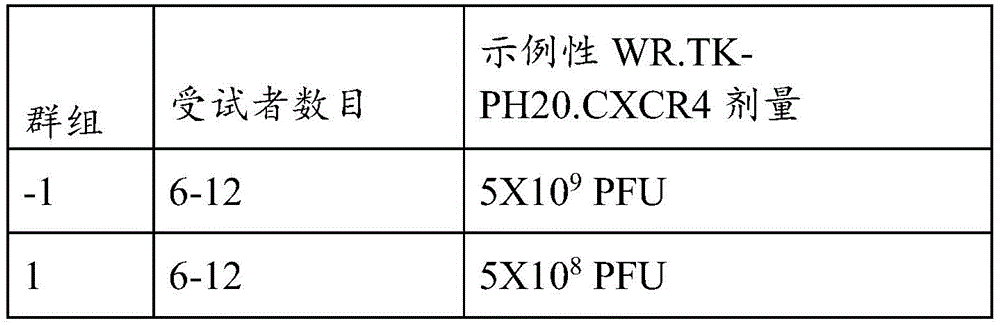
安全性safety
在研究过程中,通过记录AE、临床实验室检查、身体检查、生命体征测量、心电图(ECG)和其他相关程序来评估安全性。During the study, safety was assessed by recording AEs, clinical laboratory tests, physical examinations, vital sign measurements, electrocardiogram (ECG) and other relevant procedures.
任何检测到的累积毒性可能需要在以后酌情降低剂量和/或对给药方案进行其他更改,包括进一步完善RP2D。Any detected cumulative toxicity may require subsequent dose reductions and/or other changes to the dosing regimen as appropriate, including further refinement of RP2D.
如果最高达5x 10⁹PFU的剂量超过MTD,则评价较低的剂量。研究调查人员使用美国(US)国家癌症研究所(NCI)的“不良事件通用术语标准”(CTCAE)4.03版评估毒性。在完成每个群组的大部分安全性评估后,由医学监察员与研究调查人员协商,决定是否继续进行下一个剂量水平。If the dose of up to 5x 10⁹ PFU exceeds the MTD, a lower dose is evaluated. Toxicity was assessed by study investigators using the United States (US) National Cancer Institute (NCI) Common Terminology Criteria for Adverse Events (CTCAE) version 4.03. After completing most of the safety assessments in each cohort, the decision to proceed to the next dose level was made by the medical monitor in consultation with the study investigators.
在完成该研究的剂量递增/确认阶段,确定了MTD/RP2D之后,开始该研究的2期部分。After completion of the dose escalation/confirmation phase of the study and determination of MTD/RP2D, the
2期season2
2期(扩展):在扩展阶段,使用在转移性癌症患者中的剂量递增/确认阶段确定的RP2D评价WR.TK-PH20.CXCR4病毒。在2期部分中,将转移性癌症患者以2:1的比例随机分配以接受WR.TK-PH20.CXCR4病毒(在RP2D下)或安慰剂。通过iRECIST评估,该随机化部分的主要终点是无进展生存期(PFS)。次要终点包括持久缓解率(DRR)、无治疗间隔(TFI)、生活质量(QoL)、总缓解率(ORR)、总生存期(OS)和安全性。2期部分的样本量为100-150名患者,这可以在单侧p=0.1的情况下导致90%的功效,以检测PFS获益,危害比(HR)约为0.5。测试组的治疗持续时间为6个月、9个月、12个月或18个月,而对照组的治疗持续时间为4-6个月。估计获益(Accrual)需要花费12个月,计划试验持续时间为2-3年。Phase 2 (Expansion): In the expansion phase, the WR.TK-PH20.CXCR4 virus is evaluated using the RP2D identified in the dose escalation/confirmation phase in patients with metastatic cancer. In the
实施例6:示例性经修饰的痘苗病毒在癌症患者中的临床研究Example 6: Clinical study of an exemplary modified vaccinia virus in cancer patients
在癌症患者中进行了如本文公开的示例性痘苗病毒(WR.TK-PH20.CXCR4)的1B/2期开放开放标签研究。A Phase 1B/2 open label study of an exemplary vaccinia virus (WR.TK-PH20.CXCR4) as disclosed herein was conducted in cancer patients.
研究设计:Research design:
该研究是一项开放标签的1B/2期研究,其在癌症患者中评价了经修饰的痘苗病毒WR.TK-PH20.CXCR4。该研究分为两个阶段:剂量递增/确认阶段(1b期)和扩展阶段(2期),扩展阶段对每个群组采用Simon2阶段设计。The study is an open-label Phase 1B/2 study evaluating the modified vaccinia virus WR.TK-PH20.CXCR4 in cancer patients. The study was divided into two phases: a dose escalation/confirmation phase (Phase 1b) and an expansion phase (Phase 2), which used a Simon 2-phase design for each cohort.
经修饰的痘苗病毒WR.TK-PH20.CXCR4是Western Reserve痘苗病毒,其包含TK基因的缺失、编码PH20和CXCR4的外源核酸。正如在动物研究中所示的,痘苗病毒中TK的缺失以及PH20和CXCR4的表达可导致更大的抗癌治疗效果。The modified vaccinia virus WR.TK-PH20.CXCR4 is a Western Reserve vaccinia virus comprising a deletion of the TK gene, exogenous nucleic acids encoding PH20 and CXCR4. As shown in animal studies, deletion of TK in vaccinia virus and expression of PH20 and CXCR4 can lead to greater anticancer therapeutic effects.
1B期(剂量递增阶段)Phase 1B (dose escalation phase)
目的:Purpose:
剂量dose
确定WR.TK-PH20.CXCR4病毒的剂量限制毒性(DLT)和最大耐受剂量(MTD)或推荐的2期剂量(RP2D)。The dose-limiting toxicity (DLT) and maximum tolerated dose (MTD) or recommended
如通过临床不良事件(AE)和实验室参数所测量的,评价WR.TK-PH20.CXCR4病毒的安全性和耐受性。The safety and tolerability of WR.TK-PH20.CXCR4 virus were evaluated as measured by clinical adverse events (AEs) and laboratory parameters.
WR.TK-PH20.CXCR4病毒的起始剂量(剂量水平1)最高为一次静脉内注射5x10⁹PFU。The starting dose of WR.TK-PH20.CXCR4 virus (dose level 1) was a single intravenous injection of up to 5x10⁹ PFU.
如果剂量水平1无法耐受,则将WR.TK-PH20.CXCR4病毒的剂量水平1设置为一次最高5x10⁷ PFU。If
剂量递增阶段的每个剂量水平招募6至12名可评价的患者。Six to 12 evaluable patients were recruited for each dose level in the dose escalation phase.
表2.剂量递增示意表Table 2. Schematic of dose escalation
安全性safety
在研究过程中,通过记录AE、临床实验室检查、身体检查、生命体征测量、心电图(ECG)和其他相关程序来评估安全性。During the study, safety was assessed by recording AEs, clinical laboratory tests, physical examinations, vital sign measurements, electrocardiogram (ECG) and other relevant procedures.
任何检测到的累积毒性可能需要在以后酌情降低剂量和/或对给药方案进行其他更改,包括进一步完善RP2D。Any detected cumulative toxicity may require subsequent dose reductions and/or other changes to the dosing regimen as appropriate, including further refinement of RP2D.
如果最高达5x 10⁹PFU的剂量超过MTD,则评价较低的剂量。研究调查人员使用美国(US)国家癌症研究所(NCI)的“不良事件通用术语标准”(CTCAE)4.03版评估毒性。在完成每个群组的大部分安全性评估后,由医学监察员与研究调查人员协商,决定是否继续进行下一个剂量水平。If the dose of up to 5x 10⁹ PFU exceeds the MTD, a lower dose is evaluated. Toxicity was assessed by study investigators using the United States (US) National Cancer Institute (NCI) Common Terminology Criteria for Adverse Events (CTCAE) version 4.03. After completing most of the safety assessments in each cohort, the decision to proceed to the next dose level was made by the medical monitor in consultation with the study investigators.
在完成该研究的剂量递增/确认阶段,确定了MTD/RP2D之后,开始该研究的2期部分。After completion of the dose escalation/confirmation phase of the study and determination of MTD/RP2D, the
2期season2
2期(扩展):在扩展阶段,使用在癌症患者中的剂量递增/确认阶段确定的RP2D评价WR.TK-PH20.CXCR4病毒。在2期部分中,将癌症患者以2:1的比例随机分配以接受WR.TK-PH20.CXCR4病毒(在RP2D下)或安慰剂。通过iRECIST评估,该随机化部分的主要终点是无进展生存期(PFS)。次要终点包括持久缓解率(DRR)、无治疗间隔(TFI)、生活质量(QoL)、总缓解率(ORR)、总生存期(OS)和安全性。2期部分的样本量为100-150名患者,这可以在单侧p=0.1的情况下导致90%的功效,以检测PFS获益,危害比(HR)约为0.5。测试组的治疗持续时间为6个月、9个月、12个月或18个月,而对照组的治疗持续时间为4-6个月。估计获益(Accrual)需要花费12个月,计划试验持续时间为2-3年。Phase 2 (Expansion): In the expansion phase, the WR.TK-PH20.CXCR4 virus is evaluated using the RP2D identified in the dose escalation/confirmation phase in cancer patients. In the
实施例7:具有示例性突变以促进NK细胞活性的示例性痘苗病毒在鼠肿瘤模型中Example 7: Exemplary vaccinia virus with exemplary mutations to promote NK cell activity in a murine tumor model 显示出增强的治疗效果Shows enhanced therapeutic effects
为了测试具有为了促进NK细胞活性而设计的突变的溶瘤病毒是否表现出抗癌效果,产生了以下经修饰的病毒:(i)K7R缺失并插入了编码IL15和CCL5的外源核酸的病毒,被称为K7R-IL15 CCL5,(ii)TK缺失并插入了编码LIGHT的外源核酸的病毒,被称为TK-LIGHT,(iii)TK缺失并插入了编码ITAC和CXXXC趋化分子(也称为CX3CL1)的外源核酸的病毒,被称为TK-ITAC fractalkine,(iv)A52R缺失并插入了编码IL15和IL15-Rα的外源核酸的病毒,被称为A52R-IL15/IL15-Rα,和(v)A52R缺失并插入了编码ITAC、LIGHT、IL15和IL15Rα的外源核酸的病毒,被称为TK-ITAC LIGHT A52R-IL15/IL15-Rα。To test whether oncolytic viruses with mutations designed to promote NK cell activity exhibit anticancer effects, the following modified viruses were generated: (i) K7R-deleted and inserted exogenous nucleic acids encoding IL15 and CCL5, A virus known as K7R-IL15 CCL5, (ii) TK deleted and inserted with exogenous nucleic acid encoding LIGHT, known as TK-LIGHT, (iii) TK deleted and inserted encoding ITAC and CXXXC chemotactic molecules (also known as The virus with the exogenous nucleic acid of CX3CL1) is called TK-ITAC fractalkine, (iv) the virus with A52R deletion and insertion of exogenous nucleic acid encoding IL15 and IL15-Rα is called A52R-IL15/IL15-Rα, and (v) A52R-deleted and inserted exogenous nucleic acids encoding ITAC, LIGHT, IL15 and IL15Rα were termed TK-ITAC LIGHT A52R-IL15/IL15-Rα.
在一项实验中,皮下荷有RENCA肿瘤的BALB/c小鼠通过通过单次瘤内注射(1x108PFU)K7R-IL15+CCL5+、TK-LIGHT+或TK-GMCSF+病毒进行处理。对照小鼠接受静脉内注射对照缓冲液。在处理后第34天对肿瘤体积进行定量。在已经接受K7R-IL15+CCL5+或TK-LIGHT+修饰的病毒的小鼠中,肿瘤体积较小,提示为了促进NK细胞活性而设计的溶瘤病毒中的突变可以导致增强的抗癌治疗效果(图23)。In one experiment, BALB/c mice bearing RENCA tumors subcutaneously were treated with K7R-IL15+CCL5+, TK-LIGHT+ or TK-GMCSF+ virus by a single intratumoral injection ( 1x10⁸ PFU). Control mice received intravenous injections of control buffer. Tumor volume was quantified on day 34 post-treatment. Tumor volumes were smaller in mice that had received K7R-IL15+CCL5+ or TK-LIGHT+ modified viruses, suggesting that mutations in oncolytic viruses designed to promote NK cell activity could lead to enhanced anticancer therapeutic effects (Fig. twenty three).
在另一项实验中,皮下荷有RENCA肿瘤的BALB/c小鼠通过通过单次瘤内注射(1x107PFU)TK-LIGHT+、TK-GMCSF+、TK-ITAC+fractalkine+、A52R-IL15+/IL15R-α+、TK-ITAC+LIGHT+A52R-IL15+/IL15-Rα或赋形剂配制的缓冲液(称为VFB)进行处理,并且如上所述随时间监测肿瘤体积。瘤内递送的TK-LIGHT+、TK-ITAC+fractalkine+、A52R-IL15+/IL15-Rα和TK-ITAC+LIGHT+A52R-IL15+/IL15-Rα+延缓了肿瘤生长,提示为了促进K细胞活性而设计的溶瘤病毒中的突变导致增强的抗肿瘤治疗效果(图24)。In another experiment, BALB/c mice bearing RENCA tumors subcutaneously were treated with a single intratumoral injection (1x10 7 PFU) of TK-LIGHT+, TK-GMCSF+, TK-ITAC+fractalkine+, A52R-IL15+/IL15R- Alpha+, TK-ITAC+LIGHT+A52R-IL15+/IL15-Rα or vehicle formulated buffer (referred to as VFB) were treated and tumor volume was monitored over time as described above. Intratumorally delivered TK-LIGHT+, TK-ITAC+fractalkine+, A52R-IL15+/IL15-Rα and TK-ITAC+LIGHT+A52R-IL15+/IL15-Rα+ delayed tumor growth, suggesting that the Mutations in oncolytic viruses resulted in enhanced antitumor therapeutic effects (Figure 24).
实施例8:具有编码趋化因子受体和细胞外基质降解酶的示例性外源性核酸的示Example 8: Display with Exemplary Exogenous Nucleic Acids Encoding Chemokine Receptors and Extracellular Matrix Degrading Enzymes 例性痘苗病毒显示出在癌细胞之间扩散并杀死癌细胞Exemplary vaccinia virus shown to spread among and kill cancer cells
为了测试组合以上公开的经修饰的溶瘤病毒的元件的可行性,开发了一种经修饰的病毒,其中A52R基因和TK基因缺失,并插入了编码HysA和CXCR4的外源核酸(TK-HysAA52R-CXCR4)。用TK-(在图25A-25B中标记为WR TK-GFP 1MOI)、A52R-HysA(在图25A-25B中标记为WR A52R-EL HysA GFP 1MOI)或TK-HysA A52R-CXCR4(在图25A-25B中标记为WRA52R-7.5CXCR4 TK-EL HysA)修饰的病毒感染培养中的LLC癌细胞,每种病毒也表达GFP。A52R-HysA和TK-HysA A52R-CXCR4病毒能够在癌细胞之间扩散并减少癌细胞扩充(图25A-25B)。这些数据提供了非限制性实例,证明可以产生包含本文公开的多个经修饰元件的溶瘤病毒,并且其可以具有抗癌活性,包括在癌细胞之间扩散并杀死癌细胞。To test the feasibility of combining elements of the modified oncolytic viruses disclosed above, a modified virus was developed in which the A52R and TK genes were deleted and exogenous nucleic acids encoding HysA and CXCR4 (TK-HysAA52R -CXCR4). with TK- (marked as WR TK-
实施例9:具有示例性SCR1缺失的示例性经修饰的EVV高表达痘苗病毒显示出在癌Example 9: Exemplary modified EVV high expressing vaccinia virus with exemplary SCR1 deletion shown to be in cancer 细胞之间扩散并杀死癌细胞Spread between cells and kill cancer cells
选择IHDJ作为示例性EEV高产病毒,以评价溶瘤潜能。开发了经修饰的IHDJ病毒,其中EEV表面上的中和抗体结合位点(B5R SCR1)缺失(IHDJ-B5RcoΔSCR1)。感染MC38和HCT116癌细胞的培养物表明,IHDJ和IHDJ-B5RcoΔSCR1(均表达GFP)能够在癌细胞之间扩散并减少癌细胞扩充(图26A-26B)。噬斑测定进一步支持了IHDJ和IHDJ-B5RcoΔSCR1病毒在癌细胞之间扩散并杀死癌细胞的能力(图26C)。在另一项实验中,进行了彗尾测定,其中癌细胞单层以低感染复数进行感染并在液体培养基下孵育。在该测定中,病毒的扩散导致细长的“彗尾”形噬斑。IHDJ和IHDJ-B5RcoΔSCR1病毒产生明显的彗尾,这与有效的EEV产生一致(图26D)。这些实验证明,EEV高表达痘苗病毒,包括EEV表面上中和抗体结合位点缺失的示例性经修饰病毒,可具有抗癌活性,包括在癌细胞之间扩散并杀死癌细胞。IHDJ was selected as an exemplary EEV high-yielding virus to evaluate oncolytic potential. A modified IHDJ virus was developed in which the neutralizing antibody binding site (B5R SCR1 ) on the EEV surface was deleted (IHDJ-B5RcoΔSCR1). Cultures infected with MC38 and HCT116 cancer cells showed that IHDJ and IHDJ-B5RcoΔSCR1 (both expressing GFP) were able to spread between cancer cells and reduce cancer cell expansion (Figures 26A-26B). Plaque assays further supported the ability of IHDJ and IHDJ-B5RcoΔSCR1 viruses to spread among and kill cancer cells (FIG. 26C). In another experiment, a comet tail assay was performed in which cancer cell monolayers were infected at a low multiplicity of infection and incubated in liquid medium. In this assay, the spread of the virus results in elongated "comet tail" shaped plaques. IHDJ and IHDJ-B5RcoΔSCR1 viruses produced distinct comet tails, consistent with efficient EEV production (FIG. 26D). These experiments demonstrate that EEV high expressing vaccinia viruses, including exemplary modified viruses with deletions of neutralizing antibody binding sites on the EEV surface, can have anticancer activities, including spreading among and killing cancer cells.
表4提供了病毒骨架基因和病毒蛋白质的示例性序列。进一步提供了由各种外源核酸序列表达的蛋白质的示例性序列,这些序列可以插入本文所述的经修饰的溶瘤病毒中。在一些情况下,本文所述的经修饰的溶瘤病毒中的上述病毒骨架基因和病毒蛋白质可包含与表4中提供的病毒骨架基因和病毒蛋白质的示例性序列约70%、约75%、约80%、约81%、约82%、约83%、约84%、约85%、约86%、约87%、约88%、约89%、约90%、约91%、约92%、约93%、约94%、约95%、约96%、约97%、约98%、约99%或约100%相同的序列。在一些情况下,从本文所述的经修饰的溶瘤病毒中的外源核酸序列表达的上述蛋白质可以包含与表4中提供的示例性蛋白质序列约70%、约75%、约80%、约81%、约82%、约83%、约84%、约85%、约86%、约87%、约88%、约89%、约90%、约91%、约92%、约93%、约94%、约95%、约96%、约97%、约98%、约99%或约100%相同的序列。Table 4 provides exemplary sequences of viral backbone genes and viral proteins. Further provided are exemplary sequences of proteins expressed from various exogenous nucleic acid sequences that can be inserted into the modified oncolytic viruses described herein. In some cases, the aforementioned viral backbone genes and viral proteins in the modified oncolytic viruses described herein may comprise about 70%, about 75%, about 75%, about 80%, about 81%, about 82%, about 83%, about 84%, about 85%, about 86%, about 87%, about 88%, about 89%, about 90%, about 91%, about 92 %, about 93%, about 94%, about 95%, about 96%, about 97%, about 98%, about 99%, or about 100% identical sequences. In some cases, the above-described proteins expressed from exogenous nucleic acid sequences in the modified oncolytic viruses described herein may comprise about 70%, about 75%, about 80%, about 70%, about 80%, about 81%, about 82%, about 83%, about 84%, about 85%, about 86%, about 87%, about 88%, about 89%, about 90%, about 91%, about 92%, about 93% %, about 94%, about 95%, about 96%, about 97%, about 98%, about 99%, or about 100% identical sequences.
表4Table 4


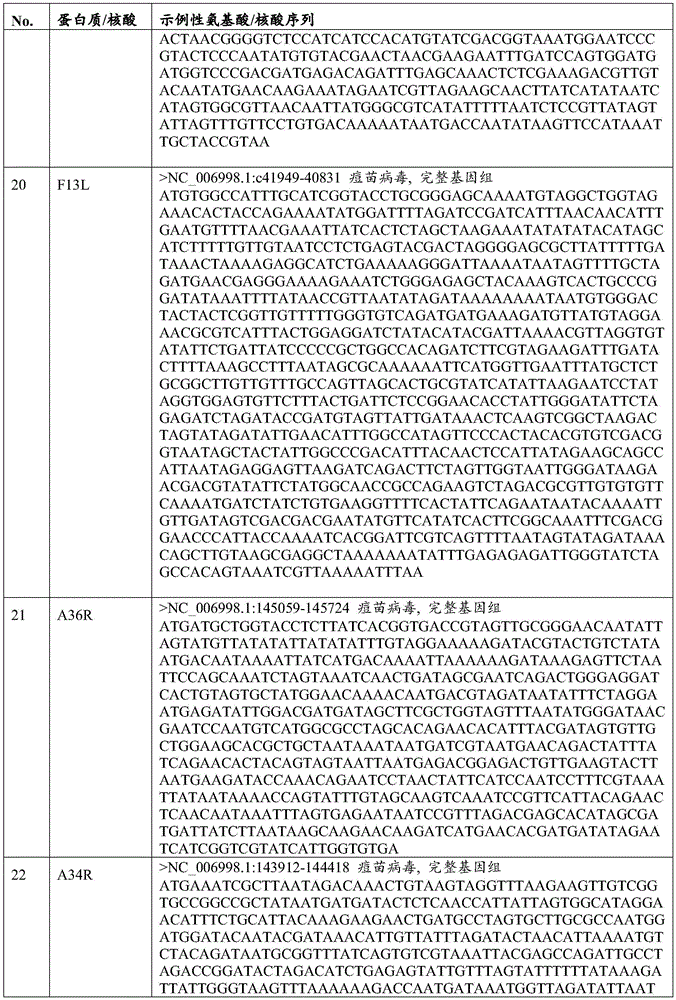


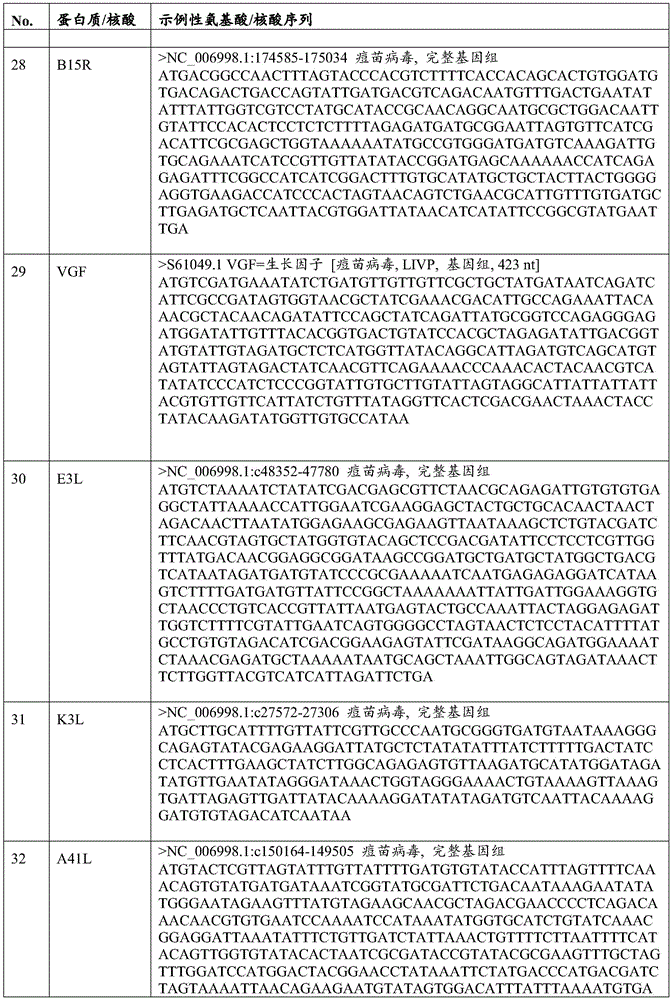


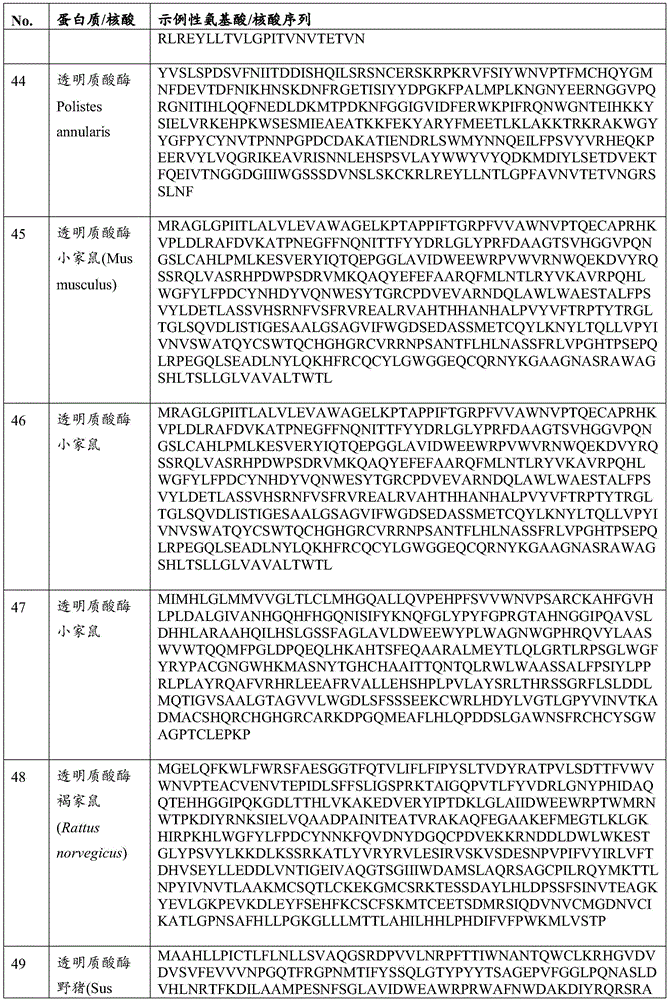

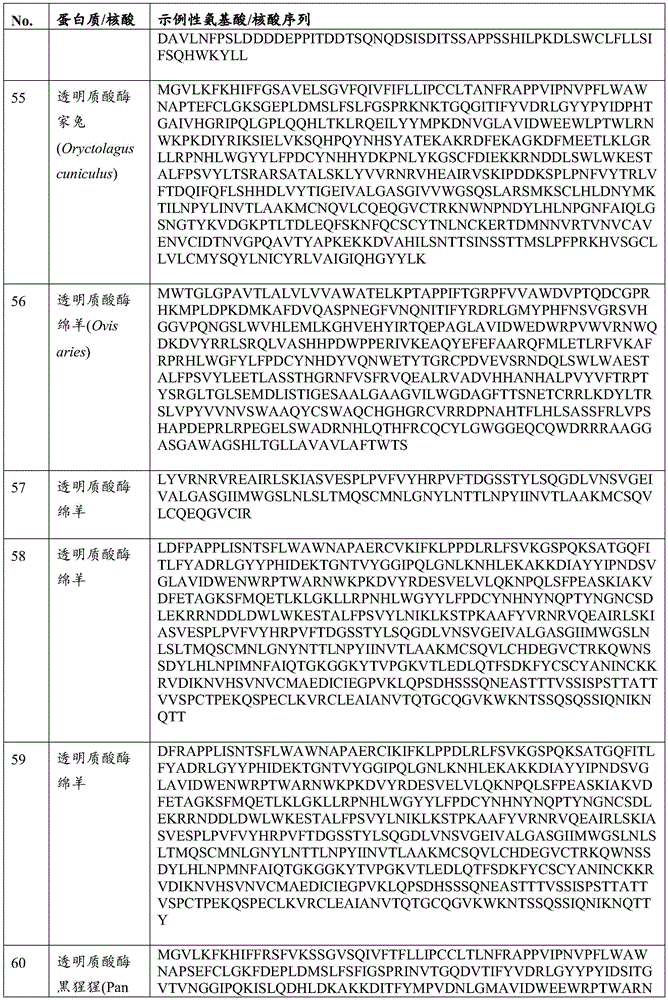


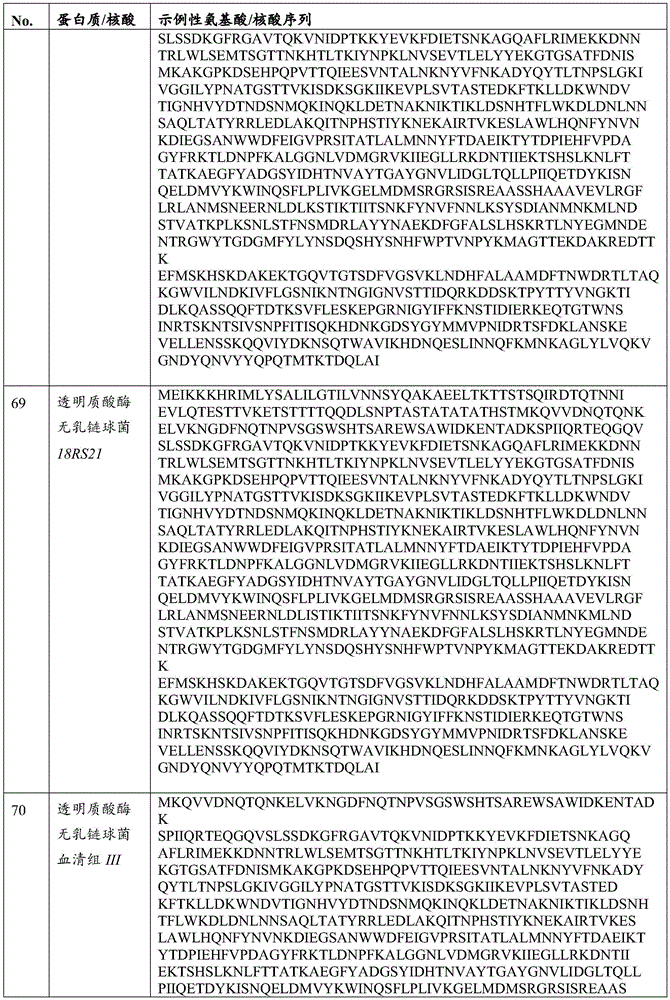

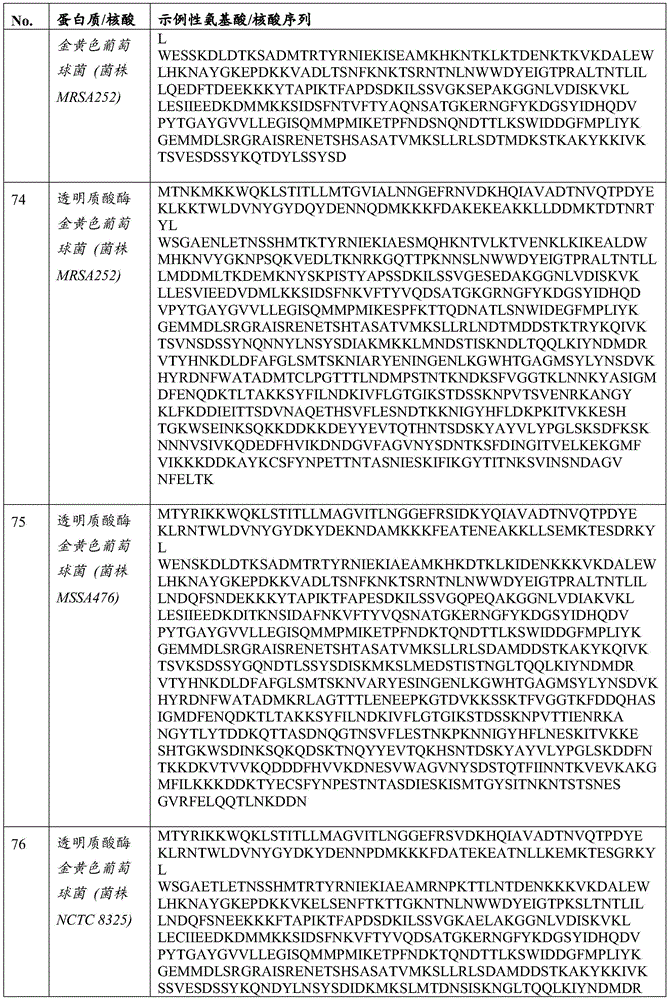


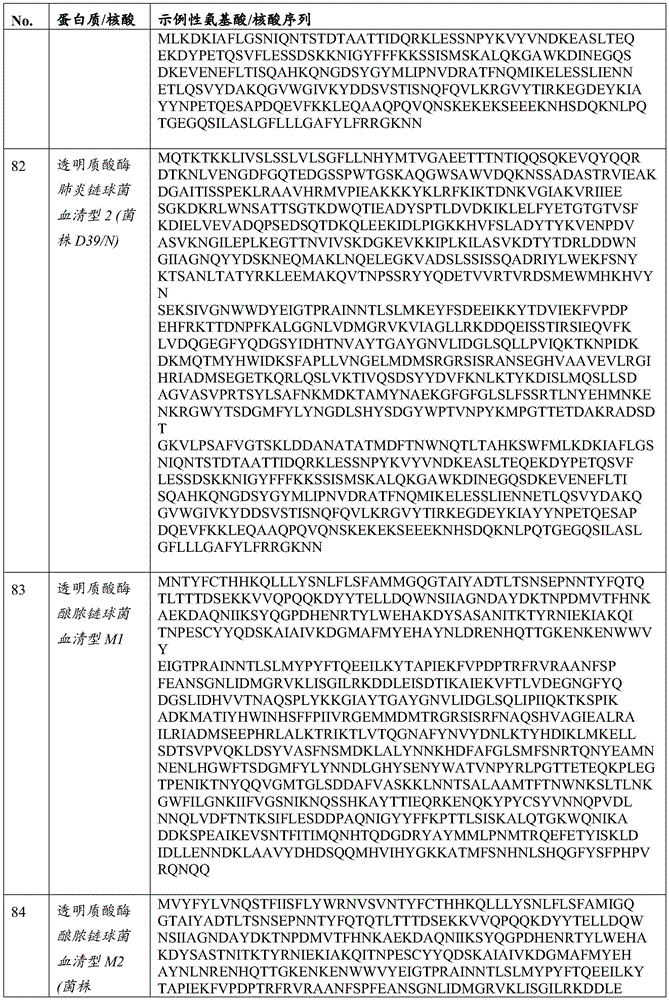

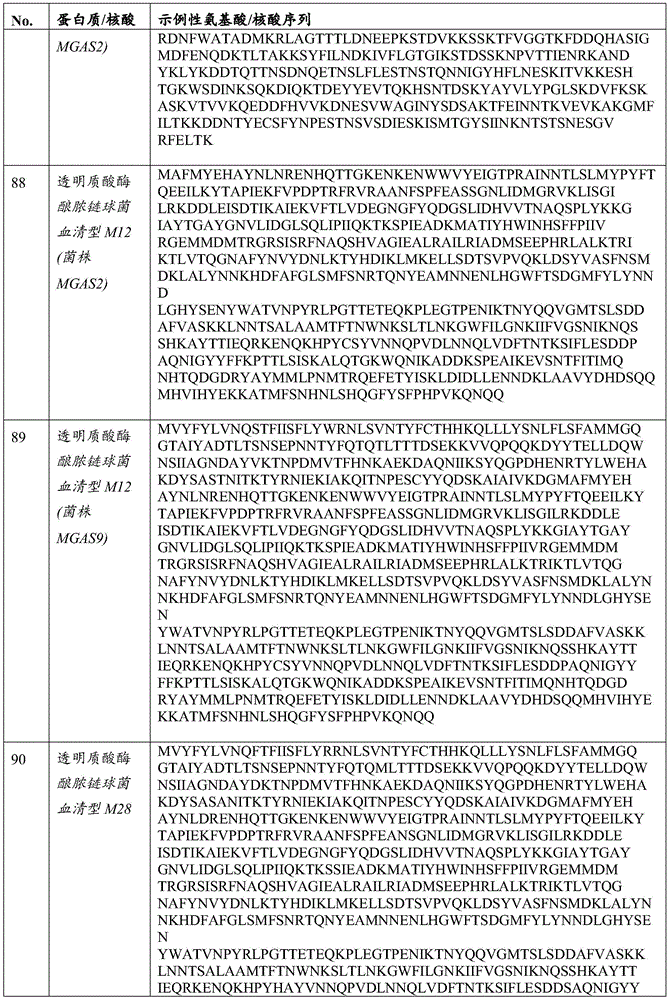


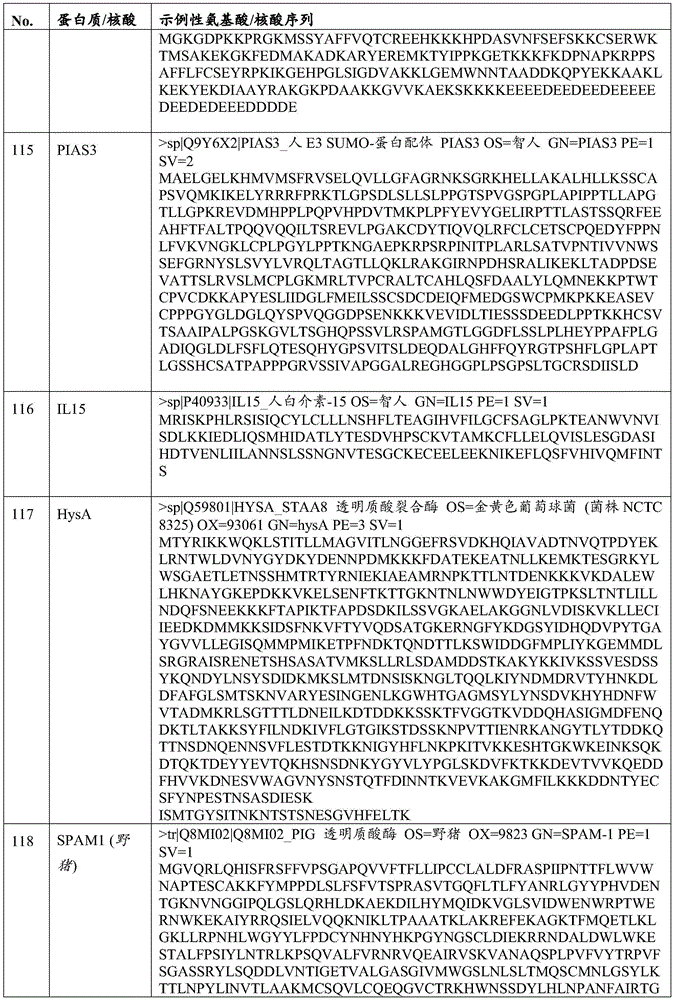
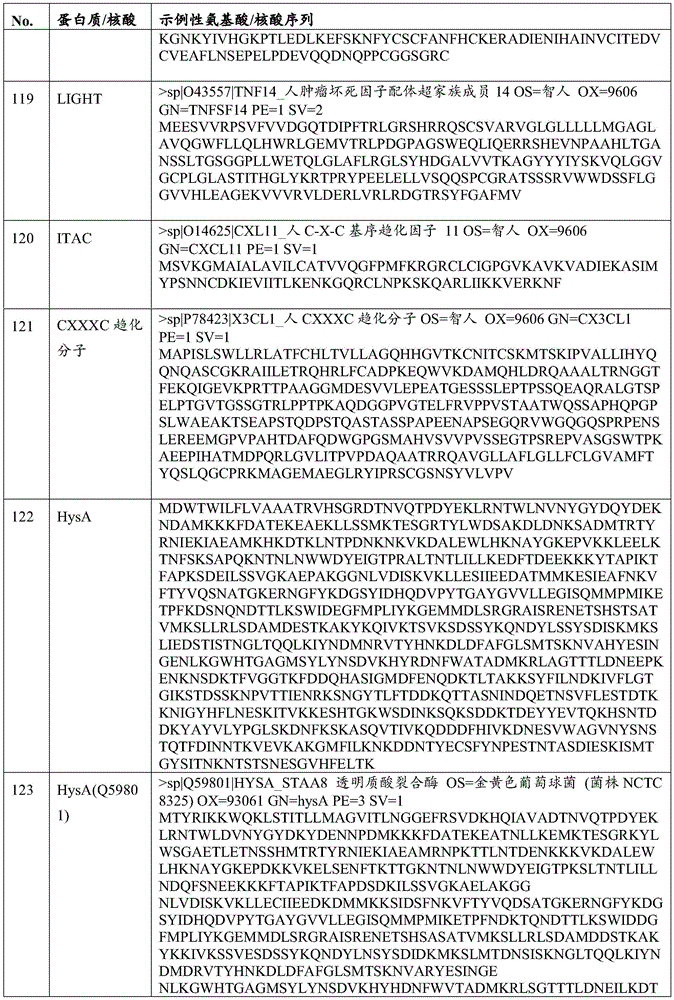
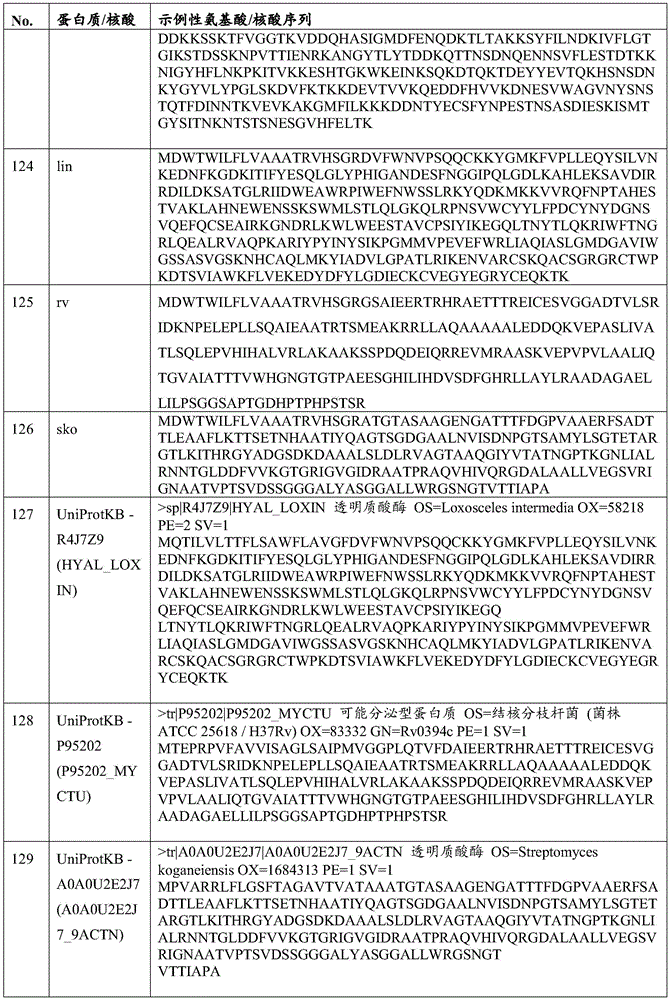

Claims (206)
Applications Claiming Priority (3)
| Application Number | Priority Date | Filing Date | Title |
|---|---|---|---|
| US201762579517P | 2017-10-31 | 2017-10-31 | |
| US62/579,517 | 2017-10-31 | ||
| PCT/US2018/058456 WO2019089755A1 (en) | 2017-10-31 | 2018-10-31 | Platform oncolytic vector for systemic delivery |
Publications (1)
| Publication Number | Publication Date |
|---|---|
| CN111556757A true CN111556757A (en) | 2020-08-18 |
Family
ID=66333632
Family Applications (1)
| Application Number | Title | Priority Date | Filing Date |
|---|---|---|---|
| CN201880085079.9A Pending CN111556757A (en) | 2017-10-31 | 2018-10-31 | Platform Oncolytic Carriers for Systemic Delivery |
Country Status (8)
| Country | Link |
|---|---|
| US (5) | US12036257B2 (en) |
| EP (2) | EP3703723A4 (en) |
| JP (2) | JP7551496B2 (en) |
| KR (1) | KR20200081438A (en) |
| CN (1) | CN111556757A (en) |
| AU (1) | AU2018359420A1 (en) |
| CA (1) | CA3081436A1 (en) |
| WO (1) | WO2019089755A1 (en) |
Cited By (6)
| Publication number | Priority date | Publication date | Assignee | Title |
|---|---|---|---|---|
| CN113144181A (en) * | 2021-04-20 | 2021-07-23 | 徐州医科大学 | B7H 3-targeted DNA vaccine, and preparation method and application thereof |
| CN114761562A (en) * | 2019-10-16 | 2022-07-15 | 卡利威尔免疫治疗公司 | Modified extracellular enveloped viruses |
| CN116947981A (en) * | 2023-07-07 | 2023-10-27 | 华中农业大学 | A universal diagnostic antigen for LSDV and GTPV and its monoclonal antibodies and applications |
| CN117241813A (en) * | 2021-04-30 | 2023-12-15 | 卡利威尔免疫治疗公司 | Oncolytic viruses for modified MHC expression |
| US12226440B2 (en) | 2017-10-31 | 2025-02-18 | Kalivir Immunotherapeutics, Inc. | Platform oncolytic vector for systemic delivery |
| US12403165B2 (en) | 2020-11-19 | 2025-09-02 | KaliVir Immunotherapeutcs, Inc. | Oncolytic immunotherapy by tumor micro-environment remodeling |
Families Citing this family (9)
| Publication number | Priority date | Publication date | Assignee | Title |
|---|---|---|---|---|
| JP7312412B2 (en) | 2018-01-05 | 2023-07-21 | オタワ ホスピタル リサーチ インスティチュート | Modified orthopoxvirus vector |
| IL293627A (en) * | 2019-12-12 | 2022-08-01 | Ignite Immunotherapy Inc | Variant of oncolytic vaccinia virus and methods of using it |
| CN111154806A (en) * | 2020-01-08 | 2020-05-15 | 深圳普菲科生命科技有限公司 | Oncolytic virus vector system embedded with exogenous super cell factor and application of oncolytic virus vector system in medicine |
| US20230201283A1 (en) * | 2020-01-09 | 2023-06-29 | Pfizer Inc. | Recombinant vaccinia virus |
| WO2021155286A1 (en) * | 2020-01-29 | 2021-08-05 | Helix Nanotechnologies, Inc. | METHODS AND COMPOSITIONS FOR NUCLEIC ACID EXPRESSION INVOLVING INHIBITION OF NF-kB PATHWAYS AND/OR IRF PATHWAYS |
| CA3189291A1 (en) * | 2020-07-14 | 2022-01-20 | Pfizer Inc. | Recombinant vaccinia virus |
| WO2022170919A1 (en) * | 2021-02-09 | 2022-08-18 | 南京惟亚德生物医药有限公司 | Recombinant oncolytic adenovirus and application thereof |
| EP4604982A2 (en) * | 2022-10-19 | 2025-08-27 | KaliVir Immunotherapeutics, Inc. | Nucleic acids encoding tgf-beta inhibitor and il-12 and uses thereof |
| WO2025184411A1 (en) | 2024-02-27 | 2025-09-04 | Calidi Biotherapeutics (Nevada), Inc. | Serum-resistant eev viruses and uses thereof |
Citations (4)
| Publication number | Priority date | Publication date | Assignee | Title |
|---|---|---|---|---|
| US20100016224A1 (en) * | 2006-08-25 | 2010-01-21 | The Provost, Fellows And Scholars Of The College Of The Holy And Undivided Trinity Of Queen Elizabe | Compositions and methods for modulating an immune response |
| WO2016033555A1 (en) * | 2014-08-28 | 2016-03-03 | Halozyme, Inc. | Combination therapy with a hyaluronan-degrading enzyme and an immune checkpoint inhibitor |
| CN106103484A (en) * | 2014-03-14 | 2016-11-09 | 诺华股份有限公司 | Antibody molecules against LAG‑3 and uses thereof |
| WO2017043815A1 (en) * | 2015-09-08 | 2017-03-16 | Sillajen, Inc. | Modified oncolytic vaccinia viruses expressing a cytokine and a car- boxylesterase and methods of use thereof |
Family Cites Families (118)
| Publication number | Priority date | Publication date | Assignee | Title |
|---|---|---|---|---|
| US4458066A (en) | 1980-02-29 | 1984-07-03 | University Patents, Inc. | Process for preparing polynucleotides |
| US4409450A (en) | 1982-07-29 | 1983-10-11 | Amp Incorporated | Double pole membrane switch having preferred sequence closing feature |
| IL71275A0 (en) | 1983-03-21 | 1984-06-29 | Sparamedica Ag | Human interleukin-2-and its preparation |
| FR2573436B1 (en) | 1984-11-20 | 1989-02-17 | Pasteur Institut | RECOMBINANT DNA COMPRISING A NUCLEOTIDE SEQUENCE ENCODING A DETERMINED POLYPEPTIDE UNDER THE CONTROL OF AN ADENOVIRUS PROMOTER, VECTORS CONTAINING THIS RECOMBINANT DNA, EUKARYOT CELLS TRANSFORMED BY THIS RECOMBINANT DNA, THE CONSTITUTION OF VACCINES |
| US4797368A (en) | 1985-03-15 | 1989-01-10 | The United States Of America As Represented By The Department Of Health And Human Services | Adeno-associated virus as eukaryotic expression vector |
| US5139941A (en) | 1985-10-31 | 1992-08-18 | University Of Florida Research Foundation, Inc. | AAV transduction vectors |
| US5585362A (en) | 1989-08-22 | 1996-12-17 | The Regents Of The University Of Michigan | Adenovirus vectors for gene therapy |
| WO1991018088A1 (en) | 1990-05-23 | 1991-11-28 | The United States Of America, Represented By The Secretary, United States Department Of Commerce | Adeno-associated virus (aav)-based eucaryotic vectors |
| US5173414A (en) | 1990-10-30 | 1992-12-22 | Applied Immune Sciences, Inc. | Production of recombinant adeno-associated virus vectors |
| US5252479A (en) | 1991-11-08 | 1993-10-12 | Research Corporation Technologies, Inc. | Safe vector for gene therapy |
| JPH07505887A (en) | 1992-04-17 | 1995-06-29 | アボツト・ラボラトリーズ | Taxol derivative |
| EP1024198A3 (en) | 1992-12-03 | 2002-05-29 | Genzyme Corporation | Pseudo-adenoviral vectors for the gene therapy of haemophiliae |
| US5776468A (en) | 1993-03-23 | 1998-07-07 | Smithkline Beecham Biologicals (S.A.) | Vaccine compositions containing 3-0 deacylated monophosphoryl lipid A |
| FR2705361B1 (en) | 1993-05-18 | 1995-08-04 | Centre Nat Rech Scient | Viral vectors and use in gene therapy. |
| FR2705686B1 (en) | 1993-05-28 | 1995-08-18 | Transgene Sa | New defective adenoviruses and corresponding complementation lines. |
| KR100356615B1 (en) | 1993-07-13 | 2003-04-03 | 아방티 파르마 소시에테 아노님 | Defective Adenovirus Vectors and Their Use in Gene Therapy |
| US5543158A (en) | 1993-07-23 | 1996-08-06 | Massachusetts Institute Of Technology | Biodegradable injectable nanoparticles |
| US6207646B1 (en) | 1994-07-15 | 2001-03-27 | University Of Iowa Research Foundation | Immunostimulatory nucleic acid molecules |
| JP3468773B2 (en) | 1994-07-15 | 2003-11-17 | ザ ユニバーシティ オブ アイオワ リサーチ ファウンデーション | Immunomodulatory oligonucleotide |
| IL116816A (en) | 1995-01-20 | 2003-05-29 | Rhone Poulenc Rorer Sa | Cell for the production of a defective recombinant adenovirus or an adeno-associated virus and the various uses thereof |
| UA68327C2 (en) | 1995-07-04 | 2004-08-16 | Gsf Forschungszentrum Fur Unwe | A recombinant mva virus, an isolated eukaryotic cell, infected with recombinant mva virus, a method for production in vitro of polypeptides with use of said cell, a method for production in vitro of virus parts (variants), vaccine containing the recombinant mva virus, a method for immunization of animals |
| US5912264A (en) | 1997-03-03 | 1999-06-15 | Bristol-Myers Squibb Company | 6-halo-or nitrate-substituted paclitaxels |
| NZ504423A (en) | 1997-11-10 | 2003-04-29 | Cellegy Pharma Inc | Composition having enhanced penetration capabilities and irritation reducing systems |
| US6506559B1 (en) | 1997-12-23 | 2003-01-14 | Carnegie Institute Of Washington | Genetic inhibition by double-stranded RNA |
| AT406376B (en) | 1998-01-16 | 2000-04-25 | Immuno Ag | CHIMEAN POXVIRUS CONTAINING A RETROVIRAL VECTOR COMPONENT |
| JPH11268865A (en) | 1998-03-20 | 1999-10-05 | Omron Corp | Paper sorting apparatus and method |
| AUPP249298A0 (en) | 1998-03-20 | 1998-04-23 | Ag-Gene Australia Limited | Synthetic genes and genetic constructs comprising same I |
| US6198323B1 (en) | 1999-01-28 | 2001-03-06 | Lucent Technologies Inc. | Flip-flop having gated inverter feedback structure with embedded preset/clear logic |
| US20040214783A1 (en) | 2002-05-08 | 2004-10-28 | Terman David S. | Compositions and methods for treatment of neoplastic disease |
| GB9927444D0 (en) | 1999-11-19 | 2000-01-19 | Cancer Res Campaign Tech | Inhibiting gene expression |
| US20030180352A1 (en) | 1999-11-23 | 2003-09-25 | Patel Mahesh V. | Solid carriers for improved delivery of active ingredients in pharmaceutical compositions |
| US6967023B1 (en) | 2000-01-10 | 2005-11-22 | Foamix, Ltd. | Pharmaceutical and cosmetic carrier or composition for topical application |
| AR030188A1 (en) | 2000-02-02 | 2003-08-13 | Univ Florida State Res Found | TAXANO COMPOUNDS REPLACED WITH ESTERS IN C7; PHARMACEUTICAL COMPOSITIONS THAT CONTAIN THEM AND PROCESS TO TREAT A MAMMER SUBJECT THAT SUFFERS FROM A CONDITION THAT RESPONDS TO TAXANS |
| CZ293690B6 (en) | 2000-03-14 | 2004-07-14 | Bavarian Nordic A/S | Modified Vaccinia Virus Ankara (MVA) |
| JP2003526367A (en) | 2000-03-16 | 2003-09-09 | ジェネティカ インコーポレイテッド | RNA interference method and RNA interference composition |
| ES2254408T4 (en) | 2000-04-25 | 2007-10-01 | Immunex Corporation | TUMOR TREATMENT PROCEDURE USING PHOTODYNAMIC THERAPY. |
| US7179483B2 (en) | 2000-04-26 | 2007-02-20 | Watson Pharmaceuticals, Inc. | Compositions and methods for transdermal oxybutynin therapy |
| WO2001091802A1 (en) | 2000-05-30 | 2001-12-06 | Baylor College Of Medicine | Chimeric viral vectors for gene therapy |
| US8512718B2 (en) | 2000-07-03 | 2013-08-20 | Foamix Ltd. | Pharmaceutical composition for topical application |
| EP1762614A3 (en) | 2000-07-21 | 2007-05-30 | Research Corporation Technologies, Inc. | Tumor-specific promoters |
| CN1549730A (en) | 2000-10-04 | 2004-11-24 | ���������Ǵ�ѧ�й��� | Composition and methods of use of flavivirus and pestivirus capsid proteins |
| EP1213025A1 (en) | 2000-12-06 | 2002-06-12 | Laboratoires Serobiologiques(Societe Anonyme) | Cosmetic and/or dermopharmaceutical composition containing extracts obtained from the leaves of Argania spinosa |
| EP1341817A2 (en) | 2000-12-08 | 2003-09-10 | Novo Nordisk A/S | Tff peptides |
| EP1395293B1 (en) | 2001-05-14 | 2009-07-22 | Gbp Ip, Llc | Lentiviral vectors encoding clotting factors for gene therapy |
| JP2003009883A (en) | 2001-07-05 | 2003-01-14 | Mitsubishi Pharma Corp | Mast cell death inducer |
| WO2003035683A2 (en) | 2001-10-26 | 2003-05-01 | Uffe Holmskov | Surfactant protein-d and atherosclerosis |
| US7368122B1 (en) | 2002-03-08 | 2008-05-06 | Dow Pharmaceutical Sciences | Skin cream |
| CN101912421A (en) | 2002-08-12 | 2010-12-15 | 杰能斯有限公司 | Methods and compositions concerning poxviruses and cancer |
| PT1506203E (en) | 2002-08-23 | 2007-04-30 | Sloan Kettering Inst Cancer | Synthesis of epothilones, intermediates thereto, analogues and uses thereof |
| GB0226251D0 (en) | 2002-11-11 | 2002-12-18 | San Raffaele Centro Fond | Acetylated protein |
| US20040143026A1 (en) | 2002-12-31 | 2004-07-22 | Shah Kishore R. | Bioadhesive hydrophilic composition for treatment of mammalian skin |
| NZ570709A (en) | 2003-06-13 | 2010-04-30 | Univ Pennsylvania | Nucleic acid sequences encoding and compositions comprising IgE signal peptide and/or IL-15 and methods for using the same |
| SG179291A1 (en) | 2003-06-18 | 2012-04-27 | Genelux Corp | Modified recombinant vaccinia viruses and other microorganisms, uses thereof |
| JP4792392B2 (en) | 2003-09-11 | 2011-10-12 | コーナーストーン セラピューティクス インコーポレイテッド | Monoclonal antibody against HMGB1 |
| EP1528101A1 (en) | 2003-11-03 | 2005-05-04 | ProBioGen AG | Immortalized avian cell lines for virus production |
| AU2003289223A1 (en) | 2003-12-05 | 2005-06-24 | Hokkaido Technology Licensing Office Co., Ltd. | Highly safe smallpox vaccine virus and vaccinia virus vector |
| DE102004030044A1 (en) | 2004-06-22 | 2006-01-12 | Birken Gmbh | Triterpene-containing oleogel, triterpene-containing oleogel and process for the preparation of a triterpenhaltigen oleogel |
| WO2006078213A1 (en) | 2005-01-20 | 2006-07-27 | Isconova Ab | Vaccine composition comprisinga fibronectin binding protein or a fibronectin binding peptide |
| US20100094560A1 (en) | 2006-08-15 | 2010-04-15 | Prometheus Laboratories Inc. | Methods for diagnosing irritable bowel syndrome |
| DK2062023T4 (en) | 2006-08-25 | 2017-02-20 | The Government Of The Us Secretary Dept Of Health And Human Services | INTERGENIC SITES BETWEEN CONSERVATED GENES THROUGH MODIFIED VACCINIA ANKARA (VAT) VACCINIAVIRUS |
| US8052968B2 (en) | 2006-10-16 | 2011-11-08 | Genelux Corporation | Modified vaccinia virus strains for use in diagnostic and therapeutic methods |
| GB0702695D0 (en) | 2007-02-12 | 2007-03-21 | Ark Therapeutics Ltd | Production of vectors |
| US8003363B2 (en) | 2007-05-14 | 2011-08-23 | Bavarian Nordic A/S | Purification of vaccinia virus- and recombinant vaccinia virus-based vaccines |
| JP6002903B2 (en) | 2007-07-10 | 2016-10-05 | アポゲニクス アーゲー | TNF superfamily collectin fusion protein |
| WO2009054996A2 (en) | 2007-10-25 | 2009-04-30 | Genelux Corporation | Systems and methods for viral therapy |
| HUE067606T2 (en) * | 2008-03-06 | 2024-10-28 | Halozyme Inc | Soluble hyaluronidase composition |
| US8313896B2 (en) | 2008-04-04 | 2012-11-20 | The General Hospital Corporation | Oncolytic herpes simplex virus immunotherapy in the treatment of brain cancer |
| DK2119726T5 (en) | 2008-05-14 | 2018-03-26 | Immatics Biotechnologies Gmbh | Novel and powerful MHC class II peptides derived from survivin and neurocan |
| EP2349296B1 (en) | 2008-08-21 | 2017-04-05 | Ottawa Hospital Research Institute | Engineered synergistic oncolytic viral symbiosis |
| CN101381742A (en) | 2008-10-23 | 2009-03-11 | 浙江理工大学 | Oncolytic adenovirus pCN305 vector targeting late promoter regulation and its construction method and application |
| EP2184297A1 (en) | 2008-11-07 | 2010-05-12 | Hla-G Technologies | HLA-G polypeptides and pharmaceutical uses thereof |
| ES2385251B1 (en) | 2009-05-06 | 2013-05-06 | Fundació Privada Institut D'investigació Biomèdica De Bellvitge | ONCOLYTIC ADENOVIRUSES FOR THE TREATMENT OF CANCER. |
| CA2709292A1 (en) | 2009-07-10 | 2011-01-10 | The Governors Of The University Of Alberta | Oncolytic viruses and methods for treating neoplastic disorders |
| WO2012036215A1 (en) | 2010-09-17 | 2012-03-22 | Taniguchi Tadatsugu | Inhibitor of hmgb protein-mediated immune response activation, and screening method |
| WO2012089225A1 (en) | 2010-12-29 | 2012-07-05 | Curevac Gmbh | Combination of vaccination and inhibition of mhc class i restricted antigen presentation |
| AU2012204467B2 (en) | 2011-01-04 | 2016-08-18 | Sillajen, Inc. | Generation of antibodies to tumor antigens and generation of tumor specific complement dependent cytotoxicity by administration of oncolytic vaccinia virus |
| EP2527459A1 (en) | 2011-05-02 | 2012-11-28 | Rheinische Friedrich-Wilhelms-Universität Bonn | Blood-based gene detection of non-small cell lung cancer |
| DK2739293T3 (en) | 2011-08-05 | 2020-08-24 | Sillajen Biotherapeutics Inc | METHODS AND COMPOSITIONS FOR THE PRODUCTION OF VACCINAVIRUS |
| FI20115914A7 (en) | 2011-09-16 | 2013-03-17 | Oncos Therapeutics Ltd | A modified oncolytic virus |
| US9283287B2 (en) | 2012-04-02 | 2016-03-15 | Moderna Therapeutics, Inc. | Modified polynucleotides for the production of nuclear proteins |
| US10806697B2 (en) | 2012-12-21 | 2020-10-20 | Therapeuticsmd, Inc. | Vaginal inserted estradiol pharmaceutical compositions and methods |
| US9862932B2 (en) | 2012-07-24 | 2018-01-09 | The General Hospital Corporation | Oncolytic virus therapy for resistant tumors |
| RU2015115898A (en) | 2012-09-28 | 2016-11-20 | Пробиоген Аг | NEW MVA VIRUS AND ITS APPLICATIONS |
| US9180091B2 (en) | 2012-12-21 | 2015-11-10 | Therapeuticsmd, Inc. | Soluble estradiol capsule for vaginal insertion |
| KR20140122603A (en) | 2013-04-10 | 2014-10-20 | 신라젠(주) | Host cell transformed by polynucleopeptide coding the protein related to forming extracellular enveloped vaccinia virus |
| RU2703438C2 (en) | 2013-04-18 | 2019-10-16 | Тилт Байотерапьютикс Ой | Extended adoptive cell therapy |
| DK3299466T3 (en) | 2013-07-18 | 2019-11-18 | Vib Vzw | FUSOKINES INVOLVING CYTOKINES WITH POWERFULLY REDUCED RECEPTOR BINDING EFFINITIES |
| EP3778897B1 (en) | 2013-08-22 | 2023-12-20 | University of Pittsburgh - Of the Commonwealth System of Higher Education | Immuno-oncolytic therapies |
| US10238700B2 (en) | 2014-01-02 | 2019-03-26 | Genelux Corporation | Oncolytic virus adjunct therapy with agents that increase virus infectivity |
| MA39818A (en) | 2014-03-30 | 2017-02-08 | Benevir Biopharm Inc | Exogenous tap inhibitor "armed" oncolytic viruses and therapeutic uses thereof |
| US20160060314A1 (en) | 2014-08-27 | 2016-03-03 | Daewoong Jo | Development of a Protein-Based Biotherapeutic Agent That Penetrates Cell-Membrane and Induces Anti-Tumor Effect in Solid Tumors - Improved Cell-Permeable Suppressor of Cytokine Signaling (iCP-SOCS3) Proteins, Polynucleotides Encoding the Same, and Anti-Tumor Compositions Comprising the Same |
| EA201700181A1 (en) * | 2014-10-14 | 2017-09-29 | Галозим, Инк. | COMPOSITIONS OF ADENOSINDEMINASE-2 (ADA-2), THEIR OPTIONS AND METHODS OF USE |
| WO2016061826A1 (en) | 2014-10-24 | 2016-04-28 | 华为技术有限公司 | Mode multiplexer-demultiplexer and switching node |
| JP2018510143A (en) | 2015-02-25 | 2018-04-12 | メモリアル スローン ケタリング キャンサー センター | Use of inactivated non-replicating modified vaccinia virus Ankara (MVA) in monotherapy for solid tumors or in combination with immune checkpoint blockers |
| EP3324988B1 (en) | 2015-07-20 | 2021-03-03 | Virttu Biologics Limited | Use of oncolytic herpes simplex virus in combination with immune checkpoint inhibitor, in the treatment of cancer |
| US11413340B2 (en) | 2015-12-22 | 2022-08-16 | Novartis Ag | Mesothelin chimeric antigen receptor (CAR) and antibody against PD-L1 inhibitor for combined use in anticancer therapy |
| BR112018016949A2 (en) | 2016-02-25 | 2019-01-08 | Memorial Sloan Kettering Cancer Center | replication-competent attenuated vaccinia virus as deletion of thymidine kinase with or without expression of human flt3l or gm-csf for cancer immunotherapy |
| WO2017165464A1 (en) | 2016-03-21 | 2017-09-28 | Elstar Therapeutics, Inc. | Multispecific and multifunctional molecules and uses thereof |
| KR20190059297A (en) * | 2016-09-21 | 2019-05-30 | 스티븐 에이치. 쏜 | High-mobility group Box 1 mutant |
| US20200046784A1 (en) | 2016-09-30 | 2020-02-13 | University Health Network | Recombinant oncolytic viruses for cancer therapy |
| WO2018091680A1 (en) | 2016-11-18 | 2018-05-24 | Transgene Sa | Cowpox-based oncolytic vectors |
| US11185586B2 (en) | 2016-11-22 | 2021-11-30 | Alloplex Biotherapeutics, Inc. | Allogeneic tumor cell vaccine |
| CN110381997A (en) | 2016-12-12 | 2019-10-25 | 茂体外尔公司 | For treating and preventing the method and composition comprising gene-virus therapy and immunologic test point inhibitor of cancer and infectious diseases |
| US20200054677A1 (en) | 2017-02-21 | 2020-02-20 | The University Of Adelaide | T cells expressing chemokine receptors for treating cancer |
| TWI672677B (en) | 2017-03-31 | 2019-09-21 | 鈺立微電子股份有限公司 | Depth map generation device for merging multiple depth maps |
| WO2019055860A1 (en) | 2017-09-15 | 2019-03-21 | The Texas A&M University System | Methods for enhancing immunotherapy in the treatment of cancer |
| CN111556757A (en) | 2017-10-31 | 2020-08-18 | 西方溶瘤细胞有限公司 | Platform Oncolytic Carriers for Systemic Delivery |
| US11786569B2 (en) | 2018-01-26 | 2023-10-17 | University of Pittsburgh—of the Commonwealth System of Higher Education | Expression of metabolic modulators in tumor microenvironment to improve tumor therapy |
| AR115069A1 (en) | 2018-05-02 | 2020-11-25 | David Evans | SYNTHETIC CHEMERIC VACCINE VIRUS |
| JP2021534101A (en) | 2018-08-09 | 2021-12-09 | ヴェルソー セラピューティクス, インコーポレイテッド | Oligonucleotide compositions for targeting CCR2 and CSF1R and their use |
| CA3116192C (en) | 2018-11-06 | 2025-09-23 | Calidi Biotherapeutics (Nevada), Inc. | Enhanced systems for cell-mediated oncolytic viral therapy |
| TW202038994A (en) | 2019-01-14 | 2020-11-01 | 美商醫格耐免疫治療公司 | Recombinant vaccinia virus and methods of use thereof |
| EP3923967A1 (en) | 2019-02-14 | 2021-12-22 | Ignite Immunotherapy, Inc. | Recombinant vaccinia virus and methods of use thereof |
| AU2020350137A1 (en) | 2019-09-20 | 2022-04-28 | Merck Patent Gmbh | Combination of a poxvirus encoding HPV polypeptides and IL-2 with an anti-PD-L1 antibody |
| IL293627A (en) | 2019-12-12 | 2022-08-01 | Ignite Immunotherapy Inc | Variant of oncolytic vaccinia virus and methods of using it |
| US20230201283A1 (en) | 2020-01-09 | 2023-06-29 | Pfizer Inc. | Recombinant vaccinia virus |
| CA3189291A1 (en) | 2020-07-14 | 2022-01-20 | Pfizer Inc. | Recombinant vaccinia virus |
| CN112668865A (en) | 2020-12-23 | 2021-04-16 | 贵阳市城市轨道交通集团有限公司 | Urban subway risk dynamic analysis method |
-
2018
- 2018-10-31 CN CN201880085079.9A patent/CN111556757A/en active Pending
- 2018-10-31 AU AU2018359420A patent/AU2018359420A1/en not_active Abandoned
- 2018-10-31 EP EP18873293.7A patent/EP3703723A4/en active Pending
- 2018-10-31 WO PCT/US2018/058456 patent/WO2019089755A1/en not_active Ceased
- 2018-10-31 EP EP21191521.0A patent/EP3973973A1/en active Pending
- 2018-10-31 US US16/759,705 patent/US12036257B2/en active Active
- 2018-10-31 KR KR1020207015355A patent/KR20200081438A/en not_active Ceased
- 2018-10-31 JP JP2020544346A patent/JP7551496B2/en active Active
- 2018-10-31 CA CA3081436A patent/CA3081436A1/en active Pending
-
2021
- 2021-03-04 US US17/192,736 patent/US20210196770A1/en active Pending
- 2021-10-11 US US17/498,158 patent/US12318419B2/en active Active
- 2021-10-28 US US17/513,034 patent/US12226440B2/en active Active
-
2022
- 2022-01-14 US US17/575,787 patent/US12472217B2/en active Active
-
2023
- 2023-12-28 JP JP2023222848A patent/JP2024019723A/en active Pending
Patent Citations (4)
| Publication number | Priority date | Publication date | Assignee | Title |
|---|---|---|---|---|
| US20100016224A1 (en) * | 2006-08-25 | 2010-01-21 | The Provost, Fellows And Scholars Of The College Of The Holy And Undivided Trinity Of Queen Elizabe | Compositions and methods for modulating an immune response |
| CN106103484A (en) * | 2014-03-14 | 2016-11-09 | 诺华股份有限公司 | Antibody molecules against LAG‑3 and uses thereof |
| WO2016033555A1 (en) * | 2014-08-28 | 2016-03-03 | Halozyme, Inc. | Combination therapy with a hyaluronan-degrading enzyme and an immune checkpoint inhibitor |
| WO2017043815A1 (en) * | 2015-09-08 | 2017-03-16 | Sillajen, Inc. | Modified oncolytic vaccinia viruses expressing a cytokine and a car- boxylesterase and methods of use thereof |
Non-Patent Citations (2)
| Title |
|---|
| VESNA TOSIC ET AL.: "Myxoma Virus Expressing a Fusion Protein of Interleukin-15 (IL15) and IL15 Receptor Alpha Has Enhanced Antitumor Activity", vol. 9, no. 10, pages 1 - 2 * |
| 窦骏: "肿瘤干细胞", vol. 1, 东南大学出版社, pages: 136 - 138 * |
Cited By (11)
| Publication number | Priority date | Publication date | Assignee | Title |
|---|---|---|---|---|
| US12226440B2 (en) | 2017-10-31 | 2025-02-18 | Kalivir Immunotherapeutics, Inc. | Platform oncolytic vector for systemic delivery |
| US12318419B2 (en) | 2017-10-31 | 2025-06-03 | Kalivir Immunotherapeutics, Inc. | Platform oncolytic vector for systemic delivery |
| US12472217B2 (en) | 2017-10-31 | 2025-11-18 | Kalivir Immunotherapeutics, Inc. | Platform oncolytic vector for systemic delivery |
| CN114761562A (en) * | 2019-10-16 | 2022-07-15 | 卡利威尔免疫治疗公司 | Modified extracellular enveloped viruses |
| CN114761562B (en) * | 2019-10-16 | 2025-08-19 | 卡利威尔免疫治疗公司 | Modified extracellular enveloped viruses |
| US12403165B2 (en) | 2020-11-19 | 2025-09-02 | KaliVir Immunotherapeutcs, Inc. | Oncolytic immunotherapy by tumor micro-environment remodeling |
| CN113144181A (en) * | 2021-04-20 | 2021-07-23 | 徐州医科大学 | B7H 3-targeted DNA vaccine, and preparation method and application thereof |
| CN113144181B (en) * | 2021-04-20 | 2022-07-19 | 徐州医科大学 | B7H 3-targeted DNA vaccine, and preparation method and application thereof |
| CN117241813A (en) * | 2021-04-30 | 2023-12-15 | 卡利威尔免疫治疗公司 | Oncolytic viruses for modified MHC expression |
| CN116947981A (en) * | 2023-07-07 | 2023-10-27 | 华中农业大学 | A universal diagnostic antigen for LSDV and GTPV and its monoclonal antibodies and applications |
| CN116947981B (en) * | 2023-07-07 | 2024-04-23 | 华中农业大学 | LSDV and GTPV universal diagnostic antigen, monoclonal antibody thereof and application |
Also Published As
| Publication number | Publication date |
|---|---|
| US20220016192A1 (en) | 2022-01-20 |
| US12318419B2 (en) | 2025-06-03 |
| US20220125865A1 (en) | 2022-04-28 |
| US20220054565A1 (en) | 2022-02-24 |
| US20210093684A1 (en) | 2021-04-01 |
| CA3081436A1 (en) | 2019-05-09 |
| EP3973973A1 (en) | 2022-03-30 |
| KR20200081438A (en) | 2020-07-07 |
| JP7551496B2 (en) | 2024-09-17 |
| US12226440B2 (en) | 2025-02-18 |
| US12472217B2 (en) | 2025-11-18 |
| JP2024019723A (en) | 2024-02-09 |
| EP3703723A1 (en) | 2020-09-09 |
| AU2018359420A1 (en) | 2020-06-04 |
| EP3703723A4 (en) | 2021-12-15 |
| US12036257B2 (en) | 2024-07-16 |
| JP2021500932A (en) | 2021-01-14 |
| WO2019089755A1 (en) | 2019-05-09 |
| US20210196770A1 (en) | 2021-07-01 |
Similar Documents
| Publication | Publication Date | Title |
|---|---|---|
| US12472217B2 (en) | Platform oncolytic vector for systemic delivery | |
| AU2022200169B2 (en) | High mobility group box i mutant | |
| KR102619496B1 (en) | Oncolytic virus targeting STAT3 | |
| US20250249054A1 (en) | Methods of Treating Cancer | |
| JP7625589B2 (en) | Modified extracellular enveloped virus | |
| WO2019046619A1 (en) | Tp53 as biomarker for responsiveness to immunotherapy | |
| HK40058302A (en) | Methods of treating cancer |
Legal Events
| Date | Code | Title | Description |
|---|---|---|---|
| PB01 | Publication | ||
| PB01 | Publication | ||
| SE01 | Entry into force of request for substantive examination | ||
| SE01 | Entry into force of request for substantive examination | ||
| TA01 | Transfer of patent application right | ||
| TA01 | Transfer of patent application right |
Effective date of registration: 20210526 Address after: Pennsylvania, USA Applicant after: Carliwell immunotherapy Co.,Ltd. Address before: Pennsylvania, USA Applicant before: Western oncolytic cell Co.,Ltd. |
|
| CB02 | Change of applicant information | ||
| CB02 | Change of applicant information |
Address after: Pennsylvania, USA Applicant after: Caliwell immunotherapy Address before: Pennsylvania, USA Applicant before: Carliwell immunotherapy Co.,Ltd. |
|
| CB03 | Change of inventor or designer information | ||
| CB03 | Change of inventor or designer information |
Inventor after: Stephen H. Thorn Inventor after: Daniel. J. Byrd Inventor after: Zhang Mingrui Inventor before: Stephen H. Thorn Inventor before: Daniel. J. Byrd Inventor before: Zhang Mingrui |