[go: up one dir, main page]

CN111526929A - System and method for text overlay in an amusement park environment - Google Patents

System and method for text overlay in an amusement park environment Download PDF

Info

Publication number
CN111526929A
CN111526929A CN201880085256.3A CN201880085256A CN111526929A CN 111526929 A CN111526929 A CN 111526929A CN 201880085256 A CN201880085256 A CN 201880085256A CN 111526929 A CN111526929 A CN 111526929A
Authority
CN
China
Prior art keywords
text
environment
appropriate
user
image
Prior art date
Legal status (The legal status is an assumption and is not a legal conclusion. Google has not performed a legal analysis and makes no representation as to the accuracy of the status listed.)
Granted
Application number
CN201880085256.3A
Other languages
Chinese (zh)
Other versions
CN111526929B (en
Inventor
A·K·齐尔科夫斯基
Current Assignee (The listed assignees may be inaccurate. Google has not performed a legal analysis and makes no representation or warranty as to the accuracy of the list.)
Universal City Studios LLC
Original Assignee
Universal City Studios LLC
Priority date (The priority date is an assumption and is not a legal conclusion. Google has not performed a legal analysis and makes no representation as to the accuracy of the date listed.)
Filing date
Publication date
Application filed by Universal City Studios LLC filed Critical Universal City Studios LLC
Publication of CN111526929A publication Critical patent/CN111526929A/en
Application granted granted Critical
Publication of CN111526929B publication Critical patent/CN111526929B/en
Active legal-status Critical Current
Anticipated expiration legal-status Critical

Links

Images

Classifications

    • AHUMAN NECESSITIES
    • A63SPORTS; GAMES; AMUSEMENTS
    • A63FCARD, BOARD, OR ROULETTE GAMES; INDOOR GAMES USING SMALL MOVING PLAYING BODIES; VIDEO GAMES; GAMES NOT OTHERWISE PROVIDED FOR
    • A63F13/00Video games, i.e. games using an electronically generated display having two or more dimensions
    • A63F13/25Output arrangements for video game devices
    • AHUMAN NECESSITIES
    • A63SPORTS; GAMES; AMUSEMENTS
    • A63FCARD, BOARD, OR ROULETTE GAMES; INDOOR GAMES USING SMALL MOVING PLAYING BODIES; VIDEO GAMES; GAMES NOT OTHERWISE PROVIDED FOR
    • A63F13/00Video games, i.e. games using an electronically generated display having two or more dimensions
    • A63F13/50Controlling the output signals based on the game progress
    • A63F13/53Controlling the output signals based on the game progress involving additional visual information provided to the game scene, e.g. by overlay to simulate a head-up display [HUD] or displaying a laser sight in a shooting game
    • A63F13/537Controlling the output signals based on the game progress involving additional visual information provided to the game scene, e.g. by overlay to simulate a head-up display [HUD] or displaying a laser sight in a shooting game using indicators, e.g. showing the condition of a game character on screen
    • A63F13/5372Controlling the output signals based on the game progress involving additional visual information provided to the game scene, e.g. by overlay to simulate a head-up display [HUD] or displaying a laser sight in a shooting game using indicators, e.g. showing the condition of a game character on screen for tagging characters, objects or locations in the game scene, e.g. displaying a circle under the character controlled by the player
    • AHUMAN NECESSITIES
    • A63SPORTS; GAMES; AMUSEMENTS
    • A63FCARD, BOARD, OR ROULETTE GAMES; INDOOR GAMES USING SMALL MOVING PLAYING BODIES; VIDEO GAMES; GAMES NOT OTHERWISE PROVIDED FOR
    • A63F13/00Video games, i.e. games using an electronically generated display having two or more dimensions
    • A63F13/60Generating or modifying game content before or while executing the game program, e.g. authoring tools specially adapted for game development or game-integrated level editor
    • A63F13/65Generating or modifying game content before or while executing the game program, e.g. authoring tools specially adapted for game development or game-integrated level editor automatically by game devices or servers from real world data, e.g. measurement in live racing competition
    • AHUMAN NECESSITIES
    • A63SPORTS; GAMES; AMUSEMENTS
    • A63GMERRY-GO-ROUNDS; SWINGS; ROCKING-HORSES; CHUTES; SWITCHBACKS; SIMILAR DEVICES FOR PUBLIC AMUSEMENT
    • A63G31/00Amusement arrangements
    • A63G31/16Amusement arrangements creating illusions of travel
    • GPHYSICS
    • G02OPTICS
    • G02BOPTICAL ELEMENTS, SYSTEMS OR APPARATUS
    • G02B27/00Optical systems or apparatus not provided for by any of the groups G02B1/00 - G02B26/00, G02B30/00
    • G02B27/01Head-up displays
    • G02B27/017Head mounted
    • GPHYSICS
    • G06COMPUTING OR CALCULATING; COUNTING
    • G06FELECTRIC DIGITAL DATA PROCESSING
    • G06F3/00Input arrangements for transferring data to be processed into a form capable of being handled by the computer; Output arrangements for transferring data from processing unit to output unit, e.g. interface arrangements
    • G06F3/01Input arrangements or combined input and output arrangements for interaction between user and computer
    • G06F3/011Arrangements for interaction with the human body, e.g. for user immersion in virtual reality
    • GPHYSICS
    • G06COMPUTING OR CALCULATING; COUNTING
    • G06TIMAGE DATA PROCESSING OR GENERATION, IN GENERAL
    • G06T11/002D [Two Dimensional] image generation
    • G06T11/60Editing figures and text; Combining figures or text
    • GPHYSICS
    • G06COMPUTING OR CALCULATING; COUNTING
    • G06TIMAGE DATA PROCESSING OR GENERATION, IN GENERAL
    • G06T19/00Manipulating 3D models or images for computer graphics
    • G06T19/006Mixed reality
    • GPHYSICS
    • G06COMPUTING OR CALCULATING; COUNTING
    • G06VIMAGE OR VIDEO RECOGNITION OR UNDERSTANDING
    • G06V20/00Scenes; Scene-specific elements
    • G06V20/20Scenes; Scene-specific elements in augmented reality scenes

Landscapes

  • Engineering & Computer Science (AREA)
  • Physics & Mathematics (AREA)
  • General Physics & Mathematics (AREA)
  • Theoretical Computer Science (AREA)
  • Multimedia (AREA)
  • General Engineering & Computer Science (AREA)
  • Optics & Photonics (AREA)
  • Human Computer Interaction (AREA)
  • Computer Graphics (AREA)
  • Computer Hardware Design (AREA)
  • Software Systems (AREA)
  • User Interface Of Digital Computer (AREA)
  • Processing Or Creating Images (AREA)
  • Controls And Circuits For Display Device (AREA)
  • Digital Computer Display Output (AREA)
  • Image Generation (AREA)
  • Road Signs Or Road Markings (AREA)

Abstract

本系统和方法针对一种包括可视化设备的系统,该可视化设备包括由用户可观看的显示器。该系统还包括通信地耦合到可视化设备的计算机图形生成系统。该计算机图形生成系统包括处理器和通信地耦合到该处理器的存储设备,使得该存储设备存储指令,该指令使得处理器生成现实世界图像、增强现实图像或其组合的环境。该指令还使得处理器接收并分析与环境相关联的数据,以确定适当的文本位置、至少部分地基于适当的文本位置来确定文本的适当的文本特性;以及在适当的文本位置处将具有适当的文本特性的文本覆盖到环境上。
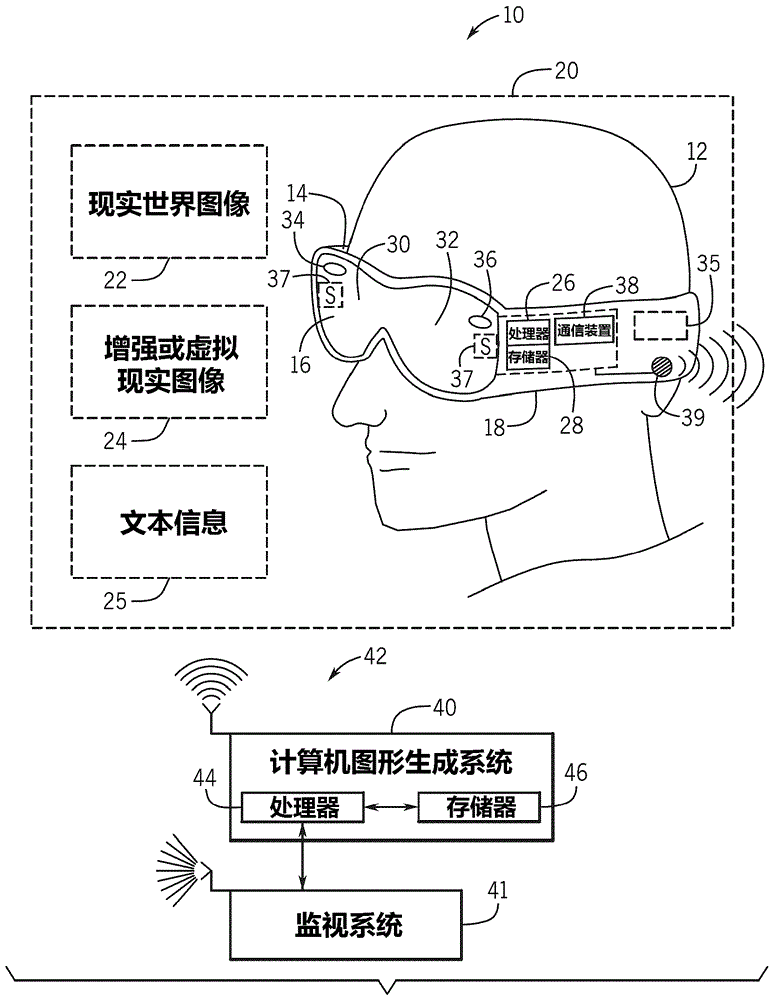
Figure 201880085256

This system and method relate to a system including a visualization device comprising a display viewable by a user. The system also includes a computer graphics generation system communicatively coupled to the visualization device. The computer graphics generation system includes a processor and a storage device communicatively coupled to the processor, such that the storage device stores instructions that cause the processor to generate an environment consisting of a real-world image, an augmented reality image, or a combination thereof. The instructions also cause the processor to receive and analyze data associated with the environment to determine appropriate text locations, determine appropriate textual properties of the text based at least in part on the appropriate text locations, and overlay text with appropriate textual properties onto the environment at the appropriate text locations.

Figure 201880085256

Description

用于游乐园环境中的文本覆盖的系统和方法System and method for text overlay in an amusement park environment

技术领域technical field

本公开总体上涉及游乐园的领域。更具体地,本公开的实施例涉及在游乐园景点中提供增强和虚拟现实体验的系统和方法。The present disclosure relates generally to the field of amusement parks. More specifically, embodiments of the present disclosure relate to systems and methods for providing augmented and virtual reality experiences in amusement park attractions.

背景技术Background technique

游乐园和/或主题公园可包括各种娱乐景点、餐馆和乘坐设施,其在为游乐园的客人(例如,所有年龄的家庭和/或人们)提供享受中是有用的。游乐园的区域可能具有具体地把某些观众作为目标的不同主题。例如,某些区域可以包括传统上儿童感兴趣的主题,而其他区域可以包括传统上较成熟的观众感兴趣的主题。通常,具有与这样的游乐园相关联的主题的位置可以被称为景点或主题景点。Amusement parks and/or theme parks may include various entertainment attractions, restaurants, and rides that are useful in providing enjoyment to amusement park guests (eg, families and/or people of all ages). Areas of an amusement park may have different themes that specifically target certain audiences. For example, certain areas may include topics that are traditionally of interest to children, while other areas may include topics that are traditionally of interest to more mature audiences. Typically, locations with themes associated with such amusement parks may be referred to as attractions or themed attractions.

可以使用固定装备、建筑布局、道具、装饰品等来建立主题景点,其中的大多数通常与某个主题相关。在要在同一位置中建立不同主题的情况下,会利用与较新主题相关联的装置来替换与较旧主题相关联的装置。取决于位置的主题的复杂性,可能证明这是非常困难且耗时的,因为装饰品、器具、装备、道具等被移除或替换。实际上,对于某些类型的景点,相对复杂的主题已变得较常见来为客人提供较沉浸的体验。Themed attractions can be built using fixtures, building layouts, props, decorations, and more, most of which are usually related to a theme. Where different themes are to be created in the same location, devices associated with older themes are replaced with devices associated with the newer theme. Depending on the complexity of the subject matter of the location, this may prove very difficult and time consuming as decorations, utensils, gear, props, etc. are removed or replaced. In fact, for some types of attractions, relatively complex themes have become more common to provide guests with a more immersive experience.

现在认识到的是,合意的是包括景点,在所述景点中可能有以相对于传统技术的灵活且高效的方式来改变景点主题、或者在这样的景点中包括或移除某些主题装置的可能。现在还认识到的是,可能合意的是增强客人在景点内的沉浸体验以及为客人提供较个性化或定制化的体验。It is now recognized that it is desirable to include attractions in which it is possible to change the theme of the attraction, or to include or remove certain themed devices in such attractions, in a flexible and efficient manner relative to conventional techniques possible. It is also now recognized that it may be desirable to enhance a guest's immersive experience within an attraction as well as provide a more personalized or customized experience for the guest.

发明内容SUMMARY OF THE INVENTION

下面概括了范围上与原始要求保护的主题相称的某些实施例。这些实施例不旨在限制本公开的范围,而是这些实施例仅旨在提供某些公开的实施例的简要概述。实际上,本公开可以包含可以与以下阐述的实施例相似或不同的多种形式。Certain embodiments commensurate in scope with the originally claimed subject matter are summarized below. These embodiments are not intended to limit the scope of the present disclosure, but rather these embodiments are intended to provide a brief summary of certain disclosed embodiments. Indeed, the present disclosure may embody various forms that may or may not be the same as the embodiments set forth below.

根据实施例,一种系统包括:可视化设备,其包括由用户可观看的显示器。该系统还包括计算机图形生成系统,其通信地耦合到可视化设备。计算机图形生成系统包括处理器和存储设备,所述存储设备通信地耦合到处理器,使得存储设备存储指令,所述指令使得处理器生成现实世界图像、增强现实图像或其组合的环境。指令还使得处理器接收并分析与环境相关联的数据以确定适当的文本位置;至少部分地基于适当的文本位置来确定文本的适当的文本特性;以及在适当的文本位置处将具有适当的文本特性的文本覆盖到环境上。According to an embodiment, a system includes a visualization device including a display viewable by a user. The system also includes a computer graphics generation system communicatively coupled to the visualization device. The computer graphics generation system includes a processor and a storage device communicatively coupled to the processor such that the storage device stores instructions that cause the processor to generate an environment of a real world image, an augmented reality image, or a combination thereof. The instructions also cause the processor to receive and analyze data associated with the environment to determine appropriate text locations; to determine appropriate textual properties of the text based at least in part on the appropriate text locations; and to have appropriate text at the appropriate text locations The text of the property is overlaid on the environment.

根据实施例,一种方法,包括经由一个或多个处理器生成包括现实世界图像、增强现实图像、虚拟现实图像或其任何组合的环境。方法还包括经由一个或多个处理器,分析与环境有关的数据以确定适当的文本位置。此外,方法包括经由一个或多个处理器,至少部分地基于适当的文本位置来确定文本的适当的文本特性;以及经由一个或多个处理器,在适当的文本位置处将具有适当的文本特性的文本覆盖到环境上。According to an embodiment, a method includes generating, via one or more processors, an environment including a real world image, an augmented reality image, a virtual reality image, or any combination thereof. The method also includes, via the one or more processors, analyzing the context-related data to determine appropriate text positions. Additionally, the method includes determining, via the one or more processors, appropriate textual properties of the text based at least in part on the appropriate textual locations; and, via the one or more processors, having the appropriate textual properties at the appropriate textual locations text overlaid onto the environment.

根据实施例,一种有形的非暂时性计算机可读介质存储由计算机图形生成系统中的一个或多个处理器可执行的指令,所述计算机图形生成系统通信地耦合到由用户戴着的可视化设备。指令使得一个或多个处理器通过在可视化设备的显示器上显示现实世界图像、虚拟现实图像、增强现实图像或其组合,来生成经由可视化设备对用户可见的环境。指令还使得一个或多个处理器接收并分析指示用户的注视方向的信号;接收并分析与环境有关的数据;至少部分地基于指示用户的注视方向的信号和与环境有关的数据来确定适当的文本位置;以及在适当的文本位置处将文本覆盖到环境上。According to an embodiment, a tangible, non-transitory computer-readable medium stores instructions executable by one or more processors in a computer graphics generation system communicatively coupled to a visualization worn by a user equipment. The instructions cause the one or more processors to generate an environment visible to a user via the visualization device by displaying real-world images, virtual reality images, augmented reality images, or a combination thereof on a display of the visualization device. The instructions also cause the one or more processors to receive and analyze a signal indicative of the user's gaze direction; receive and analyze data related to the environment; determine an appropriate text position; and overlaying the text on the environment at the appropriate text position.

附图说明Description of drawings

当参考附图阅读以下详细描述时,本公开的这些和其他特征、方面和优点将变得较好地被理解,在所述附图中,贯穿附图,相同的字符表示相同的部分,其中:These and other features, aspects and advantages of the present disclosure will become better understood when reading the following detailed description with reference to the accompanying drawings, in which like characters refer to like parts throughout, wherein :

图1是根据实施例的用作增强现实(AR)或虚拟现实(VR)眼镜(goggles)的可视化设备和计算机图形生成系统的图示;1 is an illustration of a visualization device and computer graphics generation system for use as augmented reality (AR) or virtual reality (VR) goggles, according to an embodiment;

图2是根据实施例的图1的可视化设备的分解透视图;FIG. 2 is an exploded perspective view of the visualization device of FIG. 1, according to an embodiment;

图3是根据实施例的图1的另一可视化设备的分解透视图;3 is an exploded perspective view of another visualization device of FIG. 1, according to an embodiment;

图4是根据实施例的包括具有通过图1的可视化设备提供的各种AR/VR图像以及文本的环境的刺激的乘坐设施的透视图;4 is a perspective view of a ride including stimulation of an environment with various AR/VR images and text provided by the visualization device of FIG. 1, according to an embodiment;

图5是根据实施例的当用户参与图4的刺激的乘坐设施时可以由戴着图1的可视化设备的用户观察的环境的视图;5 is a view of an environment that may be observed by a user wearing the visualization device of FIG. 1 when the user participates in the stimulating ride of FIG. 4, according to an embodiment;

图6是根据实施例的可以由戴着图1的可视化设备的用户在一个时间点上观察的图5的环境的视图;6 is a view of the environment of FIG. 5 as may be observed by a user wearing the visualization device of FIG. 1 at a point in time, according to an embodiment;

图7是根据实施例的可以由戴着图1的可视化设备的用户在另一个时间点上观察的图5的环境的视图;以及7 is a view of the environment of FIG. 5 as may be viewed by a user wearing the visualization device of FIG. 1 at another point in time, according to an embodiment; and

图8是根据实施例的可用于通过将文本覆盖到利用图1的可视化设备可观看的图5的环境上来创建增强体验的过程的流程图。8 is a flowchart of a process that may be used to create an enhanced experience by overlaying text on the environment of FIG. 5 viewable with the visualization device of FIG. 1, according to an embodiment.

具体实施方式Detailed ways

以下将描述本公开的一个或多个特定实施例。在致力于提供这些实施例的简要描述的过程中,可能不在说明书中描述实际实施方式的所有特征。应当理解的是,在任何这样的实际实施方式的开发中,如在任何工程或设计项目中,都必须做出许多特定于实施方式的决策,以实现开发者的特定目标,诸如依照与系统有关和与业务有关的约束,其可能因实施方式而变化。此外,应当理解的是,这样的开发工作可能是复杂且耗时的,但是对于受益于本公开的普通技术人员而言,这仍然会是设计、制作和制造的例行任务。One or more specific embodiments of the present disclosure will be described below. In an effort to provide a brief description of these embodiments, all features of an actual implementation may not be described in the specification. It should be appreciated that in the development of any such actual implementation, as in any engineering or design project, many implementation-specific decisions must be made to achieve the developer's specific goals, such as in accordance with system-related and business-related constraints, which may vary by implementation. Furthermore, it should be appreciated that such a development effort might be complex and time-consuming, but would nevertheless be a routine undertaking of design, fabrication, and manufacture for those of ordinary skill having the benefit of this disclosure.

本实施例涉及提供作为与游乐园或主题公园相关联的景点的一部分的增强现实(AR)体验、虚拟现实(VR)体验、混合现实(例如,AR/VR的组合)体验或其组合的系统和方法。在实施例中,系统和方法涉及提供文本(例如,字幕)以增强AR体验、VR体验或混合现实体验。尽管参考了游乐园中的景点来描述某些实施例以便于讨论,但是应当理解,景点不一定限于游乐园的区域。实际上,本公开的方面还涉及在游乐园的边界之外的场地中(诸如例如在与游乐园相关联的酒店中、在语言教育设施中、在音乐会场所处或者在向和从游乐园和/或酒店运送客人的交通工具中)的实施方式。The present embodiments relate to systems that provide an augmented reality (AR) experience, a virtual reality (VR) experience, a mixed reality (eg, a combination AR/VR) experience, or a combination thereof, as part of an attraction associated with an amusement park or theme park and method. In embodiments, systems and methods involve providing text (eg, subtitles) to enhance AR, VR, or mixed reality experiences. Although certain embodiments are described with reference to attractions in an amusement park for ease of discussion, it should be understood that the attractions are not necessarily limited to areas of the amusement park. Indeed, aspects of the present disclosure also relate to in venues outside the boundaries of amusement parks (such as, for example, in hotels associated with amusement parks, in language education facilities, at concert venues, or to and from amusement parks) and/or in the hotel's transport of guests).

考虑到上述情况,游乐园内的某些景点可能包括乘坐车辆,其可使一个或多个客人能够观看周围环境。在一个实施例中,乘坐车辆可以沿着乘坐路径(例如,轨道或导轨)行进。一个或多个客人可能暴露于各种声音(诸如通过以下各项而发出的声音:滚轮驱动行驶中的乘坐车辆、喇叭响、其他客人尖叫等等),使得可能难以听到任何一种特别的声音。此外,AR、VR或混合现实体验可以包括当一个或多个客人沿着乘坐路径行进时提供叙述(例如,经由扬声器系统说或讲故事)的各种角色(例如,虚拟动画角色)。然而,各种声音干扰(例如,滚轮、客人尖叫)可能使一些客人难以听到由角色讲的叙述。因此,叙述或任何其他信息可以作为文本被传达给客人,从而向一个或多个客人提供由于例如这样的声音干扰而不能经由声音传达的内容。实际上,(例如,在镜片或电子眼镜上)显示与AR、VR或混合现实体验相关联的文本或字幕可以允许一个或多个用户(例如,客人)解释叙述或接收多种消息中的任何一种(例如,作为文本),由此不管与听到声音相关联的任何困难都将信息传达给一个或多个用户。这样的体验可以为游乐园的客人(例如,用户)提供可以是可定制的、个性化的和/或交互性的充满景点的体验。With the above in mind, some attractions within an amusement park may include rides that allow one or more guests to view the surroundings. In one embodiment, a ride vehicle may travel along a ride path (eg, a track or rail). One or more guests may be exposed to a variety of sounds (such as through roller-driven rides, horns, other guests screaming, etc.), making it difficult to hear any particular the sound of. Additionally, AR, VR, or mixed reality experiences may include various characters (eg, virtual animated characters) that provide a narration (eg, speaking or telling a story via a speaker system) as one or more guests travel along the ride path. However, various sound disturbances (eg, rollers, guests screaming) may make it difficult for some guests to hear the narration spoken by the characters. Thus, narration or any other information may be communicated to the guests as text, thereby providing one or more guests with content that cannot be communicated via sound due to, for example, such sound interference. Indeed, displaying text or subtitles associated with an AR, VR, or mixed reality experience (eg, on lenses or electronic glasses) may allow one or more users (eg, guests) to interpret a narration or receive any of a variety of messages One (eg, as text) whereby information is conveyed to one or more users regardless of any difficulties associated with hearing the sound. Such experiences may provide amusement park guests (eg, users) with attractions-filled experiences that may be customizable, personalized, and/or interactive.

在一个实施例中,可以利用某些硬件配置、软件配置(例如,算法结构)的组合以及某些景点装置来实现具有AR、VR和混合现实体验的文本(例如,字幕)。例如,在实施例中,系统可以包括观看设备,诸如可穿戴装备(例如,诸如电子眼镜或镜片的可视化设备),游乐园客人和雇员可以通过所述观看设备观看增强、虚拟或混合现实场景。此外,可穿戴装备可以包括显示文本的表面和AR、VR或混合现实体验的其他装置。某些实施方式可用于例如通过在与游乐园相关联的环境中虚拟地移除或添加特征来在同一次乘坐中针对不同体验提供可调整的虚拟环境来增强客人(例如,用户)体验,以使客人能够接收与AR、VR或混合现实体验相关联的文本,而不妨碍体验的重要特征的视图,等等。在一个实施例中,可穿戴装备可以向用户提供AR、VR或混合现实场景上的文本。例如,由用户观看的场景可以包括各种虚拟或现实对象,诸如动物。在一个实施例中,可穿戴装备可以向用户提供与虚拟或现实对象(例如,动物)相关联的文本。例如,可穿戴装备可以向用户提供有关动物物种、动物年龄或相关联于动物的事实的文本。在一个实施例中,通信地耦合到可穿戴装备的计算机图形生成系统(例如,控制系统)可以确定合适的定位来显示文本,使得文本可识别并且不妨碍由控制系统确定为重要的任何特征的视图。In one embodiment, text (eg, subtitles) with AR, VR, and mixed reality experiences may be implemented with certain hardware configurations, combinations of software configurations (eg, algorithmic structures), and certain attractions devices. For example, in an embodiment, the system may include a viewing device, such as wearable equipment (eg, a visualization device such as electronic glasses or lenses), through which amusement park guests and employees may view augmented, virtual, or mixed reality scenes. Additionally, wearable equipment can include surfaces that display text and other devices for AR, VR, or mixed reality experiences. Certain embodiments may be used to enhance the guest (eg, user) experience, for example, by virtually removing or adding features in an environment associated with an amusement park to provide an adjustable virtual environment for different experiences within the same ride, to Enable guests to receive text associated with an AR, VR or mixed reality experience without obstructing views of important features of the experience, and more. In one embodiment, the wearable device can provide the user with text on an AR, VR or mixed reality scene. For example, a scene viewed by a user may include various virtual or real objects, such as animals. In one embodiment, the wearable device may provide the user with text associated with virtual or real objects (eg, animals). For example, the wearable device may provide the user with text about the species of the animal, the age of the animal, or facts associated with the animal. In one embodiment, a computer graphics generation system (eg, a control system) communicatively coupled to the wearable equipment can determine an appropriate location to display the text such that the text is recognizable and does not interfere with any features determined by the control system to be important view.

此外,可以从可穿戴装备收集某些数据,以实现计算能力和/或其他资源的较高效使用,以用于在合适的位置中提供文本、用于触发效果或调整展示等。在一个实施例中,可以收集用户可视化数据。例如,计算机图形生成系统可以在发起与虚拟或现实对象相关联的任何文本的显示之前确定乘坐设施中的用户是否已经在看(例如,在某个方向上的)虚拟或现实对象。可穿戴装备还可以用于充当乘坐设施操作者平视显示器(HUD)。附加地或可替代地,某些游乐园景点可以包括固定的观看设备(例如,双筒望远镜),其能够提供文本以增强用户可以用来观看游乐园或之外的不同区域的AR、VR或混合现实场景。Additionally, certain data may be collected from the wearable device to enable more efficient use of computing power and/or other resources for providing text in appropriate locations, for triggering effects or adjusting presentations, and the like. In one embodiment, user visualization data may be collected. For example, the computer graphics generation system may determine whether a user in the ride is already looking at (eg, in a certain direction) virtual or real objects before initiating display of any text associated with the virtual or real objects. Wearables can also be used to act as a heads-up display (HUD) for ride operators. Additionally or alternatively, some amusement park attractions may include stationary viewing devices (eg, binoculars) capable of providing text to enhance AR, VR, or AR, VR, or AR that users can use to view different areas of the amusement park or beyond. Mixed reality scene.

可以控制附加的游乐园设备(诸如气味释放设备、扬声器、可致动效果设备等)以与观看设备协作来提供增强的用户体验。这样,由用户探索的环境可以看来似乎对用户的增强体验或虚拟体验做出反应。此外,在一个实施例中,可以将装置结合到可穿戴物品(例如,电子眼镜或镜片)中,以向用户提供听觉、嗅觉和/或触觉输入来补充他们的视觉AR、VR或混合现实体验。Additional amusement park equipment (such as scent release equipment, speakers, actuatable effect equipment, etc.) can be controlled to cooperate with viewing equipment to provide an enhanced user experience. In this way, the environment explored by the user may appear to respond to the user's enhanced or virtual experience. Additionally, in one embodiment, the device may be incorporated into a wearable item (eg, electronic glasses or lenses) to provide users with auditory, olfactory and/or tactile input to complement their visual AR, VR or mixed reality experience .

为了帮助说明,图1描绘了AR/VR系统10的实施例,该AR/VR系统10被配置成使用户12(例如,客人、游乐园雇员)能够体验控制的AR、VR或混合现实场景(例如,观看控制的AR、VR或混合现实场景、与控制的AR、VR或混合现实场景交互)。根据实施例,用户12可以购买或以其他方式被提供可视化设备14,其在实施例中可以包括电子镜片16(例如,AR/VR镜片、眼镜)。如下面进一步详细描述的,可视化设备14可以包括被配置成容纳电子镜片16的至少一部分的、被图示为头带的可穿戴部分18。To aid in illustration, FIG. 1 depicts an embodiment of an AR/VR system 10 configured to enable a user 12 (eg, a guest, amusement park employee) to experience a controlled AR, VR, or mixed reality scene ( For example, viewing a controlled AR, VR or mixed reality scene, interacting with a controlled AR, VR or mixed reality scene). Depending on the embodiment, user 12 may purchase or otherwise be provided with visualization device 14, which in embodiments may include electronic lenses 16 (eg, AR/VR lenses, glasses). As described in further detail below, visualization device 14 may include a wearable portion 18 , illustrated as a headband, configured to accommodate at least a portion of electronic lens 16 .

可视化设备14可以被单独使用或与其他装置组合使用以创建超现实环境20,其可以包括AR体验、VR体验、混合现实(例如,AR/VR的组合)体验、计算机介导(computer-mediated)现实体验、其组合或用于用户12的其他类似的超现实环境。具体地,可视化设备14可以在乘坐或另一预定活动的整个持续时间中(诸如在游戏期间、在游乐园的特别区域的入口处、在到与游乐园相关联的酒店的乘坐期间、在酒店处等等)由用户12戴着。Visualization device 14 may be used alone or in combination with other devices to create hyper-realistic environments 20, which may include AR experiences, VR experiences, mixed reality (eg, combined AR/VR) experiences, computer-mediated A realistic experience, a combination thereof, or other similar hyper-real environment for the user 12 . Specifically, visualization device 14 may be used throughout the duration of a ride or another predetermined activity (such as during a game, at an entrance to a special area of an amusement park, during a ride to a hotel associated with the amusement park, at a hotel etc.) worn by the user 12.

可视化设备14可以包括其中某些虚拟特征被覆盖到透明表面(例如,玻璃状物)上的设备,或者可以包括其中虚拟特征被覆盖到基本上实时的视频上的设备,或其组合(例如,可视化设备14可能能够在透明和不透明的用户可视化之间进行切换)。在实施例中,可视化设备14可以包括诸如光投射装置之类的装置,其被配置成将光投射到用户12的一只或两只眼睛中,使得虚拟特征被叠加在现实世界对象之上。这样的可视化设备14可以被认为包括视网膜显示器。Visualization device 14 may include devices in which certain virtual features are overlaid on a transparent surface (eg, glass), or may include devices in which virtual features are overlaid on substantially real-time video, or a combination thereof (eg, The visualization device 14 may be able to switch between transparent and opaque user visualizations). In embodiments, visualization device 14 may include a device, such as a light projection device, configured to project light into one or both eyes of user 12 such that virtual features are superimposed on real world objects. Such a visualization device 14 may be considered to include a retina display.

因此,在实施例中,用户12可以通过基本上透明的电子镜片16的集合观看现实世界环境,其中某些虚拟特征被覆盖到电子镜片16的表面(或用户12的眼睛)上,使得用户12感知到虚拟特征被集成到现实世界环境中。可替代地或另外,在实施例中,用户12可以观看具有覆盖的虚拟特征的现实世界环境的实时视频。Thus, in embodiments, user 12 may view a real-world environment through a collection of substantially transparent electronic lenses 16 with certain virtual features overlaid onto the surface of electronic lens 16 (or user 12's eyes) such that user 12 Virtual features are perceived to be integrated into the real world environment. Alternatively or additionally, in an embodiment, user 12 may view a real-time video of the real-world environment with overlaid virtual features.

在实施例中,在戴着可视化设备14时,用户12可以感觉到被环境20完全包围,并且可以将环境20感知为包括某些虚拟特征的现实世界物理环境。具体地,可视化设备14可以(例如,使用不透明观看表面)完全控制用户12的视图,使得环境20可以是实时视频(例如,以实时或接近实时捕获的视频),其包括与一个或多个AR/VR图像24(例如,虚拟增强或虚拟特征)电子融合的现实世界图像22。现实世界图像22通常表示即使在不戴着可视化设备14时用户12也会看到的内容(例如,现实世界图像22是现实世界环境中的特征的图像)。术语“实时”指示以基本上接近于实际观察的时间的时间框架获得和/或提供的图像。实际上,可视化设备14可以(例如,使用透明观看表面)仅部分地控制用户12的视图,使得环境20是实际环境,其中AR/VR图像24覆盖到透明表面上或覆盖到用户12的眼睛上。根据本公开的实施例,AR/VR图像24可以起作用来覆盖现实世界对象,使得该对象看来似乎不再存在或被删除(例如,利用虚拟对象或虚拟环境表示完全或部分遮蔽现实世界对象)。此外,尽管本文中公开的某些示例涉及现实世界图像22以便于讨论,但是应当理解,本文中公开的任何技术可以适于将AR/VR图像24覆盖到通过可视化设备14的透明玻璃状物可见的现实世界环境上。因此,在本文中的某些示例中引用的现实世界图像22应被认为由现实世界环境中的现实特征可替换。当将AR/VR图像24覆盖到通过透明玻璃状物观看的现实世界图像22上或现实世界环境的现实特征上时,AR/VR图像24可以被认为是AR图像并且可以被认为是创建了AR体验。当AR/VR图像24形成环境20的整体(例如,不显示现实世界图像22或不实现现实世界环境的现实特征的可视化)时,AR/VR图像24可以被认为是VR图像并且可以被认为是创建了VR体验。如上所述,可视化设备14可能能够在不同类型的可视化之间切换。In an embodiment, while wearing visualization device 14, user 12 may feel completely surrounded by environment 20, and may perceive environment 20 as a real-world physical environment including certain virtual features. In particular, visualization device 14 may fully control the view of user 12 (eg, using an opaque viewing surface) such that environment 20 may be a real-time video (eg, captured in real-time or near real-time) that includes interaction with one or more AR /VR image 24 (eg, virtual augmentation or virtual feature) electronically fused real world image 22. Real-world image 22 typically represents content that user 12 would see even when visualization device 14 was not worn (eg, real-world image 22 is an image of a feature in a real-world environment). The term "real-time" refers to images obtained and/or provided in a time frame substantially close to the time of actual observation. In practice, visualization device 14 may only partially control the view of user 12 (eg, using a transparent viewing surface) such that environment 20 is the actual environment with AR/VR images 24 overlaid onto the transparent surface or overlaid onto user 12's eyes . According to embodiments of the present disclosure, AR/VR imagery 24 may function to overlay a real-world object such that the object appears to no longer exist or is deleted (eg, completely or partially obscuring the real-world object with a virtual object or virtual environment representation ). Furthermore, although some of the examples disclosed herein refer to real-world images 22 for ease of discussion, it should be understood that any of the techniques disclosed herein may be adapted to overlay AR/VR images 24 to be visible through the transparent glass of visualization device 14 in the real world environment. Accordingly, the real-world images 22 referenced in certain examples herein should be considered replaceable by real-world features in the real-world environment. The AR/VR image 24 may be considered an AR image and may be considered to create an AR when it is overlaid on the real world image 22 viewed through a transparent glass or a real feature of a real world environment experience. AR/VR image 24 may be considered a VR image and may be considered a Created a VR experience. As mentioned above, visualization device 14 may be able to switch between different types of visualizations.

此外,在一个实施例中,可视化设备14可以在生成环境20的同时向用户12提供文本25。具体地,可视化设备14可以将文本25与现实世界图像22和/或AR或VR图像24融合以生成或完成环境20。在实施例中,文本25可以向用户12提供与现实世界图像22、AR或VR图像24或环境20中的现实特征相关联的信息,如下面详细描述的那样。在一个实施例中,文本25可以被提供为文本气泡,其描绘了旨在由现实世界图像22、AR或VR图像24或环境20中的现实特征传达的内容。在一个实施例中,提供文本25的文本气泡可以与由可视化设备14或乘坐设施系统提供的声音协调。Additionally, in one embodiment, visualization device 14 may provide text 25 to user 12 while generating environment 20 . Specifically, visualization device 14 may fuse text 25 with real-world imagery 22 and/or AR or VR imagery 24 to generate or complete environment 20 . In embodiments, text 25 may provide user 12 with information associated with real-world imagery 22, AR or VR imagery 24, or real-world features in environment 20, as described in detail below. In one embodiment, text 25 may be provided as a text bubble that depicts content intended to be conveyed by real world image 22 , AR or VR image 24 , or real features in environment 20 . In one embodiment, the text bubbles providing text 25 may be coordinated with sounds provided by visualization device 14 or the ride system.

如可视化设备14的剖视部分中所图示,为了支持环境20的各方面的创建,可视化设备14可以包括处理电路,诸如处理器26和存储器28。处理器26可以可操作地耦合到存储器28,以执行用于执行目前公开的技术(例如,在显示现实世界图像22和/或一个或多个AR/VR图像24的同时生成文本25)的指令。这些指令可以被编码在存储在有形的非暂时性计算机可读介质(诸如存储器28和/或其他存储器)中的程序或代码中。处理器26可以是通用处理器、片上系统(SoC)设备、专用集成电路(ASIC)或某个其他类似的处理器配置。存储器28和处理器26可以一起形成AR/VR计算机化可视化系统40(例如,计算机图形生成系统)的全部或一部分。As illustrated in the cutaway portion of visualization device 14 , visualization device 14 may include processing circuitry, such as processor 26 and memory 28 , to support the creation of various aspects of environment 20 . Processor 26 may be operably coupled to memory 28 to execute instructions for performing the presently disclosed techniques (eg, generating text 25 while displaying real-world image 22 and/or one or more AR/VR images 24 ) . These instructions may be encoded in a program or code stored in a tangible, non-transitory computer-readable medium, such as memory 28 and/or other memories. Processor 26 may be a general-purpose processor, a system-on-chip (SoC) device, an application specific integrated circuit (ASIC), or some other similar processor configuration. Memory 28 and processor 26 together may form all or a portion of an AR/VR computerized visualization system 40 (eg, a computer graphics generation system).

在一个实施例中,如进一步图示的,可视化设备14还可以包括分别对应于用户12的每只眼睛的一对显示器30和32(例如,其可以被提供在可视化设备14的框架前部中,其中镜片透镜会以其他方式出现)。可替代地,可以采用统一的显示器。通过非限制性示例,相应的显示器30和32可以各自包括透明透镜,AR/VR图像24和文本25可以覆盖到所述透明透镜上(例如,以将这样的图像和文本覆盖在现实世界环境的用户的视图上)。此外,显示器30和32可以是显示表面,并且可以包括邻近于它们相应的周边定位的装置(例如,电路、发光器),所述装置被配置成促进覆盖AR/VR图像24和文本25以生成环境20。In one embodiment, as further illustrated, visualization device 14 may also include a pair of displays 30 and 32, respectively corresponding to each eye of user 12 (eg, which may be provided in the front of the frame of visualization device 14 , for example) , where the lens lens would appear otherwise). Alternatively, a unified display may be employed. By way of non-limiting example, respective displays 30 and 32 may each include a transparent lens onto which AR/VR images 24 and text 25 may be overlaid (eg, to overlay such images and text on a real-world environment) user's view). Additionally, displays 30 and 32 may be display surfaces and may include devices (eg, circuits, light emitters) positioned adjacent to their respective perimeters configured to facilitate overlaying AR/VR images 24 and text 25 to generate Environment 20.

附加地或可替代地,显示器30和32可以包括不透明液晶显示器(LCD)、不透明有机发光二极管(OLED)显示器或在向用户12显示现实世界图像22、AR/VR图像24和文本25中有用的其他类似显示器。在实施例中,相应的显示器30和32可各自包括透视LCD或透视OLED显示器,所述透视LCD或透视OLED显示器在例如允许用户12观看出现在相应显示器30和32上的AR/VR图像24和文本25中是有用的,所述AR/VR图像24和文本25作为对实际和物理现实世界环境(例如,与游乐园相关联的景点)的覆盖。Additionally or alternatively, displays 30 and 32 may include opaque liquid crystal displays (LCDs), opaque organic light emitting diode (OLED) displays or useful in displaying real world images 22 , AR/VR images 24 and text 25 to user 12 . other similar displays. In embodiments, respective displays 30 and 32 may each comprise a see-through LCD or see-through OLED display that, for example, allows user 12 to view AR/VR images 24 and 24 appearing on respective displays 30 and 32 The AR/VR images 24 and text 25 are useful in text 25 as overlays for actual and physical real world environments (eg, attractions associated with amusement parks).

可视化设备14的相机34和36可以分别对应于用户12的观看点,并且可以用于捕获现实世界的实时视频数据(例如,现场视频)或外界光信号。在一个实施例中,可以采用单个相机。可视化设备14还可以包括附加的相机以跟踪用户的眼睛移动,其在与计算设备(例如,计算机图形生成系统40)结合使用时,可以促进确定文本特性,诸如用于显示文本25的合适位置、文本25的合适大小、文本25的颜色、文本25的字体等,如下面详细讨论的那样。具体地,一个或多个传感器37可以是可以捕获数据以确定注视方向、瞳孔的定位、焦距和/或任何其他合适的眼睛参数的眼睛跟踪传感器(例如,相机)。在实施例中,可视化设备14包括向用户12传递声音的一个或多个扬声器35。扬声器35可以定位在用户12的耳朵附近。可视化设备14的通信装置38(例如,包括无线收发器39)可以以实时或接近实时地向处理器26和/或计算机图形生成系统40发送数据(例如,视频数据、眼睛跟踪数据、环境数据)以用于处理。由通信装置38发送的数据可以包括例如经由相应相机34和36和/或传感器37(例如,眼睛跟踪相机)捕获的数据。Cameras 34 and 36 of visualization device 14 may respectively correspond to viewing points of user 12 and may be used to capture real-world real-time video data (eg, live video) or ambient light signals. In one embodiment, a single camera may be employed. Visualization device 14 may also include additional cameras to track the user's eye movements, which, when used in conjunction with a computing device (eg, computer graphics generation system 40 ), may facilitate determining textual characteristics, such as appropriate locations for displaying text 25, The appropriate size of the text 25, the color of the text 25, the font of the text 25, etc., are discussed in detail below. In particular, the one or more sensors 37 may be eye-tracking sensors (eg, cameras) that may capture data to determine gaze direction, pupil location, focal length, and/or any other suitable eye parameters. In an embodiment, visualization device 14 includes one or more speakers 35 that deliver sound to user 12 . Speakers 35 may be positioned near the ears of user 12 . Communication means 38 (eg, including wireless transceiver 39 ) of visualization device 14 may transmit data (eg, video data, eye tracking data, environmental data) to processor 26 and/or computer graphics generation system 40 in real-time or near real-time for processing. The data sent by communication device 38 may include, for example, data captured via respective cameras 34 and 36 and/or sensors 37 (eg, eye-tracking cameras).

如所描绘的,可视化设备14可以经由无线网络42(例如,无线局域网[WLAN]、无线广域网[WWAN]、近场通信[NFC])通信地耦合到(例如,游乐园内的)计算机图形生成系统40。可替代地或附加地,应当理解,可以经由处理器26在可视化设备14上处理经由相应相机34和36捕获的实时视频数据。此外,连接到处理器26的通信装置38(例如,无线收发器39、输入/输出连接器)可以使处理器26和存储器28上包括的固件和/或软件能够被更新和/或被配置用于特别用途。As depicted, visualization device 14 may be communicatively coupled to a computer graphics generator (eg, within an amusement park) via a wireless network 42 (eg, wireless local area network [WLAN], wireless wide area network [WWAN], near field communication [NFC]) system 40. Alternatively or additionally, it should be appreciated that real-time video data captured via respective cameras 34 and 36 may be processed on visualization device 14 via processor 26 . Additionally, communication devices 38 (eg, wireless transceiver 39, input/output connectors) connected to processor 26 may enable firmware and/or software included on processor 26 and memory 28 to be updated and/or configured with for special purposes.

可视化设备14的通信装置38可以发送基于经由可视化设备14的传感器37获得的数据获得和/或导出的取向数据、定位数据、观看点数据(例如,焦距、取向、姿势)、运动跟踪数据等。这样的传感器37可以包括取向和定位传感器(例如,加速度计、磁力计、陀螺仪、全球定位系统[GPS]接收器)、运动跟踪传感器(例如,电磁和固态运动跟踪传感器)、惯性测量单元(IMU)、眼睛跟踪传感器等等。The communication device 38 of the visualization device 14 may transmit orientation data, positioning data, viewpoint data (eg, focal length, orientation, pose), motion tracking data, etc. obtained and/or derived based on data obtained via the sensors 37 of the visualization device 14 . Such sensors 37 may include orientation and positioning sensors (eg, accelerometers, magnetometers, gyroscopes, global positioning system [GPS] receivers), motion tracking sensors (eg, electromagnetic and solid-state motion tracking sensors), inertial measurement units ( IMU), eye tracking sensors, etc.

在实施例中,可视化设备14的特征(例如,几何外观或标记)可以由监视系统41(例如,一个或多个相机)监视,以确定可视化设备14的定位、位置、取向等等,并且转而确定用户12的定位、位置、取向等等。监视系统41可以通信地耦合到计算机图形生成系统40,并用于识别用户12(或多个用户)的定位、位置、取向等等。In embodiments, features of visualization device 14 (eg, geometric appearance or markings) may be monitored by monitoring system 41 (eg, one or more cameras) to determine the location, location, orientation, etc. of visualization device 14 and translate Rather, the location, location, orientation, etc. of the user 12 is determined. Monitoring system 41 may be communicatively coupled to computer graphics generation system 40 and used to identify the location, location, orientation, etc. of user 12 (or users).

计算机图形生成系统40包括诸如处理器44(例如,通用处理器或其他处理器)之类的处理电路和存储器46,并且可以处理从可视化设备14或监视系统41接收的实时(或接近实时)视频数据(例如,现场视频)、取向和定位数据、观看点数据、环境数据或其任何组合。具体地,计算机图形生成系统40可以使用该数据来生成参考系,以将AR/VR图像24和文本25注册到现实世界图像22或以将AR/VR图像24和文本25施加在实际和物理环境上。在一个实施例中,计算机图形生成系统40可以在将文本25施加在环境20上之前进一步使用该数据来确定文本特性(例如,文本25相对于通过可视化设备14可见的环境20的适当定位、文本25的大小、文本25的颜色、文本25的字体、文本25的亮度或强度和/或用于显示文本25的持续时间)。具体地,在使用基于取向数据、定位数据、观看点数据、运动跟踪数据等等生成的参考系的情况下,图形生成系统40然后可以渲染AR/VR图像24的视图并且包括文本25。在实施例中,在使用基于取向数据、定位数据、观看点数据、运动跟踪数据等等生成的参考系的情况下,计算机图形生成系统40可以确定用于显示文本25的合适位置。在实施例中,图形生成系统40可以以与现实世界环境在时间和空间上相称的方式来渲染AR/VR图像24、文本25和现实世界图像22的视图。计算机图形生成系统40可以周期性地(例如,以实时或接近实时)更新文本25的渲染,以反映用户12的相应的取向、定位和/或运动的改变。例如,计算机图形生成系统40可以识别注视方向(例如,用户12看向的方向),并且可以执行计算(例如,最小二乘近似和奇异值分解),以确定基本上正交于注视方向的平面。计算机图形生成系统40可以在平面上显示文本25。在实施例中,计算机图形生成系统40可以跟踪与多个用户(例如,乘坐的乘客、共享游戏中的玩家)对应的这样的数据,其中每个用户(或至少一些用户)具有对应的可视化设备14。Computer graphics generation system 40 includes processing circuitry such as processor 44 (eg, a general purpose processor or other processor) and memory 46 and can process real-time (or near real-time) video received from visualization device 14 or monitoring system 41 Data (eg, live video), orientation and positioning data, point-of-view data, ambient data, or any combination thereof. In particular, computer graphics generation system 40 may use this data to generate a frame of reference to register AR/VR images 24 and text 25 with real-world images 22 or to apply AR/VR images 24 and text 25 to actual and physical environments superior. In one embodiment, computer graphics generation system 40 may further use the data to determine text characteristics (eg, appropriate positioning of text 25 relative to environment 20 visible through visualization device 14 , text 25, the color of the text 25, the font of the text 25, the brightness or intensity of the text 25, and/or the duration for displaying the text 25). Specifically, graphics generation system 40 may then render a view of AR/VR image 24 and include text 25 using a frame of reference generated based on orientation data, positioning data, viewpoint data, motion tracking data, and the like. In an embodiment, computer graphics generation system 40 may determine a suitable location for displaying text 25 using a frame of reference generated based on orientation data, positioning data, viewpoint data, motion tracking data, and the like. In an embodiment, graphics generation system 40 may render views of AR/VR imagery 24, text 25, and real-world imagery 22 in a manner that is temporally and spatially commensurate with the real-world environment. Computer graphics generation system 40 may periodically (eg, in real-time or near real-time) update the rendering of text 25 to reflect corresponding changes in orientation, positioning, and/or motion of user 12 . For example, computer graphics generation system 40 may identify a gaze direction (eg, the direction in which user 12 is looking), and may perform calculations (eg, least squares approximation and singular value decomposition) to determine a plane substantially orthogonal to the gaze direction . Computer graphics generation system 40 may display text 25 on a flat surface. In an embodiment, computer graphics generation system 40 may track such data corresponding to multiple users (eg, passengers on rides, players in shared games), each of which (or at least some users) having a corresponding visualization device 14.

如上所阐述,在一个实施例中,可视化设备14包括若干部件,并且通常可以包括被配置成戴在用户12的头部上的电子镜片16。可以使用电子镜片16的多种不同配置和实施方式,其中不同配置可以具有不同的大小和形状以较好地适应不同用户的不同大小以及不同的内部部件(例如,通信装置、换能器、显示器)以适应不同的实施方式。As set forth above, in one embodiment, visualization device 14 includes several components, and may generally include electronic lenses 16 that are configured to be worn on the head of user 12 . Many different configurations and implementations of the electronic lens 16 may be used, wherein the different configurations may have different sizes and shapes to better accommodate different sizes of different users and different internal components (eg, communication devices, transducers, displays) ) to accommodate different implementations.

为了给电子镜片16提供附加的灵活性和支撑,可视化设备14的可穿戴部分18可以采取多种形式,其示例实施例在图2和3中描绘。在图2中,可视化设备14包括头带作为可穿戴部分18。可穿戴部分18的这样的实施例可以包括各种材料(例如,弹性材料、吸汗芯材料、衬垫),其被配置成适应用户12的移动,同时为用户12提供舒适性。目前认识到,可能合意的是具有分离的可穿戴部分18和电子镜片16,以使可穿戴部分18能够不时地被清洗而没有对电子镜片16的电子部件的风险。在实施例中,可穿戴部分18可以结合一个或多个电子部件。因此,可穿戴部分18中的电子部件可以基本上被密封离开环境以避免损坏。To provide additional flexibility and support to the electronic lens 16, the wearable portion 18 of the visualization device 14 may take a variety of forms, example embodiments of which are depicted in FIGS. 2 and 3 . In FIG. 2 , visualization device 14 includes a headgear as wearable portion 18 . Such embodiments of wearable portion 18 may include various materials (eg, elastic materials, wick materials, padding) configured to accommodate the movement of user 12 while providing comfort to user 12 . It is now recognized that it may be desirable to have separate wearable portion 18 and electronic lens 16 so that wearable portion 18 can be cleaned from time to time without risk to the electronic components of electronic lens 16 . In an embodiment, the wearable portion 18 may incorporate one or more electronic components. Accordingly, the electronic components in the wearable portion 18 may be substantially sealed from the environment to avoid damage.

在实施例中,图2的可穿戴部分18包括配置成接收电子镜片14并在使用期间维持电子镜片14相对于用户12的眼睛的定位的容座区60。就这一点而言,容座区60可包括围绕电子镜片16的显示器30、32的周边可固定的中央部分62,以及被配置成(例如,部分地或完全地)围绕电子镜片16的臂66的侧部分64。In an embodiment, the wearable portion 18 of FIG. 2 includes a receptacle region 60 configured to receive the electronic lens 14 and maintain the positioning of the electronic lens 14 relative to the eye of the user 12 during use. In this regard, the receptacle area 60 may include a central portion 62 that can be secured around the perimeter of the displays 30 , 32 of the electronic mirror 16 , and arms 66 that are configured (eg, partially or fully) to surround the electronic mirror 16 side portion 64.

容座区60的中央部分62可包括衬垫,以允许使用者12的舒适性,同时头带紧靠用户12的头部提供足够的压缩力(以用于维持电子镜片16的定位)。在实施例中,中央部分62可以包括一种或多种具有相对皮肤的摩擦系数的材料,该材料提供了稳定性和舒适性的适当组合。例如,通常在镜片的鼻部区中使用的凝胶材料是适当的。The central portion 62 of the receptacle area 60 may include padding to allow for comfort of the user 12 while the headgear provides sufficient compressive force against the user's 12 head (for maintaining the electronic lens 16 in position). In embodiments, the central portion 62 may comprise one or more materials having a coefficient of friction relative to the skin that provides a suitable combination of stability and comfort. For example, gel materials commonly used in the nasal region of lenses are suitable.

如图3中所描绘的实施例中所图示,可穿戴部分18可以包括除了头带之外的其他装置,或者代替头带的其他装置。如所描绘,可穿戴部分18包括要戴在用户12的头部之上的帽子70,以及与图2中阐述的头带类似的装置。在实施例中并且如所示,帽子70可以包括固定区72,其中帽子70与头带部分74重叠。固定区72可以包括搭扣机构,诸如钩环紧固件、钩眼紧固件、纽扣、磁性条带等等,其配置成实现帽子70和头带部分74之间的固定。这样,帽子70与头带部分74分离,这允许它们被分离地使用或分离地清洗。可替代地,在实施例中,头带部分74可以与帽子70成一体(例如,被缝合到帽子70中),使得头带部分74不是容易地从帽子70可移除。As illustrated in the embodiment depicted in FIG. 3, the wearable portion 18 may include other devices in addition to, or in place of, a headband. As depicted, the wearable portion 18 includes a hat 70 to be worn over the head of the user 12, and a device similar to the headgear illustrated in FIG. 2 . In an embodiment and as shown, the hat 70 may include a securing region 72 where the hat 70 overlaps the headband portion 74 . The securing region 72 may include a snap mechanism, such as hook and loop fasteners, hook and eye fasteners, buttons, magnetic straps, etc., configured to effect securing between the hat 70 and the headgear portion 74 . In this way, the cap 70 is separated from the headband portion 74, which allows them to be used or washed separately. Alternatively, in embodiments, the headband portion 74 may be integral with the hat 70 (eg, sewn into the hat 70 ) such that the headband portion 74 is not easily removable from the hat 70 .

在实施例中,帽子70包括遮阳板76,其用于保护用户的眼睛以及电子镜片16及其相关联的显示器30、32免受诸如太阳、头顶照明等等之类的强烈照明源的影响。在显示器30、32基于光学反射操作和/或是透明或半透明的应用中,遮阳板76例如可能特别有用。实际上,遮阳板76可以协助增强AR/VR图像24相对现实世界背景的感知的视觉对比度,以(例如,通过阻挡来自照明源的不想要的光)改进在显示器30、32上描绘的文本25的清晰度。In an embodiment, the hat 70 includes a visor 76 for protecting the user's eyes as well as the electronic lenses 16 and their associated displays 30, 32 from intense sources of illumination such as the sun, overhead lighting, and the like. Sun visor 76, for example, may be particularly useful in applications where displays 30, 32 operate based on optical reflection and/or are transparent or translucent. In effect, the visor 76 may assist in enhancing the perceived visual contrast of the AR/VR image 24 relative to the real world background to improve the text 25 depicted on the displays 30 , 32 (eg, by blocking unwanted light from lighting sources) clarity.

虽然不限于图3的实施例,但是图3的图示的可视化设备14还包括配置成放置在电子镜片16的显示器30、32上方的显示器盖78。显示器盖78可以为显示器30、32提供罩,以保护显示器30、32免受物理糟蹋(abuse),以提供一定程度的不透明性用于文本25和AR/VR图像24的增强的对比度和可视化、用于光学过滤等。显示盖78可包括任何适当的固定机构,诸如夹子80,其被配置成将显示盖78可移除地附接到电子镜片16。可以使用其他固定装置,诸如临时粘合剂和/或钩环紧固件。Although not limited to the embodiment of FIG. 3 , the illustrated visualization device 14 of FIG. 3 also includes a display cover 78 configured to be placed over the displays 30 , 32 of the electronic mirror 16 . The display cover 78 may provide a cover for the displays 30 , 32 to protect the displays 30 , 32 from physical abuse to provide a degree of opacity for enhanced contrast and visualization of text 25 and AR/VR images 24 , For optical filtering, etc. Display cover 78 may include any suitable securing mechanism, such as clips 80 , configured to removably attach display cover 78 to electronic lens 16 . Other securing means such as temporary adhesive and/or hook and loop fasteners may be used.

考虑到上述情况,描述如图4中示意性地示出的其中在游乐园90中使用AR/VR系统10的设置的实施例可能是有用的。图4是根据实施例的包括环境20的刺激的乘坐设施92的透视图,该环境20包括通过图1的可视化设备14提供的各种AR/VR图像24。如所图示,游乐园90可以包括现实世界装置,诸如刺激的乘坐设施92、游乐园设施的购物中心94(例如,游戏区域、酒店、餐馆、纪念品商店等等)以及附加的游乐景点96(例如,摩天轮、黑暗乘坐设施、动画角色或其他景点)。在实施例中,刺激的乘坐设施92可以包括过山车或其他类似的刺激的乘坐设施,并且因此可以进一步包括闭环轨道或闭环轨道98的系统(例如,数英里的轨道98)。例如,当乘坐乘客102、104、106、108(一个或多个可以是图1的用户12)乘坐刺激的乘坐设施92时,轨道98可以被提供为乘客乘坐车辆100可以在其上横过的基础设施。轨道98因此可以限定乘坐车辆100的运动。然而,在另一个实施例中,例如,轨道98可以由受控路径替换,在该受控路径中,可以经由电子系统、磁性系统或除轨道98以外的其他类似系统基础设施来控制乘坐车辆100的移动。换句话说,乘坐车辆100的乘坐路径可能不物理地约束到精确的路径,由此允许乘客102、104、106、108对其运动路径、观看视角等进行某种程度的控制。应当理解,尽管乘客乘坐车辆100可以被图示为4乘客车辆,但是在其他实施例中,乘客乘坐车辆100可以包括任何数量的乘客空间(例如,1、2、4、8、10、20或更多的空间)以容纳单个或多个乘客。In view of the above, it may be useful to describe an embodiment of a setup in which the AR/VR system 10 is used in an amusement park 90 as schematically shown in FIG. 4 . FIG. 4 is a perspective view of a stimulating ride 92 including an environment 20 including various AR/VR images 24 provided by the visualization device 14 of FIG. 1 , according to an embodiment. As illustrated, amusement park 90 may include real-world devices such as thrill rides 92, shopping malls 94 of amusement park facilities (eg, gaming areas, hotels, restaurants, souvenir shops, etc.), and additional amusement attractions 96 ( For example, Ferris wheel, dark rides, animated characters or other attractions). In embodiments, the thrill ride 92 may include a roller coaster or other similar thrill ride, and thus may further include a closed loop track or system of closed loop tracks 98 (eg, miles of track 98 ). For example, when the ride passengers 102 , 104 , 106 , 108 (one or more of which may be the user 12 of FIG. 1 ) ride the thrill ride 92 , the track 98 may be provided as a passage on which the passenger ride vehicle 100 may traverse. infrastructure. The track 98 can thus define the motion of the ride vehicle 100 . However, in another embodiment, for example, the track 98 may be replaced by a controlled path in which the ride vehicle 100 may be controlled via electronic systems, magnetic systems, or other similar system infrastructure in addition to the track 98 . movement. In other words, the ride path of ride vehicle 100 may not be physically constrained to a precise path, thereby allowing passengers 102, 104, 106, 108 to exercise some degree of control over their motion paths, viewing angles, and the like. It should be understood that although the passenger ride vehicle 100 may be illustrated as a 4-passenger vehicle, in other embodiments the passenger ride vehicle 100 may include any number of passenger spaces (eg, 1, 2, 4, 8, 10, 20 or more space) to accommodate single or multiple passengers.

当乘坐车辆100沿着轨道98移动时,可以向乘坐乘客102、104、106、108提供刺激的乘坐设施92周围或附近的区域中的风景(例如,设施94、附加的游乐景点96等)的移动游览。例如,这可以包括围绕刺激的乘坐设施92的环境(例如,完全或部分容纳刺激的乘坐设施92的建筑物)。尽管乘坐乘客102、104、106、108可以发现刺激的乘坐设施92是非常令人愉快的体验,但增强他们的乘坐体验可以是有用的。具体地,代替仅具有设施94(例如,娱乐区域、酒店、餐馆、纪念品商店等)、附加的游乐景点96(例如,摩天轮或其他景点)或游乐园90内的其他顾客或行人的物理视图,向乘坐乘客102、104、106、108提供增强现实(AR)体验或虚拟现实(VR)体验可以是有用的。As the ride vehicle 100 moves along the track 98 , the scenery in the area around or near the ride 92 (eg, the ride 94 , additional attractions 96 , etc.) may be provided to the ride passengers 102 , 104 , 106 , 108 to thrill Mobile tour. For example, this may include the environment surrounding the thrill ride 92 (eg, a building that houses the thrill ride 92 in whole or in part). Although riding passengers 102, 104, 106, 108 may find the thrilling ride 92 a very enjoyable experience, enhancing their ride experience may be useful. Specifically, instead of having only the facilities 94 (eg, entertainment areas, hotels, restaurants, souvenir shops, etc.), additional amusement attractions 96 (eg, Ferris wheel or other attractions), or physical views of other patrons or pedestrians within the amusement park 90 , it may be useful to provide an augmented reality (AR) experience or a virtual reality (VR) experience to the riding passengers 102 , 104 , 106 , 108 .

附加地或可替代地,向乘坐乘客102、104、106、108提供文本25可以是有用的,该文本25可以经由可视化设备14与一个或多个图像(例如,现实世界图像22和/或AR/VR图像24)或现实世界装置相关。这可以在乘坐车辆100沿着轨道98移动或在预定区域内移动时完成。在一个实施例中,这可以在游乐园顾客享受诸如设施94或游乐景点96之类的区域时完成。例如,AR/VR 24和/或合适的文本25可以由电子镜片16覆盖到现实世界环境上,使得用户12能够在饭店、景点之间的路径等处体验附加的娱乐装置。Additionally or alternatively, it may be useful to provide the occupants 102, 104, 106, 108 with text 25 that may be associated with one or more images (eg, real-world images 22 and/or AR) via the visualization device 14. /VR image 24) or real-world device related. This may be done while the ride vehicle 100 is moving along the track 98 or within a predetermined area. In one embodiment, this may be done while amusement park patrons enjoy areas such as facility 94 or amusement attraction 96 . For example, AR/VR 24 and/or suitable text 25 may be overlaid by electronic lenses 16 onto the real world environment, enabling user 12 to experience additional entertainment at restaurants, paths between attractions, and the like.

此外,在实施例中,刺激的乘坐设施92可以涉及用户与AR/VR图像24的交互,例如,当乘坐车辆100经过或穿过虚拟对象109、110时,与第一虚拟对象109(例如,星星)和第二虚拟对象110(例如,动画动物)的模拟交互。乘坐车辆100可以是用户控制的,并且游戏的一个方面可以是通过将乘坐车辆100引导向虚拟对象109、110而与各种虚拟对象109、110进行交互,或者通过向远离某些虚拟对象109、110行驶而避免与某些虚拟对象109、110碰撞。根据由计算机图形生成系统40存储的某些预定或建模的响应,模拟的交互可以使虚拟对象109、110受到影响。作为示例,预定或建模的响应可以由物理引擎或由计算机图形生成系统40实现的类似模块来实现。Additionally, in embodiments, the stimulating ride 92 may involve a user's interaction with the AR/VR imagery 24, eg, when the ride vehicle 100 passes or passes through the virtual objects 109, 110, interacts with the first virtual object 109 (eg, A simulated interaction with a second virtual object 110 (eg, an animated animal). The ride vehicle 100 may be user controlled, and one aspect of the game may be to interact with various virtual objects 109, 110 by directing the ride vehicle 100 towards the virtual objects 109, 110, or by moving away from certain virtual objects 109, 110. 110 to avoid collisions with certain virtual objects 109 , 110 while driving. The simulated interaction may cause the virtual objects 109, 110 to be affected according to some predetermined or modeled response stored by the computer graphics generation system 40. As an example, the predetermined or modeled response may be implemented by a physics engine or similar module implemented by computer graphics generation system 40 .

此外,在实施例中,虚拟对象109、110可以由计算机图形生成系统40生成并显示在可视化设备14的显示器30、32上。具体地,虚拟对象109、110可以被叠加在乘客102、104、106、108的现实世界感知上。实际上,第一虚拟对象109可以是星星的静止描绘,而第二虚拟对象可以是鸟的移动(例如,动态)描绘。即,在一个实施例中,第一虚拟对象109(例如,星星)相对于环境的其他对象保持静止,而第二虚拟对象110(例如,鸟)可以相对于环境中的其他对象移动。例如,对于包括现实世界图像22和其他AR/VR图像24(图1)的组合的环境20,第一虚拟对象109相对于现实世界图像22保持静止(例如,相对于轨道98的现实世界图像22静止),而第二虚拟对象110相对于现实世界图像22移动。Furthermore, in embodiments, the virtual objects 109 , 110 may be generated by the computer graphics generation system 40 and displayed on the displays 30 , 32 of the visualization device 14 . Specifically, virtual objects 109 , 110 may be superimposed on the real world perception of passengers 102 , 104 , 106 , 108 . In practice, the first virtual object 109 may be a still depiction of a star, while the second virtual object may be a moving (eg, dynamic) depiction of a bird. That is, in one embodiment, the first virtual object 109 (eg, a star) remains stationary relative to other objects in the environment, while the second virtual object 110 (eg, a bird) may move relative to other objects in the environment. For example, for an environment 20 that includes a combination of real-world imagery 22 and other AR/VR images 24 ( FIG. 1 ), first virtual object 109 remains stationary relative to real-world imagery 22 (eg, relative to real-world imagery 22 of track 98 ). stationary), while the second virtual object 110 moves relative to the real world image 22 .

此外,计算机图形生成系统40可以针对戴着可视化设备14的每个乘客102、104、106、108确定注视方向112(例如,与乘客正看向的方向对准并共线的轴线)。在一个实施例中,传感器37(图1)可以(例如,以实时或接近实时)捕获指示瞳孔的定位、焦距和/或可视化设备14的取向的数据以确定注视方向112。应当理解,注视方向112可以利用多种眼睛跟踪设备和算法中的任何一种来确定。在确定注视方向112之后,计算机图形生成系统40可以确定平面114以包括文本25。特别地,在一个实施例中,平面114取向成与所确定的注视方向112基本上正交。因此,文本25可以定位在平面114上,使得文本25取向成沿着注视方向112面朝向乘客,由此产生可识别文本25。Additionally, computer graphics generation system 40 may determine gaze direction 112 (eg, an axis aligned and collinear with the direction the passenger is looking) for each passenger 102 , 104 , 106 , 108 wearing visualization device 14 . In one embodiment, sensor 37 ( FIG. 1 ) may capture (eg, in real-time or near real-time) data indicative of the location of the pupil, the focal length, and/or the orientation of visualization device 14 to determine gaze direction 112 . It should be appreciated that gaze direction 112 may be determined using any of a variety of eye tracking devices and algorithms. After determining gaze direction 112 , computer graphics generation system 40 may determine plane 114 to include text 25 . In particular, in one embodiment, the plane 114 is oriented substantially orthogonal to the determined gaze direction 112 . Thus, the text 25 may be positioned on the plane 114 such that the text 25 is oriented to face the passenger along the gaze direction 112 , thereby producing recognizable text 25 .

在一个实施例中,注视方向112可以用于确定文本特性,其可以用于定制文本25。例如,计算机图形生成系统40可以确定乘客104的注视方向112取向成朝向第二虚拟对象110。响应于确定乘客104的注视方向112取向成朝向第二虚拟对象110,计算机图形生成系统40可以显示与第二虚拟对象110相关联的文本25。特别地,文本25可以包括(例如,包括与由第二虚拟对象110说出的叙述匹配的单词的)话音气泡、提供关于第二虚拟对象110的信息(例如,鸟的类型、鸟的最大速度、鸟原产于的世界的区)的图,等等。In one embodiment, gaze direction 112 may be used to determine text characteristics, which may be used to customize text 25 . For example, the computer graphics generation system 40 may determine that the gaze direction 112 of the passenger 104 is oriented toward the second virtual object 110 . In response to determining that the gaze direction 112 of the passenger 104 is oriented toward the second virtual object 110 , the computer graphics generation system 40 may display the text 25 associated with the second virtual object 110 . In particular, the text 25 may include speech bubbles (eg, including words that match the narration spoken by the second virtual object 110 ), provide information about the second virtual object 110 (eg, type of bird, maximum speed of the bird) , regions of the world in which the birds are native), etc.

图5是环境20的视图,该环境20可以由如所示的戴着可视化设备14的用户(例如,图4的乘客102、106)观察,由此文本25被覆盖到环境20上。环境20可以包括覆盖到现实世界图像22(图1、4)上的AR/VR图像24,诸如第一虚拟对象109(例如,星星)和第二虚拟对象110(例如,动画动物),所述现实世界图像22诸如刺激的乘坐设施92、设施94、乘客104、108和附加的游乐景点96的图像。如上所述,应当理解,本文中公开的技术可以应用于将AR/VR图像24和文本25覆盖到通过可视化设备14的透明玻璃状物可见的现实世界环境上,而不是覆盖到现实世界图像22(例如,现实世界环境的图像)上。因此,在一个实施例中,可以经由可视化设备14向乘客提供混合现实环境。此外,计算机图形生成系统40(图1)可以促进将文本25显示(例如,覆盖)到现实世界环境上。因此,应当理解,用于覆盖文本25的技术可以应用于VR环境、AR环境、现实世界环境、混合环境等。FIG. 5 is a view of environment 20 that may be viewed by a user (eg, passengers 102 , 106 of FIG. 4 ) wearing visualization device 14 as shown, whereby text 25 is overlaid on environment 20 . Environment 20 may include AR/VR images 24, such as first virtual objects 109 (eg, stars) and second virtual objects 110 (eg, animated animals), overlaid on real-world images 22 (FIGS. 1, 4), the Real world images 22 such as images of the thrill ride 92 , the facility 94 , passengers 104 , 108 and additional attractions 96 . As mentioned above, it should be understood that the techniques disclosed herein can be applied to overlay AR/VR images 24 and text 25 onto a real-world environment visible through the transparent glass of visualization device 14 , rather than overlaying onto real-world images 22 . (for example, images of real-world environments). Thus, in one embodiment, a mixed reality environment may be provided to passengers via visualization device 14 . Additionally, computer graphics generation system 40 (FIG. 1) may facilitate displaying (eg, overlaying) text 25 onto a real-world environment. Thus, it should be understood that the techniques for overlaying text 25 may be applied to VR environments, AR environments, real world environments, hybrid environments, and the like.

在一个实施例中,计算机图形生成系统40可以以实时或接近实时地接收环境数据。环境数据可以包括与现实世界图像22相关联的数据和/或与AR/VR图像24相关联的数据。具体地,环境数据包括现实世界图像22(例如,刺激的乘坐设施92、设施94、乘客104、108和附加游乐景点96)的定位和AR/VR图像24(例如,第一和第二虚拟对象109、110)的定位。具体地,在一个实施例中,环境数据包括现实世界图像22的定位和AR/VR图像24在环境20上的定位,使得现实世界图像22的定位和AR/VR图像24的定位被映射到可视化设备14上。In one embodiment, computer graphics generation system 40 may receive environmental data in real-time or near real-time. The environmental data may include data associated with real-world imagery 22 and/or data associated with AR/VR imagery 24 . Specifically, the environmental data includes the location of real-world images 22 (eg, exciting rides 92 , facilities 94 , passengers 104 , 108 , and additional attractions 96 ) and AR/VR images 24 (eg, first and second virtual objects 109, 110) positioning. Specifically, in one embodiment, the environment data includes the location of the real world image 22 and the location of the AR/VR image 24 on the environment 20, such that the location of the real world image 22 and the location of the AR/VR image 24 are mapped to the visualization device 14.

此外,在一个实施例中,环境数据可包括用于每个图像的标识符,使得该标识符将每个图像标记为现实世界图像22、AR/VR图像24或不重要的图像118。具体地,在一个实施例中,标识符可以将一些现实世界图像22标记为重要的,并且将一些现实世界图像22标记为不重要的图像118。当计算机图形生成系统40确定图像不添加主题或者在其他情况下是可能由文本25覆盖的图像或特征时,计算机图形生成系统40可以(例如,使用一种或多种算法)执行计算以将现实世界图像22标记为不重要(例如,不重要的图像118)。Additionally, in one embodiment, the environment data may include an identifier for each image, such that the identifier marks each image as a real world image 22 , an AR/VR image 24 , or an unimportant image 118 . Specifically, in one embodiment, the identifier may mark some real world images 22 as important and some real world images 22 as unimportant images 118 . When computer graphics generation system 40 determines that the image does not add subject matter or is otherwise an image or feature that may be covered by text 25, computer graphics generation system 40 may perform calculations (eg, using one or more algorithms) to convert reality World image 22 is marked as unimportant (eg, unimportant image 118).

在所描绘的实施例中,计算机图形生成系统40可以扫描显示在可视化设备14上的区域,以确定经由可视化设备14可见的每个图像或每段内容的标识符。例如,在所描绘的实施例中,计算机图形生成系统40可以将刺激的乘坐设施92、设施94和附加的游乐园景点96与第一标识符相关联,使得第一标识符将这些图像标记为现实世界图像22。计算机图形生成系统40可以将第一虚拟对象109和第二虚拟对象110与第二标识符相关联,使得第二标识符将这些图像标记为AR/VR图像24。另外,计算机图形生成系统40可将山119、草121和乘客104、108与第三标识符相关联,使得第三标识符基于(例如,使用一种或多种算法的)计算将这些图像标记为不重要的图像118。在实施例中,不重要的图像118包括例如通过用作背景(例如,太阳、云、其他乘客和风景设计)而不向环境20添加主题或供给如由计算机图形生成系统40所确定的任何其他不重要的功能(或者与其他图像或特征相比相对较不重要的功能)的图像。In the depicted embodiment, computer graphics generation system 40 may scan an area displayed on visualization device 14 to determine an identifier for each image or piece of content visible via visualization device 14 . For example, in the depicted embodiment, computer graphics generation system 40 may associate thrill rides 92, facilities 94, and additional amusement park attractions 96 with a first identifier such that the first identifier marks these images as Real World Image 22. Computer graphics generation system 40 may associate first virtual object 109 and second virtual object 110 with a second identifier such that the second identifier labels these images as AR/VR images 24 . Additionally, computer graphics generation system 40 may associate mountains 119, grass 121, and passengers 104, 108 with a third identifier, such that the third identifier tags these images based on calculations (eg, using one or more algorithms) 118 for unimportant images. In an embodiment, the unimportant images 118 include not adding a theme to the environment 20 or feeding any other as determined by the computer graphics generation system 40 , such as by being used as a background (eg, sun, clouds, other passengers, and landscape designs) Images of unimportant features (or features that are relatively unimportant compared to other images or features).

在实施例中,计算机图形生成系统40可以将通过可视化设备14可见的环境20的每一个区域与第一、第二或第三标识符相关联。然而,应当理解,在实施例中,计算机图形生成系统40可以不利用任何标识符、利用标识符的一部分(例如,仅第一、第二或第三标识符)、或者利用任何附加的标识符来执行本文中所描述的技术。In an embodiment, computer graphics generation system 40 may associate each area of environment 20 visible through visualization device 14 with a first, second, or third identifier. It should be understood, however, that in embodiments computer graphics generation system 40 may utilize no identifiers, utilize a portion of an identifier (eg, only the first, second, or third identifier), or utilize any additional identifiers to perform the techniques described herein.

环境数据可以进一步包括每个现实世界图像22和AR/VR图像24的大小。例如,计算机图形生成系统40可以确定每个图像相对于可视化设备14上的整个显示区域的大小。即,计算机图形生成系统40可以确定每个图像占据了经由可视化设备14可见的整个环境20的什么份额(例如,部分)。The environment data may further include the size of each real world image 22 and AR/VR image 24 . For example, computer graphics generation system 40 may determine the size of each image relative to the entire display area on visualization device 14 . That is, computer graphics generation system 40 may determine what share (eg, portion) each image occupies of overall environment 20 visible via visualization device 14 .

在实施例中,计算机图形生成系统40可以分析每个图像的定位、标识符和/或大小,以促进确定合适的文本区120。具体地,文本区120是指可视化设备14上的显示区域上适合于显示文本25的区,使得文本25对于戴着可视化设备14的用户是可见的和/或不干扰某些图像或特征的视图。In an embodiment, the computer graphics generation system 40 may analyze the positioning, identifier and/or size of each image to facilitate determining the appropriate text area 120 . Specifically, text area 120 refers to an area on a display area on visualization device 14 suitable for displaying text 25 such that text 25 is visible to a user wearing visualization device 14 and/or does not interfere with the view of certain images or features .

在一个实施例中,计算机图形生成系统40可以使用环境数据来确定文本区120。应当理解,在一个实施例中,计算机图形生成系统40可以至少基于环境数据来确定文本区120的定位和大小。具体地,计算机图形生成系统40可以使用每个图像的定位、每个图像的大小、每个图像的标识符以及任何其他合适的环境数据来确定文本区120。例如,计算机图形生成系统40可以将包括与第三标识符相关联的(一个或多个)图像(例如,不重要的图像118)的最大部分的区域确定为文本区120,因为在这样的区域处显示文本25可以例如使用户能够观看文本25而不干扰重要的图像。In one embodiment, computer graphics generation system 40 may use environmental data to determine text area 120 . It should be appreciated that, in one embodiment, computer graphics generation system 40 may determine the positioning and size of text area 120 based at least on environmental data. Specifically, computer graphics generation system 40 may use the location of each image, the size of each image, an identifier for each image, and any other suitable contextual data to determine text area 120 . For example, computer graphics generation system 40 may determine the area that includes the largest portion of the image(s) associated with the third identifier (eg, unimportant image 118 ) as text area 120 because in such area Displaying the text 25 there may, for example, enable the user to view the text 25 without interfering with important images.

此外,在一个实施例中,计算机图形生成系统40可以基于优先级方案来确定文本区120。优先级方案可以按重要性等级对在可视化设备14上接收、识别或显示的每个图像进行评定。例如,与文本25相关联的图像(例如,由文本25描述的图像)可以以最高优先级评定,而与第三标识符相关联的任何大图像(例如,不重要的图像118)可以以最低优先级评定。计算机图形生成系统40可以确定文本区120位于利用可视化设备14可见的环境20的区域上,该区域包括足够大以容纳文本25的区域和/或基于计算机图形生成系统40的优先级方案评定为最低优先级。Additionally, in one embodiment, computer graphics generation system 40 may determine text area 120 based on a priority scheme. The priority scheme may rate each image received, recognized, or displayed on the visualization device 14 by a level of importance. For example, images associated with text 25 (eg, the images described by text 25 ) may be rated with the highest priority, while any large images associated with the third identifier (eg, unimportant images 118 ) may be ranked with the lowest prioritization. Computer graphics generation system 40 may determine that text area 120 is located on an area of environment 20 visible with visualization device 14 that includes an area large enough to accommodate text 25 and/or is rated lowest based on a priority scheme of computer graphics generation system 40 priority.

此外,在一个实施例中,计算机图形生成系统40可以接收文本25的指示以显示在可视化设备14上。文本25的指示可以包括用于显示文本25的时间、文本25的内容以及与文本25相关联的图像。用于显示文本25的时间可以包括用于显示文本25的开始时间、文本25的持续时间以及用于显示文本25的结束时间。文本25的内容可以包括与和图像(例如,现实世界图像22或AR/VR图像24)相关联的声音(例如,可闻话音)协调的字幕或可识别语音、与图像相关联的描述、与图像相关联的统计信息或文本25的任何其他合适的内容。与文本25相关联的图像可以包括由文本25描述的图像、产生经由文本25传达的叙述的图像或与注视方向112相关联的图像。Additionally, in one embodiment, computer graphics generation system 40 may receive an indication of text 25 for display on visualization device 14 . The indication of the text 25 may include a time for displaying the text 25 , the content of the text 25 , and an image associated with the text 25 . The time for displaying text 25 may include a start time for displaying text 25 , a duration for text 25 , and an end time for displaying text 25 . The content of the text 25 may include subtitles or recognizable speech coordinated with sound (eg, audible speech) associated with the image (eg, real-world image 22 or AR/VR image 24 ), description associated with the image, and Statistics associated with the image or any other suitable content of the text 25 . Images associated with text 25 may include images described by text 25 , images that generate narratives conveyed via text 25 , or images associated with gaze direction 112 .

此外,在一个实施例中,文本25的指示可以是响应于由用户12(例如,乘坐乘客)采取的动作而在可视化设备14上的文本确认。例如,在用户12固定他/她的安全带之后,计算机图形生成系统40可以接收该动作(例如,安全带的固定)的指示,由此计算机图形生成系统40使得可视化设备14显示确认文本25,诸如“已固定”。出于质量控制的目的,指示确认文本的数据也可以被发送到基站控制器和/或远程操作者。例如,乘坐设施操作者可以通过接收文本25来监视用户的安全带的状态,该文本25通过在由乘坐设施操作者戴着的相应可视化设备14上显示文本25来确认用户的安全带被锁定在适当的位置。Furthermore, in one embodiment, the indication of text 25 may be a textual confirmation on visualization device 14 in response to an action taken by user 12 (eg, a passenger). For example, after the user 12 secures his/her seat belt, the computer graphics generation system 40 may receive an indication of the action (eg, the securing of the seat belt), whereby the computer graphics generation system 40 causes the visualization device 14 to display the confirmation text 25, Such as "fixed". For quality control purposes, data indicating confirmation text may also be sent to the base station controller and/or the remote operator. For example, the ride operator may monitor the status of the user's seat belt by receiving text 25 that confirms that the user's seat belt is locked in by displaying the text 25 on the corresponding visualization device 14 worn by the ride operator appropriate location.

在一个实施例中,文本25的呈现可以基于戴着可视化设备14的用户12的注视方向112。例如,计算机图形生成系统40可以(例如,基于眼睛跟踪)确定注视方向112取向成朝向第二虚拟对象110,使得计算机图形生成系统40确定应当将文本25与最接近注视方向112的图像(例如,第二虚拟对象110)相关联。在一个实施例中,响应于(例如,由计算机图形生成系统40)确定注视方向112指向特别图像(例如,指向第二虚拟对象110)来显示文本25。然而,应当理解,文本25的呈现可能不基于注视方向112,而是可以附加地或可替代地基于(例如,在乘坐的某个部分期间呈现的)在乘坐的操作期间的时间戳,这响应于某个AR/VR图像24的呈现(例如,对应的文本25与AR/VR图像24一起呈现)、由用户12采取的动作等。In one embodiment, presentation of text 25 may be based on gaze direction 112 of user 12 wearing visualization device 14 . For example, computer graphics generation system 40 may determine (eg, based on eye tracking) that gaze direction 112 is oriented toward second virtual object 110 such that computer graphics generation system 40 determines that text 25 should be aligned with the image closest to gaze direction 112 (eg, The second virtual object 110) is associated. In one embodiment, the text 25 is displayed in response to determining (eg, by the computer graphics generation system 40 ) that the gaze direction 112 is directed to a particular image (eg, to the second virtual object 110 ). It should be understood, however, that presentation of text 25 may not be based on gaze direction 112, but may additionally or alternatively be based on a timestamp during the operation of the ride (eg, presented during a certain portion of the ride), which responds to In response to the presentation of a certain AR/VR image 24 (eg, corresponding text 25 is presented with the AR/VR image 24), actions taken by the user 12, and the like.

实际上,计算机图形生成系统40可以使用环境数据(诸如每个图像的定位、每个图像的大小、每个图像的标识符和/或任何其他合适的环境数据)来确定文本区120的定位和大小。另外或可替代地,计算机图形生成系统40可以使用文本25的特性(诸如用于显示文本25的时间、文本25的内容和/或与文本25相关联的图像)来确定文本区120的定位和大小。In practice, computer graphics generation system 40 may use contextual data such as the location of each image, the size of each image, the identifier of each image, and/or any other suitable contextual data to determine the location and location of text area 120 . size. Additionally or alternatively, computer graphics generation system 40 may use characteristics of text 25 (such as the time used to display text 25 , the content of text 25 , and/or an image associated with text 25 ) to determine the location and location of text area 120 and size.

例如,在所描绘的实施例中,计算机图形生成系统40可以识别每个图像(例如,刺激的乘坐设施92、游乐园设施的购物中心94、附加的游乐景点96、第一虚拟对象109、第二虚拟对象110、山119、草121、乘客104、108和/或经由可视化设备14可见的任何其他图像)的大小、定位和/或标识符。使用上面描述的任何技术,在所描绘的实施例中,计算机图形生成系统40可以确定文本区120的定位在第二虚拟对象110上方并且确定文本区120的尺寸(例如,大小)。例如,文本区120的尺寸可以包括为L1的长度和为L2的宽度。计算机图形生成系统40可以将其确定为文本区120的定位和大小,因为计算机图形生成系统40将其确定为不重要的图像118(例如,与第三标识符相关联的图像)的最大区。尽管所描绘的实施例包括基本上矩形的文本区120,但是应当注意,文本区可以具有任何合适的形状(例如,圆形、三角形、五边形)。For example, in the depicted embodiment, computer graphics generation system 40 may identify each image (eg, thrill ride 92, amusement park facility shopping mall 94, additional attractions 96, first virtual object 109, first The size, location and/or identifier of two virtual objects 110, mountains 119, grass 121, passengers 104, 108, and/or any other image visible via visualization device 14). Using any of the techniques described above, in the depicted embodiment, computer graphics generation system 40 may determine the positioning of text area 120 over second virtual object 110 and determine the dimensions (eg, size) of text area 120 . For example, the size of the text area 120 may include a length of L1 and a width of L2. Computer graphics generation system 40 may determine this as the location and size of text area 120 because computer graphics generation system 40 determines it as the largest area of unimportant image 118 (eg, the image associated with the third identifier). Although the depicted embodiment includes a substantially rectangular text area 120, it should be noted that the text area may have any suitable shape (eg, circle, triangle, pentagon).

在一个实施例中,计算机图形生成系统40可以将其确定为文本区120的定位和大小,因为这是最接近于与文本25相关联的图像(例如,第二虚拟对象110)的区域。在所图示的实施例中,可以呈现文本25,因为第二虚拟对象110与注视方向112相交或接近注视方向112。In one embodiment, computer graphics generation system 40 may determine this as the location and size of text area 120 because this is the area closest to the image (eg, second virtual object 110 ) associated with text 25 . In the illustrated embodiment, the text 25 may be rendered because the second virtual object 110 intersects or is close to the gaze direction 112 .

在一个实施例中,计算机图形生成系统40可以将文本25定位在通过可视化设备14可见的环境20上的任何地方,使得文本25不阻挡(例如,干扰)与文本25相关联的图像(例如,第二虚拟对象110)。例如,与第二虚拟对象110相关联的文本25可以包括第二虚拟对象110在说的内容的文本气泡(例如,“从前……”)并且可以定位在第二虚拟对象110附近,而不干扰第二虚拟对象110的视图。In one embodiment, computer graphics generation system 40 may position text 25 anywhere on environment 20 that is visible through visualization device 14 such that text 25 does not obstruct (eg, interfere with) images associated with text 25 (eg, second virtual object 110). For example, the text 25 associated with the second virtual object 110 may include a text bubble of what the second virtual object 110 is saying (eg, "Once upon a time...") and may be positioned near the second virtual object 110 without interfering with A view of the second virtual object 110 .

如上所述,将诸如文本25之类的附加信息覆盖到包括现实世界图像22和AR/VR图像24的环境上可能带来许多挑战。例如,确定文本25的内容、在环境20上显示文本25的定位、文本25的颜色以及文本25的亮度或强度而使得文本25不会混入(文本25显示在其上的)背景中等可以是有益的。因此,在一个实施例中,计算机图形生成系统40可以确定文本特性,诸如要显示的合适的文本25、文本25在环境20上的定位、文本25的颜色等。As discussed above, overlaying additional information, such as text 25 , onto an environment that includes real-world images 22 and AR/VR images 24 can present a number of challenges. For example, it may be beneficial to determine the content of the text 25, the positioning to display the text 25 on the environment 20, the color of the text 25, and the brightness or intensity of the text 25 so that the text 25 does not blend into the background (on which the text 25 is displayed), etc. of. Thus, in one embodiment, computer graphics generation system 40 may determine text characteristics, such as appropriate text 25 to display, positioning of text 25 on environment 20, color of text 25, and the like.

具体地,计算机图形生成系统40可以针对文本25确定合适的颜色,使得文本25对于戴着可视化设备14的用户12较容易可读。在一个实施例中,文本25可以包括文本框124(例如,文本气泡),在其内显示文本25。文本框124可以是一种颜色,而文本25可以是不同的颜色。例如,文本框124可以是黑色,而文本25可以是白色。应当理解,可以省略文本框124,可以在环境20上方呈现文本25,并且文本25可以是与在其上显示文本25的环境20的区域(例如,背景颜色)显著地不同的颜色。例如,如果文本25显示在浅蓝色的天空上方,则文本25可以是深的颜色(例如,黑色)。然而,如果文本25显示在深色墙上方,则文本25可以是浅的颜色(例如,白色)。In particular, computer graphics generation system 40 may determine an appropriate color for text 25 so that text 25 is more readable by user 12 wearing visualization device 14 . In one embodiment, the text 25 may include a text box 124 (eg, a text bubble) within which the text 25 is displayed. Text box 124 may be one color, while text 25 may be a different color. For example, text box 124 may be black, while text 25 may be white. It should be understood that text box 124 may be omitted, text 25 may be presented above environment 20, and text 25 may be a significantly different color from the area of environment 20 (eg, background color) on which text 25 is displayed. For example, if the text 25 is displayed over a light blue sky, the text 25 may be a dark color (eg, black). However, if the text 25 is displayed over a dark wall, the text 25 may be a light color (eg, white).

附加地或可替代地,计算机图形生成系统40可以确定文本25的合适的亮度或强度,以在图像(例如,现实世界图像22)和文本25之间提供足够的对比度。例如,当现实世界图像22包括大量的太阳曝光时,可以增加文本25的亮度或强度以增强文本25的清晰度。Additionally or alternatively, computer graphics generation system 40 may determine an appropriate brightness or intensity of text 25 to provide sufficient contrast between the image (eg, real world image 22 ) and text 25 . For example, when the real world image 22 includes a substantial sun exposure, the brightness or intensity of the text 25 may be increased to enhance the clarity of the text 25 .

转向图6,描绘的是环境20的视图130,其可以在时间瞬间t0由戴着可视化设备14的用户观察。如所示,文本25覆盖到环境20上。在时间t0,计算机图形生成系统40可基于环境数据确定文本25应显示在第一文本区132上。如上所述,计算机图形生成系统40可以基于第一文本区132的定位和大小来确定文本特性(例如,文本25的内容、文本25的颜色、文本25的大小、文本25的字体、文本持续时间)。在确定文本特性、第一文本区132的定位和大小以及被统称为“显示参数”的图像(例如,现实世界图像22、AR/VR图像24)之后,可以将文本25覆盖到环境20的包括第一文本区132的部分上。此外,文本25可以显示在文本框124上或直接显示在环境20上,使得文本25具有与文本框124或环境20的颜色不同的颜色,并且较容易被用户12辨读。Turning to FIG. 6 , depicted is a view 130 of environment 20 that may be viewed by a user wearing visualization device 14 at time instant t 0 . As shown, text 25 is overlaid onto environment 20 . At time t 0 , computer graphics generation system 40 may determine that text 25 should be displayed on first text area 132 based on the environmental data. As described above, computer graphics generation system 40 may determine text characteristics (eg, content of text 25, color of text 25, size of text 25, font of text 25, duration of text) based on the positioning and size of first text area 132 ). After determining the text characteristics, the positioning and size of the first text area 132, and images collectively referred to as "display parameters" (eg, real world image 22, AR/VR image 24), text 25 may be overlaid onto the environment 20 including the part of the first text area 132 . Additionally, text 25 may be displayed on text box 124 or directly on environment 20 such that text 25 has a different color than that of text box 124 or environment 20 and is more easily readable by user 12 .

在一个实施例中,计算机图形生成系统40可以使得可视化设备14在时间t0在环境20(或文本框124)上显示文本25。实际上,计算机图形生成系统40可以以实时或接近实时地确定文本区132、文本特性等(例如,显示参数)。在一个实施例中,文本25可以基于注视方向112。例如,当计算机图形生成系统40识别到注视方向112时,文本25可以包括与第二虚拟对象110有关的信息,以沿着非常接近第二虚拟对象110的方向截取(intercept)或取向。特别地,计算机图形生成系统40可以在时间t0确定注视方向112,然后在其后不久在合适的位置(例如,文本区132)处显示包含合适的文本特性的文本25。在一个实施例中,计算机图形生成系统40可以显示文本25直到结束时间t1。持续时间(例如,在时间t0和时间t1之间的时间)可以是预定的。然而,应当理解,用于显示文本25的持续时间可以基于瞳孔活动(例如,使得计算机图形生成系统40可以识别用户12停止阅读文本25的时间)、用户12的活动、由文本所覆盖的任何图像或特征的重要性等。In one embodiment, computer graphics generation system 40 may cause visualization device 14 to display text 25 on environment 20 (or text box 124 ) at time t 0 . Indeed, computer graphics generation system 40 may determine text area 132, text properties, etc. (eg, display parameters) in real-time or near real-time. In one embodiment, the text 25 may be based on the gaze direction 112 . For example, when the computer graphics generation system 40 recognizes the gaze direction 112 , the text 25 may include information related to the second virtual object 110 to intercept or orient in a direction in close proximity to the second virtual object 110 . In particular, computer graphics generation system 40 may determine gaze direction 112 at time t 0 and then display text 25 containing the appropriate textual characteristics at an appropriate location (eg, text area 132 ) shortly thereafter. In one embodiment, computer graphics generation system 40 may display text 25 until the end time t 1 . The duration (eg, the time between time t 0 and time t 1 ) may be predetermined. It should be understood, however, that the duration for displaying text 25 may be based on pupillary activity (eg, such that computer graphics generation system 40 can identify when user 12 stopped reading text 25), the activity of user 12, any images overlaid by the text or feature importance, etc.

在一个实施例中,在文本25被覆盖在环境20上之后,文本25可以保持在可视化设备14上的那个定位达显示的持续时间(例如,在时间t0开始,并且在结束时间t1结束)。例如,在所描绘的实施例中,文本25被显示在定位在可视化设备14的左侧部分上的文本框124上的第一文本区132上。在该示例中,当戴着可视化设备14的用户12看其他地方时,文本25可以保持在可视化设备14的左侧部分上。然而,应当理解,在一个实施例中,可以基于戴着可视化设备14的用户12的视图的改变来动态地调整文本25在可视化设备14上的定位。In one embodiment, after text 25 is overlaid on environment 20, text 25 may remain in that position on visualization device 14 for the duration of the display (eg, beginning at time t 0 and ending at end time t 1 ) ). For example, in the depicted embodiment, text 25 is displayed on first text area 132 on text box 124 positioned on the left portion of visualization device 14 . In this example, text 25 may remain on the left portion of visualization device 14 while user 12 wearing visualization device 14 is looking elsewhere. It should be appreciated, however, that in one embodiment, the positioning of text 25 on visualization device 14 may be dynamically adjusted based on changes in the view of user 12 wearing visualization device 14 .

如上所述,可以基于任何合适的技术将文本25显示在经由可视化设备14可观看的环境20上。例如,可以基于时间戳在环境20上显示文本,使得当虚拟对象(例如,第二虚拟对象110)开始讲话时,文本25与讲话的虚拟对象的叙述匹配。实际上,在一个实施例中,文本25的覆盖可以与和现实世界图像22和/或AR/VR图像24相关联的音频协调。在所描绘的实施例中,文本25与第二虚拟对象110相关(例如,因为注视方向112取向成朝向第二虚拟对象)。此外,在实施例中,当注视方向取向成朝向另一图像时,文本25可以与另一图像相关。As described above, text 25 may be displayed on environment 20 viewable via visualization device 14 based on any suitable technique. For example, the text may be displayed on the environment 20 based on the timestamp such that when the virtual object (eg, the second virtual object 110 ) begins to speak, the text 25 matches the narration of the speaking virtual object. Indeed, in one embodiment, the overlay of text 25 may be coordinated with audio associated with real-world imagery 22 and/or AR/VR imagery 24 . In the depicted embodiment, the text 25 is associated with the second virtual object 110 (eg, because the gaze direction 112 is oriented toward the second virtual object). Furthermore, in an embodiment, the text 25 may be associated with another image when the gaze direction is oriented toward the other image.

在计算机图形生成系统40已经结束显示文本25之后(例如,在计算机图形生成系统40已经确定文本25的显示的持续时间已经达到结束时间t1之后),计算机图形生成系统40可以使得文本25从环境20移除。After computer graphics generation system 40 has ended displaying text 25 (eg, after computer graphics generation system 40 has determined that the duration of display of text 25 has reached end time t 1 ), computer graphics generation system 40 may render text 25 from the environment 20 removed.

转向图7,描绘的是环境的视图140,其可以在另一时间瞬间tn由戴着可视化设备14的用户观察。如所示,文本25覆盖到环境20上。在一个实施例中,在图6的第一透视图130中显示的文本25停止显示之后(例如,因为其已经到达结束时间t1、因为用户12改变他的取向视图等),计算机图形生成系统40可以等待直到另一开始时间t0,由此计算机图形生成系统40可以执行上述技术以确定显示参数,诸如文本区和文本特性。Turning to FIG. 7, depicted is a view 140 of the environment that may be viewed by a user wearing visualization device 14 at another instant in time tn . As shown, text 25 is overlaid onto environment 20 . In one embodiment, after the text 25 displayed in the first perspective view 130 of FIG. 6 ceases to be displayed (eg, because it has reached the end time t 1 , because the user 12 changes his orientation view, etc.), the computer graphics generation system 40 may wait until another start time to, whereby computer graphics generation system 40 may perform the techniques described above to determine display parameters, such as text area and text characteristics.

具体地,在时间tn,计算机图形生成系统40可以基于环境数据确定文本25应被显示在第二文本区142上。另外,计算机图形生成系统40还可以在时间tn确定第二文本区142的定位和大小。如上所述,计算机图形生成系统40可以在时间tn确定文本特性(例如,文本25的内容、文本25的颜色、文本25的大小、文本25的字体)。在实施例中,显示在第二文本区142上的文本25的文本特性可以与显示在图6的第一文本区132上的文本25的文本特性不同。在所描绘的实施例中,文本25可以是关于附加的游乐景点96,因为由计算机图形生成系统40将注视方向112识别为取向成朝向例如附加的游乐景点96。Specifically, at time t n , computer graphics generation system 40 may determine that text 25 should be displayed on second text area 142 based on the environmental data. Additionally, computer graphics generation system 40 may also determine the location and size of second text area 142 at time tn . As described above, computer graphics generation system 40 may determine text characteristics (eg, content of text 25, color of text 25, size of text 25, font of text 25) at time t n . In an embodiment, the textual properties of the text 25 displayed on the second text area 142 may be different from the textual properties of the text 25 displayed on the first text area 132 of FIG. 6 . In the depicted embodiment, text 25 may be about additional attractions 96 because gaze direction 112 is identified by computer graphics generation system 40 as being oriented toward, for example, additional attractions 96 .

在确定文本特性以及第二文本区142的定位和大小之后,文本25可以覆盖到环境20的包括第二文本区142的部分上。此外,文本25可以显示在文本框124上或直接显示在环境20上,使得文本25具有与文本框124或环境20的颜色不同的颜色,并且较容易被用户12辨读。文本25在环境20上的显示可以连续更新达乘坐的持续时间,使得当要(例如,与时间戳、注视方向112、刺激的乘坐设施92的装置等协调地)显示新文本25时,确定文本信息以及文本区的定位和大小。After determining the text properties and the positioning and size of the second text area 142 , the text 25 may be overlaid onto the portion of the environment 20 that includes the second text area 142 . Additionally, text 25 may be displayed on text box 124 or directly on environment 20 such that text 25 has a different color than that of text box 124 or environment 20 and is more easily readable by user 12 . Display of text 25 on environment 20 may be continuously updated for the duration of the ride, such that when new text 25 is to be displayed (eg, in coordination with time stamps, gaze direction 112, devices of stimulating ride 92, etc.), the text is determined information and the positioning and size of the text area.

图8是根据实施例的可用于通过将文本25(图1、4-7)覆盖在通过可视化设备14(图1-7)可观看的环境20(图4-7)上来创建增强的体验的过程200的流程图。特别地,在一个实施例中,计算机图形生成设备40(图1-4)接收并分析以实时或接近实时捕获的环境数据(处理框210)。如上所述,环境数据可以包括与现实世界图像22(图1、4)相关联的数据、与AR/VR图像24(图1-4)相关联的数据、用于经由可视化设备14可见的环境20中的每个图像的标识符、经由可视化设备14可见的环境20中的每个图像的大小和定位等。计算机图形生成系统40可以生成环境20(处理框220),其可以包括现实世界图像22和AR/VR图像24。在实施例中,计算机图形生成系统40可以访问文本信息,诸如文本25的内容(例如,文本25中包括的词语和字符)(处理框230)。然后,计算机图形生成系统40可以确定文本25的显示参数(处理框240),使得计算机图形生成系统40将文本25呈现到适当文本区120处的环境20上(处理框250),其被修改以包括文本特性(例如,内容、颜色、大小、字体)。实际上,可视化设备14可以向戴着可视化设备14的用户12提供覆盖到环境20上的文本25。Figure 8 is a method that may be used to create an enhanced experience by overlaying text 25 (Figures 1, 4-7) over an environment 20 (Figures 4-7) viewable by visualization device 14 (Figures 1-7), according to an embodiment A flowchart of process 200 . Specifically, in one embodiment, computer graphics generation device 40 (FIGS. 1-4) receives and analyzes environmental data captured in real-time or near real-time (processing block 210). As mentioned above, the environment data may include data associated with real world images 22 ( FIGS. 1 , 4 ), data associated with AR/VR images 24 ( FIGS. 1-4 ), for the environment visible via visualization device 14 . An identifier for each image in 20, the size and positioning of each image in environment 20 visible via visualization device 14, and the like. Computer graphics generation system 40 may generate environment 20 (processing block 220 ), which may include real-world imagery 22 and AR/VR imagery 24 . In an embodiment, computer graphics generation system 40 may access textual information, such as the content of text 25 (eg, words and characters included in text 25) (processing block 230). The computer graphics generation system 40 may then determine display parameters for the text 25 (processing block 240 ) such that the computer graphics generation system 40 renders the text 25 onto the environment 20 at the appropriate text area 120 (processing block 250 ), which is modified to Include text properties (eg, content, color, size, font). In effect, visualization device 14 may provide text 25 overlaid on environment 20 to user 12 wearing visualization device 14 .

在一个实施例中,计算机图形生成系统40通信地耦合到可视化设备14。计算机图形生成系统40可以从可视化设备14(诸如相机34、36(图1)和/或传感器37(图1))接收环境数据。如上所述,由计算机图形生成系统40接收的环境数据(处理框210)可以包括与现实世界图像22相关联的数据,其可以包括显示在可视化设备14上的每个现实世界图像22相对于整个显示器表面(例如,显示器30、32[图1])的大小的大小和定位。另外,环境数据可以包括与AR/VR图像24相关联的数据,其可以包括显示在可视化设备14上的每个识别的现实世界图像22相对于整个显示器表面的大小的大小和定位。此外,环境数据可以包括每个图像(例如,现实世界图像22和AR/VR图像24)的标识符。在一个实施例中,计算机图形生成系统40可以将标识符分配给每个图像。例如,第一标识符可以由计算机图形生成系统40分配给图像,使得其将图像标记为现实世界图像22。此外,第二标识符可以被分配给另一图像,使得其将图像标记为AR/VR图像24。另外或可替代地,第三标识符可以被分配给另一图像,使得该标识符将图像标记为不重要的图像118。In one embodiment, computer graphics generation system 40 is communicatively coupled to visualization device 14 . Computer graphics generation system 40 may receive environmental data from visualization devices 14 such as cameras 34 , 36 ( FIG. 1 ) and/or sensors 37 ( FIG. 1 ). As noted above, the environmental data received by computer graphics generation system 40 (processing block 210 ) may include data associated with real-world images 22 , which may include each real-world image 22 displayed on visualization device 14 relative to the entire The size and positioning of the size of the display surface (eg, displays 30, 32 [FIG. 1]). Additionally, environmental data may include data associated with AR/VR images 24, which may include the size and positioning of each identified real-world image 22 displayed on visualization device 14 relative to the size of the entire display surface. Additionally, the environment data may include an identifier for each image (eg, real world image 22 and AR/VR image 24). In one embodiment, computer graphics generation system 40 may assign an identifier to each image. For example, the first identifier may be assigned to the image by the computer graphics generation system 40 such that it labels the image as the real world image 22 . Furthermore, a second identifier may be assigned to another image such that it marks the image as the AR/VR image 24 . Additionally or alternatively, a third identifier may be assigned to another image such that the identifier marks the image as unimportant image 118 .

计算机图形生成系统40可以分析环境数据以生成环境20(处理框220)。在一个实施例中,环境20可以包括现实世界图像22和AR/VR图像24,使得它们被组合以生成环境20。如上所述,可以基于用户12的注视方向112(图4-6)来更新环境20。Computer graphics generation system 40 may analyze the environment data to generate environment 20 (processing block 220). In one embodiment, environment 20 may include real-world imagery 22 and AR/VR imagery 24 such that they are combined to generate environment 20 . As described above, the environment 20 may be updated based on the gaze direction 112 of the user 12 (FIGS. 4-6).

在生成环境20之后,计算机图形生成系统40访问文本25(处理框230)。在一个实施例中,文本25可以是存储在计算机图形生成系统40的存储器46(图1)中的预设内容(例如,字符和字母)。实际上,计算机图形生成系统40可以基于环境数据来访问文本内容(例如,文本包括的词语和字符)。例如,环境数据可以包括说话的虚拟对象的AR/VR图像24,使得所访问的文本25包括被协调以匹配说话的虚拟对象的口头叙述的文本25。After environment 20 is generated, computer graphics generation system 40 accesses text 25 (processing block 230). In one embodiment, text 25 may be preset content (eg, characters and letters) stored in memory 46 ( FIG. 1 ) of computer graphics generation system 40 . In effect, computer graphics generation system 40 may access textual content (eg, words and characters included in the text) based on the contextual data. For example, the environment data may include AR/VR images 24 of the speaking virtual object, such that the accessed text 25 includes text 25 coordinated to match the spoken narration of the speaking virtual object.

在访问文本25之后,计算机图形生成系统40可以确定显示参数(处理框240),如上面详细讨论的。显示参数可以包括文本25的文本特性、文本区120(图5)的定位和大小以及经由可视化设备14可见的图像。更详细地,文本特性包括由计算机图形生成系统40访问的文本内容、文本25的颜色、文本25的大小、文本25的字体、文本25的亮度或强度和文本持续时间。此外,显示参数可以用于确定文本25的合适呈现,使得文本25在覆盖到环境20上时较容易地可识别,并且使得文本25不干扰经由可视化设备14可见的重要内容(例如,图像)。After accessing text 25, computer graphics generation system 40 may determine display parameters (processing block 240), as discussed in detail above. Display parameters may include the textual properties of text 25 , the positioning and size of text area 120 ( FIG. 5 ), and the images visible via visualization device 14 . In more detail, the text properties include the text content accessed by the computer graphics generation system 40, the color of the text 25, the size of the text 25, the font of the text 25, the brightness or intensity of the text 25, and the duration of the text. Additionally, display parameters may be used to determine appropriate presentation of text 25 such that text 25 is more easily identifiable when overlaid on environment 20 and such that text 25 does not interfere with important content (eg, images) visible via visualization device 14 .

在确定合适的显示参数(例如,文本特性、文本区的大小和定位以及文本内容)之后,将文本25覆盖到环境20上。即,在实施例中,文本25可以被定位在具有最不重要的图像118(图5)的环境20的区域上。实际上,可视化设备14可以向戴着可视化设备14的用户12提供覆盖在环境20上的文本25,以进一步增强游乐园体验。After determining appropriate display parameters (eg, text properties, size and positioning of text areas, and text content), text 25 is overlaid onto environment 20 . That is, in an embodiment, the text 25 may be positioned on the area of the environment 20 with the least important image 118 (FIG. 5). In effect, visualization device 14 may provide text 25 overlaid on environment 20 to user 12 wearing visualization device 14 to further enhance the amusement park experience.

本文中呈现和要求保护的技术被引用并应用于实际性质的物质对象和具体示例,其明确地改进了本技术领域,并且因此不是抽象的、无形的或纯粹的理论上的。此外,如果在本说明书的末尾所附的任何权利要求包含被指定为“用于[执行][功能]的装置……”或“用于[执行][功能]的步骤……”的一个或多个元素,则意图根据35 U.S.C. 112(f)解释这样的元素。然而,对于任何包含以任何其他方式指定的元素的权利要求,意图不根据35U.S.C. 112(f)解释这样的元素。The techniques presented and claimed herein are referenced and applied to physical objects and concrete examples of a practical nature, which clearly advance the art, and are therefore not abstract, intangible, or purely theoretical. Furthermore, if any of the claims appended at the end of this specification contain one or one of "means for [performing] [function]..." or "steps for [performing] [function]..." more than one element, it is intended that such elements be interpreted under 35 U.S.C. 112(f). However, for any claim containing an element specified in any other way, it is not intended that such element be construed under 35 U.S.C. 112(f).

尽管本文中已经图示和描述了本实施例的仅某些特征,但是本领域技术人员将想到许多修改和改变。因此,应当理解,所附权利要求旨在覆盖落入本公开的真实精神内的所有这样的修改和改变。此外,应当理解,所公开的实施例的某些元件可以彼此组合或互换。While only certain features of the embodiments have been illustrated and described herein, many modifications and changes will occur to those skilled in the art. Therefore, it should be understood that the appended claims are intended to cover all such modifications and changes as fall within the true spirit of this disclosure. Furthermore, it should be understood that certain elements of the disclosed embodiments may be combined or interchanged with each other.

Claims (20)

1.一种系统,包括:1. A system comprising: 可视化设备,其包括由用户可观看的显示器;a visualization device including a display viewable by a user; 计算机图形生成系统,其通信地耦合到所述可视化设备,其中所述计算机图形生成系统包括处理器和存储设备,所述存储设备通信地耦合到所述处理器并配置成存储指令,所述指令配置成使得所述处理器:a computer graphics generation system communicatively coupled to the visualization device, wherein the computer graphics generation system includes a processor and a storage device, the storage device communicatively coupled to the processor and configured to store instructions, the instructions Configured such that the processor: 生成包括现实世界图像、增强现实图像或其组合的环境;Generate environments that include real-world imagery, augmented reality imagery, or a combination thereof; 接收并分析与所述环境相关联的数据以确定适当的文本位置;receive and analyze data associated with the environment to determine appropriate text placement; 至少部分地基于所述适当的文本位置来确定文本的适当的文本特性;以及determining appropriate textual properties of the text based at least in part on the appropriate textual location; and 在所述适当的文本位置处将具有所述适当的文本特性的所述文本覆盖到所述环境上。The text with the appropriate textual properties is overlaid onto the environment at the appropriate textual location. 2.根据权利要求1所述的系统,其中所述适当的文本特性包括所述文本的大小、所述文本的颜色、所述文本的字体、用于显示所述文本的持续时间或其组合。2. The system of claim 1, wherein the appropriate text characteristics include a size of the text, a color of the text, a font of the text, a duration for displaying the text, or a combination thereof. 3.根据权利要求2所述的系统,其中所述指令被配置成使得所述处理器基于在所述适当的文本位置处的相应背景颜色来确定所述文本的所述颜色。3. The system of claim 2, wherein the instructions are configured to cause the processor to determine the color of the text based on a corresponding background color at the appropriate text location. 4.根据权利要求1所述的系统,其中与所述环境相关联的所述数据包括所述环境中的所述现实世界图像或所述增强现实图像中的每个的定位、大小或重要性。4. The system of claim 1, wherein the data associated with the environment includes the location, size, or importance of each of the real-world images or the augmented reality images in the environment . 5.根据权利要求4所述的系统,其中所述指令被配置成使得所述处理器基于所述环境中的所述现实世界图像或所述增强现实图像中的每个的所述重要性对所述环境中的所述现实世界图像或所述增强现实图像中的每个进行评定。5. The system of claim 4, wherein the instructions are configured to cause the processor to base the pair of importance on each of the real-world image or the augmented reality image in the environment Each of the real world image or the augmented reality image in the environment is rated. 6.根据权利要求5所述的系统,其中所述指令被配置成使得所述处理器确定所述适当的文本位置,其中所述适当的文本位置是覆盖具有相对低的计算的重要性的所述现实世界图像或所述增强现实图像中的一个或多个并且使所述用户能够观察具有相对高的计算的重要性的所述现实世界图像或所述增强现实图像中的一个或多个的位置。6. The system of claim 5, wherein the instructions are configured to cause the processor to determine the appropriate text position, wherein the appropriate text position is to cover all items of relatively low computational importance. one or more of the real-world image or the augmented reality image and enabling the user to observe the real-world image or one or more of the augmented reality image of relatively high computational importance Location. 7.根据权利要求1所述的系统,其中所述指令被配置成使所述处理器与时间戳协调地来更新所述文本,其中所述时间戳提供开始时间和结束时间以用于所述处理器覆盖所述文本。7. The system of claim 1, wherein the instructions are configured to cause the processor to update the text in coordination with a time stamp, wherein the time stamp provides a start time and an end time for the The processor overwrites the text. 8.根据权利要求1所述的系统,其中所述指令被配置成使得所述处理器确定所述用户的注视方向,以及至少部分地基于所述注视方向来确定所述适当的文本位置。8. The system of claim 1, wherein the instructions are configured to cause the processor to determine a gaze direction of the user, and to determine the appropriate text position based at least in part on the gaze direction. 9.根据权利要求1所述的系统,其中所述指令被配置成使得所述处理器确定所述用户的注视方向,以及至少部分地基于所述注视方向来确定所述适当的文本特性。9. The system of claim 1, wherein the instructions are configured to cause the processor to determine a gaze direction of the user, and to determine the appropriate textual property based at least in part on the gaze direction. 10.根据权利要求1所述的系统,其中所述指令被配置成使得所述处理器确定所述文本的内容以匹配经由扬声器提供的叙述。10. The system of claim 1, wherein the instructions are configured to cause the processor to determine the content of the text to match narration provided via a speaker. 11.根据权利要求1所述的系统,包括可视化设备,所述可视化设备配置成由所述用户戴着。11. The system of claim 1, comprising a visualization device configured to be worn by the user. 12.一种用于在可视化设备的显示器上覆盖文本的方法,包括:12. A method for overlaying text on a display of a visualization device, comprising: 经由一个或多个处理器,在所述显示器上生成环境,所述环境包括现实世界图像、增强现实图像、虚拟现实图像或其任何组合;generating, via one or more processors, an environment on the display, the environment including a real world image, an augmented reality image, a virtual reality image, or any combination thereof; 经由所述一个或多个处理器,分析与所述环境有关的数据以确定适当的文本位置;analyzing, via the one or more processors, data related to the environment to determine appropriate text locations; 经由所述一个或多个处理器,至少部分地基于所述适当的文本位置来确定文本的适当的文本特性;以及determining, via the one or more processors, an appropriate textual characteristic of the text based at least in part on the appropriate textual location; and 经由所述一个或多个处理器,在所述适当的文本位置处将具有所述适当的文本特性的所述文本覆盖到所述显示器上的所述环境上。The text having the appropriate textual characteristics is overlaid onto the environment on the display at the appropriate textual location, via the one or more processors. 13.根据权利要求12所述的方法,其中所述适当的文本特性包括所述文本的大小、所述文本的颜色、所述文本的字体、用于显示所述文本的持续时间或其组合。13. The method of claim 12, wherein the appropriate text characteristics include a size of the text, a color of the text, a font of the text, a duration for displaying the text, or a combination thereof. 14.根据权利要求12所述的方法,其中与所述环境有关的所述数据包括所述环境中的所述现实世界图像、所述虚拟现实图像或所述增强现实图像中的每个的定位、大小或重要性。14. The method of claim 12, wherein the data related to the environment includes the location of each of the real world image, the virtual reality image, or the augmented reality image in the environment , size or importance. 15.根据权利要求12所述的方法,包括:经由所述一个或多个处理器,基于时间戳、所述用户的动作、所述用户的注视方向的改变、所述环境内的所述现实世界图像、增强现实图像、虚拟现实图像的改变或其组合来更新所述文本。15. The method of claim 12, comprising, via the one or more processors, based on a timestamp, the user's actions, a change in the user's gaze direction, the reality within the environment Changes to the world image, augmented reality image, virtual reality image, or a combination thereof update the text. 16.根据权利要求12所述的方法,包括:16. The method of claim 12, comprising: 经由所述一个或多个处理器,确定所述用户的注视方向;以及determining, via the one or more processors, a gaze direction of the user; and 经由所述一个或多个处理器,至少部分地基于所述注视方向来确定所述适当的文本位置。The appropriate text position is determined, via the one or more processors, based at least in part on the gaze direction. 17.根据权利要求16所述的方法,包括经由所述一个或多个处理器至少部分地基于所述注视方向来确定所述适当的文本特性。17. The method of claim 16, comprising determining, via the one or more processors, the appropriate textual property based at least in part on the gaze direction. 18.一种有形的非暂时性计算机可读介质,其存储由计算机图形生成系统中的一个或多个处理器可执行的指令,所述计算机图形生成系统通信地耦合到配置成由用户戴着的可视化设备,其中所述指令被配置成使得所述一个或多个处理器:18. A tangible, non-transitory computer-readable medium storing instructions executable by one or more processors in a computer graphics generation system communicatively coupled to a device configured to be worn by a user. The visualization device, wherein the instructions are configured to cause the one or more processors to: 通过在所述可视化设备的显示器上显示现实世界图像、虚拟现实图像、增强现实图像或其组合,来生成经由所述可视化设备对所述用户可见的环境;generating an environment visible to the user via the visualization device by displaying a real world image, a virtual reality image, an augmented reality image, or a combination thereof on a display of the visualization device; 接收并分析指示所述用户的注视方向的信号;receive and analyze signals indicative of the user's gaze direction; 接收并分析与所述环境有关的数据;receive and analyze data related to said environment; 至少部分地基于指示所述用户的所述注视方向的所述信号和与所述环境有关的所述数据来确定适当的文本位置;以及determining an appropriate text position based at least in part on the signal indicative of the gaze direction of the user and the data related to the environment; and 在所述适当的文本位置处将文本覆盖到所述环境上。Text is overlaid onto the environment at the appropriate text location. 19.根据权利要求18所述的有形的非暂时性计算机可读介质,其中所述指令被配置成使得所述一个或多个处理器至少部分地基于所述适当的文本位置来确定所述文本的文本特性。19. The tangible, non-transitory computer-readable medium of claim 18, wherein the instructions are configured to cause the one or more processors to determine the text based at least in part on the appropriate text location text features. 20.根据权利要求18所述的有形的非暂时性计算机可读介质,其中所述指令被配置成使得所述一个或多个处理器至少部分地基于所述注视方向来确定所述适当的文本特性。20. The tangible, non-transitory computer-readable medium of claim 18, wherein the instructions are configured to cause the one or more processors to determine the appropriate text based at least in part on the gaze direction characteristic.
CN201880085256.3A 2018-01-04 2018-12-13 System and method for text overlay in an amusement park environment Active CN111526929B (en)

Applications Claiming Priority (3)

Application Number Priority Date Filing Date Title
US15/862498 2018-01-04
US15/862,498 US10699485B2 (en) 2018-01-04 2018-01-04 Systems and methods for textual overlay in an amusement park environment
PCT/US2018/065516 WO2019135878A1 (en) 2018-01-04 2018-12-13 Systems and methods for textual overlay in an amusement park environment

Publications (2)

Publication Number Publication Date
CN111526929A true CN111526929A (en) 2020-08-11
CN111526929B CN111526929B (en) 2022-02-18

Family

ID=64902535

Family Applications (1)

Application Number Title Priority Date Filing Date
CN201880085256.3A Active CN111526929B (en) 2018-01-04 2018-12-13 System and method for text overlay in an amusement park environment

Country Status (11)

Country Link
US (1) US10699485B2 (en)
EP (1) EP3735306B1 (en)
JP (1) JP7322034B2 (en)
KR (1) KR102753099B1 (en)
CN (1) CN111526929B (en)
CA (1) CA3086761A1 (en)
ES (1) ES2917977T3 (en)
MY (1) MY205619A (en)
RU (1) RU2768131C2 (en)
SG (1) SG11202005413YA (en)
WO (1) WO2019135878A1 (en)

Cited By (2)

* Cited by examiner, † Cited by third party
Publication number Priority date Publication date Assignee Title
CN110556081A (en) * 2018-06-04 2019-12-10 富士施乐株式会社 Display control device, storage medium storing program, and display system
CN116212361A (en) * 2021-12-06 2023-06-06 广州视享科技有限公司 Virtual object display method and device and head-mounted display device

Families Citing this family (20)

* Cited by examiner, † Cited by third party
Publication number Priority date Publication date Assignee Title
US20190221184A1 (en) * 2016-07-29 2019-07-18 Mitsubishi Electric Corporation Display device, display control device, and display control method
US10902461B2 (en) * 2018-08-03 2021-01-26 International Business Machines Corporation Environmental modification using tone model analysis
US11354862B2 (en) * 2019-06-06 2022-06-07 Universal City Studios Llc Contextually significant 3-dimensional model
US11836410B2 (en) * 2019-08-06 2023-12-05 Universal City Studios Llc Interactive headgear
US11217024B2 (en) * 2019-12-26 2022-01-04 Facebook Technologies, Llc Artificial reality system with varifocal display of artificial reality content
US20210216099A1 (en) * 2020-01-09 2021-07-15 Universal City Studios Llc Interface device for wearable visualization device, systems and methods
US12229800B2 (en) 2020-02-27 2025-02-18 Universal City Studios Llc Augmented reality guest recognition systems and methods
US11196944B2 (en) * 2020-05-06 2021-12-07 At&T Intellectual Property I, L.P. System for infinite windows with optical disparity and depth resolution
WO2021247940A1 (en) * 2020-06-03 2021-12-09 Mr Fun, Llc Location based augmented reality gaming system
US11839829B2 (en) 2020-06-11 2023-12-12 Universal City Studios Llc Wearable visualization device with a retractable cover
US11341697B2 (en) * 2020-06-30 2022-05-24 Rovi Guides, Inc. System and methods for resolving audio conflicts in extended reality environments
US11538225B2 (en) * 2020-09-30 2022-12-27 Snap Inc. Augmented reality content generator for suggesting activities at a destination geolocation
JP7011746B1 (en) 2021-05-31 2022-01-27 株式会社バーチャルキャスト Content distribution system, content distribution method, and content distribution program
WO2023018827A1 (en) * 2021-08-11 2023-02-16 Meta Platforms Technologies, Llc Dynamic widget placement within an artificial reality display
US20230229388A1 (en) * 2022-01-18 2023-07-20 Torrey Pines Logic, Inc. Scope with text and speech communication system
EP4511144A1 (en) * 2022-04-21 2025-02-26 Universal City Studios LLC Artificial intelligence (ai)-assisted and dynamic ride profile head tracking systems and methods
US12079384B2 (en) 2022-04-21 2024-09-03 Universal City Studios Llc Artificial intelligence (AI)-assisted and dynamic ride profile head tracking systems and methods
USD1023209S1 (en) 2022-05-26 2024-04-16 Sally Industries, Inc. Indoor amusement ride
US12505587B2 (en) * 2022-08-15 2025-12-23 Universal City Studios Llc Show effect system for amusement park attraction system
KR102728699B1 (en) 2023-09-25 2024-11-13 한국과학기술원 Augmented reality system for performing augmented reality tasks involving text reading and the method thereof

Citations (6)

* Cited by examiner, † Cited by third party
Publication number Priority date Publication date Assignee Title
US20110225069A1 (en) * 2010-03-12 2011-09-15 Cramer Donald M Purchase and Delivery of Goods and Services, and Payment Gateway in An Augmented Reality-Enabled Distribution Network
US20110270135A1 (en) * 2009-11-30 2011-11-03 Christopher John Dooley Augmented reality for testing and training of human performance
US20130083062A1 (en) * 2011-09-30 2013-04-04 Kevin A. Geisner Personal a/v system with context relevant information
CN104641413A (en) * 2012-09-18 2015-05-20 高通股份有限公司 Leveraging head mounted displays to enable person-to-person interactions
CN105378657A (en) * 2013-05-29 2016-03-02 诺基亚技术有限公司 Apparatus and associated methods
GB2542424A (en) * 2015-09-21 2017-03-22 Tridonic Gmbh & Co Kg Operating device for a light-emitting means and method of controlling an operating device

Family Cites Families (14)

* Cited by examiner, † Cited by third party
Publication number Priority date Publication date Assignee Title
US8494215B2 (en) * 2009-03-05 2013-07-23 Microsoft Corporation Augmenting a field of view in connection with vision-tracking
JP6155622B2 (en) * 2012-12-18 2017-07-05 セイコーエプソン株式会社 Display device, head-mounted display device, display device control method, and head-mounted display device control method
US11250630B2 (en) * 2014-11-18 2022-02-15 Hallmark Cards, Incorporated Immersive story creation
US9665170B1 (en) * 2015-06-10 2017-05-30 Visionary Vr, Inc. System and method for presenting virtual reality content to a user based on body posture
CN107683497B (en) * 2015-06-15 2022-04-08 索尼公司 Information processing apparatus, information processing method, and program
GB2542434A (en) 2015-09-21 2017-03-22 Figment Productions Ltd A System for Providing a Virtual Reality Experience
JP6496671B2 (en) * 2016-01-13 2019-04-03 株式会社ぐるなび Information processing apparatus, terminal apparatus, information processing method, and program
KR20180014498A (en) * 2016-08-01 2018-02-09 삼성전자주식회사 Electronic device for improving a visibility of text and method of operating the same
US10235788B2 (en) * 2017-01-17 2019-03-19 Opentv, Inc. Overlay contrast control in augmented reality displays
US10565795B2 (en) * 2017-03-06 2020-02-18 Snap Inc. Virtual vision system
JP7141410B2 (en) * 2017-05-01 2022-09-22 マジック リープ, インコーポレイテッド Matching Content to Spatial 3D Environments
US10769438B2 (en) * 2017-05-23 2020-09-08 Samsung Electronics Company, Ltd. Augmented reality
US20190108578A1 (en) * 2017-09-13 2019-04-11 Magical Technologies, Llc Systems and methods of rewards object spawning and augmented reality commerce platform supporting multiple seller entities
US10553031B2 (en) * 2017-12-06 2020-02-04 Microsoft Technology Licensing, Llc Digital project file presentation

Patent Citations (6)

* Cited by examiner, † Cited by third party
Publication number Priority date Publication date Assignee Title
US20110270135A1 (en) * 2009-11-30 2011-11-03 Christopher John Dooley Augmented reality for testing and training of human performance
US20110225069A1 (en) * 2010-03-12 2011-09-15 Cramer Donald M Purchase and Delivery of Goods and Services, and Payment Gateway in An Augmented Reality-Enabled Distribution Network
US20130083062A1 (en) * 2011-09-30 2013-04-04 Kevin A. Geisner Personal a/v system with context relevant information
CN104641413A (en) * 2012-09-18 2015-05-20 高通股份有限公司 Leveraging head mounted displays to enable person-to-person interactions
CN105378657A (en) * 2013-05-29 2016-03-02 诺基亚技术有限公司 Apparatus and associated methods
GB2542424A (en) * 2015-09-21 2017-03-22 Tridonic Gmbh & Co Kg Operating device for a light-emitting means and method of controlling an operating device

Cited By (4)

* Cited by examiner, † Cited by third party
Publication number Priority date Publication date Assignee Title
CN110556081A (en) * 2018-06-04 2019-12-10 富士施乐株式会社 Display control device, storage medium storing program, and display system
US11373619B2 (en) 2018-06-04 2022-06-28 Fujifilm Business Innovation Corp. Display control apparatus, display system, and non-transitory computer readable medium
CN116212361A (en) * 2021-12-06 2023-06-06 广州视享科技有限公司 Virtual object display method and device and head-mounted display device
CN116212361B (en) * 2021-12-06 2024-04-16 广州视享科技有限公司 Virtual object display method and device and head-mounted display device

Also Published As

Publication number Publication date
CN111526929B (en) 2022-02-18
MY205619A (en) 2024-10-30
CA3086761A1 (en) 2019-07-11
EP3735306B1 (en) 2022-04-06
RU2020125730A (en) 2022-02-04
RU2020125730A3 (en) 2022-02-04
US20190206132A1 (en) 2019-07-04
EP3735306A1 (en) 2020-11-11
JP2021509612A (en) 2021-04-01
KR20200105888A (en) 2020-09-09
JP7322034B2 (en) 2023-08-07
KR102753099B1 (en) 2025-01-09
RU2768131C2 (en) 2022-03-23
US10699485B2 (en) 2020-06-30
ES2917977T3 (en) 2022-07-12
SG11202005413YA (en) 2020-07-29
WO2019135878A1 (en) 2019-07-11

Similar Documents

Publication Publication Date Title
CN111526929B (en) System and method for text overlay in an amusement park environment
US12469230B2 (en) Systems and methods for generating stereoscopic, augmented, and virtual reality images
US20250117075A1 (en) Systems and methods for generating augmented and virtual reality images
CN110352085B (en) Systems and methods for layered virtual features in amusement park environments
JP2022502699A (en) Display system in the entertainment environment
HK40036042A (en) Systems and methods for textual overlay in an amusement park environment
HK40036042B (en) Systems and methods for textual overlay in an amusement park environment
HK40087933A (en) Systems and methods for generating augmented and virtual reality images
HK40016432A (en) Systems and methods for layered virtual features in an amusement park environment
HK40016432B (en) Systems and methods for layered virtual features in an amusement park environment
HK1242806A1 (en) Systems and methods for generating augmented and virtual reality images

Legal Events

Date Code Title Description
PB01 Publication
PB01 Publication
SE01 Entry into force of request for substantive examination
REG Reference to a national code

Ref country code: HK

Ref legal event code: DE

Ref document number: 40036042

Country of ref document: HK

GR01 Patent grant
GR01 Patent grant