CN111511707A - Agglomerated ODH catalyst - Google Patents
Agglomerated ODH catalyst Download PDFInfo
- Publication number
- CN111511707A CN111511707A CN201880065083.9A CN201880065083A CN111511707A CN 111511707 A CN111511707 A CN 111511707A CN 201880065083 A CN201880065083 A CN 201880065083A CN 111511707 A CN111511707 A CN 111511707A
- Authority
- CN
- China
- Prior art keywords
- catalyst
- agglomerated
- less
- weight
- binder
- Prior art date
- Legal status (The legal status is an assumption and is not a legal conclusion. Google has not performed a legal analysis and makes no representation as to the accuracy of the status listed.)
- Granted
Links
Images


Classifications
-
- B—PERFORMING OPERATIONS; TRANSPORTING
- B01—PHYSICAL OR CHEMICAL PROCESSES OR APPARATUS IN GENERAL
- B01J—CHEMICAL OR PHYSICAL PROCESSES, e.g. CATALYSIS OR COLLOID CHEMISTRY; THEIR RELEVANT APPARATUS
- B01J27/00—Catalysts comprising the elements or compounds of halogens, sulfur, selenium, tellurium, phosphorus or nitrogen; Catalysts comprising carbon compounds
- B01J27/02—Sulfur, selenium or tellurium; Compounds thereof
- B01J27/057—Selenium or tellurium; Compounds thereof
- B01J27/0576—Tellurium; Compounds thereof
-
- B—PERFORMING OPERATIONS; TRANSPORTING
- B01—PHYSICAL OR CHEMICAL PROCESSES OR APPARATUS IN GENERAL
- B01J—CHEMICAL OR PHYSICAL PROCESSES, e.g. CATALYSIS OR COLLOID CHEMISTRY; THEIR RELEVANT APPARATUS
- B01J23/00—Catalysts comprising metals or metal oxides or hydroxides, not provided for in group B01J21/00
- B01J23/16—Catalysts comprising metals or metal oxides or hydroxides, not provided for in group B01J21/00 of arsenic, antimony, bismuth, vanadium, niobium, tantalum, polonium, chromium, molybdenum, tungsten, manganese, technetium or rhenium
- B01J23/20—Vanadium, niobium or tantalum
-
- B—PERFORMING OPERATIONS; TRANSPORTING
- B01—PHYSICAL OR CHEMICAL PROCESSES OR APPARATUS IN GENERAL
- B01J—CHEMICAL OR PHYSICAL PROCESSES, e.g. CATALYSIS OR COLLOID CHEMISTRY; THEIR RELEVANT APPARATUS
- B01J21/00—Catalysts comprising the elements, oxides, or hydroxides of magnesium, boron, aluminium, carbon, silicon, titanium, zirconium, or hafnium
- B01J21/02—Boron or aluminium; Oxides or hydroxides thereof
- B01J21/04—Alumina
-
- B—PERFORMING OPERATIONS; TRANSPORTING
- B01—PHYSICAL OR CHEMICAL PROCESSES OR APPARATUS IN GENERAL
- B01J—CHEMICAL OR PHYSICAL PROCESSES, e.g. CATALYSIS OR COLLOID CHEMISTRY; THEIR RELEVANT APPARATUS
- B01J21/00—Catalysts comprising the elements, oxides, or hydroxides of magnesium, boron, aluminium, carbon, silicon, titanium, zirconium, or hafnium
- B01J21/06—Silicon, titanium, zirconium or hafnium; Oxides or hydroxides thereof
- B01J21/063—Titanium; Oxides or hydroxides thereof
-
- B—PERFORMING OPERATIONS; TRANSPORTING
- B01—PHYSICAL OR CHEMICAL PROCESSES OR APPARATUS IN GENERAL
- B01J—CHEMICAL OR PHYSICAL PROCESSES, e.g. CATALYSIS OR COLLOID CHEMISTRY; THEIR RELEVANT APPARATUS
- B01J21/00—Catalysts comprising the elements, oxides, or hydroxides of magnesium, boron, aluminium, carbon, silicon, titanium, zirconium, or hafnium
- B01J21/06—Silicon, titanium, zirconium or hafnium; Oxides or hydroxides thereof
- B01J21/066—Zirconium or hafnium; Oxides or hydroxides thereof
-
- B—PERFORMING OPERATIONS; TRANSPORTING
- B01—PHYSICAL OR CHEMICAL PROCESSES OR APPARATUS IN GENERAL
- B01J—CHEMICAL OR PHYSICAL PROCESSES, e.g. CATALYSIS OR COLLOID CHEMISTRY; THEIR RELEVANT APPARATUS
- B01J23/00—Catalysts comprising metals or metal oxides or hydroxides, not provided for in group B01J21/00
- B01J23/002—Mixed oxides other than spinels, e.g. perovskite
-
- B—PERFORMING OPERATIONS; TRANSPORTING
- B01—PHYSICAL OR CHEMICAL PROCESSES OR APPARATUS IN GENERAL
- B01J—CHEMICAL OR PHYSICAL PROCESSES, e.g. CATALYSIS OR COLLOID CHEMISTRY; THEIR RELEVANT APPARATUS
- B01J23/00—Catalysts comprising metals or metal oxides or hydroxides, not provided for in group B01J21/00
- B01J23/16—Catalysts comprising metals or metal oxides or hydroxides, not provided for in group B01J21/00 of arsenic, antimony, bismuth, vanadium, niobium, tantalum, polonium, chromium, molybdenum, tungsten, manganese, technetium or rhenium
- B01J23/24—Chromium, molybdenum or tungsten
- B01J23/28—Molybdenum
-
- B—PERFORMING OPERATIONS; TRANSPORTING
- B01—PHYSICAL OR CHEMICAL PROCESSES OR APPARATUS IN GENERAL
- B01J—CHEMICAL OR PHYSICAL PROCESSES, e.g. CATALYSIS OR COLLOID CHEMISTRY; THEIR RELEVANT APPARATUS
- B01J35/00—Catalysts, in general, characterised by their form or physical properties
- B01J35/40—Catalysts, in general, characterised by their form or physical properties characterised by dimensions, e.g. grain size
-
- B—PERFORMING OPERATIONS; TRANSPORTING
- B01—PHYSICAL OR CHEMICAL PROCESSES OR APPARATUS IN GENERAL
- B01J—CHEMICAL OR PHYSICAL PROCESSES, e.g. CATALYSIS OR COLLOID CHEMISTRY; THEIR RELEVANT APPARATUS
- B01J35/00—Catalysts, in general, characterised by their form or physical properties
- B01J35/50—Catalysts, in general, characterised by their form or physical properties characterised by their shape or configuration
- B01J35/51—Spheres
-
- B—PERFORMING OPERATIONS; TRANSPORTING
- B01—PHYSICAL OR CHEMICAL PROCESSES OR APPARATUS IN GENERAL
- B01J—CHEMICAL OR PHYSICAL PROCESSES, e.g. CATALYSIS OR COLLOID CHEMISTRY; THEIR RELEVANT APPARATUS
- B01J35/00—Catalysts, in general, characterised by their form or physical properties
- B01J35/60—Catalysts, in general, characterised by their form or physical properties characterised by their surface properties or porosity
- B01J35/61—Surface area
- B01J35/612—Surface area less than 10 m2/g
-
- B—PERFORMING OPERATIONS; TRANSPORTING
- B01—PHYSICAL OR CHEMICAL PROCESSES OR APPARATUS IN GENERAL
- B01J—CHEMICAL OR PHYSICAL PROCESSES, e.g. CATALYSIS OR COLLOID CHEMISTRY; THEIR RELEVANT APPARATUS
- B01J35/00—Catalysts, in general, characterised by their form or physical properties
- B01J35/60—Catalysts, in general, characterised by their form or physical properties characterised by their surface properties or porosity
- B01J35/63—Pore volume
- B01J35/633—Pore volume less than 0.5 ml/g
-
- B—PERFORMING OPERATIONS; TRANSPORTING
- B01—PHYSICAL OR CHEMICAL PROCESSES OR APPARATUS IN GENERAL
- B01J—CHEMICAL OR PHYSICAL PROCESSES, e.g. CATALYSIS OR COLLOID CHEMISTRY; THEIR RELEVANT APPARATUS
- B01J35/00—Catalysts, in general, characterised by their form or physical properties
- B01J35/60—Catalysts, in general, characterised by their form or physical properties characterised by their surface properties or porosity
- B01J35/66—Pore distribution
-
- B—PERFORMING OPERATIONS; TRANSPORTING
- B01—PHYSICAL OR CHEMICAL PROCESSES OR APPARATUS IN GENERAL
- B01J—CHEMICAL OR PHYSICAL PROCESSES, e.g. CATALYSIS OR COLLOID CHEMISTRY; THEIR RELEVANT APPARATUS
- B01J37/00—Processes, in general, for preparing catalysts; Processes, in general, for activation of catalysts
- B01J37/0009—Use of binding agents; Moulding; Pressing; Powdering; Granulating; Addition of materials ameliorating the mechanical properties of the product catalyst
-
- B—PERFORMING OPERATIONS; TRANSPORTING
- B01—PHYSICAL OR CHEMICAL PROCESSES OR APPARATUS IN GENERAL
- B01J—CHEMICAL OR PHYSICAL PROCESSES, e.g. CATALYSIS OR COLLOID CHEMISTRY; THEIR RELEVANT APPARATUS
- B01J37/00—Processes, in general, for preparing catalysts; Processes, in general, for activation of catalysts
- B01J37/02—Impregnation, coating or precipitation
- B01J37/03—Precipitation; Co-precipitation
-
- B—PERFORMING OPERATIONS; TRANSPORTING
- B01—PHYSICAL OR CHEMICAL PROCESSES OR APPARATUS IN GENERAL
- B01J—CHEMICAL OR PHYSICAL PROCESSES, e.g. CATALYSIS OR COLLOID CHEMISTRY; THEIR RELEVANT APPARATUS
- B01J37/00—Processes, in general, for preparing catalysts; Processes, in general, for activation of catalysts
- B01J37/04—Mixing
-
- B—PERFORMING OPERATIONS; TRANSPORTING
- B01—PHYSICAL OR CHEMICAL PROCESSES OR APPARATUS IN GENERAL
- B01J—CHEMICAL OR PHYSICAL PROCESSES, e.g. CATALYSIS OR COLLOID CHEMISTRY; THEIR RELEVANT APPARATUS
- B01J37/00—Processes, in general, for preparing catalysts; Processes, in general, for activation of catalysts
- B01J37/06—Washing
-
- B—PERFORMING OPERATIONS; TRANSPORTING
- B01—PHYSICAL OR CHEMICAL PROCESSES OR APPARATUS IN GENERAL
- B01J—CHEMICAL OR PHYSICAL PROCESSES, e.g. CATALYSIS OR COLLOID CHEMISTRY; THEIR RELEVANT APPARATUS
- B01J37/00—Processes, in general, for preparing catalysts; Processes, in general, for activation of catalysts
- B01J37/08—Heat treatment
-
- B—PERFORMING OPERATIONS; TRANSPORTING
- B01—PHYSICAL OR CHEMICAL PROCESSES OR APPARATUS IN GENERAL
- B01J—CHEMICAL OR PHYSICAL PROCESSES, e.g. CATALYSIS OR COLLOID CHEMISTRY; THEIR RELEVANT APPARATUS
- B01J37/00—Processes, in general, for preparing catalysts; Processes, in general, for activation of catalysts
- B01J37/08—Heat treatment
- B01J37/10—Heat treatment in the presence of water, e.g. steam
-
- C—CHEMISTRY; METALLURGY
- C07—ORGANIC CHEMISTRY
- C07C—ACYCLIC OR CARBOCYCLIC COMPOUNDS
- C07C11/00—Aliphatic unsaturated hydrocarbons
- C07C11/02—Alkenes
- C07C11/04—Ethylene
-
- C—CHEMISTRY; METALLURGY
- C07—ORGANIC CHEMISTRY
- C07C—ACYCLIC OR CARBOCYCLIC COMPOUNDS
- C07C5/00—Preparation of hydrocarbons from hydrocarbons containing the same number of carbon atoms
- C07C5/32—Preparation of hydrocarbons from hydrocarbons containing the same number of carbon atoms by dehydrogenation with formation of free hydrogen
- C07C5/327—Formation of non-aromatic carbon-to-carbon double bonds only
- C07C5/333—Catalytic processes
- C07C5/3332—Catalytic processes with metal oxides or metal sulfides
-
- C—CHEMISTRY; METALLURGY
- C07—ORGANIC CHEMISTRY
- C07C—ACYCLIC OR CARBOCYCLIC COMPOUNDS
- C07C5/00—Preparation of hydrocarbons from hydrocarbons containing the same number of carbon atoms
- C07C5/42—Preparation of hydrocarbons from hydrocarbons containing the same number of carbon atoms by dehydrogenation with a hydrogen acceptor
- C07C5/48—Preparation of hydrocarbons from hydrocarbons containing the same number of carbon atoms by dehydrogenation with a hydrogen acceptor with oxygen as an acceptor
-
- B—PERFORMING OPERATIONS; TRANSPORTING
- B01—PHYSICAL OR CHEMICAL PROCESSES OR APPARATUS IN GENERAL
- B01J—CHEMICAL OR PHYSICAL PROCESSES, e.g. CATALYSIS OR COLLOID CHEMISTRY; THEIR RELEVANT APPARATUS
- B01J2523/00—Constitutive chemical elements of heterogeneous catalysts
-
- B—PERFORMING OPERATIONS; TRANSPORTING
- B01—PHYSICAL OR CHEMICAL PROCESSES OR APPARATUS IN GENERAL
- B01J—CHEMICAL OR PHYSICAL PROCESSES, e.g. CATALYSIS OR COLLOID CHEMISTRY; THEIR RELEVANT APPARATUS
- B01J2523/00—Constitutive chemical elements of heterogeneous catalysts
- B01J2523/50—Constitutive chemical elements of heterogeneous catalysts of Group V (VA or VB) of the Periodic Table
- B01J2523/55—Vanadium
-
- B—PERFORMING OPERATIONS; TRANSPORTING
- B01—PHYSICAL OR CHEMICAL PROCESSES OR APPARATUS IN GENERAL
- B01J—CHEMICAL OR PHYSICAL PROCESSES, e.g. CATALYSIS OR COLLOID CHEMISTRY; THEIR RELEVANT APPARATUS
- B01J2523/00—Constitutive chemical elements of heterogeneous catalysts
- B01J2523/50—Constitutive chemical elements of heterogeneous catalysts of Group V (VA or VB) of the Periodic Table
- B01J2523/56—Niobium
-
- B—PERFORMING OPERATIONS; TRANSPORTING
- B01—PHYSICAL OR CHEMICAL PROCESSES OR APPARATUS IN GENERAL
- B01J—CHEMICAL OR PHYSICAL PROCESSES, e.g. CATALYSIS OR COLLOID CHEMISTRY; THEIR RELEVANT APPARATUS
- B01J2523/00—Constitutive chemical elements of heterogeneous catalysts
- B01J2523/60—Constitutive chemical elements of heterogeneous catalysts of Group VI (VIA or VIB) of the Periodic Table
- B01J2523/64—Tellurium
-
- B—PERFORMING OPERATIONS; TRANSPORTING
- B01—PHYSICAL OR CHEMICAL PROCESSES OR APPARATUS IN GENERAL
- B01J—CHEMICAL OR PHYSICAL PROCESSES, e.g. CATALYSIS OR COLLOID CHEMISTRY; THEIR RELEVANT APPARATUS
- B01J2523/00—Constitutive chemical elements of heterogeneous catalysts
- B01J2523/60—Constitutive chemical elements of heterogeneous catalysts of Group VI (VIA or VIB) of the Periodic Table
- B01J2523/68—Molybdenum
-
- C—CHEMISTRY; METALLURGY
- C07—ORGANIC CHEMISTRY
- C07C—ACYCLIC OR CARBOCYCLIC COMPOUNDS
- C07C2523/00—Catalysts comprising metals or metal oxides or hydroxides, not provided for in group C07C2521/00
- C07C2523/16—Catalysts comprising metals or metal oxides or hydroxides, not provided for in group C07C2521/00 of arsenic, antimony, bismuth, vanadium, niobium, tantalum, polonium, chromium, molybdenum, tungsten, manganese, technetium or rhenium
- C07C2523/20—Vanadium, niobium or tantalum
-
- C—CHEMISTRY; METALLURGY
- C07—ORGANIC CHEMISTRY
- C07C—ACYCLIC OR CARBOCYCLIC COMPOUNDS
- C07C2523/00—Catalysts comprising metals or metal oxides or hydroxides, not provided for in group C07C2521/00
- C07C2523/16—Catalysts comprising metals or metal oxides or hydroxides, not provided for in group C07C2521/00 of arsenic, antimony, bismuth, vanadium, niobium, tantalum, polonium, chromium, molybdenum, tungsten, manganese, technetium or rhenium
- C07C2523/20—Vanadium, niobium or tantalum
- C07C2523/22—Vanadium
-
- C—CHEMISTRY; METALLURGY
- C07—ORGANIC CHEMISTRY
- C07C—ACYCLIC OR CARBOCYCLIC COMPOUNDS
- C07C2523/00—Catalysts comprising metals or metal oxides or hydroxides, not provided for in group C07C2521/00
- C07C2523/16—Catalysts comprising metals or metal oxides or hydroxides, not provided for in group C07C2521/00 of arsenic, antimony, bismuth, vanadium, niobium, tantalum, polonium, chromium, molybdenum, tungsten, manganese, technetium or rhenium
- C07C2523/24—Chromium, molybdenum or tungsten
- C07C2523/28—Molybdenum
-
- C—CHEMISTRY; METALLURGY
- C07—ORGANIC CHEMISTRY
- C07C—ACYCLIC OR CARBOCYCLIC COMPOUNDS
- C07C2527/00—Catalysts comprising the elements or compounds of halogens, sulfur, selenium, tellurium, phosphorus or nitrogen; Catalysts comprising carbon compounds
- C07C2527/02—Sulfur, selenium or tellurium; Compounds thereof
- C07C2527/057—Selenium or tellurium; Compounds thereof
-
- Y—GENERAL TAGGING OF NEW TECHNOLOGICAL DEVELOPMENTS; GENERAL TAGGING OF CROSS-SECTIONAL TECHNOLOGIES SPANNING OVER SEVERAL SECTIONS OF THE IPC; TECHNICAL SUBJECTS COVERED BY FORMER USPC CROSS-REFERENCE ART COLLECTIONS [XRACs] AND DIGESTS
- Y02—TECHNOLOGIES OR APPLICATIONS FOR MITIGATION OR ADAPTATION AGAINST CLIMATE CHANGE
- Y02P—CLIMATE CHANGE MITIGATION TECHNOLOGIES IN THE PRODUCTION OR PROCESSING OF GOODS
- Y02P20/00—Technologies relating to chemical industry
- Y02P20/50—Improvements relating to the production of bulk chemicals
- Y02P20/52—Improvements relating to the production of bulk chemicals using catalysts, e.g. selective catalysts
Landscapes
- Chemical & Material Sciences (AREA)
- Organic Chemistry (AREA)
- Engineering & Computer Science (AREA)
- Materials Engineering (AREA)
- Chemical Kinetics & Catalysis (AREA)
- Physics & Mathematics (AREA)
- Thermal Sciences (AREA)
- Organic Low-Molecular-Weight Compounds And Preparation Thereof (AREA)
- Catalysts (AREA)
- Low-Molecular Organic Synthesis Reactions Using Catalysts (AREA)
Abstract
Description
技术领域technical field
本发明涉及附聚的氧化脱氢催化剂,用于将链烷烃、通常C2-4链烷烃、优选乙烷转化为相应的烯烃。此类反应可以在固定床或流化床反应器中进行。需要形成具有足够强度以避免使用过程中的磨耗的催化剂颗粒。Nb2O5水合物可用作该催化剂颗粒的粘结剂。在较低水平的Nb2O5水合物作为粘结剂组分的情况下,催化剂在获得25%转化率时的温度方面的活性可得到改善,而不会显著(例如小于5%)降低选择性。The present invention relates to agglomerated oxidative dehydrogenation catalysts for the conversion of paraffins, generally C2-4 paraffins, preferably ethane, to the corresponding olefins. Such reactions can be carried out in fixed bed or fluidized bed reactors. It is desirable to form catalyst particles with sufficient strength to avoid attrition during use. Nb 2 O 5hydrate can be used as a binder for the catalyst particles. With lower levels of Nb 2 O 5 hydrate as the binder component, the catalyst activity at temperature to achieve 25% conversion can be improved without significantly (eg, less than 5%) reducing the selection sex.
背景技术Background technique
1985年6月18日授予McCain、转让给Union Carbide Corporation的美国专利4,524,236教导了一种用于将乙烷氧化脱氢为乙烯的催化剂,其包含MoaVbNbcSbdXe的煅烧组合物,其中:US Patent 4,524,236 , issued to McCain on June 18, 1985 and assigned to Union Carbide Corporation, teaches a catalyst for the oxidative dehydrogenation of ethane to ethylene comprising a calcined combination of MoaVbNbcSbdXe things, of which:
X=以下的至少一种:Li、Sc、Na、Be、Mg、Ca、Sr、Ba、Ti、Zr、Hf、Y、Ta、Cr、Fe、Co、Ni、Ce、La、Zn、Cd、Hg、Al、Tl、Pb、As、Bi、Te、U和W;且X=at least one of the following: Li, Sc, Na, Be, Mg, Ca, Sr, Ba, Ti, Zr, Hf, Y, Ta, Cr, Fe, Co, Ni, Ce, La, Zn, Cd, Hg, Al, Tl, Pb, As, Bi, Te, U and W; and
a=0.5至0.9a=0.5 to 0.9
b=0.1至0.4b=0.1 to 0.4
c=0.001至0.2c=0.001 to 0.2
d=0.001至0.1d=0.001 to 0.1
e=0.001至1.0。e=0.001 to 1.0.
a、b、c、d和e的值分别构成催化剂中的元素Mo、V、Nb、Sb和X 的相对克原子数(relative gram-atoms)。所述元素以各种氧化物的形式与氧结合存在。The values of a, b, c, d and e constitute the relative gram-atoms of the elements Mo, V, Nb, Sb and X, respectively, in the catalyst. The elements are present in combination with oxygen in the form of various oxides.
该专利教导该催化剂可以在有或没有载体的情况下使用。该催化剂以溶液形式制备并经干燥和煅烧。该专利教导了适合于该催化剂的载体包括二氧化硅、氧化铝、碳化硅、氧化锆、二氧化钛、及其混合物。当在载体上使用时,负载型催化剂通常包含约10至50重量%的催化剂组合物,其余部分为载体。该专利教导了用该催化剂浸渍该载体(第4栏第38至43行)。该专利并未教导Nb2O5作为氧化脱氢催化剂的载体(或促进剂)。The patent teaches that the catalyst can be used with or without a support. The catalyst is prepared in solution and dried and calcined. This patent teaches that suitable supports for the catalyst include silica, alumina, silicon carbide, zirconia, titania, and mixtures thereof. When used on a support, supported catalysts typically comprise about 10 to 50% by weight of the catalyst composition, with the remainder being the support. The patent teaches impregnating the support with the catalyst (column 4, lines 38 to 43). The patent does not teach Nb2O5 as a support (or promoter ) for the oxidative dehydrogenation catalyst.
1988年3月30日以Manyik等人的名义公开、转让给Union Carbide Corporation的欧洲专利申请0 262 264(对应于CA 1262556)教导了一种使用1985年6月18日授予McCain的美国专利4,524,236的催化剂使乙烷脱氢为乙烯的方法。该专利申请教导了使用催化剂溶液来浸渍(即初湿法)载体(第7页第30-35行)。该载体具有小于约1平方米/克的表面积和大于10微米的相对较大的中值孔径。该专利未教导附聚的催化剂。初湿含浸需要使用溶解的催化剂溶液,其中受控类型(改善进入孔隙的吸附)和体积的溶剂最低程度地润湿载体。孔隙尺寸、载体的组成(疏水性或亲水性)以及溶剂的类型和量限制了负载型催化剂中活性催化剂的吸收和布置。通过将粘结剂和载体的分散体与任选减量的溶剂/稀释剂共混、挤出并最终干燥来实施附聚方法。该附聚过程为粘结剂与催化剂的比例提供了更宽的窗口,并还提供了增强的对孔隙体积、尺寸和分布的控制。该专利并未教导Nb2O5作为氧化脱氢催化剂的载体。
2008年1月15日授予Lopez Nieto等人、转让给Conseio Superior deInvestigacionse Cientificas和Universidad Politecnica De Valencia的美国专利7,319,179教导了一种用于乙烷的氧化脱氢的五组分金属氧化物催化剂。该专利教导了催化剂可以是负载在固体(如,例如二氧化硅、氧化铝、氧化钛及其混合物)上的混合氧化物。在优选方式中,作为固体载体的二氧化硅以相对于催化剂总重量为20至70重量%的比例存在。此外,该催化剂还可以是负载在碳化硅上的混合氧化物的形式。该催化剂的不同元素在载体上的固定可以通过常规浸渍方法来实现,例如孔隙体积浸渍、过量溶液浸渍,或简单地通过含有活性元素的溶液在载体上沉淀来实现。该专利似乎教导了在载体上单独粘结催化剂的各元素。该专利并未教导Nb2O5作为氧化脱氢催化剂的载体。US Patent 7,319,179, issued Jan. 15, 2008 to Lopez Nieto et al., assigned to Conseio Superior de Investigacionse Cientificas and Universidad Politecnica De Valencia, teaches a five-component metal oxide catalyst for the oxidative dehydrogenation of ethane. This patent teaches that the catalyst may be a mixed oxide supported on solids such as, for example, silica, alumina, titania, and mixtures thereof. In a preferred manner, the silica as solid support is present in a proportion of 20 to 70% by weight relative to the total weight of the catalyst. Furthermore, the catalyst can also be in the form of a mixed oxide supported on silicon carbide. The immobilization of the different elements of the catalyst on the support can be achieved by conventional impregnation methods, such as pore volume impregnation, excess solution impregnation, or simply by precipitation of a solution containing the active element on the support. This patent appears to teach the individual binding of the elements of the catalyst on a support. The patent does not teach Nb2O5 as a support for the oxidative dehydrogenation catalyst.
2014年5月1日以Cizeron等人的名义公开、转让给Siluria的美国专利申请20140121433教导了用于甲烷的氧化偶联的催化剂。该公开似乎使用了可互换的术语粘结剂和稀释剂。用于甲烷的氧化偶联催化剂(OCM)是纳米线。该专利还教导了可用于乙烷的氧化脱氢的催化剂[357和358]。第[0146]至[0153]段的段落讨论了“稀释剂”。这些似乎是惰性的。该专利申请并未教导Nb2O5作为氧化脱氢催化剂的载体。US Patent Application 20140121433, published May 1, 2014 in the name of Cizeron et al. and assigned to Siluria, teaches catalysts for the oxidative coupling of methane. This disclosure appears to use the interchangeable terms binder and diluent. Oxidative coupling catalysts (OCMs) for methane are nanowires. This patent also teaches catalysts that can be used in the oxidative dehydrogenation of ethane [357 and 358]. Paragraphs [0146] to [0153] discuss "diluents". These seem to be lazy. This patent application does not teach Nb2O5 as a support for oxidative dehydrogenation catalysts.
2014年9月30日以Kustov等人的名义授权、转让给NOVA Chemicals(International) S.A.的美国专利8,846,996教导了将类似本发明的氧化脱氢催化剂与选自钛、锆、铝、镁、钇、镧、硅的氧化物及其混合组合物的惰性载体或碳基质共粉碎(湿法或干法研磨,第5栏第50行),以制造具有1至100微米尺寸的颗粒并将所得颗粒成型为具有0.1至2 mm尺寸的丸粒。本发明去掉了共粉碎步骤。此外,将共粉碎步骤的产物成型为丸粒并压碎以获得合适的粒度(第5栏第55行)。该专利并未教导Nb2O5作为氧化脱氢催化剂的载体。U.S. Patent 8,846,996, issued September 30, 2014 in the name of Kustov et al. and assigned to NOVA Chemicals (International) SA, teaches combining an oxidative dehydrogenation catalyst similar to the present invention with a catalyst selected from the group consisting of titanium, zirconium, aluminum, magnesium, yttrium, Inert supports or carbon substrates of lanthanum, silicon oxides and mixed compositions thereof are co-milled (wet or dry milling,
2017年1月12日以Hossain等人的名义公开、转让给King Fahd University ofPetroleum and Minerals的美国专利申请20170008821教导了一种在不存在气态氧的情况下进行的氧化脱氢方法,该方法在循环搅拌床反应器中进行。该催化剂包含晶格氧。当氧自催化剂中耗尽时,将该催化剂循环到氧化反应器中,在那里补充晶格氧。将该催化剂负载在氧化铝基载体上,该载体已使用初湿法用ZrO2进行处理(第64段)。随后也使用初湿法使该催化剂负载在经处理的载体上。该催化剂不使用挤出法来制备。该专利并未教导Nb2O5作为氧化脱氢催化剂的载体。U.S. Patent Application 20170008821, published January 12, 2017 in the name of Hossain et al., and assigned to King Fahd University of Petroleum and Minerals, teaches a process for oxidative dehydrogenation in the absence of gaseous oxygen that operates in a cycle in a stirred bed reactor. The catalyst contains lattice oxygen. When the oxygen is depleted from the catalyst, the catalyst is recycled to the oxidation reactor where it is replenished with lattice oxygen. The catalyst was supported on an alumina - based support that had been treated with ZrO2 using the incipient wetness method (paragraph 64). The catalyst was then supported on the treated support also using an incipient wetness method. The catalyst was prepared without extrusion. The patent does not teach Nb2O5 as a support for the oxidative dehydrogenation catalyst.
有一些专利公开了使用Nb作为用于低级烷烃的氧化脱氢或氧化偶联的镧系元素催化剂的促进剂。这种的一个实例是2015年2月24日授予Zucher等人、转让给Siluria的美国专利8,962,517,其建议使用Nb作为镧系元素氧化物催化剂的促进剂。该专利似乎并未教导本发明的金属氧化物催化剂,并且没有建议Nb2O5可以用作此类催化剂的粘结剂。There are several patents that disclose the use of Nb as a promoter for lanthanide catalysts for the oxidative dehydrogenation or oxidative coupling of lower alkanes. An example of this is US Patent 8,962,517 to Zucher et al., assigned to Siluria on February 24, 2015, which suggests the use of Nb as a promoter for lanthanide oxide catalysts. This patent does not appear to teach the metal oxide catalysts of the present invention, and does not suggest that Nb2O5 can be used as a binder for such catalysts.
本发明寻求提供一种用于乙烷的氧化脱氢的(挤出的)附聚的催化剂,其可以挤出为具有改善的活性的各种形状。可以将该催化剂挤出到包含Nb2O5的酸性、中性或碱性载体上。The present invention seeks to provide a catalyst for the (extruded) agglomeration of the oxidative dehydrogenation of ethane which can be extruded into various shapes with improved activity. The catalyst can be extruded onto an acidic, neutral or basic support comprising Nb2O5 .
发明概述SUMMARY OF THE INVENTION
本发明提供了附聚的、优选挤出的催化剂,其包含:The present invention provides an agglomerated, preferably extruded catalyst comprising:
i)10至95重量%的下式的催化剂活性相:i) 10 to 95% by weight of a catalyst active phase of the formula:
Mo1.0V0.12-0.49Te0.6-0.16Nb0.15-0.20Od,其中d是满足氧化物的化合价的数字;Mo 1.0 V 0.12-0.49 Te 0.6-0.16 Nb 0.15-0.20 O d , where d is a number satisfying the valence of the oxide;
ii)5至90重量%的Nb2O5;和ii) 5 to 90% by weight of Nb 2 O 5 ; and
iii)任选至多80重量%的非对抗性粘结剂或载体。iii) optionally up to 80% by weight of a non-resistant binder or carrier.
在进一步的实施方案中,该附聚的催化剂具有通过BET测得的小于10 m2/g、或者小于8 m2/g、或者小于5 m2/g的累积表面积。In further embodiments, the agglomerated catalyst has a cumulative surface area measured by BET of less than 10 m 2 /g, or less than 8 m 2 /g, or less than 5 m 2 /g.
在进一步的实施方案中,该附聚的催化剂具有0.02至0.20 cm3/g的累积孔隙体积。In further embodiments, the agglomerated catalyst has a cumulative pore volume of 0.02 to 0.20 cm 3 /g.
在进一步的实施方案中,该附聚的催化剂具有使得少于40%的孔隙具有小于200埃的孔隙宽度尺寸(例如60%的孔隙具有大于200埃的尺寸)的孔隙尺寸分布。In further embodiments, the agglomerated catalyst has a pore size distribution such that less than 40% of the pores have a pore width dimension less than 200 angstroms (eg, 60% of the pores have a size greater than 200 angstroms).
在进一步的实施方案中,该附聚的催化剂具有小于30%的孔隙面积分布百分比和相应的小于10%的孔隙体积百分比。In further embodiments, the agglomerated catalyst has a pore area distribution percentage of less than 30% and a corresponding pore volume percentage of less than 10%.
在进一步的实施方案中,该附聚的催化剂为球形、棒形、环形或鞍形,具有约1.3mm至5 mm的尺寸。In further embodiments, the agglomerated catalyst is spherical, rod-shaped, ring-shaped, or saddle-shaped, having dimensions of about 1.3 mm to 5 mm.
在进一步的实施方案中,Nb2O5水合物是酸化的。 In a further embodiment, the Nb2O5hydrate is acidified.
在进一步的实施方案中,用碱处理Nb2O5水合物。 In a further embodiment, the Nb2O5 hydrate is treated with a base.
在进一步的实施方案中,该附聚的催化剂为棒形,具有1至5/1.3的纵横比,具有至多110 N/mm的压碎强度。In a further embodiment, the agglomerated catalyst is rod-shaped, has an aspect ratio of 1 to 5/1.3, and has a crush strength of up to 110 N/mm.
在进一步的实施方案中,该附聚的催化剂为球形,具有至多110 N的压碎强度。In further embodiments, the agglomerated catalyst is spherical with a crush strength of up to 110 N.
在进一步的实施方案中,Nb2O5水合物以小于15重量%的量存在。In a further embodiment, the Nb 2 O 5 hydrate is present in an amount less than 15% by weight.
在进一步的实施方案中,Nb2O5水合物以大于15重量%的量存在。In a further embodiment, the Nb2O5hydrate is present in an amount greater than 15 % by weight.
在进一步的实施方案中,在该附聚的催化剂中,催化剂活性相具有以下实验式:In a further embodiment, in the agglomerated catalyst, the catalyst active phase has the following experimental formula:
Mo1.0V0.25-038Te0.10-0.16Nb0.15-0.19Od Mo 1.0 V 0.25-038 Te 0.10-0.16 Nb 0.15-0.19 O d
其中d是满足氧化物的化合价的数字。where d is a number satisfying the valence of the oxide.
在进一步的实施方案中,在该附聚的催化剂中,催化剂活性相具有通过PIXE测定的实验式Mo1.0V0.22-033Te0.10-0.16Nb0.15-0.19Od,其中d是满足氧化物的化合价的数字。In a further embodiment, in the agglomerated catalyst, the catalyst active phase has the experimental formula Mo 1.0 V 0.22-033 Te 0.10-0.16 Nb 0.15-0.19 O d as determined by PIXE, where d is the valence satisfying the oxide numbers.
在进一步的实施方案中,在该附聚的催化剂中,催化剂活性相具有通过PIXE测得的实验式:In a further embodiment, in the agglomerated catalyst, the catalyst active phase has the experimental formula as measured by PIXE:
Mo1.0 V0.12-0.19Te0.14-0.16Nb0.15Od Mo 1.0 V 0.12-0.19 Te 0.14-0.16 Nb 0.15 O d
其中d是满足氧化物的化合价的数字。where d is a number satisfying the valence of the oxide.
在进一步的实施方案中,在该附聚的催化剂中,催化剂活性相具有通过PIXE测得的实验式:In a further embodiment, in the agglomerated catalyst, the catalyst active phase has the experimental formula as measured by PIXE:
Mo1.0V0.17-0.20Te0.06-0.07Nb0.19-0.20Od Mo 1.0 V 0.17-0.20 Te 0.06-0.07 Nb 0.19-0.20 O d
其中d是满足氧化物的化合价的数字。where d is a number satisfying the valence of the oxide.
在进一步的实施方案中,在该附聚的催化剂中,催化剂活性相具有通过PIXE测得的实验式:In a further embodiment, in the agglomerated catalyst, the catalyst active phase has the experimental formula as measured by PIXE:
Mo1.0 V0.12-0.19Te0.14-0.16Nb0.15Od Mo 1.0 V 0.12-0.19 Te 0.14-0.16 Nb 0.15 O d
其中d是满足氧化物的化合价的数字。where d is a number satisfying the valence of the oxide.
在进一步的实施方案中,提供了制备如上的催化剂的方法,其包括:In a further embodiment, there is provided a method of preparing a catalyst as above, comprising:
i)形成包含至多10至95重量%的催化剂活性相的含水浆料或糊料;i) forming an aqueous slurry or paste comprising up to 10 to 95% by weight of the catalyst active phase;
ii)向该浆料或糊料中添加至多5至90重量%的Nb2O5水合物粘结剂,其呈具有至多12、在一些实施方案中为1-12的pH的酸性、中性或碱性胶体悬浮液形式;ii) Add up to 5 to 90 wt% Nb2O5 hydrate binder to the slurry or paste, which is acidic, neutral with a pH of up to 12, in some embodiments 1-12 or in the form of an alkaline colloidal suspension;
iii)任选至多80重量%的非对抗性粘结剂;iii) optionally up to 80% by weight of non-resistant binder;
iv)在需要的情况下将所得浆料或糊料的水含量减少至小于30重量%;iv) reducing the water content of the resulting slurry or paste to less than 30% by weight if desired;
v)将减水的浆料或糊料挤出以形成具有约1.3 mm至5 mm尺寸的棒、环或鞍;v) extruding the water-reduced slurry or paste to form rods, rings or saddles having dimensions of about 1.3 mm to 5 mm;
vi)在含氧气氛中在90℃至高达115℃的温度下干燥颗粒;和vi) drying the particles in an oxygen-containing atmosphere at a temperature of 90°C up to 115°C; and
vii)在至多600℃的温度下煅烧所得颗粒。vii) calcining the resulting particles at a temperature of up to 600°C.
在进一步的实施方案中,在步骤vi)中,将该颗粒在低于350℃的温度下煅烧。In a further embodiment, in step vi), the particles are calcined at a temperature below 350°C.
在进一步的实施方案中,将棒形附聚颗粒在至多300℃的温度下球化处理并随后在至多600℃的温度下进一步煅烧所得球体。In a further embodiment, the rod-shaped agglomerated particles are spheroidized at a temperature of up to 300°C and the resulting spheres are subsequently further calcined at a temperature of up to 600°C.
如上的附聚的催化剂,其中非对抗性粘结剂选自铝、钛和锆的氧化物。An agglomerated catalyst as above wherein the non-resisting binder is selected from oxides of aluminium, titanium and zirconium.
如上的附聚的催化剂,其中氧化铝是勃姆石(Al(O)OH)。An agglomerated catalyst as above wherein the alumina is boehmite (Al(O)OH).
如上的附聚的催化剂,其中非对抗性粘结剂是钛氧化物。An agglomerated catalyst as above wherein the non-resisting binder is titanium oxide.
如上的附聚的催化剂,其中非对抗性粘结剂是锆氧化物。An agglomerated catalyst as above wherein the non-resisting binder is zirconium oxide.
本发明进一步提供了包含氧气和一种或更多种C2-4烷烃的混合物的氧化脱氢的方法,其包括在340℃至小于420℃的温度、172.3 kPag (25 psig)至高达689 kPag (100psig)的压力、500 hr-1至3000 hr-1的空速和0.002秒至20秒的停留时间下使该混合物通过如上的挤出的附聚的催化剂。The present invention further provides a process for the oxidative dehydrogenation of a mixture comprising oxygen and one or more C2-4 alkanes, comprising 172.3 kPag (25 psig) up to 689 kPag at a temperature of 340°C to less than 420°C The mixture was passed through the extruded agglomerated catalyst as above at a pressure of (100 psig), a space velocity of 500 hr" 1 to 3000 hr" 1 , and a residence time of 0.002 seconds to 20 seconds.
在进一步的实施方案中,该氧化脱氢方法包括在5至50重量%范围内的Nb2O5粘结剂在挤出的催化剂中的范围内提高粘结剂在该催化剂中的量,并按比例量提高通过催化剂床的气体流速,同时保持床温度低于420℃、优选低于395℃、优选低于385℃且保持选择性在±3%内。In a further embodiment, the oxidative dehydrogenation process comprises increasing the amount of binder in the catalyst in the range of 5 to 50% by weight of Nb2O5 binder in the extruded catalyst, and The gas flow rate through the catalyst bed is increased proportionally while keeping the bed temperature below 420°C, preferably below 395°C, preferably below 385°C and keeping the selectivity within ±3%.
附图简述Brief Description of Drawings
图1是通过BET测得的不含粘结剂的催化剂的孔隙面积百分比随孔隙宽度(样品1)而变的曲线图(孔隙宽度分布/孔隙面积百分比或体积百分比)。Figure 1 is a graph of percent pore area as a function of pore width (Sample 1) for a catalyst without binder as measured by BET (pore width distribution/pore area percent or volume percent).
图2是通过BET测得的含有8重量% Nb2O5促进剂的催化剂的孔隙面积百分比(叠加孔隙体积百分比)随孔隙宽度(样品11)而变的曲线图(孔隙宽度分布/孔隙面积百分比或孔隙体积百分比)。Figure 2 is a graph of the percent pore area (percent superimposed pore volume) as a function of pore width (Sample 11) for catalysts containing 8 wt% Nb2O5 promoter as measured by BET (Pore Width Distribution/Percent Pore Area). or pore volume percentage).
图3是通过BET测得的含有15% Nb2O5作为促进剂的催化剂的孔隙面积百分比(叠加孔隙体积百分比)随孔隙宽度(样品7)而变的曲线图(孔隙宽度分布/孔隙面积百分比或孔隙体积百分比)。Figure 3 is a graph of the percent pore area (percent superimposed pore volume) as a function of pore width (Sample 7) for catalysts containing 15 % Nb2O5 as a promoter as measured by BET (Pore Width Distribution/Percent Pore Area). or pore volume percentage).
图4是通过BET测得的含有20% Nb2O5作为促进剂的催化剂的孔隙面积百分比(叠加孔隙体积百分比)随孔隙宽度(样品8)而变的曲线图(孔隙宽度分布/孔隙面积百分比或孔隙体积百分比)。Figure 4 is a graph of the percent pore area (percent superimposed pore volume ) as a function of pore width (Sample 8) for catalysts containing 20% Nb2O5 as a promoter as measured by BET (Pore Width Distribution/Percent Pore Area). or pore volume percentage).
图5是通过BET测得的含有40% Nb2O5作为促进剂的催化剂的孔隙面积百分比(叠加孔隙体积百分比)随孔隙宽度(样品9)而变的曲线图(孔隙宽度分布/孔隙面积百分比或孔隙体积百分比)。Figure 5 is a graph of the percent pore area (percent superimposed pore volume ) as a function of pore width (Sample 9) for catalysts containing 40% Nb2O5 as a promoter as measured by BET (Pore Width Distribution/Percent Pore Area). or pore volume percentage).
图6是通过BET测得的含有60% Nb2O5作为促进剂的催化剂的孔隙面积百分比(叠加孔隙体积百分比)随孔隙宽度(样品10)而变的曲线图(孔隙宽度分布/孔隙面积百分比或孔隙体积百分比)。Figure 6 is a graph of the percent pore area (percent superimposed pore volume ) as a function of pore width (Sample 10) for catalysts containing 60% Nb2O5 as a promoter as measured by BET (Pore Width Distribution/Percent Pore Area). or pore volume percentage).
图7是孔隙面积百分比随Nb2O5的负载百分比而变的曲线图。Figure 7 is a graph of percent pore area as a function of percent loading of Nb2O5 .
图8是通过BET测得的含有8% Nb2O5作为促进剂和60% AlO(OH)作为粘结剂的催化剂的孔隙面积百分比(叠加孔隙体积百分比)随孔隙宽度(样品12)而变的曲线图(孔隙宽度分布/孔隙面积百分比或孔隙体积百分比)。Figure 8 is the percent pore area (superimposed pore volume percent) as a function of pore width (sample 12) for catalysts containing 8 % Nb2O5 as promoter and 60% AlO(OH) as binder as measured by BET (Pore Width Distribution/Percent Pore Area or Percent Pore Volume).
图9是通过BET测得的含有8% Nb2O5作为促进剂和60% SiO2的催化剂的孔隙面积百分比(叠加孔隙体积百分比)随孔隙宽度(样品13)而变的曲线图(孔隙宽度分布/孔隙面积百分比或孔隙体积百分比)。Figure 9 is a graph of the percent pore area (superimposed pore volume percent) as a function of pore width (sample 13) for catalysts containing 8 % Nb2O5 as a promoter and 60% SiO2 as measured by BET (pore width). Distribution/Percent Pore Area or Percent Pore Volume).
图10是孔隙面积百分比随25%乙烷转化率下催化剂的活性而变的曲线图。Figure 10 is a graph of percent pore area as a function of catalyst activity at 25% ethane conversion.
实施方案描述Implementation Description
除在操作实施例中或另行说明之处外,本说明书和权利要求书中所使用的所有涉及成分的量、反应条件等等的数字或表述都应理解为在所有情况下被术语“约”修饰。因此,除非相反说明,否则下面的说明书和所附权利要求书中阐述的数值参数都是近似值,其可以根据本发明期望获得的性质而改变。至少,并且并非试图限制等同原则应用于权利要求的范围,各数值参数应当至少根据所报告的有效数字位数并通过应用普通的舍入技术来解释。Except in the working examples or where otherwise stated, all numbers or expressions used in this specification and claims referring to amounts of ingredients, reaction conditions, etc., are to be understood in all instances by the term "about" retouch. Accordingly, unless indicated to the contrary, the numerical parameters set forth in the following specification and attached claims are approximations that can vary depending upon the desired properties obtained by the present invention. At the very least, and not as an attempt to limit the application of the doctrine of equivalents to the scope of the claims, each numerical parameter should at least be construed in light of the number of reported significant digits and by applying ordinary rounding techniques.
尽管陈述本发明的宽泛范围的数值范围和参数是近似值,但是在具体实施例中阐述的数值被尽可能精确地报告。然而,任何数值都固有地含有某些误差,这些误差必定是由它们分别的测试测量中获得的标准偏差引起的。Notwithstanding that the numerical ranges and parameters setting forth the broad scope of the invention are approximations, the numerical values set forth in the specific examples are reported as precisely as possible. Any numerical value, however, inherently contain certain errors necessarily resulting from the standard deviation found in their respective testing measurements.
同样,应当理解的是,本文中列举的任何数值范围意在包括其中包含的所有子范围。例如,“1至10”的范围意在包括在所列举的最小值1和所列举的最大值10之间并包括该最小值和最大值的所有子范围;即,具有等于或大于1的最小值和等于或小于10的最大值。因为公开的数值范围是连续的,所以它们包括最小值和最大值之间的每个值。除非另行明确说明,否则本申请中规定的各种数值范围都是近似值。Likewise, it should be understood that any numerical range recited herein is intended to include all subranges subsumed therein. For example, a range of "1 to 10" is intended to include all subranges between and including the recited minimum value of 1 and the recited maximum value of 10; value and the maximum value equal to or less than 10. Because the disclosed numerical ranges are continuous, they include every value between the minimum and maximum values. Unless expressly stated otherwise, the various numerical ranges stated in this application are approximations.
在实践中,本文中表述的所有组成范围总计限于且不超过100%(体积百分比或重量百分比)。在组合物中可能存在多种组分的情况下,各组分的最大量之和可以超过100%,要理解且如本领域技术人员容易理解的那样,实际使用的组分的量应符合100%的最大值。In practice, all compositional ranges expressed herein are limited to and do not exceed 100% (volume percent or weight percent) in total. In the case where multiple components may be present in the composition, the maximum sum of each component may exceed 100%, it is to be understood and as readily understood by those skilled in the art that the actual amount of components used should meet 100% % of the maximum value.
粘结剂表示添加到催化剂中以提高催化剂颗粒之间的内聚力并任选改善催化剂与载体(如果存在的话)的粘合力的材料。Binder means a material added to the catalyst to increase the cohesion between the catalyst particles and optionally to improve the adhesion of the catalyst to the support (if present).
促进剂表示在所有其它工艺条件保持恒定的情况下添加到催化剂中以降低实现25%的乙烷转化率的温度,由此提高催化剂活性的材料。Promoter refers to a material that is added to the catalyst to lower the temperature at which 25% ethane conversion is achieved, thereby increasing catalyst activity, all other process conditions being held constant.
在本说明书中,短语“乙烷向乙烯的转化率为25%时的温度”通过通常用低于和高于25%转化率的数据点来绘制向乙烯的转化率对温度的图来确定,或者将数据拟合为方程并确定乙烷向乙烯的转化率为25%时的温度。在一些情况下,在实例中,必须将数据外推以确定发生25%转化时的温度。In this specification, the phrase "temperature at 25% conversion of ethane to ethylene" is determined by plotting conversion to ethylene versus temperature, typically with data points below and above 25% conversion, Or fit the data to an equation and determine the temperature at which the conversion of ethane to ethylene is 25%. In some cases, in the example, the data must be extrapolated to determine the temperature at which 25% conversion occurs.
在本说明书中,短语“25%转化率时的选择性”通过绘制选择性随温度而变的图或拟合为方程来确定。随后计算出发生25%转化时温度后,可以由图或由方程确定此温度下的选择性。In this specification, the phrase "selectivity at 25% conversion" is determined by plotting selectivity as a function of temperature or fitting to an equation. After subsequently calculating the temperature at which 25% conversion occurs, the selectivity at this temperature can be determined from a graph or from an equation.
在本说明书中,Nb2O5是指作为或以含水浆料、糊料或分散体或糊料形式使用时Nb2O5的水合形式(通常含有约18-25重量%的水合水),以及在附聚的载体中煅烧时Nb2O5的脱水形式二者。本领域技术人员将知晓或能够确定提及或使用何种形式的Nb2O5。In this specification, Nb2O5 refers to the hydrated form of Nb2O5 ( usually containing about 18-25 wt% water of hydration ) when used as or in the form of an aqueous slurry, paste or dispersion or paste, As well as both the dehydrated form of Nb2O5 when calcined in the agglomerated support. Those skilled in the art will know or be able to determine what form of Nb2O5 is mentioned or used.
在本说明书中,非对抗性粘结剂表示除Nb2O5之外的粘结剂,其在混入附聚的催化剂中时对该附聚的催化剂具有小于5%的对抗效应。一些非对抗性粘结剂包括铝、钛和锆的氧化物。二氧化硅氧化物对该附聚的催化剂和催化剂活性位点具有对抗效应。In this specification, a non-resistant binder means a binder other than Nb 2 O 5 which, when mixed into the agglomerated catalyst, has a antagonistic effect on the agglomerated catalyst of less than 5%. Some non-resistant binders include oxides of aluminum, titanium, and zirconium. Silica oxide has an antagonistic effect on the agglomerated catalyst and catalyst active sites.
有许多方法可以使表面积与可混入附聚的载体中的气体的体积关联在一起。There are many ways to correlate the surface area with the volume of gas that can be incorporated into the agglomerated carrier.
一种方法是累积孔隙体积(cm3/g)和累积表面积(m2/g)。One method is cumulative pore volume (cm 3 /g) and cumulative surface area (m 2 /g).
第二种方法是孔隙宽度分布对表面积的百分比(例如,何种催化剂表面积具有限定直径的孔隙尺寸)。在图2和图3中,催化剂Nb2O5混合物不具有限定的孔隙面积或与之相关的孔隙体积。这些图代表含有8-15% Nb2O5的Nb2O5催化剂混合物。在图5中,20%的孔隙面积具有17-22埃的孔隙宽度(直径)范围。剩余80%的孔隙面积具有大于70埃的孔隙宽度(直径)。在图6中,30%的孔隙面积具有12-16埃的孔隙宽度(直径)范围。剩余70%的孔隙面积具有大于80埃的孔隙宽度(直径)。在图7中,32%的孔隙面积具有12-14埃的孔隙宽度(直径)范围。剩余68%的孔隙面积具有大于90埃的孔隙宽度(直径)。在图8中,较低的负载导致没有孔隙结构,而较高的负载导致孔隙面积百分比随Nb2O5负载提高而增加的孔隙结构。该关系本质上是对数或半对数的。在图9中,5%的孔隙面积具有0-175埃的孔隙宽度(直径)范围。剩余95%的孔隙面积具有大于175埃的孔隙宽度。在图10中,36%的孔隙面积具有5-40埃的孔隙宽度(直径)范围。剩余64%的孔隙面积具有大于40埃的孔隙宽度(直径)。在图11中,较高的孔隙面积百分比导致较低的催化剂活性。较低的负载与基线相比具有增强的活性,而较高的负载与基线相比没有效果或具有降低的活性。氧化铝和二氧化硅均提高了孔隙率,但分别对活性没有效果和对活性有负面效果。The second method is the pore width distribution as a percentage of surface area (eg, which catalyst surface area has a pore size that defines a diameter). In Figures 2 and 3 , the catalyst Nb2O5 mixture does not have a defined pore area or pore volume associated therewith. These figures represent Nb2O5 catalyst mixtures containing 8-15 % Nb2O5 . In Figure 5, 20% of the pore area has a pore width (diameter) range of 17-22 Angstroms. The remaining 80% of the pore area has a pore width (diameter) greater than 70 Angstroms. In Figure 6, 30% of the pore area has a pore width (diameter) range of 12-16 Angstroms. The remaining 70% of the pore area has a pore width (diameter) greater than 80 Angstroms. In Figure 7, 32% of the pore area has a pore width (diameter) range of 12-14 Angstroms. The remaining 68% of the pore area has a pore width (diameter) greater than 90 Angstroms. In Figure 8 , lower loading results in no pore structure, while higher loading results in a pore structure with increasing pore area percentage with increasing Nb2O5 loading. The relationship is logarithmic or semi-logarithmic in nature. In Figure 9, 5% of the pore area has a pore width (diameter) range of 0-175 Angstroms. The remaining 95% of the pore area has a pore width greater than 175 Angstroms. In Figure 10, 36% of the pore area has a pore width (diameter) range of 5-40 Angstroms. The remaining 64% of the pore area has a pore width (diameter) greater than 40 Angstroms. In Figure 11, higher percentage of pore area results in lower catalyst activity. Lower loads had enhanced activity compared to baseline, while higher loads had no effect or reduced activity compared to baseline. Both alumina and silica increased porosity, but had no and negative effects on activity, respectively.
第三种方法包括:The third method includes:
首先确定随累积孔隙体积而变的累积表面积;First determine the cumulative surface area as a function of cumulative pore volume;
其次,归一化累积表面积和累积孔隙体积以产生总分布的百分比;Second, normalize the cumulative surface area and cumulative pore volume to yield a percentage of the total distribution;
第三,绘制表面积百分比随孔隙体积百分比而变的图。Third, plot the percent surface area as a function of percent pore volume.
现有的第四种方法包括:A fourth method that exists includes:
首先确定随累积孔隙体积而变的累积表面积;First determine the cumulative surface area as a function of cumulative pore volume;
其次,归一化累积表面积和累积孔隙体积以产生总分布的百分比;Second, normalize the cumulative surface area and cumulative pore volume to yield a percentage of the total distribution;
第三,绘制表面积百分比随附聚的催化剂中Nb2O5的负载百分比而变的图。或者,绘制孔隙面积百分比随25%转化率下催化剂活性而变的图。Third, the percent surface area is plotted as a function of percent loading of Nb2O5 in the aggregated catalyst. Alternatively, plot the percent pore area as a function of catalyst activity at 25% conversion.
对于低级(C2-4)烷烃(例如乙烷)的氧化脱氢,被处理的分子和产物分子具有约2.5-4埃(0.25-0.40 nm)的直径。分子直径、孔隙直径和孔隙表面积影响分子与催化剂(在孔壁或表面上)相互作用的可能性。例如,大直径孔隙、低内表面积和大孔隙体积将使分子与材料内表面(催化剂)接触的可能性最低,导致转化率较低。For the oxidative dehydrogenation of lower ( C2-4 ) alkanes (eg, ethane), the processed and product molecules have diameters of about 2.5-4 angstroms (0.25-0.40 nm). Molecular diameter, pore diameter and pore surface area affect the likelihood of molecules interacting with the catalyst (on the pore walls or surfaces). For example, large diameter pores, low internal surface area, and large pore volume will minimize the likelihood of molecules coming into contact with the internal surface of the material (catalyst), resulting in lower conversion rates.
可用于将低级烷烃例如C2-4烷烃、且特别是乙烷氧化脱氢为C2-4烯烃、且特别是乙烯的一类催化剂活性相是用于将乙烷氧化脱氢为乙烯的钼、钒、碲、铌和任选其它组分例如Pt、Pd、Ta、Ti、W、Hf、Zr、Sb、Zn、Sc、Y、La、Ce、Ta、Cr、W、U、Te、Fe、Co和Ni的混合氧化物催化剂。One class of catalyst active phases that can be used for the oxidative dehydrogenation of lower alkanes such as C2-4 alkanes, and especially ethane to C2-4 olefins, and especially ethylene, is molybdenum for the oxidative dehydrogenation of ethane to ethylene. , Vanadium, Tellurium, Niobium and optionally other components such as Pt, Pd, Ta, Ti, W, Hf, Zr, Sb, Zn, Sc, Y, La, Ce, Ta, Cr, W, U, Te, Fe , Co and Ni mixed oxide catalysts.
可用于烷烃、且特别是低级C2-4烷烃的氧化脱氢的一类催化剂活性相具有下式:One class of catalyst active phases useful for the oxidative dehydrogenation of alkanes, and especially lower C2-4 alkanes, has the formula:
Mo1.0V0.12 -0.38Te0.6-0.16Nb0.11-0.20Od,其中d是满足氧化物的化合价的数字。Mo 1.0 V 0.12 -0.38 Te 0.6-0.16 Nb 0.11-0.20 O d , where d is a number satisfying the valence of the oxide.
催化剂活性相的组成可以根据如何制造该催化剂而在以上通式内变化。The composition of the catalyst active phase can vary within the general formula above depending on how the catalyst is made.
因此,通常使用水热法制造此类催化剂和前体。Therefore, such catalysts and precursors are usually manufactured using hydrothermal methods.
通常,在水热法中,通过以下步骤制备催化剂活性相的前体:Generally, in the hydrothermal process, the precursor of the catalyst active phase is prepared by the following steps:
i)在30℃至85℃的温度下形成七钼酸铵(四水合物)和碲酸的水溶液并用含氮碱将该溶液的pH调节为6.5至8.5、优选7至8、最优选7.3至7.7以形成金属的可溶性盐;i) forming an aqueous solution of ammonium heptamolybdate (tetrahydrate) and telluric acid at a temperature of 30°C to 85°C and adjusting the pH of the solution to a pH of 6.5 to 8.5, preferably 7 to 8, most preferably 7.3 to 7.7 to form soluble salts of metals;
ii)在室温至80℃(优选50℃至70℃、最优选55℃至65℃)的温度下制备硫酸氧钒的水溶液;ii) preparing an aqueous solution of vanadyl sulfate at a temperature of room temperature to 80°C (preferably 50°C to 70°C, most preferably 55°C to 65°C);
iii)将来自步骤i)和ii)的溶液混合在一起;iii) mixing together the solutions from steps i) and ii);
iv)向步骤iii)的溶液中缓慢(逐滴)加入草酸一氧化铌(NbO(C2O4H)3 )的溶液以形成浆料;和iv) slowly (dropwise) adding a solution of niobium monoxide oxalate ( NbO(C 2 O 4 H) 3 ) to the solution of step iii) to form a slurry; and
v)在高压釜中在惰性气氛下在150℃至190℃的温度下加热所得浆料不少于6小时、在一些情况下不少于10小时。v) Heating the resulting slurry in an autoclave under an inert atmosphere at a temperature of 150°C to 190°C for not less than 6 hours, in some cases not less than 10 hours.
将来自步骤v)的所得固体过滤并用去离子水洗涤,并在70℃至100℃的温度下干燥经洗涤的固体4至10小时的时间。The resulting solid from step v) is filtered and washed with deionized water, and the washed solid is dried at a temperature of 70°C to 100°C for a period of 4 to 10 hours.
在进一步的实施方案中,将前体在惰性气氛中在200℃至600℃的温度下煅烧1至20小时的时间。In a further embodiment, the precursor is calcined in an inert atmosphere at a temperature of 200°C to 600°C for a period of 1 to 20 hours.
上面是制备前体和最终的氧化脱氢催化剂活性相的典型的水热法。The above is a typical hydrothermal process for preparing the precursor and final oxidative dehydrogenation catalyst active phase.
如果使用常规水热法制造催化剂活性相的话,其可以具有下式:If a conventional hydrothermal process is used to make the catalyst active phase, it can have the formula:
Mo1.0V0.25-0.45Te0.10-0.16Nb0.15-0.19Od,其中d是满足氧化物的化合价的数字。Mo 1.0 V 0.25-0.45 Te 0.10-0.16 Nb 0.15-0.19 O d , where d is a number satisfying the valence of the oxide.
在一些制备方法中,采用过氧化物、通常为过氧化氢来处理干燥的催化剂活性相前体。过氧化氢处理可以在大气压和室温(例如15℃至30℃)至约80℃、在一些情况下35℃至75℃、在其它情况下40℃至65℃下进行。过氧化氢在水中可以具有10至30重量%、在一些情况下15至25重量%的浓度。处理时间可以在1至10小时、在一些情况下2至8小时、在其它情况下4至6小时范围内。该催化剂活性相前体采用每克前体0.3-2.8、在一些实施方案中0.3-2.5 ml的30重量%的H2O2水溶液的当量来处理。该处理应当在浆料中(例如该前体至少部分悬浮)以提供H2O2的均匀分布并控制温度上升。对于采用H2O2的后煅烧处理,存在与H2O2的突发性延迟剧烈反应。这产生更加受控的和更安全的瞬时反应。In some preparation methods, the dried catalyst active phase precursor is treated with a peroxide, typically hydrogen peroxide. The hydrogen peroxide treatment can be carried out at atmospheric pressure and room temperature (eg, 15°C to 30°C) to about 80°C, in some
随后对经处理的催化剂前体施以煅烧以制造活性氧化脱氢催化剂。可以将经处理的前体在惰性气氛中在200℃至600℃的温度下煅烧1至20小时的时间。用于煅烧的吹扫气体是惰性气体,包括氮气、氦气、氩气、CO2(优选高纯度 >90%)的一种或更多种,所述气体或混合物在200-600℃下、优选在300-500℃下含有小于1体积%的氢气或空气。煅烧步骤可以进行1至20小时、在一些情况下5至15小时、在其它情况下约8至12小时、通常约10小时。所得混合氧化物催化剂活性相是通常不溶于水的易碎固体。通常,煅烧产物具有1.20至1.90 g/cc的堆积密度。该堆积密度基于1.5 ml的经压制和粉碎的催化剂有多重。The treated catalyst precursor is then subjected to calcination to produce an active oxidative dehydrogenation catalyst. The treated precursor may be calcined in an inert atmosphere at a temperature of 200°C to 600°C for a period of 1 to 20 hours. The purge gas used for calcination is an inert gas including one or more of nitrogen, helium, argon, CO2 (preferably high purity >90%), the gas or mixture at 200-600°C, It is preferred to contain less than 1% by volume of hydrogen or air at 300-500°C. The calcination step can be carried out for 1 to 20 hours, in some
当使用过氧化物处理时,催化剂活性相可以具有通过PIXE测定的下式:When treated with peroxide, the catalyst active phase can have the following formula as determined by PIXE:
Mo1.0V0.22-033Te0.10-0.16Nb0.15-0.19Od,其中d是满足氧化物的化合价的数字。Mo 1.0 V 0.22-033 Te 0.10-0.16 Nb 0.15-0.19 O d , where d is a number satisfying the valence of the oxide.
在一些方法中,水热处理可以在10 psi至190 psi (960 kPa至1300 kPa)的受控低压下进行。这可以通过具有到高压釜的排气口和一些合适的压力控制装置(例如调节器)或在一些情况下为液体(例如水)柱来实现,排放气体必须经由这些装置逃逸。在此类方法中,水热处理的持续时间可以延长至高达72小时。In some methods, the hydrothermal treatment can be performed at a controlled low pressure of 10 psi to 190 psi (960 kPa to 1300 kPa). This can be achieved by having a vent to the autoclave and some suitable pressure control device (eg a regulator) or in some cases a column of liquid (eg water) through which the vent gas must escape. In such methods, the duration of hydrothermal treatment can be extended up to 72 hours.
当通过该方法制备时,催化剂活性相可以具有下式:When prepared by this method, the catalyst active phase can have the formula:
Mo1.0V0.32-049Te0.10-0.17Nb0.14-0.17Od Mo 1.0 V 0.32-049 Te 0.10-0.17 Nb 0.14-0.17 O d
其中d是满足氧化物的化合价的数字。where d is a number satisfying the valence of the oxide.
在一些方法中,水热反应器中的压力甚至可以进一步降低至高于大气压1至8psig (6.89 kPag至55.1 kPag)、优选小于5 psig (34.4 kPag)。在这些条件下,催化剂活性相可以具有通过PIXE测得的以下实验式:In some methods, the pressure in the hydrothermal reactor can be reduced even further to 1 to 8 psig (6.89 kPag to 55.1 kPag) above atmospheric pressure, preferably less than 5 psig (34.4 kPag). Under these conditions, the catalyst active phase can have the following experimental formula as measured by PIXE:
Mo1.0 V0.12-0.19Te0.14-0.16Nb0.15Od Mo 1.0 V 0.12-0.19 Te 0.14-0.16 Nb 0.15 O d
其中d是满足氧化物的化合价的数字。where d is a number satisfying the valence of the oxide.
本发明预期使用以上材料的混合物或组合。The present invention contemplates the use of mixtures or combinations of the above materials.
根据本发明,优选10至95重量%的催化剂活性相与5至90重量%的Nb2O5和任选0至高达80重量%的非对抗性粘结剂一起附聚(挤出)。According to the present invention, preferably 10 to 95% by weight of the catalyst active phase is agglomerated (extruded) together with 5 to 90% by weight of Nb2O5 and optionally 0 to up to 80% by weight of a non-resistant binder.
该附聚的催化剂可以通过本领域技术人员已知的方法来制备。在一个实施方案中,将经煅烧的催化剂悬浮在稀释剂(通常是水)中,并以上述量将制备或购买的酸性、中性或碱性的粘结剂悬浮液添加到催化剂悬浮液中。The agglomerated catalyst can be prepared by methods known to those skilled in the art. In one embodiment, the calcined catalyst is suspended in a diluent (usually water) and a prepared or purchased acidic, neutral or basic binder suspension is added to the catalyst suspension in the above amounts .
Nb2O5水合物和任选的非对抗性粘结剂可以作为酸性、中性或碱性糊料、浆料或悬浮液购买或制造,其含有约3重量%至90重量%、在一些实施方案中20重量%至80重量%的Nb2O5水合物或任选的非对抗性粘结剂,通常为约40至60重量%的Nb2O5水合物和任选的非对抗性粘结剂。Nb2O5水合物和任选的非对抗性粘结剂的余量是挥发性稀释剂,通常是水。在Nb2O5水合物或任选的非对抗性粘结剂溶液中可以存在其它添加剂,以便改善与催化活性相的粘合力。Nb2O5水合物或任选的非对抗性粘结剂的糊料、浆料或悬浮液可以具有约0.5至12、在一些实施方案中为3至6的pH。Nb2O5水合物或任选的非对抗性粘结剂的糊料、浆料或悬浮液可以使用常规的酸来酸化,所述酸选自盐酸、氢溴酸、氢碘酸、高氯酸、硫酸、硝酸和有机酸及其混合物。Nb2O5水合物或任选的非对抗性粘结剂的碱性糊料、浆料或悬浮液可以用常见的碱来处理,该碱优选挥发性碱,例如pH为7.5至12、在一些实施方案中为8至10的低级二C1-6烷基胺。Nb 2 O 5 hydrate and optional non-resistant binder can be purchased or manufactured as acidic, neutral or alkaline pastes, slurries or suspensions containing from about 3% to 90% by weight, in some 20 to 80 wt% Nb2O 5 hydrate or optional non-resistant binder in embodiments, typically about 40 to 60 wt % Nb 2 O 5 hydrate and optional non-resistant binder. The balance of the Nb2O5 hydrate and optional non-resistant binder is a volatile diluent, usually water. Other additives may be present in the Nb 2 O 5 hydrate or optional non-resistant binder solution in order to improve adhesion to the catalytically active phase. The paste, slurry or suspension of Nb2O5 hydrate or optional non - resistant binder may have a pH of about 0.5 to 12, in some
在一些实施方案中,其量大于20重量%的水合Nb2O5的浆料在添加到催化剂活性相与任选的非对抗性粘结剂的浆料中以形成糊料、浆料或粉浆(slip)(下文中称为粉浆)时主要充当粘结剂。制备该粉浆无需将催化剂活性相、Nb2O5和任选的非对抗性粘结剂共粉碎。稀释剂通常通过干燥从悬浮液中部分分离,但是其它手段例如过滤或施加真空可以是合适的。所得粉浆中稀释剂(水)的含量通常降低至小于30重量%、优选小于25重量%、在一些实施方案中小于20重量%。通常在大气压下在约90℃至100℃的温度下加热该共混物。如上所述,在一些情况下,可以施加真空,从而相应降低温度以除去稀释剂。重要的是,部分干燥的混合物具有足够的流动性,以便其在正常操作条件下可以流经挤出机。In some embodiments, the slurry of hydrated Nb2O5 in an amount greater than 20 % by weight is added to the slurry of the catalyst active phase and optional non-resistive binder to form a paste, slurry or powder A slip (hereinafter referred to as a slip) mainly acts as a binder. The slip was prepared without co-grinding the catalyst active phase, Nb2O5 and optional non - resistant binder. The diluent is usually partially separated from the suspension by drying, but other means such as filtration or application of vacuum may be suitable. The content of diluent (water) in the resulting slip is typically reduced to less than 30% by weight, preferably less than 25% by weight, and in some embodiments less than 20% by weight. The blend is typically heated at a temperature of about 90°C to 100°C at atmospheric pressure. As mentioned above, in some cases a vacuum may be applied, thereby reducing the temperature accordingly to remove the diluent. It is important that the partially dried mixture is sufficiently fluid so that it can flow through the extruder under normal operating conditions.
在一些实施方案中,其量小于20重量%、在一些实施方案中小于15重量%、在进一步的实施方案中小于10重量%、最优选8重量%的水合Nb2O5的浆料在添加到催化剂活性相与任选的非对抗性粘结剂的浆料中以形成糊料、浆料或粉浆(下文中称为粉浆)时主要充当附聚的催化剂的促进剂。制备该粉浆无需将催化剂和促进剂共粉碎。稀释剂通常通过干燥从悬浮液中部分分离,但是其它手段例如过滤或施加真空可以是合适的。所得粉浆中稀释剂(水)的含量通常降低至小于30重量%、优选小于25重量%、在一些实施方案中小于20重量%。通常在大气压下在约90℃至100℃的温度下加热该共混物。如上所述,在一些情况下,可以施加真空,从而相应降低温度以除去稀释剂。重要的是,部分干燥的混合物具有足够的流动性,以便其在正常操作条件下可以流经挤出机。 In some embodiments, the slurry of hydrated Nb2O5 is added Acts primarily as a promoter for the agglomerated catalyst when incorporated into a slurry of the catalyst active phase and optional non-resisting binder to form a paste, slurry or slip (hereinafter referred to as a slip). Co-grinding of the catalyst and promoter is not required to prepare the slip. The diluent is usually partially separated from the suspension by drying, but other means such as filtration or application of vacuum may be suitable. The content of diluent (water) in the resulting slip is typically reduced to less than 30% by weight, preferably less than 25% by weight, and in some embodiments less than 20% by weight. The blend is typically heated at a temperature of about 90°C to 100°C at atmospheric pressure. As mentioned above, in some cases a vacuum may be applied, thereby reducing the temperature accordingly to remove the diluent. It is important that the partially dried mixture is sufficiently fluid so that it can flow through the extruder under normal operating conditions.
一些非对抗性粘结剂包括铝、钛和锆的氧化物,铝的氧化物例如勃姆石(Al(O)OH)。在一些实施方案中,基于附聚的催化剂的重量计,铝、钛和锆的氧化物以35-65重量%的量存在。在一些实施方案中,ZrO2不应当与铝基粘结剂结合使用。二氧化硅氧化物对该附聚的催化剂和催化剂活性位点具有对抗作用。所得催化剂的表面积可以高达250 m2/g。通常以小于35重量%、优选小于20重量%的量使用非对抗性粘结剂具有通过BET测得的小于35m2/g、或者小于20 m2/g、或者小于3 m2/g的累积表面积。Some non-resistant binders include oxides of aluminum, titanium, and zirconium, such as boehmite (Al(O)OH). In some embodiments, the oxides of aluminum, titanium, and zirconium are present in an amount of 35-65 weight percent based on the weight of the agglomerated catalyst. In some embodiments, ZrO2 should not be used in conjunction with aluminum-based binders. Silica oxide has an antagonistic effect on the agglomerated catalyst and catalyst active sites. The surface area of the resulting catalyst can be as high as 250 m 2 /g. Non-resistant binders are typically used in amounts of less than 35% by weight, preferably less than 20% by weight, having a cumulative measured by BET of less than 35 m 2 /g, or less than 20 m 2 /g, or less than 3 m 2 /g surface area.
为了改善混合物或粉浆的流动性质,可能期望在挤出之前在该混合物中包括一种或更多种流动改进剂和/或挤出助剂。适合于包含在该混合物中的添加剂包括纤维素或其衍生物、脂肪胺、季铵化合物、聚乙烯基吡啶、聚乙烯醇、氧化锍(sulphoxonium)、锍、鏻和碘鎓化合物、烷基化芳族化合物、无环单羧酸、脂肪酸、磺化芳族化合物、醇硫酸盐、醚醇硫酸盐、硫酸化脂肪和油、膦酸盐、聚氧乙烯烷基酚、聚氧乙烯醇、聚氧乙烯烷基胺、聚氧乙烯烷基酰胺、聚丙烯酰胺、多元醇和炔二醇。一些添加剂以商标Nalco和Superfloc出售。In order to improve the flow properties of a mixture or slip, it may be desirable to include one or more flow improvers and/or extrusion aids in the mixture prior to extrusion. Additives suitable for inclusion in the mixture include cellulose or derivatives thereof, fatty amines, quaternary ammonium compounds, polyvinylpyridine, polyvinyl alcohol, sulphoxonium, sulfonium, phosphonium and iodonium compounds, alkylated Aromatic compounds, acyclic monocarboxylic acids, fatty acids, sulfonated aromatic compounds, alcohol sulfates, ether alcohol sulfates, sulfated fats and oils, phosphonates, polyoxyethylene alkylphenols, polyoxyethylene alcohols, polyoxyethylene Oxyethylene alkylamines, polyoxyethylene alkylamides, polyacrylamides, polyols and acetylenic diols. Some additives are sold under the trademarks Nalco and Superfloc.
调节挤出机中的压实压力以制造平均(侧面)压碎强度至多110 N/mm (22.5磅)的结构。The compaction pressure in the extruder was adjusted to produce structures with an average (side) crush strength of up to 110 N/mm (22.5 lbs).
所得产品(粉浆)具有糊料或稠膏(例如泥浆)的稠度。将该糊料挤出、通过切割器切成成型产品,例如球、棒(包括三叶形棒)、环或鞍并随后干燥。可以对颗粒(通常为棒)施以球化处理以制造具有至多约5 mm、通常为约2至3 mm直径的球。The resulting product (slurry) has the consistency of a paste or a thick paste (eg, a slurry). The paste is extruded, cut through a cutter into shaped products such as balls, rods (including trefoil rods), rings or saddles and then dried. Particles (usually rods) can be spheronized to produce spheres having diameters of up to about 5 mm, typically about 2 to 3 mm.
生长附聚(搅拌法)Growth agglomeration (stirring method)
挤出的颗粒可以在流体流动系统中彼此聚集。这通常在液体和粘结剂的存在下进行。通过基于毛细管力的聚结或聚集(滚雪球)而发生粒度增大。在少数例外情况下,主要内聚力是范德华力。附聚物通常是球形的,直径介于0.5 mm和20 mm之间。典型的设备类型包括转鼓式、锥式、盘式、桨式混合器和犁头式混合器。The extruded particles can agglomerate with each other in the fluid flow system. This is usually done in the presence of a liquid and a binder. Particle size increase occurs through capillary force based coalescence or aggregation (snowballing). With few exceptions, the dominant cohesive force is the van der Waals force. The agglomerates are usually spherical with diameters between 0.5 mm and 20 mm. Typical equipment types include drum, cone, disc, paddle mixers and plowshare mixers.
挤出/聚集的产物可以具有约0.5至5 mm、通常为1.3至2.5 mm、合意地为1.35至1.45 mm的直径和至多8 mm、通常小于5 mm的长度。颗粒可以具有1(例如球体)至5/1.3的纵横比。The extruded/aggregated product may have a diameter of about 0.5 to 5 mm, typically 1.3 to 2.5 mm, desirably 1.35 to 1.45 mm, and a length of up to 8 mm, typically less than 5 mm. The particles may have an aspect ratio of 1 (eg, spheres) to 5/1.3.
当粉浆通过挤出机时发生许多变化。挤出机可以帮助减少产品中稀释剂(例如水)的含量。取决于挤出机中的压力,它将使粉浆内的一些间隙空位坍塌。结果,挤出并干燥的颗粒可以具有通过BET测得的小于35 m2/g、或者小于20 m2/g、或者小于3.0 m2/g的表面积。结果,附聚并干燥的颗粒可以具有约0.05至0.50 cm3/g的孔隙体积范围。随后将所得成形产品在空气中在约80℃至约150℃、通常低于120℃、在一些实施方案中低于110℃的温度下干燥。随后将干燥的颗粒状催化剂在300℃至600℃、在一些实施方案中350℃至500℃的温度下煅烧。将附聚的催化剂煅烧不少于1小时、通常至多约4小时的时间段。A number of changes occur as the slip passes through the extruder. Extruders can help reduce the amount of diluents (such as water) in the product. Depending on the pressure in the extruder, it will collapse some interstitial vacancies within the slip. As a result, the extruded and dried granules may have a surface area measured by BET of less than 35 m 2 /g, or less than 20 m 2 /g, or less than 3.0 m 2 /g. As a result, the agglomerated and dried particles may have a pore volume ranging from about 0.05 to 0.50 cm3 /g. The resulting shaped product is then dried in air at a temperature of from about 80°C to about 150°C, typically below 120°C, and in some embodiments below 110°C. The dried particulate catalyst is then calcined at a temperature of 300°C to 600°C, in some
最终的颗粒应当具有足以承受ODH反应器中的操作条件的压碎强度。该压碎强度范围可以高达110 N/mm、在一些实施方案中为10 N/mm (2.25 lb/mm)或更小(例如对于棒而言)。所得附聚的催化剂可以具有少于4%具有小于150埃的孔隙宽度尺寸的孔隙尺寸分布。或者,所得附聚的催化剂可以具有0.02至0.20 cm3/g的累积孔隙体积。The final granules should have sufficient crush strength to withstand the operating conditions in the ODH reactor. The crush strength can range up to 110 N/mm, in some embodiments 10 N/mm (2.25 lb/mm) or less (eg, for rods). The resulting agglomerated catalyst may have a pore size distribution of less than 4% having a pore width dimension of less than 150 angstroms. Alternatively, the resulting agglomerated catalyst may have a cumulative pore volume of 0.02 to 0.20 cm3 /g.
氧化脱氢反应Oxidative Dehydrogenation
通常,氧化脱氢(ODH)过程包括在低于420℃、在一些情况下低于410℃、在一些情况下低于400℃、在一些情况下低于390℃、在一些情况下低于380℃的温度下通过乙烷和氧气的混合进料。本发明的催化剂可以在(这些)温度下以不小于、合意地不小于1500 hr-1、优选至少3000 hr-1的气体时空速通过0.8至1.2个大气压的压力下的一个或更多个固定床。在一些实施方案中,本发明的催化剂允许氧化脱氢反应器在通常为300℃至450℃、在一些情况下330℃至380℃、在一些实施方案中340℃至360℃的温度下以500 hr-1至3000 hr-1的空速运行。Typically, oxidative dehydrogenation (ODH) processes include temperatures below 420°C, in some cases below 410°C, in some cases below 400°C, in some cases below 390°C, in some cases below 380°C It is fed by a mixture of ethane and oxygen at a temperature of °C. The catalysts of the present invention can be passed through one or more immobilizers at a pressure of 0.8 to 1.2 atmospheres at a temperature(s) at a gas hourly space velocity of not less than, desirably not less than 1500 hr -1 , preferably at least 3000 hr -1 bed. In some embodiments, the catalysts of the present invention allow the oxidative dehydrogenation reactor to operate at 500°C at temperatures typically from 300°C to 450°C, in some cases from 330°C to 380°C, in some embodiments from 340°C to 360°C hr -1 to 3000 hr -1 airspeed operation.
ODH反应器的出口压力可以为105 kPag (15 psig)至172.3 kPag (25 psig),并且入口压力由于跨床压降而更高,所述跨床压降取决于多个因素,包括反应器配置、床中的粒度和空速。通常,该压降可以低于689 kPag (100 psig)、优选小于206.7 kPag (30psig)。The outlet pressure of the ODH reactor can range from 105 kPag (15 psig) to 172.3 kPag (25 psig), and the inlet pressure is higher due to the pressure drop across the bed, which depends on a number of factors, including the reactor configuration , particle size and space velocity in the bed. Typically, this pressure drop may be less than 689 kPag (100 psig), preferably less than 206.7 kPag (30 psig).
一种或更多种烷烃(通常为C2-4烷烃)在反应器中的停留时间为0.002秒至20秒。The residence time of the one or more alkanes (usually C2-4 alkanes) in the reactor is from 0.002 seconds to 20 seconds.
进入氧化脱氢反应器的进料包括其量高于爆炸/自燃上限的氧气。例如,对于乙烷氧化脱氢而言,在基本包含氧气和乙烷的进料流中,通常氧气将以不小于约16摩尔%、优选约18摩尔%、例如约22至27摩尔%、或23至26摩尔%的量存在。合意的是,不具有过量太多的氧气,因为这可能由于进料或最终产品的燃烧而降低选择性。此外,进料流中氧气过量太多可能会在反应的下游端需要附加的分离步骤。在一些情况下,可以用具有低反应性的进料气体(例如氮气、氩气、氦气、CO2、CO、水蒸气)来稀释进料流。The feed to the oxidative dehydrogenation reactor includes oxygen in an amount above the explosion/autoignition upper limit. For example, for the oxidative dehydrogenation of ethane, in a feed stream substantially comprising oxygen and ethane, typically the oxygen will be present in an amount of not less than about 16 mol %, preferably about 18 mol %, such as about 22 to 27 mol %, or Present in an amount of 23 to 26 mole %. It is desirable not to have too much oxygen in excess as this may reduce selectivity due to combustion of the feed or final product. Furthermore, too much oxygen in the feed stream may require additional separation steps at the downstream end of the reaction. In some cases, the feed stream may be diluted with a feed gas with low reactivity (eg, nitrogen, argon, helium, CO2 , CO, water vapor).
在一些实施方案中,烷烃的百分比可以高达40摩尔%。例如,当在ODH之前的气体混合物包含25摩尔%的氧气和40摩尔%的烷烃时,余量必须用惰性稀释剂(例如氮气、二氧化碳或水蒸气)来补足。惰性稀释剂在反应器内的条件下应当以气态存在,并且不应提高添加到反应器中的烃的可燃性,该特征是技术人员在决定采用何种惰性稀释剂时将了解的。In some embodiments, the percentage of alkanes can be as high as 40 mole percent. For example, when the gas mixture prior to ODH contains 25 mol % oxygen and 40 mol % alkanes, the balance must be made up with an inert diluent such as nitrogen, carbon dioxide or water vapor. The inert diluent should be present in the gaseous state under the conditions within the reactor and should not increase the flammability of the hydrocarbons added to the reactor, a feature the skilled artisan will appreciate when deciding which inert diluent to employ.
目标是烷烃的100%转化,使离开ODH反应器的未反应的烷烃和氧气最少,并产生最少的一氧化碳或二氧化碳。在本发明的实施方案中,离开ODH反应器的产物流含有小于5%、优选小于2.5%、最优选小于1%的未反应的低级烷烃。在本发明的另一实施方案中,离开ODH反应器的产物流含有小于2%的氧气、优选小于1.5%的氧气、最优选小于1%的氧气。The goal is 100% conversion of alkanes, with minimal unreacted alkanes and oxygen leaving the ODH reactor, and minimal carbon monoxide or carbon dioxide production. In an embodiment of the invention, the product stream leaving the ODH reactor contains less than 5%, preferably less than 2.5%, most preferably less than 1% unreacted lower alkanes. In another embodiment of the present invention, the product stream leaving the ODH reactor contains less than 2% oxygen, preferably less than 1.5% oxygen, most preferably less than 1% oxygen.
在本发明的进一步的实施方案中,在氧化脱氢过程中,在5至50重量%范围内提高粘结剂在挤出的催化剂中的量,并按比例量提高通过催化剂床的气体流速(例如粘结剂的量提高10%,气体流速提高至多10%),同时保持床温度低于420℃、优选低于395℃、优选低于285℃,并保持选择性在±3%内。In a further embodiment of the present invention, during oxidative dehydrogenation, the amount of binder in the extruded catalyst is increased in the range of 5 to 50% by weight, and the gas flow rate through the catalyst bed is increased by a proportional amount ( For example, the amount of binder is increased by 10%, and the gas flow rate is increased by up to 10%), while keeping the bed temperature below 420°C, preferably below 395°C, preferably below 285°C, and keeping the selectivity within ±3%.
这改善了反应的经济性,类似于提高了生产率。This improves the economics of the reaction, akin to increasing productivity.
现在将通过以下非限制性实施例例示本发明。The invention will now be illustrated by the following non-limiting examples.
实施例1Example 1
使用如上所述的常规水热法制备基础催化剂。经煅烧的催化剂具有以下实验式:The base catalyst was prepared using conventional hydrothermal methods as described above. The calcined catalyst has the following experimental formula:
Mo1.0V0.25-0.45Te0.10-0.16Nb0.15-0.19Od Mo 1.0 V 0.25-0.45 Te 0.10-0.16 Nb 0.15-0.19 O d
其中d是满足氧化物的化合价的数字。where d is a number satisfying the valence of the oxide.
将该催化剂分散在水中并与各种碱性、酸性和中性的无机氧化物混合。所述成分列在下表1中。The catalyst is dispersed in water and mixed with various basic, acidic and neutral inorganic oxides. The ingredients are listed in Table 1 below.
表1Table 1

表2Table 2
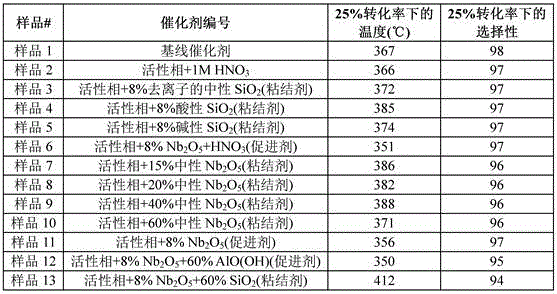
表3table 3

表中示出了基于溶液的元素重量百分比组成的粘结剂的量(重量%)。如上将所得浆料挤出或球化、在90-100℃下干燥并在350-500℃下在空气中重新煅烧。附聚的颗粒在实验室规模的脱氢反应器中进行测试。乙烷和氧气以约1:1的摩尔比以相同的起始原料流速通过固定床。记录发生25%转化时的温度和该转化率下的选择性。The table shows the amount of binder (wt %) based on the elemental weight percent composition of the solution. The resulting slurry was extruded or spheroidized as above, dried at 90-100°C and re-calcined in air at 350-500°C. The agglomerated particles were tested in a laboratory scale dehydrogenation reactor. Ethane and oxygen were passed through the fixed bed in a molar ratio of about 1:1 at the same starting material flow rate. The temperature at which 25% conversion occurred and the selectivity at this conversion were recorded.
结果支持以下结论:The results support the following conclusions:
1. SiO2是用于乙烯的氧化脱氢的催化剂的对抗剂(样品3、4、5和13)。乙烷向乙烯转化率为25%时的温度上升。1. SiO2 is a antagonist for catalysts for the oxidative dehydrogenation of ethylene (
2. 仅向催化剂中添加酸几乎没有效果(样品1和3)。2. Simply adding acid to the catalyst had little effect (
3. 以小于约10重量%的量添加Nb2O5水合物充当氧化脱氢催化剂(活性相)的促进剂/粘结剂显著降低了25%转化率下的温度并保持了高选择性。3. The addition of Nb 2 O 5 hydrate in an amount of less than about 10 wt% as a promoter/binder for the oxidative dehydrogenation catalyst (active phase) significantly reduces the temperature at 25% conversion and maintains high selectivity.
4. 实施例6和12显示,勃姆石的存在对Nb2O5水合物的促进作用几乎没有影响。使用小于15重量%的Nb2O5水合物(余量为中性粘结剂)充当促进剂。4. Examples 6 and 12 show that the presence of boehmite has little effect on the promotion of Nb 2 O 5 hydrate. Less than 15% by weight of Nb 2 O 5hydrate (the balance being neutral binder) was used as accelerator.
5. Nb2O5水合物在以大于15重量%的量存在于载体中时充当粘结剂,并且不促进催化剂。 5. Nb2O5hydrate acts as a binder when present in the support in an amount greater than 15% by weight and does not promote the catalyst.
工业实用性Industrial Applicability
Nb2O5可与混合氧化物一起用作氧化脱氢催化剂的粘结剂,用于将乙烷脱氢为乙烯。 Nb2O5 can be used together with mixed oxides as a binder for oxidative dehydrogenation catalysts for dehydrogenation of ethane to ethylene.
Claims (27)
Applications Claiming Priority (3)
| Application Number | Priority Date | Filing Date | Title |
|---|---|---|---|
| CA2975140 | 2017-08-03 | ||
| CA2975140A CA2975140C (en) | 2017-08-03 | 2017-08-03 | Agglomerated odh catalyst |
| PCT/IB2018/055478 WO2019025900A1 (en) | 2017-08-03 | 2018-07-23 | Agglomerated odh catalyst |
Publications (2)
| Publication Number | Publication Date |
|---|---|
| CN111511707A true CN111511707A (en) | 2020-08-07 |
| CN111511707B CN111511707B (en) | 2023-08-01 |
Family
ID=63490621
Family Applications (1)
| Application Number | Title | Priority Date | Filing Date |
|---|---|---|---|
| CN201880065083.9A Active CN111511707B (en) | 2017-08-03 | 2018-07-23 | Agglomerated ODH catalyst |
Country Status (12)
| Country | Link |
|---|---|
| US (2) | US10940461B2 (en) |
| EP (1) | EP3661899A1 (en) |
| JP (1) | JP6945718B2 (en) |
| KR (1) | KR102397556B1 (en) |
| CN (1) | CN111511707B (en) |
| AR (1) | AR112583A1 (en) |
| AU (1) | AU2018311391A1 (en) |
| CA (1) | CA2975140C (en) |
| CL (1) | CL2020000284A1 (en) |
| PE (1) | PE20200461A1 (en) |
| SG (1) | SG11202000870QA (en) |
| WO (1) | WO2019025900A1 (en) |
Families Citing this family (9)
| Publication number | Priority date | Publication date | Assignee | Title |
|---|---|---|---|---|
| CA2953954A1 (en) * | 2017-01-06 | 2018-07-06 | Nova Chemicals Corporation | Double peroxide treatment of oxidative dehydrogenation catalyst |
| CA2975144C (en) * | 2017-08-03 | 2025-07-08 | Nova Chemicals Corporation | Agglomerated odh catalyst |
| CA2975140C (en) * | 2017-08-03 | 2024-06-18 | Nova Chemicals Corporation | Agglomerated odh catalyst |
| CA2999092A1 (en) | 2018-03-26 | 2019-09-26 | Nova Chemicals Corporation | Calcination process to produce enhanced odh catlyst |
| BR112021000848B1 (en) | 2018-07-19 | 2024-02-06 | Nova Chemicals (International) S.A. | CATALYST FOR OXIDATIVE DEHYDROGENATION, METHOD OF PREPARATION THEREOF AND METHOD FOR OXIDATIVE DEHYDROGENATION |
| CA3050795A1 (en) * | 2018-08-03 | 2020-02-03 | Nova Chemicals Corporation | Oxidative dehydrogenation catalysts |
| CA3050720A1 (en) | 2018-08-03 | 2020-02-03 | Nova Chemicals Corporation | Oxidative dehydrogenation catalyst compositions |
| US12128386B2 (en) | 2019-07-18 | 2024-10-29 | Nova Chemicals (International) S.A. | ODH catalyst formulations |
| BR112022004079A2 (en) * | 2019-09-04 | 2022-05-31 | Nova Chem Int Sa | Molybdenum-vanadium-iron and/or molybdenum-vanadium-aluminium-based oxidative dehydrogenation catalyst materials |
Citations (7)
| Publication number | Priority date | Publication date | Assignee | Title |
|---|---|---|---|---|
| US20030065235A1 (en) * | 2001-09-24 | 2003-04-03 | Allison Joe D. | Oxidative dehydrogenation of alkanes to olefins using an oxide surface |
| CN1744946A (en) * | 2003-01-27 | 2006-03-08 | 英国石油化学品有限公司 | Oxidation catalyst and its preparation method |
| CN1802209A (en) * | 2003-06-10 | 2006-07-12 | 英国石油化学品有限公司 | Catalyst composition and process for the selective oxidation of ethane and/or ethylene to acetic acid |
| US20100255986A1 (en) * | 2009-04-02 | 2010-10-07 | Lummus Technology Inc. | Catalysts for the conversion of paraffins to olefins and use thereof |
| TW201041839A (en) * | 2009-04-02 | 2010-12-01 | Lummus Technology Inc | Process for producing ethylene via oxidative dehydrogenation (ODH) of ethane |
| US20150141727A1 (en) * | 2013-11-21 | 2015-05-21 | Nova Chemicals (International) S.A. | Inherently safe odh operation |
| CA2859935A1 (en) * | 2014-08-20 | 2016-02-20 | Nova Chemicals Corporation | High conversion and selectivity odh process |
Family Cites Families (27)
| Publication number | Priority date | Publication date | Assignee | Title |
|---|---|---|---|---|
| US4524236A (en) | 1984-06-28 | 1985-06-18 | Union Carbide Corporation | Process for oxydehydrogenation of ethane to ethylene |
| EP0262264A1 (en) | 1986-08-29 | 1988-04-06 | Nippon Seiki Co. Ltd. | Indicating instrument |
| CA1262556A (en) | 1986-09-24 | 1989-10-31 | Jonathan Lester Brockwell | Process for oxydehydrogenation of ethane to ethylene |
| CA2271397A1 (en) * | 1998-05-21 | 1999-11-21 | Rohm And Haas Company | A process for preparing a catalyst |
| DE10118814A1 (en) * | 2001-04-17 | 2002-10-24 | Basf Ag | Production of acrolein or acrylic acid involves absorption of propane and propene from a gas mixture followed by desorption and oxidation, with no catalytic dehydrogenation of propane and no added oxygen |
| EP1301457B1 (en) | 2000-07-18 | 2008-03-26 | Basf Se | Method for producing acrylic acid by the heterogeneously catalysed gas-phase oxidation of propane |
| US6858768B2 (en) * | 2001-08-01 | 2005-02-22 | Conocophillips Company | Oxidative dehydrogenation of alkanes to olefins using an oxide surface |
| ES2192983B1 (en) | 2002-01-31 | 2004-09-16 | Universidad Politecnica De Valencia. | A CATALYST FOR OXIDATIVE DEHYDROGENATION FROM ETANO TO ETENO. |
| US6919295B2 (en) | 2002-05-01 | 2005-07-19 | Rohm And Haas Company | Supported mixed metal oxide catalyst |
| CA2655841C (en) | 2009-02-26 | 2016-06-21 | Nova Chemicals Corporation | Supported oxidative dehydrogenation catalyst |
| KR101208152B1 (en) * | 2009-12-31 | 2012-12-04 | 주식회사 효성 | Dehydrogenation aerogel catalyst |
| EP2700447B1 (en) * | 2011-04-21 | 2021-06-16 | Asahi Kasei Kabushiki Kaisha | Silica-supported catalyst |
| CA2752409C (en) | 2011-09-19 | 2018-07-03 | Nova Chemicals Corporation | Membrane-supported catalysts and the process of oxidative dehydrogenation of ethane using the same |
| US20130158322A1 (en) | 2011-11-29 | 2013-06-20 | Siluria Technologies, Inc. | Polymer templated nanowire catalysts |
| CA2874043C (en) | 2012-05-24 | 2021-09-14 | Siluria Technologies, Inc. | Catalytic forms and formulations |
| US9545610B2 (en) * | 2013-03-04 | 2017-01-17 | Nova Chemicals (International) S.A. | Complex comprising oxidative dehydrogenation unit |
| AR095758A1 (en) * | 2013-03-28 | 2015-11-11 | Shell Int Research | A CATALYST FOR OXIDATIVE DEHYDROGENATION OF ALCANOS AND / OR OXIDATION OF ALKENS |
| AR098595A1 (en) | 2013-12-06 | 2016-06-01 | Shell Int Research | OXIDATIVE DEHYDROGENATION OF ALKANS AND / OR OXIDATION OF ALKENS |
| US20170137348A1 (en) * | 2014-06-30 | 2017-05-18 | Shell Oil Company | Alkane oxidative dehydrogenation and/or alkene oxidation |
| US9725381B2 (en) | 2015-07-07 | 2017-08-08 | King Fahd University Of Petroleum And Minerals | Fluidizable catalysts for oxidative dehydrogenation of hydrocarbons |
| CA2900775C (en) * | 2015-08-20 | 2023-10-10 | Nova Chemicals Corporation | Improved oxidative dehydrogenation catalyst |
| CA3002590A1 (en) | 2015-10-26 | 2017-05-04 | Shell Internationale Research Maatschappij B.V. | Mechanically strong catalyst and catalyst carrier, its preparation, and its use |
| WO2017072086A1 (en) | 2015-10-26 | 2017-05-04 | Shell Internationale Research Maatschappij B.V. | Ethane oxidative dehydrogenation and acetic acid recovery |
| KR102017207B1 (en) * | 2015-12-09 | 2019-09-02 | 주식회사 엘지화학 | Catalyst for oxidative dehydrogenation and method for preparing the catalyst |
| US9815752B2 (en) * | 2016-02-12 | 2017-11-14 | King Fahd University Of Petroleum And Minerals | Fluidizable catalyst for oxidative dehydrogenation of alkanes to olefins in an oxygen free environment |
| CA2975144C (en) * | 2017-08-03 | 2025-07-08 | Nova Chemicals Corporation | Agglomerated odh catalyst |
| CA2975140C (en) * | 2017-08-03 | 2024-06-18 | Nova Chemicals Corporation | Agglomerated odh catalyst |
-
2017
- 2017-08-03 CA CA2975140A patent/CA2975140C/en active Active
-
2018
- 2018-07-20 US US16/040,987 patent/US10940461B2/en active Active
- 2018-07-23 KR KR1020207005168A patent/KR102397556B1/en active Active
- 2018-07-23 PE PE2020000177A patent/PE20200461A1/en unknown
- 2018-07-23 EP EP18765167.4A patent/EP3661899A1/en active Pending
- 2018-07-23 AU AU2018311391A patent/AU2018311391A1/en not_active Abandoned
- 2018-07-23 WO PCT/IB2018/055478 patent/WO2019025900A1/en not_active Ceased
- 2018-07-23 SG SG11202000870QA patent/SG11202000870QA/en unknown
- 2018-07-23 CN CN201880065083.9A patent/CN111511707B/en active Active
- 2018-07-23 JP JP2020505410A patent/JP6945718B2/en active Active
- 2018-07-27 AR ARP180102128 patent/AR112583A1/en unknown
-
2020
- 2020-01-31 CL CL2020000284A patent/CL2020000284A1/en unknown
-
2021
- 2021-02-03 US US17/166,760 patent/US11772073B2/en active Active
Patent Citations (7)
| Publication number | Priority date | Publication date | Assignee | Title |
|---|---|---|---|---|
| US20030065235A1 (en) * | 2001-09-24 | 2003-04-03 | Allison Joe D. | Oxidative dehydrogenation of alkanes to olefins using an oxide surface |
| CN1744946A (en) * | 2003-01-27 | 2006-03-08 | 英国石油化学品有限公司 | Oxidation catalyst and its preparation method |
| CN1802209A (en) * | 2003-06-10 | 2006-07-12 | 英国石油化学品有限公司 | Catalyst composition and process for the selective oxidation of ethane and/or ethylene to acetic acid |
| US20100255986A1 (en) * | 2009-04-02 | 2010-10-07 | Lummus Technology Inc. | Catalysts for the conversion of paraffins to olefins and use thereof |
| TW201041839A (en) * | 2009-04-02 | 2010-12-01 | Lummus Technology Inc | Process for producing ethylene via oxidative dehydrogenation (ODH) of ethane |
| US20150141727A1 (en) * | 2013-11-21 | 2015-05-21 | Nova Chemicals (International) S.A. | Inherently safe odh operation |
| CA2859935A1 (en) * | 2014-08-20 | 2016-02-20 | Nova Chemicals Corporation | High conversion and selectivity odh process |
Also Published As
| Publication number | Publication date |
|---|---|
| AR112583A1 (en) | 2019-11-13 |
| JP6945718B2 (en) | 2021-10-06 |
| CN111511707B (en) | 2023-08-01 |
| BR112020002237A2 (en) | 2020-08-04 |
| CL2020000284A1 (en) | 2020-10-09 |
| KR20200035070A (en) | 2020-04-01 |
| EP3661899A1 (en) | 2020-06-10 |
| US20190039050A1 (en) | 2019-02-07 |
| AU2018311391A1 (en) | 2020-02-06 |
| WO2019025900A1 (en) | 2019-02-07 |
| CA2975140A1 (en) | 2019-02-03 |
| US20210154645A1 (en) | 2021-05-27 |
| US10940461B2 (en) | 2021-03-09 |
| US11772073B2 (en) | 2023-10-03 |
| SG11202000870QA (en) | 2020-02-27 |
| CA2975140C (en) | 2024-06-18 |
| KR102397556B1 (en) | 2022-05-16 |
| PE20200461A1 (en) | 2020-03-02 |
| JP2020529919A (en) | 2020-10-15 |
Similar Documents
| Publication | Publication Date | Title |
|---|---|---|
| CN111511707B (en) | Agglomerated ODH catalyst | |
| CN111447996B (en) | Agglomerated ODH catalyst | |
| JP2006517172A (en) | Zirconia extruded products | |
| CN111225743A (en) | Composite catalyst for selectively and stably producing olefin | |
| WO2017208099A1 (en) | Catalysts made with manganese tungsten oxide for the oxidative coupling of methane | |
| CN108200762B (en) | Strong catalyst and catalyst carrier, preparation and use thereof | |
| EP3830221A1 (en) | Oxidative dehydrogenation catalyst compositions | |
| JP7472733B2 (en) | Method for regenerating catalyst for alcohol production | |
| KR102806182B1 (en) | Oxydehydrogenation catalyst and method for producing said catalyst by wet ball milling | |
| US11364488B2 (en) | Supported cobalt-containing fischer-tropsch catalyst, process for preparing the same and uses thereof | |
| WO2020127003A1 (en) | Catalyst for alkane oxidative dehydrogenation and/or alkene oxidation | |
| BR112020002237B1 (en) | AGGLOMERATED OXIDATIVE DEHYDROGENATION CATALYST | |
| CN107949623B (en) | Catalyst support material and catalyst material useful in fischer-tropsch process |
Legal Events
| Date | Code | Title | Description |
|---|---|---|---|
| PB01 | Publication | ||
| PB01 | Publication | ||
| SE01 | Entry into force of request for substantive examination | ||
| SE01 | Entry into force of request for substantive examination | ||
| GR01 | Patent grant | ||
| GR01 | Patent grant |