CN111478721B - Spread spectrum synchronous capturing method based on variable code rate - Google Patents
Spread spectrum synchronous capturing method based on variable code rate Download PDFInfo
- Publication number
- CN111478721B CN111478721B CN202010265369.0A CN202010265369A CN111478721B CN 111478721 B CN111478721 B CN 111478721B CN 202010265369 A CN202010265369 A CN 202010265369A CN 111478721 B CN111478721 B CN 111478721B
- Authority
- CN
- China
- Prior art keywords
- signal
- path
- sequence
- signals
- modulation signal
- Prior art date
- Legal status (The legal status is an assumption and is not a legal conclusion. Google has not performed a legal analysis and makes no representation as to the accuracy of the status listed.)
- Active
Links
Images


Classifications
-
- H—ELECTRICITY
- H04—ELECTRIC COMMUNICATION TECHNIQUE
- H04B—TRANSMISSION
- H04B1/00—Details of transmission systems, not covered by a single one of groups H04B3/00 - H04B13/00; Details of transmission systems not characterised by the medium used for transmission
- H04B1/69—Spread spectrum techniques
- H04B1/713—Spread spectrum techniques using frequency hopping
- H04B1/7156—Arrangements for sequence synchronisation
-
- H—ELECTRICITY
- H04—ELECTRIC COMMUNICATION TECHNIQUE
- H04B—TRANSMISSION
- H04B1/00—Details of transmission systems, not covered by a single one of groups H04B3/00 - H04B13/00; Details of transmission systems not characterised by the medium used for transmission
- H04B1/69—Spread spectrum techniques
- H04B1/713—Spread spectrum techniques using frequency hopping
- H04B1/7156—Arrangements for sequence synchronisation
- H04B2001/71563—Acquisition
Landscapes
- Engineering & Computer Science (AREA)
- Computer Networks & Wireless Communication (AREA)
- Signal Processing (AREA)
- Synchronisation In Digital Transmission Systems (AREA)
Abstract
The invention provides a spread spectrum synchronous capturing method based on a transcoding rate, which comprises the following steps: s1, framing and spreading code sequences by a transmitting end; s2, mapping the spread spectrum code sequence into two paths of orthogonal modulation signals and sending the signals; s3, the receiving end receives and respectively buffers two paths of modulation signals; s4, L times extracting the modulation signal received at the current sampling moment, correlating the extracted modulation signal with a capture code element sequence prestored at a receiving end to generate a corresponding correlation signal, and grading and accumulating the correlation signal to generate a corresponding accumulated signal; s5, adding the two paths of accumulated signals to generate an accumulated summation signal for the current sampling moment and caching the accumulated summation signal, entering the next sampling moment if the length of the received modulation signal code element does not reach the set threshold value, updating the received modulation signal, and entering S4; otherwise, go to S6; and S6, generating corresponding threshold values for each peak value of the accumulated summation signals, and judging whether the spread spectrum code sequence is successfully captured or not according to the threshold values.
Description
Technical Field
The invention relates to the field of communication, in particular to a spread spectrum synchronous acquisition method based on a code-varying rate.
Background
In order to realize a high-speed reliable wireless communication system, the performance of anti-interference directly affects the working performance of the system.
The frequency hopping technique can well overcome the targeted interference, so the frequency hopping technique is widely applied to wireless communication systems. In a frequency hopping communication system, the system performance generally has to be reduced due to too fast hopping speed, resulting in limited communication distance and failing to meet the actual index requirements, and therefore, the development of the frequency hopping technology is in progress.
Document 1 (zhangyang, pandong, liu dao, etc.. a spread spectrum capture method [ J ] based on DMF and multi-symbol accumulation decision, world kokka research and development, 2010,32(3): 282-. The method does not adopt the variable code rate to send data, and the problems of low frequency hopping rate, non-ideal anti-interference effect and the like can be caused by overlong code elements.
In document 2 (Wangjinbao, Yangwang, Octopon, etc.. spread spectrum measurement and control signal capture algorithm research [ J ]. modern defense technology, 2013,41(1):92-98), a Kaiser window-based PFM-FFT method is adopted to improve the sector attenuation of the spectrum amplitude, and a parabola interpolation method is adopted to improve the fence effect generated during Doppler estimation. The method has low realizability in engineering, complex algorithm and large resource consumption, and simultaneously has no obvious effect when the Doppler frequency offset is not obvious.
Patent 1 (a new frequency hopping signal capturing method, 200710050545.3, 2007) screens out the undisturbed frequency points according to the frequency hopping synchronization sequence, and selects the monitoring frequency points to perform the related capturing of the frequency hopping synchronization signals. The method can reduce the false alarm probability, but the problem of insufficient capture sensitivity cannot be solved due to the short code length.
Patent 2 (speed hopping correlation, interval correlation variable speed frequency hopping communication methods, 201110069190.9, 2011) adopts different speed hopping and different frequency hopping interval durations to represent different data information, but the transmitted code lengths are the same, and the capture sensitivity is not improved by using the difference of the speed hopping.
In patent 3 (a spread spectrum capturing method and a receiving end implemented by the method, 200810116914.9, 2008), m-path parallel correlation processing is performed on a spread spectrum sequence in a received data frame, an average value is calculated, and whether the average value is greater than a preset threshold value is determined to determine whether to capture. The method cannot solve the problem of insufficient capture sensitivity due to short code length.
Disclosure of Invention
The invention aims to provide a spread spectrum synchronous capturing method based on a variable code rate, which greatly improves the capturing performance of a receiving end and improves the anti-interference performance in spread spectrum communication by using different code lengths and frequency hopping rates for a capturing sequence, a frame synchronization sequence and a data sequence in a transmitted spread spectrum code sequence. And at the receiving end, the pre-stored capture code element sequence is used for correlating with the extracted modulation signal, and as the number of correlation points is enough (the code length is enough), the correlation peak is particularly prominent under the condition of extremely low signal-to-noise ratio, so that the capture performance of the receiving end can be improved. By setting the threshold value in the invention, not only the capture sensitivity is considered, but also false alarm is prevented.
In order to achieve the above object, the present invention provides a spread spectrum synchronization acquisition method based on a transcoding rate, comprising the steps of:
s1, the transmitting end frames the capture sequence, the frame synchronization sequence and the data sequence in sequence to generate a spread spectrum code sequence; the capture sequence and the frame synchronization sequence have a first frequency hopping rate V1(ii) a The data sequence has a second frequency hopping rate V2;V1<V2(ii) a The length of the acquisition sequence code element is M, and M is a positive integer;
s2, the transmitting end maps the spread spectrum code sequence into two orthogonal modulation signals through code modulation, namely an I modulation signal and a Q modulation signal; transmitting the two paths of modulation signals;
s3, the receiving end buffers the I path and Q path modulation signals received at the current sampling time into two registers respectively;
s4, respectively taking the peak value of the path I modulation signal as an extraction point, and extracting the path I modulation signal in the register by L times; taking the peak value of the Q-path modulation signal as an extraction point, and extracting the Q-path modulation signal in the register by L times; wherein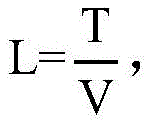 T is a processing clock, and V is the sending rate of the spread spectrum code sequence; respectively correlating the extracted I-path modulation signal and Q-path modulation signal with a capture code element sequence prestored in a receiving end to generate corresponding I-path correlation signals and Q-path correlation signals; the I path and Q path related signals are accumulated in a grading way to generate corresponding I path and Q path accumulated signals;
s5, adding the I path accumulated signal generated in the step S4 and the Q path accumulated signal to generate an accumulated summation signal at the current sampling moment, and caching the accumulated summation signal; if the length of the code element of the I path of modulation signal or the Q path of modulation signal received by the receiving end is less than M/2, entering the next sampling moment, the receiving end updates the corresponding register according to the received I path of modulation signal and Q path of modulation signal, and entering S4; otherwise, go to S6;
s6, generating corresponding threshold values for each peak value of the accumulated summation signals; and judging whether the spread spectrum code sequence is successfully captured at the peak value of the corresponding accumulated summation signal according to the threshold value.
Preferably, the lengths of the frame synchronization sequence symbol and the data sequence symbol are M, N respectively, where N is a positive integer and M > N.
Preferably, the autocorrelation of the acquisition sequence symbol, the frame synchronization sequence symbol and the data sequence symbol is greater than a set threshold, and no peak occurs when any two symbols of the acquisition sequence symbol, the frame synchronization sequence symbol and the data sequence symbol are cross-correlated.
Preferably, the capture sequence and the frame synchronization sequence each have a first pulse width, and the data sequence has a second pulse width, and the first pulse width is greater than the second pulse width.
Preferably, the depth of the register is And (4) point.
Generating the corresponding I-path correlation signal in step S4 specifically includes:
s41, corresponding the ith data of the extracted I-path modulation signal to the ith capture code element of the capture code element sequence; according to a set rule, changing the ith data of the extracted I-path modulation signal according to a capture code element;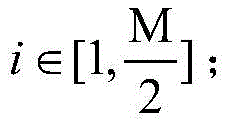
corresponding the ith data of the extracted Q-path modulation signal to the ith capture code element of the capture code element sequence; according to a set rule, changing the ith data of the extracted Q-path modulation signal according to a capture code element;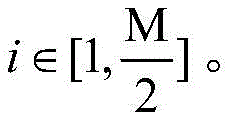
in step S4, the step of accumulating the I path and Q path related signals to generate corresponding I path and Q path accumulated signals specifically includes:
s42 initialization identifier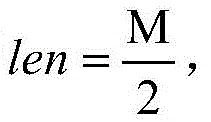 1, ji ═ 1; the extracted I path modulation signal and Q path modulation signal are respectively used as a first signal and a second signal;
s43, comparing the jth signal in the first signals with the jth signal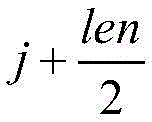 Adding the signals to generate sequentially
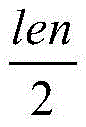 A signal with
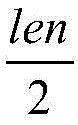 Updating the first signal by the signal; comparing the jth signal of the second signals with the jth signal
 Adding the signals to generate sequentially
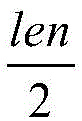 A signal with
 Updating the second signal by the signal;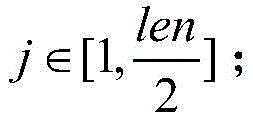
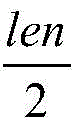
updated len is Updating ji to ji + 1; if ji is less than or equal to log2(M/2), repeating step S43; otherwise, the first and second signals are respectively used as the I path and Q path accumulated signals.
Step S6 specifically includes:
s61, smoothing the buffered accumulated summation signal, calculating the average value Ave of each S point through window movement, and making K Ave be the threshold value corresponding to the peak value of the accumulated summation signal; wherein K is a set constant; when K is used as a threshold value, the receiving end does not generate a false alarm;
and S62, if the peak value of the accumulated summation signal is larger than the corresponding threshold value, pulling up the capture enable at the position larger than the threshold value, and indicating that the spread spectrum code sequence is successfully captured.
Preferably, in step S61, S is 10.
The invention relates to a spread spectrum synchronous capturing method based on a code-changing rate, which uses different code-changing rates (namely frequency hopping rates) to send a capturing sequence, a frame synchronous sequence and a data sequence. The code changing rate of the capture sequence and the frame synchronization sequence is reduced, and the code element length of the capture sequence and the frame synchronization sequence is larger than that of the data sequence, so that the capture sensitivity of a receiving end is improved. Meanwhile, the frequency hopping rate of the data sequence is improved, and the anti-interference performance in communication is greatly improved. The invention also sets a corresponding threshold value for the peak value of the accumulated summation signal by smoothing the accumulated summation signal, thereby not only preventing the receiving end from generating false alarm for capturing, but also ensuring the capturing sensitivity.
Drawings
In order to more clearly illustrate the technical solution of the present invention, the drawings used in the description will be briefly introduced, and it is obvious that the drawings in the following description are an embodiment of the present invention, and other drawings can be obtained by those skilled in the art without creative efforts according to the drawings:
FIG. 1 is a flow chart of a method for acquiring spread spectrum synchronization based on a transcoding rate according to the present invention;
fig. 2 is a frame structure diagram of a spreading code sequence according to the present invention;
Detailed Description
The technical solutions in the embodiments of the present invention will be clearly and completely described below with reference to the drawings in the embodiments of the present invention, and it is obvious that the described embodiments are only a part of the embodiments of the present invention, and not all of the embodiments. All other embodiments, which can be derived by a person skilled in the art from the embodiments given herein without making any creative effort, shall fall within the protection scope of the present invention.
As shown in fig. 1, the present invention provides a spread spectrum synchronization acquisition method based on a transcoding rate, comprising the steps of:
s1, the transmitting end frames the capture sequence, the frame synchronization sequence and the data sequence in sequence to generate a spread spectrum code sequence; the frame structure of the spread spectrum code sequence is shown in fig. 2, a capture sequence comprises P pulses, a frame synchronization sequence comprises Q pulses, and a plurality of pulses sent by the capture sequence and the frame synchronization sequence ensure that a receiving end can capture signals at different frequency points. A time interval is also set in the two spreading code sequences transmitted in sequence as a guard interval.
The capture sequence and the frame synchronization sequence have a first frequency hopping rate V1(ii) a The data sequence has a second frequency hopping rate V2The first frequency hopping rate is higher than the second frequency hopping rate, V1<V2(ii) a The capture sequence and the frame synchronization sequence both have a first pulse width T1The duty ratio is 50% and the period is 2T1The hollow part is the time for switching the frequency hopping frequency; the data sequence has a second pulse width T2Duty ratio of 50%, and period of data sequence of 2T2(ii) a Wherein T is1>T2。
The length of the acquisition sequence symbol, the frame synchronization sequence symbol, and the data sequence symbol are M, M, N, respectively, where M and N are positive integers and M > N. The autocorrelation of the acquisition sequence code element, the frame synchronization sequence code element and the data sequence code element is larger than the set threshold value, and no peak value is generated when any two of the acquisition sequence code element, the frame synchronization sequence code element and the data sequence code element are in cross correlation.
S2, the transmitting end maps the spread spectrum code sequence into two paths of orthogonal modulation signals through code modulation, namely an I path modulation signal and a Q path modulation signal; transmitting the two paths of modulation signals; theThe two paths of modulation signals have the same code element quantity, both are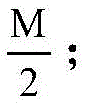
The I path of modulation signal and the Q path of modulation signal are both derived from a spread spectrum code sequence, the amplitude and the frequency are the same, and the only difference is that the phase difference of two paths of orthogonal modulation signals is 90 degrees. When the amplitude of one path of modulation signal is 1, the amplitude of the other path of modulation signal is 0, and the two paths of modulation signals are orthogonal.
S3, the receiving end respectively caches the two paths of modulation signals into two registers, one path of modulation signal corresponds to one register, and the depths of the two registers are both Point;
s4, respectively taking the peak value of the path I modulation signal as an extraction point, and extracting the path I modulation signal in the register by L times; taking the peak value of the Q-path modulation signal as an extraction point, and extracting the Q-path modulation signal in the register by L times; wherein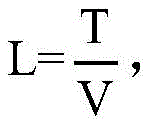 T is a processing clock, and V is the sending rate of the spread spectrum code sequence; the waveform data of the modulated signal is mapped to symbol data by decimation.
Respectively correlating the extracted I-path modulation signal and Q-path modulation signal with a capture code element sequence prestored in a receiving end to generate corresponding I-path correlation signal and Q-path correlation signal, and specifically comprising the following steps of:
s41, corresponding the ith data of the extracted I-path modulation signal to the ith capture code element of the capture code element sequence; according to a set rule, changing the ith data of the extracted I-path modulation signal according to a capture code element; in the embodiment of the invention, when the ith acquisition code element is '1', the ith data of the I-path modulation signal is unchanged; when the ith capture code element is '0', the ith data of the I-path modulation signal is inverted。
Corresponding the ith data of the extracted Q-path modulation signal to the ith capture code element of the capture code element sequence; according to a set rule, changing the ith data of the extracted Q-path modulation signal according to a capture code element;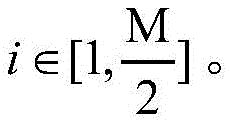
the step of accumulating I path and Q path related signals to generate corresponding I path and Q path accumulated signals specifically comprises the following steps:
s42 initialization identifier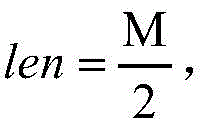 1, ji ═ 1; the extracted I path modulation signal and Q path modulation signal are respectively used as a first signal and a second signal;
s43, comparing the jth signal in the first signals with the jth signal Adding the signals to generate sequentially
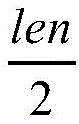 A signal with
 Updating the first signal by the signal; comparing the jth signal of the second signals with the jth signal
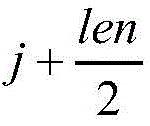 Adding the signals to generate sequentially
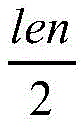 A signal with
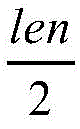 Updating the second signal by the signal;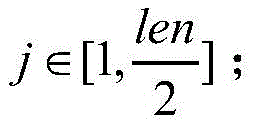
updatinglen is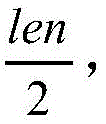 Updating ji to ji + 1; if ji is less than or equal to log2(M/2), repeating step S43; otherwise, the first and second signals are respectively used as the I path and Q path accumulated signals.
S5, adding the I path accumulated signal generated in the step S4 and the Q path accumulated signal to generate an accumulated summation signal at the current sampling moment, and caching the accumulated summation signal; if the length of the code element of the I path of modulation signal or the Q path of modulation signal received by the receiving end is less than M/2, entering the next sampling moment, the receiving end updates the corresponding register according to the received I path of modulation signal and Q path of modulation signal, and entering S4; otherwise, go to S6;
s6, generating corresponding threshold values for each peak value of the accumulated summation signals; judging whether the spread spectrum code sequence is successfully captured at the peak value of the corresponding accumulated summation signal according to the threshold value;
step S6 specifically includes:
s61, smoothing the buffered accumulated summed signal, and obtaining an average Ave of each S point (preferably, S is 10) by window shifting, and making K × Ave be a threshold corresponding to the peak of the accumulated summed signal; wherein K is a set constant; when K × Ave is used as a threshold value, the receiving end does not generate a false alarm (namely error capture);
and S62, if the peak value of the accumulated summation signal is larger than the corresponding threshold value, pulling up the capture enable at the position larger than the threshold value, and indicating that the spread spectrum code sequence is successfully captured.
In one embodiment of the invention, the code length of the acquisition sequence and the frame synchronization sequence are both 256 points, the pulse width is 40us, the pulse period is 80us, and the frequency hopping rate is 12500/s. The code length of the data sequence is 64 points, a direct spread spectrum mode is adopted, the pulse width is 25us, the pulse period is 50us, and the frequency hopping rate of the data is 20000/s. When the receiving end carries out acquisition, 128-point autocorrelation accumulation is carried out on each path of modulation signals which are correlated with the pre-stored acquisition code element sequence, the two paths of modulation signals are equivalent to 256-point autocorrelation accumulation, and the acquisition sensitivity can reach-113 db.
While the invention has been described with reference to specific embodiments, the invention is not limited thereto, and various equivalent modifications and substitutions can be easily made by those skilled in the art within the technical scope of the invention. Therefore, the protection scope of the present invention shall be subject to the protection scope of the claims.
Claims (9)
1. A spread spectrum synchronous capture method based on a code-varying rate is characterized by comprising the following steps:
s1, the transmitting end frames the capture sequence, the frame synchronization sequence and the data sequence in sequence to generate a spread spectrum code sequence; the capture sequence and the frame synchronization sequence have a first frequency hopping rate V1(ii) a The data sequence has a second frequency hopping rate V2;V1<V2(ii) a The length of the acquisition sequence code element is M, and M is a positive integer;
s2, the transmitting end maps the spread spectrum code sequence into two orthogonal modulation signals through code modulation, namely an I modulation signal and a Q modulation signal; transmitting the two paths of modulation signals;
s3, the receiving end buffers the I path and Q path modulation signals received at the current sampling time into two registers respectively;
s4, respectively taking the peak value of the path I modulation signal as an extraction point, and extracting the path I modulation signal in the register by L times; taking the peak value of the Q-path modulation signal as an extraction point, and extracting the Q-path modulation signal in the register by L times; wherein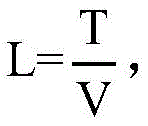 T is a processing clock, and V is the sending rate of the spread spectrum code sequence; respectively correlating the extracted I-path modulation signal and Q-path modulation signal with a capture code element sequence prestored in a receiving end to generate corresponding I-path correlation signals and Q-path correlation signals; the I path and Q path related signals are accumulated in a grading way to generate corresponding I path and Q path accumulated signals;
s5, adding the I path accumulated signal generated in the step S4 and the Q path accumulated signal to generate an accumulated summation signal at the current sampling moment, and caching the accumulated summation signal; if the length of the code element of the I path of modulation signal or the Q path of modulation signal received by the receiving end is less than M/2, entering the next sampling moment, the receiving end updates the corresponding register according to the received I path of modulation signal and Q path of modulation signal, and entering S4; otherwise, go to S6;
s6, generating corresponding threshold values for each peak value of the accumulated summation signals; and judging whether the spread spectrum code sequence is successfully captured at the peak value of the corresponding accumulated summation signal according to the threshold value.
2. The method of claim 1, wherein the lengths of the frame synchronization sequence symbol and the data sequence symbol are M, N, respectively, where N is a positive integer and M > N.
3. The method for acquiring spread spectrum synchronization based on transcoding rate of claim 2, wherein the autocorrelation of the acquisition sequence symbol, the frame synchronization sequence symbol and the data sequence symbol is greater than the set threshold, and no peak occurs when any two of the acquisition sequence symbol, the frame synchronization sequence symbol and the data sequence symbol are cross-correlated.
4. The method of claim 1, wherein the acquisition sequence and the frame synchronization sequence each have a first pulse width, the data sequence has a second pulse width, and the first pulse width is greater than the second pulse width.
5. The method for spread spectrum synchronization acquisition based on transcoding rate of claim 2, wherein the depth of the register in step S3 is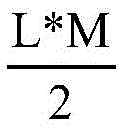 And (4) point.
6. The method for spread spectrum synchronization acquisition based on a transcoding rate as claimed in claim 1, wherein the step S4 of generating the corresponding I-path correlation signal specifically comprises:
s41, corresponding the ith data of the extracted I-path modulation signal to the ith capture code element of the capture code element sequence; according to a set rule, changing the ith data of the extracted I-path modulation signal according to a capture code element;
corresponding the ith data of the extracted Q-path modulation signal to the ith capture code element of the capture code element sequence; according to a set rule, changing the ith data of the extracted Q-path modulation signal according to a capture code element;
7. the method for spread spectrum synchronization acquisition based on a transcoding rate as claimed in claim 1, wherein the step S4 of accumulating the I and Q paths of correlated signals in a hierarchical manner to generate corresponding I and Q paths of accumulated signals specifically comprises:
s42 initialization identifier 1, ji ═ 1; the extracted I path modulation signal and Q path modulation signal are respectively used as a first signal and a second signal;
s43, comparing the jth signal in the first signals with the jth signal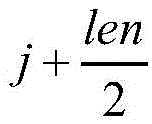 Adding the signals to generate sequentially
 A signal with
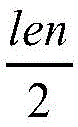 Updating the first signal by the signal; comparing the jth signal of the second signals with the jth signal
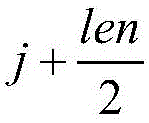 Adding the signals to generate sequentially
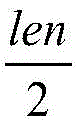 A signal with
 Updating the second signal by the signal;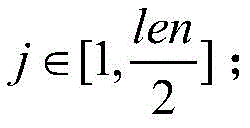
updated len is Updating ji to ji + 1; if ji is less than or equal to log2(M/2), repeating step S43; otherwise, the first and second signals are respectively used as the I path and Q path accumulated signals.
8. The method for acquiring spreading synchronization based on transcoding rate as claimed in claim 1, wherein step S6 specifically comprises:
s61, smoothing the buffered accumulated summation signal, calculating the average value Ave of each S point through window movement, and making K Ave be the threshold value corresponding to the peak value of the accumulated summation signal; wherein K is a set constant; when K is used as a threshold value, the receiving end does not generate a false alarm;
and S62, if the peak value of the accumulated summation signal is larger than the corresponding threshold value, pulling up the capture enable at the position larger than the threshold value, and indicating that the spread spectrum code sequence is successfully captured.
9. The method of claim 8, wherein in step S61, S is 10.
Priority Applications (1)
| Application Number | Priority Date | Filing Date | Title |
|---|---|---|---|
| CN202010265369.0A CN111478721B (en) | 2020-04-07 | 2020-04-07 | Spread spectrum synchronous capturing method based on variable code rate |
Applications Claiming Priority (1)
| Application Number | Priority Date | Filing Date | Title |
|---|---|---|---|
| CN202010265369.0A CN111478721B (en) | 2020-04-07 | 2020-04-07 | Spread spectrum synchronous capturing method based on variable code rate |
Publications (2)
| Publication Number | Publication Date |
|---|---|
| CN111478721A CN111478721A (en) | 2020-07-31 |
| CN111478721B true CN111478721B (en) | 2021-07-20 |
Family
ID=71750613
Family Applications (1)
| Application Number | Title | Priority Date | Filing Date |
|---|---|---|---|
| CN202010265369.0A Active CN111478721B (en) | 2020-04-07 | 2020-04-07 | Spread spectrum synchronous capturing method based on variable code rate |
Country Status (1)
| Country | Link |
|---|---|
| CN (1) | CN111478721B (en) |
Family Cites Families (11)
| Publication number | Priority date | Publication date | Assignee | Title |
|---|---|---|---|---|
| US7266141B2 (en) * | 2002-07-19 | 2007-09-04 | Vtech Communications, Ltd | Hybrid frame structure for wireless communications |
| WO2007036847A1 (en) * | 2005-09-27 | 2007-04-05 | Koninklijke Philips Electronics N.V. | Fast synchronization for frequency hopping systems |
| KR100949796B1 (en) * | 2007-12-18 | 2010-03-30 | 한국전자통신연구원 | Radio Interference Mitigation Method and Apparatus by Adaptive Frequency Hopping Rate in Radio Noise Environment |
| GB2475229B (en) * | 2009-11-05 | 2016-08-03 | Thales Holdings Uk Plc | Ultra-wideband radio reception |
| CN102694574B (en) * | 2011-03-22 | 2014-06-11 | 余碧峰 | Hopping-rate-related and interval-related shift frequency-hopping communication method |
| CN102857254B (en) * | 2012-09-21 | 2014-10-08 | 中国航空无线电电子研究所 | Frequency hopping communication system and base band achieving method thereof |
| CN104158563A (en) * | 2013-05-15 | 2014-11-19 | 北京化工大学 | Frequency-hopping transmission system based on double-pattern fast synchronization method |
| US9974035B2 (en) * | 2016-10-12 | 2018-05-15 | Landis+Gyr Innovations, Inc. | Synchronization between low energy end point devices and parent devices in a time slotted channel hopping network |
| DE102016220883A1 (en) * | 2016-10-24 | 2018-04-26 | Fraunhofer-Gesellschaft zur Förderung der angewandten Forschung e.V. | Optimized combination of preamble and data fields for sensor networks with low power consumption based on the telegram splitting method |
| DE102017220063A1 (en) * | 2017-11-10 | 2019-05-16 | Fraunhofer-Gesellschaft zur Förderung der angewandten Forschung e.V. | Efficient use of a single-channel receiver for receiving multichannel transmission |
| EP3591853B1 (en) * | 2018-07-02 | 2021-09-01 | Semtech Corporation | Low-power, frequency-hopping, wide-area network with random medium access |
-
2020
- 2020-04-07 CN CN202010265369.0A patent/CN111478721B/en active Active
Also Published As
| Publication number | Publication date |
|---|---|
| CN111478721A (en) | 2020-07-31 |
Similar Documents
| Publication | Publication Date | Title |
|---|---|---|
| CN105721375B (en) | A system and method for demodulating short preamble burst signal with low signal-to-noise ratio | |
| US11075783B2 (en) | Communication method for phase separation differential chaos shift keying based on second order hybrid system | |
| CN108964824B (en) | A kind of anti-Doppler frequency displacement synchronous method based on pseudo-random sequence differential encoding | |
| CN108683625A (en) | A kind of data packet detection method of low-power consumption bluetooth LE Coded PHY | |
| CN104852876B (en) | A kind of aviation wireless burst communication system | |
| CN107026810A (en) | The PN synchronization method of burst directly-enlarging system and its DS waveform that happens suddenly | |
| CN101834632B (en) | Method for capturing synchronization in frequency hopping communication | |
| CN113259291B (en) | Phase compensation method realized by dynamic Doppler tracking of underwater sound continuous signals | |
| CN107124193B (en) | Marine digital intermediate frequency receiving device | |
| WO2002030035A9 (en) | Symbol timing recovery method for low resolution multiple amplitude signals | |
| CN116055271A (en) | A Burst Signal Detection Method with Double Sliding Windows under Specific Waveform Structure | |
| CN103795676A (en) | Doppler frequency offset estimation method based on cyclic accumulation | |
| CN111988108A (en) | Anti-jamming and high-precision signal synchronization method based on access code in bluetooth receiver | |
| CN116599805B (en) | A measurement and communication integrated method based on underwater acoustic tomography system | |
| JPH11308187A (en) | Method and system for recovering joining timing to dmt modem and for evaluating channel | |
| CN111478721B (en) | Spread spectrum synchronous capturing method based on variable code rate | |
| CN101394198A (en) | Frequency bias capture method for block signal with relatively large frequency bias | |
| CN109474920A (en) | A kind of detection method of low-power consumption bluetooth data packet | |
| CN102158254B (en) | Method and device for receiving signal | |
| KR100534592B1 (en) | Apparatus and method for digital communication receiver | |
| CN118802431A (en) | Method, system and medium for generating, transmitting and receiving single-symbol synaesthesia integrated waveform | |
| CN109547129B (en) | A Step-Weighted Tong Detection Method | |
| CN108718461B (en) | Frequency offset resistant burst CPM signal frame synchronization method | |
| CN115442197B (en) | Integrated signal design and processing method adopting cyclic prefix-free OFDM (orthogonal frequency division multiplexing) | |
| CN118199668A (en) | Underwater detection and communication integrated method based on direct sequence spread spectrum |
Legal Events
| Date | Code | Title | Description |
|---|---|---|---|
| PB01 | Publication | ||
| PB01 | Publication | ||
| SE01 | Entry into force of request for substantive examination | ||
| SE01 | Entry into force of request for substantive examination | ||
| GR01 | Patent grant | ||
| GR01 | Patent grant |