CN111465857A - Method for diagnosing early heart failure - Google Patents
Method for diagnosing early heart failure Download PDFInfo
- Publication number
- CN111465857A CN111465857A CN201880063136.3A CN201880063136A CN111465857A CN 111465857 A CN111465857 A CN 111465857A CN 201880063136 A CN201880063136 A CN 201880063136A CN 111465857 A CN111465857 A CN 111465857A
- Authority
- CN
- China
- Prior art keywords
- biomarker
- heart failure
- subject
- concentration
- biological sample
- Prior art date
- Legal status (The legal status is an assumption and is not a legal conclusion. Google has not performed a legal analysis and makes no representation as to the accuracy of the status listed.)
- Pending
Links
Images


Classifications
-
- G—PHYSICS
- G01—MEASURING; TESTING
- G01N—INVESTIGATING OR ANALYSING MATERIALS BY DETERMINING THEIR CHEMICAL OR PHYSICAL PROPERTIES
- G01N33/00—Investigating or analysing materials by specific methods not covered by groups G01N1/00 - G01N31/00
- G01N33/48—Biological material, e.g. blood, urine; Haemocytometers
- G01N33/50—Chemical analysis of biological material, e.g. blood, urine; Testing involving biospecific ligand binding methods; Immunological testing
- G01N33/68—Chemical analysis of biological material, e.g. blood, urine; Testing involving biospecific ligand binding methods; Immunological testing involving proteins, peptides or amino acids
- G01N33/6893—Chemical analysis of biological material, e.g. blood, urine; Testing involving biospecific ligand binding methods; Immunological testing involving proteins, peptides or amino acids related to diseases not provided for elsewhere
-
- G—PHYSICS
- G01—MEASURING; TESTING
- G01N—INVESTIGATING OR ANALYSING MATERIALS BY DETERMINING THEIR CHEMICAL OR PHYSICAL PROPERTIES
- G01N33/00—Investigating or analysing materials by specific methods not covered by groups G01N1/00 - G01N31/00
- G01N33/48—Biological material, e.g. blood, urine; Haemocytometers
- G01N33/50—Chemical analysis of biological material, e.g. blood, urine; Testing involving biospecific ligand binding methods; Immunological testing
- G01N33/53—Immunoassay; Biospecific binding assay; Materials therefor
- G01N33/543—Immunoassay; Biospecific binding assay; Materials therefor with an insoluble carrier for immobilising immunochemicals
-
- G—PHYSICS
- G01—MEASURING; TESTING
- G01N—INVESTIGATING OR ANALYSING MATERIALS BY DETERMINING THEIR CHEMICAL OR PHYSICAL PROPERTIES
- G01N33/00—Investigating or analysing materials by specific methods not covered by groups G01N1/00 - G01N31/00
- G01N33/48—Biological material, e.g. blood, urine; Haemocytometers
- G01N33/50—Chemical analysis of biological material, e.g. blood, urine; Testing involving biospecific ligand binding methods; Immunological testing
- G01N33/53—Immunoassay; Biospecific binding assay; Materials therefor
- G01N33/543—Immunoassay; Biospecific binding assay; Materials therefor with an insoluble carrier for immobilising immunochemicals
- G01N33/54306—Solid-phase reaction mechanisms
-
- G—PHYSICS
- G01—MEASURING; TESTING
- G01N—INVESTIGATING OR ANALYSING MATERIALS BY DETERMINING THEIR CHEMICAL OR PHYSICAL PROPERTIES
- G01N2800/00—Detection or diagnosis of diseases
- G01N2800/32—Cardiovascular disorders
- G01N2800/325—Heart failure or cardiac arrest, e.g. cardiomyopathy, congestive heart failure
-
- G—PHYSICS
- G01—MEASURING; TESTING
- G01N—INVESTIGATING OR ANALYSING MATERIALS BY DETERMINING THEIR CHEMICAL OR PHYSICAL PROPERTIES
- G01N2800/00—Detection or diagnosis of diseases
- G01N2800/60—Complex ways of combining multiple protein biomarkers for diagnosis
Landscapes
- Health & Medical Sciences (AREA)
- Life Sciences & Earth Sciences (AREA)
- Immunology (AREA)
- Engineering & Computer Science (AREA)
- Chemical & Material Sciences (AREA)
- Molecular Biology (AREA)
- Biomedical Technology (AREA)
- Hematology (AREA)
- Urology & Nephrology (AREA)
- Food Science & Technology (AREA)
- General Physics & Mathematics (AREA)
- Cell Biology (AREA)
- Biotechnology (AREA)
- Medicinal Chemistry (AREA)
- Physics & Mathematics (AREA)
- Analytical Chemistry (AREA)
- Biochemistry (AREA)
- General Health & Medical Sciences (AREA)
- Microbiology (AREA)
- Pathology (AREA)
- Proteomics, Peptides & Aminoacids (AREA)
- Chemical Kinetics & Catalysis (AREA)
- Investigating Or Analysing Biological Materials (AREA)
- External Artificial Organs (AREA)
- Diaphragms For Electromechanical Transducers (AREA)
- Electrotherapy Devices (AREA)
Abstract
本发明涉及用于诊断早期心力衰竭的方法。确切地说,本发明涉及基于纽约心脏病协会(NYHA)分级系统诊断I级和II级心力衰竭。本发明还能区分健康对照和NYHA III/IV级心力衰竭患者。The present invention relates to a method for diagnosing early heart failure. Specifically, the present invention relates to the diagnosis of class I and class II heart failure based on the New York Heart Association (NYHA) grading system. The present invention also distinguishes healthy controls from NYHA class III/IV heart failure patients.
Description
技术领域technical field
本发明涉及用于诊断早期心力衰竭的方法。确切地说,本发明涉及基于纽约心脏病协会(NYHA)分级系统诊断I级和II级心力衰竭。本发明还能区分健康对照和NYHA III/IV级心力衰竭患者。The present invention relates to a method for diagnosing early heart failure. Specifically, the present invention relates to the diagnosis of class I and class II heart failure based on the New York Heart Association (NYHA) grading system. The present invention also distinguishes healthy controls from NYHA class III/IV heart failure patients.
背景技术Background technique
当心肌衰弱以致无法再泵送足够的血液来满足身体对血液和氧气的需求时,发生心力衰竭。换言之,心脏无法跟上其工作负荷。在心力衰竭的早期期间,存在多种起作用的补偿机制,包括增大、增加肌肉质量和更快地泵送。在不治疗和/或改变生活方式的情况下,这些补偿机制最终将不再有效,因此人开始经历心力衰竭的症状,例如疲劳和呼吸问题。Heart failure occurs when the heart muscle weakens so that it can no longer pump enough blood to meet the body's needs for blood and oxygen. In other words, the heart cannot keep up with its workload. During the early stages of heart failure, there are multiple compensatory mechanisms at work, including enlargement, increased muscle mass, and faster pumping. Without treatment and/or lifestyle changes, these compensatory mechanisms eventually cease to be effective, and a person begins to experience symptoms of heart failure, such as fatigue and breathing problems.
在20世纪初期,尚无测量心功能的方法,因此诊断也不一致。NYHA开发了一种分级系统,该分级系统至今仍用于心力衰竭的临床描述(纽约心脏病协会标准委员会(TheCriteria Committee of the New York Heart Association),1994年)。根据NYHA分级系统,基于患者体力活动中的限制、正常呼吸过程中的任何限制或症状以及呼吸短促和/或心绞痛而将患者分为四类。In the early 20th century, there was no way to measure cardiac function, so diagnosis was inconsistent. NYHA developed a grading system that is still used today for the clinical description of heart failure (The Criteria Committee of the New York Heart Association, 1994). According to the NYHA grading system, patients were divided into four categories based on limitations in physical activity, any limitations or symptoms during normal breathing, and shortness of breath and/or angina.
该分级系统列于表1中。The grading system is listed in Table 1.
表1.心力衰竭的NYHA功能分级Table 1. NYHA functional class of heart failure


心力衰竭主要因其全球性高患病率而给社会带来了巨大的社会和经济负担。例如,据估计,全世界每年有2300万人被诊断出此疾病(澳大利亚卫生与福利研究所(Australian Institute of Health and Welfare,AIHW)2011)。生存率也很低,澳大利亚总死亡人数中约有30%归因于心力衰竭(Palazzuoli等,2007)。心力衰竭的主要风险因素包括年龄、缺乏体力活动、饮食习惯不良导致肥胖、吸烟和过量饮酒(Palazzuoli等,2007)。随着许多国家正经历人口的老龄化,预期心力衰竭将成为更加普遍的问题(Marian和Nambi,2004)。Heart failure imposes a huge social and economic burden on society mainly due to its high global prevalence. For example, it is estimated that 23 million people worldwide are diagnosed with the disease each year (Australian Institute of Health and Welfare (AIHW) 2011). Survival rates are also low, with approximately 30% of total deaths in Australia attributed to heart failure (Palazzuoli et al, 2007). Major risk factors for heart failure include age, physical inactivity, poor dietary habits leading to obesity, smoking and excessive alcohol consumption (Palazzuoli et al., 2007). As many countries are experiencing aging populations, heart failure is expected to become a more prevalent problem (Marian and Nambi, 2004).
由于此疾病的复杂性,目前尚无心力衰竭的诊断标准。确切地说,没有针对心力衰竭的简单诊断测试。虽然可以使用医学成像技术来检测心脏结构或功能的早期变化,例如上述补偿机制,但是,对所有潜在心力衰竭患者进行成像是不切实际或不符合成本效益的。Due to the complexity of the disease, there are currently no diagnostic criteria for heart failure. To be precise, there is no simple diagnostic test for heart failure. Although medical imaging techniques can be used to detect early changes in cardiac structure or function, such as the compensatory mechanisms described above, it is impractical or not cost-effective to image all patients with underlying heart failure.
现有许多非侵入性风险评分系统,其被设计成用来评估个人罹患心血管疾病(如冠心病、心力衰竭、心肌病、先天性心脏病、周围血管疾病和中风)的概率。例如,弗雷明汉风险评分(Framingham Risk Score)是一种用于评估10年内发生冠心病、外周动脉疾病和心力衰竭的风险的算法(McKee等,1971)。其它实例为用于诊断心力衰竭的波士顿(Boston)标准(Carlson等,1985)以及杜克(Duke)标准(Harlan等,1977),其中波士顿标准已被证明具有最高灵敏性和特异性(Shamsham和Mitchell,2000)。这些类型的标准利用患者病史、体检、常规临床程序和实验室测试的组合,以得出诊断结论(Krum等,2006),并且对诊断晚期或严重心力衰竭特别有用。但是,预防心力衰竭的进展和临床恶化需要早期诊断。因此,需要改善早期心力衰竭的非侵入性诊断的准确性。Numerous non-invasive risk scoring systems exist that are designed to assess an individual's probability of developing cardiovascular disease (eg, coronary heart disease, heart failure, cardiomyopathy, congenital heart disease, peripheral vascular disease, and stroke). For example, the Framingham Risk Score is an algorithm used to assess the risk of developing coronary heart disease, peripheral arterial disease and heart failure over a 10-year period (McKee et al., 1971). Other examples are the Boston criteria for diagnosing heart failure (Carlson et al., 1985) and the Duke criteria (Harlan et al., 1977), of which the Boston criteria have been shown to have the highest sensitivity and specificity (Shamsham and Mitchell, 2000). These types of criteria utilize a combination of patient history, physical examination, routine clinical procedures, and laboratory tests to arrive at a diagnosis (Krum et al., 2006), and are particularly useful for diagnosing advanced or severe heart failure. However, preventing the progression and clinical deterioration of heart failure requires early diagnosis. Therefore, there is a need to improve the accuracy of non-invasive diagnosis of early heart failure.
应清楚地理解,如果本文中引用现有技术出版物,则这种引用并不表示认可所述出版物构成澳大利亚或任何其它国家的所属领域公知常识的一部分。It should be clearly understood that if a prior art publication is cited herein, such citation does not imply an admission that the publication forms part of the common general knowledge in the field in Australia or any other country.
发明内容SUMMARY OF THE INVENTION
本发明一般涉及心力衰竭的早期诊断方法,尤其地,涉及根据NYHA分级的I级和II级心力衰竭的早期的诊断方法。尤其地,本发明涉及与早期心力衰竭高度相关的生物标志物的鉴别和使用。The present invention generally relates to a method of early diagnosis of heart failure, and in particular, to a method of early diagnosis of heart failure of grades I and II according to the NYHA classification. In particular, the present invention relates to the identification and use of biomarkers that are highly correlated with early heart failure.
在第一方面中,本发明提供了一种用于检测受试者的早期心力衰竭的方法,该方法包括分析获自受试者的生物样品并测定该样品中至少一种生物标志物的浓度,以及如果至少一种生物标志物的浓度高于或低于该至少一种生物标志物的预定参考浓度,则为受试者指定心力衰竭分级。可以从获自健康受试者的生物样品中测定至少一种生物标志物的预定参考浓度。In a first aspect, the present invention provides a method for detecting early heart failure in a subject, the method comprising analyzing a biological sample obtained from the subject and determining the concentration of at least one biomarker in the sample , and assigning a heart failure class to the subject if the concentration of the at least one biomarker is above or below a predetermined reference concentration of the at least one biomarker. The predetermined reference concentration of at least one biomarker can be determined from a biological sample obtained from a healthy subject.
在第二方面中,本发明提供了一种用于检测受试者的早期心力衰竭的方法,该方法包括:分析获自受试者的生物样品并且测定该样品中至少一种生物标志物的浓度,测定从健康受试者获取的生物样品中该至少一种生物标志物的浓度,并且如果来自受试者的样品中至少一种生物标志物的浓度高于或低于来自健康受试者的生物样品中该至少一种生物标志物的浓度,则为受试者指定心力衰竭分级。In a second aspect, the present invention provides a method for detecting early heart failure in a subject, the method comprising: analyzing a biological sample obtained from the subject and determining the level of at least one biomarker in the sample Concentration, determining the concentration of the at least one biomarker in a biological sample obtained from a healthy subject, and if the concentration of the at least one biomarker in the sample from the subject is higher or lower than that from the healthy subject The concentration of the at least one biomarker in the biological sample is assigned a heart failure classification for the subject.
在第三方面中,本发明提供了一种用于检测受试者的早期心力衰竭的方法,该方法包括分析获自受试者的生物样品并且测定该样品中至少一种生物标志物的浓度,其中该至少一种生物标志物选自由KLK1、TCPD、S10A7、DLDH、IGHA2、CAMP、KV110、NAMPT、COPB、SPR2A和HV311组成的组,以及如果至少一种生物标志物的浓度高于或低于该至少一种生物标志物的预定参考浓度,则为受试者指定心力衰竭分级。In a third aspect, the present invention provides a method for detecting early stage heart failure in a subject, the method comprising analyzing a biological sample obtained from the subject and determining the concentration of at least one biomarker in the sample , wherein the at least one biomarker is selected from the group consisting of KLK1, TCPD, S10A7, DLDH, IGHA2, CAMP, KV110, NAMPT, COPB, SPR2A, and HV311, and if the concentration of the at least one biomarker is higher or lower At the predetermined reference concentration of the at least one biomarker, the subject is assigned a heart failure class.
在第四方面中,本发明提供了一种用于检测受试者的早期心力衰竭的方法,该方法包括分析获自受试者的生物样品并且测定该样品中至少一种生物标志物的浓度,其中该至少一种生物标志物选自由KLK1、TCPD、S10A7、DLDH、IGHA2、CAMP、KV110、NAMPT、COPB、SPR2A和HV311组成的组,测定获自健康受试者的生物样品中该至少一种生物标志物的浓度,以及如果来自受试者的样品中至少一种生物标志物的浓度高于或低于获自健康受试者的生物样品中该至少一种生物标志物的浓度,则为受试者指定心力衰竭分级。In a fourth aspect, the present invention provides a method for detecting early stage heart failure in a subject, the method comprising analyzing a biological sample obtained from the subject and determining the concentration of at least one biomarker in the sample , wherein the at least one biomarker is selected from the group consisting of KLK1, TCPD, S10A7, DLDH, IGHA2, CAMP, KV110, NAMPT, COPB, SPR2A and HV311, and the at least one biomarker is determined in a biological sample obtained from a healthy subject the concentration of the biomarker, and if the concentration of the at least one biomarker in the sample from the subject is higher or lower than the concentration of the at least one biomarker in the biological sample obtained from the healthy subject, then Subjects were assigned a heart failure class.
在第五方面中,本发明提供了一种用于筛查受试者的早期心力衰竭的方法,该方法包括分析获自受试者的生物样品并且测定该样品中至少一种生物标志物的浓度,以及如果该至少一种生物标志物的浓度高于或低于该至少一种生物标志物的预定参考浓度,则为受试者指定心力衰竭分级。In a fifth aspect, the present invention provides a method for screening a subject for early stage heart failure, the method comprising analyzing a biological sample obtained from the subject and determining the level of at least one biomarker in the sample concentration, and assigning a heart failure class to the subject if the concentration of the at least one biomarker is above or below a predetermined reference concentration of the at least one biomarker.
在第六方面中,本发明提供了一种用于检测与早期心力衰竭相关的至少一种生物标志物的存在的试剂盒,该试剂盒包括固体载体(support),所述固体载体上固定有与至少一种生物标志物特异性结合的至少一种分子。In a sixth aspect, the present invention provides a kit for detecting the presence of at least one biomarker associated with early heart failure, the kit comprising a solid support immobilized on the solid support At least one molecule that specifically binds to at least one biomarker.
在第七方面中,本发明提供了一种用于检测与早期心力衰竭相关的至少一种生物标志物的存在的试剂盒,其中该至少一种生物标志物选自由KLK1、TCPD、S10A7、DLDH、IGHA2、CAMP、KV110、NAMPT、COPB、SPR2A和HV311组成的组,该试剂盒包括固体载体,所述固体载体上固定有与至少一种生物标志物特异性结合的至少一种分子。In a seventh aspect, the present invention provides a kit for detecting the presence of at least one biomarker associated with early heart failure, wherein the at least one biomarker is selected from KLK1, TCPD, S10A7, DLDH , IGHA2, CAMP, KV110, NAMPT, COPB, SPR2A and HV311, the kit comprises a solid support on which at least one molecule specifically binding to at least one biomarker is immobilized.
在整个说明书中,除非上下文另有要求,否则词语“包含/包括(comprise,comprises,comprising)”应理解为暗示包括所述的整数或整数组,但不排除任何其它整数或整数组。Throughout this specification, unless the context requires otherwise, the words "comprise, comprises, comprising" should be understood to imply the inclusion of the stated integer or group of integers, but not the exclusion of any other integer or group of integers.
在本发明范围内,本文描述的任何特征均可以与本文描述的任何一个或多个其它特征以任何组合形式组合。Within the scope of the invention, any feature described herein may be combined in any combination with any one or more other features described herein.
附图说明Description of drawings
图1的图示出了通过ProteinPilot数据库搜索(表3)鉴别的每种蛋白质的肽丰度,如从LC-ESI-MS/MS数据的提取离子色谱图中确定的;Figure 1 is a graph showing the peptide abundance of each protein identified by a ProteinPilot database search (Table 3), as determined from extracted ion chromatograms of LC-ESI-MS/MS data;
图2的一系列图比较了健康对照及NYHA I级和III/IV级心力衰竭患者中各种唾液蛋白的相对丰度,如通过SWATH-MS测定的;图2A,通过SWATH-MS验证的各种蛋白质;图2B,SPLC2(BNP:对照);图2C,KLK1(BNP:对照);图2D,KLK1:SPLC2(BNP:对照);图2E,S10A7(BNP:对照);图2F,S10A7:SPLC2(BNP:对照);图2G,AACT(BNP:对照);以及图2H,AACT:SPLC2(BNP:对照)。Figure 2 is a series of graphs comparing the relative abundance of various salivary proteins in healthy controls and NYHA class I and III/IV heart failure patients, as determined by SWATH-MS; Figure 2B, SPLC2 (BNP: Control); Figure 2C, KLK1 (BNP: Control); Figure 2D, KLK1: SPLC2 (BNP: Control); Figure 2E, S10A7 (BNP: Control); Figure 2F, S10A7: SPLC2 (BNP: control); Figure 2G, AACT (BNP: control); and Figure 2H, AACT: SPLC2 (BNP: control).
图3的一系列点图比较了健康对照和心力衰竭患者中所选唾液蛋白的比率。图3A,KLK1:SPLC2;图3B,S10A7:SPLC2;以及图3C,AACT:SPLC2。Figure 3 is a series of dot plots comparing ratios of selected salivary proteins in healthy controls and heart failure patients. Figure 3A, KLK1: SPLC2; Figure 3B, S10A7: SPLC2; and Figure 3C, AACT: SPLC2.
图4A、4B和4C是图3中唾液蛋白比率的ROC曲线。图4A,KLK1:SPLC2;图4B,S10A7:SPCL2;以及图4C,AACT:SPLC2。Figures 4A, 4B and 4C are ROC curves of the salivary protein ratios in Figure 3 . Figure 4A, KLK1: SPLC2; Figure 4B, S10A7: SPCL2; and Figure 4C, AACT: SPLC2.
图5的一系列图比较了健康对照与NYHA I级和III/IV级心力衰竭患者中各种唾液蛋白(KV110、NAMPT、COPB、SPR2A和HV311)的相对丰度,如通过SWATH-MS测定的。Figure 5 is a series of graphs comparing the relative abundance of various salivary proteins (KV110, NAMPT, COPB, SPR2A and HV311) in healthy controls and NYHA class I and III/IV heart failure patients, as determined by SWATH-MS .
图6是用于比较各队列(cohort)(NYHA I级、NYHA III/IV级和对照)之间的、图5中所示唾液蛋白的组合的ROC曲线叠加图。Figure 6 is an overlay of ROC curves comparing the combinations of salivary proteins shown in Figure 5 between cohorts (NYHA class I, NYHA class III/IV, and controls).
图7的一系列图比较了健康对照与NYHA I级和III/IV级心力衰竭患者中各种唾液蛋白(KLK1、TCPD、S10A7、DLDH、IGHA2和CAMP)的相对丰度,如通过SWATH-MS测定的。Figure 7 is a series of graphs comparing the relative abundance of various salivary proteins (KLK1, TCPD, S10A7, DLDH, IGHA2 and CAMP) in healthy controls and NYHA class I and III/IV heart failure patients, as measured by SWATH-MS measured.
图8是用于比较各队列(NYHA I级、NYHA III/IV级和对照)之间的、图7中所示唾液蛋白的组合的ROC曲线叠加图。Figure 8 is an overlay of ROC curves comparing the combinations of salivary proteins shown in Figure 7 between cohorts (NYHA class I, NYHA class III/IV, and controls).
图9的一系列图比较了健康对照、患心力衰竭风险高的个体和心力衰竭患者中各种唾液蛋白(S10A7、KLK1和CAMP)的浓度,如通过免疫分析测定的;以及用于比较唾液蛋白组合的ROC曲线。通过结合这些唾液蛋白的浓度来生成预测评分。图9A,S10A7;图9B,CAMP;图9C,KLK1;图9D,唾液蛋白的组合预测评分;图9E,ROC曲线,用于比较心力衰竭患者和对照之间的唾液蛋白的组合;图9F,ROC曲线,用于比较SCREEN-HF(心力衰竭筛查)队列与对照之间的唾液蛋白的组合;Figure 9 is a series of graphs comparing the concentrations of various salivary proteins (S10A7, KLK1 and CAMP) in healthy controls, individuals at high risk of heart failure and heart failure patients, as determined by immunoassay; and for comparison of salivary proteins Combined ROC curve. Predictive scores are generated by combining the concentrations of these salivary proteins. Figure 9A, S10A7; Figure 9B, CAMP; Figure 9C, KLK1; Figure 9D, Combination prediction score of salivary proteins; ROC curves to compare the combination of salivary proteins between the SCREEN-HF (Screening for Heart Failure) cohort and controls;
图10的图示出了在参加研究后已经患有心血管疾病的研究受试者与没有因心血管疾病入院的受试者之间的预测评分。Figure 10 is a graph showing the predicted scores between study subjects who already had cardiovascular disease after enrollment in the study and subjects who were not hospitalized for cardiovascular disease.
图11(A)为6名健康对照和6名心力衰竭患者的唾液样品中KLK1、TCPD、S10A7、DLDH、IGHA2和CAMP的蛋白质印迹。(B)为健康对照和心力衰竭患者的唾液样品中KLK1、TCPD、S10A7、DLDH、IGHA2和CAMP的具有标准误差的相对带强度。Figure 11(A) is a Western blot of KLK1, TCPD, S10A7, DLDH, IGHA2 and CAMP in saliva samples from 6 healthy controls and 6 heart failure patients. (B) Relative band intensities with standard errors for KLK1, TCPD, S10A7, DLDH, IGHA2 and CAMP in saliva samples from healthy controls and heart failure patients.
图12是12名健康对照和12名心力衰竭患者的另外的唾液样品中的S10A7的蛋白质印迹。Figure 12 is a Western blot of S10A7 in additional saliva samples of 12 healthy controls and 12 heart failure patients.
具体实施方式Detailed ways
缩写abbreviation
全文使用以下缩写:The following abbreviations are used throughout:
AACT=α1抗胰凝乳蛋白酶AACT =
BNP=脑钠肽BNP = brain natriuretic peptide
CAMP=抗菌肽(Cathelicidin)抗微生物肽CAMP = Antimicrobial Peptide (Cathelicidin)
COPB=外被体(coatomer)亚基βCOPB = coatomer subunit beta
DLDH=二氢硫辛酸脱氢酶,线粒体DLDH = dihydrolipoic acid dehydrogenase, mitochondria
ESI=电喷雾电离ESI = Electrospray Ionization
GELS=凝溶胶蛋白GELS = gelsolin
h=小时h = hours
HV311=Ig重链V-III区KOLHV311=Ig heavy chain V-III region KOL
IGHA2=Igα-2链C区IGHA2=Igα-2 chain C region
IGJ=免疫球蛋白J链IGJ = immunoglobulin J chain
IQR=四分位距IQR = Interquartile range
KLK1=激肽释放酶1KLK1 =
KV110=Igκ链V-I区HK102KV110=Igκ chain V-I region HK102
LC=液相色谱LC = liquid chromatography
LC-ESI-MS/MS=液相色谱-电喷雾电离-串联质谱LC-ESI-MS/MS=liquid chromatography-electrospray ionization-tandem mass spectrometry
LPLC1=长腭、肺和鼻上皮癌相关蛋白1LPLC1 = long palate, lung and nasal epithelial cancer-associated
min=分钟min = minutes
MMP9=基质金属蛋白酶-9MMP9 = matrix metalloproteinase-9
MS=质谱MS = Mass Spectrometry
MS/MS=串联质谱MS/MS = Tandem Mass Spectrometry
NAMPT=烟酰胺磷酸核糖基转移酶NAMPT = Nicotinamide phosphoribosyltransferase
NPV=阴性预测值NPV = negative predictive value
NYHA=纽约心脏病协会NYHA = New York Heart Association
PBS=磷酸盐缓冲盐水PBS = Phosphate Buffered Saline
PPV=阳性预测值PPV = positive predictive value
rcf=相对离心力rcf = relative centrifugal force
ROC=接收者操作特征ROC = receiver operating characteristic
s=秒s = seconds
S10A7=S100钙结合蛋白A7S10A7 = S100 Calbindin A7
SPLC2=短腭、肺及鼻相关蛋白2SPLC2 = short palate, lung and nose associated
SPR2A=小脯氨酸丰富蛋白2ASPR2A = small proline-rich protein 2A
SWATH=所有理论碎片离子光谱的顺序窗口采集SWATH = sequential window acquisition of all theoretical fragment ion spectra
TCPD=T-复合蛋白1亚基δTCPD = T-
TOF=渡越时间(time of flight)TOF = time of flight
VIME=波形蛋白VIME = Vimentin
本发明部分基于以下发现:与获自健康受试者的生物样品相比,获自患有早期心力衰竭的受试者的生物样品中的蛋白质的丰度不同。本发明人已经使用高丰度蛋白质去除和SWATH-MS来鉴别唾液蛋白,作为具备早期心力衰竭诊断效用的推定生物标志物。The present invention is based in part on the discovery that the abundance of proteins differs in biological samples obtained from subjects with early stage heart failure compared to biological samples obtained from healthy subjects. The present inventors have used high abundance protein depletion and SWATH-MS to identify salivary proteins as putative biomarkers with utility in the diagnosis of early heart failure.
因此,在第一方面中,本发明提供了一种用于检测受试者的早期心力衰竭的方法,该方法包括分析获自受试者的生物样品并且测定该样品中至少一种生物标志物的浓度,以及如果该至少一种生物标志物的浓度高于或低于该至少一种生物标志物的预定参考浓度,则为受试者指定心力衰竭分级。可以从获自健康受试者的生物样品中测定至少一种生物标志物的预定参考浓度。Accordingly, in a first aspect, the present invention provides a method for detecting early stage heart failure in a subject, the method comprising analyzing a biological sample obtained from the subject and determining at least one biomarker in the sample and if the concentration of the at least one biomarker is above or below a predetermined reference concentration of the at least one biomarker, assigning a heart failure class to the subject. The predetermined reference concentration of at least one biomarker can be determined from a biological sample obtained from a healthy subject.
出于本发明的目的,描述心力衰竭阶段的短语“早期(early stage)”是指纽约心脏病协会定义的功能分级:NYHA I级和/或NYHA II级。For the purposes of the present invention, the phrase "early stage" describing the stage of heart failure refers to the functional classes defined by the New York Heart Association: NYHA Class I and/or NYHA Class II.
本文所使用的术语“生物样品”是指从受试者提取的样品。该术语包括未处理、已处理、稀释或浓缩的生物样品。从受试者获取的生物样品可以是任何合适的样品,例如全血、血清或血浆。优选地,生物样品获自受试者的颊腔。因此,生物样品可以是痰或唾液。根据提供一种用于诊断早期心力衰竭的非侵入性的具有成本效益的方法的本发明,获自受试者的生物样品优选为唾液。The term "biological sample" as used herein refers to a sample extracted from a subject. The term includes unprocessed, processed, diluted or concentrated biological samples. The biological sample obtained from the subject can be any suitable sample, such as whole blood, serum or plasma. Preferably, the biological sample is obtained from the buccal cavity of the subject. Thus, the biological sample can be sputum or saliva. According to the present invention, which provides a non-invasive cost-effective method for diagnosing early heart failure, the biological sample obtained from the subject is preferably saliva.
至少一种生物标志物是存在于生物样品中的蛋白质,该蛋白质已被鉴定为与早期心力衰竭相关。可以分析生物样品中至少一种、两种、三种、四种、五种、六种等生物标志物的浓度。例如,至少一种生物标志物可以是选自由以下项组成的组中的任何数量的蛋白质:KLK1、TCPD、S10A7、DLDH、IGHA2、CAMP、KV110、NAMPT、COPB、SPR2A和HV311。在一个实施方案中,至少一种生物标志物选自由KLK1、TCPD、S10A7、DLDH、IGHA2和CAMP组成的蛋白质的组。优选地,至少一种生物标志物是由这些蛋白质中的两种、三种、四种、五种或全部六种蛋白质组成的生物标志物组。在特别优选的实施方案中,生物标志物组包括KLK1、S10A7和CAMP。在替代实施方案中,至少一种生物标志物选自由KV110、NAMPT、COPB、SPR2A和HV311组成的组。在特别优选的实施方案中,至少一种生物标志物是由这些蛋白质中的两种、三种、四种、或全部五种蛋白质组成的生物标志物组。At least one biomarker is a protein present in the biological sample that has been identified as being associated with early heart failure. The concentration of at least one, two, three, four, five, six, etc. biomarkers in the biological sample can be analyzed. For example, the at least one biomarker can be any number of proteins selected from the group consisting of KLK1, TCPD, S10A7, DLDH, IGHA2, CAMP, KV110, NAMPT, COPB, SPR2A, and HV311. In one embodiment, the at least one biomarker is selected from the group of proteins consisting of KLK1, TCPD, S10A7, DLDH, IGHA2 and CAMP. Preferably, the at least one biomarker is a biomarker panel consisting of two, three, four, five or all six of these proteins. In a particularly preferred embodiment, the biomarker panel includes KLK1, S10A7 and CAMP. In alternative embodiments, the at least one biomarker is selected from the group consisting of KV110, NAMPT, COPB, SPR2A and HV311. In particularly preferred embodiments, the at least one biomarker is a biomarker panel consisting of two, three, four, or all five of these proteins.
生物标志物的预定参考浓度可以是浓度范围的形式,使得此范围之外的生物标志物浓度指示早期心力衰竭。可选地,生物标志物的预定参考浓度可以是具体值的形式,使得高于或低于此值的生物标志物浓度指示早期心力衰竭。因此,对于用于检测受试者的早期心力衰竭的每种生物标志物,已经测定或已知来自健康受试者的生物样品中生物标志物的预定参考浓度。The predetermined reference concentration of the biomarker may be in the form of a concentration range, such that biomarker concentrations outside this range are indicative of early heart failure. Alternatively, the predetermined reference concentration of the biomarker may be in the form of a specific value such that a biomarker concentration above or below this value is indicative of early heart failure. Thus, for each biomarker used to detect early heart failure in a subject, a predetermined reference concentration of the biomarker in a biological sample from a healthy subject has been determined or known.
在本发明的上下文中,对于测定获自健康受试者的生物样品中的至少一种生物标志物的预定参考浓度而言,“健康受试者”是没有心力衰竭的受试者。也就是说,健康受试者是没有任何心力衰竭的外在症状并且不会被归为NYHA I级或II级的受试者。In the context of the present invention, a "healthy subject" is a subject without heart failure for the purpose of determining a predetermined reference concentration of at least one biomarker in a biological sample obtained from a healthy subject. That is, healthy subjects are subjects who do not have any outward symptoms of heart failure and would not be classified as NYHA Class I or II.
本发明人惊奇地发现,与健康受试者中特定蛋白质的丰度相比,相同蛋白质在被归为NYHA I级或II级受试者的唾液中的丰度提高。相反地,与健康受试者中特定蛋白质的丰度相比,相同蛋白质在被归为NYHA I级或II级受试者的唾液中的丰度降低。The inventors have surprisingly found that the abundance of the same protein is increased in the saliva of subjects classified as NYHA class I or II compared to the abundance of a particular protein in healthy subjects. Conversely, the abundance of the same protein was reduced in the saliva of subjects classified as NYHA class I or II compared to the abundance of a specific protein in healthy subjects.
尽管可以基于来自受试者的生物样品中仅一种生物标志物的浓度为受试者指定心力衰竭分级,但是基于生物样品中两种、三种、四种、五种或更多种生物标志物的浓度来指定分级是更有利的,因为使用更多的生物标志物可以实现更高程度的分级确定性。Although a subject can be assigned a class of heart failure based on the concentration of only one biomarker in a biological sample from the subject, two, three, four, five, or more biomarkers in a biological sample may be assigned a heart failure class. It is more advantageous to assign a grade based on the concentration of the biomarker, since a higher degree of certainty of the grade can be achieved using more biomarkers.
当使用由两种或更多种生物标志物组成的生物标志物组来检测受试者的早期心力衰竭时,此组可以由这样的生物标志物组成:所述生物标志物在心力衰竭受试者唾液中的浓度比健康受试者唾液中相同生物标志物的浓度高。可选地,此组可以由这样的生物标志物组成:所述生物标志物在心力衰竭受试者唾液中的浓度比健康受试者唾液中相同生物标志物的浓度低。进一步作为替代,此组可以由生物标志物的组合组成,其中至少一种生物标志物在心力衰竭受试者唾液中的浓度高于相同的生物标志物在健康受试者唾液中的浓度,并且至少一种生物标志物在心力衰竭受试者唾液中的浓度低于相同的生物标志物在健康受试者唾液中的浓度。When a biomarker panel consisting of two or more biomarkers is used to detect early heart failure in a subject, the panel may consist of biomarkers that are tested in heart failure Concentrations of the same biomarker were higher in the saliva of healthy subjects than in the saliva of healthy subjects. Alternatively, the panel may consist of biomarkers that are present in lower concentrations in the saliva of heart failure subjects than in the saliva of healthy subjects. Further alternatively, the panel may consist of a combination of biomarkers, wherein at least one biomarker is present at a higher concentration in the saliva of heart failure subjects than in the saliva of healthy subjects, and The concentration of at least one biomarker in the saliva of heart failure subjects is lower than the concentration of the same biomarker in the saliva of healthy subjects.
在第二方面中,本发明提供了一种用于检测受试者的早期心力衰竭的方法,该方法包括分析获自受试者的生物样品并且测定该样品中至少一种生物标志物的浓度,测定获自健康受试者的生物样品中该至少一种生物标志物的浓度,以及如果来自该受试者的样品中该至少一种生物标志物的浓度高于或低于获自健康受试者的生物样品中该至少一种生物标志物的浓度,则为受试者指定心力衰竭分级。In a second aspect, the present invention provides a method for detecting early heart failure in a subject, the method comprising analyzing a biological sample obtained from the subject and determining the concentration of at least one biomarker in the sample , determining the concentration of the at least one biomarker in the biological sample obtained from the healthy subject, and if the concentration of the at least one biomarker in the sample from the subject is higher or lower than that obtained from the healthy subject The concentration of the at least one biomarker in the subject's biological sample is assigned a heart failure classification for the subject.
生物样品中至少一种生物标志物的浓度,无论是来自潜在心力衰竭受试者还是健康受试者,都可以通过用于测定蛋白质浓度的任何适当方法来测定。例如,该浓度可以通过质谱分析来测定。将特定生物标志物在来自潜在心力衰竭受试者的样品的质谱中的峰强度与在来自健康受试者的样品的质谱中的峰强度进行比较,可以提供这两个样品中生物标志物丰度的相对差异的指示。更准确的比较可以通过使用以下实例中详述的SWATH-MS来获得。The concentration of at least one biomarker in a biological sample, whether from a potential heart failure subject or a healthy subject, can be determined by any suitable method for determining protein concentration. For example, the concentration can be determined by mass spectrometry. Comparing the peak intensities of specific biomarkers in the mass spectrum of samples from potential heart failure subjects with the peak intensities in the mass spectrum of samples from healthy subjects can provide an indication of the abundance of biomarkers in both samples. Indication of relative differences in degrees. A more accurate comparison can be obtained by using SWATH-MS as detailed in the examples below.
可选地,可以使用与至少一种生物标志物特异性结合的一种或多种试剂来测定生物样品中至少一种生物标志物的浓度。例如,所述试剂可以包括针对生物标志物的表位的抗体,其中抗体任选地包括用于检测抗体-生物标志物复合物的存在的标签(例如,荧光标记)。Alternatively, one or more reagents that specifically bind to the at least one biomarker can be used to determine the concentration of the at least one biomarker in the biological sample. For example, the reagent can include an antibody directed against an epitope of a biomarker, wherein the antibody optionally includes a label (eg, a fluorescent label) for detecting the presence of an antibody-biomarker complex.
在第三方面中,本发明提供了一种用于检测受试者的早期心力衰竭的方法,该方法包括分析获自受试者的生物样品并且测定该样品中至少一种生物标志物的浓度,其中该至少一种生物标志物选自由KLK1、TCPD、S10A7、DLDH、IGHA2、CAMP、KV110、NAMPT、COPB、SPR2A和HV311组成的蛋白质的组,以及如果至少一种生物标志物的浓度高于或低于该至少一种生物标志物的预定参考浓度,则为该受试者指定心力衰竭分级。可以从获自健康受试者的生物样品中测定至少一种生物标志物的预定参考浓度。In a third aspect, the present invention provides a method for detecting early stage heart failure in a subject, the method comprising analyzing a biological sample obtained from the subject and determining the concentration of at least one biomarker in the sample , wherein the at least one biomarker is selected from the group of proteins consisting of KLK1, TCPD, S10A7, DLDH, IGHA2, CAMP, KV110, NAMPT, COPB, SPR2A and HV311, and if the concentration of the at least one biomarker is higher than or below the predetermined reference concentration of the at least one biomarker, the subject is assigned a class of heart failure. The predetermined reference concentration of at least one biomarker can be determined from a biological sample obtained from a healthy subject.
可以分析生物样品中至少一种、两种、三种、四种、五种、六种、七种、八种、九种、十种或全部十一种蛋白质的浓度。尽管可以基于生物样品中仅一种蛋白质的浓度为受试者指定心力衰竭分级,但是基于生物样品中两种、三种、四种、五种、六种、七种、八种、九种、十种或十一种蛋白质的浓度来指定分级是更有利的,因为使用更多的生物标志物可以实现更高程度的分级确定性。The biological sample can be analyzed for concentrations of at least one, two, three, four, five, six, seven, eight, nine, ten, or all eleven proteins. Although a subject can be assigned a heart failure class based on the concentration of only one protein in a biological sample, two, three, four, five, six, seven, eight, nine, The concentration of ten or eleven proteins to assign the grading is more advantageous, as a higher degree of certainty of grading can be achieved using more biomarkers.
可以通过测定比较数据的灵敏度和特异性来评估分级的确定性。The certainty of the classification can be assessed by determining the sensitivity and specificity of the comparative data.
在第四方面中,本发明提供了一种用于检测受试者的早期心力衰竭的方法,该方法包括分析获自受试者的生物样品并且测定该样品中至少一种生物标志物的浓度,其中该至少一种生物标志物选自由KLK1、TCPD、S10A7、DLDH、IGHA2、CAMP、KV110、NAMPT、COPB、SPR2A和HV311组成的蛋白质组,测定获自健康受试者的生物样品中该至少一种生物标志物的浓度,以及如果来自受试者的样品中至少一种生物标志物的浓度高于或低于获自该健康受试者的生物样品中该至少一种生物标志物的浓度,则为该受试者指定心力衰竭分级。In a fourth aspect, the present invention provides a method for detecting early stage heart failure in a subject, the method comprising analyzing a biological sample obtained from the subject and determining the concentration of at least one biomarker in the sample , wherein the at least one biomarker is selected from the proteome consisting of KLK1, TCPD, S10A7, DLDH, IGHA2, CAMP, KV110, NAMPT, COPB, SPR2A and HV311, and the at least one biomarker is determined in a biological sample obtained from a healthy subject The concentration of a biomarker, and if the concentration of the at least one biomarker in the sample from the subject is higher or lower than the concentration of the at least one biomarker in the biological sample obtained from the healthy subject , the subject is assigned a heart failure class.
在第五方面中,本发明提供了一种用于检测与早期心力衰竭相关的至少一种生物标志物的存在的试剂盒,该试剂盒包括固体载体,该固体载体上固定有与该至少一种生物标志物特异性结合的至少一种分子。In a fifth aspect, the present invention provides a kit for detecting the presence of at least one biomarker associated with early heart failure, the kit comprising a solid support immobilized on the solid support with the at least one biomarker at least one molecule to which the biomarker specifically binds.
与至少一种生物标志物特异性结合的至少一种分子可以是任何适当的分子。优选地,该至少一种分子包括与至少一种生物标志物特异性结合的抗体。因此,固体载体可以具有固定在其上的一种、两种、三种、四种等等的抗体。The at least one molecule that specifically binds to the at least one biomarker can be any suitable molecule. Preferably, the at least one molecule comprises an antibody that specifically binds to at least one biomarker. Thus, a solid support can have one, two, three, four, etc. antibodies immobilized thereon.
固体载体可以是可被适当地修饰以用于固定抗体并且适合于至少一种检测方法的任何合适的材料。适用于固体载体的材料的代表性实例包括玻璃和改性玻璃或功能化玻璃、塑料(包括丙烯酸、聚苯乙烯以及苯乙烯与其它材料的共聚物,聚丙烯、聚乙烯、聚丁烯、聚氨酯、聚四氟乙烯等)、多糖、尼龙或硝化纤维素、树脂、二氧化硅或基于二氧化硅的材料(包括硅和改性硅)、碳、金属、无机玻璃和塑料。固体载体可允许在没有明显发荧光的情况下进行光学检测。The solid support can be any suitable material that can be suitably modified for immobilizing the antibody and suitable for at least one detection method. Representative examples of materials suitable for use in solid supports include glass and modified or functionalized glass, plastics (including acrylic, polystyrene and copolymers of styrene and other materials, polypropylene, polyethylene, polybutylene, polyurethane , polytetrafluoroethylene, etc.), polysaccharides, nylon or nitrocellulose, resins, silica or silica-based materials (including silicon and modified silicon), carbon, metals, inorganic glasses, and plastics. Solid supports allow optical detection without significant fluorescence.
固体载体可以是平面的,但是也可以使用其它构造的基材。例如,固体载体可以是内表面上放置有抗体的管。The solid support can be planar, but other configurations of substrates can also be used. For example, the solid support can be a tube with the antibody placed on the inner surface.
在第六方面中,本发明提供了一种用于检测与早期心力衰竭相关的至少一种生物标志物的存在的试剂盒,其中该至少一种生物标志物选自由KLK1、TCPD、S10A7、DLDH、IGHA2、CAMP、KV110、NAMPT、COPB、SPR2A和HV311组成的组,该试剂盒包括固体载体,该固体载体上固定有与至少一种生物标志物特异性结合的至少一种分子。In a sixth aspect, the present invention provides a kit for detecting the presence of at least one biomarker associated with early heart failure, wherein the at least one biomarker is selected from KLK1, TCPD, S10A7, DLDH , IGHA2, CAMP, KV110, NAMPT, COPB, SPR2A and HV311, the kit includes a solid support on which at least one molecule specifically binding to at least one biomarker is immobilized.
实施例Example
实施例1Example 1
材料和方法Materials and methods
研究参加者study participant
这项研究得到了昆士兰大学医学伦理机构委员会(University of QueenslandMedical Ethical Institutional Board)和梅特卫生服务人类研究伦理委员会(MaterHealth Services Human Research Ethics Committee)以及皇家布里斯班妇女医院研究管理机构(Royal Brisbane and Women’s Hospital Research Governance)的批准。所有研究参加者均>18岁,并在收集样品前给予知情同意。健康对照的排除标准基于一项简单的问卷,要求志愿者表明其是否存在任何合并症(comorbid disease)和口腔疾病(例如牙周病和牙龈炎、自身免疫性、传染性、肌肉骨骼或恶性疾病以及最近有过手术或外伤)。如果存在任何病症,则参加者将被排除在研究之外。志愿者来自白种人和亚洲种族,没有发烧或感冒的症状,并且口腔卫生良好。This research was supported by the University of Queensland Medical Ethical Institutional Board and the MaterHealth Services Human Research Ethics Committee and the Royal Brisbane and Women's Hospital Research Authority. Women's Hospital Research Governance). All study participants were >18 years old and gave informed consent prior to sample collection. Exclusion criteria for healthy controls were based on a simple questionnaire asking volunteers to indicate whether they had any comorbid disease and oral diseases such as periodontal disease and gingivitis, autoimmune, infectious, musculoskeletal or malignant disease and recent surgery or trauma). Participants will be excluded from the study if any medical condition is present. The volunteers were of Caucasian and Asian ethnicity, had no symptoms of fever or cold, and had good oral hygiene.
从2012年1月至2014年7月,从澳大利亚布里斯班的昆士兰大学、梅特成人医院(Mater Adult Hospital)或皇家布里斯班妇女医院(Royal Brisbane and Women’sHospital)招募了总计30名健康对照和33名有症状的心力衰竭患者。梅特成人医院和皇家布里斯班妇女医院的心脏病专家们使用纽约心脏病协会(NYHA)功能分级系统根据患者的临床症状对这些患者进行了分级。所有参与研究的患者均被分类为NYHA III级或IV级患者。心力衰竭患者的平均年龄为67.6岁,健康对照的平均年龄为49.7岁。心力衰竭患者队列中男性占63.3%,健康对照队列中男性占43.3%。A total of 30 healthy people were recruited from the University of Queensland, Mater Adult Hospital or Royal Brisbane and Women's Hospital in Brisbane, Australia from January 2012 to July 2014 controls and 33 symptomatic heart failure patients. Cardiologists at the Mette Adult Hospital and the Royal Brisbane and Women's Hospital used the New York Heart Association (NYHA) functional grading system to grade the patients based on their clinical symptoms. All patients enrolled in the study were classified as NYHA class III or IV patients. The mean age of heart failure patients was 67.6 years, and the mean age of healthy controls was 49.7 years. The heart failure patient cohort was 63.3% male and the healthy control cohort was 43.3% male.
唾液样品收集Saliva sample collection
根据先前公布的方法,从早期和晚期心力衰竭患者以及健康对照中收集非刺激性静息全唾液(Martinet W等,2003;Punyadeera C等,2011;Foo JY等,2013;Castagnola M等,2011;Helmerhorst EJ和Oppenheim FG,2007;Loo JA等,2010)。要求志愿者在收集唾液前至少30分钟不要进食或饮用(水除外)。要求志愿者用水冲洗口腔以去除食物颗粒和碎屑,向前和向下倾斜头,在口腔中蓄积唾液,然后将其吐出到置于冰上的Falcon管(50mL,Greiner,Germany)中。将样品通过干冰转移到实验室,并且等分到Eppendorf低蛋白吸附管(Eppendorf,USA)中,并保存在-80℃,用于后期分析。Non-stimulated resting whole saliva was collected from patients with early and advanced heart failure and healthy controls according to previously published methods (Martinet W et al, 2003; Punyadeera C et al, 2011; Foo JY et al, 2013; Castagnola M et al, 2011; Helmerhorst EJ and Oppenheim FG, 2007; Loo JA et al, 2010). Volunteers were asked not to eat or drink (except water) for at least 30 minutes before collecting saliva. Volunteers were asked to rinse their mouths with water to remove food particles and debris, tilt their heads forward and down, accumulate saliva in the mouth, and spit it into Falcon tubes (50 mL, Greiner, Germany) on ice. Samples were transferred to the laboratory on dry ice and aliquoted into Eppendorf low protein adsorption tubes (Eppendorf, USA) and stored at -80°C for later analysis.
唾液样品中的总蛋白质浓度Total protein concentration in saliva samples
对于初步筛查,使用2D Quant试剂盒(GE Healthcare Bio-Sciences AB,Sweden)测量了来自患者(n=10)和对照(n=10)的唾液样品中的总蛋白浓度。使用
用于质谱分析的唾液样品制备Saliva sample preparation for mass spectrometry
分别汇合从心力衰竭患者和健康对照收集的蛋白质含量标准化的唾液样品。汇合来自每个个体的等量的总蛋白质,以便得到对照和患者各10mg的总的汇合蛋白质。根据制造商的说明,使用
对于使用个体样品进行的SWATH-MS验证,向含有50μg总蛋白的唾液中补充等体积的100mM Tris-HCl缓冲液(pH 8)、2%SDS和20mM DTT,并在95℃孵育10分钟。然后如上所述将蛋白质烷基化、沉淀和消化。For SWATH-MS validation using individual samples, saliva containing 50 μg total protein was supplemented with an equal volume of 100 mM Tris-HCl buffer (pH 8), 2% SDS and 20 mM DTT and incubated at 95°C for 10 minutes. The protein was then alkylated, precipitated and digested as described above.
质谱和数据分析Mass Spectrometry and Data Analysis
使用C18 Zip Tips(Millipore,USA)对肽进行脱盐,并在配备Nanospray III接口(AB SCIEX)的Triple TOF 5600质谱仪上使用Prominence nanoLC系统(Shimadzu,Japan)通过LC-ESI-MS/MS对其进行分析,基本上如先前所述(Foo等,2013;Ovchinnikov等,2012)。在Agilent C18捕集器(孔径

使用ProteinPilot(AB SCIEX),通过使用标准设置搜索LudwigNR数据库(截至2012年1月27日从http://apcf.edu.au下载;16,818,973个序列;5,891,363,821个残基)来鉴别蛋白质,其中所述标准设置为:样品类型,鉴别;半胱氨酸烷基化,无;仪器,Triple-TOF5600;种类,没有限制;ID焦点,生物修饰;酶,胰蛋白酶;搜索工作,详细的ID。对所有搜索都使用ProteinPilot进行伪发现率分析。置信度大于99%且局部伪发现率小于1%的鉴别出的肽用于进一步分析。如先前所述,基于蛋白质等级、得分、肽覆盖百分比和肽数目进行蛋白质丰度的半定量比较(Bailey和Schulz,2013)。使用Peak View 1.1获得提取的离子色谱图。使用ProteinPilot数据作为离子库用于SWATH分析。使用Peak View 1.2软件以标准设置自动测量蛋白质丰度。将每种蛋白质的丰度标准化为每个单独样品中已鉴别的蛋白质的总丰度,进行对数转换并使用ANOVA进行比较。使用基于R(RDevelopment Core Team,2011)的开源(open-sourced)统计包Msstats(Clough等,2012;Chang等,2012)对用SWATH分析生成的数据进行蛋白质重要性分析。使用组比较功能来比较心力衰竭患者与对照之间蛋白质丰度的显著变化。ProteinPilot (AB SCIEX) was used to identify proteins by searching the LudwigNR database (downloaded from http://apcf.edu.au as of January 27, 2012; 16,818,973 sequences; 5,891,363,821 residues) using standard settings, wherein the Standard settings are: Sample Type, Identification; Cysteine Alkylation, None; Instrument, Triple-TOF5600; Species, No Limits; ID Focus, Biomodification; Enzymes, Trypsin; Search Jobs, Detailed ID. False discovery rate analysis was performed using ProteinPilot for all searches. Identified peptides with a confidence greater than 99% and a local false discovery rate of less than 1% were used for further analysis. Semi-quantitative comparisons of protein abundance were performed based on protein rank, score, percent peptide coverage, and number of peptides as previously described (Bailey and Schulz, 2013). Extracted ion chromatograms were obtained using Peak View 1.1. The ProteinPilot data was used as the ion library for SWATH analysis. Protein abundance was automatically measured using Peak View 1.2 software with standard settings. The abundance of each protein was normalized to the total abundance of the identified proteins in each individual sample, log transformed and compared using ANOVA. Protein importance analysis was performed on data generated with SWATH analysis using the open-sourced statistical package Msstats (Clough et al., 2012; Chang et al., 2012) based on R (RDevelopment Core Team, 2011). The group comparison function was used to compare significant changes in protein abundance between heart failure patients and controls.
实施例2Example 2
通过LC-ESI-MS/MS鉴别蛋白质Protein identification by LC-ESI-MS/MS
针对心力衰竭的推定的新型唾液蛋白质生物标志物可以通过如下手段鉴定:分别汇合BNP升高患者的唾液和健康对照的唾液,减少ProteoMiner动态范围,使用胰蛋白酶消化蛋白质以及使用LC-ESI-MS/MS和数据库搜索来鉴别肽。为检测在心力衰竭患者与对照之间存在丰度变化的蛋白质,使用半定量方法来比较针对每种蛋白质所鉴别的肽的等级、得分、肽覆盖百分比和肽数目。这种半定量方法鉴别出多种推定的丰度不同的蛋白质,如表2所示。Putative novel salivary protein biomarkers for heart failure can be identified by pooling the saliva of patients with elevated BNP and healthy controls, respectively, reducing the dynamic range of ProteoMiner, digesting proteins using trypsin, and using LC-ESI-MS/ MS and database searches to identify peptides. To detect proteins with changes in abundance between heart failure patients and controls, a semi-quantitative approach was used to compare the rank, score, percent peptide coverage, and number of peptides identified for each protein. This semi-quantitative approach identified multiple putative proteins of varying abundance, as shown in Table 2.
表2比较心力衰竭患者与对照,丰度不同的唾液蛋白质Table 2 Comparison of salivary proteins with different abundances in heart failure patients and controls
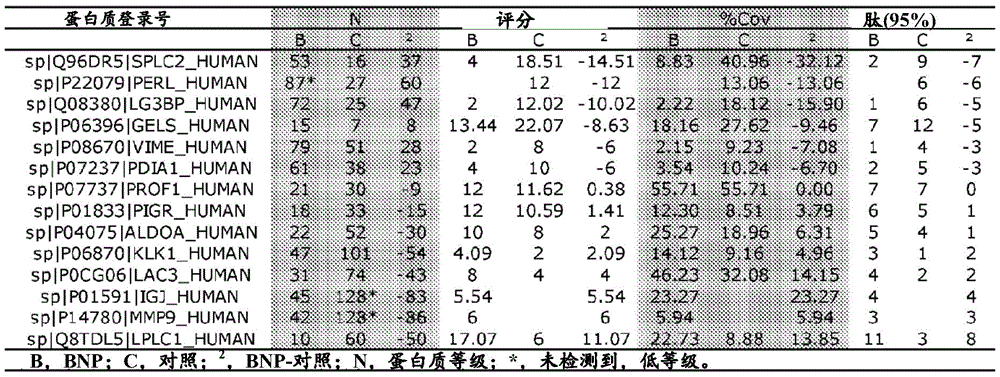
为了初步验证这些推定的生物标志物,对根据LC-ESI-MS/MS数据的提取的离子色谱图(图1)确定的、通过ProteinPilot数据库搜索(表3)鉴别的每种蛋白质的肽的丰度进行比较。肽丰度的比较鉴别出与对照样品相比,心力衰竭患者中丰度明显更高的两种蛋白质(长腭、肺和鼻上皮癌相关蛋白1,即LPLC1(P=0.0004)以及基质金属蛋白酶-9,即即MMP9(P=0.02))以及丰度明显更低的两种蛋白质(凝溶胶蛋白,即GELS(P=0.03)以及短腭、肺和鼻相关蛋白2,即SPLC2(P=0.0003))。几种其它蛋白质显示出大的丰度变化(激肽释放酶1,KLK1;免疫球蛋白J链,IGJ;以及波形蛋白,VIME),由于检测到的被确信鉴别出的肽的数量少,因此无法对其进行统计比较。因此,该初步分析鉴别出心力衰竭的几种推定的唾液蛋白生物标志物。For preliminary validation of these putative biomarkers, the abundance of peptides for each protein identified by ProteinPilot database searches (Table 3) as determined from the extracted ion chromatograms of the LC-ESI-MS/MS data (Figure 1) degree for comparison. Comparison of peptide abundances identified two proteins that were significantly more abundant in heart failure patients compared to control samples (long palate, lung and nasal epithelial cancer-associated
表3使用ProteinPilot鉴别的每种蛋白质的相对肽丰度Table 3 Relative peptide abundance of each protein identified using ProteinPilot

实施例3Example 3
使用SWATH-MS进行验证Verification with SWATH-MS
为了验证根据汇合样品的
由于心力衰竭患者与对照相比SPLC2丰度降低而KLK1丰度升高,因此对这些经过单独验证的生物标志物的丰度比率在鉴别心力衰竭中的效用进行了研究。观测到在心力衰竭患者与对照之间存在较大且高度显著的区别,比率和高特异性的差异为5.3倍(图2C,P=0.00001)。进行接收者操作特性(ROC)曲线分析,以确定SPLC2和KLK1作为生物标志物的诊断能力。KLK:SPLC2的分析(图3A,图4A)显示曲线下面积(AUC)值为0.75,灵敏度为70.0%,特异性为66.7%。Since the abundance of SPLC2 was decreased and the abundance of KLK1 was increased in heart failure patients compared with controls, the utility of the abundance ratios of these individually validated biomarkers in differentiating heart failure was investigated. A large and highly significant difference was observed between heart failure patients and controls, with a 5.3-fold difference in ratio and high specificity (Fig. 2C, P=0.00001). Receiver operating characteristic (ROC) curve analysis was performed to determine the diagnostic power of SPLC2 and KLK1 as biomarkers. Analysis of KLK:SPLC2 (Fig. 3A, Fig. 4A) showed an area under the curve (AUC) value of 0.75, a sensitivity of 70.0% and a specificity of 66.7%.
实施例4Example 4
生物标志物组的预测能力Predictive power of biomarker panels
使用基于R(R Development Core Team,2011)的Msstats(Clough等,2012;Chang等,2012)评估了包括推定的生物标志物KV110、NAMPT、COPB、SPR2A和HV311的组对早期心力衰竭的预测能力(图5)。表4列出了各种队列(NYHA I级,n=20;NYHA III/IV级,n=19;健康对照,n=20)中生物标志物组合的灵敏度和特异性。The predictive power of a panel including putative biomarkers KV110, NAMPT, COPB, SPR2A and HV311 for early heart failure was assessed using Msstats (Clough et al, 2012; Chang et al, 2012) based on R (R Development Core Team, 2011) (Figure 5). Table 4 lists the sensitivity and specificity of the biomarker combinations in various cohorts (NYHA class I, n=20; NYHA class III/IV, n=19; healthy controls, n=20).
表4生物标志物组合的灵敏度和特异性Table 4 Sensitivity and specificity of biomarker combinations


图6中的ROC曲线提供了五种生物标志物KV110、NAMPT、COPB、SPR2A和HV311的组合的诊断潜力的有用汇总。ROC曲线下的面积越接近1,诊断潜力越好。与健康对照中的五种生物标志物相比,NYHA I级患者中的五种生物标志物组合的ROC曲线的AUC为0.96,灵敏度为95.0%,特异性为90.0%(图6)。这些结果表明五种生物标志物的组合具有高诊断能力。The ROC curves in Figure 6 provide a useful summary of the diagnostic potential of the combination of five biomarkers KV110, NAMPT, COPB, SPR2A and HV311. The closer the area under the ROC curve is to 1, the better the diagnostic potential. The ROC curve of the five-biomarker combination in NYHA class I patients had an AUC of 0.96, a sensitivity of 95.0%, and a specificity of 90.0% compared to the five biomarkers in healthy controls (Figure 6). These results suggest that the combination of five biomarkers has high diagnostic power.
使用基于R(R Development Core Team,2011)的Msstats(Clough等,2012;Chang等,2012)评估了包括推定的生物标志物KLK1、TCPD、S10A7、DLDH、IGHA2和CAMP的组对早期心力衰竭的预测能力(图7)。表5列出了各种队列(NYHA I级,n=20;NYHA III/IV级,n=19;健康对照,n=20)中生物标志物的组合的灵敏度和特异性。A panel including putative biomarkers KLK1, TCPD, S10A7, DLDH, IGHA2 and CAMP was assessed for early heart failure using R (R Development Core Team, 2011)-based Msstats (Clough et al, 2012; Chang et al, 2012). predictive power (Figure 7). Table 5 lists the sensitivity and specificity of combinations of biomarkers in various cohorts (NYHA class I, n=20; NYHA class III/IV, n=19; healthy controls, n=20).
表5生物标志物的组合的灵敏度和特异性Table 5 Sensitivity and specificity of combinations of biomarkers

图8中的ROC曲线提供了六种生物标志物KLK1、TCPD、S10A7、DLDH、IGHA2和CAMP的组合的诊断潜力的有用汇总。ROC曲线下的面积越接近1,诊断潜力越好。与健康对照中的六种生物标志物相比,NYHA I级患者中的六种生物标志物组合的ROC曲线的AUC为0.86,灵敏度为80.0%,特异性为70.0%(图8)。这些结果表明六种生物标志物的组合具有高诊断能力。The ROC curves in Figure 8 provide a useful summary of the diagnostic potential of the combination of six biomarkers KLK1, TCPD, S10A7, DLDH, IGHA2 and CAMP. The closer the area under the ROC curve is to 1, the better the diagnostic potential. The ROC curve of the combination of six biomarkers in NYHA class I patients had an AUC of 0.86, a sensitivity of 80.0%, and a specificity of 70.0% compared to the six biomarkers in healthy controls (Figure 8). These results suggest that the combination of six biomarkers has high diagnostic power.
使用基于R(R Development Core Team,2011)的Msstats(Clough等,2012;Chang等,2012)评估了包括推定的生物标志物KLK1、S10A7和CAMP的组对心力衰竭高风险个体的预测能力(图9)。表6列出了各种队列(心力衰竭患者,n=100;患心力衰竭风险高的个体(SCREEN-HF),n=121;健康对照,n=88)中生物标志物的组合的灵敏度和特异性。The predictive ability of a panel including putative biomarkers KLK1, S10A7 and CAMP in individuals at high risk of heart failure was assessed using Msstats (Clough et al., 2012; Chang et al., 2012) based on R (R Development Core Team, 2011) (Fig. 9). Table 6 lists the sensitivity and sensitivity of combinations of biomarkers in various cohorts (patients with heart failure, n=100; individuals at high risk for heart failure (SCREEN-HF), n=121; healthy controls, n=88). specificity.
表6生物标志物的组合的灵敏度和特异性Table 6 Sensitivity and specificity of combinations of biomarkers

图10示出在参加研究后患有心血管疾病的研究受试者与没有因心血管疾病入院的受试者之间的预测评分。Figure 10 shows the predicted scores between study subjects with cardiovascular disease and subjects not admitted for cardiovascular disease after enrollment in the study.
在SCREEN-HF队列的99名参加者中,有11人因初步诊断为心血管疾病而入院。在这11人中,由三个标志物的组产生的预测评分在0.139到0.996的范围,中值为0.517(IQR:0.256–0.920),而在没有因心血管疾病入院的个体中,此预测评分范围为0.086到0.992,中值为0.294(IQR:0.172–0.679)。两组SCREEN-HF队列之间存在统计学上的显著差异(p=0.0382)。Of the 99 participants in the SCREEN-HF cohort, 11 were hospitalized with an initial diagnosis of cardiovascular disease. In these 11 people, the prediction scores produced by the three-marker panel ranged from 0.139 to 0.996, with a median of 0.517 (IQR: 0.256–0.920), whereas in individuals without admissions for cardiovascular disease, this prediction Scores ranged from 0.086 to 0.992, with a median of 0.294 (IQR: 0.172–0.679). There was a statistically significant difference between the two SCREEN-HF cohorts (p=0.0382).
为验证作为诊断组的成员的KLK1、TCPD、S10A7、DLDH、IGHA2和CAMP,对随机选择的6名健康对照和随机选择的6名心力衰竭患者进行了蛋白质印迹分析。如图11所示,在个别唾液样品中检测到S10A7和IGHA2。6个心力衰竭患者样品中有5个检测到S10A7,而6个健康对照样品中只有1个检测到S10A7。将每个样品的带强度针对健康对照的平均带强度进行标准化。与SWATH-MS的结果相似,S10A7和IGHA2这两者在心力衰竭患者样品中均呈现出高于健康对照样品的蛋白质丰度。心力衰竭患者中S10A7的平均带强度是健康对照样品中的6倍。IGHA2在心力衰竭患者样品中的丰度高于健康对照样品(1.06:1),但未观测到显著差异。与初始筛查的结果相反,KLK1在健康对照中的表达与患者样品相似(1:0.98)。CAMP表达也不同,在心力衰竭患者中的表达高于对照(1:1.452)。蛋白质印迹未检测到TCPD和DLDH。To validate KLK1, TCPD, S10A7, DLDH, IGHA2 and CAMP as members of the diagnostic panel, Western blot analysis was performed on 6 randomly selected healthy controls and 6 randomly selected heart failure patients. As shown in Figure 11, S10A7 and IGHA2 were detected in individual saliva samples. S10A7 was detected in 5 out of 6 heart failure patient samples, while S10A7 was detected in only 1 out of 6 healthy control samples. The band intensity of each sample was normalized to the mean band intensity of healthy controls. Similar to the results of SWATH-MS, both S10A7 and IGHA2 exhibited higher protein abundances in heart failure patient samples than in healthy control samples. The mean band intensity of S10A7 in heart failure patients was 6-fold higher than in healthy control samples. IGHA2 was more abundant in heart failure patient samples than in healthy control samples (1.06:1), but no significant difference was observed. Contrary to the results of the initial screening, KLK1 expression in healthy controls was similar to that in patient samples (1:0.98). CAMP expression was also different, with higher expression in heart failure patients than in controls (1:1.452). TCPD and DLDH were not detected by western blotting.
整个说明书中所提及的“一个实施方案”或“一种实施方案”是指结合此实施方案描述的特定特征、结构或特性包括在本发明的至少一个实施方案中。因此,贯穿本说明书在多个地方出现的短语“在一个实施方案中”或“在一种实施方案中”并不一定都指同一个实施方案。此外,特定的特征、结构或特性可以以任何适当方式组合成一个或多个组合。Reference throughout this specification to "one embodiment" or "an embodiment" means that a particular feature, structure, or characteristic described in connection with the embodiment is included in at least one embodiment of the present invention. Thus, appearances of the phrases "in one embodiment" or "in an embodiment" in various places throughout this specification are not necessarily all referring to the same embodiment. Furthermore, the particular features, structures or characteristics may be combined in any suitable manner into one or more combinations.
根据法规,已经以或多或少针对结构或方法特征的语言描述了本发明。应理解,本发明不限于所示出或描述的特定特征,因为本文所述的方式包括实施本发明的优选形式。因此,在由本领域技术人员适当解释的所附权利要求书(如果有)的适当范围内,可以以任何形式或修改主张本发明。In accordance with the statutes, the invention has been described in language more or less specific to structural or methodological features. It is to be understood that this invention is not limited to the specific features shown or described, as the modes described herein include preferred forms of carrying out the invention. Accordingly, the present invention may be claimed in any form or modification within the appropriate scope of the appended claims, if any, appropriately interpreted by those skilled in the art.
引文列表Citation List
Australian Institute of Health and Welfare 2011.Cardiovasculardisease:Australian facts 2011.Cardiovascular disease series.Cat.no.CVD53.Canberra:AIHW.(http://www.aihw.gov.au/WorkArea/DownloadAsset.aspx?id=10737418530)Australian Institute of Health and Welfare 2011. Cardiovasculardisease:Australian facts 2011.Cardiovascular disease series.Cat.no.CVD53.Canberra:AIHW.(http://www.aihw.gov.au/WorkArea/DownloadAsset.aspx?id=10737418530 )
Bailey UM and Schulz BL,Deglycosylation systematically improves N-glycoprotein identification in liquid chromatography-tandem mass spectrometryproteomics for analysis of cell wall stress responses in Saccharomycescerevisiae lacking aAlg3p,J Chromatogr B Analyt Technol Biomed Life Sci,2013;923-924:16-21Bailey UM and Schulz BL, Deglycosylation systematically improves N-glycoprotein identification in liquid chromatography-tandem mass spectrometryproteomics for analysis of cell wall stress responses in Saccharomycescerevisiae lacking aAlg3p, J Chromatogr B Analyt Technol Biomed Life Sci, 2013;923-924:16-21
Carlson KJ,Lee DCS,Goroll AH,Leahy M and Johnson RA,An analysis ofphysicians’reasons for prescribing long-term digitalis therapy inoutpatients,J Chron Dis,1985;38:733-739Carlson KJ, Lee DCS, Goroll AH, Leahy M and Johnson RA, An analysis ofphysicians’reasons for prescribing long-term digitalis therapy inoutpatients, J Chron Dis, 1985;38:733-739
Castagnola M,Inzitari R,Fanali C,Iavarone F,Vitali A,Desiderio C,Vento G,Tirone C,Romagnoli C,Cabras T,Manconi B,Sanna MT,Boi R,Pisano E,Olianas A,Pellegrini M,Nemolato S,Heizmann CW,Faa G and Messana I,Thesurprising composition of the salivary proteome of preterm human newborn,MolCell Proteomics,2011;10(1):M110.003467Castagnola M, Inzitari R, Fanali C, Iavarone F, Vitali A, Desiderio C, Vento G, Tirone C, Romagnoli C, Cabras T, Manconi B, Sanna MT, Boi R, Pisano E, Olianas A, Pellegrini M, Nemolato S , Heizmann CW, Faa G and Messana I, Thesurprising composition of the salivary proteome of preterm human newborn, MolCell Proteomics, 2011;10(1):M110.003467
Chang CY,Picotti P,Hüttenhain R,Heinzelmann-Schwarz V,Jovanovic M,Aebersold R and Vitek O,Protein significance analysis in selected reactionmonitoring(SRM)measurements,Mol Cell Proteomics,2012;11(4):M111.014662Chang CY, Picotti P, Hüttenhain R, Heinzelmann-Schwarz V, Jovanovic M, Aebersold R and Vitek O, Protein significance analysis in selected reaction monitoring (SRM) measurements, Mol Cell Proteomics, 2012;11(4):M111.014662
Clough T,Thaminy S,Ragg S,Aebersold R and Vitek O,Statistical proteinquantification and significance analysis in label-free LC-MS experiments withcomplex designs,BMC Bioinformatics,2012;13(Suppl 16):S6Clough T, Thaminy S, Ragg S, Aebersold R and Vitek O, Statistical protein quantification and significance analysis in label-free LC-MS experiments with complex designs, BMC Bioinformatics, 2012;13(Suppl 16):S6
Foo JYY,Wan Y,Schulz BL,Kostner K,Atherton J,Cooper-White J,Dimeski Gand Punyadeera C,Circulating fragments of N-terminal pro-B-type natriureticpeptides in plasma of heart failure patients,Clin Chem,2013;59:1523-1531Foo JYY, Wan Y, Schulz BL, Kostner K, Atherton J, Cooper-White J, Dimeski Gand Punyadeera C, Circulating fragments of N-terminal pro-B-type natriureticpeptides in plasma of heart failure patients, Clin Chem, 2013;59 :1523-1531
Harlan WR,Oberman A,Grimm R and Rosati RA,Chronic congestive heartfailure in coronary artery disease:clinical criteria,Ann Intern Med,1977;86(2):133-138Harlan WR, Oberman A, Grimm R and Rosati RA, Chronic congestive heartfailure in coronary artery disease: clinical criteria, Ann Intern Med, 1977;86(2):133-138
Helmerhorst EJ and Oppenheim FG,Saliva:a dynamic proteome,J Dent Res,2007;86:680-693Helmerhorst EJ and Oppenheim FG, Saliva: a dynamic proteome, J Dent Res, 2007;86:680-693
Krum H,Jelinek MV,Stewart S,Sindone A and Atherton JJ,2011 Update tonational heart foundation of Australia and cardiac society of Australia andNew Zealand guidelines for the prevention,detection and management of chronicheart failure in Australia,2006,Med J Aust,2011;194(8):405-409Krum H, Jelinek MV, Stewart S, Sindone A and Atherton JJ, 2011 Update to national heart foundation of Australia and cardiac society of Australia and New Zealand guidelines for the prevention, detection and management of chronicheart failure in Australia, 2006, Med J Aust, 2011 ;194(8):405-409
Loo JA,Yan W,Ramachandran P and Wong DT,Comparative human salivaryand plasma proteomes,J Dent Res,2010;89:1016-1023Loo JA, Yan W, Ramachandran P and Wong DT, Comparative human salivary and plasma proteomes, J Dent Res, 2010;89:1016-1023
McKee PA,Castelli WP,McNamara PM and Kannel WB,The natural history ofcongestive heart failure:the Framingham study,N Engl J Med,1971;285(26):1441-1446McKee PA, Castelli WP, McNamara PM and Kannel WB, The natural history of congestive heart failure: the Framingham study, N Engl J Med, 1971;285(26):1441-1446
Marian AJ and Nambi V,Biomarkers of cardiac disease,Expert Rev MolDiagn,2004;4:805-20Marian AJ and Nambi V, Biomarkers of cardiac disease, Expert Rev Mol Diagn, 2004;4:805-20
Martinet W,Schrijvers DM,De Meyer GRY,Herman AG and Kockx MM,Westernarray analysis of human atherosclerotic plaques:Downregulation of apoptosis-linked gene 2,Cardiovasc Res,2003;60(2):259-267Martinet W, Schrijvers DM, De Meyer GRY, Herman AG and Kockx MM, Western array analysis of human atherosclerotic plaques: Downregulation of apoptosis-linked
Ovchinnikov DA,Cooper MA,Pandit P,Coman WB,Cooper-White JJ,Keith P,Wolvetang EJ,Slowey PD and Punyadeera C,Tumor-suppressor gene promoterhypermethylation in saliva of head and neck cancer patients,Transl Oncol,2012;5(5):321-326Ovchinnikov DA, Cooper MA, Pandit P, Coman WB, Cooper-White JJ, Keith P, Wolvetang EJ, Slowey PD and Punyadeera C, Tumor-suppressor gene promoter hypermethylation in saliva of head and neck cancer patients, Transl Oncol, 2012; 5( 5): 321-326
Palazzuoli A,Iovine F,Gallotta M and Nuti R,Emerging cardiac markersin coronary disease:Role of brain natriuretic peptide and other biomarkers,Minerva Cardioangiol,2007;55(4):491-496Palazzuoli A, Iovine F, Gallotta M and Nuti R, Emerging cardiac markers in coronary disease: Role of brain natriuretic peptide and other biomarkers, Minerva Cardioangiol, 2007;55(4):491-496
Punyadeera C,Dimeski G,Kostner K,Beyerlein P and Cooper-White J,One-step homogeneous C-reactive protein assay for saliva,J Immunol Methods,2011;373:19-25Punyadeera C, Dimeski G, Kostner K, Beyerlein P and Cooper-White J, One-step homogeneous C-reactive protein assay for saliva, J Immunol Methods, 2011;373:19-25
R Development Core Team(2011),R:A language and environment forstatistical computing,Vienna,Austria:the R Foundation for StatisticalComputingR Development Core Team (2011), R: A language and environment for statistical computing, Vienna, Austria: the R Foundation for Statistical Computing
Shamsham F and Mitchell J,Essentials of the diagnosis of heartfailure,Am Fam Physician,2000;61(5):1319-1328Shamsham F and Mitchell J, Essentials of the diagnosis of heartfailure, Am Fam Physician, 2000;61(5):1319-1328
The Criteria Committee of the New York Heart Association,Nomenclatureand Criteria for Diagnosis of Diseases of the Heart and Great Vessels,9thed.,Little,Brown;Boston,1994,pp.253-256The Criteria Committee of the New York Heart Association, Nomenclature and Criteria for Diagnosis of Diseases of the Heart and Great Vessels, 9thed., Little, Brown; Boston, 1994, pp. 253-256
Claims (19)
Applications Claiming Priority (3)
| Application Number | Priority Date | Filing Date | Title |
|---|---|---|---|
| AU2017903138A AU2017903138A0 (en) | 2017-08-08 | Methods for Diagnosis of Early Stage Heart Failure | |
| AU2017903138 | 2017-08-08 | ||
| PCT/AU2018/050827 WO2019028507A1 (en) | 2017-08-08 | 2018-08-08 | Methods for diagnosis of early stage heart failure |
Publications (1)
| Publication Number | Publication Date |
|---|---|
| CN111465857A true CN111465857A (en) | 2020-07-28 |
Family
ID=65273054
Family Applications (1)
| Application Number | Title | Priority Date | Filing Date |
|---|---|---|---|
| CN201880063136.3A Pending CN111465857A (en) | 2017-08-08 | 2018-08-08 | Method for diagnosing early heart failure |
Country Status (6)
| Country | Link |
|---|---|
| US (1) | US20200174021A1 (en) |
| EP (1) | EP3665483A4 (en) |
| JP (1) | JP7414281B2 (en) |
| CN (1) | CN111465857A (en) |
| AU (2) | AU2018315056B2 (en) |
| WO (1) | WO2019028507A1 (en) |
Cited By (1)
| Publication number | Priority date | Publication date | Assignee | Title |
|---|---|---|---|---|
| WO2024007778A1 (en) * | 2022-07-05 | 2024-01-11 | 上海交通大学医学院附属上海儿童医学中心 | Use of plasma molecular marker kynurenine in detection of early heart failure |
Families Citing this family (2)
| Publication number | Priority date | Publication date | Assignee | Title |
|---|---|---|---|---|
| EP4162278A4 (en) | 2020-06-03 | 2024-08-14 | ESN Cleer | Biomarker identification for imminent and/or impending heart failure |
| EP4356142A4 (en) | 2021-06-16 | 2025-07-23 | Endothelium Scanning Nanotechnology Ltd | BIOMARKERS AND DRUG COMBINATIONS TO PREDICT HEART FAILURE |
Citations (22)
| Publication number | Priority date | Publication date | Assignee | Title |
|---|---|---|---|---|
| WO2002061131A2 (en) * | 2000-12-04 | 2002-08-08 | Bristol-Myers Squibb Company | Human single nucleotide polymorphisms |
| WO2002094870A2 (en) * | 2000-11-02 | 2002-11-28 | Curagen Corporation | Proteins and nucleic acids encoding same |
| US20040033582A1 (en) * | 2002-06-03 | 2004-02-19 | Manling-Ma Edmonds | Human single nucleotide polymorphisms |
| CN1703523A (en) * | 2002-09-30 | 2005-11-30 | 肿瘤疗法科学股份有限公司 | Method for diagnosing prostate cancers |
| WO2006008002A2 (en) * | 2004-07-23 | 2006-01-26 | Bayer Healthcare Ag | Diagnostics and therapeutics for diseases associated with kallikrein 1 (klk1) |
| CN101031640A (en) * | 2004-07-29 | 2007-09-05 | 干细胞创新有限公司 | Differentiation of stem cells |
| WO2008000067A1 (en) * | 2006-06-26 | 2008-01-03 | Vasogen Ireland Limited | Treatment of mild chronic heart failure in human patients |
| US20080057590A1 (en) * | 2006-06-07 | 2008-03-06 | Mickey Urdea | Markers associated with arteriovascular events and methods of use thereof |
| US20080300170A1 (en) * | 2006-09-01 | 2008-12-04 | Cohava Gelber | Compositions and methods for diagnosis and treatment for type 2 diabetes |
| CN101340928A (en) * | 2005-10-21 | 2009-01-07 | 催化剂生物科学公司 | Modified proteases that inhibit complement activation |
| CN101517074A (en) * | 2006-07-05 | 2009-08-26 | 催化剂生物科学公司 | Protease screening method and proteases identified thereby |
| CN101617227A (en) * | 2006-11-30 | 2009-12-30 | 纳维哲尼克斯公司 | Genetic analysis system and method |
| US20100267052A1 (en) * | 2006-09-01 | 2010-10-21 | American Type Culture Collection | Compositions and methods for diagnosis and treatment of type 2 diabetes |
| US20120219943A1 (en) * | 2011-02-03 | 2012-08-30 | Abbott Laboratories | Methods of prognosis and diagnosis in chronic heart failure |
| CN102858985A (en) * | 2009-07-24 | 2013-01-02 | 西格马-奥尔德里奇有限责任公司 | Method for genome editing |
| US20130116343A1 (en) * | 2010-04-21 | 2013-05-09 | Board Of Regents Of The University Of Texas System | Salivary Protein Markers for Detection of Breast Cancer |
| CN103289980A (en) * | 2006-07-05 | 2013-09-11 | 催化剂生物科学公司 | Protease screening methods and proteases indentified thererby |
| CN103642902A (en) * | 2006-11-30 | 2014-03-19 | 纳维哲尼克斯公司 | Genetic analysis systems and methods |
| WO2014193999A2 (en) * | 2013-05-28 | 2014-12-04 | Caris Science, Inc. | Biomarker methods and compositions |
| US20150291966A1 (en) * | 2012-07-25 | 2015-10-15 | The Broad Institute, Inc. | Inducible dna binding proteins and genome perturbation tools and applications thereof |
| WO2016134365A1 (en) * | 2015-02-20 | 2016-08-25 | The Johns Hopkins University | Biomarkers of myocardial injury |
| US20170051053A1 (en) * | 2011-12-28 | 2017-02-23 | Immunoqure Ag | Method of providing monoclonal auto-antibodies with desired specificity |
Family Cites Families (8)
| Publication number | Priority date | Publication date | Assignee | Title |
|---|---|---|---|---|
| JP2005110602A (en) * | 2003-10-09 | 2005-04-28 | Sumitomo Pharmaceut Co Ltd | Disease marker for atopic dermatitis and its use |
| EP1722232A1 (en) * | 2005-05-09 | 2006-11-15 | F.Hoffmann-La Roche Ag | Devices and methods for diagnosing or predicting early stage cardiac dysfunctions |
| AU2007262776A1 (en) * | 2006-06-20 | 2007-12-27 | Lipopeptide Ab | Use cathelicidin antimicrobial protein (hCAP18 ) as anticancer agent |
| US20150045245A1 (en) * | 2011-12-08 | 2015-02-12 | Biocartis Nv | Biomarkers and test panels useful in systemic inflammatory conditions |
| US20150072360A1 (en) * | 2011-12-14 | 2015-03-12 | The Johns Hopkins University | Biomarkers of pulmonary hypertension |
| WO2014028734A1 (en) * | 2012-08-15 | 2014-02-20 | The Procter & Gamble Company | Human ex vivo skin model and use in methods of identifying modulators of skin inflammation |
| CN104049082B (en) * | 2014-05-30 | 2016-03-16 | 华中科技大学同济医学院附属同济医院 | Human tissue kallikrein activity detection kit and application thereof |
| CN105987998B (en) * | 2015-01-30 | 2017-12-29 | 江苏众红生物工程创药研究院有限公司 | Human tissue kallikrein 1ELISA immue quantitative detection reagent boxes |
-
2018
- 2018-08-08 CN CN201880063136.3A patent/CN111465857A/en active Pending
- 2018-08-08 WO PCT/AU2018/050827 patent/WO2019028507A1/en not_active Ceased
- 2018-08-08 EP EP18844704.9A patent/EP3665483A4/en not_active Withdrawn
- 2018-08-08 JP JP2020507022A patent/JP7414281B2/en active Active
- 2018-08-08 AU AU2018315056A patent/AU2018315056B2/en active Active
- 2018-08-08 US US16/636,403 patent/US20200174021A1/en not_active Abandoned
-
2021
- 2021-09-13 AU AU2021232662A patent/AU2021232662B2/en active Active
Patent Citations (23)
| Publication number | Priority date | Publication date | Assignee | Title |
|---|---|---|---|---|
| WO2002094870A2 (en) * | 2000-11-02 | 2002-11-28 | Curagen Corporation | Proteins and nucleic acids encoding same |
| WO2002061131A2 (en) * | 2000-12-04 | 2002-08-08 | Bristol-Myers Squibb Company | Human single nucleotide polymorphisms |
| US20040033582A1 (en) * | 2002-06-03 | 2004-02-19 | Manling-Ma Edmonds | Human single nucleotide polymorphisms |
| CN1703523A (en) * | 2002-09-30 | 2005-11-30 | 肿瘤疗法科学股份有限公司 | Method for diagnosing prostate cancers |
| WO2006008002A2 (en) * | 2004-07-23 | 2006-01-26 | Bayer Healthcare Ag | Diagnostics and therapeutics for diseases associated with kallikrein 1 (klk1) |
| CN101031640A (en) * | 2004-07-29 | 2007-09-05 | 干细胞创新有限公司 | Differentiation of stem cells |
| CN101340928A (en) * | 2005-10-21 | 2009-01-07 | 催化剂生物科学公司 | Modified proteases that inhibit complement activation |
| US20080057590A1 (en) * | 2006-06-07 | 2008-03-06 | Mickey Urdea | Markers associated with arteriovascular events and methods of use thereof |
| WO2008000067A1 (en) * | 2006-06-26 | 2008-01-03 | Vasogen Ireland Limited | Treatment of mild chronic heart failure in human patients |
| CN101517074A (en) * | 2006-07-05 | 2009-08-26 | 催化剂生物科学公司 | Protease screening method and proteases identified thereby |
| CN103289980A (en) * | 2006-07-05 | 2013-09-11 | 催化剂生物科学公司 | Protease screening methods and proteases indentified thererby |
| US20100267052A1 (en) * | 2006-09-01 | 2010-10-21 | American Type Culture Collection | Compositions and methods for diagnosis and treatment of type 2 diabetes |
| US20080300170A1 (en) * | 2006-09-01 | 2008-12-04 | Cohava Gelber | Compositions and methods for diagnosis and treatment for type 2 diabetes |
| CN103642902A (en) * | 2006-11-30 | 2014-03-19 | 纳维哲尼克斯公司 | Genetic analysis systems and methods |
| CN101617227A (en) * | 2006-11-30 | 2009-12-30 | 纳维哲尼克斯公司 | Genetic analysis system and method |
| CN102858985A (en) * | 2009-07-24 | 2013-01-02 | 西格马-奥尔德里奇有限责任公司 | Method for genome editing |
| US20130116343A1 (en) * | 2010-04-21 | 2013-05-09 | Board Of Regents Of The University Of Texas System | Salivary Protein Markers for Detection of Breast Cancer |
| US20120219943A1 (en) * | 2011-02-03 | 2012-08-30 | Abbott Laboratories | Methods of prognosis and diagnosis in chronic heart failure |
| CN103403554A (en) * | 2011-02-03 | 2013-11-20 | 雅培制药有限公司 | Methods of prognosis and diagnosis in chronic heart failure |
| US20170051053A1 (en) * | 2011-12-28 | 2017-02-23 | Immunoqure Ag | Method of providing monoclonal auto-antibodies with desired specificity |
| US20150291966A1 (en) * | 2012-07-25 | 2015-10-15 | The Broad Institute, Inc. | Inducible dna binding proteins and genome perturbation tools and applications thereof |
| WO2014193999A2 (en) * | 2013-05-28 | 2014-12-04 | Caris Science, Inc. | Biomarker methods and compositions |
| WO2016134365A1 (en) * | 2015-02-20 | 2016-08-25 | The Johns Hopkins University | Biomarkers of myocardial injury |
Non-Patent Citations (13)
| Title |
|---|
| ANNE, PIZARD;CHRISTINE, RICHER;NADINE, BOUBY;NICOLAS, PICARD;PIERRE, MENETON;MICHEL, AZIZI;FRAN?OIS, ALHENC-GELAS: "Genetic deficiency in tissue kallikrein activity in mouse and man: effect on arteries, heart and kidney.", BIOLOGICAL CHEMISTRY, vol. 389, 31 December 2008 (2008-12-31) * |
| CHING-YUN, CHANG;PAOLA, PICOTTI;RUTH, HÜTTENHAIN;VIOLA, HEINZELMANN-SCHWARZ;MARKO, JOVANOVIC;RUEDI, AEBERSOLD;OLGA, VITEK: "Protein significance analysis in selected reaction monitoring (SRM) measurements.", MOLECULAR & CELLULAR PROTEOMICS, vol. 11, 31 December 2012 (2012-12-31) * |
| TIMOTHY CLOUGH, ET AL.: "Statistical protein quantification and significance analysis in label-free LC-MS experiments with complex designs.", BMC BIOINFORMATICS, vol. 13, 31 December 2012 (2012-12-31) * |
| XI, ZHANG;TERRY, WALSH;JOHN J, ATHERTON;KARAM, KOSTNER;BENJAMIN, SCHULZ;CHAMINDIE, PUNYADEERA: "Identification and Validation of a Salivary Protein Panel to Detect Heart Failure Early.", THERANOSTICS, vol. 7, no. 18, 26 September 2017 (2017-09-26), XP055794321, DOI: 10.7150/thno.21727 * |
| 余惠珍;谢良地;朱鹏立;许昌声;王华军;李体远;: "人KLK1和EGFP双顺反子重组腺病毒构建及其在血管平滑肌细胞中的表达", 中国病理生理杂志, no. 02, 15 February 2008 (2008-02-15) * |
| 庄伟;谢良地;许昌声;王华军;沈逸华;陈明;: "脂肪组织基质血管组分移植抑制阿霉素诱导的心力衰竭大鼠心肌重构", 福建医科大学学报, no. 05, 28 October 2013 (2013-10-28) * |
| 张乐;胡中扬;杨杰;李蜀渝;曾艺;刘宝琼;杜小平;夏健;刘运海;许宏伟;杨期东;: "KLK1基因rs3212855和rs5515多态性与长沙地区汉族人群脑出血的关联研究", 中南大学学报(医学版), no. 12, 15 December 2010 (2010-12-15) * |
| 张淑群, 强水云, 王西京, 纪宗正, 李妙羡: "血清T-PSA和F-PSA检测在乳腺癌诊断中的意义", 中国肿瘤临床, no. 17, 25 May 2005 (2005-05-25) * |
| 王燕;高友鹤;: "微小病变性肾病早期差异尿蛋白质组分析", 基础医学与临床, no. 03, 5 March 2010 (2010-03-05) * |
| 王锦霞;常乘;马洁;吴松锋;庄举娟;朱云平;: "基于质谱技术筛选差异表达蛋白的统计学策略研究进展", 中国科学:生命科学, no. 04, 20 April 2015 (2015-04-20) * |
| 章文莉;苏津自;: "激肽释放酶-激肽系统对心血管系统的保护作用", 实用老年医学, no. 04, 20 August 2007 (2007-08-20) * |
| 陈清标;蔡超;陈佳鸿;秦国强;陈锡彬;王月生;梁宇翔;韩兆冬;毕学成;钟惟德;: "纳米金标芯片检测用于前列腺癌多基因诊断的实验研究", 现代泌尿生殖肿瘤杂志, no. 01, 22 February 2011 (2011-02-22) * |
| 鲍丹;吕丹;董伟;陈炜;路迎冬;张连峰;: "转基因表达KLK1抵抗压力负荷引起的心室重构", 中国分子心脏病学杂志, no. 03, 25 June 2013 (2013-06-25) * |
Cited By (1)
| Publication number | Priority date | Publication date | Assignee | Title |
|---|---|---|---|---|
| WO2024007778A1 (en) * | 2022-07-05 | 2024-01-11 | 上海交通大学医学院附属上海儿童医学中心 | Use of plasma molecular marker kynurenine in detection of early heart failure |
Also Published As
| Publication number | Publication date |
|---|---|
| AU2021232662B2 (en) | 2023-06-01 |
| WO2019028507A1 (en) | 2019-02-14 |
| JP2020530120A (en) | 2020-10-15 |
| AU2018315056B2 (en) | 2021-06-17 |
| JP7414281B2 (en) | 2024-01-16 |
| EP3665483A4 (en) | 2021-07-14 |
| US20200174021A1 (en) | 2020-06-04 |
| AU2021232662A1 (en) | 2021-10-07 |
| AU2018315056A1 (en) | 2020-03-26 |
| EP3665483A1 (en) | 2020-06-17 |
Similar Documents
| Publication | Publication Date | Title |
|---|---|---|
| EP2353011B1 (en) | Biomarker for the prediction of first adverse events | |
| CN110431425B (en) | proADM as a marker indicative of adverse events | |
| CN104303061B (en) | The prognosis of adverse events in patient with doubtful chronic heart failure | |
| CN109564225B (en) | Histones and/or proADM as markers indicative of adverse events | |
| AU2021232662B2 (en) | Markers relating to early stage heart failure | |
| CN101939651A (en) | Method for detecting serious adverse cardiovascular and cerebrovascular events | |
| US20150072360A1 (en) | Biomarkers of pulmonary hypertension | |
| Cao et al. | Modelling biological age based on plasma peptides in Han Chinese adults | |
| US11740245B2 (en) | Mass spectrometry-based methods for the detection of circulating histones H3 and H2B in plasma from sepsis or septic shock (SS) patients | |
| JP6595641B2 (en) | Diagnosis of heart failure | |
| US10557860B2 (en) | Circulating pulmonary hypertension biomarker | |
| JP2020064051A (en) | Peptide marker for diagnosis of neurodegenerative diseases | |
| JP5090332B2 (en) | Measurement of short chain SRL alcohol dehydrogenase (DHRS4) as a biomarker for inflammation and infection | |
| US20210080458A1 (en) | Means and methods for determining risk of type-1 diabetes by serum protein biomarkers | |
| Elmas et al. | Midregional pro-atrial natriuretic peptide is a useful indicator for the detection of impaired left ventricular function in patients with coronary artery disease | |
| US20130236917A1 (en) | Albumin-bound protein/peptide complex as a biomarker for disease | |
| US20240418729A1 (en) | Method for detection and quantification of immunoglobulin free light chain dimers | |
| Bons et al. | Clinical proteomics in chronic inflammatory diseases: A review | |
| JP2021018124A (en) | Peptide marker related to breast cancer | |
| HK40017069B (en) | Proadm as marker indicating an adverse event | |
| Sanchez et al. | Discovery and verification of osteopontin and beta-2-microglobulin as promising markers for staging human African trypanosomiasis | |
| HK1203611B (en) | Prognosis of adverse events in patients with suspected chronic heart failure | |
| HK40017069A (en) | Proadm as marker indicating an adverse event |
Legal Events
| Date | Code | Title | Description |
|---|---|---|---|
| PB01 | Publication | ||
| PB01 | Publication | ||
| SE01 | Entry into force of request for substantive examination | ||
| SE01 | Entry into force of request for substantive examination | ||
| AD01 | Patent right deemed abandoned | ||
| AD01 | Patent right deemed abandoned |
Effective date of abandoning: 20250221 |