CN111465321B - Systems and methods for cellular reprogramming of plant cells - Google Patents
Systems and methods for cellular reprogramming of plant cells Download PDFInfo
- Publication number
- CN111465321B CN111465321B CN201880079775.9A CN201880079775A CN111465321B CN 111465321 B CN111465321 B CN 111465321B CN 201880079775 A CN201880079775 A CN 201880079775A CN 111465321 B CN111465321 B CN 111465321B
- Authority
- CN
- China
- Prior art keywords
- embryogenesis
- plant
- cells
- cell
- haploid
- Prior art date
- Legal status (The legal status is an assumption and is not a legal conclusion. Google has not performed a legal analysis and makes no representation as to the accuracy of the status listed.)
- Active
Links
Images




Classifications
-
- C—CHEMISTRY; METALLURGY
- C12—BIOCHEMISTRY; BEER; SPIRITS; WINE; VINEGAR; MICROBIOLOGY; ENZYMOLOGY; MUTATION OR GENETIC ENGINEERING
- C12N—MICROORGANISMS OR ENZYMES; COMPOSITIONS THEREOF; PROPAGATING, PRESERVING, OR MAINTAINING MICROORGANISMS; MUTATION OR GENETIC ENGINEERING; CULTURE MEDIA
- C12N15/00—Mutation or genetic engineering; DNA or RNA concerning genetic engineering, vectors, e.g. plasmids, or their isolation, preparation or purification; Use of hosts therefor
- C12N15/09—Recombinant DNA-technology
- C12N15/63—Introduction of foreign genetic material using vectors; Vectors; Use of hosts therefor; Regulation of expression
- C12N15/79—Vectors or expression systems specially adapted for eukaryotic hosts
- C12N15/82—Vectors or expression systems specially adapted for eukaryotic hosts for plant cells, e.g. plant artificial chromosomes (PACs)
- C12N15/8216—Methods for controlling, regulating or enhancing expression of transgenes in plant cells
- C12N15/8222—Developmentally regulated expression systems, tissue, organ specific, temporal or spatial regulation
- C12N15/823—Reproductive tissue-specific promoters
-
- A—HUMAN NECESSITIES
- A01—AGRICULTURE; FORESTRY; ANIMAL HUSBANDRY; HUNTING; TRAPPING; FISHING
- A01H—NEW PLANTS OR NON-TRANSGENIC PROCESSES FOR OBTAINING THEM; PLANT REPRODUCTION BY TISSUE CULTURE TECHNIQUES
- A01H1/00—Processes for modifying genotypes ; Plants characterised by associated natural traits
- A01H1/06—Processes for producing mutations, e.g. treatment with chemicals or with radiation
- A01H1/08—Methods for producing changes in chromosome number
-
- C—CHEMISTRY; METALLURGY
- C12—BIOCHEMISTRY; BEER; SPIRITS; WINE; VINEGAR; MICROBIOLOGY; ENZYMOLOGY; MUTATION OR GENETIC ENGINEERING
- C12N—MICROORGANISMS OR ENZYMES; COMPOSITIONS THEREOF; PROPAGATING, PRESERVING, OR MAINTAINING MICROORGANISMS; MUTATION OR GENETIC ENGINEERING; CULTURE MEDIA
- C12N9/00—Enzymes; Proenzymes; Compositions thereof; Processes for preparing, activating, inhibiting, separating or purifying enzymes
- C12N9/14—Hydrolases (3)
- C12N9/16—Hydrolases (3) acting on ester bonds (3.1)
- C12N9/22—Ribonucleases [RNase]; Deoxyribonucleases [DNase]
-
- C—CHEMISTRY; METALLURGY
- C12—BIOCHEMISTRY; BEER; SPIRITS; WINE; VINEGAR; MICROBIOLOGY; ENZYMOLOGY; MUTATION OR GENETIC ENGINEERING
- C12N—MICROORGANISMS OR ENZYMES; COMPOSITIONS THEREOF; PROPAGATING, PRESERVING, OR MAINTAINING MICROORGANISMS; MUTATION OR GENETIC ENGINEERING; CULTURE MEDIA
- C12N2310/00—Structure or type of the nucleic acid
- C12N2310/10—Type of nucleic acid
- C12N2310/20—Type of nucleic acid involving clustered regularly interspaced short palindromic repeats [CRISPR]
Landscapes
- Health & Medical Sciences (AREA)
- Genetics & Genomics (AREA)
- Life Sciences & Earth Sciences (AREA)
- Engineering & Computer Science (AREA)
- Biomedical Technology (AREA)
- Chemical & Material Sciences (AREA)
- Wood Science & Technology (AREA)
- Molecular Biology (AREA)
- Organic Chemistry (AREA)
- Bioinformatics & Cheminformatics (AREA)
- Zoology (AREA)
- General Engineering & Computer Science (AREA)
- Biotechnology (AREA)
- General Health & Medical Sciences (AREA)
- Microbiology (AREA)
- Biochemistry (AREA)
- Biophysics (AREA)
- Botany (AREA)
- Developmental Biology & Embryology (AREA)
- Environmental Sciences (AREA)
- Pregnancy & Childbirth (AREA)
- Reproductive Health (AREA)
- Cell Biology (AREA)
- Physics & Mathematics (AREA)
- Plant Pathology (AREA)
- Medicinal Chemistry (AREA)
- Breeding Of Plants And Reproduction By Means Of Culturing (AREA)
- Micro-Organisms Or Cultivation Processes Thereof (AREA)
Abstract
通过将植物细胞用细胞重编程因子处理来改变细胞命运和发育。胚发生诱导形态发育基因用作细胞重编程因子,特别地包含编码基因产物的多肽或多核苷酸,所述基因产物用于从配子产生双单倍体或单倍体植物。通过使分离的细胞与纯化的外源重组胚发生诱导形态发育基因多肽接触来处理玉米小孢子,导致胚发生。当用包括调节元件和结构基因的基因构建体转化时,玉米植物的配子发育为胚状体,其中所述调节元件和结构基因能够以级联方式发挥作用以改变植物细胞的细胞命运。从基因构建体表达的发育形态蛋白用于非原位处理方法和原位细胞重编程。

Altering cell fate and development by treating plant cells with cellular reprogramming factors. The embryogenesis-inducing morphodevelopmental genes are used as cellular reprogramming factors, in particular comprising polypeptides or polynucleotides encoding gene products for the production of double haploid or haploid plants from gametes. Maize microspores are treated by contacting the isolated cells with a purified exogenous recombinant embryogenesis-inducing morphogenesis gene polypeptide, resulting in embryogenesis. Gametes of maize plants develop into embryoid bodies when transformed with a genetic construct comprising regulatory elements and structural genes capable of acting in a cascade to alter the cell fate of plant cells. Developmental morphological proteins expressed from genetic constructs are used in ex situ processing methods and in situ cell reprogramming.
Description
技术领域technical field
本公开涉及植物分子生物学领域,更具体地涉及开发重组近交系。The present disclosure relates to the field of plant molecular biology, and more specifically to the development of recombinant inbred lines.
相关申请的交叉引用Cross References to Related Applications
本申请要求2017年10月13日提交的美国临时申请号62/572,007的优先权,所述临时申请通过引用以其全文特此结合。This application claims priority to US Provisional Application No. 62/572,007, filed October 13, 2017, which is hereby incorporated by reference in its entirety.
以电子方式递交的序列表的引用References to Sequence Listings Submitted Electronically
序列表的官方副本经由EFS-Web作为ASCII格式的序列表以电子方式提交,文件名为20181001_7488WOPCT_SequenceListingTXT-569832,创建于2018年10月1日且具有98,592字节大小,并与本说明书同时提交。包含在所述ASCII格式的文件中的序列表是本说明书的一部分并且通过引用以其整体并入本文。The official copy of the Sequence Listing is submitted electronically via EFS-Web as a Sequence Listing in ASCII format, filename 20181001_7488WOPCT_SequenceListingTXT-569832, created on October 1, 2018 and has a size of 98,592 bytes, and is submitted simultaneously with this specification. The Sequence Listing contained in said file in ASCII format is part of this specification and is hereby incorporated by reference in its entirety.
背景技术Background technique
植物育种计划通过筛选许多植物以鉴定具有所需特征的个体来鉴定新品种。典型地,理想地跨多年和多种环境培养和评估来自杂交的大量后代,以选择具有最需要的特征的植物。Plant breeding programs identify new varieties by screening many plants to identify individuals with desired characteristics. Typically, large numbers of progeny from crosses are ideally grown and evaluated over many years and in a variety of environments to select plants with the most desirable characteristics.
典型的育种方法使两种亲本植物杂交,并且子代1杂交体(F1杂交体)是第一子代后代。当来自不同杂合组的两种亲本株(典型地近交株)杂交时,观察到商业F1杂交体中的杂交体活力。杂交体活力(组合了其亲本的遗传贡献后产生的任何生物品质的改善的或增加的功能)对于商业玉米种子生产是重要的,并且商业杂交性能的改善需要持续开发新的近交亲本系。A typical breeding method crosses two parental plants, and the Progeny 1 hybrid (F 1 hybrid) is the first progeny offspring. Hybrid vigor in commercial Fi hybrids is observed when two parental strains (typically inbreds ) from different heterozygous groups are crossed. Hybrid vigor (any improved or increased function of biological quality resulting from combining the genetic contributions of its parents) is important for commercial maize seed production, and improvements in commercial hybrid performance require continued development of new inbred parent lines.
玉米近交系开发方法使用母本(产生雌性特征的)双单倍体生产,其中从第一代杂交产生的植物穗(已经用来自所谓的“单倍体诱导”系的花粉受精)受精后,选择母本单倍体胚。与继承母本和父本基因组二者的拷贝相反,用单倍体诱导株的花粉对雌花进行授粉导致仅含有单倍体母本基因组的胚珠水平升高,因此产生母本单倍体胚。雌花内的胚珠是减数分裂的产物,并且每个母本胚珠都是独特的减数分裂重组单倍体基因组,从而允许使用包括染色体加倍处理在内的体外组织培养方法分离和处理未成熟的母本单倍体胚,以使得快速产生母本双单倍体重组群体成为可能。用来自玉米单倍体诱导系的花粉对目标植物的受精产生的许多玉米母本单倍体胚无法再生为可育的、双单倍体植物,并且如果有的话,也很少有体外组织培养和小植株再生方法会从一个单倍体胚繁殖出多个可育植物。因此,需要改善生产适用于玉米中母本配子双单倍体的双单倍体植物的方法。The maize inbred line development method uses a female parent (feminine-producing) double haploid production in which ears of plants resulting from first generation crosses (which have been fertilized with pollen from so-called "haploid-inducing" lines) are fertilized , select maternal haploid embryos. As opposed to inheriting copies of both the maternal and paternal genomes, pollination of female flowers with pollen from haploid-inducing strains results in increased levels of ovules containing only the haploid maternal genome, thus producing maternal haploid embryos. Ovules within female flowers are the product of meiosis, and each maternal ovule has a unique meiotic recombined haploid genome, allowing the isolation and manipulation of immature ovules using in vitro tissue culture methods including chromosome doubling treatments. Maternal haploid embryos make it possible to quickly produce maternal double haploid recombination populations. Many maize maternal haploid embryos produced by fertilization of target plants with pollen from a maize haploid inducer line fail to regenerate into fertile, double haploid plants and have little, if any, in vitro tissue The culture and plantlet regeneration method propagates multiple fertile plants from one haploid embryo. Accordingly, there is a need for improved methods of producing double haploid plants suitable for maternal gamete double haploids in maize.
大多数玉米近交株对小孢子分离、体外组织培养和小植株再生方法产生父本(产雄性特征的)配子双单倍体具有顽固性。因此,需要一种产生适用于玉米中的父本配子双单倍体的双单倍体植物的方法。Most maize inbreds are recalcitrant to microspore isolation, in vitro tissue culture, and plantlet regeneration methods to produce paternal (androgenic) gamete double haploidy. Therefore, there is a need for a method of producing double haploid plants suitable for paternal gamete double haploids in maize.
因此,植物育种者将受益于开发重组近交系群体的方法,所述重组近交系不需要大量授粉控制方法或不需要延长将自体受精系繁殖为等基因态所需的时间。Accordingly, plant breeders would benefit from developing methods of recombining populations of inbred lines that do not require extensive pollination control methods or the extended time required to propagate self-fertilizing lines to the isogenic state.
发明内容Contents of the invention
在一方面,提供了一种生成单倍体植物胚的方法,所述方法包括(a)通过为植物小孢子提供胚发生调节因子以调节植物小孢子中的小孢子胚发生来获得胚发生的小孢子,所述胚发生调节因子选自由以下组成的组:(i)胚发生诱导多肽;或(ii)胚发生诱导化合物;或(iii)(i)和(ii)的组合;以及(b)从胚发生的小孢子产生单倍体植物胚。在一方面,所述胚发生诱导多肽不是由小孢子中稳定整合的重组DNA构建体产生的。在一方面,所述胚发生诱导化合物是选自以下的激酶抑制剂:N-[(2R)-2,3-二羟基丙氧基]-3,4-二氟-2-(2-氟-4-碘代苯胺基)苯甲酰胺、蒽(1,9-cd)吡唑-6(2H)-酮:4-(4-氟苯基)-2-(4-甲基亚磺酰基苯基)-5-(4-吡啶基)1H-咪唑或N-苄基-2-(嘧啶-4-基氨基)-1,3-噻唑-4-甲酰胺。在一方面,所述胚发生诱导化合物是氯化血红素(hemin)。在一方面,所述胚发生诱导多肽选自由以下组成的组:(i)WUS/WOX同源盒多肽;(ii)Babyboom(BBM)多肽或胚珠发育蛋白2(ODP2)多肽;(iii)LEC1多肽;(iv)(i)和(ii)的组合;以及(v)(i)和(iii)的组合。在一方面,所述胚发生诱导多肽还包含细胞穿透肽(CPP)。在一方面,所述胚发生调节因子存在于组织培养基中。在一方面,所述方法包括将所述小孢子与胚发生诱导悬浮饲养细胞培养物(embryogenesis inducing suspension feeder cell culture)共培养,其中所述胚发生诱导悬浮饲养细胞培养物表达胚发生诱导多肽,或在所述培养基中将所述小孢子与所述胚发生调节因子共培养。在一方面,所述胚发生诱导多肽选自由以下组成的组:(i)WUS/WOX同源盒多肽;(ii)Babyboom(BBM)多肽或胚珠发育蛋白2(ODP2)多肽;(iii)LEC1多肽;(iv)(i)和(ii)的组合;以及(v)(i)和(iii)的组合。在一方面,所述方法还包括培养单倍体植物胚。在一方面,所述方法包括使所述单倍体植物胚与染色体加倍剂接触,持续足以产生双单倍体植物胚的时间段。在一方面,所述方法其中所述小孢子获自玉米、水稻、高粱、芸苔属(brassica)、大豆、小麦和棉花。在一方面,所述方法其中所述胚发生调节因子包含细胞穿透肽。In one aspect, there is provided a method of producing haploid plant embryos, said method comprising (a) obtaining embryogenesis by providing plant microspores with an embryogenesis regulator to regulate microspore embryogenesis in plant microspores In microspores, the embryogenesis regulator is selected from the group consisting of: (i) an embryogenesis-inducing polypeptide; or (ii) an embryogenesis-inducing compound; or (iii) a combination of (i) and (ii); and (b ) produces haploid plant embryos from embryogenic microspores. In one aspect, the embryogenesis-inducing polypeptide is not produced by a stably integrated recombinant DNA construct in a microspore. In one aspect, the embryogenesis-inducing compound is a kinase inhibitor selected from the group consisting of N-[(2R)-2,3-dihydroxypropoxy]-3,4-difluoro-2-(2-fluoro -4-iodoanilino)benzamide, anthracene(1,9-cd)pyrazol-6(2H)-one: 4-(4-fluorophenyl)-2-(4-methylsulfinyl phenyl)-5-(4-pyridyl)1H-imidazole or N-benzyl-2-(pyrimidin-4-ylamino)-1,3-thiazole-4-carboxamide. In one aspect, the embryogenesis inducing compound is hemin. In one aspect, the embryogenesis-inducing polypeptide is selected from the group consisting of: (i) a WUS/WOX homeobox polypeptide; (ii) a Babyboom (BBM) polypeptide or an ovule development protein 2 (ODP2) polypeptide; (iii) a LEC1 A polypeptide; (iv) a combination of (i) and (ii); and (v) a combination of (i) and (iii). In one aspect, the embryogenesis-inducing polypeptide further comprises a cell penetrating peptide (CPP). In one aspect, the regulator of embryogenesis is present in tissue culture medium. In one aspect, the method comprises co-cultivating said microspores with an embryogenesis inducing suspension feeder cell culture, wherein said embryogenesis inducing suspension feeder cell culture expresses an embryogenesis inducing polypeptide, Or co-culture the microspores with the embryogenesis regulator in the culture medium. In one aspect, the embryogenesis-inducing polypeptide is selected from the group consisting of: (i) a WUS/WOX homeobox polypeptide; (ii) a Babyboom (BBM) polypeptide or an ovule development protein 2 (ODP2) polypeptide; (iii) a LEC1 A polypeptide; (iv) a combination of (i) and (ii); and (v) a combination of (i) and (iii). In one aspect, the method further comprises culturing haploid plant embryos. In one aspect, the method comprises contacting the haploid plant embryo with a chromosome doubling agent for a period of time sufficient to produce a double haploid plant embryo. In one aspect, the method wherein said microspores are obtained from corn, rice, sorghum, brassica, soybean, wheat and cotton. In one aspect, the method wherein the regulator of embryogenesis comprises a cell penetrating peptide.
在一方面,提供了生成单倍体植物胚的方法,所述方法包括(a)提供包含表达盒的植物,其中所述表达盒包含绒毡层细胞偏好性调节元件,所述绒毡层细胞偏好性调节元件可操作地连接到编码胚发生诱导多肽的多核苷酸;(b)使(a)的植物与野生型近交植物杂交以提供F1杂交体;(c)从(b)的F1杂交体回收胚发生的小孢子;以及(d)从胚发生的小孢子产生单倍体植物胚。在一方面,所述胚发生诱导多肽是形态发育多肽。在一方面,所述形态发育多肽选自由以下组成的组:(i)WUS/WOX同源盒多肽;(ii)Babyboom(BBM)多肽或胚珠发育蛋白2(ODP2)多肽;(iii)LEC1多肽;(iv)(i)和(ii)的组合;以及(v)(i)和(iii)的组合。在一方面,所述方法还包括通过位点特异性核酸酶修饰基因组DNA。在一方面,所述表达盒还包含编码位点特异性核酸酶的多核苷酸。在一方面,所述位点特异性核酸酶选自由锌指核酸酶、大范围核酸酶、TALEN和CRISPR-Cas内切核酸酶组成的组。在一方面,所述CRISPR-Cas核酸酶是Cas9或Cpfl核酸酶。在一方面,在小孢子胚发生期间,通过Cas内切核酸酶进行基因组DNA的修饰。在一方面,DNA的所述修饰是插入、缺失或取代突变。在一方面,从表达盒中表达所述Cas内切核酸酶,所述Cas内切核酸酶还包含细胞穿透肽。在一方面,所述方法还包括提供从所述表达盒表达的指导RNA。在一方面,通过向所述胚发生的小孢子外源地提供指导RNA和Cas内切核酸酶作为核糖核蛋白复合物进行DNA的所述修饰。在一方面,所述植物对于所述表达盒是纯合的。在一方面,所述表达盒还包含信号肽。在一方面,所述表达盒还包含细胞穿透肽(CPP)。在一方面,所述方法还包括使所述单倍体植物胚与染色体加倍剂接触,持续足以产生双单倍体植物胚的时间段。在一方面,所述植物是玉米、水稻、高粱、芸苔属、大豆、小麦或棉花。在一方面,所述方法还包括从所述双单倍体植物胚再生成双单倍体植物。In one aspect, there is provided a method of producing a haploid plant embryo, the method comprising (a) providing a plant comprising an expression cassette comprising a tapetum cell preference regulatory element, the tapetum cell The preference regulatory element is operably linked to a polynucleotide encoding an embryogenesis-inducing polypeptide; (b) crossing the plant of (a) with a wild-type inbred plant to provide an F1 hybrid; (c) from (b) recovering embryogenic microspores from the F1 hybrid ; and (d) producing haploid plant embryos from the embryogenic microspores. In one aspect, the embryogenesis-inducing polypeptide is a morphodevelopmental polypeptide. In one aspect, the morphological development polypeptide is selected from the group consisting of: (i) a WUS/WOX homeobox polypeptide; (ii) a Babyboom (BBM) polypeptide or an ovule development protein 2 (ODP2) polypeptide; (iii) a LEC1 polypeptide ; (iv) a combination of (i) and (ii); and (v) a combination of (i) and (iii). In one aspect, the method further comprises modifying the genomic DNA by a site-specific nuclease. In one aspect, the expression cassette further comprises a polynucleotide encoding a site-specific nuclease. In one aspect, the site-specific nuclease is selected from the group consisting of zinc finger nucleases, meganucleases, TALENs and CRISPR-Cas endonucleases. In one aspect, the CRISPR-Cas nuclease is Cas9 or Cpf1 nuclease. In one aspect, the modification of the genomic DNA is performed by the Cas endonuclease during microspore embryogenesis. In one aspect, said modification of DNA is an insertion, deletion or substitution mutation. In one aspect, the Cas endonuclease is expressed from an expression cassette, the Cas endonuclease further comprising a cell penetrating peptide. In one aspect, the method further comprises providing a guide RNA expressed from the expression cassette. In one aspect, said modification of DNA is performed by exogenously providing a guide RNA and a Cas endonuclease as a ribonucleoprotein complex to said embryogenic microspore. In one aspect, said plant is homozygous for said expression cassette. In one aspect, the expression cassette further comprises a signal peptide. In one aspect, the expression cassette further comprises a cell penetrating peptide (CPP). In one aspect, the method further comprises contacting the haploid plant embryo with a chromosome doubling agent for a period of time sufficient to produce double haploid plant embryos. In one aspect, the plant is corn, rice, sorghum, Brassica, soybean, wheat or cotton. In one aspect, the method further comprises regenerating a double haploid plant from the double haploid plant embryo.
在一方面,提供了生成双单倍体植物的方法,所述方法包括(a)提供包含表达盒的植物,其中所述表达盒包含胚乳细胞偏好性调节元件,所述胚乳细胞偏好性调节元件可操作地连接到编码胚发生诱导多肽的多核苷酸;(b)使(a)的植物与野生型F1杂交体杂交;(c)从(b)的杂交回收单倍体胚;(d)使单倍体胚与染色体加倍剂接触,持续足以生成双单倍体胚的时间段;以及(e)从(d)的双单倍体胚再生成双单倍体植物。在一方面,所述胚发生诱导多肽是形态发育多肽。在一方面,所述形态发育多肽选自由以下组成的组:(i)WUS/WOX同源盒多肽;(ii)Babyboom(BBM)多肽或胚珠发育蛋白2(ODP2)多肽;(iii)LEC1多肽;(iv)(i)和(ii)的组合;以及(v)(i)和(iii)的组合。在一方面,所述表达盒还包含编码基因编辑核酸酶的多核苷酸。在一方面,所述方法还包括通过位点特异性核酸酶修饰基因组DNA。在一方面,所述表达盒还包含编码位点特异性核酸酶的多核苷酸。在一方面,所述位点特异性核酸酶选自由锌指核酸酶、大范围核酸酶、TALEN和CRISPR-Cas内切核酸酶组成的组。在一方面,所述CRISPR-Cas核酸酶是Cas9或Cpfl核酸酶。在一方面,在单倍体胚胚发生期间,通过Cas内切核酸酶进行基因组DNA的修饰。在一方面,DNA的所述修饰是插入、缺失或取代突变。在一方面,从表达盒中表达所述Cas内切核酸酶,所述Cas内切核酸酶还包含细胞穿透肽。在一方面,所述方法还包括提供从所述表达盒表达的指导RNA。在一方面,通过向所述胚发生的单倍体胚外源地提供指导RNA和Cas内切核酸酶作为核糖核蛋白复合物进行DNA的所述修饰。在一方面,所述植物对于所述表达盒是纯合的。在一方面,所述表达盒还包含信号肽。在一方面,所述表达盒还包含细胞穿透肽(CPP)。在一方面,所述表达盒还包含编码可操作地连接到调节元件的颜色标记物或荧光标记物的多核苷酸。在一方面,回收所述单倍体胚包括针对所述颜色标记物、所述荧光标记物或所述调节元件的存在或不存在进行筛选。在一方面,所述筛选在用于自动荧光检测的细胞活力和细胞分选微流控设备中发生,以鉴定、分选和选择包含所述表达盒的单倍体胚与不包含所述表达盒的单倍体胚。In one aspect, there is provided a method of producing a double haploid plant, the method comprising (a) providing a plant comprising an expression cassette comprising an endosperm cell-preferred regulatory element, the endosperm cell-preferred regulatory element operably linked to a polynucleotide encoding an embryogenesis-inducing polypeptide; (b) crossing the plant of (a) with a wild-type F1 hybrid; (c) recovering haploid embryos from the cross of (b); (d ) contacting the haploid embryo with a chromosome doubling agent for a period of time sufficient to generate a double haploid embryo; and (e) regenerating a double haploid plant from the double haploid embryo of (d). In one aspect, the embryogenesis-inducing polypeptide is a morphodevelopmental polypeptide. In one aspect, the morphological development polypeptide is selected from the group consisting of: (i) a WUS/WOX homeobox polypeptide; (ii) a Babyboom (BBM) polypeptide or an ovule development protein 2 (ODP2) polypeptide; (iii) a LEC1 polypeptide ; (iv) a combination of (i) and (ii); and (v) a combination of (i) and (iii). In one aspect, the expression cassette further comprises a polynucleotide encoding a gene editing nuclease. In one aspect, the method further comprises modifying the genomic DNA by a site-specific nuclease. In one aspect, the expression cassette further comprises a polynucleotide encoding a site-specific nuclease. In one aspect, the site-specific nuclease is selected from the group consisting of zinc finger nucleases, meganucleases, TALENs and CRISPR-Cas endonucleases. In one aspect, the CRISPR-Cas nuclease is Cas9 or Cpf1 nuclease. In one aspect, the modification of the genomic DNA by the Cas endonuclease occurs during haploid embryogenesis. In one aspect, said modification of DNA is an insertion, deletion or substitution mutation. In one aspect, the Cas endonuclease is expressed from an expression cassette, the Cas endonuclease further comprising a cell penetrating peptide. In one aspect, the method further comprises providing a guide RNA expressed from the expression cassette. In one aspect, said modification of DNA is performed by exogenously providing a guide RNA and a Cas endonuclease as a ribonucleoprotein complex to said embryogenic haploid embryo. In one aspect, said plant is homozygous for said expression cassette. In one aspect, the expression cassette further comprises a signal peptide. In one aspect, the expression cassette further comprises a cell penetrating peptide (CPP). In one aspect, the expression cassette further comprises a polynucleotide encoding a color or fluorescent marker operably linked to the regulatory element. In one aspect, recovering said haploid embryos comprises screening for the presence or absence of said color marker, said fluorescent marker or said regulatory element. In one aspect, the screening occurs in a cell viability and cell sorting microfluidic device for automated fluorescence detection to identify, sort and select haploid embryos containing the expression cassette versus those not containing the expression cassette. boxes of haploid embryos.
在一方面,提供了一种胚发生的小孢子,所述胚发生的小孢子与对照小孢子相比包含增加量的胚发生诱导多肽,其中在所述小孢子中不产生所述多肽。在一方面,提供了一种从胚发生的小孢子产生的胚状体或胚发生的组织。在一方面,提供了一种胚发生的小孢子,所述胚发生的小孢子包含异源细胞重编程剂,其中在所述小孢子中不产生所述异源细胞重编程剂。在一方面,所述细胞重编程剂选自由以下组成的组:(i)胚发生诱导多肽;或(ii)胚发生诱导化合物;或(iii)(i)和(ii)的组合。在一方面,所述胚发生诱导多肽选自由以下组成的组:(i)WUS/WOX同源盒多肽;(ii)Babyboom(BBM)多肽或胚珠发育蛋白2(ODP2)多肽;(iii)LEC1多肽;(iv)(i)和(ii)的组合;以及(v)(i)和(iii)的组合。在一方面,所述胚发生诱导化合物是氯化血红素或激酶抑制剂或其组合。在一方面,所述胚发生的小孢子能够产生单倍体胚。在一方面,所述胚发生的小孢子是玉米胚发生的小孢子。在一方面,所述胚发生的小孢子来自水稻、高粱、芸苔属、大豆、小麦或棉花。在一方面,提供了一种包含表达盒的植物细胞,其中所述表达盒包含绒毡层细胞偏好性调节元件,所述绒毡层细胞偏好性调节元件可操作地连接到编码胚发生诱导多肽的多核苷酸,并且其中所述胚发生诱导多肽能够被分泌或转运到小孢子中。在一方面,所述胚发生诱导多肽包含细胞穿透肽。在一方面,所述胚发生诱导多肽是选自由以下组成的组的形态发育多肽:(i)WUS/WOX同源盒多肽;(ii)Babyboom(BBM)多肽或胚珠发育蛋白2(ODP2)多肽;(iii)LEC1多肽;(iv)(i)和(ii)的组合;以及(v)(i)和(iii)的组合。在一方面,提供了一种包含表达盒的植物细胞,其中所述表达盒包含胚乳细胞偏好性调节元件,所述胚乳细胞偏好性调节元件可操作地连接到编码胚发生诱导多肽的多核苷酸,并且其中所述胚发生诱导多肽在胚乳细胞、胚周区(ESR)、基底胚乳转移层(BETL)或其组合中产生,并且能够被分泌或转运到胚细胞中。在一方面,提供了一种包含所述植物细胞和所述胚细胞的植物细胞群体,其中所述胚细胞包含分泌或转运的胚发生诱导多肽。在一方面,所述胚发生诱导多肽是选自由以下组成的组的形态发育多肽:(i)WUS/WOX同源盒多肽;(ii)Babyboom(BBM)多肽或胚珠发育蛋白2(ODP2)多肽;(iii)LEC1多肽;(iv)(i)和(ii)的组合;以及(v)(i)和(iii)的组合。In one aspect, there is provided an embryogenic microspore comprising an increased amount of an embryogenesis-inducing polypeptide compared to a control microspore, wherein said polypeptide is not produced in said microspore. In one aspect, there is provided an embryoid body or embryogenic tissue produced from embryogenic microspores. In one aspect, there is provided an embryogenic microspore comprising a heterologous cell reprogramming agent, wherein the heterologous cell reprogramming agent is not produced in the microspore. In one aspect, the cell reprogramming agent is selected from the group consisting of: (i) an embryogenesis-inducing polypeptide; or (ii) an embryogenesis-inducing compound; or (iii) a combination of (i) and (ii). In one aspect, the embryogenesis-inducing polypeptide is selected from the group consisting of: (i) a WUS/WOX homeobox polypeptide; (ii) a Babyboom (BBM) polypeptide or an ovule development protein 2 (ODP2) polypeptide; (iii) a LEC1 A polypeptide; (iv) a combination of (i) and (ii); and (v) a combination of (i) and (iii). In one aspect, the embryogenesis inducing compound is hemin or a kinase inhibitor or a combination thereof. In one aspect, said embryogenic microspores are capable of producing haploid embryos. In one aspect, the embryogenic microspores are maize embryogenic microspores. In one aspect, the embryogenic microspores are from rice, sorghum, Brassica, soybean, wheat or cotton. In one aspect, there is provided a plant cell comprising an expression cassette comprising a tapetum cell-preference regulatory element operably linked to an embryogenesis-inducing polypeptide encoding and wherein the embryogenesis-inducing polypeptide is capable of being secreted or transported into microspores. In one aspect, the embryogenesis-inducing polypeptide comprises a cell penetrating peptide. In one aspect, the embryogenesis-inducing polypeptide is a morphodevelopmental polypeptide selected from the group consisting of: (i) a WUS/WOX homeobox polypeptide; (ii) a Babyboom (BBM) polypeptide or an ovule development protein 2 (ODP2) polypeptide (iii) a LEC1 polypeptide; (iv) a combination of (i) and (ii); and (v) a combination of (i) and (iii). In one aspect, there is provided a plant cell comprising an expression cassette comprising an endosperm cell-preferred regulatory element operably linked to a polynucleotide encoding an embryogenesis-inducing polypeptide , and wherein the embryogenesis-inducing polypeptide is produced in endosperm cells, embryonic region (ESR), basal endosperm transfer layer (BETL) or a combination thereof, and is capable of being secreted or transported into embryo cells. In one aspect, there is provided a population of plant cells comprising said plant cells and said embryo cells, wherein said embryo cells comprise a secreted or transported embryogenesis-inducing polypeptide. In one aspect, the embryogenesis-inducing polypeptide is a morphodevelopmental polypeptide selected from the group consisting of: (i) a WUS/WOX homeobox polypeptide; (ii) a Babyboom (BBM) polypeptide or an ovule development protein 2 (ODP2) polypeptide (iii) a LEC1 polypeptide; (iv) a combination of (i) and (ii); and (v) a combination of (i) and (iii).
附图说明Description of drawings
图1A示出在9%蔗糖诱导培养基(对照)中分离后,培养21天的ATCC40520细胞的原胚发育的立体显微镜显微图像。Figure 1A shows stereoscopic microscopic images of proembryo development of ATCC40520 cells cultured for 21 days after isolation in 9% sucrose induction medium (control).
图1B示出在补充有氯化血红素(1uM终浓度)的9%蔗糖诱导培养基中分离后,培养21天的ATCC40520细胞的原胚发育的立体显微镜显微图像。Figure IB shows stereomicroscopic micrographs of proembryo development of ATCC40520 cells cultured for 21 days after isolation in 9% sucrose induction medium supplemented with hemin (1 uM final concentration).
图1C示出在补充有1μM氯化血红素的9%蔗糖诱导培养基中进行体外组织培养8天后,在ATCC40520细胞的99%置信水平(p<0.01)下,四(4)个胚发生生物标记物基因(1-GRMZM2G145440;2-GRMZM2G057852;3-GRMZM2G162184;和4-GRMZM2G037368)和四(4)个花粉成熟生物标记物基因(5-GRMZM2G177391;6-GRMZM2G176595;7-GRMZM2G469689;和8-GRMZM2G126196)的胚样结构表达响应(相对mRNA水平)的条形图。Figure 1C shows that after 8 days of in vitro tissue culture in 9% sucrose induction medium supplemented with 1 μM hemin, at the 99% confidence level (p<0.01) of ATCC40520 cells, four (4) embryogenic organisms Marker genes (1-GRMZM2G145440; 2-GRMZM2G057852; 3-GRMZM2G162184; and 4-GRMZM2G037368) and four (4) pollen maturation biomarker genes (5-GRMZM2G177391; 6-GRMZM2G176595; 7-GRMZM2G1G469-689M; and 89 Bar graph of the expression response (relative mRNA level) of embryo-like structures for ).
图1D示出在9%蔗糖诱导培养基(对照)中分离后,培养21天的衍生自近交EH小孢子的细胞的原胚发育的立体显微镜显微图像。Figure ID shows stereoscopic microscopic images of proembryo development of cells derived from inbred EH microspores cultured for 21 days after isolation in 9% sucrose induction medium (control).
图1E示出在补充有氯化血红素(1uM终浓度)的9%蔗糖诱导培养基中分离后,培养21天的衍生自近交EH小孢子的细胞的原胚发育的立体显微镜显微图像。Figure 1E shows stereoscopic microscopic images of proembryo development of cells derived from inbred EH microspores cultured for 21 days after isolation in 9% sucrose induction medium supplemented with hemin (1 uM final concentration) .
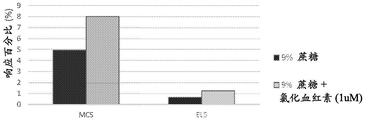
图1F示出小孢子发育响应的条形图,代表在9%蔗糖诱导培养基(对照)和在补充有氯化血红素(1μM终浓度)的9%蔗糖诱导培养基中分离后,培养21天的衍生自近交EH小孢子的多细胞结构(MCS)和胚样结构(ELS)的响应性百分比。Figure 1F shows a bar graph of microspore developmental responses, representing cultured 21 spores after isolation in 9% sucrose induction medium (control) and in 9% sucrose induction medium supplemented with hemin (1 μM final concentration). Percent responsiveness of multicellular structures (MCS) and embryo-like structures (ELS) derived from inbred EH microspores by day.
图2A示出在无PD0325901(N-[(2R)-2,3-二羟基丙氧基]-3,4-二氟-2-(2-氟-4-碘代苯胺基)苯甲酰胺)(阴性对照)的9%蔗糖诱导培养基中分离后,培养7天的ATCC40520细胞的立体显微镜显微图像。Figure 2A shows that in the absence of PD0325901 (N-[(2R)-2,3-dihydroxypropoxy]-3,4-difluoro-2-(2-fluoro-4-iodoanilino)benzamide ) (negative control) stereoscopic micrographs of ATCC40520 cells cultured for 7 days after isolation in 9% sucrose induction medium.
图2B示出在补充有PD0325901(0.19mM终浓度)的9%蔗糖诱导培养基中分离后,培养7天的ATCC40520细胞的立体显微镜显微图像。Figure 2B shows a stereomicroscope micrograph of ATCC40520 cells cultured for 7 days after isolation in 9% sucrose induction medium supplemented with PD0325901 (0.19 mM final concentration).
图2C示出在补充有PD0325901(0.39mM终浓度)的9%蔗糖诱导培养基中分离后,培养7天的ATCC40520细胞的立体显微镜显微图像。Figure 2C shows a stereoscopic micrograph of ATCC40520 cells cultured for 7 days after isolation in 9% sucrose induction medium supplemented with PD0325901 (0.39 mM final concentration).
图2D示出在补充有PD0325901(1.5mM终浓度)的9%蔗糖诱导培养基中分离后,培养7天的ATCC40520细胞的立体显微镜显微图像。Figure 2D shows stereomicroscope micrographs of ATCC40520 cells cultured for 7 days after isolation in 9% sucrose induction medium supplemented with PD0325901 (1.5 mM final concentration).
图2E示出在无SP600125(蒽(1,9-cd)吡唑-6(2H)-酮)(阴性对照)的9%蔗糖诱导培养基中分离后,培养7天的ATCC40520细胞的立体显微镜显微图像。Figure 2E shows a stereo microscope of ATCC40520 cells cultured for 7 days after isolation in 9% sucrose induction medium without SP600125 (anthracene(1,9-cd)pyrazol-6(2H)-one) (negative control) microscopic image.
图2F示出在补充有SP600125(0.19mM终浓度)的9%蔗糖诱导培养基中分离后,培养7天的ATCC40520细胞的立体显微镜显微图像。Figure 2F shows stereomicroscope micrographs of ATCC40520 cells cultured for 7 days after isolation in 9% sucrose induction medium supplemented with SP600125 (0.19 mM final concentration).
图2G示出在补充有SP600125(6.25mM终浓度)的9%蔗糖诱导培养基中分离后,培养7天的ATCC40520细胞的立体显微镜显微图像。Figure 2G shows a stereomicroscope micrograph of ATCC40520 cells cultured for 7 days after isolation in 9% sucrose induction medium supplemented with SP600125 (6.25 mM final concentration).
图2H示出在补充有SP600125(50mM终浓度)的9%蔗糖诱导培养基中分离后,培养7天的ATCC40520细胞的立体显微镜显微图像。Figure 2H shows stereoscopic microscopic images of ATCC40520 cells cultured for 7 days after isolation in 9% sucrose induction medium supplemented with SP600125 (50 mM final concentration).
图2I示出在无SB203580(4-(4-氟苯基)-2-(4-甲基亚磺酰基苯基)-5-(4-吡啶基)1H-咪唑)(阴性对照)的9%蔗糖诱导培养基中分离后,培养7天的ATCC40520细胞的立体显微镜显微图像。Figure 2I shows the presence of 9 in the absence of SB203580 (4-(4-fluorophenyl)-2-(4-methylsulfinylphenyl)-5-(4-pyridyl)1H-imidazole) (negative control). Stereoscopic micrographs of ATCC40520 cells cultured for 7 days after isolation in % sucrose induction medium.
图2J示出在补充有SB203580(0.78mM终浓度)的9%蔗糖诱导培养基中分离后,培养7天的ATCC40520细胞的立体显微镜显微图像。Figure 2J shows stereoscopic micrographs of ATCC40520 cells cultured for 7 days after isolation in 9% sucrose induction medium supplemented with SB203580 (0.78 mM final concentration).
图2K示出在补充有SB203580(3.22mM终浓度)的9%蔗糖诱导培养基中分离后,培养7天的ATCC40520细胞的立体显微镜显微图像。Figure 2K shows stereomicroscope micrographs of ATCC40520 cells cultured for 7 days after isolation in 9% sucrose induction medium supplemented with SB203580 (3.22 mM final concentration).
图2L示出在补充有SB203580(50mM终浓度)的9%蔗糖诱导培养基中分离后,培养7天的ATCC40520细胞的立体显微镜显微图像。Figure 2L shows stereoscopic micrographs of ATCC40520 cells cultured for 7 days after isolation in 9% sucrose induction medium supplemented with SB203580 (50 mM final concentration).
图2M示出在无噻唑维(thiazovivin)(N-苄基-2-(嘧啶-4-基氨基)-1,3-噻唑-4-甲酰胺)(阴性对照)的9%蔗糖诱导培养基中分离后,培养7天的ATCC40520细胞的立体显微镜显微图像。Figure 2M shows 9% sucrose induction medium without thiazovivin (N-benzyl-2-(pyrimidin-4-ylamino)-1,3-thiazole-4-carboxamide) (negative control) Stereomicroscopic micrographs of ATCC40520 cells cultured for 7 days after isolation in .
图2N示出在补充有噻唑维(0.39mM终浓度)的9%蔗糖诱导培养基中分离后,培养7天的ATCC40520细胞的立体显微镜显微图像。Figure 2N shows stereoscopic microscopic images of ATCC40520 cells cultured for 7 days after isolation in 9% sucrose induction medium supplemented with thiazolidine (0.39 mM final concentration).
图2O示出在补充有噻唑维(12.5mM终浓度)的9%蔗糖诱导培养基中分离后,培养7天的ATCC40520细胞的立体显微镜显微图像。Figure 2O shows stereomicroscope micrographs of ATCC40520 cells cultured for 7 days after isolation in 9% sucrose induction medium supplemented with thiazolidine (12.5 mM final concentration).
图2P示出在补充有噻唑维(50mM终浓度)的9%蔗糖诱导培养基中分离后,培养7天的ATCC40520细胞的立体显微镜显微图像。Figure 2P shows stereoscopic microscopic images of ATCC40520 cells cultured for 7 days after isolation in 9% sucrose induction medium supplemented with thiazolidine (50 mM final concentration).
图3A示出使用具有
图3B示出使用一级抗His单克隆抗体和二级抗鼠-HRP抗体(1∶5,000)与重组ZmWUS2-六组氨酸标签蛋白重复1(泳道1)、重组ZmWUS2-六组氨酸标签蛋白重复2(泳道2)和
图3C示出无重组ZmWUS2-六组氨酸标签蛋白处理的情况下野生型小孢子胚发生。Figure 3C shows wild-type microspore embryogenesis without recombinant ZmWUS2-hexahistidine-tagged protein treatment.
图3D示出在用纯化的重组ZmWUS2-六组氨酸标签蛋白处理的野生型小孢子中诱导细胞重编程以活化小孢子发生的生物活性。观察到小孢子衍生的具有发育的胚根和根毛的胚。Figure 3D shows the biological activity of inducing cellular reprogramming to activate microsporogenesis in wild-type microspores treated with purified recombinant ZmWUS2-hexahistidine-tagged protein. Microspore-derived embryos with developed radicles and root hairs were observed.
图4A示出在黑暗条件下在4%蔗糖诱导培养基中培养32天后,无纯化的重组WUSCHEL蛋白并且无转染试剂处理的情况下小孢子胚发生发育的立体显微镜显微图像。Figure 4A shows stereomicroscopy microscopic images of microspore embryogenesis development without purified recombinant WUSCHEL protein and without transfection reagent treatment after 32 days of culture in 4% sucrose induction medium under dark conditions.
图4B示出在黑暗条件下在4%蔗糖诱导培养基中培养32天后,在具有纯化的重组WUSCHEL蛋白并且无转染试剂处理的情况下小孢子胚发生发育的立体显微镜显微图像。Figure 4B shows stereoscopic microscopic images of microspore embryogenesis development with purified recombinant WUSCHEL protein and no transfection reagent treatment after 32 days of culture in 4% sucrose induction medium under dark conditions.
图4C示出在黑暗条件下在4%蔗糖诱导培养基中培养32天后,无纯化的重组WUSCHEL蛋白并且具有转染试剂处理的情况下小孢子胚发生发育的立体显微镜显微图像。Figure 4C shows stereomicroscopy microscopic images of microspore embryogenesis development without purified recombinant WUSCHEL protein and with transfection reagent treatment after 32 days of culture in 4% sucrose induction medium under dark conditions.
图4D示出在黑暗条件下在4%蔗糖诱导培养基中培养32天后,在具有纯化的重组WUSCHEL蛋白并且具有转染试剂处理的情况下小孢子胚发生发育的立体显微镜显微图像。Figure 4D shows stereoscopic microscopic images of microspore embryogenesis development with purified recombinant WUSCHEL protein and with transfection reagent treatment after 32 days of culture in 4% sucrose induction medium under dark conditions.
图5A是用于产生表达WUSCHEL-GFP融合蛋白的稳定玉米小孢子活化株的构建体的示意图。Figure 5A is a schematic representation of constructs used to generate stable maize microspore activated strains expressing WUSCHEL-GFP fusion proteins.
图5B是用于产生表达WUSCHEL蛋白的稳定玉米小孢子活化株的构建体的示意图。Figure 5B is a schematic representation of constructs used to generate stable maize microspore-activating strains expressing WUSCHEL proteins.
图5C是用于产生表达WUSCHEL-糖皮质激素受体(GR)融合蛋白的稳定玉米小孢子活化株的构建体的示意图。Figure 5C is a schematic representation of constructs used to generate stable maize microspore-activated strains expressing WUSCHEL-glucocorticoid receptor (GR) fusion proteins.
图6A是描绘示意性产生T0小孢子活化株的转化方法的示意图。Figure 6A is a schematic diagram depicting a transformation method schematically producing an activated T0 microspore strain.
图6B示出使用定制的多克隆抗WUSCHEL抗体(蛋白质标准品(泳道1)、纯化的重组WUS-GFP融合蛋白的泳道(泳道2、3和4)、其他池(池1,泳道7和8;池2,泳道9和10;池3,泳道12和13;池4,泳道15和16;以及池5,泳道18和19,叶样品示于泳道11、14、17和20)从花药(A)和叶(L)中分离的蛋白质样品的蛋白质印迹。Figure 6B shows the use of custom polyclonal anti-WUSCHEL antibodies (protein standard (lane 1), purified recombinant WUS-GFP fusion protein lanes (
图6C示出使用抗GFP抗体(蛋白质标准品(泳道1)、纯化的重组WUS-GFP融合蛋白的泳道(泳道2、3和4)、其他池(池1,泳道7和8;池2,泳道9和10;池3,泳道12和13;池4,泳道15和16;以及池5,泳道18和19,叶样品示于泳道11、14、17和20)从花药(A)和叶(L)中分离的蛋白质样品的蛋白质印迹。Figure 6C shows the use of anti-GFP antibodies (protein standard (lane 1), lanes of purified recombinant WUS-GFP fusion protein (
图7是描绘用于从半合Ms44-WUS小孢子活化杂交体杂交中选择野生型小孢子衍生的胚的方法的示意图。Figure 7 is a schematic diagram depicting the method used to select wild-type microspore-derived embryos from hemizygous Ms44-WUS microspore-activated hybrid crosses.
图8A示出代表响应于体内WUS-GFP活性的来自半合Ms44-WUS活化杂交体杂交的体外小孢子培养物的胚发生响应性水平增加的条形图。Figure 8A shows a bar graph representing increased levels of embryogenic responsiveness in in vitro microspore cultures from hemizygous Ms44-WUS activation hybrid crosses in response to in vivo WUS-GFP activity.
图8B示出产生小孢子衍生的单倍体植物的胚再生之前和之后,小孢子衍生的胚样结构的图像。Figure 8B shows images of microspore-derived embryo-like structures before and after embryo regeneration to produce microspore-derived haploid plants.
图8C示出描绘了每个玉米染色体1至10(Chr;x轴)与相对于遗传图谱位置(cM(厘摩);y轴)放置的遗传的等位基因模式(亲本1-黑色区域;亲本2-灰色区域;非信息、单态-浅灰色区域)的减数分裂重组断点的核型模式图。Figure 8C shows the allele pattern depicting the inheritance of each
图9是描绘使用不成熟的F1胚外植体,从半合Ms44-WUS小孢子活化T0转基因杂交体中选择野生型小孢子衍生的胚用于转化的方法的示意图。Figure 9 is a schematic diagram depicting the method for selecting wild-type microspore-derived embryos for transformation from hemizygous Ms44-WUS microspore-activated T0 transgenic hybrids using immature F1 embryo explants.
图10是示出具有三个表达盒的构建体的示意图,所述表达盒可用于产生稳定的玉米胚乳活化株。Figure 10 is a schematic diagram showing a construct with three expression cassettes that can be used to generate stable maize endosperm activated strains.
图11是描绘使用半合胚乳活化系,选择由诱导杂交产生的由野生型F1:2衍生的母本单倍体以改善母本双单倍体产生的方法的示意图。Figure 11 is a schematic diagram depicting a method for selection of maternal haploids derived from wild-type F 1:2 derived from induced crosses to improve the production of maternal double haploids using hemizygous endosperm activated lines.
图12A是使用半合单倍体诱导系由单倍体诱导杂交产生的胚F1:2的条形图。分别确定每个单倍体和二倍体胚的CFP-和CFP+胚乳(分别为野生型发育基因和形态学发育基因,“DevGene”)的平均单倍体胚大小(毫米(mm);y轴)。Figure 12A is a bar graph of embryos F 1:2 produced from haploid induced crosses using the hemizygous haploid inducer line. The average haploid embryo size (in millimeters (mm); y-axis) was determined for the CFP- and CFP+ endosperms (wild-type developmental gene and morphological developmental gene, "DevGene", respectively) of each haploid and diploid embryo, respectively. ).
图12B是示出使用具有变化的拷贝数的胚乳活化性状的转基因系(x轴),每个单倍体诱导杂交的发芽的单倍体胚(y轴)的百分比的条形图。Figure 12B is a bar graph showing the percentage of germinated haploid embryos (y-axis) for each haploid induced cross using transgenic lines (x-axis) with varying copy numbers of the endosperm activation trait.
图13是用于产生具有基因编辑活性的稳定玉米胚乳活化株的构建体的示意图。Figure 13 is a schematic diagram of constructs used to generate stable maize endosperm activated strains with gene editing activity.
图14是描绘使用半合胚乳活化系合并从胚乳到母本单倍体胚的CAS9递送,选择由诱导杂交产生的由野生型F1:2衍生的母本单倍体以改善基因编辑后代的母本双单倍体产生的方法的示意图。Figure 14 is a graph depicting the use of hemizygous endosperm activated lines incorporating CAS9 delivery from endosperm to maternal haploid embryos, selection of maternal haploids derived from wild-type F 1:2 resulting from induced crosses to improve gene-edited offspring. Schematic representation of the method for maternal double haploid generation.
具体实施方式detailed description
将在下文中参考附图更全面地描述本文的公开内容,其中示出了一些但不是所有的可能的方面。实际上,公开内容能以许多不同的形式体现,并且不应被解释为局限于本文所阐述的方面;而是提供这些方面,使得本公开能满足适用的法律要求。The present disclosure will be described more fully hereinafter with reference to the accompanying drawings, in which some, but not all possible aspects are shown. Indeed, the disclosure may be embodied in many different forms and should not be construed as limited to the aspects set forth herein; rather, these aspects are provided so that this disclosure will satisfy applicable legal requirements.
所公开的方法和组合物所涉及的领域中的技术人员将考虑到,本文所公开的许多修改和其他方面具有以下描述和相关附图中呈现的传授的益处。因此,应当理解,这些公开内容不限于所公开的特定方面,并且修改和其他方面旨在包括在所附权利要求的范围内。尽管本文中采用了具体的术语,但这些术语仅在一般性和描述性意义上使用而并非用于限制目的。Many modifications and other aspects disclosed herein will be contemplated by those skilled in the art to which the disclosed methods and compositions pertain have the benefit of the teachings presented in the following descriptions and the associated drawings. Therefore, it is to be understood that these disclosures are not to be limited to the particular aspects disclosed and that modifications and other aspects are intended to be included within the scope of the appended claims. Although specific terms are employed herein, these terms are used in a generic and descriptive sense only and not for purposes of limitation.
也应当了解本文所用的术语仅是为了描述特定方面而不旨在进行限制。如在说明书和权利要求中所使用的,术语“包含”可以包括“由......组成”的方面。除非另有定义,本文使用的所有技术和科学术语具有与所公开的方法和组合物所属领域的普通技术人员通常理解的相同含义。在本说明书和下面的权利要求中,将参考本文中所定义的若干术语。It is also to be understood that terminology used herein is for the purpose of describing particular aspects only and is not intended to be limiting. As used in the specification and claims, the term "comprising" may include the aspect "consisting of". Unless defined otherwise, all technical and scientific terms used herein have the same meaning as commonly understood by one of ordinary skill in the art to which the disclosed methods and compositions belong. In this specification and the following claims, reference will be made to several terms as defined herein.
如本文所使用的,单数形式“一种(a)”、“一种(an)”以及“所述”包括复数个指示物,除非上下文中另外明确指明。因此,例如,提及“细胞”包括多个这样的细胞,并且提及“蛋白质”包括本领域技术人员已知的一种或多种蛋白质及其等效物,等等。本文所用的所有技术和科学术语具有与本公开所属领域的普通技术人员通常所理解相同的含义,除非另有明确说明。As used herein, the singular forms "a", "an" and "the" include plural referents unless the context clearly dictates otherwise. Thus, for example, reference to "a cell" includes a plurality of such cells and reference to "a protein" includes one or more proteins and equivalents thereof known to those skilled in the art, and so forth. All technical and scientific terms used herein have the same meaning as commonly understood by one of ordinary skill in the art to which this disclosure belongs, unless explicitly defined otherwise.
本说明书中提到的所有专利、出版物和专利申请指示了本公开所属领域技术人员的水平。将所有专利、出版物和专利申请通过引用以其整体并入本文,其程度就像明确且个别指出通过引用将每一篇个别专利、出版物或专利申请以其整体并入一样。All patents, publications, and patent applications mentioned in this specification are indicative of the levels of those skilled in the art to which the disclosure pertains. All patents, publications, and patent applications are herein incorporated by reference in their entirety to the same extent as if each individual patent, publication, or patent application was specifically and individually indicated to be incorporated by reference in its entirety.
铁原卟啉IX的氧化形式,氯化血红素,是哺乳动物细胞中基因表达的重要调节剂,并且通过充当构成蛋白质(包括呼吸细胞色素、气体传感器、P450酶(CYP)、过氧化氢酶、过氧化物酶、一氧化氮合酶(NOS)、鸟苷酸环化酶、以及甚至转录因子)一部分或与之组合的非蛋白质修复基团来促进造血祖细胞的生长(Tsiftsoglou等人,(2006)Pharmacol Ther.[药理治疗学]111:327-45)。此外,据报道,在哺乳动物细胞中,血红素(heme)在细胞呼吸和代谢中起着信号传导配体的作用,这表明氯化血红素(hemin)不仅是基因表达的关键调节剂,它可能单独是有用的辅因子,也可以与其他治疗组合以改善应激响应、适应性过程、以及甚至基因的转录,以防止细胞损伤。The oxidized form of iron protoporphyrin IX, hemin, is an important regulator of gene expression in mammalian cells and acts as a constituent protein, including respiratory cytochromes, gas sensors, P450 enzymes (CYPs), catalase , peroxidase, nitric oxide synthase (NOS), guanylate cyclase, and even transcription factors) to promote the growth of hematopoietic progenitor cells (Tsiftsoglou et al. (2006) Pharmacol Ther. 111:327-45). Furthermore, in mammalian cells, heme (heme) has been reported to function as a signaling ligand in cellular respiration and metabolism, suggesting that hemin (hemin) is not only a key regulator of gene expression, it Cofactors that may be useful on their own or in combination with other treatments to improve stress responses, adaptive processes, and even the transcription of genes to prevent cellular damage.
特别是对于植物细胞和玉米小孢子,改善朝向胚发生的细胞重编程发育命运的方法包括需要改善由细胞分开和分离技术引起的应激适应过程。需要抑制小孢子内的原生质体发育成淀粉质体的方法、或使淀粉质体去分化为原生质体或促进在玉米小孢子内的自噬的方法。For plant cells and maize microspores in particular, approaches to improve the reprogramming of developmental fate of cells towards embryogenesis include the need to improve stress adaptation processes caused by cell division and isolation techniques. There is a need for methods of inhibiting the development of amyloplasts within microspores into amyloplastids, or of dedifferentiating amyloplastids into protoplasts or of promoting autophagy within maize microspores.
基于在培养细胞中的实验,氯化血红素阻断了核基因的表达。在质体分化为淀粉质体期间,通过质体信号调节了核基因表达的调节系统。使用血红素阻断了来自质体的逆行信号传导。Based on experiments in cultured cells, hemin blocks the expression of nuclear genes. A regulatory system for nuclear gene expression is regulated by plastid signaling during plastid differentiation into amyloplastids. Retrograde signaling from plastids was blocked using heme.
本公开提供了产生重组近交系的群体的高效且有效的方法,所述方法包括但不限于在植物细胞中启动胚发生以使得能够产生双单倍体重组群体的方法。本公开还提供了在配子或单倍体细胞发育期间,在非转化细胞中,并且特别是在配子或单倍体细胞中,实现细胞重编程和胚发生的生长刺激的方法。本公开提供了通过使细胞、组织或器官与能够重编程细胞、组织或器官(其中在细胞、组织或器官中诱导胚发生)的胚发生调节因子接触,在植物的细胞、组织或器官中促进小孢子胚发生的方法,所述胚发生调节因子如例如,胚发生诱导外源形态发育基因蛋白产物和/或胚发生诱导化合物。可用在本公开的方法中的胚发生诱导剂包括但不限于蛋白激酶抑制剂小分子,如N-[(2R)-2,3-二羟基丙氧基]-3,4-二氟-2-(2-氟-4-碘代苯胺基)苯甲酰胺、蒽(1,9-cd)吡唑-6(2H)-酮:4-(4-氟苯基)-2-(4-甲基亚磺酰基苯基)-5-(4-吡啶基)1H-咪唑或N-苄基-2-(嘧啶-4-基氨基)-1,3-噻唑-4-甲酰胺。氯化血红素也可用在本公开的方法中用于诱导胚发生。The present disclosure provides efficient and effective methods of generating populations of recombinant inbred lines including, but not limited to, methods of initiating embryogenesis in plant cells to enable the generation of double haploid recombinant populations. The present disclosure also provides methods for achieving growth stimulation of cellular reprogramming and embryogenesis in non-transformed cells, and particularly in gametic or haploid cells, during development of gametic or haploid cells. The present disclosure provides for promoting in a cell, tissue or organ of a plant by contacting the cell, tissue or organ with an embryogenesis regulator capable of reprogramming the cell, tissue or organ wherein embryogenesis is induced in the cell, tissue or organ. A method of microspore embryogenesis, said embryogenesis regulator such as, for example, an embryogenesis-inducing exogenous morphodevelopmental gene protein product and/or an embryogenesis-inducing compound. Embryogenesis inducers that can be used in the methods of the present disclosure include, but are not limited to, protein kinase inhibitor small molecules such as N-[(2R)-2,3-dihydroxypropoxy]-3,4-difluoro-2 -(2-fluoro-4-iodoanilino)benzamide, anthracene(1,9-cd)pyrazol-6(2H)-one: 4-(4-fluorophenyl)-2-(4- Methylsulfinylphenyl)-5-(4-pyridyl)1H-imidazole or N-benzyl-2-(pyrimidin-4-ylamino)-1,3-thiazole-4-carboxamide. Hemin can also be used in the methods of the present disclosure to induce embryogenesis.
在许多方面还提供了在配子或单倍体细胞发育期间,在非转化细胞中,并且特别是在配子或单倍体细胞中,通过以下方式产生小孢子衍生的双单倍体群体的方法:在植物组织或器官中异位表达胚发生诱导形态发育基因和易位信号的融合蛋白基因产物,从而实现细胞重编程和胚发生生长刺激。在另一方面,本公开提供了在配子或单倍体细胞发育期间,在非转化细胞中,并且特别是在配子或单倍体细胞中,通过以下方式在植物组织或器官中产生小孢子衍生的双单倍体群体的方法:使用与易位信号和荧光蛋白可操作连接的胚发生诱导形态发育基因并且基于存在或不存在胚发生诱导形态发育基因/易位信号/荧光蛋白融合物选择,从而实现细胞重编程和胚发生生长刺激。本公开在许多方面提供了通过使小孢子与纯化的蛋白质(如用或不用胚发生诱导化合物处理的形态发育胚发生诱导基因产物)共培养来重编程小孢子的方法。在另一方面,提供了通过在表达形态发育胚发生诱导基因产物的细胞的存在下共培养小孢子来重编程小孢子的方法。与胚发生诱导细胞重编程剂共培养(接触)的时间段将根据所处理的小孢子的顽固性而变化。例如,在一方面,小孢子胚发生是通过孢粉素涂层内多细胞结构(MCS)的存在和/或小孢子外壁的破裂和/或胚样结构(ELS)的存在所证明。在一方面,将小孢子与胚发生诱导细胞重编程剂共培养,直到观察到某些特征,如MCS和/或ELS。可替代地,在一方面,其他表型和/或基因型标记物也用于确定胚发生状态或细胞重编程状态。通常,在许多方面,少于1小时、1小时、2小时、3小时、4小时、5小时、6小时、7小时、8小时、9小时、10小时、11小时、12小时、13小时、14小时、15小时、16小时、17小时、18小时、19小时、20小时、21小时、22小时、23小时、24小时、2天、3天、4天、5天、6天、7天、8天、9天、10天、11天、12天、13天、14天、15天、16天、17天、18天、19天、20天、21天、22天、23天、24天、25天、26天、27天、28天、29天、30天、31天、32天、33天、34天、35天、36天、37天、38天、39天、40天、41天、42天、43天、44天、45天、46天、47天、48天、49天、50天、51天、52天、53天、54天、55天、56天、57天、58天、59天或60天或更长的时间段的共同培养足以使培养的小孢子形成MCS和/或ELS。基于本公开提供的指导,基于胚发生诱导剂的类型和浓度来优化诱导胚发生的孵育或培养时间段。本公开还在许多方面提供了通过以下方式产生小孢子衍生的双单倍体群体的方法:在半合转基因条件下,使用上文所述方法来促进从由两个不同株的遗传杂交产生的子代植物(例如第一代F1杂交体或可替代地在更靠后的子代中或回交后代中)的组织或器官的小孢子胚发生。Also provided in various aspects is a method of producing a microspore-derived double haploid population in a non-transformed cell, and particularly in a gamete or haploid cell, during development of a gamete or haploid cell by: Ectopic expression of fusion protein gene products of embryogenesis-inducing morphological development genes and translocation signals in plant tissues or organs, thereby realizing cell reprogramming and embryogenesis growth stimulation. In another aspect, the present disclosure provides that during the development of gametes or haploid cells, in non-transformed cells, and in particular in gametes or haploid cells, microspores are produced in plant tissues or organs derived by method of double haploid populations: using an embryogenesis-inducing morphogenetic gene operably linked to a translocation signal and a fluorescent protein and selecting based on the presence or absence of an embryogenesis-inducing morphogenetic gene/translocation signal/fluorescent protein fusion, Cell reprogramming and embryogenic growth stimulation are thereby achieved. The present disclosure provides, in various aspects, methods for reprogramming microspores by co-cultivating the microspores with purified proteins, such as morphological developmental embryogenesis-inducing gene products treated with or without embryogenesis-inducing compounds. In another aspect, there is provided a method of reprogramming microspores by co-cultivating the microspores in the presence of cells expressing a morphodevelopmental embryogenesis-inducing gene product. The period of co-cultivation (contact) with the embryogenesis-inducing cell reprogramming agent will vary depending on the recalcitrance of the microspores being treated. For example, in one aspect microspore embryogenesis is evidenced by the presence of a multicellular structure (MCS) within a sporopollenin coating and/or disruption of the microspore exine and/or the presence of an embryo-like structure (ELS). In one aspect, microspores are co-cultured with embryogenesis-inducing cell reprogramming agents until certain characteristics, such as MCS and/or ELS, are observed. Alternatively, in one aspect, other phenotypic and/or genotypic markers are also used to determine the embryogenic state or cell reprogramming state. Typically, in many respects, less than 1 hour, 1 hour, 2 hours, 3 hours, 4 hours, 5 hours, 6 hours, 7 hours, 8 hours, 9 hours, 10 hours, 11 hours, 12 hours, 13 hours, 14 hours, 15 hours, 16 hours, 17 hours, 18 hours, 19 hours, 20 hours, 21 hours, 22 hours, 23 hours, 24 hours, 2 days, 3 days, 4 days, 5 days, 6 days, 7 days , 8 days, 9 days, 10 days, 11 days, 12 days, 13 days, 14 days, 15 days, 16 days, 17 days, 18 days, 19 days, 20 days, 21 days, 22 days, 23 days, 24 days days, 25 days, 26 days, 27 days, 28 days, 29 days, 30 days, 31 days, 32 days, 33 days, 34 days, 35 days, 36 days, 37 days, 38 days, 39 days, 40 days, 41 days, 42 days, 43 days, 44 days, 45 days, 46 days, 47 days, 48 days, 49 days, 50 days, 51 days, 52 days, 53 days, 54 days, 55 days, 56 days, 57 days , 58 days, 59 days or 60 days or longer period of co-cultivation is sufficient for the cultured microspores to form MCS and/or ELS. Based on the guidance provided in this disclosure, the period of incubation or culture to induce embryogenesis is optimized based on the type and concentration of embryogenesis inducing agent. The present disclosure also provides, in various aspects, methods of generating microspore-derived doubled haploid populations by using the methods described above to facilitate the generation of microspore-derived doubled haploid populations from the genetic cross of two different strains under hemizygous transgenic conditions. Microspore embryogenesis of tissues or organs of progeny plants (eg first generation F1 hybrids or alternatively in later progeny or backcross progeny).
本公开还在许多方面提供了出于产生小孢子衍生的双单倍体群体的目的,促进从第一代F1杂交体的组织或器官的小孢子胚发生的方法,所述第一代F1杂交体是通过将F1胚本身转化到直接在半合转基因条件下再生的所述F1杂交体衍生而来。在另外的方面,使产生和/或处理的小孢子和/或小孢子衍生的细胞与染色体加倍剂接触,以促进小孢子衍生的胚状体的二倍体化。本公开的另外方面提供了从母本单倍体胚的细胞衍生的小植株的克隆繁殖的方法,所述母本单倍体胚是通过在植物组织或器官中异位表达具有或不具有易位信号的形态学发育基因产生的。在许多方面,还提供了从母本单倍体胚的细胞衍生的多个基因编辑小植株的克隆繁殖的方法,所述母本单倍体胚是通过在植物组织或器官中异位表达形态学发育基因产生的,所述形态学发育基因具有或不具有与核酸酶基因(具有或不具有易位信号)的基因产物融合的易位信号。The present disclosure also provides, in various aspects, methods of promoting microspore embryogenesis from tissues or organs of first -generation F1 hybrids for the purpose of producing microspore-derived doubled haploid populations, said first-generation F 1 hybrids were derived by transforming the F 1 embryos themselves into said F 1 hybrids which were regenerated directly under hemizygous transgenic conditions. In additional aspects, the produced and/or treated microspores and/or microspore-derived cells are contacted with a chromosome doubling agent to promote diploidization of the microspore-derived embryoid bodies. A further aspect of the present disclosure provides methods for the clonal propagation of plantlets derived from cells of maternal haploid embryos by ectopic expression in plant tissues or organs with or without susceptible Morphology of bit signals generated by developmental genes. Also provided, in many aspects, are methods for the clonal propagation of multiple gene-edited plantlets derived from cells of maternal haploid embryos by ectopically expressing morphological Morphological developmental genes with or without a translocation signal fused to the gene product of a nuclease gene (with or without a translocation signal).
在许多方面,本公开还提供了在母本衍生的单倍体胚细胞中,使用转化的单倍体诱导系促进胚乳细胞中胚发生和基因编辑的方法,所述转化的单倍体诱导系表达具有或不具有易位信号的形态学发育基因和具有或不具有受精易位信号的核酸酶基因的胚发生诱导基因产物。在另外的方面,使处理的母本单倍体胚和/或胚衍生的细胞与染色体加倍剂接触,以促进母本衍生的体细胞胚的二倍体化和再生。In many aspects, the present disclosure also provides methods of promoting embryogenesis and gene editing in endosperm cells using transformed haploid inducer lines in maternally derived haploid blast cells that Expression of embryogenesis-inducing gene products of morphological development genes with or without translocation signals and nuclease genes with or without fertilization translocation signals. In additional aspects, the treated maternal haploid embryos and/or embryo-derived cells are contacted with a chromosome doubling agent to promote diploidization and regeneration of the maternally-derived somatic embryos.
如本文所用,“重编程”(“reprogram”或“reprograming”或“reprogramed”)是使成熟的特化细胞回复或敏化为诱导多能干细胞或能够进一步发育为胚或胚样结构的胚/胚发生状态的细胞的过程。在被“重编程”的细胞群体中,预期并非所有细胞都被“重编程”至相同的程度或处于相同的胚状态。通常预期处于重编程的多种状态的细胞的混合或镶嵌性质。与尚未暴露于本文提供的方法和组合物的细胞相比,预期本文提供的方法和组合物可增加重编程的并且处于所需胚发生状态的细胞的比率或百分比。重编程还指生殖细胞发育的重建。当胚发生诱导多肽和/或小分子化合物与植物细胞接触使得植物细胞胚发生时,可发生重编程。在许多方面,本公开的方法使单倍体植物细胞与胚发生诱导剂(如例如,多肽和/或小分子化合物)接触,以重编程细胞命运并且使细胞变为胚发生的。可替代地,在许多方面,可以在植物细胞中引入和表达编码胚发生诱导多肽的多核苷酸,其中所述胚发生诱导多肽影响周围/邻近的细胞,从而使细胞变为胚发生的。可以在原位或非原位重编程细胞。形态(形态学)发育基因及其胚发生诱导多肽产物可用在所公开的方法中。如本文所用,术语“形态发育基因”或“形态学发育基因”意指涉及如下的基因:植物胚发生、细胞重编程、代谢、器官发育、干细胞发育、细胞生长刺激、器官发生、再生、体细胞胚发生起始、加速体细胞胚成熟、顶端分生组织的起始和/或发育、芽分生组织的起始和/或发育、芽的起始和/或发育、或其组合。当异位表达形态发育基因时,形态发育基因刺激形成可以产生植物的体细胞衍生结构。形态发育基因的异位表达刺激可以产生植物的体细胞胚或器官发生结构(如芽分生组织)的从头形成。这种刺激的从头形成发生在表达形态发育基因的细胞中或邻近的细胞中。形态发育基因可以是调节其他基因表达的转录因子,或影响植物组织中激素水平的基因,两者均可以刺激形态变化。可以将形态发育基因稳定地掺入到植物的基因组中,或所述形态发育基因可以瞬时表达。胚发生诱导形态发育基因包括但不限于WUS/WOX基因(WUS1、WUS2、WUS3、WOX2A、WOX4、WOX5或WOX9),参见美国专利7,268,271、7,309,813、7,348,468、7,256,322、7,994,391、8,383,891、8,581,037和9,029,641和美国专利申请公开20170121722、20110258741、20100100981、20040166563和20070271628,通过引用以其整体并入本文;Laux等人(1996)Development[发育学]122:87-96;和Mayer等人(1998)Cell[细胞]95:805-815;van der iGraaff等人,2009,Genome Biology[基因组生物学]10:248;Dolzblasz等人,2016,Mol.Plant[分子植物学]19:1028-39。WUS/WOX的调节预期调节植物和/或植物组织表型,包括植物胚发生、细胞重编程、代谢、器官发育、干细胞发育、细胞生长刺激、器官发生、再生、体细胞胚发生起始、加速体细胞胚成熟、顶端分生组织的起始和/或发育、芽分生组织的起始和/或发育、芽的起始和/或发育、或其组合。在这方面也感兴趣的将是MYB118基因(参见美国专利7,148,402)、MYB115基因(参见Wang等人(2008)CellResearch[细胞研究]224-235)、BABYBOOM基因(BBM;参见Boutilier等人(2002)Plant Cell[植物细胞]14:1737-1749)、OVULE DEVELOPMENT PROTEIN 2(ODP2)基因(参见US20110010795、US 20090328252和US 20050257289,通过引用以其整体并入本文,或CLAVATA基因(参见例如,美国专利7,179,963)。As used herein, "reprogramming" or "reprogramming" or "reprogrammed" is the reversion or sensitization of mature specialized cells into induced pluripotent stem cells or embryos/embryos capable of further development into embryos or embryo-like structures. The process of cells in the embryogenic state. In a population of "reprogrammed" cells, not all cells are expected to be "reprogrammed" to the same extent or be in the same embryonic state. A mixed or mosaic nature of cells in multiple states of reprogramming is generally expected. The methods and compositions provided herein are expected to increase the rate or percentage of cells that are reprogrammed and in a desired embryogenic state compared to cells that have not been exposed to the methods and compositions provided herein. Reprogramming also refers to the reconstruction of germ cell development. Reprogramming can occur when an embryogenesis-inducing polypeptide and/or small molecule compound is contacted with a plant cell such that the plant cell embryogenesis. In many aspects, the methods of the present disclosure contact a haploid plant cell with an embryogenesis-inducing agent (such as, for example, a polypeptide and/or a small molecule compound) to reprogram cell fate and render the cell embryogenic. Alternatively, in many aspects, a polynucleotide encoding an embryogenesis-inducing polypeptide can be introduced and expressed in a plant cell, wherein the embryogenesis-inducing polypeptide affects surrounding/adjacent cells, thereby rendering the cell embryogenic. Cells can be reprogrammed in situ or ex situ. Morphological (morphological) developmental genes and their embryogenesis-inducing polypeptide products can be used in the disclosed methods. As used herein, the term "morphological development gene" or "morphological developmental gene" means a gene involved in: plant embryogenesis, cellular reprogramming, metabolism, organ development, stem cell development, cell growth stimulation, organogenesis, regeneration, body Initiation of embryogenesis, accelerated maturation of somatic embryos, initiation and/or development of apical meristems, initiation and/or development of shoot meristems, initiation and/or development of shoots, or combinations thereof. When morphogenetic genes are expressed ectopically, the morphogenetic genes stimulate the formation of somatically derived structures that can give rise to plants. Stimulation of ectopic expression of morphogenetic genes can result in de novo formation of plant somatic embryos or organogenic structures such as shoot meristems. This stimulated de novo formation occurs in cells expressing morphodevelopmental genes or in neighboring cells. Morphological development genes can be transcription factors that regulate the expression of other genes, or genes that affect hormone levels in plant tissues, both of which can stimulate morphological changes. Morphological development genes can be stably incorporated into the plant's genome, or they can be expressed transiently. Embryogenesis-inducing morphogenetic genes include, but are not limited to, WUS/WOX genes (WUS1, WUS2, WUS3, WOX2A, WOX4, WOX5 or WOX9), see US Patents 7,268,271, 7,309,813, 7,348,468, 7,256,322, 7,994,391, 8,383,891, 8,581,037 and 94,029, Patent application publications 20170121722, 20110258741, 20100100981, 20040166563, and 20070271628, incorporated herein by reference in their entirety; Laux et al. (1996) Development 122:87-96; and Mayer et al. (1998) Cell 95:805-815; van der iGraaff et al., 2009, Genome Biology [Genome Biology] 10:248; Dolzblasz et al., 2016, Mol. Plant [Molecular Botany] 19:1028-39. Modulation of WUS/WOX is expected to modulate plant and/or plant tissue phenotypes, including plant embryogenesis, cell reprogramming, metabolism, organ development, stem cell development, cell growth stimulation, organogenesis, regeneration, initiation of somatic embryogenesis, acceleration of Somatic embryo maturation, initiation and/or development of an apical meristem, initiation and/or development of a shoot meristem, initiation and/or development of a shoot, or a combination thereof. Also of interest in this regard would be the MYB118 gene (see US Patent 7,148,402), the MYB115 gene (see Wang et al. (2008) CellResearch [Cell Research] 224-235), the BABYBOOM gene (BBM; see Boutilier et al. Plant Cell [Plant Cell] 14:1737-1749), the OVULE DEVELOPMENT PROTEIN 2 (ODP2) gene (see US20110010795, US 20090328252 and US 20050257289, which are incorporated herein by reference in their entirety, or the CLAVATA gene (see e.g., US Patent 7,179,963 ).
适于本公开的其他胚发生诱导形态发育基因包括但不限于LEC1(Lotan等人,1998,Cell[细胞]93:1195-1205)、LEC2(Stone等人,2008,PNAS[美国科学院院报]105:3151-3156;Belide等人,2013,Plant Cell Tiss.Organ Cult[植物细胞组织器官培养]113:543-553和美国专利8,865,971,通过引用以其整体并入本文)、KN1/STM(Sinha等人,1993.Genes Dev[基因发育]7:787-795)、来自农杆菌属(Agrobacterium)的IPT基因(Ebinuma和Komamine,2001,In vitro Cell.Dev Biol-Plant[体外细胞与发育生物学-植物]37:103-113)、MONOPTEROS-DELTA(Ckurshumova等人,2014,New Phytol.[新植物学家]204:556-566)、农杆菌属AV-6b基因(Wabiko和Minemura 1996,Plant Physiol.[植物生理学]112:939-951)、农杆菌属IAA-h和IAA-m基因的组合(Endo等人,2002,Plant Cell Rep.[植物细胞报告],20:923-928)、拟南芥属(Arabidopsis)SERK基因(Hecht等人,2001,PlantPhysiol.[植物生理学]127:803-816)、拟南芥属AGL15基因(Harding等人,2003,PlantPhysiol.[植物生理学]133:653-663)。Other embryogenesis-inducing morphogenetic genes suitable for the present disclosure include, but are not limited to, LEC1 (Lotan et al., 1998, Cell 93:1195-1205), LEC2 (Stone et al., 2008, PNAS [Proceedings of the National Academy of Sciences] 105:3151-3156; Belide et al., 2013, Plant Cell Tiss.Organ Cult [Plant Cell Tissue Organ Culture] 113:543-553 and US Patent 8,865,971, incorporated herein by reference in its entirety), KN1/STM (Sinha et al., 1993.Genes Dev [gene development] 7:787-795), from the IPT gene of Agrobacterium (Agrobacterium) (Ebinuma and Komamine, 2001, In vitro Cell.Dev Biol-Plant [in vitro cell and developmental biology -Plant] 37:103-113), MONOPTEROS-DELTA (Ckurshumova et al., 2014, New Phytol. [New Phytol.] 204:556-566), Agrobacterium AV-6b gene (Wabiko and Minemura 1996, Plant Physiol. [Plant Physiology] 112: 939-951), the combination of Agrobacterium IAA-h and IAA-m genes (Endo et al., 2002, Plant Cell Rep. [Plant Cell Report], 20: 923-928), Arabidopsis SERK gene (Hecht et al., 2001, Plant Physiol. [Plant Physiol] 127:803-816), Arabidopsis AGL15 gene (Harding et al., 2003, Plant Physiol. [Plant Physiol] 133: 653-663).
如本文所用,术语“转录因子”意指通过与启动子的DNA序列结合以及上调或下调表达来控制特定基因的转录速率的蛋白质。转录因子(还可用作胚发生诱导形态发育基因)的实例包括AP2/EREBP家族的成员(包括BBM(ODP2)、plethora和aintegumenta亚家族,CAAT-box结合蛋白(如LEC1和HAP3),以及MYB、bHLH、NAC、MADS、bZIP、RKD(美国专利申请公开号2013/0180010)和WRKY家族的成员。As used herein, the term "transcription factor" means a protein that controls the rate of transcription of a specific gene by binding to the DNA sequence of a promoter and up-regulating or down-regulating expression. Examples of transcription factors (which also act as embryogenesis-inducing morphogenetic genes) include members of the AP2/EREBP family (including the BBM (ODP2), plethora, and aintegumenta subfamilies), CAAT-box binding proteins (such as LEC1 and HAP3), and MYB , bHLH, NAC, MADS, bZIP, RKD (US Patent Application Publication No. 2013/0180010) and members of the WRKY family.
本公开在一方面还包括通过本文所公开的任何方法或组合物获得的植物。在许多方面,本公开还包括来自通过本文所公开的任何方法或组合物获得的植物的种子。如本文所用,术语“植物”是指整株植物、植物器官(例如叶、茎、根等)、植物组织、植物细胞、植物部分、种子、繁殖体、胚及其子代。如本文所用,术语植物包括植物细胞、植物原生质体、从中可再生出植物的植物细胞组织培养物、植物愈伤组织、以及在植物或植物部分中完好的植物块和植物细胞诸如胚、花粉、胚珠、种子、叶、花、枝、果实、仁、穗、穗轴、壳、茎、根、根尖、花药、谷物等。植物细胞包括但不限于来自以下的细胞:种子、悬浮培养物、外植体、未成熟胚、胚、合子胚、体细胞胚、胚发生性愈伤组织、分生组织、体分生组织、器官发生性愈伤组织、原生质体、分生组织区域、从成熟的由穗衍生的种子衍生的胚、叶基、成熟植物的叶、叶尖、未成熟的花序、雄穗、未成熟的穗、丝、子叶、未成熟的子叶、胚轴、分生组织区域、愈伤组织、叶细胞、茎细胞、根细胞、芽细胞、愈伤组织、叶、根、芽、配子体、孢子体、花粉和小孢子。植物细胞可以是分化的或未分化的(例如愈伤组织、未分化的愈伤组织、未成熟和成熟的胚、未成熟的合子胚、未成熟的子叶、胚轴、悬浮培养细胞、原生质体、叶、叶细胞、根细胞、韧皮部细胞和花粉)。植物部分包括分化和未分化的组织,包括但不限于根、茎、芽、叶、花粉、种子、肿瘤组织和各种形式的培养中的细胞(例如单细胞、原生质体、胚和愈伤组织)。植物组织可以是在植物中或在植物器官、组织或细胞培养物中。籽粒意指由商业种植者出于栽培或繁殖物种之外的目的所生产的成熟种子。再生植物的后代、变体和突变体也被包括在本公开的范围内,只要这些后代、变体和突变体是使用本文公开的方法和组合物制造的和/或包含引入的多核苷酸。The present disclosure also includes in one aspect a plant obtained by any method or composition disclosed herein. In many aspects, the present disclosure also includes seed from a plant obtained by any method or composition disclosed herein. As used herein, the term "plant" refers to whole plants, plant organs (eg, leaves, stems, roots, etc.), plant tissues, plant cells, plant parts, seeds, propagules, embryos, and progeny thereof. As used herein, the term plant includes plant cells, plant protoplasts, plant cell tissue cultures from which plants can be regenerated, plant callus, and intact plant masses and plant cells in plants or plant parts such as embryos, pollen, Ovules, seeds, leaves, flowers, branches, fruits, kernels, ears, cobs, shells, stems, roots, root tips, anthers, grains, etc. Plant cells include, but are not limited to, cells from the following: seeds, suspension cultures, explants, immature embryos, embryos, zygotic embryos, somatic embryos, embryogenic callus, meristem, somatic meristem, Organogenetic callus, protoplasts, meristematic regions, embryos derived from mature panicle-derived seeds, leaf bases, leaves of mature plants, leaf tips, immature inflorescences, tassels, immature panicles , silk, cotyledon, immature cotyledon, hypocotyl, meristem region, callus, leaf cell, stem cell, root cell, bud cell, callus, leaf, root, bud, gametophyte, sporophyte, pollen and microspores. Plant cells can be differentiated or undifferentiated (e.g., callus, undifferentiated callus, immature and mature embryos, immature zygotic embryos, immature cotyledons, hypocotyls, suspension culture cells, protoplasts , leaves, leaf cells, root cells, phloem cells and pollen). Plant parts include differentiated and undifferentiated tissues including, but not limited to, roots, stems, shoots, leaves, pollen, seeds, tumor tissue, and various forms of cells in culture (e.g., single cells, protoplasts, embryos, and callus ). Plant tissue may be in a plant or in plant organ, tissue or cell culture. Kernel means mature seed produced by a commercial grower for purposes other than cultivating or propagating a species. Progeny, variants and mutants of regenerated plants are also included within the scope of the present disclosure so long as such progeny, variants and mutants were made using the methods and compositions disclosed herein and/or comprise the introduced polynucleotide.
如本文使用的,术语“经转化的植物”和“转基因植物”是指在其基因组内包含异源多核苷酸的植物。通常,异源多核苷酸稳定整合于转基因或转化的植物基因组内,这样使得多核苷酸得以传递至连续世代。异源多核苷酸可以单独地或作为重组DNA构建体的部分整合进基因组中。应当理解的是,如本文所用,术语“转基因的”包括其基因型已经通过异源核酸的存在而改变的任何细胞、细胞系、愈伤组织、组织、植物部分或植物,包括最初如此改变的那些转基因以及通过有性杂交或无性繁殖从初始转基因产生的那些。转基因植物定义为含有转基因的成熟可育植物。As used herein, the terms "transformed plant" and "transgenic plant" refer to a plant comprising a heterologous polynucleotide within its genome. Typically, the heterologous polynucleotide is stably integrated into the genome of the transgenic or transformed plant such that the polynucleotide is passed on to successive generations. A heterologous polynucleotide can be integrated into the genome alone or as part of a recombinant DNA construct. It should be understood that, as used herein, the term "transgenic" includes any cell, cell line, callus, tissue, plant part or plant whose genotype has been altered by the presence of a heterologous nucleic acid, including the Those transgenes as well as those produced from the original transgene by sexual crossing or asexual reproduction. Transgenic plants are defined as mature fertile plants containing the transgene.
通过以下来产生转基因“事件”:用包含核酸表达盒的异源DNA构建体转化植物细胞,所述核酸表达盒包含目的基因;再生由所转移的基因插入所述植物的基因组中所产生的植物群体;并且选择表征为插入特定基因组位置的植物。事件在表型上表征为插入的基因的表达。在遗传水平上,事件是植物遗传组成的一部分。术语“事件”也指转化株和另一个植物之间有性杂交所产生的后代,其中所述后代包含异源DNA。A transgenic "event" is produced by: transforming a plant cell with a heterologous DNA construct comprising a nucleic acid expression cassette comprising a gene of interest; and regenerating a plant resulting from insertion of the transferred gene into the genome of said plant population; and selecting plants characterized for the insertion at a particular genomic location. Events are phenotypically characterized by the expression of the inserted gene. At the genetic level, events are part of the genetic makeup of a plant. The term "event" also refers to the progeny of a sexual cross between a transformant and another plant, wherein the progeny comprise heterologous DNA.
本公开的组合物和方法可应用于宽范围的植物物种,包括双子叶植物和单子叶植物。可以根据本文公开的方法处理的植物的代表性实例包括但不限于小麦、棉花、向日葵、红花、烟草、拟南芥属、大麦、燕麦、水稻、玉米、黑小麦、高粱、黑麦、粟、亚麻、甘蔗、香蕉、木薯、菜豆、豇豆、番茄、土豆、甜菜、葡萄、桉属(Eucalyptus)、小麦草(wheat grass)、草皮草、苜蓿、三叶草、大豆、花生、柑橘、番木瓜、狗尾草属物种(Setaria sp)、可可、黄瓜、苹果、辣椒属(Capsicum)、竹、瓜、观赏植物(包括商业花园和鳞茎花卉物种)、果树、蔬菜物种、芸苔属物种以及种间杂交体。在优选的实施例中,将本公开的组合物和方法应用于玉米植物。The compositions and methods of the present disclosure are applicable to a wide range of plant species, including dicots and monocots. Representative examples of plants that may be treated according to the methods disclosed herein include, but are not limited to, wheat, cotton, sunflower, safflower, tobacco, Arabidopsis, barley, oats, rice, corn, triticale, sorghum, rye, millet , flax, sugar cane, banana, cassava, kidney bean, cowpea, tomato, potato, sugar beet, grape, Eucalyptus, wheat grass, turf grass, alfalfa, clover, soybean, peanut, citrus, papaya, Setaria sp, cacao, cucumber, apple, Capsicum, bamboo, melon, ornamentals (including commercial garden and bulb flower species), fruit trees, vegetable species, Brassica species, and interspecific hybrids . In preferred embodiments, the compositions and methods of the present disclosure are applied to corn plants.
本公开的方法涉及将多肽、多核苷酸(即,DNA或RNA)或核苷酸构建体(即,DNA或RNA)引入植物中。如本文所用,“引入”意在指以使得多核苷酸、多肽或核苷酸构建体得以进入植物细胞内部的方式,将多核苷酸、多肽或核苷酸构建体呈送给植物。本公开的方法不取决于用于将多核苷酸、多肽或核苷酸构建体引入植物中的特定方法,只要所述多核苷酸、多肽或核苷酸构建体得以进入所述植物的至少一个细胞的内部即可。将多核苷酸、多肽或核苷酸构建体引入植物的方法是本领域已知的,所述方法包括但不限于稳定转化法、瞬时转化法和病毒介导法。The methods of the present disclosure involve introducing a polypeptide, polynucleotide (ie, DNA or RNA) or nucleotide construct (ie, DNA or RNA) into a plant. As used herein, "introducing" is intended to mean presenting a polynucleotide, polypeptide or nucleotide construct to a plant in such a manner that the polynucleotide, polypeptide or nucleotide construct can enter the interior of the plant cell. The methods of the present disclosure do not depend on the particular method used to introduce a polynucleotide, polypeptide or nucleotide construct into a plant so long as the polynucleotide, polypeptide or nucleotide construct gains access to at least one of the plants. inside the cell. Methods for introducing polynucleotides, polypeptides or nucleotide constructs into plants are known in the art and include, but are not limited to, stable transformation methods, transient transformation methods, and virus-mediated methods.
如本文所用,“稳定转化”是其中引入到植物中的多核苷酸或核苷酸构建体整合到植物的基因组中并能由其子代继承的转化。“瞬时转化”意指将多核苷酸或核苷酸构建体引入所述植物中并且不整合到所述植物的基因组中,或者将多肽引入植物中。另外,在某些实施例中,“瞬时”可以表示在细胞中存在胚发生诱导剂,其中这种试剂已经被外源性地应用或分泌到邻近细胞中或从染色体外位置(例如,质粒或另一种独立复制来源)产生,或者不是由相同细胞内的稳定整合的重组DNA构建体产生。As used herein, "stable transformation" is a transformation wherein a polynucleotide or nucleotide construct introduced into a plant is integrated into the plant's genome and is inherited by its progeny. "Transient transformation" means that a polynucleotide or nucleotide construct is introduced into said plant and does not integrate into the genome of said plant, or that a polypeptide is introduced into a plant. Additionally, in certain embodiments, "transient" may refer to the presence of an embryogenesis-inducing agent in a cell where such agent has been exogenously applied or secreted into adjacent cells or from an extrachromosomal location (e.g., a plasmid or Another independent source of replication), or not from a stably integrated recombinant DNA construct in the same cell.
如本文所用,“接触”、“和......接触”或“与......接触”用于意指“直接接触”或“间接接触”,并且意指将细胞置于细胞可以与任何本文公开的胚发生诱导物质接触的条件下,所述胚发生诱导物质包括但不限于胚发生诱导形态发育基因、小分子或加倍剂。允许此类物质存在于细胞存活的环境(例如,培养基或在细胞或邻近细胞中表达)中并且可以在细胞上起作用。例如,包含加倍剂的培养基可以与单倍体细胞直接接触,或者包含加倍剂的培养基可以通过滤纸、植物组织或其他细胞与单倍体细胞分开,因此加倍剂穿过滤纸或细胞被转移到单倍体细胞中。As used herein, "contact", "in contact with" or "in contact with" is used to mean "direct contact" or "indirect contact" and means placing cells in Cells may be contacted with any embryogenesis-inducing substance disclosed herein, including, but not limited to, embryogenesis-inducing morphodevelopmental genes, small molecules, or doubling agents. Such substances are permitted to exist in the environment of the cell (eg, the culture medium or expressed in the cell or adjacent cells) and can act on the cell. For example, the medium containing the doubling agent can be in direct contact with the haploid cells, or the medium containing the doubling agent can be separated from the haploid cells by a filter paper, plant tissue, or other cells so that the doubling agent passes through the filter paper or the cells are transferred into haploid cells.
本文提供的方法依赖于使用细菌介导的和/或生物射弹介导的基因转移以产生可再生的植物细胞。可用在本公开的方法中的细菌株包括但不限于卸甲(disarmed)农杆菌、苍白杆菌属(Ochrobactrum)细菌或根瘤菌科(Rhizobiaceae)细菌。粒子轰击(Finer和McMullen,1991,In Vitro Cell Dev.Biol.-Plant[体内细胞发育生物学-植物]27:175-182)、农杆菌属介导的转化(Jia等人,2015,Int J.Mol.Sci.[国际分子科学杂志]16:18552-18543;US 2017/0121722,通过引用以其整体并入本文)或苍白杆菌属介导的转化(US 2018/0216123,通过引用以其整体并入本文)的标准方案可用于本公开的方法和组合物。用于将异源基因引入植物的多种方法是已知的,并且可用于将多核苷酸插入植物宿主中,所述方法包括生物和物理植物转化方案。参见例如,Miki等人,“Procedures forIntroducing Foreign DNA into Plants[用于将外源DNA引入植物的程序],”Methods inPlant Molecular Biology and Biotechnology[植物分子生物学和生物技术的方法],Glick和Thompson,编辑(CRC Press,Inc.[CRC出版公司],Boca Raton[波卡拉顿],第67-88页(1993)。所选择的方法随宿主植物变化并且包括化学转染方法(如磷酸钙)、微生物介导的基因转移(如农杆菌属)(Horsch,等人,(1985)Science[科学]227:1229-31)、电穿孔、显微注射和生物射弹轰击。用于植物细胞或组织转化和转基因植物再生的表达盒和载体以及体外培养方法是已知的并且可用的。参见例如,Gruber,等人,“Vectors for PlantTransformation[用于植物转化的载体],”Methods in Plant Molecular Biology andBiotechnology[植物分子生物学和生物技术的方法],同上,第89-119页。The methods provided herein rely on the use of bacterial-mediated and/or biolistic-mediated gene transfer to generate regenerable plant cells. Bacterial strains that may be used in the methods of the present disclosure include, but are not limited to, disarmed Agrobacterium, Ochrobactrum bacteria, or Rhizobiaceae bacteria. Particle bombardment (Finer and McMullen, 1991, In Vitro Cell Dev. Biol.-Plant 27:175-182), Agrobacterium-mediated transformation (Jia et al., 2015, Int J .Mol.Sci. [International Journal of Molecular Science] 16:18552-18543; US 2017/0121722, incorporated herein by reference in its entirety) or Paleobacterium-mediated transformation (US 2018/0216123, incorporated by reference in its entirety Incorporated herein) standard protocols can be used in the methods and compositions of the present disclosure. A variety of methods for introducing heterologous genes into plants are known and can be used to insert polynucleotides into plant hosts, including biological and physical plant transformation protocols. See, e.g., Miki et al., "Procedures for Introducing Foreign DNA into Plants," Methods in Plant Molecular Biology and Biotechnology, Glick and Thompson, Editors (CRC Press, Inc. [CRC Publishing Company], Boca Raton [Boca Raton], pp. 67-88 (1993). The method chosen varies with the host plant and includes chemical transfection methods (such as calcium phosphate), Microbe-mediated gene transfer (eg, Agrobacterium) (Horsch, et al., (1985) Science 227:1229-31), electroporation, microinjection, and biolistic bombardment. For plant cells or tissues Expression cassettes and vectors for transformation and regeneration of transgenic plants, as well as in vitro culture methods are known and available. See, e.g., Gruber, et al., "Vectors for Plant Transformation," Methods in Plant Molecular Biology and Biotechnology [Methods in Plant Molecular Biology and Biotechnology], supra, pp. 89-119.
转化方案以及将核苷酸序列引入植物中的方案,可根据要靶向转化的植物或者植物细胞的类型(即单子叶植物或者双子叶植物)而变化。将核苷酸序列引入到植物细胞中并随后插入到植物基因组中的合适方法包括显微注射(Crossway,等人,(1986)Biotechniques[生物技术]4:320-334)、电穿孔(Riggs,等人,(1986)Proc.Natl.Acad.Sci.USA[美国科学院院报]83:5602-5606)、农杆菌属介导的转化(Townsend,等人,美国专利号5,563,055和Zhao,等人,美国专利号5,981,840)、直接基因转移(Paszkowski,等人,(1984)EMBO J[欧洲分子生物学学会杂志]3:2717-2722)以及弹道粒子加速(参见例如,美国专利号4,945,050;5,879,918;5,886,244;5,932,782;Tomes,等人,(1995)Plant Cell,Tissue,and Organ Culture:Fundamental Methods[植物细胞、组织和器官培养:基本方法],编辑Gamborg和Phillips(施普林格出版社,柏林);McCabe,等人,(1988)Biotechnology[分子技术学]6:923-926)和Lec1转化(WO 00/28058)。还参见,Weissinger,等人,(1988)Ann.Rev.Genet.[遗传学年度评论]22:421-477;Sanford,等人,(1987)Particulate Science and Technology[微粒科学与技术]5:27-37(洋葱);Christou,等人,(1988)Plant Physiol.[植物生理学]87:671-674(大豆);McCabe,等人,(1988)Bio/Technology[生物/技术]6:923-926(大豆);Finer和McMullen,(1991)In VitroCell Dev.Biol.[体外细胞发育生物学]27P:175-182(大豆);Singh,等人,(1998)Theor.Appl.Genet.[理论与应用遗传学]96:319-324(大豆);Datta,等人,(1990)Biotechnology[生物技术]8:736-740(水稻);Klein,等人,(1988)Proc.Natl.Acad.Sci.USA[美国科学院院报]85:4305-4309(玉米);Klein,等人,(1988)Biotechnology[生物技术]6:559-563(玉米);美国专利号5,240,855;5,322,783和5,324,646;Klein,等人,(1988)Plant Physiol.[植物生理学]91:440-444(玉米);Fromm,等人,(1990)Biotechnology[生物技术]8:833-839(玉米);Hooykaas-Van Slogteren,等人,(1984)Nature[自然](伦敦)311:763-764;美国专利号5,736,369(谷物);Bytebier,等人,(1987)Proc.Natl.Acad.Sci.USA[美国科学院院报]84:5345-5349(百合科(Liliaceae));De Wet,等人,(1985)The Experimental Manipulation of Ovule Tissues[胚珠组织的实验操作],Chapman,等人编辑,(Longman[朗文出版社],纽约),第197-209页(花粉);Kaeppler,等人,(1990)Plant Cell Reports[植物细胞报告]9:415-418和Kaeppler,等人,(1992)Theor.Appl.Genet.[理论与应用遗传学]84:560-566(晶须介导的转化);D′Halluin,等人,(1992)Plant Cell[植物细胞]4:1495-1505(电穿孔);Li,等人,(1993)Plant Cell Reports[植物细胞报告]12:250-255以及Christou和Ford,(1995)Annals ofBotany[植物学年报]75:407-413(水稻);Ishida,等人,(1996)Nature Biotechnology[自然生物技术]14:745-750(经由根癌农杆菌(Agrobacterium tumefaciens)的玉米),所有这些通过引用以其整体并入本文。在U.S.2017/0121722中也发现了用于快速植物转化的方法和组合物,通过引用以其整体并入本文。在美国专利申请序列号15/765,521中发现了可用于植物转化的载体,通过引用以其整体并入本文。Transformation protocols, and protocols for introducing nucleotide sequences into plants, may vary depending on the type of plant or plant cell (ie, monocot or dicot) targeted for transformation. Suitable methods for introducing nucleotide sequences into plant cells and subsequently inserting them into the plant genome include microinjection (Crossway, et al., (1986) Biotechniques 4:320-334), electroporation (Riggs, et al., (1986) Proc.Natl.Acad.Sci.USA [Proceedings of the American Academy of Sciences] 83:5602-5606), Agrobacterium-mediated transformation (Townsend, et al., U.S. Patent No. 5,563,055 and Zhao, et al. , U.S. Patent No. 5,981,840), direct gene transfer (Paszkowski, et al., (1984) EMBO J [European Molecular Biology Society Journal] 3:2717-2722), and ballistic particle acceleration (see, e.g., U.S. Patent Nos. 4,945,050; 5,879,918; 5,886,244; 5,932,782; Tomes, et al., (1995) Plant Cell, Tissue, and Organ Culture: Fundamental Methods, eds. Gamborg and Phillips (Springer Verlag, Berlin) ; McCabe, et al., (1988) Biotechnology 6:923-926) and Lec1 transformation (WO 00/28058). See also, Weissinger, et al., (1988) Ann. Rev. Genet. 22:421-477; Sanford, et al., (1987) Particulate Science and Technology 5:27 -37 (onions); Christou, et al., (1988) Plant Physiol. 87:671-674 (soybean); McCabe, et al., (1988) Bio/Technology 6:923- 926 (soybean); Finer and McMullen, (1991) In VitroCell Dev.Biol. 27P:175-182 (soybean); Singh, et al., (1998) Theor.Appl.Genet. and Applied Genetics] 96:319-324 (soybean); Datta, et al., (1990) Biotechnology 8:736-740 (rice); Klein, et al., (1988) Proc.Natl.Acad. Sci. USA [Proceedings of the United States Academy of Sciences] 85: 4305-4309 (maize); Klein, et al., (1988) Biotechnology 6: 559-563 (maize); US Patent Nos. 5,240,855; 5,322,783 and 5,324,646; Klein , et al., (1988) Plant Physiol. [Plant Physiol] 91: 440-444 (maize); Fromm, et al., (1990) Biotechnology [biotechnology] 8: 833-839 (maize); Hooykaas-Van Slogteren, et al., (1984) Nature (London) 311:763-764; US Patent No. 5,736,369 (cereals); Bytebier, et al., (1987) Proc.Natl.Acad.Sci.USA [Proceedings of the American Academy of Sciences] 84:5345-5349 (Liliaceae); De Wet, et al., (1985) The Experimental Manipulation of Ovule Tissues [Experimental Manipulation of Ovule Tissues], edited by Chapman, et al., (Longman [Longman Press] , New York), pp. 197-209 (pollen); Kaeppler, et al., (1990) Plant Cell Reports [Plant Cell Reports] 9: 415-418 and Kaeppler, et al., (19 92) Theor. Appl. Genet. 84: 560-566 (whisker-mediated transformation); D'Halluin, et al. (1992) Plant Cell 4: 1495-1505 (Electroporation); Li, et al., (1993) Plant Cell Reports 12:250-255 and Christou and Ford, (1995) Annals of Botany 75:407-413 (rice); Ishida, et al., (1996) Nature Biotechnology 14:745-750 (Maize via Agrobacterium tumefaciens), all of which are incorporated herein by reference in their entirety. Methods and compositions for rapid plant transformation are also found in U.S. 2017/0121722, which is incorporated herein by reference in its entirety. Vectors useful for plant transformation are found in US Patent Application Serial No. 15/765,521, incorporated herein by reference in its entirety.
收获雄穗的方法(包括灭菌方法)以及雄穗预处理(例如温度预处理)在本领域中是已知的,并且将根据预期的雄穗用途而变化。具体而言,在选择雄穗用于小孢子培养之前,必须使小孢子进入到适当的阶段,通常在单核阶段到双核阶段之间。典型地,对于在适当阶段具有花药和小孢子的雄穗,将这些雄穗解离,并且将每个雄穗单独地包裹在例如铝箔中。Methods of harvesting tassels, including sterilization methods, and tassel pretreatments (eg, temperature pretreatments) are known in the art and will vary depending on the intended use of the tassels. Specifically, before tassels are selected for microspore culture, the microspores must be brought to the appropriate stage, usually between the uninucleate and dinucleate stages. Typically, tassels with anthers and microspores at the appropriate stage are dissociated and each tassel individually wrapped, eg, in aluminum foil.
在降低的温度环境中,小孢子的分离典型地发生在雄穗预处理之后以改善产雄性特征的响应。一种常用的技术是将箔包裹的雄穗放置在10℃下持续1到21天。另外,可以在甘露醇溶液(例如0.3M液体甘露醇加50mg/L抗坏血酸)中进行花药的预培养(美国专利5,322,789和美国专利5,445,961,通过引用以其整体并入本文)。Isolation of microspores typically occurs after tassel pretreatment in a reduced temperature environment to improve the androgenic response. A common technique is to place foil-wrapped tassels at 10°C for 1 to 21 days. Alternatively, preincubation of anthers can be performed in a mannitol solution (eg, 0.3 M liquid mannitol plus 50 mg/L ascorbic acid) (US Patent 5,322,789 and US Patent 5,445,961, incorporated herein by reference in their entirety).
使用前,可以在40%高乐氏(Clorox)(稀释的8.25%次氯酸钠v/v)溶液加两滴吐温80中对雄穗进行表面消毒约十五分钟,同时在往复振动器上轻轻搅动。然后在室温下将雄穗在无菌水中冲洗三次或更多次,并且置于大培养皿中且通常在无菌条件下保持无盖1-1.5小时,以蒸发任何多余的水分。本领域已知的另一种方法包括将从雄穗解离的小穗置于可渗透的篮子中,然后将其浸入40%高乐氏(稀释的8.25%次氯酸钠v/v)溶液加两滴吐温80的溶液中十五分钟,然后如上所述进行冲洗。将小穗置于大培养皿中,通常保持无盖1-1.5小时,以在小孢子分离之前蒸发多余的水分。Before use, tassels can be surface disinfected in a 40% Clorox (diluted 8.25% sodium hypochlorite v/v) solution plus two drops of
玉米花药和小穗的多种分离程序是本领域已知的,包括但不限于玻璃棒浸渍法(Pescitelli,等人,(1990)Plant Cell Rep.[植物细胞报告]8:628-31)、共混方法、刀片组织切割方法(参见美国专利5,445,961,通过引用以其整体并入本文)、组织匀浆器方法(Gaillard,等人,(1991)Plant Cell Rep.[植物细胞报告]10:55-8)和组织研磨器方法(Mandaron等人,(1990)Theor Appl Genet[理论与应用遗传学]80:134-138。A variety of isolation procedures for corn anthers and spikelets are known in the art, including, but not limited to, glass rod dipping (Pescitelli, et al. (1990) Plant Cell Rep. 8:628-31), Blending method, blade tissue cutting method (see U.S. Patent 5,445,961, incorporated herein by reference in its entirety), tissue homogenizer method (Gaillard, et al., (1991) Plant Cell Rep. [Plant Cell Reports] 10:55 -8) and the tissue grinder method (Mandaron et al., (1990) Theor Appl Genet 80: 134-138.
从周围的体细胞组织中分离小孢子后,通常在将小孢子与任何花药碎片分离后立即将所述小孢子置于新鲜分离培养基中。许多培养基组合物是本领域已知的。将小孢子从花药碎片中分离的常用的方法是使来自分离程序的共混的小孢子花药碎片浆料通过筛子(Pescitelli(1989)Plant Cell Rep.[植物细胞报告]7:673-6,Gaillard,等人,(1991)和美国专利5,445,961,通过引用以其整体并入本文)。可替代地,使小孢子花药碎片浆料通过几层粗棉布或筛网过滤器(Coumans,(1989)Plant Cell Rep.[植物细胞报告]7:618-21)。可以使用不连续密度离心方法或另外的过滤方法进行进一步的分离,所述方法包括但不限于使用蔗糖或Percoll梯度的方法(Coumans,(1989)、Pescitelli等人,(1990))。可替代地,可以使用最终的高蔗糖(0.44M)离心方法进一步分离在225g离心3分钟后在20%-50%范围内的Percoll梯度的20%-30%界面处捕获的细胞的选择(Gaillard,等人,(1991))。分离方法的进一步变化是本领域已知的(Vergne等人,(1991)In:Negrutiu I.(编辑)BioMethods.Birkhauser,Basel,Boston,Bedinger和Edgerton,(1990)Plant Physiol.[植物生理学]92:474-9,Gaillard,等人,(1991)),并且可以根据需要进行优化。After isolation of microspores from surrounding somatic tissue, the microspores are usually placed in fresh isolation medium immediately after isolation of the microspores from any anther fragments. Many media compositions are known in the art. A common method for isolating microspores from anther fragments is to pass the blended microspore anther fragment slurry from the isolation procedure through a sieve (Pescitelli (1989) Plant Cell Rep. 7:673-6, Gaillard , et al., (1991) and US Patent 5,445,961, incorporated herein by reference in their entirety). Alternatively, the microspore anther fragment slurry is passed through several layers of cheesecloth or mesh filters (Coumans, (1989) Plant Cell Rep. 7:618-21). Further separations can be performed using discontinuous density centrifugation methods or additional filtration methods including, but not limited to, methods using sucrose or Percoll gradients (Coumans, (1989), Pescitelli et al., (1990)). Alternatively, a final high sucrose (0.44M) centrifugation method can be used to further isolate cells captured at the 20%-30% interface of a Percoll gradient in the 20%-50% range after centrifugation at 225g for 3 minutes (Gaillard , et al., (1991)). Further variations of isolation methods are known in the art (Vergne et al., (1991) In: Negrutiu I. (ed.) BioMethods. Birkhauser, Basel, Boston, Bedinger and Edgerton, (1990) Plant Physiol. [Plant Physiology] 92 : 474-9, Gaillard, et al., (1991)), and can be optimized as needed.
分离期间使用的具体的培养基,例如通常由6%蔗糖、50mg/L抗坏血酸、400mg/L脯氨酸、0.05mg/L生物素和10mg/L烟酸组成(参见Petolino和Genovesi(1994)The MaizeHandbook[玉米手册],Freeling,M.,Walbot,V.(编辑)Springer-Verlag[施普林格出版社],纽约)。用于培养玉米小孢子的各种其他培养基和溶液与用于其他谷物组织培养程序的那些相似,并且可以使用各种修饰(参见Genovesi和Magill,(1982)Plant Cell Rep.[植物细胞报告]1:257-60,Martin和Widholm,(1996)Plant Cell Rep.[植物细胞报告]15:781-85,Magnard等人,(2000)Plant Mol Biol[植物分子生物学]44:559-74,Testillano等人,(2002)Int J Dev Biol[国际发育生物学杂志]46:1035-47,Testillano等人,(2004)Chromosoma[染色体学]112:342-9,Shariatpanahi等人,(2006)Plant Cell Rep[植物细胞报告]25:1294-9,Shim等人,(2006)Protoplasma[原生质体学]228:79-86,Soriano等人,(2008)Plant Cell Rep[植物细胞报告]27:805-11,Cistue等人,(2009)Plant Cell Rep[植物细胞报告]28:727-35,Jacquard等人,(2009)Planta[植物]229:393-402,Jacquard等人,(2009)Plant Cell Rep[植物细胞报告]28:1329-39,Shim等人,(2009)Genome[基因组]52:166-74,Sanchez-Diaz等人,(2013)Plant Reprod[植物繁殖]26:287-96)。如以上引用所证明的,玉米培养基的共同特征通常包括使用具有相对较高糖浓度(6%-12%)的N6、NLN或YP基础盐配制品,所述配制品可具有包括三碘苯甲酸(triiobenzoic acid)、各种植物激素和/或脯氨酸的组分。The specific medium used during isolation, for example, usually consists of 6% sucrose, 50 mg/L ascorbic acid, 400 mg/L proline, 0.05 mg/L biotin and 10 mg/L niacin (see Petolino and Genovesi (1994) The Maize Handbook [Maize Handbook], Freeling, M., Walbot, V. (ed.) Springer-Verlag [Springer Verlag], New York). Various other media and solutions for culturing maize microspores are similar to those used in other cereal tissue culture procedures, and various modifications may be used (see Genovesi and Magill, (1982) Plant Cell Rep. 1:257-60, Martin and Widholm, (1996) Plant Cell Rep. 15:781-85, Magnard et al., (2000) Plant Mol Biol 44:559-74, Testillano et al., (2002) Int J Dev Biol 46:1035-47, Testillano et al., (2004) Chromosoma 112:342-9, Shariatpanahi et al., (2006) Plant Cell Rep 25:1294-9, Shim et al., (2006) Protoplasma 228:79-86, Soriano et al., (2008) Plant Cell Rep 27:805 -11, Cistue et al., (2009) Plant Cell Rep [Plant Cell Report] 28: 727-35, Jacquard et al., (2009) Planta [Plant] 229: 393-402, Jacquard et al., (2009) Plant Cell Rep [Plant Cell Report] 28:1329-39, Shim et al., (2009) Genome [Genome] 52:166-74, Sanchez-Diaz et al., (2013) Plant Reprod [Plant Reprod] 26:287-96) . As evidenced by the above citations, common features of corn culture media often include the use of N6, NLN or YP basal salt formulations with relatively high sugar concentrations (6%-12%), which may contain triiodobenzene Components of formic acid (triiobenzoic acid), various plant hormones and/or proline.
本公开的组合物和方法包括通过使植物细胞与形态发育胚发生诱导基因蛋白产物接触而从配子中产生双单倍体植物,所述形态发育胚发生诱导基因蛋白产物可以在细胞中诱导细胞重编程并且活化胚发生。还提供了通过用形态发育胚发生诱导基因蛋白产物(如WUSCHEL六组氨酸标签蛋白(“WUS-HISTAG”)(SEQ ID NO:1和SEQ ID NO:2))处理分离的小孢子来针对产雄性特征的诱导进行非原位细胞重编程的方法。在另一方面,本公开提供了用包含形态发育胚发生诱导基因蛋白产物和细胞穿透肽的翻译融合蛋白(更具体地为γ-玉米醇溶蛋白细胞穿透肽(CPP)WUSCHEL六组氨酸标签翻译融合蛋白(“WUS-HISTAG-GZCPP”)(SEQ ID NO:46和SEQ ID NO:47))处理分离的小孢子的方法。The compositions and methods of the present disclosure comprise producing a double haploid plant from a gamete by contacting a plant cell with a protein product of a morphodevelopmental embryogenesis-inducing gene that induces cellular regeneration in the cell. Programs and activates embryogenesis. Also provided are microspores that are isolated by treating isolated microspores with a protein product of a morphodevelopmental embryogenesis-inducing gene, such as the WUSCHEL hexahistidine-tagged protein ("WUS-HISTAG") (SEQ ID NO: 1 and SEQ ID NO: 2). A method for ex situ cell reprogramming by induction of androgenic traits. In another aspect, the present disclosure provides translational fusion proteins comprising morphodevelopmental embryogenesis-inducing gene protein products and cell penetrating peptides (more specifically gamma-zein cell penetrating peptide (CPP) WUSCHEL hexahistidine A method of treating isolated microspores with an acid tag translation fusion protein ("WUS-HISTAG-GZCPP") (SEQ ID NO: 46 and SEQ ID NO: 47)).
还提供了通过以下方式针对产雄性特征的诱导进行非原位细胞重编程的方法:用形态发育胚发生诱导基因蛋白产物和/或胚发生诱导小分子化合物或其组合处理植物细胞,从而使得能够改善野生型植物细胞(包括但不限于配子型细胞)中细胞重编程和胚发生生长刺激。Also provided are methods of ex situ cellular reprogramming for the induction of androgenic traits by treating a plant cell with a morphodevelopmental embryogenesis-inducing gene protein product and/or an embryogenesis-inducing small molecule compound, or a combination thereof, thereby enabling Improved cellular reprogramming and embryogenic growth stimulation in wild-type plant cells, including but not limited to gametic-type cells.
还提供了通过以组织特异性方式表达形态发育胚发生诱导基因蛋白产物来针对产雄性特征的诱导进行原位细胞重编程的方法。具体地,通过在花药的绒毡层细胞内,并且更具体地使用玉蜀黍Ms44启动子(“ZM-Ms44 PRO”;SEQ ID NO:3)和与玉蜀黍WUSCHEL2序列(“ZM-WUS2”;SEQ ID NO:6和SEQ ID NO:7)融合的Ms44 N末端分泌信号肽(“Ms44SP”;SEQ IDNO:4和SEQ ID NO:5)(以诱导小孢子内细胞重编程和活化胚发生),表达形态发育胚发生诱导基因蛋白产物。Also provided are methods of reprogramming cells in situ for the induction of androgenic traits by expressing a morphodevelopmental embryogenesis-inducing gene protein product in a tissue-specific manner. Specifically, in the tapetum cells of the anthers, and more specifically using the maize Ms44 promoter ("ZM-Ms44 PRO"; SEQ ID NO: 3) in combination with the maize WUSCHEL2 sequence ("ZM-WUS2"; SEQ ID NO: 6 and SEQ ID NO: 7) fused Ms44 N-terminal secretion signal peptide ("Ms44 SP "; SEQ ID NO: 4 and SEQ ID NO: 5) (to induce intracellular reprogramming and activate embryogenesis in microspores), Expresses morphodevelopmental embryogenesis-inducing gene protein products.
还提供了通过以下方式进行原位细胞重编程的方法:用由WUSCHEL基因、易位信号和接头序列(“L3”;SEQ ID NO:8和SEQ ID NO:9)(还可以与荧光蛋白基因例如AC-GFP1(SEQID NO:10和SEQ ID NO:11)和终止子序列“ZM-Ms44 TERM”;SEQ ID NO:12)融合)构成的构建体转化植物组织或器官,并且然后基于存在或不存在转基因而在小孢子衍生的双单倍体群体中选择。Also provided is a method for in situ cell reprogramming by using a WUSCHEL gene, a translocation signal, and a linker sequence ("L3"; SEQ ID NO: 8 and SEQ ID NO: 9) (which can also be combined with a fluorescent protein gene For example, a construct consisting of AC-GFP1 (SEQ ID NO: 10 and SEQ ID NO: 11) and the terminator sequence "ZM-Ms44 TERM"; SEQ ID NO: 12) fusion) is transformed into a plant tissue or organ, and then based on the presence or Selection in the microspore-derived double haploid population in the absence of the transgene.
本公开还提供了包含WUSCHEL多肽(SEQ ID NO:7)和易位肽或细胞定位信号序列的翻译融合蛋白(SEQ ID NO:13(“WUS-virFC36”)、SEQ ID NO:14(“WUS-virFC36”),SEQ IDNO:15(“WUS-virFC127”)、SEQ ID NO:16(“WUS-virFC127”),SEQ ID NO:17(“WUS-GALLS(GSC27)”)、SEQ ID NO:18(“WUS-GALLS(GSC27)”)),以产生在本发明的方法中用作在处理的细胞中诱导胚发生的细胞重编程因子的WUSCHEL变体。The present disclosure also provides a translational fusion protein (SEQ ID NO: 13 ("WUS-virF C36 "), SEQ ID NO: 14 (" WUS-virF C36 "), SEQ ID NO: 15 ("WUS-virF C127 "), SEQ ID NO: 16 ("WUS-virF C127 "), SEQ ID NO: 17 ("WUS-GALLS (GSC 27 )") , SEQ ID NO: 18 ("WUS-GALLS(GSC 27 )")) to generate a WUSCHEL variant for use in the methods of the invention as a cellular reprogramming factor that induces embryogenesis in treated cells.
在某些方面,本文公开的原位细胞重编程方法还提供了由WUSCHEL基因和基于糖皮质激素受体(GR)的融合蛋白(“WUS-GR”;SEQ ID NO:48和SEQ ID NO:49)构成的构建体,以通过将动物激素类似物外部应用到体外组织培养基中而有条件地将蛋白活性定位到细胞核。In some aspects, the in situ cell reprogramming method disclosed herein also provides a fusion protein composed of WUSCHEL gene and glucocorticoid receptor (GR) ("WUS-GR"; SEQ ID NO: 48 and SEQ ID NO: 49) Constructs constructed to conditionally localize protein activity to the nucleus by external application of animal hormone analogs to in vitro tissue culture medium.
本公开还使用了形态发育基因与其胚发生诱导基因蛋白产物(如WUSCHEL蛋白和玉蜀黍ODP2(ZM-ODP2;SEQ ID NO:19和SEQ ID NO:20,为一种AP2/ERF转录因子))或者其他本领域已知的形态发育基因与其胚发生诱导基因蛋白产物的组合。本公开包括使用翻译融合蛋白,所述翻译融合蛋白包含N末端Ms44 N末端分泌信号肽(ZM-Ms44SP;SEQ ID NO:5)和玉蜀黍ODP2多肽(ZM-ODP2;SEQ ID NO:20)和C末端细胞穿透肽,所述C末端细胞穿透肽包括但不限于玉蜀黍knotted1 CPP(ZM-KNT1 CPP;SEQ ID NO:21和SEQ ID NO:22)、粟酒酵母(Saccharomyces pombe)TP10 CPP(SP-TP10 CPP;SEQ ID NO:23和SEQ ID NO:24)、白色念珠菌Zebra CPP(CA-Zebra CPP;SEQ ID NO:25和SEQ ID NO:26)、PEP1 CPP(PEP1 CPP;SEQID NO:27和SEQ ID NO:28)、HIV-1 TAT CPP(HIV-1 TAT CPP;SEQ ID NO:29和SEQ ID NO:30)。能够使胚发生诱导多肽转运/转移/分泌到母本组织的发育小孢子或一种或多种胚细胞中的任何信号肽或其他部分适用于和本文公开的组合物一起使用。The present disclosure also uses morphological development genes and their embryogenesis-inducing gene protein products (such as WUSCHEL protein and maize ODP2 (ZM-ODP2; SEQ ID NO: 19 and SEQ ID NO: 20, which is an AP2/ERF transcription factor)) or Combinations of other morphodevelopmental genes and their embryogenesis-inducing gene protein products known in the art. The disclosure includes the use of translational fusion proteins comprising N-terminal Ms44 N-terminal secretion signal peptide (ZM-Ms44 SP ; SEQ ID NO:5) and maize ODP2 polypeptide (ZM-ODP2; SEQ ID NO:20) and C-terminal cell penetrating peptides including, but not limited to, maize knotted1 CPP (ZM-KNT1 CPP; SEQ ID NO: 21 and SEQ ID NO: 22), Saccharomyces pombe TP10 CPP (SP-TP10 CPP; SEQ ID NO:23 and SEQ ID NO:24), Candida albicans Zebra CPP (CA-Zebra CPP; SEQ ID NO:25 and SEQ ID NO:26), PEP1 CPP (PEP1 CPP; SEQID NO: 27 and SEQ ID NO: 28), HIV-1 TAT CPP (HIV-1 TAT CPP; SEQ ID NO: 29 and SEQ ID NO: 30). Any signal peptide or other moiety capable of transport/transfer/secretion of an embryogenesis-inducing polypeptide into the developing microspore or one or more embryonic cells of the maternal tissue is suitable for use with the compositions disclosed herein.
本公开提供了用于通过用包含胚发生诱导形态发育基因蛋白的翻译融合蛋白(如WUSCHEL六组氨酸标签蛋白和使用CPP(包括但不限于上述的CPP序列)的C末端融合物)处理分离的小孢子来针对产雄性特征的诱导进行非原位细胞重编程的方法。可以通过用包含胚发生诱导形态发育蛋白的翻译融合蛋白(如WUSCHEL蛋白和转位信号的C末端融合物(如WUSCHEL-virFC36翻译融合物、WUSCHEL-virFC127翻译融合物或WUSCHEL-GALLS(GSC27)翻译融合蛋白))处理分离的小孢子获得产雄性特征的诱导。The present disclosure provides methods for isolation by treatment with translational fusion proteins comprising embryogenesis-inducing morphodevelopmental gene proteins, such as WUSCHEL hexahistidine-tagged proteins and C-terminal fusions using CPPs, including but not limited to the CPP sequences described above. A method for ex situ cell reprogramming targeting androgenic induction of microspores. Morphogenesis can be induced by using a translational fusion protein comprising an embryogenesis-inducing morphodevelopmental protein (such as a WUSCHEL protein and a C-terminal fusion of a translocation signal (such as a WUSCHEL-virF C36 translational fusion, a WUSCHEL-virF C127 translational fusion, or a WUSCHEL-GALLS (GSC 27 ) Translation of fusion protein)) treatment of isolated microspores for induction of androgenic characteristics.
任选地,本公开的非原位方法使用与表达胚发生诱导形态发育多肽的悬浮“饲养细胞”共培养的分离的小孢子,以进一步促进用以活化小孢子胚发生的细胞重编程。Optionally, the ex situ methods of the present disclosure use isolated microspores co-cultured with suspended "feeder cells" expressing embryogenesis-inducing morphological development polypeptides to further facilitate cellular reprogramming to activate microspore embryogenesis.
任选地,本公开的非原位细胞重编程方法可以与从使用本文公开的原位细胞重编程方法产生的植物组织分离的小孢子组合并且与之一起使用。Optionally, the ex situ cell reprogramming methods of the present disclosure can be combined with and used with microspores isolated from plant tissue produced using the in situ cell reprogramming methods disclosed herein.
本公开提供了一种用于通过转化玉米单倍体诱导系以稳定整合并且表达异源表达盒来使母本单倍体胚再生的原位细胞重编程方法,所述异源表达盒编码刺激体细胞胚发生的形态发育多肽以及还编码包括用于基因编辑目的的基因的第二组分。两种组分都可以包含使用可操作地连接到在胚乳内表达的启动子的分泌信号肽的融合肽。可用在本公开中的分泌信号肽包括但不限于可操作地连接到BETL9启动子(“ZM-BETL9 PRO”;SEQ ID NO:33)的基底胚乳转移层9(BETL9)分泌信号肽(“BETL9SP”;SEQ ID NO:31和SEQ ID NO:32)或可操作地连接到BETL9样启动子(“ZM-BETL9样PRO”;SEQ ID NO:36)的基底胚乳转移层9样(BETL9样)分泌信号肽(“BETL9样SP”;SEQ ID NO:34和SEQ ID NO:35)。原位细胞重编程方法可以任选地使用胚乳内表达的荧光颜色标记物,例如可操作地连接到玉蜀黍FEM2启动子的编码Anemonia majano青色荧光蛋白(CFP)的多核苷酸(“AM--CFP-ZM-FEM2”;SEQ ID NO:39)。The present disclosure provides an in situ cell reprogramming method for the regeneration of maternal haploid embryos by transforming a maize haploid inducer line to stably integrate and express a heterologous expression cassette encoding a stimulatory The morphodevelopmental polypeptides of somatic embryogenesis also encode a second component comprising genes for gene editing purposes. Both components may comprise a fusion peptide using a secretion signal peptide operably linked to a promoter expressed in the endosperm. Secretion signal peptides useful in the present disclosure include, but are not limited to, the basal endosperm transfer layer 9 (BETL9) secretion signal peptide ("BETL9 PRO" operably linked to the BETL9 promoter ("ZM-BETL9 PRO"; SEQ ID NO: 33) SP "; SEQ ID NO: 31 and SEQ ID NO: 32) or the basal endosperm transfer layer 9-like (BETL9-like ) secretion signal peptide ("BETL9-like SP "; SEQ ID NO: 34 and SEQ ID NO: 35). The in situ cell reprogramming method can optionally use a fluorescent color marker expressed in the endosperm, such as a polynucleotide encoding Anemonia majano cyan fluorescent protein (CFP) operably linked to the maize FEM2 promoter ("AM--CFP -ZM-FEM2"; SEQ ID NO: 39).
还可以在本公开的表达盒中包括其他报告基因或者选择性标记基因。本领域已知的合适的报告物的实例可以在以下中找到:例如,Jefferson,等人,(1991)PlantMolecular Biology Manual[植物分子生物学年刊],编辑Gelvin,等人,(Kluwer AcademicPublishers[鲁维尔学术出版社]),第1-33页;DeWet,等人,(1987)Mol.Cell.Biol.[分子细胞生物学]7:725-737;Goff,等人,(1990)EMBO J.[欧洲分子生物学学会杂志]9:2517-2522;Kain,等人,(1995)Bio Techtniques[生物技术]19:650-655和Chiu,等人,(1996)Current Biology[当前生物学]6:325-330,通过引用以其整体并入本文。Other reporter genes or selectable marker genes can also be included in the expression cassettes of the present disclosure. Examples of suitable reporters known in the art can be found in, e.g., Jefferson, et al., (1991) Plant Molecular Biology Manual [Annual Journal of Plant Molecular Biology], ed. Gelvin, et al., (Kluwer Academic Publishers Academic Press]), pp. 1-33; DeWet, et al., (1987) Mol. Cell. Biol. [Molecular Cell Biology] 7:725-737; Goff, et al., (1990) EMBO J. [ Journal of the European Society for Molecular Biology] 9: 2517-2522; Kain, et al., (1995) Bio Techniques [biotechnology] 19: 650-655 and Chiu, et al., (1996) Current Biology [current biology] 6: 325-330, incorporated herein by reference in its entirety.
用于选择转化细胞或者组织的选择性标记基因可以包括赋予抗生素抗性或除草剂抗性的基因。合适的选择性标记基因的实例包括但不限于编码对如下的耐受性的基因:氯霉素(Herrera Estrella,等人,(1983)EMBO J.[欧洲分子生物学学会杂志]2:987-992);氨甲蝶呤(Herrera Estrella,等人,(1983)Nature[自然]303:209-213;Meijer,等人,(1991)Plant Mol.Biol.[植物分子生物学]16:807-820);潮霉素(Waldron,等人,(1985)Plant Mol.Biol.[植物分子生物学]5:103-108和Zhijian,等人,(1995)Plant Science[植物科学]108:219-227);链霉素(Jones,等人,(1987)Mol.Gen.Genet.[分子遗传学和普通遗传学]210:86-91);壮观霉素(Bretagne-Sagnard,等人,(1996)Transgenic Res.[转基因研究]5:131-137);博菜霉素(Hille,等人,(1990)Plant Mol.Biol.[植物分子生物学]7:171-176);磺酰胺类(Guerineau,等人,(1990)Plant Mol.Biol.[植物分子生物学]15:127-36);溴草腈(Stalker,等人,(1988)Science[科学]242:419-423);草甘膦(Shaw,等人,(1986)Science[科学]233:478-481以及美国专利申请序列号10/004,357和10/427,692);草丁膦(DeBlock,等人,(1987)EMBO J.[欧洲分子生物学学会杂志]6:2513-2518),通过引用以其整体并入本文。Selectable marker genes for selection of transformed cells or tissues can include genes that confer antibiotic resistance or herbicide resistance. Examples of suitable selectable marker genes include, but are not limited to, genes encoding resistance to chloramphenicol (Herrera Estrella, et al., (1983) EMBO J. [Journal of the European Society for Molecular Biology] 2:987- 992); methotrexate (Herrera Estrella, et al., (1983) Nature [natural] 303:209-213; Meijer, et al., (1991) Plant Mol.Biol. [Plant Molecular Biology] 16:807- 820); Hygromycin (Waldron, et al., (1985) Plant Mol. Biol. [Plant Molecular Biology] 5: 103-108 and Zhijian, et al., (1995) Plant Science [Plant Science] 108: 219- 227); Streptomycin (Jones, et al., (1987) Mol. Gen. Genet. [Molecular Genetics and General Genetics] 210:86-91); Spectinomycin (Bretagne-Sagnard, et al., (1996 ) Transgenic Res.[Transgenic Research] 5:131-137); Bleomycin (Hille, et al., (1990) Plant Mol.Biol.[Plant Molecular Biology] 7:171-176); Sulfonamides ( Guerineau, et al., (1990) Plant Mol. Biol. [Plant Molecular Biology] 15: 127-36); bromoxynil (Stalker, et al., (1988) Science [science] 242: 419-423); Grass Glyphosate (Shaw, et al., (1986) Science 233:478-481 and U.S. Patent Application Serial Nos. 10/004,357 and 10/427,692); Glyphosate (DeBlock, et al., (1987) EMBO J. [Journal of the European Society for Molecular Biology] 6:2513-2518), which is hereby incorporated by reference in its entirety.
可以在转基因事件的恢复中发挥效用的其他基因将包括但不限于如以下的实例:GUS(β-葡糖苷酶;Jefferson,(1987)Plant Mol.Biol.Rep.[植物分子生物学报告]5:387)、GFP(绿色荧光蛋白;Chalfie,等人,(1994)Science[科学]263:802)、萤光素酶(Riggs,等人,(1987)Nucleic Acids Res.[核酸研究]15(19):8115和Luehrsen,等人,(1992)MethodsEnzymol.[酶学方法]216:397-414)以及编码花色素产生的玉米基因(Ludwig,等人,(1990)Science[科学]247:449),通过引用以其整体并入本文。Other genes that may play a role in recovery of transgenic events would include, but are not limited to, examples such as: GUS (beta-glucosidase; Jefferson, (1987) Plant Mol. Biol. Rep. [Plant Molecular Biology Reports] 5 : 387), GFP (green fluorescent protein; Chalfie, et al., (1994) Science [science] 263: 802), luciferase (Riggs, et al., (1987) Nucleic Acids Res. [nucleic acid research] 15 ( 19): 8115 and Luehrsen, et al., (1992) Methods Enzymol. [Enzyme Methods] 216: 397-414) and the maize gene encoding anthocyanin production (Ludwig, et al., (1990) Science [Science] 247: 449 ), incorporated herein by reference in its entirety.
本公开的方法还提供了使用多顺反子接头(“TA-T2A”;SEQ ID NO:40和SEQ IDNO:41)使多个形态学发育基因在一个表达盒中的表达,所述多顺反子接头可操作地连接到启动子和包括用于基因编辑目的的基因的第二组分,所述用于基因编辑目的的基因包括但不限于酿脓链球菌(Streptococcus pyogenes)(CRISPR)CAS9核酸酶(“SP-CAS9”;SEQ IDNO:42和SEQ ID NO:43)或Cpf1核酸酶(“AC-Cpfl”;SEQ ID NO:44和SEQ ID NO:45)或其他核酸酶蛋白(包括但不限于锌指核酸酶、大范围核酸酶或转录激活因子样效应子核酸酶)。在转化的玉米单倍体诱导系中使用第一组分以使靶植物的母本穗受精,这对改善双单倍体生产是有用的,而第二组分能够改善基因编辑的玉米双单倍体的再生。The methods of the present disclosure also provide for the expression of multiple morphological developmental genes in one expression cassette using a polycistronic linker ("TA-T2A"; SEQ ID NO: 40 and SEQ ID NO: 41), which An anti-linker is operably linked to a promoter and a second component comprising a gene for gene editing purposes including, but not limited to, Streptococcus pyogenes (CRISPR) CAS9 Nuclease ("SP-CAS9"; SEQ ID NO:42 and SEQ ID NO:43) or Cpf1 nuclease ("AC-Cpfl"; SEQ ID NO:44 and SEQ ID NO:45) or other nuclease proteins (including But not limited to zinc finger nucleases, meganucleases or transcription activator-like effector nucleases). Use of the first component in transformed maize haploid-inducing lines to fertilize the female ear of the target plant is useful for improving double haploid production, while the second component enables improved gene-edited maize double haploid production. Ploid regeneration.
本公开还提供了在分离和胚发生诱导方法(用于产生父本配子(产雄性特征的)或母本配子(产生雌性特征的)双单倍体群体)的任何部分之前、期间、之后或与之重叠,使单倍体细胞与一定量的染色体加倍剂接触的方法。The present disclosure also provides that before, during, after or during any part of a separation and embryogenesis induction method for producing a paternal gamete (male-producing) or maternal gamete (female-producing) double haploid population Overlapping, a method of contacting haploid cells with a certain amount of a chromosome doubling agent.
如本文所用,对于在生物的组织外部的植物细胞(例如已经分离用于实验和/或在外部环境中完成测量的所提取的细胞),使用细胞重编程剂(胚发生诱导多肽或胚发生诱导化合物)或细胞重编程处理称为“非原位”处理或处理方法。As used herein, for plant cells outside the tissue of an organism (such as extracted cells that have been isolated for experiments and/or for measurements done in an external environment), using a cell reprogramming agent (embryogenesis-inducing polypeptide or embryogenesis-inducing Compounds) or cell reprogramming treatments are referred to as "ex situ" treatments or treatment methods.
如本文所使用的“重组体”意指细胞或载体,其已经通过引入异源核酸或衍生自已经如此修饰的细胞而被修饰。因此,例如,重组细胞是表达未在天然(非重组)细胞中以相同形式或位置发现的基因的细胞、或以不同于天然(非重组)细胞的表达模式表达天然基因的细胞,例如,由于故意的人为干预,天然基因异常表达、表达不足、表达降低或根本不表达。如本文所用的术语“重组”不涵盖由于自然发生的事件(例如,自发突变、自然转化/转导/转位)(如在没有故意的人为干预的情况下发生的事件)而引起的细胞或载体的改变。"Recombinant" as used herein means a cell or vector that has been modified by the introduction of heterologous nucleic acid or derived from a cell that has been so modified. Thus, for example, a recombinant cell is a cell that expresses a gene that is not found in the same form or location in a natural (non-recombinant) cell, or that expresses a native gene in an expression pattern that differs from that of a natural (non-recombinant) cell, e.g., because Deliberate human intervention whereby natural genes are abnormally expressed, underexpressed, reduced or not expressed at all. As used herein, the term "recombination" does not encompass the recombination of cells or cells due to naturally occurring events (e.g., spontaneous mutation, natural transformation/transduction/translocation), such as events that occur without deliberate human intervention. carrier change.
如本文所使用的,“重组表达盒”是以重组或合成方式产生的具有允许特定核酸在靶细胞中转录的一系列特定核酸元件的核酸构建体。重组表达盒可以整合在质粒、染色体、线粒体DNA、质体DNA、病毒或核酸片段中。典型地,表达载体的重组表达盒部分包括,除了其他序列之外,待转录的核酸和启动子。As used herein, a "recombinant expression cassette" is a nucleic acid construct produced recombinantly or synthetically with a series of specific nucleic acid elements that permit transcription of a specific nucleic acid in a target cell. Recombinant expression cassettes can be integrated in plasmids, chromosomes, mitochondrial DNA, plastid DNA, viruses or nucleic acid fragments. Typically, the recombinant expression cassette portion of an expression vector includes, among other sequences, a nucleic acid to be transcribed and a promoter.
术语“多肽”、“肽”和“蛋白”在本文中可互换使用,是指氨基酸残基的聚合物。所述术语适用于其中一个或多个氨基酸残基是相应的天然存在的氨基酸的人工化学类似物的氨基酸聚合物,以及适用于天然存在的氨基酸聚合物。The terms "polypeptide", "peptide" and "protein" are used interchangeably herein to refer to a polymer of amino acid residues. The term applies to amino acid polymers in which one or more amino acid residues are an artificial chemical analog of the corresponding naturally occurring amino acid, as well as to naturally occurring amino acid polymers.
如本文所用,可用于本公开的方法中的多肽可以用细胞穿透肽(本文称为“CPP”)进一步工程化。可用在本发明的方法中的CPP是一类短肽,其具有跨细胞膜易位并充当用于将蛋白质递送到植物细胞中的纳米载体的性质。示例性CPP家族包括但不限于衍生自蛋白质转导结构域、两亲性肽和合成阳离子多肽(例如聚赖氨酸、聚组氨酸和聚精氨酸)或树状聚阳离子分子的CPP。可用在本公开的方法中的示例性CPP包括但不限于肽血管内皮钙粘蛋白CPP、转运素CPP、HIV-1TAT基本结构域Cpp的单体和二聚体、穿透素CPP、合成的阳离子高精氨酸寡肽CPP(参见Eudes和Chugh.(2008)Plant Signal Behav.[植物信号行为]3:549-550)和γ玉米醇溶蛋白CPP(参见US 8581036,通过引用以其整体并入本文)。本公开提供了使用γ-玉米醇溶蛋白CPP形态发育蛋白翻译融合蛋白以用于使γ-玉米醇溶蛋白连接的结构与植物细胞接触并且允许将γ-玉米醇溶蛋白连接的结构摄取到植物细胞中以改变植物细胞的细胞命运的方法。As used herein, polypeptides useful in the methods of the present disclosure can be further engineered with cell penetrating peptides (referred to herein as "CPPs"). CPPs that can be used in the methods of the present invention are a class of short peptides that have the property of translocating across cell membranes and acting as nanocarriers for protein delivery into plant cells. Exemplary CPP families include, but are not limited to, CPPs derived from protein transduction domains, amphiphilic peptides, and synthetic cationic polypeptides (eg, polylysine, polyhistidine, and polyarginine) or dendritic polycationic molecules. Exemplary CPPs that can be used in the methods of the present disclosure include, but are not limited to, the peptides vascular endothelial cadherin CPP, transporter CPP, monomers and dimers of HIV-1 TAT basic domain Cpp, penetratin CPP, synthetic cationic Homoarginine oligopeptide CPP (see Eudes and Chugh. (2008) Plant Signal Behav. [Plant Signal Behav.] 3:549-550) and gamma zein CPP (see US 8581036, incorporated by reference in its entirety This article). The present disclosure provides translation of fusion proteins using γ-zein CPP morphodevelopmental proteins for contacting γ-zein-linked structures with plant cells and allowing uptake of γ-zein-linked structures into plants A method in cells to alter the cell fate of plant cells.
如本文所用,“细胞重编程因子”或“胚发生诱导剂”包括但不限于在细胞命运重编程中独立或协同地发挥功能(包括例如,小孢子胚发生诱导)的小分子、化合物和形态发育胚发生诱导基因产物。当细胞与小分子接触时,认为这些重编程分子活化在接触的细胞中引发胚发生响应的细胞内的内源基因的表达。如本文所用,“细胞重编程处理”是本文公开的在接触的细胞中引发胚发生响应的任何处理。As used herein, "cell reprogramming factors" or "embryogenesis inducers" include, but are not limited to, small molecules, compounds, and morphologies that function independently or synergistically in cell fate reprogramming, including, for example, induction of microspore embryogenesis. Developmental embryogenesis induces gene products. When cells are contacted with small molecules, these reprogramming molecules are thought to activate the expression of endogenous genes within the cells that initiate an embryogenic response in the contacted cells. As used herein, a "cell reprogramming treatment" is any treatment disclosed herein that elicits an embryogenic response in contacted cells.
如本文所用,在细胞分离或细胞提取用于实验和/或在外部环境中完成测量之前,对于在生物的组织内部的植物细胞,使用细胞重编程剂(胚发生诱导多肽或胚发生诱导化合物)或细胞重编程处理称为“原位”处理或处理方法。As used herein, a cell reprogramming agent (embryogenesis-inducing polypeptide or embryogenesis-inducing compound) is used for plant cells inside a tissue of an organism before cell isolation or cell extraction for experimentation and/or for measurements done in an external environment Or cell reprogramming treatment is called "in situ" treatment or treatment method.
术语“调节元件”是指具有基因调节活性的核酸分子,也就是能够影响可操作地连接的可转录多核苷酸的转录和/或翻译表达模式的核酸分子。因此,术语“基因调节活性”是指通过影响可操作地连接的可转录多核苷酸分子的转录和/或翻译,从而影响这种可操作地连接的可转录多核苷酸分子表达的能力。基因调节活性可为正向和/或负向,并且所述影响可通过其下列特性来表征:时间、空间、发育、组织、环境、生理、病理、细胞周期和/或化学响应,还可通过定量指示或定性指示来表征。The term "regulatory element" refers to a nucleic acid molecule having gene regulatory activity, ie, a nucleic acid molecule capable of affecting the transcriptional and/or translational expression pattern of an operably linked transcribable polynucleotide. Accordingly, the term "gene regulatory activity" refers to the ability to affect the expression of an operably linked transcribable polynucleotide molecule by affecting the transcription and/or translation of such operably linked transcribable polynucleotide molecule. Gene regulatory activity can be positive and/or negative, and the effects can be characterized by their: temporal, spatial, developmental, tissue, environmental, physiological, pathological, cell cycle and/or chemical responses, and can also be characterized by Quantitative indicators or qualitative indicators to characterize.
如本文所用,“启动子”是示例性调节元件,并且通常是指能够控制编码序列或功能性RNA的表达的核苷酸序列。一般来讲,编码序列位于启动子序列的3′端。启动子序列包含近端元件和较远端上游元件,后一元件通常称为增强子。因此,“增强子”是可以刺激启动子活性的核苷酸序列,并且可以是启动子的固有元件或插入的异源元件,用来增强启动子的水平或组织特异性。启动子可以全部衍生自天然基因,或者由衍生自在自然界发现的不同启动子的不同元件构成,或者甚至包含合成的核苷酸片段。本领域技术人员应当理解,不同的调节元件可能引导基因在不同组织或细胞类型中、或在不同发育阶段、或者响应于不同环境条件的表达。As used herein, a "promoter" is an exemplary regulatory element, and generally refers to a nucleotide sequence capable of controlling the expression of a coding sequence or functional RNA. Generally, the coding sequence is located 3' to the promoter sequence. A promoter sequence contains proximal elements and more distal upstream elements, the latter elements are often referred to as enhancers. Thus, an "enhancer" is a nucleotide sequence that stimulates the activity of a promoter, and may be an intrinsic element of the promoter or an inserted heterologous element that serves to increase the level or tissue specificity of the promoter. The promoter may be derived entirely from a native gene, or consist of different elements derived from different promoters found in nature, or even comprise synthetic nucleotide segments. Those skilled in the art will appreciate that different regulatory elements may direct the expression of a gene in different tissues or cell types, or at different developmental stages, or in response to different environmental conditions.
植物启动子是能够在植物细胞中起始转录的启动子。示例性植物启动子包括但不局限于从植物、植物病毒以及包含在植物细胞中表达的基因的细菌(如农杆菌属或根瘤菌属)获得的那些启动子。实例是优先在某些组织(如叶、根、种子、纤维、木质部导管、管胞或厚壁组织)中启动转录的启动子。这样的启动子称为“组织偏好性”启动子。“细胞类型”特异性启动子主要驱动在一个或多个器官中的某些细胞类型(例如,根或叶中的维管细胞)中的表达。“诱导型”或“调节型”启动子是指在环境控制下的启动子。可通过诱导型启动子影响转录的环境条件的实例包括厌氧条件或光照的存在。另一类型的启动子是发育调节启动子,例如在花粉发育期间驱动表达的启动子。组织偏好性启动子、细胞类型特异性启动子、发育调节启动子和诱导型启动子是“非组成性”启动子类别的成员。“组成型”启动子是导致核酸片段在大多数环境条件和发育或细胞分化状态下在大多数时间在大多数细胞类型中表达的启动子。A plant promoter is a promoter capable of initiating transcription in plant cells. Exemplary plant promoters include, but are not limited to, those obtained from plants, plant viruses, and bacteria (eg, Agrobacterium or Rhizobium) that contain genes expressed in plant cells. Examples are promoters that initiate transcription preferentially in certain tissues such as leaves, roots, seeds, fibers, xylem vessels, tracheids or sclerenchyma. Such promoters are referred to as "tissue-preferred" promoters. A "cell type" specific promoter primarily drives expression in certain cell types (eg, vascular cells in roots or leaves) in one or more organs. An "inducible" or "regulatory" promoter refers to a promoter that is under environmental control. Examples of environmental conditions that can affect transcription through an inducible promoter include anaerobic conditions or the presence of light. Another type of promoter is a developmentally regulated promoter, such as a promoter that drives expression during pollen development. Tissue-preferred, cell-type-specific, developmentally regulated, and inducible promoters are members of the class of "non-constitutive" promoters. A "constitutive" promoter is one that results in the expression of a nucleic acid segment in most cell types at most times under most environmental conditions and states of development or cell differentiation.
“翻译前导序列”是指位于基因的启动子序列和编码序列之间的核苷酸序列。翻译前导序列存在于翻译起始序列的经完全处理的mRNA上游。翻译前导序列可以影响多种参数,包括初级转录物到mRNA的加工、mRNA稳定性和/或翻译效率。已经描述了翻译前导序列的实例(Turner和Foster(1995)Mol.Biotechnol.[分子生物技术]3:225-236)。"Translation leader sequence" refers to the nucleotide sequence located between the promoter sequence and the coding sequence of a gene. The translation leader sequence is present in the fully processed mRNA upstream of the translation initiation sequence. The translation leader sequence can affect a variety of parameters including processing of the primary transcript to mRNA, mRNA stability and/or translation efficiency. Examples of translation leader sequences have been described (Turner and Foster (1995) Mol. Biotechnol. 3:225-236).
如上所述,技术人员将认识到适当的启动子可用于调节父本或母本胚发生。对于父本胚发生,示例性启动子包括雄穗偏好性启动子、花药偏好性启动子和绒毡层偏好性启动子。已知的组织特异性、组织偏好性或阶段特异性调节元件进一步包括花药特异性LAT52(Twell,等人,(1989)Mol.Gen.Genet.[分子遗传学和普通遗传学]217:240-245)、小孢子特异性启动子(如apg基因启动子)(Twell,等人,(1993)Sex.Plant Reprod.[有性植物繁殖]6:217-224)和绒毡层特异性启动子(如TA29基因启动子)(Mariani,等人,(1990)Nature[自然]347:737;美国专利号6,372,967)、雄蕊特异性启动子,如MS26基因启动子、MS44基因启动子、MS45基因启动子、5126基因启动子、BS7基因启动子、PG47基因启动子(美国专利号5,412,085;美国专利号5,545,546;Zheng等人,(1993)Plant J[植物杂志]3(2):261-271)、SGB6基因启动子(美国专利号5,470,359)、G9基因启动子(美国专利号5,8937,850;美国专利号5,589,610)、SB200基因启动子(WO 2002/26789)等。在雄性生殖器官的细胞中有活性的组织偏好性启动子可特别用在本公开的某些方面中。As noted above, the skilled artisan will recognize that appropriate promoters can be used to regulate either paternal or maternal embryogenesis. For paternal embryogenesis, exemplary promoters include tassel-preferred, anther-preferred, and tapetum-preferred promoters. Known tissue-specific, tissue-preferred or stage-specific regulatory elements further include anther-specific LAT52 (Twell, et al., (1989) Mol. Gen. Genet. [Molecular Genetics and General Genetics] 217:240- 245), microspore-specific promoters (such as the apg gene promoter) (Twell, et al., (1993) Sex.Plant Reprod. [sexual plant reproduction] 6:217-224) and tapetum-specific promoters (such as TA29 gene promoter) (Mariani, et al., (1990) Nature [nature] 347:737; U.S. Patent No. 6,372,967), stamen-specific promoters, such as MS26 gene promoter, MS44 gene promoter, MS45 gene promoter 5126 gene promoter, BS7 gene promoter, PG47 gene promoter (U.S. Patent No. 5,412,085; U.S. Patent No. 5,545,546; Zheng et al., (1993) Plant J [Plant Journal] 3(2): 261-271), SGB6 gene promoter (US Patent No. 5,470,359), G9 gene promoter (US Patent No. 5,8937,850; US Patent No. 5,589,610), SB200 gene promoter (WO 2002/26789) and the like. Tissue-preferred promoters active in cells of the male reproductive organs find particular use in certain aspects of the present disclosure.
对于母本胚发生,示例性启动子包括种子偏好性启动子。“种子偏好性”启动子包括“种子特异性”启动子(在种子发育期间有活性的那些启动子如种子贮藏蛋白的启动子)以及“种子发芽性”启动子(在种子发芽期间有活性的那些启动子)。参见Thompson等人,(1989)BioEssays[生物测定]10:108,其通过引用并入本文。此类种子偏好性启动子包括但不限于Cim1(细胞分裂素诱导的信号)启动子;cZ19B1(玉米19kDa玉米醇溶蛋白)启动子;和milps(肌醇-1-磷酸盐合酶)启动子(参见WO 00/11177和美国专利号6,225,529,通过引用以其整体并入本文)。可用在本公开的方法中的其他启动子包括但不限于胚乳特异性启动子,如γ-玉米醇溶蛋白启动子(Boronat等人(1986)Plant Science[植物科学]47:95-102)和胚特异性启动子,如球蛋白-1(Glob-1)启动子。对于单子叶植物,种子特异性启动子包括但不限于玉米15kDa启动子、22kDa玉米醇溶蛋白启动子、27kDa玉米醇溶蛋白启动子、γ-玉米醇溶蛋白启动子、糯质基因启动子(waxy promoter)、超甜基因1启动子(shrunken1promoter)、超甜基因2启动子、球蛋白1启动子等。还参见WO 00/12733,其公开了来自endl和end2基因的种子偏好性启动子。另外的种子偏好性启动子包括油质蛋白启动子(WO 00/0028058)、脂质转移蛋白(LTP)启动子(美国专利号5,525,716)、Lec1启动子、Jip1启动子和milps3启动子(参见WO 02/42424)。For maternal embryogenesis, exemplary promoters include seed-preferred promoters. "Seed-preferred" promoters include "seed-specific" promoters (those active during seed development, such as promoters of seed storage proteins) as well as "seed germination" promoters (those active during seed germination). those promoters). See Thompson et al., (1989) BioEssays 10:108, which is incorporated herein by reference. Such seed-preferred promoters include, but are not limited to, the Cim1 (cytokinin-induced signaling) promoter; the cZ19B1 (
如本文所用,“信号肽”或“分泌信号肽”序列是指与蛋白质转运系统相互作用并且易位或靶向蛋白质以递送至特定目的地的蛋白质区域。可用在本公开的方法中的信号肽或分泌信号肽的实例包括但不限于将蛋白质靶向植物细胞的细胞外基质的信号肽,如白花丹叶烟草(Nicotiana plumbaginifolia)延伸基因信号肽(DeLoose,等人,(1991)Gene[基因]99:95-100);导致蛋白质分泌的信号肽,如PRIb信号肽(Lind,等人,(1992)PlantMol.Biol.[植物分子生物学]18:47-53)或大麦α淀粉酶(BAA)信号肽(Rahmatullah,等人,(1989)Plant Mol.Biol.[植物分子生物学]12:119)。As used herein, a "signal peptide" or "secretion signal peptide" sequence refers to a region of a protein that interacts with the protein transport system and translocates or targets the protein for delivery to a specific destination. Examples of signal peptides or secretion signal peptides that can be used in the methods of the present disclosure include, but are not limited to, signal peptides that target proteins to the extracellular matrix of plant cells, such as the Nicotiana plumbaginifolia elongated gene signal peptide (DeLoose, et al., (1991) Gene [gene] 99: 95-100); signal peptides leading to protein secretion, such as the PRIb signal peptide (Lind, et al., (1992) PlantMol.Biol. [Plant Molecular Biology] 18: 47 -53) or the barley alpha amylase (BAA) signal peptide (Rahmatullah, et al. (1989) Plant Mol. Biol. 12:119).
包含在双功能抑制剂/植物脂质转移蛋白/种子存储螺旋结构域蛋白(特征性地编码对二级结构重要的八个保守半胱氨酸残基)的超家族中发现的结构域的分泌信号肽包括但不限于脂质转移蛋白,如LILY-LIM2(Q43534)、高粱(XP_002445754)、大麦(BAK05897)、水稻-OSC4(BAD09233)、水稻-MEN-8(XP_006660357)和玉米-MZm3-3(NP_001105123),它们可用于将可用在本公开的方法中的雄性表达的植物特异性蛋白工程化。将蛋白质从胚乳靶向到胚的分泌信号肽可用于使可用在本公开的方法中的雌性表达的翻译融合蛋白工程化。Secretion comprising domains found in the superfamily of bifunctional inhibitor/plant lipid transfer protein/seed storage helix domain proteins characteristically encoding eight conserved cysteine residues important for secondary structure Signal peptides include but are not limited to lipid transfer proteins such as LILY-LIM2 (Q43534), Sorghum (XP_002445754), Barley (BAK05897), Rice-OSC4 (BAD09233), Rice-MEN-8 (XP_006660357) and Maize-MZm3-3 (NP_001105123), which can be used to engineer male-expressed plant-specific proteins that can be used in the methods of the present disclosure. Secretion signal peptides that target proteins from the endosperm to the embryo can be used to engineer female expressed translational fusion proteins that can be used in the methods of the present disclosure.
如本文所用,“异源”是指源于外来物种,或者,如果源于同一物种的话,则是通过蓄意人为干预对其天然形式在组成和/或基因组基因座方面进行实质性修饰得到的核酸。例如,可操作地连接到异源结构基因的启动子,所述异源结构基因来自与衍生结构基因的物种不同的物种,或者,如果来自相同的物种,则其中一者或二者从其原始形式和/或基因组位置进行了实质性的修饰。As used herein, "heterologous" means a nucleic acid derived from an alien species or, if derived from the same species, substantially modified in composition and/or genomic locus from its native form by deliberate human intervention . For example, a promoter operably linked to a heterologous structural gene from a species different from that from which the structural gene was derived, or, if from the same species, either or both from the species from which the structural gene was derived Substantial modifications in form and/or genomic location.
在一方面,可以在用于在目的植物中表达的表达盒中提供可用在本公开的方法中的胚发生诱导形态发育基因。所述表达盒可以包括可操作地连接到本文公开的胚发生诱导形态发育基因序列的5′和3′调节序列。“可操作地连接”旨在表示两个或更多个元件之间的功能性连接。例如,目的多核苷酸和调节序列(即启动子)之间的可操作的连接是允许目的多核苷酸表达的功能性连接。可操作地连接的元件可以是连续的或非连续的。当用来指两个蛋白质编码区域的连接(融合蛋白)时,可操作地连接意指所述编码区域处于相同的阅读框中。所述盒可以另外包含至少一个待共转化到生物中的另外的基因。可替代地,所述一个或多个另外的胚发生诱导形态发育基因可以在多个表达盒上提供。此类表达盒具有用于插入胚发生诱导形态发育基因序列的多个限制性位点,所述胚发生诱导形态发育基因序列将位于调节区域(一个或多个启动子)的转录调节之下。表达盒可另外包含选择性标记基因。In one aspect, the embryogenesis-inducing morphological developmental genes useful in the methods of the present disclosure may be provided in expression cassettes for expression in a plant of interest. The expression cassette may include 5' and 3' regulatory sequences operably linked to the embryogenesis-inducing morphogenetic gene sequences disclosed herein. "Operably linked" is intended to mean a functional linkage between two or more elements. For example, an operable linkage between a polynucleotide of interest and a regulatory sequence (ie, a promoter) is a functional linkage that allows expression of the polynucleotide of interest. Operably linked elements may be continuous or discontinuous. When used to refer to the joining of two protein coding regions (fusion protein), operably linked means that the coding regions are in the same reading frame. The cassette may additionally comprise at least one additional gene to be co-transformed into the organism. Alternatively, the one or more additional embryogenesis-inducing morphogenetic genes may be provided on multiple expression cassettes. Such expression cassettes have multiple restriction sites for the insertion of embryogenesis-inducing morphogenetic gene sequences that will be under the transcriptional regulation of regulatory regions (promoter(s)). The expression cassette may additionally contain a selectable marker gene.
如本文所用,嵌合信号肽-形态发育基因融合物可以用在多肽C末端上的易位或核定位信号序列进一步工程化以促进改善的细胞重编程效率和胚发生诱导。本公开的方法提供了编码WUSCHEL蛋白的基因构建体,所述WUSCHEL蛋白与赋予分泌蛋白原位易位的衍生自细菌毒力蛋白的多肽融合。根癌农杆菌(Agrobacterium tumefaciens)和毛根农杆菌(Agrobacterium rhizogenes)是植物病原体的实例,所述植物病原体可以以依赖于细菌毒力(Vir)蛋白质易位的方式将位于转移的DNA(T-DNA)上的由质粒编码的细菌基因转移到植物细胞中。Cre重组酶与Vir蛋白多肽(具体是VirE2或VirF肽序列)之间的融合物的易位,直接证明了由Vir肽赋予的将蛋白质易位到植物细胞中的作用(Vergunst等人,(2000)Science[科学]290:979-82)。此外,示出毛根农杆菌GALLS蛋白的C末端27个氨基酸在蛋白质转运和核定位中起作用(Hodges等人,(2006)J.Bacteriol.[细菌学杂志]188:8222-30)。使用编码易位或核定位信号的肽是本领域已知的(参见US 6800791,通过引用以其整体并入本文)。As used herein, chimeric signal peptide-morphogenetic gene fusions can be further engineered with a translocation or nuclear localization signal sequence at the C-terminus of the polypeptide to promote improved cellular reprogramming efficiency and induction of embryogenesis. The methods of the present disclosure provide genetic constructs encoding WUSCHEL proteins fused to polypeptides derived from bacterial virulence proteins that confer in situ translocation of secreted proteins. Agrobacterium tumefaciens and Agrobacterium rhizogenes are examples of plant pathogens that can translocate localized DNA (T-DNA) in a manner dependent on bacterial virulence (Vir) protein translocation. ) on a plasmid-encoded bacterial gene is transferred into plant cells. Translocation of fusions between Cre recombinase and Vir protein polypeptides (specifically VirE2 or VirF peptide sequences) directly demonstrates the role of protein translocation into plant cells conferred by Vir peptides (Vergunst et al., (2000 ) Science 290:979-82). Furthermore, the C-terminal 27 amino acids of the Agrobacterium rhizogenes GALLS protein were shown to play a role in protein transport and nuclear localization (Hodges et al. (2006) J. Bacteriol. 188:8222-30). The use of peptides encoding translocation or nuclear localization signals is known in the art (see US 6800791 , incorporated herein by reference in its entirety).
如本文所用,可用在本公开的方法中的表达盒可以含有编码如下的多核苷酸:具有易位或核定位信号序列的Ms44信号肽-WUSCHEL融合物、或者类似的具有易位融合肽的Ms44信号肽-ODP2融合物,所述易位融合肽可以用细胞穿透肽(在本文中称为“CPP”)进一步工程化。可用在本发明的方法中的CPP是一类短肽,其具有跨细胞膜易位并充当用于将蛋白质递送到植物细胞中的纳米载体的性质。示例性CPP家族包括但不限于衍生自蛋白质转导结构域、两亲性肽和合成阳离子多肽(例如聚赖氨酸、聚组氨酸和聚精氨酸)或树状聚阳离子分子的CPP。可用在本公开的方法中的示例性CPP包括但不限于肽血管内皮钙粘蛋白CPP、转运素CPP、HIV-1 TAT基本结构域Cpp的单体和二聚体、穿透素CPP、合成的阳离子高精氨酸寡肽CPP(参见Eudes和Chugh.(2008)Plant Signal Behav.[植物信号行为]3:549-550)和γ玉米醇溶蛋白CPP(参见US 8581036,通过引用以其整体并入本文)。本公开提供了使用γ-玉米醇溶蛋白CPP形态发育蛋白翻译融合蛋白以用于使γ-玉米醇溶蛋白连接的结构与植物细胞接触并且允许将γ-玉米醇溶蛋白连接的结构摄取到植物细胞中以改变植物细胞的细胞命运的方法。还提供了用在本公开的方法中的工程化胚发生诱导形态发育蛋白,所述工程化胚发生诱导形态发育蛋白包含与ODP2蛋白融合的CPP,以用于与嵌合信号肽-WUSCHEL融合蛋白组合使用。使这些基因构建体工程化以向小孢子递送胚发生诱导形态发育蛋白并使小孢子和胚发生诱导形态发育蛋白接触,所述胚发生诱导形态发育蛋白包含与ODP2蛋白融合的CPP,以用于与可操作地连接到花药特异性启动子或更具体地绒毡层特异性启动子的嵌合信号肽-WUSCHEL融合蛋白组合使用。As used herein, an expression cassette useful in the methods of the present disclosure may contain a polynucleotide encoding a Ms44 signal peptide-WUSCHEL fusion with a translocation or nuclear localization signal sequence, or similar Ms44 with a translocation fusion peptide Signal peptide-ODP2 fusion, the translocation fusion peptide can be further engineered with a cell penetrating peptide (referred to herein as "CPP"). CPPs that can be used in the methods of the present invention are a class of short peptides that have the property of translocating across cell membranes and acting as nanocarriers for protein delivery into plant cells. Exemplary CPP families include, but are not limited to, CPPs derived from protein transduction domains, amphiphilic peptides, and synthetic cationic polypeptides (eg, polylysine, polyhistidine, and polyarginine) or dendritic polycationic molecules. Exemplary CPPs that can be used in the methods of the present disclosure include, but are not limited to, the peptide vascular endothelial cadherin CPP, the transporter CPP, monomers and dimers of the HIV-1 TAT basic domain Cpp, penetratin CPP, synthetic Cationic homoarginine oligopeptide CPP (see Eudes and Chugh. (2008) Plant Signal Behav. [plant signal behavior] 3:549-550) and gamma zein CPP (see US 8581036, incorporated by reference in its entirety into this article). The present disclosure provides translation of fusion proteins using γ-zein CPP morphodevelopmental proteins for contacting γ-zein-linked structures with plant cells and allowing uptake of γ-zein-linked structures into plants A method in cells to alter the cell fate of plant cells. Also provided is an engineered embryogenesis-inducing morphodevelopmental protein for use in the methods of the present disclosure, said engineered embryogenesis-inducing morphodevelopmental protein comprising a CPP fused to an ODP2 protein for use in a fusion protein with a chimeric signal peptide-WUSCHEL Use in combination. These genetic constructs are engineered to deliver and contact the microspores with an embryogenesis-inducing morphodevelopment protein comprising a CPP fused to an ODP2 protein to microspores for Used in combination with a chimeric signal peptide-WUSCHEL fusion protein operably linked to an anther-specific promoter, or more specifically a tapetum-specific promoter.
如本文所用,也可以工程化此类基因构建体以向胚递送胚发生诱导形态发育蛋白并且使胚与胚发生诱导形态发育蛋白接触,所述胚更具体地为玉米单倍体胚。还提供了用在本公开的方法中的表达盒,所述表达盒包含与ODP2蛋白融合的CPP,以用于与嵌合信号肽-WUSCHEL融合蛋白可操作地组合使用,由此这些蛋白质是使用基因构建体被工程化,所述基因构建体被设计为具有可操作地连接到胚乳特异性启动子的嵌合胚乳或转移细胞层信号肽-WUSCHEL融合蛋白,以及编码胚乳或转移细胞层信号肽-ODP2-CPP融合肽的多核苷酸,以使表达的蛋白质从胚乳易位到胚。As used herein, such genetic constructs can also be engineered to deliver and contact embryogenesis-inducing morphodevelopment proteins to embryos, more specifically maize haploid embryos. Also provided are expression cassettes for use in the methods of the present disclosure comprising a CPP fused to an ODP2 protein for use in operative combination with a chimeric signal peptide-WUSCHEL fusion protein whereby these proteins are used A genetic construct is engineered that has a chimeric endosperm or metastatic cell layer signal peptide-WUSCHEL fusion protein operably linked to an endosperm-specific promoter, and an endosperm or metastatic cell layer signal peptide encoding - A polynucleotide of an ODP2-CPP fusion peptide to allow the translocation of expressed proteins from the endosperm to the embryo.
如本文所用,“花药”是含有附着于丝状体的小孢子囊的雄蕊的一部分。在被子植物(开花植物)中,所述小孢子囊产生小孢子母细胞(microsporocyte)(也称为小孢子母细胞(microspore mother cell)),所述小孢子母细胞然后通过减数分裂产生四个小孢子。小孢子通过有丝分裂进行分裂,产生花粉粒。As used herein, an "anther" is the part of a stamen containing microsporangia attached to filaments. In angiosperms (flowering plants), the microsporangia give rise to microsporocytes (also known as microspore mother cells), which then produce four small spores. Microspores divide by mitosis to produce pollen grains.
如本文所用,“子房室”是在小配子发生期间含有雄性配子的花药内的隔室。As used herein, an "ovary compartment" is a compartment within an anther that contains male gametes during microgametogenesis.
术语“小配子发生”是植物繁殖中的过程,其中小配子体(本文中称为“小孢子”)发育为三细胞花粉粒。The term "microgametogenesis" is the process in plant reproduction in which small gametophytes (herein referred to as "microspores") develop into three-celled pollen grains.
如本文所用,“小孢子囊(microsporangium)”或复数“小孢子囊(microsporangia)”是产生孢子的孢子囊,所述孢子产生雄性配子体。在几乎所有陆地植物中,孢子囊都是减数分裂的位点,并且产生遗传上不同的单倍体孢子。As used herein, a "microsporangium" or plural "microsporangia" is a sporangium that produces spores that give rise to the male gametophyte. In nearly all land plants, the sporangia are the site of meiosis and give rise to genetically distinct haploid spores.
术语“小孢子胚发生”意指在小孢子中,将引起或诱导小孢子处于胚发生状态的产雄性特征的胚发生进行活化。The term "microspore embryogenesis" means that in microspores, the activation of embryogenesis causes or induces the androgenic characteristics of the microspores in an embryogenic state.
术语“小孢子衍生的胚”或“小孢子衍生的胚状体”意指衍生自具有经历胚发生的细胞的细胞命运和发育特征的小孢子的一个或多个细胞。The term "microspore-derived embryo" or "microspore-derived embryoid body" means one or more cells derived from a microspore having the cell fate and developmental characteristics of a cell undergoing embryogenesis.
术语“产雄性特征的”意指孤雄生殖的诱导,其中胚仅含有单倍体或二倍体细胞的父本染色体(单性生殖)。The term "androgenic" means the induction of parthenogenesis, in which the embryo contains only the paternal chromosomes of haploid or diploid cells (parthenogenesis).
如本文所用,“单倍体”植物具有单组染色体(基因组),并且单倍体植物中减少的染色体数目(n)等于配子中的染色体数目。As used herein, a "haploid" plant has a single set of chromosomes (genome), and the reduced number of chromosomes (n) in a haploid plant is equal to the number of chromosomes in the gametes.
如本文所用,“二倍体”植物具有两组(基因组)染色体,并且染色体数目(2n)等于受精卵中的染色体数目。As used herein, a "diploid" plant has two sets of (genome) chromosomes, and the number of chromosomes (2n) is equal to the number of chromosomes in a fertilized egg.
如本文所用,“双单倍体”或“双单倍体植物或细胞”是通过对单倍体染色体组进行加倍而发育的。从双单倍体植物(自交任何代数)获得的植物或种子仍然可以被鉴定为双单倍体植物。双单倍体植物被认为是纯合植物。如果植物是可育的,则其是双单倍体,即使植物的整个营养部分不是由具有加倍染色体组的细胞组成。例如,如果植物含有活的配子,即使其是嵌合的,也会被认为是双单倍体植物。As used herein, a "double haploid" or "double haploid plant or cell" develops by doubling the haploid chromosome set. Plants or seeds obtained from double haploid plants (any generation of selfing) can still be identified as double haploid plants. Double haploid plants are considered homozygous plants. A plant is double haploid if it is fertile, even if the entire vegetative part of the plant is not composed of cells with a doubled chromosome set. For example, a plant is considered a double haploid plant if it contains viable gametes, even though it is chimeric.
如本文所用,“双单倍体胚”是具有一个或多个细胞的胚,所述细胞含有之后可以生长为双单倍体植物的2组纯合染色体。As used herein, a "double haploid embryo" is an embryo having one or more cells containing two sets of homozygous chromosomes that can then grow into a double haploid plant.
术语“培养基”包括呈液态、气态或固态的化合物。The term "medium" includes compounds in liquid, gaseous or solid state.
本公开提供了如下方法,所述方法中染色体可以在小孢子阶段、胚阶段、成熟种子阶段、或在植物授粉和单倍体种子萌发前之间的任何时间加倍。可替代地,还可以发生自发加倍。The present disclosure provides methods in which chromosomes can double at the microspore stage, embryo stage, mature seed stage, or at any time between plant pollination and haploid seed germination. Alternatively, spontaneous doubling can also occur.
本公开的非原位方法通过使分离的小孢子与胚发生诱导形态发育蛋白接触来促进小孢子胚发生和细胞重编程。分离的小孢子可以与外源胚发生诱导形态发育蛋白特异性接触,以改善玉米小孢子胚发生。例如,如本文所公开的,非原位胚发生诱导形态发育蛋白处理细胞重编程方法使用异源表达系统以产生纯化的重组WUSCHEL蛋白(SEQ ID NO:2)。本公开的方法包括将所述蛋白质递送到植物细胞,例如使用转染试剂以进一步促进将外源WUSCHEL蛋白递送到分离的小孢子细胞。在一些方面,具有或不具有转染试剂的蛋白质递送方法可以包括在进一步促进将外源胚发生诱导形态发育蛋白递送到小孢子细胞中的试剂(如二甲基亚砜(DMSO)、佐剂、表面活性剂等)的存在下进行的电穿孔方法和/或声处理方法。The ex situ methods of the present disclosure promote microspore embryogenesis and cellular reprogramming by contacting isolated microspores with embryogenesis-inducing morphodevelopmental proteins. Isolated microspores can be specifically contacted with exogenous embryogenesis-inducing morphodevelopmental proteins to improve maize microspore embryogenesis. For example, as disclosed herein, the ex situ embryogenesis-induced morphodevelopmental protein-treated cell reprogramming method uses a heterologous expression system to produce purified recombinant WUSCHEL protein (SEQ ID NO: 2). Methods of the present disclosure include delivering the protein to plant cells, eg, using a transfection reagent to further facilitate delivery of exogenous WUSCHEL protein to isolated microspore cells. In some aspects, protein delivery methods with or without transfection reagents may include reagents (e.g., dimethyl sulfoxide (DMSO), adjuvants, etc. , surfactants, etc.) in the presence of electroporation methods and/or sonication methods.
还提供了非原位方法,其包括使分离的小孢子与诸如小分子或化合物等试剂接触或用所述试剂处理,所述试剂实现细胞命运重编程并且刺激胚发生的细胞增殖。本公开提供了包括在补充有小分子或化合物的诱导培养基中共培养分离的小孢子的方法。在一些方面,在本公开的方法中使用蛋白质激酶的小分子抑制剂以对植物细胞进行细胞重编程。Also provided are ex situ methods comprising contacting or treating isolated microspores with agents, such as small molecules or compounds, that effect reprogramming of cell fate and stimulate embryogenic cell proliferation. The present disclosure provides methods comprising co-cultivating isolated microspores in induction medium supplemented with small molecules or compounds. In some aspects, small molecule inhibitors of protein kinases are used in the methods of the disclosure to reprogram plant cells.
本公开的方法还提供了将蛋白质递送细胞重编程方法与或不与转染试剂、与和不与电穿孔方法和/或声处理方法组合,其可以在上述试剂(如二甲基亚砜(DMSO)、佐剂、表面活性剂等)以及使用上述小分子或化合物进行细胞重编程处理的存在下进行,以改善植物细胞的细胞重编程。The methods of the present disclosure also provide for the combination of protein delivery cell reprogramming methods with or without transfection reagents, with and without electroporation methods and/or sonication methods, which can be performed in the above reagents (such as dimethyl sulfoxide ( DMSO), adjuvants, surfactants, etc.) and cell reprogramming treatment using the above-mentioned small molecules or compounds, so as to improve the cell reprogramming of plant cells.
本公开的方法还提供了非原位和/或原位方法可以随后包括与具有胚发生和细胞重编程特性的玉米悬浮“饲养细胞”接触的所分离的小孢子的共培养。具体而言,所述方法包括在转基因玉米悬浮细胞培养物的存在下共培养所分离的小孢子,所述转基因玉米悬浮细胞培养物用表达胚发生诱导形态发育基因蛋白(如WUSCHEL蛋白(SEQ ID NO:7)和或ODP2(SEQ ID NO:20))的基因构建体转化。The methods of the present disclosure also provide that ex situ and/or in situ methods may subsequently include co-cultivation of the isolated microspores in contact with maize suspension "feeder cells" having embryogenesis and cell reprogramming properties. Specifically, the method comprises co-cultivating the isolated microspores in the presence of a transgenic maize suspension cell culture with a protein expressing an embryogenesis-inducing morphological development gene (such as the WUSCHEL protein (SEQ ID NO: 7) and or ODP2 (SEQ ID NO: 20)) gene construct transformation.
在一方面,将饲养细胞工程化以表达编码参与生长刺激、胚发生、细胞重编程和/或细胞周期刺激的多肽的多核苷酸,以增加单倍体胚的频率、以增加小孢子衍生的胚的起始频率和/或以刺激和增加染色体加倍效率。可用在本公开的方法中的多核苷酸包括但不限于胚发生诱导形态发育基因和细胞周期基因,包括细胞周期蛋白A、细胞周期蛋白B、细胞周期蛋白C、细胞周期蛋白D、细胞周期蛋白E、细胞周期蛋白F、细胞周期蛋白G和细胞周期蛋白H;Pinl;E2F;Cdc25;RepA基因和类似的编码复制相关蛋白的植物病毒多核苷酸。参见美国专利公开号2002/0188965,通过引用以其整体并入本文。In one aspect, feeder cells are engineered to express polynucleotides encoding polypeptides involved in growth stimulation, embryogenesis, cell reprogramming, and/or cell cycle stimulation, to increase the frequency of haploid embryos, to increase microspore-derived Embryo initiation frequency and/or to stimulate and increase chromosome doubling efficiency. Polynucleotides useful in the methods of the present disclosure include, but are not limited to, embryogenesis-inducing morphodevelopmental genes and cell cycle genes, including cyclin A, cyclin B, cyclin C, cyclin D, cyclin E, Cyclin F, Cyclin G, and Cyclin H; Pinl; E2F; Cdc25; RepA genes and similar plant viral polynucleotides encoding replication-associated proteins. See US Patent Publication No. 2002/0188965, incorporated herein by reference in its entirety.
在一方面,本公开提供了方法,所述方法包括在非转基因玉米悬浮细胞培养物(饲养细胞)的存在下(更具体地使用从具有响应性产雄性特征表型的基因型衍生的饲养细胞)共培养所分离的小孢子,所述饲养细胞如例如为ATCC40520或ATCC40519(参见US5306864A,通过引用以其整体并入本文)、或非转基因的响应性近交株(如HF1(Martin和Widholm,(1996)))。In one aspect, the present disclosure provides methods comprising the use of feeder cells derived from genotypes having a responsive androgenic phenotype in the presence of non-transgenic maize suspension cell cultures (feeder cells) ) co-cultivate isolated microspores with feeder cells such as, for example, ATCC40520 or ATCC40519 (see US5306864A, incorporated herein by reference in its entirety), or non-transgenic responsive inbred strains such as HF1 (Martin and Widholm, (1996))).
本公开的原位方法通过在组织或器官中或在邻近组织或器官中异位表达形态发育蛋白来促进从植物组织或器官的胚发生。提供时空表达和定位于植物的特定组织或器官的基因元件可用在本公开的方法中。The in situ methods of the present disclosure promote embryogenesis from plant tissues or organs by ectopically expressing morphodevelopmental proteins in the tissue or organ or in adjacent tissues or organs. Genetic elements that provide spatiotemporal expression and localization to specific tissues or organs of a plant can be used in the methods of the present disclosure.
在一方面,在本公开的方法中采用的启动子是天然玉蜀黍Ms44启动子(SEQ IDNO:3),所述天然玉蜀黍Ms44启动子导致利用了Ms44(花药特异性基因)的时空表达和定位特征特性,所述Ms44首次在通过单核小孢子发育中持续存在的减数分裂期间在绒毡层细胞中被检测到(参见Fox等人,(2017)Plant Biotechnol.J.[植物生物技术杂志],doi:10.1111/pbi.12689中的图S1b)。In one aspect, the promoter employed in the methods of the present disclosure is the native maize Ms44 promoter (SEQ ID NO: 3), which results in the utilization of the spatiotemporal expression and localization characteristics of Ms44 (an anther-specific gene) characteristic, the Ms44 was first detected in tapetum cells during meiosis that persists through the development of mononucleate microspores (see Fox et al., (2017) Plant Biotechnol.J. [Plant Biotechnology Journal] , doi: 10.1111/pbi.12689 Figure S1b).
可用在本公开的方法中的信号肽是天然玉蜀黍Ms44信号肽(SEQ ID NO:5;还参见美国申请14/384715、14/384743、14/384854和14/384890,通过引用以其整体并入本文)。A signal peptide useful in the methods of the present disclosure is the native maize Ms44 signal peptide (SEQ ID NO: 5; see also U.S. Application Nos. 14/384715, 14/384743, 14/384854 and 14/384890, incorporated by reference in their entirety This article).
在本公开中,将编码调节花药特异性Ms44信号肽(SEQ ID NO:5)的Ms44启动子(SEQ ID NO:3)的异源表达盒与编码WUSCHEL肽(SEQ ID NO:7)的多核苷酸融合,从而在小配子发生期间异位表达胚发生诱导形态发育基因。本公开的方法允许在绒毡层细胞中胚发生诱导形态发育基因蛋白的合成和加工,以分泌到子房室中,从而导致与小孢子接触和胚发生诱导形态发育蛋白的活性,以诱导细胞重编程并且活化小孢子胚发生。In this disclosure, a heterologous expression cassette encoding the Ms44 promoter (SEQ ID NO:3) that regulates the anther-specific Ms44 signal peptide (SEQ ID NO:5) was combined with a multinuclear expression cassette encoding the WUSCHEL peptide (SEQ ID NO:7). oligonucleotide fusions to ectopically express embryogenesis-inducing morphogenetic genes during microgametogenesis. The methods of the present disclosure allow the synthesis and processing of embryogenesis-inducing morphogenetic proteins in tapetal cells for secretion into the ovary compartment, resulting in contact with microspores and activity of embryogenesis-inducing morphogenetic proteins to induce cell Reprograms and activates microspore embryogenesis.
如本文所用,“嵌合基因表达盒”是包含可操作地连接到转录起始区的编码序列的表达盒,所述转录起始区与所述编码序列异源,并且所述表达盒可以在转录的5′-3′方向上包括转录起始区域(即启动子)和翻译起始区、分泌信号肽、胚发生诱导形态发育基因序列、荧光蛋白序列以及在植物中起作用的转录和翻译终止区(即终止区)。As used herein, a "chimeric gene expression cassette" is an expression cassette comprising a coding sequence operably linked to a transcriptional initiation region that is heterologous to the coding sequence and that can be expressed in The 5'-3' direction of transcription includes the transcription initiation region (i.e. promoter) and translation initiation region, secretion signal peptide, embryogenesis-inducing morphological development gene sequence, fluorescent protein sequence, and transcription and translation that function in plants Termination zone (ie termination zone).
在一方面,可用在本公开的方法中的基因构建体是编码以下的多核苷酸:Ms44启动子和与WUSCHEL蛋白融合的Ms44分泌信号肽,所述WUSCHEL蛋白还与C末端36个氨基酸VirF易位肽序列(SEQ ID NO:14)(本文称为“virFc36”)融合、或任选地与C末端127个氨基酸VirF易位肽序列(SEQ ID NO:16)(本文称为“virFC127”)融合、或任选地与来自毛根农杆菌GALLS蛋白的27个氨基酸易位信号肽(SEQ ID NO:18)(本文称为“GSC27”)融合,以促进增加的形态活性和细胞重编程。In one aspect, the gene construct that can be used in the methods of the present disclosure is a polynucleotide encoding the Ms44 promoter and the Ms44 secretion signal peptide fused to the WUSCHEL protein, which is also compatible with the C-terminal 36 amino acid VirF A translocation peptide sequence (SEQ ID NO: 14) (referred to herein as "virF c36 "), or optionally fused to the C-terminal 127 amino acid VirF translocation peptide sequence (SEQ ID NO: 16) (referred to herein as "virF C127 ") ”), or optionally with a 27 amino acid translocation signal peptide (SEQ ID NO: 18) (referred to herein as “GS C27 ”) from the GALLS protein of Agrobacterium rhizogenes to promote increased morphological activity and cell rejuvenation. programming.
在一方面,可用在本公开的方法中的具有胚发生诱导形态发育基因蛋白活性(细胞重编程和胚发生诱导活性)的基因构建体还可以包括胚发生诱导形态发育基因与细胞穿透肽的融合物,以增加以细胞非自主方式的细胞递送和活性(增加对周围/相邻细胞的胚发生诱导影响)。In one aspect, the gene constructs having embryogenesis-inducing morphogenesis gene protein activity (cell reprogramming and embryogenesis-inducing activity) that can be used in the methods of the present disclosure may also include the combination of embryogenesis-inducing morphogenesis gene and cell penetrating peptide Fusions to increase cell delivery and activity in a cell non-autonomous manner (increased embryogenesis-inducing effects on surrounding/adjacent cells).
在一方面,可用在本公开的方法中的具有胚发生诱导形态发育基因蛋白活性(细胞重编程和胚发生诱导活性)的基因构建体还可以包括胚发生诱导形态发育基因与基于糖皮质激素受体(GR)的融合蛋白系统的融合物(SEQ ID NO:48和SEQ ID NO:49),以通过将动物激素类似物外部应用到体外组织培养物而将蛋白质活性有条件地定位于细胞核。In one aspect, the gene constructs with embryogenesis-inducing morphogenesis gene protein activity (cell reprogramming and embryogenesis-inducing activity) that can be used in the methods of the present disclosure can also include embryogenesis-inducing morphogenesis genes and glucocorticoid-based receptors Fusions (SEQ ID NO: 48 and SEQ ID NO: 49) of the fusion protein system of the GR (GR) to conditionally localize protein activity to the nucleus by external application of animal hormone analogs to in vitro tissue culture.
可用在本公开的方法中的启动子包括ZmBETL9和5’非翻译区或者ZmBETL9样启动子和5’非翻译区(分别为SEQ ID NO:33和SEQ ID NO:36),其与编码胚发生诱导形态发育基因蛋白(如WUSCHEL肽(SEQ ID NO:7)或胚珠发育蛋白2(ODP2)(SEQ ID NO:20))的多核苷酸融合,从而在胚发生期间异位调节胚发生诱导形态发育基因表达。Promoters that can be used in the methods of the present disclosure include ZmBETL9 and 5' untranslated region or a ZmBETL9-like promoter and 5' untranslated region (SEQ ID NO: 33 and SEQ ID NO: 36, respectively), which are associated with the Polynucleotide fusions of morphogenesis-inducing gene proteins such as WUSCHEL peptide (SEQ ID NO: 7) or ovule development protein 2 (ODP2) (SEQ ID NO: 20) to ectopically regulate embryogenesis-induced morphology during embryogenesis Developmental gene expression.
胚乳分泌信号肽(如N末端ZmBETL9分泌信号肽或ZmBETL9样分泌信号肽(分别为SEQ ID NO:32和SEQ ID NO:35))可用在本公开的方法中,所述胚乳分泌信号肽与胚发生诱导形态发育基因蛋白融合,从而使蛋白质能在胚发生期间从胚乳易位到胚细胞。任选地,包含分泌信号肽和胚发生诱导形态发育基因蛋白的翻译融合蛋白可以与易位信号肽融合。在一方面,翻译融合蛋白可以包含细胞穿透肽。本文公开的方法实现在植物细胞中改善的胚发生和细胞重编程,这也改善了后续植物组织培养方法中的细胞响应。An endosperm secretion signal peptide, such as an N-terminal ZmBETL9 secretion signal peptide or a ZmBETL9-like secretion signal peptide (SEQ ID NO: 32 and SEQ ID NO: 35, respectively), can be used in the methods of the present disclosure, and the endosperm secretion signal peptide is compatible with the embryo Protein fusions of inducible morphogenetic genes occur, allowing the proteins to translocate from the endosperm to the blastocyst during embryogenesis. Optionally, a translational fusion protein comprising a secretion signal peptide and an embryogenesis-inducing morphodevelopmental gene protein can be fused to a translocation signal peptide. In one aspect, the translational fusion protein can comprise a cell penetrating peptide. The methods disclosed herein achieve improved embryogenesis and cellular reprogramming in plant cells, which also improves cellular response in subsequent plant tissue culture methods.
本公开的原位细胞重编程方法改善了母本单倍体胚再生的产生率并且实现基因编辑以提供再生的经基因编辑的玉米双单倍体,其中所处理的细胞(但是为非转基因的)与衍生自三倍体胚乳细胞的胚发生诱导形态发育基因蛋白接触,所述三倍体胚乳细胞包含表达作为稳定转化体的性状的一个父本等位基因。The in situ cell reprogramming methods of the present disclosure improve the yield of maternal haploid embryo regeneration and enable gene editing to provide regenerated gene-edited maize double haploids in which the treated cells (but non-transgenic ) is contacted with an embryogenesis-inducing morphogenetic gene protein derived from a triploid endosperm cell comprising one paternal allele expressing a trait as a stable transformant.
在一些方面,编码ZmBETL9启动子、5’非翻译区(SEQ ID NO 33)和N末端ZmBETL9分泌信号肽(SEQ ID NO:31)或者ZmBETL9样启动子、5’非翻译区(SEQ ID NO:36)和N末端ZmBETL9样分泌信号肽(SEQ ID NO:34)的异源表达盒融合至编码胚发生诱导形态发育蛋白(如WUSCHEL肽(SEQ ID NO:7)或胚珠发育蛋白2(ODP2)肽(SEQ ID NO:20))的多核苷酸,用于本公开的方法,从而在胚发生期间异位调节胚发生诱导形态发育基因表达。In some aspects, a ZmBETL9 promoter, 5' untranslated region (SEQ ID NO 33) and an N-terminal ZmBETL9 secretion signal peptide (SEQ ID NO: 31 ) or a ZmBETL9-like promoter, 5' untranslated region (SEQ ID NO: 36) and a heterologous expression cassette of N-terminal ZmBETL9-like secretion signal peptide (SEQ ID NO: 34) fused to an embryogenesis-inducing morphodevelopmental protein (such as WUSCHEL peptide (SEQ ID NO: 7) or ovule development protein 2 (ODP2) peptide (SEQ ID NO: 20)) for use in the methods of the present disclosure to ectopically regulate embryogenesis-induced morphogenetic gene expression during embryogenesis.
在一方面,单倍体细胞可以与一定量的染色体加倍剂接触以促进染色体加倍,然后从经处理的单倍体细胞再生纯合二倍体植物。在小孢子胚发生或胚成熟之前、期间或之后,可以使单倍体小孢子细胞与加倍剂接触。染色体加倍后,加倍的单倍体胚将含有2拷贝的由父本衍生的染色体。用于从单倍体胚获得双单倍体植物的方法的效率可以大于10%、20%、30%、50%、60%、70%、80%或90%。单倍体细胞与染色体加倍剂之间接触的持续时间可以变化。接触时间可以是从少于24小时(例如4-12小时)至约一周。接触的持续时间通常为从约8小时至2天。In one aspect, haploid cells can be contacted with an amount of a chromosome doubling agent to promote chromosome doubling, and homozygous diploid plants can then be regenerated from the treated haploid cells. Haploid microspore cells can be contacted with a doubling agent before, during, or after microspore embryogenesis or embryo maturation. After chromosome doubling, the doubled haploid embryo will contain 2 copies of the paternally derived chromosome. The efficiency of the method for obtaining double haploid plants from haploid embryos may be greater than 10%, 20%, 30%, 50%, 60%, 70%, 80% or 90%. The duration of contact between the haploid cells and the chromosome doubling agent can vary. The contact time can be from less than 24 hours (eg, 4-12 hours) to about one week. The duration of contact is usually from about 8 hours to 2 days.
染色体加倍的方法公开于Antoine-Michard,S.等人,Plant cell,tissue organcult.[植物细胞、组织器官培养],荷兰科尔德雷赫特,Kluwer Academic Publishers[Kluwer学术出版社],1997,48(3):203-207;Kato,A.,Maize Genetics CooperationNewsletter[玉米遗传合作新闻通讯]1997,36-37;和Wan,Y.等人,TAG,1989,77:889-892;Wan,Y.等人,TAG,1991,81:205-211。将所公开的内容通过引用并入本文。典型的加倍方法涉及使细胞与秋水仙碱、抗微管剂或抗微管除草剂、拿草特、一氧化二氮或任何有丝分裂抑制剂接触,以产生纯合的双单倍体细胞。培养基中使用的秋水仙碱的量通常是0.01%-0.2%,或可以使用约0.05%的甲基胺草磷(APM)(5-225μM)。秋水仙碱的量可以是在约400-600mg/L的范围或约500mg/L。培养基中拿草特的量是约0.5-20μM。表1中包括有丝分裂抑制剂的实例。其他试剂可以与有丝分裂抑制剂一起使用以改善加倍效率。此类试剂包括二甲基亚砜(DMSO)、佐剂、表面活性剂等。The method for chromosome doubling is disclosed in Antoine-Michard, S. et al., Plant cell, tissue organcult. [Plant cell, tissue organ culture], Holland Koldrecht, Kluwer Academic Publishers [Kluwer Academic Publishing House], 1997, 48(3):203-207; Kato, A., Maize Genetics Cooperation Newsletter 1997, 36-37; and Wan, Y. et al., TAG, 1989, 77:889-892; Wan, Y. et al., TAG, 1991, 81:205-211. The disclosure is incorporated herein by reference. A typical doubling method involves contacting the cells with colchicine, an anti-microtubule agent or herbicide, natriate, nitrous oxide, or any inhibitor of mitosis to generate homozygous doubled haploid cells. The amount of colchicine used in the culture medium is typically 0.01%-0.2%, or about 0.05% of amitrafos-methyl (APM) (5-225 [mu]M) can be used. The amount of colchicine may be in the range of about 400-600 mg/L or about 500 mg/L. The amount of lasate in the culture medium is about 0.5-20 μM. Table 1 includes examples of mitotic inhibitors. Other reagents can be used with mitotic inhibitors to improve doubling efficiency. Such agents include dimethylsulfoxide (DMSO), adjuvants, surfactants, and the like.
表1Table 1



本公开的原位方法提供了稳定的转基因“小孢子活化”亲本近交系,用于与第二野生型亲本近交系进行遗传杂交以产生第一代F1杂交体。The in situ method of the present disclosure provides a stable transgenic "microspore-activated" parental inbred line for genetic crossing with a second wild-type parental inbred line to generate first generation F1 hybrids.
在一方面,本公开的方法使用此半合转基因F1杂交体,以用于产生不成熟的雄穗,所述不成熟的雄穗可以与含有发育的小孢子的花药一起产生小花。小孢子是减数分裂的产物,并且因此,由于减数分裂期间的染色体互换事件,每种雄性配子都具有从亲本沿着重组染色体继承的基因的独特组合。在减数分裂期间,在处于半合状态的单个基因座上的单一拷贝转基因可以以1∶1的比率分离,这导致一半配子为野生型,另一半配子具有遗传的转基因基因座。减数分裂后,野生型和转基因配子继续原位发育,其中所有发育的小孢子暴露于胚发生诱导形态发育基因蛋白,所述胚发生诱导形态发育基因蛋白是从孢子体的绒毡层细胞中分泌的,源自半合F1基因组中转基因的单拷贝的蛋白质翻译。从雄穗组织中分离小孢子后,本公开的方法在小配子发生期间诱导细胞重编程活性,以改善小孢子胚发生响应性和体外细胞重编程。使用本领域技术人员已知的方法选择非转基因小孢子衍生的胚状体。In one aspect, the methods of the disclosure use this hemizygous transgenic F1 hybrid for the production of immature tassels that can produce florets together with anthers containing developing microspores. Microspores are the products of meiosis, and as a result, each male gamete has a unique combination of genes inherited from the parent along the recombined chromosome due to the chromosomal crossover event during meiosis. During meiosis, a single copy of the transgene at a single locus in a hemizygous state can segregate in a 1:1 ratio, resulting in half of the gametes being wild-type and the other half having the inherited transgenic locus. After meiosis, wild-type and transgenic gametes continue to develop in situ, where all developing microspores are exposed to embryogenesis-inducing morphogenetic gene protein from the tapetum cells of the sporophyte Secreted, translation of protein derived from a single copy of the transgene in the hemizygous F1 genome. After isolation of microspores from tassel tissue, the disclosed methods induce cellular reprogramming activity during microgametogenesis to improve microspore embryogenesis responsiveness and cellular reprogramming in vitro. Non-transgenic microspore-derived embryoid bodies are selected using methods known to those skilled in the art.
在一方面,使两种不同的近交株进行异花受精,以产生在母本的受精穗中发育的第一代F1合子胚。每个F1合子胚具有两组(基因组)染色体,各自来自每个亲本。受精后,例如受精后8至16天,出于转化的目的,可以随后从母本穗中分离不成熟的F1合子胚,以将编码胚发生诱导形态发育细胞重编程因子的多核苷酸稳定整合到F1植物基因组中。以这种方式,可以选择在半合状态中具有单拷贝的胚发生诱导形态发育细胞重编程基因构建体的F1植物,以对在花药中产生小孢子的雄穗组织取样。关于插入的胚发生诱导形态发育细胞重编程转基因,小孢子在配子发生过程中将以1∶1的比率分离,导致一半配子为野生型,另一半配子具有遗传的转基因胚发生诱导形态发育细胞重编程基因座。由此,本公开的方法允许从半合F1杂交体中选择具有改善的胚发生响应性的F2代野生型小孢子,以产生双单倍体群体。In one aspect, two different inbreds are cross-fertilized to produce first generation F1 zygotic embryos that develop in fertilized ears of the female parent. Each Fi zygotic embryo has two sets of (genome) chromosomes, one from each parent. After fertilization, e.g., 8 to 16 days after fertilization, immature F1 zygotic embryos may subsequently be isolated from the parent ear for transformation purposes to stabilize polynucleotides encoding embryogenesis-inducing morphogenetic cell reprogramming factors Integrate into F1 plant genome. In this way, F1 plants with a single copy of the embryogenesis-inducing morphogenetic cell reprogramming gene construct in the hemizygous state can be selected to sample tassel tissue that produces microspores in the anthers. With regard to the inserted EIMC reprogramming transgene, microspores will segregate at a 1:1 ratio during gametogenesis, resulting in half of the gametes being wild-type and the other half having the inherited transgenic EIMC reprogramming. Programming loci. Thus, the methods of the present disclosure allow selection of F2 generation wild - type microspores with improved embryogenic responsiveness from hemizygous F1 hybrids to generate double haploid populations.
在一方面,本公开的方法还提供了原位蛋白递送。所述方法包括转化玉米单倍体诱导系以稳定整合并且表达编一个或多个异源表达盒,所述异源表达盒编码两种主要功能活性:一种活性包含用于诱导体细胞胚发生和细胞重编程的蛋白质,另一种活性包含用于基因编辑目的的蛋白质。两种组分均可操作地连接到胚乳内(特别是胚周区(ESR)和或基底胚乳转移层(BETL))表达的一个或多个启动子。本公开的方法使用转化的单倍体诱导系以用于使靶植物的母本穗受精,以产生具有改善的双单倍体小植株再生和/或改善的经基因编辑的双单倍体后代再生的单倍体胚。在这些方法中,包含来自三倍体胚乳细胞内父本等位基因的胚发生诱导形态发育基因蛋白的异源表达盒的表达导致使所述蛋白质使用胚乳转移细胞特有的分泌信号肽通过转移细胞而易位到单倍体胚中。一旦将拯救的单倍体胚进行体外培养,本发明的方法则提供了胚发生水平和小植株再生能力提高的母本单倍体胚。In one aspect, the methods of the present disclosure also provide for in situ protein delivery. The method involves transforming a maize haploid inducible line to stably integrate and express one or more heterologous expression cassettes encoding two main functional activities: one activity comprising a gene for inducing somatic embryogenesis and proteins for cell reprogramming, another activity involves proteins for gene editing purposes. Both components may be operably linked to one or more promoters expressed within the endosperm, particularly the periembryonic region (ESR) and or basal endosperm transfer layer (BETL). The methods of the present disclosure use transformed haploid inducible lines for fertilizing female ears of target plants to produce double haploid plantlets with improved regeneration and/or improved gene-edited double haploid progeny Regenerated haploid embryos. In these methods, expression of a heterologous expression cassette comprising an embryogenesis-inducing morphogenetic gene protein from the paternal allele in a triploid endosperm cell results in passage of the protein through the transferred cell using a secretion signal peptide specific to the endosperm-transferred cell. translocation into haploid embryos. Once the rescued haploid embryos are cultured in vitro, the methods of the present invention provide maternal haploid embryos with increased levels of embryogenesis and plantlet regeneration.
SEQ ID NO:1-49的总结示于表2。A summary of SEQ ID NO: 1-49 is shown in Table 2.
表2.SEQ ID NO:1-49的总结。Table 2. Summary of SEQ ID NO: 1-49.
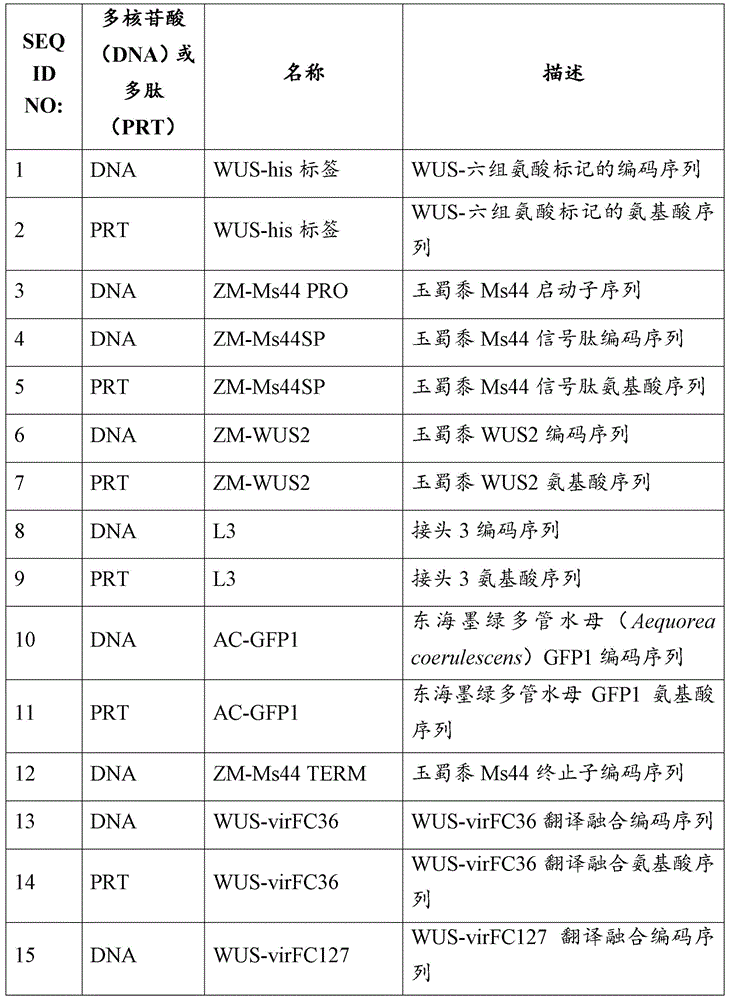
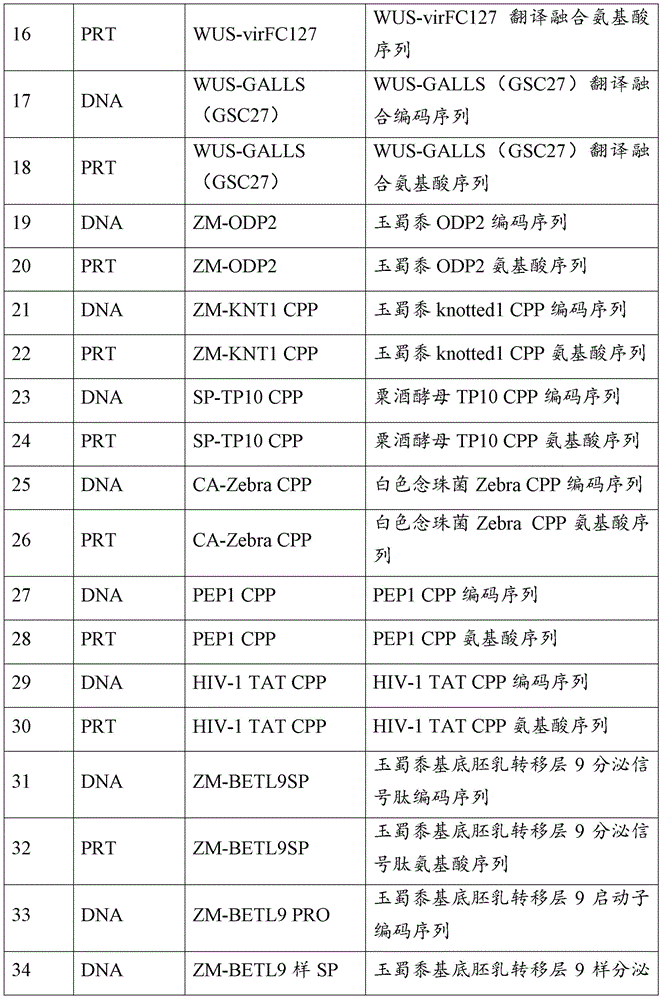


在一方面,所公开的方法和组合物可用于以提高的效率和速度向植物细胞和器官引入多核苷酸,所述多核苷酸可用于靶向源自体细胞胚的植物的基因组中的特定位点以进行修饰。可以用所公开的方法和组合物引入的位点特异性修饰包括使用用于引入位点特异性修饰的任何方法产生的修饰,所述方法包括但不限于通过使用基因修复寡核苷酸(例如美国公开案2013/0019349),或通过使用位点特异性DNA切割技术,如TALEN、大范围核酸酶、锌指核酸酶、CRISPR-Cas等。例如,所公开的方法和组合物可以用于将CRISPR-Cas系统引入植物细胞或植物中,以用于以下目的:对植物或植物细胞的基因组中的靶序列进行基因组修饰,选择植物,缺失碱基或序列,基因编辑,以及将目的多核苷酸插入植物或植物细胞的基因组中。因此,所公开的方法和组合物可以与CRISPR-Cas系统一起使用以提供用于修饰或改变在植物、植物细胞或种子的基因组内的靶位点和目的核苷酸的有效系统。在一方面,所述Cas内切核酸酶基因是植物优化的Cas9内切核酸酶,其中植物优化的Cas9内切核酸酶能够结合植物基因组的基因组靶序列并在其中产生双链断裂。In one aspect, the disclosed methods and compositions are useful for introducing into plant cells and organs polynucleotides useful for targeting specific sites in the genome of plants derived from somatic embryos with increased efficiency and speed. Click to modify. Site-specific modifications that can be introduced using the disclosed methods and compositions include modifications produced using any method for introducing site-specific modifications, including, but not limited to, through the use of gene repair oligonucleotides such as US Publication 2013/0019349), or by using site-specific DNA cleavage techniques such as TALENs, meganucleases, zinc finger nucleases, CRISPR-Cas, etc. For example, the disclosed methods and compositions can be used to introduce a CRISPR-Cas system into a plant cell or plant for the following purposes: Genomic modification of a target sequence in the genome of a plant or plant cell, selection of plants, deletion of bases base or sequence, gene editing, and insertion of a polynucleotide of interest into the genome of a plant or plant cell. Thus, the disclosed methods and compositions can be used with the CRISPR-Cas system to provide an efficient system for modifying or altering target sites and nucleotides of interest within the genome of a plant, plant cell or seed. In one aspect, the Cas endonuclease gene is a plant-optimized Cas9 endonuclease, wherein the plant-optimized Cas9 endonuclease is capable of binding to a genomic target sequence of a plant genome and generating a double-strand break therein.
基因组编辑技术(如锌指核酸酶(ZFN)、转录激活因子样效应子核酸酶(TALEN)或归巢大范围核酸酶)可用于产生靶向基因组扰动。Genome editing technologies such as zinc finger nucleases (ZFNs), transcription activator-like effector nucleases (TALENs), or homing meganucleases can be used to generate targeted genome perturbations.
所述Cas内切核酸酶由指导核苷酸指导来识别特定靶位点处的双链断裂并且任选地将所述双链断裂引入细胞的基因组中。所述CRISPR-Cas系统提供用于修饰植物、植物细胞或种子的基因组内的靶位点的有效系统。进一步提供了使用指导多核苷酸/Cas内切核酸酶系统的方法和组合物,以提供用于修饰细胞基因组内的靶位点和编辑细胞基因组中的核苷酸序列的有效系统。一旦鉴定出基因组靶位点,就可以采用多种方法来进一步修饰靶位点,这样使得它们包含多种目的多核苷酸。所公开的组合物和方法可以用于引入CRISPR-Cas系统,所述系统用于编辑细胞基因组中的核苷酸序列。待编辑的核苷酸序列(目的核苷酸序列)可以位于由Cas内切核酸酶识别的靶位点内部或外部。The Cas endonuclease is directed by a guide nucleotide to recognize a double-strand break at a specific target site and optionally introduce the double-strand break into the genome of the cell. The CRISPR-Cas system provides an efficient system for modifying target sites within the genome of plants, plant cells or seeds. Further provided are methods and compositions using the guide polynucleotide/Cas endonuclease system to provide an efficient system for modifying target sites within the genome of a cell and editing nucleotide sequences in the genome of a cell. Once genomic target sites have been identified, various methods can be used to further modify the target sites so that they contain multiple polynucleotides of interest. The disclosed compositions and methods can be used to introduce a CRISPR-Cas system for editing nucleotide sequences in the genome of a cell. The nucleotide sequence to be edited (the nucleotide sequence of interest) may be located inside or outside the target site recognized by the Cas endonuclease.
CRISPR基因座(规律间隔成簇短回文重复序列)(又称SPIDR-间隔区散在同向重复序列)构成最近描述的DNA基因座的家族。CRISPR基因座由部分回文的短而高度保守的DNA重复序列(通常为24至40bp,重复从1至140次,也称为CRISPR重复序列)组成。重复序列(通常具有物种特异性)由恒定长度的可变序列(通常为20至58,依赖于CRISPR基因座(WO2007/025097,2007年3月1日公开))间隔。CRISPR loci (clustered regularly interspaced short palindromic repeats) (also known as SPIDR-spacer interspersed direct repeats) constitute a recently described family of DNA loci. CRISPR loci consist of short, highly conserved DNA repeats that are partially palindromic (typically 24 to 40 bp and repeated from 1 to 140 times, also known as CRISPR repeats). Repeated sequences (often species-specific) are spaced by variable sequences of constant length (typically 20 to 58, depending on the CRISPR locus (WO2007/025097, published March 1, 2007)).
Cas基因包括通常与侧翼CRISPR基因座偶合、相关或相近或相邻的基因。术语“Cas基因”和“CRISPR相关的(Cas)基因”在本文中可互换地使用。Cas genes include genes that are often coupled to, related to, or close to or adjacent to flanking CRISPR loci. The terms "Cas gene" and "CRISPR-associated (Cas) gene" are used interchangeably herein.
Cas内切核酸酶涉及由Cas基因编码的Cas蛋白质,其中所述Cas蛋白质能够将双链断裂引入DNA靶序列中。Cas内切核酸酶由指导多核苷酸指导来识别特定靶位点处的双链断裂并且任选地将所述双链断裂引入细胞的基因组中。如本文所用,术语“指导多核苷酸/Cas内切核酸酶系统”包括能够将双链断裂引入DNA靶序列的Cas内切核酸酶和指导多核苷酸的复合物。当由指导核苷酸识别靶序列时,Cas内切核酸酶紧邻基因组靶位点解开DNA双链体,并且切割两个DNA链,但前提是正确的前间区序列邻近基序(PAM)被大致定向在靶序列的3’端(参见2015年2月26日公开的WO/2015/026883的图2A和图2B)。在一方面,Cas内切核酸酶基因是Cas9内切核酸酶。The Cas endonuclease involves the Cas protein encoded by the Cas gene, wherein the Cas protein is capable of introducing a double-strand break into a DNA target sequence. The Cas endonuclease is directed by a guide polynucleotide to recognize a double-strand break at a specific target site and optionally introduce the double-strand break into the genome of the cell. As used herein, the term "guide polynucleotide/Cas endonuclease system" includes a complex of a Cas endonuclease and a guide polynucleotide capable of introducing a double strand break into a DNA target sequence. Upon recognition of the target sequence by a guide nucleotide, the Cas endonuclease unwinds the DNA duplex in close proximity to the genomic target site and cleaves both DNA strands, but only if the correct protospacer adjacent motif (PAM) is present is oriented approximately 3' to the target sequence (see Figures 2A and 2B of WO/2015/026883 published February 26, 2015). In one aspect, the Cas endonuclease gene is a Cas9 endonuclease.
在另一方面,Cas内切核酸酶基因是植物、玉米或大豆优化的Cas9内切核酸酶,如但不限于US2016/0208272的图1A中所示的那些,并且通过引用并入本文。In another aspect, the Cas endonuclease gene is a plant, corn or soybean optimized Cas9 endonuclease, such as, but not limited to, those shown in Figure 1A of US2016/0208272, and incorporated herein by reference.
术语“Cas蛋白”或“Cas内切核酸酶”或“Cas核酶”或“Cas多肽”是指由Cas(CRISPR-相关的)基因编码的多肽。Cas蛋白包括但不限于Cas9蛋白、Cas9直系同源物、Cpfl(Cas12)蛋白、C2c1蛋白、C2c2蛋白、C2c3蛋白、Cas3、Cas3-HD、Cas 5、Cas7、Cas8、Cas10或这些的组合或复合物。当与适合的多核苷酸组分复合时,Cas蛋白可以是能够识别、结合特定多核苷酸靶序列的全部或部分、并任选地使特定多核苷酸靶序列的全部或部分产生切口或切割特定多核苷酸靶序列的全部或部分的“Cas内切核酸酶”。本文描述的Cas内切核酸酶包含一个或多个核酸酶结构域。Cas蛋白被进一步定义为天然Cas蛋白的功能性片段或功能性变体,或与天然Cas蛋白的至少50个、50至100个、至少100个、100至150个、至少150个、150至200个、至少200个、200至250个、至少250个、250至300个、至少300个、300至350个、至少350个、350至400个、至少400个、400至450个、至少500个或大于500个连续氨基酸共享至少50%、50%至55%、至少55%、55%至60%、至少60%、60%至65%、至少65%、65%至70%、至少70%、70%至75%、至少75%、75%至80%、至少80%、80%至85%、至少85%、85%至90%、至少90%、90%至95%、至少95%、95%至96%、至少96%、96%至97%、至少97%、97%至98%、至少98%、98%至99%、至少99%、99%至100%或100%的序列同一性并且保留至少部分活性的蛋白质。The term "Cas protein" or "Cas endonuclease" or "Cas ribozyme" or "Cas polypeptide" refers to a polypeptide encoded by a Cas (CRISPR-related) gene. Cas proteins include but are not limited to Cas9 proteins, Cas9 orthologs, Cpfl (Cas12) proteins, C2c1 proteins, C2c2 proteins, C2c3 proteins, Cas3, Cas3-HD,
术语“指导RNA/Cas内切核酸酶复合物”、“指导RNA/Cas内切核酸酶系统”、“指导RNA/Cas复合物”、“指导RNA/Cas系统”、“gRNA/Cas复合物”、“gRNA/Cas系统”、“RNA指导的内切核酸酶”和“RGEN”在本文中可互换地使用并且指能够形成复合物的至少一种RNA组分和至少一种Cas内切核酸酶,其中所述指导RNA/Cas内切核酸酶复合物可以将Cas内切核酸酶引导至DNA靶位点,使Cas内切核酸酶能够识别、结合DNA靶位点并任选地使DNA靶位点产生切口或切割(引入单链或双链断裂)DNA靶位点。在一些方面,提供这些组分作为Cas内切核酸酶蛋白和指导RNA的核糖核蛋白复合物(“RNP”)。Terms "guide RNA/Cas endonuclease complex", "guide RNA/Cas endonuclease system", "guide RNA/Cas complex", "guide RNA/Cas system", "gRNA/Cas complex" , "gRNA/Cas system", "RNA-guided endonuclease" and "RGEN" are used interchangeably herein and refer to at least one RNA component and at least one Cas endonucleic acid capable of forming a complex Enzymes, wherein the guide RNA/Cas endonuclease complex can guide the Cas endonuclease to the DNA target site, enabling the Cas endonuclease to recognize, bind to the DNA target site and optionally make the DNA target The site nicks or cuts (introduces a single- or double-strand break) the DNA target site. In some aspects, these components are provided as a Cas endonuclease protein and a ribonucleoprotein complex ("RNP") of guide RNA.
本文描述了在小孢子胚发生期间或对于小孢子胚发生诱导的部分,用CRISPR相关(Cas)内切核酸酶进行基因组编辑的方法。在对指导RNA(或指导多核苷酸)和PAM序列进行表征后,包含Cas内切核酸酶和指导RNA(或指导多核苷酸)的核糖核蛋白(RNP)复合物可用于修饰靶多核苷酸,所述靶多核苷酸包括但不限于:其他生物(包括植物)中的合成DNA、分离的基因组DNA或染色体DNA。为了促进最佳表达和核定位(对于真核细胞),可以如2016年11月24日公开的WO 2016186953中所述将包含Cas内切核酸酶的基因进行优化,然后通过本领域已知的方法将其作为DNA表达盒递送至细胞中。也可以将必需包含活性RNP的组分作为RNA(具有或不具有保护RNA免于降解的修饰)或作为有帽或无帽的mRNA(Zhang,Y.等人,2016,Nat.Commun.[自然通讯]7:12617)或Cas蛋白指导多核苷酸复合物(公开于2017年4月27日的WO 2017070032)、或其任何组合递送。另外,复合物的一个或多个部分可以从DNA构建体表达,而将其他组分作为RNA(具有或不具有保护RNA免于降解的修饰)或以带帽或不带帽的mRNA(Zhang等人2016Nat.Commun.[自然通讯]7:12617)或Cas蛋白指导多核苷酸复合物(公开于2017年4月27日的WO 2017070032)或其任何组合递送。Here we describe a method for genome editing with CRISPR-associated (Cas) endonucleases during microsporogenesis or as part of microsporogenesis induction. After the guide RNA (or guide polynucleotide) and PAM sequence are characterized, a ribonucleoprotein (RNP) complex comprising a Cas endonuclease and guide RNA (or guide polynucleotide) can be used to modify the target polynucleotide , said target polynucleotides include, but are not limited to: synthetic DNA, isolated genomic DNA or chromosomal DNA in other organisms (including plants). In order to facilitate optimal expression and nuclear localization (for eukaryotic cells), the gene comprising the Cas endonuclease can be optimized as described in WO 2016186953 published on November 24, 2016, followed by methods known in the art It is delivered into cells as a DNA expression cassette. Components that must contain active RNPs can also be presented as RNA (with or without modifications that protect the RNA from degradation) or as capped or uncapped mRNA (Zhang, Y. et al., 2016, Nat. Commun. [Nature Communication] 7: 12617) or the Cas protein directs the delivery of the polynucleotide complex (WO 2017070032 published on April 27, 2017), or any combination thereof. Alternatively, one or more parts of the complex can be expressed from a DNA construct, while the other components are expressed as RNA (with or without modifications that protect the RNA from degradation) or as capped or uncapped mRNA (Zhang et al. 2016 Nat. Commun. [Nature Communications] 7: 12617) or the Cas protein directs the delivery of the polynucleotide complex (WO 2017070032 published on April 27, 2017) or any combination thereof.
关于Cas内切核酸酶,术语“功能片段”、“功能上等效的片段”和“功能等效片段”在本文中可互换使用。这些术语意指本公开的Cas内切核酸酶序列的一部分或子序列,其中产生双链断裂的能力被保留。With respect to Cas endonucleases, the terms "functional fragment", "functionally equivalent fragment" and "functionally equivalent fragment" are used interchangeably herein. These terms mean a portion or subsequence of the Cas endonuclease sequence of the present disclosure, wherein the ability to make double strand breaks is retained.
关于Cas内切核酸酶,术语“功能变体”、“功能上等效的变体”和“功能等效变体”在本文中可互换使用。这些术语意指本公开的Cas内切核酸酶的变体,其中产生双链断裂的能力被保留。这些片段和变体可以经由例如定点诱变和合成构建等方法来获得。With respect to Cas endonucleases, the terms "functional variant", "functionally equivalent variant" and "functionally equivalent variant" are used interchangeably herein. These terms mean variants of the Cas endonucleases of the disclosure wherein the ability to make double-strand breaks is retained. These fragments and variants can be obtained via methods such as site-directed mutagenesis and synthetic construction.
除了双链断裂诱导剂,还可以实现位点特异性碱基转化,以工程化一个或多个核苷酸变化,从而在基因组中创建一个或多个编辑。这些包括例如,由C·G至T·A或A·T至G·C碱基编辑脱氨酶介导的位点特异性碱基编辑(Gaudelli等人,Programmable baseediting of A·T to G·C in genomic DNA without DNA cleavage[在无DNA切割时基因组DNA中A·T至G·C的可编程碱基编辑].″Nature[自然](2017);Nishida等人“Targetednucleotide editing using hybrid prokaryotic and vertebrate adaptive immunesystems[使用杂交体原核和脊椎动物适应性免疫系统进行靶向核苷酸编辑].”Science[科学]353(6305)(2016);Komor等人“Programmable editing of a target base in genomicDNA without double-stranded DNA cleavage[在无双链DNA切割时基因组DNA中靶碱基的可编程编辑].”Nature[自然]533(7603)(2016):420-4。与胞苷脱氨酶或腺嘌呤脱氨酶蛋白融合的催化“死亡”或失活Cas9(dCas9)(例如本文公开的Cas9直向同源物的催化失活“死亡”形式)成为特异性的碱基编辑器,其可以改变DNA碱基而不会诱导DNA断裂。碱基编辑器转换C->T(或在相反链上,G->A)或腺嘌呤碱基编辑器将腺嘌呤转换为肌苷,从而在gRNA指定的编辑窗口内导致A->G变化。In addition to double-strand break-inducing agents, site-specific base conversions can be achieved to engineer one or more nucleotide changes to create one or more edits in the genome. These include, for example, site-specific base editing mediated by C.G to T.A or A.T to G.C base editing deaminases (Gaudelli et al., Programmable basedediting of A.T to G. C in genomic DNA without DNA cleavage[Programmable base editing from A T to G C in genomic DNA without DNA cleavage]. ″Nature [Natural] (2017); Nishida et al. “Targetednucleotide editing using hybrid prokaryotic and vertebrate adaptive immunesystems [Targeted nucleotide editing using hybrid prokaryotic and vertebrate adaptive immune systems]." Science [science] 353 (6305) (2016); Komor et al. "Programmable editing of a target base in genomicDNA without double-stranded DNA cleavage [Programmable editing of target bases in genomic DNA without double-stranded DNA cleavage]. "Nature [Natural] 533(7603) (2016): 420-4. With cytidine deaminase or adenine Catalytically "dead" or inactive Cas9 (dCas9) fused to deaminase proteins (such as the catalytically inactive "dead" forms of Cas9 orthologs disclosed herein) become specific base editors that can alter DNA base without inducing DNA breaks. A base editor converts C->T (or on the opposite strand, G->A) or an adenine base editor converts adenine to inosine, thereby creating A->G changes in the editing window.
如本文所用,术语“指导核苷酸”涉及两个RNA分子-包含可变靶向结构域的crRNA(CRISPR RNA)和tracrRNA的合成性融合。在一方面,所述指导核苷酸包含12至30个核苷酸序列的可变靶向结构域和可以与Cas内切核酸酶相互作用的RNA片段。As used herein, the term "guide nucleotide" refers to the synthetic fusion of two RNA molecules - crRNA (CRISPR RNA) and tracrRNA comprising a variable targeting domain. In one aspect, the guide nucleotides comprise a variable targeting domain of 12 to 30 nucleotide sequences and an RNA segment that can interact with the Cas endonuclease.
如本文所用,术语“指导多核苷酸”涉及可以与Cas内切核酸酶形成复合物的多核苷酸序列,并且使得Cas内切核酸酶能够识别并任选地切割DNA靶位点。指导多核苷酸可以是单分子或双分子。指导多核苷酸序列可以是RNA序列、DNA序列或其组合(RNA-DNA组合序列)。任选地,指导多核苷酸可以包含至少一种核苷酸、磷酸二酯键或连接修饰,例如但不限于锁核酸(LNA)、5-甲基dC、2,6-二氨基嘌呤、2′-氟代A、2′-氟代U、2′-O-甲基RNA、硫代磷酸酯键、与胆固醇分子的连接、与聚乙二醇分子的连接、与间隔子18(六乙二醇链)分子的连接、或导致环化的5′至3′共价连接。仅包含核糖核酸的指导多核苷酸也被称为“指导核苷酸”。As used herein, the term "guide polynucleotide" relates to a polynucleotide sequence that can form a complex with a Cas endonuclease and enable the Cas endonuclease to recognize and optionally cleave a DNA target site. A guide polynucleotide can be unimolecular or bimolecular. A guide polynucleotide sequence can be an RNA sequence, a DNA sequence, or a combination thereof (RNA-DNA combined sequence). Optionally, the guide polynucleotide may comprise at least one nucleotide, phosphodiester bond, or linkage modification such as, but not limited to, locked nucleic acid (LNA), 5-methyl dC, 2,6-diaminopurine, 2 '-fluoro A, 2'-fluoro U, 2'-O-methyl RNA, phosphorothioate bond, connection with cholesterol molecule, connection with polyethylene glycol molecule, connection with spacer 18 (hexaethylene diol chain) molecules, or a 5' to 3' covalent linkage leading to cyclization. A guide polynucleotide comprising only ribonucleic acid is also referred to as a "guide nucleotide".
指导多核苷酸可以是双分子(也被称为双链体指导多核苷酸),其包含与靶DNA中的核苷酸序列互补的第一核苷酸序列结构域(被称为可变靶向结构域或VT结构域)和与Cas内切核酸酶多肽相互作用的第二核苷酸序列结构域(被称为Cas内切核酸酶识别结构域或CER结构域)。双分子指导多核苷酸的CER结构域包含沿着互补区域杂交的两个单独的分子。两个单独的分子可以是RNA、DNA和/或RNA-DNA组合序列。在一方面,包含连接到CER结构域的VT结构域的双链体指导多核苷酸的第一个分子被称为“crDNA”(当由DNA核苷酸的连续延伸构成时)或“crRNA”(当由RNA核苷酸的连续延伸构成时)或“crDNA-RNA”(当由DNA和RNA核苷酸的组合构成时)。所述cr核苷酸可以包含天然存在于细菌和古细菌中的cRNA的片段。在一方面,存在于在此公开的cr核苷酸中的在细菌和古细菌中天然存在的cRNA的片段的大小范围可以是,但并不限于2、3、4、5、6、7、8、9、10、11、12、13、14、15、16、17、18、19、20或更多个核苷酸。The guide polynucleotide may be a bimolecule (also known as a duplex guide polynucleotide) comprising a first nucleotide sequence domain (known as the variable target sequence) that is complementary to a nucleotide sequence in the target DNA. domain or VT domain) and a second nucleotide sequence domain (referred to as the Cas endonuclease recognition domain or CER domain) that interacts with the Cas endonuclease polypeptide. The CER domain of a bimolecular directing polynucleotide comprises two separate molecules that hybridize along complementary regions. The two separate molecules can be RNA, DNA and/or combined RNA-DNA sequences. In one aspect, the first molecule of the duplex guide polynucleotide comprising the VT domain linked to the CER domain is referred to as "crDNA" (when composed of a continuous stretch of DNA nucleotides) or "crRNA" (when consisting of a continuous stretch of RNA nucleotides) or "crDNA-RNA" (when consisting of a combination of DNA and RNA nucleotides). The cr nucleotides may comprise fragments of cRNA naturally occurring in bacteria and archaea. In one aspect, fragments of naturally occurring cRNA in bacteria and archaea present in the cr nucleotides disclosed herein may range in size from, but are not limited to, 2, 3, 4, 5, 6, 7, 8, 9, 10, 11, 12, 13, 14, 15, 16, 17, 18, 19, 20 or more nucleotides.
在一方面,包含CER结构域的双链体指导多核苷酸的第二个分子被称为“tracrRNA”(当由RNA核苷酸的连续延伸构成时)或“tracrDNA”(当由DNA核苷酸的连续延伸构成时)或“tracrDNA-RNA”(当由DNA和RNA核苷酸的组合构成时。在一方面,指导RNA/Cas9内切核酸酶复合物的RNA是包含双链体crRNA-tracrRNA的双链体化的RNA。In one aspect, the second molecule of the duplex guide polynucleotide comprising the CER domain is referred to as "tracrRNA" (when composed of a continuous stretch of RNA nucleotides) or "tracrDNA" (when composed of DNA nucleosides). acid) or "tracrDNA-RNA" (when composed of a combination of DNA and RNA nucleotides. In one aspect, the RNA of the guide RNA/Cas9 endonuclease complex is a duplex comprising the crRNA- tracrRNA is duplexed RNA.
指导多核苷酸还可以是单分子,其包含与靶DNA中的核苷酸序列互补的第一核苷酸序列结构域(称为可变靶向结构域或VT结构域)和与Cas内切核酸酶多肽相互作用的第二核苷酸结构域(称为Cas内切核酸酶识别结构域或CER结构域)。“结构域”意指可以为RNA、DNA和/或RNA-DNA组合序列的核苷酸的连续延伸。单指导多核苷酸的VT结构域和/或CER结构域可以包含RNA序列、DNA序列或RNA-DNA组合序列。在一方面,单指导多核苷酸包含连接到tracr核苷酸(包含CER结构域)的cr核苷酸(包含与CER结构域连接的VT结构域),其中所述连接是包含RNA序列、DNA序列或RNA-DNA组合序列的核苷酸序列。包含来自cr核苷酸和tracr核苷酸的序列的单指导多核苷酸可以被称为“单指导核苷酸”(当由RNA核苷酸的连续延伸构成时)或“单指导DNA”(当由DNA核苷酸的连续延伸构成时)或“单指导核苷酸-DNA”(当由RNA和DNA核苷酸的组合构成时)。在本公开的一方面,单指导核苷酸包含可以与II型Cas内切核酸酶形成复合物的II型CRISPR/Cas系统的cRNA或cRNA片段和tracrRNA或tracrRNA片段,其中所述指导核苷酸/Cas内切核酸酶复合物可以将Cas内切核酸酶指导至植物基因组靶位点,使得Cas内切核酸酶能够将双链断裂引入基因组靶位点。使用单指导多核苷酸对比双链体指导多核苷酸的一个方面是,为了表达单指导多核苷酸,仅需要制造一个表达盒。The guide polynucleotide can also be a single molecule comprising a first nucleotide sequence domain (called a variable targeting domain or VT domain) complementary to a nucleotide sequence in the target DNA and a Cas endonuclease domain. A second nucleotide domain (called the Cas endonuclease recognition domain or CER domain) that nuclease-polypeptide interacts with. "Domain" means a contiguous stretch of nucleotides which may be an RNA, DNA and/or combined RNA-DNA sequence. The VT domain and/or the CER domain of a single guide polynucleotide may comprise an RNA sequence, a DNA sequence or a combined RNA-DNA sequence. In one aspect, a single guide polynucleotide comprises a cr nucleotide (comprising a VT domain linked to a CER domain) linked to a tracr nucleotide (comprising a CER domain), wherein said linking is a sequence comprising RNA, DNA sequence or the nucleotide sequence of an RNA-DNA combination sequence. A single guide polynucleotide comprising a sequence from cr nucleotides and tracr nucleotides may be referred to as a "single guide nucleotide" (when composed of a contiguous stretch of RNA nucleotides) or a "single guide DNA" ( when consisting of a continuous stretch of DNA nucleotides) or "single guide nucleotide-DNA" (when consisting of a combination of RNA and DNA nucleotides). In one aspect of the disclosure, the single guide nucleotide comprises a cRNA or cRNA fragment and a tracrRNA or a tracrRNA fragment of a Type II CRISPR/Cas system that can form a complex with a Type II Cas endonuclease, wherein the guide nucleotide The Cas/Cas endonuclease complex can guide the Cas endonuclease to the plant genome target site, so that the Cas endonuclease can introduce a double-strand break into the genome target site. One aspect of using a single guide polynucleotide versus a duplex guide polynucleotide is that in order to express a single guide polynucleotide, only one expression cassette needs to be made.
术语“可变靶向结构域”或“VT结构域”在此可互换地使用,并且包括与双链DNA靶位点的一个链(核苷酸序列)互补的核苷酸序列。第一个核苷酸序列结构域(VT结构域)与靶序列之间的互补%可以为至少50%、51%、52%、53%、54%、55%、56%、57%、58%、59%、60%、61%、62%、63%、63%、65%、66%、67%、68%、69%、70%、71%、72%、73%、74%、75%、76%、77%、78%、79%、80%、81%、82%、83%、84%、85%、86%、87%、88%、89%、90%、91%、92%、93%、94%、95%、96%、97%、98%、99%或100%。可变靶结构域的长度可以是至少12、13、14、15、16、17、18、19、20、21、22、23、24、25、26、27、28、29或30个核苷酸。在一方面,可变靶向结构域包含12至30个核苷酸的连续延伸。可变靶向结构域可以由DNA序列、RNA序列、修饰的DNA序列、修饰的RNA序列或其任何组合构成。The terms "variable targeting domain" or "VT domain" are used interchangeably herein and include a nucleotide sequence that is complementary to one strand (nucleotide sequence) of a double-stranded DNA target site. The % complementarity between the first nucleotide sequence domain (VT domain) and the target sequence may be at least 50%, 51%, 52%, 53%, 54%, 55%, 56%, 57%, 58% %, 59%, 60%, 61%, 62%, 63%, 63%, 65%, 66%, 67%, 68%, 69%, 70%, 71%, 72%, 73%, 74%, 75%, 76%, 77%, 78%, 79%, 80%, 81%, 82%, 83%, 84%, 85%, 86%, 87%, 88%, 89%, 90%, 91% , 92%, 93%, 94%, 95%, 96%, 97%, 98%, 99%, or 100%. The variable target domain can be at least 12, 13, 14, 15, 16, 17, 18, 19, 20, 21, 22, 23, 24, 25, 26, 27, 28, 29 or 30 nucleosides in length acid. In one aspect, the variable targeting domain comprises a contiguous stretch of 12 to 30 nucleotides. Variable targeting domains can be composed of DNA sequences, RNA sequences, modified DNA sequences, modified RNA sequences, or any combination thereof.
术语指导多核苷酸的“Cas内切核酸酶识别结构域”或“CER结构域”在此可互换地使用,并且包括与Cas内切核酸酶多肽相互作用的核苷酸序列(例如指导多核苷酸的第二核苷酸序列结构域)。CER结构域可以由DNA序列、RNA序列、修饰的DNA序列、修饰的RNA序列(参见例如本文所述的修饰)或其任何组合构成。The terms "Cas endonuclease recognition domain" or "CER domain" of a guide polynucleotide are used interchangeably herein and include nucleotide sequences that interact with a Cas endonuclease polypeptide (e.g., guide polynuclease The second nucleotide sequence domain of the nucleotide). A CER domain can be composed of a DNA sequence, an RNA sequence, a modified DNA sequence, a modified RNA sequence (see, eg, modifications described herein), or any combination thereof.
在本公开的一方面,指导核苷酸包含II型CRISPR/Cas系统中的可以与II型Cas内切核酸酶形成复合物的cRNA(或cRNA片段)和tracrRNA(或tracrRNA片段),其中所述指导核苷酸/Cas内切核酸酶复合物可以将Cas内切核酸酶指导至植物基因组靶位点,使得Cas内切核酸酶能够将双链断裂引入基因组靶位点。可以使用本领域已知的任何方法(例如但不限于粒子轰击或局部应用)将指导核苷酸直接引入植物或植物细胞。In one aspect of the present disclosure, the guide nucleotides comprise cRNA (or cRNA fragment) and tracrRNA (or tracrRNA fragment) that can form a complex with type II Cas endonuclease in the type II CRISPR/Cas system, wherein said The guide nucleotide/Cas endonuclease complex can guide the Cas endonuclease to the plant genome target site, so that the Cas endonuclease can introduce a double-strand break into the genome target site. Guide nucleotides can be introduced directly into plants or plant cells using any method known in the art, such as, but not limited to, particle bombardment or topical application.
在一方面,还可以通过引入重组DNA分子间接地引入指导核苷酸,所述重组DNA分子包含可操作地连接到植物特异性启动子的相应指导DNA序列,所述植物特异性启动子能够在植物细胞中转录所述指导核苷酸。术语“相应指导DNA”包括与RNA分子相同的,但其中“T”取代RNA分子的每个“U”的DNA分子。In one aspect, the guide nucleotides can also be introduced indirectly by introducing a recombinant DNA molecule comprising a corresponding guide DNA sequence operably linked to a plant-specific promoter capable of The guide nucleotides are transcribed in plant cells. The term "corresponding guide DNA" includes DNA molecules that are identical to RNA molecules, but wherein a "T" replaces each "U" of the RNA molecule.
在一方面,经由粒子轰击或使用所公开的用于重组DNA构建体的农杆菌转化的方法和组合物来引入所述指导核苷酸,所述重组DNA构建体包含可操作地连接到植物U6聚合酶III启动子的相应指导DNA。In one aspect, the guide nucleotides are introduced via particle bombardment or using the disclosed methods and compositions for Agrobacterium transformation of recombinant DNA constructs comprising Corresponding guide DNA for the polymerase III promoter.
基于保守的序列基序将大范围核酸酶分类为四个家族,所述家族是LAGLIDADG、GIY-YIG、H-N-H、和His-Cys box家族。这些基序参与金属离子的配位和磷酸二酯键的水解。大范围核酸酶的显著之处在于它们的长识别位点,并且还在于耐受其DNA底物中的一些序列多态性。对于大范围核酸酶的命名约定相似于对其他限制性内切核酸酶的约定。大范围核酸酶还分别表征为针对由独立的ORF、内含子、和内含肽编码的酶的前缀F-、I-、或PI-。在重组过程中的一个步骤涉及在识别位点处或在所述识别位点附近的多核苷酸切割。该切割活性可用于产生双链断裂。对于位点特异性重组酶和它们的识别位点的综述,参见,Sauer(1994)Curr Op Biotechnol[生物技术新见]5:521-7;以及Sadowski(1993)FASEB[美国实验生物学学会联合会杂志]7:760-7。在一些实例中,重组酶来自整合酶(Integrase)或解离酶(Resolvase)家族。TAL效应子核酸酶是一类新的序列特异性核酸酶,其可以被用于在植物或其他生物的基因组中特异性靶序列处造成双链断裂。(Miller,等人(2011)NatureBiotechnology[自然生物技术]29:143-148)。Meganucleases are classified into four families based on conserved sequence motifs, which are the LAGLIDADG, GIY-YIG, H-N-H, and His-Cys box families. These motifs are involved in the coordination of metal ions and the hydrolysis of phosphodiester bonds. Meganucleases are notable for their long recognition sites and also for their tolerance to some sequence polymorphisms in their DNA substrates. The naming convention for meganucleases is similar to that for other restriction endonucleases. Meganucleases are also characterized by the prefixes F-, I-, or PI- for enzymes encoded by separate ORFs, introns, and inteins, respectively. One step in the recombination process involves cleavage of the polynucleotide at or near the recognition site. This cleavage activity can be used to generate double-strand breaks. For a review of site-specific recombinases and their recognition sites, see, Sauer (1994) Curr Op Biotechnol [News in Biotechnology] 5:521-7; and Sadowski (1993) FASEB [Federation of the American Society for Experimental Biology]. Society Journal] 7:760-7. In some examples, the recombinase is from the Integrase or Resolvase family. TAL effector nucleases are a new class of sequence-specific nucleases that can be used to create double-strand breaks at specific target sequences in the genome of plants or other organisms. (Miller, et al. (2011) Nature Biotechnology 29:143-148).
锌指核酸酶(ZFN)是由锌指DNA结合结构域和双链-断裂-诱导剂结构域组成的工程化双链断裂诱导剂。识别位点特异性由锌指结构域赋予,所述锌指结构域典型地包含两个、三个、或四个锌指,例如具有C2H2结构,然而其他锌指结构是已知的并且已经被工程化。锌指结构域适于设计特异性结合所选择的多核苷酸识别序列的多肽。ZFN包括连接至非特异性内切核酸酶结构域(例如来自Ms型内切核酸酶,例如Fokl的核酸酶结构域)的工程化DNA结合锌指结构域。另外的功能性可以融合到锌指结合结构域中,这些另外的功能性包括转录激活子结构域、转录抑制子结构域、和甲基化酶。在一些实例中,核酸酶结构域的二聚化是切割活性所需的。每个锌指在靶DNA中识别三个连续的碱基对。例如,3指结构域识别9个连续核苷酸的序列,由于所述核酸酶的二聚化需要,因此两组锌指三联体用于结合18个核苷酸的识别序列。Zinc finger nucleases (ZFNs) are engineered double-strand break inducers consisting of a zinc finger DNA-binding domain and a double-strand-break-inducer domain. Recognition site specificity is conferred by zinc finger domains that typically contain two, three, or four zinc fingers, for example with a C2H2 structure, however other zinc finger structures are known and have been studied. engineered. Zinc finger domains are suitable for designing polypeptides that specifically bind a selected polynucleotide recognition sequence. A ZFN comprises an engineered DNA-binding zinc finger domain linked to a non-specific endonuclease domain, such as that from an Ms-type endonuclease, such as Fokl. Additional functionalities can be fused into the zinc finger binding domains, these additional functionalities include transcriptional activator domains, transcriptional repressor domains, and methylases. In some instances, dimerization of the nuclease domain is required for cleavage activity. Each zinc finger recognizes three consecutive base pairs in the target DNA. For example, a 3-finger domain recognizes a sequence of 9 contiguous nucleotides, as required for dimerization of the nuclease, two sets of zinc finger triplets are used to bind a recognition sequence of 18 nucleotides.
术语“靶位点”、“靶序列”、“靶DNA”、“靶基因座”、“基因组靶位点”、“基因组靶序列”、以及“基因组靶基因座”在本文中可互换地使用,并且意指植物细胞的基因组(包括叶绿体DNA和线粒体DNA)中的多核苷酸序列,在所述多核苷酸序列处通过Cas内切核酸酶在植物细胞基因组中诱导双链断裂。靶位点可以是植物基因组中的内源性位点,或者可替代地,靶位点可以与植物异源,从而不是基因组中天然存在的,或者与其在自然界中存在的地方相比,靶位点可以发现于异源基因组位置中。The terms "target site", "target sequence", "target DNA", "target locus", "genomic target site", "genomic target sequence", and "genomic target locus" are used interchangeably herein As used, and means a polynucleotide sequence in the genome of a plant cell (including chloroplast DNA and mitochondrial DNA) at which a double-strand break is induced in the plant cell genome by the Cas endonuclease. The target site may be an endogenous site in the plant genome, or alternatively, the target site may be heterologous to the plant, such that it does not naturally occur in the genome, or is different from where it occurs in nature. Spots can be found in heterologous genomic locations.
如本文所用,术语“内源性靶序列”和“天然靶序列”在本文中可互换地使用,从而意指对于植物的基因组是内源的或天然的靶序列,并且是在植物的基因组中靶序列的内源或天然位置处。在一方面,所述靶位点可以相似于由双链断裂诱导剂,例如LIG3-4内切核酸酶(美国专利公开2009-0133152A1(2009年5月21日公开))或MS26++大范围核酸酶(2012年6月19日提交的美国专利申请13/526912)特异性识别和/或结合的DNA识别位点或靶位点。As used herein, the terms "endogenous target sequence" and "native target sequence" are used interchangeably herein to mean a target sequence that is endogenous or native to the plant's genome and that is present in the plant's genome endogenous or native location of the target sequence. In one aspect, the target site can be similar to that produced by a double-strand break-inducing agent, such as LIG3-4 endonuclease (US Patent Publication 2009-0133152A1 (published May 21, 2009)) or MS26++ meganuclease. (
“人工靶位点”或“人工靶序列”在本文中可互换地使用,并且意指已经引入植物基因组中的靶序列。此类人工靶序列可以在序列上与植物的基因组中的内源性或天然靶序列相同,但是位于植物的基因组中的不同位置(即,非内源性的或非天然的位置)处。"Artificial target site" or "artificial target sequence" are used interchangeably herein and mean a target sequence that has been introduced into the genome of a plant. Such an artificial target sequence may be identical in sequence to an endogenous or native target sequence in the plant's genome, but located at a different location (ie, a non-endogenous or non-natural location) in the plant's genome.
“改变的靶位点”、“改变的靶序列”、“修饰的靶位点”和“修饰的靶序列”在本文中可互换地使用,并且是指如本文公开的靶序列:所述靶序列当与未改变的靶序列相比时包含至少一种改变。此类“改变”包括,例如:(i)至少一个核苷酸的替代、(ii)至少一个核苷酸的缺失、(iii)至少一个核苷酸的插入、或(iv)(i)-(iii)的任何组合。"Altered target site", "altered target sequence", "modified target site" and "modified target sequence" are used interchangeably herein and refer to a target sequence as disclosed herein: A target sequence comprises at least one alteration when compared to an unaltered target sequence. Such "alterations" include, for example: (i) substitution of at least one nucleotide, (ii) deletion of at least one nucleotide, (iii) insertion of at least one nucleotide, or (iv) (i)- any combination of (iii).
以下实例是通过说明的方式但不是通过限制的方式来提供的。The following examples are offered by way of illustration and not by way of limitation.
实例example
本公开的多个方面在以下实例中被进一步定义,其中除非另有说明,否则份数和百分数以重量计,并且度数以摄氏度计。尽管这些实例说明了本公开的多个方面,但仅是通过说明的方式给出的。从以上的讨论和这些实例中,本领域的技术人员能够确定本公开的多个方面的本质特性,并且在不脱离本公开的精神和范围的情况下,可进行它们的各种变化和修改以使其适应各种用途和条件。因此,从上述说明书来看,除了本文所示出和描述的那些之外,各种修改对于本领域技术人员来说将是清楚的。此类修改也当视为落入所附权利要求的范围内。Aspects of the present disclosure are further defined in the following examples, wherein parts and percentages are by weight and degrees are in degrees Celsius unless otherwise indicated. While these examples illustrate various aspects of the disclosure, they are given by way of illustration only. From the above discussion and these Examples, one skilled in the art can ascertain the essential characteristics of the aspects of this disclosure, and, without departing from the spirit and scope of the disclosure, can make various changes and modifications thereof to further Adapt it to various uses and conditions. Accordingly, various modifications in addition to those shown and described herein will become apparent to those skilled in the art from the foregoing description. Such modifications are also considered to fall within the scope of the appended claims.
实例1Example 1
胚发生诱导剂处理后小孢子胚发生改善Improvement of microspore embryogenesis after embryogenesis inducer treatment
在分离小孢子之后,将ATCC40520小孢子(参见US 5,602,310,通过引用以其整体并入本文)在培养皿中在作为对照的9%蔗糖诱导培养基或补充有1μM终浓度的氯化血红素(西格玛-奥德里奇公司(Sigma-A1drich),目录号H9039)的9%蔗糖诱导培养基中在黑暗条件下在28℃下培养。After isolation of microspores, ATCC40520 microspores (see US 5,602,310, incorporated herein by reference in its entirety) were cultured in culture dishes in 9% sucrose induction medium as a control or supplemented with 1 μM final concentration of hemin ( Sigma-Aldrich (Cat. No. H9039) in 9% sucrose induction medium at 28° C. in the dark.
体外组织培养8天后,从对照和氯化血红素处理的ATCC40520组织培养物(以用于胚发生诱导)中的每个取得增殖胚样结构的四个生物重复样品,并且处理以用于使用本领域已知的方法进行基因表达分析(数据未显示)。After 8 days of in vitro tissue culture, four biological replicates of proliferating embryo-like structures were taken from each of control and hemin-treated ATCC40520 tissue cultures (for embryogenesis induction) and processed for use in this study. Gene expression analysis was performed by methods known in the art (data not shown).
在分离小孢子之后,ATCC40520小孢子和EH(优良近交的,已知相对于ATCC40520基因型响应性较低)各自分别在培养皿中在作为对照的9%蔗糖诱导培养基或补充有1μM终浓度的氯化血红素的9%蔗糖诱导培养基中在黑暗条件下在28℃下培养。After isolation of microspores, ATCC40520 microspores and EH (excellent inbred, known to be less responsive relative to the ATCC40520 genotype) were each cultured separately in culture dishes in either 9% sucrose induction medium as a control or supplemented with 1 μM final Concentration of hemin in 9% sucrose induction medium at 28 °C in the dark.
处理(+/-氯化血红素)21天后,对ATCC40520和EH的小孢子表型进行评价。当观察到在周围完整的外壁中随机定向分裂而产生的单细胞衍生结构时,对多细胞结构(MCS)表型进行评价。如果周围的外壁破裂并且观察到细胞释放,则将响应记为增殖性胚样结构(ELS)。ATCC40520 and EH were evaluated for microspore phenotype after 21 days of treatment (+/- hemin). Multicellular structure (MCS) phenotypes were assessed when single cell-derived structures arising from random directed division in the surrounding intact exine were observed. If the surrounding exine wall was ruptured and cell release was observed, the response was scored as proliferative embryo-like structures (ELS).
如图1A(对照)和图1B(氯化血红素处理)所示,ATCC40520小孢子的氯化血红素处理增加了细胞增殖和胚样结构(ELS)的发育。处理(+/-氯化血红素)21天后,ELS的数量在响应性培养物中大约加倍。此外,如图1B所示,如通过球形胚状体比例的增加和非球形胚状体比例的降低所证明的,氯化血红素处理改善了胚样结构的质量。As shown in Figure 1A (control) and Figure 1B (hemin treatment), hemin treatment of ATCC40520 microspores increased cell proliferation and development of embryo-like structures (ELS). After 21 days of treatment (+/- hemin), the number of ELSs approximately doubles in the responsive cultures. Furthermore, as shown in Figure 1B, hemin treatment improved the quality of embryoid-like structures as evidenced by an increase in the proportion of spherical embryoid bodies and a decrease in the proportion of non-spherical embryoid bodies.
如图1C所示,由相对于花粉相关转录物的相应减少的表达而言胚发生转录物增加的表达所指示的,对照和氯化血红素处理的ATCC40520小孢子的相应基因表达分析示出改善的细胞重编程命运。As shown in Figure 1C, corresponding gene expression analysis of control and hemin-treated ATCC40520 microspores showed improved expression as indicated by increased expression of embryogenic transcripts relative to corresponding decreased expression of pollen-associated transcripts. cell reprogrammed fate.
如图1D(对照)和图1E(氯化血红素处理)所示,在培养21天后,近交EH小孢子的氯化血红素处理增加了响应培养物中的细胞增殖。如图1F所示,相对于近交对照EH小孢子,氯化血红素处理增加了用MCS表型和ELS表型评价的近交EH小孢子的百分比。As shown in Figure ID (control) and Figure IE (hemin treatment), hemin treatment of inbred EH microspores increased cell proliferation in responding cultures after 21 days in culture. As shown in Figure 1F, hemin treatment increased the percentage of inbred EH microspores as assessed by the MCS phenotype and the ELS phenotype relative to inbred control EH microspores.
在分离小孢子之后,将ATCC40520小孢子在培养皿中在作为对照的9%蔗糖诱导培养基或补充有变化浓度的小分子化合物的9%蔗糖诱导培养基中进行培养,所述小分子化合物包括:N-[(2R)-2,3-二羟基丙氧基]-3,4-二氟-2-(2-氟-4-碘代苯胺基)苯甲酰胺,本文称为“PD0325901”(ESI BIO 1010大西洋大街,102幢,阿拉米达,加利福尼亚州94501)、蒽(1,9-cd)吡唑-6(2H)-酮,本文称为“SP600125”(ESI BIO 1010大西洋大街,102幢,阿拉米达,加利福尼亚州94501)、4-(4-氟苯基)-2-(4-甲基亚磺酰基苯基)-5-(4-吡啶基)1H-咪唑,本文称为“SB203580”(ESI BIO 1010大西洋大街,102幢,阿拉米达,加利福尼亚州94501)和N-苄基-2-(嘧啶-4-基氨基)-1,3-噻唑-4-甲酰胺,本文称为“噻唑维”(ESI BIO1010大西洋大街,102幢,阿拉米达,加利福尼亚州94501)。将体外组织培养物在28℃下在黑暗条件下孵育,并且在7天后进行评价。After isolation of microspores, ATCC40520 microspores were cultured in Petri dishes in 9% sucrose induction medium as control or 9% sucrose induction medium supplemented with varying concentrations of small molecule compounds including : N-[(2R)-2,3-dihydroxypropoxy]-3,4-difluoro-2-(2-fluoro-4-iodoanilino)benzamide, referred to herein as "PD0325901" (ESI BIO 1010 Atlantic Avenue, Building 102, Alameda, CA 94501), anthracene(1,9-cd)pyrazol-6(2H)-one, referred to herein as "SP600125" (ESI BIO 1010 Atlantic Avenue, Building 102, Alameda, CA 94501), 4-(4-fluorophenyl)-2-(4-methylsulfinylphenyl)-5-(4-pyridyl)1H-imidazole, referred to herein as "SB203580" (ESI BIO 1010 Atlantic Avenue, Building 102, Alameda, CA 94501) and N-benzyl-2-(pyrimidin-4-ylamino)-1,3-thiazole-4-carboxamide, This article is referred to as "thiazovir" (ESI BIO 1010 Atlantic Avenue, Building 102, Alameda, CA 94501). In vitro tissue cultures were incubated at 28°C in the dark and evaluated after 7 days.
如图2A-图2P示出使用EVOS FL自动数字显微镜(赛默飞世尔科技公司(ThermoFisher Scientific))以2倍放大倍数拍摄的图像,观察到响应于小分子化合物处理的细胞增殖增加。图2A-图2P示出改善的多细胞结构比例,观察到相对于未处理的对照细胞而言具有增加的球形形状的暗细胞。在使用每种小分子化合物处理激酶抑制剂进行体外培养开始后的7天内,观察到外壁破裂(为小孢子胚生长和进一步发育中的重要步骤),这表明对小孢子胚发生的诱导增加以及细胞重编程的效率提高。Figures 2A-2P show images taken at 2x magnification using the EVOS FL automated digital microscope (ThermoFisher Scientific), where increased cell proliferation was observed in response to small molecule compound treatment. Figures 2A-2P show an improved proportion of multicellular structures, dark cells with increased spherical shape were observed relative to untreated control cells. Disruption of the exine wall (an important step in the growth and further development of microspore embryos) was observed within 7 days after initiation of in vitro culture with each of the small molecule compounds treated with kinase inhibitors, suggesting increased induction of microspore embryogenesis and Increased efficiency of cell reprogramming.
因此,本公开提供了使用胚发生诱导剂(例如像,小分子化合物)来诱导胚发生并且从分化的细胞或单倍体配子细胞产生重编程细胞的方法。如下文更充分描述的,小分子化合物处理激酶抑制剂可以与胚发生诱导形态发育基因蛋白产物组合使用,以促进细胞的细胞重编程并且增加小孢子胚发生响应性。Accordingly, the present disclosure provides methods of using embryogenesis-inducing agents, such as, for example, small molecule compounds, to induce embryogenesis and generate reprogrammed cells from differentiated cells or haploid gametic cells. As described more fully below, small molecule compounds treating kinase inhibitors can be used in combination with embryogenesis-inducing morphogenetic gene protein products to promote cellular reprogramming of cells and increase microspore embryogenesis responsiveness.
实例2Example 2
将玉米小孢子与表达胚发生诱导多肽的饲养层悬浮细胞培养物共培养诱导小孢Co-cultivation of maize microspores with feeder suspension cell cultures expressing embryogenesis-inducing polypeptides induces microspores 子胚发生embryogenesis
产生和维持玉米悬浮细胞培养物的方法是本领域技术人员已知的。将分离的小孢子与稳定表达胚发生诱导形态发育基因多肽如WUSCHEL多肽(SEQ ID NO:2))和ZmODP2多肽(SEQ ID NO:20)(为一种AP2/ERF转录因子)的玉米悬浮细胞共培养,以确定用表达胚发生诱导形态发育多肽的玉米悬浮细胞(“饲养细胞”)调节的培养基是否支持在非转基因的所分离小孢子中小孢子胚发生响应改善。如上所述分离小孢子。使用

相反,所述方法可以包括首先将悬浮细胞添加到孔中,然后添加聚碳酸酯膜细胞培养插入物,最后将分离的小孢子添加到聚碳酸酯膜细胞培养插入物中。Instead, the method may comprise first adding the suspension cells to the wells, then adding the polycarbonate membrane cell culture insert, and finally adding the isolated microspores to the polycarbonate membrane cell culture insert.
共培养约一个月后,将分离的野生型小孢子从共培养条件(4%蔗糖液体诱导培养基)转移到固化的4%蔗糖诱导培养基(0.6%琼脂糖)中,用于随后的胚发生发育。与表达WUSCHEL和ODP2胚发生诱导形态发育基因多肽的组合的转基因饲养细胞共培养的野生型小孢子展现出:在固化的4%蔗糖诱导培养基上放置后的14天内,多细胞结构的发育增强,而即使在固化的4%蔗糖诱导培养基上32天后在未处理的孔(缺少转基因饲养细胞的孔)中也未观察到相应的多细胞结构的发育水平。After about one month of co-cultivation, the isolated wild-type microspores were transferred from co-culture conditions (4% sucrose liquid induction medium) to solidified 4% sucrose induction medium (0.6% agarose) for subsequent embryonic development occurs. Wild-type microspores co-cultured with transgenic feeder cells expressing a combination of WUSCHEL and ODP2 embryogenesis-inducing morphogenetic gene polypeptides exhibit enhanced development of multicellular structures within 14 days of placement on solidified 4% sucrose induction medium , while no corresponding developmental level of multicellular structures was observed in untreated wells (wells lacking transgenic feeder cells) even after 32 days on solidified 4% sucrose induction medium.
这些结果显示,野生型小孢子与表达WUSCHEL和ODP2胚发生诱导形态发育基因多肽的组合的转基因饲养细胞的共培养和/或野生型小孢子在用饲养细胞上清液调节的培养基中的培养支持在非转基因小孢子中小孢子胚发生响应的改善。These results show that co-culture of wild-type microspores with transgenic feeder cells expressing a combination of WUSCHEL and ODP2 embryogenesis-inducing morphogenetic gene polypeptides and/or cultivation of wild-type microspores in media conditioned with feeder cell supernatant Supports improved microspore embryogenesis response in non-transgenic microspores.
实例3Example 3
在小孢子胚发生方面对玉米小孢子与外源多肽的非原位共培养的评价Evaluation of ex situ co-culture of maize microspores with exogenous polypeptides in microspore embryogenesis
使用表达编码ZmWUS2-六组氨酸标签(SEQ ID NO:1)序列的质粒(所述质粒转化到DH10Bac细胞(赛默飞世尔科技公司,目录号10361012)以产生杆状病毒)的外源表达系统,进行WUSCHEL蛋白表达和纯化。将杆状病毒感染的SF9昆虫细胞(赛默飞世尔科技公司,目录号12552014)在27℃下孵育72小时。通过离心收获感染的昆虫细胞。A foreign source of a plasmid expressing the sequence encoding the ZmWUS2-hexahistidine tag (SEQ ID NO: 1) (the plasmid was transformed into DH10Bac cells (Thermo Fisher Scientific, Cat. No. 10361012) to produce baculovirus) was used. Expression system for WUSCHEL protein expression and purification. Baculovirus-infected SF9 insect cells (Thermo Fisher Scientific, cat. no. 12552014) were incubated at 27°C for 72 hours. Infected insect cells were harvested by centrifugation.
使用可商购的蛋白质纯化方法进行重组ZmWUS2-六组氨酸标签蛋白(SEQ ID NO:2)的纯化。Purification of recombinant ZmWUS2-hexahistidine-tagged protein (SEQ ID NO: 2) was performed using commercially available protein purification methods.
从近交EH分离小孢子后,通过使505μL的4%蔗糖诱导培养基、37.5μL的分子级牛血清白蛋白(BSA;20mg/ml)(西格玛-奥德里奇公司,目录号B8667)和7.5μL的蛋白酶抑制剂(西格玛-奥德里奇公司,目录号P9599)与250μL的纯化的重组ZmWUS2-六组氨酸标签蛋白合并,对每种培养物进行ZmWUS2-六组氨酸标签蛋白处理。轻轻混合后,将溶液在无菌环境中使用0.2μm过滤器(颇尔公司(Pall Corporation),目录号4612)进行过滤除菌。任选地,将分离培养基用还原性L-谷胱甘肽(西格玛-奥德里奇公司,目录号G4251)缓冲。通过将0.075g的还原性L-谷胱甘肽添加到50mL的无菌水中,混合,然后将所述溶液进行过滤除菌,产生还原性L-谷胱甘肽(1.5mg/mL)储备溶液。通过将15.63μL的还原性L-谷胱甘肽储备溶液添加到15.60mL的分离培养基中以产生最终的1.5mg/L浓度,产生工作溶液。After isolating microspores from inbred EH, incubate 505 μL of 4% sucrose induction medium, 37.5 μL of molecular grade bovine serum albumin (BSA; 20 mg/ml) (Sigma-Aldrich, Cat. No. B8667) and 7.5 μL of protease inhibitor (Sigma-Aldrich, Cat. No. P9599) was combined with 250 μL of purified recombinant ZmWUS2-hexahistidine-tagged protein, and each culture was treated with ZmWUS2-hexahistidine-tagged protein. After gentle mixing, the solution was filter sterilized using a 0.2 μm filter (Pall Corporation, Cat. No. 4612) in a sterile environment. Optionally, the isolation medium was buffered with reduced L-glutathione (Sigma-Aldrich, Cat# G4251). A stock solution of reduced L-glutathione (1.5 mg/mL) was generated by adding 0.075 g of reduced L-glutathione to 50 mL of sterile water, mixing, and then subjecting the solution to filter sterilization . Create a working solution by adding 15.63 μL of reduced L-glutathione stock solution to 15.60 mL of isolation medium to yield a final concentration of 1.5 mg/L.
如图3A所示,在两个各自的重复样品重复1(泳道2)和重复2(泳道3)中,以上纯化的所纯化的重组ZmWUS2-六组氨酸标签蛋白样品的12%Bis-tris SDS-PAGE电泳凝胶的考马斯染色具有相似的总蛋白质水平。如图3B所示,使用一级抗His单克隆抗体(如上所述)和二级抗小鼠-HRP抗体(如上所述)对纯化的重组ZmWUS2-六组氨酸标签蛋白样品的蛋白质印迹分析证实了预期的所纯化的重组ZmWUS2-六组氨酸标签蛋白的存在。此纯化的重组ZmWUS2-六组氨酸标签蛋白用于下述非原位处理。As shown in Figure 3A, in the two respective replicate samples replicate 1 (lane 2) and replicate 2 (lane 3), the 12% Bis-tris of the purified recombinant ZmWUS2-hexahistidine-tagged protein sample purified above Coomassie staining of SDS-PAGE electrophoresis gels had similar total protein levels. Western blot analysis of purified recombinant ZmWUS2-hexahistidine-tagged protein samples using primary anti-His monoclonal antibody (as above) and secondary anti-mouse-HRP antibody (as above) as shown in Figure 3B The expected presence of the purified recombinant ZmWUS2-hexahistidine-tagged protein was confirmed. This purified recombinant ZmWUS2-hexahistidine-tagged protein was used for the ex situ processing described below.
当与对照(在不存在纯化的ZmWUS2-六组氨酸标签蛋白的情况下培养的小孢子)(图3C)相比,当用纯化的ZmWUS2-六组氨酸标签蛋白处理时,如图3D所示,顽固性优良近交的所分离小孢子展现改善的小孢子响应性和胚发生诱导。胚状体发育揭示了具有根毛的胚柄(图3D),这证明了野生型小孢子中改善的细胞重编程和活化的小孢子胚发生。When compared with the control (microspores cultured in the absence of purified ZmWUS2-hexahistidine-tagged protein) (Figure 3C), when treated with purified ZmWUS2-hexahistidine-tagged protein, as shown in Figure 3D As shown, recalcitrant elite inbred isolated microspores exhibit improved microspore responsiveness and induction of embryogenesis. Embryoid body development revealed a stalk with root hairs (Fig. 3D), demonstrating improved cellular reprogramming and activated microspore embryogenesis in wild-type microspores.
实例4Example 4
在小孢子胚发生方面对玉米小孢子与融合至外源细胞穿透肽的外源多肽的非原Non-protogenetic effects of maize microspores and exogenous polypeptides fused to exogenous cell-penetrating peptides in microspore embryogenesis 位共培养的评价bit co-culture evaluation
使用表达编码γ玉米醇溶蛋白-ZmWUS2-六组氨酸标签(SEQ ID NO:46)序列的质粒(所述质粒转化到DH10Bac细胞以产生杆状病毒)的外源表达系统,进行γ玉米醇溶蛋白-ZmWUS2-六组氨酸标签蛋白表达和纯化。将杆状病毒感染的SF9昆虫细胞在27℃下孵育72小时。通过离心收获感染的昆虫细胞。如实例3中所述进行重组γ玉米醇溶蛋白-ZmWUS2-六组氨酸标签蛋白(SEQ ID NO:47)的纯化。Gamma zein was performed using an exogenous expression system expressing a plasmid encoding the gamma zein-ZmWUS2-hexahistidine tag (SEQ ID NO: 46) sequence that was transformed into DH10Bac cells to produce baculovirus. Lysin-ZmWUS2-hexahistidine-tagged protein expression and purification. Baculovirus-infected SF9 insect cells were incubated at 27°C for 72 hours. Infected insect cells were harvested by centrifugation. Purification of recombinant gamma zein-ZmWUS2-hexahistidine-tagged protein (SEQ ID NO: 47) was performed as described in Example 3.
当与对照(在不存在纯化的γ玉米醇溶蛋白-ZmWUS2-六组氨酸标签蛋白的情况下培养的小孢子)相比时,预期用纯化的γ玉米醇溶蛋白-ZmWUS2-六组氨酸标签蛋白处理的所分离小孢子展现改善的小孢子响应性和胚发生诱导。When compared to the control (microspores cultured in the absence of purified γ-zein-ZmWUS2-hexahistidine-tagged protein), it is expected that Acid tag protein treated isolated microspores exhibit improved microspore responsiveness and induction of embryogenesis.
实例5Example 5
使用蛋白质转染将改善的外源多肽蛋白递送到小孢子中Improved protein delivery of exogenous polypeptides into microspores using protein transfection
通过将250μL甲醇添加到含有干燥的转染试剂的管中,以最高速度涡旋30秒,并且将10μL的Pro-jectTM加甲醇分配到1.5mLEppendorf管中,使用基于阳离子脂质的Pro-JectTM转染试剂(赛默飞世尔科技公司,目录号89850)进行转染试剂制备。在室温下在化学通风橱中将转染试剂从管中蒸发4小时,然后将管在-20℃下保存直至使用。Use cationic lipid-based Pro-Ject by adding 250 µL of methanol to the tube containing the dried transfection reagent, vortexing at top speed for 30 s, and dispensing 10 µL of Pro-ject ™ plus methanol into 1.5 mL Eppendorf tubes. TM Transfection Reagent (Thermo Fisher Scientific, Cat. No. 89850) for transfection reagent preparation. The transfection reagents were evaporated from the tubes for 4 h at room temperature in a chemical fume hood, then the tubes were stored at -20 °C until use.
使用时,将含有50ng的纯化的ZmWUS2-六组氨酸标签蛋白的100μL分离培养基添加到每个管中,并且将900μL小孢子培养基分配到每个转染管中以重新水化转染试剂并且囊封蛋白质。将1mL体积的此溶液与1mL体积的从EHxGR遗传杂交的F1杂交体雄穗分离的小孢子合并。将小孢子悬浮于分离培养基中,并且在24孔微量滴定板(实验室安全供应公司(LabSafety Supply),目录号11L794)的孔中各自分配2mL体积。When in use, add 100 µL of isolation medium containing 50 ng of purified ZmWUS2-hexahistidine-tagged protein to each tube, and dispense 900 µL of microspore medium into each transfection tube to rehydrate the transfection Reagents and encapsulate proteins. A volume of 1 mL of this solution was combined with a volume of 1 mL of microspores isolated from F1 hybrid tassels of the EHxGR genetic cross. Microspores were suspended in isolation medium and a volume of 2 mL each was dispensed into the wells of a 24-well microtiter plate (LabSafety Supply, Cat# 11L794).
将分离培养基进一步补充牛血清白蛋白、蛋白酶抑制剂和还原性L-谷胱甘肽,具有或没有基于阳离子脂质的Pro-JectTM转染试剂,以及具有或有ZmWUS2-六组氨酸标签蛋白处理(ZmWUS2-六组氨酸标签蛋白缓冲液作为对照以便与ZmWUS2-六组氨酸标签蛋白比较)。Isolation medium was further supplemented with bovine serum albumin, protease inhibitors, and reduced L-glutathione, with or without cationic lipid-based Pro-Ject ™ transfection reagent, and with or with ZmWUS2-hexahistidine Tagged protein treatment (ZmWUS2-hexahistidine-tagged protein buffer as a control for comparison with ZmWUS2-hexahistidine-tagged protein).
将每个板用石蜡膜密封并且在28℃下在黑暗条件下孵育。72小时后,将直径大于或等于70μm的细胞收集起来,并且使用FisherbrandTM细胞过滤网(赛默飞世尔科技公司的飞世尔科技,目录号FBH#22-363)洗涤,并且在35mm组织培养皿中用1.5mL的9%蔗糖诱导培养基培养。将每个板用石蜡膜密封并且在28℃下在黑暗条件下孵育。18天后,将所有的细胞收集起来,并且使用70μm FisherbrandTM细胞过滤网冲洗,并且评价细胞重编程的活化和小孢子胚发生的诱导。Each plate was sealed with parafilm and incubated at 28°C in the dark. After 72 hours, cells with a diameter greater than or equal to 70 μm were collected and washed using a Fisherbrand ™ cell strainer (Fisher Scientific, Cat. 1.5 mL of 9% sucrose induction medium was used to culture in the Petri dish. Each plate was sealed with parafilm and incubated at 28°C in the dark. After 18 days, all cells were collected and rinsed using a 70 μm Fisherbrand ™ cell strainer and evaluated for activation of cellular reprogramming and induction of microspore embryogenesis.
通过计数质壁分离的、塌陷的细胞(即“非存活”)和与原始状态相对应的半透明球形细胞(即“存活”)来评价小孢子活力。分离后72小时,并且使用4%蔗糖液体诱导培养基的体外培养生长后,细胞活力示出在ZmWUS2-六组氨酸标签蛋白缓冲液(对照处理)中培养的小孢子中观察到平均2.1倍的改善,以及在ZmWUS2-六组氨酸标签蛋白(实验处理)中培养的小孢子中观察到细胞活力平均5.1倍的改善。Microspore viability was assessed by counting plasmolytic, collapsed cells (ie "nonviable") and translucent spherical cells corresponding to the naive state (ie "viable"). 72 hours after isolation, and after growth in in vitro culture using 4% sucrose liquid induction medium, cell viability showed an average of 2.1 fold observed in microspores cultured in ZmWUS2-hexahistidine-tagged protein buffer (control treatment). , and an average 5.1-fold improvement in cell viability was observed in microspores cultured in ZmWUS2-hexahistidine-tagged protein (experimental treatment).
如图4A所示,培养18天后,相对于ZmWUS2-六组氨酸标签蛋白处理的细胞(实验处理)(图4B),对照处理(无ZmWUS2-六组氨酸标签蛋白)中较少的细胞存活。在不存在ZmWUS2-六组氨酸标签蛋白的情况下使用转染试剂无法促进任何进一步的胚发生发育(图4C),而在与基于阳离子脂质的Pro-JectTM转染试剂组合的ZmWUS2-六组氨酸标签蛋白(导致改善了细胞重编程的活化和小孢子胚发生的诱导)中培养的小孢子中看到了细胞增殖(图4D)。As shown in Figure 4A, after 18 days in culture, there were fewer cells in the control treatment (no ZmWUS2-hexahistidine-tagged protein) compared to ZmWUS2-hexahistidine-tagged protein-treated cells (experimental treatment) (Figure 4B) survive. The use of transfection reagents in the absence of ZmWUS2 -hexahistidine-tagged protein failed to promote any further embryogenic development (Fig. 4C), whereas in the presence of ZmWUS2- Cell proliferation was seen in microspores cultured in the hexahistidine-tagged protein (resulting in improved activation of cellular reprogramming and induction of microspore embryogenesis) (Fig. 4D).
实例6Example 6
小孢子电穿孔提供了改善的外源多肽递送Microspore electroporation provides improved delivery of exogenous polypeptides
根据制造商的说明,使用了

将分离的小孢子重悬于2%(V/V)二甲基亚砜(DMSO)/9%蔗糖诱导培养基溶液中,并且在室温下孵育15分钟,将小孢子沉淀并且除去上清液。将小孢子用磷酸盐缓冲盐水(PBS;GibcoTM 10010023)洗涤3次,重悬于电解质缓冲液E(赛默飞世尔科技公司,目录号MPK5000)中,并且与ZmWUS2-六组氨酸标签蛋白/Lipofectamine 3000溶液混合,然后室温孵育10分钟,并且然后冰上孵育10分钟。The isolated microspores were resuspended in 2% (V/V) dimethyl sulfoxide (DMSO)/9% sucrose induction medium solution and incubated at room temperature for 15 minutes, the microspores were pelleted and the supernatant was removed . Microspores were washed 3 times with phosphate-buffered saline (PBS; Gibco TM 10010023), resuspended in electrolyte buffer E (Thermo Fisher Scientific, catalog number MPK5000), and tagged with ZmWUS2-hexahistidine The protein/Lipofectamine 3000 solution was mixed, then incubated at room temperature for 10 minutes, and then incubated on ice for 10 minutes.
DMSO介导的电穿孔用于通过多个脉冲条件使ZmWUS2-六组氨酸标签蛋白对分离的小孢子的摄取增加。DMSO-mediated electroporation was used to increase the uptake of ZmWUS2-hexahistidine-tagged proteins into isolated microspores by multiple pulse conditions.
电穿孔后,将小孢子在冰上孵育10min,然后在室温下孵育5分钟,然后将100μL的9%蔗糖诱导培养基添加到每个电穿孔的细胞样品中,以5分钟的间隔重复三次。质壁分离复原后,将细胞在使用SeaPlaqueTM琼脂糖(0.6%)固化分离培养基上铺板。After electroporation, microspores were incubated on ice for 10 min and then at room temperature for 5 min, then 100 μL of 9% sucrose induction medium was added to each electroporated cell sample, repeated three times at 5 min intervals. After plasmolysis recovery, cells were plated on separation medium solidified with SeaPlaque ™ agarose (0.6%).
当与对照(在不存在纯化的ZmWUS2-六组氨酸标签蛋白的情况下培养并且不经受电穿孔的小孢子)相比时,预期用纯化的ZmWUS2-六组氨酸标签蛋白合并电穿孔处理的所分离小孢子辰现改善的小孢子响应性和胚发生诱导。Combined electroporation treatment with purified ZmWUS2-hexahistidine-tagged protein is expected to The isolated microspores showed improved microspore responsiveness and induction of embryogenesis.
实例7Example 7
玉米小孢子活化株的产生Production of Activated Microspore Strains of Maize
表达盒被设计为在小孢子分离前增加原位小孢子胚发生。具体地,使用了处于可操作连接中的编码以下的多核苷酸:Ms44启动子(SEQ ID NO:3)、用接头序列(SEQ ID NO:8)与WUSCHEL胚发生诱导形态发育基因序列(SEQ ID NO:6)融合的Ms44信号肽序列(SEQ IDNO:4)、荧光AC-GFP1基因(SEQ ID NO:10)、和Ms44终止子序列(SEQ ID NO:12)(图5A)。此构建体促进了胚发生诱导形态发育基因蛋白的蛋白质表达和从绒毡层细胞到花药的子房室的转运,这样诱导细胞重编程并且在绒毡层细胞的时空定位内启动小孢子胚发生,导致在小配子发生期间蛋白质加工以及将WUSCHEL胚发生调节因子分泌到子房室中。可用在本公开的方法中的另外的表达盒在图5B和图5C中示出。The expression cassette was designed to increase in situ microspore embryogenesis prior to microspore isolation. Specifically, a polynucleotide encoding the following in operable linkage was used: the Ms44 promoter (SEQ ID NO: 3), the linker sequence (SEQ ID NO: 8) and the WUSCHEL embryogenesis-inducing morphological development gene sequence (SEQ ID NO: 6) Fused Ms44 signal peptide sequence (SEQ ID NO: 4), fluorescent AC-GFP1 gene (SEQ ID NO: 10), and Ms44 terminator sequence (SEQ ID NO: 12) (Fig. 5A). This construct promotes protein expression and transport of embryogenesis-inducing morphogenetic genes from tapetum cells to the anther compartment, thus inducing cellular reprogramming and initiation of microspore embryogenesis within the temporal and spatial localization of tapetum cells , leading to protein processing and secretion of WUSCHEL embryogenesis regulators into the ovary compartment during microgametogenesis. Additional expression cassettes that can be used in the methods of the present disclosure are shown in Figure 5B and Figure 5C.
将表达盒掺入农杆菌属转化载体中。使用本领域已知的标准方案进行农杆菌属转化。可替代地,可以通过通常已知的生物射弹转化方法将转化载体引入植物细胞。The expression cassette is incorporated into the Agrobacterium transformation vector. Agrobacterium transformation was performed using standard protocols known in the art. Alternatively, transformation vectors can be introduced into plant cells by generally known biolistic transformation methods.
在转化和选择半合的经转化的植物之后(参见图6A),在开花期从植物获得花药和叶样品,以测试胚发生诱导形态发育基因蛋白的存在。将2至3个T0半合转化体的花药和叶组织合并为池化样品,从每个池中提取蛋白质,并且使用识别WUSCHEL表位的定制多克隆抗体和抗GFP抗体进行蛋白质印迹。Following transformation and selection of hemizygous transformed plants (see Figure 6A), anther and leaf samples were obtained from the plants at anthesis to test for the presence of embryogenesis-inducing morphogenetic gene proteins. Anther and leaf tissues from 2 to 3 T0 hemizygous transformants were pooled into pooled samples, proteins were extracted from each pool, and Western blot was performed using a custom polyclonal antibody recognizing the WUSCHEL epitope and an anti-GFP antibody.
蛋白质印迹(图6B)示出花药组织中在约60kD处代表WUSCHEL-GFP融合蛋白预期蛋白质大小的条带,并且确认了WUSCHEL-GFP融合蛋白在花药中而不在叶中的组织特异性表达以及胚发生诱导形态发育基因蛋白的时空表达。Western blot (Figure 6B) shows a band representing the expected protein size of the WUSCHEL-GFP fusion protein in anther tissue at approximately 60 kD, and confirms tissue-specific expression of the WUSCHEL-GFP fusion protein in anthers but not in leaves and embryo Induced spatiotemporal expression of morphogenetic gene proteins occurs.
将小孢子从T0半合转化体中分离并且进行培养。培养6天后,观察到小孢子胚发生的开始,这由孢粉素外被内多细胞结构的存在和/或小孢子外壁的破裂所证明。培养11天后,观察到胚样结构。这些结果确认了编码形态发育基因多肽的胚发生诱导多核苷酸的原位表达诱导细胞重编程并且启动小孢子胚发生。Microspores were isolated from T0 hemizygous transformants and cultured. After 6 days of culture, the onset of microspore embryogenesis was observed, evidenced by the presence of multicellular structures within the sporopollenin coat and/or disruption of the microspore exine. After 11 days of culture, embryo-like structures were observed. These results confirm that in situ expression of embryogenesis-inducing polynucleotides encoding morphogenetic gene polypeptides induces cellular reprogramming and initiates microspore embryogenesis.
实例8Example 8
从半合小孢子活化亲本中选择野生型小孢子胚Selection of wild-type microspore embryos from hemizygous microspore-activated parents
实例7中产生的小孢子活化半合T0植物(图6A)是自花授粉的,并且分选了基因型。选择单拷贝纯合T1小孢子活化事件。在单拷贝事件纯合T1小孢子活化株和亲本2野生型近交株之间进行遗传杂交,以产生半合F1杂交体(参见图7)并且最终在玉米中产生父本配子衍生的(产雄性特征的)双单倍体的群体。可替代地,将单拷贝半合T0小孢子活化事件与亲本2野生型近交株杂交以产生半合F1杂交体。类似地,将单拷贝半合T1小孢子活化事件与亲本2野生型近交株杂交以产生半合F1杂交体。还通过无效分离子植物(小孢子活化半合T0转基因植物的后代)与相同的亲本非转基因植物的控制杂交产生F1杂交体(“无效”)。Microspore-activated hemizygous T 0 plants generated in Example 7 (Figure 6A) were self-pollinated and genotyped. Single copy homozygous T1 microspore activation events were selected. Genetic crosses were performed between single-copy event homozygous T1 microspore - activated strains and parental 2 wild-type inbreds to generate hemizygous F1 hybrids (see Figure 7 ) and ultimately paternal gamete-derived A population of double haploids (androgenic). Alternatively, a single copy hemizygous T0 microspore activation event was crossed with the parental 2 wild-type inbred to generate a hemizygous F1 hybrid. Similarly, a single-copy hemizygous T1 microspore activation event was crossed with parental 2 wild-type inbreds to generate hemizygous F1 hybrids. Fi hybrids ("nulls") were also generated by controlled crosses of null segregants (progeny of microspore - activated hemizygous T 0 transgenic plants) with the same parental non-transgenic plants.
在半合F1杂交体生长后,在生殖组织中发生小配子发生,并且以孟德尔方式分离转基因插入位点。独立于配子发生,在每个绒毡层细胞中,用编码胚发生诱导形态发育基因多肽的单拷贝异源表达盒(图5A)转化的二倍体孢子体绒毡层细胞以半合状态表达并且分泌胚发生诱导形态发育多肽。在小孢子囊发育期间,将胚发生诱导WUSCHEL-GFP融合多肽递送到所有小孢子进行发育的子房室中,这允许所有的小孢子在体内被胚发生诱导形态发育多肽处理,改善了小孢子分离后的体外小孢子胚发生响应。After growth of the hemizygous F1 hybrids, microgametogenesis occurs in the reproductive tissues and the transgene insertion sites segregate in a Mendelian manner. Independently of gametogenesis, diploid sporophytic tapetum cells transformed with a single copy of a heterologous expression cassette (Fig. 5A) encoding an embryogenesis-inducing morphogenetic gene polypeptide expressed hemizygously in each tapetum cell And secrete embryogenesis-inducing morphological development polypeptides. During microsporangium development, delivery of the embryogenesis-inducing WUSCHEL-GFP fusion polypeptide into the ovary compartment where all microspores undergo development allows all microspores to be treated with the embryogenesis-inducing morphological development polypeptide in vivo, improving microspore Microspore embryogenesis responds after isolation.
如图8A所示,当与经受相同的分离后组织培养条件的无效或野生型F1杂交体小孢子相比时,从半合F1杂交体中分离并且经受标准组织培养条件(无任何胚发生诱导化合物的诱导培养基)的小孢子在分离后展现胚状体的产生增加和/或胚样结构的产生增加。唯一发芽并且发育成植物的胚状体衍生自半合F1杂交体供体植物(图8B),而从无效或野生型F1供体植物分离的胚状体没有产生任何植物。As shown in Figure 8A, microspores from hemizygous F1 hybrids isolated and subjected to standard tissue culture conditions (without any embryos ) were compared to null or wild - type F1 hybrid microspores subjected to the same post-isolation tissue culture conditions. Induction medium in which the inducing compound was isolated) exhibits increased production of embryoid bodies and/or increased production of embryoid-like structures after isolation. The only embryoid bodies that germinated and developed into plants were derived from hemizygous F 1 hybrid donor plants ( FIG. 8B ), whereas embryoid bodies isolated from null or wild type F 1 donor plants did not give rise to any plants.
使用本领域已知的方法对此再生的小植株进行基因分型,并且沿着玉米基因组绘制其遗传标记物的遗传性(图8C)。如图8C所示,沿着每个玉米染色体的亲本等位基因的遗传性与从杂交体亲本预期的减数分裂重组模式一致,因此确认了这是小孢子衍生的植物。如这些结果证明,本公开的方法在无需授粉控制方法或无需将自体受精系繁殖成同基因态的情况下开发了重组近交系。This regenerated plantlet was genotyped using methods known in the art, and the heritability of its genetic markers mapped along the maize genome (Fig. 8C). As shown in Figure 8C, the inheritance of the parental alleles along each maize chromosome was consistent with the pattern of meiotic recombination expected from the hybrid parents, thus confirming that this is a microspore-derived plant. As demonstrated by these results, the methods of the present disclosure develop recombinant inbred lines without the need for pollination control methods or the need to propagate self-fertilized lines to isogenic states.
从半合F1杂交体的雄穗中分离的小孢子(在小配子发生期间已经在子房室中经历原位细胞重编程和开始小孢子胚发生)可以经受组织培养方法,所述组织培养方法包括但不限于如本文所述的进一步的细胞重编程和胚发生诱导方法。Microspores isolated from tassels of hemizygous F 1 hybrids (which have undergone in situ cell reprogramming and initiation of microspore embryogenesis during microgametogenesis in the ovary compartment) can be subjected to tissue culture methods, which Methods include, but are not limited to, further cell reprogramming and embryogenesis induction methods as described herein.
使用本领域已知的方法,可以对来自半合F1杂交体的野生型小孢子衍生的胚进行基因分型并且进行选择,以产生父本配子(产雄性特征的)双单倍体群体(图7)。Using methods known in the art, wild-type microspore - derived embryos from hemizygous Fi hybrids can be genotyped and selected to generate a double haploid population of paternal gametes (male-producing) ( Figure 7).
可以通过进一步繁殖所选择的稳定转基因个体(包括使纯合转基因系自体受精的方法,或通过使半合系自体受精随后选择纯合后代)来维持所需的单拷贝纯合T1小孢子活化事件,以用作小孢子活化亲本。The desired activation of single - copy homozygous T1 microspores can be maintained by further propagation of selected stable transgenic individuals, including methods of selfing homozygous transgenic lines, or by selfing hemizygous lines followed by selection of homozygous progeny event to serve as the microspore activation parent.
出于一些育种目的,可能特别感兴趣的是产生来自以下的分离材料:杂交(包括但不限于衍生自半合F1杂交体的F2或更靠后的子代),第一代或更靠后的代之后的回交材料和/或回交衍生材料的更靠后的自体受精代,和/或使用在远缘物种之间的远缘杂交(如通过使通常不会彼此有性繁殖的物种或属进行杂交(玉米x小麦,玉米x高粱,玉米x水稻等)而产生的种间和属间杂交体)。本文公开的方法可特别用于此类育种目的。For some breeding purposes, it may be of particular interest to generate segregating material from crosses (including but not limited to F2 or later progeny derived from hemizygous F1 hybrids ) , first generation or later Later generations of backcross material and/or later self-fertilization generations of backcross-derived material, and/or using distant crosses between distantly related species (e.g., by making Interspecific and intergeneric hybrids produced by crossing of different species or genera (maize x wheat, maize x sorghum, maize x rice, etc.). The methods disclosed herein are particularly useful for such breeding purposes.
实例9Example 9
父本配子衍生的双单倍体的产生Generation of double haploids derived from paternal gametes
然后将通过本文公开的用于发育胚的任何方法产生的单倍体小孢子与一定量的染色体加倍剂接触,以促进染色体加倍并且从处理的由单倍体小孢子衍生的单倍体胚、胚样结构或胚状体再生纯合二倍体植物。可以在小孢子胚发生、胚成熟或植物再生之前、期间或之后,使单倍体小孢子细胞与加倍剂接触。多种具有染色体加倍特性的化合物是本领域已知的,包括但不限于表1中公开的那些。Haploid microspores produced by any of the methods disclosed herein for developing embryos are then contacted with an amount of a chromosome doubling agent to promote chromosome doubling and from the treated haploid embryos derived from haploid microspores, Embryo-like structures or embryoid bodies regenerate homozygous diploid plants. The haploid microspore cells can be contacted with the doubling agent before, during or after microspore embryogenesis, embryo maturation, or plant regeneration. A variety of compounds with chromosome doubling properties are known in the art, including but not limited to those disclosed in Table 1.
例如,将通过本文公开的任何方法产生的由小孢子衍生的胚状体转移到含有秋水仙碱的培养基中约24小时,然后转移到不含秋水仙碱的培养基中以获得双单倍体胚的群体。大约6-10天后,将小植株转移到光培养室。大约7-14天后,将小植株转移到含有盆栽土壤的平地上,并且在生长室中生长1周,并随后在温室中生长另外的1-2周,然后转移到盆中并生长至成熟。For example, microspore-derived embryoid bodies produced by any of the methods disclosed herein are transferred to colchicine-containing medium for about 24 hours and then transferred to colchicine-free medium to obtain double haploid A population of somatic embryos. After about 6-10 days, transfer the plantlets to a light culture room. After approximately 7-14 days, the plantlets were transferred to flat ground with potting soil and grown in a growth chamber for 1 week and then in the greenhouse for an additional 1-2 weeks before being transferred to pots and grown to maturity.
实例10Example 10
具有胚发生诱导特性的玉米小孢子活化株的产生Production of Maize Microspore Activation Strains with Embryogenesis Inducing Properties
为了改善通过小孢子表达盒对胚发生诱导形态发育基因蛋白的转运、易位和/或摄取,构建了相似于图5A所示的那些并且将其用于本公开的方法中。例如,将WUSCHEL多核苷酸用以下多核苷酸替代:编码与WUSCHEL多肽的C末端融合的根癌农杆菌virF蛋白的有36个氨基酸的C末端转位信号的多核苷酸(SEQ ID NO:13和SEQ ID NO:14),编码与WUSCHEL多肽的C末端融合的根癌农杆菌virF蛋白的有127个氨基酸的C末端转位信号的多核苷酸(SEQID NO:15和SEQ ID NO:16),编码与WUSCHEL多肽的C末端融合的来自毛根农杆菌的根诱导(Ri)质粒的GALLS多肽的C末端27个氨基酸的多核苷酸(SEQ ID NO:17和SEQ ID NO:18),编码与包含Ms44分泌信号肽(SEQ ID NO:5)、ODP2多肽(SEQ ID NO:20)和C末端CPP多肽(SEQID NO:22、SEQ ID NO:24、SEQ ID NO:26、SEQ ID NO:28和SEQ ID NO:30中的任一个)的翻译融合蛋白组合的在此实例10中所述的WUSCHEL序列或在实例3和4中所述的WUSCHEL序列中任一个的多核苷酸,以及编码与糖皮质激素受体(GR)融合的WUSCHEL多肽的多核苷酸(SEQ ID NO:48和SEQ ID NO 49)。To improve the transport, translocation and/or uptake of embryogenesis-inducing morphogenetic gene proteins by microspore expression cassettes, similar to those shown in Figure 5A were constructed and used in the methods of the present disclosure. For example, the WUSCHEL polynucleotide is replaced with the following polynucleotide: a polynucleotide encoding a C-terminal translocation signal of 36 amino acids of the Agrobacterium tumefaciens virF protein fused to the C-terminus of the WUSCHEL polypeptide (SEQ ID NO: 13 and SEQ ID NO: 14), a polynucleotide (SEQ ID NO: 15 and SEQ ID NO: 16) encoding the C-terminal translocation signal of 127 amino acids of the Agrobacterium tumefaciens virF protein fused to the C-terminus of the WUSCHEL polypeptide , a polynucleotide (SEQ ID NO: 17 and SEQ ID NO: 18) of the C-terminal 27 amino acids of the GALLS polypeptide from the root-inducing (Ri) plasmid of Agrobacterium rhizogenes fused to the C-terminus of the WUSCHEL polypeptide, encoding and Contains Ms44 secretion signal peptide (SEQ ID NO: 5), ODP2 polypeptide (SEQ ID NO: 20) and C-terminal CPP polypeptide (SEQ ID NO: 22, SEQ ID NO: 24, SEQ ID NO: 26, SEQ ID NO: 28 The WUSCHEL sequence described in this example 10 or the polynucleotide of any one of the WUSCHEL sequences described in examples 3 and 4 combined with the translation fusion protein of any one of SEQ ID NO: 30), and encoding and Polynucleotides of glucocorticoid receptor (GR) fused WUSCHEL polypeptides (SEQ ID NO: 48 and SEQ ID NO 49).
当如实例7所述使用表达盒时,预期在小孢子分离之前原位小孢子胚发生增加。预期这些表达盒促进了胚发生诱导形态发育基因蛋白的蛋白质表达和从绒毡层细胞到花药的子房室的转运,以诱导细胞重编程并且在绒毡层细胞的时空定位内启动小孢子胚发生,导致在小配子发生期间蛋白质加工以及将WUSCHEL胚发生调节因子分泌到子房室中。在编码与糖皮质激素受体(GR)融合的WUSCHEL蛋白(SEQ ID NO:48和SEQ ID NO 49)的表达盒的情况下,预期通过将动物激素类似物外部应用到体外组织培养物将蛋白活性有条件地定位于细胞核。此处理后,可活化的嵌合转录因子提供了一种活化小孢子胚发生以改善胚再生和植物繁殖的手段。When the expression cassette is used as described in Example 7, an increase in in situ microspore embryogenesis prior to microspore isolation is expected. These expression cassettes are expected to promote protein expression of embryogenesis-inducing morphodevelopmental gene proteins and transport from tapetal cells to the ovary compartment of anthers to induce cellular reprogramming and initiate microspore embryos within the spatiotemporal localization of tapetal cells occurs, leading to protein processing and secretion of WUSCHEL embryogenesis regulators into the ovary compartment during microgametogenesis. In the case of the expression cassette encoding the WUSCHEL protein (SEQ ID NO: 48 and SEQ ID NO 49) fused to the glucocorticoid receptor (GR), it is expected that the protein will be released by external application of animal hormone analogs to tissue cultures in vitro. Activity is conditionally localized to the nucleus. Following this treatment, activatable chimeric transcription factors provide a means to activate microspore embryogenesis to improve embryo regeneration and plant reproduction.
如实例8所述,使用如实例7中产生的小孢子活化半合T0植物(包含此实例10中以上所述的表达盒),以产生半合F1杂交体并且最终在玉米中产生父本配子衍生的(产雄性特征的)双单倍体的群体。在小孢子囊发育期间,预期将胚发生诱导WUSCHEL融合多肽递送到所有小孢子进行发育的子房室中,这允许所有的小孢子在体内被胚发生诱导形态发育多肽处理,改善了小孢子分离后的体外小孢子胚发生响应。预期当与经受相同的分离后组织培养条件的无效或野生型F1杂交体小孢子相比时,从半合F1杂交体中分离并且经受标准组织培养条件(无任何胚发生诱导化合物的诱导培养基)的小孢子在分离后展现胚状体的产生增加和/或胚样结构的产生增加。从半合F1杂交体的雄穗中分离的小孢子(在小配子发生期间已经在子房室中经历原位细胞重编程和开始小孢子胚发生)可以经受组织培养方法,所述组织培养方法包括但不限于如本文所述的进一步的细胞重编程和胚发生诱导方法。另外,使用本领域已知的方法,可以对来自半合F1杂交体的野生型小孢子衍生的胚进行基因分型并且进行选择,以产生父本配子(产雄性特征的)双单倍体群体。可以通过进一步繁殖所选择的稳定转基因个体(包括使纯合转基因系自体受精的方法,或通过使半合系自体受精随后选择纯合后代)来维持所需的单拷贝纯合T1小孢子活化事件,以用作小孢子活化亲本。出于一些育种目的,可能特别感兴趣的是产生来自以下的分离材料:杂交(包括但不限于衍生自半合F1杂交体的F2或更靠后的子代),第一代或更靠后的代之后的回交材料和/或回交衍生材料的更靠后的自体受精代,和/或使用在远缘物种之间的远缘杂交(如通过使通常不会彼此有性繁殖的物种或属进行杂交(玉米x小麦,玉米x高粱,玉米x水稻等)而产生的种间和属间杂交体)。本文公开的方法可特别用于此类育种目的。Microspores produced as in Example 7 were used to activate hemizygous T 0 plants (comprising the expression cassette described above in this Example 10) as described in Example 8 to generate hemizygous F 1 hybrids and ultimately fathers in maize. A population of (androgenic) double haploids derived from this gamete. During microsporangium development, the embryogenesis-inducing WUSCHEL fusion polypeptide is expected to be delivered to the ovary compartment where all microspores develop, which allows all microspores to be treated with the embryogenesis-inducing morphological development polypeptide in vivo, improving microspore isolation Post-in vitro microspore embryogenesis response. It is expected that microspores isolated from hemizygous F1 hybrids and subjected to standard tissue culture conditions (without induction of any embryogenesis-inducing compounds) will be isolated when compared to null or wild - type F1 hybrid microspores subjected to the same post-isolation tissue culture conditions. culture medium) exhibited increased production of embryoid bodies and/or increased production of embryo-like structures after isolation. Microspores isolated from tassels of hemizygous F 1 hybrids (which have undergone in situ cell reprogramming and initiation of microspore embryogenesis during microgametogenesis in the ovary compartment) can be subjected to tissue culture methods, which Methods include, but are not limited to, further cell reprogramming and embryogenesis induction methods as described herein. In addition, wild-type microspore-derived embryos from hemizygous F1 hybrids can be genotyped and selected to produce paternal gametes (androgenic) double haploid using methods known in the art group. The desired activation of single - copy homozygous T1 microspores can be maintained by further propagation of selected stable transgenic individuals, including methods of selfing homozygous transgenic lines, or by selfing hemizygous lines followed by selection of homozygous progeny event to serve as the microspore activation parent. For some breeding purposes, it may be of particular interest to generate segregating material from crosses (including but not limited to F2 or later progeny derived from hemizygous F1 hybrids ) , first generation or later Later generations of backcross material and/or later self-fertilization generations of backcross-derived material, and/or using distant crosses between distantly related species (e.g., by making Interspecific and intergeneric hybrids produced by crossing of different species or genera (maize x wheat, maize x sorghum, maize x rice, etc.). The methods disclosed herein are particularly useful for such breeding purposes.
当如实例3-6中所述使用此实例10中以上所述的序列时,预期当与对照相比时,如此处理的小孢子展现改善的小孢子响应性和胚发生诱导。When using the sequences described above in this Example 10 as described in Examples 3-6, microspores so treated are expected to exhibit improved microspore responsiveness and induction of embryogenesis when compared to controls.
实例11Example 11
来自半合T0转基因F1杂交体的野生型小孢子胚的选择Selection of wild-type microspore embryos from hemizygous T0 transgenic F1 hybrids
将野生型近交亲本1与野生型近交亲本2杂交,以提供在母本的受精穗中发育的F1合子胚。每个F1合子胚具有两组染色体,各自来自每个亲本。受精后,例如受精后8至16天,出于转化的目的,分离来自母本穗的不成熟的F1合子胚,以将本文所述的任一个表达盒整合到F1植物基因组中。Wild-type
选择具有单拷贝基因构建体的植物,所述基因构建体以半合状态包含本文所述的任何表达盒,其中花药内发育的小孢子的细胞重编程在原位发生(参见图9)。Plants were selected with a single copy of the genetic construct comprising any of the expression cassettes described herein in a hemizygous state where cellular reprogramming of developing microspores within anthers occurs in situ (see Figure 9).
在配子发生期间,小孢子以1∶1的比率分离,这导致一半配子为野生型,另一半配子为转基因型(具有遗传的转基因基因座)。预期野生型小孢子将具有来自半合T0代F1杂交体的改善的胚发生响应性,以产生双单倍体群体(图9)。During gametogenesis, microspores segregate in a 1:1 ratio, which results in half of the gametes being wild type and the other half being transgenic (with inherited transgenic loci). It was expected that wild-type microspores would have improved embryogenic responsiveness from hemizygous T 0 generation F 1 hybrids to generate double haploid populations (Figure 9).
实例12Example 12
用胚乳活化性状转化玉米母本单倍体诱导系Transformation of Maize Maternal Haploid Inducer Lines with Endosperm Activation Traits
具有处于可操作连接中的三个表达盒的构建体(见图10)用于产生稳定的玉米胚乳活化系。A construct with three expression cassettes in operable linkage (see Figure 10) was used to generate a stable maize endosperm activated line.
第一表达盒包含处于可操作连接中的编码以下的多核苷酸序列:ZmBETL9启动子和5’非翻译区(SEQ ID NO:33)、N末端ZmBETL9基底胚乳转移层分泌信号肽(SEQ ID NO:31和SEQ ID NO:32)、和与根癌农杆菌virF蛋白的有127个氨基酸的C末端易位信号融合的WUSCHEL肽(SEQ ID NO:15和SEQ ID NO:16)(可替代地,可以使用本文所述的任何WUSCHEL变体翻译融合蛋白并且所述WUSCHEL变体翻译融合物可操作地连接到在基底胚乳转移层中表达的启动子)。第二表达盒包含处于可操作连接中的编码以下的多核苷酸序列:ZmBETL9样启动子和5’非翻译区(SEQ ID NO:36)、N末端ZmBETL9样基底胚乳转移层分泌信号肽(SEQID NO:34和SEQ ID NO:35)、有445个氨基酸的C末端ODP2肽、GALLSC27肽、最小FLAG表位(SEQID NO:37和SEQ ID NO:38)、以及KNOTTED1细胞穿透肽(SEQ ID NO:21和SEQ ID NO:22)(可替代地可以使用本文所述的任何ODP2变体翻译融合蛋白,并且所述ODP2变体翻译融合蛋白可操作地连接到在基底胚乳转移层中表达的启动子)。The first expression cassette comprises a polynucleotide sequence encoding the following in operable linkage: ZmBETL9 promoter and 5' untranslated region (SEQ ID NO: 33), N-terminal ZmBETL9 basal endosperm transfer layer secretion signal peptide (SEQ ID NO : 31 and SEQ ID NO: 32), and the WUSCHEL peptide (SEQ ID NO: 15 and SEQ ID NO: 16) (alternatively , the fusion protein can be translated using any of the WUSCHEL variants described herein and the WUSCHEL variant translation fusion is operably linked to a promoter expressed in the basal endosperm transfer layer). The second expression cassette comprises polynucleotide sequences encoding the following in operable linkage: ZmBETL9-like promoter and 5' untranslated region (SEQ ID NO: 36), N-terminal ZmBETL9-like basal endosperm transfer layer secretion signal peptide (SEQ ID NO: 34 and SEQ ID NO: 35), C-terminal ODP2 peptide with 445 amino acids, GALLS C27 peptide, minimal FLAG epitope (SEQ ID NO: 37 and SEQ ID NO: 38), and KNOTTED1 cell penetrating peptide (SEQ ID NO: 38) ID NO: 21 and SEQ ID NO: 22) (alternatively any of the ODP2 variant translation fusion proteins described herein can be used and the ODP2 variant translation fusion protein is operably linked to a protein expressed in the basal endosperm transfer layer promoter).
第三表达盒,用于验证在胚乳细胞中父本等位基因的表达,包含处于可操作连接中的编码可操作地连接到ZmFEM2启动子的Anemonia majano青色荧光蛋白(CFP)的多核苷酸序列(SEQ ID NO:39)。(图10)。A third expression cassette, used to verify expression of the paternal allele in endosperm cells, comprising in operably linked polynucleotide sequence encoding Anemonia majano cyan fluorescent protein (CFP) operably linked to the ZmFEM2 promoter (SEQ ID NO: 39). (Figure 10).
通过农杆菌属介导的转化,将玉米单倍体诱导系自体受精12-14天后从发育的玉米籽粒中分离的不成熟二倍体胚外植体用胚乳活化性状构建体(参见图10和图11)转化。基于父本基因组对于胚的贡献,诱导系在二倍体胚中表达R-scm2颜色标记物(Kato A.(2002)Plant breeding[植物育种]121:370-377和美国专利申请20030005479,通过引用以其整体并入本文)。所述胚颜色标记物可用于鉴定由于单倍体胚中不存在父本基因组而不表达R-scm2形态标记物的母本单倍体胚。另外,将此诱导系先前用表达盒稳定转化,所述表达盒包含编码可操作地连接到黄色荧光蛋白(YFP)的玉米泛素启动子的多核苷酸,所述黄色荧光蛋白允许分别基于检测YFP蛋白的表达的存在或不存在,从母本单倍体胚识别具有父本基因组贡献的二倍体胚。Immature diploid embryonic explants isolated from developing maize kernels 12-14 days after self-fertilization of the maize haploid inducer line by Agrobacterium-mediated transformation were endosperm-activating trait constructs (see Figure 10 and Figure 11) Transformation. Based on the contribution of the paternal genome to the embryo, the inducible line expresses the R-scm2 color marker in diploid embryos (Kato A. (2002) Plant breeding [Plant Breeding] 121:370-377 and US Patent Application 20030005479, by reference incorporated herein in its entirety). The embryo color markers can be used to identify maternal haploid embryos that do not express R-scm2 morphological markers due to the absence of the paternal genome in haploid embryos. Additionally, this inducible line was previously stably transformed with an expression cassette comprising a polynucleotide encoding the maize ubiquitin promoter operably linked to yellow fluorescent protein (YFP), which allows detection based on The presence or absence of expression of the YFP protein identifies diploid embryos with paternal genome contributions from maternal haploid embryos.
农杆菌属介导的诱导株的转化产生了转基因玉米胚乳活化单倍体诱导半合T0系(图11),所述半合T0系表达具有N末端分泌信号肽的两种胚发生诱导形态发育融合蛋白,每种融合蛋白均在胚乳启动子的调节下(这些融合蛋白在三倍体胚乳细胞中表达,更具体地在基底胚乳转移层细胞中表达,这允许在母本单倍体胚中进行蛋白易位和细胞重编程,并且改善了母本衍生的玉米单倍体植物的产生。Agrobacterium-mediated transformation of the inducer strain resulted in a transgenic maize endosperm-activated haploid-induced hemizygous T0 line (Figure 11) expressing two embryogenic-inducing T0 lines with N-terminal secretion signal peptides. Morphodevelopmental fusion proteins, each under the regulation of an endosperm promoter (these fusion proteins are expressed in triploid endosperm cells, more specifically in cells of the basal endosperm transfer protein translocation and cellular reprogramming in embryos, and improved generation of maternally derived maize haploid plants.
实例13Example 13
使用玉米母本单倍体诱导胚乳活化株改善双单倍体玉米植物的小植株再生Improving Plantlet Regeneration of Double Haploid Maize Plants Using Maternal Haploid-Induced Endosperm-Activated Strains
选择、杂交两个亲本系(亲本1野生型测试株和亲本2野生型测试株),然后种植所得的育种杂交F1种子并且使其生长,并且将这些育种杂交F1植物的雌花或穗用于受精(花粉接受器)。种植来自实例12中产生的转基因玉米胚乳活化单倍体诱导半合To系的种子并且使其生长,并且将这些转基因玉米胚乳活化单倍体诱导半合T0植物的雄花或雄穗用于受精(花粉供体)(参见图11)。进行诱导杂交,即在穗丝出现之前对花粉接受器的穗的芽装袋,并且用从花粉供体植物的花药中收集的花粉粒对这些花粉接受器的穗的穗丝进行授粉(参见图11)。此诱导杂交采用在玉米育种项目中常规使用的方法,以避免任何外来花粉污染。Two parent lines (
此诱导杂交授粉方法导致每个穗中以25%到约50%范围的频率产生单倍体胚。在授粉后约9-16天,收获未成熟的穗。将未成熟的穗在30%高乐氏漂白剂加0.5%米克罗(Micro)洗涤剂中进行表面灭菌20分钟,用无菌水冲洗两次,将发育籽粒中的未成熟的胚解剖,并且在无菌条件下置于植物组织培养基上。使用本领域已知的方法,植物组织培养基可以补充有染色体加倍剂(参见表1)以产生玉米双单倍体。This induced cross pollination method results in the production of haploid embryos at frequencies ranging from 25% to about 50% per ear. About 9-16 days after pollination, immature ears are harvested. Immature ears were surface sterilized in 30% Clorox bleach plus 0.5% Micro detergent for 20 minutes, rinsed twice with sterile water, and immature embryos in developing kernels were dissected , and placed on plant tissue culture medium under sterile conditions. Using methods known in the art, plant tissue culture medium can be supplemented with chromosome doubling agents (see Table 1) to generate maize double haploids.
在诱导杂交中受精的植物会发育出二倍体胚和单倍体胚二者,并且所有的胚乳组织都是三倍体,在胚乳细胞中具有3组染色体,其中两组染色体来自花粉接受器,一组染色体来自花粉供体。如分别通过检测ZmFEM2:CFP胚乳颜色标记物的存在或不存在所检测的,此诱导杂交允许在存在和不存在表达胚乳活化性状的父本等位基因之间进行直接比较。Plants fertilized in induced crosses develop both diploid and haploid embryos, and all endosperm tissue is triploid, with 3 sets of chromosomes in the endosperm cells, two of which come from pollen receptors , a set of chromosomes from a pollen donor. This induced cross allowed a direct comparison between the presence and absence of the paternal allele expressing the endosperm activation trait, as detected by detecting the presence or absence of the ZmFEM2:CFP endosperm color marker, respectively.
在如上所述对野生型胚乳或具有胚乳活化性状的胚乳进行胚乳评价之后,在两个胚乳类别中拯救并且分离单倍体胚,并且然后通过确定从诱导系继承的标记物基因产物来分选二倍体和单倍体胚。父本对胚的贡献可通过YFP表达来检测,从而检测到表达父本等位基因的二倍体胚,而单倍体胚则是无色的并且被观察为YFP阴性。Following endosperm evaluation of wild-type endosperm or endosperm with the endosperm activation trait as described above, haploid embryos were rescued and isolated in both endosperm classes and then sorted by determining marker gene products inherited from the inducer line Diploid and haploid embryos. Paternal contribution to embryos can be detected by YFP expression, whereby diploid embryos expressing the paternal allele are detected, whereas haploid embryos are colorless and observed to be YFP negative.
使用解剖刀将两类单倍体玉米胚(从野生型胚乳分离的那些(CFP阴性胚乳)和在原位与衍生自胚乳活化性状的形态发育蛋白接触后分离的那些(CFP阳性胚乳))分离,并且置于含有秋水仙碱的培养基上。大约24小时后,将胚转移到不含秋水仙碱的培养基中,并且置于黑暗中。大约6-10天后,将小植株转移到光培养室。大约7-14天后,将小植株转移到含有盆栽土壤的平地上,并且在生长室中生长1周,随后在温室中生长另外的1-2周,然后转移到盆中并生长至成熟。这些植物是双单倍体植物的异质群体。使这些可育的双单倍体玉米植物自交,并且出于育种目的对其进行评价。Two types of haploid maize embryos (those isolated from wild-type endosperm (CFP-negative endosperm) and those isolated after in situ exposure to morphodevelopmental proteins derived from endosperm-activating traits (CFP-positive endosperm)) were separated using a scalpel , and placed on colchicine-containing medium. After approximately 24 hours, embryos were transferred to colchicine-free medium and kept in the dark. After about 6-10 days, the plantlets were transferred to a light culture room. After approximately 7-14 days, the plantlets were transferred to flat ground with potting soil and grown in a growth chamber for 1 week, followed by an additional 1-2 weeks in the greenhouse before being transferred to pots and grown to maturity. These plants are a heterogeneous population of double haploid plants. These fertile double haploid maize plants were selfed and evaluated for breeding purposes.
相对于使用常规(野生型)单倍体诱导系产生的单倍体胚,预期通过与胚发生诱导形态发育基因蛋白(从胚乳转移细胞被转运到胚)原位接触发育而来并且用染色体加倍剂处理的单倍体胚具有增加的小植株再生水平。Relative to haploid embryos produced using conventional (wild-type) haploid inducer lines, expected to develop by in situ contact with embryogenesis-inducing morphogenetic gene proteins (transported from endosperm-transferred cells to embryos) and double with chromosomes Haploid embryos treated with the agent had an increased level of plantlet regeneration.
对于在诱导杂交中受精的植物,二倍体胚的平均胚大小是相等的,与胚乳活性无关。与具有野生型胚乳的单倍体胚相比,在存在形态学发育基因蛋白的情况下,在原位发育的拯救胚的平均大小具有增加的单倍体胚大小(图12A)。这些结果表明,衍生自母本单倍体胚的植物细胞与衍生自胚乳活化性状的胚发生诱导形态发育翻译融合蛋白的原位接触改善了单倍体胚的发育。For plants fertilized in induced crosses, the average embryo size of diploid embryos is equal regardless of endosperm activity. Compared to haploid embryos with wild-type endosperm, the average size of rescued embryos developed in situ in the presence of the morphological development gene protein had increased haploid embryo size (Fig. 12A). These results suggest that in situ exposure of plant cells derived from maternal haploid embryos to embryogenesis-inducing morphodevelopmental translational fusion proteins derived from endosperm-activating traits improves haploid embryo development.
对经秋水仙碱处理并且然后转移到光培养室的拯救胚各自进行评价,以评估响应于胚乳中原位发育基因表达的单倍体植物再生。在父本单倍体诱导系中,单倍体植物的再生具有响应于编码胚乳活化性状的转基因的拷贝数丰度、以及因此蛋白质剂量的正相关(图12B)。在光条件下在体外培养期间,胚乳中增加的WUSCHEL和ODP2融合蛋白水平对从单倍体胚再生的小植株具有积极影响,并且当与染色体加倍处理组合实践时,将改进使用母本(产雌性特征的)系统产生双单倍体玉米植物的生产力。Rescued embryos treated with colchicine and then transferred to a light chamber were each evaluated for haploid plant regeneration in response to in situ developmental gene expression in the endosperm. In the paternal haploid inducer lines, regeneration of haploid plants had a positive correlation in response to copy number abundance of the transgene encoding the endosperm activation trait, and thus protein dosage (Fig. 12B). Increased levels of WUSCHEL and ODP2 fusion proteins in the endosperm during in vitro culture under light conditions have a positive effect on plantlets regenerated from haploid embryos and, when practiced in combination with chromosome doubling treatments, will improve the use of the female parent (producing female-characterized) system produces double haploid maize plant productivity.
实例14Example 14
用胚乳活化-编辑性状转化玉米母本单倍体诱导系Transformation of Maize Maternal Haploid Inducible Lines with Endosperm Activation-Editing Traits
具有处于可操作连接中的表达盒的构建体(参见图13A和图13B)用于产生稳定的玉米胚乳活化系,所述稳定的玉米胚乳活化系用于促进选择野生型F12衍生的母本单倍体的方法中,所述野生型F1:2衍生的母本单倍体是使用“胚乳活化”系与核酸酶蛋白递送方法相组合进行诱导杂交而产生的,以改进基因编辑后代的母本双单倍体产生(参见图14)。Constructs with expression cassettes in operable linkage (see Figure 13A and Figure 13B) were used to generate stable maize endosperm activated lines that were used to facilitate selection of wild-type F12 -derived female parents In the haploid approach, the wild-type F1 :2 -derived maternal haploid is generated by induced hybridization using an "endosperm-activated" line combined with a nuclease protein delivery method to improve gene-edited progeny Maternal double haploid production (see Figure 14).
第一构建体包含含有多核苷酸序列的表达盒,所述多核苷酸序列编码处于可操作连接中的ZmBETL9样启动子和5’非翻译区(SEQ ID NO:36)、N末端ZmBETL9样基底胚乳转移层分泌信号肽(SEQ ID NO:34和SEQ ID NO:35)、ODP2肽(SEQ ID NO:19和SEQ ID NO:20)、明脉扁刺蛾β四体病毒多顺反子样T2A接头(SEQ ID NO:40和SEQ ID NO:41)(介导核糖体跳跃事件,从而使得能够从一个mRNA产生多个分开的肽产物)、N末端ZmBETL9样基底胚乳转移层分泌信号肽(SEQ ID NO:34和SEQ ID NO:35)以及WUSCHEL肽(SEQ ID NO:6和SEQ ID NO:7)。(可替代地,可以使用本文所述的任何WUSCHEL和/或ODP2变体翻译融合蛋白,并且所述翻译融合物可操作地连接到在基底胚乳转移层中表达的启动子)。The first construct comprises an expression cassette comprising a polynucleotide sequence encoding a ZmBETL9-like promoter and 5' untranslated region (SEQ ID NO: 36), an N-terminal ZmBETL9-like substrate in operable linkage Endosperm transfer layer secretion signal peptide (SEQ ID NO: 34 and SEQ ID NO: 35), ODP2 peptide (SEQ ID NO: 19 and SEQ ID NO: 20), polycistrogenous β-tetrasomy virus T2A linker (SEQ ID NO: 40 and SEQ ID NO: 41) (mediates ribosome jumping events, thereby enabling multiple separate peptide products to be produced from one mRNA), N-terminal ZmBETL9-like basal endosperm transfer layer secretion signal peptide ( SEQ ID NO: 34 and SEQ ID NO: 35) and WUSCHEL peptide (SEQ ID NO: 6 and SEQ ID NO: 7). (Alternatively, any of the WUSCHEL and/or ODP2 variants described herein can be used to translate the fusion protein and the translated fusion is operably linked to a promoter expressed in the basal endosperm transfer layer).
相同的表达盒或第二构建体包含处于可操作连接中的编码以下的多核苷酸序列:BETL9启动子和5’UTR(SEQ ID NO:33)、N末端ZmBETL9基底胚乳转移层分泌信号肽(SEQ IDNO:31和SEQ ID NO:32)、以及酿脓链球菌Cas9(SpCAS9 MO)(SEQ ID NO:42和SEQ ID NO:43)(可替代地,可以使用本文所述的任何基因编辑核酸酶,并且所述基因编辑核酸酶可操作地连接到在基底胚乳转移层中表达的启动子)。此外,介导核糖体跳跃事件从而使得能够从一个mRNA产生多个分开的肽产物的明脉扁刺蛾β四体病毒多顺反子样T2A接头(SEQ IDNO:40和SEQ ID NO:41)可用于在第二构建体中组合两个或更多个基因编辑组分。The same expression cassette or the second construct comprises polynucleotide sequences encoding the following in operable linkage: BETL9 promoter and 5' UTR (SEQ ID NO: 33), N-terminal ZmBETL9 basal endosperm transfer layer secretion signal peptide ( SEQ ID NO: 31 and SEQ ID NO: 32), and Streptococcus pyogenes Cas9 (SpCAS9 MO) (SEQ ID NO: 42 and SEQ ID NO: 43) (alternatively, any gene editing nucleic acid described herein can be used enzyme, and the gene editing nuclease is operably linked to a promoter expressed in the basal endosperm transfer layer). In addition, the polycistronic-like T2A linker of the lysovirus beta tetrasomy that mediates ribosome jumping events thereby enabling the generation of multiple separate peptide products from one mRNA (SEQ ID NO: 40 and SEQ ID NO: 41) Can be used to combine two or more gene editing components in a second construct.
在具体的配置中,第二构建体的第二表达盒被设计为转录与调节元件处于可操作连接中的指导RNA分子(参见Svitashev等人,Plant Physiol[植物生理学](2015)169:931-45(使用具有多种指导RNA的ZmU6启动子)。根据基因编辑靶标,设计指导RNA。可替代地,使用与指导RNA处于可操作连接中的其他启动子,例如胚乳偏好性启动子。此外,可以使用本领域已知的方法(包括但不限于生物射弹递送、电穿孔或农杆菌属介导的递送)将合成指导RNA分子或合成指导RNA分子的组合外源地递送到具有预先整合的基因编辑性状的细胞中,如先前由Svitashev等人,(2015)描述的。在另一个选择中,所述指导RNA不必从表达盒表达,而可以例如在培养基中外源递送。类似地,包含指导RNA和Cas内切核酸酶的核糖核蛋白(“RNP”)复合物可以通过外源应用递送至胚发生的母本单倍体胚。将RNP直接递送到胚发生的母本单倍体胚的这种递送不需要涉及转化步骤。In a particular configuration, the second expression cassette of the second construct is designed as a guide RNA molecule that is transcribed in operable linkage to the regulatory element (see Svitashev et al., Plant Physiol (2015) 169:931- 45 (using the ZmU6 promoter with multiple guide RNAs). Depending on the gene editing target, the guide RNA is designed. Alternatively, other promoters are used that are in operable linkage with the guide RNA, such as the endosperm-preferred promoter. Additionally, Synthetic guide RNA molecules or combinations of synthetic guide RNA molecules can be delivered exogenously to cells with pre-integrated DNA using methods known in the art, including but not limited to, biolistic delivery, electroporation, or Agrobacterium-mediated delivery. Gene editing traits in cells, as previously described by Svitashev et al., (2015). In another option, the guide RNA does not have to be expressed from an expression cassette, but can be delivered exogenously, for example in the culture medium. Similarly, containing A ribonucleoprotein ("RNP") complex of guide RNA and Cas endonuclease can be delivered to embryogenic maternal haploid embryos by exogenous application. RNP is delivered directly to embryogenic maternal haploid embryos Such delivery does not require a transformation step to be involved.
通过农杆菌属介导的转化,将玉米单倍体诱导株自体受精12-14天后从发育的玉米籽粒中分离二倍体胚外植体,用胚乳活化性状包构建体(参见图13和图14)转化。基于父本基因组对于胚的贡献,诱导系在二倍体胚中表达R-scm2颜色标记物(Kato A.(2002)Plant breeding[植物育种]121:370-377和美国专利申请20030005479,通过引用以其整体并入本文)。所述胚颜色标记物可用于鉴定由于单倍体胚中不存在父本基因组而不表达R-scm2形态标记物的母本单倍体胚。另外,将此诱导系先前用表达盒稳定转化,所述表达盒包含编码可操作地连接到黄色荧光蛋白(YFP)的玉米泛素启动子的多核苷酸,所述黄色荧光蛋白允许分别基于检测YFP蛋白的表达的存在或不存在,从母本单倍体胚识别具有父本基因组贡献的二倍体胚。Diploid embryo explants were isolated from developing maize kernels 12-14 days after self-fertilization of haploid inducer strains by Agrobacterium-mediated transformation, and the construct was encapsulated with the endosperm-activating trait (see Figure 13 and Fig. 14) Transformation. Based on the contribution of the paternal genome to the embryo, the inducible line expresses the R-scm2 color marker in diploid embryos (Kato A. (2002) Plant breeding [Plant Breeding] 121:370-377 and US Patent Application 20030005479, by reference incorporated herein in its entirety). The embryo color markers can be used to identify maternal haploid embryos that do not express R-scm2 morphological markers due to the absence of the paternal genome in haploid embryos. Additionally, this inducible line was previously stably transformed with an expression cassette comprising a polynucleotide encoding the maize ubiquitin promoter operably linked to yellow fluorescent protein (YFP), which allows detection based on The presence or absence of expression of the YFP protein identifies diploid embryos with paternal genome contributions from maternal haploid embryos.
农杆菌属介导的诱导株的转化产生了转基因玉米胚乳活化基因编辑半合T0系(图14),所述半合T0系表达具有N末端分泌信号肽的两种胚发生诱导形态发育融合蛋白,每种融合蛋白均在胚乳启动子的调节下(这些融合蛋白在三倍体胚乳细胞中表达,更具体地在基底胚乳转移层细胞中表达,这允许在母本单倍体胚中进行蛋白易位和细胞重编程,并且改善了母本衍生的玉米单倍体植物的产生。Agrobacterium-mediated transformation of the inducer strain resulted in a transgenic maize endosperm-activated gene-edited hemizygous T0 line (Figure 14 ) expressing two embryogenesis-inducing morphologically developmental genes with N-terminal secretion signal peptides. Fusion proteins, each under the regulation of an endosperm promoter (these fusion proteins are expressed in triploid endosperm cells, more specifically in cells of the basal endosperm transfer layer, which allows expression in maternal haploid embryos Protein translocation and cellular reprogramming are performed, and generation of maternally derived maize haploid plants is improved.
实例15Example 15
使用具有胚乳活化-胚编辑性状的玉米母本单倍体诱导株改善经基因组编辑的双Improving genome-edited double genome editing using a maize maternal haploid inducer with the endosperm activation-embryo editing trait 单倍体玉米植物的小植株再生Plantlet Regeneration of Haploid Maize Plants
选择、杂交两个亲本系(亲本1野生型测试株和亲本2野生型测试株),然后种植所得的育种杂交F1种子并且使其生长,并且将这些育种杂交F1植物的雌花或穗用于受精(花粉接受器)。采用在玉米育种项目中常规使用的方法,从实例14中产生的转基因玉米胚乳活化基因编辑半合T0系产生胚乳活化基因编辑纯合T1系。种植来自这种转基因玉米胚乳活化基因编辑纯合T1系的种子并且使其生长,并且将这些转基因玉米胚乳活化基因编辑纯合T1植物的雄花或雄穗用于受精(花粉供体)(参见图14)。进行诱导杂交,即在穗丝出现之前对花粉接受器的穗的芽装袋,并且用从花粉供体植物的花药中收集的花粉粒对这些花粉接受器的穗的穗丝进行授粉(参见图14)。此诱导杂交采用在玉米育种项目中常规使用的方法,以避免任何外来花粉污染。可替代地,可以使用转基因玉米胚乳活化基因编辑半合T0系作为花粉供体进行诱导杂交。Two parent lines (
预期此诱导杂交授粉方法将导致每个穗中以25%到约50%范围的频率产生单倍体胚。在授粉后约9-16天,收获未成熟的穗。将未成熟的穗在30%高乐氏漂白剂加0.5%米克罗洗涤剂中进行表面灭菌20分钟,用无菌水冲洗两次,将发育籽粒中的未成熟的胚解剖,并且在无菌条件下置于植物组织培养基上。使用本领域已知的方法,植物组织培养基补充有染色体加倍剂(参见表1)以产生玉米双单倍体。It is expected that this induced cross pollination method will result in the production of haploid embryos at a frequency ranging from 25% to about 50% per ear. About 9-16 days after pollination, immature ears are harvested. The immature ears were surface sterilized in 30% Clorox bleach plus 0.5% Micronol detergent for 20 min, rinsed twice with sterile water, and the immature embryos in the developing kernel were dissected and placed in Place on plant tissue culture medium under sterile conditions. Using methods known in the art, plant tissue culture medium was supplemented with chromosome doubling agents (see Table 1) to generate maize double haploids.
在诱导杂交中受精的植物会发育出二倍体胚和单倍体胚二者,并且所有的胚乳组织都是三倍体,在胚乳细胞中具有3组染色体,其中两组染色体来自花粉接受器,一组染色体来自花粉供体。如分别通过检测ZmFEM2:CFP胚乳颜色标记物的存在或不存在所检测的,此诱导杂交允许在存在和不存在表达胚乳活化性状的父本等位基因之间进行直接比较。Plants fertilized in induced crosses develop both diploid and haploid embryos, and all endosperm tissue is triploid, with 3 sets of chromosomes in the endosperm cells, two of which come from pollen receptors , a set of chromosomes from a pollen donor. This induced cross allowed a direct comparison between the presence and absence of the paternal allele expressing the endosperm activation trait, as detected by detecting the presence or absence of the ZmFEM2:CFP endosperm color marker, respectively.
在如上所述对野生型胚乳或具有胚乳活化性状的胚乳进行胚乳评价之后,在两个胚乳类别中拯救并且分离单倍体胚,并且然后通过确定从诱导系继承的标记物基因产物来分选二倍体和单倍体胚。父本对胚的贡献可通过YFP表达来检测,从而检测到表达父本等位基因的二倍体胚,而单倍体胚则是无色的并且被观察为YFP阴性。Following endosperm evaluation of wild-type endosperm or endosperm with the endosperm activation trait as described above, haploid embryos were rescued and isolated in both endosperm classes and then sorted by determining marker gene products inherited from the inducer line Diploid and haploid embryos. Paternal contribution to embryos can be detected by YFP expression, whereby diploid embryos expressing the paternal allele are detected, whereas haploid embryos are colorless and observed to be YFP negative.
使用解剖刀将两类单倍体玉米胚(从野生型胚乳分离的那些(CFP阴性胚乳)和在原位与衍生自胚乳活化性状的形态发育蛋白接触后分离的那些(CFP阳性胚乳))分离,并且置于含有秋水仙碱的培养基上。大约24小时后,将胚转移到不含秋水仙碱的培养基中,并且置于黑暗中。大约6-10天后,将小植株转移到光培养室。大约7-14天后,将小植株转移到含有盆栽土壤的平地上,并且在生长室中生长1周,随后在温室中生长另外的1-2周,然后转移到盆中并生长至成熟。这些植物是双单倍体植物的异质群体。使这些可育的双单倍体玉米植物自交,并且出于育种目的对其进行评价。Two types of haploid maize embryos (those isolated from wild-type endosperm (CFP-negative endosperm) and those isolated after in situ exposure to morphodevelopmental proteins derived from endosperm-activating traits (CFP-positive endosperm)) were separated using a scalpel , and placed on colchicine-containing medium. After approximately 24 hours, embryos were transferred to colchicine-free medium and kept in the dark. After about 6-10 days, transfer the plantlets to a light culture room. After approximately 7-14 days, the plantlets were transferred to flat ground with potting soil and grown in a growth chamber for 1 week, followed by an additional 1-2 weeks in the greenhouse before being transferred to pots and grown to maturity. These plants are a heterogeneous population of double haploid plants. These fertile double haploid maize plants were selfed and evaluated for breeding purposes.
相对于使用常规(野生型)单倍体诱导系产生的单倍体胚,预期通过与胚发生诱导形态发育基因蛋白和基因编辑机器(从胚乳转移细胞被转运到胚)原位接触发育而来并且用染色体加倍剂处理的单倍体胚将具有增加的经基因组编辑的小植株再生水平。Relative to haploid embryos produced using conventional (wild-type) haploid-inducing lines, expected to develop through in situ contact with embryogenesis-inducing morpho-developmental gene proteins and gene-editing machinery (transferring cells from endosperm to embryo) And haploid embryos treated with chromosome doubling agents will have increased levels of genome-edited plantlet regeneration.
对于在诱导杂交中受精的植物,预期二倍体胚的平均胚大小将是相等的,与胚乳活性无关。与具有野生型胚乳的单倍体胚相比,在存在形态学发育基因蛋白的情况下,在原位发育的拯救胚的平均大小具有增加的单倍体胚大小。这些结果表明,衍生自母本单倍体胚的植物细胞与衍生自胚乳活化性状的胚发生诱导形态发育翻译融合蛋白的原位接触改善了单倍体胚的原位发育。For plants fertilized in induced crosses, it is expected that the average embryo size of diploid embryos will be equal regardless of endosperm activity. Compared to haploid embryos with wild-type endosperm, the average size of rescued embryos developed in situ in the presence of the morphological development gene protein had increased haploid embryo size. These results suggest that in situ contact of plant cells derived from maternal haploid embryos with embryogenesis-inducing morphodevelopmental translational fusion proteins derived from endosperm-activating traits improves haploid embryo development in situ.
对经秋水仙碱处理并且然后转移到光培养室的拯救胚各自进行评价,以评估响应于胚乳中原位发育基因表达的单倍体植物再生。在父本单倍体诱导系中,单倍体植物的再生具有响应于编码胚乳活化性状的转基因的拷贝数丰度、以及因此蛋白质剂量的正相关。胚乳中增加的WUSCHEL和ODP2融合蛋白水平对从单倍体胚再生的小植株具有积极影响,并且当与染色体加倍处理组合实践时,展现出使用母本(产雌性特征的)系统产生双单倍体玉米植物的改进的生产力。Rescued embryos treated with colchicine and then transferred to a light chamber were each evaluated for haploid plant regeneration in response to in situ developmental gene expression in the endosperm. Regeneration of haploid plants in the paternal haploid inducible line has a positive correlation in response to copy number abundance of the transgene encoding the endosperm activation trait, and thus protein dosage. Increased WUSCHEL and ODP2 fusion protein levels in the endosperm had a positive effect on plantlets regenerated from haploid embryos and, when practiced in combination with chromosome doubling treatments, demonstrated the use of a maternal (feminogenic) system to generate double haploid Improved Productivity of Somatic Maize Plants.
实例16Example 16
玉米小孢子活化-编辑系的产生和用玉米小孢子活化编辑系转化提供了改善的基Generation of maize microspore-activated-edited lines and transformation with maize microspore-activated-edited lines provides improved genetic 因组编辑植物的小植株再生Plantlet regeneration of genome-edited plants
具有处于可操作连接中的表达盒的构建体被设计为在小孢子分离之前在原位增加小孢子胚发生并且提供基因编辑。通过在目的靶细胞中位点特异性核酸酶例如Cas内切核酸酶的选择性存在,在小孢子胚发生诱导阶段期间还进行基因组编辑。Constructs with expression cassettes in operable linkage were designed to increase microspore embryogenesis and provide gene editing in situ prior to microspore isolation. Genome editing also occurs during the induction phase of microspore embryogenesis by the selective presence of site-specific nucleases, such as Cas endonucleases, in target cells of interest.
在一个实例中,第一构建体包含表达盒,所述表达盒包含处于可操作连接中的编码以下的多核苷酸:绒毡层细胞偏好性调节元件、用接头序列与胚发生诱导形态发育基因序列融合的绒毡层细胞信号肽序列、和荧光蛋白基因。In one example, the first construct comprises an expression cassette comprising polynucleotides encoding the following in operable linkage: a tapetum cell preference regulatory element, a linker sequence and an embryogenesis-inducing morphodevelopmental gene Sequence fused tapetum cell signal peptide sequence and fluorescent protein gene.
在一个实例中,第二构建体包含绒毡层细胞偏好性调节元件、绒毡层细胞信号肽序列、Cas9和多顺反子样接头,所述多顺反子样接头介导核糖体跳跃事件,从而使得能够从一个mRNA产生多个分开的肽产物,所述多顺反子样接头用于在第二构建体中组合两个或更多个基因编辑组分。第二构建体的第二表达元件包含处于可操作连接中的调节元件和指导RNA分子,被设计为转录与调节元件可操作地连接的指导RNA分子。预期这些构建体促进胚发生诱导形态发育基因蛋白和基因编辑组分的蛋白质表达和从绒毡层细胞到花药的子房室的转运,从而诱导细胞重编程,在绒毡层细胞的时空定位内启动小孢子胚发生,导致在小配子发生期间蛋白质加工以及将胚发生调节因子和基因编辑组分分泌到子房室中。在另一个选择中,所述指导RNA不必从表达盒表达,而可以例如在培养基中外源递送。类似地,包含指导RNA和Cas内切核酸酶的核糖核蛋白(“RNP”)复合物可以通过外源应用递送至胚发生的小孢子。将RNP直接递送到胚发生的小孢子的这种递送不需要涉及转化步骤。In one example, the second construct comprises a tapetum cell preference regulatory element, a tapetum cell signal peptide sequence, Cas9, and a polycistronic-like linker that mediates a ribosome jumping event , thereby enabling the generation of multiple separate peptide products from one mRNA, the polycistronic-like linker is used to combine two or more gene editing components in a second construct. The second expression element of the second construct comprises a regulatory element and a guide RNA molecule in operable linkage, designed to transcribe the guide RNA molecule operably linked to the regulatory element. These constructs are expected to promote protein expression and transport of embryogenesis-inducing morphodevelopmental gene proteins and gene-editing components from tapetum cells to the ovary compartment of anthers, thereby inducing cellular reprogramming, within the spatiotemporal localization of tapetum cells Initiation of microspore embryogenesis, leading to protein processing and secretion of embryogenesis regulators and gene editing components into the ovary compartment during microgametogenesis. In another option, the guide RNA need not be expressed from an expression cassette, but can be delivered exogenously, for example in culture medium. Similarly, a ribonucleoprotein ("RNP") complex comprising a guide RNA and a Cas endonuclease can be delivered to embryogenic microspores by exogenous application. This delivery of RNPs directly to embryogenic microspores does not need to involve a transformation step.
在一方面,将构建体掺入农杆菌属转化载体中。使用本领域已知的标准方案进行农杆菌属转化。可替代地,可以通过生物射弹转化方法(也是本领域已知的)将转化载体引入植物细胞中。In one aspect, the construct is incorporated into an Agrobacterium transformation vector. Agrobacterium transformation was performed using standard protocols known in the art. Alternatively, transformation vectors can be introduced into plant cells by biolistic transformation methods (also known in the art).
转化后,将小孢子活化-编辑半合T0植物再生、自花授粉,并且对基因型进行分选。选择单拷贝纯合T1小孢子活化-编辑事件。在单拷贝事件纯合T1小孢子活化-编辑株和亲本2野生型近交株之间进行遗传杂交,以产生半合F1杂交体(参见图7)并且最终在玉米中产生父本配子衍生的(产雄性特征的)经基因编辑的双单倍体的群体。可替代地,将单拷贝半合T0小孢子活化-编辑事件与亲本2野生型近交株杂交以产生半合F1杂交体。类似地,将单拷贝半合T1小孢子活化-编辑事件与亲本2野生型近交株杂交以产生半合F1杂交体。Following transformation, microspore activation-edited hemizygous T 0 plants were regenerated, self-pollinated, and sorted for genotypes. Single-copy homozygous T1 microspore activation - editing events were selected. Genetic crosses were performed between single-copy event homozygous T1 microspore activation - edited strains and parental 2 wild-type inbreds to generate hemizygous F1 hybrids (see Figure 7 ) and ultimately paternal gametes in maize A population of derived (androgenic) gene-edited double haploids. Alternatively, a single copy hemizygous T0 microspore activation-editing event was crossed with the parental 2 wild-type inbred to generate a hemizygous F1 hybrid. Similarly, a single copy hemizygous T1 microspore activation-editing event was crossed with the parental 2 wild-type inbred to generate a hemizygous F1 hybrid.
在半合F1杂交体生长后,在生殖组织中发生小配子发生,并且以孟德尔方式分离转基因插入位点。与配子发生无关,用单拷贝的异源表达盒转化的二倍体孢子体绒毡层细胞以半合状态在一个或多个绒毡层细胞中表达和分泌胚发生诱导形态发育多肽以及基因编辑组分,所述异源表达盒编码胚发生诱导形态发育基因多肽和基因组编辑组分(例如,Cas9核酸酶、指导RNA和任选的用于修复或用于插入的供体DNA模板)。在小孢子囊发育期间,将胚发生诱导形态发育多肽和基因编辑组分递送/分泌/转运到小孢子群体进行发育的子房室中,这允许可以在体内用胚发生诱导形态发育多肽和基因编辑组分处理所有的小孢子,这在分离小孢子后,在体外提供了基因编辑的小孢子并且改善了小孢子胚发生响应。因此,诱导小孢子的胚发生以及进行基因组编辑反应提高了出于育种目的而产生几种经基因组编辑的双单倍体植物的总体效率和有效性。After growth of the hemizygous F1 hybrids, microgametogenesis occurs in the reproductive tissues and the transgene insertion sites segregate in a Mendelian manner. Independent of gametogenesis, diploid sporophytic tapetum cells transformed with a single copy of a heterologous expression cassette express and secrete embryogenesis-inducing morphogenetic polypeptides and gene editing in a hemizygous state in one or more tapetum cells Components, the heterologous expression cassette encodes an embryogenesis-inducing morphodevelopmental gene polypeptide and a genome editing component (eg, Cas9 nuclease, guide RNA, and optionally a donor DNA template for repair or for insertion). During microsporangium development, embryogenesis-inducing morphogenetic polypeptides and gene editing components are delivered/secreted/translocated into the ovary compartment where the microspore population develops, which allows in vivo in vivo induction of morphogenetic polypeptides and genes The editing component treated all microspores, which provided gene-edited microspores in vitro and improved microspore embryogenesis response after isolation of the microspores. Thus, inducing embryogenesis of microspores and performing the genome editing reaction increased the overall efficiency and effectiveness of generating several genome-edited double haploid plants for breeding purposes.
从半合F1杂交体的雄穗中分离的小孢子(在小配子发生期间已经在子房室中经历原位基因编辑、细胞重编程和开始小孢子胚发生)可以经受组织培养方法,所述组织培养方法包括但不限于如本文所述的进一步的细胞重编程和胚发生诱导方法。Microspores isolated from tassels of hemizygous F1 hybrids that have undergone in situ gene editing, cell reprogramming, and initiation of microspore embryogenesis in the ovary compartment during microgametogenesis can be subjected to tissue culture methods, so Such tissue culture methods include, but are not limited to, further cell reprogramming and embryogenesis induction methods as described herein.
使用本领域已知的方法,可以对来自半合F1杂交体的野生型小孢子衍生的胚进行基因分型并且进行选择,以产生父本配子(产雄性特征的)双单倍体群体。Wild-type microspore - derived embryos from hemizygous Fi hybrids can be genotyped and selected to generate a double haploid population of paternal gametes (androgenic traits) using methods known in the art.
可以通过进一步繁殖所选择的稳定转基因个体(包括使纯合转基因系自体受精的方法,或通过使半合系自体受精随后选择纯合后代)来维持所需的单拷贝纯合T1小孢子活化-编辑事件,以用作小孢子活化-编辑亲本。The desired activation of single - copy homozygous T1 microspores can be maintained by further propagation of selected stable transgenic individuals, including methods of selfing homozygous transgenic lines, or by selfing hemizygous lines followed by selection of homozygous progeny - Edit events to serve as microspore activation-edited parents.
出于一些育种目的,可能特别感兴趣的是产生来自以下的分离材料:杂交(包括但不限于衍生自半合F1杂交体的F2或更靠后的子代),第一代或更靠后的代之后的回交材料和/或回交衍生材料的更靠后的自体受精代,和/或使用在远缘物种之间的远缘杂交(如通过使通常不会彼此有性繁殖的物种或属进行杂交(玉米x小麦,玉米x高粱,玉米x水稻等)而产生的种间和属间杂交体)。本文公开的方法可特别用于此类育种目的。For some breeding purposes, it may be of particular interest to generate segregating material from crosses (including but not limited to F2 or later progeny derived from hemizygous F1 hybrids ) , first generation or later Later generations of backcross material and/or later self-fertilization generations of backcross-derived material, and/or using distant crosses between distantly related species (e.g., by making Interspecific and intergeneric hybrids produced by crossing of different species or genera (maize x wheat, maize x sorghum, maize x rice, etc.). The methods disclosed herein are particularly useful for such breeding purposes.
虽然为了清楚理解的目的,已经通过说明和实例的方式对前述公开进行了详细描述,但是在所附权利要求的范围内可以实施某些改变和修改。Although for purposes of clarity of understanding the foregoing disclosure has been described in detail by way of illustration and example, certain changes and modifications may be practiced within the scope of the appended claims.












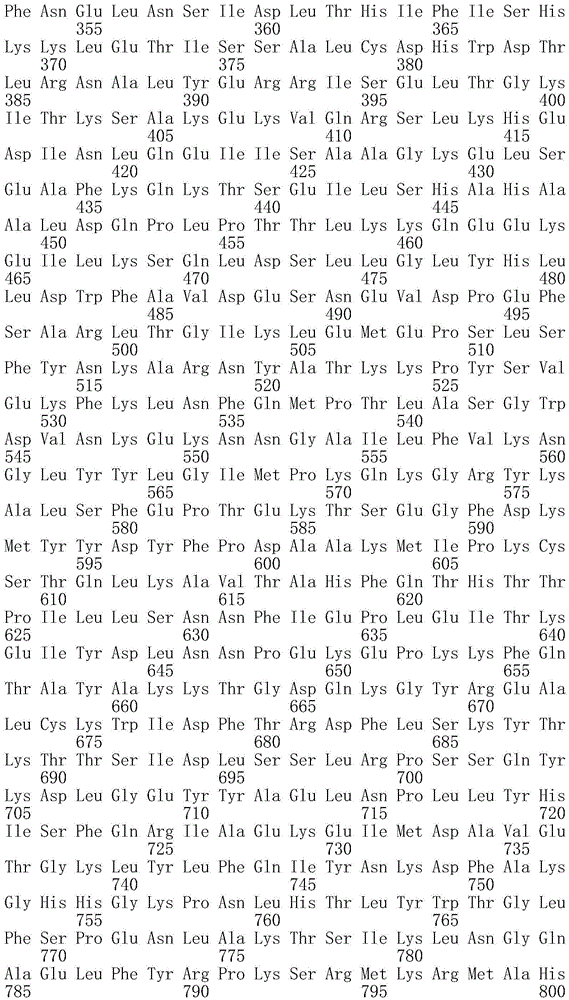

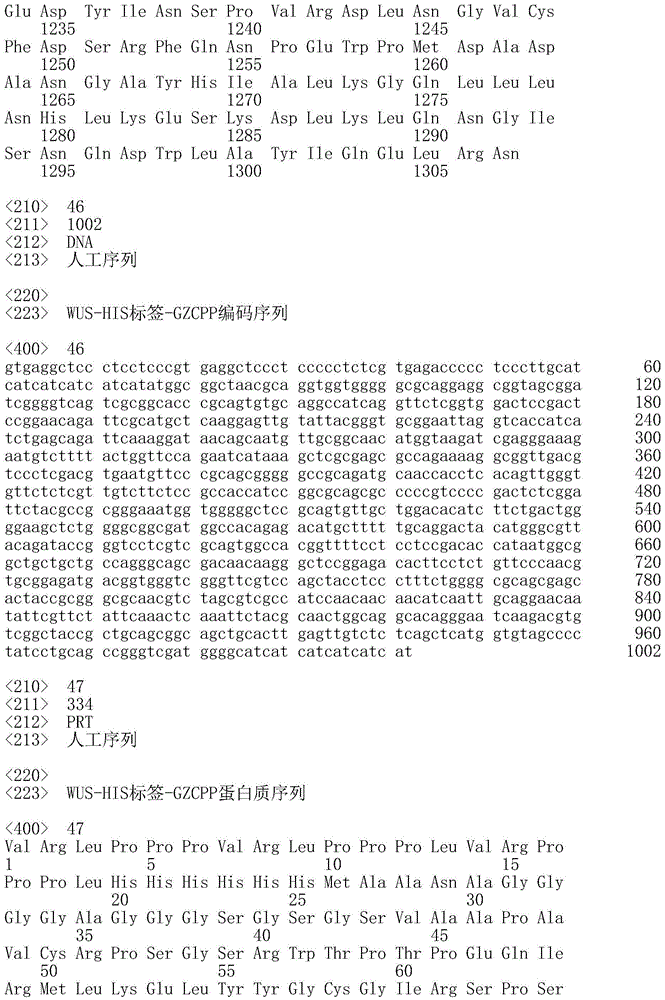


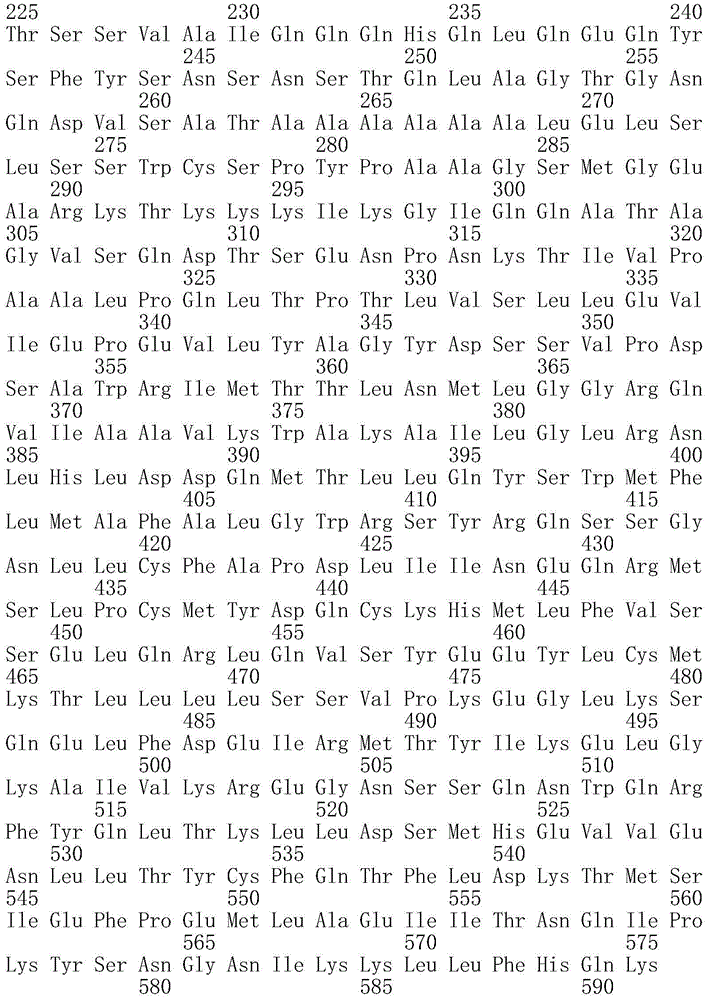
Claims (8)
Applications Claiming Priority (3)
| Application Number | Priority Date | Filing Date | Title |
|---|---|---|---|
| US201762572007P | 2017-10-13 | 2017-10-13 | |
| US62/572007 | 2017-10-13 | ||
| PCT/US2018/055561 WO2019075295A1 (en) | 2017-10-13 | 2018-10-12 | Systems and methods for cellular reprogramming of a plant cell |
Publications (2)
| Publication Number | Publication Date |
|---|---|
| CN111465321A CN111465321A (en) | 2020-07-28 |
| CN111465321B true CN111465321B (en) | 2022-12-06 |
Family
ID=64051788
Family Applications (1)
| Application Number | Title | Priority Date | Filing Date |
|---|---|---|---|
| CN201880079775.9A Active CN111465321B (en) | 2017-10-13 | 2018-10-12 | Systems and methods for cellular reprogramming of plant cells |
Country Status (12)
| Country | Link |
|---|---|
| US (3) | US11447786B2 (en) |
| EP (1) | EP3694308A1 (en) |
| CN (1) | CN111465321B (en) |
| AU (1) | AU2018347545B2 (en) |
| BR (1) | BR112020007343A2 (en) |
| CA (1) | CA3078819A1 (en) |
| CL (1) | CL2020000953A1 (en) |
| IL (1) | IL273710B2 (en) |
| MX (1) | MX2020004138A (en) |
| PE (1) | PE20200857A1 (en) |
| WO (1) | WO2019075295A1 (en) |
| ZA (1) | ZA202002527B (en) |
Families Citing this family (24)
| Publication number | Priority date | Publication date | Assignee | Title |
|---|---|---|---|---|
| CA3099645A1 (en) * | 2018-06-01 | 2019-12-05 | Pioneer Hi-Bred International, Inc. | Crispr/cas system for editing brassica genome |
| BR112021017998A2 (en) | 2019-03-11 | 2021-11-16 | Pioneer Hi Bred Int | Methods for producing clonal plants |
| CN113939594B (en) * | 2019-04-18 | 2024-12-17 | 先锋国际良种公司 | Embryogenic factors for cell reprogramming of plant cells |
| EP3757219A1 (en) * | 2019-06-28 | 2020-12-30 | KWS SAAT SE & Co. KGaA | Enhanced plant regeneration and transformation by using grf1 booster gene |
| EP4002993A4 (en) * | 2019-07-30 | 2024-01-10 | Pairwise Plants Services, Inc. | MORPHOGENE REGULATORS AND METHODS OF USE THEREOF |
| CN112522298B (en) * | 2019-09-19 | 2022-08-09 | 中国农业大学 | Complete set of vectors for plant gene editing and application thereof |
| ES3013182T3 (en) * | 2019-11-26 | 2025-04-11 | Consejo Superior Investigacion | Mammal kinase inhibitors to promote in vitro embryogenesis induction of plants |
| WO2021162970A1 (en) * | 2020-02-12 | 2021-08-19 | Pioneer Hi-Bred International, Inc. | Cas-mediated homology directed repair in somatic plant tissue |
| CA3183409A1 (en) * | 2020-05-29 | 2021-12-02 | Pioneer Hi-Bred International, Inc. | Large scale genome manipulation |
| EP4210475A4 (en) | 2020-09-10 | 2025-03-05 | Monsanto Technology LLC | Increasing gene editing and site-directed integration events utilizing meiotic and germline promoters |
| CA3197681A1 (en) * | 2020-10-21 | 2022-04-28 | Pioneer Hi-Bred International, Inc. | Parthenogenesis factors and methods of using same |
| CN116456824A (en) * | 2020-10-21 | 2023-07-18 | 先锋国际良种公司 | Parthenogenesis factors and methods of use thereof |
| CN113176263A (en) * | 2021-05-06 | 2021-07-27 | 云南省农业科学院粮食作物研究所 | Method for auxiliary identification of corn haploid seedling plant by high power microscope |
| CN113151303B (en) * | 2021-05-21 | 2022-07-05 | 浙江大学 | Cabbage stem cell determination related gene BrWUS1 and application thereof |
| EP4197318B1 (en) * | 2021-12-17 | 2025-11-19 | Albert-Ludwigs-Universität Freiburg | Phosphodiesterases inhibitors to promote in vitro plant cell reprogramming towards plant embryogenesis or microcallus formation |
| CA3240766A1 (en) * | 2021-12-22 | 2023-06-29 | Timothy James Golds | Use of tawox for improving regeneration of plant cells |
| US20250101453A1 (en) * | 2022-03-25 | 2025-03-27 | Pioneer Hi-Bred International, Inc. | Methods of parthenogenic haploid induction and haploid chromosome doubling |
| CN115386589A (en) * | 2022-05-09 | 2022-11-25 | 上海大学 | A dual-vector genetic transformation system for corn inbred lines, its construction method and application |
| WO2024133272A1 (en) * | 2022-12-21 | 2024-06-27 | BASF Agricultural Solutions Seed US LLC | Increased editing efficiency by co-delivery of rnp with nucleic acid |
| IL322884A (en) | 2023-02-23 | 2025-10-01 | Micropep Tech S A | Antifungal peptides to control plant pathogens |
| WO2025059184A1 (en) | 2023-09-12 | 2025-03-20 | Pioneer Hi-Bred International, Inc. | Methods and compositions for generating genome-edited paternal doubled haploids |
| CN117385087B (en) * | 2023-11-27 | 2024-06-18 | 北京市农林科学院 | SNP molecular marker Me-5676929 linked with microspore embryogenic gene, application thereof and special primer |
| WO2026008891A1 (en) * | 2024-07-05 | 2026-01-08 | KWS SAAT SE & Co. KGaA | Modified crop plant having increased expression of one or more one transcription factors specific for the plant's esr or betl |
| CN120699999B (en) * | 2025-08-27 | 2025-11-07 | 海南热带海洋学院 | Application of pyrazothrone as a strigolactone analog |
Family Cites Families (51)
| Publication number | Priority date | Publication date | Assignee | Title |
|---|---|---|---|---|
| US4945050A (en) | 1984-11-13 | 1990-07-31 | Cornell Research Foundation, Inc. | Method for transporting substances into living cells and tissues and apparatus therefor |
| GB8810120D0 (en) | 1988-04-28 | 1988-06-02 | Plant Genetic Systems Nv | Transgenic nuclear male sterile plants |
| US5990387A (en) | 1988-06-10 | 1999-11-23 | Pioneer Hi-Bred International, Inc. | Stable transformation of plant cells |
| US5306864A (en) | 1988-12-02 | 1994-04-26 | United Agriseeds | Increasing the anther culturability of maize |
| US5879918A (en) | 1989-05-12 | 1999-03-09 | Pioneer Hi-Bred International, Inc. | Pretreatment of microprojectiles prior to using in a particle gun |
| US5240855A (en) | 1989-05-12 | 1993-08-31 | Pioneer Hi-Bred International, Inc. | Particle gun |
| US5322783A (en) | 1989-10-17 | 1994-06-21 | Pioneer Hi-Bred International, Inc. | Soybean transformation by microparticle bombardment |
| US5445961A (en) | 1990-06-26 | 1995-08-29 | Dekalb Genetics Corporation | Isolated microscope and anther culture of maize |
| US5322789A (en) | 1990-06-26 | 1994-06-21 | Dekalb Plant Genetics | Isolated microspore and anther culture of corn |
| US5932782A (en) | 1990-11-14 | 1999-08-03 | Pioneer Hi-Bred International, Inc. | Plant transformation method using agrobacterium species adhered to microprojectiles |
| ES2299172T3 (en) | 1991-02-07 | 2008-05-16 | Bayer Bioscience N.V. | SPECIFIC PROMOTERS OF CORN STAMPS. |
| US5324646A (en) | 1992-01-06 | 1994-06-28 | Pioneer Hi-Bred International, Inc. | Methods of regeneration of Medicago sativa and expressing foreign DNA in same |
| JPH08501684A (en) | 1992-07-09 | 1996-02-27 | パイオニア・ハイ−ブレツド・インターナシヨナル・インコーポレイテツド | Maize pollen-specific polygalacturonase gene |
| AU670316B2 (en) | 1992-07-27 | 1996-07-11 | Pioneer Hi-Bred International, Inc. | An improved method of (agrobacterium)-mediated transformation of cultured soybean cells |
| GB9324707D0 (en) | 1993-12-02 | 1994-01-19 | Olsen Odd Arne | Promoter |
| US5470359A (en) | 1994-04-21 | 1995-11-28 | Pioneer Hi-Bred Internation, Inc. | Regulatory element conferring tapetum specificity |
| US5837850A (en) | 1994-04-21 | 1998-11-17 | Pioneer Hi-Bred International, Inc. | Regulatory element conferring tapetum specificity |
| US5736369A (en) | 1994-07-29 | 1998-04-07 | Pioneer Hi-Bred International, Inc. | Method for producing transgenic cereal plants |
| US5981840A (en) | 1997-01-24 | 1999-11-09 | Pioneer Hi-Bred International, Inc. | Methods for agrobacterium-mediated transformation |
| AU5489099A (en) | 1998-08-20 | 2000-03-14 | Pioneer Hi-Bred International, Inc. | Seed-preferred promoters |
| WO2000012733A1 (en) | 1998-08-28 | 2000-03-09 | Pioneer Hi-Bred International, Inc. | Seed-preferred promoters from end genes |
| US6284947B1 (en) | 1999-02-25 | 2001-09-04 | Pioneer Hi-Bred International, Inc. | Methods of using viral replicase polynucleotides and polypeptides |
| EP1131454A2 (en) | 1998-11-09 | 2001-09-12 | Pioneer Hi-Bred International, Inc. | Transcriptional activator nucleic acids, polypeptides and methods of use thereof |
| US6800791B1 (en) | 1999-05-19 | 2004-10-05 | Pioneer Hi-Bred International, Inc. | Method for delivery of proteins to plant cells |
| WO2001023575A2 (en) | 1999-09-30 | 2001-04-05 | E.I. Du Pont De Nemours And Company | Wuschel (wus) gene homologs |
| US7256322B2 (en) | 1999-10-01 | 2007-08-14 | Pioneer Hi-Bred International, Inc. | Wuschel (WUS) Gene Homologs |
| WO2002026789A2 (en) | 2000-09-26 | 2002-04-04 | Pioneer Hi-Bred International, Inc. | Nucleotide sequences mediating male fertility and method of using same |
| US7122658B1 (en) | 2000-11-22 | 2006-10-17 | Pioneer Hi-Bred International, Inc. | Seed-preferred regulatory elements and uses thereof |
| US20020188965A1 (en) | 2001-04-20 | 2002-12-12 | Zou-Yu Zhao | Methods of transforming plants |
| AU2002346242A1 (en) | 2001-06-05 | 2002-12-16 | The Curators Of The University Of Missouri | Chromosome doubling method |
| US20030082813A1 (en) | 2001-10-29 | 2003-05-01 | The Rockefeller University | Promotion of somatic embryogenesis in plants by wuschel gene expression |
| AU2003228935A1 (en) | 2002-05-06 | 2003-11-17 | E.I. Dupont De Nemours And Company | Maize clavata3-like polynucleotide sequences and methods of use |
| US7268271B2 (en) | 2002-07-19 | 2007-09-11 | Pioneer Hi-Bred International, Inc. | Methods of use of LEC1 polynucleotides and polypeptides |
| CA2554644C (en) * | 2004-02-02 | 2015-06-16 | Pioneer Hi-Bred International, Inc. | Ap2 domain transcription factor odp2 (ovule development protein 2) and methods of use |
| US7148402B2 (en) | 2004-05-21 | 2006-12-12 | Rockefeller University | Promotion of somatic embryogenesis in plants by PGA37 gene expression |
| WO2006116876A1 (en) * | 2005-05-04 | 2006-11-09 | National Research Council Of Canada | Method for production of saponaria from microspores |
| JP2008541744A (en) * | 2005-05-31 | 2008-11-27 | ライク・ズワーン・ザードテールト・アン・ザードハンデル・ベスローテン・フェンノートシャップ | Methods for producing haploid plant embryos and doubled haploid plant embryos |
| DK2341149T3 (en) | 2005-08-26 | 2017-02-27 | Dupont Nutrition Biosci Aps | Use of CRISPR-associated genes (Cas) |
| NZ597682A (en) | 2006-01-12 | 2014-02-28 | Incima Ipco B V | Epsps mutants |
| EP2568048A1 (en) | 2007-06-29 | 2013-03-13 | Pioneer Hi-Bred International, Inc. | Methods for altering the genome of a monocot plant cell |
| JP5922094B2 (en) | 2010-03-31 | 2016-05-24 | ダウ アグロサイエンシィズ エルエルシー | Plant peptide γ-zein for delivery of biomolecules into plant cells |
| CN104039818A (en) | 2012-01-06 | 2014-09-10 | 先锋国际良种公司 | Methods And Compositions For Modulating Expression Or Activity Of A Rkd Polypeptide In A Plant |
| MX2016002118A (en) | 2013-08-22 | 2016-06-28 | Du Pont | MODIFICATION OF THE GENOME OF PLANTS THROUGH THE USE OF SYSTEMS OF RIBONUCLEIC ACID (RNA) GUIDE / ENDONUCLEASE CAS AND METHODS OF USE. |
| WO2015043621A1 (en) * | 2013-09-24 | 2015-04-02 | Stichting Dienst Landbouwkundig Onderzoek | Haploid embryogenesis |
| GB201504309D0 (en) | 2015-03-13 | 2015-04-29 | University Of Warwick And Max-Planck-Gesellschaftzur F�Rderung Der Wissenschaften E.V. | Stable epigenetic plant variants |
| WO2016186953A1 (en) | 2015-05-15 | 2016-11-24 | Pioneer Hi Bred International Inc | Guide rna/cas endonuclease systems |
| EP3328185B1 (en) * | 2015-07-28 | 2020-06-24 | Vilmorin & Cie | Method for producing haploid, dihaploid and doubled haploid plants by isolated microspore culture |
| CA2992488A1 (en) | 2015-08-28 | 2017-03-09 | Pioneer Hi-Bred International, Inc. | Ochrobactrum-mediated transformation of plants |
| JP2018531024A (en) | 2015-10-20 | 2018-10-25 | パイオニア ハイ−ブレッド インターナショナル, イン | Methods and compositions for marker-free genome modification |
| EP3368676B1 (en) | 2015-10-30 | 2021-05-26 | Pioneer Hi-Bred International, Inc. | Methods and compositions for rapid plant transformation |
| GB201604142D0 (en) | 2016-03-10 | 2016-04-27 | Univ Warwick | Epigenetically stable cloned plants |
-
2018
- 2018-10-12 BR BR112020007343-1A patent/BR112020007343A2/en unknown
- 2018-10-12 AU AU2018347545A patent/AU2018347545B2/en active Active
- 2018-10-12 US US16/755,432 patent/US11447786B2/en active Active
- 2018-10-12 IL IL273710A patent/IL273710B2/en unknown
- 2018-10-12 CA CA3078819A patent/CA3078819A1/en active Pending
- 2018-10-12 CN CN201880079775.9A patent/CN111465321B/en active Active
- 2018-10-12 PE PE2020000410A patent/PE20200857A1/en unknown
- 2018-10-12 EP EP18796286.5A patent/EP3694308A1/en active Pending
- 2018-10-12 WO PCT/US2018/055561 patent/WO2019075295A1/en not_active Ceased
- 2018-10-12 MX MX2020004138A patent/MX2020004138A/en unknown
-
2020
- 2020-04-08 CL CL2020000953A patent/CL2020000953A1/en unknown
- 2020-05-07 ZA ZA2020/02527A patent/ZA202002527B/en unknown
-
2022
- 2022-08-08 US US17/818,060 patent/US20230203516A1/en active Pending
-
2024
- 2024-12-02 US US18/965,327 patent/US20250115924A1/en active Pending
Also Published As
| Publication number | Publication date |
|---|---|
| WO2019075295A1 (en) | 2019-04-18 |
| BR112020007343A2 (en) | 2020-10-06 |
| CL2020000953A1 (en) | 2020-09-11 |
| CN111465321A (en) | 2020-07-28 |
| US20230203516A1 (en) | 2023-06-29 |
| AU2018347545B2 (en) | 2024-10-03 |
| IL273710B2 (en) | 2024-10-01 |
| PE20200857A1 (en) | 2020-08-25 |
| CA3078819A1 (en) | 2019-04-18 |
| IL273710A (en) | 2020-05-31 |
| ZA202002527B (en) | 2021-05-26 |
| US20200263189A1 (en) | 2020-08-20 |
| US20250115924A1 (en) | 2025-04-10 |
| EP3694308A1 (en) | 2020-08-19 |
| IL273710B1 (en) | 2024-06-01 |
| MX2020004138A (en) | 2020-08-13 |
| AU2018347545A1 (en) | 2020-04-16 |
| US11447786B2 (en) | 2022-09-20 |
Similar Documents
| Publication | Publication Date | Title |
|---|---|---|
| CN111465321B (en) | Systems and methods for cellular reprogramming of plant cells | |
| CN113939594B (en) | Embryogenic factors for cell reprogramming of plant cells | |
| US20230323374A1 (en) | Plant genome modification using guide rna/cas endonuclease systems and methods of use | |
| US20220364107A1 (en) | Agronomic trait modification using guide rna/cas endonuclease systems and methods of use | |
| EP3765605A1 (en) | Use of morphogenic factors for the improvement of gene editing | |
| CN113412333A (en) | Method for clonal plant production | |
| JP2013074892A (en) | Method of producing haploid plant embryo and doubled haploid plant embryo | |
| CN104039967A (en) | A method to screen plants for genetic elements inducing parthenogenesis in plants | |
| US20240002877A1 (en) | Parthenogenesis factors and methods of using same | |
| CN104039818A (en) | Methods And Compositions For Modulating Expression Or Activity Of A Rkd Polypeptide In A Plant | |
| US20230407324A1 (en) | Doubled haploid inducer | |
| EP4499841A1 (en) | Methods of parthenogenic haploid induction and haploid chromosome doubling | |
| US12543674B2 (en) | Embryogenesis factors for cellular reprogramming of a plant cell | |
| HK40034402A (en) | Systems and methods for cellular reprogramming of a plant cell | |
| CN116456824A (en) | Parthenogenesis factors and methods of use thereof | |
| WO2025059184A1 (en) | Methods and compositions for generating genome-edited paternal doubled haploids |
Legal Events
| Date | Code | Title | Description |
|---|---|---|---|
| PB01 | Publication | ||
| PB01 | Publication | ||
| SE01 | Entry into force of request for substantive examination | ||
| SE01 | Entry into force of request for substantive examination | ||
| REG | Reference to a national code |
Ref country code: HK Ref legal event code: DE Ref document number: 40034402 Country of ref document: HK |
|
| GR01 | Patent grant | ||
| GR01 | Patent grant |