CN111462238B - Attitude estimation optimization method and device and storage medium - Google Patents
Attitude estimation optimization method and device and storage medium Download PDFInfo
- Publication number
- CN111462238B CN111462238B CN202010260079.7A CN202010260079A CN111462238B CN 111462238 B CN111462238 B CN 111462238B CN 202010260079 A CN202010260079 A CN 202010260079A CN 111462238 B CN111462238 B CN 111462238B
- Authority
- CN
- China
- Prior art keywords
- pose
- target object
- attitude
- deviation
- feature vector
- Prior art date
- Legal status (The legal status is an assumption and is not a legal conclusion. Google has not performed a legal analysis and makes no representation as to the accuracy of the status listed.)
- Active
Links
Images


Classifications
-
- G—PHYSICS
- G06—COMPUTING OR CALCULATING; COUNTING
- G06T—IMAGE DATA PROCESSING OR GENERATION, IN GENERAL
- G06T7/00—Image analysis
- G06T7/70—Determining position or orientation of objects or cameras
- G06T7/73—Determining position or orientation of objects or cameras using feature-based methods
-
- G—PHYSICS
- G06—COMPUTING OR CALCULATING; COUNTING
- G06N—COMPUTING ARRANGEMENTS BASED ON SPECIFIC COMPUTATIONAL MODELS
- G06N3/00—Computing arrangements based on biological models
- G06N3/02—Neural networks
- G06N3/04—Architecture, e.g. interconnection topology
- G06N3/045—Combinations of networks
-
- G—PHYSICS
- G06—COMPUTING OR CALCULATING; COUNTING
- G06T—IMAGE DATA PROCESSING OR GENERATION, IN GENERAL
- G06T2207/00—Indexing scheme for image analysis or image enhancement
- G06T2207/20—Special algorithmic details
- G06T2207/20081—Training; Learning
-
- Y—GENERAL TAGGING OF NEW TECHNOLOGICAL DEVELOPMENTS; GENERAL TAGGING OF CROSS-SECTIONAL TECHNOLOGIES SPANNING OVER SEVERAL SECTIONS OF THE IPC; TECHNICAL SUBJECTS COVERED BY FORMER USPC CROSS-REFERENCE ART COLLECTIONS [XRACs] AND DIGESTS
- Y02—TECHNOLOGIES OR APPLICATIONS FOR MITIGATION OR ADAPTATION AGAINST CLIMATE CHANGE
- Y02T—CLIMATE CHANGE MITIGATION TECHNOLOGIES RELATED TO TRANSPORTATION
- Y02T10/00—Road transport of goods or passengers
- Y02T10/10—Internal combustion engine [ICE] based vehicles
- Y02T10/40—Engine management systems
Landscapes
- Engineering & Computer Science (AREA)
- Physics & Mathematics (AREA)
- Theoretical Computer Science (AREA)
- General Physics & Mathematics (AREA)
- General Health & Medical Sciences (AREA)
- Molecular Biology (AREA)
- Biophysics (AREA)
- Computational Linguistics (AREA)
- Data Mining & Analysis (AREA)
- Evolutionary Computation (AREA)
- Artificial Intelligence (AREA)
- Biomedical Technology (AREA)
- Computing Systems (AREA)
- General Engineering & Computer Science (AREA)
- Life Sciences & Earth Sciences (AREA)
- Mathematical Physics (AREA)
- Software Systems (AREA)
- Health & Medical Sciences (AREA)
- Computer Vision & Pattern Recognition (AREA)
- Image Analysis (AREA)
Abstract
本公开涉及计算机视觉领域,尤其涉及一种姿态估计优化方法、装置及存储介质。所述方法:获取测试图像,测试图像中包括目标对象;根据测试图像,采用姿态优化模型输出得到目标对象的姿态偏差,姿态优化模型为采用样本图像对神经网络进行训练得到的模型;根据姿态偏差对目标对象的初始估计姿态进行优化。本公开实施例通过采用训练得到的姿态优化模型确定目标对象的姿态偏差,从而对目标对象的初始估计姿态进行优化,大大提高了姿态估计的准确率,保证了姿态估计效果。
The present disclosure relates to the field of computer vision, and in particular to a pose estimation optimization method, device and storage medium. The method: obtain a test image, the test image includes the target object; according to the test image, the attitude deviation of the target object is obtained by using the attitude optimization model output, and the attitude optimization model is a model obtained by training the neural network using the sample image; according to the attitude deviation Optimize the initial estimated pose of the target object. The embodiments of the present disclosure determine the attitude deviation of the target object by using the attitude optimization model obtained through training, thereby optimizing the initial estimated attitude of the target object, greatly improving the accuracy of attitude estimation, and ensuring the effect of attitude estimation.
Description
技术领域technical field
本公开涉及计算机视觉领域,尤其涉及一种姿态估计优化方法、装置及存储介质。The present disclosure relates to the field of computer vision, and in particular to a pose estimation optimization method, device and storage medium.
背景技术Background technique
物体姿态估计在机器人作业、自动驾驶、增强现实等方面起着至关重要的作用。物体姿态估计指的是从图像中准确估计出目标物体相对相机的姿态信息。姿态信息通常包括旋转量和平移量,其中旋转量可以表示相机坐标系相对于目标物体坐标系的旋转关系,平移量可以表示相机坐标系原点相对于目标物体坐标系原点的平移信息。Object pose estimation plays a vital role in robotic operations, autonomous driving, augmented reality, and more. Object pose estimation refers to accurately estimating the pose information of the target object relative to the camera from the image. Pose information usually includes rotation and translation, where the rotation can represent the rotation relationship of the camera coordinate system relative to the target object coordinate system, and the translation can represent the translation information of the origin of the camera coordinate system relative to the origin of the target object coordinate system.
物体姿态估计很容易受到遮挡、光照变化、物体具有的对称性等因素的影响,准确估计出目标物体相对相机的姿态信息具有很大的挑战性。相关技术中,难以对物体姿态达到高准确率的估计。Object pose estimation is easily affected by factors such as occlusion, illumination changes, and symmetry of the object. It is very challenging to accurately estimate the pose information of the target object relative to the camera. In related technologies, it is difficult to estimate the attitude of an object with high accuracy.
发明内容Contents of the invention
有鉴于此,本公开提出了一种姿态估计优化方法、装置及存储介质。所述技术方案包括:In view of this, the present disclosure proposes a pose estimation optimization method, device and storage medium. The technical solutions include:
根据本公开的一方面,提供了一种姿态估计优化方法,所述方法包括:According to an aspect of the present disclosure, a pose estimation optimization method is provided, the method comprising:
获取测试图像,所述测试图像中包括目标对象;Obtain a test image, the test image includes a target object;
根据所述测试图像,采用姿态优化模型输出得到所述目标对象的姿态偏差,所述姿态优化模型为采用样本图像对神经网络进行训练得到的模型;According to the test image, the posture deviation of the target object is obtained by using a posture optimization model output, and the posture optimization model is a model obtained by training a neural network using a sample image;
根据所述姿态偏差对所述目标对象的初始估计姿态进行优化。Optimizing the initial estimated pose of the target object according to the pose deviation.
在一种可能的实现方式中,所述根据所述测试图像,采用姿态优化模型输出得到所述目标对象的姿态偏差,包括:In a possible implementation manner, the obtaining the posture deviation of the target object by using the posture optimization model output according to the test image includes:
从所述测试图像中提取第一特征向量,所述第一特性向量用于指示所述测试图像中所述目标对象的真实物体姿态;extracting a first feature vector from the test image, the first feature vector being used to indicate the real object pose of the target object in the test image;
从预设字典中获取所述第一特征向量匹配的第二特征向量,所述第二特征向量用于指示所述目标对象的初始估计姿态;Acquiring a second feature vector matched by the first feature vector from a preset dictionary, where the second feature vector is used to indicate an initial estimated pose of the target object;
将所述第一特征向量和所述第二特征向量输入至所述姿态优化模型中,输出得到所述目标对象的所述姿态偏差。Inputting the first eigenvector and the second eigenvector into the pose optimization model, and outputting the pose deviation of the target object.
在另一种可能的实现方式中,所述预设字典包括多个姿态特征对,所述姿态特征对包括候选姿态和对应的特征向量;In another possible implementation manner, the preset dictionary includes a plurality of pose feature pairs, and the pose feature pairs include candidate poses and corresponding feature vectors;
所述根据所述姿态偏差对所述目标对象的初始估计姿态进行优化之前,还包括:Before the optimization of the initial estimated pose of the target object according to the pose deviation, the method further includes:
将所述第二特征向量对应的候选姿态确定为所述目标对象的所述初始估计姿态。Determining a candidate pose corresponding to the second feature vector as the initial estimated pose of the target object.
在另一种可能的实现方式中,所述姿态偏差用于指示所述目标对象的真实物体姿态与所述初始估计姿态之间的偏差,所述根据所述姿态偏差对所述目标对象的初始估计姿态进行优化,包括:In another possible implementation manner, the attitude deviation is used to indicate the deviation between the real object attitude of the target object and the initial estimated attitude, and the initial estimation of the target object based on the attitude deviation is The estimated pose is optimized, including:
根据所述姿态偏差和所述初始估计姿态,确定所述目标对象的所述真实物体姿态。The real object pose of the target object is determined based on the pose deviation and the initial estimated pose.
在另一种可能的实现方式中,所述根据所述测试图像,采用姿态优化模型输出得到所述目标对象的姿态偏差之前,还包括:In another possible implementation manner, before obtaining the posture deviation of the target object by using the posture optimization model output according to the test image, the method further includes:
获取包括至少一组样本数据组的训练样本集,每组所述样本数据组包括第一样本特征向量、与所述第一样本特征向量匹配的第二样本特征向量和预先标注的正确姿态偏差;Acquiring a training sample set including at least one set of sample data sets, each set of sample data sets including a first sample feature vector, a second sample feature vector matching the first sample feature vector, and a pre-labeled correct pose deviation;
根据所述训练样本集训练得到所述姿态优化模型。The posture optimization model is obtained by training according to the training sample set.
在另一种可能的实现方式中,所述根据所述姿态偏差对所述目标对象的初始估计姿态进行优化之后,还包括:In another possible implementation manner, after optimizing the initial estimated pose of the target object according to the pose deviation, further comprising:
将所述第一特征向量、所述第二特征向量和所述姿态偏差添加至训练样本集,得到更新后的训练样本集;adding the first eigenvector, the second eigenvector, and the attitude deviation to a training sample set to obtain an updated training sample set;
根据更新后的所述训练样本集对所述姿态优化模型进行训练,得到更新后的姿态优化模型。The posture optimization model is trained according to the updated training sample set to obtain an updated posture optimization model.
在另一种可能的实现方式中,所述姿态优化模型包括三个卷积层和三个全连接层,所述三个卷积层和所述三个全连接层依次连接。In another possible implementation manner, the pose optimization model includes three convolutional layers and three fully connected layers, and the three convolutional layers and the three fully connected layers are connected in sequence.
根据本公开的另一方面,提供了一种姿态估计优化装置,所述装置包括:According to another aspect of the present disclosure, a pose estimation optimization device is provided, the device comprising:
获取模块,用于获取测试图像,所述测试图像中包括目标对象;An acquisition module, configured to acquire a test image, which includes a target object;
输出模块,用于根据所述测试图像,采用姿态优化模型输出得到所述目标对象的姿态偏差,所述姿态优化模型为采用样本图像对神经网络进行训练得到的模型;The output module is used to obtain the posture deviation of the target object by using a posture optimization model output according to the test image, and the posture optimization model is a model obtained by training a neural network using sample images;
优化模块,用于根据所述姿态偏差对所述目标对象的初始估计姿态进行优化。An optimization module, configured to optimize the initial estimated pose of the target object according to the pose deviation.
在一种可能的实现方式中,所述输出模块,还用于:In a possible implementation manner, the output module is also used for:
从所述测试图像中提取第一特征向量,所述第一特性向量用于指示所述测试图像中所述目标对象的真实物体姿态;extracting a first feature vector from the test image, the first feature vector being used to indicate the real object pose of the target object in the test image;
从预设字典中获取所述第一特征向量匹配的第二特征向量,所述第二特征向量用于指示所述目标对象的初始估计姿态;Acquiring a second feature vector matched by the first feature vector from a preset dictionary, where the second feature vector is used to indicate an initial estimated pose of the target object;
将所述第一特征向量和所述第二特征向量输入至所述姿态优化模型中,输出得到所述目标对象的所述姿态偏差。Inputting the first eigenvector and the second eigenvector into the pose optimization model, and outputting the pose deviation of the target object.
在另一种可能的实现方式中,所述预设字典包括多个姿态特征对,所述姿态特征对包括候选姿态和对应的特征向量;In another possible implementation manner, the preset dictionary includes a plurality of pose feature pairs, and the pose feature pairs include candidate poses and corresponding feature vectors;
所述装置,还包括:确定模块;所述确定模块,用于将所述第二特征向量对应的候选姿态确定为所述目标对象的所述初始估计姿态。The device further includes: a determination module; the determination module is configured to determine a candidate pose corresponding to the second feature vector as the initial estimated pose of the target object.
在另一种可能的实现方式中,所述姿态偏差用于指示所述目标对象的真实物体姿态与所述初始估计姿态之间的偏差,所述优化模块,还用于根据所述姿态偏差和所述初始估计姿态,确定所述目标对象的所述真实物体姿态。In another possible implementation manner, the attitude deviation is used to indicate the deviation between the real object attitude of the target object and the initial estimated attitude, and the optimization module is further configured to The initial estimated pose determines the real object pose of the target object.
在另一种可能的实现方式中,所述装置,还包括:训练模块;所述训练模块,用于:In another possible implementation manner, the device further includes: a training module; the training module is configured to:
获取包括至少一组样本数据组的训练样本集,每组所述样本数据组包括第一样本特征向量、与所述第一样本特征向量匹配的第二样本特征向量和预先标注的正确姿态偏差;Acquiring a training sample set including at least one set of sample data sets, each set of sample data sets including a first sample feature vector, a second sample feature vector matching the first sample feature vector, and a pre-labeled correct pose deviation;
根据所述训练样本集训练得到所述姿态优化模型。The posture optimization model is obtained by training according to the training sample set.
在另一种可能的实现方式中,所述装置,还包括:更新模块;所述更新模块,用于:In another possible implementation manner, the device further includes: an update module; the update module is configured to:
将所述第一特征向量、所述第二特征向量和所述姿态偏差添加至训练样本集,得到更新后的训练样本集;adding the first eigenvector, the second eigenvector, and the attitude deviation to a training sample set to obtain an updated training sample set;
根据更新后的所述训练样本集对所述姿态优化模型进行训练,得到更新后的姿态优化模型。The posture optimization model is trained according to the updated training sample set to obtain an updated posture optimization model.
在另一种可能的实现方式中,所述姿态优化模型包括三个卷积层和三个全连接层,所述三个卷积层和所述三个全连接层依次连接。In another possible implementation manner, the pose optimization model includes three convolutional layers and three fully connected layers, and the three convolutional layers and the three fully connected layers are connected in sequence.
根据本公开的另一方面,提供了一种计算机设备,所述计算机设备包括:处理器;用于存储处理器可执行指令的存储器;According to another aspect of the present disclosure, there is provided a computer device, the computer device comprising: a processor; a memory for storing instructions executable by the processor;
其中,所述处理器被配置为:Wherein, the processor is configured as:
获取测试图像,所述测试图像中包括目标对象;Obtain a test image, the test image includes a target object;
根据所述测试图像,采用姿态优化模型输出得到所述目标对象的姿态偏差,所述姿态优化模型为采用样本图像对神经网络进行训练得到的模型;According to the test image, the posture deviation of the target object is obtained by using a posture optimization model output, and the posture optimization model is a model obtained by training a neural network using a sample image;
根据所述姿态偏差对所述目标对象的初始估计姿态进行优化。Optimizing the initial estimated pose of the target object according to the pose deviation.
根据本公开的另一方面,提供了一种非易失性计算机可读存储介质,其上存储有计算机程序指令,所述计算机程序指令被处理器执行时实现上述的方法。According to another aspect of the present disclosure, there is provided a non-volatile computer-readable storage medium, on which computer program instructions are stored, and the above-mentioned method is implemented when the computer program instructions are executed by a processor.
本公开实施例通过获取测试图像,测试图像中包括目标对象;根据测试图像,采用姿态优化模型输出得到目标对象的姿态偏差,姿态优化模型为采用样本图像对神经网络进行训练得到的模型;根据姿态偏差对目标对象的初始估计姿态进行优化;即采用训练得到的姿态优化模型确定目标对象的姿态偏差,从而对目标对象的初始估计姿态进行优化,大大提高了姿态估计的准确率,保证了姿态估计效果。In the embodiment of the present disclosure, the target object is included in the test image by acquiring the test image; according to the test image, the posture deviation of the target object is obtained by using the posture optimization model output, and the posture optimization model is a model obtained by training the neural network using the sample image; according to the posture The deviation optimizes the initial estimated attitude of the target object; that is, the attitude optimization model obtained by training is used to determine the attitude deviation of the target object, thereby optimizing the initial estimated attitude of the target object, which greatly improves the accuracy of the attitude estimation and ensures the attitude estimation. Effect.
附图说明Description of drawings
包含在说明书中并且构成说明书的一部分的附图与说明书一起示出了本公开的示例性实施例、特征和方面,并且用于解释本公开的原理。The accompanying drawings, which are incorporated in and constitute a part of the specification, illustrate exemplary embodiments, features, and aspects of the disclosure and, together with the specification, serve to explain the principles of the disclosure.
图1示出了本公开一个示例性实施例提供的计算机设备的结构示意图;FIG. 1 shows a schematic structural diagram of a computer device provided by an exemplary embodiment of the present disclosure;
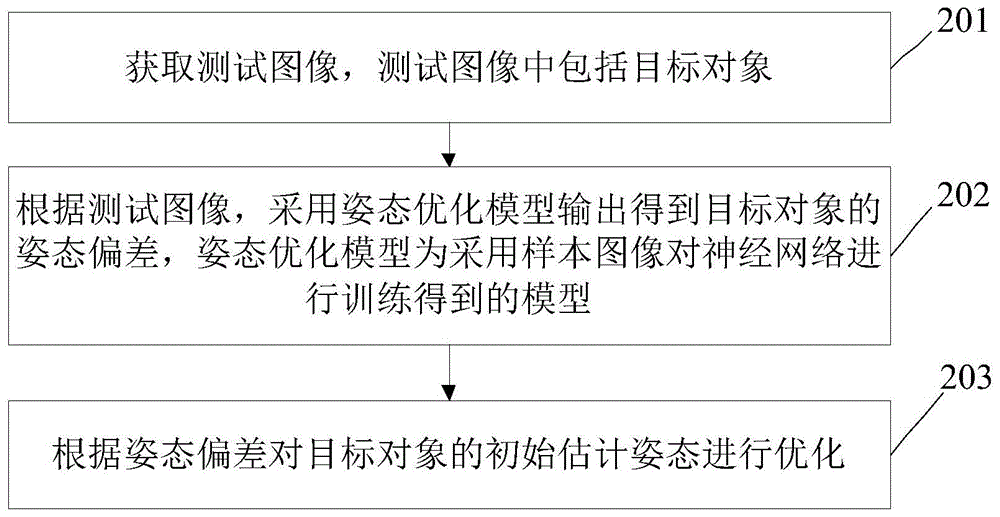
图2示出了本公开一个示例性实施例提供的姿态估计优化方法的流程图;FIG. 2 shows a flow chart of a pose estimation optimization method provided by an exemplary embodiment of the present disclosure;
图3示出了本公开另一个示例性实施例提供的姿态估计优化方法的流程图;FIG. 3 shows a flowchart of a pose estimation optimization method provided by another exemplary embodiment of the present disclosure;
图4示出了本公开一个示例性实施例提供的姿态估计优化方法涉及的原理示意图;FIG. 4 shows a schematic diagram of the principles involved in the pose estimation optimization method provided by an exemplary embodiment of the present disclosure;
图5示出了本公开一个示例性实施例提供的姿态估计优化装置的结构示意图;Fig. 5 shows a schematic structural diagram of a pose estimation optimization device provided by an exemplary embodiment of the present disclosure;
图6是根据一示例性实施例示出的一种终端的框图;Fig. 6 is a block diagram of a terminal shown according to an exemplary embodiment;
图7是根据一示例性实施例示出的一种服务器的框图。Fig. 7 is a block diagram of a server according to an exemplary embodiment.
具体实施方式Detailed ways
以下将参考附图详细说明本公开的各种示例性实施例、特征和方面。附图中相同的附图标记表示功能相同或相似的元件。尽管在附图中示出了实施例的各种方面,但是除非特别指出,不必按比例绘制附图。Various exemplary embodiments, features, and aspects of the present disclosure will be described in detail below with reference to the accompanying drawings. The same reference numbers in the figures indicate functionally identical or similar elements. While various aspects of the embodiments are shown in drawings, the drawings are not necessarily drawn to scale unless specifically indicated.
在这里专用的词“示例性”意为“用作例子、实施例或说明性”。这里作为“示例性”所说明的任何实施例不必解释为优于或好于其它实施例。The word "exemplary" is used exclusively herein to mean "serving as an example, embodiment, or illustration." Any embodiment described herein as "exemplary" is not necessarily to be construed as superior or better than other embodiments.
另外,为了更好的说明本公开,在下文的具体实施方式中给出了众多的具体细节。本领域技术人员应当理解,没有某些具体细节,本公开同样可以实施。在一些实例中,对于本领域技术人员熟知的方法、手段、元件和电路未作详细描述,以便于凸显本公开的主旨。In addition, in order to better illustrate the present disclosure, numerous specific details are given in the following specific implementation manners. It will be understood by those skilled in the art that the present disclosure may be practiced without some of the specific details. In some instances, methods, means, components and circuits that are well known to those skilled in the art have not been described in detail so as to obscure the gist of the present disclosure.
物体姿态估计在机器人作业、自动驾驶、增强现实等方面起着至关重要的作用。物体姿态估计指的是从图像中准确估计出目标物体相对相机的姿态信息,通常包括:1、旋转量(三个自由度),即相机坐标系相对于目标物体坐标系的旋转关系;2、平移量(三个自由度),即相机坐标系原点相对于目标物体坐标系原点的平移信息。对于旋转量,其表示方法包括旋转矩阵、欧拉角、四元数等。对于平移量,通常用欧式空间中的平移向量来表示。Object pose estimation plays a vital role in robotic operations, autonomous driving, augmented reality, and more. Object pose estimation refers to accurately estimating the pose information of the target object relative to the camera from the image, usually including: 1. The amount of rotation (three degrees of freedom), that is, the rotation relationship between the camera coordinate system and the target object coordinate system; 2. Translation amount (three degrees of freedom), that is, the translation information of the origin of the camera coordinate system relative to the origin of the target object coordinate system. For the rotation amount, its representation method includes rotation matrix, Euler angle, quaternion, etc. For the amount of translation, it is usually represented by a translation vector in Euclidean space.
目前,相关技术中基于单张RGB图像的物体姿态估计方法效果往往不够好,需要进一步的优化。对初始估计的姿态值进行优化的方法大概有两类:一种,通过引入深度信息进行优化,比如通过最近点搜索法(Iterative Closest Point,ICP)算法等。另一种,基于渲染的方法,这类方法通常利用渲染器,根据初始预测的物体姿态渲染得到相应的图像,然后将渲染图像与观察到的真实图像进行比对,训练一个模型来预测当前估计的姿态的误差,从而实现姿态优化。At present, the object pose estimation method based on a single RGB image in the related art is often not good enough, and further optimization is needed. There are roughly two types of methods for optimizing the initial estimated attitude value: one is to optimize by introducing depth information, such as the Iterative Closest Point (ICP) algorithm. The other is a rendering-based method, which usually uses a renderer to render the corresponding image according to the initially predicted object pose, then compares the rendered image with the observed real image, and trains a model to predict the current estimate The error of the attitude, so as to realize the attitude optimization.
然而,基于深度信息的姿态估计优化方法需要额外的深度传感器来提供深度信息。同时,也受到深度传感器的局限性,比如:视野小、帧率低、分辨率低,很难捕获透明的以及快速移动的物体等。而基于渲染的优化方法则受限于渲染器的局限性,比如渲染器耗时较长,使得姿态估计难以满足实时性的需求等。However, depth information-based pose estimation optimization methods require additional depth sensors to provide depth information. At the same time, it is also limited by the depth sensor, such as: small field of view, low frame rate, low resolution, and it is difficult to capture transparent and fast-moving objects. However, the rendering-based optimization method is limited by the limitations of the renderer. For example, the renderer takes a long time, making it difficult for pose estimation to meet real-time requirements.
为了对从图像中估计的目标物体相对于相机的姿态(包括三个自由度的旋转量和三个自由度的平移量)进行优化,来达到更高的姿态估计准确率,本公开实施例提供了一种姿态估计优化方法、装置及存储介质,通过获取测试图像,测试图像中包括目标对象;根据测试图像,采用姿态优化模型输出得到目标对象的姿态偏差,姿态优化模型为采用样本图像对神经网络进行训练得到的模型;根据姿态偏差对目标对象的初始估计姿态进行优化;即采用训练得到的姿态优化模型确定目标对象的姿态偏差,从而对目标对象的初始估计姿态进行优化,大大提高了姿态估计的准确率,保证了姿态估计效果。In order to optimize the pose of the target object estimated from the image relative to the camera (including the rotation of three degrees of freedom and the translation of three degrees of freedom), to achieve a higher accuracy of pose estimation, the embodiments of the present disclosure provide A pose estimation optimization method, device, and storage medium are provided. By acquiring a test image, the test image includes a target object; according to the test image, a pose optimization model is used to output the pose deviation of the target object. The model obtained by training the network; according to the attitude deviation, the initial estimated attitude of the target object is optimized; that is, the attitude optimization model obtained by training is used to determine the attitude deviation of the target object, thereby optimizing the initial estimated attitude of the target object, which greatly improves the attitude The accuracy of the estimation ensures the attitude estimation effect.
首先,对本公开涉及的应用场景进行介绍。First, the application scenarios involved in the present disclosure are introduced.
请参考图1,其示出了本公开一个示例性实施例提供的计算机设备的结构示意图。Please refer to FIG. 1 , which shows a schematic structural diagram of a computer device provided by an exemplary embodiment of the present disclosure.
该计算机设备可以是终端或者服务器。终端包括平板电脑、膝上型便携计算机和台式计算机等等。服务器可以是一台服务器,或者由若干台服务器组成的服务器集群,或者是一个云计算服务中心。The computer device may be a terminal or a server. Terminals include tablet computers, laptop computers, and desktop computers, among others. The server can be one server, or a server cluster composed of several servers, or a cloud computing service center.
该计算机设备安装有图像处理程序,该图像处理程序是用于对输入的测试图像进行姿态估计的应用程序。The computer device is installed with an image processing program, which is an application program for performing pose estimation on the input test image.
如图1所示,计算机设备包括处理器10、存储器20以及通信接口30。本领域技术人员可以理解,图1中示出的结构并不构成对该计算机设备的限定,可以包括比图示更多或更少的部件,或者组合某些部件,或者不同的部件布置。其中:As shown in FIG. 1 , the computer device includes a
处理器10是计算机设备的控制中心,利用各种接口和线路连接整个计算机设备的各个部分,通过运行或执行存储在存储器20内的软件程序和/或模块,以及调用存储在存储器20内的数据,执行计算机设备的各种功能和处理数据,从而对计算机设备进行整体控制。处理器10可以由CPU实现,也可以由图形处理器(Graphics Processing Unit,GPU)实现。The
存储器20可用于存储软件程序以及模块。处理器10通过运行存储在存储器20的软件程序以及模块,从而执行各种功能应用以及数据处理。存储器20可主要包括存储程序区和存储数据区,其中,存储程序区可存储操作系统21、获取模块22、输出模块23、优化模块24和至少一个功能所需的应用程序25(比如神经网络训练等)等;存储数据区可存储根据计算机设备的使用所创建的数据等。存储器20可以由任何类型的易失性或非易失性存储设备或者它们的组合实现,如静态随机存取存储器(Static Random Access Memory,SRAM),电可擦除可编程只读存储器(Electrically Erasable Programmable Read-Only Memory,EEPROM),可擦除可编程只读存储器(Erasable Programmable Read Only Memory,EPROM),可编程只读存储器(Programmable Read-Only Memory,PROM),只读存储器(Read OnlyMemory,ROM),磁存储器,快闪存储器,磁盘或光盘。相应地,存储器20还可以包括存储器控制器,以提供处理器10对存储器20的访问。The memory 20 can be used to store software programs as well as modules. The
其中,处理器20通过运行获取模块22执行以下功能:获取测试图像,所述测试图像中包括目标对象;处理器20通过输出模块23执行以下功能:根据所述测试图像,采用姿态优化模型输出得到所述目标对象的姿态偏差,所述姿态优化模型为采用样本图像对神经网络进行训练得到的模型;处理器20通过优化模块24执行以下功能:根据所述姿态偏差对所述目标对象的初始估计姿态进行优化。Wherein, the processor 20 performs the following functions by running the acquisition module 22: acquire a test image, which includes the target object; the processor 20 performs the following functions through the output module 23: according to the test image, adopt the pose optimization model output to obtain The posture deviation of the target object, the posture optimization model is a model obtained by using sample images to train the neural network; the processor 20 performs the following functions through the optimization module 24: initial estimation of the target object according to the posture deviation attitude optimization.
下面,采用几个示例性实施例对本公开实施例提供的姿态估计优化方法的进行介绍。In the following, several exemplary embodiments are used to introduce the pose estimation optimization method provided by the embodiments of the present disclosure.
请参考图2,其示出了本公开一个示例性实施例提供的姿态估计优化方法的流程图,本实施例以该方法用于图1所示的计算机设备中来举例说明。该方法包括以下几个步骤。Please refer to FIG. 2 , which shows a flow chart of a pose estimation optimization method provided by an exemplary embodiment of the present disclosure. This embodiment is illustrated by using the method in the computer device shown in FIG. 1 . The method includes the following steps.
步骤201,获取测试图像,测试图像中包括目标对象。In
计算机设备测试图像,测试图像为待预测的包括目标对象的二维图像,目标对象为待进行姿态估计的对象,比如,目标对象为物体或者人物。The computer device test image, the test image is a two-dimensional image including a target object to be predicted, the target object is an object to be pose estimated, for example, the target object is an object or a person.
可选的,计算机设备获取原始输入图像,从原始输入图像中提取目标区域,目标区域是原始输入图像中目标对象所在的区域,将该目标区域确定为测试图像。Optionally, the computer device acquires the original input image, extracts a target area from the original input image, the target area is the area where the target object is located in the original input image, and determines the target area as the test image.
示意性的,对于原始输入图像,计算机设备通过物体检测器在原始输入图像中识别出目标物体的位置,获取目标物体所在区域的局部图像即测试图像,以便后续计算机设备将测试图像输入至编码器,编码器用于将测试图像转化为第一特征向量。Schematically, for the original input image, the computer device recognizes the position of the target object in the original input image through the object detector, and obtains a partial image of the area where the target object is located, that is, a test image, so that the subsequent computer device can input the test image to the encoder , the encoder is used to convert the test image into the first feature vector.
步骤202,根据测试图像,采用姿态优化模型输出得到目标对象的姿态偏差,姿态优化模型为采用样本图像对神经网络进行训练得到的模型。
计算机设备对测试图像进行初始姿态估计,得到测试图像中目标对象的初始估计姿态。计算机设备根据测试图像,采用预先训练得到的姿态优化模型输出得到目标对象的姿态偏差。The computer device performs initial pose estimation on the test image to obtain an initial estimated pose of the target object in the test image. According to the test image, the computer device uses the pre-trained posture optimization model to output the posture deviation of the target object.
其中,姿态偏差用于指示目标对象的真实物体姿态与初始估计姿态之间的偏差。Wherein, the pose bias is used to indicate the deviation between the real object pose of the target object and the initial estimated pose.
计算机设备采用预设的特征匹配算法对测试图像进行初始姿态估计,得到目标对象的初始估计姿态。The computer device uses a preset feature matching algorithm to perform initial pose estimation on the test image to obtain an initial estimated pose of the target object.
计算机设备获取预先训练得到的姿态优化模型,该姿态优化模型是采用样本图像对神经网络进行训练得到的模型。The computer device acquires a pre-trained posture optimization model, and the posture optimization model is a model obtained by using sample images to train a neural network.
姿态优化模型是一种用于根据输入的数据确定姿态偏差的数学模型。The attitude optimization model is a mathematical model used to determine the attitude deviation from the input data.
姿态优化模型是采用样本图像对原始参数模型进行训练得到的模型。比如,原始参数模型为神经网络模型。The pose optimization model is a model obtained by training the original parameter model using sample images. For example, the original parameter model is a neural network model.
姿态优化模型是具有对测试图像中的目标对象的真实物体姿态与初始估计姿态之间的偏差进行识别的模型。A pose optimization model is a model that has the ability to identify the deviation between the real object pose and the initial estimated pose of the target object in the test image.
可选的,姿态优化模型包括但不限于:卷积神经网络(Convolutional NeuralNetwork,CNN)模型、深度神经网络(Deep Neural Network,DNN)模型、循环神经网络(Recurrent Neural Networks,RNN)模型、嵌入(embedding)模型、梯度提升决策树(Gradient Boosting Decision Tree,GBDT)模型、逻辑回归(Logistic Regression,LR)模型中的至少一种。Optionally, the posture optimization model includes but is not limited to: Convolutional Neural Network (CNN) model, Deep Neural Network (Deep Neural Network, DNN) model, Recurrent Neural Networks (Recurrent Neural Networks, RNN) model, embedding ( embedding) model, gradient boosting decision tree (Gradient Boosting Decision Tree, GBDT) model, logistic regression (Logistic Regression, LR) model at least one.
步骤203,根据姿态偏差对目标对象的初始估计姿态进行优化。
计算机设备根据姿态偏差对目标对象的初始估计姿态进行优化。可选的,计算机设备根据姿态偏差和目标对象的初始估计姿态,确定目标对象的真实物体姿态。The computer device optimizes the initial estimated pose of the target object based on the pose bias. Optionally, the computer device determines the real object pose of the target object according to the pose deviation and the initial estimated pose of the target object.
综上所述,本公开实施例通过获取测试图像,测试图像中包括目标对象;根据测试图像,采用姿态优化模型输出得到目标对象的姿态偏差,姿态优化模型为采用样本图像对神经网络进行训练得到的模型;根据姿态偏差对目标对象的初始估计姿态进行优化;即采用训练得到的姿态优化模型确定目标对象的姿态偏差,从而对目标对象的初始估计姿态进行优化,大大提高了姿态估计的准确率,保证了姿态估计效果。To sum up, the embodiment of the present disclosure obtains the test image, which includes the target object; according to the test image, the pose deviation of the target object is obtained by using the pose optimization model output, and the pose optimization model is obtained by training the neural network using sample images. The model; optimize the initial estimated attitude of the target object according to the attitude deviation; that is, use the trained attitude optimization model to determine the attitude deviation of the target object, thereby optimizing the initial estimated attitude of the target object, greatly improving the accuracy of attitude estimation , which guarantees the pose estimation effect.
需要说明的是,在计算机设备对测试图像进行姿态估计之前,需要训练特征提取模型、构造预设字典和训练姿态优化模型。下面对特征提取模型的训练过程、构造预设字典的过程和姿态优化模型的训练过程依次进行介绍。It should be noted that before the computer device performs pose estimation on the test image, it needs to train the feature extraction model, construct the preset dictionary and train the pose optimization model. The training process of the feature extraction model, the process of constructing the preset dictionary and the training process of the pose optimization model are introduced in sequence below.
特征提取模型为用于从测试图像中提取第一特征向量的模型,第一特性向量用于指示测试图像中目标对象的真实物体姿态。The feature extraction model is a model for extracting a first feature vector from the test image, and the first feature vector is used to indicate the real object pose of the target object in the test image.
在一种可能的实现方式中,特征提取模型的训练过程通过训练一个自编码器来实现。自编码器包含编码器(英文:Encoder)和解码器(英文:Decoder)两部分。在训练过程中,编码器E用于将高维的原始输入图像I转化为低维特征向量f,解码器D用于从低维特征向量f中恢复出原始输入图像。训练好的编码器具有将包括不同姿态的物体的图像转换成相应的低维特征向量的功能,从而使低维的特征向量能够指示包括不同姿态的物体的图像。In a possible implementation manner, the training process of the feature extraction model is implemented by training an autoencoder. The self-encoder includes two parts: encoder (English: Encoder) and decoder (English: Decoder). During the training process, the encoder E is used to convert the high-dimensional original input image I into a low-dimensional feature vector f, and the decoder D is used to restore the original input image from the low-dimensional feature vector f. The trained encoder has the function of converting images including objects of different poses into corresponding low-dimensional feature vectors, so that the low-dimensional feature vectors can indicate images including objects of different poses.
预设字典包括多个姿态特征对,每个姿态特征对包括候选姿态和候选姿态对应的特征向量。The preset dictionary includes a plurality of pose feature pairs, and each pose feature pair includes a candidate pose and a feature vector corresponding to the candidate pose.
在一种可能的实现方式中,构造预设字典的过程包括:计算机设备获取训练好的编码器模型和多个目标图像,目标图像中包括已知姿态的物体。计算机设备采用编码器模型对多个目标图像进行编码,可以得到包括多个姿态特征对的预设字典,比如,多个目标图像为{I1,I2,…,IN},预设字典C={f1-Pose1,f2-Pose2,…,fN-PoseN}。In a possible implementation manner, the process of constructing the preset dictionary includes: the computer device acquires a trained encoder model and multiple target images, where the target images include objects with known poses. The computer equipment uses the encoder model to encode multiple target images, and a preset dictionary including multiple pose feature pairs can be obtained. For example, multiple target images are {I 1 ,I 2 ,…,I N }, and the preset dictionary C={f 1 -Pose 1 , f 2 -Pose 2 ,...,f N -Pose N }.
姿态优化模型为用于根据第一特征向量和第二特征向量输出得到目标对象的姿态偏差的模型。The posture optimization model is a model used to obtain the posture deviation of the target object according to the output of the first eigenvector and the second eigenvector.
在一种可能的实现方式中,计算机设备获取包括至少一组样本数据组的训练样本集,根据训练样本集训练得到姿态优化模型。In a possible implementation manner, the computer device obtains a training sample set including at least one set of sample data groups, and trains the pose optimization model according to the training sample set.
其中,每组样本数据组包括第一样本特征向量、与第一样本特征向量匹配的第二样本特征向量和预先标注的正确姿态偏差。Wherein, each sample data group includes a first sample feature vector, a second sample feature vector matching the first sample feature vector, and a pre-marked correct pose deviation.
请参考图3,其示出了本公开另一个示例性实施例提供的姿态估计优化方法的流程图,本实施例以该方法用于图1所示的计算机设备中来举例说明。该方法包括以下几个步骤。Please refer to FIG. 3 , which shows a flowchart of a pose estimation optimization method provided by another exemplary embodiment of the present disclosure. This embodiment is illustrated by using the method in the computer device shown in FIG. 1 . The method includes the following steps.
步骤301,获取测试图像,测试图像中包括目标对象。In
计算机设备获取包括目标对象的测试图像。获取过程可参考上述实施例中的相关细节,在此不再赘述。A computer device acquires a test image including a target object. For the acquisition process, reference may be made to relevant details in the foregoing embodiments, and details are not repeated here.
步骤302,从测试图像中提取第一特征向量,第一特性向量用于指示测试图像中目标对象的真实物体姿态。
计算机设备获取通过特征提取模型将测试图像转化为第一特征向量。The computer device acquires and transforms the test image into a first feature vector through a feature extraction model.
可选的,计算机设备预先训练的特征提取模型,将测试图像输入至特征提取模型中输出得到第一特征向量。其中,第一特性向量用于指示测试图像中目标对象的真实物体姿态。Optionally, the feature extraction model is pre-trained by the computer device, and the test image is input into the feature extraction model to output the first feature vector. Wherein, the first feature vector is used to indicate the real object pose of the target object in the test image.
特征提取模型的训练过程可参考上述实施例中的相关细节,在此不再赘述。For the training process of the feature extraction model, reference may be made to relevant details in the foregoing embodiments, and details are not repeated here.
步骤303,从预设字典中获取第一特征向量匹配的第二特征向量,第二特征向量用于指示目标对象的初始估计姿态。
计算机设备获取预先构造的预设字典,预设字典包括多个特征向量。计算机设备查询预设字典中与第一特征向量匹配的特征向量,将该特征向量确定为第二特征向量。The computer device obtains a pre-constructed preset dictionary, and the preset dictionary includes a plurality of feature vectors. The computer device queries the feature vector matching the first feature vector in the preset dictionary, and determines the feature vector as the second feature vector.
可选的,对于预设字典中的多个特征向量中的每个特征向量,计算机设备采用预设的距离函数确定该特征向量与第一特征向量的距离参数,该距离参数用于指示该特征向量与第一特征向量的匹配程度。其中。距离参数与匹配程度呈负相关关系,即距离参数越小,匹配程度越高。计算机设备将距离参数最小的特征向量确定为第二特征向量。示意性的,距离函数包括范数或者余弦距离函数,比如,范数为1-范数或者2-范数。本实施例对距离函数的类型不加以限定。预设字典包括多个姿态特征对,每个姿态特征对包括候选姿态和对应的特征向量。候选姿态为已知的物体姿态,候选姿态对应的特征向量为对该候选姿态进行编码得到的特征向量。Optionally, for each of the multiple feature vectors in the preset dictionary, the computer device uses a preset distance function to determine a distance parameter between the feature vector and the first feature vector, where the distance parameter is used to indicate that the feature How well the vector matches the first eigenvector. in. The distance parameter is negatively correlated with the matching degree, that is, the smaller the distance parameter, the higher the matching degree. The computer device determines the eigenvector with the smallest distance parameter as the second eigenvector. Schematically, the distance function includes a norm or a cosine distance function, for example, the norm is a 1-norm or a 2-norm. In this embodiment, the type of the distance function is not limited. The preset dictionary includes a plurality of pose feature pairs, and each pose feature pair includes a candidate pose and a corresponding feature vector. The candidate pose is a known object pose, and the feature vector corresponding to the candidate pose is a feature vector obtained by encoding the candidate pose.
其中,第二特征向量用于指示在预设字典中对应的候选姿态即目标对象的初始估计姿态。Wherein, the second feature vector is used to indicate the corresponding candidate pose in the preset dictionary, that is, the initial estimated pose of the target object.
预设字典的构造过程可参考上述实施例中的相关细节,在此不再赘述。For the construction process of the preset dictionary, reference may be made to relevant details in the foregoing embodiments, and details are not repeated here.
步骤304,将第二特征向量对应的候选姿态确定为目标对象的初始估计姿态。
计算机设备根据预设字典,将第二特征向量对应的候选姿态确定为目标对象的初始估计姿态。The computer device determines the candidate pose corresponding to the second feature vector as the initial estimated pose of the target object according to the preset dictionary.
步骤305,将第一特征向量和第二特征向量输入至姿态优化模型中,输出得到目标对象的姿态偏差。
计算机设备获取预先训练的姿态优化模型,将第一特征向量和第二特征向量输入至姿态优化模型中,输出得到目标对象的姿态偏差。The computer device obtains a pre-trained attitude optimization model, inputs the first feature vector and the second feature vector into the attitude optimization model, and outputs the attitude deviation of the target object.
其中,姿态偏差用于指示目标对象的真实物体姿态与初始估计姿态之间的偏差。Wherein, the pose bias is used to indicate the deviation between the real object pose of the target object and the initial estimated pose.
可选的,姿态偏差的表示形式为姿态偏差值,初始估计姿态的表示形式为姿态估计值,真实物体姿态为姿态真值,则姿态偏差值为姿态真值与姿态估计值的差值。Optionally, the expression form of the attitude deviation is the attitude deviation value, the expression form of the initial estimated attitude is the attitude estimation value, and the attitude of the real object is the attitude true value, and the attitude deviation value is the difference between the attitude true value and the attitude estimation value.
可选的,姿态优化模型用于表示第一特征向量、第二特征向量与姿态偏差之间的相关关系。Optionally, the attitude optimization model is used to represent the correlation between the first eigenvector, the second eigenvector and the attitude deviation.
可选的,姿态优化模型用于表示在预设场景下第一特征向量、第二特征向量与姿态偏差之间的相关关系。Optionally, the attitude optimization model is used to represent the correlation between the first feature vector, the second feature vector and the attitude deviation in a preset scene.
可选的,姿态优化模型为预设的数学模型,该姿态优化模型包括第一特征向量、第二特征向量与姿态偏差之间的模型系数。模型系数可以为固定值,也可以是随时间动态修改的值,还可以是随着使用场景动态修改的值。Optionally, the attitude optimization model is a preset mathematical model, and the attitude optimization model includes model coefficients between the first eigenvector, the second eigenvector and the attitude deviation. The model coefficient can be a fixed value, or a value that is dynamically modified over time, or a value that is dynamically modified according to a usage scenario.
姿态优化模型是具有对测试图像中目标对象的真实物体姿态与初始估计姿态之间的偏差进行识别的神经网络模型。The pose optimization model is a neural network model with the ability to identify the deviation between the real object pose of the target object in the test image and the initial estimated pose.
姿态优化模型用于将输入的第一特征向量和第二特征向量转化为姿态偏差。The pose optimization model is used to convert the input first feature vector and the second feature vector into a pose bias.
可选的,姿态优化模型为神经网络模型。姿态优化模型包括三个卷积层和三个全连接层,三个卷积层和三个全连接层依次连接。姿态优化模型的输出参数即姿态偏差由四元数进行表示。需要说明的是,本公开实施例对姿态优化模型的模型结构不加以限定。Optionally, the posture optimization model is a neural network model. The pose optimization model includes three convolutional layers and three fully connected layers, and the three convolutional layers and three fully connected layers are connected in sequence. The output parameter of the attitude optimization model, that is, the attitude deviation, is represented by a quaternion. It should be noted that, the embodiment of the present disclosure does not limit the model structure of the pose optimization model.
步骤306,根据姿态偏差和初始估计姿态,确定目标对象的真实物体姿态。Step 306: Determine the real object pose of the target object according to the pose deviation and the initial estimated pose.
计算机设备根据姿态偏差对目标对象的初始估计姿态进行优化,即根据姿态偏差和初始估计姿态,确定目标对象的真实物体姿态。The computer device optimizes the initial estimated attitude of the target object according to the attitude deviation, that is, determines the real object attitude of the target object according to the attitude deviation and the initial estimated attitude.
可选的,姿态偏差的表示形式为姿态偏差值,初始估计姿态的表示形式为姿态估计值,真实物体姿态为姿态真值,则计算机设备获取姿态偏差值和姿态估计值后,将姿态偏差值与姿态估计值相加得到姿态真值。Optionally, the expression form of the attitude deviation is the attitude deviation value, the expression form of the initial estimated attitude is the attitude estimation value, and the attitude of the real object is the attitude true value. After the computer device obtains the attitude deviation value and the attitude estimation value, the attitude deviation value Added to the pose estimate to get the pose ground truth.
可选的,计算机设备根据姿态偏差对目标对象的初始估计姿态进行优化之后,根据第一特征向量、第二特征向量和姿态偏差对姿态优化模型进行更新。即计算机设备将第一特征向量、第二特征向量和姿态偏差添加至训练样本集,得到更新后的训练样本集;根据更新后的训练样本集对姿态优化模型进行训练,得到更新后的姿态优化模型。Optionally, after the computer device optimizes the initial estimated pose of the target object according to the pose deviation, the pose optimization model is updated according to the first eigenvector, the second eigenvector and the pose bias. That is, the computer device adds the first eigenvector, the second eigenvector, and the attitude deviation to the training sample set to obtain an updated training sample set; the attitude optimization model is trained according to the updated training sample set to obtain an updated attitude optimization model Model.
在一个示意性的例子中,请参考图4,在测试阶段,计算机设备获取一张测试图像ITest,通过编码器将该测试图像ITest转化为第一特征向量fTest,查询预设字典C中与第一特征向量fTest最匹配的第二特征向量fi,从而得到与第二特征向量fi对应的候选姿态即初始估计姿态posei。计算机设备获取预先训练的姿态优化模型41,该姿态优化模型41的输入参数为从测试图像ITest中提取的第一特征向量fTest和从预设字典C中匹配到的第二特征向量fi。该姿态优化模型41的训练目标即输出参数为姿态偏差Δpose,姿态偏差Δpose为目标对象的真实物体姿态poseGT与初始估计姿态posei之间的偏差,即Δpose=poseGT-posei。计算机设备根据姿态偏差Δpose对初始估计姿态posei进行优化,得到真实物体姿态poseGT。In a schematic example, please refer to FIG. 4 , in the testing phase, the computer device obtains a test image I Test , converts the test image I Test into the first feature vector f Test through an encoder, and queries the preset dictionary C The second eigenvector f i that best matches the first eigenvector f Test , so as to obtain the candidate pose corresponding to the second eigenvector f i , that is, the initial estimated pose pose i . The computer device obtains a pre-trained posture optimization model 41, and the input parameters of the posture optimization model 41 are the first feature vector f Test extracted from the test image I Test and the second feature vector f i matched from the preset dictionary C . The training target of the pose optimization model 41 ie the output parameter is the pose deviation Δpose, which is the deviation between the real object pose GT of the target object and the initial estimated pose i , that is, Δpose=pose GT −pose i . The computer device optimizes the initial estimated pose i according to the pose deviation Δpose to obtain the pose GT of the real object.
综上所述,本公开实施例还通过从测试图像中提取第一特征向量,从预设字典中获取第一特征向量匹配的第二特征向量,将第一特征向量和第二特征向量输入至姿态优化模型中,输出得到目标对象的姿态偏差,将第二特征向量对应的候选姿态确定为目标对象的初始估计姿态,根据姿态偏差和初始估计姿态,确定目标对象的真实物体姿态;实现了对基于特征匹配的姿态估计算法的优化,进一步保证了姿态估计的准确率。与基于深度信息的姿态优化算法相比较,本方法无需额外的深度传感器,从而避免了深度传感器带来的局限性;与基于渲染的优化算法相比,本方法无需额外的渲染器,同时避免了渲染的耗时,能够更好地满足实时性的要求。In summary, the embodiment of the present disclosure also extracts the first feature vector from the test image, obtains the second feature vector matching the first feature vector from the preset dictionary, and inputs the first feature vector and the second feature vector to In the attitude optimization model, the attitude deviation of the target object is output, and the candidate attitude corresponding to the second eigenvector is determined as the initial estimated attitude of the target object, and the real object attitude of the target object is determined according to the attitude deviation and the initial estimated attitude; The optimization of the pose estimation algorithm based on feature matching further ensures the accuracy of pose estimation. Compared with the pose optimization algorithm based on depth information, this method does not require an additional depth sensor, thus avoiding the limitations brought by the depth sensor; compared with the rendering-based optimization algorithm, this method does not require an additional renderer, while avoiding the The time-consuming rendering can better meet the real-time requirements.
以下为本公开实施例的装置实施例,对于装置实施例中未详细阐述的部分,可以参考上述方法实施例中公开的技术细节。The following are device embodiments of the embodiments of the present disclosure. For the parts that are not described in detail in the device embodiments, you can refer to the technical details disclosed in the above method embodiments.
请参考图5,其示出了本公开一个示例性实施例提供的姿态估计优化装置的结构示意图。该装置可以通过软件、硬件以及两者的组合实现成为计算机设备的全部或一部分。该装置包括:获取模块510、输出模块520和优化模块530。Please refer to FIG. 5 , which shows a schematic structural diagram of an apparatus for pose estimation and optimization provided by an exemplary embodiment of the present disclosure. The device can be implemented as all or a part of computer equipment through software, hardware or a combination of the two. The device includes: an
获取模块510,用于获取测试图像,测试图像中包括目标对象;An
输出模块520,用于根据测试图像,采用姿态优化模型输出得到目标对象的姿态偏差,姿态优化模型为采用样本图像对神经网络进行训练得到的模型;The
优化模块530,用于根据姿态偏差对目标对象的初始估计姿态进行优化。An
在一种可能的实现方式中,输出模块520,还用于:In a possible implementation manner, the
从测试图像中提取第一特征向量,第一特性向量用于指示测试图像中目标对象的真实物体姿态;Extracting the first feature vector from the test image, the first feature vector is used to indicate the real object pose of the target object in the test image;
从预设字典中获取第一特征向量匹配的第二特征向量,第二特征向量用于指示目标对象的初始估计姿态;Obtaining a second eigenvector matched by the first eigenvector from a preset dictionary, where the second eigenvector is used to indicate an initial estimated pose of the target object;
将第一特征向量和第二特征向量输入至姿态优化模型中,输出得到目标对象的姿态偏差。The first eigenvector and the second eigenvector are input into the pose optimization model, and the pose deviation of the target object is obtained as an output.
在另一种可能的实现方式中,预设字典包括多个姿态特征对,姿态特征对包括候选姿态和对应的特征向量;In another possible implementation, the preset dictionary includes a plurality of pose feature pairs, and the pose feature pairs include candidate poses and corresponding feature vectors;
装置,还包括:确定模块;确定模块,用于将第二特征向量对应的候选姿态确定为目标对象的初始估计姿态。The device further includes: a determining module; a determining module configured to determine the candidate pose corresponding to the second feature vector as the initial estimated pose of the target object.
在另一种可能的实现方式中,姿态偏差用于指示目标对象的真实物体姿态与初始估计姿态之间的偏差,优化模块530,还用于根据姿态偏差和初始估计姿态,确定目标对象的真实物体姿态。In another possible implementation, the pose deviation is used to indicate the deviation between the real object pose of the target object and the initial estimated pose, and the
在另一种可能的实现方式中,该装置,还包括:训练模块;训练模块,用于:In another possible implementation manner, the device further includes: a training module; the training module is used for:
获取包括至少一组样本数据组的训练样本集,每组样本数据组包括第一样本特征向量、与第一样本特征向量匹配的第二样本特征向量和预先标注的正确姿态偏差;Acquiring a training sample set including at least one set of sample data sets, each set of sample data sets including a first sample feature vector, a second sample feature vector matching the first sample feature vector, and a pre-marked correct attitude deviation;
根据训练样本集训练得到姿态优化模型。The pose optimization model is obtained by training the training sample set.
在另一种可能的实现方式中,装置,还包括:更新模块;更新模块,用于:In another possible implementation manner, the device further includes: an update module; the update module is configured to:
将第一特征向量、第二特征向量和姿态偏差添加至训练样本集,得到更新后的训练样本集;Adding the first eigenvector, the second eigenvector and the attitude deviation to the training sample set to obtain an updated training sample set;
根据更新后的训练样本集对姿态优化模型进行训练,得到更新后的姿态优化模型。The attitude optimization model is trained according to the updated training sample set to obtain the updated attitude optimization model.
在另一种可能的实现方式中,姿态优化模型包括三个卷积层和三个全连接层,三个卷积层和三个全连接层依次连接。In another possible implementation manner, the pose optimization model includes three convolutional layers and three fully-connected layers, and the three convolutional layers and the three fully-connected layers are sequentially connected.
需要说明的是,上述实施例提供的装置在实现其功能时,仅以上述各个功能模块的划分进行举例说明,实际应用中,可以根据实际需要而将上述功能分配由不同的功能模块完成,即将设备的内容结构划分成不同的功能模块,以完成以上描述的全部或者部分功能。It should be noted that when the device provided by the above embodiment implements its functions, it only uses the division of the above functional modules as an example for illustration. In practical applications, the above function allocation can be completed by different functional modules according to actual needs. The content structure of the device is divided into different functional modules to complete all or part of the functions described above.
关于上述实施例中的装置,其中各个模块执行操作的具体方式已经在有关该方法的实施例中进行了详细描述,此处将不做详细阐述说明。Regarding the apparatus in the foregoing embodiments, the specific manner in which each module executes operations has been described in detail in the embodiments related to the method, and will not be described in detail here.
本公开实施例还提供了一种计算机设备,计算机设备包括:处理器;用于存储处理器可执行指令的存储器;其中,处理器被配置为:实现上述各个方法实施例中由计算机设备执行的步骤。An embodiment of the present disclosure also provides a computer device, and the computer device includes: a processor; a memory for storing instructions executable by the processor; wherein, the processor is configured to: implement the steps performed by the computer device in the above method embodiments step.
该计算机设备可以是终端,也可以是服务器。本实施例对此不加以限定。The computer device can be a terminal or a server. This embodiment does not limit it.
本公开实施例还提供了一种非易失性计算机可读存储介质,其上存储有计算机程序指令,计算机程序指令被处理器执行时实现上述各个方法实施例中由计算机设备执行的步骤。Embodiments of the present disclosure also provide a non-volatile computer-readable storage medium, on which computer program instructions are stored. When the computer program instructions are executed by a processor, the steps performed by the computer device in the foregoing method embodiments are implemented.
图6是根据一示例性实施例示出的一种终端的框图。例如,终端600可以是移动电话,计算机,数字广播终端,消息收发设备,游戏控制台,平板设备,个人数字助理等。Fig. 6 is a block diagram of a terminal according to an exemplary embodiment. For example, the terminal 600 may be a mobile phone, a computer, a digital broadcast terminal, a messaging device, a game console, a tablet device, a personal digital assistant, and the like.
参照图6,终端600可以包括以下一个或多个组件:处理组件602,存储器604,电源组件606,多媒体组件608,音频组件610,输入/输出(I/O)的接口612,传感器组件614,以及通信组件616。6, the terminal 600 may include one or more of the following components: a
处理组件602通常控制终端600的整体操作,诸如与显示,电话呼叫,数据通信,相机操作和记录操作相关联的操作。处理组件602可以包括一个或多个处理器620来执行指令,以完成上述的方法的全部或部分步骤。此外,处理组件602可以包括一个或多个模块,便于处理组件602和其他组件之间的交互。例如,处理组件602可以包括多媒体模块,以方便多媒体组件608和处理组件602之间的交互。The
存储器604被配置为存储各种类型的数据以支持在终端600的操作。这些数据的示例包括用于在终端600上操作的任何应用程序或方法的指令,联系人数据,电话簿数据,消息,图片,视频等。存储器604可以由任何类型的易失性或非易失性存储设备或者它们的组合实现,如静态随机存取存储器(SRAM),电可擦除可编程只读存储器(EEPROM),可擦除可编程只读存储器(EPROM),可编程只读存储器(PROM),只读存储器(ROM),磁存储器,快闪存储器,磁盘或光盘。The
电源组件606为终端600的各种组件提供电力。电源组件606可以包括电源管理系统,一个或多个电源,及其他与为终端600生成、管理和分配电力相关联的组件。The
多媒体组件608包括在所述终端600和用户之间的提供一个输出接口的屏幕。在一些实施例中,屏幕可以包括液晶显示器(LCD)和触摸面板(TP)。如果屏幕包括触摸面板,屏幕可以被实现为触摸屏,以接收来自用户的输入信号。触摸面板包括一个或多个触摸传感器以感测触摸、滑动和触摸面板上的手势。所述触摸传感器可以不仅感测触摸或滑动动作的边界,而且还检测与所述触摸或滑动操作相关的持续时间和压力。在一些实施例中,多媒体组件608包括一个前置摄像头和/或后置摄像头。当终端600处于操作模式,如拍摄模式或视频模式时,前置摄像头和/或后置摄像头可以接收外部的多媒体数据。每个前置摄像头和后置摄像头可以是一个固定的光学透镜系统或具有焦距和光学变焦能力。The
音频组件610被配置为输出和/或输入音频信号。例如,音频组件610包括一个麦克风(MIC),当终端600处于操作模式,如呼叫模式、记录模式和语音识别模式时,麦克风被配置为接收外部音频信号。所接收的音频信号可以被进一步存储在存储器604或经由通信组件616发送。在一些实施例中,音频组件610还包括一个扬声器,用于输出音频信号。The
I/O接口612为处理组件602和外围接口模块之间提供接口,上述外围接口模块可以是键盘,点击轮,按钮等。这些按钮可包括但不限于:主页按钮、音量按钮、启动按钮和锁定按钮。The I/
传感器组件614包括一个或多个传感器,用于为终端600提供各个方面的状态评估。例如,传感器组件614可以检测到终端600的打开/关闭状态,组件的相对定位,例如所述组件为终端600的显示器和小键盘,传感器组件614还可以检测终端600或终端600一个组件的位置改变,用户与终端600接触的存在或不存在,终端600方位或加速/减速和终端600的温度变化。传感器组件614可以包括接近传感器,被配置用来在没有任何的物理接触时检测附近物体的存在。传感器组件614还可以包括光传感器,如CMOS或CCD图像传感器,用于在成像应用中使用。在一些实施例中,该传感器组件614还可以包括加速度传感器,陀螺仪传感器,磁传感器,压力传感器或温度传感器。The
通信组件616被配置为便于终端600和其他设备之间有线或无线方式的通信。终端600可以接入基于通信标准的无线网络,如WiFi,2G或3G,或它们的组合。在一个示例性实施例中,通信组件616经由广播信道接收来自外部广播管理系统的广播信号或广播相关信息。在一个示例性实施例中,所述通信组件616还包括近场通信(NFC)模块,以促进短程通信。例如,在NFC模块可基于射频识别(RFID)技术,红外数据协会(IrDA)技术,超宽带(UWB)技术,蓝牙(BT)技术和其他技术来实现。The
在示例性实施例中,终端600可以被一个或多个应用专用集成电路(ASIC)、数字信号处理器(DSP)、数字信号处理设备(DSPD)、可编程逻辑器件(PLD)、现场可编程门阵列(FPGA)、控制器、微控制器、微处理器或其他电子元件实现,用于执行上述方法。In an exemplary embodiment, terminal 600 may be programmed by one or more application specific integrated circuits (ASICs), digital signal processors (DSPs), digital signal processing devices (DSPDs), programmable logic devices (PLDs), field programmable A gate array (FPGA), controller, microcontroller, microprocessor or other electronic component implementation for performing the methods described above.
在示例性实施例中,还提供了一种非易失性计算机可读存储介质,例如包括计算机程序指令的存储器604,上述计算机程序指令可由终端600的处理器620执行以完成上述方法。In an exemplary embodiment, there is also provided a non-volatile computer-readable storage medium, such as the
图7是根据一示例性实施例示出的一种服务器的框图。参照图7,服务器700包括处理组件722,其进一步包括一个或多个处理器,以及由存储器732所代表的存储器资源,用于存储可由处理组件722的执行的指令,例如应用程序。存储器732中存储的应用程序可以包括一个或一个以上的每一个对应于一组指令的模块。此外,处理组件722被配置为执行指令,以执行上述方法。Fig. 7 is a block diagram of a server according to an exemplary embodiment. 7,
服务器700还可以包括一个电源组件726被配置为执行服务器700的电源管理,一个有线或无线网络接口750被配置为将服务器700连接到网络,和一个输入输出(I/O)接口758。服务器700可以操作基于存储在存储器732的操作系统,例如Windows ServerTM,MacOS XTM,UnixTM,LinuxTM,FreeBSDTM或类似。
在示例性实施例中,还提供了一种非易失性计算机可读存储介质,例如包括计算机程序指令的存储器732,上述计算机程序指令可由服务器700的处理组件722执行以完成上述方法。In an exemplary embodiment, there is also provided a non-transitory computer-readable storage medium, such as a
本公开可以是系统、方法和/或计算机程序产品。计算机程序产品可以包括计算机可读存储介质,其上载有用于使处理器实现本公开的各个方面的计算机可读程序指令。The present disclosure can be a system, method and/or computer program product. A computer program product may include a computer readable storage medium having computer readable program instructions thereon for causing a processor to implement various aspects of the present disclosure.
计算机可读存储介质可以是可以保持和存储由指令执行设备使用的指令的有形设备。计算机可读存储介质例如可以是――但不限于――电存储设备、磁存储设备、光存储设备、电磁存储设备、半导体存储设备或者上述的任意合适的组合。计算机可读存储介质的更具体的例子(非穷举的列表)包括:便携式计算机盘、硬盘、随机存取存储器(RAM)、只读存储器(ROM)、可擦式可编程只读存储器(EPROM或闪存)、静态随机存取存储器(SRAM)、便携式压缩盘只读存储器(CD-ROM)、数字多功能盘(DVD)、记忆棒、软盘、机械编码设备、例如其上存储有指令的打孔卡或凹槽内凸起结构、以及上述的任意合适的组合。这里所使用的计算机可读存储介质不被解释为瞬时信号本身,诸如无线电波或者其他自由传播的电磁波、通过波导或其他传输媒介传播的电磁波(例如,通过光纤电缆的光脉冲)、或者通过电线传输的电信号。A computer readable storage medium may be a tangible device that can retain and store instructions for use by an instruction execution device. A computer readable storage medium may be, for example, but is not limited to, an electrical storage device, a magnetic storage device, an optical storage device, an electromagnetic storage device, a semiconductor storage device, or any suitable combination of the foregoing. More specific examples (a non-exhaustive list) of computer-readable storage media include: portable computer diskettes, hard disks, random access memory (RAM), read-only memory (ROM), erasable programmable read-only memory (EPROM), or flash memory), static random access memory (SRAM), compact disc read only memory (CD-ROM), digital versatile disc (DVD), memory stick, floppy disk, mechanically encoded device, such as a printer with instructions stored thereon A hole card or a raised structure in a groove, and any suitable combination of the above. As used herein, computer-readable storage media are not to be construed as transient signals per se, such as radio waves or other freely propagating electromagnetic waves, electromagnetic waves propagating through waveguides or other transmission media (e.g., pulses of light through fiber optic cables), or transmitted electrical signals.
这里所描述的计算机可读程序指令可以从计算机可读存储介质下载到各个计算/处理设备,或者通过网络、例如因特网、局域网、广域网和/或无线网下载到外部计算机或外部存储设备。网络可以包括铜传输电缆、光纤传输、无线传输、路由器、防火墙、交换机、网关计算机和/或边缘服务器。每个计算/处理设备中的网络适配卡或者网络接口从网络接收计算机可读程序指令,并转发该计算机可读程序指令,以供存储在各个计算/处理设备中的计算机可读存储介质中。Computer-readable program instructions described herein may be downloaded from a computer-readable storage medium to a respective computing/processing device, or downloaded to an external computer or external storage device over a network, such as the Internet, a local area network, a wide area network, and/or a wireless network. The network may include copper transmission cables, fiber optic transmission, wireless transmission, routers, firewalls, switches, gateway computers, and/or edge servers. A network adapter card or a network interface in each computing/processing device receives computer-readable program instructions from the network and forwards the computer-readable program instructions for storage in a computer-readable storage medium in each computing/processing device .
用于执行本公开操作的计算机程序指令可以是汇编指令、指令集架构(ISA)指令、机器指令、机器相关指令、微代码、固件指令、状态设置数据、或者以一种或多种编程语言的任意组合编写的源代码或目标代码,所述编程语言包括面向对象的编程语言—诸如Smalltalk、C++等,以及常规的过程式编程语言—诸如“C”语言或类似的编程语言。计算机可读程序指令可以完全地在用户计算机上执行、部分地在用户计算机上执行、作为一个独立的软件包执行、部分在用户计算机上部分在远程计算机上执行、或者完全在远程计算机或服务器上执行。在涉及远程计算机的情形中,远程计算机可以通过任意种类的网络—包括局域网(LAN)或广域网(WAN)—连接到用户计算机,或者,可以连接到外部计算机(例如利用因特网服务提供商来通过因特网连接)。在一些实施例中,通过利用计算机可读程序指令的状态信息来个性化定制电子电路,例如可编程逻辑电路、现场可编程门阵列(FPGA)或可编程逻辑阵列(PLA),该电子电路可以执行计算机可读程序指令,从而实现本公开的各个方面。Computer program instructions for performing the operations of the present disclosure may be assembly instructions, instruction set architecture (ISA) instructions, machine instructions, machine-dependent instructions, microcode, firmware instructions, state setting data, or Source or object code written in any combination, including object-oriented programming languages—such as Smalltalk, C++, etc., and conventional procedural programming languages—such as the “C” language or similar programming languages. Computer readable program instructions may execute entirely on the user's computer, partly on the user's computer, as a stand-alone software package, partly on the user's computer and partly on a remote computer, or entirely on the remote computer or server implement. In cases involving a remote computer, the remote computer can be connected to the user computer through any kind of network, including a local area network (LAN) or a wide area network (WAN), or it can be connected to an external computer (such as via the Internet using an Internet service provider). connect). In some embodiments, an electronic circuit, such as a programmable logic circuit, field programmable gate array (FPGA), or programmable logic array (PLA), can be customized by utilizing state information of computer-readable program instructions, which can Various aspects of the present disclosure are implemented by executing computer readable program instructions.
这里参照根据本公开实施例的方法、装置(系统)和计算机程序产品的流程图和/或框图描述了本公开的各个方面。应当理解,流程图和/或框图的每个方框以及流程图和/或框图中各方框的组合,都可以由计算机可读程序指令实现。Aspects of the present disclosure are described herein with reference to flowchart illustrations and/or block diagrams of methods, apparatus (systems) and computer program products according to embodiments of the disclosure. It should be understood that each block of the flowcharts and/or block diagrams, and combinations of blocks in the flowcharts and/or block diagrams, can be implemented by computer-readable program instructions.
这些计算机可读程序指令可以提供给通用计算机、专用计算机或其它可编程数据处理装置的处理器,从而生产出一种机器,使得这些指令在通过计算机或其它可编程数据处理装置的处理器执行时,产生了实现流程图和/或框图中的一个或多个方框中规定的功能/动作的装置。也可以把这些计算机可读程序指令存储在计算机可读存储介质中,这些指令使得计算机、可编程数据处理装置和/或其他设备以特定方式工作,从而,存储有指令的计算机可读介质则包括一个制造品,其包括实现流程图和/或框图中的一个或多个方框中规定的功能/动作的各个方面的指令。These computer-readable program instructions may be provided to a processor of a general purpose computer, special purpose computer, or other programmable data processing apparatus to produce a machine such that when executed by the processor of the computer or other programmable data processing apparatus , producing an apparatus for realizing the functions/actions specified in one or more blocks in the flowchart and/or block diagram. These computer-readable program instructions can also be stored in a computer-readable storage medium, and these instructions cause computers, programmable data processing devices and/or other devices to work in a specific way, so that the computer-readable medium storing instructions includes An article of manufacture comprising instructions for implementing various aspects of the functions/acts specified in one or more blocks in flowcharts and/or block diagrams.
也可以把计算机可读程序指令加载到计算机、其它可编程数据处理装置、或其它设备上,使得在计算机、其它可编程数据处理装置或其它设备上执行一系列操作步骤,以产生计算机实现的过程,从而使得在计算机、其它可编程数据处理装置、或其它设备上执行的指令实现流程图和/或框图中的一个或多个方框中规定的功能/动作。It is also possible to load computer-readable program instructions into a computer, other programmable data processing device, or other equipment, so that a series of operational steps are performed on the computer, other programmable data processing device, or other equipment to produce a computer-implemented process , so that instructions executed on computers, other programmable data processing devices, or other devices implement the functions/actions specified in one or more blocks in the flowcharts and/or block diagrams.
附图中的流程图和框图显示了根据本公开的多个实施例的系统、方法和计算机程序产品的可能实现的体系架构、功能和操作。在这点上,流程图或框图中的每个方框可以代表一个模块、程序段或指令的一部分,所述模块、程序段或指令的一部分包含一个或多个用于实现规定的逻辑功能的可执行指令。在有些作为替换的实现中,方框中所标注的功能也可以以不同于附图中所标注的顺序发生。例如,两个连续的方框实际上可以基本并行地执行,它们有时也可以按相反的顺序执行,这依所涉及的功能而定。也要注意的是,框图和/或流程图中的每个方框、以及框图和/或流程图中的方框的组合,可以用执行规定的功能或动作的专用的基于硬件的系统来实现,或者可以用专用硬件与计算机指令的组合来实现。The flowchart and block diagrams in the figures illustrate the architecture, functionality, and operation of possible implementations of systems, methods and computer program products according to various embodiments of the present disclosure. In this regard, each block in a flowchart or block diagram may represent a module, a portion of a program segment, or an instruction that includes one or more Executable instructions. In some alternative implementations, the functions noted in the block may occur out of the order noted in the figures. For example, two blocks in succession may, in fact, be executed substantially concurrently, or they may sometimes be executed in the reverse order, depending upon the functionality involved. It should also be noted that each block of the block diagrams and/or flowchart illustrations, and combinations of blocks in the block diagrams and/or flowchart illustrations, can be implemented by a dedicated hardware-based system that performs the specified function or action , or may be implemented by a combination of dedicated hardware and computer instructions.
以上已经描述了本公开的各实施例,上述说明是示例性的,并非穷尽性的,并且也不限于所披露的各实施例。在不偏离所说明的各实施例的范围和精神的情况下,对于本技术领域的普通技术人员来说许多修改和变更都是显而易见的。本文中所用术语的选择,旨在最好地解释各实施例的原理、实际应用或对市场中的技术的技术改进,或者使本技术领域的其它普通技术人员能理解本文披露的各实施例。Having described various embodiments of the present disclosure above, the foregoing description is exemplary, not exhaustive, and is not limited to the disclosed embodiments. Many modifications and alterations will be apparent to those of ordinary skill in the art without departing from the scope and spirit of the described embodiments. The terminology used herein is chosen to best explain the principles of the various embodiments, practical applications or technical improvements over technologies in the market, or to enable other persons of ordinary skill in the art to understand the various embodiments disclosed herein.
Claims (8)
Priority Applications (1)
| Application Number | Priority Date | Filing Date | Title |
|---|---|---|---|
| CN202010260079.7A CN111462238B (en) | 2020-04-03 | 2020-04-03 | Attitude estimation optimization method and device and storage medium |
Applications Claiming Priority (1)
| Application Number | Priority Date | Filing Date | Title |
|---|---|---|---|
| CN202010260079.7A CN111462238B (en) | 2020-04-03 | 2020-04-03 | Attitude estimation optimization method and device and storage medium |
Publications (2)
| Publication Number | Publication Date |
|---|---|
| CN111462238A CN111462238A (en) | 2020-07-28 |
| CN111462238B true CN111462238B (en) | 2023-04-07 |
Family
ID=71681662
Family Applications (1)
| Application Number | Title | Priority Date | Filing Date |
|---|---|---|---|
| CN202010260079.7A Active CN111462238B (en) | 2020-04-03 | 2020-04-03 | Attitude estimation optimization method and device and storage medium |
Country Status (1)
| Country | Link |
|---|---|
| CN (1) | CN111462238B (en) |
Families Citing this family (6)
| Publication number | Priority date | Publication date | Assignee | Title |
|---|---|---|---|---|
| CN112102506B (en) * | 2020-09-25 | 2023-07-07 | 北京百度网讯科技有限公司 | Method, device, equipment and storage medium for acquiring collection of sampling points of objects |
| CN114519326B (en) * | 2020-11-19 | 2023-03-24 | Tcl科技集团股份有限公司 | Photoelectric characteristic obtaining method and device, storage medium and terminal equipment |
| CN112597965B (en) * | 2021-01-05 | 2024-10-18 | 株洲中车时代电气股份有限公司 | Driving behavior recognition method, device and computer readable storage medium |
| CN113561181B (en) * | 2021-08-04 | 2023-01-31 | 北京京东乾石科技有限公司 | Target detection model updating method, device and system |
| CN115222871B (en) * | 2021-08-31 | 2023-04-18 | 达闼科技(北京)有限公司 | Model evaluation method, model evaluation device, storage medium and electronic equipment |
| CN113673532B (en) * | 2021-10-21 | 2022-04-22 | 北京科技大学 | Target detection method and device based on quantitative model |
Family Cites Families (6)
| Publication number | Priority date | Publication date | Assignee | Title |
|---|---|---|---|---|
| CN105550634B (en) * | 2015-11-18 | 2019-05-03 | 广东微模式软件股份有限公司 | Face posture recognition method based on Gabor characteristics and dictionary learning |
| CN107481292B (en) * | 2017-09-05 | 2020-07-28 | 百度在线网络技术(北京)有限公司 | Attitude error estimation method and device for vehicle-mounted camera |
| US10535155B2 (en) * | 2017-10-24 | 2020-01-14 | Toyota Motor Engineering & Manufacturing North America, Inc. | Systems and methods for articulated pose estimation |
| CN109919077B (en) * | 2019-03-04 | 2022-09-20 | 网易(杭州)网络有限公司 | Gesture recognition method, device, medium and computing equipment |
| CN109949368B (en) * | 2019-03-14 | 2020-11-06 | 郑州大学 | A 3D Pose Estimation Method of Human Body Based on Image Retrieval |
| CN110930452B (en) * | 2019-10-23 | 2023-05-02 | 同济大学 | A Method of Object Pose Estimation Based on Self-Supervised Learning and Template Matching |
-
2020
- 2020-04-03 CN CN202010260079.7A patent/CN111462238B/en active Active
Non-Patent Citations (2)
| Title |
|---|
| Mohammadreza Zolfaghari等.3D human pose estimation from image using couple sparse coding.《Machine Vision a nd Applications (2014)》.2014,全文. * |
| 王松 ; 刘复昌 ; 黄骥 ; 许威威 ; 董洪伟 ; .基于卷积神经网络的深度图姿态估计算法研究.系统仿真学报.2017,(11),全文. * |
Also Published As
| Publication number | Publication date |
|---|---|
| CN111462238A (en) | 2020-07-28 |
Similar Documents
| Publication | Publication Date | Title |
|---|---|---|
| CN111462238B (en) | Attitude estimation optimization method and device and storage medium | |
| CN110287874B (en) | Target tracking method and device, electronic device and storage medium | |
| CN111540000B (en) | Scene depth and camera motion prediction method and device, electronic device and medium | |
| CN111783986B (en) | Network training method and device, posture prediction method and device | |
| CN111753822B (en) | Text recognition method and device, electronic device and storage medium | |
| CN110674719B (en) | Target object matching method and device, electronic equipment and storage medium | |
| CN110503689B (en) | Pose prediction method, model training method and model training device | |
| CN109840917B (en) | Image processing method and device and network training method and device | |
| CN109920016B (en) | Image generation method and device, electronic equipment and storage medium | |
| CN109165738B (en) | Neural network model optimization method and device, electronic device and storage medium | |
| CN111242303A (en) | Network training method and device, and image processing method and device | |
| CN108881952A (en) | Video generation method and device, electronic equipment and storage medium | |
| CN109977868A (en) | Image rendering method and device, electronic equipment and storage medium | |
| CN107886515A (en) | Image partition method and device | |
| CN106875446B (en) | Camera repositioning method and device | |
| CN112597944A (en) | Key point detection method and device, electronic equipment and storage medium | |
| CN110837766A (en) | Gesture recognition method, gesture processing method and device | |
| CN116543211A (en) | Image attribute editing method, device, electronic equipment and storage medium | |
| CN111784772B (en) | Method and device for training pose estimation model based on domain randomization | |
| CN109903252B (en) | Image processing method and device, electronic equipment and storage medium | |
| CN108171222B (en) | Real-time video classification method and device based on multi-stream neural network | |
| CN113538310A (en) | Image processing method and device, electronic equipment and storage medium | |
| CN114821231A (en) | Image identification method and device, electronic equipment and storage medium | |
| CN113837933A (en) | Network training and image generation method and device, electronic equipment and storage medium | |
| CN109766463B (en) | Semi-supervised Hash learning method and device applied to image retrieval |
Legal Events
| Date | Code | Title | Description |
|---|---|---|---|
| PB01 | Publication | ||
| PB01 | Publication | ||
| SE01 | Entry into force of request for substantive examination | ||
| SE01 | Entry into force of request for substantive examination | ||
| GR01 | Patent grant | ||
| GR01 | Patent grant |