CN111445496A - Underwater image recognition tracking system and method - Google Patents
Underwater image recognition tracking system and method Download PDFInfo
- Publication number
- CN111445496A CN111445496A CN202010118383.8A CN202010118383A CN111445496A CN 111445496 A CN111445496 A CN 111445496A CN 202010118383 A CN202010118383 A CN 202010118383A CN 111445496 A CN111445496 A CN 111445496A
- Authority
- CN
- China
- Prior art keywords
- frame
- image
- affine
- candidate
- affine transformation
- Prior art date
- Legal status (The legal status is an assumption and is not a legal conclusion. Google has not performed a legal analysis and makes no representation as to the accuracy of the status listed.)
- Granted
Links
Images


Classifications
-
- G—PHYSICS
- G06—COMPUTING OR CALCULATING; COUNTING
- G06T—IMAGE DATA PROCESSING OR GENERATION, IN GENERAL
- G06T7/00—Image analysis
- G06T7/20—Analysis of motion
-
- G—PHYSICS
- G06—COMPUTING OR CALCULATING; COUNTING
- G06T—IMAGE DATA PROCESSING OR GENERATION, IN GENERAL
- G06T3/00—Geometric image transformations in the plane of the image
- G06T3/02—Affine transformations
-
- G—PHYSICS
- G06—COMPUTING OR CALCULATING; COUNTING
- G06T—IMAGE DATA PROCESSING OR GENERATION, IN GENERAL
- G06T2207/00—Indexing scheme for image analysis or image enhancement
- G06T2207/10—Image acquisition modality
- G06T2207/10016—Video; Image sequence
-
- G—PHYSICS
- G06—COMPUTING OR CALCULATING; COUNTING
- G06T—IMAGE DATA PROCESSING OR GENERATION, IN GENERAL
- G06T2207/00—Indexing scheme for image analysis or image enhancement
- G06T2207/20—Special algorithmic details
- G06T2207/20081—Training; Learning
-
- G—PHYSICS
- G06—COMPUTING OR CALCULATING; COUNTING
- G06T—IMAGE DATA PROCESSING OR GENERATION, IN GENERAL
- G06T2207/00—Indexing scheme for image analysis or image enhancement
- G06T2207/20—Special algorithmic details
- G06T2207/20084—Artificial neural networks [ANN]
Landscapes
- Engineering & Computer Science (AREA)
- Physics & Mathematics (AREA)
- General Physics & Mathematics (AREA)
- Theoretical Computer Science (AREA)
- Multimedia (AREA)
- Computer Vision & Pattern Recognition (AREA)
- Image Analysis (AREA)
Abstract
本发明提供一种水下图像识别跟踪系统及方法,涉及计算机视觉技术领域。本申请包括仿射变换模块、候选框生成模块、跟踪模块、训练模块;通过接收水下视频图像序列,对所接收的图像序列中的图像进行仿射变换,以在当前的图像帧上标记出仿射框;基于所述仿射框,利用随机游走模型将仿射变换形成M个候选框;将M个候选框所确定的候选图像区域输入到深度卷积神经元网络从而获得M个得分,其中M为大于1的整数;以及将得分最高的候选框确定为所要识别的对象,并在该当前帧中划出该候选框作为被识别跟踪的对象。

The invention provides an underwater image recognition and tracking system and method, and relates to the technical field of computer vision. The present application includes an affine transformation module, a candidate frame generation module, a tracking module, and a training module; by receiving an underwater video image sequence, affine transformation is performed on the images in the received image sequence to mark the current image frame. Affine frame; based on the affine frame, the random walk model is used to form M candidate frames through affine transformation; the candidate image regions determined by the M candidate frames are input into the deep convolutional neuron network to obtain M scores , where M is an integer greater than 1; and the candidate frame with the highest score is determined as the object to be recognized, and the candidate frame is drawn in the current frame as the object to be recognized and tracked.
Description
技术领域technical field
本发明涉及计算机视觉技术领域,尤其涉及一种水下图像识别跟踪系统及方法。The invention relates to the technical field of computer vision, in particular to an underwater image recognition and tracking system and method.
背景技术Background technique
近年来,水下机器人的出现进一步提高了我们认识和探索海洋的能力,它可代替人类在恶劣条件下完成任务。视觉系统是水下机器人应用的核心系统。但对于水下拍摄的视频图像,由于水体自身环境的复杂性、水下的不确定性动态因素、以及成像过程中水体对光线散射以及吸收效应产生的非线性影响都极大地降低了水下图像质量,导致图像对比度降低、纹理模糊。使得在陆地上行之有效的视觉检测与识别方法发挥的作用有限,目前还没有一种通用的方法可以处理所有场景下的图像。因此,研究开发一种高效地水下水下图像分类识别算法及系统,将具有重要的理论和应用价值。In recent years, the emergence of underwater robots has further improved our ability to understand and explore the ocean, which can replace humans to complete tasks under harsh conditions. Vision system is the core system of underwater robot application. However, for video images captured underwater, the underwater images are greatly reduced due to the complexity of the water body itself, the uncertain dynamic factors under water, and the nonlinear effects of the water body on light scattering and absorption during the imaging process. quality, resulting in reduced image contrast and blurred textures. This makes the effective visual detection and recognition methods on land play a limited role, and there is currently no general method that can handle images in all scenarios. Therefore, research and development of an efficient underwater image classification and recognition algorithm and system will have important theoretical and application value.
发明内容SUMMARY OF THE INVENTION
针对现有技术的不足,本发明提供一种水下图像识别跟踪系统及方法。针对水下图像的特点,通过训练CNN网络,能够实现水下图像的识别和跟踪功能。In view of the deficiencies of the prior art, the present invention provides an underwater image recognition and tracking system and method. According to the characteristics of underwater images, the recognition and tracking functions of underwater images can be realized by training the CNN network.
为解决上述技术问题,本发明所采取的技术方案是:In order to solve the above-mentioned technical problems, the technical scheme adopted by the present invention is:
一方面,本发明提供一种水下图像识别跟踪系统,包括仿射变换模块、候选框生成模块、跟踪模块、训练模块;In one aspect, the present invention provides an underwater image recognition and tracking system, including an affine transformation module, a candidate frame generation module, a tracking module, and a training module;
所述仿射变换模块用于接收水下视频图像序列,并对所接收的水下视频图像序列中的图像进行仿射变换,根据上一帧图像中标记出的仿射框而在当前帧上标记出当前帧中的仿射框;所述仿射变换模块在标记出各视频图像帧中的所述仿射框时,采用仿射变换表示各个图像帧中的目标的几何变形;The affine transformation module is used to receive the underwater video image sequence, and perform affine transformation on the images in the received underwater video image sequence. Marking the affine frame in the current frame; when the affine transformation module marks the affine frame in each video image frame, adopts affine transformation to represent the geometric deformation of the target in each image frame;
所述候选框生成模块,基于所述仿射框,利用随机游走模型将仿射变换,形成M个候选框;The candidate frame generation module, based on the affine frame, utilizes a random walk model to transform the affine to form M candidate frames;
所述跟踪模块,将所述M个候选框所确定的候选图像区域输入到深度卷积神经元网络从而获得M个得分,其中M为大于1的整数,并将得分最高的候选框确定为所要识别的对象,以及在当前帧中划出该候选框作为被识别跟踪的对象;The tracking module inputs the candidate image regions determined by the M candidate frames into the deep convolutional neural network to obtain M scores, where M is an integer greater than 1, and determines the candidate frame with the highest score as the desired frame. The recognized object, and the candidate frame is drawn in the current frame as the recognized and tracked object;
所述训练模块用于对深度卷积神经元网络进行训练,从预定训练集中选择两个对象区域-标签对输入到所述深度卷积神经元网络;其中,所述两个对象区域-标签对包括:在光照充足的环境下拍摄的无噪声真值图像,以及在光照不足的环境下拍摄的含噪声训练图像;将所述含噪声训练图像用作初始图像以利用所述深度卷积神经元网络重建图像,将重建图像与所述无噪声真值图像进行比较以获得训练误差,以及将所述训练误差迭代反向传播经过所述深度卷积神经元网络以修正所述深度卷积神经元网络的参数,直至所述训练误差满足收敛条件。The training module is used to train a deep convolutional neuron network, and select two object region-label pairs from a predetermined training set and input them to the deep convolutional neuron network; wherein, the two object region-label pairs are Including: a noise-free ground-truth image taken in a well-lit environment, and a noisy training image taken in a low-light environment; using the noisy training image as an initial image to utilize the deep convolutional neurons network reconstructs an image, compares the reconstructed image to the noise-free ground-truth image to obtain a training error, and iteratively backpropagates the training error through the deep convolutional neuron network to modify the deep convolutional neuron parameters of the network until the training error satisfies the convergence condition.
另一方面,本发明还提供一种水下图像识别跟踪方法,采用上述的一种水下图像识别跟踪系统实现,该方法包括以下步骤:On the other hand, the present invention also provides an underwater image recognition and tracking method, which is realized by adopting the above-mentioned underwater image recognition and tracking system, and the method comprises the following steps:
步骤1:接收水下视频图像序列,对图像进行预处理,在对所述每一幅图像进行直方图均衡化之后,进行缩放、旋转、平移、剪裁等中的一个或多个操作;Step 1: Receive a sequence of underwater video images, preprocess the images, and perform one or more operations of scaling, rotating, panning, cropping, etc. after each image is histogram equalized;
步骤2:对所接收的水下视频图像序列中的图像进行仿射变换,以在当前的图像帧上标记出仿射框;Step 2: perform affine transformation on the images in the received underwater video image sequence to mark the affine frame on the current image frame;
步骤2.1:根据上一帧图像中标记出的仿射框而在当前帧上标记出当前帧中的仿射框;Step 2.1: Mark the affine frame in the current frame on the current frame according to the affine frame marked in the previous frame of image;
步骤2.2:在标记出各视频图像帧中的所述仿射框时,采用仿射变换表示各个图像帧中的目标的几何变形。Step 2.2: When marking the affine frame in each video image frame, use affine transformation to represent the geometric deformation of the target in each image frame.
步骤3:基于步骤2中所述仿射框,利用随机游走模型将仿射变换形成M个候选框;Step 3: Based on the affine frame described in
步骤3.1:基于当前图像帧中的仿射框随机生成多维向量u;Step 3.1: randomly generate a multi-dimensional vector u based on the affine frame in the current image frame;
步骤3.2:对随机生成的向量u进行标准化处理;Step 3.2: Standardize the randomly generated vector u ;
步骤3.3:将上一帧的仿射变换与通过随机生成的向量u进行标准化处理得到的向量之和确定为所述当前帧中的仿射变换;Step 3.3: Determine the sum of the affine transformation of the previous frame and the vector obtained by standardizing the randomly generated vector u as the affine transformation in the current frame;
步骤3.4:对下一帧进行步骤1,重复步骤1-3直到产生M个候选框。Step 3.4:
所述多维向量u为6维向量。The multidimensional vector u is a 6-dimensional vector.
步骤4:将M个候选框所确定的候选图像区域输入到深度卷积神经元网络从而获得M个得分,设计损失函数;Step 4: Input the candidate image regions determined by the M candidate frames into the deep convolutional neuron network to obtain M scores, and design the loss function;
步骤4.1:将M个候选框所确定的候选图像区域输入到深度卷积神经元网络;Step 4.1: Input the candidate image regions determined by the M candidate frames into the deep convolutional neural network;
所述深度卷积神经元网络包括相互级联的卷积层、激活层、池化层和全连接层;The deep convolutional neuron network includes a convolutional layer, an activation layer, a pooling layer and a fully connected layer that are cascaded to each other;
步骤4.2:对深度卷积神经元网络进行训练,通过所述深度卷积神经元网络,分别进行卷积操作、激活操作、池化操作获得所述M个得分。Step 4.2: Train the deep convolutional neuron network, and obtain the M scores by performing convolution operation, activation operation, and pooling operation respectively through the deep convolutional neuron network.
所述深度卷积神经元网络的损失函数为:The loss function of the deep convolutional neural network is:

其中,α为学习率;where α is the learning rate;
tc表示是类别标签,其中tc=1表示目标,tc=1表示背景; tc represents a category label, where tc =1 represents the target, and tc =1 represents the background;
i表示正在计算损失的回归框的序号; i represents the serial number of the regression box where the loss is being calculated;
p表示类别属于目标或是背景的概率;其中L c (p,tc)=-logp tc 是类别tc的对数损失; p represents the probability that the category belongs to the target or the background; where L c ( p , tc )=- logp tc is the logarithmic loss of the category tc ;
u i =(r1,r2,r3,r4,r5,r6)为真实目标区域的仿射参数元组; u i = ( r1 , r2 , r3 , r4 , r5 , r6 ) is the affine parameter tuple of the real target area;


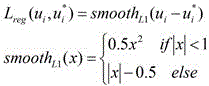
其中x为实数。where x is a real number.
所述对深度卷积神经元网络进行训练具体包括:The training of the deep convolutional neuron network specifically includes:
步骤S1:从预定训练集中选择两个对象区域-标签对输入到所述深度卷积神经元网络;其中,所述两个对象区域-标签对包括:在光照充足的环境下拍摄的无噪声真值图像,以及在光照不足的环境下拍摄的含噪声训练图像;Step S1: Select two object region-label pairs from a predetermined training set and input them into the deep convolutional neural network; wherein, the two object region-label pairs include: noise-free real images taken in a well-lit environment; value images, as well as noisy training images taken in poorly lit environments;
步骤S2:将所述含噪声训练图像用作所述初始图像以利用所述卷积神经网络重建图像;Step S2: using the noisy training image as the initial image to reconstruct the image using the convolutional neural network;
步骤S3:将所述重建图像与所述无噪声真值图像进行比较以获得训练误差;Step S3: comparing the reconstructed image with the noise-free ground-truth image to obtain a training error;
步骤S4:将所述训练误差迭代的反向传播经过所述卷积神经网络以修正所述卷积神经网络的参数,直至所述训练误差满足收敛条件。Step S4: Iteratively back-propagates the training error through the convolutional neural network to correct the parameters of the convolutional neural network until the training error satisfies the convergence condition.
步骤5:将得分最高的候选框确定为所要识别的对象,并在该当前帧中划出该候选框作为被识别跟踪的对象。Step 5: Determine the candidate frame with the highest score as the object to be recognized, and draw the candidate frame in the current frame as the object to be recognized and tracked.
采用上述技术方案所产生的有益效果在于:The beneficial effects produced by the above technical solutions are:
(1)最后一个卷积层用于获取编码对象的语义信息,其对目标的外观变化具有较强的鲁棒性。(1) The last convolutional layer is used to obtain the semantic information of the encoded object, which has strong robustness to the appearance changes of the object.
(2)应用仿射变换预测目标的位置,从而更准确地预测动态几何变形。(2) Apply the affine transformation to predict the position of the target, thereby more accurately predicting the dynamic geometric deformation.
(3)使用多任务损失,使仿射参数参与回归任务,能够进一步使目标定位更加准确。(3) Using the multi-task loss to make the affine parameters participate in the regression task can further make the target localization more accurate.
(4)将仿射变换与最高卷积层相结合,同时应用语义和几何变形处理外形和几何变化变化大目标,实现稳定识别与跟踪。(4) Combining affine transformation with the highest convolutional layer, and applying semantic and geometric deformation to deal with large objects with large changes in shape and geometry, to achieve stable recognition and tracking.
附图说明Description of drawings
图1为本发明实施例的一种水下图像识别跟踪系统框图;1 is a block diagram of an underwater image recognition tracking system according to an embodiment of the present invention;
图2为本发明实施例的深度卷积神经元网络结构模块示意图;2 is a schematic diagram of a deep convolutional neuron network structural module according to an embodiment of the present invention;
图3本发明实施例的电子设备结构示意图;3 is a schematic structural diagram of an electronic device according to an embodiment of the present invention;
图4为本发明实施例的一种水下图像识别跟踪方法流程图;4 is a flowchart of a method for identifying and tracking underwater images according to an embodiment of the present invention;
图5为本发明实施例的一种水下图像识别跟踪网络架构图;5 is an architectural diagram of an underwater image recognition and tracking network according to an embodiment of the present invention;
图6所示为本发明实施例的水下图像识别跟踪结果图。FIG. 6 is a diagram showing a result of underwater image recognition and tracking according to an embodiment of the present invention.
具体实施方式Detailed ways
下面结合附图对本发明具体实施方式加以详细的说明。The specific embodiments of the present invention will be described in detail below with reference to the accompanying drawings.
一方面,本发明提供一种水下图像识别跟踪系统,如图1所示,包括仿射变换模块201、候选框生成模块202和跟踪模块203。可选地,系统2000还可包括训练器204;In one aspect, the present invention provides an underwater image recognition and tracking system, as shown in FIG. 1 , including an
所述仿射变换模块201接收水下视频图像序列,并对所接收的图像序列中的图像进行仿射变换,以在当前的图像帧上标记出仿射框。水下图像可由高清摄像头动态随机获取。水下拍摄的视频图像,由于水体自身环境的复杂性、水下的不确定性动态因素、以及成像过程中水体对光线散射以及吸收效应产生的非线性影响都极大地降低了水下图像质量,导致图像对比度降低、纹理模糊。因此有必要对这些图像进行预处理,例如针对每一幅图像,进行图像增强处理,在直方图均衡化之后,进行缩放、旋转、平移、剪裁等中的一个或多个操作。本领域技术人员应该理解,这些与操作并不是必需的,而是可选的。接着,对所接收的图像序列中的图像进行仿射变换,以在当前的图像帧上标记初始仿射框。在这里,仿射框表示图像序列中要被追踪的目标。具体地,可以根据上一帧图像中画出的目标而在当前帧上标记初始仿射框,即,根据第t-1帧图像目标所在位置,在第t帧图像上,标记初始仿射框。在本实施例中,在标记出各视频图像帧中的仿射框时,采用仿射变换表示各个图像帧中的目标的几何变形。仿射变换采用仿射变换矩阵的形式。The
所述候选框生成模块202,基于所述仿射框,利用随机游走模型将仿射变换,形成M个候选框;The candidate
所述跟踪模块203,将所述M个候选框所确定的候选图像区域输入到深度卷积神经元网络从而获得M个得分,并将得分最高的候选框确定为所要识别的对象,以及在该当前帧中划出该候选框作为被识别跟踪的对象;The
本实施例中,将M个候选框所确定的候选图像区域进行仿射变换成矩形区域,输入到深度卷积神经元网络,本实施例中的CNN网络为VGG-16网络,也可为其它常规的深度学习网络(CNN)。本CNN网络采用如图2所示的经典的深度网络结构。In this embodiment, the candidate image regions determined by the M candidate frames are affine-transformed into rectangular regions and input to the deep convolutional neuron network. The CNN network in this embodiment is the VGG-16 network, or other Regular deep learning network (CNN). This CNN network adopts the classic deep network structure shown in Figure 2.
将候选框输入如图2所示的深度卷积神经元网络,分别通过卷积层10、激活层20、池化层30,分别进行卷积操作、激活操作、池化操作并通过全连接层40输出M个得分score1,score2, ……scoreM。Input the candidate frame into the deep convolutional neuron network as shown in Figure 2, and pass through the
CNN包括卷积层10。图2中作为示例给出了一层卷积层。然而,本领域技术人员可知,为了增强特征的表征能力,在CNN 2000中可包括多层卷积层。每个卷积层均可包括多个卷积核,卷积核由权重(Weight)和偏移量(Bias)构成。卷积核的数量也称为特征通道数量。每个卷积核仅对输入层的特定特征敏感,并可通过卷积操作提取这些特征。因此,卷积层2200也可称之为特征提取层。根据本申请实施方式的图像降噪方法1000可通过CNN 2000的特征提取层(例如,卷积层2200)对包含噪声的初始图像2100进行卷积操作以提取初级特征图。The CNN includes convolutional layers 10 . One convolutional layer is given as an example in Figure 2. However, those skilled in the art know that in order to enhance the representation capability of features, multiple convolutional layers may be included in
一般地,卷积核的尺寸小于输入层的尺寸,因此,每个卷积核仅感知输入层的部分区域,这部分区域称之为感知域(Receptive Field)。然后,每个卷积核以特定的步长(Stride)滑动遍及整个输入层,直至提取输入层的全部信息。在这一过程中,通过权重共享,卷积核可将卷积核自身的权重和偏移量共享应用到对整个输入层的特征提取上,以大大降低计算负担。然而,权重共享并非适用于任何应用场景。对于一些图像,用户的关注区域集中在图像的某个区域(例如,中心区域),而且这一区域的图像特征与其它区域明显不同。在这种应用场景下,可通过局域连接层来对图像的特定区域进行特征提取,局域连接层的卷积核权重可不共享到对其它图像区域的特征提取中。Generally, the size of the convolution kernel is smaller than the size of the input layer. Therefore, each convolution kernel only perceives a part of the input layer, which is called the Receptive Field. Then, each convolution kernel slides through the entire input layer with a specific stride until all the information of the input layer is extracted. In this process, through weight sharing, the convolution kernel can apply the weight and offset sharing of the convolution kernel itself to the feature extraction of the entire input layer to greatly reduce the computational burden. However, weight sharing is not suitable for any application scenarios. For some images, the user's area of interest is concentrated in a certain area of the image (eg, the central area), and the image characteristics of this area are significantly different from other areas. In this application scenario, the local connection layer can be used to perform feature extraction on a specific area of the image, and the convolution kernel weight of the local connection layer may not be shared with the feature extraction of other image areas.
CNN还包括激活层20。如上所述,卷积核仅仅对初始图像进行线性变换。然而,线性变换对于图像特征的语义表征能力是不足的。为了增强对图像特征的语义表征能力,往往需要添加非线性的激活层。这样的非线性的激活层可以对初级特征图进行非线性变换,以获得具有较强的语义表征能力的次级特征图。可根据实际需求而为激活层配置不同的激活函数。例如,可采用sigmod函数来对特征进行激活。The CNN also includes an
根据本申请的一个实施例,CNN还包括池化(Pooling)层30。池化层30可以对其输入层进行下采样以降低数据尺寸。例如,池化层30可以对激活层20输出的特征图进行下采样。这种下采样操作在一方面可以降低输出尺寸以加快输出处理速度,在另一方面也可以减小过拟合现象。根据本申请的一个实施例,可以在每个下采样的过程中将特征通道数量翻倍。According to an embodiment of the present application, the CNN further includes a pooling (Pooling)
池化层30选用多种池化操作。根据本申请的实施例,池化层30选用平均值池化(Average Pooling)。在平均值池化过程中,每个池可涵盖其输出层的N个像素值,每个池的输出值是这N个像素值的平均值。通过这种方式,数据尺寸降低为原尺寸的1/N。The
根据本申请的实施例,池化层30选用最大值池化(Max Pooling)。在最大值池化过程中,每个池可涵盖其输出层的N个像素值,每个池的输出值是从这N个像素值中选出的最大值。通过这种方式,数据尺寸也降低为原尺寸的1/N。According to the embodiment of the present application, the
CNN包括全连接层40。在全连接层40中,每一神经元连接至上一层的全部神经元。全连接层40可以对前几层卷积层提取的特征进行归纳和总结,以获得体现全局特征的特征图。The CNN includes fully connected layers 40 . In the fully connected
所述训练模块204用于对深度卷积神经元网络进行训练。具体地,从预定训练集中选择两个对象区域-标签对输入到所述深度卷积神经元网络;其中,所述两个对象区域-标签对包括:在光照充足的环境下拍摄的无噪声真值图像,以及在光照不足的环境下拍摄的含噪声训练图像;将所述含噪声训练图像用作所述初始图像以利用所述卷积神经网络重建图像。将所重建的重建图像与所述无噪声真值图像进行比较以获得训练误差,以及将所述训练误差迭代地反向传播经过所述卷积神经网络以修正所述卷积神经网络的参数,直至所述训练误差满足收敛条件。The
如图3所示,表示了适于用实现本公开的实施例的电子设备600的结构示意图。图3示出的电子设备仅仅是一个示例,不应对本公开的实施例的功能和使用范围带来任何限制。As shown in FIG. 3, a schematic structural diagram of an
如图3所示,电子设备600可以包括处理装置(例如中央处理器、图形处理器等)601,其可以根据存储在只读存储器(ROM)602中的程序或者从存储装置608加载到随机访问存储器(RAM)603中的程序而执行各种适当的动作和处理。在RAM 603中,还存储有电子设备600操作所需的各种程序和数据。处理装置601、ROM 602以及RAM 603通过总线604彼此相连。输入/输出(I/O)接口605也连接至总线604。As shown in FIG. 3 ,
通常,以下装置可以连接至I/O接口605:包括例如触摸屏、触摸板、键盘、鼠标、摄像头、麦克风、加速度计、陀螺仪等的输入装置606;包括例如液晶显示器(LCD)、扬声器、振动器等的输出装置607;包括例如磁带、硬盘等的存储装置608;以及通信装置609。通信装置609可以允许电子设备600与其他设备进行无线或有线通信以交换数据。虽然图3示出了具有各种装置的电子设备600,但是应理解的是,并不要求实施或具备所有示出的装置。可以替代地实施或具备更多或更少的装置。图3中示出的每个方框可以代表一个装置,也可以根据需要代表多个装置。Typically, the following devices may be connected to the I/O interface 605:
特别地,根据本公开的实施例,上文参考流程图描述的过程可以被实现为计算机软件程序。例如,本公开的实施例包括一种计算机程序产品,其包括承载在计算机可读介质上的计算机程序,该计算机程序包含用于执行流程图所示的方法的程序代码。在这样的实施例中,该计算机程序可以通过通信装置609从网络上被下载和安装,或者从存储装置608被安装,或者从ROM 602被安装。在该计算机程序被处理装置601执行时,执行本公开的实施例的方法中限定的上述功能。In particular, according to embodiments of the present disclosure, the processes described above with reference to the flowcharts may be implemented as computer software programs. For example, embodiments of the present disclosure include a computer program product comprising a computer program carried on a computer-readable medium, the computer program containing program code for performing the method illustrated in the flowchart. In such an embodiment, the computer program may be downloaded and installed from the network via the
需要说明的是,本公开的实施例所述的计算机可读介质可以是计算机可读信号介质或者计算机可读存储介质或者是上述两者的任意组合。计算机可读存储介质例如可以是——但不限于——电、磁、光、电磁、红外线、或半导体的系统、装置或器件,或者任意以上的组合。计算机可读存储介质的更具体的例子可以包括但不限于:具有一个或多个导线的电连接、便携式计算机磁盘、硬盘、随机访问存储器(RAM)、只读存储器(ROM)、可擦式可编程只读存储器(EPROM或闪存)、光纤、便携式紧凑磁盘只读存储器(CD-ROM)、光存储器件、磁存储器件、或者上述的任意合适的组合。在本公开的实施例中,计算机可读存储介质可以是任何包含或存储程序的有形介质,该程序可以被指令执行系统、装置或者器件使用或者与其结合使用。而在本公开的实施例中,计算机可读信号介质可以包括在基带中或者作为载波一部分传播的数据信号,其中承载了计算机可读的程序代码。这种传播的数据信号可以采用多种形式,包括但不限于电磁信号、光信号或上述的任意合适的组合。计算机可读信号介质还可以是计算机可读存储介质以外的任何计算机可读介质,该计算机可读信号介质可以发送、传播或者传输用于由指令执行系统、装置或者器件使用或者与其结合使用的程序。计算机可读介质上包含的程序代码可以用任何适当的介质传输,包括但不限于:电线、光缆、RF(射频)等等,或者上述的任意合适的组合。It should be noted that the computer-readable medium described in the embodiments of the present disclosure may be a computer-readable signal medium or a computer-readable storage medium, or any combination of the above two. The computer-readable storage medium can be, for example, but not limited to, an electrical, magnetic, optical, electromagnetic, infrared, or semiconductor system, apparatus or device, or a combination of any of the above. More specific examples of computer readable storage media may include, but are not limited to, electrical connections with one or more wires, portable computer disks, hard disks, random access memory (RAM), read only memory (ROM), erasable Programmable read only memory (EPROM or flash memory), optical fiber, portable compact disk read only memory (CD-ROM), optical storage devices, magnetic storage devices, or any suitable combination of the above. In embodiments of the present disclosure, a computer-readable storage medium may be any tangible medium that contains or stores a program that can be used by or in conjunction with an instruction execution system, apparatus, or device. Rather, in embodiments of the present disclosure, a computer-readable signal medium may include a data signal in baseband or propagated as part of a carrier wave, carrying computer-readable program code therein. Such propagated data signals may take a variety of forms, including but not limited to electromagnetic signals, optical signals, or any suitable combination of the foregoing. A computer-readable signal medium can also be any computer-readable medium other than a computer-readable storage medium that can transmit, propagate, or transport the program for use by or in connection with the instruction execution system, apparatus, or device . Program code embodied on a computer readable medium may be transmitted using any suitable medium including, but not limited to, electrical wire, optical fiber cable, RF (radio frequency), etc., or any suitable combination of the foregoing.
另一方面,本发明还提供一种水下图像识别跟踪方法,其流程图如图4所示,网络架构图如图5所示,采用上述的一种水下图像识别跟踪系统实现,该方法包括以下步骤:On the other hand, the present invention also provides an underwater image recognition and tracking method, the flowchart of which is shown in FIG. 4 , and the network architecture diagram as shown in FIG. 5 . Include the following steps:
步骤1:接收水下视频图像序列,对图像进行预处理,在对所述每一幅图像进行直方图均衡化之后,进行缩放、旋转、平移、剪裁等中的一个或多个操作;Step 1: Receive a sequence of underwater video images, preprocess the images, and perform one or more operations of scaling, rotating, panning, cropping, etc. after each image is histogram equalized;
水下图像可由高清摄像头动态随机获取。水下拍摄的视频图像,由于水体自身环境的复杂性、水下的不确定性动态因素、以及成像过程中水体对光线散射以及吸收效应产生的非线性影响都极大地降低了水下图像质量,导致图像对比度降低、纹理模糊。因此有必要对这些图像进行预处理,例如针对每一幅图像,进行图像增强处理,在直方图均衡化之后,进行缩放、旋转、平移、剪裁等中的一个或多个操作。Underwater images can be dynamically and randomly acquired by high-definition cameras. For video images captured underwater, the quality of underwater images is greatly reduced due to the complexity of the water environment, the dynamic factors of underwater uncertainty, and the nonlinear effects of the water on light scattering and absorption during the imaging process. This results in reduced image contrast and blurred textures. Therefore, it is necessary to perform preprocessing on these images, such as performing image enhancement processing for each image, and performing one or more operations of scaling, rotation, translation, cropping, etc. after histogram equalization.
步骤2:对所接收的水下视频图像序列中的图像进行仿射变换,以在当前的图像帧上标记出仿射框;Step 2: perform affine transformation on the images in the received underwater video image sequence to mark the affine frame on the current image frame;
步骤2.1:根据上一帧图像中标记出的仿射框而在当前帧上标记出当前帧中的仿射框;Step 2.1: Mark the affine frame in the current frame on the current frame according to the affine frame marked in the previous frame of image;
步骤2.2:在标记出各视频图像帧中的所述仿射框时,采用仿射变换表示各个图像帧中的目标的几何变形。Step 2.2: When marking the affine frame in each video image frame, use affine transformation to represent the geometric deformation of the target in each image frame.
对所接收的图像序列中的图像进行仿射变换,以在当前的图像帧上标记初始仿射框。在这里,仿射框表示图像序列中要被追踪的目标。具体地,根据上一帧图像中标记出的目标而在当前帧上标记初始仿射框,即,根据第t-1帧图像目标所在位置,在第t帧图像上,标记初始仿射框。An affine transformation is performed on the images in the received image sequence to mark the initial affine box on the current image frame. Here, the affine box represents the object to be tracked in the image sequence. Specifically, the initial affine frame is marked on the current frame according to the target marked in the previous frame of image, that is, according to the position of the target in the t-1 frame image, the initial affine frame is marked on the t frame image.
本实施例中,在标记出各视频图像帧中的仿射框时,采用仿射变换表示各个图像帧中的目标的几何变形。仿射变换采用仿射变换矩阵的形式,例如仿射变换矩阵T(r) ,具有如下3维的李群结构:In this embodiment, when the affine frame in each video image frame is marked, affine transformation is used to represent the geometric deformation of the target in each image frame. Affine transformation takes the form of an affine transformation matrix, such as an affine transformation matrix T(r) , which has the following 3-dimensional Lie group structure:

ga(2)是对应于仿射李群GA(2)的李代数,矩阵G j (

当t=1时,初始化仿射变换参数S1=[r1,r2,r3,r4,r5,r6]。When t=1, initialize the affine transformation parameters S 1 =[
步骤3:基于步骤2中所述仿射框,利用随机游走模型将仿射变换形成M个候选框;Step 3: Based on the affine frame described in
步骤3.1:基于当前图像帧中的仿射框随机生成多维向量
步骤3.2:对随机生成的向量
步骤3.3:将上一帧的仿射变换与通过随机生成的向量
步骤3.4:对下一帧进行步骤1,重复步骤1-3直到产生M个候选框。Step 3.4:
所述多维向量
本实施例中,随机生成一个(-1,1)之间的6维向量 u=(u 1,...,u j ,...u 6),(-1<u j <
1,
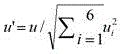
则第t-1帧图像跟踪的仿射变换S t-1可表示为:Then the affine transformation S t-1 of the t-1th frame image tracking can be expressed as:

其中 t是当前目标帧,
当前帧的仿射变换为上一帧的仿射变换与通过随机生成的向量u进行标准化处理得到的 u’之和。The affine transformation of the current frame is the sum of the affine transformation of the previous frame and u' obtained by normalizing the randomly generated vector u .
接着,对下一帧进行处理,即k=k+1,然后重复上述步骤1至3,直到产生M个候选框
为了清楚起见,下面以一个具体的例子进行说明。应该理解,所举之例仅仅是示意性的,而不是用来限定本发明。在本发明公开范围的教导下,本领域技术人员还可以预期其它的具体实例来实现本发明。For the sake of clarity, a specific example is described below. It should be understood that the given examples are merely illustrative and not intended to limit the present invention. Given the teachings of the scope of the present disclosure, those skilled in the art can also contemplate other specific examples for practicing the present invention.
对于视频图像序列中的第一帧进行初始化处理,即,t=1时,初始化仿射变换参数S1=[0.05;0.002;0.002;0.05;5;5]。Initialize the first frame in the video image sequence, that is, when t=1, initialize the affine transformation parameter S 1 =[0.05; 0.002; 0.002; 0.05; 5; 5].
对第t(t>1)帧图像,根据第t-1帧图像目标所在位置,在第t帧图像上,画出初始仿射框,确定出候选图像区域,即,要跟踪的目标。接着,将仿射变换利用随机游走模型,产生1000个候选框。For the t (t>1) frame image, according to the position of the target in the t-1 frame image, on the t frame image, draw an initial affine frame to determine the candidate image area, that is, the target to be tracked. Next, the affine transformation is performed using a random walk model to generate 1000 candidate boxes.
初始化k=1,当k<=1000时,随机生成一个(-1,1)之间的6维向量u=(u 1,u 2,u 3,u 4,u 5,u 6),对随机生成一个(-1,1)之间的6维向量u=(u 1,u 2,u 3,u 4,u 5,u 6),进行标准化处理得到


步骤4:将M个候选框所确定的候选图像区域输入到深度卷积神经元网络从而获得M个得分,其中M为大于1的整数;Step 4: Input the candidate image regions determined by the M candidate frames into the deep convolutional neural network to obtain M scores, where M is an integer greater than 1;
在本实施例中,将M个候选框所确定的候选图像区域进行仿射变换成矩形区域,输入到深度卷积神经元网络,该网络如图2所示。输将候选框输入如图2所示的深度卷积神经元网络,分别进行卷积操作、激活操作、池化操作并通过全连接层输出M个得分score1,score2, ……scoreM。其中,在进行上述操作过程中的损失函数可表示为: In this embodiment, the candidate image regions determined by the M candidate frames are subjected to affine transformation into rectangular regions, which are input to the deep convolutional neuron network, as shown in FIG. 2 . Input the candidate box into the deep convolutional neuron network shown in Figure 2, perform convolution operation, activation operation, pooling operation, and output M scores score1, score2, ... scoreM through the fully connected layer. Among them, the loss function in the process of performing the above operations can be expressed as:

其中,α为学习率;where α is the learning rate;
tc表示是类别标签,其中tc=1表示目标,tc=1表示背景; tc represents a category label, where tc =1 represents the target, and tc =1 represents the background;
i表示正在计算损失的回归框的序号; i represents the serial number of the regression box where the loss is being calculated;

L c (p,tc)=-logp tc (6) L c ( p , tc ) = - logp tc (6)
u i =(r1,r2,r3,r4,r5,r6)为真实目标区域的仿射参数元组; u i = ( r1 , r2 , r3 , r4 , r5 , r6 ) is the affine parameter tuple of the real target area;


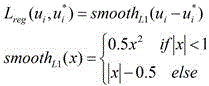
其中x为实数。where x is a real number.
步骤4.1:将M个候选框所确定的候选图像区域输入到深度卷积神经元网络;Step 4.1: Input the candidate image regions determined by the M candidate frames into the deep convolutional neural network;
所述深度卷积神经元网络包括相互级联的卷积层、激活层、池化层和全连接层;The deep convolutional neuron network includes a convolutional layer, an activation layer, a pooling layer and a fully connected layer that are cascaded to each other;
步骤4.2:对深度卷积神经元网络进行训练,通过所述深度卷积神经元网络,分别进行卷积操作、激活操作、池化操作获得所述M个得分。Step 4.2: Train the deep convolutional neuron network, and obtain the M scores by performing convolution operation, activation operation, and pooling operation respectively through the deep convolutional neuron network.
所述对深度卷积神经元网络进行训练具体包括:The training of the deep convolutional neuron network specifically includes:
步骤S1:从预定训练集中选择两个对象区域-标签对输入到所述深度卷积神经元网络;其中,所述两个对象区域-标签对包括:在光照充足的环境下拍摄的无噪声真值图像,以及在光照不足的环境下拍摄的含噪声训练图像;Step S1: Select two object region-label pairs from a predetermined training set and input them into the deep convolutional neural network; wherein, the two object region-label pairs include: noise-free real images taken in a well-lit environment; value images, as well as noisy training images taken in poorly lit environments;
步骤S2:将所述含噪声训练图像用作所述初始图像以利用所述卷积神经网络重建图像;Step S2: using the noisy training image as the initial image to reconstruct the image using the convolutional neural network;
步骤S3:将所述重建图像与所述无噪声真值图像进行比较以获得训练误差;Step S3: comparing the reconstructed image with the noise-free ground-truth image to obtain a training error;
步骤S4:将所述训练误差迭代的反向传播经过所述卷积神经网络以修正所述卷积神经网络的参数,直至所述训练误差满足收敛条件。Step S4: Iteratively back-propagates the training error through the convolutional neural network to correct the parameters of the convolutional neural network until the training error satisfies the convergence condition.
首先,向CNN输入训练数据集,以及对应类别的标签向量。针对每一幅图像,首先进行图像增强处理,在直方图均衡化之后,进行缩放、旋转、平移、剪裁操作,增大训练数据集中图像的数量。通过增加样本数量来获得较好的学习效果。初始图像的尺寸可不受限制。例如,初始图像可具有任意的分辨率和宽高比。初始图像可以是RGB图像并具有红色、绿色和蓝色三个颜色通道。每一颜色通道的图像均由位于各个像素点处的像素值来表示。这些像素值处于[0, 255]的数值范围内。First, input the training dataset to the CNN, as well as the label vector of the corresponding class. For each image, image enhancement processing is performed first, and after histogram equalization, scaling, rotation, translation, and cropping operations are performed to increase the number of images in the training data set. A better learning effect can be obtained by increasing the number of samples. The size of the initial image may not be limited. For example, the initial image can have any resolution and aspect ratio. The initial image may be an RGB image with three color channels of red, green and blue. The image of each color channel is represented by the pixel value located at each pixel point. These pixel values are in the range of [0, 255].
本发明实施例中,初始图像预先进行剪裁以符合特定宽高比。例如,初始图像可被剪裁为具有32像素×32像素的尺寸以匹配CIFAR-10数据集。或者,初始图像可剪裁为具有227像素×227像素的尺寸以匹配ImageNet数据集。再或者,初始图像2100可剪裁为具有224像素×224像素的尺寸以匹配VGG16和ResNet数据集。图像的剪裁可采用手工剪裁,例如,可使用Amazon Mechanical Turk (AMT)服务由大量在线人员根据图像的特点进行手工剪裁,以在保留拍摄对象的同时将图像剪裁为符合特定宽高比。此外,剪裁也可通过ROI(Regionof Interest,关注区域)提取层进行自动提取。例如,ROI提取层会自动生成框选出目标对象的边界框,并基于这一边界框自动调整和剪裁图像的尺寸以符合特定宽高比。ROI提取层的网络参数可以在训练过程中进行训练优化。In this embodiment of the present invention, the initial image is cropped in advance to conform to a specific aspect ratio. For example, the initial image may be cropped to have dimensions of 32 pixels by 32 pixels to match the CIFAR-10 dataset. Alternatively, the initial image can be cropped to have dimensions of 227 pixels by 227 pixels to match the ImageNet dataset. Still alternatively, the initial image 2100 may be cropped to have dimensions of 224 pixels by 224 pixels to match the VGG16 and ResNet datasets. Cropping of images can be done by hand, for example, by a large number of people online using the Amazon Mechanical Turk (AMT) service to tailor the image to a specific aspect ratio while preserving the subject. In addition, cropping can also be automatically extracted through the ROI (Region of Interest) extraction layer. For example, the ROI extraction layer automatically generates a bounding box that outlines the target object, and based on this bounding box, the image is automatically resized and cropped to fit a specific aspect ratio. The network parameters of the ROI extraction layer can be optimized during training.
可选地,可以对初始图像进行归一化以将初始图像的像素值转换到特定数值范围内。例如,可将初始图像的每个颜色通道的像素值归一化到[0, 1]的数值范围内以方便后续处理。然而,本领域技术人员可理解,由于像素值一般已均处于固定幅度[0, 255]的数值范围内,因此归一化处理并非必要处理,而仅是一种优化的选择。Optionally, the original image can be normalized to convert the pixel values of the original image into a specific numerical range. For example, the pixel values of each color channel of the initial image can be normalized to a value range of [0, 1] to facilitate subsequent processing. However, those skilled in the art can understand that since the pixel values are generally in the range of the fixed amplitude [0, 255], normalization processing is not necessary processing, but is only an optimal choice.
在本事实例中,上述向CNN输入数据的步骤包括:从预定训练集中选择两个对象区域-标签对,这两个对象区域-标签对是成对的对准的对象区域及其对应的对象身份标签。在一个实施方式中,可用属于同一物体或不同物体的相等的概率随机地选择这两个对象区域-标签对。例如,可在光照充足的环境下拍摄对象以获得无噪声真值图像,并且在光照不足的水下环境下拍摄对象以获得含噪声训练图像;In the present example, the above-mentioned step of inputting data to the CNN includes: selecting two object region-label pairs from a predetermined training set, the two object region-label pairs being pairs of aligned object regions and their corresponding object identities Label. In one embodiment, the two object region-label pairs may be randomly selected with equal probability of belonging to the same object or to different objects. For example, subjects can be photographed in a well-lit environment to obtain noise-free ground-truth images, and subjects can be photographed in a poorly-lit underwater environment to obtain noisy training images;
将含噪声训练图像用作初始图像以利用所述卷积神经网络重建获得所述重建图像;将所重建的重建图像与无噪声真值图像进行比较以获得训练误差,并将所述训练误差迭代地反向传播经过所述卷积神经网络以修正所述卷积神经网络的参数,直至所述训练误差满足收敛条件,例如直到得到测试准确率达到98%以上。using a noisy training image as an initial image to reconstruct the reconstructed image using the convolutional neural network; comparing the reconstructed reconstructed image to a noise-free ground truth image to obtain a training error, and iterating the training error Backpropagating through the convolutional neural network to correct the parameters of the convolutional neural network, until the training error satisfies the convergence condition, for example, until the test accuracy rate reaches more than 98%.
训练结束后,保存最后得到的训练模型,传送给识别跟踪系统。以上步骤可在数据集训练子系统中完成。After the training, save the final training model and send it to the recognition and tracking system. The above steps can be done in the dataset training subsystem.
步骤5:将得分最高的候选框确定为所要识别的对象,并在该当前帧中划出该候选框作为被识别跟踪的对象。Step 5: Determine the candidate frame with the highest score as the object to be recognized, and draw the candidate frame in the current frame as the object to be recognized and tracked.
计算得分最高者所在的候选框n可参照以下公式:To calculate the candidate box n where the highest scorer is located, refer to the following formula:

scorel表示M个得分,即score1,score2, ……scoreM; scorel represents M scores, that is, score1, score2, ... scoreM;
在第t帧图像上画出该候选框,即完成第t帧图像的识别,并将第t帧图像的候选框位置保存下来。The candidate frame is drawn on the t-th frame image, that is, the recognition of the t-th frame image is completed, and the position of the candidate frame of the t-th frame image is saved.
当t+1小于视频总帧数时,算法进入第一步,进行第t+1帧图像的跟踪。直到所有视频帧跟踪完毕,算法结束。识别跟踪结果如图6所示。When t+1 is less than the total number of video frames, the algorithm enters the first step to track the t+1th frame image. The algorithm ends when all video frames are tracked. The identification and tracking results are shown in Figure 6.
最后应说明的是:以上各实施例仅用以说明本发明的技术方案,而非对其限制;尽管参照前述各实施例对本发明进行了详细的说明,本领域的普通技术人员应当理解:其依然可以对前述各实施例所记载的技术方案进行修改,或者对其中部分或者全部技术特征进行等同替换;而这些修改或者替换,并不使相应技术方案的本质脱离本发明权利要求所限定的范围。Finally, it should be noted that the above embodiments are only used to illustrate the technical solutions of the present invention, but not to limit them; although the present invention has been described in detail with reference to the foregoing embodiments, those of ordinary skill in the art should understand that: The technical solutions described in the foregoing embodiments can still be modified, or some or all of the technical features thereof can be equivalently replaced; and these modifications or replacements do not make the essence of the corresponding technical solutions depart from the scope defined by the claims of the present invention .
Claims (9)


Priority Applications (1)
| Application Number | Priority Date | Filing Date | Title |
|---|---|---|---|
| CN202010118383.8A CN111445496B (en) | 2020-02-26 | 2020-02-26 | Underwater image recognition tracking system and method |
Applications Claiming Priority (1)
| Application Number | Priority Date | Filing Date | Title |
|---|---|---|---|
| CN202010118383.8A CN111445496B (en) | 2020-02-26 | 2020-02-26 | Underwater image recognition tracking system and method |
Publications (2)
| Publication Number | Publication Date |
|---|---|
| CN111445496A true CN111445496A (en) | 2020-07-24 |
| CN111445496B CN111445496B (en) | 2023-06-30 |
Family
ID=71652738
Family Applications (1)
| Application Number | Title | Priority Date | Filing Date |
|---|---|---|---|
| CN202010118383.8A Active CN111445496B (en) | 2020-02-26 | 2020-02-26 | Underwater image recognition tracking system and method |
Country Status (1)
| Country | Link |
|---|---|
| CN (1) | CN111445496B (en) |
Cited By (4)
| Publication number | Priority date | Publication date | Assignee | Title |
|---|---|---|---|---|
| CN113077048A (en) * | 2021-04-09 | 2021-07-06 | 上海西井信息科技有限公司 | Seal matching method, system, equipment and storage medium based on neural network |
| TWI779334B (en) * | 2020-08-21 | 2022-10-01 | 國立臺灣海洋大學 | Mobile automatic marking method for aquatic organisms and automatic marking system for aquatic organisms images |
| CN115424180A (en) * | 2022-09-06 | 2022-12-02 | 北京远鉴信息技术有限公司 | Target identification method and device, electronic equipment and storage medium |
| CN116405626A (en) * | 2023-06-05 | 2023-07-07 | 吉林大学 | A Global Matching Method for Visual Enhancement of Underwater Moving Targets |
Citations (14)
| Publication number | Priority date | Publication date | Assignee | Title |
|---|---|---|---|---|
| US20170343481A1 (en) * | 2016-05-27 | 2017-11-30 | Purdue Research Foundation | Methods and systems for crack detection |
| CN107844750A (en) * | 2017-10-19 | 2018-03-27 | 华中科技大学 | A kind of water surface panoramic picture target detection recognition methods |
| CN107909082A (en) * | 2017-10-30 | 2018-04-13 | 东南大学 | Sonar image target identification method based on depth learning technology |
| CN108171112A (en) * | 2017-12-01 | 2018-06-15 | 西安电子科技大学 | Vehicle identification and tracking based on convolutional neural networks |
| CN108447074A (en) * | 2018-02-02 | 2018-08-24 | 中国科学院西安光学精密机械研究所 | Underwater target identification method based on bidirectional self-adaptive semantic fusion |
| CN108537170A (en) * | 2018-04-09 | 2018-09-14 | 电子科技大学 | A kind of power equipment firmware unmanned plane inspection pin missing detection method |
| CN108596030A (en) * | 2018-03-20 | 2018-09-28 | 杭州电子科技大学 | Sonar target detection method based on Faster R-CNN |
| CN108846323A (en) * | 2018-05-28 | 2018-11-20 | 哈尔滨工程大学 | A kind of convolutional neural networks optimization method towards Underwater Targets Recognition |
| CN109100710A (en) * | 2018-06-26 | 2018-12-28 | 东南大学 | A kind of Underwater targets recognition based on convolutional neural networks |
| CN109543585A (en) * | 2018-11-16 | 2019-03-29 | 西北工业大学 | Underwater optics object detection and recognition method based on convolutional neural networks |
| CN110060248A (en) * | 2019-04-22 | 2019-07-26 | 哈尔滨工程大学 | Sonar image submarine pipeline detection method based on deep learning |
| CN110119672A (en) * | 2019-03-26 | 2019-08-13 | 湖北大学 | A kind of embedded fatigue state detection system and method |
| CN110765886A (en) * | 2019-09-29 | 2020-02-07 | 深圳大学 | Road target detection method and device based on convolutional neural network |
| WO2020030949A1 (en) * | 2018-08-08 | 2020-02-13 | Abyssal S.A. | System and method of operation for remotely operated vehicles for automatic detection of structure integrity threats |
-
2020
- 2020-02-26 CN CN202010118383.8A patent/CN111445496B/en active Active
Patent Citations (14)
| Publication number | Priority date | Publication date | Assignee | Title |
|---|---|---|---|---|
| US20170343481A1 (en) * | 2016-05-27 | 2017-11-30 | Purdue Research Foundation | Methods and systems for crack detection |
| CN107844750A (en) * | 2017-10-19 | 2018-03-27 | 华中科技大学 | A kind of water surface panoramic picture target detection recognition methods |
| CN107909082A (en) * | 2017-10-30 | 2018-04-13 | 东南大学 | Sonar image target identification method based on depth learning technology |
| CN108171112A (en) * | 2017-12-01 | 2018-06-15 | 西安电子科技大学 | Vehicle identification and tracking based on convolutional neural networks |
| CN108447074A (en) * | 2018-02-02 | 2018-08-24 | 中国科学院西安光学精密机械研究所 | Underwater target identification method based on bidirectional self-adaptive semantic fusion |
| CN108596030A (en) * | 2018-03-20 | 2018-09-28 | 杭州电子科技大学 | Sonar target detection method based on Faster R-CNN |
| CN108537170A (en) * | 2018-04-09 | 2018-09-14 | 电子科技大学 | A kind of power equipment firmware unmanned plane inspection pin missing detection method |
| CN108846323A (en) * | 2018-05-28 | 2018-11-20 | 哈尔滨工程大学 | A kind of convolutional neural networks optimization method towards Underwater Targets Recognition |
| CN109100710A (en) * | 2018-06-26 | 2018-12-28 | 东南大学 | A kind of Underwater targets recognition based on convolutional neural networks |
| WO2020030949A1 (en) * | 2018-08-08 | 2020-02-13 | Abyssal S.A. | System and method of operation for remotely operated vehicles for automatic detection of structure integrity threats |
| CN109543585A (en) * | 2018-11-16 | 2019-03-29 | 西北工业大学 | Underwater optics object detection and recognition method based on convolutional neural networks |
| CN110119672A (en) * | 2019-03-26 | 2019-08-13 | 湖北大学 | A kind of embedded fatigue state detection system and method |
| CN110060248A (en) * | 2019-04-22 | 2019-07-26 | 哈尔滨工程大学 | Sonar image submarine pipeline detection method based on deep learning |
| CN110765886A (en) * | 2019-09-29 | 2020-02-07 | 深圳大学 | Road target detection method and device based on convolutional neural network |
Non-Patent Citations (11)
| Title |
|---|
| FENGQIANG XU;XUEYAN DING;JINJIA PENG;GUOLIANG YUAN;YAFEI WANG;JUN ZHANG;XIANPING FU: "Real-time Detecting Method of Marine Small Object with Underwater Robot Vision" * |
| XUEMEI WU;JING LI;QIANG WU;JIANDE SUN: "Appearance-based gaze block estimation via CNN classification" * |
| YUEMEI ZHU ETAL.: "Segmentation of underwater object in videos" * |
| 周浩: "样本不足条件下水下机器人小目标检测识别研究" * |
| 宋博扬等: "卷积神经网络在UUV上图像识别的应用" * |
| 徐梦洋: "基于深度学习的行人再识别研究综述" * |
| 曾文冠等: "基于卷积神经网络的声呐图像目标检测识别" * |
| 王冬丽等: "基于深度强化学习的视觉目标跟踪" * |
| 钮赛赛等: "基于深度卷积神经网络的空中红外目标识别分类技术" * |
| 闵召阳等: "基于卷积神经网络检测的单镜头多目标跟踪算法" * |
| 高强,鲁建华: "基于声呐图像的海洋目标矩特征提取方法性能分析" * |
Cited By (5)
| Publication number | Priority date | Publication date | Assignee | Title |
|---|---|---|---|---|
| TWI779334B (en) * | 2020-08-21 | 2022-10-01 | 國立臺灣海洋大學 | Mobile automatic marking method for aquatic organisms and automatic marking system for aquatic organisms images |
| CN113077048A (en) * | 2021-04-09 | 2021-07-06 | 上海西井信息科技有限公司 | Seal matching method, system, equipment and storage medium based on neural network |
| CN115424180A (en) * | 2022-09-06 | 2022-12-02 | 北京远鉴信息技术有限公司 | Target identification method and device, electronic equipment and storage medium |
| CN116405626A (en) * | 2023-06-05 | 2023-07-07 | 吉林大学 | A Global Matching Method for Visual Enhancement of Underwater Moving Targets |
| CN116405626B (en) * | 2023-06-05 | 2023-09-22 | 吉林大学 | A global matching underwater moving target visual enhancement method and system |
Also Published As
| Publication number | Publication date |
|---|---|
| CN111445496B (en) | 2023-06-30 |
Similar Documents
| Publication | Publication Date | Title |
|---|---|---|
| CN113673307B (en) | A lightweight video action recognition method | |
| CN110210551B (en) | A Visual Object Tracking Method Based on Adaptive Subject Sensitivity | |
| US12039440B2 (en) | Image classification method and apparatus, and image classification model training method and apparatus | |
| Guo et al. | Exploring the effects of blur and deblurring to visual object tracking | |
| US20200311871A1 (en) | Image reconstruction method and device | |
| US8805018B2 (en) | Method of detecting facial attributes | |
| WO2021043168A1 (en) | Person re-identification network training method and person re-identification method and apparatus | |
| CN113191489B (en) | Training method of binary neural network model, image processing method and device | |
| CN109684969B (en) | Gaze position estimation method, computer device, and storage medium | |
| WO2023250223A1 (en) | View dependent three-dimensional morphable models | |
| CN111445496B (en) | Underwater image recognition tracking system and method | |
| CN113962846B (en) | Image alignment method and device, computer readable storage medium and electronic equipment | |
| Salem | A Survey on Various Image Inpainting Techniques. | |
| CN115359525A (en) | Face detection and recognition method and device based on deep learning | |
| CN111222459A (en) | Visual angle-independent video three-dimensional human body posture identification method | |
| Zhang et al. | Underwater image enhancement using improved generative adversarial network | |
| Yang et al. | S3Net: A single stream structure for depth guided image relighting | |
| CN115482523A (en) | Small object target detection method and system of lightweight multi-scale attention mechanism | |
| CN117036658A (en) | Image processing method and related equipment | |
| Guo et al. | Face illumination normalization based on generative adversarial network | |
| CN108416756B (en) | A region-aware image denoising method based on machine learning | |
| Agarwal et al. | Unmasking the potential: evaluating image inpainting techniques for masked face reconstruction | |
| CN115115537A (en) | Image restoration method based on mask training | |
| Cao et al. | Over-exposure correction via exposure and scene information disentanglement | |
| US12307628B2 (en) | System and method for image transformation |
Legal Events
| Date | Code | Title | Description |
|---|---|---|---|
| PB01 | Publication | ||
| PB01 | Publication | ||
| SE01 | Entry into force of request for substantive examination | ||
| SE01 | Entry into force of request for substantive examination | ||
| GR01 | Patent grant | ||
| GR01 | Patent grant | ||
| TR01 | Transfer of patent right |
Effective date of registration: 20240905 Address after: 202-25 Conference Center of CEC Haikang Wuxi Internet of Things Industrial Base, No. 78, Jinghui East Road, Xinwu District, Wuxi City, Jiangsu Province, 214000 Patentee after: Wuxi Haibote Intelligent Technology Co.,Ltd. Country or region after: China Address before: 110044 Liaoning Province, Shenyang City District wanghuanan Street No. 21 Patentee before: SHENYANG University Country or region before: China |
|
| TR01 | Transfer of patent right |