CN111444771A - Gesture preposing real-time identification method based on recurrent neural network - Google Patents
Gesture preposing real-time identification method based on recurrent neural network Download PDFInfo
- Publication number
- CN111444771A CN111444771A CN202010122397.7A CN202010122397A CN111444771A CN 111444771 A CN111444771 A CN 111444771A CN 202010122397 A CN202010122397 A CN 202010122397A CN 111444771 A CN111444771 A CN 111444771A
- Authority
- CN
- China
- Prior art keywords
- gesture
- neural network
- real
- recognition
- time
- Prior art date
- Legal status (The legal status is an assumption and is not a legal conclusion. Google has not performed a legal analysis and makes no representation as to the accuracy of the status listed.)
- Granted
Links
Images


Classifications
-
- G—PHYSICS
- G06—COMPUTING OR CALCULATING; COUNTING
- G06V—IMAGE OR VIDEO RECOGNITION OR UNDERSTANDING
- G06V40/00—Recognition of biometric, human-related or animal-related patterns in image or video data
- G06V40/20—Movements or behaviour, e.g. gesture recognition
- G06V40/28—Recognition of hand or arm movements, e.g. recognition of deaf sign language
-
- G—PHYSICS
- G06—COMPUTING OR CALCULATING; COUNTING
- G06F—ELECTRIC DIGITAL DATA PROCESSING
- G06F18/00—Pattern recognition
- G06F18/20—Analysing
- G06F18/21—Design or setup of recognition systems or techniques; Extraction of features in feature space; Blind source separation
- G06F18/214—Generating training patterns; Bootstrap methods, e.g. bagging or boosting
-
- G—PHYSICS
- G06—COMPUTING OR CALCULATING; COUNTING
- G06F—ELECTRIC DIGITAL DATA PROCESSING
- G06F18/00—Pattern recognition
- G06F18/20—Analysing
- G06F18/24—Classification techniques
-
- G—PHYSICS
- G06—COMPUTING OR CALCULATING; COUNTING
- G06N—COMPUTING ARRANGEMENTS BASED ON SPECIFIC COMPUTATIONAL MODELS
- G06N3/00—Computing arrangements based on biological models
- G06N3/02—Neural networks
- G06N3/04—Architecture, e.g. interconnection topology
- G06N3/044—Recurrent networks, e.g. Hopfield networks
-
- G—PHYSICS
- G06—COMPUTING OR CALCULATING; COUNTING
- G06N—COMPUTING ARRANGEMENTS BASED ON SPECIFIC COMPUTATIONAL MODELS
- G06N3/00—Computing arrangements based on biological models
- G06N3/02—Neural networks
- G06N3/04—Architecture, e.g. interconnection topology
- G06N3/045—Combinations of networks
Landscapes
- Engineering & Computer Science (AREA)
- Theoretical Computer Science (AREA)
- Physics & Mathematics (AREA)
- Data Mining & Analysis (AREA)
- General Physics & Mathematics (AREA)
- Life Sciences & Earth Sciences (AREA)
- Artificial Intelligence (AREA)
- General Engineering & Computer Science (AREA)
- Evolutionary Computation (AREA)
- Computer Vision & Pattern Recognition (AREA)
- Health & Medical Sciences (AREA)
- General Health & Medical Sciences (AREA)
- Molecular Biology (AREA)
- Computing Systems (AREA)
- Biomedical Technology (AREA)
- Biophysics (AREA)
- Computational Linguistics (AREA)
- Bioinformatics & Computational Biology (AREA)
- Evolutionary Biology (AREA)
- Bioinformatics & Cheminformatics (AREA)
- Mathematical Physics (AREA)
- Software Systems (AREA)
- Psychiatry (AREA)
- Social Psychology (AREA)
- Human Computer Interaction (AREA)
- Multimedia (AREA)
- Image Analysis (AREA)
Abstract
本发明公开了一种基于循环神经网络的手势前置实时识别方法,包括以下步骤:A、离线建模阶段:leap motion采集手势数据,对采集到的数据进行预处理后提取手势特征,获得手势的特征序列,将手势特征序列和手势类型输入长短时记忆神经网络LSTM训练获得手势分类器。B、在线手势前置识别阶段:leap motion实时采集手势数据,处理手势数据,计算当前时间节点的手势特征,加入特征序列,将当前时间节点获得特征序列输入手势分类器,如果分类器输出预测概率大于95%,将此概率对应手势类型作为结果输出。利用本发明,可以做到与人的视觉类似的动态识别和提前预测能力,不需要等待手势全部完整表达完就可以实时识别出用户试图表达的手势类型,效果理想。

The invention discloses a real-time gesture pre-recognition method based on a cyclic neural network, comprising the following steps: A. Offline modeling stage: leap motion collects gesture data, preprocesses the collected data to extract gesture features, and obtains gestures The hand gesture feature sequence and gesture type are input into the long short-term memory neural network LSTM training to obtain the gesture classifier. B. Online gesture pre-recognition stage: leap motion collects gesture data in real time, processes the gesture data, calculates the gesture features of the current time node, adds the feature sequence, and inputs the feature sequence obtained at the current time node into the gesture classifier. If the classifier outputs the predicted probability If it is greater than 95%, this probability corresponding to the gesture type is output as the result. Using the present invention, the dynamic recognition and advance prediction ability similar to human vision can be achieved, and the gesture type that the user is trying to express can be recognized in real time without waiting for all gestures to be fully expressed, and the effect is ideal.
Description
技术领域technical field
本发明属于人机交互技术领域,尤其是涉及一种基于循环神经网络的手势前置实时识别方法。The invention belongs to the technical field of human-computer interaction, and in particular relates to a real-time gesture pre-recognition method based on a cyclic neural network.
背景技术Background technique
手势是一种很自然且直观的交互手段,人类经常有意识或无意识地使用手势来表达和传递信息。在如今的信息时代,各种智能设备的出现和普及对人机交互技术提出了更高的要求,传统的键鼠交互很难适应越来越复杂的应用场景,手势交互正是在这样一种需求下为人们所重视。手势交互天生具有便捷、自然、表意丰富直接等优势,是人与机器交流的优秀接口。Gestures are a natural and intuitive means of interaction, and humans often use gestures, consciously or unconsciously, to express and convey information. In today's information age, the emergence and popularization of various smart devices has put forward higher requirements for human-computer interaction technology. It is difficult for traditional keyboard and mouse interaction to adapt to more and more complex application scenarios. Gesture interaction is precisely in such a People pay attention to demand. Gesture interaction has the advantages of being convenient, natural, rich and direct, and it is an excellent interface for human-machine communication.
在手势识别的实现上,手势识别系统可分为基于接触的系统和基于视觉的系统。基于接触的系统通常利用物理交互获取人体的运动特征,比如数据手套、加速度传感器、多点触摸屏等等。它的优势在于可以快速直接地获得用户数据,在很多领域也得到了广泛的应用,比如智能手机、平板等智能设备都普遍使用多点触摸屏来获取用户手势输入,特别是当下全面屏手机的推广,手机越来越依赖手势交互。基于视觉的系统通常使用一个或多个摄像头捕获人体运动信息并进行分析以获得手势。早期的视觉系统经常使用标记物来定位手部,现在基本摆脱物理外设,仅借助摄像头就可以检测分析手势,因此使用起来也更加便捷舒适。在商用领域,诸如kinect、leap motion等成熟的商业产品都已经投入市场。In the realization of gesture recognition, gesture recognition systems can be divided into contact-based systems and vision-based systems. Contact-based systems typically use physical interactions to capture human motion features, such as data gloves, accelerometers, multi-touch screens, and more. Its advantage is that it can quickly and directly obtain user data, and it has also been widely used in many fields. For example, smart devices such as smartphones and tablets generally use multi-touch screens to obtain user gesture input, especially the current promotion of full-screen mobile phones. , mobile phones increasingly rely on gesture interaction. Vision-based systems typically use one or more cameras to capture human motion information and analyze it for gestures. Early vision systems often used markers to locate the hand, but now basically get rid of physical peripherals, and can detect and analyze gestures only with the help of cameras, so it is more convenient and comfortable to use. In the commercial field, mature commercial products such as kinect and leap motion have been put into the market.
目前大部分手势识别的工作都是针对完整手势,即等待手势完成后进行识别,虽然可以取得较高的识别率,但这样的流程不符合人的直觉。在人与人进行交流时,接受方并不需要施展方完全做完手势才开始识别,事实上施展方在表达手势到一定程度时就开始预识别手势,进行合理的预测,在对方完全做完手势前就已经理解了对方所要表达的意图。因此,手势识别系统并不需要等用户完整表达完手势才开始识别,完全可以提前开始识别,这样可以大大提高手势识别的速度,而且更符合用户的使用逻辑,减少用户不必要的等待。At present, most of the gesture recognition work is aimed at the complete gesture, that is, the recognition is performed after the gesture is completed. Although a high recognition rate can be achieved, such a process does not conform to human intuition. When communicating between people, the recipient does not need the performer to complete the gesture before starting to recognize it. In fact, the performer starts to pre-recognize the gesture when the gesture reaches a certain level, and makes a reasonable prediction. The intention of the other party has been understood before the gesture. Therefore, the gesture recognition system does not need to wait for the user to fully express the gesture before starting the recognition, and can start the recognition in advance, which can greatly improve the speed of gesture recognition, and is more in line with the user's use logic, reducing unnecessary waiting for the user.
发明内容SUMMARY OF THE INVENTION
针对目前手势识别存在的延迟、滞后问题,本发明提供了一种基于循环神经网络的手势前置实时识别方法,可以在手势完成前实现识别,减少用户在表达完意图后等待系统做出反应的时间。Aiming at the problems of delay and lag existing in current gesture recognition, the present invention provides a real-time gesture recognition method based on cyclic neural network, which can realize the recognition before the gesture is completed, and reduce the user's need to wait for the system to respond after expressing his intention. time.
一种基于循环神经网络的手势前置实时识别方法,包括离线建模阶段和在线手势前置识别阶段,具体步骤如下:A real-time gesture recognition method based on a recurrent neural network, including an offline modeling stage and an online gesture recognition stage, and the specific steps are as follows:
A、离线建模阶段A. Offline modeling stage
(1)采集手势数据,并对采集到的数据进行预处理;(1) Collect gesture data, and preprocess the collected data;
(2)选择B样条曲线拟合方程参数和角点信息作为手势特征进行提取,获得手势的特征序列;(2) Selecting B-spline curve fitting equation parameters and corner point information as gesture features to extract, to obtain the feature sequence of gestures;
(3)构建长短时记忆神经网络LSTM,将手势特征序列和对应的手势类型输入长短时记忆神经网络LSTM进行训练,获得神经网络模型作为手势分类器;(3) Build a long-short-term memory neural network LSTM, input the gesture feature sequence and the corresponding gesture type into the long-short-term memory neural network LSTM for training, and obtain a neural network model as a gesture classifier;
B、在线手势前置识别阶段B. Online gesture pre-recognition stage
(4)实时采集待识别的手势数据;(4) Collect gesture data to be recognized in real time;
(5)对待识别手势数据进行实时处理,计算当前时间节点的手势特征,得到当前时间节点的手势特征序列;(5) Perform real-time processing on the gesture data to be recognized, calculate the gesture features of the current time node, and obtain the gesture feature sequence of the current time node;
(6)将当前时间节点的手势特征序列输入至训练得到的手势分类器;若手势分类器输出预测概率大于95%,将此概率对应手势类型作为结果输出,完成手势的实时识别。(6) Input the gesture feature sequence of the current time node into the trained gesture classifier; if the gesture classifier output prediction probability is greater than 95%, the gesture type corresponding to this probability is output as the result to complete the real-time recognition of gestures.
本发明选择B样条曲线拟合方程参数和角点信息作为手势特征;选择长短时记忆神经网络(LSTM:Long Short Term Memory)模型训练手势分类器,由此实现手势的前置实时识别,即在手势完成前实现识别,减少用户在表达完意图后等待系统做出反应的时间,甚至可以让系统在用户表达完意图前做出反应。The present invention selects B-spline curve fitting equation parameters and corner point information as gesture features; selects a Long Short Term Memory (LSTM: Long Short Term Memory) model to train a gesture classifier, thereby realizing pre-real-time recognition of gestures, namely Recognition before the gesture is completed reduces the time the user waits for the system to respond after expressing an intent, and even allows the system to react before the user has expressed an intent.
本发明针对的手势类型为轨迹型手势,步骤(1)中,所述的对采集的数据进行预处理是通过低通滤波消除由于徒手凌空手势容易因手臂疲劳造成的抖动,低通滤波是对手势坐标序列进行卷积核为[1 1 1]*1/3的一维卷积以消除一部分高频信息,即抖动。The gesture type targeted by the present invention is a track-type gesture. In step (1), the preprocessing of the collected data is to eliminate the shaking easily caused by arm fatigue due to the freehand volley gesture through low-pass filtering. The gesture coordinate sequence is subjected to one-dimensional convolution with a convolution kernel of [1 1 1]*1/3 to eliminate a part of high-frequency information, that is, jitter.
步骤(2)中,B样条曲线拟合可以得到一段平滑连接的逼近控制点Pi的曲线,见图1所示。B样条曲线的方程为:In step (2), a B-spline curve fitting can obtain a smoothly connected curve approaching the control point Pi, as shown in FIG. 1 . The equation of the B-spline curve is:

其中Pi是第i个曲线特征点,Fi,k(t)是k阶样条基函数。where Pi is the i-th curve feature point, and F i,k (t) is the k-order spline basis function.
选择二次B样条曲线,其中每段曲线的方程为:Select a quadratic B-spline curve, where the equation for each segment is:

转换成关于t的多项式就是:Converted to a polynomial in t is:

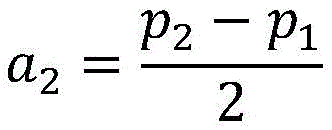
由于常数项表达的是曲线的偏移,曲线形状由二次项和一次项系数决定,选取二次项和一次项系数作为手势特征之一,可以描述一段曲线的形状,也就是一段时间内手势的轨迹信息。计算方法如下:Since the constant term expresses the offset of the curve, the shape of the curve is determined by the quadratic term and the linear term coefficient. Selecting the quadratic term and the linear term coefficient as one of the gesture features can describe the shape of a curve, that is, the gesture within a period of time. track information. The calculation method is as follows:
ti时刻手部位置为(xi,yi),ti+1时刻手部位置为(xi+1,yi+1),ti+2时刻手部位置为(xi-+2,yi+2)。记p1=xi+1-xi,q1=yi+1-yi,p2=xi+2-xi+1,q2=yi+2-yi+1,计算一次项系数a1,b1,二次项系数a2,b2:The hand position at time t i is (x i , y i ), the hand position at time t i+1 is (x i+1 , y i+1 ), and the hand position at time t i+2 is ( xi-+ 2 , y i+2 ). Denote p 1 =x i+1 -xi , q 1 =y i+1 -y i , p 2 =x i+2 -x i +1 , q 2 =y i+2 -y i+1 , calculate First-order coefficients a 1 , b 1 , quadratic coefficients a 2 , b 2 :
a1=p1 a 1 =p 1
b1=q1b 1 =q1


选取B样条曲线拟合得到的曲线方程的4个系数a1,a2,b1,b2为手势的其中四个特征值。由于B样条曲线拟合得到的曲线方程系数与点的相对距离有关,因此会受到手势大小的干扰,为了消除这一影响,另外引入g1和g2两个特征值。The four coefficients a1, a2, b1, and b2 of the curve equation obtained by fitting the B-spline curve are selected as the four eigenvalues of the gesture. Since the coefficient of the curve equation obtained by B-spline curve fitting is related to the relative distance of the points, it will be interfered by the size of the gesture. In order to eliminate this influence, two eigenvalues, g1 and g2, are introduced.
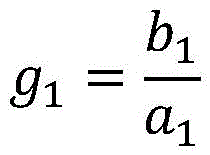
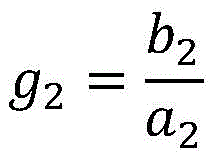
角点是曲线上局部曲率最大的点,即曲线的拐角点。角点特征g3定义为当前点与相邻点的夹角余弦,见图2所示。计算方法如下:The corner point is the point on the curve with the largest local curvature, that is, the corner point of the curve. The corner feature g3 is defined as the cosine of the angle between the current point and the adjacent point, as shown in Figure 2. The calculation method is as follows:

角点特征反映了曲线的平滑程度,如果曲线平滑,则转角基本不变,其余弦值为一个较小的正值;曲线有转折时,转角很大,比如V型手势最低点处转角大于90°,其余弦值为负,由此可以区分U型手势和V型手势这类在走势上难以区分的手势。The corner feature reflects the smoothness of the curve. If the curve is smooth, the corner is basically unchanged, and the cosine value is a small positive value; when the curve has a turning point, the turning angle is very large, for example, the turning angle at the lowest point of the V-shaped gesture is greater than 90 °, the cosine value is negative, which can distinguish between U-shaped gestures and V-shaped gestures, which are indistinguishable in trend.
针对ti、ti+1、ti+2这三个时刻的手势轨迹数据(xi,yi),(xi+1,yi+1),(xi+2,yi+2),可以计算得到一组手势特征值fi,fi=(a1,a2,b1,b2,g1,g2,g3)。对应于一个完整的手势数据序列(x0,y0),(x1,y1),……,(xn,yn),其手势特征序列f=(f0,f1,f2,…,fn-2)。Gesture trajectory data (x i , y i ), (x i+1 , y i+1 ), (x i+2 , y i+ for the three moments t i , t i+1 , t i+2 2 ), a set of gesture feature values f i can be obtained by calculation, f i =(a1,a2,b1,b2,g1,g2,g3). Corresponding to a complete gesture data sequence (x 0 , y 0 ), (x 1 , y 1 ), ..., (x n , y n ), its gesture feature sequence f=(f 0 , f 1 , f 2 , ..., f n-2 ).
步骤(3)中,构建的长短时记忆神经网络LSTM的结构分为4层,如图3所示,分别为Masking层、LSTM层、Dropout层和Dense层,其中关键的LSTM层,共使用了60个LSTM细胞相连接。In step (3), the structure of the constructed long-term memory neural network LSTM is divided into four layers, as shown in Figure 3, which are the Masking layer, the LSTM layer, the Dropout layer and the Dense layer, of which the key LSTM layer uses a total of 60 LSTM cells are connected.
如图4所示,在线手势前置识别阶段采用手势前置识别系统,包括unity前端、socket通信系统和Python神经网络后端三部分;As shown in Figure 4, the online gesture pre-recognition stage adopts a gesture pre-recognition system, including three parts: unity front-end, socket communication system and Python neural network back-end;
socket通信系统实现unity前端和Python神经网络后端间的通信,根据所记录的手部运动的距离,当移动距离累加高于阈值0.01m时,将其设为手势轨迹的B样条曲线拟合的特征点传输给Python神经网络后端进行处理。The socket communication system realizes the communication between the front end of Unity and the back end of the Python neural network. According to the distance of the recorded hand movement, when the accumulated movement distance is higher than the threshold of 0.01m, it is set as the B-spline curve fitting of the gesture trajectory. The feature points are transmitted to the Python neural network backend for processing.
与现有技术相比,本发明具有以下有益效果:Compared with the prior art, the present invention has the following beneficial effects:
本发明通过对动态轨迹型手势特点的分析,采用了B样条曲线拟合参数和角点特征两种有效的手势特征对手势进行建模,利用长短时记忆神经网络LSTM长期记忆的优势,建立了用于手势前置实时识别的手势分类器,该分类器有效地利用手势整体特征进行学习,在手势中后期可以提前识别出手势类型,为更高效更智能的手势交互系统提供支持。By analyzing the characteristics of the dynamic trajectory-type gesture, the present invention adopts two effective gesture features, the B-spline curve fitting parameter and the corner point feature, to model the gesture. A gesture classifier for real-time gesture recognition is developed. The classifier effectively uses the overall characteristics of gestures to learn, and can identify gesture types in advance in the middle and late stages of gestures, providing support for a more efficient and intelligent gesture interaction system.
附图说明Description of drawings
图1为本发明中二次B样条曲线示意图;1 is a schematic diagram of a quadratic B-spline curve in the present invention;
图2为本发明中手势角点特征示意图;2 is a schematic diagram of gesture corner feature in the present invention;
图3为本发明中手势前置实时识别采用的LSTM神经网络结构示意图;Fig. 3 is a schematic diagram of the structure of the LSTM neural network adopted for the gesture pre-real-time recognition in the present invention;
图4为本发明中手势前置实时识别系统架构图;4 is an architecture diagram of a gesture front real-time recognition system in the present invention;
图5为本发明中手势前置实时识别系统界面示意图。FIG. 5 is a schematic diagram of the interface of the gesture front real-time recognition system in the present invention.
具体实施方式Detailed ways
下面结合附图和实施例对本发明做进一步详细描述,需要指出的是,以下所述实施例旨在便于对本发明的理解,而对其不起任何限定作用。The present invention will be further described in detail below with reference to the accompanying drawings and embodiments. It should be pointed out that the following embodiments are intended to facilitate the understanding of the present invention, but do not have any limiting effect on it.
本实施例在具体实施过程中,采用分辨率为1920px*1080px的ASUS MG248显示器作为显示设备,显示屏幕大小53cm*32cm,显示屏幕中心距地面105cm,用户正对显示屏幕中心,距离显示屏幕60cm。采用Leap Motion记录被试的右手运动轨迹数据,采集频率为60fps。In the specific implementation process of this embodiment, an ASUS MG248 display with a resolution of 1920px*1080px is used as the display device, the display screen size is 53cm*32cm, the center of the display screen is 105cm from the ground, the user is facing the center of the display screen, and the distance from the display screen is 60cm. Leap Motion was used to record the right-hand motion trajectory data of the subjects, and the acquisition frequency was 60fps.
离线建模阶段:Offline modeling stage:
共计10组实验,每组实验采集30个手势,每组实验将30种手势形成一个随机序列,按照序列顺序逐个采集手势,采集时在屏幕上显示需要画的手势,红点标注手势起始点。30个手势可以是字母(A,B,C,D,E,F,G,H,J,K,L,M,N,P,Q,R,U,V,W,Y)和数字(0,1,2,3,4,5,6,7,8,9),排除了一部分和数字难以区分的字母,如S(和5很像)、I(和1很像)。实际应用中,开发者在设计手势集时尽量避免使用容易混淆的手势。A total of 10 groups of experiments were conducted, each group of experiments collected 30 gestures, and each group of experiments formed a random sequence of 30 kinds of gestures, and collected gestures one by one according to the sequence order. 30 gestures can be letters (A, B, C, D, E, F, G, H, J, K, L, M, N, P, Q, R, U, V, W, Y) and numbers ( 0, 1, 2, 3, 4, 5, 6, 7, 8, 9), excluding some letters that are indistinguishable from numbers, such as S (similar to 5) and I (similar to 1). In practical applications, developers try to avoid confusing gestures when designing gesture sets.
如图5所示,用户按下空格开始做根据系统界面显示要求用户表达的手势,系统记录每帧的右手中指指尖位置作为手势数据,被试手势结束时停顿0.5秒,系统检测到后结束本次采集,将采集到的手势数据和手势类型记录下来。As shown in Figure 5, the user presses the space to start the gesture that the user is required to express according to the system interface display, the system records the position of the fingertip of the right middle finger in each frame as the gesture data, pauses for 0.5 seconds at the end of the tested gesture, and ends after the system detects it. In this collection, the collected gesture data and gesture types are recorded.
为保证神经网络训练能得到高识别率的手势分类器需选取高质量的手势数据进行神经网络训练。通过读取手势数据获取手势信息,按照数据标记的时序把所有数据点逐一画在屏幕上,用线段连接,还原出用户绘制的手势,然后用人眼判断手势质量,若无法分辨手势类型则将此手势数据抛弃。In order to ensure that the neural network training can obtain a gesture classifier with a high recognition rate, it is necessary to select high-quality gesture data for neural network training. Obtain gesture information by reading gesture data, draw all data points on the screen one by one according to the data mark sequence, connect them with line segments, restore the gesture drawn by the user, and then judge the quality of the gesture with the human eye, if the gesture type cannot be distinguished, use this Gesture data discarded.
考虑到leap motion的精度问题和徒手凌空手势容易因为手臂疲劳造成抖动,需要对原始数据进行低通滤波的预处理,即进行卷积核为[1 1 1]*1/3的一维卷积以消除一部分高频信息,即抖动。Considering the accuracy of leap motion and the fact that freehand volley gestures are prone to shaking due to arm fatigue, it is necessary to preprocess the original data by low-pass filtering, that is, a one-dimensional convolution with a convolution kernel of [1 1 1]*1/3 to remove part of the high-frequency information, that is, jitter.
选取的手势特征应满足连续性、整体性和实时性要求,选取B样条曲线拟合的曲线方程一次项系数a1、b1,a1、b1的比值g1,二次项系数a2、b2,a2、b2的比值g2以及手势曲线的角点特征g3共7个特征值作为手势特征。The selected gesture features should meet the requirements of continuity, integrity and real-time. The ratio g2 of b2 and the corner feature g3 of the gesture curve have a total of 7 eigenvalues as gesture features.
手势特征中的B样条曲线拟合的曲线方程一次项系数a1、b1和二次项系数a2、b2的具体计算公式为:The specific calculation formulas of the first-order coefficients a1, b1 and the quadratic coefficients a2, b2 of the curve equation of the B-spline curve fitting in the gesture feature are:
记ti时刻手部位置为(xi,yi),ti+1时刻手部位置为(xi+1,yi+1),ti+2时刻手部位置为(xi+2,yi+2);Note that the hand position at time t i is ( xi , y i ), the position of hand at time t i+1 is (x i+1 , y i+1 ), and the position of hand at time t i+2 is (x i+ 2 , y i+2 );
a1=p1 a 1 =p 1
b1=q1 b 1 =q 1


其中,p1=xi+1-xi,q1=yi+1-yi,p2=xi+2-xi+1,q2=yi+2-yi+1;Wherein, p 1 =x i+1 -xi , q 1 =y i+1 -y i , p 2 =x i+2 -x i +1 , q 2 =y i+2 -y i+1 ;
手势特征中的g1和g2的具体计算公式为:The specific calculation formulas of g1 and g2 in the gesture feature are:
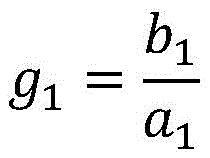
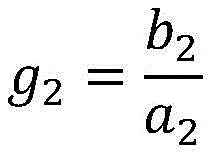
角点是曲线上局部曲率最大的点,即曲线的拐角点。角点特征g3定义为当前点与相邻点的夹角余弦,如图2所示,angle为夹角度数,计算方法如下The corner point is the point on the curve with the largest local curvature, that is, the corner point of the curve. The corner feature g3 is defined as the cosine of the angle between the current point and the adjacent point, as shown in Figure 2, angle is the angle number, and the calculation method is as follows

本发明中,循环神经网络(Recurrent Neural Network,RNN)选用了长短时记忆神经网络LSTM。在处理序列问题上循环神经网络是一个很好的工具,它通过循环网络记忆和学习序列数据。但RNN存在长期依赖问题,这一问题的主要原因是RNN的循环连接比较简单,通常是一个简单的线性关系,经过多次连接迭代后,系数相乘会越来越小逐渐消失,也就丢失了距离较远的数据信息。长短时记忆神经网络作为循环神经网络的一种改良网络,有效地解决了传统RNN的长期依赖问题,适合用于处理较长的时序数据。In the present invention, the cyclic neural network (Recurrent Neural Network, RNN) selects the long-short-term memory neural network LSTM. Recurrent neural network is a good tool for dealing with sequence problems, it memorizes and learns sequence data through recurrent network. However, RNN has a long-term dependency problem. The main reason for this problem is that the cyclic connection of RNN is relatively simple, usually a simple linear relationship. After many connection iterations, the coefficient multiplication will become smaller and smaller and gradually disappear, which is lost. data from a long distance. As an improved network of recurrent neural network, long-short-term memory neural network effectively solves the long-term dependence problem of traditional RNN, and is suitable for processing long time series data.
LSTM与传统RNN最大的不同在于隐藏层,传统RNN的隐藏层通常使用一个简单的激活函数,如双曲函数tanh,而LSTM的隐藏层做了很多处理,它使用了三个门(遗忘门,输入门和输出门)来控制细胞状态。其中输入门控制从当前节点的输入层输入多少信息,遗忘门控制从上一节点的隐藏层接受多少信息,输出门控制从当前节点输出多少信息到下一时刻。这种做法很大程度上解决了梯度爆炸和梯度消失的问题,因此可以处理较长时间序列的问题,对序列整体的记忆性较好。将LSTM应用于手势前置实时识别正是利用了LSTM的长期记忆性,在学习时可以记忆手势早期的信息,学习到的模型对不同时间的信息权重较为平衡,因此可以在手势中期就可以计算得到和完整手势近似的特征,判断出手势的类型。The biggest difference between LSTM and traditional RNN is the hidden layer. The hidden layer of traditional RNN usually uses a simple activation function, such as the hyperbolic function tanh, while the hidden layer of LSTM does a lot of processing. It uses three gates (forgetting gate, input gate and output gate) to control the cell state. The input gate controls how much information is input from the input layer of the current node, the forget gate controls how much information is received from the hidden layer of the previous node, and the output gate controls how much information is output from the current node to the next moment. This approach largely solves the problem of gradient explosion and gradient disappearance, so it can deal with the problem of longer time series and has better memory for the whole sequence. The application of LSTM to the real-time recognition of gestures makes use of the long-term memory of LSTM. It can memorize the early information of gestures during learning. The learned model has a more balanced weight on the information at different times, so it can be calculated in the middle of the gesture. Obtain features similar to the complete gesture, and determine the type of gesture.
构建的LSTM神经网络结构分为4层,分别为Masking层,LSTM层,Dropout层和Dense层,结构图如图3所示。第一层Masking层的可以使神经网络拥有处理可变长序列的能力,第二层是关键的LSTM层,共使用了60(序列最大长度)个LSTM细胞相连接,作为核心部分,这一层用来记忆和学习输入的手势特征序列,学习处理序列的方法。第三层为Dropout层,加入这一层是为了避免过拟合,每次随机丢失一半的学习得到的参数以防止在训练集上表现太好而在测试集上表现不佳。最后一层Dense层是全连接层,使用softmax激活函数,按照学习到的权重输出分类结果。The constructed LSTM neural network structure is divided into 4 layers, namely Masking layer, LSTM layer, Dropout layer and Dense layer. The structure diagram is shown in Figure 3. The first layer of Masking layer can make the neural network have the ability to process variable-length sequences. The second layer is the key LSTM layer, which uses a total of 60 (maximum sequence length) LSTM cells to connect. As the core part, this layer It is used to memorize and learn the input gesture feature sequence, and learn the method of processing the sequence. The third layer is the Dropout layer. This layer is added to avoid overfitting. Half of the learned parameters are randomly lost each time to prevent the performance from being too good on the training set and not performing well on the test set. The last Dense layer is a fully connected layer, which uses the softmax activation function to output the classification results according to the learned weights.
对处理完毕的手势数据进行手势特征提取,将提取得到的手势特征和相应的手势类型输入至长短时记忆神经网络LSTM训练获得神经网络模型作为手势分类器。Gesture feature extraction is performed on the processed gesture data, and the extracted gesture features and corresponding gesture types are input into the long-short-term memory neural network LSTM training to obtain a neural network model as a gesture classifier.
训练时使用多种分类常用的交叉熵函数作为损失函数,最后训练得到的手势分类器就可以用来实现步骤(2)中的手势前置实时识别。During training, a variety of commonly used cross-entropy functions for classification are used as loss functions, and the gesture classifier finally trained can be used to realize the real-time recognition of gesture front in step (2).
在线手势前置实时识别阶段:Online gesture pre-real-time recognition stage:
如图4所示,用于实现线上手势前置实时识别的手势前置识别系统包括unity前端,socket通信系统和Python神经网络后端三部分。As shown in Figure 4, the gesture pre-recognition system used to realize online gesture pre-recognition in real time includes three parts: Unity front-end, socket communication system and Python neural network back-end.
(1)unity前端包含可视化界面、用户手势数据采集和手势数据预处理。可视化界面实时显示系统猜测用户表达的手势类型,并实时绘制用户使用leap motion绘制的手势图案,当用户意图与系统识别结果一致时便提前结束绘制,可视化界面示意图如图5所示。系统界面显示要求用户表达的手势且给予提示,红点标注手势起始点。用户按下空格开始做手势,利用leap motion的unity sdk检测右手中指的指尖设置,每帧采集记录右手指尖在unity程序的世界坐标系的坐标,将其投影到xoy平面,获得横纵坐标值作为手势原始数据。考虑到leap motion的精度问题和徒手凌空手势容易因为手臂疲劳造成抖动,需要对原始数据进行低通滤波的预处理,即进行卷积核为[1 1 1]*1/3的一维卷积以消除一部分高频信息,即抖动。(1) The front-end of Unity includes a visual interface, user gesture data collection and gesture data preprocessing. The visual interface displays the gesture type guessed by the user in real time, and draws the gesture pattern drawn by the user using leap motion in real time. When the user's intention is consistent with the recognition result of the system, the drawing is ended in advance. The schematic diagram of the visual interface is shown in Figure 5. The system interface displays the gesture that the user is required to express and gives a prompt, and the red dot marks the starting point of the gesture. The user presses the space to start the gesture, uses the unity sdk of leap motion to detect the fingertip setting of the right middle finger, collects and records the coordinates of the right fingertip in the world coordinate system of the unity program every frame, projects it to the xoy plane, and obtains the abscissa and ordinate coordinates value as gesture raw data. Considering the accuracy of leap motion and the fact that freehand volley gestures are prone to shaking due to arm fatigue, it is necessary to preprocess the original data by low-pass filtering, that is, a one-dimensional convolution with a convolution kernel of [1 1 1]*1/3 to remove part of the high frequency information, that is, jitter.
(2)socket通信系统是一种基于TCP协议的跨程序通信机制,可以在两个程序之间进行双向传输信息,实现unity前端和Python神经网络后端间的通信。为了提高手势前置识别系统的效率,unity前端并不是每帧都与后端通信,而是根据记录的手部运动的距离,当移动距离累加高于阈值0.01m时,将其设为手势轨迹的B样条曲线拟合的特征点,传输给Python神经网络后端进行处理,这样可以避免无效数据干扰,比如用户在手势绘制过程中短暂的停顿。(2) The socket communication system is a cross-program communication mechanism based on the TCP protocol, which can transmit information in two directions between two programs, and realize the communication between the front end of Unity and the back end of the Python neural network. In order to improve the efficiency of the gesture pre-recognition system, the front-end of Unity does not communicate with the back-end every frame, but according to the recorded hand movement distance, when the accumulated movement distance is higher than the threshold of 0.01m, it is set as the gesture track The feature points of the B-spline curve fitting are transmitted to the Python neural network backend for processing, which can avoid invalid data interference, such as a brief pause during the user's gesture drawing process.
(3)Python神经网络后端在得到手势数据后,提取手势特征得到特征序列,利用训练得到的手势分类器识别出手势类型后,通过socket通信系统传输给可视化界面实时显示,当预测结果和用户意图一致时,用户可以提前终止,即停止手的移动,系统检测到停顿后,结束该手势的识别。(3) After the backend of the Python neural network obtains the gesture data, it extracts the gesture features to obtain the feature sequence, uses the gesture classifier obtained by training to identify the gesture type, and transmits it to the visual interface through the socket communication system for real-time display. When the intention is consistent, the user can terminate in advance, that is, stop the movement of the hand, and after the system detects the pause, end the recognition of the gesture.
具体的,本实施例中,同线下神经网络训练建模阶段类似采集并处理完手势数据后,利用socket通信系统实现手势数据传输,socket设定为绑定到localhost的9000端口,发送缓冲区和接受缓冲区均设定为1024个字节。运行时unity前端向Python后端发送“000”表示开始一个新的手势识别,此后发送每次得到的手势B样条曲线拟合的特征点坐标,在每个手势结束时发送“111”表示本次手势输入结束。Python后端读取预先训练好的神经网络模型作为分类器,根据计算出的手势特征值序列得到识别出的手势类型,将识别结果的手势类型编号通过socket通信系统发送回unity前端,反馈输出至可视化界面进行实时显示。当预测结果和用户意图一致时,用户可以提前终止,即停止手的移动,系统检测到停顿后,结束该手势的识别。Specifically, in this embodiment, after the gesture data is collected and processed in the same offline neural network training and modeling stage, the socket communication system is used to realize the gesture data transmission. The socket is set to be bound to port 9000 of localhost, and the buffer is sent. and accept buffers are both set to 1024 bytes. When running, the Unity front end sends "000" to the Python backend to start a new gesture recognition, and then sends the coordinates of the feature points of the B-spline curve fitting of the gesture obtained each time, and sends "111" at the end of each gesture to indicate this The gesture input ends. The Python backend reads the pre-trained neural network model as a classifier, obtains the recognized gesture type according to the calculated gesture feature value sequence, sends the gesture type number of the recognition result back to the unity front-end through the socket communication system, and outputs the feedback to The visual interface is displayed in real time. When the prediction result is consistent with the user's intention, the user can terminate in advance, that is, stop the movement of the hand. After the system detects the pause, the recognition of the gesture ends.
本发明有效地利用手势整体特征进行学习,在手势中后期提前识别出手势类型,为更高效更智能的手势交互系统提供支持。本发明实现的系统可以做到与人的视觉类似的动态识别和提前预测能力,不需要等待手势全部完整表达完就可以实时识别出用户试图表达的手势类型,效果理想。The present invention effectively utilizes the overall features of gestures for learning, recognizes gesture types in advance in the middle and later stages of gestures, and provides support for a more efficient and intelligent gesture interaction system. The system realized by the invention can achieve dynamic recognition and advance prediction ability similar to human vision, and can recognize the gesture type that the user is trying to express in real time without waiting for all gestures to be fully expressed, and the effect is ideal.
以上所述的实施例对本发明的技术方案和有益效果进行了详细说明,应理解的是以上所述仅为本发明的具体实施例,并不用于限制本发明,凡在本发明的原则范围内所做的任何修改、补充和等同替换,均应包含在本发明的保护范围之内。The above-mentioned embodiments describe the technical solutions and beneficial effects of the present invention in detail. It should be understood that the above-mentioned embodiments are only specific embodiments of the present invention and are not intended to limit the present invention. Any modifications, additions and equivalent replacements made shall be included within the protection scope of the present invention.
Claims (6)


Priority Applications (1)
| Application Number | Priority Date | Filing Date | Title |
|---|---|---|---|
| CN202010122397.7A CN111444771B (en) | 2020-02-27 | 2020-02-27 | Gesture preposing real-time identification method based on recurrent neural network |
Applications Claiming Priority (1)
| Application Number | Priority Date | Filing Date | Title |
|---|---|---|---|
| CN202010122397.7A CN111444771B (en) | 2020-02-27 | 2020-02-27 | Gesture preposing real-time identification method based on recurrent neural network |
Publications (2)
| Publication Number | Publication Date |
|---|---|
| CN111444771A true CN111444771A (en) | 2020-07-24 |
| CN111444771B CN111444771B (en) | 2022-06-21 |
Family
ID=71627070
Family Applications (1)
| Application Number | Title | Priority Date | Filing Date |
|---|---|---|---|
| CN202010122397.7A Active CN111444771B (en) | 2020-02-27 | 2020-02-27 | Gesture preposing real-time identification method based on recurrent neural network |
Country Status (1)
| Country | Link |
|---|---|
| CN (1) | CN111444771B (en) |
Cited By (1)
| Publication number | Priority date | Publication date | Assignee | Title |
|---|---|---|---|---|
| US20230107097A1 (en) * | 2021-10-06 | 2023-04-06 | Fotonation Limited | Method for identifying a gesture |
Citations (9)
| Publication number | Priority date | Publication date | Assignee | Title |
|---|---|---|---|---|
| CN107219924A (en) * | 2017-05-27 | 2017-09-29 | 华南理工大学 | A kind of aerial gesture identification method based on inertial sensor |
| CN107742102A (en) * | 2017-10-13 | 2018-02-27 | 北京华捷艾米科技有限公司 | A kind of gesture identification method based on depth transducer |
| CN108932500A (en) * | 2018-07-09 | 2018-12-04 | 广州智能装备研究院有限公司 | A kind of dynamic gesture identification method and system based on deep neural network |
| CN109271023A (en) * | 2018-08-29 | 2019-01-25 | 浙江大学 | A selection method based on the expression of three-dimensional object outline contour freehand gesture |
| CA3016921A1 (en) * | 2017-10-07 | 2019-04-07 | Tata Consultancy Services Limited | System and method for deep learning based hand gesture recognition in first person view |
| CN109902583A (en) * | 2019-01-28 | 2019-06-18 | 电子科技大学 | A skeleton gesture recognition method based on bidirectional independent recurrent neural network |
| US20190251702A1 (en) * | 2018-02-12 | 2019-08-15 | Avodah Labs, Inc. | Real-time gesture recognition method and apparatus |
| CN110287844A (en) * | 2019-06-19 | 2019-09-27 | 北京工业大学 | Gesture recognition method for traffic police based on convolutional gesture machine and long short-term memory network |
| CN110458059A (en) * | 2019-07-30 | 2019-11-15 | 北京科技大学 | A gesture recognition method and recognition device based on computer vision |
-
2020
- 2020-02-27 CN CN202010122397.7A patent/CN111444771B/en active Active
Patent Citations (9)
| Publication number | Priority date | Publication date | Assignee | Title |
|---|---|---|---|---|
| CN107219924A (en) * | 2017-05-27 | 2017-09-29 | 华南理工大学 | A kind of aerial gesture identification method based on inertial sensor |
| CA3016921A1 (en) * | 2017-10-07 | 2019-04-07 | Tata Consultancy Services Limited | System and method for deep learning based hand gesture recognition in first person view |
| CN107742102A (en) * | 2017-10-13 | 2018-02-27 | 北京华捷艾米科技有限公司 | A kind of gesture identification method based on depth transducer |
| US20190251702A1 (en) * | 2018-02-12 | 2019-08-15 | Avodah Labs, Inc. | Real-time gesture recognition method and apparatus |
| CN108932500A (en) * | 2018-07-09 | 2018-12-04 | 广州智能装备研究院有限公司 | A kind of dynamic gesture identification method and system based on deep neural network |
| CN109271023A (en) * | 2018-08-29 | 2019-01-25 | 浙江大学 | A selection method based on the expression of three-dimensional object outline contour freehand gesture |
| CN109902583A (en) * | 2019-01-28 | 2019-06-18 | 电子科技大学 | A skeleton gesture recognition method based on bidirectional independent recurrent neural network |
| CN110287844A (en) * | 2019-06-19 | 2019-09-27 | 北京工业大学 | Gesture recognition method for traffic police based on convolutional gesture machine and long short-term memory network |
| CN110458059A (en) * | 2019-07-30 | 2019-11-15 | 北京科技大学 | A gesture recognition method and recognition device based on computer vision |
Non-Patent Citations (6)
| Title |
|---|
| CHUNYONG MA等: "Hand joints-based gesture recognition for noisy dataset using nested interval unscented Kalman filter with LSTM network", 《THE VISUAL COMPUTER》 * |
| CHUNYONG MA等: "Hand joints-based gesture recognition for noisy dataset using nested interval unscented Kalman filter with LSTM network", 《THE VISUAL COMPUTER》, 11 May 2018 (2018-05-11), pages 1053 - 1063, XP036515412, DOI: 10.1007/s00371-018-1556-0 * |
| XIAOXIA HAN等: "A Framework for Virtual Hand Haptic Interaction", 《SPRINGER》 * |
| XIAOXIA HAN等: "A Framework for Virtual Hand Haptic Interaction", 《SPRINGER》, 31 December 2010 (2010-12-31), pages 229 - 240 * |
| 秦敏莹 等: "基于长短时记忆网络的多媒体教学手势识别研究", 《国外电子测量技术》 * |
| 秦敏莹 等: "基于长短时记忆网络的多媒体教学手势识别研究", 《国外电子测量技术》, vol. 38, no. 6, 30 June 2019 (2019-06-30), pages 80 - 85 * |
Cited By (2)
| Publication number | Priority date | Publication date | Assignee | Title |
|---|---|---|---|---|
| US20230107097A1 (en) * | 2021-10-06 | 2023-04-06 | Fotonation Limited | Method for identifying a gesture |
| US11983327B2 (en) * | 2021-10-06 | 2024-05-14 | Fotonation Limited | Method for identifying a gesture |
Also Published As
| Publication number | Publication date |
|---|---|
| CN111444771B (en) | 2022-06-21 |
Similar Documents
| Publication | Publication Date | Title |
|---|---|---|
| CN115294658B (en) | Personalized gesture recognition system and gesture recognition method for multiple application scenes | |
| CN112148128B (en) | Real-time gesture recognition method and device and man-machine interaction system | |
| CN110458059B (en) | Gesture recognition method and device based on computer vision | |
| CN102024151B (en) | Training method of gesture motion recognition model and gesture motion recognition method | |
| CN110837792B (en) | Three-dimensional gesture recognition method and device | |
| CN109597485B (en) | Gesture interaction system based on double-fingered-area features and working method thereof | |
| CN105426815A (en) | Living body detection method and device | |
| CN103984416A (en) | Gesture recognition method based on acceleration sensor | |
| CN110308795B (en) | Dynamic gesture recognition method and system | |
| CN110472506B (en) | Gesture recognition method based on support vector machine and neural network optimization | |
| CN106502390B (en) | A virtual human interaction system and method based on dynamic 3D handwritten digit recognition | |
| CN109731302A (en) | Motion gesture recognition method, device and electronic device | |
| CN111444488A (en) | Identity authentication method based on dynamic gesture | |
| CN104517100B (en) | Gesture pre-judging method and system | |
| CN107368820A (en) | One kind becomes more meticulous gesture identification method, device and equipment | |
| CN106503619B (en) | Gesture recognition method based on BP neural network | |
| Fu et al. | Gesture recognition based on BP neural network and data glove | |
| CN107909042B (en) | continuous gesture segmentation recognition method | |
| CN115393963A (en) | Motion action correcting method, system, storage medium, computer equipment and terminal | |
| CN108108015A (en) | A kind of action gesture recognition methods based on mobile phone gyroscope and dynamic time warping | |
| CN112883922A (en) | Sign language identification method based on CNN-BiGRU neural network fusion | |
| CN107346207B (en) | Dynamic gesture segmentation recognition method based on hidden Markov model | |
| Liu | Tennis players' hitting action recognition method based on multimodal data | |
| CN106383586A (en) | Training system for children suffering from autistic spectrum disorders | |
| CN111444771A (en) | Gesture preposing real-time identification method based on recurrent neural network |
Legal Events
| Date | Code | Title | Description |
|---|---|---|---|
| PB01 | Publication | ||
| PB01 | Publication | ||
| SE01 | Entry into force of request for substantive examination | ||
| SE01 | Entry into force of request for substantive examination | ||
| GR01 | Patent grant | ||
| GR01 | Patent grant |