CN111414118A - Touch center calculation method, touch system and touch device - Google Patents
Touch center calculation method, touch system and touch device Download PDFInfo
- Publication number
- CN111414118A CN111414118A CN201910016951.0A CN201910016951A CN111414118A CN 111414118 A CN111414118 A CN 111414118A CN 201910016951 A CN201910016951 A CN 201910016951A CN 111414118 A CN111414118 A CN 111414118A
- Authority
- CN
- China
- Prior art keywords
- touch
- sub
- area
- areas
- touch area
- Prior art date
- Legal status (The legal status is an assumption and is not a legal conclusion. Google has not performed a legal analysis and makes no representation as to the accuracy of the status listed.)
- Pending
Links
Images


Classifications
-
- G—PHYSICS
- G06—COMPUTING OR CALCULATING; COUNTING
- G06F—ELECTRIC DIGITAL DATA PROCESSING
- G06F3/00—Input arrangements for transferring data to be processed into a form capable of being handled by the computer; Output arrangements for transferring data from processing unit to output unit, e.g. interface arrangements
- G06F3/01—Input arrangements or combined input and output arrangements for interaction between user and computer
- G06F3/048—Interaction techniques based on graphical user interfaces [GUI]
- G06F3/0487—Interaction techniques based on graphical user interfaces [GUI] using specific features provided by the input device, e.g. functions controlled by the rotation of a mouse with dual sensing arrangements, or of the nature of the input device, e.g. tap gestures based on pressure sensed by a digitiser
- G06F3/0488—Interaction techniques based on graphical user interfaces [GUI] using specific features provided by the input device, e.g. functions controlled by the rotation of a mouse with dual sensing arrangements, or of the nature of the input device, e.g. tap gestures based on pressure sensed by a digitiser using a touch-screen or digitiser, e.g. input of commands through traced gestures
- G06F3/04886—Interaction techniques based on graphical user interfaces [GUI] using specific features provided by the input device, e.g. functions controlled by the rotation of a mouse with dual sensing arrangements, or of the nature of the input device, e.g. tap gestures based on pressure sensed by a digitiser using a touch-screen or digitiser, e.g. input of commands through traced gestures by partitioning the display area of the touch-screen or the surface of the digitising tablet into independently controllable areas, e.g. virtual keyboards or menus
-
- G—PHYSICS
- G06—COMPUTING OR CALCULATING; COUNTING
- G06F—ELECTRIC DIGITAL DATA PROCESSING
- G06F3/00—Input arrangements for transferring data to be processed into a form capable of being handled by the computer; Output arrangements for transferring data from processing unit to output unit, e.g. interface arrangements
- G06F3/01—Input arrangements or combined input and output arrangements for interaction between user and computer
- G06F3/03—Arrangements for converting the position or the displacement of a member into a coded form
- G06F3/041—Digitisers, e.g. for touch screens or touch pads, characterised by the transducing means
- G06F3/0416—Control or interface arrangements specially adapted for digitisers
Landscapes
- Engineering & Computer Science (AREA)
- General Engineering & Computer Science (AREA)
- Theoretical Computer Science (AREA)
- Human Computer Interaction (AREA)
- Physics & Mathematics (AREA)
- General Physics & Mathematics (AREA)
- Position Input By Displaying (AREA)
Abstract
A touch center calculation method comprises the following steps: step S1, dividing the effective touch area to form a plurality of sub-touch areas, each sub-touch area corresponding to a position information; step S2, acquiring touch sensing signals corresponding to the sub-touch areas at the current time, and determining the sub-touch areas corresponding to the touch sensing signals meeting the preset conditions as target sub-touch areas; step S3, calculating the touch center at the current time according to the position information of each target sub-touch area and the touch sensing signal corresponding to each target sub-touch area. The touch center calculation method provided by the invention can improve the touch accuracy. The invention also provides a touch system and a touch device.
Description
Technical Field
The present invention relates to the field of touch technologies, and in particular, to a touch center calculation method, a touch system, and a touch device.
Background
Touch technology is closely related to the function realization of various smart devices (such as tablet computers, smart phones, and the like), wherein one widely-used touch method is capacitive touch.
In the existing capacitive touch technology, a touch area is divided into a plurality of sub-touch areas with equal shapes and areas to calculate the occurrence position of the current touch operation, so that a corresponding function is started according to the touch operation. With the diversification of products in the market, smart devices with various touch area shapes appear, and in the smart devices, the touch precision is reduced by adopting the traditional touch technology, especially in the part with irregular touch area shape (such as edge round corner), the situation of touch misalignment often occurs, and the use experience of a user is affected.
Disclosure of Invention
One aspect of the present invention provides a touch center calculation method, including:
step S1, dividing the effective touch area to form a plurality of sub-touch areas, each sub-touch area corresponding to a position information;
step S2, acquiring touch sensing signals corresponding to the sub-touch areas at the current time, and determining the sub-touch areas corresponding to the touch sensing signals meeting the preset conditions as target sub-touch areas;
step S3, calculating the touch center at the current time according to the position information of each target sub-touch area and the touch sensing signal corresponding to each target sub-touch area.
Another aspect of the present invention provides a touch system, including:
the area dividing module is used for dividing an effective touch area to form a plurality of sub-touch areas, and each sub-touch area corresponds to position information;
the target sub-touch area determining module is used for acquiring touch sensing signals corresponding to the sub-touch areas at the current moment and determining the sub-touch areas corresponding to the touch sensing signals meeting the preset conditions as target sub-touch areas;
and the touch center calculation module is used for calculating the touch center at the current moment according to the position information of each target sub-touch area and the touch sensing signal corresponding to each target sub-touch area.
Another aspect of the invention provides a touch device, which includes the touch system as described in any one of the above.
The touch center calculation method provided by this embodiment divides an effective touch area into a plurality of sub-touch areas, determines the sub-touch area meeting a preset condition as a target sub-touch area, and calculates the touch center coordinate by referring to a touch sensing signal corresponding to the target sub-touch area and the geometric center coordinate of the target sub-touch area.
Drawings
Fig. 1 is a flowchart illustrating a touch center calculation method according to an embodiment of the present invention.
Fig. 2 is a schematic cross-sectional block diagram of a touch device according to an embodiment of the invention.
Fig. 3 is a schematic plan view of the touch device in fig. 2.
Fig. 4 is another schematic plan view of the touch device in fig. 2.
Fig. 5 is a detailed flowchart of step S2 in fig. 1.
Fig. 6 is a schematic diagram of a target sub-touch area at the current moment according to an embodiment.
Fig. 7 is a flowchart illustrating a difference step between the touch center calculation method provided in the second embodiment and the touch center calculation method provided in the first embodiment.
Fig. 8 is a schematic view of the target sub-touch area at the current moment according to the second embodiment.
Fig. 9 is a schematic structural diagram of a touch system according to a third embodiment.
Fig. 10 is a schematic structural diagram of the target sub-touch area determination module in fig. 9.
Fig. 11 is a schematic structural diagram of a target sub-touch area determination module according to a fourth embodiment.
Description of the main elements


The following detailed description will further illustrate the invention in conjunction with the above-described figures.
Detailed Description
Example one
Referring to fig. 1, the touch center calculation method provided in this embodiment includes the following steps:
step S1, dividing the effective touch area to form a plurality of sub-touch areas, each sub-touch area corresponding to a position information;
step S2, acquiring a touch sensing signal corresponding to each sub-touch area at the current time, and determining the sub-touch area corresponding to the touch sensing signal meeting the preset condition as a target sub-touch area;
in step S3, a touch center at the current time is calculated according to the position information of each target sub-touch area and the touch sensing signal corresponding to each target sub-touch area.
The touch center calculation method provided in this embodiment is applicable to various touch devices (e.g., tablet computers and smart phones) having a touch function, the touch principle of the touch device is not limited, and various touch principles may be adopted, such as an ultrasonic type (obtaining a touch position by detecting a change in ultrasonic waves), a capacitive type (obtaining a touch position by detecting a change in capacitance), and the like.
Referring to fig. 2, fig. 2 shows a partial structure related to a touch function in a touch device 10 (a smart phone in this embodiment), which includes: the touch panel includes a cover plate 11, a touch electrode array 12 disposed on one side of the cover plate 11, and a touch control circuit 13 electrically connected to the touch electrode array 12. The touch electrode array 12 includes a plurality of touch electrodes (not shown). At a certain time, a touch object (e.g., a human finger) performs a touch operation on the surface of the cover plate 11 away from the touch electrode array 12, and a capacitance is formed between the touch object and the touch electrode array.
Referring to fig. 2 and fig. 3, the touch device 10 defines an effective touch area 14, the effective touch area 14 is all areas capable of sensing touch operation of a touch object, and the effective touch area 14 is opposite to the arrangement area of the touch electrode array 12. In this embodiment, the effective touch area 14 is a central area of the cover plate 11 of the touch device 10 facing the touch electrode array 12.
In step S1, the effective touch area 14 is divided into a plurality of sub-touch areas 141, the sub-touch areas 141 are closely arranged in an array, and the sum of the areas covered by all the sub-touch areas 141 is the area of the effective touch area 14. The shape and area of each sub-touch region 141 may be the same, may be partially the same, or may be different, and mainly depends on the shape of the effective touch region 14.
Referring to fig. 3, the effective touch area 14 is a substantially rectangular area having an arc-shaped corner at an edge and a concave portion, and is divided into a plurality of sub-touch areas 141, the sub-touch area 141 near the central area is a regular rectangle, and the sub-touch area 141 near the corner is an irregular shape.
Referring to fig. 4, in another embodiment, compared to the relatively regular area division manner in fig. 3, the effective touch area 14 is divided in a completely irregular manner in fig. 4, and the sizes and shapes of the sub-touch areas 141 are completely different.
In other embodiments, when the effective touch area 14 is a regular rectangle, the effective touch area 14 can be divided into a plurality of sub-touch areas 141 with equal shapes and sizes.
In this embodiment, for convenience of understanding, the following description will be made by taking the area division method shown in fig. 3 as an example, and it should be understood that the area division method shown in the present disclosure is not intended to limit the present invention.
Each sub-touch area 141 faces a portion of the touch electrode array 12, i.e. corresponds to one or more touch electrodes. An initial capacitor C1 is formed between the portion of each sub-touch area 141 facing the touch electrode array 12 and ground. When the touch object performs a touch operation, an induced capacitance C2 may be generated between the touch object and a portion of the touch electrode array 12 corresponding to the sub-touch area 141 touched by the touch object.
Further, step S1 specifically includes: an area threshold S is set, and the effective touch area 14 is divided to form a plurality of sub-touch areas 141 with areas larger than the area threshold S.
The touch device 10 has a signal recognition accuracy corresponding to the hardware configuration thereof, and if the area of the sub-touch areas 141 is too small, the induced capacitance C2 generated between the touch electrode array 12 and the touch object corresponding to each sub-touch area 141 is too small to be recognized or is easily influenced by environmental noise, resulting in a decrease in touch accuracy. Therefore, the area of the sub-touch region 141 is limited by setting the area threshold S. The specific value of the area threshold S is determined according to factors such as the hardware configuration of the touch device 10.
Each sub-touch area 141 corresponds to a position information. In this embodiment, the position information corresponding to each sub-touch area 141 is the geometric center coordinate of each sub-touch area 141.
Step S2 is configured to determine a target sub-touch area, where the target sub-touch area is the sub-touch area 141 meeting a preset condition.
Referring to fig. 5, in the present embodiment, step S2 specifically includes:
step S21, acquiring touch sensing signals corresponding to the sub-touch areas at the current moment;
step S22, setting a signal threshold, and determining whether the touch sensing signal corresponding to each sub-touch area is greater than the signal threshold;
in step S23, if yes, the sub-touch area corresponding to the touch sensing signal greater than the signal threshold is determined as the target sub-touch area.
In step S21, at the current time, the touch sensing signal corresponding to the sub-touch area 141 is the induced capacitance C2 generated between the touch object and the partial touch electrode array 12 corresponding to each sub-touch area 141 when the touch object performs the touch operation at the current time.
In step S22, a signal threshold C0 is set, and it is determined whether the touch sensing signal corresponding to each sub-touch area 141, that is, the sensing capacitor C2, is greater than the signal threshold C0. In step S23, the sub-touch area 141 corresponding to the touch sensing signal C2 determined to be greater than the signal threshold C0 is determined as the target sub-touch area. That is, in the present embodiment, the predetermined condition is that the touch sensing signal C2 corresponding to the sub-touch area 141 is greater than the signal threshold C0.
In the present embodiment, it is considered that the sub-touch area 141 corresponding to the larger touch sensing signal is closer to the position where the touch object wants to touch, the sub-touch area 141 corresponding to the larger touch sensing signal is determined as the target sub-touch area by setting the signal threshold C0, and the subsequent calculation steps are only performed on the target sub-touch area. The steps not only realize that the data calculation has pertinence, but also reduce the calculated data quantity.
Step S3 specifically includes:
and carrying out weighted average on the geometric center coordinates of the target sub-touch areas to obtain the touch center coordinates at the current moment. The weight value during weighted averaging is the touch sensing signal corresponding to each target sub-touch area, and the weighted averaging includes weighted averaging of the X coordinate and weighted averaging of the Y coordinate. The touch center coordinate is a position coordinate that the touch object wants to touch at the current time, and the touch center coordinate may be represented as (Xlabel, Ylabel).
The calculation process in step S3 can be expressed by the calculation formula:


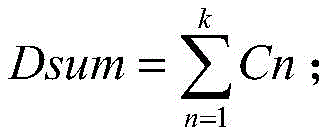
Xlabel=Xsum/Dsum;
Ylabel=Ysum/Dsum。
the following description will be made by introducing specific numerical values for the calculation process in step S3:
referring to fig. 6, in the present embodiment, for example, in step S23, the target sub-touch areas 1411, 1412, 1413, 1414, 1415, 1416, 1417, 1418, and 1419 are confirmed. A plane rectangular coordinate system is established on the plane of the sub-touch area 141 by taking any point as an origin, taking any straight line passing through the origin as an X-axis, and taking a straight line perpendicular to the X-axis as a Y-axis, wherein the geometric center coordinates of the target sub-touch areas 1411, 1412, 1413, 1414, 1415, 1416, 1417, 1418 and 1419 are respectively represented as (X1, Y1), (X2, Y2), (X3, Y3), (X4, Y4), (X5, Y5), (X6, Y6), (X7, Y7), (X8, Y8) and (X9, Y9); touch sensing signals corresponding to the target sub-touch regions 1411, 1412, 1413, 1414, 1415, 1416, 1417, 1418, and 1419 are denoted as C21, C22, C23, C24, C25, C26, C27, C28, and C29, respectively.
Substituting the data into a formula, and calculating the touch center coordinates (Xlabel, Ylabel) as:
Xlabel=
(x1*C21+x2*C22+x3*C23+x4*C24+x5*C25+x6*C26+x7*C27+x8
*C28+x9*C29)/(C21+C22+C23+C24+C25+C26+C27+C28+C29)
Ylabel=
(y1*C21+y2*C22+y3*C23+y4*C24+y5*C25+y6*C26+y7*C27+y8
*C28+y9*C29)/(C21+C22+C23+C24+C25+C26+C27+C28+C29)
in the touch center calculation method provided in this embodiment, the effective touch area 14 is divided into a plurality of sub-touch areas 141, the sub-touch areas 141 meeting the preset condition are determined as target sub-touch areas, and the touch center coordinates are calculated by referring to the touch sensing signal corresponding to the target sub-touch areas and the geometric center coordinates of the target sub-touch areas.
Example two
Referring to fig. 7, the difference between the touch center calculation method of the present embodiment and the first embodiment is that step S2 specifically includes:
step S24, acquiring touch sensing signals corresponding to the sub-touch areas at the current time;
in step S25, the sub-touch area corresponding to the largest touch sensing signal and the sub-touch area adjacent to the sub-touch area corresponding to the largest touch sensing signal are determined as the target sub-touch area.
That is, the difference between the present embodiment and the first embodiment is that the preset condition of the target sub-touch area is determined in step S2.
Referring to fig. 8, in the present embodiment, for example, if the sub-touch area corresponding to the obtained current maximum touch sensing signal is 1420, the sub-touch area 1420 is determined as the target sub-touch area 1420, and sub-touch areas 1421, 1422, 1423, 1424, 1425, 1426, 1427, and 1428 adjacent to the target sub-touch area 1420 are also determined as the target sub-touch areas.
In this embodiment, only the differences from the first embodiment will be described in detail, and the same steps of the method will not be described herein again.
It should be understood that the touch center calculation method provided in this embodiment can achieve all the advantages described in the first embodiment.
EXAMPLE III
Referring to fig. 9, the touch system 20 provided in the present embodiment includes:
the area dividing module 21 is configured to divide an effective touch area of the touch device to form a plurality of sub-touch areas, where each sub-touch area corresponds to a piece of position information;
a target sub-touch area determining module 22, configured to obtain a touch sensing signal corresponding to each sub-touch area at the current time, and determine a sub-touch area corresponding to the touch sensing signal meeting a preset condition as a target sub-touch area;
the touch center calculating module 23 is configured to calculate a touch center at the current time according to the position information of each target sub-touch area and the touch sensing signal corresponding to each target sub-touch area.
The touch system 20 provided in this embodiment is suitable for various touch devices (e.g., tablet computers and smart phones) having a touch function, the touch principle of the touch device is not limited, and various touch principles can be adopted, such as an ultrasonic type (obtaining a touch position by detecting a change of ultrasonic waves), a capacitive type (obtaining a touch position by detecting a change of capacitance), and the like.
Referring to fig. 3 again, the area dividing module 21 is configured to divide the effective touch area 14 to form a plurality of sub-touch areas 141, the sub-touch areas 141 are closely arranged in an array, and a sum of areas covered by all the sub-touch areas 141 is an area of the effective touch area 14. The shape and area of each sub-touch region 141 may be the same, may be partially the same, or may be different, and mainly depends on the shape of the effective touch region 14. In this embodiment, the effective touch area 14 is substantially rectangular with arc-shaped corners, and is divided into a plurality of sub-touch areas 141, the sub-touch area 141 near the central area is regular rectangular, and the sub-touch area 141 near the corners is irregular. In other embodiments, when the effective touch area 14 is a regular rectangle, the effective touch area 14 can be divided into a plurality of sub-touch areas 141 with equal shapes and sizes.
Each sub-touch area 141 faces a portion of the touch electrode array 12. An initial capacitor C1 is formed between the portion of each sub-touch area 141 facing the touch electrode array 12 and ground. When the touch object performs a touch operation, an induced capacitance C2 may be generated between the touch object and a portion of the touch electrode array 12 corresponding to the sub-touch area 141 touched by the touch object.
Further, step S1 specifically includes: an area threshold S is set, and the effective touch area 14 is divided to form a plurality of sub-touch areas 141 with areas larger than the area threshold S.
The touch device 10 has a signal recognition accuracy corresponding to the hardware configuration thereof, and if the area of the sub-touch areas 141 is too small, the induced capacitance C2 generated between the touch electrode array 12 and the touch object corresponding to each sub-touch area 141 is too small to be recognized or is easily influenced by environmental noise, resulting in a decrease in touch accuracy. Therefore, the area of the sub-touch region 141 is limited by setting the area threshold S. The specific value of the area threshold S is determined according to factors such as the hardware configuration of the touch device 10.
Each sub-touch area 141 corresponds to a position information. In this embodiment, the position information corresponding to each sub-touch area 141 is the geometric center coordinate of each sub-touch area 141.
Step S2 is configured to determine a target sub-touch area, where the target sub-touch area is the sub-touch area 141 meeting a preset condition.
Referring to fig. 10, in the present embodiment, the target sub-touch area determining module 22 specifically includes:
a first obtaining unit 221, configured to obtain touch sensing signals corresponding to sub-touch areas at a current time;
the determining unit 222 is configured to set a signal threshold, and determine whether the touch sensing signal corresponding to each sub-touch area is greater than the signal threshold;
the first determining unit 223 is configured to determine, if yes, the sub-touch area corresponding to the touch sensing signal larger than the signal threshold as the target sub-touch area.
In the first obtaining unit 221, the touch sensing signal corresponding to the sub-touch area 141 at the current time is an induced capacitance C2 generated between the touch object and the touch electrode array 12 corresponding to each sub-touch area 141 when the touch object performs the touch operation at the current time.
The determining unit 222 is configured to set a signal threshold C0, and determine whether the acquired touch sensing signal corresponding to each sub-touch area 141, that is, the sensing capacitor C2, is greater than the signal threshold C0. The first determining unit 223 is configured to determine the sub-touch area 141 corresponding to the touch sensing signal determined to be greater than the signal threshold C0 as the target sub-touch area. That is, in the present embodiment, the predetermined condition is that the touch sensing signal corresponding to the sub-touch area 141 is greater than the signal threshold C0.
In the present embodiment, it is considered that the sub-touch area 141 corresponding to the larger touch sensing signal is closer to the position where the touch object wants to touch, the sub-touch area 141 corresponding to the larger touch sensing signal is determined as the target sub-touch area by setting the signal threshold C0, and the subsequent calculation steps are only performed on the target sub-touch area. The steps not only realize that the data calculation has pertinence, but also reduce the calculated data quantity.
The touch center calculation module 23 is specifically configured to:
and carrying out weighted average on the geometric center coordinates of the target sub-touch areas to obtain the touch center coordinates at the current moment. The weight value during weighted averaging is the touch sensing signal corresponding to each target sub-touch area, and the weighted averaging includes weighted averaging of the X coordinate and weighted averaging of the Y coordinate. The touch center coordinate is a position coordinate that the touch object wants to touch at the current time, and the touch center coordinate may be represented as (Xlabel, Ylabel).
The calculation process of the touch center calculation module 23 can be expressed by a calculation formula as follows:

The number of control zones;


Xlabel=Xsum/Dsum;
Ylabel=Ysum/Dsum。
for an example of a specific calculation manner, refer to the description in the first embodiment.
The touch system 20 provided in this embodiment includes an area dividing module 21, a target sub-touch area determining module 22, and a touch center calculating module 23. In one embodiment, the touch system 20 may be entirely or partially a circuit system of a touch control chip; in another embodiment, the entire touch system 20 may be disposed on a motherboard of the smart device; in another embodiment, the touch system 20 is partially used as a circuit system in a touch control chip, and the other part is disposed on a motherboard of the smart device including the touch control chip. The present invention is not limited in any way to the existence of the touch system 20.
The touch system 20 provided in this embodiment divides the effective touch area 14 into a plurality of sub-touch areas 141 by the area dividing module 21, the sub-touch area 141 meeting the preset condition is determined as the target sub-touch area by the target sub-touch area determination module 22, meanwhile, the touch sensing signal corresponding to the target sub-touch area and the geometric center coordinates of the target sub-touch area are referenced, the touch center coordinates are calculated by the touch center calculation module 23, since the geometric center coordinates of the target sub-touch areas are adopted in the calculation process, the calculation result of the touch center coordinates cannot be influenced by different shapes of the target sub-touch areas, therefore, the touch center calculation method provided by the embodiment is particularly suitable for intelligent equipment of a special-shaped touch screen (with a special-shaped effective touch area), and can effectively improve touch precision.
Example four
Referring to fig. 11, the touch system of the present embodiment is different from the third embodiment in that the target sub-touch area determining module 22 specifically includes:
a second obtaining unit 224, configured to obtain touch sensing signals corresponding to each of the sub-touch areas at the current time;
a second determining unit 225, configured to determine, as the target sub-touch region, a sub-touch region corresponding to the largest touch sensing signal and the sub-touch region adjacent to the sub-touch region corresponding to the largest touch sensing signal.
That is, the difference between the present embodiment and the first embodiment is that the target sub-touch area determining module 22 determines the preset condition of the target sub-touch area. The specific determination of the preset condition of the target sub-touch area can be found in the second embodiment.
In this embodiment, only the differences from the third embodiment will be described in detail, and the rest of the embodiments will not be described herein again.
It should be understood that the touch system provided in this embodiment can achieve all the advantages as described in the third embodiment.
EXAMPLE five
The touch device provided in this embodiment includes any one of the touch systems 20 described in the third to fourth embodiments. It should be understood that the touch device provided in this embodiment can achieve all the advantages described in the third to fourth embodiments.
It will be appreciated by those skilled in the art that the above embodiments are illustrative only and not intended to be limiting, and that suitable modifications and variations may be made to the above embodiments without departing from the true spirit and scope of the invention.
Claims (10)
1. A touch center calculation method is characterized by comprising the following steps:
step S1, dividing the effective touch area to form a plurality of sub-touch areas, each sub-touch area corresponding to a position information;
step S2, acquiring touch sensing signals corresponding to the sub-touch areas at the current time, and determining the sub-touch areas corresponding to the touch sensing signals meeting the preset conditions as target sub-touch areas;
step S3, calculating the touch center at the current time according to the position information of each target sub-touch area and the touch sensing signal corresponding to each target sub-touch area.
2. The touch center calculation method according to claim 1, wherein step S1 specifically comprises:
and setting an area threshold, and dividing the effective touch area to form a plurality of sub-touch areas with areas larger than the area threshold.
3. The touch center calculation method according to claim 1, wherein the position information corresponding to each of the sub-touch areas is a geometric center coordinate of each of the sub-touch areas.
4. The touch center calculation method according to claim 3, wherein the step S2 includes:
step S21, acquiring touch sensing signals corresponding to the sub-touch areas at the current time;
step S22, setting a signal threshold, and determining whether the touch sensing signal corresponding to each sub-touch area is greater than the signal threshold;
in step S23, if yes, the sub-touch area corresponding to the touch sensing signal larger than the signal threshold is determined as the target sub-touch area.
5. The touch center calculation method according to claim 3, wherein the step S2 includes:
step S24, acquiring touch sensing signals corresponding to the sub-touch areas at the current time;
in step S25, the sub-touch area corresponding to the largest touch sensing signal and the sub-touch area adjacent to the sub-touch area corresponding to the largest touch sensing signal are determined as the target sub-touch area.
6. The touch center calculation method according to claim 4 or 5, wherein the step S3 specifically comprises:
carrying out weighted average on the geometric center coordinates of each target sub-touch area to obtain the touch center coordinates at the current moment;
and the weight value during weighted average is the touch sensing signal corresponding to each target sub-touch area.
7. A touch system, comprising:
the area dividing module is used for dividing an effective touch area to form a plurality of sub-touch areas, and each sub-touch area corresponds to position information;
the target sub-touch area determining module is used for acquiring touch sensing signals corresponding to the sub-touch areas at the current moment and determining the sub-touch areas corresponding to the touch sensing signals meeting the preset conditions as target sub-touch areas;
and the touch center calculation module is used for calculating the touch center at the current moment according to the position information of each target sub-touch area and the touch sensing signal corresponding to each target sub-touch area.
8. The touch system of claim 7, wherein the target sub-touch area determination module specifically comprises:
the first acquisition unit is used for acquiring touch sensing signals corresponding to the sub-touch areas at the current moment;
the judging unit is used for setting a signal threshold value and judging whether the touch sensing signal corresponding to each sub-touch area is larger than the signal threshold value; and
a first determining unit, configured to determine, if yes, a sub-touch area corresponding to the touch sensing signal larger than the signal threshold as the target sub-touch area; or
The target sub-touch area determination module specifically includes:
the second acquisition unit is used for acquiring touch sensing signals corresponding to the sub-touch areas at the current moment; and
a second determining unit, configured to determine, as the target sub-touch area, a sub-touch area corresponding to the largest touch sensing signal and the sub-touch area adjacent to the sub-touch area corresponding to the largest touch sensing signal.
9. The touch system of claim 7, wherein the touch center computing module is specifically configured to:
carrying out weighted average on the position information of each target sub-touch area to obtain a target coordinate, wherein the target coordinate is the touch center coordinate of the current moment;
the position information is the geometric center coordinate of each sub-touch area, and the weight value in weighted average is the touch sensing signal corresponding to each target sub-touch area.
10. A touch device comprising a touch system according to any one of claims 7-9.
Priority Applications (2)
| Application Number | Priority Date | Filing Date | Title |
|---|---|---|---|
| CN201910016951.0A CN111414118A (en) | 2019-01-08 | 2019-01-08 | Touch center calculation method, touch system and touch device |
| TW108112387A TWI700624B (en) | 2019-01-08 | 2019-04-09 | Method for calculating center of touch area, touch system and touch device |
Applications Claiming Priority (1)
| Application Number | Priority Date | Filing Date | Title |
|---|---|---|---|
| CN201910016951.0A CN111414118A (en) | 2019-01-08 | 2019-01-08 | Touch center calculation method, touch system and touch device |
Publications (1)
| Publication Number | Publication Date |
|---|---|
| CN111414118A true CN111414118A (en) | 2020-07-14 |
Family
ID=68618353
Family Applications (1)
| Application Number | Title | Priority Date | Filing Date |
|---|---|---|---|
| CN201910016951.0A Pending CN111414118A (en) | 2019-01-08 | 2019-01-08 | Touch center calculation method, touch system and touch device |
Country Status (2)
| Country | Link |
|---|---|
| CN (1) | CN111414118A (en) |
| TW (1) | TWI700624B (en) |
Cited By (2)
| Publication number | Priority date | Publication date | Assignee | Title |
|---|---|---|---|---|
| CN111782077A (en) * | 2020-06-15 | 2020-10-16 | 深圳曦华科技有限公司 | Touch position determination method, touch device and electronic device |
| WO2022247616A1 (en) * | 2021-05-28 | 2022-12-01 | 华为技术有限公司 | Method and apparatus for sensing area separation during floating control, and floating control remote controller |
Families Citing this family (1)
| Publication number | Priority date | Publication date | Assignee | Title |
|---|---|---|---|---|
| TWI842551B (en) * | 2023-06-02 | 2024-05-11 | 大陸商北京集創北方科技股份有限公司 | Capacitive touch area recognition method, touch device and information processing device |
Citations (2)
| Publication number | Priority date | Publication date | Assignee | Title |
|---|---|---|---|---|
| CN103513835A (en) * | 2012-06-26 | 2014-01-15 | 彩优微电子(昆山)有限公司 | Method for detecting touch coordinates based on mutual capacitance touch screen |
| CN108710453A (en) * | 2018-06-26 | 2018-10-26 | 北京集创北方科技股份有限公司 | A kind of touch panel, electronic equipment and information processing method |
Family Cites Families (5)
| Publication number | Priority date | Publication date | Assignee | Title |
|---|---|---|---|---|
| US8723825B2 (en) * | 2009-07-28 | 2014-05-13 | Cypress Semiconductor Corporation | Predictive touch surface scanning |
| EP2616912B1 (en) * | 2010-09-15 | 2019-12-11 | Advanced Silicon SA | Method for detecting an arbitrary number of touches from a multi-touch device |
| TWI469025B (en) * | 2011-08-25 | 2015-01-11 | Touch panel and its dynamic drive control method | |
| TWI442298B (en) * | 2011-10-27 | 2014-06-21 | Novatek Microelectronics Corp | Touch sensing method |
| US10061450B2 (en) * | 2014-12-04 | 2018-08-28 | Apple Inc. | Coarse scan and targeted active mode scan for touch |
-
2019
- 2019-01-08 CN CN201910016951.0A patent/CN111414118A/en active Pending
- 2019-04-09 TW TW108112387A patent/TWI700624B/en active
Patent Citations (2)
| Publication number | Priority date | Publication date | Assignee | Title |
|---|---|---|---|---|
| CN103513835A (en) * | 2012-06-26 | 2014-01-15 | 彩优微电子(昆山)有限公司 | Method for detecting touch coordinates based on mutual capacitance touch screen |
| CN108710453A (en) * | 2018-06-26 | 2018-10-26 | 北京集创北方科技股份有限公司 | A kind of touch panel, electronic equipment and information processing method |
Cited By (3)
| Publication number | Priority date | Publication date | Assignee | Title |
|---|---|---|---|---|
| CN111782077A (en) * | 2020-06-15 | 2020-10-16 | 深圳曦华科技有限公司 | Touch position determination method, touch device and electronic device |
| CN111782077B (en) * | 2020-06-15 | 2023-03-21 | 深圳曦华科技有限公司 | Touch position determining method, touch device and electronic equipment |
| WO2022247616A1 (en) * | 2021-05-28 | 2022-12-01 | 华为技术有限公司 | Method and apparatus for sensing area separation during floating control, and floating control remote controller |
Also Published As
| Publication number | Publication date |
|---|---|
| TW201937359A (en) | 2019-09-16 |
| TWI700624B (en) | 2020-08-01 |
Similar Documents
| Publication | Publication Date | Title |
|---|---|---|
| US10747368B2 (en) | Method and device for preventing false-touch on touch screen, mobile terminal and storage medium | |
| US9274652B2 (en) | Apparatus, method, and medium for sensing movement of fingers using multi-touch sensor array | |
| US10386965B2 (en) | Finger tracking in wet environment | |
| US9069420B2 (en) | Touch device for determining real coordinates of multiple touch points and method thereof | |
| US10254879B1 (en) | Touch screen proximity sensing with accelerometer/gyroscope and finger grip suppression to prevent false ear touch | |
| WO2018107903A1 (en) | Control method and device for touch screen of mobile terminal, mobile terminal, and storage medium | |
| US9041684B2 (en) | Senseline data adjustment method, circuit, and system to reduce the detection of false touches in a touch screen | |
| KR20160042824A (en) | Mis-touch recognition method and device | |
| CN106775407A (en) | Method and device for controlling touch screen of mobile terminal and mobile terminal | |
| US20180307365A1 (en) | Coordinate detection device and operating method thereof | |
| US20130278547A1 (en) | Electronic device | |
| CN110192170B (en) | Touch controller, device, terminal and touch method | |
| US10852882B2 (en) | Fingerprint sensing control method for fingerprint sensing device | |
| US10296139B2 (en) | Refreshing method of sensing baseline values for capacitive sensor device and capacitive sensor device | |
| US20160054831A1 (en) | Capacitive touch device and method identifying touch object on the same | |
| TWI700624B (en) | Method for calculating center of touch area, touch system and touch device | |
| CN106681636A (en) | A method, device and mobile terminal for preventing false touches | |
| US20110216030A1 (en) | Signal sensing structure for touch panels | |
| JP5958974B2 (en) | Touchpad input device and touchpad control program | |
| CN107807747B (en) | Touch system and touch detection method thereof | |
| CN106775406A (en) | Anti-incorrect touch control method and device for touch screen of mobile terminal, and mobile terminal | |
| CN108604146B (en) | Touch device and method for determining capacitance sensing amount of touch device | |
| CN107016338B (en) | The method of mobile terminal, fingerprint mould group and fingerprint false-touch prevention | |
| CN106155437A (en) | Operation mode judging method, touch point position judging method and touch control circuit | |
| CN207571719U (en) | Touch panels, devices and terminals |
Legal Events
| Date | Code | Title | Description |
|---|---|---|---|
| PB01 | Publication | ||
| PB01 | Publication | ||
| SE01 | Entry into force of request for substantive examination | ||
| SE01 | Entry into force of request for substantive examination |