CN111383353A - Broken bone model registration method based on Gaussian mixture model and contour descriptor - Google Patents
Broken bone model registration method based on Gaussian mixture model and contour descriptor Download PDFInfo
- Publication number
- CN111383353A CN111383353A CN202010251702.2A CN202010251702A CN111383353A CN 111383353 A CN111383353 A CN 111383353A CN 202010251702 A CN202010251702 A CN 202010251702A CN 111383353 A CN111383353 A CN 111383353A
- Authority
- CN
- China
- Prior art keywords
- point
- points
- contour
- cluster
- section
- Prior art date
- Legal status (The legal status is an assumption and is not a legal conclusion. Google has not performed a legal analysis and makes no representation as to the accuracy of the status listed.)
- Granted
Links
Images


Classifications
-
- G—PHYSICS
- G06—COMPUTING OR CALCULATING; COUNTING
- G06T—IMAGE DATA PROCESSING OR GENERATION, IN GENERAL
- G06T19/00—Manipulating 3D models or images for computer graphics
- G06T19/20—Editing of 3D images, e.g. changing shapes or colours, aligning objects or positioning parts
-
- G—PHYSICS
- G06—COMPUTING OR CALCULATING; COUNTING
- G06F—ELECTRIC DIGITAL DATA PROCESSING
- G06F18/00—Pattern recognition
- G06F18/20—Analysing
- G06F18/23—Clustering techniques
- G06F18/232—Non-hierarchical techniques
- G06F18/2321—Non-hierarchical techniques using statistics or function optimisation, e.g. modelling of probability density functions
- G06F18/23213—Non-hierarchical techniques using statistics or function optimisation, e.g. modelling of probability density functions with fixed number of clusters, e.g. K-means clustering
-
- G—PHYSICS
- G06—COMPUTING OR CALCULATING; COUNTING
- G06N—COMPUTING ARRANGEMENTS BASED ON SPECIFIC COMPUTATIONAL MODELS
- G06N3/00—Computing arrangements based on biological models
- G06N3/12—Computing arrangements based on biological models using genetic models
- G06N3/126—Evolutionary algorithms, e.g. genetic algorithms or genetic programming
-
- G—PHYSICS
- G06—COMPUTING OR CALCULATING; COUNTING
- G06T—IMAGE DATA PROCESSING OR GENERATION, IN GENERAL
- G06T7/00—Image analysis
- G06T7/30—Determination of transform parameters for the alignment of images, i.e. image registration
- G06T7/33—Determination of transform parameters for the alignment of images, i.e. image registration using feature-based methods
- G06T7/344—Determination of transform parameters for the alignment of images, i.e. image registration using feature-based methods involving models
-
- G—PHYSICS
- G06—COMPUTING OR CALCULATING; COUNTING
- G06T—IMAGE DATA PROCESSING OR GENERATION, IN GENERAL
- G06T2207/00—Indexing scheme for image analysis or image enhancement
- G06T2207/30—Subject of image; Context of image processing
- G06T2207/30004—Biomedical image processing
- G06T2207/30008—Bone
-
- Y—GENERAL TAGGING OF NEW TECHNOLOGICAL DEVELOPMENTS; GENERAL TAGGING OF CROSS-SECTIONAL TECHNOLOGIES SPANNING OVER SEVERAL SECTIONS OF THE IPC; TECHNICAL SUBJECTS COVERED BY FORMER USPC CROSS-REFERENCE ART COLLECTIONS [XRACs] AND DIGESTS
- Y02—TECHNOLOGIES OR APPLICATIONS FOR MITIGATION OR ADAPTATION AGAINST CLIMATE CHANGE
- Y02P—CLIMATE CHANGE MITIGATION TECHNOLOGIES IN THE PRODUCTION OR PROCESSING OF GOODS
- Y02P90/00—Enabling technologies with a potential contribution to greenhouse gas [GHG] emissions mitigation
- Y02P90/30—Computing systems specially adapted for manufacturing
Landscapes
- Engineering & Computer Science (AREA)
- Physics & Mathematics (AREA)
- Theoretical Computer Science (AREA)
- General Physics & Mathematics (AREA)
- Life Sciences & Earth Sciences (AREA)
- Data Mining & Analysis (AREA)
- Bioinformatics & Cheminformatics (AREA)
- Bioinformatics & Computational Biology (AREA)
- Evolutionary Biology (AREA)
- General Engineering & Computer Science (AREA)
- Biophysics (AREA)
- Health & Medical Sciences (AREA)
- Artificial Intelligence (AREA)
- Computer Vision & Pattern Recognition (AREA)
- Evolutionary Computation (AREA)
- Software Systems (AREA)
- Architecture (AREA)
- Computer Hardware Design (AREA)
- Computer Graphics (AREA)
- Probability & Statistics with Applications (AREA)
- Physiology (AREA)
- Genetics & Genomics (AREA)
- Biomedical Technology (AREA)
- Computational Linguistics (AREA)
- General Health & Medical Sciences (AREA)
- Molecular Biology (AREA)
- Computing Systems (AREA)
- Mathematical Physics (AREA)
- Apparatus For Radiation Diagnosis (AREA)
Abstract
Description
技术领域technical field
本发明涉及断骨匹配技术领域,尤其涉及一种基于高斯混合模型和轮廓描述子的断骨模型配准方法。The invention relates to the technical field of broken bone matching, in particular to a broken bone model registration method based on a Gaussian mixture model and a contour descriptor.
背景技术Background technique
目前骨折手术缺少良好的术前规划,需要医生在手术过程中凭经验手工制作钢板,这种手术方法时间长、出血多、容易造成感染,并且手工制作的钢板不够精确。因此,我们利用计算机对断骨的三维模型进行配准,然后根据配准后的模型进行钢板拟合,从而在手术前获取所需钢板,可以大幅度缩短手术时间,提高治疗效果;现有技术仅能实现断裂为两部分的骨骼的配准,而不能将碎裂为多部分的骨骼进行精确配准。At present, there is a lack of good preoperative planning for fracture surgery, and doctors are required to manually make steel plates based on experience during the operation. This surgical method takes a long time, has a lot of bleeding, is prone to infection, and the hand-made steel plates are not accurate enough. Therefore, we use the computer to register the three-dimensional model of the broken bone, and then fit the steel plate according to the registered model, so as to obtain the required steel plate before the operation, which can greatly shorten the operation time and improve the treatment effect; the prior art The registration of bones that are broken into two parts can only be achieved, and the accurate registration of bones that are broken into multiple parts cannot be achieved.
发明内容SUMMARY OF THE INVENTION
根据现有技术存在的问题,本发明公开了一种基于高斯混合模型和轮廓描述子的断骨模型配准方法,具体包括如下步骤:According to the problems existing in the prior art, the present invention discloses a method for registering a broken bone model based on a Gaussian mixture model and a contour descriptor, which specifically includes the following steps:
S1:提取断骨模型中低曲率的点,利用高斯混合模型对低曲率的点进行聚类;S1: Extract the low-curvature points in the broken bone model, and use the Gaussian mixture model to cluster the low-curvature points;
S2:对每个聚类进行椭圆拟合、得到该聚类对应的长轴和短轴,根据每个聚类的长轴和短轴的长度找到互相匹配的聚类,将聚类中包含的点集定义为断面点集;S2: Perform ellipse fitting on each cluster to obtain the long axis and short axis corresponding to the cluster, find the matching clusters according to the lengths of the long axis and short axis of each cluster, and use the The point set is defined as the section point set;
S3:以断面点集中的每个点为起始点、与该断面点集的轮廓点之间进行均匀连线,将所有线段按照长短顺序保存在一个向量中,将该向量定义为轮廓描述子;S3: take each point in the cross-section point set as the starting point, and carry out an even connection with the contour points of the cross-section point set, all line segments are stored in a vector according to the order of length, and the vector is defined as a contour descriptor;
S4:利用卷积自编码器对断面点集中每个点的轮廓描述子进行降维,其中降维后得到的向量为该点的几何特征向量;S4: utilize the convolutional self-encoder to reduce the dimension of the contour descriptor of each point in the section point set, and the vector obtained after the dimension reduction is the geometric feature vector of the point;
S5:根据几何特征向量提取多组匹配点、并利用遗传算法对匹配点进行筛选得到基准点,根据获取的基准点采用RANSAC算法对断骨模型进行配准。S5 : extracting multiple sets of matching points according to the geometric feature vector, screening the matching points with a genetic algorithm to obtain reference points, and using the RANSAC algorithm to register the broken bone model according to the obtained reference points.
S1具体采用如下方式:S1 specifically adopts the following methods:
S11:计算断骨模型中每个点的曲率,将曲率小于1.5的点提取出来作为低曲率的点;S11: Calculate the curvature of each point in the broken bone model, and extract the points with the curvature less than 1.5 as the points with low curvature;
S12:计算断骨模型的体积V,然后利用公式nc=0.0014V+4计算得到聚类的数目nc;S12: Calculate the volume V of the broken bone model, and then use the formula n c =0.0014V+4 to calculate the number n c of clusters;
S13:建立一个高斯混合模型,并将其聚类数目设置为nc,然后利用该高斯混合模型对低曲率的点进行聚类,共得到nc个聚类点集。S13: Establish a Gaussian mixture model, and set the number of clusters to n c , and then use the Gaussian mixture model to cluster points with low curvature to obtain a total of n c clustered point sets.
S2具体采用如下方式:S2 specifically adopts the following methods:
S21:将每个聚类点集的边缘点提取出来,作为该聚类点集的轮廓;S21: Extract the edge points of each cluster point set as the outline of the cluster point set;
S22:对每个聚类点集的轮廓进行椭圆拟合,将椭圆的长轴和短轴的长度提取出来作为该聚类点集的形状参数;S22: Perform ellipse fitting on the contour of each cluster point set, and extract the lengths of the long axis and the short axis of the ellipse as the shape parameters of the cluster point set;
S23:将两个断骨模型的所有聚类点集分别放在两个数组中,然后对两个数组中的聚类点集进行两两比较,分别计算两个聚类点集之间形状参数的差值,差值最小的两个聚类点集就是互相匹配的断面点集;S23: Put all the cluster point sets of the two broken bone models into two arrays respectively, then compare the cluster point sets in the two arrays in pairs, and calculate the shape parameters between the two cluster point sets respectively The difference of , the two cluster point sets with the smallest difference are the cross-section point sets that match each other;
S24:遍历所有的断骨模型,将所有互相匹配的断面点集提取出来。S24: Traverse all broken bone models, and extract all matching section point sets.
S3具体采用如下方式:S3 specifically adopts the following methods:
S31:计算稳定法向量:对断面点集中的每个点,都采集其周围邻域内的点组成邻域点集,然后利用PCA算法对邻域点集的坐标矩阵进行特征分离,得到3个特征值,其中最小的特征值对应的特征向量即为该点的稳定法向量。计算断面点集中每个点的稳定法向量,同时计算断面点集的整体法向量;S31: Calculate the stable normal vector: For each point in the cross-section point set, collect the points in its surrounding neighborhood to form a neighborhood point set, and then use the PCA algorithm to separate the coordinate matrix of the neighborhood point set to obtain 3 features The eigenvector corresponding to the smallest eigenvalue is the stable normal vector of the point. Calculate the stable normal vector of each point in the section point set, and calculate the overall normal vector of the section point set at the same time;
S32:提取轮廓控制点:以断面点集的整体法向量为轴,按照逆时针的方向每隔每隔一定角度(该角度值可以是12)选一个轮廓点作为初始种子点,共得N(其中N可以取30)个初始种子点,然后根据这些初始种子点使用K-means算法对轮廓点进行聚类,将聚类后的中心点作为轮廓控制点;S32: Extract contour control points: take the overall normal vector of the cross-section point set as the axis, select a contour point at every certain angle (the angle value can be 12) in the counterclockwise direction as the initial seed point, and obtain a total of N ( Wherein N can take 30) initial seed points, then use the K-means algorithm to cluster the contour points according to these initial seed points, and use the clustered center point as the contour control point;
S33:根据轮廓控制点筛选轮廓点:轮廓控制点是按照提取的顺序保存在数组中的,第i个控制点的空间坐标是Ci,控制点i处的方向向量vi可以用如下公式计算:vi=Ci-Ci-1。对每个轮廓控制点i,都用如下公式计算γ:γ=vi×vi-1,如果γ<0,则将轮廓控制点i剔除;S33: Screen contour points according to contour control points: The contour control points are stored in the array in the order of extraction, the spatial coordinate of the i-th control point is C i , and the direction vector v i at the control point i can be calculated by the following formula : v i =C i -C i-1 . For each contour control point i, use the following formula to calculate γ: γ=v i ×v i-1 , if γ<0, then remove the contour control point i;
S34:构建轮廓描述子:对断面点集中的每个点,以它的稳定法向量为轴,按照逆时针方向每隔1度向轮廓发射一条射线,在射线周围随机选取三个邻近的轮廓点,然后计算这三个轮廓点与该断面点之间的欧式距离并取平均值,按照这种方法共计算得到360个距离值,将其保存在一个向量中,该向量就是该断面点的轮廓描述子。S34: Construct the contour descriptor: For each point in the cross-section point set, take its stable normal vector as the axis, emit a ray to the contour every 1 degree in the counterclockwise direction, and randomly select three adjacent contour points around the ray , and then calculate the Euclidean distance between the three contour points and the section point and take the average value. According to this method, a total of 360 distance values are calculated and stored in a vector, which is the contour of the section point. descriptor.
S4具体采用如下方式:S4 specifically adopts the following methods:
S41:建立卷积自编码器模型:构建12层的网络模型,其中编码器部分和解码器部分各6层,编码器由卷积层和池化层构成,解码器由反卷积层和上采样层构成,该网络模型的损失函数是输出向量和输入向量之间的均方误差;S41: Build a convolutional autoencoder model: build a 12-layer network model, in which the encoder part and the decoder part each have 6 layers, the encoder consists of a convolutional layer and a pooling layer, and the decoder consists of a deconvolution layer and an upper layer. The sampling layer is composed, and the loss function of the network model is the mean square error between the output vector and the input vector;
S42:利用卷积自编码器模型进行降维:对断面点集中的每个点,将其轮廓描述子作为卷积自编码器模型的输入,然后将编码器部分的输出提取出来作为该断面点的几何特征向量。S42: Use the convolutional autoencoder model for dimensionality reduction: for each point in the cross-section point set, use its contour descriptor as the input of the convolutional self-encoder model, and then extract the output of the encoder part as the cross-section point The geometric feature vector of .
S5具体采用如下方式:S5 specifically adopts the following methods:
S51:均匀选取匹配点:在断面点集中进行均匀选点,然后在匹配的断面中找到所选点的匹配点,形成多个匹配点对;S51: uniformly select matching points: uniformly select points in the section point set, and then find the matching points of the selected points in the matching section to form multiple matching point pairs;
S52:利用遗传算法筛选得到基准点:随机抽取两组匹配点对可以构成一个DNA的结构,构造多个含有不同DNA的个体,在进化过程中将DNA中两组匹配点之间相对距离大的个体淘汰掉,最后种群中比例较大的匹配点即为基准点;S52: Use genetic algorithm to screen to obtain reference points: randomly select two sets of matching point pairs to form a DNA structure, and construct multiple individuals with different DNAs. During the evolution process, the relative distance between the two sets of matching points in DNA is determined Individuals are eliminated, and the matching point with a larger proportion in the final population is the reference point;
S53:利用RANSAC算法进行配准:选取多组与基准点相对距离较小的匹配点对,然后利用RANSAC算法根据这些匹配点对进行配准,就可以实现两个断面点集之间的配准。按照这种方法将所有互相匹配的断面点集都进行配准,就可以实现断骨模型的整体配准。S53: Use the RANSAC algorithm for registration: select multiple sets of matching point pairs with a relatively small relative distance from the reference point, and then use the RANSAC algorithm to perform registration according to these matching point pairs, so that the registration between the two section point sets can be achieved . According to this method, all the cross-section point sets that match each other are registered, and the overall registration of the fractured bone model can be realized.
采用了上述技术方案,本发明提供的一种基于高斯混合模型和轮廓描述子的断骨模型配准方法,本方法利用高斯混合模型对低曲率的点进行聚类,然后对每个聚类进行椭圆拟合,并根据椭圆的参数找到互相匹配的断面点集;根据断面的轮廓构建轮廓描述子,然后利用卷积自编码器进行降维,得到点的几何特征向量;最后利用RANSAC算法根据几何特征向量进行配准;因此该方法可以将碎裂为多块的骨骼进行精确配准,在医疗领域中可以大幅度提升骨折手术的治疗效果。By adopting the above technical solution, the present invention provides a method for registration of broken bone models based on Gaussian mixture model and contour descriptor. This method uses Gaussian mixture model to cluster points with low curvature, and then performs a Ellipse fitting, and find the matching section point set according to the parameters of the ellipse; construct the contour descriptor according to the contour of the section, and then use the convolutional autoencoder to reduce the dimension to obtain the geometric feature vector of the point; finally, use the RANSAC algorithm according to the geometric The feature vector is used for registration; therefore, this method can accurately register broken bones, which can greatly improve the treatment effect of fracture surgery in the medical field.
附图说明Description of drawings
为了更清楚地说明本申请实施例或现有技术中的技术方案,下面将对实施例或现有技术描述中所需要使用的附图作简单地介绍,显而易见地,下面描述中的附图仅仅是本申请中记载的一些实施例,对于本领域普通技术人员来讲,在不付出创造性劳动的前提下,还可以根据这些附图获得其他的附图。In order to more clearly illustrate the embodiments of the present application or the technical solutions in the prior art, the following briefly introduces the accompanying drawings required for the description of the embodiments or the prior art. Obviously, the drawings in the following description are only These are some embodiments described in this application. For those of ordinary skill in the art, other drawings can also be obtained based on these drawings without any creative effort.
图1为本发明方法的流程图;Fig. 1 is the flow chart of the method of the present invention;
图2为本发明中利用高斯混合模型进行聚类的结果图;Fig. 2 is the result diagram of utilizing Gaussian mixture model to carry out clustering in the present invention;
图3为本发明中提取得到的两个断面点集示意图;3 is a schematic diagram of two section point sets extracted in the present invention;
图4为本发明中构造轮廓描述子的示意图;4 is a schematic diagram of constructing a contour descriptor in the present invention;
图5为本发明中卷积自编码器的结构图;Fig. 5 is the structure diagram of the convolutional self-encoder in the present invention;
图6为本发明中断骨模型整体配准的结果图。FIG. 6 is a result diagram of the overall registration of the interrupted bone model according to the present invention.
具体实施方式Detailed ways
为使本发明的技术方案和优点更加清楚,下面结合本发明实施例中的附图,对本发明实施例中的技术方案进行清楚完整的描述:In order to make the technical solutions and advantages of the present invention clearer, the technical solutions in the embodiments of the present invention will be described clearly and completely below with reference to the accompanying drawings in the embodiments of the present invention:
如图1所示的一种基于高斯混合模型和轮廓描述子的断骨模型配准方法,具体采用如下方式:As shown in Figure 1, a broken bone model registration method based on a Gaussian mixture model and a contour descriptor is specifically adopted as follows:
S1:将断骨模型中低曲率的点提取出来,然后利用高斯混合模型对低曲率的点进行聚类。如图2所示,该步骤的具体过程为:S1: Extract the low-curvature points in the broken bone model, and then use the Gaussian mixture model to cluster the low-curvature points. As shown in Figure 2, the specific process of this step is:
S11:计算断骨模型中每个点的曲率,将曲率小于设定阈值(这里可以取1.5)的点提取出来作为低曲率的点;S11: Calculate the curvature of each point in the broken bone model, and extract the points whose curvature is less than the set threshold (1.5 can be taken here) as the low curvature point;
S12:计算断骨模型的体积V,然后利用公式nc=0.0014V+4计算得到聚类的数目nc;S12: Calculate the volume V of the broken bone model, and then use the formula n c =0.0014V+4 to calculate the number n c of clusters;
S13:建立一个高斯混合模型,并将其聚类数目设置为nc,然后利用该高斯混合模型对低曲率的点进行聚类,共得到nc个聚类点集。S13: Establish a Gaussian mixture model, and set the number of clusters to n c , and then use the Gaussian mixture model to cluster points with low curvature to obtain a total of n c clustered point sets.
S2:对每个聚类进行椭圆拟合,得到该聚类对应的长轴和短轴两个参数,根据每个聚类的长轴和短轴的长度找到互相匹配的聚类,这种聚类中包含的点集即为断面点集。S2: Perform ellipse fitting on each cluster to obtain two parameters corresponding to the long axis and short axis of the cluster, and find the matching clusters according to the lengths of the long axis and short axis of each cluster. The point set contained in the class is the section point set.
S21:将每个聚类点集的边缘点提取出来,作为该聚类点集的轮廓;S21: Extract the edge points of each cluster point set as the outline of the cluster point set;
S22:对每个聚类点集的轮廓进行椭圆拟合,由于拟合椭圆图形只需要平面空间中的二维数据,因此我们首先利用PCA对轮廓点集计算获得最佳投影方向(即最小特征值对应的特征向量方向),然后将轮廓点集沿投影方向投影到二维平面,其中轮廓点集在二维空间中的坐标分布中心化后可以用(x,y)表示,椭圆的二次曲线方程可以表示为a1x2+a2xy+a3y2+a4x+a5y+1=0S22: Perform ellipse fitting on the contour of each clustered point set. Since fitting an ellipse only requires two-dimensional data in the plane space, we first use PCA to calculate the contour point set to obtain the best projection direction (ie, the minimum feature The eigenvector direction corresponding to the value), and then project the contour point set to a two-dimensional plane along the projection direction, where the coordinate distribution of the contour point set in the two-dimensional space can be expressed by (x, y) after being centralized, the quadratic ellipse The curve equation can be expressed as a 1 x 2 +a 2 xy+a 3 y 2 +a 4 x+a 5 y+1=0
其中a1,a2,a3,a4,a5为方程的系数,轮廓点(xi,yi)相对于椭圆的拟合误差可以定义为为di=(a1xi 2+a2xiyi+a3yi 2+a4xi+a5yi)2 where a 1 , a 2 , a 3 , a 4 , a 5 are the coefficients of the equation, and the fitting error of the contour points (x i , y i ) relative to the ellipse can be defined as d i =(a 1 x i 2 + a 2 x i y i +a 3 y i 2 +a 4 x i +a 5 y i ) 2
则轮廓点集的总体拟合误差为Then the overall fitting error of the contour point set is

我们可以将其转化为求解D的最小值的优化问题,当D取最小值时,可以求得椭圆二次方程各个系数的值。接下来对椭圆进行标准化得到椭圆的标准方程,其中椭圆标准方程各个参数的计算方法如下:We can turn it into an optimization problem of finding the minimum value of D. When D takes the minimum value, the values of the coefficients of the quadratic equation of the ellipse can be obtained. Next, standardize the ellipse to obtain the standard equation of the ellipse. The calculation method of each parameter of the standard equation of the ellipse is as follows:
椭圆中心点坐标:The coordinates of the center point of the ellipse:
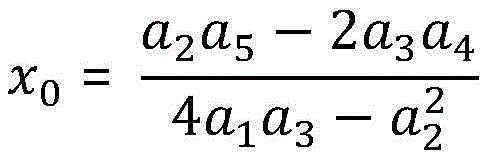

椭圆的短轴和长轴:The minor and major axes of the ellipse:


对每个聚类轮廓都进行椭圆拟合,并保存拟合得到的椭圆的长轴和短轴参数,用于后续的匹配断面的寻找和提取;Perform ellipse fitting on each cluster outline, and save the long-axis and short-axis parameters of the fitted ellipse for subsequent finding and extraction of matching sections;
S23:将两个断骨模型的所有聚类点集分别放在两个数组中,然后对两个数组中的聚类点集进行两两比较,分别计算两个聚类点集之间形状参数的差值,差值最小的两个聚类点集就是互相匹配的断面点集,如图3所示;S23: Put all the cluster point sets of the two broken bone models into two arrays respectively, then compare the cluster point sets in the two arrays in pairs, and calculate the shape parameters between the two cluster point sets respectively The difference of , the two cluster point sets with the smallest difference are the cross-section point sets that match each other, as shown in Figure 3;
S24:遍历所有的断骨模型,将所有互相匹配的断面点集提取出来。S24: Traverse all broken bone models, and extract all matching section point sets.
S3:如图4所示,以断面点集中的每个点作为起始点、与该断面点集的轮廓点之间进行均匀地连线,将所有线段的长度按从长到短的顺序保存在一个向量中、作为该点的轮廓描述子,具体步骤如下:S3: As shown in Figure 4, take each point in the cross-section point set as the starting point, and evenly connect the line with the contour points of the cross-section point set, and save the lengths of all line segments in the order from longest to shortest in the In a vector, as the contour descriptor of the point, the specific steps are as follows:
S31:计算稳定法向量:对于断面点集中的每个点,都采集其周围邻域内的点组成邻域点集,然后利用PCA算法对邻域点集的坐标矩阵进行特征分离,得到3个特征值,其中最小的特征值对应的特征向量即为该点的稳定法向量,计算断面点集中每个点的稳定法向量,同时计算断面点集的整体法向量;S31: Calculate the stable normal vector: For each point in the cross-section point set, collect the points in its surrounding neighborhood to form a neighborhood point set, and then use the PCA algorithm to separate the coordinate matrix of the neighborhood point set to obtain 3 features value, the eigenvector corresponding to the smallest eigenvalue is the stable normal vector of the point, calculate the stable normal vector of each point in the section point set, and calculate the overall normal vector of the section point set at the same time;
S32:提取轮廓控制点:以断面点集的整体法向量为轴,按照逆时针的方向每隔12度选一个轮廓点作为初始种子点,共得到30个初始种子点,然后根据这些初始种子点使用K-means算法对轮廓点进行聚类,将聚类后的中心点作为轮廓控制点;S32: Extract the contour control points: take the overall normal vector of the section point set as the axis, select a contour point every 12 degrees as the initial seed point in the counterclockwise direction, and obtain a total of 30 initial seed points, and then according to these initial seed points Use the K-means algorithm to cluster the contour points, and use the clustered center point as the contour control point;
S33:根据轮廓控制点筛选轮廓点:轮廓控制点是按照提取的顺序保存在数组中的,第i个控制点的空间坐标是Ci,控制点i处的方向向量vi可以用如下公式计算:vi=Ci-Ci-1。对每个轮廓控制点i,都用如下公式计算γ:γ=vi×vi-1,如果γ<0,则将轮廓控制点i剔除;S33: Screen contour points according to contour control points: The contour control points are stored in the array in the order of extraction, the spatial coordinate of the i-th control point is C i , and the direction vector v i at the control point i can be calculated by the following formula : v i =C i -C i-1 . For each contour control point i, use the following formula to calculate γ: γ=v i ×v i-1 , if γ<0, then remove the contour control point i;
S34:构建轮廓描述子:对断面点集中的每个点,以它的稳定法向量为轴,按照逆时针方向每隔1度向轮廓发射一条射线,在射线周围随机选取三个邻近的轮廓点,然后计算这三个轮廓点与该断面点之间的欧式距离并取平均值,按照这种方法共计算得到360个距离值,将其保存在一个向量中,该向量就是该断面点的轮廓描述子。S34: Construct the contour descriptor: For each point in the cross-section point set, take its stable normal vector as the axis, emit a ray to the contour every 1 degree in the counterclockwise direction, and randomly select three adjacent contour points around the ray , and then calculate the Euclidean distance between the three contour points and the section point and take the average value. According to this method, a total of 360 distance values are calculated and stored in a vector, which is the contour of the section point. descriptor.
S4:利用卷积自编码器对断面点集中每个点的轮廓描述子进行降维,降维后得到的向量即为该点的几何特征向量,具体包括如下步骤:S4: Use the convolutional autoencoder to reduce the dimension of the contour descriptor of each point in the cross-section point set, and the vector obtained after dimension reduction is the geometric feature vector of the point, which specifically includes the following steps:
S41:建立卷积自编码器模型:如图5所示,构建12层的网络模型,其中编码器部分和解码器部分各6层,编码器由卷积层和池化层构成,解码器由反卷积层和上采样层构成,该网络模型的损失函数是输出向量和输入向量之间的均方误差;S41: Build a convolutional autoencoder model: as shown in Figure 5, build a 12-layer network model, in which the encoder part and the decoder part each have 6 layers, the encoder consists of a convolutional layer and a pooling layer, and the decoder consists of The deconvolution layer and the upsampling layer are composed, and the loss function of the network model is the mean square error between the output vector and the input vector;
S42:利用卷积自编码器模型进行降维:对断面点集中的每个点,将其轮廓描述子作为卷积自编码器模型的输入,然后将编码器部分的输出提取出来作为该断面点的几何特征向量。S42: Use the convolutional autoencoder model for dimensionality reduction: for each point in the cross-section point set, use its contour descriptor as the input of the convolutional self-encoder model, and then extract the output of the encoder part as the cross-section point The geometric feature vector of .
现有的断骨模型配准方法都是利用传统的基于迭代的算法来实现的,这些算法对断骨模型的初始位置非常敏感,当两个断骨模型初始的角度差非常大时,经常会出现较大的配准误差。而本文中的方法可以根据局部特征找到匹配点,利用匹配点进行配准,可以不受初始位置的影响,具有很高的鲁棒性和精确度。The existing fractured bone model registration methods are all implemented by traditional iterative-based algorithms. These algorithms are very sensitive to the initial position of the fractured bone model. When the initial angle difference between the two fractured bone models is very large, it is often There is a large registration error. The method in this paper can find matching points based on local features, and use matching points for registration, which is not affected by the initial position, and has high robustness and accuracy.
S5:根据几何特征向量提取多组匹配点,并利用遗传算法对匹配点进行筛选得到基准点,然后采用RANSAC算法根据基准点进行断骨模型的配准,具体包括如下步骤:S5: Extract multiple sets of matching points according to the geometric feature vector, and use the genetic algorithm to screen the matching points to obtain the reference points, and then use the RANSAC algorithm to register the broken bone model according to the reference points, which specifically includes the following steps:
S51:均匀选取匹配点:在断面点集中进行均匀选点,然后在匹配的断面中找到所选点的匹配点,形成多个匹配点对;S51: uniformly select matching points: uniformly select points in the section point set, and then find the matching points of the selected points in the matching section to form multiple matching point pairs;
S52:利用遗传算法筛选得到基准点:随机抽取两组匹配点对可以构成一个DNA的结构,构造多个含有不同DNA的个体,在进化过程中将DNA中两组匹配点之间相对距离大的个体淘汰掉,最后种群中比例较大的匹配点即为基准点;S52: Use genetic algorithm to screen to obtain reference points: randomly select two sets of matching point pairs to form a DNA structure, and construct multiple individuals with different DNAs. During the evolution process, the relative distance between the two sets of matching points in DNA is determined Individuals are eliminated, and the matching point with a larger proportion in the final population is the reference point;
S53:利用RANSAC算法进行配准时如图6所示:选取多组与基准点相对距离较小的匹配点对,然后利用RANSAC算法根据这些匹配点对进行配准,就可以实现两个断面点集之间的配准。按照这种方法将所有互相匹配的断面点集都进行配准,就可以实现断骨模型的整体配准。S53: When using the RANSAC algorithm for registration, as shown in Figure 6: select multiple sets of matching point pairs with a relatively small relative distance from the reference point, and then use the RANSAC algorithm to perform registration according to these matching point pairs, and two cross-section point sets can be realized. alignment between. According to this method, all the cross-section point sets that match each other are registered, and the overall registration of the fractured bone model can be achieved.
本发明公开的一种基于高斯混合模型和轮廓描述子的断骨模型配准方法,该方法通过高斯混合模型将断骨模型中的低曲率点集进行聚类,然后对聚类的轮廓进行椭圆拟合,并根据椭圆参数将断面点集提取出来,再对断面点集构造了轮廓描述子,并利用轮廓描述子实现了断骨模型的精确配准,将碎裂为多块的骨骼实现了自动精确配准,可以大幅度提升骨折手术的治疗效果。The invention discloses a broken bone model registration method based on a Gaussian mixture model and a contour descriptor. The method uses the Gaussian mixture model to cluster low-curvature point sets in the broken bone model, and then ellipse the clustered contour. Fitting, and extracting the cross-section point set according to the ellipse parameters, and then constructing a contour descriptor for the cross-section point set, and using the contour descriptor to achieve the accurate registration of the broken bone model, the fragmented bones are automatically realized. Accurate registration can greatly improve the treatment effect of fracture surgery.
以上所述,仅为本发明较佳的具体实施方式,但本发明的保护范围并不局限于此,任何熟悉本技术领域的技术人员在本发明揭露的技术范围内,根据本发明的技术方案及其发明构思加以等同替换或改变,都应涵盖在本发明的保护范围之内。The above description is only a preferred embodiment of the present invention, but the protection scope of the present invention is not limited to this. The equivalent replacement or change of the inventive concept thereof shall be included within the protection scope of the present invention.
Claims (6)
Priority Applications (1)
| Application Number | Priority Date | Filing Date | Title |
|---|---|---|---|
| CN202010251702.2A CN111383353B (en) | 2020-04-01 | 2020-04-01 | Registration Method of Broken Bone Model Based on Gaussian Mixture Model and Contour Descriptor |
Applications Claiming Priority (1)
| Application Number | Priority Date | Filing Date | Title |
|---|---|---|---|
| CN202010251702.2A CN111383353B (en) | 2020-04-01 | 2020-04-01 | Registration Method of Broken Bone Model Based on Gaussian Mixture Model and Contour Descriptor |
Publications (2)
| Publication Number | Publication Date |
|---|---|
| CN111383353A true CN111383353A (en) | 2020-07-07 |
| CN111383353B CN111383353B (en) | 2023-05-23 |
Family
ID=71217500
Family Applications (1)
| Application Number | Title | Priority Date | Filing Date |
|---|---|---|---|
| CN202010251702.2A Active CN111383353B (en) | 2020-04-01 | 2020-04-01 | Registration Method of Broken Bone Model Based on Gaussian Mixture Model and Contour Descriptor |
Country Status (1)
| Country | Link |
|---|---|
| CN (1) | CN111383353B (en) |
Cited By (2)
| Publication number | Priority date | Publication date | Assignee | Title |
|---|---|---|---|---|
| CN112183541A (en) * | 2020-09-17 | 2021-01-05 | 中山大学肿瘤防治中心 | Contour extraction method and device, electronic device, and storage medium |
| CN113470084A (en) * | 2021-05-18 | 2021-10-01 | 西安电子科技大学 | Point set registration method based on outline rough matching |
Citations (7)
| Publication number | Priority date | Publication date | Assignee | Title |
|---|---|---|---|---|
| CN103607972A (en) * | 2011-06-22 | 2014-02-26 | 新特斯有限责任公司 | Ultrasound CT registration for positioning |
| CN105869149A (en) * | 2016-03-24 | 2016-08-17 | 大连理工大学 | Fracture Section Segmentation and Fracture Model Registration Method Based on Principal Vector Analysis |
| CN107316327A (en) * | 2017-07-05 | 2017-11-03 | 大连理工大学 | Registration Method of Fracture Section and Fracture Model Based on Maximum Common Subgraph and Bounding Box |
| CN107330281A (en) * | 2017-07-05 | 2017-11-07 | 大连理工大学 | Fully automatic fracture plate model personalized reconstruction method |
| CN108154525A (en) * | 2017-11-21 | 2018-06-12 | 四川大学 | A kind of matched bone fragments joining method of feature based |
| CN109035311A (en) * | 2018-07-11 | 2018-12-18 | 大连理工大学 | Automatic registration and internal fixation steel plate pre-bending modeling method for curved bone fracture |
| US10492981B1 (en) * | 2015-07-17 | 2019-12-03 | Bao Tran | Systems and methods for computer assisted operation |
-
2020
- 2020-04-01 CN CN202010251702.2A patent/CN111383353B/en active Active
Patent Citations (7)
| Publication number | Priority date | Publication date | Assignee | Title |
|---|---|---|---|---|
| CN103607972A (en) * | 2011-06-22 | 2014-02-26 | 新特斯有限责任公司 | Ultrasound CT registration for positioning |
| US10492981B1 (en) * | 2015-07-17 | 2019-12-03 | Bao Tran | Systems and methods for computer assisted operation |
| CN105869149A (en) * | 2016-03-24 | 2016-08-17 | 大连理工大学 | Fracture Section Segmentation and Fracture Model Registration Method Based on Principal Vector Analysis |
| CN107316327A (en) * | 2017-07-05 | 2017-11-03 | 大连理工大学 | Registration Method of Fracture Section and Fracture Model Based on Maximum Common Subgraph and Bounding Box |
| CN107330281A (en) * | 2017-07-05 | 2017-11-07 | 大连理工大学 | Fully automatic fracture plate model personalized reconstruction method |
| CN108154525A (en) * | 2017-11-21 | 2018-06-12 | 四川大学 | A kind of matched bone fragments joining method of feature based |
| CN109035311A (en) * | 2018-07-11 | 2018-12-18 | 大连理工大学 | Automatic registration and internal fixation steel plate pre-bending modeling method for curved bone fracture |
Non-Patent Citations (4)
| Title |
|---|
| BIN LIU 等: "An Automatic Personalized Internal Fixation Plate Modeling Framework for Minimally Invasive Curved Bone Fracture Surgery Based on Preregistration With Capsule Projection Model" * |
| 刘斌;华顺刚;欧宗瑛;赵德伟;王卫明;: "基于断骨模型自动配准的完全性骨折钢板预弯" * |
| 张松: "计算机辅助弯骨自动配准及钢板虚拟预弯研究" * |
| 魏梓泉;杨扬;张愫;杨昆;: "基于双特征高斯混合模型和双约束空间变换的配准" * |
Cited By (4)
| Publication number | Priority date | Publication date | Assignee | Title |
|---|---|---|---|---|
| CN112183541A (en) * | 2020-09-17 | 2021-01-05 | 中山大学肿瘤防治中心 | Contour extraction method and device, electronic device, and storage medium |
| CN112183541B (en) * | 2020-09-17 | 2023-04-18 | 中山大学肿瘤防治中心(中山大学附属肿瘤医院、中山大学肿瘤研究所) | Contour extraction method and device, electronic equipment and storage medium |
| CN113470084A (en) * | 2021-05-18 | 2021-10-01 | 西安电子科技大学 | Point set registration method based on outline rough matching |
| CN113470084B (en) * | 2021-05-18 | 2024-01-30 | 西安电子科技大学 | Point set registration method based on outline rough matching |
Also Published As
| Publication number | Publication date |
|---|---|
| CN111383353B (en) | 2023-05-23 |
Similar Documents
| Publication | Publication Date | Title |
|---|---|---|
| CN110335297B (en) | A point cloud registration method based on feature extraction | |
| US8885926B2 (en) | Image and data segmentation | |
| CN109584209B (en) | Vascular wall plaque identification device, system, method and storage medium | |
| CN103593844B (en) | A kind of multidimensional various features extracting method of medical image | |
| WO2024021523A1 (en) | Graph network-based method and system for fully automatic segmentation of cerebral cortex surface | |
| CN104200524B (en) | A 3D Mesh Bone Model Averaging Method for Bone Plate Design | |
| WO2018108129A1 (en) | Method and apparatus for use in identifying object type, and electronic device | |
| CN106530341B (en) | A Point Registration Algorithm Preserving Local Topological Invariance | |
| CN110969619B (en) | Method and device for automatically identifying primary tumor of nasopharyngeal carcinoma | |
| CN108230301A (en) | A kind of spine CT image automatic positioning dividing method based on active contour model | |
| CN103985112B (en) | Image segmentation method based on improved multi-objective particle swarm optimization and clustering | |
| WO2018077111A1 (en) | Plant type recognition method, recognition apparatus and server | |
| CN111986101A (en) | Cerebrovascular map construction method | |
| CN107316327B (en) | A registration method of broken bone model | |
| EP4285321A1 (en) | Systems and methods for classifying biomedical image data using a graph neural network | |
| CN111383353A (en) | Broken bone model registration method based on Gaussian mixture model and contour descriptor | |
| CN104732546A (en) | Non-rigid SAR image registration method based on region similarity and local spatial constraint | |
| WO2025200521A1 (en) | Point cloud cylinder segmentation processing method and apparatus, and electronic device | |
| CN109035311A (en) | Automatic registration and internal fixation steel plate pre-bending modeling method for curved bone fracture | |
| CN105913451B (en) | A kind of natural image superpixel segmentation method based on graph model | |
| CN108305279A (en) | A kind of brain magnetic resonance image super voxel generation method of iteration space fuzzy clustering | |
| CN103745473A (en) | Brain tissue extraction method | |
| CN106548478A (en) | Active contour image partition method based on local fit image | |
| CN112581513B (en) | Feature Extraction and Corresponding Method of Cone Beam Computed Tomography Image | |
| CN108010114A (en) | The Geometric Shape Recognition method and characteristic recognition method of element figure point cloud surface |
Legal Events
| Date | Code | Title | Description |
|---|---|---|---|
| PB01 | Publication | ||
| PB01 | Publication | ||
| SE01 | Entry into force of request for substantive examination | ||
| SE01 | Entry into force of request for substantive examination | ||
| GR01 | Patent grant | ||
| GR01 | Patent grant |