CN111369646B - Expression synthesis method integrating attention mechanism - Google Patents
Expression synthesis method integrating attention mechanism Download PDFInfo
- Publication number
- CN111369646B CN111369646B CN202010155374.6A CN202010155374A CN111369646B CN 111369646 B CN111369646 B CN 111369646B CN 202010155374 A CN202010155374 A CN 202010155374A CN 111369646 B CN111369646 B CN 111369646B
- Authority
- CN
- China
- Prior art keywords
- expression
- image
- network
- images
- intensity
- Prior art date
- Legal status (The legal status is an assumption and is not a legal conclusion. Google has not performed a legal analysis and makes no representation as to the accuracy of the status listed.)
- Active
Links
Images


Classifications
-
- G—PHYSICS
- G06—COMPUTING OR CALCULATING; COUNTING
- G06T—IMAGE DATA PROCESSING OR GENERATION, IN GENERAL
- G06T11/00—2D [Two Dimensional] image generation
- G06T11/60—Editing figures and text; Combining figures or text
-
- G—PHYSICS
- G06—COMPUTING OR CALCULATING; COUNTING
- G06N—COMPUTING ARRANGEMENTS BASED ON SPECIFIC COMPUTATIONAL MODELS
- G06N3/00—Computing arrangements based on biological models
- G06N3/02—Neural networks
- G06N3/04—Architecture, e.g. interconnection topology
- G06N3/045—Combinations of networks
-
- Y—GENERAL TAGGING OF NEW TECHNOLOGICAL DEVELOPMENTS; GENERAL TAGGING OF CROSS-SECTIONAL TECHNOLOGIES SPANNING OVER SEVERAL SECTIONS OF THE IPC; TECHNICAL SUBJECTS COVERED BY FORMER USPC CROSS-REFERENCE ART COLLECTIONS [XRACs] AND DIGESTS
- Y02—TECHNOLOGIES OR APPLICATIONS FOR MITIGATION OR ADAPTATION AGAINST CLIMATE CHANGE
- Y02T—CLIMATE CHANGE MITIGATION TECHNOLOGIES RELATED TO TRANSPORTATION
- Y02T10/00—Road transport of goods or passengers
- Y02T10/10—Internal combustion engine [ICE] based vehicles
- Y02T10/40—Engine management systems
Landscapes
- Engineering & Computer Science (AREA)
- Physics & Mathematics (AREA)
- Theoretical Computer Science (AREA)
- General Physics & Mathematics (AREA)
- Data Mining & Analysis (AREA)
- Molecular Biology (AREA)
- Biophysics (AREA)
- Computational Linguistics (AREA)
- Artificial Intelligence (AREA)
- Evolutionary Computation (AREA)
- General Health & Medical Sciences (AREA)
- Biomedical Technology (AREA)
- Computing Systems (AREA)
- General Engineering & Computer Science (AREA)
- Life Sciences & Earth Sciences (AREA)
- Mathematical Physics (AREA)
- Software Systems (AREA)
- Health & Medical Sciences (AREA)
- Image Analysis (AREA)
Abstract
本发明公开了一种融合注意力机制的表情合成方法。该方法为:获取人脸表情数据集,对数据集进行关键点检测和图像裁剪;按照表情的不同类别将同一类表情划分在一起,将每类表情数据划分成训练集和测试集,根据不同的表情强度将训练集手动地划分为不同的类别;以表情强度作为条件标签,构建条件生成对抗网络,在生成网络中同时融合通道和空间两种注意力机制,使用带有分类器的鉴别网络同时判别输入图像的真假和强度类别;使用预处理后的训练集对网络进行训练,调节参数使模型达到最优,以测试集中的中立表情作为输入,得到不同强度的人脸表情图像。本发明能由中立表情图像合成具有不同强度的人脸表情图像,方法方便直观且合成的表情图像真实生动。

The invention discloses an expression synthesis method integrating an attention mechanism. The method is as follows: obtain a facial expression data set, perform key point detection and image cropping on the data set; divide the same type of expression together according to different types of expression, and divide each type of expression data into a training set and a test set. The expression strength of the training set is manually divided into different categories; the expression strength is used as the conditional label, and the conditional generative confrontation network is constructed, and the two attention mechanisms of channel and space are combined in the generative network at the same time, and the discriminative network with a classifier is used. At the same time, the authenticity and intensity category of the input image are discriminated; the preprocessed training set is used to train the network, the parameters are adjusted to make the model optimal, and the neutral expression in the test set is used as input to obtain facial expression images of different intensities. The invention can synthesize facial expression images with different intensities from neutral expression images, the method is convenient and intuitive, and the synthesized expression images are real and vivid.
Description
技术领域Technical Field
本发明涉及深度学习和图像处理技术领域,特别是一种融合注意力机制的表情合成方法。The present invention relates to the technical field of deep learning and image processing, and in particular to an expression synthesis method integrating an attention mechanism.
背景技术Background Art
人脸图像合成是计算机视觉和图形学领域一个广泛研究的课题。面部表情不仅是一种微妙的形体语言,更是人们传递情感信息的重要方式。近年来,随着计算机信息技术和服务的发展,人们越来越希望计算机的通信能够表现出拟人化的感情,在人机交互中提供一种全新的沉浸感,这也推动了表情合成的发展。面部表情合成也成为当前研究热点之一,具有广泛的应用如人机交互,虚拟现实,数字娱乐等领域。Facial image synthesis is a widely studied topic in the field of computer vision and graphics. Facial expressions are not only a subtle form of body language, but also an important way for people to convey emotional information. In recent years, with the development of computer information technology and services, people increasingly hope that computer communications can express anthropomorphic emotions and provide a new sense of immersion in human-computer interaction, which has also promoted the development of expression synthesis. Facial expression synthesis has also become one of the current research hotspots, with a wide range of applications such as human-computer interaction, virtual reality, digital entertainment and other fields.
由于不同表情之间存在人脸面部几何的非线性变化,而且不同个体的表情变化强度也是不同的,因此面部表情的合成工作具有一定的挑战性。在表情合成方面,现有的工作大部分关注于合成七种典型表情如快乐,悲伤,惊讶,愤怒等,但表情是一个变化的过程,当合成具有不同强度的表情时,会存在缺少数据标签的问题。目前关于不同强度表情合成方法大致分为两类:(1)无监督方法,利用面部几何信息进行插值拉动面部肌肉运动使人脸变形或者人工设计表情编码模块学习表情之间的变化;(2)有监督方法,使用带有表情强度标签标注的数据集进行训练。Since there are nonlinear changes in facial geometry between different expressions, and the intensity of expression changes of different individuals is also different, the synthesis of facial expressions is challenging. In terms of expression synthesis, most of the existing work focuses on synthesizing seven typical expressions such as happiness, sadness, surprise, anger, etc., but expression is a changing process. When synthesizing expressions with different intensities, there is a problem of lack of data labels. At present, the methods for synthesizing expressions with different intensities can be roughly divided into two categories: (1) unsupervised methods, which use facial geometry information to interpolate and pull facial muscle movements to deform the face or manually design expression encoding modules to learn the changes between expressions; (2) supervised methods, which use datasets annotated with expression intensity labels for training.
然而,第一类方法不能很好到捕捉不同表情强度的变化过程,如面部皱纹等,导致生成的表情不自然,不够逼真;另外通过这类方法生成的图像有时候会存在缺乏精细的细节部分,往往是模糊的或者低分辨率的。第二类方法要求数据必须标注表情强度,然而在实际应用中,表情的强度是很难用一个统一的标准去定义的,这类方法虽然能实现细粒度控制,但具有局限性。However, the first type of method cannot capture the changing process of different expression intensities, such as facial wrinkles, which makes the generated expressions unnatural and not realistic enough. In addition, the images generated by this type of method sometimes lack fine details and are often blurry or low-resolution. The second type of method requires that the data must be labeled with expression intensity. However, in practical applications, the intensity of expression is difficult to define with a unified standard. Although this type of method can achieve fine-grained control, it has limitations.
发明内容Summary of the invention
本发明的目的在于提供一种能够通过中立无表情人脸图像合成具有不同强度的人脸表情,方法直观便捷,合成的表情强度生动且人脸真实性强的表情合成方法。The purpose of the present invention is to provide an expression synthesis method which can synthesize facial expressions with different intensities through neutral expressionless facial images. The method is intuitive and convenient, and the synthesized expression intensity is vivid and the face authenticity is strong.
实现本发明目的的技术解决方案为:一种融合注意力机制的表情合成方法,包括以下步骤:The technical solution to achieve the purpose of the present invention is: a method for synthesizing facial expressions by integrating an attention mechanism, comprising the following steps:
步骤1,获取人脸表情图像的数据集;Step 1, obtaining a dataset of facial expression images;
步骤2,对表情数据集进行预处理,首先获取人脸图像的关键点信息,根据关键点位置将图像裁剪为统一大小,然后将同一类别的表情图像划分在一起,将同类表情图像划分为训练集和测试集,将训练集根据不同的表情强度手动划分成不同的类别;Step 2, preprocessing the facial expression dataset, first obtain the key point information of the face image, crop the image to a uniform size according to the key point position, then group the facial expression images of the same category together, divide the facial expression images of the same category into a training set and a test set, and manually divide the training set into different categories according to different expression intensities;
步骤3,以表情强度作为条件标签,构造条件生成式对抗网络,融合通道和空间两种注意力机制,使生成的网络更关注与表情变化相关的面部部位,使用带有分类器的鉴别网络同时判别输入图像的真假和强度类别;Step 3: Using expression intensity as a conditional label, a conditional generative adversarial network is constructed. The channel and spatial attention mechanisms are integrated to make the generated network pay more attention to the facial parts related to expression changes. The discriminator network with a classifier is used to simultaneously distinguish the true and false and intensity categories of the input image.
步骤4,在步骤3构造的网络中加入人脸图像的身份信息,使生成图像前后身份信息不变性;Step 4, adding the identity information of the face image to the network constructed in step 3, so that the identity information remains unchanged before and after the image is generated;
步骤5,使用预处理后的表情数据集对步骤4中的网络进行训练和测试,调节网络参数,使生成图像效果达到最优;Step 5, using the preprocessed expression data set to train and test the network in step 4, and adjusting the network parameters to achieve the best generated image effect;
步骤6,将测试集中的中立表情输入到训练好的条件生成对抗网络,合成带有不同强度的人脸表情图像。Step 6: Input the neutral expressions in the test set into the trained conditional generative adversarial network to synthesize facial expression images with different intensities.
本发明与现有技术相比,具有以下优点:(1)在不使用额外的表情编码等信息的辅助下,也能合成具有不同表情强度的人脸图像,方法方便直观;(2)使用了注意力机制帮助学习不同表情强度对应面部的细微变化,能合成更生动的人脸表情;(3)合成的人脸图像更加真实自然,在图像合成前后也能很好地保持身份信息。Compared with the prior art, the present invention has the following advantages: (1) without the aid of additional expression coding information, it is also possible to synthesize facial images with different expression intensities, and the method is convenient and intuitive; (2) an attention mechanism is used to help learn the subtle changes in the face corresponding to different expression intensities, and more vivid facial expressions can be synthesized; (3) the synthesized facial images are more realistic and natural, and the identity information can be well maintained before and after the image synthesis.
附图说明BRIEF DESCRIPTION OF THE DRAWINGS
图1是本发明融合注意力机制的表情合成方法的流程示意图。FIG1 is a flow chart of the expression synthesis method integrating the attention mechanism of the present invention.
图2是本发明实施例中的人脸表情图像的合成效果图。FIG. 2 is a diagram showing the synthesis effect of a facial expression image in an embodiment of the present invention.
具体实施方式DETAILED DESCRIPTION
下面结合附图及具体实施例对本发明作进一步详细说明。The present invention is further described in detail below with reference to the accompanying drawings and specific embodiments.
结合图1,本发明一种融合注意力机制的表情合成方法,包括以下步骤:In conjunction with FIG1 , the present invention provides an expression synthesis method integrating an attention mechanism, comprising the following steps:
步骤1,获取人脸表情图像的数据集;Step 1, obtaining a dataset of facial expression images;
下载人脸表情序列的数据集,作为实验数据;Download the dataset of facial expression sequences as experimental data;
步骤2,对表情数据集进行预处理,首先获取人脸图像的关键点信息,根据关键点位置将图像裁剪为统一大小,然后将同一类别的表情图像划分在一起,将同类表情图像划分为训练集和测试集,将训练集根据不同的表情强度手动划分成不同的类别,具体操作如下:Step 2: Preprocess the facial expression dataset. First, obtain the key point information of the facial image, crop the image to a uniform size according to the key point position, then group the facial expression images of the same category together, divide the facial expression images of the same category into training sets and test sets, and manually divide the training set into different categories according to different expression intensities. The specific operations are as follows:
首先进行人脸关键点检测,提取人脸图像的关键点位置并裁剪为统一大小,将不同类别的表情图像进行归类,每个类别按照受试者人数9:1的比例划分成训练集和测试集,选取中立表情作为测试输入,然后人工地将训练集按照不同的强度划分成中立,弱,中,强四个类别。First, facial key point detection is performed, the key point positions of the facial image are extracted and cropped to a uniform size, and expression images of different categories are classified. Each category is divided into training set and test set in a ratio of 9:1 to the number of subjects. Neutral expression is selected as the test input, and then the training set is manually divided into four categories according to different intensities: neutral, weak, medium, and strong.
例如,得到人脸图像的68个关键点信息,计算其中5个关键点位置将图像裁剪成统一大小为128×128像素。接着受试者人数按照9:1将数据划分为训练集和测试集,然后手动地将训练集按照表情强度从弱到强依次划分成4种类别,分别是中立(无表情),弱,中,强;For example, we get the information of 68 key points of a face image, calculate the positions of 5 key points and crop the image to a uniform size of 128×128 pixels. Then we divide the data into training set and test set according to the ratio of 9:1, and then manually divide the training set into 4 categories according to the intensity of expression from weak to strong, namely neutral (no expression), weak, medium, and strong;
步骤3,以表情强度作为条件标签,构造条件生成式对抗网络,融合通道和空间两种注意力机制,使生成的网络更关注与表情变化相关的面部部位,使用带有分类器的鉴别网络同时判别输入图像的真假和强度类别,具体如下:Step 3: Using expression intensity as a conditional label, construct a conditional generative adversarial network, integrate the channel and spatial attention mechanisms, so that the generated network pays more attention to the facial parts related to expression changes, and uses a discriminator network with a classifier to simultaneously distinguish the true and false and intensity categories of the input image, as follows:
构造条件生成对抗网络,在生成网络中同时融合通道和空间注意力机制,使其能更关注与表情变化相关的面部部位,在鉴别网络的输出层上额外加一个分类器,用来判别生成图像所属的表情强度类别,使其在辨别图像真假的同时还能判断表情所属的强度;Construct a conditional generative adversarial network, and integrate channel and spatial attention mechanisms in the generative network so that it can pay more attention to facial parts related to expression changes. Add an additional classifier to the output layer of the discriminative network to determine the expression intensity category of the generated image, so that it can not only distinguish the authenticity of the image but also determine the intensity of the expression.
步骤3.1、使用一个独热编码向量z表示图像x的表情强度,作为条件标签,控制生成器合成带有目标表情强度的图像;Step 3.1, use a one-hot encoding vector z to represent the expression intensity of image x as a conditional label to control the generator to synthesize images with target expression intensity;
步骤3.2、在生成网络中融入注意力机制,同时结合通道和空间两种注意力机制,使生成的网络更关注与表情变化相关的面部部位;Step 3.2: Incorporate the attention mechanism into the generated network, and combine the channel and spatial attention mechanisms to make the generated network pay more attention to the facial parts related to expression changes;
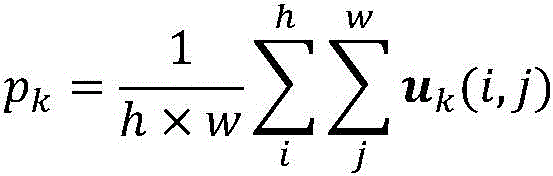
(1)通道注意力在提取语义属性时能强调相关特征而忽略不相关特征,首先对输入图像的特征图U=[u1,u2,…,uC]进行全局平均池化,嵌入全局空间信息,用p表示通道统计量,p的第k个元素表示为:(1) Channel attention can emphasize relevant features and ignore irrelevant features when extracting semantic attributes. First, the feature map U = [u 1 ,u 2 ,…,u C ] of the input image is globally averaged pooled to embed global spatial information. p is used to represent the channel statistics, and the kth element of p is expressed as:

其中,h和w分别表示图像的高度和宽度,C表示通道数,pk表示第k个通道统计量,i∈{1,2,…,h},j∈{1,2,…,w},(i,j)表示特征点的位置,uk(i,j)表示第k个通道在位置(i,j)处的特征值;Where h and w represent the height and width of the image, respectively, C represents the number of channels, pk represents the statistics of the kth channel, i∈{1,2,…,h},j∈{1,2,…,w}, (i,j) represents the position of the feature point, and uk (i,j) represents the eigenvalue of the kth channel at position (i,j);
接着通过下采样和上采样层提取特征模式并使用sigmoid函数进行归一化,表示为:Then the feature pattern is extracted through the downsampling and upsampling layers and normalized using the sigmoid function, expressed as:

其中,
最后经过通道注意力校准后的特征图为
(2)空间注意力则将注意力集中在与表情强度变化相关的面部器官位置上,忽略不相关的部分;(2) Spatial attention focuses on the positions of facial organs related to changes in expression intensity and ignores irrelevant parts;
将输入图像按照空间位置表示为U=[u1,1,u1,2,…,ui,j,…,uh,w],其中i∈{1,2,…,h},j∈{1,2,…,w},ui,j表示在位置(i,j)处的特征值;通过一个空间挤压操作将C个通道投影到一个空间位置上,最后使用sigmoid函数进行归一化,表示为:The input image is represented by spatial position as U = [u 1,1 ,u 1,2 ,…,u i,j ,…,u h,w ], where i∈{1,2,…,h},j∈{1,2,…,w}, and u i,j represents the eigenvalue at position (i,j); the C channels are projected to a spatial position through a spatial squeezing operation, and finally normalized using the sigmoid function, which is expressed as:
q=sigmoid(Wsq*U)q=sigmoid(W sq *U)
其中,向量q表示在空间上进行投影的结果,Wsq表示空间挤压操作层;Among them, vector q represents the result of projection in space, and W sq represents the spatial squeezing operation layer;
最后根据空间注意力校准后的特征图为Us=[q1,1u1,1,…,qi,jui,j,…,qh,wuh,w];Finally, the feature map after spatial attention calibration is U s = [q 1,1 u 1,1 ,…,q i,j u i,j ,…,q h,w u h,w ];
步骤3.3、在鉴别网络上添加一个分类器,用以输出生成图像的表情强度类别,使鉴别网络能够同时辨别图像真假和估计图像所属的表情强度类别。Step 3.3. Add a classifier to the discrimination network to output the expression intensity category of the generated image, so that the discrimination network can simultaneously distinguish whether the image is real or fake and estimate the expression intensity category to which the image belongs.
步骤4,在步骤3构造的网络中加入人脸图像的身份信息,使生成图像前后身份信息不变性,具体如下:Step 4: Add the identity information of the face image to the network constructed in step 3 to keep the identity information unchanged before and after the image is generated. The details are as follows:
在表情强度合成前后需要保证输入图像和输出图像的身份一致性,使用了一个身份保留损失函数来实现,定义如下:Before and after expression intensity synthesis, the identity consistency of the input image and the output image needs to be ensured. An identity preservation loss function is used to achieve this, which is defined as follows:

其中,Lid是身份保留损失函数,xs表示源输入图像,zt表示目标表情强度的标签,G(xs,zt)表示生成的带有目标表情强度zt的图像,φ是一个人脸识别的特征提取器,φ(xs)和φ(G(xs,zt))分别表示输入人脸图像和生成的人脸图像的身份特征,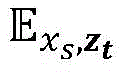
步骤5,使用预处理后的表情数据集对步骤4中的网络进行训练和测试,调节网络参数,使生成图像效果达到最优;Step 5, using the preprocessed expression data set to train and test the network in step 4, and adjusting the network parameters to achieve the best generated image effect;
步骤6,将测试集中的中立表情输入到训练好的条件生成对抗网络,合成带有不同强度的人脸表情图像。Step 6: Input the neutral expressions in the test set into the trained conditional generative adversarial network to synthesize facial expression images with different intensities.
实施例1Example 1
本实施例以CK+,MUG和Oulu-CASIA共3个数据集为例对本发明提出的基于生成式对抗网络的人脸表情图像合成方法进行研究,具体实施步骤如下:This embodiment uses CK+, MUG and Oulu-CASIA as examples to study the facial expression image synthesis method based on generative adversarial network proposed by the present invention. The specific implementation steps are as follows:
步骤1、分别从CK+(http://www.consortium.ri.cmu.edu/ckagree/)、MUG(https://mug.ee.auth.gr/fed/)和Oulu-CASIA(https://www.oulu.fi/cmvs/node/41316)、三个网址上下载表情数据集,作为实验数据。Step 1. Download expression datasets from CK+ (http://www.consortium.ri.cmu.edu/ckagree/), MUG (https://mug.ee.auth.gr/fed/) and Oulu-CASIA (https://www.oulu.fi/cmvs/node/41316) as experimental data.
步骤2、对步骤1中的表情数据集进行预处理,本实施例以高兴和惊讶这两种表情为例对提出的算法进行研究。在CK+数据集中,由于其没有明确的归类表情,首先需要根据表情类别标签对图像进行归类,然后再选取其中的高兴和惊讶两类表情进行实验,该数据集仅有部分标签,为了充分利用数据,因此需要额外的将没有标签的高兴和惊讶表情进行归类。在MUG数据集中,每一个受试者的单个表情含有多个重复的序列,只保留其中一个。在Oulu-CASIA数据集中,选择正常光照条件下的图像进行实验。在表情类别分类之后,分别将高兴和惊讶表情序列均按照不同的表情强度划分为不同类别(中立,弱,中,强),作为训练数据。Step 2, pre-process the facial expression data set in step 1. This embodiment uses the two facial expressions of happiness and surprise as examples to study the proposed algorithm. In the CK+ data set, since it does not have clear categorized expressions, it is first necessary to classify the images according to the facial expression category labels, and then select the two categories of happy and surprised expressions for experiments. This data set only has partial labels. In order to make full use of the data, it is necessary to additionally classify the unlabeled happy and surprised expressions. In the MUG data set, each subject's single expression contains multiple repeated sequences, and only one of them is retained. In the Oulu-CASIA data set, images under normal lighting conditions are selected for experiments. After the facial expression category classification, the happy and surprised expression sequences are divided into different categories (neutral, weak, medium, strong) according to different expression intensities as training data.
步骤3、构造条件生成对抗网络,在生成网络中融合注意力机制,同时在鉴别网络中加入对表情强度的判别信息,具体如下:Step 3: Construct a conditional generative adversarial network, integrate the attention mechanism into the generative network, and add the discriminant information of expression intensity into the discriminative network, as follows:
步骤3.1、使用一个独热编码向量z表示图像x的表情强度,作为条件标签,控制生成器合成带有目标表情强度的图像。Step 3.1. Use a one-hot encoding vector z to represent the expression intensity of image x as a conditional label to control the generator to synthesize images with target expression intensity.
步骤3.2、在生成网络中融入注意力机制,同时结合通道和空间两种注意力机制将注意力集中在与表情强度变化相关的特征上,能使生成网络更关注于表情强度改变,捕捉不同强度的细节。Step 3.2: Integrate the attention mechanism into the generative network. Combining the channel and spatial attention mechanisms to focus on features related to changes in expression intensity can enable the generative network to pay more attention to changes in expression intensity and capture details of different intensities.
步骤3.3、在鉴别网络上额外添加一个分类器,用以输出生成图像的表情强度类别,使鉴别网络能够同时辨别图像真假和估计图像所属的表情强度类别;源输入图像的表情强度的分类损失可以表示为:Step 3.3, add an additional classifier to the discrimination network to output the expression intensity category of the generated image, so that the discrimination network can simultaneously distinguish the authenticity of the image and estimate the expression intensity category to which the image belongs; the classification loss of the expression intensity of the source input image can be expressed as:

这里,Dintensity(zs|xs)表示源输入图像xs在源强度标签zs上的概率分布。通过最小化该损失函数来优化鉴别器对于表情强度的判别能力。类似地,目标图像的强度分类损失函数表示为:Here, D intensity (z s |x s ) represents the probability distribution of the source input image x s on the source intensity label z s . By minimizing this loss function, the discriminator's ability to distinguish expression intensity is optimized. Similarly, the intensity classification loss function of the target image is expressed as:

其中,Dintensity(zt|G(xs,zt))表示生成图像在目标强度zt上的概率分布。通过优化该损失函数能使生成器尽可能合成被鉴别器分类为zt的目标强度图像。这两个强度损失函数是为了能够使鉴别器进行正确的表情强度分类,同时促进生成器的合成目标强度。Among them, D intensity (z t |G(x s ,z t )) represents the probability distribution of the generated image at the target intensity z t . By optimizing this loss function, the generator can synthesize the target intensity image classified as z t by the discriminator as much as possible. The two intensity loss functions are designed to enable the discriminator to correctly classify the expression intensity and promote the generator to synthesize the target intensity.
步骤4,在步骤3构造的网络中加入身份保留损失函数,以保证合成图像前后人脸身份不变性,表示如下:Step 4: Add the identity preservation loss function to the network constructed in step 3 to ensure the invariance of the face identity before and after the synthesis image, as shown below:

其中,xs表示源输入表情图像,zt表示目标表情强度标签,
步骤5,使用预处理好的表情数据对步骤4的网络进行训练和测试,调节网络参数,使网络的合成结果达到最优。Step 5, use the pre-processed expression data to train and test the network in step 4, and adjust the network parameters to optimize the network synthesis result.
步骤6,选择中立表情进行测试,合成带有不同表情强度的人脸图像,如图2所示。Step 6: Select a neutral expression for testing and synthesize facial images with different expression intensities, as shown in Figure 2.
这里以CK+,MUG和Oulu-CASIA数据集中的高兴表情和惊讶表情为例,输入一个中立表情图像,依次合成不同强度的四种人脸表情图像,随着强度增加,面部肌肉运动幅度也增大,如高兴时嘴巴逐渐张大,牙齿裸露越来越多,鼻唇沟逐渐明显;惊讶时,眉毛逐渐上扬,嘴巴张大,眼睛瞪大,额头逐渐出现横皱纹等;表1和表2是3个数据集分别在高兴和惊讶表情合成的人脸验证结果,可以看出输入图像和合成图像的人脸验证置信度都较高,表明图像合成前后身份信息没有发生大的改变。Here, we take the happy and surprised expressions in the CK+, MUG and Oulu-CASIA datasets as examples, input a neutral expression image, and synthesize four facial expression images of different intensities in turn. As the intensity increases, the amplitude of facial muscle movement also increases. For example, when happy, the mouth gradually opens, more and more teeth are exposed, and the nasolabial groove gradually becomes obvious; when surprised, the eyebrows gradually rise, the mouth opens wide, the eyes widen, and horizontal wrinkles gradually appear on the forehead. Tables 1 and 2 are the face verification results of the three datasets synthesized with happy and surprised expressions respectively. It can be seen that the face verification confidence of the input image and the synthesized image is high, indicating that the identity information has not changed significantly before and after the image synthesis.
由图2,表1和表2可以看出我们的发明不仅能捕捉到不同表情强度的面部细节,图像合成前后也保证了人身份信息不变,最终生成了清晰且具有真实感的人脸图像。It can be seen from Figure 2, Table 1 and Table 2 that our invention can not only capture facial details of different expression intensities, but also ensure that the identity information of the person remains unchanged before and after image synthesis, and finally generates a clear and realistic face image.
表1在高兴表情合成上的人脸验证结果Table 1 Face verification results on happy expression synthesis

表2在惊讶表情合成上的人脸验证结果Table 2 Face verification results on surprise expression synthesis

Claims (3)


Priority Applications (1)
| Application Number | Priority Date | Filing Date | Title |
|---|---|---|---|
| CN202010155374.6A CN111369646B (en) | 2020-03-09 | 2020-03-09 | Expression synthesis method integrating attention mechanism |
Applications Claiming Priority (1)
| Application Number | Priority Date | Filing Date | Title |
|---|---|---|---|
| CN202010155374.6A CN111369646B (en) | 2020-03-09 | 2020-03-09 | Expression synthesis method integrating attention mechanism |
Publications (2)
| Publication Number | Publication Date |
|---|---|
| CN111369646A CN111369646A (en) | 2020-07-03 |
| CN111369646B true CN111369646B (en) | 2023-03-24 |
Family
ID=71211709
Family Applications (1)
| Application Number | Title | Priority Date | Filing Date |
|---|---|---|---|
| CN202010155374.6A Active CN111369646B (en) | 2020-03-09 | 2020-03-09 | Expression synthesis method integrating attention mechanism |
Country Status (1)
| Country | Link |
|---|---|
| CN (1) | CN111369646B (en) |
Families Citing this family (8)
| Publication number | Priority date | Publication date | Assignee | Title |
|---|---|---|---|---|
| CN111860380B (en) * | 2020-07-27 | 2024-07-23 | 平安科技(深圳)有限公司 | Face image generation method, device, server and storage medium |
| CN112749657B (en) * | 2021-01-07 | 2024-11-19 | 北京码牛科技有限公司 | A rental management method and system |
| CN113361387A (en) * | 2021-06-03 | 2021-09-07 | 湖南快乐阳光互动娱乐传媒有限公司 | Face image fusion method and device, storage medium and electronic equipment |
| CN113706428B (en) * | 2021-07-02 | 2024-01-05 | 杭州海康威视数字技术股份有限公司 | An image generation method and device |
| CN114863533B (en) * | 2022-05-18 | 2025-07-15 | 京东科技控股股份有限公司 | Digital human generation method, device and storage medium |
| CN115346086B (en) * | 2022-08-17 | 2025-09-05 | 华中师范大学 | A method, system, device and storage medium for identifying expression intensity |
| CN116012928A (en) * | 2023-02-16 | 2023-04-25 | 平安壹钱包电子商务有限公司 | Identity verification method and device, medium, and computer equipment based on image processing |
| CN119338947B (en) * | 2024-09-10 | 2025-05-09 | 南京理工大学 | A new object AI generation method based on image and text fusion |
Citations (1)
| Publication number | Priority date | Publication date | Assignee | Title |
|---|---|---|---|---|
| CN110084121A (en) * | 2019-03-27 | 2019-08-02 | 南京邮电大学 | Implementation method based on the human face expression migration for composing normalized circulation production confrontation network |
Family Cites Families (1)
| Publication number | Priority date | Publication date | Assignee | Title |
|---|---|---|---|---|
| US10565434B2 (en) * | 2017-06-30 | 2020-02-18 | Google Llc | Compact language-free facial expression embedding and novel triplet training scheme |
-
2020
- 2020-03-09 CN CN202010155374.6A patent/CN111369646B/en active Active
Patent Citations (1)
| Publication number | Priority date | Publication date | Assignee | Title |
|---|---|---|---|---|
| CN110084121A (en) * | 2019-03-27 | 2019-08-02 | 南京邮电大学 | Implementation method based on the human face expression migration for composing normalized circulation production confrontation network |
Also Published As
| Publication number | Publication date |
|---|---|
| CN111369646A (en) | 2020-07-03 |
Similar Documents
| Publication | Publication Date | Title |
|---|---|---|
| CN111369646B (en) | Expression synthesis method integrating attention mechanism | |
| Zhang et al. | Facial: Synthesizing dynamic talking face with implicit attribute learning | |
| Alnaim et al. | DFFMD: a deepfake face mask dataset for infectious disease era with deepfake detection algorithms | |
| Hong et al. | Real-time speech-driven face animation with expressions using neural networks | |
| CN111489287A (en) | Image conversion method, image conversion device, computer equipment and storage medium | |
| Hajarolasvadi et al. | Generative adversarial networks in human emotion synthesis: A review | |
| Esmaeili et al. | A comprehensive survey on facial micro-expression: approaches and databases | |
| CN113935435B (en) | Multimodal emotion recognition method based on spatiotemporal feature fusion | |
| Raza et al. | Holisticdfd: Infusing spatiotemporal transformer embeddings for deepfake detection | |
| Taha et al. | Learned 3D shape representations using fused geometrically augmented images: Application to facial expression and action unit detection | |
| CN115410254B (en) | A multi-feature expression recognition method based on deep learning | |
| Wang et al. | Laun improved stargan for facial emotion recognition | |
| Prabhu et al. | Facial Expression Recognition Using Enhanced Convolution Neural Network with Attention Mechanism. | |
| Wang et al. | Fighting malicious media data: A survey on tampering detection and deepfake detection | |
| Kumar et al. | Robust one shot audio to video generation | |
| CN118015142B (en) | Face image processing method, device, computer equipment and storage medium | |
| CN115862120A (en) | Separable variation self-encoder decoupled face action unit identification method and equipment | |
| Khan et al. | Comparative study of deep learning techniques for DeepFake video detection | |
| Liu et al. | Generating talking face with controllable eye movements by disentangled blinking feature | |
| CN117153195B (en) | Method and system for generating speaker face video based on adaptive region shielding | |
| Sivaganesan et al. | Image to audio conversion to aid visually impaired people by cnn | |
| Zhan et al. | Learning from text: a multimodal face inpainting network for irregular holes | |
| CN111192343B (en) | Face expression synthesis method based on generative confrontation network | |
| CN112016592B (en) | Domain-adaptive semantic segmentation method and device based on cross-domain category awareness | |
| Sowmya et al. | Generative adversarial networks with attentional multimodal for human face synthesis |
Legal Events
| Date | Code | Title | Description |
|---|---|---|---|
| PB01 | Publication | ||
| PB01 | Publication | ||
| SE01 | Entry into force of request for substantive examination | ||
| SE01 | Entry into force of request for substantive examination | ||
| GR01 | Patent grant | ||
| GR01 | Patent grant |