CN111368673B - Method for quickly extracting human body key points based on neural network - Google Patents
Method for quickly extracting human body key points based on neural network Download PDFInfo
- Publication number
- CN111368673B CN111368673B CN202010118903.5A CN202010118903A CN111368673B CN 111368673 B CN111368673 B CN 111368673B CN 202010118903 A CN202010118903 A CN 202010118903A CN 111368673 B CN111368673 B CN 111368673B
- Authority
- CN
- China
- Prior art keywords
- layer
- key point
- neural network
- convolution
- key points
- Prior art date
- Legal status (The legal status is an assumption and is not a legal conclusion. Google has not performed a legal analysis and makes no representation as to the accuracy of the status listed.)
- Active
Links
Images


Classifications
-
- G—PHYSICS
- G06—COMPUTING OR CALCULATING; COUNTING
- G06V—IMAGE OR VIDEO RECOGNITION OR UNDERSTANDING
- G06V40/00—Recognition of biometric, human-related or animal-related patterns in image or video data
- G06V40/10—Human or animal bodies, e.g. vehicle occupants or pedestrians; Body parts, e.g. hands
-
- G—PHYSICS
- G06—COMPUTING OR CALCULATING; COUNTING
- G06F—ELECTRIC DIGITAL DATA PROCESSING
- G06F18/00—Pattern recognition
- G06F18/20—Analysing
- G06F18/21—Design or setup of recognition systems or techniques; Extraction of features in feature space; Blind source separation
- G06F18/214—Generating training patterns; Bootstrap methods, e.g. bagging or boosting
-
- G—PHYSICS
- G06—COMPUTING OR CALCULATING; COUNTING
- G06N—COMPUTING ARRANGEMENTS BASED ON SPECIFIC COMPUTATIONAL MODELS
- G06N3/00—Computing arrangements based on biological models
- G06N3/02—Neural networks
- G06N3/08—Learning methods
-
- G—PHYSICS
- G06—COMPUTING OR CALCULATING; COUNTING
- G06V—IMAGE OR VIDEO RECOGNITION OR UNDERSTANDING
- G06V10/00—Arrangements for image or video recognition or understanding
- G06V10/20—Image preprocessing
- G06V10/30—Noise filtering
Landscapes
- Engineering & Computer Science (AREA)
- Theoretical Computer Science (AREA)
- Physics & Mathematics (AREA)
- General Physics & Mathematics (AREA)
- Data Mining & Analysis (AREA)
- General Engineering & Computer Science (AREA)
- Life Sciences & Earth Sciences (AREA)
- Artificial Intelligence (AREA)
- Multimedia (AREA)
- Evolutionary Computation (AREA)
- Computer Vision & Pattern Recognition (AREA)
- Biophysics (AREA)
- Bioinformatics & Computational Biology (AREA)
- Bioinformatics & Cheminformatics (AREA)
- Human Computer Interaction (AREA)
- Health & Medical Sciences (AREA)
- Biomedical Technology (AREA)
- Evolutionary Biology (AREA)
- Computational Linguistics (AREA)
- General Health & Medical Sciences (AREA)
- Molecular Biology (AREA)
- Computing Systems (AREA)
- Mathematical Physics (AREA)
- Software Systems (AREA)
- Image Analysis (AREA)
Abstract
本发明公开了一种基于神经网络的人体关键点快速提取方法,包括步骤:1)构建训练数据集;2)人体关键点神经网络模型的设计;3)使用数据增强方法对原始输入图像进行数据增强;4)对设计的模型进行多次迭代训练;5)使用已有的行人检测方法以及训练好的人体关键点神经网络模型对图像中的行人进行关键点提取,其中,对于实际应用过程中容易产生的关键点噪声,使用左右翻转的方法来抵抗噪声,实现对关键点提取过程中的有效降噪。本发明可使人体关键点提取在满足检测精确度前提下大大提高检测速度,实现从上到下的人体关键点提取中单人关键点提取的功能。

The invention discloses a method for quickly extracting key points of a human body based on a neural network, comprising the steps of: 1) constructing a training data set; 2) designing a neural network model of key points of a human body; 3) performing data processing on an original input image by using a data enhancement method Enhancement; 4) Carry out multiple iterative training on the designed model; 5) Use the existing pedestrian detection method and the trained human key point neural network model to extract the key points of the pedestrians in the image, wherein, for the actual application process For the key point noise that is easy to generate, use the method of flipping left and right to resist the noise, and realize effective noise reduction in the process of key point extraction. The invention can greatly improve the detection speed under the premise of satisfying the detection accuracy in extracting the key points of the human body, and realize the function of extracting the key points of a single person in the extraction of the key points of the human body from top to bottom.
Description
技术领域technical field
本发明涉及图像处理和计算机视觉的技术领域,尤其是指一种基于神经网络的人体关键点快速提取方法。The invention relates to the technical fields of image processing and computer vision, in particular to a method for quickly extracting key points of a human body based on a neural network.
背景技术Background technique
人体关键点提取在计算机视觉领域中是指对图像中行人的关键点进行检测,定位并返回人体各个部位关键点的位置坐标,由坐标即可得到行人的当前姿态。由于图片中行人的大小不一,行人的姿态各异,以及行人之间的互相遮挡等因素的影响,人体关键点提取是十分具有挑战性的难题。Human key point extraction in the field of computer vision refers to detecting the key points of pedestrians in the image, locating and returning the position coordinates of key points of various parts of the human body, and the current posture of pedestrians can be obtained from the coordinates. Due to the different sizes of pedestrians in the picture, the different postures of pedestrians, and the influence of factors such as mutual occlusion between pedestrians, human body key point extraction is a very challenging problem.
人体关键点提取具有极其重大的意义,它可以在智能视频监控,病人监护系统,人机交互,虚拟现实,人体动画,智能家居,智能安防,运动员辅助训练和人体行为分析等应用中被广泛使用。因为智能视频监控,游戏娱乐产业等领域越来越被重视,对人体关键点提取的需求也逐步提升,人体关键点提取技术越来越受到学术界和工业界的重视。The key point extraction of the human body is of great significance. It can be widely used in applications such as intelligent video surveillance, patient monitoring system, human-computer interaction, virtual reality, human animation, smart home, smart security, athlete auxiliary training and human behavior analysis. . Because intelligent video surveillance, game entertainment industry and other fields are getting more and more attention, the demand for human body key point extraction is gradually increasing, and human body key point extraction technology is getting more and more attention from academia and industry.
目前实现行人检测方法有很多种,其中主要包含传统方法和基于神经网络的深度学习方法。传统方法一般的思路是在几何先验的基础上再进行模版匹配,传统方法的缺陷是几何先验需要人为设定,然而现实场景中的行人往往姿态各异,因此很难寻找几何先验知识,另外特定的几何先验知识往往并不适用于所有场景。因此,近年来深度学习的方法被广泛应用到人体关键点提取中,有一系列算法应运而生,如openpose、alphapose、CPN等。然而这些算法固然定位精准,但由于网络结构过于冗余、计算量过大等原因导致前向推理速度较慢,因此难以落地到实际应用。At present, there are many ways to realize pedestrian detection, which mainly include traditional methods and deep learning methods based on neural networks. The general idea of the traditional method is to perform template matching on the basis of the geometric prior. The defect of the traditional method is that the geometric prior needs to be artificially set. However, pedestrians in real scenes often have different postures, so it is difficult to find geometric prior knowledge. , and specific geometric prior knowledge is often not applicable to all scenarios. Therefore, in recent years, the method of deep learning has been widely applied to the extraction of key points of the human body, and a series of algorithms have emerged, such as openpose, alphapose, CPN, etc. However, although these algorithms are accurate in positioning, due to the excessive redundancy of the network structure and the large amount of calculation, the forward reasoning speed is slow, so it is difficult to implement them in practical applications.
基于深度学习的人体关键点提取方法主要分为两种:从上到下和从下到上。其中从上到下的人体关键点提取方法主要包含两个部分,行人检测和单人关键点提取,而从下到上的方法也包含两个部分,关键点检测和关键点聚类。由于从下到上的方法在关键点分配的时候会存在二义性,导致关键点连接错误,同时从下到上的方法中关键点聚类是NP完全问题,计算复杂度较高,因此现在绝大部分基于深度学习的人体关键点提取方法是从上到下的。Human body key point extraction methods based on deep learning are mainly divided into two types: top-down and bottom-up. The top-to-bottom human key point extraction method mainly includes two parts, pedestrian detection and single key point extraction, while the bottom-up method also includes two parts, key point detection and key point clustering. Because the bottom-up method has ambiguity when assigning key points, which leads to key point connection errors, and the key point clustering in the bottom-up method is an NP-complete problem with high computational complexity, so now Most of the human body key point extraction methods based on deep learning are from top to bottom.
综合以上论述,发明一种兼顾实时性和准确度的基于神经网络的人体关键点提取方法具有较高的科学研究和实际应用价值。Based on the above discussion, it is of high scientific research and practical application value to invent a neural network-based human key point extraction method that takes into account both real-time and accuracy.
发明内容Contents of the invention
本发明的目的在于克服现有传统方法中需要人工提取先验知识的不足,以及改进现有绝大多数深度学习方法中网络结构过于复杂,前向推理速度慢的缺陷,提出了一种基于神经网络的人体关键点快速提取方法,该方法采用基于组合卷积模块和反卷积模块的神经网络,并使用神经网络输出的热力图的smooth-L1损失进行训练,使人体关键点提取在满足检测精确度前提下大大提高检测速度,实现从上到下的人体关键点提取中单人关键点提取的功能。The purpose of the present invention is to overcome the shortcomings of manual extraction of prior knowledge in existing traditional methods, and to improve the defects of too complicated network structure and slow forward reasoning speed in most existing deep learning methods, and propose a neural network based A fast extraction method for key points of the human body, which uses a neural network based on a combined convolution module and a deconvolution module, and uses the smooth-L1 loss of the heat map output by the neural network for training, so that the key points of the human body can be extracted to meet the detection requirements. Under the premise of accuracy, the detection speed is greatly improved, and the function of single-person key point extraction in the top-to-bottom human key point extraction is realized.
为实现上述目的,本发明所提供的技术方案为:一种基于神经网络的人体关键点快速提取方法,包括以下步骤:In order to achieve the above object, the technical solution provided by the present invention is: a method for quickly extracting key points of a human body based on a neural network, comprising the following steps:
1)通过对coco数据集的图片单人裁剪和归一化操作,同时对标注信息进行同样变换,构建训练数据集;1) Construct the training data set by cropping and normalizing the pictures of the coco data set by one person, and at the same time transforming the label information in the same way;
2)根据训练数据集和实际应用场景的特点,设计合适的人体关键点神经网络模型;2) According to the characteristics of the training data set and the actual application scenario, design a suitable neural network model for key points of the human body;
3)为增大网络模型训练数据量及适用性,需要使用数据增强方法对原始输入图像进行数据增强;3) In order to increase the amount of training data and applicability of the network model, it is necessary to use a data enhancement method to perform data enhancement on the original input image;
4)对设计的人体关键点神经网络模型设定训练参数进行多次迭代训练,并保存训练的神经网络模型参数,并根据指标选择最优模型;4) Set the training parameters for the designed human body key point neural network model to perform multiple iterative training, and save the trained neural network model parameters, and select the optimal model according to the indicators;
5)将待进行人体关键点提取的图像首先使用已有的行人检测方法将图像中的行人检测出来,然后将行人裁剪出来并归一化到固定长宽,并输入到训练好的人体关键点神经网络模型中进行前向推理,得到热力响应图,即特征图,将热力响应图最大的位置映射回原图,即完成人体关键点提取的功能;其中,对于实际应用过程中容易产生的关键点噪声,使用左右翻转的方法来抵抗噪声,实现对关键点提取过程中的有效降噪。5) Use the existing pedestrian detection method to detect the pedestrians in the image to be extracted from the human body key points, then cut out the pedestrians and normalize them to a fixed length and width, and input them to the trained human body key points Forward reasoning is carried out in the neural network model to obtain the thermodynamic response map, that is, the feature map, and the maximum position of the thermodynamic response map is mapped back to the original map, which is to complete the function of extracting key points of the human body; among them, for the key points that are easy to occur in the actual application process Point noise, use the method of flipping left and right to resist noise, and achieve effective noise reduction in the process of key point extraction.
在步骤1)中,对coco公开数据集注释文件中的关键点进行操作,coco数据集中关键点的注释属性为:关键点坐标、关键是否可见、关键点数量及骨架;关键点在图片中的横纵坐标分别用x,y表示;关键点是否可见使用v来表示,其中定义v=0表示该关键点未被标记,v=1表示该关键点被标记但是不可见,而v=2表示该关键点被标记且可见;骨架信息表示不同关键点之间的连线;首先,对可见关键点进行求取外接矩形框的操作,然后矩形框的中心保持不变,将矩形的宽高扩大1.2倍,如果超过图片边界,那么就以图片的边界为界限,这样能够确保外接矩形框包含了该行人的整个身体。In step 1), the key points in the coco public dataset annotation file are operated. The annotation attributes of the key points in the coco data set are: key point coordinates, whether the key is visible, the number of key points, and the skeleton; the key points in the picture The horizontal and vertical coordinates are represented by x and y respectively; whether the key point is visible or not is represented by v, where the definition v=0 means that the key point is not marked, v=1 means that the key point is marked but invisible, and v=2 means The key point is marked and visible; the skeleton information represents the connection between different key points; first, the operation of obtaining the circumscribed rectangle frame is performed on the visible key point, and then the center of the rectangle frame remains unchanged, and the width and height of the rectangle are enlarged 1.2 times, if it exceeds the boundary of the picture, then use the boundary of the picture as the boundary, so as to ensure that the circumscribed rectangular frame includes the entire body of the pedestrian.
在步骤2)中,综合考虑数据集图片以及应用场景的特点,设计合适的人体关键点神经网络模型,包括以下步骤:In step 2), considering the characteristics of the data set picture and the application scene comprehensively, designing a suitable human body key point neural network model includes the following steps:
2.1)搭建关键点提取网络2.1) Build a key point extraction network
根据实时性和高精度要求构建关键点提取网络,其结构如下:According to the real-time and high-precision requirements, the key point extraction network is constructed, and its structure is as follows:
第一层为组合卷积模块A,它由一个步长为2的卷积层、一个批归一化层、一个relu非线性激活层组成;The first layer is the combined convolution module A, which consists of a convolutional layer with a stride of 2, a batch normalization layer, and a relu nonlinear activation layer;
第二层为组合卷积模块B,它由一个步长为1的深度卷积层、一个点卷积层、两个批归一化层、两个Relu非线性激活层组成;The second layer is the combined convolution module B, which consists of a depth convolution layer with a step size of 1, a point convolution layer, two batch normalization layers, and two Relu nonlinear activation layers;
第三层为组合卷积模块C,它由一个步长为2的深度卷积层、一个点卷积层、两个批归一化层、两个Relu非线性激活层组成;The third layer is the combined convolution module C, which consists of a depth convolution layer with a step size of 2, a point convolution layer, two batch normalization layers, and two Relu nonlinear activation layers;
第四层为组合卷积模块B,它由一个步长为1的深度卷积层、一个点卷积层、两个批归一化层、两个Relu非线性激活层组成;The fourth layer is the combined convolution module B, which consists of a depth convolution layer with a step size of 1, a point convolution layer, two batch normalization layers, and two Relu nonlinear activation layers;
第五层为组合卷积模块C,它由一个步长为2的深度卷积层、一个点卷积层、两个批归一化层、两个Relu非线性激活层组成;The fifth layer is the combined convolution module C, which consists of a depth convolution layer with a step size of 2, a point convolution layer, two batch normalization layers, and two Relu nonlinear activation layers;
第六层为组合卷积模块B,它由一个步长为1的深度卷积层、一个点卷积层、两个批归一化层、两个Relu非线性激活层组成;The sixth layer is the combined convolution module B, which consists of a depth convolution layer with a step size of 1, a point convolution layer, two batch normalization layers, and two Relu nonlinear activation layers;
第七层为组合卷积模块C,它由一个步长为2的深度卷积层、一个点卷积层、两个批归一化层、两个Relu非线性激活层组成;The seventh layer is the combined convolution module C, which consists of a depth convolution layer with a step size of 2, a point convolution layer, two batch normalization layers, and two Relu nonlinear activation layers;
第八层到第十二层为组合卷积模块B,它由一个步长为1的深度卷积层、一个点卷积层、两个批归一化层、两个Relu非线性激活层组成;The eighth to twelfth layers are the combined convolution module B, which consists of a depth convolution layer with a step size of 1, a point convolution layer, two batch normalization layers, and two Relu nonlinear activation layers ;
第十三层为组合卷积模块C,它由一个步长为2的深度卷积层、一个点卷积层、两个批归一化层、两个Relu非线性激活层组成;The thirteenth layer is a combined convolution module C, which consists of a depth convolution layer with a step size of 2, a point convolution layer, two batch normalization layers, and two Relu nonlinear activation layers;
第十四层为组合卷积模块B,它由一个步长为1的深度卷积层、一个点卷积层、两个批归一化层、两个Relu非线性激活层组成;The fourteenth layer is the combined convolution module B, which consists of a depth convolution layer with a step size of 1, a point convolution layer, two batch normalization layers, and two Relu nonlinear activation layers;
第十五层为反卷积模块D,它由一个步长为2的pixelshuffle上采样层,一个Relu非线性激活层组成;The fifteenth layer is the deconvolution module D, which consists of a pixelshuffle upsampling layer with a step size of 2 and a Relu nonlinear activation layer;
第十六层为反卷积模块D,它由一个步长为2的pixelshuffle上采样层,一个Relu非线性激活层组成;The sixteenth layer is the deconvolution module D, which consists of a pixelshuffle upsampling layer with a step size of 2 and a Relu nonlinear activation layer;
第十七层为反卷积模块D,它由一个步长为2的pixelshuffle上采样层,一个Relu非线性激活层组成;The seventeenth layer is the deconvolution module D, which consists of a pixelshuffle upsampling layer with a step size of 2 and a Relu nonlinear activation layer;
第十八层为卷积模块E,它由一个步长为1的卷积层组成;The eighteenth layer is the convolution module E, which consists of a convolution layer with a step size of 1;
2.2)设置损失函数2.2) Set the loss function
设置损失函数为smooth-L1损失函数,公式如下:Set the loss function to smooth-L1 loss function, the formula is as follows:

式中,ynij为神经网络模型输出的第n个关键点的特征图在位置(i,j)上的响应,而
总的损失函数为各个关键点的smooth-L1损失的求和,即The total loss function is the sum of the smooth-L1 losses of each key point, namely

在步骤3)中,为增大网络模型训练数据量及适用性,需要使用数据增强方法对原始输入图像进行数据增强,包括:In step 3), in order to increase the amount of training data and applicability of the network model, it is necessary to use a data enhancement method to perform data enhancement on the original input image, including:
a、随机添加高斯、椒盐噪声a. Randomly add Gaussian and salt and pepper noise
对输入的图像,以0.25的概率随机添加高斯噪声,0.25的概率添加椒盐噪声;For the input image, Gaussian noise is randomly added with a probability of 0.25, and salt and pepper noise is added with a probability of 0.25;
b、随机镜像翻转b. Random mirror flip
对输入图像以0.5的概率进行随机镜像翻转,该变换需要同时应用到标注上;The input image is randomly mirrored and flipped with a probability of 0.5, and the transformation needs to be applied to the label at the same time;
c、随机调整对比度c. Randomly adjust the contrast
修改色调和饱和度实现对比度转换;Modify hue and saturation to achieve contrast conversion;
d、随机旋转d. Random rotation
对图片以0.25的概率进行随机旋转,旋转角度在-25°~25°之间,该变换需要同时应用到标注上。The image is randomly rotated with a probability of 0.25, and the rotation angle is between -25° and 25°. This transformation needs to be applied to the label at the same time.
在步骤4)中,将步骤3)数据增强后的图像输入设计好的人体关键点神经网络模型中,对模型设定训练参数进行训练,并保存训练的神经网络模型参数,包括以下步骤:In step 4), the image input after step 3) data enhancement is designed in the human body key point neural network model, the training parameters are set for the model to train, and the neural network model parameters of the training are saved, including the following steps:
4.1)设置训练参数4.1) Set training parameters
设置训练优化器为Adam、初始学习率为10-5,学习率衰减为每迭代1个epoch衰减为原来的0.5;迭代总次数为400个epoch、批次大小为32;初始化方法选择为截断高斯分布,权重衰减系数选择为4×10⁻⁵;Set the training optimizer to Adam, the initial learning rate is 10 -5 , and the learning rate decays to 0.5 per epoch per iteration; the total number of iterations is 400 epochs, and the batch size is 32; the initialization method is selected as truncated Gaussian distribution, the weight attenuation coefficient is selected as 4×10 -5 ;
4.2)设置训练完成标志4.2) Set the training completion flag
当训练达到400个epoch或者模型在验证集上达到更好效果时,即可停止训练;When the training reaches 400 epochs or the model achieves better results on the verification set, the training can be stopped;
4.3)保存神经网络模型4.3) Save the neural network model
训练完成后,将神经网络模型的结构和权重一并保存。After the training is complete, save the structure and weight of the neural network model together.
在步骤5)中,首先使用YOLOv3来检测出图像中行人的位置,然后保持检测框的中心点不变,宽高增大为原来的1.2倍,保证检测框中有完整的行人;然后根据检测框,在原图像中裁剪出单个行人,将裁剪出来的行人输入到步骤4)中已经训练好的人体关键点神经网络模型,取出每个关键点特征图的最大值所在的位置,即为这个关键点最终的位置;由于噪声都是对称的,因此将待检测图像进行翻转,将翻转前后的图像一起传入人体关键点神经网络模型进行前向推理,提取其关键点,然后对翻转后的图像的特征图进行通道之间的交换,并与翻转前图像的特征图进行加和求平均操作,能够得到降噪后的最终特征图,对降噪之后的特征图,求取其最大输出响应对应的位置,并将响应位置乘以设定的缩放倍数和加上偏移量,从而得到各个部位的关键点坐标,最后将所有检测出来的关键点,按照人体结构连接起来,得到最后关键点提取结果。In step 5), first use YOLOv3 to detect the position of pedestrians in the image, then keep the center point of the detection frame unchanged, and increase the width and height to 1.2 times the original to ensure that there are complete pedestrians in the detection frame; then according to the detection frame, cut out a single pedestrian in the original image, input the cropped pedestrian into the human body key point neural network model that has been trained in step 4), and take out the position of the maximum value of each key point feature map, which is the key The final position of the point; since the noise is symmetrical, the image to be detected is flipped, and the images before and after the flip are passed into the human key point neural network model for forward reasoning, and the key points are extracted, and then the flipped image The feature map of the image is exchanged between channels, and the feature map of the image before flipping is summed and averaged to obtain the final feature map after noise reduction. For the feature map after noise reduction, the maximum output response corresponding to position, and multiply the response position by the set zoom factor and add the offset to obtain the key point coordinates of each part, and finally connect all the detected key points according to the human body structure to obtain the final key point extraction result.
本发明与现有技术相比,具有如下优点与有益效果:Compared with the prior art, the present invention has the following advantages and beneficial effects:
1、本发明的基网络选用参数量较少的深度可分离卷积模块,将图像区域和图像通道的卷积运算进行拆分,降低了参数量,从而使网络更加轻量化,提高关键点提取速度;1. The base network of the present invention selects a depth-separable convolution module with fewer parameters, and splits the convolution operation of the image area and image channel, reducing the amount of parameters, thereby making the network more lightweight and improving key point extraction speed;
2、本发明在上采样过程中使用PixelShuffle进行上采样,能够在不降低精度的前提下减少运算量,使网络前向传播速度更快;2. The present invention uses PixelShuffle for upsampling in the upsampling process, which can reduce the amount of computation without reducing the precision, and make the forward propagation speed of the network faster;
3、本发明将水平翻转前后的图像与原图一起进行前向推理,然后对水平翻转后的图像的特征图进行通道之间的交换,并与翻转前图像的特征图进行加和求平均操作,减少神经网络中由左右不对称引起的噪声。3. In the present invention, the images before and after horizontal flipping are forwardly inferred together with the original image, and then the feature map of the image after horizontal flipping is exchanged between channels, and the feature map of the image before flipping is added and averaged. , to reduce the noise caused by left-right asymmetry in neural networks.
附图说明Description of drawings
图1为本发明方法的逻辑流程图。Fig. 1 is a logic flow diagram of the method of the present invention.
图2a为组合卷积模块A示意图。Figure 2a is a schematic diagram of combined convolution module A.
图2b为组合卷积模块B示意图。Fig. 2b is a schematic diagram of combined convolution module B.
图2c为组合卷积模块C示意图。Figure 2c is a schematic diagram of the combined convolution module C.
图2d为反卷积模块D示意图。Fig. 2d is a schematic diagram of the deconvolution module D.
图2e为卷积模块E示意图。Fig. 2e is a schematic diagram of the convolution module E.
具体实施方式Detailed ways
下面结合具体实施例对本发明作进一步说明。The present invention will be further described below in conjunction with specific examples.
如图1所示,本实施例所提供的基于神经网络的人体关键点快速提取方法,包括以下步骤:As shown in Figure 1, the method for quickly extracting key points of a human body based on a neural network provided in this embodiment includes the following steps:
1)对coco公开数据集注释文件中的关键点进行操作,coco数据集中关键点的注释属性为:关键点坐标、关键是否可见、关键点数量及骨架。关键点在图片中的横纵坐标分别用x,y表示;关键点是否可见使用v来表示,其中定义v=0表示该关键点未被标记,v=1表示该关键点被标记但是不可见,而v=2表示该关键点被标记且可见;骨架信息表示不同关键点之间的连线。首先对可见关键点(v=2)进行求取外接矩形框的操作,然后矩形框的中心保持不变,将矩形的宽高扩大1.2倍(如果超过图片边界,那么就以图片的边界为界限),这样可以确保外接矩形框包含了该行人的整个身体。1) Operate the key points in the coco public dataset annotation file. The annotation attributes of the key points in the coco dataset are: key point coordinates, whether the key is visible, the number of key points, and the skeleton. The horizontal and vertical coordinates of key points in the picture are represented by x and y respectively; whether the key point is visible or not is represented by v, where the definition v=0 means that the key point is not marked, and v=1 means that the key point is marked but invisible , and v=2 means that the key point is marked and visible; the skeleton information represents the connection lines between different key points. First, calculate the circumscribed rectangular frame for the visible key points (v=2), then keep the center of the rectangular frame unchanged, and expand the width and height of the rectangle by 1.2 times (if it exceeds the boundary of the picture, then use the boundary of the picture as the limit ), which can ensure that the bounding rectangle contains the entire body of the pedestrian.
2)根据步骤1)中的矩形框,将coco数据集中的每个可见且被标注的行人都裁剪出来,并把裁剪出来的矩形归一化到384×288,这样既可以保持行人的形状大致保持不变,也可以将裁剪出来的图像归一化到同一尺寸,以便后面神经网络的训练。以人体关键点快速准确的提取为目的,构建合适合适的人体关键点神经网络模型。模型主要包括以下几个部分:2) According to the rectangular frame in step 1), crop each visible and marked pedestrian in the coco dataset, and normalize the cropped rectangle to 384×288, so that the shape of the pedestrian can be kept roughly Keeping it unchanged, you can also normalize the cropped image to the same size for the training of the neural network later. For the purpose of fast and accurate extraction of key points of the human body, a suitable human key point neural network model is constructed. The model mainly includes the following parts:
2.1)搭建关键点提取网络2.1) Build a key point extraction network
根据实时性和高精度要求构建关键点提取网络,其结构如下:According to the real-time and high-precision requirements, the key point extraction network is constructed, and its structure is as follows:
输入图像为3×384×288。The input image is 3×384×288.
第一层为组合卷积模块A,如图2a所示。模块首先通过卷积层,卷积核大小为(3,3)步长为2,卷积核数量为32,输出为32×192×144,然后通过批归一化层和relu激活层,最终输出为32×192×144。The first layer is a combined convolutional module A, as shown in Figure 2a. The module first passes through the convolutional layer, the size of the convolutional kernel is (3, 3), the step size is 2, the number of convolutional kernels is 32, and the output is 32×192×144, then it passes through the batch normalization layer and the relu activation layer, and finally The output is 32×192×144.
第二层为组合卷积模块B(亦可称为深度可分离卷积模块),如图2b所示。模块首先输入深度卷积层,卷积核为(3,3),步长为1,卷积核数量为32,输出为32×192×144,然后通过批归一化层和relu激活层,大小为32×192×144。再输入到点卷积层、批归一化层、relu激活层,其中卷积核大小为1×1,卷积核数量为64,步长为1,输出为64×192×144。The second layer is a combined convolution module B (also called a depthwise separable convolution module), as shown in Figure 2b. The module first inputs the depth convolution layer, the convolution kernel is (3,3), the step size is 1, the number of convolution kernels is 32, and the output is 32×192×144, and then through the batch normalization layer and the relu activation layer, The size is 32×192×144. Then input to the point convolution layer, batch normalization layer, and relu activation layer, where the convolution kernel size is 1×1, the number of convolution kernels is 64, the step size is 1, and the output is 64×192×144.
第三层为组合卷积模块C(亦可称为深度可分离卷积模块),如图2c所示。模块首先输入深度卷积层,卷积核为(3,3),步长为2,卷积核数量为64,输出为64×192×144,然后通过批归一化层和relu激活层,大小为64×96×72。再输入到点卷积层、批归一化层、relu激活层,其中卷积核大小为1×1,卷积核数量为128,步长为1,输出为128×96×72。The third layer is a combined convolution module C (also called a depthwise separable convolution module), as shown in Figure 2c. The module first inputs the depth convolution layer, the convolution kernel is (3,3), the step size is 2, the number of convolution kernels is 64, and the output is 64×192×144, and then through the batch normalization layer and the relu activation layer, The size is 64×96×72. Then input to the point convolution layer, batch normalization layer, and relu activation layer, where the convolution kernel size is 1×1, the number of convolution kernels is 128, the step size is 1, and the output is 128×96×72.
第四层为组合卷积模块B(亦可称为深度可分离卷积模块),如图2b所示。模块首先输入深度卷积层,卷积核为(3,3),步长为1,卷积核数量为128,输出为128×96×72,然后通过批归一化层和relu激活层,大小为128×96×72。再输入到点卷积层、批归一化层、relu激活层,其中卷积核大小为1×1,卷积核数量为128,步长为1,输出为128×96×72。The fourth layer is a combined convolution module B (also called a depthwise separable convolution module), as shown in Figure 2b. The module first inputs the depth convolution layer, the convolution kernel is (3,3), the step size is 1, the number of convolution kernels is 128, and the output is 128×96×72, and then through the batch normalization layer and the relu activation layer, The size is 128×96×72. Then input to the point convolution layer, batch normalization layer, and relu activation layer, where the convolution kernel size is 1×1, the number of convolution kernels is 128, the step size is 1, and the output is 128×96×72.
第五层为组合卷积模块C(亦可称为深度可分离卷积模块),如图2c所示。模块首先输入深度卷积层,卷积核为(3,3),步长为2,卷积核数量为128,输出为128×48×36,然后通过批归一化层和relu激活层,大小为128×48×36。再输入到点卷积层、批归一化层、relu激活层,其中卷积核大小为1×1,卷积核数量为256,步长为1,输出为256×48×36。The fifth layer is a combined convolution module C (also called a depthwise separable convolution module), as shown in Figure 2c. The module first inputs the depth convolution layer, the convolution kernel is (3,3), the step size is 2, the number of convolution kernels is 128, and the output is 128×48×36, and then through the batch normalization layer and the relu activation layer, The size is 128×48×36. Then input to the point convolution layer, batch normalization layer, and relu activation layer, where the convolution kernel size is 1×1, the number of convolution kernels is 256, the step size is 1, and the output is 256×48×36.
第六层为组合卷积模块B(亦可称为深度可分离卷积模块),如图2b所示。模块首先输入深度卷积层,卷积核为(3,3),步长为1,卷积核数量为256,输出为256×48×36,然后通过批归一化层和relu激活层,大小为256×48×36。再输入到点卷积层、批归一化层、relu激活层,其中卷积核大小为1×1,卷积核数量为256,步长为1,输出为256×48×36。The sixth layer is a combined convolution module B (also called a depthwise separable convolution module), as shown in Figure 2b. The module first inputs the depth convolution layer, the convolution kernel is (3,3), the step size is 1, the number of convolution kernels is 256, and the output is 256×48×36, and then through the batch normalization layer and the relu activation layer, The size is 256×48×36. Then input to the point convolution layer, batch normalization layer, and relu activation layer, where the convolution kernel size is 1×1, the number of convolution kernels is 256, the step size is 1, and the output is 256×48×36.
第七层为组合卷积模块C(亦可称为深度可分离卷积模块),如图2c所示。模块首先输入深度卷积层,卷积核为(3,3),步长为2,卷积核数量为256,输出为256×24×18,然后通过批归一化层和relu激活层,大小为256×24×18。再输入到点卷积层、批归一化层、relu激活层,其中卷积核大小为1×1,卷积核数量为512,步长为1,输出为512×24×18。The seventh layer is a combined convolution module C (also called a depthwise separable convolution module), as shown in Figure 2c. The module first inputs the depth convolution layer, the convolution kernel is (3,3), the step size is 2, the number of convolution kernels is 256, and the output is 256×24×18, and then through the batch normalization layer and the relu activation layer, The size is 256×24×18. Then input to the point convolution layer, batch normalization layer, and relu activation layer, where the convolution kernel size is 1×1, the number of convolution kernels is 512, the step size is 1, and the output is 512×24×18.
第八层到第十二层为5个组合卷积模块B(亦可称为深度可分离卷积模块),如图2b所示。模块首先输入深度卷积层,卷积核为(3,3),步长为1,卷积核数量为512,输出为512×24×18,然后通过批归一化层和relu激活层,大小为256×48×36。再输入到点卷积层、批归一化层、relu激活层,其中卷积核大小为1×1,卷积核数量为512,步长为1,输出为512×24×18。The eighth layer to the twelfth layer are five combined convolution modules B (also called depth-separable convolution modules), as shown in Figure 2b. The module first inputs the depth convolution layer, the convolution kernel is (3,3), the step size is 1, the number of convolution kernels is 512, and the output is 512×24×18, and then through the batch normalization layer and the relu activation layer, The size is 256×48×36. Then input to the point convolution layer, batch normalization layer, and relu activation layer, where the convolution kernel size is 1×1, the number of convolution kernels is 512, the step size is 1, and the output is 512×24×18.
第十三层为组合卷积模块C(亦可称为深度可分离卷积模块),如图2c所示。模块首先输入深度卷积层,卷积核为(3,3),步长为2,卷积核数量为512,输出为512×24×18,然后通过批归一化层和relu激活层,大小为512×12×9。再输入到点卷积层、批归一化层、relu激活层,其中卷积核大小为1×1,卷积核数量为1024,步长为1,输出为1024×12×9。The thirteenth layer is a combined convolution module C (also called a depthwise separable convolution module), as shown in Figure 2c. The module first inputs the depth convolution layer, the convolution kernel is (3,3), the step size is 2, the number of convolution kernels is 512, and the output is 512×24×18, and then through the batch normalization layer and the relu activation layer, The size is 512×12×9. Then input to the point convolution layer, batch normalization layer, and relu activation layer, where the convolution kernel size is 1×1, the number of convolution kernels is 1024, the step size is 1, and the output is 1024×12×9.
第十四层为组合卷积模块B(亦可称为深度可分离卷积模块),如图2b所示。模块首先输入深度卷积层,卷积核为(3,3),步长为1,卷积核数量为1024,输出为1024×12×9,然后通过批归一化层和relu激活层,大小为1024×12×9。再输入到点卷积层、批归一化层、relu激活层,其中卷积核大小为1×1,卷积核数量为1024,步长为1,输出为1024×12×9。The fourteenth layer is a combined convolution module B (also called a depthwise separable convolution module), as shown in Figure 2b. The module first inputs the depth convolution layer, the convolution kernel is (3,3), the step size is 1, the number of convolution kernels is 1024, and the output is 1024×12×9, and then through the batch normalization layer and the relu activation layer, The size is 1024×12×9. Then input to the point convolution layer, batch normalization layer, and relu activation layer, where the convolution kernel size is 1×1, the number of convolution kernels is 1024, the step size is 1, and the output is 1024×12×9.
第十五层为反卷积模块D,如图2d所示。模块首先输入pixelshuffle上采样层,步长为2,相当于特征图尺寸加倍,卷积核数量为256,输出为256×24×18,然后通过relu激活层,输出为256×24×18。The fifteenth layer is the deconvolution module D, as shown in Figure 2d. The module first inputs the pixelshuffle upsampling layer with a step size of 2, which is equivalent to doubling the size of the feature map. The number of convolution kernels is 256, and the output is 256×24×18, and then through the relu activation layer, the output is 256×24×18.
第十六层为反卷积模块D,如图2d所示。模块首先输入pixelshuffle上采样层,步长为2,相当于特征图尺寸加倍,卷积核数量为256,输出为256×48×36,然后通过relu激活层,输出为256×48×36。The sixteenth layer is the deconvolution module D, as shown in Figure 2d. The module first inputs the pixelshuffle upsampling layer with a step size of 2, which is equivalent to doubling the size of the feature map. The number of convolution kernels is 256, and the output is 256×48×36, and then through the relu activation layer, the output is 256×48×36.
第十七层为反卷积模块D,如图2d所示。模块首先输入pixelshuffle上采样层,步长为2,相当于特征图尺寸加倍,卷积核数量为256,输出为256×96×72,然后通过relu激活层,输出为256×96×72。The seventeenth layer is the deconvolution module D, as shown in Figure 2d. The module first inputs the pixelshuffle upsampling layer with a step size of 2, which is equivalent to doubling the size of the feature map. The number of convolution kernels is 256, and the output is 256×96×72, and then through the relu activation layer, the output is 256×96×72.
第十八层为卷积模块E,如图2e所示。模块输入到卷积层,卷积核为(3,3),步长为1,卷积核数量为17,最终网络的输出为17×96×72。其中,17表示17个关键点,每个特征图预测一个关键点的位置。The eighteenth layer is the convolution module E, as shown in Figure 2e. The module is input to the convolution layer, the convolution kernel is (3,3), the step size is 1, the number of convolution kernels is 17, and the output of the final network is 17×96×72. Among them, 17 represents 17 key points, and each feature map predicts the position of a key point.
2.2)设置损失函数2.2) Set the loss function
设置损失函数为smooth-L1损失函数,公式如下:Set the loss function to smooth-L1 loss function, the formula is as follows:

式中,ynij为神经网络输出的第n个关键点的特征图在位置(i,j)上的响应,而
总的损失函数为各个关键点的smooth-L1损失的求和,即The total loss function is the sum of the smooth-L1 losses of each key point, namely
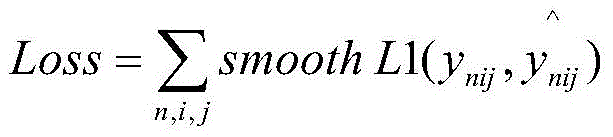
3)为增大网络模型训练数据量及适用性,需要使用数据增强方法对原始输入图像进行数据增强,包括以下步骤:3) In order to increase the amount of training data and applicability of the network model, it is necessary to use a data enhancement method to perform data enhancement on the original input image, including the following steps:
a、随机添加高斯、椒盐噪声a. Randomly add Gaussian and salt and pepper noise
对输入的图像,以0.25的概率随机添加高斯噪声,0.25的概率添加椒盐噪声。For the input image, Gaussian noise is randomly added with a probability of 0.25, and salt and pepper noise is added with a probability of 0.25.
b、随机镜像翻转b. Random mirror flip
对输入图像以0.5的概率进行随机镜像翻转,该变换需要同时应用到标注上。在对图像翻转之后,标注也需要进行左右翻转,如:若原来的左肩关键点标注坐标左右为(xl,yl),右肩关键点标注坐标为(xr,yr),则经过翻转之后,左肩关键点标注坐标为(xr,yr),右肩关键点标注坐标左右为(xl,yl)。The input image is randomly mirrored with a probability of 0.5, and the transformation needs to be applied to the label at the same time. After flipping the image, the label also needs to be flipped left and right. For example, if the original left shoulder key point label coordinates are (x l , y l ), and the right shoulder key point label coordinates are (x r , y r ), then after After flipping, the coordinates of the key point on the left shoulder are (x r , y r ), and the coordinates of the key point on the right shoulder are (x l , y l ).
c、随机调整对比度c. Randomly adjust the contrast
修改色调和饱和度实现对比度转换。Modify hue and saturation to achieve contrast transformation.
d、随机旋转d. Random rotation
对图片以0.25的概率进行随机旋转,旋转角度在-25°~25°之间,该变换需要同时应用到标注上。The image is randomly rotated with a probability of 0.25, and the rotation angle is between -25° and 25°. This transformation needs to be applied to the label at the same time.
4)将步骤3)数据增强后的图像输入设计好的人体关键点神经网络模型中,对模型设定训练参数进行训练,并保存训练的神经网络模型参数,包括以下步骤:4) Step 3) the image input after the data enhancement is designed in the human key point neural network model, the training parameters are set for the model and trained, and the neural network model parameters of the training are saved, including the following steps:
4.1)设置训练参数4.1) Set training parameters
为了加快训练速度,设置训练优化器为Adam、初始学习率为10-5,学习率衰减为每迭代1个epoch衰减为原来的0.5。迭代总次数为400个epoch、批次大小为32。初始化方法选择为截断高斯分布,权重衰减系数选择为4×10⁻⁵。In order to speed up the training, the training optimizer is set to Adam, the initial learning rate is 10 -5 , and the learning rate decays to 0.5 per epoch. The total number of iterations is 400 epochs and the batch size is 32. The initialization method is selected as truncated Gaussian distribution, and the weight decay coefficient is selected as 4×10 -5 .
4.2)设置训练完成标志4.2) Set the training completion flag
当训练达到400个epoch或者模型在验证集上达到较好效果时,即可停止训练。When the training reaches 400 epochs or the model achieves a good effect on the verification set, the training can be stopped.
4.3)保存神经网络模型4.3) Save the neural network model
训练完成后,将神经网络模型的结构和权重一并保存。After the training is complete, save the structure and weight of the neural network model together.
5)使用YOLOv3来检测出图像中行人的位置,保持检测框的中心点不变,宽高增大为原来的1.2倍,保证检测框中有完整的行人,然后根据检测框,在原图像中裁剪出单个行人,将裁剪出来的行人输入到步骤4)中已经训练好的人体关键点神经网络模型,取出每个关键点特征图的最大值所在的位置,即为这个关键点在特征图中对应的位置,再需要根据下采样计算缩放倍数以及偏移量,将特征图中的坐标反算回原图像中的坐标,得到人体关键点在原图像中的位置,最后将所有检测出来的关键点,按照人体结构连接起来,得到关键点提取结果。其中,由于实际应用过程中容易产生关键点噪声,且噪声一般都是对称的,因此可以将待检测图像进行翻转,将翻转前后的图像一起传入人体关键点神经网络模型进行前向推理,提取其关键点,然后对翻转后的图像的特征图进行通道之间的交换,并与翻转前图像的特征图进行加和求平均操作,能够得到降噪后的最终特征图,对降噪之后的特征图,求取其最大输出响应对应的位置,并将响应位置乘以设定的缩放倍数和加上偏移量,从而得到各个部位的关键点坐标,最后将所有检测出来的关键点,按照人体结构连接起来,得到最后关键点提取结果,其具体情况如下:5) Use YOLOv3 to detect the position of pedestrians in the image, keep the center point of the detection frame unchanged, increase the width and height to 1.2 times the original, ensure that there are complete pedestrians in the detection frame, and then cut out the original image according to the detection frame Take out a single pedestrian, input the cropped pedestrian into the human key point neural network model that has been trained in step 4), and take out the position where the maximum value of each key point feature map is, that is, the corresponding key point in the feature map position, and then need to calculate the zoom factor and offset according to the downsampling, invert the coordinates in the feature map back to the coordinates in the original image, get the position of the key points of the human body in the original image, and finally combine all the detected key points, Connect according to the human body structure to get the key point extraction result. Among them, since the noise of key points is easy to be generated in the actual application process, and the noise is generally symmetrical, the image to be detected can be flipped, and the images before and after the flip can be transferred to the human key point neural network model for forward reasoning, extracting Its key points, and then exchange the feature map of the image after flipping between channels, and perform summing and averaging operations with the feature map of the image before flipping to obtain the final feature map after noise reduction. Feature map, find the position corresponding to its maximum output response, multiply the response position by the set zoom factor and add the offset, so as to obtain the key point coordinates of each part, and finally all the detected key points, according to The human body structure is connected to get the final key point extraction result. The details are as follows:
对原图I进行左右翻转,设在翻转之前的图像为I(x,y)=a,其中x,y分别为图像中的横纵坐标,在(x,y)位置上的像素值为a,则翻转之后的图像为I(w-x,y)=a,即在(w-x,y)位置上的像素值为a。将对称之后的图像定义为I',将I和I'一起输入训练好的人体关键点神经网络模型中进行前向推理,得到两张特征图。由于I'是经过左右翻转的,因此输出特征图也需要变换之后才能表示翻转之前的原图关键点位置,将I'的输出特征图中的左关键点通道与其对应的右关键点位置进行交换,如:原来左肩部关键点在输出特征图的第5个通道,右肩关键点对应的是特征图的第7个通道,经过交换,第5个通道与第7通道的值进行交换。交换之后,第5个通道表示的是I'的右肩关键点,由于I'是经过I翻转的,因此I'的右肩关键点对应的是I的左肩关键点,因此经过该变换之后,两张特征图均可以表示,原图I的关键点,但是经过翻转后的特征图,噪声也会跟着对称。因此将两张特征图进行加和求平均,有效信号就会增强,噪声会因此削弱,从而实现对关键点提取过程中有效抑制噪声的效果。The original image I is flipped left and right, and the image before the flip is I(x, y)=a, where x and y are the horizontal and vertical coordinates in the image respectively, and the pixel value at the (x, y) position is a , then the flipped image is I(w-x, y)=a, that is, the pixel value at the position (w-x, y) is a. The symmetrical image is defined as I', and I and I' are input together into the trained human key point neural network model for forward inference, and two feature maps are obtained. Since I' is flipped left and right, the output feature map also needs to be transformed to represent the key point position of the original image before flipping, and the left key point channel in the output feature map of I' is exchanged with the corresponding right key point position , such as: the original left shoulder key point is in the 5th channel of the output feature map, and the right shoulder key point corresponds to the 7th channel of the feature map. After the exchange, the values of the 5th channel and the 7th channel are exchanged. After the exchange, the fifth channel represents the key point of the right shoulder of I'. Since I' is flipped by I, the key point of the right shoulder of I' corresponds to the key point of the left shoulder of I. Therefore, after this transformation, Both feature maps can represent the key points of the original image I, but the noise of the flipped feature map will also be symmetrical. Therefore, the two feature maps are summed and averaged, the effective signal will be enhanced, and the noise will be weakened, thereby achieving the effect of effectively suppressing the noise during the key point extraction process.
以上所述实施例只为本发明之较佳实施例,并非以此限制本发明的实施范围,故凡依本发明之形状、原理所作的变化,均应涵盖在本发明的保护范围内。The above-described embodiments are only preferred embodiments of the present invention, and are not intended to limit the scope of the present invention. Therefore, all changes made according to the shape and principles of the present invention should be covered within the protection scope of the present invention.
Claims (4)


Priority Applications (1)
| Application Number | Priority Date | Filing Date | Title |
|---|---|---|---|
| CN202010118903.5A CN111368673B (en) | 2020-02-26 | 2020-02-26 | Method for quickly extracting human body key points based on neural network |
Applications Claiming Priority (1)
| Application Number | Priority Date | Filing Date | Title |
|---|---|---|---|
| CN202010118903.5A CN111368673B (en) | 2020-02-26 | 2020-02-26 | Method for quickly extracting human body key points based on neural network |
Publications (2)
| Publication Number | Publication Date |
|---|---|
| CN111368673A CN111368673A (en) | 2020-07-03 |
| CN111368673B true CN111368673B (en) | 2023-04-07 |
Family
ID=71206604
Family Applications (1)
| Application Number | Title | Priority Date | Filing Date |
|---|---|---|---|
| CN202010118903.5A Active CN111368673B (en) | 2020-02-26 | 2020-02-26 | Method for quickly extracting human body key points based on neural network |
Country Status (1)
| Country | Link |
|---|---|
| CN (1) | CN111368673B (en) |
Families Citing this family (16)
| Publication number | Priority date | Publication date | Assignee | Title |
|---|---|---|---|---|
| CN111860276B (en) * | 2020-07-14 | 2023-04-11 | 咪咕文化科技有限公司 | Human body key point detection method, device, network equipment and storage medium |
| CN112131965B (en) * | 2020-08-31 | 2023-10-13 | 深圳云天励飞技术股份有限公司 | Human body posture estimation method and device, electronic equipment and storage medium |
| CN112149590A (en) * | 2020-09-28 | 2020-12-29 | 河南威虎智能科技有限公司 | A method of hand key point detection |
| CN112232194A (en) * | 2020-10-15 | 2021-01-15 | 广州云从凯风科技有限公司 | Single-target human body key point detection method, system, equipment and medium |
| CN112418098B (en) * | 2020-11-24 | 2024-10-01 | 深圳云天励飞技术股份有限公司 | Training method of video structured model and related equipment |
| CN112733624B (en) * | 2020-12-26 | 2023-02-03 | 电子科技大学 | Crowd density detection method, system storage medium and terminal in indoor dense scene |
| CN112800958B (en) * | 2021-01-28 | 2022-07-22 | 南京邮电大学 | Lightweight human body key point detection method based on heat point diagram |
| CN112862095B (en) * | 2021-02-02 | 2023-09-29 | 浙江大华技术股份有限公司 | Self-distillation learning method and device based on feature analysis and readable storage medium |
| CN114912569B (en) * | 2021-02-10 | 2026-01-20 | 华为技术有限公司 | A model training method and apparatus |
| CN113081025B (en) * | 2021-03-10 | 2022-04-29 | 华中科技大学 | A New Coronary Pneumonia Intelligent Diagnosis System and Device Based on Lung Sounds |
| CN114170653A (en) * | 2021-11-24 | 2022-03-11 | 奥比中光科技集团股份有限公司 | A face feature extraction method and device, terminal device and storage medium |
| CN114492570B (en) * | 2021-12-21 | 2024-12-13 | 绍兴市北大信息技术科创中心 | A method and system for constructing a key point extraction network of a neural network architecture |
| CN114565937A (en) * | 2022-01-25 | 2022-05-31 | 重庆特斯联启智科技有限公司 | Human body key point detection method and system |
| CN114429192B (en) * | 2022-04-02 | 2022-07-15 | 中国科学技术大学 | An image matching method, device and electronic device |
| CN115546521B (en) * | 2022-11-07 | 2024-05-07 | 佳木斯大学 | Point matching method based on key point response constraints |
| CN116721412B (en) * | 2023-04-17 | 2024-05-03 | 之江实验室 | Pod key point detection method and system based on structural priori from bottom to top |
Citations (4)
| Publication number | Priority date | Publication date | Assignee | Title |
|---|---|---|---|---|
| WO2019144575A1 (en) * | 2018-01-24 | 2019-08-01 | 中山大学 | Fast pedestrian detection method and device |
| CN110084161A (en) * | 2019-04-17 | 2019-08-02 | 中山大学 | A kind of rapid detection method and system of skeleton key point |
| CN110348375A (en) * | 2019-07-09 | 2019-10-18 | 华南理工大学 | A kind of finger vena region of interest area detecting method neural network based |
| CN110543878A (en) * | 2019-08-07 | 2019-12-06 | 华南理工大学 | pointer instrument reading identification method based on neural network |
-
2020
- 2020-02-26 CN CN202010118903.5A patent/CN111368673B/en active Active
Patent Citations (4)
| Publication number | Priority date | Publication date | Assignee | Title |
|---|---|---|---|---|
| WO2019144575A1 (en) * | 2018-01-24 | 2019-08-01 | 中山大学 | Fast pedestrian detection method and device |
| CN110084161A (en) * | 2019-04-17 | 2019-08-02 | 中山大学 | A kind of rapid detection method and system of skeleton key point |
| CN110348375A (en) * | 2019-07-09 | 2019-10-18 | 华南理工大学 | A kind of finger vena region of interest area detecting method neural network based |
| CN110543878A (en) * | 2019-08-07 | 2019-12-06 | 华南理工大学 | pointer instrument reading identification method based on neural network |
Also Published As
| Publication number | Publication date |
|---|---|
| CN111368673A (en) | 2020-07-03 |
Similar Documents
| Publication | Publication Date | Title |
|---|---|---|
| CN111368673B (en) | Method for quickly extracting human body key points based on neural network | |
| CN108710830B (en) | Human body 3D posture estimation method combining dense connection attention pyramid residual error network and isometric limitation | |
| CN109191491B (en) | Target tracking method and system of full convolution twin network based on multi-layer feature fusion | |
| CN108564097B (en) | Multi-scale target detection method based on deep convolutional neural network | |
| CN111696148A (en) | End-to-end stereo matching method based on convolutional neural network | |
| CN113870335A (en) | Monocular depth estimation method based on multi-scale feature fusion | |
| CN110399809A (en) | The face critical point detection method and device of multiple features fusion | |
| CN108960212A (en) | Based on the detection of human joint points end to end and classification method | |
| CN111488827A (en) | Crowd counting method and system based on multi-scale feature information | |
| CN114638866A (en) | Point cloud registration method and system based on local feature learning | |
| CN112541460B (en) | A vehicle re-identification method and system | |
| CN115527159B (en) | Counting system and method based on inter-modal scale attention aggregation features | |
| CN113345089B (en) | A Regularized Modeling Method Based on Power Tower Point Cloud | |
| CN112766123B (en) | A crowd counting method and system based on vertical and horizontal cross attention network | |
| CN113850136A (en) | Yolov5 and BCNN-based vehicle orientation identification method and system | |
| CN111414988A (en) | Remote sensing image super-resolution method based on multi-scale feature self-adaptive fusion network | |
| CN114581502A (en) | Method, electronic device and storage medium for joint reconstruction of 3D human body model based on monocular image | |
| CN111626134B (en) | A dense crowd counting method, system and terminal based on hidden density distribution | |
| CN103093211B (en) | Based on the human body motion tracking method of deep nuclear information image feature | |
| CN115018999A (en) | A method and device for constructing a dense point cloud map for multi-robot collaboration | |
| CN117437361A (en) | A scene model generation method and related devices | |
| CN115690916A (en) | A Lightweight Video Behavior Recognition Method Based on Hybrid Model | |
| CN114694176A (en) | Lightweight human body posture estimation method based on deep learning | |
| WO2022017129A1 (en) | Target object detection method and apparatus, electronic device, and storage medium | |
| CN117690188A (en) | A hand posture estimation method, system and electronic device |
Legal Events
| Date | Code | Title | Description |
|---|---|---|---|
| PB01 | Publication | ||
| PB01 | Publication | ||
| SE01 | Entry into force of request for substantive examination | ||
| SE01 | Entry into force of request for substantive examination | ||
| GR01 | Patent grant | ||
| GR01 | Patent grant |