CN111342896B - Self-coding algorithm based on convolutional neural network - Google Patents
Self-coding algorithm based on convolutional neural network Download PDFInfo
- Publication number
- CN111342896B CN111342896B CN202010135681.8A CN202010135681A CN111342896B CN 111342896 B CN111342896 B CN 111342896B CN 202010135681 A CN202010135681 A CN 202010135681A CN 111342896 B CN111342896 B CN 111342896B
- Authority
- CN
- China
- Prior art keywords
- data
- array
- self
- optical signal
- encoder
- Prior art date
- Legal status (The legal status is an assumption and is not a legal conclusion. Google has not performed a legal analysis and makes no representation as to the accuracy of the status listed.)
- Active
Links
Images


Classifications
-
- H—ELECTRICITY
- H04—ELECTRIC COMMUNICATION TECHNIQUE
- H04B—TRANSMISSION
- H04B10/00—Transmission systems employing electromagnetic waves other than radio-waves, e.g. infrared, visible or ultraviolet light, or employing corpuscular radiation, e.g. quantum communication
- H04B10/11—Arrangements specific to free-space transmission, i.e. transmission through air or vacuum
- H04B10/114—Indoor or close-range type systems
- H04B10/116—Visible light communication
-
- G—PHYSICS
- G06—COMPUTING OR CALCULATING; COUNTING
- G06N—COMPUTING ARRANGEMENTS BASED ON SPECIFIC COMPUTATIONAL MODELS
- G06N3/00—Computing arrangements based on biological models
- G06N3/02—Neural networks
- G06N3/04—Architecture, e.g. interconnection topology
- G06N3/045—Combinations of networks
-
- H—ELECTRICITY
- H04—ELECTRIC COMMUNICATION TECHNIQUE
- H04B—TRANSMISSION
- H04B10/00—Transmission systems employing electromagnetic waves other than radio-waves, e.g. infrared, visible or ultraviolet light, or employing corpuscular radiation, e.g. quantum communication
- H04B10/50—Transmitters
- H04B10/501—Structural aspects
- H04B10/502—LED transmitters
-
- H—ELECTRICITY
- H04—ELECTRIC COMMUNICATION TECHNIQUE
- H04B—TRANSMISSION
- H04B10/00—Transmission systems employing electromagnetic waves other than radio-waves, e.g. infrared, visible or ultraviolet light, or employing corpuscular radiation, e.g. quantum communication
- H04B10/50—Transmitters
- H04B10/516—Details of coding or modulation
-
- H—ELECTRICITY
- H04—ELECTRIC COMMUNICATION TECHNIQUE
- H04B—TRANSMISSION
- H04B10/00—Transmission systems employing electromagnetic waves other than radio-waves, e.g. infrared, visible or ultraviolet light, or employing corpuscular radiation, e.g. quantum communication
- H04B10/60—Receivers
Landscapes
- Engineering & Computer Science (AREA)
- Physics & Mathematics (AREA)
- Signal Processing (AREA)
- Computer Networks & Wireless Communication (AREA)
- Electromagnetism (AREA)
- Theoretical Computer Science (AREA)
- General Health & Medical Sciences (AREA)
- General Engineering & Computer Science (AREA)
- Data Mining & Analysis (AREA)
- Evolutionary Computation (AREA)
- Biophysics (AREA)
- Molecular Biology (AREA)
- Computing Systems (AREA)
- Computational Linguistics (AREA)
- General Physics & Mathematics (AREA)
- Mathematical Physics (AREA)
- Software Systems (AREA)
- Biomedical Technology (AREA)
- Artificial Intelligence (AREA)
- Life Sciences & Earth Sciences (AREA)
- Health & Medical Sciences (AREA)
- Optical Communication System (AREA)
Abstract
The invention discloses a convolutional neural network-based self-coding algorithm and a multi-input multi-output MIMO visible light communication system thereof.A transmitting end encodes X (X is a positive integer) bit data by using a coding module of a trained self-coder, outputs a data stream consisting of n X n (n is a positive integer) arrays, and the n X n array data stream drives n X n LED arrays to send out light signals; at the receiving end, after the receiving array receives the optical signal, the decoding module of the self-encoder decodes the optical signal to restore the original data. The self-encoder based on the convolutional neural network adopts an information set for training, and sequentially takes X-bit data in the information set to input into the self-encoder trained in the optical communication system. The MIMO visible light communication system is simple and feasible, low in error rate and wide in application prospect.
Description
Technical Field
The invention relates to the technical field of visible light communication, in particular to a self-coding algorithm based on a convolutional neural network.
Background
The visible light communication technology is to transmit information by using high-frequency flashing signals which cannot be identified by naked eyes by using light emitting devices such as fluorescent lamps or light emitting diodes, and the visible light communication can be realized only by modifying the existing lighting device. Compared with the traditional wireless communication technology, the wireless communication system has the advantages of high information transmission speed, low construction cost, no electromagnetic interference and the like, is high in safety, can realize safe communication by shielding light, and can effectively prevent information leakage. Therefore, the visible light communication technology is one of the next generation wireless communication technologies with wide application prospects.
However, the implementation of visible light communication presents many problems, and the two more critical problems are path loss and mutual interference between multiple channels, which are not fully researched and solved at present. The method can be used for solving the problem that the loss is difficult to estimate accurately due to the complexity of the influence factors, and the loss is difficult to compensate by accurate mathematical transformation due to the influence of the path loss in the optical communication, wherein the loss is increased along with the increase of the distance between a transmitting end and a receiving end, and the loss is also related to the channel quality and other related factors. When a plurality of light emitting devices communicate simultaneously, due to factors such as randomness of light particle emission directions, serious interference between different light signals can be caused, and as a result, the problem of high error rate can be caused, and the normal operation of visible light communication can be influenced.
Accordingly, the prior art is deficient and needs improvement.
Disclosure of Invention
The invention aims to solve the defects in the prior art, and provides a convolutional neural network-based self-coding algorithm and a MIMO visible light communication system thereof as an improvement of the existing visible light communication system.
The purpose of the invention can be achieved by adopting the following technical scheme:
a self-coding algorithm based on a convolutional neural network is provided, which comprises the following steps:
step S1: dividing X-bit data to be transmitted into a groups of data at a transmitting end, adding a head to each group of data to form a sub-data packets, sequentially inputting the sub-data packets into a coding module of a trained self-encoder for coding, and outputting a group of data streams consisting of n X n arrays, wherein the n X n array data streams drive n X n LED arrays and send light signals, and each group of data streams are continuously and repeatedly sent for many times to make up the problem of data loss, wherein X, a and n are positive integers;
step S2: the optical signal is transmitted from the transmitting end to the receiving end through the air;
step S3: at a receiving end, after receiving the optical signal received by the array, decoding the optical signal through a decoding module of the self-encoder, firstly finding out the head of the data packet, then sequentially restoring effective data behind the head, and combining the effective data according to a time sequence to obtain original data.
Further, the step S1 includes the following steps:
step S101: dividing X (X is a positive integer) bit data to be transmitted into a (a is a positive integer) group data at a transmitting end, and adding a head part formed by n X n (n is a positive integer) bit data to each group of data to form a sub-data packet;
step S102: during coding, one-dimensional data to be coded is firstly mapped into two-dimensional data through a full connection layer, and then the two-dimensional data is converted into an n x n array through a convolution layer and a pooling layer;
step S103: then through the activation function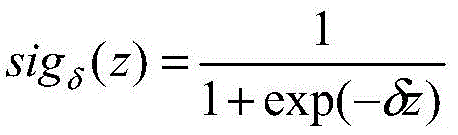 Mapping into a 2D OOK array data stream of n x n containing only 0 and 1 elements;
step S104: and 0 in the array data stream controls the corresponding LED in the LED array to be extinguished, and 1 in the signal matrix controls the corresponding LED in the LED array to be lightened, wherein the size of the LED array is n x n.
Further, the step S3 includes the following steps:
step S301: at a receiving end, the receiving array captures an optical signal sent by a transmitting end and transmits the optical signal to a decoding module of a self-encoder;
step S302: when decoding, firstly, the features are extracted through the convolutional layer and the pooling layer, and then the two-dimensional data is mapped into one-dimensional data through the full-connection layer.
Step S303: and searching header data in the received data, then sequentially restoring effective data behind the header, and combining the effective data according to a time sequence to obtain original data.
The invention further provides a MIMO visible light communication system, which comprises a transmitting end and a receiving end, wherein the transmitting end comprises a transmitting end computer, a power adapter, a data line, a controller and an LED array;
the receiving end comprises a receiving array and a receiving end computer, the receiving end computer comprises a decoding module, the receiving array receives optical signals and inputs the optical signals into the decoding module for decoding, the coding module and the decoding module form a self-coder, the self-coder is composed of a convolution network, and the self-coder is trained with the aim of minimizing the error between original data and restored data.
Further, when the receiving array is a PD array, the receiving end further includes an operational amplifier and an a/D conversion module, receives the optical signal, amplifies the signal by the operational amplifier circuit, and performs analog-to-digital conversion by the a/D conversion module to output an array data stream.
Further, the receiving array may also be an image sensor.
Compared with the prior art, the invention has the following advantages and effects:
(1) the visible light communication system is a multi-input multi-output system, each LED controllable LED array is introduced into the transmitting end, the receiving array is introduced into the receiving end, a plurality of data streams can be transmitted simultaneously, and compared with a single-input single-output visible light communication system, the data transmission speed is higher.
(2) The invention introduces the self-encoder based on the convolutional neural network into the visible light communication system, can train the self-encoder through abundant training sets, and compared with the traditional simple encoding and decoding, the error rate of the visible light communication system can be effectively reduced, and the accurate and efficient visible light communication is realized.
Drawings
Fig. 1 is a schematic diagram of a MIMO visible light communication system according to the present invention.
Fig. 2 is a block diagram of a transmitting end according to the present invention.
Fig. 3 is a schematic structural diagram of the receiving end of the PD array according to the present invention.
FIG. 4 is a schematic diagram of a structure of an image sensor at a receiving end according to the present invention.
Detailed Description
In order to make the objects, technical solutions and advantages of the embodiments of the present invention clearer, the technical solutions in the embodiments of the present invention will be clearly and completely described below with reference to the drawings in the embodiments of the present invention, and it is obvious that the described embodiments are some, but not all, embodiments of the present invention. All other embodiments, which can be derived by a person skilled in the art from the embodiments given herein without making any creative effort, shall fall within the protection scope of the present invention.
Examples
In this embodiment, a convolutional neural network-based self-coding algorithm and a MIMO (multiple-input multiple-output) visible light communication system thereof are adopted, and fig. 1 is a schematic diagram of the MIMO visible light communication system.
The MIMO visible light communication system comprises a transmitting end and a receiving end. The transmitting terminal comprises a transmitting terminal computer, a power adapter, a data line, a controller and an LED array, wherein the transmitting terminal computer comprises a coding module. The original data is coded in a transmitting end computer through a coding module, the coded data is transmitted to a controller, and the controller controls the on and off of the LED array according to the data to generate corresponding optical signals. In this embodiment, the controller is model number STM 32.
The receiving end comprises a receiving array and a receiving end computer, the receiving end computer comprises a decoding module, and the receiving array receives optical signals and inputs the optical signals to the decoding module for decoding. The coding module and the decoding module form an auto-encoder, and the auto-encoder is formed by a convolution network and is trained by taking the error between the original data and the restored data as a target.
The receiving array in the receiving end may be a PD array or an image sensor. Fig. 3 is a schematic structural diagram of the receiving array being a PD array, and fig. 4 is a schematic structural diagram of the receiving array being an image sensor. When the receiving array is selected as the PD array, the receiving end also comprises an operational amplifier and an A/D conversion module, receives the optical signal, amplifies the signal by an operational amplification circuit, and performs analog-to-digital conversion by the A/D conversion module to obtain a data matrix which can be input into a decoding module of the self-encoder. When the receiving array is selected as an image sensor, an image containing the optical signal is obtained by photographing the LED array, and the image may be input to a decoding module of the self-encoder for decoding.
As shown in fig. 1, the present invention further provides a convolutional neural network-based self-coding algorithm, which includes the following steps:
step S1: dividing X-bit data to be transmitted into a groups of data at a transmitting end, adding a head to each group of data to form a sub-data packets, sequentially inputting the sub-data packets into a coding module of a trained self-encoder for coding, and outputting a group of data streams consisting of n X n arrays, wherein the n X n array data streams drive n X n LED arrays and send light signals, and each group of data streams are continuously and repeatedly sent for many times to make up the problem of data loss, wherein X, a and n are positive integers;
wherein, the encoding process in step S1 is as follows:
inputting one-dimensional data to be coded into a coding module of a trained self-coder, firstly mapping the data into two-dimensional data through a full-connection layer, and then converting the data into an n x n array through a convolution layer and a pooling layer;
then through the activation function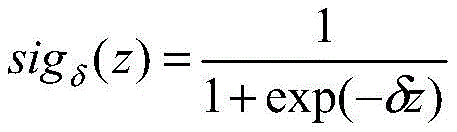 Mapping into a 2D OOK array data stream of n x n containing only 0 and 1 elements;
the manner of controlling the LED array by the data stream in step S1 is as follows:
in an OOK mode, 0 in the array data stream controls the corresponding LED in the LED array to be turned off, and 1 in the signal matrix controls the corresponding LED in the LED array to be turned on;
step S2: the optical signal propagates through the air from the transmitting end to the receiving end.
Step S3: at a receiving end, after receiving the optical signal received by the array, decoding the optical signal through a decoding module of the self-encoder, firstly finding out the head of the data packet, then sequentially restoring effective data behind the head, and combining the effective data according to a time sequence to obtain original data.
Wherein, the optical signal receiving process in step S3 is as follows:
the receiving array may be a PD array or an image sensor. Fig. 3 is a schematic structural diagram when the receiving array is selected as the PD array, and fig. 4 is a schematic structural diagram when the receiving array is selected as the image sensor. When the receiving array is selected as the PD array, the received optical signals are amplified by the operational amplifier circuit, and then analog-to-digital conversion is carried out by the A/D conversion module, and the array data stream is output. When the receiving array is selected as an image sensor, an image containing the light signal is obtained by photographing the LED array.
Wherein, the decoding process in step S3 is as follows:
inputting the array data stream or image obtained after the receiving array processing into a decoding module of a corresponding trained self-encoder, firstly extracting characteristics through a convolutional layer and a pooling layer, and then mapping two-dimensional data into one-dimensional data through a full connection layer.
In summary, in the present embodiment, data is encoded and then sent through the LED array, and the receiving array receives and then decodes the encoded data to implement visible light communication, which provides a self-encoding algorithm based on the convolutional neural network and a MIMO visible light communication system thereof. After the transmitting end encodes the original data through the encoding module of the self-encoder, the STM32 is adopted to control the LED array to send out optical signals, after the optical signals are received by the receiving array through air propagation, the decoding module of the self-encoder is used for decoding, and the original data is restored. The method can form a multi-input multi-output visible light communication system, has low error rate and can realize accurate communication. The invention can be applied to indoor end-to-end communication, underwater communication and other occasions, and has wide application prospect.
The above embodiment is only one embodiment of the present invention, but the embodiment of the present invention is not limited by the above embodiment, and any other changes, modifications, substitutions, combinations, and simplifications which do not depart from the spirit and principle of the present invention and are equivalent to each other are all within the protection scope of the present invention.
Claims (2)
1. A convolutional neural network-based self-coding algorithm, comprising the steps of:
step S1: dividing X-bit data to be transmitted into a groups of data at a transmitting end, adding a head to each group of data to form a sub-data packets, sequentially inputting the sub-data packets into a coding module of a trained self-encoder for coding, and outputting a group of data streams consisting of n X n arrays, wherein the n X n array data streams drive n X n LED arrays and send light signals, and each group of data streams are continuously and repeatedly sent for many times to make up the problem of data loss, wherein X, a and n are positive integers;
step S2: the optical signal is transmitted from the transmitting end to the receiving end through the air;
step S3: at a receiving end, after receiving an optical signal received by the array, decoding the optical signal through a decoding module of a self-encoder, firstly finding out a head of a data packet, then sequentially restoring effective data behind the head, and combining the effective data according to a time sequence to obtain original data;
wherein the step S1 includes the steps of:
step S101: dividing X-bit data to be transmitted into a groups of data at a transmitting end, adding a head part formed by n X n bit data to each group of data to form a sub-data packets, wherein X, a and n are positive integers;
step S102: during coding, one-dimensional data to be coded is firstly mapped into two-dimensional data through a full connection layer, and then the two-dimensional data is converted into an n x n array through a convolution layer and a pooling layer;
step S103: then through the activation function 2D OOK array data stream mapped to n x n containing only 0 and 1 elements;
Step S104: and 0 in the array data stream controls the corresponding LED in the LED array to be extinguished, and 1 in the signal matrix controls the corresponding LED in the LED array to be lightened, wherein the size of the LED array is n x n.
2. The convolutional neural network-based self-encoding algorithm as claimed in claim 1, wherein the step S3 comprises the steps of:
step S301: at a receiving end, the receiving array captures an optical signal sent by a transmitting end and transmits the optical signal to a decoding module of a self-encoder;
step S302: during decoding, firstly, extracting features through a convolutional layer and a pooling layer, and then mapping two-dimensional data into one-dimensional data through a full-connection layer;
step S303: and searching header data in the received data, then sequentially restoring effective data behind the header, and combining the effective data according to a time sequence to obtain original data.
Priority Applications (1)
| Application Number | Priority Date | Filing Date | Title |
|---|---|---|---|
| CN202010135681.8A CN111342896B (en) | 2020-03-02 | 2020-03-02 | Self-coding algorithm based on convolutional neural network |
Applications Claiming Priority (1)
| Application Number | Priority Date | Filing Date | Title |
|---|---|---|---|
| CN202010135681.8A CN111342896B (en) | 2020-03-02 | 2020-03-02 | Self-coding algorithm based on convolutional neural network |
Publications (2)
| Publication Number | Publication Date |
|---|---|
| CN111342896A CN111342896A (en) | 2020-06-26 |
| CN111342896B true CN111342896B (en) | 2021-04-02 |
Family
ID=71187303
Family Applications (1)
| Application Number | Title | Priority Date | Filing Date |
|---|---|---|---|
| CN202010135681.8A Active CN111342896B (en) | 2020-03-02 | 2020-03-02 | Self-coding algorithm based on convolutional neural network |
Country Status (1)
| Country | Link |
|---|---|
| CN (1) | CN111342896B (en) |
Families Citing this family (1)
| Publication number | Priority date | Publication date | Assignee | Title |
|---|---|---|---|---|
| CN115694655B (en) * | 2022-10-11 | 2023-07-14 | 北京华通时空通信技术有限公司 | Optical domain amplitude-phase parasitic modulation method, system, device and storage medium |
Citations (6)
| Publication number | Priority date | Publication date | Assignee | Title |
|---|---|---|---|---|
| EP3154232A1 (en) * | 2015-10-08 | 2017-04-12 | Alcatel Lucent | Method for channel estimation in a wireless communication system, communication unit, terminal and communication system |
| CN108764466A (en) * | 2018-03-07 | 2018-11-06 | 东南大学 | Convolutional neural networks hardware based on field programmable gate array and its accelerated method |
| CN109600335A (en) * | 2019-01-17 | 2019-04-09 | 山东建筑大学 | The comprehensive PAPR suppressing method of ACO-OFDM system neural network based and system |
| CN109660297A (en) * | 2018-12-19 | 2019-04-19 | 中国矿业大学 | A kind of physical layer visible light communication method based on machine learning |
| CN109672639A (en) * | 2019-01-22 | 2019-04-23 | 哈尔滨工业大学 | A kind of signal demodulating method based on machine learning |
| CN110581732A (en) * | 2019-09-30 | 2019-12-17 | 山东建筑大学 | Neural network-based multi-objective optimization system and method for indoor visible light communication |
Family Cites Families (9)
| Publication number | Priority date | Publication date | Assignee | Title |
|---|---|---|---|---|
| KR101732758B1 (en) * | 2009-09-18 | 2017-05-04 | 인터디지탈 패튼 홀딩스, 인크 | Method and apparatus for dimming with rate control for visible light communications(vlc) |
| EP3180872B1 (en) * | 2014-08-12 | 2019-07-31 | ABL IP Holding LLC | System and method for estimating the position and orientation of a mobile communications device in a beacon-based positioning system |
| CN105591695A (en) * | 2014-10-23 | 2016-05-18 | 苏州研迪智能科技有限公司 | Multi-transmitting-multi-receiving LED visible light communication system |
| CN107534486B (en) * | 2016-02-25 | 2021-04-30 | 松下电器(美国)知识产权公司 | Signal decoding method, signal decoding device, and recording medium |
| CN207835454U (en) * | 2017-07-21 | 2018-09-07 | 华南理工大学 | A kind of neural net equalizer based on visible light communication |
| CN107342814A (en) * | 2017-07-21 | 2017-11-10 | 华南理工大学 | A kind of neural net equalizer based on visible light communication |
| CN207369040U (en) * | 2017-11-03 | 2018-05-15 | 天津职业技术师范大学 | A kind of MIMO indoor visible light communication systems based on DSP |
| CN110266382B (en) * | 2019-05-29 | 2021-07-27 | 北京邮电大学 | A multi-dimensional hybrid dimming method based on visible light communication MU-MIMO-OFDM system |
| CN110417467A (en) * | 2019-07-12 | 2019-11-05 | 深圳抟翼科技有限公司 | MIMO imaging visible light communication transmitter, receiver and system |
-
2020
- 2020-03-02 CN CN202010135681.8A patent/CN111342896B/en active Active
Patent Citations (6)
| Publication number | Priority date | Publication date | Assignee | Title |
|---|---|---|---|---|
| EP3154232A1 (en) * | 2015-10-08 | 2017-04-12 | Alcatel Lucent | Method for channel estimation in a wireless communication system, communication unit, terminal and communication system |
| CN108764466A (en) * | 2018-03-07 | 2018-11-06 | 东南大学 | Convolutional neural networks hardware based on field programmable gate array and its accelerated method |
| CN109660297A (en) * | 2018-12-19 | 2019-04-19 | 中国矿业大学 | A kind of physical layer visible light communication method based on machine learning |
| CN109600335A (en) * | 2019-01-17 | 2019-04-09 | 山东建筑大学 | The comprehensive PAPR suppressing method of ACO-OFDM system neural network based and system |
| CN109672639A (en) * | 2019-01-22 | 2019-04-23 | 哈尔滨工业大学 | A kind of signal demodulating method based on machine learning |
| CN110581732A (en) * | 2019-09-30 | 2019-12-17 | 山东建筑大学 | Neural network-based multi-objective optimization system and method for indoor visible light communication |
Non-Patent Citations (1)
| Title |
|---|
| High Speed Novel Hybrid Modulation Technique of Visible Light Communication Based on Artificial Neural Network Equalizer;Weipeng Guan等;《2018 IEEE 3rd Optoelectronics Global Conference (OGC)》;20180907;全文 * |
Also Published As
| Publication number | Publication date |
|---|---|
| CN111342896A (en) | 2020-06-26 |
Similar Documents
| Publication | Publication Date | Title |
|---|---|---|
| CN101282175B (en) | Free space MIMO optical communication system based on vertical demixing time space | |
| CN111510218A (en) | 5G wireless network communication system | |
| CN104917566B (en) | Intelligent transportation optical signal reception system and its control method based on spread spectrum | |
| CN111342896B (en) | Self-coding algorithm based on convolutional neural network | |
| CN102158281A (en) | High-speed omni-directional wireless laser communication equipment | |
| Biagi et al. | Analysis and demonstration of quasi trace orthogonal space time block coding for visible light communications | |
| CN101309127A (en) | A Distributed MIMO Transmission Method Based on Network Coding | |
| CN114531200B (en) | Radio frequency signal dynamic coverage system and method based on wireless laser communication | |
| CN114301525B (en) | A SIC precoding method for MIMO VLC system with sub-connection structure | |
| CN112769485B (en) | A Visible Light Relay System Suitable for Underground Environment | |
| CN111988090B (en) | Chip Mode Carrier Composite Correlation Optical Coding Method | |
| CN107919911A (en) | High speed visible light communication system and method based on OFDM modulation techniques | |
| CN113141214A (en) | Deep learning-based underwater optical communication misalignment robust blind receiver design method | |
| CN116886201A (en) | Optical module, forwarding network equipment and system and signal processing method | |
| CN114142929B (en) | Visible light communication system and method based on GMD-BD precoding | |
| CN114665960B (en) | Anti-interference underwater visible light communication system | |
| Song et al. | Implementation of machine learning-based emergency communication using RoFSO-VLC/RF convergence link | |
| CN205123744U (en) | Optical transmission terminal and system that fiber channel bus is wireless | |
| CN101115045A (en) | A multi-antenna transmission method and device | |
| CN104579467B (en) | Frame positioning method for free space optical communication | |
| Nistazakis et al. | Average capacity of wireless optical communication systems over gamma gamma atmospheric turbulence channels | |
| CN107181531A (en) | Bit mapping method when LED numbers are any in light spatial modulation communication system | |
| CN105227236A (en) | A kind of optical-fibre channel bus wireless optical transmission terminal and system | |
| CN113301564A (en) | Heuristic method for preventing eavesdropping by utilizing interference signals in wireless energy supply communication network | |
| CN112751651B (en) | Signal transmission method combining Turbo code and neural network |
Legal Events
| Date | Code | Title | Description |
|---|---|---|---|
| PB01 | Publication | ||
| PB01 | Publication | ||
| SE01 | Entry into force of request for substantive examination | ||
| SE01 | Entry into force of request for substantive examination | ||
| GR01 | Patent grant | ||
| GR01 | Patent grant |