CN111324892A - Software gene for generating script file and script detection method, device and medium - Google Patents
Software gene for generating script file and script detection method, device and medium Download PDFInfo
- Publication number
- CN111324892A CN111324892A CN202010062677.3A CN202010062677A CN111324892A CN 111324892 A CN111324892 A CN 111324892A CN 202010062677 A CN202010062677 A CN 202010062677A CN 111324892 A CN111324892 A CN 111324892A
- Authority
- CN
- China
- Prior art keywords
- data
- code
- script file
- generating
- software
- Prior art date
- Legal status (The legal status is an assumption and is not a legal conclusion. Google has not performed a legal analysis and makes no representation as to the accuracy of the status listed.)
- Granted
Links
Images


Classifications
-
- G—PHYSICS
- G06—COMPUTING OR CALCULATING; COUNTING
- G06F—ELECTRIC DIGITAL DATA PROCESSING
- G06F21/00—Security arrangements for protecting computers, components thereof, programs or data against unauthorised activity
- G06F21/50—Monitoring users, programs or devices to maintain the integrity of platforms, e.g. of processors, firmware or operating systems
- G06F21/55—Detecting local intrusion or implementing counter-measures
- G06F21/56—Computer malware detection or handling, e.g. anti-virus arrangements
- G06F21/562—Static detection
- G06F21/563—Static detection by source code analysis
Landscapes
- Engineering & Computer Science (AREA)
- Computer Security & Cryptography (AREA)
- Computer Hardware Design (AREA)
- General Engineering & Computer Science (AREA)
- Software Systems (AREA)
- Theoretical Computer Science (AREA)
- Health & Medical Sciences (AREA)
- General Health & Medical Sciences (AREA)
- Virology (AREA)
- Physics & Mathematics (AREA)
- General Physics & Mathematics (AREA)
- Stored Programmes (AREA)
Abstract
The application discloses a method, a device and a medium for detecting software genes and scripts of a generated script file. The method for detecting the script file comprises the following steps: acquiring a code recorded by a script file to be detected; generating a software gene corresponding to the script file according to the acquired code; and detecting the software gene. The technical problem that malicious script identification technology is limited to code feature matching and cannot detect code logic calling relation in a script file in the prior art, and therefore malicious script identification accuracy is affected is solved.
Description
Technical Field
The application relates to the technical field of internet security, in particular to a method, a device and a medium for detecting a software gene and a script of a generated script file.
Background
In order to solve the problem, people search clue rules from a large data perspective and association analysis, combine an artificial intelligence algorithm, and a script type malicious code analysis and homology judgment method based on a software gene technology theory can better solve the problem.
Traditional malicious code characteristics generally refer to code fragments capable of identifying target software, and the characteristics of the traditional malicious code characteristics are unique identification; however, the focus of the script gene is not on uniqueness, but whether the extracted code segments have functional semantics or bear key information of interdependence between family software is determined, and the segments have the characteristics of atomicity, ideality, stability, progressiveness and the like as the broad definition of the software gene. In contrast, the idea of feature detection is simple, the algorithm matching efficiency is high, but the content of the algorithm does not necessarily have key hereditary information and is easy to bypass, and the gene is the software for recognizing from a microscopic view angle, so that the realization is simplified. Different from the traditional characteristic detection technology, the detection method using the script genes can not only identify the target sample, but also analyze other potential samples with similarity or homology with the target sample, thereby realizing the association mining and the exploration of the derivative evolution law.
However, in the prior art, the malicious script recognition technology is limited to code feature matching, that is, the frequency of occurrence of malicious codes contained in a section of script determines the maliciousness of the script, but the above technology has a low recognition rate for the variant-appearing malicious scripts, and the features extracted by the conventional malicious script recognition technology cannot meet the requirement of script homology judgment.
Aiming at the technical problem that the malicious script identification technology in the prior art is limited to code feature matching and cannot detect the code logic calling relation in the script file, so that the malicious script identification accuracy is influenced, an effective solution is not provided at present.
Disclosure of Invention
The embodiment of the disclosure provides a method, a device and a medium for detecting a software gene and a script for generating a script file, so as to at least solve the technical problem that malicious script identification technology is limited to code feature matching and cannot detect a code logic calling relation in the script file in the prior art, so that the malicious script identification accuracy is influenced.
According to an aspect of an embodiment of the present disclosure, there is provided a method of generating a software gene of a script file, including: acquiring a code recorded by a script file to be detected; and generating a software gene corresponding to the script file according to the acquired code.
According to another aspect of the embodiments of the present disclosure, there is also provided a method of detecting a script file, including: acquiring a code recorded by a script file to be detected; generating a software gene corresponding to the script file according to the acquired code; and detecting the software gene.
According to another aspect of the embodiments of the present disclosure, there is also provided a storage medium including a stored program, wherein the method of any one of the above is performed by a processor when the program is executed.
According to another aspect of the embodiments of the present disclosure, there is also provided an apparatus for generating a software gene of a script file, including: the first data acquisition module is used for acquiring codes recorded by a script file to be detected; and the first gene generation module is used for generating a software gene corresponding to the script file according to the acquired code.
According to another aspect of the embodiments of the present disclosure, there is also provided an apparatus for detecting a script file, including: the second data acquisition module is used for acquiring codes recorded by the script file to be detected; the second gene generation module is used for generating a software gene corresponding to the script file according to the acquired code; and the gene detection module is used for detecting the software genes.
According to another aspect of the embodiments of the present disclosure, there is also provided an apparatus for generating a software gene of a script file, including: a first processor; and a first memory coupled to the first processor for providing instructions to the first processor to process the following processing steps: acquiring a code recorded by a script file to be detected; and generating a software gene corresponding to the script file according to the acquired code.
According to another aspect of the embodiments of the present disclosure, there is also provided an apparatus for detecting a script file, including: a second processor; and a second memory coupled to the second processor for providing instructions to the second processor to process the following processing steps: acquiring a code recorded by a script file to be detected; generating a software gene corresponding to the script file according to the acquired code; and detecting the software gene.
In the embodiment of the disclosure, malicious codes are detected by extracting software genes in the script file and then detecting the malicious codes according to the extracted software genes. The technical effect of improving the identification precision of the malicious codes is achieved. The technical problem that malicious script identification technology is limited to code feature matching and cannot detect code logic calling relation in a script file in the prior art, and therefore malicious script identification accuracy is affected is solved.
Drawings
The accompanying drawings, which are included to provide a further understanding of the disclosure and are incorporated in and constitute a part of this application, illustrate embodiment(s) of the disclosure and together with the description serve to explain the disclosure and not to limit the disclosure. In the drawings:
fig. 1 is a hardware block diagram of a computing device for implementing the method according to embodiment 1 of the present disclosure;
FIG. 2 is a schematic flow chart of a method for generating software genes of a script file according to a first aspect of embodiment 1 of the present disclosure;
FIG. 3a schematically shows an overall block diagram of the detection system;
FIG. 3b schematically shows a schematic diagram of a scripting software gene extraction apparatus;
FIG. 4a shows a schematic of the overall flow of gene extraction;
FIG. 4b schematically shows a detailed flow chart of the step of generating the software genes;
fig. 5 is a schematic flow chart of a method for detecting a script file according to a second aspect of embodiment 1 of the present disclosure;
FIG. 6 is a schematic diagram of an apparatus for generating software genes of a script file according to a first aspect of embodiment 2 of the present disclosure;
fig. 7 is a schematic diagram of an apparatus for testing a script file according to a second aspect of embodiment 2 of the present disclosure;
FIG. 8 is a schematic diagram of an apparatus for generating software genes of a script file according to the first aspect of embodiment 3 of the present disclosure; and
fig. 9 is a schematic diagram of an apparatus for testing a script file according to a second aspect of embodiment 3 of the present disclosure.
Detailed Description
In order to make those skilled in the art better understand the technical solutions of the present disclosure, the technical solutions in the embodiments of the present disclosure will be clearly and completely described below with reference to the drawings in the embodiments of the present disclosure. It is to be understood that the described embodiments are merely exemplary of some, and not all, of the present disclosure. All other embodiments, which can be derived by a person skilled in the art from the embodiments disclosed herein without making any creative effort, shall fall within the protection scope of the present disclosure.
It should be noted that the terms "first," "second," and the like in the description and claims of the present disclosure and in the above-described drawings are used for distinguishing between similar elements and not necessarily for describing a particular sequential or chronological order. It is to be understood that the data so used is interchangeable under appropriate circumstances such that the embodiments of the disclosure described herein are capable of operation in sequences other than those illustrated or otherwise described herein. Furthermore, the terms "comprises," "comprising," and "having," and any variations thereof, are intended to cover a non-exclusive inclusion, such that a process, method, system, article, or apparatus that comprises a list of steps or elements is not necessarily limited to those steps or elements expressly listed, but may include other steps or elements not expressly listed or inherent to such process, method, article, or apparatus.
Example 1
According to the present embodiment, there is provided an embodiment of a software gene for generating a script file and a method for detecting a script file, it is noted that the steps illustrated in the flowchart of the drawings may be performed in a computer system such as a set of computer executable instructions, and that while a logical order is illustrated in the flowchart, in some cases the steps illustrated or described may be performed in an order different than here.
The method embodiments provided by the present embodiment may be executed in a mobile terminal, a computer terminal, a server or a similar computing device. FIG. 1 illustrates a block diagram of a hardware architecture of a computing device for implementing software genes for generating script files and methods of detecting script files. As shown in fig. 1, the computing device may include one or more processors (which may include, but are not limited to, a processing device such as a microprocessor MCU or a programmable logic device FPGA), a memory for storing data, and a transmission device for communication functions. Besides, the method can also comprise the following steps: a display, an input/output interface (I/O interface), a Universal Serial Bus (USB) port (which may be included as one of the ports of the I/O interface), a network interface, a power source, and/or a camera. It will be understood by those skilled in the art that the structure shown in fig. 1 is only an illustration and is not intended to limit the structure of the electronic device. For example, the computing device may also include more or fewer components than shown in FIG. 1, or have a different configuration than shown in FIG. 1.
It should be noted that the one or more processors and/or other data processing circuitry described above may be referred to generally herein as "data processing circuitry". The data processing circuitry may be embodied in whole or in part in software, hardware, firmware, or any combination thereof. Further, the data processing circuitry may be a single, stand-alone processing module, or incorporated in whole or in part into any of the other elements in the computing device. As referred to in the disclosed embodiments, the data processing circuit acts as a processor control (e.g., selection of a variable resistance termination path connected to the interface).
The memory can be used for storing software programs and modules of application software, such as software genes for generating script files and program instruction/data storage devices corresponding to the method for detecting the script files in the embodiments of the disclosure, and the processor executes various functional applications and data processing by running the software programs and modules stored in the memory, that is, the software genes for generating script files of the application programs and the method for detecting the script files are realized. The memory may include high speed random access memory, and may also include non-volatile memory, such as one or more magnetic storage devices, flash memory, or other non-volatile solid-state memory. In some instances, the memory may further include memory located remotely from the processor, which may be connected to the computing device over a network. Examples of such networks include, but are not limited to, the internet, intranets, local area networks, mobile communication networks, and combinations thereof.
The transmission device is used for receiving or transmitting data via a network. Specific examples of such networks may include wireless networks provided by communication providers of the computing devices. In one example, the transmission device includes a Network adapter (NIC) that can be connected to other Network devices through a base station to communicate with the internet. In one example, the transmission device may be a Radio Frequency (RF) module, which is used for communicating with the internet in a wireless manner.
The display may be, for example, a touch screen type Liquid Crystal Display (LCD) that may enable a user to interact with a user interface of the computing device.
It should be noted here that in some alternative embodiments, the computing device shown in fig. 1 described above may include hardware elements (including circuitry), software elements (including computer code stored on a computer-readable medium), or a combination of both hardware and software elements. It should be noted that FIG. 1 is only one example of a particular specific example and is intended to illustrate the types of components that may be present in a computing device as described above.
In the above operating environment, according to the first aspect of the present embodiment, a method for generating a software gene of a script file is provided, which is applied to a malicious code detection system. Fig. 2 shows a flow diagram of the method, which, with reference to fig. 2, comprises:
s202: acquiring a code recorded by a script file to be detected; and
s204: and generating a software gene corresponding to the script file according to the acquired code.
As described in the background art, the malicious script recognition technology in the prior art is limited to code feature matching, that is, the frequency of occurrence of malicious codes contained in a section of script determines the maliciousness of the script, but the above technology has a low recognition rate for the variant-appearing malicious scripts, and the features extracted by the conventional malicious script recognition technology cannot meet the requirement of script homology judgment.
For the technical problem in the background art, in the technical scheme of the embodiment, the recorded code is firstly acquired from the script file to be detected. Further, a software gene corresponding to the script file is generated based on the acquired code. Therefore, the software gene of the script can be detected in the malicious script detection process, and the method provides a data basis for the software gene detection of the script. Therefore, compared with a detection mode adopting code feature matching in the prior art, the method and the device achieve the purpose of detecting the code logic calling relation in the script file, and achieve the technical effect of improving the identification precision of malicious codes. The technical problem that malicious script identification technology is limited to code feature matching and cannot detect code logic calling relation in a script file in the prior art, and therefore malicious script identification accuracy is affected is solved.
Specifically, in step S202, the detection system first acquires a code described in a script file to be detected. For example: the system intercepts a script and extracts all code from the script. Illustratively, a piece of code in the script file is "var a ═ 10; ".
Further, in step S204, a software gene corresponding to the script file is generated based on the acquired code. That is, the software genes in the script file are extracted from the code. The following are software genes corresponding to the code segment "var a ═ 10" in the script file, as follows:
1. in one embodiment, the outermost type is the omission of Program and is not shown as gene content, and the extracted gene content is as follows:
the first one is:
{‘type’:’VariableDeclaration’,‘declarations’:
[{‘type’:’VariableDeclarator,‘id’:
{‘type’:’Indentifer’,’name’:’a’},
‘init’:{‘type’:’Literal’,’value’:10.0,’raw’:’10’}}],’kind’:’var’}
a second bar:
{‘type’:‘EmptyStatement’}
2. in another specific example, the outermost layer is not a Program, but other properties, such as: if attribute TypeA, then all genes under TypeA should be:
first strip
{ ' type ': type A ', ' body ': F } (direct removal of content in body)
Second bar (first in body)
{‘type’:’VariableDeclaration’,‘declarations’:
[{‘type’:’VariableDeclarator,‘id’:
{‘type’:’Indentifer’,’name’:’a’},
‘init’:{‘type’:’Literal’,’value’:10.0,’raw’:’10’}}],’kind’:’var’}
Third bar (second position in body)
{‘type’:‘EmptyStatement’}
Therefore, by the method, a data base is provided for software gene detection of the script, and malicious codes can be detected according to the extracted software genes. The technical effect of improving the identification precision of the malicious codes is achieved. The technical problem that malicious script identification technology is limited to code feature matching and cannot detect code logic calling relation in a script file in the prior art, and therefore malicious script identification accuracy is affected is solved.
Optionally, generating a software gene corresponding to the script file according to the acquired code includes: generating tree structure data corresponding to the code, wherein the tree structure data is used for describing the grammatical features of the code; and generating a software gene corresponding to the script file according to the tree structure data.
Specifically, in the operation of generating a software gene corresponding to a script file from an acquired code, tree structure data corresponding to the code is first generated, wherein the tree structure data is used to describe the syntactic characteristics of the code. For example, abstract syntax tree rules may be adopted to convert codes in the script file into tree structures for describing syntax features of the codes, and the following is tree structure data corresponding to the codes:
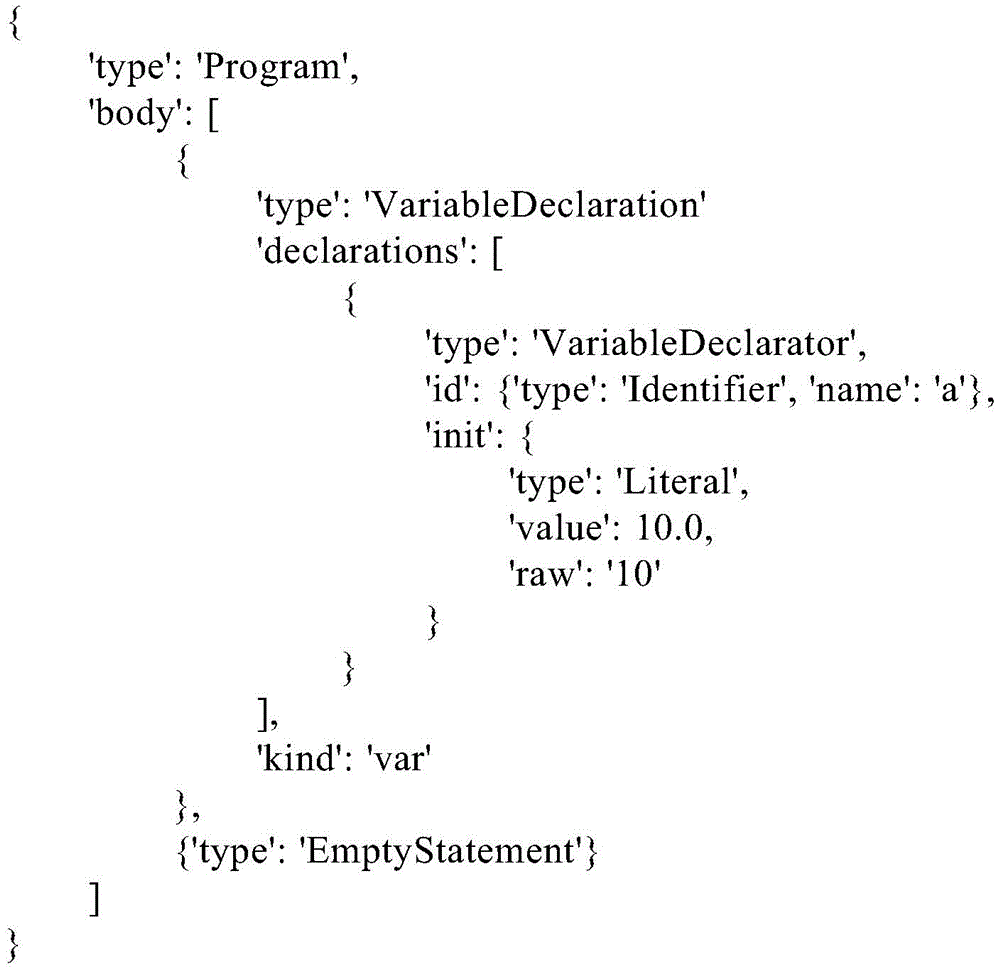
further, a software gene corresponding to the script file is generated based on the tree structure data. Therefore, the script logic flow can be more intuitively embodied through the abstract syntax tree structure, and the gene content can be specified through the tree nodes.
Fig. 3a is an overall block diagram of the detection system, and referring to fig. 3a, in concrete practice, the abstract syntax tree extraction module may be used to construct tree structure data, and the data abstraction module and the gene extraction module are used to generate software genes corresponding to the script files according to the tree structure data.
Optionally, generating tree structure data corresponding to the code includes: performing lexical analysis on the codes, and determining a word set corresponding to the codes, wherein the word set comprises a plurality of words forming the codes; and carrying out syntactic analysis on the determined word set to generate tree structure data corresponding to the codes.
Specifically, in the operation of generating tree structure data corresponding to a code, lexical analysis is first performed on the code, and a set of words corresponding to the code is determined, where the set of words includes a plurality of words constituting the code. The set may be in the form of an array, for example, and the words may also have attributes. The lexical parser will scan the code by character, in case it encounters spaces, operators and special symbols, it will consider that a sentence is complete and then merge them into individual tokens according to predetermined rules. At the same time, it will remove whites, comments, etc. Finally, the entire code will be partitioned into a token array. In one specific example, the code 'var a ═ 10', after lexical analysis, the resulting set of words (in array form) is: { value: 'var', type: 'keyword' }, { value: 'a', type: 'identifier' }.
Further, the lexical word set is parsed and converted into a tree-shaped expression form (i.e., the tree-structured data described above). Meanwhile, the method also comprises the step of verifying the grammar, and throwing out grammar errors if the grammar errors exist.
Optionally, generating a software gene corresponding to the script file according to the tree structure data includes: abstract data for gene analysis is extracted from the tree structure data; and segmenting the abstract data to generate software genes corresponding to the script files.
Specifically, in the operation of generating a software gene corresponding to a script file from tree structure data, abstract data for gene analysis, that is, abstract code data is extracted from the tree structure data. Further, the abstract data is divided (tree-structured data is divided), and a software gene corresponding to the script file is generated.
Optionally, extracting abstract data for gene analysis from the tree structure data includes: determining data parts constituting a tree structure; and generating abstract data from the data portion, wherein the abstract data comprises a first element for identifying a data type of the data portion and a second element describing a data content of the data portion.
Specifically, in the operation of extracting abstract data for gene analysis from tree structure data, a data portion constituting a tree structure is first determined. In this step, irrelevant data variables may also be removed first, for example: the outermost Program is removed leaving the body portion of the Program. The data enclosed by curly brackets at the outermost layer in the body array is regarded as one part, a plurality of parts may be contained in one body, and the tree structure data is divided into two data parts as follows:
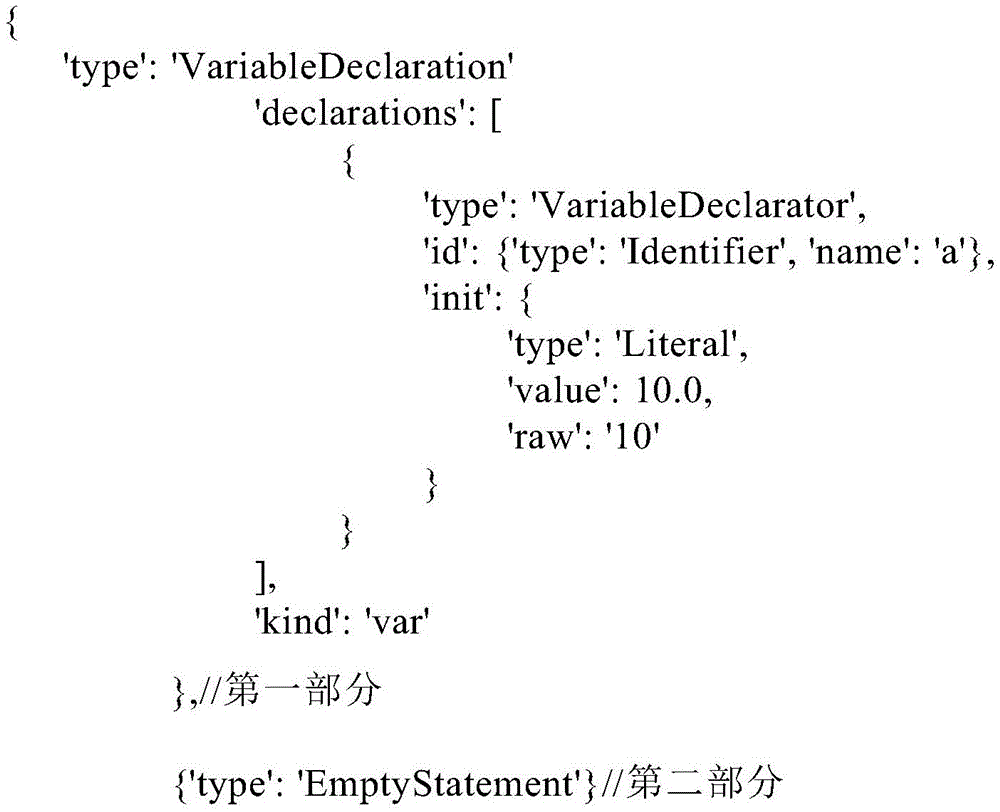
further, abstract data is generated from the data portion, wherein the abstract data comprises a first element for identifying a data type of the data portion and a second element describing a data content of the data portion. For example: the first element and the second element in the first part of data are as follows:

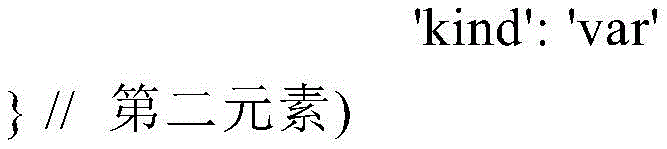
by determining the tree structure data as a plurality of data parts, operation can be performed on each block of data in the calculation process, and system resource occupation is saved. In addition, the code logic can be clearer, and the gene extraction is more accurate. The data is divided into the first element and the second element, so that the data type and the data content can be separated, the definition of code logic is further improved, and the accuracy and the efficiency are improved. In addition, the obtained abstract data can be stored in an array, and the data in the array can be operated in the step of determining the software genes.
Optionally, the segmenting the abstract data to generate a software gene corresponding to the script file includes: obtaining a second element of the abstract data; traversing the second element, and determining a minimum data unit contained in the second element and a call relation between the minimum data units, wherein the minimum data unit corresponds to a code segment in a fully executed or fully non-executed state; and generating a software gene according to the minimum data unit and the calling relation.
Specifically, in the operation of segmenting the abstract data to generate the software genes corresponding to the script file, the second element of the abstract data, that is, the data content of the data portion, is first acquired. Further, the second element is traversed, and a minimum data unit contained in the second element and a call relation between the minimum data units are determined, and the traversal algorithm may adopt an extent traversal algorithm, for example. The minimum data unit is a code segment corresponding to a completely executed or completely non-executed state, namely, the atomicity principle of the software gene is met. Each minimal data unit acts as a gene, while the entire second element is referred to as a genome. The calling relationship may be a reference or a dependent relationship between the codes. Finally, a software gene is generated according to the minimum data unit and the calling relationship. Thus, in this way, it can be ensured that the genes in the finally generated script conform to the characteristics of the software genes.
Optionally, the method further comprises: and determining the number corresponding to each minimum data unit, and representing the calling relationship among the minimum data units by using the numbers.
Specifically, the present embodiment further includes determining a number corresponding to the minimum data unit, and then representing the calling relationship between the numbers. Therefore, compared with direct code representation, the calling relation is more clear and concise by using the number representation.
Optionally, the method further comprises: determining the file type of the script file; and determining an extraction scheme adopted for generating the tree structure data according to the file type.
In particular, the script file may contain a variety of, for example: JavaScript, PHP, Visual Basic, batch bat, Python, etc., first preprocesses the script file to determine the type of the script file (e.g., Python type script file) before obtaining the code of the script file. Namely: for different types of script files, different syntax tree parsers will be assigned to parse the script (the file type detection module shown in FIG. 3 a). Where the type of file can be determined using the magic package. And then selecting an extraction scheme for generating tree structure data corresponding to the Python type to generate the tree structure data corresponding to the script. In addition, the extraction scheme is not limited to be determined by the file type in the process of selecting the extraction scheme, and the extraction scheme may also be determined by other file attributes, which is not specifically limited herein. Besides, the file type can be determined, the md5 value of the file can be determined, and the md5 value can be used as a file fingerprint for directly judging the maliciousness in the later software maliciousness judgment.
Optionally, the method further comprises: and carrying out hash calculation on the data content, and taking the calculated hash value as a component of the second element.
Specifically, in the technical solution of this embodiment, hash calculation is further performed on the data content, and then the calculated hash value is used as a component of the second element (corresponding to the hash value in the second element described above). A characteristic of the data content can be generated through Hash calculation, and then whether the script file is mutated or not can be judged through a Hash value when homology analysis is carried out.
Fig. 3b schematically shows a schematic diagram of the script software gene extraction device, and referring to fig. 3b, in specific implementation, script software data is stored into a storage medium in the device through an input interface. The script software gene extraction program runs in the processor, and the running data is stored in the memory. And outputting the data to the user through an output interface after the operation of the script software gene extraction program is finished.
Further, fig. 4a shows a schematic diagram of the overall flow of gene extraction, and referring to fig. 4a, first, a file input (script file) is performed. The file type is then parsed (determining the code contained in the file), and in this step it is also determined whether the script is a legitimate script, such as: the symbolic data structure of a PHP file is <? php? The grammar in python is strictly indented, whether the grammar of the file is correct or not is judged through legality judgment, and the gene extraction process is ended under the condition that the grammar of the script file is wrong. Further, tree structure data (AST) is generated from the analyzed code, abstract data is extracted from the tree structure data, and a gene block relationship (corresponding to the minimum data unit and the call relationship) included in the abstract data are extracted. Finally, the gene information is written into the software gene of the file generation script file.
FIG. 4b exemplarily shows a detailed flowchart of the step of generating the software gene, and referring to FIG. 4b, a metadata array (i.e., an array corresponding to the abstract data in the above step) is first input. Further, it is determined whether the array is empty, and a piece of data (i.e., the second element of each abstract data) is obtained from the array if the array is not empty. Further, traversing (breadth traversing) is performed on the second element, the minimum data unit and the corresponding number are determined, and the call relation is recorded. And finally, writing the gene data and the calling relation into a file to finish the step of generating the software gene.
Thus according to the first aspect of this embodiment, a data basis can be provided for software genetic testing of scripts.
In addition, according to the second aspect of the present embodiment, there is provided a method for testing a script file, a system for testing a software gene, and a flowchart of the method is shown in fig. 5, and referring to fig. 5, the method includes:
s502: acquiring a code recorded by a script file to be detected;
s504: generating a software gene corresponding to the script file according to the acquired code; and
s506: and detecting the software gene.
Specifically, in step S502, the detection system first obtains a code described in a script file to be detected. For example: the system intercepts a script and extracts all code from the script. Illustratively, a piece of code in the script file is "var a ═ 10; ".
Further, in step S504, a software gene corresponding to the script file is generated based on the acquired code. That is, the software genes in the script file are extracted from the code. The following are software genes corresponding to the code segment "var a ═ 10" in the script file, as follows:
1. in one embodiment, the outermost type is the omission of Program and is not shown as gene content, and the extracted gene content is as follows:
the first one is:
{‘type’:’VariableDeclaration’,‘declarations’:
[{‘type’:’VariableDeclarator,‘id’:
{‘type’:’Indentifer’,’name’:’a’},
‘init’:{‘type’:’Literal’,’value’:10.0,’raw’:’10’}}],’kind’:’var’}
a second bar:
{‘type’:‘EmptyStatement’}
2. in another specific example, the outermost layer is not a Program, but other properties, such as: if attribute TypeA, then all genes under TypeA should be:
first strip
{ ' type ': type A ', ' body ': F } (direct removal of content in body)
Second bar (first in body)
{‘type’:’VariableDeclaration’,‘declarations’:
[{‘type’:’VariableDeclarator,‘id’:
{‘type’:’Indentifer’,’name’:’a’},
‘init’:{‘type’:’Literal’,’value’:10.0,’raw’:’10’}}],’kind’:’var’}
Third bar (second position in body)
{‘type’:‘EmptyStatement’}
Finally, the software genes are detected in step S506, and the detection process of the script file is completed.
Thus, malicious code can be detected based on the extracted software genes. The technical effect of improving the identification precision of the malicious codes is achieved. The technical problem that malicious script identification technology is limited to code feature matching and cannot detect code logic calling relation in a script file in the prior art, and therefore malicious script identification accuracy is affected is solved.
Optionally, generating a software gene corresponding to the script file according to the acquired code includes: generating tree structure data corresponding to the code, wherein the tree structure data is used for describing the grammatical features of the code; and generating a software gene corresponding to the script file according to the tree structure data.
Specifically, in the operation of generating a software gene corresponding to a script file from an acquired code, tree structure data corresponding to the code is first generated, wherein the tree structure data is used to describe the syntactic characteristics of the code. For example, abstract syntax tree rules may be used to convert code in the script file into a tree structure. Further, a software gene corresponding to the script file is generated based on the tree structure data. Therefore, the script logic flow can be more intuitively embodied through the abstract syntax tree structure, and the gene content can be specified through the tree nodes.
Thus according to the second aspect of the present embodiment, malicious code can be detected based on the extracted software genes. The technical effect of improving the identification precision of the malicious codes is achieved. The technical problem that malicious script identification technology is limited to code feature matching and cannot detect code logic calling relation in a script file in the prior art, and therefore malicious script identification accuracy is affected is solved.
Further, referring to fig. 1, according to a third aspect of the present embodiment, there is provided a storage medium. The storage medium comprises a stored program, wherein the method of any of the above is performed by a processor when the program is run.
Thus, according to the present embodiment, malicious code is detected by extracting software genes in the script file and then detecting the malicious code according to the extracted software genes. The technical effect of improving the identification precision of the malicious codes is achieved. The technical problem that malicious script identification technology is limited to code feature matching and cannot detect code logic calling relation in a script file in the prior art, and therefore malicious script identification accuracy is affected is solved.
In addition, at present, application software developed based on a script language is increasing, and the number of corresponding vulnerabilities mainly based on scripts is also increasing. Code auditing is one of traditional methods for dealing with software bugs, and comprises manual auditing and automatic auditing, wherein the automatic auditing method is similar to a malicious script identification method, and code fragments which possibly generate bugs in software codes are scanned and counted. The traditional method can avoid the hole leakage risk to a little extent, but cannot process the hole leakage caused by a series of operations. According to the technical scheme, the problems can be well solved, after the genes are extracted from the software script, the gene segments related to the vulnerability are extracted, and the related vulnerability of the target code can be accurately scanned. In addition, the technical scheme of the embodiment not only reserves the characteristics of the malicious codes, but also contains the logical relationship among the malicious codes, and can judge the maliciousness and the homology of the unknown script.
It should be noted that, for simplicity of description, the above-mentioned method embodiments are described as a series of acts or combination of acts, but those skilled in the art will recognize that the present invention is not limited by the order of acts, as some steps may occur in other orders or concurrently in accordance with the invention. Further, those skilled in the art should also appreciate that the embodiments described in the specification are preferred embodiments and that the acts and modules referred to are not necessarily required by the invention.
Through the above description of the embodiments, those skilled in the art can clearly understand that the method according to the above embodiments can be implemented by software plus a necessary general hardware platform, and certainly can also be implemented by hardware, but the former is a better implementation mode in many cases. Based on such understanding, the technical solutions of the present invention may be embodied in the form of a software product, which is stored in a storage medium (e.g., ROM/RAM, magnetic disk, optical disk) and includes instructions for enabling a terminal device (e.g., a mobile phone, a computer, a server, or a network device) to execute the method according to the embodiments of the present invention.
Example 2
Fig. 6 shows an apparatus 600 for generating software genes of a script file according to the first aspect of the present embodiment, the apparatus 600 corresponding to the method according to the first aspect of the embodiment 1. Referring to fig. 6, the apparatus 600 includes: the first data acquisition module 610 is configured to acquire a code recorded in a script file to be detected; and a first gene generation module 620 for generating a software gene corresponding to the script file according to the acquired code.
Optionally, the first gene generation module 620 comprises: the structure generation submodule is used for generating tree structure data corresponding to the codes, wherein the tree structure data is used for describing grammatical features of the codes; and the gene generation submodule is used for generating a software gene corresponding to the script file according to the tree structure data.
Optionally, the structure generation submodule includes: a lexical analysis unit for performing lexical analysis on the code and determining a word set corresponding to the code, wherein the word set comprises a plurality of words constituting the code; and a syntax analysis unit that performs syntax analysis on the determined word set and generates tree structure data corresponding to the code.
Optionally, a gene generation submodule comprising: a data extraction unit for extracting abstract data for gene analysis from the tree structure data; and the gene generation unit is used for segmenting the abstract data to generate a software gene corresponding to the script file.
Optionally, the data extracting unit includes: a structure determining subunit configured to determine a data portion constituting a tree structure; and a data extraction subunit, configured to generate abstract data from the data portion, where the abstract data includes a first element for identifying a data type of the data portion and a second element describing a data content of the data portion.
Optionally, a gene generation unit comprising: a data acquisition subunit, configured to acquire a second element of the abstract data; the traversal subunit is used for traversing the second element and determining a minimum data unit contained in the second element and a call relation between the minimum data units, wherein the minimum data unit corresponds to a code segment in a completely executed or completely non-executed state; and the extraction subunit is used for generating the software gene according to the minimum data unit and the calling relation.
Optionally, the apparatus 600 further comprises: and the calling relation determining subunit is used for determining the number corresponding to each minimum data unit and indicating the calling relation among the minimum data units by using the numbers.
Optionally, the apparatus 600 further comprises: the file type determining module is used for determining the file type of the script file; and the scheme determining module is used for determining an extraction scheme adopted for generating the tree structure data according to the file type.
Optionally, the apparatus 600 further comprises: and the Hash calculation submodule is used for carrying out Hash calculation on the data content and taking the calculated Hash value as a component of the second element.
Furthermore, fig. 7 shows an apparatus 700 for testing a script file according to the second aspect of the present embodiment, the apparatus 700 corresponding to the method according to the second aspect of embodiment 1. Referring to fig. 7, the apparatus 700 includes: a second data obtaining module 710, configured to obtain a code recorded in a script file to be detected; a second gene generation module 720, configured to generate a software gene corresponding to the script file according to the obtained code; and a gene detection module 730 for detecting the software gene.
Optionally, the second gene generation module 720 comprises: the tree structure generation submodule is used for generating tree structure data corresponding to the codes, wherein the tree structure data is used for describing grammatical features of the codes; and the software gene generation submodule is used for generating software genes corresponding to the script file according to the tree structure data.
Thus, according to the present embodiment, malicious code is detected by extracting software genes in the script file and then detecting the malicious code according to the extracted software genes. The technical effect of improving the identification precision of the malicious codes is achieved. The technical problem that malicious script identification technology is limited to code feature matching and cannot detect code logic calling relation in a script file in the prior art, and therefore malicious script identification accuracy is affected is solved.
Example 3
Fig. 8 shows an apparatus 800 for generating software genes of a script file according to the first aspect of the present embodiment, the apparatus 800 corresponding to the method according to the first aspect of the embodiment 1. Referring to fig. 8, the apparatus 800 includes: a first processor 810; and a first memory 820 coupled to the first processor 810 for providing instructions to the first processor 810 to process the following process steps: acquiring a code recorded by a script file to be detected; and generating a software gene corresponding to the script file according to the acquired code.
Optionally, generating a software gene corresponding to the script file according to the acquired code includes: generating tree structure data corresponding to the code, wherein the tree structure data is used for describing the grammatical features of the code; and generating a software gene corresponding to the script file according to the tree structure data.
Optionally, generating tree structure data corresponding to the code, where the tree structure data is used to describe a syntactic characteristic of the code, including: performing lexical analysis on the codes, and determining a word set corresponding to the codes, wherein the word set comprises a plurality of words forming the codes; and carrying out syntactic analysis on the determined word set to generate tree structure data corresponding to the codes.
Optionally, generating a software gene corresponding to the script file according to the tree structure data includes: abstract data for gene analysis is extracted from the tree structure data; and segmenting the abstract data to generate software genes corresponding to the script files.
Optionally, extracting abstract data for gene analysis from the tree structure data includes: determining data parts constituting a tree structure; and generating abstract data from the data portion, wherein the abstract data comprises a first element for identifying a data type of the data portion and a second element describing a data content of the data portion.
Optionally, the segmenting the abstract data to generate a software gene corresponding to the script file includes: obtaining a second element of the abstract data; traversing the second element, and determining a minimum data unit contained in the second element and a call relation between the minimum data units, wherein the minimum data unit corresponds to a code segment in a fully executed or fully non-executed state; and generating a software gene according to the minimum data unit and the calling relation.
Optionally, the first memory 820 is further configured to provide the first processor 810 with instructions for processing the following processing steps: and determining the number corresponding to each minimum data unit, and representing the calling relationship among the minimum data units by using the numbers.
Optionally, the first memory 820 is further configured to provide the first processor 810 with instructions for processing the following processing steps: determining the file type of the script file; and determining an extraction scheme adopted for generating the tree structure data according to the file type.
Optionally, the first memory 820 is further configured to provide the first processor 810 with instructions for processing the following processing steps: and carrying out hash calculation on the data content, and taking the calculated hash value as a component of the second element.
Furthermore, fig. 9 shows an apparatus 900 for checking script files according to the second aspect of the present embodiment, the apparatus 900 corresponding to the method according to the second aspect of embodiment 1. Referring to fig. 9, the apparatus 900 includes: a second processor 910; and a second memory 920, coupled to the second processor 910, for providing instructions to the second processor 910 to process the following steps: acquiring a code recorded by a script file to be detected; generating a software gene corresponding to the script file according to the acquired code; and detecting the software gene.
Optionally, generating a software gene corresponding to the script file according to the acquired code includes: generating tree structure data corresponding to the code, wherein the tree structure data is used for describing the grammatical features of the code; and generating a software gene corresponding to the script file according to the tree structure data.
Thus, according to the present embodiment, malicious code is detected by extracting software genes in the script file and then detecting the malicious code according to the extracted software genes. The technical effect of improving the identification precision of the malicious codes is achieved. The technical problem that malicious script identification technology is limited to code feature matching and cannot detect code logic calling relation in a script file in the prior art, and therefore malicious script identification accuracy is affected is solved.
The above-mentioned serial numbers of the embodiments of the present invention are merely for description and do not represent the merits of the embodiments.
In the above embodiments of the present invention, the descriptions of the respective embodiments have respective emphasis, and for parts that are not described in detail in a certain embodiment, reference may be made to related descriptions of other embodiments.
In the embodiments provided in the present application, it should be understood that the disclosed technology can be implemented in other ways. The above-described embodiments of the apparatus are merely illustrative, and for example, the division of the units is only one type of division of logical functions, and there may be other divisions when actually implemented, for example, a plurality of units or components may be combined or may be integrated into another system, or some features may be omitted, or not executed. In addition, the shown or discussed mutual coupling or direct coupling or communication connection may be an indirect coupling or communication connection through some interfaces, units or modules, and may be in an electrical or other form.
The units described as separate parts may or may not be physically separate, and parts displayed as units may or may not be physical units, may be located in one place, or may be distributed on a plurality of network units. Some or all of the units can be selected according to actual needs to achieve the purpose of the solution of the embodiment.
In addition, functional units in the embodiments of the present invention may be integrated into one processing unit, or each unit may exist alone physically, or two or more units are integrated into one unit. The integrated unit can be realized in a form of hardware, and can also be realized in a form of a software functional unit.
The integrated unit, if implemented in the form of a software functional unit and sold or used as a stand-alone product, may be stored in a computer readable storage medium. Based on such understanding, the technical solution of the present invention may be embodied in the form of a software product, which is stored in a storage medium and includes instructions for causing a computer device (which may be a personal computer, a server, or a network device) to execute all or part of the steps of the method according to the embodiments of the present invention. And the aforementioned storage medium includes: a U-disk, a Read-Only Memory (ROM), a Random Access Memory (RAM), a removable hard disk, a magnetic disk, or an optical disk, which can store program codes.
The foregoing is only a preferred embodiment of the present invention, and it should be noted that, for those skilled in the art, various modifications and decorations can be made without departing from the principle of the present invention, and these modifications and decorations should also be regarded as the protection scope of the present invention.
Claims (10)
1. A method of generating a software gene of a script file, comprising:
acquiring a code recorded by a script file to be detected; and
and generating a software gene corresponding to the script file according to the acquired code.
2. The method of claim 1, wherein generating a software gene corresponding to the script file from the obtained code comprises:
generating tree structure data corresponding to the code, wherein the tree structure data is used for describing grammatical features of the code; and
and generating a software gene corresponding to the script file according to the tree structure data.
3. The method of claim 2, wherein generating tree structured data corresponding to the code comprises:
performing lexical analysis on the code, and determining a word set corresponding to the code, wherein the word set comprises a plurality of words forming the code; and
and carrying out syntactic analysis on the determined word set to generate the tree structure data corresponding to the codes.
4. The method according to claim 2, wherein generating a software gene corresponding to the script file from the tree structure data comprises:
extracting abstract data for gene analysis from the tree structure data; and
and segmenting the abstract data to generate a software gene corresponding to the script file.
5. The method of claim 4, wherein extracting abstract data from the tree structure data for genetic analysis comprises:
determining the data parts constituting the tree structure; and
generating the abstract data from the data portion, wherein the abstract data comprises a first element for identifying a data type of the data portion and a second element that describes a data content of the data portion.
6. The method of claim 5, wherein segmenting the abstract data to generate software genes corresponding to the script file comprises:
acquiring a second element of the abstract data;
traversing the second element, and determining a minimum data unit contained in the second element and a call relation between the minimum data units, wherein the minimum data unit corresponds to a code segment in a fully executed or fully non-executed state; and
and generating the software gene according to the minimum data unit and the calling relation.
7. The method of claim 2, further comprising:
determining the file type of the script file; and
and determining an extraction scheme adopted for generating the tree structure data according to the file type.
8. A method of detecting a script file, comprising:
acquiring a code recorded by a script file to be detected;
generating a software gene corresponding to the script file according to the acquired code; and
and detecting the software gene.
9. The method of claim 8, wherein generating a software gene corresponding to the script file based on the obtained code comprises:
generating tree structure data corresponding to the code, wherein the tree structure data is used for describing grammatical features of the code; and
and generating a software gene corresponding to the script file according to the tree structure data.
10. A storage medium comprising a stored program, wherein the method of any one of claims 1 to 9 is performed by a processor when the program is run.
Priority Applications (1)
| Application Number | Priority Date | Filing Date | Title |
|---|---|---|---|
| CN202010062677.3A CN111324892B (en) | 2020-01-19 | 2020-01-19 | Method, device and medium for generating software genes and script detection of script file |
Applications Claiming Priority (1)
| Application Number | Priority Date | Filing Date | Title |
|---|---|---|---|
| CN202010062677.3A CN111324892B (en) | 2020-01-19 | 2020-01-19 | Method, device and medium for generating software genes and script detection of script file |
Publications (2)
| Publication Number | Publication Date |
|---|---|
| CN111324892A true CN111324892A (en) | 2020-06-23 |
| CN111324892B CN111324892B (en) | 2023-09-19 |
Family
ID=71172839
Family Applications (1)
| Application Number | Title | Priority Date | Filing Date |
|---|---|---|---|
| CN202010062677.3A Active CN111324892B (en) | 2020-01-19 | 2020-01-19 | Method, device and medium for generating software genes and script detection of script file |
Country Status (1)
| Country | Link |
|---|---|
| CN (1) | CN111324892B (en) |
Cited By (4)
| Publication number | Priority date | Publication date | Assignee | Title |
|---|---|---|---|---|
| CN112699379A (en) * | 2020-12-31 | 2021-04-23 | 上海戎磐网络科技有限公司 | Firmware vulnerability scanning system and method based on software genes |
| CN113448605A (en) * | 2021-06-29 | 2021-09-28 | 北京高途云集教育科技有限公司 | Software updating method and device, electronic equipment and storage medium |
| CN114117440A (en) * | 2021-10-29 | 2022-03-01 | 北京长亭未来科技有限公司 | Script command vulnerability detection method, vulnerability scanner and storage medium |
| CN119276609A (en) * | 2024-11-08 | 2025-01-07 | 深圳前海翼联科技有限公司 | A network security pre-detection analysis method and system based on big data |
Citations (2)
| Publication number | Priority date | Publication date | Assignee | Title |
|---|---|---|---|---|
| US20120174227A1 (en) * | 2010-12-30 | 2012-07-05 | Kaspersky Lab Zao | System and Method for Detecting Unknown Malware |
| CN108171059A (en) * | 2017-12-26 | 2018-06-15 | 中国人民解放军战略支援部队信息工程大学 | Malicious Code Detection and recognition methods and device based on software gene |
-
2020
- 2020-01-19 CN CN202010062677.3A patent/CN111324892B/en active Active
Patent Citations (3)
| Publication number | Priority date | Publication date | Assignee | Title |
|---|---|---|---|---|
| US20120174227A1 (en) * | 2010-12-30 | 2012-07-05 | Kaspersky Lab Zao | System and Method for Detecting Unknown Malware |
| CN102592079A (en) * | 2010-12-30 | 2012-07-18 | 卡巴斯基实验室封闭式股份公司 | System and method for detecting unknown malware |
| CN108171059A (en) * | 2017-12-26 | 2018-06-15 | 中国人民解放军战略支援部队信息工程大学 | Malicious Code Detection and recognition methods and device based on software gene |
Non-Patent Citations (1)
| Title |
|---|
| 陈平;李敬明;沈桂芳;张平华;: "基于SVM的敏感权限Android恶意软件检测方法", no. 06 * |
Cited By (7)
| Publication number | Priority date | Publication date | Assignee | Title |
|---|---|---|---|---|
| CN112699379A (en) * | 2020-12-31 | 2021-04-23 | 上海戎磐网络科技有限公司 | Firmware vulnerability scanning system and method based on software genes |
| CN112699379B (en) * | 2020-12-31 | 2024-05-24 | 上海戎磐网络科技有限公司 | A firmware vulnerability scanning system and method based on software gene |
| CN113448605A (en) * | 2021-06-29 | 2021-09-28 | 北京高途云集教育科技有限公司 | Software updating method and device, electronic equipment and storage medium |
| CN113448605B (en) * | 2021-06-29 | 2024-02-09 | 北京高途云集教育科技有限公司 | Software updating method and device, electronic equipment and storage medium |
| CN114117440A (en) * | 2021-10-29 | 2022-03-01 | 北京长亭未来科技有限公司 | Script command vulnerability detection method, vulnerability scanner and storage medium |
| CN119276609A (en) * | 2024-11-08 | 2025-01-07 | 深圳前海翼联科技有限公司 | A network security pre-detection analysis method and system based on big data |
| CN119276609B (en) * | 2024-11-08 | 2025-05-23 | 深圳前海翼联科技有限公司 | Network security pre-detection analysis method and system based on big data |
Also Published As
| Publication number | Publication date |
|---|---|
| CN111324892B (en) | 2023-09-19 |
Similar Documents
| Publication | Publication Date | Title |
|---|---|---|
| Yu et al. | Deescvhunter: A deep learning-based framework for smart contract vulnerability detection | |
| CN107292170B (en) | Method, device and system for detecting SQL injection attack | |
| CN111324892B (en) | Method, device and medium for generating software genes and script detection of script file | |
| EP3819785A1 (en) | Feature word determining method, apparatus, and server | |
| US20170214704A1 (en) | Method and device for feature extraction | |
| CN108763928A (en) | A kind of open source software leak analysis method, apparatus and storage medium | |
| US11048798B2 (en) | Method for detecting libraries in program binaries | |
| CN110532176A (en) | A kind of formalization verification method, electronic device and the storage medium of intelligence contract | |
| CN110795069A (en) | Code analysis method, intelligent terminal and computer readable storage medium | |
| KR20120078018A (en) | System and method for detecting malwares in a file based on genetic map of the file | |
| CN113221032A (en) | Link risk detection method, device and storage medium | |
| CN106709350B (en) | Virus detection method and device | |
| CN112579937A (en) | Character highlight display method and device | |
| Feichtner et al. | Obfuscation-resilient code recognition in Android apps | |
| CN114357454A (en) | Binary executable file dependency library analysis method and device, electronic equipment and storage medium | |
| CN110245308B (en) | Image extraction method and device and terminal equipment | |
| CN109413450B (en) | Bullet screen data integrity verification method and device, terminal and storage medium | |
| CN118551384A (en) | WebShell detection method based on machine learning | |
| CN117056347A (en) | SQL statement permanent injection detection method, device, computer equipment and storage medium | |
| CN113111147A (en) | Text type identification method and device, electronic equipment and storage medium | |
| CN118245055A (en) | A method for detecting a script dead loop or a quasi-dead loop | |
| CN111258628B (en) | Rule file comparison method and device, readable storage medium and terminal equipment | |
| CN114254316A (en) | Software identification method and device based on software gene and storage medium | |
| CN109413506B (en) | Bullet screen data verification method and device, terminal and storage medium | |
| CN111104671B (en) | Application identification determining method and application detection method |
Legal Events
| Date | Code | Title | Description |
|---|---|---|---|
| PB01 | Publication | ||
| PB01 | Publication | ||
| SE01 | Entry into force of request for substantive examination | ||
| SE01 | Entry into force of request for substantive examination | ||
| GR01 | Patent grant | ||
| GR01 | Patent grant |