CN111310728A - Pedestrian re-identification system based on monitoring camera and wireless positioning - Google Patents
Pedestrian re-identification system based on monitoring camera and wireless positioning Download PDFInfo
- Publication number
- CN111310728A CN111310728A CN202010180502.2A CN202010180502A CN111310728A CN 111310728 A CN111310728 A CN 111310728A CN 202010180502 A CN202010180502 A CN 202010180502A CN 111310728 A CN111310728 A CN 111310728A
- Authority
- CN
- China
- Prior art keywords
- pedestrian
- track
- video sequence
- video
- affinity
- Prior art date
- Legal status (The legal status is an assumption and is not a legal conclusion. Google has not performed a legal analysis and makes no representation as to the accuracy of the status listed.)
- Granted
Links
Images


Classifications
-
- G—PHYSICS
- G06—COMPUTING OR CALCULATING; COUNTING
- G06V—IMAGE OR VIDEO RECOGNITION OR UNDERSTANDING
- G06V20/00—Scenes; Scene-specific elements
- G06V20/40—Scenes; Scene-specific elements in video content
- G06V20/41—Higher-level, semantic clustering, classification or understanding of video scenes, e.g. detection, labelling or Markovian modelling of sport events or news items
-
- G—PHYSICS
- G06—COMPUTING OR CALCULATING; COUNTING
- G06F—ELECTRIC DIGITAL DATA PROCESSING
- G06F16/00—Information retrieval; Database structures therefor; File system structures therefor
- G06F16/70—Information retrieval; Database structures therefor; File system structures therefor of video data
- G06F16/73—Querying
- G06F16/732—Query formulation
- G06F16/7328—Query by example, e.g. a complete video frame or video sequence
-
- G—PHYSICS
- G06—COMPUTING OR CALCULATING; COUNTING
- G06F—ELECTRIC DIGITAL DATA PROCESSING
- G06F16/00—Information retrieval; Database structures therefor; File system structures therefor
- G06F16/70—Information retrieval; Database structures therefor; File system structures therefor of video data
- G06F16/78—Retrieval characterised by using metadata, e.g. metadata not derived from the content or metadata generated manually
- G06F16/787—Retrieval characterised by using metadata, e.g. metadata not derived from the content or metadata generated manually using geographical or spatial information, e.g. location
-
- G—PHYSICS
- G06—COMPUTING OR CALCULATING; COUNTING
- G06V—IMAGE OR VIDEO RECOGNITION OR UNDERSTANDING
- G06V20/00—Scenes; Scene-specific elements
- G06V20/40—Scenes; Scene-specific elements in video content
- G06V20/46—Extracting features or characteristics from the video content, e.g. video fingerprints, representative shots or key frames
-
- G—PHYSICS
- G06—COMPUTING OR CALCULATING; COUNTING
- G06V—IMAGE OR VIDEO RECOGNITION OR UNDERSTANDING
- G06V40/00—Recognition of biometric, human-related or animal-related patterns in image or video data
- G06V40/10—Human or animal bodies, e.g. vehicle occupants or pedestrians; Body parts, e.g. hands
-
- H—ELECTRICITY
- H04—ELECTRIC COMMUNICATION TECHNIQUE
- H04N—PICTORIAL COMMUNICATION, e.g. TELEVISION
- H04N7/00—Television systems
- H04N7/18—Closed-circuit television [CCTV] systems, i.e. systems in which the video signal is not broadcast
Landscapes
- Engineering & Computer Science (AREA)
- Multimedia (AREA)
- Theoretical Computer Science (AREA)
- Physics & Mathematics (AREA)
- General Physics & Mathematics (AREA)
- Computational Linguistics (AREA)
- Databases & Information Systems (AREA)
- General Engineering & Computer Science (AREA)
- Data Mining & Analysis (AREA)
- Mathematical Physics (AREA)
- Software Systems (AREA)
- Human Computer Interaction (AREA)
- Signal Processing (AREA)
- Library & Information Science (AREA)
- Closed-Circuit Television Systems (AREA)
- Image Analysis (AREA)
- Traffic Control Systems (AREA)
Abstract
Description
技术领域technical field
本发明涉及行人重识别技术领域,尤其涉及一种基于监控相机和无线定位的行人重识别系统。The invention relates to the technical field of pedestrian re-identification, in particular to a pedestrian re-identification system based on surveillance cameras and wireless positioning.
背景技术Background technique
行人重识别旨在匹配不同相机下的行人。随着经济的发展,监控摄像机的覆盖范围越来越大,行人重识别的应用价值也越来越突出。借助行人重识别,我们可以寻找丢失的儿童,追踪嫌犯,安防布控等等。受此影响,近些年中,行人重识别也受到了越来越多研究者的关注。Pedestrian re-identification aims to match pedestrians under different cameras. With the development of the economy, the coverage of surveillance cameras has become larger and larger, and the application value of pedestrian re-identification has become more and more prominent. With pedestrian re-identification, we can find lost children, track suspects, deploy security, and more. Affected by this, in recent years, pedestrian re-identification has also received more and more attention from researchers.
因为摄像机架设的位置不同,相机的拍摄视角是不同的,即使拍到的是同一个人,但是其背景,光照,行人的姿势和角度都会有很大的差异。这些问题都给行人重识别算法带来了很多的困难。根据识别对象的来源分类,现有的行人重识别算法主要有两大类,一类是基于图像的,另一类是基于视频的。基于图像的行人重识别是给定一张行人的图片,算法需要在其他相机拍摄到的图片中找到相应的行人的图像。基于视频的行人重识别则是给定一个行人的视频序列,算法需找出其他相机下该行人的视频序列。单张图片所含有的信息量是有限的,容易受到遮挡、模糊和姿态变化的影响,而视频序列中,帧之间的信息是相互补充的,某一帧缺失的信息可以借助相邻帧中的信息恢复。所以相较于基于图片的行人重识别,基于视频的行人重识别有更多的信息可以利用,更有优势。Because the camera is set up in different positions, the camera's shooting angle is different. Even if the same person is photographed, the background, lighting, and the posture and angle of the pedestrian will be very different. These problems have brought many difficulties to the pedestrian re-identification algorithm. According to the classification of the source of the recognized object, the existing pedestrian re-identification algorithms mainly fall into two categories, one is image-based and the other is video-based. Image-based pedestrian re-identification is that given a picture of a pedestrian, the algorithm needs to find the corresponding image of the pedestrian in the pictures captured by other cameras. Video-based pedestrian re-identification is given a video sequence of a pedestrian, and the algorithm needs to find the video sequence of the pedestrian under other cameras. The amount of information contained in a single picture is limited, and it is easily affected by occlusion, blur, and posture changes. In a video sequence, the information between frames is complementary to each other. The missing information in a certain frame can be obtained by using the information in adjacent frames. information recovery. Therefore, compared with image-based pedestrian re-identification, video-based pedestrian re-identification has more information to use and has more advantages.
行人重识别算法主要包含两部分,一部分是特征的提取,另一部分是相似性的度量。不同行人之间可能会有相似的姿势甚至衣着,而相同的行人因视角不同可能会有很大的姿势差距,有区分性的、鲁棒的特征对解决这些问题至关重要。给定两张图片或者两个视频的特征表达之后,用有效的方法度量特征之间的相似性也是一个重要的研究内容。好的相似性度量方法能更充分地利用特征的区分性,提升匹配的准确率。The pedestrian re-identification algorithm mainly includes two parts, one part is feature extraction, and the other part is similarity measurement. Different pedestrians may have similar poses and even clothing, and the same pedestrians may have large pose gaps due to different perspectives. Discriminative and robust features are critical to solving these problems. Given the feature representation of two pictures or two videos, it is also an important research content to measure the similarity between features in an effective way. A good similarity measurement method can make full use of the distinguishability of features and improve the matching accuracy.
基于图片的行人重识别常用卷积神经网络(Convolutional Neural Network)来提取特征,而基于视频的行人重识别,在提取到视频帧的特征之后,还需要对帧特征进行融合以得到视频序列的特征表达。现有的融合视频帧特征的方法主要有循环神经网络(Recurrent Neural Network),估计帧质量并用质量值加权求和,利用3D卷积神经网络同时整合时空信息,利用局部显著性值加权融合等等。Image-based person re-identification often uses Convolutional Neural Network to extract features, while video-based person re-identification needs to fuse frame features after extracting video frame features to obtain video sequence features. Express. Existing methods for fusing video frame features mainly include Recurrent Neural Network, which estimates frame quality and uses the weighted summation of quality values, uses 3D convolutional neural network to simultaneously integrate spatiotemporal information, and uses local saliency value weighted fusion, etc. .
现有的行人重识别方案主要存在如下缺陷:1)现有的行人重识别算法容易受到遮挡、模糊和姿态变化的影响。当行人被一些物体遮挡住部分身体,或者监控相机分辨率较低以至于无法看清细节,或者因姿势变化而导致类内差异增大时,都会干扰算法的匹配精度。2)现有的行人重识别算法只能给定一个行人的图像或者视频,寻找其在其他相机下的数据,但是很多情况下,因相机分辨率较低以及角度问题,无法识别面部,故不能有效的知道行人的具体身份。3)现有的行人重识别算法的计算复杂度较高,而现在的城市监控网络中,监控视频数据量十分庞大,在这么多视频数据中直接搜寻行人需要大量的计算资源。The existing pedestrian re-identification schemes mainly have the following defects: 1) The existing pedestrian re-identification algorithms are easily affected by occlusion, blur and pose changes. When pedestrians are partially occluded by some objects, or when the resolution of the surveillance camera is so low that details cannot be seen clearly, or when the intra-class variance increases due to pose changes, it will interfere with the matching accuracy of the algorithm. 2) The existing pedestrian re-identification algorithm can only give an image or video of a pedestrian to find its data under other cameras. However, in many cases, due to the low resolution of the camera and the angle problem, the face cannot be recognized, so it cannot be used. Effectively know the specific identity of pedestrians. 3) The computational complexity of the existing pedestrian re-identification algorithm is high, and in the current urban surveillance network, the amount of surveillance video data is very large, and it requires a lot of computing resources to directly search for pedestrians in so many video data.
发明内容SUMMARY OF THE INVENTION
本发明的目的是提供一种基于监控相机和无线定位的行人重识别系统,不仅能提升传统行人重识别的准确率,同时能匹配行人的无线信号以进一步得到其具体的身份信息。The purpose of the present invention is to provide a pedestrian re-identification system based on surveillance cameras and wireless positioning, which can not only improve the accuracy of traditional pedestrian re-identification, but also match the wireless signals of pedestrians to further obtain their specific identity information.
本发明的目的是通过以下技术方案实现的:The purpose of this invention is to realize through the following technical solutions:
一种基于监控相机和无线定位的行人重识别系统,包括:A pedestrian re-identification system based on surveillance cameras and wireless positioning, including:
定位标注单元,用于对监控区域内的场景进行经纬度标注;The positioning and labeling unit is used to label the latitude and longitude of the scene in the monitoring area;
行人视频序列与视觉轨迹提取单元,用于从摄像机拍摄的监控区域内的视频中提取出行人视频序列,并根据视频序列中标注的经纬度,提取相应的视觉轨迹;The pedestrian video sequence and visual trajectory extraction unit is used to extract the pedestrian video sequence from the video in the monitoring area captured by the camera, and extract the corresponding visual trajectory according to the longitude and latitude marked in the video sequence;
无线定位轨迹获取单元,用于记录监控区域内移动终端的运动轨迹,获得对应的无线定位轨迹;A wireless positioning track acquisition unit, used to record the movement track of the mobile terminal in the monitoring area, and obtain the corresponding wireless positioning track;
视频特征提取器,用于从行人视频序列中提取出视频特征;Video feature extractor for extracting video features from pedestrian video sequences;
循环亲和度传播单元,用于利用视频特征计算待查询的行人视频序列与数据库中每一行人视频序列之间的视觉亲和度,以及利用待查询的行人视频序列对应的视觉轨迹与每一无线定位轨迹的距离计算对应的轨迹亲和度,并通过融合两种亲和度实现两种亲和度的循环更新;The loop affinity propagation unit is used to calculate the visual affinity between the pedestrian video sequence to be queried and each pedestrian video sequence in the database by using the video features, and use the visual trajectory corresponding to the pedestrian video sequence to be queried to associate with each pedestrian video sequence. The distance of the wireless positioning track calculates the corresponding track affinity, and realizes the cyclic update of the two affinities by fusing the two affinities;
行人重识别单元,利用最终更新得到的视觉亲和度与轨迹亲和度进行行人重识别。The pedestrian re-identification unit uses the visual affinity and trajectory affinity obtained by the final update to perform pedestrian re-identification.
由上述本发明提供的技术方案可以看出,通过对相机拍摄的场景进行经纬度标注,将无线定位与行人重识别结合起来,构成新的行人重识别系统,系统中利用循环亲和度传播单元,视觉信息与无线定位信息不断传播融合,互相提升,系统不仅能提升传统行人重识别的准确率,同时能匹配行人的无线信号以进一步得到其具体的身份信息;此外,在得到行人的无线信息身份后,便可直接在其无线信号路径上进行搜索,极大地降低了搜索的复杂度。It can be seen from the technical solution provided by the present invention that, by marking the latitude and longitude of the scene captured by the camera, wireless positioning and pedestrian re-identification are combined to form a new pedestrian re-identification system. Visual information and wireless positioning information are continuously disseminated and integrated to improve each other. The system can not only improve the accuracy of traditional pedestrian re-identification, but also match the wireless signal of pedestrians to further obtain their specific identity information; in addition, after obtaining the wireless information identity of pedestrians After that, the search can be performed directly on its wireless signal path, which greatly reduces the complexity of the search.
附图说明Description of drawings
为了更清楚地说明本发明实施例的技术方案,下面将对实施例描述中所需要使用的附图作简单地介绍,显而易见地,下面描述中的附图仅仅是本发明的一些实施例,对于本领域的普通技术人员来讲,在不付出创造性劳动的前提下,还可以根据这些附图获得其他附图。In order to illustrate the technical solutions of the embodiments of the present invention more clearly, the following briefly introduces the accompanying drawings used in the description of the embodiments. Obviously, the drawings in the following description are only some embodiments of the present invention. For those of ordinary skill in the art, other drawings can also be obtained from these drawings without any creative effort.
图1为本发明实施例提供的一种基于监控相机和无线定位的行人重识别系统的示意图;1 is a schematic diagram of a pedestrian re-identification system based on surveillance cameras and wireless positioning according to an embodiment of the present invention;
图2为本发明实施例提供的监控区域内摄像机架设位置示意图;2 is a schematic diagram of a camera erection position in a monitoring area according to an embodiment of the present invention;
图3为本发明实施例提供的6个摄像机实际拍摄范围的示意图;3 is a schematic diagram of an actual shooting range of six cameras provided by an embodiment of the present invention;
图4为本发明实施例提供的视觉轨迹与无线定位轨迹图;FIG. 4 is a visual trajectory and a wireless positioning trajectory diagram provided by an embodiment of the present invention;
图5为本发明实施例提供的视频特征提取器的模型框图;5 is a model block diagram of a video feature extractor provided by an embodiment of the present invention;
图6为本发明实施例提供的视觉亲和度更新单元中的信息传播图;Fig. 6 is the information dissemination diagram in the visual affinity updating unit provided by the embodiment of the present invention;
图7为本发明实施例提供的轨迹亲和度更新单元中的信息传播图;FIG. 7 is an information propagation diagram in a trajectory affinity update unit provided by an embodiment of the present invention;
图8为本发明实施例提供的循环亲和度更新单元的结构图。FIG. 8 is a structural diagram of a cyclic affinity update unit provided by an embodiment of the present invention.
具体实施方式Detailed ways
下面结合本发明实施例中的附图,对本发明实施例中的技术方案进行清楚、完整地描述,显然,所描述的实施例仅仅是本发明一部分实施例,而不是全部的实施例。基于本发明的实施例,本领域普通技术人员在没有做出创造性劳动前提下所获得的所有其他实施例,都属于本发明的保护范围。The technical solutions in the embodiments of the present invention will be clearly and completely described below with reference to the drawings in the embodiments of the present invention. Obviously, the described embodiments are only a part of the embodiments of the present invention, rather than all the embodiments. Based on the embodiments of the present invention, all other embodiments obtained by those of ordinary skill in the art without creative work fall within the protection scope of the present invention.
本发明实施例提供一种基于监控相机和无线定位的行人重识别系统,在寻找行人时,将多模态的信息相互融合,利用无线定位信息纠正一些因为遮挡、模糊和姿态变化引起的误匹配,同时又能获取行人的具体身份。在得到行人的无线信息身份后,便可直接在其无线信号路径上进行搜索,极大地降低了搜索的复杂度。The embodiments of the present invention provide a pedestrian re-identification system based on surveillance cameras and wireless positioning. When looking for pedestrians, multi-modal information is fused with each other, and the wireless positioning information is used to correct some mismatches caused by occlusion, blur, and attitude changes. , and at the same time can obtain the specific identity of the pedestrian. After obtaining the wireless information identity of the pedestrian, the search can be carried out directly on the wireless signal path, which greatly reduces the complexity of the search.
如图1所示为基于监控相机和无线定位的行人重识别系统的示意图,其主要包括:Figure 1 is a schematic diagram of a pedestrian re-identification system based on surveillance cameras and wireless positioning, which mainly includes:
1、定位标注单元,用于对监控区域内的场景进行经纬度标注。1. The positioning and labeling unit is used to label the latitude and longitude of the scene in the monitoring area.
本发明实施例中,所述定位标注单元,利用GPS定位仪器监控区域内的场景进行网格定位,从而获得每一视频帧中网格点对应像素的经纬度坐标,再通过近邻差值计算出每个像素点的经纬度,完成经纬度标注。In the embodiment of the present invention, the positioning and labeling unit uses the scene in the monitoring area of the GPS positioning instrument to perform grid positioning, so as to obtain the latitude and longitude coordinates of the pixels corresponding to the grid points in each video frame, and then calculate each The longitude and latitude of each pixel point, complete the longitude and latitude labeling.
如图2所示,为监控区域内摄像机架设位置示意图,图中数字为摄像机编号,对应的区域为相应摄像机的拍摄范围。As shown in Figure 2, it is a schematic diagram of the erection position of the cameras in the monitoring area. The numbers in the figure are the camera numbers, and the corresponding areas are the shooting ranges of the corresponding cameras.
如图3所示,为每个摄像机实际拍摄范围的示意图,图中的黑点即为经纬度标记的网格点,基于这些网格点可以差值得到整个图每个像素点的经纬度坐标。As shown in Figure 3, it is a schematic diagram of the actual shooting range of each camera. The black dots in the figure are grid points marked by latitude and longitude. Based on these grid points, the latitude and longitude coordinates of each pixel in the entire image can be obtained by difference.
2、行人视频序列与视觉轨迹提取单元,用于从摄像机拍摄的监控区域内的视频中提取出行人视频序列,并根据视频序列中标注的经纬度,提取相应的视觉轨迹。2. The pedestrian video sequence and visual trajectory extraction unit is used to extract the pedestrian video sequence from the video in the monitoring area captured by the camera, and extract the corresponding visual trajectory according to the longitude and latitude marked in the video sequence.
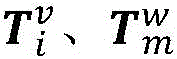
本发明实施例中,所述行人视频序列与视觉轨迹提取单元,利用跟踪算法(可通过现有算法实现)从摄像机拍摄的监控区域内的视频中提取出行人视频序列V;对于一个视频帧中的行人边界框,通过边界框底部中心位置所对应的像素点的经纬度来得到行人在物理世界中的位置,这样,对于一个行人视频序列V,能够得到相应的经纬度轨迹,再经过卡尔曼滤波降低噪声的影响,得到最终的视觉轨迹Tv。,每一个视觉轨迹是由一系列经纬度坐标点构成的集合,记录了行人的位置随时间的变化。In the embodiment of the present invention, the pedestrian video sequence and visual trajectory extraction unit uses a tracking algorithm (which can be implemented by existing algorithms) to extract the pedestrian video sequence V from the video in the monitoring area captured by the camera; The pedestrian bounding box is obtained by using the longitude and latitude of the pixel corresponding to the bottom center of the bounding box to obtain the pedestrian's position in the physical world. In this way, for a pedestrian video sequence V, the corresponding longitude and latitude trajectory can be obtained, and then reduced by Kalman filtering. The influence of noise is obtained to obtain the final visual trajectory T v . , each visual track is a collection of a series of latitude and longitude coordinate points, which records the change of the pedestrian's position over time.
后文所涉及的待查询的行人视频序列、以及数据库中每一行人视频序列都采用上述方式获得,同时,也会提取对应的视觉轨迹。The pedestrian video sequence to be queried and each pedestrian video sequence in the database involved in the following are obtained in the above manner, and at the same time, the corresponding visual track is also extracted.
3、无线定位轨迹获取单元,用于记录监控区域内移动终端的运动轨迹,获得对应的无线定位轨迹。3. The wireless positioning track obtaining unit is used to record the movement track of the mobile terminal in the monitoring area and obtain the corresponding wireless positioning track.
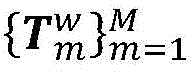
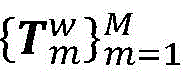
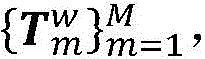
本发明实施例中,所述无线定位轨迹获取单元,通过基站定位、GPS定位、或者wifi定位方式记录每一个移动终端的运动轨迹;得到M个基于无线定位的经纬度轨迹

图4为视觉轨迹与无线定位轨迹图。视觉轨迹为较短的虚线线段,无线定位轨迹为较长的实线线段。Figure 4 is a diagram of the visual track and the wireless positioning track. The visual track is a short dotted line segment, and the wireless positioning track is a long solid line segment.
4、视频特征提取器,用于从行人视频序列中提取出视频特征。4. A video feature extractor for extracting video features from pedestrian video sequences.
通常情况下,提取出行人视频序列下,可以从中随机选择T个连续视频帧组成一个视频短序列,对于一个批次的数据,会随机选择P个行人,每个行人挑选K个视频短序列。Under normal circumstances, when extracting pedestrian video sequences, T consecutive video frames can be randomly selected to form a short video sequence. For a batch of data, P pedestrians are randomly selected, and each pedestrian selects K short video sequences.
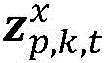
如图5所示,为视频特征提取器的模型框图,其输入为一系列的视频帧。对于第p个行人的第k个视频中的第t帧图片Vr,k,t,将其送入2维卷积神经网络(CNN),再经过一个全局平均池化(Pooling)后得到特征表达xr,k,t。对于行人视频序列,其帧特征的平均特征作为视频的特征表达:As shown in Figure 5, it is a model block diagram of a video feature extractor, and its input is a series of video frames. For the t-th frame picture V r,k,t in the k-th video of the p-th pedestrian, send it to a 2-dimensional convolutional neural network (CNN), and then obtain features after a global average pooling (Pooling) Express x r,k,t . For a pedestrian video sequence, the average feature of its frame features is used as the feature representation of the video:
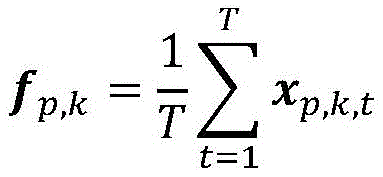
其中,xp,k,t表示第p个行人的第k个视频中的第t帧图片Vr,k,t的特征表达,T表示行人视频序列中视频帧数目。Among them, x p, k, t represents the feature expression of the t-th frame picture V r, k, t in the k-th video of the p-th pedestrian, and T represents the number of video frames in the pedestrian video sequence.
所述视频特征提取器需要预先训练,训练数据集包含了P个行人的视频序列集,每一个行人的视频序列集包含了K个视频序列。The video feature extractor needs to be pre-trained, the training data set contains P video sequence sets of pedestrians, and each pedestrian video sequence set contains K video sequences.
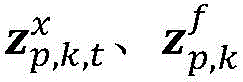
训练阶段,对于第p个行人,将第k个视频中的第t帧图片Vr,k,t的特征表达xp,k,t,以及视频的特征表达fp,k经过同一个批归一化(Batch Normalization,BN)、不同的全连接层(Fully Connected Layer,FC)后得到
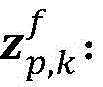

其中,FCx为处理视频帧特征表达xp,k,t时用到的全连接层,FCf为处理视频的特征表达fp,k时用到的全连接层,BN为共享的批归一化层;Among them, FC x is the fully connected layer used to process the feature expression x p, k, t of the video frame, FC f is the fully connected layer used to process the feature expression f p, k of the video, and BN is the shared batch regression One layer;
视频特征提取器整体的优化目标是:The overall optimization goal of the video feature extractor is:
L=Lx+Lf×(1-λ)+λ×Lkl+Lt L=L x +L f ×(1-λ)+λ×L kl +L t
其中,λ为设定的比例参数,Lx、Lf对应为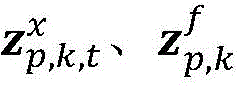

其中,τ为退火参数,KL(.)为KL散度函数。where τ is the annealing parameter and KL(.) is the KL divergence function.
5、循环亲和度传播单元,用于利用视频特征计算待查询的行人视频序列与数据库中每一行人视频序列之间的视觉亲和度,以及利用待查询的行人视频序列对应的视觉轨迹与每一无线定位轨迹的距离计算对应的轨迹亲和度,并通过融合两种亲和度实现两种亲和度的循环更新。5. The cyclic affinity propagation unit is used to calculate the visual affinity between the pedestrian video sequence to be queried and each pedestrian video sequence in the database by using the video features, and use the visual trajectory corresponding to the pedestrian video sequence to be queried to be queried. The distance of each wireless positioning track calculates the corresponding track affinity, and realizes the cyclic update of the two affinities by fusing the two affinities.
所述循环亲和度传播单元主要包括:1)视觉亲和度更新单元,利用视频特征计算待查询的行人视频序列与数据库中每一行人视频序列之间的视觉亲和度,并利用待查询的行人视频序列的视觉轨迹与无线定位轨迹之间的距离,来更新相应视频序列之间的视觉亲和度。2)轨迹亲和度更新单元,用于根据待查询的行人视频序列的视觉轨迹与无线定位轨迹之间距离计算轨迹亲和度,并根据待查询的行人视频序列与其他行人视频序列的视觉亲和度,来更新待查询的行人视频序列的视觉轨迹与无线定位轨迹之间距离,进而更新轨迹亲和度。The cycle affinity propagation unit mainly includes: 1) a visual affinity update unit, which uses the video features to calculate the visual affinity between the pedestrian video sequence to be queried and each pedestrian video sequence in the database, and uses the video feature to calculate the visual affinity between the pedestrian video sequence to be queried and the video sequence of each pedestrian in the database. The distance between the visual trajectory of the pedestrian video sequence and the wireless positioning trajectory is used to update the visual affinity between the corresponding video sequences. 2) The track affinity updating unit is used to calculate the track affinity according to the distance between the visual track of the pedestrian video sequence to be queried and the wireless positioning track, and according to the visual affinity of the pedestrian video sequence to be queried and other pedestrian video sequences; and degree to update the distance between the visual track of the pedestrian video sequence to be queried and the wireless positioning track, and then update the track affinity.
两种亲和度的计算方式如下:The two affinities are calculated as follows:
1)计算视觉亲和度。1) Calculate visual affinity.
假设数据集中共有N个视频(与前文训练数据集的形式相同,包含了多个行人的视频序列集,每一个行人的视频序列集包含了多个视频序列),会分别得到其视频特征表达,并计算待查询的行人视频序列与数据库中每一行人视频序列的视频特征表达之间的余弦相似度作为其亲和度,得到亲和度矩阵S。亲和度矩阵S中的元素Si,j表示待查询的行人视频序列Vi与数据库中行人视频序列Vj的视觉亲和度,计算公式为:Assuming that there are a total of N videos in the data set (the same form as the previous training data set, including video sequence sets of multiple pedestrians, each pedestrian video sequence set includes multiple video sequences), its video feature expressions will be obtained respectively, And calculate the cosine similarity between the pedestrian video sequence to be queried and the video feature expression of each pedestrian video sequence in the database as its affinity, and obtain the affinity matrix S. The element S i,j in the affinity matrix S represents the visual affinity between the pedestrian video sequence V i to be queried and the pedestrian video sequence V j in the database, and the calculation formula is:
Si,j=Cos(fi,fj)S i,j =Cos(f i ,f j )
其中,Cos(.)为余弦相似度函数;fi、fj对应的表示待查询的行人视频序列Vi、数据库中行人视频序列Vj的视觉特征。Among them, Cos(.) is a cosine similarity function; f i and f j correspond to the visual features of the pedestrian video sequence V i to be queried and the pedestrian video sequence V j in the database.
2)计算轨迹亲和度。2) Calculate the trajectory affinity.
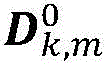
首先,计算待查询的行人视频序列Vi对应的视觉轨迹



其中,d(.)为欧氏距离函数。Among them, d(.) is the Euclidean distance function.
对于两个轨迹,计算时间戳相同的点之间的欧氏距离,以这些点的欧氏距离的均值作为两个轨迹之间的距离;当两个轨迹没有时间戳相同的点时,距离定义为无穷大;For two trajectories, calculate the Euclidean distance between points with the same timestamp, and use the mean of the Euclidean distances of these points as the distance between the two trajectories; when the two trajectories do not have points with the same timestamp, the distance is defined as is infinite;
然后,根据轨迹距离计算两个轨迹的亲和度为:Then, the affinity of the two trajectories is calculated according to the trajectory distance as:

亲和度越高,表示两个轨迹越匹配。The higher the affinity, the more matched the two trajectories are.
两种亲和度的更新方式如下:The two affinities are updated as follows:
1)更新视觉亲和度。1) Update visual affinity.
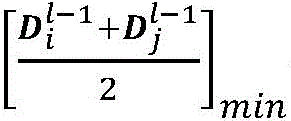
计算待查询的行人视频序列Vi的视觉轨迹

如果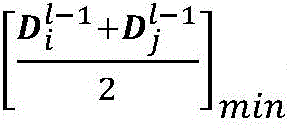
借由轨迹距离更新两个行人视频序列的视觉亲和度:Update the visual affinities of two pedestrian video sequences by the trajectory distance:

其中,

如图6所示,为视觉亲和度更新单元中的信息传播图,原始的视觉亲和度会借助轨迹信息进行更新。As shown in Figure 6, which is the information propagation diagram in the visual affinity update unit, the original visual affinity will be updated with the help of trajectory information.
2)更新轨迹亲和度。2) Update the track affinity.
对于待查询的行人视频序列Vi对应的视觉轨迹


其中,


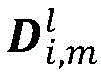


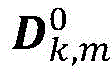


根据更新得到的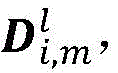

如图7所示,为轨迹亲和度更新单元中的信息传播图。原始的轨迹亲和度会借助视觉信息进行更新。As shown in Figure 7, it is the information propagation diagram in the trajectory affinity update unit. The original trajectory affinity is updated with visual information.
如图8所示,为循环亲和度更新单元的结构图。图6~图8中,符号“/”表示倒数运算,符号“×”表示乘法运算,符号“+”表示加法运算,S与Q之间曲线箭头指向横线箭头表示信息融合。As shown in FIG. 8 , it is a structural diagram of the cyclic affinity update unit. In Figures 6 to 8, the symbol "/" represents the reciprocal operation, the symbol "x" represents the multiplication operation, the symbol "+" represents the addition operation, and the curved arrow between S and Q points to the horizontal arrow to represent information fusion.
6、行人重识别单元,利用最终更新得到的视觉亲和度与轨迹亲和度进行行人重识别。6. The pedestrian re-identification unit uses the visual affinity and trajectory affinity obtained by the final update to perform pedestrian re-identification.
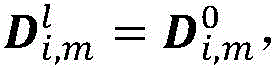
给定一个待查询的行人视频序列Vi,经过循环亲和度更新单元更新L次后(L的具体数值可根据情况自行设定),获得更新结果


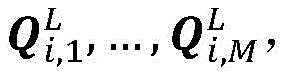


至此,给定一个待查询的行人视频序列Vi后,便能在数据库中的找到对应的视频序列和其对应的无线定位轨迹。根据无线定位轨迹对应的身份信息,我们便可以了解到此人的身份。在后续的跟踪检索时,我们便可以直接由此无线定位轨迹附近的摄像机拍摄的视频构建数据库并通过我们的算法检索视频。这种策略会更加节省计算开销,避免了搜索整个城市范围的监控数据。So far, given a pedestrian video sequence V i to be queried, the corresponding video sequence and its corresponding wireless positioning track can be found in the database. According to the identity information corresponding to the wireless positioning track, we can know the identity of the person. In the subsequent tracking retrieval, we can directly construct a database of videos captured by cameras near this wireless positioning track and retrieve videos through our algorithm. This strategy saves more computational overhead and avoids searching for city-wide surveillance data.
通过以上的实施方式的描述,本领域的技术人员可以清楚地了解到上述实施例可以通过软件实现,也可以借助软件加必要的通用硬件平台的方式来实现。基于这样的理解,上述实施例的技术方案可以以软件产品的形式体现出来,该软件产品可以存储在一个非易失性存储介质(可以是CD-ROM,U盘,移动硬盘等)中,包括若干指令用以使得一台计算机设备(可以是个人计算机,服务器,或者网络设备等)执行本发明各个实施例所述的方法。From the description of the above embodiments, those skilled in the art can clearly understand that the above embodiments can be implemented by software or by means of software plus a necessary general hardware platform. Based on this understanding, the technical solutions of the above embodiments may be embodied in the form of software products, and the software products may be stored in a non-volatile storage medium (which may be CD-ROM, U disk, mobile hard disk, etc.), including Several instructions are used to cause a computer device (which may be a personal computer, a server, or a network device, etc.) to execute the methods described in various embodiments of the present invention.
所属领域的技术人员可以清楚地了解到,为描述的方便和简洁,仅以上述各功能模块的划分进行举例说明,实际应用中,可以根据需要而将上述功能分配由不同的功能模块完成,即将系统的内部结构划分成不同的功能模块,以完成以上描述的全部或者部分功能。Those skilled in the art can clearly understand that, for the convenience and conciseness of the description, only the division of the above-mentioned functional modules is used for illustration. In practical applications, the above-mentioned functions can be allocated to different functional modules as required. The internal structure of the system is divided into different functional modules to complete all or part of the functions described above.
以上所述,仅为本发明较佳的具体实施方式,但本发明的保护范围并不局限于此,任何熟悉本技术领域的技术人员在本发明披露的技术范围内,可轻易想到的变化或替换,都应涵盖在本发明的保护范围之内。因此,本发明的保护范围应该以权利要求书的保护范围为准。The above description is only a preferred embodiment of the present invention, but the protection scope of the present invention is not limited to this. Substitutions should be covered within the protection scope of the present invention. Therefore, the protection scope of the present invention should be based on the protection scope of the claims.
Claims (10)


















Priority Applications (1)
| Application Number | Priority Date | Filing Date | Title |
|---|---|---|---|
| CN202010180502.2A CN111310728B (en) | 2020-03-16 | 2020-03-16 | Pedestrian re-identification system based on monitoring camera and wireless positioning |
Applications Claiming Priority (1)
| Application Number | Priority Date | Filing Date | Title |
|---|---|---|---|
| CN202010180502.2A CN111310728B (en) | 2020-03-16 | 2020-03-16 | Pedestrian re-identification system based on monitoring camera and wireless positioning |
Publications (2)
| Publication Number | Publication Date |
|---|---|
| CN111310728A true CN111310728A (en) | 2020-06-19 |
| CN111310728B CN111310728B (en) | 2022-07-15 |
Family
ID=71158708
Family Applications (1)
| Application Number | Title | Priority Date | Filing Date |
|---|---|---|---|
| CN202010180502.2A Active CN111310728B (en) | 2020-03-16 | 2020-03-16 | Pedestrian re-identification system based on monitoring camera and wireless positioning |
Country Status (1)
| Country | Link |
|---|---|
| CN (1) | CN111310728B (en) |
Cited By (7)
| Publication number | Priority date | Publication date | Assignee | Title |
|---|---|---|---|---|
| CN112507853A (en) * | 2020-12-02 | 2021-03-16 | 西北工业大学 | Cross-mode pedestrian re-identification method based on mutual attention mechanism |
| CN112818787A (en) * | 2021-01-23 | 2021-05-18 | 福州视驰科技有限公司 | Multi-target tracking method fusing convolutional neural network and feature similarity learning |
| CN113361392A (en) * | 2021-06-04 | 2021-09-07 | 中国科学技术大学 | Unsupervised multi-mode pedestrian re-identification method based on camera and wireless positioning |
| JP2022082493A (en) * | 2020-11-23 | 2022-06-02 | 同▲済▼大学 | Pedestrian re-identification method for random shielding recovery based on noise channels |
| CN114612521A (en) * | 2022-03-22 | 2022-06-10 | 中国科学技术大学 | A multi-target multi-camera tracking method, system, device and storage medium |
| WO2022252519A1 (en) * | 2021-05-31 | 2022-12-08 | 深圳市商汤科技有限公司 | Image processing method and apparatus, terminal, medium, and program |
| CN117037057A (en) * | 2023-07-19 | 2023-11-10 | 中电莱斯信息系统有限公司 | A tracking system based on pedestrian re-identification and hierarchical search strategy |
Citations (5)
| Publication number | Priority date | Publication date | Assignee | Title |
|---|---|---|---|---|
| US20170078626A1 (en) * | 2015-09-16 | 2017-03-16 | Microsoft Technology Licensing, Llc | Bandwidth efficient video surveillance system |
| CN109697391A (en) * | 2017-10-23 | 2019-04-30 | 北京京东尚科信息技术有限公司 | Personage knows method for distinguishing, system and terminal device again in closing place |
| CN110110601A (en) * | 2019-04-04 | 2019-08-09 | 深圳久凌软件技术有限公司 | Video pedestrian weight recognizer and device based on multi-space attention model |
| CN110232330A (en) * | 2019-05-23 | 2019-09-13 | 复钧智能科技(苏州)有限公司 | A kind of recognition methods again of the pedestrian based on video detection |
| CN110796040A (en) * | 2019-10-15 | 2020-02-14 | 武汉大学 | Pedestrian identity recognition method based on multivariate spatial trajectory correlation |
-
2020
- 2020-03-16 CN CN202010180502.2A patent/CN111310728B/en active Active
Patent Citations (5)
| Publication number | Priority date | Publication date | Assignee | Title |
|---|---|---|---|---|
| US20170078626A1 (en) * | 2015-09-16 | 2017-03-16 | Microsoft Technology Licensing, Llc | Bandwidth efficient video surveillance system |
| CN109697391A (en) * | 2017-10-23 | 2019-04-30 | 北京京东尚科信息技术有限公司 | Personage knows method for distinguishing, system and terminal device again in closing place |
| CN110110601A (en) * | 2019-04-04 | 2019-08-09 | 深圳久凌软件技术有限公司 | Video pedestrian weight recognizer and device based on multi-space attention model |
| CN110232330A (en) * | 2019-05-23 | 2019-09-13 | 复钧智能科技(苏州)有限公司 | A kind of recognition methods again of the pedestrian based on video detection |
| CN110796040A (en) * | 2019-10-15 | 2020-02-14 | 武汉大学 | Pedestrian identity recognition method based on multivariate spatial trajectory correlation |
Non-Patent Citations (2)
| Title |
|---|
| THUNWA SATTRUPAI等: "Deep Trajectory Based Gait Recognition for Human Re-identification", 《TENCON 2018 - 2018 IEEE REGION 10 CONFERENCE》 * |
| 彭志勇: "智能视频监控系统中的行人重识别方法研究", 《中国优秀硕士学位论文全文数据库》 * |
Cited By (11)
| Publication number | Priority date | Publication date | Assignee | Title |
|---|---|---|---|---|
| JP2022082493A (en) * | 2020-11-23 | 2022-06-02 | 同▲済▼大学 | Pedestrian re-identification method for random shielding recovery based on noise channels |
| JP7136500B2 (en) | 2020-11-23 | 2022-09-13 | 同▲済▼大学 | Pedestrian Re-identification Method for Random Occlusion Recovery Based on Noise Channel |
| CN112507853A (en) * | 2020-12-02 | 2021-03-16 | 西北工业大学 | Cross-mode pedestrian re-identification method based on mutual attention mechanism |
| CN112507853B (en) * | 2020-12-02 | 2024-05-14 | 西北工业大学 | Cross-modal pedestrian re-recognition method based on mutual attention mechanism |
| CN112818787A (en) * | 2021-01-23 | 2021-05-18 | 福州视驰科技有限公司 | Multi-target tracking method fusing convolutional neural network and feature similarity learning |
| CN112818787B (en) * | 2021-01-23 | 2024-01-19 | 福州视驰科技有限公司 | Multi-target tracking method integrating convolutional neural network and feature similarity learning |
| WO2022252519A1 (en) * | 2021-05-31 | 2022-12-08 | 深圳市商汤科技有限公司 | Image processing method and apparatus, terminal, medium, and program |
| CN113361392A (en) * | 2021-06-04 | 2021-09-07 | 中国科学技术大学 | Unsupervised multi-mode pedestrian re-identification method based on camera and wireless positioning |
| CN113361392B (en) * | 2021-06-04 | 2022-07-15 | 中国科学技术大学 | Unsupervised multi-mode pedestrian re-identification method based on camera and wireless positioning |
| CN114612521A (en) * | 2022-03-22 | 2022-06-10 | 中国科学技术大学 | A multi-target multi-camera tracking method, system, device and storage medium |
| CN117037057A (en) * | 2023-07-19 | 2023-11-10 | 中电莱斯信息系统有限公司 | A tracking system based on pedestrian re-identification and hierarchical search strategy |
Also Published As
| Publication number | Publication date |
|---|---|
| CN111310728B (en) | 2022-07-15 |
Similar Documents
| Publication | Publication Date | Title |
|---|---|---|
| CN111310728B (en) | Pedestrian re-identification system based on monitoring camera and wireless positioning | |
| CN112445929B (en) | Visual positioning method and related device | |
| CN110414441B (en) | A method and system for pedestrian whereabouts analysis | |
| Sun et al. | A dataset for benchmarking image-based localization | |
| WO2020042419A1 (en) | Gait-based identity recognition method and apparatus, and electronic device | |
| Suprem et al. | Looking glamorous: Vehicle re-id in heterogeneous cameras networks with global and local attention | |
| CN113935358A (en) | Pedestrian tracking method, equipment and storage medium | |
| CN111323024A (en) | Positioning method and device, equipment and storage medium | |
| CN107657232B (en) | A kind of pedestrian intelligent recognition method and system | |
| CN108280411A (en) | A kind of pedestrian's searching method with spatial alternation ability | |
| Vishal et al. | Accurate localization by fusing images and GPS signals | |
| CN114373203B (en) | Image archiving method, device, terminal equipment, and computer-readable storage medium | |
| CN110796074A (en) | Pedestrian re-identification method based on space-time data fusion | |
| Liu et al. | Multi-modal context propagation for person re-identification with wireless positioning | |
| CN113450457B (en) | Road reconstruction method, apparatus, computer device and storage medium | |
| CN111767839A (en) | Vehicle driving track determining method, device, equipment and medium | |
| CN111928857B (en) | Method and related device for realizing SLAM positioning in dynamic environment | |
| CN115115976B (en) | Video processing method, device, electronic equipment and storage medium | |
| CN110503663A (en) | A random multi-target automatic detection and tracking method based on frame sampling detection | |
| CN113361392B (en) | Unsupervised multi-mode pedestrian re-identification method based on camera and wireless positioning | |
| CN115131691A (en) | Object matching method and device, electronic equipment and computer-readable storage medium | |
| KR102249380B1 (en) | System for generating spatial information of CCTV device using reference image information | |
| CN115131705B (en) | Target detection methods, devices, electronic equipment and storage media | |
| Choe et al. | Traffic analysis with low frame rate camera networks | |
| CN116071569A (en) | Image selection method, computer equipment and storage device |
Legal Events
| Date | Code | Title | Description |
|---|---|---|---|
| PB01 | Publication | ||
| PB01 | Publication | ||
| SE01 | Entry into force of request for substantive examination | ||
| SE01 | Entry into force of request for substantive examination | ||
| GR01 | Patent grant | ||
| GR01 | Patent grant | ||
| TR01 | Transfer of patent right | ||
| TR01 | Transfer of patent right |
Effective date of registration: 20250116 Address after: 230026 Jinzhai Road, Baohe District, Hefei, Anhui Province, No. 96 Patentee after: University of Science and Technology of China Country or region after: China Patentee after: Zhang Yongdong Patentee after: Li Houqiang Patentee after: Zha Zhengjun Patentee after: Kang Yu Patentee after: Wang Zilei Address before: 230026 Jinzhai Road, Baohe District, Hefei, Anhui Province, No. 96 Patentee before: University of Science and Technology of China Country or region before: China |
|
| TR01 | Transfer of patent right | ||
| TR01 | Transfer of patent right |
Effective date of registration: 20250126 Address after: No. 25-2 North Fourth Ring West Road, Haidian District, Beijing 100080, Chinese Academy of Sciences Talent Exchange Center 1633 Patentee after: Zhang Yongdong Country or region after: China Patentee after: Li Houqiang Patentee after: Zha Zhengjun Patentee after: Kang Yu Patentee after: Wang Zilei Address before: 230026 Jinzhai Road, Baohe District, Hefei, Anhui Province, No. 96 Patentee before: University of Science and Technology of China Country or region before: China Patentee before: Zhang Yongdong Patentee before: Li Houqiang Patentee before: Zha Zhengjun Patentee before: Kang Yu Patentee before: Wang Zilei |
|
| TR01 | Transfer of patent right | ||
| TR01 | Transfer of patent right |
Effective date of registration: 20250618 Address after: 3rd Floor, Embedded R&D Building No.1, China University of Science and Technology Advanced Technology Research Institute, 5089 Wangjiang West Road, High tech Zone, Hefei City, Anhui Province 230094 Patentee after: HEFEI ZHONGKE LEINAO INTELLIGENT TECHNOLOGY Co.,Ltd. Country or region after: China Address before: No. 25-2 North Fourth Ring West Road, Haidian District, Beijing 100080, Chinese Academy of Sciences Talent Exchange Center 1633 Patentee before: Zhang Yongdong Country or region before: China Patentee before: Li Houqiang Patentee before: Zha Zhengjun Patentee before: Kang Yu Patentee before: Wang Zilei |