CN111281981B - Composite nanoparticle combining poloxamer and/or poloxamine and PEG lipid - Google Patents
Composite nanoparticle combining poloxamer and/or poloxamine and PEG lipid Download PDFInfo
- Publication number
- CN111281981B CN111281981B CN202010102914.4A CN202010102914A CN111281981B CN 111281981 B CN111281981 B CN 111281981B CN 202010102914 A CN202010102914 A CN 202010102914A CN 111281981 B CN111281981 B CN 111281981B
- Authority
- CN
- China
- Prior art keywords
- mrna
- pluronic
- tetronic
- dspe
- mpeg2000
- Prior art date
- Legal status (The legal status is an assumption and is not a legal conclusion. Google has not performed a legal analysis and makes no representation as to the accuracy of the status listed.)
- Active
Links
Images


Classifications
-
- A—HUMAN NECESSITIES
- A61—MEDICAL OR VETERINARY SCIENCE; HYGIENE
- A61K—PREPARATIONS FOR MEDICAL, DENTAL OR TOILETRY PURPOSES
- A61K48/00—Medicinal preparations containing genetic material which is inserted into cells of the living body to treat genetic diseases; Gene therapy
- A61K48/0008—Medicinal preparations containing genetic material which is inserted into cells of the living body to treat genetic diseases; Gene therapy characterised by an aspect of the 'non-active' part of the composition delivered, e.g. wherein such 'non-active' part is not delivered simultaneously with the 'active' part of the composition
- A61K48/0025—Medicinal preparations containing genetic material which is inserted into cells of the living body to treat genetic diseases; Gene therapy characterised by an aspect of the 'non-active' part of the composition delivered, e.g. wherein such 'non-active' part is not delivered simultaneously with the 'active' part of the composition wherein the non-active part clearly interacts with the delivered nucleic acid
- A61K48/0041—Medicinal preparations containing genetic material which is inserted into cells of the living body to treat genetic diseases; Gene therapy characterised by an aspect of the 'non-active' part of the composition delivered, e.g. wherein such 'non-active' part is not delivered simultaneously with the 'active' part of the composition wherein the non-active part clearly interacts with the delivered nucleic acid the non-active part being polymeric
-
- A—HUMAN NECESSITIES
- A61—MEDICAL OR VETERINARY SCIENCE; HYGIENE
- A61K—PREPARATIONS FOR MEDICAL, DENTAL OR TOILETRY PURPOSES
- A61K39/00—Medicinal preparations containing antigens or antibodies
-
- A—HUMAN NECESSITIES
- A61—MEDICAL OR VETERINARY SCIENCE; HYGIENE
- A61K—PREPARATIONS FOR MEDICAL, DENTAL OR TOILETRY PURPOSES
- A61K9/00—Medicinal preparations characterised by special physical form
- A61K9/48—Preparations in capsules, e.g. of gelatin, of chocolate
- A61K9/50—Microcapsules having a gas, liquid or semi-solid filling; Solid microparticles or pellets surrounded by a distinct coating layer, e.g. coated microspheres, coated drug crystals
- A61K9/51—Nanocapsules; Nanoparticles
- A61K9/5107—Excipients; Inactive ingredients
- A61K9/513—Organic macromolecular compounds; Dendrimers
- A61K9/5146—Organic macromolecular compounds; Dendrimers obtained otherwise than by reactions only involving carbon-to-carbon unsaturated bonds, e.g. polyethylene glycol, polyamines, polyanhydrides
-
- A—HUMAN NECESSITIES
- A61—MEDICAL OR VETERINARY SCIENCE; HYGIENE
- A61P—SPECIFIC THERAPEUTIC ACTIVITY OF CHEMICAL COMPOUNDS OR MEDICINAL PREPARATIONS
- A61P31/00—Antiinfectives, i.e. antibiotics, antiseptics, chemotherapeutics
- A61P31/12—Antivirals
- A61P31/14—Antivirals for RNA viruses
- A61P31/16—Antivirals for RNA viruses for influenza or rhinoviruses
-
- A—HUMAN NECESSITIES
- A61—MEDICAL OR VETERINARY SCIENCE; HYGIENE
- A61P—SPECIFIC THERAPEUTIC ACTIVITY OF CHEMICAL COMPOUNDS OR MEDICINAL PREPARATIONS
- A61P35/00—Antineoplastic agents
-
- B—PERFORMING OPERATIONS; TRANSPORTING
- B82—NANOTECHNOLOGY
- B82Y—SPECIFIC USES OR APPLICATIONS OF NANOSTRUCTURES; MEASUREMENT OR ANALYSIS OF NANOSTRUCTURES; MANUFACTURE OR TREATMENT OF NANOSTRUCTURES
- B82Y30/00—Nanotechnology for materials or surface science, e.g. nanocomposites
-
- B—PERFORMING OPERATIONS; TRANSPORTING
- B82—NANOTECHNOLOGY
- B82Y—SPECIFIC USES OR APPLICATIONS OF NANOSTRUCTURES; MEASUREMENT OR ANALYSIS OF NANOSTRUCTURES; MANUFACTURE OR TREATMENT OF NANOSTRUCTURES
- B82Y5/00—Nanobiotechnology or nanomedicine, e.g. protein engineering or drug delivery
-
- C—CHEMISTRY; METALLURGY
- C12—BIOCHEMISTRY; BEER; SPIRITS; WINE; VINEGAR; MICROBIOLOGY; ENZYMOLOGY; MUTATION OR GENETIC ENGINEERING
- C12N—MICROORGANISMS OR ENZYMES; COMPOSITIONS THEREOF; PROPAGATING, PRESERVING, OR MAINTAINING MICROORGANISMS; MUTATION OR GENETIC ENGINEERING; CULTURE MEDIA
- C12N15/00—Mutation or genetic engineering; DNA or RNA concerning genetic engineering, vectors, e.g. plasmids, or their isolation, preparation or purification; Use of hosts therefor
- C12N15/09—Recombinant DNA-technology
- C12N15/87—Introduction of foreign genetic material using processes not otherwise provided for, e.g. co-transformation
- C12N15/88—Introduction of foreign genetic material using processes not otherwise provided for, e.g. co-transformation using microencapsulation, e.g. using amphiphile liposome vesicle
-
- A—HUMAN NECESSITIES
- A61—MEDICAL OR VETERINARY SCIENCE; HYGIENE
- A61K—PREPARATIONS FOR MEDICAL, DENTAL OR TOILETRY PURPOSES
- A61K39/00—Medicinal preparations containing antigens or antibodies
- A61K2039/51—Medicinal preparations containing antigens or antibodies comprising whole cells, viruses or DNA/RNA
- A61K2039/53—DNA (RNA) vaccination
-
- Y—GENERAL TAGGING OF NEW TECHNOLOGICAL DEVELOPMENTS; GENERAL TAGGING OF CROSS-SECTIONAL TECHNOLOGIES SPANNING OVER SEVERAL SECTIONS OF THE IPC; TECHNICAL SUBJECTS COVERED BY FORMER USPC CROSS-REFERENCE ART COLLECTIONS [XRACs] AND DIGESTS
- Y02—TECHNOLOGIES OR APPLICATIONS FOR MITIGATION OR ADAPTATION AGAINST CLIMATE CHANGE
- Y02A—TECHNOLOGIES FOR ADAPTATION TO CLIMATE CHANGE
- Y02A50/00—TECHNOLOGIES FOR ADAPTATION TO CLIMATE CHANGE in human health protection, e.g. against extreme weather
- Y02A50/30—Against vector-borne diseases, e.g. mosquito-borne, fly-borne, tick-borne or waterborne diseases whose impact is exacerbated by climate change
Landscapes
- Health & Medical Sciences (AREA)
- Chemical & Material Sciences (AREA)
- Life Sciences & Earth Sciences (AREA)
- Engineering & Computer Science (AREA)
- General Health & Medical Sciences (AREA)
- Pharmacology & Pharmacy (AREA)
- Medicinal Chemistry (AREA)
- Animal Behavior & Ethology (AREA)
- Genetics & Genomics (AREA)
- Nanotechnology (AREA)
- Veterinary Medicine (AREA)
- Bioinformatics & Cheminformatics (AREA)
- Public Health (AREA)
- Organic Chemistry (AREA)
- Molecular Biology (AREA)
- Biotechnology (AREA)
- General Engineering & Computer Science (AREA)
- Epidemiology (AREA)
- Virology (AREA)
- Biomedical Technology (AREA)
- Physics & Mathematics (AREA)
- Microbiology (AREA)
- Wood Science & Technology (AREA)
- Biophysics (AREA)
- Crystallography & Structural Chemistry (AREA)
- Biochemistry (AREA)
- Zoology (AREA)
- Chemical Kinetics & Catalysis (AREA)
- General Chemical & Material Sciences (AREA)
- Nuclear Medicine, Radiotherapy & Molecular Imaging (AREA)
- Optics & Photonics (AREA)
- Pulmonology (AREA)
- Communicable Diseases (AREA)
- Oncology (AREA)
- Composite Materials (AREA)
- Condensed Matter Physics & Semiconductors (AREA)
- General Physics & Mathematics (AREA)
- Materials Engineering (AREA)
- Plant Pathology (AREA)
- Immunology (AREA)
Abstract
Description
技术领域technical field
本发明涉及基因治疗领域,具体涉及一种用于核酸递送的泊洛沙姆和/或泊洛沙胺与脂质组合的阳离子复合物纳米粒,以及制备这种阳离子复合物纳米粒的方法,及其用于体内外细胞基因转染的用途,及其在疫苗新药领域的应用。The present invention relates to the field of gene therapy, in particular to a cationic complex nanoparticle of poloxamer and/or poloxamer combined with lipid for nucleic acid delivery, and a method for preparing the cationic complex nanoparticle, And its use for in vitro and in vivo cell gene transfection, and its application in the field of new vaccines.
背景技术Background technique
基因治疗是指将外源治疗性基因导入靶细胞,以纠正或补偿因基因缺陷和异常引起的疾病,以达到治疗目的。基因递送是通过递送技术将有生物活性的外源治疗性基因递送至病人的受体细胞中,并使外源治疗性基因翻译产生蛋白多肽从而治疗某种疾病。基因转染是一种将具生物功能的核酸转移或运送到细胞内并使核酸在细胞内维持其生物功能的技术。近年来,随着基因的体外合成技术、载体技术和编辑技术等生物技术的成熟,基因治疗时代已经正式来临。此前,美国FDA批准了Alnylam Pharmaceuticals公司的两款基于RNA干扰(RNAi)技术的基因治疗药物Onpattro和Gilvaari,它们分别用于治疗遗传性甲状腺素转运蛋白淀粉样变性(hereditary transthyretin amyloidosis hATTR)多发神经病变和急性肝卟啉症(AHP),这在基因治疗领域的新药开发史上具有里程碑意义。然而在另一领域,随着如蛋白替代疗法、蛋白补充疗法、癌症和传染病的疫苗接种等更多关于mRNA应用场景的发现,人们开始着手克服mRNA的缺点如体内外稳定性、短半衰期和不利的免疫原性等,以挖掘其更多的功能。与DNA基因疗法相比,IVTmRNA疗法有自己的优势。IVTmRNA不需要进入细胞核就能发挥作用;相比之下,DNA疗法需要进入细胞核转录成RNA。这主要是由于mRNA是在细胞质起作用,不需要穿越难以逾越的细胞核膜,因此mRNA不会整合进入靶细胞的基因组,也就不存在插入诱变的风险。基于mRNA的疗法和药物开发引起了科学家与投资者的广泛兴趣。Gene therapy refers to the introduction of exogenous therapeutic genes into target cells to correct or compensate for diseases caused by gene defects and abnormalities in order to achieve therapeutic purposes. Gene delivery is the delivery of biologically active exogenous therapeutic genes to the recipient cells of patients through delivery technology, and the translation of the exogenous therapeutic genes to produce protein polypeptides to treat a certain disease. Gene transfection is a technology that transfers or transports biologically functional nucleic acids into cells and enables the nucleic acids to maintain their biological functions in the cells. In recent years, with the maturity of biotechnology such as gene in vitro synthesis technology, vector technology and editing technology, the era of gene therapy has officially arrived. Previously, the U.S. FDA approved two RNA interference (RNAi)-based gene therapy drugs, Onpattro and Gilvaari, from Alnylam Pharmaceuticals, for the treatment of hereditary transthyretin amyloidosis hATTR polyneuropathy, respectively. and acute hepatic porphyria (AHP), a milestone in the history of new drug development in the field of gene therapy. However, in another field, with the discovery of more mRNA application scenarios such as protein replacement therapy, protein supplementation therapy, vaccination of cancer and infectious diseases, etc., people started to overcome the shortcomings of mRNA such as in vitro and in vivo stability, short half-life and Unfavorable immunogenicity, etc., to tap its more functions. Compared with DNA gene therapy, IVTmRNA therapy has its own advantages. IVT mRNA does not need to enter the nucleus to function; by contrast, DNA therapy requires entry into the nucleus to be transcribed into RNA. This is mainly because mRNA functions in the cytoplasm and does not need to cross the insurmountable nuclear membrane, so mRNA does not integrate into the genome of the target cell, and there is no risk of insertional mutagenesis. mRNA-based therapeutics and drug development have attracted widespread interest from scientists and investors.
疫苗一般分为两类:预防性疫苗和治疗性疫苗。预防性疫苗主要用于疾病的预防,接受者为健康个体或新生儿;治疗性疫苗主要用于患病的个体,接受者为患者,如肿瘤患者。预防性疫苗是将病原微生物(如细菌、立克次氏体、病毒等)及其代谢产物,经过人工减毒、灭活或利用转基因等方法制成的用于预防传染病的自动免疫制剂。疫苗保留了病原菌刺激动物体免疫系统的特性。当动物体接触到这种不具伤害力的病原菌后,免疫系统便会产生一定的保护物质,如免疫激素、活性生理物质、特殊抗体等;当动物再次接触到这种病原菌时,动物体的免疫系统便会依循其原有的记忆,制造更多的保护物质来阻止病原菌的伤害。肿瘤疫苗属于治疗性疫苗,其工作原理是将肿瘤细胞、肿瘤相关蛋白或多肽、表达肿瘤抗原的基因等,导入患者体内,克服肿瘤引起的免疫抑制状态,增强免疫原性,激活患者自身的免疫系统,诱导机体细胞免疫和体液免疫应答,从而达到控制或清除肿瘤的目的。Vaccines are generally divided into two categories: preventive vaccines and therapeutic vaccines. Prophylactic vaccines are mainly used for disease prevention, and the recipients are healthy individuals or newborns; therapeutic vaccines are mainly used for diseased individuals, and the recipients are patients, such as tumor patients. Prophylactic vaccines are autoimmune preparations for the prevention of infectious diseases, which are prepared by artificially attenuating, inactivating or using genetically modified pathogenic microorganisms (such as bacteria, rickettsia, viruses, etc.) and their metabolites. Vaccines retain the properties of pathogenic bacteria to stimulate the immune system of the animal body. When the animal is exposed to this innocuous pathogen, the immune system will produce certain protective substances, such as immune hormones, active physiological substances, special antibodies, etc.; when the animal is exposed to this pathogen again, the immune system of the animal will The system will follow its original memory and create more protective substances to prevent the damage of pathogenic bacteria. Tumor vaccines are therapeutic vaccines. Their working principle is to introduce tumor cells, tumor-related proteins or polypeptides, and genes expressing tumor antigens into patients, to overcome the immunosuppressive state caused by tumors, enhance immunogenicity, and activate the patient's own immunity. system to induce the body's cellular and humoral immune responses, so as to achieve the purpose of controlling or eliminating tumors.
DNA疫苗是20世纪90年代发展起来的新型疫苗,是继减毒疫苗、基因工程疫苗之后的第3代疫苗。DNA疫苗不仅有预防疾病的作用,同时还具有治疗疾病的作用。DNA疫苗是由插入一种或多种外源基因的质粒DNA和真核启动调控基因等元件构成的,载有外源抗原的质粒DNA在一种真核启动子和加尾信号以及相关增强子等基因单元的控制下,可在哺乳动物的各类细胞中表达出相关的抗原蛋白。将重组有外源抗原编码基因的质粒,利用某种基因递送方法导入人或动物的细胞内,通过宿主细胞的转录系统,在被免疫对象机体的活体细胞内合成抗原蛋白,从而诱导机体产生免疫应答。DNA疫苗具有以下优点:DNA接种载体(如质粒)的结构简单,提纯质粒DNA的工艺简便,因而生产成本较低,且适于大批量生产;DNA分子克隆比较容易,使得DNA疫苗能根据需要随时进行更新;DNA分子很稳定,可制成DNA疫苗冻干苗,使用时在盐溶液中可恢复原有活性,因而便于运输和保存;比传统疫苗安全,虽然DNA疫苗具有与弱毒疫苗相当的免疫原性,能激活细胞毒性T淋巴细胞而诱导细胞免疫,但由于DNA序列编码的仅是单一的一段病毒基因,基本没有毒性逆转的可能,因此不存在减毒疫苗毒力回升的危险,而且由于机体免疫系统中DNA疫苗的抗原相关表位比较稳定,因此DNA疫苗也不像弱毒疫苗或亚单位疫苗那样,会出现表位丢失的现象。质粒本身可作为佐剂,因此使用DNA疫苗不用加佐剂,既降低成本又方便使用;将多种质粒DNA简单混合,就可将生化特性类似的抗原(如来源于相同病原菌的不同菌株)或一种病原体的多种不同抗原结合在一起,组成多价疫苗,从而使一种DNA疫苗能够诱导产生针对多个抗原表位的免疫保护作用,使DNA疫苗生产的灵活性大大增加。但DNA疫苗存在以下严重的安全性问题:外源DNA进入机体后是否整合到宿主基因组,导致癌基因激活或抑癌基因失活;疫苗DNA长期在体内表达是否会诱导机体产生免疫耐受,长远来说,导致机体免疫功能低下;疫苗DNA 作为一种外来物质,是否会引起机体产生抗DNA抗体;DNA疫苗诱导的CTL反应是否会对其他细胞产生杀伤作用。这些潜在的风险限制了DNA疫苗的广泛应用。DNA vaccine is a new type of vaccine developed in the 1990s. It is the third generation vaccine after attenuated vaccine and genetic engineering vaccine. DNA vaccines not only prevent diseases, but also treat diseases. DNA vaccines are composed of plasmid DNA inserted with one or more exogenous genes and eukaryotic promoter regulatory genes and other elements. Under the control of isogenic units, related antigenic proteins can be expressed in various types of mammalian cells. The recombinant plasmid containing the gene encoding the foreign antigen is introduced into human or animal cells by a certain gene delivery method, and the antigen protein is synthesized in the living cells of the immunized body through the transcription system of the host cell, thereby inducing the body to produce immunity. answer. DNA vaccines have the following advantages: the structure of DNA inoculation vectors (such as plasmids) is simple, and the process for purifying plasmid DNA is simple, so the production cost is low, and it is suitable for mass production; DNA molecular cloning is relatively easy, so that DNA vaccines can be used at any time as needed. Update; DNA molecules are very stable and can be made into DNA vaccine freeze-dried vaccines, which can restore the original activity in salt solution when used, so it is convenient for transportation and storage; safer than traditional vaccines, although DNA vaccines have equivalent immunity to attenuated vaccines It can activate cytotoxic T lymphocytes and induce cellular immunity, but because the DNA sequence encodes only a single viral gene, there is basically no possibility of reversal of toxicity, so there is no risk of virulence recovery of attenuated vaccines, and due to The antigen-related epitopes of DNA vaccines in the body's immune system are relatively stable, so DNA vaccines do not suffer from epitope loss like attenuated vaccines or subunit vaccines. The plasmid itself can be used as an adjuvant, so the use of DNA vaccines does not require adjuvant, which reduces the cost and is convenient to use; simply mixing multiple plasmid DNAs can combine antigens with similar biochemical properties (such as from different strains of the same pathogen) or a single antigen. A variety of different antigens of various pathogens are combined together to form a multivalent vaccine, so that a DNA vaccine can induce immune protection against multiple antigenic epitopes, which greatly increases the flexibility of DNA vaccine production. However, DNA vaccines have the following serious safety problems: whether the foreign DNA is integrated into the host genome after entering the body, resulting in the activation of oncogenes or the inactivation of tumor suppressor genes; whether the long-term expression of vaccine DNA in the body will induce the body to develop immune tolerance, long-term For example, it will lead to low immune function of the body; whether vaccine DNA, as a foreign substance, will cause the body to produce anti-DNA antibodies; whether the CTL response induced by DNA vaccine will have a killing effect on other cells. These potential risks limit the widespread use of DNA vaccines.
mRNA疫苗是近几年发展起来的新型疫苗,是继减毒疫苗、基因工程疫苗、DNA疫苗之后的第4代新型疫苗,安全性比DNA疫苗更具优势。mRNA疫苗作为一种新的应对方案,是将编码抗原蛋白的mRNA直接导入细胞,通过细胞的表达系统合成蛋白, 从而诱导特异免疫应答,与传统的减毒活疫苗、灭活疫苗、抗毒素、亚单位疫苗(含多肽疫苗)、载体疫苗、DNA疫苗相比有明显的优势。mRNA vaccine is a new type of vaccine developed in recent years. It is the fourth generation of new vaccines after attenuated vaccines, genetic engineering vaccines and DNA vaccines. Its safety is more advantageous than DNA vaccines. As a new response plan, mRNA vaccine is to directly introduce mRNA encoding antigenic protein into cells, and synthesize the protein through the cell's expression system, thereby inducing a specific immune response. Compared with unit vaccine (containing polypeptide vaccine), vector vaccine and DNA vaccine, it has obvious advantages.
首先,mRNA可被正常的细胞过程降解,降低代谢毒性的风险,体内半衰期可以通过某些修饰和递送方式进行调节,因此mRNA在体内会经历一个自然的降解过程;其次,mRNA易于合成,可编码任何新抗原,mRNA疫苗可以快速制备,通常生产一种传统流感疫苗需要至少6个月时间,而mRNA疫苗由于高产量的体外转录反应,在实现标准化生产的情况下30天内就可以生产出所需疫苗,时效性尤其在应对新型冠状病毒和禽流感病毒疫情尤为重要;另外,mRNA水溶性较好,更易成药,通过搭载各种修饰和递送方式,可有效提高mRNA疫苗稳定性,避免其在进入细胞前被体内RNA酶所降解;mRNA进入胞内后通过蛋白质翻译由机体自体产生足够的新抗原以快速启动局部T细胞,mRNA疫苗能够有效诱导B细胞和T细胞免疫应答,能引起免疫记忆效果,可以传递更多有效抗原。免疫原性方面,mRNA疫苗可以被专门设计为编码多种肽和蛋白质结构,从而表达整个抗原,还可以设计成一次表达多个抗原或在同一个纳米制剂中包含几个甚至几十段IVTmRNA序列用于制备多价mRNA疫苗。此外mRNA疫苗是非感染性的,属于非集成平台,避免了感染和插入突变的风险,还有成本低,便于保存和运输的优点。First, mRNA can be degraded by normal cellular processes, reducing the risk of metabolic toxicity, and the in vivo half-life can be regulated by certain modifications and delivery methods, so mRNA undergoes a natural degradation process in vivo; second, mRNA is easily synthesized and can be encoded Any neoantigen, mRNA vaccine can be quickly prepared, usually it takes at least 6 months to produce a traditional influenza vaccine, while mRNA vaccine can be produced within 30 days with standardized production due to the high-yield in vitro transcription reaction. Vaccines, timeliness is particularly important in the response to the new coronavirus and avian influenza virus epidemics; in addition, mRNA is more water-soluble and easier to prepare medicines. By carrying various modifications and delivery methods, the stability of mRNA vaccines can be effectively improved to prevent it from entering. Before cells are degraded by RNase in the body; after mRNA enters the cell, enough neoantigens are produced by the body itself through protein translation to quickly start local T cells. mRNA vaccines can effectively induce B cell and T cell immune responses, and can cause immune memory effects. , can deliver more effective antigens. In terms of immunogenicity, mRNA vaccines can be specifically designed to encode multiple peptide and protein structures to express the entire antigen, and can also be designed to express multiple antigens at once or contain several or even dozens of IVT mRNA sequences in the same nanoformulation For the preparation of multivalent mRNA vaccines. In addition, mRNA vaccines are non-infectious and belong to a non-integrated platform, which avoids the risk of infection and insertional mutation, and has the advantages of low cost and easy storage and transportation.
IVTmRNA除了应用于mRNA疫苗或其他恶性肿瘤免疫疗法开发外,IVTmRNA还可以应用于罕见遗传疾病的治疗、蛋白替代或蛋白补充疗法、多功能干细胞疗法和核酸酶的基因组工程等。使用IVTmRNA作为药物无非就是将特定的遗传信息转到患者的细胞中以改变某一疾病状态。有两种方法:一种是先将IVTmRNA转移到离体的细胞中,再将这些转染细胞送回患者体内,转染细胞内的IVTmRNA将信息翻译成蛋白质在患者体内发挥作用从而产生治疗效果。这种方法一般用于基因组工程、遗传重编程、基于T细胞和树突细胞(DC)的免疫疗法以治疗癌症和感染性疾病,以及一些蛋白质替代方法。另一种方法是利用各种方式直接将IVTmRNA递送到患者体内的细胞中。这种方法主要应用于肿瘤学和传染病、过敏治疗的耐受方案和其他蛋白质替代方法。IVTmRNA发挥药效学活性的主要位置是细胞质,与在细胞核中产生并通过核输出进入细胞质的天然mRNA相反,IVTmRNA必须从细胞外空间进入细胞质。两个关键因素决定细胞质生物利用度:一种是体内普遍存在的高活性RNase使其快速降解;另一种是细胞膜,其阻碍带负电的大mRNA分子被动扩散到细胞质中。由IVTmRNA翻译得到的蛋白质产物经历翻译后修饰发挥治疗作用,这两个因素的存在可能会大大降低治疗效果,因此高效的基因递送方案尤为重要。IVTmRNA模板和蛋白质产物的半衰期是药代动力学的关键决定因素。而基因的递送一直是使基因,尤其是RNAi、DNA、mRNA等基因产业转化的难点,也是基因治疗领域的痛点。In addition to the development of mRNA vaccines or immunotherapy for other malignant tumors, IVTmRNA can also be applied to the treatment of rare genetic diseases, protein replacement or protein supplementation therapy, multifunctional stem cell therapy and nuclease genome engineering. Using IVTmRNA as a drug is nothing more than transferring specific genetic information into a patient's cells to alter a disease state. There are two methods: one is to first transfer the IVTmRNA into isolated cells, and then send these transfected cells back to the patient. . This approach is commonly used in genome engineering, genetic reprogramming, T-cell and dendritic cell (DC)-based immunotherapy to treat cancer and infectious diseases, and some protein replacement approaches. Another approach is to use various means to deliver IVT mRNA directly into cells in a patient. This approach is primarily used in oncology and infectious diseases, tolerance regimens for allergy therapy, and other protein replacement approaches. The primary location for IVT mRNA to exert its pharmacodynamic activity is the cytoplasm, and in contrast to native mRNA that is produced in the nucleus and enters the cytoplasm by nuclear export, IVT mRNA must enter the cytoplasm from the extracellular space. Two key factors determine cytoplasmic bioavailability: one is the rapid degradation of highly active RNases ubiquitous in the body; the other is the cell membrane, which hinders passive diffusion of negatively charged large mRNA molecules into the cytoplasm. The protein product translated from IVT mRNA undergoes post-translational modification to exert therapeutic effects. The presence of these two factors may greatly reduce the therapeutic effect, so efficient gene delivery schemes are particularly important. The half-life of the IVT mRNA template and protein product are key determinants of pharmacokinetics. The delivery of genes has always been a difficulty in transforming genes, especially RNAi, DNA, mRNA and other gene industries, and is also a pain point in the field of gene therapy.
基因载体是指将外源的治疗性基因导入生物细胞内的一种工具,目前国际上具有产业转化潜力的基因载体主要是病毒载体和非病毒载体。病毒载体是利用病毒具有传送其基因组进入其他细胞,进行感染的一种基因递送工具,可应用于基础研究、基因疗法或疫苗,目前应用前景较好的有慢病毒、腺病毒、逆转录病毒载体和腺联病毒载体等。然而病毒载体由于其固有的理化性质和生物活性,具有较为严重的缺点,比如具有生产成本高、包载量有限、靶向性差、具有插入整合与致畸致癌致突变等,不利于开发普适性和通用性的疗法。而非病毒载体包括:直接注射法(将含有DNA的溶液直接注射到肌肉,以引起邻近的细胞摄入DNA链进行表达,在肌细胞中,基因表达可持续数月。)、磷酸钙共沉淀法(将氯化钙、DNA和磷酸盐缓冲液混合,形成磷酸钙微沉淀 ,附着于细胞膜并经过细胞内吞作用进入细胞质。该方法的转化效率通常很低。)、受体介导的基因转移(依靠受体介导的细胞内吞途径以转移外源基因。受体介导的基因转移方法是在质粒DNA和某种特异的多肽(配体)之间形成复合体,而这种多肽能为细胞表面的受体所识别。如若将DNA在体内运送至肝内,可以选将DNA和能与肝细胞受体特异结合的去唾液酸糖蛋白质偶联,以便通过细胞内吞过程而被摄入,这种DNA大部分被肝脏所摄取。应用该方法转移的外源基因在活体内的表达持续时间较短。)、显微注射法(在显微镜下,将DNA经同细胞玻璃针直接注入细胞,该法适合于各种培养生长的细胞,但需要一定的设备和操作技巧。)、电穿孔法(电穿孔通过将细胞暴露在短暂的高场强电脉冲中转导分子。即 利用脉冲场将DNA导入培养细胞。电脉冲和场强的优化对于成功的转染很重要。)、微粒子轰击法(也称基因枪,在真空状态下,利用粒子加速器将外面包裹了外源基因DNA的金颗粒或钨粉微颗粒进行加速,打入完整的细胞中,从而使外源基因DNA得以在靶细胞中稳定转化并有可能获得表达。实验结果表明,用这种方法靶基因可在皮肤、肌肉、肝、胰、胃和乳腺等细胞中表达。)、DEAE-葡聚糖和polybrene聚阳离子法(带正电的DEAE-葡聚糖或polybrene多聚体复合物和带负电的DNA分子使得DNA可以结合在细胞表面。通过使用DMSO或甘油获得的渗透休克将DNA复合体导入。DEAE-葡聚糖仅限于瞬时转染。)、精子载体法(用精子和NDA(吡啶核甘酸辅酶)-剂孵育,可捕获得DNA。通过受精过程,将外源性基因导入受精卵,大大简化了转基因动物的制备过程。这项转染方法是近年来才发展出来应用在鱼类转殖的最新技术,它最大有点就是简单方便。)等。然而上述非病毒基因递送方法存在以下方面的问题:转染效率低、毒性大、操作复杂、不利于靶向修饰等。纳米粒法是指通过纳米技术在体内或体外将外源性基因运载进入细胞的一种方法,属于非病毒载体的一种。纳米粒法包括:脂质体纳米粒、胶束纳米粒、纳米微球、纳米乳、树状大分子、共聚物纳米粒、复合物纳米粒等。与其他基因递送方法比较,具有生产成本低、化学结构明确、便于质量控制、可通过靶向性修饰实现局部靶向给药、理论上包载量不受限制、无整合诱导突变的风险、可通过机体生物降解、细胞毒性小、生物相容性好、无免疫原性以及可应用于体内外的基因递送。Gene vector refers to a tool for introducing exogenous therapeutic genes into biological cells. Currently, gene vectors with industrial transformation potential in the world are mainly viral vectors and non-viral vectors. Viral vector is a gene delivery tool that uses the virus to transmit its genome into other cells for infection. It can be used in basic research, gene therapy or vaccines. Currently, lentivirus, adenovirus, and retrovirus vectors have good application prospects. and adeno-linked virus vectors. However, viral vectors have serious disadvantages due to their inherent physicochemical properties and biological activities, such as high production cost, limited package capacity, poor targeting, insertion integration and teratogenic, carcinogenic, mutagenic, etc., which are not conducive to the development of universal Sexual and universal therapy. Non-viral vectors include: direct injection (a solution containing DNA is injected directly into the muscle to cause adjacent cells to take up the DNA strand for expression, in muscle cells, gene expression can persist for months.), calcium phosphate co-precipitation method (calcium chloride, DNA and phosphate buffer are mixed to form calcium phosphate microprecipitates, which attach to the cell membrane and enter the cytoplasm through endocytosis. The transformation efficiency of this method is usually very low.), receptor-mediated genes Transfer (relying on the receptor-mediated endocytosis pathway to transfer foreign genes. The receptor-mediated gene transfer method is to form a complex between plasmid DNA and a specific polypeptide (ligand), and this polypeptide It can be recognized by receptors on the cell surface. If DNA is transported to the liver in vivo, the DNA can be coupled with asialoglycoproteins that can specifically bind to receptors on liver cells, so that they can be processed by endocytosis. Most of this DNA is taken up by the liver. The exogenous gene transferred by this method has a shorter expression duration in vivo.), microinjection method (under the microscope, the DNA is directly injected into the same cell glass needle Injecting cells, this method is suitable for cells grown in various cultures, but requires certain equipment and operating skills.), electroporation (electroporation transduces molecules by exposing cells to brief high-field electrical pulses. That is, using Pulsed fields introduce DNA into cultured cells. Optimization of electrical pulses and field strength is important for successful transfection.), microparticle bombardment (also known as a gene gun, in a vacuum state, a particle accelerator is used to wrap the outer DNA of foreign genes) The gold particles or tungsten powder micro-particles are accelerated and penetrated into complete cells, so that the exogenous gene DNA can be stably transformed in the target cells and possibly expressed. The experimental results show that the target gene can be expressed in the skin by this method. , muscle, liver, pancreas, stomach and breast cells.), DEAE-dextran and polybrene polycation method (positively charged DEAE-dextran or polybrene multimeric complexes and negatively charged DNA molecules Allows DNA to bind to the cell surface. The DNA complex is introduced by osmotic shock obtained using DMSO or glycerol. DEAE-dextran is limited to transient transfection.), sperm carrier method (using sperm and NDA (pyridine nucleotide coenzyme) -Incubating with reagents can capture DNA. Through the fertilization process, exogenous genes are introduced into fertilized eggs, which greatly simplifies the preparation process of transgenic animals. This transfection method is the latest development in fish transfection developed in recent years. technology, its biggest advantage is simplicity and convenience.) and so on. However, the above-mentioned non-viral gene delivery methods have the following problems: low transfection efficiency, high toxicity, complicated operation, and unfavorable targeting modification. Nanoparticle method refers to a method of carrying exogenous genes into cells in vivo or in vitro through nanotechnology, which is a kind of non-viral vector. Nanoparticle methods include: liposome nanoparticles, micellar nanoparticles, nanospheres, nanoemulsions, dendrimers, copolymer nanoparticles, composite nanoparticles, and the like. Compared with other gene delivery methods, it has the advantages of low production cost, clear chemical structure, easy quality control, local targeted drug delivery through targeted modification, theoretically unlimited package load, no risk of integration-induced mutation, possible Through body biodegradation, it has low cytotoxicity, good biocompatibility, no immunogenicity and can be applied to gene delivery in vivo and in vitro.
在mRNA领域,虽然大多数细胞可以自发地摄取mRNA,但是效率很低并且在低剂量就饱和了。因此需要合适的制剂来保护IVTmRNA免受细胞外RNase介导的降解并促进其进入细胞。在病毒mRNA疫苗与肿瘤mRNA疫苗开发过程中,将特定序列的IVTmRNA递送至树突状细胞使其安全、高效、足量的表达对疫苗产生药效至关重要。目前纳米递送技术已经成为国际上在RNAi、DNA、mRNA等基因领域的主流递送技术,经过肌内、皮内、结内、皮下、静脉、鞘内、呼吸道及消化道等给药途径,使具有生物活性的基因递送至病人的受体细胞中发挥作用。这种纳米载体是未来基因体内外给药不可替代的传递系统,在临床应用上具有无限潜力。目前全球科学家已经开发了多种纳米递送载体,用于保护RNAi、DNA、mRNA等基因免受细胞外DNA酶或RNA酶介导的降解并促进其进入细胞,同时改善RNAi、DNA、mRNA等基因制剂的药代动力学性质,但目前大部分递送系统仍然存在严重的不稳定性、半衰期短、体内毒性大、转染效率低等问题。In the field of mRNA, although most cells can take up mRNA spontaneously, it is very inefficient and saturates at low doses. Appropriate formulations are therefore required to protect IVT mRNA from extracellular RNase-mediated degradation and facilitate its entry into cells. During the development of viral mRNA vaccines and tumor mRNA vaccines, the delivery of specific sequences of IVT mRNA to dendritic cells for safe, efficient and sufficient expression is crucial for the vaccine to produce efficacy. At present, nano-delivery technology has become the mainstream delivery technology in the field of RNAi, DNA, mRNA and other genes. The biologically active gene is delivered to the patient's recipient cells to function. This nanocarrier is an irreplaceable delivery system for future gene delivery in vitro and in vivo, and has unlimited potential in clinical applications. At present, scientists around the world have developed a variety of nano-delivery vectors to protect RNAi, DNA, mRNA and other genes from extracellular DNase or RNase-mediated degradation and promote their entry into cells, while improving RNAi, DNA, mRNA and other genes However, most of the current delivery systems still suffer from serious instability, short half-life, high toxicity in vivo, and low transfection efficiency.
发明内容SUMMARY OF THE INVENTION
本发明目的之一是提供一种转染效率高的用于递送核酸的泊洛沙姆和/或泊洛沙胺与PEG脂质组合的阳离子复合物纳米粒;本发明另一目的是提供一种转染效率和稳定性高的用于递送核酸的泊洛沙姆和/或泊洛沙胺与PEG脂质组合的阳离子复合物纳米粒;本发明又一目的是提供一种转染效率和稳定性高的适用于递送mRNA的泊洛沙姆和/或泊洛沙胺与PEG脂质组合的阳离子复合物纳米粒。One of the objects of the present invention is to provide a cationic complex nanoparticle of poloxamer and/or poloxamine combined with PEG lipids for delivering nucleic acids with high transfection efficiency; another object of the present invention is to provide a A cationic complex nanoparticle of poloxamer and/or poloxamine combined with PEG lipid for delivering nucleic acid with high transfection efficiency and stability; another object of the present invention is to provide a transfection efficiency and High stability cationic complex nanoparticles of poloxamer and/or poloxamine combined with PEG lipid suitable for delivery of mRNA.
一方面,本发明提供泊洛沙姆和/或泊洛沙胺与PEG脂质组合的阳离子复合物纳米粒,其包含泊洛沙姆和或泊洛沙胺与PEG脂质。In one aspect, the present invention provides cationic complex nanoparticles of poloxamer and/or poloxamine in combination with PEG lipid, comprising poloxamer and or poloxamine and PEG lipid.
一方面,本发明所述泊洛沙胺(1,2,-乙二胺四乙醇与环氧乙烷和甲基环氧乙烷的聚合物或1,2-乙二胺四异丙醇与甲基环氧乙烷和环氧乙烷的聚合物,购买自BASF公司,商品名为Tetronic®),在一些实施例中,所述泊洛沙胺选自Tetronic®304、Tetronic®701、Tetronic®704、Tetronic®707、Tetronic®803、Tetronic®901、Tetronic®904、Tetronic®908、Tetronic®1107、Tetronic®1301、Tetronic®1304、Tetronic®1307或Tetronic®90R4、Tetronic®150R1中的一种或几种;本发明所述泊洛沙胺结构式为:In one aspect, the poloxamide (1,2,-ethylenediaminetetraethanol polymer with ethylene oxide and methyl ethylene oxide or 1,2-ethylenediaminetetraisopropanol with polymers of methyl ethylene oxide and ethylene oxide, available from BASF under the trade name Tetronic®), in some embodiments, the poloxamine is selected from Tetronic® 304, Tetronic® 701, Tetronic® One of Tetronic® 704, Tetronic® 707, Tetronic® 803, Tetronic® 901, Tetronic® 904, Tetronic® 908, Tetronic® 1107, Tetronic® 1301, Tetronic® 1304, Tetronic® 1307 or Tetronic® 90R4, Tetronic® 150R1 or several; Poloxamine structural formula of the present invention is:
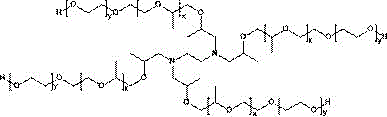

在一些实施例中,所述泊洛沙姆(聚(丙二醇)-聚(乙二醇)-聚(丙二醇)共聚物或聚(乙二醇)-聚(丙二醇)-聚(乙二醇)共聚物,购买自Sigma Aldrich公司,商品名为Pluronic®),在一些实施例中,所述泊洛沙姆选自Pluronic®17R4、Pluronic®P10R5、Pluronic®L-121、Pluronic®L-31、Pluronic®L-64、Pluronic®L-85、Pluronic®P-10R5、Pluronic®L-35、Pluronic®L-61、Pluronic®P-123、Pluronic®F108、Pluronic®F127、Pluronic®F68、Pluronic®P105、Pluronic®P104、Pluronic®P-85、Pluronic®P103或Pluronic®L122中的一种或几种,所述泊洛沙姆的结构式如下:In some embodiments, the poloxamer (poly(propylene glycol)-poly(ethylene glycol)-poly(propylene glycol) copolymer or poly(ethylene glycol)-poly(propylene glycol)-poly(ethylene glycol) copolymer, purchased from Sigma Aldrich under the trade name Pluronic®), in some embodiments, the poloxamer is selected from the group consisting of Pluronic® 17R4, Pluronic® P10R5, Pluronic® L-121, Pluronic® L-31, Pluronic® L-64, Pluronic® L-85, Pluronic® P-10R5, Pluronic® L-35, Pluronic® L-61, Pluronic® P-123, Pluronic® F108, Pluronic® F127, Pluronic® F68, Pluronic® One or more of P105, Pluronic® P104, Pluronic® P-85, Pluronic® P103 or Pluronic® L122, the structural formula of the poloxamer is as follows:


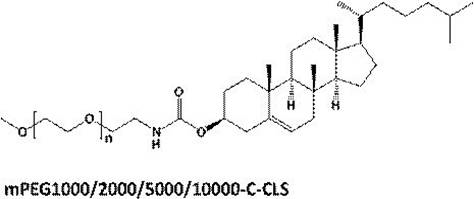
在某些实施方案中,所述PEG脂质为PEG化的两亲性高分子化合物,尤其是指PEG-C-DMG、mPEG-C-CLS、DSPE-PEG-Mal、DSPE-PEG-NH2或mPEG-DSPE,例如PEG2000-C-DMG、mPEG1000-C-CLS、mPEG2000-C-CLS、mPEG5000-C-CLS、mPEG10000-C-CLS及DSPE-PEG2000-Mal、DSPE-PEG5000-NH2、mPEG2000/5000-DSPE,其结构式如下式所示:In certain embodiments, the PEG lipid is a PEGylated amphiphilic polymer compound, especially PEG-C-DMG, mPEG-C-CLS, DSPE-PEG-Mal, DSPE-PEG-NH2 or mPEG-DSPE, such as PEG2000-C-DMG, mPEG1000-C-CLS, mPEG2000-C-CLS, mPEG5000-C-CLS, mPEG10000-C-CLS and DSPE-PEG2000-Mal, DSPE-PEG5000-NH 2 , mPEG2000/ 5000-DSPE, its structural formula is as follows:



DSPE-PEG2000-Mal CAS号 474922-22-0DSPE-PEG2000-Mal CAS No. 474922-22-0

DSPE-PEG5000-NH2 CAS号 474922-26-4DSPE-PEG5000-NH 2 CAS No. 474922-26-4

mPEG2000/5000-DSPE CAS号147867-65-0mPEG2000/5000-DSPE CAS No. 147867-65-0
所述PEG化的两亲性高分子化合物利于改善纳米粒体内药动学性质、利于稳定纳米粒及便于靶向修饰的PEG化的两亲性高分子化合物,The PEGylated amphiphilic polymer compound is beneficial to improve the in vivo pharmacokinetic properties of nanoparticles, to stabilize the nanoparticles and to facilitate targeted modification of the PEGylated amphiphilic polymer compound,
在一些实施例中,所述泊洛沙姆和/或泊洛沙胺与PEG脂质阳离子复合物纳米粒还可以包括至少一种如下脂质,如PC、DSPC、DOTAP或DOPE,所述脂质其结构式下式所示:In some embodiments, the poloxamer and/or poloxamer and PEG lipid-cation complex nanoparticles may further comprise at least one of the following lipids, such as PC, DSPC, DOTAP or DOPE, the lipid Its structural formula is shown below:

在一些实施例中,所述阳离子复合物纳米粒组合物包括Tetronic®904、Pluronic®L-64、Tetronic®304、Tetronic®90R4、Tetronic®704、Tetronic®701、Pluronic®17R4、Pluronic®P-85、Pluronic® L-31、Pluronic® L-61中的一种或几种;在一些实施例中,所述阳离子复合物纳米粒组合物由L64:P10R5:mPEG2000-DSPE:DSPC:mPEG5000-C-CLS摩尔比为50:50:3:20:80组成。在一些实施例中,所述阳离子复合物纳米粒组合物由Tetronic®:PEG2000-C-DMG:PC:mPEG2000-C-CLS摩尔比为100:3:120:80组成;在一个实施方案中,所述阳离子复合物纳米粒组合物由Tetronic®904: Tetronic®90R4:DSPE-PEG200-Mal:PC:mPEG2000-C-CLS摩尔比为50:50:3:20:160组成;在一个实施方案中,所述阳离子复合物纳米粒组合物由Pluronic®L61:mPEG2000-DSPE:DSPC:mPEG5000-C-CLS摩尔比为100:3:20:80组成。在一些实施例中,所述阳离子复合物纳米粒组合物由Pluronic®L85: DSPE-PEG2000-Mal:DSPC:mPEG2000-C-CLS摩尔比为100:2:15:80组成;一些实施例中,所述阳离子复合物纳米粒组合物由L31: DSPE-PEG200-NH2:DOPE:mPEG2000-C-CLS摩尔比为40:3:20:80组成;一些实施例中,所述阳离子复合物纳米粒组合物由T304:17R4:mPEG2000-DSPE:DOTAP:mPEG2000-C-CLS摩尔比为100:100:1:30:80组成;一些实施例中,所述阳离子复合物纳米粒组合物由T304:PEG2000-C-DMG:DSPC:mPEG2000-C-CLS摩尔比为100:3:20:80组成;一些实施例中,所述阳离子复合物纳米粒组合物由T304:PEG2000-C-DMG:DSPC:mPEG2000-C-CLS摩尔比为100:3:20:80组成。In some embodiments, the cationic complex nanoparticle composition comprises Tetronic® 904, Pluronic® L-64, Tetronic® 304, Tetronic® 90R4, Tetronic® 704, Tetronic® 701, Pluronic® 17R4, Pluronic® P- 85. One or more of Pluronic® L-31 and Pluronic® L-61; in some embodiments, the cationic complex nanoparticle composition is composed of L64:P10R5:mPEG2000-DSPE:DSPC:mPEG5000-C -CLS molar ratio is 50:50:3:20:80. In some embodiments, the cationic complex nanoparticle composition consists of a Tetronic®:PEG2000-C-DMG:PC:mPEG2000-C-CLS molar ratio of 100:3:120:80; in one embodiment, The cationic complex nanoparticle composition consists of Tetronic® 904: Tetronic® 90R4:DSPE-PEG200-Mal:PC:mPEG2000-C-CLS molar ratio of 50:50:3:20:160; in one embodiment , the cationic complex nanoparticle composition is composed of Pluronic® L61:mPEG2000-DSPE:DSPC:mPEG5000-C-CLS in a molar ratio of 100:3:20:80. In some embodiments, the cationic complex nanoparticle composition consists of Pluronic® L85:DSPE-PEG2000-Mal:DSPC:mPEG2000-C-CLS in a molar ratio of 100:2:15:80; in some embodiments, The cationic complex nanoparticle composition is composed of L31: DSPE-PEG200-NH 2 : DOPE: mPEG2000-C-CLS in a molar ratio of 40:3:20:80; in some embodiments, the cationic complex nanoparticle The composition is composed of T304:17R4:mPEG2000-DSPE:DOTAP:mPEG2000-C-CLS in a molar ratio of 100:100:1:30:80; in some embodiments, the cationic complex nanoparticle composition is composed of T304:PEG2000 -C-DMG:DSPC:mPEG2000-C-CLS molar ratio is 100:3:20:80; in some embodiments, the cationic complex nanoparticle composition is composed of T304:PEG2000-C-DMG:DSPC:mPEG2000 -C-CLS molar ratio is 100:3:20:80.
在一些实施方案中,在制备泊洛沙姆和/或泊洛沙胺与脂质组合的复合物的过程中,复合物自组装成纳米粒,经检测所述阳离子复合物纳米粒平均直径或粒径小于1000nm,优选小于500nm,例如约20~300nm。在一些实施方案中,所述泊洛沙姆和/或泊洛沙胺与脂质组合的复合物的多分散系数为0~0.4,在某些实施例中为0.1~0.3。在一些实施方案中,所述泊洛沙姆和/或泊洛沙胺与脂质组合的复合物的表面电位是带正电的,例如为5.0mV~35.0 mV,优选10.0mV~25.0 mV。In some embodiments, during the preparation of a complex of poloxamer and/or poloxamine in combination with a lipid, the complex self-assembles into nanoparticles, the cationic complex nanoparticles having an average diameter or The particle size is less than 1000 nm, preferably less than 500 nm, eg about 20-300 nm. In some embodiments, the complexes of poloxamers and/or poloxamines in combination with lipids have a polydispersity coefficient of 0 to 0.4, in certain embodiments 0.1 to 0.3. In some embodiments, the surface potential of the complex of poloxamer and/or poloxamine in combination with lipid is positively charged, eg, 5.0 mV to 35.0 mV, preferably 10.0 mV to 25.0 mV.
另一方面申请人发现本发明所述泊洛沙姆和/或泊洛沙胺与脂质组合的复合物可用于体内外细胞的核酸转染,可以将细胞外的核酸递送至特定细胞内,使基因实现表达。因此,本发明还提供包含核酸的阳离子复合物纳米粒;所述阳离子复合物纳米粒对核酸的包载率在70%以上,或在85%以上,或在90%以上,例如为约93.7%、约90.3%、约77.6%、约88.8%、约89.9%、约91.4%、约68.1%、约88.3%。On the other hand, the applicant found that the complex of poloxamer and/or poloxamer combined with lipid of the present invention can be used for nucleic acid transfection of cells in vivo and in vitro, and the extracellular nucleic acid can be delivered into specific cells, enable gene expression. Therefore, the present invention also provides cationic complex nanoparticles comprising nucleic acid; the encapsulation rate of nucleic acid by the cationic complex nanoparticles is more than 70%, or more than 85%, or more than 90%, for example, about 93.7% , about 90.3%, about 77.6%, about 88.8%, about 89.9%, about 91.4%, about 68.1%, about 88.3%.
在一些实施方案中,所述核酸可以是mRNA、RNAi、DNA等等,在一个具体实施方案中,所述核酸为mRNA。In some embodiments, the nucleic acid may be mRNA, RNAi, DNA, etc., and in a specific embodiment, the nucleic acid is mRNA.
在一些实施方案中,所述核酸为信使核糖核酸mRNA,mRNA是指从脱氧核糖核酸(DNA)转录合成的带有遗传信息的一类单链核糖核酸(RNA)。它在核糖体上作为蛋白质合成的模板,决定肽链的氨基酸排列顺序。体外转录信使RNA(IVT mRNA)是指在体外条件下以DNA为模板转录得到的一种mRNA,这种mRNA可以指导特定蛋白质的合成,阻止或改变某种特定的疾病。In some embodiments, the nucleic acid is messenger ribonucleic acid mRNA, which refers to a type of single-stranded ribonucleic acid (RNA) with genetic information transcribed from deoxyribonucleic acid (DNA). It acts as a template for protein synthesis on the ribosome and determines the amino acid sequence of the peptide chain. In vitro transcribed messenger RNA (IVT mRNA) refers to a mRNA transcribed from DNA as a template under in vitro conditions. This mRNA can guide the synthesis of specific proteins and prevent or change a specific disease.
再一方面,本发明提供所述泊洛沙姆和/或泊洛沙胺与脂质组合的复合物在制备RNA/DNA疫苗药物中的应用。In yet another aspect, the present invention provides the application of the poloxamer and/or the complex of poloxamer and lipid in the preparation of RNA/DNA vaccine drugs.
基因转染是一种将具生物功能的核酸转移或运送到细胞内并使核酸在细胞内维持其生物功能的技术。Gene transfection is a technology that transfers or transports biologically functional nucleic acids into cells and enables the nucleic acids to maintain their biological functions in the cells.
本发明创造的优点:The advantages of the present invention:
本发明通过选取不同长度或不同聚合度的泊洛沙姆和/或泊洛沙胺与特定的PEG脂质以特殊范围的比例进行混合冻干剂复溶之后能很快形成纳米粒,所得纳米粒的电位带正电的,使得阳离子复合物纳米粒在体内外更稳定,其作为核酸载体比病毒载体成本低,便于质量控制,比一般纳米载体(行业金标准ThermoFischer公司的Lipofactamine2000)转染效率高,毒性小,生物相容性好,在体外实验中给药后无需换液,特别适合离体细胞的转染,体内体外转染均有效,且制备简单,创造性地解决了核酸尤其是mRNA安全高效地在体内外递送的难题。In the present invention, nanoparticles of different lengths or different degrees of polymerization are selected and/or poloxamers and specific PEG lipids are mixed and reconstituted with a specific range of lyophilized agents, and nanoparticles can be quickly formed. The potential of the particles is positively charged, which makes the cationic complex nanoparticles more stable in vivo and in vitro. As a nucleic acid carrier, the cost is lower than that of a virus carrier, which is convenient for quality control, and the transfection efficiency is higher than that of general nanocarriers (the industry gold standard ThermoFischer's Lipofactamine2000). High, low toxicity, good biocompatibility, no need to change the liquid after administration in in vitro experiments, especially suitable for the transfection of isolated cells, both in vivo and in vitro transfection are effective, and the preparation is simple, creatively solves the problem of nucleic acid, especially mRNA The challenge of safe and efficient in vitro and in vivo delivery.
本发明所述泊洛沙姆和/或泊洛沙胺与PEG脂质组合的阳离子复合物纳米粒主要用于体内外细胞的基因转染,可以将细胞外的基因递送至特定细胞内,使基因实现表达。本发明所述泊洛沙姆和/或泊洛沙胺与脂质组合的阳离子复合物纳米粒既可以用于科研,尤其是指用于制备基因转染试剂盒或细胞标记试剂盒,还可以应用于RNA/DNA疫苗新药领域,尤其是指用于mRNA肿瘤疫苗和mRNA流感病毒疫苗的开发;创造性地解决了核酸安全高效地在体内外递送的难题。The cationic complex nanoparticles of poloxamer and/or poloxamer combined with PEG lipids of the present invention are mainly used for gene transfection of cells in vivo and in vitro, and can deliver extracellular genes into specific cells, so that the gene expression. The cationic complex nanoparticles of poloxamer and/or poloxamer combined with lipids of the present invention can be used for scientific research, especially for preparing gene transfection kits or cell labeling kits, and can also be used for scientific research. It is applied to the field of new RNA/DNA vaccine drugs, especially for the development of mRNA tumor vaccines and mRNA influenza virus vaccines; it creatively solves the problem of safe and efficient delivery of nucleic acids in vivo and in vitro.
附图说明Description of drawings
图1. 示本发明实施例FLuc-mRNA与处方1复合物不同质量比混合后在体外细胞细胞中的转染荧光表达强度。Fig. 1 shows the fluorescence expression intensity of transfection in cells in vitro after mixing the FLuc-mRNA of the embodiment of the present invention with the formula 1 complex in different mass ratios.
图2.示本发明实施例FLuc-mRNA与处方2复合物不同质量比混合后在体外细胞细胞中的转染荧光表达强度。Figure 2 shows the fluorescence expression intensity of transfection in cells in vitro after mixing the FLuc-mRNA of the embodiment of the present invention with the formula 2 complex in different mass ratios.
图3.示本发明实施例FLuc-mRNA与处方3复合物不同质量比混合后在体外细胞细胞中的转染荧光表达强度。Figure 3 shows the fluorescence expression intensity of transfection in cells in vitro after mixing the FLuc-mRNA of the embodiment of the present invention with the formula 3 complex in different mass ratios.
图4.示本发明实施例FLuc-mRNA与处方4复合物不同质量比混合后在体外细胞细胞中的转染荧光表达强度。Figure 4 shows the fluorescence expression intensity of transfection in cells in vitro after mixing the FLuc-mRNA of the embodiment of the present invention with the formula 4 complex in different mass ratios.
图5.示本发明实施例FLuc-mRNA与处方5复合物不同质量比混合后在体外细胞细胞中的转染荧光表达强度。Figure 5 shows the fluorescence expression intensity of transfection in cells in vitro after mixing the FLuc-mRNA of the embodiment of the present invention with the formula 5 complex in different mass ratios.
图6.示本发明实施例FLuc-mRNA与处方6复合物不同质量比混合后在体外细胞细胞中的转染荧光表达强度。Figure 6 shows the fluorescence expression intensity of transfection in cells in vitro after mixing the FLuc-mRNA of the embodiment of the present invention with the formula 6 complex in different mass ratios.
图7.示本发明实施例FLuc-mRNA与处方7复合物不同质量比混合后在体外细胞细胞中的转染荧光表达强度。Figure 7 shows the fluorescence expression intensity of transfection in cells in vitro after mixing the FLuc-mRNA of the embodiment of the present invention with the formula 7 complex in different mass ratios.
图8.示本发明实施例FLuc-mRNA与处方8复合物不同质量比混合后在体外细胞细胞中的转染荧光表达强度。Figure 8 shows the fluorescence expression intensity of transfection in cells in vitro after mixing the FLuc-mRNA of the embodiment of the present invention with the
图9.示本发明实施例不同处方按最佳质量比与FLuc-mRNA混合后在DC2.4细胞中的转染荧光表达强度。Figure 9. Shows the fluorescence expression intensity of transfection in DC2.4 cells after mixing different recipes with FLuc-mRNA according to the best mass ratio according to the embodiment of the present invention.
图10.示本发明实施例不同处方按最佳质量比与Luc-pDNA混合后在DC2.4细胞中的转染荧光表达强度。Figure 10 shows the fluorescence expression intensity of transfection in DC2.4 cells after mixing different recipes with Luc-pDNA according to the best mass ratio according to the embodiment of the present invention.
图11.示本发明实施例不同处方按最佳质量比与5ug OVA-mRNA混合后在C57BL/6J小鼠皮下注射疫苗,考察疫苗对黑色素瘤的治疗效果。Fig. 11 shows that the vaccines were subcutaneously injected into C57BL/6J mice after mixing different prescriptions with 5ug OVA-mRNA according to the best mass ratio according to the embodiment of the present invention, and the therapeutic effect of the vaccines on melanoma was investigated.
具体实施方式Detailed ways
Tetronic®购买自BASF公司,Pluronic®购买自Sigma Aldrich公司;Tetronic® was purchased from BASF, and Pluronic® was purchased from Sigma Aldrich;
Tetronic®904简写为T904、Pluronic®L-64简写为L-64、Tetronic®304简写为T304、Tetronic®90R4简写为T90R4、Tetronic®704简写为T704、Pluronic®17R4简写为17R4、Pluronic®P-85简写为P-85、Tetronic®701简写为T701、Pluronic®L-61简写为L-61、Pluronic®L-31简写为L31。Tetronic® 904 is abbreviated as T904, Pluronic® L-64 is abbreviated as L-64, Tetronic® 304 is abbreviated as T304, Tetronic® 90R4 is abbreviated as T90R4, Tetronic® 704 is abbreviated as T704, Pluronic® 17R4 is abbreviated as 17R4, Pluronic® P- 85 is abbreviated as P-85, Tetronic® 701 is abbreviated as T701, Pluronic® L-61 is abbreviated as L-61, and Pluronic® L-31 is abbreviated as L31.
实施例一:阳离子复合物纳米粒LLLRNA1003各处方的制备Example 1: Preparation of various formulations of cationic complex nanoparticles LLLRNA1003
处方1:T304:PEG2000-C-DMG:DSPC:mPEG2000-C-CLS摩尔比为100:3:20:80Formulation 1: The molar ratio of T304:PEG2000-C-DMG:DSPC:mPEG2000-C-CLS is 100:3:20:80
先将T304从4℃冰箱取出平衡至室温,在室温下称取并加去核酸酶的超纯水溶解,用斡旋仪充分振荡5min,静置过夜得到储备液A;将PEG2000-C-DMG、DSPC和mPEG2000-C-CLS从-20℃冰箱取出,平衡至室温开封,在室温下按摩尔比3:20:80称取,在圆底烧瓶中用氯仿溶解。使用旋转蒸发仪蒸发去除氯仿,将储备液A倒入圆底烧瓶中,在40摄氏度下以超声2秒暂停2秒的方式持续超声60分钟,转入MWCO为5000的透析袋中,用去核酸酶的超纯水透析12小时,每4小时更换一次透析液。透析完后用0.22um水性滤膜过滤,得到储备液B,将储备液A和储备液B按摩尔比为100:3:20:80的比例混合,即得到处方1水溶液。将处方1水溶液用冻干机制备成冻干剂,并保存于4℃冰箱中待用。First, take T304 out of the refrigerator at 4 °C and equilibrate to room temperature, weigh it at room temperature and add nuclease-free ultrapure water to dissolve, fully shake it with a mediator for 5 minutes, and let it stand overnight to obtain stock solution A; PEG2000-C-DMG, DSPC and mPEG2000-C-CLS were taken out from the -20°C refrigerator, equilibrated to room temperature, opened, weighed in a molar ratio of 3:20:80 at room temperature, and dissolved in chloroform in a round-bottomed flask. Use a rotary evaporator to evaporate chloroform, pour stock solution A into a round-bottomed flask, continue to sonicate for 60 minutes at 40 degrees Celsius with a 2-second pause for 2 seconds, and transfer to a dialysis bag with a MWCO of 5000 to remove nucleic acids. The enzymes were dialyzed against ultrapure water for 12 hours, and the dialysate was changed every 4 hours. After dialysis, filter with a 0.22um aqueous membrane to obtain a stock solution B, and mix the stock solution A and the stock solution B in a molar ratio of 100:3:20:80 to obtain the prescription 1 aqueous solution. The formulation 1 aqueous solution was prepared into a lyophilized agent with a freeze dryer, and stored in a 4°C refrigerator for later use.
处方2:T304:17R4:mPEG2000-DSPE:DOTAP:mPEG2000-C-CLS摩尔比为100:100:1:30:80Formulation 2: The molar ratio of T304:17R4:mPEG2000-DSPE:DOTAP:mPEG2000-C-CLS is 100:100:1:30:80
先将T304和17R4从4℃冰箱取出平衡至室温,在室温下按摩尔比1:1称取并加去核酸酶的超纯水溶解,用斡旋仪充分振荡5min,静置过夜得到储备液A;将mPEG2000-DSPE、DOTAP和mPEG2000-C-CLS从-20℃冰箱取出,平衡至室温开封,在室温下按摩尔比1:30:80称取,在圆底烧瓶中用氯仿溶解。使用旋转蒸发仪蒸发去除氯仿,将储备液A倒入圆底烧瓶中,在40摄氏度下以超声3秒暂停2秒的方式持续超声60分钟,转入MWCO为5000的透析袋中,用去核酸酶的超纯水透析24小时,每4小时更换一次透析液。透析完后用0.22um水性滤膜过滤,得到储备液B,将储备液A和储备液B按摩尔比为200:1:30:80的比例混合,即得到处方2。将制备好的处方2水溶液。将处方2水溶液用冻干机制备成冻干剂,并保存于4℃冰箱中待用。First, take T304 and 17R4 out of the refrigerator at 4°C and equilibrate to room temperature. Weigh them in a 1:1 molar ratio at room temperature and add nuclease-free ultrapure water to dissolve them. Shake fully with a mediator for 5 minutes, and let stand overnight to obtain stock solution A. ; Take out mPEG2000-DSPE, DOTAP and mPEG2000-C-CLS from the -20°C refrigerator, equilibrate to room temperature, unpack, weigh in a molar ratio of 1:30:80 at room temperature, and dissolve in chloroform in a round-bottomed flask. Use a rotary evaporator to evaporate the chloroform, pour the stock solution A into a round-bottomed flask, continue to sonicate for 60 minutes at 40 degrees Celsius with a 3-second pause for 2 seconds, and transfer to a dialysis bag with a MWCO of 5000 to remove nucleic acids. The enzymes were dialyzed against ultrapure water for 24 hours, and the dialysate was changed every 4 hours. After dialysis, filter with a 0.22um aqueous membrane to obtain a stock solution B, and mix the stock solution A and the stock solution B in a molar ratio of 200:1:30:80 to obtain prescription 2. The prepared formulation 2 aqueous solution. The formulation 2 aqueous solution was prepared into a lyophilized agent with a freeze dryer, and stored in a 4° C. refrigerator for later use.
处方3:L31: DSPE-PEG200-NH2:DOPE:mPEG2000-C-CLS摩尔比为40:3:20:80Formulation 3: The molar ratio of L31: DSPE-PEG200-NH 2 : DOPE: mPEG2000-C-CLS is 40:3:20:80
先将L31从4℃冰箱取出平衡至室温,在室温下称取并加去核酸酶的超纯水溶解,用斡旋仪充分振荡5min,静置过夜得到储备液A;将DSPE-PEG200-NH2、DOPE和mPEG2000-C-CLS从-20℃冰箱取出,平衡至室温开封,在室温下按摩尔比3:20:80称取,在圆底烧瓶中用氯仿溶解。使用旋转蒸发仪蒸发去除氯仿,将储备液A倒入圆底烧瓶中,在40摄氏度下以超声2秒暂停3秒的方式持续超声60分钟,转入MWCO为5000的透析袋中,用去核酸酶的超纯水透析12小时,每4小时更换一次透析液。透析完后用0.22um水性滤膜过滤,得到储备液B,将储备液A和储备液B按摩尔比为40:3:20:80的比例混合,即得到处方3水溶液。将处方3水溶液用冻干机制备成冻干剂,并保存于4℃冰箱中待用。First, take L31 out of the 4°C refrigerator and equilibrate to room temperature, weigh it at room temperature and add nuclease-free ultrapure water to dissolve, fully shake with a mediator for 5 minutes, and let stand overnight to obtain stock solution A; DSPE-PEG200-NH2, DSPE-PEG200-NH2, DOPE and mPEG2000-C-CLS were taken out from the -20°C refrigerator, equilibrated to room temperature, opened, weighed in a molar ratio of 3:20:80 at room temperature, and dissolved in chloroform in a round-bottomed flask. Use a rotary evaporator to evaporate the chloroform, pour the stock solution A into a round-bottomed flask, continue to sonicate for 60 minutes at 40 degrees Celsius with 2 seconds of ultrasonic pause for 3 seconds, transfer to a dialysis bag with a MWCO of 5000, and use to remove nucleic acids. The enzymes were dialyzed against ultrapure water for 12 hours, and the dialysate was changed every 4 hours. After dialysis, filter with a 0.22um aqueous membrane to obtain a stock solution B, and mix the stock solution A and the stock solution B in a molar ratio of 40:3:20:80 to obtain the prescription 3 aqueous solution. The formulation 3 aqueous solution was prepared into a lyophilized agent with a freeze dryer, and was stored in a 4° C. refrigerator for later use.
处方4:L85: DSPE-PEG2000-Mal:DSPC:mPEG2000-C-CLS摩尔比为100:2:15:80Formulation 4: The molar ratio of L85: DSPE-PEG2000-Mal:DSPC:mPEG2000-C-CLS is 100:2:15:80
先将L85从4℃冰箱取出平衡至室温,在室温下称取并加去核酸酶的超纯水溶解,用斡旋仪充分振荡5min,静置过夜得到储备液A;将DSPE-PEG2000-Mal、DSPC和mPEG2000-C-CLS从-20℃冰箱取出,平衡至室温开封,在室温下按摩尔比2:15:80称取,在圆底烧瓶中用氯仿溶解。使用旋转蒸发仪蒸发去除氯仿,将储备液A倒入圆底烧瓶中,在40摄氏度下以超声3秒暂停3秒的方式持续超声60分钟,转入MWCO为5000的透析袋中,用去核酸酶的超纯水透析12小时,每4小时更换一次透析液。透析完后用0.22um水性滤膜过滤,得到储备液B,将储备液A和储备液B按摩尔比为100:2:15:80的比例混合,即得到处方4水溶液。将处方4水溶液用冻干机制备成冻干剂,并保存于4℃冰箱中待用。First, take L85 out of the refrigerator at 4°C and equilibrate to room temperature, weigh it at room temperature and add nuclease-free ultrapure water to dissolve, fully shake with a mediator for 5 minutes, and let stand overnight to obtain stock solution A; DSPE-PEG2000-Mal, DSPE-PEG2000-Mal, DSPC and mPEG2000-C-CLS were taken out from the -20°C refrigerator, equilibrated to room temperature, opened, weighed in a molar ratio of 2:15:80 at room temperature, and dissolved in chloroform in a round-bottomed flask. Use a rotary evaporator to evaporate the chloroform, pour the stock solution A into a round-bottomed flask, continue to sonicate for 60 minutes at 40 degrees Celsius with a 3-second pause for 3 seconds, and transfer to a dialysis bag with a MWCO of 5000 to remove nucleic acids. The enzymes were dialyzed against ultrapure water for 12 hours, and the dialysate was changed every 4 hours. After dialysis, filter with a 0.22um aqueous membrane to obtain a stock solution B, and mix the stock solution A and the stock solution B in a molar ratio of 100:2:15:80 to obtain the prescription 4 aqueous solution. The formulation 4 aqueous solution was prepared into a lyophilized agent with a freeze dryer, and was stored in a 4° C. refrigerator for later use.
处方5:T701:PEG2000-C-DMG:PC:mPEG2000-C-CLS摩尔比为100:3:120:80Formulation 5: The molar ratio of T701:PEG2000-C-DMG:PC:mPEG2000-C-CLS is 100:3:120:80
先将T701从4℃冰箱取出平衡至室温,在室温下称取并加去核酸酶的超纯水溶解,用斡旋仪充分振荡5min,静置过夜得到储备液A;将PEG2000-C-DMG、PC和mPEG2000-C-CLS从-20℃冰箱取出,平衡至室温开封,在室温下按摩尔比3:120:80称取,在圆底烧瓶中用氯仿溶解。使用旋转蒸发仪蒸发去除氯仿,将储备液A倒入圆底烧瓶中,在40摄氏度下以超声2秒暂停2秒的方式持续超声60分钟,转入MWCO为5000的透析袋中,用去核酸酶的超纯水透析12小时,每4小时更换一次透析液。透析完后用0.22um水性滤膜过滤,得到储备液B,将储备液A和储备液B按摩尔比为100:3:120:80的比例混合,即得到处方5水溶液。将处方5水溶液用冻干机制备成冻干剂,并保存于4℃冰箱中待用。First, take T701 out of the 4°C refrigerator and equilibrate to room temperature, weigh it at room temperature and add nuclease-free ultrapure water to dissolve, fully shake with a mediator for 5 minutes, and let stand overnight to obtain stock solution A; PEG2000-C-DMG, PC and mPEG2000-C-CLS were taken out from the -20°C refrigerator, equilibrated to room temperature, unsealed, weighed in a molar ratio of 3:120:80 at room temperature, and dissolved in chloroform in a round-bottomed flask. Use a rotary evaporator to evaporate chloroform, pour stock solution A into a round-bottomed flask, continue to sonicate for 60 minutes at 40 degrees Celsius with a 2-second pause for 2 seconds, and transfer to a dialysis bag with a MWCO of 5000 to remove nucleic acids. The enzymes were dialyzed against ultrapure water for 12 hours, and the dialysate was changed every 4 hours. After dialysis, filter with a 0.22um aqueous membrane to obtain a stock solution B, and mix the stock solution A and the stock solution B in a molar ratio of 100:3:120:80 to obtain the prescription 5 aqueous solution. The formulation 5 aqueous solution was prepared into a lyophilized agent by a freeze dryer, and was stored in a 4° C. refrigerator for later use.
处方6:T904:T90R4:DSPE-PEG200-Mal:PC:mPEG2000-C-CLS摩尔比为50:50:3:20:160Formulation 6: The molar ratio of T904:T90R4:DSPE-PEG200-Mal:PC:mPEG2000-C-CLS is 50:50:3:20:160
先将T904和T90R4从4℃冰箱取出平衡至室温,在室温下按摩尔比1:1称取并加去核酸酶的超纯水溶解,用斡旋仪充分振荡5min,静置过夜得到储备液A;将DSPE-PEG200-Mal、PC和mPEG2000-C-CLS从-20℃冰箱取出,平衡至室温开封,在室温下按摩尔比3:20:160称取,在圆底烧瓶中用氯仿溶解。使用旋转蒸发仪蒸发去除氯仿,将储备液A倒入圆底烧瓶中,在40摄氏度下以超声2秒暂停3秒的方式持续超声60分钟,转入MWCO为5000的透析袋中,用去核酸酶的超纯水透析12小时,每4小时更换一次透析液。透析完后用0.22um水性滤膜过滤,得到储备液B,将储备液A和储备液B按摩尔比为100:3:20:160的比例混合,即得到处方6水溶液。将处方6水溶液用冻干机制备成冻干剂,并保存于4℃冰箱中待用。First, take T904 and T90R4 out of the 4°C refrigerator and equilibrate to room temperature. Weigh them in a 1:1 molar ratio at room temperature and add nuclease-free ultrapure water to dissolve, fully shake with a mediator for 5 minutes, and let stand overnight to obtain stock solution A. ; Take out DSPE-PEG200-Mal, PC and mPEG2000-C-CLS from -20°C refrigerator, equilibrate to room temperature, unpack, weigh at room temperature in a molar ratio of 3:20:160, and dissolve in chloroform in a round-bottomed flask. Use a rotary evaporator to evaporate the chloroform, pour the stock solution A into a round-bottomed flask, continue to sonicate for 60 minutes at 40 degrees Celsius with 2 seconds of ultrasonic pause for 3 seconds, transfer to a dialysis bag with a MWCO of 5000, and use to remove nucleic acids. The enzymes were dialyzed against ultrapure water for 12 hours, and the dialysate was changed every 4 hours. After dialysis, filter with a 0.22um aqueous membrane to obtain a stock solution B, and mix the stock solution A and the stock solution B in a molar ratio of 100:3:20:160 to obtain the prescription 6 aqueous solution. The formulation 6 aqueous solution was prepared into a lyophilized agent with a freeze dryer, and was stored in a 4° C. refrigerator for later use.
处方7:L61:mPEG2000-DSPE:DSPC:mPEG5000-C-CLS摩尔比为100:3:20:80Formulation 7: The molar ratio of L61:mPEG2000-DSPE:DSPC:mPEG5000-C-CLS is 100:3:20:80
先将L61从4℃冰箱取出平衡至室温,在室温下称取并加去核酸酶的超纯水溶解,用斡旋仪充分振荡5min,静置过夜得到储备液A;将mPEG2000-DSPE、DSPC和mPEG5000-C-CLS从-20℃冰箱取出,平衡至室温开封,在室温下按摩尔比3:20:80称取,在圆底烧瓶中用氯仿溶解。使用旋转蒸发仪蒸发去除氯仿,将储备液A倒入圆底烧瓶中,在40摄氏度下以超声2秒暂停2秒的方式持续超声30分钟,转入MWCO为5000的透析袋中,用去核酸酶的超纯水透析12小时,每4小时更换一次透析液。透析完后用0.22um水性滤膜过滤,得到储备液B,将储备液A和储备液B按摩尔比为100:3:20:80的比例混合,即得到处方7水溶液。将处方7水溶液用冻干机制备成冻干剂,并保存于4℃冰箱中待用。First, take L61 out of the refrigerator at 4°C and equilibrate to room temperature, weigh it at room temperature and add nuclease-free ultrapure water to dissolve, fully shake it with a mediator for 5 minutes, and let it stand overnight to obtain stock solution A; mPEG2000-DSPE, DSPC and mPEG5000-C-CLS was taken out from the -20°C refrigerator, equilibrated to room temperature, opened, weighed in a molar ratio of 3:20:80 at room temperature, and dissolved in chloroform in a round-bottomed flask. Use a rotary evaporator to evaporate the chloroform, pour the stock solution A into a round-bottomed flask, continue to sonicate for 30 minutes at 40 degrees Celsius with a 2-second pause for 2 seconds, and transfer to a dialysis bag with a MWCO of 5000 to remove nucleic acids. The enzymes were dialyzed against ultrapure water for 12 hours, and the dialysate was changed every 4 hours. After dialysis, filter with a 0.22um aqueous membrane to obtain a stock solution B, and mix the stock solution A and the stock solution B in a molar ratio of 100:3:20:80 to obtain the prescription 7 aqueous solution. The formulation 7 aqueous solution was prepared into a lyophilized agent with a freeze dryer, and was stored in a 4° C. refrigerator for later use.
处方8:L64:P10R5:mPEG2000-DSPE:DSPC:mPEG5000-C-CLS摩尔比为50:50:3:20:80Formula 8: The molar ratio of L64:P10R5:mPEG2000-DSPE:DSPC:mPEG5000-C-CLS is 50:50:3:20:80
先将L64和P10R5从4℃冰箱取出平衡至室温,在室温下按摩尔比称取并加去核酸酶的超纯水溶解,用斡旋仪充分振荡5min,静置过夜得到储备液A;将mPEG2000-DSPE、DSPC和mPEG5000-C-CLS从-20℃冰箱取出,平衡至室温开封,在室温下按摩尔比3:20:80称取,在圆底烧瓶中用氯仿溶解。使用旋转蒸发仪蒸发去除氯仿,将储备液A倒入圆底烧瓶中,在40摄氏度下以超声3秒暂停3秒的方式持续超声30分钟,转入MWCO为5000的透析袋中,用去核酸酶的超纯水透析12小时,每4小时更换一次透析液。透析完后用0.22um水性滤膜过滤,得到储备液B,将储备液A和储备液B按摩尔比为100:3:20:80的比例混合,即得到处方8水溶液。将处方8水溶液用冻干机制备成冻干剂,并保存于4℃冰箱中待用。First, take L64 and P10R5 out of the 4°C refrigerator and equilibrate to room temperature, weigh them in molar ratio at room temperature and add nuclease-free ultrapure water to dissolve, fully shake with a mediator for 5 minutes, and let stand overnight to obtain stock solution A; mPEG2000 -DSPE, DSPC and mPEG5000-C-CLS were taken out from -20°C refrigerator, equilibrated to room temperature, opened, weighed in a molar ratio of 3:20:80 at room temperature, and dissolved in chloroform in a round-bottom flask. Use a rotary evaporator to evaporate the chloroform, pour the stock solution A into a round-bottomed flask, continue to sonicate for 30 minutes at 40 degrees Celsius with a 3-second pause for 3 seconds, and transfer to a dialysis bag with a MWCO of 5000 to remove nucleic acids. The enzymes were dialyzed against ultrapure water for 12 hours, and the dialysate was changed every 4 hours. After dialysis, filter with a 0.22um aqueous membrane to obtain a stock solution B, and mix the stock solution A and the stock solution B in a molar ratio of 100:3:20:80 to obtain the
实施例二:泊洛沙姆和/或泊洛沙胺与脂质组合的阳离子复合物纳米粒处方的表征Example 2: Characterization of cationic complex nanoparticle formulations of poloxamer and/or poloxamine combined with lipids
本发明涉及纳米粒径与电位是采用Malvern Zetasizer Nano ZSE测试,将处方1、处方2、处方3、处方4、处方5、处方6、处方7及处方8不含FLuc-mRNA的阳离子复合物纳米粒制成1ml待测液,在25℃条件下考察了处方1、处方2、处方3、处方4、处方5、处方6、处方7及处方8不含FLuc-mRNA的阳离子复合物纳米粒的动态光散射纳米粒子的粒径大小(IntensityMean)、表面电位(Zeta Potential)及多分散性(PDI),如表1所示。The present invention relates to nanometer particle size and potential, which is tested by Malvern Zetasizer Nano ZSE, and formula 1, formula 2, formula 3, formula 4, formula 5, formula 6, formula 7 and
按各处方纳米粒与FLuc-mRNA最佳质量比(处方1最佳质量比为5000、处方2最佳质量比为5000、处方3最佳质量比为3500、处方4最佳质量比为100、处方5最佳质量比为1500、处方6最佳质量比为5000、处方7最佳质量比为2000及处方8最佳质量比为500)称取在4℃下已保存6个月的不含FLuc-mRNA的阳离子复合物纳米粒的处方1、处方2、处方3、处方4、处方5、处方6、处方7及处方8的冻干剂,分别加500ul去核酸酶的水复溶10分钟,吹打数次之后分别将500ul含200ng FLuc-mRNA的去核酸酶水溶液加入混合10分钟制备得到含FLuc-mRNA的阳离子复合物纳米粒。采用Malvern Zetasizer Nano ZSE测试含FLuc-mRNA的阳离子复合物纳米粒的动态光散射纳米粒子的粒径大小(Intensity Mean)、表面电位(ZetaPotential)及多分散性(PDI),如表2所示。According to the best mass ratio of nanoparticles to FLuc-mRNA of each recipe (the best mass ratio of recipe 1 is 5000, the best mass ratio of recipe 2 is 5000, the best mass ratio of recipe 3 is 3500, the best mass ratio of recipe 4 is 100, The best mass ratio of formula 5 is 1500, the best mass ratio of formula 6 is 5000, the best mass ratio of formula 7 is 2000, and the best mass ratio of
表1:处方1、处方2、处方3、处方4、处方5、处方6、处方7及处方8不含mRNA的阳离子复合物纳米粒的粒径大小(Intensity Mean)、表面电位(Zeta Potential)及多分散性(PDI)。Table 1: Formulation 1, Formulation 2, Formulation 3, Formulation 4, Formulation 5, Formulation 6, Formulation 7 and

表2:处方1、处方2、处方3、处方4、处方5、处方6、处方7及处方8含mRNA的阳离子复合物纳米粒的粒径大小(Intensity Mean)、表面电位(Zeta Potential)及多分散性(PDI)。Table 2: Particle size (Intensity Mean), surface potential (Zeta Potential) and Polydispersity (PDI).

实施例三:测试泊洛沙姆和/或泊洛沙胺与脂质组合的阳离子复合物纳米粒各处方的包载率Example 3: Testing the Encapsulation Efficiency of Each Formulation of Cationic Complex Nanoparticles of Poloxamer and/or Poloxamine Combined with Lipids
使用Quant-iT RiboGreen RNA检测试剂盒(ThermoFischer公司)测定LLLRNA-1003各处方(处方1、处方2、处方3、处方4、处方5、处方6、处方7及处方8)对FLuc-mRNA的包封率,具体方法参考试剂盒说明书,本发明的简要处理方法为:The Quant-iT RiboGreen RNA detection kit (ThermoFischer Company) was used to determine the LLLRNA-1003 formulations (formulation 1, formulation 2, formulation 3, formulation 4, formulation 5, formulation 6, formulation 7 and formulation 8) to FLuc-mRNA. The sealing rate, the specific method refers to the kit instructions, the brief processing method of the present invention is:
按各处方纳米粒与FLuc-mRNA最佳质量比(处方1最佳质量比为5000、处方2最佳质量比为5000、处方3最佳质量比为3500、处方4最佳质量比为100、处方5最佳质量比为1500、处方6最佳质量比为5000、处方7最佳质量比为2000及处方8最佳质量比为500)称取在4℃下保存6个月的不含FLuc-mRNA的阳离子复合物纳米粒的处方1、处方2、处方3、处方4、处方5、处方6、处方7及处方8的冻干剂,分别加500ul去核酸酶的水复溶10分钟,吹打数次之后分别将500ul含200ng FLuc-mRNA的去核酸酶水溶液加入混合10分钟制备得到含FLuc-mRNA的阳离子复合物纳米粒。使用低温高速离心机将各处方在4℃,16000rpm条件下离心2.5h,收集上清液并用移液器定量其体积,记为V1;用Quant-iT RiboGreen RNA检测试剂盒测量上清中的FLuc-mRNA的浓度,记为C1;将离心后的沉淀溶于1ml的DMSO,从中取100ul,加入200ul肝素钠溶液(6.667mg/ml)混匀,室温静置2h后,记录置换的体积V2并用Quant-iTRiboGreen RNA检测试剂盒测定FLuc-mRNA的浓度,记为C2;LLLRNA-1003各处方的包载率计算公式如下:According to the best mass ratio of nanoparticles to FLuc-mRNA of each recipe (the best mass ratio of recipe 1 is 5000, the best mass ratio of recipe 2 is 5000, the best mass ratio of recipe 3 is 3500, the best mass ratio of recipe 4 is 100, The best mass ratio of formula 5 is 1500, the best mass ratio of formula 6 is 5000, the best mass ratio of formula 7 is 2000, and the best mass ratio of
包载率=100%-(V1C1)/(V1C1+V2C2)×100%Packet load rate=100%-(V1C1)/(V1C1+V2C2)×100%
本发明所述处方1、处方2、处方3、处方4、处方5、处方6、处方7及处方8的包载率分别为:93.7%、90.3%、77.6%、88.8%、89.9%、91.4%、68.1%、88.3%。The packing rates of prescription 1, prescription 2, prescription 3, prescription 4, prescription 5, prescription 6, prescription 7 and
实施例四:不同处方按材料与FLuc-mRNA的最佳质量比混合后在DC2.4细胞中的转染Example 4: Transfection in DC2.4 cells after mixing different recipes according to the optimal mass ratio of materials and FLuc-mRNA
1)细胞收集1) Cell collection
从培养箱中取出细胞,弃去培养液,加入PBS 10ml,轻轻摇动培养瓶,使其流遍细胞表面,弃去PBS,向瓶内加入约2ml消化液(0.25%胰蛋白酶-0.03% EDTA溶液),轻轻摇动后,消化30秒,将培养瓶置于显微镜下观察,发现胞质回缩,细胞间隙增大后,立即加入含血清的培养液终止消化。用吸管吸取瓶内培养液,反复轻轻吹打瓶壁细胞,使之成为单细胞悬液,将细胞悬液加入到15ml离心管中,于1500转/min离心5min,除去上清液,用培养基重悬细胞,在计数板上计数后,用培养基调节细胞悬液的浓度,待用。Remove the cells from the incubator, discard the culture medium, add 10ml of PBS, shake the culture flask gently to make it flow over the cell surface, discard the PBS, and add about 2ml of digestion solution (0.25% trypsin-0.03% EDTA) to the flask. solution), shake gently, digest for 30 seconds, place the culture flask under a microscope to observe, and find that the cytoplasm shrinks and the intercellular space increases, and immediately add serum-containing culture medium to terminate the digestion. Aspirate the culture medium in the bottle with a pipette, gently blow and beat the cells on the wall of the bottle repeatedly to make it into a single-cell suspension, add the cell suspension to a 15ml centrifuge tube, centrifuge at 1500 rpm for 5 minutes, remove the supernatant, and use the culture medium. The cells were resuspended in the base, and after counting on the counting plate, the concentration of the cell suspension was adjusted with the medium, and it was set aside.
2)FLuc-mRNA在体外细胞中的基因转染2) Gene transfection of FLuc-mRNA in cells in vitro
将细胞悬液以4×10⁴个每孔的密度分装至96孔板,放入37℃、5% CO2培养箱中静置培养。24h后将浓度为1ug/ul的FLuc-mRNA用去核酸酶的超纯水稀释至0.1ug/ul,按不同质量比以每孔200ng FLuc-mRNA的浓度分别与复溶的不同浓度的处方1、处方2、处方3、处方4、处方5、处方6、处方7及处方8冻干剂等体积混合,分别得到88ul含FLuc-mRNA的阳离子复合物纳米粒处方混合液,静置30min后,以每孔20ul的体积分别加至每孔含180ul 完全培养基的96孔板中,以Thermofischer公司的Lipofactamine2000包载的FLuc-mRNA和裸FLuc-mRNA作为两个阳性对照组,每个样品重复4个孔。The cell suspension was dispensed into a 96-well plate at a density of 4×10 4 per well, and placed in a 37°C, 5% CO 2 incubator for static culture. After 24h, dilute the FLuc-mRNA with a concentration of 1ug/ul to 0.1ug/ul with nuclease-free ultrapure water. According to different mass ratios, the concentration of 200ng FLuc-mRNA per well is respectively the same as the reconstituted formula 1 of different concentrations. , Recipe 2, Recipe 3, Recipe 4, Recipe 5, Recipe 6, Recipe 7, and
给药24h后,用DPBS配置浓度为25mg/ml的D-Luciferin储存液,混匀后立即使用或分装后-20℃保存。用预热好的完全培养基以1:100的比例稀释D-Luciferin,使其工作浓度为250ug/ml,吸出96孔板中的培养液。在成像前将100ul D-Luciferin工作溶液加入各96孔板,继续在37℃孵育箱中培养5min,以每孔200ng FLuc-mRNA的浓度分别与处方1 -8的质量比为50、100、200、500、1000、1500、2000、2500、3000、3500、4000、5000进行混合,对照组为裸mRNA和Lipo 2000,用Omega FLuostar酶标仪成像测试FLuc-mRNA的荧光表达强度。结果如图1-8所示:横坐标代表处方与mRNA的质量比,纵坐标为荧光强度,纵坐标越高,表示转染效率越高,数据表明,FLuc-mRNA与处方1的最佳质量比为5000、与处方2的最佳质量比为5000、与处方3的最佳质量比为3500、与处方4的最佳质量比为100、与处方5的最佳质量比为1500、与处方6的最佳质量比为5000、与处方7的最佳质量比为2000、与处方8的最佳质量比为500。24h after administration, use DPBS to prepare a D-Luciferin stock solution with a concentration of 25 mg/ml, and use it immediately after mixing or store it at -20°C after packaging. Dilute D-Luciferin at a ratio of 1:100 with pre-warmed complete medium to make its working concentration 250ug/ml, and aspirate the culture medium in the 96-well plate. Add 100ul D-Luciferin working solution to each 96-well plate before imaging, and continue to incubate at 37°C for 5min. The concentration of 200ng FLuc-mRNA per well and the mass ratio of prescription 1-8 are 50, 100, and 200, respectively. , 500, 1000, 1500, 2000, 2500, 3000, 3500, 4000, 5000 were mixed, and the control group was naked mRNA and
采用以上方法按各处方最佳质量比重复在DC2.4细胞中的转染实验,实验结果如图9所示。The above method was used to repeat the transfection experiment in DC2.4 cells according to the optimal mass ratio of each recipe. The experimental results are shown in Figure 9.
实施例五:不同处方按材料与Luc-pDNA的最佳质量比混合后在DC2.4细胞中的转染Example 5: Transfection in DC2.4 cells after mixing different recipes according to the optimal mass ratio of materials and Luc-pDNA
将细胞悬液以4×10⁴个每孔的密度分装至96孔板,放入37℃、5% CO2培养箱中静置培养。24h后将浓度为1ug/ul的Luc-pDNA用去核酸酶的超纯水稀释至0.1ug/ul,以每孔300ng Luc-pDNA的浓度分别与复溶好的处方1(质量比为5000)、处方2(质量比为5000)、处方3(质量比为3500)、处方4(质量比为100)、处方5(质量比为1500)、处方6(质量比为5000)、处方7(质量比为2000)及处方8(质量比为500)按蛋白表达最高的质量比比例混合分别得到88ul含Luc-pDNA的阳离子复合物纳米粒处方混合液,静置30min后,以每孔20ul的体积分别加至每孔含180ul完全培养基的96孔板中,以Thermofischer公司的Lipofactamine2000及其处方作为阳性对照,以不加处方不加Luc-pDNA的孔做阴性对照,每个样品重复4个孔。The cell suspension was dispensed into a 96-well plate at a density of 4×10 4 per well, and placed in a 37°C, 5% CO2 incubator for static culture. After 24 hours, the Luc-pDNA with a concentration of 1ug/ul was diluted to 0.1ug/ul with nuclease-free ultrapure water, and the concentration of 300ng Luc-pDNA per well was respectively mixed with the reconstituted prescription 1 (mass ratio of 5000). , prescription 2 (mass ratio is 5000), prescription 3 (mass ratio is 3500), prescription 4 (mass ratio is 100), prescription 5 (mass ratio is 1500), prescription 6 (mass ratio is 5000), prescription 7 (mass ratio is 5000) The ratio of 2000) and recipe 8 (mass ratio of 500) were mixed according to the mass ratio with the highest protein expression to obtain 88ul of Luc-pDNA-containing cationic complex nanoparticle formulation mixture. After standing for 30min, the volume of each well was 20ul. Each well was added to a 96-well plate containing 180ul of complete medium, and Lipofactamine2000 of Thermofischer and its prescription were used as positive control, and the wells without prescription and without Luc-pDNA were used as negative control, and each sample was repeated 4 wells .
给药24h后,将100ul工作浓度为250ug/ml的D-Luciferin溶液加入各96孔板,继续在37℃孵育箱中培养5min,最后用Omega-FLuostar酶标仪成像,测试Luc-pDNA的荧光表达强度,每24小时重复测试一次,每次测试完后将含D-Luciferin的培养基吸出,加入新鲜完全培养基继续培养24小时后加D-Luciferin测试,重复四天。结果如图10所示。After 24 hours of administration, 100ul of D-Luciferin solution with a working concentration of 250ug/ml was added to each 96-well plate, and continued to be incubated in a 37°C incubator for 5min. Finally, an Omega-FLuostar microplate reader was used to image the fluorescence of Luc-pDNA. For the expression intensity, the test was repeated every 24 hours. After each test, the medium containing D-Luciferin was aspirated, and fresh complete medium was added to continue the culture for 24 hours, and then D-Luciferin was added to test for four days. The results are shown in Figure 10.
实施例六本发明阳离子复合物纳米粒LLLRNA1003-OVA-mRNA疫苗对荷瘤小鼠模型的治疗Example 6 Treatment of tumor-bearing mouse model by the cationic complex nanoparticle LLLRNA1003-OVA-mRNA vaccine of the present invention
1) B16-OVA黑色素瘤小鼠模型的建立:将鼠源淋巴瘤细胞B16-OVA在体外扩增培养,得到B16-OVA细胞系,用DPBS稀释备用,每只小鼠打5×10⁵个肿瘤细胞。在第0天将7周龄的雌性C57BL/6J小鼠侧腹部脱毛,收集培养的B16-OVA肿瘤细胞,将B16-OVA肿瘤细胞皮下注射到小鼠的侧腹部,建立皮下B16-OVA肿瘤模型。 1 ) Establishment of B16-OVA melanoma mouse model: The mouse-derived lymphoma cell B16-OVA was expanded and cultured in vitro to obtain a B16-OVA cell line, which was diluted with DPBS for use. tumor cells. On
2) LLLRNA1003-OVA-mRNA疫苗的制备:将复溶好的将处方1、处方2、处方5、处方6分别与OVA-mRNA(从美国TriLink公司购买获得)简单轻轻混合30分钟后分别得到由处方1、处方2、处方5、处方6制备的四种LLLRNA1003-OVA-mRNA疫苗;2) Preparation of LLLRNA1003-OVA-mRNA vaccine: Simply mix the reconstituted formula 1, formula 2, formula 5, and formula 6 with OVA-mRNA (purchased from TriLink, USA) for 30 minutes, respectively. Four types of LLLRNA1003-OVA-mRNA vaccines prepared from prescription 1, prescription 2, prescription 5, and prescription 6;
3)对C57BL/6J小鼠用LLLRNA1003-OVA-mRNA疫苗(每次每只注射含有5ug治疗剂mRNA-OVA的纳米粒疫苗,注射前用9%生理盐水缓冲液稀释)分别在第5天、第8天、第11天、第14天、第17天、第20天通过脚掌注射的方式接种疫苗,同时将接种等体积PBS缓冲溶液和稀释后同体积等量的OVA-mRNA溶液的小鼠设定为对照组,平行每组5只小鼠。3) LLLRNA1003-OVA-mRNA vaccine for C57BL/6J mice (nanoparticle vaccine containing 5ug therapeutic agent mRNA-OVA for each injection, diluted with 9% saline buffer before injection) on the 5th day, respectively On the 8th day, the 11th day, the 14th day, the 17th day and the 20th day, the vaccine was vaccinated by foot injection, and the mice were vaccinated with the same volume of PBS buffer solution and the same volume of OVA-mRNA solution after dilution. Set as the control group, with 5 mice in each group in parallel.
4)从接种肿瘤后第10天开始,每天测量肿瘤垂直直径。按下述公式计算C57BL/6J小鼠的肿瘤体积:V(mm3)=x×y2/2,单位为mm,其中V代表肿瘤体积,x表示肿瘤长径,y表示肿瘤短径。同时每天用电子天平记录C57BL/6J小鼠体重的变化,并统计存活率。其考察结果如图11所示:在第0天皮下接种B16-OVA黑色素瘤细胞,分别在接种肿瘤后第5天、第8天、第11天、第14天、第17天和第20天接种疫苗。接种肿瘤后第11天,由处方1、处方2、处方5和处方6制备得到的LLLRNA1003疫苗组从第12天开始显示肿瘤生长,而PBS对照组和裸mRNA组从第12天开始可见肉瘤。从第13天起,由处方5和处方6制备得到的LLLRNA1003疫苗组开始可见肿瘤。从第14天起,由处方1和处方2制备得到的LLLRNA1003疫苗组开始可见肿瘤。与PBS对照组和裸mRNA组相比,由处方1、处方2、处方5和处方6制备得到的LLLRNA1003疫苗组显示出明显的肿瘤生长延迟。在第20天,由处方1、处方2、处方5和处方6制备得到的LLLRNA1003疫苗组的肿瘤大小均小于PBS对照组和裸mRNA组。PBS对照组和裸mRNA组分别从接种肿瘤后第21天和第25天开始,所有小鼠分别在第30天和第33天全部牺牲。由处方1、处方2、处方5和处方6制备得到的LLLRNA1003疫苗组分别从第39天、第29天、第27天和第35天开始牺牲。处方2、处方5和处方6制备得到的LLLRNA1003疫苗组所有小鼠分别在第38天、第36天和第41天全部牺牲。继续统计处方1制备得到的LLLRNA1003疫苗组的存活率,直到第44天为止。4) From the 10th day after tumor inoculation, the vertical diameter of the tumor was measured every day. The tumor volume of C57BL/6J mice was calculated according to the following formula: V(mm3)=x×y 2 /2, in mm, where V represents the tumor volume, x represents the long diameter of the tumor, and y represents the short diameter of the tumor. At the same time, the changes of body weight of C57BL/6J mice were recorded by electronic balance every day, and the survival rate was counted. The results of the investigation are shown in Figure 11: B16-OVA melanoma cells were subcutaneously inoculated on
以上所述仅为本发明的优选实施例而已,并不用于限制本发明,对于本领域的技术人员来说,本发明可以有各种更改和变化。凡在本发明的精神和原则之内,所作的任何修改、等同替换、改进等,均应包含在本发明的保护范围之内。The above descriptions are only preferred embodiments of the present invention, and are not intended to limit the present invention. For those skilled in the art, the present invention may have various modifications and changes. Any modification, equivalent replacement, improvement, etc. made within the spirit and principle of the present invention shall be included within the protection scope of the present invention.
Claims (4)




Priority Applications (2)
| Application Number | Priority Date | Filing Date | Title |
|---|---|---|---|
| CN202010102914.4A CN111281981B (en) | 2020-02-19 | 2020-02-19 | Composite nanoparticle combining poloxamer and/or poloxamine and PEG lipid |
| CN202011226741.3A CN112121180B (en) | 2020-02-19 | 2020-02-19 | Complex nanoparticles of poloxamers and or poloxamines combined with PEG lipids |
Applications Claiming Priority (1)
| Application Number | Priority Date | Filing Date | Title |
|---|---|---|---|
| CN202010102914.4A CN111281981B (en) | 2020-02-19 | 2020-02-19 | Composite nanoparticle combining poloxamer and/or poloxamine and PEG lipid |
Related Child Applications (1)
| Application Number | Title | Priority Date | Filing Date |
|---|---|---|---|
| CN202011226741.3A Division CN112121180B (en) | 2020-02-19 | 2020-02-19 | Complex nanoparticles of poloxamers and or poloxamines combined with PEG lipids |
Publications (2)
| Publication Number | Publication Date |
|---|---|
| CN111281981A CN111281981A (en) | 2020-06-16 |
| CN111281981B true CN111281981B (en) | 2020-12-11 |
Family
ID=71023689
Family Applications (2)
| Application Number | Title | Priority Date | Filing Date |
|---|---|---|---|
| CN202011226741.3A Active CN112121180B (en) | 2020-02-19 | 2020-02-19 | Complex nanoparticles of poloxamers and or poloxamines combined with PEG lipids |
| CN202010102914.4A Active CN111281981B (en) | 2020-02-19 | 2020-02-19 | Composite nanoparticle combining poloxamer and/or poloxamine and PEG lipid |
Family Applications Before (1)
| Application Number | Title | Priority Date | Filing Date |
|---|---|---|---|
| CN202011226741.3A Active CN112121180B (en) | 2020-02-19 | 2020-02-19 | Complex nanoparticles of poloxamers and or poloxamines combined with PEG lipids |
Country Status (1)
| Country | Link |
|---|---|
| CN (2) | CN112121180B (en) |
Families Citing this family (2)
| Publication number | Priority date | Publication date | Assignee | Title |
|---|---|---|---|---|
| CN113171450A (en) * | 2021-04-20 | 2021-07-27 | 浙江大学 | Construction and application of nanocarriers for regulating adaptive cellular and humoral immunity |
| CN119212687A (en) * | 2022-02-25 | 2024-12-27 | 奎尔波特股份有限公司 | Lipid nanoparticle compositions and methods of use thereof |
Family Cites Families (5)
| Publication number | Priority date | Publication date | Assignee | Title |
|---|---|---|---|---|
| CN101138636B (en) * | 2006-09-05 | 2010-05-12 | 中国科学院上海药物研究所 | A gene drug delivery system and preparation method thereof |
| CN102712935B (en) * | 2009-11-04 | 2017-04-26 | 不列颠哥伦比亚大学 | Nucleic acid-containing lipid particles and related methods |
| EP2678007A4 (en) * | 2011-02-25 | 2015-08-12 | Univ South Dakota | PROTEIN NANOVECTORS APPLIED TO TOPICAL ADMINISTRATION |
| PL2791160T3 (en) * | 2011-12-16 | 2022-06-20 | Modernatx, Inc. | Modified mrna compositions |
| EP3468537A1 (en) * | 2016-06-14 | 2019-04-17 | Modernatx, Inc. | Stabilized formulations of lipid nanoparticles |
-
2020
- 2020-02-19 CN CN202011226741.3A patent/CN112121180B/en active Active
- 2020-02-19 CN CN202010102914.4A patent/CN111281981B/en active Active
Also Published As
| Publication number | Publication date |
|---|---|
| CN111281981A (en) | 2020-06-16 |
| CN112121180B (en) | 2023-08-25 |
| CN112121180A (en) | 2020-12-25 |
Similar Documents
| Publication | Publication Date | Title |
|---|---|---|
| Liang et al. | Development and delivery systems of mRNA vaccines | |
| Lim et al. | Engineered nanodelivery systems to improve DNA vaccine technologies | |
| Deng et al. | mRNA vaccines: the dawn of a new era of cancer immunotherapy | |
| Meng et al. | Nanoplatforms for mRNA therapeutics | |
| Meng et al. | A new developing class of gene delivery: messenger RNA-based therapeutics | |
| ES2228467T3 (en) | THERAPEUTIC PARTICLES OF CALCIUM PHOSPHATE AND METHODS OF MANUFACTURE AND ITS USE. | |
| Lin et al. | An overview of nanoparticle-based delivery platforms for mRNA vaccines for treating cancer | |
| CN105873613A (en) | A novel plga-modified polyethylenimine self-assembly nanotechnology for nucleic acid and drug delivery | |
| Pan et al. | The potential of mRNA vaccines in cancer nanomedicine and immunotherapy | |
| JP2003528024A (en) | Needle-free injection of formulated nucleic acid molecules | |
| CN102485274A (en) | Preparation method and application of PLGA microspheres as nucleic acid vaccine carrier | |
| Chen et al. | Path towards mRNA delivery for cancer immunotherapy from bench to bedside | |
| CN111281981B (en) | Composite nanoparticle combining poloxamer and/or poloxamine and PEG lipid | |
| Tuyen Ho et al. | Bioinspired and biomimetic gene delivery systems | |
| Ji et al. | Fused cytomembrane‐camouflaged nanoparticles for tumor‐specific immunotherapy | |
| Kim et al. | Strategy to Enhance Dendritic Cell‐Mediated DNA Vaccination in the Lung | |
| Liu et al. | Potentiating the immune responses of HBsAg-VLP vaccine using a polyphosphoester-based cationic polymer adjuvant | |
| Wang et al. | Engineered lipid nanoparticles with synergistic dendritic cell targeting and enhanced endosomal escape for boosted mRNA cancer vaccines | |
| Zdrehus et al. | Role of biofunctionalized nanoparticles in digestive cancer vaccine development | |
| Chen et al. | Unleashing the potential of mRNA: Overcoming delivery challenges with nanoparticles | |
| CN111249476B (en) | Neutral complex nanoparticles of poloxamer and/or poloxamine combined with lipids | |
| He et al. | A novel gene carrier based on amino-modified silica nanoparticles | |
| CN111281982B (en) | A complex of poloxamer and/or poloxamine combined with lipids | |
| Yang et al. | Novel bionic inspired nanosystem construction for precise delivery of mRNA | |
| Kanazawa et al. | Electroporation-based ex vivo gene delivery into dendritic cells by anionic polymer-coated versatile nuclear localization signal/pDNA complex |
Legal Events
| Date | Code | Title | Description |
|---|---|---|---|
| PB01 | Publication | ||
| PB01 | Publication | ||
| SE01 | Entry into force of request for substantive examination | ||
| SE01 | Entry into force of request for substantive examination | ||
| GR01 | Patent grant | ||
| GR01 | Patent grant |