CN111278477A - Biodegradable and biometabolic tumor sealants - Google Patents
Biodegradable and biometabolic tumor sealants Download PDFInfo
- Publication number
- CN111278477A CN111278477A CN201880069436.2A CN201880069436A CN111278477A CN 111278477 A CN111278477 A CN 111278477A CN 201880069436 A CN201880069436 A CN 201880069436A CN 111278477 A CN111278477 A CN 111278477A
- Authority
- CN
- China
- Prior art keywords
- tumor
- superabsorbent polymer
- polymer compound
- microparticles
- cells
- Prior art date
- Legal status (The legal status is an assumption and is not a legal conclusion. Google has not performed a legal analysis and makes no representation as to the accuracy of the status listed.)
- Pending
Links
Images


Classifications
-
- C—CHEMISTRY; METALLURGY
- C08—ORGANIC MACROMOLECULAR COMPOUNDS; THEIR PREPARATION OR CHEMICAL WORKING-UP; COMPOSITIONS BASED THEREON
- C08B—POLYSACCHARIDES; DERIVATIVES THEREOF
- C08B15/00—Preparation of other cellulose derivatives or modified cellulose, e.g. complexes
- C08B15/10—Crosslinking of cellulose
-
- A—HUMAN NECESSITIES
- A61—MEDICAL OR VETERINARY SCIENCE; HYGIENE
- A61K—PREPARATIONS FOR MEDICAL, DENTAL OR TOILETRY PURPOSES
- A61K31/00—Medicinal preparations containing organic active ingredients
- A61K31/70—Carbohydrates; Sugars; Derivatives thereof
- A61K31/715—Polysaccharides, i.e. having more than five saccharide radicals attached to each other by glycosidic linkages; Derivatives thereof, e.g. ethers, esters
- A61K31/716—Glucans
- A61K31/717—Celluloses
-
- A—HUMAN NECESSITIES
- A61—MEDICAL OR VETERINARY SCIENCE; HYGIENE
- A61K—PREPARATIONS FOR MEDICAL, DENTAL OR TOILETRY PURPOSES
- A61K31/00—Medicinal preparations containing organic active ingredients
- A61K31/70—Carbohydrates; Sugars; Derivatives thereof
- A61K31/715—Polysaccharides, i.e. having more than five saccharide radicals attached to each other by glycosidic linkages; Derivatives thereof, e.g. ethers, esters
-
- A—HUMAN NECESSITIES
- A61—MEDICAL OR VETERINARY SCIENCE; HYGIENE
- A61K—PREPARATIONS FOR MEDICAL, DENTAL OR TOILETRY PURPOSES
- A61K31/00—Medicinal preparations containing organic active ingredients
- A61K31/70—Carbohydrates; Sugars; Derivatives thereof
- A61K31/715—Polysaccharides, i.e. having more than five saccharide radicals attached to each other by glycosidic linkages; Derivatives thereof, e.g. ethers, esters
- A61K31/716—Glucans
- A61K31/722—Chitin, chitosan
-
- A—HUMAN NECESSITIES
- A61—MEDICAL OR VETERINARY SCIENCE; HYGIENE
- A61K—PREPARATIONS FOR MEDICAL, DENTAL OR TOILETRY PURPOSES
- A61K31/00—Medicinal preparations containing organic active ingredients
- A61K31/74—Synthetic polymeric materials
- A61K31/765—Polymers containing oxygen
- A61K31/77—Polymers containing oxygen of oxiranes
-
- A—HUMAN NECESSITIES
- A61—MEDICAL OR VETERINARY SCIENCE; HYGIENE
- A61K—PREPARATIONS FOR MEDICAL, DENTAL OR TOILETRY PURPOSES
- A61K47/00—Medicinal preparations characterised by the non-active ingredients used, e.g. carriers or inert additives; Targeting or modifying agents chemically bound to the active ingredient
- A61K47/30—Macromolecular organic or inorganic compounds, e.g. inorganic polyphosphates
- A61K47/32—Macromolecular compounds obtained by reactions only involving carbon-to-carbon unsaturated bonds, e.g. carbomers, poly(meth)acrylates, or polyvinyl pyrrolidone
-
- A—HUMAN NECESSITIES
- A61—MEDICAL OR VETERINARY SCIENCE; HYGIENE
- A61K—PREPARATIONS FOR MEDICAL, DENTAL OR TOILETRY PURPOSES
- A61K47/00—Medicinal preparations characterised by the non-active ingredients used, e.g. carriers or inert additives; Targeting or modifying agents chemically bound to the active ingredient
- A61K47/46—Ingredients of undetermined constitution or reaction products thereof, e.g. skin, bone, milk, cotton fibre, eggshell, oxgall or plant extracts
-
- A—HUMAN NECESSITIES
- A61—MEDICAL OR VETERINARY SCIENCE; HYGIENE
- A61K—PREPARATIONS FOR MEDICAL, DENTAL OR TOILETRY PURPOSES
- A61K9/00—Medicinal preparations characterised by special physical form
- A61K9/0012—Galenical forms characterised by the site of application
- A61K9/0019—Injectable compositions; Intramuscular, intravenous, arterial, subcutaneous administration; Compositions to be administered through the skin in an invasive manner
-
- A—HUMAN NECESSITIES
- A61—MEDICAL OR VETERINARY SCIENCE; HYGIENE
- A61K—PREPARATIONS FOR MEDICAL, DENTAL OR TOILETRY PURPOSES
- A61K9/00—Medicinal preparations characterised by special physical form
- A61K9/10—Dispersions; Emulsions
- A61K9/107—Emulsions ; Emulsion preconcentrates; Micelles
- A61K9/1075—Microemulsions or submicron emulsions; Preconcentrates or solids thereof; Micelles, e.g. made of phospholipids or block copolymers
-
- A—HUMAN NECESSITIES
- A61—MEDICAL OR VETERINARY SCIENCE; HYGIENE
- A61K—PREPARATIONS FOR MEDICAL, DENTAL OR TOILETRY PURPOSES
- A61K9/00—Medicinal preparations characterised by special physical form
- A61K9/14—Particulate form, e.g. powders, Processes for size reducing of pure drugs or the resulting products, Pure drug nanoparticles
- A61K9/16—Agglomerates; Granulates; Microbeadlets ; Microspheres; Pellets; Solid products obtained by spray drying, spray freeze drying, spray congealing,(multiple) emulsion solvent evaporation or extraction
- A61K9/1605—Excipients; Inactive ingredients
- A61K9/1629—Organic macromolecular compounds
- A61K9/1652—Polysaccharides, e.g. alginate, cellulose derivatives; Cyclodextrin
-
- A—HUMAN NECESSITIES
- A61—MEDICAL OR VETERINARY SCIENCE; HYGIENE
- A61K—PREPARATIONS FOR MEDICAL, DENTAL OR TOILETRY PURPOSES
- A61K9/00—Medicinal preparations characterised by special physical form
- A61K9/14—Particulate form, e.g. powders, Processes for size reducing of pure drugs or the resulting products, Pure drug nanoparticles
- A61K9/19—Particulate form, e.g. powders, Processes for size reducing of pure drugs or the resulting products, Pure drug nanoparticles lyophilised, i.e. freeze-dried, solutions or dispersions
-
- A—HUMAN NECESSITIES
- A61—MEDICAL OR VETERINARY SCIENCE; HYGIENE
- A61L—METHODS OR APPARATUS FOR STERILISING MATERIALS OR OBJECTS IN GENERAL; DISINFECTION, STERILISATION OR DEODORISATION OF AIR; CHEMICAL ASPECTS OF BANDAGES, DRESSINGS, ABSORBENT PADS OR SURGICAL ARTICLES; MATERIALS FOR BANDAGES, DRESSINGS, ABSORBENT PADS OR SURGICAL ARTICLES
- A61L24/00—Surgical adhesives or cements; Adhesives for colostomy devices
- A61L24/001—Use of materials characterised by their function or physical properties
- A61L24/0031—Hydrogels or hydrocolloids
-
- A—HUMAN NECESSITIES
- A61—MEDICAL OR VETERINARY SCIENCE; HYGIENE
- A61L—METHODS OR APPARATUS FOR STERILISING MATERIALS OR OBJECTS IN GENERAL; DISINFECTION, STERILISATION OR DEODORISATION OF AIR; CHEMICAL ASPECTS OF BANDAGES, DRESSINGS, ABSORBENT PADS OR SURGICAL ARTICLES; MATERIALS FOR BANDAGES, DRESSINGS, ABSORBENT PADS OR SURGICAL ARTICLES
- A61L24/00—Surgical adhesives or cements; Adhesives for colostomy devices
- A61L24/04—Surgical adhesives or cements; Adhesives for colostomy devices containing macromolecular materials
- A61L24/08—Polysaccharides
-
- A—HUMAN NECESSITIES
- A61—MEDICAL OR VETERINARY SCIENCE; HYGIENE
- A61L—METHODS OR APPARATUS FOR STERILISING MATERIALS OR OBJECTS IN GENERAL; DISINFECTION, STERILISATION OR DEODORISATION OF AIR; CHEMICAL ASPECTS OF BANDAGES, DRESSINGS, ABSORBENT PADS OR SURGICAL ARTICLES; MATERIALS FOR BANDAGES, DRESSINGS, ABSORBENT PADS OR SURGICAL ARTICLES
- A61L31/00—Materials for other surgical articles, e.g. stents, stent-grafts, shunts, surgical drapes, guide wires, materials for adhesion prevention, occluding devices, surgical gloves, tissue fixation devices
- A61L31/04—Macromolecular materials
- A61L31/06—Macromolecular materials obtained otherwise than by reactions only involving carbon-to-carbon unsaturated bonds
-
- A—HUMAN NECESSITIES
- A61—MEDICAL OR VETERINARY SCIENCE; HYGIENE
- A61L—METHODS OR APPARATUS FOR STERILISING MATERIALS OR OBJECTS IN GENERAL; DISINFECTION, STERILISATION OR DEODORISATION OF AIR; CHEMICAL ASPECTS OF BANDAGES, DRESSINGS, ABSORBENT PADS OR SURGICAL ARTICLES; MATERIALS FOR BANDAGES, DRESSINGS, ABSORBENT PADS OR SURGICAL ARTICLES
- A61L31/00—Materials for other surgical articles, e.g. stents, stent-grafts, shunts, surgical drapes, guide wires, materials for adhesion prevention, occluding devices, surgical gloves, tissue fixation devices
- A61L31/14—Materials characterised by their function or physical properties, e.g. injectable or lubricating compositions, shape-memory materials, surface modified materials
-
- A—HUMAN NECESSITIES
- A61—MEDICAL OR VETERINARY SCIENCE; HYGIENE
- A61P—SPECIFIC THERAPEUTIC ACTIVITY OF CHEMICAL COMPOUNDS OR MEDICINAL PREPARATIONS
- A61P35/00—Antineoplastic agents
-
- C—CHEMISTRY; METALLURGY
- C08—ORGANIC MACROMOLECULAR COMPOUNDS; THEIR PREPARATION OR CHEMICAL WORKING-UP; COMPOSITIONS BASED THEREON
- C08B—POLYSACCHARIDES; DERIVATIVES THEREOF
- C08B15/00—Preparation of other cellulose derivatives or modified cellulose, e.g. complexes
- C08B15/005—Crosslinking of cellulose derivatives
-
- C—CHEMISTRY; METALLURGY
- C08—ORGANIC MACROMOLECULAR COMPOUNDS; THEIR PREPARATION OR CHEMICAL WORKING-UP; COMPOSITIONS BASED THEREON
- C08B—POLYSACCHARIDES; DERIVATIVES THEREOF
- C08B37/00—Preparation of polysaccharides not provided for in groups C08B1/00 - C08B35/00; Derivatives thereof
- C08B37/0006—Homoglycans, i.e. polysaccharides having a main chain consisting of one single sugar, e.g. colominic acid
- C08B37/0024—Homoglycans, i.e. polysaccharides having a main chain consisting of one single sugar, e.g. colominic acid beta-D-Glucans; (beta-1,3)-D-Glucans, e.g. paramylon, coriolan, sclerotan, pachyman, callose, scleroglucan, schizophyllan, laminaran, lentinan or curdlan; (beta-1,6)-D-Glucans, e.g. pustulan; (beta-1,4)-D-Glucans; (beta-1,3)(beta-1,4)-D-Glucans, e.g. lichenan; Derivatives thereof
- C08B37/0027—2-Acetamido-2-deoxy-beta-glucans; Derivatives thereof
- C08B37/003—Chitin, i.e. 2-acetamido-2-deoxy-(beta-1,4)-D-glucan or N-acetyl-beta-1,4-D-glucosamine; Chitosan, i.e. deacetylated product of chitin or (beta-1,4)-D-glucosamine; Derivatives thereof
-
- C—CHEMISTRY; METALLURGY
- C08—ORGANIC MACROMOLECULAR COMPOUNDS; THEIR PREPARATION OR CHEMICAL WORKING-UP; COMPOSITIONS BASED THEREON
- C08K—Use of inorganic or non-macromolecular organic substances as compounding ingredients
- C08K5/00—Use of organic ingredients
- C08K5/04—Oxygen-containing compounds
- C08K5/15—Heterocyclic compounds having oxygen in the ring
- C08K5/151—Heterocyclic compounds having oxygen in the ring having one oxygen atom in the ring
- C08K5/1535—Five-membered rings
- C08K5/1539—Cyclic anhydrides
-
- C—CHEMISTRY; METALLURGY
- C08—ORGANIC MACROMOLECULAR COMPOUNDS; THEIR PREPARATION OR CHEMICAL WORKING-UP; COMPOSITIONS BASED THEREON
- C08L—COMPOSITIONS OF MACROMOLECULAR COMPOUNDS
- C08L1/00—Compositions of cellulose, modified cellulose or cellulose derivatives
- C08L1/02—Cellulose; Modified cellulose
-
- C—CHEMISTRY; METALLURGY
- C08—ORGANIC MACROMOLECULAR COMPOUNDS; THEIR PREPARATION OR CHEMICAL WORKING-UP; COMPOSITIONS BASED THEREON
- C08L—COMPOSITIONS OF MACROMOLECULAR COMPOUNDS
- C08L5/00—Compositions of polysaccharides or of their derivatives not provided for in groups C08L1/00 or C08L3/00
- C08L5/08—Chitin; Chondroitin sulfate; Hyaluronic acid; Derivatives thereof
-
- A—HUMAN NECESSITIES
- A61—MEDICAL OR VETERINARY SCIENCE; HYGIENE
- A61K—PREPARATIONS FOR MEDICAL, DENTAL OR TOILETRY PURPOSES
- A61K9/00—Medicinal preparations characterised by special physical form
- A61K9/06—Ointments; Bases therefor; Other semi-solid forms, e.g. creams, sticks, gels
-
- A—HUMAN NECESSITIES
- A61—MEDICAL OR VETERINARY SCIENCE; HYGIENE
- A61K—PREPARATIONS FOR MEDICAL, DENTAL OR TOILETRY PURPOSES
- A61K9/00—Medicinal preparations characterised by special physical form
- A61K9/10—Dispersions; Emulsions
- A61K9/107—Emulsions ; Emulsion preconcentrates; Micelles
-
- A—HUMAN NECESSITIES
- A61—MEDICAL OR VETERINARY SCIENCE; HYGIENE
- A61L—METHODS OR APPARATUS FOR STERILISING MATERIALS OR OBJECTS IN GENERAL; DISINFECTION, STERILISATION OR DEODORISATION OF AIR; CHEMICAL ASPECTS OF BANDAGES, DRESSINGS, ABSORBENT PADS OR SURGICAL ARTICLES; MATERIALS FOR BANDAGES, DRESSINGS, ABSORBENT PADS OR SURGICAL ARTICLES
- A61L2400/00—Materials characterised by their function or physical properties
- A61L2400/12—Nanosized materials, e.g. nanofibres, nanoparticles, nanowires, nanotubes; Nanostructured surfaces
-
- A—HUMAN NECESSITIES
- A61—MEDICAL OR VETERINARY SCIENCE; HYGIENE
- A61L—METHODS OR APPARATUS FOR STERILISING MATERIALS OR OBJECTS IN GENERAL; DISINFECTION, STERILISATION OR DEODORISATION OF AIR; CHEMICAL ASPECTS OF BANDAGES, DRESSINGS, ABSORBENT PADS OR SURGICAL ARTICLES; MATERIALS FOR BANDAGES, DRESSINGS, ABSORBENT PADS OR SURGICAL ARTICLES
- A61L2430/00—Materials or treatment for tissue regeneration
- A61L2430/36—Materials or treatment for tissue regeneration for embolization or occlusion, e.g. vaso-occlusive compositions or devices
-
- B—PERFORMING OPERATIONS; TRANSPORTING
- B82—NANOTECHNOLOGY
- B82Y—SPECIFIC USES OR APPLICATIONS OF NANOSTRUCTURES; MEASUREMENT OR ANALYSIS OF NANOSTRUCTURES; MANUFACTURE OR TREATMENT OF NANOSTRUCTURES
- B82Y5/00—Nanobiotechnology or nanomedicine, e.g. protein engineering or drug delivery
Landscapes
- Health & Medical Sciences (AREA)
- Chemical & Material Sciences (AREA)
- Life Sciences & Earth Sciences (AREA)
- Medicinal Chemistry (AREA)
- General Health & Medical Sciences (AREA)
- Veterinary Medicine (AREA)
- Public Health (AREA)
- Animal Behavior & Ethology (AREA)
- Epidemiology (AREA)
- Pharmacology & Pharmacy (AREA)
- Chemical Kinetics & Catalysis (AREA)
- Organic Chemistry (AREA)
- Polymers & Plastics (AREA)
- Engineering & Computer Science (AREA)
- Molecular Biology (AREA)
- Surgery (AREA)
- Materials Engineering (AREA)
- Biochemistry (AREA)
- Bioinformatics & Cheminformatics (AREA)
- Vascular Medicine (AREA)
- Heart & Thoracic Surgery (AREA)
- General Chemical & Material Sciences (AREA)
- Nuclear Medicine, Radiotherapy & Molecular Imaging (AREA)
- Dispersion Chemistry (AREA)
- Botany (AREA)
- Inorganic Chemistry (AREA)
- Biophysics (AREA)
- Dermatology (AREA)
- Medicines Containing Antibodies Or Antigens For Use As Internal Diagnostic Agents (AREA)
- Medicinal Preparation (AREA)
- Materials For Medical Uses (AREA)
- Pharmaceuticals Containing Other Organic And Inorganic Compounds (AREA)
- Medicines That Contain Protein Lipid Enzymes And Other Medicines (AREA)
Abstract
Description
技术领域technical field
本发明涉及如下的微粒状的器件,其透过肿瘤部位的血管,选择性地聚集和/或粘附于肿瘤组织,利用生物体内的水分溶胀并固定一定时间,包围肿瘤及肿瘤周围的细胞、血管,覆盖肿瘤整体或一部分,由此,将肿瘤组织从包含血管的周边组织截断和/或隔离开,或者将肿瘤部位的血管与肿瘤组织之间截断。The present invention relates to a particulate device, which penetrates the blood vessels of the tumor site, selectively aggregates and/or adheres to the tumor tissue, swells and fixes for a certain period of time by the water in the living body, surrounds the tumor and the cells surrounding the tumor, A blood vessel, covering all or a portion of a tumor, thereby truncating and/or isolating tumor tissue from surrounding tissue containing the blood vessel, or between the blood vessel at the tumor site and the tumor tissue.
背景技术Background technique
作为肝癌的低侵袭性治疗之一,有肝动脉栓塞术(TAE:trans-catheter arterialembolization)。被用于肝脏的损害度高、发展到无法手术的程度的情况等缓和医疗、终末期医疗中。这是栓塞营养动脉而断绝血液所运输的营养和氧的供给、对癌实施饥饿策略而使其死亡的治疗方法。肝细胞从肝动脉与门静脉血管接受营养等,但癌化的肝细胞仅从肝动脉接受营养供给。另一方面,由于正常的肝细胞中来自门静脉的血流占70%,因此可以说,即使栓塞肝动脉,正常细胞也不会死亡。As one of the less invasive treatments for liver cancer, there is hepatic artery embolization (TAE: trans-catheter arterialembolization). It is used in palliative care and end-stage medical care, such as cases where the liver has a high degree of damage and is inoperable. This is a treatment method in which the supply of nutrients and oxygen transported by the blood is cut off by embolizing the feeding artery, and the cancer is killed by starvation strategy. Hepatocytes receive nutrients and the like from hepatic arteries and portal veins, but cancerous hepatocytes receive nutrients from only hepatic arteries. On the other hand, since blood flow from the portal vein accounts for 70% of normal hepatocytes, it can be said that normal cells do not die even if the hepatic artery is embolized.
另外,将肝动脉栓塞术与抗癌剂联用的肝动脉栓塞化学疗法(TACE:trans-catheter chemo-embolization)中,在注入造影剂与抗癌剂的混浊液后,用栓塞材料栓塞营养动脉。此时,混浊液有时会流出至门静脉,存在栓塞肝动脉和门静脉、从而引起肝梗死的危险性。另外,如果造影剂、抗癌剂及栓塞材料流入胆囊、胰腺,则还可能引发胆囊炎、胰腺炎。In addition, in trans-catheter chemo-embolization (TACE: trans-catheter chemo-embolization) in which hepatic artery embolization is combined with an anticancer agent, a turbid solution of a contrast agent and an anticancer agent is injected, and then the feeding artery is embolized with an embolic material. . At this time, the turbid fluid may flow out into the portal vein, and there is a risk of embolizing the hepatic artery and the portal vein, thereby causing hepatic infarction. In addition, cholecystitis and pancreatitis may also occur if contrast agents, anticancer agents, and embolic materials flow into the gallbladder and pancreas.
鉴于这种危险性,还出现了如下栓塞材料:其不是利用如上所述的混浊液,而是使抗癌剂吸附于以高分子聚合物作为基材的粒径为约数十μm~约数百μm的球状微珠(微球体)、并在闭塞的血管内缓慢释放,通过具备如上功能来抑制药剂等一下子流出到血管内。In view of this risk, embolizing materials have emerged which use high molecular polymers as a base material to adsorb anticancer agents instead of using the turbid liquid as described above. Spherical microbeads (microspheres) of 100 μm are slowly released in the occluded blood vessel, and by having the above function, the drug or the like can be inhibited from flowing out into the blood vessel at once.
栓塞材料存在如上所述以高分子聚合物作为原材料而永久留置于体内的永久栓塞材料和以淀粉、明胶之类的生物降解性物质作为原材料而被降解代谢的临时栓塞材料。但是,大多数临时栓塞材料的栓塞效果并不充分,并且明胶等动物来源物质已被日本国内的学会禁用。The embolizing material includes a permanent embolizing material that is permanently indwelled in the body using a high molecular polymer as a raw material, and a temporary embolic material that is degraded and metabolized using a biodegradable substance such as starch and gelatin as a raw material. However, the embolization effect of most temporary embolization materials is insufficient, and animal-derived substances such as gelatin have been banned by domestic societies.
另一方面,就栓塞效果较高的永久栓塞材料而言,必须对永久留置的风险有心理准备。在肝硬化这样的原肝脏的功能受损的情况下,会伴随肝能量水平的降低而发生代谢障碍,容易引起肝衰竭。为了尽可能地抑制肝功能的损伤,肝动脉和门静脉的血流的再疏通变得必要。On the other hand, in the case of permanent embolic materials with a high embolic effect, it is necessary to be mentally prepared for the risk of permanent indwelling. When the function of the original liver such as liver cirrhosis is impaired, metabolic disturbance occurs along with a decrease in the liver energy level, and liver failure is likely to occur. In order to suppress the damage of liver function as much as possible, it becomes necessary to re-drain the blood flow of the hepatic artery and the portal vein.
因此,专利文献1提出了如下的由生物降解性物质构成的栓塞材料,其不会在导管或目标外的血管内引起聚集堵塞,会在血管内的目标部位完全栓塞,在特定时间后解除血流闭塞状态,在生物体内降解,并代谢或排出至体外。Therefore,
在动脉栓塞疗法(TAE/TACE)中,若使用栓塞效果不充分的临时栓塞材料、或者使用产生间隙的球形栓塞微珠等而产生不完全的栓塞状况,则不仅会阻碍流向正常细胞的血流而造成损伤,而且还会导致肿瘤环境呈低氧状态,成为恶性化的元凶的风险会增高。In arterial embolization therapy (TAE/TACE), if a temporary embolization material with insufficient embolization effect is used, or spherical embolization beads that create gaps are used to produce an incomplete embolization state, not only the blood flow to normal cells is obstructed In addition to causing damage, it will also lead to a hypoxic state of the tumor environment, which increases the risk of becoming the culprit of malignancy.
根据非专利文献1,在低氧状态下,连正常细胞也会分泌抑制对抗癌的免疫细胞的作用的蛋白质,免疫细胞的一部分成为癌的同伙。记载了会出现如下令人担忧的状况:即使恶性度低的癌细胞由于低氧状态而死亡,浸润到组织并扩大的恶性度高的癌细胞也会转移到其它脏器、从而提高浸润能力。According to Non-Patent
通常,在癌治疗中,仅对癌组织进行处置是极为困难的。在外科切除中,为了避免癌细胞的残留,会扩大地切除至正常组织。在使用抗癌剂的化学疗法中,通过滴注、静脉注射进行的给药会对全身的正常组织也造成较大损伤。在放射线照射中,虽然粒子射线等射束集中,但无法避免对放射线所经过的正常组织的损伤。因此,期望能够仅选择性地治疗肿瘤组织及肿瘤细胞的疗法。In general, in cancer treatment, it is extremely difficult to treat only cancer tissue. In surgical resection, in order to avoid residual cancer cells, the excision is extended to normal tissue. In chemotherapy using an anticancer agent, administration by instillation and intravenous injection also causes large damage to normal tissues of the whole body. In radiation irradiation, although beams such as particle beams are concentrated, damage to normal tissues through which the radiation passes cannot be avoided. Therefore, a therapy capable of selectively treating only tumor tissues and tumor cells is desired.
如上所述,在使用微导管的疗法(TAE/TACE)中,虽然也大多取决于医生的技能,但可以使用微导管从肿瘤附近的动脉中选择性地栓塞肿瘤的营养动脉。As described above, in therapy using a microcatheter (TAE/TACE), the microcatheter can be used to selectively embolize the feeding artery of the tumor from the arteries near the tumor, although it also depends largely on the skill of the physician.
在给用药物的化学疗法中,一直在研究仅肿瘤选择性地传递至肿瘤。其中之一是以肿瘤特异性标记为目标、从而使药剂仅对肿瘤细胞起作用的分子靶向功能的赋予,其被称为主动靶向方式。与此相对,还有根据肿瘤组织及肿瘤细胞特征性的性质及结构来传递药剂的被动靶向方式。In chemotherapy in which drugs are administered, selective delivery to tumors only has been studied. One of them is the conferring of molecular targeting functions that target tumor-specific markers so that agents can only act on tumor cells, which is called active targeting. In contrast to this, there is also a passive targeting method in which a drug is delivered according to the characteristic properties and structures of tumor tissue and tumor cells.
被动靶向的代表性原理为EPR效应(Enhanced Permeability and RetentionEffect,高通透性和滞留效应)。A representative principle of passive targeting is the EPR effect (Enhanced Permeability and Retention Effect).
由于正常组织的血管无间隙地填满内皮细胞,因此,高分子物质等不会从血管的中途漏出,但肿瘤血管在结构上不完整、内皮细胞间的间隙大,据说为50nm~500nm。若是具有500nm以下的粒径的微粒,则可以透过肿瘤血管(Permeability)。Since the blood vessels of normal tissues are filled with endothelial cells without gaps, polymer substances and the like do not leak out of the blood vessels, but tumor blood vessels are structurally incomplete and the gaps between endothelial cells are large, which is said to be 50 nm to 500 nm. Microparticles having a particle size of 500 nm or less can permeate tumor blood vessels (Permeability).
另外,肿瘤组织中,淋巴管不发达,物质的循环变得不完全。因此,透过肿瘤血管后的物质结果会滞留于肿瘤附近而聚集(Retention)。In addition, in tumor tissue, lymphatic vessels are not developed, and the circulation of substances becomes incomplete. Therefore, the substances that pass through the tumor blood vessels will stay near the tumor and accumulate (Retention).
在药剂传递中利用了上述EPR效应的DDS(Drug Delivery System,药物传递系统)制剂的研究也曾盛行,但实用化的例子少。例如,已知蛇麻素、阿霉素。即使将药剂传递到肿瘤附近,如果没有在合适的时机进入细胞内,则作为药剂的效果也差。因此,需要使药剂渗透到细胞内的更巧妙的手段。Studies on DDS (Drug Delivery System) formulations utilizing the above-described EPR effect in drug delivery have also been prevalent, but practical examples are few. For example, lupusin and doxorubicin are known. Even if the drug is delivered to the vicinity of the tumor, if it does not enter the cells at an appropriate time, the effect as a drug will be poor. Therefore, there is a need for more sophisticated means of permeating agents into cells.
作为医用材料,开发出如下的人工合成化学物质,其具有优良的生物相容性、生物降解性、生物环境应答性等的惊人的进步,可以避免来源于动物的风险。As medical materials, synthetic chemical substances have been developed, which have excellent biocompatibility, biodegradability, bioenvironmental responsiveness, etc., and can avoid risks derived from animals.
在已知作为人工合成化学物质形成液晶的两亲性化合物中,报道了不是将胶束结构、囊泡结构、树枝状结构等生物粘附性差的层状结构、而是将立方体结构或倒六角形结构等生物粘附性优良的非层状结构等自组织而成的低分子液晶化合物(专利文献2、专利文献3)。Among the amphiphilic compounds known to form liquid crystals as synthetic chemicals, it has been reported that instead of a layered structure with poor bioadhesion such as a micelle structure, a vesicle structure, and a dendritic structure, a cubic structure or an inverted six Low-molecular-weight liquid crystal compounds formed by self-organization such as non-lamellar structures with excellent bioadhesion such as angular structures (
例如,专利文献2及3中开发了注射剂用基材(专利文献2)和活用生物粘附性的防粘连剂(专利文献3)。但是,这些专利文献中没有关于栓塞材料或封闭材料、或者栓塞或封闭的用途的记载。For example, in
另外,非专利文献2、专利文献4~5公开了使用非层状液晶的动脉栓塞用栓塞材料。但是,非专利文献2、专利文献4~6中记载的栓塞剂是以两亲性化合物与水溶性有机溶剂等的混合液作为非层状液晶的前体、在血管内形成块状液晶凝胶而控制血流或者闭塞血管的限定于血管内的栓塞,并非意图活用EPR效应的向肿瘤组织的直接聚集、封闭。In addition,
到目前为止,本发明人以活用EPR效应的向肿瘤组织的直接聚集、封闭为目的,已开发出包含以能够形成非层状液晶的低分子两亲性化合物为基材的微粒的生物降解性肿瘤封闭剂(专利文献7)。但是,稍稍具有细胞损害性,担心对正常组织的损害。So far, the present inventors have developed biodegradable microparticles containing microparticles based on low-molecular amphiphilic compounds capable of forming non-lamellar liquid crystals for the purpose of direct aggregation and confinement in tumor tissues utilizing the EPR effect. Tumor sealing agent (Patent Document 7). However, it is slightly cytotoxic, and there is concern about damage to normal tissues.
现有技术文献prior art literature
专利文献Patent Literature
专利文献1:日本特开2004-313759号公报Patent Document 1: Japanese Patent Laid-Open No. 2004-313759
专利文献2:国际公开第2011/078383号Patent Document 2: International Publication No. 2011/078383
专利文献3:国际公开第2014/178256号Patent Document 3: International Publication No. 2014/178256
专利文献4:中国专利第103040741号说明书Patent Document 4: Specification of Chinese Patent No. 103040741
专利文献5:中国专利第101822635号说明书Patent Document 5: Specification of Chinese Patent No. 101822635
专利文献6:中国专利第103536974号说明书Patent Document 6: Specification of Chinese Patent No. 103536974
专利文献7:国际公开第2017/104840号Patent Document 7: International Publication No. 2017/104840
非专利文献Non-patent literature
非专利文献1:日经科学2014年11月号R.K.Jain“与肿瘤血管为友(腫瘍血管を味方につける)”P61Non-Patent Document 1: Nikkei Science November 2014 issue R.K.Jain "Friendship with Tumor Blood Vessels (Tumor Blood Vessels)" P61
非专利文献2:“介绍中国科学技术现状的Science Portal China”第48号:新药的研究与开发-吴传斌“关于‘控释制剂中的立方液晶’的研究进展(「放出制御製剤におけるキュービック液晶」についての研究の進展)”2010年9月6日Non-Patent Document 2: "Science Portal China Introducing the Current Situation of Science and Technology in China" No. 48: Research and Development of New Drugs - Wu Chuanbin "Research Progress on 'Cubic Liquid Crystals in Controlled Release Preparations'についてのResearch no progress)" September 6, 2010
发明内容SUMMARY OF THE INVENTION
发明所要解决的问题The problem to be solved by the invention
本发明的课题在于提供能够提高患者的QOL的肿瘤封闭剂,其利用通过对肿瘤细胞实施饥饿策略、具体而言截断氧及营养而导致细胞死亡的疗法,使侵袭性低,排除由药品引起的副作用和放射线的暴露风险,从而避免肿瘤的恶性化,还能够成为与其它疗法的联用疗法。An object of the present invention is to provide a tumor sealant capable of improving the QOL of a patient, which utilizes a therapy that induces cell death by starving tumor cells, specifically, cutting off oxygen and nutrients, thereby reducing invasiveness and eliminating drug-induced side effects and radiation exposure risk, thereby avoiding tumor malignancy, and can also be used as a combination therapy with other therapies.
用于解决问题的方法method used to solve the problem
本发明人为了解决上述课题反复进行了深入研究,结果发现,以高吸水性高分子化合物作为基材的微粒透过肿瘤血管内皮细胞的间隙而聚集在血管外的肿瘤组织,通过与生物体内的水分接触而溶胀,形成凝胶状组合物,由此截断氧和营养向肿瘤的供给以及诱导因子从肿瘤的传递,由此导致该肿瘤细胞坏死,从而完成了本发明。The present inventors have repeatedly conducted intensive studies in order to solve the above-mentioned problems. As a result, they have found that microparticles based on a superabsorbent polymer compound pass through the gap between tumor vascular endothelial cells and accumulate in tumor tissue outside the blood vessel. The present invention is accomplished by swelling upon contact with water to form a gel-like composition, thereby interrupting the supply of oxygen and nutrients to the tumor and the transmission of inducing factors from the tumor, thereby causing necrosis of the tumor cells.
即,本发明包含以下方案。That is, the present invention includes the following aspects.
[1]一种肿瘤封闭剂,其包含以高吸水性高分子化合物作为基材的微粒。[1] A tumor sealant comprising fine particles having a superabsorbent polymer compound as a base material.
[2]根据上述[1]所述的肿瘤封闭剂,其中,高吸水性高分子化合物具有下述所示的结构:[2] The tumor sealant according to the above [1], wherein the superabsorbent polymer compound has the structure shown below:
PS1-X-PS2(1)PS1-X-PS2(1)
(式中,PS1及PS2为多糖类,X为间隔基)。(in the formula, PS1 and PS2 are polysaccharides, and X is a spacer).
[3]根据上述[2]所述的肿瘤封闭剂,其中,PS1及PS2相同或不同,独立地选自由β-葡聚糖、壳多糖、脱乙酰壳多糖及它们的衍生物、以及它们的混合物组成的组。[3] The tumor sealant according to the above [2], wherein PS1 and PS2 are the same or different, and are independently selected from β-glucan, chitin, chitosan, derivatives thereof, and derivatives thereof group of mixtures.
[4]根据上述[3]所述的肿瘤封闭剂,其中,β-葡聚糖或其衍生物为纤维素、羧甲基纤维素或TEMPO氧化纤维素。[4] The tumor sealant according to the above [3], wherein the β-glucan or its derivative is cellulose, carboxymethyl cellulose or TEMPO oxidized cellulose.
[5]根据上述[2]~[4]中任一项所述的肿瘤封闭剂,其中,X为一种以上的多羧酸酐。[5] The tumor sealant according to any one of the above [2] to [4], wherein X is one or more kinds of polycarboxylic acid anhydrides.
[6]根据上述[2]~[4]中任一项所述的肿瘤封闭剂,其中,X来自于选自由1,2,3,4-丁烷四羧酸二酐(BTCA)、聚乙二醇二缩水甘油醚(PEGDE)、联苯四羧酸二酐(BPDA)、二苯基砜四羧酸二酐(DSDA)、PEG(聚乙二醇)400、PEG2000及表氯醇组成的组中的一种以上交联剂。[6] The tumor sealant according to any one of the above [2] to [4], wherein X is derived from the group consisting of 1,2,3,4-butanetetracarboxylic dianhydride (BTCA), polyamide Ethylene glycol diglycidyl ether (PEGDE), biphenyl tetracarboxylic dianhydride (BPDA), diphenyl sulfone tetracarboxylic dianhydride (DSDA), PEG (polyethylene glycol) 400, PEG2000 and epichlorohydrin more than one crosslinking agent from the group of .
[7]根据上述[1]所述的肿瘤封闭剂,其中,高吸水性高分子化合物从下述物质组成的组中选择一种以上,[7] The tumor sealant according to the above [1], wherein the superabsorbent polymer compound is one or more selected from the group consisting of:
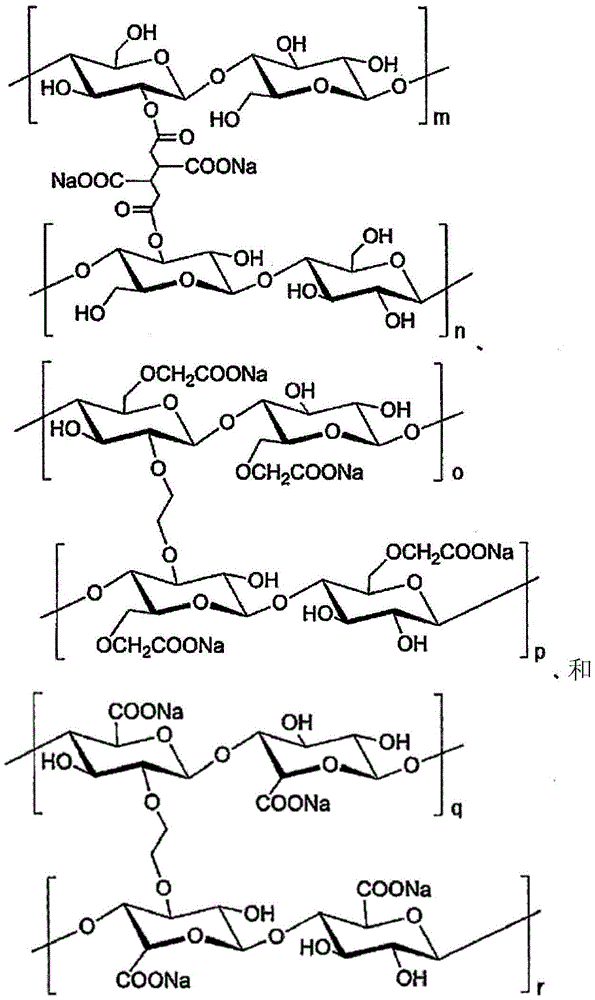
(式中,m~r为100~200)。(In the formula, m to r are 100 to 200).
[8]根据上述[1]~[7]中任一项所述的肿瘤封闭剂,其中,微粒具有20nm~500nm的粒径。[8] The tumor sealing agent according to any one of the above [1] to [7], wherein the microparticles have a particle diameter of 20 nm to 500 nm.
[9]根据上述[1]~[8]中任一项所述的肿瘤封闭剂,其中,微粒以乳液的形态存在。[9] The tumor sealing agent according to any one of the above [1] to [8], wherein the microparticles exist in the form of an emulsion.
[10]根据上述[1]~[9]中任一项所述的肿瘤封闭剂,其中,微粒包含造影剂和/或色素。[10] The tumor sealant according to any one of the above [1] to [9], wherein the microparticles contain a contrast agent and/or a pigment.
发明效果Invention effect
根据本发明,通过对肿瘤细胞实施饥饿策略的疗法,可以在不产生由抗癌剂等引起的严重副作用和由外科手术引起的严重外伤的情况下治疗实体恶性肿瘤。According to the present invention, solid malignant tumors can be treated without serious side effects caused by anticancer agents and the like and severe trauma caused by surgical operations through therapy that implements a starvation strategy on tumor cells.
附图说明Description of drawings
图1为本发明的纳米器件(高吸收性高分子化合物)侵入细胞间的间隙的样子的示意图。FIG. 1 is a schematic diagram showing how the nanodevice (superabsorbent polymer compound) of the present invention penetrates into the space between cells.
图2为示出纳米器件的作用机制的图。FIG. 2 is a diagram illustrating the mechanism of action of the nanodevice.
图3为根据乳腺癌细胞移植小鼠中给药本发明的纳米器件后的肿瘤和未给药本发明的纳米器件的肿瘤中的荧光素表达所引起的发光量差异示出该纳米器件所带来的抗肿瘤效果的图。FIG. 3 is a graph showing the difference in luminescence amount caused by the expression of fluorescein in the tumor after administration of the nanodevice of the present invention and the tumor without administration of the nanodevice of the present invention in breast cancer cell transplanted mice, showing the effect of the nanodevice Graph of the anti-tumor effect.
图4为对通过向图3的荷瘤小鼠给药本发明的纳米器件而引起的肿瘤的体积变化与非给药肿瘤的体积变化进行比较的图。FIG. 4 is a graph comparing the volume change of the tumor caused by the administration of the nanodevice of the present invention to the tumor-bearing mouse of FIG. 3 and the volume change of the non-administered tumor.
图5为对荷瘤动物模型中的抗肿瘤效果进行验证的图。对癌组织给药作为纳米器件(封闭剂)的聚丙烯酰胺系的高吸水性高分子化合物(本说明书中有时称为“MD2”),经时地测定肿瘤尺寸。FIG. 5 is a graph for verifying the antitumor effect in a tumor-bearing animal model. A polyacrylamide-based superabsorbent polymer compound (sometimes referred to as "MD2" in this specification) as a nanodevice (sealing agent) is administered to cancer tissue, and the tumor size is measured over time.
图6为对荷瘤动物模型中的抗肿瘤效果进行验证的图。对癌组织给药作为纳米器件(封闭剂)的以羧甲基纤维素(CMC)为原料的高吸水性高分子化合物(本说明书中有时称为“MD3”),在给药8天后摘出肿瘤,测定肿瘤尺寸。FIG. 6 is a graph for verifying the antitumor effect in a tumor-bearing animal model. A superabsorbent polymer compound (in this specification, sometimes referred to as "MD3") made of carboxymethyl cellulose (CMC) as a nanodevice (sealing agent) was administered to cancer tissue, and the tumor was excised 8 days after administration , to measure tumor size.
图7为示出纳米器件(MD3)所带来的氧截断效果的图。FIG. 7 is a graph showing the oxygen cutoff effect by the nanodevice (MD3).
图8为示出体外的纳米器件(MD3)所带来的蛋白质/营养素的截断效果的图。作为蛋白质/营养素的供给源,使用FBS,示出蛋白质的透过被纳米器件截断的比例。FIG. 8 is a graph showing the protein/nutrient truncation effect by nanodevices (MD3) in vitro. FBS was used as a supply source of protein/nutrient, and the ratio of the permeation of protein was cut off by the nanodevice was shown.
图9为示出体外的纳米器件(MD3)所带来的血红蛋白的截断效果的图。作为血红蛋白的供给源,使用FBS,示出血红蛋白的透过被纳米器件截断的比例。FIG. 9 is a graph showing the truncation effect of hemoglobin by the nanodevice (MD3) in vitro. As a supply source of hemoglobin, FBS was used, and the ratio of the permeation of hemoglobin was cut off by the nanodevice was shown.
图10为示出体外的纳米器件(MD3)所带来的葡萄糖的截断效果的图。作为血红蛋白的供给源,使用FBS,示出葡萄糖的透过被纳米器件截断的比例。FIG. 10 is a graph showing the glucose truncation effect by the nanodevice (MD3) in vitro. FBS was used as a supply source of hemoglobin, and the ratio of the permeation of glucose to the nanodevice was shown.
图11为示出乳腺癌细胞移植小鼠中的、纳米器件(MD3)所带来的肿瘤血管的血流阻断效果(氧浓度减少)的图。11 is a graph showing the blood flow blocking effect (decreased oxygen concentration) of tumor blood vessels by the nanodevice (MD3) in breast cancer cell-transplanted mice.
图12为示出通过使用ICG的血管造影来测定肿瘤内血流下降的结果。FIG. 12 shows the results of measuring the decrease in blood flow in the tumor by angiography using ICG.
具体实施方式Detailed ways
以下详细说明本发明。The present invention will be described in detail below.
本发明的肿瘤封闭剂是以高吸水性高分子化合物作为基材、具有可透过肿瘤血管内皮细胞的间隙的粒径的微粒,其特征在于,该微粒透过该间隙后,利用高的生物粘附性附着于间隙附近存在的肿瘤组织后,通过与生物体内的水分接触而溶胀,形成基于凝胶状组合物的屏障,截断氧和营养向肿瘤的供给以及诱导因子从肿瘤的传递,由此导致该肿瘤细胞坏死,然后,使附着的微粒在生物体内被降解和/或代谢。另外,本发明的肿瘤封闭剂具有上述特征,但还具有压迫通往肿瘤的营养血管而阻断血流、由此减少肿瘤部位的血氧浓度及营养供给从而使肿瘤细胞坏死的效果,因此,本发明的肿瘤封闭剂还作为具有上述附加效果的血流阻断剂起作用。The tumor sealant of the present invention uses a superabsorbent polymer compound as a base material and has microparticles having a particle size capable of permeating the gap of tumor vascular endothelial cells, and is characterized in that after the microparticles pass through the gap, a high biological Adhesively adheres to the tumor tissue existing near the gap, swells by contact with moisture in the living body, forms a barrier based on a gel-like composition, cuts off the supply of oxygen and nutrients to the tumor, and the transmission of inducing factors from the tumor. This results in the necrosis of the tumor cells, which then allow the attached microparticles to be degraded and/or metabolized in vivo. In addition, the tumor sealant of the present invention has the above-mentioned features, but also has the effect of compressing the nutrient blood vessels leading to the tumor to block blood flow, thereby reducing the blood oxygen concentration and nutrient supply at the tumor site, and thereby causing tumor cell necrosis. The tumor sealing agent of the present invention also functions as a blood flow blocking agent having the above-mentioned additional effects.
1.高吸水性高分子化合物1. Super absorbent polymer compound
本发明的肿瘤封闭剂含有可以利用水分溶胀而形成凝胶状组合物的高吸水性高分子化合物,可以为生物降解性和/或生物代谢性。在本说明书中使用时,术语“高吸水性”是指吸水量或溶胀率为干燥时的基材的重量或体积的至少2~10000倍的材料特性。另外,术语“高分子”化合物通常是指由多个单体的重复结构构成的聚合物,在本说明书中,还包括经交联的聚合物。高分子化合物的分子量典型地为约10kDa~约2000kDa,但不限于此,可以根据使用目的适宜变更。需要说明的是,本发明中使用的高吸收性高分子化合物除了可以为后述的式(1)所示的化合物以外,还可以为聚丙烯酰胺、糖胺聚糖、糖胺聚糖交联体、胶原蛋白、胶原蛋白交联体、聚丙烯酸、聚甲基丙烯酸甲酯、聚乙烯醇、聚-L-乳酸或它们的衍生物。另外,如上所述,本发明中使用的高吸水性高分子化合物的溶胀度以重量比或体积比计可以为2~10000倍,例如可以为2~1000倍、2~500倍、2~300倍、2~200倍或2~100倍(作为上限值,为90倍、80倍、70倍、60倍、50倍、40倍、30倍、20倍、15倍、10倍、9倍、8倍、7倍、6倍、5倍、4倍、3倍)。在后述的式(1)所示的化合物中,X(间隔基)为来自于交联剂的分子,但使交联剂减少而合成化合物时,存在溶胀度及溶胀速度变高的倾向(数据未示出)。The tumor sealant of the present invention contains a superabsorbent polymer compound that can be swelled with water to form a gel-like composition, and may be biodegradable and/or biometabolizable. As used in this specification, the term "high water absorption" refers to a material property having a water absorption or swelling ratio of at least 2 to 10,000 times the weight or volume of the substrate when dry. In addition, the term "polymer" compound generally refers to a polymer composed of a repeating structure of a plurality of monomers, and in this specification, a crosslinked polymer is also included. The molecular weight of the polymer compound is typically about 10 kDa to about 2000 kDa, but it is not limited to this, and can be appropriately changed according to the purpose of use. In addition, the superabsorbent polymer compound used in the present invention may be polyacrylamide, glycosaminoglycan, or glycosaminoglycan cross-linked in addition to the compound represented by the formula (1) described later. body, collagen, collagen cross-linked body, polyacrylic acid, polymethyl methacrylate, polyvinyl alcohol, poly-L-lactic acid or their derivatives. In addition, as described above, the swelling degree of the superabsorbent polymer compound used in the present invention may be 2 to 10,000 times in weight ratio or volume ratio, for example, 2 to 1000 times, 2 to 500 times, or 2 to 300 times. times, 2 to 200 times, or 2 to 100 times (as the upper limit, 90 times, 80 times, 70 times, 60 times, 50 times, 40 times, 30 times, 20 times, 15 times, 10 times, 9 times , 8 times, 7 times, 6 times, 5 times, 4 times, 3 times). In the compound represented by the formula (1) described later, X (spacer) is a molecule derived from a crosslinking agent, but when the crosslinking agent is reduced to synthesize the compound, the degree of swelling and the swelling rate tend to increase ( data not shown).
作为本发明的肿瘤封闭剂使用的高吸水性高分子化合物只要具有上述的特性则没有限定,典型地,优选为具有下述的式(1)所示的结构的化合物。The superabsorbent polymer compound used as the tumor sealing agent of the present invention is not limited as long as it has the above-mentioned properties, but typically, a compound having a structure represented by the following formula (1) is preferable.
PS1-X-PS2(1)PS1-X-PS2(1)
(式中,PS1及PS2为多糖类,X为间隔基)(in the formula, PS1 and PS2 are polysaccharides, and X is a spacer)
更具体而言,上述“PS1”及“PS2”相同或不同,独立地选自由β-葡聚糖、壳多糖、脱乙酰壳多糖及它们的衍生物、以及它们的混合物组成的组。本领域技术人员可以理解,本发明包含例如“PS1”为β-聚糖且“PS2”为壳多糖的高吸水性高分子化合物、或“PS1”为β-聚糖且“PS2”为脱乙酰壳多糖的高吸水性高分子化合物。More specifically, the above-mentioned "PS1" and "PS2" are the same or different, and are independently selected from the group consisting of β-glucan, chitin, chitosan and derivatives thereof, and mixtures thereof. Those skilled in the art will understand that the present invention includes, for example, a superabsorbent polymer compound in which "PS1" is β-glycan and "PS2" is chitin, or "PS1" is β-glycan and "PS2" is deacetylated A superabsorbent polymer compound of chitin.
作为以PS1及PS2表示的多糖类,可列举β-葡聚糖、壳多糖、脱乙酰壳多糖、直链淀粉、淀粉、糖原及它们的衍生物、以及它们的混合物。β-葡聚糖没有限定,包括纤维素,另外,β-葡聚糖的衍生物典型地包括羧甲基纤维素及TEMP(2,2,6,6-四甲基哌啶-1-氧基)氧化纤维素。Examples of polysaccharides represented by PS1 and PS2 include β-glucan, chitin, chitosan, amylose, starch, glycogen, derivatives thereof, and mixtures thereof. β-glucan is not limited, including cellulose, in addition, derivatives of β-glucan typically include carboxymethyl cellulose and TEMP (2,2,6,6-tetramethylpiperidine-1-oxo) base) oxidized cellulose.
上述的式(1)所示的结构中的间隔基(“X”)为来自于交联剂的分子,只要是可以通过交联反应将多糖(“PS1”及“PS2”)连接的分子则没有限定。另外,X不限于分子间的交联,也可以用于分子内的交联。更具体而言,在本发明中,作为可以通过交联反应将多糖类连接的交联剂,优选为选自由羧酸酐、例如1,2,3,4-丁烷四羧酸二酐(BTCA)、聚乙二醇二缩水甘油醚(PEGDE)、联苯四羧酸二酐(BPDA)、二苯基砜四羧酸二酐(DSDA)、DSDA及表氯醇组成的组中的一种以上。需要说明的是,在本发明中,所使用的高吸水性高分子化合物为了达到高吸水性,优选在分子内具有同种或异种的解离(离子)性官能团。作为解离性官能团,典型地可例示-COO-Na+,但对于水分子的结合和保持而言,这种结合性阴离子和游离阴离子是必不可少的。另外,本领域技术人员可以出于使所制造的高吸水性高分子化合物的吸水量、溶胀率达到优选数值的目的而适宜选择多糖类的种类、使用量及比率以及交联剂的种类、添加量、比率及交联密度(也可以简记为交联度)等。The spacer ("X") in the structure represented by the above formula (1) is a molecule derived from a cross-linking agent, as long as it is a molecule that can link polysaccharides ("PS1" and "PS2") by a cross-linking reaction. There is no limit. In addition, X is not limited to intermolecular crosslinking, and may be used for intramolecular crosslinking. More specifically, in the present invention, the crosslinking agent capable of linking polysaccharides by a crosslinking reaction is preferably selected from carboxylic acid anhydrides, for example, 1,2,3,4-butanetetracarboxylic dianhydride ( One of the group consisting of BTCA), polyethylene glycol diglycidyl ether (PEGDE), biphenyl tetracarboxylic dianhydride (BPDA), diphenyl sulfone tetracarboxylic dianhydride (DSDA), DSDA and epichlorohydrin more than one species. In addition, in this invention, in order to achieve high water absorption, the superabsorbent polymer compound used preferably has a dissociative (ionic) functional group of the same kind or different kind in the molecule. Typically, -COO - Na + is exemplified as the dissociative functional group, but such a bound anion and a free anion are essential for the binding and retention of water molecules. In addition, those skilled in the art can appropriately select the type, usage amount and ratio of polysaccharides, as well as the type of crosslinking agent, for the purpose of making the water absorption and swelling ratio of the superabsorbent polymer compound to be produced reach the preferred values. The addition amount, ratio, crosslinking density (may also be abbreviated as crosslinking degree) and the like.
作为可以形成凝胶状组合物的高吸水性高分子化合物的例子,没有限定,可以从由下述物质组成的组中选择一种以上。Examples of the superabsorbent polymer compound that can form a gel-like composition are not limited, and one or more kinds can be selected from the group consisting of the following.
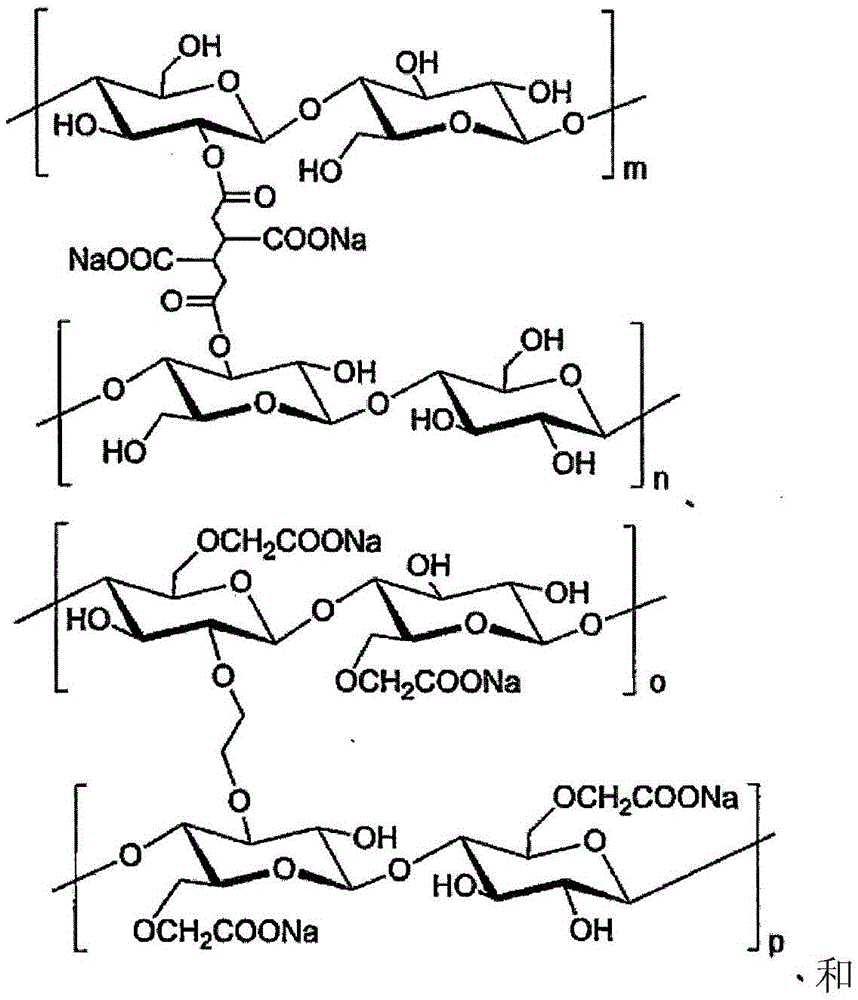

(式中,m~r为100~200)(in the formula, m~r is 100~200)
关于这些高吸水性高分子化合物的合成,可以使用公知的技术来制造(例如,参照国际公开第WO2012/147255号、日本特表2012-12462)。The synthesis of these superabsorbent polymer compounds can be produced using known techniques (for example, refer to International Publication No. WO2012/147255, Japanese Patent Application Publication No. 2012-12462).
例如,以纤维素为原料的高吸水性高分子化合物具有利用四羧酸将其链间进行交联而成的结构。制造该高吸水性高分子化合物的方法简单地如下所述。将作为起始原料的纤维素溶解于氯化锂(LiCl)/N,N,-二甲基乙酰胺(DMAc)、LiCl/N-甲基吡咯烷酮(NMP)、四丁基氟化铵(TBAF)/二甲基亚砜(DMSO)中的任一溶剂中,在室温、常压下以N,N-二甲基-4-氨基吡啶(DMAP)作为催化剂与多羧酸酐进行酯交联反应。作为多羧酸酐,优选1,2,3,4-丁烷四羧酸二酐(BTCA)或3,3’,4,4’-二苯基砜四羧酸二酐(DSDA)。通过该酯交联反应,在纤维素的羟基与羧酸酐之间进行酯化,在纤维素分子链间形成酯性交联,同时羧酸酐转变为羧基。另外,根据本发明,不限于天然来源的高分子链,也可以使用其衍生物。例如,关于纤维素,可以使用羧甲基纤维素(CMC)、CMC钠、CMC铵。关于以CMC为原料的高吸水性高分子材料的制造,可以参考后述的实施例2来进行。For example, a superabsorbent polymer compound using cellulose as a raw material has a structure in which the interchain is cross-linked with tetracarboxylic acid. The method for producing this superabsorbent polymer compound is simply as follows. Cellulose as a starting material was dissolved in lithium chloride (LiCl)/N,N,-dimethylacetamide (DMAc), LiCl/N-methylpyrrolidone (NMP), tetrabutylammonium fluoride (TBAF) )/dimethyl sulfoxide (DMSO) in any solvent, at room temperature and normal pressure with N,N-dimethyl-4-aminopyridine (DMAP) as a catalyst and polycarboxylic anhydride for ester crosslinking reaction . As the polycarboxylic acid anhydride, 1,2,3,4-butanetetracarboxylic dianhydride (BTCA) or 3,3',4,4'-diphenylsulfonetetracarboxylic dianhydride (DSDA) is preferable. Through this ester crosslinking reaction, esterification proceeds between hydroxyl groups of cellulose and carboxylic acid anhydrides, and ester crosslinks are formed between cellulose molecular chains, and at the same time, the carboxylic acid anhydrides are converted into carboxyl groups. In addition, according to the present invention, it is not limited to the polymer chain of natural origin, and derivatives thereof can also be used. For example, as cellulose, carboxymethyl cellulose (CMC), sodium CMC, ammonium CMC can be used. The production of the superabsorbent polymer material using CMC as a raw material can be carried out with reference to Example 2 to be described later.
使上述酯交联反应中得到的反应产物在甲醇、丙酮等有机溶剂中进行沉淀,用碱性水溶液中和至达到pH7为止。通过该中和反应,所生成的羧基转变为羧酸盐。通过这些操作,可以得到具有发挥吸水性作用的羧酸盐和发挥保水性作用的经酯性交联而成的三维交联结构的生物降解性高吸水性高分子。The reaction product obtained in the above-mentioned ester crosslinking reaction is precipitated in an organic solvent such as methanol and acetone, and neutralized with an alkaline aqueous solution until
交联纤维素、交联壳多糖等的吸水、保水性能依赖于交联密度(例如多羧酸交联密度),因此,可以通过控制交联剂的投入浓度、反应溶剂、作为原料的纤维素等的聚合度等来得到具有适合于各种用途的特性的高吸水性高分子化合物。The water absorption and water retention properties of cross-linked cellulose, cross-linked chitin, etc. depend on the cross-linking density (for example, polycarboxylic acid cross-linking density). Therefore, it can be controlled by controlling the input concentration of the cross-linking agent, the reaction solvent, and the cellulose as a raw material. A superabsorbent polymer compound having properties suitable for various uses can be obtained.
即使除了纤维素以外还使用壳多糖、脱乙酰壳多糖或直链淀粉等多糖类、以及它们的混合物作为起始原料,也可以得到具有同样性能的高吸水性高分子。其中,在使用脱乙酰壳多糖、多糖类作为起始原料的情况下,可以使用酸水溶液与有机溶剂的混合体系、例如10%乙酸水溶液/甲醇/NMP的1:1:1混合溶剂等作为溶剂。其中,通过使用棉的纤维素等聚合度为1500以上的纤维素,可得到具有与现有市售品同等以上的吸水性能的生物降解性高吸水性高分子,因此是优选的。Even if a polysaccharide such as chitin, chitosan, or amylose, or a mixture thereof is used as a starting material in addition to cellulose, a superabsorbent polymer having the same performance can be obtained. Among them, in the case of using chitosan and polysaccharides as starting materials, a mixed system of an aqueous acid solution and an organic solvent, such as a 1:1:1 mixed solvent of 10% aqueous acetic acid/methanol/NMP, etc., can be used as the starting material. solvent. Among them, the use of cellulose having a degree of polymerization of 1500 or more, such as cellulose of cotton, is preferable because a biodegradable superabsorbent polymer having a water absorbing performance equal to or higher than that of a conventional commercial product can be obtained.
2.高吸水性高分子化合物的性质2. Properties of Super Absorbent Polymer Compounds
本发明的生物降解性和/或生物代谢性的肿瘤封闭剂中使用的高吸水性高分子化合物通过与水分接触而溶胀,可以形成凝胶状组合物。如上所述,高吸水性高分子化合物在宽泛的环境条件下显示高的稳定性。在使用上述高吸水性高分子化合物作为肿瘤封闭剂的情况下,该高吸水性高分子化合物利用如下现象:利用生物体内的水分形成凝胶状物质,溶胀至原体积的数十倍~数百倍,由此物理性密合于肿瘤细胞表面。The superabsorbent polymer compound used in the biodegradable and/or biometabolizable tumor sealing agent of the present invention can be swelled by contact with water to form a gel-like composition. As described above, the superabsorbent polymer compound exhibits high stability under a wide range of environmental conditions. When the above-mentioned superabsorbent polymer compound is used as a tumor sealing agent, the superabsorbent polymer compound utilizes the phenomenon that a gel-like substance is formed by the moisture in the living body and swells to several tens to hundreds of times its original volume. folds, thereby physically adhering to the surface of tumor cells.
作为可以使本发明的高吸水性高分子化合物溶胀而形成凝胶的水性介质,没有特别限定,可列举:灭菌水、纯化水、蒸馏水、离子交换水、超纯水等水;生理盐水、氯化钠水溶液、氯化钙水溶液、氯化镁水溶液、硫酸钠水溶液、硫酸钾水溶液、碳酸钠水溶液、醋酸钠水溶液等电解质水溶液;磷酸缓冲溶液、Tris-HCl缓冲溶液等缓冲溶液;含有甘油、乙二醇、乙醇等水溶性有机物的水溶液;含有葡萄糖、蔗糖、麦芽糖等糖分子的水溶液;含有聚乙二醇、聚乙烯醇等水溶性高分子的水溶液;含有辛基葡萄糖苷、十二烷基麦芽糖苷、普朗尼克(聚乙二醇/聚丙二醇/聚乙二醇共聚物)等表面活性剂的水溶液;细胞内液、细胞外液、间质液、淋巴液、脊髓液、血液、胃液、血清、血浆、唾液、泪液、精液、尿液等体液;等。The aqueous medium that can swell the superabsorbent polymer compound of the present invention to form a gel is not particularly limited, and examples include water such as sterilized water, purified water, distilled water, ion-exchanged water, and ultrapure water; physiological saline, Sodium chloride aqueous solution, calcium chloride aqueous solution, magnesium chloride aqueous solution, sodium sulfate aqueous solution, potassium sulfate aqueous solution, sodium carbonate aqueous solution, sodium acetate aqueous solution and other electrolyte aqueous solutions; phosphate buffer solution, Tris-HCl buffer solution and other buffer solutions; containing glycerol, ethylene glycol Aqueous solutions of water-soluble organic substances such as alcohol and ethanol; aqueous solutions containing sugar molecules such as glucose, sucrose, maltose; aqueous solutions containing water-soluble macromolecules such as polyethylene glycol and polyvinyl alcohol; containing octyl glucoside, dodecyl maltose Aqueous solutions of surfactants such as glycosides, pluronic (polyethylene glycol/polypropylene glycol/polyethylene glycol copolymer); intracellular fluid, extracellular fluid, interstitial fluid, lymph fluid, spinal fluid, blood, gastric juice, Serum, plasma, saliva, tears, semen, urine and other body fluids; etc.
3.生物降解性和/或生物代谢性的肿瘤封闭剂3. Biodegradable and/or biometabolic tumor sealants
本发明的生物降解性和/或生物代谢性的肿瘤封闭剂是以高吸水性高分子化合物作为基材、具有可透过肿瘤血管内皮细胞的间隙的粒径的纳米微粒,其特征在于,该微粒透过该间隙后,利用高的生物粘附性附着于间隙附近存在的肿瘤组织后,通过与生物体内的水分接触而溶胀,形成凝胶状组合物,截断氧和营养向肿瘤的供给以及诱导因子从肿瘤的传递,由此导致该肿瘤细胞坏死,然后,使附着的微粒在生物体内被降解和/或代谢。The biodegradable and/or biometabolizable tumor sealing agent of the present invention is a nanoparticle having a particle size that can penetrate the gap of tumor vascular endothelial cells as a base material of a superabsorbent polymer compound, and is characterized in that the After passing through the gap, the microparticles adhere to the tumor tissue existing near the gap with high bioadhesion, and then swell by contact with the moisture in the living body to form a gel-like composition, which interrupts the supply of oxygen and nutrients to the tumor and The delivery of inducing factors from the tumor, thereby causing necrosis of the tumor cells, then causes the attached microparticles to be degraded and/or metabolized in vivo.
如上所述,本发明的肿瘤封闭剂需要为可透过肿瘤血管内皮细胞的间隙的纳米级的尺寸,因此优选在纳米微粒的生成中在作为基材的高吸水性高分子化合物的上述酯聚合反应工艺中进行微粒化。该纳米微粒化没有限定,可以使用微流控来进行。微流控可以通过调整反应物质的流量及流速来控制反应量,因此,可以通过在进行聚合反应的同时进行与生成的聚合物量相对应的微粒化来管理粒径,因此非常优选。另外,微流控的使用不仅如上所述比较容易进行粒径的控制,而且还可列举粒子形状接近球体、容易附加化学修饰工序作为优点。但是,利用微流控制备的纳米微粒处于含有水分的水凝胶状态,因此优选通过冷冻干燥制成固体的微粉末状态。As described above, the tumor sealant of the present invention needs to have a nanoscale size that can permeate the interstitial space of tumor vascular endothelial cells. Therefore, it is preferable to polymerize the above-mentioned ester of a superabsorbent polymer compound as a base material in the production of nanoparticles. Micronization is carried out in the reaction process. The nanoparticleization is not limited, and can be performed using microfluidics. Microfluidics can control the amount of reaction by adjusting the flow rate and flow rate of the reactant. Therefore, it is very preferable to control the particle size by performing micronization corresponding to the amount of the polymer produced while the polymerization reaction is being performed. In addition, the use of microfluidics is not only relatively easy to control the particle size as described above, but also has the advantages that the particle shape is close to a sphere and that it is easy to add a chemical modification process. However, the nanoparticles prepared by the microfluidic control are in a hydrogel state containing water, and therefore, it is preferable to freeze-dry them into a solid fine powder state.
纳米微粒与水分接触时溶胀,因此,为了隔绝水分,优选在油性溶液中保管并与该脂质一起在水性介质中进行乳液化。用于将纳米微粒制备成乳液形态的水性介质没有特别限定,可列举:灭菌水、纯化水、蒸馏水、离子交换水、超纯水等水;生理盐水、氯化钠水溶液、氯化钙水溶液、氯化镁水溶液、硫酸钠水溶液、硫酸钾水溶液、碳酸钠水溶液、醋酸钠水溶液等电解质水溶液;磷酸缓冲溶液、Tris-HCl缓冲溶液等缓冲溶液;含有甘油、乙二醇、乙醇等水溶性有机物的水溶液;含有葡萄糖、蔗糖、麦芽糖等糖分子的水溶液;含有聚乙二醇、聚乙烯醇等水溶性高分子的水溶液;含有辛基葡萄糖苷、十二烷基麦芽糖苷、普朗尼克(聚乙二醇/聚丙二醇/聚乙二醇共聚物)等表面活性剂的水溶液;细胞内液、细胞外液、间质液、淋巴液、脊髓液、血液、胃液、血清、血浆、唾液、泪液、精液、尿液等体液;等。Nanoparticles swell when contacted with moisture, and therefore, in order to block moisture, it is preferable to store in an oily solution and emulsify together with the lipid in an aqueous medium. The aqueous medium used to prepare the nanoparticles into an emulsion form is not particularly limited, and examples include water such as sterilized water, purified water, distilled water, ion-exchanged water, and ultrapure water; physiological saline, aqueous sodium chloride, aqueous calcium chloride , magnesium chloride aqueous solution, sodium sulfate aqueous solution, potassium sulfate aqueous solution, sodium carbonate aqueous solution, sodium acetate aqueous solution and other electrolyte aqueous solutions; phosphate buffer solution, Tris-HCl buffer solution and other buffer solutions; aqueous solutions containing water-soluble organics such as glycerol, ethylene glycol, ethanol ; Aqueous solution containing sugar molecules such as glucose, sucrose, maltose; Aqueous solution containing water-soluble macromolecules such as polyethylene glycol and polyvinyl alcohol; Aqueous solutions of surfactants such as alcohol/polypropylene glycol/polyethylene glycol copolymer); intracellular fluid, extracellular fluid, interstitial fluid, lymph fluid, spinal fluid, blood, gastric fluid, serum, plasma, saliva, tears, semen , urine and other body fluids; etc.
作为上述微粒的基材,可以只含有高吸水性高分子化合物,也可以进一步包含功能性物质(例如药剂、造影剂、色素等)。实际应用上,为了将肿瘤封闭剂的封闭状况(具体而言,透过血管后附着并留置于肿瘤部位的状态、附着后慢慢生物降解的过程)可视化,可以含有造影剂或色素中的任一种或这两者。这样,本发明的肿瘤封闭剂可以包含造影剂和/或色素,因此在临床上可用于癌的诊断。As the base material of the above-mentioned fine particles, only a superabsorbent polymer compound may be contained, and a functional substance (eg, a drug, a contrast agent, a dye, etc.) may be further contained. In practice, in order to visualize the sealing state of the tumor sealant (specifically, the state of attaching and indwelling in the tumor site after passing through blood vessels, and the process of gradually biodegrading after attaching), any of a contrast agent or a pigment may be contained. one or both. In this way, the tumor sealant of the present invention can contain a contrast agent and/or a pigment, and thus can be used for the diagnosis of cancer clinically.
作为造影剂,在X射线CT用途中,可列举作为疏水性造影剂的碘系碘化油、作为水性造影剂的碘帕醇等,在MRI用途中,可列举Gd(钆)系或Fe(铁)系磁性物质,在回波用途中,可列举超声波脂质体粒子。这些造影剂可以含有一种或两种以上。Examples of contrast agents include iodine-based lipiodol as a hydrophobic contrast agent and iopamidol as an aqueous contrast agent for X-ray CT applications, and Gd (gadolinium)-based or Fe ( Iron)-based magnetic substances, for echo applications, ultrasonic liposome particles are exemplified. These contrast agents may contain one kind or two or more kinds.
另外,作为确保手术前及手术中的辨认性的色素,可列举:疏水性的香豆素、水溶性的荧光素、荧光黄(Pyranine)、青色素等荧光色素、虫荧光素(Luciferin)等发光色素。这些色素可以含有一种或两种以上。In addition, examples of dyes for ensuring visibility before and during surgery include hydrophobic coumarin, water-soluble fluorescein, fluorescent dyes such as Pyranine and cyanine, and luciferin. Luminous pigments. These pigments may contain one type or two or more types.
进而,可以同时含有各自为一种或两种以上的造影剂和色素。Furthermore, each of one or two or more types of contrast agents and dyes may be contained at the same time.
上述高吸水性高分子化合物与造影剂或/和色素的配合比可以为100:1~1:100,例如可以为95:5、10:1、90:10、10:2、80:20、10:3、70:30、60:40、50:50、40:60、30:70、20:80、10:90、5:95。优选为100:1~50:50,进一步优选为10:1~10:3。The mixing ratio of the above-mentioned superabsorbent polymer compound to the contrast agent or/and the pigment can be 100:1 to 1:100, for example, 95:5, 10:1, 90:10, 10:2, 80:20, 10:3, 70:30, 60:40, 50:50, 40:60, 30:70, 20:80, 10:90, 5:95. Preferably it is 100:1-50:50, More preferably, it is 10:1-10:3.
通常,在肿瘤组织中,肿瘤末梢血管中新生血管较多,构成这些血管的血管内皮细胞彼此、癌细胞彼此与正常细胞相比粘附性下降,因此在细胞与细胞之间存在数纳米至数微米的间隙。在该间隙可使纳米微粒进行扩散。图1为对肿瘤组织中的细胞外微环境中的本发明的肿瘤封闭剂、细胞及间隙的尺寸进行比较的图。间隙被称为间质,由胶原蛋白、成纤维细胞、血管(在癌组织中为新生血管)、淋巴管等构成。癌组织中,通常淋巴管不发达,在癌微环境的间质中,胶原蛋白、成纤维细胞等的存在抑制了微粒的流动性。本发明的作用机制之一是利用EPR效应(enhanced permeability&retention effect),即,微粒从该血管内皮细胞彼此的间隙透过,聚集并固定于肿瘤组织中。而且,本发明的肿瘤封闭剂侵入癌细胞间的间隙,利用生物体内的水分溶胀至数百倍,压迫周围的癌细胞、血管等,覆盖肿瘤整体,由此发挥血流阻断效果(图2)。Generally, in tumor tissue, there are many new blood vessels in the peripheral blood vessels of the tumor. The adhesion of vascular endothelial cells and cancer cells constituting these blood vessels is lower than that of normal cells. Therefore, there are several nanometers to several nanometers between cells. micron gap. In this gap, nanoparticles can diffuse. FIG. 1 is a graph comparing the size of the tumor sealant of the present invention, cells and spaces in the extracellular microenvironment in tumor tissue. The space is called the stroma, and is composed of collagen, fibroblasts, blood vessels (new blood vessels in cancer tissues), lymphatic vessels, and the like. In cancer tissues, lymphatic vessels are generally underdeveloped, and the presence of collagen, fibroblasts, and the like in the interstitium of the cancer microenvironment inhibits the fluidity of microparticles. One of the mechanisms of action of the present invention is to utilize the EPR effect (enhanced permeability & retention effect), that is, the microparticles permeate through the gap between the vascular endothelial cells, aggregate and fix in the tumor tissue. Furthermore, the tumor sealant of the present invention penetrates into the space between cancer cells, swells several hundred times with the water in the living body, compresses surrounding cancer cells, blood vessels, etc., and covers the entire tumor, thereby exerting a blood flow blocking effect ( FIG. 2 ). ).
如后所述,以高吸水性高分子化合物作为基材的微粒可使用以喷射磨为代表的干式粉碎技术、高压均化器、喷雾干燥、冷冻干燥等湿式粉碎技术及乳液聚合技术、微流体技术来制备,粒径尺寸并不均匀,各种尺寸混合存在,但20nm~500nm的粒径尺寸为主体(在全部微粒中优选占70%以上,更优选占90%以上,根据情况也可以占100%),也可以存在小于20nm的微粒或超过500nm的微粒。因此,在本说明书中,在根据使用的形态而通过粒径尺寸来特别规定微粒的情况下,具有“20nm~500nm”的粒径的微粒并非意图排除例如具有“10nm~200nm”的粒径的微粒、具有“300nm~700nm”的粒径的微粒等。另一方面,“20nm~500nm”的粒径尺寸中,意图也例示性地包含“20nm~400nm”、“20nm~300nm”、“20nm~200nm”、“20nm~100nm”、“30nm~500nm”、“30nm~400nm”、“30nm~300nm”、“30nm~200nm”、“30nm~100nm”、“40nm~500nm”、“40nm~400nm”、“40nm~300nm”、“40nm~200nm”、“40nm~100nm”、“50nm~500nm”、“50nm~400nm”、“50nm~300nm”、“50nm~200nm”、“50nm~100nm”、“100nm~500nm”、“100nm~400nm”、“100nm~300nm”、“100nm~200nm”等。As will be described later, fine particles using a superabsorbent polymer compound as a base material can use dry pulverization technology represented by jet mill, wet pulverization technology such as high-pressure homogenizer, spray drying, freeze drying, emulsion polymerization technology, micro-pulverization technology, etc. It is prepared by fluid technology, the particle size is not uniform, and various sizes are mixed, but the particle size of 20nm ~ 500nm is the main particle size (preferably accounting for more than 70% of all particles, more preferably accounting for more than 90%, depending on the situation. 100%), particles smaller than 20 nm or particles over 500 nm may also be present. Therefore, in this specification, when the particle size is specifically defined by the particle size according to the form of use, the particle having a particle diameter of "20 nm to 500 nm" is not intended to exclude, for example, a particle having a particle diameter of "10 nm to 200 nm". Microparticles, microparticles having a particle diameter of "300 nm to 700 nm", and the like. On the other hand, the particle size of "20 nm to 500 nm" is intended to include "20 nm to 400 nm", "20 nm to 300 nm", "20 nm to 200 nm", "20 nm to 100 nm", and "30 nm to 500 nm" as an example. , "30nm~400nm", "30nm~300nm", "30nm~200nm", "30nm~100nm", "40nm~500nm", "40nm~400nm", "40nm~300nm", "40nm~200nm", " 40nm~100nm", "50nm~500nm", "50nm~400nm", "50nm~300nm", "50nm~200nm", "50nm~100nm", "100nm~500nm", "100nm~400nm", "100nm~ 300nm", "100nm~200nm", etc.
典型地,上述微粒可以通过以任意的顺序添加一种或两种以上的上述高吸水性高分子化合物或其盐、造影剂或/和色素(含有时)、一种或两种以上的适量的制药上可允许的表面活性剂及适量的水性介质(例如,生理盐水、注射用水)等并进行搅拌、均质化来制备。Typically, the above-mentioned fine particles can be prepared by adding one or two or more of the above-mentioned superabsorbent polymer compounds or salts thereof, a contrast agent or/and a pigment (if contained), and one or two or more appropriate amounts thereof in any order. A pharmaceutically acceptable surfactant and an appropriate amount of aqueous medium (for example, physiological saline, water for injection), etc., are prepared by stirring and homogenizing.
作为上述制药上可允许的表面活性剂,可使用制药或化妆品领域中使用的任意的表面活性剂,虽然不限于以下,但可使用例如普朗尼克(例如普朗尼克F127;聚氧乙烯聚氧丙烯(200EO)(70PO))、聚山梨酯80(聚氧乙烯失水山梨醇油酸酯;吐温80)等。As the above-mentioned pharmaceutically acceptable surfactant, any surfactant used in the pharmaceutical or cosmetic fields can be used, and although not limited to the following, for example, Pluronic (eg, Pluronic F127; polyoxyethylene polyoxyethylene) can be used. Propylene (200EO) (70PO)), polysorbate 80 (polyoxyethylene sorbitan oleate; Tween 80) and the like.
在一个实施方式中,本发明的肿瘤封闭剂可以以可分散的浓度(例如0.001~15重量%)含有上述微粒,可根据给药对象、给药量等决定。In one embodiment, the tumor sealing agent of the present invention may contain the above-mentioned fine particles at a dispersible concentration (eg, 0.001 to 15% by weight), which can be determined according to the administration object, the administration amount, and the like.
作为上述微粒的确认方法,微粒的结构可以利用例如小角X射线散射(SAXS)或cryo-TEM(低温透射电镜)进行分析。另外,微粒的粒径分布可以利用例如动态光散射法、ζ电位-粒径测定装置等进行测定。As a method for confirming the above-mentioned microparticles, the structure of the microparticles can be analyzed by, for example, small angle X-ray scattering (SAXS) or cryo-TEM (cryo-transmission electron microscopy). In addition, the particle size distribution of the fine particles can be measured by, for example, a dynamic light scattering method, a zeta potential-particle size measuring apparatus, or the like.
如上所述,本发明的微粒可以通过将一种以上高吸水性高分子化合物与表面活性剂等混合、并进行搅拌及均质化来制备,但也可以如后述的实施例1及2所示使用超声波破碎、微流体技术来制备。在此,“微流体技术”是在微小空间处理流体的技术的总称,将该技术所使用的器件称为“微流体器件”。这是应用半导体微细加工技术或精密机械加工技术而制作的、具有深度及宽度典型地为约数μm~约数百μm的流路结构的装置。在本说明书中,使用基于粉碎法的过滤或乳液聚合技术和微流体技术来制作微粒,可以稳定地制备具有期望粒径的微粒,因此,优选使用该技术来制作微粒。需要说明的是,微粒的粒径可以使用本领域技术人员公知的常规方法来测定。As described above, the microparticles of the present invention can be prepared by mixing one or more types of superabsorbent polymer compounds with a surfactant and the like, and stirring and homogenizing them. Shown using ultrasonication, microfluidic technology to prepare. Here, "microfluidic technology" is a general term for technologies for processing fluids in tiny spaces, and devices used in this technology are referred to as "microfluidic devices". This is a device produced by applying semiconductor microfabrication technology or precision machining technology and having a flow channel structure with a depth and width of typically about several μm to about several hundreds of μm. In the present specification, the microparticles are produced using the pulverization-based filtration or emulsion polymerization technique and the microfluidic technique, since fine particles having a desired particle size can be stably produced, this technique is preferably used to produce the microparticles. In addition, the particle diameter of microparticles|fine-particles can be measured using the conventional method well-known to those skilled in the art.
4.生物降解性肿瘤封闭剂的性质和特征4. Properties and Characteristics of Biodegradable Tumor Sealers
(1)注射器或微导管通过性(1) Syringe or microcatheter passability
如上所述,本发明的肿瘤封闭剂包含将上述高吸水性高分子化合物进行纳米微粒化、并分散于油性介质中而成的乳液。通过该乳液,确保了注射器或微导管的通过性。As described above, the tumor sealing agent of the present invention contains an emulsion obtained by nano-particle-forming the above-mentioned superabsorbent polymer compound and dispersing it in an oily medium. By this emulsion, the passability of the syringe or microcatheter is ensured.
(2)肿瘤血管透过性(2) Tumor vascular permeability
就肿瘤组织中特异性形成的肿瘤新生血管而言,覆盖血管的周细胞(血管周细胞)减少,因此,与正常细胞相比,肿瘤血管中的内皮细胞间的间隙扩大。存在从该间隙漏出的粒子。本发明的肿瘤封闭剂具有足以通过该间隙的小粒径。间隙的大小存在个体差异,也取决于肿瘤种类、部位,但通常设为5nm以上且700nm以下。Regarding tumor neovascularization specifically formed in tumor tissue, the pericytes (perivascular cells) covering the blood vessels are reduced, and therefore, the gaps between endothelial cells in tumor blood vessels are enlarged compared to normal cells. There are particles leaking from this gap. The tumor sealant of the present invention has a particle size small enough to pass through the gap. The size of the gap varies among individuals and also depends on the type and site of the tumor, but is usually set to 5 nm or more and 700 nm or less.
(3)由不同的粒径构成的分散性(3) Dispersibility consisting of different particle sizes
上述肿瘤血管的间隙大小不一。本发明的肿瘤封闭剂是粒径不单一、具有数百nm幅度的分布的乳液,因此,可以透过任何间隙,由此增加聚集密度。The gaps in the tumor vessels described above vary in size. The tumor sealant of the present invention is an emulsion with a non-uniform particle size and a distribution with a range of several hundreds of nm, and therefore, can penetrate any gap, thereby increasing the aggregation density.
(4)肿瘤组织聚集性(4) Tumor tissue aggregation
如上所述,透过肿瘤血管后的微粒被释放到肿瘤周边,但与正常组织不同,肿瘤组织中淋巴管网络不发达。因此,不会与体液一起经由淋巴管输送到其它部位。因此,被释放出的微粒、即本发明的肿瘤封闭剂具有停留于肿瘤部位的聚集性。将上述(2)和(4)合并称为EPR效应。As described above, the microparticles that pass through the tumor blood vessels are released around the tumor, but unlike normal tissue, the lymphatic network in tumor tissue is underdeveloped. Therefore, it is not transported to other sites via lymphatic vessels together with body fluids. Therefore, the released microparticles, ie, the tumor sealing agent of the present invention, have aggregation properties that stay at the tumor site. The combination of the above (2) and (4) is called the EPR effect.
(5)氧和营养的截断性(5) Cutoff of oxygen and nutrients
本发明的肿瘤封闭剂呈凝胶状态并集合体化,因此,稠密地将肿瘤组织封闭,由此肿瘤细胞被截断增殖所需的营养和氧,导致细胞死亡(坏死)。The tumor sealant of the present invention is in a gel state and aggregates, and therefore, densely seals tumor tissue, whereby tumor cells are deprived of nutrients and oxygen required for proliferation, resulting in cell death (necrosis).
(6)传递系统转录诱导因子的传递抑制性(6) Transmission inhibition of transcription-inducing factors in the delivery system
从肿瘤组织、细胞会产生各种诱导因子。例如,从低氧应激下的癌细胞产生的HIF(低氧诱导因子)传递到VEGF(血管内皮细胞生长因子),促进肿瘤血管新生,增加向肿瘤的营养和氧的供给量,从而有助于增殖。本发明的肿瘤封闭剂将肿瘤组织无间隙地覆盖并封锁,由此阻止从这些肿瘤产生的传递因子的扩散,从而能够防止住恶性化。Various induction factors are produced from tumor tissues and cells. For example, HIF (hypoxia-inducible factor) produced from cancer cells under hypoxic stress is transmitted to VEGF (vascular endothelial growth factor), which promotes tumor angiogenesis and increases the supply of nutrients and oxygen to the tumor, thereby helping for proliferation. The tumor sealant of the present invention covers and seals tumor tissues without gaps, thereby preventing the spread of transfer factors produced from these tumors, thereby preventing malignancy.
(7)快速代谢、排泄(7) Rapid metabolism and excretion
本发明的肿瘤封闭剂经过足以使肿瘤细胞坏死的时间、期间后,经过基于体内酶的降解或可溶化,一部分经过进一步降解等,被排泄到体外。The tumor sealing agent of the present invention is degraded or solubilized by in vivo enzymes after a time and period sufficient to necrotize tumor cells, and a part thereof is further degraded and excreted outside the body.
(8)辨认性及可视化性(8) Recognition and visualization
到(5)为止是限于本发明的肿瘤封闭剂的基本功能的性质,但作为实际应用上的功能,附加有医生使用时有用的功能。The properties up to (5) are limited to the basic functions of the tumor sealant of the present invention, but as practical functions, functions useful when used by doctors are added.
第一,是基于目视的辨认性。通过包含色素(包括荧光色素)而降低与其它药品拿错的风险,进而,通过作为标志物显示出手术部位、范围,能够避免在错误的位置实施手术。The first is based on visual recognition. The inclusion of dyes (including fluorescent dyes) reduces the risk of mistaking with other medicines, and further, by displaying the surgical site and range as a marker, it is possible to avoid performing surgery at the wrong location.
第二,通过包含造影剂,可以通过手术中的图像装置的监控来确认是否在准确的位置上实施了充分的手术或已完成手术。进而,不会像仅使用造影剂时那样流出,而是固定在肿瘤部位,因此具有不进行再次注入造影剂的手术、可以通过图像装置监控术后的肿瘤状况的可视化性。Second, by including a contrast agent, it is possible to confirm whether or not a sufficient operation has been performed or completed at an accurate position through monitoring of the imaging device during the operation. Furthermore, it does not flow out like when only the contrast medium is used, but is fixed to the tumor site, so that the operation without re-injection of the contrast medium has the ability to monitor the postoperative tumor status with an image device.
(9)栓塞性(9) Embolic
本发明的肿瘤封闭剂还可以用作动脉栓塞用栓塞材料。作为栓塞材料,制成发挥与永久栓塞材料同等的栓塞效果的临时栓塞材料,可以避免永久留置风险,进而还可以期待肿瘤封闭效果与栓塞效果的协同效果。The tumor sealant of the present invention can also be used as an embolization material for arterial embolization. As an embolization material, a temporary embolization material that exhibits the same embolization effect as a permanent embolization material can avoid the risk of permanent indwelling, and furthermore, a synergistic effect of the tumor sealing effect and the embolization effect can be expected.
5.生物降解性肿瘤封闭剂的使用5. Use of biodegradable tumor sealants
如上制备的肿瘤封闭剂例如可用于诊断和/或治疗实体恶性肿瘤。在本说明书中使用时,“实体恶性肿瘤”包括:鳞状细胞癌、乳腺癌、皮肤淋巴瘤、血管肉瘤、肝胆道系统癌、头颈部癌、肺癌、间皮瘤、纵隔癌、食道癌、胃癌、胰腺癌、小肠癌、结肠癌、结肠直肠癌、大肠癌、肛门癌、肾癌、尿道癌、膀胱癌、前列腺癌、尿道癌、阴茎癌、睾丸癌、妇科器官癌、卵巢癌、内分泌系统癌、皮肤癌、包括脑在内的中枢神经系统的癌;软组织及骨肉瘤;以及皮肤及眼内起源的黑色素瘤。作为使用形态,虽然没有限定,但可以以在油性介质中分散有以一种或两种以上的高吸水性高分子作为基材的微粒的乳液的形态使用,或者,可以以包含该微粒的药物组合物的形式使用。这样,本发明的肿瘤封闭剂不仅可以适用于实体恶性肿瘤等癌的诊断,而且还可以应用于癌的治疗,因此可称作“治疗诊断·器件”。A tumor sealant prepared as above can be used, for example, in the diagnosis and/or treatment of solid malignancies. As used in this specification, "solid malignancy" includes: squamous cell carcinoma, breast cancer, cutaneous lymphoma, angiosarcoma, hepatobiliary cancer, head and neck cancer, lung cancer, mesothelioma, mediastinal cancer, esophageal cancer , gastric cancer, pancreatic cancer, small bowel cancer, colon cancer, colorectal cancer, colorectal cancer, anal cancer, kidney cancer, urethral cancer, bladder cancer, prostate cancer, urethral cancer, penile cancer, testicular cancer, gynecological organ cancer, ovarian cancer, Endocrine system cancer, skin cancer, cancer of the central nervous system including the brain; soft tissue and osteosarcoma; and melanoma of skin and intraocular origin. The form of use is not limited, but it can be used in the form of an emulsion in which fine particles having one or two or more types of superabsorbent polymers as a base are dispersed in an oily medium, or a drug containing the fine particles can be used. used in the form of a composition. In this way, the tumor sealing agent of the present invention can be applied not only to the diagnosis of cancers such as solid malignant tumors, but also to the treatment of cancer, and thus can be referred to as "therapeutic diagnostic devices".
根据本发明,可以使用注射器或微导管,从肿瘤附近动脉导入肿瘤封闭剂以栓塞肿瘤和/或阻断血流。在一个方式中,本发明的生物降解性肿瘤封闭剂可以以可用针穿刺的癌作为治疗对象,因此,可以使用例如注射器局部给药于肿瘤附近。在此,关于导入时的生物降解性肿瘤封闭剂的量、浓度、次数及频率等,可以考虑对象(受试者)的性别、年龄、体重、患部的状态等由医生及兽医来适宜调整。在此,本发明的生物降解性肿瘤封闭剂的治疗对象优选为哺乳动物,作为哺乳动物,没有限定,可列举:人、猴等灵长类;小鼠、大鼠、兔子、豚鼠等啮齿类;猫、狗、绵羊、猪、牛、马、驴、山羊、雪貂等。According to the present invention, a tumor sealant can be introduced from an artery adjacent to the tumor using a syringe or microcatheter to embolize the tumor and/or block blood flow. In one embodiment, the biodegradable tumor sealant of the present invention can target a needle-pierceable cancer, and thus can be locally administered near a tumor using, for example, a syringe. Here, the amount, concentration, frequency, and frequency of the biodegradable tumor sealant at the time of introduction can be appropriately adjusted by a doctor or veterinarian in consideration of the sex, age, weight, and condition of the affected part of the subject (subject). Here, the subject to be treated by the biodegradable tumor sealant of the present invention is preferably a mammal, and the mammal is not limited, and examples include primates such as humans and monkeys; rodents such as mice, rats, rabbits, and guinea pigs. ; cats, dogs, sheep, pigs, cattle, horses, donkeys, goats, ferrets, etc.
在后述的实施例3中,利用注射器从肿瘤附近的血管对乳腺癌细胞移植小鼠给药(具体而言,注入)100μL乳液形态的肿瘤封闭剂(实施例1),得到了抗肿瘤效果。关于对人的应用,如果基于这些乳腺癌细胞移植小鼠的实验结果简单地进行体重换算,则例如对于人的实体恶性肿瘤,相当于从肿瘤附近的血管以每次10ml~200ml左右的量给药本发明的生物降解性肿瘤封闭剂。另外,本发明的生物降解性肿瘤封闭剂可以以适当间隔(例如,每天2次、每天1次、每周2次、每周1次、每两周1次)多次(例如,2~10次)给药,直至得到所期望的治疗效果为止。此外,本发明的生物降解性肿瘤封闭剂的每次的给药量(具体而言,注入量)及给药频率不限于上述,本领域技术人员(例如,医生或兽医)可适当调整并决定。In Example 3, which will be described later, 100 μL of a tumor sealant (Example 1) in the form of an emulsion was administered (specifically, injected) to breast cancer cell-transplanted mice from a blood vessel near the tumor using a syringe, and an antitumor effect was obtained. . Regarding the application to humans, if the body weight is simply converted based on the experimental results of these breast cancer cell-transplanted mice, for example, for solid malignant tumors in humans, it is equivalent to administer an amount of about 10 ml to 200 ml each time from the blood vessels near the tumor. The biodegradable tumor sealing agent of the present invention is used. In addition, the biodegradable tumor sealant of the present invention may be multiple times (eg, 2 to 10 times) at appropriate intervals (eg, twice a day, once a day, twice a week, once a week, once every two weeks). times) until the desired therapeutic effect is obtained. In addition, the administration amount (specifically, the injection amount) and administration frequency of the biodegradable tumor sealant of the present invention are not limited to the above, and those skilled in the art (for example, a doctor or a veterinarian) can appropriately adjust and decide .
在将本发明的肿瘤封闭剂作为药物组合物使用的情况下,可以以除了作为有效成分的肿瘤封闭剂以外还适当添加载体、赋形剂和/或稳定剂等的形态来使用。另外,根据本发明,可以以包含分别封入有肿瘤封闭剂、溶剂(生理盐水等)、载体等的容器(小瓶等)及使用说明书等的试剂盒的形式提供。另外,本发明的生物降解性肿瘤封闭剂包括医用材料。When the tumor sealing agent of the present invention is used as a pharmaceutical composition, it can be used in a form in which a carrier, an excipient, and/or a stabilizer, etc. are appropriately added in addition to the tumor sealing agent as an active ingredient. In addition, according to the present invention, it can be provided in the form of a kit including a container (vial, etc.) in which a tumor sealing agent, a solvent (physiological saline, etc.), a carrier, etc. are enclosed, and an instruction manual, etc., respectively. In addition, the biodegradable tumor sealant of the present invention includes medical materials.
实施例Example
以下基于实施例更具体地说明本发明。当然,本发明不受下述实施例限定。Hereinafter, the present invention will be described more specifically based on examples. Of course, the present invention is not limited to the following examples.
[实施例1]以纤维素为原料的高吸水性高分子化合物的制造[Example 1] Production of a superabsorbent polymer compound using cellulose as a raw material
将1g纤维素(株式会社Sugino Machine)添加到氯化锂(LiCl)/N-甲基吡咯烷酮(NMP)溶液(5g LiCl/95g NMP)中,在室温下充分搅拌2天而使其溶解。添加作为催化剂的N,N-二甲基-4-氨基吡啶(DMAP)1.14g、作为交联剂的1,2,3,4-丁烷四羧酸二酐(BTCA)3.07g,在搅拌的同时在室温下反应24小时。通过该酯交联反应而在纤维素分子链间形成交联。然后,在1L甲醇溶液中使反应生成物析出,然后用10%氢氧化钠水溶液调整到pH7.0。接着,将沉淀物用均化器粉碎,用玻璃过滤器过滤。过滤后,使用甲醇和水,将洗涤及过滤重复进行数次,最终在70℃的条件下进行减压干燥,得到纤维素高吸水性高分子化合物。需要说明的是,在没有特别声明时,使用的试剂均为购自东京化成工业株式会社的试剂(以下同样)。1 g of cellulose (Sugino Machine Co., Ltd.) was added to a lithium chloride (LiCl)/N-methylpyrrolidone (NMP) solution (5 g LiCl/95 g NMP), and the mixture was sufficiently stirred at room temperature for 2 days to dissolve. 1.14 g of N,N-dimethyl-4-aminopyridine (DMAP) as a catalyst and 3.07 g of 1,2,3,4-butanetetracarboxylic dianhydride (BTCA) as a crosslinking agent were added, and the mixture was stirred. while reacting at room temperature for 24 hours. Crosslinks are formed between cellulose molecular chains by this ester crosslinking reaction. Then, the reaction product was deposited in 1 L of methanol solution, and then adjusted to pH 7.0 with a 10% aqueous sodium hydroxide solution. Next, the precipitate was pulverized with a homogenizer and filtered with a glass filter. After filtration, washing and filtration were repeated several times using methanol and water, and finally, the mixture was dried under reduced pressure at 70° C. to obtain a cellulose superabsorbent polymer compound. In addition, unless otherwise stated, the reagents used were all reagents purchased from Tokyo Chemical Industry Co., Ltd. (the same applies hereinafter).
[实施例2]以羧甲基纤维素(CMC)为原料的高吸水性高分子化合物的合成[Example 2] Synthesis of superabsorbent polymer compound using carboxymethyl cellulose (CMC) as raw material
在烧杯内搅拌1.5M氢氧化钠水溶液100ml的同时,以不结块的方式一点一点地加入5g的CMC(三晶株式会社),使其完全溶解。添加作为交联剂的聚乙二醇二缩水甘油醚(PEGDE)0.5ml,在室温下充分搅拌10分钟,然后在60℃下进行3小时交联反应。向反应生成物的水凝胶中加入甲醇200ml,用均化器进行湿式粉碎。粉碎后,将成为粒状的水凝胶粒子用玻璃过滤器过滤。过滤后,使用甲醇和水,将洗涤及过滤的操作进行数次,直至洗涤液的pH达到中性附近为止,最终在70℃的条件下进行减压干燥,得到CMC高吸水性高分子化合物。While stirring 100 ml of a 1.5 M aqueous sodium hydroxide solution in a beaker, 5 g of CMC (Sanjing Co., Ltd.) was added little by little so as not to agglomerate, and it was completely dissolved. 0.5 ml of polyethylene glycol diglycidyl ether (PEGDE) as a crosslinking agent was added, and the mixture was stirred well at room temperature for 10 minutes, and then crosslinking reaction was performed at 60° C. for 3 hours. 200 ml of methanol was added to the hydrogel of the reaction product, and wet pulverization was carried out with a homogenizer. After pulverization, the granular hydrogel particles were filtered with a glass filter. After the filtration, washing and filtration were performed several times using methanol and water until the pH of the washing solution reached near neutrality, and finally, it was dried under reduced pressure at 70° C. to obtain a CMC superabsorbent polymer compound.
[实施例3]关于肿瘤部位的血流阻断效果的评价[Example 3] Evaluation of the blood flow blocking effect at the tumor site
(1)乳腺癌细胞移植小鼠的制作(1) Preparation of breast cancer cell transplanted mice
获得稳定表达荧光素酶的4T1乳腺癌细胞(4T1-Luc),将2.5×10⁷个细胞/ml的PBS/Geltrex(注册商标)=1/1(vol/vol)的细胞悬浮液0.04ml移植于裸小鼠Balb/c nu/nu(日本Charles River株式会社)的皮下。4T1 breast cancer cells stably expressing luciferase (4T1-Luc) were obtained, and 0.04 ml of a cell suspension of PBS/Geltrex (registered trademark) = 1/1 (vol/vol) of 2.5×10 7 cells/ml was transplanted subcutaneously in nude mice Balb/c nu/nu (Charles River Co., Ltd., Japan).
(2)血流阻断效果(2) Blood flow blocking effect
向上述移植了乳腺癌细胞的小鼠肿瘤部位,局部给药实施例1中制作的肿瘤封闭剂(乳液)。给药后,通过腹腔内给药来给药含有作为荧光素酶的底物的D-荧光素的磷酸缓冲生理盐水,使血流循环,利用体内成像装置(IVIS)(Spectrum)经时性地观察上述乳腺癌细胞的荧光素酶(Luc)活性。在肿瘤部位,通过血中的荧光素的存在,基于Luc活性来确认荧光。如图3A所示,在未给药乳液的小鼠中,通过移植的乳腺癌细胞的Luc表达,可以持续观察到荧光,与此相对,在给药了乳液的小鼠中,从刚给药后起荧光减少,因此暗示了:通过乳液的给药,可阻断血中的D-荧光素向肿瘤的传递,通过乳液给药,可阻断流向肿瘤部位的血流。另外,对于该观察结果,算出给药小鼠相对于未给药小鼠的Luc活性之比,图3B中示出经时性的变化。The tumor sealant (emulsion) prepared in Example 1 was locally administered to the tumor site of the above-mentioned breast cancer cell-transplanted mouse. After administration, phosphate buffered saline containing D-luciferin, which is a substrate of luciferase, was administered by intraperitoneal administration to circulate blood flow, and the in vivo imaging device (IVIS) (Spectrum) was used for time-lapse. The luciferase (Luc) activity of the above breast cancer cells was observed. At the tumor site, fluorescence was confirmed based on Luc activity by the presence of fluorescein in blood. As shown in FIG. 3A , in mice to which the emulsion was not administered, fluorescence was continuously observed by the expression of Luc in the transplanted breast cancer cells, whereas in the mice to which the emulsion was administered, the expression of Luc was observed immediately after administration. The subsequent decrease in fluorescence suggested that the delivery of D-luciferin in blood to the tumor could be blocked by the administration of the emulsion, and the blood flow to the tumor site could be blocked by the administration of the emulsion. In addition, regarding this observation result, the ratio of the Luc activity of the administered mice to the non-administered mice was calculated, and FIG. 3B shows the changes over time.
(3)肿瘤抑制(3) Tumor suppression
对多次给药乳液时的肿瘤体积的变化进行研究。使用如上述(1)中记载那样移植了4T1-Luc的裸小鼠进行经时性观察。乳液的给药在第一次(第1天)、第2天、第3天及第4天进行。将肿瘤体积的经时变化示于图4。根据图4可知,与给药了生理盐水的对照相比,给药了乳液的小鼠的肿瘤体积减少。这样,从大约给药4次后起,肿瘤体积的减少变得显著。Changes in tumor volume with multiple doses of the emulsion were studied. Time-lapse observation was performed using nude mice transplanted with 4T1-Luc as described in (1) above. The administration of the emulsion was performed on the first (day 1), 2, 3 and 4 days. Time-dependent changes in tumor volume are shown in FIG. 4 . As can be seen from FIG. 4 , the tumor volume of the mice administered with the emulsion decreased as compared with the control administered with physiological saline. Thus, from about 4 doses, the reduction in tumor volume became significant.
[实施例4]荷瘤动物模型中的抗肿瘤效果的确认[Example 4] Confirmation of antitumor effect in tumor-bearing animal model
在本实施例中,使用实施例3中采用的皮下移植了乳腺癌细胞的小鼠作为荷瘤动物模型,使用以市售的聚丙烯酰胺系的高吸水性高分子化合物(粒径:500~600nm)(三洋化成工业株式会社)(以下有时称为“MD2”)及羧甲基纤维素(CMC)为原料的高吸水性高分子化合物(粒径:600~1500nm)(以下有时称为“MD3”)作为封闭剂,研究它们的通过形成屏障而带来的抗肿瘤效果。In this example, the mouse subcutaneously transplanted with breast cancer cells used in Example 3 was used as a tumor-bearing animal model, and a commercially available polyacrylamide-based superabsorbent polymer compound (particle size: 500-500 Å) was used. 600nm) (Sanyo Chemical Industry Co., Ltd.) (hereinafter sometimes referred to as "MD2") and carboxymethyl cellulose (CMC) as raw materials (particle size: 600-1500nm) (hereinafter sometimes referred to as "" MD3") as blocking agents to study their antitumor effect by forming a barrier.
(1)抗肿瘤效果(1) Anti-tumor effect
对小鼠局部给药包含高吸收性高分子化合物的肿瘤封闭剂(包含在生理盐水中)及仅生理盐水(对照),观察肿瘤生长的变化。A tumor sealant containing a highly absorbable polymer compound (contained in physiological saline) and only physiological saline (control) were locally administered to mice, and changes in tumor growth were observed.
(a)聚丙烯酰胺系的高吸水性高分子化合物(MD2)所带来的抗肿瘤效果(a) Antitumor effect of polyacrylamide-based superabsorbent polymer compound (MD2)
如图5所示,在仅给药了生理盐水(100μl)的对照中,经时观察到肿瘤生长。与此相对,在给药了在生理盐水中含有高吸水性高分子化合物的溶液(10mg/ml)的情况下,可以显著抑制肿瘤生长。在第6天进行比较时,在两者间可见显著差异。As shown in FIG. 5, tumor growth was observed over time in the control to which only physiological saline (100 μl) was administered. In contrast, when a solution (10 mg/ml) containing a superabsorbent polymer compound in physiological saline was administered, tumor growth was significantly inhibited. Significant differences were seen between the two when compared at
(b)CMC系的高吸水性高分子化合物(MD3)的情况(b) In the case of CMC-based superabsorbent polymer compound (MD3)
在图6中汇总了对高吸收性高分子的给药前后的肿瘤体积的变化进行测定的结果。图6A示出仅使用生理盐水作为载体时的结果。以即将给药前的肿瘤体积为基准,在给药8天后摘出肿瘤并对肿瘤体积进行比较研究。在仅给药了生理盐水的对照中,肿瘤增大到342%,但在给药了高吸收性高分子的对象中,肿瘤体积减少到69%。进一步地,在图6B中示出使用生理盐水+碘化油作为载体时的结果。与图6A的结果同样地,可以观察到肿瘤体积的减少,但由于含有碘化油,肿瘤抑制效果增大。The results of measuring the change in tumor volume before and after administration of the superabsorbent polymer are summarized in FIG. 6 . Figure 6A shows the results when only physiological saline was used as the vehicle. Tumors were excised 8 days after dosing, based on the tumor volume immediately before dosing, and a comparative study of tumor volume was performed. Tumors increased to 342% in controls administered only saline, but decreased to 69% in subjects administered superabsorbent polymer. Further, Fig. 6B shows the results when using normal saline + lipiodol as a vehicle. Similar to the results in FIG. 6A , a reduction in tumor volume was observed, but the tumor suppressor effect was increased due to the inclusion of lipiodol.
(2)封闭效果(氧截断效果)(2) Blocking effect (oxygen cut-off effect)
对本发明的高吸收性高分子化合物(MD3)所带来的、截断氧向肿瘤组织的供给的效果进行了验证。为了使实验动物的肿瘤部位处的、由高吸收性高分子化合物引起的低氧状态可视化,使用多光谱光声层析成像MSOT(MultiSpectral Optoacoustic Tomography)(设备名称:MSOT inVision 256-TG;Summit Pharmaceuticals InternationalCorporation)。在该系统中,通过将血红蛋白的氧饱和度可视化,可以以图像的形式将富含氧的氧合血红蛋白区分为红色、将脱氧的还原血红蛋白区分为蓝色。将利用该系统使低氧状态可视化而得到的图像示于图7。对于左右的肿瘤,在未给药高吸收性高分子化合物的对照的肿瘤(左侧)中,可确认为富含氧的状态(红色)。与此相对,在给药了高吸收性高分子化合物的肿瘤(右侧)中,辨认为脱氧的状态(蓝色),可以确认肿瘤部位处于低氧状态。由此表明,本发明的高吸收性高分子化合物作为封闭剂具有抗肿瘤效果。The effect of the superabsorbent polymer compound (MD3) of the present invention to cut off the supply of oxygen to the tumor tissue was verified. In order to visualize the hypoxic state at the tumor site of the experimental animals caused by the superabsorbent polymer compound, a multispectral photoacoustic tomography MSOT (MultiSpectral Optoacoustic Tomography) (device name: MSOT inVision 256-TG; Summit Pharmaceuticals) was used International Corporation). In this system, by visualizing the oxygen saturation of hemoglobin, it is possible to distinguish oxygen-enriched oxyhemoglobin as red and deoxygenated reduced hemoglobin as blue in the form of images. An image obtained by visualizing the hypoxic state using this system is shown in FIG. 7 . The tumors on the left and right were confirmed to be in an oxygen-enriched state (red) in the control tumor (left side) to which the superabsorbent polymer compound was not administered. In contrast, in the tumor to which the superabsorbent polymer compound was administered (right side), a deoxygenated state (blue) was recognized, and it was confirmed that the tumor site was in a hypoxic state. This shows that the superabsorbent polymer compound of the present invention has an antitumor effect as a blocking agent.
[实施例5]体外的高吸收性高分子化合物的蛋白质及营养素的截断能力的研究[Example 5] In vitro study of protein and nutrient truncating ability of superabsorbent polymer compounds
本发明的高吸收性高分子化合物所带来的、血中的各种物质向肿瘤组织的供给截断认为是由于通过与生物体内的水分接触而引起的高吸收性高分子化合物溶胀。为了对此进行验证,在本实施例中,使高吸收性高分子化合物在体外凝胶化,以相对于凝胶的蛋白质及营养素的通过(透过性)为指标来研究截断效果。首先,使用PBS(-)制备高吸收性高分子化合物(MD3)的凝胶(最终浓度:0.01g/mL)。然后,向用棉塞塞住了底部的2.5ml注射器中,以规定体积(0.2、0.5及1.0ml)注入上述所制备的凝胶。接着,将胎牛血清(FBS)(100%或10%)填充到注射器内的凝胶上。然后,将通过凝胶后的FBS回收,将该FBS中残存的各成分(蛋白质/营养素、血红蛋白及血红蛋白)的量与对照的各成分量进行比较,由此验证凝胶所带来的封闭效果。需要说明的是,对照是从未填充凝胶、且用棉塞塞住了底部的注射器通过后的FBS。The interruption of the supply of various substances in blood to tumor tissue by the superabsorbent polymer compound of the present invention is thought to be due to swelling of the superabsorbent polymer compound by contact with moisture in the living body. In order to verify this, in the present Example, the superabsorbent polymer compound was gelled in vitro, and the cut-off effect was examined using the passage (permeability) of proteins and nutrients to the gel as an index. First, a gel of the superabsorbent polymer compound (MD3) was prepared using PBS(-) (final concentration: 0.01 g/mL). Then, a predetermined volume (0.2, 0.5, and 1.0 ml) of the gel prepared above was injected into a 2.5 ml syringe whose bottom was plugged with a cotton stopper. Next, fetal bovine serum (FBS) (100% or 10%) was filled onto the gel in the syringe. Then, the FBS after passing through the gel was recovered, and the amount of each component (protein/nutrient, hemoglobin, and hemoglobin) remaining in the FBS was compared with the amount of each component in the control, thereby verifying the blocking effect by the gel. . In addition, the control was FBS after the syringe which was not filled with gel and whose bottom was plugged with a cotton stopper was passed through.
(1)蛋白质/营养素的截断(1) Truncation of protein/nutrients
利用紫外分光光度计测定并由标准曲线求出通过凝胶后回收的FBS中残存的蛋白质的量。被凝胶截断的蛋白质的比例通过将对照的FBS中存在的蛋白质的量和通过凝胶后的FBS中残存的量进行比较来计算。更具体而言,通过下式来求出。The amount of protein remaining in the FBS recovered after passing through the gel was measured with an ultraviolet spectrophotometer and determined from a standard curve. The proportion of protein cut off by the gel was calculated by comparing the amount of protein present in the control FBS with the amount remaining in the FBS after passing through the gel. More specifically, it is calculated|required by the following formula.
被截断的蛋白质(%)=(对照中的蛋白质的量-通过凝胶后残存的蛋白质的量)×100/对照中的蛋白质的量Truncated protein (%) = (the amount of protein in the control - the amount of protein remaining after passing through the gel) x 100/the amount of protein in the control
将结果示于图8。在使用稀释后的FBS(10%)的情况下,凝胶不至于饱和,因此明显可见蛋白质的截断效果。在使用未经稀释的FBS(100%)的情况下,凝胶为饱和状态,因此与稀释后的FBS相比,蛋白质的截断效果差。在使用体积为0.5ml及1.0ml的MD3的情况下,可见显著差异。The results are shown in FIG. 8 . In the case of using diluted FBS (10%), the gel was not saturated, so the truncation effect of the protein was clearly seen. In the case of using undiluted FBS (100%), the gel is saturated, and therefore, the protein truncation effect is inferior to that of diluted FBS. Significant differences were seen when using MD3 in volumes of 0.5 ml and 1.0 ml.
(2)血红蛋白的截断(2) truncation of hemoglobin
与上述(1)的蛋白质/营养素的截断实验同样地进行,对凝胶所带来的血红蛋白的截断效果进行研究。将结果示于图9。在使用体积为0.5ml和1.0ml的MD3的情况下,血红蛋白的截断效果可见显著差异。In the same manner as the protein/nutrient truncation experiment of the above (1), the truncation effect of hemoglobin by the gel was examined. The results are shown in FIG. 9 . Significant differences were seen in the truncation effect of hemoglobin when using MD3 in volumes of 0.5 ml and 1.0 ml.
(3)葡萄糖的截断(3) truncation of glucose
与上述(1)的蛋白质/营养素的截断实验同样地进行,对凝胶所带来的葡萄糖的截断效果进行研究。将结果示于图10。在使用1.0mL的MD3的情况下,约80%的葡萄糖被凝胶捕捉,但其效果根据所用的凝胶的量而明显不同。另外,截断效果没有由于所装填的FBS的浓度差异而产生差异。In the same manner as the protein/nutrient truncation experiment of the above (1), the truncation effect of glucose by the gel was examined. The results are shown in FIG. 10 . In the case of using 1.0 mL of MD3, about 80% of the glucose was captured by the gel, but the effect varied significantly depending on the amount of gel used. In addition, the cut-off effect did not differ due to the difference in the concentration of the loaded FBS.
由上判明,本发明的高吸收性高分子化合物可以阻断蛋白质/营养素、葡萄糖、血红蛋白等血清成分的透过。From the above, it was found that the superabsorbent polymer compound of the present invention can block the permeation of serum components such as proteins/nutrients, glucose, and hemoglobin.
[实施例6]肿瘤血管中的氧浓度的测定及血流阻断效果的验证[Example 6] Measurement of oxygen concentration in tumor blood vessels and verification of blood flow blocking effect
使用移植了4T1-Luc细胞的小鼠,进一步对给药高吸收性高分子化合物所带来的肿瘤血管的血流阻断效果(氧浓度减少)进行验证。在给药该高吸收性高分子化合物(MD3)起1天后,利用光声层析成像测定肿瘤内的氧状态时,在给药了MD3的一侧的肿瘤组织(左)中,还原型血红蛋白(蓝色)增加(图11)。由此,观察到肿瘤组织内血氧浓度减少,推断血流被截断。Using mice transplanted with 4T1-Luc cells, the blood flow blocking effect (decreased oxygen concentration) of tumor blood vessels by administration of the superabsorbent polymer compound was further verified. One day after the administration of the superabsorbent polymer compound (MD3), when the oxygen state in the tumor was measured by photoacoustic tomography, in the tumor tissue on the side where the MD3 was administered (left), the amount of reduced hemoglobin (blue) increased (Figure 11). As a result, a decrease in the blood oxygen concentration in the tumor tissue was observed, and it was presumed that the blood flow was interrupted.
进而,使用与血清蛋白质结合时发出峰波长845nm的发光的吲哚菁绿(ICG)作为造影剂,对肿瘤组织内的血流经时测定该造影剂的发光信号,由此测定血流的变化。在给药了MD3的上述小鼠中,在给药1天后给药ICG(株式会社同仁化学研究所、2.5mg/mL、100μL(320nmol)),通过LED(发光二极管)照射而激发荧光,使用近红外光成像装置(Perkin-Elmer、IVIS Spectrum)进行拍摄,由图像测定发光信号(图12)。其结果是,在未给药MD3的肿瘤组织中,观察到ICG所引起的发光,观察到存在血流。与此相对,在给药了MD3的肿瘤组织中,未观察到ICG所引起的发光,未观察到血流(图12A)。由得到的图像对ICG信号进行平均并数值化,经时地绘图,将所得的结果示于图12B。在未给药MD3的肿瘤组织中,在ICG刚给药后其信号增大,但在给药了MD3的肿瘤组织中,ICG信号未增大。由以上的结果判明,高吸收性高分子化合物可以截断流向肿瘤组织的血流。Furthermore, indocyanine green (ICG), which emits light with a peak wavelength of 845 nm when bound to serum proteins, was used as a contrast medium, and the luminescence signal of the contrast medium was measured in the blood flow in the tumor tissue, thereby measuring changes in blood flow. . To the above-mentioned mice administered with MD3, ICG (Dojin Chemical Research Institute Co., Ltd., 2.5 mg/mL, 100 μL (320 nmol)) was administered 1 day after administration, and fluorescence was excited by LED (light emitting diode) irradiation, using The image was captured by a near-infrared imaging device (Perkin-Elmer, IVIS Spectrum), and the luminescence signal was measured from the image ( FIG. 12 ). As a result, in the tumor tissue to which MD3 was not administered, luminescence by ICG was observed, and blood flow was observed. In contrast, in the MD3-administered tumor tissue, no luminescence by ICG was observed, and no blood flow was observed ( FIG. 12A ). The ICG signal was averaged from the obtained image, digitized, and plotted over time, and the result obtained is shown in FIG. 12B . In tumor tissues not administered MD3, the signal increased immediately after ICG administration, but in tumor tissues administered with MD3, the ICG signal did not increase. From the above results, it was found that the superabsorbent polymer compound can cut off the blood flow to the tumor tissue.
产业上的可利用性Industrial Availability
通过使用本发明的肿瘤封闭剂的微粒,可以期待防止癌的转移或浸润的低侵袭性疗法的新选择增加。另外,该微粒作为栓塞剂具有降解性或可视化功能的优点,开拓出作为动脉栓塞疗法的新栓塞剂的可能性,进而,可以包含造影剂和/或色素,因此,还可以扩展出在癌的诊断、实施手术时的标记材料中的应用。By using the microparticles of the tumor sealant of the present invention, new options for low-invasive therapy for preventing metastasis or invasion of cancer can be expected to increase. In addition, the microparticles have the advantages of degradability and visualization function as an embolizing agent, which opens up the possibility of being used as a new embolizing agent for arterial embolization therapy. Furthermore, it can contain a contrast agent and/or a pigment, and therefore, it can also be used in cancer. Application of marker materials in diagnosis and operation.
本说明书所引用的全部出版物及专利文献通过参照而整体援引到本说明书中。需要说明的是,为了例示而在本说明书中对本发明的特定实施方式进行了说明,但本领域技术人员应当容易理解的是,在不脱离本发明的精神及范围的情况下可以进行各种改变。All publications and patent documents cited in this specification are incorporated herein by reference in their entirety. It should be noted that, although specific embodiments of the present invention have been described in this specification for illustrative purposes, it should be easily understood by those skilled in the art that various changes can be made without departing from the spirit and scope of the present invention. .
Claims (10)

Applications Claiming Priority (3)
| Application Number | Priority Date | Filing Date | Title |
|---|---|---|---|
| JP2017206227 | 2017-10-25 | ||
| JP2017-206227 | 2017-10-25 | ||
| PCT/JP2018/039762 WO2019082991A1 (en) | 2017-10-25 | 2018-10-25 | Biodegradable and biometabolic tumor sealant |
Publications (1)
| Publication Number | Publication Date |
|---|---|
| CN111278477A true CN111278477A (en) | 2020-06-12 |
Family
ID=66246432
Family Applications (1)
| Application Number | Title | Priority Date | Filing Date |
|---|---|---|---|
| CN201880069436.2A Pending CN111278477A (en) | 2017-10-25 | 2018-10-25 | Biodegradable and biometabolic tumor sealants |
Country Status (5)
| Country | Link |
|---|---|
| US (1) | US20200281960A1 (en) |
| EP (1) | EP3701975B1 (en) |
| JP (4) | JP6620288B2 (en) |
| CN (1) | CN111278477A (en) |
| WO (1) | WO2019082991A1 (en) |
Citations (5)
| Publication number | Priority date | Publication date | Assignee | Title |
|---|---|---|---|---|
| CN1586624A (en) * | 2004-06-30 | 2005-03-02 | 中国人民解放军南京军区福州总医院 | Water soluble chitose intervention embolism chemical therapeutic medicine slow release gel microball |
| CN101237857A (en) * | 2005-05-09 | 2008-08-06 | 生物领域医疗公司 | Compositions and methods using microspheres and nonionic contrast agents |
| JP2012012462A (en) * | 2010-06-30 | 2012-01-19 | Institute Of National Colleges Of Technology Japan | Method for synthesizing biodegradable highly water-absorbing polymer |
| WO2017104840A1 (en) * | 2015-12-18 | 2017-06-22 | メディギア・インターナショナル株式会社 | Biodegradable tumor sealant |
| CN107050502A (en) * | 2016-12-20 | 2017-08-18 | 欣乐加生物科技有限公司 | A kind of super water-absorbent macromolecule hydrogel dry glue sponge and its production and use |
Family Cites Families (16)
| Publication number | Priority date | Publication date | Assignee | Title |
|---|---|---|---|---|
| US8697137B2 (en) * | 2000-03-24 | 2014-04-15 | Biosphere Medical, Inc. | Methods of using microspheres for active embolization |
| US6878384B2 (en) * | 2001-03-13 | 2005-04-12 | Microvention, Inc. | Hydrogels that undergo volumetric expansion in response to changes in their environment and their methods of manufacture and use |
| JP2004313759A (en) | 2003-03-31 | 2004-11-11 | Toray Ind Inc | Blood vessel embolus material |
| US8377484B1 (en) * | 2004-05-06 | 2013-02-19 | Maria V. Tsiper | Tumor encapsulation for prevention and treatment of metastatic cancer disease |
| US7838035B2 (en) * | 2006-04-11 | 2010-11-23 | E. I. Du Pont De Nemours And Company | Microsphere powder of high density, swellable, deformable, durable occlusion-forming microspheres |
| EP2018875A1 (en) * | 2006-05-15 | 2009-01-28 | Ebara Corporation | Poorly-water-soluble pharmaceutical agent |
| US9345809B2 (en) * | 2007-11-28 | 2016-05-24 | Fziomed, Inc. | Carboxymethylcellulose polyethylene glycol compositions for medical uses |
| JP2012100680A (en) * | 2009-03-04 | 2012-05-31 | Terumo Corp | Treatment instrument to be used in blood vessel |
| WO2011078383A1 (en) | 2009-12-25 | 2011-06-30 | 株式会社サイトパスファインダー | Low-viscosity liquid-crystal compound |
| CN101822635B (en) | 2010-04-15 | 2011-12-14 | 中山大学 | Novel in situ liquid crystal vascular embolization agent |
| JP5937066B2 (en) * | 2011-04-27 | 2016-06-22 | 独立行政法人国立高等専門学校機構 | Water-absorbing and liquid-absorbing polymers |
| EP3939572B1 (en) * | 2012-04-12 | 2024-03-27 | Yale University | Vehicles for controlled delivery of different pharmaceutical agents |
| WO2014035206A2 (en) | 2012-08-31 | 2014-03-06 | 중앙대학교 산학협력단 | Method for preparing microspheres for emboli, and method for preparing microspheres to which drug-containing carrier is bound |
| CN103040741B (en) | 2012-12-11 | 2014-11-05 | 中山大学 | Precursor suspension of lyotropic liquid crystal and preparation method thereof |
| EP2992910A4 (en) | 2013-05-01 | 2016-12-07 | Farnex Incorporated | Adhesion preventing agent |
| CN103536974B (en) | 2013-07-05 | 2015-07-15 | 北京大学 | Magnetic resonance imaging detectable in-situ liquid crystal precursor embolism composition, preparation and application thereof |
-
2018
- 2018-10-25 CN CN201880069436.2A patent/CN111278477A/en active Pending
- 2018-10-25 WO PCT/JP2018/039762 patent/WO2019082991A1/en not_active Ceased
- 2018-10-25 US US16/756,670 patent/US20200281960A1/en not_active Abandoned
- 2018-10-25 JP JP2019518332A patent/JP6620288B2/en not_active Expired - Fee Related
- 2018-10-25 EP EP18869827.8A patent/EP3701975B1/en active Active
-
2019
- 2019-08-27 JP JP2019154939A patent/JP6867633B2/en active Active
-
2021
- 2021-03-31 JP JP2021059451A patent/JP7324965B2/en active Active
-
2023
- 2023-04-04 JP JP2023060636A patent/JP2023107245A/en active Pending
Patent Citations (5)
| Publication number | Priority date | Publication date | Assignee | Title |
|---|---|---|---|---|
| CN1586624A (en) * | 2004-06-30 | 2005-03-02 | 中国人民解放军南京军区福州总医院 | Water soluble chitose intervention embolism chemical therapeutic medicine slow release gel microball |
| CN101237857A (en) * | 2005-05-09 | 2008-08-06 | 生物领域医疗公司 | Compositions and methods using microspheres and nonionic contrast agents |
| JP2012012462A (en) * | 2010-06-30 | 2012-01-19 | Institute Of National Colleges Of Technology Japan | Method for synthesizing biodegradable highly water-absorbing polymer |
| WO2017104840A1 (en) * | 2015-12-18 | 2017-06-22 | メディギア・インターナショナル株式会社 | Biodegradable tumor sealant |
| CN107050502A (en) * | 2016-12-20 | 2017-08-18 | 欣乐加生物科技有限公司 | A kind of super water-absorbent macromolecule hydrogel dry glue sponge and its production and use |
Also Published As
| Publication number | Publication date |
|---|---|
| EP3701975B1 (en) | 2023-12-27 |
| JPWO2019082991A1 (en) | 2019-11-14 |
| JP6620288B2 (en) | 2019-12-18 |
| JP6867633B2 (en) | 2021-04-28 |
| EP3701975A4 (en) | 2021-09-22 |
| US20200281960A1 (en) | 2020-09-10 |
| JP7324965B2 (en) | 2023-08-14 |
| EP3701975A1 (en) | 2020-09-02 |
| JP2021102096A (en) | 2021-07-15 |
| JP2020058784A (en) | 2020-04-16 |
| JP2023107245A (en) | 2023-08-02 |
| WO2019082991A1 (en) | 2019-05-02 |
Similar Documents
| Publication | Publication Date | Title |
|---|---|---|
| Wu et al. | Injectable magnetic supramolecular hydrogel with magnetocaloric liquid-conformal property prevents post-operative recurrence in a breast cancer model | |
| US12303596B2 (en) | Thermo-responsive hydrogel for intratumoral administration as a treatment in solid tumor cancers | |
| KR102315855B1 (en) | Alginate-based injectable hydrogel system | |
| JP6035633B2 (en) | Aptamer bioconjugate drug delivery system | |
| US12318491B2 (en) | Intraoperative topically-applied non-implantable rapid release patch | |
| CN108472373A (en) | Biological degradability tumour sealant | |
| JP2025178320A (en) | Systems and pharmaceutical compositions for treatment by direct injection of targeted populations of cells | |
| Guo et al. | Injectable nanocomposite hydrogel with cascade drug release for treatment of uveal melanoma | |
| Mehrazin et al. | Investigating the rheological behavior of Poloxamer–chitosan thermogel for in situ drug delivery of doxorubicin in breast cancer treatment: designed by response surface method (RSM) | |
| Selvaraj et al. | Unveiling the role of nanogels as an innovative drug delivery in hepatocellular carcinoma therapy: an updated review | |
| Yan et al. | Doxorubicin-loaded in situ gel combined with biocompatible hydroxyethyl cellulose hemostatic gauze for controlled release of drugs and prevention of breast cancer recurrence postsurgery | |
| JP7324965B2 (en) | Biodegradable and biometabolic tumor sealants | |
| CN114848843B (en) | Chemotherapeutic synergistic targeting combined treatment nano-drug and application thereof in tumor treatment | |
| HK40037027A (en) | Biodegradable and biometabolic tumor sealant | |
| CN111870616A (en) | Composite nano particle for targeted inhibition of bone tumor and preparation method thereof | |
| Andrade et al. | Injectable Smart Hydrogels for Local Cancer Therapy | |
| 차기두 | Unconventional bioresorbable platforms for in vivo clinical applications | |
| Porcu | Development of novel platforms for diagnosis and therapy in experimental medicine | |
| Salis et al. | 2.3 Development of thermosensitive chitosan/glycerophosphate injectable in situ gelling solutions for potential application in intraoperative fluorescence imaging and local therapy of hepatocellular carcinoma | |
| Fullagar | Nanoencapsulation of bilirubin and its effects on isolated murine pancreatic islet cells |
Legal Events
| Date | Code | Title | Description |
|---|---|---|---|
| PB01 | Publication | ||
| PB01 | Publication | ||
| SE01 | Entry into force of request for substantive examination | ||
| SE01 | Entry into force of request for substantive examination | ||
| WD01 | Invention patent application deemed withdrawn after publication |
Application publication date: 20200612 |
|
| WD01 | Invention patent application deemed withdrawn after publication |