CN111263698A - Heat-shrinkable label - Google Patents
Heat-shrinkable label Download PDFInfo
- Publication number
- CN111263698A CN111263698A CN201880068614.XA CN201880068614A CN111263698A CN 111263698 A CN111263698 A CN 111263698A CN 201880068614 A CN201880068614 A CN 201880068614A CN 111263698 A CN111263698 A CN 111263698A
- Authority
- CN
- China
- Prior art keywords
- terpolymer
- ethylene
- shrinkable label
- hexene
- heat shrinkable
- Prior art date
- Legal status (The legal status is an assumption and is not a legal conclusion. Google has not performed a legal analysis and makes no representation as to the accuracy of the status listed.)
- Pending
Links
Classifications
-
- B—PERFORMING OPERATIONS; TRANSPORTING
- B32—LAYERED PRODUCTS
- B32B—LAYERED PRODUCTS, i.e. PRODUCTS BUILT-UP OF STRATA OF FLAT OR NON-FLAT, e.g. CELLULAR OR HONEYCOMB, FORM
- B32B27/00—Layered products comprising a layer of synthetic resin
- B32B27/06—Layered products comprising a layer of synthetic resin as the main or only constituent of a layer, which is next to another layer of the same or of a different material
- B32B27/08—Layered products comprising a layer of synthetic resin as the main or only constituent of a layer, which is next to another layer of the same or of a different material of synthetic resin
-
- C—CHEMISTRY; METALLURGY
- C08—ORGANIC MACROMOLECULAR COMPOUNDS; THEIR PREPARATION OR CHEMICAL WORKING-UP; COMPOSITIONS BASED THEREON
- C08J—WORKING-UP; GENERAL PROCESSES OF COMPOUNDING; AFTER-TREATMENT NOT COVERED BY SUBCLASSES C08B, C08C, C08F, C08G or C08H
- C08J5/00—Manufacture of articles or shaped materials containing macromolecular substances
- C08J5/18—Manufacture of films or sheets
-
- B—PERFORMING OPERATIONS; TRANSPORTING
- B32—LAYERED PRODUCTS
- B32B—LAYERED PRODUCTS, i.e. PRODUCTS BUILT-UP OF STRATA OF FLAT OR NON-FLAT, e.g. CELLULAR OR HONEYCOMB, FORM
- B32B27/00—Layered products comprising a layer of synthetic resin
- B32B27/18—Layered products comprising a layer of synthetic resin characterised by the use of special additives
-
- B—PERFORMING OPERATIONS; TRANSPORTING
- B32—LAYERED PRODUCTS
- B32B—LAYERED PRODUCTS, i.e. PRODUCTS BUILT-UP OF STRATA OF FLAT OR NON-FLAT, e.g. CELLULAR OR HONEYCOMB, FORM
- B32B27/00—Layered products comprising a layer of synthetic resin
- B32B27/18—Layered products comprising a layer of synthetic resin characterised by the use of special additives
- B32B27/20—Layered products comprising a layer of synthetic resin characterised by the use of special additives using fillers, pigments, thixotroping agents
-
- B—PERFORMING OPERATIONS; TRANSPORTING
- B32—LAYERED PRODUCTS
- B32B—LAYERED PRODUCTS, i.e. PRODUCTS BUILT-UP OF STRATA OF FLAT OR NON-FLAT, e.g. CELLULAR OR HONEYCOMB, FORM
- B32B27/00—Layered products comprising a layer of synthetic resin
- B32B27/32—Layered products comprising a layer of synthetic resin comprising polyolefins
- B32B27/327—Layered products comprising a layer of synthetic resin comprising polyolefins comprising polyolefins obtained by a metallocene or single-site catalyst
-
- B—PERFORMING OPERATIONS; TRANSPORTING
- B29—WORKING OF PLASTICS; WORKING OF SUBSTANCES IN A PLASTIC STATE IN GENERAL
- B29C—SHAPING OR JOINING OF PLASTICS; SHAPING OF MATERIAL IN A PLASTIC STATE, NOT OTHERWISE PROVIDED FOR; AFTER-TREATMENT OF THE SHAPED PRODUCTS, e.g. REPAIRING
- B29C61/00—Shaping by liberation of internal stresses; Making preforms having internal stresses; Apparatus therefor
- B29C61/02—Thermal shrinking
-
- B—PERFORMING OPERATIONS; TRANSPORTING
- B29—WORKING OF PLASTICS; WORKING OF SUBSTANCES IN A PLASTIC STATE IN GENERAL
- B29C—SHAPING OR JOINING OF PLASTICS; SHAPING OF MATERIAL IN A PLASTIC STATE, NOT OTHERWISE PROVIDED FOR; AFTER-TREATMENT OF THE SHAPED PRODUCTS, e.g. REPAIRING
- B29C66/00—General aspects of processes or apparatus for joining preformed parts
- B29C66/70—General aspects of processes or apparatus for joining preformed parts characterised by the composition, physical properties or the structure of the material of the parts to be joined; Joining with non-plastics material
- B29C66/73—General aspects of processes or apparatus for joining preformed parts characterised by the composition, physical properties or the structure of the material of the parts to be joined; Joining with non-plastics material characterised by the intensive physical properties of the material of the parts to be joined, by the optical properties of the material of the parts to be joined, by the extensive physical properties of the parts to be joined, by the state of the material of the parts to be joined or by the material of the parts to be joined being a thermoplastic or a thermoset
- B29C66/737—General aspects of processes or apparatus for joining preformed parts characterised by the composition, physical properties or the structure of the material of the parts to be joined; Joining with non-plastics material characterised by the intensive physical properties of the material of the parts to be joined, by the optical properties of the material of the parts to be joined, by the extensive physical properties of the parts to be joined, by the state of the material of the parts to be joined or by the material of the parts to be joined being a thermoplastic or a thermoset characterised by the state of the material of the parts to be joined
- B29C66/7371—General aspects of processes or apparatus for joining preformed parts characterised by the composition, physical properties or the structure of the material of the parts to be joined; Joining with non-plastics material characterised by the intensive physical properties of the material of the parts to be joined, by the optical properties of the material of the parts to be joined, by the extensive physical properties of the parts to be joined, by the state of the material of the parts to be joined or by the material of the parts to be joined being a thermoplastic or a thermoset characterised by the state of the material of the parts to be joined oriented or heat-shrinkable
- B29C66/73715—General aspects of processes or apparatus for joining preformed parts characterised by the composition, physical properties or the structure of the material of the parts to be joined; Joining with non-plastics material characterised by the intensive physical properties of the material of the parts to be joined, by the optical properties of the material of the parts to be joined, by the extensive physical properties of the parts to be joined, by the state of the material of the parts to be joined or by the material of the parts to be joined being a thermoplastic or a thermoset characterised by the state of the material of the parts to be joined oriented or heat-shrinkable heat-shrinkable
-
- B—PERFORMING OPERATIONS; TRANSPORTING
- B32—LAYERED PRODUCTS
- B32B—LAYERED PRODUCTS, i.e. PRODUCTS BUILT-UP OF STRATA OF FLAT OR NON-FLAT, e.g. CELLULAR OR HONEYCOMB, FORM
- B32B2250/00—Layers arrangement
- B32B2250/24—All layers being polymeric
- B32B2250/242—All polymers belonging to those covered by group B32B27/32
-
- B—PERFORMING OPERATIONS; TRANSPORTING
- B32—LAYERED PRODUCTS
- B32B—LAYERED PRODUCTS, i.e. PRODUCTS BUILT-UP OF STRATA OF FLAT OR NON-FLAT, e.g. CELLULAR OR HONEYCOMB, FORM
- B32B2307/00—Properties of the layers or laminate
- B32B2307/30—Properties of the layers or laminate having particular thermal properties
- B32B2307/308—Heat stability
-
- B—PERFORMING OPERATIONS; TRANSPORTING
- B32—LAYERED PRODUCTS
- B32B—LAYERED PRODUCTS, i.e. PRODUCTS BUILT-UP OF STRATA OF FLAT OR NON-FLAT, e.g. CELLULAR OR HONEYCOMB, FORM
- B32B2307/00—Properties of the layers or laminate
- B32B2307/40—Properties of the layers or laminate having particular optical properties
- B32B2307/402—Coloured
- B32B2307/4026—Coloured within the layer by addition of a colorant, e.g. pigments, dyes
-
- B—PERFORMING OPERATIONS; TRANSPORTING
- B32—LAYERED PRODUCTS
- B32B—LAYERED PRODUCTS, i.e. PRODUCTS BUILT-UP OF STRATA OF FLAT OR NON-FLAT, e.g. CELLULAR OR HONEYCOMB, FORM
- B32B2307/00—Properties of the layers or laminate
- B32B2307/70—Other properties
- B32B2307/71—Resistive to light or to UV
-
- B—PERFORMING OPERATIONS; TRANSPORTING
- B32—LAYERED PRODUCTS
- B32B—LAYERED PRODUCTS, i.e. PRODUCTS BUILT-UP OF STRATA OF FLAT OR NON-FLAT, e.g. CELLULAR OR HONEYCOMB, FORM
- B32B2307/00—Properties of the layers or laminate
- B32B2307/70—Other properties
- B32B2307/732—Dimensional properties
- B32B2307/734—Dimensional stability
- B32B2307/736—Shrinkable
-
- B—PERFORMING OPERATIONS; TRANSPORTING
- B32—LAYERED PRODUCTS
- B32B—LAYERED PRODUCTS, i.e. PRODUCTS BUILT-UP OF STRATA OF FLAT OR NON-FLAT, e.g. CELLULAR OR HONEYCOMB, FORM
- B32B2519/00—Labels, badges
-
- B—PERFORMING OPERATIONS; TRANSPORTING
- B65—CONVEYING; PACKING; STORING; HANDLING THIN OR FILAMENTARY MATERIAL
- B65B—MACHINES, APPARATUS OR DEVICES FOR, OR METHODS OF, PACKAGING ARTICLES OR MATERIALS; UNPACKING
- B65B53/00—Shrinking wrappers, containers, or container covers during or after packaging
- B65B53/02—Shrinking wrappers, containers, or container covers during or after packaging by heat
-
- C—CHEMISTRY; METALLURGY
- C08—ORGANIC MACROMOLECULAR COMPOUNDS; THEIR PREPARATION OR CHEMICAL WORKING-UP; COMPOSITIONS BASED THEREON
- C08F—MACROMOLECULAR COMPOUNDS OBTAINED BY REACTIONS ONLY INVOLVING CARBON-TO-CARBON UNSATURATED BONDS
- C08F210/00—Copolymers of unsaturated aliphatic hydrocarbons having only one carbon-to-carbon double bond
- C08F210/14—Monomers containing five or more carbon atoms
-
- C—CHEMISTRY; METALLURGY
- C08—ORGANIC MACROMOLECULAR COMPOUNDS; THEIR PREPARATION OR CHEMICAL WORKING-UP; COMPOSITIONS BASED THEREON
- C08F—MACROMOLECULAR COMPOUNDS OBTAINED BY REACTIONS ONLY INVOLVING CARBON-TO-CARBON UNSATURATED BONDS
- C08F210/00—Copolymers of unsaturated aliphatic hydrocarbons having only one carbon-to-carbon double bond
- C08F210/16—Copolymers of ethene with alpha-alkenes, e.g. EP rubbers
-
- C—CHEMISTRY; METALLURGY
- C08—ORGANIC MACROMOLECULAR COMPOUNDS; THEIR PREPARATION OR CHEMICAL WORKING-UP; COMPOSITIONS BASED THEREON
- C08J—WORKING-UP; GENERAL PROCESSES OF COMPOUNDING; AFTER-TREATMENT NOT COVERED BY SUBCLASSES C08B, C08C, C08F, C08G or C08H
- C08J2323/00—Characterised by the use of homopolymers or copolymers of unsaturated aliphatic hydrocarbons having only one carbon-to-carbon double bond; Derivatives of such polymers
- C08J2323/02—Characterised by the use of homopolymers or copolymers of unsaturated aliphatic hydrocarbons having only one carbon-to-carbon double bond; Derivatives of such polymers not modified by chemical after treatment
- C08J2323/16—Ethene-propene or ethene-propene-diene copolymers
Landscapes
- Chemical & Material Sciences (AREA)
- Engineering & Computer Science (AREA)
- Manufacturing & Machinery (AREA)
- Chemical Kinetics & Catalysis (AREA)
- Materials Engineering (AREA)
- Health & Medical Sciences (AREA)
- Medicinal Chemistry (AREA)
- Polymers & Plastics (AREA)
- Organic Chemistry (AREA)
- Addition Polymer Or Copolymer, Post-Treatments, Or Chemical Modifications (AREA)
Abstract
一种热收缩标签,其包括含有丙烯、乙烯和1‑己烯的三元共聚物膜,其中三元共聚物具有:(i)0.5wt%至5.0wt%的乙烯衍生单元含量,(ii)1.0wt%至6.0wt%的1‑己烯衍生单元含量,(iii)0.5‑20g/10min的熔体流动速率(MFR)(ISO 1133 230℃,2.16kg),和(iv)2.0至7.0的多分散指数(P.I.)。A heat shrinkable label comprising a terpolymer film comprising propylene, ethylene and 1-hexene, wherein the terpolymer has: (i) an ethylene derived unit content of 0.5 wt% to 5.0 wt%, (ii) 1-hexene-derived unit content of 1.0 wt% to 6.0 wt%, (iii) melt flow rate (MFR) of 0.5-20 g/10min (ISO 1133 230°C, 2.16 kg), and (iv) 2.0 to 7.0 Polydispersity Index (P.I.).
Description
技术领域technical field
本发明涉及包括丙烯/乙烯/1-己烯三元共聚物膜的热收缩标签。The present invention relates to heat shrinkable labels comprising propylene/ethylene/1-hexene terpolymer films.
背景技术Background technique
已知丙烯/乙烯/1-己烯三元共聚物在本领域中用于生产膜。Propylene/ethylene/1-hexene terpolymers are known in the art for the production of membranes.
EP 483 523涉及丙烯结晶聚合物的组合物,其包括(重量百分比):EP 483 523 relates to a composition of a crystalline polymer of propylene comprising (in weight percent):
A)30-65%,优选35-65%,更优选45-65%的丙烯与C4-C8α烯烃的共聚物,其含有98-80%,优选95-85%的丙烯;A) 30-65%, preferably 35-65%, more preferably 45-65% of a copolymer of propylene with a C4 -C8 alpha olefin containing 98-80 %, preferably 95-85% propylene;
B)35-70%,优选35-65%,更优选35-55%的丙烯与乙烯的共聚物,和任选2-10%,优选3-6%的C4-C8α-烯烃,当不存在C4-C8α-烯烃时,所述共聚物含有2-10%,优选7-9%的乙烯,和当存在C4-C8α-烯烃时,含有0.5-5%,优选1-3%的乙烯。B) 35-70%, preferably 35-65%, more preferably 35-55% of a copolymer of propylene and ethylene, and optionally 2-10%, preferably 3-6% of a C4 - C8 alpha-olefin, The copolymers contain 2-10%, preferably 7-9 % ethylene when C4 -C8 alpha-olefins are absent, and 0.5-5%, preferably 1- 3% ethylene.
C4-C8α-烯烃优选选自1-丁烯;1-戊烯;1-己烯;4-甲基-1-戊烯和1-辛烯。特别优选1-丁烯。 The C4 -C8 alpha-olefins are preferably selected from 1-butene; 1-pentene; 1-hexene; 4-methyl-1-pentene and 1-octene. 1-Butene is particularly preferred.
US 6,365,682涉及用于膜的丙烯基三元共聚物。乙烯含量通常为1wt%至10wt%,α-烯烃为5wt%至25wt%。为了制备膜,显示了乙烯含量为0.9wt%至3wt%和α-烯烃含量为1wt%至15wt%的三元共聚物。仅示例了丙烯、乙烯和1-丁烯的三元共聚物。US 6,365,682 relates to propylene based terpolymers for membranes. The ethylene content is typically 1 wt% to 10 wt% and the alpha-olefin is 5 wt% to 25 wt%. For the production of films, terpolymers with ethylene contents of 0.9 to 3 wt% and alpha-olefin contents of 1 to 15 wt% are shown. Only terpolymers of propylene, ethylene and 1-butene are exemplified.
当暴露于高温时,热收缩膜收缩或缩紧。这允许膜用于围绕产品封闭或收缩以产生符合产品轮廓的封闭膜包装。Heat shrinkable films shrink or contract when exposed to high temperatures. This allows the film to be used to close or shrink around the product to create a closed film package that conforms to the contours of the product.
EP 0374783涉及一种双轴拉伸的热收缩膜,其包括单体(a)、(b)和(c)的三元共聚物,其中单体(a)包括乙烯,单体(b)包括C6-C8α-烯烃,单体(c)包括1-丁烯或1-己烯,其中所述三元共聚物具有小于0.915g/cm的密度。EP 0374783 relates to a biaxially stretched heat shrinkable film comprising a terpolymer of monomers (a), (b) and (c), wherein the monomer (a) comprises ethylene and the monomer (b) comprises A C6 -C8 alpha-olefin, monomer (c) comprising 1 -butene or 1-hexene, wherein the terpolymer has a density of less than 0.915 g/cm.
WO 2009/019169涉及适合用作具有良好光学性质和良好收缩率的膜的丙烯乙烯1-丁烯三元共聚物。WO 2009/019169 relates to propylene ethylene 1-butene terpolymers suitable for use as films with good optical properties and good shrinkage.
WO 2016/102779涉及一种收缩膜,该收缩膜包括第一表层和第二表层,该第一表层和第二表层包括1wt%至99wt%的丙烯三元共聚物,以及芯层,该芯层包括丙烯或丙烯三元共聚物的无规共聚物,以及改性剂,该改性剂是以下中的至少一种:烯烃塑性体,烯烃弹性体和乙烯-辛烯嵌段共聚物。WO 2016/102779 relates to a shrink film comprising a first skin layer and a second skin layer, the first skin layer and the second skin layer comprising 1 wt % to 99 wt % of a propylene terpolymer, and a core layer, the core layer A random copolymer comprising propylene or a propylene terpolymer, and a modifier that is at least one of the following: an olefin plastomer, an olefin elastomer, and an ethylene-octene block copolymer.
发明内容SUMMARY OF THE INVENTION
申请人现已发现,通过使用特定的三元共聚物,可以获得具有改进的收缩率的热收缩标签。Applicants have now found that by using certain terpolymers, heat shrinkable labels with improved shrinkage can be obtained.
因此,本发明的目的是一种热收缩标签,其包括含有丙烯、乙烯和1-己烯的三元共聚物膜,其中三元共聚物具有:Accordingly, the object of the present invention is a heat shrinkable label comprising a terpolymer film containing propylene, ethylene and 1-hexene, wherein the terpolymer has:
(i)0.5wt%至5.0wt%的乙烯衍生单元含量,(i) a content of ethylene derived units from 0.5 wt% to 5.0 wt%,
(ii)1.0wt%至6.0wt%的1-己烯衍生单元含量,(ii) a content of 1-hexene derived units from 1.0 wt% to 6.0 wt%,
(iii)0.5-20g/10min的熔体流动速率(MFR)(ISO 1133 230℃,2.16kg),和(iii) a melt flow rate (MFR) of 0.5-20 g/10min (ISO 1133 230°C, 2.16kg), and
(iv)2.0至7.0的多分散指数(P.I.)。(iv) Polydispersity Index (P.I.) of 2.0 to 7.0.
具体实施方式Detailed ways
术语″可收缩层″包括收缩套管标签和辊式进给收缩标签。The term "shrinkable layer" includes shrink sleeve labels and roll-fed shrink labels.
三元共聚物仅含有丙烯、乙烯和1-己烯,这三种共聚单体衍生单元的总量为100。The terpolymer contains only propylene, ethylene and 1-hexene, the total amount of units derived from these three comonomers being 100.
膜可以是流延膜。The film may be a cast film.
膜可以是单层或多层聚合物膜。The film may be a single layer or a multilayer polymer film.
必要时,三元共聚物的分子量可根据熟知技术通过减粘裂化技术加以改变。If necessary, the molecular weight of the terpolymer can be altered by visbreaking techniques according to well known techniques.
优选地,乙烯衍生单元的含量为1.0wt%至3.0wt%,更优选为1.2wt%至2.5wt%。Preferably, the content of ethylene derived units is 1.0 wt% to 3.0 wt%, more preferably 1.2 wt% to 2.5 wt%.
优选地,1-己烯衍生单元的含量为2.0wt%至5.0wt%;更优选2.5wt%至4.0wt%。Preferably, the content of 1-hexene-derived units is 2.0 wt% to 5.0 wt%; more preferably 2.5 wt% to 4.0 wt%.
优选地,熔体流动速率为1-10g/10min,更优选3-8g/10min。Preferably, the melt flow rate is 1-10 g/10min, more preferably 3-8 g/10min.
优选地,多分散指数(P.I.)为3.0至6.5,更优选3.5至6.0。Preferably, the polydispersity index (P.I.) is 3.0 to 6.5, more preferably 3.5 to 6.0.
优选地,在熔点(Tm)峰值后的DSC曲线的面积表示大于22%;优选大于DSC曲线总面积的25%,更优选大于28%。Preferably, the area of the DSC curve after the melting point (Tm) peak represents greater than 22%; preferably greater than 25% of the total area of the DSC curve, more preferably greater than 28%.
熔融温度(熔点,Tm),结晶温度(Tc)和部分面积百分比通过差示扫描量热法(DSC)使用以下方法测定:Melting temperature (melting point, Tm), crystallization temperature (Tc) and fraction area percentage were determined by differential scanning calorimetry (DSC) using the following methods:
将重为6±1mg的样品以20℃/min的速率加热至220±1℃,并在氮气流中在220±1℃下保持2分钟,之后将其以20℃/min的速率冷却至40±2℃,从而在该温度下保持2分钟以使样品结晶。然后,将样品以20℃/分钟的升温速度加热至220℃±1以再次熔融。记录下熔融扫描,获得热谱曲线,从该曲线上可以读出熔融温度和结晶温度。对于部分面积计算,使用考虑用于Tm计算的相同熔融峰。通过结合吸热峰开始和结束时的峰起始和结束温度来建立峰的基线以偏离相对直的基线。以Tm温度为起点,峰值温度为终点计算部分面积。结果以总面积的百分比表示。A sample weighing 6 ± 1 mg was heated to 220 ± 1 °C at a rate of 20 °C/min and held at 220 ± 1 °C for 2 minutes in a nitrogen stream, after which it was cooled to 40 °C at a rate of 20 °C/min ±2°C to hold at this temperature for 2 minutes to crystallize the sample. Then, the sample was heated to 220°C±1 at a heating rate of 20°C/min to melt again. The melting scan was recorded and a thermogram was obtained from which the melting temperature and crystallization temperature could be read. For partial area calculations, the same melting peaks considered for Tm calculations were used. The baseline of the peak was established to deviate from a relatively straight baseline by combining the peak start and end temperatures at the beginning and end of the endothermic peak. The partial area was calculated using the Tm temperature as the starting point and the peak temperature as the ending point. Results are expressed as a percentage of the total area.
优选地,本发明的三元共聚物还具有:Preferably, the terpolymer of the present invention also has:
(v)熔点峰与Tm+5℃之间的DSC曲线面积小于19%;优选低于15%;更优选低于DSC曲线总面积的13%。(v) The area of the DSC curve between the melting point peak and Tm+5°C is less than 19%; preferably less than 15%; more preferably less than 13% of the total area of the DSC curve.
优选地,1-己烯(C6)的量(wt%),乙烯(C2)的量(wt%)和三元共聚物的熔点(Tm)满足以下关系(I)Preferably, the amount (wt%) of 1-hexene (C6), the amount (wt%) of ethylene (C2) and the melting point (Tm) of the terpolymer satisfy the following relation (I)
Tm>157-(C2+0.8C6)*6 (I)Tm>157-(C2+0.8C6)*6 (I)
优选关系(I)是Tm>158-(C2+0.8C6)*6;更优选Tm>159-(C2+0.8C6)*6;The preferred relation (I) is Tm>158-(C2+0.8C6)*6; more preferably Tm>159-(C2+0.8C6)*6;
本发明的三元共聚物优选表现出包括在90℃和120℃之间,更优选在100℃和115℃之间;甚至更优选在102℃和113℃之间的密封起始温度(SIT)。The terpolymers of the present invention preferably exhibit a seal initiation temperature (SIT) comprised between 90°C and 120°C, more preferably between 100°C and 115°C; even more preferably between 102°C and 113°C .
结晶温度优选为70℃至100℃,优选80℃至95℃;更优选85℃至95℃。The crystallization temperature is preferably 70°C to 100°C, preferably 80°C to 95°C; more preferably 85°C to 95°C.
为了实现本发明三元共聚物的MFR,还可以减粘裂化具有较低MFR的聚合物。为了减粘裂化聚合物,可以使用已知的减粘裂化剂,例如过氧化物。通过减粘裂化,可以微调产物的MFR。In order to achieve the MFR of the terpolymers of the present invention, polymers with lower MFRs can also be visbroken. For visbreaking the polymer, known visbreaking agents such as peroxides can be used. Through visbreaking, the MFR of the product can be fine-tuned.
本发明的三元共聚物具有低于15wt%的二甲苯可萃取物含量。The terpolymers of the present invention have xylene extractables content of less than 15 wt%.
不受理论的束缚,据信在熔点峰之后DSC曲线的面积相对较大的事实反映了高熔点三元共聚物级分的存在。因此,通过使用下述聚合方法,可以获得在组合物中多峰化的三元共聚物,即所得三元共聚物包括具有低共聚单体含量的各种级分,所述级分负责高熔点并且所述三元共聚物包括具有相当高共聚单体含量的级分,所述级分负责低SIT。这也由以下事实证实:即使在高共聚单体含量下,本发明的三元共聚物也显示出高熔点。Without being bound by theory, it is believed that the fact that the area of the DSC curve is relatively large after the melting point peak reflects the presence of a high melting point terpolymer fraction. Thus, it is possible to obtain terpolymers that are multimodal in the composition by using a polymerization method such that the resulting terpolymer comprises various fractions with low comonomer content responsible for the high melting point And the terpolymer includes a fraction with rather high comonomer content, which is responsible for the low SIT. This is also confirmed by the fact that the terpolymers of the present invention exhibit high melting points even at high comonomer contents.
高熔点级分允许容易地加工三元共聚物,特别是在膜的生产中。同时,低SIT允许三元共聚物容易地用于各种材料如多层膜中。High melting point fractions allow easy processing of terpolymers, especially in the production of films. At the same time, the low SIT allows the terpolymer to be easily used in various materials such as multilayer films.
三元共聚物可以通过在一个或多个聚合步骤中聚合来制备。这种聚合可以在齐格勒-纳塔催化剂的存在下进行。所述催化剂的基本组分是固体催化剂组分,该组分包括具有至少一个钛-卤键的钛化合物和电子给体化合物,两者均以活性形式承载于卤化镁上。另一基本组分(助催化剂)是有机铝化合物,例如烷基铝化合物。Terpolymers can be prepared by polymerizing in one or more polymerization steps. This polymerization can be carried out in the presence of Ziegler-Natta catalysts. The essential component of the catalyst is a solid catalyst component comprising a titanium compound having at least one titanium-halogen bond and an electron donor compound, both of which are supported in active form on magnesium halide. Another essential component (cocatalyst) is an organoaluminum compound, such as an alkylaluminum compound.
可任选地加入外部给体。External donors can optionally be added.
本发明的方法中通常使用的催化剂能够生产在环境温度下二甲苯不溶性值大于90%,优选大于95%的聚丙烯。The catalysts typically used in the process of the present invention are capable of producing polypropylene with xylene insolubility values greater than 90%, preferably greater than 95%, at ambient temperature.
具有上述特征的催化剂在专利文献中是公知的;特别有利的是美国专利4,399,054和欧洲专利45977中描述的催化剂。其它的例子可在美国专利4,472,524中找到。Catalysts having the above characteristics are well known in the patent literature; particularly advantageous are the catalysts described in US Pat. No. 4,399,054 and European Pat. No. 45,977. Other examples can be found in US Patent 4,472,524.
所述催化剂中使用的固体催化剂组分包括,作为电子给体(内部给体),选自下列成分组成的组中:醚、酮、内酯、含N、P和/或S原子的化合物、单羧酸酯和二羧酸酯。The solid catalyst components used in the catalyst include, as electron donors (internal donors), selected from the group consisting of ethers, ketones, lactones, compounds containing N, P and/or S atoms, Monocarboxylates and dicarboxylates.
特别合适的电子给体化合物是苯二甲酸和下式的1,3-二醚的酯:Particularly suitable electron-donor compounds are esters of phthalic acid and 1,3-diethers of the formula:
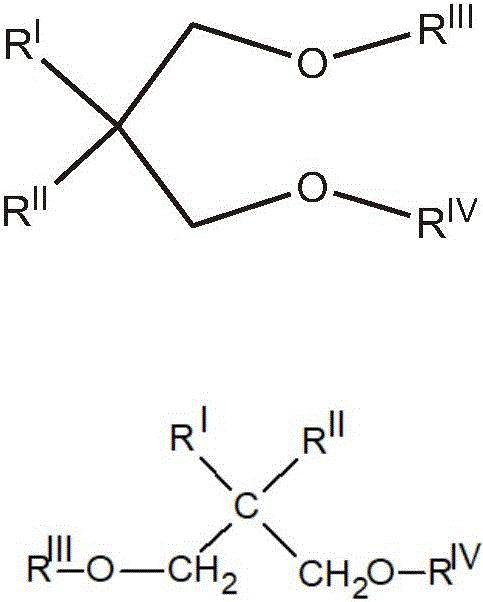
其中RI和RII相同或不同并且是C1-C18烷基,C3-C18环烷基或C7-C18芳基;RIII和RIV相同或不同,为C1-C4烷基;或者是1,3-二醚,其中2位上的碳原子属于由5、6或7个碳原子,或5-n或6-n′个碳原子,以及分别n个氮原子和n′个选自N、O、S和Si的杂原子组成的环状或多环结构,其中n为1或2且n′为1、2或3,该结构含有两个或三个不饱和(环状多烯结构),并任选与其它环状结构缩合,或被一个或多个选自直链或支链烷基;环烷基、芳基、芳烷基、烷芳基和卤素的取代基取代,或者与其它环状结构缩合并且被一个或多个也可以键合到缩合环状结构上的上述取代基;上述烷基、环烷基、芳基、芳烷基或烷芳基中的一个或多个以及任选含有一个或多个杂原子作为碳或氢原子或两者的取代基的缩合环状结构取代。wherein R I and R II are the same or different and are C 1 -C 18 alkyl, C 3 -C 18 cycloalkyl or C 7 -C 18 aryl; R III and R IV are the same or different and are C 1 -C 4 alkyl; or a 1,3-diether in which the carbon atom in the 2-position belongs to a group consisting of 5, 6 or 7 carbon atoms, or 5-n or 6-n' carbon atoms, and respectively n nitrogen atoms and n' a cyclic or polycyclic structure composed of heteroatoms selected from N, O, S and Si, wherein n is 1 or 2 and n' is 1, 2 or 3, the structure contains two or three different Saturated (cyclic polyene structures), and optionally condensed with other cyclic structures, or by one or more selected from the group consisting of linear or branched alkyl; cycloalkyl, aryl, aralkyl, alkaryl and Substituents of halogen substituted, or condensed with other cyclic structures and by one or more of the above-mentioned substituents which may also be bonded to the condensed cyclic structure; the above-mentioned alkyl, cycloalkyl, aryl, aralkyl or alkane groups One or more of the aryl groups and condensed cyclic structures optionally containing one or more heteroatoms as substituents for carbon or hydrogen atoms or both are substituted.
这种类型的醚在公开的欧洲专利申请361493和728769中有所描述。Ethers of this type are described in published European patent applications 361493 and 728769.
所述二醚的代表性实例为2-甲基-2-异丙基-1,3-二甲氧基丙烷、2,2-二异丁基-1,3-二甲氧基丙烷、2-异丙基-2-环戊基-1,3-二甲氧基丙烷、2-异丙基-2-异戊基-1,3-二甲氧基丙烷、9,9-双(甲氧基甲基)芴。Representative examples of such diethers are 2-methyl-2-isopropyl-1,3-dimethoxypropane, 2,2-diisobutyl-1,3-dimethoxypropane, 2 -Isopropyl-2-cyclopentyl-1,3-dimethoxypropane, 2-isopropyl-2-isopentyl-1,3-dimethoxypropane, 9,9-bis(methyl) oxymethyl) fluorene.
其它合适的电子给体化合物是邻苯二甲酸酯,例如邻苯二甲酸二异丁酯、邻苯二甲酸二辛酯、邻苯二甲酸二苯酯和邻苯二甲酸苄丁酯。Other suitable electron donor compounds are phthalates such as diisobutyl phthalate, dioctyl phthalate, diphenyl phthalate and benzyl butyl phthalate.
上述催化剂组分的制备按照各种方法进行。The preparation of the above catalyst components is carried out according to various methods.
例如,MgCl2·nROH加合物(特别是球状颗粒形式),其中n一般为1至3,并且ROH是乙醇、丁醇或异丁醇,与过量的含有电子给体化合物的TiCl4进行反应。反应温度通常为80℃至120℃。然后将固体分离并在电子给体化合物的存在或不存在下,与TiCl4再反应一次,在这之后,将其分离并用烃的等分洗涤直到所有的氯离子消失为止。For example, MgCl2.nROH adduct (particularly in spherical particle form), where n is typically 1 to 3, and ROH is ethanol, butanol or isobutanol, is reacted with an excess of TiCl4 containing an electron donor compound . The reaction temperature is usually 80°C to 120°C. The solid was then isolated and reacted one more time with TiCl4 in the presence or absence of an electron donor compound, after which it was isolated and washed with an aliquot of hydrocarbon until all chloride ions disappeared.
在固体催化剂组分中,钛化合物(以Ti表示)通常以0.5wt%至10wt%的量存在。保持固定在固体催化剂组分上的电子给体化合物的量通常为相对于二卤化镁的5mol%至20mol%。In the solid catalyst component, the titanium compound (expressed as Ti) is usually present in an amount of 0.5 wt % to 10 wt %. The amount of the electron-donor compound that remains fixed on the solid catalyst component is generally 5 to 20 mol % relative to the magnesium dihalide.
钛化合物,可用于制备固体催化剂组分,是钛的卤化物和卤醇化物。四氯化钛是优选的化合物。Titanium compounds, which can be used to prepare solid catalyst components, are titanium halides and haloalcoholates. Titanium tetrachloride is the preferred compound.
上述反应导致了形成活性形式卤化镁。文献中公知的其它反应,会导致由卤化物之外的其它镁化合物例如羧酸镁形成活性形式卤化镁。The above reaction results in the formation of magnesium halide in active form. Other reactions well known in the literature lead to the formation of magnesium halides in active form from magnesium compounds other than halides, such as magnesium carboxylates.
用作助催化剂的烷基铝化合物包括三烷基铝,例如三乙基铝、三异丁基铝、三正丁基铝,和含有通过氧或氮原子,或SO4或SO3基团彼此键合的两个或多个铝原子的直链或环状烷基铝化合物。Alkylaluminum compounds used as cocatalysts include trialkylaluminums, such as triethylaluminum, triisobutylaluminum, tri-n-butylaluminum, and compounds that contain each other through oxygen or nitrogen atoms, or SO4 or SO3 groups Linear or cyclic aluminum alkyl compounds of two or more bonded aluminum atoms.
烷基铝化合物通常的使用量为使Al/Ti比为1至1000。The alkylaluminum compound is usually used in such an amount that the Al/Ti ratio is 1 to 1000.
可以用作外部给体的电子给体化合物包括芳族酸酯,例如苯甲酸烷基酯,特别是含有至少一个Si-OR键的硅化合物,其中R是烃基。Electron-donor compounds that can be used as external donors include aromatic acid esters, such as alkyl benzoates, especially silicon compounds containing at least one Si-OR bond, wherein R is a hydrocarbyl group.
硅化合物的实例是(叔丁基)2Si(OCH3)2,(环己基)(甲基)Si(OCH3)2,(环戊基)2Si(OCH3)2和(苯基)2Si(OCH3)2以及(1,1,2-三甲基丙基)Si(OCH3)3。Examples of silicon compounds are (tert-butyl) 2Si ( OCH3 ) 2 , (cyclohexyl)(methyl)Si( OCH3 ) 2 , (cyclopentyl) 2Si ( OCH3 ) 2 and (phenyl) 2 Si(OCH 3 ) 2 and (1,1,2-trimethylpropyl)Si(OCH 3 ) 3 .
也可以有利地使用具有上述化学式的1,3-二醚。如果内部给体是这些二醚的一种,则外部给体可以省略。1,3-Diethers of the above formula can also be used advantageously. If the internal donor is one of these diethers, the external donor can be omitted.
具体地,根据本发明,即使先前所述催化剂组分的许多其它组合可以允许获得丙烯聚合物组合物,但三元共聚物优选地通过使用含有邻苯二甲酸酯作为内部给体和(环戊基)2Si(OCH3)2作为外部供体的催化剂,或者所述1,3-二醚作为内部供体制备。In particular, according to the present invention, even though many other combinations of the catalyst components described previously may allow to obtain propylene polymer compositions, the terpolymers are preferably obtained by using phthalates as internal donors and (cyclic Amyl) 2 Si(OCH 3 ) 2 as catalyst for external donor, or the 1,3-diether was prepared as internal donor.
所述丙烯-乙烯-己烯-1聚合物用EP申请1012195中的聚合方法制备。The propylene-ethylene-hexene-1 polymer was prepared by the polymerization method in EP application 1012195.
详细地,所述过程包括在催化剂的存在和反应条件下将单体进料至所述聚合区,并从所述聚合区收集聚合物产物。在上述过程中,生长的聚合物颗粒在快速流化条件下向上流动穿过其中一个(第一)所述聚合区(提升管),离开所述提升管并进入另一个(第二)聚合区(下降管),穿过该下降管,在重力的作用下以稠化形式向下流动,离开所述下降管并被重新引入到提升管,从而建立提升管和下降管之间聚合物的循环。In detail, the process includes feeding monomers to the polymerization zone in the presence of a catalyst and reaction conditions, and collecting a polymer product from the polymerization zone. In the above process, growing polymer particles flow upward through one (first) of the polymerization zones (risers) under fast fluidization conditions, exit the riser and enter the other (second) polymerization zone (downcomer), through which it flows downwards in a densified form under the force of gravity, leaves the downcomer and is reintroduced to the riser, thereby establishing a circulation of polymer between the riser and the downcomer .
在下降管中达到了高固体密度值,接近聚合物的堆积密度。因此,可以沿流动方向获得压力的正增益,使得不用特殊机械装置的帮助就可以重新将聚合物引入到提升管。这样,确定了一个″套环″循环,该循环由两个聚合区之间压力的平衡以及引入到系统中的压头损失来限定。High solids density values are achieved in the downcomer, approaching the bulk density of the polymer. Thus, a positive gain in pressure can be obtained along the flow direction, making it possible to reintroduce the polymer to the riser without the aid of special mechanical means. In this way, a "loop" cycle is defined which is defined by the balance of pressure between the two polymerization zones and the head loss introduced into the system.
通常,提升管中的快速流化条件是通过将含有有关单体的气体混合物送至所述提升管来确定。优选的是,该气体混合物的进料要在适当情况下使用气体分配器装置来确保低于聚合物再次引入所述提升管的点。运输气体进入提升管的速度要高于操作条件下的输送速度,优选为2米/秒至15米/秒。Typically, fast fluidization conditions in a riser are determined by feeding a gas mixture containing the monomers concerned to the riser. Preferably, the feed of the gas mixture is ensured below the point at which the polymer is reintroduced into the riser, where appropriate using gas distributor means. The velocity of the transport gas entering the riser is higher than the transport velocity under operating conditions, preferably 2 m/s to 15 m/s.
通常,离开提升管的聚合物和气体混合物被输送到固/气分离区。可以使用常规的分离方法进行固/气分离。聚合物从分离区中进入下降管。离开分离区的气体混合物被压缩、冷却并转移至提升管,如果合适的话加入补充的单体和/或分子量调节剂至提升管。转移可以通过气体混合物再循环管线进行。Typically, the polymer and gas mixture leaving the riser is conveyed to a solid/gas separation zone. Solid/gas separation can be performed using conventional separation methods. The polymer enters the downcomer from the separation zone. The gas mixture leaving the separation zone is compressed, cooled and transferred to a riser to which additional monomers and/or molecular weight regulators are added if appropriate. The transfer can take place through the gas mixture recycle line.
可以通过使用适于控制固体流动的装置,如机械阀来计量离开下降管的聚合物的量,从而对两个聚合区之间循环的聚合物进行控制。The polymer circulating between the two polymerization zones can be controlled by metering the amount of polymer exiting the downcomer using means suitable for controlling the flow of solids, such as mechanical valves.
操作参数,如温度,是烯烃聚合过程中惯常的参数,例如50℃至120℃之间。Operating parameters, such as temperature, are parameters customary in olefin polymerization processes, eg between 50°C and 120°C.
该第一阶段过程可以在0.5兆帕至10兆帕,优选1.5兆帕至6兆帕的操作压力下进行。This first stage process can be carried out at an operating pressure of 0.5 MPa to 10 MPa, preferably 1.5 MPa to 6 MPa.
有利的是,聚合区中充有一种或多种惰性气体,此类气体的含量标准为,使惰性气体的分压总和优选为气体总压力的5%至80%。例如,惰性气体可以是氮气或丙烷。Advantageously, the polymerization zone is filled with one or more inert gases, the content of which is such that the sum of the partial pressures of the inert gases is preferably between 5% and 80% of the total gas pressure. For example, the inert gas can be nitrogen or propane.
各种催化剂可以在提升管的任何点进料到所述提升管。然而,它们也可以在下降管的任何点进料。催化剂可以是任何物理状态;因此可以使用固体态或液态的催化剂。Various catalysts can be fed to the riser at any point in the riser. However, they can also be fed at any point in the downcomer. The catalyst can be in any physical state; thus, solid or liquid catalysts can be used.
本发明的三元共聚物可以与本领域常用的添加剂共混,例如抗氧化剂、光稳定剂、热稳定剂、成核剂、着色剂和填充剂。The terpolymers of the present invention may be blended with additives commonly used in the art, such as antioxidants, light stabilizers, heat stabilizers, nucleating agents, colorants, and fillers.
给出以下实施例是为了说明本发明,而无限制性目的。The following examples are given to illustrate the invention and not to limit it.
实施例Example
表征方法Characterization method
熔融温度、结晶温度和部分面积百分比测定:Melting temperature, crystallization temperature and part area percentage determination:
通过差示扫描量热法(DSC)测定的。将重为6·1mg的样品以20℃/min的速率加热至220·1℃,并在氮气流中在220·1℃下保持2分钟,之后将其以20℃/min的速率冷却至40·2℃,从而在该温度下保持2分钟以使样品结晶。然后,将样品以20℃/分钟的升温速度加热至220℃·1以再次熔融。记录下熔融扫描,获得热谱曲线,从该曲线上可以读出熔融温度和结晶温度。Determined by Differential Scanning Calorimetry (DSC). A sample weighing 6.1 mg was heated to 220.1 °C at a rate of 20 °C/min and held at 220.1 °C for 2 min in a nitrogen stream, after which it was cooled to 40 °C at a rate of 20 °C/min. • 2°C to hold at this temperature for 2 minutes to crystallize the sample. Then, the sample was heated to 220°C·1 at a heating rate of 20°C/min to melt again. The melting scan was recorded and a thermogram was obtained from which the melting temperature and crystallization temperature could be read.
对于部分面积计算,使用考虑用于Tm计算的相同熔融峰。For partial area calculations, the same melting peaks considered for Tm calculations were used.
通过结合吸热峰开始和结束时的峰起始和结束温度来建立峰的基线以偏离相对直的基线。The baseline of the peak was established to deviate from a relatively straight baseline by combining the peak start and end temperatures at the beginning and end of the endothermic peak.
以Tm温度为起点,峰值温度为终点计算部分面积。The partial area was calculated using the Tm temperature as the starting point and the peak temperature as the ending point.
结果以总面积的百分比表示。Results are expressed as a percentage of the total area.
熔体流动速率:根据方法ISO 1133(230℃,2.16kg)测定。 Melt flow rate : determined according to method ISO 1133 (230°C, 2.16 kg).
二甲苯中的溶解度:测定如下。 Solubility in Xylene : Determined as follows.
将2.5g聚合物和250ml二甲苯引入装配有冰箱和磁力搅拌器的玻璃烧瓶中。在135℃下在30分钟内升高温度。然后将如此获得的透明溶液保持回流,并进一步搅拌30分钟。将密闭的烧瓶在25℃的恒温水浴中保持30分钟。在快速滤纸上过滤形成的固体。将100ml过滤的液体倒入预先称重的铝容器中,该铝容器在氮气流下在加热板上加热以通过蒸发除去溶剂。然后在真空下将容器保持在70℃的烘箱中,直到获得恒定重量。然后计算室温下可溶于二甲苯的聚合物的重量百分比。2.5 g of polymer and 250 ml of xylene were introduced into a glass flask equipped with a refrigerator and a magnetic stirrer. The temperature was raised over 30 minutes at 135°C. The clear solution thus obtained was then kept at reflux and stirred for a further 30 minutes. The closed flask was kept in a constant temperature water bath at 25°C for 30 minutes. The solid formed was filtered on quick filter paper. 100 ml of the filtered liquid was poured into a pre-weighed aluminum container which was heated on a hot plate under nitrogen flow to remove the solvent by evaporation. The container was then kept in an oven at 70°C under vacuum until a constant weight was obtained. The weight percent of polymer that is soluble in xylene at room temperature is then calculated.
1-己烯和乙烯含量:在三元共聚物中通过13C-NMR光谱测定: 1-Hexene and ethylene content : determined by 13 C-NMR spectroscopy in the terpolymer:
在AV-600光谱仪上获得13C NMR光谱,该光谱仪在150.91MHz下以傅立叶变换模式在120℃下操作。丙烯CH的峰用作28.83处的内参。使用以下参数获得13C NMR光谱: 13C NMR spectra were acquired on an AV-600 spectrometer operating at 120°C in Fourier transform mode at 150.91 MHz. The peak of propylene CH was used as an internal reference at 28.83. 13 C NMR spectra were obtained using the following parameters:
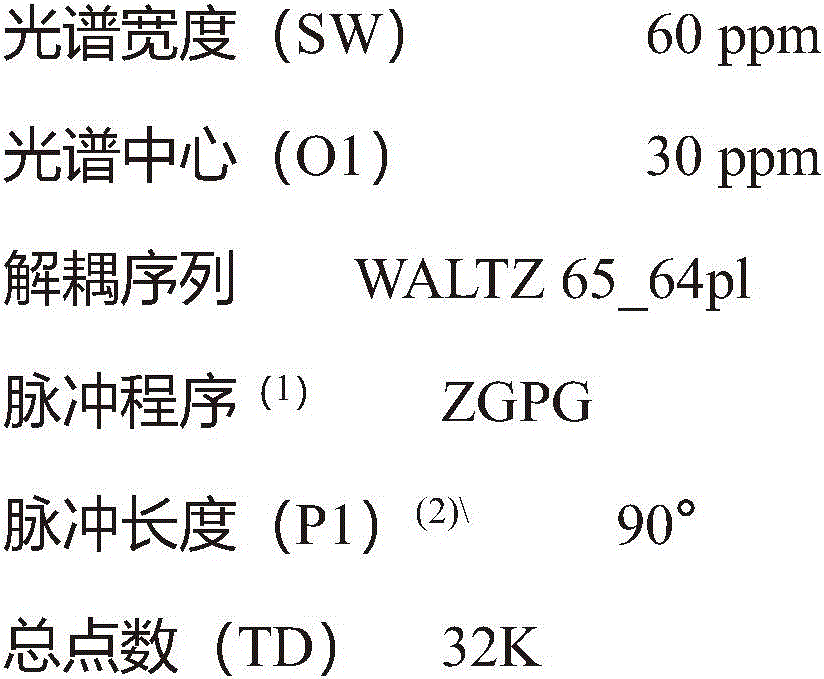

1-己烯和乙烯的总量(摩尔%)使用以下关系由二价基计算:The total amount (mol %) of 1-hexene and ethylene is calculated from the divalent basis using the following relationship:
[P]=PP+0.5PH+0.5PE[P]=PP+0.5PH+0.5PE
[H]=HH+0.5PH[H]=HH+0.5PH
[E]=EE+0.5PE[E]=EE+0.5PE
丙烯/1-己烯/乙烯共聚物的13C NMR光谱的归属根据下表计算:The assignment of the 13 C NMR spectrum of the propylene/1-hexene/ethylene copolymer was calculated according to the following table:


多分散指数(P.I.): Polydispersity Index (PI) :
通过使用RHEOMETRICS(USA)销售的RMS-800型平行板流变仪,在从0.1rad/sec增加到100rad/sec的振荡频率下操作,在200℃的温度下测定。从交叉模量可以通过以下等式导出P.I.:Measured at a temperature of 200°C by using a parallel-plate rheometer, model RMS-800, sold by RHEOMETRICS (USA), operating at an oscillation frequency increased from 0.1 rad/sec to 100 rad/sec. From the cross modulus the P.I. can be derived by the following equation:
P.I.=105/GcP.I.=105/Gc
其中Gc是交叉模量,其被定义为G′=G″时的值(以Pa表示),其中G′是储能模量并且G″是损耗模量。where Gc is the cross modulus, which is defined as the value (in Pa) when G'=G", where G' is the storage modulus and G" is the loss modulus.
密封起始温度(SIT)Seal Initiation Temperature (SIT)
——膜样品的制备- Preparation of membrane samples
通过在7m/min的膜拉伸速度和210℃至250℃的熔融温度下在单螺杆Collin挤出机(螺杆的长度/直径比为1:25)中挤出每个测试物组合物来制备厚度为50μm的膜。每个得到的膜被层叠在二甲苯不溶物级分为97wt%且MFR L为2g/10min的丙烯均聚物的1000μm厚的膜上。层叠的薄膜在200℃、9000kg负载下在Carver压机内相互结合,保持5分钟。在150℃利用TOM Long膜拉伸机将所得到的层叠件在纵向和横向上,即双轴向拉伸6倍,从而得到20μm厚的膜(18μm均聚物+2μm测试物)。Prepared by extruding each test composition composition in a single screw Collin extruder (screw length/diameter ratio 1:25) at a film draw speed of 7 m/min and a melt temperature of 210°C to 250°C Film with a thickness of 50 μm. Each of the resulting films was laminated on a 1000 μm thick film of a propylene homopolymer with a xylene insoluble fraction of 97 wt% and an MFR L of 2 g/10 min. The laminated films were bonded to each other in a Carver press at 200°C under a load of 9000 kg for 5 minutes. The resulting laminate was stretched 6 times in the machine and transverse directions, ie biaxially, at 150°C using a TOM Long film stretcher to obtain a 20 μm thick film (18 μm homopolymer + 2 μm test object).
从膜上切取2×5cm样品。A 2 x 5 cm sample was cut from the membrane.
——SIT的测定- Determination of SIT
对于每个测试,上述样品中的两个对齐地层叠,相邻层为特定测试组合物的层。用型号为HSG-ETK 745的Brugger Feinmechanik密封器沿着2cm边缘密封层叠样品。密封时间在0.1N/mm2压力下为5秒。每一次密封,密封温度增加2℃,起始温度约为10℃,低于试验组合物的熔融温度。将密封的样品放置冷却,然后将它们的未密封端附接到Instron机,它们在那里以50mm/min的牵引速度被测试。For each test, two of the above samples were stacked in alignment, with the adjacent layers being the layers of the particular test composition. The laminated samples were sealed along the 2 cm edge with a Brugger Feinmechanik sealer model HSG-ETK 745. The sealing time was 5 seconds at a pressure of 0.1 N/mm 2 . For each seal, the sealing temperature was increased by 2°C, starting at about 10°C below the melting temperature of the test composition. The sealed samples were left to cool before attaching their unsealed ends to the Instron machine where they were tested at a pulling speed of 50 mm/min.
SIT是最小密封温度,当所述测试条件中应用至少2牛顿的负载时,密封在该温度下不会被破坏。SIT is the minimum seal temperature at which the seal will not be broken when a load of at least 2 Newtons is applied in the test conditions.
收缩率Shrinkage
——膜样品的制备- Preparation of membrane samples
通过在4m/min的膜拉伸速度和230℃至250℃的熔融温度下在单螺杆Leonard挤出机(螺杆的长度/直径比为1:27)中挤出每个测试物组合物来制备厚度为200μm的膜。Prepared by extruding each test composition composition in a single screw Leonard extruder (screw length/diameter ratio 1:27) at a film stretch speed of 4 m/min and a melt temperature of 230°C to 250°C Film with a thickness of 200 μm.
——膜的拉伸- film stretching
在温度115℃下预热30秒后,用Karo 4Bmeckner拉伸线(拉伸比5∶1)以600%秒的速度在MD上拉伸膜。After preheating at a temperature of 115°C for 30 seconds, the film was stretched in MD with a Karo 4Bmeckner stretch line (stretch ratio 5:1) at a speed of 600% sec.
——收缩率测量- Shrinkage measurement
通过将100×20mm标签样品置于具有循环空气的烘箱中测定标签收缩率。从如上所述制备的相应膜上雕刻出每个标签样品。Label shrinkage was determined by placing 100 x 20 mm label samples in an oven with circulating air. Each label sample was engraved from the corresponding film prepared as described above.
烘箱在不同空气温度(100或110℃)下的停留时间为180s(+/-5s)。最终膜收缩率的计算通过以下关系测定:The dwell time of the oven at different air temperatures (100 or 110°C) was 180s (+/- 5s). The calculation of the final film shrinkage is determined by the following relationship:
膜收缩率=(Li-Lf)/Li*100Film shrinkage = (Li-Lf)/Li*100
是Yes
Li=初始膜尺寸(100mm)Li = initial film size (100mm)
LF=烘箱处理后的膜尺寸LF = film size after oven treatment
当膜达到室温(从烘箱中取出后约15-20m)时进行测量。Measurements were taken when the film reached room temperature (approximately 15-20 m after removal from the oven).
实施例1Example 1
共聚物通过在包括如EP 1 012 195中所述的聚合装置的设备中在催化剂存在下在连续条件下聚合丙烯、乙烯和己烯-1来制备。The copolymers are prepared by polymerizing propylene, ethylene and hexene-1 under continuous conditions in the presence of a catalyst in an apparatus comprising a polymerisation unit as described in EP 1 012 195.
将催化剂送入包括两个相互连接的圆柱形反应器、提升管和下降管的聚合装置。通过循环来自气固分离器的气体在提升管中建立快速流化条件。The catalyst is fed to a polymerization unit comprising two interconnected cylindrical reactors, a riser and a downcomer. Rapid fluidization conditions are established in the riser by circulating the gas from the gas-solid separator.
在实施例1中,通过使用根据EP 1 012 195中所述的″阻挡″进料来区分两个反应器腿中的气体组成。该物流是在下降管的较大上部进料的丙烯。在对比实施例2中,没有使用阻隔进料。In Example 1, the gas composition in the two reactor legs was differentiated by using a "barrier" feed as described in EP 1 012 195. This stream is propylene fed in the larger upper part of the downcomer. In Comparative Example 2, no barrier feed was used.
所使用的催化剂包括通过类似于EP-A-728769的实施例5制备的催化剂组分,但是使用微球形MgCl2·1.7C2H5OH代替MgCl2·2.1C2H5OH。这种催化剂组分与二环戊基二甲氧基硅烷(DCPMS)一起用作外部给体并和三乙基铝(TEA)一起使用。The catalyst used consisted of a catalyst component prepared by analogy to Example 5 of EP - A - 728769 , but using microspherical MgCl2.1.7C2H5OH instead of MgCl2.2.1C2H5OH . This catalyst component was used as external donor with dicyclopentyldimethoxysilane (DCPMS) and with triethylaluminum (TEA).
对离开第三反应器的聚合物颗粒进行蒸汽处理以除去反应性单体和挥发性物质,然后干燥。其它操作条件在表1中示出。The polymer particles leaving the third reactor are steamed to remove reactive monomers and volatiles, and then dried. Other operating conditions are shown in Table 1.
表1Table 1
C2:乙烯;C3:丙烯;C6:1-己烯C2: Ethylene; C3: Propylene; C6: 1-hexene
对比实施例2Comparative Example 2
对比实施例2是根据WO 2009/019169的实施例1制备的丙烯-乙烯-1-丁烯三元共聚物。相对于三元共聚物,乙烯衍生的单元含量为3.7wt%,而1-丁烯衍生的单元含量为6.4wt%。Comparative Example 2 is a propylene-ethylene-1-butene terpolymer prepared according to Example 1 of WO 2009/019169. The content of ethylene-derived units was 3.7 wt%, and the content of 1-butene-derived units was 6.4 wt%, relative to the terpolymer.
向根据实施例1和对比实施例2获得的三元共聚物中加入以下添加剂(表2)。To the terpolymers obtained according to Example 1 and Comparative Example 2 were added the following additives (Table 2).
表2Table 2
在表3中报道了实施例1和对比实施例2的性能。The properties of Example 1 and Comparative Example 2 are reported in Table 3.
表3table 3
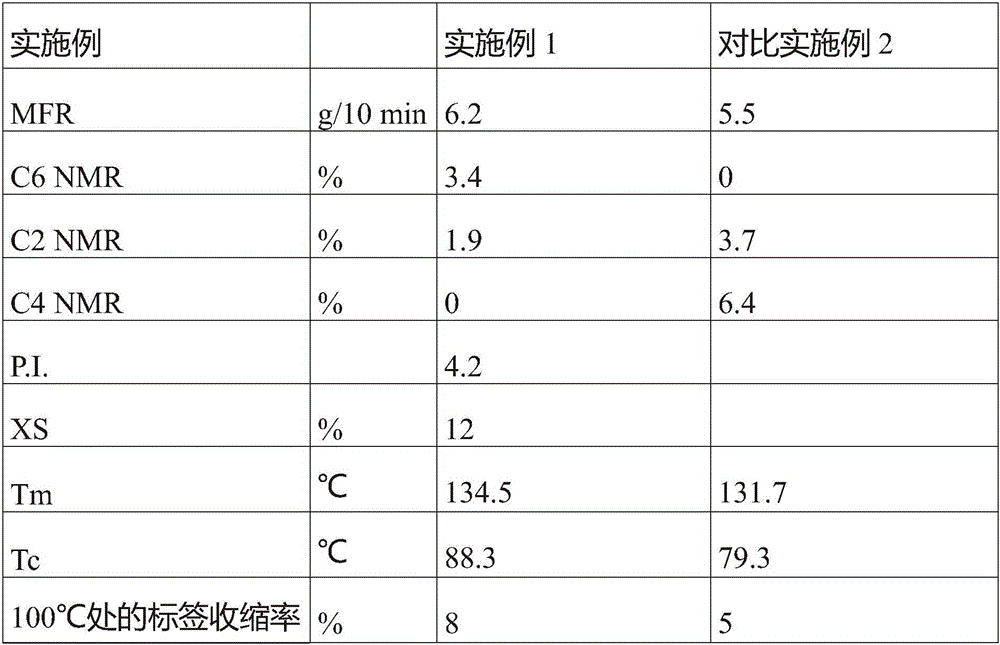

C2:乙烯;C6:1-己烯;C4:1-丁烯;XS:二甲苯可溶物。C2: ethylene; C6: 1-hexene; C4: 1-butene; XS: xylene solubles.
Claims (10)
Applications Claiming Priority (3)
| Application Number | Priority Date | Filing Date | Title |
|---|---|---|---|
| EP17200780.9 | 2017-11-09 | ||
| EP17200780 | 2017-11-09 | ||
| PCT/EP2018/079794 WO2019091841A1 (en) | 2017-11-09 | 2018-10-31 | Heat-shrinkable label |
Publications (1)
| Publication Number | Publication Date |
|---|---|
| CN111263698A true CN111263698A (en) | 2020-06-09 |
Family
ID=60543310
Family Applications (1)
| Application Number | Title | Priority Date | Filing Date |
|---|---|---|---|
| CN201880068614.XA Pending CN111263698A (en) | 2017-11-09 | 2018-10-31 | Heat-shrinkable label |
Country Status (4)
| Country | Link |
|---|---|
| US (1) | US11407867B2 (en) |
| EP (1) | EP3706999B1 (en) |
| CN (1) | CN111263698A (en) |
| WO (1) | WO2019091841A1 (en) |
Families Citing this family (2)
| Publication number | Priority date | Publication date | Assignee | Title |
|---|---|---|---|---|
| WO2020020808A1 (en) * | 2018-07-27 | 2020-01-30 | Sabic Global Technologies B.V. | Propylene-based terpolymer composition for pipes |
| WO2020020811A1 (en) | 2018-07-27 | 2020-01-30 | Sabic Global Technologies B.V. | Propylene-based terpolymer composition for pipes |
Citations (4)
| Publication number | Priority date | Publication date | Assignee | Title |
|---|---|---|---|---|
| EP0374783A2 (en) * | 1988-12-19 | 1990-06-27 | Viskase Corporation | Heat shrinkable very low density polyethylene terpolymer film |
| EP2602102A1 (en) * | 2011-12-05 | 2013-06-12 | Basell Poliolefine Italia S.r.l. | Propylene-based terpolymers for pipes |
| CN103781614A (en) * | 2011-09-01 | 2014-05-07 | 巴塞尔聚烯烃意大利有限责任公司 | Propylene-based terpolymers for films |
| WO2016102779A1 (en) * | 2014-12-23 | 2016-06-30 | Upm Raflatac Oy | A shrinkable label film, a shrinkable label and a method for providing a shrinkable film and a label |
Family Cites Families (12)
| Publication number | Priority date | Publication date | Assignee | Title |
|---|---|---|---|---|
| IT1098272B (en) | 1978-08-22 | 1985-09-07 | Montedison Spa | COMPONENTS, CATALYSTS AND CATALYSTS FOR THE POLYMERIZATION OF ALPHA-OLEFINS |
| IT1209255B (en) | 1980-08-13 | 1989-07-16 | Montedison Spa | CATALYSTS FOR THE POLYMERIZATION OF OLEFINE. |
| JPS57129746A (en) | 1981-02-05 | 1982-08-11 | Toyo Boseki | Shrinkable package |
| IT1190681B (en) | 1982-02-12 | 1988-02-24 | Montedison Spa | COMPONENTS AND CATALYSTS FOR THE POLYMERIZATION OF OLEFINE |
| IT1227260B (en) | 1988-09-30 | 1991-03-28 | Himont Inc | DIETTERS THAT CAN BE USED IN THE PREPARATION OF ZIEGLER-NATTA CATALYSTS |
| IT1243430B (en) | 1990-09-28 | 1994-06-10 | Himont Inc | COMPOSITIONS OF PROPYLENE CRYSTALLINE POLYMERS HAVING LOW TEMPERATURE |
| IL117114A (en) | 1995-02-21 | 2000-02-17 | Montell North America Inc | Components and catalysts for the polymerization ofolefins |
| FI104824B (en) | 1997-06-24 | 2000-04-14 | Borealis As | Process for producing propylene polymers |
| WO2000002929A1 (en) | 1998-07-08 | 2000-01-20 | Montell Technology Company B.V. | Process and apparatus for the gas-phase polymerisation |
| BRPI0813543B1 (en) | 2007-08-03 | 2019-10-08 | Basell Poliolefine Italia S.R.L. | PROPILENE TERPOLYMER, PROCESS FOR YOUR PRODUCTION AND FILM UNDERSTANDING THE SAME |
| BR112013005315B1 (en) * | 2010-09-06 | 2020-01-28 | Basell Poliolefine Italia Srl | propylene / ethylene / 1-hexene terpolymer and films comprising the same |
| WO2015004314A1 (en) * | 2013-07-12 | 2015-01-15 | Upm Raflatac Oy | Multilayer film for label and a method for providing such |
-
2018
- 2018-10-31 CN CN201880068614.XA patent/CN111263698A/en active Pending
- 2018-10-31 EP EP18796024.0A patent/EP3706999B1/en active Active
- 2018-10-31 US US16/758,763 patent/US11407867B2/en active Active
- 2018-10-31 WO PCT/EP2018/079794 patent/WO2019091841A1/en not_active Ceased
Patent Citations (5)
| Publication number | Priority date | Publication date | Assignee | Title |
|---|---|---|---|---|
| EP0374783A2 (en) * | 1988-12-19 | 1990-06-27 | Viskase Corporation | Heat shrinkable very low density polyethylene terpolymer film |
| CN103781614A (en) * | 2011-09-01 | 2014-05-07 | 巴塞尔聚烯烃意大利有限责任公司 | Propylene-based terpolymers for films |
| EP2602102A1 (en) * | 2011-12-05 | 2013-06-12 | Basell Poliolefine Italia S.r.l. | Propylene-based terpolymers for pipes |
| WO2016102779A1 (en) * | 2014-12-23 | 2016-06-30 | Upm Raflatac Oy | A shrinkable label film, a shrinkable label and a method for providing a shrinkable film and a label |
| CN107405903A (en) * | 2014-12-23 | 2017-11-28 | Upm拉弗拉塔克公司 | Shrinkable lable film, shrinkable lable and the method that shrinkable lable film and label are provided |
Also Published As
| Publication number | Publication date |
|---|---|
| EP3706999A1 (en) | 2020-09-16 |
| US20200255609A1 (en) | 2020-08-13 |
| EP3706999B1 (en) | 2021-07-07 |
| WO2019091841A1 (en) | 2019-05-16 |
| US11407867B2 (en) | 2022-08-09 |
Similar Documents
| Publication | Publication Date | Title |
|---|---|---|
| CN102834424B (en) | Propylene-based terpolymers for films | |
| JP3768312B2 (en) | Compositions based on random propylene copolymers, processes for their production and heat-sealable multilayer sheets comprising them | |
| CA2769057A1 (en) | Improved polypropylene for use in bopp applications | |
| US20150307700A1 (en) | Polyolefin composition | |
| US9803040B2 (en) | Propylene-based terpolymers for films | |
| US8993703B2 (en) | Polypropylene-based terpolymers for films | |
| KR102078953B1 (en) | Propylene copolymer | |
| EP3080172B1 (en) | Multilayer metallized films | |
| CN111263698A (en) | Heat-shrinkable label | |
| KR101917069B1 (en) | Composition comprising propylene-ethylene-1-butene terpolymer | |
| CN102256788B (en) | multilayer heat shrinkable film | |
| JP7551755B2 (en) | Polymers for producing BOPP films at high processing speeds | |
| JP7213989B2 (en) | Polymers for high speed production of biaxially oriented films, films and articles made therefrom | |
| CN110831985B (en) | Propylene copolymer |
Legal Events
| Date | Code | Title | Description |
|---|---|---|---|
| PB01 | Publication | ||
| PB01 | Publication | ||
| SE01 | Entry into force of request for substantive examination | ||
| SE01 | Entry into force of request for substantive examination | ||
| RJ01 | Rejection of invention patent application after publication | ||
| RJ01 | Rejection of invention patent application after publication |
Application publication date: 20200609 |