CN111247254A - Microbiome health index - Google Patents
Microbiome health index Download PDFInfo
- Publication number
- CN111247254A CN111247254A CN201880066008.4A CN201880066008A CN111247254A CN 111247254 A CN111247254 A CN 111247254A CN 201880066008 A CN201880066008 A CN 201880066008A CN 111247254 A CN111247254 A CN 111247254A
- Authority
- CN
- China
- Prior art keywords
- bacteria
- relative abundance
- patient
- health index
- calculating
- Prior art date
- Legal status (The legal status is an assumption and is not a legal conclusion. Google has not performed a legal analysis and makes no representation as to the accuracy of the status listed.)
- Pending
Links
Classifications
-
- C—CHEMISTRY; METALLURGY
- C12—BIOCHEMISTRY; BEER; SPIRITS; WINE; VINEGAR; MICROBIOLOGY; ENZYMOLOGY; MUTATION OR GENETIC ENGINEERING
- C12Q—MEASURING OR TESTING PROCESSES INVOLVING ENZYMES, NUCLEIC ACIDS OR MICROORGANISMS; COMPOSITIONS OR TEST PAPERS THEREFOR; PROCESSES OF PREPARING SUCH COMPOSITIONS; CONDITION-RESPONSIVE CONTROL IN MICROBIOLOGICAL OR ENZYMOLOGICAL PROCESSES
- C12Q1/00—Measuring or testing processes involving enzymes, nucleic acids or microorganisms; Compositions therefor; Processes of preparing such compositions
- C12Q1/02—Measuring or testing processes involving enzymes, nucleic acids or microorganisms; Compositions therefor; Processes of preparing such compositions involving viable microorganisms
- C12Q1/04—Determining presence or kind of microorganism; Use of selective media for testing antibiotics or bacteriocides; Compositions containing a chemical indicator therefor
- C12Q1/06—Quantitative determination
-
- C—CHEMISTRY; METALLURGY
- C12—BIOCHEMISTRY; BEER; SPIRITS; WINE; VINEGAR; MICROBIOLOGY; ENZYMOLOGY; MUTATION OR GENETIC ENGINEERING
- C12Q—MEASURING OR TESTING PROCESSES INVOLVING ENZYMES, NUCLEIC ACIDS OR MICROORGANISMS; COMPOSITIONS OR TEST PAPERS THEREFOR; PROCESSES OF PREPARING SUCH COMPOSITIONS; CONDITION-RESPONSIVE CONTROL IN MICROBIOLOGICAL OR ENZYMOLOGICAL PROCESSES
- C12Q1/00—Measuring or testing processes involving enzymes, nucleic acids or microorganisms; Compositions therefor; Processes of preparing such compositions
- C12Q1/68—Measuring or testing processes involving enzymes, nucleic acids or microorganisms; Compositions therefor; Processes of preparing such compositions involving nucleic acids
- C12Q1/6876—Nucleic acid products used in the analysis of nucleic acids, e.g. primers or probes
- C12Q1/6888—Nucleic acid products used in the analysis of nucleic acids, e.g. primers or probes for detection or identification of organisms
- C12Q1/689—Nucleic acid products used in the analysis of nucleic acids, e.g. primers or probes for detection or identification of organisms for bacteria
Landscapes
- Chemical & Material Sciences (AREA)
- Life Sciences & Earth Sciences (AREA)
- Organic Chemistry (AREA)
- Proteomics, Peptides & Aminoacids (AREA)
- Health & Medical Sciences (AREA)
- Analytical Chemistry (AREA)
- Zoology (AREA)
- Engineering & Computer Science (AREA)
- Wood Science & Technology (AREA)
- Immunology (AREA)
- Bioinformatics & Cheminformatics (AREA)
- Molecular Biology (AREA)
- Biophysics (AREA)
- Biotechnology (AREA)
- Physics & Mathematics (AREA)
- Biochemistry (AREA)
- Microbiology (AREA)
- General Engineering & Computer Science (AREA)
- General Health & Medical Sciences (AREA)
- Genetics & Genomics (AREA)
- Toxicology (AREA)
- Medicines Containing Material From Animals Or Micro-Organisms (AREA)
- Measuring Or Testing Involving Enzymes Or Micro-Organisms (AREA)
- Apparatus Associated With Microorganisms And Enzymes (AREA)
Abstract
Description
优先权要求priority claim
本申请根据35U.S.C.§119主张于2017年10月13日提交的美国临时专利申请No.62/571,907的优先权,其公开内容以引用方式全文并入于此。This application claims priority under 35 U.S.C. § 119 to US Provisional Patent Application No. 62/571,907, filed October 13, 2017, the disclosure of which is incorporated herein by reference in its entirety.
技术领域technical field
本发明涉及肠道微生物组。更具体地,本发明涉及平衡微生物组、治疗微生物组、通过检查微生物组来评估医学疾病和/或通过检查微生物组来评估医学治疗。The present invention relates to the gut microbiome. More specifically, the present invention relates to balancing the microbiome, treating the microbiome, assessing medical disease by examining the microbiome, and/or assessing medical treatment by examining the microbiome.
发明背景Background of the Invention
多种医学疾病和/或身体状况可能与肠道微生物组有关。A variety of medical diseases and/or medical conditions may be associated with the gut microbiome.
发明内容SUMMARY OF THE INVENTION
公开了一种用于评估微生物群的方法。该方法包含:获取粪便样品;以及量化来自粪便样品中的选定的纲类组的细菌相对丰度;根据来自选定的纲类组的细菌相对丰度,计算微生物组健康指数;以及考虑计算出的微生物组健康指数来评估粪便样品的微生物群。A method for assessing the microbiota is disclosed. The method comprises: obtaining a stool sample; and quantifying the relative abundance of bacteria from the selected class group in the stool sample; calculating a microbiome health index based on the relative abundance of bacteria from the selected class group; and considering calculating The Microbiome Health Index was developed to assess the microbiota of fecal samples.
对于上述实施例中的任一个来说替代地或额外地,粪便样品可以来自一个人或来自多个人。Alternatively or additionally to any of the above embodiments, the stool sample can be from one person or from multiple people.
对于上述实施例中的任一个来说替代地或额外地,选定的纲类组包括来自拟杆菌纲的细菌。Alternatively or additionally to any of the above embodiments, the selected class group includes bacteria from the class Bacteroidetes.
对于上述实施例中的任一个来说替代地或额外地,选定的纲类组包括来自梭菌纲的细菌。Alternatively or additionally to any of the above embodiments, the selected class group includes bacteria from the class Clostridium.
对于上述实施例中的任一个来说替代地或额外地,选定的纲类组包括来自γ-变形菌纲的细菌。Alternatively or additionally to any of the above embodiments, the selected class group includes bacteria from the class Gamma-Proteobacteria.
对于上述实施例中的任一个来说替代地或额外地,选定的纲类组包括来自芽孢杆菌纲的细菌。Alternatively or additionally to any of the above embodiments, the selected class group includes bacteria from the Bacillus class.
对于上述实施例中的任一个来说替代地或额外地,计算微生物组健康指数包括确定相对细菌丰度的第一总数,细菌丰度的第一总数等于细菌的第一纲类的第一相对丰度和细菌的第二纲类的第二相对丰度之和;确定相对细菌丰度的第二总数,细菌丰度的第二总数等于细菌的第三纲类的第三相对丰度与细菌的第四纲类的第四相对丰度之和;以及将相对细菌丰度的第一总数除以相对细菌丰度的第二总数。Alternatively or additionally to any of the above embodiments, calculating the microbiome health index includes determining a first total number of relative bacterial abundances, the first total number of bacterial abundances being equal to a first relative first total number of bacteria of the first class The sum of abundance and the second relative abundance of the second class of bacteria; to determine the second total of relative bacterial abundance, the second total of bacterial abundance is equal to the third relative abundance of the third class of bacteria and bacteria The sum of the fourth relative abundances of the fourth class; and dividing the first total number of relative bacterial abundances by the second total relative bacterial abundances.
对于上述实施例中的任一个来说替代地或额外地,细菌的第一相对丰度是来自粪便样品中拟杆菌纲类的细菌相对丰度。Alternatively or additionally to any of the above embodiments, the first relative abundance of bacteria is the relative abundance of bacteria from the Bacteroidetes class in the stool sample.
对于上述实施例中的任一个来说替代地或额外地,细菌的第二相对丰度是来自粪便样品中梭菌纲类的细菌相对丰度。Alternatively or additionally to any of the above embodiments, the second relative abundance of bacteria is the relative abundance of bacteria from the class Clostridium in the stool sample.
对于上述实施例中的任一个来说替代地或额外地,细菌的第三相对丰度是来自粪便样品中γ-变形菌纲类的细菌相对丰度。Alternatively or additionally to any of the above embodiments, the third relative abundance of bacteria is the relative abundance of bacteria from the gamma-proteobacteria species in the stool sample.
对于上述实施例中的任一个来说替代地或额外地,细菌的第四相对丰度是来自粪便样品中芽孢杆菌纲类的细菌相对丰度。Alternatively or additionally to any of the above embodiments, the fourth relative abundance of bacteria is the relative abundance of bacteria from the Bacillus species in the stool sample.
公开了一种用于评估治疗的方法。该方法包含:治疗患者的医学疾病;在治疗后从治疗后的患者那里获取粪便样品;根据来自治疗后粪便样品中选定的纲类组的细菌相对丰度,计算微生物组健康指数;以及考虑微生物组健康指数来评估治疗该患者医学疾病的效果。A method for evaluating treatment is disclosed. The method comprises: treating a patient for a medical condition; obtaining a stool sample from the treated patient after treatment; calculating a microbiome health index based on the relative abundance of bacteria from a selected class group in the post-treatment stool sample; and considering Microbiome Health Index to assess the effect of treating the patient's medical condition.
对于上述实施例中的任一个来说替代地或额外地,用于评估治疗的方法进一步包含量化来自粪便样品中的选定的纲类组的细菌相对丰度。Alternatively or additionally to any of the above embodiments, the method for assessing treatment further comprises quantifying the relative abundance of bacteria from a selected group of taxa in the stool sample.
对于上述实施例中的任一个来说替代地或额外地,用于评估治疗的方法进一步包括在治疗之前从患者那里获取治疗前的粪便样品,并根据来自治疗前的粪便样品中选定的纲类组的细菌相对丰度,计算另一个微生物组健康指数。并且进一步地在一些实施方案中,该方法进一步包含将治疗前的粪便样品的微生物组健康指数与治疗后的粪便样品的微生物组健康指数进行比较以评估治疗的效果。Alternatively or additionally to any of the above embodiments, the method for assessing treatment further comprises obtaining a pre-treatment stool sample from the patient prior to treatment and according to a selected category from the pre-treatment stool sample Bacterial relative abundances of taxonomic groups, another microbiome health index was calculated. And further in some embodiments, the method further comprises comparing the microbiome health index of the stool sample before treatment to the microbiome health index of the stool sample after treatment to assess the effect of the treatment.
对于上述实施例中的任一个来说替代地或额外地,选定的纲类组包括来自拟杆菌纲的细菌。Alternatively or additionally to any of the above embodiments, the selected class group includes bacteria from the class Bacteroidetes.
对于上述实施例中的任一个来说替代地或额外地,选定的纲类组包括来自梭菌纲的细菌。Alternatively or additionally to any of the above embodiments, the selected class group includes bacteria from the class Clostridium.
对于上述实施例中的任一个来说替代地或额外地,选定的纲类组包括来自γ-变形菌纲的细菌。Alternatively or additionally to any of the above embodiments, the selected class group includes bacteria from the class Gamma-Proteobacteria.
对于上述实施例中的任一个来说替代地或额外地,选定的纲类组包括来自芽孢杆菌纲的细菌。Alternatively or additionally to any of the above embodiments, the selected class group includes bacteria from the Bacillus class.
对于上述实施例中的任一个来说替代地或额外地,计算微生物组健康指数包括确定相对细菌丰度的第一总数,细菌丰度的第一总数等于细菌的第一纲类的第一相对丰度和细菌的第二纲类的第二相对丰度之和;确定相对细菌丰度的第二总数,细菌丰度的第二总数等于细菌的第三纲类的第三相对丰度与细菌的第四纲类的第四相对丰度之和;以及将相对细菌丰度的第一总数除以相对细菌丰度的第二总数。Alternatively or additionally to any of the above embodiments, calculating the microbiome health index includes determining a first total number of relative bacterial abundances, the first total number of bacterial abundances being equal to a first relative first total number of bacteria of the first class The sum of abundance and the second relative abundance of the second class of bacteria; to determine the second total of relative bacterial abundance, the second total of bacterial abundance is equal to the third relative abundance of the third class of bacteria and bacteria The sum of the fourth relative abundances of the fourth class; and dividing the first total number of relative bacterial abundances by the second total relative bacterial abundances.
对于上述实施例中的任一个来说替代地或额外地,细菌的第一相对丰度是来自粪便样品中拟杆菌纲类的细菌相对丰度。Alternatively or additionally to any of the above embodiments, the first relative abundance of bacteria is the relative abundance of bacteria from the Bacteroidetes class in the stool sample.
对于上述实施例中的任一个来说替代地或额外地,细菌的第二相对丰度是来自粪便样品中梭菌纲类的细菌相对丰度。Alternatively or additionally to any of the above embodiments, the second relative abundance of bacteria is the relative abundance of bacteria from the class Clostridium in the stool sample.
对于上述实施例中的任一个来说替代地或额外地,细菌的第三相对丰度是来自粪便样品中γ-变形菌纲类的细菌相对丰度。Alternatively or additionally to any of the above embodiments, the third relative abundance of bacteria is the relative abundance of bacteria from the gamma-proteobacteria species in the stool sample.
对于上述实施例中的任一个来说替代地或额外地,细菌的第四相对丰度是来自粪便样品中芽孢杆菌纲类的细菌相对丰度。Alternatively or additionally to any of the above embodiments, the fourth relative abundance of bacteria is the relative abundance of bacteria from the Bacillus species in the stool sample.
对于上述实施例中的任一个来说替代地或额外地,治疗患有医学疾病的患者包括治疗胃肠道疾病的患者。Alternatively or additionally to any of the above embodiments, treating a patient with a medical disorder includes treating a patient with a gastrointestinal disorder.
对于上述实施例中的任一个来说替代地或额外地,治疗患有医学疾病的患者包括向患者施用微生物群恢复治疗组合物。Alternatively or additionally to any of the above embodiments, treating a patient with a medical condition includes administering to the patient a microbiota restoration therapeutic composition.
对于上述实施例中的任一个来说替代地或额外地,微生物群恢复治疗组合物包括经处理的粪便样品和稀释剂,该稀释剂包括在盐水中浓度为30-90g/L的聚乙二醇。Alternatively or additionally to any of the above embodiments, the microbiota restoration treatment composition comprises a treated stool sample and a diluent comprising polyethylene glycol at a concentration of 30-90 g/L in saline alcohol.
对于上述实施例中的任一个来说替代地或额外地,微生物群恢复治疗组合物具有一微生物组健康指数(根据来自组合物中选定的纲类组的细菌相对丰度计算)其高于治疗前和治疗后的粪便样品的微生物组健康指数。Alternatively or additionally to any of the above embodiments, the microbiota restoration therapeutic composition has a microbiome health index (calculated based on the relative abundance of bacteria from selected groups of classes in the composition) that is higher than Microbiome health index of fecal samples before and after treatment.
对于上述实施例中的任一个来说替代地或额外地,治疗后的粪便样品是在患者接受医学疾病治疗后的7至30天的一段时间范围内采集。Alternatively or additionally to any of the above embodiments, the post-treatment stool sample is collected over a period of time ranging from 7 to 30 days after the patient is treated for the medical condition.
对于上述实施例中的任一个来说替代地或额外地,治疗后的粪便样品是在患者经医学疾病治疗后7天或更多。Alternatively or additionally to any of the above embodiments, the post-treatment stool sample is 7 days or more after the patient has been treated for the medical condition.
公开了一种用于治疗的方法。该方法包含:向患有医学疾病的患者施用微生物群恢复治疗组合物;在向患者施用微生物群恢复治疗组合物之后至少7天,从患者那里获取粪便样品;量化来自粪便样品中选定的纲类组的细菌相对丰度;根据来自选定的纲类组的细菌相对丰度,计算微生物组健康指数,以评估治疗的效果;并且其中选定的纲类组包括拟杆菌纲、梭菌纲、γ-变形菌纲和芽孢杆菌纲。A method for treatment is disclosed. The method comprises: administering to a patient suffering from a medical condition a microbiota restoration therapeutic composition; obtaining a stool sample from the patient at least 7 days after administering the microbiota restoration therapeutic composition to the patient; quantifying selected species from the stool sample The relative abundance of bacteria of the class group; based on the relative abundance of bacteria from the selected class group, the microbiome health index is calculated to evaluate the effect of the treatment; and the selected class group includes Bacteroidetes, Clostridium , γ-Proteobacteria and Bacillus.
公开了一种用于评估患者微生物组的方法。该方法包含:从患者那里获取粪便样品;根据来自选定的纲类组的细菌相对丰度,计算微生物组健康指数;以及根据计算出的微生物组健康指数评估患者的微生物群。A method for assessing a patient's microbiome is disclosed. The method comprises: obtaining a stool sample from a patient; calculating a microbiome health index based on the relative abundance of bacteria from a selected class group; and evaluating the patient's microbiota based on the calculated microbiome health index.
对于上述实施例中的任一个来说替代地或额外地,选定的纲类组包括拟杆菌纲、梭菌纲、γ-变形菌纲和芽孢杆菌纲。Alternatively or additionally to any of the above embodiments, the selected class group includes Bacteroidetes, Clostridium, Gamma-Proteobacteria, and Bacillus.
公开了一种用于评估治疗的方法。该方法包含:治疗患者的医学疾病;在治疗患者的医学疾病之后的一段时间,从患者那里获取粪便样品;根据来自粪便样品中选定的纲类组的细菌相对丰度,计算微生物组健康指数;考虑计算出的微生物组健康指数,以评估治疗患者医学疾病的成功与否。A method for evaluating treatment is disclosed. The method comprises: treating a patient for a medical condition; obtaining a stool sample from the patient at a time following treatment of the patient's medical condition; calculating a microbiome health index based on the relative abundance of bacteria from a selected class group in the stool sample ; Consider a calculated microbiome health index to assess the success of treating a patient's medical condition.
对于上述实施例中的任一个来说替代地或额外地,选定的纲类组包括拟杆菌纲、梭菌纲、γ-变形菌纲和芽孢杆菌纲。Alternatively or additionally to any of the above embodiments, the selected class group includes Bacteroidetes, Clostridium, Gamma-Proteobacteria, and Bacillus.
公开了一种用于治疗的方法。该方法包含:向患有医学疾病的患者施用微生物群恢复治疗组合物;在向患者施用微生物群恢复治疗组合物之后至少7天从患者那里获取粪便样品;根据来自选定的纲类组的细菌相对丰度,计算微生物组健康指数,以评估治疗的成功与否;并且其中选定的纲类组包括拟杆菌纲、梭菌纲、γ-变形菌纲和芽孢杆菌纲。A method for treatment is disclosed. The method comprises: administering to a patient suffering from a medical condition a microbiota restoration therapeutic composition; obtaining a stool sample from the patient at least 7 days after administering the microbiota restoration therapeutic composition to the patient; according to bacteria from a selected class group Relative abundance, a microbiome health index was calculated to assess the success of treatment; and selected class groups included Bacteroidetes, Clostridium, Gamma-Proteobacteria, and Bacillus.
对于上述实施例中的任一个来说替代地或额外地,当计算出的微生物组健康指数低于预定阈值时,向患者施用第二种微生物群恢复治疗组合物。Alternatively or additionally to any of the above embodiments, when the calculated microbiome health index is below a predetermined threshold, a second microbiota restoration therapeutic composition is administered to the patient.
对于上述实施例中的任一个来说替代地或额外地,用于评估治疗的方法进一步包含在治疗之前从患者那里获取治疗前的粪便样品,并根据来自治疗前的粪便样品中选定的纲类组的细菌相对丰度,计算另一个微生物组健康指数。Alternatively or additionally to any of the above embodiments, the method for assessing treatment further comprises obtaining a pre-treatment stool sample from the patient prior to treatment and according to a selected category from the pre-treatment stool sample Bacterial relative abundances of taxonomic groups, another microbiome health index was calculated.
对于上述实施例中的任一个来说替代地或额外地,当治疗后的粪便样品中患者的微生物组健康指数大约与治疗前粪便样品中的微生物组健康指数相同或不显著高(例如,小于两个、三个或四个数量级)于治疗前粪便样品中的微生物组健康指数时,向患者施用第二种微生物群恢复治疗组合物。Alternatively or additionally to any of the above embodiments, when the patient's microbiome health index in the post-treatment stool sample is about the same or not significantly higher than the microbiome health index in the pre-treatment stool sample (eg, less than two, three, or four orders of magnitude) at the microbiome health index in the pre-treatment fecal sample, the patient is administered a second microbiota restoring therapeutic composition.
对于上述实施例中的任一个来说替代地或额外地,微生物群恢复治疗组合物具有一微生物组健康指数(根据来自组合物中选定的纲类组的细菌相对丰度计算)其高于患者治疗前的粪便样品的微生物组健康指数(例如,至少10倍,15倍,20倍,30倍,40倍,50倍,或高于100倍)。Alternatively or additionally to any of the above embodiments, the microbiota restoration therapeutic composition has a microbiome health index (calculated based on the relative abundance of bacteria from selected groups of classes in the composition) that is higher than Microbiome health index (eg, at least 10-fold, 15-fold, 20-fold, 30-fold, 40-fold, 50-fold, or higher than 100-fold) of the patient's fecal sample prior to treatment.
对于上述实施例中的任一个来说替代地或额外地,微生物群恢复治疗组合物具有一微生物组健康指数(根据来自组合物中选定的纲类组的细菌相对丰度计算)其高于患者治疗后的粪便样品的微生物组健康指数(例如,至少10倍,15倍,20倍,30倍,40倍,50倍,或高于100倍)。Alternatively or additionally to any of the above embodiments, the microbiota restoration therapeutic composition has a microbiome health index (calculated based on the relative abundance of bacteria from selected groups of classes in the composition) that is higher than Microbiome health index (eg, at least 10-fold, 15-fold, 20-fold, 30-fold, 40-fold, 50-fold, or higher than 100-fold) of the patient's post-treatment stool samples.
公开了一种用于评估微生物群的方法。该方法包含:从患者那里获取粪便样品;根据来自粪便样品中的一个或多个分类层级的细菌相对丰度,计算微生物组健康指数;以及将微生物组健康指数与患者的身体状况相关联。A method for assessing the microbiota is disclosed. The method comprises: obtaining a stool sample from a patient; calculating a microbiome health index based on the relative abundance of bacteria from one or more taxonomic levels in the stool sample; and correlating the microbiome health index to the patient's physical condition.
对于上述实施例中的任一个来说替代地或额外地,将微生物组健康指数与患者的身体状况相关联可以包括确定微生物组健康指数是否低于预定的阈值。Alternatively or additionally to any of the above embodiments, associating the microbiome health index with the patient's physical condition may include determining whether the microbiome health index is below a predetermined threshold.
对于上述实施例中的任一个来说替代地或额外地,确定微生物组健康指数是否低于预定的阈值可以包括将患者认定为具有不平衡的/不健康的微生物组。Alternatively or additionally to any of the above embodiments, determining whether the microbiome health index is below a predetermined threshold may include identifying the patient as having an unbalanced/unhealthy microbiome.
对于上述实施例中的任一个来说替代地或额外地,将微生物组健康指数与患者的身体状况相关联可以包括确定微生物组健康指数是否高于预定的阈值。Alternatively or additionally to any of the above embodiments, associating the microbiome health index with the patient's physical condition may include determining whether the microbiome health index is above a predetermined threshold.
对于上述实施例中的任一个来说替代地或额外地,确定微生物组健康指数是否高于预定的阈值可以包括将患者认定为具有平衡的/健康的微生物组。Alternatively or additionally to any of the above embodiments, determining whether the microbiome health index is above a predetermined threshold may include identifying the patient as having a balanced/healthy microbiome.
对于上述实施例中的任一个来说替代地或额外地,根据来自粪便样品中一个或多个分类层级的细菌相对丰度,计算微生物组健康指数,包括根据来自一个或多个门类的细菌相对丰度,计算微生物组健康指数。Alternatively or additionally to any of the above embodiments, a microbiome health index is calculated based on the relative abundance of bacteria from one or more taxonomic levels in the stool sample, including based on the relative abundance of bacteria from one or more phyla Abundance, calculates the microbiome health index.
对于上述实施例中的任一个来说替代地或额外地,根据来自粪便样品中一个或多个分类层级的细菌相对丰度,计算微生物组健康指数,包括根据来自一个或多个纲类的细菌相对丰度,计算微生物组健康指数。Alternatively or additionally to any of the above embodiments, a microbiome health index is calculated based on the relative abundance of bacteria from one or more taxonomic levels in the stool sample, including based on bacteria from one or more classes Relative abundance, calculates the microbiome health index.
对于上述实施例中的任一个来说替代地或额外地,根据来自粪便样品中一个或多个分类层级的细菌相对丰度,计算微生物组健康指数,包括根据来自一个或多个目类的细菌相对丰度,计算微生物组健康指数。Alternatively or additionally to any of the above embodiments, a microbiome health index is calculated based on the relative abundance of bacteria from one or more taxonomic levels in the stool sample, including based on bacteria from one or more taxa Relative abundance, calculates the microbiome health index.
对于上述实施例中的任一个来说替代地或额外地,根据来自粪便样品中一个或多个分类层级的细菌相对丰度,计算微生物组健康指数,包括根据来自一个或多个科类的细菌相对丰度,计算微生物组健康指数。Alternatively or additionally to any of the above embodiments, a microbiome health index is calculated based on the relative abundance of bacteria from one or more taxonomic levels in the stool sample, including based on bacteria from one or more families Relative abundance, calculates the microbiome health index.
对于上述实施例中的任一个来说替代地或额外地,根据来自粪便样品中一个或多个分类层级的细菌相对丰度,计算微生物组健康指数,包括根据来自一个或多个属类的细菌相对丰度,计算微生物组健康指数。Alternatively or additionally to any of the above embodiments, a microbiome health index is calculated based on the relative abundance of bacteria from one or more taxonomic levels in the stool sample, including based on bacteria from one or more genera Relative abundance, calculates the microbiome health index.
对于上述实施例中的任一个来说替代地或额外地,根据来自粪便样品中一个或多个分类层级的细菌相对丰度,计算微生物组健康指数,包括根据来自一个或多个种类的细菌相对丰度,计算微生物组健康指数。Alternatively or additionally to any of the above embodiments, a microbiome health index is calculated based on the relative abundance of bacteria from one or more taxonomic levels in the stool sample, including based on the relative abundance of bacteria from one or more species Abundance, calculates the microbiome health index.
公开了一种用于评估治疗的方法。该方法包含:治疗患者的医学疾病;在治疗患者的医学疾病后的一预定时间段,从患者那里获取粪便样品;根据来自粪便样品中的一个或多个分类层级的细菌相对丰度,计算微生物组健康指数;以及确定治疗患者的医学疾病的成功与否。A method for evaluating treatment is disclosed. The method comprises: treating a medical condition in a patient; obtaining a stool sample from the patient at a predetermined time period after treating the medical condition in the patient; calculating microorganisms based on the relative abundance of bacteria from one or more taxonomic levels in the stool sample group health index; and determining success in treating a patient's medical condition.
对于上述实施例中的任一个来说替代地或额外地,根据来自粪便样品中一个或多个分类层级的细菌相对丰度,计算微生物组健康指数,包括根据来自一个或多个门类的细菌相对丰度,计算微生物组健康指数。Alternatively or additionally to any of the above embodiments, a microbiome health index is calculated based on the relative abundance of bacteria from one or more taxonomic levels in the stool sample, including based on the relative abundance of bacteria from one or more phyla Abundance, calculates the microbiome health index.
对于上述实施例中的任一个来说替代地或额外地,根据来自粪便样品中一个或多个分类层级的细菌相对丰度,计算微生物组健康指数,包括根据来自一个或多个纲类的细菌相对丰度,计算微生物组健康指数。Alternatively or additionally to any of the above embodiments, a microbiome health index is calculated based on the relative abundance of bacteria from one or more taxonomic levels in the stool sample, including based on bacteria from one or more classes Relative abundance, calculates the microbiome health index.
对于上述实施例中的任一个来说替代地或额外地,根据来自粪便样品中一个或多个分类层级的细菌相对丰度,计算微生物组健康指数,包括根据来自一个或多个目类的细菌相对丰度,计算微生物组健康指数。Alternatively or additionally to any of the above embodiments, a microbiome health index is calculated based on the relative abundance of bacteria from one or more taxonomic levels in the stool sample, including based on bacteria from one or more taxa Relative abundance, calculates the microbiome health index.
对于上述实施例中的任一个来说替代地或额外地,根据来自粪便样品中一个或多个分类层级的细菌相对丰度,计算微生物组健康指数,包括根据来自一个或多个科类的细菌相对丰度,计算微生物组健康指数。Alternatively or additionally to any of the above embodiments, a microbiome health index is calculated based on the relative abundance of bacteria from one or more taxonomic levels in the stool sample, including based on bacteria from one or more families Relative abundance, calculates the microbiome health index.
对于上述实施例中的任一个来说替代地或额外地,根据来自粪便样品中一个或多个分类层级的细菌相对丰度,计算微生物组健康指数,包括根据来自一个或多个属类的细菌相对丰度,计算微生物组健康指数。Alternatively or additionally to any of the above embodiments, a microbiome health index is calculated based on the relative abundance of bacteria from one or more taxonomic levels in the stool sample, including based on bacteria from one or more genera Relative abundance, calculates the microbiome health index.
对于上述实施例中的任一个来说替代地或额外地,根据来自粪便样品中一个或多个分类层级的细菌相对丰度,计算微生物组健康指数,包括根据来自一个或多个种类的细菌相对丰度,计算微生物组健康指数。Alternatively or additionally to any of the above embodiments, a microbiome health index is calculated based on the relative abundance of bacteria from one or more taxonomic levels in the stool sample, including based on the relative abundance of bacteria from one or more species Abundance, calculates the microbiome health index.
一些实施例的以上概述并非旨在描述本发明的每个公开的实施例或每个实施方式。以下的详细说明更具体地举例说明了这些实施例。The above summary of some embodiments is not intended to describe each disclosed embodiment or every implementation of the present invention. The following detailed description illustrates these embodiments in more detail.
具体实施方式Detailed ways
对于以下定义的术语,除非在权利要求书或本说明书的其他地方给出了不同的定义,这些定义适用于权利要求书或本说明书的其他地方。For terms defined below, these definitions apply to the claims or elsewhere in the specification unless a different definition is given in the claims or elsewhere in the specification.
无论是否进行了明确表示,所有数值在本文均被假定为受到术语“约”的修饰。术语“约”通常是指本领域技术人员认为等同于所引用的值(即,具有相同的功能或结果)的数字范围。在许多情况下,术语“约”可以包括四舍五入到最接近的有效数字的数字。All numerical values are herein assumed to be modified by the term "about" whether or not explicitly stated. The term "about" generally refers to a range of numbers that one of ordinary skill in the art considers equivalent to the recited value (ie, having the same function or result). In many instances, the term "about" can include numbers rounded to the nearest significant digit.
由端点表示的对数字范围的叙述包括在该范围内的所有数字(例如,1至5包括1、1.5、2、2.75、3、3.80、4和5)。The recitation of numerical ranges by endpoints includes all numbers within that range (eg, 1 to 5 includes 1, 1.5, 2, 2.75, 3, 3.80, 4, and 5).
如在本说明书和所附的权利要求中使用的,单数形式“一”、“一种”和“该”包括复数个指示物,除非内容另有明确指示。如在本说明书和所附的权利要求中使用的,术语“或”通常是按包括“和/或”的意义而采用的,除非内容另有明确指示。As used in this specification and the appended claims, the singular forms "a," "an," and "the" include plural referents unless the content clearly dictates otherwise. As used in this specification and the appended claims, the term "or" is generally employed in its sense including "and/or" unless the content clearly dictates otherwise.
应注意,在说明书中对“一实施例”、“一些实施例”、“其他实施例”等的参考表示所描述的实施例可以包括一个或多个特定特性,结构或特征。然而,这种叙述不一定表示所有实施例均包括该特定特性、结构和/或特征。此外,当结合一个实施例描述特定特性、结构和/或特征时,应当理解的是,无论是否进行了明确描述,这种特性、结构和/或特征还可以结合其他实施例一起使用,除非明确表示与此相反。It should be noted that references in the specification to "one embodiment," "some embodiments," "other embodiments," etc. mean that the described embodiments may include one or more of a particular feature, structure, or characteristic. However, such recitation does not necessarily mean that all embodiments include the particular feature, structure and/or characteristic. Furthermore, when a particular feature, structure and/or characteristic is described in connection with one embodiment, it should be understood that such characteristic, structure and/or characteristic can also be used in connection with other embodiments, whether or not explicitly described, unless explicitly described means the opposite.
胃肠道内/沿着胃肠道的肠道微生物群(例如,包括但不限于细菌、真菌、噬菌体、病毒等诸如此类的微生物的集合)和/或其破坏,可以被认为与许多疾病相关。这些疾病中的一些与消化道密切相关,例如艰难梭菌感染、溃疡性结肠炎、炎症性肠病、生态失调、消化道的其他失调和/或疾病、癌症(例如,沿消化道)和/或诸如此类。可能与肠道微生物群有关的其他疾病可能包括糖尿病、癌症(例如,包括沿消化道以外的位置的癌症)、自闭症、肝性脑病等。这些例子是说明性的,而不是全面的。The gut microbiota (eg, collections of microorganisms including, but not limited to, bacteria, fungi, bacteriophages, viruses, and the like) and/or disruption thereof in/along the gastrointestinal tract can be considered to be associated with many diseases. Some of these diseases are closely related to the digestive tract, such as Clostridium difficile infection, ulcerative colitis, inflammatory bowel disease, dysbiosis, other disorders and/or diseases of the digestive tract, cancer (eg, along the digestive tract) and/or or something like that. Other diseases that may be related to the gut microbiota may include diabetes, cancer (eg, including in locations other than along the digestive tract), autism, hepatic encephalopathy, and more. These examples are illustrative, not comprehensive.
由于构成微生物群的生物的绝对数量和/或生物之间的多样性,所以允许临床医生以评估微生物群的变化、评估/诊断身体状况、评估治疗的方式,或以其他方式将微生物群与临床上有意义的状况相关联来表征微生物群可能具有挑战性。本文公开了用于表征肠道微生物群的方法。该方法可以允许临床医生评估身体状况,诊断身体状况/失调,评估医学治疗的成功与否,其组合等,和/或以其他方式向临床医生提供临床上有意义的信息。Because of the sheer number and/or diversity among organisms that make up the microbiome, it allows clinicians to assess changes in the microbiome, assess/diagnose physical conditions, assess treatment, or otherwise associate the microbiome with clinical Characterizing the microbiota in association with meaningful conditions can be challenging. Disclosed herein are methods for characterizing the gut microbiota. The method may allow clinicians to assess medical conditions, diagnose medical conditions/disorders, assess the success of medical treatments, combinations thereof, etc., and/or otherwise provide clinicians with clinically meaningful information.
在至少一些情况下,可以计算/确定用于患者肠道菌群的指数,例如称为微生物组健康指数(MHI)的一维指数。根据肠道微生物群中一个或多个分类层级(例如,门、纲、目、科、属、种、亚种等)的细菌的相对丰度可以确定MHI。这种细菌的相对丰度可以被量化并用于确定MHI的计算中。例如,根据肠道微生物群中存在的选定的纲类组(例如,一个或多个纲)的细菌的相对丰度可以确定MHI,并且这种细菌的相对丰度可以被量化并且被用于确定MHI的计算中。一旦计算/确定了MHI的大小,就可以将其与身体状况相关联,用于评估患者的健康状况,用于评估治疗的成功与否,用于表征微生物群,和/或提供临床相关信息的其它用途。In at least some cases, an index for the patient's gut microbiota, such as a one-dimensional index known as the Microbiome Health Index (MHI), can be calculated/determined. MHI can be determined based on the relative abundance of bacteria at one or more taxonomic levels (eg, phylum, class, order, family, genus, species, subspecies, etc.) in the gut microbiota. The relative abundance of such bacteria can be quantified and used in calculations to determine MHI. For example, MHI can be determined from the relative abundance of bacteria of a selected class group (eg, one or more classes) present in the gut microbiota, and the relative abundance of such bacteria can be quantified and used for Determine the MHI in the calculation. Once the MHI is calculated/determined, it can be correlated to physical condition, used to assess patient health, used to assess the success of treatment, used to characterize the microbiome, and/or to provide clinically relevant information Other uses.
在至少一些情况下,计算/确定MHI可以包括从患者那里收集粪便样品并确定/量化粪便样品中细菌相对丰度(例如,量化来自选定的纲类的细菌相对丰度)。确定/量化来自选定的纲类的细菌相对丰度可以包括使用合适的方法学,例如16s rRNA或全基因组测序。可以设想其他方法。In at least some cases, calculating/determining the MHI can include collecting a stool sample from the patient and determining/quantifying the relative abundance of bacteria in the stool sample (eg, quantifying the relative abundance of bacteria from a selected class). Determining/quantifying the relative abundance of bacteria from a selected class may include the use of suitable methodologies, such as 16s rRNA or whole genome sequencing. Other methods can be envisaged.
计算/确定MHI还可以包括确定/量化相对细菌丰度的第一总数。细菌丰度的第一总数(例如,相对于粪便样品中的整个细菌种群)可以被理解为或以其他方式等于来自分类层级(例如,门、纲、目、科、属、种、亚种等)的细菌的第一相对丰度和来自分类层级(例如,门、纲、目、科、属、种、亚种等)的细菌的第二相对丰度之和。例如,细菌丰度的第一总数可以等于第一纲类细菌的第一相对丰度和第二纲类细菌的第二相对丰度之和。在该示例中,细菌丰度的第一总数可以包括对来自两个纲类的细菌的相对丰度的量化。但是,这并非旨在进行限制。在其他情况下,细菌丰度的第一总数可以包括对来自少于或多于两个纲类细菌的细菌相对丰度的量化。此外,在上述示例中,构成细菌丰度的第一总数的所有细菌来自相同的分类层级(例如,纲)。这并非旨在进行限制。细菌丰度的第一总数可以包括对来自不同分类层级的细菌的相对丰度的量化。Computing/determining the MHI may also include determining/quantifying the first total number of relative bacterial abundances. The first total number of bacterial abundances (eg, relative to the entire bacterial population in the fecal sample) can be understood or otherwise equal to that from a taxonomic hierarchy (eg, phylum, class, order, family, genus, species, subspecies, etc. ) and the sum of the second relative abundance of bacteria from a taxonomic hierarchy (eg, phylum, class, order, family, genus, species, subspecies, etc.). For example, the first total number of bacterial abundances may be equal to the sum of the first relative abundance of bacteria of the first class and the second relative abundance of the bacteria of the second class. In this example, the first total number of bacterial abundances may include quantification of the relative abundances of bacteria from the two classes. However, this is not intended to be limiting. In other cases, the first total number of bacterial abundances may include a quantification of the relative abundance of bacteria from less than or more than two classes of bacteria. Furthermore, in the above example, all bacteria that make up the first total number of bacterial abundances are from the same taxonomic hierarchy (eg, class). This is not intended to be limiting. The first total number of bacterial abundances may include quantification of relative abundances of bacteria from different taxonomic levels.
计算/确定MHI还可以包括确定/量化相对细菌丰度的第二总数。细菌丰度的第二总数(例如,相对于粪便样品中的整个细菌种群)可以被理解为或以其他方式等于来自分类层级(例如,门、纲、目、科、属、种、亚种等)的细菌的第三相对丰度和来自分类层级(例如,门、纲、目、科、属、种、亚种等)的细菌的第四相对丰度之和。例如,细菌丰度的第二总数可以被理解为或等于第三纲类细菌的第三相对丰度和第四纲类细菌的第四相对丰度之和。就像先前的示例一样,细菌丰度的第二个总数可以包括对来自两个纲类的细菌相对丰度的量化。但是,这并非旨在进行限制。在其他情况下,细菌丰度的第二总数可以包括来自多于或少于两个纲类细菌的细菌相对丰度的量化。此外,细菌丰度的第二总数可以包括对来自相同或不同分类层级的细菌的相对丰度的量化。Computing/determining the MHI may also include determining/quantifying a second total of relative bacterial abundance. The second total number of bacterial abundance (eg, relative to the entire bacterial population in the fecal sample) can be understood or otherwise equal to that derived from a taxonomic hierarchy (eg, phylum, class, order, family, genus, species, subspecies, etc. ) and the sum of the third relative abundance of bacteria from a taxonomic hierarchy (eg, phylum, class, order, family, genus, species, subspecies, etc.). For example, the second total number of bacterial abundances can be understood as or equal to the sum of the third relative abundance of bacteria of the third class and the fourth relative abundance of the bacteria of the fourth class. As in the previous example, the second total of bacterial abundance can include a quantification of the relative abundance of bacteria from the two classes. However, this is not intended to be limiting. In other cases, the second total number of bacterial abundances may include a quantification of the relative abundance of bacteria from more or less than two classes of bacteria. Furthermore, the second total number of bacterial abundances may include quantification of relative abundances of bacteria from the same or different taxonomic levels.
最终,计算MHI可以包括将相对细菌丰度的第一总数除以相对细菌丰度的第二总数。Finally, calculating the MHI can include dividing the first total number of relative bacterial abundances by the second total number of relative bacterial abundances.
一些纲的细菌水平的增加可能与健康或改善的微生物群有关。例如,来自拟杆菌纲和/或梭菌纲的细菌的相对丰度可以与许多消化疾病的成功治疗相关。相反,来自γ-变形菌(gammaproteobacteria)纲和/或芽孢杆菌纲的细菌水平升高可能与微生物群破坏或生态失调有关。基于这些观察,在至少一些情况下,计算/确定MHI可包括确定/量化相对细菌丰度的第一总数(例如,在粪便样品中),其等于来自拟杆菌纲的细菌相对丰度加上梭菌纲的细菌相对丰度。计算/确定MHI还可以包括确定/量化相对细菌丰度的第二总数,其等于来自γ-变形菌纲的细菌相对丰度加上来自芽孢杆菌纲的细菌相对丰度。最后,计算MHI可以包括将相对细菌丰度的第一总数除以相对细菌丰度的第二总数。Increased levels of bacteria in some classes may be associated with a healthy or improved microbiome. For example, the relative abundance of bacteria from Bacteroidetes and/or Clostridium can be correlated with successful treatment of many digestive diseases. Conversely, elevated levels of bacteria from the gammaproteobacteria and/or Bacillus classes may be associated with microbiota disruption or dysbiosis. Based on these observations, in at least some cases, calculating/determining the MHI can include determining/quantifying a first total number of relative bacterial abundances (eg, in a fecal sample) equal to the relative abundance of bacteria from the Bacteroidetes plus Clostridium The relative abundance of bacteria in the Mycobacterium class. Calculating/determining the MHI may also include determining/quantifying a second total number of relative bacterial abundances equal to the relative abundance of bacteria from Gamma-Proteobacteria plus the relative abundance of bacteria from the class Bacillus. Finally, calculating the MHI may include dividing the first total number of relative bacterial abundances by the second total number of relative bacterial abundances.
计算MHI的结果是一个值(例如,数字)。在至少一些情况下,MHI的大小可以被用于评估身体状况,诊断身体状况/失调,评估治疗的成功与否,其组合等,和/或以其他方式向临床医生提供临床上有意义的信息。例如,如果MHI的大小低于预定阈值,临床医生可以将微生物群评估/诊断为不平衡,不健康,诸如此类。在一些情况下,阈值可以近似大约1-20,或大约1-10,或大约5-10,或大约5-8,或大约7-7.2,或大约7.1。例如,如果预定阈值设置为7.1,则计算出的MHI为1(例如,低于预定阈值)的粪便样品将被认为与不平衡的/不健康的微生物组相关和/或被认定为不平衡的/不健康的微生物组,而计算出的MHI为10(例如,高于预定阈值)的粪便样品将被认为与平衡的/健康的微生物组相关和/或被认定为平衡的/健康的微生物组。因此,MHI可用于临床评估或确定患者是否具有健康的或不健康的微生物组,并且该评估可被临床医生根据需要使用,以确定对患者的适当干预/治疗。在其他情况下,阈值可以近似大约1-20,或大约1-10,或大约5-10,或大约6-9,或大约8-8.5,或大约8.2。例如,如果预定阈值被设置为8.2,则计算出的MHI为1(例如,低于预定阈值)的粪便样品将被认为与不平衡的/不健康的微生物组相关和/或被认定为不平衡的/不健康的微生物组,而计算出的MHI为10(例如,高于预定阈值)的粪便样品将被认为与平衡的/健康的微生物组相关和/或被认定为平衡的/健康的微生物群。在其他情况下,阈值可以近似大约1-20,或大约1-10,或大约5-10,或大约6-9,或大约8-8.5,或大约8.4。例如,如果预定阈值被设置为8.4,计算出的MHI为1(例如,低于预定阈值)的粪便样品将被认为与不平衡的/不健康的微生物组相关和/或被认定为不平衡的/不健康的微生物组,而计算出的MHI为10(例如,高于预定阈值)的粪便样品将被认为与平衡的/健康的微生物组相关和/或被认定为平衡的/健康的微生物群。在其他情况下,阈值可以近似大约1-50,或大约1-40,或大约5-40,或大约30-35,或大约31。例如,如果预定阈值被设置为31,则计算出的MHI为1(例如,低于预定阈值)的粪便样品将被认为与不平衡的/不健康的微生物组相关和/或被认定为不平衡的/不健康的微生物组,而计算出的MHI为40(例如,高于预定阈值)的粪便样品将被认为与平衡的/健康的微生物组相关和/或被认定为平衡的/健康的微生物群。因此,MHI可用于临床评估或确定患者是否具有健康的或不健康的微生物组,并且该评估可被临床医生根据需要使用,以确定对患者的适当干预/治疗。The result of calculating the MHI is a value (eg, a number). In at least some cases, the magnitude of the MHI can be used to assess medical conditions, diagnose medical conditions/disorders, assess the success of treatments, combinations thereof, etc., and/or otherwise provide clinically meaningful information to clinicians . For example, if the magnitude of the MHI is below a predetermined threshold, the clinician can assess/diagnose the microbiota as unbalanced, unhealthy, etc. In some cases, the threshold may be approximately about 1-20, or about 1-10, or about 5-10, or about 5-8, or about 7-7.2, or about 7.1. For example, if the predetermined threshold is set to 7.1, fecal samples with a calculated MHI of 1 (eg, below the predetermined threshold) will be considered to be associated with an unbalanced/unhealthy microbiome and/or as unbalanced/ An unhealthy microbiome, while a fecal sample with a calculated MHI of 10 (eg, above a predetermined threshold) would be considered to be associated with a balanced/healthy microbiome and/or identified as a balanced/healthy microbiome. Thus, MHI can be used for clinical assessment or to determine whether a patient has a healthy or unhealthy microbiome, and this assessment can be used by clinicians as needed to determine appropriate intervention/treatment for the patient. In other cases, the threshold may be approximately about 1-20, or about 1-10, or about 5-10, or about 6-9, or about 8-8.5, or about 8.2. For example, if the predetermined threshold is set to 8.2, fecal samples with a calculated MHI of 1 (eg, below the predetermined threshold) will be considered to be associated with an unbalanced/unhealthy microbiome and/or considered unbalanced /unhealthy microbiome, and stool samples with a calculated MHI of 10 (eg, above a predetermined threshold) will be considered to be associated with a balanced/healthy microbiome and/or considered a balanced/healthy microbiome. In other cases, the threshold may be approximately about 1-20, or about 1-10, or about 5-10, or about 6-9, or about 8-8.5, or about 8.4. For example, if the predetermined threshold is set to 8.4, fecal samples with a calculated MHI of 1 (eg, below the predetermined threshold) will be considered to be associated with an unbalanced/unhealthy microbiome and/or as unbalanced/ An unhealthy microbiome, while a fecal sample with a calculated MHI of 10 (eg, above a predetermined threshold) would be considered to be associated with a balanced/healthy microbiome and/or identified as a balanced/healthy microbiome. In other cases, the threshold may be approximately about 1-50, or about 1-40, or about 5-40, or about 30-35, or about 31. For example, if the predetermined threshold is set to 31, fecal samples with a calculated MHI of 1 (eg, below the predetermined threshold) will be considered to be associated with an unbalanced/unhealthy microbiome and/or considered unbalanced /unhealthy microbiome, while a fecal sample with a calculated MHI of 40 (eg, above a predetermined threshold) would be considered to be associated with a balanced/healthy microbiome and/or considered a balanced/healthy microbiome. Thus, MHI can be used for clinical assessment or to determine whether a patient has a healthy or unhealthy microbiome, and this assessment can be used by clinicians as needed to determine appropriate intervention/treatment for the patient.
在一些情况下,MHI可被用于评估治疗的成功与否。例如,在患有胃肠道失调例如艰难梭菌感染的患者中,患者可以用微生物群恢复疗组合物进行治疗(例如,在那些美国专利No.9,629,881、美国专利No.9,675,648、美国专利申请公开号No.US2016/0361263和美国专利申请No.16/009,157中所描述的/公开的,其全部公开内容通过引用并入本文)。在治疗后的一个或多个时间段,可以从患者那里收集粪便样品,并可以计算MHI。如果MHI的大小低于预定阈值(例如,诸如本文公开的阈值),则临床医生可以确定治疗是否成功。例如,如果预定阈值设置为8.2,则计算出的MHI为1(例如,低于预定阈值)的粪便样品(在治疗后的一段适当时间段收集)将表明治疗方法是不成功的,而计算出的MHI为10(例如,高于预定阈值)的粪便样品(在治疗后的一段适当时间收集)将表明治疗是成功的。在一些情况下,时间段(例如,用微生物群恢复疗法组合物治疗后的天数)可以近似治疗后的大约1-60天,或大约7-60天,或大约7-30天,或约7-15天,或约7天,或超过大约7天。In some cases, MHI can be used to assess the success of treatment. For example, in patients with gastrointestinal disorders such as C. difficile infection, the patient can be treated with a microbiota restoration therapeutic composition (eg, in those of US Patent No. 9,629,881, US Patent No. 9,675,648, US Patent Application Publication No. US2016/0361263 and US Patent Application No. 16/009,157, the entire disclosures of which are incorporated herein by reference). At one or more time periods following treatment, stool samples can be collected from the patient and the MHI can be calculated. If the magnitude of the MHI is below a predetermined threshold (eg, such as the thresholds disclosed herein), the clinician can determine whether the treatment was successful. For example, if the predetermined threshold is set to 8.2, a stool sample with a calculated MHI of 1 (eg, below the predetermined threshold) (collected at an appropriate time period after treatment) would indicate that the treatment was unsuccessful, while the calculated A stool sample (collected at an appropriate time after treatment) with an MHI of 10 (eg, above a predetermined threshold) will indicate that the treatment was successful. In some cases, the period of time (eg, days after treatment with the microbiota restoration therapy composition) can approximate about 1-60 days, or about 7-60 days, or about 7-30 days, or about 7 days after treatment -15 days, or about 7 days, or more than about 7 days.
替代地或额外地,设想了多种方法。这些方法中的一些方法可以包括评估患者的微生物群,以确定患者是“健康”(例如,肠道微生物群与被认为健康(例如,没有疾病或患病)的其他个体一致)或“不健康”(例如,肠道菌群与被认为“不健康”(例如,患有一种或多种疾病)的其他个体一致)。这可以包括从患者那里收集粪便样品并确定MHI。如果MHI低于预定阈值,该患者可以被认为“不健康”或患有疾病或病患,并且可以用微生物菌群恢复治疗组合物进行治疗。如果MHI高于预定阈值,无需进一步治疗。Alternatively or additionally, various approaches are envisaged. Some of these methods may include assessing a patient's microbiome to determine whether the patient is "healthy" (eg, the gut microbiome is consistent with other individuals considered healthy (eg, free of disease or disease)) or "unhealthy" (eg, gut microbiota consistent with other individuals considered "unhealthy" (eg, suffering from one or more diseases). This can include collecting stool samples from patients and determining MHI. If the MHI is below a predetermined threshold, the patient may be considered "unhealthy" or suffering from a disease or condition, and may be treated with a microflora restoration therapeutic composition. If the MHI is above a predetermined threshold, no further treatment is required.
替代地或额外地,设想了多种方法。这些方法中的一些可以包括随着时间推移评估患者的微生物群。这可以包括在一个或多个时间段从患者那里收集粪便样品并在该时间段确定MHI。MHI随时间推移的变化可以与身体状况相关。Alternatively or additionally, various approaches are envisaged. Some of these methods can include assessing a patient's microbiome over time. This may include collecting stool samples from the patient over one or more time periods and determining the MHI over that time period. Changes in MHI over time can be correlated with physical condition.
替代地或额外地,设想了多种方法。这些方法中的一些可以包括制造微生物群恢复治疗组合物。制造微生物群恢复治疗组合物可以包括收集新鲜的人类粪便样品,向新鲜的人类粪便样品中添加稀释剂以形成稀释的样品,以及过滤稀释的样品以形成包含微生物群恢复治疗组合物的滤液。在一些情况下,稀释剂可包括在盐水中30-90g/L聚乙二醇。在这些情况中的一些以及在其他情况下,可以在患有医学疾病的患者的粪便样品中测量MHI。这些情况中的一些以及在其他情况下,可以用微生物群恢复治疗组合物治疗患者。在这些情况中的一些以及在其他情况下,可以在治疗后的不同时间段(例如,治疗后7天,治疗后30天,治疗后60天等)在患者的粪便样品中测量MHI。如果MHI低于预定阈值,可以用微生物群恢复治疗组合物(例如,其可以源自相同或不同的样品,源自于相同的供体或不同的供体等)第二次治疗患者。在其中一些情况下和在其他情况下,可以在第二次治疗后的不同时间段(例如,治疗后7天,治疗后30天,治疗后60天等)在患者的粪便样本中测量MHI。Alternatively or additionally, various approaches are envisaged. Some of these methods can include making a microbiota restoration therapeutic composition. Manufacturing the microbiota restoration therapeutic composition can include collecting a fresh human stool sample, adding a diluent to the fresh human stool sample to form a diluted sample, and filtering the diluted sample to form a filtrate comprising the microbiota restoration therapeutic composition. In some cases, the diluent may include 30-90 g/L polyethylene glycol in saline. In some of these cases, as well as in other cases, MHI can be measured in stool samples from patients with medical conditions. In some of these cases, and in other cases, the patient can be treated with a microbiota restoration therapeutic composition. In some of these cases, as well as in other cases, MHI can be measured in stool samples of patients at various time periods after treatment (eg, 7 days after treatment, 30 days after treatment, 60 days after treatment, etc.). If the MHI is below a predetermined threshold, the patient can be treated a second time with a microbiota restoration therapeutic composition (eg, which can be derived from the same or a different sample, from the same donor or a different donor, etc.). In some of these cases and in other cases, MHI can be measured in stool samples from patients at various time periods after the second treatment (eg, 7 days after treatment, 30 days after treatment, 60 days after treatment, etc.).
示例Example
通过参考以下示例可以进一步阐明本发明,该示例有助于举例说明一些实施例,而非旨在以任何方式限制本发明。The invention may be further elucidated by reference to the following examples, which serve to illustrate some embodiments and are not intended to limit the invention in any way.
示例1-MHI可以区分“健康”和“不健康”的微生物组。Example 1 - MHI can distinguish between "healthy" and "unhealthy" microbiomes.
计算MHI:(A组)从被诊断为患有艰难梭菌感染并已经接受了抗生素治疗的患者那里收集的粪便样品,(B组)从健康个体那里收集的粪便样品,然后加工成Rebiotix,Inc.制造的被称为RBX2660微生物群恢复疗法组合物,以及(C组)根据人类微生物组计划的规定制备的粪便移植材料。在此示例中,MHI使用以下等式1计算:Calculation of MHI: (Panel A) stool samples collected from patients diagnosed with C. difficile infection who had been treated with antibiotics, (Panel B) stool samples collected from healthy individuals and then processed into Rebiotix, Inc. Manufactured as RBX2660 Microbiota Restoration Therapy Composition, and (Group C) Fecal Transplant Material prepared according to the regulations of the Human Microbiome Project. In this example, MHI is calculated using Equation 1 below:
等式1:MHI=(RABacteroidia+RAClostridia)/(RAGammaproteobacteria+RABacilli)Equation 1: MHI=(RA Bacteroidia +RA Clostridia )/(RA Gammaproteobacteria +RA Bacilli )
其中:in:
RABacteroidia是来自拟杆菌纲细菌的相对丰度,RA Bacterodia is the relative abundance of bacteria from Bacteroidetes,
RAClostridia是来自梭菌纲细菌的相对丰度,RA Clostridia is the relative abundance of bacteria from the class Clostridium,
RAGammaproteobacteria是来自γ-变形菌纲的细菌相对丰度,RA Gammaproteobacteria is the relative abundance of bacteria from the class Gammaproteobacteria,
RABacilli是来自芽孢杆菌纲类的细菌相对丰度。RA Bacilli is the relative abundance of bacteria from the Bacillus class.
使用Illumina MiSeq平台用16s rRNA分析计算相对丰度值。A组被归类为“不健康”,而B组和C组被归类为“健康”。结果表明,A组的MHI平均值为0.78,以及中位数为0.002;B组的MHI平均值为260,以及中位数为200;C组的MHI平均值为1500,以及中位数为868。用于区分“不健康”和“健康”的统计学上显著的分界点被确定为7.1(敏感性=0.96,特异性=0.99,概率比=0.8)。Relative abundance values were calculated with 16s rRNA analysis using the Illumina MiSeq platform. Group A was classified as "unhealthy", while groups B and C were classified as "healthy". The results showed that the mean MHI of group A was 0.78, and the median was 0.002; the mean MHI of group B was 260, and the median was 200; the mean MHI of group C was 1500, and the median was 868 . The statistically significant cut-off point for distinguishing between "unhealthy" and "healthy" was determined to be 7.1 (sensitivity=0.96, specificity=0.99, probability ratio=0.8).
示例2–用Rebiotix,Inc.制造的称为RBX2660的微生物群恢复治疗组合物进行治疗后,成功和失败的治疗反应中的MHI不同Example 2 – Different MHIs in Successful and Failed Treatment Responses Following Treatment with a Microbiota Restoration Therapeutic Composition called RBX2660, manufactured by Rebiotix, Inc.
用Rebiotix,Inc.制造的被称为RBX2660的微生物群恢复治疗组合物治疗之前,基于从被诊断为艰难梭菌感染(并已经接受了抗生素治疗)的患者那里收集的粪便样品,用等式1计算MHI。用Rebiotix,Inc.制造的被称为RBX2660的微生物群恢复治疗组合物治疗后7天,治疗后30天,以及治疗后60天从患有艰难梭菌感染(并且已经接受了抗生素治疗)的患者那里再次采集粪便样品。在临床确定治疗成功的患者组中和在临床确定治疗失败的患者组中比较了MHI测定的结果。结果总结在表1中。Equation 1 based on stool samples collected from patients diagnosed with C. Calculate MHI. 7 days after treatment, 30 days after treatment, and 60 days after treatment with a microbiota restoration therapeutic composition called RBX2660 manufactured by Rebiotix, Inc. from patients with C. difficile infection (and who have been treated with antibiotics) There, stool samples were collected again. The results of the MHI assay were compared in the group of patients with clinically determined treatment success and in the group of patients with clinically determined treatment failure. The results are summarized in Table 1.
表1:治疗前和治疗后的MHITable 1: MHI before and after treatment

BL=基线,在用微生物群恢复治疗组合物治疗之前被诊断为患有艰难梭菌感染的患者。RBX2660=Rebiotix,Inc.制造的微生物群恢复治疗组合物。BL = Baseline, patients diagnosed with C. difficile infection prior to treatment with the microbiota restoration therapeutic composition. RBX2660 = Microbiota Restoration therapeutic composition manufactured by Rebiotix, Inc.
示例3-成功的患者显示持续的MHI增长。Example 3 - Successful patient shows sustained MHI increase.
用Rebiotix,Inc.制造的被称为RBX2660的微生物群恢复治疗组合物治疗后的多个时间段,使用等式1确定了从被诊断为艰难梭菌感染的患者的粪便样品中的MHI。在临床上确定治疗成功的患者,治疗后7天,治疗后30天和治疗后60天测量的MHI值会持续增加(与基线相比,Sign结对测试的p<0.001)。在临床上确定治疗失败的患者中,治疗后7天和治疗后30天测量的MHI值并没有持续增加(治疗后7天的MHI在成功与失败之间无显着差异;p=0.24,Kolmagorov-Smirnov测试)。Equation 1 was used to determine MHI in stool samples from patients diagnosed with C. difficile infection over various time periods following treatment with a microbiota restoration therapeutic composition called RBX2660 manufactured by Rebiotix, Inc. In patients with clinically determined treatment success, MHI values measured 7 days after treatment, 30 days after treatment, and 60 days after treatment continued to increase (p<0.001 for the Sign paired test compared to baseline). Among patients with clinically determined treatment failure, MHI values measured at 7 days after treatment and 30 days after treatment did not increase consistently (MHI at 7 days after treatment was not significantly different between success and failure; p=0.24, Kolmagorov -Smirnov test).
示例4-成功的MHI接近RBX2660 MHI。Example 4 - Successful MHI close to RBX2660 MHI.
受试者工作特征(ROC)分析表明,MHI区分应答者(例如,在临床上被认为用Rebiotix,Inc.制造的被称为RBX2660的微生物群恢复治疗组合物已经成功治疗的患者)和RBX2660的能力随着治疗后的时间增加而减少。Receiver operating characteristic (ROC) analysis showed that MHI differentiated responders (eg, patients who are clinically considered to have been successfully treated with a microbiota restoration therapeutic composition called RBX2660 manufactured by Rebiotix, Inc.) and those of RBX2660. Ability decreases with time after treatment.
示例5-在PUNCH开放标签试验中,应答者中的MHI显着增加–与PUNCH CD2试验的比较Example 5 - Significantly increased MHI in responders in the PUNCH open-label trial – comparison to the PUNCH CD2 trial
用Rebiotix,Inc.制造的被称为RBX2660的微生物群恢复治疗组合物治疗前,使用等式1计算从被诊断为艰难梭菌感染(并且已经接受了抗生素治疗)的患者那里采集的粪便样品中的MHI。用Rebiotix,Inc.制造的被称为RBX2660的微生物群恢复治疗组合物治疗后7天和治疗后30天,再次从艰难梭菌感染(并且已接受了抗生素治疗)的患者那里采集粪便样品。在这个实验中,使用其他患者结果更新了示例2中的数据(PUNCH CD2试验)。此外,还包括PUNCH Open-Label(开放标签)试验的结果以及合并结果(其中结合/合并来自PUNCH CD2试验和PUNCH Open-Label试验的数据)。在临床上确定治疗成功的患者组中和在临床上确定治疗失败的患者组中比较了MHI测定的结果。结果总结在表2中。Calculated using Equation 1 in stool samples collected from patients diagnosed with C. difficile infection (and who have been treated with antibiotics) prior to treatment with a microbiota restoration therapeutic composition called RBX2660 manufactured by Rebiotix, Inc. the MHI. Fecal samples were again collected from patients infected with C. difficile (and already receiving antibiotics) 7 days after treatment and 30 days after treatment with a microbiota restoration therapeutic composition called RBX2660 manufactured by Rebiotix, Inc. In this experiment, the data in Example 2 (PUNCH CD2 trial) were updated with other patient results. In addition, results from the PUNCH Open-Label (open label) assay are included as well as pooled results (where data from the PUNCH CD2 assay and the PUNCH Open-Label assay are combined/combined). The results of the MHI assay were compared in the group of patients with clinically determined treatment success and in the group of patients with clinically determined treatment failure. The results are summarized in Table 2.
表2:治疗前和治疗后的MHITable 2: MHI before and after treatment
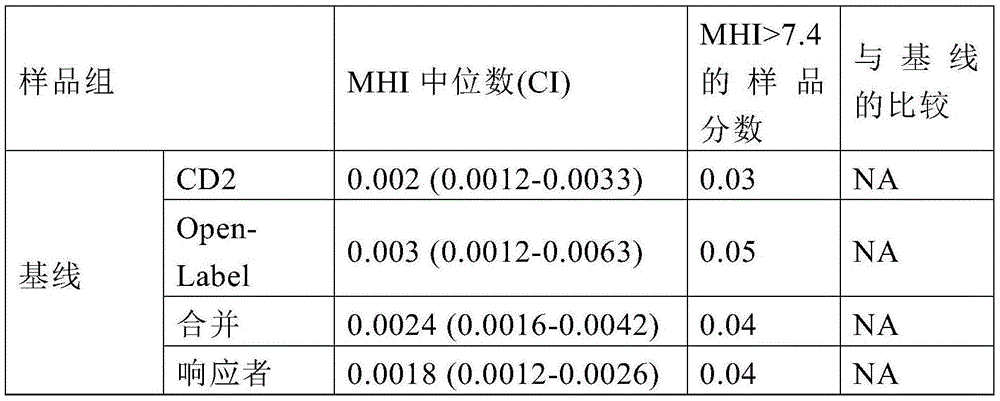

受试者工作特征(ROC)分析被用于基线对RBX2660样品的分析,合并了两个试验的MHI,以使后续开发所基于的群体最大化。ROC分析检查了二元分类器系统的诊断能力,因为其识别分界点有所变化,具有较高的曲线下面积(AUC),表明诊断或生物标志物在所分析的两种群体之间更具区分性(Grund和Sabin,2010)。ROC分析表明,MHI在区分发育不良的受体微生物组与健康的供体微生物组方面非常有效(AUC=0.996;图2C)。使用ROC分析,将7.4的MHI值确定为合并数据的最佳功效分界点(敏感性=0.96,特异性=0.99,概率比=125)。随后的分析确认,分别或共同考虑两个RBX2660和基线群体给出了相似的分析值和预测能力(p=0.335)。应当指出,PUNCH CD2试验的最佳功效分界点被确定为8.2(例如,来自实施例5),PUNCH开放标签试验的最佳功效分界点被确定为31。Receiver operating characteristic (ROC) analysis was used for baseline analysis of RBX2660 samples, combining the MHI of the two trials to maximize the population on which subsequent development is based. The ROC analysis examined the diagnostic power of the binary classifier system as its identification cut-off point varied, with a higher area under the curve (AUC), indicating that a diagnostic or biomarker was more likely to be between the two populations analyzed Discriminatory (Grund and Sabin, 2010). ROC analysis showed that MHI was very effective in differentiating the dysplastic recipient microbiome from the healthy donor microbiome (AUC = 0.996; Figure 2C). Using ROC analysis, an MHI value of 7.4 was determined as the best power cut-off point for pooled data (sensitivity=0.96, specificity=0.99, probability ratio=125). Subsequent analyses confirmed that considering the two RBX2660 and baseline populations separately or together gave similar analytical values and predictive power (p=0.335). It should be noted that the optimal efficacy cut-off point for the PUNCH CD2 assay was determined to be 8.2 (eg, from Example 5) and the optimal efficacy cut-point for the PUNCH open-label assay was determined to be 31.
PUNCH CD2和PUNCH开放标签试验的中位数基线MHI值分别为0.002(0.0012-0.0033,上下置信区间)和0.003(0.0012-0.0063)(图2A,表2)。试验之间基线MHI值的相似性是值得注意的,因为PUNCH CD2试验的样品采用16S方法测序,而PUNCH开放标签试验的样品采用浅鸟枪法测序。结果的相似性表明,无论使用哪种测序方法,都可以获得可靠的MHI计算。The median baseline MHI values for the PUNCH CD2 and PUNCH open-label assays were 0.002 (0.0012-0.0033, upper and lower confidence intervals) and 0.003 (0.0012-0.0063), respectively (Figure 2A, Table 2). The similarity in baseline MHI values between trials is notable because samples from the PUNCH CD2 trial were sequenced using the 16S method, while samples from the PUNCH open-label trial were sequenced using the shallow shotgun method. The similarity of the results suggests that reliable MHI calculations can be obtained regardless of the sequencing method used.
示例6-用RBX7455治疗/预防rCDIExample 6 - Treatment/prevention of rCDI with RBX7455
在1期临床试验筛选然后招募患者参加使用RBX7455(一种口服微生物群恢复治疗组合物,如本文和/或美国专利申请公开号US 2016/0361263和/或美国专利申请16/009,157中所公开的,其全部内容通过引用并入本文),以防止复发性艰难梭菌感染(rCDI)。经过24-48小时的抗生素洗脱期后,对患者进行治疗。RBX7455参与者在基线(0.0095)时的MHI类似于RBX2660参与者在基线(0.002;例如,参见示例5)时的MHI。RBX7455治疗成功后30天的MHI为33.3(例如,大于8.2),与RBX2660参与者一致(RBX2660参与者成功治疗30天后的MHI为14.6,参见示例5)。RBX7455被确定具有中位数为115的MHI(平均值为109)。Patients were screened in a Phase 1 clinical trial and then enrolled in the use of RBX7455, an oral microbiota restoration therapeutic composition as disclosed herein and/or in US Patent Application Publication No. US 2016/0361263 and/or US Patent Application 16/009,157 , the entire contents of which are incorporated herein by reference), to prevent recurrent Clostridium difficile infection (rCDI). After a 24-48 hour antibiotic washout period, patients were treated. The MHI of the RBX7455 participants at baseline (0.0095) was similar to the MHI of the RBX2660 participants at baseline (0.002; eg, see Example 5). The MHI 30 days after successful RBX7455 treatment was 33.3 (eg, greater than 8.2), consistent with RBX2660 participants (14.6 after 30 days of successful treatment for RBX2660 participants, see Example 5). RBX7455 was determined to have a median MHI of 115 (mean 109).
应该理解的是,本发明在许多方面仅是说明性的。在不超出本发明范围的情况下,可以在细节上做出改变,特别是在形状,尺寸和步骤的安排方面。在这个意义上,这可以包括在其他实施例中使用一个示例实施例的任何特征的使用。当然,本发明的范围由所附权利要求书所表达的语言来定义。It should be understood that the present invention is in many respects merely illustrative. Changes may be made in details, particularly in shape, size and arrangement of steps, without departing from the scope of the invention. In this sense, this may include the use of any feature of an example embodiment in other embodiments. Of course, the scope of the invention is defined by the language expressed in the appended claims.
Claims (45)
Applications Claiming Priority (3)
| Application Number | Priority Date | Filing Date | Title |
|---|---|---|---|
| US201762571907P | 2017-10-13 | 2017-10-13 | |
| US62/571,907 | 2017-10-13 | ||
| PCT/US2018/055742 WO2019075426A1 (en) | 2017-10-13 | 2018-10-12 | Microbiome health index |
Publications (1)
| Publication Number | Publication Date |
|---|---|
| CN111247254A true CN111247254A (en) | 2020-06-05 |
Family
ID=64110115
Family Applications (1)
| Application Number | Title | Priority Date | Filing Date |
|---|---|---|---|
| CN201880066008.4A Pending CN111247254A (en) | 2017-10-13 | 2018-10-12 | Microbiome health index |
Country Status (10)
| Country | Link |
|---|---|
| US (1) | US20200263223A1 (en) |
| EP (1) | EP3695017A1 (en) |
| JP (1) | JP2020536548A (en) |
| KR (1) | KR102355054B1 (en) |
| CN (1) | CN111247254A (en) |
| AU (1) | AU2018347619A1 (en) |
| CA (1) | CA3076359A1 (en) |
| MX (1) | MX2020004204A (en) |
| RU (1) | RU2020115649A (en) |
| WO (1) | WO2019075426A1 (en) |
Cited By (1)
| Publication number | Priority date | Publication date | Assignee | Title |
|---|---|---|---|---|
| CN114164260A (en) * | 2020-09-10 | 2022-03-11 | 中国科学院青岛生物能源与过程研究所 | Indoor micro-ecological environment livability detection method based on human body conditioned pathogens |
Families Citing this family (4)
| Publication number | Priority date | Publication date | Assignee | Title |
|---|---|---|---|---|
| KR102503766B1 (en) * | 2020-06-16 | 2023-02-23 | 씨제이바이오사이언스 주식회사 | Apparatus, method and recording medium storing command for determining gut microbiome index |
| EP4211257A1 (en) * | 2020-09-10 | 2023-07-19 | The Procter & Gamble Company | Systems and methods of determining hygiene condition of interior space |
| KR102548376B1 (en) * | 2021-02-08 | 2023-06-26 | 경희대학교 산학협력단 | Depression and anxiety disorder diagnosis method using intestinal microbiome |
| KR20250033538A (en) | 2023-08-31 | 2025-03-10 | 서울대학교병원 | Composition for Predicting responsiveness to treatment of Nontuberculous mycobacteria infectious diseases using Microbiome |
Citations (10)
| Publication number | Priority date | Publication date | Assignee | Title |
|---|---|---|---|---|
| WO2013037068A1 (en) * | 2011-09-14 | 2013-03-21 | Queen's University At Kingston | Method for treatment of disorders of the gastrointestinal system |
| WO2013130773A2 (en) * | 2012-02-29 | 2013-09-06 | Ethicon Endo-Surgery, Inc. | Compositions of microbiota and methods related thereto |
| CN103857402A (en) * | 2011-10-11 | 2014-06-11 | 阿基姆医药公司 | Compositions comprising anaerobically cultured human gut microbiota |
| US20140179726A1 (en) * | 2011-05-19 | 2014-06-26 | Virginia Commonwealth University | Gut microflora as biomarkers for the prognosis of cirrhosis and brain dysfunction |
| US20160058804A1 (en) * | 2013-06-05 | 2016-03-03 | Rebiotix, Inc. | Microbiota restoration therapy (mrt), compositions and methods of manufacture |
| WO2016201053A1 (en) * | 2015-06-09 | 2016-12-15 | Regents Of The University Of Minnesota | Methods for detecting risk of having a bloodstream infection and compositions for reducing the risk |
| US20160361263A1 (en) * | 2015-06-09 | 2016-12-15 | Rebiotix, Inc. | Microbiota restoration therapy (mrt) compositions and methods of manufacture |
| WO2017100688A1 (en) * | 2015-12-09 | 2017-06-15 | uBiome, Inc. | Method and system for characterization of clostridium difficile-associated conditions |
| WO2017118924A1 (en) * | 2016-01-05 | 2017-07-13 | Wellmicro S.R.L. | Method for evaluating the state of health of an individual |
| CN107075588A (en) * | 2014-10-21 | 2017-08-18 | 优比欧迈公司 | The diagnosis originated for microorganism group and the method and system for the treatment of |
Family Cites Families (2)
| Publication number | Priority date | Publication date | Assignee | Title |
|---|---|---|---|---|
| EP2531589B1 (en) | 2010-02-01 | 2017-04-05 | MikrobEX | Bacteriotherapy for Clostridium difficile colitis |
| CN107429291A (en) * | 2014-11-17 | 2017-12-01 | 耶达研究及发展有限公司 | The method for analyzing microorganism group |
-
2018
- 2018-10-12 CN CN201880066008.4A patent/CN111247254A/en active Pending
- 2018-10-12 AU AU2018347619A patent/AU2018347619A1/en not_active Abandoned
- 2018-10-12 JP JP2020520107A patent/JP2020536548A/en active Pending
- 2018-10-12 RU RU2020115649A patent/RU2020115649A/en unknown
- 2018-10-12 US US16/651,469 patent/US20200263223A1/en not_active Abandoned
- 2018-10-12 EP EP18797315.1A patent/EP3695017A1/en not_active Withdrawn
- 2018-10-12 KR KR1020207013108A patent/KR102355054B1/en not_active Expired - Fee Related
- 2018-10-12 CA CA3076359A patent/CA3076359A1/en not_active Abandoned
- 2018-10-12 WO PCT/US2018/055742 patent/WO2019075426A1/en not_active Ceased
- 2018-10-12 MX MX2020004204A patent/MX2020004204A/en unknown
Patent Citations (11)
| Publication number | Priority date | Publication date | Assignee | Title |
|---|---|---|---|---|
| US20140179726A1 (en) * | 2011-05-19 | 2014-06-26 | Virginia Commonwealth University | Gut microflora as biomarkers for the prognosis of cirrhosis and brain dysfunction |
| WO2013037068A1 (en) * | 2011-09-14 | 2013-03-21 | Queen's University At Kingston | Method for treatment of disorders of the gastrointestinal system |
| CN103857402A (en) * | 2011-10-11 | 2014-06-11 | 阿基姆医药公司 | Compositions comprising anaerobically cultured human gut microbiota |
| WO2013130773A2 (en) * | 2012-02-29 | 2013-09-06 | Ethicon Endo-Surgery, Inc. | Compositions of microbiota and methods related thereto |
| US20160058804A1 (en) * | 2013-06-05 | 2016-03-03 | Rebiotix, Inc. | Microbiota restoration therapy (mrt), compositions and methods of manufacture |
| CN105473152A (en) * | 2013-06-05 | 2016-04-06 | 雷柏奥提斯有限公司 | Microbiota restoration therapy (mrt), compositions and methods of manufacture |
| CN107075588A (en) * | 2014-10-21 | 2017-08-18 | 优比欧迈公司 | The diagnosis originated for microorganism group and the method and system for the treatment of |
| WO2016201053A1 (en) * | 2015-06-09 | 2016-12-15 | Regents Of The University Of Minnesota | Methods for detecting risk of having a bloodstream infection and compositions for reducing the risk |
| US20160361263A1 (en) * | 2015-06-09 | 2016-12-15 | Rebiotix, Inc. | Microbiota restoration therapy (mrt) compositions and methods of manufacture |
| WO2017100688A1 (en) * | 2015-12-09 | 2017-06-15 | uBiome, Inc. | Method and system for characterization of clostridium difficile-associated conditions |
| WO2017118924A1 (en) * | 2016-01-05 | 2017-07-13 | Wellmicro S.R.L. | Method for evaluating the state of health of an individual |
Non-Patent Citations (3)
| Title |
|---|
| ALEXANDER等: "Membership and behavior of ultra-low-diversity pathogen communities present in the gut of humans during prolonged critical illness." * |
| 丁庞华等: "基于高通量测序技术的溃疡性结肠炎大肠湿热证患者肠道菌群多样性的研究" * |
| 周鹏程等: "经鼻十二指肠管输注健康人粪便溶液治疗复发性艰难梭菌感染(摘译)" * |
Cited By (1)
| Publication number | Priority date | Publication date | Assignee | Title |
|---|---|---|---|---|
| CN114164260A (en) * | 2020-09-10 | 2022-03-11 | 中国科学院青岛生物能源与过程研究所 | Indoor micro-ecological environment livability detection method based on human body conditioned pathogens |
Also Published As
| Publication number | Publication date |
|---|---|
| RU2020115649A (en) | 2021-11-15 |
| RU2020115649A3 (en) | 2021-11-15 |
| KR102355054B1 (en) | 2022-01-24 |
| MX2020004204A (en) | 2020-08-13 |
| CA3076359A1 (en) | 2019-04-18 |
| KR20200061403A (en) | 2020-06-02 |
| WO2019075426A1 (en) | 2019-04-18 |
| JP2020536548A (en) | 2020-12-17 |
| EP3695017A1 (en) | 2020-08-19 |
| AU2018347619A1 (en) | 2020-04-09 |
| US20200263223A1 (en) | 2020-08-20 |
Similar Documents
| Publication | Publication Date | Title |
|---|---|---|
| CN111247254A (en) | Microbiome health index | |
| Thoen et al. | Tuberculosis: a re-emerging disease in animals and humans | |
| Ling et al. | Altered fecal microbiota composition associated with food allergy in infants | |
| Katsarou-Katsari et al. | Acute urticaria associated with amoeboid forms of Blastocystis sp. subtype 3 | |
| CN108095685B (en) | Classification technology based on positive-negative relation ratio of interaction network and application thereof | |
| Dohoo et al. | Diagnosing intramammary infections: Comparison of multiple versus single quarter milk samples for the identification of intramammary infections in lactating dairy cows | |
| Vidal et al. | Crohn associated microbial communities associated to colonic mucosal biopsies in patients of the western Mediterranean | |
| Maffia-Bizzozero et al. | Viable SARS-CoV-2 Omicron sub-variants isolated from autopsy tissues | |
| Singhla et al. | Prevalence, risk factors, and diagnostic efficacy of bovine tuberculosis in slaughtered animals at the Chiang Mai Municipal abattoir, Thailand | |
| CN111630189B (en) | Bacterial metagenomic analysis to diagnose cholangiocarcinoma | |
| KR102063196B1 (en) | Method for diagnosis of irritable bowel syndrome using analysis of bacteria metagenome | |
| Karakas et al. | Oropharyngeal tularemia cases admitted to a military hospital in Ankara, Turkey | |
| HK40031160A (en) | Microbiome health index | |
| Das et al. | Clinico-epidemiological profile of patients with liver abscess: a hospital based study | |
| Krajewska-Wędzina et al. | Tuberculosis in Polish zoos as health risk for humans | |
| El-Sony et al. | Symptoms in patients attending services for diagnosis of pulmonary tuberculosis in Sudan | |
| Lim et al. | Environmental sources of Clostridioides (Clostridium) difficile in the hospital | |
| Al-Robasi et al. | Seroprevalence of Leptospira antibodies among populations at risk | |
| Oh et al. | Laboratory Investigation of Sexually Transmitted Infections in the Elderly Population of South Korea | |
| Sullivan | Update on influenza epidemiology and vaccines | |
| Bradbury | Faecal microscopy–sorting the parasites from the crap | |
| Pritt | Commercial molecular assays: pros and cons | |
| Qu et al. | Disseminated Strongyloides Stercoralis Hyperinfection in An Immunocompetent Patient First Diagnosed by Metagenomic Next-Generation Sequencing in Cerebrospinal Fluid: A Case Report | |
| Gustin et al. | High-risk microbial signatures are associated with severe parasitemia in controlled Plasmodium infections of both humans and rhesus macaques | |
| Feltrer | Toxoplasma gondii causing death in a captive speckled mousebird (Colius straitus) |
Legal Events
| Date | Code | Title | Description |
|---|---|---|---|
| PB01 | Publication | ||
| PB01 | Publication | ||
| SE01 | Entry into force of request for substantive examination | ||
| SE01 | Entry into force of request for substantive examination | ||
| REG | Reference to a national code |
Ref country code: HK Ref legal event code: DE Ref document number: 40031160 Country of ref document: HK |
|
| WD01 | Invention patent application deemed withdrawn after publication |
Application publication date: 20200605 |
|
| WD01 | Invention patent application deemed withdrawn after publication |