CN111243309A - Expressway traffic flow full-sample trajectory reconstruction method based on automatic driving vehicle movement detection - Google Patents
Expressway traffic flow full-sample trajectory reconstruction method based on automatic driving vehicle movement detection Download PDFInfo
- Publication number
- CN111243309A CN111243309A CN202010024563.XA CN202010024563A CN111243309A CN 111243309 A CN111243309 A CN 111243309A CN 202010024563 A CN202010024563 A CN 202010024563A CN 111243309 A CN111243309 A CN 111243309A
- Authority
- CN
- China
- Prior art keywords
- vehicle
- driving state
- trajectory
- automatic driving
- speed
- Prior art date
- Legal status (The legal status is an assumption and is not a legal conclusion. Google has not performed a legal analysis and makes no representation as to the accuracy of the status listed.)
- Pending
Links
Images


Classifications
-
- G—PHYSICS
- G08—SIGNALLING
- G08G—TRAFFIC CONTROL SYSTEMS
- G08G1/00—Traffic control systems for road vehicles
- G08G1/09—Arrangements for giving variable traffic instructions
- G08G1/0962—Arrangements for giving variable traffic instructions having an indicator mounted inside the vehicle, e.g. giving voice messages
- G08G1/0967—Systems involving transmission of highway information, e.g. weather, speed limits
-
- G—PHYSICS
- G08—SIGNALLING
- G08G—TRAFFIC CONTROL SYSTEMS
- G08G1/00—Traffic control systems for road vehicles
- G08G1/09—Arrangements for giving variable traffic instructions
- G08G1/0962—Arrangements for giving variable traffic instructions having an indicator mounted inside the vehicle, e.g. giving voice messages
- G08G1/0968—Systems involving transmission of navigation instructions to the vehicle
-
- G—PHYSICS
- G08—SIGNALLING
- G08G—TRAFFIC CONTROL SYSTEMS
- G08G1/00—Traffic control systems for road vehicles
- G08G1/123—Traffic control systems for road vehicles indicating the position of vehicles, e.g. scheduled vehicles; Managing passenger vehicles circulating according to a fixed timetable, e.g. buses, trains, trams
Landscapes
- Physics & Mathematics (AREA)
- General Physics & Mathematics (AREA)
- Engineering & Computer Science (AREA)
- Radar, Positioning & Navigation (AREA)
- Remote Sensing (AREA)
- Life Sciences & Earth Sciences (AREA)
- Atmospheric Sciences (AREA)
- Traffic Control Systems (AREA)
Abstract
本发明公开了一种基于自动驾驶车辆移动检测的快速路交通流全样本轨迹重构方法。主要步骤包括:首先,对于自动驾驶车辆可以检测到的两辆相邻人工驾驶车辆,将后车行驶状态分为跟随和逼近,利用自动驾驶车辆移动检测到的前车轨迹数据预测后车下一时刻的期望行驶状态参数;其次,计算后车下一时刻期望行驶状态参数与实际行驶状态参数差值,若该差值超出可接受范围,要在这两辆相邻人工驾驶车辆之间插入新的车辆;之后,根据道路局部交通密度和区域平均速度,进一步计算插入人工驾驶车辆初始插入位置和初始插入速度;最后,设计元胞自动机运动更新规则,仿真车辆运动,据此完成插入车辆轨迹重构,得到快速路混行交通流全样本轨迹。

The invention discloses a full-sample trajectory reconstruction method of expressway traffic flow based on automatic driving vehicle movement detection. The main steps include: first, for the two adjacent human-driven vehicles that can be detected by the automatic driving vehicle, the driving state of the rear vehicle is divided into following and approaching, and the trajectory data of the preceding vehicle detected by the movement of the automatic driving vehicle is used to predict the next vehicle. The expected driving state parameters at the moment; secondly, calculate the difference between the expected driving state parameters of the rear car and the actual driving state parameters at the next moment. If the difference exceeds the acceptable range, insert a new Then, according to the local traffic density and regional average speed of the road, the initial insertion position and initial insertion speed of the artificially driven vehicle are further calculated; finally, the cellular automata motion update rule is designed to simulate the vehicle motion, and the inserted vehicle trajectory is completed accordingly. Reconstruction to obtain the full sample trajectory of the mixed traffic flow on the expressway.
Description
技术领域technical field
本申请涉及交通信息领域,具体而言,涉及一种基于自动驾驶车辆移动检测的快速路交通流全样本轨迹重构方法。The present application relates to the field of traffic information, and in particular, to a full-sample trajectory reconstruction method of expressway traffic flow based on automatic driving vehicle movement detection.
背景技术Background technique
车辆轨迹数据可在时域和空域内提供大量重要交通信息,为交通管理与控制方案的制定提供重要基础。一旦完整的轨迹数据可以被准确获取,道路交通状态和服务水平便可准确估计,决策者可以据此改善优化当前交通管理和控制方案,这对于改善城市交通状况有重要现实意义。Vehicle trajectory data can provide a large amount of important traffic information in the time domain and airspace, and provide an important basis for the formulation of traffic management and control schemes. Once the complete trajectory data can be accurately obtained, the road traffic state and service level can be accurately estimated, and decision makers can improve and optimize the current traffic management and control scheme accordingly, which has important practical significance for improving urban traffic conditions.
目前,车辆轨迹数据的收集主要包括定点检测和移动检测,例如视频、航拍、探测车等。受限于安装维护成本,依赖定点检测器如视频、航拍等收集到的轨迹数据往往覆盖范围有限,这类轨迹数据往往不完整而且包含大量错误。而基于移动检测如探测车等获取的轨迹数据只是部分抽样车辆轨迹,无法反应交通流全貌,同时,受限于通信成本和通信可靠性,这种采集方式获取的轨迹数据在时空上有时甚至只是稀疏的几个数据点,无法提供交通流时空信息。At present, the collection of vehicle trajectory data mainly includes fixed-point detection and motion detection, such as video, aerial photography, and detection vehicles. Limited by the cost of installation and maintenance, trajectory data collected relying on fixed-point detectors such as video and aerial photography often have limited coverage, and such trajectory data are often incomplete and contain a lot of errors. However, the trajectory data obtained based on mobile detection such as rover vehicles are only partially sampled vehicle trajectories, which cannot reflect the full picture of the traffic flow. At the same time, limited by the communication cost and communication reliability, the trajectory data obtained by this collection method is sometimes even only limited in time and space. A few sparse data points cannot provide spatiotemporal information of traffic flow.
随着自动驾驶技术和5G通信的快速发展,未来道路将会是自动驾驶车辆和人工驾驶车辆混行的状态。自动驾驶车辆具备大量丰富检测传感设备,如3D雷达、激光雷达、图像处理系统、移动物体追踪系统等,检测范围内的物体都可以被自动驾驶车辆准确识别。可以将自动驾驶车辆视作在道路上随机分布的大量高精度移动检测器,它们不仅可以准确记录自身轨迹数据,还可以将检测范围内的其他车辆轨迹数据一并采集。因此,自动驾驶车辆为交通数据的获取提供了新来源。然而,考虑到自动驾驶车辆的大范围应用仍存在许多现实问题,无法快速普及,未来一段时间内,自动驾驶车辆的渗透率会维持在低水平。受限于检测范围,自动驾驶车辆检测到的轨迹数据只是部分抽样交通流轨迹,无法反应交通流全貌。尽管未来自动驾驶车辆渗透率可能达到100%,但高频率的采样记录车辆轨迹会造成隐私担忧和安全隐患。因此,如何基于自动驾驶车辆检测到的部分抽样交通流轨迹数据重构全样本混行交通流轨迹,是交通信息领域待解决的新问题。With the rapid development of autonomous driving technology and 5G communication, the road in the future will be a mixture of autonomous vehicles and human-driven vehicles. Autonomous vehicles are equipped with a large number of rich detection and sensing devices, such as 3D radar, lidar, image processing systems, moving object tracking systems, etc., and objects within the detection range can be accurately recognized by autonomous vehicles. Autonomous vehicles can be regarded as a large number of high-precision motion detectors randomly distributed on the road. They can not only accurately record their own trajectory data, but also collect the trajectory data of other vehicles within the detection range. Thus, self-driving vehicles provide a new source for the acquisition of traffic data. However, considering that there are still many practical problems in the large-scale application of autonomous vehicles, which cannot be quickly popularized, the penetration rate of autonomous vehicles will remain at a low level for a period of time in the future. Limited by the detection range, the trajectory data detected by the autonomous vehicle is only a partial sample of the traffic flow trajectory, and cannot reflect the full picture of the traffic flow. Although the penetration rate of autonomous vehicles may reach 100% in the future, the high frequency of sampling and recording vehicle trajectories will cause privacy concerns and security risks. Therefore, how to reconstruct the full-sample mixed traffic flow trajectory based on the partially sampled traffic flow trajectory data detected by the autonomous vehicle is a new problem to be solved in the field of traffic information.
发明内容SUMMARY OF THE INVENTION
1.发明目的1. Purpose of the invention
本发明针对自动驾驶车辆检测到的轨迹数据只是部分抽样交通流轨迹,无法反应交通流全貌,提出一种基于自动驾驶车辆移动检测的快速路交通流全样本轨迹重构方法,实现全样本混行交通流轨迹的获取。Aiming at the fact that the trajectory data detected by the automatic driving vehicle is only a partial sample traffic flow trajectory, which cannot reflect the whole picture of the traffic flow, the invention proposes a full sample trajectory reconstruction method of the expressway traffic flow based on the movement detection of the automatic driving vehicle, so as to realize the mixed traffic of the whole sample. Acquisition of traffic flow trajectories.
2.本发明所采用的技术方案2. The technical solution adopted in the present invention
定义快速路上相邻两辆自动驾驶车辆为AV1和AV2,头车为AV1,跟随车为AV2,AV1检测范围内完整记录轨迹的最后一辆跟随人工驾驶车辆为HVa,AV2检测范围内的完整记录轨迹的第一辆人工驾驶车辆为HVb,本发明提出的基于自动驾驶车辆移动检测数据的快速路全样本轨迹重构方法可以通过以下步骤来实现:Define the two adjacent autonomous vehicles on the expressway as AV 1 and AV 2 , the leading vehicle is AV 1 , the following vehicle is AV 2 , and the last following human-driven vehicle with a complete recorded trajectory within the detection range of AV 1 is HV a , AV 2. The first manually-driven vehicle with a complete recorded trajectory within the detection range is HV b , and the method for reconstructing the full-sample trajectory of the expressway based on the movement detection data of the self-driving vehicle proposed by the present invention can be realized by the following steps:
(1)将车辆行驶状态分为跟随和逼近,基于AV1检测到的HVa轨迹数据估计后车HVb下一时刻的期望行驶状态参数;(1) The vehicle driving state is divided into following and approximation, and the expected driving state parameters of the rear vehicle HV b at the next moment are estimated based on the trajectory data of HV a detected by AV 1 ;
(2)基于AV2检测到的HVb实际轨迹数据计算下一时刻车辆的实际行驶状态参数,结合步骤(1)结果,计算HVb下一时刻期望行驶状态参数与实际行驶状态参数差值,若该差值超出可接受范围,则认为后车HVb受到检测范围外未检测到车辆的影响导致该车无法按照期望速度行驶,此时要在HVa和HVb之间插入新的人工驾驶车辆;(2) Calculate the actual driving state parameter of the vehicle at the next moment based on the actual trajectory data of HV b detected by AV 2 , and combine the results of step (1) to calculate the difference between the expected driving state parameter of HV b and the actual driving state parameter at the next moment, If the difference exceeds the acceptable range, it is considered that the rear vehicle HV b is affected by the undetected vehicle outside the detection range, so that the vehicle cannot drive at the desired speed. At this time, a new manual driving should be inserted between HV a and HV b . vehicle;
(3)根据自动驾驶车辆移动检测数据,计算道路局部交通密度和区域平均速度,据此计算车辆之间的理想期望间距,进一步确定插入人工驾驶车辆初始插入位置和初始插入速度;(3) Calculate the local traffic density and regional average speed of the road according to the movement detection data of the automatic driving vehicle, calculate the ideal expected distance between vehicles based on this, and further determine the initial insertion position and initial insertion speed of the artificially driven vehicle;
(4)根据步骤(3)结果,设计元胞自动机运动更新规则,包括:匀速、加速、减速、随机慢化和位置更新,仿真车辆运动,计算插入车辆下一时刻位置,完成插入车辆轨迹重构。(4) According to the result of step (3), design the cellular automata motion update rules, including: uniform speed, acceleration, deceleration, random slowdown and position update, simulate the motion of the vehicle, calculate the position of the inserted vehicle at the next moment, and complete the inserted vehicle trajectory Refactor.
所述步骤(1)具体为:车辆行驶状态可以用不同参数表示,如速度、加速度等,本方法采用加速度表征车辆行驶状态。若车辆处于跟随状态,则后车驾驶行为应该与前车保持一致,因此,后车下一时刻期望加速度ai-1为零,如式(1)所示:The step (1) is specifically as follows: the driving state of the vehicle can be represented by different parameters, such as speed, acceleration, etc. The method uses the acceleration to represent the driving state of the vehicle. If the vehicle is in the following state, the driving behavior of the rear vehicle should be consistent with that of the preceding vehicle. Therefore, the expected acceleration a i-1 of the rear vehicle at the next moment is zero, as shown in equation (1):
ai-1=0 (1)a i-1 = 0 (1)
若后车处于逼近状态,为了避免碰撞,后车下一时刻的速度应该小于前车,后车会根据与前车的距离不断调整自身速度直到开始跟随前车行驶,后车下一时刻期望加速度ai-1的计算方法如式(2)所示:If the car behind is in an approaching state, in order to avoid a collision, the speed of the car in the next moment should be lower than that of the car in front, and the car behind will adjust its speed according to the distance from the car in front until it starts to follow the car in front, and the car behind expects the acceleration at the next moment The calculation method of a i-1 is shown in formula (2):

其中,da=l+ds,l表示车辆长度;ds表示相对安全距离;ai表示前车的加速度;amin表示最小加速度,
所述步骤(2)具体为:HVb下一时刻的实际加速度

其中,t1,t2表示时间戳;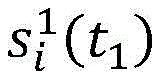


结合步骤(1)计算结果,用

其中,si-1表示后车当前速度;si表示前车当前速度。则HVb下一时刻期望行驶状态参数与实际行驶状态参数差值δ如式(5)所示:Among them, s i-1 represents the current speed of the following vehicle; s i represents the current speed of the preceding vehicle. Then the difference δ between the expected driving state parameters of HV b and the actual driving state parameters at the next moment is shown in formula (5):

用τ表示可接受差值阈值,假设快速路限速为20m/s,如果车辆速度低于20m/s且下一时刻实际加速度为0,而预测该车下一时刻期望加速度为最大值,此时一定需要插入人工驾驶车辆。
所述步骤(3)具体为:首先,基于自动驾驶车辆探测到的部分轨迹数据,估计道路局部交通密度,将道路划分为m个单元,长度均为l,假设道路上共有N辆自动驾驶车辆,一个道路单元只能被一辆车占据。对于自动驾驶车辆AVi,其检测范围内有zi辆车的轨迹数据可以被完整记录,在时刻t,zi辆车所在道路单元表示为

其中,D∈[0,1],T表示仿真时间。where D∈[0,1], T denotes the simulation time.
根据式(6)计算结果可以估计道路上车辆之间的理想期望间距,计算方法如式(7)所示:According to the calculation result of formula (6), the ideal expected distance between vehicles on the road can be estimated, and the calculation method is shown in formula (7):

用Pd表示前后车辆位置差值:Use P d to represent the position difference between the front and rear vehicles:

其中,α表示调整参数,一般情况α∈(0,1)。Among them, α represents the adjustment parameter, in the general case α∈(0,1).
根据式(8)计算结果,人工驾驶车辆插入位置如式(9)所示:According to the calculation result of Equation (8), the insertion position of the manually driven vehicle is shown in Equation (9):
Pinsert=Pi-1=Pi-Pd (9)P insert =P i-1 =P i -P d (9)
之后,进一步估计插入人工驾驶车辆初始插入速度。假设道路区域A共有N辆自动驾驶车辆表示为{AV1,AV2,…,AVN},其中某一AVi检测范围内共有zi辆车的轨迹被完整记录,在时刻t,zi辆车的位置表示为

其中,k表示仿真总次数;Δt表示时间步长。Among them, k represents the total number of simulations; Δt represents the time step.
因为插入车辆位于区域道路区域A,因此,插入人工驾驶车辆初始插入速度可以取道路区域A的平均速度,即式(10)的计算结果为插入人工驾驶车辆初始插入速度。Because the inserted vehicle is located in the regional road area A, the initial insertion speed of the artificially driven vehicle can be taken as the average speed of the road area A, that is, the calculation result of equation (10) is the initial inserted speed of the artificially driven vehicle.
所述步骤(4)具体为:首先,在设计元胞自动机运动更新规则之前,为了避免碰撞,后车应该与前车保持一定的安全距离,要计算安全参数临界值,计算方法如式(11)所示:The step (4) is specifically as follows: first, before designing the cellular automata motion update rule, in order to avoid collision, the rear vehicle should keep a certain safety distance from the front vehicle, and the critical value of the safety parameter should be calculated, and the calculation method is as follows: 11) shown:

其中,ai和ai-1分别表示前车和后车的最大减速度,ai=ai-1=3m/s2;l表示车辆长度;tr表示反应时间,若后车为人工驾驶车辆,则tr=0.8s,若后车为自动驾驶车辆,则tr=0.5s。Among them, a i and a i-1 represent the maximum deceleration of the preceding vehicle and the rear vehicle respectively, a i =a i-1 =3m/s 2 ; l represents the length of the vehicle; tr represents the reaction time, if the rear vehicle is artificial If the vehicle is driven, then tr = 0.8s, and if the following vehicle is an autonomous vehicle, then tr = 0.5s.
根据式(11)计算结果可以分别得到安全距离gapsi-1(t)和安全速度ssi-1(t)的临界值:According to the calculation result of formula (11), the critical values of the safety distance gaps i-1 (t) and the safety speed ss i-1 (t) can be obtained respectively:


根据式(12)和式(13)计算的安全参数临界值,进一步制定元胞自动机运动更新规则,包括:匀速、加速、减速、随机慢化和位置更新。According to the critical values of safety parameters calculated by equations (12) and (13), the cellular automata motion update rules are further formulated, including: uniform speed, acceleration, deceleration, random slowdown and position update.
Step1:匀速运动。如果在时刻t,前车vi和后车vi-1的距离gapi-1(t)等于安全间距临界值,即gapi-1(t)=gapsi-1(t),则后车在下一时刻会保持当前速度:Step1: Exercise at a uniform speed. If at time t, the distance gap i-1 (t) between the preceding vehicle v i and the following vehicle v i-1 is equal to the critical value of the safety distance, that is, gap i-1 (t)=gap i- 1 (t), then the rear The car will maintain the current speed at the next moment:
si-1(t+1)=si-1(t) (14)s i-1 (t+1)=s i-1 (t) (14)
Step2:加速运动。如果gapi-1(t)≠gapsi-1(t),则后车在下一时刻首先进行加速,如式(15)所示:Step2: Accelerate the movement. If gap i-1 (t)≠gap i- 1 (t), the following vehicle will first accelerate at the next moment, as shown in equation (15):
si-1(t+1)=min{si-1(t)+1,smax,ssi-1(t)} (15)s i-1 (t+1)=min{s i-1 (t)+1,s max ,ss i-1 (t)} (15)
其中,smax表示后车的最大速度。Among them, s max represents the maximum speed of the following vehicle.
Step3:减速运动。后车为了保证与前车之间的间距在安全范围内,在加速之后可能需要进一步减速:Step3: Decelerate the movement. In order to keep the distance between the vehicle in front and the vehicle in front within a safe range, the vehicle behind may need to decelerate further after accelerating:

其中,si(t+1)表示在t+1时刻车辆加速后的速度。Among them, s i (t+1) represents the speed of the vehicle after acceleration at time t+1.
Step4:随机慢化。由于插入人工驾驶车辆的驾驶员存在生理差异,以慢化概率p调整车辆速度:Step4: Random slow down. Due to the physiological differences in the drivers inserted into the human-driven vehicle, the vehicle speed is adjusted with a slowing probability p:

其中,
Step5:位置更新。插入的人工驾驶车辆下一时刻的位置Pi-1(t+1)可以按照式(18)的计算方法进行更新:Step5: Location update. The inserted position P i-1 (t+1) of the artificially driven vehicle at the next moment can be updated according to the calculation method of formula (18):
Pi-1(t+1)=Pi-1(t)+si-1(t+1)″ (18)P i-1 (t+1)=P i-1 (t)+s i-1 (t+1)″ (18)
其中,Pi-1(t)表示后车vi-1在时刻t的位置,初始时刻,Pi-1(t)即插入人工驾驶车辆的初始插入位置,si-1(t)即插入人工驾驶车辆的初始插入速度。Among them, P i-1 (t) represents the position of the following vehicle v i-1 at time t, and at the initial moment, P i-1 (t) is the initial insertion position of the artificially driven vehicle, and s i-1 (t) is Inserts the initial insertion speed of the human-driven vehicle.
因此,根据制定元胞自动机运动更新规则Step1-Step5仿真车辆运动,不断计算更新插入人工驾驶车辆下一时刻的位置,可以重构出插入人工驾驶车辆的完整轨迹,得到快速路混行交通流全样本轨迹。Therefore, according to the cellular automata motion update rules Step1-Step5, the motion of the vehicle is simulated, and the position of the inserted artificially driven vehicle at the next moment is continuously calculated and updated, and the complete trajectory of the inserted artificially driven vehicle can be reconstructed, and the mixed traffic flow of the expressway can be obtained. Full sample trajectory.
附图说明Description of drawings
此处所说明的附图用来提供对本申请的进一步理解,构成本申请的一部分,本申请的示意性实施例及其说明用于解释本申请,并不构成对本申请的不当限定。在附图中:The drawings described herein are used to provide further understanding of the present application and constitute a part of the present application. The schematic embodiments and descriptions of the present application are used to explain the present application and do not constitute an improper limitation of the present application. In the attached image:
图1为根据本公开具体实施方式所述的快速路示意图;1 is a schematic diagram of an expressway according to a specific embodiment of the present disclosure;
图2为根据本公开具体实施方式所述的轨迹重构结果,其中自动驾驶车辆渗透率为5%,道路交通密度分别取40veh/km和60veh/km;Fig. 2 shows the trajectory reconstruction result according to the specific embodiment of the present disclosure, wherein the penetration rate of autonomous driving vehicles is 5%, and the road traffic density is respectively 40veh/km and 60veh/km;
图3为根据本公开具体实施方式所述的轨迹重构结果,其中道路交通密度为100veh/km,自动驾驶车辆渗透率分别取2%和5%;Fig. 3 shows the trajectory reconstruction result according to the specific embodiment of the present disclosure, wherein the road traffic density is 100 veh/km, and the penetration rate of autonomous vehicles is taken as 2% and 5%, respectively;
图4为根据本公开具体实施方式所述的不同道路交通密度下的轨迹重构误差,其中自动驾驶车辆渗透率固定为5%;FIG. 4 is the trajectory reconstruction error under different road traffic densities according to the specific embodiment of the present disclosure, wherein the penetration rate of autonomous driving vehicles is fixed at 5%;
图5为根据本公开具体实施方式所述的不同自动驾驶车辆渗透率下的轨迹重构误差,其中道路交通密度固定为100veh/km;FIG. 5 is the trajectory reconstruction error under different penetration rates of autonomous vehicles according to the specific embodiment of the present disclosure, wherein the road traffic density is fixed at 100veh/km;
图6为根据本公开具体实施方式的流程图。6 is a flow diagram according to an embodiment of the present disclosure.
具体实施方式Detailed ways
下面将结合本发明实施例中的附图,对本发明实施例中的技术方案进行清楚、完整地描述,显然,所描述的实施例仅仅是本发明一部分实施例,而不是全部的实施例。以下对至少一个示例性实施例的描述实际上仅仅是说明性的,决不作为对本发明及其应用或使用的任何限制。基于本发明中的实施例,本领域普通技术人员在没有作出创造性劳动前提下所获得的所有其他实施例,都属于本发明保护的范围。The technical solutions in the embodiments of the present invention will be clearly and completely described below with reference to the accompanying drawings in the embodiments of the present invention. Obviously, the described embodiments are only a part of the embodiments of the present invention, but not all of the embodiments. The following description of at least one exemplary embodiment is merely illustrative in nature and is in no way intended to limit the invention, its application, or uses. Based on the embodiments of the present invention, all other embodiments obtained by those of ordinary skill in the art without creative efforts shall fall within the protection scope of the present invention.
需要注意的是,这里所使用的术语仅是为了描述具体实施方式,而非意图限制根据本申请的示例性实施方式。如在这里所使用的,除非上下文另外明确指出,否则单数形式也意图包括复数形式,此外,还应当理解的是,当在本说明书中使用术语“包含”和/或“包括”时,其指明存在特征、步骤、操作、器件、组件和/或它们的组合。It should be noted that the terminology used herein is for the purpose of describing specific embodiments only, and is not intended to limit the exemplary embodiments according to the present application. As used herein, unless the context clearly dictates otherwise, the singular is intended to include the plural as well, furthermore, it is to be understood that when the terms "comprising" and/or "including" are used in this specification, it indicates that There are features, steps, operations, devices, components and/or combinations thereof.
除非另外具体说明,否则在这些实施例中阐述的部件和步骤的相对布置、数字表达式和数值不限制本发明的范围。同时,应当明白,为了便于描述,附图中所示出的各个部分的尺寸并不是按照实际的比例关系绘制的。对于相关领域普通技术人员已知的技术、方法和设备可能不作详细讨论,但在适当情况下,技术、方法和设备应当被视为授权说明书的一部分。在这里示出和讨论的所有示例中,任何具体值应被解释为仅仅是示例性的,而不是作为限制。因此,示例性实施例的其它示例可以具有不同的值。应注意到:相似的标号和字母在下面的附图中表示类似项,因此,一旦某一项在一个附图中被定义,则在随后的附图中不需要对其进行进一步讨论。The relative arrangement of the components and steps, the numerical expressions and numerical values set forth in these embodiments do not limit the scope of the invention unless specifically stated otherwise. Meanwhile, it should be understood that, for the convenience of description, the dimensions of various parts shown in the accompanying drawings are not drawn in an actual proportional relationship. Techniques, methods, and apparatus known to those of ordinary skill in the relevant art may not be discussed in detail, but where appropriate, techniques, methods, and apparatus should be considered part of the authorized description. In all examples shown and discussed herein, any specific value should be construed as illustrative only and not as limiting. Accordingly, other examples of exemplary embodiments may have different values. It should be noted that like numerals and letters refer to like items in the following figures, so once an item is defined in one figure, it does not require further discussion in subsequent figures.
本发明提出的基于自动驾驶车辆移动检测的快速路交通流全样本轨迹重构方法可以通过以下步骤来实现:The full-sample trajectory reconstruction method of expressway traffic flow based on automatic driving vehicle movement detection proposed by the present invention can be realized by the following steps:
(1)将车辆行驶状态分为跟随和逼近,基于AV1检测到的HVa轨迹数据估计后车HVb下一时刻的期望行驶状态参数;(1) The vehicle driving state is divided into following and approximation, and the expected driving state parameters of the rear vehicle HV b at the next moment are estimated based on the trajectory data of HV a detected by AV 1 ;
(2)基于AV2检测到的HVb实际轨迹数据计算下一时刻车辆的实际行驶状态参数,结合步骤(1)结果,计算HVb下一时刻期望行驶状态参数与实际行驶状态参数差值,若该差值超出可接受范围,则认为后车HVb受到检测范围外未检测到车辆的影响导致该车无法按照期望速度行驶,此时要在HVa和HVb之间插入新的人工驾驶车辆;(2) Calculate the actual driving state parameter of the vehicle at the next moment based on the actual trajectory data of HV b detected by AV 2 , and combine the results of step (1) to calculate the difference between the expected driving state parameter of HV b and the actual driving state parameter at the next moment, If the difference exceeds the acceptable range, it is considered that the rear vehicle HV b is affected by the undetected vehicle outside the detection range, so that the vehicle cannot drive at the desired speed. At this time, a new manual driving should be inserted between HV a and HV b . vehicle;
(3)根据自动驾驶车辆移动检测数据,计算道路局部交通密度和区域平均速度,据此计算车辆之间的理想期望间距,进一步确定插入人工驾驶车辆初始插入位置和初始插入速度;(3) Calculate the local traffic density and regional average speed of the road according to the movement detection data of the automatic driving vehicle, calculate the ideal expected distance between vehicles based on this, and further determine the initial insertion position and initial insertion speed of the artificially driven vehicle;
(4)根据步骤(3)结果,设计元胞自动机运动更新规则,包括:匀速、加速、减速、随机慢化和位置更新,仿真车辆运动,计算插入车辆下一时刻位置,据此完成插入车辆轨迹重构。(4) According to the result of step (3), design the cellular automata motion update rules, including: uniform speed, acceleration, deceleration, random slowdown and position update, simulate the motion of the vehicle, calculate the position of the inserted vehicle at the next moment, and complete the insertion accordingly. Vehicle trajectory reconstruction.
由于自动驾驶技术尚未普及,实际数据获取存在难度,因此采用仿真数据具体介绍方法实施的每步骤。Since the automatic driving technology has not yet been popularized, it is difficult to obtain the actual data. Therefore, the simulation data is used to introduce each step of the method implementation in detail.
第(1)步:仿真快速路路段如图1所示,道路长度为3000m,将其划分为600个道路单元,每个单元的长度均为5m。采用刺激反应跟驰模型,仿真自动驾驶和人工驾驶车辆混行交通流获得完整轨迹数据用于方法验证,其中,假设人工驾驶车辆的敏感性参数服从高斯分布,均值为0.7,方差为0.01,由于自动驾驶车辆具有同质性,为了确保安全,其相对而言会更保守,因此,自动驾驶车辆的敏感性参数全部设置为0.8。Step (1): The simulated expressway section is shown in Figure 1. The length of the road is 3000m, which is divided into 600 road units, and the length of each unit is 5m. The stimulus-response car-following model is used to simulate the mixed traffic flow of autonomous and human-driven vehicles to obtain complete trajectory data for method verification. It is assumed that the sensitivity parameters of human-driven vehicles obey a Gaussian distribution with a mean of 0.7 and a variance of 0.01. Self-driving vehicles are homogeneous, and in order to ensure safety, they will be relatively conservative, so the sensitivity parameters of self-driving vehicles are all set to 0.8.
第(2)步:假设自动驾驶车辆的渗透率P为5%,道路的交通密度D分别为40veh/km和60veh/km,假设自动驾驶车辆检测范围为100m,如果车辆均匀分布,则自动驾驶车辆检测范围内至少存在8辆车。然而,车辆随机分布,靠近检测边缘的车辆轨迹数据可能无法完整记录,因此,假设自动驾驶车辆检测范围内有6辆车的轨迹数据被完整记录。之后,按照式(4)依次估计车辆驾驶状态,基于实际车辆驾驶状态与期望驾驶状态的差值按照式(9)和式(10)插入人工驾驶车辆。Step (2): Assume that the penetration rate P of autonomous vehicles is 5%, and the traffic density D of the road is 40veh/km and 60veh/km, respectively. Assuming that the detection range of autonomous vehicles is 100m, if the vehicles are evenly distributed, the automatic driving There are at least 8 vehicles within the vehicle detection range. However, the vehicles are randomly distributed, and the vehicle trajectory data near the detection edge may not be completely recorded. Therefore, it is assumed that the trajectory data of 6 vehicles within the detection range of the autonomous vehicle are completely recorded. Afterwards, the vehicle driving states are estimated sequentially according to equation (4), and the artificially driven vehicle is inserted according to equations (9) and (10) based on the difference between the actual vehicle driving state and the expected driving state.
另外,假设道路交通密度为100veh/km,自动驾驶车辆分别渗透率为2%和5%,自动驾驶车辆的检测范围同样设置为100m,此时,自动驾驶车辆检测范围内至少存在20辆车,考虑到车辆随机分布并且车辆通信信道资源有限,因此,同样假设自动驾驶车辆检测范围内被完整记录轨迹的车辆数为6。之后,再次按照式(4)依次估计车辆驾驶状态,基于实际车辆驾驶状态与期望驾驶状态的差值按照式(9)和式(10)插入人工驾驶车辆。In addition, assuming that the road traffic density is 100veh/km, the penetration rate of autonomous vehicles is 2% and 5% respectively, and the detection range of autonomous vehicles is also set to 100m. At this time, there are at least 20 vehicles within the detection range of autonomous vehicles. Considering the random distribution of vehicles and limited vehicle communication channel resources, it is also assumed that the number of vehicles whose trajectories are completely recorded within the detection range of autonomous vehicles is 6. After that, the vehicle driving state is estimated in sequence according to equation (4) again, and the artificially driven vehicle is inserted according to equations (9) and (10) based on the difference between the actual vehicle driving state and the expected driving state.
第(3)步:插入人工驾驶车辆后,按照制定元胞自动机运动更新规则Step1-Step5即式(14)-式(18)仿真车辆运动,不断计算更新插入人工驾驶车辆下一时刻的位置,可以重构出插入人工驾驶车辆的完整轨迹,如图2、图3所示。Step (3): After inserting the artificially driven vehicle, simulate the motion of the vehicle according to the formula (14)-(18) according to the formula of the cellular automata motion update rule Step1-Step5, and continuously calculate and update the position of the inserted artificially driven vehicle at the next moment. , the complete trajectory inserted into the artificially driven vehicle can be reconstructed, as shown in Figure 2 and Figure 3.
第(4)步:选择平均绝对误差(MAE)对每秒更新的插入车辆位置和实际车辆位置进行比较,计算轨迹重构误差,如式(19)所示,自动驾驶车辆渗透率为5%,道路交通密度分别为40,60,80,100,120,140,160,and 180veh/km的计算结果如图4所示;道路交通密度为100veh/km,自动驾驶车辆渗透率分别为1%,2%,3%,5%,7%,8%,10%,and 12%的计算结果如图5所示。Step (4): Select the mean absolute error (MAE) to compare the inserted vehicle position updated every second with the actual vehicle position, and calculate the trajectory reconstruction error, as shown in Eq. (19), the penetration rate of autonomous vehicles is 5% , the road traffic densities are 40, 60, 80, 100, 120, 140, 160, and 180veh/km, and the calculation results are shown in Figure 4; the road traffic density is 100veh/km, and the penetration rates of autonomous vehicles are 1%, 2%, 3%, 5 The calculation results of %, 7%, 8%, 10%, and 12% are shown in Figure 5.

其中,

本实施例中通过利用基于自动驾驶车辆移动检测数据的快速路全样本轨迹重构方法,结果显示不同的交通密度和自动驾驶车辆渗透率下,本方法都可以很好的完成混行交通流全样本轨迹重构。In this embodiment, by using the full sample trajectory reconstruction method of expressway based on the movement detection data of autonomous driving vehicles, the results show that under different traffic densities and penetration rates of autonomous driving vehicles, this method can well complete the total mixed traffic flow. Sample trajectory reconstruction.
Claims (5)
Priority Applications (1)
| Application Number | Priority Date | Filing Date | Title |
|---|---|---|---|
| CN202010024563.XA CN111243309A (en) | 2020-01-10 | 2020-01-10 | Expressway traffic flow full-sample trajectory reconstruction method based on automatic driving vehicle movement detection |
Applications Claiming Priority (1)
| Application Number | Priority Date | Filing Date | Title |
|---|---|---|---|
| CN202010024563.XA CN111243309A (en) | 2020-01-10 | 2020-01-10 | Expressway traffic flow full-sample trajectory reconstruction method based on automatic driving vehicle movement detection |
Publications (1)
| Publication Number | Publication Date |
|---|---|
| CN111243309A true CN111243309A (en) | 2020-06-05 |
Family
ID=70874482
Family Applications (1)
| Application Number | Title | Priority Date | Filing Date |
|---|---|---|---|
| CN202010024563.XA Pending CN111243309A (en) | 2020-01-10 | 2020-01-10 | Expressway traffic flow full-sample trajectory reconstruction method based on automatic driving vehicle movement detection |
Country Status (1)
| Country | Link |
|---|---|
| CN (1) | CN111243309A (en) |
Cited By (4)
| Publication number | Priority date | Publication date | Assignee | Title |
|---|---|---|---|---|
| CN112668100A (en) * | 2020-11-19 | 2021-04-16 | 同济大学 | Intelligent automobile traffic scene event chain reconstruction method based on natural driving experiment |
| CN113460066A (en) * | 2021-08-11 | 2021-10-01 | 东南大学 | Method for detecting vehicle data transmission accuracy in automatic driving vehicle queue |
| CN113611109A (en) * | 2021-07-26 | 2021-11-05 | 上海德衡数据科技有限公司 | Intelligent traffic control method and system based on fog calculation |
| CN115879294A (en) * | 2022-11-30 | 2023-03-31 | 西部科学城智能网联汽车创新中心(重庆)有限公司 | Full-sample traffic flow track generation method and system based on multi-vehicle environment perception |
Citations (11)
| Publication number | Priority date | Publication date | Assignee | Title |
|---|---|---|---|---|
| CN101561836A (en) * | 2009-01-05 | 2009-10-21 | 天津大学 | Urban microscopic traffic flow simulation system based on cellular machine |
| CN101944148A (en) * | 2010-09-10 | 2011-01-12 | 天津市市政工程设计研究院 | Cellular automata based design method of circular curve elements of bends of harbor roads |
| CN102968541A (en) * | 2012-12-11 | 2013-03-13 | 东南大学 | Traffic flow microscopic simulation method based on car following behavior |
| CA2881198A1 (en) * | 2012-08-17 | 2014-02-20 | King Abdullah University Of Science And Technology | System and method for monitoring traffic while preserving personal privacy |
| CN106652564A (en) * | 2017-03-07 | 2017-05-10 | 哈尔滨工业大学 | Traffic flow cellular automaton modeling method under car networking environment |
| CN106898143A (en) * | 2017-04-10 | 2017-06-27 | 合肥学院 | A kind of magnitude of traffic flow modeling method of pilotless automobile |
| CN109002595A (en) * | 2018-06-27 | 2018-12-14 | 东南大学 | Simulate the two-way traffic cellular automata microscopic traffic simulation method of dynamic lane-change behavior |
| CN109960261A (en) * | 2019-03-22 | 2019-07-02 | 北京理工大学 | A dynamic obstacle avoidance method based on collision detection |
| US20190243381A1 (en) * | 2018-02-02 | 2019-08-08 | Continental Teves Ag & Co. Ohg | Method and device for the decentralized cooperative coordination of vehicles |
| CN110119528A (en) * | 2019-03-28 | 2019-08-13 | 长安大学 | A kind of random traffic flow simulation system of bridge based on intelligent body cellular automata |
| CN110555476A (en) * | 2019-08-29 | 2019-12-10 | 华南理工大学 | A lane-changing trajectory prediction method for intelligent vehicles in a human-machine hybrid driving environment |
-
2020
- 2020-01-10 CN CN202010024563.XA patent/CN111243309A/en active Pending
Patent Citations (11)
| Publication number | Priority date | Publication date | Assignee | Title |
|---|---|---|---|---|
| CN101561836A (en) * | 2009-01-05 | 2009-10-21 | 天津大学 | Urban microscopic traffic flow simulation system based on cellular machine |
| CN101944148A (en) * | 2010-09-10 | 2011-01-12 | 天津市市政工程设计研究院 | Cellular automata based design method of circular curve elements of bends of harbor roads |
| CA2881198A1 (en) * | 2012-08-17 | 2014-02-20 | King Abdullah University Of Science And Technology | System and method for monitoring traffic while preserving personal privacy |
| CN102968541A (en) * | 2012-12-11 | 2013-03-13 | 东南大学 | Traffic flow microscopic simulation method based on car following behavior |
| CN106652564A (en) * | 2017-03-07 | 2017-05-10 | 哈尔滨工业大学 | Traffic flow cellular automaton modeling method under car networking environment |
| CN106898143A (en) * | 2017-04-10 | 2017-06-27 | 合肥学院 | A kind of magnitude of traffic flow modeling method of pilotless automobile |
| US20190243381A1 (en) * | 2018-02-02 | 2019-08-08 | Continental Teves Ag & Co. Ohg | Method and device for the decentralized cooperative coordination of vehicles |
| CN109002595A (en) * | 2018-06-27 | 2018-12-14 | 东南大学 | Simulate the two-way traffic cellular automata microscopic traffic simulation method of dynamic lane-change behavior |
| CN109960261A (en) * | 2019-03-22 | 2019-07-02 | 北京理工大学 | A dynamic obstacle avoidance method based on collision detection |
| CN110119528A (en) * | 2019-03-28 | 2019-08-13 | 长安大学 | A kind of random traffic flow simulation system of bridge based on intelligent body cellular automata |
| CN110555476A (en) * | 2019-08-29 | 2019-12-10 | 华南理工大学 | A lane-changing trajectory prediction method for intelligent vehicles in a human-machine hybrid driving environment |
Non-Patent Citations (1)
| Title |
|---|
| WEI,L,WANG,YP: "Trajectory Reconstruction Using Automated Vehicles Motion Detection Data: A Hybrid Approach Integrating Wiedemann Model and Cellular Automation", 《2019 IEEE INTELLIGENT TRANSPORTATION SYSTEMS-ITSC》 * |
Cited By (7)
| Publication number | Priority date | Publication date | Assignee | Title |
|---|---|---|---|---|
| CN112668100A (en) * | 2020-11-19 | 2021-04-16 | 同济大学 | Intelligent automobile traffic scene event chain reconstruction method based on natural driving experiment |
| CN112668100B (en) * | 2020-11-19 | 2022-08-19 | 同济大学 | Intelligent automobile traffic scene event chain reconstruction method based on natural driving experiment |
| CN113611109A (en) * | 2021-07-26 | 2021-11-05 | 上海德衡数据科技有限公司 | Intelligent traffic control method and system based on fog calculation |
| CN113611109B (en) * | 2021-07-26 | 2022-08-16 | 上海德衡数据科技有限公司 | Intelligent traffic control method and system based on fog calculation |
| CN113460066A (en) * | 2021-08-11 | 2021-10-01 | 东南大学 | Method for detecting vehicle data transmission accuracy in automatic driving vehicle queue |
| CN115879294A (en) * | 2022-11-30 | 2023-03-31 | 西部科学城智能网联汽车创新中心(重庆)有限公司 | Full-sample traffic flow track generation method and system based on multi-vehicle environment perception |
| CN115879294B (en) * | 2022-11-30 | 2024-04-26 | 西部科学城智能网联汽车创新中心(重庆)有限公司 | A method and system for generating full-sample vehicle flow trajectories based on multi-vehicle environment perception |
Similar Documents
| Publication | Publication Date | Title |
|---|---|---|
| CN111243309A (en) | Expressway traffic flow full-sample trajectory reconstruction method based on automatic driving vehicle movement detection | |
| US11520331B2 (en) | Methods and apparatus to update autonomous vehicle perspectives | |
| CN107421752B (en) | An accelerated reconstruction method of intelligent vehicle test scene | |
| CN106355907B (en) | Signalized crossing queue length real-time estimation method based on track of vehicle | |
| US20230339502A1 (en) | Safety measurement of autonomous vehicle driving | |
| CN113654564A (en) | method for delivery | |
| CN109784254B (en) | A method, device and electronic device for vehicle violation event detection | |
| CN111445015B (en) | A method for location estimation of non-connected vehicles in an intelligent networked environment | |
| CN111145552A (en) | Planning method for vehicle dynamic lane changing track based on 5G network | |
| CN115408851B (en) | Collision warning method, device, storage medium and computer equipment | |
| Odeh | Management of an intelligent traffic light system by using genetic algorithm | |
| DK180694B1 (en) | FIELD THEORY-BASED PERCEPTION FOR AUTONOMIC VEHICLES | |
| CN113963550A (en) | Ambiguous path identification method and device and electronic equipment | |
| CN118708489A (en) | Automatic driving simulation evaluation method, device, electronic device and storage medium | |
| Salgado et al. | Fuzzing malicious driving behavior to find vulnerabilities in collision avoidance systems | |
| CN111862602A (en) | Signal timing optimization method for single intersection based on trajectory data | |
| CN119920084A (en) | A real-time estimation method and system for tunnel congestion nodes based on digital twins | |
| CN114564849B (en) | Vehicle economy simulation test scene generation method based on data driving | |
| CN116740944A (en) | A driving safety warning method, equipment and storage medium in a road tunnel | |
| Sheng et al. | Real-time queue length estimation with trajectory reconstruction using surveillance data | |
| Wheeler et al. | A probabilistic framework for microscopic traffic propagation | |
| CN106569981A (en) | Statistic parameter determination method and system applicable to large-scale data set | |
| US12269490B2 (en) | Autonomous vehicle simulated mileage data collection-guided operational design domain testing and test generation | |
| CN119360602A (en) | Vehicle trajectory reconstruction method and device | |
| CN113053100A (en) | Method and device for estimating bus arrival time |
Legal Events
| Date | Code | Title | Description |
|---|---|---|---|
| PB01 | Publication | ||
| PB01 | Publication | ||
| SE01 | Entry into force of request for substantive examination | ||
| SE01 | Entry into force of request for substantive examination | ||
| WD01 | Invention patent application deemed withdrawn after publication | ||
| WD01 | Invention patent application deemed withdrawn after publication |
Application publication date: 20200605 |