CN111243018A - Method and system for automatically performing mole removal surgery - Google Patents
Method and system for automatically performing mole removal surgery Download PDFInfo
- Publication number
- CN111243018A CN111243018A CN201911413500.7A CN201911413500A CN111243018A CN 111243018 A CN111243018 A CN 111243018A CN 201911413500 A CN201911413500 A CN 201911413500A CN 111243018 A CN111243018 A CN 111243018A
- Authority
- CN
- China
- Prior art keywords
- laser
- mole
- face model
- target position
- approximate normal
- Prior art date
- Legal status (The legal status is an assumption and is not a legal conclusion. Google has not performed a legal analysis and makes no representation as to the accuracy of the status listed.)
- Pending
Links
Images



Classifications
-
- G—PHYSICS
- G06—COMPUTING OR CALCULATING; COUNTING
- G06T—IMAGE DATA PROCESSING OR GENERATION, IN GENERAL
- G06T7/00—Image analysis
- G06T7/70—Determining position or orientation of objects or cameras
- G06T7/73—Determining position or orientation of objects or cameras using feature-based methods
-
- A—HUMAN NECESSITIES
- A61—MEDICAL OR VETERINARY SCIENCE; HYGIENE
- A61B—DIAGNOSIS; SURGERY; IDENTIFICATION
- A61B18/00—Surgical instruments, devices or methods for transferring non-mechanical forms of energy to or from the body
- A61B18/18—Surgical instruments, devices or methods for transferring non-mechanical forms of energy to or from the body by applying electromagnetic radiation, e.g. microwaves
- A61B18/20—Surgical instruments, devices or methods for transferring non-mechanical forms of energy to or from the body by applying electromagnetic radiation, e.g. microwaves using laser
-
- G—PHYSICS
- G06—COMPUTING OR CALCULATING; COUNTING
- G06T—IMAGE DATA PROCESSING OR GENERATION, IN GENERAL
- G06T17/00—Three dimensional [3D] modelling, e.g. data description of 3D objects
-
- G—PHYSICS
- G06—COMPUTING OR CALCULATING; COUNTING
- G06T—IMAGE DATA PROCESSING OR GENERATION, IN GENERAL
- G06T7/00—Image analysis
- G06T7/50—Depth or shape recovery
- G06T7/521—Depth or shape recovery from laser ranging, e.g. using interferometry; from the projection of structured light
-
- G—PHYSICS
- G06—COMPUTING OR CALCULATING; COUNTING
- G06T—IMAGE DATA PROCESSING OR GENERATION, IN GENERAL
- G06T7/00—Image analysis
- G06T7/80—Analysis of captured images to determine intrinsic or extrinsic camera parameters, i.e. camera calibration
-
- A—HUMAN NECESSITIES
- A61—MEDICAL OR VETERINARY SCIENCE; HYGIENE
- A61B—DIAGNOSIS; SURGERY; IDENTIFICATION
- A61B18/00—Surgical instruments, devices or methods for transferring non-mechanical forms of energy to or from the body
- A61B2018/00315—Surgical instruments, devices or methods for transferring non-mechanical forms of energy to or from the body for treatment of particular body parts
- A61B2018/00452—Skin
- A61B2018/00458—Deeper parts of the skin, e.g. treatment of vascular disorders or port wine stains
-
- G—PHYSICS
- G06—COMPUTING OR CALCULATING; COUNTING
- G06T—IMAGE DATA PROCESSING OR GENERATION, IN GENERAL
- G06T2207/00—Indexing scheme for image analysis or image enhancement
- G06T2207/10—Image acquisition modality
- G06T2207/10028—Range image; Depth image; 3D point clouds
Landscapes
- Engineering & Computer Science (AREA)
- Physics & Mathematics (AREA)
- General Physics & Mathematics (AREA)
- Theoretical Computer Science (AREA)
- Health & Medical Sciences (AREA)
- Computer Vision & Pattern Recognition (AREA)
- Life Sciences & Earth Sciences (AREA)
- Surgery (AREA)
- Optics & Photonics (AREA)
- Otolaryngology (AREA)
- Heart & Thoracic Surgery (AREA)
- Nuclear Medicine, Radiotherapy & Molecular Imaging (AREA)
- Software Systems (AREA)
- Geometry (AREA)
- Computer Graphics (AREA)
- Biomedical Technology (AREA)
- Electromagnetism (AREA)
- Medical Informatics (AREA)
- Molecular Biology (AREA)
- Animal Behavior & Ethology (AREA)
- General Health & Medical Sciences (AREA)
- Public Health (AREA)
- Veterinary Medicine (AREA)
- Length Measuring Devices By Optical Means (AREA)
Abstract
Description
技术领域technical field
本发明涉及智能识别与定位技术领域,特别涉及一种自动进行祛痣手术的方法及系统。The invention relates to the technical field of intelligent identification and positioning, in particular to a method and system for automatically performing a mole removal operation.
背景技术Background technique
现有的祛痣手术仍然停留在医生手动操作阶段,存在医生疲劳导致操作失误,以及拥有手术资质医生数量不足的问题。The existing mole removal surgery is still in the stage of manual operation by doctors, and there are problems such as doctor fatigue leading to mistakes in operation, and insufficient number of doctors with surgical qualifications.
除了手动祛痣手术以外,相关技术中,还有一种超快激光系统的应用,一种二自由度可移动床位,配合调节反光镜等光学元件完成手术。In addition to manual mole removal surgery, there is also an application of an ultra-fast laser system in the related technology, a two-degree-of-freedom movable bed, and the adjustment of optical components such as mirrors to complete the surgery.
然而,现有技术中没有明确提出视觉定位和人脸扫描的方案,缺乏痣的自动识别与智能定位,亟待解决。However, the prior art does not clearly propose solutions for visual positioning and face scanning, and there is a lack of automatic identification and intelligent positioning of moles, which needs to be solved urgently.
发明内容SUMMARY OF THE INVENTION
本发明旨在至少在一定程度上解决相关技术中的技术问题之一。The present invention aims to solve one of the technical problems in the related art at least to a certain extent.
为此,本发明的一个目的在于提出一种自动进行祛痣手术的方法,该方法可以让医生只需要进行简单的判断就能进行手术,简单易实现。Therefore, one object of the present invention is to propose a method for automatically performing mole removal surgery, which allows doctors to perform surgery only by making simple judgments, and is simple and easy to implement.
本发明的另一个目的在于提出一种自动进行祛痣手术的系统。Another object of the present invention is to provide a system for automatically performing a mole removal operation.
为达到上述目的,本发明一方面实施例提出了一种自动进行祛痣手术的方法,包括以下步骤:通过双目视觉确定面部色素痣的目标位置,并得到近似法向量;引入指示激光,并根据所述目标位置及多数近似法向量进行指示激光,并对所述目标位置的实时比较并补偿,实现祛痣手术。In order to achieve the above object, an embodiment of the present invention proposes a method for automatically performing a mole removal operation, comprising the following steps: determining the target position of the facial pigmented mole through binocular vision, and obtaining an approximate normal vector; introducing an indicator laser, and The laser is indicated according to the target position and most approximate normal vectors, and the target position is compared and compensated in real time to realize the mole removal operation.
本发明实施例的自动进行祛痣手术的方法,可以大大减轻进行祛痣手术的医师的工作量和工作难度,提高手术的成功率;为医师提供实时的操作画面和一键式的操作环境;同时医师可以加入自己的判断来最终决定是否进行手术;此外激光近似垂直入射的特点也能为自动确定激光用量算法的编写提供支撑。The method for automatically performing a mole removal operation according to the embodiment of the present invention can greatly reduce the workload and difficulty of a doctor who performs a mole removal operation, and improve the success rate of the operation; provide a real-time operation screen and a one-click operation environment for the doctor; At the same time, physicians can add their own judgments to finally decide whether to perform surgery; in addition, the characteristics of laser near vertical incidence can also provide support for the compilation of the algorithm for automatically determining the amount of laser light.
另外,根据本发明上述实施例的自动进行祛痣手术的方法还可以具有以下附加的技术特征:In addition, the method for automatically performing a mole removal operation according to the foregoing embodiment of the present invention may also have the following additional technical features:
进一步地,在本发明的一个实施例中,所述通过双目视觉确定面部色素痣的目标位置,并得到近似法向量,还包括:采用双目视觉进行人脸模型图像的立体匹配,以获取人脸模型的深度信息。Further, in an embodiment of the present invention, determining the target position of the facial pigmented mole through binocular vision, and obtaining an approximate normal vector, also includes: using binocular vision to perform stereo matching on the face model image to obtain Depth information of the face model.
进一步地,在本发明的一个实施例中,所述获取人脸模型的深度信息,包括:对双目RGB相机进行标定,得到其内外参数,并旋转与平移矩阵直至满足预设条件;根据标定结果对人脸模型图像进行矫正,直至两图像位于同一平面并且极线平行;对校正后的人脸模型图像进行SGBM(Semi-Global Block Matching,半全局块匹配算法)半全局匹配,并根据匹配结果得到像素深度,获取人脸模型的深度信息。Further, in an embodiment of the present invention, the obtaining of the depth information of the face model includes: calibrating the binocular RGB camera, obtaining its internal and external parameters, and rotating and translating the matrix until the preset conditions are met; according to the calibration Results The face model image was corrected until the two images were in the same plane and the epipolar lines were parallel; SGBM (Semi-Global Block Matching, semi-global block matching algorithm) semi-global matching was performed on the corrected face model image, and the matching As a result, the pixel depth is obtained, and the depth information of the face model is obtained.
进一步地,在本发明的一个实施例中,还包括:利用PCL(Point Cloud Library,点云库)进行点云的三维重建,以通过所述近似法向量得到激光最大能量入射的角度。Further, in an embodiment of the present invention, the method further includes: using PCL (Point Cloud Library, point cloud library) to perform three-dimensional reconstruction of the point cloud, so as to obtain the angle at which the maximum laser energy is incident through the approximate normal vector.
进一步地,在本发明的一个实施例中,所述根据所述目标位置及多数近似法向量进行指示激光,并对所述目标位置的实时比较并补偿,包括:将所述指示激光作为视觉反馈,让指示激光入射并将激光切换为点痣模式,以通过相机确定激光斑与痣点完全重合。Further, in an embodiment of the present invention, performing the pointing laser according to the target position and most approximate normal vectors, and comparing and compensating the target position in real time includes: using the pointing laser as a visual feedback , let the pointing laser be incident and switch the laser to spot mole mode, so as to confirm the laser spot and mole spot completely coincide with the camera.
为达到上述目的,本发明另一方面实施例提出了一种自动进行祛痣手术的系统,包括:确定模块,用于通过双目视觉确定面部色素痣的目标位置,并得到近似法向量;指示模块,用于引入指示激光,并根据所述目标位置及多数近似法向量进行指示激光,并对所述目标位置的实时比较并补偿,实现祛痣手术。In order to achieve the above object, another embodiment of the present invention proposes a system for automatically performing a mole removal operation, including: a determination module for determining the target position of the facial pigmented mole through binocular vision, and obtaining an approximate normal vector; indicating The module is used to introduce the pointing laser, and perform the pointing laser according to the target position and most approximate normal vectors, and compare and compensate the target position in real time, so as to realize the mole removal operation.
本发明实施例的自动进行祛痣手术的系统,可以大大减轻进行祛痣手术的医师的工作量和工作难度,提高手术的成功率;为医师提供实时的操作画面和一键式的操作环境;同时医师可以加入自己的判断来最终决定是否进行手术;此外激光近似垂直入射的特点也能为自动确定激光用量算法的编写提供支撑。The system for automatically performing the mole removal operation according to the embodiment of the present invention can greatly reduce the workload and difficulty of the physician performing the mole removal operation, and improve the success rate of the operation; provide the physician with a real-time operation screen and a one-click operation environment; At the same time, physicians can add their own judgments to finally decide whether to perform surgery; in addition, the characteristics of laser near vertical incidence can also provide support for the compilation of the algorithm for automatically determining the amount of laser light.
另外,根据本发明上述实施例的自动进行祛痣手术的系统还可以具有以下附加的技术特征:In addition, the system for automatically performing mole removal surgery according to the above-mentioned embodiments of the present invention may also have the following additional technical features:
进一步地,在本发明的一个实施例中,所述确定模块进一步用于采用双目视觉进行人脸模型图像的立体匹配,以获取人脸模型的深度信息。Further, in an embodiment of the present invention, the determining module is further configured to perform stereo matching of the face model image by using binocular vision, so as to obtain the depth information of the face model.
进一步地,在本发明的一个实施例中,所述确定模块进一步用于对双目RGB相机进行标定,得到其内外参数,并旋转与平移矩阵直至满足预设条件;根据标定结果对人脸模型图像进行矫正,直至两图像位于同一平面并且极线平行;对校正后的人脸模型图像进行SGBM半全局匹配,并根据匹配结果得到像素深度,获取人脸模型的深度信息。Further, in an embodiment of the present invention, the determination module is further used to calibrate the binocular RGB camera, obtain its internal and external parameters, and rotate and translate the matrix until the preset conditions are met; The images are corrected until the two images are on the same plane and the epipolar lines are parallel; SGBM semi-global matching is performed on the corrected face model image, and the pixel depth is obtained according to the matching result to obtain the depth information of the face model.
进一步地,在本发明的一个实施例中,还包括:三维重建模块,用于利用PCL点云库进行点云的三维重建,以通过所述近似法向量得到激光最大能量入射的角度。Further, in an embodiment of the present invention, it further includes: a three-dimensional reconstruction module, configured to perform three-dimensional reconstruction of the point cloud by using the PCL point cloud library, so as to obtain the angle of incidence of the maximum laser energy through the approximate normal vector.
进一步地,在本发明的一个实施例中,所述指示模块进一步用于将所述指示激光作为视觉反馈,让指示激光入射并将激光切换为点痣模式,以通过相机确定激光斑与痣点完全重合。Further, in an embodiment of the present invention, the indication module is further configured to use the indication laser as a visual feedback, let the indication laser be incident and switch the laser to a mole mode, so as to determine the laser spot and mole point through the camera completely coincident.
本发明附加的方面和优点将在下面的描述中部分给出,部分将从下面的描述中变得明显,或通过本发明的实践了解到。Additional aspects and advantages of the present invention will be set forth, in part, from the following description, and in part will be apparent from the following description, or may be learned by practice of the invention.
附图说明Description of drawings
本发明上述的和/或附加的方面和优点从下面结合附图对实施例的描述中将变得明显和容易理解,其中:The above and/or additional aspects and advantages of the present invention will become apparent and readily understood from the following description of embodiments taken in conjunction with the accompanying drawings, wherein:
图1为根据本发明实施例的自动进行祛痣手术的方法的流程图;1 is a flowchart of a method for automatically performing a mole removal operation according to an embodiment of the present invention;
图2为根据本发明实施例的单目视觉虽然反映出物体轮廓的示意图;FIG. 2 is a schematic diagram of a monocular vision according to an embodiment of the present invention although the outline of an object is reflected;
图3为根据本发明实施例的双目视觉虽然反映出物体轮廓的示意图;FIG. 3 is a schematic diagram of a binocular vision according to an embodiment of the present invention, although the outline of an object is reflected;
图4为根据本发明实施例的利用PCL点云库进行点云的三维重建示意图;4 is a schematic diagram of three-dimensional reconstruction of a point cloud using a PCL point cloud library according to an embodiment of the present invention;
图5为根据本发明实施例的执行逻辑示意图;5 is a schematic diagram of execution logic according to an embodiment of the present invention;
图6为根据本发明实施例的样机示意图;6 is a schematic diagram of a prototype according to an embodiment of the present invention;
图7为根据本发明实施例的系统使用步骤的流程图;FIG. 7 is a flow chart of the steps of using the system according to an embodiment of the present invention;
图8为根据本发明实施例的上位机界面示意图;8 is a schematic diagram of a host computer interface according to an embodiment of the present invention;
图9为根据本发明实施例的上位机自动扫描可用串口示意图;9 is a schematic diagram of a host computer automatically scanning available serial ports according to an embodiment of the present invention;
图10为根据本发明实施例的“摄像头拍照”选项卡界面示意图;FIG. 10 is a schematic diagram of the interface of the "Photo by camera" tab according to an embodiment of the present invention;
图11为根据本发明实施例的上位机寻痣与重建界面示意图;11 is a schematic diagram of a host computer for mole finding and reconstruction interface according to an embodiment of the present invention;
图12为根据本发明实施例的上位机寻找激光点界面示意图;12 is a schematic diagram of an interface of a host computer for searching for a laser point according to an embodiment of the present invention;
图13为根据本发明实施例的“寻痣调节”选项卡界面示意图;FIG. 13 is a schematic diagram of a tab interface of “find mole adjustment” according to an embodiment of the present invention;
图14为根据本发明实施例的自动进行祛痣手术的系统结构示意图。FIG. 14 is a schematic structural diagram of a system for automatically performing a mole removal operation according to an embodiment of the present invention.
具体实施方式Detailed ways
下面详细描述本发明的实施例,所述实施例的示例在附图中示出,其中自始至终相同或类似的标号表示相同或类似的元件或具有相同或类似功能的元件。下面通过参考附图描述的实施例是示例性的,旨在用于解释本发明,而不能理解为对本发明的限制。The following describes in detail the embodiments of the present invention, examples of which are illustrated in the accompanying drawings, wherein the same or similar reference numerals refer to the same or similar elements or elements having the same or similar functions throughout. The embodiments described below with reference to the accompanying drawings are exemplary, and are intended to explain the present invention and should not be construed as limiting the present invention.
下面参照附图描述根据本发明实施例提出的自动进行祛痣手术的方法及系统,首先将参照附图描述根据本发明实施例提出的自动进行祛痣手术的方法。The following describes the method and system for automatically performing mole removal surgery according to the embodiments of the present invention with reference to the accompanying drawings. First, the method for automatically performing mole removal surgery according to the embodiments of the present invention will be described with reference to the accompanying drawings.
图1是本发明一个实施例的自动进行祛痣手术的方法的流程图。FIG. 1 is a flowchart of a method for automatically performing a mole removal operation according to an embodiment of the present invention.
如图1所示,该自动进行祛痣手术的方法包括以下步骤:As shown in Figure 1, the method for automatically performing a mole removal operation includes the following steps:
在步骤S101中,通过双目视觉确定面部色素痣的目标位置,并得到近似法向量。In step S101, the target position of the facial mole is determined through binocular vision, and an approximate normal vector is obtained.
可以理解的是,本发明实施例应用了双目视觉技术确定面部色素痣的位置和其近似法向量。It can be understood that, in the embodiment of the present invention, the binocular vision technology is applied to determine the position of the facial pigmented nevus and its approximate normal vector.
进一步地,在本发明的一个实施例中,通过双目视觉确定面部色素痣的目标位置,并得到近似法向量,还包括:采用双目视觉进行人脸模型图像的立体匹配,以获取人脸模型的深度信息。Further, in an embodiment of the present invention, the target position of the facial pigmented nevus is determined by binocular vision, and an approximate normal vector is obtained, and the method also includes: using binocular vision to perform stereo matching on the face model image to obtain the human face Model depth information.
可以理解的是,双目视觉又被称为计算机立体视觉(Stereo Vision),是计算机视觉当中的一个重要分支。人之所以能感知到世界,凭借的就是与生俱来的视觉系统,通过视差来得到各物体的距离。而对于激光点痣机器人系统来说,要保证手术时激光的治疗效果好,就要保证激光与人脸之间的距离为定值。这时,就要采用双目视觉进行人脸模型图像的立体匹配,来获取深度信息。It is understandable that binocular vision, also known as computer stereo vision (Stereo Vision), is an important branch of computer vision. The reason why people can perceive the world is that they rely on the innate visual system to get the distance of each object through parallax. For the laser mole point robot system, in order to ensure a good laser treatment effect during surgery, it is necessary to ensure that the distance between the laser and the face is a fixed value. At this time, it is necessary to use binocular vision to perform stereo matching of face model images to obtain depth information.
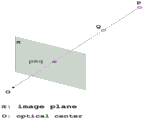
单目视觉虽然可以反映出物体的轮廓,但是图2所示,在图片上的同一个点,空间当中的坐标却天差地别。因此,单目摄像头无法反映深度信息。Although monocular vision can reflect the outline of an object, as shown in Figure 2, at the same point on the picture, the coordinates in the space are very different. Therefore, monocular cameras cannot reflect depth information.
而双目视觉则不同,如图3所示,将摄像头增加为两个后,左眼中相同像素位置的两个点在右眼上的成像出现了区别,因此如果可以在两幅图像上找到对应点,就可以通过几何三角测量的方法来计算出视差。进而通过两摄像头之间的距离与视差比对,得出真实人脸痣点的三维坐标。However, binocular vision is different. As shown in Figure 3, after adding two cameras, the imaging of two points at the same pixel position in the left eye on the right eye is different. Therefore, if the corresponding images can be found on the two images point, the parallax can be calculated by geometric triangulation. Then, by comparing the distance between the two cameras and the parallax, the three-dimensional coordinates of the real face mole point are obtained.
进一步地,在本发明的一个实施例中,获取人脸模型的深度信息,包括:对双目RGB相机进行标定,得到其内外参数,并旋转与平移矩阵直至满足预设条件;根据标定结果对人脸模型图像进行矫正,直至两图像位于同一平面并且极线平行;对校正后的人脸模型图像进行SGBM半全局匹配,并根据匹配结果得到像素深度,获取人脸模型的深度信息。Further, in an embodiment of the present invention, acquiring the depth information of the face model includes: calibrating the binocular RGB camera, obtaining its internal and external parameters, and rotating and translating the matrix until the preset conditions are met; The face model image is corrected until the two images are on the same plane and the epipolar lines are parallel; the SGBM semi-global matching is performed on the corrected face model image, and the pixel depth is obtained according to the matching result to obtain the depth information of the face model.
具体而言,双目视觉在测量过程中要进行如下步骤:Specifically, the binocular vision has the following steps in the measurement process:
1、对双目RGB相机进行标定,得到其内外参数,旋转与平移矩阵。1. Calibrate the binocular RGB camera to obtain its internal and external parameters, rotation and translation matrices.
2、根据标定结果对人脸模型图像进行矫正,使两图像位于同一平面并且极线平行。2. Correct the face model image according to the calibration result, so that the two images are on the same plane and the epipolar lines are parallel.
3、对校正后的人脸模型图像进行SGBM半全局匹配。3. Perform SGBM semi-global matching on the corrected face model image.
4、根据匹配结果计算像素深度,从而得到人脸模型的深度信息。4. Calculate the pixel depth according to the matching result, so as to obtain the depth information of the face model.
在步骤S102中,引入指示激光,并根据目标位置及多数近似法向量进行指示激光,并对目标位置的实时比较并补偿,实现祛痣手术。In step S102, the pointing laser is introduced, and the pointing laser is performed according to the target position and most approximate normal vectors, and the target position is compared and compensated in real time to realize the mole removal operation.
可以理解的是,通过引入指示激光的方法进行指示激光和色素痣位置的实时比较并补偿。It can be understood that the real-time comparison and compensation of the position of the indicator laser and the pigmented mole are performed by introducing the method of the indicator laser.
进一步地,在本发明的一个实施例中,还包括:利用PCL点云库进行点云的三维重建,以通过近似法向量得到激光最大能量入射的角度。Further, in an embodiment of the present invention, the method further includes: using the PCL point cloud library to perform three-dimensional reconstruction of the point cloud, so as to obtain the angle of incidence of the maximum laser energy by approximating the normal vector.
可以理解的是,如图4所示,本发明实施例利用PCL点云库进行点云的三维重建,可以让医生可视化的观察人脸,更加直观的看到痣的位置。并且重建后可以通过近似平面法向量来得到激光最大能量入射的角度。It can be understood that, as shown in FIG. 4 , in this embodiment of the present invention, the PCL point cloud library is used to perform 3D reconstruction of point clouds, which allows doctors to visually observe human faces and see the location of moles more intuitively. And after reconstruction, the angle of maximum laser energy incident can be obtained by approximating the plane normal vector.
进一步地,在本发明的一个实施例中,根据目标位置及多数近似法向量进行指示激光,并对目标位置的实时比较并补偿,包括:将指示激光作为视觉反馈,让指示激光入射并将激光切换为点痣模式,以通过相机确定激光斑与痣点完全重合。Further, in an embodiment of the present invention, the pointing laser is performed according to the target position and most approximate normal vectors, and the target position is compared and compensated in real time, including: using the pointing laser as a visual feedback, allowing the pointing laser to be incident and the laser Switch to Mole Point mode to confirm the laser spot and mole point exactly coincide with the camera.
可以理解的是,用与大功率激光同轴的指示激光作为视觉反馈,让指示激光准确入射,这样只要激光切换为大功率模式就可以准确点痣了。要让相机看到激光斑与痣点完全重合,这样就要对激光斑进行识别与定位。It is understandable that the indicator laser coaxial with the high-power laser is used as visual feedback to allow the indicator laser to be incident accurately, so that the mole can be accurately spotted as long as the laser is switched to the high-power mode. In order for the camera to see that the laser spot and the mole point are completely coincident, it is necessary to identify and locate the laser spot.
具体而言,本发明实施例的激光斑识别的基本思想是:选用绿色的指示激光,通过对图像BGR通道的分割,进行高斯模糊与阈值筛选,之后在G通道上进行筛选,得到的激光斑点与痣的三维坐标进行比对,距离相对近的点为可能的激光斑点。Specifically, the basic idea of laser spot recognition in the embodiment of the present invention is: select a green indicator laser, perform Gaussian blur and threshold screening by segmenting the BGR channel of the image, and then screen on the G channel to obtain the laser spot. Compared with the three-dimensional coordinates of the mole, the relatively close point is a possible laser spot.
同时,再对图像进行HSV(Hue Saturation Value,HSV颜色模型)通道的转换,通过图像亮度的检测来进行阈值的筛选,最终通过亮度和颜色两个方向进行筛选,最终确定激光斑的位置。能更加快速并且准确的计算出激光斑轮廓并求出它的质心。At the same time, the image is converted to the HSV (Hue Saturation Value, HSV color model) channel, and the threshold is screened through the detection of the image brightness. It can calculate the laser spot profile more quickly and accurately and find its centroid.
由此得到的光斑坐标与之前得到的痣坐标做差之后得到Δx,Δy,Δz,即为机构在三个方向上需要运动的距离,为了简化算法,本发明实施例采用移动X,Y方向的策略,不断使光斑逼近痣的中心,直到激光斑与痣点的中心距离小于0.5mm,即可认为激光斑与痣点重合。Δx, Δy, Δz are obtained after the difference between the obtained spot coordinates and the previously obtained mole coordinates, which are the distances that the mechanism needs to move in three directions. The strategy is to continuously make the laser spot approach the center of the mole until the center distance between the laser spot and the mole point is less than 0.5mm, then the laser spot and the mole point can be considered to be coincident.
下面将通过一个具体实施例对自动进行祛痣手术的方法进行进一步阐述。The method for automatically performing mole removal surgery will be further described below through a specific embodiment.
本发明实施例的执行逻辑如图5所示。摄像头实时进行图像捕捉,然后对双目的图像进行立体校正,消除畸变。随后进行视差图,深度图计算得出痣的三维坐标。同时进行PCL三维重建以获得痣的近似法向量。由此计算出系统五个自由度分别应该运动的距离。在开环到达理论位置后开启指示激光,进行实时的激光斑识别和痣的斑点识别并计算其坐标差。以此坐标差为依据系统进行反馈直到指示激光与痣斑点重合。The execution logic of the embodiment of the present invention is shown in FIG. 5 . The camera captures images in real time, and then performs stereo correction on the binocular image to eliminate distortion. The disparity map is then performed, and the depth map is calculated to obtain the three-dimensional coordinates of the mole. Simultaneous PCL 3D reconstruction was performed to obtain approximate normal vectors of moles. From this, the distances that the five degrees of freedom of the system should move respectively are calculated. After the open loop reaches the theoretical position, turn on the pointing laser, perform real-time laser spot identification and mole spot identification, and calculate the coordinate difference. Based on this coordinate difference, the system feeds back until the pointing laser coincides with the mole spot.
本发明实施例的样机如图6所示,其使用的步骤如图7所示:The prototype of the embodiment of the present invention is shown in Figure 6, and the steps of its use are shown in Figure 7:
样机有5个自由度,分别是x、y、z方向的平移和激光头2个旋转。5个自由度可以保证激光在空间中的自由指向。双目摄像头固定在框架上,进行实时位置信息的处理。The prototype has 5 degrees of freedom, which are translation in the x, y, and z directions and 2 rotations of the laser head. 5 degrees of freedom can guarantee the free pointing of the laser in space. The binocular camera is fixed on the frame to process real-time position information.
其中,上位机界面是在Visual Studio和易语言环境下开发的,其界面图88所示。主界面包含菜单栏、工具栏、主面板等部分。菜单栏中的“文件”项目包含图片打开、配置读取与保存等功能,“帮助”项目包含使用手册、更新日志和关于等项目。Among them, the host computer interface is developed under Visual Studio and easy language environment, and its interface is shown in Figure 88. The main interface includes menu bar, toolbar, main panel and other parts. The "File" item in the menu bar includes functions such as image opening, configuration reading and saving, and the "Help" item includes the user manual, update log, and about items.
1、“连接与控制”选项卡1. "Connection and Control" tab
“连接与控制”项目实现上位机与点痣机器人的数据交换、通讯功能。打开上位机界面后,程序自动扫描当前可用来与下位机通讯的串口接收器,只有当具有可用的串口接收器时,程序才能正常工作。若没有可用的串口,会弹出如图9所示的对话框进行提示。The "connection and control" project realizes the data exchange and communication functions between the host computer and the mole robot. After opening the interface of the upper computer, the program automatically scans the serial port receivers that can be used to communicate with the lower computer. Only when there is an available serial port receiver, the program can work normally. If there is no available serial port, a dialog box as shown in Figure 9 will pop up to prompt.
程序开启时,默认在“连接与控制”项目下,其中主面板包括“连接点痣机配置”、“位移设定”、“步距设定”等部分。When the program is started, it is under the item "Connection and Control" by default, and the main panel includes "Connection Point Mole Machine Configuration", "Displacement Setting", "Step Setting" and other parts.
“连接点痣机配置”模块中,“串口”显示当前可供使用的串口;“模式选择”提供了从“模式0”到“模式5”的多种对点痣机器人的控制模式,分别是:“大范围移动”、“微调角度”、“微调坐标”、“开启激光器”和“回零”等。In the "Connecting Mole Machine Configuration" module, "Serial Port" displays the currently available serial ports; "Mode Selection" provides a variety of control modes for the Mole Point Robot from "
“大范围移动”模式允许在“位移设定”模块中输入需要移动到的五维坐标并直接大范围地移动;“微调角度”模式只允许调整角度a和b,禁止调整平移x、y和z;“微调坐标”模式只允许调整平移x、y和z,禁止调整角度a和b;“开启激光器”模式可以开启激光器,以方便执行机构定位和点痣;“回零”模式使点痣机器人回零位重置状态,方便进一步的调整。The "Large Range Movement" mode allows you to input the five-dimensional coordinates to be moved to in the "Displacement Setting" module and directly move in a large range; the "Fine Angle" mode only allows adjusting the angles a and b, and prohibits adjusting the translation x, y and z; "Fine Coordinate" mode only allows to adjust translation x, y and z, and prohibits adjustment of angles a and b; "Turn on the laser" mode can turn on the laser to facilitate the positioning of the actuator and point moles; "Return to zero" mode makes point moles The robot returns to the zero position to reset the state, which is convenient for further adjustment.
为了实现长距离调整和微调,设计了“位移设定”和“步距设定”两个模块。其中,“步距设定”模块具有一个“实时”复选项,勾选时可以不必再按“执行”按钮就能够立刻使下位机动作,提升效率。为了防止短时间内上位机对下位机发送过多信号导致其混乱和死机,在按下“执行”按钮后其自身将被禁止操作,直到接收到下位机发来的空闲信号后才能恢复操作。同时,设计了“读取和保存配置”功能,方便在下次使用时快速恢复已保存的工作进度。In order to realize long-distance adjustment and fine-tuning, two modules of "displacement setting" and "step setting" are designed. Among them, the "step distance setting" module has a "real-time" option. When you check it, you can make the lower computer act immediately without pressing the "execute" button, which improves the efficiency. In order to prevent the upper computer from sending too many signals to the lower computer in a short period of time, which may cause its confusion and crash, it will be prohibited from operating after pressing the "Execute" button, and it will not be able to resume operation until it receives the idle signal from the lower computer. At the same time, a "read and save configuration" function is designed, which is convenient to quickly restore the saved work progress in the next use.
“激光微调”仅可工作在“开启激光器”模式下,可以实现手动激光点痣的功能;而“自动微调”可以实现全自动激光点痣功能。"Laser fine-tuning" can only work in the "on laser" mode, which can realize the function of manual laser mole point; and "automatic fine-tuning" can realize the automatic laser mole point function.
2、“摄像头拍照”选项卡2. "Camera Capture" tab
“摄像头拍照”项目实现了人脸信息采集,包括痣的信息采集以及其后的自动或手动激光寻痣的光斑采集等,界面图10所示。The "Camera Photo" project realizes the collection of face information, including the collection of mole information and the subsequent collection of light spots for automatic or manual laser mole finding, etc. The interface is shown in Figure 10.
使用时,点击“打开摄像头”,则双目摄像头的左右眼图像会实时地显示在界面中。点按“拍照”,可以对当前时刻的摄像头内容进行捕捉,并可拍摄多张照片以供后续选择。拍照完毕后,点击“停止拍照并预览”,则关闭摄像头并可以在选择框中选择浏览拍摄的照片。选中某一组照片后,点击“确认选择”,则程序自动对所选的图片进行立体矫正及生成深度图,并将结果显示在右侧的图片框内。When in use, click "Open Camera", and the left and right eye images of the binocular camera will be displayed in the interface in real time. Click "Photo" to capture the camera content at the current moment, and take multiple photos for subsequent selection. After taking pictures, click "Stop taking pictures and preview", then close the camera and you can choose to browse the taken pictures in the selection box. After selecting a group of photos, click "Confirm Selection", the program will automatically perform stereo correction on the selected pictures and generate a depth map, and display the results in the picture box on the right.
在每次确认选择后,程序都会将已经拍的照片自动归档保存到\history目录下,以供使用者查找。After each confirmation of the selection, the program will automatically archive and save the photos that have been taken to the \history directory for users to find.
3、“寻痣与重建”选项卡3. "Mole Finding and Reconstruction" tab
在“寻痣与重建”项目中,可以实现对已保存双目照片的进一步处理、手动框选及PCL三维重建功能,并将控制下位机运动的坐标写入“连接与控制”项目的“位移设定”模块中,如图11所示。In the "mole finding and reconstruction" project, further processing, manual frame selection and PCL 3D reconstruction of the saved binocular photos can be realized, and the coordinates that control the movement of the lower computer can be written into the "displacement" of the "connection and control" project. Settings" module, as shown in Figure 11.
“图片预览与剪切”模块显示上一步拍照后的立体矫正结果图像,可框选出人脸范围,以使得痣的识别及之后的激光光斑识别更加精准。The "Picture Preview and Cut" module displays the stereoscopic correction result image after the previous step, and can frame the face range to make the identification of moles and subsequent laser spot identification more accurate.
“疑似痣区域预览”模块输出框选范围内的所有可疑的痣点,当点选某一坐标时,在旁边会生成原图对应坐标附近的小片图像,方便手动将痣点加入列表,增加选择的准确性。添加坐标后,点击“确认已选痣”,则保存此次痣识别的图像二维坐标以及相机形成的三维坐标,方便后续流程中使用。The "Suspected mole area preview" module outputs all suspicious mole points within the selection range. When a coordinate is clicked, a small image near the corresponding coordinates of the original image will be generated next to it, which is convenient to manually add mole points to the list and increase the selection. accuracy. After adding the coordinates, click "Confirm Selected Mole" to save the two-dimensional coordinates of the image identified by the mole and the three-dimensional coordinates formed by the camera, which are convenient for use in subsequent processes.
“PCL三维重建”模块实现对人脸的三维重构,并藉此计算出痣点对应的空间单位向量值,形成相机坐标系内的关于所选痣点位姿的六维坐标。最后,点击“写坐标至位移设定”,可将此六维坐标变换成点痣机所在的世界坐标系的五维坐标,并可据此控制点痣机器人末端机构移动到痣点附近。此变换可以将迭代后产生的激光器端部到脸部的近似距离显示出来,以供参考。由于此重建过程涉及较多的运算量,运行时间较长,因此在其下方设计了建模运行时间及实时的建模进度条以供使用者参考。The "PCL 3D reconstruction" module realizes the 3D reconstruction of the face, and calculates the spatial unit vector value corresponding to the mole point to form the six-dimensional coordinates of the selected mole point pose in the camera coordinate system. Finally, click "write coordinates to displacement setting" to convert the six-dimensional coordinates into the five-dimensional coordinates of the world coordinate system where the mole robot is located, and control the end mechanism of the mole robot to move to the vicinity of the mole point accordingly. This transformation displays the approximate distance from the end of the laser to the face after iteration for reference. Since this reconstruction process involves more computation and takes longer to run, the modeling running time and real-time modeling progress bar are designed below it for users' reference.
4、“寻找激光点”选项卡4. "Find Laser Point" tab
“寻找激光点”项目只在手动激光点痣时可以使用,其作用是找出激光光斑在相机坐标系内的三维坐标,并反馈至“连接与控制”项目中执行,如图12所示。The "Find Laser Point" item can only be used when manually spotting moles. Its function is to find out the three-dimensional coordinates of the laser spot in the camera coordinate system, and feed it back to the "Connection and Control" item for execution, as shown in Figure 12.
图片框中显示系统识别到的激光光斑位置,用绿色斑点标记出来,并立刻将结果反馈到“连接与控制”项目中,通过步进的方式将激光光斑位置手动逼近至痣点附近。若系统无法识别到有任何激光光斑存在,则弹出对话框提示使用者。此时需要重新拍照并重复上述过程,直到可以找到光斑位置为止。The position of the laser spot recognized by the system is displayed in the picture box, which is marked with a green spot, and the result is immediately fed back to the "Connection and Control" project, and the position of the laser spot is manually approached to the vicinity of the mole by stepping. If the system cannot identify the existence of any laser spot, a dialog box will pop up to remind the user. At this point, you need to take a picture again and repeat the above process until the spot position can be found.
5.“寻痣调节”选项卡5. "Mole finding adjustment" tab
“寻痣调节”项目提供了对比度、亮度等共12种参数。通过改变参数值大小,能对自动寻痣结果进行优化,同时提供了读取和保存配置功能,以便下次快速恢复进度。提供的“实时”复选框使得不必按下“处理”按钮即可立刻寻痣,大幅度提高效率。其界面如图13所示。The "Mole finding adjustment" item provides a total of 12 parameters such as contrast and brightness. By changing the size of the parameter value, the result of automatic mole finding can be optimized, and the function of reading and saving the configuration is provided at the same time, so that the progress can be quickly restored next time. The "Real Time" checkbox provided makes it possible to find moles immediately without pressing the "Process" button, greatly improving efficiency. Its interface is shown in Figure 13.
综上,本发明实施例提出的自动进行祛痣手术的方法,可以大大减轻进行祛痣手术的医师的工作量和工作难度,提高手术的成功率;为医师提供实时的操作画面和一键式的操作环境;同时医师可以加入自己的判断来最终决定是否进行手术;此外激光近似垂直入射的特点也能为自动确定激光用量算法的编写提供支撑。To sum up, the method for automatically performing a mole removal operation proposed by the embodiments of the present invention can greatly reduce the workload and difficulty of a physician performing a mole removal operation, improve the success rate of the operation, and provide the physician with a real-time operation screen and one-click operation. At the same time, physicians can add their own judgment to finally decide whether to perform surgery; in addition, the characteristics of laser near vertical incidence can also provide support for the programming of the algorithm for automatically determining the amount of laser light.
其次参照附图描述根据本发明实施例提出的自动进行祛痣手术的系统。Next, a system for automatically performing mole removal surgery according to an embodiment of the present invention will be described with reference to the accompanying drawings.
图14是本发明一个实施例的自动进行祛痣手术的系统的结构示意图。14 is a schematic structural diagram of a system for automatically performing mole removal surgery according to an embodiment of the present invention.
如图14所示,该自动进行祛痣手术的系统10包括:确定模块100和指示模块200。As shown in FIG. 14 , the
其中,确定模块100用于通过双目视觉确定面部色素痣的目标位置,并得到近似法向量;指示模块200用于引入指示激光,并根据目标位置及多数近似法向量进行指示激光,并对目标位置的实时比较并补偿,实现祛痣手术。本发明实施例的系统10应用了双目视觉技术确定面部色素痣的位置和其近似法向量,并通过引入指示激光的方法进行指示激光和色素痣位置的实时比较并补偿,从而可以让医生只需要进行简单的判断就能进行手术,简单易实现。Wherein, the
进一步地,在本发明的一个实施例中,确定模块100进一步用于采用双目视觉进行人脸模型图像的立体匹配,以获取人脸模型的深度信息。Further, in an embodiment of the present invention, the
进一步地,在本发明的一个实施例中,确定模块100进一步用于对双目RGB相机进行标定,得到其内外参数,并旋转与平移矩阵直至满足预设条件;根据标定结果对人脸模型图像进行矫正,直至两图像位于同一平面并且极线平行;对校正后的人脸模型图像进行SGBM半全局匹配,并根据匹配结果得到像素深度,获取人脸模型的深度信息。Further, in an embodiment of the present invention, the
进一步地,在本发明的一个实施例中,本发明实施例的系统10还包括:三维重建模块。其中,三维重建模块用于利用PCL点云库进行点云的三维重建,以通过近似法向量得到激光最大能量入射的角度。Further, in an embodiment of the present invention, the
进一步地,在本发明的一个实施例中,指示模块200进一步用于将指示激光作为视觉反馈,让指示激光入射并将激光切换为点痣模式,以通过相机确定激光斑与痣点完全重合。Further, in an embodiment of the present invention, the indicating
需要说明的是,前述对自动进行祛痣手术的方法实施例的解释说明也适用于该实施例的自动进行祛痣手术的系统,此处不再赘述。It should be noted that the foregoing explanations of the method embodiment for automatically performing mole removal operation are also applicable to the system for automatically performing mole removal operation of this embodiment, and details are not repeated here.
根据本发明实施例提出的自动进行祛痣手术的系统,可以大大减轻进行祛痣手术的医师的工作量和工作难度,提高手术的成功率;为医师提供实时的操作画面和一键式的操作环境;同时医师可以加入自己的判断来最终决定是否进行手术;此外激光近似垂直入射的特点也能为自动确定激光用量算法的编写提供支撑。The system for automatically performing mole removal surgery according to the embodiment of the present invention can greatly reduce the workload and difficulty of the physician performing the mole removal surgery, and improve the success rate of the surgery; and provide the physician with a real-time operation screen and one-button operation environment; at the same time, physicians can add their own judgments to decide whether to perform surgery; in addition, the characteristics of laser near vertical incidence can also provide support for the programming of the algorithm for automatically determining the amount of laser light.
此外,术语“第一”、“第二”仅用于描述目的,而不能理解为指示或暗示相对重要性或者隐含指明所指示的技术特征的数量。由此,限定有“第一”、“第二”的特征可以明示或者隐含地包括至少一个该特征。在本发明的描述中,“多个”的含义是至少两个,例如两个,三个等,除非另有明确具体的限定。In addition, the terms "first" and "second" are only used for descriptive purposes, and should not be construed as indicating or implying relative importance or implying the number of indicated technical features. Thus, a feature delimited with "first", "second" may expressly or implicitly include at least one of that feature. In the description of the present invention, "plurality" means at least two, such as two, three, etc., unless otherwise expressly and specifically defined.
在本发明中,除非另有明确的规定和限定,第一特征在第二特征“上”或“下”可以是第一和第二特征直接接触,或第一和第二特征通过中间媒介间接接触。而且,第一特征在第二特征“之上”、“上方”和“上面”可是第一特征在第二特征正上方或斜上方,或仅仅表示第一特征水平高度高于第二特征。第一特征在第二特征“之下”、“下方”和“下面”可以是第一特征在第二特征正下方或斜下方,或仅仅表示第一特征水平高度小于第二特征。In the present invention, unless otherwise expressly specified and limited, a first feature "on" or "under" a second feature may be in direct contact between the first and second features, or the first and second features indirectly through an intermediary touch. Also, the first feature being "above", "over" and "above" the second feature may mean that the first feature is directly above or obliquely above the second feature, or simply means that the first feature is level higher than the second feature. The first feature being "below", "below" and "below" the second feature may mean that the first feature is directly below or obliquely below the second feature, or simply means that the first feature has a lower level than the second feature.
在本说明书的描述中,参考术语“一个实施例”、“一些实施例”、“示例”、“具体示例”、或“一些示例”等的描述意指结合该实施例或示例描述的具体特征、结构、材料或者特点包含于本发明的至少一个实施例或示例中。在本说明书中,对上述术语的示意性表述不必须针对的是相同的实施例或示例。而且,描述的具体特征、结构、材料或者特点可以在任一个或多个实施例或示例中以合适的方式结合。此外,在不相互矛盾的情况下,本领域的技术人员可以将本说明书中描述的不同实施例或示例以及不同实施例或示例的特征进行结合和组合。In the description of this specification, description with reference to the terms "one embodiment," "some embodiments," "example," "specific example," or "some examples", etc., mean specific features described in connection with the embodiment or example , structure, material or feature is included in at least one embodiment or example of the present invention. In this specification, schematic representations of the above terms are not necessarily directed to the same embodiment or example. Furthermore, the particular features, structures, materials or characteristics described may be combined in any suitable manner in any one or more embodiments or examples. Furthermore, those skilled in the art may combine and combine the different embodiments or examples described in this specification, as well as the features of the different embodiments or examples, without conflicting each other.
尽管上面已经示出和描述了本发明的实施例,可以理解的是,上述实施例是示例性的,不能理解为对本发明的限制,本领域的普通技术人员在本发明的范围内可以对上述实施例进行变化、修改、替换和变型。Although the embodiments of the present invention have been shown and described above, it should be understood that the above-mentioned embodiments are exemplary and should not be construed as limiting the present invention. Embodiments are subject to variations, modifications, substitutions and variations.
Claims (10)
Priority Applications (1)
| Application Number | Priority Date | Filing Date | Title |
|---|---|---|---|
| CN201911413500.7A CN111243018A (en) | 2019-12-31 | 2019-12-31 | Method and system for automatically performing mole removal surgery |
Applications Claiming Priority (1)
| Application Number | Priority Date | Filing Date | Title |
|---|---|---|---|
| CN201911413500.7A CN111243018A (en) | 2019-12-31 | 2019-12-31 | Method and system for automatically performing mole removal surgery |
Publications (1)
| Publication Number | Publication Date |
|---|---|
| CN111243018A true CN111243018A (en) | 2020-06-05 |
Family
ID=70879633
Family Applications (1)
| Application Number | Title | Priority Date | Filing Date |
|---|---|---|---|
| CN201911413500.7A Pending CN111243018A (en) | 2019-12-31 | 2019-12-31 | Method and system for automatically performing mole removal surgery |
Country Status (1)
| Country | Link |
|---|---|
| CN (1) | CN111243018A (en) |
Citations (5)
| Publication number | Priority date | Publication date | Assignee | Title |
|---|---|---|---|---|
| CN103868460A (en) * | 2014-03-13 | 2014-06-18 | 桂林电子科技大学 | Parallax optimization algorithm-based binocular stereo vision automatic measurement method |
| CN104392488A (en) * | 2014-12-11 | 2015-03-04 | 福州大学 | Automatic point cloud data rectification method aiming at laser scanner and three-coordinate measuring arm |
| CN107358631A (en) * | 2017-06-27 | 2017-11-17 | 大连理工大学 | A kind of binocular vision method for reconstructing for taking into account three-dimensional distortion |
| CN107907048A (en) * | 2017-06-30 | 2018-04-13 | 长沙湘计海盾科技有限公司 | A kind of binocular stereo vision method for three-dimensional measurement based on line-structured light scanning |
| CN110382048A (en) * | 2017-03-06 | 2019-10-25 | Oh & Lee医疗机器人公司 | Area division method for laser treatment, laser treatment method and device using same |
-
2019
- 2019-12-31 CN CN201911413500.7A patent/CN111243018A/en active Pending
Patent Citations (5)
| Publication number | Priority date | Publication date | Assignee | Title |
|---|---|---|---|---|
| CN103868460A (en) * | 2014-03-13 | 2014-06-18 | 桂林电子科技大学 | Parallax optimization algorithm-based binocular stereo vision automatic measurement method |
| CN104392488A (en) * | 2014-12-11 | 2015-03-04 | 福州大学 | Automatic point cloud data rectification method aiming at laser scanner and three-coordinate measuring arm |
| CN110382048A (en) * | 2017-03-06 | 2019-10-25 | Oh & Lee医疗机器人公司 | Area division method for laser treatment, laser treatment method and device using same |
| CN107358631A (en) * | 2017-06-27 | 2017-11-17 | 大连理工大学 | A kind of binocular vision method for reconstructing for taking into account three-dimensional distortion |
| CN107907048A (en) * | 2017-06-30 | 2018-04-13 | 长沙湘计海盾科技有限公司 | A kind of binocular stereo vision method for three-dimensional measurement based on line-structured light scanning |
Non-Patent Citations (2)
| Title |
|---|
| ZHENCHENG FAN 等: "Spatial Position Measurement System Marker-Based Tracking Tools With Compact Volume", 《IEEE TRANSACTIONS ON BIOMEDICAL ENGINEERING》 * |
| 王田苗 等: "腹腔镜增强现实导航的研究进展综述", 《机器人》 * |
Similar Documents
| Publication | Publication Date | Title |
|---|---|---|
| AU2025202741A1 (en) | Methods and systems for registering preoperative image data to intraoperative image data of a scene, such as a surgical scene | |
| US8600192B2 (en) | System and method for finding correspondence between cameras in a three-dimensional vision system | |
| CA2931529C (en) | 3d corrected imaging | |
| US11488322B2 (en) | System and method for training a model in a plurality of non-perspective cameras and determining 3D pose of an object at runtime with the same | |
| US6519359B1 (en) | Range camera controller for acquiring 3D models | |
| CN110838164B (en) | Monocular image three-dimensional reconstruction method, system and device based on object point depth | |
| US10779793B1 (en) | X-ray detector pose estimation in medical imaging | |
| JP2016018213A (en) | HMD calibration by direct geometric modeling | |
| JPH09187038A (en) | 3D shape extraction device | |
| US20180364033A1 (en) | Three-dimensional measurement device with color camera | |
| JP2012063866A (en) | Device for processing point group position data, method for processing point group position data, system for processing point group position data, and program for processing point group position data | |
| CN109297413A (en) | A visual measurement method for large-scale cylindrical structures | |
| US11080822B2 (en) | Method, system and recording medium for building environment map | |
| WO2020024684A1 (en) | Method and device for modeling three-dimensional scene, electronic device, readable storage medium, and computer apparatus | |
| US20040220767A1 (en) | Image processing method and apparatus therefor | |
| JP2006098256A (en) | 3D surface model creation system, image processing system, program, and information recording medium | |
| CN112146647B (en) | Binocular vision positioning method and chip for ground texture | |
| US20250131747A1 (en) | Systems and methods for identifying changes in a space | |
| JP7792594B2 (en) | Viewer control method and information processing device | |
| EP4233004B1 (en) | Automated calibration method of a system comprising an external eye tracking device and a computing device | |
| US12357397B2 (en) | Methods and systems for calibrating instruments within an imaging system, such as a surgical imaging system | |
| CN110166680A (en) | Device imaging method and device, storage medium and electronic device | |
| CN111243018A (en) | Method and system for automatically performing mole removal surgery | |
| CN111355894A (en) | A New Self-Calibration Laser Scanning Projection System | |
| JP2022011818A (en) | Information processing apparatus and control method thereof |
Legal Events
| Date | Code | Title | Description |
|---|---|---|---|
| PB01 | Publication | ||
| PB01 | Publication | ||
| SE01 | Entry into force of request for substantive examination | ||
| SE01 | Entry into force of request for substantive examination | ||
| RJ01 | Rejection of invention patent application after publication |
Application publication date: 20200605 |
|
| RJ01 | Rejection of invention patent application after publication |