Disclosure of Invention
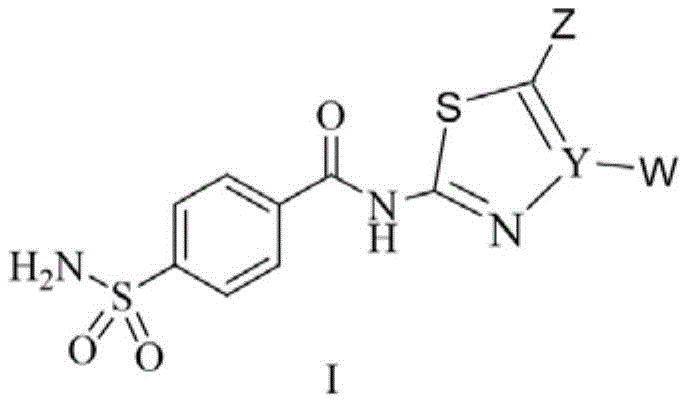
According to one aspect of the invention, the invention aims to provide a benzene sulfonamide compound containing a five-membered heterocycle as shown in the formula I, and enantiomers, diastereoisomers, racemates and mixtures thereof, and pharmaceutically acceptable salts, crystal hydrates and solvates thereof.
Wherein Y is a carbon atom or a nitrogen atom, and at least one of Z and W is
Wherein the substituent G is selected from NR1R2, OR3 OR a substituted OR unsubstituted five-, six-OR seven-membered heterocyclic group containing 1 to 3 heteroatoms selected from N and O, the other of Z and W being absent OR being a hydrogen atom, C1, C2, C3, C4, C5, C6, C7, C8, C9, C10, C11, C12, C13, C14, C15, C16, C17, C18, C19 OR C20 alkyl, alkyl substituted by 1 to 3 halogen atoms, C19 OR C20 alkylC1, C2, C3, C4, C5, C6, C7, C8, C9, C10, C11, C12, C13, C14, C15, C16, C17, C18, C19 or C20, a halogen atom, C6, C7, C8, C9, C10, C11, C12, C13, C14, C15, C16, C17, C18, C19 or C20;
the substituent of the substituted five-, six-or seven-membered heterocyclic group containing 1 to 3 heteroatoms selected from N and O is selected from the group consisting of alkyl of C1, C2, C3, C4, C5, C6, C7, C8, C9, C10, C11, C12, C13, C14 or C14, hydroxyl-substituted C14, alkyl of C14 or C14, alkyl of C14, C14 or C14 containing 1 to 3 heteroatoms selected from N or O, c, C or C fused ring heteroaryl substituted C, C or C alkyl and C, C or C alkoxyalkyl;
r1, R2 and R3 are each independently:
H. a halogen atom,
Halogen atom-substituted C1, C2, C3, C4, C5, C6, C7, C8, C9, C10, C11, C12, C13, C14, C15, C16, C17, C18, C19 or C20 alkyl,
Alkoxy of C1, C2, C3, C4, C5, C6, C7, C8, C9, C10, C11, C12, C13, C14, C15, C16, C17, C18, C19 or C20, alkoxy of C,
C1, C2, C3, C4, C5, C6, C7, C8, C9, C10, C11, C12, C13, C14, C15, C16, C17, C18, C19 or C20 alkyl,
C3 to C20 cycloalkyl,
C3-C20 cycloalkyl-substituted C1, C2, C3, C4, C5, C6, C7, C8, C9, C10, C11, C12, C13, C14, C15, C16, C17, C18, C19 or C20 alkyl,
C1, C2, C3, C4, C5, C6, C7, C8, C9 or C10 alkoxy-substituted C1, C2, C3, C4, C5, C6, C7, C8, C9, C10, C11, C12, C13, C14, C15, C16, C17, C18, C19 or C20 alkyl,
C6, C7, C8, C9, C10, C11, C12, C13, C14, C15, C16, C17, C18, C19 or C20 aryl substituted C1, C2, C3, C4, C5, C6, C7, C8, C9, C10, C11, C12, C13, C14, C15, C16, C17, C18, C19 or C20 alkyl,
C1, C2, C3, C4, C5, C6, C7, C8, C9, C10, C11, C12, C13, C14, C15, C16, C17, C18, C19 or C20 alkyl substituted by a five-, six-or seven-membered heterocyclic group containing 1 to 3 heteroatoms selected from N and O,
C6, C7, C8, C9, C10, C11, C12, C13, C14, C15, C16, C17, C18, C19 or C20 aryl-substituted C1, C2, C3, C4, C5, C6, C7, C8, C9, C10, C11, C12, C13, C14, C15, C16, C17, C18, C19 or C20 alkyl,
Substituted or unsubstituted C6, C7, C8, C9, C10, C11, C12, C13, C14, C15, C16, C17, C18, C19 or C20 aryl, wherein the substituents in the substituted C6, C7, C8, C9, C10, C11, C12, C13, C14, C15, C16, C17, C18 or C18 aryl are selected from alkyl groups containing 1 to 3C 18, or C18 alkoxy, C18, C,
A substituted or unsubstituted five-, six-, or seven-membered heterocyclic group containing 1 to 3 heteroatoms selected from N and O, wherein the substituents in the substituted five-, six-, or seven-membered heterocyclic group containing 1 to 3 heteroatoms selected from N and O are selected from C, or C alkyl, hydroxy-substituted C, or C alkyl and C, or C alkoxyalkyl, substituted or unsubstituted or substituted or unsubstituted alkyl, C, or C,
Aminoalkyl of C1, C2, C3, C4, C5, C6, C7, C8, C9, C10, C11, C12, C13, C14, C15, C16, C17, C18, C19 or C20;
the halogen atom is selected from fluorine, chlorine, bromine and iodine.
Preferably, at least one of Z and W is
Wherein substituent G is selected from NR1R2, OR3, OR a substituted OR unsubstituted six-membered heterocyclic group containing 1 to 3 heteroatoms selected from N and O, the other of Z and W is absent, OR is a hydrogen atom, an alkyl group of C1, C2, C3, C4, C5, C6, C7, C8, C9 OR C10, an alkyl group of C1, C2, C3, C4, C5, C6, C7, C8, C9 OR C10 substituted with 1 to 3 halogen atoms, a halogen atom, an aryl group of C6, C7, C8, C9 OR C10;
the substituents in the substituted six-membered heterocyclic group containing 1 to 3 heteroatoms selected from N and O are selected from the group consisting of alkyl of C1, C2, C3, C4, C5, C6, C7, C8, C9 or C10, alkyl of hydroxy-substituted C1, C2, C3, C4, C5, C6, C7, C8, C9 or C10, substituted C1, C2, C3, C4, C5, C6, C7, C8, C9 or C10 of C5 to C10 fused ring heteroaryl containing 1 to 3 heteroatoms selected from N or O, and alkoxyalkyl of C10 to C10;
r1, R2 and R3 are each independently:
H. a halogen atom,
Halogen atom-substituted C1, C2, C3, C4, C5, C6, C7, C8, C9 or C10 alkyl,
Alkoxy of C1, C2, C3, C4, C5, C6, C7, C8, C9 or C10,
C1, C2, C3, C4, C5, C6, C7, C8, C9 or C10 alkyl,
C3 to C10 cycloalkyl,
C1, C2, C3, C4, C5, C6, C7, C8, C9 or C10 alkyl substituted by C3 to C10 cycloalkyl,
C1, C2, C3, C4, C5, C6, C7, C8, C9 or C10 alkoxy-substituted C1, C2, C3, C4, C5, C6, C7, C8, C9 or C10 alkyl,
C6, C7, C8, C9 or C10 aryl-substituted C1, C2, C3, C4, C5, C6, C7, C8, C9 or C10 alkyl, C7, C7, C8, C9 or C10 alkyl,
A six-membered heterocyclic group-substituted C1, C2, C3, C4, C5, C6, C7, C8, C9 or C10 alkyl group containing 1 to 3 hetero atoms selected from N and O,
C6, C7, C8, C9 or C10 aryl substituted C1, C2, C3, C4, C5, C6, C7, C8, C9 or C10 alkyl containing 1 to 3 halogen atom substituents,
Substituted or unsubstituted C6, C7, C8, C9 or C10 aryl, wherein the substituents in the substituted C6, C7, C8, C9 or C10 aryl are selected from the group consisting of C1, C2, C3, C4, C5, C6, C7, C8, C9 or C10-containing alkyl groups, halogen atoms, C7, C8, C9 or C10 aralkyloxy groups and C1, C2, C3, C4, C5, C6, C7, C8, C9 or C10 alkoxy groups,
A substituted or unsubstituted six-membered heterocyclic group containing 1 to 3 heteroatoms selected from N and O, wherein the substituent in the substituted six-membered heterocyclic group containing 1 to 3 heteroatoms selected from N and O is selected from the group consisting of an alkyl group of C1, C2, C3, C4, C5, C6, C7, C8, C9 or C10, a hydroxyl-substituted alkyl group of C1, C2, C3, C4, C5, C6, C7, C8, C9 or C10, an alkoxyalkyl group of C2 to C10, a substituted or unsubstituted alkoxy alkyl group of C10, a substituted or unsubstituted alkoxy group of C3626, C9, C5, C6, C7, C352, a substituted or unsubstituted alkoxy group of C9,
C1, C2, C3, C4, C5, C6, C7, C8, C9 or C10.
Preferably, at least one of Z and W is
Wherein the substituent G is selected from NR1R2, OR3, OR a substituted OR unsubstituted six-membered heterocyclic group containing 1 to 3 heteroatoms selected from N and O, the other of Z and W is absent, OR is a hydrogen atom, an alkyl group of C1, C2, C3, C4, C5 OR C6, an alkyl group of C1, C2, C3, C4, C5 OR C6 substituted with 1 to 3 halogen atoms, an aryl group of a halogen atom, C6, C7, C8, C9 OR C10;
the substituent in the substituted six-membered heterocyclic group containing 1 to 3 heteroatoms selected from N and O is selected from the group consisting of alkyl of C1, C2, C3, C4, C5 or C6, alkyl of hydroxy substituted C1, C2, C3, C4, C5 or C6, and alkoxyalkyl of C2, C3, C4, C5 or C6;
r1, R2 and R3 are each independently:
H. a halogen atom,
Halogen atom-substituted C1, C2, C3 or C4 alkyl,
Alkoxy of C1, C2, C3 or C4,
C1, C2, C3 or C4 alkyl,
C3, C4, C5, C6, C7 or C8 cycloalkyl,
C1, C2, C3 or C4 alkyl substituted by C3, C4, C5, C6, C7 or C8 cycloalkyl,
C1, C2, C3 or C4 alkyl substituted by C1, C2, C3 or C4 alkoxy,
C6, C7, C8, C9 or C10 aryl-substituted C1, C2, C3 or C4 alkyl,
A six-membered heterocyclic group substituted C1, C2, C3 or C4 alkyl group containing 1 to 3 heteroatoms selected from N and O,
C6, C7, C8, C9 or C10 aryl-substituted C1, C2, C3 or C4 alkyl containing 1 to 3 halogen atom substituents,
A substituted or unsubstituted C6, C7, C8, C9 or C10 aryl group, wherein the substituent in the substituted C6, C7, C8, C9 or C10 aryl group is selected from the group consisting of an alkyl group having 1 to 3C 1, C2, C3 or C4 atoms, a halogen atom, a C7, C8, C9 or C10 aralkyloxy group and a C1 to C3 alkoxy group, a C,
A substituted or unsubstituted six-membered heterocyclic group containing 1 to 3 heteroatoms selected from N and O, wherein the substituent in the substituted six-membered heterocyclic group containing 1 to 3 heteroatoms selected from N and O is selected from the group consisting of C1, C2, C3, C4, C5 or C6 alkyl, hydroxyl-substituted C1, C2, C3, C4, C5 or C6 alkyl, and C2, C3, C4, C5 or C6 alkoxyalkyl, a substituted or unsubstituted N-substituted C-2, C-substituted C-3 alkyl group, and an unsubstituted or C-3 heterocyclic group containing 1 to 3 heteroatoms selected from N and O,
C1, C2, C3, C4, C5, C6, C7, C8, C9 or C10.
Further preferably, wherein at least one of Z and W is
Wherein the substituent G is selected from NR1R2, OR3, OR a substituted OR unsubstituted six-membered heterocyclic group containing 1 OR 2 heteroatoms selected from N and O, Z and WThe other is absent, or is a hydrogen atom, methyl, ethyl, propyl, butyl, Cl, Br, monofluoromethyl, difluoromethyl, trifluoromethyl, monofluoroethyl, difluoroethyl, trifluoroethyl, phenyl or naphthyl;
the substituent in the substituted six-membered heterocyclic group containing 1 or 2 heteroatoms selected from N and O is selected from methyl, ethyl, propyl, butyl, hydroxymethyl, hydroxyethyl, hydroxypropyl, hydroxybutyl, methoxymethyl, methoxyethyl, methoxypropyl, substituted methyl of C5 containing 1 or 2 heteroatoms selected from N or O, C5 or C5 benzoheterocycloaryl, substituted ethyl of C5 containing 1 or 2 heteroatoms selected from N or O, C5 or C5 benzoheterocycloaryl, and substituted ethyl of C5, C5 or C5 benzoheterocycloaryl containing 1 or 2 heteroatoms selected from N or O;
r1, R2 and R3 are each independently:
H. fluorine, chlorine, bromine,
A fluoromethyl group, a difluoromethyl group, a trifluoromethyl group, a fluoroethyl group, a difluoroethyl group, a trifluoroethyl group, a chloromethyl group, a dichloromethyl group, a trichloromethyl group, a monochloroethyl group, a dichloroethyl group, a trichloroethyl group, a monobromomethyl group, a dibromomethyl group, a tribromomethyl group, a monobromoethyl group, a dibromoethyl group, a tribromoethyl group, a bromoethyl group, a salt thereof, and a salt thereof,
Methoxy, ethoxy, propoxy, butoxy,
Methyl, ethyl, n-propyl, isopropyl, n-butyl, isobutyl, sec-butyl, tert-butyl, methyl, ethyl, n-propyl, isopropyl, tert-butyl, isobutyl, tert-butyl, and tert-butyl,
Cyclopropyl, cyclobutyl, cyclopentyl, cyclohexyl, cycloheptyl, cyclooctyl,
Cyclopropylmethyl, cyclobutylmethyl, cyclopentylmethyl, cyclohexylmethyl, cycloheptylmethyl, cyclooctylmethyl, cyclopropylethyl, cyclobutylethyl, cyclopentylethyl, cyclohexylethyl, cycloheptylethyl, cyclooctylethyl, cyclopropylpropyl, cyclobutylpropyl, cyclopentylpropyl, cyclohexylpropyl, cycloheptylpropyl, cyclooctylpropyl, cyclopropylbutyl, cyclobutylbutyl, cyclopentylbutyl, cyclohexylbutyl, cycloheptylbutyl, cyclooctylbutyl,
Methoxymethyl, ethoxymethyl, propoxymethyl, butoxymethyl, methoxyethyl, ethoxyethyl, propoxyethyl, butoxyethyl, methoxypropyl, ethoxypropyl, propoxypropyl, butoxypropyl, methoxybutyl, ethoxybutyl, propoxybutyl, butoxybutyl,
Benzyl, phenethyl, phenylpropyl, phenylbutyl, naphthylmethyl, naphthylethyl, naphthylpropyl, naphthylbutyl,
A six-membered heterocyclic group substituted C1, C2, C3 or C4 alkyl group containing 1 to 3 heteroatoms selected from N and O,
Phenyl or naphthyl substituted C1, C2, C3 or C4 alkyl containing 1 to 3 fluorine, chlorine or bromine halogen atoms as substituents,
Substituted or unsubstituted phenyl or naphthyl, wherein the substituents in the substituted phenyl or naphthyl are selected from the group consisting of those containing 1 to 3 substituents selected from the group consisting of methyl, ethyl, propyl, butyl, fluoro, chloro, bromo, phenoxy, benzyloxy, phenethyloxy, phenylpropyloxy, phenylbutoxy, naphthyloxy, naphthylmethoxy, naphthylethoxy, naphthylpropoxy, naphthylbutyloxy, methoxy, ethoxy and propoxy,
A substituted or unsubstituted six-membered heterocyclic group containing 1 to 3 heteroatoms selected from N and O, wherein the substituents in the substituted six-membered heterocyclic group containing 1 to 3 heteroatoms selected from N and O are selected from the group consisting of methyl, ethyl, propyl, butyl, hydroxymethyl, hydroxyethyl, hydroxypropyl, hydroxybutyl, methoxymethyl, ethoxymethyl and propoxymethyl, methoxyethyl, ethoxyethyl and propoxyethyl, methoxypropyl, ethoxypropyl and propoxypropyl,
Methylamino, ethylamino, propylamino, butylamino, pentylamino, dimethylamino, diethylamino, dipropylamino, dibutylamino, dipentylamino, methylethylamino, methylpropylamino, methylbutylamino, methylpentylamino, ethylpropylamino, ethylbutylamino, ethylpentylamino, propylbutylamino, propylpentylamino, and butylpentylamino.
Further preferably, the five-membered heterocycle-containing benzenesulfonamide compound, its enantiomer, diastereomer, racemate, and mixture thereof, and its pharmaceutically acceptable salt, crystal hydrate, and solvate according to formula I are selected from the following compounds:
(1)2- [ (4-sulfamoylphenyl) formyl ] aminothiazole-4-carboxylic acid ethyl ester
(2)5- [ (4-sulfamoylphenyl) formyl ] amino-1, 3, 4-thiadiazole-2-carboxylic acid ethyl ester
(3) N-cyclopropyl-2- [ (4-sulfamoylphenyl) formyl ] aminothiazole-4-carboxamide
(4) N-cyclopentyl-2- [ (4-sulfamoylphenyl) formyl ] aminothiazole-4-carboxamide
(5) N-cyclohexyl-2- [ (4-sulfamoylphenyl) formyl ] aminothiazole-4-carboxamide
(6) N-cycloheptyl-2- [ (4-sulfamoylphenyl) formyl ] aminothiazole-4-carboxamide
(7) N-cyclooctyl-2- [ (4-sulfamoylphenyl) formyl ] aminothiazole-4-carboxamide
(8) N-N-propyl-2- [ (4-sulfamoylbenzoyl) amino ] thiazole-4-carboxamide
(9)2- [ (4-sulfamoylphenyl) formyl ] aminothiazole-4-carboxylic acid hexyl ester
(10)2- [ (4-sulfamoylphenyl) formyl ] aminothiazole-4-carboxylic acid isopropyl ester
(11)2- [ (4-sulfamoylphenyl) formyl ] aminothiazole-4-carboxylic acid (2-methoxy) ethyl ester
(12)2- [ (4-sulfamoylphenyl) formyl ] aminothiazole-4-carboxylic acid cyclopropylmethyl ester
(13)2- [ (4-sulfamoylphenyl) formyl ] aminothiazole-4-carboxylic acid cyclopentylmethyl ester
(14)2- [ (4-sulfamoylphenyl) formyl ] aminothiazole-4-carboxylic acid cyclopropyl ester
(15)2- [ (4-sulfamoylphenyl) formyl ] aminothiazole-4-carboxylic acid cyclopentyl ester
(16)2- [ (4-sulfamoylphenyl) formyl ] aminothiazole-4-carboxylic acid cyclohexyl ester
(17) N-N-propyl-5- [ (4-sulfamoylphenyl) formyl ] amino-1, 3, 4-thiadiazole-2-carboxamide
(18) N-cyclohexyl-5- [ (4-sulfamoylphenyl) formyl ] amino-1, 3, 4-thiadiazole-2-carboxamide
(19) N-cycloheptyl-5- [ (4-sulfamoylphenyl) formyl ] amino-1, 3, 4-thiadiazole-2-carboxamide
(20)5- [ (4-sulfamoylphenyl) formyl ] amino-1, 3, 4-thiadiazole-2-carboxamide
(21)5- [ (4-sulfamoylphenyl) formyl ] amino-1, 3, 4-thiadiazole-2-carboxylic acid hydrazide
(22) N- (4-fluorobenzyl) -2- [ (4-sulfamoylphenyl) formyl ] aminothiazole-4-carboxamide
(23) N- (3, 4-dimethylphenyl) -2- [ (4-sulfamoylphenyl) formyl ] aminothiazole-4-carboxamide
(24) N- [3- (benzyloxy) phenyl ] -2- [ (4-sulfamoylphenyl) formyl ] aminothiazole-4-carboxamide
(25) (R) -N- (1-phenylpropyl) -2- [ (4-sulfamoylphenyl) formyl ] aminothiazole-4-carboxamide
(26) N-methyl-N-phenyl-2- [ (4-sulfamoylphenyl) formyl ] aminothiazole-4-carboxamide
(27) N- (2-morpholinylethyl) -2- [ (4-sulfamoylphenyl) formyl ] aminothiazole-4-carboxamide
(28) N- (2-methoxyethyl) -2- [ (4-sulfamoylphenyl) formyl ] aminothiazole-4-carboxamide
(29) N- {4- [4- (2-hydroxyethyl) piperidine-1-carbonyl ] thiazol-2-yl } -4-sulfamoylbenzamide
(30) N- (2-methoxyphenyl) -2- [ (4-sulfamoylphenyl) formyl ] aminothiazole-4-carboxamide
(31) N- [4- (4-methylpiperazine-1-carbonyl) thiazol-2-yl ] -4-sulfamoylbenzamide
(32) N- [4- (4-ethylpiperazine-1-carbonyl) thiazol-2-yl ] -4-sulfamoylbenzamide
(33) N- {4- [ (benzo [ d ] [1,3] dioxo-5-ylmethyl) piperazine-1-carbonyl ] thiazol-2-yl } -4-sulfamoylbenzamide
(34)2- [ (4-sulfamoylphenyl) formyl ] aminothiazole-4-carboxylic acid [3- (4-methylpiperazin-1-yl) propyl ] ester
(35)2- [ (4-sulfamoylphenyl) formyl ] aminothiazole-4-carboxylic acid [2- (4-methylpiperazin-1-yl) ethyl ] ester
(36)2- [ (4-sulfamoylphenyl) formyl ] aminothiazole-4-carboxylic acid [ (3-morpholinyl) propyl ] ester
(37)2- [ (4-sulfamoylphenyl) formyl ] aminothiazole-4-carboxylic acid [ (2-morpholinyl) ethyl ] ester
(38)1- [ (4-sulfamoylbenzyl) carboxamido) thiazole-4-acyl ] -4- (2-methoxyethyl) piperazine
(39)3- { [2- [ (4-sulfamoylphenyl) formyl ] aminothiazole-4-formyl } -1- (tert-butoxycarbonyl) guanidine
(40) N- { [ (4-Aminosulfonylphenyl) formyl ] aminothiazole-4-acyl } glycine benzyl ester
(41)2- [ (4-sulfamoylphenyl) formyl ] aminothiazole-5-carboxylic acid ethyl ester
(42)2- [ (4-sulfamoylphenyl) formyl ] amino-4-methylthiazole-5-carboxylic acid ethyl ester
(43)2- [ (4-sulfamoylphenyl) formyl ] amino-4-bromothiazole-5-carboxylic acid ethyl ester
(44)2- [ (4-sulfamoylphenyl) formyl ] amino-4-phenylthiazole-5-carboxylic acid ethyl ester
(45)2- [ (4-sulfamoylphenyl) formyl ] amino-4-trifluoromethylthiazole-5-carboxylic acid ethyl ester
(46) N-cycloheptyl [2- (4-sulfamoylphenylformyl) amino ] thiazole-5-carboxamide
(47) N- (3-benzyloxy) phenyl 2- [ (4-sulfamoylphenyl) formyl ] aminothiazole-5-carboxamide
(48) N- (2-morpholinyl) ethyl 2- [ (4-sulfamoylphenyl) formyl ] aminothiazole-5-carboxamide
(49) N-nonyl 2- [ (4-sulfamoylphenyl) formyl ] aminothiazole-5-carboxamide
(50) N- (2-morpholinyl) ethyl 2- [ (4-sulfamoylphenyl) formyl ] amino-4-methylthiazole-5-carboxamide.
According to another aspect of the present invention, an object of the present invention is to provide a method for preparing five-membered heterocycle-containing benzenesulfonamide compounds represented by formula I, enantiomers, diastereomers, racemates thereof, and mixtures thereof, and pharmaceutically acceptable salts, crystal hydrates and solvates thereof, wherein the method is selected from one of the following methods:
the method A comprises the following steps:
the method B comprises the following steps:
the method C comprises the following steps:
wherein, the p-carboxyl benzene sulfonamide is used as a raw material, and a target product, namely the benzene sulfonamide compound containing the five-membered heterocycle is obtained through amide condensation, alkali hydrolysis, amide condensation or ester condensation. The specific reaction conditions of the steps of the alkaline hydrolysis, the amide condensation or the ester condensation can be carried out according to the conventional design in the art, for example, the amide or ester condensation reaction can be referred to the literature (Bioorganic & Medicinal Chemistry Letters,2007,17(5): 1355-537), and the alkaline hydrolysis can be referred to the literature (Organic Letters,2012,14(20): 5370-5373).
Wherein the substituents W and G are as described above.
The invention also provides a five-membered heterocycle-containing benzenesulfonamide compound shown in formula I, enantiomers, diastereomers, racemates and mixtures thereof, and pharmaceutically acceptable salts, crystal hydrates and solvates thereof, and application of the compound in preparation of CA inhibitors.
The invention also provides application of the five-membered heterocycle-containing benzenesulfonamide compound shown in the formula I, enantiomers, diastereomers, racemates and mixtures thereof, and pharmaceutically acceptable salts, crystal hydrates and solvates thereof in preparing medicaments for treating glaucoma, high altitude anoxia, epilepsy, cancer, leukemia, obesity, arthritis and the like.
The invention provides a pharmaceutical composition containing the benzene sulfonamide compound containing the five-membered heterocycle shown in the formula I, enantiomer, diastereomer, raceme and mixture thereof, and pharmaceutically acceptable salt, crystal hydrate and solvate thereof as active ingredients, wherein the pharmaceutical composition comprises therapeutically effective amount of the benzene sulfonamide compound containing the five-membered heterocycle shown in the formula I, enantiomer, diastereomer, raceme and mixture thereof, pharmaceutically acceptable salt, crystal hydrate and solvate thereof and pharmaceutical excipients. The term "effective amount" can refer to an amount effective at dosages and for periods of time necessary to achieve the desired effect. This effective amount may vary depending on factors such as the type of disease or the condition of the disease being treated, the particular target organ being administered, the size of the individual patient, or the severity of the disease or symptoms. One of ordinary skill in the art can empirically determine the effective amount of a particular compound without undue experimentation. The "pharmaceutical excipients" refer to various excipients conventionally used in medicines, such as excipients, controlled release agents, stabilizers, etc., which are within the conventional knowledge of those skilled in the art. These pharmaceutical compositions may also contain one or more buffering agents, stabilizing agents, surfactants, wetting agents, lubricating agents, emulsifying agents, suspending agents, preservatives, antioxidants, opacifiers, glidants, processing aids, colorants, sweeteners, flavoring agents or other known additives to allow the pharmaceutical composition to be manufactured or used in an acceptable form.
The pharmaceutically acceptable salt is a conventional non-toxic salt formed by reacting the compound of formula I with an inorganic acid or an organic acid. For example, the conventional non-toxic salts can be prepared by reacting a compound of formula I with inorganic acids including hydrochloric acid, hydrobromic acid, sulfuric acid, nitric acid, sulfamic acid, phosphoric acid, and the like, or organic acids including citric acid, tartaric acid, lactic acid, pyruvic acid, acetic acid, benzenesulfonic acid, p-toluenesulfonic acid, methanesulfonic acid, naphthalenesulfonic acid, ethanesulfonic acid, naphthalenedisulfonic acid, maleic acid, malic acid, malonic acid, fumaric acid, succinic acid, propionic acid, oxalic acid, trifluoroacetic acid, stearic acid, pamoic acid, hydroxymaleic acid, phenylacetic acid, benzoic acid, salicylic acid, glutamic acid, ascorbic acid, p-aminobenzenesulfonic acid, 2-acetoxybenzoic acid, isethionic acid, and the like; or sodium salt, potassium salt, calcium salt, aluminum salt or ammonium salt formed by the compound of the formula I and propionic acid, oxalic acid, malonic acid, succinic acid, fumaric acid, maleic acid, lactic acid, malic acid, tartaric acid, citric acid, aspartic acid or glutamic acid after forming ester and then forming ester with inorganic base; or the methylamine salt, ethylamine salt or ethanolamine salt of the compound of formula I with an organic base; or the compound of the formula I forms ester with lysine, arginine and ornithine and then forms corresponding inorganic acid salt with hydrochloric acid, hydrobromic acid, hydrofluoric acid, sulfuric acid, nitric acid and phosphoric acid or forms corresponding organic acid salt with formic acid, acetic acid, picric acid, methanesulfonic acid and ethanesulfonic acid.
The pharmaceutical composition according to the invention may be in the following dosage form: tablets such as, but not limited to, conventional tablets, immediate release tablets, sustained release tablets, controlled release tablets, film-coated tablets, sugar-coated tablets, buccal tablets, sublingual tablets, bioadhesive tablets and the like; capsules, such as but not limited to hard capsules, soft capsules, and the like; injections such as, but not limited to, sterile or bacteriostatic aqueous injections, oily injections, lyophilized injections, microspheres for injection, etc.; sprays such as, but not limited to, oral sprays, nasal sprays, topical skin sprays, and the like; aerosols, such as but not limited to aerosols for pulmonary inhalation, topical skin aerosols, and the like; nasal drops such as, but not limited to, nasal drops gels, and the like; dry aerosols such as, but not limited to, dry aerosols for the cavity, dry aerosols for the nasal cavity, dry aerosols for the topical skin, and the like; suppository, patch, and gel for other body cavities such as vagina, rectum, and ear cavity. The preparation of these formulations is carried out by the person skilled in the art on the basis of the available knowledge or with reference to relevant textbooks or tool books or literature.
The term "pharmaceutical adjuvant" refers to any formulation or carrier vehicle capable of delivering an effective amount of an active agent of the present invention without interfering with the biological activity of the active agent and without toxic side effects to the host or patient, and representative carriers include water, oils, vegetables and minerals, cream bases, lotion bases, ointment bases, and the like. These include suspending agents, viscosity enhancers, skin penetration enhancers, and the like. Their preparation is known to those skilled in the cosmetic or topical pharmaceutical field. For additional information on the carrier, reference may be made to Remington: the Science and Practice of Pharmacy,21st Ed., Lippincott, Williams & Wilkins (2005), The contents of which are incorporated herein by reference.
Advantageous effects
The compound of the invention has simple preparation process, easily obtained raw materials and high yield. The synthetic method for preparing the five-membered heterocycle-containing benzenesulfonamide derivative shown in the formula I is scientific and reasonable, and has the characteristics of simple and convenient operation, low cost, easy control of reaction and the like. The compound of the invention is used as a carbonic anhydrase inhibitor, shows good development potential, and compared with the clinical common Carbonic Anhydrase (CA) inhibitor, the acetimidamide has unbalanced inhibition capability, relatively weak CA I inhibition capability and IC50Micro-molar, strong inhibition to CA II, IC50In nanomolar scale. Therefore, the effect caused by inhibiting CA II is easily compensated and damaged by CA I, and the compound of the invention has stronger inhibitory activity to CA I, shows strong inhibitory capacity to CA I and CAII, and IC50Are all in nanomolar level, and are expected to avoid the in vivo drug effect loss caused by the unbalance of the acezamide.
Detailed Description
Hereinafter, the present invention will be described in detail. Before the description is made, it should be understood that the terms used in the present specification and the appended claims should not be construed as limited to general and dictionary meanings, but interpreted based on the meanings and concepts corresponding to technical aspects of the present invention on the basis of the principle that the inventor is allowed to define terms appropriately for the best explanation. Accordingly, the description proposed herein is just a preferable example for the purpose of illustrations only, not intended to limit the scope of the invention, so it should be understood that other equivalents and modifications could be made thereto without departing from the spirit and scope of the invention.
The following examples are given by way of illustration of embodiments of the invention and are not to be construed as limiting the invention, and it will be understood by those skilled in the art that modifications may be made without departing from the spirit and scope of the invention. Unless otherwise specified, reagents and equipment used in the following examples are commercially available products.
Example 1: 2- [ (4-sulfamoylphenyl) formyl ] aminothiazole-4-carboxylic acid ethyl ester
4-Carboxybenzenesulfonamide (10.0mmol), 1- (3-dimethylaminopropyl) -3-ethylcarbodiimide hydrochloride (EDCI, 12.0mmol) and 1-hydroxybenzotriazole (HOBT, 12.0mmol) were added to DMF (10ml) and stirred at room temperature for 30 min. Then 2-amino-4-ethoxycarbonylthiazole (12.0mmol) and DMAP (3.0mmol) were added. The reaction was completed at 45 ℃ until the TLC detection reaction was completed. The mixture was cooled to room temperature and extracted with ethyl acetate. The organic layer was washed with brine, dried over anhydrous sodium sulfate, filtered, and concentrated under reduced pressure. The starting product was purified by column chromatography (DCM/MT60:1-30:1) to give the compound as a white solid in 69% yield.1H NMR(DMSO-d6)δppm:13.30(s,1H,CONH),8.27(d,J=8.0Hz,2H,Ar-H),8.18(s,1H,S-CH),7.98(d,J=8.0Hz,2H,Ar-H),7.60(s,2H,SO2NH2),4.32(q,2H,OCH2),1.32(t,3H,CH3);13C NMR(DMSO-d6)δppm:165.18,161.56,159.06,147.99,141.72,135.03,129.55,126.36,123.96,61.24,14.75;ESI-MS:356.03[M+H]+.
Example 2: 5- [ (4-sulfamoylphenyl) formyl ] amino-1, 3, 4-thiadiazole-2-carboxylic acid ethyl ester
Except for the replacement phaseThe title compound was prepared in 73% yield as a white solid according to the procedure of example 1, except for the reaction starting materials.1H NMR(DMSO-d6)δppm:13.77(s,1H,CONH),8.29(d,J=8.0Hz,2H,Ar-H),8.00(d,J=8.0Hz,2H,Ar-H),7.61(s,2H,SO2NH2),4.43(q,2H,OCH2),1.37(t,3H,CH3);13C NMR(DMSO-d6)δppm:165.42,163.26,159.50,154.57,148.38,134.52,129.93,126.41,63.02,14.53;ESI-MS:357.01[M+H]+.
Example 3: n-cyclopropyl-2- [ (4-sulfamoylphenyl) formyl ] aminothiazole-4-carboxamide
The first step is as follows: preparation of 2- (4-sulfamoylbenzamido) thiazole-4-carboxylic acid
Ethyl 2- (4-sulfamoylbenzamido) thiazole-4-carboxylate (3.56mmol) was dissolved in tetrahydrofuran (THF, 15 ml). Lithium hydroxide (10.68mmol) was then added, the reaction stirred at room temperature, TLC checked for completion, and the mixture was adjusted to pH 5-6 with 10% aqueous hydrochloric acid. Filtration and washing of the filter cake with methanol gave the compound as a white solid in 91% yield.1H NMR(DMSO-d6)δppm:13.20-13.00(m,2H,CONH,COOH),8.27(d,J=8.0HZ,2H,Ar-H),8.10(s,1H,CH),7.98(d,J=8.0HZ,2H,Ar-H),7.59(s,2H,SO2NH2);ESI-MS:328.00[M+H]+.
The second step is that: preparation of N-cyclopropyl-2- (4-sulfamoylbenzamido) thiazole-4-carboxamide
2- (4-sulfamoylbenzamido) thiazole-4-carboxylic acid (1.53mmol), EDCI (1.84mmol) and HOBT (1) were added.84mmol) was added to 3ml DMF and stirred at room temperature for 30 minutes. Then 2-amino-4-ethoxycarbonylthiazole (1.53mmol) and DMAP (0.46mmol) were added. The mixture was reacted at 45 ℃ until the reaction was complete and then cooled to room temperature. The ethyl acetate extract was washed with brine, dried over anhydrous sodium sulfate, filtered and concentrated under reduced pressure. Column chromatography (dichloromethane-methanol 60:1-50:1) was used for column chromatography to obtain a white solid compound with a yield of 53%.1H NMR(DMSO-d6)δppm:13.01(s,1H,CONH),8.24(d,J=8.0HZ,2H,Ar-H),8.10(s,1H,CH),7.97(d,J=8.0HZ,2H,Ar-H),7.94(d,J=4.0HZ,1H,NH),7.88(s,1H,SCH),7.58(s,2H,SO2NH2),2.84(m,1H,NCH),0.73(m,2H,CH2),0.58(m,2H,CH2);ESI-MS 367.05[M+H]+。
Example 4: n-cyclopentyl-2- [ (4-sulfamoylphenyl) formyl ] aminothiazole-4-carboxamide
The title compound was prepared in 66% yield as a white solid according to the procedure of example 3, except for replacing the corresponding reaction starting materials.1H NMR(DMSO-d6)δppm:13.01(s,1H,CONH),8.25(d,J=8.0HZ,2H,Ar-H),7.98(d,J=8.0HZ,2H,Ar-H),7.89(s,1H,SCH),7.64(d,J=8.0HZ,1H,NH),7.58(s,2H,SO2NH2),4.16(m,1H,NCH),1.88(m,2H,CH2),1.53(m,6H,CH2);ESI-MS 395.08[M+H]+.
Example 5: n-cyclohexyl-2- [ (4-sulfamoylphenyl) formyl ] aminothiazole-4-carboxamide
The title compound was prepared in 51% yield as a white solid according to the procedure of example 3, except for replacing the corresponding reaction starting materials.1H NMR(DMSO-d6)δppm:13.01(s,1H,CONH),8.25(d,J=8.0HZ,2H,Ar-H),7.97(d,J=8.0HZ,2H,Ar-H),7.89(s,1H,SCH),7.58-7.57(m,3H,SO2NH2,NH),3.74(m,1H,NCH),1.87-1.19(m,10H,CH2);ESI-MS 409.10[M+H]+.
Example 6: n-cycloheptyl-2- [ (4-sulfamoylphenyl) formyl ] aminothiazole-4-carboxamide
The title compound was prepared in 63% yield as a white solid according to the procedure of example 3, except for replacing the corresponding reaction starting materials.1H NMR(DMSO-d6)δppm:13.00(s,1H,CONH),8.25(d,J=8.0HZ,2H,Ar-H),7.98(d,J=8.0HZ,2H,Ar-H),7.88(s,1H,SCH),7.62-7.58(m,3H,SO2NH2,NH),3.94(m,1H,NCH),1.91-1.44(m,12H,CH2);ESI-MS 423.11[M+H]+.
Example 7: n-cyclooctyl-2- [ (4-sulfamoylphenyl) formyl ] aminothiazole-4-carboxamide
The title compound was prepared in 63% yield as a white solid according to the procedure of example 3, except for replacing the corresponding reaction starting materials.1H NMR(DMSO-d6)δppm:13.00(s,1H,CONH),8.25(d,J=8.0HZ,2H,Ar-H),7.98(d,J=8.0HZ,2H,Ar-H),7.88(s,1H,SCH),7.61-7.58(m,3H,SO2NH2,NH),3.99(m,1H,NCH),1.80-1.52(m,14H,CH2);ESI-MS 437.13[M+H]+.
Example 8: N-N-propyl-2- [ (4-sulfamoylbenzoyl) amino ] thiazole-4-carboxamide
Except for replacing the corresponding reactionThe title compound was prepared according to the procedure for example 3, except for the starting materials, as a white solid in 75% yield.1H NMR(DMSO-d6)δppm:13.01(s,1H,CONH),8.25(d,J=8.0HZ,2H,Ar-H),7.98(d,J=8.0HZ,2H,Ar-H),7.89-7.87(m,2H,SCH,NH),7.59(s,2H,SO2NH2),3.26(q,1H,NCH),1.55(m,2H,CH2),0.90(t,3H,CH3);ESI-MS 369.09[M+H]+.
Example 9: 2- [ (4-sulfamoylphenyl) formyl ] aminothiazole-4-carboxylic acid hexyl ester
The title compound was prepared in 42% yield as a white solid according to the procedure of example 3, except for replacing the corresponding reaction starting materials.1H NMR(DMSO-d6)δppm:13.27(s,1H,Ar-CONH),8.26(d,J=8.0HZ,2H,Ar-H),8.16(s,1H,CH),7.97(d,J=8.0HZ,2H,Ar-H),7.58(s,2H,SO2NH2),4.26(t,2H,OCH2),1.70(m,2H,CH2),1.35(m,4H,CH2),0.90(t,3H,CH3);ESI-MS 398.08[M+H]+.
Example 10: 2- [ (4-sulfamoylphenyl) formyl ] aminothiazole-4-carboxylic acid isopropyl ester
The title compound was prepared in 47% yield as a white solid according to the procedure of example 3, except for replacing the corresponding reaction starting materials.1H NMR(DMSO-d6)δppm:13.28(s,1H,Ar-CONH),8.27(d,J=8.0HZ,2H,Ar-H),8.15(s,1H,CH),7.98(d,J=8.0HZ,2H,Ar-H),7.59(s,2H,SO2NH2),5.15(m,1H,OCH),1.32(d,J=4.0HZ,6H,CH3);ESI-MS 370.06[M+H]+.
Example 11: 2- [ (4-sulfamoylphenyl) formyl ] aminothiazole-4-carboxylic acid (2-methoxy) ethyl ester
The title compound was prepared in 74% yield as a white solid according to the procedure of example 3, except for replacing the corresponding reaction starting materials.1H NMR(DMSO-d6)δppm:13.30(s,1H,Ar-CONH),8.27(d,J=8.0HZ,2H,Ar-H),8.18(s,1H,CH),7.97(d,J=8.0HZ,2H,Ar-H),7.59(s,2H,SO2NH2),4.39(m,2H,OCH2),3.65(m,2H,CH2),3.30(s,3H,CH3);ESI-MS 386.05[M+H]+.
Example 12: 2- [ (4-sulfamoylphenyl) formyl ] aminothiazole-4-carboxylic acid cyclopropylmethyl ester
The title compound was prepared in 42% yield as a white solid according to the procedure of example 3, except for replacing the corresponding reaction starting materials.1H NMR(DMSO-d6)δppm:13.30(s,1H,Ar-CONH),8.27(d,J=8.0HZ,2H,Ar-H),8.18(s,1H,SCH),7.97(d,J=8.0HZ,2H,Ar-H),7.58(s,2H,SO2NH2),4.10(d,2H,OCH2),1.23(m,1H,OCCH),0.58(m,2H,CH2),0.35(m,3H,CH2);ESI-MS 382.05[M+H]+.
Example 13: 2- [ (4-sulfamoylphenyl) formyl ] aminothiazole-4-carboxylic acid cyclopentylmethyl ester
The title compound was prepared in 64% yield as a white solid according to the procedure of example 3, except for replacing the corresponding reaction starting materials.1H NMR(DMSO-d6)δppm:13.27(s,1H,Ar-CONH),8.27(d,J=8.0HZ,2H,Ar-H),8.16(s,1H,SCH),7.97(d,J=8.0HZ,2H,Ar-H),7.58(s,2H,SO2NH2),4.16(d,J=8HZ,2H,OCH2),2.29(m,1H,OCCH),1.76-1.30(m,8H,CH2);ESI-MS 410.08[M+H]+.
Example 14: 2- [ (4-sulfamoylphenyl) formyl ] aminothiazole-4-carboxylic acid cyclopropyl ester
The title compound was prepared in 43% yield as a white solid according to the procedure of example 3, except for replacing the corresponding reaction starting materials.1H NMR(DMSO-d6)δppm:13.28(s,1H,Ar-CONH),8.26(d,J=8.0HZ,2H,Ar-H),8.16(s,1H,SCH),7.97(d,J=8.0HZ,2H,Ar-H),7.58(s,2H,SO2NH2),4.30(m,1H,OCH),0.80(m,4H,CH2);ESI-MS 368.03[M+H]+.
Example 15: 2- [ (4-sulfamoylphenyl) formyl ] aminothiazole-4-carboxylic acid cyclopentyl ester
The title compound was prepared in 48% yield as a white solid according to the procedure of example 3, except for replacing the corresponding reaction starting materials.1H NMR(DMSO-d6)δppm:13.25(s,1H,Ar-CONH),8.26(d,J=8.0HZ,2H,Ar-H),8.14(s,1H,SCH),7.96(d,J=8.0HZ,2H,Ar-H),7.57(s,2H,SO2NH2),5.30(m,1H,OCH),1.96-1.61(m,8H,CH2);ESI-MS 396.06[M+H]+.
Example 16: 2- [ (4-sulfamoylphenyl) formyl ] aminothiazole-4-carboxylic acid cyclohexyl ester
The title compound, a white solid,the yield thereof was found to be 57%.1H NMR(DMSO-d6)δppm:13.27(s,1H,Ar-CONH),8.27(d,J=8.0HZ,2H,Ar-H),8.16(s,1H,SCH),7.97(d,J=8.0HZ,2H,Ar-H),7.58(s,2H,SO2NH2),4.90(m,1H,OCH),1.92-1.23(m,10H,CH2);ESI-MS 410.08[M+H]+.
Example 17: N-N-propyl-5- [ (4-sulfamoylphenyl) formyl ] amino-1, 3, 4-thiadiazole-2-carboxamide
The title compound was prepared in 72% yield as a white solid according to the procedure of example 3, except for replacing the corresponding reaction starting materials.1H NMR(DMSO-d6)δppm:13.56(s,1H,Ar-CONH),9.18(t,1H,NH),8.29(d,J=8.0HZ,2H,Ar-H),7.99(d,J=8.0HZ,2H,Ar-H),7.60(s,2H,SO2NH2),3.24(m,2H,NCH2),1.56(m,2H,CH2),0.89(t,3H,CH3);ESI-MS 370.07[M+H]+.
Example 18: n-cyclohexyl-5- [ (4-sulfamoylphenyl) formyl ] amino-1, 3, 4-thiadiazole-2-carboxamide
The title compound was prepared in 47% yield as a white solid according to the procedure of example 3, except for replacing the corresponding reaction starting materials.1H NMR(DMSO-d6)δppm:13.58(s,1H,Ar-CONH),8.99(d,J=8.0HZ,1H,NH),8.29(d,J=8.0HZ,2H,Ar-H),7.99(d,J=8.0HZ,2H,Ar-H),7.60(s,2H,SO2NH2),3.76(m,1H,NCH),1.81-1.09(m,10H,CH2);ESI-MS 410.10[M+H]+.
Example 19: n-cycloheptyl-5- [ (4-sulfamoylphenyl) formyl ] amino-1, 3, 4-thiadiazole-2-carboxamide
The title compound was prepared in 62% yield as a white solid according to the procedure of example 3, except for replacing the corresponding reaction starting materials.1H NMR(DMSO-d6)δppm:13.53(s,1H,Ar-CONH),8.93(d,J=8.0HZ,1H,NH),8.28(d,J=8.0HZ,2H,Ar-H),7.97(d,J=8.0HZ,2H,Ar-H),7.57(s,2H,SO2NH2),3.94(m,1H,NCH),1.86-1.41(m,12H,CH2);ESI-MS 424.11[M+H]+.
Example 20: 5- [ (4-sulfamoylphenyl) formyl ] amino-1, 3, 4-thiadiazole-2-carboxamide
The title compound was prepared in 73% yield as a white solid according to the procedure of example 3, except for replacing the corresponding reaction starting materials.1H NMR(DMSO-d6)δppm:13.58(s,1H,CONH),8.44(s,1H,CONH2),8.28(d,J=8.0HZ,2H,Ar-H),7.97(m,3H,Ar-H,CONH2),7.57(s,2H,SO2NH2);ESI-MS 327.99[M+H]+.
Example 21: 5- [ (4-sulfamoylphenyl) formyl ] amino-1, 3, 4-thiadiazole-2-carboxylic acid hydrazide
The title compound was prepared in 85% yield as a white solid according to the procedure of example 3, except for replacing the corresponding reaction starting materials.1H NMR(DMSO-d6)δppm:9.83(s,1H,CONH),8.29(d,J=8.0HZ,2H,Ar-H),7.88(d,J=8.0HZ,2H,Ar-H),7.35(brs,5H,SO2NH2,NHNH2);ESI-MS 343.00[M+H]+.
Example 22: n- (4-fluorobenzyl) -2- [ (4-sulfamoylphenyl) formyl ] aminothiazole-4-carboxamide
The title compound was prepared in 43% yield as a white solid according to the procedure of example 3, except for replacing the corresponding reaction starting materials.1H NMR(DMSO-d6)δppm:13.00(s,1H,CONHC),8.43(t,1H,CH2-NHCO),8.23(d,J=8.0Hz,2H,Ar-H),7.97(d,J=8.0Hz,2H,Ar-H),7.93(s,1H,SCH),7.58(s,2H,SO2NH2),7.37(m,2H,Ar-H),7.16(m,2H,Ar-H),4.47(d,2H,J=4.0Hz,CH2);ESI-MS 435.06[M+H]+.
Example 23: n- (3, 4-dimethylphenyl) -2- [ (4-sulfamoylphenyl) formyl ] aminothiazole-4-carboxamide
The title compound was prepared in 64% yield as a white solid according to the procedure of example 3, except for replacing the corresponding reaction starting materials.1H NMR(DMSO-d6)δppm:13.07(s,1H,CONH),9.69(s,1H,NHCO),8.27(d,J=8.0Hz,2H,Ar-H),8.05(s,1H,SCH),7.99(d,J=8.0Hz,2H,Ar-H),7.59(s,2H,SO2NH2),7.53(m,1H,Ar-H),7.47(m,1H,Ar-H),7.12(d,1H,J=8.0Hz,Ar-H),2.23(s,3H,CH3),2.20(s,3H,CH3);ESI-MS 431.08[M+H]+.
Example 24: n- [3- (benzyloxy) phenyl ] -2- [ (4-sulfamoylphenyl) formyl ] aminothiazole-4-carboxamide
The title compound was prepared in 71% yield as a white solid according to the procedure of example 3, except for replacing the corresponding reaction starting materials.1H NMR(DMSO-d6)δppm:13.16(s,1H,CONH),9.88(s,1H,NHCO),8.27(d,J=8.0Hz,2H,Ar-H),8.10(s,1H,SCH),7.99(d,J=8.0Hz,2H,Ar-H),7.59(s,2H,SO2NH2),7.57(m,1H,Ar-H),7.48-7.27(m,6H,Ar-H),6.78(m,1H,Ar-H),5.11(s,2H,CH2);ESI-MS509.09[M+H]+.
Example 25: (R) -N- (1-phenylpropyl) -2- [ (4-sulfamoylphenyl) formyl ] aminothiazole-4-carboxamide
The title compound was prepared in 68% yield as a white solid according to the procedure of example 3, except for replacing the corresponding reaction starting materials.1H NMR(DMSO-d6)δppm:13.04(s,1H,CONH),8.25(d,J=8.0Hz,2H,Ar-H),8.08(d,J=8.0Hz,1H,CONH),7.97(d,J=8.0Hz,2H,Ar-H),7.93(s,1H,SCH),7.59(s,2H,SO2NH2),7.40-7.24(m,5H,Ar-H),4.89(q,1H,NCH),1.88(m,2H,CH2),0.88(t,3H,CH3);ESI-MS 445.10[M+H]+.
Example 26: N-methyl-N-phenyl-2- [ (4-sulfamoylphenyl) formyl ] aminothiazole-4-carboxamide
The title compound was prepared in 51% yield as a white solid according to the procedure of example 3, except for replacing the corresponding reaction starting materials.1H NMR(DMSO-d6)δppm:13.02(s,1H,CONH),8.20(d,J=8.0Hz,2H,Ar-H),7.95(d,J=8.0Hz,2H,Ar-H),7.57(s,2H,SO2NH2),7.35(m,2H,Ar-H),7.48-7.27(m,6H,Ar-H),7.22(m,3H,Ar-H),7.03(s,1H,SCH),3.40(s,3H,CH3);ESI-MS 417.06[M+H]+.
Example 27: n- (2-morpholinylethyl) -2- [ (4-sulfamoylphenyl) formyl ] aminothiazole-4-carboxamide
Except for replacing the correspondingThe title compound was prepared in 68% yield as a white solid according to the procedure in example 3, except for the starting materials for the reaction of (1).1H NMR(DMSO-d6)δppm:13.00(s,1H,CONH),8.25(d,J=8.0Hz,2H,Ar-H),7.98(d,J=8.0Hz,2H,Ar-H),7.89(s,1H,SCH),7.82(t,1H,CONH),7.59(s,2H,SO2NH2),3.60(m,4H,OCH2),3.44(m,2H,CONH-CH2),2.43(m,6H,NCH2);ESI-MS 440.11[M+H]+.
Example 28: n- (2-methoxyethyl) -2- [ (4-sulfamoylphenyl) formyl ] aminothiazole-4-carboxamide
The title compound was prepared in 70% yield as a white solid according to the procedure of example 3, except for replacing the corresponding reaction starting materials.1H NMR(DMSO-d6)δppm:13.04(s,1H,CONH),8.24(d,J=8.0Hz,2H,Ar-H),7.97(d,J=8.0Hz,2H,Ar-H),7.92(s,1H,SCH),7.79(t,1H,CONH),7.59(s,2H,SO2NH2),3.47(m,4H,CH2CH2),3.29(s,3H,OCH3);ESI-MS 385.06[M+H]+.
Example 29: n- {4- [4- (2-hydroxyethyl) piperidine-1-carbonyl ] thiazol-2-yl } -4-sulfamoylbenzamide
The title compound was prepared in 61% yield as a white solid according to the procedure of example 3, except for replacing the corresponding reaction starting materials.1H NMR(DMSO-d6)δppm:13.01(s,1H,CONH),8.24(d,J=8.0Hz,2H,Ar-H),7.97(d,J=8.0Hz,2H,Ar-H),7.59(m,3H,SCH,SO2NH2),4.42(m,2H,OCH2),4.10(s,1H,OH),3.46(m,2H,CH2),3.07-2.75(m,2H,CH2),1.72(m,3H,CH,CH2),1.38(m,2H,CH2),1.10(m,2H,CH2);ESI-MS 439.10[M+H]+.
Example 30: n- (2-methoxyphenyl) -2- [ (4-sulfamoylphenyl) formyl ] aminothiazole-4-carboxamide
The title compound was prepared in 63% yield as a white solid according to the procedure of example 3, except for replacing the corresponding reaction starting materials.1H NMR(DMSO-d6)δppm:13.12(s,1H,CONH),9.57(s,1H,CONH),8.39(d,1H,Ar-H),8.29(d,J=8.0Hz,2H,Ar-H),8.09(s,1H,SCH),7.99(d,J=8.0Hz,2H,Ar-H),7.60(s,2H,SO2NH2),7.13(m,2H,Ar-H),7.00(m,1H,Ar-H),3.94(s,3H,CH3);ESI-MS 433.06[M+H]+.
Example 31: n- [4- (4-methylpiperazine-1-carbonyl) thiazol-2-yl ] -4-sulfamoylbenzamide
The title compound was prepared in 64% yield as a white solid according to the procedure of example 3, except for replacing the corresponding reaction starting materials.1H NMR(DMSO-d6)δppm:12.98(s,1H,CONH),8.25(d,J=8.0Hz,2H,Ar-H),7.97(d,J=8.0Hz,2H,Ar-H),7.66(s,1H,SCH),7.59(s,2H,SO2NH2),3.66(m,4H,NCH2),2.35(m,4H,NCH2),2.22(s,3H,CH3);ESI-MS 410.09[M+H]+.
Example 32: n- [4- (4-ethylpiperazine-1-carbonyl) thiazol-2-yl ] -4-sulfamoylbenzamide
The title compound was prepared in 54% yield as a white solid according to the procedure of example 3, except for replacing the corresponding reaction starting materials.1H NMR(DMSO-d6)δppm:12.95(s,1H,CONH),8.24(d,J=8.0Hz,2H,Ar-H),7.96(d,J=8.0Hz,2H,Ar-H),7.65(s,1H,SCH),7.58(s,2H,SO2NH2),3.65(m,4H,NCH2),2.37(m,6H,NCH2),1.01(t,3H,CH3);ESI-MS 424.11[M+H]+.
Example 33: n- {4- [ (benzo [ d ] [1,3] dioxo-5-ylmethyl) piperazine-1-carbonyl ] thiazol-2-yl } -4-sulfamoylbenzamide
The title compound was prepared in 51% yield as a white solid according to the procedure of example 3, except for replacing the corresponding reaction starting materials.1H NMR(DMSO-d6)δppm:12.86(s,1H,CONH),8.24(d,J=8.0Hz,2H,Ar-H),7.97(d,J=8.0Hz,2H,Ar-H),7.64(s,1H,SCH),7.58(s,2H,SO2NH2),6.87(m,2H,Ar-H),6.76(m,2H,Ar-H),5.99(s,2H,Ar-H),3.64(m,4H,NCH2),3.42(s,2H,NCH2),2.38(m,4H,NCH2);ESI-MS 530.11[M+H]+.
Example 35: 2- [ (4-sulfamoylphenyl) formyl ] aminothiazole-4-carboxylic acid [3- (4-methylpiperazin-1-yl) propyl ] ester
The title compound was prepared in 63% yield as a white solid according to the procedure of example 3, except for replacing the corresponding reaction starting materials.1H NMR(DMSO-d6)δppm:8.27(d,J=8.0Hz,2H,Ar-H),8.14(s,1H,SCH),7.96(d,J=8.0Hz,2H,Ar-H),7.58(s,2H,SO2NH2),4.28(t,2H,OCH2),2.42-2.33(m,10H,NCH2),2.18(s,3H,CH3),1.85(m,2H,CCH2C);ESI-MS 468.13[M+H]+.
Example 36: 2- [ (4-sulfamoylphenyl) formyl ] aminothiazole-4-carboxylic acid [2- (4-methylpiperazin-1-yl) ethyl ] ester
The title compound was prepared in 49% yield as a white solid according to the procedure of example 3, except for replacing the corresponding reaction starting materials.1H NMR(DMSO-d6)δppm:12.54(s,1H,CONH),8.22(d,J=8.0Hz,2H,Ar-H),8.09(s,1H,SCH),7.92(d,J=8.0Hz,2H,Ar-H),7.54(s,2H,SO2NH2),4.32(t,2H,OCH2),2.62(t,2H,NCH2),2.33(m,8H,NCH2),2.15(s,3H,CH3);ESI-MS 454.12[M+H]+.
Example 37: 2- [ (4-sulfamoylphenyl) formyl ] aminothiazole-4-carboxylic acid [ (3-morpholinyl) propyl ] ester
The title compound was prepared in 69% yield as a white solid according to the procedure of example 3, except for replacing the corresponding reaction starting materials.1H NMR(DMSO-d6)δppm:13.26(s,1H,CONH),8.27(d,J=8.0Hz,2H,Ar-H),8.18(s,1H,SCH),7.97(d,J=8.0Hz,2H,Ar-H),7.60(s,2H,SO2NH2),4.31(t,2H,OCH2),3.58(t,4H,OCH2),2.40(m,6H,NCH2),1.87(m,2H,CCH2C);ESI-MS 455.10[M+H]+.
Example 38: 2- [ (4-sulfamoylphenyl) formyl ] aminothiazole-4-carboxylic acid [ (2-morpholinyl) ethyl ] ester
The title compound was prepared in 56% yield as a white solid according to the procedure of example 3, except for replacing the corresponding reaction starting materials.1H NMR(DMSO-d6)δppm:13.28(s,1H,CONH),8.27(d,J=8.0Hz,2H,Ar-H),8.17(s,1H,SCH),7.97(d,J=8.0Hz,2H,Ar-H),7.59(s,2H,SO2NH2),4.39(t,2H,OCH2),3.58(t,4H,OCH2),2.68(t,2H,NCH2),2.47(m,4H,NCH2);ESI-MS 441.09[M+H]+.
Example 39: 1- [ (4-sulfamoylbenzyl) carboxamido) thiazole-4-acyl ] -4- (2-methoxyethyl) piperazine
The title compound was prepared in 59% yield as a white solid according to the procedure of example 3, except for replacing the corresponding reaction starting materials.1H NMR(DMSO-d6)δppm:13.08(br s,1H,CONH),8.21(d,J=8.0Hz,2H,Ar-H),7.94(d,J=8.0Hz,2H,Ar-H),7.87(s,1H,SCH),7.54(s,2H,SO2NH2),3.63(m,4H,NCH2),3.42(t,2H,OCH2),3.21(s,3H,OCH3),2.46(m,6H,NCH2);ESI-MS 454.12[M+H]+.
Example 40: 3- { [2- [ (4-sulfamoylphenyl) formyl ] aminothiazole-4-formyl } -1- (tert-butoxycarbonyl) guanidine
The title compound was prepared in 58% yield as a white solid according to the procedure of example 3, except for replacing the corresponding reaction starting materials.1H NMR(DMSO-d6)δppm:13.81(br s,1H,NH),10.9(br s,1H,NH),9.12(br s,1H,NH),8.56(br s,1H,NH),8.24(d,J=8.0Hz,2H,Ar-H),8.08(s,1H,SCH),7.94(d,J=8.0Hz,2H,Ar-H),7.55(br s,2H,SO2NH2),1.42(s,9H,C(CH3)3).ESI-MS 469.10[M+H]+.
Example 41: n- { [ (4-Aminosulfonylphenyl) formyl ] aminothiazole-4-acyl } glycine benzyl ester
The title compound was prepared in 66% yield as a white solid according to the procedure of example 3, except for replacing the corresponding reaction starting materials.1H NMR(DMSO-d6)δppm:13.05(br s,1H,CONH),8.25(br t,J=5.96Hz,1H,CONHCH2),8.21(d,J=8.0Hz,2H,Ar-H),7.94(d,J=8.0Hz,2H,Ar-H),7.92(s,1H,SCH),7.55(br s,2H,SO2NH2),7.28-7.38(m,5H,Ph),5.15(s,2H,PhCH2),4.12(d,J=5.96Hz,2H,CONHC 2H);ESI-MS 475.07[M+H]+.
Example 42: 2- [ (4-sulfamoylphenyl) formyl ] aminothiazole-5-carboxylic acid ethyl ester
The title compound was prepared in 86% yield as a white solid according to the procedure of example 1, except for replacing the corresponding reaction starting materials.1H NMR(DMSO-d6)δppm:13.35(br s,1H,CONH),8.27(s,1H,SCH),8.26(d,J=8.0Hz,2H,Ar-H),7.99(d,J=8.0Hz,2H,Ar-H),7.60(s,2H,SO2NH2),4.31(q,J=7.0Hz,2H,OC 2HCH3),1.32(t,J=7.0Hz,3H,OCH2 3CH);ESI-MS 356.04[M+H]+.
Example 43: 2- [ (4-sulfamoylphenyl) formyl ] amino-4-methylthiazole-5-carboxylic acid ethyl ester
The title compound was prepared in 81% yield as a white solid according to the procedure of example 1, except for replacing the corresponding reaction starting materials.1H NMR(DMSO-d6)δppm:13.2(br s,1H),8.24(d,J=8.0Hz,2H,Ar-H),7.99(d,J=8.0Hz,2H,Ar-H),7.58(s,2H,SO2NH2),4.27(q,J=7.0Hz,2H,OC 2HCH3),2.60(s,3H,CH3),1.31(t,J=7.0Hz,3H,OCH2 3CH);ESI-MS 370.05[M+H]+.
Example 44: 2- [ (4-sulfamoylphenyl) formyl ] amino-4-bromothiazole-5-carboxylic acid ethyl ester
The title compound was prepared in 62% yield as a white solid according to the procedure of example 1, except for replacing the corresponding reaction starting materials.1H NMR(DMSO-d6)δppm:13.5(br s,1H),8.22(d,J=8.0Hz,2H,Ar-H),7.93(d,J=8.0Hz,2H,Ar-H),7.55(s,2H,SO2NH2),4.28(q,J=7.0Hz,2H,OC 2HCH3),1.28(t,J=7.0Hz,3H,OCH2 3CH);ESI-MS 433.95[M+H]+.
Example 45: 2- [ (4-sulfamoylphenyl) formyl ] amino-4-phenylthiazole-5-carboxylic acid ethyl ester
The title compound was prepared in 82% yield as a white solid according to the procedure of example 1, except for replacing the corresponding reaction starting materials.1H NMR(DMSO-d6)δppm:13.4(br s,1H),8.23(d,J=8.0Hz,2H,Ar-H),7.94(d,J=8.0Hz,2H,Ar-H),7.77(m,2H,Ph-H),7.56(s,2H,SO2NH2),7.42(m,3H,Ph-H),4.18(q,J=7.0Hz,2H,OC 2HCH3),1.19(t,J=7.0Hz,3H,OCH2 3CH);ESI-MS 432.07[M+H]+.
Example 46: 2- [ (4-sulfamoylphenyl) formyl ] amino-4-trifluoromethylthiazole-5-carboxylic acid ethyl ester
The title compound was prepared in 73% yield as a white solid according to the procedure of example 1, except for replacing the corresponding reaction starting materials.1H NMR(DMSO-d6)δppm:13.7(br s,1H),8.24(d,J=8.0Hz,2H,Ar-H),7.95(d,J=8.0Hz,2H,Ar-H),7.57(s,2H,SO2NH2),4.30(q,J=7.0Hz,2H,OC 2HCH3),1.28(t,J=7.0Hz,3H,OCH2 3CH);ESI-MS 424.02[M+H]+.
Example 47: n-cycloheptyl [2- (4-sulfamoylphenylformyl) amino ] thiazole-5-carboxamide
The title compound was prepared in 56% yield as a white solid according to the procedure of example 3, except for replacing the corresponding reaction starting materials.
1H NMR(DMSO-d6)δppm:13.35(br s,1H,CONH),9.52(s,1H,CONH),8.84(s,1H,NCH),8.26(d,J=8.0Hz,2H,Ar-H),7.99(d,J=8.0Hz,2H,Ar-H),7.60(s,2H,SO
2NH
2),3.41(m,1H,
),1.35-1.52(m,12H);ESI-MS 437.13[M+H]
+.
Example 48: n- (3-benzyloxy) phenyl 2- [ (4-sulfamoylphenyl) formyl ] aminothiazole-5-carboxamide
The title compound was prepared in 61% yield as a white solid according to the procedure of example 3, except for replacing the corresponding reaction starting materials.1H NMR(DMSO-d6)δppm:13.4(br s,1H,CONH),10.2(br s,1H,CONH),8.84(s,1H,NCH-C),8.28(d,J=8.0Hz,2H,Ar-H),7.91(d,J=8.0Hz,2H,Ar-H),7.56(s,2H,SO2NH2),7.08-7.48(m,9H,Ph-H),5.14(s,2H,Ph-CH2O);ESI-MS 509.10[M+H]+.
Example 49: n- (2-morpholinyl) ethyl 2- [ (4-sulfamoylphenyl) formyl ] aminothiazole-5-carboxamide
The title compound was prepared in 54% yield as a white solid according to the procedure of example 3, except for replacing the corresponding reaction starting materials.1H NMR(DMSO-d6)δppm:13.0(br s,1H,CONH),8.46(s,1H,CONH),8.21(d,J=8.0Hz,2H,Ar-H),8.11(s,1H,NCHC)7.92(d,J=8.0Hz,2H,Ar-H),7.54(s,2H,SO2NH2),3.55(m,4H,CH2OCH2),3.31(m,2H),3.13(m,2H),2.41(m,4H);ESI-MS 440.10[M+H]+.
Example 50: n-nonyl 2- [ (4-sulfamoylphenyl) formyl ] aminothiazole-5-carboxamide
The title compound was prepared in 86% yield as a white solid according to the procedure of example 3, except for replacing the corresponding reaction starting materials.1H NMR(DMSO-d6)δppm:13.0(br s,1H,CONH),8.45(s,1H,CONH),8.21(d,J=8.0Hz,2H,Ar-H),8.11(s,1H,NCHC)7.92(d,J=8.0Hz,2H,Ar-H),7.54(s,2H,SO2NH2),3.18(m,2H,NH-C 2H-CH2-),1.47(m,2H,NH-CH2- 2CH-),1.22(m,2H,CH2×6),0.81(m,3H,-CH3);ESI-MS 453.16[M+H]+.
Example 51: n- (2-morpholinyl) ethyl 2- [ (4-sulfamoylphenyl) formyl ] amino-4-methylthiazole-5-carboxamide
The title compound was prepared in 56% yield as a white solid according to the procedure of example 3, except for replacing the corresponding reaction starting materials.1H NMR(DMSO-d6)δppm:13.2(br s,1H),8.24(d,J=8.0Hz,2H,Ar-H),7.99(d,J=8.0Hz,2H,Ar-H),7.58(s,2H,SO2NH2),3.52(m,4H,CH2OCH2),3.36(m,2H,CONH-C 2H-CH2-N)2.50(s,3H,CH3),2.46(m,2H,CONH-CH2- 2CH-N),2.38(m,4H,-C 2HNC 2H-,morpholine);ESI-MS 454.12[M+H]+.
Test example 1: inhibition assay of Compounds on Carbonic anhydrase
According to the principle that carbonic anhydrase can catalyze 4-nitrophthalic acid to generate phthalic acid radical ions to generate color change, a spectrophotometer is adopted to measure the value change of 405 nm. In the experiment, 15mM Hepes (pH 7.5) was used as a buffer, and 100mM NaCl was used as an ionic strength modifier. Each experiment was repeated 3 times with a commercial acetazolamide control. The test concentrations of the compounds were 30.0000,10.0000,3.3333,1.1111,0.3704,0.1235,0.0412,0.0137,0.0046,0.0015,0.0000uM/L, the CA I and II enzyme solutions were incubated with the compound mixture at 25 ℃ for 15 minutes, then phthalic acid was added for reaction for 60 minutes, absorbance values were recorded, and the concentration of the inhibitor was plotted on the abscissa to calculate IC50Ki was calculated using the Chenge-Prusoff equation and the results are shown in Table 1.
TABLE 1 Carbonic anhydrase inhibitory Activity test results
As can be seen from the data in Table 1, the compounds prepared according to the present invention have more significant inhibitory effect against CA I and II than the prior art acetazolamide used clinically.
Test example 2: closed hypoxia test
Acetazolamide (AAZ) is the only drug approved by the U.S. drug food administration (FDA) for the treatment and prevention of high altitude hypoxia. The present invention preferably performs comparative efficacy studies of representative compounds with acetazolamide. The C57 mice were randomly grouped according to body weight, 10 mice per group, the tested compounds were formulated into suspension with sodium carboxymethylcellulose, and the administration was performed by gavage for three consecutive days, after the last administration, the mice were placed in ground glass bottles, respectively, and the closed hypoxia experiment was performed, and carbon dioxide in the glass bottles was sealed during the absorption experiment with soda lime. The results show that, with acetazolamide, the representative compounds can better prolong the survival time of mice, show stronger anti-hypoxia effect (Table 2), and have the potential of developing into stronger anti-altitude hypoxia drugs.
Table 2 results of the anti-hypoxia experiment.
c dose with no significant toxic effects
CA inhibitors have been widely used clinically as diuretics and as drugs for the treatment of glaucoma, epilepsy, macular edema and acute mountain sickness (Supuran CT. Nature Reviews Drug Discovery,2008,7, 168-. Research shows that the novel carbonic anhydrase inhibitor compound has good medical application and can be used as a novel potent low-toxicity CAI/II inhibitor.
While particular embodiments of the present invention have been described, it will be obvious to those skilled in the art that various changes and modifications may be made without departing from the spirit and scope of the invention as defined in the following claims.