CN111150934A - Evaluation system of Chinese tone coding strategy of cochlear implant - Google Patents
Evaluation system of Chinese tone coding strategy of cochlear implant Download PDFInfo
- Publication number
- CN111150934A CN111150934A CN201911371172.9A CN201911371172A CN111150934A CN 111150934 A CN111150934 A CN 111150934A CN 201911371172 A CN201911371172 A CN 201911371172A CN 111150934 A CN111150934 A CN 111150934A
- Authority
- CN
- China
- Prior art keywords
- module
- signal
- frequency
- voice
- speech
- Prior art date
- Legal status (The legal status is an assumption and is not a legal conclusion. Google has not performed a legal analysis and makes no representation as to the accuracy of the status listed.)
- Granted
Links
Images


Classifications
-
- A—HUMAN NECESSITIES
- A61—MEDICAL OR VETERINARY SCIENCE; HYGIENE
- A61N—ELECTROTHERAPY; MAGNETOTHERAPY; RADIATION THERAPY; ULTRASOUND THERAPY
- A61N1/00—Electrotherapy; Circuits therefor
- A61N1/18—Applying electric currents by contact electrodes
- A61N1/32—Applying electric currents by contact electrodes alternating or intermittent currents
- A61N1/36—Applying electric currents by contact electrodes alternating or intermittent currents for stimulation
- A61N1/36036—Applying electric currents by contact electrodes alternating or intermittent currents for stimulation of the outer, middle or inner ear
- A61N1/36038—Cochlear stimulation
Landscapes
- Health & Medical Sciences (AREA)
- Otolaryngology (AREA)
- Engineering & Computer Science (AREA)
- Biomedical Technology (AREA)
- Nuclear Medicine, Radiotherapy & Molecular Imaging (AREA)
- Radiology & Medical Imaging (AREA)
- Life Sciences & Earth Sciences (AREA)
- Animal Behavior & Ethology (AREA)
- General Health & Medical Sciences (AREA)
- Public Health (AREA)
- Veterinary Medicine (AREA)
- Compression, Expansion, Code Conversion, And Decoders (AREA)
- Prostheses (AREA)
Abstract
The invention discloses an evaluation system of a Chinese speech coding strategy of an artificial cochlea, wherein a main hardware system comprises a speech signal acquisition module, a fundamental frequency detection module, a signal preprocessing module, a frequency channel division module, a harmonic selection module, a frequency shift processing module, a filtering module, a speech synthesis module and a playing module. The basic voice material adopted by the invention is six tones in Lin, four tones are matched, the six tones in Lin are processed by utilizing the Chinese voice coding strategy to be tested, the six tones in Lin are played to a subject, the hearing task of tone recognition is completed, the accuracy of tone recognition is counted, and the quality of the Chinese voice coding strategy to be tested is evaluated. The test content of the evaluation system is less than that of a traditional voice test library, the time is short, the relative detection efficiency is high, the cost is low, the treatment experience of a subject can be improved, the Chinese voice coding algorithm is tested, and the tone recognition capability of hearing-impaired children is trained and detected.
Description
Technical Field
The invention relates to the technical field of artificial visual hearing, in particular to an evaluation system of a Chinese tone coding strategy of an artificial cochlea.
Background
The hearing impairment, whether formed congenital or acquired, can cause great distress to the normal life of the patient and may even affect the speech function of the patient. By 2013, the world health organization has counted that about 3.6 hundred million disabled people with hearing language disorder are in the world, wherein 2780 thousands of people exist in China, and the people are the countries with the most hearing disabilities in the world. Auditory disorders can be broadly classified into conductive deafness, sensorineural deafness, and mixed deafness. The patients with sensorineural deafness and mixed deafness can obtain partial hearing by wearing artificial Cochlea (CI) to communicate with other people, so that the quality of life is improved.
The artificial cochlea converts sound signals into intracochlear electrical stimulation signals through a specific coding mode to help severe hearing patients recover partial auditory function, and mainly comprises 4 parts, namely a voice processor, a wireless transmission device, a receiving coil and a cochlear electrode. The voice coding strategy in the voice processor determines the quality of the reserved voice of the cochlear implant, and in order to obtain a better auditory effect, the characteristics of the voice signal need to be extracted as effectively as possible, and the voice coding strategy needs to be perfected.
Conventional commercial speech coding strategies can be roughly classified into envelope feature schemes and fine feature schemes according to the degree of signal extraction. Traditionally, the F0/F2(F0 for the fundamental frequency of the speech signal and F2 for the second formant) speech coding scheme has been applied to WSP speech processors manufactured by the australian Cochlear corporation. The CIS (continuous interstitial assisted sampler) scheme improves the problem of electric field interference caused by simultaneous stimulation of electrodes in the conventional Compression Analog (CA) scheme by using an intermittent pulse stimulation strategy, and simultaneously adopts a higher stimulation rate in order to better express time domain information. A plurality of experimental results show that the CIS coding scheme is obviously improved in speech recognition rate compared with the CA scheme. The coding scheme has also been successfully applied to the Clarion series cochlear implants by AB, USA, and cochlear products by MEDEL, Austria. The ace (advanced defined encoding) scheme is a waveform coding scheme that is currently widely used in Cochlear implant products of the australian Cochlear corporation. The ACE mainly solves the problem of insufficient frequency resolution in a CIS coding scheme, divides a voice signal into sub-bands with narrower bandwidths and then dynamically selects a stimulation channel; meanwhile, a good voice recognition rate is obtained by utilizing high-speed pulse stimulation. The envelope characteristic scheme mainly transfers the spectral envelope information of the sound signal and ignores the fine structure information. Since the envelope information plays an important role in language understanding, and the fine structure is more relevant to the tone and music perception, these schemes cannot well perceive the tone and music information.
However, due to the difference between the language features of chinese and english, when the target speech is mandarin chinese, energy masking and information masking are more likely to occur according to the speech coding strategy designed in english, resulting in poor speech perception capability, poor speech tone recognition capability, inability to better perceive music, and the like.
In response to this problem, new coding strategies, which have been enabled in recent years, have been to retain more speech information. 2012-2013, niee-kaibando, university of washington, usa, proposed a Harmonic Single sideband coding scheme (HSSE), which first extracts fundamental frequency information from a speech signal, then selects the strongest Harmonic component in each frequency channel, and finally moves higher harmonics to the fundamental frequency range by using a frequency shift processing technology for stimulation, thereby coding rich tone information in the speech signal into a stimulation signal. The neural digital simulation and the psychophysics test show that the HSSE scheme can better transmit time tone clues than the CIS scheme, and the voice perception of the artificial cochlea implant is enhanced. Also, like the c-tone coding system adopted by the mechanotl company, by improving the correlation between the time-domain amplitude envelope of the speech signal and the F0 locus, noise can be reduced and F0 can be extracted in a complex environment, and the recognition of vocabulary tones, monosyllabic and diphyllable is significantly improved, wherein the improvement range of the third tone recognition rate is the largest, the improvement range of the fourth tone recognition rate is the smallest, and the diphyllable recognition rate is larger than that of the monosyllable. Med-EL C40+ adopts a fine structure encoding strategy (FSP), after the continuous use for 6 weeks, the tone recognition performance of the subject is obviously improved compared with that before the change, and the difference has statistical significance; the speech test result under the noise of the mandarin chinese is close to the result obtained by using a CIS coding strategy before replacement, and the difference is not statistically significant (t is 1.475, and P is 0.173). The extraction of time domain fine structure clues is added in the artificial cochlea speech extraction scheme, so that the perception capability of a cochlear implant on tone and the comprehension of speech integrity are improved, and the improvement of the life quality of the artificial cochlea implant is facilitated.
Meanwhile, the novel speech coding can be applied to cochlear implant products mainly through clinical trials. However, the current voice library has many contents and wide range, and the detection one by one wastes time and labor. Moreover, speech coding algorithms involving implanted prostheses are highly scrutinized, clinical trials are expensive, and subjects are also resistant to new strategy testing. Most scientific research institutions and colleges adopt auditory nerve digital simulation models to evaluate novel voice coding strategies, and the system is high in speed and low in price. However, since the current auditory neural pathway mathematical model mainly simulates the function of peripheral auditory pathways, the central level auditory neural pathway function simulation is lacked, and the value of digital simulation is reduced.
The above problems all limit the development of new Chinese speech coding algorithms.
Disclosure of Invention
The present invention is directed to solving the problems of the prior art.
The technical scheme adopted for achieving the purpose of the invention is as follows, and the evaluation system of the cochlear implant Chinese tone voice coding strategy mainly comprises a voice signal acquisition module, a signal preprocessing module, a frequency channel division module, a fundamental frequency detection module, a harmonic selection module, a frequency shift processing module, a filtering module, a voice synthesis module and a voice playing module.
The voice signal acquisition module acquires an external voice signal s (t) and sends the external voice signal s (t) to the fundamental frequency detection module and the signal preprocessing module.
The voice signal acquisition module is a microphone of the cochlear implant.
The external speech signal s (t) is a Chinese speech including 24 syllables formed by six tones of Lin together with four Chinese tones.
The signal preprocessing module performs pre-emphasis, data framing and windowing on the voice signal s (t), and sends the preprocessed voice signal s (t) to the frequency channel dividing module.
Further, the step of performing pre-emphasis on the speech signal s (t) is as follows: the speech signal s (t) is input to a first order butterworth high pass filter and the pre-emphasized speech signal s (t) is output.
The transfer function h (z) of the first order butterworth high pass filter is as follows:
H(z)=1-k*z-1。 (3)
where k is a filter coefficient. z represents the speech signal to be processed.
The frequency channel division module divides the preprocessed one-path voice signal s (t) into a plurality of sub-path voice signals by using a band-pass filter and sends the sub-path voice signals to the harmonic selection module.
The frequency channel division module simulates the distribution of human ear induction positions.
The fundamental frequency detection module obtains a fundamental frequency value F in a voice signal s (t) by utilizing a least square harmonic algorithm0And the fundamental frequency value F0And sending the signal to a frequency shift processing module.
Further, the step of dividing the preprocessed voice signal s (t) into a plurality of sub-voice signals is as follows: a path of voice signals s (t) is input into a Greenwood cochlea frequency-position function. The Greenwood cochlear frequency-position function divides the frequency band of the voice signal, thereby outputting a plurality of sub-voice signals.
The Greenwood cochlear frequency-position function is as follows:
f=A(10αx-k)。 (4)
where f denotes the corresponding frequency point on the cochlea, a and k are constants, x is the position on the basilar membrane of the cochlea from the top, and α is a constant coefficient associated with position x.
The harmonic selection module selects the harmonic component h with the maximum amplitude value in each path of voice signal respectivelykAnd (t) and sending to the frequency shift processing module.
Further, the step of selecting the harmonic component with the maximum amplitude in each voice signal is as follows:
1) and the harmonic selection module performs FFT (fast Fourier transform) on each path of voice signal.
2) Fundamental frequency value F based on each path of voice signal0And finding out the corresponding amplitudes of all harmonic components on the frequency spectrum.
3) Selecting harmonic component h with maximum amplitudek(t)。
The frequency shift processing module is used for selecting the harmonic component hkAnd (t) carrying out frequency reduction treatment and sending to a filtering module.
Further, for the selected harmonic component hk(t) the main steps of the frequency reduction treatment are as follows:
1) the frequency shift processing module multiplies the speech signal s (t) by exp (-j2 pi (k-1) F0t) harmonic components h of the speech signal s (t)k(t) spectrum from kF0Conversion to F0。
2) Inputting the input signal s (t) into a complex filter as a function of the impulse response of the filter And (5) convolution is carried out, and band-pass filtering is completed. g (t) denotes F0A band-pass filter at the location of the filter,
 is a Hilbert transform.
3) Using the real part of the signal output by the complex filter as the modulation signal Completion of harmonic component hkAnd (t) performing frequency reduction treatment.
And the filtering module performs low-pass filtering on the frequency-reduced harmonic component and sends the harmonic component to the amplitude modulation voice signal synthesis module. The envelope signal is a down-converted low-pass filtered harmonic signal. The carrier signal is a high frequency sine wave. And synthesizing the amplitude modulation signals and outputting the signals.
The filtering module sends the signal to the speech synthesis module.
And the voice synthesis module encodes the harmonic component and sends the harmonic component to the playing module.
And the playing module plays the coded signal.
The fundamental frequency detection module, the signal preprocessing module, the frequency channel division module, the harmonic selection module, the frequency shift processing module, the filtering module, the voice synthesis module and the playing module are integrated in the set of voice evaluation system.
It should be noted that the basic speech material adopted in the invention is six tones of lins, and four Chinese tones are matched, namely one tone (yin flat), two tones (yang flat), three tones (up tone) and four tones (down tone), so as to obtain 24 tone syllables. And processing the 24 tone syllables by using the novel Chinese speech coding strategy to be tested, playing the processed tones to a subject, completing the hearing task of tone recognition, and counting the accuracy of the tone recognition to evaluate the quality of the Chinese speech coding strategy to be tested.
The technical effect of the present invention is undoubted. Aiming at the problems of low detection efficiency and high cost caused by more contents and long time of evaluation tests of a speech library of a modern speech coding algorithm, the invention provides a strategy for evaluating Chinese tone speech coding by combining the Lin's six tones and the Chinese tone speech coding algorithm, realizes simple and efficient test of Chinese tone speech coding, and is used for hearing speech rehabilitation training.
The key point of the patent is to avoid downloading and solidifying a novel voice coding strategy into a cochlear implant product, and simulate and test the effect of the novel voice coding of the cochlear implant by using a hearing-healthy volunteer. The method can not only test the Chinese speech coding algorithm, but also assist in testing the tone speech perception capability of the cochlear implant hearing impaired children. Moreover, the test content of the patent is few, the time is short, the relative detection efficiency is high, the cost is low, the treatment experience of a patient can be improved, the Chinese speech coding algorithm can be tested, and the tone speech perception capability of hearing-impaired children can be trained. This patent extracts the fundamental frequency relevant with the pronunciation tone and its harmonic modulates to envelope information extraction is carried out through frequency shift processing mode, increases phase information and has improved the wave form of time domain, therefore can embody the existence of compound waveform, has contained abundanter fine structure. Because six tones in Lin covers the common frequency range of most spoken languages, this patent can be fast and check effectively whether children can perceive the sound in the speech frequency range, has advantages such as simple high efficiency, feasibility height.
Drawings
FIG. 1 is a hardware diagram of an artificial cochlear tone speech coding strategy evaluation system;
FIG. 2 is a block diagram of a Chinese code evaluation system;
FIG. 3 is a schematic diagram of the operation of the Chinese code evaluation system;
FIG. 4 is a flow chart of a tone recognition rate experiment of the evaluation system;
in the figure, the device comprises a voice signal acquisition module 1, a fundamental frequency detection module 2, a signal preprocessing module 3, a frequency channel division module 4, a harmonic selection module 5, a frequency shift processing module 6, a filtering module 7, a voice synthesis module 8, a voice playing module 9, an input controller 10, an evaluation system host 11, a display 12, a microphone 101, a left side speaker 901 and a right side speaker 902.
Detailed Description
The present invention is further illustrated by the following examples, but it should not be construed that the scope of the above-described subject matter is limited to the following examples. Various substitutions and alterations can be made without departing from the technical idea of the invention and the scope of the invention is covered by the present invention according to the common technical knowledge and the conventional means in the field.
Example 1:
referring to fig. 1 to 4, the system for evaluating a cochlear implant chinese speech coding strategy mainly includes a speech signal acquisition module 1, a fundamental frequency detection module 2, a signal preprocessing module 3, a frequency channel division module 4, a harmonic selection module 5, a frequency shift processing module 6, a filtering module 7, a speech synthesis module 8, a speech playing module 9, and an input controller 10 for controlling other modules.
Referring to fig. 3, an evaluation system of cochlear implant chinese speech coding strategy is integrated as a host of the evaluation system.
The voice signal acquisition module 1 acquires an external voice signal s (t) and sends the external voice signal s (t) to the fundamental frequency detection module 2 and the signal preprocessing module 3.
The voice signal collection module 1 has a microphone 101.
The external speech signal s (t) is a Chinese speech including 24 syllables formed by six tones of Lin together with four Chinese tones.
The signal preprocessing module 3 performs pre-emphasis, data framing and windowing on the voice signal s (t), and sends the preprocessed voice signal s (t) to the frequency channel dividing module 4.
Further, the step of performing pre-emphasis on the speech signal s (t) is as follows: the speech signal s (t) is input to a first order butterworth high pass filter and the pre-emphasized speech signal s (t) is output.
The transfer function h (z) of the first order butterworth high pass filter is as follows:
H(z)=1-k*z-1。 (5)
where k is a filter coefficient. z represents the speech signal to be processed. k is taken to be 1 or close to 1.
The window functions used for the windowing process include rectangular windows, hanning windows, hamming windows, and the like.
The frequency channel division module divides the preprocessed one-path voice signal s (t) into a plurality of sub-path voice signals by using a band-pass filter, and sends the sub-path voice signals to the harmonic selection module 5.
The frequency channel division module simulates the distribution of human ear induction positions.
The fundamental frequency detection module 2 obtains a fundamental frequency value F in the voice signal s (t) by using a least square harmonic algorithm0And the fundamental frequency value F0And sent to the frequency shift processing module 6.
Further, the step of dividing the preprocessed voice signal s (t) into a plurality of sub-voice signals is as follows: a path of voice signals s (t) is input into a Greenwood cochlea frequency-position function. The Greenwood cochlear frequency-position function divides the frequency band of the voice signal, thereby outputting a plurality of sub-voice signals.
The Greenwood cochlear frequency-position function is as follows:
f=A(10αx-K)。 (6)
where f denotes the corresponding frequency point on the cochlea, a and K are constants, x is the position on the basilar membrane of the cochlea from the top, and α is a constant coefficient associated with position x.
The harmonic selection module 5 selects the harmonic component h with the maximum amplitude value in each path of voice signal respectivelyk(t) and sent to the frequency shift processing module 6.
The steps of selecting the harmonic component with the maximum amplitude in each path of voice signal are as follows:
1) the harmonic selection module 5 performs FFT on each path of voice signal.
2) Fundamental frequency value F based on each path of voice signal0And finding out the corresponding amplitudes of all harmonic components on the frequency spectrum.
3) Selecting harmonic component h with maximum amplitudek(t)。
The frequency shift processing module 6 is used for selecting the harmonic component hkAnd (t) performing frequency reduction processing and sending to the filtering module 7.
For the selected harmonic component hk(t) the main steps of the frequency reduction treatment are as follows:
1) the frequency shift processing module 6 multiplies the speech signal s (t) by exp (-j2 pi (k-1) F0t) harmonic components h of the speech signal s (t)k(t) spectrum from kF0Conversion to F0. j is an imaginary number.
2) Inputting the input signal s (t) into a complex filter as a function of the impulse response of the filter And (5) convolution is carried out, and band-pass filtering is completed. g (t) denotes F0A band-pass filter at the location of the filter,
 is a Hilbert transform.
3) Using the real part of the signal output by the complex filter as the modulation signal Completion of harmonic component hkAnd (t) performing frequency reduction treatment.
And the filtering module 7 performs low-pass filtering on the frequency-reduced harmonic component and sends the harmonic component to the amplitude modulation voice synthesis module 8. The envelope signal is a down-converted low-pass filtered harmonic signal. The carrier signal is a high frequency sine wave. And synthesizing the amplitude modulation signals and outputting the signals.
The filtering module sends the signal to the speech synthesis module 8.
The speech synthesis module encodes the harmonic components and sends them to the speech playing module 9.
The voice playing module 9 plays the encoded signal.
The speakers of the voice playback module 9 are output as a left speaker 901 and a right speaker 902 provided on both sides of the evaluation system host 11, respectively.
The fundamental frequency detection module 2, the signal preprocessing module 3, the frequency channel division module 4, the harmonic selection module 5, the frequency shift processing module 6, the filtering module 7, the voice synthesis module 8 and the voice playing module 9 are integrated in the set of voice evaluation system. The evaluation system includes an evaluation system host 11 and a display 12 into which the respective modules are integrated.
The user can set the parameters of each module in the evaluation system of the artificial cochlea Chinese speech coding strategy through the input controller 10.
Example 2:
referring to fig. 2, the system for evaluating a cochlear implant chinese speech coding strategy mainly includes a speech signal acquisition module 1, a fundamental frequency detection module 2, a signal preprocessing module 3, a frequency channel division module 4, a harmonic selection module 5, a frequency shift processing module 6, a filtering module 7, a speech synthesis module 8, and a speech playing module 9.
The experiment for verifying the evaluation system of the Chinese speech coding strategy of the cochlear implant mainly comprises the following steps:
1) the conventional voice signal preprocessing and frequency channel division in the frequency channel division module 4 are as follows:
generally, most of the capability of the speech signal is concentrated on the low frequency side, and the signal-to-noise ratio on the high frequency side is low. The compensation of the high frequency band is completed by adopting a first-order Butterworth high-pass filter with the cut-off frequency of 1300 Hz:
H(z)=1-k*z-1(k=1) (7)
the speech signal is an unstable signal, and generally, the speech signal has a quasi-stable characteristic in a short time (10-30 ms), so that the speech signal is analyzed by adopting a solution system of a stable signal. In speech signals, speech framing is usually chosen to intercept quasi-stationary signals.
And multiplying the voice signal after the framing by a certain weighted window function with a limited length to obtain a framing signal. Preferably, a hamming window capable of obtaining better stop-band attenuation at the same transition band is adopted, so that the spectral characteristics of the short-time signal can be better reflected.
In the normal cochlea, there is a function of position coding when processing sound. According to the classical theory of normal cochlear sound sensing mechanism, from the top to the bottom of the cochlea, voice signals with different frequencies stimulate corresponding positions in a basilar membrane, the basilar membrane responds to high-frequency signals near the cochlear bottom, and responds to low-frequency signals near the cochlear tip. The artificial cochlea speech coding strategy simulates the distribution of human ear induction positions to divide frequency channels, collected sound signals pass through a group of band-pass filters, and the central frequency of each section corresponds to the frequency position of a stimulation electrode on a cochlea basilar membrane.
2) The fundamental frequency information in the fundamental frequency detection module 2 is extracted in the following way:
and extracting the fundamental frequency F0 and the harmonic by using a least square harmonic model. The speech signal is denoted as s (t), h (t) as harmonic components, n (t) as noise components, and then the signal s (t) may be denoted as s (t) ═ h (t) + n (t) (8)

F0For the fundamental frequency, k is the total number of harmonics at a given sampling rate, each specific harmonic hk(t) all have their own amplitude modulation ak(t) frequency kF0And phase function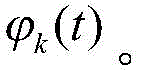
The Mean Square Error (MSE) between the original signal and the harmonic component can be expressed as equation (3), the MSE is close to zero, the signal can be approximately represented by the harmonic component, and the frequency value of the harmonic signal can be expressed as the fundamental frequency or the frequency multiplication of the signal.

3) The harmonic signal selection mode in the harmonic selection module 5 is as follows:
preferably, not all harmonics in a channel can be extracted for processing, which requires a suitable selection of harmonic components in the sub-band channels. Due to the auditory masking effect, the most energetic harmonics in the channel usually dominate the sound perception process, while the low energy components are masked.
4) The frequency shift mode in the frequency shift processing module 6 is as follows:
except for the fundamental frequency, harmonic signals selected in most channels belong to high-frequency signals, and cannot directly act on modulation signals under the limit of an electric stimulation sensing threshold, and a harmonic model (4) needing to be subjected to frequency reduction processing is converted into the following analysis form:


where "Re" represents the real part of the complex signal and the symbol j ═ sqet (-1)
First, an input signal s (t) is multiplied by exp (-j2 pi (k-1) F0t) thus hk(t) the spectrum will be from its original position kF0Conversion to F0Then s (t) is passed through a filter, i.e. the impulse response function of the filter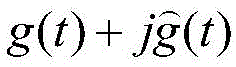 Convolution, wherein g (t) denotes F0A band-pass filter at the location of the filter,
 is a Hilbert transform. Due to hk(t) information is located only at F0Nearby, therefore, from
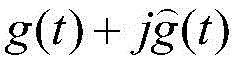 Constructing an analytical filter with only F0The surrounding positive spectrum passes. Then, the real part of the output of the complex filter is taken to obtain a modulation signal, which is recorded as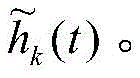

Comparing equations (4) and (6), it can be seen that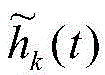 The conveyed AM signal is the same as the original harmonic, but the oscillation speed is much slower. Modulating signals
 From hkThe real part of (t) is obtained. And hk(t) has the same amplitude a as compared withk(t) and phase
 But with an oscillation rate of F0Rather than kF0. Due to the fact thatFor CI users, the sensitivity to time domain modulation is generally poor, so the extracted modulated signal is more perceptible than the original harmonics.
Example 3:
an experiment for verifying tone recognition accuracy of an evaluation system of a Chinese speech coding strategy of an artificial cochlea mainly comprises the following steps:
and respectively contacting the hearing-healthy subject and the hearing-impaired subject to carry out a tone recognition accuracy statistical test. The entire test was conducted in a quiet sound isolation booth, with each subject tested individually. Synthesizing the sound to be tested by Chinese speech strategy coding with vocoder, i.e. selecting a group of sinusoidal signals as modulation signals and using the central frequency f of each channelcAnd accumulating the modulated channel signals as modulation frequency, and obtaining an output signal y (t) which is a coded signal after the sound code synthesis. The effect of the used chinese speech coding strategy is detected by acoustic simulation of the hearing key trial.

Matching original six Lin tones with four tones of voice to obtain original 24 tone syllables, repeating each original tone syllable ten times, randomly playing two hundred forty syllables in total, allowing the subject to recognize the content and tone of the sound, and counting the correct rate of each subject recognizing each original tone syllable. And then, after the original 24 tone syllables are coded by adopting the traditional voice, repeating each traditional coded tone syllable ten times, randomly playing two hundred and forty syllables in total, enabling the subjects to recognize the content and tone of the sound, and counting the correct rate of each subject for recognizing each traditional tone syllable. And after the original 24 tone syllables are coded by adopting novel voice, repeating each novel coding tone syllable for ten times, randomly playing two hundred and forty syllables in total, allowing the testee to recognize the content and tone of the sound to be heard, and counting the correct rate of recognizing each novel coding tone syllable by each tester.
Then use Eliminating abnormal data, and calculating the standard deviation of the arithmetic mean value of each identical syllable of the hearing-healthy group and the hearing-impaired group

Calculating the deviation value Deltax between the recognition accuracy of each subject and the average recognition accuracy of the group in which the subject is locatediAnd standard deviation from the set of threefold arithmetic mean Compare, if there is
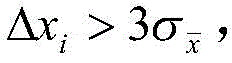 Judging the data to be abnormal data, discarding and counting, otherwise, keeping the data.
After the abnormal data are eliminated, the arithmetic mean value and the variance of the accuracy of each tone syllable of each tested identified sound of the hearing health group and the hearing barrier group are respectively calculated.
In the results of the hearing volunteers, the recognition rate of the original tone syllable is used as a contrast, and the recognition rate of the new type of coded tone syllable is compared with the recognition rate of the conventional coded tone syllable to judge whether the new type of code is improved in the speech tone recognition compared with a conventional code and the degree of the improvement of the tone recognition.
In the results of the hearing impaired volunteers, the recognition rate of the original tone syllable is used as a contrast, and the recognition rate of the new type of coded tone syllable is compared with the recognition rate of the traditional type of coded tone syllable to judge whether the new type of code is improved in the aspect of voice tone recognition compared with a certain traditional code, and the degree of tone recognition improvement.
Claims (8)
1. The system for evaluating the Chinese speech coding strategy of the cochlear implant is characterized by mainly comprising a speech signal acquisition module (1), a fundamental frequency detection module (2), a signal preprocessing module (3), a frequency channel division module (4), a harmonic selection module (5), a frequency shift processing module (6), a filtering module (7), a speech synthesis module (8) and a speech playing module (9);
the voice signal acquisition module (1) acquires an external voice signal s (t) and sends the external voice signal s (t) to the fundamental frequency detection module (2) and the signal preprocessing module (3).
The fundamental frequency detection module (2) obtains a fundamental frequency value F in a voice signal s (t) by utilizing a least square harmonic algorithm0And the fundamental frequency value F0Sending the data to a frequency shift processing module (6);
the signal preprocessing module (3) performs pre-emphasis, data framing and windowing on a voice signal s (t), and sends the preprocessed voice signal s (t) to the frequency channel dividing module (4);
the frequency channel dividing module (4) divides the preprocessed one-path voice signal s (t) into a plurality of sub-path voice signals by using a band-pass filter, and sends the sub-path voice signals to the harmonic wave selecting module (5);
the harmonic selection module (5) selects the harmonic component h with the maximum amplitude in each path of voice signals respectivelyk(t) and sending the signal to a frequency shift processing module (6);
the frequency shift processing module (6) is used for selecting the harmonic component hk(t) performing frequency reduction processing and sending to a filtering module (7);
the filtering module (7) performs low-pass filtering on the frequency-reduced harmonic component and sends the harmonic component to the voice synthesis module (8);
the voice synthesis module (8) encodes the harmonic component and sends the harmonic component to the voice playing module (9);
the voice playing module (9) plays the coded signals;
2. the system for evaluating cochlear implant chinese speech coding strategy according to claim 1 or 2, wherein the signal preprocessing module (3) performs pre-emphasis on the speech signal s (t) by: inputting a voice signal s (t) into a first-order Butterworth high-pass filter, and outputting a pre-emphasized voice signal s (t);
the transfer function h (z) of the first order butterworth high pass filter is as follows:
H(z)=1-k*z-1; (1)
in the formula, k is a filter coefficient; z represents the speech signal to be processed.
3. The system for evaluating cochlear implant chinese speech coding strategy of claim 1, wherein: the step of dividing the preprocessed voice signal s (t) into a plurality of sub-voice signals is as follows: inputting a path of voice signals s (t) into a Greenwood cochlea frequency-position function; the Greenwood cochlea frequency-position function divides the frequency band of the voice signal, thereby outputting a plurality of sub-voice signals;
the Greenwood cochlear frequency-position function is as follows:
f=A(10αx-K); (2)
where f denotes the corresponding frequency point on the cochlea, a and K are constants, x is the position on the basilar membrane of the cochlea from the top, and α is a constant coefficient associated with position x.
4. The system for evaluating cochlear implant chinese speech coding strategy of claim 1, wherein the step of selecting the harmonic component with the largest amplitude in each path of speech signal is as follows:
1) the harmonic selection module (5) performs FFT (fast Fourier transform) on each path of voice signals;
2) fundamental frequency value F based on each path of voice signal0Finding out the corresponding amplitudes of all harmonic components on the frequency spectrum;
3) selecting harmonic component h with maximum amplitudek(t)。
5. The system for evaluating cochlear implant chinese speech coding strategy of claim 1, wherein the selected harmonic component h is evaluatedk(t) the main steps of the frequency reduction treatment are as follows:
1) the frequency shift processing module (6) multiplies the speech signal s (t) byexp(-j2π(k-1)F0t) harmonic components h of the speech signal s (t)k(t) spectrum from kF0Conversion to F0;
2) Inputting the input signal s (t) into a complex filter as a function of the impulse response of the filter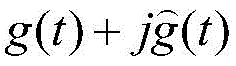 Performing convolution to complete band-pass filtering; g (t) denotes F0The g to (t) of the band-pass filter are Hilbert transformation;
3) using the real part of the signal output by the complex filter as the modulation signal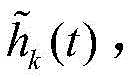 Completion of harmonic component hkAnd (t) performing frequency reduction treatment.
6. The system for evaluating cochlear implant chinese speech coding strategy according to claim 1, wherein the speech signal collection module (1) is a microphone of cochlear implant.
7. The system for evaluating cochlear implant chinese speech coding strategy of claim 1, wherein: the external speech signal s (t) is chinese speech.
8. The system for evaluating cochlear implant chinese speech coding strategy of claim 1, wherein: the frequency channel division module (4) simulates the distribution of human ear induction positions.
Priority Applications (1)
| Application Number | Priority Date | Filing Date | Title |
|---|---|---|---|
| CN201911371172.9A CN111150934B (en) | 2019-12-27 | 2019-12-27 | Evaluation system of Chinese tone coding strategy of cochlear implant |
Applications Claiming Priority (1)
| Application Number | Priority Date | Filing Date | Title |
|---|---|---|---|
| CN201911371172.9A CN111150934B (en) | 2019-12-27 | 2019-12-27 | Evaluation system of Chinese tone coding strategy of cochlear implant |
Publications (2)
| Publication Number | Publication Date |
|---|---|
| CN111150934A true CN111150934A (en) | 2020-05-15 |
| CN111150934B CN111150934B (en) | 2022-10-04 |
Family
ID=70556899
Family Applications (1)
| Application Number | Title | Priority Date | Filing Date |
|---|---|---|---|
| CN201911371172.9A Expired - Fee Related CN111150934B (en) | 2019-12-27 | 2019-12-27 | Evaluation system of Chinese tone coding strategy of cochlear implant |
Country Status (1)
| Country | Link |
|---|---|
| CN (1) | CN111150934B (en) |
Cited By (2)
| Publication number | Priority date | Publication date | Assignee | Title |
|---|---|---|---|---|
| CN113286243A (en) * | 2021-04-29 | 2021-08-20 | 佛山博智医疗科技有限公司 | Error correction system and method for self-testing speech recognition |
| CN118490216A (en) * | 2024-04-22 | 2024-08-16 | 山东大学 | Passive hearing detection method and system for Lien's six-tone |
Citations (6)
| Publication number | Priority date | Publication date | Assignee | Title |
|---|---|---|---|---|
| WO2005091493A1 (en) * | 2004-03-12 | 2005-09-29 | Rf Magic, Inc. | Harmonic suppression mixer and tuner |
| CN101301240A (en) * | 2008-05-21 | 2008-11-12 | 清华大学深圳研究生院 | Electric cochlea Chinese fixed electric stimulation amplitude changing pattern in vitro voice processing equipment |
| US20110091048A1 (en) * | 2006-04-27 | 2011-04-21 | National Chiao Tung University | Method for virtual bass synthesis |
| CN102318371A (en) * | 2009-02-03 | 2012-01-11 | 希尔沃克斯股份有限公司 | Enhianced envelope encoded tone, sound procrssor and system |
| CN102579159A (en) * | 2012-02-23 | 2012-07-18 | 杭州诺尔康神经电子科技有限公司 | Electrical cochlea speech processor and processing method with signal compression in wide dynamic range |
| CN109036569A (en) * | 2018-09-17 | 2018-12-18 | 重庆大学 | The verification method of the time domain fine structure novel coding of artificial cochlea's tone language |
-
2019
- 2019-12-27 CN CN201911371172.9A patent/CN111150934B/en not_active Expired - Fee Related
Patent Citations (6)
| Publication number | Priority date | Publication date | Assignee | Title |
|---|---|---|---|---|
| WO2005091493A1 (en) * | 2004-03-12 | 2005-09-29 | Rf Magic, Inc. | Harmonic suppression mixer and tuner |
| US20110091048A1 (en) * | 2006-04-27 | 2011-04-21 | National Chiao Tung University | Method for virtual bass synthesis |
| CN101301240A (en) * | 2008-05-21 | 2008-11-12 | 清华大学深圳研究生院 | Electric cochlea Chinese fixed electric stimulation amplitude changing pattern in vitro voice processing equipment |
| CN102318371A (en) * | 2009-02-03 | 2012-01-11 | 希尔沃克斯股份有限公司 | Enhianced envelope encoded tone, sound procrssor and system |
| CN102579159A (en) * | 2012-02-23 | 2012-07-18 | 杭州诺尔康神经电子科技有限公司 | Electrical cochlea speech processor and processing method with signal compression in wide dynamic range |
| CN109036569A (en) * | 2018-09-17 | 2018-12-18 | 重庆大学 | The verification method of the time domain fine structure novel coding of artificial cochlea's tone language |
Non-Patent Citations (1)
| Title |
|---|
| XING WANG: "Neural Representation Of Harmonic Single Sideband Encoder In Inferior Colliculus Of Guinea Pigs", 《2018 40TH ANNUAL INTERNATIONAL CONFERENCE OF THE IEEE ENGINEERING IN MEDICINE AND BIOLOGY SOCIETY (EMBC)》 * |
Cited By (3)
| Publication number | Priority date | Publication date | Assignee | Title |
|---|---|---|---|---|
| CN113286243A (en) * | 2021-04-29 | 2021-08-20 | 佛山博智医疗科技有限公司 | Error correction system and method for self-testing speech recognition |
| CN118490216A (en) * | 2024-04-22 | 2024-08-16 | 山东大学 | Passive hearing detection method and system for Lien's six-tone |
| CN118490216B (en) * | 2024-04-22 | 2026-01-30 | 山东大学 | A passive hearing test method and system based on the Linus six-tone scale |
Also Published As
| Publication number | Publication date |
|---|---|
| CN111150934B (en) | 2022-10-04 |
Similar Documents
| Publication | Publication Date | Title |
|---|---|---|
| Nie et al. | Encoding frequency modulation to improve cochlear implant performance in noise | |
| CN101642399B (en) | Artificial cochlea speech processing method based on frequency modulation information and artificial cochlea speech processor | |
| US8023673B2 (en) | Pitch perception in an auditory prosthesis | |
| US8019431B2 (en) | Enhanced signal processing for cochlear implants | |
| Luo et al. | Enhancing Chinese tone recognition by manipulating amplitude envelope: Implications for cochlear implants | |
| CN102318371B (en) | Senior envelope encoding tonal sound processing method and system | |
| CN102958561B (en) | Envelope specific stimulus timing | |
| CN105555354B (en) | Auditory prosthesis stimulus velocity as a multiple of natural oscillation | |
| CN102579159B (en) | Electrical cochlea speech processor and processing method with signal compression in wide dynamic range | |
| EP3056022B1 (en) | Arrangement and method for extracting temporal features from spike-like signals | |
| CN101716108A (en) | System for processing electronic cochlear signal and coding electric stimulation and processing method thereof | |
| WO2013067145A1 (en) | Systems and methods for enhancing place-of-articulation features in frequency-lowered speech | |
| US8670582B2 (en) | N band FM demodulation to aid cochlear hearing impaired persons | |
| CN111150934B (en) | Evaluation system of Chinese tone coding strategy of cochlear implant | |
| CN100502819C (en) | Artificial cochlea manufacture method suitable for Chinese voice coding strategy | |
| EP2732641B1 (en) | Test methods for cochlear implant stimulation strategies | |
| CN104307100B (en) | A kind of method and system improving artificial cochlea's pitch perception | |
| Healy et al. | The role of contrasting temporal amplitude patterns in the perception of speech | |
| AU2005202837A1 (en) | Selective resolution speech processing | |
| Seligman | Speech-processing strategies and their implementation | |
| Liu et al. | A novel speech coding algorithm for cochlear implants | |
| AU2021102795A4 (en) | Optimized coding method and system for enhancing tone perception of cochlear implant | |
| EP2184929B1 (en) | N band FM demodulation to aid cochlear hearing impaired persons | |
| Luo et al. | Importance of pitch and periodicity to Chinese-speaking cochlear implant patients | |
| Luo et al. | Vocal emotion recognition with cochlear implants. |
Legal Events
| Date | Code | Title | Description |
|---|---|---|---|
| PB01 | Publication | ||
| PB01 | Publication | ||
| SE01 | Entry into force of request for substantive examination | ||
| SE01 | Entry into force of request for substantive examination | ||
| GR01 | Patent grant | ||
| GR01 | Patent grant | ||
| TR01 | Transfer of patent right |
Effective date of registration: 20230727 Address after: Floor 3, Chengjiao 5th Apartment, Chongqing University, Shazhong Road, Shapingba District, Chongqing 400044 Patentee after: Chongqing University Science and Technology Park Co.,Ltd. Address before: 400044 No. 174 Sha Jie street, Shapingba District, Chongqing Patentee before: Chongqing University |
|
| TR01 | Transfer of patent right | ||
| CF01 | Termination of patent right due to non-payment of annual fee |
Granted publication date: 20221004 |
|
| CF01 | Termination of patent right due to non-payment of annual fee |