CN111147407A - TMSBL underwater acoustic OFDM time-varying channel estimation method based on channel prediction - Google Patents
TMSBL underwater acoustic OFDM time-varying channel estimation method based on channel prediction Download PDFInfo
- Publication number
- CN111147407A CN111147407A CN201911419352.XA CN201911419352A CN111147407A CN 111147407 A CN111147407 A CN 111147407A CN 201911419352 A CN201911419352 A CN 201911419352A CN 111147407 A CN111147407 A CN 111147407A
- Authority
- CN
- China
- Prior art keywords
- channel
- tmsbl
- ofdm
- estimation
- time
- Prior art date
- Legal status (The legal status is an assumption and is not a legal conclusion. Google has not performed a legal analysis and makes no representation as to the accuracy of the status listed.)
- Granted
Links
- 238000000034 method Methods 0.000 title claims abstract description 61
- 238000004422 calculation algorithm Methods 0.000 claims abstract description 34
- 239000013598 vector Substances 0.000 claims abstract description 31
- 238000004891 communication Methods 0.000 claims abstract description 15
- 239000011159 matrix material Substances 0.000 claims description 34
- 238000004364 calculation method Methods 0.000 claims description 6
- 230000000694 effects Effects 0.000 claims description 6
- 238000005457 optimization Methods 0.000 claims description 6
- 238000007493 shaping process Methods 0.000 claims description 6
- 230000008859 change Effects 0.000 claims description 5
- 125000004122 cyclic group Chemical group 0.000 claims description 4
- 239000000654 additive Substances 0.000 claims description 3
- 230000000996 additive effect Effects 0.000 claims description 3
- 238000005070 sampling Methods 0.000 claims description 3
- 238000005259 measurement Methods 0.000 claims description 2
- 238000004088 simulation Methods 0.000 description 6
- 230000006870 function Effects 0.000 description 4
- 238000012360 testing method Methods 0.000 description 4
- 238000010586 diagram Methods 0.000 description 3
- 238000012545 processing Methods 0.000 description 3
- 230000004044 response Effects 0.000 description 3
- 230000008901 benefit Effects 0.000 description 2
- 238000011161 development Methods 0.000 description 2
- 238000005516 engineering process Methods 0.000 description 2
- 238000005562 fading Methods 0.000 description 2
- 238000004458 analytical method Methods 0.000 description 1
- 230000005540 biological transmission Effects 0.000 description 1
- 230000003247 decreasing effect Effects 0.000 description 1
- 238000002474 experimental method Methods 0.000 description 1
- 230000006872 improvement Effects 0.000 description 1
- 230000000644 propagated effect Effects 0.000 description 1
- XLYOFNOQVPJJNP-UHFFFAOYSA-N water Substances O XLYOFNOQVPJJNP-UHFFFAOYSA-N 0.000 description 1
Images


Classifications
-
- H—ELECTRICITY
- H04—ELECTRIC COMMUNICATION TECHNIQUE
- H04L—TRANSMISSION OF DIGITAL INFORMATION, e.g. TELEGRAPHIC COMMUNICATION
- H04L25/00—Baseband systems
- H04L25/02—Details ; arrangements for supplying electrical power along data transmission lines
- H04L25/0202—Channel estimation
- H04L25/024—Channel estimation channel estimation algorithms
-
- H—ELECTRICITY
- H04—ELECTRIC COMMUNICATION TECHNIQUE
- H04L—TRANSMISSION OF DIGITAL INFORMATION, e.g. TELEGRAPHIC COMMUNICATION
- H04L25/00—Baseband systems
- H04L25/02—Details ; arrangements for supplying electrical power along data transmission lines
- H04L25/0202—Channel estimation
- H04L25/0212—Channel estimation of impulse response
-
- Y—GENERAL TAGGING OF NEW TECHNOLOGICAL DEVELOPMENTS; GENERAL TAGGING OF CROSS-SECTIONAL TECHNOLOGIES SPANNING OVER SEVERAL SECTIONS OF THE IPC; TECHNICAL SUBJECTS COVERED BY FORMER USPC CROSS-REFERENCE ART COLLECTIONS [XRACs] AND DIGESTS
- Y02—TECHNOLOGIES OR APPLICATIONS FOR MITIGATION OR ADAPTATION AGAINST CLIMATE CHANGE
- Y02D—CLIMATE CHANGE MITIGATION TECHNOLOGIES IN INFORMATION AND COMMUNICATION TECHNOLOGIES [ICT], I.E. INFORMATION AND COMMUNICATION TECHNOLOGIES AIMING AT THE REDUCTION OF THEIR OWN ENERGY USE
- Y02D30/00—Reducing energy consumption in communication networks
- Y02D30/70—Reducing energy consumption in communication networks in wireless communication networks
Landscapes
- Engineering & Computer Science (AREA)
- Power Engineering (AREA)
- Computer Networks & Wireless Communication (AREA)
- Signal Processing (AREA)
- Cable Transmission Systems, Equalization Of Radio And Reduction Of Echo (AREA)
Abstract
The invention provides a TMSBL underwater acoustic OFDM time-varying channel estimation method based on channel prediction, which comprises the following steps: based on a CP-OFDM communication system model, modeling the variation of amplitude, time delay and Doppler factor of a continuous inter-block channel path into a cluster-based channel offset parameter model; predicting a current channel by estimating a channel offset parameter and compensating a channel estimated by a previous symbol, and forming a virtual receiving vector of the current channel according to a known pilot symbol; and constructing a joint estimation model based on channel prediction, and performing joint estimation on the sparse channel by adopting a TMSBL algorithm based on the joint estimation model. Under the fast time-varying underwater acoustic channel with the path time delay and the amplitude obviously changing based on the cluster characteristics, the time-varying information of the channel between the adjacent blocks is fully utilized, the precision of channel estimation is effectively improved, and the error rate of a system is reduced.
Description
Technical Field
The invention relates to a TMSBL underwater sound OFDM time-varying channel estimation method based on channel prediction, belonging to the technical field of underwater sound communication.
Background
Ocean observation and development and utilization of ocean resources are one of the most concerned problems in many ocean countries, and the underwater acoustic communication technology is proposed as an important technical support for ocean development in recent years. Orthogonal frequency Division Multiplexing (orthogonal frequency Division Multiplexing-OFDM) technology has the characteristic of frequency selective fading resistance and high frequency band utilization rate, and is widely applied to underwater high-speed communication systems. The underwater acoustic channel is one of the most complex wireless channels, and will be paired inThe propagated acoustic signals cause interference such as multipath propagation, phase fluctuation and the like, meanwhile, the underwater acoustic channel is a time-varying and frequency-varying fading channel, and the complex and variable underwater acoustic channel causes distortion of signals received by a receiving end. In order to demodulate the received signal accurately, the estimation of the underwater acoustic channel is indispensable. However, the propagation speed of the sound wave in water is about 1500m/s, which is much lower than the propagation speed of the electromagnetic wave in air by 3.0X 10⁸m/s, therefore, the transmission delay in the underwater acoustic communication system is far higher than that in the electromagnetic wave wireless communication system, the channel estimation performance of the current symbol can be effectively improved by only depending on the limited symbol-by-symbol channel estimation capability of a receiving end and utilizing the channel prediction information of the demodulated symbol.
The method provides a time-varying OFDM time-varying channel estimation method based on time-varying multiple Sparse Bayesian Learning (TMSBL) of channel prediction. The channel offset parameter is first estimated using an Orthogonal Matching Pursuit (OMP) algorithm. Then, a virtual received signal based on the channel prediction of the previous block is reconstructed, which is considered to pass through the same channel as the actual received signal. Finally, the channel of the current block is jointly estimated using the TMSBL method, since the main paths traversed by the virtual received signal and the actual received signal have the same sparse distribution. The effectiveness of the method in a time-varying underwater acoustic channel is verified through performance simulation and sea test data processing, and compared with the existing OMP method and TMSBL method, the method has lower Bit Error Rate (BER) and minimum mean square error.
Disclosure of Invention
The invention aims to provide a TMSBL underwater sound OFDM time-varying channel estimation method based on channel prediction. Then, a virtual received signal based on the channel prediction of the previous block is reconstructed, which is considered to pass through the same channel as the actual received signal. Finally, the channel of the current block is jointly estimated using the TMSBL method, since the main paths traversed by the virtual received signal and the actual received signal have the same sparse distribution. The effectiveness of the method in a time-varying underwater acoustic channel is verified through performance simulation and sea test data processing, and compared with the existing OMP method and TMSBL method, the method has lower Bit Error Rate (BER) and minimum mean square error.
TMSBL underwater acoustic OFDM time-varying channel estimation method based on channel prediction, the estimation method comprises the following steps:
step one, based on a CP-OFDM communication system model, modeling the amplitude, time delay and Doppler factor variation of a channel path between continuous blocks into a cluster-based channel offset parameter model;
estimating a channel offset parameter, compensating by using a channel estimated by a previous symbol to predict a current channel, and forming a virtual receiving vector of the current channel according to a known pilot symbol;
and thirdly, constructing a joint estimation model based on channel prediction, and performing joint estimation on the sparse channel by adopting a TMSBL algorithm based on the joint estimation model.
Further, in step one, specifically, for the initial CP-OFDM communication system model:
suppose there are K subcarriers in an OFDM block and the symbol sent on the kth subcarrier of the nth block is X [ K; n is]T represents the period of an OFDM block, fcIs the center frequency, TcpIndicating the cyclic prefix length, the k-th subcarrier frequency is
fk=fc+k/T,k=-K/2,…,K/2-1 (1.1)
Transmitted OFDM signal writing

Wherein q (t) is a pulse shaping filter written as

A common time-varying channel model used in underwater acoustic communication is

Wherein N ispaIs the number of paths of the multipath channel, Ap(t;n),τp(t;n),ap(t; n) respectively representing the gain, delay and Doppler factors of the p-th path in the n-th block, A being the sum of the values of A and B over the duration of one OFDM blockp(t;n),τp(t;n),ap(t; n) these three parameters are assumed to be constant: a. thep(t;n)=Ap[n],τp(t;n)=τp[n],ap(t;n)=ap[n],
The OFDM signal received via the channel is written as

Wherein Is the additive noise that is generated by the noise source,
the received signal after doppler compensation and CP-OFDM demodulation is represented as:

wherein m is [ -K/2, K/2-1], w [ m; n is the frequency domain noise, coefficient H [ m, k; n ] specifies the effect of the kth subcarrier on the mth subcarrier FFT output in the doppler effect due to the time-varying channel, expressed as:

wherein G (f) represents the Fourier transform of a rectangular pulse shaping filter, bp[n]and ξp[n]Residual doppler factor and complex gain, respectively:

then, the coefficients H [ m, k; n ] are collected into a channel mixing matrix H [ n ], simplifying the input-output relationship to:
Y[n]=H[n]X[n]+w[n](1.9)

wherein, Y [ n ]]Is the nth received vector, X [ n ]]Is the nth transmit vector, w n]Is a noise vector, and the matrix Γ is: [ gamma (b')]m,k=G(fm+-(1+b)fk) The kth diagonal element of the diagonal matrix Λ is:
further, in step one, specifically, regarding the cluster-based channel offset parameter model:
dividing channel paths into NclAnd (3) clustering:

wherein omegaiFor the set of all paths in the ith cluster,
assuming that the variation of the complex gain, delay and residual doppler factor satisfy the same set of channel offset parameters y within one clusteri,Δτi,ΔbiAnd in the ith cluster of the nth block, the path parameters after offset compensation based on the cluster channel are as follows:

further, in step two, the channel offset parameter estimation is implemented based on an OMP algorithm, specifically:
for the current block, Yp[n]And Xp[n]Respectively correspond to Y [ n ]]And X [ n ]]The pilot element in (1) is known and can be used for estimating the channel offset parameter, and based on the channel offset parameter model of equation (2.2), a K × K matrix B of the ith cluster is definedi(·):

Symbol vector Xp[n]Is a channel input from the ith cluster path, and the corresponding frequency domain output is
Yi[n]=γiBi(Δτi,Δbi;n)Xp[n]. (3.2)
Combining the output results of all clusters to obtain:

wherein, the estimation problem is converted into an optimization problem, and the optimization model is as follows:

where { Δ τi,ΔbiLie on a defined two-dimensional search grid:

δτand deltabSearch step sizes of delay offset and Doppler offset, respectively, assuming N on the delay variation search grid1With N grid points on the residual Doppler factor variation search grid2At each grid point, the equation (3.3) is rewritten as:

wherein, the vector p is divided intoi,l,jIs defined as
pi,l,j=Bi(Δτ[l],Δb[j];n)Xp[n]. (3.7)
Estimation of gamma in equation (3.6) using OMP algorithmi,l,jIn order to simplify the calculation amount, Δ b is set in consideration of the fact that the influence of the doppler shift is smalliWhen 0, equation (3.6) is further simplified to:

after estimating and compensating the offset parameter, obtaining a predicted value of the channel parameter of the nth block:

two channel matrices corresponding to the ith cluster are defined:


the virtual received signal is configured to:

wherein Representing the residual error.
Further, in step three, a joint estimation model is constructed based on channel prediction, specifically, the receiver has two measured values for the nth block:

defining a time delay search grid and a residual Doppler factor search grid as follows:

b∈{-bmax,-bmax+Δb,…,bmax}
the baseband sampling time is T/K, I is an oversampling factor, and Nτ=ITcpK/T is the number of estimated delay points, Nb=2bmax/(Δ b) +1 is the number of estimated residual Doppler factors, where Δ b is the amount of change in the residual Doppler factor, bmaxIs the maximum value of the estimated residual doppler factor,
the definition of the dictionary matrix is:
Φ=Γ(b,∈)Λ(τ)Xp, (4.3)
the rewrite joint estimation model equation (4.1) is:

wherein Ξ[n]And
 respectively an actual gain vector and a virtual gain vector, Yp[n]And
 are the same.
Further, in the third step, based on the joint estimation model, the TMSBL algorithm is adopted to perform joint estimation on the sparse channel, which specifically includes:
exploiting time correlation pairs using TMSBL algorithm Performing joint estimation, each
 The conditional probability density function of the prior parameter is written as:

wherein, the length of the channel is L, to represent
 Ith row of (1), thetaiIs a non-negative hyperparameter, represents
 Let Θ be a diagonal line, and the element on the diagonal line be θ ═ θ1,θ2,,θL]TWhen theta isi→0,
 All elements of the corresponding row in (1) are zero, DiIs a positive definite matrix, which provides
 In the context of the related structure of (1),
according to Will be provided with
 The conditional probability density function of the prior parameter is written as:


the covariance and mean are:
Σ=(σ-2ΦHΦ+Θ(r)-1)-1

wherein, mu1、μ2、 Are respectively estimated xi [ n]、
 Θ(r)Representing the updated Θ matrix in the r iteration, estimating the hyper-parameters by using the EM algorithm, calculating the posterior parameters by using the formula (5.4) in the step E, and expressing the update formula in the step M as follows:

wherein, is that
 In the ith row of the matrix, D in the formula (5.5) is replaced by a positive definite matrix DiTo describe the relative structure of all the paths,
the D matrix describes the relevant structures of all paths, and the calculation method is as follows:

where η is a positive scalar quantity,
variance of noise σ2The following are determined by the idler:

and η is set to 2 in equation (5.6) to ensure that the matrix D is positive, where Is a symbol received at a null subcarrier location.
The main advantages of the invention are: under the fast time-varying underwater acoustic channel with the path time delay and the amplitude obviously changing based on the cluster characteristics, the time-varying information of the channel between the adjacent blocks is fully utilized, the precision of channel estimation is effectively improved, and the error rate of a system is reduced.
Drawings
FIG. 1 is a time-varying signal-to-noise ratio-mean square error curve for an underwater acoustic channel;
FIG. 2 is a time varying signal-to-noise ratio-bit error rate curve for an underwater acoustic channel;
FIG. 3 is a diagram of channel impulse response estimation;
FIG. 4 is a diagram comparing BER performance of the method proposed by the present invention with the OMP channel estimation method and the TMSBL channel estimation method;
FIG. 5 is a graph of offset parameters for clusters of channels between adjacent blocks;
fig. 6 is a graph of offset variance of clusters of channels between adjacent blocks.
Detailed Description
The technical solutions in the embodiments of the present invention will be described clearly and completely with reference to the accompanying drawings in the embodiments of the present invention, and it is obvious that the described embodiments are only a part of the embodiments of the present invention, and not all of the embodiments. All other embodiments, which can be derived by a person skilled in the art from the embodiments given herein without making any creative effort, shall fall within the protection scope of the present invention.
The invention provides an embodiment of a TMSBL underwater acoustic OFDM time-varying channel estimation method based on channel prediction, which comprises the following steps:
step one, based on a CP-OFDM communication system model, modeling the amplitude, time delay and Doppler factor variation of a channel path between continuous blocks into a cluster-based channel offset parameter model;
estimating a channel offset parameter, compensating by using a channel estimated by a previous symbol to predict a current channel, and forming a virtual receiving vector of the current channel according to a known pilot symbol;
and thirdly, constructing a joint estimation model based on channel prediction, and performing joint estimation on the sparse channel by adopting a TMSBL algorithm based on the joint estimation model.
Specifically, the method adopted by the invention for solving the technical problem comprises the following three parts:
(1) pre-building cluster-based channel offset parameter model
According to the characteristic of clustering of the underwater acoustic channels, the time correlation of the fast time-varying underwater acoustic channels is utilized to model the changes of the amplitude, the time delay and the Doppler factor of the continuous inter-block channel paths into a channel offset parameter model based on clusters.
(2) Fictitious received vector of current channel
And predicting the current channel by estimating the channel offset parameter and compensating the channel estimated by the previous symbol, and forming a virtual receiving vector of the current channel according to the known pilot symbols.
(3) TMSBL-based joint channel estimation method
Performing joint estimation on a channel of a current symbol based on a TMSBL joint channel estimation method, reconstructing a virtual receiving vector, subjecting the virtual receiving vector and an actual receiving vector to the same channel, forming a receiving matrix by the virtual receiving vector and the actual receiving vector, and finally performing joint estimation on a sparse channel by adopting a TMSBL algorithm.
In the preferred embodiment of this section, in step one, specifically, for the initial CP-OFDM communication system model:
suppose there are K subcarriers in an OFDM block and the symbol sent on the kth subcarrier of the nth block is X [ K; n is]T represents the period of an OFDM block, fcIs the center frequency, TcpIndicating cyclesRing prefix length, then the k-th subcarrier frequency is
fk=fc+k/T,k=-K/2,…,K/2-1 (1.1)
Transmitted OFDM signal writing

Wherein q (t) is a pulse shaping filter written as

A common time-varying channel model used in underwater acoustic communication is

Wherein N ispaIs the number of paths of the multipath channel, Ap(t;n),τp(t;n),ap(t; n) respectively representing the gain, delay and Doppler factors of the p-th path in the n-th block, A being the sum of the values of A and B over the duration of one OFDM blockp(t;n),τp(t;n),ap(t; n) these three parameters are assumed to be constant: a. thep(t;n)=Ap[n],τp(t;n)=τp[n],ap(t;n)=ap[n],
The OFDM signal received via the channel is written as

Wherein Is the additive noise that is generated by the noise source,
the received signal after doppler compensation and CP-OFDM demodulation is represented as:

wherein m is [ -K/2, K/2-1], w [ m; n is the frequency domain noise, coefficient H [ m, k; n ] specifies the effect of the kth subcarrier on the mth subcarrier FFT output in the doppler effect due to the time-varying channel, expressed as:

wherein G (f) represents the Fourier transform of a rectangular pulse shaping filter, bp[n]and ξp[n]Residual doppler factor and complex gain, respectively:

then, the coefficients H [ m, k; n ] are collected into a channel mixing matrix H [ n ], simplifying the input-output relationship to:
Y[n]=H[n]X[n]+w[n](1.9)

wherein, Y [ n ]]Is the nth received vector, X [ n ]]Is the nth transmit vector, w n]Is a noise vector, and the matrix Γ is: [ gamma (b')]m,k=G(fm+-(1+b)fk) The kth diagonal element of the diagonal matrix Λ is:
in the preferred embodiment of this section, in step one, specifically, regarding the cluster-based channel offset parameter model:
dividing channel paths into NclAnd (3) clustering:

wherein omegaiFor the set of all paths in the ith cluster,
assuming that the variation of the complex gain, delay and residual doppler factor satisfy the same set of channel offset parameters y within one clusteri,Δτi,ΔbiAnd in the ith cluster of the nth block, the path parameters after offset compensation based on the cluster channel are as follows:

in this preferred embodiment of this section, in step two, the channel offset parameter estimation is implemented based on an OMP algorithm, specifically:
for the current block, Yp[n]And Xp[n]Respectively correspond to Y [ n ]]And X [ n ]]The pilot element in (1) is known and can be used for estimating the channel offset parameter, and based on the channel offset parameter model of equation (2.2), a K × K matrix B of the ith cluster is definedi(·):

Symbol vector Xp[n]Is a channel input from the ith cluster path, and the corresponding frequency domain output is
Yi[n]=γiBi(Δτi,Δbi;n)Xp[n]. (3.2)
Combining the output results of all clusters to obtain:

wherein, the estimation problem is converted into an optimization problem, and the optimization model is as follows:

where { Δ τi,ΔbiLie on a defined two-dimensional search grid:

δτand deltabSearch step sizes of delay offset and Doppler offset, respectively, assuming N on the delay variation search grid1With N grid points on the residual Doppler factor variation search grid2At each grid point, the equation (3.3) is rewritten as:
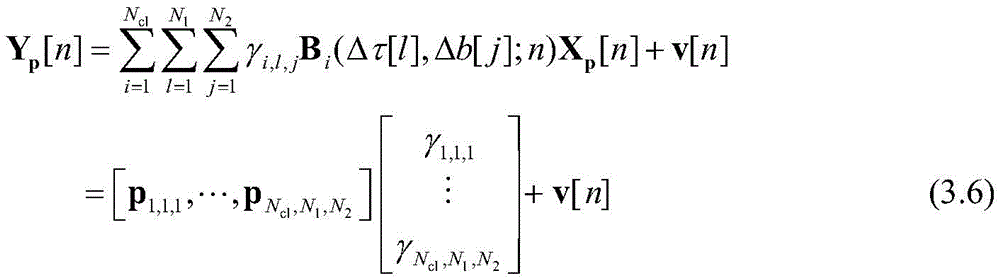
wherein, the vector p is divided intoi,l,jIs defined as
pi,l,j=Bi(Δτ[l],Δb[j];n)Xp[n]. (3.7)
Estimation of gamma in equation (3.6) using OMP algorithmi,l,jIn order to simplify the calculation amount, Δ b is set in consideration of the fact that the influence of the doppler shift is smalliWhen 0, equation (3.6) is further simplified to:

after estimating and compensating the offset parameter, obtaining a predicted value of the channel parameter of the nth block:

two channel matrices corresponding to the ith cluster are defined:


the virtual received signal is configured to:

wherein Representing the residual error.
In the preferred embodiment of this section, in step three, a joint estimation model is constructed based on channel prediction, specifically, the receiver has two measurements for the nth block:

defining a time delay search grid and a residual Doppler factor search grid as follows:

b∈{-bmax,-bmax+Δb,…,bmax}
the baseband sampling time is T/K, I is an oversampling factor, and Nτ=ITcpK/T is the number of estimated delay points, Nb=2bmax/(Δ b) +1 is the number of estimated residual Doppler factors, where Δ b is the amount of change in the residual Doppler factor, bmaxIs the maximum value of the estimated residual doppler factor,
the definition of the dictionary matrix is:
Φ=Γ(b,∈)Λ(τ)Xp, (4.3)
the rewrite joint estimation model equation (4.1) is:

wherein Ξ[n]And
 are respectively provided withFor the actual and virtual gain vectors, Yp[n]And
 are the same.
In the preferred embodiment of this section, in step three, based on the joint estimation model, the TMSBL algorithm is used to perform joint estimation on the sparse channel, specifically:
exploiting time correlation pairs using TMSBL algorithm Performing joint estimation, each
 The conditional probability density function of the prior parameter is written as:

wherein, the length of the channel is L, to represent
 Ith row of (1), thetaiIs a non-negative hyperparameter, represents
 Let Θ be a diagonal line, and the element on the diagonal line be θ ═ θ1,θ2,,θL]TWhen theta isi→0,
 All elements of the corresponding row in (1) are zero, DiIs a positive definite matrix, which provides
 In the context of the related structure of (1),
according to Will be provided with
 The conditional probability density function of the prior parameter is written as:


the covariance and mean are:
Σ=(σ-2ΦHΦ+Θ(r)-1)-1

wherein, mu1、μ2、 Are respectively estimated xi [ n]、
 Θ(r)Representing the updated Θ matrix in the r iteration, estimating the hyper-parameters by using the EM algorithm, calculating the posterior parameters by using the formula (5.4) in the step E, and expressing the update formula in the step M as follows:

wherein, is that
 In the ith row of the matrix, D in the formula (5.5) is replaced by a positive definite matrix DiTo describe the relative structure of all the paths,
the D matrix describes the relevant structures of all paths, and the calculation method is as follows:

where η is a positive scalar quantity,
variance of noise σ2The following are determined by the idler:

and η is set to 2 in equation (5.6) to ensure that the matrix D is positive, where Is a symbol received at a null subcarrier location.
The embodiment also performs simulation and experimental performance analysis on the estimation method, which specifically includes the following steps:
(1) MATLAB simulation:
in order to verify the performance of the channel estimation method, an underwater sound OFDM system is built, and the underwater sound OFDM system comprises 256 subcarriers, wherein the data subcarriers Kd200 pilot subcarriers Kp32, no carrier wave Kn24, bandwidth B1.5 kHz, center frequency fc2.25kHz, sample rate fs12kHz, signal length T171 ms, cyclic prefix TcpOne frame signal contains 4 OFDM blocks for 10 ms. The underwater sound sparse time-varying channel model adopts 10 randomly generated paths which are arranged into two clusters, the delay interval follows exponential distribution with the average value of 0.3ms, and the Doppler factor of each OFDM block is assumed to be randomly changed and ranges from [ -vp/c,vp/c]Wherein v isp1.5m/s and c 1500m/s, the path amplitude is Rayleigh distributed, and the average power is exponentially decreased along with the time delay. Meanwhile, the symbols adopt QPSK modulation, and 1/2 non-binary LDPC coding.
In simulation, LS algorithm and OMP algorithm are adopted to estimate channel block by block, TMSBL algorithm is adopted to estimate two continuous blocks in each frame jointly, finally the method (shown by deployed in the figure) provided by the invention is adopted, and for the first OFDM block, OMP algorithm is adopted to estimate channel impulse response of CIR, which is used as initial estimation of the method.
FIG. 1 is a comparison graph of signal-to-noise ratio-mean square error performance of the method of the present invention and LS channel estimation method, OMP channel estimation method and TMSBL channel estimation method under time varying underwater acoustic channel; from simulation results, it can be seen that the MSE performance of the LS channel estimation method is the worst, and the OMP performance is superior to that of the LS method, but inferior to that of the TMSBL method and the method of the present invention. Under the condition of high signal-to-noise ratio, the algorithm provided by the invention has better performance advantage than TMSBL and other algorithms, and under the condition of low signal-to-noise ratio, the performance of the algorithm provided by the invention is slightly inferior to that of TMSBL. This is because the channel prediction error of the previous symbol is large under low signal-to-noise ratio, which results in error propagation, and as the signal-to-noise ratio is improved, the estimation of the previous symbol is more and more accurate, and the performance improvement is gradually obvious.
FIG. 2 is a comparison graph of SNR-decoding performance under time varying underwater acoustic channel for the method of the present invention and LS channel estimation method, OMP channel estimation method, and TMSBL channel estimation method; it can be seen that the bit error rate of the LS channel estimation method is still worst. The BER performance of channel estimation by utilizing OMP is lower than that of the TMSBL method and the method provided by the invention. However, as the signal-to-noise ratio increases, the channel estimation accuracy of the previous symbol is higher and higher, and the bit error rate obtained by the method is much lower than that of the TMSBL algorithm.
(2) Processing sea test data:
the experimental data obtained in 2014 at sea are adopted to further verify the algorithm. The distance between the transmitting transducer and the receiving transducer is about 3km, the depth of the transmitting transducer is 27m, and the depth of the receiving transducer is 30 m.
One OFDM symbol contains K681 subcarriers, whereData subcarrier Kd571 pilot subcarriers Kp86, no carrier wave Kn24, bandwidth B4 kHz, center frequency fc8kHz, sample rate fs48kHz, signal length T170 ms, cyclic prefix TcpOne frame signal contains 8 OFDM blocks for 20 ms. QPSK modulation and convolutional code coding are adopted. 9 frames of OFDM symbols are transmitted consecutively with a time interval of 2s between each frame. The LFM signal is set before each frame of signal for synchronization.
Fig. 3 is a diagram of the impulse response estimation of the south sea experimental data channel. It can be seen from the figure that the channel exhibits an obvious cluster characteristic, and the channel in this experiment has two obvious clusters.
FIG. 4 is a comparison graph of BER performance of south China sea test data in the method of the present invention and OMP channel estimation method and TMSBL channel estimation method. The results plot can lead to two conclusions: 1) for frames (1-5 and 9), the BER of the method provided by the invention is lowest, the performance is optimal, and the performance of the TMSBL-2 (combining two OFDM blocks) algorithm is slightly poor, but is better than that of the TMSBL-4 (combining four OFDM blocks) and the OMP algorithm. 2) For the frame (6-8), the BER of the method provided by the invention is equivalent to that of an OMP algorithm, the BER is higher, and the TMSBL-4 performance is optimal and superior to that of TMSBL-2 and the like.
Fig. 5 and 6 show the offset parameter and offset variance of adjacent inter-block channel clusters, respectively. The channel estimation result obtained by the method is considered to be optimal by estimating the channel by taking all the subcarriers as the known pilots, calculating the offset parameter and the offset variance respectively, and analyzing and supporting the conclusion of fig. 4 by combining fig. 5 and fig. 6. Firstly, through the graph of fig. 5, the fact that two clusters between channels are obvious in fluctuation and the fluctuation is independent of each other is seen, the variance of an offset parameter is shown in the graph of fig. 6, and for the frame (1-5 and 9) with large variance, the frame channels are considered to have large fluctuation and fast change and accord with a fast time-varying channel, so that the error rate obtained is the lowest according to the channel environment aimed by the method of the invention; in contrast, for the frames (6-8), the variance is small, and the channel fluctuation of the frames is considered to be low and change slowly, so that the method is consistent with the slow time-varying channel, and therefore the method is not as good as the TMSBL algorithm in performance, but still has certain robustness.
Claims (6)
1. The TMSBL underwater acoustic OFDM time-varying channel estimation method based on channel prediction is characterized by comprising the following steps of:
step one, based on a CP-OFDM communication system model, modeling the amplitude, time delay and Doppler factor variation of a channel path between continuous blocks into a cluster-based channel offset parameter model;
estimating a channel offset parameter, compensating by using a channel estimated by a previous symbol to predict a current channel, and forming a virtual receiving vector of the current channel according to a known pilot symbol;
and thirdly, constructing a joint estimation model based on channel prediction, and performing joint estimation on the sparse channel by adopting a TMSBL algorithm based on the joint estimation model.
2. The TMSBL underwater acoustic OFDM time-varying channel estimation method based on channel prediction as claimed in claim 1, wherein in step one, specifically, for an initial CP-OFDM communication system model:
suppose there are K subcarriers in an OFDM block and the symbol sent on the kth subcarrier of the nth block is X [ K; n is]T represents the period of an OFDM block, fcIs the center frequency, TcpIndicating the cyclic prefix length, the k-th subcarrier frequency is
fk=fc+k/T,k=-K/2,…,K/2-1 (1.1)
Transmitted OFDM signal writing

Wherein q (t) is a pulse shaping filter written as

A common time-varying channel model used in underwater acoustic communication is

Wherein N ispaIs the number of paths of the multipath channel, Ap(t;n),τp(t;n),ap(t; n) respectively representing the gain, delay and Doppler factors of the p-th path in the n-th block, A being the sum of the values of A and B over the duration of one OFDM blockp(t;n),τp(t;n),ap(t; n) these three parameters are assumed to be constant: a. thep(t;n)=Ap[n],τp(t;n)=τp[n],ap(t;n)=ap[n],
The OFDM signal received via the channel is written as

Wherein Is the additive noise that is generated by the noise source,
the received signal after doppler compensation and CP-OFDM demodulation is represented as:

wherein m is [ -K/2, K/2-1], w [ m; n is the frequency domain noise, coefficient H [ m, k; n ] specifies the effect of the kth subcarrier on the mth subcarrier FFT output in the doppler effect due to the time-varying channel, expressed as:

wherein G (f) represents the Fourier transform of a rectangular pulse shaping filter, bp[n]and ξp[n]Respectively residual DopplerThe le factor and complex gain:

then, the coefficients H [ m, k; n ] are collected into a channel mixing matrix H [ n ], simplifying the input-output relationship to:
Y[n]=H[n]X[n]+w[n](1.9)

wherein, Y [ n ]]Is the nth received vector, X [ n ]]Is the nth transmit vector, w n]Is a noise vector, and the matrix Γ is: [ gamma (b')]m,k=G(fm+-(1+b)fk) The kth diagonal element of the diagonal matrix Λ is:
3. the channel prediction-based TMSBL underwater acoustic OFDM time-varying channel estimation method of claim 2, wherein in step one, specifically, with respect to the cluster-based channel offset parameter model:
dividing channel paths into NclAnd (3) clustering:

wherein omegaiFor the set of all paths in the ith cluster,
assuming that the variation of the complex gain, delay and residual doppler factor satisfy the same set of channel offset parameters y within one clusteri,Δτi,ΔbiAnd in the ith cluster of the nth block, the path parameters after offset compensation based on the cluster channel are as follows:

4. the TMSBL underwater acoustic OFDM time-varying channel estimation method based on channel prediction as claimed in claim 3, wherein in step two, said channel offset parameter estimation is implemented based on OMP algorithm, specifically:
for the current block, Yp[n]And Xp[n]Respectively correspond to Y [ n ]]And X [ n ]]The pilot element in (1) is known and can be used for estimating the channel offset parameter, and based on the channel offset parameter model of equation (2.2), a K × K matrix B of the ith cluster is definedi(·):

Symbol vector Xp[n]Is a channel input from the ith cluster path, and the corresponding frequency domain output is
Yi[n]=γiBi(Δτi,Δbi;n)Xp[n].(3.2)
Combining the output results of all clusters to obtain:

wherein, the estimation problem is converted into an optimization problem, and the optimization model is as follows:

where { Δ τi,ΔbiLie on a defined two-dimensional search grid:

δτand deltabSearch step sizes of delay offset and Doppler offset, respectively, assuming N on the delay variation search grid1With N grid points on the residual Doppler factor variation search grid2At each grid point, the equation (3.3) is rewritten as:

wherein, the vector p is divided intoi,l,jIs defined as
pi,l,j=Bi(Δτ[l],Δb[j];n)Xp[n]. (3.7)
Estimation of gamma in equation (3.6) using OMP algorithmi,l,jIn order to simplify the calculation amount, Δ b is set in consideration of the fact that the influence of the doppler shift is smalliWhen 0, equation (3.6) is further simplified to:

after estimating and compensating the offset parameter, obtaining a predicted value of the channel parameter of the nth block:

two channel matrices corresponding to the ith cluster are defined:


the virtual received signal is configured to:

wherein Representing the residual error.
5. The TMSBL underwater acoustic OFDM time-varying channel estimation method based on channel prediction as claimed in claim 4, wherein in the third step, a joint estimation model is constructed based on channel prediction, specifically, the receiver has two measurements for the nth block:

defining a time delay search grid and a residual Doppler factor search grid as follows:

the baseband sampling time is T/K, I is an oversampling factor, and Nτ=ITcpK/T is the number of estimated delay points, Nb=2bmax/(Δ b) +1 is the number of estimated residual Doppler factors, where Δ b is the amount of change in the residual Doppler factor, bmaxIs the maximum value of the estimated residual doppler factor,
the definition of the dictionary matrix is:
Φ=Γ(b,∈)Λ(τ)Xp, (4.3)
the rewrite joint estimation model equation (4.1) is:

wherein Ξ[n]And
 respectively an actual gain vector and a virtual gain vector, Yp[n]And
 are the same.
6. The TMSBL underwater acoustic OFDM time-varying channel estimation method based on channel prediction as claimed in claim 5, wherein in the third step, based on the joint estimation model, the TMSBL algorithm is adopted to perform joint estimation on the sparse channel, specifically:
exploiting time correlation pairs using TMSBL algorithm Performing joint estimation, each
 The conditional probability density function of the prior parameter is written as:

wherein, the length of the channel is L, to represent
 Ith row of (1), thetaiIs a non-negative hyperparameter, represents
 Let Θ be a diagonal line, and the element on the diagonal line be θ ═ θ1,θ2,,θL]TWhen theta isi→0,
 All elements of the corresponding row in (1) are zero, DiIs a positive definite matrix, which provides
 In the context of the related structure of (1),
according to Will be provided with
 The conditional probability density function of the prior parameter is written as:


the covariance and mean are:
Σ=(σ-2ΦHΦ+Θ(r)-1)-1

wherein, mu1、μ2、 Are respectively estimated xi [ n]、
 Θ(r)Representing the updated Θ matrix in the r iteration, estimating the hyper-parameters by using the EM algorithm, calculating the posterior parameters by using the formula (5.4) in the step E, and expressing the update formula in the step M as follows:

wherein, is that
 In the ith row of the matrix, D in the formula (5.5) is replaced by a positive definite matrix DiTo describe the relative structure of all the paths,
the D matrix describes the relevant structures of all paths, and the calculation method is as follows:

where η is a positive scalar quantity,
variance of noise σ2The following are determined by the idler:

and η is set to 2 in equation (5.6) to ensure that the matrix D is positive, where Is a symbol received at a null subcarrier location.
Priority Applications (1)
| Application Number | Priority Date | Filing Date | Title |
|---|---|---|---|
| CN201911419352.XA CN111147407B (en) | 2019-12-31 | 2019-12-31 | TMSBL underwater acoustic OFDM time-varying channel estimation method based on channel prediction |
Applications Claiming Priority (1)
| Application Number | Priority Date | Filing Date | Title |
|---|---|---|---|
| CN201911419352.XA CN111147407B (en) | 2019-12-31 | 2019-12-31 | TMSBL underwater acoustic OFDM time-varying channel estimation method based on channel prediction |
Publications (2)
| Publication Number | Publication Date |
|---|---|
| CN111147407A true CN111147407A (en) | 2020-05-12 |
| CN111147407B CN111147407B (en) | 2022-09-09 |
Family
ID=70522827
Family Applications (1)
| Application Number | Title | Priority Date | Filing Date |
|---|---|---|---|
| CN201911419352.XA Active CN111147407B (en) | 2019-12-31 | 2019-12-31 | TMSBL underwater acoustic OFDM time-varying channel estimation method based on channel prediction |
Country Status (1)
| Country | Link |
|---|---|
| CN (1) | CN111147407B (en) |
Cited By (8)
| Publication number | Priority date | Publication date | Assignee | Title |
|---|---|---|---|---|
| CN112737702A (en) * | 2020-12-18 | 2021-04-30 | 哈尔滨工程大学 | MIMO underwater acoustic channel estimation method under sparse interference background |
| CN113176539A (en) * | 2021-04-25 | 2021-07-27 | 哈尔滨工程大学 | Underwater sound signal noise multi-stage suppression and steady positioning system and positioning method |
| CN113765581A (en) * | 2021-09-27 | 2021-12-07 | 北京理工大学 | RIS fast time-varying channel estimation method based on compressed sensing and beam alignment |
| CN114172591A (en) * | 2021-11-15 | 2022-03-11 | 中国船舶重工集团公司第七一五研究所 | Efficient concurrent transmission method for multi-body underwater acoustic communication network |
| CN117081894A (en) * | 2023-07-17 | 2023-11-17 | 中国科学院声学研究所 | An underwater acoustic signal detection method utilizing the sparse characteristics of the channel |
| CN117375731A (en) * | 2023-10-27 | 2024-01-09 | 中国科学院声学研究所南海研究站 | A quantitative analysis method and system for time-varying characteristics of underwater acoustic communication multipath channels |
| CN119945850A (en) * | 2025-01-21 | 2025-05-06 | 哈尔滨工程大学 | A method for estimating underwater acoustic channels under deep sea reliable acoustic paths |
| CN120151146A (en) * | 2025-03-31 | 2025-06-13 | 重庆邮电大学 | Data-aided Turbo Iterative Estimation Method for Shortwave OFDM Sparse Channels |
Citations (7)
| Publication number | Priority date | Publication date | Assignee | Title |
|---|---|---|---|---|
| US20110013685A1 (en) * | 2009-07-14 | 2011-01-20 | Advanced Receiver Technologies, Llc | Channel and Equalization Coefficient Based Timing Recovery |
| WO2015000306A1 (en) * | 2013-07-01 | 2015-01-08 | 华为技术有限公司 | Channel estimation processing method, apparatus and communication device |
| CN105227512A (en) * | 2015-10-19 | 2016-01-06 | 宁波大学 | Impulsive noise method of estimation in a kind of OFDM underwater sound communication system |
| CN105490974A (en) * | 2015-12-15 | 2016-04-13 | 江苏科技大学 | Doppler estimation method of MIMO-OFDM hydroacoustic communication system |
| CN108259398A (en) * | 2018-01-12 | 2018-07-06 | 电子科技大学 | The channel estimation methods of COMPLEX MIXED model based on variational Bayesian |
| CN109088835A (en) * | 2018-10-15 | 2018-12-25 | 哈尔滨工程大学 | Underwater sound time-varying channel estimation method based on time multiple management loading |
| CN109194596A (en) * | 2018-10-15 | 2019-01-11 | 哈尔滨工程大学 | A kind of underwater sound OFDM time-varying channel estimation method based on management loading |
-
2019
- 2019-12-31 CN CN201911419352.XA patent/CN111147407B/en active Active
Patent Citations (7)
| Publication number | Priority date | Publication date | Assignee | Title |
|---|---|---|---|---|
| US20110013685A1 (en) * | 2009-07-14 | 2011-01-20 | Advanced Receiver Technologies, Llc | Channel and Equalization Coefficient Based Timing Recovery |
| WO2015000306A1 (en) * | 2013-07-01 | 2015-01-08 | 华为技术有限公司 | Channel estimation processing method, apparatus and communication device |
| CN105227512A (en) * | 2015-10-19 | 2016-01-06 | 宁波大学 | Impulsive noise method of estimation in a kind of OFDM underwater sound communication system |
| CN105490974A (en) * | 2015-12-15 | 2016-04-13 | 江苏科技大学 | Doppler estimation method of MIMO-OFDM hydroacoustic communication system |
| CN108259398A (en) * | 2018-01-12 | 2018-07-06 | 电子科技大学 | The channel estimation methods of COMPLEX MIXED model based on variational Bayesian |
| CN109088835A (en) * | 2018-10-15 | 2018-12-25 | 哈尔滨工程大学 | Underwater sound time-varying channel estimation method based on time multiple management loading |
| CN109194596A (en) * | 2018-10-15 | 2019-01-11 | 哈尔滨工程大学 | A kind of underwater sound OFDM time-varying channel estimation method based on management loading |
Non-Patent Citations (3)
| Title |
|---|
| GANG QIAO,QINGJUN SONG: ""Sparse Bayesian Learning for Channel Estimation in Time-Varying Underwater Acoustic OFDM Communication"", 《IEEE ACCESS》 * |
| 李栋,朱敏,武岩波,李欣国: "基于近似消息传递的匹配追踪水声信道估计", 《中国声学学会水声学分会2019年学术会议》 * |
| 王永刚: ""OFDM水下通信信道估计与同步技术研究"", 《中国优秀硕士学位论文全文数据库 (信息科技辑)》 * |
Cited By (13)
| Publication number | Priority date | Publication date | Assignee | Title |
|---|---|---|---|---|
| CN112737702A (en) * | 2020-12-18 | 2021-04-30 | 哈尔滨工程大学 | MIMO underwater acoustic channel estimation method under sparse interference background |
| CN113176539A (en) * | 2021-04-25 | 2021-07-27 | 哈尔滨工程大学 | Underwater sound signal noise multi-stage suppression and steady positioning system and positioning method |
| CN113176539B (en) * | 2021-04-25 | 2022-09-09 | 哈尔滨工程大学 | A multi-level suppression and robust positioning system and positioning method for underwater acoustic signal noise |
| CN113765581A (en) * | 2021-09-27 | 2021-12-07 | 北京理工大学 | RIS fast time-varying channel estimation method based on compressed sensing and beam alignment |
| CN114172591A (en) * | 2021-11-15 | 2022-03-11 | 中国船舶重工集团公司第七一五研究所 | Efficient concurrent transmission method for multi-body underwater acoustic communication network |
| CN114172591B (en) * | 2021-11-15 | 2023-09-05 | 中国船舶重工集团公司第七一五研究所 | Efficient concurrent transmission method for multi-body underwater acoustic communication network |
| CN117081894A (en) * | 2023-07-17 | 2023-11-17 | 中国科学院声学研究所 | An underwater acoustic signal detection method utilizing the sparse characteristics of the channel |
| CN117081894B (en) * | 2023-07-17 | 2024-05-24 | 中国科学院声学研究所 | A method and system for underwater acoustic signal detection using channel sparse characteristics |
| CN117375731A (en) * | 2023-10-27 | 2024-01-09 | 中国科学院声学研究所南海研究站 | A quantitative analysis method and system for time-varying characteristics of underwater acoustic communication multipath channels |
| CN117375731B (en) * | 2023-10-27 | 2024-05-28 | 中国科学院声学研究所南海研究站 | A method and system for quantitative analysis of time-varying characteristics of underwater acoustic communication multipath channels |
| CN119945850A (en) * | 2025-01-21 | 2025-05-06 | 哈尔滨工程大学 | A method for estimating underwater acoustic channels under deep sea reliable acoustic paths |
| CN120151146A (en) * | 2025-03-31 | 2025-06-13 | 重庆邮电大学 | Data-aided Turbo Iterative Estimation Method for Shortwave OFDM Sparse Channels |
| CN120151146B (en) * | 2025-03-31 | 2026-02-03 | 重庆邮电大学 | Data-aided shortwave OFDM sparse channel Turbo iterative estimation method |
Also Published As
| Publication number | Publication date |
|---|---|
| CN111147407B (en) | 2022-09-09 |
Similar Documents
| Publication | Publication Date | Title |
|---|---|---|
| CN111147407B (en) | TMSBL underwater acoustic OFDM time-varying channel estimation method based on channel prediction | |
| CN111404849B (en) | A deep learning-based OFDM channel estimation and signal detection method | |
| Panayirci et al. | Sparse channel estimation for OFDM-based underwater acoustic systems in Rician fading with a new OMP-MAP algorithm | |
| CN103095639B (en) | Orthogonal frequency division multiplexing (OFDM) underwater acoustic communication parallel iterative inter-carrier interference (ICI) elimination method | |
| CN103107969B (en) | Incremental iterative time-varying channel evaluation and inter carrier interference (ICI) elimination method of fast orthogonal frequency division multiplexing (OFDM) system | |
| CN109088835A (en) | Underwater sound time-varying channel estimation method based on time multiple management loading | |
| CN116155662B (en) | A Channel Estimation Method for Multiple-Input Multiple-Output Orthogonal Time-Frequency Spatial Modulation System Based on Fractional Doppler Shift | |
| EP2446596B1 (en) | Method and apparatus for enhanced channel estimation in wireless communication systems | |
| CN103491046B (en) | The doppler spread processing method of underwater sound high speed ofdm communication | |
| CN108616314B (en) | Underwater acoustic communication system impulse noise suppression method based on OFDM | |
| CN109194596A (en) | A kind of underwater sound OFDM time-varying channel estimation method based on management loading | |
| CN113055317A (en) | Orthogonal matching tracking channel estimation method for underwater sound OFDM system | |
| CN116232810A (en) | A OTFS Channel Estimation Method Based on Deep Neural Network | |
| CN105490974A (en) | Doppler estimation method of MIMO-OFDM hydroacoustic communication system | |
| Wang et al. | Underwater acoustic sparse channel estimation based on DW-SACoSaMP reconstruction algorithm | |
| CN109412997A (en) | A kind of improved orthogonal multiple carrier underwater sound mobile telecommunication channel estimation and compensation method | |
| CN107026804A (en) | Channel estimation methods based on exponential smoothing in MIMO ofdm systems | |
| US20240372755A1 (en) | Communication device and method for performing communication signal processing | |
| Bai et al. | Impulsive noise mitigation with interleaving based on MUSIC in power line communication | |
| CN117880012A (en) | Channel estimation and data detection combined processing method based on deep learning | |
| Arunkumar et al. | Iterative sparse channel estimation and data detection for underwater acoustic communications using partial interval demodulation | |
| Ma et al. | Parallel iterative inter-carrier interference cancellation in underwater acoustic orthogonal frequency division multiplexing | |
| Qiao et al. | Analysis of SNR metrics for a typical underwater acoustic OFDM system | |
| CN110661735A (en) | A Delay Estimation Method for Sparse Channel Estimation Based on Orthogonal Matching Tracking | |
| CN113055318A (en) | Channel estimation method |
Legal Events
| Date | Code | Title | Description |
|---|---|---|---|
| PB01 | Publication | ||
| PB01 | Publication | ||
| SE01 | Entry into force of request for substantive examination | ||
| SE01 | Entry into force of request for substantive examination | ||
| GR01 | Patent grant | ||
| GR01 | Patent grant |