CN111132298B - A power distribution method and device - Google Patents
A power distribution method and device Download PDFInfo
- Publication number
- CN111132298B CN111132298B CN201811279512.0A CN201811279512A CN111132298B CN 111132298 B CN111132298 B CN 111132298B CN 201811279512 A CN201811279512 A CN 201811279512A CN 111132298 B CN111132298 B CN 111132298B
- Authority
- CN
- China
- Prior art keywords
- system capacity
- vehicle
- model
- power
- information
- Prior art date
- Legal status (The legal status is an assumption and is not a legal conclusion. Google has not performed a legal analysis and makes no representation as to the accuracy of the status listed.)
- Active
Links
- 238000009826 distribution Methods 0.000 title claims abstract description 54
- 238000000034 method Methods 0.000 title claims abstract description 42
- 238000005457 optimization Methods 0.000 claims abstract description 66
- 230000006855 networking Effects 0.000 claims abstract description 16
- 239000002245 particle Substances 0.000 claims description 83
- 230000005540 biological transmission Effects 0.000 claims description 22
- 238000004422 calculation algorithm Methods 0.000 claims description 12
- 238000006243 chemical reaction Methods 0.000 claims description 3
- 230000006870 function Effects 0.000 description 37
- 238000010586 diagram Methods 0.000 description 15
- 238000004891 communication Methods 0.000 description 13
- 230000008569 process Effects 0.000 description 10
- 238000005562 fading Methods 0.000 description 8
- 238000004590 computer program Methods 0.000 description 7
- 239000011159 matrix material Substances 0.000 description 6
- 238000012545 processing Methods 0.000 description 4
- 230000009471 action Effects 0.000 description 3
- 238000004364 calculation method Methods 0.000 description 3
- 238000005516 engineering process Methods 0.000 description 3
- 238000003860 storage Methods 0.000 description 3
- 238000012986 modification Methods 0.000 description 2
- 230000004048 modification Effects 0.000 description 2
- 238000011160 research Methods 0.000 description 2
- 238000001228 spectrum Methods 0.000 description 2
- 239000013598 vector Substances 0.000 description 2
- 230000000694 effects Effects 0.000 description 1
- 230000007613 environmental effect Effects 0.000 description 1
- 238000004519 manufacturing process Methods 0.000 description 1
- 230000007246 mechanism Effects 0.000 description 1
- 230000003287 optical effect Effects 0.000 description 1
- 230000000750 progressive effect Effects 0.000 description 1
- 230000009467 reduction Effects 0.000 description 1
Images


Classifications
-
- H—ELECTRICITY
- H04—ELECTRIC COMMUNICATION TECHNIQUE
- H04W—WIRELESS COMMUNICATION NETWORKS
- H04W52/00—Power management, e.g. Transmission Power Control [TPC] or power classes
- H04W52/04—Transmission power control [TPC]
- H04W52/30—Transmission power control [TPC] using constraints in the total amount of available transmission power
- H04W52/34—TPC management, i.e. sharing limited amount of power among users or channels or data types, e.g. cell loading
- H04W52/343—TPC management, i.e. sharing limited amount of power among users or channels or data types, e.g. cell loading taking into account loading or congestion level
-
- H—ELECTRICITY
- H04—ELECTRIC COMMUNICATION TECHNIQUE
- H04B—TRANSMISSION
- H04B17/00—Monitoring; Testing
- H04B17/30—Monitoring; Testing of propagation channels
- H04B17/391—Modelling the propagation channel
- H04B17/3912—Simulation models, e.g. distribution of spectral power density or received signal strength indicator [RSSI] for a given geographic region
-
- H—ELECTRICITY
- H04—ELECTRIC COMMUNICATION TECHNIQUE
- H04W—WIRELESS COMMUNICATION NETWORKS
- H04W52/00—Power management, e.g. Transmission Power Control [TPC] or power classes
- H04W52/04—Transmission power control [TPC]
- H04W52/18—TPC being performed according to specific parameters
-
- H—ELECTRICITY
- H04—ELECTRIC COMMUNICATION TECHNIQUE
- H04W—WIRELESS COMMUNICATION NETWORKS
- H04W52/00—Power management, e.g. Transmission Power Control [TPC] or power classes
- H04W52/04—Transmission power control [TPC]
- H04W52/18—TPC being performed according to specific parameters
- H04W52/24—TPC being performed according to specific parameters using SIR [Signal to Interference Ratio] or other wireless path parameters
- H04W52/243—TPC being performed according to specific parameters using SIR [Signal to Interference Ratio] or other wireless path parameters taking into account interferences
-
- H—ELECTRICITY
- H04—ELECTRIC COMMUNICATION TECHNIQUE
- H04W—WIRELESS COMMUNICATION NETWORKS
- H04W52/00—Power management, e.g. Transmission Power Control [TPC] or power classes
- H04W52/04—Transmission power control [TPC]
- H04W52/30—Transmission power control [TPC] using constraints in the total amount of available transmission power
Landscapes
- Engineering & Computer Science (AREA)
- Computer Networks & Wireless Communication (AREA)
- Signal Processing (AREA)
- Physics & Mathematics (AREA)
- Spectroscopy & Molecular Physics (AREA)
- Electromagnetism (AREA)
- Mobile Radio Communication Systems (AREA)
Abstract
本发明实施例提供了一种功率分配方法和装置,应用于车联网系统中,所述车联网系统包括网络侧设备、基站和车辆,所述网络侧设备与多个基站连接,一个基站与多个车辆连接,所述的方法包括:网络侧设备获取信道信息;依据所述信道信息建立系统容量模型;基于系统容量模型,确定以系统容量最大化为目标的系统容量优化模型;依据所述系统容量优化模型确定功率分配信息,依据所述功率分配信息确定各车辆的上行发射功率;通过基站通知各车辆对应的上行发射功率,以使各车辆按照对应的上行发射功率发送上行数据。本发明实施例通过最大化系统容量来进行功率分配,能够有效降低同频干扰。

Embodiments of the present invention provide a power distribution method and apparatus, which are applied in a car networking system, where the car networking system includes network side equipment, a base station and a vehicle, the network side equipment is connected to multiple base stations, and one base station is connected to multiple base stations. The method includes: acquiring channel information by a network side device; establishing a system capacity model based on the channel information; determining a system capacity optimization model aiming at maximizing system capacity based on the system capacity model; The capacity optimization model determines power allocation information, and determines the uplink transmit power of each vehicle according to the power allocation information; the base station notifies each vehicle of the corresponding uplink transmit power, so that each vehicle sends uplink data according to the corresponding uplink transmit power. In the embodiment of the present invention, power allocation is performed by maximizing system capacity, which can effectively reduce co-channel interference.
Description
技术领域technical field
本发明涉及通信技术领域,特别是涉及一种功率分配方法和一种功率分 配装置。The present invention relates to the field of communication technologies, and in particular, to a power distribution method and a power distribution device.
背景技术Background technique
车联网(Internet of Vehicles,IoV)是未来无线通信的重要研究领域,IoV 中,车辆可采用车对车(Vehicle-to-Vehicle,V2V)和车对基础设施(Vehicle-toInfrastructure,V2I)技术通信提高系统性能。由于车辆网络中的所有车辆节 点共享有限的频谱资源,因此频谱利用率,传输可靠性,系统吞吐量和路由 机制的稳定性都是IoV的关键性能。由于网络拓扑快速变化,干扰更加严重, 如何在IoV中进行实时、可靠的通信十分关键。The Internet of Vehicles (IoV) is an important research field of wireless communication in the future. In IoV, vehicles can use Vehicle-to-Vehicle (V2V) and Vehicle-toInfrastructure (V2I) technologies to communicate Improve system performance. Since all vehicle nodes in a vehicle network share limited spectrum resources, spectrum utilization, transmission reliability, system throughput, and stability of routing mechanisms are all key performances of IoV. Because the network topology changes rapidly and the interference is more serious, how to carry out real-time and reliable communication in IoV is very important.
目前,大多数现有的IoV研究都是在单小区场景中实现的,而道路边基 站通常采用同频部署的策略,由于道路车辆分布较为集中,相邻小区间同频 干扰会影响车辆通信质量,导致车辆通信中断,系统容量、通信可靠性降低。 例如可参照图1,车辆2(是接入基站2的)发送的上行数据,会影响车辆1 (是接入基站1的)发送的上行数据;相应地,车辆1发送的上行数据,会 影响车辆2发送的上行数据。因此如何降低同频干扰,是车联网领域亟待解决的问题。At present, most of the existing IoV research is implemented in a single-cell scenario, and the roadside base station usually adopts the strategy of co-frequency deployment. Due to the concentrated distribution of road vehicles, co-frequency interference between adjacent cells will affect the quality of vehicle communication. , resulting in the interruption of vehicle communication and the reduction of system capacity and communication reliability. For example, referring to FIG. 1, the uplink data sent by vehicle 2 (accessing base station 2) will affect the uplink data sent by vehicle 1 (accessing base station 1); correspondingly, the uplink data sent by vehicle 1 will affect the uplink data sent by vehicle 1. Uplink data sent by vehicle 2. Therefore, how to reduce co-channel interference is an urgent problem to be solved in the field of Internet of Vehicles.
发明内容SUMMARY OF THE INVENTION
本发明实施例提供一种功率分配方法,以降低同频干扰。Embodiments of the present invention provide a power allocation method to reduce co-channel interference.
相应的,本发明实施例还提供了一种功率分配装置,用以保证上述方法 的实现及应用。Correspondingly, an embodiment of the present invention also provides a power distribution device, so as to ensure the implementation and application of the above method.
为了解决上述问题,本发明公开了一种功率分配方法,应用于车联网系 统中,所述车联网系统包括网络侧设备、基站和车辆,所述网络侧设备与多 个基站连接,一个基站与多个车辆连接;具体包括:网络侧设备获取信道信 息;依据所述信道信息建立系统容量模型;基于系统容量模型,确定以系统 容量最大化为目标的系统容量优化模型;依据所述系统容量优化模型确定功 率分配信息,依据所述功率分配信息确定各车辆的上行发射功率;通过基站 通知各车辆对应的上行发射功率,以使各车辆按照对应的上行发射功率发送上行数据。In order to solve the above problems, the present invention discloses a power distribution method, which is applied to a car networking system, wherein the car networking system includes a network side device, a base station and a vehicle, the network side device is connected to a plurality of base stations, and one base station is connected to Multiple vehicle connections; specifically include: network-side equipment acquiring channel information; establishing a system capacity model based on the channel information; determining a system capacity optimization model aiming at maximizing system capacity based on the system capacity model; optimizing the system capacity according to the system capacity The model determines power allocation information, and determines the uplink transmit power of each vehicle according to the power allocation information; the base station notifies each vehicle of the corresponding uplink transmit power, so that each vehicle sends uplink data according to the corresponding uplink transmit power.
可选地,所述信道信息包括信道状态信息和信道状态分布信息,所述依 据所述信道信息建立系统容量模型,包括:判断控制信道占用率是否低于占 用率阈值;若控制信道占用率低于占用率阈值,则依据所述信道状态信息建 立系统容量瞬时模型;若控制信道占用率高于占用率阈值,则依据所述信道 状态分布信息建立系统容量均值模型。Optionally, the channel information includes channel state information and channel state distribution information, and the establishing a system capacity model according to the channel information includes: judging whether the control channel occupancy rate is lower than an occupancy rate threshold; if the control channel occupancy rate is low If the occupancy rate threshold is greater than the occupancy rate threshold, a system capacity instantaneous model is established according to the channel state information; if the control channel occupancy rate is higher than the occupancy rate threshold, a system capacity mean model is established according to the channel state distribution information.
可选地,所述基于系统容量模型,确定以系统容量最大化为目标的系统 容量优化模型,包括:确定信号中断概率约束条件和车辆上行发射功率约束 条件;依据所述系统容量模型、信号中断概率约束条件和车辆上行发射功率 约束条件,建立以最大化系统容量为目标的系统容量优化模型。Optionally, determining a system capacity optimization model aiming at maximizing system capacity based on the system capacity model includes: determining signal interruption probability constraints and vehicle uplink transmit power constraints; according to the system capacity model, signal interruption Based on probability constraints and vehicle uplink transmit power constraints, a system capacity optimization model aiming at maximizing system capacity is established.
可选地,所述依据所述系统容量优化模型确定功率分配信息,包括:采 用罚函数,将所述系统容量优化模型转换为适应度函数;依据粒子群优化算 法和适应度函数,确定功率分配信息。Optionally, the determining the power allocation information according to the system capacity optimization model includes: using a penalty function to convert the system capacity optimization model into a fitness function; and determining the power allocation according to the particle swarm optimization algorithm and the fitness function. information.
可选地,所述依据粒子群优化算法和适应度函数,确定功率分配信息, 包括:初始化粒子群,所述粒子群中每个粒子包括对应的位置和速度,每个 粒子的位置包括车联网系统中所有车辆的上行发射功率,每个粒子的速度包 括车联网系统中所有车辆的上行发射功率的调整步长;依据各粒子的位置、 速度和所述适应度函数,对各粒子的位置进行迭代更新;确定迭代次数达到 预设迭代次数时的全局最优位置,依据全局最优位置确定功率分配信息。Optionally, the determining the power allocation information according to the particle swarm optimization algorithm and the fitness function includes: initializing the particle swarm, where each particle in the particle swarm includes a corresponding position and speed, and the position of each particle includes the Internet of Vehicles. The uplink emission power of all vehicles in the system, and the speed of each particle includes the adjustment step size of the uplink emission power of all vehicles in the Internet of Vehicles system; Iterative update; determine the global optimal position when the number of iterations reaches the preset number of iterations, and determine the power allocation information according to the global optimal position.
本发明实施例还提供了一种功率分配装置,应用于车联网系统中,所述 车联网系统包括网络侧设备、基站和车辆,所述网络侧设备与多个基站连接, 一个基站与多个车辆连接;具体包括:信息获取模块,用于获取信道信息; 第一模型建立模块,用于依据所述信道信息建立系统容量模型;第二模型建 立模块,用于基于系统容量模型,确定以系统容量最大化为目标的系统容量 优化模型;功率确定模块,用于依据所述系统容量优化模型确定功率分配信 息,依据所述功率分配信息确定各车辆的上行发射功率;功率通知模块,用 于通过基站通知各车辆对应的上行发射功率,以使各车辆按照对应的上行发 射功率发送上行数据。An embodiment of the present invention further provides a power distribution device, which is applied in an Internet of Vehicles system, where the Internet of Vehicles system includes a network side device, a base station and a vehicle, the network side device is connected to multiple base stations, and one base station is connected to multiple base stations. Vehicle connection; specifically includes: an information acquisition module for acquiring channel information; a first model establishment module for establishing a system capacity model based on the channel information; a second model establishment module for determining a system capacity model based on the system capacity model A system capacity optimization model with a capacity maximization goal; a power determination module for determining power allocation information according to the system capacity optimization model, and for determining the uplink transmit power of each vehicle according to the power allocation information; a power notification module for passing The base station notifies each vehicle of the corresponding uplink transmit power, so that each vehicle sends uplink data according to the corresponding uplink transmit power.
可选地,所述信道信息包括信道状态信息和信道状态分布信息,所述第 一模型建立模块,具体用于判断控制信道占用率是否低于占用率阈值;若控 制信道占用率低于占用率阈值,则依据所述信道状态信息建立系统容量瞬时 模型;若控制信道占用率高于占用率阈值,则依据所述信道状态分布信息建 立系统容量均值模型。Optionally, the channel information includes channel state information and channel state distribution information, and the first model building module is specifically used to determine whether the control channel occupancy rate is lower than the occupancy rate threshold; if the control channel occupancy rate is lower than the occupancy rate If the occupancy rate of the control channel is higher than the occupancy rate threshold, the system capacity average model is established according to the channel state distribution information.
可选地,所述第二模型建立模块,具体用于确定信号中断概率约束条件 和车辆上行发射功率约束条件;依据所述系统容量模型、信号中断概率约束 条件和车辆上行发射功率约束条件,建立以最大化系统容量为目标的系统容 量优化模型。Optionally, the second model establishment module is specifically configured to determine the signal interruption probability constraint condition and the vehicle uplink transmit power constraint condition; establish the system capacity model, the signal interruption probability constraint condition and the vehicle uplink transmit power constraint condition according to the system capacity model. A system capacity optimization model aiming at maximizing system capacity.
可选地,所述功率确定模块包括:转换子模块,用于采用罚函数,将所 述系统容量优化模型转换为适应度函数;功率信息确定子模块,用于依据粒 子群优化算法和适应度函数,确定功率分配信息。Optionally, the power determination module includes: a conversion sub-module for using a penalty function to convert the system capacity optimization model into a fitness function; a power information determination sub-module for using the particle swarm optimization algorithm and fitness function to determine the power allocation information.
可选地,所述功率信息确定子模块,具体用于初始化粒子群,所述粒子 群中每个粒子包括对应的位置和速度,每个粒子的位置包括车联网系统中所 有车辆的上行发射功率,每个粒子的速度包括车联网系统中所有车辆的上行 发射功率的调整步长;依据各粒子的位置、速度和所述适应度函数,对各粒 子的位置进行迭代更新;确定迭代次数达到预设迭代次数时的全局最优位 置,依据全局最优位置确定功率分配信息。Optionally, the power information determination sub-module is specifically used to initialize a particle swarm, where each particle in the particle swarm includes a corresponding position and speed, and the position of each particle includes the uplink transmission power of all vehicles in the Internet of Vehicles system. , the speed of each particle includes the adjustment step size of the uplink transmission power of all vehicles in the Internet of Vehicles system; according to the position, speed and the fitness function of each particle, the position of each particle is iteratively updated; The global optimal position at the number of iterations is set, and the power allocation information is determined according to the global optimal position.
与现有技术相比,本发明实施例包括以下优点:Compared with the prior art, the embodiments of the present invention include the following advantages:
本发明实施例中,网络侧设备可以获取信道信息,依据所述信道信息建 立系统容量模型,然后基于系统容量模型,确定以系统容量最大化为目标的 系统容量优化模型;再依据所述系统容量优化模型确定功率分配信息,依据 所述功率分配信息确定各车辆的上行发射功率;通过基站通知各车辆对应的 上行发射功率,以使各车辆按照对应的上行发射功率发送上行数据。本发明 实施例通过最大化系统容量来进行功率分配,能够有效降低同频干扰。In this embodiment of the present invention, the network-side device may acquire channel information, establish a system capacity model based on the channel information, and then determine a system capacity optimization model aiming at maximizing system capacity based on the system capacity model; and then based on the system capacity The optimization model determines power allocation information, and determines the uplink transmit power of each vehicle according to the power allocation information; the base station notifies each vehicle of the corresponding uplink transmit power, so that each vehicle sends uplink data according to the corresponding uplink transmit power. The embodiments of the present invention perform power allocation by maximizing system capacity, which can effectively reduce co-channel interference.
附图说明Description of drawings
图1是现有技术中一种同频干扰的示意图;Fig. 1 is the schematic diagram of a kind of co-channel interference in the prior art;
图2本发明的一种功率分配方法实施例的步骤流程图;2 is a flow chart of steps in an embodiment of a power distribution method according to the present invention;
图3本发明的一种功率分配方法可选实施例的步骤流程图;FIG. 3 is a flowchart of steps of an optional embodiment of a power distribution method according to the present invention;
图4是本发明实施例的一种系统容量的示意图;4 is a schematic diagram of a system capacity according to an embodiment of the present invention;
图5是本发明实施例的一种系统容量性能的示意图;5 is a schematic diagram of a system capacity performance according to an embodiment of the present invention;
图6是本发明的一种功率分配装置实施例的结构框图;6 is a structural block diagram of an embodiment of a power distribution apparatus of the present invention;
图7是本发明的一种功率分配装置可选实施例的结构框图。FIG. 7 is a structural block diagram of an optional embodiment of a power distribution apparatus according to the present invention.
具体实施方式Detailed ways
为使本发明的上述目的、特征和优点能够更加明显易懂,下面结合附图 和具体实施方式对本发明作进一步详细的说明。In order to make the above objects, features and advantages of the present invention more clearly understood, the present invention will be described in further detail below with reference to the accompanying drawings and specific embodiments.
本发明实施例的核心构思之一在于,通过最大化系统的容量,来为车辆 分配对应的上行发射功率,进而有效的降低同频干扰。One of the core concepts of the embodiments of the present invention is to allocate corresponding uplink transmit power to vehicles by maximizing the capacity of the system, thereby effectively reducing co-channel interference.
其中,本发明实施例可应用于车联网系统中,所述车联网系统包括网络 侧设备、基站和车辆,所述网络侧设备与多个基站连接,一个基站与多个车 辆连接;其中,所述车辆可以是指具有通信功能的车辆,可以直接与基站进 行通信。The embodiments of the present invention can be applied to a car networking system, where the car networking system includes a network side device, a base station, and a vehicle, the network side device is connected to multiple base stations, and one base station is connected to multiple vehicles; The vehicle may refer to a vehicle with a communication function, which can directly communicate with the base station.
本发明实施例提供的一种功率分配的方法,是一种集中调度的方法,即 由网络侧设备计算车联网系统的系统容量,然后依据系统容量进行功率分 配;其中,所述车联网系统中包含的基站的数量可以根据实际情况确定,例 如若需要降低某个路段的同频干扰,则车联网系统可以包含该路段上部署的 所有基站;又例如若需要减低某个区域内的同频干扰,则车联网系统可以包 含该区域内部署的所有基站。A method for power allocation provided by an embodiment of the present invention is a centralized scheduling method, that is, a network-side device calculates the system capacity of the Internet of Vehicles system, and then performs power allocation according to the system capacity; wherein, in the Internet of Vehicles system The number of base stations included can be determined according to the actual situation. For example, if the co-channel interference of a certain road section needs to be reduced, the IoV system can include all the base stations deployed on the road section; for example, if the co-channel interference in a certain area needs to be reduced , the IoV system can include all base stations deployed in the area.
参照图2,示出了本发明的一种功率分配方法实施例的步骤流程图,具 体可以包括如下步骤:Referring to Fig. 2, there is shown a flow chart of steps of a power distribution method embodiment of the present invention, which may specifically include the following steps:
步骤201、网络侧设备获取信道信息。Step 201: The network side device acquires channel information.
本发明实施例中,网络侧设备可以通过基站获取信道信息,进而根据信 道信息建立系统容量模型,其中,所述信道信息包括多种,如信道状态信息、 信道状态分布信息等等。其中,车辆在接入基站、与基站进行交互的过程中, 会通过上行控制信道向基站发送上行控制信息,以通过上行控制信息携带信 道的信道状态信息。进而基站可以获取到车辆发送的上行控制信息,然后可 以通过上行控制信息获取对应信道的信道状态信息;然后各基站可以将其获 取的信道状态信息,上报给网络侧设备,进而网络侧设备可以获取车联网系统中各信道的信道状态信息。其中,所述信道状态信息可以用于表征通信链 路的信道属性,它描述了信号在每条传输路径上的衰弱因子,包括信道增益 矩阵中每个元素的值,如信号散射、环境衰弱、距离衰减等信息。此外,基 站还可以周期性的统计信道分布状态信息,然后将获取的信道分布状态信息 上报给网络侧设备,进而网络侧说吧可以获取车联网系统中各信道的信道分 别状态信息。In the embodiment of the present invention, the network side device can obtain channel information through the base station, and then establish a system capacity model according to the channel information, wherein the channel information includes various types, such as channel state information, channel state distribution information, and the like. In the process of accessing the base station and interacting with the base station, the vehicle will send uplink control information to the base station through the uplink control channel, so as to carry the channel state information of the channel through the uplink control information. Then the base station can obtain the uplink control information sent by the vehicle, and then can obtain the channel state information of the corresponding channel through the uplink control information; then each base station can report the obtained channel state information to the network side device, and then the network side device can obtain the channel state information. Channel status information of each channel in the IoV system. Among them, the channel state information can be used to characterize the channel properties of the communication link, which describes the attenuation factor of the signal on each transmission path, including the value of each element in the channel gain matrix, such as signal scattering, environmental attenuation, distance attenuation, etc. In addition, the base station can also periodically count the channel distribution state information, and then report the obtained channel distribution state information to the network side device, and then the network side can obtain the channel state information of each channel in the IoV system.
步骤202、依据所述信道信息建立系统容量模型。Step 202: Establish a system capacity model according to the channel information.
步骤203、基于所述系统容量模型,确定以系统容量最大化为目标的系 统容量优化模型。Step 203: Based on the system capacity model, determine a system capacity optimization model aiming at maximizing system capacity.
由于现有技术中,同频干扰会导致系统容量降低,因此本发明实施例可 以基于系统容量进行功率分配,以降低同频干扰;其中,本发明实施例可以 通过将系统容量最大化来进行功率分配,以在保证系统容量的条件下,确定 各车辆的上行发射功率。本发明实施例中,可以采用系统容量模型来计算系 统容量,其中,所述系统容量模型可以包括多种,如系统容量瞬时模型、系 统容量均值模型等,系统容量模型的种类可以依据网络拥塞情况选取;例如, 网络拥塞时,可以选取系统容量均值模型,网络畅通时,可以选取系统容量 瞬时模型。因此可以依据网络的拥塞情况,确定匹配的模型种类,再依据系 匹配的模型种类和信道信息,建立对应系统容量模型。Since co-channel interference in the prior art reduces system capacity, the embodiment of the present invention may perform power allocation based on system capacity to reduce co-channel interference; wherein, the embodiment of the present invention may perform power allocation by maximizing system capacity Allocated to determine the uplink transmit power of each vehicle under the condition of ensuring the system capacity. In the embodiment of the present invention, a system capacity model may be used to calculate the system capacity, wherein the system capacity model may include various types, such as a system capacity instantaneous model, a system capacity average model, etc. The type of the system capacity model may be based on the network congestion situation Select; for example, when the network is congested, the mean value model of the system capacity can be selected, and when the network is smooth, the instantaneous model of the system capacity can be selected. Therefore, the type of matching model can be determined according to the congestion situation of the network, and then the corresponding system capacity model can be established according to the type of matching model and channel information.
本发明实施例中,在建立对应系统容量模型后,为降低同频干扰,可以 以最大化系统容量为目标,基于所述系统容量模型建立系统容量优化模型, 然后再依据系统容量优化模型进行功率分配。In this embodiment of the present invention, after establishing the corresponding system capacity model, in order to reduce co-channel interference, a system capacity optimization model may be established based on the system capacity model with the goal of maximizing the system capacity, and then the power distribute.
步骤204、依据所述系统容量优化模型确定功率分配信息,依据所述功 率分配信息确定各车辆的上行发射功率。Step 204: Determine power allocation information according to the system capacity optimization model, and determine the uplink transmit power of each vehicle according to the power allocation information.
步骤205、通过基站通知各车辆对应的上行发射功率,以使各车辆按照 对应的上行发射功率发送上行数据。Step 205: Notify each vehicle of the corresponding uplink transmit power through the base station, so that each vehicle sends uplink data according to the corresponding uplink transmit power.
本发明实施例中,在进行功率分配的过程中,可以先确定各车辆的上行 发射功率,再通知各车辆其对应上行发射功率;其中,可以依据所述系统容 量优化模型进行计算,确定功率分配信息,例如采用罚函数将系统容量优化 模型进行转换,再依据粒子群算法和转换后的模型确定功率分配信息。其中, 所述功率分配信息可以包括车联网系统中各车辆的上行发射功率,进而可以 依据所述功率分配信息确定各车辆的上行发射功率。然后网络侧设备可以通 过基站通知各车辆对应的上行发射功率,例如网络侧设备将各车辆的上行发 射功率发送给各基站,各基站可以从中选取出与其连接的车辆的上行发射功 率,然后将这些上行发射功率分别发送给对应的车辆;进而各车辆在获取其 对应的上行发射功率后,在后续可以按照该上行发射功率发送上行数据。In the embodiment of the present invention, in the process of power allocation, the uplink transmission power of each vehicle may be determined first, and then the corresponding uplink transmission power of each vehicle may be notified; wherein, the power allocation may be determined by calculation according to the system capacity optimization model For example, the system capacity optimization model is converted by the penalty function, and then the power allocation information is determined according to the particle swarm algorithm and the converted model. Wherein, the power allocation information may include the uplink transmit power of each vehicle in the Internet of Vehicles system, and then the uplink transmit power of each vehicle may be determined according to the power allocation information. Then the network-side device can notify the corresponding uplink transmit power of each vehicle through the base station. For example, the network-side device sends the uplink transmit power of each vehicle to each base station, and each base station can select the uplink transmit power of the vehicle connected to it, and then use these The uplink transmit power is respectively sent to the corresponding vehicle; and after each vehicle obtains its corresponding uplink transmit power, it can subsequently send uplink data according to the uplink transmit power.
本发明实施例中,网络侧设备可以获取信道信息,依据所述信道信息建 立系统容量模型,然后基于系统容量模型,确定以系统容量最大化为目标的 系统容量优化模型;再依据所述系统容量优化模型确定功率分配信息,依据 所述功率分配信息确定各车辆的上行发射功率;通过基站通知各车辆对应的 上行发射功率,以使各车辆按照对应的上行发射功率发送上行数据。本发明 实施例通过最大化系统容量来进行功率分配,有效降低同频干扰。In this embodiment of the present invention, the network-side device may acquire channel information, establish a system capacity model based on the channel information, and then determine a system capacity optimization model aiming at maximizing system capacity based on the system capacity model; and then based on the system capacity The optimization model determines power allocation information, and determines the uplink transmit power of each vehicle according to the power allocation information; the base station notifies each vehicle of the corresponding uplink transmit power, so that each vehicle sends uplink data according to the corresponding uplink transmit power. The embodiments of the present invention perform power allocation by maximizing system capacity, thereby effectively reducing co-channel interference.
在本发明的另一个实施例中,对如何建立系统容量模型、系统容量优化 模型,以及确定功率分配信息进行详细说明。In another embodiment of the present invention, how to establish a system capacity model, a system capacity optimization model, and determine power allocation information is described in detail.
参照图3,示出了本发明的一种功率分配方法可选实施例的步骤流程图, 具体可以包括如下步骤:Referring to FIG. 3, a flowchart of steps of an optional embodiment of a power distribution method of the present invention is shown, which may specifically include the following steps:
步骤301、网络侧设备确定信道信息。Step 301: The network side device determines channel information.
本发明实施例中,网络侧设备根据基站上报的信道态信息,确定系统内 各信道的信道状态信息;然后可以依据信道信息,建立系统容量模型;具体 如步骤302。In the embodiment of the present invention, the network side device determines the channel state information of each channel in the system according to the channel state information reported by the base station; and then can establish a system capacity model according to the channel information;
步骤302、依据所述信道信息建立系统容量模型。Step 302: Establish a system capacity model according to the channel information.
本发明实施例中,网络侧设备可以先确定网络拥塞情况,依据拥塞情况 确定与当前拥塞情况匹配的系统容量模型的种类,再依据匹配的种类和信道 信息建立系统容量模型;所述信道信息可以包括信道状态信息和信道状态分 布信息。其中,所述依据所述信道信息建立系统容量模型,可包括如下子步 骤:In the embodiment of the present invention, the network side device may first determine the network congestion situation, determine the type of the system capacity model matching the current congestion situation according to the congestion situation, and then establish the system capacity model according to the matching type and channel information; the channel information may be Including channel state information and channel state distribution information. Wherein, establishing the system capacity model according to the channel information may include the following sub-steps:
步骤21、判断控制信道占用率是否低于占用率阈值。Step 21: Determine whether the control channel occupancy rate is lower than the occupancy rate threshold.
步骤22、若控制信道占用率低于占用率阈值,则依据所述信道状态信息 建立系统容量瞬时模型。Step 22: If the occupancy rate of the control channel is lower than the occupancy rate threshold, establish an instantaneous model of the system capacity according to the channel state information.
步骤23、若控制信道占用率高于占用率阈值,则依据所述信道状态分布 信息建立系统容量均值模型。Step 23: If the control channel occupancy rate is higher than the occupancy rate threshold, establish a system capacity mean model according to the channel state distribution information.
其中,网络侧设备可以统计控制信道的占用率,判断控制信道占用率是 否低于占用率阈值;若控制信道占用率低于占用率阈值,可确定网络畅通, 此时可以选取系统容量瞬时模型;若控制信道占用不低于占用率阈值,可确 定网络拥塞,此时可以选取系统容量均值模型。其中,所述占用率阈值可按 照需求设置。Among them, the network side device can count the occupancy rate of the control channel, and judge whether the occupancy rate of the control channel is lower than the occupancy rate threshold; if the control channel occupancy rate is lower than the occupancy rate threshold, it can be determined that the network is unblocked, and the instantaneous model of the system capacity can be selected at this time; If the control channel occupancy is not lower than the occupancy rate threshold, it can be determined that the network is congested, and the system capacity mean model can be selected at this time. Wherein, the occupancy rate threshold can be set as required.
其中,系统容量模型是基于信噪比计算的,本发明的一个示例中,只考 虑了第m-1个小区和第m+1个小区对第m个小区的干扰情况,此时,第m个 小区接收到第m个小区使用资源块i的车辆的上行数据对应的信噪比SINRm,i的可以采用如下公式表示:The system capacity model is calculated based on the signal-to-noise ratio. In an example of the present invention, only the interference of the m-1th cell and the m+1th cell to the mth cell is considered. At this time, the mth cell The signal-to-noise ratio SINR m,i corresponding to the uplink data of the vehicle using resource block i in the mth cell received by each cell can be expressed by the following formula:

其中,Um,i是指第m个小区接收到的该小区中使用第i个资源块的车辆的 上行信号接收功率;Im-1为来自第m-1个小区的干扰,Im+1为来自第m+1个小 区的干扰,第m-1个小区和第m+1个小区均为第m个小区的邻小区;σ2为高 斯白噪声功率。Wherein, U m,i refers to the received power of the uplink signal of the vehicle using the i-th resource block in the cell received by the m-th cell; Im-1 is the interference from the m-1-th cell, and I m+ 1 is the interference from the m+1th cell, both the m-1th cell and the m+1th cell are neighbors of the mth cell; σ 2 is the Gaussian white noise power.
其中,Um,i=Pm,iαm,m,ihm,m,i,Pm,i为第m个小区内使用资源块i的车辆的上行发 射功率,αm,m,i为第m个小区内使用资源块i的车辆到小区m对应基站的路径 损耗;hm,m,i为第m个小区内使用资源块i的车辆到小区m对应基站的小尺度衰 落。Im-1=Pm-1,iαm,m-1,ihm,m-1,i,Pm-1,i为第m-1个小区内使用资源块i的车辆的上行发 射功率,αm-1,m-1,i为第m-1个小区内使用资源块i的车辆到小区m-1对应基站的 路径损耗;hm-1,m-1,i为第m-1个小区内使用资源块i的车辆到小区m-1对应基站 的小尺度衰落。Im+1=Pm+1,iαm,m+1,ihm,m+1,i,Pm+1,i为第m+1个小区内使用资源块i的车 辆的上行发射功率,αm+1,m+1,i为第m+1个小区内使用资源块i的车辆到小区 m+1对应基站的路径损耗;hm+1,m+1,i为第m+1个小区内使用资源块i的车辆到小 区m+1对应基站的小尺度衰落。Wherein, U m,i =P m,i α m,m,i h m,m,i , P m,i is the uplink transmit power of the vehicle using resource block i in the mth cell, α m,m, i is the path loss from the vehicle using resource block i in the mth cell to the base station corresponding to cell m; h m,m,i is the small-scale fading from the vehicle using resource block i in the mth cell to the base station corresponding to cell m. I m-1 =P m-1,i α m,m-1,i h m,m-1,i , P m-1,i is the uplink of the vehicle using resource block i in the m-1th cell Transmit power, α m-1,m-1,i is the path loss from the vehicle using resource block i in the m-1th cell to the base station corresponding to cell m-1; h m-1,m-1,i is the Small-scale fading from vehicles using resource block i in m-1 cells to the base station corresponding to cell m-1. I m+1 =P m+1,i α m,m+1,i h m,m+1,i , P m+1,i is the uplink of the vehicle using resource block i in the m+1th cell Transmit power, α m+1,m+1,i is the path loss from the vehicle using resource block i in the m+1th cell to the base station corresponding to cell m+1; h m+1,m+1,i is the Small-scale fading from vehicles using resource block i in m+1 cells to the base station corresponding to cell m+1.
其中,根据3GPP(3rd Generation Partnership Project,第三代合作计划) 规范,路径损耗取值为:Among them, according to the 3GPP (3rd Generation Partnership Project, 3rd Generation Partnership Project) specification, the path loss value is:
α[dB]=128.1+37.6lg(d)α[dB]=128.1+37.6lg(d)
其中,d是第m个小区内使用资源块i的车辆到第m个小区对应基站的距 离,单位km。Among them, d is the distance from the vehicle using the resource block i in the mth cell to the base station corresponding to the mth cell, and the unit is km.
需要注意的是,本发明实施例在计算第m个小区接收到第m个小区使用 资源块i的车辆的上行数据对应的信噪比时,也可以考虑其他的小区对第m 个小区使用资源块i的车辆的干扰,本发明实施例不限制只考虑第m-1个小 区和第m+1个小区的干扰。It should be noted that, in the embodiment of the present invention, when calculating the signal-to-noise ratio corresponding to the uplink data received by the m-th cell from the vehicle using the resource block i in the m-th cell, other cells may also consider the resources used by the m-th cell. For the interference of the vehicle in block i, the embodiment of the present invention does not limit that only the interference of the m-1 th cell and the m+1 th cell is considered.
当网络畅通时,所有车辆的小尺度衰落信道增益h为一组服从瑞利分布 的离散参数;此时,可以选择系统容量瞬时模型计算系统容量,其中,系统 容量瞬时模型可以采用如下公式表示:When the network is unblocked, the small-scale fading channel gain h of all vehicles is a set of discrete parameters obeying the Rayleigh distribution; at this time, the instantaneous model of the system capacity can be selected to calculate the system capacity, where the instantaneous model of the system capacity can be expressed by the following formula:

其中,CI是系统瞬时容量,B是一个资源块的带宽,M是车联网系统中 小区的数量,Nm是第m个小区内车辆的数量。Among them, CI is the instantaneous capacity of the system, B is the bandwidth of a resource block, M is the number of cells in the IoV system, and N m is the number of vehicles in the mth cell.
其中,系统瞬时容量模型中的信噪比SINRm,i,可以根据获取的信道状态 信息中参数确定;因此本发明实施例可以依据信道状态信息,建立对应的系 统容量瞬时模型。The signal-to-noise ratio SINR m,i in the system instantaneous capacity model can be determined according to parameters in the acquired channel state information; therefore, the embodiment of the present invention can establish a corresponding system capacity instantaneous model according to the channel state information.
当网络拥塞时,所有车辆的小尺度衰落信道增益h服从参数为λ0的指数 分布:h~E(λ0);此时,可以选取系统容量均值模型计算系统容量,其中,系 统容量均值模型可以采用如下公式表示:When the network is congested, the small-scale fading channel gain h of all vehicles obeys an exponential distribution with parameter λ 0 : h~E(λ 0 ); at this time, the system capacity mean model can be selected to calculate the system capacity, among which, the system capacity mean model It can be expressed by the following formula:

其中,CD是系统均值容量,
其中,系统均值容量模型中的信噪比SINRm,i,可以依据信道分布状态信 息和车辆位置确定(如依据信道分布状态信息确定小尺度衰落,根据车辆位 置确定大尺度衰落);其中,信道分布状态信息是基站自身统计的,车辆位 置除了通过无线通信的方式获取外,还可以通过其他的方式如射频识别技术 等。因此本发明实施例一种建立系统容量均值模型的方式可以是,可以依据 信道状态分布信息建立系统容量均值模型;此时无需占用过多的控制信道, 降低了信道开销,比较适用于控制信道比较繁忙的场景。Among them, the signal-to-noise ratio SINR m,i in the system mean capacity model can be determined according to the channel distribution state information and the vehicle position (for example, the small-scale fading is determined according to the channel distribution state information, and the large-scale fading is determined according to the vehicle position); The distribution status information is collected by the base station itself, and the vehicle position can be obtained by other methods such as radio frequency identification technology in addition to wireless communication. Therefore, a method for establishing an average system capacity model in this embodiment of the present invention may be that a system capacity average model can be established according to channel state distribution information; at this time, it is unnecessary to occupy too many control channels, reducing channel overhead, and is more suitable for comparison of control channels busy scene.
步骤303、确定信号中断概率约束条件和车辆上行发射功率约束条件。Step 303: Determine the signal interruption probability constraints and the vehicle uplink transmit power constraints.
步骤304、依据所述系统容量模型、信号中断概率约束条件和车辆上行 发射功率约束条件,建立以最大化系统容量为目标的系统容量优化模型。Step 304: Establish a system capacity optimization model aiming at maximizing system capacity according to the system capacity model, signal interruption probability constraints and vehicle uplink transmit power constraints.
本发明实施例中,可以基于系统容量模型建立系统容量优化模型,再依 据系统容量优化模型确定功率分配信息;其中,可以先设置约束条件,再依 据约束条件和系统容量模型,建立系统容量优化模型。其中,所述约束条件 可以包括目标约束条件、信号中断概率约束条件和车辆上行发射功率约束条 件;其中,所述目标约束条件可以包括:最大化系统容量,信号中断概率约 束条件可以包括:信号中断概率小于概率阈值,车辆上行发射功率约束条件 可以包括:车辆上行发射功率大于0且小于车辆上行发射功率最大值。In this embodiment of the present invention, a system capacity optimization model may be established based on the system capacity model, and then power allocation information may be determined according to the system capacity optimization model; wherein constraints may be set first, and then a system capacity optimization model may be established according to the constraints and the system capacity model . Wherein, the constraints may include target constraints, signal interruption probability constraints, and vehicle uplink transmit power constraints; wherein, the target constraints may include: maximizing system capacity, and signal interruption probability constraints may include: signal interruption When the probability is less than the probability threshold, the vehicle uplink transmit power constraint may include: the vehicle uplink transmit power is greater than 0 and less than the maximum vehicle uplink transmit power.
本发明的一个示例中,当第m个小区接收到第m个小区使用第i个资源 块的车辆发送的上行信号的信噪比低于接收阈值时,则该车辆的上行通信会 发生中断,若小尺度衰落信道增益hm,m,i服从参数为λ0的指数分布,即 hm,m,i~E(λ0),则中断概率的分布可表示为:In an example of the present invention, when the signal-to-noise ratio of the uplink signal sent by the vehicle using the i-th resource block in the m-th cell is lower than the reception threshold, the uplink communication of the vehicle will be interrupted, If the small-scale fading channel gain h m,m,i obeys an exponential distribution with parameter λ 0 , that is, h m,m,i ~E(λ 0 ), then the distribution of outage probability can be expressed as:
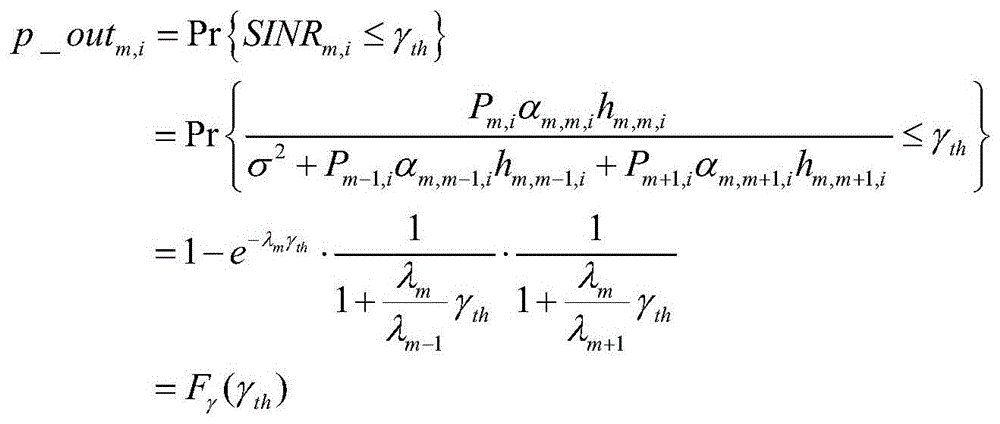
其中,
然后依据信号中断概率确定信号中断概率约束条件: p_outm,i=Pr(SINRm,i≤γth)≤p0,其中,p0是概率阈值,可以按照需求设置。Then, the signal interruption probability constraint condition is determined according to the signal interruption probability: p_out m,i =Pr(SINR m,i ≤γ th )≤p 0 , where p 0 is a probability threshold, which can be set as required.
以及可以确定车辆上行发射功率约束条件:0≤Pm,i≤Pmax,其中,Pmax为第 m个小区使用第i个资源块的车辆的最大上行发射功率。And the vehicle uplink transmit power constraint condition can be determined: 0≤P m,i ≤P max , where P max is the maximum uplink transmit power of the vehicle using the i th resource block in the m th cell.
进而针对系统容量瞬时模型,建立对应的系统容量瞬时优化模型,可表 示为:Then, according to the instantaneous model of system capacity, the corresponding instantaneous optimization model of system capacity is established, which can be expressed as:



针对系统容量均值模型,建立对应的系统容量均值优化模型,可表示为:For the system capacity mean model, the corresponding system capacity mean value optimization model is established, which can be expressed as:


然后可以通过对系统容量优化模型进行计算,确定功率分配信息,具体 可参照步骤305-步骤306:Then the power allocation information can be determined by calculating the system capacity optimization model, specifically referring to
步骤305、采用罚函数,将所述系统容量优化模型转换为适应度函数。
步骤306、依据粒子群优化算法和适应度函数,确定功率分配信息。Step 306: Determine the power allocation information according to the particle swarm optimization algorithm and the fitness function.
本发明实施例中,可以采用罚函数将系统容量优化模型进行转换,转换 为没有约束条件的适应度函数,可采用如下表达式表示适应度函数:In the embodiment of the present invention, a penalty function can be used to convert the system capacity optimization model into a fitness function without constraints, and the following expression can be used to represent the fitness function:
fit=f(x)+α·G1+β·G2 fit=f(x)+α·G 1 +β·G 2
其中,fit是适应度函数,f(x)为目标函数,G1为中断约束集合;G2为 功率约束集合;α和β为相应的惩罚因子向量。Among them, fit is the fitness function, f(x) is the objective function, G 1 is the set of interruption constraints; G 2 is the set of power constraints; α and β are the corresponding penalty factor vectors.
因此,采用罚函数对系统容量瞬时优化模型进行转换,得到瞬时适应度 函数,可采用如下表达式表示:Therefore, the penalty function is used to convert the instantaneous optimization model of the system capacity to obtain the instantaneous fitness function, which can be expressed by the following expression:

其中,fI为瞬时适应度函数,μm,i和θm,i为惩罚因子。Among them, f I is the instantaneous fitness function, and μ m,i and θ m,i are penalty factors.
采用罚函数对系统容量均值优化模型进行转换,得到均值适应度函数, 可采用如下表达式表示:The penalty function is used to transform the system capacity mean optimization model to obtain the mean fitness function, which can be expressed by the following expression:

其中,fD为瞬时适应度函数,αm,i和βm,i为惩罚因子。Among them, f D is the instantaneous fitness function, and α m,i and β m,i are penalty factors.
然后再采用粒子群优化算法和适应度函数,确定功率分配信息;具体可 包括如下子步骤:Then use the particle swarm optimization algorithm and fitness function to determine the power allocation information; the specific steps include the following:
子步骤61、初始化粒子群,所述粒子群中每个粒子包括对应的位置和速 度,每个粒子的位置包括车联网系统中所有车辆的上行发射功率,每个粒子 的速度包括车联网系统中所有车辆的上行发射功率的调整步长。Sub-step 61, initialize the particle swarm, each particle in the particle swarm includes a corresponding position and speed, the position of each particle includes the uplink transmission power of all vehicles in the Internet of Vehicles system, and the speed of each particle includes the speed of each particle in the Internet of Vehicles system. Adjustment step size for uplink transmit power of all vehicles.
本发明实施例中可以先初始化粒子群,其中,初始化粒子群可以包括设 置粒子群的维度,其中,一种设置粒子群维度的方式可以是,依据车联网系 统中小区的数量和车辆的数量,确定粒子群的维度。例如,车联网系统中包 括S个小区,每个小区对应K个车辆,则可以生成一个S*K的矩阵:In the embodiment of the present invention, the particle swarm may be initialized first, wherein initializing the particle swarm may include setting the dimension of the particle swarm, wherein, a method of setting the dimension of the particle swarm may be, according to the number of cells and the number of vehicles in the Internet of Vehicles system, Determine the dimensions of the particle swarm. For example, the IoV system includes S cells, and each cell corresponds to K vehicles, then an S*K matrix can be generated:

其中,矩阵中x11可以表示第一个小区的第一个车辆的上行发射功率,x1K可以表示第一个小区的第K个车辆的上行发射功率,xS1可以表示第S个小区 的第一个车辆的上行发射功率,xSK可以表示第S个小区的第K个车辆的上行 发射功率,……,依次类推;进而可以将矩阵的元素个数确定为粒子群的维 度D=S*K,一个维度对应车联网系统中一个车辆。初始化粒子群可以包括 按照需求设置粒子群的规模,即设置粒子群中粒子的数量,以及初始化各粒 子的位置和速度;其中,一个粒子的位置可以表示为:xi=(xi1,xi2,...,xid...xiD)T,其中,xid表示一个车辆的上行发射功率,xi1可以与上述矩阵中x11,……,以 此类推,xiD可以与上述矩阵中xSK对应。以及一个粒子的速度可以表示为: Vi=(vi1,vi2,...,vid...viD)T,其中,vid表示一个车辆的上行发射功率对应的调整步长。Among them, x 11 in the matrix can represent the uplink transmit power of the first vehicle in the first cell, x 1K can represent the uplink transmit power of the K-th vehicle in the first cell, and x S1 can represent the S-th cell’s uplink transmit power The uplink transmission power of a vehicle, x SK can represent the uplink transmission power of the Kth vehicle in the Sth cell, ..., and so on; and then the number of elements of the matrix can be determined as the dimension of the particle swarm D=S* K, one dimension corresponds to a vehicle in the Internet of Vehicles system. Initializing the particle swarm may include setting the size of the particle swarm as required, that is, setting the number of particles in the particle swarm, and initializing the position and speed of each particle; wherein, the position of a particle can be expressed as: x i =(x i1 ,x i2 ,...,x id ...x iD ) T , where x id represents the uplink transmit power of a vehicle, x i1 can be the same as x 11 , ... in the above matrix, and so on, x iD can be the same as the above matrix where x SK corresponds. And the speed of a particle can be expressed as: V i =(v i1 ,v i2 ,...,v id ...v iD ) T , where v id represents the adjustment step size corresponding to the uplink transmission power of a vehicle.
子步骤62、依据各粒子的位置、速度和所述适应度函数,对各粒子的位 置进行迭代更新。Sub-step 62: Iteratively update the position of each particle according to the position, velocity and the fitness function of each particle.
子步骤63、确定迭代次数达到预设迭代次数时的全局最优位置,依据全 局最优位置确定功率分配信息。Sub-step 63: Determine the global optimal position when the number of iterations reaches a preset number of iterations, and determine the power allocation information according to the global optimal position.
本发明实施例中,可以对各粒子的位置进行迭代更新,确定全局最优位 置,然后依据全局最优位置确定功率分配信息;其中,每次更新粒子群中各 粒子位置的过程中可以如下:In the embodiment of the present invention, the position of each particle can be iteratively updated, the global optimal position is determined, and then the power allocation information is determined according to the global optimal position; wherein, the process of updating the position of each particle in the particle swarm each time can be as follows:
可以先分别将粒子群中各粒子的位置代入至适应度函数中计算,得到每 个粒子对应的适应度值;然后记录本次计算过程中适应度值最优的粒子对应 的位置(也可称为局部最优位置),可以记做:pi=(pi1,pi2,...,piD)T,以及根据 各粒子历史适应度值和本次适应度值,确定粒子群中适应度值最优的粒子和 对应的位置(也可称为全局最优位置),可以记做:pg=(pg1,pg2,...pgD)T;然后 依据局部最优位置和全局最优位置,对粒子群中各粒子的位置进行更新。The position of each particle in the particle swarm can be substituted into the fitness function for calculation, and the corresponding fitness value of each particle can be obtained; then the position corresponding to the particle with the best fitness value in this calculation process can be recorded (also called is the local optimal position), which can be written as: p i =(p i1 ,p i2 ,...,p iD ) T , and according to the historical fitness value of each particle and the current fitness value, determine the fitness in the particle swarm The particle with the optimal degree value and the corresponding position (also known as the global optimal position) can be written as: p g = (p g1 , p g2 ,...p gD ) T ; then according to the local optimal position and The global optimal position updates the position of each particle in the particle swarm.
其中,可以依据局部最优位置和全局最优位置,确定各粒子的速度:Among them, the velocity of each particle can be determined according to the local optimal position and the global optimal position:
vid(gn+1)=wvid(gn)+c1r1(gn)(pid(gn)-xid(gn)) +c2r2(gn)(pgd(gn)-xid(gn))v id (g n +1)=wv id (g n )+c 1 r 1 (g n )(p id (g n )-x id (g n ))+c 2 r 2 (g n )(p gd (g n )-x id (g n ))
然后再依据粒子的速度,对粒子的位置进行更新:Then according to the speed of the particle, the position of the particle is updated:
xid(gn+1)=xid(gn)+vid(gn+1)x id (g n +1)=x id (g n )+v id (g n +1)
其中,d=1,2,...,D;i=1,2,...,K;gn为迭代次数;w为惯性因子;r1、r2为 分布于[0,1]之间的随机数,这两个参数用于保持群体的多样性;c1,c2为学 习因子。Among them, d=1,2,...,D; i=1,2,...,K; g n is the number of iterations; w is the inertia factor; r 1 , r 2 are distributed in [0, 1] The random number between, these two parameters are used to maintain the diversity of the population; c 1 , c 2 are learning factors.
当确定达到预设迭代次数时,可以停止对粒子群中各粒子位置的更新, 然后将此时的全局最优位置,作为功率分配信息;其中,所述功率分配信息 可以是一个D维向量,如P=(P1,P2,...,PD)T,其中的每一个元素可以对应某一 个小区的某一个车辆的上行发射功率。其中,可以在设置预设方向,按照预 设方向上车辆进入小区的顺序确定车辆为该小区的第几个车辆。本发明实施 例中,预设迭代次数和预设方向均可按照需求设置。When it is determined that the preset number of iterations has been reached, the updating of the position of each particle in the particle swarm can be stopped, and then the global optimal position at this time can be used as the power allocation information; wherein, the power allocation information can be a D-dimensional vector, For example, P=(P 1 , P 2 , . . . , P D ) T , each element of which may correspond to the uplink transmit power of a certain vehicle in a certain cell. Wherein, the preset direction may be set, and the vehicle may be determined as the number th vehicle of the cell according to the sequence in which the vehicle enters the cell in the preset direction. In this embodiment of the present invention, the preset number of iterations and the preset direction can be set as required.
步骤307、依据所述功率分配信息确定各车辆的上行发射功率。Step 307: Determine the uplink transmit power of each vehicle according to the power allocation information.
步骤308、通过基站通知各车辆对应的上行发射功率,以使各车辆按照 对应的上行发射功率发送上行数据。Step 308: Notify each vehicle of the corresponding uplink transmit power through the base station, so that each vehicle sends uplink data according to the corresponding uplink transmit power.
然后可以依据功率分配信息、车联网系统内基站数量和每个基站对应的 车辆数量,确定各车辆对应的上行发射功率;然后网络侧设备将各车辆的上 行发射功率下发给基站,由基站将车辆的上行发射功率发送给对应的车辆; 进而车辆可以按照对应的上行发射功率发送上行数据。Then, the uplink transmit power corresponding to each vehicle can be determined according to the power allocation information, the number of base stations in the IoV system, and the number of vehicles corresponding to each base station; then the network side equipment sends the uplink transmit power of each vehicle to the base station, and the base station sends the uplink transmit power of each vehicle to the base station. The uplink transmission power of the vehicle is sent to the corresponding vehicle; and then the vehicle can send uplink data according to the corresponding uplink transmission power.
本发明的一个示例中,可参照图4,示出了本发明实施例的一种系统容 量的示意图;其中,P1是车辆采用本发明实施例根据系统容量瞬时模型分 配的上行发射功率,发送上行数据时对应的系统容量,P2是车辆采用最大 功率(23dBm)发送上行数据时对应的系统容量,P3是车辆采用最低功率 (0dBm)发送上行数据时对应的系统容量。可见,P1优于P2、P3,并且随 着小区中车辆的增多,优化效果更明显。In an example of the present invention, referring to FIG. 4 , a schematic diagram of a system capacity according to an embodiment of the present invention is shown; wherein, P1 is the uplink transmit power allocated by the vehicle according to the instant model of the system capacity according to the embodiment of the present invention. The system capacity corresponding to the data, P2 is the system capacity corresponding to the vehicle using the maximum power (23dBm) to send uplink data, and P3 is the system capacity corresponding to the vehicle using the lowest power (0dBm) to send the uplink data. It can be seen that P1 is better than P2 and P3, and with the increase of vehicles in the community, the optimization effect is more obvious.
本发明的另一个示例中,可参照图5,示出了本发明实施例的一种系统 容量性能的示意图,其中,C1是车辆采用最低功率(0dBm)发送上行数据 时计算的系统容量对应的系统容量性能,C2是车辆采用最大功率(23dBm) 发送上行数据时计算的系统容量对应的系统容量性能,C3是车辆采用本发 明实施例根据系统容量均值模型分配的上行发射功率,发送上行数据时计算 的系统容量对应的系统容量性能,C4是车辆采用本发明实施例根据系统容 量瞬时模型分配的上行发射功率,发送上行数据时计算的系统容量对应的系 统容量性能。可见C4优于C3,C3优于C1、C2。In another example of the present invention, referring to FIG. 5, it shows a schematic diagram of a system capacity performance according to an embodiment of the present invention, wherein C1 is the system capacity calculated when the vehicle uses the lowest power (0dBm) to send uplink data. System capacity performance, C2 is the system capacity performance corresponding to the system capacity calculated when the vehicle uses the maximum power (23dBm) to send uplink data, and C3 is the uplink transmit power allocated by the vehicle according to the system capacity mean model according to the embodiment of the present invention. The system capacity performance corresponding to the calculated system capacity, C4 is the system capacity performance corresponding to the system capacity calculated when the vehicle transmits uplink data using the uplink transmit power allocated by the vehicle according to the instantaneous model of the system capacity according to the embodiment of the present invention. It can be seen that C4 is better than C3, and C3 is better than C1 and C2.
本发明实施例中,网络侧设备可以获取信道状态信息,依据所述信道状 态信息建立系统容量模型,然后基于系统容量模型,确定以系统容量最大化 为目标的系统容量优化模型;再依据所述系统容量优化模型确定功率分配信 息,依据所述功率分配信息确定各车辆的上行发射功率;通过基站通知各车 辆对应的上行发射功率,以使各车辆按照对应的上行发射功率发送上行数 据。本发明实施例通过最大化系统容量来进行功率分配,有效降低同频干扰; 且通过最大化系统容量来提升网络通信质量。In this embodiment of the present invention, the network side device may acquire channel state information, establish a system capacity model based on the channel state information, and then determine a system capacity optimization model aiming at maximizing system capacity based on the system capacity model; The system capacity optimization model determines power allocation information, and determines the uplink transmit power of each vehicle according to the power allocation information; the base station notifies each vehicle of the corresponding uplink transmit power, so that each vehicle sends uplink data according to the corresponding uplink transmit power. The embodiment of the present invention performs power allocation by maximizing system capacity, effectively reducing co-channel interference; and improving network communication quality by maximizing system capacity.
其次,本发明实施例在建立系统容量优化模型的过程中,确定信号中断 概率约束条件和车辆上行发射功率约束条件,依据所述系统容量模型、信号 中断概率约束条件和车辆上行发射功率约束条件,建立以最大化系统容量为 目标的系统容量优化模型;能够在保证车辆通信中断性能的条件下,提升网 络系统容量,进一步提升了网络通信质量。Secondly, in the process of establishing the system capacity optimization model in the embodiment of the present invention, the signal interruption probability constraints and the vehicle uplink transmission power constraints are determined, and according to the system capacity model, the signal interruption probability constraints and the vehicle uplink transmission power constraints, The system capacity optimization model aiming at maximizing the system capacity is established; under the condition of ensuring the performance of vehicle communication interruption, the network system capacity can be improved, and the network communication quality can be further improved.
再次,本发明实施例在所述依据所述系统容量优化模型确定功率分配信 息过程中,采用罚函数,将所述系统容量优化模型转换为适应度函数,依据 粒子群优化算法和适应度函数,确定功率分配信息;通过采用粒子群算法迭 代,使得系统容量优化模型能够快速收敛、差错率低,从而提高了功率分配 的效率。Thirdly, in the embodiment of the present invention, in the process of determining the power allocation information according to the system capacity optimization model, a penalty function is used to convert the system capacity optimization model into a fitness function, and according to the particle swarm optimization algorithm and the fitness function, Determine the power allocation information; by adopting the particle swarm algorithm iteration, the system capacity optimization model can converge quickly and the error rate is low, thereby improving the efficiency of power allocation.
进一步,本发明实施例在确定控制信道占用率高于占用率阈值时,依据 所述信道状态分布信息建立系统容量均值模型;其中,信道状态分布信息无 需通过控制信道获取,从而降低了信道开销。Further, in the embodiment of the present invention, when it is determined that the control channel occupancy rate is higher than the occupancy rate threshold, a system capacity mean model is established according to the channel state distribution information; wherein, the channel state distribution information does not need to be obtained through the control channel, thereby reducing the channel overhead.
需要说明的是,对于方法实施例,为了简单描述,故将其都表述为一系 列的动作组合,但是本领域技术人员应该知悉,本发明实施例并不受所描述 的动作顺序的限制,因为依据本发明实施例,某些步骤可以采用其他顺序或 者同时进行。其次,本领域技术人员也应该知悉,说明书中所描述的实施例 均属于优选实施例,所涉及的动作并不一定是本发明实施例所必须的。It should be noted that, for the sake of simple description, the method embodiments are described as a series of action combinations, but those skilled in the art should know that the embodiments of the present invention are not limited by the described action sequences, because According to embodiments of the present invention, certain steps may be performed in other sequences or simultaneously. Secondly, those skilled in the art should also know that the embodiments described in the specification are all preferred embodiments, and the actions involved are not necessarily required by the embodiments of the present invention.
本发明实施例还提供了一种功率分配装置,应用于上述车联网系统中。The embodiment of the present invention also provides a power distribution device, which is applied in the above-mentioned vehicle networking system.
参照图6,示出了本发明一种功率分配装置实施例的结构框图,具体可 以包括如下模块:Referring to Fig. 6, it shows a structural block diagram of an embodiment of a power distribution apparatus of the present invention, which may specifically include the following modules:
信息获取模块601,用于获取信道信息;an information acquisition module 601, configured to acquire channel information;
第一模型建立模块602,用于依据所述信道信息建立系统容量模型;a first model establishment module 602, configured to establish a system capacity model according to the channel information;
第二模型建立模块603,用于基于系统容量模型,确定以系统容量最大 化为目标的系统容量优化模型;The second model establishment module 603 is used to determine the system capacity optimization model aiming at maximizing the system capacity based on the system capacity model;
功率确定模块604,用于依据所述系统容量优化模型确定功率分配信息, 依据所述功率分配信息确定各车辆的上行发射功率;a power determination module 604, configured to determine power allocation information according to the system capacity optimization model, and determine the uplink transmit power of each vehicle according to the power allocation information;
功率通知模块605,用于通过基站通知各车辆对应的上行发射功率,以 使各车辆按照对应的上行发射功率发送上行数据。The power notification module 605 is configured to notify the corresponding uplink transmission power of each vehicle through the base station, so that each vehicle sends uplink data according to the corresponding uplink transmission power.
参照图7,示出了本发明一种功率分配装置可选实施例的结构框图。Referring to FIG. 7 , a structural block diagram of an optional embodiment of a power distribution apparatus according to the present invention is shown.
本发明的一个可选实施例中,所述信道信息包括信道状态信息和信道状 态分布信息,所述第一模型建立模块602,具体用于判断控制信道占用率是 否低于占用率阈值;若控制信道占用率低于占用率阈值,则依据所述信道状 态信息建立系统容量瞬时模型;若控制信道占用率高于占用率阈值,则依据 所述信道状态分布信息建立系统容量均值模型。In an optional embodiment of the present invention, the channel information includes channel state information and channel state distribution information, and the first model establishment module 602 is specifically configured to determine whether the control channel occupancy rate is lower than the occupancy rate threshold; If the channel occupancy rate is lower than the occupancy rate threshold, an instantaneous model of system capacity is established according to the channel state information; if the control channel occupancy rate is higher than the occupancy rate threshold, a system capacity mean model is established according to the channel state distribution information.
本发明的一个可选实施例中,所述第二模型建立模块603,具体用于确 定信号中断概率约束条件和车辆上行发射功率约束条件;依据所述系统容量 模型、信号中断概率约束条件和车辆上行发射功率约束条件,建立以最大化 系统容量为目标的系统容量优化模型。In an optional embodiment of the present invention, the second model establishment module 603 is specifically configured to determine a signal interruption probability constraint and a vehicle uplink transmit power constraint; according to the system capacity model, the signal interruption probability constraint and the vehicle Based on the uplink transmit power constraints, a system capacity optimization model aiming at maximizing system capacity is established.
本发明的一个可选实施例中,所述功率确定模块604包括:In an optional embodiment of the present invention, the power determination module 604 includes:
转换子模块6041,用于采用罚函数,将所述系统容量优化模型转换为适 应度函数;The conversion submodule 6041 is used for using a penalty function to convert the system capacity optimization model into a fitness function;
功率信息确定子模块6042,用于依据粒子群优化算法和适应度函数,确 定功率分配信息。The power information determination sub-module 6042 is configured to determine the power allocation information according to the particle swarm optimization algorithm and the fitness function.
本发明的一个可选实施例中,所述功率信息确定子模块6042,具体用于 初始化粒子群,所述粒子群中每个粒子包括对应的位置和速度,每个粒子的 位置包括车联网系统中所有车辆的上行发射功率,每个粒子的速度包括车联 网系统中所有车辆的上行发射功率的调整步长;依据各粒子的位置、速度和 所述适应度函数,对各粒子的位置进行迭代更新;确定迭代次数达到预设迭 代次数时的全局最优位置,依据全局最优位置确定功率分配信息。In an optional embodiment of the present invention, the power information determination sub-module 6042 is specifically used to initialize a particle swarm, where each particle in the particle swarm includes a corresponding position and speed, and the position of each particle includes the vehicle networking system The uplink transmission power of all vehicles in the network, and the speed of each particle includes the adjustment step size of the uplink transmission power of all vehicles in the Internet of Vehicles system; according to the position, speed and the fitness function of each particle, the position of each particle is iterated. Update; determine the global optimal position when the number of iterations reaches the preset number of iterations, and determine the power allocation information according to the global optimal position.
本发明实施例中,网络侧设备可以获取信道信息,依据所述信道信息建 立系统容量模型,然后基于系统容量模型,确定以系统容量最大化为目标的 系统容量优化模型;再依据所述系统容量优化模型确定功率分配信息,依据 所述功率分配信息确定各车辆的上行发射功率;通过基站通知各车辆对应的 上行发射功率,以使各车辆按照对应的上行发射功率发送上行数据。本发明 实施例通过最大化系统容量来进行功率分配,有效降低同频干扰。In this embodiment of the present invention, the network-side device may acquire channel information, establish a system capacity model based on the channel information, and then determine a system capacity optimization model aiming at maximizing system capacity based on the system capacity model; and then based on the system capacity The optimization model determines power allocation information, and determines the uplink transmit power of each vehicle according to the power allocation information; the base station notifies each vehicle of the corresponding uplink transmit power, so that each vehicle sends uplink data according to the corresponding uplink transmit power. The embodiments of the present invention perform power allocation by maximizing system capacity, thereby effectively reducing co-channel interference.
对于装置实施例而言,由于其与方法实施例基本相似,所以描述的比较 简单,相关之处参见方法实施例的部分说明即可。As for the apparatus embodiment, since it is basically similar to the method embodiment, the description is relatively simple, and reference may be made to the partial description of the method embodiment for related parts.
本说明书中的各个实施例均采用递进的方式描述,每个实施例重点说明 的都是与其他实施例的不同之处,各个实施例之间相同相似的部分互相参见 即可。The various embodiments in this specification are described in a progressive manner, and each embodiment focuses on the differences from other embodiments, and the same and similar parts between the various embodiments can be referred to each other.
本领域内的技术人员应明白,本发明实施例的实施例可提供为方法、装 置、或计算机程序产品。因此,本发明实施例可采用完全硬件实施例、完全 软件实施例、或结合软件和硬件方面的实施例的形式。而且,本发明实施例 可采用在一个或多个其中包含有计算机可用程序代码的计算机可用存储介 质(包括但不限于磁盘存储器、CD-ROM、光学存储器等)上实施的计算机程 序产品的形式。Those skilled in the art will appreciate that embodiments of embodiments of the present invention may be provided as a method, an apparatus, or a computer program product. Accordingly, embodiments of the present invention may take the form of an entirely hardware embodiment, an entirely software embodiment, or an embodiment combining software and hardware aspects. Furthermore, embodiments of the present invention may take the form of a computer program product implemented on one or more computer-usable storage media (including, but not limited to, disk storage, CD-ROM, optical storage, etc.) having computer-usable program code embodied therein.
本发明实施例是参照根据本发明实施例的方法、终端设备(系统)、和计 算机程序产品的流程图和/或方框图来描述的。应理解可由计算机程序指令 实现流程图和/或方框图中的每一流程和/或方框、以及流程图和/或方框 图中的流程和/或方框的结合。可提供这些计算机程序指令到通用计算机、 专用计算机、嵌入式处理机或其他可编程数据处理终端设备的处理器以产生 一个机器,使得通过计算机或其他可编程数据处理终端设备的处理器执行的 指令产生用于实现在流程图一个流程或多个流程和/或方框图一个方框或 多个方框中指定的功能的装置。Embodiments of the present invention are described with reference to flowcharts and/or block diagrams of methods, terminal devices (systems), and computer program products according to embodiments of the present invention. It will be understood that each flow and/or block in the flowchart illustrations and/or block diagrams, and combinations of flows and/or blocks in the flowchart illustrations and/or block diagrams, can be implemented by computer program instructions. These computer program instructions may be provided to the processor of a general purpose computer, special purpose computer, embedded processor or other programmable data processing terminal equipment to produce a machine that causes the instructions to be executed by the processor of the computer or other programmable data processing terminal equipment Means are created for implementing the functions specified in the flow or flows of the flowcharts and/or the blocks or blocks of the block diagrams.
这些计算机程序指令也可存储在能引导计算机或其他可编程数据处理 终端设备以特定方式工作的计算机可读存储器中,使得存储在该计算机可读 存储器中的指令产生包括指令装置的制造品,该指令装置实现在流程图一个 流程或多个流程和/或方框图一个方框或多个方框中指定的功能。These computer program instructions may also be stored in a computer readable memory capable of directing a computer or other programmable data processing terminal equipment to operate in a particular manner, such that the instructions stored in the computer readable memory result in an article of manufacture comprising instruction means, the The instruction means implement the functions specified in the flow or flow of the flowcharts and/or the block or blocks of the block diagrams.
这些计算机程序指令也可装载到计算机或其他可编程数据处理终端设 备上,使得在计算机或其他可编程终端设备上执行一系列操作步骤以产生计 算机实现的处理,从而在计算机或其他可编程终端设备上执行的指令提供用 于实现在流程图一个流程或多个流程和/或方框图一个方框或多个方框中 指定的功能的步骤。These computer program instructions can also be loaded on a computer or other programmable data processing terminal equipment, so that a series of operational steps are performed on the computer or other programmable terminal equipment to produce a computer-implemented process, thereby executing on the computer or other programmable terminal equipment The instructions executed on the above provide steps for implementing the functions specified in the flowchart or blocks and/or the block or blocks of the block diagrams.
尽管已描述了本发明实施例的优选实施例,但本领域内的技术人员一旦 得知了基本创造性概念,则可对这些实施例做出另外的变更和修改。所以, 所附权利要求意欲解释为包括优选实施例以及落入本发明实施例范围的所 有变更和修改。While preferred embodiments of the embodiments of the present invention have been described, additional changes and modifications to these embodiments may occur to those skilled in the art once the basic inventive concepts are known. Therefore, the appended claims are intended to be construed to include the preferred embodiments as well as all changes and modifications that fall within the scope of the embodiments of the present invention.
最后,还需要说明的是,在本文中,诸如第一和第二等之类的关系术语 仅仅用来将一个实体或者操作与另一个实体或操作区分开来,而不一定要求 或者暗示这些实体或操作之间存在任何这种实际的关系或者顺序。而且,术 语“包括”、“包含”或者其任何其他变体意在涵盖非排他性的包含,从而使得 包括一系列要素的过程、方法、物品或者终端设备不仅包括那些要素,而且 还包括没有明确列出的其他要素,或者是还包括为这种过程、方法、物品或 者终端设备所固有的要素。在没有更多限制的情况下,由语句“包括一个……”限定的要素,并不排除在包括所述要素的过程、方法、物品或者终 端设备中还存在另外的相同要素。Finally, it should also be noted that in this document, relational terms such as first and second are used only to distinguish one entity or operation from another, and do not necessarily require or imply these entities or that there is any such actual relationship or sequence between operations. Moreover, the terms "comprising", "comprising" or any other variation thereof are intended to encompass non-exclusive inclusion, such that a process, method, article or terminal device comprising a list of elements includes not only those elements, but also a non-exclusive list of elements. other elements, or also include elements inherent to such a process, method, article or terminal equipment. Without further limitation, an element defined by the phrase "comprises a..." does not preclude the presence of additional identical elements in the process, method, article or terminal device comprising said element.
以上对本发明所提供的一种功率分配方法和一种功率分配装置,进行了 详细介绍,本文中应用了具体个例对本发明的原理及实施方式进行了阐述, 以上实施例的说明只是用于帮助理解本发明的方法及其核心思想;同时,对 于本领域的一般技术人员,依据本发明的思想,在具体实施方式及应用范围 上均会有改变之处,综上所述,本说明书内容不应理解为对本发明的限制。A power distribution method and a power distribution device provided by the present invention have been described in detail above. The principles and implementations of the present invention are described with specific examples in this paper. The descriptions of the above embodiments are only for help. Understand the method of the present invention and its core idea; at the same time, for those skilled in the art, according to the idea of the present invention, there will be changes in the specific implementation and application scope. In summary, the content of this specification does not It should be understood as a limitation of the present invention.
Claims (8)
Priority Applications (1)
| Application Number | Priority Date | Filing Date | Title |
|---|---|---|---|
| CN201811279512.0A CN111132298B (en) | 2018-10-30 | 2018-10-30 | A power distribution method and device |
Applications Claiming Priority (1)
| Application Number | Priority Date | Filing Date | Title |
|---|---|---|---|
| CN201811279512.0A CN111132298B (en) | 2018-10-30 | 2018-10-30 | A power distribution method and device |
Publications (2)
| Publication Number | Publication Date |
|---|---|
| CN111132298A CN111132298A (en) | 2020-05-08 |
| CN111132298B true CN111132298B (en) | 2021-05-28 |
Family
ID=70484640
Family Applications (1)
| Application Number | Title | Priority Date | Filing Date |
|---|---|---|---|
| CN201811279512.0A Active CN111132298B (en) | 2018-10-30 | 2018-10-30 | A power distribution method and device |
Country Status (1)
| Country | Link |
|---|---|
| CN (1) | CN111132298B (en) |
Families Citing this family (2)
| Publication number | Priority date | Publication date | Assignee | Title |
|---|---|---|---|---|
| CN114125884B (en) * | 2020-09-01 | 2025-03-21 | 中国移动通信有限公司研究院 | Uplink capacity optimization method, device, network node and storage medium |
| CN114158116B (en) * | 2021-11-29 | 2024-08-02 | 国网上海市电力公司 | Power self-adaptive adjusting method of edge computing cloud server |
Family Cites Families (7)
| Publication number | Priority date | Publication date | Assignee | Title |
|---|---|---|---|---|
| US9271245B2 (en) * | 2012-10-29 | 2016-02-23 | Lg Electronics Inc. | Method for determining transmission power |
| EP3280172B1 (en) * | 2015-04-01 | 2024-05-29 | LG Electronics Inc. | Method and device for transmitting, by v2x terminal, signal in wireless communication system |
| CN105050176A (en) * | 2015-05-29 | 2015-11-11 | 重庆邮电大学 | Stackelberg game power control method based on interruption probability constraint in cognitive radio network |
| CN105979590B (en) * | 2016-04-27 | 2019-04-16 | 西安交通大学 | User Scheduling and Power Allocation Based on Effective Capacity in Cognitive Radio Systems |
| CN105979598B (en) * | 2016-06-29 | 2019-07-12 | 哈尔滨工业大学深圳研究生院 | A kind of LTE-D2D car networking resource allocation methods based on traffic flow Dynamic Packet |
| CN106160993B (en) * | 2016-08-12 | 2019-03-05 | 江苏大学 | A kind of power system capacity expansion method based on D2D traffic model in ITS |
| CN106954268A (en) * | 2017-05-03 | 2017-07-14 | 北京科技大学 | A method for allocating access network resources under SDN architecture |
-
2018
- 2018-10-30 CN CN201811279512.0A patent/CN111132298B/en active Active
Also Published As
| Publication number | Publication date |
|---|---|
| CN111132298A (en) | 2020-05-08 |
Similar Documents
| Publication | Publication Date | Title |
|---|---|---|
| Duan et al. | SDN enabled 5G-VANET: Adaptive vehicle clustering and beamformed transmission for aggregated traffic | |
| CN109905918B (en) | NOMA cellular Internet of vehicles dynamic resource scheduling method based on energy efficiency | |
| JP5536671B2 (en) | Communication apparatus and communication method for adaptively controlling channel bandwidth | |
| CN106658514A (en) | Energy efficiency and frequency spectrum efficiency balance method for micro base station super dense disposition heterogeneous network | |
| KR102178880B1 (en) | Network system and data trasmission method based on device clustering in lorawan communication | |
| Chen et al. | A millimeter wave-based sensor data broadcasting scheme for vehicular communications | |
| Lehong et al. | A survey of lorawan adaptive data rate algorithms for possible optimization | |
| CN112367668A (en) | Unmanned aerial vehicle base station deployment method utilizing reflected wave beam to supplement coverage | |
| da Silva et al. | D2D assisted Q-learning random access for NOMA-based MTC networks | |
| CN111132298B (en) | A power distribution method and device | |
| CN107135469A (en) | A Distributed User Access Method | |
| Shafiq et al. | Analysis and evaluation of random access transmission for UAV-assisted vehicular-to-infrastructure communications | |
| Hegde et al. | Cellular-v2x for vulnerable road user protection in cooperative its | |
| KR102200713B1 (en) | Interference-aware transmission power control method and apparatus for IEEE 802.11-based wireless networks with nodes with directional antennas | |
| CN118921712A (en) | Multi-agent system networking and resource optimization method | |
| Mondal et al. | Station grouping mechanism using machine learning approach for IEEE 802.11 ah | |
| Zheng et al. | Capacity of vehicular networks in mixed traffic with CAVs and human-driven vehicles | |
| Ding et al. | Resource allocation for low-latency NOMA-enabled vehicle platoon-based V2X system | |
| CN112243195A (en) | Beam multicast fast access method based on content intention dynamic tracking | |
| Ganjalizadeh et al. | Interplay between distributed AI workflow and URLLC | |
| Kosmanos et al. | Investigating 5G V2X QoS using turbo codes | |
| Cordeschi et al. | Performance evaluation of primary-secondary reliable resource-management in vehicular networks | |
| CN116017496A (en) | Communication method and device, system, storage medium, program product | |
| CN109041009B (en) | Internet of vehicles uplink power distribution method and device | |
| Cordeschi et al. | Hard and soft optimal resource allocation for primary and secondary users in infrastructure vehicular networks |
Legal Events
| Date | Code | Title | Description |
|---|---|---|---|
| PB01 | Publication | ||
| PB01 | Publication | ||
| SE01 | Entry into force of request for substantive examination | ||
| SE01 | Entry into force of request for substantive examination | ||
| GR01 | Patent grant | ||
| GR01 | Patent grant |