CN111131999B - A method and device for predicting destination based on location trajectory - Google Patents
A method and device for predicting destination based on location trajectory Download PDFInfo
- Publication number
- CN111131999B CN111131999B CN201811194932.9A CN201811194932A CN111131999B CN 111131999 B CN111131999 B CN 111131999B CN 201811194932 A CN201811194932 A CN 201811194932A CN 111131999 B CN111131999 B CN 111131999B
- Authority
- CN
- China
- Prior art keywords
- target
- target user
- signaling
- location
- destination
- Prior art date
- Legal status (The legal status is an assumption and is not a legal conclusion. Google has not performed a legal analysis and makes no representation as to the accuracy of the status listed.)
- Active
Links
- 238000000034 method Methods 0.000 title claims abstract description 93
- 230000011664 signaling Effects 0.000 claims abstract description 185
- 230000008859 change Effects 0.000 claims abstract description 34
- 238000004891 communication Methods 0.000 claims description 14
- 230000005540 biological transmission Effects 0.000 claims description 5
- 230000008569 process Effects 0.000 abstract description 20
- 238000004364 calculation method Methods 0.000 abstract description 12
- 238000004422 calculation algorithm Methods 0.000 abstract description 7
- 238000012544 monitoring process Methods 0.000 abstract description 4
- 238000012545 processing Methods 0.000 description 21
- 238000010586 diagram Methods 0.000 description 15
- 239000011159 matrix material Substances 0.000 description 15
- 230000007704 transition Effects 0.000 description 8
- 238000004458 analytical method Methods 0.000 description 7
- 230000033001 locomotion Effects 0.000 description 7
- 238000004590 computer program Methods 0.000 description 5
- 238000005516 engineering process Methods 0.000 description 4
- 230000001052 transient effect Effects 0.000 description 4
- 238000010521 absorption reaction Methods 0.000 description 3
- 230000006399 behavior Effects 0.000 description 3
- 230000000694 effects Effects 0.000 description 3
- 238000011156 evaluation Methods 0.000 description 3
- 239000000523 sample Substances 0.000 description 3
- 230000003542 behavioural effect Effects 0.000 description 2
- 238000013480 data collection Methods 0.000 description 2
- 230000006870 function Effects 0.000 description 2
- 230000003287 optical effect Effects 0.000 description 2
- 238000007619 statistical method Methods 0.000 description 2
- 230000001960 triggered effect Effects 0.000 description 2
- 101000802640 Homo sapiens Lactosylceramide 4-alpha-galactosyltransferase Proteins 0.000 description 1
- 102100035838 Lactosylceramide 4-alpha-galactosyltransferase Human genes 0.000 description 1
- 230000009471 action Effects 0.000 description 1
- 230000003044 adaptive effect Effects 0.000 description 1
- 230000003139 buffering effect Effects 0.000 description 1
- 230000007423 decrease Effects 0.000 description 1
- 238000005315 distribution function Methods 0.000 description 1
- 230000003203 everyday effect Effects 0.000 description 1
- 239000012634 fragment Substances 0.000 description 1
- 230000014509 gene expression Effects 0.000 description 1
- 238000005259 measurement Methods 0.000 description 1
- 238000010295 mobile communication Methods 0.000 description 1
- 238000012986 modification Methods 0.000 description 1
- 230000004048 modification Effects 0.000 description 1
- 238000007781 pre-processing Methods 0.000 description 1
- 238000002360 preparation method Methods 0.000 description 1
- 238000003672 processing method Methods 0.000 description 1
- 230000004044 response Effects 0.000 description 1
- 238000012216 screening Methods 0.000 description 1
- 230000009897 systematic effect Effects 0.000 description 1
- 230000000007 visual effect Effects 0.000 description 1
Images


Classifications
-
- H—ELECTRICITY
- H04—ELECTRIC COMMUNICATION TECHNIQUE
- H04W—WIRELESS COMMUNICATION NETWORKS
- H04W4/00—Services specially adapted for wireless communication networks; Facilities therefor
- H04W4/02—Services making use of location information
-
- H—ELECTRICITY
- H04—ELECTRIC COMMUNICATION TECHNIQUE
- H04L—TRANSMISSION OF DIGITAL INFORMATION, e.g. TELEGRAPHIC COMMUNICATION
- H04L5/00—Arrangements affording multiple use of the transmission path
- H04L5/003—Arrangements for allocating sub-channels of the transmission path
- H04L5/0053—Allocation of signalling, i.e. of overhead other than pilot signals
-
- H—ELECTRICITY
- H04—ELECTRIC COMMUNICATION TECHNIQUE
- H04W—WIRELESS COMMUNICATION NETWORKS
- H04W4/00—Services specially adapted for wireless communication networks; Facilities therefor
- H04W4/02—Services making use of location information
- H04W4/029—Location-based management or tracking services
Landscapes
- Engineering & Computer Science (AREA)
- Signal Processing (AREA)
- Computer Networks & Wireless Communication (AREA)
- Telephonic Communication Services (AREA)
- Navigation (AREA)
Abstract
本发明的实施例公开了一种基于位置轨迹预测目的地的方法及装置,该方法在监测到目标用户的位置发生变化后,即开始根据目标用户的实时位置对目标用户将要到达的目的地进行预测。预测过程中,根据目标用户对应的目标位置信令的数量选择不同的预测算法进行预测,当目标位置信令的数量不充足时,参考公共位置信令对目标用户的目的地进行预测,避免了由于目标位置信令不充足造成的预测不准确。另一方面,相比于采用统一的预测方法对用户的目的地进行预测的方法,该方法的简化了预测的计算过程,且该方法能够根据用户实时位置对用户将要到达的目的地进行预测,充分考虑了预测的时效性。
The embodiment of the present invention discloses a method and device for predicting a destination based on a location trajectory. After monitoring a change in the location of the target user, the method starts to perform the target user's destination based on the real-time location of the target user. predict. In the prediction process, different prediction algorithms are selected according to the number of target location signaling corresponding to the target user for prediction. Inaccurate predictions due to insufficient target location signaling. On the other hand, compared with the method of using a unified prediction method to predict the user's destination, this method simplifies the calculation process of the prediction, and the method can predict the destination that the user will reach according to the user's real-time location, The timeliness of the forecast is fully considered.
Description
技术领域technical field
本发明涉及移动通信定位技术领域,尤其是涉及一种基于位置轨迹预测目的地的方法及装置。The present invention relates to the technical field of mobile communication positioning, and in particular, to a method and device for predicting a destination based on a position trajectory.
背景技术Background technique
根据用户位置轨迹进行目的地预报主要用在通过用户目前已有的行动轨迹来推测用户在未来一段时间可能前往的目的地,这样可以帮助我们在用户到达目的地之前,提前做好准备,以便合理应对,还可以用在诸如客流预警等公共领域。Destination prediction based on the user's location trajectory is mainly used to infer the user's possible destination in the future based on the user's current action trajectory, which can help us prepare in advance before the user arrives at the destination, so that the It can also be used in public areas such as passenger flow warning.
目前历史轨迹目的地预测的方法包括了基于传统统计分析的目的地预测模型,这是基于条件概率进行计算,过程计算量大,边界条件苛刻,不具有很好的实用意义;还有基于贝叶斯统计的目的地预测模型,克服了传统统计分析的一些弱点,但同时也面临着统计样本的问题和计算量方面的问题;还有将用户的位置运动过程视作马尔科夫过程,为了处理问题的方便,人为地增加了无后效性的假设,一定程度上将问题进行了过于理想的假设。例如,基于无后效性假设对用户的目的地进行预测,引入过大的系统性误差;预测过程中由于计算的延时偏高,使得预报的结果失去意义,因为可能预报计算出来的时候,用户的真实结果已经发生了;采用较少的用户位置轨迹进行目的地的预测,导致预测结果偏离事实程度较大。At present, the destination prediction methods of historical trajectories include destination prediction models based on traditional statistical analysis, which are calculated based on conditional probabilities, which require a large amount of calculation and harsh boundary conditions, which do not have very good practical significance. Statistical destination prediction model, which overcomes some of the weaknesses of traditional statistical analysis, but also faces the problem of statistical samples and the amount of calculation; there is also the user's position movement process as a Markov process, in order to deal with The convenience of the problem has artificially increased the assumption of no aftereffect, and to a certain extent, the problem has been assumed to be too ideal. For example, the user's destination is predicted based on the assumption of no aftereffect, which introduces excessive systematic errors; during the prediction process, due to the high delay in the calculation, the prediction result is meaningless, because when the prediction is calculated, The real result of the user has already occurred; the prediction of the destination with fewer user location trajectories results in a larger deviation of the predicted result from the truth.
在实现本发明实施例的过程中,发明人发现现有的对目的地进行预测的方法中,对用于预测的数据充分性要求低,且由于计算过程复杂,延时较高,预测结果不准确。。In the process of implementing the embodiments of the present invention, the inventor found that in the existing method for predicting a destination, the requirement for data sufficiency for prediction is low, and due to the complicated calculation process and high delay, the prediction result is inconsistent. precise. .
发明内容SUMMARY OF THE INVENTION
本发明所要解决的技术问题是如何解决现有的对目的地进行预测的方法中,对用于预测的数据充分性要求低,且由于计算过程复杂,延时较高,预测结果不准确的问题。The technical problem to be solved by the present invention is how to solve the problem that in the existing method for predicting a destination, the requirement for data sufficiency for prediction is low, and the prediction result is inaccurate due to the complicated calculation process, high delay and inaccurate results. .
针对以上技术问题,本发明的实施例提供了一种基于位置轨迹预测目的地的方法,包括:In view of the above technical problems, an embodiment of the present invention provides a method for predicting a destination based on a position trajectory, including:
若监测到目标用户的位置发生改变,则判断预先存储的对应于所述目标用户的目标位置信令的数量是否满足预设数量要求;If it is detected that the location of the target user changes, then determine whether the number of pre-stored target location signaling corresponding to the target user meets the preset number requirement;
若所述目标位置信令的数量满足所述预设数量要求,则根据所述目标位置信令和所述目标用户的位置变化预测所述目标用户欲到达的目的地;If the quantity of the target location signaling meets the preset quantity requirement, predict the destination that the target user wants to reach according to the target location signaling and the location change of the target user;
若所述目标位置信令的数量不满足所述预设数量要求,则根据预先存储的公共位置信令和所述目标用户的位置变化预测所述目标用户欲到达的目的地;If the quantity of the target location signaling does not meet the preset quantity requirement, predict the destination to be reached by the target user according to the pre-stored public location signaling and the location change of the target user;
其中,每一目标位置信令均表示了所述目标用户在不同时刻的位置,每一公共位置信令均表示了不同用户在不同时刻的位置。Wherein, each target location signaling represents the location of the target user at different times, and each common location signaling represents the location of different users at different times.
本实施例提供了一种基于位置轨迹预测目的地的装置,包括:This embodiment provides an apparatus for predicting a destination based on a position trajectory, including:
判断模块,用于若监测到目标用户的位置发生改变,则判断预先存储的对应于所述目标用户的目标位置信令的数量是否满足预设数量要求;a judgment module, configured to judge whether the pre-stored quantity of target position signaling corresponding to the target user meets a preset quantity requirement if a change in the position of the target user is detected;
第一预测模块,用于若所述目标位置信令的数量满足所述预设数量要求,则根据所述目标位置信令和所述目标用户的位置变化预测所述目标用户欲到达的目的地;a first prediction module, configured to predict the destination that the target user wants to reach according to the target location signaling and the location change of the target user if the quantity of the target location signaling meets the preset quantity requirement ;
第二预测模块,用于若所述目标位置信令的数量不满足所述预设数量要求,则根据预先存储的公共位置信令和所述目标用户的位置变化预测所述目标用户欲到达的目的地;The second prediction module is configured to predict the destination the target user will reach according to the pre-stored public location signaling and the location change of the target user if the quantity of the target location signaling does not meet the preset quantity requirement. destination;
其中,每一目标位置信令均表示了所述目标用户在不同时刻的位置,每一公共位置信令均表示了不同用户在不同时刻的位置。Wherein, each target location signaling represents the location of the target user at different times, and each common location signaling represents the location of different users at different times.
本实施例提供了一种电子设备,包括:This embodiment provides an electronic device, including:
至少一个处理器、至少一个存储器、通信接口和总线;其中,at least one processor, at least one memory, a communication interface, and a bus; wherein,
所述处理器、存储器、通信接口通过所述总线完成相互间的通信;The processor, the memory, and the communication interface communicate with each other through the bus;
所述通信接口用于该电子设备和终端的通信设备之间的信息传输;The communication interface is used for information transmission between the electronic device and the communication device of the terminal;
所述存储器存储有可被所述处理器执行的程序指令,所述处理器调用所述程序指令能够执行以上所述的方法。The memory stores program instructions executable by the processor, the processor invoking the program instructions capable of performing the method described above.
本实施例提供了一种非暂态计算机可读存储介质,其特征在于,所述非暂态计算机可读存储介质存储计算机指令,所述计算机指令使所述计算机执行以上所述的方法。This embodiment provides a non-transitory computer-readable storage medium, characterized in that, the non-transitory computer-readable storage medium stores computer instructions, and the computer instructions cause the computer to execute the above-mentioned method.
本发明的实施例提供了一种基于位置轨迹预测目的地的方法及装置,该方法在监测到目标用户的位置发生变化后,即开始根据目标用户的实时位置对目标用户将要到达的目的地进行预测。预测过程中,根据目标用户对应的目标位置信令的数量选择不同的预测算法进行预测,当目标位置信令的数量不充足时,参考公共位置信令对目标用户的目的地进行预测,避免了由于目标位置信令不充足造成的预测不准确。另一方面,相比于采用统一的预测方法对用户的目的地进行预测的方法,该方法的简化了预测的计算过程,且该方法能够根据用户实时位置对用户将要到达的目的地进行预测,充分考虑了预测的时效性。Embodiments of the present invention provide a method and device for predicting a destination based on a location trajectory. After monitoring a change in the location of the target user, the method starts to predict the destination to be reached by the target user according to the real-time location of the target user. predict. In the prediction process, different prediction algorithms are selected according to the number of target location signaling corresponding to the target user for prediction. Inaccurate predictions due to insufficient target location signaling. On the other hand, compared with the method of using a unified prediction method to predict the user's destination, this method simplifies the calculation process of the prediction, and the method can predict the destination that the user will reach according to the user's real-time location, The timeliness of the forecast is fully considered.
附图说明Description of drawings
为了更清楚地说明本发明实施例或现有技术中的技术方案,下面将对实施例或现有技术描述中所需要使用的附图作一简单地介绍,显而易见地,下面描述中的附图是本发明的一些实施例,对于本领域普通技术人员来讲,在不付出创造性劳动的前提下,还可以根据这些附图获得其他的附图。In order to more clearly illustrate the embodiments of the present invention or the technical solutions in the prior art, the following briefly introduces the accompanying drawings that need to be used in the description of the embodiments or the prior art. Obviously, the accompanying drawings in the following description These are some embodiments of the present invention. For those of ordinary skill in the art, other drawings can also be obtained according to these drawings without creative efforts.
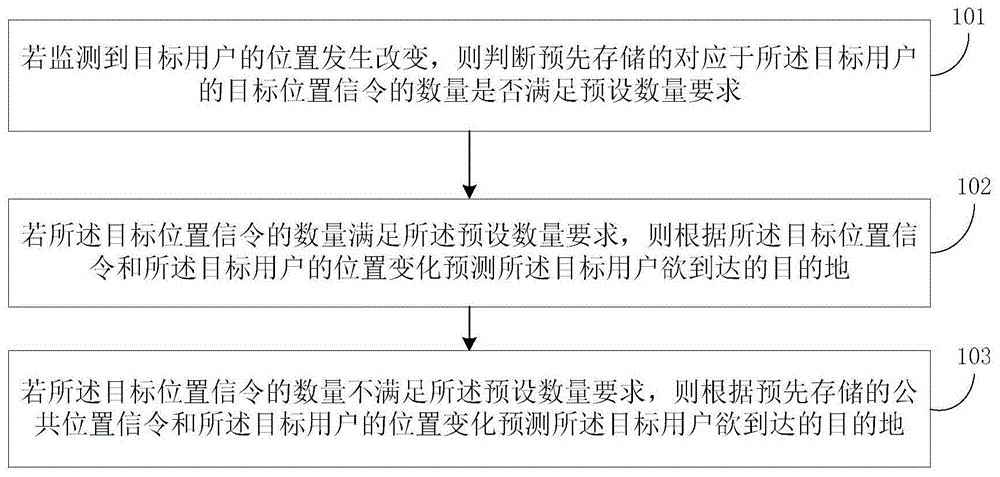
图1是本发明一个实施例提供的基于位置轨迹预测目的地的方法的流程示意图;1 is a schematic flowchart of a method for predicting a destination based on a location trajectory provided by an embodiment of the present invention;
图2是本发明另一个实施例提供的实现基于位置轨迹预测目的地的方法的硬件结构示意图;2 is a schematic diagram of a hardware structure of a method for implementing a method for predicting a destination based on a location trajectory provided by another embodiment of the present invention;
图3是本发明另一个实施例提供的基于位置轨迹预测目的地的方法的具体的实现流程示意图;3 is a schematic flowchart of a specific implementation of a method for predicting a destination based on a location trajectory provided by another embodiment of the present invention;
图4是本发明另一个实施例提供的beta分布概率密度曲线;4 is a beta distribution probability density curve provided by another embodiment of the present invention;
图5是本发明另一个实施例提供的流处理的原理示意图;FIG. 5 is a schematic diagram of the principle of stream processing provided by another embodiment of the present invention;
图6是本发明另一个实施例提供的用户经过的节点的示意图;6 is a schematic diagram of a node passed by a user according to another embodiment of the present invention;
图7是本发明另一个实施例提供的原有节点扩展前和扩展后的对比示意图;FIG. 7 is a schematic diagram of a comparison before and after expansion of an original node provided by another embodiment of the present invention;
图8是本发明另一个实施例提供的每条原始数据变成了若干条子数据的示意图;Fig. 8 is the schematic diagram that each piece of original data provided by another embodiment of the present invention becomes several pieces of sub-data;
图9是本发明另一个实施例提供的从某一节点到其它节点的次数示意图;9 is a schematic diagram of the number of times from a certain node to other nodes provided by another embodiment of the present invention;
图10是本发明另一个实施例提供的在某个景点的数据中,从一个结点到达其他结点的次数示意图;10 is a schematic diagram of the number of times from one node to other nodes in the data of a certain scenic spot provided by another embodiment of the present invention;
图11是本发明另一个实施例提供的对目的地进行预报的示意图;11 is a schematic diagram of forecasting a destination provided by another embodiment of the present invention;
图12是本发明另一个实施例提供的基于位置轨迹预测目的地的装置的结构框图;12 is a structural block diagram of an apparatus for predicting a destination based on a position trajectory provided by another embodiment of the present invention;
图13是本发明另一个实施例提供的电子设备的结构框图。FIG. 13 is a structural block diagram of an electronic device provided by another embodiment of the present invention.
具体实施方式Detailed ways
为使本发明实施例的目的、技术方案和优点更加清楚,下面将结合本发明实施例中的附图,对本发明实施例中的技术方案进行清楚、完整地描述,显然,所描述的实施例是本发明一部分实施例,而不是全部的实施例。基于本发明中的实施例,本领域普通技术人员在没有做出创造性劳动前提下所获得的所有其他实施例,都属于本发明保护的范围。In order to make the purposes, technical solutions and advantages of the embodiments of the present invention clearer, the technical solutions in the embodiments of the present invention will be clearly and completely described below with reference to the accompanying drawings in the embodiments of the present invention. Obviously, the described embodiments These are some embodiments of the present invention, but not all embodiments. Based on the embodiments of the present invention, all other embodiments obtained by those of ordinary skill in the art without creative efforts shall fall within the protection scope of the present invention.
图1是本实施例提供的基于位置轨迹预测目的地的方法的流程示意图。参见图1,该方法包括:FIG. 1 is a schematic flowchart of a method for predicting a destination based on a location trajectory provided in this embodiment. Referring to Figure 1, the method includes:
101:若监测到目标用户的位置发生改变,则判断预先存储的对应于所述目标用户的目标位置信令的数量是否满足预设数量要求;101: If it is detected that the location of the target user changes, determine whether the number of pre-stored target location signaling corresponding to the target user meets a preset number requirement;
102:若所述目标位置信令的数量满足所述预设数量要求,则根据所述目标位置信令和所述目标用户的位置变化预测所述目标用户欲到达的目的地;102: If the quantity of the target location signaling meets the preset quantity requirement, predict the destination to be reached by the target user according to the target location signaling and the location change of the target user;
103:若所述目标位置信令的数量不满足所述预设数量要求,则根据预先存储的公共位置信令和所述目标用户的位置变化预测所述目标用户欲到达的目的地;103: If the quantity of the target location signaling does not meet the preset quantity requirement, predict the destination to be reached by the target user according to the pre-stored public location signaling and the location change of the target user;
其中,每一目标位置信令均表示了所述目标用户在不同时刻的位置,每一公共位置信令均表示了不同用户在不同时刻的位置。Wherein, each target location signaling represents the location of the target user at different times, and each common location signaling represents the location of different users at different times.
需要说明的是,本实施例提供的方法通常由服务器执行。对任一用户,一旦监测到该用户的位置发生改变,即可根据该用户之前的位置信令或者根据公众的公共位置信令中的位置信息对该用户想要到达的目的地进行预测,以在该用户到达该目的地之前做好准备工作或者依据预测的目的地提供相应的服务。例如,各个旅游景点可以根据预测的目的地提前知晓各景区的客流量,以便提前根据客流量对景点设施或者景点服务进行调整。It should be noted that the method provided in this embodiment is usually executed by a server. For any user, once it is monitored that the user's location changes, the destination that the user wants to reach can be predicted based on the user's previous location signaling or the location information in the public's public location signaling. Before the user arrives at the destination, make preparations or provide corresponding services according to the predicted destination. For example, each tourist attraction can know the passenger flow of each scenic spot in advance according to the predicted destination, so as to adjust the scenic spot facilities or scenic spot services in advance according to the passenger flow.
对应于目标用户的终端会将目标用户的位置实时上报至服务器,以便服务器能够实时对目标用户的位置进行监控,同时,上报的位置还可以作为该目标用户的位置信令进行存储,以用于后续根据存储的位置信令对该目标用户欲到达的目的地进行预测。目标位置信令和公共位置信令作为表示不同时刻对应的位置的信令,通常包括时间和该时间对应的位置的经纬度。目标位置信令的数量满足预设数量要求,则说明目标位置信令的数量充足,可以直接通过目标位置信令预测目标用户的目的地。目标位置信令的数量不满足预设数量要求,则说明目标位置信令的数量不充足,这种情况通过公共位置信令预测目标用户的目的地。The terminal corresponding to the target user will report the location of the target user to the server in real time, so that the server can monitor the location of the target user in real time. Subsequently, the destination to be reached by the target user is predicted according to the stored location signaling. The target location signaling and the public location signaling, as signaling representing locations corresponding to different times, usually include time and the latitude and longitude of the location corresponding to the time. If the quantity of target location signaling meets the preset quantity requirement, it means that the quantity of target location signaling is sufficient, and the destination of the target user can be directly predicted through the target location signaling. If the quantity of target location signaling does not meet the preset quantity requirement, it means that the quantity of target location signaling is insufficient. In this case, the destination of the target user is predicted through public location signaling.
本实施例提供了一种基于位置轨迹预测目的地的方法,该方法在监测到目标用户的位置发生变化后,即开始根据目标用户的实时位置对目标用户将要到达的目的地进行预测。预测过程中,根据目标用户对应的目标位置信令的数量选择不同的预测算法进行预测,当目标位置信令的数量不充足时,参考公共位置信令对目标用户的目的地进行预测,避免了由于目标位置信令不充足造成的预测不准确。另一方面,相比于采用统一的预测方法对用户的目的地进行预测的方法,该方法的简化了预测的计算过程,且该方法能够根据用户实时位置对用户将要到达的目的地进行预测,充分考虑了预测的时效性。This embodiment provides a method for predicting a destination based on a location trajectory. After monitoring a change in the location of the target user, the method starts to predict the destination to be reached by the target user according to the real-time location of the target user. In the prediction process, different prediction algorithms are selected according to the number of target location signaling corresponding to the target user for prediction. Inaccurate predictions due to insufficient target location signaling. On the other hand, compared with the method of using a unified prediction method to predict the user's destination, this method simplifies the calculation process of the prediction, and the method can predict the destination that the user will reach according to the user's real-time location, The timeliness of the forecast is fully considered.
实际上,用户的位置信令数据可以反映出用户某一时刻所处的位置,将这些位置信息连起来就形成了用户的位置轨迹。人们前往某个地方总是带有某种目的,而用户目的能够反映出用户的需求,将这样的数据存储到数据仓库中可以挖掘出很多重要的信息。运动轨迹的数据积累多了,就可以使用大数据的方法进行处理了,就可以看出用户的行为习惯,根据这些行为习惯就可以对用户接下来的目的地进行预推断。具体来说,对历史轨迹进行分析,先要解决信令的搜集与存储的问题,图2示出了实现基于位置轨迹预测目的地的方法的硬件结构示意图,参见图2,用户的手机信令是分散的,需要通过位置信令采集设备完成信令的采集,从各处采集上来的信令通过位置信令管理设备(例如,该位置信令管理设备为kafka)进行信令格式的统一,生成实时消息队列,然后在送入到位置信令处理设备(例如,位置信令处理设备为spark计算引擎)这样的大数据科学进行处理。In fact, the location signaling data of the user can reflect the location of the user at a certain moment, and the location track of the user is formed by connecting these location information. People always go to a certain place with a certain purpose, and the purpose of the user can reflect the needs of the user. Storing such data in the data warehouse can dig out a lot of important information. When the data of the motion trajectory is accumulated more, the big data method can be used for processing, and the user's behavioral habits can be seen, and the user's next destination can be pre-inferred according to these behavioral habits. Specifically, to analyze the historical trajectory, the problem of collecting and storing signaling must be solved first. Figure 2 shows a schematic diagram of the hardware structure of the method for implementing the method of predicting the destination based on the location trajectory. Referring to Figure 2, the user's mobile phone signaling It is scattered, and the collection of signaling needs to be completed through the location signaling collection device, and the signaling collected from various places is unified through the location signaling management device (for example, the location signaling management device is kafka) to unify the signaling format. Generate a real-time message queue, and then send it to the location signaling processing device (for example, the location signaling processing device is a spark computing engine) for big data science processing.
图3为基于位置轨迹预测目的地的方法的具体的实现流程示意图,参见图3,上述方法可以描述为:FIG. 3 is a schematic diagram of a specific implementation flowchart of a method for predicting a destination based on a location trajectory. Referring to FIG. 3, the above method can be described as:
在预处理模块,对数据先进行清洗,由于位置信令中存在字段缺失,乱序等情况,在这个模块中,将会逐个进行处理,从而保证数据在这个模块出来后是很整齐的。In the preprocessing module, the data is cleaned first. Due to the missing fields and disorder in the location signaling, in this module, it will be processed one by one, so as to ensure that the data is very tidy after this module comes out.
在数据缓存模块,会根据用户将数据分别缓存下来,每个用户都有其自己的位置序列,可以供进一步处理。In the data caching module, the data will be cached separately according to the user, and each user has its own sequence of positions for further processing.
在模式选择模块,会根据用户数据已经缓存的多少,选择合适的后续处理模块,对于数据比较少的情况,会选择适用于数据稀疏情况的处理方法;当有了较充足的数据之后,会自动选择另一种适合数据充足情况的方法。In the mode selection module, the appropriate follow-up processing module will be selected according to how much user data has been cached. For the case of less data, the processing method suitable for the sparse data will be selected; when there is sufficient data, it will automatically Choose another method suitable for data sufficiency situations.
在数据充足情况的处理模块,这个模块包含了用于临时缓存数据的子模块,以及基于这些数据的筛选,对于筛选出的数据将代入beta分布,进行计算后,得到各个目的地的转移概率,从而完成对未来行为轨迹的预测。In the processing module of data sufficiency, this module includes a sub-module for temporarily caching data, and screening based on these data, the screened data will be substituted into beta distribution, and after calculation, the transition probability of each destination is obtained, This completes the prediction of future behavior trajectories.
在数据缺乏情况的处理模块,这个模块包含了用于临时缓存数据的子模块,以及用于计算马尔科夫转移矩阵的子模块,以马尔科夫转移矩阵为基础,就可以一步步推导出整个马尔科夫链,从而完成对未来行为轨迹的预测。In the processing module of the lack of data, this module includes a sub-module for temporarily buffering data and a sub-module for calculating the Markov transition matrix. Based on the Markov transition matrix, the whole process can be derived step by step. Markov chain to complete the prediction of future behavior trajectories.
在预报模块,会根据前面模块的处理结果,给出相应的预报结果,实时对手机用户下一步的位置给出相应的预判。In the forecasting module, the corresponding forecasting results will be given according to the processing results of the previous modules, and the corresponding forecasting will be given in real time to the next position of the mobile phone user.
在评估模块,会对各个预报结果进行综合的评估,给出模型运行的状态。In the evaluation module, each forecast result will be comprehensively evaluated, and the status of the model operation will be given.
整个信令处理过程基于成熟的大数据处理平台storm与spark结合进行,各个模块分布于整个集群的不同主机之上,能够完成并行计算,对于计算密集型的模块,可以进行水平扩展,从而消除计算中的短板,保证了整个系统具有很高的实时性。The entire signaling processing process is based on the combination of the mature big data processing platform storm and spark. Each module is distributed on different hosts in the entire cluster, which can complete parallel computing. The short board in the system ensures that the whole system has high real-time performance.
进一步地,在上述实施例的基础上,所述若监测到目标用户的位置发生改变,则判断预先存储的对应于所述目标用户的目标位置信令的数量是否满足预设数量要求,包括:Further, on the basis of the above-mentioned embodiment, if a change in the location of the target user is detected, it is determined whether the pre-stored number of target location signaling corresponding to the target user meets the preset number requirement, including:
若监测到目标用户的位置发生改变,获取在第一预设时间段内生成的对应于所述目标用户的目标位置信令的第一数量,若所述第一数量大于第一预设数量,则对应于所述目标用户的目标位置信令的数量满足所述预设数量要求;If it is detected that the location of the target user changes, obtain a first number of target location signaling corresponding to the target user generated within a first preset time period, and if the first number is greater than the first preset number, then the quantity of target location signaling corresponding to the target user meets the preset quantity requirement;
若所述第一数量小于或者等于所述第一预设数量,则获取在第二预设时间段生成的对应于所述目标用户的目标位置信令的第二数量,若所述第二数量大于第二预设数量,则对应于所述目标用户的目标位置信令的数量满足所述预设数量要求;If the first number is less than or equal to the first preset number, acquire a second number of target location signaling corresponding to the target user generated in the second preset time period, if the second number is greater than the second preset number, the number of target location signaling corresponding to the target user meets the preset number requirement;
若所述第二数量小于或者等于所述第二预设数量,则判断是否存在第三预设时间段,在所述第三预设时间段内生成的对应于所述目标用户的目标位置信令的第三数量大于第三预设数量,若存在,则对应于所述目标用户的目标位置信令的数量满足所述预设数量要求,否则,对应于所述目标用户的目标位置信令的数量不满足所述预设数量要求;If the second number is less than or equal to the second preset number, it is determined whether there is a third preset time period, and the target location information corresponding to the target user generated within the third preset time period Let the third quantity be greater than the third preset quantity. If there is, the quantity of the target location signaling corresponding to the target user meets the preset quantity requirement, otherwise, the target location signaling corresponding to the target user The quantity does not meet the preset quantity requirement;
其中,所述第一预设时间段的时长大于所述第二预设时间段的时长,所述第二预设时间段的时长大于所述第三预设时间段的时长。Wherein, the duration of the first preset time period is greater than the duration of the second preset time period, and the duration of the second preset time period is greater than the duration of the third preset time period.
例如,第一预设时间段为自当前时间向前的一个月,第二预设时间段为自当前时间向前的一个周,第三预设时间段为自当前时间向前的3天内的每一天。第一预设数量、第二预设数量和第三预设数量均为预先设定的数量,其中,第一预设数量大于第二预设数量,第二预设数量大于第三预设数量。若自当前时间向前的一个月生成的目标位置信令的数量小于或者等于第一预设数量,则判断自当前时间向前的一个周生成的目标位置信令的数量是否大于第二预设数量。若自当前时间向前的一个月生成的目标位置信令的条数小于或者等于第一预设数量小于或者等于第二预设数量,则判断自当前时间向前的三天内,是否存在某一天生成的目标位置信令的数量大于第三预设数量,若是,则目标位置信令的数量满足预设数量要求,否则,目标位置信令的数量不满足预设数量要求。For example, the first preset time period is one month ahead from the current time, the second preset time period is one week ahead from the current time, and the third preset time period is three days ahead from the current time. every day. The first preset number, the second preset number, and the third preset number are all preset numbers, wherein the first preset number is greater than the second preset number, and the second preset number is greater than the third preset number . If the number of target location signaling generated one month forward from the current time is less than or equal to the first preset number, then determine whether the number of target location signaling generated one week forward from the current time is greater than the second preset number quantity. If the number of target location signaling generated one month from the current time is less than or equal to the first preset number and less than or equal to the second preset number, it is determined whether there is a certain day within three days from the current time onward The quantity of the generated target position signaling is greater than the third preset quantity. If so, the quantity of the target position signalling meets the preset quantity requirement; otherwise, the quantity of the target position signalling does not meet the preset quantity requirement.
本实施例提供了一种基于位置轨迹预测目的地的方法,通过设定的各时间段和预设数量实现了对目标位置信令是否充足的判断,能够快速通过该判断采取哪一种算法对目标用户的目的地进行预测。This embodiment provides a method for predicting a destination based on a location trajectory, which realizes the determination of whether the signaling of the target location is sufficient by setting each time period and a preset number, and can quickly determine which algorithm to use to determine whether the target location is sufficient. The destination of the target user is predicted.
进一步地,在上述各实施例的基础上,所述若所述目标位置信令的数量满足所述预设数量要求,则根据所述目标位置信令和所述目标用户的位置变化预测所述目标用户欲到达的目的地,包括:Further, on the basis of the above embodiments, if the quantity of the target location signaling meets the preset quantity requirement, predict the target location signaling according to the target location signaling and the location change of the target user. The destination the target user wants to reach, including:
若所述目标位置信令的数量满足所述预设数量要求,则获取在第四预设时间段内生成的对应于所述目标用户的目标位置信令,由获取的目标位置信令确定所述目标用户的位置轨迹,并获取生成的位置轨迹中的目的终点;If the quantity of the target location signaling meets the preset quantity requirement, acquire the target location signaling corresponding to the target user generated within the fourth preset time period, and determine the target location signaling based on the acquired target location signaling. Describe the location trajectory of the target user, and obtain the destination end point in the generated location trajectory;
获取所述目标用户所在的当前位置,根据确定的位置轨迹计算所述目标用户由所述当前位置到达各目的终点的概率,将最大的概率对应的目的终点作为所述目标用户欲到达的目的地。Obtain the current position of the target user, calculate the probability of the target user reaching each destination end point from the current position according to the determined position trajectory, and take the destination end point corresponding to the maximum probability as the destination the target user wants to reach .
进一步地,若所述第一数量大于第一预设数量,则所述第四预设时间段与所述第一预设时间段相同;若所述第二数量大于第二预设数量,则所述第四预设时间段与所述第二预设时间段相同;若所述第三数量大于第三预设数量,则所述第四预设时间段与所述第三预设时间段相同。Further, if the first number is greater than the first preset number, the fourth preset time period is the same as the first preset time period; if the second number is greater than the second preset number, then the fourth preset time period is the same as the first preset time period; The fourth preset time period is the same as the second preset time period; if the third number is greater than the third preset number, the fourth preset time period and the third preset time period same.
进一步,所述若所述目标位置信令的数量满足所述预设数量要求,则获取在第四预设时间段内生成的对应于所述目标用户的目标位置信令,由获取的目标位置信令确定所述目标用户的位置轨迹,并获取生成的位置轨迹中的目的终点,包括:Further, if the quantity of the target location signaling meets the preset quantity requirement, acquire the target location signaling corresponding to the target user generated within the fourth preset time period, and obtain the target location signaling from the acquired target location. The signaling determines the location trajectory of the target user, and obtains the destination end point in the generated location trajectory, including:
若所述目标位置信令的数量满足所述预设数量要求,则获取在第四预设时间段内生成的对应于所述目标用户的目标位置信令,对获取的目标位置信令进行格式统一后,由目标位置信令确定所述目标用户的位置轨迹,并获取生成的位置轨迹中的目的终点。If the quantity of the target location signaling meets the preset quantity requirement, acquire the target location signaling corresponding to the target user generated within the fourth preset time period, and format the acquired target location signaling After unification, the location trajectory of the target user is determined by the target location signaling, and the destination end point in the generated location trajectory is acquired.
其中,位置信令可以均统一为如表一所示的格式,不同用户对应的位置信令可以按照表二所示的形式进行存储。Wherein, the location signaling may be unified in the format shown in Table 1, and the location signaling corresponding to different users may be stored in the format shown in Table 2.
表一 位置信令的格式Table 1 Format of location signaling
表二 位置信令的存储Table 2 Storage of location signaling
需要说明的是,根据所述目标位置信令,若在某一预设时间段内,所述目标用户在某一位置停留的时长超过预设时长,则该位置作为一个目的终点。将用户在不同的时间在不同的目的终点的状态表示为位置轨迹,例如,某一段时间内,目标用户的运动轨迹表示为
根据目标位置信令生成一条条的位置轨迹后,对位置轨迹中所有的目的终点,均根据当前位置计算出目标用户到达该目的终点的概率,概率最高的目的终点即为预测的目标用户欲到达的目的地。After generating a piece of position trajectories according to the target position signaling, for all the destination endpoints in the location trajectories, the probability that the target user will reach the destination endpoint is calculated according to the current position, and the destination endpoint with the highest probability is the predicted target user to reach. destination.
本实施例提供了一种基于位置轨迹预测目的地的方法,根据位置信令生成位置轨迹,根据位置轨迹计算目标用户到达各个目的终点的概率,计算过程简单,结算结果从统计上反应了用户的行为。This embodiment provides a method for predicting a destination based on a location trajectory, generating a location trajectory according to the location signaling, and calculating the probability of the target user reaching each destination end point according to the location trajectory. The calculation process is simple, and the settlement result statistically reflects the user's Behavior.
进一步地,在上述各实施例的基础上,所述获取所述目标用户所在的当前位置,根据确定的位置轨迹计算所述目标用户由所述当前位置到达各目的终点的概率,包括:Further, on the basis of the above embodiments, the obtaining of the current position of the target user, and calculating the probability of the target user reaching each destination end point from the current position according to the determined position trajectory, includes:
设置时间窗口,获取出现在时间窗口中的位置,作为所述目标用户所在的当前位置,针对每一目的终点,计算由当前位置到达该目的终点的位置轨迹占根据目标位置信令确定的所有位置轨迹的第一比值,作为所述目标用户由所述当前位置到达该目的终点的概率。Set the time window, obtain the position that appears in the time window, as the current position of the target user, for each destination end point, calculate the position trajectory of the destination end point from the current position to occupy all positions determined according to the target position signaling The first ratio of the trajectory is taken as the probability that the target user reaches the destination end point from the current position.
通过时间窗口计算概率为一种流处理技术,时间窗口实际上是每隔一定的时间即对目标用户的实时位置进行采集。在计算机计算各目的终点的概率的过程中,通过这种流处理技术能够大大提高计算效率。Calculating probability through time window is a stream processing technology. Time window actually collects the real-time location of the target user at regular intervals. In the process of calculating the probability of each destination end point by the computer, the calculation efficiency can be greatly improved by this stream processing technology.
本实施例提供了一种基于位置轨迹预测目的地的方法,引入了流处理的技术方案,从数据采集到数据传输整理运算,都以数据流的形式完成,极大地缩短了由于运算延时带来的结果有效期过短的问题,从而增加了本装置的实用性。This embodiment provides a method for predicting a destination based on a location trajectory, and introduces a technical solution of stream processing. From data collection to data transmission and sorting operations, all are completed in the form of data streams, which greatly shortens the time delay caused by the operation. The result is that the validity period is too short, thereby increasing the practicability of the device.
以下具体分析依据位置信令生成位置轨迹,依据位置轨迹进行各目的终点预测的可行性,具体分析如下:The following is a detailed analysis of the feasibility of generating a location trajectory based on the location signaling and predicting the destination of each destination based on the location trajectory. The specific analysis is as follows:
(1)问题的描述(1) Description of the problem
基于历史的位置信令反应的运动轨迹推断,通常可以归结为如下一般化描述。Inference of motion trajectories based on historical position signaling responses can generally be summarized as the following generalized description.
(2)用户状态的定义(2) Definition of user status
从基站a出发到达基站b,则记作
从基站a出发经过基站b到达基站c,则记作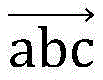
从基站a出发经过基站b再经过基站c到达基站d,则记作
以上的
(3)问题的描述(3) Description of the problem
假设用户的备选目的地集合为{dest1,dest2,…,destN},则满足如下关系:Assuming that the user's candidate destination set is {dest1,dest2,...,destN}, the following relationship is satisfied:
当用户在

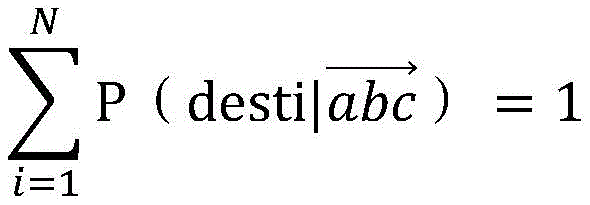
当用户进一步运动到d时When the user moves further to d


从信息熵的角度去观察以上两组表达式,To observe the above two sets of expressions from the perspective of information entropy,


由于because

所以so
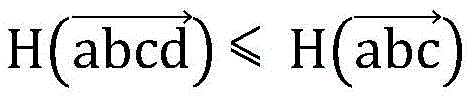
可见,随着用户运动的不断进行,用户去往目的地的信息是一个不确定性逐渐下降的过程。It can be seen that with the continuous movement of the user, the information of the user going to the destination is a process in which the uncertainty gradually decreases.
假设有abcd四个目的地,时刻1用户到达各个目的地的概率为:Assuming that there are four destinations abcd, the probability of the user arriving at each destination at
P(A|State1),P(B|State1),P(C|State1),P(D|State1)P(A|State1), P(B|State1), P(C|State1), P(D|State1)
时刻2用户到达各个目的地的概率为:The probability of the user arriving at each destination at
P(A|State2),P(B|State2),P(C|State2),P(D|State2)P(A|State2), P(B|State2), P(C|State2), P(D|State2)
以此类推,时刻N用户到达各个目的地的概率为:By analogy, the probability of user reaching each destination at time N is:
P(A|StateN),P(B|StateN),P(C|StateN),P(D|StateN)P(A|StateN), P(B|StateN), P(C|StateN), P(D|StateN)
写成矩阵的形式便得到了用户的转移概率矩阵,这个矩阵是列数固定,行数不定的,这个矩阵其实是一个向量时间序列的矩阵写法,如下式:The user's transition probability matrix is obtained by writing it in the form of a matrix. This matrix has a fixed number of columns and an indeterminate number of rows. This matrix is actually a matrix writing of a vector time series, as follows:
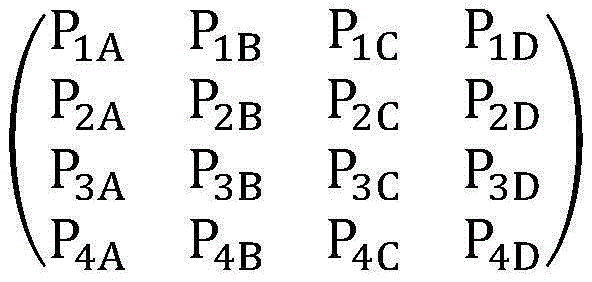
基于上述方法,在装置的实现中,用户将在图形界面上看到实时的可视化图形,对用户去各个目的地的概率进行展示。在装置上,可以查到某一用户的概率分布图。例如,当用户刚经过基站a时,计算出到达a,b,c的概率分别为20%,40%,40%(在装置中可以查询到用表示各目的地对应的概率的柱形图);当用户刚再经过基站b时,计算出到达a,b,c的概率分别为15%,35%,50%;当用户刚再经过基站c时,计算出到达a,b,c的概率分别为10%,20%,70%;当用户刚再经过基站d时,计算出到达a,b,c的概率分别为0%,0%,100%。Based on the above method, in the implementation of the device, the user will see a real-time visual graph on the graphical interface, showing the probability of the user going to each destination. On the device, the probability distribution map of a certain user can be found. For example, when the user just passed the base station a, the probability of arriving at a, b, and c is calculated to be 20%, 40%, and 40%, respectively (the bar graph representing the probability corresponding to each destination can be queried in the device) ; When the user just passes through base station b, the probability of reaching a, b, and c is calculated to be 15%, 35%, and 50% respectively; when the user just passes through base station c, the probability of reaching a, b, and c is calculated. They are 10%, 20%, and 70% respectively; when the user just passes the base station d, the calculated probabilities of reaching a, b, and c are 0%, 0%, and 100%, respectively.
在目标位置信令的数据量充足的情况下,计算各个目的终点的概率的实现原理可以进行如下阐述:In the case that the data volume of the target location signaling is sufficient, the realization principle of calculating the probability of each destination endpoint can be described as follows:
当用户从基站a到基站b时,从历史数据中找到符合从基站a到基站b的所有数据,假设共有n条,这n条中,有k条最终到达了目的地a,根据伯努利大数定律:When the user goes from base station a to base station b, find all the data from base station a to base station b from the historical data. Suppose there are a total of n items. Among the n items, k items finally reach destination a. According to Bernoulli Law of Large Numbers:

当n趋于无穷时,频率会依概率收敛,从而可以用k/n作为矩阵中
假设概率的真值为p,将n个样本作为n重伯努利试验的结果,其中去了目的地A的有k次,根据二项分布:Assuming that the true value of the probability is p, n samples are taken as the result of n repeated Bernoulli trials, of which there are k times to the destination A, according to the binomial distribution:

这个式子表达了在实际概率为p的时候,我们观察到n重伯努利试验中恰好出现k次的概率。概率p可以看作是随机变量。This formula expresses the probability that we observe exactly k occurrences of n Bernoulli trials when the actual probability is p. The probability p can be thought of as a random variable.
根据贝叶斯假设,p的先验分布为均匀分布According to the Bayesian assumption, the prior distribution of p is uniform

P(k)=∫pP(k|p)P(p)dp (3)P(k)=∫ p P(k|p)P(p)dp (3)
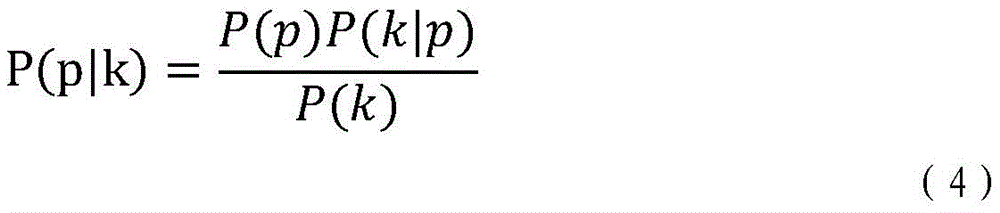
将(1)(2)(3)代入(4)后,得到After substituting (1)(2)(3) into (4), we get
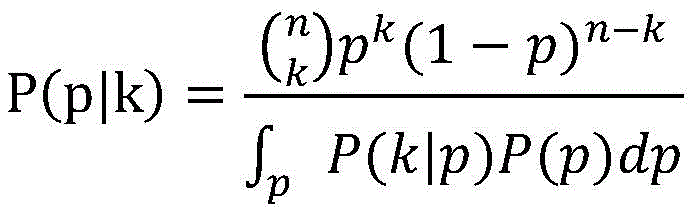
求解此式后,结果恰好为参数(k+1,n-k+1)的贝塔分布。为了更形象地说明,接下来举个例子,当历史数据中看到如表三所示的三组数据时,画出的beta分布概率密度曲线如图4所示,可见,虽然比值都是0.3,但样本数的不同会出现不同的误差,历史数据越充分,估计误差会越小。当历史数据趋于无穷时,估计区间的上下界会收缩到一起,从而得到大数定律中描述的结果。After solving this equation, the result is exactly a beta distribution with parameters (k+1,n-k+1). In order to illustrate more vividly, let’s take an example next. When the three sets of data shown in Table 3 are seen in the historical data, the drawn beta distribution probability density curve is shown in Figure 4. It can be seen that although the ratios are all 0.3 , but different numbers of samples will have different errors. The more sufficient the historical data, the smaller the estimation error will be. As the historical data tends to infinity, the upper and lower bounds of the estimation interval shrink together, resulting in the result described in the law of large numbers.
表三历史数据Table 3 Historical data
基于上述分析,在历史数据量充足时,计算各目的终点的方法可以采用流处理实现。图5为流处理的原理示意图,参见图5,流处理是一种基于窗口的操作(window-basedoperation),随着数据流中不断地出现元组,将不断地触发相关的操作。在实际中,当收到一条用户的信令时,就会触发一次操作,将用户的信令追加到队列的尾部,然后对队列进行扫描,形成用户当前的路径状态,以上理论中的

采用了流处理技术,就可以设定一个合理的窗口大小,从而基于这个窗口大小来作为状态匹配的边界,也就是说以最近发生的窗口范围大小的轨迹点作为状态。这样,有了用户已具有的路径状态后,到历史数据中进行搜索,找到符合这个路径的历史数据,然后分别进行计数,得到对应的n与k,然后将参数k与(n-k)代入R语言的beta分布函数中,通过以下代码进行求解。Using stream processing technology, a reasonable window size can be set, and the state matching boundary can be based on the window size, that is, the most recent trajectory point of the window size is used as the state. In this way, after having the path status that the user already has, search in the historical data to find the historical data that matches the path, then count them separately to get the corresponding n and k, and then substitute the parameters k and (n-k) into the R language The beta distribution function of , is solved by the following code.
pHat<-k/(n-k)pHat<-k/(n-k)
pHatCeiling<-k/(n-k)*(1+10%)pHatCeiling<-k/(n-k)*(1+10%)
pHatFloor<-k/(n-k)*(1-10%)pHatFloor<-k/(n-k)*(1-10%)
probCeiling<-pbeta(pHatCeiling,k,(n-k))probCeiling<-pbeta(pHatCeiling,k,(n-k))
probFloor<-pbeta(pHatFloor,k,(n-k))probFloor<-pbeta(pHatFloor,k,(n-k))
delta<-probCeiling–probFloordelta<-probCeiling–probFloor
通过sparkR对R语言的代码进行调用。Call the code in R language through sparkR.
进一步地,在上述各实施例的基础上,所述若所述目标位置信令的数量不满足所述预设数量要求,则根据预先存储的公共位置信令和所述目标用户的位置变化预测所述目标用户欲到达的目的地,包括:Further, on the basis of the above-mentioned embodiments, if the quantity of the target location signaling does not meet the preset quantity requirement, predict the change according to the pre-stored public location signaling and the location change of the target user. The destination that the target user wants to reach includes:
若所述目标位置信令的数量不满足所述预设数量要求,由预先存储的公共位置信令生成位置轨迹,并生成的位置轨迹中的目的终点;If the quantity of the target location signaling does not meet the preset quantity requirement, generate a location track from the pre-stored public location signaling, and generate the destination endpoint in the location track;
获取所述目标用户所在的当前位置,对每一目的终点,计算由当前位置到达该目的终点的位置轨迹占根据公共位置信令确定的所有位置轨迹的第二比值,将最大的第二比值对应的目的终点作为所述目标用户欲到达的目的地。Obtain the current position of the target user, and for each destination end point, calculate the second ratio of the position trajectory from the current position to the destination end point to all the position trajectories determined according to the public position signaling, and assign the largest second ratio corresponding to the second ratio. The destination destination of the target user is taken as the destination that the target user wants to reach.
根据公共位置信令生成位置轨迹的方法与根据目标位置信令生成位置轨迹的方法相同,在此不再赘述。The method for generating the location track according to the public location signaling is the same as the method for generating the location track according to the target location signaling, and details are not described herein again.
本实施例提供了一种基于位置轨迹预测目的地的方法,在目标位置信令的数据量不充足的情况下,通过公共位置信令对用户欲到达的目的地进行预测,避免了因数据量不充足造成的预测结果的不准确。This embodiment provides a method for predicting a destination based on a location trajectory. When the data volume of the target location signaling is insufficient, the destination to be reached by the user is predicted through the public location signaling, avoiding the need for data volume. Inaccuracy of forecast results caused by insufficiency.
以下对数据稀疏或缺乏的情况下,预测目标用户的目的地进行分析:The following analysis is performed to predict the destination of the target user when the data is sparse or lacking:
从上面的分析可以看出,历史样本量越大,分析的效果越好,但事实上,经常会遇到历史样本不足,甚至没有历史样本可以参考的情况,这时我们就要想一些其他的办法了,比如参考其他人的历史样本来对此用户的运动轨迹进行估计。以下对参考其他人的位置信令预测目标用户的目的地的方法是否合理进行分析:每个用户都有一个属于自己的分布,中心极限定理告诉我们,任意随机变量序列部分和分布渐近于正态分布,当随机变量的个数趋于无穷时,会出现依概率收敛。换句话说,由于用户间的个性会相互抵消,用所有用户的数学期望作为该用户的估计,将是一个无偏估计。It can be seen from the above analysis that the larger the historical sample size, the better the analysis effect, but in fact, there are often insufficient historical samples or even no historical samples for reference. At this time, we have to think about some other things. There are ways, such as referring to other people's historical samples to estimate the user's movement trajectory. The following is an analysis of whether the method of predicting the destination of the target user with reference to the location signaling of others is reasonable: each user has a distribution belonging to its own, and the central limit theorem tells us that the partial sum distribution of any random variable sequence is asymptotically positive When the number of random variables tends to infinity, there will be convergence according to probability. In other words, since the personalities among users will cancel each other out, using the mathematical expectation of all users as the estimate of this user will be an unbiased estimate.
地图上的很多信息对于我们这个问题是没有什么意义的,因此我们需要将数据进一步抽象,只保留和我们这个问题相关的数据,会得到图6所示的用户经过的节点。图6反映了客户运行经过了那些结点。将一条条这样的历史轨迹拼合在一起,就会为我们展现出客户群在各个结点会做出怎样的集体性选择,为了表示这种集体性选择,我们将各个结点作为markov-chain的一个状态,通过统计轨迹的计数,我们会得到对应的一步转移概率矩阵:A lot of information on the map is meaningless to our problem, so we need to further abstract the data, and only keep the data related to our problem, and we will get the nodes that the user passes through as shown in Figure 6. Figure 6 reflects the nodes that the client runs through. Putting these historical trajectories together will show us what kind of collective choices the customer group will make at each node. In order to express this collective choice, we use each node as the markov-chain For a state, by counting the counts of trajectories, we will get the corresponding one-step transition probability matrix:

在行驶轨迹中,往往会出现一类很常见的现象,这就是同样是到达了某个结点,但有时是路过这个结点,有时是以此结点作为最终的目的地,这就要求模型必须能够区分出这两类不同的结点,从而才能给出更合理的结论。In the driving trajectory, a very common phenomenon often occurs, that is, it also reaches a certain node, but sometimes passes through this node, and sometimes uses this node as the final destination, which requires the model It must be possible to distinguish between these two different types of nodes, so that a more reasonable conclusion can be drawn.
假设模型原有n个结点,为了能够在模型中区分这两种情况,将模型进一步扩展为2n个结点,扩充的方法是原有的每个结点都分裂出一个镜像结点,这样一来,原有的一个结点既表示瞬态又表示吸收态的情况得到了改观,变成了原结点表示瞬态结点,镜像结点表示吸收态结点,图7示出了原有节点扩展前和扩展后的对比,图7的左边为扩展前的节点,右边为扩展后的节点。这一次扩展,相当于从功能上,将一个结点人为地看成两个结点了,因此转移矩阵也随之相应的需要进行扩充,前n维表示瞬态结点,后n维表示吸收结点,于是转移矩阵就可以进一步的写成分块矩阵。Assuming that the model has n nodes, in order to distinguish these two cases in the model, the model is further extended to 2n nodes. The expansion method is to split each original node into a mirror node, so that As a result, the original situation of a node representing both the transient state and the absorption state has been improved, and the original node represents the transient node, and the mirror node represents the absorption state node. Figure 7 shows the original node. There is a comparison of nodes before and after expansion. The left side of Figure 7 is the node before expansion, and the right side is the node after expansion. This expansion is equivalent to artificially treating one node as two nodes in terms of function, so the transition matrix also needs to be expanded accordingly. The first n dimensions represent transient nodes, and the last n dimensions represent absorption. node, so the transition matrix can be further written as a block matrix.

吸收结点的定义,容易得出以下这个结论:(1)吸收结点转移到瞬态结点的概率为0;(2)吸收结点转移到自己的概率为1;(3)吸收结点转移到其他吸收结点的概率为0。有了这个结论容易推出以下两个推论:(1)左下的分块是一个0矩阵;(2)右下的分块是一个单位矩阵。于是原矩阵可以进一步写为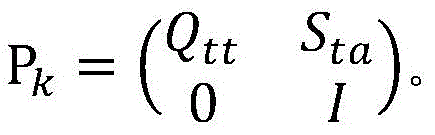
对于目标位置信令数据稀疏或者缺乏的情况,在进行目标用户的目的地的预测时,在目的地区域逗留超过5小时的手机信令用户,当天的位置信令时间序列筛选出来,存到类似如表四所示的二维表中。For the situation that the target location signaling data is sparse or lacking, when predicting the destination of the target user, the mobile phone signaling users who stay in the destination area for more than 5 hours, the location signaling time series of the day is screened out and stored in similar In the two-dimensional table shown in Table IV.
表四 位置信令各目的终点的存储形式Table 4 Storage form of each destination end point of location signaling

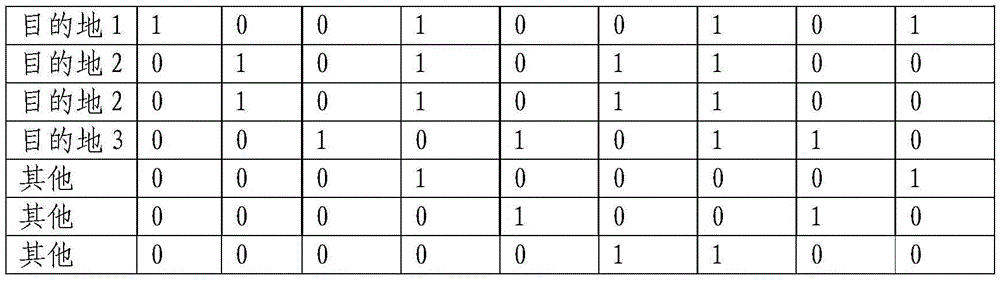
原始轨迹是一条链式数据,我们按照经历的路口情况,对其进行碎片化处理,分割为若干个子轨迹,这样每条原始数据变成了若干条子数据,如图8所示。The original trajectory is a chain of data, and we fragment it according to the experienced intersections and divide it into several sub-trajectories, so that each original data becomes several sub-data, as shown in Figure 8.
在存储上原始数据我们表示为Di,碎片化后的数据我们表示为集合{Di1,Din}。有了碎片化的数据后,我们就可以统计出从某个结点到达其他结点的次数。图9示出了从某一节点到其它节点的次数,图10示出了在某个景点的数据中,从一个结点到达其他结点的次数。In the storage, we denote the original data as D i , and the fragmented data we denote as the set {D i1 , D in }. With fragmented data, we can count the number of times from a node to other nodes. Figure 9 shows the number of times from a node to other nodes, and Figure 10 shows the number of times from a node to other nodes in the data of a certain scenic spot.
从图9和图10中可以看出,如果发现到了C1点,去各个景点的概率如表五所示。As can be seen from Figure 9 and Figure 10, if the C1 point is found, the probability of going to each scenic spot is shown in Table 5.
表五Table 5

根据全概率公式According to the total probability formula
PA=PC1P(A|C1)+PC2P(A|C2)+…+PCnP(A|Cn)P A =P C1 P(A|C 1 )+P C2 P(A|C 2 )+…+P Cn P(A|C n )
PA=∑PCnP(A|Cn)P A =∑P Cn P(A|C n )
简化公式Simplified formula

从而可以得出各个结点的一步转移概率。Thus, the one-step transition probability of each node can be obtained.
图11为对目的地进行预报的示意图,参见图11,用户目前的行车轨迹记作T,根据贝叶斯定理,概率为Fig. 11 is a schematic diagram of predicting a destination. Referring to Fig. 11, the user's current driving trajectory is denoted as T. According to Bayes' theorem, the probability is


历史轨迹库中有N条轨迹There are N tracks in the historical track library
以A为目的地的条数为nA,其中覆盖了路径T的为mA;以B为目的地的条数为nB,其中覆盖了路径T的为mB;以C为目的地的条数为nC,其中覆盖了路径T的为mC;The number of bars taking A as the destination is n A , and the one covering the path T is m A ; the number of taking B as the destination is n B , and the one covering the path T is m B ; the one taking C as the destination is m B . The number of bars is n C , and the one covering the path T is m C ;
N=nA+nB+nC N=n A +n B +n C
于是先验概率我们有So the prior probability we have


似然函数为The likelihood function is


后验概率为The posterior probability is

计算得出Calculated

同理得出The same can be drawn


进一步地,在上述各实施例的基础上,还包括:Further, on the basis of the above embodiments, it also includes:
获取所述目标用户实际到达的实际目的地,根据所述实际目的地评估预测的所述目标用户欲到达的目的地的准确性。The actual destination actually reached by the target user is acquired, and the accuracy of the predicted destination to be reached by the target user is evaluated according to the actual destination.
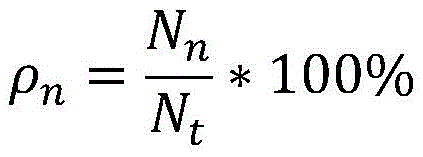
具体来说,为了增加系统的实用性,评估指标设计成针对具体目的地的指标,而不是系统的平均指标,针对各个目的地,分别计算误报率和漏报率。Specifically, in order to increase the practicability of the system, the evaluation index is designed as an index for specific destinations, rather than an average index of the system, and the false positive rate and the false negative rate are calculated separately for each destination.
误报率为误报数与总数的比值The false positive rate is the ratio of the number of false positives to the total number of false positives

漏报率为漏报数与总数的比值The false negative rate is the ratio of false negatives to the total number of false positives
综上,本实施例提供的基于位置轨迹预测目的地的方法,改进原有的基于马尔科夫模型的位置预报方案,以大数定律和中心极限定理作为基础,在沿用原有马尔科夫模型位置预报方案的基础上,进行改良,通过对误差区间的精细化测量,引入基于beta分布的区间估计,在承认运动轨迹后效性的基础上给出了合理的估计;引入了流处理的技术方案,从数据采集到数据传输整理运算,都以数据流的形式完成,极大地缩短了由于运算延时带来的结果有效期过短的问题,从而增加了本装置的实用性;采用了视历史数据充足情况而动态选择算法的策略,突破了传统上从头到尾使用一种算法的方式,从而实现了动态自适应的智能方式进行科学计算;将效果评估引入到整个系统的运行过程中,这样可以随时对模型进行检验与调整,可以更好地实现对模型细致的调整,能够更好地完成整个生命周期的处理。To sum up, the method for predicting a destination based on the position trajectory provided in this embodiment improves the original position prediction scheme based on the Markov model. Based on the law of large numbers and the central limit theorem, the original Markov model is used. On the basis of the position prediction scheme, it is improved. Through the refined measurement of the error interval, the interval estimation based on beta distribution is introduced, and a reasonable estimation is given on the basis of acknowledging the after-effects of the motion trajectory; the technology of stream processing is introduced. The scheme, from data collection to data transmission and sorting operation, is completed in the form of data flow, which greatly shortens the problem of short validity period of results caused by operation delay, thereby increasing the practicability of the device; The strategy of dynamically selecting an algorithm when there is sufficient data breaks through the traditional method of using one algorithm from beginning to end, thereby realizing a dynamic adaptive intelligent method for scientific computing; the effect evaluation is introduced into the operation process of the entire system, so that The model can be checked and adjusted at any time, which can better realize the detailed adjustment of the model, and can better complete the processing of the entire life cycle.
如图12所示,本发明的实施例提供了一种基于位置轨迹预测目的地的装置,包括判断模块1201、第一预测模块1202和第二预测模块1203,其中,As shown in FIG. 12, an embodiment of the present invention provides an apparatus for predicting a destination based on a position trajectory, including a
判断模块1201,用于若监测到目标用户的位置发生改变,则判断预先存储的对应于所述目标用户的目标位置信令的数量是否满足预设数量要求;The
第一预测模块1202,用于若所述目标位置信令的数量满足所述预设数量要求,则根据所述目标位置信令和所述目标用户的位置变化预测所述目标用户欲到达的目的地;The
第二预测模块1203,用于若所述目标位置信令的数量不满足所述预设数量要求,则根据预先存储的公共位置信令和所述目标用户的位置变化预测所述目标用户欲到达的目的地;The
其中,每一目标位置信令均表示了所述目标用户在不同时刻的位置,每一公共位置信令均表示了不同用户在不同时刻的位置。Wherein, each target location signaling represents the location of the target user at different times, and each common location signaling represents the location of different users at different times.
本实施例提供的基于位置轨迹预测目的地的装置适用于上述实施例中的基于位置轨迹预测目的地的方法,在此不再赘述。The apparatus for predicting a destination based on a location trajectory provided in this embodiment is applicable to the method for predicting a destination based on a location trajectory in the foregoing embodiment, and details are not described herein again.
本发明的实施例提供了一种基于位置轨迹预测目的地的装置,该装置在监测到目标用户的位置发生变化后,即开始根据目标用户的实时位置对目标用户将要到达的目的地进行预测。预测过程中,根据目标用户对应的目标位置信令的数量选择不同的预测算法进行预测,当目标位置信令的数量不充足时,参考公共位置信令对目标用户的目的地进行预测,避免了由于目标位置信令不充足造成的预测不准确。另一方面,相比于采用统一的预测方法对用户的目的地进行预测的方法,该装置的简化了预测的计算过程,且该装置能够根据用户实时位置对用户将要到达的目的地进行预测,充分考虑了预测的时效性。An embodiment of the present invention provides a device for predicting a destination based on a location trajectory. After monitoring a change in the location of the target user, the device starts to predict the destination the target user will reach according to the target user's real-time location. In the prediction process, different prediction algorithms are selected according to the number of target location signaling corresponding to the target user for prediction. Inaccurate predictions due to insufficient target location signaling. On the other hand, compared with the method of using a unified prediction method to predict the destination of the user, the device simplifies the calculation process of prediction, and the device can predict the destination that the user will reach according to the real-time location of the user, The timeliness of the forecast is fully considered.
图13是示出本实施例提供的电子设备的结构框图。FIG. 13 is a block diagram showing the structure of the electronic device provided in this embodiment.
参照图13,所述电子设备包括:处理器(processor)1301、存储器(memory)1302、通信接口(Communications Interface)1303和总线1304;13, the electronic device includes: a processor (processor) 1301, a memory (memory) 1302, a communications interface (Communications Interface) 1303 and a
其中,in,
所述处理器1301、存储器1302、通信接口1303通过所述总线1304完成相互间的通信;The
所述通信接口1303用于该电子设备和终端的通信设备之间的信息传输;The
所述处理器1301用于调用所述存储器1302中的程序指令,以执行上述各方法实施例所提供的方法,例如包括:若监测到目标用户的位置发生改变,则判断预先存储的对应于所述目标用户的目标位置信令的数量是否满足预设数量要求;若所述目标位置信令的数量满足所述预设数量要求,则根据所述目标位置信令和所述目标用户的位置变化预测所述目标用户欲到达的目的地;若所述目标位置信令的数量不满足所述预设数量要求,则根据预先存储的公共位置信令和所述目标用户的位置变化预测所述目标用户欲到达的目的地;其中,每一目标位置信令均表示了所述目标用户在不同时刻的位置,每一公共位置信令均表示了不同用户在不同时刻的位置。The
第四方面,本实施例提供一种非暂态计算机可读存储介质,所述非暂态计算机可读存储介质存储计算机指令,所述计算机指令使所述计算机执行上述各方法实施例所提供的方法,例如包括:若监测到目标用户的位置发生改变,则判断预先存储的对应于所述目标用户的目标位置信令的数量是否满足预设数量要求;若所述目标位置信令的数量满足所述预设数量要求,则根据所述目标位置信令和所述目标用户的位置变化预测所述目标用户欲到达的目的地;若所述目标位置信令的数量不满足所述预设数量要求,则根据预先存储的公共位置信令和所述目标用户的位置变化预测所述目标用户欲到达的目的地;其中,每一目标位置信令均表示了所述目标用户在不同时刻的位置,每一公共位置信令均表示了不同用户在不同时刻的位置。In a fourth aspect, this embodiment provides a non-transitory computer-readable storage medium, where the non-transitory computer-readable storage medium stores computer instructions, and the computer instructions cause the computer to execute the methods provided by the above method embodiments. The method, for example, includes: if a change in the location of the target user is detected, judging whether the number of pre-stored target location signaling corresponding to the target user meets a preset number requirement; if the number of target location signaling satisfies For the preset number requirement, predict the destination that the target user wants to reach according to the target location signaling and the location change of the target user; if the number of the target location signaling does not meet the preset number request, the destination to be reached by the target user is predicted according to the pre-stored public location signaling and the location change of the target user; wherein, each target location signaling represents the location of the target user at different times , each public location signaling indicates the location of different users at different times.
本实施例公开一种计算机程序产品,所述计算机程序产品包括存储在非暂态计算机可读存储介质上的计算机程序,所述计算机程序包括程序指令,当所述程序指令被计算机执行时,计算机能够执行上述各方法实施例所提供的方法,例如,包括:若监测到目标用户的位置发生改变,则判断预先存储的对应于所述目标用户的目标位置信令的数量是否满足预设数量要求;若所述目标位置信令的数量满足所述预设数量要求,则根据所述目标位置信令和所述目标用户的位置变化预测所述目标用户欲到达的目的地;若所述目标位置信令的数量不满足所述预设数量要求,则根据预先存储的公共位置信令和所述目标用户的位置变化预测所述目标用户欲到达的目的地;其中,每一目标位置信令均表示了所述目标用户在不同时刻的位置,每一公共位置信令均表示了不同用户在不同时刻的位置。This embodiment discloses a computer program product, the computer program product includes a computer program stored on a non-transitory computer-readable storage medium, the computer program includes program instructions, and when the program instructions are executed by a computer, the computer program The methods provided by the above method embodiments can be performed, for example, including: if a change in the location of the target user is detected, judging whether the number of pre-stored target location signaling corresponding to the target user meets the preset number requirement ; If the quantity of the target location signaling meets the preset quantity requirement, then predict the destination that the target user wants to reach according to the target location signaling and the location change of the target user; if the target location If the number of signaling does not meet the preset number requirement, the destination to be reached by the target user is predicted according to the pre-stored public location signaling and the location change of the target user; wherein, each target location signaling is The positions of the target users at different times are indicated, and each public position signaling indicates the positions of different users at different times.
本领域普通技术人员可以理解:实现上述方法实施例的全部或部分步骤可以通过程序指令相关的硬件来完成,前述的程序可以存储于一计算机可读取存储介质中,该程序在执行时,执行包括上述方法实施例的步骤;而前述的存储介质包括:ROM、RAM、磁碟或者光盘等各种可以存储程序代码的介质。Those of ordinary skill in the art can understand that all or part of the steps of implementing the above method embodiments can be completed by program instructions related to hardware, the aforementioned program can be stored in a computer-readable storage medium, and when the program is executed, execute It includes the steps of the above method embodiments; and the aforementioned storage medium includes: ROM, RAM, magnetic disk or optical disk and other media that can store program codes.
以上所描述的电子设备等实施例仅仅是示意性的,其中所述作为分离部件说明的单元可以是或者也可以不是物理上分开的,作为单元显示的部件可以是或者也可以不是物理单元,即可以位于一个地方,或者也可以分布到多个网络单元上。可以根据实际的需要选择其中的部分或者全部模块来实现本实施例方案的目的。本领域普通技术人员在不付出创造性的劳动的情况下,即可以理解并实施。The above-described electronic equipment and other embodiments are only illustrative, wherein the units described as separate components may or may not be physically separated, and the components displayed as units may or may not be physical units, that is, It can be located in one place, or it can be distributed over multiple network elements. Some or all of the modules may be selected according to actual needs to achieve the purpose of the solution in this embodiment. Those of ordinary skill in the art can understand and implement it without creative effort.
通过以上的实施方式的描述,本领域的技术人员可以清楚地了解到各实施方式可借助软件加必需的通用硬件平台的方式来实现,当然也可以通过硬件。基于这样的理解,上述技术方案本质上或者说对现有技术做出贡献的部分可以以软件产品的形式体现出来,该计算机软件产品可以存储在计算机可读存储介质中,如ROM/RAM、磁碟、光盘等,包括若干指令用以使得一台计算机设备(可以是个人计算机,服务器,或者网络设备等)执行各个实施例或者实施例的某些部分所述的方法。From the description of the above embodiments, those skilled in the art can clearly understand that each embodiment can be implemented by means of software plus a necessary general hardware platform, and certainly can also be implemented by hardware. Based on this understanding, the above-mentioned technical solutions can be embodied in the form of software products in essence or the parts that make contributions to the prior art, and the computer software products can be stored in computer-readable storage media, such as ROM/RAM, magnetic A disc, an optical disc, etc., includes several instructions for causing a computer device (which may be a personal computer, a server, or a network device, etc.) to perform the methods described in various embodiments or some parts of the embodiments.
最后应说明的是:以上各实施例仅用以说明本发明的实施例的技术方案,而非对其限制;尽管参照前述各实施例对本发明的实施例进行了详细的说明,本领域的普通技术人员应当理解:其依然可以对前述各实施例所记载的技术方案进行修改,或者对其中部分或者全部技术特征进行等同替换;而这些修改或者替换,并不使相应技术方案的本质脱离本发明的实施例各实施例技术方案的范围。Finally, it should be noted that the above embodiments are only used to illustrate the technical solutions of the embodiments of the present invention, but not to limit them; although the embodiments of the present invention have been described in detail with reference to the foregoing embodiments, ordinary The skilled person should understand that it is still possible to modify the technical solutions described in the foregoing embodiments, or to perform equivalent replacements on some or all of the technical features; and these modifications or replacements do not make the essence of the corresponding technical solutions deviate from the present invention. The scope of the technical solutions of the embodiments of each embodiment.
Claims (9)
Priority Applications (1)
| Application Number | Priority Date | Filing Date | Title |
|---|---|---|---|
| CN201811194932.9A CN111131999B (en) | 2018-10-15 | 2018-10-15 | A method and device for predicting destination based on location trajectory |
Applications Claiming Priority (1)
| Application Number | Priority Date | Filing Date | Title |
|---|---|---|---|
| CN201811194932.9A CN111131999B (en) | 2018-10-15 | 2018-10-15 | A method and device for predicting destination based on location trajectory |
Publications (2)
| Publication Number | Publication Date |
|---|---|
| CN111131999A CN111131999A (en) | 2020-05-08 |
| CN111131999B true CN111131999B (en) | 2021-05-25 |
Family
ID=70483956
Family Applications (1)
| Application Number | Title | Priority Date | Filing Date |
|---|---|---|---|
| CN201811194932.9A Active CN111131999B (en) | 2018-10-15 | 2018-10-15 | A method and device for predicting destination based on location trajectory |
Country Status (1)
| Country | Link |
|---|---|
| CN (1) | CN111131999B (en) |
Families Citing this family (4)
| Publication number | Priority date | Publication date | Assignee | Title |
|---|---|---|---|---|
| CN111787491B (en) * | 2020-06-29 | 2022-09-30 | 广东小天才科技有限公司 | A kind of assisted positioning, system, wearable device and storage medium |
| CN115484548B (en) * | 2021-06-16 | 2025-09-05 | 中移系统集成有限公司 | A method and device for determining user displacement information and user motion trajectory |
| CN115222769A (en) * | 2022-06-14 | 2022-10-21 | 京东科技信息技术有限公司 | Trajectory prediction method, device and agent |
| CN116151476A (en) * | 2023-03-13 | 2023-05-23 | 清华大学 | Trajectory prediction method, electronic device and storage medium |
Citations (2)
| Publication number | Priority date | Publication date | Assignee | Title |
|---|---|---|---|---|
| CN104520881A (en) * | 2012-06-22 | 2015-04-15 | 谷歌公司 | Rank nearby destinations based on likelihood of visit and predict future visits to places from location history |
| CN108108831A (en) * | 2016-11-24 | 2018-06-01 | 中国移动通信有限公司研究院 | A kind of destination Forecasting Methodology and device |
Family Cites Families (2)
| Publication number | Priority date | Publication date | Assignee | Title |
|---|---|---|---|---|
| US7522995B2 (en) * | 2004-02-05 | 2009-04-21 | Nortrup Edward H | Method and system for providing travel time information |
| US9134137B2 (en) * | 2010-12-17 | 2015-09-15 | Microsoft Technology Licensing, Llc | Mobile search based on predicted location |
-
2018
- 2018-10-15 CN CN201811194932.9A patent/CN111131999B/en active Active
Patent Citations (2)
| Publication number | Priority date | Publication date | Assignee | Title |
|---|---|---|---|---|
| CN104520881A (en) * | 2012-06-22 | 2015-04-15 | 谷歌公司 | Rank nearby destinations based on likelihood of visit and predict future visits to places from location history |
| CN108108831A (en) * | 2016-11-24 | 2018-06-01 | 中国移动通信有限公司研究院 | A kind of destination Forecasting Methodology and device |
Also Published As
| Publication number | Publication date |
|---|---|
| CN111131999A (en) | 2020-05-08 |
Similar Documents
| Publication | Publication Date | Title |
|---|---|---|
| CN111131999B (en) | A method and device for predicting destination based on location trajectory | |
| CN110264709A (en) | The prediction technique of the magnitude of traffic flow of road based on figure convolutional network | |
| CN109120463B (en) | Flow prediction method and device | |
| CN114039918B (en) | An information age optimization method, device, computer equipment and storage medium | |
| EP3899758A1 (en) | Methods and systems for automatically selecting a model for time series prediction of a data stream | |
| CN104468413B (en) | A kind of network service method and system | |
| CN113379176A (en) | Telecommunication network abnormal data detection method, device, equipment and readable storage medium | |
| WO2017152734A1 (en) | Data processing method and relevant devices and systems | |
| CN117787411A (en) | A local-global temporal knowledge graph reasoning method based on relational graph | |
| US20210152454A1 (en) | Network Flow Measurement Method, Network Measurement Device, and Control Plane Device | |
| CN104077412B (en) | A kind of microblog users interest Forecasting Methodology based on more Markov chains | |
| Liu et al. | Finding densest lasting subgraphs in dynamic graphs: A stochastic approach | |
| CN117290706A (en) | A traffic flow prediction method using spatiotemporal convolution and probabilistic sparse attention mechanism | |
| CN106980874B (en) | A kind of multi-time Scales dimension data fusion method towards distribution big data | |
| CN110764975A (en) | Early warning method and device for equipment performance and monitoring equipment | |
| CN114173350A (en) | Wireless network planning method and device | |
| US20160125005A1 (en) | Apparatus and Method for Profiling Activities and Transitions | |
| CN120179499B (en) | Storage System Performance Monitoring and Analysis Method | |
| Kaushik et al. | Traffic prediction in telecom systems using deep learning | |
| Czachórski | Queueing models for performance evaluation of computer networks—transient state analysis | |
| CN119051705B (en) | A method for congestion sensing and fault prediction in large-scale low-Earth orbit satellite networks | |
| CN114925294B (en) | Position prediction system and method based on graph enhancement time-space model | |
| CN118152775A (en) | Truck arrival time estimation method, system, computer device and storage medium | |
| WO2024208076A1 (en) | Behavior data prediction model updating method, apparatus, device and storage medium | |
| US11962475B2 (en) | Estimating properties of units using system state graph models |
Legal Events
| Date | Code | Title | Description |
|---|---|---|---|
| PB01 | Publication | ||
| PB01 | Publication | ||
| SE01 | Entry into force of request for substantive examination | ||
| SE01 | Entry into force of request for substantive examination | ||
| GR01 | Patent grant | ||
| GR01 | Patent grant |