CN111124260A - Method, electronic device and computer program product for managing redundant arrays of independent disks - Google Patents
Method, electronic device and computer program product for managing redundant arrays of independent disks Download PDFInfo
- Publication number
- CN111124260A CN111124260A CN201811288170.9A CN201811288170A CN111124260A CN 111124260 A CN111124260 A CN 111124260A CN 201811288170 A CN201811288170 A CN 201811288170A CN 111124260 A CN111124260 A CN 111124260A
- Authority
- CN
- China
- Prior art keywords
- plbs
- raid
- disks
- determining
- disk
- Prior art date
- Legal status (The legal status is an assumption and is not a legal conclusion. Google has not performed a legal analysis and makes no representation as to the accuracy of the status listed.)
- Granted
Links
Images


Classifications
-
- G—PHYSICS
- G06—COMPUTING OR CALCULATING; COUNTING
- G06F—ELECTRIC DIGITAL DATA PROCESSING
- G06F3/00—Input arrangements for transferring data to be processed into a form capable of being handled by the computer; Output arrangements for transferring data from processing unit to output unit, e.g. interface arrangements
- G06F3/06—Digital input from, or digital output to, record carriers, e.g. RAID, emulated record carriers or networked record carriers
- G06F3/0601—Interfaces specially adapted for storage systems
- G06F3/0628—Interfaces specially adapted for storage systems making use of a particular technique
- G06F3/0638—Organizing or formatting or addressing of data
- G06F3/064—Management of blocks
-
- G—PHYSICS
- G06—COMPUTING OR CALCULATING; COUNTING
- G06F—ELECTRIC DIGITAL DATA PROCESSING
- G06F11/00—Error detection; Error correction; Monitoring
- G06F11/07—Responding to the occurrence of a fault, e.g. fault tolerance
- G06F11/08—Error detection or correction by redundancy in data representation, e.g. by using checking codes
- G06F11/10—Adding special bits or symbols to the coded information, e.g. parity check, casting out 9's or 11's
- G06F11/1076—Parity data used in redundant arrays of independent storages, e.g. in RAID systems
-
- G—PHYSICS
- G06—COMPUTING OR CALCULATING; COUNTING
- G06F—ELECTRIC DIGITAL DATA PROCESSING
- G06F11/00—Error detection; Error correction; Monitoring
- G06F11/07—Responding to the occurrence of a fault, e.g. fault tolerance
- G06F11/08—Error detection or correction by redundancy in data representation, e.g. by using checking codes
- G06F11/10—Adding special bits or symbols to the coded information, e.g. parity check, casting out 9's or 11's
- G06F11/1076—Parity data used in redundant arrays of independent storages, e.g. in RAID systems
- G06F11/1092—Rebuilding, e.g. when physically replacing a failing disk
-
- G—PHYSICS
- G06—COMPUTING OR CALCULATING; COUNTING
- G06F—ELECTRIC DIGITAL DATA PROCESSING
- G06F3/00—Input arrangements for transferring data to be processed into a form capable of being handled by the computer; Output arrangements for transferring data from processing unit to output unit, e.g. interface arrangements
- G06F3/06—Digital input from, or digital output to, record carriers, e.g. RAID, emulated record carriers or networked record carriers
- G06F3/0601—Interfaces specially adapted for storage systems
- G06F3/0602—Interfaces specially adapted for storage systems specifically adapted to achieve a particular effect
- G06F3/0614—Improving the reliability of storage systems
- G06F3/0616—Improving the reliability of storage systems in relation to life time, e.g. increasing Mean Time Between Failures [MTBF]
-
- G—PHYSICS
- G06—COMPUTING OR CALCULATING; COUNTING
- G06F—ELECTRIC DIGITAL DATA PROCESSING
- G06F3/00—Input arrangements for transferring data to be processed into a form capable of being handled by the computer; Output arrangements for transferring data from processing unit to output unit, e.g. interface arrangements
- G06F3/06—Digital input from, or digital output to, record carriers, e.g. RAID, emulated record carriers or networked record carriers
- G06F3/0601—Interfaces specially adapted for storage systems
- G06F3/0602—Interfaces specially adapted for storage systems specifically adapted to achieve a particular effect
- G06F3/0614—Improving the reliability of storage systems
- G06F3/0619—Improving the reliability of storage systems in relation to data integrity, e.g. data losses, bit errors
-
- G—PHYSICS
- G06—COMPUTING OR CALCULATING; COUNTING
- G06F—ELECTRIC DIGITAL DATA PROCESSING
- G06F3/00—Input arrangements for transferring data to be processed into a form capable of being handled by the computer; Output arrangements for transferring data from processing unit to output unit, e.g. interface arrangements
- G06F3/06—Digital input from, or digital output to, record carriers, e.g. RAID, emulated record carriers or networked record carriers
- G06F3/0601—Interfaces specially adapted for storage systems
- G06F3/0628—Interfaces specially adapted for storage systems making use of a particular technique
- G06F3/0629—Configuration or reconfiguration of storage systems
- G06F3/0631—Configuration or reconfiguration of storage systems by allocating resources to storage systems
-
- G—PHYSICS
- G06—COMPUTING OR CALCULATING; COUNTING
- G06F—ELECTRIC DIGITAL DATA PROCESSING
- G06F3/00—Input arrangements for transferring data to be processed into a form capable of being handled by the computer; Output arrangements for transferring data from processing unit to output unit, e.g. interface arrangements
- G06F3/06—Digital input from, or digital output to, record carriers, e.g. RAID, emulated record carriers or networked record carriers
- G06F3/0601—Interfaces specially adapted for storage systems
- G06F3/0628—Interfaces specially adapted for storage systems making use of a particular technique
- G06F3/0653—Monitoring storage devices or systems
-
- G—PHYSICS
- G06—COMPUTING OR CALCULATING; COUNTING
- G06F—ELECTRIC DIGITAL DATA PROCESSING
- G06F3/00—Input arrangements for transferring data to be processed into a form capable of being handled by the computer; Output arrangements for transferring data from processing unit to output unit, e.g. interface arrangements
- G06F3/06—Digital input from, or digital output to, record carriers, e.g. RAID, emulated record carriers or networked record carriers
- G06F3/0601—Interfaces specially adapted for storage systems
- G06F3/0668—Interfaces specially adapted for storage systems adopting a particular infrastructure
- G06F3/0671—In-line storage system
- G06F3/0683—Plurality of storage devices
- G06F3/0689—Disk arrays, e.g. RAID, JBOD
Landscapes
- Engineering & Computer Science (AREA)
- Theoretical Computer Science (AREA)
- Physics & Mathematics (AREA)
- General Engineering & Computer Science (AREA)
- General Physics & Mathematics (AREA)
- Human Computer Interaction (AREA)
- Quality & Reliability (AREA)
- Computer Security & Cryptography (AREA)
- Techniques For Improving Reliability Of Storages (AREA)
- Debugging And Monitoring (AREA)
- Information Retrieval, Db Structures And Fs Structures Therefor (AREA)
Abstract
Embodiments of the present disclosure relate to methods, electronic devices, and computer program products for managing redundant arrays of independent disks. The method comprises the following steps: obtaining information of a wear level associated with each of a plurality of disks; selecting a set of discs from a plurality of discs based on the information of the wear level, a difference in wear level between any two discs in the set of discs being below a predetermined threshold; and creating a redundant array of independent disks using the selected sectors in the set of disks. Embodiments of the present disclosure can leverage this wear level to balance the data storage distribution among the individual redundant arrays of independent disks, thereby enabling efficient management of the individual redundant arrays of independent disks.
Description
Technical Field
Embodiments of the present disclosure relate generally to the field of data storage, and more particularly, to methods, electronic devices, and computer program products for managing redundant arrays of independent disks.
Background
Storage systems typically have multiple disks therein, and the multiple disks may be organized in a disk array. These discs may be used for user writing of data. For example, Redundant Array of Independent Disks (RAID) is a data storage virtualization technique that organizes multiple Disks into a single logical unit for purposes of Redundant backup of data and/or performance improvement. As more and more data is written, some discs may become overloaded. How to balance data storage among the various RAIDs to avoid similar overloads is a significant challenge.
Disclosure of Invention
Embodiments of the present disclosure provide methods, electronic devices, and computer program products for managing Redundant Arrays of Independent Disks (RAIDs) that address, at least in part, the above and/or other potential problems in the art of data storage.
In a first aspect, embodiments of the present disclosure provide a method of managing RAID. The method comprises the following steps: obtaining information of a wear level associated with each of a plurality of disks; selecting a set of disks from the plurality of disks based on the information of the wear level, a difference in the wear level between any two disks in the set of disks being below a predetermined threshold; and creating a RAID using the selected zones of the set of disks.
In some embodiments, the RAID comprises a plurality of Physical Large Blocks (PLBs), each PLB comprising one of the blocks in a section of each disk in the set of disks, the method further comprising: in response to receiving a request to write target data to the RAID, determining a first number of used PLBs in the RAID that have stored data; determining a second number of PLBs of the plurality of PLBs of the RAID that are expected to be used to store data based on an average of the wear levels of the set of disks; and in response to the first number being lower than the second number, determining a third number of free PLBs available for storing the target data.
In some embodiments, the method further comprises: determining the third number of free PLBs from the plurality of PLBs; and storing the target data in the idle PLB.
In some embodiments, determining a second number of PLBs of the plurality of PLBs of the RAID that are expected to be used to store data comprises: determining a wear level for the RAID based on an average of the wear levels for the set of disks; determining a number of unreserved PLBs from the plurality of PLBs of the RAID based on a wear level of the RAID; determining a number of used PLBs and a number of unreserved PLBs for another RAID associated with the RAID based on a wear level of the other RAID; and determining the second number of PLBs of the plurality of PLBs of the RAID that are expected to be used to store data based on the number of used PLBs and the number of unreserved PLBs of the RAID and the number of used PLBs and the number of unreserved PLBs of the other RAID.
In some embodiments, the method further comprises: in response to the first number not being less than the second number, determining whether there is another RAID available to store the target data; and in response to the absence of the other RAID, adding a new disk to the plurality of disks to update the RAID.
In some embodiments, wherein obtaining information of the wear level associated with each disk of the plurality of disks comprises: obtaining a used time for each disk, the used time indicating a time the disk has been used to store data; obtaining a nominal usage time for each disk, the nominal usage time indicating a maximum time the disk may be used to store data; and obtaining information of the associated wear level based on the elapsed time of use and the rated time of use.
In a second aspect, embodiments of the present disclosure provide an electronic device. The electronic device includes: at least one processing unit; at least one memory coupled to the at least one processing unit and storing instructions for execution by the at least one processing unit, the instructions when executed by the at least one processing unit, cause the apparatus to perform acts comprising: obtaining information of a wear level associated with each of a plurality of disks; selecting a set of disks from the plurality of disks based on the information of the wear level, a difference in the wear level between any two disks in the set of disks being below a predetermined threshold; and creating a RAID using the selected zones of the set of disks.
In a third aspect, embodiments of the present disclosure provide a computer program product. The computer program product is tangibly stored in a non-transitory computer storage medium and includes machine executable instructions. The machine executable instructions, when executed by an apparatus, cause the apparatus to perform any of the steps of the method described according to the first aspect of the disclosure.
This summary is provided to introduce a selection of concepts in a simplified form that are further described below in the detailed description. This summary is not intended to identify key features or essential features of the disclosure, nor is it intended to be used to limit the scope of the disclosure.
Drawings
The above and other objects, features and advantages of the present disclosure will become more apparent by describing in greater detail exemplary embodiments thereof with reference to the attached drawings, in which like reference numerals generally represent like parts throughout.
FIG. 1 shows an illustrative method of creating a RAID utilizing a method according to embodiments of the present disclosure;
FIG. 2 shows a schematic diagram of a RAID comprising a plurality of PLBs, according to an embodiment of the present disclosure;
FIG. 3 shows a flow diagram of a method for managing RAID, according to an embodiment of the present disclosure; and
FIG. 4 shows a schematic block diagram of an example device that may be used to implement embodiments of the present disclosure.
Detailed Description
Preferred embodiments of the present disclosure will be described in more detail below with reference to the accompanying drawings. While the preferred embodiments of the present disclosure are shown in the drawings, it should be understood that the present disclosure may be embodied in various forms and should not be limited to the embodiments set forth herein. Rather, these embodiments are provided so that this disclosure will be thorough and complete, and will fully convey the scope of the disclosure to those skilled in the art.
The term "include" and variations thereof as used herein is meant to be inclusive in an open-ended manner, i.e., "including but not limited to". Unless specifically stated otherwise, the term "or" means "and/or". The term "based on" means "based at least in part on". The terms "one example embodiment" and "one embodiment" mean "at least one example embodiment". The term "another embodiment" means "at least one additional embodiment". The terms "first," "second," and the like may refer to different or the same object. Other explicit and implicit definitions are also possible below.
In a conventional data storage approach, RAID is divided into smaller granularity portions, i.e., Physical Large Blocks (PLBs). When a user writes data, the processor selects an idle PLB from the RAID and writes the user data to that PLB. The conventional data storage manner selects PLBs in order. When all PLBs in a RAID are used up, the processor selects the next RAID and also selects an idle PLB from this RAID for the user to write data. This method does not take into account the wear level of the disc. In addition, this approach also does not balance user data in RAID. Some discs may be overloaded and may even be damaged.
In response to the above problems and potentially other problems, embodiments of the present disclosure provide a method of managing RAID. The method according to the embodiments of the present disclosure considers the wear level of the disks when writing data, thereby avoiding that some disks wear out to a large extent and are overloaded or damaged first, thereby achieving efficient management of the redundant array of independent disks. A use environment in which methods according to embodiments of the present disclosure may be implemented is described in more detail below in conjunction with fig. 1 and 2.
FIG. 1 shows an illustrative method of creating RAID200 using a method according to an embodiment of the present disclosure. Referring to FIG. 1, a plurality of disks 100-0, 100-1, 100-2, … …, 100-N (collectively, "disks 100" or "storage disks 100," where N is a positive integer) are shown. "disk" as used herein may refer to any now known or later developed non-volatile storage medium, such as a magnetic disk, optical disk, or Solid State Disk (SSD), among others. In the description herein, a magnetic disk will be taken as an example of a disk. It should be understood, however, that this is for convenience of description only and does not imply any limitation on the scope of the disclosure.
Each disc 100 may be divided into a plurality of sectors 110. For example, the disk 100-0 may include a plurality of sectors 110-0-0, sectors 110-0-1, … …, and sectors 110-0-M, where M is a positive integer. Similarly, disk 100-1 may include a plurality of segments 110-1-0, segments 110-1-1, … …, segment 110-1-M, and so on. These sections are collectively referred to as sections 110. In the numbering of the sectors, the first number after the number "110" indicates to which disc the sector belongs, and the second number after the number "110" indicates that the sector is the second sector on the disc. The segments may be of the same size. As shown in fig. 1, the disc 100-0 may further include a reserved zone 110-0-R, and the reserved zone 110-0-R may function to retain data.
At least some of the plurality of zones may be grouped into a RAID, which combines multiple physical storage units into a logical storage unit, typically for the purpose of data redundancy backup and/or performance improvement. It may be of different types, such as RAID0, RAID1, … …, RAID5, etc., depending on the level of redundancy and performance required.
RAID may include a data section for storing user data and a parity section for storing parity information. Take RAID5 with a 4D +1P layout as an example, where each RAID may include 4 data sectors (i.e., "4D") and 1 parity sector (i.e., "1P"). In the following description, 4D +1P RAID5 will be taken as an example of RAID 200. It should be understood, however, that this is for illustrative purposes only and does not imply any limitation on the scope of the present disclosure. Embodiments of the present disclosure may be applied to other types of RAIDs having other layouts.
Depending on the type of RAID, a section 110 may be selected from different disks 100 to form a RAID. Taking RAID5 as an example, a zone needs to be selected from 5 disks 100 (e.g., disk 100-0, disk 100-1, disk 100-2, disk 100-3, disk 100-4) to form RAID 200-1. For example, in the embodiment shown in FIG. 1, sectors 110-0-0 of disk 100-0, sectors 110-1-0 of disk 100-1, sectors 110-2-0 of disk 100-2, sectors 110-3-0 of disk 100-3, and sectors 110-4-0 of disk 100-4 are selected to form RAID 200-1. Of course, this is merely exemplary and sectors may be selected from the other five disks in disks 100 to form RAID 200.
Each disc 100 has a certain wear level (wear level) which indicates the extent to which the disc wears during use and which plays an important role in the data storage of the storage disc. A plurality of levels of wear may be defined. Some space may be reserved in RAID for different wear levels. Due to wear level considerations, these spaces are not used to store user data, while the remaining space in the RAID may be used to store user data.
Embodiments according to the present disclosure are described below with particular reference to fig. 3.
In block 310, information of a wear level associated with each disk 100-0, 100-1, … …, 100-N of the plurality of disks 100 is obtained. Information of these wear levels may be stored on the firmware of each disc 100-0, 100-1, … …, 100-N to reflect the wear of each disc 100-0, 100-1, … …, 100-N.
In block 320, referring to FIG. 1, a set of disks 100-0, 100-1, 100-2, 100-3, 100-4 is selected from the plurality of disks 100 based on the information of the wear level, a difference in the wear level between any two disks in the set of disks 100-0, 100-1, 100-2, 100-3, 100-4 being below a predetermined threshold. The predetermined threshold may be a percentage and may be adjusted according to different usage environments and different user requirements.
In an alternative embodiment, the predetermined threshold may be set to 5%, for example, and several discs with wear levels of, for example, 11%, 13%, 14%, and 15%, respectively, may be selected as a group of discs. Likewise, it is also possible to select a set of several discs with wear levels of 33%, 34%, 36% and 37%, respectively, for example. Of course, this number is merely exemplary. For ease of illustration, the set of disks 100-0, 100-1, 100-2, 100-3, 100-4 selected based on the wear level in FIG. 1 are shown as an adjacent set of numbered disks. Of course, the set of discs may be a set of discs that are not numbered adjacently, as long as the difference in wear level between any two of the discs is below a predetermined threshold. In the same manner, another set of disks 100-5, 100-6, 100-7, 100-8, 100-9 having similar levels of wear may be selected, as shown in FIG. 1. The percentage of wear level of the selected set of disks is within a certain range, via block 320. That is, the wear levels of the discs of this group are similar.
In block 330, RAID200-1 is created using the selected sectors in the set of disks 100-0, 100-1, 100-2, 100-3, and 100-4. Referring to FIG. 1, a section 110-0-0 in disk 100-0, a section 110-1-0 in disk 100-1, a section 110-2-0 in disk 100-2, a section 110-3-0 in disk 100-3, and a section 110-4-0 in disk 100-4 are selected to create RAID 200-1. Similarly, section 110-5-0 in disk 100-5, section 110-6-0 in disk 100-6, section 110-7-0 in disk 100-7, section 110-8-0 in disk 100-8, and section 110-9-0 in disk 100-9 are selected to create RAID 200-2. In this manner, a plurality of RAID200-1, RAID 200-2 … …, RAID 200-P (collectively "RAID 200" where P is a positive integer) may be created.
According to an embodiment of the present disclosure, disks with close levels of wear are selected to create a RAID. This may avoid creating a RAID from disks that are worn to a very different extent. In this way, the overall degree of wear of the disks in the disk array can be taken into account during RAID creation, preventing the risk that a portion of the disks will be damaged first during use due to excessive wear.
In some embodiments, as shown in FIG. 2, each section 110-0-0, 110-1-0, 110-2-0, 110-3-0, 110-4-0 may include a plurality of blocks 210. One block 210 is selected from each of the sections 110-0-0, 110-1-0, 110-2-0, 110-3-0, 110-4-0, respectively, to constitute the PLB 201-1. When writing user data, PLB201-1 can be regarded as a minimum unit storing user data. PLB201-1 may have a size of 2M. A plurality of other PLBs 201-2, PLBs 201-3, … …, PLBs 201-S may be constructed in a similar manner. As shown in FIG. 2, RAID200-1 may comprise a plurality of PLBs 201-1, PLBs 201-2, and so on. PLB201-1 will be exemplified as PLB hereinafter.
When user-provided data needs to be written, the number of used PLBs having data stored in RAID200-1 may be determined in response to receiving a request to write target data to RAID 200-1. The number of PLBs of the plurality of PLBs that are expected to be used for storing data may be determined based on the wear level of a set of discs 100-0, 100-1, 100-2, 100-3, and 100-4 to which the sections 110-0-0, 110-1-0, 110-2-0, 110-3-0, 110-4-0 correspond. In some embodiments, the average of the wear levels of each disk in the set of disks 100-0, 100-1, 100-2, 100-3, and 100-4 may be selected as a measure of the wear level of the set of disks. Since the selection of the set of discs 100-0, 100-1, 100-2, 100-3, and 100-4 is made based on the wear level being relatively close to this criterion, as described above, the measure of the wear level of the set of discs 100-0, 100-1, 100-2, 100-3, and 100-4 based on the average of the wear level of each disc also approximates the actual wear level of each disc, and thus better reflects the degree of wear of each disc.
In some embodiments, four fields may be maintained in each RAID 200: the number of reserved PLBs, the number of used PLBs, the number of idle PLBs, and the number of PLBs expected to be used for storing data. In these four fields, the number of reserved PLBs indicates the number of PLBs used to provide reserved data as described above; the number of used PLBs represents the number of PLBs on which user data has been stored as described above; the number of free PLBs represents the number of PLBs available to be allocated to store user data; and the number of PLBs expected to be used for storing data indicates the number of PLBs expected to be used for storing data among the plurality of PLBs determined according to the wear level.
If it is determined that the number of used PLBs that have stored data is lower than the number of PLBs expected to be used to store data among the plurality of PLBs, it indicates that there is still a desired space in RAID200 to store data written by the user. In this case, the RAID200 is put into an allocation link (allocation Ring) for storing the RAID satisfying the above determination condition. That is, the RAIDs in the allocation linked list all have free PLBs to store data. Further, the number of free PLBs available for storing the target data is determined using a difference between the number of PLBs expected for storing data and the number of used PLBs having data already stored among the plurality of PLBs. It is easily understood that the number of available PLBs available for storing the target data is a positive integer in the case where the number of used PLBs where data has been stored is lower than the number of PLBs expected for storing data among a plurality of PLBs. When the data written by the user needs to be stored, the PLB is selected from the distribution linked list to write the data. After the data writing is completed, the number of available PLBs and the number of used PLBs may be updated.
If it is judged that the number of used PLBs having data already stored is not lower than the number of PLBs expected to be used for storing data among the plurality of PLBs, it indicates that there is no space in RAID200 to store data written by the user. In this case, the RAID is put into an Overrun link list (Overrun Ring) for storing the RAID that satisfies this determination condition. That is, none of the RAIDs in the overrun linked list have a free PLB to store data to be written.
In this manner, different RAIDs 200-1 may be categorized into an allocation linked list or an overrun linked list based on their wear levels and the number of stored data in that RAID200-1, thereby enabling a determination to be made at the time of data write whether to write data to RAID 200-1. If the wear level of the multiple disks 100-0, 100-1, 100-2, 100-3, and 100-4 associated with the RAID200-1 is greater, no data is written to the RAID 200-1. Data may be written in the RAID200-1 if the wear level of the disks 100-0, 100-1, 100-2, 100-3, and 100-4 associated with the RAID200-1 is small. With the allocation and release of PLBs, RAID200-1 may switch between the allocation linked list and the overrun linked list. In this way, it is possible to avoid that the disc, which has been worn to a large extent, is continuously written with data, thus effectively preventing a part of the discs in the disc array from being overloaded.
In some embodiments, the PLBs desired for storing data are determined from the plurality of PLBs 201-1, 201-2, … …, 201-S based on the calculated number of free PLBs available for storing the target data, and the target data is stored in the determined PLBs.
In some embodiments, table 1 may be used to establish a correspondence between the wear level and the proportion of the number of reserved PLBs to the total number of PLBs in the RAID. As shown in table 1, six levels of wear may be defined. Of course, this is merely exemplary, and more or less levels of wear level may be defined according to different accuracy requirements, i.e. more or less fine or coarse grading may be performed according to actual needs. Abrasion levels W in Table 1iRatio O of the number of reserved PLBs to the total number of PLBs of the RAIDiThe correspondence between them is also merely exemplary.
TABLE 1
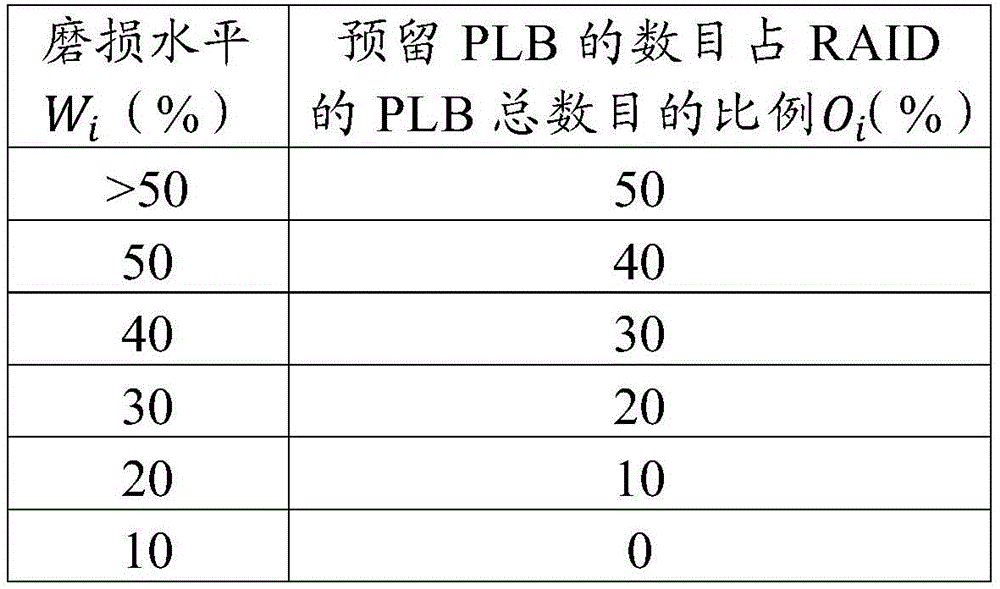
The wear level may be expressed in percentage. A higher percentage of the wear level of a disc indicates a greater degree of wear of the disc, i.e. a greater tendency of the disc towards the end of its useful life. Conversely, a smaller percentage of the wear level of a disc indicates a smaller degree of wear of the disc, i.e. a "new" disc. As shown in Table 1, wear level WiThe higher the corresponding reserved PLBs are, the proportion O of the number of corresponding reserved PLBs to the total number of PLBs of the RAIDiThe higher. Level of wear WiWhich may be a field in the disc.
In some embodiments, the number P of PLBs expected to be used for storing data among the plurality of PLBs may be calculated by the following formula (1)i:

Wherein O isiRepresents the ratio of reserved PLBs to the total number of PLBs in the ith RAID, the ratio OiMay be determined from Table 1, listed above, according to wear level WiTo determine; ciRepresents the total number of PLBs of the ith RAID; (1-O)i)*iIndicating the number of unreserved PLBs for the ith RAID in the disk array. T represents the sum of the number of PLBs that have stored data in multiple RAIDs in the disk array.
In some embodiments, wear level W associated with RAID200-1 is determined based on an average of the wear levels of a set of disks 100-0, 100-1, 100-2, 100-3, and 100-4i. From Table 1, the O corresponding to the wear level is determinediAnd the total number of PLBs C according to RAIDiThe number of determined unreserved PLBs, i.e., (1-O), of the plurality of PLBs 201-1, 201-2, … …, 201-S for RAID200-1 is calculatedi)*i。
Subsequently, the unreserved PLBs of other RAIDs in the disk array are similarly computedNumber, and sum to obtain The number of used PLBs for each RAID in the disk array is determined and summed to give T. The number of PLBs desired to be used for storing data in the plurality of PLBs 201-1, 201-2, … …, 201-S in RAID200-1 is calculated based on the above equation (1).
In this manner, the number of PLBs expected to be used to store data in multiple PLBs in a single RAID200-1 is determined via OiThe wear level of other RAIDs 200 in the disk array is considered. The data distribution of the PLBs storing data across the disk array is effectively balanced by the ratio of unreserved PLBs in a single RAID200-1 to unreserved PLBs across the disk array.
In some embodiments, the component managing the mapping relationship (mapper) will dynamically calculate the number of PLBs expected to be used to store data in each RAID using equation (1) above. In an alternative embodiment, a timer may be set to complete the calculation at constant time intervals, such time intervals may be set to 1 minute, for example. In other embodiments, the RAID may be updated in response to a user inserting a new disk to perform the above calculations. This is because, a user often inserts a new disk when the wear level of an existing disk is large, and thus the wear level of the new disk is greatly different from that of the existing disk, in which case it is necessary to update the RAID.
In some embodiments, the wear level of the disc 100 may be determined based on the ratio of the elapsed time of the disc 100 to the rated time of use of the disc 100. The elapsed time indicates the time that the disc 100 has been used to store data, and the nominal usage time indicates the maximum time that the disc 100 can be used to store data. The wear level will gradually become greater as the disc is used. This may cause the number of PLBs expected to be used to store data to vary. In this way, some RAIDs previously subsumed into the overrun linked list will likely be subsumed into the allocation linked list. Thus, when a user write data command is received, the RAIDs may be written with data again, thereby completing the dynamic writing of data in the disk array.
In some embodiments, if the number of used PLBs in RAID200-1 that have stored data is not lower than the number of PLBs expected to be used to store data, then no data is written to that RAID. While the means for managing the mapping relationship determines whether the number of used PLBs that have stored data in the other RAID is lower than the number of PLBs expected to be used to store data. That is, the component that manages the mapping will look for whether there is another RAID available to store the target data. If the number of PLBs expected to be used to store data for all RAIDs in the disk array is lower than the number of used PLBs that have already stored data, i.e. if there is no other RAID available to store the target data, then this indicates that the PLBs on the RAID are all occupied. In this case, the means for managing the mapping would notify the user to add a new disk to the disk array to expand the capacity in order to update the RAID. Reserved PLBs on RAID, which are reserved, may be used to temporarily write the user's data before the user inserts a new disk. In some embodiments, if the disk 110-0-0 has a high wear level, i.e., near End-of-Life (EOL), the reconstruction of the disk 110-0-0 may be accomplished by inserting disks of the same type, dividing them into zones, and notifying components that manage the mapping to perform the reconstruction.
In some embodiments, a round-robin (round-robin) approach may be used to choose the reserved PLB. In case these reserved PLBs are also occupied, then the means for managing the mapping will send out a capacity shortage message and the user's writing will be rejected. At this time, since the data read has less influence on the wear level of the disk, the component that manages the mapping relationship will not actively move the user data from the RAID that has been overloaded to the newly inserted RAID. In this case, if the user selects an overloaded RAID when writing data, all PLBs on it will be moved to the new RAID.
As can be seen from the above description, according to the method of the embodiment of the present disclosure, RAID may be created according to the wear level of the disks in the disk array, and the number of PLBs expected to be used for storing data in RAID is derived using the wear level, and the allocation of the storage data is optimized according to the number.
Fig. 4 shows a schematic block diagram of an example device 400 that may be used to implement embodiments of the present disclosure. The apparatus 400 may be used to implement the method 300 of fig. 3.
As shown, device 400 includes a Central Processing Unit (CPU)401 that may perform various appropriate actions and processes in accordance with computer program instructions stored in a Read Only Memory (ROM)402 or loaded from a storage unit 408 into a Random Access Memory (RAM) 403. In the RAM 403, various programs and data required for the operation of the device 400 can also be stored. The CPU 401, ROM 402, and RAM 403 are connected to each other via a bus 404. An input/output (I/O) interface 405 is also connected to bus 404.
A number of components in device 400 are connected to I/O interface 405, including: an input unit 406 such as a keyboard, a mouse, or the like; an output unit 407 such as various types of displays, speakers, and the like; a storage unit 408 such as a magnetic disk, optical disk, or the like; and a communication unit 409 such as a network card, modem, wireless communication transceiver, etc. The communication unit 409 allows the device 400 to exchange information/data with other devices via a computer network, such as the internet, and/or various telecommunication networks.
It will be appreciated by those skilled in the art that the steps of the method of the present disclosure described above may be implemented by a general purpose computing device, centralized on a single computing device or distributed over a network of computing devices, or alternatively, may be implemented by program code executable by a computing device, such that the program code may be stored in a memory device and executed by a computing device, or may be implemented by individual or multiple modules or steps of the program code as a single integrated circuit module. As such, the present disclosure is not limited to any specific combination of hardware and software.
It should be understood that although several means or sub-means of the apparatus have been referred to in the detailed description above, such division is exemplary only and not mandatory. Indeed, the features and functions of two or more of the devices described above may be embodied in one device in accordance with embodiments of the present disclosure. Conversely, the features and functions of one apparatus described above may be further divided into embodiments by a plurality of apparatuses.
The above description is intended only as an alternative embodiment of the present disclosure and is not intended to limit the present disclosure, which may be modified and varied by those skilled in the art. Any modification, equivalent replacement, improvement, etc. made within the spirit and principle of the present disclosure should be included in the protection scope of the present disclosure.
Claims (13)
1. A method of managing a Redundant Array of Independent Disks (RAID), comprising:
obtaining information of a wear level associated with each of a plurality of disks;
selecting a set of disks from the plurality of disks based on the information of the wear level, a difference in the wear level between any two disks in the set of disks being below a predetermined threshold; and
creating a RAID using the selected zones in the set of disks.
2. The method of claim 1, wherein the RAID comprises a plurality of physical blocks (PLBs), each PLB comprising one of the blocks in a zone of each disk in the set of disks, the method further comprising:
in response to receiving a request to write target data to the RAID, determining a first number of used PLBs in the RAID that have stored data;
determining a second number of PLBs of the plurality of PLBs of the RAID that are expected to be used to store data based on an average of the wear levels of the set of disks; and
determining a third number of free PLBs available for storing the target data in response to the first number being lower than the second number.
3. The method of claim 2, further comprising:
determining the third number of free PLBs from the plurality of PLBs; and
storing the target data in the idle PLB.
4. The method of claim 2, wherein determining a second number of PLBs of the plurality of PLBs of the RAID that are expected to be used to store data comprises:
determining a wear level for the RAID based on an average of the wear levels for the set of disks;
determining a number of unreserved PLBs from the plurality of PLBs of the RAID based on a wear level of the RAID;
determining a number of used PLBs and a number of unreserved PLBs for another RAID associated with the RAID based on a wear level of the other RAID; and
determining the second number of PLBs of the plurality of PLBs of the RAID that are expected to be used to store data based on the number of used PLBs and the number of unreserved PLBs of the RAID and the number of used PLBs and the number of unreserved PLBs of the other RAID.
5. The method of claim 2, further comprising:
in response to the first number not being less than the second number, determining whether there is another RAID available to store the target data; and
in response to the absence of the another RAID, adding a new disk to the plurality of disks to update the RAID.
6. The method of claim 1, wherein obtaining information of a wear level associated with each of a plurality of disks comprises:
obtaining a used time for each disk, the used time indicating a time the disk has been used to store data;
obtaining a nominal usage time for each disk, the nominal usage time indicating a maximum time the disk may be used to store data; and
based on the elapsed time and the nominal time of use, information of the associated wear level is obtained.
7. An electronic device, comprising:
at least one processing unit;
at least one memory coupled to the at least one processing unit and storing instructions for execution by the at least one processing unit, which when executed by the at least one processing unit, cause the apparatus to perform acts comprising:
obtaining information of a wear level associated with each of a plurality of disks;
selecting a set of disks from the plurality of disks based on the information of the wear level, a difference in the wear level between any two disks in the set of disks being below a predetermined threshold; and
creating a RAID using the selected zones in the set of disks.
8. The apparatus of claim 7, wherein the RAID comprises a plurality of PLBs, each PLB comprising one block in a zone of each disk in the set of disks, the method further comprising:
in response to receiving a request to write target data to the RAID, determining a first number of used PLBs in the RAID that have stored data;
determining a second number of PLBs of the plurality of PLBs of the RAID that are expected to be used to store data based on an average of the wear levels of the set of disks; and
determining a third number of free PLBs available for storing the target data in response to the first number being lower than the second number.
9. The apparatus of claim 8, the acts further comprising:
determining the third number of free PLBs from the plurality of PLBs; and
storing the target data in the idle PLB.
10. The apparatus of claim 8, wherein determining a second number of PLBs of the plurality of PLBs of the RAID that are expected to be used to store data comprises:
determining a wear level for the RAID based on an average of the wear levels for the set of disks;
determining a number of unreserved PLBs from the plurality of PLBs of the RAID based on a wear level of the RAID;
determining a number of used PLBs and a number of unreserved PLBs for another RAID associated with the RAID based on a wear level of the other RAID; and
determining the second number of PLBs of the plurality of PLBs of the RAID that are expected to be used to store data based on the number of used PLBs and the number of unreserved PLBs of the RAID and the number of used PLBs and the number of unreserved PLBs of the other RAID.
11. The apparatus of claim 8, the acts further comprising:
in response to the first number not being less than the second number, determining whether there is another RAID available to store the target data; and
in response to the absence of the another RAID, adding a new disk to the plurality of disks to update the RAID.
12. The apparatus of claim 7, wherein obtaining information of a wear level associated with each disk of the plurality of disks comprises:
obtaining a used time for each disk, the used time indicating a time the disk has been used to store data;
obtaining a nominal usage time for each disk, the nominal usage time indicating a maximum time the disk may be used to store data; and
based on the elapsed time and the nominal time of use, information of the associated wear level is obtained.
13. A computer program product tangibly stored in a non-transitory computer storage medium and comprising machine executable instructions that, when executed by a device, cause the device to perform the method of any of claims 1-6.
Priority Applications (2)
| Application Number | Priority Date | Filing Date | Title |
|---|---|---|---|
| CN201811288170.9A CN111124260B (en) | 2018-10-31 | 2018-10-31 | Method, electronic device and computer program product for managing redundant array of independent disks |
| US16/654,702 US11163470B2 (en) | 2018-10-31 | 2019-10-16 | Method, electronic device and computer program product for managing redundant arrays of independent disks |
Applications Claiming Priority (1)
| Application Number | Priority Date | Filing Date | Title |
|---|---|---|---|
| CN201811288170.9A CN111124260B (en) | 2018-10-31 | 2018-10-31 | Method, electronic device and computer program product for managing redundant array of independent disks |
Publications (2)
| Publication Number | Publication Date |
|---|---|
| CN111124260A true CN111124260A (en) | 2020-05-08 |
| CN111124260B CN111124260B (en) | 2023-09-08 |
Family
ID=70326239
Family Applications (1)
| Application Number | Title | Priority Date | Filing Date |
|---|---|---|---|
| CN201811288170.9A Active CN111124260B (en) | 2018-10-31 | 2018-10-31 | Method, electronic device and computer program product for managing redundant array of independent disks |
Country Status (2)
| Country | Link |
|---|---|
| US (1) | US11163470B2 (en) |
| CN (1) | CN111124260B (en) |
Families Citing this family (1)
| Publication number | Priority date | Publication date | Assignee | Title |
|---|---|---|---|---|
| CN111104047B (en) * | 2018-10-25 | 2023-08-25 | 伊姆西Ip控股有限责任公司 | Method, apparatus and computer readable storage medium for managing redundant array of disks |
Citations (5)
| Publication number | Priority date | Publication date | Assignee | Title |
|---|---|---|---|---|
| US20040162940A1 (en) * | 2003-02-17 | 2004-08-19 | Ikuya Yagisawa | Storage system |
| US20170131947A1 (en) * | 2015-11-06 | 2017-05-11 | Pho Hoang | Data and collection methods to analyze life acceleration of SSD with real usages |
| CN107122269A (en) * | 2016-02-25 | 2017-09-01 | 伊姆西公司 | For the method and apparatus for the reliability for ensureing mapping RAID |
| US20180284997A1 (en) * | 2016-06-30 | 2018-10-04 | EMC IP Holding Company LLC | Arranging ssd resources based on estimated endurance |
| US20180300212A1 (en) * | 2017-04-17 | 2018-10-18 | EMC IP Holding Company LLC | Method, device and computer readable storage media for rebuilding redundant array of independent disks |
Family Cites Families (10)
| Publication number | Priority date | Publication date | Assignee | Title |
|---|---|---|---|---|
| US10209904B2 (en) | 2013-04-09 | 2019-02-19 | EMC IP Holding Company LLC | Multiprocessor system with independent direct access to bulk solid state memory resources |
| US9710317B2 (en) * | 2015-03-30 | 2017-07-18 | Netapp, Inc. | Methods to identify, handle and recover from suspect SSDS in a clustered flash array |
| US9946471B1 (en) * | 2015-03-31 | 2018-04-17 | EMC IP Holding Company LLC | RAID groups based on endurance sets |
| US10261717B1 (en) | 2015-06-24 | 2019-04-16 | EMC IP Holding Company LLC | Optimizing performance of snapshots based on service level objectives |
| US9703664B1 (en) | 2015-06-24 | 2017-07-11 | EMC IP Holding Company LLC | Self adaptive workload classification and forecasting in multi-tiered storage system using ARIMA time series modeling |
| US9965218B1 (en) | 2015-09-30 | 2018-05-08 | EMC IP Holding Company LLC | Techniques using multiple service level objectives in connection with a storage group |
| US9940033B1 (en) | 2015-12-30 | 2018-04-10 | EMC IP Holding Company LLC | Method, system and computer readable medium for controlling performance of storage pools |
| US10282107B1 (en) | 2015-12-31 | 2019-05-07 | EMC IP Holding Company LLC | Controlling I/O response time to meet service levels |
| US10254970B1 (en) | 2016-06-30 | 2019-04-09 | EMC IP Holding Company LLC | System, method and computer readable medium for obtaining consistent read performance for a plurality of flash drives or raid groups using workload and capacity limits |
| CN110058788B (en) * | 2018-01-18 | 2022-06-14 | 伊姆西Ip控股有限责任公司 | Method for allocating storage, electronic device, storage system and computer program product |
-
2018
- 2018-10-31 CN CN201811288170.9A patent/CN111124260B/en active Active
-
2019
- 2019-10-16 US US16/654,702 patent/US11163470B2/en active Active
Patent Citations (5)
| Publication number | Priority date | Publication date | Assignee | Title |
|---|---|---|---|---|
| US20040162940A1 (en) * | 2003-02-17 | 2004-08-19 | Ikuya Yagisawa | Storage system |
| US20170131947A1 (en) * | 2015-11-06 | 2017-05-11 | Pho Hoang | Data and collection methods to analyze life acceleration of SSD with real usages |
| CN107122269A (en) * | 2016-02-25 | 2017-09-01 | 伊姆西公司 | For the method and apparatus for the reliability for ensureing mapping RAID |
| US20180284997A1 (en) * | 2016-06-30 | 2018-10-04 | EMC IP Holding Company LLC | Arranging ssd resources based on estimated endurance |
| US20180300212A1 (en) * | 2017-04-17 | 2018-10-18 | EMC IP Holding Company LLC | Method, device and computer readable storage media for rebuilding redundant array of independent disks |
Also Published As
| Publication number | Publication date |
|---|---|
| US11163470B2 (en) | 2021-11-02 |
| US20200133494A1 (en) | 2020-04-30 |
| CN111124260B (en) | 2023-09-08 |
Similar Documents
| Publication | Publication Date | Title |
|---|---|---|
| US11809720B2 (en) | Techniques for storage management | |
| CN108052655B (en) | Data writing and reading method | |
| US9348761B1 (en) | Weighted-value consistent hashing for balancing device wear | |
| CN103929454B (en) | The method and system of load balancing storage in a kind of cloud computing platform | |
| EP1193600A2 (en) | Memory control apparatus and its control method | |
| CN109725830B (en) | Method, apparatus and storage medium for managing redundant array of independent disks | |
| WO2019119311A1 (en) | Data storage method, device, and system | |
| CN104102761B (en) | Dynamic reservations in a unified request queue | |
| CN111104055B (en) | Method, apparatus and computer program product for managing a storage system | |
| CN110737393A (en) | Data reading method, device and computer program product | |
| CN101827121A (en) | Method, service end and system for creating files in RAID (Redundant Array of Independent Disk) | |
| CN112241320A (en) | Resource allocation method, storage device and storage system | |
| CN112748867B (en) | Method, electronic device and computer program product for storage management | |
| JPWO2015087442A1 (en) | Storage system migration method and migration method | |
| US11474919B2 (en) | Method for managing multiple disks, electronic device and computer program product | |
| JP2020154587A (en) | Computer system and data management method | |
| CN106293492A (en) | A kind of memory management method and distributed file system | |
| CN109725838B (en) | Method, apparatus and computer readable medium for managing a plurality of discs | |
| CN111124250A (en) | Method, apparatus and computer program product for managing storage space | |
| CN109725835B (en) | Method, apparatus and computer program product for managing disk array | |
| US11188258B2 (en) | Distributed storage system | |
| CN108009196A (en) | Database Rebalance Method | |
| CN114115698A (en) | Method, apparatus and computer program product for creating stripes in a storage system | |
| CN108733307B (en) | Storage management method, apparatus and computer readable medium | |
| CN111124260B (en) | Method, electronic device and computer program product for managing redundant array of independent disks |
Legal Events
| Date | Code | Title | Description |
|---|---|---|---|
| PB01 | Publication | ||
| PB01 | Publication | ||
| SE01 | Entry into force of request for substantive examination | ||
| SE01 | Entry into force of request for substantive examination | ||
| GR01 | Patent grant | ||
| GR01 | Patent grant |