CN111108105B - Heterocyclic compounds as PAD inhibitors - Google Patents
Heterocyclic compounds as PAD inhibitors Download PDFInfo
- Publication number
- CN111108105B CN111108105B CN201880060972.6A CN201880060972A CN111108105B CN 111108105 B CN111108105 B CN 111108105B CN 201880060972 A CN201880060972 A CN 201880060972A CN 111108105 B CN111108105 B CN 111108105B
- Authority
- CN
- China
- Prior art keywords
- alkyl
- radical
- aryl
- heteroaryl
- hydrogen
- Prior art date
- Legal status (The legal status is an assumption and is not a legal conclusion. Google has not performed a legal analysis and makes no representation as to the accuracy of the status listed.)
- Active
Links
Classifications
-
- A—HUMAN NECESSITIES
- A61—MEDICAL OR VETERINARY SCIENCE; HYGIENE
- A61K—PREPARATIONS FOR MEDICAL, DENTAL OR TOILETRY PURPOSES
- A61K31/00—Medicinal preparations containing organic active ingredients
- A61K31/33—Heterocyclic compounds
- A61K31/395—Heterocyclic compounds having nitrogen as a ring hetero atom, e.g. guanethidine or rifamycins
- A61K31/535—Heterocyclic compounds having nitrogen as a ring hetero atom, e.g. guanethidine or rifamycins having six-membered rings with at least one nitrogen and one oxygen as the ring hetero atoms, e.g. 1,2-oxazines
- A61K31/5375—1,4-Oxazines, e.g. morpholine
- A61K31/5383—1,4-Oxazines, e.g. morpholine ortho- or peri-condensed with heterocyclic ring systems
-
- A—HUMAN NECESSITIES
- A61—MEDICAL OR VETERINARY SCIENCE; HYGIENE
- A61K—PREPARATIONS FOR MEDICAL, DENTAL OR TOILETRY PURPOSES
- A61K31/00—Medicinal preparations containing organic active ingredients
- A61K31/33—Heterocyclic compounds
- A61K31/395—Heterocyclic compounds having nitrogen as a ring hetero atom, e.g. guanethidine or rifamycins
- A61K31/41—Heterocyclic compounds having nitrogen as a ring hetero atom, e.g. guanethidine or rifamycins having five-membered rings with two or more ring hetero atoms, at least one of which being nitrogen, e.g. tetrazole
- A61K31/4164—1,3-Diazoles
- A61K31/4188—1,3-Diazoles condensed with other heterocyclic ring systems, e.g. biotin, sorbinil
-
- C—CHEMISTRY; METALLURGY
- C07—ORGANIC CHEMISTRY
- C07D—HETEROCYCLIC COMPOUNDS
- C07D498/00—Heterocyclic compounds containing in the condensed system at least one hetero ring having nitrogen and oxygen atoms as the only ring hetero atoms
- C07D498/02—Heterocyclic compounds containing in the condensed system at least one hetero ring having nitrogen and oxygen atoms as the only ring hetero atoms in which the condensed system contains two hetero rings
- C07D498/04—Ortho-condensed systems
-
- A—HUMAN NECESSITIES
- A61—MEDICAL OR VETERINARY SCIENCE; HYGIENE
- A61K—PREPARATIONS FOR MEDICAL, DENTAL OR TOILETRY PURPOSES
- A61K31/00—Medicinal preparations containing organic active ingredients
- A61K31/33—Heterocyclic compounds
- A61K31/395—Heterocyclic compounds having nitrogen as a ring hetero atom, e.g. guanethidine or rifamycins
- A61K31/495—Heterocyclic compounds having nitrogen as a ring hetero atom, e.g. guanethidine or rifamycins having six-membered rings with two or more nitrogen atoms as the only ring heteroatoms, e.g. piperazine or tetrazines
- A61K31/4985—Pyrazines or piperazines ortho- or peri-condensed with heterocyclic ring systems
-
- A—HUMAN NECESSITIES
- A61—MEDICAL OR VETERINARY SCIENCE; HYGIENE
- A61K—PREPARATIONS FOR MEDICAL, DENTAL OR TOILETRY PURPOSES
- A61K31/00—Medicinal preparations containing organic active ingredients
- A61K31/33—Heterocyclic compounds
- A61K31/395—Heterocyclic compounds having nitrogen as a ring hetero atom, e.g. guanethidine or rifamycins
- A61K31/55—Heterocyclic compounds having nitrogen as a ring hetero atom, e.g. guanethidine or rifamycins having seven-membered rings, e.g. azelastine, pentylenetetrazole
- A61K31/553—Heterocyclic compounds having nitrogen as a ring hetero atom, e.g. guanethidine or rifamycins having seven-membered rings, e.g. azelastine, pentylenetetrazole having at least one nitrogen and one oxygen as ring hetero atoms, e.g. loxapine, staurosporine
-
- A—HUMAN NECESSITIES
- A61—MEDICAL OR VETERINARY SCIENCE; HYGIENE
- A61K—PREPARATIONS FOR MEDICAL, DENTAL OR TOILETRY PURPOSES
- A61K45/00—Medicinal preparations containing active ingredients not provided for in groups A61K31/00 - A61K41/00
- A61K45/06—Mixtures of active ingredients without chemical characterisation, e.g. antiphlogistics and cardiaca
-
- A—HUMAN NECESSITIES
- A61—MEDICAL OR VETERINARY SCIENCE; HYGIENE
- A61P—SPECIFIC THERAPEUTIC ACTIVITY OF CHEMICAL COMPOUNDS OR MEDICINAL PREPARATIONS
- A61P1/00—Drugs for disorders of the alimentary tract or the digestive system
-
- A—HUMAN NECESSITIES
- A61—MEDICAL OR VETERINARY SCIENCE; HYGIENE
- A61P—SPECIFIC THERAPEUTIC ACTIVITY OF CHEMICAL COMPOUNDS OR MEDICINAL PREPARATIONS
- A61P11/00—Drugs for disorders of the respiratory system
- A61P11/06—Antiasthmatics
-
- A—HUMAN NECESSITIES
- A61—MEDICAL OR VETERINARY SCIENCE; HYGIENE
- A61P—SPECIFIC THERAPEUTIC ACTIVITY OF CHEMICAL COMPOUNDS OR MEDICINAL PREPARATIONS
- A61P17/00—Drugs for dermatological disorders
- A61P17/06—Antipsoriatics
-
- A—HUMAN NECESSITIES
- A61—MEDICAL OR VETERINARY SCIENCE; HYGIENE
- A61P—SPECIFIC THERAPEUTIC ACTIVITY OF CHEMICAL COMPOUNDS OR MEDICINAL PREPARATIONS
- A61P19/00—Drugs for skeletal disorders
- A61P19/02—Drugs for skeletal disorders for joint disorders, e.g. arthritis, arthrosis
-
- A—HUMAN NECESSITIES
- A61—MEDICAL OR VETERINARY SCIENCE; HYGIENE
- A61P—SPECIFIC THERAPEUTIC ACTIVITY OF CHEMICAL COMPOUNDS OR MEDICINAL PREPARATIONS
- A61P29/00—Non-central analgesic, antipyretic or antiinflammatory agents, e.g. antirheumatic agents; Non-steroidal antiinflammatory drugs [NSAID]
-
- A—HUMAN NECESSITIES
- A61—MEDICAL OR VETERINARY SCIENCE; HYGIENE
- A61P—SPECIFIC THERAPEUTIC ACTIVITY OF CHEMICAL COMPOUNDS OR MEDICINAL PREPARATIONS
- A61P35/00—Antineoplastic agents
-
- C—CHEMISTRY; METALLURGY
- C07—ORGANIC CHEMISTRY
- C07D—HETEROCYCLIC COMPOUNDS
- C07D471/00—Heterocyclic compounds containing nitrogen atoms as the only ring hetero atoms in the condensed system, at least one ring being a six-membered ring with one nitrogen atom, not provided for by groups C07D451/00 - C07D463/00
- C07D471/02—Heterocyclic compounds containing nitrogen atoms as the only ring hetero atoms in the condensed system, at least one ring being a six-membered ring with one nitrogen atom, not provided for by groups C07D451/00 - C07D463/00 in which the condensed system contains two hetero rings
- C07D471/04—Ortho-condensed systems
-
- C—CHEMISTRY; METALLURGY
- C07—ORGANIC CHEMISTRY
- C07D—HETEROCYCLIC COMPOUNDS
- C07D487/00—Heterocyclic compounds containing nitrogen atoms as the only ring hetero atoms in the condensed system, not provided for by groups C07D451/00 - C07D477/00
- C07D487/02—Heterocyclic compounds containing nitrogen atoms as the only ring hetero atoms in the condensed system, not provided for by groups C07D451/00 - C07D477/00 in which the condensed system contains two hetero rings
- C07D487/04—Ortho-condensed systems
-
- C—CHEMISTRY; METALLURGY
- C07—ORGANIC CHEMISTRY
- C07D—HETEROCYCLIC COMPOUNDS
- C07D487/00—Heterocyclic compounds containing nitrogen atoms as the only ring hetero atoms in the condensed system, not provided for by groups C07D451/00 - C07D477/00
- C07D487/02—Heterocyclic compounds containing nitrogen atoms as the only ring hetero atoms in the condensed system, not provided for by groups C07D451/00 - C07D477/00 in which the condensed system contains two hetero rings
- C07D487/06—Peri-condensed systems
-
- C—CHEMISTRY; METALLURGY
- C07—ORGANIC CHEMISTRY
- C07D—HETEROCYCLIC COMPOUNDS
- C07D498/00—Heterocyclic compounds containing in the condensed system at least one hetero ring having nitrogen and oxygen atoms as the only ring hetero atoms
- C07D498/02—Heterocyclic compounds containing in the condensed system at least one hetero ring having nitrogen and oxygen atoms as the only ring hetero atoms in which the condensed system contains two hetero rings
- C07D498/06—Peri-condensed systems
Landscapes
- Chemical & Material Sciences (AREA)
- Health & Medical Sciences (AREA)
- Organic Chemistry (AREA)
- Veterinary Medicine (AREA)
- Medicinal Chemistry (AREA)
- Pharmacology & Pharmacy (AREA)
- Life Sciences & Earth Sciences (AREA)
- Animal Behavior & Ethology (AREA)
- General Health & Medical Sciences (AREA)
- Public Health (AREA)
- Epidemiology (AREA)
- General Chemical & Material Sciences (AREA)
- Nuclear Medicine, Radiotherapy & Molecular Imaging (AREA)
- Chemical Kinetics & Catalysis (AREA)
- Engineering & Computer Science (AREA)
- Bioinformatics & Cheminformatics (AREA)
- Rheumatology (AREA)
- Pulmonology (AREA)
- Pain & Pain Management (AREA)
- Dermatology (AREA)
- Immunology (AREA)
- Orthopedic Medicine & Surgery (AREA)
- Physical Education & Sports Medicine (AREA)
- Pharmaceuticals Containing Other Organic And Inorganic Compounds (AREA)
- Nitrogen Condensed Heterocyclic Rings (AREA)
- Nitrogen And Oxygen Or Sulfur-Condensed Heterocyclic Ring Systems (AREA)
- Plural Heterocyclic Compounds (AREA)
- Luminescent Compositions (AREA)
- Peptides Or Proteins (AREA)
- Medicines That Contain Protein Lipid Enzymes And Other Medicines (AREA)
Abstract
Described herein are heterocyclic compounds of formulas (I), (II), and (III) and polymorphs, stereoisomers, prodrugs, solvates, co-crystals, intermediates, pharmaceutically acceptable salts, and metabolites thereof. The compounds, their polymorphs, stereoisomers, prodrugs, solvates, co-crystals, intermediates, pharmaceutically acceptable salts, and metabolites thereof, described herein are PAD4 inhibitors and are useful in the treatment of a variety of conditions, such as rheumatoid arthritis, vasculitis, systemic lupus erythematosus, cutaneous lupus erythematosus, ulcerative colitis, cancer, cystic fibrosis, asthma, multiple sclerosis, and psoriasis.
Description
Technical Field
The present disclosure relates to novel heterocyclic compounds of formula (I), (II) and (III) and polymorphs, stereoisomers, prodrugs, solvates, co-crystals, intermediates, pharmaceutically acceptable salts, and metabolites thereof, which act as PAD4 inhibitors.
Also described herein are processes for preparing the heterocyclic compounds of formulas (I), (II), and (III) above, polymorphs, stereoisomers, prodrugs, solvates, co-crystals, intermediates, pharmaceutically acceptable salts, pharmaceutical compositions, and metabolites thereof, which are useful for preparing such compounds.
The compounds described herein are PAD4 inhibitors and are useful in the treatment of a variety of disorders, such as rheumatoid arthritis, vasculitis, systemic lupus erythematosus, cutaneous lupus erythematosus, ulcerative colitis, cancer, cystic fibrosis, asthma, multiple sclerosis, and psoriasis.
Background
PAD (protein arginine deiminase) consists of a family of enzymes that convert peptidyl arginine to peptidyl citrulline. The process of this transformation is known as citrullination (j.e. jones, et al. Curr. Opin. Drug discov. Devel.,2009,12, 616-627). Five isoenzymes of the PAD family are found in mammals, namely PAD1, PAD2, PAD3, PAD4 and PAD6. The amino acid sequences of these isozymes share 70% to 95% sequence similarity with mammals. Citrullination is a post-translational modification of arginine to citrulline by a closely related enzyme of the PAD family, which affects many physiological and pathological processes.
Citrullination is involved in a variety of diseases (ailment), such as cell differentiation (k.nakashima et al., j.biol.chem.,1999,274, 27786-27792), stem cell pluripotency (m.a.christophorou et al., nature,2014,507, 104-108), apoptosis (g.y.liu, apoptosis,2006,11, 183-196), neutrophil Extracellular Trap (NET) formation (y.wang et al, j.cell biol.,2009,184, 205-213), transcriptional regulation (p.li et al., mol.cell l.,2008,28, 4745-4758), antigen processing in autophagy (j.m.ireland et al, j.irel et al, k.chem., 1999, chem. J.exp. Med.,2011,208, 2625-2632), inflammation (d.makrygiannakis et al, ann.rheum.dis.,2006,65, 1219-1222), keratinization of the skin (e.canti et al, nat.rev.mol.cell biol.,2005,6, 328-340), demyelination in multiple sclerosis (f.g.masternardi et al, j.neurosci.,2006,26, 11387-11396), chemokine modulation (t.loos et al, blood,2008,112, 2648-2656), spinal cord injury repair (s.lange et al, dev.biol.,2011,355, 205-214), and a variety of normal cellular processes.
The role of PAD in the pathogenesis of many diseases is becoming more and more pronounced, as the enzymes that catalyze citrullination also produce autoantibodies that recognize citrullinated proteins. The introduction of citrulline, a product of PAD activity, alters both the structure and function of proteins. At the physiologically active level, PAD regulates many cell signaling pathways, such as cell differentiation, apoptosis, and gene transcription: ( et al int.J.biochem.cell biol.,2006,38, 1662-1677). Over the last decade it has become increasingly apparent that abnormal PAD activity has been implicated in many human inflammatory diseases, such as Rheumatoid Arthritis (RA), alzheimer's disease and multiple sclerosis (n.k.achharya, j.autoimmun.,2012,38, 369-380).
PAD4 is also known for deamination or citrullination of a variety of proteins both in vitro and in vivo, as a result of which different functional responses are elicited in a variety of diseases, such as Rheumatoid Arthritis (RA), diseases in which neutrophils contribute to pathogenesis (e.g., vasculitis, systemic lupus erythematosus, ulcerative colitis), and oncology indications (j.e. jones, et al. Curr. Opin. Drug discovery. Device., 2009,12, 616-627). PAD4 has been found to be involved in the formation of the Neutrophil Extracellular Trap (NET), more specifically in histone citrullination occurring during NETosis (j.cederval, a. -k.olsson, oncoscience,2015,2 (11), 900-901). Thus, the PAD4 enzyme is associated with a disease characterized by abnormal levels of Neutrophil Extracellular Trap (NET). The proposed role of PAD4 in NETosis is associated with Rheumatoid Arthritis (RA) because NET is absent in the absence of PAD4 and PAD4 is released extracellularly in the RA joint, probably due to the pathological state of RA neutrophils.
Given the fact that NET is involved in many diseases, the therapeutic potential of PAD inhibitor drugs would be enormous. Through epigenetic mechanisms, PAD4 inhibitors may also have broader applicability as tools and therapeutics for human diseases.
In the literature, a number of PAD inhibitors are known that are selective for PAD4 (h.d. lewis et al, nature Chemical Biology,2015,11, 189-191). Some of these compounds are chloroaerolysins (chloro-amidines), fluorosulfacloridine (fluorosulfadiazines) and related analogs that act as mechanism-based inhibitors, reversibly inactivating PAD4 and other PAD isoenzymes. PAD4 inhibitor compounds are useful against Rheumatoid Arthritis (RA). PAD4 detected in synovial tissue was found to cause citrullination of various joint proteins. These citrullinated protein substrates produce anti-citrullinated antibodies that cause disease pathogenesis (y. Kochi et al, ann. Rheum. Dis.,2011,70, 512-515).
PAD4 inhibitors are also known to alleviate the pathological activity of various diseases. Some specific studies have shown that the defense mechanism of neutrophils to eliminate pathogens (also known as NET formation) is associated with histone citrullination (i.neeli et al, j.immunol.,2008,180, 1895-1902). Thus, PAD4 inhibitor compounds are useful in injury and disease pathology where NET formation occurs in tissues. In addition, PAD4 inhibitors have broader applicability to neutrophil diseases.
US20170105971 discloses the reduction, treatment and/or prevention of autoimmune diseases, such as rheumatoid arthritis, osteoarthritis and joint pain, by using amylin as a PAD inhibitor compound. Another application of US20050159334 also discusses the treatment of Rheumatoid Arthritis (RA) by administering a suitable PAD inhibitor.
PAD inhibitor compounds chloroamyllysin have been extensively studied to show their efficacy in several animal disease models, such as collagen-induced arthritis (v.c. willis et al, j.immunol.,2011,186 (7), 4396-4404), dextran Sulfate Sodium (DSS) induced experimental colitis (a.a.chumanevich et al, am.j.physiol.gastrointest.lever physicol., 2011.300 (6), G929-G938), lupus-prone l/lpr mouse atherosclerosis and arterial thrombosis (j.s.knight et al, circ.res.,2014,114 (6), 947-956), spinal cord injury repair (s.lange.biol., dev.biol.,2011, experimental encephalomyelitis (2011-355), experimental myeloencephalitis, 214). Studies with DSS colitis have shown that chloroaamylin can drive apoptosis of inflammatory cells in vitro and in vivo, indicating the efficacy of PAD4 inhibitors in the treatment of inflammatory diseases.
PAD4 is expressed primarily in granulocytes and is closely associated with a variety of diseases. In a variety of tumors, PAD4 was found to be overexpressed, affecting p53 function and downstream pathways. The binding of calcium to PAD promotes the bioactive conformation, which increases PAD4 activity ten thousand-fold.
Slack et al show the use of PAD4 inhibitors in cancer treatment (J.L. Slack et al, cellular and Molecular Life Sciences,2011,68 (4), 709-720). Overexpression of PAD4 has been shown in a variety of cancers (x. Chang et al, BMC Cancer,2009,9, 40). PAD4 inhibitors are also proposed to have antiproliferative effects. PAD4 deiminates arginine residues in histones at the promoter of a p53 target gene (e.g., p 21) that is involved in Cell cycle arrest and apoptosis induction (p.li et al, molecular & Cell Biology,2008,28 (15), 4745-4758).
PAD inhibition is a viable strategy for the treatment of many of the diseases mentioned above. The use of PAD inhibitors in a variety of other diseases involving dysregulation of PAD activity remains to be explored. Although the exact role of dysregulation of PAD activity in these diseases has not been established, a direct link appears to be reasonable. However, there remains an unmet need to identify and develop PAD4 inhibitors that can effectively treat PAD 4-mediated disorders.
Disclosure of Invention
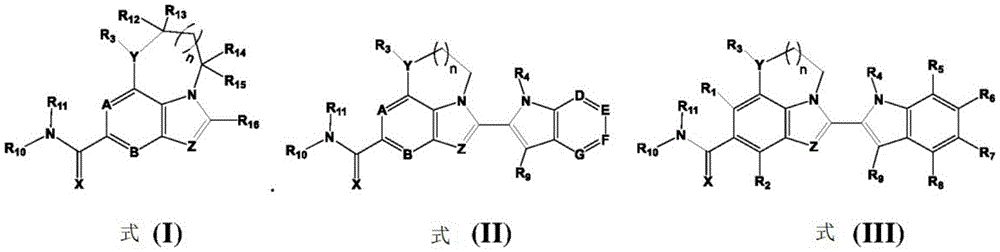
The present disclosure discloses compounds of formula (I), polymorphs, stereoisomers, prodrugs, solvates, co-crystals, intermediates, pharmaceutically acceptable salts, and metabolites thereof,

wherein:
x is selected from O or S; y is selected from O, N, S (O), SO 2 Or C; z is selected from N or CR 17 (ii) a A is selected from N or CR 1 (ii) a B is selected from N or CR 2 (ii) a n is 0 to 2; r is 1 And R 2 Independently selected from hydrogen, hydroxy, cyano, halogen, C 1-6 Alkyl radical, C 1-6 Alkoxy radical, C 1-6 Haloalkyl, C 1-6 Haloalkoxy, C 1-6 Acylamino group, C 1-6 Alkylamino radical, C 5-6 Aryl and C 1-6 Heteroaryl of which C 1-6 Alkoxy and C 1-6 Haloalkoxy is optionally substituted with one or more substituents selected from hydrogen, C 1-6 Alkyl radical, C 1-6 Alkoxy radical, C 1-6 Haloalkyl, C 1-6 Alkyl hydroxy, cyano and hydroxy; r 3 Absent or selected from hydrogen, C 1-6 Alkyl radical, C 3-6 Cycloalkyl radical, C 1-6 Alkylamino radical, C 1-6 Haloalkyl, C (O) C 1-6 Alkyl, C (O) C 1-6 Haloalkyl, C (O) NR 18 、C(O)C 1-6 Alkylamino, SO 2 C 1-6 Alkyl, SO 2 C 1-6 Halogenated alkyl, SO 2 C 3-6 Cycloalkyl, SO 2 NR 18 、SO 2 NC 1-6 Alkylamino radical, C 5-6 Aryl radical, C 1-6 Heteroaryl, C (O) C 5-6 Aryl, C (O) C 1-6 Heteroaryl, SO 2 C 5-6 Aryl and SO 2 C 1-6 Heteroaryl group, wherein C 1-6 Alkyl, (CO) C 1-6 Alkyl, C (O) C 1-6 Halogenated alkyl, SO 2 C 5-6 Aryl and SO 2 C 1-6 Alkyl is optionally substituted by C 1-6 Alkoxy, halogen, C 5-6 Aryl and C 1-6 Heteroaryl substitution;R 10 is hydrogen; r 11 Selected from the group consisting of: hydrogen, C 1-6 Alkyl radical, C 3-6 Cycloalkyl, C 1-6 Alkylamino radical, C 1-6 Haloalkyl, C (O) C 1-6 Alkyl, C (O) C 1-6 Haloalkyl, C (O) NR 18 、C(O)C 1-6 Alkylamino, SO 2 C 1-6 Alkyl, SO 2 C 1-6 Halogenated alkyl, SO 2 C 3-6 Cycloalkyl, SO 2 NR 18 、SO 2 NC 1-6 Alkylamino radical, C 5-6 Aryl radical, C 1-6 Heteroaryl, C (O) C 5-6 Aryl, C (O) C 1-6 Heteroaryl, SO 2 C 5-6 Aryl and SO 2 C 1-6 A heteroaryl group; and a 5-to 10-membered monocyclic or bicyclic saturated heterocycle having 1 to 3 heteroatoms selected from N, S or O, wherein C 1-6 Alkyl, (CO) C 1-6 Alkyl, C (O) C 1-6 Halogenated alkyl, SO 2 C 5-6 Aryl and SO 2 C 1-6 Alkyl is optionally substituted by C 1-6 Alkoxy, halogen, C 5-6 Aryl and C 1-6 Heteroaryl substituted, or R 10 And R 11 May together form a 5-to 10-membered monocyclic or bicyclic saturated or unsaturated heterocycle, wherein said 5-to 10-membered monocyclic or bicyclic saturated or unsaturated heterocycle is optionally selected from amino, C 1-6 Alkylamino radical, C 1-6 Acylamino, -NHC (NH) CH 2 Cl、-NHC(O)CH=CHCH 2 N(CH 3 ) 2 、C 1-6 Alkyl, halogen, C 1-6 Alkoxy and hydroxy; r is 12 、R 13 、R 14 And R 15 Independently selected from hydrogen, C 1-6 Alkyl radical, C 1-6 Haloalkyl, C 1-6 Alkylamino radical, C 5-6 Aryl and C 1-6 A heteroaryl group; or R 12 And R 13 May together form = O or = S; or R 14 And R 15 May together form = O or = S; r is 16 Selected from: hydrogen; 5 to 10 membered monocyclic or bicyclic aryl; and a 5-to 10-membered monocyclic or bicyclic heteroaryl group having 1 to 5 heteroatoms selected from N, S, or O, wherein the 5-to 10-membered monocyclic or bicyclic aryl and the 5-to 10-membered monocyclic or bicyclic heteroaryl group are optionally substituted by 1 to 5 heteroatoms selected from Substituent group substitution: hydroxy, cyano, halogen, C 1-6 Alkyl radical, C 1-6 Alkoxy radical, C 3-6 Cycloalkyl, C 1-6 Haloalkyl, C 1-6 Haloalkoxy, C 1-6 Acylamino group, C 1-6 Alkylamino radical, C 5-6 Aryl radical, C 1-6 alkyl-C 5-6 Aryl radical, C 2-6 alkenyl-C 5-6 Aryl radical, C 1-6 Heterocyclic group, C 1-6 alkyl-C 1-6 Heterocyclic group, C 1-6 Heteroaryl and C 1-6 alkyl-C 1-6 Heteroaryl of which C 1-6 Alkyl radical, C 1-6 Alkoxy radical, C 3-6 Cycloalkyl, C 5-6 Aryl radical, C 1-6 alkyl-C 5-6 Aryl radical, C 1-6 Heteroaryl, C 1-6 alkyl-C 1-6 Heteroaryl and C 1-6 alkyl-C 1-6 Heterocyclyl is optionally substituted by one or more groups selected from hydrogen, C 1-6 Alkyl radical, C 1-6 Alkoxy radical, C 3-8 Cycloalkyl, C 1-6 Heteroaryl, halogen, hydroxy, -CH 2 OH, -COOH and cyano; r is 17 Selected from hydrogen, hydroxy, cyano, halogen, C 1-6 Alkyl radical, C 1-6 Alkoxy radical, C 1-6 Haloalkyl, C 1-6 Haloalkoxy, C 1-6 Acylamino group, C 1-6 Alkylamino radical, C 5-6 Aryl and C 1-6 Heteroaryl group, wherein C 1-6 Alkoxy and C 1-6 Haloalkoxy is optionally substituted by one or more groups selected from hydrogen, C 1-6 Alkyl radical, C 1-6 Alkoxy radical, C 1-6 Haloalkyl, C 1-6 Alkyl hydroxy, cyano, and hydroxy; and R is 18 Independently selected from hydrogen, C 1-6 Alkyl groups and combinations thereof.
The present disclosure also discloses compounds of formula (II), polymorphs, stereoisomers, prodrugs, solvates, co-crystals, intermediates, pharmaceutically acceptable salts thereof, and metabolites thereof,

Wherein:
x is selected from O or S; y is selected from O, N, S (O), SO 2 Or C; z is selected from N or CR 17 (ii) a A is selected from N or CR 1 (ii) a B is selected from N or CR 2 (ii) a D is selected from N or CR 5 (ii) a E is selected from N or CR 6 (ii) a F is selected from N or CR 7 (ii) a G is selected from N or CR 8 (ii) a n is 0 to 2; r 1 、R 2 、R 5 、R 6 、R 7 、R 8 And R 9 Independently selected from hydrogen, hydroxy, cyano, halogen, C 1-6 Alkyl radical, C 1-6 Alkoxy radical, C 1-6 Haloalkyl, C 1-6 Haloalkoxy, C 1-6 Acylamino group, C 1-6 Alkylamino radical, C 5-6 Aryl and C 1-6 Heteroaryl of which C 1-6 Alkoxy and C 1-6 Haloalkoxy is optionally substituted with one or more substituents selected from hydrogen, C 1-6 Alkyl radical, C 1-6 Alkoxy radical, C 1-6 Haloalkyl, C 1-6 Alkyl hydroxy, cyano, and hydroxy; r 3 Absent or selected from hydrogen, C 1-6 Alkyl radical, C 3-6 Cycloalkyl radical, C 1-6 Alkylamino radical, C 1-6 Haloalkyl, C (O) C 1-6 Alkyl, C (O) C 1-6 Haloalkyl, C (O) NR 18 、C(O)C 1-6 Alkylamino, SO 2 C 1-6 Alkyl, SO 2 C 1-6 Halogenated alkyl, SO 2 C 3-6 Cycloalkyl, SO 2 NR 18 、SO 2 NC 1-6 Alkylamino radical, C 5-6 Aryl radical, C 1-6 Heteroaryl, C (O) C 5-6 Aryl, C (O) C 1-6 Heteroaryl, SO 2 C 5-6 Aryl and SO 2 C 1-6 Heteroaryl group, wherein C 1-6 Alkyl, (CO) C 1-6 Alkyl, C (O) C 1-6 Haloalkyl, SO 2 C 5-6 Aryl and SO 2 C 1-6 Alkyl is optionally substituted by C 1-6 Alkoxy, halogen, C 5-6 Aryl and C 1-6 Heteroaryl substitution; r is 4 Selected from hydrogen, C 1-6 Alkyl radical, C 1-6 Haloalkyl, C 1-6 Alkoxy radical, C 3-6 Cycloalkyl, C (O) C 1-6 Alkyl, C (O) C 1-6 Halogenated alkyl radical、C(O)NR 18 、C(O)C 1-6 Alkylamino, SO 2 C 1-6 Alkyl, SO 2 C 1-6 Haloalkyl, SO 2 NR 18 、SO 2 NC 1-6 Alkylamino radical, C 5-6 Aryl radical, C 1-6 alkyl-C 5-6 Aryl radical, C 1-6 Heterocyclic group, C 1-6 alkyl-C 1-6 Heterocyclic group, C 1-6 Heteroaryl group, C 1-6 alkyl-C 1-6 Heteroaryl, C (O) C 5-6 Aryl, C (O) C 1-6 Heteroaryl, SO 2 C 5-6 Aryl and SO 2 C 1-6 Heteroaryl group, wherein C 1-6 Alkyl radical, C 1-6 Alkoxy radical, C 3-6 Cycloalkyl radical, C 5-6 Aryl radical, C 1-6 alkyl-C 5-6 Aryl radical, C 1-6 Heterocyclic group, C 1-6 alkyl-C 1-6 Heterocyclic group, C 1-6 Heteroaryl, C 1-6 alkyl-C 1-6 Heteroaryl, (CO) C 1-6 Alkyl, C (O) C 1-6 Haloalkyl and SO 2 C 1-6 Alkyl is optionally substituted with one or more groups selected from: hydrogen, C 1-6 Alkyl radical, C 1-6 Alkoxy radical, C 3-8 Cycloalkyl, C 5-6 Aryl radical, C 1-6 Heteroaryl, halogen, hydroxy, -CH 2 OH, -COOH and cyano; r is 10 Is hydrogen; r 11 Selected from the group consisting of: c 1-6 Alkylamino, and a 5-to 10-membered monocyclic or bicyclic saturated heterocycle having 1 to 3 heteroatoms selected from N, S or O, or R 10 And R 11 May together form a 5-to 10-membered monocyclic or bicyclic saturated or unsaturated heterocyclic ring, wherein said 5-to 10-membered monocyclic or bicyclic saturated or unsaturated heterocyclic ring is optionally selected from amino, C 1-6 Alkylamino radical, C 1-6 Acylamino, -NHC (NH) CH 2 Cl、-NHC(O)CH=CHCH 2 N(CH 3 ) 2 、C 1-6 Alkyl, halogen, C 1-6 Alkoxy and hydroxy; r 17 Selected from hydrogen, hydroxy, cyano, halogen, C 1-6 Alkyl radical, C 1-6 Alkoxy radical, C 1-6 Haloalkyl, C 1-6 Haloalkoxy, C 1-6 Acylamino group, C 1-6 Alkylamino radical, C 5-6 Aryl and C 1-6 Heteroaryl of which C 1-6 Alkoxy and C 1-6 Haloalkoxy is optionally substituted by one or more groups selected from hydrogen, C 1-6 Alkyl radical, C 1-6 Alkoxy radical, C 1-6 Haloalkyl, C 1-6 Alkyl hydroxy, cyano, and hydroxy; and R is 18 Independently selected from hydrogen, C 1-6 Alkyl groups and combinations thereof.
The present disclosure also discloses compounds of formula (III), polymorphs, stereoisomers, prodrugs, solvates, co-crystals, intermediates, pharmaceutically acceptable salts, and metabolites thereof,

wherein:
x is selected from O or S; y is selected from O, N, S (O), SO 2 Or C; z is selected from N or CR 17 (ii) a n is 0 to 2; r 1 、R 2 、R 5 、R 6 、R 7 、R 8 And R 9 Independently selected from hydrogen, hydroxy, cyano, halogen, C 1-6 Alkyl radical, C 1-6 Alkoxy radical, C 1-6 Haloalkyl, C 1-6 Haloalkoxy, C 1-6 Acylamino group, C 1-6 Alkylamino radical, C 5-6 Aryl radical, C 2-6 alkenyl-C 5-6 Aryl and C 1-6 Heteroaryl group, wherein C 1-6 Alkoxy and C 1-6 Haloalkoxy is optionally substituted by one or more groups selected from hydrogen, C 1-6 Alkyl radical, C 1-6 Alkoxy radical, C 1-6 Haloalkyl, C 1-6 Alkyl hydroxy, cyano, and hydroxy; r is 3 Absent or selected from hydrogen, C 1-6 Alkyl radical, C 3-6 Cycloalkyl radical, C 1-6 Alkylamino radical, C 1-6 Haloalkyl, C (O) C 1-6 Alkyl, C (O) C 1-6 Haloalkyl, C (O) NR 18 、C(O)C 1-6 Alkylamino, SO 2 C 1-6 Alkyl, SO 2 C 1-6 Halogenated alkyl, SO 2 C 3-6 Cycloalkyl, SO 2 NR 18 、SO 2 NC 1-6 Alkylamino radical, C 5-6 Aryl radical, C 1-6 Heteroaryl, C (O) C 5-6 Aryl, C (O) C 1-6 Heteroaryl, SO 2 C 5-6 Aryl and SO 2 C 1-6 Heteroaryl group, wherein C 1-6 Alkyl, (CO) C 1-6 Alkyl, C (O) C 1-6 Halogenated alkyl, SO 2 C 5-6 Aryl and SO 2 C 1-6 Alkyl is optionally substituted by C 1-6 Alkoxy, halogen, C 5-6 Aryl and C 1-6 Heteroaryl substitution; r is 4 Selected from hydrogen, C 1-6 Alkyl radical, C 1-6 Haloalkyl, C 1-6 Alkoxy radical, C 3-6 Cycloalkyl, C (O) C 1-6 Alkyl, C (O) C 1-6 Haloalkyl, C (O) NR 18 、C(O)C 1-6 Alkylamino, SO 2 C 1-6 Alkyl, SO 2 C 1-6 Halogenated alkyl, SO 2 NR 18 、SO 2 NC 1-6 Alkylamino radical, C 5-6 Aryl radical, C 1-6 alkyl-C 5-6 Aryl radical, C 1-6 Heterocyclic group, C 1-6 alkyl-C 1-6 Heterocyclic group, C 1-6 Heteroaryl, C 1-6 alkyl-C 1-6 Heteroaryl, C (O) C 5-6 Aryl, C (O) C 1-6 Heteroaryl, SO 2 C 5-6 Aryl and SO 2 C 1-6 Heteroaryl of which C 1-6 Alkyl radical, C 1-6 Alkoxy radical, C 3-6 Cycloalkyl radical, C 5-6 Aryl radical, C 1-6 alkyl-C 5-6 Aryl radical, C 1-6 Heterocyclic group, C 1-6 alkyl-C 1-6 Heterocyclic group, C 1-6 Heteroaryl, C 1-6 alkyl-C 1-6 Heteroaryl, (CO) C 1-6 Alkyl, C (O) C 1-6 Haloalkyl and SO 2 C 1-6 Alkyl is optionally substituted with one or more groups selected from: hydrogen, C 1-6 Alkyl radical, C 1-6 Alkoxy radical, C 3-8 Cycloalkyl radical, C 5-6 Aryl radical, C 1-6 Heteroaryl, halogen, hydroxy, -CH 2 OH, -COOH and cyano; r 10 Is hydrogen; r is 11 Selected from the group consisting of: hydrogen, C 1-6 Alkyl radical, C 3-6 Cycloalkyl radical, C 1-6 Alkylamino radical, C 1-6 Haloalkyl, C (O) C 1-6 Alkyl, C (O) C 1-6 Haloalkyl, C (O) NR 18 、C(O)C 1-6 Alkylamino, SO 2 C 1-6 Alkyl, SO 2 C 1-6 Halogenated alkyl, SO 2 C 3-6 Cycloalkyl, SO 2 NR 18 、SO 2 NC 1-6 Alkylamino radical, C 5-6 Aryl radical, C 1-6 Heteroaryl, C (O) C 5-6 Aryl, C (O) C 1-6 Heteroaryl, SO 2 C 5-6 Aryl and SO 2 C 1-6 A heteroaryl group; and a 5 to 10 membered monocyclic or bicyclic saturated heterocycle having 1 to 3 heteroatoms selected from N, S or O, wherein C 1-6 Alkyl, (CO) C 1-6 Alkyl, C (O) C 1-6 Halogenated alkyl, SO 2 C 5-6 Aryl and SO 2 C 1-6 Alkyl is optionally substituted by C 1-6 Alkoxy, halogen, C 5-6 Aryl and C 1-6 Heteroaryl substituted, or R 10 And R 11 May together form a 5-to 10-membered monocyclic or bicyclic saturated or unsaturated heterocycle, wherein said 5-to 10-membered monocyclic or bicyclic saturated or unsaturated heterocycle is optionally selected from amino, C 1-6 Alkylamino radical, C 1-6 Acylamino, -NHC (NH) CH 2 Cl、-NHC(O)CH=CHCH 2 N(CH 3 ) 2 、C 1-6 Alkyl, halogen, C 1-6 Alkoxy and hydroxy; r is 17 Selected from hydrogen, hydroxy, cyano, halogen, C 1-6 Alkyl radical, C 1-6 Alkoxy radical, C 1-6 Haloalkyl, C 1-6 Haloalkoxy, C 1-6 Acylamino group, C 1-6 Alkylamino radical, C 5-6 Aryl and C 1-6 Heteroaryl group, wherein C 1-6 Alkoxy and C 1-6 Haloalkoxy is optionally substituted by one or more groups selected from hydrogen, C 1-6 Alkyl radical, C 1-6 Alkoxy radical, C 1-6 Haloalkyl, C 1-6 Alkyl hydroxy, cyano and hydroxy; and R is 18 Independently selected from hydrogen, C 1-6 Alkyl groups and combinations thereof.
The present disclosure also describes methods of making compounds of formula (I), formula (II), and formula (III) or their polymorphs, stereoisomers, prodrugs, solvates, co-crystals, intermediates, pharmaceutically acceptable salts, and metabolites thereof.
The present disclosure also discloses pharmaceutical compositions comprising compounds of formula (I), formula (II), and formula (III), or pharmaceutically acceptable salts thereof, and a pharmaceutically acceptable carrier, optionally in combination with one or more other pharmaceutical compositions.
The present disclosure also discloses methods for inhibiting one or more PAD families in a cell with an effective amount of a compound of the present disclosure.
The present disclosure also discloses methods of treating a disorder mediated by one or more PAD families, the methods comprising administering to a subject in need thereof a therapeutically effective amount of a compound or pharmaceutical composition of formula (I), formula (II), and formula (III) of the present disclosure and other clinically relevant agents or biological agents.
The present disclosure also discloses compounds of formula (I), formula (II) and formula (III) for use in the treatment of rheumatoid arthritis, vasculitis, systemic lupus erythematosus, ulcerative colitis, cancer, cystic fibrosis, asthma, cutaneous lupus erythematosus and psoriasis.
These and other features, aspects, and advantages of the present subject matter will become better understood with reference to the following description. This summary is provided to introduce a selection of concepts in a simplified form. This summary is not intended to identify key features or essential features of the disclosure, nor is it intended to be used to limit the scope of the subject matter.
Detailed Description
Those skilled in the art will appreciate that variations and modifications of the present disclosure may be made in addition to those specifically described. It is to be understood that the present disclosure includes all such variations and modifications. The present disclosure also includes all such steps, features, compositions and compounds referred to or indicated in this specification, individually or collectively, and any and all combinations of any or more such steps or features.
Definition of
For convenience, certain terms and examples employed in the specification are collected here before the disclosure is further described. These definitions should be read in light of the remainder of this disclosure and understood by those skilled in the art. Terms used herein have meanings that are recognized and known by those skilled in the art, but specific terms and their meanings are set forth below for convenience and completeness.
Nouns without quantitative recitation mean one or more than one (i.e., at least one).
Throughout this specification and the claims which follow, unless the context requires otherwise, the word "comprise", and variations such as "comprises" and "comprising", will be understood to imply the inclusion of a stated integer or step or group of integers but not the exclusion of any other integer or step or group of integers or steps.
The term "including" is used to mean "including but not limited to". "include/include" and "include/include but not limited to" are used interchangeably.
In the structural formulae given herein and throughout this disclosure, the following terms have the meanings indicated, unless specifically stated otherwise.
Further, the compounds of formula (I), formula (II) and formula (III) may be derivatives, analogs, stereoisomers, diastereomers, geometric isomers, polymorphs, solvates, co-crystals, intermediates, metabolites, prodrugs or pharmaceutically acceptable salts and compositions thereof.
The compounds according to formula (I), formula (II) and formula (III) contain one or more asymmetric centers (also known as chiral centers) and may therefore exist as individual enantiomers, diastereomers or other stereoisomeric forms, or mixtures thereof. Chiral centers, such as chiral carbon atoms, may also be present in substituents such as alkyl groups. When the stereochemistry of the chiral centers present in formula (I), formula (II) and formula (III) or in any of the chemical structures illustrated herein is not specified, the structure is intended to encompass any stereoisomer and all mixtures thereof. Thus, compounds according to formula (I), formula (II) and formula (III) containing one or more chiral centers may be used as racemic variants (including racemic mixtures and racemates), enantiomerically enriched mixtures, or as enantiomerically pure individual stereoisomers.
Individual stereoisomers of compounds according to formula (I), formula (II) and formula (III) comprising one or more asymmetric centers may be resolved by methods known to those skilled in the art. For example, such a resolution can be performed by: (1) By formation of diastereomeric salts, complexes or other derivatives; (2) By selective reaction with a stereoisomer-specific reagent, for example by enzymatic oxidation or reduction; or (3) by gas-liquid or liquid chromatography in a chiral environment, for example on a chiral support (support) such as silica with bound chiral ligands, or in the presence of a chiral solvent. It will be appreciated that where the desired stereoisomer is converted to another chemical entity by one of the separation procedures described above, an additional step is required to liberate the desired form.
Alternatively, a particular stereoisomer may be synthesized by asymmetric synthesis using optically active reagents, substrates, catalysts, or solvents, or by converting one enantiomer into the other via asymmetric transformation.
It will be understood that reference herein to compounds of formula (I), (II) and (III) and salts thereof encompasses compounds of formula (I), (II) and (III) as the free base or as a salt thereof, for example as a pharmaceutically acceptable salt thereof. Thus, in one embodiment, the present disclosure relates to compounds of formula (I), formula (II), and formula (III) as free bases. In another embodiment, the invention relates to compounds of formula (I), formula (II) and formula (III) and salts thereof. In another embodiment, the present invention relates to compounds of formula (I), formula (II) and formula (III) and pharmaceutically acceptable salts thereof.
It will be appreciated that pharmaceutically acceptable salts of the compounds according to formulas (I, II and III) may be prepared. Indeed, in certain embodiments of the present disclosure, pharmaceutically acceptable salts of the compounds according to formula (I), formula (II) and formula (III) may be preferred over the respective free bases, as such salts confer greater stability or solubility to the molecule, thereby facilitating its formulation into a dosage form. Accordingly, the present invention also relates to compounds of formula (I), formula (II) and formula (III) and pharmaceutically acceptable salts thereof.
"enantiomeric excess" (ee) is the excess of one enantiomer over the other, expressed as a percentage. In the racemic variants, since both enantiomers are present in equal amounts, the enantiomeric excess is zero (0% ee). However, if one enantiomer is enriched such that it constitutes 95% of the product, the enantiomeric excess will be 90% ee (amount of enriched enantiomer (95%) minus the amount of the other enantiomer (5%)).
"enantiomerically enriched" refers to a product whose enantiomeric excess (ee) is greater than zero. For example, "enantiomeric enrichment" refers to products whose enantiomeric excess is greater than 50% ee, greater than 75% ee, and greater than 90% ee. "enantiomerically pure" refers to a product having an enantiomeric excess of 99% or greater.
Included within the scope of "compounds of the present disclosure" are all solvates (including hydrates), complexes, polymorphs, prodrugs, radiolabeled derivatives and stereoisomers of the compounds of formula (I), (II) and (III), and salts thereof.
The compounds of the present disclosure may be present in solid or liquid form. In the solid state, the compounds of the present disclosure may be present in crystalline or amorphous form or mixtures thereof. For the compounds of the present disclosure in crystalline form, the skilled artisan will appreciate that pharmaceutically acceptable solvates may be formed, wherein solvent molecules are incorporated into the crystal lattice during crystallization. Solvates may involve non-aqueous solvents such as ethanol, isopropanol, N-dimethyl sulfoxide (DMSO), acetic acid, ethanolamine and ethyl acetate, or they may involve water as the solvent incorporated into the crystal lattice. Solvates in which water is the solvent incorporated into the crystal lattice are commonly referred to as "hydrates". Hydrates include stoichiometric hydrates as well as compositions containing variable amounts of water. The present disclosure includes all such solvates.
It will also be appreciated that certain compounds of the present disclosure, including various solvates thereof, in crystalline form may exhibit polymorphism (i.e., the ability to exist in different crystal structures). These different crystalline forms are often referred to as "polymorphs". The present disclosure includes such polymorphs. Polymorphs have the same chemical composition, but differ in packing, geometric arrangement, and other descriptive aspects of the crystalline solid state. Thus, polymorphs can have different physical properties, such as shape, density, hardness, deformability, stability, and solubility properties. Polymorphs typically exhibit different melting points, IR spectra and X-ray powder diffraction patterns, which can be used for identification. It is understood that different polymorphs can be produced, for example, by changing or adjusting the reaction conditions or reagents used to manufacture the compound. For example, changes in temperature, pressure or solvent can result in multiple polymorphs. Additionally, under certain conditions, one polymorph may spontaneously convert to another polymorph.
The present disclosure also includes isotopically-labeled compounds, which are identical to the compounds of formulae (I, II, and III) and salts thereof, but for the fact that one or more atoms are replaced by an atom having an atomic mass or mass number different from the atomic mass or mass number most commonly found in nature. Some examples of isotopes that can be incorporated into compounds of the present disclosure include isotopes of hydrogen, carbon, nitrogen, oxygen, and fluorine, e.g. 3 H、 11 C、 14 C and 18 F。
the term "co-crystal" refers to a solid, which is a crystalline single phase material composed of two or more different molecular and/or ionic compounds, usually in stoichiometric ratios, that is neither a solvate nor a simple salt.
The term "substituted" with respect to a group means replacing a hydrogen atom within the group to which one member atom is attached. It is to be understood that the term "substituted" includes implicit indications that such substitution is according to the allowed valencies of the substituted atom or group and that the substitution results in a stable compound (i.e., a compound that does not spontaneously undergo transformation (e.g., rearrangement, cyclization, or elimination)). In certain embodiments, a single atom may be substituted with more than one substituent, so long as such substitution is in accordance with the allowed valences of the atom. Suitable substituents for each substituted or optionally substituted group are defined herein.
The term "polymorph" refers to multiple crystal forms of the same molecule, and different polymorphs can have different physical properties, e.g., melting temperature, heat of fusion, solubility, dissolution rate, and/or vibrational spectrum, due to the arrangement or conformation of the molecules in the crystal lattice.
The term "prodrug" refers to a precursor of the compounds of formula (I, II and III) which undergoes a chemical transformation by metabolic processes upon administration and then becomes the active pharmacological substance. Typically, such prodrugs will be functional derivatives of the compounds of the present disclosure that are readily convertible in vivo into the compounds of the present disclosure.
The term "alkyl" refers to a saturated hydrocarbon chain having the indicated number of carbon atoms. Such as, but not limited to, C 1-6 Alkyl refers to alkyl groups having 1 to 6 carbon atoms or 1 to 3 carbon atoms. The alkyl group may be a straight chain or branched group. Representative branched alkyl groups have one, two or three branches. Preferred alkyl groups include, but are not limited to, methyl, ethyl, n-propyl, isopropyl, butyl, and isobutyl.
The term "C (O) alkyl" refers to an alkyl group as defined above attached to the rest of the molecule via a carbonyl linkage. For example, C (O) C 1-6 Alkyl refers to an alkyl group having 1 to 6 carbon atoms or 1 to 3 carbon atoms attached to the rest of the molecule via a carbonyl linkage. Preferred C (O) alkyl groups include, but are not limited to, -C (O) CH 3 、-C(O)CH 2 CH 3 And so on.
The term "SO 2 Alkyl "means an alkyl group as defined above attached to the rest of the molecule via a sulfonyl linkage. For example, SO 2 C 1-6 Alkyl refers to an alkyl group having 1 to 6 carbon atoms or 1 to 3 carbon atoms bonded to the rest of the molecule via a sulfonyl linkage. Preferred SO 2 Alkyl includes but is not limited to-SO 2 CH 3 、-SO 2 CH 2 CH 3 And so on.
The term "alkoxy" refers to an alkyl group attached to the rest of the molecule via an oxygen linkage. E.g. C 1-6 Alkoxy means via an oxygen bondAn alkyl group having 1 to 6 carbon atoms or 1 to 3 carbon atoms attached to the remainder of the molecule. Preferred alkoxy groups include, but are not limited to-OCH 3 (methoxy), -OC 2 H 5 (ethoxy) and the like.
The term "alkylamino" refers to an alkyl group as defined above attached to the rest of the molecule via an amino linkage. E.g. C 1-6 Alkylamino refers to an alkyl group having 1 to 6 carbon atoms or 1 to 3 carbon atoms that is attached to the rest of the molecule via an amino linkage. Preferred alkylamino groups include, but are not limited to-NHCH 3 、-N(CH 3 ) 2 And so on.
The term "C (O) NR" refers to an alkylamino group as defined above attached to the rest of the molecule via a carbonyl linkage. Preferred C (O) NR groups include C (O) NCH 3 、C(O)NCH 2 CH 3 And the like.
The term "SO 2 NR "refers to an alkylamino group as defined above attached to the rest of the molecule via a sulfonyl linkage. Preferred SO 2 The NR groups comprising SO 2 NCH 3 、SO 2 NCH 2 CH 3 And so on.
The term "C (O) alkylamino" refers to an alkylamino group as defined above attached to the rest of the molecule via a carbonyl linkage. For example, C (O) C 1-6 Alkylamino refers to alkylamino groups having 1 to 6 carbon atoms or 1 to 3 carbon atoms attached to the rest of the molecule via a carbonyl linkage. Preferred C (O) alkylamino groups include, but are not limited to-C (O) NHCH 3 、-C(O)N(CH 3 ) 2 And so on.
The term "SO 2 Alkylamino "refers to an alkylamino group as defined above attached to the rest of the molecule via a sulfonyl linkage. For example, SO 2 C 1-6 Alkylamino refers to alkylamino groups having 1 to 6 carbon atoms or 1 to 3 carbon atoms attached to the rest of the molecule via a sulfonyl linkage. Preferred SO 2 Alkylamino includes, but is not limited to, -SO 2 NHCH 3 、-SO 2 N(CH 3 ) 2 And so on.
The term "acylamino" refers to a linkage to a molecule via an amino groupThe remainder is an attached acyl group. For example, C 1-6 Acylamino refers to an acyl group having 1 to 6 carbon atoms or 1 to 3 carbon atoms attached to the rest of the molecule via an amino linkage. Preferred acylamino groups include, but are not limited to- (CO) NHCH 3 、-(CO)N(CH 3 ) 2 And the like.
The term "haloalkyl" refers to an alkyl group as defined above attached to the rest of the molecule via a halo linkage. For example, C 1-6 Haloalkyl refers to an alkyl group having 1 to 6 carbon atoms or 1 to 3 carbon atoms attached to the rest of the molecule via a halo linkage. Preferred haloalkyl groups include, but are not limited to, -CH 2 Cl、-CHCl 2 And the like.
The term "C (O) haloalkyl" means a haloalkyl group as defined above attached to the remainder of the molecule via a carbonyl linkage. For example, C (O) C 1-6 Haloalkyl refers to haloalkyl groups having 1 to 6 carbon atoms or 1 to 3 carbon atoms attached to the remainder of the molecule via a carbonyl linkage. Preferred C (O) haloalkyl groups include, but are not limited to- (CO) CH 2 Cl、-C(O)CHCl 2 And the like.
The term "SO 2 Haloalkyl "means a haloalkyl group as defined above attached to the remainder of the molecule via a sulfonyl linkage. For example, SO 2 C 1-6 Haloalkyl refers to haloalkyl groups having 1 to 6 carbon atoms or 1 to 3 carbon atoms that are linked to the remainder of the molecule via a sulfonyl linkage. Preferred SO 2 Haloalkyl includes, but is not limited to, -SO 2 CH 2 Cl、-SO 2 CHCl 2 And so on.
The term "haloalkoxy" refers to an alkoxy group, as defined above, attached to the rest of the molecule via an oxygen linkage of the haloalkoxy group. E.g. C 1-6 Haloalkoxy refers to an alkoxy group having 1 to 6 carbon atoms or 1 to 3 carbon atoms that is attached to the rest of the molecule via an oxygen linkage. Preferred haloalkoxy groups include, but are not limited to, -OCH 2 Cl、-OCHCl 2 And the like.
The term "halogen" refers to a halogen group, such as fluorine, chlorine, bromine or iodine. "haloalkyl" refers to an alkyl group as defined herein aboveWherein at least one hydrogen atom has been replaced by a halogen group. ' C 1-6 Haloalkyl "refers to C wherein at least one hydrogen atom has been replaced by a halogen group 1-6 An alkyl group. An example of "haloalkyl" is trifluoromethyl or 2, 2-trifluoroethyl.
The term "cycloalkyl" refers to a saturated hydrocarbon ring having the indicated number of carbon atoms. Such as, but not limited to, C 3-6 Cycloalkyl refers to cycloalkyl having 3 to 6 member atoms or 3 member atoms. Preferred cycloalkyl groups include, but are not limited to, cyclopropyl, cyclobutyl, cyclopentyl, cyclohexyl, and the like.
The term "SO 2 C 3-6 Cycloalkyl "refers to a cycloalkyl group as defined above attached to the rest of the molecule via a sulfonyl linkage. For example, SO 2 C 3-6 Cycloalkyl refers to cycloalkyl groups having 3 to 6 carbon atoms attached to the rest of the molecule via a sulfonyl linkage. Preferred SO 2 Cycloalkyl groups include, but are not limited to, -SO 2 C 3 Cycloalkyl groups, and the like.
The term "aryl" refers to an aromatic ring having the indicated number of carbon atoms. E.g. C 5-6 Aryl refers to an aryl group having 5 or 6 member atoms or 6 atoms. Preferred aryl groups include, but are not limited to, phenyl and the like.
The term "C (O) aryl" refers to an aryl group as defined above attached to the rest of the molecule via a carbonyl linkage. For example, C (O) C 5-6 Aryl means an aryl group having 5 to 6 carbon atoms attached to the rest of the molecule via a carbonyl linkage. Preferred C (O) aryl groups include, but are not limited to-C (O) C 6 H 5 、-C(O)C 5 H 5 And the like.
The term "SO 2 Aryl "refers to an aryl group as defined above attached to the rest of the molecule via a sulfonyl linkage. For example, SO 2 C 5-6 Aryl means an aryl group having 5 to 6 carbon atoms linked to the rest of the molecule via a sulfonyl linkage. Preferred SO 2 Aryl groups include, but are not limited to, -SO 2 C 6 H 5 、-SO 2 C 5 H 5 And the like.
The term "heteroaryl" refers to a group in the ringAn aromatic ring containing 1 to 5 heteroatoms. A "heteroaryl" group, if so defined herein, may be substituted with one or more substituents. "C having 1 or 6 carbons as a member atom 1-6 Heteroaryl "ring. "heteroaryl" includes pyridyl, tetrazolyl, and pyrazolyl. "heteroatom" means a nitrogen, sulfur or oxygen atom, such as a nitrogen atom or an oxygen atom.
The term "C (O) heteroaryl" refers to a heteroaryl group as defined above attached to the rest of the molecule via a carbonyl linkage. For example, C (O) C 1-6 Heteroaryl refers to an alkyl group having 1 to 6 carbon atoms attached to the rest of the molecule via a carbonyl linkage. Preferred C (O) heteroaryl groups include, but are not limited to, -C (O) pyridyl, -C (O) pyrazolyl, and the like.
The term "SO 2 Heteroaryl "refers to an aryl group as defined above attached to the rest of the molecule via a sulfonyl linkage. For example, SO 2 C 1-6 Heteroaryl refers to an aryl group having 1 to 6 carbon atoms linked to the rest of the molecule via a sulfonyl linkage. Preferred SO 2 Heteroaryl includes, but is not limited to, -SO 2 Pyridyl, -SO 2 Pyrazolyl, and the like.
The terms "heterocycle" and "heterocyclyl" refer to a saturated or unsaturated monocyclic aliphatic ring comprising 5, 6, or 7 ring members, which contains 1 to 5 heteroatoms; or a saturated or unsaturated bicyclic aliphatic ring comprising 5, 6 or 7 ring members, each containing 1 to 5 heteroatoms. In certain embodiments, a "heterocyclyl" group is saturated. In other embodiments, a "heterocyclyl" group is unsaturated. A "heterocyclyl" group that contains more than one heteroatom may contain different heteroatoms. A "heterocyclyl" group may be substituted by one or more substituents as defined herein. "Heterocyclyl" includes piperidinyl, tetrahydropyranyl, azepinyl, oxaazepinyl, azabicyclo [3.1.0] hexyl.
The phrase "pharmaceutically acceptable" refers to compounds, materials, compositions, and dosage forms which are, within the scope of sound medical judgment, suitable for use in contact with the tissues of human beings and animals without excessive toxicity, irritation, or other problem or complication, commensurate with a reasonable benefit/risk ratio.
As used herein, the term "pharmaceutically acceptable salt" refers to a salt that retains the desired biological activity of the compounds of the present invention and exhibits minimal undesirable toxicological effects. These pharmaceutically acceptable salts can be prepared in situ during the final isolation and purification of the compounds or by separately reacting the purified compound in its free base form with an appropriate acid. Selected pharmaceutically acceptable salts derived from inorganic bases (such as, for example, li, na, K, ca, mg, fe, cu, zn and Mn); salts of organic bases such as N, N' -diacetylethylenediamine, glucosamine, triethylamine, choline, dicyclohexylamine, benzylamine, trialkylamine, thiamine, guanidine, diethanolamine, α -phenylethylamine, piperidine, morpholine, pyridine, hydroxyethylpyrrolidine, hydroxyethylpiperidine; ammonium; a substituted ammonium salt; aluminum salts, and the like. Salts also include amino acid salts such as glycine, alanine, cystine, cysteine, lysine, arginine, phenylalanine, and guanidine. Salts may include acid addition salts where appropriate which are sulphates, nitrates, phosphates, perchlorates, borates, hydrohalides, acetates, tartrates, maleates, citrates, succinates, pamates, methanesulphonates, toluenesulphonates, benzoates, salicylates, hydroxynaphthoates, benzenesulphonates, ascorbates, glycerophosphates, ketoglutarates.
Salts and solvates with non-pharmaceutically acceptable counterions or related solvents are within the scope of the disclosure, e.g., as intermediates for preparing other compounds of formula (I), formula (II), and formula (III) and pharmaceutically acceptable salts thereof. Accordingly, one embodiment of the present disclosure includes compounds of formula (I), formula (II), and formula (III) and salts thereof. The compounds according to formula (I), formula (II) and formula (III) comprise basic functional groups and can therefore form pharmaceutically acceptable acid addition salts by treatment with an appropriate acid. Suitable acids include pharmaceutically acceptable inorganic acids and pharmaceutically acceptable organic acids. Representative pharmaceutically acceptable acid addition salts include the hydrochloride, hydrobromide, nitrate, methyl nitrate, sulphate, bisulphate, sulphamate, phosphate, acetate, hydroxyacetate, phenylacetate, propionate, butyrate, isobutyrate, valerate, maleate, hydroxymaleate, acrylate, fumarate, malate, tartrate, citrate, salicylate, glycolate, lactate, heptanoate, phthalate, oxalate, succinate, benzoate, o-acetoxybenzoate, chlorobenzoate, methylbenzoate, dinitrobenzoate, hydroxybenzoate, methoxybenzoate, naphthoate, hydroxynaphthoate, mandelate, tannate, formate, stearate, ascorbate, palmitate, oleate, pyruvate, pamoate, malonate, laurate, glutarate, glutamate, laurate (estolate), methanesulphonate (methanesulphonate), ethanesulphonate (ethanesulphonate), 2-hydroxyethanesulphonate, benzenesulphonate (benzenesulphonate), aminobenzenesulphonate, p-toluenesulphonate (p-toluenesulphonate) and naphthalene-2-sulphonate.
The term "PAD inhibitor" or "PAD inhibitor" is used to identify compounds capable of interacting with the neutrophil extracellular capture NET, more specifically in histone citrullination occurring during NETosis. By inhibiting PAD4 enzyme activity is meant the ability to decrease the PAD4 enzyme, thereby inhibiting the formation of citrulline through the citrullination process. Preferably, this inhibition is specific for the PAD4 enzyme.
Once a term is described, it has the same meaning throughout the patent.
As described in the background section, PAD4 inhibitors have broad utility. However, despite the wide utility of PAD4 inhibitor compounds, its identification and development remains a problem. Thus, there is a need for new PAD4 inhibitor compounds for the treatment of PAD4 mediated disorders.
In one embodiment of the present disclosure, there is provided a compound of formula (I), polymorphs, stereoisomers, prodrugs, solvates, co-crystals, intermediates, pharmaceutically acceptable salts, and metabolites thereof, wherein:

x is selected from O or S; y is selected from O, N, S (O), SO 2 Or C; z is selected from N or CR 17 (ii) a A is selected from N or CR 1 (ii) a B is selected from N or CR 2 (ii) a n is 0 to 2; r is 1 And R 2 Independently selected from hydrogen, hydroxy, cyano, halogen, C 1-6 Alkyl radical, C 1-6 Alkoxy radical, C 1-6 Haloalkyl, C 1-6 Haloalkoxy, C 1-6 Acylamino group, C 1-6 Alkylamino radical, C 5-6 Aryl and C 1-6 Heteroaryl of which C 1-6 Alkoxy and C 1-6 Haloalkoxy is optionally substituted by one or more groups selected from hydrogen, C 1-6 Alkyl radical, C 1-6 Alkoxy radical, C 1-6 Haloalkyl, C 1-6 Alkyl hydroxy, cyano, and hydroxy; r 3 Absent or selected from hydrogen, C 1-6 Alkyl radical, C 3-6 Cycloalkyl, C 1-6 Alkylamino radical, C 1-6 Haloalkyl, C (O) C 1-6 Alkyl, C (O) C 1-6 Haloalkyl, C (O) NR 18 、C(O)C 1-6 Alkylamino, SO 2 C 1-6 Alkyl, SO 2 C 1-6 Haloalkyl, SO 2 C 3-6 Cycloalkyl, SO 2 NR 18 、SO 2 NC 1-6 Alkylamino radical, C 5-6 Aryl radical, C 1-6 Heteroaryl, C (O) C 5-6 Aryl, C (O) C 1-6 Heteroaryl, SO 2 C 5-6 Aryl and SO 2 C 1-6 Heteroaryl group, wherein C 1-6 Alkyl, (CO) C 1-6 Alkyl, C (O) C 1-6 Halogenated alkyl, SO 2 C 5-6 Aryl and SO 2 C 1-6 Alkyl is optionally substituted by C 1-6 Alkoxy, halogen, C 5-6 Aryl and C 1-6 Heteroaryl substitution; r 10 Is hydrogen; r is 11 Selected from: hydrogen, C 1-6 Alkyl radical, C 3-6 Cycloalkyl radical, C 1-6 Alkylamino radical, C 1-6 Haloalkyl, C (O) C 1-6 Alkyl, C (O) C 1-6 Haloalkyl, C (O) NR 18 、C(O)C 1-6 Alkylamino, SO 2 C 1-6 Alkyl, SO 2 C 1-6 Halogenated alkyl, SO 2 C 3-6 Cycloalkyl, SO 2 NR 18 、SO 2 NC 1-6 Alkylamino radical, C 5-6 Aryl radical, C 1-6 Heteroaryl, C (O) C 5-6 Aryl, C (O) C 1-6 Heteroaryl, SO 2 C 5-6 Aryl and SO 2 C 1-6 A heteroaryl group; and a 5 to 10 membered monocyclic or bicyclic saturated heterocycle having 1 to 3 heteroatoms selected from N, S or O, wherein C 1-6 Alkyl, (CO) C 1-6 Alkyl, C (O) C 1-6 Halogenated alkyl, SO 2 C 5-6 Aryl and SO 2 C 1-6 Alkyl is optionally substituted by C 1-6 Alkoxy, halogen, C 5-6 Aryl and C 1-6 Heteroaryl substituted, or R 10 And R 11 May together form a 5-to 10-membered monocyclic or bicyclic saturated or unsaturated heterocyclic ring, wherein said 5-to 10-membered monocyclic or bicyclic saturated or unsaturated heterocyclic ring is optionally selected from amino, C 1-6 Alkylamino radical, C 1-6 Acylamino, -NHC (NH) CH 2 Cl、-NHC(O)CH=CHCH 2 N(CH 3 ) 2 、C 1-6 Alkyl, halogen, C 1-6 Alkoxy and hydroxy; r is 12 、R 13 、R 14 And R 15 Independently selected from hydrogen, C 1-6 Alkyl radical, C 1-6 Haloalkyl, C 1-6 Alkylamino radical, C 5-6 Aryl and C 1-6 A heteroaryl group; or R 12 And R 13 May together form = O or = S; or R 14 And R 15 May together form = O or = S; r is 16 Selected from the group consisting of: hydrogen; 5-to 10-membered monocyclic or bicyclic aryl; and a 5 to 10 membered monocyclic or bicyclic heteroaryl having 1 to 5 heteroatoms selected from N, S, or O, wherein the 5 to 10 membered monocyclic or bicyclic aryl and the 5 to 10 membered monocyclic or bicyclic heteroaryl are optionally substituted with 1 to 5 substituents selected from: hydroxy, cyano, halogen, C 1-6 Alkyl radical, C 1-6 Alkoxy radical, C 3-6 Cycloalkyl, C 1-6 Haloalkyl, C 1-6 Haloalkoxy, C 1-6 Acylamino group, C 1-6 Alkylamino radical, C 5-6 Aryl radical, C 1-6 alkyl-C 5-6 Aryl radical, C 2-6 alkenyl-C 5-6 Aryl radical, C 1-6 Heterocyclic group, C 1-6 alkyl-C 1-6 Heterocyclic group, C 1-6 Heteroaryl and C 1-6 alkyl-C 1-6 Heteroaryl group, wherein C 1-6 Alkyl radical, C 1-6 Alkoxy radical, C 3-6 Cycloalkyl radical, C 5-6 Aryl radical, C 1-6 alkyl-C 5-6 Aryl radical, C 1-6 Heteroaryl, C 1-6 alkyl-C 1-6 Heteroaryl and C 1-6 alkyl-C 1-6 Heterocyclyl is optionally substituted by one or more groups selected from hydrogen, C 1-6 Alkyl radical, C 1-6 Alkoxy radical, C 3-8 Cycloalkyl, C 1-6 Heteroaryl, halogen, hydroxy, -CH 2 OH, -COOH and cyano; r is 17 Selected from hydrogen, hydroxy, cyano, halogen, C 1-6 Alkyl radical, C 1-6 Alkoxy radical, C 1-6 Haloalkyl, C 1-6 Haloalkoxy, C 1-6 Acylamino group, C 1-6 Alkylamino radical, C 5-6 Aryl and C 1-6 Heteroaryl group, wherein C 1-6 Alkoxy and C 1-6 Haloalkoxy is optionally substituted by one or more groups selected from hydrogen, C 1-6 Alkyl radical, C 1-6 Alkoxy radical, C 1-6 Haloalkyl, C 1-6 Alkyl hydroxy, cyano and hydroxy; and R is 18 Independently selected from hydrogen, C 1-6 Alkyl groups and combinations thereof.
In one embodiment of the present disclosure, there is provided a compound of formula (I) as described herein, wherein X is O; y is selected from O, N, S (O), SO 2 Or C; z is selected from N or CR 17 (ii) a A is selected from N or CR 1 (ii) a B is selected from N or CR 2 (ii) a n is 0 to 2; r 1 And R 2 Independently selected from hydrogen, hydroxy, cyano, halogen, C 1-6 Alkyl radical, C 1-6 Alkoxy radical, C 1-6 Haloalkyl, C 1-6 Haloalkoxy, C 1-6 Acylamino group, C 1-6 Alkylamino radical, C 5-6 Aryl and C 1-6 Heteroaryl group, wherein C 1-6 Alkoxy and C 1-6 Haloalkoxy is optionally substituted with one or more substituents selected from hydrogen, C 1-6 Alkyl radical, C 1-6 Alkoxy radical, C 1-6 HalogenatedAlkyl radical, C 1-6 Alkyl hydroxy, cyano and hydroxy; r 3 Absent or selected from hydrogen, C 1-6 Alkyl radical, C 3-6 Cycloalkyl radical, C 1-6 Alkylamino radical, C 1-6 Haloalkyl, C (O) C 1-6 Alkyl, C (O) C 1-6 Haloalkyl, C (O) NR 18 、C(O)C 1-6 Alkylamino, SO 2 C 1-6 Alkyl, SO 2 C 1-6 Haloalkyl, SO 2 C 3-6 Cycloalkyl, SO 2 NR 18 、SO 2 NC 1-6 Alkylamino radical, C 5-6 Aryl radical, C 1-6 Heteroaryl, C (O) C 5-6 Aryl, C (O) C 1-6 Heteroaryl, SO 2 C 5-6 Aryl and SO 2 C 1-6 Heteroaryl of which C 1-6 Alkyl, (CO) C 1-6 Alkyl, C (O) C 1-6 Halogenated alkyl, SO 2 C 5-6 Aryl and SO 2 C 1-6 Alkyl is optionally substituted by C 1-6 Alkoxy, halogen, C 5-6 Aryl and C 1-6 Heteroaryl substitution; r 10 Is hydrogen; r 11 Selected from: hydrogen, C 1-6 Alkyl radical, C 3-6 Cycloalkyl, C 1-6 Alkylamino radical, C 1-6 Haloalkyl, C (O) C 1-6 Alkyl, C (O) C 1-6 Haloalkyl, C (O) NR 18 、C(O)C 1-6 Alkylamino, SO 2 C 1-6 Alkyl, SO 2 C 1-6 Halogenated alkyl, SO 2 C 3-6 Cycloalkyl, SO 2 NR 18 、SO 2 NC 1-6 Alkylamino radical, C 5-6 Aryl radical, C 1-6 Heteroaryl, C (O) C 5-6 Aryl, C (O) C 1-6 Heteroaryl, SO 2 C 5-6 Aryl and SO 2 C 1-6 A heteroaryl group; and a 5-to 10-membered monocyclic or bicyclic saturated heterocycle having 1 to 3 heteroatoms selected from N, S or O, wherein C 1-6 Alkyl, (CO) C 1-6 Alkyl, C (O) C 1-6 Haloalkyl, SO 2 C 5-6 Aryl and SO 2 C 1-6 Alkyl is optionally substituted by C 1-6 Alkoxy, halogen, C 5-6 Aryl and C 1-6 Heteroaryl substituted, or R 10 And R 11 May together form a 5-to 10-membered monocyclic or bicyclic saturated or unsaturated heterocycle, wherein said 5-to 10-membered monocyclic or bicyclic saturated or unsaturated heterocycle is optionally selected from amino, C 1-6 Alkylamino radical, C 1-6 Acylamino, -NHC (NH) CH 2 Cl、-NHC(O)CH=CHCH 2 N(CH 3 ) 2 、C 1-6 Alkyl, halogen, C 1-6 Alkoxy and hydroxy; r is 12 、R 13 、R 14 And R 15 Independently selected from hydrogen, C 1-6 Alkyl radical, C 1-6 Haloalkyl, C 1-6 Alkylamino radical, C 5-6 Aryl and C 1-6 A heteroaryl group; or R 12 And R 13 May together form = O or = S; or R 14 And R 15 May together form = O or = S; r 16 Selected from: hydrogen; 5-to 10-membered monocyclic or bicyclic aryl; and a 5-to 10-membered monocyclic or bicyclic heteroaryl having 1 to 5 heteroatoms selected from N, S, or O, wherein the 5-to 10-membered monocyclic or bicyclic aryl and the 5-to 10-membered monocyclic or bicyclic heteroaryl are optionally substituted with 1 to 5 substituents selected from: hydroxy, cyano, halogen, C 1-6 Alkyl radical, C 1-6 Alkoxy radical, C 3-6 Cycloalkyl radical, C 1-6 Haloalkyl, C 1-6 Haloalkoxy, C 1-6 Acylamino group, C 1-6 Alkylamino radical, C 5-6 Aryl radical, C 1-6 alkyl-C 5-6 Aryl radical, C 2-6 alkenyl-C 5-6 Aryl radical, C 1-6 Heterocyclic group, C 1-6 alkyl-C 1-6 Heterocyclic group, C 1-6 Heteroaryl and C 1-6 alkyl-C 1-6 Heteroaryl group, wherein C 1-6 Alkyl radical, C 1-6 Alkoxy radical, C 3-6 Cycloalkyl, C 5-6 Aryl radical, C 1-6 alkyl-C 5-6 Aryl radical, C 1-6 Heteroaryl group, C 1-6 alkyl-C 1-6 Heteroaryl and C 1-6 alkyl-C 1-6 Heterocyclyl is optionally substituted by one or more groups selected from hydrogen, C 1-6 Alkyl radical, C 1-6 Alkoxy radical, C 3-8 Cycloalkyl, C 1-6 Heteroaryl, halogen, hydroxy, -CH 2 OH, -COOH and cyano; r is 17 Selected from hydrogen, hydroxy, cyano, halogenElement, C 1-6 Alkyl radical, C 1-6 Alkoxy radical, C 1-6 Haloalkyl, C 1-6 Haloalkoxy, C 1-6 Acylamino group, C 1-6 Alkylamino radical, C 5-6 Aryl and C 1-6 Heteroaryl of which C 1-6 Alkoxy and C 1-6 Haloalkoxy is optionally substituted with one or more substituents selected from hydrogen, C 1-6 Alkyl radical, C 1-6 Alkoxy radical, C 1-6 Haloalkyl, C 1-6 Alkyl hydroxy, cyano, and hydroxy; and R is 18 Independently selected from hydrogen, C 1-6 Alkyl groups and combinations thereof.
In one embodiment of the present disclosure, there is provided a compound of formula (I) as described herein, wherein X is S; y is selected from O, N, S (O), SO 2 Or C; z is selected from N or CR 17 (ii) a A is selected from N or CR 1 (ii) a B is selected from N or CR 2 (ii) a n is 0 to 2; r is 1 And R 2 Independently selected from hydrogen, hydroxy, cyano, halogen, C 1-6 Alkyl radical, C 1-6 Alkoxy radical, C 1-6 Haloalkyl, C 1-6 Haloalkoxy, C 1-6 Acylamino group, C 1-6 Alkylamino radical, C 5-6 Aryl and C 1-6 Heteroaryl of which C 1-6 Alkoxy and C 1-6 Haloalkoxy is optionally substituted with one or more substituents selected from hydrogen, C 1-6 Alkyl radical, C 1-6 Alkoxy radical, C 1-6 Haloalkyl, C 1-6 Alkyl hydroxy, cyano, and hydroxy; r is 3 Absent or selected from hydrogen, C 1-6 Alkyl radical, C 3-6 Cycloalkyl radical, C 1-6 Alkylamino radical, C 1-6 Haloalkyl, C (O) C 1-6 Alkyl, C (O) C 1-6 Haloalkyl, C (O) NR 18 、C(O)C 1-6 Alkylamino, SO 2 C 1-6 Alkyl, SO 2 C 1-6 Halogenated alkyl, SO 2 C 3-6 Cycloalkyl, SO 2 NR 18 、SO 2 NC 1-6 Alkylamino radical, C 5-6 Aryl radical, C 1-6 Heteroaryl, C (O) C 5-6 Aryl, C (O) C 1-6 Heteroaryl, SO 2 C 5-6 Aryl and SO 2 C 1-6 (ii) a heteroaryl group, wherein,wherein C is 1-6 Alkyl, (CO) C 1-6 Alkyl, C (O) C 1-6 Halogenated alkyl, SO 2 C 5-6 Aryl and SO 2 C 1-6 Alkyl is optionally substituted by C 1-6 Alkoxy, halogen, C 5-6 Aryl and C 1-6 Heteroaryl substitution; r is 10 Is hydrogen; r is 11 Selected from the group consisting of: hydrogen, C 1-6 Alkyl radical, C 3-6 Cycloalkyl, C 1-6 Alkylamino radical, C 1-6 Haloalkyl, C (O) C 1-6 Alkyl, C (O) C 1-6 Haloalkyl, C (O) NR 18 、C(O)C 1-6 Alkylamino, SO 2 C 1-6 Alkyl, SO 2 C 1-6 Halogenated alkyl, SO 2 C 3-6 Cycloalkyl, SO 2 NR 18 、SO 2 NC 1-6 Alkylamino radical, C 5-6 Aryl radical, C 1-6 Heteroaryl, C (O) C 5-6 Aryl, C (O) C 1-6 Heteroaryl, SO 2 C 5-6 Aryl and SO 2 C 1-6 A heteroaryl group; and a 5-to 10-membered monocyclic or bicyclic saturated heterocycle having 1 to 3 heteroatoms selected from N, S or O, wherein C 1-6 Alkyl, (CO) C 1-6 Alkyl, C (O) C 1-6 Halogenated alkyl, SO 2 C 5-6 Aryl and SO 2 C 1-6 Alkyl is optionally substituted by C 1-6 Alkoxy, halogen, C 5-6 Aryl and C 1-6 Heteroaryl substituted, or R 10 And R 11 May together form a 5-to 10-membered monocyclic or bicyclic saturated or unsaturated heterocyclic ring, wherein said 5-to 10-membered monocyclic or bicyclic saturated or unsaturated heterocyclic ring is optionally selected from amino, C 1-6 Alkylamino radical, C 1-6 Acylamino, -NHC (NH) CH 2 Cl、-NHC(O)CH=CHCH 2 N(CH 3 ) 2 、C 1-6 Alkyl, halogen, C 1-6 Alkoxy and hydroxy; r 12 、R 13 、R 14 And R 15 Independently selected from hydrogen, C 1-6 Alkyl radical, C 1-6 Haloalkyl, C 1-6 Alkylamino radical, C 5-6 Aryl and C 1-6 A heteroaryl group; or R 12 And R 13 May together form = O or = S; or R 14 And R 15 Can be combined togetherForm = O or = S; r is 16 Selected from the group consisting of: hydrogen; 5 to 10 membered monocyclic or bicyclic aryl; and a 5 to 10 membered monocyclic or bicyclic heteroaryl having 1 to 5 heteroatoms selected from N, S, or O, wherein the 5 to 10 membered monocyclic or bicyclic aryl and the 5 to 10 membered monocyclic or bicyclic heteroaryl are optionally substituted with 1 to 5 substituents selected from: hydroxy, cyano, halogen, C 1-6 Alkyl radical, C 1-6 Alkoxy radical, C 3-6 Cycloalkyl, C 1-6 Haloalkyl, C 1-6 Haloalkoxy, C 1-6 Acylamino group, C 1-6 Alkylamino radical, C 5-6 Aryl radical, C 1-6 alkyl-C 5-6 Aryl radical, C 2-6 alkenyl-C 5-6 Aryl radical, C 1-6 Heterocyclic group, C 1-6 alkyl-C 1-6 Heterocyclic group, C 1-6 Heteroaryl and C 1-6 alkyl-C 1-6 Heteroaryl of which C 1-6 Alkyl radical, C 1-6 Alkoxy radical, C 3-6 Cycloalkyl, C 5-6 Aryl radical, C 1-6 alkyl-C 5-6 Aryl radical, C 1-6 Heteroaryl, C 1-6 alkyl-C 1-6 Heteroaryl and C 1-6 alkyl-C 1-6 Heterocyclyl is optionally substituted by one or more groups selected from hydrogen, C 1-6 Alkyl radical, C 1-6 Alkoxy radical, C 3-8 Cycloalkyl, C 1-6 Heteroaryl, halogen, hydroxy, -CH 2 OH, -COOH and cyano; r 17 Selected from hydrogen, hydroxy, cyano, halogen, C 1-6 Alkyl radical, C 1-6 Alkoxy radical, C 1-6 Haloalkyl, C 1-6 Haloalkoxy, C 1-6 Acylamino group, C 1-6 Alkylamino radical, C 5-6 Aryl and C 1-6 Heteroaryl group, wherein C 1-6 Alkoxy and C 1-6 Haloalkoxy is optionally substituted by one or more groups selected from hydrogen, C 1-6 Alkyl radical, C 1-6 Alkoxy radical, C 1-6 Haloalkyl, C 1-6 Alkyl hydroxy, cyano, and hydroxy; and R is 18 Independently selected from hydrogen, C 1-6 Alkyl groups and combinations thereof.
In one embodiment of the present disclosure, there is provided a compound of formula (I) as described herein, wherein X is O or S; y is selected from O or N; z is selected from N or CR 17 (ii) a A is selected from N or CR 1 (ii) a B is selected from N or CR 2 (ii) a n is 0 to 2; r is 1 And R 2 Independently selected from hydrogen, hydroxy, cyano, halogen, C 1-6 Alkyl radical, C 1-6 Alkoxy radical, C 1-6 Haloalkyl, C 1-6 Haloalkoxy, C 1-6 Acylamino group, C 1-6 Alkylamino radical, C 5-6 Aryl and C 1-6 Heteroaryl of which C 1-6 Alkoxy and C 1-6 Haloalkoxy is optionally substituted by one or more groups selected from hydrogen, C 1-6 Alkyl radical, C 1-6 Alkoxy radical, C 1-6 Haloalkyl, C 1-6 Alkyl hydroxy, cyano and hydroxy; r 3 Absent or selected from hydrogen, C 1-6 Alkyl radical, C 3-6 Cycloalkyl radical, C 1-6 Alkylamino radical, C 1-6 Haloalkyl, C (O) C 1-6 Alkyl, C (O) C 1-6 Haloalkyl, C (O) NR 18 、C(O)C 1-6 Alkylamino, SO 2 C 1-6 Alkyl, SO 2 C 1-6 Haloalkyl, SO 2 C 3-6 Cycloalkyl, SO 2 NR 18 、SO 2 NC 1-6 Alkylamino radical, C 5-6 Aryl radical, C 1-6 Heteroaryl, C (O) C 5-6 Aryl, C (O) C 1-6 Heteroaryl, SO 2 C 5-6 Aryl and SO 2 C 1-6 Heteroaryl group, wherein C 1-6 Alkyl, (CO) C 1-6 Alkyl, C (O) C 1-6 Halogenated alkyl, SO 2 C 5-6 Aryl and SO 2 C 1-6 Alkyl is optionally substituted by C 1-6 Alkoxy, halogen, C 5-6 Aryl and C 1-6 Heteroaryl substitution; r 10 Is hydrogen; r is 11 Selected from the group consisting of: hydrogen, C 1-6 Alkyl radical, C 3-6 Cycloalkyl radical, C 1-6 Alkylamino radical, C 1-6 Haloalkyl, C (O) C 1-6 Alkyl, C (O) C 1-6 Haloalkyl, C (O) NR 18 、C(O)C 1-6 Alkylamino, SO 2 C 1-6 Alkyl, SO 2 C 1-6 Halogenated alkyl, SO 2 C 3-6 Cycloalkyl, SO 2 NR 18 、SO 2 NC 1-6 Alkylamino radical, C 5-6 Aryl radical, C 1-6 Heteroaryl, C (O) C 5-6 Aryl, C (O) C 1-6 Heteroaryl, SO 2 C 5-6 Aryl and SO 2 C 1-6 A heteroaryl group; and a 5 to 10 membered monocyclic or bicyclic saturated heterocycle having 1 to 3 heteroatoms selected from N, S or O, wherein C 1-6 Alkyl, (CO) C 1-6 Alkyl, C (O) C 1-6 Haloalkyl, SO 2 C 5-6 Aryl and SO 2 C 1-6 Alkyl is optionally substituted by C 1-6 Alkoxy, halogen, C 5-6 Aryl and C 1-6 Heteroaryl substituted, or R 10 And R 11 May together form a 5-to 10-membered monocyclic or bicyclic saturated or unsaturated heterocyclic ring, wherein said 5-to 10-membered monocyclic or bicyclic saturated or unsaturated heterocyclic ring is optionally selected from amino, C 1-6 Alkylamino radical, C 1-6 Acylamino, -NHC (NH) CH 2 Cl、-NHC(O)CH=CHCH 2 N(CH 3 ) 2 、C 1-6 Alkyl, halogen, C 1-6 Alkoxy and hydroxy; r is 12 、R 13 、R 14 And R 15 Independently selected from hydrogen, C 1-6 Alkyl radical, C 1-6 Haloalkyl, C 1-6 Alkylamino radical, C 5-6 Aryl and C 1-6 A heteroaryl group; or R 12 And R 13 May together form = O or = S; or R 14 And R 15 May together form = O or = S; r is 16 Selected from the group consisting of: hydrogen; 5 to 10 membered monocyclic or bicyclic aryl; and a 5-to 10-membered monocyclic or bicyclic heteroaryl having 1 to 5 heteroatoms selected from N, S, or O, wherein the 5-to 10-membered monocyclic or bicyclic aryl and the 5-to 10-membered monocyclic or bicyclic heteroaryl are optionally substituted with 1 to 5 substituents selected from: hydroxy, cyano, halogen, C 1-6 Alkyl radical, C 1-6 Alkoxy radical, C 3-6 Cycloalkyl, C 1-6 Haloalkyl, C 1-6 Haloalkoxy, C 1-6 Acylamino group, C 1-6 Alkylamino radical, C 5-6 Aryl radical, C 1-6 alkyl-C 5-6 Aryl radical, C 2-6 alkenyl-C 5-6 Aryl radical, C 1-6 Heterocyclic group, C 1-6 alkyl-C 1-6 Heterocyclic group, C 1-6 Heteroaryl and C 1-6 alkyl-C 1-6 Heteroaryl of which C 1-6 Alkyl radical, C 1-6 Alkoxy radical, C 3-6 Cycloalkyl, C 5-6 Aryl radical, C 1-6 alkyl-C 5-6 Aryl radical, C 1-6 Heteroaryl group, C 1-6 alkyl-C 1-6 Heteroaryl and C 1-6 alkyl-C 1-6 The heterocyclic group is optionally substituted by one or more groups selected from hydrogen, C 1-6 Alkyl radical, C 1-6 Alkoxy radical, C 3-8 Cycloalkyl radical, C 1-6 Heteroaryl, halogen, hydroxy, -CH 2 OH, -COOH and cyano; r 17 Selected from hydrogen, hydroxy, cyano, halogen, C 1-6 Alkyl radical, C 1-6 Alkoxy radical, C 1-6 Haloalkyl, C 1-6 Haloalkoxy, C 1-6 Acylamino group, C 1-6 Alkylamino radical, C 5-6 Aryl and C 1-6 Heteroaryl group, wherein C 1-6 Alkoxy and C 1-6 Haloalkoxy is optionally substituted by one or more groups selected from hydrogen, C 1-6 Alkyl radical, C 1-6 Alkoxy radical, C 1-6 Haloalkyl, C 1-6 Alkyl hydroxy, cyano and hydroxy; and R is 18 Independently selected from hydrogen, C 1-6 Alkyl groups and combinations thereof.
In one embodiment of the present disclosure, there is provided a compound of formula (I) as described herein, wherein X is O or S; y is O; z is selected from N or CR 17 (ii) a A is selected from N or CR 1 (ii) a B is selected from N or CR 2 (ii) a n is 0 to 2; r 1 And R 2 Independently selected from hydrogen, hydroxy, cyano, halogen, C 1-6 Alkyl radical, C 1-6 Alkoxy radical, C 1-6 Haloalkyl, C 1-6 Haloalkoxy, C 1-6 Acylamino group, C 1-6 Alkylamino radical, C 5-6 Aryl and C 1-6 Heteroaryl of which C 1-6 Alkoxy and C 1-6 Haloalkoxy is optionally substituted by one or more groups selected from hydrogen, C 1-6 Alkyl radical, C 1-6 Alkoxy radical, C 1-6 Haloalkyl, C 1-6 Alkyl hydroxy, cyano, and hydroxy; r 3 Absent or selected from hydrogen, C 1-6 Alkyl radical, C 3-6 Cycloalkyl, C 1-6 Alkylamino radical, C 1-6 Haloalkyl, C (O) C 1-6 Alkyl, C (O) C 1-6 Haloalkyl, C (O) NR 18 、C(O)C 1-6 Alkylamino, SO 2 C 1-6 Alkyl, SO 2 C 1-6 Haloalkyl, SO 2 C 3-6 Cycloalkyl, SO 2 NR 18 、SO 2 NC 1-6 Alkylamino radical, C 5-6 Aryl radical, C 1-6 Heteroaryl, C (O) C 5-6 Aryl, C (O) C 1-6 Heteroaryl, SO 2 C 5-6 Aryl and SO 2 C 1-6 Heteroaryl of which C 1-6 Alkyl, (CO) C 1-6 Alkyl, C (O) C 1-6 Halogenated alkyl, SO 2 C 5-6 Aryl and SO 2 C 1-6 Alkyl is optionally substituted by C 1-6 Alkoxy, halogen, C 5-6 Aryl and C 1-6 Heteroaryl substitution; r 10 Is hydrogen; r 11 Selected from: hydrogen, C 1-6 Alkyl radical, C 3-6 Cycloalkyl, C 1-6 Alkylamino radical, C 1-6 Haloalkyl, C (O) C 1-6 Alkyl, C (O) C 1-6 Haloalkyl, C (O) NR 18 、C(O)C 1-6 Alkylamino, SO 2 C 1-6 Alkyl, SO 2 C 1-6 Halogenated alkyl, SO 2 C 3-6 Cycloalkyl, SO 2 NR 18 、SO 2 NC 1-6 Alkylamino radical, C 5-6 Aryl radical, C 1-6 Heteroaryl, C (O) C 5-6 Aryl, C (O) C 1-6 Heteroaryl, SO 2 C 5-6 Aryl and SO 2 C 1-6 A heteroaryl group; and a 5-to 10-membered monocyclic or bicyclic saturated heterocycle having 1 to 3 heteroatoms selected from N, S or O, wherein C 1-6 Alkyl, (CO) C 1-6 Alkyl, C (O) C 1-6 Halogenated alkyl, SO 2 C 5-6 Aryl and SO 2 C 1-6 Alkyl is optionally substituted by C 1-6 Alkoxy, halogen, C 5-6 Aryl and C 1-6 Heteroaryl substituted, or R 10 And R 11 May together form a 5-to 10-membered monocyclic or bicyclic saturated or unsaturated heterocyclic ring, wherein said 5-to 10-membered monocyclic or bicyclic saturated or unsaturated heterocyclic ring is optionally selected from amino, C 1-6 Alkylamino radical、C 1-6 Acylamino, -NHC (NH) CH 2 Cl、-NHC(O)CH=CHCH 2 N(CH 3 ) 2 、C 1-6 Alkyl, halogen, C 1-6 Alkoxy and hydroxy; r 12 、R 13 、R 14 And R 15 Independently selected from hydrogen, C 1-6 Alkyl radical, C 1-6 Haloalkyl, C 1-6 Alkylamino radical, C 5-6 Aryl and C 1-6 A heteroaryl group; or R 12 And R 13 May together form = O or = S; or R 14 And R 15 May together form = O or = S; r is 16 Selected from the group consisting of: hydrogen; 5 to 10 membered monocyclic or bicyclic aryl; and a 5-to 10-membered monocyclic or bicyclic heteroaryl having 1 to 5 heteroatoms selected from N, S, or O, wherein the 5-to 10-membered monocyclic or bicyclic aryl and the 5-to 10-membered monocyclic or bicyclic heteroaryl are optionally substituted with 1 to 5 substituents selected from: hydroxy, cyano, halogen, C 1-6 Alkyl radical, C 1-6 Alkoxy radical, C 3-6 Cycloalkyl, C 1-6 Haloalkyl, C 1-6 Haloalkoxy, C 1-6 Acylamino group, C 1-6 Alkylamino radical, C 5-6 Aryl radical, C 1-6 alkyl-C 5-6 Aryl radical, C 2-6 alkenyl-C 5-6 Aryl radical, C 1-6 Heterocyclic group, C 1-6 alkyl-C 1-6 Heterocyclic group, C 1-6 Heteroaryl and C 1-6 alkyl-C 1-6 Heteroaryl group, wherein C 1-6 Alkyl radical, C 1-6 Alkoxy radical, C 3-6 Cycloalkyl radical, C 5-6 Aryl radical, C 1-6 alkyl-C 5-6 Aryl radical, C 1-6 Heteroaryl group, C 1-6 alkyl-C 1-6 Heteroaryl and C 1-6 alkyl-C 1-6 The heterocyclic group is optionally substituted by one or more groups selected from hydrogen, C 1-6 Alkyl radical, C 1-6 Alkoxy radical, C 3-8 Cycloalkyl radical, C 1-6 Heteroaryl, halogen, hydroxy, -CH 2 OH, -COOH and cyano; r 17 Selected from hydrogen, hydroxy, cyano, halogen, C 1-6 Alkyl radical, C 1-6 Alkoxy radical, C 1-6 Haloalkyl, C 1-6 Haloalkoxy, C 1-6 Acylamino group, C 1-6 Alkylamino radical, C 5-6 Aryl and C 1-6 Heteroaryl group, wherein C 1-6 Alkoxy and C 1-6 Haloalkoxy is optionally substituted by one or more groups selected from hydrogen, C 1-6 Alkyl radical, C 1-6 Alkoxy radical, C 1-6 Haloalkyl, C 1-6 Alkyl hydroxy, cyano, and hydroxy; and R is 18 Independently selected from hydrogen, C 1-6 Alkyl groups and combinations thereof.
In one embodiment of the present disclosure, there is provided a compound of formula (I) as described herein, wherein X is O or S; y is N; z is selected from N or CR 17 (ii) a A is selected from N or CR 1 (ii) a B is selected from N or CR 2 (ii) a n is 0 to 2; r 1 And R 2 Independently selected from hydrogen, hydroxy, cyano, halogen, C 1-6 Alkyl radical, C 1-6 Alkoxy radical, C 1-6 Haloalkyl, C 1-6 Haloalkoxy, C 1-6 Acylamino group, C 1-6 Alkylamino radical, C 5-6 Aryl and C 1-6 Heteroaryl group, wherein C 1-6 Alkoxy and C 1-6 Haloalkoxy is optionally substituted by one or more groups selected from hydrogen, C 1-6 Alkyl radical, C 1-6 Alkoxy radical, C 1-6 Haloalkyl, C 1-6 Alkyl hydroxy, cyano, and hydroxy; r 3 Absent or selected from hydrogen, C 1-6 Alkyl radical, C 3-6 Cycloalkyl radical, C 1-6 Alkylamino radical, C 1-6 Haloalkyl, C (O) C 1-6 Alkyl, C (O) C 1-6 Haloalkyl, C (O) NR 18 、C(O)C 1-6 Alkylamino, SO 2 C 1-6 Alkyl, SO 2 C 1-6 Halogenated alkyl, SO 2 C 3-6 Cycloalkyl, SO 2 NR 18 、SO 2 NC 1-6 Alkylamino radical, C 5-6 Aryl radical, C 1-6 Heteroaryl, C (O) C 5-6 Aryl, C (O) C 1-6 Heteroaryl, SO 2 C 5-6 Aryl and SO 2 C 1-6 Heteroaryl group, wherein C 1-6 Alkyl, (CO) C 1-6 Alkyl, C (O) C 1-6 Halogenated alkyl, SO 2 C 5-6 Aryl and SO 2 C 1-6 Alkyl is optionally substituted by C 1-6 Alkoxy, halogen, C 5-6 Aryl and C 1-6 Heteroaryl substitution; r 10 Is hydrogen; r 11 Selected from: hydrogen, C 1-6 Alkyl radical, C 3-6 Cycloalkyl, C 1-6 Alkylamino radical, C 1-6 Haloalkyl, C (O) C 1-6 Alkyl, C (O) C 1-6 Haloalkyl, C (O) NR 18 、C(O)C 1-6 Alkylamino, SO 2 C 1-6 Alkyl, SO 2 C 1-6 Haloalkyl, SO 2 C 3-6 Cycloalkyl, SO 2 NR 18 、SO 2 NC 1-6 Alkylamino radical, C 5-6 Aryl radical, C 1-6 Heteroaryl, C (O) C 5-6 Aryl, C (O) C 1-6 Heteroaryl, SO 2 C 5-6 Aryl and SO 2 C 1-6 A heteroaryl group; and a 5 to 10 membered monocyclic or bicyclic saturated heterocycle having 1 to 3 heteroatoms selected from N, S or O, wherein C 1-6 Alkyl, (CO) C 1-6 Alkyl, C (O) C 1-6 Halogenated alkyl, SO 2 C 5-6 Aryl and SO 2 C 1-6 Alkyl is optionally substituted by C 1-6 Alkoxy, halogen, C 5-6 Aryl and C 1-6 Heteroaryl substituted, or R 10 And R 11 May together form a 5-to 10-membered monocyclic or bicyclic saturated or unsaturated heterocyclic ring, wherein said 5-to 10-membered monocyclic or bicyclic saturated or unsaturated heterocyclic ring is optionally selected from amino, C 1-6 Alkylamino radical, C 1-6 Acylamino, -NHC (NH) CH 2 Cl、-NHC(O)CH=CHCH 2 N(CH 3 ) 2 、C 1-6 Alkyl, halogen, C 1-6 Alkoxy and hydroxy; r 12 、R 13 、R 14 And R 15 Independently selected from hydrogen, C 1-6 Alkyl radical, C 1-6 Haloalkyl, C 1-6 Alkylamino radical, C 5-6 Aryl and C 1-6 A heteroaryl group; or R 12 And R 13 May together form = O or = S; or R 14 And R 15 May together form = O or = S; r 16 Selected from the group consisting of: hydrogen; 5-to 10-membered monocyclic or bicyclic aryl; and a 5 to 10 membered monocyclic or bicyclic heteroaryl having 1 to 5 heteroatoms selected from N, S or O, wherein the 5 to 10 membered monocyclic or bicyclic aryl and the 5 to 10 membered monocyclic or bicyclic aryl areThe bicyclic heteroaryl is optionally substituted with 1 to 5 substituents selected from: hydroxy, cyano, halogen, C 1-6 Alkyl radical, C 1-6 Alkoxy radical, C 3-6 Cycloalkyl, C 1-6 Haloalkyl, C 1-6 Haloalkoxy, C 1-6 Acylamino group, C 1-6 Alkylamino radical, C 5-6 Aryl radical, C 1-6 alkyl-C 5-6 Aryl radical, C 2-6 alkenyl-C 5-6 Aryl radical, C 1-6 Heterocyclic group, C 1-6 alkyl-C 1-6 Heterocyclic group, C 1-6 Heteroaryl and C 1-6 alkyl-C 1-6 Heteroaryl of which C 1-6 Alkyl radical, C 1-6 Alkoxy radical, C 3-6 Cycloalkyl radical, C 5-6 Aryl radical, C 1-6 alkyl-C 5-6 Aryl radical, C 1-6 Heteroaryl group, C 1-6 alkyl-C 1-6 Heteroaryl and C 1-6 alkyl-C 1-6 Heterocyclyl is optionally substituted by one or more groups selected from hydrogen, C 1-6 Alkyl radical, C 1-6 Alkoxy radical, C 3-8 Cycloalkyl radical, C 1-6 Heteroaryl, halogen, hydroxy, -CH 2 OH, -COOH and cyano; r is 17 Selected from hydrogen, hydroxy, cyano, halogen, C 1-6 Alkyl radical, C 1-6 Alkoxy radical, C 1-6 Haloalkyl, C 1-6 Haloalkoxy, C 1-6 Acylamino group, C 1-6 Alkylamino radical, C 5-6 Aryl and C 1-6 Heteroaryl group, wherein C 1-6 Alkoxy and C 1-6 Haloalkoxy is optionally substituted by one or more groups selected from hydrogen, C 1-6 Alkyl radical, C 1-6 Alkoxy radical, C 1-6 Haloalkyl, C 1-6 Alkyl hydroxy, cyano and hydroxy; and R is 18 Independently selected from hydrogen, C 1-6 Alkyl groups and combinations thereof.
In one embodiment of the present disclosure, there is provided a compound of formula (I) as described herein, wherein X is O or S; y is selected from O, N, S (O), SO 2 Or C; z is N; a is selected from N or CR 1 (ii) a B is selected from N or CR 2 (ii) a n is 0 to 2; r 1 And R 2 Independently selected from hydrogen, hydroxy, cyano, halogen, C 1-6 Alkyl radical, C 1-6 Alkoxy radical、C 1-6 Haloalkyl, C 1-6 Haloalkoxy, C 1-6 Acylamino group, C 1-6 Alkylamino radical, C 5-6 Aryl and C 1-6 Heteroaryl of which C 1-6 Alkoxy and C 1-6 Haloalkoxy is optionally substituted with one or more substituents selected from hydrogen, C 1-6 Alkyl radical, C 1-6 Alkoxy radical, C 1-6 Haloalkyl, C 1-6 Alkyl hydroxy, cyano, and hydroxy; r is 3 Absent or selected from hydrogen, C 1-6 Alkyl radical, C 3-6 Cycloalkyl radical, C 1-6 Alkylamino radical, C 1-6 Haloalkyl, C (O) C 1-6 Alkyl, C (O) C 1-6 Haloalkyl, C (O) NR 18 、C(O)C 1-6 Alkylamino, SO 2 C 1-6 Alkyl, SO 2 C 1-6 Halogenated alkyl, SO 2 C 3-6 Cycloalkyl, SO 2 NR 18 、SO 2 NC 1-6 Alkylamino radical, C 5-6 Aryl radical, C 1-6 Heteroaryl, C (O) C 5-6 Aryl, C (O) C 1-6 Heteroaryl, SO 2 C 5-6 Aryl and SO 2 C 1-6 Heteroaryl of which C 1-6 Alkyl, (CO) C 1-6 Alkyl, C (O) C 1-6 Halogenated alkyl, SO 2 C 5-6 Aryl and SO 2 C 1-6 Alkyl is optionally substituted by C 1-6 Alkoxy, halogen, C 5-6 Aryl and C 1-6 Heteroaryl substitution; r is 10 Is hydrogen; r is 11 Selected from: hydrogen, C 1-6 Alkyl radical, C 3-6 Cycloalkyl, C 1-6 Alkylamino radical, C 1-6 Haloalkyl, C (O) C 1-6 Alkyl, C (O) C 1-6 Haloalkyl, C (O) NR 18 、C(O)C 1-6 Alkylamino, SO 2 C 1-6 Alkyl, SO 2 C 1-6 Haloalkyl, SO 2 C 3-6 Cycloalkyl, SO 2 NR 18 、SO 2 NC 1-6 Alkylamino radical, C 5-6 Aryl radical, C 1-6 Heteroaryl, C (O) C 5-6 Aryl, C (O) C 1-6 Heteroaryl, SO 2 C 5-6 Aryl and SO 2 C 1-6 A heteroaryl group; and having 1 to 3 substituents selected from N,5-to 10-membered monocyclic or bicyclic saturated heterocycle of a heteroatom of S or O, wherein C 1-6 Alkyl, (CO) C 1-6 Alkyl, C (O) C 1-6 Haloalkyl, SO 2 C 5-6 Aryl and SO 2 C 1-6 Alkyl is optionally substituted by C 1-6 Alkoxy, halogen, C 5-6 Aryl and C 1-6 Heteroaryl substituted, or R 10 And R 11 May together form a 5-to 10-membered monocyclic or bicyclic saturated or unsaturated heterocycle, wherein said 5-to 10-membered monocyclic or bicyclic saturated or unsaturated heterocycle is optionally selected from amino, C 1-6 Alkylamino radical, C 1-6 Acylamino, -NHC (NH) CH 2 Cl、-NHC(O)CH=CHCH 2 N(CH 3 ) 2 、C 1-6 Alkyl, halogen, C 1-6 Alkoxy and hydroxy; r 12 、R 13 、R 14 And R 15 Independently selected from hydrogen, C 1-6 Alkyl radical, C 1-6 Haloalkyl, C 1-6 Alkylamino radical, C 5-6 Aryl and C 1-6 A heteroaryl group; or R 12 And R 13 May together form = O or = S; or R 14 And R 15 May together form = O or = S; r is 16 Selected from the group consisting of: hydrogen; 5 to 10 membered monocyclic or bicyclic aryl; and a 5-to 10-membered monocyclic or bicyclic heteroaryl having 1 to 5 heteroatoms selected from N, S, or O, wherein the 5-to 10-membered monocyclic or bicyclic aryl and the 5-to 10-membered monocyclic or bicyclic heteroaryl are optionally substituted with 1 to 5 substituents selected from: hydroxy, cyano, halogen, C 1-6 Alkyl radical, C 1-6 Alkoxy radical, C 3-6 Cycloalkyl radical, C 1-6 Haloalkyl, C 1-6 Haloalkoxy, C 1-6 Acylamino group, C 1-6 Alkylamino radical, C 5-6 Aryl radical, C 1-6 alkyl-C 5-6 Aryl radical, C 2-6 alkenyl-C 5-6 Aryl radical, C 1-6 Heterocyclic group, C 1-6 alkyl-C 1-6 Heterocyclic group, C 1-6 Heteroaryl and C 1-6 alkyl-C 1-6 Heteroaryl of which C 1-6 Alkyl radical, C 1-6 Alkoxy radical, C 3-6 Cycloalkyl, C 5-6 Aryl radical, C 1-6 alkyl-C 5-6 Aryl radical, C 1-6 Heteroaryl, C 1-6 alkyl-C 1-6 Heteroaryl and C 1-6 alkyl-C 1-6 The heterocyclic group is optionally substituted by one or more groups selected from hydrogen, C 1-6 Alkyl radical, C 1-6 Alkoxy radical, C 3-8 Cycloalkyl, C 1-6 Heteroaryl, halogen, hydroxy, -CH 2 OH, -COOH and cyano; and R is 18 Independently selected from hydrogen, C 1-6 Alkyl groups and combinations thereof.
In one embodiment of the present disclosure, there is provided a compound of formula (I) as described herein, wherein X is O or S; y is selected from O, N, S (O), SO 2 Or C; z is selected from N or CR 17 (ii) a A is CR 1 (ii) a B is selected from N or CR 2 (ii) a n is 0 to 2; r 1 And R 2 Independently selected from hydrogen, hydroxy, cyano, halogen, C 1-6 Alkyl radical, C 1-6 Alkoxy radical, C 1-6 Haloalkyl, C 1-6 Haloalkoxy, C 1-6 Acylamino group, C 1-6 Alkylamino radical, C 5-6 Aryl and C 1-6 Heteroaryl of which C 1-6 Alkoxy and C 1-6 Haloalkoxy is optionally substituted with one or more substituents selected from hydrogen, C 1-6 Alkyl radical, C 1-6 Alkoxy radical, C 1-6 Haloalkyl, C 1-6 Alkyl hydroxy, cyano and hydroxy; r 3 Absent or selected from hydrogen, C 1-6 Alkyl radical, C 3-6 Cycloalkyl, C 1-6 Alkylamino radical, C 1-6 Haloalkyl, C (O) C 1-6 Alkyl, C (O) C 1-6 Haloalkyl, C (O) NR 18 、C(O)C 1-6 Alkylamino, SO 2 C 1-6 Alkyl, SO 2 C 1-6 Halogenated alkyl, SO 2 C 3-6 Cycloalkyl, SO 2 NR 18 、SO 2 NC 1-6 Alkylamino radical, C 5-6 Aryl radical, C 1-6 Heteroaryl, C (O) C 5-6 Aryl, C (O) C 1-6 Heteroaryl, SO 2 C 5-6 Aryl and SO 2 C 1-6 Heteroaryl of which C 1-6 Alkyl, (CO) C 1-6 Alkyl, C (O) C 1-6 Halogenated alkyl, SO 2 C 5-6 Aryl and SO 2 C 1-6 Alkyl is optionally substitutedQuilt C 1-6 Alkoxy, halogen, C 5-6 Aryl and C 1-6 Heteroaryl substitution; r is 10 Is hydrogen; r 11 Selected from: hydrogen, C 1-6 Alkyl radical, C 3-6 Cycloalkyl radical, C 1-6 Alkylamino radical, C 1-6 Haloalkyl, C (O) C 1-6 Alkyl, C (O) C 1-6 Haloalkyl, C (O) NR 18 、C(O)C 1-6 Alkylamino, SO 2 C 1-6 Alkyl, SO 2 C 1-6 Haloalkyl, SO 2 C 3-6 Cycloalkyl, SO 2 NR 18 、SO 2 NC 1-6 Alkylamino radical, C 5-6 Aryl radical, C 1-6 Heteroaryl, C (O) C 5-6 Aryl, C (O) C 1-6 Heteroaryl, SO 2 C 5-6 Aryl and SO 2 C 1-6 A heteroaryl group; and a 5-to 10-membered monocyclic or bicyclic saturated heterocycle having 1 to 3 heteroatoms selected from N, S or O, wherein C 1-6 Alkyl, (CO) C 1-6 Alkyl, C (O) C 1-6 Halogenated alkyl, SO 2 C 5-6 Aryl and SO 2 C 1-6 Alkyl is optionally substituted by C 1-6 Alkoxy, halogen, C 5-6 Aryl and C 1-6 Heteroaryl substituted, or R 10 And R 11 May together form a 5-to 10-membered monocyclic or bicyclic saturated or unsaturated heterocyclic ring, wherein said 5-to 10-membered monocyclic or bicyclic saturated or unsaturated heterocyclic ring is optionally selected from amino, C 1-6 Alkylamino radical, C 1-6 Acylamino, -NHC (NH) CH 2 Cl、-NHC(O)CH=CHCH 2 N(CH 3 ) 2 、C 1-6 Alkyl, halogen, C 1-6 Alkoxy and hydroxy; r is 12 、R 13 、R 14 And R 15 Independently selected from hydrogen, C 1-6 Alkyl radical, C 1-6 Haloalkyl, C 1-6 Alkylamino radical, C 5-6 Aryl and C 1-6 A heteroaryl group; or R 12 And R 13 May together form = O or = S; or R 14 And R 15 May together form = O or = S; r is 16 Selected from the group consisting of: hydrogen; 5 to 10 membered monocyclic or bicyclic aryl; and a 5 to 10 membered monocyclic or bicyclic heteroaryl having 1 to 5 heteroatoms selected from N, S or O, wherein 5A to 10 membered monocyclic or bicyclic aryl and a 5 to 10 membered monocyclic or bicyclic heteroaryl is optionally substituted with 1 to 5 substituents selected from: hydroxy, cyano, halogen, C 1-6 Alkyl radical, C 1-6 Alkoxy radical, C 3-6 Cycloalkyl, C 1-6 Haloalkyl, C 1-6 Haloalkoxy, C 1-6 Acylamino group, C 1-6 Alkylamino radical, C 5-6 Aryl radical, C 1-6 alkyl-C 5-6 Aryl radical, C 2-6 alkenyl-C 5-6 Aryl radical, C 1-6 Heterocyclic group, C 1-6 alkyl-C 1-6 Heterocyclic group, C 1-6 Heteroaryl and C 1-6 alkyl-C 1-6 Heteroaryl of which C 1-6 Alkyl radical, C 1-6 Alkoxy radical, C 3-6 Cycloalkyl, C 5-6 Aryl radical, C 1-6 alkyl-C 5-6 Aryl radical, C 1-6 Heteroaryl, C 1-6 alkyl-C 1-6 Heteroaryl and C 1-6 alkyl-C 1-6 The heterocyclic group is optionally substituted by one or more groups selected from hydrogen, C 1-6 Alkyl radical, C 1-6 Alkoxy radical, C 3-8 Cycloalkyl, C 1-6 Heteroaryl, halogen, hydroxy, -CH 2 OH, -COOH and cyano; r is 17 Selected from hydrogen, hydroxy, cyano, halogen, C 1-6 Alkyl radical, C 1-6 Alkoxy radical, C 1-6 Haloalkyl, C 1-6 Haloalkoxy, C 1-6 Acylamino group, C 1-6 Alkylamino radical, C 5-6 Aryl and C 1-6 Heteroaryl of which C 1-6 Alkoxy and C 1-6 Haloalkoxy is optionally substituted by one or more groups selected from hydrogen, C 1-6 Alkyl radical, C 1-6 Alkoxy radical, C 1-6 Haloalkyl, C 1-6 Alkyl hydroxy, cyano and hydroxy; and R is 18 Independently selected from hydrogen, C 1-6 Alkyl groups and combinations thereof.
In one embodiment of the present disclosure, there is provided a compound of formula (I) as described herein, wherein X is O or S; y is selected from O, N, S (O), SO 2 Or C; z is selected from N or CR 17 (ii) a A is selected from N or CR 1 (ii) a B is CR 2 (ii) a n is 0 to 2; r is 1 And R 2 Independently selected from hydrogen, hydroxyl,Cyano, halogen, C 1-6 Alkyl radical, C 1-6 Alkoxy radical, C 1-6 Haloalkyl, C 1-6 Haloalkoxy, C 1-6 Acylamino group, C 1-6 Alkylamino radical, C 5-6 Aryl and C 1-6 Heteroaryl of which C 1-6 Alkoxy and C 1-6 Haloalkoxy is optionally substituted by one or more groups selected from hydrogen, C 1-6 Alkyl radical, C 1-6 Alkoxy radical, C 1-6 Haloalkyl, C 1-6 Alkyl hydroxy, cyano, and hydroxy; r 3 Absent or selected from hydrogen, C 1-6 Alkyl radical, C 3-6 Cycloalkyl radical, C 1-6 Alkylamino radical, C 1-6 Haloalkyl, C (O) C 1-6 Alkyl, C (O) C 1-6 Haloalkyl, C (O) NR 18 、C(O)C 1-6 Alkylamino, SO 2 C 1-6 Alkyl, SO 2 C 1-6 Halogenated alkyl, SO 2 C 3-6 Cycloalkyl, SO 2 NR 18 、SO 2 NC 1-6 Alkylamino radical, C 5-6 Aryl radical, C 1-6 Heteroaryl, C (O) C 5-6 Aryl, C (O) C 1-6 Heteroaryl, SO 2 C 5-6 Aryl and SO 2 C 1-6 Heteroaryl of which C 1-6 Alkyl, (CO) C 1-6 Alkyl, C (O) C 1-6 Haloalkyl, SO 2 C 5-6 Aryl and SO 2 C 1-6 Alkyl is optionally substituted by C 1-6 Alkoxy, halogen, C 5-6 Aryl and C 1-6 Heteroaryl substitution; r 10 Is hydrogen; r 11 Selected from: hydrogen, C 1-6 Alkyl radical, C 3-6 Cycloalkyl, C 1-6 Alkylamino radical, C 1-6 Haloalkyl, C (O) C 1-6 Alkyl, C (O) C 1-6 Haloalkyl, C (O) NR 18 、C(O)C 1-6 Alkylamino, SO 2 C 1-6 Alkyl, SO 2 C 1-6 Halogenated alkyl, SO 2 C 3-6 Cycloalkyl, SO 2 NR 18 、SO 2 NC 1-6 Alkylamino radical, C 5-6 Aryl radical, C 1-6 Heteroaryl, C (O) C 5-6 Aryl, C (O) C 1-6 Heteroaryl, SO 2 C 5-6 Aryl and SO 2 C 1-6 A heteroaryl group; and a 5-to 10-membered monocyclic or bicyclic saturated heterocycle having 1 to 3 heteroatoms selected from N, S or O, wherein C 1-6 Alkyl, (CO) C 1-6 Alkyl, C (O) C 1-6 Haloalkyl, SO 2 C 5-6 Aryl and SO 2 C 1-6 Alkyl is optionally substituted by C 1-6 Alkoxy, halogen, C 5-6 Aryl and C 1-6 Heteroaryl substituted, or R 10 And R 11 May together form a 5-to 10-membered monocyclic or bicyclic saturated or unsaturated heterocyclic ring, wherein said 5-to 10-membered monocyclic or bicyclic saturated or unsaturated heterocyclic ring is optionally selected from amino, C 1-6 Alkylamino radical, C 1-6 Acylamino, -NHC (NH) CH 2 Cl、-NHC(O)CH=CHCH 2 N(CH 3 ) 2 、C 1-6 Alkyl, halogen, C 1-6 Alkoxy and hydroxy; r is 12 、R 13 、R 14 And R 15 Independently selected from hydrogen, C 1-6 Alkyl radical, C 1-6 Haloalkyl, C 1-6 Alkylamino radical, C 5-6 Aryl and C 1-6 A heteroaryl group; or R 12 And R 13 May together form = O or = S; or R 14 And R 15 May together form = O or = S; r is 16 Selected from the group consisting of: hydrogen; 5 to 10 membered monocyclic or bicyclic aryl; and a 5 to 10 membered monocyclic or bicyclic heteroaryl having 1 to 5 heteroatoms selected from N, S, or O, wherein the 5 to 10 membered monocyclic or bicyclic aryl and the 5 to 10 membered monocyclic or bicyclic heteroaryl are optionally substituted with 1 to 5 substituents selected from: hydroxy, cyano, halogen, C 1-6 Alkyl radical, C 1-6 Alkoxy radical, C 3-6 Cycloalkyl radical, C 1-6 Haloalkyl, C 1-6 Haloalkoxy, C 1-6 Acylamino group, C 1-6 Alkylamino radical, C 5-6 Aryl radical, C 1-6 alkyl-C 5-6 Aryl radical, C 2-6 alkenyl-C 5-6 Aryl radical, C 1-6 Heterocyclic group, C 1-6 alkyl-C 1-6 Heterocyclic group, C 1-6 Heteroaryl and C 1-6 alkyl-C 1-6 Heteroaryl group, wherein C 1-6 Alkyl radical, C 1-6 Alkoxy radical, C 3-6 Cycloalkyl, C 5-6 Aryl radical, C 1-6 alkyl-C 5-6 Aryl radical, C 1-6 Heteroaryl group, C 1-6 alkyl-C 1-6 Heteroaryl and C 1-6 alkyl-C 1-6 Heterocyclyl is optionally substituted by one or more groups selected from hydrogen, C 1-6 Alkyl radical, C 1-6 Alkoxy radical, C 3-8 Cycloalkyl, C 1-6 Heteroaryl, halogen, hydroxy, -CH 2 OH, -COOH and cyano; r 17 Selected from hydrogen, hydroxy, cyano, halogen, C 1-6 Alkyl radical, C 1-6 Alkoxy radical, C 1-6 Haloalkyl, C 1-6 Haloalkoxy, C 1-6 Acylamino group, C 1-6 Alkylamino radical, C 5-6 Aryl and C 1-6 Heteroaryl group, wherein C 1-6 Alkoxy and C 1-6 Haloalkoxy is optionally substituted by one or more groups selected from hydrogen, C 1-6 Alkyl radical, C 1-6 Alkoxy radical, C 1-6 Haloalkyl, C 1-6 Alkyl hydroxy, cyano and hydroxy; and R is 18 Independently selected from hydrogen, C 1-6 Alkyl groups and combinations thereof.
In one embodiment of the present disclosure, there is provided a compound of formula (I) as described herein, wherein X is O or S; y is selected from O, N, S (O), SO 2 Or C; z is selected from N or CR 17 (ii) a A is selected from N or CR 1 (ii) a B is selected from N or CR 2 (ii) a n is 0; r 1 And R 2 Independently selected from hydrogen, hydroxy, cyano, halogen, C 1-6 Alkyl radical, C 1-6 Alkoxy radical, C 1-6 Haloalkyl, C 1-6 Haloalkoxy, C 1-6 Acylamino group, C 1-6 Alkylamino radical, C 5-6 Aryl and C 1-6 Heteroaryl group, wherein C 1-6 Alkoxy and C 1-6 Haloalkoxy is optionally substituted by one or more groups selected from hydrogen, C 1-6 Alkyl radical, C 1-6 Alkoxy radical, C 1-6 Haloalkyl, C 1-6 Alkyl hydroxy, cyano and hydroxy; r 3 Absent or selected from hydrogen, C 1-6 Alkyl radical, C 3-6 Cycloalkyl, C 1-6 Alkylamino radical, C 1-6 Haloalkyl, C (O) C 1-6 Alkyl, C (O) C 1-6 Haloalkyl, C (O) NR 18 、C(O)C 1-6 Alkylamino, SO 2 C 1-6 Alkyl, SO 2 C 1-6 Halogenated alkyl, SO 2 C 3-6 Cycloalkyl, SO 2 NR 18 、SO 2 NC 1-6 Alkylamino radical, C 5-6 Aryl radical, C 1-6 Heteroaryl, C (O) C 5-6 Aryl, C (O) C 1-6 Heteroaryl, SO 2 C 5-6 Aryl and SO 2 C 1-6 Heteroaryl group, wherein C 1-6 Alkyl, (CO) C 1-6 Alkyl, C (O) C 1-6 Haloalkyl, SO 2 C 5-6 Aryl and SO 2 C 1-6 Alkyl is optionally substituted by C 1-6 Alkoxy, halogen, C 5-6 Aryl and C 1-6 Heteroaryl substitution; r 10 Is hydrogen; r is 11 Selected from: hydrogen, C 1-6 Alkyl radical, C 3-6 Cycloalkyl radical, C 1-6 Alkylamino radical, C 1-6 Haloalkyl, C (O) C 1-6 Alkyl, C (O) C 1-6 Haloalkyl, C (O) NR 18 、C(O)C 1-6 Alkylamino, SO 2 C 1-6 Alkyl, SO 2 C 1-6 Halogenated alkyl, SO 2 C 3-6 Cycloalkyl, SO 2 NR 18 、SO 2 NC 1-6 Alkylamino radical, C 5-6 Aryl radical, C 1-6 Heteroaryl, C (O) C 5-6 Aryl, C (O) C 1-6 Heteroaryl, SO 2 C 5-6 Aryl and SO 2 C 1-6 A heteroaryl group; and a 5 to 10 membered monocyclic or bicyclic saturated heterocycle having 1 to 3 heteroatoms selected from N, S or O, wherein C 1-6 Alkyl, (CO) C 1-6 Alkyl, C (O) C 1-6 Halogenated alkyl, SO 2 C 5-6 Aryl and SO 2 C 1-6 Alkyl is optionally substituted by C 1-6 Alkoxy, halogen, C 5-6 Aryl and C 1-6 Heteroaryl substituted, or R 10 And R 11 May together form a 5-to 10-membered monocyclic or bicyclic saturated or unsaturated heterocyclic ring, wherein said 5-to 10-membered monocyclic or bicyclic saturated or unsaturated heterocyclic ring is optionally selected from amino, C 1-6 Alkylamino radical, C 1-6 Acylamino, -NHC (NH) CH 2 Cl、-NHC(O)CH=CHCH 2 N(CH 3 ) 2 、C 1-6 Alkyl, halogen, C 1-6 Alkoxy and hydroxy; r is 12 、R 13 、R 14 And R 15 Independently selected from hydrogen, C 1-6 Alkyl radical, C 1-6 Haloalkyl, C 1-6 Alkylamino radical, C 5-6 Aryl and C 1-6 A heteroaryl group; or R 12 And R 13 May together form = O or = S; or R 14 And R 15 May together form = O or = S; r 16 Selected from the group consisting of: hydrogen; 5-to 10-membered monocyclic or bicyclic aryl; and a 5 to 10 membered monocyclic or bicyclic heteroaryl having 1 to 5 heteroatoms selected from N, S, or O, wherein the 5 to 10 membered monocyclic or bicyclic aryl and the 5 to 10 membered monocyclic or bicyclic heteroaryl are optionally substituted with 1 to 5 substituents selected from: hydroxy, cyano, halogen, C 1-6 Alkyl radical, C 1-6 Alkoxy radical, C 3-6 Cycloalkyl radical, C 1-6 Haloalkyl, C 1-6 Haloalkoxy, C 1-6 Acylamino group, C 1-6 Alkylamino radical, C 5-6 Aryl radical, C 1-6 alkyl-C 5-6 Aryl radical, C 2-6 alkenyl-C 5-6 Aryl radical, C 1-6 Heterocyclic group, C 1-6 alkyl-C 1-6 Heterocyclic group, C 1-6 Heteroaryl and C 1-6 alkyl-C 1-6 Heteroaryl group, wherein C 1-6 Alkyl radical, C 1-6 Alkoxy radical, C 3-6 Cycloalkyl radical, C 5-6 Aryl radical, C 1-6 alkyl-C 5-6 Aryl radical, C 1-6 Heteroaryl group, C 1-6 alkyl-C 1-6 Heteroaryl and C 1-6 alkyl-C 1-6 Heterocyclyl is optionally substituted by one or more groups selected from hydrogen, C 1-6 Alkyl radical, C 1-6 Alkoxy radical, C 3-8 Cycloalkyl radical, C 1-6 Heteroaryl, halogen, hydroxy, -CH 2 OH, -COOH and cyano; r 17 Selected from hydrogen, hydroxy, cyano, halogen, C 1-6 Alkyl radical, C 1-6 Alkoxy radical, C 1-6 Haloalkyl, C 1-6 Haloalkoxy, C 1-6 Acylamino group, C 1-6 Alkylamino radical, C 5-6 Aryl and C 1-6 Heteroaryl group, wherein C 1-6 Alkoxy and C 1-6 Haloalkoxy optionallyIs selected from one or more of hydrogen, C 1-6 Alkyl radical, C 1-6 Alkoxy radical, C 1-6 Haloalkyl, C 1-6 Alkyl hydroxy, cyano, and hydroxy; and R is 18 Independently selected from hydrogen, C 1-6 Alkyl groups and combinations thereof.
In one embodiment of the present disclosure, there is provided a compound of formula (I) as described herein, wherein X is O or S; y is selected from O, N, S (O), SO 2 Or C; z is selected from N or CR 17 (ii) a A is selected from N or CR 1 (ii) a B is selected from N or CR 2 (ii) a n is 1; r 1 And R 2 Independently selected from hydrogen, hydroxy, cyano, halogen, C 1-6 Alkyl radical, C 1-6 Alkoxy radical, C 1-6 Haloalkyl, C 1-6 Haloalkoxy, C 1-6 Acylamino group, C 1-6 Alkylamino radical, C 5-6 Aryl and C 1-6 Heteroaryl group, wherein C 1-6 Alkoxy and C 1-6 Haloalkoxy is optionally substituted by one or more groups selected from hydrogen, C 1-6 Alkyl radical, C 1-6 Alkoxy radical, C 1-6 Haloalkyl, C 1-6 Alkyl hydroxy, cyano, and hydroxy; r 3 Absent or selected from hydrogen, C 1-6 Alkyl radical, C 3-6 Cycloalkyl, C 1-6 Alkylamino radical, C 1-6 Haloalkyl, C (O) C 1-6 Alkyl, C (O) C 1-6 Haloalkyl, C (O) NR 18 、C(O)C 1-6 Alkylamino, SO 2 C 1-6 Alkyl, SO 2 C 1-6 Haloalkyl, SO 2 C 3-6 Cycloalkyl, SO 2 NR 18 、SO 2 NC 1-6 Alkylamino radical, C 5-6 Aryl radical, C 1-6 Heteroaryl, C (O) C 5-6 Aryl, C (O) C 1-6 Heteroaryl, SO 2 C 5-6 Aryl and SO 2 C 1-6 Heteroaryl of which C 1-6 Alkyl, (CO) C 1-6 Alkyl, C (O) C 1-6 Haloalkyl, SO 2 C 5-6 Aryl and SO 2 C 1-6 Alkyl is optionally substituted by C 1-6 Alkoxy, halogen, C 5-6 Aryl and C 1-6 Heteroaryl substitution; r 10 Is hydrogen; r 11 Selected from: hydrogen, C 1-6 Alkyl radical, C 3-6 Cycloalkyl radical, C 1-6 Alkylamino radical, C 1-6 Haloalkyl, C (O) C 1-6 Alkyl, C (O) C 1-6 Haloalkyl, C (O) NR 18 、C(O)C 1-6 Alkylamino, SO 2 C 1-6 Alkyl, SO 2 C 1-6 Haloalkyl, SO 2 C 3-6 Cycloalkyl, SO 2 NR 18 、SO 2 NC 1-6 Alkylamino radical, C 5-6 Aryl radical, C 1-6 Heteroaryl, C (O) C 5-6 Aryl, C (O) C 1-6 Heteroaryl, SO 2 C 5-6 Aryl and SO 2 C 1-6 A heteroaryl group; and a 5-to 10-membered monocyclic or bicyclic saturated heterocycle having 1 to 3 heteroatoms selected from N, S or O, wherein C 1-6 Alkyl, (CO) C 1-6 Alkyl, C (O) C 1-6 Haloalkyl, SO 2 C 5-6 Aryl and SO 2 C 1-6 Alkyl is optionally substituted by C 1-6 Alkoxy, halogen, C 5-6 Aryl and C 1-6 Heteroaryl substituted, or R 10 And R 11 May together form a 5-to 10-membered monocyclic or bicyclic saturated or unsaturated heterocyclic ring, wherein said 5-to 10-membered monocyclic or bicyclic saturated or unsaturated heterocyclic ring is optionally selected from amino, C 1-6 Alkylamino radical, C 1-6 Acylamino, -NHC (NH) CH 2 Cl、-NHC(O)CH=CHCH 2 N(CH 3 ) 2 、C 1-6 Alkyl, halogen, C 1-6 Alkoxy and hydroxy; r 12 、R 13 、R 14 And R 15 Independently selected from hydrogen, C 1-6 Alkyl radical, C 1-6 Haloalkyl, C 1-6 Alkylamino radical, C 5-6 Aryl and C 1-6 A heteroaryl group; or R 12 And R 13 May together form = O or = S; or R 14 And R 15 May together form = O or = S; r is 16 Selected from: hydrogen; 5-to 10-membered monocyclic or bicyclic aryl; and a 5 to 10 membered monocyclic or bicyclic heteroaryl having 1 to 5 heteroatoms selected from N, S, or O, wherein the 5 to 10 membered monocyclic or bicyclic aryl and the 5 to 10 membered monocyclic or bicyclic heteroaryl are optionally substituted with 1 to 5 substituents selected from: hydroxy, cyanoRadical, halogen, C 1-6 Alkyl radical, C 1-6 Alkoxy radical, C 3-6 Cycloalkyl radical, C 1-6 Haloalkyl, C 1-6 Haloalkoxy, C 1-6 Acylamino group, C 1-6 Alkylamino radical, C 5-6 Aryl radical, C 1-6 alkyl-C 5-6 Aryl radical, C 2-6 alkenyl-C 5-6 Aryl radical, C 1-6 Heterocyclic group, C 1-6 alkyl-C 1-6 Heterocyclic group, C 1-6 Heteroaryl and C 1-6 alkyl-C 1-6 Heteroaryl group, wherein C 1-6 Alkyl radical, C 1-6 Alkoxy radical, C 3-6 Cycloalkyl, C 5-6 Aryl radical, C 1-6 alkyl-C 5-6 Aryl radical, C 1-6 Heteroaryl, C 1-6 alkyl-C 1-6 Heteroaryl and C 1-6 alkyl-C 1-6 The heterocyclic group is optionally substituted by one or more groups selected from hydrogen, C 1-6 Alkyl radical, C 1-6 Alkoxy radical, C 3-8 Cycloalkyl radical, C 1-6 Heteroaryl, halogen, hydroxy, -CH 2 OH, -COOH and cyano; r 17 Selected from hydrogen, hydroxy, cyano, halogen, C 1-6 Alkyl radical, C 1-6 Alkoxy radical, C 1-6 Haloalkyl, C 1-6 Haloalkoxy, C 1-6 Acylamino group, C 1-6 Alkylamino radical, C 5-6 Aryl and C 1-6 Heteroaryl of which C 1-6 Alkoxy and C 1-6 Haloalkoxy is optionally substituted with one or more substituents selected from hydrogen, C 1-6 Alkyl radical, C 1-6 Alkoxy radical, C 1-6 Haloalkyl, C 1-6 Alkyl hydroxy, cyano and hydroxy; and R is 18 Independently selected from hydrogen, C 1-6 Alkyl groups and combinations thereof.
In one embodiment of the present disclosure, there is provided a compound of formula (I) as described herein, wherein X is O or S; y is selected from O, N, S (O), SO 2 Or C; z is selected from N or CR 17 (ii) a A is selected from N or CR 1 (ii) a B is selected from N or CR 2 (ii) a n is 0 to 2; r 1 And R 2 Independently selected from hydrogen, hydroxy, cyano, halogen and C 1-4 An alkyl group; r 3 Absent or selected from hydrogen, C 1-6 Alkyl radical, C 3-6 Cycloalkyl radical, C 1-6 Alkylamino radical, C 1-6 Haloalkyl, C (O) C 1-6 Alkyl, C (O) C 1-6 Haloalkyl, C (O) NR 18 、C(O)C 1-6 Alkylamino, SO 2 C 1-6 Alkyl, SO 2 C 1-6 Halogenated alkyl, SO 2 C 3-6 Cycloalkyl, SO 2 NR 18 、SO 2 NC 1-6 Alkylamino radical, C 5-6 Aryl radical, C 1-6 Heteroaryl, C (O) C 5-6 Aryl, C (O) C 1-6 Heteroaryl, SO 2 C 5-6 Aryl and SO 2 C 1-6 Heteroaryl of which C 1-6 Alkyl, (CO) C 1-6 Alkyl, C (O) C 1-6 Halogenated alkyl, SO 2 C 5-6 Aryl and SO 2 C 1-6 Alkyl is optionally substituted by C 1-6 Alkoxy, halogen, C 5-6 Aryl and C 1-6 Heteroaryl substitution; r is 10 Is hydrogen; r 11 Selected from: hydrogen, C 1-6 Alkyl radical, C 3-6 Cycloalkyl radical, C 1-6 Alkylamino radical, C 1-6 Haloalkyl, C (O) C 1-6 Alkyl, C (O) C 1-6 Haloalkyl, C (O) NR 18 、C(O)C 1-6 Alkylamino, SO 2 C 1-6 Alkyl, SO 2 C 1-6 Haloalkyl, SO 2 C 3-6 Cycloalkyl, SO 2 NR 18 、SO 2 NC 1-6 Alkylamino radical, C 5-6 Aryl radical, C 1-6 Heteroaryl, C (O) C 5-6 Aryl, C (O) C 1-6 Heteroaryl, SO 2 C 5-6 Aryl and SO 2 C 1-6 A heteroaryl group; and a 5 to 10 membered monocyclic or bicyclic saturated heterocycle having 1 to 3 heteroatoms selected from N, S or O, wherein C 1-6 Alkyl, (CO) C 1-6 Alkyl, C (O) C 1-6 Haloalkyl, SO 2 C 5-6 Aryl and SO 2 C 1-6 Alkyl is optionally substituted by C 1-6 Alkoxy, halogen, C 5-6 Aryl and C 1-6 Heteroaryl substituted, or R 10 And R 11 May together form a 5-to 10-membered monocyclic or bicyclic saturated or unsaturated heterocyclic ring, wherein said 5-to 10-membered monocyclic or bicyclic saturated or unsaturated heterocyclic ring is optionally substitutedSelected from amino, C 1-6 Alkylamino radical, C 1-6 Acylamino, -NHC (NH) CH 2 Cl、-NHC(O)CH=CHCH 2 N(CH 3 ) 2 、C 1-6 Alkyl, halogen, C 1-6 Alkoxy and hydroxy; r 12 、R 13 、R 14 And R 15 Independently selected from hydrogen, C 1-6 Alkyl radical, C 1-6 Haloalkyl, C 1-6 Alkylamino radical, C 5-6 Aryl and C 1-6 A heteroaryl group; or R 12 And R 13 May together form = O or = S; or R 14 And R 15 May together form = O or = S; r 16 Selected from: hydrogen; 5 to 10 membered monocyclic or bicyclic aryl; and a 5-to 10-membered monocyclic or bicyclic heteroaryl having 1 to 5 heteroatoms selected from N, S, or O, wherein the 5-to 10-membered monocyclic or bicyclic aryl and the 5-to 10-membered monocyclic or bicyclic heteroaryl are optionally substituted with 1 to 5 substituents selected from: hydroxy, cyano, halogen, C 1-6 Alkyl radical, C 1-6 Alkoxy radical, C 3-6 Cycloalkyl radical, C 1-6 Haloalkyl, C 1-6 Haloalkoxy, C 1-6 Acylamino group, C 1-6 Alkylamino radical, C 5-6 Aryl radical, C 1-6 alkyl-C 5-6 Aryl radical, C 2-6 alkenyl-C 5-6 Aryl radical, C 1-6 Heterocyclic group, C 1-6 alkyl-C 1-6 Heterocyclic group, C 1-6 Heteroaryl and C 1-6 alkyl-C 1-6 Heteroaryl group, wherein C 1-6 Alkyl radical, C 1-6 Alkoxy radical, C 3-6 Cycloalkyl radical, C 5-6 Aryl radical, C 1-6 alkyl-C 5-6 Aryl radical, C 1-6 Heteroaryl, C 1-6 alkyl-C 1-6 Heteroaryl and C 1-6 alkyl-C 1-6 The heterocyclic group is optionally substituted by one or more groups selected from hydrogen, C 1-6 Alkyl radical, C 1-6 Alkoxy radical, C 3-8 Cycloalkyl radical, C 1-6 Heteroaryl, halogen, hydroxy, -CH 2 OH, -COOH and cyano; r is 17 Selected from hydrogen, hydroxy, cyano, halogen, C 1-6 Alkyl radical, C 1-6 Alkoxy radical, C 1-6 Haloalkyl, C 1-6 Haloalkoxy, C 1-6 Acylamino group,C 1-6 Alkylamino radical, C 5-6 Aryl and C 1-6 Heteroaryl group, wherein C 1-6 Alkoxy and C 1-6 Haloalkoxy is optionally substituted by one or more groups selected from hydrogen, C 1-6 Alkyl radical, C 1-6 Alkoxy radical, C 1-6 Haloalkyl, C 1-6 Alkyl hydroxy, cyano and hydroxy; and R is 18 Independently selected from hydrogen, C 1-6 Alkyl groups and combinations thereof.
In one embodiment of the present disclosure, there is provided a compound of formula (I) as described herein, wherein X is O or S; y is selected from O, N, S (O), SO 2 Or C; z is selected from N or CR 17 (ii) a A is selected from N or CR 1 (ii) a B is selected from N or CR 2 (ii) a n is 0 to 2; r is 1 And R 2 Independently selected from hydrogen; r 3 Absent or selected from hydrogen, C 1-6 Alkyl radical, C 3-6 Cycloalkyl radical, C 1-6 Alkylamino radical, C 1-6 Haloalkyl, C (O) C 1-6 Alkyl, C (O) C 1-6 Haloalkyl, C (O) NR 18 、C(O)C 1-6 Alkylamino, SO 2 C 1-6 Alkyl, SO 2 C 1-6 Haloalkyl, SO 2 C 3-6 Cycloalkyl, SO 2 NR 18 、SO 2 NC 1-6 Alkylamino radical, C 5-6 Aryl radical, C 1-6 Heteroaryl, C (O) C 5-6 Aryl, C (O) C 1-6 Heteroaryl, SO 2 C 5-6 Aryl and SO 2 C 1-6 Heteroaryl of which C 1-6 Alkyl, (CO) C 1-6 Alkyl, C (O) C 1-6 Halogenated alkyl, SO 2 C 5-6 Aryl and SO 2 C 1-6 Alkyl is optionally substituted by C 1-6 Alkoxy, halogen, C 5-6 Aryl and C 1-6 Heteroaryl substitution; r 10 Is hydrogen; r 11 Selected from: hydrogen, C 1-6 Alkyl radical, C 3-6 Cycloalkyl radical, C 1-6 Alkylamino radical, C 1-6 Haloalkyl, C (O) C 1-6 Alkyl, C (O) C 1-6 Haloalkyl, C (O) NR 18 、C(O)C 1-6 Alkylamino, SO 2 C 1-6 Alkyl, SO 2 C 1-6 Haloalkyl, SO 2 C 3-6 Cycloalkyl, SO 2 NR 18 、SO 2 NC 1-6 Alkylamino radical, C 5-6 Aryl radical, C 1-6 Heteroaryl, C (O) C 5-6 Aryl, C (O) C 1-6 Heteroaryl, SO 2 C 5-6 Aryl and SO 2 C 1-6 A heteroaryl group; and a 5-to 10-membered monocyclic or bicyclic saturated heterocycle having 1 to 3 heteroatoms selected from N, S or O, wherein C 1-6 Alkyl, (CO) C 1-6 Alkyl, C (O) C 1-6 Halogenated alkyl, SO 2 C 5-6 Aryl and SO 2 C 1-6 Alkyl is optionally substituted by C 1-6 Alkoxy, halogen, C 5-6 Aryl and C 1-6 Heteroaryl substituted, or R 10 And R 11 May together form a 5-to 10-membered monocyclic or bicyclic saturated or unsaturated heterocycle, wherein said 5-to 10-membered monocyclic or bicyclic saturated or unsaturated heterocycle is optionally selected from amino, C 1-6 Alkylamino radical, C 1-6 Acylamino, -NHC (NH) CH 2 Cl、-NHC(O)CH=CHCH 2 N(CH 3 ) 2 、C 1-6 Alkyl, halogen, C 1-6 Alkoxy and hydroxy; r is 12 、R 13 、R 14 And R 15 Independently selected from hydrogen, C 1-6 Alkyl radical, C 1-6 Haloalkyl, C 1-6 Alkylamino radical, C 5-6 Aryl and C 1-6 A heteroaryl group; or R 12 And R 13 May together form = O or = S; or R 14 And R 15 May together form = O or = S; r 16 Selected from: hydrogen; 5-to 10-membered monocyclic or bicyclic aryl; and a 5 to 10 membered monocyclic or bicyclic heteroaryl having 1 to 5 heteroatoms selected from N, S, or O, wherein the 5 to 10 membered monocyclic or bicyclic aryl and the 5 to 10 membered monocyclic or bicyclic heteroaryl are optionally substituted with 1 to 5 substituents selected from: hydroxy, cyano, halogen, C 1-6 Alkyl radical, C 1-6 Alkoxy radical, C 3-6 Cycloalkyl radical, C 1-6 Haloalkyl, C 1-6 Haloalkoxy, C 1-6 Acylamino group, C 1-6 Alkylamino radical, C 5-6 Aryl radical, C 1-6 alkyl-C 5-6 Aryl radical, C 2-6 alkenyl-C 5-6 Aryl radical, C 1-6 Heterocyclic group, C 1-6 alkyl-C 1-6 Heterocyclic group, C 1-6 Heteroaryl and C 1-6 alkyl-C 1-6 Heteroaryl of which C 1-6 Alkyl radical, C 1-6 Alkoxy radical, C 3-6 Cycloalkyl, C 5-6 Aryl radical, C 1-6 alkyl-C 5-6 Aryl radical, C 1-6 Heteroaryl group, C 1-6 alkyl-C 1-6 Heteroaryl and C 1-6 alkyl-C 1-6 The heterocyclic group is optionally substituted by one or more groups selected from hydrogen, C 1-6 Alkyl radical, C 1-6 Alkoxy radical, C 3-8 Cycloalkyl radical, C 1-6 Heteroaryl, halogen, hydroxy, -CH 2 OH, -COOH and cyano; r is 17 Selected from hydrogen, hydroxy, cyano, halogen, C 1-6 Alkyl radical, C 1-6 Alkoxy radical, C 1-6 Haloalkyl, C 1-6 Haloalkoxy, C 1-6 Acylamino group, C 1-6 Alkylamino radical, C 5-6 Aryl and C 1-6 Heteroaryl group, wherein C 1-6 Alkoxy and C 1-6 Haloalkoxy is optionally substituted by one or more groups selected from hydrogen, C 1-6 Alkyl radical, C 1-6 Alkoxy radical, C 1-6 Haloalkyl, C 1-6 Alkyl hydroxy, cyano, and hydroxy; and R is 18 Independently selected from hydrogen, C 1-6 Alkyl groups and combinations thereof.
In one embodiment of the present disclosure, there is provided a compound of formula (I) as described herein, wherein X is O or S; y is selected from O, N, S (O), SO 2 Or C; z is selected from N or CR 17 (ii) a A is selected from N or CR 1 (ii) a B is selected from N or CR 2 (ii) a n is 0 to 2; r is 1 And R 2 Independently selected from hydrogen, hydroxy, cyano, halogen, C 1-6 Alkyl radical, C 1-6 Alkoxy radical, C 1-6 Haloalkyl, C 1-6 Haloalkoxy, C 1-6 Acylamino group, C 1-6 Alkylamino radical, C 5-6 Aryl and C 1-6 Heteroaryl of which C 1-6 Alkoxy and C 1-6 Haloalkoxy is optionally substituted by one or more groups selected from hydrogen, C 1-6 Alkyl radical, C 1-6 Alkoxy radical, C 1-6 Haloalkyl, C 1-6 Alkyl hydroxy, cyanoRadical substitution of radicals and hydroxyl radicals; r is 3 Absent or selected from hydrogen, C 1-4 Alkyl radical, C 3-5 Cycloalkyl, C 1-4 Alkylamino radical, C 1-4 Haloalkyl, C (O) C 1-4 Alkyl, C (O) C 1-4 Haloalkyl, C (O) NR 18 、C(O)C 1-4 Alkylamino, SO 2 C 1-4 Alkyl, SO 2 C 1-4 Haloalkyl, SO 2 C 3-6 Cycloalkyl, SO 2 NR 18 、SO 2 NC 1-4 Alkylamino radical, C 5-6 Aryl radical, C 1-6 Heteroaryl, C (O) C 5-6 Aryl, C (O) C 1-6 Heteroaryl, SO 2 C 5-6 Aryl and SO 2 C 1-6 Heteroaryl group, wherein C 1-4 Alkyl, (CO) C 1-4 Alkyl, C (O) C 1-4 Halogenated alkyl, SO 2 C 5-6 Aryl and SO 2 C 1-6 Alkyl is optionally substituted by C 1-4 Alkoxy, halogen, C 5-6 Aryl and C 1-6 Heteroaryl substitution; r 10 Is hydrogen; r 11 Selected from: hydrogen, C 1-6 Alkyl radical, C 3-6 Cycloalkyl radical, C 1-6 Alkylamino radical, C 1-6 Haloalkyl, C (O) C 1-6 Alkyl, C (O) C 1-6 Haloalkyl, C (O) NR 18 、C(O)C 1-6 Alkylamino, SO 2 C 1-6 Alkyl, SO 2 C 1-6 Haloalkyl, SO 2 C 3-6 Cycloalkyl, SO 2 NR 18 、SO 2 NC 1-6 Alkylamino radical, C 5-6 Aryl radical, C 1-6 Heteroaryl, C (O) C 5-6 Aryl, C (O) C 1-6 Heteroaryl, SO 2 C 5-6 Aryl and SO 2 C 1-6 A heteroaryl group; and a 5-to 10-membered monocyclic or bicyclic saturated heterocycle having 1 to 3 heteroatoms selected from N, S or O, wherein C 1-6 Alkyl, (CO) C 1-6 Alkyl, C (O) C 1-6 Halogenated alkyl, SO 2 C 5-6 Aryl and SO 2 C 1-6 Alkyl is optionally substituted by C 1-6 Alkoxy, halogen, C 5-6 Aryl and C 1-6 Heteroaryl substituted, or R 10 And R 11 May together form a 5-to 10-membered monocyclic ringOr a bicyclic saturated or unsaturated heterocycle, wherein said 5 to 10 membered monocyclic or bicyclic saturated or unsaturated heterocycle is optionally selected from amino, C 1-6 Alkylamino radical, C 1-6 Acylamino, -NHC (NH) CH 2 Cl、-NHC(O)CH=CHCH 2 N(CH 3 ) 2 、C 1-6 Alkyl, halogen, C 1-6 Alkoxy and hydroxy; r 12 、R 13 、R 14 And R 15 Independently selected from hydrogen, C 1-6 Alkyl radical, C 1-6 Haloalkyl, C 1-6 Alkylamino radical, C 5-6 Aryl and C 1-6 A heteroaryl group; or R 12 And R 13 May together form = O or = S; or R 14 And R 15 May together form = O or = S; r 16 Selected from the group consisting of: hydrogen; 5 to 10 membered monocyclic or bicyclic aryl; and a 5-to 10-membered monocyclic or bicyclic heteroaryl having 1 to 5 heteroatoms selected from N, S, or O, wherein the 5-to 10-membered monocyclic or bicyclic aryl and the 5-to 10-membered monocyclic or bicyclic heteroaryl are optionally substituted with 1 to 5 substituents selected from: hydroxy, cyano, halogen, C 1-6 Alkyl radical, C 1-6 Alkoxy radical, C 3-6 Cycloalkyl radical, C 1-6 Haloalkyl, C 1-6 Haloalkoxy, C 1-6 Acylamino group, C 1-6 Alkylamino radical, C 5-6 Aryl radical, C 1-6 alkyl-C 5-6 Aryl radical, C 2-6 alkenyl-C 5-6 Aryl radical, C 1-6 Heterocyclic group, C 1-6 alkyl-C 1-6 Heterocyclic group, C 1-6 Heteroaryl and C 1-6 alkyl-C 1-6 Heteroaryl of which C 1-6 Alkyl radical, C 1-6 Alkoxy radical, C 3-6 Cycloalkyl radical, C 5-6 Aryl radical, C 1-6 alkyl-C 5-6 Aryl radical, C 1-6 Heteroaryl group, C 1-6 alkyl-C 1-6 Heteroaryl and C 1-6 alkyl-C 1-6 Heterocyclyl is optionally substituted by one or more groups selected from hydrogen, C 1-6 Alkyl radical, C 1-6 Alkoxy radical, C 3-8 Cycloalkyl radical, C 1-6 Heteroaryl, halogen, hydroxy, -CH 2 OH, -COOH and cyano; r 17 Selected from hydrogen, hydroxy, cyano, halogen, C 1-6 Alkyl radical, C 1-6 Alkoxy radical, C 1-6 Haloalkyl, C 1-6 Haloalkoxy, C 1-6 Acylamino group, C 1-6 Alkylamino radical, C 5-6 Aryl and C 1-6 Heteroaryl of which C 1-6 Alkoxy and C 1-6 Haloalkoxy is optionally substituted with one or more substituents selected from hydrogen, C 1-6 Alkyl radical, C 1-6 Alkoxy radical, C 1-6 Haloalkyl, C 1-6 Alkyl hydroxy, cyano, and hydroxy; and R is 18 Independently selected from hydrogen, C 1-6 Alkyl groups and combinations thereof.
In one embodiment of the present disclosure, there is provided a compound of formula (I) as described herein, wherein X is O or S; y is selected from O or S; z is selected from N or CR 17 (ii) a A is selected from N or CR 1 (ii) a B is selected from N or CR 2 (ii) a n is 0 to 2; r is 1 And R 2 Independently selected from hydrogen, hydroxy, cyano, halogen, C 1-6 Alkyl radical, C 1-6 Alkoxy radical, C 1-6 Haloalkyl, C 1-6 Haloalkoxy, C 1-6 Acylamino group, C 1-6 Alkylamino radical, C 5-6 Aryl and C 1-6 Heteroaryl group, wherein C 1-6 Alkoxy and C 1-6 Haloalkoxy is optionally substituted by one or more groups selected from hydrogen, C 1-6 Alkyl radical, C 1-6 Alkoxy radical, C 1-6 Haloalkyl, C 1-6 Alkyl hydroxy, cyano and hydroxy; r 3 Is absent; r 10 Is hydrogen; r 11 Selected from the group consisting of: hydrogen, C 1-6 Alkyl radical, C 3-6 Cycloalkyl radical, C 1-6 Alkylamino radical, C 1-6 Haloalkyl, C (O) C 1-6 Alkyl, C (O) C 1-6 Haloalkyl, C (O) NR 18 、C(O)C 1-6 Alkylamino, SO 2 C 1-6 Alkyl, SO 2 C 1-6 Halogenated alkyl, SO 2 C 3-6 Cycloalkyl, SO 2 NR 18 、SO 2 NC 1-6 Alkylamino radical, C 5-6 Aryl radical, C 1-6 Heteroaryl, C (O) C 5-6 Aryl, C (O) C 1-6 Heteroaryl, SO 2 C 5-6 Aryl and SO 2 C 1-6 A heteroaryl group; and having 1 to 3 substituents selected from N,5-to 10-membered monocyclic or bicyclic saturated heterocycle of a heteroatom of S or O, wherein C 1-6 Alkyl, (CO) C 1-6 Alkyl, C (O) C 1-6 Halogenated alkyl, SO 2 C 5-6 Aryl and SO 2 C 1-6 Alkyl is optionally substituted by C 1-6 Alkoxy, halogen, C 5-6 Aryl and C 1-6 Heteroaryl substituted, or R 10 And R 11 May together form a 5-to 10-membered monocyclic or bicyclic saturated or unsaturated heterocycle, wherein said 5-to 10-membered monocyclic or bicyclic saturated or unsaturated heterocycle is optionally selected from amino, C 1-6 Alkylamino radical, C 1-6 Acylamino, -NHC (NH) CH 2 Cl、-NHC(O)CH=CHCH 2 N(CH 3 ) 2 、C 1-6 Alkyl, halogen, C 1-6 Alkoxy and hydroxy; r 12 、R 13 、R 14 And R 15 Independently selected from hydrogen, C 1-6 Alkyl radical, C 1-6 Haloalkyl, C 1-6 Alkylamino radical, C 5-6 Aryl and C 1-6 A heteroaryl group; or R 12 And R 13 May together form = O or = S; or R 14 And R 15 May together form = O or = S; r 16 Selected from the group consisting of: hydrogen; 5 to 10 membered monocyclic or bicyclic aryl; and a 5 to 10 membered monocyclic or bicyclic heteroaryl having 1 to 5 heteroatoms selected from N, S, or O, wherein the 5 to 10 membered monocyclic or bicyclic aryl and the 5 to 10 membered monocyclic or bicyclic heteroaryl are optionally substituted with 1 to 5 substituents selected from: hydroxy, cyano, halogen, C 1-6 Alkyl radical, C 1-6 Alkoxy radical, C 3-6 Cycloalkyl, C 1-6 Haloalkyl, C 1-6 Haloalkoxy, C 1-6 Acylamino group, C 1-6 Alkylamino radical, C 5-6 Aryl radical, C 1-6 alkyl-C 5-6 Aryl radical, C 2-6 alkenyl-C 5-6 Aryl radical, C 1-6 Heterocyclic group, C 1-6 alkyl-C 1-6 Heterocyclic group, C 1-6 Heteroaryl and C 1-6 alkyl-C 1-6 Heteroaryl group, wherein C 1-6 Alkyl radical, C 1-6 Alkoxy radical, C 3-6 Cycloalkyl, C 5-6 Aryl radical, C 1-6 alkyl-C 5-6 Aryl radical, C 1-6 Heteroaryl group, C 1-6 alkyl-C 1-6 Heteroaryl and C 1-6 alkyl-C 1-6 The heterocyclic group is optionally substituted by one or more groups selected from hydrogen, C 1-6 Alkyl radical, C 1-6 Alkoxy radical, C 3-8 Cycloalkyl radical, C 1-6 Heteroaryl, halogen, hydroxy, -CH 2 OH, -COOH and cyano; r is 17 Selected from hydrogen, hydroxy, cyano, halogen, C 1-6 Alkyl radical, C 1-6 Alkoxy radical, C 1-6 Haloalkyl, C 1-6 Haloalkoxy, C 1-6 Acylamino group, C 1-6 Alkylamino radical, C 5-6 Aryl and C 1-6 Heteroaryl group, wherein C 1-6 Alkoxy and C 1-6 Haloalkoxy is optionally substituted by one or more groups selected from hydrogen, C 1-6 Alkyl radical, C 1-6 Alkoxy radical, C 1-6 Haloalkyl, C 1-6 Alkyl hydroxy, cyano and hydroxy; and R is 18 Independently selected from hydrogen, C 1-6 Alkyl groups and combinations thereof.
In one embodiment of the present disclosure, there is provided a compound of formula (I) as described herein, wherein X is O or S; y is selected from O, N, S (O), SO 2 Or C; z is selected from N or CR 17 (ii) a A is selected from N or CR 1 (ii) a B is selected from N or CR 2 (ii) a n is 0 to 2; r 1 And R 2 Independently selected from hydrogen, hydroxy, cyano, halogen, C 1-6 Alkyl radical, C 1-6 Alkoxy radical, C 1-6 Haloalkyl, C 1-6 Haloalkoxy, C 1-6 Acylamino group, C 1-6 Alkylamino radical, C 5-6 Aryl and C 1-6 Heteroaryl group, wherein C 1-6 Alkoxy and C 1-6 Haloalkoxy is optionally substituted by one or more groups selected from hydrogen, C 1-6 Alkyl radical, C 1-6 Alkoxy radical, C 1-6 Haloalkyl, C 1-6 Alkyl hydroxy, cyano, and hydroxy; r is 3 Selected from hydrogen, C 1-4 Alkyl radical, C 3-5 Cycloalkyl radical, C 1-4 Alkylamino radical, C 1-4 Haloalkyl, C (O) C 1-4 Alkyl, C (O) C 1-4 Haloalkyl, C (O) NR 18 、C(O)C 1-4 Alkylamino, SO 2 C 1-4 Alkyl, SO 2 C 1-4 Halogenated alkyl, SO 2 C 3-6 Cycloalkyl, SO 2 NR 18 、SO 2 NC 1-4 Alkylamino radical, C 5-6 Aryl radical, C 1-6 Heteroaryl, C (O) C 5-6 Aryl, C (O) C 1-6 Heteroaryl, SO 2 C 5-6 Aryl and SO 2 C 1-6 Heteroaryl group, wherein C 1-4 Alkyl, (CO) C 1-4 Alkyl, C (O) C 1-4 Halogenated alkyl, SO 2 C 5-6 Aryl and SO 2 C 1-6 Alkyl is optionally substituted by C 1-4 Alkoxy, halogen, C 5-6 Aryl and C 1-6 Heteroaryl substitution; r 10 Is hydrogen; r is 11 Selected from: hydrogen, C 1-6 Alkyl radical, C 3-6 Cycloalkyl radical, C 1-6 Alkylamino radical, C 1-6 Haloalkyl, C (O) C 1-6 Alkyl, C (O) C 1-6 Haloalkyl, C (O) NR 18 、C(O)C 1-6 Alkylamino, SO 2 C 1-6 Alkyl, SO 2 C 1-6 Halogenated alkyl, SO 2 C 3-6 Cycloalkyl, SO 2 NR 18 、SO 2 NC 1-6 Alkylamino radical, C 5-6 Aryl radical, C 1-6 Heteroaryl, C (O) C 5-6 Aryl, C (O) C 1-6 Heteroaryl, SO 2 C 5-6 Aryl and SO 2 C 1-6 A heteroaryl group; and a 5 to 10 membered monocyclic or bicyclic saturated heterocycle having 1 to 3 heteroatoms selected from N, S or O, wherein C 1-6 Alkyl, (CO) C 1-6 Alkyl, C (O) C 1-6 Haloalkyl, SO 2 C 5-6 Aryl and SO 2 C 1-6 Alkyl is optionally substituted by C 1-6 Alkoxy, halogen, C 5-6 Aryl and C 1-6 Heteroaryl substituted, or R 10 And R 11 May together form a 5-to 10-membered monocyclic or bicyclic saturated or unsaturated heterocyclic ring, wherein said 5-to 10-membered monocyclic or bicyclic saturated or unsaturated heterocyclic ring is optionally selected from amino, C 1-6 Alkylamino radical, C 1-6 Acylamino, -NHC (NH) CH 2 Cl、-NHC(O)CH=CHCH 2 N(CH 3 ) 2 、C 1-6 Alkyl, halogen, C 1-6 Alkoxy and hydroxySubstituted with the substituent(s); r 12 、R 13 、R 14 And R 15 Independently selected from hydrogen, C 1-6 Alkyl radical, C 1-6 Haloalkyl, C 1-6 Alkylamino radical, C 5-6 Aryl and C 1-6 A heteroaryl group; or R 12 And R 13 May together form = O or = S; or R 14 And R 15 May together form = O or = S; r 16 Selected from: hydrogen; 5 to 10 membered monocyclic or bicyclic aryl; and a 5 to 10 membered monocyclic or bicyclic heteroaryl having 1 to 5 heteroatoms selected from N, S, or O, wherein the 5 to 10 membered monocyclic or bicyclic aryl and the 5 to 10 membered monocyclic or bicyclic heteroaryl are optionally substituted with 1 to 5 substituents selected from: hydroxy, cyano, halogen, C 1-6 Alkyl radical, C 1-6 Alkoxy radical, C 3-6 Cycloalkyl, C 1-6 Haloalkyl, C 1-6 Haloalkoxy, C 1-6 Acylamino group, C 1-6 Alkylamino radical, C 5-6 Aryl radical, C 1-6 alkyl-C 5-6 Aryl radical, C 2-6 alkenyl-C 5-6 Aryl radical, C 1-6 Heterocyclic group, C 1-6 alkyl-C 1-6 Heterocyclic group, C 1-6 Heteroaryl and C 1-6 alkyl-C 1-6 Heteroaryl group, wherein C 1-6 Alkyl radical, C 1-6 Alkoxy radical, C 3-6 Cycloalkyl radical, C 5-6 Aryl radical, C 1-6 alkyl-C 5-6 Aryl radical, C 1-6 Heteroaryl, C 1-6 alkyl-C 1-6 Heteroaryl and C 1-6 alkyl-C 1-6 Heterocyclyl is optionally substituted by one or more groups selected from hydrogen, C 1-6 Alkyl radical, C 1-6 Alkoxy radical, C 3-8 Cycloalkyl, C 1-6 Heteroaryl, halogen, hydroxy, -CH 2 OH, -COOH and cyano; r is 17 Selected from hydrogen, hydroxy, cyano, halogen, C 1-6 Alkyl radical, C 1-6 Alkoxy radical, C 1-6 Haloalkyl, C 1-6 Haloalkoxy, C 1-6 Acylamino group, C 1-6 Alkylamino radical, C 5-6 Aryl and C 1-6 Heteroaryl group, wherein C 1-6 Alkoxy and C 1-6 Haloalkoxy is optionally substituted by one or more groups selected from hydrogen, C 1-6 Alkyl radical, C 1-6 Alkoxy radical, C 1-6 Haloalkyl, C 1-6 Alkyl hydroxy, cyano, and hydroxy; and R is 18 Independently selected from hydrogen, C 1-6 Alkyl groups and combinations thereof.
In one embodiment of the present disclosure, there is provided a compound of formula (I) as described herein, wherein X is O or S; y is selected from O, N, S (O), SO 2 Or C; z is selected from N or CR 17 (ii) a A is selected from N or CR 1 (ii) a B is selected from N or CR 2 (ii) a n is 0 to 2; r 1 And R 2 Independently selected from hydrogen, hydroxy, cyano, halogen, C 1-6 Alkyl radical, C 1-6 Alkoxy radical, C 1-6 Haloalkyl, C 1-6 Haloalkoxy, C 1-6 Acylamino group, C 1-6 Alkylamino radical, C 5-6 Aryl and C 1-6 Heteroaryl group, wherein C 1-6 Alkoxy and C 1-6 Haloalkoxy is optionally substituted with one or more substituents selected from hydrogen, C 1-6 Alkyl radical, C 1-6 Alkoxy radical, C 1-6 Haloalkyl, C 1-6 Alkyl hydroxy, cyano and hydroxy; r 3 Absent or selected from hydrogen, C 1-6 Alkyl radical, C 3-6 Cycloalkyl radical, C 1-6 Alkylamino radical, C 1-6 Haloalkyl, C (O) C 1-6 Alkyl, C (O) C 1-6 Haloalkyl, C (O) NR 18 、C(O)C 1-6 Alkylamino, SO 2 C 1-6 Alkyl, SO 2 C 1-6 Halogenated alkyl, SO 2 C 3-6 Cycloalkyl, SO 2 NR 18 、SO 2 NC 1-6 Alkylamino radical, C 5-6 Aryl radical, C 1-6 Heteroaryl, C (O) C 5-6 Aryl, C (O) C 1-6 Heteroaryl, SO 2 C 5-6 Aryl and SO 2 C 1-6 Heteroaryl group, wherein C 1-6 Alkyl, (CO) C 1-6 Alkyl, C (O) C 1-6 Halogenated alkyl, SO 2 C 5-6 Aryl and SO 2 C 1-6 Alkyl is optionally substituted by C 1-6 Alkoxy radical, C 5-6 Aryl and C 1-6 Heteroaryl substitution; r 10 And R 11 May together form a 5 to 10 membered monocyclic or bicyclic saturated or unsaturated heterocycle wherein said 5The up to 10 membered monocyclic or bicyclic saturated or unsaturated heterocyclic ring is optionally selected from amino, C 1-6 Alkylamino radical, C 1-6 Acylamino, -NHC (NH) CH 2 Cl、-NHC(O)CH=CHCH 2 N(CH 3 ) 2 、C 1-6 Alkyl, halogen, C 1-6 Alkoxy and hydroxy; r is 12 、R 13 、R 14 And R 15 Independently selected from hydrogen, C 1-6 Alkyl radical, C 1-6 Haloalkyl, C 1-6 Alkylamino radical, C 5-6 Aryl and C 1-6 A heteroaryl group; or R 12 And R 13 May together form = O or = S; or R 14 And R 15 May together form = O or = S; r 16 Selected from: hydrogen; 5-to 10-membered monocyclic or bicyclic aryl; and a 5 to 10 membered monocyclic or bicyclic heteroaryl having 1 to 5 heteroatoms selected from N, S, or O, wherein the 5 to 10 membered monocyclic or bicyclic aryl and the 5 to 10 membered monocyclic or bicyclic heteroaryl are optionally substituted with 1 to 5 substituents selected from: hydroxy, cyano, halogen, C 1-6 Alkyl radical, C 1-6 Alkoxy radical, C 3-6 Cycloalkyl radical, C 1-6 Haloalkyl, C 1-6 Haloalkoxy, C 1-6 Acylamino group, C 1-6 Alkylamino radical, C 5-6 Aryl radical, C 1-6 alkyl-C 5-6 Aryl radical, C 2-6 alkenyl-C 5-6 Aryl radical, C 1-6 Heterocyclic group, C 1-6 alkyl-C 1-6 Heterocyclic group, C 1-6 Heteroaryl and C 1-6 alkyl-C 1-6 Heteroaryl group, wherein C 1-6 Alkyl radical, C 1-6 Alkoxy radical, C 3-6 Cycloalkyl radical, C 5-6 Aryl radical, C 1-6 alkyl-C 5-6 Aryl radical, C 1-6 Heteroaryl, C 1-6 alkyl-C 1-6 Heteroaryl and C 1-6 alkyl-C 1-6 The heterocyclic group is optionally substituted by one or more groups selected from hydrogen, C 1-6 Alkyl radical, C 1-6 Alkoxy radical, C 3-8 Cycloalkyl radical, C 1-6 Heteroaryl, halogen, hydroxy, -CH 2 OH, -COOH and cyano; r 17 Selected from hydrogen, hydroxy, cyano, halogen, C 1-6 Alkyl radical, C 1-6 Alkoxy radical, C 1-6 Haloalkyl, C 1-6 Haloalkoxy, C 1-6 Acylamino group, C 1-6 Alkylamino radical, C 5-6 Aryl and C 1-6 Heteroaryl group, wherein C 1-6 Alkoxy and C 1-6 Haloalkoxy is optionally substituted with one or more substituents selected from hydrogen, C 1-6 Alkyl radical, C 1-6 Alkoxy radical, C 1-6 Haloalkyl, C 1-6 Alkyl hydroxy, cyano and hydroxy; and R is 18 Independently selected from hydrogen, C 1-6 Alkyl groups and combinations thereof.
In one embodiment of the present disclosure, there is provided a compound of formula (I) as described herein, wherein X is O or S; y is selected from O, N, S (O), SO 2 Or C; z is selected from N or CR 17 (ii) a A is selected from N or CR 1 (ii) a B is selected from N or CR 2 (ii) a n is 0 to 2; r 1 And R 2 Independently selected from hydrogen, hydroxy, cyano, halogen, C 1-6 Alkyl radical, C 1-6 Alkoxy radical, C 1-6 Haloalkyl, C 1-6 Haloalkoxy, C 1-6 Acylamino group, C 1-6 Alkylamino radical, C 5-6 Aryl and C 1-6 Heteroaryl group, wherein C 1-6 Alkoxy and C 1-6 Haloalkoxy is optionally substituted by one or more groups selected from hydrogen, C 1-6 Alkyl radical, C 1-6 Alkoxy radical, C 1-6 Haloalkyl, C 1-6 Alkyl hydroxy, cyano and hydroxy; r 3 Absent or selected from hydrogen, C 1-6 Alkyl radical, C 3-6 Cycloalkyl radical, C 1-6 Alkylamino radical, C 1-6 Haloalkyl, C (O) C 1-6 Alkyl, C (O) C 1-6 Haloalkyl, C (O) NR 18 、C(O)C 1-6 Alkylamino, SO 2 C 1-6 Alkyl, SO 2 C 1-6 Halogenated alkyl, SO 2 C 3-6 Cycloalkyl, SO 2 NR 18 、SO 2 NC 1-6 Alkylamino radical, C 5-6 Aryl radical, C 1-6 Heteroaryl, C (O) C 5-6 Aryl, C (O) C 1-6 Heteroaryl, SO 2 C 5-6 Aryl and SO 2 C 1-6 Heteroaryl of which C 1-6 Alkyl, (CO) C 1-6 Alkyl, C (O) C 1-6 HalogenatedAlkyl, SO 2 C 5-6 Aryl and SO 2 C 1-6 Alkyl is optionally substituted by C 1-6 Alkoxy, halogen, C 5-6 Aryl and C 1-6 Heteroaryl substitution; r is 10 Is hydrogen; r is 11 Selected from: hydrogen, C 1-6 Alkyl radical, C 3-6 Cycloalkyl radical, C 1-6 Alkylamino radical, C 1-6 Haloalkyl, C (O) C 1-6 Alkyl, C (O) C 1-6 Haloalkyl, C (O) NR 18 、C(O)C 1-6 Alkylamino, SO 2 C 1-6 Alkyl, SO 2 C 1-6 Halogenated alkyl, SO 2 C 3-6 Cycloalkyl, SO 2 NR 18 、SO 2 NC 1-6 Alkylamino radical, C 5-6 Aryl radical, C 1-6 Heteroaryl, C (O) C 5-6 Aryl, C (O) C 1-6 Heteroaryl, SO 2 C 5-6 Aryl and SO 2 C 1-6 A heteroaryl group; and a 5 to 10 membered monocyclic or bicyclic saturated heterocycle having 1 to 3 heteroatoms selected from N, S or O, wherein C 1-6 Alkyl, (CO) C 1-6 Alkyl, C (O) C 1-6 Halogenated alkyl, SO 2 C 5-6 Aryl and SO 2 C 1-6 Alkyl is optionally substituted by C 1-6 Alkoxy, halogen, C 5-6 Aryl and C 1-6 Heteroaryl substituted, or R 10 And R 11 May together form a 5-to 10-membered monocyclic or bicyclic saturated or unsaturated heterocyclic ring, wherein said 5-to 10-membered monocyclic or bicyclic saturated or unsaturated heterocyclic ring is optionally selected from amino, C 1-6 Alkylamino radical, C 1-6 Acylamino, -NHC (NH) CH 2 Cl、NHC(O)CH=CHCH 2 N(CH 3 ) 2 、C 1-6 Alkyl, halogen, C 1-6 Alkoxy and hydroxy; r is 12 、R 13 、R 14 And R 15 Independently selected from hydrogen, C 1-4 Alkyl radical, C 1-4 Haloalkyl, C 1-4 Alkylamino radical, C 5-6 Aryl and C 1-6 A heteroaryl group; r 16 Selected from: hydrogen; 5-to 10-membered monocyclic or bicyclic aryl; and a 5 to 10 membered monocyclic or bicyclic heteroaryl having 1 to 5 heteroatoms selected from N, S or O, wherein the 5 to 10 membered monocyclic or bicyclic aryl and the 5 to 10 membered monocyclic or bicyclic aryl areMonocyclic or bicyclic heteroaryl is optionally substituted with 1 to 5 substituents selected from: hydroxy, cyano, halogen, C 1-6 Alkyl radical, C 1-6 Alkoxy radical, C 3-6 Cycloalkyl radical, C 1-6 Haloalkyl, C 1-6 Haloalkoxy, C 1-6 Acylamino group, C 1-6 Alkylamino radical, C 5-6 Aryl radical, C 1-6 alkyl-C 5-6 Aryl radical, C 2-6 alkenyl-C 5-6 Aryl radical, C 1-6 Heterocyclic group, C 1-6 alkyl-C 1-6 Heterocyclic group, C 1-6 Heteroaryl and C 1-6 alkyl-C 1-6 Heteroaryl group, wherein C 1-6 Alkyl radical, C 1-6 Alkoxy radical, C 3-6 Cycloalkyl, C 5-6 Aryl radical, C 1-6 alkyl-C 5-6 Aryl radical, C 1-6 Heteroaryl group, C 1-6 alkyl-C 1-6 Heteroaryl and C 1-6 alkyl-C 1-6 The heterocyclic group is optionally substituted by one or more groups selected from hydrogen, C 1-6 Alkyl radical, C 1-6 Alkoxy radical, C 3-8 Cycloalkyl radical, C 1-6 Heteroaryl, halogen, hydroxy, -CH 2 OH, -COOH and cyano; r 17 Selected from hydrogen, hydroxy, cyano, halogen, C 1-6 Alkyl radical, C 1-6 Alkoxy radical, C 1-6 Haloalkyl, C 1-6 Haloalkoxy, C 1-6 Acylamino group, C 1-6 Alkylamino radical, C 5-6 Aryl and C 1-6 Heteroaryl of which C 1-6 Alkoxy and C 1-6 Haloalkoxy is optionally substituted by one or more groups selected from hydrogen, C 1-6 Alkyl radical, C 1-6 Alkoxy radical, C 1-6 Haloalkyl, C 1-6 Alkyl hydroxy, cyano, and hydroxy; and R is 18 Independently selected from hydrogen, C 1-6 Alkyl groups and combinations thereof.
In one embodiment of the present disclosure, there is provided a compound of formula (I) as described herein, wherein X is O or S; y is selected from O, N, S (O), SO 2 Or C; z is selected from N or CR 17 (ii) a A is selected from N or CR 1 (ii) a B is selected from N or CR 2 (ii) a n is 0 to 2; r is 1 And R 2 Independently selected from hydrogen, hydroxy, cyano, halogen, C 1-6 Alkyl radical, C 1-6 Alkoxy radical, C 1-6 Haloalkyl, C 1-6 Haloalkoxy, C 1-6 Acylamino group, C 1-6 Alkylamino radical, C 5-6 Aryl and C 1-6 Heteroaryl of which C 1-6 Alkoxy and C 1-6 Haloalkoxy is optionally substituted by one or more groups selected from hydrogen, C 1-6 Alkyl radical, C 1-6 Alkoxy radical, C 1-6 Haloalkyl, C 1-6 Alkyl hydroxy, cyano and hydroxy; r is 3 Absent or selected from hydrogen, C 1-6 Alkyl radical, C 3-6 Cycloalkyl, C 1-6 Alkylamino radical, C 1-6 Haloalkyl, C (O) C 1-6 Alkyl, C (O) C 1-6 Haloalkyl, C (O) NR 18 、C(O)C 1-6 Alkylamino, SO 2 C 1-6 Alkyl, SO 2 C 1-6 Halogenated alkyl, SO 2 C 3-6 Cycloalkyl, SO 2 NR 18 、SO 2 NC 1-6 Alkylamino radical, C 5-6 Aryl radical, C 1-6 Heteroaryl, C (O) C 5-6 Aryl, C (O) C 1-6 Heteroaryl, SO 2 C 5-6 Aryl and SO 2 C 1-6 Heteroaryl group, wherein C 1-6 Alkyl, (CO) C 1-6 Alkyl, C (O) C 1-6 Halogenated alkyl, SO 2 C 5-6 Aryl and SO 2 C 1-6 Alkyl is optionally substituted by C 1-6 Alkoxy, halogen, C 5-6 Aryl and C 1-6 Heteroaryl substitution; r 10 Is hydrogen; r is 11 Selected from: hydrogen, C 1-6 Alkyl radical, C 3-6 Cycloalkyl radical, C 1-6 Alkylamino radical, C 1-6 Haloalkyl, C (O) C 1-6 Alkyl, C (O) C 1-6 Haloalkyl, C (O) NR 18 、C(O)C 1-6 Alkylamino, SO 2 C 1-6 Alkyl, SO 2 C 1-6 Halogenated alkyl, SO 2 C 3-6 Cycloalkyl, SO 2 NR 18 、SO 2 NC 1-6 Alkylamino radical, C 5-6 Aryl radical, C 1-6 Heteroaryl, C (O) C 5-6 Aryl, C (O) C 1-6 Heteroaryl, SO 2 C 5-6 Aryl and SO 2 C 1-6 Heteroaryl radical(ii) a And a 5-to 10-membered monocyclic or bicyclic saturated heterocycle having 1 to 3 heteroatoms selected from N, S or O, wherein C 1-6 Alkyl, (CO) C 1-6 Alkyl, C (O) C 1-6 Halogenated alkyl, SO 2 C 5-6 Aryl and SO 2 C 1-6 Alkyl is optionally substituted by C 1-6 Alkoxy, halogen, C 5-6 Aryl and C 1-6 Heteroaryl substituted, or R 10 And R 11 May together form a 5-to 10-membered monocyclic or bicyclic saturated or unsaturated heterocycle, wherein said 5-to 10-membered monocyclic or bicyclic saturated or unsaturated heterocycle is optionally selected from amino, C 1-6 Alkylamino radical, C 1-6 Acylamino, -NHC (NH) CH 2 Cl、NHC(O)CH=CHCH 2 N(CH 3 ) 2 、C 1-6 Alkyl, halogen, C 1-6 Alkoxy and hydroxy; r is 12 、R 13 、R 14 And R 15 Independently selected from hydrogen and C 1-4 An alkyl group; r is 16 Selected from: hydrogen; 5 to 10 membered monocyclic or bicyclic aryl; and a 5 to 10 membered monocyclic or bicyclic heteroaryl having 1 to 5 heteroatoms selected from N, S, or O, wherein the 5 to 10 membered monocyclic or bicyclic aryl and the 5 to 10 membered monocyclic or bicyclic heteroaryl are optionally substituted with 1 to 5 substituents selected from: hydroxy, cyano, halogen, C 1-6 Alkyl radical, C 1-6 Alkoxy radical, C 3-6 Cycloalkyl radical, C 1-6 Haloalkyl, C 1-6 Haloalkoxy, C 1-6 Acylamino group, C 1-6 Alkylamino radical, C 5-6 Aryl radical, C 1-6 alkyl-C 5-6 Aryl radical, C 2-6 alkenyl-C 5-6 Aryl radical, C 1-6 Heterocyclic group, C 1-6 alkyl-C 1-6 Heterocyclic group, C 1-6 Heteroaryl and C 1-6 alkyl-C 1-6 Heteroaryl group, wherein C 1-6 Alkyl radical, C 1-6 Alkoxy radical, C 3-6 Cycloalkyl radical, C 5-6 Aryl radical, C 1-6 alkyl-C 5-6 Aryl radical, C 1-6 Heteroaryl, C 1-6 alkyl-C 1-6 Heteroaryl and C 1-6 alkyl-C 1-6 The heterocyclic group is optionally substituted by one or more groups selected from hydrogen, C 1-6 Alkyl radical, C 1-6 Alkoxy radical, C 3-8 A cycloalkyl group, a,C 1-6 Heteroaryl, halogen, hydroxy, -CH 2 OH, -COOH and cyano; r 17 Selected from hydrogen, hydroxy, cyano, halogen, C 1-6 Alkyl radical, C 1-6 Alkoxy radical, C 1-6 Haloalkyl, C 1-6 Haloalkoxy, C 1-6 Acylamino group, C 1-6 Alkylamino radical, C 5-6 Aryl and C 1-6 Heteroaryl of which C 1-6 Alkoxy and C 1-6 Haloalkoxy is optionally substituted with one or more substituents selected from hydrogen, C 1-6 Alkyl radical, C 1-6 Alkoxy radical, C 1-6 Haloalkyl, C 1-6 Alkyl hydroxy, cyano and hydroxy; and R is 18 Independently selected from hydrogen, C 1-6 Alkyl groups and combinations thereof.
In one embodiment of the present disclosure, there is provided a compound of formula (I) as described herein, wherein X is O or S; y is selected from O, N, S (O), SO 2 Or C; z is selected from N or CR 17 (ii) a A is selected from N or CR 1 (ii) a B is selected from N or CR 2 (ii) a n is 0 to 2; r 1 And R 2 Independently selected from hydrogen, hydroxy, cyano, halogen, C 1-6 Alkyl radical, C 1-6 Alkoxy radical, C 1-6 Haloalkyl, C 1-6 Haloalkoxy, C 1-6 Acylamino group, C 1-6 Alkylamino radical, C 5-6 Aryl and C 1-6 Heteroaryl of which C 1-6 Alkoxy and C 1-6 Haloalkoxy is optionally substituted by one or more groups selected from hydrogen, C 1-6 Alkyl radical, C 1-6 Alkoxy radical, C 1-6 Haloalkyl, C 1-6 Alkyl hydroxy, cyano and hydroxy; r 3 Absent or selected from hydrogen, C 1-6 Alkyl radical, C 3-6 Cycloalkyl radical, C 1-6 Alkylamino radical, C 1-6 Haloalkyl, C (O) C 1-6 Alkyl, C (O) C 1-6 Haloalkyl, C (O) NR 18 、C(O)C 1-6 Alkylamino, SO 2 C 1-6 Alkyl, SO 2 C 1-6 Halogenated alkyl, SO 2 C 3-6 Cycloalkyl, SO 2 NR 18 、SO 2 NC 1-6 Alkylamino radical, C 5-6 Aryl radical, C 1-6 Heteroaryl, C (O) C 5-6 Aryl, C (O) C 1-6 Heteroaryl, SO 2 C 5-6 Aryl and SO 2 C 1-6 Heteroaryl of which C 1-6 Alkyl, (CO) C 1-6 Alkyl, C (O) C 1-6 Haloalkyl, SO 2 C 5-6 Aryl and SO 2 C 1-6 Alkyl is optionally substituted by C 1-6 Alkoxy, halogen, C 5-6 Aryl and C 1-6 Heteroaryl substitution; r is 10 Is hydrogen; r 11 Selected from the group consisting of: hydrogen, C 1-6 Alkyl radical, C 3-6 Cycloalkyl, C 1-6 Alkylamino radical, C 1-6 Haloalkyl, C (O) C 1-6 Alkyl, C (O) C 1-6 Haloalkyl, C (O) NR 18 、C(O)C 1-6 Alkylamino, SO 2 C 1-6 Alkyl, SO 2 C 1-6 Haloalkyl, SO 2 C 3-6 Cycloalkyl, SO 2 NR 18 、SO 2 NC 1-6 Alkylamino radical, C 5-6 Aryl radical, C 1-6 Heteroaryl, C (O) C 5-6 Aryl, C (O) C 1-6 Heteroaryl, SO 2 C 5-6 Aryl and SO 2 C 1-6 A heteroaryl group; and a 5 to 10 membered monocyclic or bicyclic saturated heterocycle having 1 to 3 heteroatoms selected from N, S or O, wherein C 1-6 Alkyl, (CO) C 1-6 Alkyl, C (O) C 1-6 Halogenated alkyl, SO 2 C 5-6 Aryl and SO 2 C 1-6 Alkyl is optionally substituted by C 1-6 Alkoxy, halogen, C 5-6 Aryl and C 1-6 Heteroaryl substituted, or R 10 And R 11 May together form a 5-to 10-membered monocyclic or bicyclic saturated or unsaturated heterocyclic ring, wherein said 5-to 10-membered monocyclic or bicyclic saturated or unsaturated heterocyclic ring is optionally selected from amino, C 1-6 Alkylamino radical, C 1-6 Acylamino, -NHC (NH) CH 2 Cl、NHC(O)CH=CHCH 2 N(CH 3 ) 2 、C 1-6 Alkyl, halogen, C 1-6 Alkoxy and hydroxy; r is 12 、R 13 、R 14 And R 15 Independently selected from hydrogen; r 16 Selected from the group consisting of: hydrogen; 5 to 10 membered monocyclic or bicyclic aryl; and has 1 to 5 substituents selected from N, S orA 5 to 10 membered monocyclic or bicyclic heteroaryl of a heteroatom of O, wherein the 5 to 10 membered monocyclic or bicyclic aryl and the 5 to 10 membered monocyclic or bicyclic heteroaryl are optionally substituted with 1 to 5 substituents selected from: hydroxy, cyano, halogen, C 1-6 Alkyl radical, C 1-6 Alkoxy radical, C 3-6 Cycloalkyl radical, C 1-6 Haloalkyl, C 1-6 Haloalkoxy, C 1-6 Acylamino group, C 1-6 Alkylamino radical, C 5-6 Aryl radical, C 1-6 alkyl-C 5-6 Aryl radical, C 2-6 alkenyl-C 5-6 Aryl radical, C 1-6 Heterocyclic group, C 1-6 alkyl-C 1-6 Heterocyclic group, C 1-6 Heteroaryl and C 1-6 alkyl-C 1-6 Heteroaryl group, wherein C 1-6 Alkyl radical, C 1-6 Alkoxy radical, C 3-6 Cycloalkyl radical, C 5-6 Aryl radical, C 1-6 alkyl-C 5-6 Aryl radical, C 1-6 Heteroaryl group, C 1-6 alkyl-C 1-6 Heteroaryl and C 1-6 alkyl-C 1-6 Heterocyclyl is optionally substituted by one or more groups selected from hydrogen, C 1-6 Alkyl radical, C 1-6 Alkoxy radical, C 3-8 Cycloalkyl radical, C 1-6 Heteroaryl, halogen, hydroxy, -CH 2 OH, -COOH and cyano; r is 17 Selected from hydrogen, hydroxy, cyano, halogen, C 1-6 Alkyl radical, C 1-6 Alkoxy radical, C 1-6 Haloalkyl, C 1-6 Haloalkoxy, C 1-6 Acylamino group, C 1-6 Alkylamino radical, C 5-6 Aryl and C 1-6 Heteroaryl of which C 1-6 Alkoxy and C 1-6 Haloalkoxy is optionally substituted with one or more substituents selected from hydrogen, C 1-6 Alkyl radical, C 1-6 Alkoxy radical, C 1-6 Haloalkyl, C 1-6 Alkyl hydroxy, cyano and hydroxy; and R is 18 Independently selected from hydrogen, C 1-6 Alkyl groups and combinations thereof.
In one embodiment of the present disclosure, there is provided a compound of formula (I) as described herein, wherein X is O or S; y is selected from O, N, S (O), SO 2 Or C; z is selected from N or CR 17 (ii) a A is selected from N or CR 1 (ii) a B is selected from N or CR 2 (ii) a n is 0To 2; r 1 And R 2 Independently selected from hydrogen, hydroxy, cyano, halogen, C 1-6 Alkyl radical, C 1-6 Alkoxy radical, C 1-6 Haloalkyl, C 1-6 Haloalkoxy, C 1-6 Acylamino group, C 1-6 Alkylamino radical, C 5-6 Aryl and C 1-6 Heteroaryl group, wherein C 1-6 Alkoxy and C 1-6 Haloalkoxy is optionally substituted by one or more groups selected from hydrogen, C 1-6 Alkyl radical, C 1-6 Alkoxy radical, C 1-6 Haloalkyl, C 1-6 Alkyl hydroxy, cyano and hydroxy; r 3 Absent or selected from hydrogen, C 1-6 Alkyl radical, C 3-6 Cycloalkyl radical, C 1-6 Alkylamino radical, C 1-6 Haloalkyl, C (O) C 1-6 Alkyl, C (O) C 1-6 Haloalkyl, C (O) NR 18 、C(O)C 1-6 Alkylamino, SO 2 C 1-6 Alkyl, SO 2 C 1-6 Haloalkyl, SO 2 C 3-6 Cycloalkyl, SO 2 NR 18 、SO 2 NC 1-6 Alkylamino radical, C 5-6 Aryl radical, C 1-6 Heteroaryl, C (O) C 5-6 Aryl, C (O) C 1-6 Heteroaryl, SO 2 C 5-6 Aryl and SO 2 C 1-6 Heteroaryl of which C 1-6 Alkyl, (CO) C 1-6 Alkyl, C (O) C 1-6 Halogenated alkyl, SO 2 C 5-6 Aryl and SO 2 C 1-6 Alkyl is optionally substituted by C 1-6 Alkoxy, halogen, C 5-6 Aryl and C 1-6 Heteroaryl substitution; r is 10 Is hydrogen; r 11 Selected from: hydrogen, C 1-6 Alkyl radical, C 3-6 Cycloalkyl radical, C 1-6 Alkylamino radical, C 1-6 Haloalkyl, C (O) C 1-6 Alkyl, C (O) C 1-6 Haloalkyl, C (O) NR 18 、C(O)C 1-6 Alkylamino, SO 2 C 1-6 Alkyl, SO 2 C 1-6 Halogenated alkyl, SO 2 C 3-6 Cycloalkyl, SO 2 NR 18 、SO 2 NC 1-6 Alkylamino radical, C 5-6 Aryl radical, C 1-6 Heteroaryl, C (O) C 5-6 Aryl, C (O) C 1-6 Heteroaryl, SO 2 C 5-6 Aryl and SO 2 C 1-6 A heteroaryl group; and a 5 to 10 membered monocyclic or bicyclic saturated heterocycle having 1 to 3 heteroatoms selected from N, S or O, wherein C 1-6 Alkyl, (CO) C 1-6 Alkyl, C (O) C 1-6 Halogenated alkyl, SO 2 C 5-6 Aryl and SO 2 C 1-6 Alkyl is optionally substituted by C 1-6 Alkoxy, halogen, C 5-6 Aryl and C 1-6 Heteroaryl substituted, or R 10 And R 11 May together form a 5-to 10-membered monocyclic or bicyclic saturated or unsaturated heterocyclic ring, wherein said 5-to 10-membered monocyclic or bicyclic saturated or unsaturated heterocyclic ring is optionally selected from amino, C 1-6 Alkylamino radical, C 1-6 Acylamino, -NHC (NH) CH 2 Cl、NHC(O)CH=CHCH 2 N(CH 3 ) 2 、C 1-6 Alkyl, halogen, C 1-6 Alkoxy and hydroxy; r 12 、R 13 、R 14 And R 15 Independently selected from hydrogen, C 1-6 Alkyl radical, C 1-6 Haloalkyl, C 1-6 Alkylamino radical, C 5-6 Aryl and C 1-6 A heteroaryl group; or R 12 And R 13 May together form = O or = S; or R 14 And R 15 May together form = O or = S; r 16 Selected from: hydrogen; 5-to 10-membered bicyclic aryl; and a 5-to 10-membered bicyclic heteroaryl having 1 to 2 heteroatoms selected from N or S, wherein the 5-to 10-membered bicyclic aryl and the 5-to 10-membered bicyclic heteroaryl are optionally substituted with 1 to 3 substituents selected from: halogen, C 1-6 Alkyl radical, C 1-6 Alkoxy radical, C 1-6 Haloalkyl, C 5-6 Aryl radical, C 1-6 alkyl-C 5-6 Aryl radical, C 2-6 alkenyl-C 5-6 Aryl radical, C 1-6 Heterocyclic group, C 1-6 alkyl-C 1-6 Heterocyclic group, C 1-6 Heteroaryl and C 1-6 alkyl-C 1-6 Heteroaryl group, wherein C 1-6 Alkyl radical, C 1-6 Alkoxy radical, C 5-6 Aryl radical, C 1-6 alkyl-C 5-6 Aryl radical, C 1-6 Heteroaryl group, C 1-6 alkyl-C 1-6 Heteroaryl and C 1-6 alkyl-C 1-6 Heterocyclyl is optionally substituted by one or more groups selected from hydrogen, C 1-6 Alkyl radical, C 1-6 Alkoxy radical, C 3-8 Cycloalkyl radical, C 1-6 Heteroaryl, halo, hydroxy, -COOH, and cyano; r is 17 Selected from hydrogen, hydroxy, cyano, halogen, C 1-6 Alkyl radical, C 1-6 Alkoxy radical, C 1-6 Haloalkyl, C 1-6 Haloalkoxy, C 1-6 Acylamino group, C 1-6 Alkylamino radical, C 5-6 Aryl and C 1-6 Heteroaryl of which C 1-6 Alkoxy and C 1-6 Haloalkoxy is optionally substituted by one or more groups selected from hydrogen, C 1-6 Alkyl radical, C 1-6 Alkoxy radical, C 1-6 Haloalkyl, C 1-6 Alkyl hydroxy, cyano and hydroxy; and R is 18 Independently selected from hydrogen, C 1-6 Alkyl groups and combinations thereof.
In one embodiment of the present disclosure, there is provided a compound of formula (I) as described herein, wherein X is O; y is O or N; z is selected from N or CR 17 (ii) a A is selected from N or CR 1 (ii) a B is selected from N or CR 2 (ii) a n is 0 to 2; r 1 And R 2 Independently selected from hydrogen, hydroxy, cyano, halogen, C 1-6 Alkyl radical, C 1-6 Alkoxy radical, C 1-6 Haloalkyl, C 1-6 Haloalkoxy, C 1-6 Acylamino group, C 1-6 Alkylamino radical, C 5-6 Aryl and C 1-6 Heteroaryl of which C 1-6 Alkoxy and C 1-6 Haloalkoxy is optionally substituted with one or more substituents selected from hydrogen, C 1-6 Alkyl radical, C 1-6 Alkoxy radical, C 1-6 Haloalkyl, C 1-6 Alkyl hydroxy, cyano, and hydroxy; r is 3 Absent or selected from hydrogen, C 1-6 Alkyl radical, C 3-6 Cycloalkyl, C 1-6 Alkylamino radical, C 1-6 Haloalkyl, C (O) C 1-6 Alkyl, C (O) C 1-6 Haloalkyl, C (O) NR 18 、C(O)C 1-6 Alkylamino, SO 2 C 1-6 Alkyl, SO 2 C 1-6 Halogenated alkyl, SO 2 C 3-6 Cycloalkyl, SO 2 NR 18 、SO 2 NC 1-6 Alkylamino radical, C 5-6 Aryl radical, C 1-6 Heteroaryl, C (O) C 5-6 Aryl, C (O) C 1-6 Heteroaryl, SO 2 C 5-6 Aryl and SO 2 C 1-6 Heteroaryl group, wherein C 1-6 Alkyl, (CO) C 1-6 Alkyl, C (O) C 1-6 Halogenated alkyl, SO 2 C 5-6 Aryl and SO 2 C 1-6 Alkyl is optionally substituted by C 1-6 Alkoxy, halogen, C 5-6 Aryl and C 1-6 Heteroaryl substitution; r is 10 Is hydrogen; r 11 Selected from: hydrogen, C 1-6 Alkyl radical, C 3-6 Cycloalkyl radical, C 1-6 Alkylamino radical, C 1-6 Haloalkyl, C (O) C 1-6 Alkyl, C (O) C 1-6 Haloalkyl, C (O) NR 18 、C(O)C 1-6 Alkylamino, SO 2 C 1-6 Alkyl, SO 2 C 1-6 Halogenated alkyl, SO 2 C 3-6 Cycloalkyl, SO 2 NR 18 、SO 2 NC 1-6 Alkylamino radical, C 5-6 Aryl radical, C 1-6 Heteroaryl, C (O) C 5-6 Aryl, C (O) C 1-6 Heteroaryl, SO 2 C 5-6 Aryl and SO 2 C 1-6 A heteroaryl group; and a 5 to 10 membered monocyclic or bicyclic saturated heterocycle having 1 to 3 heteroatoms selected from N, S or O, wherein C 1-6 Alkyl, (CO) C 1-6 Alkyl, C (O) C 1-6 Haloalkyl, SO 2 C 5-6 Aryl and SO 2 C 1-6 Alkyl is optionally substituted by C 1-6 Alkoxy, halogen, C 5-6 Aryl and C 1-6 Heteroaryl substituted, or R 10 And R 11 May together form a 5-to 10-membered monocyclic or bicyclic saturated or unsaturated heterocyclic ring, wherein said 5-to 10-membered monocyclic or bicyclic saturated or unsaturated heterocyclic ring is optionally selected from amino, C 1-6 Alkylamino radical, C 1-6 Acylamino, -NHC (NH) CH 2 Cl、-NHC(O)CH=CHCH 2 N(CH 3 ) 2 、C 1-6 Alkyl, halogen, C 1-6 Alkoxy and hydroxy; r 12 、R 13 、R 14 And R 15 Independently selected from hydrogen, C 1-6 Alkyl radical, C 1-6 Haloalkyl, C 1-6 Alkylamino radical, C 5-6 Aryl and C 1-6 A heteroaryl group; or R 12 And R 13 May together form = O or = S; or R 14 And R 15 May together form = O or = S; r is 16 Selected from the group consisting of: hydrogen; 5-to 10-membered monocyclic or bicyclic aryl; and a 5 to 10 membered monocyclic or bicyclic heteroaryl having 1 to 5 heteroatoms selected from N, S, or O, wherein the 5 to 10 membered monocyclic or bicyclic aryl and the 5 to 10 membered monocyclic or bicyclic heteroaryl are optionally substituted with 1 to 5 substituents selected from: hydroxy, cyano, halogen, C 1-6 Alkyl radical, C 1-6 Alkoxy radical, C 3-6 Cycloalkyl, C 1-6 Haloalkyl, C 1-6 Haloalkoxy, C 1-6 Acylamino group, C 1-6 Alkylamino radical, C 5-6 Aryl radical, C 1-6 alkyl-C 5-6 Aryl radical, C 2-6 alkenyl-C 5-6 Aryl radical, C 1-6 Heterocyclic group, C 1-6 alkyl-C 1-6 Heterocyclic group, C 1-6 Heteroaryl and C 1-6 alkyl-C 1-6 Heteroaryl group, wherein C 1-6 Alkyl radical, C 1-6 Alkoxy radical, C 3-6 Cycloalkyl radical, C 5-6 Aryl radical, C 1-6 alkyl-C 5-6 Aryl radical, C 1-6 Heteroaryl, C 1-6 alkyl-C 1-6 Heteroaryl and C 1-6 alkyl-C 1-6 The heterocyclic group is optionally substituted by one or more groups selected from hydrogen, C 1-6 Alkyl radical, C 1-6 Alkoxy radical, C 3-8 Cycloalkyl radical, C 1-6 Heteroaryl, halogen, hydroxy, -CH 2 OH, -COOH and cyano; r 17 Selected from hydrogen, hydroxy, cyano, halogen, C 1-6 Alkyl radical, C 1-6 Alkoxy radical, C 1-6 Haloalkyl, C 1-6 Haloalkoxy, C 1-6 Acylamino group, C 1-6 Alkylamino radical, C 5-6 Aryl and C 1-6 Heteroaryl group, wherein C 1-6 Alkoxy and C 1-6 Haloalkoxy is optionally substituted with one or more substituents selected from hydrogen, C 1-6 Alkyl radical, C 1-6 Alkoxy radical, C 1-6 Haloalkyl, C 1-6 Alkyl hydroxy, cyano and hydroxy; and R is 18 Independently selected from hydrogen, C 1-6 Alkyl groups and combinations thereof.
In one embodiment of the present disclosure, there is provided a compound of formula (I) as described herein, wherein X is S; y is O or N; z is selected from N or CR 17 (ii) a A is selected from N or CR 1 (ii) a B is selected from N or CR 2 (ii) a n is 0 to 2; r is 1 And R 2 Independently selected from hydrogen, hydroxy, cyano, halogen, C 1-6 Alkyl radical, C 1-6 Alkoxy radical, C 1-6 Haloalkyl, C 1-6 Haloalkoxy, C 1-6 Acylamino group, C 1-6 Alkylamino radical, C 5-6 Aryl and C 1-6 Heteroaryl of which C 1-6 Alkoxy and C 1-6 Haloalkoxy is optionally substituted by one or more groups selected from hydrogen, C 1-6 Alkyl radical, C 1-6 Alkoxy radical, C 1-6 Haloalkyl, C 1-6 Alkyl hydroxy, cyano, and hydroxy; r is 3 Absent or selected from hydrogen, C 1-6 Alkyl radical, C 3-6 Cycloalkyl, C 1-6 Alkylamino radical, C 1-6 Haloalkyl, C (O) C 1-6 Alkyl, C (O) C 1-6 Haloalkyl, C (O) NR 18 、C(O)C 1-6 Alkylamino, SO 2 C 1-6 Alkyl, SO 2 C 1-6 Halogenated alkyl, SO 2 C 3-6 Cycloalkyl, SO 2 NR 18 、SO 2 NC 1-6 Alkylamino radical, C 5-6 Aryl radical, C 1-6 Heteroaryl, C (O) C 5-6 Aryl, C (O) C 1-6 Heteroaryl, SO 2 C 5-6 Aryl and SO 2 C 1-6 Heteroaryl group, wherein C 1-6 Alkyl, (CO) C 1-6 Alkyl, C (O) C 1-6 Halogenated alkyl, SO 2 C 5-6 Aryl and SO 2 C 1-6 Alkyl is optionally substituted by C 1-6 Alkoxy, halogen, C 5-6 Aryl and C 1-6 Heteroaryl substitution; r is 10 Is hydrogen; r 11 Selected from: hydrogen, C 1-6 Alkyl radical, C 3-6 Cycloalkyl radical, C 1-6 Alkylamino radical, C 1-6 Haloalkyl, C (O) C 1-6 Alkyl, C (O) C 1-6 Haloalkyl, C (O) NR 18 、C(O)C 1-6 Alkylamino, SO 2 C 1-6 Alkyl, SO 2 C 1-6 Halogenated alkyl, SO 2 C 3-6 Cycloalkyl, SO 2 NR 18 、SO 2 NC 1-6 Alkylamino radical, C 5-6 Aryl radical, C 1-6 Heteroaryl, C (O) C 5-6 Aryl, C (O) C 1-6 Heteroaryl, SO 2 C 5-6 Aryl and SO 2 C 1-6 A heteroaryl group; and a 5-to 10-membered monocyclic or bicyclic saturated heterocycle having 1 to 3 heteroatoms selected from N, S or O, wherein C 1-6 Alkyl, (CO) C 1-6 Alkyl, C (O) C 1-6 Haloalkyl, SO 2 C 5-6 Aryl and SO 2 C 1-6 Alkyl is optionally substituted by C 1-6 Alkoxy, halogen, C 5-6 Aryl and C 1-6 Heteroaryl substituted, or R 10 And R 11 May together form a 5-to 10-membered monocyclic or bicyclic saturated or unsaturated heterocycle, wherein said 5-to 10-membered monocyclic or bicyclic saturated or unsaturated heterocycle is optionally selected from amino, C 1-6 Alkylamino radical, C 1-6 Acylamino, -NHC (NH) CH 2 Cl、-NHC(O)CH=CHCH 2 N(CH 3 ) 2 、C 1-6 Alkyl, halogen, C 1-6 Alkoxy and hydroxy; r 12 、R 13 、R 14 And R 15 Independently selected from hydrogen, C 1-6 Alkyl radical, C 1-6 Haloalkyl, C 1-6 Alkylamino radical, C 5-6 Aryl and C 1-6 A heteroaryl group; or R 12 And R 13 May together form = O or = S; or R 14 And R 15 May together form = O or = S; r 16 Selected from: hydrogen; 5-to 10-membered monocyclic or bicyclic aryl; and a 5-to 10-membered monocyclic or bicyclic heteroaryl having 1 to 5 heteroatoms selected from N, S, or O, wherein the 5-to 10-membered monocyclic or bicyclic aryl and the 5-to 10-membered monocyclic or bicyclic heteroaryl are optionally substituted with 1 to 5 substituents selected from: hydroxy, cyano, halogen, C 1-6 Alkyl radical, C 1-6 Alkoxy radical, C 3-6 Cycloalkyl radical, C 1-6 Haloalkyl, C 1-6 Haloalkoxy, C 1-6 Acylamino group, C 1-6 Alkylamino radical, C 5-6 Aryl radical, C 1-6 alkyl-C 5-6 Aryl radical, C 2-6 alkenyl-C 5-6 Aryl radical, C 1-6 Heterocyclic group, C 1-6 alkyl-C 1-6 Heterocyclic group, C 1-6 Heteroaryl and C 1-6 alkyl-C 1-6 Heteroaryl of which C 1-6 Alkyl radical, C 1-6 Alkoxy radical, C 3-6 Cycloalkyl, C 5-6 Aryl radical, C 1-6 alkyl-C 5-6 Aryl radical, C 1-6 Heteroaryl group, C 1-6 alkyl-C 1-6 Heteroaryl and C 1-6 alkyl-C 1-6 Heterocyclyl is optionally substituted by one or more groups selected from hydrogen, C 1-6 Alkyl radical, C 1-6 Alkoxy radical, C 3-8 Cycloalkyl, C 1-6 Heteroaryl, halogen, hydroxy, -CH 2 OH, -COOH and cyano; r 17 Selected from hydrogen, hydroxy, cyano, halogen, C 1-6 Alkyl radical, C 1-6 Alkoxy radical, C 1-6 Haloalkyl, C 1-6 Haloalkoxy, C 1-6 Acylamino group, C 1-6 Alkylamino radical, C 5-6 Aryl and C 1-6 Heteroaryl group, wherein C 1-6 Alkoxy and C 1-6 Haloalkoxy is optionally substituted by one or more groups selected from hydrogen, C 1-6 Alkyl radical, C 1-6 Alkoxy radical, C 1-6 Haloalkyl, C 1-6 Alkyl hydroxy, cyano and hydroxy; and R is 18 Independently selected from hydrogen, C 1-6 Alkyl groups and combinations thereof.
In one embodiment of the present disclosure, there is provided a compound of formula (I) as described herein, wherein X is O or S; y is selected from O or N; z is N; a is selected from N or CR 1 (ii) a B is selected from N or CR 2 (ii) a n is 0 to 2; r 1 And R 2 Independently selected from hydrogen, hydroxy, cyano, halogen, C 1-6 Alkyl radical, C 1-6 Alkoxy radical, C 1-6 Haloalkyl, C 1-6 Haloalkoxy, C 1-6 Acylamino group, C 1-6 Alkylamino radical, C 5-6 Aryl and C 1-6 Heteroaryl of which C 1-6 Alkoxy and C 1-6 Haloalkoxy is optionally substituted by one or more groups selected from hydrogen, C 1-6 Alkyl radical, C 1-6 Alkoxy radical,C 1-6 Haloalkyl, C 1-6 Alkyl hydroxy, cyano and hydroxy; r 3 Absent or selected from hydrogen, C 1-6 Alkyl radical, C 3-6 Cycloalkyl radical, C 1-6 Alkylamino radical, C 1-6 Haloalkyl, C (O) C 1-6 Alkyl, C (O) C 1-6 Haloalkyl, C (O) NR 18 、C(O)C 1-6 Alkylamino, SO 2 C 1-6 Alkyl, SO 2 C 1-6 Haloalkyl, SO 2 C 3-6 Cycloalkyl, SO 2 NR 18 、SO 2 NC 1-6 Alkylamino radical, C 5-6 Aryl radical, C 1-6 Heteroaryl, C (O) C 5-6 Aryl, C (O) C 1-6 Heteroaryl, SO 2 C 5-6 Aryl and SO 2 C 1-6 Heteroaryl group, wherein C 1-6 Alkyl, (CO) C 1-6 Alkyl, C (O) C 1-6 Halogenated alkyl, SO 2 C 5-6 Aryl and SO 2 C 1-6 Alkyl is optionally substituted by C 1-6 Alkoxy, halogen, C 5-6 Aryl and C 1-6 Heteroaryl substitution; r 10 Is hydrogen; r is 11 Selected from: hydrogen, C 1-6 Alkyl radical, C 3-6 Cycloalkyl, C 1-6 Alkylamino radical, C 1-6 Haloalkyl, C (O) C 1-6 Alkyl, C (O) C 1-6 Haloalkyl, C (O) NR 18 、C(O)C 1-6 Alkylamino, SO 2 C 1-6 Alkyl, SO 2 C 1-6 Halogenated alkyl, SO 2 C 3-6 Cycloalkyl, SO 2 NR 18 、SO 2 NC 1-6 Alkylamino radical, C 5-6 Aryl radical, C 1-6 Heteroaryl, C (O) C 5-6 Aryl, C (O) C 1-6 Heteroaryl, SO 2 C 5-6 Aryl and SO 2 C 1-6 A heteroaryl group; and a 5 to 10 membered monocyclic or bicyclic saturated heterocycle having 1 to 3 heteroatoms selected from N, S or O, wherein C 1-6 Alkyl, (CO) C 1-6 Alkyl, C (O) C 1-6 Halogenated alkyl, SO 2 C 5-6 Aryl and SO 2 C 1-6 Alkyl is optionally substituted by C 1-6 Alkoxy, halogen, C 5-6 Aryl and C 1-6 Heteroaryl is substituted, orR 10 And R 11 May together form a 5-to 10-membered monocyclic or bicyclic saturated or unsaturated heterocyclic ring, wherein said 5-to 10-membered monocyclic or bicyclic saturated or unsaturated heterocyclic ring is optionally selected from amino, C 1-6 Alkylamino radical, C 1-6 Acylamino, -NHC (NH) CH 2 Cl、-NHC(O)CH=CHCH 2 N(CH 3 ) 2 、C 1-6 Alkyl, halogen, C 1-6 Alkoxy and hydroxy; r is 12 、R 13 、R 14 And R 15 Independently selected from hydrogen, C 1-6 Alkyl radical, C 1-6 Haloalkyl, C 1-6 Alkylamino radical, C 5-6 Aryl and C 1-6 A heteroaryl group; or R 12 And R 13 May together form = O or = S; or R 14 And R 15 May together form = O or = S; r 16 Selected from the group consisting of: hydrogen; 5-to 10-membered monocyclic or bicyclic aryl; and a 5-to 10-membered monocyclic or bicyclic heteroaryl having 1 to 5 heteroatoms selected from N, S, or O, wherein the 5-to 10-membered monocyclic or bicyclic aryl and the 5-to 10-membered monocyclic or bicyclic heteroaryl are optionally substituted with 1 to 5 substituents selected from: hydroxy, cyano, halogen, C 1-6 Alkyl radical, C 1-6 Alkoxy radical, C 3-6 Cycloalkyl radical, C 1-6 Haloalkyl, C 1-6 Haloalkoxy, C 1-6 Acylamino group, C 1-6 Alkylamino radical, C 5-6 Aryl radical, C 1-6 alkyl-C 5-6 Aryl radical, C 2-6 alkenyl-C 5-6 Aryl radical, C 1-6 Heterocyclic group, C 1-6 alkyl-C 1-6 Heterocyclic group, C 1-6 Heteroaryl and C 1-6 alkyl-C 1-6 Heteroaryl group, wherein C 1-6 Alkyl radical, C 1-6 Alkoxy radical, C 3-6 Cycloalkyl radical, C 5-6 Aryl radical, C 1-6 alkyl-C 5-6 Aryl radical, C 1-6 Heteroaryl, C 1-6 alkyl-C 1-6 Heteroaryl and C 1-6 alkyl-C 1-6 Heterocyclyl is optionally substituted by one or more groups selected from hydrogen, C 1-6 Alkyl radical, C 1-6 Alkoxy radical, C 3-8 Cycloalkyl radical, C 1-6 Heteroaryl, halogen, hydroxy, -CH 2 OH, -COOH and cyano; and R is 18 Independently of each otherSelected from hydrogen, C 1-6 Alkyl groups and combinations thereof.
In one embodiment of the present disclosure, there is provided a compound of formula (I) as described herein, wherein: x is O; y is selected from O or N; z is N; a is CR 1 (ii) a B is CR 2 (ii) a n is 0 to 2; r 1 And R 2 Independently selected from hydrogen, hydroxy, cyano, halogen, C 1-6 Alkyl radical, C 1-6 Alkoxy radical, C 1-6 Haloalkyl, C 1-6 Haloalkoxy, C 1-6 Acylamino group, C 1-6 Alkylamino radical, C 5-6 Aryl and C 1-6 Heteroaryl group, wherein C 1-6 Alkoxy and C 1-6 Haloalkoxy is optionally substituted by one or more groups selected from hydrogen, C 1-6 Alkyl radical, C 1-6 Alkoxy radical, C 1-6 Haloalkyl, C 1-6 Alkyl hydroxy, cyano, and hydroxy; r is 3 Absent or selected from hydrogen, C 1-6 Alkyl radical, C 3-6 Cycloalkyl radical, C 1-6 Alkylamino radical, C 1-6 Haloalkyl, C (O) C 1-6 Alkyl, C (O) C 1-6 Haloalkyl, C (O) NR 18 、C(O)C 1-6 Alkylamino, SO 2 C 1-6 Alkyl, SO 2 C 1-6 Halogenated alkyl, SO 2 C 3-6 Cycloalkyl, SO 2 NR 18 、SO 2 NC 1-6 Alkylamino radical, C 5-6 Aryl radical, C 1-6 Heteroaryl, C (O) C 5-6 Aryl, C (O) C 1-6 Heteroaryl, SO 2 C 5-6 Aryl and SO 2 C 1-6 Heteroaryl group, wherein C 1-6 Alkyl, (CO) C 1-6 Alkyl, C (O) C 1-6 Halogenated alkyl, SO 2 C 5-6 Aryl and SO 2 C 1-6 Alkyl is optionally substituted by C 1-6 Alkoxy, halogen, C 5-6 Aryl and C 1-6 Heteroaryl substitution; r 10 Is hydrogen; r 11 Selected from hydrogen, C 1-6 Alkyl radical, C 3-6 Cycloalkyl radical, C 1-6 Alkylamino radical, C 1-6 Haloalkyl, C (O) C 1-6 Alkyl, C (O) C 1-6 Haloalkyl, C (O) NR 18 、C(O)C 1-6 Alkylamino, SO 2 C 1-6 Alkyl, SO 2 C 1-6 Halogenated alkyl, SO 2 C 3-6 Cycloalkyl, SO 2 NR 18 、SO 2 NC 1-6 Alkylamino radical, C 5-6 Aryl radical, C 1-6 Heteroaryl, C (O) C 5-6 Aryl, C (O) C 1-6 Heteroaryl, SO 2 C 5-6 Aryl and SO 2 C 1-6 Heteroaryl of which C 1-6 Alkyl, (CO) C 1-6 Alkyl, C (O) C 1-6 Halogenated alkyl, SO 2 C 5-6 Aryl and SO 2 C 1-6 Alkyl is optionally substituted by C 1-6 Alkoxy, halogen, C 5-6 Aryl and C 1-6 Heteroaryl substitution; and a 5-to 10-membered monocyclic or bicyclic saturated heterocycle having 1 to 3 heteroatoms selected from N, S or O, or R 10 And R 11 May together form a 5-to 10-membered monocyclic or bicyclic saturated or unsaturated heterocycle, wherein the 5-to 10-membered monocyclic or bicyclic saturated or unsaturated heterocycle is optionally selected from amino, C 1-6 Alkylamino radical, C 1-6 Acylamino, -NHC (NH) CH 2 Cl、NHC(O)CH=CHCH 2 N(CH 3 ) 2 、C 1-6 Alkyl, halogen, C 1-6 Alkoxy and hydroxy; r 12 、R 13 、R 14 And R 15 Independently selected from hydrogen, C 1-6 Alkyl radical, C 1-6 Haloalkyl, C 1-6 Alkylamino radical, C 5-6 Aryl and C 1-6 A heteroaryl group; or R 12 And R 13 May together form = O or = S; or R 14 And R 15 May together form = O or = S; r is 16 Selected from hydrogen; 5 to 10 membered monocyclic or bicyclic aryl; and a 5 to 10 membered monocyclic or bicyclic heteroaryl having 1 to 5 heteroatoms selected from N, S, or O, wherein the 5 to 10 membered monocyclic or bicyclic aryl and the 5 to 10 membered monocyclic or bicyclic heteroaryl are optionally substituted with 1 to 5 substituents selected from: hydroxy, cyano, halogen, C 1-6 Alkyl radical, C 1-6 Alkoxy radical, C 3-6 Cycloalkyl radical, C 1-6 Haloalkyl, C 1-6 Haloalkoxy, C 1-6 Acylamino group, C 1-6 Alkylamino radical, C 5-6 Aryl radical, C 1-6 alkyl-C 5-6 Aryl radical, C 2-6 alkenyl-C 5-6 Aryl radical, C 1-6 Heterocyclic group, C 1-6 alkyl-C 1-6 Heterocyclic group, C 1-6 Heteroaryl and C 1-6 alkyl-C 1-6 Heteroaryl group, wherein C 1-6 Alkyl radical, C 1-6 Alkoxy radical, C 3-6 Cycloalkyl, C 5-6 Aryl radical, C 1-6 alkyl-C 5-6 Aryl radical, C 1-6 Heteroaryl, C 1-6 alkyl-C 1-6 Heteroaryl and C 1-6 alkyl-C 1-6 The heterocyclic group is optionally substituted by one or more groups selected from hydrogen, C 1-6 Alkyl radical, C 1-6 Alkoxy radical, C 3-8 Cycloalkyl radical, C 1-6 Heteroaryl, halogen, hydroxy, -CH 2 OH, -COOH and cyano; and R is 18 Independently selected from hydrogen, C 1-6 Alkyl groups and combinations thereof.
In one embodiment of the present disclosure, there is provided a compound of formula (I) as described herein, wherein: x is O or S; y is selected from O or N; z is N; a is CR 1 (ii) a B is CR 2 (ii) a n is 0 to 1; r 1 And R 2 Independently selected from hydrogen, hydroxy, cyano, halogen, C 1-6 Alkyl radical, C 1-6 Alkoxy radical, C 1-6 Haloalkyl, C 1-6 Haloalkoxy, C 1-6 Acylamino group, C 1-6 Alkylamino radical, C 5-6 Aryl and C 1-6 Heteroaryl group, wherein C 1-6 Alkoxy and C 1-6 Haloalkoxy is optionally substituted by one or more groups selected from hydrogen, C 1-6 Alkyl radical, C 1-6 Alkoxy radical, C 1-6 Haloalkyl, C 1-6 Alkyl hydroxy, cyano and hydroxy; r 3 Absent or selected from hydrogen, C 1-6 Alkyl radical, C 3-6 Cycloalkyl radical, C 1-6 Alkylamino radical, C 1-6 Haloalkyl, C (O) C 1-6 Alkyl, C (O) C 1-6 Haloalkyl, C (O) NR 18 、C(O)C 1-6 Alkylamino, SO 2 C 1-6 Alkyl, SO 2 C 1-6 Halogenated alkyl, SO 2 C 3-6 Cycloalkyl, SO 2 NR 18 、SO 2 NC 1-6 Alkylamino radical, C 5-6 Aryl radical, C 1-6 Heteroaryl, C (O) C 5-6 Aryl, C (O) C 1-6 Heteroaryl, SO 2 C 5-6 Aryl and SO 2 C 1-6 Heteroaryl group, wherein C 1-6 Alkyl, (CO) C 1-6 Alkyl, C (O) C 1-6 Haloalkyl, SO 2 C 5-6 Aryl and SO 2 C 1-6 Alkyl is optionally substituted by C 1-6 Alkoxy, halogen, C 5-6 Aryl and C 1-6 Heteroaryl substitution; r 10 Is hydrogen; r 11 Selected from hydrogen, C 1-6 Alkyl radical, C 3-6 Cycloalkyl, C 1-6 Alkylamino radical, C 1-6 Haloalkyl, C (O) C 1-6 Alkyl, C (O) C 1-6 Haloalkyl, C (O) NR 18 、C(O)C 1-6 Alkylamino, SO 2 C 1-6 Alkyl, SO 2 C 1-6 Halogenated alkyl, SO 2 C 3-6 Cycloalkyl, SO 2 NR 18 、SO 2 NC 1-6 Alkylamino radical, C 5-6 Aryl radical, C 1-6 Heteroaryl, C (O) C 5-6 Aryl, C (O) C 1-6 Heteroaryl, SO 2 C 5-6 Aryl and SO 2 C 1-6 Heteroaryl group, wherein C 1-6 Alkyl, (CO) C 1-6 Alkyl, C (O) C 1-6 Halogenated alkyl, SO 2 C 5-6 Aryl and SO 2 C 1-6 Alkyl is optionally substituted by C 1-6 Alkoxy, halogen, C 5-6 Aryl and C 1-6 Heteroaryl substitution; and a 5-to 10-membered monocyclic or bicyclic saturated heterocycle having 1 to 3 heteroatoms selected from N, S or O, or R 10 And R 11 May together form a 5-to 10-membered monocyclic or bicyclic saturated or unsaturated heterocycle, wherein the 5-to 10-membered monocyclic or bicyclic saturated or unsaturated heterocycle is optionally selected from amino, C 1-6 Alkylamino radical, C 1-6 Acylamino, -NHC (NH) CH 2 Cl、NHC(O)CH=CHCH 2 N(CH 3 ) 2 、C 1-6 Alkyl, halogen, C 1-6 Alkoxy and hydroxy; r 12 、R 13 、R 14 And R 15 Independently selected from hydrogen, C 1-6 Alkyl radical, C 1-6 Haloalkyl, C 1-6 Alkylamino radical, C 5-6 Aryl and C 1-6 A heteroaryl group; or R 12 And R 13 May together form = O or = S; or R 14 And R 15 May together form = O or = S; r is 16 Selected from hydrogen; 5-to 10-membered monocyclic or bicyclic aryl; and a 5-to 10-membered monocyclic or bicyclic heteroaryl having 1 to 5 heteroatoms selected from N, S, or O, wherein the 5-to 10-membered monocyclic or bicyclic aryl and the 5-to 10-membered monocyclic or bicyclic heteroaryl are optionally substituted with 1 to 5 substituents selected from: hydroxy, cyano, halogen, C 1-6 Alkyl radical, C 1-6 Alkoxy radical, C 3-6 Cycloalkyl radical, C 1-6 Haloalkyl, C 1-6 Haloalkoxy, C 1-6 Acylamino group, C 1-6 Alkylamino radical, C 5-6 Aryl radical, C 1-6 alkyl-C 5-6 Aryl radical, C 2-6 alkenyl-C 5-6 Aryl radical, C 1-6 Heterocyclic group, C 1-6 alkyl-C 1-6 Heterocyclic group, C 1-6 Heteroaryl and C 1-6 alkyl-C 1-6 Heteroaryl of which C 1-6 Alkyl radical, C 1-6 Alkoxy radical, C 3-6 Cycloalkyl, C 5-6 Aryl radical, C 1-6 alkyl-C 5-6 Aryl radical, C 1-6 Heteroaryl group, C 1-6 alkyl-C 1-6 Heteroaryl and C 1-6 alkyl-C 1-6 The heterocyclic group is optionally substituted by one or more groups selected from hydrogen, C 1-6 Alkyl radical, C 1-6 Alkoxy radical, C 3-8 Cycloalkyl radical, C 1-6 Heteroaryl, halogen, hydroxy, -CH 2 OH, -COOH and cyano; and R is 18 Independently selected from hydrogen, C 1-6 Alkyl and combination thereof
In one embodiment of the present disclosure, there is provided a compound of formula (I) as described herein, wherein: x is O; y is selected from O or N; z is N; a is CR 1 (ii) a B is CR 2 (ii) a n is 0; r 1 And R 2 Independently selected from hydrogen, hydroxy, cyano, halogen, C 1-6 Alkyl radical, C 1-6 Alkoxy radical, C 1-6 Haloalkyl, C 1-6 Haloalkoxy, C 1-6 Acylamino group, C 1-6 Alkylamino radical, C 5-6 Aryl and C 1-6 Heteroaryl group, wherein C 1-6 Alkoxy and C 1-6 Haloalkoxy is optionally substituted by one or more groups selected from hydrogen, C 1-6 Alkyl radical, C 1-6 Alkoxy radical, C 1-6 Haloalkyl, C 1-6 Alkyl hydroxy, cyano, and hydroxy; r is 3 Absent or selected from hydrogen, C 1-6 Alkyl radical, C 3-6 Cycloalkyl, C 1-6 Alkylamino radical, C 1-6 Haloalkyl, C (O) C 1-6 Alkyl, C (O) C 1-6 Haloalkyl, C (O) NR 18 、C(O)C 1-6 Alkylamino, SO 2 C 1-6 Alkyl, SO 2 C 1-6 Halogenated alkyl, SO 2 C 3-6 Cycloalkyl, SO 2 NR 18 、SO 2 NC 1-6 Alkylamino radical, C 5-6 Aryl radical, C 1-6 Heteroaryl, C (O) C 5-6 Aryl, C (O) C 1-6 Heteroaryl, SO 2 C 5-6 Aryl and SO 2 C 1-6 Heteroaryl group, wherein C 1-6 Alkyl, (CO) C 1-6 Alkyl, C (O) C 1-6 Halogenated alkyl, SO 2 C 5-6 Aryl and SO 2 C 1-6 Alkyl is optionally substituted by C 1-6 Alkoxy, halogen, C 5-6 Aryl and C 1-6 Heteroaryl substitution; r 10 Is hydrogen; r 11 Selected from hydrogen, C 1-6 Alkyl radical, C 3-6 Cycloalkyl radical, C 1-6 Alkylamino radical, C 1-6 Haloalkyl, C (O) C 1-6 Alkyl, C (O) C 1-6 Haloalkyl, C (O) NR 18 、C(O)C 1-6 Alkylamino, SO 2 C 1-6 Alkyl, SO 2 C 1-6 Haloalkyl, SO 2 C 3-6 Cycloalkyl, SO 2 NR 18 、SO 2 NC 1-6 Alkylamino radical, C 5-6 Aryl radical, C 1-6 Heteroaryl, C (O) C 5-6 Aryl, C (O) C 1-6 Heteroaryl, SO 2 C 5-6 Aryl and SO 2 C 1-6 Heteroaryl group, wherein C 1-6 Alkyl, (CO) C 1-6 Alkyl, C (O) C 1-6 Haloalkyl, SO 2 C 5-6 Aryl and SO 2 C 1-6 Alkyl is optionally substituted by C 1-6 Alkoxy, halogen, C 5-6 Aryl and C 1-6 Heteroaryl substitution; and a 5-to 10-membered monocyclic or bicyclic saturated heterocycle having 1 to 3 heteroatoms selected from N, S or O, or R 10 And R 11 May together form a 5-to 10-membered monocyclic or bicyclic saturated or unsaturated heterocycle, wherein the 5-to 10-membered monocyclic or bicyclic saturated or unsaturated heterocycle is optionally selected from amino, C 1-6 Alkylamino radical, C 1-6 Acylamino, -NHC (NH) CH 2 Cl、NHC(O)CH=CHCH 2 N(CH 3 ) 2 、C 1-6 Alkyl, halogen, C 1-6 Alkoxy and hydroxy; r 12 、R 13 、R 14 And R 15 Independently selected from hydrogen, C 1-6 Alkyl radical, C 1-6 Haloalkyl, C 1-6 Alkylamino radical, C 5-6 Aryl and C 1-6 A heteroaryl group; or R 12 And R 13 May together form = O or = S; or R 14 And R 15 May together form = O or = S; r is 16 Selected from hydrogen; 5 to 10 membered monocyclic or bicyclic aryl; and a 5-to 10-membered monocyclic or bicyclic heteroaryl having 1 to 5 heteroatoms selected from N, S, or O, wherein the 5-to 10-membered monocyclic or bicyclic aryl and the 5-to 10-membered monocyclic or bicyclic heteroaryl are optionally substituted with 1 to 5 substituents selected from: hydroxy, cyano, halogen, C 1-6 Alkyl radical, C 1-6 Alkoxy radical, C 3-6 Cycloalkyl radical, C 1-6 Haloalkyl, C 1-6 Haloalkoxy, C 1-6 Acylamino group, C 1-6 Alkylamino radical, C 5-6 Aryl radical, C 1-6 alkyl-C 5-6 Aryl radical, C 2-6 alkenyl-C 5-6 Aryl radical, C 1-6 Heterocyclic group, C 1-6 alkyl-C 1-6 Heterocyclic group, C 1-6 Heteroaryl and C 1-6 alkyl-C 1-6 Heteroaryl of which C 1-6 Alkyl radical, C 1-6 Alkoxy radical, C 3-6 Cycloalkyl radical, C 5-6 Aryl radical, C 1-6 alkyl-C 5-6 Aryl radical, C 1-6 Heteroaryl group, C 1-6 alkyl-C 1-6 Heteroaryl and C 1-6 alkyl-C 1-6 The heterocyclic group is optionally substituted by one or more groups selected from hydrogen, C 1-6 Alkyl radical, C 1-6 Alkoxy radical, C 3-8 Cycloalkyl radical, C 1-6 Heteroaryl, halogen, hydroxy, -CH 2 OH, -COOH and cyano; and R is 18 Independently selected from hydrogen, C 1-6 Alkyl groups and combinations thereof.
In one embodiment of the present disclosure, there is provided a compound of formula (I) as described herein, wherein: x is O; y is O or N; z is N; a is CR 1 (ii) a B is CR 2 (ii) a n is 1; r is 1 And R 2 Independently selected from hydrogen, hydroxy, cyano, halogen, C 1-6 Alkyl radical, C 1-6 Alkoxy radical, C 1-6 Haloalkyl, C 1-6 Haloalkoxy, C 1-6 Acylamino group, C 1-6 Alkylamino radical, C 5-6 Aryl and C 1-6 Heteroaryl of which C 1-6 Alkoxy and C 1-6 Haloalkoxy is optionally substituted with one or more substituents selected from hydrogen, C 1-6 Alkyl radical, C 1-6 Alkoxy radical, C 1-6 Haloalkyl, C 1-6 Alkyl hydroxy, cyano, and hydroxy; r is 3 Absent or selected from hydrogen, C 1-6 Alkyl radical, C 3-6 Cycloalkyl, C 1-6 Alkylamino radical, C 1-6 Haloalkyl, C (O) C 1-6 Alkyl, C (O) C 1-6 Haloalkyl, C (O) NR 18 、C(O)C 1-6 Alkylamino, SO 2 C 1-6 Alkyl, SO 2 C 1-6 Halogenated alkyl, SO 2 C 3-6 Cycloalkyl, SO 2 NR 18 、SO 2 NC 1-6 Alkylamino radical, C 5-6 Aryl radical, C 1-6 Heteroaryl, C (O) C 5-6 Aryl, C (O) C 1-6 Heteroaryl, SO 2 C 5-6 Aryl and SO 2 C 1-6 Heteroaryl group, wherein C 1-6 Alkyl, (CO) C 1-6 Alkyl, C (O) C 1-6 Halogenated alkyl, SO 2 C 5-6 Aryl and SO 2 C 1-6 Alkyl is optionally substituted by C 1-6 Alkoxy, halogen, C 5-6 Aryl and C 1-6 Heteroaryl substitution; r 10 Is hydrogen; r 11 Selected from hydrogen, C 1-6 Alkyl radical, C 3-6 Cycloalkyl radical, C 1-6 Alkylamino radical, C 1-6 Haloalkyl, C (O) C 1-6 Alkyl, C (O) C 1-6 Haloalkyl, C (O) NR 18 、C(O)C 1-6 Alkylamino, SO 2 C 1-6 Alkyl, SO 2 C 1-6 Haloalkyl, SO 2 C 3-6 Cycloalkyl, SO 2 NR 18 、SO 2 NC 1-6 Alkylamino radical, C 5-6 Aryl radical, C 1-6 Heteroaryl, C (O) C 5-6 Aryl, C (O) C 1-6 Heteroaryl, SO 2 C 5-6 Aryl and SO 2 C 1-6 Heteroaryl group, wherein C 1-6 Alkyl, (CO) C 1-6 Alkyl, C (O) C 1-6 Haloalkyl, SO 2 C 5-6 Aryl and SO 2 C 1-6 Alkyl is optionally substituted by C 1-6 Alkoxy, halogen, C 5-6 Aryl and C 1-6 Heteroaryl substitution; and a 5-to 10-membered monocyclic or bicyclic saturated heterocycle having 1 to 3 heteroatoms selected from N, S or O, or R 10 And R 11 May together form a 5-to 10-membered monocyclic or bicyclic saturated or unsaturated heterocycle, wherein the 5-to 10-membered monocyclic or bicyclic saturated or unsaturated heterocycle is optionally selected from amino, C 1-6 Alkylamino radical, C 1-6 Acylamino, -NHC (NH) CH 2 Cl、NHC(O)CH=CHCH 2 N(CH 3 ) 2 、C 1-6 Alkyl, halogen, C 1-6 Alkoxy and hydroxy; r is 12 、R 13 、R 14 And R 15 Independently selected from hydrogen, C 1-6 Alkyl radical, C 1-6 Haloalkyl, C 1-6 Alkylamino radical, C 5-6 Aryl and C 1-6 A heteroaryl group; or R 12 And R 13 May together form = O or = S; or R 14 And R 15 May together form = O or = S; r is 16 Selected from hydrogen; 5-to 10-membered monocyclic or bicyclic aryl; and a 5-to 10-membered monocyclic or bicyclic heteroaryl having 1 to 5 heteroatoms selected from N, S, or O, wherein the 5-to 10-membered monocyclic or bicyclic aryl and the 5-to 10-membered monocyclic or bicyclic heteroaryl are optionally substituted with 1 to 5 substituents selected from: hydroxy, cyano, halogen, C 1-6 Alkyl radical, C 1-6 Alkoxy radical, C 3-6 Cycloalkyl, C 1-6 Haloalkyl, C 1-6 Halogenated alkoxy、C 1-6 Acylamino group, C 1-6 Alkylamino radical, C 5-6 Aryl radical, C 1-6 alkyl-C 5-6 Aryl radical, C 2-6 alkenyl-C 5-6 Aryl radical, C 1-6 Heterocyclic group, C 1-6 alkyl-C 1-6 Heterocyclic group, C 1-6 Heteroaryl and C 1-6 alkyl-C 1-6 Heteroaryl group, wherein C 1-6 Alkyl radical, C 1-6 Alkoxy radical, C 3-6 Cycloalkyl radical, C 5-6 Aryl radical, C 1-6 alkyl-C 5-6 Aryl radical, C 1-6 Heteroaryl group, C 1-6 alkyl-C 1-6 Heteroaryl and C 1-6 alkyl-C 1-6 The heterocyclic group is optionally substituted by one or more groups selected from hydrogen, C 1-6 Alkyl radical, C 1-6 Alkoxy radical, C 3-8 Cycloalkyl, C 1-6 Heteroaryl, halogen, hydroxy, -CH 2 OH, -COOH and cyano; and R is 18 Independently selected from hydrogen, C 1-6 Alkyl groups and combinations thereof.
In one embodiment of the present disclosure, there is provided a compound of formula (I) as described herein, wherein: x is O or S; y is O or N; z is N; a is CR 1 (ii) a B is CR 2 (ii) a n is 0 to 1; r 1 And R 2 Independently selected from hydrogen; r is 3 Absent or selected from hydrogen, C 1-6 Alkyl radical, C 3-6 Cycloalkyl, C 1-6 Alkylamino radical, C 1-6 Haloalkyl, C (O) C 1-6 Alkyl, C (O) C 1-6 Haloalkyl, C (O) NR 18 、C(O)C 1-6 Alkylamino, SO 2 C 1-6 Alkyl, SO 2 C 1-6 Haloalkyl, SO 2 C 3-6 Cycloalkyl, SO 2 NR 18 、SO 2 NC 1-6 Alkylamino radical, C 5-6 Aryl radical, C 1-6 Heteroaryl, C (O) C 5-6 Aryl, C (O) C 1-6 Heteroaryl, SO 2 C 5-6 Aryl and SO 2 C 1-6 Heteroaryl group, wherein C 1-6 Alkyl, (CO) C 1-6 Alkyl, C (O) C 1-6 Halogenated alkyl, SO 2 C 5-6 Aryl and SO 2 C 1-6 Alkyl is optionally substituted by C 1-6 Alkoxy, halogen, C 5-6 Aryl and C 1-6 Heteroaryl substitution; r 10 Is hydrogen; r 11 Selected from hydrogen, C 1-6 Alkyl radical, C 3-6 Cycloalkyl radical, C 1-6 Alkylamino radical, C 1-6 Haloalkyl, C (O) C 1-6 Alkyl, C (O) C 1-6 Haloalkyl, C (O) NR 18 、C(O)C 1-6 Alkylamino, SO 2 C 1-6 Alkyl, SO 2 C 1-6 Halogenated alkyl, SO 2 C 3-6 Cycloalkyl, SO 2 NR 18 、SO 2 NC 1-6 Alkylamino radical, C 5-6 Aryl radical, C 1-6 Heteroaryl, C (O) C 5-6 Aryl, C (O) C 1-6 Heteroaryl, SO 2 C 5-6 Aryl and SO 2 C 1-6 Heteroaryl group, wherein C 1-6 Alkyl, (CO) C 1-6 Alkyl, C (O) C 1-6 Halogenated alkyl, SO 2 C 5-6 Aryl and SO 2 C 1-6 Alkyl is optionally substituted by C 1-6 Alkoxy, halogen, C 5-6 Aryl and C 1-6 Heteroaryl substitution; and a 5-to 10-membered monocyclic or bicyclic saturated heterocycle having 1 to 3 heteroatoms selected from N, S or O, or R 10 And R 11 May together form a 5-to 10-membered monocyclic or bicyclic saturated or unsaturated heterocycle, wherein the 5-to 10-membered monocyclic or bicyclic saturated or unsaturated heterocycle is optionally selected from amino, C 1-6 Alkylamino radical, C 1-6 Acylamino, -NHC (NH) CH 2 Cl、NHC(O)CH=CHCH 2 N(CH 3 ) 2 、C 1-6 Alkyl, halogen, C 1-6 Alkoxy and hydroxy; r 12 、R 13 、R 14 And R 15 Independently selected from hydrogen, C 1-6 Alkyl radical, C 1-6 Haloalkyl, C 1-6 Alkylamino radical, C 5-6 Aryl and C 1-6 A heteroaryl group; or R 12 And R 13 May together form = O or = S; or R 14 And R 15 May together form = O or = S; r is 16 Selected from hydrogen; 5-to 10-membered monocyclic or bicyclic aryl; and a 5 to 10 membered monocyclic or bicyclic heteroaryl having 1 to 5 heteroatoms selected from N, S or O, wherein the 5 to 10 membered monocyclic or bicyclic aryl and the 5 to 10 membered monocyclic or bicyclic aryl areHeteroaryl is optionally substituted with 1 to 5 substituents selected from: hydroxy, cyano, halogen, C 1-6 Alkyl radical, C 1-6 Alkoxy radical, C 3-6 Cycloalkyl radical, C 1-6 Haloalkyl, C 1-6 Haloalkoxy, C 1-6 Acylamino group, C 1-6 Alkylamino radical, C 5-6 Aryl radical, C 1-6 alkyl-C 5-6 Aryl radical, C 2-6 alkenyl-C 5-6 Aryl radical, C 1-6 Heterocyclic group, C 1-6 alkyl-C 1-6 Heterocyclic group, C 1-6 Heteroaryl and C 1-6 alkyl-C 1-6 Heteroaryl group, wherein C 1-6 Alkyl radical, C 1-6 Alkoxy radical, C 3-6 Cycloalkyl, C 5-6 Aryl radical, C 1-6 alkyl-C 5-6 Aryl radical, C 1-6 Heteroaryl, C 1-6 alkyl-C 1-6 Heteroaryl and C 1-6 alkyl-C 1-6 Heterocyclyl is optionally substituted by one or more groups selected from hydrogen, C 1-6 Alkyl radical, C 1-6 Alkoxy radical, C 3-8 Cycloalkyl radical, C 1-6 Heteroaryl, halogen, hydroxy, -CH 2 OH, -COOH and cyano; and R is 18 Independently selected from hydrogen, C 1-6 Alkyl groups and combinations thereof.
In one embodiment of the present disclosure, there is provided a compound of formula (I) as described herein, wherein: x is O or S; y is O or N; z is N; a is CR 1 (ii) a B is CR 2 (ii) a n is 0 to 1; r 1 And R 2 Independently selected from hydrogen; r 3 Absent or selected from hydrogen, C 1-4 Alkyl, C (O) C 1-4 Alkyl radical, C 3-6 Cycloalkyl, SO 2 C 3-6 Cycloalkyl, SO 2 C 5-6 Aryl and SO 2 C 1-6 Aryl radical, wherein C 1-4 Alkyl, SO 2 C 5-6 Aryl and SO 2 C 1-6 Alkyl is optionally substituted by C 1-6 Alkoxy, halogen, C 5-6 Aryl and C 1-6 Heteroaryl substitution; r is 10 Is hydrogen; r is 11 Selected from hydrogen, C 1-6 Alkyl radical, C 3-6 Cycloalkyl, C 1-6 Alkylamino radical, C 1-6 Haloalkyl, C (O) C 1-6 Alkyl, C (O) C 1-6 Haloalkyl, C (O) NR 18 、C(O)C 1-6 Alkylamino, SO 2 C 1-6 Alkyl, SO 2 C 1-6 Halogenated alkyl, SO 2 C 3-6 Cycloalkyl, SO 2 NR 18 、SO 2 NC 1-6 Alkylamino radical, C 5-6 Aryl radical, C 1-6 Heteroaryl, C (O) C 5-6 Aryl, C (O) C 1-6 Heteroaryl, SO 2 C 5-6 Aryl and SO 2 C 1-6 Heteroaryl of which C 1-6 Alkyl, (CO) C 1-6 Alkyl, C (O) C 1-6 Haloalkyl, SO 2 C 5-6 Aryl and SO 2 C 1-6 Alkyl is optionally substituted by C 1-6 Alkoxy, halogen, C 5-6 Aryl and C 1-6 Heteroaryl substitution; and a 5-to 10-membered monocyclic or bicyclic saturated heterocycle having 1 to 3 heteroatoms selected from N, S or O, or R 10 And R 11 May together form a 5-to 10-membered monocyclic or bicyclic saturated or unsaturated heterocycle, wherein the 5-to 10-membered monocyclic or bicyclic saturated or unsaturated heterocycle is optionally selected from amino, C 1-6 Alkylamino radical, C 1-6 Acylamino, -NHC (NH) CH 2 Cl、NHC(O)CH=CHCH 2 N(CH 3 ) 2 、C 1-6 Alkyl, halogen, C 1-6 Alkoxy and hydroxy; r is 12 、R 13 、R 14 And R 15 Independently selected from hydrogen, C 1-6 Alkyl radical, C 1-6 Haloalkyl, C 1-6 Alkylamino radical, C 5-6 Aryl and C 1-6 A heteroaryl group; or R 12 And R 13 May together form = O or = S; or R 14 And R 15 May together form = O or = S; and R is 16 Selected from hydrogen; 5-to 10-membered monocyclic or bicyclic aryl; and a 5 to 10 membered monocyclic or bicyclic heteroaryl having 1 to 5 heteroatoms selected from N, S, or O, wherein the 5 to 10 membered monocyclic or bicyclic aryl and the 5 to 10 membered monocyclic or bicyclic heteroaryl are optionally substituted with 1 to 5 substituents selected from: hydroxy, cyano, halogen, C 1-6 Alkyl radical, C 1-6 Alkoxy radical, C 3-6 Cycloalkyl, C 1-6 Haloalkyl, C 1-6 Haloalkoxy, C 1-6 Acyl radicalAmino group, C 1-6 Alkylamino radical, C 5-6 Aryl radical, C 1-6 alkyl-C 5-6 Aryl radical, C 2-6 alkenyl-C 5-6 Aryl radical, C 1-6 Heterocyclic group, C 1-6 alkyl-C 1-6 Heterocyclic group, C 1-6 Heteroaryl and C 1-6 alkyl-C 1-6 Heteroaryl of which C 1-6 Alkyl radical, C 1-6 Alkoxy radical, C 3-6 Cycloalkyl, C 5-6 Aryl radical, C 1-6 alkyl-C 5-6 Aryl radical, C 1-6 Heteroaryl group, C 1-6 alkyl-C 1-6 Heteroaryl and C 1-6 alkyl-C 1-6 Heterocyclyl is optionally substituted by one or more groups selected from hydrogen, C 1-6 Alkyl radical, C 1-6 Alkoxy radical, C 3-8 Cycloalkyl radical, C 1-6 Heteroaryl, halogen, hydroxy, -CH 2 OH, -COOH and cyano groups.
In one embodiment of the present disclosure, there is provided a compound of formula (I) as described herein, wherein: x is O or S; y is O or N; z is N; a is CR 1 (ii) a B is CR 2 (ii) a n is 0 to 1; r 1 And R 2 Independently selected from hydrogen; r 3 Absent or selected from hydrogen, C 1-4 Alkyl radical, C 3-6 Cycloalkyl, C (O) C 1-4 Alkyl, SO 2 C 3-6 Cycloalkyl, SO 2 C 5-6 Aryl and SO 2 C 1-6 Aryl radical, wherein C 1-4 Alkyl, SO 2 C 5-6 Aryl and SO 2 C 1-6 Alkyl is optionally substituted by C 1-6 Alkoxy, halogen, C 5-6 Aryl and C 1-6 Heteroaryl substitution; r 10 And R 11 Together form a 5-to 6-membered monocyclic saturated heterocycle, wherein the 5-to 6-membered monocyclic saturated heterocycle is optionally selected from amino, C 1-6 Alkylamino and NHC (O) CH = CHCH 2 N(CH 3 ) 2 Substituted with the substituent(s); r 12 、R 13 、R 14 And R 15 Independently selected from hydrogen, C 1-6 Alkyl radical, C 1-6 Haloalkyl, C 1-6 Alkylamino radical, C 5-6 Aryl and C 1-6 A heteroaryl group; or R 12 And R 13 May together form = O or = S; or R 14 And R 15 May together form = O or = S; and R is 16 Selected from hydrogen; 5 to 10 membered monocyclic or bicyclic aryl; and a 5 to 10 membered monocyclic or bicyclic heteroaryl having 1 to 5 heteroatoms selected from N, S, or O, wherein the 5 to 10 membered monocyclic or bicyclic aryl and the 5 to 10 membered monocyclic or bicyclic heteroaryl are optionally substituted with 1 to 5 substituents selected from: hydroxy, cyano, halogen, C 1-6 Alkyl radical, C 1-6 Alkoxy radical, C 3-6 Cycloalkyl, C 1-6 Haloalkyl, C 1-6 Haloalkoxy, C 1-6 Acylamino group, C 1-6 Alkylamino radical, C 5-6 Aryl radical, C 1-6 alkyl-C 5-6 Aryl radical, C 2-6 alkenyl-C 5-6 Aryl radical, C 1-6 Heterocyclic group, C 1-6 alkyl-C 1-6 Heterocyclic group, C 1-6 Heteroaryl and C 1-6 alkyl-C 1-6 Heteroaryl group, wherein C 1-6 Alkyl radical, C 1-6 Alkoxy radical, C 3-6 Cycloalkyl radical, C 5-6 Aryl radical, C 1-6 alkyl-C 5-6 Aryl radical, C 1-6 Heteroaryl group, C 1-6 alkyl-C 1-6 Heteroaryl and C 1-6 alkyl-C 1-6 Heterocyclyl is optionally substituted by one or more groups selected from hydrogen, C 1-6 Alkyl radical, C 1-6 Alkoxy radical, C 3-8 Cycloalkyl, C 1-6 Heteroaryl, halogen, hydroxy, -CH 2 OH, -COOH and cyano groups.
In one embodiment of the present disclosure, there is provided a compound of formula (I) as described herein, wherein: x is O or S; y is O or N; z is N; a is CR 1 (ii) a B is CR 2 (ii) a n is 0 to 1; r 1 And R 2 Independently selected from hydrogen; r 3 Absent or selected from hydrogen, C 1-4 Alkyl radical, C 3-6 Cycloalkyl, C (O) C 1-4 Alkyl, SO 2 C 3-6 Cycloalkyl, SO 2 C 5-6 Aryl and SO 2 C 1-6 Aryl radical, wherein C 1-4 Alkyl, SO 2 C 5-6 Aryl and SO 2 C 1-6 Alkyl is optionally substituted by C 1-6 Alkoxy, halogen, C 5-6 Aryl and C 1-6 Heteroaryl substitution; r is 10 And R 11 Together form a 5-to 6-membered monocyclic saturated heterocycle, wherein the 5-to 6-membered monocyclic saturated heterocycle is optionally selected from amino, C 1-6 Alkylamino and NHC (O) CH = CHCH 2 N(CH 3 ) 2 Substituted with the substituent(s); r is 12 、R 13 、R 14 And R 15 Independently selected from hydrogen and C 1-6 An alkyl group; and R is 16 Selected from hydrogen; 5-to 10-membered monocyclic or bicyclic aryl; and a 5-to 10-membered monocyclic or bicyclic heteroaryl having 1 to 5 heteroatoms selected from N, S, or O, wherein the 5-to 10-membered monocyclic or bicyclic aryl and the 5-to 10-membered monocyclic or bicyclic heteroaryl are optionally substituted with 1 to 5 substituents selected from: hydroxy, cyano, halogen, C 1-6 Alkyl radical, C 1-6 Alkoxy radical, C 3-6 Cycloalkyl, C 1-6 Haloalkyl, C 1-6 Haloalkoxy, C 1-6 Acylamino group, C 1-6 Alkylamino radical, C 5-6 Aryl radical, C 1-6 alkyl-C 5-6 Aryl radical, C 2-6 alkenyl-C 5-6 Aryl radical, C 1-6 Heterocyclic group, C 1-6 alkyl-C 1-6 Heterocyclic group, C 1-6 Heteroaryl and C 1-6 alkyl-C 1-6 Heteroaryl group, wherein C 1-6 Alkyl radical, C 1-6 Alkoxy radical, C 3-6 Cycloalkyl radical, C 5-6 Aryl radical, C 1-6 alkyl-C 5-6 Aryl radical, C 1-6 Heteroaryl group, C 1-6 alkyl-C 1-6 Heteroaryl and C 1-6 alkyl-C 1-6 The heterocyclic group is optionally substituted by one or more groups selected from hydrogen, C 1-6 Alkyl radical, C 1-6 Alkoxy radical, C 3-8 Cycloalkyl, C 1-6 Heteroaryl, halogen, hydroxy, -CH 2 OH, -COOH and cyano groups.
In one embodiment of the present disclosure, there is provided a compound of formula (I) as described herein, wherein: x is O; y is O or N; z is N; a is CR 1 (ii) a B is CR 2 (ii) a n is 0 to 1; r is 1 And R 2 Independently selected from hydrogen; r 3 Absent or selected from hydrogen, C 1-4 Alkyl radical, C 3-6 Cycloalkyl, C (O) C 1-6 Alkyl, SO 2 C 3-6 Cycloalkyl, SO 2 C 5-6 Aryl and SO 2 C 1-6 Aryl radical, wherein C 1-4 Alkyl, SO 2 C 5-6 Aryl and SO 2 C 1-6 Alkyl is optionally substituted by C 1-6 Alkoxy, halogen, C 5-6 Aryl and C 1-6 Heteroaryl substitution; r is 10 And R 11 Together form a 5-to 6-membered monocyclic saturated heterocycle, wherein the 5-to 6-membered monocyclic saturated heterocycle is optionally selected from amino, C 1-6 Alkylamino and NHC (O) CH = CHCH 2 N(CH 3 ) 2 Substituted with the substituent(s); r 12 、R 13 、R 14 And R 15 Independently selected from hydrogen and C 1-6 An alkyl group; r 16 Selected from hydrogen; 5-to 10-membered bicyclic aryl; and a 5-to 10-membered bicyclic heteroaryl having 1 to 2 heteroatoms selected from N or S, wherein the 5-to 10-membered bicyclic aryl and the 5-to 10-membered bicyclic heteroaryl are optionally substituted with 1 to 3 substituents selected from: halogen, C 1-6 Alkyl radical, C 1-6 Alkoxy radical, C 1-6 Haloalkyl, C 5-6 Aryl radical, C 1-6 alkyl-C 5-6 Aryl radical, C 2-6 alkenyl-C 5-6 Aryl radical, C 1-6 Heterocyclic group, C 1-6 alkyl-C 1-6 Heterocyclic group, C 1-6 Heteroaryl and C 1-6 alkyl-C 1-6 Heteroaryl of which C 1-6 Alkyl radical, C 1-6 Alkoxy radical, C 5-6 Aryl radical, C 1-6 alkyl-C 5-6 Aryl radical, C 1-6 Heteroaryl group, C 1-6 alkyl-C 1-6 Heteroaryl and C 1-6 alkyl-C 1-6 The heterocyclic group is optionally substituted by one or more groups selected from hydrogen, C 1-6 Alkyl radical, C 1-6 Alkoxy radical, C 3-8 Cycloalkyl radical, C 1-6 Heteroaryl, halogen, hydroxy, -COOH and cyano.
In one embodiment of the present disclosure, there is provided a compound of formula (I) as described herein, wherein: x is selected from O or S; y is selected from O, N, S (O), SO 2 Or C; z is selected from N or CR 17 (ii) a A is selected from N or CR 1 (ii) a B is selected from N or CR 2 (ii) a n is 0 to 1; r is 1 And R 2 Independently selected from hydrogen, hydroxy, C 1-6 Alkyl radical, C 1-6 Alkoxy radical, C 1-6 Haloalkyl and C 1-6 Halogenoalkoxy, wherein C 1-6 Alkoxy and C 1-6 Haloalkoxy is optionally substituted with one or more substituents selected from hydrogen, C 1-6 Alkyl radical, C 1-6 Alkoxy radical, C 1-6 Haloalkyl, C 1-6 Alkyl hydroxy, cyano, and hydroxy; r is 3 Absent or selected from hydrogen, C 1-6 Alkyl radical, C 3-6 Cycloalkyl, C 1-6 Alkylamino radical, C 1-6 Haloalkyl, C (O) C 1-6 Alkyl, C (O) C 1-6 Haloalkyl, C (O) NR 18 、C(O)C 1-6 Alkylamino, SO 2 C 1-6 Alkyl, SO 2 C 1-6 Halogenated alkyl, SO 2 C 3-6 Cycloalkyl, SO 2 NR 18 、SO 2 NC 1-6 Alkylamino radical, C 5-6 Aryl radical, C 1-6 Heteroaryl, C (O) C 5-6 Aryl, C (O) C 1-6 Heteroaryl, SO 2 C 5-6 Aryl and SO 2 C 1-6 Heteroaryl group, wherein C 1-6 Alkyl, (CO) C 1-6 Alkyl, C (O) C 1-6 Halogenated alkyl, SO 2 C 5-6 Aryl and SO 2 C 1-6 Alkyl is optionally substituted by C 1-6 Alkoxy, halogen, C 5-6 Aryl and C 1-6 Heteroaryl substitution; r is 10 Is hydrogen; r 11 Selected from hydrogen, C 1-6 Alkyl radical, C 3-6 Cycloalkyl, C 1-6 Alkylamino radical, C 1-6 Haloalkyl, C (O) C 1-6 Alkyl, C (O) C 1-6 Haloalkyl, C (O) NR 18 、C(O)C 1-6 Alkylamino, SO 2 C 1-6 Alkyl, SO 2 C 1-6 Haloalkyl, SO 2 C 3-6 Cycloalkyl, SO 2 NR 18 、SO 2 NC 1-6 Alkylamino radical, C 5-6 Aryl radical, C 1-6 Heteroaryl, C (O) C 5-6 Aryl, C (O) C 1-6 Heteroaryl, SO 2 C 5-6 Aryl and SO 2 C 1-6 A heteroaryl group; and a 5-to 10-membered monocyclic or bicyclic saturated heterocycle having 1 to 3 heteroatoms selected from N, S or O, wherein C 1-6 Alkyl, (CO) C 1-6 An alkyl group,C(O)C 1-6 Halogenated alkyl, SO 2 C 5-6 Aryl and SO 2 C 1-6 Alkyl is optionally substituted by C 1-6 Alkoxy, halogen, C 5-6 Aryl and C 1-6 Heteroaryl substituted, or R 10 And R 11 May together form a 5-to 10-membered monocyclic or bicyclic saturated or unsaturated heterocycle, wherein said 5-to 10-membered monocyclic or bicyclic saturated or unsaturated heterocycle is optionally selected from amino, C 1-6 Alkylamino radical, C 1-6 Acylamino, -NHC (NH) CH 2 Cl、-NHC(O)CH=CHCH 2 N(CH 3 ) 2 、C 1-6 Alkyl, halogen, C 1-6 Alkoxy and hydroxy; r is 12 、R 13 、R 14 And R 15 Independently selected from hydrogen, C 1-6 Alkyl radical, C 1-6 Haloalkyl, C 1-6 Alkylamino radical, C 5-6 Aryl and C 1-6 A heteroaryl group; or R 12 And R 13 May together form = O or = S; or R 14 And R 15 May together form = O or = S;
R 16 selected from hydrogen; 5-to 10-membered monocyclic or bicyclic aryl; and a 5-to 10-membered monocyclic or bicyclic heteroaryl having 1 to 5 heteroatoms selected from N, S, or O, wherein the 5-to 10-membered monocyclic or bicyclic aryl and the 5-to 10-membered monocyclic or bicyclic heteroaryl are optionally substituted with 1 to 5 substituents selected from: hydroxy, cyano, halogen, C 1-6 Alkyl radical, C 1-6 Alkoxy radical, C 3-6 Cycloalkyl radical, C 1-6 Haloalkyl, C 1-6 Haloalkoxy, C 1-6 Acylamino group, C 1-6 Alkylamino radical, C 5-6 Aryl radical, C 1-6 alkyl-C 5-6 Aryl radical, C 2-6 alkenyl-C 5-6 Aryl radical, C 1-6 Heterocyclic group, C 1-6 alkyl-C 1-6 Heterocyclic group, C 1-6 Heteroaryl and C 1-6 alkyl-C 1-6 Heteroaryl group, wherein C 1-6 Alkyl radical, C 1-6 Alkoxy radical, C 3-6 Cycloalkyl radical, C 5-6 Aryl radical, C 1-6 alkyl-C 5-6 Aryl radical, C 1-6 Heteroaryl group, C 1-6 alkyl-C 1-6 Heteroaryl and C 1-6 alkyl-C 1-6 The heterocyclic group is optionally substituted by one or more groups selected from hydrogen, C 1-6 Alkyl radical, C 1-6 Alkoxy radical, C 3-8 Cycloalkyl, C 1-6 Heteroaryl, halogen, hydroxy, -CH 2 OH, -COOH and cyano; r 17 Selected from hydrogen, hydroxy, cyano, halogen, C 1-6 Alkyl radical, C 1-6 Alkoxy radical, C 1-6 Haloalkyl, C 1-6 Haloalkoxy, C 1-6 Acylamino group, C 1-6 Alkylamino radical, C 5-6 Aryl and C 1-6 Heteroaryl group, wherein C 1-6 Alkoxy and C 1-6 Haloalkoxy is optionally substituted with one or more substituents selected from hydrogen, C 1-6 Alkyl radical, C 1-6 Alkoxy radical, C 1-6 Haloalkyl, C 1-6 Alkyl hydroxy, cyano and hydroxy; and R is 18 Independently selected from hydrogen, C 1-6 Alkyl groups and combinations thereof.
In one embodiment of the present disclosure, there is provided a compound of formula (I) as described herein, wherein: x is selected from O or S; y is selected from O, N, S (O), SO 2 Or C; z is selected from N or CR 17 (ii) a A is selected from N or CR 1 (ii) a B is selected from N or CR 2 (ii) a n is 0 to 2; r is 1 And R 2 Independently selected from hydrogen, hydroxy, cyano, halogen, C 1-6 Alkyl radical, C 1-6 Alkoxy radical, C 1-6 Haloalkyl, C 1-6 Haloalkoxy, C 1-6 Acylamino group, C 1-6 Alkylamino radical, C 5-6 Aryl and C 1-6 Heteroaryl of which C 1-6 Alkoxy and C 1-6 Haloalkoxy is optionally substituted by one or more groups selected from hydrogen, C 1-6 Alkyl radical, C 1-6 Alkoxy radical, C 1-6 Haloalkyl, C 1-6 Alkyl hydroxy, cyano, and hydroxy; r 3 Absent or selected from hydrogen, C 1-6 Alkyl radical, C 3-6 Cycloalkyl radical, C 1-6 Alkylamino radical, C (O) C 1-6 Alkyl, C (O) NR 18 、C(O)C 1-6 Alkylamino, SO 2 C 1-6 Alkyl, SO 2 C 3-6 Cycloalkyl, SO 2 NR 18 、SO 2 NC 1-6 Alkylamino radical, C 5-6 Aryl radical, C 1-6 Heteroaryl, C (O) C 5-6 Aryl, C (O) C 1-6 Heteroaryl, SO 2 C 5-6 Aryl and SO 2 C 1-6 Heteroaryl group, wherein C 1-6 Alkyl, (CO) C 1-6 Alkyl, SO 2 C 5-6 Aryl and SO 2 C 1-6 Alkyl is optionally substituted by C 1-6 Alkoxy, halogen, C 5-6 Aryl and C 1-6 Heteroaryl substitution; r is 10 And R 11 Together form a 5-to 10-membered monocyclic or bicyclic saturated or unsaturated heterocycle, wherein said 5-to 10-membered monocyclic or bicyclic saturated or unsaturated heterocycle is optionally selected from amino, C 2-4 Alkylamino radical, C 2-4 Acylamino, -NHC (NH) CH 2 Cl、-NHC(O)CH=CHCH 2 N(CH 3 ) 2 、C 2-4 Alkyl, halogen, C 2-4 Alkoxy and hydroxy; r 12 、R 13 、R 14 And R 15 Independently selected from hydrogen, C 1-6 Alkyl radical, C 1-6 Haloalkyl, C 1-6 Alkylamino radical, C 5-6 Aryl and C 1-6 A heteroaryl group; or R 12 And R 13 May together form = O or = S; or R 14 And R 15 May together form = O or = S; r 16 Selected from hydrogen; 5 to 10 membered monocyclic or bicyclic aryl; and a 5 to 10 membered monocyclic or bicyclic heteroaryl having 1 to 5 heteroatoms selected from N, S, or O, wherein the 5 to 10 membered monocyclic or bicyclic aryl and the 5 to 10 membered monocyclic or bicyclic heteroaryl are optionally substituted with 1 to 5 substituents selected from: hydroxy, cyano, halogen, C 1-6 Alkyl radical, C 1-6 Alkoxy radical, C 3-6 Cycloalkyl, C 1-6 Haloalkyl, C 1-6 Haloalkoxy, C 1-6 Acylamino group, C 1-6 Alkylamino radical, C 5-6 Aryl radical, C 1-6 alkyl-C 5-6 Aryl radical, C 2-6 alkenyl-C 5-6 Aryl radical, C 1-6 Heterocyclic group, C 1-6 alkyl-C 1-6 Heterocyclic group, C 1-6 Heteroaryl and C 1-6 alkyl-C 1-6 Heteroaryl group, wherein C 1-6 Alkyl radical, C 1-6 Alkoxy radical, C 3-6 Cycloalkyl, C 5-6 Aryl radicals、C 1-6 alkyl-C 5-6 Aryl radical, C 1-6 Heteroaryl, C 1-6 alkyl-C 1-6 Heteroaryl and C 1-6 alkyl-C 1-6 Heterocyclyl is optionally substituted by one or more groups selected from hydrogen, C 1-6 Alkyl radical, C 1-6 Alkoxy radical, C 3-8 Cycloalkyl radical, C 1-6 Heteroaryl, halogen, hydroxy, -CH 2 OH, -COOH and cyano; r 17 Selected from hydrogen, hydroxy, cyano, halogen, C 1-6 Alkyl radical, C 1-6 Alkoxy radical, C 1-6 Haloalkyl, C 1-6 Haloalkoxy, C 1-6 Acylamino group, C 1-6 Alkylamino radical, C 5-6 Aryl and C 1-6 Heteroaryl group, wherein C 1-6 Alkoxy and C 1-6 Haloalkoxy is optionally substituted by one or more groups selected from hydrogen, C 1-6 Alkyl radical, C 1-6 Alkoxy radical, C 1-6 Haloalkyl, C 1-6 Alkyl hydroxy, cyano and hydroxy; and R is 18 Independently selected from hydrogen, C 1-6 Alkyl groups and combinations thereof.
In one embodiment of the present disclosure, there is provided a compound of formula (I) as described herein, wherein: x is selected from O or S; y is selected from O, N, S (O), SO 2 Or C; z is selected from N or CR 17 (ii) a A is selected from N or CR 1 (ii) a B is selected from N or CR 2 (ii) a n is 0 to 1; r 1 And R 2 Independently selected from hydrogen, hydroxy, C 1-6 Alkyl radical, C 1-6 Alkoxy radical, C 1-6 Haloalkyl and C 1-6 Halogenoalkoxy, wherein C 1-6 Alkoxy and C 1-6 Haloalkoxy is optionally substituted by one or more groups selected from hydrogen, C 1-6 Alkyl radical, C 1-6 Alkoxy radical, C 1-6 Haloalkyl, C 1-6 Alkyl hydroxy, cyano, and hydroxy; r 3 Absent or selected from hydrogen, C 1-6 Alkyl radical, C 3-6 Cycloalkyl radical, C 1-6 Alkylamino radical, C 1-6 Haloalkyl, C (O) C 1-6 Alkyl, C (O) C 1-6 Haloalkyl, C (O) NR 18 、C(O)C 1-6 Alkylamino, SO 2 C 1-6 Alkyl, SO 2 C 1-6 HalogenatedAlkyl, SO 2 C 3-6 Cycloalkyl, SO 2 NR 18 、SO 2 NC 1-6 Alkylamino radical, C 5-6 Aryl radical, C 1-6 Heteroaryl, C (O) C 5-6 Aryl, C (O) C 1-6 Heteroaryl, SO 2 C 5-6 Aryl and SO 2 C 1-6 Heteroaryl group, wherein C 1-6 Alkyl, (CO) C 1-6 Alkyl, C (O) C 1-6 Halogenated alkyl, SO 2 C 5-6 Aryl and SO 2 C 1-6 Alkyl is optionally substituted by C 1-6 Alkoxy, halogen, C 5-6 Aryl and C 1-6 Heteroaryl substitution; r 10 And R 11 Together form a 5-to 10-membered monocyclic or bicyclic saturated or unsaturated heterocycle, wherein said 5-to 10-membered monocyclic or bicyclic saturated or unsaturated heterocycle is optionally selected from amino, C 2-4 Alkylamino radical, C 2-4 Acylamino, -NHC (NH) CH 2 Cl、-NHC(O)CH=CHCH 2 N(CH 3 ) 2 、C 2-4 Alkyl, halogen, C 2-4 Alkoxy and hydroxy; r 12 And R 13 May together form = O or = S; or R 14 And R 15 May together form = O or = S; r 16 Selected from hydrogen; 5-to 10-membered monocyclic or bicyclic aryl; and a 5 to 10 membered monocyclic or bicyclic heteroaryl having 1 to 5 heteroatoms selected from N, S, or O, wherein the 5 to 10 membered monocyclic or bicyclic aryl and the 5 to 10 membered monocyclic or bicyclic heteroaryl are optionally substituted with 1 to 5 substituents selected from: hydroxy, cyano, halogen, C 1-6 Alkyl radical, C 1-6 Alkoxy radical, C 3-6 Cycloalkyl, C 1-6 Haloalkyl, C 1-6 Haloalkoxy, C 1-6 Acylamino group, C 1-6 Alkylamino radical, C 5-6 Aryl radical, C 1-6 alkyl-C 5-6 Aryl radical, C 2-6 alkenyl-C 5-6 Aryl radical, C 1-6 Heterocyclic group, C 1-6 alkyl-C 1-6 Heterocyclic group, C 1-6 Heteroaryl and C 1-6 alkyl-C 1-6 Heteroaryl group, wherein C 1-6 Alkyl radical, C 1-6 Alkoxy radical, C 3-6 Cycloalkyl radical, C 5-6 Aryl radical, C 1-6 alkyl-C 5-6 Aryl radical, C 1-6 Heteroaryl group, C 1-6 alkyl-C 1-6 Heteroaryl and C 1-6 alkyl-C 1-6 The heterocyclic group is optionally substituted by one or more groups selected from hydrogen, C 1-6 Alkyl radical, C 1-6 Alkoxy radical, C 3-8 Cycloalkyl, C 1-6 Heteroaryl, halogen, hydroxy, -CH 2 OH, -COOH and cyano; r is 17 Selected from hydrogen, hydroxy, cyano, halogen, C 1-6 Alkyl radical, C 1-6 Alkoxy radical, C 1-6 Haloalkyl and C 1-6 Halogenoalkoxy, wherein C 1-6 Alkoxy and C 1-6 Haloalkoxy is optionally substituted with one or more substituents selected from hydrogen, C 1-6 Alkyl radical, C 1-6 Alkoxy radical, C 1-6 Haloalkyl, C 1-6 Alkyl hydroxy, cyano and hydroxy; and R is 18 Independently selected from hydrogen, C 1-6 Alkyl groups and combinations thereof.
In one embodiment of the present disclosure, there is provided a compound of formula (I) as described herein, wherein: x is O or S; y is selected from O, N, S (O), SO 2 Or C; z is selected from N or CR 17 (ii) a A is CR 1 (ii) a B is CR 2 (ii) a n is 0 to 1; r is 1 And R 2 Independently selected from hydrogen; r 3 Absent or selected from hydrogen, C 1-6 Alkyl radical, C 3-6 Cycloalkyl, C (O) C 1-6 Alkyl, SO 2 C 3-6 Cycloalkyl, SO 2 C 5-6 Aryl and SO 2 C 1-6 Aryl radical, in which SO 2 C 1-6 Alkyl is optionally substituted by C 1-6 Alkoxy, halogen, C 5-6 Aryl and C 1-6 Heteroaryl substitution; r 10 And R 11 Taken together form a 5-to 6-membered monocyclic saturated heterocycle, wherein the 5-to 6-membered monocyclic saturated heterocycle is optionally substituted with one or more substituents selected from amino, NHC (O) CH = CHCH 2 N(CH 3 ) 2 Or C 1-6 Substituted with alkyl amino; r is 12 、R 13 、R 14- And R 15 Independently selected from hydrogen or C 1-6 An alkyl group; or R 12 And R 13 May together form = O or = S; or R 14 And R 15 May together form = O or = S; r 16 Selected from hydrogen; 5 to 10 yuanA bicyclic aryl group; and a 5-to 10-membered bicyclic heteroaryl having 1 to 2 heteroatoms selected from N or S, wherein the 5-to 10-membered bicyclic aryl and the 5-to 10-membered bicyclic heteroaryl are optionally substituted with 1 to 3 substituents selected from: halogen, C 1-6 Alkyl radical, C 1-6 Alkoxy radical, C 1-6 Haloalkyl, C 5-6 Aryl radical, C 1-6 alkyl-C 5-6 Aryl radical, C 2-6 alkenyl-C 5-6 Aryl radical, C 1-6 Heterocyclic group, C 1-6 alkyl-C 1-6 Heterocyclic group, C 1-6 Heteroaryl and C 1-6 alkyl-C 1-6 Heteroaryl group, wherein C 1-6 Alkyl radical, C 1-6 Alkoxy radical, C 5-6 Aryl radical, C 1-6 alkyl-C 5-6 Aryl radical, C 1-6 Heteroaryl group, C 1-6 alkyl-C 1-6 Heteroaryl and C 1-6 alkyl-C 1-6 The heterocyclic group is optionally substituted by one or more groups selected from hydrogen, C 1-6 Alkyl radical, C 1-6 Alkoxy radical, C 3-8 Cycloalkyl radical, C 1-6 Heteroaryl, halo, hydroxy, -COOH, and cyano; r 17 Selected from hydrogen or C 1-6 An alkyl group; and R is 18 Independently selected from hydrogen, C 1-6 Alkyl groups and combinations thereof.
In one embodiment of the present invention, there is provided a compound of formula (II), polymorphs, stereoisomers, prodrugs, solvates, co-crystals, intermediates, pharmaceutically acceptable salts thereof, and metabolites thereof,

wherein: x is selected from O or S; y is selected from O, N, S (O), SO 2 Or C; z is selected from N or CR 17 (ii) a A is selected from N or CR 1 (ii) a B is selected from N or CR 2 (ii) a D is selected from N or CR 5 (ii) a E is selected from N or CR 6 (ii) a F is selected from N or CR 7 (ii) a G is selected from N or CR 8 (ii) a n is 0 to 2; r 1 、R 2 、R 5 、R 6 、R 7 、R 8 And R 9 Independently selected from hydrogen, hydroxy, cyano, halogen, C 1-6 Alkyl radical, C 1-6 Alkoxy radicalBase, C 1-6 Haloalkyl, C 1-6 Haloalkoxy, C 1-6 Acylamino group, C 1-6 Alkylamino radical, C 5-6 Aryl and C 1-6 Heteroaryl of which C 1-6 Alkoxy and C 1-6 Haloalkoxy is optionally substituted by one or more groups selected from hydrogen, C 1-6 Alkyl radical, C 1-6 Alkoxy radical, C 1-6 Haloalkyl, C 1-6 Alkyl hydroxy, cyano, and hydroxy; r is 3 Absent or selected from hydrogen, C 1-6 Alkyl radical, C 3-6 Cycloalkyl, C 1-6 Alkylamino radical, C 1-6 Haloalkyl, C (O) C 1-6 Alkyl, C (O) C 1-6 Haloalkyl, C (O) NR 18 、C(O)C 1-6 Alkylamino, SO 2 C 1-6 Alkyl, SO 2 C 1-6 Halogenated alkyl, SO 2 C 3-6 Cycloalkyl, SO 2 NR 18 、SO 2 NC 1-6 Alkylamino radical, C 5-6 Aryl radical, C 1-6 Heteroaryl, C (O) C 5-6 Aryl, C (O) C 1-6 Heteroaryl, SO 2 C 5-6 Aryl and SO 2 C 1-6 Heteroaryl of which C 1-6 Alkyl, (CO) C 1-6 Alkyl, C (O) C 1-6 Haloalkyl, SO 2 C 5-6 Aryl and SO 2 C 1-6 Alkyl is optionally substituted by C 1-6 Alkoxy, halogen, C 5-6 Aryl and C 1-6 Heteroaryl substitution; r is 4 Selected from hydrogen, C 1-6 Alkyl radical, C 1-6 Haloalkyl, C 1-6 Alkoxy radical, C 3-6 Cycloalkyl, C (O) C 1-6 Alkyl, C (O) C 1-6 Haloalkyl, C (O) NR 18 、C(O)C 1-6 Alkylamino, SO 2 C 1-6 Alkyl, SO 2 C 1-6 Halogenated alkyl, SO 2 NR 18 、SO 2 NC 1-6 Alkylamino radical, C 5-6 Aryl radical, C 1-6 alkyl-C 5-6 Aryl radical, C 1-6 Heterocyclic group, C 1-6 alkyl-C 1-6 Heterocyclic group, C 1-6 Heteroaryl group, C 1-6 alkyl-C 1-6 Heteroaryl, C (O) C 5-6 Aryl, C (O) C 1-6 Heteroaryl, SO 2 C 5-6 Aryl and SO 2 C 1-6 Heteroaryl of which C 1-6 Alkyl radical, C 1-6 Alkoxy radical, C 3-6 Cycloalkyl radical, C 5-6 Aryl radical, C 1-6 alkyl-C 5-6 Aryl radical, C 1-6 Heterocyclic group, C 1-6 alkyl-C 1-6 Heterocyclic group, C 1-6 Heteroaryl group, C 1-6 alkyl-C 1-6 Heteroaryl, (CO) C 1-6 Alkyl, C (O) C 1-6 Haloalkyl and SO 2 C 1-6 Alkyl is optionally substituted with one or more groups selected from: hydrogen, C 1-6 Alkyl radical, C 1-6 Alkoxy radical, C 3-8 Cycloalkyl radical, C 5-6 Aryl radical, C 1-6 Heteroaryl, halogen, hydroxy, -CH 2 OH, -COOH and cyano; r 10 Is hydrogen; r 11 Is selected from C 1-6 Alkylamino and a 5-to 10-membered monocyclic or bicyclic saturated heterocycle having 1 to 3 heteroatoms selected from N, S or O, or R 10 And R 11 May together form a 5-to 10-membered monocyclic or bicyclic saturated or unsaturated heterocycle, wherein said 5-to 10-membered monocyclic or bicyclic saturated or unsaturated heterocycle is optionally selected from amino, C 1-6 Alkylamino radical, C 1-6 Acylamino, -NHC (NH) CH 2 Cl、-NHC(O)CH=CHCH 2 N(CH 3 ) 2 、C 1-6 Alkyl, halogen, C 1-6 Alkoxy and hydroxy; r is 17 Selected from hydrogen, hydroxy, cyano, halogen, C 1-6 Alkyl radical, C 1-6 Alkoxy radical, C 1-6 Haloalkyl, C 1-6 Haloalkoxy, C 1-6 Acylamino group, C 1-6 Alkylamino radical, C 5-6 Aryl and C 1-6 Heteroaryl group, wherein C 1-6 Alkoxy and C 1-6 Haloalkoxy is optionally substituted by one or more groups selected from hydrogen, C 1-6 Alkyl radical, C 1-6 Alkoxy radical, C 1-6 Haloalkyl, C 1-6 Alkyl hydroxy, cyano and hydroxy; and R is 18 Independently selected from hydrogen, C 1-6 Alkyl groups and combinations thereof.
In one embodiment of the present disclosure, there is provided a compound of formula (II) as described herein, which isThe method comprises the following steps: x is selected from O or S; y is selected from O, N, S (O), SO 2 Or C; z is selected from N or CR 17 (ii) a A is selected from N or CR 1 (ii) a B is selected from N or CR 2 (ii) a D is selected from N or CR 5 (ii) a E is selected from N or CR 6 (ii) a F is selected from N or CR 7 (ii) a G is selected from N or CR 8 (ii) a n is 1 to 2; r is 1 、R 2 、R 8 And R 9 Independently selected from hydrogen, halogen, hydroxy, C 1-6 Alkyl radical, C 1-6 Alkoxy radical, C 1-6 Haloalkyl and C 1-6 Haloalkoxy, wherein C 1-6 Alkoxy and C 1-6 Haloalkoxy is optionally substituted with one or more substituents selected from hydrogen, C 1-6 Alkyl radical, C 1-6 Alkoxy radical, C 1-6 Haloalkyl, C 1-6 Alkyl hydroxy, cyano, and hydroxy; r 5 、R 6 And R 7 Independently selected from hydrogen, hydroxy, cyano, halogen, C 1-6 Alkyl radical, C 1-6 Alkoxy radical, C 1-6 Haloalkyl, C 1-6 Haloalkoxy, C 1-6 Acylamino group, C 1-6 Alkylamino radical, C 5-6 Aryl radical, C 2-6 alkenyl-C 5-6 Aryl and C 1-6 Heteroaryl group, wherein C 1-6 Alkoxy and C 1-6 Haloalkoxy is optionally substituted with one or more substituents selected from hydrogen, C 1-6 Alkyl radical, C 1-6 Alkoxy radical, C 1-6 Haloalkyl, C 1-6 Alkyl hydroxy, cyano and hydroxy; r 3 Absent or selected from hydrogen, C 1-6 Alkyl radical, C 3-6 Cycloalkyl radical, C 1-6 Alkylamino radical, C 1-6 Haloalkyl, C (O) C 1-6 Alkyl, C (O) C 1-6 Haloalkyl, C (O) NR 18 、C(O)C 1-6 Alkylamino, SO 2 C 1-6 Alkyl, SO 2 C 1-6 Haloalkyl, SO 2 C 3-6 Cycloalkyl, SO 2 NR 18 、SO 2 NC 1-6 Alkylamino radical, C 5-6 Aryl radical, C 1-6 Heteroaryl, C (O) C 5-6 Aryl, C (O) C 1-6 Heteroaryl, SO 2 C 5-6 Aryl and SO 2 C 1-6 Heteroaryl group, wherein C 1-6 Alkyl, (CO) C 1-6 Alkyl, C (O) C 1-6 Halogenated alkyl, SO 2 C 5-6 Aryl and SO 2 C 1-6 Alkyl is optionally substituted by C 1-6 Alkoxy, halogen, C 5-6 Aryl and C 1-6 Heteroaryl substitution; r 4 Selected from hydrogen, C 1-6 Alkyl radical, C 1-6 Haloalkyl, C 1-6 Alkoxy radical, C 3-6 Cycloalkyl, C (O) C 1-6 Alkyl, C (O) C 1-6 Haloalkyl, C (O) NR 18 、C(O)C 1-6 Alkylamino, SO 2 C 1-6 Alkyl, SO 2 C 1-6 Halogenated alkyl, SO 2 NR 18 、SO 2 NC 1-6 Alkylamino radical, C 5-6 Aryl radical, C 1-6 alkyl-C 5-6 Aryl radical, C 1-6 Heterocyclic group, C 1-6 alkyl-C 1-6 Heterocyclic group, C 1-6 Heteroaryl, C 1-6 alkyl-C 1-6 Heteroaryl, C (O) C 5-6 Aryl, C (O) C 1-6 Heteroaryl, SO 2 C 5-6 Aryl and SO 2 C 1-6 Heteroaryl group, wherein C 1-6 Alkyl radical, C 1-6 Alkoxy radical, C 3-6 Cycloalkyl, C 5-6 Aryl radical, C 1-6 Heteroaryl group, C 1-6 alkyl-C 5-6 Aryl radical, C 1-6 Heterocyclic group, C 1-6 alkyl-C 1-6 Heterocyclic group, C 1-6 alkyl-C 1-6 Heteroaryl, (CO) C 1-6 Alkyl, C (O) C 1-6 Haloalkyl and SO 2 C 1-6 Alkyl is optionally substituted with one or more groups selected from: hydrogen, C 1-6 Alkyl radical, C 1-6 Alkoxy radical, C 3-8 Cycloalkyl, C 5-6 Aryl radical, C 1-6 Heteroaryl, halogen, hydroxy, -CH 2 OH, -COOH and cyano; r 10 Is hydrogen; r 11 Selected from hydrogen, C 1-6 Alkyl radical, C 3-6 Cycloalkyl radical, C 1-6 Alkylamino radical, C 1-6 Haloalkyl, C (O) C 1-6 Alkyl, C (O) C 1-6 Haloalkyl, C (O) NR 18 、C(O)C 1-6 Alkylamino, SO 2 C 1-6 Alkyl, SO 2 C 1-6 Halogenated alkyl, SO 2 C 3-6 CycloalkanesBase, SO 2 NR 18 、SO 2 NC 1-6 Alkylamino radical, C 5-6 Aryl radical, C 1-6 Heteroaryl, C (O) C 5-6 Aryl, C (O) C 1-6 Heteroaryl, SO 2 C 5-6 Aryl and SO 2 C 1-6 A heteroaryl group; and a 5-to 10-membered monocyclic or bicyclic saturated heterocycle having 1 to 3 heteroatoms selected from N, S or O, wherein C 1-6 Alkyl, (CO) C 1-6 Alkyl, C (O) C 1-6 Halogenated alkyl, SO 2 C 5-6 Aryl and SO 2 C 1-6 Alkyl is optionally substituted by C 1-6 Alkoxy, halogen, C 5-6 Aryl and C 1-6 Heteroaryl substituted, or R 10 And R 11 May together form a 5-to 10-membered monocyclic or bicyclic saturated or unsaturated heterocycle, wherein said 5-to 10-membered monocyclic or bicyclic saturated or unsaturated heterocycle is optionally selected from amino, C 1-6 Alkylamino radical, C 1-6 Acylamino, -NHC (NH) CH 2 Cl、NHC(O)CH=CHCH 2 N(CH 3 ) 2 、C 1-6 Alkyl, halogen, C 1-6 Alkoxy and hydroxy; r 17 Selected from hydrogen, hydroxy, cyano, halogen, C 1-6 Alkyl radical, C 1-6 Alkoxy radical, C 1-6 Haloalkyl, C 1-6 Haloalkoxy, C 1-6 Acylamino group, C 1-6 Alkylamino radical, C 5-6 Aryl and C 1-6 Heteroaryl of which C 1-6 Alkoxy and C 1-6 Haloalkoxy is optionally substituted with one or more substituents selected from hydrogen, C 1-6 Alkyl radical, C 1-6 Alkoxy radical, C 1-6 Haloalkyl, C 1-6 Alkyl hydroxy, cyano and hydroxy; and R is 18 Independently selected from hydrogen, C 1-6 Alkyl groups and combinations thereof.
In one embodiment of the present disclosure, there is provided a compound of formula (II) as described herein, wherein: x is selected from O or S; y is selected from O, N, S (O), SO 2 Or C; z is selected from N or CR 17 (ii) a A is selected from N or CR 1 (ii) a B is selected from N or CR 2 (ii) a D is selected from N or CR 5 (ii) a E is selected from N or CR 6 (ii) a F is selected from N or CR 7 (ii) a G is selected from N or CR 8 (ii) a n is 0 to 2; r 1 、R 2 、R 8 And R 9 Independently selected from hydrogen, halogen, hydroxy, C 1-6 Alkyl radical, C 1-6 Alkoxy radical, C 1-6 Haloalkyl and C 1-6 Halogenoalkoxy, wherein C 1-6 Alkoxy and C 1-6 Haloalkoxy is optionally substituted by one or more groups selected from hydrogen, C 1-6 Alkyl radical, C 1-6 Alkoxy radical, C 1-6 Haloalkyl, C 1-6 Alkyl hydroxy, cyano and hydroxy; r is 5 、R 6 And R 7 Independently selected from hydrogen, hydroxy, cyano, halogen, C 1-6 Alkyl radical, C 1-6 Alkoxy radical, C 1-6 Haloalkyl, C 1-6 Haloalkoxy, C 1-6 Acylamino group, C 1-6 Alkylamino radical, C 5-6 Aryl radical, C 2-6 alkenyl-C 5-6 Aryl and C 1-6 Heteroaryl group, wherein C 1-6 Alkoxy and C 1-6 Haloalkoxy is optionally substituted by one or more groups selected from hydrogen, C 1-6 Alkyl radical, C 1-6 Alkoxy radical, C 1-6 Haloalkyl, C 1-6 Alkyl hydroxy, cyano, and hydroxy; r 3 Absent or selected from hydrogen, C 1-6 Alkyl radical, C 3-6 Cycloalkyl radical, C 1-6 Alkylamino radical, C 1-6 Haloalkyl, C (O) C 1-6 Alkyl, C (O) C 1-6 Haloalkyl, C (O) NR 18 、C(O)C 1-6 Alkylamino, SO 2 C 1-6 Alkyl, SO 2 C 1-6 Halogenated alkyl, SO 2 C 3-6 Cycloalkyl, SO 2 NR 18 、SO 2 NC 1-6 Alkylamino radical, C 5-6 Aryl radical, C 1-6 Heteroaryl, C (O) C 5-6 Aryl, C (O) C 1-6 Heteroaryl, SO 2 C 5-6 Aryl and SO 2 C 1-6 Heteroaryl group, wherein C 1-6 Alkyl, (CO) C 1-6 Alkyl, C (O) C 1-6 Halogenated alkyl, SO 2 C 5-6 Aryl and SO 2 C 1-6 Alkyl is optionally substituted by C 1-6 Alkoxy, halogen, C 5-6 Aryl and C 1-6 Heteroaryl substitution; r 4 Selected from hydrogen, C 1-6 Alkyl radical, C 1-6 Haloalkyl, C 1-6 Alkoxy radical, C 3-6 Cycloalkyl, C (O) C 1-6 Alkyl, C (O) C 1-6 Haloalkyl, C (O) NR 18 、C(O)C 1-6 Alkylamino, SO 2 C 1-6 Alkyl, SO 2 C 1-6 Halogenated alkyl, SO 2 NR 18 、SO 2 NC 1-6 Alkylamino radical, C 5-6 Aryl radical, C 1-6 alkyl-C 5-6 Aryl radical, C 1-6 Heterocyclic group, C 1-6 alkyl-C 1-6 Heterocyclic group, C 1-6 Heteroaryl, C 1-6 alkyl-C 1-6 Heteroaryl, C (O) C 5-6 Aryl, C (O) C 1-6 Heteroaryl, SO 2 C 5-6 Aryl and SO 2 C 1-6 Heteroaryl of which C 1-6 Alkyl radical, C 1-6 Alkoxy radical, C 3-6 Cycloalkyl radical, C 5-6 Aryl radical, C 1-6 Heteroaryl, C 1-6 alkyl-C 5-6 Aryl radical, C 1-6 Heterocyclic group, C 1-6 alkyl-C 1-6 Heterocyclic group, C 1-6 alkyl-C 1-6 Heteroaryl, (CO) C 1-6 Alkyl, C (O) C 1-6 Haloalkyl and SO 2 C 1-6 Alkyl is optionally substituted with one or more groups selected from: hydrogen, C 1-6 Alkyl radical, C 1-6 Alkoxy radical, C 3-8 Cycloalkyl radical, C 5-6 Aryl radical, C 1-6 Heteroaryl, halogen, hydroxy, -CH 2 OH, -COOH and cyano; r is 10 Is hydrogen; r is 11 Selected from hydrogen, C 1-6 Alkyl radical, C 3-6 Cycloalkyl, C 1-6 Alkylamino radical, C 1-6 Haloalkyl, C (O) C 1-6 Alkyl, C (O) C 1-6 Haloalkyl, C (O) NR 18 、C(O)C 1-6 Alkylamino, SO 2 C 1-6 Alkyl, SO 2 C 1-6 Halogenated alkyl, SO 2 C 3-6 Cycloalkyl, SO 2 NR 18 、SO 2 NC 1-6 Alkylamino radical, C 5-6 Aryl radical, C 1-6 Heteroaryl, C (O) C 5-6 Aryl, C (O) C 1-6 Heteroaryl, SO 2 C 5-6 Aryl and SO 2 C 1-6 A heteroaryl group; and a 5-to 10-membered monocyclic or bicyclic saturated heterocycle having 1 to 3 heteroatoms selected from N, S or O, wherein C 1-6 Alkyl, (CO) C 1-6 Alkyl, C (O) C 1-6 Halogenated alkyl, SO 2 C 5-6 Aryl and SO 2 C 1-6 Alkyl is optionally substituted by C 1-6 Alkoxy, halogen, C 5-6 Aryl and C 1-6 Heteroaryl substituted, or R 10 And R 11 May together form a 5-to 10-membered monocyclic or bicyclic saturated or unsaturated heterocyclic ring, wherein said 5-to 10-membered monocyclic or bicyclic saturated or unsaturated heterocyclic ring is optionally selected from amino, C 1-6 Alkylamino radical, C 1-6 Acylamino, -NHC (NH) CH 2 Cl、NHC(O)CH=CHCH 2 N(CH 3 ) 2 、C 1-6 Alkyl, halogen, C 1-6 Alkoxy and hydroxy; r 17 Selected from hydrogen, hydroxy, cyano, halogen, C 1-6 Alkyl radical, C 1-6 Alkoxy radical, C 1-6 Haloalkyl, C 1-6 Haloalkoxy, C 1-6 Acylamino group, C 1-6 Alkylamino radical, C 5-6 Aryl and C 1-6 Heteroaryl group, wherein C 1-6 Alkoxy and C 1-6 Haloalkoxy is optionally substituted by one or more groups selected from hydrogen, C 1-6 Alkyl radical, C 1-6 Alkoxy radical, C 1-6 Haloalkyl, C 1-6 Alkyl hydroxy, cyano and hydroxy; and R is 18 Independently selected from hydrogen, C 1-6 Alkyl groups and combinations thereof.
In one embodiment of the present disclosure, there is provided a compound of formula (II) as described herein, wherein: x is selected from O or S; y is selected from O, N, S (O), SO 2 Or C; z is selected from N or CR 17 (ii) a A is CR 1 (ii) a B is CR 2 (ii) a D is selected from N or CR 5 (ii) a E is CR 6 (ii) a F is CR 7 (ii) a G is CR 8 (ii) a n is 0 to 2; r 1 、R 2 、R 5 、R 6 、R 7 、R 8 And R 9 Independently selected from hydrogen, hydroxy, cyano, halogen, C 1-6 Alkyl radical, C 1-6 Alkoxy radical, C 1-6 Haloalkyl, C 1-6 A halogenated alkoxy group,C 1-6 Acylamino group, C 1-6 Alkylamino radical, C 5-6 Aryl radical, C 2-6 alkenyl-C 5-6 Aryl and C 1-6 Heteroaryl group, wherein C 1-6 Alkoxy and C 1-6 Haloalkoxy is optionally substituted by one or more groups selected from hydrogen, C 1-6 Alkyl radical, C 1-6 Alkoxy radical, C 1-6 Haloalkyl, C 1-6 Alkyl hydroxy, cyano and hydroxy; r is 3 Absent or selected from hydrogen, C 1-6 Alkyl radical, C 3-6 Cycloalkyl radical, C 1-6 Alkylamino radical, C 1-6 Haloalkyl, C (O) C 1-6 Alkyl, C (O) C 1-6 Haloalkyl, C (O) NR 18 、C(O)C 1-6 Alkylamino, SO 2 C 1-6 Alkyl, SO 2 C 1-6 Haloalkyl, SO 2 C 3-6 Cycloalkyl, SO 2 NR 18 、SO 2 NC 1-6 Alkylamino radical, C 5-6 Aryl radical, C 1-6 Heteroaryl, C (O) C 5-6 Aryl, C (O) C 1-6 Heteroaryl, SO 2 C 5-6 Aryl and SO 2 C 1-6 Heteroaryl group, wherein C 1-6 Alkyl, (CO) C 1-6 Alkyl, C (O) C 1-6 Halogenated alkyl, SO 2 C 5-6 Aryl and SO 2 C 1-6 Alkyl is optionally substituted by C 1-6 Alkoxy, halogen, C 5-6 Aryl and C 1-6 Heteroaryl substitution; r is 4 Selected from hydrogen, C 1-6 Alkyl radical, C 1-6 Haloalkyl, C 1-6 Alkoxy radical, C 3-6 Cycloalkyl, C (O) C 1-6 Alkyl, C (O) C 1-6 Haloalkyl, C (O) NR 18 、C(O)C 1-6 Alkylamino, SO 2 C 1-6 Alkyl, SO 2 C 1-6 Halogenated alkyl, SO 2 NR 18 、SO 2 NC 1-6 Alkylamino radical, C 5-6 Aryl radical, C 1-6 alkyl-C 5-6 Aryl radical, C 1-6 Heterocyclic group, C 1-6 alkyl-C 1-6 Heterocyclic group, C 1-6 Heteroaryl group, C 1-6 alkyl-C 1-6 Heteroaryl, C (O) C 5-6 Aryl, C (O) C 1-6 Heteroaryl, SO 2 C 5-6 Aryl and SO 2 C 1-6 Heteroaryl group, wherein C 1-6 Alkyl radical, C 1-6 Alkoxy radical, C 3-6 Cycloalkyl radical, C 5-6 Aryl radical, C 1-6 Heteroaryl, C 1-6 alkyl-C 5-6 Aryl radical, C 1-6 Heterocyclic group, C 1-6 alkyl-C 1-6 Heterocyclic group, C 1-6 alkyl-C 1-6 Heteroaryl, (CO) C 1-6 Alkyl, C (O) C 1-6 Haloalkyl and SO 2 C 1-6 Alkyl is optionally substituted with one or more groups selected from: hydrogen, C 1-6 Alkyl radical, C 1-6 Alkoxy radical, C 3-8 Cycloalkyl radical, C 5-6 Aryl radical, C 1-6 Heteroaryl, halogen, hydroxy, -CH 2 OH, -COOH and cyano; r is 10 And R 11 Together form a 5-to 10-membered monocyclic or bicyclic saturated or unsaturated heterocycle, wherein said 5-to 10-membered monocyclic or bicyclic saturated or unsaturated heterocycle is optionally selected from amino, C 2-4 Alkylamino radical, C 2-4 Acylamino, -NHC (NH) CH 2 Cl、NHC(O)CH=CHCH 2 N(CH 3 ) 2 、C 2-4 Alkyl, halogen, C 2-4 Alkoxy and hydroxy; r is 17 Selected from hydrogen, hydroxy, cyano, halogen, C 1-6 Alkyl radical, C 1-6 Alkoxy radical, C 1-6 Haloalkyl, C 1-6 Haloalkoxy, C 1-6 Acylamino group, C 1-6 Alkylamino radical, C 5-6 Aryl and C 1-6 Heteroaryl group, wherein C 1-6 Alkoxy and C 1-6 Haloalkoxy is optionally substituted by one or more groups selected from hydrogen, C 1-6 Alkyl radical, C 1-6 Alkoxy radical, C 1-6 Haloalkyl, C 1-6 Alkyl hydroxy, cyano and hydroxy; and R is 18 Independently selected from hydrogen, C 1-6 Alkyl groups and combinations thereof.
In one embodiment of the present disclosure, there is provided a compound of formula (II) as described herein, wherein: x is O; y is selected from O or N; z is N; a is CR 1 (ii) a B is CR 2 (ii) a D is selected from N or CR 5 (ii) a E is CR 6 (ii) a F is CR 7 (ii) a G is CR 8 (ii) a n is 1 to 2; r 1 、R 2 、R 8 And R 9 Independently selected from hydrogen or halogen; r is 5 、R 6 And R 7 Independently selected from hydrogen, halogen, C 1 Alkyl radical, C 1 Alkoxy radical, C 2-6 alkenyl-C 5-6 Aryl and C 1-6 A heteroaryl group; r 3 Absent or selected from hydrogen, C 1-6 Alkyl, C (O) C 1-6 Alkyl, SO 2 C 3-6 Cycloalkyl radical, C 3-6 Cycloalkyl, and SO 2 C 1-6 Alkyl, SO 2 C 5-6 Aryl and SO 2 C 1-6 Alkyl radical, wherein SO 2 C 1-6 Alkyl and SO 2 C 5-6 Aryl is optionally substituted by C 1-6 Alkoxy, halogen, C 5-6 Aryl and C 1-6 Heteroaryl substitution; r 4 Selected from hydrogen, C 1-6 Alkyl radical, C 1-6 alkyl-C 5-6 Aryl radical, C 1-6 alkyl-C 1-6 Heterocyclyl and C 1-6 alkyl-C 1-6 Heteroaryl of which C 1-6 Alkyl radical, C 1-6 alkyl-C 5-6 Aryl radical, C 1-6 alkyl-C 1-6 Heterocyclyl and C 1-6 alkyl-C 1-6 Heteroaryl is optionally substituted with one or more groups selected from: hydrogen, halogen, C 1-6 Alkyl radical, C 1-6 Alkoxy radical, C 3-8 Cycloalkyl radical, C 5-6 Aryl radical, C 1-6 Heteroaryl, hydroxy, -CH 2 OH, -COOH and halogen; r 10 And R 11 Together form a 5-to 6-membered monocyclic saturated heterocycle, wherein said 5-to 6-membered monocyclic saturated heterocycle is optionally selected from amino, C 1-6 Alkylamino or NHC (O) CH = CHCH 2 N(CH 3 ) 2 Substituted with the substituent(s); and R is 18 Independently selected from hydrogen, C 1-6 Alkyl groups and combinations thereof.
In one embodiment of the present disclosure, there is provided a compound of formula (III), polymorphs, stereoisomers, prodrugs, solvates, co-crystals, intermediates, pharmaceutically acceptable salts thereof, and metabolites thereof,

wherein: x is selected from O or S; y is selected from O, N, S (O), SO 2 Or C; z is selected from N or CR 17 (ii) a n is 0 to 2; r 1 、R 2 、R 5 、R 6 、R 7 、R 8 And R 9 Independently selected from hydrogen, hydroxy, cyano, halogen, C 1-6 Alkyl radical, C 1-6 Alkoxy radical, C 1-6 Haloalkyl, C 1-6 Haloalkoxy, C 1-6 Acylamino group, C 1-6 Alkylamino radical, C 5-6 Aryl radical, C 2-6 alkenyl-C 5-6 Aryl and C 1-6 Heteroaryl group, wherein C 1-6 Alkoxy and C 1-6 Haloalkoxy is optionally substituted by one or more groups selected from hydrogen, C 1-6 Alkyl radical, C 1-6 Alkoxy radical, C 1-6 Haloalkyl, C 1-6 Alkyl hydroxy, cyano, and hydroxy; r is 3 Absent or selected from hydrogen, C 1-6 Alkyl radical, C 3-6 Cycloalkyl, C 1-6 Alkylamino radical, C 1-6 Haloalkyl, C (O) C 1-6 Alkyl, C (O) C 1-6 Haloalkyl, C (O) NR 18 、C(O)C 1-6 Alkylamino, SO 2 C 1-6 Alkyl, SO 2 C 1-6 Haloalkyl, SO 2 C 3-6 Cycloalkyl, SO 2 NR 18 、SO 2 NC 1-6 Alkylamino radical, C 5-6 Aryl radical, C 1-6 Heteroaryl, C (O) C 5-6 Aryl, C (O) C 1-6 Heteroaryl, SO 2 C 5-6 Aryl and SO 2 C 1-6 Heteroaryl group, wherein C 1-6 Alkyl, (CO) C 1-6 Alkyl, C (O) C 1-6 Halogenated alkyl, SO 2 C 5-6 Aryl and SO 2 C 1-6 Alkyl is optionally substituted by C 1-6 Alkoxy, halogen, C 5-6 Aryl and C 1-6 Heteroaryl substitution; r is 4 Selected from hydrogen, C 1-6 Alkyl radical, C 1-6 Haloalkyl, C 1-6 Alkoxy radical, C 3-6 Cycloalkyl, C (O) C 1-6 Alkyl, C (O) C 1-6 Haloalkyl, C (O) NR 18 、C(O)C 1-6 Alkylamino radical、SO 2 C 1-6 Alkyl, SO 2 C 1-6 Haloalkyl, SO 2 NR 18 、SO 2 NC 1-6 Alkylamino radical, C 5-6 Aryl radical, C 1-6 alkyl-C 5-6 Aryl radical, C 1-6 Heterocyclic group, C 1-6 alkyl-C 1-6 Heterocyclic group, C 1-6 Heteroaryl group, C 1-6 alkyl-C 1-6 Heteroaryl, C (O) C 5-6 Aryl, C (O) C 1-6 Heteroaryl, SO 2 C 5-6 Aryl and SO 2 C 1-6 Heteroaryl group, wherein C 1-6 Alkyl radical, C 1-6 Alkoxy radical, C 3-6 Cycloalkyl radical, C 5-6 Aryl radical, C 1-6 alkyl-C 5-6 Aryl radical, C 1-6 Heterocyclic group, C 1-6 alkyl-C 1-6 Heterocyclic group, C 1-6 Heteroaryl, C 1-6 alkyl-C 1-6 Heteroaryl, (CO) C 1-6 Alkyl, C (O) C 1-6 Haloalkyl and SO 2 C 1-6 Alkyl is optionally substituted with one or more groups selected from: hydrogen, C 1-6 Alkyl radical, C 1-6 Alkoxy radical, C 3-8 Cycloalkyl radical, C 5-6 Aryl radical, C 1-6 Heteroaryl, halogen, hydroxy, -CH 2 OH, -COOH and cyano; r 10 Is hydrogen; r 11 Selected from: hydrogen, C 1-6 Alkyl radical, C 3-6 Cycloalkyl, C 1-6 Alkylamino radical, C 1-6 Haloalkyl, C (O) C 1-6 Alkyl, C (O) C 1-6 Haloalkyl, C (O) NR 18 、C(O)C 1-6 Alkylamino, SO 2 C 1-6 Alkyl, SO 2 C 1-6 Halogenated alkyl, SO 2 C 3-6 Cycloalkyl, SO 2 NR 18 、SO 2 NC 1-6 Alkylamino radical, C 5-6 Aryl radical, C 1-6 Heteroaryl, C (O) C 5-6 Aryl, C (O) C 1-6 Heteroaryl, SO 2 C 5-6 Aryl and SO 2 C 1-6 A heteroaryl group; and a 5-to 10-membered monocyclic or bicyclic saturated heterocycle having 1 to 3 heteroatoms selected from N, S or O, wherein C 1-6 Alkyl, (CO) C 1-6 Alkyl, C (O) C 1-6 Halogenated alkyl, SO 2 C 5-6 Aryl and SO 2 C 1-6 Alkyl is optionally substituted by C 1-6 Alkoxy, halogen, C 5-6 Aryl and C 1-6 Heteroaryl substituted, or R 10 And R 11 May together form a 5-to 10-membered monocyclic or bicyclic saturated or unsaturated heterocycle, wherein said 5-to 10-membered monocyclic or bicyclic saturated or unsaturated heterocycle is optionally selected from amino, C 1-6 Alkylamino radical, C 1-6 Acylamino, -NHC (NH) CH 2 Cl、-NHC(O)CH=CHCH 2 N(CH 3 ) 2 、C 1-6 Alkyl, halogen, C 1-6 Alkoxy and hydroxy; r 17 Selected from hydrogen, hydroxy, cyano, halogen, C 1-6 Alkyl radical, C 1-6 Alkoxy radical, C 1-6 Haloalkyl, C 1-6 Haloalkoxy, C 1-6 Acylamino group, C 1-6 Alkylamino radical, C 5-6 Aryl and C 1-6 Heteroaryl group, wherein C 1-6 Alkoxy and C 1-6 Haloalkoxy is optionally substituted by one or more groups selected from hydrogen, C 1-6 Alkyl radical, C 1-6 Alkoxy radical, C 1-6 Haloalkyl, C 1-6 Alkyl hydroxy, cyano and hydroxy; and R is 18 Independently selected from hydrogen, C 1-6 Alkyl groups and combinations thereof.
In one embodiment of the present disclosure, there is provided a compound of formula (I) or its polymorph, stereoisomer, prodrug, solvate, co-crystal, intermediate, pharmaceutically acceptable salt, and metabolite thereof, selected from:
1) (R) - (3-aminopiperidin-1-yl) (2- (1- (cyclopropylmethyl) -1H-indol-2-yl) -3, 4-dihydro-5-oxa-1, 2a-diazacenaphthen-7-yl) methanone,
2) (R) - (3-Aminopyrrolidin-1-yl) (2- (1- (cyclopropylmethyl) -1H-indol-2-yl) -3, 4-dihydro-5-oxa-1, 2a-diazacenaphthen-7-yl) methanone,
3) (R) - (3-aminopiperidin-1-yl) (2- (1-ethyl-1H-indol-2-yl) -3, 4-dihydro-5-oxa-1, 2a-diazacenaphthen-7-yl) methanone,
4) (2- (aminomethyl) piperidin-1-yl) (2- (1- (cyclopropylmethyl) -1H-indol-2-yl) -3, 4-dihydro-5-oxa-1, 2a-diazacenaphthen-7-yl) methanone,
5) (R) - (3-aminopiperidin-1-yl) (2- (1-ethyl-1H-pyrrolo [2,3-b ] pyridin-2-yl) -3, 4-dihydro-5-oxa-1, 2a-diazacenaphthen-7-yl) methanone,
6) (R) - (3-aminopiperidin-1-yl) (1- (1- (cyclopropylmethyl) -1H-indol-2-yl) -8, 9-dihydro-7H-6-oxa-2, 9 a-diaza-benzo [ cd ] azulen-4-yl) methanone,
7) (R) - (3-Aminopyrrolidin-1-yl) (1- (1- (cyclopropylmethyl) -1H-indol-2-yl) -8, 9-dihydro-7H-6-oxa-2, 9 a-diazabenzo [ cd ] azulen-4-yl) methanone,
8) (R) - (3-aminopiperidin-1-yl) (2- (1- (cyclopropylmethyl) -7-methyl-1H-indol-2-yl) -3, 4-dihydro-5-oxa-1, 2a-diazacenaphthen-7-yl) methanone,
9) (R) - (3-aminopiperidin-1-yl) (2- (1- (cyclopropylmethyl) -5-fluoro-1H-indol-2-yl) -3, 4-dihydro-5-oxa-1, 2a-diazacenaphthen-7-yl) methanone,
10 (R) - (3-aminopiperidin-1-yl) (2- (1- (pyridin-4-ylmethyl) -1H-indol-2-yl) -3, 4-dihydro-5-oxa-1, 2a-diazacenaphthen-7-yl) methanone,
11 (R) - (3-aminopiperidin-1-yl) (2- (1- (pyridin-2-ylmethyl) -1H-indol-2-yl) -3, 4-dihydro-5-oxa-1, 2a-diazacenaphthen-7-yl) methanone,
12 (R) - (3-aminopiperidin-1-yl) (2- (3-ethylbenzo [ b ] thiophen-2-yl) -3, 4-dihydro-5-oxa-1, 2a-diazacenaphthen-7-yl) methanone,
13 (R) - (3-aminopiperidin-1-yl) (2- (1- (4-chlorobenzyl) -1H-indol-2-yl) -3, 4-dihydro-5-oxa-1, 2a-diazacenaphthen-7-yl) methanone,
14 (R) - (3-aminopiperidin-1-yl) (2- (1- (2-fluorobenzyl) -1H-indol-2-yl) -3, 4-dihydro-5-oxa-1, 2a-diazacenaphthen-7-yl) methanone,
15 (R) - (3-aminopiperidin-1-yl) (2- (1- (4-fluorobenzyl) -1H-indol-2-yl) -3, 4-dihydro-5-oxa-1, 2a-diazacenaphthen-7-yl) methanone,
16 (R) - (3-aminopiperidin-1-yl) (2- (1- (pyridin-3-ylmethyl) -1H-indol-2-yl) -3, 4-dihydro-5-oxa-1, 2a-diazacenaphthen-7-yl) methanone,
17 (R) - (3-aminopiperidin-1-yl) (2- (1- (cyclopropylmethyl) -5, 6-dimethoxy-1H-indol-2-yl) -3, 4-dihydro-5-oxa-1, 2a-diazacenaphthen-7-yl) methanone,
18 (R) - (3-aminopiperidin-1-yl) (2- (1-benzyl-1H-indol-2-yl) -3, 4-dihydro-5-oxa-1, 2a-diazacenaphthen-7-yl) methanone,
19 (R) - (3-aminopiperidin-1-yl) (2- (1- (4-methoxybenzyl) -1H-indol-2-yl) -3, 4-dihydro-5-oxa-1, 2a-diazacenaphthen-7-yl) methanone,
20 (R) - (3-aminopiperidin-1-yl) (2- (1- (2-methoxyethyl) -1H-indol-2-yl) -3, 4-dihydro-5-oxa-1, 2a-diazacenaphthen-7-yl) methanone,
21 (R) - (3-aminopiperidin-1-yl) (2- (6-methoxy-1- (2-methoxyethyl) -1H-indol-2-yl) -3, 4-dihydro-5-oxa-1, 2a-diazacenaphthen-7-yl) methanone,
22 (R) - (3-aminopiperidin-1-yl) (2- (1- (2-hydroxyethyl) -1H-indol-2-yl) -3, 4-dihydro-5-oxa-1, 2a-diazacenaphthen-7-yl) methanone,
23 (R) - (3-aminopiperidin-1-yl) (2- (1- (cyclopropylmethyl) -6-methoxy-1H-indol-2-yl) -3, 4-dihydro-5-oxa-1, 2a-diazacenaphthen-7-yl) methanone,
24 (R) - (3-aminopiperidin-1-yl) (2- (1- ((3-fluoropyridin-4-yl) methyl) -1H-indol-2-yl) -3, 4-dihydro-5-oxa-1, 2a-diazacenaphthen-7-yl) methanone,
25 (R) - (3-aminopiperidin-1-yl) (2- (1- (pyrazin-2-ylmethyl) -1H-indol-2-yl) -3, 4-dihydro-5-oxa-1, 2a-diazacenaphthen-7-yl) methanone,
26 (R) - (3-aminopiperidin-1-yl) (2- (1- ((3-fluoropyridin-2-yl) methyl) -1H-indol-2-yl) -3, 4-dihydro-5-oxa-1, 2a-diazacenaphthen-7-yl) methanone,
27 (R) - (3-aminopiperidin-1-yl) (2- (1- (pyrimidin-2-ylmethyl) -1H-indol-2-yl) -3, 4-dihydro-5-oxa-1, 2a-diazacenaphthen-7-yl) methanone,
28 (R) - (3-aminopiperidin-1-yl) (2- (1- (cyclopropylmethyl) -6-fluoro-1H-indol-2-yl) -3, 4-dihydro-5-oxa-1, 2a-diazacenaphthen-7-yl) methanone,
29 (R) - (3-aminopiperidin-1-yl) (2- (1- (pyrimidin-5-ylmethyl) -1H-indol-2-yl) -3, 4-dihydro-5-oxa-1, 2a-diazacenaphthen-7-yl) methanone,
30 (R) - (3-aminopiperidin-1-yl) (2- (1- (pyridazin-3-ylmethyl) -1H-indol-2-yl) -3, 4-dihydro-5-oxa-1, 2a-diazacenaphthen-7-yl) methanone,
31 (R) - (3-aminopiperidin-1-yl) (2- (1-isobutyl-1H-indol-2-yl) -3, 4-dihydro-5-oxa-1, 2a-diazacenaphthen-7-yl) methanone,
32 (R) - (3-aminopiperidin-1-yl) (2- (1- (cyclopropylmethyl) -5, 6-difluoro-1H-indol-2-yl) -3, 4-dihydro-5-oxa-1, 2a-diazacenaphthen-7-yl) methanone,
33 (R) - (3-aminopiperidin-1-yl) (2- (1- ((3-fluoropyridin-2-yl) methyl) -6-methoxy-1H-indol-2-yl) -3, 4-dihydro-5-oxa-1, 2a-diazacenaphthen-7-yl) methanone,
34 (R) - (3-aminopiperidin-1-yl) (2- (7-chloro-1- ((3-fluoropyridin-2-yl) methyl) -1H-indol-2-yl) -3, 4-dihydro-5-oxa-1, 2a-diazacenaphthen-7-yl) methanone,
35 (R) - (3-aminopiperidin-1-yl) (2- (6-fluoro-1- ((3-fluoropyridin-2-yl) methyl) -1H-indol-2-yl) -3, 4-dihydro-5-oxa-1, 2a-diazacenaphthen-7-yl) methanone,
36 (R) - (3-aminopiperidin-1-yl) (2- (7-chloro-1- (2-methoxyethyl) -1H-indol-2-yl) -3, 4-dihydro-5-oxa-1, 2a-diazacenaphthen-7-yl) methanone,
37 (R) - (3-aminopiperidin-1-yl) (2- (1- (4- (hydroxymethyl) benzyl) -1H-indol-2-yl) -3, 4-dihydro-5-oxa-1, 2a-diazacenaphthen-7-yl) methanone trifluoroacetate,
38 (R, E) -N- (1- (2- (1- (cyclopropylmethyl) -1H-indol-2-yl) -3, 4-dihydro-5-oxa-1, 2a-diazacenaphthene-7-carbonyl) piperidin-3-yl) -4- (dimethylamino) but-2-enamide trifluoroacetate,
39 (R) - (3-aminopiperidin-1-yl) (2- (7-chloro-1- (4-methoxybenzyl) -1H-indol-2-yl) -3, 4-dihydro-5-oxa-1, 2a-diazacenaphthen-7-yl) methanone,
40 (R) - (3-aminopiperidin-1-yl) (2- (1- ((tetrahydro-2H-pyran-4-yl) methyl) -1H-indol-2-yl) -3, 4-dihydro-5-oxa-1, 2a-diazacenaphthen-7-yl) methanone,
41 (R) - (3-aminopiperidin-1-yl) (2- (1- (cyclobutylmethyl) -1H-indol-2-yl) -3, 4-dihydro-5-oxa-1, 2a-diazacenaphthen-7-yl) methanone,
42 (R) -2- (2- (7- (3-aminopiperidine-1-carbonyl) -3, 4-dihydro-5-oxa 1,2a diazacenaphthen-2-yl) -1H-indol-1-yl) acetic acid,
43 (R) - (3-aminopiperidin-1-yl) (2- (1- (piperidin-4-ylmethyl) -1H-indol-2-yl) -3, 4-dihydro-5-oxa-1, 2a-diazacenaphthen-7-yl) methanone,
44 (R) - (3-aminopiperidin-1-yl) (2- (1- (oxetan-3-ylmethyl) -1H-indol-2-yl) -3, 4-dihydro-5-oxa-1, 2a-diazacenaphthen-7-yl) methanone,
45 (R) - (3-aminopiperidin-1-yl) (2- (1- ((1-methylpiperidin-4-yl) methyl) -1H-indol-2-yl) -3, 4-dihydro-5-oxa-1, 2a-diazacenaphthen-7-yl) methanone,
46 (R) - (3-aminopiperidin-1-yl) (2- (5-fluoro-1- (4-methoxybenzyl) -1H-indol-2-yl) -3, 4-dihydro-5-oxa-1, 2a-diazacenaphthen-7-yl) methanone,
47 (R) - (3-aminopiperidin-1-yl) (2- (1- (2, 2-difluoroethyl) -1H-indol-2-yl) -3, 4-dihydro-5-oxa-1, 2a-diazacenaphthen-7-yl) methanone,
48 (R) - (3-aminopiperidin-1-yl) (2- (5-fluoro-1- (2-methoxyethyl) -1H-indol-2-yl) -3, 4-dihydro-5-oxa-1, 2a-diazacenaphthen-7-yl) methanone,
49 (R) - (3-aminopiperidin-1-yl) (2- (6-fluoro-1- (4-fluorobenzyl) -1H-indol-2-yl) -3, 4-dihydro-5-oxa-1, 2a-diazacenaphthen-7-yl) methanone,
50 (R) - (3-aminopiperidin-1-yl) (2- (6-fluoro-1- (4-methoxybenzyl) -1H-indol-2-yl) -3, 4-dihydro-5-oxa-1, 2a-diazacenaphthen-7-yl) methanone,
51 (R) - (3-aminopiperidin-1-yl) (2- (1- (4-fluorobenzyl) -6-methoxy-1H-indol-2-yl) -3, 4-dihydro-5-oxa-1, 2a-diazacenaphthen-7-yl) methanone,
52 3-aminopiperidin-1-yl) (2- (6-fluoro-1- (2-methoxyethyl) -1H-indol-2-yl) -3, 4-dihydro-5-oxa-1, 2a-diazacenaphthen-7-yl) methanone,
53 (R) - (3-aminopiperidin-1-yl) (2- (7-chloro-1- (cyclobutylmethyl) -1H-indol-2-yl) -3, 4-dihydro-5-oxa-1, 2a-diazacenaphthen-7-yl) methanone,
54 (R) - (3-aminopiperidin-1-yl) (2- (5, 6-difluoro-1- (2-methoxyethyl) -1H-indol-2-yl) -3, 4-dihydro-5-oxa-1, 2a-diazacenaphthen-7-yl) methanone,
55 (R) - (3-aminopiperidin-1-yl) (2- (7-chloro-1-isobutyl-1H-indol-2-yl) -3, 4-dihydro-5-oxa-1, 2a-diazacenaphthen-7-yl) methanone,
56 (R) - (3-aminopiperidin-1-yl) (2- (7-chloro-1- (2, 2-difluoroethyl) -1H-indol-2-yl) -3, 4-dihydro-5-oxa-1, 2a-diazacenaphthen-7-yl) methanone,
57 (R) - (3-aminopiperidin-1-yl) (2- (7-chloro-1- (cyclopropylmethyl) -1H-indol-2-yl) -3, 4-dihydro-5-oxa-1, 2a-diazacenaphthen-7-yl) methanone,
58 (R, E) - (3-aminopiperidin-1-yl) (2- (1- (cyclopropylmethyl) -5-styryl-1H-indol-2-yl) -3, 4-dihydro-5-oxa-1, 2a-diazacenaphthen-7-yl) methanone,
59 (R) - (3-aminopiperidin-1-yl) (2- (1- ((4-methylthiazol-2-yl) methyl) -1H-indol-2-yl) -3, 4-dihydro-5-oxa-1, 2a-diazacenaphthen-7-yl) methanone,
60 (R) - (3-aminopiperidin-1-yl) (2- (1- (cyclopropylmethyl) -5-methoxy-1H-indol-2-yl) -3, 4-dihydro-5-oxa-1, 2a-diazacenaphthen-7-yl) methanone,
61 (R) - (3-aminopiperidin-1-yl) (2- (1- (cyclopropylmethyl) -6- (hydroxymethyl) -1H-indol-2-yl) -3, 4-dihydro-5-oxa-1, 2a-diazacenaphthen-7-yl) methanone,
62 (R) - (3-aminopiperidin-1-yl) (2- (1- (cyclopropylmethyl) -1H-indol-2-yl) -3, 3-dimethyl-3, 4-dihydro-5-oxa-1, 2a-diazacenaphthen-7-yl) methanone,
63 (R) - (3-aminopiperidin-1-yl) (2- (1- (cyclopropylmethyl) -1H-indol-2-yl) -5, 6-dihydro-4H-imidazo [1,5,4-de ] quinoxalin-8-yl) methanone,
64 (R) - (3-aminopiperidin-1-yl) (2- (1- (cyclopropylmethyl) -5-fluoro-1H-indol-2-yl) -5, 6-dihydro-4H-imidazo [1,5,4-de ] quinoxalin-8-yl) methanone,
65 (R) - (3-aminopiperidin-1-yl) (2- (1- (cyclopropylmethyl) -6-fluoro-1H-indol-2-yl) -5, 6-dihydro-4H-imidazo [1,5,4-de ] quinoxalin-8-yl) methanone,
66 (R) - (3-aminopiperidin-1-yl) (2- (1- (pyridin-3-ylmethyl) -1H-indol-2-yl) -5, 6-dihydro-4H-imidazo [1,5,4-de ] quinoxalin-8-yl) methanone,
67 (R) - (3-aminopiperidin-1-yl) (2- (5-bromo-1- (cyclopropylmethyl) -1H-indol-2-yl) -5, 6-dihydro-4H-imidazo [1,5,4-de ] quinoxalin-8-yl) methanone,
68 (R) - (3-aminopiperidin-1-yl) (2- (1- (cyclopropylmethyl) -5- (pyridin-3-yl) -1H-indol-2-yl) -5, 6-dihydro-4H-imidazo [1,5,4-de ] quinoxalin-8-yl) methanone,
69 (R) - (3-aminopiperidin-1-yl) (2- (1- (pyridin-2-ylmethyl) -1H-indol-2-yl) -5, 6-dihydro-4H-imidazo [1,5,4-de ] quinoxalin-8-yl) methanone,
70 (R) - (3-aminopiperidin-1-yl) (2- (1- (2-fluorobenzyl) -1H-indol-2-yl) -5, 6-dihydro-4H-imidazo [1,5,4-de ] quinoxalin-8-yl) methanone,
71 (R) - (3-aminopiperidin-1-yl) (2- (1- (pyridin-4-ylmethyl) -1H-indol-2-yl) -5, 6-dihydro-4H-imidazo [1,5,4-de ] quinoxalin-8-yl) methanone,
72 (R) - (3-aminopiperidin-1-yl) (2- (1- (cyclopropylmethyl) -1H-indol-2-yl) -6-methyl-5, 6-dihydro-4H-imidazo [1,5,4-de ] quinoxalin-8-yl) methanone,
73 (R) - (3-aminopiperidin-1-yl) (2- (1- (cyclopropylmethyl) -6-methoxy-1H-indol-2-yl) -5, 6-dihydro-4H-imidazo [1,5,4-de ] quinoxalin-8-yl) methanone,
74 (R) - (3-aminopiperidin-1-yl) (2- (1- (cyclopropylmethyl) -6-methoxy-1H-indol-2-yl) -6-methyl-5, 6-dihydro-4H-imidazo [1,5,4-de ] quinoxalin-8-yl) methanone,
75 (R) - (3-aminopiperidin-1-yl) (2- (1- (cyclopropylmethyl) -5-fluoro-1H-indol-2-yl) -6-methyl-5, 6-dihydro-4H-imidazo [1,5,4-de ] quinoxalin-8-yl) methanone,
76 (R) - (3-aminopiperidin-1-yl) (2- (1- (cyclopropylmethyl) -1H-indol-2-yl) -6- (methylsulfonyl) -5, 6-dihydro-4H-imidazo [1,5,4-de ] quinoxalin-8-yl) methanone,
77 (R) - (3-aminopiperidin-1-yl) (2- (1- (cyclopropylmethyl) -5, 6-difluoro-1H-indol-2-yl) -5, 6-dihydro-4H-imidazo [1,5,4-de ] quinoxalin-8-yl) methanone,
78 (R) - (3-aminopiperidin-1-yl) (6-cyclopropyl-2- (1- (cyclopropylmethyl) -1H-indol-2-yl) -5, 6-dihydro-4H-imidazo [1,5,4-de ] quinoxalin-8-yl) methanone,
79 (R) - (3-aminopiperidin-1-yl) (2- (1- (cyclopropylmethyl) -1H-indol-2-yl) -6- (phenethylsulfonyl) -5, 6-dihydro-4H-imidazo [1,5,4-de ] quinoxalin-8-yl) methanone,
80 (R) - (3-aminopiperidin-1-yl) (2- (1- (cyclopropylmethyl) -4-fluoro-1H-indol-2-yl) -5, 6-dihydro-4H-imidazo [1,5,4-de ] quinoxalin-8-yl) methanone,
81 (R) - (3-aminopiperidin-1-yl) (6- ((4-chlorophenyl) sulfonyl) -2- (1- (cyclopropylmethyl) -1H-indol-2-yl) -5, 6-dihydro-4H-imidazo [1,5,4-de ] quinoxalin-8-yl) methanone,
82 (R) - (3-aminopiperidin-1-yl) (2- (1- (cyclopropylmethyl) -1H-indol-2-yl) -6- (cyclopropylsulfonyl) -5, 6-dihydro-4H-imidazo [1,5,4-de ] quinoxalin-8-yl) methanone,
83 (R) - (3-aminopiperidin-1-yl) (2- (1- (cyclopropylmethyl) -1H-indol-2-yl) -6- ((2-ethoxy) sulfonyl) -5, 6-dihydro-4H-imidazo [1,5,4-de ] quinoxalin-8-yl) methanone,
84 (R) - (3-aminopiperidin-1-yl) (2- (1- (cyclopropylmethyl) -7-methyl-1H-indol-2-yl) -5, 6-dihydro-4H-imidazo [1,5,4-de ] quinoxalin-8-yl) methanone,
85 (R) -1- (8- (3-aminopiperidine e-1-carbonyl) -2- (1- (cyclopropylmethyl) -1H-indol-2-yl) -4, 5-dihydro-6H-imidazo [1,5,4-de ] quinoxalin-6-yl) ethan-1-one,
86 (R) - (3-aminopiperidin-1-yl) (2- (1- (cyclopropylmethyl) -1H-indol-2-yl) -5, 6-dihydro-4H-imidazo [1,5,4-de ] quinoxalin-8-yl) methanethione.
87 (R) - (3-aminopiperidin-1-yl) (2- (7-chloro-1- (cyclopropylmethyl) -6-fluoro-1H-indol-2-yl) -3, 4-dihydro-5-oxa-1, 2a-diazacenaphthen-7-yl) methanone, and
88 (R) - (3-aminopiperidin-1-yl) (2- (7-chloro-1- (pyrimidin-5-ylmethyl) -1H-indol-2-yl) -3, 4-dihydro-5-oxa-1, 2a-diazacenaphthen-7-yl) methanone
In one embodiment, the present disclosure relates to a process for preparing a compound of formula (I), formula (II), and formula (III) or polymorphs, stereoisomers, prodrugs, solvates, co-crystals, intermediates, pharmaceutically acceptable salts, and metabolites thereof.
In one embodiment, the present disclosure relates to a process for preparing a compound of formula (I) or its polymorphs, stereoisomers, prodrugs, solvates, co-crystals, intermediates, pharmaceutically acceptable salts, and metabolites thereof, comprising reacting formula (IV) with R 16 C (O) H reaction:

wherein R of formula (IV) 19 Selected from nitro and C 1-6 An alkoxy group; r 16 R of C (O) H 16 Selected from the group consisting of: hydrogen; 5 to 10 membered monocyclic or bicyclic aryl; and a 5-to 10-membered monocyclic or bicyclic heteroaryl having 1 to 5 heteroatoms selected from N, S, or O, wherein the 5-to 10-membered monocyclic or bicyclic aryl and the 5-to 10-membered monocyclic or bicyclic heteroaryl are optionally substituted with 1 to 5 substituents selected from: hydroxy, cyano, halogen, C 1-6 Alkyl radical, C 1-6 Alkoxy radical, C 3-6 Cycloalkyl radical, C 1-6 Haloalkyl, C 1-6 Haloalkoxy, C 1-6 Acylamino group, C 1-6 Alkylamino radical, C 5-6 Aryl radical, C 1-6 alkyl-C 5-6 Aryl radical, C 2-6 alkenyl-C 5-6 Aryl radical, C 1-6 Heterocyclic group, C 1-6 alkyl-C 1-6 Heterocyclic group, C 1-6 Heteroaryl and C 1-6 alkyl-C 1-6 Heteroaryl group, wherein C 1-6 Alkyl radical, C 1-6 Alkoxy radical, C 3-6 Cycloalkyl radical, C 5-6 Aryl radical, C 1-6 alkyl-C 5-6 Aryl radical, C 1-6 Heteroaryl group, C 1-6 alkyl-C 1-6 Heteroaryl and C 1-6 alkyl-C 1-6 The heterocyclic group is optionally substituted by one or more groups selected from hydrogen, C 1-6 Alkyl radical, C 1-6 Alkoxy radical, C 3-8 Cycloalkyl radical, C 1-6 Heteroaryl, halogen, hydroxy, -CH 2 OH, -COOH and cyano; x in formula (I) is selected from O or S; y is selected from O, N, S (O), SO 2 Or C; z is selected from N or CR 17 (ii) a A is selected from N or CR 1 (ii) a B is selected from N or CR 2 (ii) a n is 0 to 2; r 1 And R 2 Independently selected from hydrogen, hydroxy, cyano, halogen, C 1-6 Alkyl radical, C 1-6 Alkoxy radical, C 1-6 Haloalkyl, C 1-6 Haloalkoxy, C 1-6 Acylamino group, C 1-6 Alkylamino radical, C 5-6 Aryl and C 1-6 Heteroaryl group, wherein C 1-6 Alkoxy and C 1-6 Haloalkoxy is optionally substituted by one or more groups selected from hydrogen, C 1-6 Alkyl radical, C 1-6 Alkoxy radical, C 1-6 Haloalkyl, C 1-6 Alkyl hydroxy, cyano, and hydroxy; r is 3 Absent or selected from hydrogen, C 1-6 Alkyl radical, C 3-6 Cycloalkyl, C 1-6 Alkylamino radical, C 1-6 Haloalkyl, C (O) C 1-6 Alkyl, C (O) C 1-6 Haloalkyl, C (O) NR 18 、C(O)C 1-6 Alkylamino, SO 2 C 1-6 Alkyl, SO 2 C 3-6 Cycloalkyl, SO 2 C 1-6 Halogenated alkyl, SO 2 NR 18 、SO 2 NC 1-6 Alkylamino radical, C 5-6 Aryl radical, C 1-6 Heteroaryl, C (O) C 5-6 Aryl, C (O) C 1-6 Heteroaryl, SO 2 C 5-6 Aryl and SO 2 C 1-6 Heteroaryl group, wherein C 1-6 Alkyl, (CO) C 1-6 Alkyl, C (O) C 1-6 Halogenated alkyl, SO 2 C 5-6 Aryl and SO 2 C 1-6 Alkyl is optionally substituted by C 1-6 Alkoxy, halogen, C 5-6 Aryl and C 1-6 Heteroaryl substitution; r 10 Is hydrogen; r is 11 Selected from the group consisting of: hydrogen, C 1-6 Alkyl radical, C 3-6 Cycloalkyl, C 1-6 Alkylamino radical, C 1-6 Haloalkyl, C (O) C 1-6 Alkyl, C (O) C 1-6 Haloalkyl, C (O) NR 18 、C(O)C 1-6 Alkylamino, SO 2 C 1-6 Alkyl, SO 2 C 1-6 Halogenated alkyl, SO 2 C 3-6 Cycloalkyl, SO 2 NR 18 、SO 2 NC 1-6 Alkylamino radical, C 5-6 Aryl radical, C 1-6 Heteroaryl, C (O) C 5-6 Aryl, C (O) C 1-6 Heteroaryl, SO 2 C 5-6 Aryl and SO 2 C 1-6 A heteroaryl group; and a 5 to 10 membered monocyclic or bicyclic saturated heterocycle having 1 to 3 heteroatoms selected from N, S or O, wherein C 1-6 Alkyl, (CO) C 1-6 Alkyl, C (O) C 1-6 Halogenated alkyl, SO 2 C 5-6 Aryl and SO 2 C 1-6 Alkyl is optionally substituted by C 1-6 Alkoxy, halogen, C 5-6 Aryl and C 1-6 Heteroaryl substituted, or R 10 And R 11 May together form a 5-to 10-membered monocyclic or bicyclic saturated or unsaturated heterocycle, wherein said 5-to 10-membered monocyclic or bicyclic saturated or unsaturated heterocycle is optionally selected from amino, C 1-6 Alkylamino radical, C 1-6 Acylamino, -NHC (NH) CH 2 Cl、-NHC(O)CH=CHCH 2 N(CH 3 ) 2 、C 1-6 Alkyl, halogen, C 1-6 Alkoxy and hydroxy; r 12 、R 13 、R 14 And R 15 Independently selected from hydrogen, C 1-6 Alkyl radical, C 1-6 Haloalkyl, C 1-6 Alkylamino radical, C 5-6 Aryl and C 1-6 A heteroaryl group; or R 12 And R 13 May together form = O or = S; or R 14 And R 15 May together form = O or = S; r 16 Selected from: hydrogen; 5-to 10-membered monocyclic or bicyclic aryl; and a 5-to 10-membered monocyclic or bicyclic heteroaryl having 1 to 5 heteroatoms selected from N, S, or O, wherein the 5-to 10-membered monocyclic or bicyclic aryl and the 5-to 10-membered monocyclic or bicyclic heteroaryl are optionally substituted with 1 to 5 substituents selected from: hydroxy, cyano, halogen, C 1-6 Alkyl radical, C 1-6 Alkoxy radical, C 3-6 Cycloalkyl, C 1-6 Haloalkyl, C 1-6 Haloalkoxy, C 1-6 Acylamino group, C 1-6 Alkylamino radical, C 5-6 Aryl radical, C 1-6 alkyl-C 5-6 Aryl radical, C 2-6 alkenyl-C 5-6 Aryl radical, C 1-6 Heterocyclic group, C 1-6 alkyl-C 1-6 Heterocyclic group, C 1-6 Heteroaryl and C 1-6 alkyl-C 1-6 Heteroaryl of which C 1-6 Alkyl radical, C 1-6 Alkoxy radical, C 3-6 Cycloalkyl, C 5-6 Aryl radical, C 1-6 alkyl-C 5-6 Aryl radical, C 1-6 Heteroaryl, C 1-6 alkyl-C 1-6 Heteroaryl and C 1-6 alkyl-C 1-6 Heterocyclyl is optionally substituted by one or more groups selected from hydrogen, C 1-6 Alkyl radical, C 1-6 Alkoxy radical, C 3-8 Cycloalkyl, C 1-6 Heteroaryl, halogen, hydroxy, -CH 2 OH, -COOH and cyano; r 17 Selected from hydrogen, hydroxy, cyano, halogen, C 1-6 Alkyl radical, C 1-6 Alkoxy radical, C 1-6 Haloalkyl, C 1-6 Haloalkoxy, C 1-6 Acylamino group, C 1-6 Alkylamino radical, C 5-6 Aryl and C 1-6 Heteroaryl group, wherein C 1-6 Alkoxy and C 1-6 Haloalkoxy is optionally substituted by one or more groups selected from hydrogen, C 1-6 Alkyl radical, C 1-6 Alkoxy radical, C 1-6 Haloalkyl, C 1-6 Alkyl hydroxy, cyano, and hydroxy; and R is 18 Independently selected from hydrogen, C 1-6 Alkyl groups and combinations thereof.
In one embodiment, the present disclosure relates to a process for preparing a compound of formula (II) or its polymorphs, stereoisomers, prodrugs, solvates, co-crystals, intermediates, pharmaceutically acceptable salts and metabolites thereof, comprising reacting formula (IV) with formula (V):

wherein R of formula (IV) 19 Selected from nitro and C 1-6 An alkoxy group; x of formula (II) is selected from O or S; y is selected from O, N, S (O), SO 2 Or C; z is selected from N or CR 17 (ii) a A is selected from N or CR 1 (ii) a B is selected from N or CR 2 (ii) a D is selected from N or CR 5 (ii) a E is selected from N or CR 6 (ii) a F is selected from N or CR 7 (ii) a G is selected from N or CR 8 (ii) a n is 0 to 2; r 1 、R 2 、R 5 、R 6 、R 7 、R 8 And R 9 Independently selected from hydrogen, hydroxy, cyano, halogen, C 1-6 Alkyl radical, C 1-6 Alkoxy radical, C 1-6 Haloalkyl, C 1-6 Haloalkoxy, C 1-6 Acylamino group, C 1-6 Alkylamino radical, C 5-6 Aryl radical, C 2-6 alkenyl-C 5-6 Aryl and C 1-6 Heteroaryl, wherein: c 1-6 Alkoxy and C 1-6 Haloalkoxy is optionally substituted by one or more groups selected from hydrogen, C 1-6 Alkyl radical, C 1-6 Alkoxy radical, C 1-6 Haloalkyl, C 1-6 Alkyl hydroxy, cyano and hydroxy; r 3 Absent or selected from hydrogen, C 1-6 Alkyl radical, C 3-6 Cycloalkyl, C 1-6 Alkylamino radical, C 1-6 Haloalkyl, C (O) C 1-6 Alkyl, C (O) C 1-6 Haloalkyl, C (O) NR 18 、C(O)C 1-6 Alkylamino, SO 2 C 1-6 Alkyl, SO 2 C 1-6 Halogenated alkyl, SO 2 C 3-6 Cycloalkyl, SO 2 NR 18 、SO 2 NC 1-6 Alkylamino radical, C 5-6 Aryl radical, C 1-6 Heteroaryl, C (O) C 5-6 Aryl, C (O) C 1-6 Heteroaryl, SO 2 C 5-6 Aryl and SO 2 C 1-6 Heteroaryl of which C 1-6 Alkyl, (CO) C 1-6 Alkyl, C (O) C 1-6 Halogenated alkyl, SO 2 C 5-6 Aryl and SO 2 C 1-6 Alkyl is optionally substituted by C 1-6 Alkoxy, halogen, C 5-6 Aryl and C 1-6 Heteroaryl substitution; r 4 Selected from hydrogen, C 1-6 Alkyl radical, C 1-6 Haloalkyl, C 1-6 Alkoxy radical, C 3-6 Cycloalkyl, C (O) C 1-6 Alkyl, C (O) C 1-6 Haloalkyl, C (O) NR 18 、C(O)C 1-6 Alkylamino, SO 2 C 1-6 Alkyl, SO 2 C 1-6 Halogenated alkyl, SO 2 NR 18 、SO 2 NC 1-6 Alkylamino radical, C 5-6 Aryl radical, C 1-6 alkyl-C 5-6 Aryl radical, C 1-6 Heterocyclic group, C 1-6 alkyl-C 1-6 Heterocyclic group, C 1-6 Heteroaryl group, C 1-6 alkyl-C 1-6 Heteroaryl, C (O) C 5-6 Aryl, C (O) C 1-6 Heteroaryl, SO 2 C 5-6 Aryl and SO 2 C 1-6 Heteroaryl group, wherein C 1-6 Alkyl radical, C 1-6 Alkoxy radical, C 3-6 Cycloalkyl radical, C 5-6 Aryl radical, C 1-6 alkyl-C 5-6 Aryl radical, C 1-6 Heterocyclic group, C 1-6 alkyl-C 1-6 Heterocyclic group, C 1-6 Heteroaryl, C 1-6 alkyl-C 1-6 Heteroaryl, (CO) C 1-6 Alkyl, C (O) C 1-6 Haloalkyl and SO 2 C 1-6 Alkyl is optionally substituted with one or more groups selected from: hydrogen, C 1-6 Alkyl radical, C 1-6 Alkoxy radical, C 3-8 Cycloalkyl radical, C 5-6 Aryl radical, C 1-6 Heteroaryl, halogen, hydroxy, -CH 2 OH, -COOH and cyano; r is 10 Is hydrogen; r is 11 Selected from the group consisting of: hydrogen, C 1-6 Alkyl radical, C 3-6 Cycloalkyl, C 1-6 Alkylamino radical, C 1-6 Haloalkyl, C (O) C 1-6 Alkyl, C (O) C 1-6 Haloalkyl, C (O) NR 18 、C(O)C 1-6 Alkylamino, SO 2 C 1-6 Alkyl, SO 2 C 1-6 Halogenated alkyl, SO 2 C 3-6 Cycloalkyl, SO 2 NR 18 、SO 2 NC 1-6 Alkylamino radical, C 5-6 Aryl radical, C 1-6 Heteroaryl, C (O) C 5-6 Aryl, C (O) C 1-6 Heteroaryl, SO 2 C 5-6 Aryl and SO 2 C 1-6 A heteroaryl group; and a 5-to 10-membered monocyclic or bicyclic saturated heterocycle having 1 to 3 heteroatoms selected from N, S or O, wherein C 1-6 Alkyl, (CO) C 1-6 Alkyl, C (O) C 1-6 Halogenated alkyl, SO 2 C 5-6 Aryl and SO 2 C 1-6 Alkyl is optionally substituted by C 1-6 Alkoxy, halogen, C 5-6 Aryl and C 1-6 Heteroaryl substituted, or R 10 And R 11 May together form a 5-to 10-membered monocyclic or bicyclic saturated or unsaturated heterocycle, whereinSaid 5-to 10-membered monocyclic or bicyclic saturated or unsaturated heterocycle is optionally selected from amino, C 1-6 Alkylamino radical, C 1-6 Acylamino, -NHC (NH) CH 2 Cl、-NHC(O)CH=CHCH 2 N(CH 3 ) 2 、C 1-6 Alkyl, halogen, C 1-6 Alkoxy and hydroxy; r 17 Selected from hydrogen, hydroxy, cyano, halogen, C 1-6 Alkyl radical, C 1-6 Alkoxy radical, C 1-6 Haloalkyl, C 1-6 Haloalkoxy, C 1-6 Acylamino group, C 1-6 Alkylamino radical, C 5-6 Aryl and C 1-6 Heteroaryl of which C 1-6 Alkoxy and C 1-6 Haloalkoxy is optionally substituted by one or more groups selected from hydrogen, C 1-6 Alkyl radical, C 1-6 Alkoxy radical, C 1-6 Haloalkyl, C 1-6 Alkyl hydroxy, cyano and hydroxy; and R is 18 Independently selected from hydrogen, C 1-6 Alkyl groups and combinations thereof; d of formula (V) is selected from N or CR 5 (ii) a E is selected from N or CR 6 (ii) a F is selected from N or CR 7 (ii) a G is selected from N or CR 8 ,R 9 Is H; and R is 4 Selected from hydrogen, C 1-6 Alkyl radical, C 1-6 Haloalkyl, C 1-6 Alkoxy radical, C 3-6 Cycloalkyl, C (O) C 1-6 Alkyl, C (O) C 1-6 Haloalkyl, C (O) NR 18 、C(O)C 1-6 Alkylamino, SO 2 C 1-6 Alkyl, SO 2 C 1-6 Halogenated alkyl, SO 2 NR 18 、SO 2 NC 1-6 Alkylamino radical, C 5-6 Aryl radical, C 1-6 alkyl-C 5-6 Aryl radical, C 1-6 Heterocyclic group, C 1-6 alkyl-C 1-6 Heterocyclic group, C 1-6 Heteroaryl, C 1-6 alkyl-C 1-6 Heteroaryl, C (O) C 5-6 Aryl, C (O) C 1-6 Heteroaryl, SO 2 C 5-6 Aryl and SO 2 C 1-6 Heteroaryl group, wherein C 1-6 Alkyl radical, C 1-6 Alkoxy radical, C 3-6 Cycloalkyl radical, C 5-6 Aryl radical, C 1-6 alkyl-C 5-6 Aryl radical, C 1-6 Heterocyclic group, C 1-6 alkyl-C 1-6 Heterocyclic group, C 1-6 Heteroaryl group, C 1-6 alkyl-C 1-6 Heteroaryl, (CO) C 1-6 Alkyl, C (O) C 1-6 Haloalkyl and SO 2 C 1-6 Alkyl is optionally substituted with one or more groups selected from: hydrogen, C 1-6 Alkyl radical, C 1-6 Alkoxy radical, C 3-8 Cycloalkyl radical, C 5-6 Aryl radical, C 1-6 Heteroaryl, halogen, hydroxy, -CH 2 OH, -COOH and cyano.
In one embodiment, the present disclosure relates to a process for preparing a compound of formula (III) or its polymorphs, stereoisomers, prodrugs, solvates, co-crystals, intermediates, pharmaceutically acceptable salts and metabolites thereof, comprising reacting formula (IV) with formula (VI):

wherein R of formula (IV) 19 Selected from nitro and C 1-6 An alkoxy group; x of formula (III) is selected from O or S; y is selected from O, N, S (O), SO 2 Or C; z is selected from N or CR 17 (ii) a n is 0 to 2; r is 1 、R 2 、R 5 、R 6 、R 7 、R 8 And R 9 Independently selected from hydrogen, hydroxy, cyano, halogen, C 1-6 Alkyl radical, C 1-6 Alkoxy radical, C 1-6 Haloalkyl, C 1-6 Haloalkoxy, C 1-6 Acylamino group, C 1-6 Alkylamino radical, C 5-6 Aryl radical, C 2-6 alkenyl-C 5-6 Aryl and C 1-6 A heteroaryl group, wherein: c 1-6 Alkoxy and C 1-6 Haloalkoxy is optionally substituted by one or more groups selected from hydrogen, C 1-6 Alkyl radical, C 1-6 Alkoxy radical, C 1-6 Haloalkyl, C 1-6 Alkyl hydroxy, cyano and hydroxy; r 3 Absent or selected from hydrogen, C 1-6 Alkyl radical, C 3-6 Cycloalkyl radical, C 1-6 Alkylamino radical, C 1-6 Haloalkyl, C (O) C 1-6 Alkyl, C (O) C 1-6 Haloalkyl, C (O) NR 18 、C(O)C 1-6 Alkylamino, SO 2 C 1-6 Alkyl, SO 2 C 1-6 Halogenated alkyl, SO 2 C 3-6 Cycloalkyl, SO 2 NR 18 、SO 2 NC 1-6 Alkylamino radical, C 5-6 Aryl radical, C 1-6 Heteroaryl, C (O) C 5-6 Aryl, C (O) C 1-6 Heteroaryl, SO 2 C 5-6 Aryl and SO 2 C 1-6 Heteroaryl of which C 1-6 Alkyl, (CO) C 1-6 Alkyl, C (O) C 1-6 Haloalkyl, SO 2 C 5-6 Aryl and SO 2 C 1-6 Alkyl is optionally substituted by C 1-6 Alkoxy, halogen, C 5-6 Aryl and C 1-6 Heteroaryl substitution; r 4 Selected from hydrogen, C 1-6 Alkyl radical, C 1-6 Haloalkyl, C 1-6 Alkoxy radical, C 3-6 Cycloalkyl, C (O) C 1-6 Alkyl, C (O) C 1-6 Haloalkyl, C (O) NR 18 、C(O)C 1-6 Alkylamino, SO 2 C 1-6 Alkyl, SO 2 C 1-6 Haloalkyl, SO 2 NR 18 、SO 2 NC 1-6 Alkylamino radical, C 5-6 Aryl radical, C 1-6 alkyl-C 5-6 Aryl radical, C 1-6 Heterocyclic group, C 1-6 alkyl-C 1-6 Heterocyclic group, C 1-6 Heteroaryl group, C 1-6 alkyl-C 1-6 Heteroaryl, C (O) C 5-6 Aryl, C (O) C 1-6 Heteroaryl, SO 2 C 5-6 Aryl and SO 2 C 1-6 Heteroaryl of which C 1-6 Alkyl radical, C 1-6 Alkoxy radical, C 3-6 Cycloalkyl, C 5-6 Aryl radical, C 1-6 alkyl-C 5-6 Aryl radical, C 1-6 Heterocyclic group, C 1-6 alkyl-C 1-6 Heterocyclic group, C 1-6 Heteroaryl group, C 1-6 alkyl-C 1-6 Heteroaryl, (CO) C 1-6 Alkyl, C (O) C 1-6 Haloalkyl and SO 2 C 1-6 Alkyl is optionally substituted with one or more groups selected from: hydrogen, C 1-6 Alkyl radical, C 1-6 Alkoxy radical, C 3-8 Cycloalkyl, C 5-6 Aryl radical, C 1-6 Heteroaryl, halogen, hydroxy, -CH 2 OH, -COOH and cyano; r 10 Is hydrogen; r 11 Selected from the group consisting of: hydrogen, C 1-6 Alkyl radical, C 3-6 Cycloalkyl radical, C 1-6 Alkylamino radical, C 1-6 Haloalkyl, C (O) C 1-6 Alkyl, C (O) C 1-6 Haloalkyl, C (O) NR 18 、C(O)C 1-6 Alkylamino, SO 2 C 1-6 Alkyl, SO 2 C 1-6 Haloalkyl, SO 2 C 3-6 Cycloalkyl, SO 2 NR 18 、SO 2 NC 1-6 Alkylamino radical, C 5-6 Aryl radical, C 1-6 Heteroaryl, C (O) C 5-6 Aryl, C (O) C 1-6 Heteroaryl, SO 2 C 5-6 Aryl and SO 2 C 1-6 A heteroaryl group; and a 5 to 10 membered monocyclic or bicyclic saturated heterocycle having 1 to 3 heteroatoms selected from N, S or O, wherein C 1-6 Alkyl, (CO) C 1-6 Alkyl, C (O) C 1-6 Halogenated alkyl, SO 2 C 5-6 Aryl and SO 2 C 1-6 Alkyl is optionally substituted by C 1-6 Alkoxy, halogen, C 5-6 Aryl and C 1-6 Heteroaryl substituted, or R 10 And R 11 May together form a 5-to 10-membered monocyclic or bicyclic saturated or unsaturated heterocycle, wherein said 5-to 10-membered monocyclic or bicyclic saturated or unsaturated heterocycle is optionally selected from amino, C 1-6 Alkylamino radical, C 1-6 Acylamino, -NHC (NH) CH 2 Cl、-NHC(O)CH=CHCH 2 N(CH 3 ) 2 、C 1-6 Alkyl, halogen, C 1-6 Alkoxy and hydroxy; r 17 Selected from hydrogen, hydroxy, cyano, halogen, C 1-6 Alkyl radical, C 1-6 Alkoxy radical, C 1-6 Haloalkyl, C 1-6 Haloalkoxy, C 1-6 Acylamino group, C 1-6 Alkylamino radical, C 5-6 Aryl and C 1-6 Heteroaryl group, wherein C 1-6 Alkoxy and C 1-6 Haloalkoxy is optionally substituted with one or more substituents selected from hydrogen, C 1-6 Alkyl radical, C 1-6 Alkoxy radical, C 1-6 Haloalkyl, C 1-6 Alkyl hydroxy, cyano, and hydroxy; and is provided withR 18 Independently selected from hydrogen, C 1-6 Alkyl groups and combinations thereof; and R is 5 、R 6 、R 7 、R 8 And R 9 Independently selected from hydrogen, hydroxy, cyano, halogen, C 1-6 Alkyl radical, C 1-6 Alkoxy radical, C 1-6 Haloalkyl, C 1-6 Haloalkoxy, C 1-6 Acylamino group, C 1-6 Alkylamino radical, C 5-6 Aryl radical, C 2-6 alkenyl-C 5-6 Aryl and C 1-6 Heteroaryl group, wherein C 1-6 Alkoxy and C 1-6 Haloalkoxy is optionally substituted by one or more groups selected from hydrogen, C 1-6 Alkyl radical, C 1-6 Alkoxy radical, C 1-6 Haloalkyl, C 1-6 Alkyl hydroxy, cyano and hydroxy; r 4 Selected from hydrogen, C 1-6 Alkyl radical, C 1-6 Haloalkyl, C 1-6 Alkoxy radical, C 3-6 Cycloalkyl, C (O) C 1-6 Alkyl, C (O) C 1-6 Haloalkyl, C (O) NR 18 、C(O)C 1-6 Alkylamino, SO 2 C 1-6 Alkyl, SO 2 C 1-6 Haloalkyl, SO 2 NR 18 、SO 2 NC 1-6 Alkylamino radical, C 5-6 Aryl radical, C 1-6 alkyl-C 5-6 Aryl radical, C 1-6 Heterocyclic group, C 1-6 alkyl-C 1-6 Heterocyclic group, C 1-6 Heteroaryl group, C 1-6 alkyl-C 1-6 Heteroaryl, C (O) C 5-6 Aryl, C (O) C 1-6 Heteroaryl, SO 2 C 5-6 Aryl and SO 2 C 1-6 Heteroaryl of which C 1-6 Alkyl radical, C 1-6 Alkoxy radical, C 3-6 Cycloalkyl, C 5-6 Aryl radical, C 1-6 alkyl-C 5-6 Aryl radical, C 1-6 Heterocyclic group, C 1-6 alkyl-C 1-6 Heterocyclic group, C 1-6 Heteroaryl, C 1-6 alkyl-C 1-6 Heteroaryl, (CO) C 1-6 Alkyl, C (O) C 1-6 Haloalkyl and SO 2 C 1-6 Alkyl is optionally substituted with one or more groups selected from: hydrogen, C 1-6 Alkyl radical, C 1-6 Alkoxy radical, C 3-8 Cycloalkyl, C 5-6 Aryl radical, C 1-6 Heteroaryl, halogen, hydroxy, -CH 2 OH, -COOH and cyano; and R is 18 Independently selected from hydrogen, C 1-6 Alkyl groups and combinations thereof.
In another embodiment, the present disclosure relates to pharmaceutical compositions comprising a compound of formula (I), formula (II), and formula (III), or a pharmaceutically acceptable salt thereof, and a pharmaceutically acceptable carrier, optionally in combination with one or more other pharmaceutical compositions.
In another embodiment, the present disclosure relates to a pharmaceutical composition as described herein, wherein the composition is in a form selected from the group consisting of a tablet, a capsule, a powder, a syrup, a solution, an aerosol, and a suspension.
In one embodiment of the present disclosure, there is provided a compound of formula (I), formula (II) and formula (III) as described herein, or a pharmaceutically acceptable salt thereof, wherein the pharmaceutically acceptable salt is selected from salts derived from inorganic bases, such as, for example, li, na, K, ca, mg, fe, cu, zn and Mn; organic bases, such as, for example, salts of N, N' -diacetylethylenediamine, glucosamine, triethylamine, choline, dicyclohexylamine, benzylamine, trialkylamine, thiamine, guanidine, diethanolamine, alpha-phenylethylamine, piperidine, morpholine, pyridine, hydroxyethylpyrrolidine, hydroxyethylpiperidine, ammonium salts, substituted ammonium salts, aluminum salts, and the like. Salts also include amino acid salts such as glycine, alanine, cystine, cysteine, lysine, arginine, phenylalanine, and guanidine. Salts may, where appropriate, comprise acid addition salts which are sulphates, nitrates, phosphates, perchlorates, borates, hydrohalides, acetates, tartrates, maleates, citrates, succinates, palmitates, methanesulphonates, toluenesulphonates, benzoates, salicylates, hydroxynaphthoates, benzenesulphonates, ascorbates, glycerophosphates, ketoglutarates.
In one embodiment of the present disclosure, there is provided a compound of formula (I), formula (II) and formula (III), or a pharmaceutically acceptable salt thereof, as described herein, wherein said pharmaceutically acceptable salt thereof is for use in the manufacture of a medicament for inhibiting one or more PAD in a cell.
In one embodiment, the present disclosure relates to methods for inhibiting one or more PAD families in a cell with an effective amount of a compound of formula (I), formula (II), and formula (III), or a pharmaceutically acceptable salt thereof, and a pharmaceutically acceptable carrier, optionally in combination with one or more other pharmaceutical compositions.
In one embodiment, the present disclosure relates to a method of treating a disorder mediated by one or more PAD families, the method comprising administering a therapeutically effective amount of a compound of formula (I), formula (II), and formula (III), or a pharmaceutically acceptable salt thereof, and a pharmaceutically acceptable carrier, optionally in combination with one or more other pharmaceutical compositions, to a subject having a disorder mediated by one or more PAD families.
In one embodiment, the present disclosure relates to a method for treating and/or preventing a PAD-mediated disorder associated with PAD activity, comprising administering to a subject having a PAD-mediated disorder associated with PAD activity a therapeutically effective amount of a compound of formula (I), formula (II), and formula (III), or a pharmaceutically acceptable salt thereof, and a pharmaceutically acceptable carrier, optionally in combination with one or more additional pharmaceutical compositions.
In one embodiment the disclosure relates to a method for the treatment and/or prevention of a PAD-mediated disorder associated with PAD, said disorder being selected from rheumatoid arthritis, vasculitis, systemic lupus erythematosus, ulcerative colitis, cancer, cystic fibrosis, asthma, cutaneous lupus erythematosus and psoriasis.
In one embodiment, the present disclosure relates to a method for treating a PAD-mediated disorder, comprising administering to a subject in need thereof a combination of a compound of formula (I), formula (II), and formula (III), or a pharmaceutically acceptable salt thereof, and a pharmaceutically acceptable carrier, optionally in combination with one or more other pharmaceutical compositions, and/or with other clinically relevant agents or biological agents.
In one embodiment, the present disclosure relates to a method for the treatment and/or prevention of PAD-mediated disorders associated with PAD selected from acid-induced lung injury, respiratory distress syndrome, allergen-induced asthma, allergic bronchopulmonary disease, aspergillosis, allergic conjunctivitis, alopecia, amyotrophic lateral sclerosis, inflammation, arthritis, asthma, atherosclerosis, atopic dermatitis, autoimmune diseases, bone pain, bronchiolitis, chronic lung disease in premature infants, chronic obstructive pulmonary disease, colitis, complex local pain syndrome, crohn's disease, cystic fibrosis, familial cold urticaria, gout, gouty arthritis, GVHR disease, intestinal diseases, inflammatory bowel disease, inflammatory lung diseases, inflammatory neuropathies, inflammatory pain, insect bite induced inflammation, irritation induced inflammation, juvenile rheumatoid arthritis, kidney disease, kidney injury caused by parasitic infection, kidney transplant rejection prevention, lung injury, lupus nephritis, multiple sclerosis, muscle wasting, muscular dystrophy, non-allergen induced asthma, osteoarthritis, periodontitis, peritoneal endometriosis, plant irritation induced inflammation, psoriasis, lung disease, pulmonary fibrosis, purulent aseptic arthritis, kidney disease, rheumatic whole heart disease, rheumatic disease, rheumatoid arthritis, sepsis, severe pain, and ulcerative colitis.
In one embodiment, the present disclosure relates to the use of compounds of formula (I), formula (II) and formula (III), or pharmaceutically acceptable salts thereof, and pharmaceutically acceptable carriers, optionally in combination with one or more other pharmaceutical compositions, in combination with other clinically relevant or biological agents, for: treating a disorder mediated by one or more PAD families; or treating and/or preventing a PAD-mediated disorder; or for the treatment of PAD mediated disorders.
In one embodiment, the present disclosure relates to a method for treating and/or preventing a disorder mediated by one or more PAD families or proliferative disorders or cancer, the method comprising administering a therapeutically effective amount of a compound of the present disclosure or a pharmaceutical composition of the present disclosure to a subject having a disorder mediated by one or more PAD families or a PAD-mediated disorder.
In one embodiment, the present disclosure relates to methods comprising administering a compound or pharmaceutical composition of formula (I), formula (II), and formula (III) in combination with other clinically relevant or biological agents to a subject in need thereof.
In one embodiment, the present disclosure relates to methods for treating cancer comprising administering to a subject in need thereof a compound of formula (I), formula (II), and formula (III), or a pharmaceutically acceptable salt thereof, in combination with a pharmaceutically acceptable carrier and other clinically relevant or biological agents, optionally in combination with one or more other pharmaceutical compositions.
As used herein, the symbols and conventions used in these methods, schemes, and examples are consistent with those used in the contemporary scientific literature, e.g., the journal of the american chemical society. All starting materials were purchased from commercial suppliers and used without further purification unless otherwise noted. In particular, the following abbreviations may be used in the examples and throughout the specification:
abbreviations:
AcOH acetic acid
BOC 2 Di-tert-butyl O dicarbonate
nBuLi n-butyl lithium
BuOH Butanol
Bz benzyl group
Cbz Carboxybenzyl radical
cHex cyclohexane
Cs 2 CO 3 Cesium carbonate
DCM/CH 2 Cl 2 Methylene dichloride
DIAD diisopropyl azodicarboxylate
Dioxane 1, 4-Dioxane
DIPEA N, N-diisopropylethylamine
DMSO dimethyl sulfoxide
DMF N, N-dimethylformamide
Et 3 N-Triethylamine
Ether
EtOAc ethyl acetate
HATU O- (7-azabenzotriazol-1-yl) -N, N, N ', N' -tetramethyluronium hexafluorophosphate
HPLC high performance liquid chromatography
IPA isopropyl alcohol
K 2 CO 3 Potassium carbonate
KOH potassium hydroxide
LiOH lithium hydroxide
LCMS or LC/MS liquid chromatography-mass spectrometry
MeOH methanol
Min minute
Na 2 SO 4 Sodium sulfate
NaHCO 3 Sodium bicarbonate
NH 4 Cl ammonium chloride
Palladium tetrakistriphenylphosphine Palladium
Pd/C palladium on carbon
PTSA para-toluenesulfonic acid
Rb round bottom (flask)
r.t/rt. Room temperature
Rt Retention time
TFA trifluoroacetic acid
TFAA trifluoroacetic anhydride
THF/THF tetrahydrofuran
TLC/tic thin layer chromatography
TMEDA Tetramethylethylenediamine
The following examples provide detailed information on the synthesis, activity and use of the compounds of the present disclosure. It should be understood that the following is representative only, and that the disclosure is not limited by the details shown in these examples.
The compounds of the present disclosure can be prepared by a variety of methods, including standard chemical methods. Any previously defined variables will continue to have the previously defined meanings unless otherwise specified. Illustrative general synthetic methods are set forth in the schemes below and can be readily adapted to prepare other compounds of the present disclosure.
Also provided are general processes for preparing compounds of formula (I, II and III) as shown in scheme-1 below, wherein all groups are as previously defined.
Scheme 1
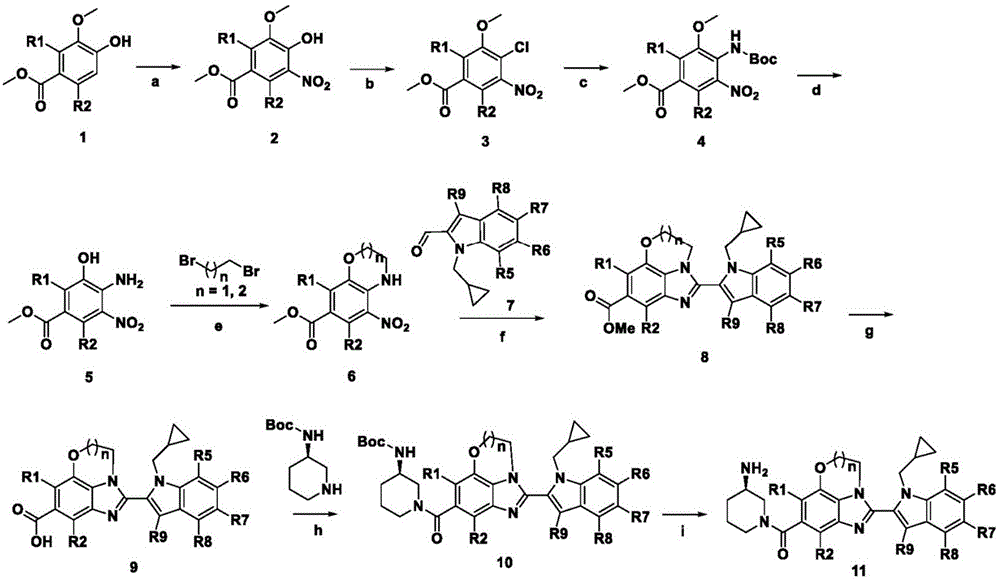
The process for the preparation of compounds of formulae (I, II and III) comprises the steps of:
step 1: using CH 3 COOH and HNO 3 (reaction conditions a) Compound 1 was converted to Compound 2 under standard conditions.
Step 2: treatment of compound 2 with oxalyl chloride (reaction condition b) affords intermediate 3.
And step 3: using tert-butyl carbamate, cs 2 CO 3 And X-Phos (reaction condition c) converts intermediate 3 to Compound 4.
And 4, step 4: by BBr 3 (reaction Condition d) treatment of Compound 4 affords intermediate 5.
And 5: by reaction with 1, omega-dibromoalkane and K 2 CO 3 (reaction condition e) reaction to convert intermediate 5 into compound 6.
And 6: compound 6 is coupled with substituted indole-2-carbaldehyde 7 (reaction condition f) to afford compound 8.
And 7: compound 8 is hydrolyzed (reaction conditions g) to give compound 9.
And 8: coupling of compound 9 with tert-butyl (R) -piperidin-3-ylcarbamate (reaction condition h) affords intermediate 10.
And step 9: compound 10 was converted to final compound 11 by Boc deprotection (reaction condition i).
The examples given below are provided by way of illustration only and therefore should not be construed to limit the scope of the present disclosure.
Example-1:
synthesis of ((R) - (3-aminopiperidin-1-yl) (2- (1- (cyclopropylmethyl) -1H-indol-2-yl) -3, 4-dihydro-5-oxa-1, 2a-diazacenaphthen-7-yl) methanone (example-1)

Scheme 2
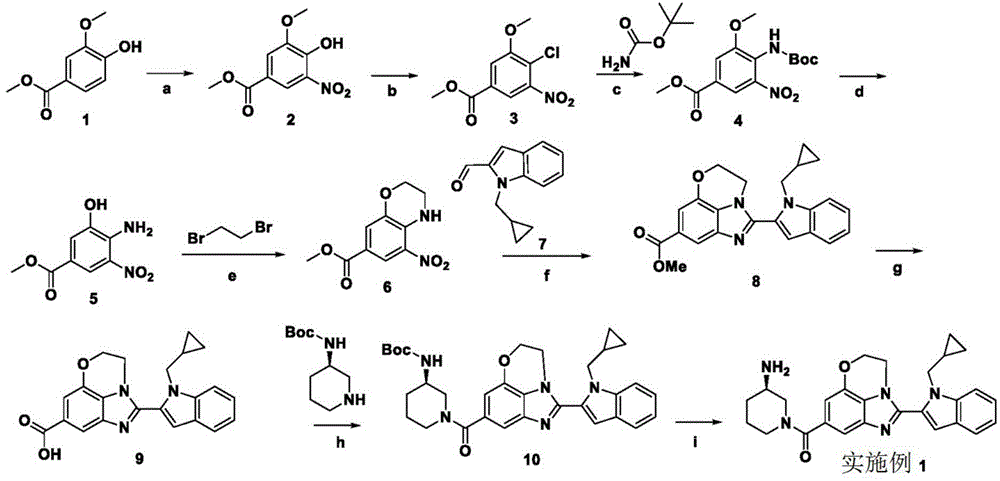
Step 1: preparation of methyl 4-hydroxy-3-methoxy-5-nitrobenzoate (2)

To a stirred solution of methyl 4-hydroxy-3-methoxybenzoate (1, 20g, 109.7mmol) in CH at 0 deg.C 3 HNO was added dropwise to a solution in COOH (100 mL) 3 (5.9mL, 94.4mmol), and then the reaction mixture is stirred at room temperature for 4 to 5 hours (reaction condition a). Ice-cold water was added to the reaction mixture and the reaction mixture was filtered to give a precipitate, which was dried using high vacuum to give the product as a yellow solid (18g, 75% yield). MS (ESI): c 9 H 9 NO 6 A calculated mass value of 227.04; measured value of m/z is 228[ m ] +H] + 。
Step 2: preparation of methyl 4-chloro-3-methoxy-5-nitrobenzoate (3)

To a stirred solution of methyl 4-hydroxy-3-methoxy-5-nitrobenzoate (2, 18g, 79.29mmol) in DMF (100 mL) at 0 ℃ was slowly added oxalyl chloride (14.27mL, 113.28 mmol) and the reaction mixture is then refluxed at 80 ℃ for about 12 hours (reaction condition b). Ice-cold water was added to the reaction mixture, and the resulting solid was filtered. The solid was dried under high vacuum to obtain the product as a brown solid (17.5g, 90% yield). MS (ESI): c 9 H 8 CINO 5 The calculated mass value of (a) is 245.01; the measured value of m/z is 246[ m ] +H] + 。
And step 3: preparation of methyl 4- ((tert-butoxycarbonyl) amino) -3-methoxy-5-nitrobenzoate (4)

In N 2 Next, to a stirred solution of methyl 4-chloro-3-methoxy-5-nitrobenzoate (3,6g, 24.42mmol) in t-butanol (50 mL) was added tert-butyl carbamate (2.86g, 24.42mmol, cs) 2 CO 3 (9.5g, 29.31mmol) and X-Phos (1.116g, 2.44mmol). Addition of Pd 2 (dba) 3 (0.44g, 0.48mmol) and stirred at room temperature for about 10 minutes and then the resulting mixture was heated to 100 ℃ for 12 hours (reaction conditions c). The reaction mixture was cooled to room temperature and diluted with ethyl acetate (100 mL × 3), the organic phase was washed with water and brine, dried over sodium sulfate and concentrated under reduced pressure to give the crude compound purified by column chromatography (silica gel, 0% to 20% EtOAc in hexanes) to give methyl 4- ((tert-butoxycarbonyl) amino) -3-methoxy-5-nitrobenzoate (2.5 g,75% yield) as a colorless liquid. MS (ESI): c 14 H 18 N 2 O 7 A mass calculated value of 325.0; m/z found value of 326.3[ m ] +H] + 。
And 4, step 4: preparation of methyl 4-amino-3-hydroxy-5-nitrobenzoate (5)
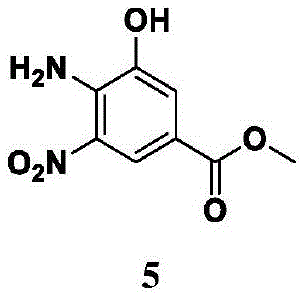
4- ((tert-butyl) under stirring at-78 deg.C Butoxycarbonyl) amino) -3-methoxy-5-nitrobenzoic acid methyl ester (4,3.5 g, 10.74mmol) in DCM (30 mL) was added BBr 3 (3.5 mL) and the resulting mixture was stirred at room temperature for 3 hours (reaction condition d). The progress of the reaction was monitored by TLC. The reaction mixture was quenched with ice and sodium bicarbonate solution (30 mL) and extracted with DCM (50 mL × 3). The combined organic extracts were washed with brine, dried over sodium sulfate and concentrated under reduced pressure to give methyl 4-amino-3-hydroxy-5-nitrobenzoate as a brown solid (0.7g, 35% yield). MS (ESI): c 8 H 8 N 2 O 5 A calculated mass value of 212.1; measured value of m/z is 213[ m ] +H] + 。
And 5: preparation of 5-nitro-3, 4-dihydro-2H-benzo [ b ]][1,4]  Oxazine-7-carboxylic acid methyl ester (6) />

To a stirred solution of methyl 4-amino-3-hydroxy-5-nitrobenzoate (5,1.1g, 5.12mmol) in DMF (10 mL) was added 1, 2-dibromoethane (0.44 mL) and K 2 CO 3 (0.86g, 2.38mmol), and the resulting mixture was heated to 80 ℃ for 12 hours (reaction condition e). The progress of the reaction was monitored by TLC. The reaction mixture was quenched with water and extracted with ethyl acetate (20 mL × 2). The combined organic extracts were washed with brine, dried over sodium sulfate, and concentrated under reduced pressure to give the crude compound purified by column chromatography (SiO 2, 0% to 20% EtOAc in hexanes) to give 5-nitro-3, 4-dihydro-2H-benzo [ b ] as a brown solid ][1,4] Oxazine-7-carboxylic acid methyl ester (0.45g, 89% yield). MS (ESI): c 10 H 10 N 2 O 5 A mass calculated value of 238.2; measured value of m/z is 239.1[ m + H ]] + 。
And 6: preparation of 2- (1- (cyclopropylmethyl) -1H-indol-2-yl) -3, 4-dihydro-5-oxa-1, 2-diaza
Acenaphthene-7-carboxylic acid methyl ester (8)

5-Nitro-3, 4-dihydro-2H-benzo [ b ] with downward stirring][1,4] A solution of a mixture of oxazine-7-carboxylic acid methyl ester (6,0.2g, 0.84mmol) and 1- (cyclopropylmethyl) -1H-indole-2-carbaldehyde (7,0.18g, 0.92mmol) in EtOH (10 mL) was added to water (5 mL) Na 2 S 2 O 4 (0.73g, 4.20mmol) and stirred at 95 ℃ for 16 h (reaction condition f). The reaction mixture was cooled to room temperature, water was added, and the compound was extracted with ethyl acetate (20 mL × 2). The combined organic extracts were washed with brine, dried over sodium sulfate and evaporated to give the crude product. The crude residue was purified by gradient column chromatography using silica gel and the eluent 15% to 20% ethyl acetate in hexane to give methyl 2- (1- (cyclopropylmethyl) -1H-indol-2-yl) -3, 4-dihydro-5-oxa-1, 2-diazacenaphthylene-7-carboxylate as a yellow solid (0.18g, 12% yield). MS (ESI): c 23 H 21 N 3 O 3 Has a mass calculated value of 387.4; measured value of m/z is 388.1[ m ] +H] + 。
And 7: preparation of 2- (1- (cyclopropylmethyl) -1H-indol-2-yl) -3, 4-dihydro-5-oxa-1, 2a-diaza
Acenaphthene-7-carboxylic acid (9)

To a stirred solution of methyl 2- (1- (cyclopropylmethyl) -1H-indol-2-yl) -3, 4-dihydro-5-oxa-1, 2 diazacenaphthylene-7-carboxylate (8, 0.18g, 0.46mmol) in MeOH (2 mL) was added a 5N NaOH solution (0.4 mL) at 75 deg.CThe mixture was stirred for 1 hour (reaction condition g). The reaction mixture was completely evaporated. The resulting crude was dissolved in water and acidified with citric acid (pH 4 to 6) and extracted with DCM (20 mL × 2). The combined organic extracts were washed with brine, dried over sodium sulfate, filtered and evaporated to give the crude product as a yellow solid to give 2- (1- (cyclopropylmethyl) -1H-indol-2-yl) -3, 4-dihydro-5-oxa-1, 2a-diazacenaphthylene-7-carboxylic acid as a brown solid (0.07g, 41% yield). MS (ESI): c 22 H 19 N 3 O 3 373.4; measured value of m/z is 374.1[ 2 ], [ M ] +H] + 。
And step 8: preparation of (R) - (1- (2- (1- (cyclopropylmethyl) -1H-indol-2-yl) -3, 4-dihydrooxa-1, 2a-
Diazacenaphthene-7-carbonyl) piperidin-3-yl) carbamic acid tert-butyl ester (10)

2- (1- (cyclopropylmethyl) -1H-indol-2-yl) -3-methyl-3H-imidazo [4,5-b ] with downward stirring]A solution of pyridine-6-carboxylic acid (9,0.089g, 0.24mmol) in DCM (2 mL) was added tert-butyl (R) -piperidin-3-ylcarbamate (0.05g, 0.26mmol), triethylamine (0.1g, 0.72mmol), followed by a solution of 50% T3P in ethyl acetate (0.2g, 0.72mmol) and stirred at room temperature for 12 hours (reaction condition h). Water was added to the reaction mixture and the compound was extracted with DCM (20 mL × 2). The combined organic extracts were washed with brine, dried over sodium sulfate and evaporated to give the crude product. The crude residue was purified by gradient column chromatography using 5% meoh in DCM to give the product as a yellow solid (0.07g, 53.8% yield). MS (ESI): c 32 H 37 N 5 The mass calculated value of O is 555.6; measured value of m/z is 556.3[ M + ] H] + 。
And step 9: preparation of (R) - (3-aminopiperidin-1-yl) (2- (1- (cyclopropylmethyl) -1H-indol-2-yl) -3,4-
Dihydro-5-oxa-1, 2a-diazacenaphthen-7-yl) methanone (example-1)

To a stirred solution of tert-butyl (R) - (1- (2- (1- (cyclopropylmethyl) -1H-indol-2-yl) -3, 4-dihydro-5-oxa-1, 2a-diazacenaphthene-7-carbonyl) piperidin-3-yl) carbamate (10, 0.08g, 0.14mol) in dichloromethane (10 mL) was added trifluoroacetic acid (0.5 mL) and stirred at room temperature for 2 hours (reaction condition i). The reaction mixture was completely evaporated, dissolved in a minimum volume of water (30 mL) and passed through saturated NaHCO 3 The solution was basified (20 mL). The compound was extracted with ethyl acetate (50 mL. Times.2). The combined organic extracts were washed with brine, dried over sodium sulfate and evaporated to give the product as a pale yellow solid (0.044g, 67.5% yield).

MS(ESI):C 32 H 37 N 5 O 4 455.0 is calculated as the mass of; measured value of m/z is 456.4[ m ] +H] + 。
The following compounds (examples 2 to 8) were synthesized using the corresponding reactants using the above procedure as exemplified in example-1 above.
Example-2:
(R) - (3-Aminopyrrolidin-1-yl) (2- (1- (cyclopropylmethyl) -1H-indol-2-yl) -3, 4-dihydro-5-oxa-1, 2a-diazacenaphthen-7-yl) methanone


MS(ESI):C 26 H 27 N 5 O 2 A mass calculated value of (d) of 441.22; measured value of m/z is 442.0[ m ] +H] + 。
Example-3:
(R) - (3-aminopiperidin-1-yl) (2- (1-ethyl-1H-indol-2-yl) -3, 4-dihydro-5-oxa-1, 2a-diazacenaphthen-7-yl) methanone
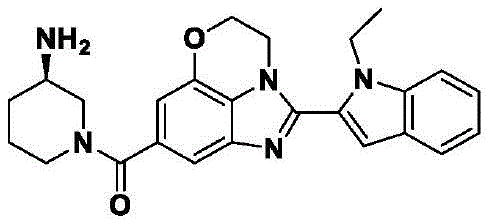

MS(ESI):C 25 H 27 N 5 O 2 A calculated mass of 429.52; measured value of m/z is 430.2[ m ] +H] + 。
Example-4:
(2- (aminomethyl) piperidin-1-yl) (2- (1- (cyclopropylmethyl) -1H-indol-2-yl) -3, 4-dihydro-5-oxa-1, 2a-diazacenaphthen-7-yl) methanone
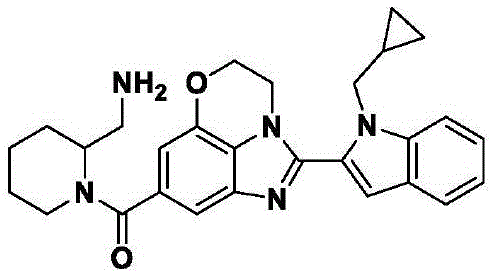

MS(ESI):C 28 H 31 N 5 O 2 A mass calculated value of 469.59; m/z found value of 470.3[ m ] +H] + 。
Example-5:
(R) - (3-aminopiperidin-1-yl) (2- (1-ethyl-1H-pyrrolo [2,3-b ] pyridin-2-yl) -3, 4-dihydro-5-oxa-1, 2a-diazacenaphthen-7-yl) methanone
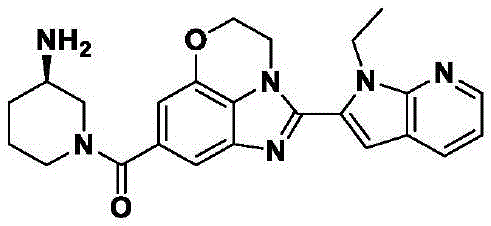

MS(ESI):C 24 H 26 N 6 O 2 A calculated mass value of 430.51; m/z found value of 431.4[ m ] +H] + 。
Example-6:
(R) - (3-Aminopiperidin-1-yl) (1- (1- (cyclopropylmethyl) -1H-indol-2-yl) -8, 9-dihydro-7H-6-oxa-2, 9 a-diazabenz [ cd ] azulen-4-yl) methanone
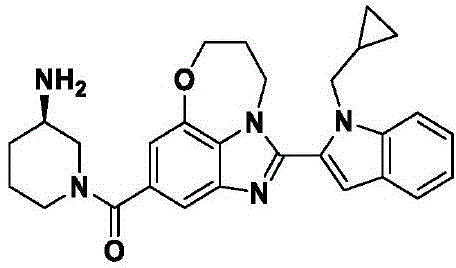

MS(ESI):C 28 H 31 N 5 O 2 A mass calculated value of 469.59; m/z found value of 470.2[ M ] +H] + 。
Example-7:
(R) - (3-Aminopyrrolidin-1-yl) (1- (1- (cyclopropylmethyl) -1H-indol-2-yl) -8, 9-dihydro-7H-6-oxa-2, 9 a-diazabenz [ cd ] azulen-4-yl) methanone
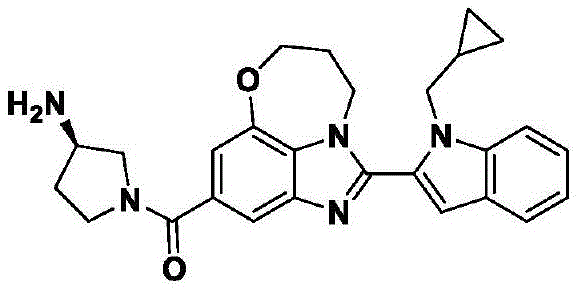

MS(ESI):C 27 H 29 N 5 O 2 A calculated mass of 455.56; measured value of m/z is 456.3[ m ] +H ] + 。
Example-8:
(R) - (3-aminopiperidin-1-yl) (2- (1- (cyclopropylmethyl) -7-methyl-1H-indol-2-yl) -3, 4-dihydro-5-oxa-1, 2a-diazacenaphthen-7-yl) methanone


MS(ESI):C 28 H 31 N 5 O 2 A mass calculated value of 469.5; m/z measured value is 470[ m ] +H] + . Example-9:
synthesis of (R) - (3-aminopiperidin-1-yl) (2- (1- (cyclopropylmethyl) -5-fluoro-1H-indol-2-yl) -3, 4-dihydro-5-oxa-1, 2a-diazacenaphthen-7-yl) methanone (example-9)

Scheme 3

The reaction procedure followed to obtain intermediate (6) was similar to that outlined above for the preparation of example-1 in scheme 2.
Step 6: preparation of (E) -5- (((1- (cyclopropylmethyl) -5-fluoro-1H-indol-2-yl) methylene) amino) -3,4- dihydro-2H-benzo [ b][1,4]  Oxazine-7-carboxylic acid methyl ester (8) />

5-Nitro-3, 4-dihydro-2H-benzo [ b ] with downward stirring][1,4] Oxazine-7-carboxylic acid methyl esterA solution of the ester (6,0.25g, 1.05mmol) in ethanol (6 mL) was added 1- (cyclopropylmethyl) -5-fluoro-1H-indole-2-carbaldehyde (7,0.27g, 1.26mmol), sodium dithionite (0.91g, 5.25mmol) and water (3 mL). The reaction mixture was then heated to 90 ℃ in a closed tube for 12 hours (reaction conditions f). The reaction mixture was evaporated, diluted with water and extracted with ethyl acetate (20 mL × 2). The combined organic extracts were washed with water, brine, dried over sodium sulfate, filtered and evaporated to give the crude product as a yellow solid (0.25 g, crude). MS (ESI): c 23 H 22 FN 3 O 3 The mass calculated value of (b) is 407.45; measured value of m/z is 408.1[ m ] +H] + 。
And 7: preparation of 2- (1- (cyclopropylmethyl) -5-fluoro-1H-indol-2-yl) -3, 4-dihydro-5-oxa-1, 2a-diazacenaphthene-7-carboxylic acid methyl ester (9)

(E) -5- (((1- (cyclopropylmethyl) -5-fluoro-1H-indol-2-yl) methylene) amino) -3, 4-dihydro-2H-benzo [ b ] at room temperature with stirring][1,4] A solution of methyl oxazine-7-carboxylate (8,0.25g, 0.61mmol) in toluene (3 mL) was added p-toluenesulfonic acid (0.012g, 0.0614 mmol). The reaction mixture was then heated to 90 ℃ for 12 hours (reaction conditions g). The reaction mixture was quenched with sodium bicarbonate and extracted with ethyl acetate (20 mL × 2). The combined organic extracts were washed with brine, dried over sodium sulfate, filtered and evaporated to give the crude product. The crude residue was purified by gradient column chromatography using silica gel and the eluent 15% to 20% ethyl acetate in hexane to afford the product as a yellow solid (0.15g, 35% yield). MS (ESI): c 23 H 20 FN 3 O 3 A mass calculated value of (d) of 405.43; m/z found value of 406.1[ m ] +H] + 。
And step 8: preparation of 2- (1- (cyclopropylmethyl) -5-fluoro-1H-indol-2-yl) -3, 4-dihydro-5-oxa-1,2a-
Diazacenaphthene-7-carboxylic acid (10)
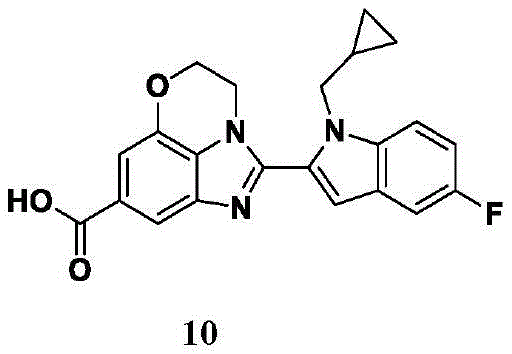
To a stirred solution of methyl 2- (1- (cyclopropylmethyl) -5-fluoro-1H-indol-2-yl) -3, 4-dihydro-5-oxa-1, 2a-diazacenaphthene-7-carboxylate (9, 0.15g, 0.37mmol) in methanol (5 mL) was added a solution of 5N NaOH (0.37mL, 1.85mmol) and heated to 80 ℃ for 1 hour (reaction conditions H). The solvent was evaporated completely and dissolved in water (10 mL) and acidified with citric acid and extracted with DCM (20 mL × 2). The combined organic extracts were washed with brine, dried over sodium sulfate, filtered and evaporated to give the crude product as a yellow solid (0.13g, 90% yield). MS (ESI): c 22 H 18 FN 3 O 3 391.40; measured value of m/z, is 392.1[ 2 ], [ M + ] H] + 。
And step 9: preparation of (R) - (1- (2- (1- (cyclopropylmethyl) -5-fluoro-1H-indol-2-yl) -3, 4-dihydro-5-oxo
Hetero-1, 2a-diazacenaphthene-7-carbonyl) piperidin-3-yl) carbamic acid tert-butyl ester (11)

To a stirred solution of 2- (1- (cyclopropylmethyl) -5-fluoro-1H-indol-2-yl) -3, 4-dihydro-5-oxa-1, 2a-diazacenaphthene-7-carboxylic acid (10, 0.13g, 0.33mmol) in DCM (4 mL) was added tert-butyl (R) -piperidin-3-ylcarbamate (0.079g, 0.398mmol), triethylamine (0.09mL, 0.66mmol), and propylphosphonic anhydride in 50% ethyl acetate (0.316mL, 0.498mmol). The reaction mixture was stirred at room temperature for 1 hour (reaction condition i). The reaction mixture was quenched with sodium bicarbonate solution (20 mL) and extracted with ethyl acetate (20 mL. Times.2). The combined organic extracts were washed with brine, dried over sodium sulfate, filtered and evaporated to give the crude product. The crude residue was purified by gradient column chromatography using silica gel and eluent DCM 5% to 10%Purification of methanol gave the product as a yellow solid (0.13g, 68% yield). MS (ESI): c 32 H 36 FN 5 O 4 Calculated mass value of (a), 573.67; the measured value of m/z is 574.3[ m ] +H] + 。
Step 10: preparation of (R) - (3-aminopiperidin-1-yl) (2- (1- (cyclopropylmethyl) -5-fluoro-1H-indol-2-
Yl) -3, 4-dihydro-5-oxa-1, 2a-diazacenaphthen-7-yl methanone (example-9)
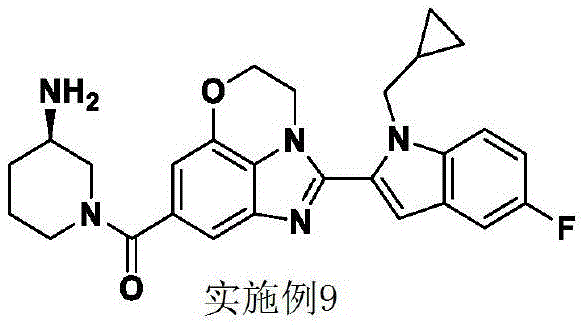
To a stirred solution of tert-butyl (R) - (1- (2- (1- (cyclopropylmethyl) -5-fluoro-1H-indol-2-yl) -3, 4-dihydro-5-oxa-1, 2a-diazacenaphthylene-7-carbonyl) piperidin-3-yl) carbamate (11, 0.13g, 0.226mmol) in DCM (4 mL) at 0 deg.C was added trifluoroacetic acid (0.5 mL). The reaction mixture was then stirred at room temperature for 1 hour (reaction condition j). The reaction mixture was evaporated under reduced pressure, washed with diethyl ether, and the reaction mixture was basified with saturated sodium bicarbonate solution (20 mL) and extracted with ethyl acetate (20 mL × 2). The combined organic extracts were washed with brine, dried over sodium sulfate, filtered and evaporated to give the crude product. The crude residue was purified by gradient column chromatography using silica gel and the eluent DCM 5% to 10% methanol to give the product as an off-white solid (0.06g, 57% yield).

MS(ESI):C 27 H 28 FN 5 O 2 The calculated mass value of (a) is 473.55; the measured value of m/z is 474.2[ M ] +H] + 。
The following compounds (examples 10 to 60) were synthesized using the above-described method as exemplified in example-9.
Example-10:
(R) - (3-aminopiperidin-1-yl) (2- (1- (pyridin-4-ylmethyl) -1H-indol-2-yl) -3, 4-dihydro-5-oxa-1, 2a-diazacenaphthen-7-yl) methanone


MS(ESI):C 29 H 28 N 6 O 2 492.23; measured value of m/z is 493[ 2 ] M + H] + 。
Example-11:
(R) - (3-aminopiperidin-1-yl) (2- (1- (pyridin-2-ylmethyl) -1H-indol-2-yl) -3, 4-dihydro-5-oxa-1, 2a-diazacenaphthen-7-yl) methanone
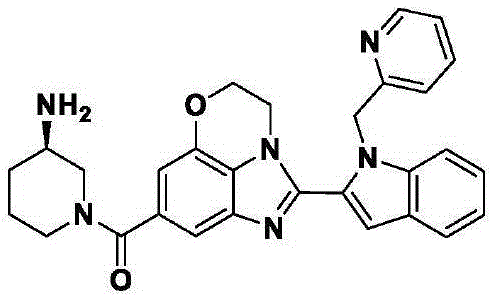

MS(ESI):C 29 H 28 N 6 O 2 492.23; the measured value of m/z is 493.2[ M ] +H] + 。
Example-12:
(R) - (3-aminopiperidin-1-yl) (2- (3-ethylbenzo [ b ] thiophen-2-yl) -3, 4-dihydro-5-oxa-1, 2a-diazacenaphthen-7-yl) methanone:


MS(ESI):C 25 H 26 N 4 O 2 quality of SCalculated value, 446.57; measured value of m/z is 447.2, [ M ] +H] + 。
Example-13:
(R) - (3-aminopiperidin-1-yl) (2- (1- (4-chlorobenzyl) -1H-indol-2-yl) -3, 4-dihydro-5-oxa-1, 2a-diazacenaphthen-7-yl) methanone


MS(ESI):C 30 H 28 ClN 5 O 2 A mass calculated value of 525.19; the measured value of m/z is 526.2[ m ] +H] + 。
Example-14:
(R) - (3-aminopiperidin-1-yl) (2- (1- (2-fluorobenzyl) -1H-indol-2-yl) -3, 4-dihydro-5-oxa-1, 2a-diazacenaphthen-7-yl) methanone


MS(ESI):C 30 H 28 FN 5 O 2 A calculated mass value of 509.22; the measured value of m/z is 510.2[ m ] +H] + 。
Example-15:
(R) - (3-aminopiperidin-1-yl) (2- (1- (4-fluorobenzyl) -1H-indol-2-yl) -3, 4-dihydro-5-oxa-1, 2a-diazacenaphthen-7-yl) methanone


MS(ESI):C 30 H 28 FN 5 O 2 509.59; measured value of m/z is 510.2[ m ] +H] + 。
Example-16:
(R) - (3-aminopiperidin-1-yl) (2- (1- (pyridin-3-ylmethyl) -1H-indol-2-yl) -3, 4-dihydro-5-oxa-1, 2a-diazacenaphthen-7-yl) methanone


MS(ESI):C 29 H 28 N 6 O 2 492.58; the measured value of m/z is 493.4[ m ] +H] + 。
Example-17:
(R) - (3-aminopiperidin-1-yl) (2- (1- (cyclopropylmethyl) -5, 6-dimethoxy-1H-indol-2-yl) -3, 4-dihydro-5-oxa-1, 2a-diazacenaphthen-7-yl) methanone


MS(ESI):C 29 H 33 FN 5 O 4 A mass calculated value of 515.61; the measured value of m/z is 516.3[ m ] +H] + 。
Example-18:
(R) - (3-aminopiperidin-1-yl) (2- (1-benzyl-1H-indol-2-yl) -3, 4-dihydro-5-oxa-1, 2a-diazacenaphthen-7-yl) methanone


MS(ESI):C 30 H 29 N 5 O 2 491.6 is adopted as the mass calculation value of (A); m/z measured value is 492.2[ M ] +H] + 。
Example-19:
(R) - (3-aminopiperidin-1-yl) (2- (1- (4-methoxybenzyl) -1H-indol-2-yl) -3, 4-dihydro-5-oxa-1, 2a-diazacenaphthen-7-yl) methanone
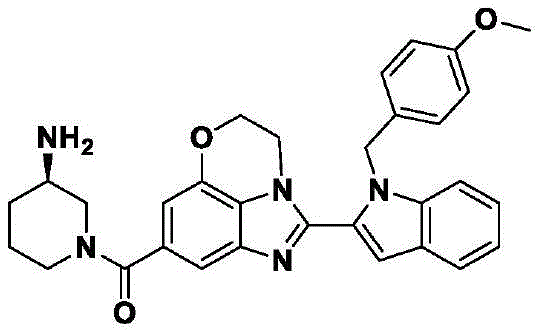

MS(ESI):C 31 H 31 N 5 O 3 521.62; m/z found value of 522.2[ M ] +H] + 。
Example-20:
synthesis of (R) - (3-aminopiperidin-1-yl) (2- (1- (2-methoxyethyl) -1H-indol-2-yl) -3, 4-dihydro-5-oxa-1, 2a-diazacenaphthen-7-yl) methanone


MS(ESI):C 26 H 29 N 5 O 3 A calculated mass value of 459.23; m/z is measured as460.10[M+H] + 。
Example-21:
(R) - (3-aminopiperidin-1-yl) (2- (6-methoxy-1- (2-methoxyethyl) -1H-indol-2-yl) -3, 4-dihydro-5-oxa-1, 2a-diazacenaphthen-7-yl) methanone


MS(ESI):C 27 H 31 N 5 O 4 A calculated mass value of 489.19; the measured value of m/z is 490.27[ mu ] M +1] + 。
Example-22:
(R) - (3-aminopiperidin-1-yl) (2- (1- (2-hydroxyethyl) -1H-indol-2-yl) -3, 4-dihydro-5-oxa-1, 2a-diazacenaphthen-7-yl) methanone


MS(ESI):C 25 H 27 N 5 O 3 A calculated mass value of 445.21; m/z found value of 446.24[ m ] +H] +1 。
Example-23:
(R) - (3-aminopiperidin-1-yl) (2- (1- (cyclopropylmethyl) -6-methoxy-1H-indol-2-yl) -3, 4-dihydro-5-oxa-1, 2a-diazacenaphthen-7-yl) methanone


MS(ESI):C 28 H 31 N 5 O 3 The calculated mass value of (a) is 485.24; the measured value of m/z is 486.20[ m ] +H] +1 。
Example-24:
(R) - (3-aminopiperidin-1-yl) (2- (1- ((3-fluoropyridin-4-yl) methyl) -1H-indol-2-yl) -3, 4-dihydro-5-oxa-1, 2a-diazacenaphthen-7-yl) methanone
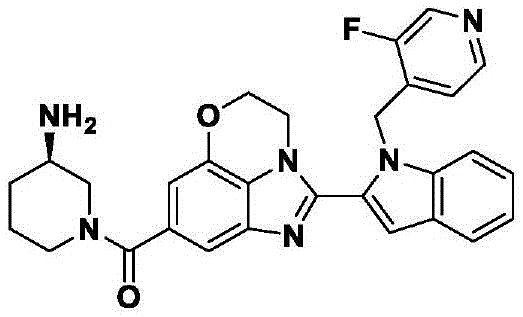
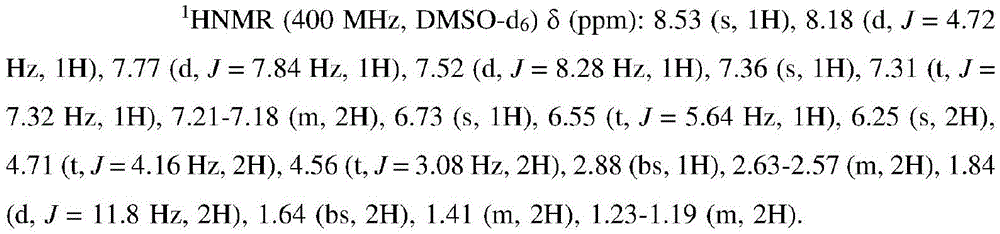
MS(ESI):C 29 H 27 FN 6 O 2 A calculated mass value of 511.23; measured value of m/z is 511.14[ 2 ], [ M + [ H ]] + 。
Example-25:
(R) - (3-aminopiperidin-1-yl) (2- (1- (pyrazin-2-ylmethyl) -1H-indol-2-yl) -3, 4-dihydro-5-oxa-1, 2a-diazacenaphthen-7-yl) methanone


MS(ESI):C 28 H 27 N 7 O 2 Has a mass calculated value of 493.12; the measured value of m/z is 494.10[ M ] +H] + 。
Example-26:
(R) - (3-aminopiperidin-1-yl) (2- (1- ((3-fluoropyridin-2-yl) methyl) -1H-indol-2-yl) -3, 4-dihydro-5-oxa-1, 2a-diazacenaphthen-7-yl) methanone
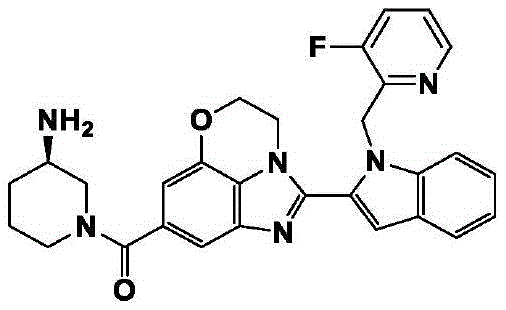

MS(ESI):C 29 H 27 FN 6 O 2 A calculated mass value of 510.22; measured value of m/z is 511.18[ m ] +H ] + 。
Example-27:
(R) - (3-aminopiperidin-1-yl) (2- (1- (pyrimidin-2-ylmethyl) -1H-indol-2-yl) -3, 4-dihydro-5-oxa-1, 2a-diazacenaphthen-7-yl) methanone


MS(ESI):C 28 H 27 N 7 O 2 A mass calculated value of 493.22; the measured value of m/z is 494.23[ m ] +H] + 。
Example-28:
(R) - (3-aminopiperidin-1-yl) (2- (1- (cyclopropylmethyl) -6-fluoro-1H-indol-2-yl) -3, 4-dihydro-5-oxa-1, 2a-diazacenaphthen-7-yl) methanone


MS(ESI):C 27 H 28 FN 5 O 2 473.12; m/z actual measurementThe value is 474.20[ m ] +H] + 。
Example-29:
(R) - (3-aminopiperidin-1-yl) (2- (1- (pyrimidin-5-ylmethyl) -1H-indol-2-yl) -3, 4-dihydro-5-oxa-1, 2a-diazacenaphthen-7-yl) methanone

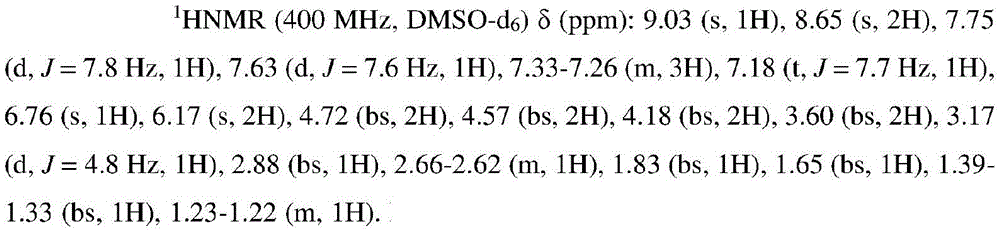
MS(ESI):C 28 H 27 N 7 O 2 Has a mass calculated value of 493.12; measured value of m/z is 494.27[ m ] +H] + 。
Example-30:
(R) - (3-aminopiperidin-1-yl) (2- (1- (pyridazin-3-ylmethyl) -1H-indol-2-yl) -3, 4-dihydro-5-oxa-1, 2a-diazacenaphthen-7-yl) methanone


MS(ESI):C 28 H 27 N 7 O 2 Has a mass calculated value of 493.12; the measured value of m/z is 494.24[ m ] +H] + 。
Example-31:
(R) - (3-aminopiperidin-1-yl) (2- (1-isobutyl-1H-indol-2-yl) -3, 4-dihydro-5-oxa-1, 2a-diazacenaphthen-7-yl) methanone


MS(ESI):C 27 H 31 N 5 O 2 A mass calculated value of 457.25; the measured value of m/z is 458.28[ M ] +H] + 。
Example-32:
(R) - (3-aminopiperidin-1-yl) (2- (1- (cyclopropylmethyl) -5, 6-difluoro-1H-indol-2-yl) -3, 4-dihydro-5-oxa-1, 2a-diazacenaphthen-7-yl) methanone


MS(ESI):C 27 H 27 F 2 N 5 O 2 The calculated mass value of (a) is 491.12; m/z measured value of 492.25[ m ] +H] + 。
Example 33:
(R) - (3-aminopiperidin-1-yl) (2- (1- ((3-fluoropyridin-2-yl) methyl) -6-methoxy-1H-indol-2-yl) -3, 4-dihydro-5-oxa-1, 2a-diazacenaphthen-7-yl) methanone


MS(ESI):C 30 H 29 FN 6 O 3 540.60; the measured value of m/z is 541.29[ M ] +H] + 。
Example-34:
(R) - (3-aminopiperidin-1-yl) (2- (7-chloro-1- ((3-fluoropyridin-2-yl) methyl) -1H-indol-2-yl) -3, 4-dihydro-5-oxa-1, 2a-diazacenaphthen-7-yl) methanone
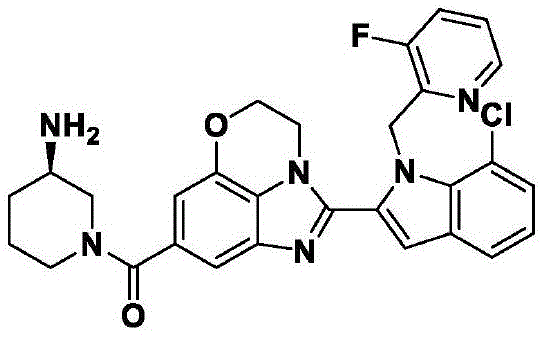

MS(ESI):C 29 H 26 ClFN 6 O 2 A calculated mass value of 544.18; measured value of m/z is 545.27[ M + H ]] + 。
Example-35:
(R) - (3-aminopiperidin-1-yl) (2- (6-fluoro-1- ((3-fluoropyridin-2-yl) methyl) -1H-indol-2-yl) -3, 4-dihydro-5-oxa-1, 2a-diazacenaphthen-7-yl) methanone
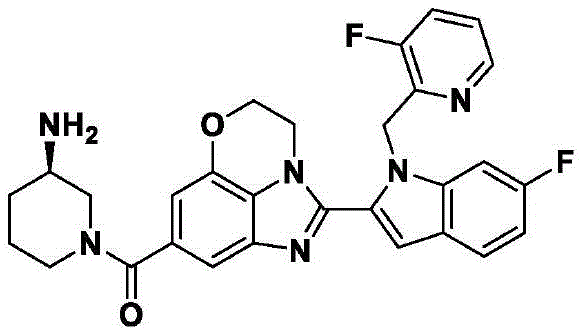

MS(ESI):C 29 H 26 F 2 N 6 O 2 528.18 mass calculated value of (a); the measured value of m/z is 529.26[ M + ] H] + 。
Example-36:
(R) - (3-aminopiperidin-1-yl) (2- (7-chloro-1- (2-methoxyethyl) -1H-indol-2-yl) -3, 4-dihydro-5-oxa-1, 2a-diazacenaphthen-7-yl) methanone
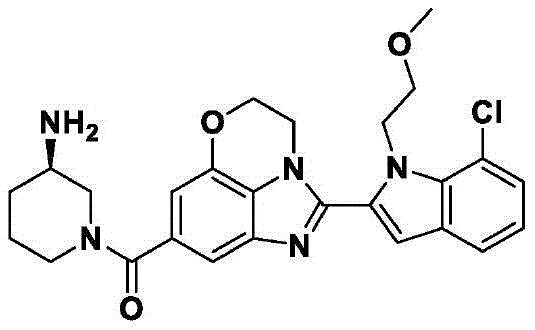

MS(ESI):C 26 H 28 ClN 5 O 3 A mass calculated value of 493.1; the measured value of m/z is 494.5[ m ] +H] + 。
Example-37:
(R) - (3-Aminopiperidin-1-yl) (2- (1- (4- (hydroxymethyl) benzyl) -1H-indol-2-yl) -3, 4-dihydro-5-oxa-1, 2a-diazacenaphthen-7-yl) methanone trifluoroacetate salt


MS(ESI):C 31 H 31 N 5 O 3 521.2; m/z found value of 522.25[ m ] +H] + 。
Example-38:
(R, E) -N- (1- (2- (1- (cyclopropylmethyl) -1H-indol-2-yl) -3, 4-dihydro-5-oxa-1, 2a-diazacenaphthene-7-carbonyl) piperidin-3-yl) -4- (dimethylamino) but-2-enamide trifluoroacetate


MS(ESI):C 35 H 39 N 6 F 3 O 4 A calculated mass of 566.30; found in m/z, 567.42.
Example-39:
(R) - (3-aminopiperidin-1-yl) (2- (7-chloro-1- (4-methoxybenzyl) -1H-indol-2-yl) -3, 4-dihydro-5-oxa-1, 2a-diazacenaphthen-7-yl) methanone
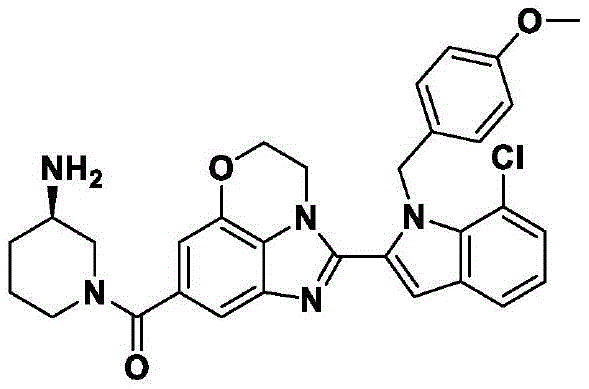

MS(ESI):C 31 H 30 ClN 5 O 3 The mass calculated value of (b) is 555.18; measured value of m/z is 556.36[ m + H ]] + 。
Example-40:
(R) - (3-aminopiperidin-1-yl) (2- (1- ((tetrahydro-2H-pyran-4-yl) methyl) -1H-indol-2-yl) -3, 4-dihydro-5-oxa-1, 2a-diazacenaphthen-7-yl) methanone


MS(ESI):C 29 H 33 N 5 O 3 A calculated mass of 499.26; m/z found value of 500.30[ m ] +H] + 。
Example-41:
(R) - (3-aminopiperidin-1-yl) (2- (1- (cyclobutylmethyl) -1H-indol-2-yl) -3, 4-dihydro-5-oxa-1, 2a-diazacenaphthen-7-yl) methanone
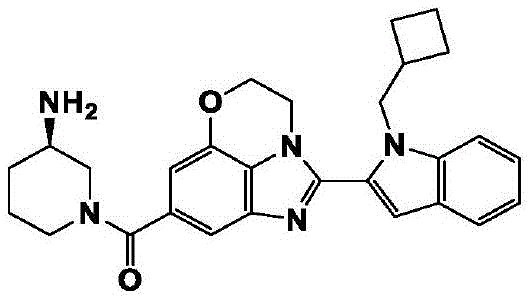

MS(ESI):C 28 H 31 N 5 O 2 A mass calculated value of 469.25; m/z found value of 470.31[ m ] +H] + 。
Example-42:
(R) -2- (2- (7- (3-aminopiperidine-1-carbonyl) -3, 4-dihydro-5-oxa 1,2a diazacenaphthen-2-yl) -1H-indol-1-yl) acetic acid


MS(ESI):C 25 H 25 N 5 O 4 Is 459.18; the measured value of m/z is 460.21[ deg. ] M + H] + 。
Example-43:
(R) - (3-aminopiperidin-1-yl) (2- (1- (piperidin-4-ylmethyl) -1H-indol-2-yl) -3, 4-dihydro-5-oxa-1, 2a-diazacenaphthen-7-yl) methanone
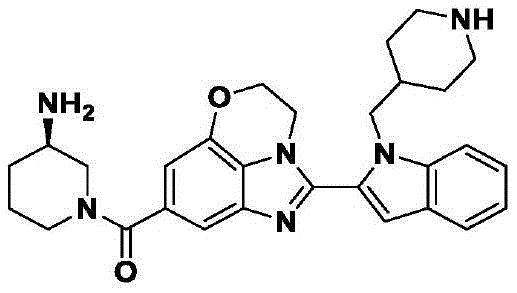
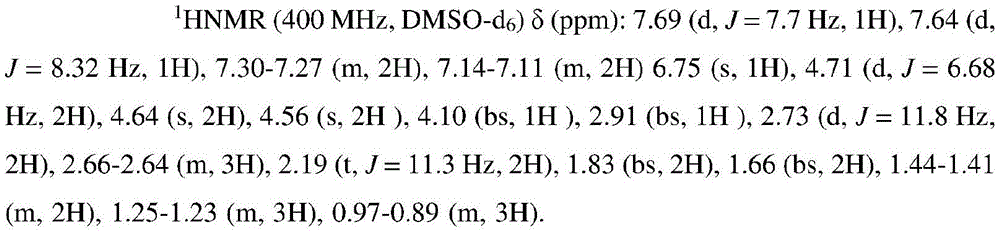
MS(ESI):C 29 H 34 N 6 O 2 The mass calculation value of (b) is 498.1; measured value of m/z is 499.29[ m + H ]] + 。
Example-44:
(R) - (3-aminopiperidin-1-yl) (2- (1- (oxetan-3-ylmethyl) -1H-indol-2-yl) -3, 4-dihydro-5-oxa-1, 2a-diazacenaphthen-7-yl) methanone

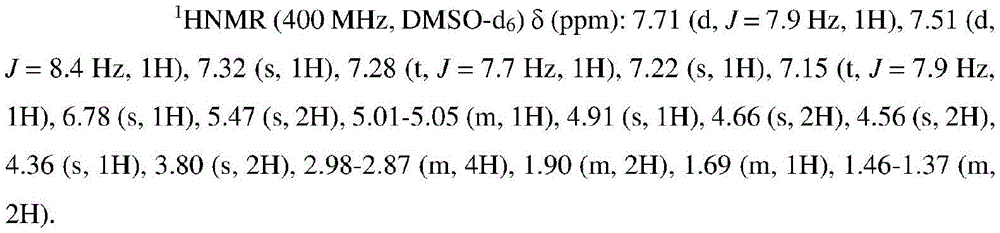
MS(ESI):C 27 H 29 N 5 O 3 471.23; measured value of m/z is 472.27[ m ] +H] + 。
Example-45:
(R) - (3-aminopiperidin-1-yl) (2- (1- ((1-methylpiperidin-4-yl) methyl) -1H-indol-2-yl) -3, 4-dihydro-5-oxa-1, 2a-diazacenaphthen-7-yl) methanone


MS(ESI):C 30 H 36 N 6 O 2 A mass calculated value of (d) of 512; the measured value of m/z is 513.34[ M + ] H] + 。
Example-46:
(R) - (3-aminopiperidin-1-yl) (2- (5-fluoro-1- (4-methoxybenzyl) -1H-indol-2-yl) -3, 4-dihydro-5-oxa-1, 2a-diazacenaphthen-7-yl) methanone


MS(ESI):C 31 H 30 FN 5 O 3 539.23; m/z found value of 540.33[ deg. ] M + H] + 。
Example-47:
(R) - (3-aminopiperidin-1-yl) (2- (1- (2, 2-difluoroethyl) -1H-indol-2-yl) -3, 4-dihydro-5-oxa-1, 2a-diazacenaphthen-7-yl) methanone


MS(ESI):C 25 H 25 F 2 N 5 O 2 A mass calculated value of (b) of 465.12; the measured value of m/z is 466.26[ m ] +H ] + 。
Example-48:
(R) - (3-aminopiperidin-1-yl) (2- (5-fluoro-1- (2-methoxyethyl) -1H-indol-2-yl) -3, 4-dihydro-5-oxa-1, 2a-diazacenaphthen-7-yl) methanone


MS(ESI):C 26 H 28 FN 5 O 3 477.23 is calculated by the mass; m/z found value of 478.39[ m ] +H] + 。
Example-49:
(R) - (3-aminopiperidin-1-yl) (2- (6-fluoro-1- (4-fluorobenzyl) -1H-indol-2-yl) -3, 4-dihydro-5-oxa-1, 2a-diazacenaphthen-7-yl) methanone


MS(ESI):C 30 H 27 F 2 N 5 O 2 527.21; m/z found value of 528.36[ m ] +H] + 。
Example-50:
(R) - (3-aminopiperidin-1-yl) (2- (6-fluoro-1- (4-methoxybenzyl) -1H-indol-2-yl) -3, 4-dihydro-5-oxa-1, 2a-diazacenaphthen-7-yl) methanone


MS(ESI):C 31 H 30 FN 5 O 3 539.23; m/z found value of 540.27[ deg. ] M + H] + 。
Example-51:
(R) - (3-aminopiperidin-1-yl) (2- (1- (4-fluorobenzyl) -6-methoxy-1H-indol-2-yl) -3, 4-dihydro-5-oxa-1, 2a-diazacenaphthen-7-yl) methanone


MS(ESI):C 31 H 30 FN 5 O 3 539.23; m/z found value of 540.42[ m ] +H] + 。
Example-52
3-aminopiperidin-1-yl) (2- (6-fluoro-1- (2-methoxyethyl) -1H-indol-2-yl) -3, 4-dihydro-5-oxa-1, 2a-diazacenaphthen-7-yl) methanone


MS(ESI):C 26 H 28 FN 5 O 3 477.12 is calculated as the mass; measured value of m/z is 478.26 2[ m + ] H] + 。
Example 53
(R) - (3-aminopiperidin-1-yl) (2- (7-chloro-1- (cyclobutylmethyl) -1H-indol-2-yl) -3, 4-dihydro-5-oxa-1, 2a-diazacenaphthen-7-yl) methanone


MS(ESI):C 28 H 30 ClFN 5 O 2 A mass calculated value of 503.26; m/z found value of 504.44[ m ] +H] + 。
Example-54
(R) - (3-aminopiperidin-1-yl) (2- (5, 6-difluoro-1- (2-methoxyethyl) -1H-indol-2-yl) -3, 4-dihydro-5-oxa-1, 2a-diazacenaphthen-7-yl) methanone

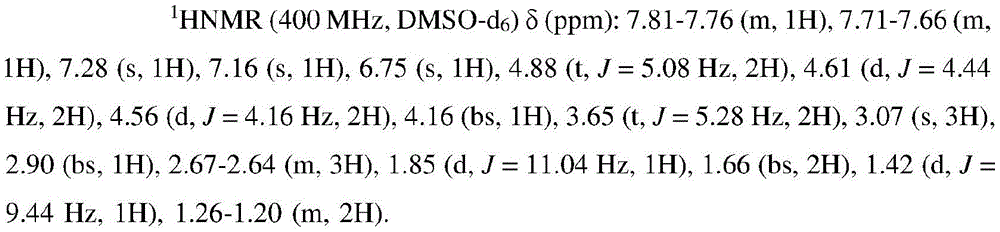
MS(ESI):C 26 H 27 F 2 N 5 O 3 Has a mass calculated value of 495.21; measured value of m/z is 496.15[ m ] +H] + 。
Example 55
(R) - (3-aminopiperidin-1-yl) (2- (7-chloro-1-isobutyl-1H-indol-2-yl) -3, 4-dihydro-5-oxa-1, 2a-diazacenaphthen-7-yl) methanone


MS(ESI):C 27 H 30 ClN 5 O 2 A calculated mass value of 492.02; m/z measured value, 492.41[ m ] +H] + 。
Example 56
(R) - (3-aminopiperidin-1-yl) (2- (7-chloro-1- (2, 2-difluoroethyl) -1H-indol-2-yl) -3, 4-dihydro-5-oxa-1, 2a-diazacenaphthen-7-yl) methanone


MS(ESI):C 25 H 24 ClF 2 N 5 O 2 A calculated mass of 499.16; m/z found value of 500.35[ m ] +H] + 。
Example 57
(R) - (3-aminopiperidin-1-yl) (2- (7-chloro-1- (cyclopropylmethyl) -1H-indol-2-yl) -3, 4-dihydro-5-oxa-1, 2a-diazacenaphthen-7-yl) methanone


MS(ESI):C 27 H 28 ClN 5 O 2 A mass calculated value of 490.0; found in M/z was 490.2 (M + H).
Example 58
(R, E) - (3-aminopiperidin-1-yl) (2- (1- (cyclopropylmethyl) -5-styryl-1H-indol-2-yl) -3, 4-dihydro-5-oxa-1, 2a-diazacenaphthen-7-yl) methanone


MS(ESI):C 35 H 35 N 5 O 2 The calculated mass value of (a) is 557.0; found M/z of 558.6 (M + H) + 。
Example-59:
(R) - (3-aminopiperidin-1-yl) (2- (1- ((4-methylthiazol-2-yl) methyl) -1H-indol-2-yl) -3, 4-dihydro-5-oxa-1, 2a-diazacenaphthen-7-yl) methanone


MS(ESI):C 27 H 28 N 6 The mass calculated value of OS was 484.20; found value of M/z, 485.1 (M + H) + 。
Example-60
(R) - (3-aminopiperidin-1-yl) (2- (1- (cyclopropylmethyl) -5-methoxy-1H-indol-2-yl) -3, 4-dihydro-5-oxa-1, 2a-diazacenaphthen-7-yl) methanone


MS(ESI):C 28 H 31 N 5 O 3 The mass calculated value of (a) is 485.5; found M/z of 486.5 (M + H) + 。
Example 61
(R) - (3-aminopiperidin-1-yl) (2- (1- (cyclopropylmethyl) -6- (hydroxymethyl) -1H-indol-2-yl) -3, 4-dihydro-5-oxa-1, 2a-diazacenaphthen-7-yl) methanone
Scheme 4

Intermediate 1 was synthesized using the procedure described in scheme 3.
Step 1: synthesis of 5-amino-3, 4-dihydro-2H-benzo [ b ]][1,4] Oxazine-7-carboxylic acid methyl ester (2).

5-Nitro-3, 4-dihydro-2H-benzo [ b ] at room temperature with stirring][1,4] A solution of methyl oxazine-7-carboxylate (1, 11.0g, 46.18mmol) in a mixture of ethanol (110mL, 10 vol.) and water (33mL, 3 vol.) was added with ammonium chloride (37.0g, 692.0mmol) and iron powder (38.6g, 692.0mmol), and the resulting mixture was stirred at 80 ℃ for 3 hours. The progress of the reaction was monitored by TLC. After completion of the reaction, the reaction mixture was evaporated, filtered through celite, and the celite bed was washed with ethyl acetate (200 mL × 3). The combined ethyl acetate layers were washed with water and brine. The obtained organic layer was dried over anhydrous sodium sulfate and concentrated under reduced pressure to give 5-amino-3, 4-dihydro-2H-benzo [ b ] as a brown solid ][1,4]
 Oxazine-7-carboxylic acid methyl ester (2), yield: 9.0g (93%). />

MS (ESI): 208.12; measured value of m/z is 209.20[ m ] +H] +1 。
Step-2: synthesis of methyl 2- (1- (cyclopropylmethyl) -6-vinyl-1H-indol-2-yl) -3, 4-dihydro-5-oxa-1, 2a-diazacenaphthene-7-carboxylate (3)

5-amino-3, 4-dihydro-2H-benzo [ b ] at room temperature with stirring][1,4] A solution of methyl oxazine-7-carboxylate (2,1.0 g, 4.80mmol) and 1- (cyclopropylmethyl) -6-vinyl-1H-indole-2-carbaldehyde (6 a,1.2g, 5.70mmol) in N, N-dimethylformamide (10.0 mL) and water (3.0 mL) was added potassium peroxymonosulfate (0.88g, 5.76mmol). The reaction mixture was stirred at room temperature for 16 hours. After completion of the reaction, the reaction mixture was cooled to room temperature and water was added. The precipitated solid was filtered and washed with water (20 mL. Times.2) and methanol (10 mL. Times.2). The resulting compound was dried under vacuum to give methyl 2- (1- (cyclopropylmethyl) -6-vinyl-1H-indol-2-yl) -3, 4-dihydro-5-oxa-1, 2a-diazacenaphthylene-7-carboxylate (3) as a yellow solid. Yield: 0.550g (crude). MS (ESI): 413.17; measured value of m/z, is 414.26[ m + H ]] +1 。
Step-3: synthesis of 2- (1- (cyclopropylmethyl) -6-vinyl-1H-indol-2-yl) -3, 4-dihydro-5-oxa-1, 2a-diazacenaphthene-7-carboxylic acid (4)
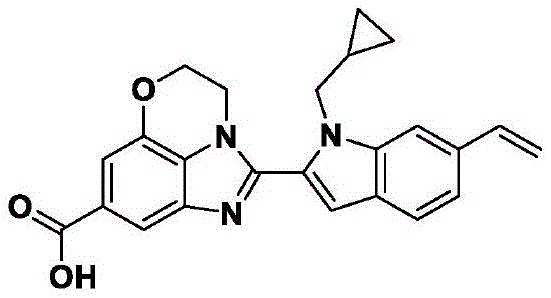
To the stirred 2- (1- (cyclopropylmethyl) -6-vinyl-1)A solution of methyl H-indol-2-yl) -3, 4-dihydro-5-oxa-1, 2a-diazacenaphthylene-7-carboxylate (3, 0.55g,1.3 mmol) in tetrahydrofuran (5.0 mL) and methanol (3.0 mL) was added 5N sodium hydroxide solution (3.0 mL) and the reaction mixture was stirred at 60 ℃ for 2 hours. After completion of the reaction, the reaction mixture was concentrated under reduced pressure. The resulting crude was dissolved in a minimum volume of water and acidified to pH 2 to 3 with a saturated citric acid solution at 0 ℃. The precipitated solid was filtered and washed with water (10 mL. Times.2). The resulting compound was dried under vacuum to give 2- (1- (cyclopropylmethyl) -6-vinyl-1H-indol-2-yl) -3, 4-dihydro-5-oxa-1, 2a-diazacenaphthylene-7-carboxylic acid (4) as a white solid. Yield: 0.440g (crude). MS (ESI): 399.16; measured value of m/z is 400.16[ m ] +H] +1 。
Step-4: synthesis of tert-butyl (R) - (1- (2- (1- (cyclopropylmethyl) -6-vinyl-1H-indol-2-yl) -3, 4-dihydro-5-oxa-1, 2a-diazacenaphthene-7-carbonyl) piperidin-3-yl) carbamate (5)

To a stirred solution of 2- (1- (cyclopropylmethyl) -6-vinyl-1H-indol-2-yl) -3, 4-dihydro-5-oxa-1, 2a-diazacenaphthene-7-carboxylic acid (4, 0.44g, 1.10mmol) in dichloromethane (10.0 mL) was added tert-butyl (R) -piperidin-3-ylcarbamate (3 b,0.26g, 1.29mmol) and triethylamine (0.4mL, 3.31mmol), followed by propylphosphonic anhydride (50% solution in ethyl acetate, 0.8mL, 3.37mmol). The reaction mixture was stirred at room temperature for 2 hours. After completion of the reaction, the reaction mixture was diluted with water and extracted with dichloromethane (10 mL × 2). The combined organic layers were washed with water and brine solution, further dried over anhydrous sodium sulfate, filtered and concentrated to give the crude product. The crude was purified by CombiFlash using 12.0g, redisep and 70% ethyl acetate in hexane as eluent to give tert-butyl (R) - (1- (2- (1- (cyclopropylmethyl) -6-vinyl-1H-indol-2-yl) -3, 4-dihydro-5-oxa-1, 2a-diazacenaphthylene-7-carbonyl) piperidin-3-yl) carbamate (5) as a brown solid. Yield: 0.250g (44%). MS (ESI): 5 81.30; the measured value of m/z is 582.41[ M + ] 1] + 。
Step-5: preparation of tert-butyl (R) - (1- (2- (1- (cyclopropylmethyl) -6-formyl-1H-indol-2-yl) -3, 4-dihydro-5-oxa-1, 2a-diazacenaphthene-7-carbonyl) piperidin-3-yl) carbamate (6)

To a stirred solution of tert-butyl (R) - (1- (2- (1- (cyclopropylmethyl) -6-vinyl-1H-indol-2-yl) -3, 4-dihydro-5-oxa-1, 2a-diazacenaphthylene-7-carbonyl) piperidin-3-yl) carbamate (5, 0.25g, 0.43mmol) in tetrahydrofuran (10.0 mL) and water (3.0 mL) at 0 deg.C was added osmium tetroxide (0.6 mL, 0.08mmol) and sodium periodate (0.29g, 1.37mmol). The reaction mixture was stirred at room temperature for 20 minutes. After completion of the reaction, the reaction mixture was diluted with water and extracted with ethyl acetate (10 mL × 2). The combined organic layers were washed with water and brine solution, further dried over anhydrous sodium sulfate, filtered and concentrated to give the crude product. The crude was purified by CombiFlash using 12.0g, rediSep and 70% ethyl acetate in hexane as eluent to give tert-butyl (R) - (1- (2- (1- (cyclopropylmethyl) -6-formyl-1H-indol-2-yl) -3, 4-dihydro-5-oxa-1, 2a-diazacenaphthylene-7-carbonyl) piperidin-3-yl) carbamate (6) as a white solid. Yield: 0.200g (80%). MS (ESI): 583.28; the measured value of m/z is 584.30[ M + ] 1 ] + 。
Step-6: preparation of tert-butyl (R) - (1- (2- (1- (cyclopropylmethyl) -6- (hydroxymethyl) -1H-indol-2-yl) -3, 4-dihydro-5-oxa-1, 2a-diazacenaphthene-7-carbonyl) piperidin-3-yl) carbamate (7)
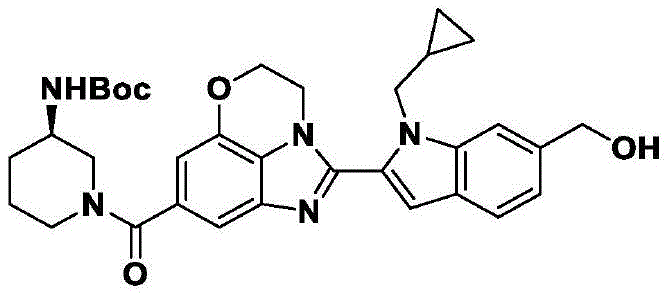
(R) - (1- (2- (1- (cyclopropylmethyl) -6-formyl-1H-indol-2-yl) -3, 4-dihydro-5-oxa-1, 2a-diazacenaphthene-7-carbonyl) piperidin-3-yl) carbamic acid tert-butyl ester (6, 0.2g, 0.34mmol) in methanol (10.0 mL) with stirring at 0 deg.CTo the solution was added sodium borohydride (0.014g, 0.34mmol). The reaction mixture was stirred at room temperature for 1 hour. After completion of the reaction, the reaction mixture was diluted with water and extracted with dichloromethane (10 mL × 2). The combined organic layers were washed with water and brine solution, further dried over anhydrous sodium sulfate, filtered and concentrated to give the crude product. The crude was purified by CombiFlash using 12.0g, redisep and 70% ethyl acetate in hexane as eluent to give tert-butyl (R) - (1- (2- (1- (cyclopropylmethyl) -6- (hydroxymethyl) -1H-indol-2-yl) -3, 4-dihydro-5-oxa-1, 2a-diazacenaphthylene-7-carbonyl) piperidin-3-yl) carbamate (7) as a yellow solid. Yield: 0.100g (51%). MS (ESI): 585.30; m/z found value is 586.30[ M + ] 1 ] + 。
Step-7: preparation of (R) - (3-Aminopiperidin-1-yl) (2- (1- (cyclopropylmethyl) -6- (hydroxymethyl) -1H-indol-2-yl) -3, 4-dihydro-5-oxa-1, 2a-diazacenaphthen-7-yl) methanone (example 61)
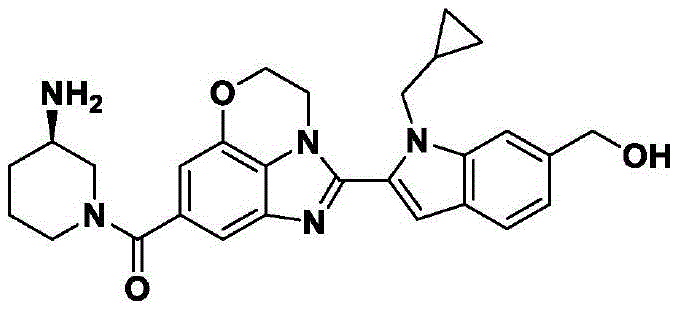
To a stirred solution of tert-butyl (R) - (1- (2- (1- (cyclopropylmethyl) -6- (hydroxymethyl) -1H-indol-2-yl) -3, 4-dihydro-5-oxa-1, 2a-diazacenaphthene-7-carbonyl) piperidin-3-yl) carbamate (6, 0.1g, 0.17mmol) in dichloromethane (10.0 mL) at 0 deg.C was added trifluoroacetic acid (1.0 mL) and stirred at room temperature for 2 hours. After completion of the reaction, the reaction mixture was completely concentrated and basified with saturated sodium bicarbonate solution (10 mL). The compound was extracted with dichloromethane (10 mL. Times.2). The combined organic extracts were washed with brine, dried over anhydrous sodium sulfate, filtered and concentrated to give the crude product. The crude product was purified by reverse phase preparative HPLC to give ((R) - (3-aminopiperidin-1-yl) (2- (1- (cyclopropylmethyl) -6- (hydroxymethyl) -1H-indol-2-yl) -3, 4-dihydro-5-oxa-1, 2a-diazacenaphthylene-7-yl) methanone as an off-white solid in 0.0023g (0.02%).

MS(ESI):C 28 H 31 N 5 O 3 The calculated mass value of (a) is 485.24; measured value of m/z is 486.32[ 2 ], [ M ] +1] + 。
Example-62:
(R) - (3-aminopiperidin-1-yl) (2- (1- (cyclopropylmethyl) -1H-indol-2-yl) -3, 3-dimethyl-3, 4-dihydro-5-oxa-1, 2a-diazacenaphthen-7-yl) methanone
Scheme 5

Step-1: synthesis of 3, 3-dimethyl-5-nitro-3, 4-dihydro-2H-benzo [ b ]][1,4] Oxazine-7-carboxylic acid methyl ester (2)

To a stirred solution of methyl 4-chloro-3, 5-dinitrobenzoate (1,5.0g, 19.19mmol) in methanol (30.0 mL) was added 2-amino-2-methylpropan-1-ol (1a, 2.6g, 28.7mmol) at room temperature. The reaction mixture was stirred at room temperature for 3 hours. After 3 hours, a 25% sodium methoxide solution in methanol (12.5mL, 57.6 mmol) was added to the reaction mixture at 0 ℃. The reaction mixture was allowed to react at 80 ℃ for 3 hours. After completion of the reaction, the reaction mixture was diluted with water. The precipitated solid was filtered and washed with water. The crude material was dried under reduced pressure to give 3, 3-dimethyl-5-nitro-3, 4-dihydro-2H-benzo [ b ] as a yellow solid][1,4] Oxazine-7-carboxylic acid methyl ester (2). Yield: 1.8g (35%). MS (ESI): 266.0, found in m/z, is 267.1[ m ] +H] +1 。
Step-2: synthesis of 5-amino-3, 3-dimethyl-3, 4-dihydro-2H-benzo [ b ]][1,4] Oxazine-7-carboxylic acid methyl ester (3)

3, 3-dimethyl-5-nitro-3, 4-dihydro-2H-benzo [ b ] at room temperature with stirring][1,4] A solution of methyl oxazine-7-carboxylate (2,1.8g, 6.76mmol) in ethanol (20 mL) -water (10 mL) was added ammonium chloride (5.4g, 101.4mmol) and iron powder (5.6g, 101.4mmol) and the resulting mixture was stirred at 60 ℃ for 3 hours. The progress of the reaction was monitored by TLC. After completion of the reaction, the reaction mixture was evaporated, filtered through celite, and washed with ethyl acetate (50 mL × 3). The combined ethyl acetate layers were washed with water and brine. The organic layer was dried over anhydrous sodium sulfate and concentrated under reduced pressure to give 5-amino-3, 3-dimethyl-3, 4-dihydro-2H-benzo [ b ] as a yellow solid ][1,4]
 Oxazine-7-carboxylic acid methyl ester (3).
Yield: 1.0g (55%). MS (ESI): 236.11, m/z found value, is 237.20, [ M ] +H] +1 . Step-3: synthesis of methyl 2- (1- (cyclopropylmethyl) -1H-indol-2-yl) -3, 3-dimethyl-3, 4-dihydro-5-oxa-1, 2a-diazacenaphthene-7-carboxylate (4)

5-amino-3, 3-dimethyl-3, 4-dihydro-2H-benzo [ b ] at room temperature with stirring][1,4] Oxazine-7-carboxylic acid methyl ester (3,0.5g, 2.12mmol) and 1- (cyclopropylmethyl) -1H-indole-2-carbaldehyde (3a, 0.46g,2.33 mmol) in N, N-dimethylformamide (5.0 mL) and water (0.5 mL) potassium peroxymonosulfate (Oxone, 0.39g, 2.54mmol) was added. The reaction mixture was stirred at room temperature for 16 hours. After completion of the reaction, the reaction mixture was cooled to room temperature and water was added. The precipitated solid was filtered and washed with water (10 mL. Times.2) and methanol (5 mL. Times.2). The compound obtained was dried under vacuum to give methyl 2- (1- (cyclopropylmethyl) -1H-indol-2-yl) -3, 3-dimethyl-3, 4-dihydro-5-oxa-1, 2a-diazacenaphthylene-7-carboxylate (4) as a yellow solid. Yield: 0.50g, crude, MS (ESI): 415.19; m/z found value of 416.27[ m ] +H] +1 。
Step-4: synthesis of 2- (1- (cyclopropylmethyl) -1H-indol-2-yl) -3, 3-dimethyl-3, 4-dihydro-5-oxa-1, 2a-diazacenaphthene-7-carboxylic acid (5)

To a stirred solution of the obtained methyl 2- (1- (cyclopropylmethyl) -1H-indol-2-yl) -3, 3-dimethyl-3, 4-dihydro-5-oxa-1, 2a-diazacenaphthylene-7-carboxylate (4, 0.5g,1.2 mmol) in tetrahydrofuran (10.0 mL) and methanol (5.0 mL) was added a 5N sodium hydroxide solution (5.0 mL), and the reaction mixture was stirred at 60 ℃ for 3 hours. After completion of the reaction, the reaction mixture was completely concentrated under reduced pressure. The resulting crude was dissolved in a minimum volume of water and acidified to pH 2 to 3 with a saturated citric acid solution at 0 ℃. The precipitated solid was filtered and washed with water (10 mL. Times.2). The resulting compound was dried under vacuum to give 2- (1- (cyclopropylmethyl) -1H-indol-2-yl) -3, 3-dimethyl-3, 4-dihydro-5-oxa-1, 2a-diazacenaphthylene-7-carboxylic acid (5) as an orange solid. Yield: 0.50g (crude). MS (ESI): 401.17; measured value of m/z is 402.27[ m ] +H] +1 。
Step-5: synthesis of tert-butyl (R) - (1- (2- (1- (cyclopropylmethyl) -1H-indol-2-yl) -3, 3-dimethyl-3, 4-dihydro-5-oxa-1, 2a-diazacenaphthene-7-carbonyl) piperidin-3-yl) carbamate (6)

To a stirred solution of 2- (1- (cyclopropylmethyl) -1H-indol-2-yl) -3, 3-dimethyl-3, 4-dihydro-5-oxa-1, 2a-diazacenaphthene-7-carboxylic acid (5, 0.5g, 1.25mmol) in dichloromethane (20.0 mL) was added tert-butyl (R) -piperidin-3-ylcarbamate (5a, 0.3g, 1.49mmol) and triethylamine (0.6 mL, 3.99mmol), followed by propylphosphonic anhydride (50% solution in ethyl acetate, 2.5mL, 3.99mmol). The reaction mixture was stirred at room temperature for 12 hours. After completion of the reaction, the reaction mixture was diluted with water and extracted with dichloromethane (40 mL × 2). The combined organic layers were washed with water and brine solution, further dried over anhydrous sodium sulfate, filtered and concentrated to give the crude product. The crude was purified by CombiFlash using 12.0g, rediSep and 70% ethyl acetate in hexane as eluent to give tert-butyl (R) - (1- (2- (1- (cyclopropylmethyl) -1H-indol-2-yl) -3, 3-dimethyl-3, 4-dihydro-5-oxa-1, 2 a-diazacenaphthylene-7-carbonyl) piperidin-3-yl) carbamate (6) as a yellow solid. Yield: 0.25g (34%). MS (ESI): 583.32; the measured value of m/z is 584.37[ M + ] 1 ] + 。
Step-6: preparation of (R) - (3-aminopiperidin-1-yl) (2- (1- (cyclopropylmethyl) -1H-indol-2-yl) -3, 3-dimethyl-3, 4-dihydro-5-oxa-1, 2a-diazacenaphthen-7-yl) methanone (example 62)
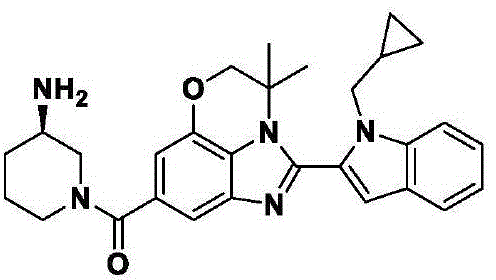

MS(ESI):C 29 H 33 N 5 O 2 The mass calculated value of (b) is 483.2; measured value of m/z is 484.37[ m + ] H] + 。
Example-63:
(R) - (3-aminopiperidin-1-yl) (2- (1- (cyclopropylmethyl) -1H-indol-2-yl) -5, 6-dihydro-4H-imidazo [1,5,4-de ] quinoxalin-8-yl) methanone

Scheme 6

Intermediate (1) used to prepare example 61 was purchased commercially (from Reddy N Reddy Pharmaceuticals). The intermediate (1) mentioned in scheme 4 is identical to the intermediate (3) in scheme 2 above.
And 3, step 3: preparation of methyl 4- ((2-chloroethyl) amino) -3, 5-dinitrobenzoate (2)

To a stirred solution of (1,0.5g, 1.92mmol) in MeOH (50 mL) was added 2-chloroethylamine hydrochloride (0.46g, 4.03mmol), followed by triethylamine (0.7ml, 4.031mmol), and the resulting mixture was heated to 80 ℃ for 1 hour (reaction condition a). The reaction mixture was cooled to room temperature and diluted with ethyl acetate (100 mL × 2), and the organic phase was evaporated in vacuo and the crude was used in the next step without purification to give a yellow solid (0.9 g,100% yield). MS (ESI): c 10 H 10 ClN 3 O 6 A calculated mass value of 303.66; m/z found value of 304.0[ M ] +H] + 。
A step of; preparation of 8-nitro-1, 2,3, 4-tetrahydroquinoxaline-6-carboxylic acid methyl ester (3)

To a stirred solution of methyl 4- ((2-chloroethyl) amino) -3, 5-dinitrobenzoate (2, 0.3g, 0.99mmol) in AcOH (30 mL) at room temperature was added iron powder (0.27g, 4.95mmol) and the resulting mixture was placed in a chamberStirred at room temperature for 12 hours (reaction conditions b). The progress of the reaction was monitored by TLC. The reaction mixture was then evaporated, filtered through celite, and extracted with ethyl acetate (50 mL × 3). The combined organic extracts were washed with brine NaHCO 3 The solution was dried over sodium sulfate and concentrated under reduced pressure to give the crude compound which was purified by column chromatography (silica gel, 0% to 20% EtOAc in hexanes) to give a dark brown solid (0.23g, 99% yield). MS (ESI): c 10 H 11 N 3 O 4 A calculated mass value of 237.22; m/z found value of 238.1[ m ] +H] + 。
And 5: preparation of 2- (1- (cyclopropylmethyl) -1H-indol-2-yl) -5, 6-dihydro-4H-imidazo [1,5,4-
de]Quinoxaline-8-carboxylic acid methyl ester (5)

5-Nitro-3, 4-dihydro-2H-benzo [ b ] with downward stirring][1,4] A solution of a mixture of oxazine-7-carboxylic acid methyl ester (3,0.1g, 0.42mmol) and 1- (cyclopropylmethyl) -1H-indole-2-carbaldehyde (4,0.09g, 0.46mmol) in EtOH (10 mL) was added to water (5 mL) Na 2 S 2 O 4 (0.4 g, 2.32mmol) and the reaction mixture was stirred at 80 ℃ for 16 h (reaction condition c). The reaction mixture was cooled to room temperature, water was added, and the compound was extracted with ethyl acetate (50 mL × 2). The combined organic extracts were washed with brine, dried over sodium sulfate and evaporated to give the crude product. The crude residue was purified by gradient column chromatography using silica gel and the eluent 15% to 20% ethyl acetate in hexane to give a yellow solid (0.08g, 62% yield). MS (ESI): c 23 H 22 N 4 O 2 A calculated mass of 386.46; m/z found value of 387.2[ M ] +H] + 。
Step 6: preparation of 2- (1- (cyclopropylmethyl) -1H-indol-2-yl) -5, 6-dihydro-4H-imidOxazolo [1,5,4-
de]Quinoxaline-8-carboxylic acid (6)

Stirred-down 2- (1- (cyclopropylmethyl) -1H-indol-2-yl) -5, 6-dihydro-4H-imidazo [1,5,4-de]A solution of methyl quinoxaline-8-carboxylate (5,0.1 g, 0.25mmol) in MeOH (2 mL) was added with a 5N NaOH solution (0.4 mL) and stirred at 75 ℃ for 1h (reaction condition d). The reaction mixture was completely evaporated. The resulting crude product was dissolved in a minimum volume of water and acidified with a saturated citric acid solution. The compound was extracted with DCM (50 mL × 2), washed with brine, dried over sodium sulfate and evaporated to give the crude product as a pale yellow solid (0.07g, 72% yield). MS (ESI): c 22 H 20 N 4 O 2 A mass calculated value of 372.43; the measured value of m/z is 373[ m ] +H] + 。
And 7: preparation of (R) - (1- (2- (1- (cyclopropylmethyl) -1H-indol-2-yl) -5, 6-dihydro-4H-imidazo
[1,5,4-de]Quinoxaline-8-carbonyl) piperidin-3-yl) carbamic acid tert-butyl ester (8)

Stirred-down 2- (1- (cyclopropylmethyl) -1H-indol-2-yl) -5, 6-dihydro-4H-imidazo [1,5,4-de]A solution of quinoxaline-8-carboxylic acid (6,0.07g, 0.18mmol) in DCM (5 mL) was added tert-butyl (R) -piperidin-3-ylcarbamate (7,0.041g, 0.206mmol), triethylamine (0.07mL, 0.56mmol), followed by a 50% solution of T3P in ethyl acetate (0.17g, 0.565mmol) and stirred at room temperature for 12 hours (reaction condition e). Water was added to the reaction mixture, and the compound was extracted with DCM (50 mL × 2). The combined organic extracts were washed with brine, dried over sodium sulfate and evaporated to give the crude product. The crude residue was purified by gradient column chromatography using silica gel and the eluent 5% MeOH in DCM to give as a yellow solidProduct (0.1g.71% yield). MS (ESI): c 32 H 38 N 6 O 3 A mass calculated value of 554.7; measured value of m/z is 555.3[ m ] +H] + 。
And 8: preparation of (R) - (3-aminopiperidin-1-yl) (2- (1- (cyclopropylmethyl) -1H-indol-2-yl) -5,6-
dihydro-4H-imidazo [1,5,4-de]Quinoxalin-8-yl methanone (example 63)

(R) - (1- (2- (1- (cyclopropylmethyl) -1H-indol-2-yl) -5, 6-dihydro-4H-imidazo [1,5, 4-de) with stirring]Quinoxaline-8-carbonyl) piperidin-3-yl) carbamic acid tert-butyl ester (8,0.05g, 0.09mmol) in dichloromethane (10 mL) trifluoroacetic acid (0.5 mL) was added and stirred at room temperature for 2 hours (reaction condition f). The reaction mixture was completely evaporated, dissolved in a minimum volume of water and passed through saturated NaHCO 3 The solution (20 mL) was basified. The compound was extracted with DCM (20 mL. Times.2). The combined organic extracts were washed with brine, dried over sodium sulfate and evaporated to give the product as a pale yellow solid (0.025g, 62.5% yield).

MS(ESI):C 27 H 30 N 6 A calculated mass value of O of 455.58; measured value of m/z is 456.2[ m ] +H] + 。
The following compounds (examples 64 to 80) were synthesized using the procedure as described for example-63.
Example 64
R- (3-aminopiperidin-1-yl) (2- (1- (cyclopropylmethyl) -5-fluoro-1H-indol-2-yl) -5, 6-dihydro-4H-imidazo [1,5,4-de ] quinoxalin-8-yl) methanone
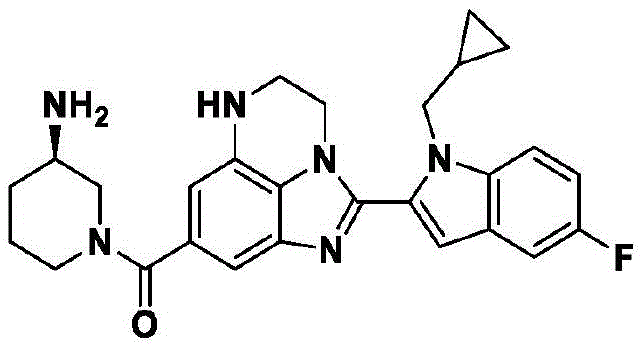

MS(ESI):C 27 H 29 FN 6 Calculated mass of O, 472.57; measured value of m/z is 473.58[ cm ] +H] + 。
Example 65
Synthesis of (R) - (3-aminopiperidin-1-yl) (2- (1- (cyclopropylmethyl) -6-fluoro-1H-indol-2-yl) -5, 6-dihydro-4H-imidazo [1,5,4-de ] quinoxalin-8-yl) methanone (example-65)
Scheme-7

Intermediate (1) was synthesized from intermediate (3) of scheme-6 under reducing conditions.
And 5:2- (1- (cyclopropylmethyl) -6-fluoro-1H-indol-2-yl) -5, 6-dihydro-4H-imidazo [1,5,4-
de]Preparation of quinoxaline-8-carboxylic acid methyl ester (3)

To a stirred solution of methyl 8-amino-1, 2,3, 4-tetrahydroquinoxaline-6-carboxylate (1, 0.1g, 0.48mmol) and 1- (cyclopropylmethyl) -6-fluoro-1H-indole-2-carbaldehyde (2, 0.11g, 0.53mmol) in DMF (3 mL) was added water (0.1 mL) and finally Ketone (oxone) (0.09g, 0.31mmol). The reaction mixture was then allowed to stir at room temperature for about 1 hour. The reaction mixture was quenched with potassium carbonate (0.005 g), and extracted with ethyl acetate (20 mL. Times.2). The combined organic extracts were washed with brine, dried over sodium sulfate, filtered and evaporated to give the crude product. Subjecting the crude residue to gradient column chromatographyPurification was performed using silica gel and 20% to 30% ethyl acetate in hexane as eluent to give the product as a yellow solid (0.15g, 65.2% yield). MS (ESI): c 23 H 21 FN 4 O 2 A mass calculated value of 404.16; m/z found value of 405.2[ m ] +H] + 。
The following compounds (examples 65 to 71) were synthesized using the above intermediate (3) and the procedure as described for example-63.
Example-65:
(R) - (3-aminopiperidin-1-yl) (2- (1- (cyclopropylmethyl) -6-fluoro-1H-indol-2-yl) -5, 6-dihydro-4H-imidazo [1,5,4-de ] quinoxalin-8-yl) methanone


MS(ESI):C 27 H 29 FN 6 Calculated mass O, 472.24; m/z measured value is 473.3[ m ] +H] + 。
Example 66
(R) - (3-aminopiperidin-1-yl) (2- (1- (pyridin-3-ylmethyl) -1H-indol-2-yl) -5, 6-dihydro-4H-imidazo [1,5,4-de ] quinoxalin-8-yl) methanone


MS(ESI):C 29 H 29 N 7 The mass calculated value of O is 491.60; m/z measured value is 492.4[ M ] +H] + 。
Example 67
(R) - (3-aminopiperidin-1-yl) (2- (5-bromo-1- (cyclopropylmethyl) -1H-indol-2-yl) -5, 6-dihydro-4H-imidazo [1,5,4-de ] quinoxalin-8-yl) methanone


MS(ESI):C 27 H 29 BrN 6 Calculated mass value of O, 533.47; measured value of m/z is 497[ m ] +H]+。
Example 68
(R) - (3-aminopiperidin-1-yl) (2- (1- (cyclopropylmethyl) -5- (pyridin-3-yl) -1H-indol-2-yl) -5, 6-dihydro-4H-imidazo [1,5,4-de ] quinoxalin-8-yl) methanone


MS(ESI):C 32 H 33 N 7 The mass calculated value of O is 531.6; m/z found value of 533.2[ M + ] H]+。
Example 69
(R) - (3-aminopiperidin-1-yl) (2- (1- (pyridin-2-ylmethyl) -1H-indol-2-yl) -5, 6-dihydro-4H-imidazo [1,5,4-de ] quinoxalin-8-yl) methanone


MS(ESI):C 29 H 29 N 7 The mass calculated value of O is 491.02; m/z found value of 492.09[ m ] +H ] + 。
Example-70
(R) - (3-aminopiperidin-1-yl) (2- (1- (2-fluorobenzyl) -1H-indol-2-yl) -5, 6-dihydro-4H-imidazo [1,5,4-de ] quinoxalin-8-yl) methanone
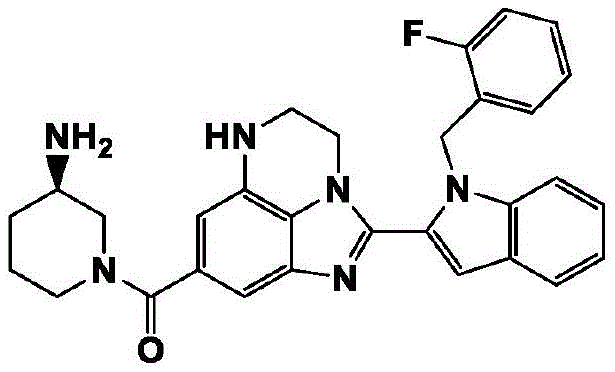

MS(ESI):C 30 H 29 FN 6 The calculated mass value of O is 508.2; measured value m/z:509.16[ 2 ] M + H] + 。
Example 71
(R) - (3-aminopiperidin-1-yl) (2- (1- (pyridin-4-ylmethyl) -1H-indol-2-yl) -5, 6-dihydro-4H-imidazo [1,5,4-de ] quinoxalin-8-yl) methanone


MS(ESI):C 29 H 29 N 7 The mass calculation value of O is 491.12; measured value m/z:492.22[ 2 ] M + H] + 。
The following compounds were synthesized using the above intermediate 3, and following the procedure as shown for example 63.
Example-72
R- (3-Aminopiperidin-1-yl) (2- (1- (cyclopropylmethyl) -1H-indol-2-yl) -6-methyl-5, 6-dihydro-4H-imidazo [1,5,4-de ] quinoxalin-8-yl) methanone (example-72)

2- (1- (cyclopropylmethyl) -1H-indol-2-yl) -6-methyl-5, 6-dihydro-4H-imidazo [1,5,4-de]Quinoline derivatives
Preparation of methyl oxine-8-carboxylate (2)
The intermediate (3) obtained from scheme-6 above was methylated to obtain the intermediate (2) given below. The remaining reaction steps are the same as those exemplified for example-63.
Scheme-8

To stirred 2- (1- (cyclopropylmethyl) -1H-indol-2-yl) -5, 6-dihydro-4H-imidazo [1,5,4-de at room temperature]A solution of quinoxaline-8-carboxylic acid methyl ester (1.1 g, 0.25mmol) in DMF (10 mL) was added potassium carbonate (0.07g, 0.51mmol) followed by methyl iodide (0.01mL, 0.28mmol) and the reaction mixture was allowed to stir at room temperature for 12 hours. The progress of the reaction was monitored by TLC. The reaction mixture was then evaporated and extracted with ethyl acetate (50 mL × 3), dried over sodium sulfate, and concentrated under reduced pressure to give the crude compound, which was purified by column chromatography (silica gel, 0 to 20% EtOAc in hexanes) to give a light yellow solid (0.05g, 50% yield). MS (ESI): c 24 H 24 N 4 O 2 A mass calculated value of 400.48; m/z found value of 401.2[ m ] +H] + 。
R- (3-Aminopiperidin-1-yl) (2- (1- (cyclopropylmethyl) -1H-indol-2-yl) -6-methyl-5, 6-dihydro-4H-imidazo [1,5,4-de ] quinoxalin-8-yl) methanone (example-72)


MS(ESI):C 28 H 32 N 6 A mass calculated value of O of 468.61; measured value of m/z is 469.3 2M + H] + 。
The following compounds (examples 73, 77 and 80) were synthesized using the procedure as shown for example-63.
Example-73
(R) - (3-aminopiperidin-1-yl) (2- (1- (cyclopropylmethyl) -6-methoxy-1H-indol-2-yl) -5, 6-dihydro-4H-imidazo [1,5,4-de ] quinoxalin-8-yl) methanone


MS(ESI):C 28 H 32 N 6 O 2 The calculated mass value of (a) is 484.26; measured value of m/z is 485.3 2M + H] + 。
Example 74
(R) - (3-aminopiperidin-1-yl) (2- (1- (cyclopropylmethyl) -6-methoxy-1H-indol-2-yl) -6-methyl-5, 6-dihydro-4H-imidazo [1,5,4-de ] quinoxalin-8-yl) methanone


MS(ESI):C 28 H 31 N 5 O 3 The mass calculated value of (a) is 485.5; found M/z of 486.5 (M + H) + 。
Example-75
(R) - (3-aminopiperidin-1-yl) (2- (1- (cyclopropylmethyl) -5-fluoro-1H-indol-2-yl) -6-methyl-5, 6-dihydro-4H-imidazo [1,5,4-de ] quinoxalin-8-yl) methanone
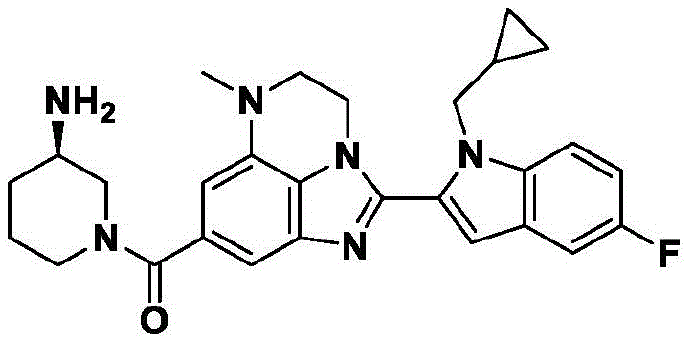

MS(ESI):C 28 H 31 FN 6 Calculated O, 486.25; measured value of M/z, 487.3 (M + H) + 。
Example 76
(R) - (3-aminopiperidin-1-yl) (2- (1- (cyclopropylmethyl) -1H-indol-2-yl) -6- (methylsulfonyl) -
5, 6-dihydro-4H-imidazo [1,5,4-de]Quinoxalin-8-yl) methanones
Scheme-9

The intermediate (1) of scheme-9 above was obtained by a similar procedure as exemplified for example-63 (scheme 6).
Step 6:2- (1- (cyclopropylmethyl) -1H-indol-2-yl) -6- (methylsulfonyl) -5, 6-dihydro-4H-imidazole
And [1,5,4-de ]]Preparation of methyl quinoxaline-8-carboxylate (2)

2- (1- (cyclopropylmethyl) -1H-indol-2-yl) -5, 6-dihydro-4H-imidazo [1,5, 4-de) at 0 ℃ with stirring]A solution of methyl quinoxaline-8-carboxylate (1,0.15g, 0.39mmol) in DCM (10 mL) was added pyridine (0.061g, 0.77mmol) followed by methanesulfonyl chloride (0.03ml, 0.39mmol) and the resulting mixture was allowed to stir at room temperature for 1 hour. The progress of the reaction was monitored by TLC. The reaction mixture was then evaporated and made up with DCM (50 mL;)3) Extraction, drying over sodium sulfate and concentration under reduced pressure gave a brown solid (0.18 g, crude product). LC-MS: c 24 H 24 N 4 O 4 Calculated m/z for S: 464.5; measured value of m/z, is 465.1[ m ] +H] + 。
And 7:2- (1- (cyclopropylmethyl) -1H-indol-2-yl) -6- (methylsulfonyl) -5, 6-dihydro-4H-imidazole
And [1,5,4-de ]]Preparation of quinoxaline-8-carboxylic acid- (3)

To stirred 2- (1- (cyclopropylmethyl) -1H-indol-2-yl) -6- (methylsulfonyl) -5, 6-dihydro-4H-imidazo [1,5,4-de ]A solution of quinoxaline-8-carboxylic acid methyl ester (2,0.18g, 0.39mmol) in MeOH (5 mL) and water (0.5 mL) was added LiOH. H 2 O (0.027g, 0.12mmol), and stirred at 60 ℃ for 2 hours. The reaction mixture was completely evaporated. The resulting crude product was dissolved in a minimum volume of water and acidified with a saturated citric acid solution. The compound was extracted with DCM (30 mL × 2), washed with brine, dried over sodium sulfate and evaporated to give the crude product as a pale yellow solid (0.15 g, crude product). MS (ESI): c 23 H 22 N 4 O 4 The calculated mass value of S is 450.51; measured value of m/z is 451.1[ 2 ], [ M ] +H] + . Further steps of example-76 were performed using a similar procedure as exemplified for example-63.
(R) - (3-aminopiperidin-1-yl) (2- (1- (cyclopropylmethyl) -1H-indol-2-yl) -6- (methylsulfonyl) -5, 6-dihydro-4H-imidazo [1,5,4-de ] quinoxalin-8-yl) methanone
(example-76)


MS(ESI):C 28 H 32 N 6 O 3 The calculated mass value of S is 532.6; m/z measured value of 533[ m ] +H] + 。
Example 77
(R) - (3-aminopiperidin-1-yl) (2- (1- (cyclopropylmethyl) -5, 6-difluoro-1H-indol-2-yl) -5, 6-dihydro-4H-imidazo [1,5,4-de ] quinoxalin-8-yl) methanone
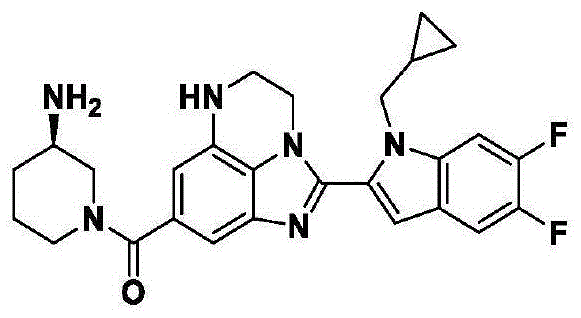

MS(ESI):C 27 H 28 F 2 N 6 A calculated mass value of O of 490.23; m/z found value of 491.2[ M ] +H] + 。
Example 78
(R) - (3-Aminopiperidin-1-yl) (6-cyclopropyl-2- (1- (cyclopropylmethyl) -1H-indol-2-yl) -5, 6-di hydro-4H-imidazo [1,5,4-de]Quinoxalin-8-yl) methanones(example 78)
Scheme-10
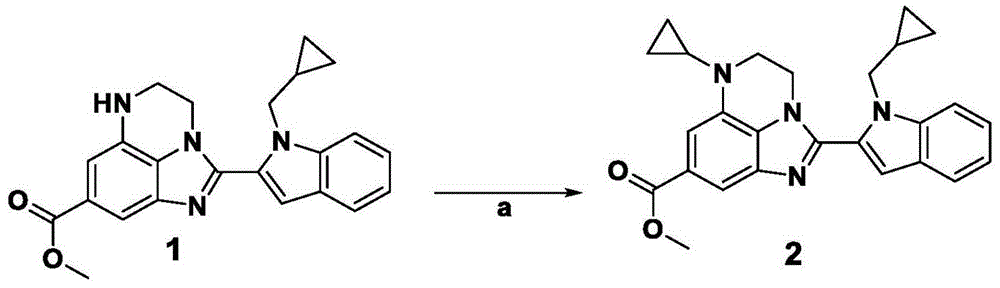
Step 6: preparation of methyl 6-cyclopropyl-2- (1- (cyclopropylmethyl) -1H-indol-2-yl) -5, 6-dihydro-4H-imidazo [1,5,4-de ] quinoxaline-8-carboxylate (2)
2- (1- (cyclopropylmethyl) -1H-indol-2-yl) -5, 6-dihydro-4H-imidazo [1,5, 4-de) at room temperature with stirring]A solution of methyl quinoxaline-8-carboxylate (1, 0.2g, 0.52mmol) and cyclopropylboronic acid (0.088g, 1.04mmol) in DCM (10 mL) was added copper (II) acetate (0.164g, 1.036 mmol), followed by pyridine (0.1mL, 1.04mmol), and the resulting mixture was allowed to stir at room temperature in the presence of air for 24 hours. The reaction progresses throughMonitored by TLC. The reaction mixture was then quenched with dilute HCl, extracted with DCM (50 mL × 3), dried over sodium sulfate and concentrated under reduced pressure to give the crude compound. It was purified by column chromatography (silica gel, 0 to 20% EtOAc in hexanes) to give a pale yellow solid (0.11g, 50% yield). MS (ESI): c 26 H 26 N 4 O 2 A mass calculated value of 426.2; the measured value of m/z is 427[ M ] +H] + 。
Further steps of example-78 were performed using similar procedures as exemplified for example-63.
(R) - (3-Aminopiperidin-1-yl) (6-cyclopropyl-2- (1- (cyclopropylmethyl) -1H-indol-2-yl) -5, 6-dihydro-4H-imidazo [1,5,4-de ] quinoxalin-8-yl) methanone (example-78)


MS(ESI):C 30 H 34 N 60 Is 494.64; the measured value of m/z is 495.5[ m ] +H] + 。
Example 79 was synthesized using the procedure described above as exemplified for example-76.
Example 79
(R) - (3-aminopiperidin-1-yl) (2- (1- (cyclopropylmethyl) -1H-indol-2-yl) -6- (phenethylsulfonyl) -5, 6-dihydro-4H-imidazo [1,5,4-de ] quinoxalin-8-yl) methanone


MS(ESI):C 35 H 38 N 6 O 3 The calculated mass value of S is 622.27; found value of M/z, 623.2 (M + H) + 。
Example 80
(R) - (3-aminopiperidin-1-yl) (2- (1- (cyclopropylmethyl) -4-fluoro-1H-indol-2-yl) -5, 6-dihydro-4H-imidazo [1,5,4-de ] quinoxalin-8-yl) methanone
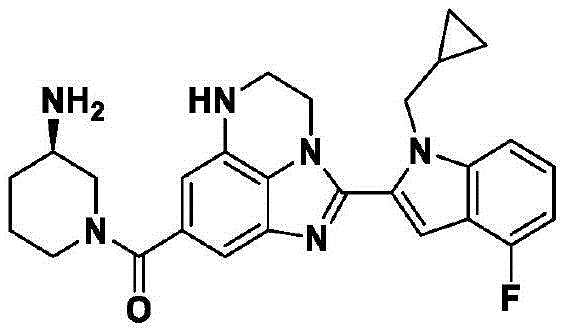

MS(ESI):C 27 H 29 Calculated mass of FN6O, 472.57; m/z found value is 473.2[ m ] +H] + 。
Examples 81 to 83 were synthesized using the procedure described above as exemplified for example-76. Example 84 was synthesized using the procedure described above as exemplified for example-63.
Example 81
(R) - (3-Aminopiperidin-1-yl) (6- ((4-chlorophenyl) sulfonyl) -2- (1- (cyclopropylmethyl) -1H-indole-)
2-yl) -5, 6-dihydro-4H-imidazo [1,5,4-de]Quinoxalin-8-yl) methanones


MS(ESI):C 30 H 34 N 6 O 3 The calculated mass value of S is 629.18; measured value of m/z is 629.2[ m + H ] ] + 。
Example-82
(R) - (3-aminopiperidin-1-yl) (2- (1- (cyclopropylmethyl) -1H-indol-2-yl) -6- (cyclopropylsulfonyl) -5, 6-dihydro-4H-imidazo [1,5,4-de ] quinoxalin-8-yl) methanone


MS(ESI):C 30 H 34 N 6 O 3 The calculated mass value of S was 558.7; measured value of m/z is 559.2[ m ] +H] + 。
Example 83
(R) - (3-aminopiperidin-1-yl) (2- (1- (cyclopropylmethyl) -1H-indol-2-yl) -6- ((2-ethoxyethyl) sulfonyl) -5, 6-dihydro-4H-imidazo [1,5,4-de ] quinoxalin-8-yl) methanone


MS(ESI):C 31 H 38 N 6 O 4 The calculated mass value of S is 590.27; found M/z 591.3 (M + H) + 。
Example 84
(R) - (3-aminopiperidin-1-yl) (2- (1- (cyclopropylmethyl) -7-methyl-1H-indol-2-yl) -5, 6-dihydro-4H-imidazo [1,5,4-de ] quinoxalin-8-yl) methanone


MS(ESI):C 28 H 32 N 6 A mass calculated value of O of 468.61; measured value of m/z is 469.1[ 2 ], [ M + H ]] + 。
Example 85
(R) -1- (8- (3-aminopiperidine-1-carbonyl) -2- (1- (cyclopropylmethyl) -1H-indol-2-yl) -4, 5-dihydro-6H-imidazo [1,5,4-de ] quinoxalin-6-yl) ethan-1-one
Scheme-11

The intermediate (1) of scheme-11 above was obtained by similar procedures as exemplified for example-63 (scheme 6).
And 6: preparation of 2- (1- (cyclopropylmethyl) -1H-indol-2-yl) -5, 6-dihydro-4H-imidazo [1,5,4-de ] quinoxaline-8-carboxylic acid- (2)

Stirred-down 2- (1- (cyclopropylmethyl) -1H-indol-2-yl) -5, 6-dihydro-4H-imidazo [1,5,4-de]Quinoxaline-8-carboxylic acid methyl ester (1,0.09g, 0.21mmol) in MeOH (5 mL) and water (0.5 mL) LiOH. H. 2 O (0.044g, 1.05mmol), and stirred at room temperature for 12 hours. The reaction mixture was evaporated completely. The resulting crude product was dissolved in a minimum volume of water and acidified with a saturated citric acid solution. The compound was extracted with DCM (30 mL × 2), washed with brine, dried over sodium sulfate and evaporated to give the crude product as a pale yellow solid (0.07 g, crude product). MS (ESI): c 22 H 20 N 4 O 2 A mass calculated value of 372.43; the measured value of m/z is 373.0[ M ] +H] + 。
And 7: 6-acetyl-2- (1- (cyclopropylmethyl) -1H-indol-2-yl) -5, 6-dihydro-4H-imidazo [1,
5,4-de]preparation of quinoxaline-8-carboxylic acid (3)

2- (1- (cyclopropylmethyl) -1H-indol-2-yl) -5, 6-dihydro-4H-imidazo [1,5, 4-de) at 0 ℃ with stirring]A solution of quinoxaline-8-carboxylic acid (0.07g, 0.19mmol) in DCM (10 mL) was added pyridine (0.03mL, 0.37mmol) followed by acetyl chloride (0.02mL, 0.28mmol) and the resulting mixture was stirred at room temperature for 1 hour. The progress of the reaction was monitored by TLC. The reaction mixture was evaporated, extracted with DCM (50 mL × 3), dried over sodium sulfate and concentrated under reduced pressure to give a brown solid (0.059g, 76%). LC-MS: c 24 H 22 N 4 O 3 Calculated m/z of (c): 414.4; measured value is 415.1[ deg. ] M +H] + 。
The remaining steps of preparation example-85 were carried out using similar procedures as exemplified for example-63.
Example 85
(R) -1- (8- (3-aminopiperidine-1-carbonyl) -2- (1- (cyclopropylmethyl) -1H-indol-2-yl) -4, 5-dihydro-6H-imidazo [1,5,4-de ] quinoxalin-6-yl) ethan-1-one


MS(ESI):C 29 H 32 N 6 O 2 The calculated mass value of (a) is 496.6; measured value of m/z is 497.3[ m + H ]] + 。
Example-86
(R) - (3-Aminopiperidin-1-yl) (2- (1- (cyclopropylmethyl) -1H-indol-2-yl) -5, 6-dihydro-4H-imidazole
Azolo [1,5,4-de]Quinoxalin-8-yl) methanethione
Scheme-12
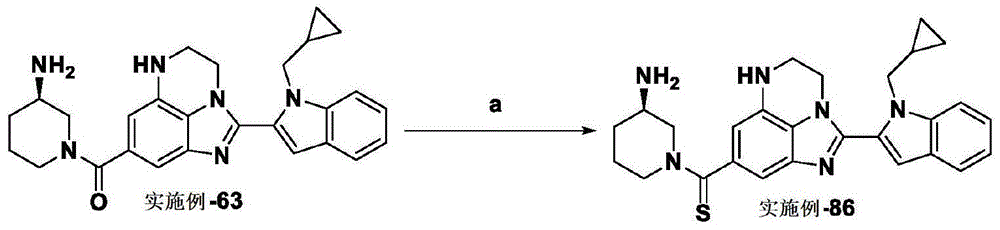
(R) - (3-Aminopiperidin-1-yl) (2- (1- (cyclopropylmethyl) -1H-indol-2-yl) -5, 6-dihydro-4H-imidazo [1,5, 4-de) to stirring at room temperature]A solution of quinoxalin-8-yl) methanone (example-63, 0.07g, 0.15mmol) in toluene (50 mL) was added Lawson's reagent (Lawessons reagent) (0.12g, 0.39mmol). The reaction mixture was refluxed at a bath temperature of 100 ℃ for 12 hours. The reaction mixture was washed with NaHCO 3 Diluted (50 mL. Times.2) and extracted with ethyl acetate (50 mL. Times.2). The combined organic extracts were washed with brine, dried over sodium sulfate and evaporated to give the crude product. The crude residue was purified by gradient column chromatography using 15% to 100% ethyl acetate in hexane to give (R) - (3-aminopiperidin-1-yl) (2- (1- (cyclopropylmethyl) -1H-indol-2-yl) -5, 6-dihydro-4H-imidazo [1,5, 4-de) as a yellow solid ]Quinoxalin-8-yl) methanethiol (0.007g, 10% yield).

MS(ESI):C 27 H 30 N 6 The calculated mass value of S is 470.64; m/z found value of 471.2[ M ] +H] + 。
Example-87
Synthesis of (R) - (3-aminopiperidin-1-yl) (2- (7-chloro-1- (cyclopropylmethyl) -6-fluoro-1H-indol-2-yl) -3, 4-dihydro-5-oxa-1, 2a-diazacenaphthen-7-yl) methanone
Scheme-13

Step-1: synthesis of methyl 2- (7-chloro-1- (cyclopropylmethyl) -6-fluoro-1H-indol-2-yl) -3, 4-dihydro-5-oxa-1, 2a-diazacenaphthylene-7-carboxylate (2)

5-amino-3, 4-dihydro-2H-benzo [ b ] at room temperature with stirring][1,4] A solution of methyl oxazine-7-carboxylate (1,0.33g, 1.31mmol) and 7-chloro-1- (cyclopropylmethyl) -6-fluoro-1H-indole-2-carbaldehyde (7a, 0.27g, 1.31mmol) in N, N-dimethylformamide (10.0 mL) and water (3.0 mL) was added potassium peroxymonosulfonate (` ion `)>
 Ketone, 0.484g, 1.57mmol). The reaction mixture was stirred at room temperature for 16 hours. After completion of the reaction, the reaction mixture was cooled to room temperature and water was added. The precipitated solid was filtered and washed with water (20 mL. Times.2) and methanol (10 mL. Times.2). The obtained compound was dried under vacuum to give methyl 2- (7-chloro-1- (cyclopropylmethyl) -6-fluoro-1H-indol-2-yl) -3, 4-dihydro-5-oxa-1, 2a-diazacenaphthene-7-carboxylate (2) as a yellow solid. Yield: 0.12g (22%). MS (ESI): 439.11; m/z found value of 440.28[ m ] +H ] +1 。
Step-2: synthesis of 2- (7-chloro-1- (cyclopropylmethyl) -6-fluoro-1H-indol-2-yl) -3, 4-dihydro-5-oxa-1, 2a-diazacenaphthene-7-carboxylic acid (3)

To a stirred solution of methyl 2- (7-chloro-1- (cyclopropylmethyl) -6-fluoro-1H-indol-2-yl) -3, 4-dihydro-5-oxa-1, 2 a-diazacenaphthylene-7-carboxylate (2, 0.12g, 0.29mmol) in tetrahydrofuran (5.0 mL) and methanol (3.0 mL) was added 5N sodium hydroxide solution (3.0 mL) and the reaction mixture was stirred at 60 ℃ for 2 hours. After completion of the reaction, the reaction mixture was concentrated under reduced pressure. The resulting crude product was dissolved in a minimum volume of water and acidified to pH 2-3 with a saturated citric acid solution at 0 ℃. The precipitated solid was filtered and washed with water (10 mL. Times.2). The obtained compound was dried under vacuum to obtain 2- (7-chloro-1) as a white solid- (cyclopropylmethyl) -6-fluoro-1H-indol-2-yl) -3, 4-dihydro-5-oxa-1, 2a-diazacenaphthylene-7-carboxylic acid (3). Yield: 0.11g (89%). MS (ESI): 425.09; the found value of m/z is 424.13[ M-H ]] -1 。
Step-3: synthesis of (R) - (1- (2- (7-chloro-1- (cyclopropylmethyl) -6-fluoro-1H-indol-2-yl) -3, 4-dihydro-5-oxa-1, 2a-diazacenaphthene-7-carbonyl) piperidin-3-yl) carbamic acid tert-butyl ester (4)

To a stirred solution of 2- (7-chloro-1- (cyclopropylmethyl) -6-fluoro-1H-indol-2-yl) -3, 4-dihydro-5-oxa-1, 2a-diazacenaphthene-7-carboxylic acid (3, 0.11g, 0.25mmol) in dichloromethane (10.0 mL) was added tert-butyl (R) -piperidin-3-ylcarbamate (3b, 0.06g, 0.31mmol) and triethylamine (0.11mL, 0.83mmol), followed by propylphosphonic anhydride (50% solution in ethyl acetate, 0.25mL, 0.86mmol). The reaction mixture was stirred at room temperature for 2 hours. After completion of the reaction, the reaction mixture was diluted with water and extracted with dichloromethane (10 mL × 2). The combined organic layers were washed with water and brine solution, further dried over anhydrous sodium sulfate, filtered and concentrated to give the crude product. The crude product was purified by CombiFlash using 4.0g RediSep column and 70% ethyl acetate in hexane as eluent to give tert-butyl (R) - (1- (2- (7-chloro-1- (cyclopropylmethyl) -6-fluoro-1H-indol-2-yl) -3, 4-dihydro-5-oxa-1, 2a-diazacenaphthylene-7-carbonyl) piperidin-3-yl) carbamate (4) as a yellow solid. Yield: 0.07g (45%). MS (ESI): 607.24; measured value of m/z is 608.32[ m ] +1] +1 。
Step-4: synthesis of (R) - (3-aminopiperidin-1-yl) (2- (7-chloro-1- (cyclopropylmethyl) -6-fluoro-1H-indol-2-yl) -3, 4-dihydro-5-oxa-1, 2a-diazacenaphthen-7-yl) methanone (example-87)

To a stirred solution of tert-butyl (R) - (1- (2- (7-chloro-1- (cyclopropylmethyl) -6-fluoro-1H-indol-2-yl) -3, 4-dihydro-5-oxa-1, 2a-diazacenaphthene-7-carbonyl) piperidin-3-yl) carbamate (4, 0.07g, 0.11mmol) in dichloromethane (5.0 mL) at 0 deg.C was added trifluoroacetic acid (1.0 mL) and stirred at room temperature for 2 hours. After the reaction was complete, the reaction mixture was completely concentrated and basified by saturated sodium bicarbonate solution (10 mL). The compound was extracted with dichloromethane (10 mL. Times.2). The combined organic extracts were washed with brine, dried over anhydrous sodium sulfate, filtered and concentrated to give (R) - (3-aminopiperidin-1-yl) (2- (7-chloro-1- (cyclopropylmethyl) -6-fluoro-1H-indol-2-yl) -3, 4-dihydro-5-oxa-1, 2a-diazacenaphthylene-7-yl) methanone as a white solid. Yield: 0.042g (72%).

MS (ESI): 507.18; measured value m/z:508.36[ M ] +H] + 。
Example-88
Synthesis of (R) - (3-aminopiperidin-1-yl) (2- (7-chloro-1- (pyrimidin-5-ylmethyl) -1H-indol-2-yl) -3, 4-dihydro-5-oxa-1, 2a-diazacenaphthen-7-yl) methanone
Scheme-14

Step-1: synthesis of methyl 2- (7-chloro-1- (pyrimidin-5-ylmethyl) -1H-inden-2-yl) -3, 4-dihydro-5-oxa-1, 2a-diazacenaphthylene-7-carboxylate (2)
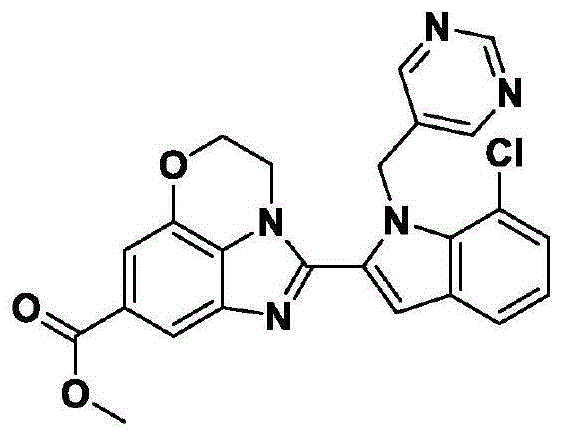
5-amino-3, 4-dihydro-2H-benzo [ b ] at room temperature with stirring][1,4] Oxazine-7-carboxylic acid methyl ester (1,0.200g, 0.96mmol) and 7-chloro(vii) -1- (pyrimidin-5-ylmethyl) -1H-indole-2-carbaldehyde (2a, 0.260g, 1.05mmol) in N, N-dimethylformamide (5.0 mL) and water (1.5 mL) was added potassium peroxymonosulfonate (` Liang `)>
 Ketone, 0.175g, 1.15mmol). The reaction mixture was stirred at room temperature for 16 hours. After completion of the reaction, the reaction mixture was cooled to room temperature and water was added. The precipitated solid was filtered and washed with water (10 mL. Times.2) and methanol (5 mL. Times.2). The obtained compound was dried under vacuum to give methyl 2- (7-chloro-1- (pyrimidin-5-ylmethyl) -1H-inden-2-yl) -3, 4-dihydro-5-oxa-1, 2a-diazacenaphthylene-7-carboxylate (2) as a yellow solid. Yield: 0.30g (crude). MS (ESI): 458.90; measured value of m/z is 459.80[ m + H ]] +1 。
Step-2: synthesis of 2- (7-chloro-1- (pyrimidin-5-ylmethyl) -1H-indol-2-yl) -3, 4-dihydro-5-oxa-1, 2a-diazacenaphthene-7-carboxylic acid (3)

To a stirred solution of methyl 2- (7-chloro-1- (pyrimidin-5-ylmethyl) -1H-inden-2-yl) -3, 4-dihydro-5-oxa-1, 2a-diazacenaphthylene-7-carboxylate (2, 0.30g, 0.65mmol) in tetrahydrofuran (5.0 mL) and methanol (3.0 mL) was added a 5N sodium hydroxide solution (3.0 mL), and the reaction mixture was stirred at 60 ℃ for 2 hours. After completion of the reaction, the reaction mixture was completely concentrated under reduced pressure. The resulting crude product was dissolved in a minimum volume of water and acidified to pH 2-3 with a saturated citric acid solution at 0 ℃. The precipitated solid was filtered and washed with water (10 mL. Times.2). The obtained compound was dried under vacuum to give 2- (7-chloro-1- (pyrimidin-5-ylmethyl) -1H-indol-2-yl) -3, 4-dihydro-5-oxa-1, 2a-diazacenaphthene-7-carboxylic acid (3) as a white solid. Yield: 0.250g (crude). MS (ESI): 445.86; the measured value of m/z is 446.89[ deg. ] M + H ] +1 。
Step-3: synthesis of (R) - (1- (2- (7-chloro-1- (pyrimidin-5-ylmethyl) -1H-indol-2-yl) -3, 4-dihydro-5 ] -oxa-1, 2a-diazacenaphthene-7-carbonyl) piperidin-3-yl) carbamic acid tert-butyl ester (4)

To a stirred solution of 2- (7-chloro-1- (pyrimidin-5-ylmethyl) -1H-indol-2-yl) -3, 4-dihydro-5-oxa-1, 2a-diazacenaphthene-7-carboxylic acid (3, 0.25g, 0.56mmol) in dichloromethane (10.0 mL) was added tert-butyl (R) -piperidin-3-ylcarbamate (3 b,0.134g, 0.67mmol) and triethylamine (0.2mL, 1.74mmol), followed by propyl phosphonic anhydride (50% solution in ethyl acetate, 0.5mL, 1.96mmol). The reaction mixture was stirred at room temperature for 2 hours. After completion of the reaction, the reaction mixture was diluted with water and extracted with dichloromethane (10 mL × 2). The combined organic layers were washed with water, brine solution and dried over anhydrous sodium sulfate. The organic layer was filtered and concentrated to give the crude product. The crude product was purified by CombiFlash using 12.0g reisep column and 70% ethyl acetate in hexane as eluent to give tert-butyl (R) - (1- (2- (7-chloro-1- (pyrimidin-5-ylmethyl) -1H-indol-2-yl) -3, 4-dihydro-5-oxa-1, 2a-diazacenaphthylene-7-carbonyl) piperidin-3-yl) carbamate (4) as a white solid. Yield: 0.10g (30%). MS (ESI): 628.13; measured value of m/z is 629.35[ m ] +1 ] + 。
Step-4: synthesis of (R) - (3-aminopiperidin-1-yl) (2- (7-chloro-1- (pyrimidin-5-ylmethyl) -1H-indol-2-yl) -3, 4-dihydro-5-oxa-1, 2a-diazacenaphthen-7-yl) methanone (example-88)
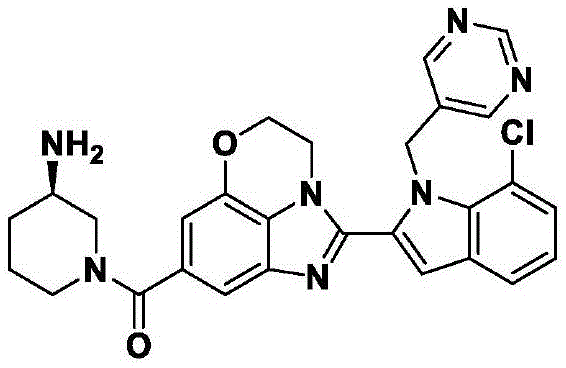
To a stirred solution of tert-butyl (R) - (1- (2- (7-chloro-1- (pyrimidin-5-ylmethyl) -1H-indol-2-yl) -3, 4-dihydro-5-oxa-1, 2a-diazacenaphthene-7-carbonyl) piperidin-3-yl) carbamate (4, 0.1g,0.1 mmol) in dichloromethane (5.0 mL) at 0 deg.C was added trifluoroacetic acid (1.0 mL) and stirred at room temperature for 2 hours. After completion of the reaction, the reaction mixture was concentrated. The reaction mixture was basified by saturated sodium bicarbonate solution (5.0 mL). The compound was extracted with dichloromethane (10 mL. Times.2). The combined organic extracts were washed with brine, dried over anhydrous sodium sulfate, filtered and concentrated in vacuo to give (R) - (3-aminopiperidin-1-yl) (2- (7-chloro-1- (pyrimidin-5-ylmethyl) -1H-indol-2-yl) -3, 4-dihydro-5-oxa-1, 2a-diazacenaphthylene-7-yl) methanone as an off-white solid. Yield: 0.025g (30%).

MS (ESI): 528.01; measured value m/z:528.42[ M ] +H] + 。
Synthesis of intermediates
Synthesis of 1-ethyl-1H-pyrrolo [2,3-b ] pyridine-2-carbaldehyde (intermediate of example-5):

Step-1: 1H-pyrrolo [2,3-b ]]Pyridine-2-carboxylic acid ethyl ester (3)

To a stirred solution of 2-bromonicotinamidal (1, 10.0g,53.7 mmol) in DMSO (100 mL) was added Cs 2 CO 3 (35.0 g, 107mmol), cuI (1.05g, 5.37mmol), followed by the addition of ethyl-2-isocyanoacetate (2, 7.9mL, 69.8mmol), and stirring at 80 ℃ for 16 hours (reaction condition a). The reaction mixture was cooled to room temperature and filtered through celite. Water (100 mL) was added to the reaction mixture, and the mixture was extracted with EtOAc (200 mL). Subjecting the organic layer to anhydrous Na 2 SO 4 Dried and evaporated under vacuum. The crude product was purified by column chromatography using 30% to 50% EtOAc in hexanes to give the product as a brown gum. (yield: 45%,4.5 g). MS (ESI): c 10 H 10 N 2 O 2 The mass calculated value of (a) is 190.20; found M/z of 191.0 (M + H) + 。
Step-2: 1- (tert-butyl) 2-ethyl-1H-pyrrolo [2,3-b ]]Pyridine-1, 2-dicarboxylic acid ester (4)
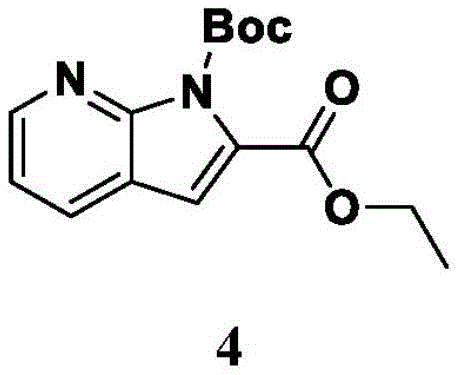
1H-pyrrolo [2,3-b ] with downward stirring]A solution of pyridine-2-carboxylic acid ethyl ester (3, 34.5g,23.6 mmol) in THF (50 mL) was added triethylamine (6.5mL, 47.3 mmol) followed by Boc anhydride (3.6 g,35.5 mmol) and stirred at room temperature for 16 hours (reaction condition b). Water (100 mL) was added to the reaction mixture and extracted with EtOAc (200 mL). Subjecting the organic layer to anhydrous Na 2 SO 4 Dried and evaporated under vacuum. The crude product was purified by column chromatography using silica gel and the eluent 20% to 30% EtOAc in hexanes to give the product as a brown gum. (yield: 81%,5.5 g). MS (ESI): c 15 H 18 N 2 O 4 A calculated mass value of 290.32; found M/z of 291.1 (M + H) + 。
Step-3: 1H-pyrrolo [2,3-b]Pyridine-2-carboxylic acid (5)

1- (tert-butyl) 2-ethyl-1H-pyrrolo [2,3-b ] with downward stirring]A solution of pyridine-1, 2-dicarboxylate (4,5.5g, 18.9mmol) in THF (40 mL) was added water (10 mL) LiOH (3.9g, 94.8mmol) and stirred at room temperature for 4 h. The reaction mixture was evaporated and dissolved in a minimal amount of water. A saturated citric acid solution was added thereto until it was acidic, and the formed precipitate was collected by filtration and dried to obtain the product as a white solid. (yield: 81%,2.5 g). MS (ESI): c 8 H 6 N 2 O 2 The calculated mass value of (a) is 162.04; found M/z of 163.1 (M + H) + 。
Step-4: N-methoxy-N-methyl-1H-pyrrolo [2,3-b]Pyridine-2-carboxamide (7)

1H-pyrrolo [2,3-b ] at 0 ℃ with downward stirring]Pyridine-2-carboxylic acid (5,2.5g, 15.4 mmol) and N, O-dimethylhydroxylamine hydrochloride (6,1.8g, 18.5 mmol) in DCM (50 mL) were added triethylamine (10.6mL, 77.1mmol), HOBt (3.54g, 23.14mmol), followed by EDC.HCl (4.42g, 23.18mmol), and the reaction mixture was stirred at room temperature for 16 hours. The reaction mixture was cooled to room temperature, filtered through celite and the filtrate was evaporated. To the crude product was added water (10 mL) and the compound was extracted with DCM (30 mL). The organic layer was dried over sodium sulfate and evaporated to give the crude product. The crude residue was purified by gradient column chromatography using silica gel and the eluent 2% to 4% MeOH in DCM to give the product as an off white solid. (yield: 82%,2.6 g). MS (ESI): c 10 H 11 N 3 O 2 A mass calculated value of 205.09; found M/z of 206.1 (M + H) + 。
Step-5: 1H-pyrrolo [2,3-b ]]Pyridine-2-carbaldehyde (8)

N-methoxy-N-methyl-1H-pyrrolo [2,3-b ] at-78 ℃ with downward stirring]Solution of pyridine-2-carboxamide (7,0.5g, 2.43mmol) in THF (10 mL) 1M LAH in THF (3.6 mL, 3.65mmol) was added and the reaction mixture was stirred at the same temperature for 3 hours. The reaction mixture was taken up with saturated Na 2 CO 3 The solution was basified and extracted with DCM (2 × 25 mL). Reacting with saturated NH 4 The Cl (10 mL) solution was quenched and the compound was extracted with EtOAc (50 mL). Subjecting the organic layer to anhydrous Na 2 SO 4 And (5) drying. Subjecting the crude product to flash column chromatography using 25 in hexane% to 30% EtOAc was purified to give the compound as a white solid. (yield: 85%,0.3 g). MS (ESI): c 8 H 6 N 2 A mass calculated value of O of 146.15; found M/z of 147.1 (M + H) + 。
Step-6: 1-Ethyl-1H-pyrrolo [2,3-b ]]Pyridine-2-carbaldehyde (9)
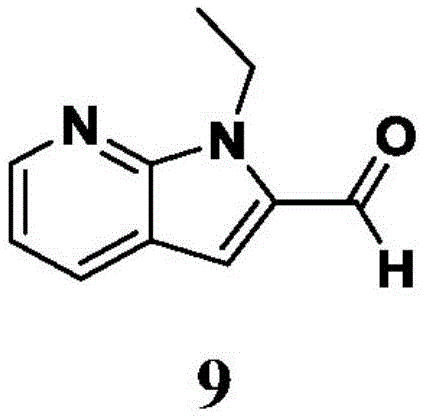
1H-pyrrolo [2,3-b ] with downward stirring]Solution of pyridine-2-carbaldehyde (8,0.3g, 2.19mmol) in DMF (10 mL) was added K 2 CO 3 (0.91g, 6.57mmol), followed by addition of iodoethane (0.5g, 3.28mmol) and stirring of the reaction mixture at the same temperature for 16 h. Water (15 mL) was added to the reaction mixture and extracted with EtOAc (50 mL). Subjecting the organic layer to anhydrous Na 2 SO 4 And (5) drying. The crude product was purified by flash column chromatography using 15% to 20% EtOAc in hexanes to give the compound as a colorless oil. (yield: 95%,0.34 g).

MS(ESI):C 10 H 10 N 2 Calculated mass of O, 174.08; found M/z of 175.2 (M + H) + 。
Synthesis of 1- (cyclopropylmethyl) -6-methoxy-1H-indole-2-carbaldehyde (intermediate of example-74):
the scheme is as follows:

step-1: preparation of N, 6-dimethoxy-N-methyl-1H-indole-2-carboxamide (3)

To a stirred solution of 6-methoxy-1H-indole-2-carboxylic acid (1,3g, 15.69mmol) in DCM (20 mL) was added N, O-dimethylhydroxylamine hydrochloride (2,3g, 31.38mmol), followed by hydroxybenzotriazole (3.6 g, 23.5mmol), N- (3-dimethylaminopropyl) -N' -ethylcarbodiimide hydrochloride (4.5g, 23.5mmol), and TEA (11.3mL, 120.7 mmol), and the reaction mixture was stirred at the same temperature for 5 hours. The reaction mixture was quenched with water and extracted with ethyl acetate (50 mL. Times.2). The combined organic extracts were washed with brine, dried over sodium sulfate, filtered and evaporated to give the crude product. The crude residue was purified by gradient column chromatography using 25% to 30% ethyl acetate in hexane to give the product as a beige solid. (yield: 75%,0.86 g). MS (ESI): c 12 H 14 N 2 O 3 A calculated mass of 234.10; found value of M/z, 235 (M + H) + 。
Step-2: preparation of 6-methoxy-1H-indole-2-carbaldehyde (4)
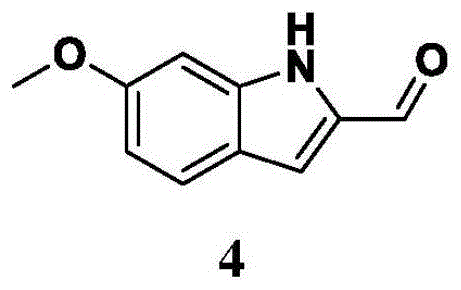
To a stirred solution of N, 6-dimethoxy-N-methyl-1H-indole-2-carboxamide (3,2g, 8.54mmol) in THF (20 mL) was slowly added a solution of LAH 1M in THF (12.8ml, 12.75mmol) with cooling and the reaction mixture was then allowed to stir at room temperature for 1 hour. The reaction mixture was quenched with ammonium chloride and extracted with ethyl acetate (50 mL × 2). The combined organic extracts were washed with brine, dried over sodium sulfate, filtered and evaporated to give the crude product. The crude residue was purified by gradient column chromatography using 5% to 10% ethyl acetate in hexane to give the product as a white solid. (yield: 60%,0.9 g). MS (ESI): c 10 H 9 NO 2 A mass calculated value of 175.06; found M/z of 176.1 (M + H) + 。
Step-3: preparation of 1- (cyclopropylmethyl) -6-methoxy-1H-indole-2-carbaldehyde (6)

To a stirred solution of 6-methoxy-1H-indole-2-carbaldehyde (4,0.28g, 1.6 mmol) in DMF (5 mL) was added potassium carbonate (1.1g, 8mmol), followed by (bromomethyl) cyclopropane (5,0.23mL, 1.72mmol), and the reaction mixture was stirred at the same temperature for 4 hours. The reaction mixture was quenched with water and extracted with ethyl acetate (20 mL. Times.2). The combined organic extracts were washed with brine, dried over sodium sulfate, filtered and evaporated to give the crude product. The crude residue was purified by gradient column chromatography using 5% to 10% ethyl acetate in hexane to give the product as a brown liquid. (yield: 63%,0.23 g).

MS(ESI):C 14 H 15 NO 2 A calculated mass value of 229.1; found M/z of 230.2 (M + H) + 。
Synthesis of 1- (4-chlorobenzyl) -1H-indole-2-carbaldehyde (intermediate of example-13)

To a stirred solution of 1H-indole-2-carbaldehyde (1,0.5g, 3.44mmol) in DMF (10 mL) was added potassium carbonate (1.42g, 10.3mmol), followed by 1- (bromomethyl) -4-chlorobenzene (0.84g, 4.13mmol), and the reaction mixture was stirred at the same temperature for 4 hours. The reaction mixture was quenched with water and extracted with ethyl acetate (30 mL. Times.2). The combined organic extracts were washed with brine, dried over sodium sulfate, filtered and evaporated to give the crude product. The crude residue was purified by gradient column chromatography using 10% to 15% ethyl acetate in hexane to give the product as a semi-white solid. (yield: 93.4%,0.86 g).

MS(ESI):C 16 H 12 Mass calculation of ClNO, 269.73; found value of M/z of 270.1 (M + H) + 。
Synthesis of 1- (cyclopropylmethyl) -1H-indole-2-carbaldehyde (an intermediate of examples-1, 2, 4, 6, 7, 38, 62, 72, 76, 78, 79, 85, and 86)
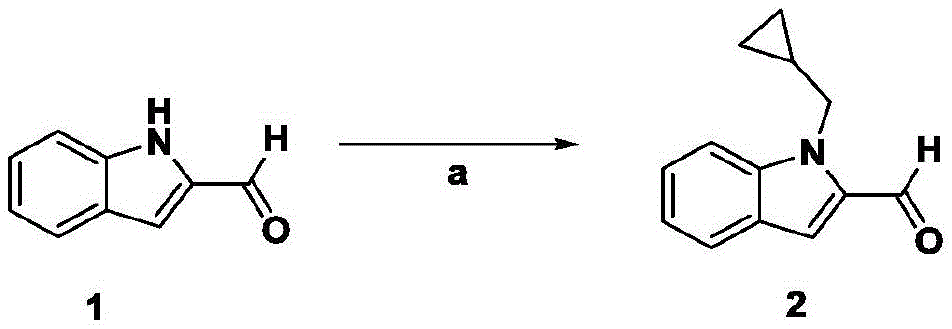
To a stirred solution of 1H-indole-2-carbaldehyde (1,1g, 6.89mmol) in DMF (20 mL) at room temperature were added potassium carbonate (2.8g, 20.67mmol) and (bromomethyl) cyclopropane (0.68mL, 7.58mmol). The reaction mixture was stirred at room temperature for 12 hours. The reaction mixture was diluted with water and extracted with ethyl acetate (50 mL. Times.2). The combined organic extracts were washed with brine, dried over sodium sulfate and evaporated to give the crude product. The crude residue was purified by gradient column chromatography using 3% to 7% ethyl acetate in hexane to give 1- (cyclopropylmethyl) -1H-indole-2-carbaldehyde as a yellow solid (1g, 76% yield).

MS(ESI):C 13 H 13 Mass calculated value of NO, 199.1; found value of M/z, 200.1 (M + H) + 。
Synthesis of 1- (cyclopropylmethyl) -6-fluoro-1H-indole-2-carbaldehyde (intermediate of example-65)

Step 1: preparation of 6-fluoro-1- (phenylsulfonyl) -1H-indole (2)

To a solution of sodium hydride (0.88g, 22.2 mmol) in DMF (50 mL) at 0 deg.C over 15 minutes was added dropwise a solution of 6-fluoro-1H-indole (1, 3.0g,22.2 mmol) in DMF. Benzenesulfonyl chloride in DMF (2.86mL, 22.2mmol) was added at 0 deg.C and at room temperature under N 2 Stirred under atmosphere for 2 hours. Ice-cold water (50 mL) was added to the reaction mixture, and then the precipitate was filtered off and washed with ice-cold water to obtain a white solid. (6.0 g, 98.19% yield).
Step 2: preparation of 6-fluoro-1- (phenylsulfonyl) -1H-indole-2-carbaldehyde (3)

To a solution of 6-fluoro-1- (phenylsulfonyl) -1H-indole (2, 6.0g, 22.0mmol) in anhydrous THF (60 mL) at-78 deg.C was added lithium diisopropylamide 2M in THF (10.9mL g, 22.0mmol), and stirred for 5 to 8 minutes, followed by addition of anhydrous DMF (2.5mL, 33.0mmol) at-78 deg.C, and N at-78 deg.C 2 Stirred under atmosphere for 10 minutes. Aqueous ammonium chloride (20 mL) was added to the reaction mixture, which was then extracted into EtOAc. The organic layer was treated with saturated NH 4 The Cl solution and brine were washed, dried over sodium sulfate, filtered and concentrated under reduced pressure to obtain a yellow solid (6.0 g, yield 90.90%). MS (ESI): m/z 304.2 (M + H) + 。
And step 3: preparation of 6-fluoro-1- (phenylsulfonyl) -1H-indole-2-carbaldehyde (4)

Stirred downward at room temperature 6-difluoro-1- (phenylsulfonyl) -1H-indole-2-carbaldehyde (3.1g, 3.3mmol) in THF (50 mL) was added TBAF (1M in THF) (9.15mL, 16.5mmol). The reaction mixture was stirred at room temperature for 12 hours. The reaction mixture was diluted with water and extracted with ethyl acetate (50 mL. Times.2). The combined organic extracts were washed with brine, dried over sodium sulfate and evaporated to give the crude product. The crude residue was purified by gradient column chromatography using 15% to 25% ethyl acetate in hexane to give 6-fluoro-1- (phenylsulfonyl) -1H-indole-2-carbaldehyde as a viscous solid, (0.45g, 90% yield). MS (ESI): c 9 H 6 Mass calculated for FNO of 163; m/z found 164 (M + H) + 。
And 4, step 4: preparation of 1- (cyclopropylmethyl) -6-fluoro-1H-indole-2-carbaldehyde (5)

To a stirred solution of 6-fluoro-1H-indole-2-carbaldehyde (4,0.5g, 3.44mmol) in DMF (10 mL) was added potassium carbonate (1.42g, 10.3mmol), followed by (bromomethyl) cyclopropane (0.84g, 4.13mmol), and the reaction mixture was stirred at the same temperature for 4 hours. The reaction mixture was quenched with water and extracted with ethyl acetate (30 mL × 2). The combined organic extracts were washed with brine, dried over sodium sulfate, filtered and evaporated to give the crude product. The crude residue was purified by gradient column chromatography using 10% to 15% ethyl acetate in hexane to give the product as a semi-white solid. (yield: 93.4%,0.86 g).

MS(ESI):C 13 H 12 The mass calculated value of FNO was 217.09; found M/z of 218.0 (M + H) + 。
Synthesis of 1- (pyridin-4-ylmethyl) -1H-indole-2-carbaldehyde (intermediate of example-10)

To a stirred solution of 1H-indole-2-carbaldehyde (1,1g, 6.89mmol) in DMF (20 mL) at room temperature was added cesium carbonate (6.7 g, 20.68mmol) and (4- (bromomethyl) pyridine (1.1g, 6.89mmol.) the reaction mixture was refluxed at 80 ℃ for 12 hours, the reaction mixture was diluted with water and extracted with ethyl acetate (50 mL × 2), the combined organic extracts were washed with brine, dried over sodium sulfate and evaporated to give the crude product, the crude residue was purified by gradient column chromatography using 3% to 7% ethyl acetate in hexane to give 1- (pyridin-4-ylmethyl) -1H-indole-2-carbaldehyde as a yellow solid (0.5g, 31% yield).

MS(ESI):C 15 H 12 N 2 Calculated mass O of 236.09; found M/z of 237.0 (M + H) + 。
Synthesis of 1- (pyridin-3-ylmethyl) -1H-indole-2-carbaldehyde (intermediate of examples-16 and 66)
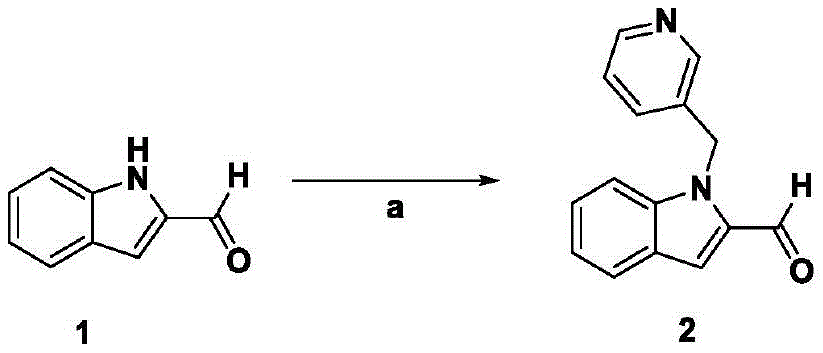
To a stirred solution of 1H-indole-2-carbaldehyde (1,1g, 6.89mmol) in DMF (20 mL) was added cesium carbonate (6.7g, 20.68mmol) and 3- (chloromethyl) pyridine hydrochloride (1.1g, 6.89mmol) at room temperature. The reaction mixture was refluxed at 80 ℃ for 12 hours. The reaction mixture was diluted with water and extracted with ethyl acetate (50 mL. Times.2). The combined organic extracts were washed with brine, dried over sodium sulfate and evaporated to give the crude product. The crude residue was purified by gradient column chromatography using 3% to 7% ethyl acetate in hexane to give 1- (pyridin-3-ylmethyl) -1H-indole-2-carbaldehyde as a yellow solid (0.4 g,25% yield).

MS(ESI):C 15 H 12 N 2 Calculated mass of O, 236.27; found value of M/z of 237.1 (M + H) + 。
Synthesis of 1- (pyridin-2-ylmethyl) -1H-indole-2-carbaldehyde (intermediate of example-11 &69)

To a stirred solution of 1H-indole-2-carbaldehyde (1,1g, 6.89mmol) in DMF (20 mL) at room temperature were added cesium carbonate (6.7g, 20.68mmol) and 2- (bromomethyl) pyridine (1.1g, 6.89mmol). The reaction mixture was refluxed at 80 ℃ for 12 hours. The reaction mixture was diluted with water and extracted with ethyl acetate (50 mL. Times.2). The combined organic extracts were washed with brine, dried over sodium sulfate and evaporated to give the crude product. The crude residue was purified by gradient column chromatography using 3% to 7% ethyl acetate in hexane to give 1- (pyridin-2-ylmethyl) -1H-indole-2-carbaldehyde as a yellow solid (0.8g, 50% yield).

MS(ESI):C 16 H 12 Mass calculation of ClNO, 269.73; found value of M/z of 270.1 (M + H) + 。
Synthesis of 1-ethyl-1H-indole-2-carbaldehyde (intermediate of example-3)

To a stirred solution of 1H-indole-2-carbaldehyde (1,1g, 6.89mmol) in DMF (15 mL) was added potassium carbonate (2.85g, 20.6 mmol), followed by iodoethane (0.6 mL, 7.58mmol), and the reaction mixture was stirred at the same temperature for 4 hours. The reaction mixture was poured into crushed ice, diluted with water and extracted with ethyl acetate. The organic layer was dried over anhydrous sodium sulfate and evaporated under vacuum to give the crude product. The crude product was purified by flash column chromatography using ethyl acetate and hexane to obtain 1-ethyl-1H-indole-2-carbaldehyde as a viscous liquid. (yield: 1g, 90%).

MS(ESI):C 11 H 11 Calculated mass NO value of 173.08; found M/z of 174.0 (M + H) + 。
Synthesis of 1-benzyl-1H-indole-2-carbaldehyde (intermediate of example-18)

To a stirred solution of 1H-indole-2-carbaldehyde (1,1g, 6.89mmol) in DMF (20 mL) at room temperature were added potassium carbonate (2.8g, 20.68mmol) and (bromomethyl) benzene (1.2g, 7.58mmol). The reaction mixture was stirred at room temperature for 12 hours. The reaction mixture was diluted with water and extracted with ethyl acetate (50 mL. Times.2). The combined organic extracts were washed with brine, dried over sodium sulfate and evaporated to give the crude product. The crude residue was purified by gradient column chromatography using 3% to 7% ethyl acetate in hexane to give 1-benzyl-1H-indole-2-carbaldehyde as a viscous liquid (0.5g, 33% yield).

MS(ESI):C 16 H 13 Mass calculated value of NO, 235.10; found M/z of 236.1 (M + H) + 。
Synthesis of 1- (2-fluorobenzyl) -1H-indole-2-carbaldehyde (intermediate of example-14)

To a stirred solution of 1H-indole-2-carbaldehyde (1,1g, 6.89mmol) in DMF (15 mL) was added potassium carbonate (2.85g, 20.6 mmol), followed by 1- (chloromethyl) -2-fluorobenzene (1.19g, 8.26mmol), and the reaction mixture was stirred at the same temperature for 4 hours. The reaction mixture was poured into crushed ice, diluted with water and extracted with ethyl acetate. The organic layer was dried over anhydrous sodium sulfate and evaporated under vacuum to give the crude product. The crude product was purified by flash column chromatography using ethyl acetate and hexane to give 1- (2-fluorobenzyl) -1H-indole-2-carbaldehyde as a gray solid (yield: 1.8g, 96.5%).

MS(ESI):C 16 H 12 The calculated mass value of FNO was 253.09; found M/z 254.0 (M + H) + 。
Synthesis of 1- (cyclopropylmethyl) -5-fluoro-1H-indole-2-carbaldehyde (intermediate of example-9, 64 &75)

Step 1: preparation of 5-fluoro-1- (phenylsulfonyl) -1H-indole (3)

To a solution of sodium hydride (0.06g, 15mmol) in DMF (10 mL) at 0 ℃ over 15 minutes was added dropwise a solution of 5-fluoro-1H-indole (1, 0.2g, 15mmol) in DMF. Subsequently a solution of benzenesulfonyl chloride (2,0.26g, 15mmol) in DMF was added at 0 ℃ and the reaction mixture was cooled at room temperatureUnder N 2 Stirred under atmosphere for 2 hours. Ice-cold water (50 mL) was added to the reaction mixture, and then the precipitate was filtered off and washed with ice-cold water to obtain a brown solid. (0.25g, 62.50% yield). MS (ESI): m/z 275.0 (M + H) + 。
Step 2: preparation of 5-fluoro-1- (phenylsulfonyl) -1H-indole-2-carbaldehyde (4)

To a solution of 5-fluoro-1- (phenylsulfonyl) -1H-indole (3, 0.250g, 1.0mmol) in anhydrous THF (50 mL) at-78 deg.C was added lithium diisopropylamide 1M in THF (0.5mL g, 1.0mmol), followed by anhydrous DMF (0.11mL, 1.5mmol) at-78 deg.C, and N at-78 deg.C 2 Stirred under atmosphere for 10 minutes. Aqueous ammonium chloride (20 mL) was added to the reaction mixture and extracted with EtOAc. The organic layer was treated with saturated NH 4 The Cl solution and brine were washed, dried over sodium sulfate, filtered and concentrated under reduced pressure to obtain a brown solid. (0.150g, 54.54% yield). MS (ESI): m/z 304.1 (M + H) + 。
And 3, step 3: preparation of 5-fluoro-1H-indole-2-carbaldehyde (5)

To a stirred solution of 5-fluoro-1- (phenylsulfonyl) -1H-indole-2-carbaldehyde (4,1.85g, 6.105mmol) in THF (50 mL) was added TBAF (1M in THF) (9.15mL, 9.158mmol) at room temperature. The reaction mixture was stirred at room temperature for 12 hours. The reaction mixture was diluted with water and extracted with ethyl acetate (50 mL. Times.2). The combined organic extracts were washed with brine, dried over sodium sulfate and evaporated to give the crude product. The crude residue was purified by gradient column chromatography using 15% to 25% ethyl acetate in hexane to give 5-fluoro-1H-indole-2-carbaldehyde as a viscous solid (0.65g, 65% yield), MS (ESI): c 9 H 6 The calculated mass value of FNO was 163.15; the value of m/z is 162.0[ M-H ]] - 。
And 4, step 4: preparation of 1- (cyclopropylmethyl) -5-fluoro-1H-indole-2-carbaldehyde (7)
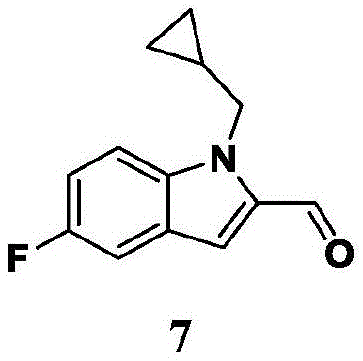
To a stirred solution of 5-fluoro-1H-indole-2-carbaldehyde (5,0.65g, 3.98mmol) in DMF (50 mL) at room temperature was added potassium carbonate (1.64g, 11.94mmol) and (bromomethyl) cyclopropane (6,0.58mL, 5.98mmol). The reaction mixture was stirred at room temperature for 12 hours. The reaction mixture was diluted with water and extracted with ethyl acetate (50 mL. Times.2). The combined organic extracts were washed with brine, dried over sodium sulfate and evaporated to give the crude product. The crude residue was purified by gradient column chromatography using 3% to 7% ethyl acetate in hexane to give 1- (cyclopropylmethyl) -5-fluoro-1H-indole-2-carbaldehyde as a viscous solid (0.76g, 88% yield).

MS(ESI):C 13 H 12 The calculated mass value of FNO is 217.24; measured value of m/z, is 218.1[ m ] +H] + 。
Synthesis of 1- (cyclopropylmethyl) -7-methyl-1H-indole-2-carbaldehyde (intermediate of example-8 &84)

Step 1: preparation of 7-methyl-1- (phenylsulfonyl) -1H-indole (2)

To a solution of sodium hydride (0.92g, 23mmol) in DMF (10 mL) was added dropwise a solution of 7-methyl-1H-indole (1, 3.0g, 23mmol) in DMF over 15 minutes at 0 ℃. Benzenesulfonyl chloride in DMF (2.96mL, 23mmol) was added at 0 deg.C and at room temperature under N 2 Stirred under atmosphere for 2 hours. Ice-cold water (50 mL) was added to the reaction mixture, and then the precipitate was filtered off and washed with ice-cold water to obtain a brown solid (5.30g, 85.50%). MS (ESI): m/z 272.1 (M + H) + 。
And 2, step: preparation of 7-methyl-1- (phenylsulfonyl) -1H-indole-2-carbaldehyde (3)

To a solution of 7-methyl-1- (phenylsulfonyl) -1H-indole (2, 5.3g, 20.0mmol) in anhydrous THF (50 mL) at-78 deg.C was added 1.5M lithium diisopropylamide in THF (13.0mL, 20.0mmol) and stirred for 5 to 8 minutes, followed by addition of anhydrous DMF (2.33mL, 30.0mmol) at-78 deg.C and N at-78 deg.C 2 Stirred under atmosphere for 10 minutes. Aqueous ammonium chloride (20 mL) was added to the reaction mixture, which was then extracted into EtOAc. The organic layer was treated with saturated NH 4 The Cl solution and brine were washed, dried over sodium sulfate, filtered and concentrated under reduced pressure to obtain a red viscous liquid (5.0 g, 85.47%). MS (ESI): m/z 300.2 (M + H) + 。
And step 3: preparation of 7-methyl-1H-indole-2-carbaldehyde (4)

To a stirred solution of 7-methyl-1- (phenylsulfonyl) -1H-indole-2-carbaldehyde (3,2g, 6.68mmol) in THF (20 mL) was added a 1M solution of tetrabutylammonium fluoride in THF (10 mL,10.2 mmol), and the mixture was stirred at 80 ℃ for 1 hour. The reaction mixture was cooled to room temperature, water (20 mL) was added, and extracted with EtOAc (100 mL). Subjecting the organic layer to anhydrous Na 2 SO 4 Dried and evaporated under vacuum. The crude product was purified by column chromatography using 15% to 20% etoac in hexanes to give the product as a brown solid. (0.8 g,58% yield). MS (ESI): c 10 H 9 Calculated mass NO of 159.07; found M/z of 160.1 (M + H) + 。
And 4, step 4:1- (cyclopropylmethyl) -7-methyl-1H-indole-2-carbaldehyde (5)
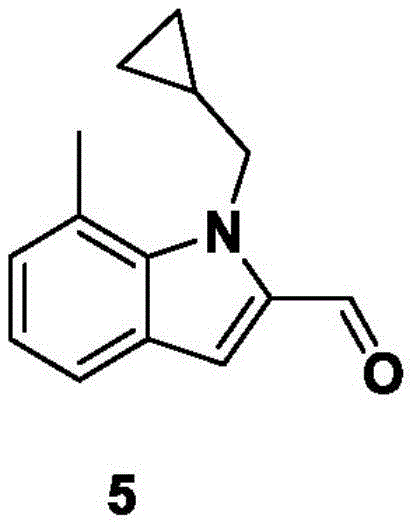
To a stirred solution of 7-methyl-1H-indole-2-carbaldehyde (4,0.85g, 5.345mmol) in DMF (20 mL) at room temperature were added potassium carbonate (2.21g, 16.035 mmol) and (bromomethyl) cyclopropane (4 a,0.78mL, 8.018mmol). The reaction mixture was stirred at room temperature for 12 hours. The reaction mixture was diluted with water and extracted with ethyl acetate (50 mL. Times.2). The combined organic extracts were washed with brine, dried over sodium sulfate and evaporated to give the crude product. The crude residue was purified by gradient column chromatography using 3% to 7% ethyl acetate in hexane to give 1- (cyclopropylmethyl) -7-methyl-1H-indole-2-carbaldehyde as a viscous solid (0.52g, 45% yield).

MS(ESI):C 14 H 15 Mass calculated value of NO, 213.28; the measured value of m/z is 214.1[ m ] +H] + 。
Synthesis of 1- (cyclopropylmethyl) -5, 6-dimethoxy-1H-indole-2-carbaldehyde (intermediate from example-17)

Step 1: preparation of 5, 6-dimethoxy-1- (phenylsulfonyl) -1H-indole (2)

To a solution of sodium hydride (0.56g, 14mmol) in DMF (50 mL) at 0 ℃ over 15 minutes was added dropwise a solution of 5, 6-dimethoxy-1H-indole (1, 2.5g, 14mmol) in DMF. Benzenesulfonyl chloride (1.8mL, 14mmol) in DMF was added at 0 ℃ and the mixture was cooled at room temperature under N 2 Stirred under atmosphere for 2 hours. Ice-cold water (50 mL) was added to the reaction mixture, and then the precipitate was filtered off and washed with ice-cold water to obtain a white solid. (4.20g, 93.95% yield). MS (ESI): c 16 H 15 NO 4 The calculated mass value of S was 317.07; measured value of m/z is 318.1[ 2 ], [ M + H ]] + 。
And 2, step: preparation of 5, 6-dimethoxy-1- (phenylsulfonyl) -1H-indole-2-carbaldehyde (3)
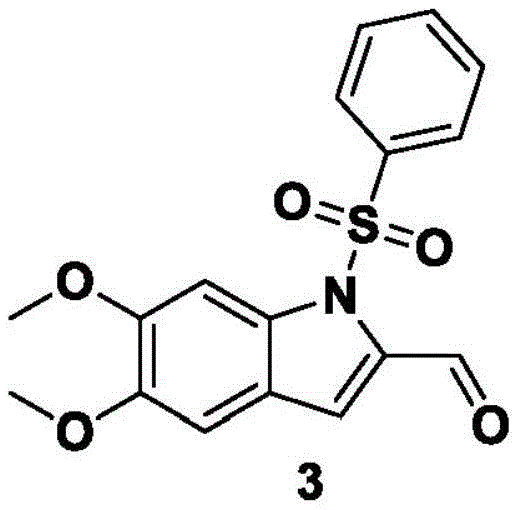
To a solution of 5, 6-dimethoxy-1- (phenylsulfonyl) -1H-indole (2, 4.2g,13.2 mmol) in anhydrous THF (60 mL) at-78 deg.C was added lithium diisopropylamide 2M in THF (8.8mL g,13.2 mmol) and stirred for 5 to 8 minutes, followed by addition of anhydrous DMF (1.54mL, 20.0 mmol) at-78 deg.C and N at-78 deg.C 2 Stirred under atmosphere for 10 minutes. Aqueous ammonium chloride (20 mL) was added to the reaction mixture, which was then extracted into EtOAc. The organic layer was saturated with NH 4 The Cl solution and brine were washed, dried over sodium sulfate, filtered and concentrated under reduced pressure to obtain a yellow solid (3.5g, 78.26% yield). MS (ESI): c 17 H 15 NO 5 The calculated mass value of S is 345.07; measured value of m/z is 346.1[ m + H ]] + 。
And step 3: preparation of 5, 6-dimethoxy-1H-indole-2-carbaldehyde (4)

To a stirred solution of 5,6-dimethoxy-1- (phenylsulfonyl) -1H-indole-2-carbaldehyde (3,2g, 5.5 mmol) in THF (50 mL) at room temperature was added TBAF (1M in THF) (8.8mL, 8.2mmol). The reaction mixture was stirred at room temperature for 12 hours. The reaction mixture was diluted with water and extracted with ethyl acetate (50 mL. Times.2). The combined organic extracts were washed with brine, dried over sodium sulfate and evaporated to give the crude product. The crude residue was purified by gradient column chromatography using 5% to 10% ethyl acetate in hexanes to give the desired compound as a gummy solid (1g, 88.6% yield). MS (ESI): c 11 H 11 Mass calculated value of NO3, 205.07; the measured value of m/z is 206.1[ m ] +H] + 。
And 4, step 4: preparation of 1- (cyclopropylmethyl) -5, 6-dimethoxy-1H-indole-2-carbaldehyde (5)

To a stirred solution of 5,6-dimethoxy-1H-indole-2-carbaldehyde (4,1g, 4.8mmol) in DMF (20 mL) at room temperature was added potassium carbonate (1.9g, 14mmol) and (bromomethyl) cyclopropane (0.7g, 5.7mmol). The reaction mixture was stirred at room temperature for 12 hours. The reaction mixture was diluted with water and extracted with ethyl acetate (50 mL. Times.2). The combined organic extracts were washed with brine, dried over sodium sulfate and evaporated to give the crude product. The crude residue was purified by gradient column chromatography using 10% ethyl acetate in hexane to give the title compound as a yellow solid (0.7 g,56.3% yield).

MS(ESI):C 15 H 17 NO 3 A mass calculated value of 259.31; m/z found value of 260.2[ m ] +H] + 。
Synthesis of ethylbenzo [ b ] thiophene-2-carbaldehyde (intermediate of example-12)

Step 1: 3-ethylbenzo [ b ]]Thiophene-2-carboxylic acid methyl ester (3)
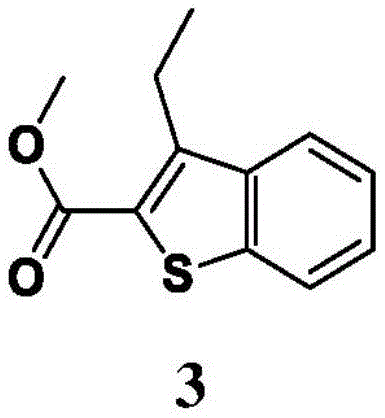
To a suspension of NaH (60% in oil, 0.17g, 4.27mmol) in THF (10 mL) was added methyl 2-mercaptoacetate (2, 0.41g, 3.94mmol) at room temperature and stirred at the same temperature for 30 min. A solution of 1- (2-fluorophenyl) propan-1-one (1,0.5g, 3.28mmol) in THF was added to the reaction and allowed to reflux for 16 hours (reaction condition a). Completion of the reaction was monitored by LCMS. The reaction mixture was cooled to room temperature, diluted with EtOAc, and washed with 1N NaOH and water. The organic layer was washed, dried over sodium sulfate, filtered and concentrated under reduced pressure. The crude mixture was purified by column chromatography to obtain the product as a brown oil (yield: 0.4g, 57.14%). MS (ESI): c 12 H 12 O 2 The calculated mass value of S is 220.06; found M/z, 221.1 (M + H) + 。
And 2, step: (3-ethylbenzo [ b ]]Thiophen-2-yl) methanol (4)

At 0 ℃ to 3-ethylbenzo [ b ]]A solution of thiophene-2-carboxylic acid methyl ester (3,0.5g, 1.81mmol) in THF (10 mL) was added dropwise to a 1M solution of LAH in THF (2.7mL, 2.72mmol). The reaction mixture was stirred at 25 ℃ for 2 hours (reaction condition b). The reaction was monitored by TLC (1, etoac: hexane). The reaction mixture was washed with saturated NH 4 Quenched with Cl (10 mL), filtered through celite, and extracted with EtOAc. Will be provided withThe organic layer was washed with brine, dried over sodium sulfate, filtered and concentrated under reduced pressure. The crude mixture was purified by column chromatography to obtain the product as a yellow oil (yield: 0.24g, 70.58%). MS (ESI): c 11 H 12 A mass calculated value of OS of 192.06; found M/z of 192.9 (M + H) + 。
And step 3: ethylbenzo [ b ]]Thiophene-2-carbaldehyde (5)

At 0 deg.C, to (3-ethylbenzo [ b ]]Thien-2-yl) methanol (4,0.24g, 1.25mmol) in DCM (10 mL) was added with Dess martin periodinane (0.79g, 1.87mmol) (reaction condition c). The reaction mixture was stirred at 25 ℃ for 2 hours. The reaction was monitored by TLC (1, etoac: hexane). The reaction mixture was washed with saturated NaHCO 3 Quench (10 mL), filter through celite, and extract with DCM. The organic layer was washed with brine, dried over sodium sulfate, filtered and concentrated under reduced pressure. The crude mixture was purified by column chromatography to obtain the product as a yellow solid. (yield: 0.18g, 81.8%).

MS(ESI):C 11 H 10 Mass calculated value of OS, 190.05; found M/z of 191.0 (M + H) + 。
Synthesis of 1- (4-fluorobenzyl) -1H-indole-2-carbaldehyde (intermediate of example-15)

To a stirred solution of 1H-indole-2-carbaldehyde (1,0.5g, 3.44mmol) in DMF (20 mL) at room temperature were added potassium carbonate (1.42g, 10.34mmol) and 1- (bromomethyl) -4-fluorobenzene (0.716g, 3.79mmol). The reaction mixture was stirred at room temperature for 12 hours. The reaction mixture was diluted with water and extracted with ethyl acetate (50 mL. Times.2). The combined organic extracts were washed with brine, dried over sodium sulfate and evaporated to give the crude product. The crude residue was purified by gradient column chromatography using 3% to 7% ethyl acetate in hexane to give 1- (4-fluorobenzyl) -1H-indole-2-carbaldehyde (0.8g, 97% yield) as a solid.

MS(ESI):C 16 H 12 Calculated mass for FNO, 253.28; measured value of m/z is 254.0[ m ] +H] + 。
Synthesis of 1- (4-methoxybenzyl) -1H-indole-2-carbaldehyde (intermediate of example-19)

To a stirred solution of 1H-indole-2-carbaldehyde (1,0.5g, 3.44mmol) in DMF (20 mL) at room temperature were added potassium carbonate (1.42g, 10.34mmol) and 1- (bromomethyl) -4-methoxybenzene (0.76g, 3.79mmol). The reaction mixture was stirred at room temperature for 12 hours. The reaction mixture was diluted with water and extracted with ethyl acetate (50 mL. Times.2). The combined organic extracts were washed with brine, dried over sodium sulfate and evaporated to give the crude product. The crude residue was purified by gradient column chromatography using 3% to 7% ethyl acetate in hexane to give 1- (4-methoxybenzyl) -1H-indole-2-carbaldehyde as a solid (0.4 g,43% yield).

MS (ESI): the calculated mass value of C17H15NO2 is 265.31; m/z found at 266.1, M + H] + 。
Synthesis of 1- (2-methoxyethyl) -1H-indole-2-carbaldehyde (intermediate of example-20)

To a stirred solution of 1H-indole-2-carbaldehyde (1,0.80g, 5.5 mmol) in N, N-dimethylformamide (20 mL) was added cesium carbonate (5.36g, 90.5 mmol) and 1-bromo-2-methoxyethane (0.62ml, 6.7 mmol) at room temperature. The reaction mixture was stirred at 60 ℃ for 1 hour. After completion of the reaction, the reaction mixture was diluted with water and extracted with ethyl acetate (20 mL × 2). The combined organic extracts were washed with brine, dried over anhydrous sodium sulfate, filtered and concentrated under reduced pressure. The crude product was purified by CombiFlash using 12g of RediSep and 20% ethyl acetate in hexane as eluent to give 1- (2-methoxyethyl) -1H-indole-2-carbaldehyde as a light yellow oil. Yield: 3.0g (42%).

Synthesis of 1- (cyclopropylmethyl) -6-methoxy-1H-indole-2-carbaldehyde (intermediate of example-23)

To a stirred solution of 6-methoxy-1H-indole-2-carbaldehyde (1,2.0g, 11.4mmol) in N, N-dimethylformamide (20 mL) were added cesium carbonate (11.14g, 34.3mmol) and (bromomethyl) cyclopropane (1.41mL, 13.7mmol) at room temperature. The reaction mixture was stirred at room temperature for 2 hours. After completion of the reaction, the reaction mixture was diluted with water and extracted with ethyl acetate (20 mL × 2). The combined organic extracts were washed with brine, dried over anhydrous sodium sulfate, filtered and concentrated under reduced pressure. The crude product was purified by Combiflash using 12g of RediSep and 20% ethyl acetate in hexane as eluent to give 1- (cyclopropylmethyl) -6-one as a light yellow oilmethoxy-1H-indole-2-carbaldehyde. Yield: 0.80g (31%), MS (ESI): 229.13 of a basic material; measured value of m/z is 230.1[ m ] +H] +1 。
Synthesis of 1- (cyclopropylmethyl) -5-methoxy-1H-indole-2-carbaldehyde (intermediate of example-60)

To a stirred solution of 6-methoxy-1H-indole-2-carbaldehyde (1,2.0g, 11.4mmol) in N, N-dimethylformamide (20 mL) were added cesium carbonate (11.14g, 34.3mmol) and (bromomethyl) cyclopropane (1.41mL, 13.7mmol) at room temperature. The reaction mixture was stirred at room temperature for 2 hours. After completion of the reaction, the reaction mixture was diluted with water and extracted with ethyl acetate (20 mL × 2). The combined organic extracts were washed with brine, dried over anhydrous sodium sulfate, filtered and concentrated under reduced pressure. The crude product was purified by CombiFlash using 12g RediSep and 20% ethyl acetate in hexane as eluent to give 1- (cyclopropylmethyl) -5-methoxy-1H-indole-2-carbaldehyde as a pale yellow oil. Yield: 0.79g (30%), MS (ESI): 229.13; m/z found value of 230.1[ m ] +H ] +1 。
Synthesis of 6-methoxy-1- (2-methoxyethyl) -1H-indole-2-carbaldehyde (intermediate of example-21)

To a stirred solution of 6-methoxy-1H-indole-2-carbaldehyde (1,0.80g, 4.57mmol) in N, N-dimethylformamide (3 mL) was added cesium carbonate (4.4g, 13.7 mmol) and 1-bromo-2-methoxyethane (0.51mL, 5.48mmol) at room temperature. The reaction mixture was stirred at 60 ℃ for 16 hours. After completion of the reaction, the reaction mixture was diluted with water and extracted with ethyl acetate (20 mL × 2). The combined organic extracts were washed with brine, dried over anhydrous sodium sulfate, filtered and concentrated under reduced pressure. The crude product was passed through Combiflash using 12g of RediSep and 20% acetic acid in hexaneThe ethyl ester was purified as eluent to give 6-methoxy-1- (2-methoxyethyl) -1H-indole-2-carbaldehyde as an off-white semisolid. Yield: 0.60g,60%, MS (ESI): 235; the value of m/z is found to be 234.10[ M-1 ]] -1 。
Synthesis of 1- (2-fluorobenzyl) -1H-indole-2-carbaldehyde (intermediate of example-70)

To a solution of 1H-indole-2-carbaldehyde (1,2.0g, 13.7mmol) in N, N-dimethylformamide (15 mL) were added potassium carbonate (5.6 g, 41.1mmol) and 1- (bromomethyl) -2-fluorobenzene (3.1g, 16.5mmol) at room temperature. The reaction mixture was stirred at room temperature for 4 hours. After completion of the reaction, the reaction mixture was diluted with water and extracted with ethyl acetate (20 mL × 2). The combined organic extracts were washed with brine, dried over anhydrous sodium sulfate, filtered and concentrated under reduced pressure. The crude product was purified by CombiFlash using 12g of RediSep and 20% ethyl acetate in hexane as eluent to give 1- (2-fluorobenzyl) -1H-indole-2-carbaldehyde as a yellow solid.
Synthesis of 1- (pyridin-4-ylmethyl) -1H-indole-2-carbaldehyde (intermediate of examples-11 and 71)

To a solution of 1H-indole-2-carbaldehyde (1,1.50g, 10.3mmol) in N, N-dimethylformamide (40 mL) were added potassium carbonate (4.2g, 31.0 mmol) and 4- (bromomethyl) pyridine hydrobromide (3.1g, 12.4 mmol) at room temperature. The reaction mixture was stirred at 60 ℃ for 4 hours. After completion of the reaction, the reaction mixture was diluted with water and extracted with ethyl acetate (20 mL × 2). The combined organic extracts were washed with brine, dried over anhydrous sodium sulfate, filtered and concentrated under reduced pressure. The crude product was purified by CombiFlash using 12g of RediSep and 10% ethyl acetate in hexane as eluent to give 1- (pyridine-4) as a yellow oil-ylmethyl) -1H-indole-2-carbaldehyde. Yield: 1.0g (40%). MS (ESI): 236.01; m/z found to be 2.37.12.1[ m + H ]] +1 。
Synthesis of 1- (pyrazin-2-ylmethyl) -1H-indole-2-carbaldehyde (intermediate of example-25)
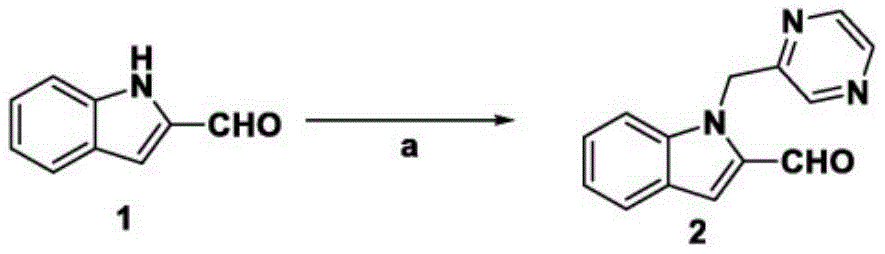
To a stirred solution of 1H-indole-2-carbaldehyde (1,1.0g, 6.81mmol) in N, N-dimethylformamide (20.0 mL) were added cesium carbonate (11.2g, 34.4mmol) and 2- (chloromethyl) pyrazine (1.0g, 8.27mmol) at room temperature. The reaction mixture was stirred at room temperature for 3 hours. After completion of the reaction, the reaction mixture was diluted with water and extracted with ethyl acetate (30 mL × 2). The combined organic extracts were washed with brine, dried over anhydrous sodium sulfate, filtered and concentrated under reduced pressure. The crude product was purified by CombiFlash using 12g RediSep and 10% ethyl acetate in hexane as eluent to give 1- (pyrazin-2-ylmethyl) -1H-indole-2-carbaldehyde (3 a) as a yellow solid. Yield: 0.80g (48%). MS (ESI): 237.26; m/z found value of 238.12[ m ] +H ] +1 。
Synthesis of 1- (cyclopropylmethyl) -6-fluoro-1H-indole-2-carbaldehyde (intermediate of example-28)

To a stirred solution of 6-fluoro-1H-indole-2-carbaldehyde (1,1.5g, 9.2mmol) in N, N-dimethylformamide (30.0 mL) were added cesium carbonate (8.9g, 27.6 mmol) and (bromomethyl) cyclopropane (1.47g, 11.2mmol) at room temperature. The reaction mixture was stirred at room temperature for 3 hours. After completion of the reaction, the reaction mixture was diluted with water and extracted with ethyl acetate (30 mL × 2). The combined organic extracts were washed with brine, dried over anhydrous sodium sulfate, filtered and concentrated under reduced pressure. The crude product was purified by CombiFlash using 12g of RediSep and 10% ethyl acetate in hexane as eluent to give1- (cyclopropylmethyl) -6-fluoro-1H-indole-2-carbaldehyde as a yellow solid. Yield: 1.5g (75%). MS (ESI): 217.24; measured value of m/z, is 218.34[ m ] +H] +1 。
Synthesis of 1- (pyrimidin-5-ylmethyl) -1H-indole-2-carbaldehyde (intermediate of example-29)

To a stirred solution of 1H-indole-2-carbaldehyde (1,1.20g, 8.27mmol) in N, N-dimethylformamide (20.0 mL) were added cesium carbonate (8.08g, 24.01mmol) and 5- (chloromethyl) pyrimidine (1.0g, 8.27mmol) at room temperature. The reaction mixture was stirred at room temperature for 3 hours. After completion of the reaction, the reaction mixture was diluted with water and extracted with ethyl acetate (30 mL × 2). The combined organic extracts were washed with brine, dried over anhydrous sodium sulfate, filtered and concentrated under reduced pressure. The crude product was purified by CombiFlash using 12g of RediSep and 10% ethyl acetate in hexane as eluent to give 1- (pyrimidin-5-ylmethyl) -1H-indole-2-carbaldehyde as a brown solid. Yield: 1.60g (81%). MS (ESI): 237.26; m/z found value of 238.32[ m ] +H ] +1 。
Synthesis of 1- (pyridazin-3-ylmethyl) -1H-indole-2-carbaldehyde (intermediate of example-30)

To a stirred solution of 1H-indole-2-carbaldehyde (1,1.0g, 6.81mmol) in N, N-dimethylformamide (10.0 mL) were added cesium carbonate (6.7g, 20.01mmol) and 3- (chloromethyl) pyridazine (1.0g, 7.10mmol) at room temperature. The reaction mixture was stirred at room temperature for 3 hours. After completion of the reaction, the reaction mixture was diluted with water and extracted with ethyl acetate (30 mL × 2). The combined organic extracts were washed with brine, dried over anhydrous sodium sulfate, filtered and concentrated under reduced pressure. The crude product was passed through Combiflash using 12g RediSep and 10% ethyl acetate in hexane as eluentPurification to give 1- (pyridazin-3-ylmethyl) -1H-indole-2-carbaldehyde (3 a) as a brown solid. Yield: 1.40g (crude). MS (ESI): 237.26; measured value of m/z is 238.42[ m + H ]] +1 。
Synthesis of 1- ((tetrahydro-2H-pyran-4-yl) methyl) -1H-indole-2-carbaldehyde (intermediate of example-40)

To a stirred solution of 1H-indole-2-carbaldehyde (1,1.0 g, 6.89mmol) in N, N-dimethylformamide (10 mL) were added cesium carbonate (6.70g, 20.68mmol) and 4- (bromomethyl) tetrahydro-2H-pyran (1.48g, 8.27mmol) at room temperature. The reaction mixture was stirred at room temperature for 1 hour. After completion of the reaction, the reaction mixture was diluted with water and extracted with ethyl acetate (200 mL × 2). The combined organic extracts were washed with brine, dried over anhydrous sodium sulfate, filtered and concentrated under reduced pressure. The crude product was purified by CombiFlash using 12g RediSep and 5% ethyl acetate in hexane as eluent to give 1- ((tetrahydro-2H-pyran-4-yl) methyl) -1H-indole-2-carbaldehyde as a white solid. Yield: 0.80g (48%). MS (ESI): 243.13; measured value of m/z is 244.17[ m ] +H ] +1 。
Synthesis of 1- (cyclobutylmethyl) -1H-indole-2-carbaldehyde (intermediate of example-41)

To a stirred solution of 1H-indole-2-carbaldehyde (1,0.50g, 3.44mmol) in N, N-dimethylformamide (10 mL) was added cesium carbonate (3.3g, 10.34mmol) and cyclobutyl methyl methanesulfonate (2b, 0.84g, 5.17mmol) at room temperature. The reaction mixture was stirred at 100 ℃ for 1 hour. After completion of the reaction, the reaction mixture was diluted with water and extracted with ethyl acetate (200 mL × 2). The combined organic extracts were washed with brine, dried over anhydrous sodium sulfate, filtered and concentrated under reduced pressure. The crude product was purified by CombiFlash using 12g RediSep and 5% ethyl acetate in hexane as eluent to give 1- (cyclobutylmethyl) -1H-indole-2-carbaldehyde (3 a) as an oily liquid. Yield: 0.650g (88%). MS (ESI): 213.12; m/z is found to be unionized.

Synthesis of methyl 2- (2-formyl-1H-indol-1-yl) acetate intermediate (example-42)

To a stirred solution of 1H-indole-2-carbaldehyde (1,1.5g, 10.3mmol) in N, N-dimethylformamide (40.0 mL) were added cesium carbonate (10.0 g, 30.9mmol) and methyl 2-chloroacetate (2a, 1.35g,12.4 mmol) at room temperature. The reaction mixture was stirred at room temperature for 1 hour. After completion of the reaction, the reaction mixture was diluted with water and extracted with ethyl acetate (100 mL × 2). The combined organic extracts were washed with brine, dried over anhydrous sodium sulfate, filtered and concentrated under reduced pressure. The crude product was purified by CombiFlash using 40g of RediSep and 5% ethyl acetate in hexane as eluent to give methyl 2- (2-formyl-1H-indol-1-yl) acetate (3 a) as a yellow oil. Yield: 1.2g (53%). MS (ESI): 217.04; m/z found value of 218.18[ m ] +H ] +1 。
Synthesis of tert-butyl 4- ((2-formyl-1H-indol-1-yl) methyl) piperidine-1-carboxylate (intermediate of example-43)

To a stirred solution of 1H-indole-2-carbaldehyde (1,1.0 g, 6.81mmol) in N, N-dimethylformamide (10 mL) were added cesium carbonate (6.72g, 20.0 mmol) and tert-butyl 4- (bromomethyl) piperidine-1-carboxylate (2.29g, 8.1mmol) at room temperature. The reaction mixture was stirred at room temperature for 3 hours. After completion of the reaction, the reaction mixture was diluted with water and extracted with ethyl acetate (50 mL × 2). The combined organic extracts were washed with brine, dried over anhydrous sodium sulfate, filtered and concentrated under reduced pressure. The crude product was purified by CombiFlash using 12g RediSep and 20% ethyl acetate in hexane as eluent to give tert-butyl 4- ((2-formyl-1H-indol-1-yl) methyl) piperidine-1-carboxylate as a yellow solid. Yield: 2.0g (86%). MS (ESI): found to be unionized.

Synthesis of 1- ((1-methylpiperidin-4-yl) methyl) -1H-indole-2-carbaldehyde (intermediate of example-45)

To a stirred solution of 1H-indole-2-carbaldehyde (1,1.0g, 6.81mmol) in N, N-dimethylformamide (10 mL) were added cesium carbonate (6.72g, 20.0mmol) and tert-butyl 4- (bromomethyl) -1-methylpiperidine (2.2g, 8mmol) at room temperature. The reaction mixture was stirred at room temperature for 3 hours. After completion of the reaction, the reaction mixture was diluted with water and extracted with ethyl acetate (50 mL × 2). The combined organic extracts were washed with brine, dried over anhydrous sodium sulfate, filtered and concentrated under reduced pressure. The crude product was purified by CombiFlash using 12g of RediSep and 20% ethyl acetate in hexane as eluent to give 1- ((1-methylpiperidin-4-yl) methyl) -1H-indole-2-carbaldehyde as a solid. Yield: 2.2g (85%).
Synthesis of 1- (oxetan-3-ylmethyl) -1H-indole-2-carbaldehyde (intermediate of example-44)

1H-indole-substituted benzene under stirring at room temperature2-Formaldehyde (1,0.700g, 4.82mmol) in N, N-dimethylformamide (10.0 mL) was added cesium carbonate (4.7 g, 14.48mmol) and (3- (chloromethyl) oxetane (0.562g, 5.31mmol). The reaction mixture was stirred at room temperature for 16 hours after the reaction was complete, the reaction mixture was diluted with water and extracted with ethyl acetate (10 mL. Times.2). The combined organic extracts were washed with brine, dried over anhydrous sodium sulfate, filtered and concentrated under reduced pressure.the crude product was purified by Combiflash using 12g RediseP and 30% ethyl acetate in hexane as eluent to give 1- (oxetan-3-ylmethyl) -1H-indole-2-carbaldehyde as a yellow solid yield: 0.380g (63%). MS (ESI): 215.09 m/z found, 216.18M H.,] +1 。
synthesis of 6-fluoro-1- (2-methoxyethyl) -1H-indole-2-carbaldehyde (intermediate of example-52)
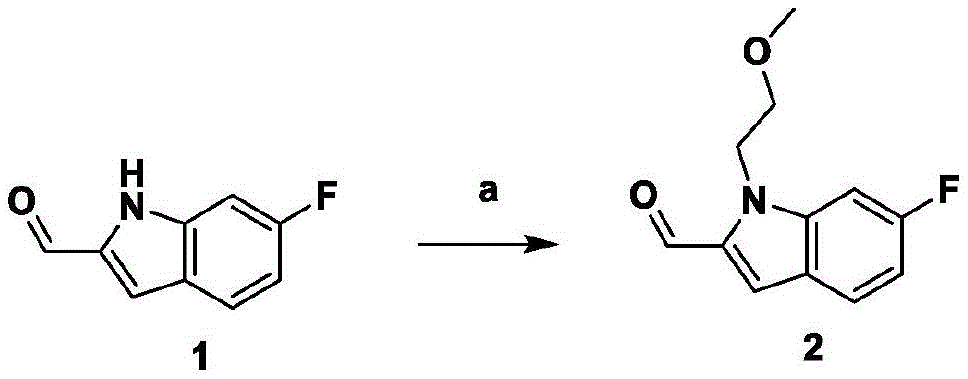
To a stirred solution of 6-fluoro-1H-indole-2-carbaldehyde (1,0.90g, 5.5 mmol) in N, N-dimethylformamide (20 mL) at room temperature were added potassium carbonate (5.38g, 16.5 mmol) and 1-bromo-2-methoxyethane (0.61mL, 6.62mmol). The reaction mixture was stirred at room temperature for 3 hours. After completion of the reaction, the reaction mixture was diluted with water and extracted with ethyl acetate (20 mL × 2). The combined organic extracts were washed with brine, dried over anhydrous sodium sulfate, filtered and concentrated under reduced pressure. The crude product was purified by CombiFlash using 12g RediSep and 20% ethyl acetate in hexane as eluent to give 6-fluoro-1- (2-methoxyethyl) -1H-indole-2-carbaldehyde as a viscous solid. Yield: 0.60g (60%); MS (ESI): 221.09; the measured value of m/z is 222.10[ m ] +H ] +1 。
Synthesis of 1- ((3-Fluoropyridin-2-yl) methyl) -6-methoxy-1H-indole-2-carbaldehyde (intermediate of example-26)
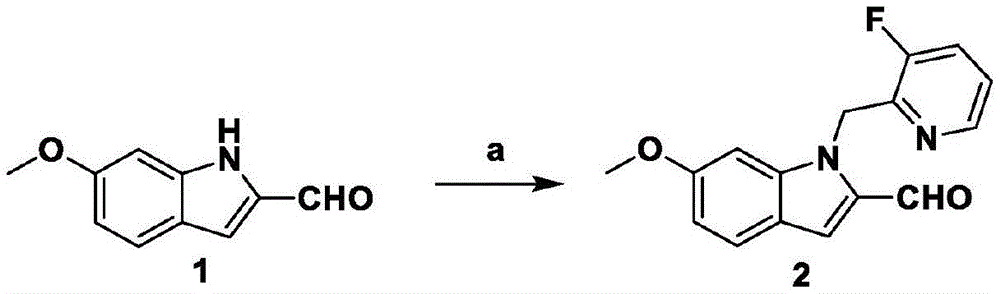
To a stirred solution of 6-methoxy-1H-indole-2-carbaldehyde (1,0.50g, 2.85mmol) in N, N-dimethylformamide (10.0 mL) was added cesium carbonate (2.7 g, 8.57mmol) and 2- (chloromethyl) -3-fluoropyridine hydrochloride (0.452g, 3.14mmol) at room temperature. The reaction mixture was stirred at 60 ℃ for about 2 hours. After completion of the reaction, the reaction mixture was diluted with water and extracted with ethyl acetate (10 mL × 2). The combined organic extracts were washed with brine, dried over anhydrous sodium sulfate, filtered and concentrated under reduced pressure. The crude product was purified by CombiFlash using 12g rediesep and 30% ethyl acetate in hexane as eluent to give 1- ((3-fluoropyridin-2-yl) methyl) -6-methoxy-1H-indole-2-carbaldehyde as a solid, yield: 0.63g (79%). MS (ESI): 284.10 of the total weight of the steel; the measured value of m/z is 285.19[ m ] +H] +1 。
Synthesis of 1- ((3-Fluoropyridin-2-yl) methyl) -6-methoxy-1H-indole-2-carbaldehyde (intermediate of example-33)

To a stirred solution of 6-methoxy-1H-indole-2-carbaldehyde (1,0.50g, 2.85mmol) in N, N-dimethylformamide (10.0 mL) was added cesium carbonate (2.7 g, 8.57mmol) and 2- (chloromethyl) -3-fluoropyridine hydrochloride (0.45g, 3.14mmol) at room temperature. The reaction mixture was stirred at 60 ℃ for about 2 hours. After completion of the reaction, the reaction mixture was diluted with water and extracted with ethyl acetate (10 mL × 2). The combined organic extracts were washed with brine, dried over anhydrous sodium sulfate, filtered and concentrated under reduced pressure. The crude product was purified by CombiFlash using 12g rediesep and 30% ethyl acetate in hexane as eluent to give 1- ((3-fluoropyridin-2-yl) methyl) -6-methoxy-1H-indole-2-carbaldehyde as a yellow solid, yield: 0.66g (81%). MS (ESI): 284.10 of the total weight of the steel; measured value of m/z is 285.19[ m ] +H ] +1 。
Synthesis of 7-chloro-1- ((3-fluoropyridin-2-yl) methyl) -1H-indole-2-carbaldehyde (intermediate of example-34)

To a stirred solution of 7-chloro-1H-indole-2-carbaldehyde (1,0.4g, 2.23mmol) in N, N-dimethylformamide (14.0 mL) was added cesium carbonate (2.1g, 6.68mmol) and 2- (chloromethyl) -3-fluoropyridine (0.39g, 2.67mmol) at room temperature. The reaction mixture was stirred at room temperature for 3 hours. After completion of the reaction, the reaction mixture was diluted with water and extracted with ethyl acetate (30 mL × 2). The combined organic extracts were washed with brine, dried over anhydrous sodium sulfate, filtered and concentrated under reduced pressure. The crude product was purified by CombiFlash using 12g of RediSep and 20% ethyl acetate in hexane as eluent to give 7-chloro-1- ((3-fluoropyridin-2-yl) methyl) -1H-indole-2-carbaldehyde as a yellow oil. Yield: 0.30g (46%). MS (ESI): 288.0; m/z found to be 289.01[ M ] +H] +1 。
Synthesis of 6-fluoro-1- ((3-fluoropyridin-2-yl) methyl) -1H-indole-2-carbaldehyde (intermediate of example-35)
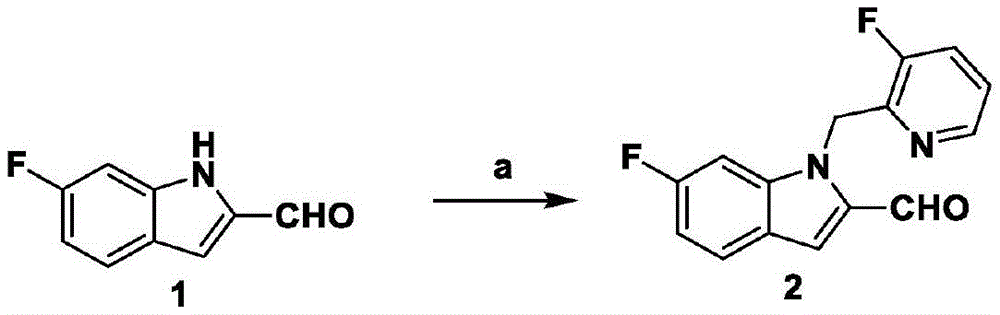
To a stirred solution of 6-fluoro-1H-indole-2-carbaldehyde (1,0.5g, 3.06mmol) in N, N-dimethylformamide (6.0 mL) were added cesium carbonate (2.99g, 9.2mmol) and 2- (chloromethyl) -3-fluoropyridine hydrochloride (0.53g, 3.6 mmol) at room temperature. The reaction mixture was stirred at room temperature for 3 hours. After completion of the reaction, the reaction mixture was diluted with water and extracted with ethyl acetate (20 mL × 2). The combined organic extracts were washed with brine, dried over anhydrous sodium sulfate, filtered and concentrated under reduced pressure. The crude product was purified by CombiFlash using 12g of RediSep and 5% ethyl acetate in hexane as eluent to give 6-fluoro-1- ((3-fluoropyridin-2-yl) methyl) -1H-indole-2-carbaldehyde as a yellow solid. Yield: 0.72g (86%). MS (ESI): 272.12 of the total weight of the steel; m/z found, unionized.

Synthesis of 1- (2, 2-difluoroethyl) -1H-indole-2-carbaldehyde (intermediate of example-47)

To a stirred solution of 1H-indole-2-carbaldehyde (1,1.0g, 6.81mmol) in N, N-dimethylformamide (10.0 mL) were added cesium carbonate (6.7g, 20.01mmol) and 2-bromo-1, 1-difluoroethane (1.78mL, 20.6 mmol) at room temperature. The reaction mixture was stirred at room temperature for 3 hours. After completion of the reaction, the reaction mixture was diluted with water and extracted with ethyl acetate (30 mL × 2). The combined organic extracts were washed with brine, dried over anhydrous sodium sulfate, filtered and concentrated under reduced pressure. The crude product was purified by CombiFlash using 12g RediSep and 10% ethyl acetate in hexane as eluent to give 1- (2, 2-difluoroethyl) -1H-indole-2-carbaldehyde as a brown solid. Yield: 0.91g (63%). MS (ESI): 209.26; m/z found, unionized.

Synthesis of 5-fluoro-1- (2-methoxyethyl) -1H-indole-2-carbaldehyde (intermediate of example-48)
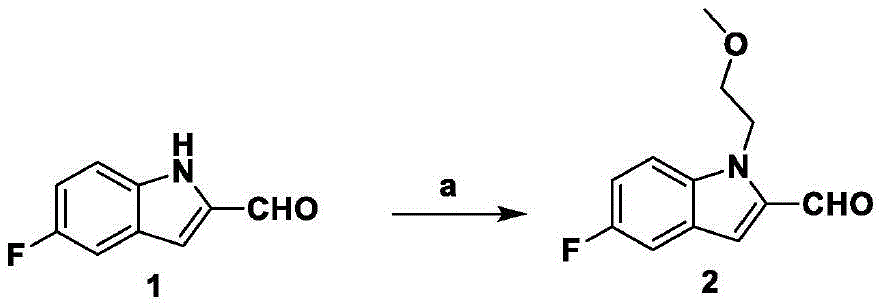
To a stirred solution of 5-fluoro-1H-indole-2-carbaldehyde (1,0.5g, 3.06mmol) in N, N-dimethylformamide (20.0 mL) were added cesium carbonate (3.0 g, 9.18mmol) and 1-bromo-2-methoxyethane (2a, 0.34mL, 3.68mmol) at room temperature. The reaction mixture was stirred at room temperature for 2 hours. After completion of the reaction, the reaction mixture was diluted with water and extracted with ethyl acetate (20 mL × 2). The combined organic extracts were washed with brine, Dried over anhydrous sodium sulfate, filtered and concentrated under reduced pressure. The crude product was purified by CombiFlash using 12g of RediSep and 20% ethyl acetate in hexane as eluent to give 5-fluoro-1- (2-methoxyethyl) -1H-indole-2-carbaldehyde as a brown oil. Yield: 0.58g (85%), MS (ESI): 221.0; the measured value of m/z is 221.95[ deg. ] M + H] +1 。
Synthesis of 6-fluoro-1- (4-fluorobenzyl) -1H-indole-2-carbaldehyde (intermediate of example-49)
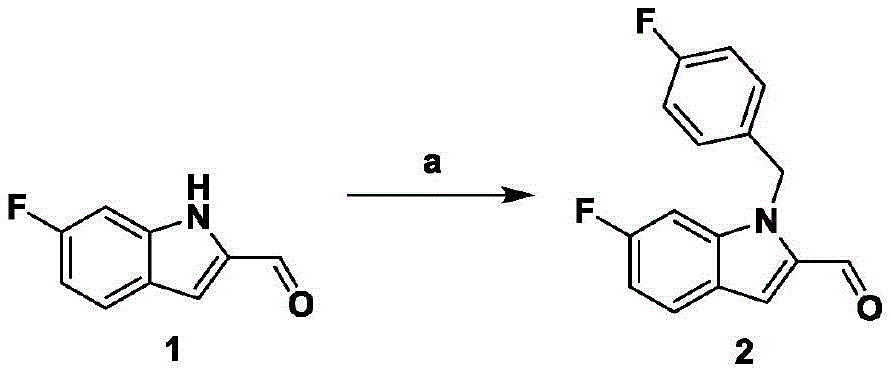
To a stirred solution of 6-fluoro-1H-indole-2-carbaldehyde (1,1.00g, 6.13mmol) in N, N-dimethylformamide (10 mL) was added cesium carbonate (5.98g, 18.4mmol) and 1- (bromomethyl) -4-fluorobenzene (1.38g, 7.36mmol) at room temperature. The reaction mixture was stirred at room temperature for 1 hour. After the reaction was completed, the reaction mixture was diluted with water and extracted with ethyl acetate (200 mL × 2). The combined organic extracts were washed with brine, dried over anhydrous sodium sulfate, filtered and concentrated under reduced pressure. The crude product was purified by CombiFlash using 12g RediSep and 5% ethyl acetate in hexane as eluent to give 6-fluoro-1- (4-fluorobenzyl) -1H-indole-2-carbaldehyde as an off-white solid. Yield: 1.20g (75%). MS (ESI): 271.08; found in m/z, 272.19.
Synthesis of 5-bromo-1- (cyclopropylmethyl) -1H-indole-2-carbaldehyde (intermediate of example-67)

To a stirred solution of 5-bromo-1H-indole-2-carbaldehyde (1,5g, 32.9mmol) in N, N-dimethylformamide (60 mL) was added cesium carbonate (29.5g, 90.5mmol) and (bromomethyl) cyclopropane (4.8ml, 36.2mmol) at room temperature. The reaction mixture was stirred at room temperature for 3 hours. After completion of the reaction, the reaction mixture was diluted with water and extracted with ethyl acetate (200 mL × 2). The combined organic extracts were washed with brine, dried over anhydrous sodium sulfate, filtered and concentrated under reduced pressure. The crude product was purified by combi flash using 12g of RediSep and 20% ethyl acetate in hexane as eluent to give 5-bromo-1- (cyclopropylmethyl) -1H-indole-2-carbaldehyde as a solid. Yield: 3.5g (55%). MS (ESI): 278.06; found in m/z, was 279.19.
Synthesis of 1- (cyclopropylmethyl) -7-chloro-1H-indole-2-carbaldehyde (intermediate of example-57)
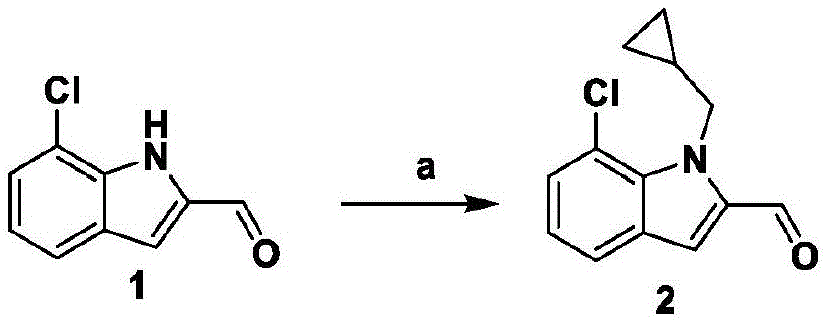
To a stirred solution of 7-chloro-1H-indole-2-carbaldehyde (1,5.4g, 30.9mmol) in N, N-dimethylformamide (60 mL) were added cesium carbonate (29.5g, 90.5mmol) and (bromomethyl) cyclopropane (4.8mL, 36.2mmol) at room temperature. The reaction mixture was stirred at room temperature for 3 hours. After completion of the reaction, the reaction mixture was diluted with water and extracted with ethyl acetate (200 mL × 2). The combined organic extracts were washed with brine, dried over anhydrous sodium sulfate, filtered and concentrated under reduced pressure. The crude product was purified by combi flash using 12g of RediSep and 20% ethyl acetate in hexane to give 1- (cyclopropylmethyl) -7-chloro-1H-indole-2-carbaldehyde as a sticky solid. Yield: 3.0g (42%).

MS (ESI): 233.06; found m/z was 234.19.
Synthesis of 7-chloro-1- (4-methoxybenzyl) -1H-indole-2-carbaldehyde (intermediate of example-39)

To a stirred solution of 7-chloro-1H-indole-2-carbaldehyde (0.5g, 2.78mmol) in N, N-dimethylformamide (10.0 mL) was added cesium carbonate (2) at room temperature.7g, 8.35mmol) and 1- (chloromethyl) -4-methoxybenzene (0.52g, 3.34mmol). The reaction mixture was stirred at room temperature for 3 hours. After completion of the reaction, the reaction mixture was diluted with water and extracted with ethyl acetate (30 mL × 2). The combined organic extracts were washed with brine, dried over anhydrous sodium sulfate, filtered and concentrated under reduced pressure. The crude product was purified by CombiFlash using 12g RediSep and 10% ethyl acetate in hexane as eluent to give 7-chloro-1- (4-methoxybenzyl) -1H-indole-2-carbaldehyde as a yellow oil. Yield: 0.40g (47%). MS (ESI): 299.0; m/z found value of 300.19[ m ] +H] +1 。
Synthesis of 5-fluoro-1- (4-methoxybenzyl) -1H-indole-2-carbaldehyde (intermediate of example-46)

To a stirred solution of 5-fluoro-1H-indole-2-carbaldehyde (1,0.5g, 3.06mmol) in N, N-dimethylformamide (20.0 mL) were added cesium carbonate (3.0g, 9.18mmol) and 1- (chloromethyl) -4- (methoxymethyl) benzene (0.72mL, 3.68mmol) at room temperature. The reaction mixture was stirred at room temperature for 2 hours. After completion of the reaction, the reaction mixture was diluted with water and extracted with ethyl acetate (25 mL × 2). The combined organic extracts were washed with brine, dried over anhydrous sodium sulfate, filtered and concentrated under reduced pressure. The crude product was purified by CombiFlash using 12g RediSep and 20% ethyl acetate in hexane as eluent to give 5-fluoro-1- (4-methoxybenzyl) -1H-indole-2-carbaldehyde as a yellow oil. Yield: 0.52g (60%). MS (ESI): 283.06; m/z found, unionized.

Synthesis of 6-fluoro-1- (4-methoxybenzyl) -1H-indole-2-carbaldehyde (intermediate of example-50)
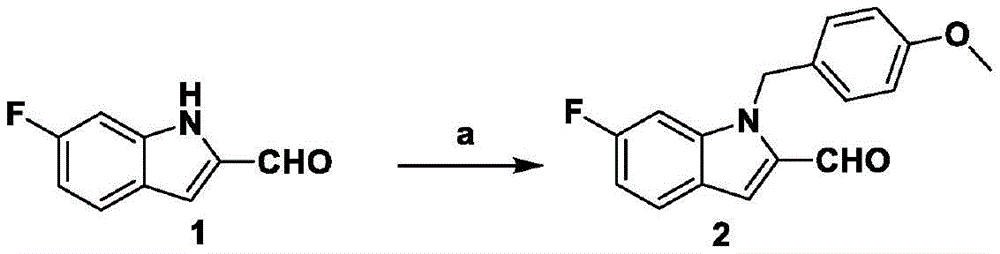
To a stirred solution of 6-fluoro-1H-indole-2-carbaldehyde (0.5g, 3.06mmol) in N, N-dimethylformamide (20.0 mL) were added cesium carbonate (3.0g, 9.18mmol) and 1-bromo-2-methoxyethane (0.34mL, 3.68mmol) at room temperature. The reaction mixture was stirred at room temperature for 2 hours. After completion of the reaction, the reaction mixture was diluted with water and extracted with ethyl acetate (20 mL × 2). The combined organic extracts were washed with brine, dried over anhydrous sodium sulfate, filtered and concentrated under reduced pressure. The crude product was purified by CombiFlash using 12g RediSep and 20% ethyl acetate in hexane as eluent to give 6-fluoro-1- (4-methoxybenzyl) -1H-indole-2-carbaldehyde as a brown oil. Yield: 0.51g (58%), MS (ESI): 283.1; the measured value of m/z is 284.22[ deg. ] M + H] +1 。
Synthesis of 1- (4-fluorobenzyl) -6-methoxy-1H-indole-2-carbaldehyde (intermediate of example-51)

To a stirred solution of 6-methoxy-1H-indole-2-carbaldehyde (0.70g, 5.5mmol) in N, N-dimethylformamide (10 mL) was added cesium carbonate (5.31g, 16.3mmol) and 1- (bromomethyl) -4-fluorobenzene (1.22g, 5.6 mmol) at room temperature. The reaction mixture was stirred at room temperature for 1 hour. After the reaction was completed, the reaction mixture was diluted with water and extracted with ethyl acetate (200 mL × 2). The combined organic extracts were washed with brine, dried over anhydrous sodium sulfate, filtered and concentrated under reduced pressure. The crude product was purified by CombiFlash using 12g of RediSep and 5% ethyl acetate in hexane as eluent to give 1- (4-fluorobenzyl) -6-methoxy-1H-indole-2-carbaldehyde as a yellow solid. Yield: 1.0g (90%). MS (ESI): 283.1; the m/z found is 284.18.
Synthesis of 7-chloro-1- (2, 2-difluoroethyl) -1H-indole-2-carbaldehyde (intermediate of example-56)

To a stirred solution of 7-chloro-1H-indole-2-carbaldehyde (0.9g, 5.0 mmol) in N, N-dimethylformamide (20.0 mL) were added cesium carbonate (4.9g, 15mmol) and 2-bromo-1, 1-difluoroethane (0.868g, 6.0 mmol) at room temperature. The reaction mixture was stirred at room temperature for 3 hours. After completion of the reaction, the reaction mixture was diluted with water and extracted with ethyl acetate (30 mL × 2). The combined organic extracts were washed with brine, dried over anhydrous sodium sulfate, filtered and concentrated to give 7-chloro-1- (2, 2-difluoroethyl) -1H-indole-2-carbaldehyde. Yield: 1.46g (crude). MS (ESI): 243.03; measured value of m/z is 244.00[ 2 ], [ M ] +H] +1 。
Synthesis of 7-chloro-1-isobutyl-1H-indole-2-carbaldehyde (intermediate of example-55)

To a stirred solution of 7-chloro-1H-indole-2-carbaldehyde (0.7g, 3.90mmol) in N, N-dimethylformamide (20.0 mL) was added cesium carbonate (3.8g, 11.69mmol) and 1-bromo-2-methylpropane (0.53g, 3.90mmol) at room temperature. The reaction mixture was stirred at room temperature for 3 hours. After completion of the reaction, the reaction mixture was diluted with water and extracted with ethyl acetate (30 mL × 2). The combined organic extracts were washed with brine, dried over anhydrous sodium sulfate, filtered and concentrated under reduced pressure. The crude product was purified by CombiFlash using 12g of RediSep and 5% ethyl acetate in hexane as eluent to give 7-chloro-1-isobutyl-1H-indole-2-carbaldehyde as a yellow oil. Yield: 0.50g (54%). MS (ESI): 235.71; the measured value of m/z is 236.62[ m ] +H ] +1 。
Synthesis of 2- (chloromethyl) -4-methylthiazole (intermediate of example-59)

Step A: (4-Methylthiazol-2-yl) methanol

To a stirred solution of 4-methylthiazole-2-carbaldehyde (1,1.0g, 7 mmol) in MeOH (30 mL) was added sodium borohydride (0.52g, 14mmol) in portions at 0 ℃. The reaction mixture was stirred at room temperature for 2 hours. The reaction mixture was diluted with water (15 mL) and extracted with EtOAc (2X 25 mL). The organic layer was washed with brine (15 mL) solution and dried over anhydrous Na 2 SO 4 Dried and evaporated. The crude residue was purified by gradient column chromatography using 40% to 60% etoac in hexanes to give the product as a light yellow gum. (0.9g, 90%, yield). MS (ESI): c 5 H 7 Mass calculated value of NOS, 129.02; found M/z of 130.1 (M + H) + 。
And B, step B:2- (chloromethyl) -4-methylthiazole

To a stirred solution of (4-methylthiazol-2-yl) methanol (2,0.9g, 6.97mmol) in DCM (5 mL) at 0 deg.C was added SOCl dropwise 2 (0.83mL, 11mmol), and the reaction mixture was stirred at room temperature for 1 hour. The reaction mixture was quenched with cold NaHCO 3 The solution was neutralized (5 mL) and extracted with DCM (2X 25 mL). The organic layer was washed with brine (5 mL) solution over anhydrous Na 2 SO 4 Dried and evaporated to give the product as a yellow oil (1 g). MS (ESI): c 5 H 6 The mass calculation value of ClNS is 146.99; found M/z of 148.1 (M + H) + 。
Synthesis of 7-chloro-1- (cyclobutylmethyl) -1H-indole-2-carbaldehyde (intermediate of example-53)

Step-1 a: preparation of Cyclobutylmethyl methanesulfonate (2 a)

To a stirred solution of cyclobutylmethanol (1a, 2.00g,23.2 mmol) in dichloromethane (20 mL) was added triethylamine (6.50mL, 46.5 mmol) and N, N-dimethylaminopyridine (0.28g, 2.3 mmol) at room temperature, and methanesulfonyl chloride (2.27mL, 27.9 mmol) was added at 0 ℃. The reaction mixture was stirred at room temperature for 3 hours. After completion of the reaction, the reaction mixture was diluted with water and extracted with dichloromethane (20 mL × 2). The combined organic extracts were washed with brine, dried over anhydrous sodium sulfate, filtered and concentrated under reduced pressure. The crude product was purified by CombiFlash using 12g Redisep and 10% ethyl acetate in hexane as eluent to give cyclobutyl methyl mesylate (2 a) as a colorless oil. Yield: 2.50g (66%); MS (ESI): 164.05; m/z is found to be unionized.

Step 2a: synthesis of 7-chloro-1- (cyclobutylmethyl) -1H-indole-2-carbaldehyde (3 a)

To a stirred solution of 7-chloro-1H-indole-2-carbaldehyde (2b, 0.90g,5.0 mmol) in N, N-dimethylformamide (10 mL) were added cesium carbonate (4.90g, 15.10 mmol) and cyclobutyl methyl methanesulfonate (2a, 0.98g,6.0 mmol) at room temperature. The reaction mixture was stirred at room temperature for 3 hours. After the reaction was completed, the reaction mixture was diluted with water and extracted with ethyl acetate (20 mL × 2). Will merge The organic extracts of (a) were washed with brine, dried over anhydrous sodium sulfate, filtered and concentrated under reduced pressure. The crude product was purified by CombiFlash using 12g Redisep and 20% ethyl acetate in hexane as eluent to give 7-chloro-1- (cyclobutylmethyl) -1H-indole-2-carbaldehyde (3 a) as a pale yellow viscous solid. Yield: 0.32g (26%); MS (ESI): 247.08; the measured value of m/z is 248.10[ m ] +H] +1 。
Synthesis of 1- (cyclopropylmethyl) -6-vinyl-1H-indole-2-carbaldehyde (intermediate of example-61)

Step-1a preparation of 6-bromo-1H-indole-2-carboxylic acid methyl ester (2 a)

To a stirred solution of 6-bromo-1H-indole-2-carboxylic acid (1a, 5.0g, 20.83mmol) in methanol (50 mL) was added sulfuric acid (9mL, 1.8vol) at 0 ℃. The reaction mixture was stirred at 80 ℃ for 12 hours. After completion of the reaction, the reaction mixture was quenched with ice, and the precipitated solid was filtered and washed with water (100 mL × 2). The compound obtained was dried under vacuum. The crude product was purified by CombiFlash using 40g Redisep and 10% ethyl acetate in hexane as eluent to give methyl 6-bromo-1H-indole-2-carboxylate (2 a) as a white solid. Yield: 4.5g (86%). MS (ESI): 252.99; measured value of m/z is 253.99[ m ] +H ] +1 。
Step-2 a: preparation of methyl 6-bromo-1- (cyclopropylmethyl) -1H-indole-2-carboxylate (3 a)

1H-indole-2-carbaldehyde (2a, 4.5g, 1) was stirred at room temperature7.85 mmol) in N, N-dimethylformamide (40 mL) was added cesium carbonate (17.4g, 53.27mmol) and (bromomethyl) cyclopropane (2b, 2.8g, 21.42mmol). The reaction mixture was stirred at room temperature for 2 hours. After completion of the reaction, the reaction mixture was diluted with water and extracted with ethyl acetate (30 mL × 2). The combined organic extracts were washed with brine, dried over anhydrous sodium sulfate, filtered and concentrated under reduced pressure. The crude product was purified by CombiFlash using 12g Redisep and 10% ethyl acetate in hexane as eluent to give methyl 6-bromo-1- (cyclopropylmethyl) -1H-indole-2-carboxylate (3 a) as a white solid. Yield: 4.0g (74%). MS (ESI): 307.18; the measured value of m/z is 308.04[ mu ] M + H] +1 。
Step-3 a: preparation of methyl 1- (cyclopropylmethyl) -6-vinyl-1H-indole-2-carboxylate (4 a)

To a stirred solution of methyl 6-bromo-1- (cyclopropylmethyl) -1H-indole-2-carboxylate (3a, 4.0g, 13.02mmol) in N, N-dimethylformamide (40.0 mL) was added lithium chloride (0.656g, 15.63mmol) and tributylvinyltin (4.9g, 15.63mmol) at room temperature. Argon was purged for 15 minutes and tetrakis (triphenylphosphine) palladium (0) (0.75g, 0.65mmol) was added at room temperature. The reaction mixture was stirred at 90 ℃ for 4 hours. After completion of the reaction, the reaction mixture was diluted with water and extracted with ethyl acetate (40 mL × 2). The combined organic extracts were washed with brine, dried over anhydrous sodium sulfate, filtered and concentrated under reduced pressure. The crude product was purified by CombiFlash using 40g Redisep and 5% to 10% ethyl acetate in hexane as eluent to give methyl 1- (cyclopropylmethyl) -6-vinyl-1H-indole-2-carboxylate (4 a) as a brown solid. Yield: 3.1g (92%). MS (ESI): 255.13; the measured value of m/z is 256.11[ deg. ] M + H ] +1 。
Step-4 a: preparation of (1- (cyclopropylmethyl) -6-vinyl-1H-indol-2-yl) methanol (5 a)

To a stirred solution of methyl 1- (cyclopropylmethyl) -6-vinyl-1H-indole-2-carboxylate (4a, 2.7g, 10.5mmol) in tetrahydrofuran (30.0 mL) at 0 deg.C was added 1.0M lithium aluminate hydrate in tetrahydrofuran (20mL, 21.0mmol). The reaction mixture was stirred at room temperature for 2 hours. After completion of the reaction, the reaction mixture was diluted with ammonium chloride and extracted with ethyl acetate (30 mL × 2). The combined organic extracts were washed with brine, dried over anhydrous sodium sulfate, filtered and concentrated under reduced pressure. The crude product was purified by CombiFlash using 12.0g Redisep and 20% ethyl acetate in hexane as eluent to give (1- (cyclopropylmethyl) -6-vinyl-1H-indol-2-yl) methanol (5 a) as a white solid. Yield: 2.0g (83%). MS (ESI): 227.13; measured value of m/z is 228.13[ m ] +H] +1 。
Step-5 a: preparation of 1- (cyclopropylmethyl) -6-vinyl-1H-indole-2-carbaldehyde

To a stirred solution of (1- (cyclopropylmethyl) -6-vinyl-1H-indol-2-yl) methanol (2.0 g, 8.73mmol) in dichloromethane (20.0 mL) was added tasmadin periodinane (4.4 g, 10.48mmol) at room temperature. The reaction mixture was stirred at room temperature for 4 hours. After completion of the reaction, the reaction mixture was diluted with water and extracted with dichloromethane (20 mL × 2). The combined organic extracts were washed with brine, dried over anhydrous sodium sulfate, filtered and concentrated under reduced pressure. The crude product was purified by CombiFlash using 12g Redisep and 30% ethyl acetate in hexane as eluent to give 1- (cyclopropylmethyl) -6-vinyl-1H-indole-2-carbaldehyde (6 a) as a white solid. Yield: 1.1g (55%). MS (ESI): 225.12 of the total weight of the mixture; m/z found value of 226.12[ m ] +H ] +1 。
Synthesis of 5,6-difluoro-1- (2-methoxyethyl) -1H-indole-2-carbaldehyde (intermediate of example-54)

To a stirred solution of 5,6-difluoro-1H-indole-2-carbaldehyde (1,0.50g, 2.76mmol) in N, N-dimethylformamide (10 mL) was added cesium carbonate (2.69g, 8.28mmol) and 1-bromo-2-methoxyethane (0.32mL, 3.31mmol) at room temperature. The reaction mixture was stirred at 60 ℃ for 3 hours. After completion of the reaction, the reaction mixture was diluted with water and extracted with ethyl acetate (200 mL × 2). The combined organic extracts were washed with brine, dried over anhydrous sodium sulfate, filtered and concentrated under reduced pressure. The crude product was purified by CombiFlash using 12g Redisep and 10% ethyl acetate in hexane as eluent to give 5, 6-difluoro-1- (2-methoxyethyl) -1H-indole-2-carbaldehyde as a yellow solid. Yield: 0.66g (45%). MS (ESI): 239.08 of the root of Chinese yam; the measured value of m/z is 240.04[ m ] +H] +1 。
Synthesis of 4- (chloromethyl) -3-fluoropyridine hydrochloride (intermediate of example-24)

Step-1 a: preparation of (3-fluoropyridin-4-yl) methanol (2 a)
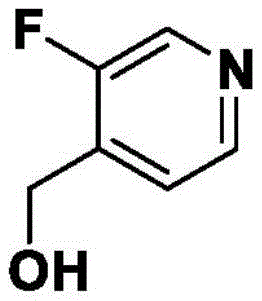
To a solution of 3-fluoroisonicotinic acid (1M in tetrahydrofuran) (12.0 mL,21.3 mmol) in tetrahydrofuran (20 mL) was added dropwise lithium aluminum hydride (1M in tetrahydrofuran) (12.0 mL,21.3 mmol) at 0 ℃ over 10 minutes, and the reaction mixture was stirred at 0 ℃ for 2 hours. After completion of the reaction, 40% potassium hydroxide solution (60 mL) was added to the reaction mixture. The precipitated solid was filtered off and washed with diethyl ether. The crude product was passed through Combiflash using 12g Redispe and 20% acetic acid in hexane Ethyl ester was purified as eluent to give (3-fluoropyridin-4-yl) methanol (2 a) as an off-white solid. Yield: 0.50g (28%). MS (ESI): 127.04; m/z found value of 128.01[ mu ] M + H] +1 。
Step 2a: preparation of 4- (chloromethyl) -3-fluoropyridine hydrochloride (3 a)

To a stirred solution of (3-fluoropyridin-4-yl) methanol (2a, 0.70g, 5.51mmol) in N, N-dichloromethane (5.0 mL) at 0 deg.C was added thionyl chloride (1.00g, 13.78mmol) and the reaction mixture was stirred at room temperature for 1 hour. After completion of the reaction, dichloromethane was removed under reduced pressure, and the obtained crude product was washed with diethyl ether and dried to give 4- (chloromethyl) -3-fluoropyridine hydrochloride 3a as a light brown solid. Yield: 1.0g (90%). MS (ESI): 180.99 of the total weight of the mixture; the measured value of m/z is 182.02[ m ] +H] + 。
Synthesis of 1- (pyrimidin-2-ylmethyl) -1H-indole-2-carbaldehyde (intermediate of example-27)

To a stirred solution of 1H-indole-2-carbaldehyde (1,0.70g, 4.82mmol) in N, N-dimethylformamide (10 mL) were added cesium carbonate (7.8g, 24.1mmol) and 2- (chloromethyl) pyrimidine (0.98g, 7.24mmol) at room temperature. The reaction mixture was stirred at 60 ℃ for 3 hours. After completion of the reaction, the reaction mixture was cooled to room temperature, diluted with water and extracted with ethyl acetate (200 mL × 2). The combined organic extracts were washed with brine, dried over anhydrous sodium sulfate, filtered and concentrated under reduced pressure. The crude product was purified by CombiFlash using 12g Redisep and 10% ethyl acetate in hexane as eluent to give 1- (pyrimidin-2-ylmethyl) -1H-indole-2-carbaldehyde as a brown crystalline solid. Yield: 1.30g (81%). MS (ESI): 237.09; measured value of m/z is 238.14[ 2 ], [ M + [ H ] ] +1 。

Synthesis of 1-isobutyl-1H-indole-2-carbaldehyde (intermediate of example-31)

To a stirred solution of 1H-indole-2-carbaldehyde (1,0.70g, 4.82mmol) in N, N-dimethylformamide (10 mL) were added cesium carbonate (7.8g, 24.1mmol) and 1-bromo-2-methylpropane (0.98g, 7.24mmol) at room temperature. The reaction mixture was stirred at 60 ℃ for 3 hours. After completion of the reaction, the reaction mixture was diluted with water and extracted with ethyl acetate (200 mL × 2). The combined organic extracts were washed with brine, dried over anhydrous sodium sulfate, filtered and concentrated under reduced pressure. The crude product was purified by CombiFlash using 12g Redisep and 10% ethyl acetate in hexane as eluent to give 1-isobutyl-1H-indole-2-carbaldehyde as an oily liquid. Yield: 0.80g (82%). MS (ESI): 201.12; found M/z of 202.30 (M + H) + 。

Synthesis of 1- (2-methoxyethyl) -1H-indole-2-carbaldehyde (intermediate of example-22)

To a stirred solution of 1H-indole-2-carbaldehyde (1,1.0 g,6.0 mmol) in N, N-dimethylformamide (6.0 mL) were added cesium carbonate (6.6 g,20.6 mmol) and 1-bromo-2-methoxyethane (0.76mL, 8.0 mmol) at room temperature. The reaction mixture was stirred at 60 ℃ for 1.5 hours. After completion of the reaction, the reaction mixture was diluted with water and extracted with ethyl acetate (200 mL × 2). The combined organic extracts were washed with brine, dried over anhydrous sodium sulfate, filtered and concentrated under reduced pressure. The crude product was purified by CombiFlash using 12g Redisep and 20% ethyl acetate in hexane as eluent to give 1- (2-methoxyethyl) -1H-indole-2-carbaldehyde as a light yellow solid. Yield: 0.9g (64%). MS (ESI): 203; m/z is found to be unionized.

Synthesis of 7-chloro-1- (2-methoxyethyl) -1H-indole-2-carbaldehyde (intermediate of example-36)

To a stirred solution of 7-chloro-1H-indole-2-carbaldehyde (1,0.5g, 2.79mmol) in N, N-dimethylformamide (15 mL) was added cesium carbonate (2.7 g, 8.37mmol) and 1-bromo-2-methoxyethane (0.31ml, 3.35mmol) at room temperature. The reaction mixture was stirred at room temperature for 3 hours. After completion of the reaction, the reaction mixture was diluted with water and extracted with ethyl acetate (50 mL × 2). The combined organic extracts were washed with brine, dried over anhydrous sodium sulfate, filtered and concentrated under reduced pressure. The crude product was purified by CombiFlash using 12g Redisep and 20% ethyl acetate in hexane as eluent to give 7-chloro-1- (2-methoxyethyl) -1H-indole-2-carbaldehyde as a yellow oil. Yield: 0.34g (52%). MS (ESI): 237.06; m/z found, unionized.

Synthesis of 1- (4- (methoxymethyl) benzyl) -1H-indole-2-carbaldehyde (intermediate of example-37)

To a stirred solution of 1H-indole-2-carbaldehyde (1,1.0 g,6.0 mmol) in N, N-dimethylformamide (5.0 mL) at room temperature were added cesium carbonate (0.58g, 1.79mmol) and (41- (bromomethyl) -4- (methoxymethyl) benzene (0.14g, 0.72mmol) and the reaction mixture was stirred at room temperature for 3 hours after completion of the reaction, the reaction mixture was diluted with water and extracted with ethyl acetate (20 mL. Times.2), the combined organic extracts were washed with brine, dried over anhydrous sodium sulfate, filtered and concentrated under reduced pressure and the crude product was purified by CombiFlash using 12g of Redisp and 5% methanol in dichloromethane as eluent to give 1- (4- (methoxymethyl) benzyl) -1H-indole-2-carbaldehyde.
Synthesis of 1- (cyclopropylmethyl) -5, 6-difluoro-1H-indole-2-carbaldehyde (intermediate of example-32 &77)
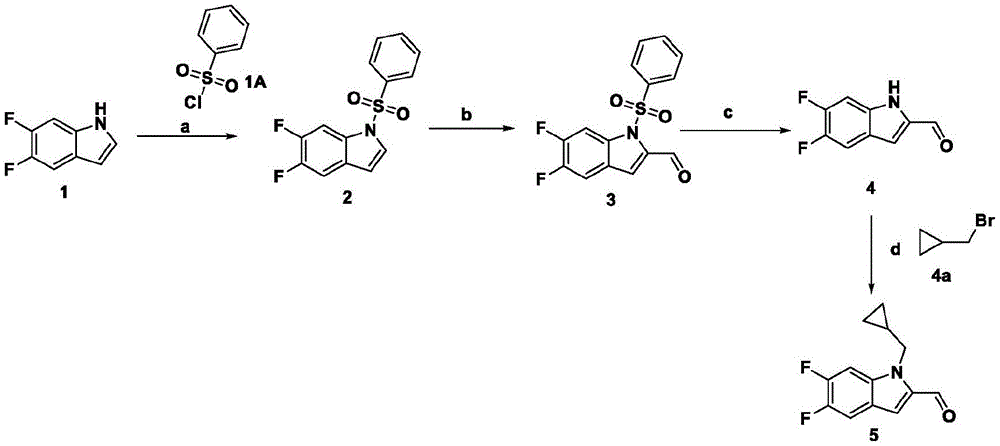
Step 1a: preparation of 5, 6-difluoro-1- (phenylsulfonyl) -1H-indole (2)

To a solution of sodium hydride (0.26g, 13mmol) in DMF (10 mL) at 0 ℃ over 15 minutes was added dropwise a solution of 5, 6-difluoro-1H-indole (1, 0.52g, 13mmol) in DMF. Subsequently, a solution of benzenesulfonyl chloride in DMF (1.4g, 13mmol) was added at 0 ℃ and N at room temperature 2 Stirred under atmosphere for 2 hours. Ice-cold water (50 mL) was added to the reaction mixture, then the precipitate was filtered off and washed with ice-cold water to obtain a brown solid. (1g, 26% yield). MS (ESI): m/z 293.0 (M + H) + 。
And step 2b: preparation of 5, 6-difluoro-1- (phenylsulfonyl) -1H-indole-2-carbaldehyde (3)

To a solution of 5, 6-difluoro-1- (phenylsulfonyl) -1H-indole (2, 1g, 3.42mmol) in anhydrous THF (50 mL) at-78 deg.C was added lithium diisopropylamide 1M in THF (3.4 mL g, 6.84mmol) and stirred for 5 to 8 minutes, followed by N at-78 deg.C 2 Anhydrous DMF (0.5 mL, at-78 ℃ C. And stirring for 10 min) was added under atmosphere. Aqueous ammonium chloride (20 mL) was added to the reaction mixture, which was then extracted into EtOAc. The organic layer was treated with saturated NH 4 The Cl solution and brine were washed, dried over sodium sulfate, filtered and concentrated under reduced pressure to obtain a brown solid (0.7 g, 70%). MS (ESI): m/z 322.0 (M + H) + 。
And step 3c: preparation of 5, 6-difluoro-1H-indole-2-carbaldehyde (4)

To a stirred solution of 5, 6-difluoro-1- (phenylsulfonyl) -1H-indole-2-carbaldehyde (3, 0.8g, 2.49mmol) in THF (50 mL) was added TBAF (1M in THF) (9.15mL, 12.45mmol) at room temperature. The reaction mixture was stirred at room temperature for 12 hours. The reaction mixture was diluted with water and extracted with ethyl acetate (50 mL. Times.2). The combined organic extracts were washed with brine, dried over sodium sulfate and evaporated to give the crude product. The crude residue was purified by gradient column chromatography using 15% to 25% ethyl acetate in hexane to give 5-fluoro-1H-indole-2-carbaldehyde as a sticky solid (0.4 g,88% yield), MS (ESI): c 9 H 5 F 2 Mass calculated value of NO, 181.145; m/z found 182 (M + H) + 。
And 4d: preparation of 1- (cyclopropylmethyl) -5, 6-difluoro-1H-indole-2-carbaldehyde (5)

To a stirred solution of 5,6-difluoro-1H-indole-2-carbaldehyde (4,0.3g, 1.65mmol) in DMF (20 mL) at room temperature was added potassium carbonate (0.68g, 4.97mmol) and (bromomethyl) cyclopropane (4 a,0.16mL, 1.82mmol). The reaction mixture was stirred at room temperature for 12 hours. The reaction mixture was diluted with water and extracted with ethyl acetate (50 mL. Times.2). The combined organic extracts were washed with brine, dried over sodium sulfate and evaporated to give the crude product. The crude residue was purified by gradient column chromatography using 3% to 7% ethyl acetate in hexane to give 1- (cyclopropylmethyl) -5, 6-difluoro-1H-indole-2-carbaldehyde as an off-white solid (0.2g, 48% yield).

MS(ESI):C 13 H 11 F 2 Calculated mass NO of 235.23; m/z found value of 236.1[ m ] +H] + 。
Synthesis of 1- (cyclopropylmethyl) -4-fluoro-1H-indole-2-carbaldehyde (intermediate of example-80)

Step 1: preparation of 4-fluoro-1- (phenylsulfonyl) -1H-indole (2)

To a solution of sodium hydride (0.88g, 22.2 mmol) in DMF (50 mL) at 0 deg.C over 15 minutes was added dropwise a solution of 4-fluoro-1H-indole (1, 3.0g,22.2 mmol) in DMF. Benzenesulfonyl chloride in DMF (2.86mL, 22.2mmol) was added at 0 deg.C and at room temperature under N 2 Stirred under atmosphere for 2 hours. Ice-cold water (50 mL) was added to the reaction mixture, then the precipitate was filtered off and washed with ice-cold water to obtain a white solid. (7.0 g-crude).
Step 2: preparation of 4-fluoro-1- (phenylsulfonyl) -1H-indole-2-carbaldehyde (3)

To a solution of 4-fluoro-1- (phenylsulfonyl) -1H-indole (2, 7.0g, 22.0mmol) in anhydrous THF (60 mL) at-78 deg.C was added lithium diisopropylamide 2M in THF (10.9mL, 22.0mmol), and stirred for 5 to 8 minutes, followed by addition of anhydrous DMF (2.5mL, 33.0mmol) at-78 deg.C, and N at-78 deg.C 2 Stirred under atmosphere for 10 minutes. Aqueous ammonium chloride (20 mL) was added to the reaction mixture, which was then extracted into EtOAc. The organic layer was treated with saturated NH 4 The Cl solution and brine were washed, dried over sodium sulfate, filtered and concentrated under reduced pressure to obtain a red liquid (6.80g, 88.31%).
And step 3: preparation of 4-fluoro-1H-indole-2-carbaldehyde (4)

To a solution of 4-fluoro-1- (phenylsulfonyl) -1H-indole-2-carbaldehyde (4,3.0g, 9.9mmol) in anhydrous THF (20 mL) was added tetrabutylammonium fluoride 1M in THF (14.8 mL), and the reaction mixture was stirred at room temperature for about 12 hours. The reaction mixture was quenched with water, and then extracted with ethyl acetate (50 mL × 3). The combined organic extracts were washed with brine, dried over sodium sulfate, filtered and evaporated to give the crude product. The crude residue was purified by gradient column chromatography using 5% to 10% ethyl acetate in hexane to give the product as a yellow solid. (yield: 99%,1.6 g). MS (ESI): c 9 H 6 The mass calculated value of FNO was 163.04; m/z found 164 (M + H) + 。
Step-4: preparation of 1- (cyclopropylmethyl) -4-fluoro-1H-indole-2-carbaldehyde (5)
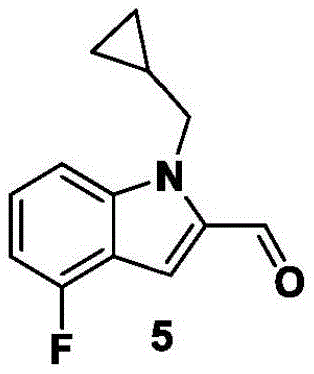
To a stirred solution of 4-fluoro-1H-indole-2-carbaldehyde (4,1.6 g,9.877 mmol) in DMF (10 mL) was added potassium carbonate (6.8g, 49.38mmol) followed by (bromomethyl) cyclopropane (6,1.4 mL, 10.65mmol) and the reaction mixture was stirred at room temperature for 12 hours. The reaction mixture was quenched with water and extracted with ethyl acetate (30 mL. Times.2). The combined organic extracts were washed with brine, dried over sodium sulfate, filtered and evaporated to give the crude product. The crude residue was purified by gradient column chromatography using 5% to 10% ethyl acetate in hexane to give the product as a brown liquid. (yield: 47.6%,1 g).

MS(ESI):C 13 H 12 The calculated mass value of FNO was 217.24; measured value of m/z is 218[ m ] +H] + 。
Synthesis of 7-chloro-1- (cyclopropylmethyl) -6-fluoro-1H-indole-2-carbaldehyde (intermediate of example-87)

Step-1 a: synthesis of methyl 2-azidoacetate (2 a)

To a stirred solution of methyl 2-bromoacetate (1a, 20.0g,131.5 mmol) in N, N-dimethylformamide (40.0 mL) at 0 ℃ was added sodium azide (10.2g, 157.8mmol). The reaction mixture was stirred at room temperature for 16 hours. After completion of the reaction, the reaction mixture was diluted with water and extracted with ethyl acetate (100 mL × 2). The combined organic extracts were washed with brine, dried over anhydrous sodium sulfate, filtered and concentrated under reduced pressureFollowed by concentration to obtain methyl 2-azidoacetate (2 a) as an oily liquid. Yield: 11.2g (74%). ELSD MS (ESI): 115.04; m/z found value of 116.10[ m ] +H] +1 。
Step-2 a: synthesis of methyl (Z) -2-azido-3- (3-chloro-4-fluorophenyl) acrylate (3 a)
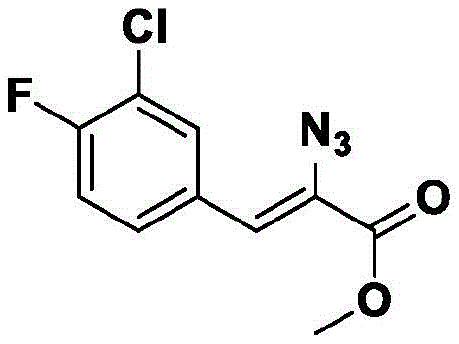
To a stirred solution of methanol (25 mL) was added metallic sodium (1.09g, 47.46mmol) at room temperature, and allowed to stir at room temperature for 10 minutes. A solution of methyl 2-azidoacetate (2a, 2.50g, 15.80mmol) and 3-chloro-4-fluorobenzaldehyde (2b, 6.10g, 53.70mmol) in methanol (5.0 mL) was added at-15 ℃. The reaction mixture was stirred at-15 ℃ for 4 hours. After the reaction was complete, the reaction mixture was neutralized to pH 7 with 1N hydrogen chloride at 0 ℃. The precipitated solid was filtered and washed with water (10 mL. Times.2). The obtained compound was dried under vacuum to obtain methyl (Z) -2-azido-3- (3-chloro-4-fluorophenyl) acrylate (3 a) as a pale yellow solid. Yield: 1.8g (45%). MS (ESI): 255.02; the measured value of m/z is 256.25[ deg. ] M + H ] +1 . Step-3 a: synthesis of methyl 7-chloro-6-fluoro-1H-indole-2-carboxylate (4 a)
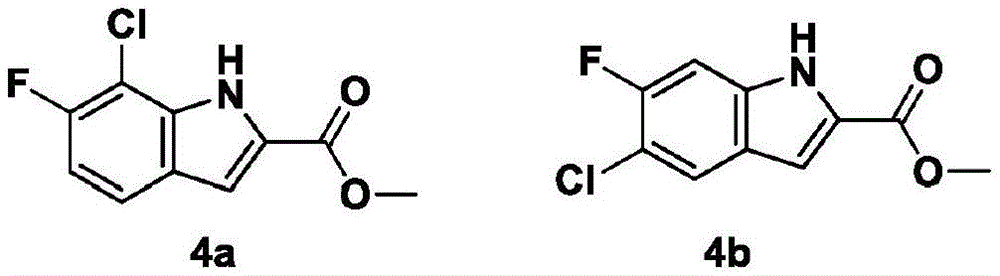
A stirred solution of methyl (Z) -2-azido-3- (3-chloro-4-fluorophenyl) acrylate (3a, 1.80g, 7.05mmol) in p-xylene (80.0 mL) was refluxed at 140 ℃ for 2 hours. After completion of the reaction, the reaction mixture was concentrated under reduced pressure. The crude product obtained was purified by CombiFlash using 40.0g RediSep column. The desired methyl 7-chloro-6-fluoro-1H-indole-2-carboxylate (4 a) was obtained in 2% ethyl acetate in hexane and methyl 5-chloro-6-fluoro-1H-indole-2-carboxylate (4 b) was obtained in 5% ethyl acetate in hexane. The desired fractions were concentrated to give methyl 7-chloro-6-fluoro-1H-indole-2-carboxylate (4 a) as a pale brown solid. Yield: 1.1g (crude). MS (Mass Spectrometry)(ESI): 227.01; the measured value of m/z is 228.01[ mu ] M + H] +1 。
Step-4 a: synthesis of (7-chloro-6-fluoro-1H-indol-2-yl) methanol (5 a)

To a stirred solution of methyl 7-chloro-6-fluoro-1H-indole-2-carboxylate (4a, 1.0g, 4.4mmol) in tetrahydrofuran (20.0 mL) at 0 deg.C was added 1.0M lithium aluminate hydrate in tetrahydrofuran (8.8mL, 8.80mmol). The reaction mixture was stirred at room temperature for 2 hours. After completion of the reaction, the reaction mixture was diluted with ammonium chloride and extracted with ethyl acetate (30 mL × 2). The combined organic extracts were washed with brine, dried over anhydrous sodium sulfate, filtered and concentrated under reduced pressure. The crude product was purified by CombiFlash using 40g RediSep column and 20% ethyl acetate in hexane as eluent to give (7-chloro-6-fluoro-1H-indol-2-yl) methanol (5 a) as a viscous solid. Yield: 8.24g (91%). MS (ESI): 199.02; m/z found value of 200.05[ mu ] M + H ] +1 。
Step-5 a: synthesis of 7-chloro-6-fluoro-1H-indole-2-carbaldehyde (6 a)

To a stirred solution of (7-chloro-6-fluoro-1H-indol-2-yl) methanol (5a, 0.80g, 4.00mmol) in dichloromethane (30.0 mL) was added persimmodineproodane (3.4 g, 8.00mmol) at room temperature. The reaction mixture was stirred at room temperature for 4 hours. After completion of the reaction, the reaction mixture was diluted with water and extracted with dichloromethane (20 mL × 2). The combined organic extracts were washed with brine, dried over anhydrous sodium sulfate, filtered and concentrated under reduced pressure. The crude product was purified by CombiFlash using 12.0g RediSep column and 2% to 5% ethyl acetate in hexane as eluent to give 7-chloro-6-fluoro-1H-indole-2-methanol (6 a) as a white solid. Yield: 0.63g (75%). MS (ESI): 197.0; the measured value of m/z is,is 198.12 2[ m ] +H] +1 。
Step-6 a: synthesis of 7-chloro-1- (cyclopropylmethyl) -6-fluoro-1H-indole-2-carbaldehyde (7 a)

To a stirred solution of 7-chloro-6-fluoro-1H-indole-2-carbaldehyde (6 a,0.30g, 1.52mmol) in N, N-dimethylformamide (15.0 mL) was added cesium carbonate (1.40g, 4.56mmol) and (bromomethyl) cyclopropane (6 b,0.29mL, 3.04mmol) at room temperature. The reaction mixture was stirred at 60 ℃ for 30 minutes. After completion of the reaction, the reaction mixture was diluted with water and extracted with ethyl acetate (30 mL × 2). The combined organic extracts were washed with brine, dried over anhydrous sodium sulfate, filtered and concentrated under reduced pressure. The crude product was purified by CombiFlash using a 12.0g red sepp column and 10% ethyl acetate in hexane as eluent to give 7-chloro-1- (cyclopropylmethyl) -6-fluoro-1H-indole-2-carbaldehyde (7 a) as a viscous solid. Yield: 0.33g (88%). MS (ESI): 251.05; measured value of m/z is 252.25[ 2 ], [ M + H ] ] +1 。
Synthesis of 7-chloro-1- (pyrimidin-5-ylmethyl) -1H-indole-2-carbaldehyde (intermediate of example-88)

To a stirred solution of 7-chloro-1H-indole-2-carbaldehyde (1a, 0.500g, 2.79mmol) in N, N-dimethylformamide (10.0 mL) was added cesium carbonate (2.7 g, 8.37mmol) and 5- (chloromethyl) pyrimidine hydrochloride (1b, 0.429g, 3.34mmol) at room temperature. The reaction mixture was stirred at room temperature for about 16 hours. After completion of the reaction, the reaction mixture was diluted with water and extracted with ethyl acetate (10 mL × 2). The combined organic extracts were washed with brine, dried over anhydrous sodium sulfate, filtered and concentrated under reduced pressure. The crude product was purified by CombiFlash using 12.0g Redisep and 30% ethyl acetate in hexane as eluent to give 7-chloro-1- (pyrimidine as a yellow solid-5-ylmethyl) -1H-indole-2-carbaldehyde (2 a). Yield: 0.260g (34%). MS (ESI): 271.10; measured value of m/z is 272.19[ m ] +H] +1 。
And (3) biological determination:
FP binding assay
Binding of the compound to the PAD4 enzyme was detected by FP assay. PAD4 enzyme was diluted to 1uM in assay buffer (100mM HEPES,50mM NaCl,1mM DTT,5% glycerol and 1mM CHAPS) and added to wells containing different concentrations of compound or DMSO vehicle (1%) in 384-well blanks. 10nM fluorescein-labeled probe (JPAD-00085) was added to the plate. The assay plates were incubated at room temperature for 60 min, and the FP read of the FP module (. Lamda.ex 485/lamda.em 535 nm) was then measured on the Pheastar. Computing IC Using XL-fit software model 205 50 (see: nat Chem biol.2015Mar;11 (3): 189-91).
Biochemical determination of ammonia release
Citrullination assay by ammonia release detection (Citrullination assay). PAD4 enzyme was diluted to 120nM in assay buffer (100mM HEPES,50mM NaCl,2mM DDT,0.6mg/mL BSA, pH 7.4) and added to wells containing different concentrations of compound or DMSO vehicle (1% final) in blank 384-well plates. After a pre-incubation of 60 min at room temperature, the reaction was initiated by addition of substrate (1.5 mM BAEE,50mM NaCl,350uM CaCl2, 2mM, pH 7.4 in 200mM HEPES). The reaction was stopped after 60 minutes by adding stop/detection buffer containing 50mM EDTA,2.6mM o-phthalaldehyde, and 2.6mM DTT. The assay was incubated at room temperature for 90 minutes and then fluorescence was measured on a Tecan reader (λ ex 405/λ em 460 nm). Computing IC Using XL-fit software model 205 50 . (see: nat Chem biol.2015Mar;11 (3): 189-91).
anti-PAD 4 activity:
table 1 below shows the activity of selected compounds of the present disclosure in the PAD4 assay described above. Compounds having activity designated "A" specify IC 50 <1uM; compounds having activity designated "B" specify IC 50 Is 1 to 10uM; and has a designation of Compounds with "C" activity specify IC 50 >10uM。
Table 1: PAD4 enzyme Activity


nd = undetermined
Table 1 illustrates that most compounds (from examples 1 to 88) were found to be active against the PAD4 enzyme when evaluated by ammonia release biochemical assay and FP binding assay. IC (integrated circuit) 50 Values show the potency of the compounds to inhibit PAD4 enzyme activity. IC (integrated circuit) 50 The value represents how much of a particular drug or compound is required to inhibit a given biological process or component of a process, such as an enzyme. IC (integrated circuit) 50 Low values of (a) indicate high inhibitory potency of the test compound (examples 1 to 88 as described herein). However, in Table 1 above, the high effective forces are represented by "A", "B", and "C", where "A" has the smallest IC 50 The value, and thus the most efficient.
Biochemical ammonia release assay showed 62 of 88 compounds showed IC 50 The value < 1. Mu.M, which is indicated by "A". These 62 compounds are examples-1, 8 to 13, 15 to 28, 31 to 37, 39, 41, 46 to 51, 53, 55 to 57, 59 to 61, 63 to 67, 69 to 78 and 84 to 88.
In another aspect, the FP binding assay showed that 13 of the 23 test compounds were effective in inhibiting PAD4 enzyme activity. Examples 8 to 12, 14, 19, 63 to 65, 72, 73 and 77, respectively.
Thus, it can be concluded that examples-1, 8 to 13, 15 to 28, 31 to 37, 39, 41, 46 to 51, 53, 55 to 57, 59 to 61, 63 to 67, 69 to 78, and 84 to 87 were identified as potential drugs that could alleviate PAD4 enzyme activity and thus treat PAD4 mediated diseases, and could be developed.
Claims (20)
1. Compounds of formula (I), stereoisomers and pharmaceutically acceptable salts thereof,

wherein:
x is selected from O or S;
y is selected from O or N;
z is N;
a is CR 1 ;
B is CR 2 ;
n is 0 to 1;
R 1 and R 2 Independently selected from hydrogen or C 1-6 An alkyl group;
R 3 absent or selected from hydrogen, C 1-6 Alkyl radical, C 3-6 Cycloalkyl, C (O) C 1-6 Alkyl, SO 2 C 1-6 Alkyl, SO 2 C 3-6 Cycloalkyl, or SO 2 C 5-6 Aryl, wherein:
C 1-6 alkyl, (CO) C 1-6 Alkyl, SO 2 C 5-6 Aryl and SO 2 C 1-6 Alkyl is optionally substituted by C 1-6 Alkoxy, halogen or C 5-6 Aryl substitution;
R 10 and R 11 Taken together, form a 5-to 6-membered monocyclic saturated heterocycle wherein:
said 5-to 6-membered monocyclic saturated heterocycle is optionally selected from amino, C 1-6 Alkylamino or-NHC (O) CH = CHCH 2 N(CH 3 ) 2 Substituted with the substituent(s);
R 12 、R 13 、R 14 and R 15 Independent of each otherIs selected from hydrogen or C 1-6 An alkyl group; and is
R 16 Is a 5 to 10 membered bicyclic heteroaryl having 1 to 5 heteroatoms selected from N or S, wherein,
the 5-to 10-membered bicyclic heteroaryl is optionally substituted with 1 to 5 substituents selected from: halogen, C 1-6 Alkyl radical, C 1-6 Alkoxy radical, C 1-6 Haloalkyl, C 1-6 alkyl-C 5-6 Aryl radical, C 2-6 alkenyl-C 5-6 Aryl radical, C 1-6 alkyl-C 1-6 Heterocyclic group, C 1-6 Heteroaryl or C 1-6 alkyl-C 1-6 Heteroaryl of which C is 1-6 Alkyl radical, C 1-6 Alkoxy radical, C 1-6 alkyl-C 5-6 Aryl radical, C 1-6 alkyl-C 1-6 Heteroaryl and C 1-6 alkyl-C 1-6 Heterocyclyl is optionally substituted by one or more groups selected from hydrogen, C 1-6 Alkyl radical, C 1-6 Alkoxy radical, C 3-8 Cycloalkyl, halogen, hydroxy, -CH 2 OH or-COOH.
2. A compound of formula (I), its stereoisomers and pharmaceutically acceptable salts thereof, as claimed in claim 1, wherein:
x is selected from O or S;
y is selected from O or N;
z is N;
a is CR 1 ;
B is CR 2 ;
n is 0 to 1;
R 1 and R 2 Independently selected from hydrogen or C 1-6 An alkyl group;
R 3 absent or selected from hydrogen, C 1-6 Alkyl radical, C 3-6 Cycloalkyl, C (O) C 1-6 Alkyl, SO 2 C 1-6 Alkyl, SO 2 C 3-6 Cycloalkyl or SO 2 C 5-6 Aryl radical, wherein SO 2 C 5-6 Aryl and SO 2 C 1-6 Alkyl is optionally substituted by C 1-6 Alkoxy, halogen or C 5-6 Aryl substitution;
R 10 and R 11 Are formed togetherA 5 to 6 membered monocyclic saturated heterocycle, wherein:
said 5-to 6-membered monocyclic saturated heterocycle is optionally selected from amino, C 1-6 Alkylamino or-NHC (O) CH = CHCH 2 N(CH 3 ) 2 Substituted with the substituent(s);
R 12 、R 13 、R 14 and R 15 Independently selected from hydrogen or C 1-6 An alkyl group; and is provided with
R 16 Is a 5 to 10 membered bicyclic heteroaryl group having 1 to 5 heteroatoms selected from N or S, wherein,
The 5-to 10-membered bicyclic heteroaryl is optionally substituted with 1 to 5 substituents selected from: halogen, C 1-6 Alkyl radical, C 1-6 Alkoxy radical, C 1-6 Haloalkyl, C 1-6 alkyl-C 5-6 Aryl radical, C 2-6 alkenyl-C 5-6 Aryl radical, C 1-6 alkyl-C 1-6 Heterocyclic group, C 1-6 Heteroaryl or C 1-6 alkyl-C 1-6 Heteroaryl of which C is 1-6 Alkyl radical, C 1-6 Alkoxy radical, C 1-6 alkyl-C 5-6 Aryl radical, C 1-6 alkyl-C 1-6 Heteroaryl and C 1-6 alkyl-C 1-6 The heterocyclic group is optionally substituted by one or more groups selected from hydrogen, C 1-6 Alkyl radical, C 1-6 Alkoxy radical, C 3-8 Cycloalkyl, halogen, hydroxy, -CH 2 OH or-COOH.
3. A compound of formula (I), its stereoisomers and pharmaceutically acceptable salts thereof, as claimed in claim 1, wherein:
x is selected from O or S;
y is selected from O or N;
z is N;
a is CR 1 ;
B is CR 2 ;
n is 0 to 1;
R 1 and R 2 Independently selected from hydrogen or C 1-6 An alkyl group;
R 3 absent or selected from hydrogen, C 1-6 Alkyl radical, C 3-6 Cycloalkyl, C (O) C 1-6 Alkyl, SO 2 C 1-6 Alkyl, SO 2 C 3-6 Cycloalkyl or SO 2 C 5-6 Aryl radical, wherein SO 2 C 5-6 Aryl and SO 2 C 1-6 Alkyl is optionally substituted by C 1-6 Alkoxy, halogen or C 5-6 Aryl substitution;
R 10 and R 11 Taken together, form a 5-to 6-membered monocyclic saturated heterocycle wherein:
said 5-to 6-membered monocyclic saturated heterocycle is optionally selected from amino, C 2-4 Alkylamino or-NHC (O) CH = CHCH 2 N(CH 3 ) 2 Substituted with the substituent(s); and
R 16 is a 5 to 10 membered bicyclic heteroaryl having 1 to 5 heteroatoms selected from N or S, wherein,
The 5-to 10-membered bicyclic heteroaryl is optionally substituted with 1 to 5 substituents selected from: halogen, C 1-6 Alkyl radical, C 1-6 Alkoxy radical, C 1-6 Haloalkyl, C 1-6 alkyl-C 5-6 Aryl radical, C 2-6 alkenyl-C 5-6 Aryl radical, C 1-6 alkyl-C 1-6 Heterocyclic group, C 1-6 Heteroaryl or C 1-6 alkyl-C 1-6 Heteroaryl of which C is 1-6 Alkyl radical, C 1-6 Alkoxy radical, C 1-6 alkyl-C 5-6 Aryl radical, C 1-6 alkyl-C 1-6 Heteroaryl and C 1-6 alkyl-C 1-6 Heterocyclyl is optionally substituted by one or more groups selected from hydrogen, C 1-6 Alkyl radical, C 1-6 Alkoxy radical, C 3-8 Cycloalkyl, halogen, hydroxy, -CH 2 OH or-COOH.
4. A compound of formula (I), its stereoisomers and pharmaceutically acceptable salts thereof, as claimed in claim 1, wherein:
x is selected from O or S;
y is selected from O or N;
z is N;
a is CR 1 ;
B is CR 2 ;
n is 0 to 1;
R 1 and R 2 Independently is hydrogen;
R 3 absent or selected from hydrogen, C 1-6 Alkyl radical, C 3-6 Cycloalkyl, C (O) C 1-6 Alkyl, SO 2 C 3-6 Cycloalkyl, SO 2 C 5-6 Aryl radicals or SO 2 C 1-6 Alkyl radical, wherein SO 2 C 1-6 Alkyl and SO 2 C 5-6 Aryl being optionally substituted by C 1-6 Alkoxy, halogen or C 5-6 Aryl substitution;
R 10 and R 11 Taken together, form a 5-to 6-membered monocyclic saturated heterocycle wherein:
said 5-to 6-membered monocyclic saturated heterocycle is optionally substituted with a substituent selected from amino, -NHC (O) CH = CHCH 2 N(CH 3 ) 2 Or C 1-6 Substituted with alkyl amino;
R 12 、R 13 、R 14 and R 15 Independently selected from hydrogen or C 1-6 An alkyl group; and
R 16 Is a 5 to 10 membered bicyclic heteroaryl having 1 to 2 heteroatoms selected from N or S, wherein:
the 5-to 10-membered bicyclic heteroaryl is optionally substituted with 1 to 3 substituents selected from: halogen, C 1-6 Alkyl radical, C 1-6 Alkoxy radical, C 1-6 Haloalkyl, C 1-6 alkyl-C 5-6 Aryl radical, C 2-6 alkenyl-C 5-6 Aryl radical, C 1-6 alkyl-C 1-6 Heterocyclic group, C 1-6 Heteroaryl and C 1-6 alkyl-C 1-6 Heteroaryl of which C 1-6 Alkyl radical, C 1-6 Alkoxy radical, C 1-6 alkyl-C 5-6 Aryl radical, C 1-6 alkyl-C 1-6 Heteroaryl and C 1-6 alkyl-C 1-6 The heterocyclic group is optionally substituted by one or more groups selected from hydrogen, C 1-6 Alkyl radical, C 1-6 Alkoxy radical, C 3-8 Cycloalkyl, halogen, hydroxy, -CH 2 OH or-COOH.
5. Compounds of formula (II), stereoisomers thereof and pharmaceutically acceptable salts thereof,
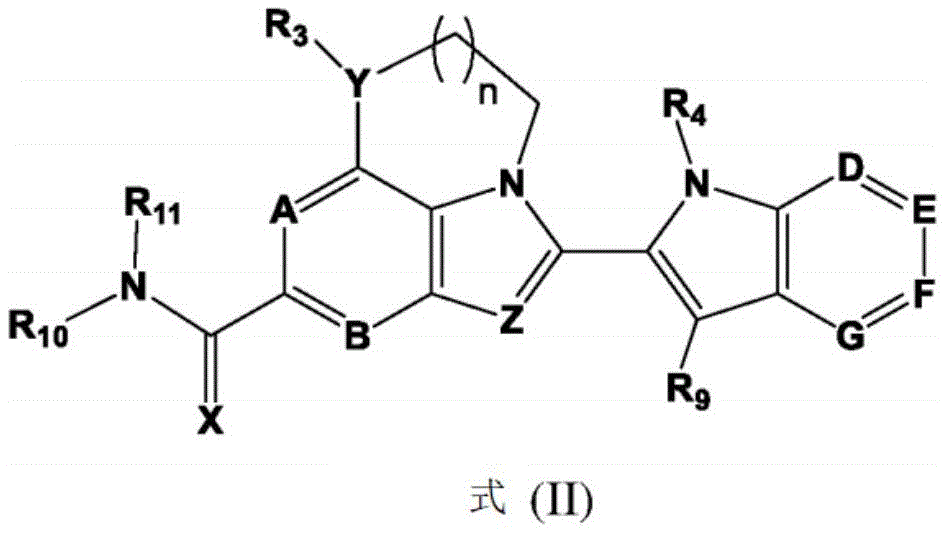
wherein:
x is selected from O or S;
y is selected from O or N;
z is N;
a is CR 1 ;
B is CR 2 ;
D is selected from N or CR 5 ;
E is CR 6 ;
F is CR 7 ;
G is CR 8 ;
n is 1 to 2;
R 1 、R 2 and R 9 Independently selected from hydrogen or C 1-6 An alkyl group;
R 5 、R 6 、R 7 and R 8 Independently selected from hydrogen, halogen, C 1-6 Alkyl radical, C 1-6 Alkoxy radical, C 2-6 alkenyl-C 5-6 Aryl or C 1-6 A heteroaryl group;
R 3 absent or selected from hydrogen, C 1-6 Alkyl radical, C 3-6 Cycloalkyl, C (O) C 1-6 Alkyl, SO 2 C 1-6 Alkyl, SO 2 C 3-6 Cycloalkyl or SO 2 C 5-6 Aryl radical, wherein, C 1-6 Alkyl, (CO) C 1-6 Alkyl, SO 2 C 5-6 Aryl and SO 2 C 1-6 Alkyl is optionally substituted by C 1-6 Alkoxy, halogen or C 5-6 Aryl substitution;
R 4 is selected from C 1-6 Alkyl radical, C 1-6 Haloalkyl, C 1-6 Alkoxy radical, C 1-6 alkyl-C 5-6 Aryl radical, C 1-6 alkyl-C 1-6 Heterocyclyl or C 1-6 alkyl-C 1-6 Heteroaryl of which C 1-6 Alkyl radical, C 1-6 Alkoxy radical, C 1-6 alkyl-C 5-6 Aryl radical, C 1-6 alkyl-C 1-6 Heterocyclyl and C 1-6 alkyl-C 1-6 Heteroaryl is optionalSubstituted with one or more groups selected from: hydrogen, C 1-6 Alkyl radical, C 1-6 Alkoxy radical, C 3-8 Cycloalkyl, C 1-6 Heteroaryl, halogen, hydroxy, -CH 2 OH or-COOH; and
R 10 and R 11 May together form a 5-to 6-membered monocyclic saturated heterocycle, wherein:
said 5-to 6-membered monocyclic saturated heterocycle is optionally selected from amino, C 1-6 Alkylamino or-NHC (O) CH = CHCH 2 N(CH 3 ) 2 。
6. Compounds of formula (III), stereoisomers thereof and pharmaceutically acceptable salts thereof,

wherein:
x is selected from O or S;
y is selected from O or N;
z is N;
n is 1 to 2;
R 1 、R 2 and R 9 Independently selected from hydrogen or C 1-6 An alkyl group;
R 5 、R 6 、R 7 and R 8 Independently selected from hydrogen, halogen, C 1-6 Alkyl radical, C 1-6 Alkoxy radical, C 2-6 alkenyl-C 5-6 Aryl or C 1-6 (ii) a heteroaryl group, wherein,
R 3 absent or selected from hydrogen, C 1-6 Alkyl radical, C 3-6 Cycloalkyl, C (O) C 1-6 Alkyl, SO 2 C 1-6 Alkyl, SO 2 C 3-6 Cycloalkyl or SO 2 C 5-6 Aryl radical, wherein, C 1-6 Alkyl, (CO) C 1-6 Alkyl, SO 2 C 5-6 Aryl and SO 2 C 1-6 Alkyl is optionally substituted by C 1-6 Alkoxy, halogen or C 5-6 Aryl substitution;
R 4 is selected from C 1-6 Alkyl radical, C 1-6 Haloalkyl, C 1-6 Alkoxy radical, C 1-6 alkyl-C 5-6 Aryl radical, C 1-6 alkyl-C 1-6 Heterocyclyl or C 1-6 alkyl-C 1-6 Heteroaryl of which C 1-6 Alkyl radical, C 1-6 alkyl-C 5-6 Aryl radical, C 1-6 alkyl-C 1-6 Heterocyclyl and C 1-6 alkyl-C 1-6 Heteroaryl is optionally substituted with one or more groups selected from: hydrogen, C 1-6 Alkyl radical, C 1-6 Alkoxy radical, C 3-8 Cycloalkyl, C 5-6 Aryl radical, C 1-6 Heteroaryl, halogen, hydroxy, -CH 2 OH or-COOH; and
R 10 and R 11 May together form a 5 to 6 membered monocyclic saturated heterocycle wherein:
said 5-to 6-membered monocyclic saturated heterocycle is optionally selected from amino, C 1-6 Alkylamino or-NHC (O) CH = CHCH 2 N(CH 3 ) 2 Is substituted with the substituent(s).
7. A compound of formula (I) as claimed in claim 1 or its stereoisomers and pharmaceutically acceptable salts thereof, selected from:
(R) - (3-aminopiperidin-1-yl) (2- (1- (cyclopropylmethyl) -1H-indol-2-yl) -3, 4-dihydro-5-oxa-1, 2a-diazacenaphthen-7-yl) methanone,
(R) - (3-Aminopyrrolidin-1-yl) (2- (1- (cyclopropylmethyl) -1H-indol-2-yl) -3, 4-dihydro-5-oxa-1, 2a-diazacenaphthen-7-yl) methanone,
(R) - (3-aminopiperidin-1-yl) (2- (1-ethyl-1H-indol-2-yl) -3, 4-dihydro-5-oxa-1, 2a-diazacenaphthen-7-yl) methanone,
(2- (aminomethyl) piperidin-1-yl) (2- (1- (cyclopropylmethyl) -1H-indol-2-yl) -3, 4-dihydro-5-oxa-1, 2a-diazacenaphthen-7-yl) methanone,
(R) - (3-aminopiperidin-1-yl) (2- (1-ethyl-1H-pyrrolo [2,3-b ] pyridin-2-yl) -3, 4-dihydro-5-oxa-1, 2a-diazacenaphthen-7-yl) methanone,
(R) - (3-aminopiperidin-1-yl) (1- (1- (cyclopropylmethyl) -1H-indol-2-yl) -8, 9-dihydro-7H-6-oxa-2, 9 a-diaza-benzo [ cd ] azulen-4-yl) methanone,
(R) - (3-Aminopyrrolidin-1-yl) (1- (1- (cyclopropylmethyl) -1H-indol-2-yl) -8, 9-dihydro-7H-6-oxa-2, 9 a-diaza-benzo [ cd ] azulen-4-yl) methanone,
(R) - (3-aminopiperidin-1-yl) (2- (1- (cyclopropylmethyl) -7-methyl-1H-indol-2-yl) -3, 4-dihydro-5-oxa-1, 2a-diazacenaphthen-7-yl) methanone,
(R) - (3-aminopiperidin-1-yl) (2- (1- (cyclopropylmethyl) -5-fluoro-1H-indol-2-yl) -3, 4-dihydro-5-oxa-1, 2a-diazacenaphthen-7-yl) methanone,
(R) - (3-aminopiperidin-1-yl) (2- (1- (pyridin-4-ylmethyl) -1H-indol-2-yl) -3, 4-dihydro-5-oxa-1, 2a-diazacenaphthen-7-yl) methanone,
(R) - (3-aminopiperidin-1-yl) (2- (1- (pyridin-2-ylmethyl) -1H-indol-2-yl) -3, 4-dihydro-5-oxa-1, 2a-diazacenaphthen-7-yl) methanone,
(R) - (3-aminopiperidin-1-yl) (2- (3-ethylbenzo [ b ] thiophen-2-yl) -3, 4-dihydro-5-oxa-1, 2a-diazacenaphthen-7-yl) methanone,
(R) - (3-aminopiperidin-1-yl) (2- (1- (4-chlorobenzyl) -1H-indol-2-yl) -3, 4-dihydro-5-oxa-1, 2a-diazacenaphthen-7-yl) methanone,
(R) - (3-aminopiperidin-1-yl) (2- (1- (2-fluorobenzyl) -1H-indol-2-yl) -3, 4-dihydro-5-oxa-1, 2a-diazacenaphthen-7-yl) methanone,
(R) - (3-aminopiperidin-1-yl) (2- (1- (4-fluorobenzyl) -1H-indol-2-yl) -3, 4-dihydro-5-oxa-1, 2a-diazacenaphthen-7-yl) methanone,
(R) - (3-aminopiperidin-1-yl) (2- (1- (pyridin-3-ylmethyl) -1H-indol-2-yl) -3, 4-dihydro-5-oxa-1, 2a-diazacenaphthen-7-yl) methanone,
(R) - (3-aminopiperidin-1-yl) (2- (1- (cyclopropylmethyl) -5, 6-dimethoxy-1H-indol-2-yl) -3, 4-dihydro-5-oxa-1, 2a-diazacenaphthen-7-yl) methanone,
(R) - (3-aminopiperidin-1-yl) (2- (1-benzyl-1H-indol-2-yl) -3, 4-dihydro-5-oxa-1, 2a-diazacenaphthen-7-yl) methanone,
(R) - (3-aminopiperidin-1-yl) (2- (1- (4-methoxybenzyl) -1H-indol-2-yl) -3, 4-dihydro-5-oxa-1, 2a-diazacenaphthen-7-yl) methanone,
(R) - (3-aminopiperidin-1-yl) (2- (1- (2-methoxyethyl) -1H-indol-2-yl) -3, 4-dihydro-5-oxa-1, 2a-diazacenaphthen-7-yl) methanone,
(R) - (3-aminopiperidin-1-yl) (2- (6-methoxy-1- (2-methoxyethyl) -1H-indol-2-yl) -3, 4-dihydro-5-oxa-1, 2a-diazacenaphthen-7-yl) methanone,
(R) - (3-aminopiperidin-1-yl) (2- (1- (2-hydroxyethyl) -1H-indol-2-yl) -3, 4-dihydro-5-oxa-1, 2a-diazacenaphthen-7-yl) methanone,
(R) - (3-aminopiperidin-1-yl) (2- (1- (cyclopropylmethyl) -6-methoxy-1H-indol-2-yl) -3, 4-dihydro-5-oxa-1, 2a-diazacenaphthen-7-yl) methanone,
(R) - (3-aminopiperidin-1-yl) (2- (1- ((3-fluoropyridin-4-yl) methyl) -1H-indol-2-yl) -3, 4-dihydro-5-oxa-1, 2a-diazacenaphthen-7-yl) methanone,
(R) - (3-aminopiperidin-1-yl) (2- (1- (pyrazin-2-ylmethyl) -1H-indol-2-yl) -3, 4-dihydro-5-oxa-1, 2a-diazacenaphthen-7-yl) methanone,
(R) - (3-aminopiperidin-1-yl) (2- (1- ((3-fluoropyridin-2-yl) methyl) -1H-indol-2-yl) -3, 4-dihydro-5-oxa-1, 2a-diazacenaphthen-7-yl) methanone,
(R) - (3-aminopiperidin-1-yl) (2- (1- (pyrimidin-2-ylmethyl) -1H-indol-2-yl) -3, 4-dihydro-5-oxa-1, 2a-diazacenaphthen-7-yl) methanone,
(R) - (3-aminopiperidin-1-yl) (2- (1- (cyclopropylmethyl) -6-fluoro-1H-indol-2-yl) -3, 4-dihydro-5-oxa-1, 2a-diazacenaphthen-7-yl) methanone,
(R) - (3-aminopiperidin-1-yl) (2- (1- (pyrimidin-5-ylmethyl) -1H-indol-2-yl) -3, 4-dihydro-5-oxa-1, 2a-diazacenaphthen-7-yl) methanone,
(R) - (3-aminopiperidin-1-yl) (2- (1- (pyridazin-3-ylmethyl) -1H-indol-2-yl) -3, 4-dihydro-5-oxa-1, 2a-diazacenaphthen-7-yl) methanone,
(R) - (3-aminopiperidin-1-yl) (2- (1-isobutyl-1H-indol-2-yl) -3, 4-dihydro-5-oxa-1, 2a-diazacenaphthen-7-yl) methanone,
(R) - (3-aminopiperidin-1-yl) (2- (1- (cyclopropylmethyl) -5, 6-difluoro-1H-indol-2-yl) -3, 4-dihydro-5-oxa-1, 2a-diazacenaphthen-7-yl) methanone,
(R) - (3-aminopiperidin-1-yl) (2- (1- ((3-fluoropyridin-2-yl) methyl) -6-methoxy-1H-indol-2-yl) -3, 4-dihydro-5-oxa-1, 2a-diazacenaphthen-7-yl) methanone,
(R) - (3-aminopiperidin-1-yl) (2- (7-chloro-1- ((3-fluoropyridin-2-yl) methyl) -1H-indol-2-yl) -3, 4-dihydro-5-oxa-1, 2a-diazacenaphthen-7-yl) methanone,
(R) - (3-aminopiperidin-1-yl) (2- (6-fluoro-1- ((3-fluoropyridin-2-yl) methyl) -1H-indol-2-yl) -3, 4-dihydro-5-oxa-1, 2a-diazacenaphthen-7-yl) methanone,
(R) - (3-aminopiperidin-1-yl) (2- (7-chloro-1- (2-methoxyethyl) -1H-indol-2-yl) -3, 4-dihydro-5-oxa-1, 2a-diazacenaphthen-7-yl) methanone,
(R) - (3-aminopiperidin-1-yl) (2- (1- (4- (hydroxymethyl) benzyl) -1H-indol-2-yl) -3, 4-dihydro-5-oxa-1, 2a-diazacenaphthen-7-yl) methanone trifluoroacetic acid, a pharmaceutically acceptable salt thereof, and a pharmaceutically acceptable salt thereof,
(R, E) -N- (1- (2- (1- (cyclopropylmethyl) -1H-indol-2-yl) -3, 4-dihydro-5-oxa-1, 2a-diazacenaphthene-7-carbonyl) piperidin-3-yl) -4- (dimethylamino) but-2-enamidotrifluoroacetic acid,
(R) - (3-aminopiperidin-1-yl) (2- (7-chloro-1- (4-methoxybenzyl) -1H-indol-2-yl) -3, 4-dihydro-5-oxa-1, 2a-diazacenaphthen-7-yl) methanone,
(R) - (3-aminopiperidin-1-yl) (2- (1- ((tetrahydro-2H-pyran-4-yl) methyl) -1H-indol-2-yl) -3, 4-dihydro-5-oxa-1, 2a-diazacenaphthen-7-yl) methanone,
(R) - (3-aminopiperidin-1-yl) (2- (1- (cyclobutylmethyl) -1H-indol-2-yl) -3, 4-dihydro-5-oxa-1, 2a-diazacenaphthen-7-yl) methanone,
(R) -2- (2- (7- (3-aminopiperidine-1-carbonyl) -3, 4-dihydro-5-oxa-1, 2a diazacenaphthen-2-yl) -1H-indol-1-yl) acetic acid,
(R) - (3-aminopiperidin-1-yl) (2- (1- (piperidin-4-ylmethyl) -1H-indol-2-yl) -3, 4-dihydro-5-oxa-1, 2a-diazacenaphthen-7-yl) methanone,
(R) - (3-aminopiperidin-1-yl) (2- (1- (oxetan-3-ylmethyl) -1H-indol-2-yl) -3, 4-dihydro-5-oxa-1, 2a-diazacenaphthen-7-yl) methanone,
(R) - (3-aminopiperidin-1-yl) (2- (1- ((1-methylpiperidin-4-yl) methyl) -1H-indol-2-yl) -3, 4-dihydro-5-oxa-1, 2a-diazacenaphthen-7-yl) methanone,
(R) - (3-aminopiperidin-1-yl) (2- (5-fluoro-1- (4-methoxybenzyl) -1H-indol-2-yl) -3, 4-dihydro-5-oxa-1, 2a-diazacenaphthen-7-yl) methanone,
(R) - (3-aminopiperidin-1-yl) (2- (1- (2, 2-difluoroethyl) -1H-indol-2-yl) -3, 4-dihydro-5-oxa-1, 2a-diazacenaphthen-7-yl) methanone,
(R) - (3-aminopiperidin-1-yl) (2- (5-fluoro-1- (2-methoxyethyl) -1H-indol-2-yl) -3, 4-dihydro-5-oxa-1, 2a-diazacenaphthen-7-yl) methanone,
(R) - (3-aminopiperidin-1-yl) (2- (6-fluoro-1- (4-fluorobenzyl) -1H-indol-2-yl) -3, 4-dihydro-5-oxa-1, 2a-diazacenaphthen-7-yl) methanone,
(R) - (3-aminopiperidin-1-yl) (2- (6-fluoro-1- (4-methoxybenzyl) -1H-indol-2-yl) -3, 4-dihydro-5-oxa-1, 2a-diazacenaphthen-7-yl) methanone,
(R) - (3-aminopiperidin-1-yl) (2- (1- (4-fluorobenzyl) -6-methoxy-1H-indol-2-yl) -3, 4-dihydro-5-oxa-1, 2a-diazacenaphthen-7-yl) methanone,
(3-aminopiperidin-1-yl) (2- (6-fluoro-1- (2-methoxyethyl) -1H-indol-2-yl) -3, 4-dihydro-5-oxa-1, 2a-diazacenaphthen-7-yl) methanone,
(R) - (3-aminopiperidin-1-yl) (2- (7-chloro-1- (cyclobutylmethyl) -1H-indol-2-yl) -3, 4-dihydro-5-oxa-1, 2a-diazacenaphthen-7-yl) methanone,
(R) - (3-aminopiperidin-1-yl) (2- (5, 6-difluoro-1- (2-methoxyethyl) -1H-indol-2-yl) -3, 4-dihydro-5-oxa-1, 2a-diazacenaphthen-7-yl) methanone,
(R) - (3-aminopiperidin-1-yl) (2- (7-chloro-1-isobutyl-1H-indol-2-yl) -3, 4-dihydro-5-oxa-1, 2a-diazacenaphthen-7-yl) methanone,
(R) - (3-aminopiperidin-1-yl) (2- (7-chloro-1- (2, 2-difluoroethyl) -1H-indol-2-yl) -3, 4-dihydro-5-oxa-1, 2a-diazacenaphthen-7-yl) methanone,
(R) - (3-aminopiperidin-1-yl) (2- (7-chloro-1- (cyclopropylmethyl) -1H-indol-2-yl) -3, 4-dihydro-5-oxa-1, 2a-diazacenaphthen-7-yl) methanone,
(R, E) - (3-aminopiperidin-1-yl) (2- (1- (cyclopropylmethyl) -5-styryl-1H-indol-2-yl) -3, 4-dihydro-5-oxa-1, 2a-diazacenaphthen-7-yl) methanone,
(R) - (3-aminopiperidin-1-yl) (2- (1- ((4-methylthiazol-2-yl) methyl) -1H-indol-2-yl) -3, 4-dihydro-5-oxa-1, 2a-diazacenaphthen-7-yl) methanone,
(R) - (3-aminopiperidin-1-yl) (2- (1- (cyclopropylmethyl) -5-methoxy-1H-indol-2-yl) -3, 4-dihydro-5-oxa-1, 2a-diazacenaphthen-7-yl) methanone,
(R) - (3-aminopiperidin-1-yl) (2- (1- (cyclopropylmethyl) -6- (hydroxymethyl) -1H-indol-2-yl) -3, 4-dihydro-5-oxa-1, 2a-diazacenaphthen-7-yl) methanone,
(R) - (3-aminopiperidin-1-yl) (2- (1- (cyclopropylmethyl) -1H-indol-2-yl) -3, 3-dimethyl-3, 4-dihydro-5-oxa-1, 2a-diazacenaphthen-7-yl) methanone,
(R) - (3-aminopiperidin-1-yl) (2- (1- (cyclopropylmethyl) -1H-indol-2-yl) -5, 6-dihydro-4H-imidazo [1,5,4-de ] quinoxalin-8-yl) methanone,
(R) - (3-aminopiperidin-1-yl) (2- (1- (cyclopropylmethyl) -5-fluoro-1H-indol-2-yl) -5, 6-dihydro-4H-imidazo [1,5,4-de ] quinoxalin-8-yl) methanone,
(R) - (3-aminopiperidin-1-yl) (2- (1- (cyclopropylmethyl) -6-fluoro-1H-indol-2-yl) -5, 6-dihydro-4H-imidazo [1,5,4-de ] quinoxalin-8-yl) methanone,
(R) - (3-aminopiperidin-1-yl) (2- (1- (pyridin-3-ylmethyl) -1H-indol-2-yl) -5, 6-dihydro-4H-imidazo [1,5,4-de ] quinoxalin-8-yl) methanone,
(R) - (3-aminopiperidin-1-yl) (2- (5-bromo-1- (cyclopropylmethyl) -1H-indol-2-yl) -5, 6-dihydro-4H-imidazo [1,5,4-de ] quinoxalin-8-yl) methanone,
(R) - (3-aminopiperidin-1-yl) (2- (1- (cyclopropylmethyl) -5- (pyridin-3-yl) -1H-indol-2-yl) -5, 6-dihydro-4H-imidazo [1,5,4-de ] quinoxalin-8-yl) methanone,
(R) - (3-aminopiperidin-1-yl) (2- (1- (pyridin-2-ylmethyl) -1H-indol-2-yl) -5, 6-dihydro-4H-imidazo [1,5,4-de ] quinoxalin-8-yl) methanone,
(R) - (3-aminopiperidin-1-yl) (2- (1- (2-fluorobenzyl) -1H-indol-2-yl) -5, 6-dihydro-4H-imidazo [1,5,4-de ] quinoxalin-8-yl) methanone,
(R) - (3-aminopiperidin-1-yl) (2- (1- (pyridin-4-ylmethyl) -1H-indol-2-yl) -5, 6-dihydro-4H-imidazo [1,5,4-de ] quinoxalin-8-yl) methanone,
(R) - (3-aminopiperidin-1-yl) (2- (1- (cyclopropylmethyl) -1H-indol-2-yl) -6-methyl-5, 6-dihydro-4H-imidazo [1,5,4-de ] quinoxalin-8-yl) methanone,
(R) - (3-aminopiperidin-1-yl) (2- (1- (cyclopropylmethyl) -6-methoxy-1H-indol-2-yl) -5, 6-dihydro-4H-imidazo [1,5,4-de ] quinoxalin-8-yl) methanone,
(R) - (3-aminopiperidin-1-yl) (2- (1- (cyclopropylmethyl) -6-methoxy-1H-indol-2-yl) -6-methyl-5, 6-dihydro-4H-imidazo [1,5,4-de ] quinoxalin-8-yl) methanone,
(R) - (3-aminopiperidin-1-yl) (2- (1- (cyclopropylmethyl) -5-fluoro-1H-indol-2-yl) -6-methyl-5, 6-dihydro-4H-imidazo [1,5,4-de ] quinoxalin-8-yl) methanone,
(R) - (3-aminopiperidin-1-yl) (2- (1- (cyclopropylmethyl) -1H-indol-2-yl) -6- (methylsulfonyl) -5, 6-dihydro-4H-imidazo [1,5,4-de ] quinoxalin-8-yl) methanone,
(R) - (3-aminopiperidin-1-yl) (2- (1- (cyclopropylmethyl) -5, 6-difluoro-1H-indol-2-yl) -5, 6-dihydro-4H-imidazo [1,5,4-de ] quinoxalin-8-yl) methanone,
(R) - (3-aminopiperidin-1-yl) (6-cyclopropyl-2- (1- (cyclopropylmethyl) -1H-indol-2-yl) -5, 6-dihydro-4H-imidazo [1,5,4-de ] quinoxalin-8-yl) methanone,
(R) - (3-aminopiperidin-1-yl) (2- (1- (cyclopropylmethyl) -1H-indol-2-yl) -6- (phenethylsulfonyl) -5, 6-dihydro-4H-imidazo [1,5,4-de ] quinoxalin-8-yl) methanone,
(R) - (3-aminopiperidin-1-yl) (2- (1- (cyclopropylmethyl) -4-fluoro-1H-indol-2-yl) -5, 6-dihydro-4H-imidazo [1,5,4-de ] quinoxalin-8-yl) methanone,
(R) - (3-aminopiperidin-1-yl) (6- ((4-chlorophenyl) sulfonyl) -2- (1- (cyclopropylmethyl) -1H-indol-2-yl) -5, 6-dihydro-4H-imidazo [1,5,4-de ] quinoxalin-8-yl) methanone,
(R) - (3-aminopiperidin-1-yl) (2- (1- (cyclopropylmethyl) -1H-indol-2-yl) -6- (cyclopropylsulfonyl) -5, 6-dihydro-4H-imidazo [1,5,4-de ] quinoxalin-8-yl) methanone,
(R) - (3-aminopiperidin-1-yl) (2- (1- (cyclopropylmethyl) -1H-indol-2-yl) -6- ((2-ethoxy) sulfonyl) -5, 6-dihydro-4H-imidazo [1,5,4-de ] quinoxalin-8-yl) methanone,
(R) - (3-aminopiperidin-1-yl) (2- (1- (cyclopropylmethyl) -7-methyl-1H-indol-2-yl) -5, 6-dihydro-4H-imidazo [1,5,4-de ] quinoxalin-8-yl) methanone,
(R) -1- (8- (3-aminopiperidine-1-carbonyl) -2- (1- (cyclopropylmethyl) -1H-indol-2-yl) -4, 5-dihydro-6H-imidazo [1,5,4-de ] quinoxalin-6-yl) ethan-1-one,
(R) - (3-aminopiperidin-1-yl) (2- (1- (cyclopropylmethyl) -1H-indol-2-yl) -5, 6-dihydro-4H-imidazo [1,5,4-de ] quinoxalin-8-yl) methanethione,
(R) - (3-aminopiperidin-1-yl) (2- (7-chloro-1- (cyclopropylmethyl) -6-fluoro-1H-indol-2-yl) -3, 4-dihydro-5-oxa-1, 2a-diazacenaphthen-7-yl) methanone, and
(R) - (3-aminopiperidin-1-yl) (2- (7-chloro-1- (pyrimidin-5-ylmethyl) -1H-indol-2-yl) -3, 4-dihydro-5-oxa-1, 2a-diazacenaphthen-7-yl) methanone.
8. A process for the preparation of a compound of formula (I) as claimed in any one of claims 1 to 4 and 7 or a stereoisomer thereof and a pharmaceutically acceptable salt thereof, which process comprises reacting formula (IV) with R 16 C (O) H reaction:

wherein R of the formula (IV) 19 Selected from nitro or C 1-6 An alkoxy group; r 16 R of C (O) H 16 Is a 5 to 10 membered bicyclic heteroaryl having 1 to 5 heteroatoms selected from N or S, wherein the 5 to 10 membered bicyclic heteroaryl is optionally substituted with 1 to 5 substituents selected from: halogen, C 1-6 Alkyl radical, C 1-6 Alkoxy radical, C 1-6 Haloalkyl, C 1-6 alkyl-C 5-6 Aryl radical、C 2-6 alkenyl-C 5-6 Aryl radical, C 1-6 alkyl-C 1-6 Heterocyclic group, C 1-6 Heteroaryl or C 1-6 alkyl-C 1-6 Heteroaryl of which C 1-6 Alkyl radical, C 1-6 Alkoxy radical, C 1-6 alkyl-C 5-6 Aryl radical, C 1-6 alkyl-C 1-6 Heteroaryl and C 1-6 alkyl-C 1-6 The heterocyclic group is optionally substituted by one or more groups selected from hydrogen, C 1-6 Alkyl radical, C 1-6 Alkoxy radical, C 3-8 Cycloalkyl, halogen, hydroxy, -CH 2 OH or-COOH; x of formula (I) is selected from O or S; y is selected from O or N; z is N; a is CR 1 (ii) a B is CR 2 (ii) a n is 0 to 1; r 1 And R 2 Independently selected from hydrogen or C 1-6 An alkyl group; r 3 Absent or selected from hydrogen, C 1-6 Alkyl radical, C 3-6 Cycloalkyl C (O) C 1-6 Alkyl, SO 2 C 1-6 Alkyl, SO 2 C 3-6 Cycloalkyl or SO 2 C 5-6 Aryl radical, wherein, C 1-6 Alkyl, (CO) C 1-6 Alkyl, SO 2 C 5-6 Aryl and SO 2 C 1-6 Alkyl is optionally substituted by C 1-6 Alkoxy, halogen or C 5-6 Aryl substitution; r is 10 And R 11 Together form a 5-to 6-membered monocyclic saturated heterocycle, wherein said 5-to 6-membered monocyclic saturated heterocycle is optionally selected from amino, C 1-6 Alkylamino or-NHC (O) CH = CHCH 2 N(CH 3 ) 2 Substituted with the substituent(s); r is 12 、R 13 、R 14 And R 15 Independently selected from hydrogen or C 1-6 An alkyl group; r is 16 Is a 5 to 10 membered bicyclic heteroaryl having 1 to 5 heteroatoms selected from N or S, wherein the 5 to 10 membered bicyclic heteroaryl is optionally substituted with 1 to 5 substituents selected from: halogen, C 1-6 Alkyl radical, C 1-6 Alkoxy radical, C 1-6 Haloalkyl, C 1-6 alkyl-C 5-6 Aryl radical, C 2-6 alkenyl-C 5-6 Aryl radical, C 1-6 alkyl-C 1-6 Heterocyclic group, C 1-6 Heteroaryl or C 1-6 alkyl-C 1-6 Heteroaryl of which C is 1-6 Alkyl radical, C 1-6 Alkoxy radical, C 1-6 alkyl-C 5-6 Aryl radical, C 1-6 alkyl-C 1-6 Heteroaryl and C 1-6 alkyl-C 1-6 The heterocyclic group is optionally substituted by one or more groups selected from hydrogen, C 1-6 Alkyl radical, C 1-6 Alkoxy radical, C 3-8 Cycloalkyl, halogen, hydroxy, -CH 2 OH or-COOH.
9. A process for preparing a compound of formula (II) as defined in any one of claims 1 to 5 and 7, or a stereoisomer thereof and pharmaceutically acceptable salts thereof, which process comprises reacting formula (IV) with formula (V):

wherein R of formula (IV) 19 Selected from nitro or C 1-6 An alkoxy group; x of formula (II) is selected from O or S; y is selected from O or N; z is N; a is CR 1 (ii) a B is CR 2 (ii) a D is selected from N or CR 5 (ii) a E is CR 6 (ii) a F is CR 7 (ii) a G is CR 8 (ii) a n is 1 to 2; r 1 、R 2 And R 9 Independently selected from hydrogen or C 1-6 An alkyl group; r 5 、R 6 、R 7 And R 8 Independently selected from hydrogen halogen, C 1-6 Alkyl radical, C 1-6 Alkoxy radical, C 2-6 alkenyl-C 5-6 Aryl and C 1-6 A heteroaryl group; r 3 Absent or selected from hydrogen, C 1-6 Alkyl radical, C 3-6 Cycloalkyl, C (O) C 1-6 Alkyl, SO 2 C 1-6 Alkyl, SO 2 C 3-6 Cycloalkyl or SO 2 C 5-6 Aryl radical, wherein, C 1-6 Alkyl, (CO) C 1-6 Alkyl, SO 2 C 5-6 Aryl and SO 2 C 1-6 Alkyl is optionally substituted by C 1-6 Alkoxy, halogen or C 5-6 Aryl substitution; r 4 Is selected from C 1-6 Alkyl radical, C 1-6 Haloalkyl, C 1-6 Alkoxy radical, C 1-6 alkyl-C 5-6 Aryl radical, C 1-6 alkyl-C 1-6 Heterocyclyl or C 1-6 alkyl-C 1-6 Heteroaryl of which C 1-6 Alkyl radical, C 1-6 Alkoxy radical, C 1-6 alkyl-C 5-6 Aryl radical, C 1-6 alkyl-C 1-6 Heterocyclyl and C 1-6 alkyl-C 1-6 Heteroaryl is optionally substituted with one or more groups selected from: hydrogen, C 1-6 Alkyl radical, C 1-6 Alkoxy radical, C 3-8 Cycloalkyl, C 1-6 Heteroaryl, halogen, hydroxy, -CH 2 OH or-COOH; r is 10 And R 11 May together form a 5-to 6-membered monocyclic saturated heterocycle, wherein said 5-to 6-membered monocyclic saturated heterocycle is optionally selected from amino, C 1-6 Alkylamino or-NHC (O) CH = CHCH 2 N(CH 3 ) 2 Substituted with a substituent of (1); d of formula (V) is selected from N or CR 5 (ii) a E is CR 6 (ii) a F is CR 7 (ii) a G is CR 8 ;R 9 Is hydrogen or C 1-6 An alkyl group; and R is 4 Is selected from C 1-6 Alkyl radical, C 1-6 Haloalkyl, C 1-6 Alkoxy radical, C 1-6 alkyl-C 5-6 Aryl radical, C 1-6 alkyl-C 1-6 Heterocyclic radicals or C 1-6 alkyl-C 1-6 Heteroaryl of which C 1-6 Alkyl radical, C 1-6 Alkoxy radical, C 1-6 alkyl-C 5-6 Aryl radical, C 1-6 alkyl-C 1-6 Heterocyclyl and C 1-6 alkyl-C 1-6 Heteroaryl is optionally substituted with one or more groups selected from: hydrogen, C 1-6 Alkyl radical, C 1-6 Alkoxy radical, C 3-8 Cycloalkyl, C 1-6 Heteroaryl, halogen, hydroxy, -CH 2 OH or-COOH.
10. A process for preparing a compound of formula (III) as defined in any one of claims 6 to 7 or stereoisomers thereof and pharmaceutically acceptable salts thereof, which process comprises reacting formula (IV) with formula (VI):
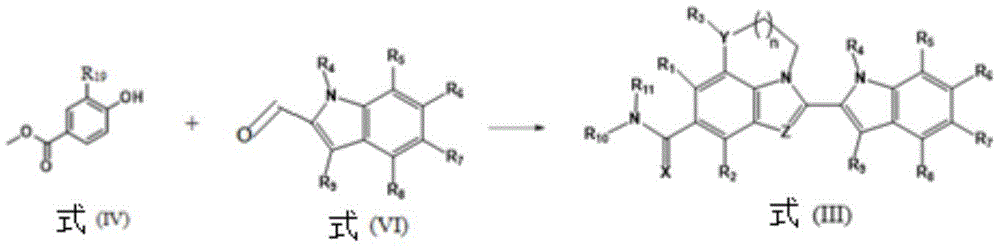
wherein R of formula (IV) 19 Selected from nitro radicalsOr C 1-6 An alkoxy group; x of formula (III) is selected from O or S; y is O or N; z is N; n is 1 to 2; r 1 、R 2 And R 9 Independently selected from hydrogen or C 1-6 An alkyl group; r is 5 、R 6 、R 7 And R 8 Independently selected from hydrogen, halogen, C 1-6 Alkyl radical, C 1-6 Alkoxy radical, C 2-6 alkenyl-C 5-6 Aryl or C 1-6 A heteroaryl group; r 3 Absent or selected from hydrogen, C 1-6 Alkyl radical, C 3-6 Cycloalkyl, C (O) C 1-6 Alkyl, SO 2 C 1-6 Alkyl, SO 2 C 3-6 Cycloalkyl or SO 2 C 5-6 Aryl radical, wherein, C 1-6 Alkyl, (CO) C 1-6 Alkyl, SO 2 C 5-6 Aryl and SO 2 C 1-6 Alkyl is optionally substituted by C 1-6 Alkoxy, halogen or C 5-6 Aryl substitution; r 4 Is selected from C 1-6 Alkyl radical, C 1-6 Haloalkyl, C 1-6 Alkoxy radical, C 1-6 alkyl-C 5-6 Aryl radical, C 1-6 alkyl-C 1-6 Heterocyclic radicals or C 1-6 alkyl-C 1-6 Heteroaryl of which C is 1-6 Alkyl radical C 1-6 alkyl-C 5-6 Aryl radical, C 1-6 alkyl-C 1-6 Heterocyclyl and C 1-6 alkyl-C 1-6 Heteroaryl is optionally substituted with one or more groups selected from: hydrogen, C 1-6 Alkyl radical, C 1-6 Alkoxy radical, C 3-8 Cycloalkyl, C 5-6 Aryl radical, C 1-6 Heteroaryl, halogen, hydroxy, -CH 2 OH or-COOH; r 10 And R 11 May together form a 5 to 6 membered monocyclic saturated heterocycle, wherein said 5 to 6 membered monocyclic saturated heterocycle is optionally selected from amino, C 1-6 Alkylamino or-NHC (O) CH = CHCH 2 N(CH 3 ) 2 Substituted with the substituent(s); r of the formula (IV) 9 Is hydrogen or C 1-6 An alkyl group; r is 5 、R 6 、R 7 And R 8 Independently selected from hydrogen, halogen, C 1-6 Alkyl radical, C 1-6 Alkoxy radical, C 2-6 alkenyl-C 5-6 Aryl or C 1-6 A heteroaryl group; and R 4 Is selected from C 1-6 Alkyl radical, C 1-6 Haloalkyl, C 1-6 Alkoxy radical, C 1-6 alkyl-C 5-6 Aryl radical, C 1-6 alkyl-C 1-6 Heterocyclic radicals or C 1-6 alkyl-C 1-6 Heteroaryl of which C 1-6 Alkyl radical, C 1-6 alkyl-C 5-6 Aryl radical, C 1-6 alkyl-C 1-6 Heterocyclyl and C 1-6 alkyl-C 1-6 Heteroaryl is optionally substituted with one or more groups selected from: hydrogen, C 1-6 Alkyl radical, C 1-6 Alkoxy radical, C 3-8 Cycloalkyl radical, C 5-6 Aryl radical, C 1-6 Heteroaryl, halogen, hydroxy, -CH 2 OH or-COOH.
11. A pharmaceutical composition comprising a compound of formula (I), formula (II) and formula (III), or a pharmaceutically acceptable salt thereof, as claimed in any one of claims 1 to 7, and a pharmaceutically acceptable carrier, optionally in combination with one or more other pharmaceutical compositions.
12. The pharmaceutical composition of claim 11, wherein the composition is in a form selected from the group consisting of a tablet, a capsule, a powder, a syrup, a solution, an aerosol, and a suspension.
13. A compound of any one of claims 1 to 7, or a pharmaceutically acceptable salt thereof, for use in the manufacture of a medicament for inhibiting one or more PAD in a cell.
14. Use of an effective amount of a compound of any one of claims 1 to 7 in the manufacture of a medicament for inhibiting one or more PAD families in a cell.
15. Use of a compound according to any one of claims 1 to 7 or a pharmaceutical composition according to any one of claims 11 or 12 for the manufacture of a medicament for the treatment of a PAD4 mediated disorder.
16. A compound as claimed in any one of claims 1 to 7 for use in the treatment of rheumatoid arthritis, vasculitis, systemic lupus erythematosus, ulcerative colitis, cancer, cystic fibrosis, asthma, cutaneous lupus erythematosus and psoriasis.
17. Use of a compound according to any one of claims 1 to 7 or a pharmaceutical composition according to claim 11 or 12 for the preparation of a medicament for the treatment and/or prophylaxis of rheumatoid arthritis, vasculitis, systemic lupus erythematosus, ulcerative colitis, cancer, cystic fibrosis, asthma, cutaneous lupus erythematosus, and psoriasis, wherein the medicament is in combination with other clinically relevant or biological agents.
18. Use of a compound according to any one of claims 1 to 7 or a pharmaceutical composition according to claim 11 or 12 for the manufacture of a medicament for the treatment and/or prevention of acid-induced lung injury, respiratory distress syndrome, allergen-induced asthma, allergic bronchopulmonary disease, chronic lung disease of premature infants, chronic obstructive pulmonary disease, colitis, cystic fibrosis, gouty arthritis, inflammatory bowel disease, inflammatory lung disease, inflammatory pain, juvenile rheumatoid arthritis, kidney disease, kidney injury caused by parasite infection, kidney transplant rejection prevention, lung injury, lupus nephritis, multiple sclerosis, muscular dystrophy, non-allergen-induced asthma, osteoarthritis, periodontitis, peritoneal endometriosis, psoriasis, lung disease, pulmonary fibrosis, suppurative arthritis, kidney disease, rheumatic disease, rheumatoid arthritis, sepsis, severe pain and ulcerative colitis, wherein the medicament is in combination with other clinically relevant or biological agents.
19. Use of a combination of a compound according to any one of claims 1 to 7 or a pharmaceutical composition according to claim 11 or 12 in the manufacture of a medicament for the treatment of rheumatoid arthritis, wherein the medicament is in combination with other clinically relevant or biological agents.
20. Use of a combination of a compound according to any one of claims 1 to 7 or a pharmaceutical composition according to claim 11 or 12 in the manufacture of a medicament for the treatment of cancer, wherein the medicament is in combination with other clinically relevant immunomodulators.
Applications Claiming Priority (3)
| Application Number | Priority Date | Filing Date | Title |
|---|---|---|---|
| IN201741033768 | 2017-09-22 | ||
| IN201741033768 | 2017-09-22 | ||
| PCT/IN2018/050614 WO2019058393A1 (en) | 2017-09-22 | 2018-09-20 | Heterocyclic compounds as pad inhibitors |
Publications (2)
| Publication Number | Publication Date |
|---|---|
| CN111108105A CN111108105A (en) | 2020-05-05 |
| CN111108105B true CN111108105B (en) | 2023-03-31 |
Family
ID=63834341
Family Applications (1)
| Application Number | Title | Priority Date | Filing Date |
|---|---|---|---|
| CN201880060972.6A Active CN111108105B (en) | 2017-09-22 | 2018-09-20 | Heterocyclic compounds as PAD inhibitors |
Country Status (19)
| Country | Link |
|---|---|
| US (2) | US11833156B2 (en) |
| EP (1) | EP3684767B1 (en) |
| JP (1) | JP7065951B2 (en) |
| KR (1) | KR102824574B1 (en) |
| CN (1) | CN111108105B (en) |
| AU (1) | AU2018336171B2 (en) |
| BR (1) | BR112020005489A2 (en) |
| CA (1) | CA3073656C (en) |
| DK (1) | DK3684767T3 (en) |
| ES (1) | ES2983048T3 (en) |
| FI (1) | FI3684767T3 (en) |
| HU (1) | HUE067314T2 (en) |
| IL (1) | IL273428B2 (en) |
| MX (1) | MX2020003242A (en) |
| PL (1) | PL3684767T3 (en) |
| PT (1) | PT3684767T (en) |
| RU (1) | RU2764243C2 (en) |
| SG (1) | SG11202002032SA (en) |
| WO (1) | WO2019058393A1 (en) |
Families Citing this family (28)
| Publication number | Priority date | Publication date | Assignee | Title |
|---|---|---|---|---|
| US11833156B2 (en) | 2017-09-22 | 2023-12-05 | Jubilant Epipad LLC | Heterocyclic compounds as pad inhibitors |
| WO2019077631A1 (en) | 2017-10-18 | 2019-04-25 | Jubilant Biosys Limited | Imidazo-pyridine compounds as pad inhibitors |
| KR20200085836A (en) | 2017-11-06 | 2020-07-15 | 주빌런트 프로델 엘엘씨 | Pyrimidine derivatives as PD1/PD-L1 activation inhibitors |
| BR112020010322A2 (en) | 2017-11-24 | 2020-11-17 | Jubilant Episcribe Llc | compound of the formula i; compound of the formula ia; compound of the formula ib; process for preparing compounds of formula i; pharmaceutical composition; method for the treatment and / or prevention of various diseases; use of compounds; method for treating cancer; and method for the treatment and / or prevention of a prmt5-mediated condition or a proliferative disorder or cancer |
| CN112105610B (en) | 2018-03-13 | 2024-01-26 | 朱比连特普罗德尔有限责任公司 | Bicyclic compounds as inhibitors of PD1/PD-L1 interaction/activation |
| EP3871673B1 (en) | 2018-10-26 | 2024-01-03 | Taiho Pharmaceutical Co., Ltd. | Novel indazole compound or salt thereof |
| BR112021017831A2 (en) * | 2019-03-11 | 2021-11-30 | Collaborative Medicinal Dev Llc | Heteroaromatic and heterobicyclic aromatic derivatives for the treatment of ferroptosis-related disorders |
| TW202544011A (en) | 2019-03-22 | 2025-11-16 | 美商基利科學股份有限公司 | Bridged tricyclic carbamoylpyridone compounds and their pharmaceutical use |
| MX2022005053A (en) | 2019-10-28 | 2022-05-18 | Merck Sharp & Dohme Llc | KRAS G12C MUTANT SMALL MOLECULE INHIBITORS. |
| WO2021084765A1 (en) * | 2019-10-31 | 2021-05-06 | Taiho Pharmaceutical Co., Ltd | 4-aminobut-2-enamide derivatives and salts thereof |
| US12479834B2 (en) | 2019-11-29 | 2025-11-25 | Taiho Pharmaceutical Co., Ltd. | Phenol compound or salt thereof |
| JP7453399B2 (en) | 2020-02-24 | 2024-03-19 | ギリアード サイエンシーズ, インコーポレイテッド | Tetracyclic compounds and their use for treating HIV infection |
| US20230107927A1 (en) | 2020-02-28 | 2023-04-06 | First Wave Bio, Inc. | Methods of treating iatrogenic autoimmune colitis |
| EP4143189A1 (en) | 2020-04-30 | 2023-03-08 | Gilead Sciences, Inc. | Macrocyclic inhibitors of peptidylarginine deiminases |
| IL300502A (en) * | 2020-08-12 | 2023-04-01 | Jubilant Epipad LLC | Method and compound for use, in treating and/or preventing netosis |
| KR20230079137A (en) | 2020-09-30 | 2023-06-05 | 길리애드 사이언시즈, 인코포레이티드 | Crosslinked Tricyclic Carbamoylpyridone Compounds and Uses Thereof |
| KR102524977B1 (en) | 2020-10-13 | 2023-04-26 | 한국기계연구원 | Method and apparatus for controlling NOx in incinerator by suppressing combustion variability |
| TW202241884A (en) | 2020-12-22 | 2022-11-01 | 美商基利科學股份有限公司 | Inhibitors of peptidylarginine deiminases |
| CN112618546B (en) * | 2020-12-22 | 2022-03-01 | 陈昊 | Application of PAD4 inhibitor in preparation of radiotherapy sensitizing drug |
| US12240862B2 (en) | 2020-12-22 | 2025-03-04 | Gilead Sciences, Inc. | Inhibitors of peptidylarginine deiminases |
| PL4196479T3 (en) | 2021-01-19 | 2024-03-18 | Gilead Sciences, Inc. | Substituted pyridotriazine compounds and uses thereof |
| AU2022387714A1 (en) * | 2021-11-15 | 2024-05-30 | Regor Pharmaceuticals, Inc. | Pad4 inhibitors and use thereof |
| TWI856796B (en) | 2022-04-06 | 2024-09-21 | 美商基利科學股份有限公司 | Bridged tricyclic carbamoylpyridone compounds and uses thereof |
| KR20250027599A (en) * | 2022-05-26 | 2025-02-26 | 셀진 코포레이션 | Heterocyclic PAD4 inhibitors |
| WO2025024265A1 (en) | 2023-07-21 | 2025-01-30 | Bristol-Myers Squibb Company | Methods of assessing citrullination and activity of pad4 modulators |
| TW202535891A (en) | 2023-10-20 | 2025-09-16 | 美商默沙東有限責任公司 | Small molecule inhibitors of kras proteins |
| WO2025181830A2 (en) * | 2024-03-01 | 2025-09-04 | Jubilant Epipad LLC | Polyheterocyclic compounds as peptidyl arginine deiminase 4 (pad4) inhibitors |
| WO2026020127A2 (en) | 2024-07-19 | 2026-01-22 | Bristol-Myers Squibb Company | Methods of assessing citrullination and activity of pad2 modulators |
Citations (3)
| Publication number | Priority date | Publication date | Assignee | Title |
|---|---|---|---|---|
| WO2004094430A1 (en) * | 2003-04-23 | 2004-11-04 | Glaxo Group Limited | Tricyclic indole derivatives and their use in the treatment of alzheimer’s disease |
| CN104470919A (en) * | 2012-07-26 | 2015-03-25 | 葛兰素集团有限公司 | 2 - (azaindol- 2 -yl) benz imidazoles as pad4 inhibitors |
| WO2016185279A1 (en) * | 2015-05-21 | 2016-11-24 | Glaxosmithkline Intellectual Property Development Limited | Benzoimidazole derivatives as pad4 inhibitors |
Family Cites Families (278)
| Publication number | Priority date | Publication date | Assignee | Title |
|---|---|---|---|---|
| GB1230663A (en) | 1968-12-10 | 1971-05-05 | ||
| GB1356789A (en) | 1970-08-06 | 1974-06-12 | Prodotti Antibiotici Spa | Derivatives of theophylline |
| DE2050657C3 (en) | 1970-10-15 | 1974-06-20 | Basf Ag, 6700 Ludwigshafen | Azo dyes, process for their preparation and their use |
| US3970753A (en) | 1973-06-12 | 1976-07-20 | Smith Kline & French Laboratories Limited | Imidazo[1,2-a]pyridines |
| DE2361390A1 (en) | 1973-12-10 | 1975-06-19 | Merck Patent Gmbh | ISOCHINOLINE DERIVATIVES AND THE PROCESS FOR THEIR PRODUCTION |
| DE2832677A1 (en) | 1978-07-26 | 1980-02-07 | Bayer Ag | 2,3-Di:aryl-2-hydroxy:propyl-imidazole derivs. - useful as antimycotic agents |
| US4246274A (en) | 1978-05-10 | 1981-01-20 | Bayer Aktiengesellschaft | Antimycotic hydroxypropyl-imidazoles |
| DE3210570A1 (en) | 1982-03-23 | 1983-10-06 | Hoechst Ag | 3-AZOLYL-1,2-DIARYL-1-HALOGEN-1-PROPENE, THEIR PRODUCTION, THEIR USE AS PLANT PROTECTION PRODUCTS, AND PREPARATIONS CONTAINING THESE COMPOUNDS |
| JPH0615527B2 (en) | 1983-01-21 | 1994-03-02 | アルカロイダ ベギエスゼテイ ギヤル | Alkyldiamine derivative, production method thereof and antiarrhythmic agent |
| DE3687030T2 (en) | 1985-03-15 | 1993-03-11 | Eugene Stirchak | STEREO-REGULAR POLYNUCLEOTID-BINDING POLYMERS. |
| DE3628545A1 (en) | 1985-09-23 | 1987-04-23 | Hoechst Ag | ARYLMETHYLAZOLES AND THEIR SALTS, METHOD FOR THE PRODUCTION THEREOF, MEANS CONTAINING THEM AND THEIR USE |
| JPH07100688B2 (en) | 1986-02-12 | 1995-11-01 | 大日本製薬株式会社 | Cyclic amine derivative |
| JPH07121911B2 (en) | 1986-03-26 | 1995-12-25 | クミアイ化学工業株式会社 | 4 (1H) -pyridinone derivatives and agricultural and horticultural fungicides |
| DE3631013A1 (en) | 1986-09-12 | 1988-03-24 | Thomae Gmbh Dr K | NEW NAPHTHYL DERIVATIVES, MEDICINAL PRODUCTS CONTAINING THESE COMPOUNDS AND METHOD FOR THE PRODUCTION THEREOF |
| EP0301751B1 (en) | 1987-07-31 | 1993-03-10 | Takeda Chemical Industries, Ltd. | Pyridinium derivatives, their production and use |
| US5210266A (en) | 1987-12-03 | 1993-05-11 | Dainippon Pharmaceutical Co., Ltd. | N-substituted mercaptopropanamide derivatives |
| US5179125A (en) | 1987-12-03 | 1993-01-12 | Dainippon Pharmaceutical Co., Ltd. | N-substituted mercaptopropanamide derivatives |
| GB8820231D0 (en) | 1988-08-25 | 1988-09-28 | Fujisawa Pharmaceutical Co | New benzazole compounds processes for preparation thereof & pharmaceutical composition comprising same |
| FR2638747B1 (en) | 1988-11-08 | 1993-12-24 | Synthelabo | PHENYLOXYPROPANOLAMINE DERIVATIVES, THEIR PREPARATION AND THEIR THERAPEUTIC APPLICATION |
| DE3901723A1 (en) | 1989-01-21 | 1990-07-26 | Bayer Ag | AZOLYL DERIVATIVES |
| JP2769711B2 (en) | 1989-02-17 | 1998-06-25 | 昭和電工株式会社 | Method for producing catalyst component for olefin polymerization and method for polymerizing olefin |
| US5229516A (en) | 1989-10-27 | 1993-07-20 | American Home Products Corporation | Substituted indole-, indene-, pyranoindole- and tetrahydrocarbazole-alkanoic acid derivatives as inhibitors of PLA2 and lipoxygenase |
| PT95692A (en) | 1989-10-27 | 1991-09-13 | American Home Prod | PROCESS FOR THE PREPARATION OF INDOLE-, INDENO-, PYRANOINDOLE- AND TETRA-HYDROCARBAZOLE-ALCANOIC ACID DERIVATIVES, OR WHICH ARE USEFUL AS PLA2 INHIBITORS AND LIPOXIGENASE |
| US5420289A (en) | 1989-10-27 | 1995-05-30 | American Home Products Corporation | Substituted indole-, indene-, pyranoindole- and tetrahydrocarbazole-alkanoic acid derivatives as inhibitors of PLA2 and lipoxygenase |
| DK0471236T3 (en) | 1990-07-30 | 1995-07-24 | Takeda Chemical Industries Ltd | Imidazopyridine derivatives and their use |
| ATE141909T1 (en) | 1991-07-03 | 1996-09-15 | Shionogi & Co | PHOSPHOLIPASE A2 INHIBITOR |
| FI924053A7 (en) | 1991-09-14 | 1993-03-15 | Hoechst Ag | Substituted aminopropanes, process for their preparation and use |
| CA2079374C (en) | 1991-09-30 | 2003-08-05 | Merck Frosst Canada Incorporated | (bicyclic-azaarylmethoxy)indoles as inhibitors of leukotriene biosynthesis |
| US5273980A (en) | 1991-09-30 | 1993-12-28 | Merck Frosst Canada Inc. | Bicyclic-azaarylmethoxy) indoles as inhibitors of leukotriene biosynthesis |
| US5330989A (en) | 1991-10-24 | 1994-07-19 | American Home Products Corporation | Heterocycles substituted with biphenyl-3-cyclobutene-1,2-dione derivatives |
| EP0618909A1 (en) | 1991-12-10 | 1994-10-12 | Hoechst Schering AgrEvo GmbH | Pyrimidinyl- or triazinyl-oxy(or thio)aldehyde derivatives and their use as herbicides or plant-growth regulators |
| GB9206757D0 (en) | 1992-03-27 | 1992-05-13 | Ferring Bv | Novel peptide receptor ligands |
| DE4227522A1 (en) | 1992-08-20 | 1994-02-24 | Bayer Ag | New dichroitic dyestuff cpds. and light-polarising film contg. these or known analogues - which are yellow or yellow-red and have excellent dichroitic property. |
| JP3298954B2 (en) | 1992-12-16 | 2002-07-08 | 三共株式会社 | Novel N, N'-dibenzoylhydrazine derivative and insecticidal composition |
| US5484926A (en) | 1993-10-07 | 1996-01-16 | Agouron Pharmaceuticals, Inc. | HIV protease inhibitors |
| SK120895A3 (en) | 1993-03-29 | 1996-06-05 | Zeneca Ltd | Pyridine derivatives, process for preparing the same and intermediate products in this process and pharmaceutical compositions containing them |
| IL109220A0 (en) | 1993-04-05 | 1994-07-31 | Synaptic Pharma Corp | Dihydropyridines and new uses thereof |
| AU6971894A (en) | 1993-05-27 | 1994-12-20 | Smithkline Beecham Laboratoires Pharmaceutiques | Anti-arrhythmic n-substituted 3-benzazepines or isoquinolines |
| FR2706895A1 (en) | 1993-06-22 | 1994-12-30 | Synthelabo | Tetrahydroisoquinoline derivatives, their preparation and their application in therapeutics |
| JPH07179402A (en) | 1993-10-20 | 1995-07-18 | Ishihara Sangyo Kaisha Ltd | Substituted benzene derivative, its production and pest-controlling agent containing the same |
| US5461154A (en) | 1994-02-02 | 1995-10-24 | Eli Lilly And Company | Intermediate and process for making |
| TW281667B (en) | 1994-02-03 | 1996-07-21 | Synthelabo | |
| GB9402807D0 (en) | 1994-02-14 | 1994-04-06 | Xenova Ltd | Pharmaceutical compounds |
| JPH07304770A (en) | 1994-05-11 | 1995-11-21 | Kanebo Ltd | New benzazepinone derivative |
| US5593994A (en) | 1994-09-29 | 1997-01-14 | The Dupont Merck Pharmaceutical Company | Prostaglandin synthase inhibitors |
| EP0793653A1 (en) | 1994-11-23 | 1997-09-10 | Neurogen Corporation | Certain 4-aminomethyl-2-substituted imidazole derivatives and 2-aminomethyl-4-substituted imidazole derivatives; new classes of dopamine receptor subtype specific ligands |
| US5541033A (en) | 1995-02-01 | 1996-07-30 | Ocg Microelectronic Materials, Inc. | Selected o-quinonediazide sulfonic acid esters of phenolic compounds and their use in radiation-sensitive compositions |
| US5554621A (en) | 1995-06-07 | 1996-09-10 | Bristol-Myers Squibb Company | Dihydropyridine NPY antagonists: nitrogen heterocyclic derivatives |
| US20030018025A1 (en) | 1995-06-07 | 2003-01-23 | Neurogen Corporation, Corporation Of The State Of Delaware | Certain 4-aminomethyl-2-substituted imidazole derivatives and 2-aminomethyl-4-substituted imidazole derivatives: new classes of dopamine receptor subtype specific ligands |
| EP0848957A1 (en) | 1995-09-08 | 1998-06-24 | Kanebo Ltd. | Fas LIGAND SOLUBILIZATION INHIBITOR |
| ZA967892B (en) | 1995-09-21 | 1998-03-18 | Lilly Co Eli | Selective β3 adrenergic agonists. |
| TR199801253T2 (en) | 1995-12-29 | 1998-12-21 | Smithkline Beecham Corporation | Vitronectin receptor antagonists. |
| AU2404897A (en) | 1996-04-24 | 1997-11-12 | Takeda Chemical Industries Ltd. | Fused imidazopyridine derivatives as antihyperlipidemic agents |
| ATE353937T1 (en) | 1996-07-17 | 2007-03-15 | Fuji Photo Film Co Ltd | METHOD FOR SYNTHESIS OF AN OXONOL COMPOUND |
| GB9717576D0 (en) | 1997-08-19 | 1997-10-22 | Xenova Ltd | Pharmaceutical compounds |
| HN1997000027A (en) | 1996-12-06 | 1997-06-05 | Pfizer Prod Inc | DERIVATIVES OF 6-PHENYL PIRIDIL - 2 AMINE |
| HUP9700392A1 (en) | 1997-02-10 | 1999-09-28 | ICN Magyarország Részvénytársaság | Cardioprotective pharmaceutical compositions containing one or two active ingredients |
| US6048877A (en) | 1997-02-21 | 2000-04-11 | Bristol-Myers Squibb Company | Tetralone derivatives as antiarrhythmic agents |
| WO1998038156A1 (en) | 1997-02-27 | 1998-09-03 | Takeda Chemical Industries, Ltd. | Amine compounds, their production and use as amyloid-beta production inhibitors |
| DE19717371A1 (en) | 1997-04-24 | 1998-10-29 | Basf Ag | Propargyl-terminated nematic or cholesteric polymers |
| ATE308535T1 (en) | 1997-07-31 | 2005-11-15 | Hoffmann La Roche | O-SUBSTITUTED HYDROXYCUMARANONE DERIVATIVES WITH ANTITUMORAL AND ANTIMETASTATIC EFFECTS |
| JPH11119379A (en) | 1997-10-08 | 1999-04-30 | Fuji Photo Film Co Ltd | Silver halide color photographic sensitive material and image forming method |
| WO1999032447A2 (en) | 1997-12-11 | 1999-07-01 | American Home Products Corporation | 2,4,6-trisubstituted pyridines with estrogenic activity and methods for the solid phase synthesis thereof |
| TW555757B (en) | 1998-07-31 | 2003-10-01 | Akzo Nobel Nv | Aminomethylcarboxylic acid derivatives |
| DE19834751A1 (en) | 1998-08-01 | 2000-02-03 | Boehringer Ingelheim Pharma | Disubstituted bicyclic heterocycles, their preparation and their use as medicines |
| WO2000023420A1 (en) | 1998-10-20 | 2000-04-27 | Takeda Chemical Industries, Ltd. | Aromatic amine derivatives, process for the preparation thereof and agents containing the same |
| GB9823873D0 (en) | 1998-10-30 | 1998-12-30 | Pharmacia & Upjohn Spa | 2-ureido-thiazole derivatives,process for their preparation,and their use as antitumour agents |
| JP4603679B2 (en) | 1999-12-14 | 2010-12-22 | 日本化薬株式会社 | Pest control agent |
| GB0007108D0 (en) | 2000-03-23 | 2000-05-17 | Novartis Ag | Organic compounds |
| US6534651B2 (en) | 2000-04-06 | 2003-03-18 | Inotek Pharmaceuticals Corp. | 7-Substituted isoindolinone inhibitors of inflammation and reperfusion injury and methods of use thereof |
| CN1251671C (en) | 2000-05-19 | 2006-04-19 | 武田药品工业株式会社 | Beta secretase inhibitors |
| MXPA02012560A (en) | 2000-06-30 | 2003-05-14 | Elan Pharm Inc | Compounds to treat alzheimer s disease. |
| US6846813B2 (en) | 2000-06-30 | 2005-01-25 | Pharmacia & Upjohn Company | Compounds to treat alzheimer's disease |
| US20020094989A1 (en) | 2000-10-11 | 2002-07-18 | Hale Jeffrey J. | Pyrrolidine modulators of CCR5 chemokine receptor activity |
| EP1326619A2 (en) | 2000-10-11 | 2003-07-16 | Merck & Co., Inc. | Pyrrolidine modulators of ccr5 chemokine receptor activity |
| SE0100568D0 (en) | 2001-02-20 | 2001-02-20 | Astrazeneca Ab | Compounds |
| DE10110750A1 (en) | 2001-03-07 | 2002-09-12 | Bayer Ag | Novel aminodicarboxylic acid derivatives with pharmaceutical properties |
| FR2822153B1 (en) | 2001-03-19 | 2003-10-31 | Servier Lab | NOVEL INDENOINDOLONE DERIVATIVES, PROCESS FOR THEIR PREPARATION AND PHARMACEUTICAL COMPOSITIONS CONTAINING SAME |
| CA2441790A1 (en) | 2001-03-27 | 2002-10-03 | Actelion Pharmaceuticals Ltd. | 1,2,3,4-tetrahydroisoquinolines derivatives as urotensin ii receptor antagonists |
| FR2822827B1 (en) | 2001-03-28 | 2003-05-16 | Sanofi Synthelabo | NOVEL N- (ARYLSULFONYL) BETA-AMINOACIDS DERIVATIVES COMPRISING A SUBSTITUTED AMINOMETHYL GROUP, THEIR PREPARATION METHOD AND THE PHARMACEUTICAL COMPOSITIONS CONTAINING THE SAME |
| CA2443868C (en) | 2001-04-10 | 2011-01-25 | Ortho-Mcneil Pharmaceutical, Inc. | 1,3,8-triazaspiro[4.5]decan-4-one derivatives useful for the treatment of orl-1 receptor mediated disorders |
| WO2002088089A1 (en) | 2001-04-19 | 2002-11-07 | Banyu Pharmaceutical Co., Ltd. | Spiropiperidine derivatives, nociceptin receptor antagonists containing the same as the active ingredient and medicinal compositions |
| AU2002310156A1 (en) | 2001-06-05 | 2002-12-16 | Boehringer Ingelheim Pharmaceuticals, Inc. | 1,4-disubstituted benzo-fused cycloalkyl urea compounds |
| US7192982B2 (en) | 2001-06-07 | 2007-03-20 | Ligand Pharmaceuticals, Inc. | Modulators of peroxisome proliferator activated receptors |
| BR0212676A (en) * | 2001-09-21 | 2006-05-23 | Upjohn Co | 5-ht ligand therapeutic compounds, pharmaceutical compositions comprising such compounds and their uses |
| SI1441734T1 (en) | 2001-10-26 | 2007-08-31 | Angeletti P Ist Richerche Bio | Dihydroxypyrimidine carboxamide inhibitors of hiv integrase |
| SE0103644D0 (en) | 2001-11-01 | 2001-11-01 | Astrazeneca Ab | Therapeutic isoquinoline compounds |
| AU2002347982A1 (en) | 2001-11-20 | 2003-06-10 | Eli Lilly And Company | 3-SUBSTITUTED OXINDOLE Beta3 AGONISTS |
| ES2299618T3 (en) | 2001-11-20 | 2008-06-01 | Eli Lilly And Company | BETA-3-ADRENERGIC AGONISTS. |
| GB0202873D0 (en) | 2002-02-07 | 2002-03-27 | Novartis Ag | Organic compounds |
| US6875780B2 (en) | 2002-04-05 | 2005-04-05 | Warner-Lambert Company | Compounds that modulate PPAR activity and methods for their preparation |
| AU2003248122A1 (en) | 2002-07-25 | 2004-02-16 | Kotobuki Pharmaceutical Co., Ltd. | Sodium channel inhibitor |
| EP1388342A1 (en) | 2002-08-07 | 2004-02-11 | Aventis Pharma Deutschland GmbH | Acylated, heteroaryl-condensed cycloalkenylamines and their use as pharmaceuticals |
| EP1601674B1 (en) | 2002-09-09 | 2012-08-08 | Janssen Pharmaceutica NV | Hydroxyalkyl substituted 1,3,8-triazaspiro[4.5]decan-4-one derivatives useful for the treatment of ORL-1 receptor mediated disorders |
| WO2004035579A1 (en) | 2002-10-15 | 2004-04-29 | Takeda Pharmaceutical Company Limited | Imidazopyridine derivative, process for producing the same, and use |
| CA2507026A1 (en) | 2002-11-22 | 2004-06-10 | Takeda Pharmaceutical Company Limited | Imidazole derivatives, their production and use |
| ATE370118T1 (en) | 2002-12-06 | 2007-09-15 | Bayer Healthcare Ag | TETRAHYDRONAPHTALENE DERIVATIVES |
| EP1581472A2 (en) | 2002-12-20 | 2005-10-05 | MIGENIX Corp. | Ligands of adenine nucleotide translocase (ant) and compositions and methods related thereto |
| PT1585749E (en) | 2003-01-09 | 2008-10-23 | Pfizer | Diazepinoindole derivatives as kinase inhibitors |
| WO2004078731A1 (en) | 2003-03-06 | 2004-09-16 | 'chemical Diversity Research Institute', Ltd. | Quinoline-carboxylic acids and the derivatives thereof, a focused library |
| KR20060023520A (en) | 2003-03-11 | 2006-03-14 | 후지필름 일렉트로닉 머티리얼스 유.에스.에이., 아이엔씨. | Novel Photosensitive Resin Compositions |
| JP2005060247A (en) | 2003-08-12 | 2005-03-10 | Takeda Chem Ind Ltd | Isoquinolinone derivative and its production method and use |
| US7504401B2 (en) | 2003-08-29 | 2009-03-17 | Locus Pharmaceuticals, Inc. | Anti-cancer agents and uses thereof |
| JP4769082B2 (en) | 2003-12-17 | 2011-09-07 | 武田薬品工業株式会社 | Urea derivatives, their production and use |
| US20050159334A1 (en) | 2004-01-16 | 2005-07-21 | Gluck Oscar S. | Method for treating rheumatoid arthritis by inhibiting peptidylarginine deiminase |
| KR101258504B1 (en) | 2004-03-26 | 2013-04-26 | 메틸진 인코포레이티드 | Inhibitors of histone deacetylase |
| TWI351282B (en) | 2004-04-07 | 2011-11-01 | Theravance Inc | Quinolinone-carboxamide compounds as 5-ht4 recepto |
| RU2266906C1 (en) | 2004-04-29 | 2005-12-27 | Общество с ограниченной ответственностью "Исследовательский Институт Химического Разнообразия" (ООО "Исследовательский Институт Химического Разнообразия") | Anellated carbamoyl azaheterocycles, methods for their preparing (variants), pharmaceutical composition, focused library |
| GB0413605D0 (en) | 2004-06-17 | 2004-07-21 | Addex Pharmaceuticals Sa | Novel compounds |
| US7488745B2 (en) | 2004-07-16 | 2009-02-10 | Schering Corporation | Compounds for the treatment of inflammatory disorders |
| EP1655283A1 (en) | 2004-11-08 | 2006-05-10 | Evotec OAI AG | 11beta-HSD1 Inhibitors |
| JP2008007405A (en) | 2004-12-07 | 2008-01-17 | Takeda Chem Ind Ltd | Carboxamide derivative |
| CA2588037A1 (en) | 2004-12-22 | 2006-06-29 | Theravance, Inc. | Indazole-carboxamide compounds |
| JP3962404B2 (en) | 2004-12-27 | 2007-08-22 | 株式会社東京測器研究所 | An unnecessary component measuring method in the wheel 6 component force measuring system. |
| US7297700B2 (en) | 2005-03-24 | 2007-11-20 | Renovis, Inc. | Bicycloheteroaryl compounds as P2X7 modulators and uses thereof |
| DE102005016547A1 (en) | 2005-04-08 | 2006-10-12 | Grünenthal GmbH | Substituted 5,6,7,8-tetrahydro-imidazo (1,2-a) pyridin-2-ylamine compounds and their use for the preparation of medicaments |
| PT1881823E (en) | 2005-05-17 | 2015-03-02 | Sarcode Bioscience Inc | COMPOSITIONS AND METHODS FOR THE TREATMENT OF EYE DISORDERS |
| AR054363A1 (en) | 2005-05-23 | 2007-06-20 | Astrazeneca Ab | COMPOUNDS THAT DISPLAY MODULATORY ACTIVITY IN THE 5-HYDROXY-TRIPTAMINE 6 RECEIVER |
| AU2006252540B2 (en) | 2005-06-02 | 2011-12-01 | Jenrin Discovery | MAO-B inhibitors useful for treating obesity |
| US7317022B2 (en) | 2005-06-07 | 2008-01-08 | Theravance, Inc. | Benzoimidazolone-carboxamide compounds as 5-HT4 receptors agonists |
| US7592461B2 (en) | 2005-12-21 | 2009-09-22 | Bristol-Myers Squibb Company | Indane modulators of glucocorticoid receptor, AP-1, and/or NF-κB activity and use thereof |
| JP2009524689A (en) | 2006-01-25 | 2009-07-02 | スミスクライン ビーチャム コーポレーション | Compound |
| US20070191371A1 (en) | 2006-02-14 | 2007-08-16 | Kalypsys, Inc. | Heterocyclic modulators of ppar |
| MX2008011615A (en) | 2006-03-14 | 2008-09-22 | Amgen Inc | Bicyclic carboxylic acid derivatives useful for treating metabolic disorders. |
| RU2302417C1 (en) | 2006-03-14 | 2007-07-10 | Иващенко Андрей Александрович | 1-oxo-3-(1h-indol-3-yl)-1,2,3,4-tetrahydroisoquinolines, methods of preparation thereof, combinatory library, and focused library |
| JP2007304770A (en) | 2006-05-10 | 2007-11-22 | Dainippon Screen Mfg Co Ltd | Simulation system, simulation device, simulation method, and program |
| RU2303597C1 (en) | 2006-05-12 | 2007-07-27 | Иващенко Андрей Александрович | Pharmaceutical composition, method for its preparing and using |
| US20080280891A1 (en) | 2006-06-27 | 2008-11-13 | Locus Pharmaceuticals, Inc. | Anti-cancer agents and uses thereof |
| WO2008000408A1 (en) | 2006-06-28 | 2008-01-03 | Sanofi-Aventis | Cxcr2 antagonists |
| WO2008008059A1 (en) | 2006-07-12 | 2008-01-17 | Locus Pharmaceuticals, Inc. | Anti-cancer agents ans uses thereof |
| DE102006039003A1 (en) | 2006-08-19 | 2008-02-21 | Boehringer Ingelheim Pharma Gmbh & Co. Kg | New connections |
| CN101528744A (en) | 2006-10-20 | 2009-09-09 | Irm责任有限公司 | Compositions and methods for modulating C-KIT and PDGFR receptors |
| WO2008064320A2 (en) | 2006-11-21 | 2008-05-29 | University Of Virginia Patent Foundation | Hydrindane analogs having sphingosine 1-phosphate receptor agonist activity |
| EP2591675A1 (en) | 2006-11-27 | 2013-05-15 | H. Lundbeck A/S | Heteroaryl amide derivatives |
| WO2008065500A2 (en) | 2006-11-30 | 2008-06-05 | Pfizer Products Inc. | Heteroaryl amides as type i glycine transport inhibitors |
| US20100216767A1 (en) | 2006-12-22 | 2010-08-26 | Mina Aikawa | Quinazolines for pdk1 inhibition |
| US20090069373A1 (en) | 2007-02-28 | 2009-03-12 | Wyeth | Quinoline Acids |
| EP2137158A4 (en) | 2007-02-28 | 2012-04-18 | Methylgene Inc | Small molecule inhibitors of protein arginine methyltransferases (prmts) |
| WO2008112715A2 (en) | 2007-03-12 | 2008-09-18 | Vm Discovery Inc. | Novel agents of calcium ion channel modulators |
| US20100144751A1 (en) | 2007-03-28 | 2010-06-10 | Array Biopharma Inc. | IMIDAZO[1,2-a]PYRIDINE COMPOUNDS AS RECEPTOR TYROSINE KINASE INHIBITORS |
| JP5313881B2 (en) | 2007-04-04 | 2013-10-09 | 興和株式会社 | Tetrahydroisoquinoline compounds |
| JP2008280344A (en) | 2007-04-12 | 2008-11-20 | Sumitomo Chemical Co Ltd | Hydrazide compound and harmful arthropod control agent containing the same |
| AR066379A1 (en) | 2007-05-02 | 2009-08-12 | Boehringer Ingelheim Int | CARBOXILIC ACID AMIDAS ITS PREPARATION AND ITS USE AS MEDICATIONS |
| MX2009013676A (en) | 2007-06-15 | 2010-06-01 | Mission Pharma Co | Methods and compositions to inhibit edema factor and adenylyl cyclase. |
| BRPI0813105A2 (en) | 2007-06-20 | 2015-08-04 | Mitsubishi Tanabe Pharma Corp | Sulfonamide derivative of malonic acid and its pharmaceutical use |
| RU2345996C1 (en) | 2007-07-17 | 2009-02-10 | Андрей Александрович Иващенко | Annelated azaheterocyclic amides, which include pyrimidine fragment, method of obtaining and their application |
| WO2009023179A2 (en) | 2007-08-10 | 2009-02-19 | Genelabs Technologies, Inc. | Nitrogen containing bicyclic chemical entities for treating viral infections |
| WO2009048152A2 (en) | 2007-10-11 | 2009-04-16 | Sumitomo Chemical Company, Limited | Unsaturated imine compound and use thereof for pest control |
| MX2010004281A (en) | 2007-10-19 | 2010-09-10 | Sarcode Corp | Compositions and methods for treatment of diabetic retinopathy. |
| EP2072050A1 (en) | 2007-12-21 | 2009-06-24 | Santhera Pharmaceuticals (Schweiz) AG | Compounds with anti-emetic effect |
| WO2009086303A2 (en) | 2007-12-21 | 2009-07-09 | University Of Rochester | Method for altering the lifespan of eukaryotic organisms |
| FR2925902B1 (en) | 2008-01-02 | 2011-01-07 | Sanofi Aventis | IMIDAZO-1,2-α-PYRIDINE-2-CARBOXAMIDE DERIVATIVES, THEIR PREPARATION AND THEIR THERAPEUTIC USE |
| RU2371444C1 (en) | 2008-01-24 | 2009-10-27 | Андрей Александрович Иващенко | FURO- AND THIENO[2,3-b]-QUINOLINE-2-CARBOXAMIDES, METHOD OF PRODUCTION AND ANTITUBERCULOUS ACTIVITY |
| TWI413522B (en) | 2008-02-22 | 2013-11-01 | Otsuka Pharma Co Ltd | Benzodiazepine compound and pharmaceutical composition |
| JP2009209090A (en) | 2008-03-04 | 2009-09-17 | Mitsui Chemicals Inc | Insecticide, compound contained in the insecticide, and method of using the compound |
| US20090264433A1 (en) | 2008-04-21 | 2009-10-22 | Institute For Oneworld Health | Compounds, Compositions and Methods Comprising Triazine Derivatives |
| WO2009137309A2 (en) | 2008-05-01 | 2009-11-12 | Travel Tech Systems, Llc | Process and system to determine commercial airline arrivals |
| US8148408B2 (en) | 2008-05-09 | 2012-04-03 | Abbott Laboratories | Selective substituted pyridine ligands for neuronal nicotinic receptors |
| WO2009140101A2 (en) | 2008-05-12 | 2009-11-19 | Boehringer Ingelheim International Gmbh | Imidazopyridine compounds useful as mmp-13 inhibitors |
| JP2009274984A (en) | 2008-05-14 | 2009-11-26 | Sumitomo Chemical Co Ltd | Compound, optical film and method for producing optical film |
| US20100121052A1 (en) | 2008-06-20 | 2010-05-13 | Rama Jain | Novel compounds for treating proliferative diseases |
| MX2011004125A (en) | 2008-10-21 | 2011-05-19 | Metabolex Inc | Aryl gpr120 receptor agonists and uses thereof. |
| DE102008060958A1 (en) | 2008-12-06 | 2010-07-08 | Saltigo Gmbh | Hydroxytetralone |
| RU2586212C2 (en) | 2008-12-08 | 2016-06-10 | Мандифарма Интернэшнл Корпорейшн Лимитед | Protein tyrosine kinase receptor inhibitor compositions |
| US8367700B2 (en) | 2008-12-17 | 2013-02-05 | Gruenenthal Gmbh | Substituted 4-(1.2,3,4-tetrahydroisoquinolin-2-yl)-4-oxobutyric acid amide as KCNQ2/3 modulators |
| US20100204265A1 (en) | 2009-02-09 | 2010-08-12 | Genelabs Technologies, Inc. | Certain Nitrogen Containing Bicyclic Chemical Entities for Treating Viral Infections |
| JP2012051806A (en) | 2009-02-26 | 2012-03-15 | Eisai R & D Management Co Ltd | Imidazolylpyrazine derivative |
| KR101641385B1 (en) | 2009-03-16 | 2016-07-20 | 스미또모 가가꾸 가부시끼가이샤 | Compound, optical film and process for producing optical film |
| JP5899607B2 (en) | 2009-03-16 | 2016-04-06 | 住友化学株式会社 | Compound, optical film and method for producing optical film |
| TW201100398A (en) | 2009-03-31 | 2011-01-01 | Arqule Inc | Substituted indolo-pyridinone compounds |
| US20110077250A1 (en) | 2009-06-26 | 2011-03-31 | Ryder Sean | Compounds for modulating rna binding proteins and uses therefor |
| JP5669481B2 (en) | 2009-08-21 | 2015-02-12 | 大塚製薬株式会社 | Pharmaceutical composition |
| GB0914767D0 (en) | 2009-08-24 | 2009-09-30 | Sterix Ltd | Compound |
| EP2357176A1 (en) | 2010-01-15 | 2011-08-17 | Hybrigenics S.A. | Amidoacridine derivatives useful as selective inhibitors of ubiquitin specific protease 7 |
| SG10202012179RA (en) | 2010-02-11 | 2021-01-28 | Celgene Corp | Arylmethoxy isoindoline derivatives and compositions comprising and methods of using the same |
| UY33304A (en) | 2010-04-02 | 2011-10-31 | Amgen Inc | HETEROCYCLIC COMPOUNDS AND THEIR USES |
| US8697911B2 (en) | 2010-07-07 | 2014-04-15 | Boehringer Ingelheim International Gmbh | Rho kinase inhibitors |
| US9079880B2 (en) | 2010-07-07 | 2015-07-14 | Boehringer Ingelheim International Gmbh | Rho kinase inhibitors |
| MX2013001970A (en) | 2010-08-20 | 2013-08-09 | Hutchison Medipharma Ltd | PIRROLOPIRIMIDINE COMPOUNDS AND USES OF THE SAME. |
| WO2012022045A1 (en) | 2010-08-20 | 2012-02-23 | Hutchison Medipharma Limited | Pyrrolopyrimidine compounds and uses thereof |
| EP2632461A4 (en) | 2010-10-29 | 2014-04-02 | Merck Sharp & Dohme | ISOINDOLINONE COMPOUNDS USEFUL AS PDE INHIBITORS 10 |
| JP5918264B2 (en) | 2010-12-22 | 2016-05-18 | アッヴィ・インコーポレイテッド | Hepatitis C inhibitor and use thereof |
| AU2012276037A1 (en) | 2011-06-29 | 2014-02-13 | Mayo Foundation For Medical Education And Research | Small molecule CD38 inhibitors and methods of using same |
| JP6284475B2 (en) | 2011-06-29 | 2018-02-28 | ザ ジェネラル ホスピタル コーポレイション | Compositions and methods for enhancing bioenergetic status in female germ cells |
| US9938269B2 (en) | 2011-06-30 | 2018-04-10 | Abbvie Inc. | Inhibitor compounds of phosphodiesterase type 10A |
| JP2014198669A (en) | 2011-08-03 | 2014-10-23 | 杏林製薬株式会社 | Biaryl ester derivatives and drugs containing them as active ingredients |
| WO2013025733A1 (en) | 2011-08-15 | 2013-02-21 | Intermune, Inc. | Lysophosphatidic acid receptor antagonists |
| US9216968B2 (en) | 2011-08-18 | 2015-12-22 | Nippon Shinyaku Co., Ltd. | Heterocyclic derivative and pharmaceutical drug |
| US20130116241A1 (en) | 2011-11-09 | 2013-05-09 | Abbvie Inc. | Novel inhibitor compounds of phosphodiesterase type 10a |
| EP2794611B1 (en) | 2011-12-22 | 2017-10-11 | Gilead Sciences, Inc. | Pyrazolo[1,5-a]pyrimidines as antiviral agents |
| JP2015503518A (en) | 2011-12-23 | 2015-02-02 | ノバルティス アーゲー | Compound for inhibiting interaction between BCL2 and binding partner |
| EA201491268A1 (en) | 2011-12-23 | 2014-11-28 | Новартис Аг | COMPOUNDS AND COMPOSITIONS FOR INHIBITING THE INTERACTION OF BCL2 WITH PARTNERS ON THE LINKAGE |
| JP2015503519A (en) | 2011-12-23 | 2015-02-02 | ノバルティス アーゲー | Compound for inhibiting interaction between BCL2 and binding partner |
| CA2859867A1 (en) | 2011-12-23 | 2013-06-27 | Novartis Ag | Compounds for inhibiting the interaction of bcl2 with binding partners |
| CZ2012114A3 (en) | 2012-02-17 | 2013-02-20 | Zentiva, K.S. | Process for preparing rivaroxaban based on saving of 1,1?-carbonyldiimidazole |
| US8859541B2 (en) | 2012-02-27 | 2014-10-14 | Boehringer Ingelheim International Gmbh | 6-alkynylpyridines |
| US9296725B2 (en) | 2012-05-24 | 2016-03-29 | Cellzome Limited | Heterocyclyl pyrimidine analogues as TYK2 inhibitors |
| EP2669276A1 (en) | 2012-05-31 | 2013-12-04 | Université de Strasbourg | Ornithine- and lysine-derivatives for the treatment of pain |
| CA2877301A1 (en) | 2012-06-20 | 2013-12-27 | Michael J. Heller | Dynamic biomimetic synzyme catalyst, catalysis, and catalytic systems |
| FR2993564B1 (en) | 2012-07-20 | 2014-08-22 | Metabrain Res | IMIDAZOPYRIDINE DERIVATIVES USEFUL IN THE TREATMENT OF DIABETES |
| WO2014031872A2 (en) | 2012-08-23 | 2014-02-27 | The Broad Institute, Inc. | Small molecule inhibitors for treating parasitic infections |
| CA2882826A1 (en) | 2012-08-24 | 2014-02-27 | Board Of Regents Of The University Of Texas System | Pro-neurogenic compounds |
| WO2014077321A1 (en) | 2012-11-15 | 2014-05-22 | 高砂香料工業株式会社 | Aluminum catalyst |
| HRP20182037T1 (en) | 2012-12-21 | 2019-02-08 | Epizyme, Inc. | PRMT5 INHIBITORS AND THEIR USE |
| US20150344457A1 (en) | 2012-12-21 | 2015-12-03 | Epizyme, Inc. | Methods of inhibiting prmt5 |
| WO2014152018A1 (en) | 2013-03-14 | 2014-09-25 | The Trustees Of Columbia University In The City Of New York | Octahydrocyclopentapyrroles, their preparation and use |
| FR3008976A1 (en) | 2013-07-23 | 2015-01-30 | Servier Lab | "NOVEL INDOLIZINE DERIVATIVES, PROCESS FOR PREPARING THEM AND PHARMACEUTICAL COMPOSITIONS CONTAINING THEM" |
| MX2016002075A (en) | 2013-08-27 | 2016-05-26 | Squibb Bristol Myers Co | Ido inhibitors. |
| CA2923184A1 (en) | 2013-09-04 | 2015-03-12 | Bristol-Myers Squibb Company | Compounds useful as immunomodulators |
| GB201321746D0 (en) | 2013-12-09 | 2014-01-22 | Ucb Pharma Sa | Therapeutic agents |
| GB201321730D0 (en) | 2013-12-09 | 2014-01-22 | Ucb Pharma Sa | Therapeutic agents |
| WO2015108038A1 (en) | 2014-01-17 | 2015-07-23 | 第一三共株式会社 | Ethylene glycol compound |
| ES2693255T3 (en) | 2014-02-27 | 2018-12-10 | Ono Pharmaceutical Co., Ltd. | Compound exhibiting selective EP2 agonist activity |
| US9067898B1 (en) | 2014-03-07 | 2015-06-30 | Janssen Pharmaceutica Nv | Isothiazole derivatives as GPR120 agonists for the treatment of type II diabetes |
| ME03472B (en) | 2014-03-19 | 2020-01-20 | Boehringer Ingelheim Int | Heteroaryl sik inhibitors |
| WO2015197028A1 (en) | 2014-06-28 | 2015-12-30 | Sunshine Lake Pharma Co., Ltd. | Compounds as hepatitis c virus (hcv) inhibitors and uses thereof in medicine |
| AU2015291522B2 (en) | 2014-07-17 | 2018-12-06 | Sunshine Lake Pharma Co., Ltd. | Substituted urea derivatives and pharmaceutical uses thereof |
| US10081624B2 (en) | 2014-08-26 | 2018-09-25 | Takeda Pharmaceutical Company Limited | Heterocyclic compound |
| GB201415573D0 (en) | 2014-09-03 | 2014-10-15 | Cancer Therapeutics Crc Pty Ltd | Compounds |
| US10005792B2 (en) | 2014-09-03 | 2018-06-26 | Ctxt Pty. Ltd. | Aminoindane-, aminotetrahydronaphthalene- and aminobenzocyclobutane-derived PRMT5-inhibitors |
| US9877957B2 (en) | 2014-09-05 | 2018-01-30 | Merck Sharp & Dohme Corp. | Tetrahydroisoquinoline derivatives useful as inhibitors of diacylglyceride O-acyltransferase 2 |
| CN105461693B (en) | 2014-09-26 | 2019-10-25 | 广东东阳光药业有限公司 | CRTH2 antagonist compounds and uses thereof |
| AU2015326506B2 (en) | 2014-10-03 | 2021-02-25 | Divya MAHESHWARI | Novel anthranilic acid derivatives |
| ES2578377B1 (en) | 2014-12-22 | 2017-05-04 | Consejo Superior De Investigaciones Científicas (Csic) | DREAM CALCIUM NEURONAL SENSOR MODULATING COMPOUNDS AND THERAPEUTIC USES. |
| AU2016289621A1 (en) * | 2015-07-03 | 2018-02-22 | Anca CATRINA | Methods and compounds for the alleviation and/or prevention of bone loss |
| WO2017024180A1 (en) | 2015-08-06 | 2017-02-09 | Amgen Inc. | Vinyl fluoride cyclopropyl fused thiazin-2-amine compounds as beta-secretase inhibitors and methods of use |
| US10906897B2 (en) | 2015-08-12 | 2021-02-02 | Syngenta Participations Ag | Microbiocidal heterobicyclic derivatives |
| CN112409378A (en) | 2015-09-08 | 2021-02-26 | 豪夫迈·罗氏有限公司 | Tricyclic PI3K inhibitor compounds and methods of use |
| SG10201912959QA (en) | 2015-10-21 | 2020-02-27 | Otsuka Pharma Co Ltd | Benzolactam compounds as protein kinase inhibitors |
| MA44075A (en) | 2015-12-17 | 2021-05-19 | Incyte Corp | N-PHENYL-PYRIDINE-2-CARBOXAMIDE DERIVATIVES AND THEIR USE AS MODULATORS OF PROTEIN / PROTEIN PD-1 / PD-L1 INTERACTIONS |
| US10280159B2 (en) | 2015-12-22 | 2019-05-07 | AbbVie Deutschland GmbH & Co. KG | Fused (hetero)cyclic compounds as S1P modulators |
| EP3190103A1 (en) | 2016-01-08 | 2017-07-12 | Rijksuniversiteit Groningen | Inhibitors of the pd-1/pd-l1 protein/protein interaction |
| TW201825476A (en) | 2016-02-23 | 2018-07-16 | 扣鎖醫療公司 | Heteroaryl inhibitor of PAD4 |
| AU2017286368B2 (en) | 2016-06-16 | 2021-02-25 | Janssen Sciences Ireland Unlimited Company | Heterocyclic compounds as antibacterials |
| ES2836402T3 (en) | 2016-06-30 | 2021-06-25 | Viiv Healthcare Uk No 5 Ltd | Azadecalin derivatives as inhibitors of human immunodeficiency virus replication |
| CN108602802B (en) | 2016-07-26 | 2020-01-21 | 深圳市塔吉瑞生物医药有限公司 | Aminopyrimidines for Inhibiting Protein Tyrosine Kinase Activity |
| JP2019530732A (en) | 2016-08-03 | 2019-10-24 | アライジング・インターナショナル・インコーポレイテッドArising International, Inc. | Symmetric or semi-symmetrical compounds useful as immune modulators |
| TWI795381B (en) | 2016-12-21 | 2023-03-11 | 比利時商健生藥品公司 | Pyrazole derivatives as malt1 inhibitors |
| WO2018112843A1 (en) | 2016-12-22 | 2018-06-28 | Merck Sharp & Dohme Corp. | Heteroaryl piperidine ether allosteric modulators of the m4 muscarinic acetylcholine receptor |
| CN110099900B (en) | 2016-12-27 | 2022-12-02 | 山东大学 | Hedgehog Pathway Inhibitors Targeting Smoothened Mutants |
| CN107056630B (en) | 2017-01-23 | 2020-01-17 | 合肥工业大学 | A kind of indane derivative and its synthetic method and use in medicine |
| US12012467B2 (en) | 2017-03-28 | 2024-06-18 | Regents Of The University Of Michigan | Small molecule DCN1 inhibitors and therapeutic methods using the same |
| WO2018208985A2 (en) | 2017-05-10 | 2018-11-15 | Forge Therapeutics, Inc. | Antibacterial compounds |
| CN107163044B (en) | 2017-06-19 | 2021-04-23 | 广东药科大学 | A class of naphthalene ethylenedione compounds with protease modification activity and their derivatives |
| WO2018234342A1 (en) | 2017-06-21 | 2018-12-27 | F. Hoffmann-La Roche Ag | Isoindolinone derivatives as irak4 modulators |
| GB201710851D0 (en) | 2017-07-06 | 2017-08-23 | Galápagos Nv | Novel compounds and pharmaceutical compositions thereof for the treatment of fibrosis |
| US11833156B2 (en) | 2017-09-22 | 2023-12-05 | Jubilant Epipad LLC | Heterocyclic compounds as pad inhibitors |
| WO2019077631A1 (en) | 2017-10-18 | 2019-04-25 | Jubilant Biosys Limited | Imidazo-pyridine compounds as pad inhibitors |
| KR20250037575A (en) | 2017-10-20 | 2025-03-17 | 반더빌트유니버시티 | Antagonists of the muscarinic acetylcholine receptor m4 |
| KR20200085836A (en) | 2017-11-06 | 2020-07-15 | 주빌런트 프로델 엘엘씨 | Pyrimidine derivatives as PD1/PD-L1 activation inhibitors |
| BR112020010322A2 (en) | 2017-11-24 | 2020-11-17 | Jubilant Episcribe Llc | compound of the formula i; compound of the formula ia; compound of the formula ib; process for preparing compounds of formula i; pharmaceutical composition; method for the treatment and / or prevention of various diseases; use of compounds; method for treating cancer; and method for the treatment and / or prevention of a prmt5-mediated condition or a proliferative disorder or cancer |
| ES2922174T3 (en) | 2017-12-19 | 2022-09-09 | Bristol Myers Squibb Co | Amide Substituted Indole Compounds Useful as TLR Inhibitors |
| CN110117278B (en) | 2018-02-07 | 2022-07-19 | 石家庄以岭药业股份有限公司 | Alkoxybenzo five-membered (six-membered) heterocyclic amine compound and pharmaceutical application thereof |
| CN111727390B (en) | 2018-02-14 | 2021-11-02 | 富士胶片株式会社 | Polymerizable liquid crystal composition, optical film, polarizer, and image display device |
| CN112105610B (en) | 2018-03-13 | 2024-01-26 | 朱比连特普罗德尔有限责任公司 | Bicyclic compounds as inhibitors of PD1/PD-L1 interaction/activation |
| JP6956033B2 (en) | 2018-03-14 | 2021-10-27 | 日本化薬株式会社 | A benzoazole compound and a pigment composition containing the same. |
| CN108358917B (en) | 2018-04-24 | 2020-06-19 | 北京市结核病胸部肿瘤研究所 | Imidazo [1,2-a ] pyridine-3-amide compound containing basic fused ring segment and preparation method thereof |
| WO2019205147A1 (en) | 2018-04-28 | 2019-10-31 | 上海璃道医药科技有限公司 | Amino acetamide compound containing benzo oxygen-containing aliphatic ring structure and use thereof |
| WO2019213234A1 (en) | 2018-05-01 | 2019-11-07 | The Trustees Of Columbia University In The City Of New York | Triazolopyrimidines, their preparation and use |
| CN120267838A (en) | 2018-08-01 | 2025-07-08 | 纽约市哥伦比亚大学理事会 | RBP4 antagonists for the treatment and prevention of nonalcoholic fatty liver disease and gout |
| AU2019316858B2 (en) | 2018-08-06 | 2024-03-28 | Moexa Pharmaceuticals Limited | Smad3 inhibitors |
| WO2020045216A1 (en) | 2018-08-28 | 2020-03-05 | 富士フイルム株式会社 | Layered body and image display device |
| CN110963997A (en) | 2018-09-28 | 2020-04-07 | 四川科伦博泰生物医药股份有限公司 | Heterocyclic amide compound, pharmaceutical composition containing same, and preparation method and application of heterocyclic amide compound |
| EP3643711A1 (en) | 2018-10-24 | 2020-04-29 | Bayer Animal Health GmbH | New anthelmintic compounds |
| KR102641718B1 (en) | 2018-10-30 | 2024-02-29 | 길리애드 사이언시즈, 인코포레이티드 | Imidazopyridine derivatives as alpha4beta7 integrin inhibitors |
| CN110105299B (en) | 2019-01-23 | 2023-01-03 | 中山大学 | Aryl ether substituted oxazolidinone carboxylic acid ester derivative and preparation method and application thereof |
| EP3946618A1 (en) | 2019-04-05 | 2022-02-09 | Storm Therapeutics Ltd | Mettl3 inhibitory compounds |
| RU2717101C1 (en) | 2019-06-03 | 2020-03-18 | Андрей Александрович Иващенко | Anellated 9-hydroxy-1,8-dioxo-1,3,4,8-tetrahydro-2h-pyrido[1,2-a]pyrazine-7-carboxamides - integrase inhibitors, methods for preparing and using thereof |
| JP7420502B2 (en) | 2019-07-24 | 2024-01-23 | 住友化学株式会社 | Polymerizable liquid crystal mixed composition, retardation plate, elliptically polarizing plate, and organic EL display device |
| AR119494A1 (en) | 2019-07-29 | 2021-12-22 | Servier Lab | 6,7-DIHYDRO-5H-PYRIDO[2,3-c]PYRIDAZIN-8-YL DERIVATIVES, PHARMACEUTICAL COMPOSITIONS CONTAINING THEM AND THEIR USES AS PROAPOPTOTIC AGENTS |
| WO2021028810A1 (en) | 2019-08-09 | 2021-02-18 | Inorbit Therapeutics Ab | Sulfinic acid compounds as free fatty acid receptor agonists |
| CN114521212B (en) | 2019-09-27 | 2024-06-21 | 富士胶片株式会社 | Liquid crystal composition, optical anisotropic layer, optical film, polarizing plate and image display device |
| JP7182533B2 (en) | 2019-09-27 | 2022-12-02 | 富士フイルム株式会社 | Liquid crystal composition, optically anisotropic layer, optical film, polarizing plate and image display device |
| WO2021096239A1 (en) | 2019-11-15 | 2021-05-20 | Yuhan Corporation | Novel derivatives having 1,2,3,4-tetrahydronaphthalene moiety or pharmaceutically acceptable salt thereof and pharmaceutical compositions comprising the same |
| BR112022009409A2 (en) | 2019-11-15 | 2022-08-09 | Yuhan Corp | NEW DERIVATIVES THAT HAVE 2,3-DIHYDRO-1H-INDENE OR 2,3-DIHYDROBENZOFURAN OR PHARMACEUTICALLY ACCEPTABLE SALT THEREOF AND PHARMACEUTICAL COMPOSITIONS COMPRISING THEM |
| CN111606904B (en) | 2020-04-07 | 2021-10-15 | 广州医科大学 | Azaindoles and their applications |
| IL300502A (en) | 2020-08-12 | 2023-04-01 | Jubilant Epipad LLC | Method and compound for use, in treating and/or preventing netosis |
| JP2022187452A (en) | 2021-06-07 | 2022-12-19 | 忠司 吉田 | Fate/destiny/mission analysis by statistic classification of element |
-
2018
- 2018-09-20 US US16/649,597 patent/US11833156B2/en active Active
- 2018-09-20 SG SG11202002032SA patent/SG11202002032SA/en unknown
- 2018-09-20 WO PCT/IN2018/050614 patent/WO2019058393A1/en not_active Ceased
- 2018-09-20 CN CN201880060972.6A patent/CN111108105B/en active Active
- 2018-09-20 RU RU2020112759A patent/RU2764243C2/en active
- 2018-09-20 JP JP2020517210A patent/JP7065951B2/en active Active
- 2018-09-20 PT PT187857792T patent/PT3684767T/en unknown
- 2018-09-20 KR KR1020207011585A patent/KR102824574B1/en active Active
- 2018-09-20 EP EP18785779.2A patent/EP3684767B1/en active Active
- 2018-09-20 IL IL273428A patent/IL273428B2/en unknown
- 2018-09-20 MX MX2020003242A patent/MX2020003242A/en unknown
- 2018-09-20 ES ES18785779T patent/ES2983048T3/en active Active
- 2018-09-20 PL PL18785779.2T patent/PL3684767T3/en unknown
- 2018-09-20 AU AU2018336171A patent/AU2018336171B2/en active Active
- 2018-09-20 FI FIEP18785779.2T patent/FI3684767T3/en active
- 2018-09-20 BR BR112020005489-5A patent/BR112020005489A2/en unknown
- 2018-09-20 CA CA3073656A patent/CA3073656C/en active Active
- 2018-09-20 DK DK18785779.2T patent/DK3684767T3/en active
- 2018-09-20 HU HUE18785779A patent/HUE067314T2/en unknown
-
2023
- 2023-11-17 US US18/513,229 patent/US12357639B2/en active Active
Patent Citations (3)
| Publication number | Priority date | Publication date | Assignee | Title |
|---|---|---|---|---|
| WO2004094430A1 (en) * | 2003-04-23 | 2004-11-04 | Glaxo Group Limited | Tricyclic indole derivatives and their use in the treatment of alzheimer’s disease |
| CN104470919A (en) * | 2012-07-26 | 2015-03-25 | 葛兰素集团有限公司 | 2 - (azaindol- 2 -yl) benz imidazoles as pad4 inhibitors |
| WO2016185279A1 (en) * | 2015-05-21 | 2016-11-24 | Glaxosmithkline Intellectual Property Development Limited | Benzoimidazole derivatives as pad4 inhibitors |
Non-Patent Citations (1)
| Title |
|---|
| Inhibition of PAD4 activity is sufficient to disrupt mouse and human NET formation;Huw D Lewis 等;《Nature Chemical Biology》;20150126;第11卷(第3期);第189-191页 * |
Also Published As
| Publication number | Publication date |
|---|---|
| WO2019058393A1 (en) | 2019-03-28 |
| US20200276206A1 (en) | 2020-09-03 |
| EP3684767A1 (en) | 2020-07-29 |
| BR112020005489A2 (en) | 2020-09-24 |
| PL3684767T3 (en) | 2024-10-14 |
| JP7065951B2 (en) | 2022-05-12 |
| PT3684767T (en) | 2024-07-29 |
| MX2020003242A (en) | 2020-09-18 |
| HUE067314T2 (en) | 2024-10-28 |
| KR102824574B1 (en) | 2025-06-25 |
| AU2018336171B2 (en) | 2023-01-05 |
| RU2764243C2 (en) | 2022-01-14 |
| CA3073656C (en) | 2024-03-05 |
| CA3073656A1 (en) | 2019-03-28 |
| US11833156B2 (en) | 2023-12-05 |
| FI3684767T3 (en) | 2024-07-22 |
| JP2021503438A (en) | 2021-02-12 |
| RU2020112759A (en) | 2021-10-22 |
| IL273428A (en) | 2020-05-31 |
| US20240156831A1 (en) | 2024-05-16 |
| AU2018336171A1 (en) | 2020-03-12 |
| NZ762985A (en) | 2024-03-22 |
| DK3684767T3 (en) | 2024-07-15 |
| IL273428B2 (en) | 2023-09-01 |
| SG11202002032SA (en) | 2020-04-29 |
| US12357639B2 (en) | 2025-07-15 |
| EP3684767B1 (en) | 2024-04-24 |
| ES2983048T3 (en) | 2024-10-21 |
| KR20200094734A (en) | 2020-08-07 |
| CN111108105A (en) | 2020-05-05 |
| RU2020112759A3 (en) | 2021-10-22 |
| IL273428B1 (en) | 2023-05-01 |
Similar Documents
| Publication | Publication Date | Title |
|---|---|---|
| CN111108105B (en) | Heterocyclic compounds as PAD inhibitors | |
| CN111225915B (en) | Imidazopyridine compounds as PAD inhibitors | |
| ES2924522T3 (en) | Heteroaryl inhibitors of PAD4 | |
| EA017187B1 (en) | Fused thiazole derivatives as kinase inhibitors | |
| JP2009526855A (en) | Alphacarboline and its use | |
| HK40028776B (en) | Heterocyclic compounds as pad inhibitors | |
| HK40028776A (en) | Heterocyclic compounds as pad inhibitors | |
| US20250302842A1 (en) | Heterocyclic compounds useful for treatment of cancers | |
| RU2782743C2 (en) | Imidazopyridine compounds as pad inhibitors | |
| RU2782743C9 (en) | Imidazopyridine compounds as pad inhibitors | |
| HK40036619B (en) | Imidazo-pyridine compounds as pad inhibitors | |
| HK40036619A (en) | Imidazo-pyridine compounds as pad inhibitors | |
| CN116217543A (en) | Novel CCR3 inhibitor compound and application thereof | |
| KR20080002935A (en) | Pyrazolo [1,5-a] pyridine derivatives or pharmaceutically acceptable salts thereof | |
| CA3008653A1 (en) | Bruton's tyrosine kinase inhibitors |
Legal Events
| Date | Code | Title | Description |
|---|---|---|---|
| PB01 | Publication | ||
| PB01 | Publication | ||
| SE01 | Entry into force of request for substantive examination | ||
| SE01 | Entry into force of request for substantive examination | ||
| REG | Reference to a national code |
Ref country code: HK Ref legal event code: DE Ref document number: 40028776 Country of ref document: HK |
|
| GR01 | Patent grant | ||
| GR01 | Patent grant |