CN111102618A - Intelligent rotating speed control method for range hood - Google Patents
Intelligent rotating speed control method for range hood Download PDFInfo
- Publication number
- CN111102618A CN111102618A CN201811264462.9A CN201811264462A CN111102618A CN 111102618 A CN111102618 A CN 111102618A CN 201811264462 A CN201811264462 A CN 201811264462A CN 111102618 A CN111102618 A CN 111102618A
- Authority
- CN
- China
- Prior art keywords
- range hood
- current
- motor
- gear
- value
- Prior art date
- Legal status (The legal status is an assumption and is not a legal conclusion. Google has not performed a legal analysis and makes no representation as to the accuracy of the status listed.)
- Granted
Links
- 238000000034 method Methods 0.000 title claims abstract description 25
- 238000005070 sampling Methods 0.000 claims description 9
- 230000003068 static effect Effects 0.000 claims description 7
- 230000000903 blocking effect Effects 0.000 claims description 3
- 238000001514 detection method Methods 0.000 claims description 3
- 230000002411 adverse Effects 0.000 description 2
- 238000010586 diagram Methods 0.000 description 1
- 230000000694 effects Effects 0.000 description 1
- 238000000605 extraction Methods 0.000 description 1
- 239000000779 smoke Substances 0.000 description 1
- 230000000391 smoking effect Effects 0.000 description 1
Images

Classifications
-
- F—MECHANICAL ENGINEERING; LIGHTING; HEATING; WEAPONS; BLASTING
- F24—HEATING; RANGES; VENTILATING
- F24C—DOMESTIC STOVES OR RANGES ; DETAILS OF DOMESTIC STOVES OR RANGES, OF GENERAL APPLICATION
- F24C15/00—Details
- F24C15/20—Removing cooking fumes
- F24C15/2021—Arrangement or mounting of control or safety systems
Landscapes
- Engineering & Computer Science (AREA)
- Chemical & Material Sciences (AREA)
- Combustion & Propulsion (AREA)
- Mechanical Engineering (AREA)
- General Engineering & Computer Science (AREA)
- Air Conditioning Control Device (AREA)
Abstract
The invention relates to an intelligent rotating speed control method of a range hood, which comprises the steps of obtaining an ex-factory current reference value of a corresponding motor when the range hood is ex-factory, and enabling the motor to enter a cold state rotating speed control state when the continuous operation time after the motor is detected to be less than preset time, so as to obtain a cold state current effective value basic value; when the continuous operation time after the motor is started is detected to be longer than the preset time, the motor is enabled to enter a hot state rotating speed control state to obtain a hot state current effective value basic value, then the obtained current effective value and the current effective value basic value under the two states are respectively compared to correspondingly raise or lower the operation gear of the range hood, the trouble of manually adjusting the gear by the outside is avoided, the self-adaptive load change of the range hood according to the operation time of the motor and the air duct pressure change is improved, and the actual requirement of intelligently adjusting the operation gear is met.
Description
Technical Field
The invention relates to the field of range hoods, in particular to an intelligent rotating speed control method for a range hood.
Background
The motor of the AC range hood system adopts an AC motor, and the current of the AC motor is sinusoidal current with fixed frequency of 50 Hz. The current waveform of the motor can be distorted due to the influence of the static pressure change of the air duct, and the current peak value of the motor current is changed.
In order to overcome the influence of the static pressure change of the air duct on the current of a motor in the range hood, the traditional rotating speed control method for the alternating-current range hood mainly utilizes a current transformer to realize the adjustment of the rotating speed of a fan along with the static pressure of the air duct. Specifically, the current value of the motor in the range hood under different wind pressures is detected through the current transformer, and the current value of the motor is compared with a reference value of a prestored current value in the range hood, so that the gear shifting control of the running gear of the motor is realized.
However, due to the influence of the running time of the motor, the current amplitudes of the motor in the cold state and the hot state are different, if only the pre-stored current value in the range hood is used as the unique shift standard of the range hood, the manual adjusting device is required to perform auxiliary shift adjustment, and then the current of the motor is corrected by changing the sampled current transformer value, and the traditional rotation speed control method is undoubtedly unable to realize intelligent control of the rotation speed of the fan.
Disclosure of Invention
The invention aims to solve the technical problem of providing an intelligent rotating speed control method of a range hood aiming at the prior art.
The technical scheme adopted by the invention for solving the technical problems is as follows: an intelligent rotating speed control method of a range hood is characterized by comprising the following steps 1 to 9:
step 1, obtaining a delivery current reference value of the range hood when the range hood leaves a factory, taking the delivery current reference value as an initial value of an effective current value of a motor in the range hood at an initial starting moment after the motor leaves the factory, and turning to step 2; the range hood is provided with a T gear mode, and at least two gears capable of realizing gear switching operation are preset in the T gear mode;
step 4, when the continuous operation time of the range hood is less than a third preset time T3, acquiring a current effective value of the range hood in a motor cold state in a time period from the starting time to the current time, storing the acquired current effective value of the range hood in the motor cold state into a memory of the range hood as a current effective value basic value of the motor in the motor cold state, and turning to the step 5; otherwise, acquiring the current effective value of the range hood in the motor thermal state in the time period from the starting moment to the current moment, storing the acquired current effective value of the motor in the motor thermal state into the memory of the range hood as the current effective value basic value of the motor in the motor thermal state, and turning to the step 5;
step 5, acquiring the current effective value of the motor in the range hood within a preset sampling time period according to a preset sampling interval to obtain the current effective value of the motor in the range hood within the preset sampling time period, and turning to step 6;
step 6, detecting whether the range hood is in the T gear mode or not so as to correspondingly adjust and process the gear state of the range hood:
when the range hood is in the T-gear mode and is in the preset gear operation in the T-gear mode, turning to step 7;
when the range hood is in the T-gear mode and does not have a preset gear in the T-gear mode, turning to step 8;
when the range hood is not in the T-gear mode, the range hood is enabled to operate in the current mode;
step 7, when detecting that the difference value between the cold-state current effective value basic value or the hot-state current effective value basic value of the range hood obtained in the step 4 and the current effective value of the motor in the range hood obtained in the step 5 is greater than a first preset gear shifting threshold value, increasing the current gear of the range hood to a preset high gear in a T gear mode for operation, and obtaining the operation duration time of the range hood under the preset high gear; otherwise, the range hood is still enabled to continue to operate at the current gear; wherein the first preset shift threshold is greater than zero;
step 8, when detecting that the difference value between the effective current value of the motor in the range hood obtained in the step 5 and the basic cold-state current value or the basic hot-state current value of the range hood in the step 4 is smaller than a second preset gear shifting threshold value, turning to step 9; otherwise, the current gear of the range hood is lifted to a preset high gear in a T-gear mode to operate, and the duration of the range hood operating at the preset high gear is obtained; wherein the second preset shift threshold is greater than zero;
step 9, when the continuous operation time of the motor of the range hood in the current state is greater than a fourth preset time T4, reducing the current gear of the range hood to a preset low gear operation in a T gear mode; otherwise, go to step 8.
Further, in the method for controlling the intelligent rotation speed of the range hood, the obtaining process of the reference value of the factory current in the step 1 includes the following steps S1 to S4:
step S1, operating the range hood at a preset test gear, continuously detecting the continuous operation time of the range hood at the preset test gear and the current effective value of a motor in the range hood, and turning to step S2;
step S2, when the fact that the continuous operation time of the range hood under the preset test gear reaches preset detection time is detected, according to the obtained current effective value of the motor, the current effective value of the motor in a cold state in the time period from the starting time to the current time of the range hood is obtained, the current effective value of the motor in the cold state is used as a base value of the current effective value of the motor in the cold state and is written into a memory of the range hood, and the step S3 is carried out; otherwise, go to step S1;
step S3, after the basic value of the current effective value under the cold state of the motor is successfully written into the memory of the range hood, blocking the air duct of the range hood and changing the static pressure of the air duct, and turning to step S4;
step S4, when the current gear of the range hood is lifted to a high gear, the base value of the current effective value of the motor in the cold state in the memory of the range hood is used as the delivery current reference value of the range hood when the range hood leaves the factory; otherwise, the process proceeds to step S2.
Still further, in the method for controlling the intelligent rotating speed of the range hood, the current effective value of the range hood in any operating time period is obtained as follows:
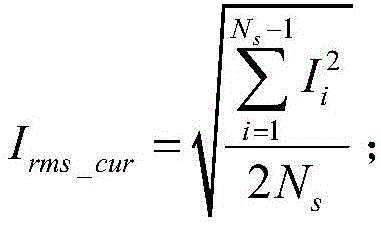
wherein, Irms_curIs the effective value of the current of the motor of the range hood in any operation time period, NsIs the number of effective values of the current collected during the operating time period, IiRepresenting the effective value of the ith current collected during any one of the operating periods.
Compared with the prior art, the invention has the advantages that: according to the invention, the delivery current reference value of the corresponding motor when the range hood is delivered from the factory is obtained, and when the continuous operation time after the motor is started is detected to be less than the preset time, the motor enters a cold state rotating speed control state to obtain the cold state current effective value basic value; otherwise, the motor enters a thermal state rotating speed control state to obtain a thermal state current effective value basic value, and then the obtained current effective value and the current effective value basic value in the two states are respectively compared to raise or lower the operating gear of the range hood to the corresponding gear in the T-gear mode, so that the complexity of manually adjusting the gear of the range hood by the outside is avoided, the range hood is improved to realize self-adaptive load change according to the operating time of the motor and the pressure change of the air duct, and the actual requirement of intelligently adjusting the operating gear is met.
Drawings
Fig. 1 is a schematic diagram of an obtaining process of a factory current reference value in an embodiment of the present invention.
Detailed Description
The invention is described in further detail below with reference to the accompanying examples.
Referring to fig. 1, the method for controlling the intelligent rotation speed of the range hood in the embodiment includes the following steps 1 to 9:
step 1, obtaining a delivery current reference value of the range hood when the range hood leaves a factory, taking the delivery current reference value as an initial value of an effective current value of a motor in the range hood at an initial starting moment after the motor leaves the factory, and turning to step 2; the range hood in the embodiment has a T-gear mode, and at least two gears capable of realizing gear switching operation are preset in the T-gear mode; for example, the T-range mode of the range hood in this embodiment includes two operating ranges capable of implementing gear switching, i.e., the second range and the third range; the non-T gear mode of the range hood is only provided with one gear;
the static pressure change of the air duct can be accurately detected through the change of the subsequent effective current value by acquiring the delivery current reference value of the range hood when the range hood is delivered from a factory; it should be noted that, in this embodiment, the obtaining process of the factory current reference value includes the following steps S1 to S4:
step S1, operating the range hood at a preset test gear, continuously detecting the continuous operation time of the range hood at the preset test gear and the current effective value of a motor in the range hood, and turning to step S2; wherein, the preset test gear is assumed to be the second gear of the range hood;
step S2, when the continuous operation time of the range hood under the preset test gear reaches the preset detection time, obtaining the current effective value of the motor in the cold state in the time period from the starting time to the current time of the range hood according to the obtained current effective value of the motor, writing the current effective value of the motor in the cold state into the memory of the range hood as the current effective value basic value of the motor in the cold state, and turning to step S3; otherwise, go to step S1; wherein, the base value of the effective current value of the marked motor in the cold state is Irms_base_cold(ii) a The current effective value of the range hood in any operation time period is obtained according to the following mode in the embodiment:

wherein, Irms_curFor the motor of the range hood in any operating periodEffective value of current, NsIs the number of effective values of the current collected during the operating time period, IiRepresenting the effective value of the ith current collected in any one operation time period;
step S3, the basic value I of the current in the cold state of the motorrms_base_coldAfter the data is successfully written into the memory of the range hood, blocking the air duct of the range hood and changing the static pressure of the air duct, and turning to the step S4;
step S4, when the current gear of the range hood is shifted to a high gear, for example, from the second gear of the current operation to the third gear of the current operation, it indicates that the pressure in the air duct of the range hood is increased, and the smoke extraction operation of the range hood is adversely affected by the air duct pressure, so as to change the current effective value basic value I of the motor in the memory of the range hood in the cold staterms_base_coldThe reference value of the delivery current of the range hood when the range hood is delivered from the factory is used; otherwise, if the pressure of the air duct in the range hood is not changed significantly, that is, the pressure of the air duct does not have an obvious adverse effect on the normal smoking work of the range hood, the operation goes to step S2;
step 4, when the continuous operation time of the range hood is less than a third preset time T3, acquiring a current effective value of the range hood in a motor cold state in a time period from the starting time to the current time, storing the acquired current effective value of the range hood in the motor cold state into a memory of the range hood as a base value of the current effective value of the motor in the motor cold state, and turning to step 5; otherwise, acquiring the current effective value of the range hood in the motor thermal state in the time period from the starting moment to the current moment, storing the acquired current effective value of the motor in the motor thermal state into the memory of the range hood as the current effective value basic value of the motor in the motor thermal state, and turning to the step 5;
step 5, acquiring the current effective value of the motor in the range hood within a preset sampling time period according to a preset sampling interval to obtain the current effective value of the motor in the range hood within the preset sampling time period, and turning to step 6;
step 6, detecting whether the range hood is in the T gear mode or not so as to correspondingly adjust and process the gear state of the range hood:
when the range hood is in the T-range mode and is in the preset gear operation in the T-range mode, for example, when the range hood is in the second preset gear operation in the T-range mode (i.e., the low gear operation in the T-range mode), the process proceeds to step 7;
when the range hood is in the T-range mode and does not operate in the preset gear in the T-range mode, that is, when the range hood is in the third gear (which is a high gear relative to the second gear) of the T-range mode, the process goes to step 8;
when the range hood is not in the T-gear mode, namely the range hood is not in a second gear in the T-gear mode at the moment, and is not in a third gear in the T-gear mode at the moment, the range hood is enabled to operate in the current mode;
step 7, when detecting that the difference value between the effective current value of the motor in the range hood obtained in the step 5 and the basic value of the effective cold-state current value of the range hood in the step 4 or the difference value between the effective hot-state current value of the range hood in the step 4 is within a first preset range, increasing the current gear of the range hood to a preset high gear in a T-gear mode for operation, and obtaining the operation duration time of the range hood under the preset high gear; otherwise, the range hood is still enabled to continue to operate at the current gear;
step 7, detecting step 4When the difference value between the cold-state current effective value basic value or the hot-state current effective value basic value of the medium range hood and the current effective value of the motor in the range hood obtained in the step 5 is larger than a first preset gear shifting threshold value, the current gear of the range hood is lifted to a preset high gear in a T gear mode to operate, and the operation duration of the range hood under the preset high gear is obtained; otherwise, the range hood is still enabled to continue to operate at the current gear; wherein the first preset shifting threshold sign in the present embodiment is epsilon1The first preset shift threshold ε1Greater than zero, i.e. epsilon1>0;
Specifically, for example, assume that the effective current value of the motor in the range hood obtained in step 5 is recorded as IrmsAnd the effective value basic value of the cold-state current of the range hood in the step 4 is Irms_base_coldAnd 4, the effective value basic value of the thermal state current of the range hood in the step 4 is Irms_base_heatIn this step 7, once Irms_base_cold-Irms>ε1Or Irms_base_heat-Irms>ε1Then, the current gear (second gear) of the range hood is increased to the third gear of the T-gear mode, and the running duration of the range hood under the preset high gear (third gear) is obtained;
step 8, when detecting that the difference value between the effective current value of the motor in the range hood obtained in the step 5 and the basic cold-state current value or the basic hot-state current value of the range hood in the step 4 is smaller than a second preset gear shifting threshold value, turning to step 9; otherwise, the current gear of the range hood is lifted to a preset high gear in a T-gear mode to operate, and the duration of the range hood operating at the preset high gear is obtained; wherein the second preset shifting threshold sign in the present embodiment is epsilon2The second preset shift threshold ε2Greater than zero, i.e. epsilon2>0;
For example, in this step 8, once Irms-Irms_base_cold<ε2Or Irms-Irms_base_heat<ε2If so, then go to step 9; otherwise, the current gear (second gear) of the range hood is increasedThe range hood runs to a preset high gear (third gear) of a T-gear mode, and the duration of the range hood running under the preset high gear (third gear) is obtained;
step 9, when the continuous operation time of the motor of the range hood in the current state is greater than a fourth preset time T4, reducing the current gear of the range hood to a preset low gear operation in a T gear mode; otherwise, go to step 8. In this embodiment, the first preset time T1 and the third preset time T3 may be set to the same value according to actual needs, for example, T1 is set to T2 is set to 30 min; the second preset time T2 may be set to 300h and the fourth preset time T4 may be set to 30s as needed.
Claims (3)
1. An intelligent rotating speed control method of a range hood is characterized by comprising the following steps 1 to 9:
step 1, obtaining a delivery current reference value of the range hood when the range hood leaves a factory, taking the delivery current reference value as an initial value of an effective current value of a motor in the range hood at an initial starting moment after the motor leaves the factory, and turning to step 2; the range hood is provided with a T gear mode, and at least two gears capable of realizing gear switching operation are preset in the T gear mode;
step 2, after the range hood is subjected to factory start operation and when the continuous operation time of the range hood is detected to be less than a first preset time T1, turning to step 5; otherwise, turning to the step 3;
step 3, when the total operation time of the range hood is less than a second preset time T2, acquiring a current effective value of the range hood in a motor hot state within the current total operation time, storing the acquired current effective value of the motor in the motor hot state into a memory of the range hood as a current effective value basic value of the motor in the motor hot state, and turning to the step 5; otherwise, turning to step 4;
step 4, when the continuous operation time of the range hood is less than a third preset time T3, acquiring a current effective value of the range hood in a motor cold state in a time period from the starting time to the current time, storing the acquired current effective value of the range hood in the motor cold state into a memory of the range hood as a current effective value basic value of the motor in the motor cold state, and turning to the step 5; otherwise, acquiring the current effective value of the range hood in the motor thermal state in the time period from the starting moment to the current moment, storing the acquired current effective value of the motor in the motor thermal state into the memory of the range hood as the current effective value basic value of the motor in the motor thermal state, and turning to the step 5;
step 5, acquiring the current effective value of the motor in the range hood within a preset sampling time period according to a preset sampling interval to obtain the current effective value of the motor in the range hood within the preset sampling time period, and turning to step 6;
step 6, detecting whether the range hood is in the T gear mode or not so as to correspondingly adjust and process the gear state of the range hood:
when the range hood is in the T-gear mode and is in the preset gear operation in the T-gear mode, turning to step 7;
when the range hood is in the T-gear mode and does not have a preset gear in the T-gear mode, turning to step 8;
when the range hood is not in the T-gear mode, the range hood is enabled to operate in the current mode;
step 7, when detecting that the difference value between the cold-state current effective value basic value or the hot-state current effective value basic value of the range hood obtained in the step 4 and the current effective value of the motor in the range hood obtained in the step 5 is greater than a first preset gear shifting threshold value, increasing the current gear of the range hood to a preset high gear in a T gear mode for operation, and obtaining the operation duration time of the range hood under the preset high gear; otherwise, the range hood is still enabled to continue to operate at the current gear; wherein the first preset shift threshold is greater than zero;
step 8, when detecting that the difference value between the effective current value of the motor in the range hood obtained in the step 5 and the basic cold-state current value or the basic hot-state current value of the range hood in the step 4 is smaller than a second preset gear shifting threshold value, turning to step 9; otherwise, the current gear of the range hood is lifted to a preset high gear in a T-gear mode to operate, and the duration of the range hood operating at the preset high gear is obtained; wherein the second preset shift threshold is greater than zero;
step 9, when the continuous operation time of the motor of the range hood in the current state is greater than a fourth preset time T4, reducing the current gear of the range hood to a preset low gear operation in a T gear mode; otherwise, go to step 8.
2. The intelligent speed control method for the range hood according to claim 1, wherein the obtaining process of the factory current reference value in step 1 comprises the following steps S1 to S4:
step S1, operating the range hood at a preset test gear, continuously detecting the continuous operation time of the range hood at the preset test gear and the current effective value of a motor in the range hood, and turning to step S2;
step S2, when the fact that the continuous operation time of the range hood under the preset test gear reaches a preset detection time threshold value is detected, according to the obtained current effective value of the motor, the current effective value of the motor in the cold state in the time period from the starting moment to the current moment of the range hood is obtained, the current effective value of the motor in the cold state is used as a base value of the current effective value of the motor in the cold state and is written into a memory of the range hood, and the step S3 is carried out; otherwise, go to step S1;
step S3, after the basic value of the current effective value under the cold state of the motor is successfully written into the memory of the range hood, blocking the air duct of the range hood and changing the static pressure of the air duct, and turning to step S4;
step S4, when the current gear of the range hood is lifted to a high gear, the base value of the current effective value of the motor in the cold state in the memory of the range hood is used as the delivery current reference value of the range hood when the range hood leaves the factory; otherwise, the process proceeds to step S2.
3. The intelligent rotating speed control method for the range hood according to claim 2, wherein the effective current value of the range hood in any operating time period is obtained as follows:
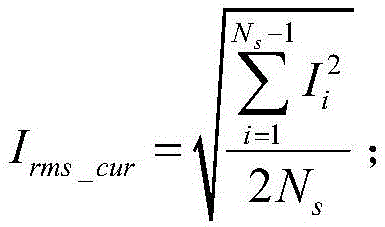
wherein, Irms_curIs the effective value of the current of the motor of the range hood in any operation time period, NsIs the number of effective values of the current collected during the operating time period, IiRepresenting the effective value of the ith current collected during any one of the operating periods.
Priority Applications (1)
| Application Number | Priority Date | Filing Date | Title |
|---|---|---|---|
| CN201811264462.9A CN111102618B (en) | 2018-10-29 | 2018-10-29 | Intelligent rotating speed control method for range hood |
Applications Claiming Priority (1)
| Application Number | Priority Date | Filing Date | Title |
|---|---|---|---|
| CN201811264462.9A CN111102618B (en) | 2018-10-29 | 2018-10-29 | Intelligent rotating speed control method for range hood |
Publications (2)
| Publication Number | Publication Date |
|---|---|
| CN111102618A true CN111102618A (en) | 2020-05-05 |
| CN111102618B CN111102618B (en) | 2021-10-01 |
Family
ID=70420295
Family Applications (1)
| Application Number | Title | Priority Date | Filing Date |
|---|---|---|---|
| CN201811264462.9A Active CN111102618B (en) | 2018-10-29 | 2018-10-29 | Intelligent rotating speed control method for range hood |
Country Status (1)
| Country | Link |
|---|---|
| CN (1) | CN111102618B (en) |
Cited By (2)
| Publication number | Priority date | Publication date | Assignee | Title |
|---|---|---|---|---|
| CN115264762A (en) * | 2022-07-22 | 2022-11-01 | 广东美的制冷设备有限公司 | Fan detection method, device, equipment and storage medium |
| CN115540011A (en) * | 2022-10-13 | 2022-12-30 | 中山百得厨卫有限公司 | Method and device for controlling a range hood |
Citations (6)
| Publication number | Priority date | Publication date | Assignee | Title |
|---|---|---|---|---|
| EP1333231A2 (en) * | 2002-01-31 | 2003-08-06 | Diehl AKO Stiftung & Co. KG | Control of an electric fan motor of an exhaust hood |
| CN103216867A (en) * | 2013-04-25 | 2013-07-24 | 中山华帝燃具股份有限公司 | Range hood air volume and air pressure compensation system based on variable frequency motor and control method thereof |
| CN105138028A (en) * | 2015-09-18 | 2015-12-09 | 珠海格力电器股份有限公司 | Method and device for controlling rotating speed of range hood |
| CN105371329A (en) * | 2015-11-09 | 2016-03-02 | 浙江苏泊尔家电制造有限公司 | Control method and device for range hood |
| CN106160587A (en) * | 2015-03-31 | 2016-11-23 | 中山大洋电机股份有限公司 | A control method of a motor and a control method of an electrical device with an air duct using the same |
| CN206959062U (en) * | 2017-06-07 | 2018-02-02 | 宁波方太厨具有限公司 | A kind of range hood |
-
2018
- 2018-10-29 CN CN201811264462.9A patent/CN111102618B/en active Active
Patent Citations (6)
| Publication number | Priority date | Publication date | Assignee | Title |
|---|---|---|---|---|
| EP1333231A2 (en) * | 2002-01-31 | 2003-08-06 | Diehl AKO Stiftung & Co. KG | Control of an electric fan motor of an exhaust hood |
| CN103216867A (en) * | 2013-04-25 | 2013-07-24 | 中山华帝燃具股份有限公司 | Range hood air volume and air pressure compensation system based on variable frequency motor and control method thereof |
| CN106160587A (en) * | 2015-03-31 | 2016-11-23 | 中山大洋电机股份有限公司 | A control method of a motor and a control method of an electrical device with an air duct using the same |
| CN105138028A (en) * | 2015-09-18 | 2015-12-09 | 珠海格力电器股份有限公司 | Method and device for controlling rotating speed of range hood |
| CN105371329A (en) * | 2015-11-09 | 2016-03-02 | 浙江苏泊尔家电制造有限公司 | Control method and device for range hood |
| CN206959062U (en) * | 2017-06-07 | 2018-02-02 | 宁波方太厨具有限公司 | A kind of range hood |
Cited By (2)
| Publication number | Priority date | Publication date | Assignee | Title |
|---|---|---|---|---|
| CN115264762A (en) * | 2022-07-22 | 2022-11-01 | 广东美的制冷设备有限公司 | Fan detection method, device, equipment and storage medium |
| CN115540011A (en) * | 2022-10-13 | 2022-12-30 | 中山百得厨卫有限公司 | Method and device for controlling a range hood |
Also Published As
| Publication number | Publication date |
|---|---|
| CN111102618B (en) | 2021-10-01 |
Similar Documents
| Publication | Publication Date | Title |
|---|---|---|
| CN104534805B (en) | Fan rotating speed control method and device and refrigerator | |
| CN111102618B (en) | Intelligent rotating speed control method for range hood | |
| CN101995069B (en) | Air conditioner and method for controlling same to operate in energy-saving manner | |
| CN107044671A (en) | Pressure sensitive speedup control method and high-static pressure fan system, range hood | |
| CN104566795B (en) | The control method of room air conditioner, system and there is its air conditioner | |
| CN107655150A (en) | Air-conditioner defrosting control device and method | |
| CN104236008A (en) | Air conditioner and automatic control method for operational mode thereof | |
| CN104101054A (en) | Control method and system of variable refrigerant flow (VRF) air conditioner | |
| CN103940058A (en) | Air conditioner, and control method and device thereof | |
| CN206669833U (en) | High-static pressure fan system and range hood | |
| CN106352510A (en) | Automatic-mode control method and device suitable for air conditioner | |
| CN103574830A (en) | Air conditioner and control method and control device thereof | |
| CN106094932B (en) | Electronic product method for controlling heat | |
| CN104848482A (en) | Preheating control method of air conditioner compressor | |
| CN105465854A (en) | Smoke lampblack machine, controlling device, and controlling method for smoke lampblack machine | |
| CN103629717A (en) | Self-adaptive control device of full-automatic range hood | |
| CN102679501B (en) | Automatic control method of air conditioner display screen | |
| CN104864603B (en) | Air-fuel ratio adjustment method for gas heating water heater | |
| CN104949269A (en) | System control method and device for overhigh module temperature | |
| CN105822535A (en) | Control method and device of compressor and air conditioner | |
| CN114427739A (en) | Air conditioner control method and device under low-temperature refrigeration and fixed-frequency air conditioner | |
| CN109612115A (en) | The control method of gas heater and the adaptive flue pressure change of wall-hung boiler | |
| CN107062521A (en) | Convertible frequency air-conditioner fire prevention control method | |
| CN107289595A (en) | The control method of air-conditioning | |
| CN107677041A (en) | Refrigerator purifies control method and refrigerator |
Legal Events
| Date | Code | Title | Description |
|---|---|---|---|
| PB01 | Publication | ||
| PB01 | Publication | ||
| SE01 | Entry into force of request for substantive examination | ||
| SE01 | Entry into force of request for substantive examination | ||
| GR01 | Patent grant | ||
| GR01 | Patent grant |