CN111100935B - Method for detecting drug resistance gene of bacteria - Google Patents
Method for detecting drug resistance gene of bacteria Download PDFInfo
- Publication number
- CN111100935B CN111100935B CN201811257679.7A CN201811257679A CN111100935B CN 111100935 B CN111100935 B CN 111100935B CN 201811257679 A CN201811257679 A CN 201811257679A CN 111100935 B CN111100935 B CN 111100935B
- Authority
- CN
- China
- Prior art keywords
- sequence
- probe
- mediator
- nucleic acid
- seq
- Prior art date
- Legal status (The legal status is an assumption and is not a legal conclusion. Google has not performed a legal analysis and makes no representation as to the accuracy of the status listed.)
- Active
Links
- 108090000623 proteins and genes Proteins 0.000 title claims abstract description 358
- 238000000034 method Methods 0.000 title claims abstract description 212
- 206010059866 Drug resistance Diseases 0.000 title claims abstract description 17
- 241000894006 Bacteria Species 0.000 title claims description 103
- 239000000523 sample Substances 0.000 claims abstract description 1164
- 150000007523 nucleic acids Chemical class 0.000 claims abstract description 550
- 108020004707 nucleic acids Proteins 0.000 claims abstract description 232
- 102000039446 nucleic acids Human genes 0.000 claims abstract description 232
- 230000001580 bacterial effect Effects 0.000 claims abstract description 16
- 238000001514 detection method Methods 0.000 claims description 500
- 108091034117 Oligonucleotide Proteins 0.000 claims description 440
- 238000011144 upstream manufacturing Methods 0.000 claims description 340
- 108091028043 Nucleic acid sequence Proteins 0.000 claims description 299
- 230000000295 complement effect Effects 0.000 claims description 162
- 206010034133 Pathogen resistance Diseases 0.000 claims description 158
- 239000003242 anti bacterial agent Substances 0.000 claims description 108
- 229940088710 antibiotic agent Drugs 0.000 claims description 103
- 108020004414 DNA Proteins 0.000 claims description 100
- 125000006853 reporter group Chemical group 0.000 claims description 95
- 230000000694 effects Effects 0.000 claims description 74
- 125000003729 nucleotide group Chemical group 0.000 claims description 71
- 101710163270 Nuclease Proteins 0.000 claims description 65
- JLCPHMBAVCMARE-UHFFFAOYSA-N [3-[[3-[[3-[[3-[[3-[[3-[[3-[[3-[[3-[[3-[[3-[[5-(2-amino-6-oxo-1H-purin-9-yl)-3-[[3-[[3-[[3-[[3-[[3-[[5-(2-amino-6-oxo-1H-purin-9-yl)-3-[[5-(2-amino-6-oxo-1H-purin-9-yl)-3-hydroxyoxolan-2-yl]methoxy-hydroxyphosphoryl]oxyoxolan-2-yl]methoxy-hydroxyphosphoryl]oxy-5-(5-methyl-2,4-dioxopyrimidin-1-yl)oxolan-2-yl]methoxy-hydroxyphosphoryl]oxy-5-(6-aminopurin-9-yl)oxolan-2-yl]methoxy-hydroxyphosphoryl]oxy-5-(6-aminopurin-9-yl)oxolan-2-yl]methoxy-hydroxyphosphoryl]oxy-5-(6-aminopurin-9-yl)oxolan-2-yl]methoxy-hydroxyphosphoryl]oxy-5-(6-aminopurin-9-yl)oxolan-2-yl]methoxy-hydroxyphosphoryl]oxyoxolan-2-yl]methoxy-hydroxyphosphoryl]oxy-5-(5-methyl-2,4-dioxopyrimidin-1-yl)oxolan-2-yl]methoxy-hydroxyphosphoryl]oxy-5-(4-amino-2-oxopyrimidin-1-yl)oxolan-2-yl]methoxy-hydroxyphosphoryl]oxy-5-(5-methyl-2,4-dioxopyrimidin-1-yl)oxolan-2-yl]methoxy-hydroxyphosphoryl]oxy-5-(5-methyl-2,4-dioxopyrimidin-1-yl)oxolan-2-yl]methoxy-hydroxyphosphoryl]oxy-5-(6-aminopurin-9-yl)oxolan-2-yl]methoxy-hydroxyphosphoryl]oxy-5-(6-aminopurin-9-yl)oxolan-2-yl]methoxy-hydroxyphosphoryl]oxy-5-(4-amino-2-oxopyrimidin-1-yl)oxolan-2-yl]methoxy-hydroxyphosphoryl]oxy-5-(4-amino-2-oxopyrimidin-1-yl)oxolan-2-yl]methoxy-hydroxyphosphoryl]oxy-5-(4-amino-2-oxopyrimidin-1-yl)oxolan-2-yl]methoxy-hydroxyphosphoryl]oxy-5-(6-aminopurin-9-yl)oxolan-2-yl]methoxy-hydroxyphosphoryl]oxy-5-(4-amino-2-oxopyrimidin-1-yl)oxolan-2-yl]methyl [5-(6-aminopurin-9-yl)-2-(hydroxymethyl)oxolan-3-yl] hydrogen phosphate Polymers Cc1cn(C2CC(OP(O)(=O)OCC3OC(CC3OP(O)(=O)OCC3OC(CC3O)n3cnc4c3nc(N)[nH]c4=O)n3cnc4c3nc(N)[nH]c4=O)C(COP(O)(=O)OC3CC(OC3COP(O)(=O)OC3CC(OC3COP(O)(=O)OC3CC(OC3COP(O)(=O)OC3CC(OC3COP(O)(=O)OC3CC(OC3COP(O)(=O)OC3CC(OC3COP(O)(=O)OC3CC(OC3COP(O)(=O)OC3CC(OC3COP(O)(=O)OC3CC(OC3COP(O)(=O)OC3CC(OC3COP(O)(=O)OC3CC(OC3COP(O)(=O)OC3CC(OC3COP(O)(=O)OC3CC(OC3COP(O)(=O)OC3CC(OC3COP(O)(=O)OC3CC(OC3COP(O)(=O)OC3CC(OC3COP(O)(=O)OC3CC(OC3CO)n3cnc4c(N)ncnc34)n3ccc(N)nc3=O)n3cnc4c(N)ncnc34)n3ccc(N)nc3=O)n3ccc(N)nc3=O)n3ccc(N)nc3=O)n3cnc4c(N)ncnc34)n3cnc4c(N)ncnc34)n3cc(C)c(=O)[nH]c3=O)n3cc(C)c(=O)[nH]c3=O)n3ccc(N)nc3=O)n3cc(C)c(=O)[nH]c3=O)n3cnc4c3nc(N)[nH]c4=O)n3cnc4c(N)ncnc34)n3cnc4c(N)ncnc34)n3cnc4c(N)ncnc34)n3cnc4c(N)ncnc34)O2)c(=O)[nH]c1=O JLCPHMBAVCMARE-UHFFFAOYSA-N 0.000 claims description 64
- 239000002773 nucleotide Substances 0.000 claims description 51
- 102000004190 Enzymes Human genes 0.000 claims description 46
- 108090000790 Enzymes Proteins 0.000 claims description 46
- ULGZDMOVFRHVEP-RWJQBGPGSA-N Erythromycin Chemical compound O([C@@H]1[C@@H](C)C(=O)O[C@@H]([C@@]([C@H](O)[C@@H](C)C(=O)[C@H](C)C[C@@](C)(O)[C@H](O[C@H]2[C@@H]([C@H](C[C@@H](C)O2)N(C)C)O)[C@H]1C)(C)O)CC)[C@H]1C[C@@](C)(OC)[C@@H](O)[C@H](C)O1 ULGZDMOVFRHVEP-RWJQBGPGSA-N 0.000 claims description 41
- 238000009396 hybridization Methods 0.000 claims description 36
- 238000010791 quenching Methods 0.000 claims description 34
- 230000003321 amplification Effects 0.000 claims description 31
- 238000003199 nucleic acid amplification method Methods 0.000 claims description 31
- 239000003153 chemical reaction reagent Substances 0.000 claims description 30
- 229930186147 Cephalosporin Natural products 0.000 claims description 29
- 229940124587 cephalosporin Drugs 0.000 claims description 29
- 150000001780 cephalosporins Chemical class 0.000 claims description 29
- 238000007899 nucleic acid hybridization Methods 0.000 claims description 29
- 108010040201 Polymyxins Proteins 0.000 claims description 26
- 239000003120 macrolide antibiotic agent Substances 0.000 claims description 26
- 108010014303 DNA-directed DNA polymerase Proteins 0.000 claims description 24
- 102000016928 DNA-directed DNA polymerase Human genes 0.000 claims description 24
- 241000589596 Thermus Species 0.000 claims description 21
- YZBQHRLRFGPBSL-RXMQYKEDSA-N carbapenem Chemical compound C1C=CN2C(=O)C[C@H]21 YZBQHRLRFGPBSL-RXMQYKEDSA-N 0.000 claims description 18
- 239000003782 beta lactam antibiotic agent Substances 0.000 claims description 17
- 230000000171 quenching effect Effects 0.000 claims description 17
- 239000002132 β-lactam antibiotic Substances 0.000 claims description 17
- 229940124586 β-lactam antibiotics Drugs 0.000 claims description 17
- 238000003776 cleavage reaction Methods 0.000 claims description 16
- 230000007017 scission Effects 0.000 claims description 16
- RJQXTJLFIWVMTO-TYNCELHUSA-N Methicillin Chemical compound COC1=CC=CC(OC)=C1C(=O)N[C@@H]1C(=O)N2[C@@H](C(O)=O)C(C)(C)S[C@@H]21 RJQXTJLFIWVMTO-TYNCELHUSA-N 0.000 claims description 15
- 108010059993 Vancomycin Proteins 0.000 claims description 15
- 229960003276 erythromycin Drugs 0.000 claims description 15
- 229960003085 meticillin Drugs 0.000 claims description 15
- 229960003165 vancomycin Drugs 0.000 claims description 15
- MYPYJXKWCTUITO-LYRMYLQWSA-N vancomycin Chemical compound O([C@@H]1[C@@H](O)[C@H](O)[C@@H](CO)O[C@H]1OC1=C2C=C3C=C1OC1=CC=C(C=C1Cl)[C@@H](O)[C@H](C(N[C@@H](CC(N)=O)C(=O)N[C@H]3C(=O)N[C@H]1C(=O)N[C@H](C(N[C@@H](C3=CC(O)=CC(O)=C3C=3C(O)=CC=C1C=3)C(O)=O)=O)[C@H](O)C1=CC=C(C(=C1)Cl)O2)=O)NC(=O)[C@@H](CC(C)C)NC)[C@H]1C[C@](C)(N)[C@H](O)[C@H](C)O1 MYPYJXKWCTUITO-LYRMYLQWSA-N 0.000 claims description 15
- MYPYJXKWCTUITO-UHFFFAOYSA-N vancomycin Natural products O1C(C(=C2)Cl)=CC=C2C(O)C(C(NC(C2=CC(O)=CC(O)=C2C=2C(O)=CC=C3C=2)C(O)=O)=O)NC(=O)C3NC(=O)C2NC(=O)C(CC(N)=O)NC(=O)C(NC(=O)C(CC(C)C)NC)C(O)C(C=C3Cl)=CC=C3OC3=CC2=CC1=C3OC1OC(CO)C(O)C(O)C1OC1CC(C)(N)C(O)C(C)O1 MYPYJXKWCTUITO-UHFFFAOYSA-N 0.000 claims description 15
- 238000012986 modification Methods 0.000 claims description 14
- 230000004048 modification Effects 0.000 claims description 14
- 239000000203 mixture Substances 0.000 claims description 12
- 230000008685 targeting Effects 0.000 claims description 7
- SGTNSNPWRIOYBX-UHFFFAOYSA-N 2-(3,4-dimethoxyphenyl)-5-{[2-(3,4-dimethoxyphenyl)ethyl](methyl)amino}-2-(propan-2-yl)pentanenitrile Chemical compound C1=C(OC)C(OC)=CC=C1CCN(C)CCCC(C#N)(C(C)C)C1=CC=C(OC)C(OC)=C1 SGTNSNPWRIOYBX-UHFFFAOYSA-N 0.000 claims description 6
- 241000589499 Thermus thermophilus Species 0.000 claims description 6
- 101150025725 ermA gene Proteins 0.000 claims description 6
- 101150016744 ermC gene Proteins 0.000 claims description 6
- 238000010839 reverse transcription Methods 0.000 claims description 6
- 101150114434 vanA gene Proteins 0.000 claims description 6
- 101150037181 vanB gene Proteins 0.000 claims description 6
- FWMNVWWHGCHHJJ-SKKKGAJSSA-N 4-amino-1-[(2r)-6-amino-2-[[(2r)-2-[[(2r)-2-[[(2r)-2-amino-3-phenylpropanoyl]amino]-3-phenylpropanoyl]amino]-4-methylpentanoyl]amino]hexanoyl]piperidine-4-carboxylic acid Chemical compound C([C@H](C(=O)N[C@H](CC(C)C)C(=O)N[C@H](CCCCN)C(=O)N1CCC(N)(CC1)C(O)=O)NC(=O)[C@H](N)CC=1C=CC=CC=1)C1=CC=CC=C1 FWMNVWWHGCHHJJ-SKKKGAJSSA-N 0.000 claims description 5
- 101100119095 Enterococcus faecalis (strain ATCC 700802 / V583) ermB gene Proteins 0.000 claims description 5
- 101150004219 MCR1 gene Proteins 0.000 claims description 5
- 241000204666 Thermotoga maritima Species 0.000 claims description 5
- 101100102353 Vibrio anguillarum vanM gene Proteins 0.000 claims description 5
- 125000000217 alkyl group Chemical group 0.000 claims description 5
- ABZLKHKQJHEPAX-UHFFFAOYSA-N tetramethylrhodamine Chemical compound C=12C=CC(N(C)C)=CC2=[O+]C2=CC(N(C)C)=CC=C2C=1C1=CC=CC=C1C([O-])=O ABZLKHKQJHEPAX-UHFFFAOYSA-N 0.000 claims description 5
- UDGUGZTYGWUUSG-UHFFFAOYSA-N 4-[4-[[2,5-dimethoxy-4-[(4-nitrophenyl)diazenyl]phenyl]diazenyl]-n-methylanilino]butanoic acid Chemical compound COC=1C=C(N=NC=2C=CC(=CC=2)N(C)CCCC(O)=O)C(OC)=CC=1N=NC1=CC=C([N+]([O-])=O)C=C1 UDGUGZTYGWUUSG-UHFFFAOYSA-N 0.000 claims description 4
- 241000205188 Thermococcus Species 0.000 claims description 4
- 241000206213 Thermosipho africanus Species 0.000 claims description 4
- 241000204664 Thermotoga neapolitana Species 0.000 claims description 4
- 125000003118 aryl group Chemical group 0.000 claims description 4
- 241000508310 Meiothermus chliarophilus Species 0.000 claims description 3
- 241000589496 Meiothermus ruber Species 0.000 claims description 3
- 241000508289 Meiothermus silvanus Species 0.000 claims description 3
- 108010010677 Phosphodiesterase I Proteins 0.000 claims description 3
- 108010006785 Taq Polymerase Proteins 0.000 claims description 3
- 241001237851 Thermococcus gorgonarius Species 0.000 claims description 3
- 241000205180 Thermococcus litoralis Species 0.000 claims description 3
- 241000589500 Thermus aquaticus Species 0.000 claims description 3
- 241000589498 Thermus filiformis Species 0.000 claims description 3
- 241000015334 Thermus igniterrae Species 0.000 claims description 3
- 241001522143 Thermus scotoductus Species 0.000 claims description 3
- 238000009640 blood culture Methods 0.000 claims description 3
- MPLHNVLQVRSVEE-UHFFFAOYSA-N texas red Chemical compound [O-]S(=O)(=O)C1=CC(S(Cl)(=O)=O)=CC=C1C(C1=CC=2CCCN3CCCC(C=23)=C1O1)=C2C1=C(CCC1)C3=[N+]1CCCC3=C2 MPLHNVLQVRSVEE-UHFFFAOYSA-N 0.000 claims description 3
- WCKQPPQRFNHPRJ-UHFFFAOYSA-N 4-[[4-(dimethylamino)phenyl]diazenyl]benzoic acid Chemical compound C1=CC(N(C)C)=CC=C1N=NC1=CC=C(C(O)=O)C=C1 WCKQPPQRFNHPRJ-UHFFFAOYSA-N 0.000 claims description 2
- 241000282412 Homo Species 0.000 claims description 2
- 241000124008 Mammalia Species 0.000 claims description 2
- 206010036790 Productive cough Diseases 0.000 claims description 2
- 210000004369 blood Anatomy 0.000 claims description 2
- 239000008280 blood Substances 0.000 claims description 2
- HJUFTIJOISQSKQ-UHFFFAOYSA-N fenoxycarb Chemical compound C1=CC(OCCNC(=O)OCC)=CC=C1OC1=CC=CC=C1 HJUFTIJOISQSKQ-UHFFFAOYSA-N 0.000 claims description 2
- 239000012530 fluid Substances 0.000 claims description 2
- 210000002381 plasma Anatomy 0.000 claims description 2
- 108010068698 spleen exonuclease Proteins 0.000 claims description 2
- 210000003802 sputum Anatomy 0.000 claims description 2
- 208000024794 sputum Diseases 0.000 claims description 2
- JZODKRWQWUWGCD-UHFFFAOYSA-N 2,5-di-tert-butylbenzene-1,4-diol Chemical compound CC(C)(C)C1=CC(O)=C(C(C)(C)C)C=C1O JZODKRWQWUWGCD-UHFFFAOYSA-N 0.000 claims 1
- 241000207208 Aquifex Species 0.000 claims 1
- 241000207207 Aquifex pyrophilus Species 0.000 claims 1
- 241000219195 Arabidopsis thaliana Species 0.000 claims 1
- 241001148023 Pyrococcus abyssi Species 0.000 claims 1
- 241000522615 Pyrococcus horikoshii Species 0.000 claims 1
- 241000205192 Pyrococcus woesei Species 0.000 claims 1
- 241000204670 Pyrodictium occultum Species 0.000 claims 1
- 238000006243 chemical reaction Methods 0.000 abstract description 43
- 239000012634 fragment Substances 0.000 description 129
- 238000002844 melting Methods 0.000 description 92
- 230000008018 melting Effects 0.000 description 92
- 238000003753 real-time PCR Methods 0.000 description 48
- 238000011880 melting curve analysis Methods 0.000 description 42
- 239000007850 fluorescent dye Substances 0.000 description 28
- 238000000137 annealing Methods 0.000 description 20
- 238000005520 cutting process Methods 0.000 description 19
- 101710196510 BRCA1-associated protein Proteins 0.000 description 18
- 101710144867 Inositol monophosphatase Proteins 0.000 description 18
- 108091028664 Ribonucleotide Proteins 0.000 description 15
- 238000004925 denaturation Methods 0.000 description 15
- 230000036425 denaturation Effects 0.000 description 15
- 125000002637 deoxyribonucleotide group Chemical group 0.000 description 15
- 239000002336 ribonucleotide Substances 0.000 description 15
- 125000002652 ribonucleotide group Chemical group 0.000 description 15
- 102100037880 GTP-binding protein REM 1 Human genes 0.000 description 14
- 150000003952 β-lactams Chemical class 0.000 description 12
- 239000002585 base Substances 0.000 description 11
- 229940041011 carbapenems Drugs 0.000 description 11
- 230000001419 dependent effect Effects 0.000 description 11
- 229940041033 macrolides Drugs 0.000 description 11
- 229940041153 polymyxins Drugs 0.000 description 11
- 230000008569 process Effects 0.000 description 11
- RYVNIFSIEDRLSJ-UHFFFAOYSA-N 5-(hydroxymethyl)cytosine Chemical compound NC=1NC(=O)N=CC=1CO RYVNIFSIEDRLSJ-UHFFFAOYSA-N 0.000 description 10
- 239000005547 deoxyribonucleotide Substances 0.000 description 10
- 239000003814 drug Substances 0.000 description 10
- 229940079593 drug Drugs 0.000 description 10
- -1 BHQ-1 or BHQ-2) Chemical compound 0.000 description 9
- 239000000872 buffer Substances 0.000 description 9
- 230000014509 gene expression Effects 0.000 description 9
- 230000009471 action Effects 0.000 description 8
- 230000003115 biocidal effect Effects 0.000 description 8
- 238000010438 heat treatment Methods 0.000 description 8
- 238000012360 testing method Methods 0.000 description 8
- 230000035945 sensitivity Effects 0.000 description 7
- 101100454267 Arabidopsis thaliana LAC8 gene Proteins 0.000 description 6
- 238000007796 conventional method Methods 0.000 description 6
- 238000010369 molecular cloning Methods 0.000 description 6
- WETFHJRYOTYZFD-YIZRAAEISA-N (2r,3s,5s)-2-(hydroxymethyl)-5-(3-nitropyrrol-1-yl)oxolan-3-ol Chemical compound C1[C@H](O)[C@@H](CO)O[C@@H]1N1C=C([N+]([O-])=O)C=C1 WETFHJRYOTYZFD-YIZRAAEISA-N 0.000 description 5
- LRSASMSXMSNRBT-UHFFFAOYSA-N 5-methylcytosine Chemical compound CC1=CNC(=O)N=C1N LRSASMSXMSNRBT-UHFFFAOYSA-N 0.000 description 5
- OZFPSOBLQZPIAV-UHFFFAOYSA-N 5-nitro-1h-indole Chemical compound [O-][N+](=O)C1=CC=C2NC=CC2=C1 OZFPSOBLQZPIAV-UHFFFAOYSA-N 0.000 description 5
- UGQMRVRMYYASKQ-KQYNXXCUSA-N Inosine Chemical compound O[C@@H]1[C@H](O)[C@@H](CO)O[C@H]1N1C2=NC=NC(O)=C2N=C1 UGQMRVRMYYASKQ-KQYNXXCUSA-N 0.000 description 5
- 229930010555 Inosine Natural products 0.000 description 5
- 238000003556 assay Methods 0.000 description 5
- 238000001816 cooling Methods 0.000 description 5
- 229960003786 inosine Drugs 0.000 description 5
- YBJHBAHKTGYVGT-ZKWXMUAHSA-N (+)-Biotin Chemical compound N1C(=O)N[C@@H]2[C@H](CCCCC(=O)O)SC[C@@H]21 YBJHBAHKTGYVGT-ZKWXMUAHSA-N 0.000 description 4
- 108091032973 (ribonucleotides)n+m Proteins 0.000 description 4
- 238000012408 PCR amplification Methods 0.000 description 4
- 230000001939 inductive effect Effects 0.000 description 4
- 108020004999 messenger RNA Proteins 0.000 description 4
- 238000011897 real-time detection Methods 0.000 description 4
- 239000000126 substance Substances 0.000 description 4
- QKNYBSVHEMOAJP-UHFFFAOYSA-N 2-amino-2-(hydroxymethyl)propane-1,3-diol;hydron;chloride Chemical compound Cl.OCC(N)(CO)CO QKNYBSVHEMOAJP-UHFFFAOYSA-N 0.000 description 3
- 241000219194 Arabidopsis Species 0.000 description 3
- 108020005187 Oligonucleotide Probes Proteins 0.000 description 3
- 239000002299 complementary DNA Substances 0.000 description 3
- 238000010494 dissociation reaction Methods 0.000 description 3
- 230000005593 dissociations Effects 0.000 description 3
- 230000009977 dual effect Effects 0.000 description 3
- 238000011534 incubation Methods 0.000 description 3
- 238000012423 maintenance Methods 0.000 description 3
- 239000002751 oligonucleotide probe Substances 0.000 description 3
- 238000011160 research Methods 0.000 description 3
- PYWVYCXTNDRMGF-UHFFFAOYSA-N rhodamine B Chemical compound [Cl-].C=12C=CC(=[N+](CC)CC)C=C2OC2=CC(N(CC)CC)=CC=C2C=1C1=CC=CC=C1C(O)=O PYWVYCXTNDRMGF-UHFFFAOYSA-N 0.000 description 3
- VGIRNWJSIRVFRT-UHFFFAOYSA-N 2',7'-difluorofluorescein Chemical compound OC(=O)C1=CC=CC=C1C1=C2C=C(F)C(=O)C=C2OC2=CC(O)=C(F)C=C21 VGIRNWJSIRVFRT-UHFFFAOYSA-N 0.000 description 2
- 108020000946 Bacterial DNA Proteins 0.000 description 2
- 108700003860 Bacterial Genes Proteins 0.000 description 2
- 102100034343 Integrase Human genes 0.000 description 2
- 108091093037 Peptide nucleic acid Proteins 0.000 description 2
- 108010092799 RNA-directed DNA polymerase Proteins 0.000 description 2
- 101150049452 SIM gene Proteins 0.000 description 2
- 108091081021 Sense strand Proteins 0.000 description 2
- 241000204652 Thermotoga Species 0.000 description 2
- 241000557726 Thermus oshimai Species 0.000 description 2
- 101150018417 VIM gene Proteins 0.000 description 2
- GRRMZXFOOGQMFA-UHFFFAOYSA-J YoYo-1 Chemical compound [I-].[I-].[I-].[I-].C12=CC=CC=C2C(C=C2N(C3=CC=CC=C3O2)C)=CC=[N+]1CCC[N+](C)(C)CCC[N+](C)(C)CCC[N+](C1=CC=CC=C11)=CC=C1C=C1N(C)C2=CC=CC=C2O1 GRRMZXFOOGQMFA-UHFFFAOYSA-J 0.000 description 2
- 238000004458 analytical method Methods 0.000 description 2
- 230000000692 anti-sense effect Effects 0.000 description 2
- 229940124350 antibacterial drug Drugs 0.000 description 2
- 238000013459 approach Methods 0.000 description 2
- 230000027455 binding Effects 0.000 description 2
- 230000015572 biosynthetic process Effects 0.000 description 2
- 229960002685 biotin Drugs 0.000 description 2
- 235000020958 biotin Nutrition 0.000 description 2
- 239000011616 biotin Substances 0.000 description 2
- 239000005546 dideoxynucleotide Substances 0.000 description 2
- 101150023863 ges gene Proteins 0.000 description 2
- 239000000463 material Substances 0.000 description 2
- 238000002156 mixing Methods 0.000 description 2
- 239000003068 molecular probe Substances 0.000 description 2
- 101150110399 shv gene Proteins 0.000 description 2
- 241000894007 species Species 0.000 description 2
- XLYOFNOQVPJJNP-UHFFFAOYSA-N water Substances O XLYOFNOQVPJJNP-UHFFFAOYSA-N 0.000 description 2
- 101150104241 ACT gene Proteins 0.000 description 1
- 208000035143 Bacterial infection Diseases 0.000 description 1
- 241000212384 Bifora Species 0.000 description 1
- OYPRJOBELJOOCE-UHFFFAOYSA-N Calcium Chemical compound [Ca] OYPRJOBELJOOCE-UHFFFAOYSA-N 0.000 description 1
- 102000052510 DNA-Binding Proteins Human genes 0.000 description 1
- 108700020911 DNA-Binding Proteins Proteins 0.000 description 1
- 101100215371 Homo sapiens ACTB gene Proteins 0.000 description 1
- 101001121408 Homo sapiens L-amino-acid oxidase Proteins 0.000 description 1
- 101000827703 Homo sapiens Polyphosphoinositide phosphatase Proteins 0.000 description 1
- 101150017040 I gene Proteins 0.000 description 1
- 102100026388 L-amino-acid oxidase Human genes 0.000 description 1
- 108060004795 Methyltransferase Proteins 0.000 description 1
- 241000588652 Neisseria gonorrhoeae Species 0.000 description 1
- 101100344651 Neurospora crassa (strain ATCC 24698 / 74-OR23-1A / CBS 708.71 / DSM 1257 / FGSC 987) mcr-1 gene Proteins 0.000 description 1
- 108010053210 Phycocyanin Proteins 0.000 description 1
- 108010004729 Phycoerythrin Proteins 0.000 description 1
- 102100023591 Polyphosphoinositide phosphatase Human genes 0.000 description 1
- 241000288906 Primates Species 0.000 description 1
- 101100233916 Saccharomyces cerevisiae (strain ATCC 204508 / S288c) KAR5 gene Proteins 0.000 description 1
- 101710082933 Single-strand DNA-binding protein Proteins 0.000 description 1
- 241000191967 Staphylococcus aureus Species 0.000 description 1
- XSQUKJJJFZCRTK-UHFFFAOYSA-N Urea Chemical compound NC(N)=O XSQUKJJJFZCRTK-UHFFFAOYSA-N 0.000 description 1
- 108700005077 Viral Genes Proteins 0.000 description 1
- 239000003513 alkali Substances 0.000 description 1
- 208000022362 bacterial infectious disease Diseases 0.000 description 1
- 230000009286 beneficial effect Effects 0.000 description 1
- DEGAKNSWVGKMLS-UHFFFAOYSA-N calcein Chemical compound O1C(=O)C2=CC=CC=C2C21C1=CC(CN(CC(O)=O)CC(O)=O)=C(O)C=C1OC1=C2C=C(CN(CC(O)=O)CC(=O)O)C(O)=C1 DEGAKNSWVGKMLS-UHFFFAOYSA-N 0.000 description 1
- 229910052791 calcium Inorganic materials 0.000 description 1
- 239000011575 calcium Substances 0.000 description 1
- 229960005069 calcium Drugs 0.000 description 1
- 235000001465 calcium Nutrition 0.000 description 1
- IDMLRIMDYVWWRJ-UHFFFAOYSA-N calcium crimson Chemical compound CC(=O)OCOC(=O)CN(CC(=O)OCOC(C)=O)C1=CC=CC=C1OCCOC1=CC(NS(=O)(=O)C=2C=C(C(C=3C4=CC=5CCCN6CCCC(C=56)=C4OC4=C5C6=[N+](CCC5)CCCC6=CC4=3)=CC=2)S([O-])(=O)=O)=CC=C1N(CC(=O)OCOC(C)=O)CC(=O)OCOC(C)=O IDMLRIMDYVWWRJ-UHFFFAOYSA-N 0.000 description 1
- NMUGYJRMGWBCPU-UHFFFAOYSA-N calcium orange Chemical compound C=12C=CC(=[N+](C)C)C=C2OC2=CC(N(C)C)=CC=C2C=1C(C(=C1)C([O-])=O)=CC=C1NC(=S)NC(C=1)=CC=C(N(CC(=O)OCOC(C)=O)CC(=O)OCOC(C)=O)C=1OCCOC1=CC=CC=C1N(CC(=O)OCOC(C)=O)CC(=O)OCOC(C)=O NMUGYJRMGWBCPU-UHFFFAOYSA-N 0.000 description 1
- 239000004202 carbamide Substances 0.000 description 1
- 230000008859 change Effects 0.000 description 1
- 238000007385 chemical modification Methods 0.000 description 1
- 239000003795 chemical substances by application Substances 0.000 description 1
- 230000007547 defect Effects 0.000 description 1
- 238000013461 design Methods 0.000 description 1
- 239000000539 dimer Substances 0.000 description 1
- 238000006911 enzymatic reaction Methods 0.000 description 1
- 101150086253 ermB gene Proteins 0.000 description 1
- 210000003608 fece Anatomy 0.000 description 1
- GNBHRKFJIUUOQI-UHFFFAOYSA-N fluorescein Chemical compound O1C(=O)C2=CC=CC=C2C21C1=CC=C(O)C=C1OC1=CC(O)=CC=C21 GNBHRKFJIUUOQI-UHFFFAOYSA-N 0.000 description 1
- MHMNJMPURVTYEJ-UHFFFAOYSA-N fluorescein-5-isothiocyanate Chemical compound O1C(=O)C2=CC(N=C=S)=CC=C2C21C1=CC=C(O)C=C1OC1=CC(O)=CC=C21 MHMNJMPURVTYEJ-UHFFFAOYSA-N 0.000 description 1
- 238000012921 fluorescence analysis Methods 0.000 description 1
- 238000001917 fluorescence detection Methods 0.000 description 1
- 238000001506 fluorescence spectroscopy Methods 0.000 description 1
- 238000002189 fluorescence spectrum Methods 0.000 description 1
- PCHJSUWPFVWCPO-UHFFFAOYSA-N gold Chemical compound [Au] PCHJSUWPFVWCPO-UHFFFAOYSA-N 0.000 description 1
- 239000010931 gold Substances 0.000 description 1
- 229910052737 gold Inorganic materials 0.000 description 1
- 239000001963 growth medium Substances 0.000 description 1
- 229910052739 hydrogen Inorganic materials 0.000 description 1
- 239000001257 hydrogen Substances 0.000 description 1
- 230000000977 initiatory effect Effects 0.000 description 1
- 150000002500 ions Chemical class 0.000 description 1
- 239000011777 magnesium Substances 0.000 description 1
- NGCVJRFIBJVSFI-UHFFFAOYSA-I magnesium green Chemical compound [K+].[K+].[K+].[K+].[K+].C1=C(N(CC([O-])=O)CC([O-])=O)C(OCC(=O)[O-])=CC(NC(=O)C=2C=C3C(C4(C5=CC(Cl)=C([O-])C=C5OC5=CC([O-])=C(Cl)C=C54)OC3=O)=CC=2)=C1 NGCVJRFIBJVSFI-UHFFFAOYSA-I 0.000 description 1
- 101150008979 mecA gene Proteins 0.000 description 1
- 101150111763 mefA gene Proteins 0.000 description 1
- 101150021123 msrA gene Proteins 0.000 description 1
- VOFUROIFQGPCGE-UHFFFAOYSA-N nile red Chemical compound C1=CC=C2C3=NC4=CC=C(N(CC)CC)C=C4OC3=CC(=O)C2=C1 VOFUROIFQGPCGE-UHFFFAOYSA-N 0.000 description 1
- 229960002378 oftasceine Drugs 0.000 description 1
- 238000002360 preparation method Methods 0.000 description 1
- 238000000746 purification Methods 0.000 description 1
- MYIOYATURDILJN-UHFFFAOYSA-N rhodamine 110 Chemical compound [Cl-].C=12C=CC(N)=CC2=[O+]C2=CC(N)=CC=C2C=1C1=CC=CC=C1C(O)=O MYIOYATURDILJN-UHFFFAOYSA-N 0.000 description 1
- TUFFYSFVSYUHPA-UHFFFAOYSA-M rhodamine 123 Chemical compound [Cl-].COC(=O)C1=CC=CC=C1C1=C(C=CC(N)=C2)C2=[O+]C2=C1C=CC(N)=C2 TUFFYSFVSYUHPA-UHFFFAOYSA-M 0.000 description 1
- 229940043267 rhodamine b Drugs 0.000 description 1
- 108700038288 rhodamine-phalloidin Proteins 0.000 description 1
- 239000003161 ribonuclease inhibitor Substances 0.000 description 1
- 238000000926 separation method Methods 0.000 description 1
- 108700014590 single-stranded DNA binding proteins Proteins 0.000 description 1
- 230000002194 synthesizing effect Effects 0.000 description 1
- JGVWCANSWKRBCS-UHFFFAOYSA-N tetramethylrhodamine thiocyanate Chemical compound [Cl-].C=12C=CC(N(C)C)=CC2=[O+]C2=CC(N(C)C)=CC=C2C=1C1=CC=C(SC#N)C=C1C(O)=O JGVWCANSWKRBCS-UHFFFAOYSA-N 0.000 description 1
- 229940043263 traditional drug Drugs 0.000 description 1
- 238000013518 transcription Methods 0.000 description 1
- 230000035897 transcription Effects 0.000 description 1
- 101150007232 vanM gene Proteins 0.000 description 1
Images


Classifications
-
- C—CHEMISTRY; METALLURGY
- C12—BIOCHEMISTRY; BEER; SPIRITS; WINE; VINEGAR; MICROBIOLOGY; ENZYMOLOGY; MUTATION OR GENETIC ENGINEERING
- C12Q—MEASURING OR TESTING PROCESSES INVOLVING ENZYMES, NUCLEIC ACIDS OR MICROORGANISMS; COMPOSITIONS OR TEST PAPERS THEREFOR; PROCESSES OF PREPARING SUCH COMPOSITIONS; CONDITION-RESPONSIVE CONTROL IN MICROBIOLOGICAL OR ENZYMOLOGICAL PROCESSES
- C12Q1/00—Measuring or testing processes involving enzymes, nucleic acids or microorganisms; Compositions therefor; Processes of preparing such compositions
- C12Q1/68—Measuring or testing processes involving enzymes, nucleic acids or microorganisms; Compositions therefor; Processes of preparing such compositions involving nucleic acids
- C12Q1/6876—Nucleic acid products used in the analysis of nucleic acids, e.g. primers or probes
- C12Q1/6888—Nucleic acid products used in the analysis of nucleic acids, e.g. primers or probes for detection or identification of organisms
- C12Q1/689—Nucleic acid products used in the analysis of nucleic acids, e.g. primers or probes for detection or identification of organisms for bacteria
-
- C—CHEMISTRY; METALLURGY
- C12—BIOCHEMISTRY; BEER; SPIRITS; WINE; VINEGAR; MICROBIOLOGY; ENZYMOLOGY; MUTATION OR GENETIC ENGINEERING
- C12Q—MEASURING OR TESTING PROCESSES INVOLVING ENZYMES, NUCLEIC ACIDS OR MICROORGANISMS; COMPOSITIONS OR TEST PAPERS THEREFOR; PROCESSES OF PREPARING SUCH COMPOSITIONS; CONDITION-RESPONSIVE CONTROL IN MICROBIOLOGICAL OR ENZYMOLOGICAL PROCESSES
- C12Q2600/00—Oligonucleotides characterized by their use
- C12Q2600/106—Pharmacogenomics, i.e. genetic variability in individual responses to drugs and drug metabolism
-
- C—CHEMISTRY; METALLURGY
- C12—BIOCHEMISTRY; BEER; SPIRITS; WINE; VINEGAR; MICROBIOLOGY; ENZYMOLOGY; MUTATION OR GENETIC ENGINEERING
- C12Q—MEASURING OR TESTING PROCESSES INVOLVING ENZYMES, NUCLEIC ACIDS OR MICROORGANISMS; COMPOSITIONS OR TEST PAPERS THEREFOR; PROCESSES OF PREPARING SUCH COMPOSITIONS; CONDITION-RESPONSIVE CONTROL IN MICROBIOLOGICAL OR ENZYMOLOGICAL PROCESSES
- C12Q2600/00—Oligonucleotides characterized by their use
- C12Q2600/16—Primer sets for multiplex assays
Landscapes
- Chemical & Material Sciences (AREA)
- Life Sciences & Earth Sciences (AREA)
- Analytical Chemistry (AREA)
- Proteomics, Peptides & Aminoacids (AREA)
- Organic Chemistry (AREA)
- Zoology (AREA)
- Wood Science & Technology (AREA)
- Health & Medical Sciences (AREA)
- Engineering & Computer Science (AREA)
- Microbiology (AREA)
- Immunology (AREA)
- Molecular Biology (AREA)
- Biotechnology (AREA)
- Biophysics (AREA)
- Physics & Mathematics (AREA)
- Biochemistry (AREA)
- Bioinformatics & Cheminformatics (AREA)
- General Engineering & Computer Science (AREA)
- General Health & Medical Sciences (AREA)
- Genetics & Genomics (AREA)
- Measuring Or Testing Involving Enzymes Or Micro-Organisms (AREA)
Abstract
Description
技术领域Technical Field
本申请涉及核酸分子的多重检测。特别地,本申请提供了一种检测细菌耐药基因(例如能够导致细菌耐受碳青霉烯类抗生素耐药的KPC等基因、导致β-内酰胺类抗生素耐药的CTX-M等基因、导致头孢菌素类抗生素耐药的AAC等基因,以及能够导细菌耐受其它类型抗生素的耐药基因)的方法,所述方法能够同时检测多个(例如2、5、10、15、20、23、24或更多个)细菌耐药基因在样品中的核酸分子中的存在或水平。此外,本申请还提供了一种探针组,和包含一种或多种所述探针组的试剂盒,所述探针组和试剂盒可用于实施本发明的方法。此外,本申请还提供了一种试剂盒,其能够在一轮反应中同时检测多个(例如2、5、10、15、20、23、24或更多个)细菌耐药基因(例如能够导致细菌耐受碳青霉烯类抗生素耐药的KPC等基因、导致β-内酰胺类抗生素耐药的CTX-M等基因、导致头孢菌素类抗生素耐药的AAC等基因,以及能够导细菌耐受其它类型抗生素的耐药基因)在样品中的核酸分子中的存在或水平。The present application relates to multiple detection of nucleic acid molecules. In particular, the present application provides a method for detecting bacterial resistance genes (e.g., genes such as KPC that can cause bacteria to tolerate carbapenem antibiotics, genes such as CTX-M that cause β-lactam antibiotics resistance, genes such as AAC that cause cephalosporin antibiotics resistance, and resistance genes that can cause bacteria to tolerate other types of antibiotics), the method being able to simultaneously detect the presence or level of multiple (e.g., 2, 5, 10, 15, 20, 23, 24 or more) bacterial resistance genes in nucleic acid molecules in a sample. In addition, the present application also provides a probe group, and a kit comprising one or more of the probe groups, the probe group and the kit can be used to implement the method of the present invention. In addition, the present application also provides a kit that can simultaneously detect the presence or level of multiple (e.g., 2, 5, 10, 15, 20, 23, 24 or more) bacterial resistance genes (e.g., genes such as KPC that can cause bacteria to resist carbapenem antibiotics, genes such as CTX-M that cause β-lactam antibiotics resistance, genes such as AAC that cause cephalosporin antibiotics resistance, and resistance genes that can cause bacteria to resist other types of antibiotics) in nucleic acid molecules in a sample in one round of reaction.
背景技术Background Art
抗生素是目前治疗细菌感染最常用的药物。细菌耐药是指细菌对特定抗生素不敏感的现象。细菌耐药情况和细菌携带的耐药基因密切相关(例如KPC等基因导致碳青霉烯类抗生素耐药,CTX-M等基因导致β-内酰胺类抗生素耐药,AAC等基因导致头孢菌素类抗生素耐药等)。目前细菌耐药主要检测方法为传统药敏培养试验,即将待检菌株分别置于带各种抗生素的培养基中培养以鉴定是否对特定的抗生素耐药。药敏培养试验所需的时间通常长达数天,而且要耗费大量人力。耐药基因的核酸检测相对于药敏培养鉴定具备检测快速、操作简便、可同时识别多种抗生素耐药情况等显著优点。因此,国内外大量文献和专利均已报道,采用核酸检测方法来检测细菌耐药基因并判定细菌所耐受的抗生素种类。在此基础上,大部分的核酸检测方法都会采用多重PCR扩增技术来提高检测方法的效率和灵敏度。实时PCR是用于检测核酸的一种常用方法,其操作简便,应用广泛。并且,通过利用多重实时PCR,可在单个反应管内同时检测多个靶序列,这不仅提高了检测效率,也降低了成本。Antibiotics are currently the most commonly used drugs for treating bacterial infections. Bacterial resistance refers to the phenomenon that bacteria are insensitive to specific antibiotics. Bacterial resistance is closely related to the resistance genes carried by bacteria (for example, genes such as KPC lead to carbapenem resistance, genes such as CTX-M lead to β-lactam resistance, genes such as AAC lead to cephalosporin resistance, etc.). At present, the main detection method for bacterial resistance is the traditional drug sensitivity culture test, that is, the strain to be tested is placed in a culture medium with various antibiotics to identify whether it is resistant to a specific antibiotic. The time required for drug sensitivity culture tests is usually several days and it consumes a lot of manpower. Compared with drug sensitivity culture identification, nucleic acid detection of resistance genes has significant advantages such as rapid detection, simple operation, and simultaneous identification of multiple antibiotic resistance. Therefore, a large number of literature and patents at home and abroad have reported the use of nucleic acid detection methods to detect bacterial resistance genes and determine the types of antibiotics that bacteria tolerate. On this basis, most nucleic acid detection methods will use multiple PCR amplification technology to improve the efficiency and sensitivity of the detection method. Real-time PCR is a common method for detecting nucleic acids, which is easy to operate and widely used. Furthermore, by utilizing multiplex real-time PCR, multiple target sequences can be detected simultaneously in a single reaction tube, which not only improves detection efficiency but also reduces costs.
在实时PCR方法中,可通过使用荧光标记的寡核苷酸探针来对靶序列进行检测。一般而言,荧光标记的探针特异性地与用于PCR扩增的两条引物之间的靶序列结合,以避免由引物二聚体的非特异性扩增而导致的干扰信号,提高检测结果的特异性。对于多重实时PCR而言,当使用多种靶序列特异性的寡核苷酸探针时,可使用不同的荧光基团标记每一个寡核苷酸探针,由此,通过检测每一个探针所携带的独特荧光信号,可以检测每一个探针所特异性识别的靶序列。在实时PCR方法中,可通过两种模式来对靶序列进行检测,即,实时检测模式和扩增后的熔解曲线分析(也称为post-PCR MCA模式)。在实时检测模式中,靶序列的检测和PCR扩增同时进行,无需进行额外的步骤。因此,实时检测模式简便直接。但是,这种模式在单轮检测中能检测的最大靶序列的数目受限于实时PCR仪器的荧光检测通道的数目,一般不超过6个。在MCA模式中,需要在PCR扩增后进行一个额外的步骤,即,分析由探针与靶序列构成的双链体的熔点。MCA模式可通过荧光颜色和/或熔点来识别或区分靶序列。因此,MCA模式虽然相对较为繁琐(即,增加了一个额外的步骤),但其在单轮检测中能检测的最大靶序列的数目有所提高。In the real-time PCR method, the target sequence can be detected by using a fluorescently labeled oligonucleotide probe. Generally speaking, the fluorescently labeled probe specifically binds to the target sequence between the two primers used for PCR amplification to avoid interference signals caused by the non-specific amplification of primer dimers, thereby improving the specificity of the detection result. For multiple real-time PCR, when using oligonucleotide probes specific to a variety of target sequences, different fluorescent groups can be used to label each oligonucleotide probe, thus, by detecting the unique fluorescent signal carried by each probe, the target sequence specifically identified by each probe can be detected. In the real-time PCR method, the target sequence can be detected by two modes, that is, the real-time detection mode and the melting curve analysis (also referred to as the post-PCR MCA mode) after amplification. In the real-time detection mode, the detection of the target sequence and the PCR amplification are carried out simultaneously, without the need to carry out additional steps. Therefore, the real-time detection mode is simple and direct. However, the number of the maximum target sequences that this mode can detect in a single round of detection is limited to the number of fluorescence detection channels of the real-time PCR instrument, which is generally no more than 6. In the MCA mode, an additional step is required after PCR amplification, i.e., analyzing the melting point of the duplex consisting of the probe and the target sequence. The MCA mode can identify or distinguish the target sequence by fluorescent color and/or melting point. Therefore, although the MCA mode is relatively cumbersome (i.e., an additional step is added), the maximum number of target sequences that can be detected in a single round of detection is increased.
然而,基于荧光探针检测的多重实时PCR也存在一些问题。首先,荧光探针的制备涉及复杂的化学修饰和纯化过程,其成本大大高于非标记探针。因此,多个荧光探针的使用会导致检测成本的增加。其次,在多重实时PCR法中,多个荧光探针的共存会使反应体系的背景荧光增加,这进而可导致检测灵敏度的下降。因此,需要对多重实时PCR法进行改进,以期通过尽可能少的荧光探针来检测尽可能多的靶序列。However, there are also some problems with multiplex real-time PCR based on fluorescent probe detection. First, the preparation of fluorescent probes involves complex chemical modification and purification processes, and its cost is much higher than that of unlabeled probes. Therefore, the use of multiple fluorescent probes will lead to an increase in detection costs. Secondly, in the multiplex real-time PCR method, the coexistence of multiple fluorescent probes will increase the background fluorescence of the reaction system, which in turn can lead to a decrease in detection sensitivity. Therefore, it is necessary to improve the multiplex real-time PCR method in order to detect as many target sequences as possible with as few fluorescent probes as possible.
Faltin等人(Clinical Chemistry 2012,58(11):1546-1556)描述了一种基于“媒介子探针”的实时PCR检测方法。在传统的实时PCR检测方法中,针对每一个靶序列,均需要使用一个靶序列特异的荧光探针。然而,在Faltin等人报道的方法中,针对每一个靶序列,需要使用两个探针:一个非荧光标记的靶序列特异的媒介子探针,以及另一个不与靶序列结合的荧光标记的探针(荧光探针);其中,媒介子探针由位于3'-端的靶特异性序列和位于5'-端的标签序列(媒介子)组成;荧光探针由包含媒介子杂交位点的3'-端单链序列以及包含淬灭基团和荧光基团的、具有发夹结构的5'-端序列构成,淬灭基团和荧光基团均位于发夹结构的臂上且相互靠近,从而发生荧光淬灭。在PCR过程中,媒介子探针通过靶特异性序列与靶序列结合,并且其5'-端的标签序列(媒介子)保持单链游离状态;随后,媒介子探针在具有5'-核酸酶活性的DNA聚合酶的作用下发生酶切,释放出带有3'-OH的媒介子。随后,释放的媒介子结合至荧光探针中的媒介子杂交位点,并被聚合酶延伸,导致标记有淬灭基团的序列被切除或被置换,进而造成荧光基团与淬灭基团的分离,引起荧光强度的增加。Faltin et al. (Clinical Chemistry 2012, 58(11): 1546-1556) described a real-time PCR detection method based on "mediator probe". In the traditional real-time PCR detection method, a target sequence-specific fluorescent probe is required for each target sequence. However, in the method reported by Faltin et al., two probes are required for each target sequence: a non-fluorescently labeled target sequence-specific mediator probe, and another fluorescently labeled probe (fluorescent probe) that does not bind to the target sequence; wherein the mediator probe is composed of a target-specific sequence located at the 3'-end and a label sequence (mediator) located at the 5'-end; the fluorescent probe is composed of a 3'-end single-stranded sequence containing a mediator hybridization site and a 5'-end sequence having a hairpin structure containing a quencher group and a fluorescent group, and the quencher group and the fluorescent group are both located on the arms of the hairpin structure and close to each other, so that fluorescence quenching occurs. During the PCR process, the mediator probe binds to the target sequence through the target-specific sequence, and the label sequence (mediator) at its 5'-end remains in a single-stranded free state; then, the mediator probe is cleaved by a DNA polymerase with 5'-nuclease activity, releasing the mediator with 3'-OH. Subsequently, the released mediator binds to the mediator hybridization site in the fluorescent probe and is extended by the polymerase, resulting in the excision or replacement of the sequence labeled with the quencher group, thereby causing the separation of the fluorescent group and the quencher group, resulting in an increase in fluorescence intensity.
Faltin等人描述的方法的特点在于,荧光信号的产生依赖于两个探针:媒介子探针和荧光探针;其中,媒介子探针用作杂交探针,本身是非荧光标记的;荧光探针用于产生荧光信号,其与媒介子特异性结合,但不与靶序列结合。在该方法中,荧光探针可被用作通用探针。例如,当使用单重实时PCR来检测多个靶序列时,可以使用各自携带独特的靶特异性序列但含有相同的媒介子序列的多个媒介子探针以及一个相同的荧光探针来分别进行PCR反应。此外,对于多重实时PCR而言,当无需识别或区分每一个靶序列时,也可以使用具有相同媒介子序列的多个媒介子探针和一个荧光探针来实现多个靶序列的筛查。与传统的实时PCR方法相比,Faltin等人的方法可以使用一个通用的荧光探针来对多个靶序列进行检测,而无需针对每一个靶序列合成一个独特的荧光探针,这显著降低了检测成本。The method described by Faltin et al. is characterized in that the generation of fluorescent signals depends on two probes: a mediator probe and a fluorescent probe; wherein the mediator probe is used as a hybridization probe and is itself non-fluorescently labeled; and the fluorescent probe is used to generate a fluorescent signal, which specifically binds to the mediator but does not bind to the target sequence. In this method, the fluorescent probe can be used as a universal probe. For example, when single-plex real-time PCR is used to detect multiple target sequences, multiple mediator probes each carrying a unique target-specific sequence but containing the same mediator sequence and an identical fluorescent probe can be used to perform PCR reactions separately. In addition, for multiplex real-time PCR, when it is not necessary to identify or distinguish each target sequence, multiple mediator probes with the same mediator sequence and a fluorescent probe can also be used to screen multiple target sequences. Compared with the traditional real-time PCR method, the method of Faltin et al. can use a universal fluorescent probe to detect multiple target sequences without synthesizing a unique fluorescent probe for each target sequence, which significantly reduces the detection cost.
然而,Faltin等人的方法也存在着明显的缺陷。特别地,当将Faltin等人的方法用于进行需要区分每一个靶序列的多重实时PCR时,针对每一个靶序列都需要设计一个携带靶特异性序列的媒介子探针和一个对应的、带有独特荧光信号的荧光探针。在这种情况下,与针对每一个靶序列使用单个探针的传统多重实时PCR相比,Faltin等人的方法需要使用双倍数目的探针。相应地,整个反应体系变得更为复杂,检测成本也变得更高。例如,Faltin等人公开了同时检测HPV18和人类ACTB基因的双重PCR法,其中使用了2条媒介子探针和2条荧光探针;相比之下,传统的双重实时PCR法仅需要使用2条荧光探针。类似的例子还见于Wadle S等人(Biotechniques 2016,61(3):123-8),其中描述了一个五重PCR体系,该体系共使用了5条媒介子探针和5条荧光报告探针。相比之下,传统的五重实时PCR法仅需要使用5条荧光探针。在这种情况下,与传统多重实时PCR相比,Faltin等人的方法更加复杂,并且成本高昂。However, the method of Faltin et al. also has obvious defects. In particular, when the method of Faltin et al. is used to perform multiplex real-time PCR that needs to distinguish each target sequence, a mediator probe carrying a target-specific sequence and a corresponding fluorescent probe with a unique fluorescent signal need to be designed for each target sequence. In this case, compared with the traditional multiplex real-time PCR that uses a single probe for each target sequence, the method of Faltin et al. requires the use of double the number of probes. Accordingly, the entire reaction system becomes more complicated and the detection cost becomes higher. For example, Faltin et al. disclosed a dual PCR method for simultaneously detecting HPV18 and human ACTB genes, in which 2 mediator probes and 2 fluorescent probes were used; in contrast, the traditional dual real-time PCR method only requires the use of 2 fluorescent probes. Similar examples are also found in Wadle S et al. (Biotechniques 2016, 61 (3): 123-8), which describes a five-plex PCR system that uses a total of 5 mediator probes and 5 fluorescent reporter probes. In contrast, the traditional five-plex real-time PCR method only requires the use of 5 fluorescent probes. In this case, the method of Faltin et al. is more complicated and expensive compared to traditional multiplex real-time PCR.
US 2013/0109588 A1公开了一种可用于熔解曲线分析的实时PCR测定,其与Faltin等人的方法类似,通过两条探针(PTO探针,其对应于媒介子探针;和CTO探针,其对应于荧光探针)来实现对靶序列的检测。相应地,US 2013/0109588 A1的方法具有与Faltin等人的方法相似的优点和缺点。特别地,当将该专利申请中描述的方法用于实施需要区分每一个靶序列的多重实时PCR时,针对每一个靶序列需要分别设计一条PTO探针和一条CTO探针;即,使用双倍数目的探针。例如,该专利申请描述了同时检测奈瑟氏淋球菌和金黄色葡萄球菌的双重实时PCR,其中即使用了2条PTO探针和2条CTO探针。在这种情况下,与针对每一个靶序列使用单个探针的传统多重实时PCR相比,US 2013/0109588 A1的方法更加复杂,并且成本高昂。US 2013/0109588 A1 discloses a real-time PCR assay that can be used for melting curve analysis, which is similar to the method of Faltin et al., and detects the target sequence by two probes (PTO probe, which corresponds to the mediator probe; and CTO probe, which corresponds to the fluorescent probe). Accordingly, the method of US 2013/0109588 A1 has similar advantages and disadvantages to the method of Faltin et al. In particular, when the method described in the patent application is used to implement multiple real-time PCR that needs to distinguish each target sequence, a PTO probe and a CTO probe need to be designed for each target sequence; that is, a double number of probes are used. For example, the patent application describes a dual real-time PCR for the simultaneous detection of Neisseria gonorrhoeae and Staphylococcus aureus, in which two PTO probes and two CTO probes are used. In this case, compared with the traditional multiple real-time PCR using a single probe for each target sequence, the method of US 2013/0109588 A1 is more complicated and costly.
US 2014/0057264 A1公开了另一种使用两个探针的实时PCR方法。在该方法中,荧光信号是因标记探针的切割而产生的,因此,该方法仅能用于实时检测模式,而不能用于MCA模式。此外,与Faltin等人的方法类似,当将US 2014/0057264 A1中描述的方法用于实施需要区分每一个靶序列的多重实时PCR时,针对每一个靶序列需要分别设计两条探针,这导致反应体系更加复杂,并且成本高昂。US 2014/0057264 A1 discloses another real-time PCR method using two probes. In this method, the fluorescent signal is generated by the cleavage of the labeled probe, so this method can only be used in the real-time detection mode, not in the MCA mode. In addition, similar to the method of Faltin et al., when the method described in US 2014/0057264 A1 is used to implement multiplex real-time PCR that needs to distinguish each target sequence, two probes need to be designed for each target sequence, which makes the reaction system more complicated and costly.
US 2015/0072887 A1公开了一种可用于熔解曲线分析的实时PCR测定,其通过3条探针来实现对靶序列的检测。然而,当将该专利申请描述的方法用于实施需要区分每一个靶序列的多重实时PCR时,针对每一个靶序列需要分别设计3条探针,这导致反应体系更加复杂,并且成本高昂。类似的使用3条探针的实时PCR测定还公开于US 2015/0167060 A1和US 2016/0060690 A1中。然而,这些方法与US 2015/0072887 A1中公开的方法类似,在用于实施需要区分每一个靶序列的多重实时PCR时,比传统实时PCR法更复杂且成本更高。US 2015/0072887 A1 discloses a real-time PCR assay that can be used for melting curve analysis, which detects the target sequence through three probes. However, when the method described in this patent application is used to implement multiple real-time PCR that needs to distinguish each target sequence, three probes need to be designed separately for each target sequence, which makes the reaction system more complicated and costly. Similar real-time PCR assays using three probes are also disclosed in US 2015/0167060 A1 and US 2016/0060690 A1. However, these methods are similar to the method disclosed in US 2015/0072887 A1, and when used to implement multiple real-time PCR that needs to distinguish each target sequence, they are more complicated and costly than traditional real-time PCR methods.
总的来说,与传统实时PCR法相比,使用两条或三条探针的经改良的实时PCR方法(例如Faltin等人的方法)在实施单重实时PCR或者无需识别或区分每一个靶序列的多重实时PCR时,具有显著的优点:即,可使用携带相同媒介子序列但不同靶特异性序列的多条媒介子探针以及一条通用的荧光探针,从而可显著降低检测成本。但是,当实施需要区分每一个靶序列的多重实时PCR时,这些经改良的实时PCR方法就需要使用双倍乃至三倍数目的探针,反而比传统实时PCR法更加复杂,成本更高。In general, compared with the traditional real-time PCR method, the improved real-time PCR method using two or three probes (such as the method of Faltin et al.) has significant advantages when implementing single real-time PCR or multiple real-time PCR without identifying or distinguishing each target sequence: that is, multiple mediator probes carrying the same mediator sequence but different target-specific sequences and a universal fluorescent probe can be used, thereby significantly reducing the detection cost. However, when implementing multiple real-time PCR that requires distinguishing each target sequence, these improved real-time PCR methods require the use of double or even triple the number of probes, which is more complicated and more expensive than the traditional real-time PCR method.
在本申请中,发明人开发了一种新的实时PCR测定方法,其能够以更简单的反应体系、更低的检测成本来对样品中的每一个靶序列进行区分和鉴定。在此基础上,本申请的发明人开发了一种更为快速简便、灵敏特异、稳定可靠的高通量核酸检测方法和试剂盒,其可用于检测多种细菌耐药基因(例如能够导致细菌耐受碳青霉烯类、β-内酰胺类、头孢菌素类、多粘菌素类、万古霉素类、红霉素类、甲氧西林类、大环内酯类等抗生素的耐药基因)。In the present application, the inventors have developed a new real-time PCR assay method, which can distinguish and identify each target sequence in a sample with a simpler reaction system and lower detection cost. On this basis, the inventors of the present application have developed a more rapid, simple, sensitive, specific, stable and reliable high-throughput nucleic acid detection method and kit, which can be used to detect a variety of bacterial resistance genes (for example, resistance genes that can cause bacteria to resist carbapenems, β-lactams, cephalosporins, polymyxins, vancomycins, erythromycins, methicillins, macrolides and other antibiotics).
发明内容Summary of the invention
术语定义Definition of terms
在本发明中,除非另有说明,否则本文中使用的科学和技术名词具有本领域技术人员所通常理解的含义。并且,本文中所用的核酸化学实验室操作步骤均为相应领域内广泛使用的常规步骤。同时,为了更好地理解本发明,下面提供相关术语的定义和解释。In the present invention, unless otherwise specified, the scientific and technical terms used herein have the meanings commonly understood by those skilled in the art. In addition, the nucleic acid chemistry laboratory operation steps used herein are all conventional steps widely used in the corresponding fields. At the same time, in order to better understand the present invention, the definitions and explanations of the relevant terms are provided below.
如本文中所使用的,术语“细菌耐药基因”具有本领域技术人员通常理解的含义,其是指能够导致细菌针对特定抗菌药物产生耐受性以抵抗该药物影响的基因。在某些优选的实施方案中,所述细菌耐药基因是指抗生素抗性基因(antibiotic resistance gene),其能够赋予细菌对特定抗生素的耐受性。在某些示例性实施方案中,所述细菌耐药基因是能够导致细菌耐受选自下列的一种或多种抗生素的基因:碳青霉烯类抗生素、β-内酰胺类抗生素、头孢菌素类抗生素、多粘菌素类抗生素、万古霉素类抗生素、红霉素、甲氧西林类抗生素、大环内酯类抗生素。As used herein, the term "bacterial resistance gene" has the meaning generally understood by those skilled in the art, and refers to a gene that can cause bacteria to develop tolerance to a specific antibacterial drug to resist the effects of the drug. In certain preferred embodiments, the bacterial resistance gene refers to an antibiotic resistance gene that can confer tolerance to specific antibiotics on bacteria. In certain exemplary embodiments, the bacterial resistance gene is a gene that can cause bacteria to resist one or more antibiotics selected from the following: carbapenem antibiotics, β-lactam antibiotics, cephalosporin antibiotics, polymyxin antibiotics, vancomycin antibiotics, erythromycin, methicillin antibiotics, macrolide antibiotics.
如本文中所使用的,术语“靶核酸序列”、“靶核酸”和“靶序列”是指待检测的目标核酸序列。在本申请中,术语“靶核酸序列”、“靶核酸”和“靶序列”具有相同的含义,并且可互换使用。As used herein, the terms "target nucleic acid sequence", "target nucleic acid" and "target sequence" refer to a target nucleic acid sequence to be detected. In this application, the terms "target nucleic acid sequence", "target nucleic acid" and "target sequence" have the same meaning and are used interchangeably.
如本文中所使用的,术语“媒介子探针”是指,从5'至3'方向含有媒介子序列(mediator sequence)和靶向序列(targeting sequence;即,靶特异性序列)的单链核酸分子。在本申请中,媒介子序列不含与靶核酸序列互补的序列,靶特异性序列包含与靶核酸序列互补的序列。因此,在允许核酸杂交、退火或扩增的条件下,媒介子探针通过靶特异性序列与靶核酸序列杂交或退火(即,形成双链结构),并且媒介子探针中的媒介子序列不与所述靶核酸序列杂交,而处于游离状态(即,保持单链结构)。As used herein, the term "mediator probe" refers to a single-stranded nucleic acid molecule containing a mediator sequence and a targeting sequence (i.e., a target-specific sequence) from the 5' to 3' direction. In the present application, the mediator sequence does not contain a sequence complementary to the target nucleic acid sequence, and the target-specific sequence contains a sequence complementary to the target nucleic acid sequence. Therefore, under conditions that allow nucleic acid hybridization, annealing or amplification, the mediator probe hybridizes or anneals with the target nucleic acid sequence through the target-specific sequence (i.e., forms a double-stranded structure), and the mediator sequence in the mediator probe does not hybridize with the target nucleic acid sequence, but is in a free state (i.e., maintains a single-stranded structure).
如本文中所使用的,术语“靶向序列”和“靶特异性序列”是指,在允许核酸杂交、退火或扩增的条件下,能够与靶核酸序列选择性/特异性杂交或退火的序列,其包含与靶核酸序列互补的序列。在本申请中,术语“靶向序列”和“靶特异性序列”具有相同的含义,并且可互换使用。易于理解的是,靶向序列或靶特异性序列对于靶核酸序列是特异性的。换言之,在允许核酸杂交、退火或扩增的条件下,靶向序列或靶特异性序列仅与特定的靶核酸序列杂交或退火,而不与其他的核酸序列杂交或退火。As used herein, the terms "targeting sequence" and "target-specific sequence" refer to sequences that can selectively/specifically hybridize or anneal with a target nucleic acid sequence under conditions that allow nucleic acid hybridization, annealing or amplification, and that include sequences that are complementary to the target nucleic acid sequence. In the present application, the terms "targeting sequence" and "target-specific sequence" have the same meaning and are used interchangeably. It is easy to understand that a targeting sequence or target-specific sequence is specific to a target nucleic acid sequence. In other words, under conditions that allow nucleic acid hybridization, annealing or amplification, a targeting sequence or target-specific sequence hybridizes or anneals only with a specific target nucleic acid sequence, and does not hybridize or anneal with other nucleic acid sequences.
如本文中所使用的,术语“媒介子序列”是指,媒介子探针中不与靶核酸序列互补的一段寡核苷酸序列,其位于靶特异性序列的上游(5'端)。在本申请中,针对每一种靶核酸序列,设计或提供一条独特的媒介子探针,其具有独特的媒介子序列(换言之,所使用的所有媒介子探针中的媒介子序列彼此不同);由此,每一种靶核酸序列与一条独特的媒介子探针(独特的媒介子序列)相对应。因此,通过检测所述独特的媒介子序列,可以检测与之相对应的靶核酸序列。As used herein, the term "mediator sequence" refers to an oligonucleotide sequence in a mediator probe that is not complementary to a target nucleic acid sequence and is located upstream (5' end) of a target-specific sequence. In the present application, for each target nucleic acid sequence, a unique mediator probe is designed or provided, which has a unique mediator sequence (in other words, the mediator sequences in all the mediator probes used are different from each other); thus, each target nucleic acid sequence corresponds to a unique mediator probe (unique mediator sequence). Therefore, by detecting the unique mediator sequence, the target nucleic acid sequence corresponding thereto can be detected.
如本文中所使用的,术语“上游寡核苷酸序列”是指,包含与靶核酸序列互补的序列的一段寡核苷酸序列,其在允许核酸杂交(或退火)或扩增的条件下,能够与靶核酸序列杂交(或退火),并且,当与靶核酸序列杂交时,其位于媒介子探针的上游。As used herein, the term "upstream oligonucleotide sequence" refers to an oligonucleotide sequence comprising a sequence complementary to a target nucleic acid sequence, which is capable of hybridizing (or annealing) with the target nucleic acid sequence under conditions that allow nucleic acid hybridization (or annealing) or amplification, and, when hybridized with the target nucleic acid sequence, is located upstream of the mediator probe.
如本文中所使用的,术语“互补”意指,两条核酸序列能够根据碱基配对原则(Waston-Crick原则)在彼此之间形成氢键,并由此形成双链体。在本申请中,术语“互补”包括“实质上互补”和“完全互补”。如本文中所使用的,术语“完全互补”意指,一条核酸序列中的每一个碱基都能够与另一条核酸链中的碱基配对,而不存在错配或缺口。如本文中所使用的,术语“实质上互补”意指,一条核酸序列中的大部分碱基都能够与另一条核酸链中的碱基配对,其允许存在错配或缺口(例如,一个或数个核苷酸的错配或缺口)。通常,在允许核酸杂交、退火或扩增的条件下,“互补”(例如实质上互补或完全互补)的两条核酸序列将选择性地/特异性地发生杂交或退火,并形成双链体。例如,在本申请中,上游寡核苷酸序列和媒介子探针中的靶特异性序列各自包含与靶核酸序列互补(例如实质上互补或完全互补)的序列。因此,在允许核酸杂交、退火或扩增的条件下,上游寡核苷酸序列和媒介子探针中的靶特异性序列将选择性地/特异性地与靶核酸序列杂交或退火。相应地,术语“不互补”意指,两条核酸序列在允许核酸杂交、退火或扩增的条件下不能发生杂交或退火,无法形成双链体。例如,在本申请中,媒介子序列包含不与靶核酸序列互补的序列。因此,在允许核酸杂交、退火或扩增的条件下,媒介子序列不与靶核酸序列杂交或退火,无法形成双链体,而是处于游离状态(即,保持单链结构)。As used herein, the term "complementary" means that two nucleic acid sequences can form hydrogen bonds between each other according to the base pairing principle (Waston-Crick principle), and thus form a duplex. In the present application, the term "complementary" includes "substantially complementary" and "completely complementary". As used herein, the term "completely complementary" means that each base in a nucleic acid sequence can be paired with a base in another nucleic acid chain without mismatching or gaps. As used herein, the term "substantially complementary" means that most of the bases in a nucleic acid sequence can be paired with a base in another nucleic acid chain, and it allows the presence of mismatches or gaps (for example, mismatches or gaps of one or several nucleotides). Generally, under conditions that allow nucleic acid hybridization, annealing or amplification, two nucleic acid sequences of "complementary" (for example, substantially complementary or completely complementary) will selectively/specifically hybridize or anneal, and form a duplex. For example, in the present application, the target-specific sequence in the upstream oligonucleotide sequence and the mediator probe each comprises a sequence complementary to the target nucleic acid sequence (for example, substantially complementary or completely complementary). Therefore, under conditions that allow nucleic acid hybridization, annealing or amplification, the target-specific sequence in the upstream oligonucleotide sequence and the mediator probe will selectively/specifically hybridize or anneal with the target nucleic acid sequence. Accordingly, the term "non-complementary" means that the two nucleic acid sequences cannot hybridize or anneal under conditions that allow nucleic acid hybridization, annealing or amplification, and cannot form a duplex. For example, in the present application, the mediator sequence contains a sequence that is not complementary to the target nucleic acid sequence. Therefore, under conditions that allow nucleic acid hybridization, annealing or amplification, the mediator sequence does not hybridize or anneal with the target nucleic acid sequence, cannot form a duplex, but is in a free state (i.e., maintains a single-stranded structure).
如本文中所使用的,术语“杂交”和“退火”意指,互补的单链核酸分子形成双链核酸的过程。在本申请中,“杂交”和“退火”具有相同的含义,并且可互换使用。通常,完全互补或实质上互补的两条核酸序列可发生杂交或退火。两条核酸序列发生杂交或退火所需要的互补性取决于所使用的杂交条件,特别是温度。As used herein, the terms "hybridization" and "annealing" refer to the process by which complementary single-stranded nucleic acid molecules form double-stranded nucleic acids. In this application, "hybridization" and "annealing" have the same meaning and are used interchangeably. Typically, two nucleic acid sequences that are fully complementary or substantially complementary can hybridize or anneal. The complementarity required for hybridization or annealing of two nucleic acid sequences depends on the hybridization conditions used, particularly the temperature.
如本文中所使用的,“允许核酸杂交的条件”具有本领域技术人员通常理解的含义,并且可通过常规的方法来确定。例如,具有互补序列的两条核酸分子可在合适的杂交条件下发生杂交。此类杂交条件可涉及下列因素:温度,杂交缓冲液的pH值、成分和离子强度等,并且可根据互补的两条核酸分子的长度和GC含量来确定。例如,当互补的两条核酸分子的长度相对较短和/或GC含量相对较低时,可采用低严紧的杂交条件。当互补的两条核酸分子的长度相对较长和/或GC含量相对较高时,可采用高严紧的杂交条件。此类杂交条件是本领域技术人员熟知的,并且可参见例如Joseph Sambrook,et al.,Molecular Cloning,ALaboratory Manual,Cold Spring Harbor Laboratory Press,Cold Spring Harbor,N.Y.(2001);和M.L.M.Anderson,Nucleic Acid Hybridization,Springer-Verlag New YorkInc.N.Y.(1999)。在本申请中,“杂交”和“退火”具有相同的含义,并且可互换使用。相应地,表述“允许核酸杂交的条件”和“允许核酸退火的条件”也具有相同的含义,并且可互换使用。As used herein, "conditions that allow nucleic acid hybridization" have the meaning commonly understood by those skilled in the art and can be determined by conventional methods. For example, two nucleic acid molecules with complementary sequences can hybridize under suitable hybridization conditions. Such hybridization conditions may involve the following factors: temperature, pH value, composition and ionic strength of the hybridization buffer, etc., and can be determined based on the length and GC content of the two complementary nucleic acid molecules. For example, when the length of the two complementary nucleic acid molecules is relatively short and/or the GC content is relatively low, low stringency hybridization conditions can be used. When the length of the two complementary nucleic acid molecules is relatively long and/or the GC content is relatively high, high stringency hybridization conditions can be used. Such hybridization conditions are well known to those skilled in the art and can be found in, for example, Joseph Sambrook, et al., Molecular Cloning, A Laboratory Manual, Cold Spring Harbor Laboratory Press, Cold Spring Harbor, N.Y. (2001); and M.L.M.Anderson, Nucleic Acid Hybridization, Springer-Verlag New York Inc. N.Y. (1999). In the present application, "hybridization" and "annealing" have the same meaning and are used interchangeably. Accordingly, the expressions "conditions that allow nucleic acid hybridization" and "conditions that allow nucleic acid annealing" also have the same meaning and are used interchangeably.
如本文中所使用的,表述“允许核酸扩增的条件”具有本领域技术人员通常理解的含义,其是指,允许核酸聚合酶(例如DNA聚合酶)以一条核酸链为模板合成另一条核酸链,并形成双链体的条件。此类条件是本领域技术人员熟知的,并且可涉及下列因素:温度,杂交缓冲液的pH值、成分、浓度和离子强度等。可通过常规方法来确定合适的核酸扩增条件(参见例如Joseph Sambrook,et al.,Molecular Cloning,A Laboratory Manual,ColdSpring Harbor Laboratory Press,Cold Spring Harbor,N.Y.(2001))。在本发明的方法中,“允许核酸扩增的条件”优选地为核酸聚合酶(例如DNA聚合酶)的工作条件。As used herein, the expression "conditions that allow nucleic acid amplification" has a meaning generally understood by those skilled in the art, which refers to conditions that allow a nucleic acid polymerase (e.g., a DNA polymerase) to synthesize another nucleic acid chain using a nucleic acid chain as a template and form a duplex. Such conditions are well known to those skilled in the art and may involve the following factors: temperature, pH value, composition, concentration and ionic strength of the hybridization buffer, etc. Suitable nucleic acid amplification conditions can be determined by conventional methods (see, e.g., Joseph Sambrook, et al., Molecular Cloning, A Laboratory Manual, Cold Spring Harbor Laboratory Press, Cold Spring Harbor, N.Y. (2001)). In the method of the present invention, "conditions that allow nucleic acid amplification" are preferably working conditions for a nucleic acid polymerase (e.g., a DNA polymerase).
如本文中所使用的,表述“允许核酸聚合酶进行延伸反应的条件”具有本领域技术人员通常理解的含义,其是指,允许核酸聚合酶(例如DNA聚合酶)以一条核酸链为模板延伸另一条核酸链(例如引物或探针),并形成双链体的条件。此类条件是本领域技术人员熟知的,并且可涉及下列因素:温度,杂交缓冲液的pH值、成分、浓度和离子强度等等。可通过常规方法来确定合适的核酸扩增条件(参见例如Joseph Sambrook,et al.,MolecularCloning,A Laboratory Manual,Cold Spring Harbor Laboratory Press,Cold SpringHarbor,N.Y.(2001))。在本发明的方法中,“允许核酸聚合酶进行延伸反应的条件”优选地为核酸聚合酶(例如DNA聚合酶)的工作条件。在本申请中,表述“允许核酸聚合酶进行延伸反应的条件”和“允许核酸延伸的条件”具有相同的含义,并且可互换使用。As used herein, the expression "conditions that allow nucleic acid polymerase to perform an extension reaction" has a meaning generally understood by those skilled in the art, which refers to conditions that allow nucleic acid polymerase (e.g., DNA polymerase) to extend another nucleic acid chain (e.g., primer or probe) using one nucleic acid chain as a template and form a duplex. Such conditions are well known to those skilled in the art and may involve the following factors: temperature, pH value, composition, concentration and ionic strength of the hybridization buffer, etc. Suitable nucleic acid amplification conditions can be determined by conventional methods (see, e.g., Joseph Sambrook, et al., Molecular Cloning, A Laboratory Manual, Cold Spring Harbor Laboratory Press, Cold Spring Harbor, N.Y. (2001)). In the method of the present invention, "conditions that allow nucleic acid polymerase to perform an extension reaction" are preferably working conditions of nucleic acid polymerase (e.g., DNA polymerase). In the present application, the expressions "conditions that allow nucleic acid polymerase to perform an extension reaction" and "conditions that allow nucleic acid extension" have the same meaning and can be used interchangeably.
如本文中所使用的,表述“允许切割媒介子探针的条件”是指,允许具有5'核酸酶活性的酶切割杂交至靶核酸序列上的媒介子探针,并释放出含有媒介子序列或其部分的核酸片段的条件。在本发明的方法中,允许切割媒介子探针的条件优选地为具有5'核酸酶活性的酶的工作条件。例如,当使用的具有5'核酸酶活性的酶为具有5'核酸酶活性的核酸聚合酶时,允许切割媒介子探针的条件可以为所述核酸聚合酶的工作条件。As used herein, the expression "conditions that allow cleavage of the mediator probe" refers to conditions that allow an enzyme with 5' nuclease activity to cleave the mediator probe hybridized to the target nucleic acid sequence and release a nucleic acid fragment containing the mediator sequence or a portion thereof. In the method of the present invention, the conditions that allow cleavage of the mediator probe are preferably working conditions of an enzyme with 5' nuclease activity. For example, when the enzyme with 5' nuclease activity used is a nucleic acid polymerase with 5' nuclease activity, the conditions that allow cleavage of the mediator probe can be the working conditions of the nucleic acid polymerase.
各种酶的工作条件可由本领域技术人员通过常规方法确定,并且通常可涉及下列因素:温度,缓冲液的pH值,成分,浓度,离子强度等。备选地,可使用酶的制造商所推荐的条件。The working conditions of various enzymes can be determined by those skilled in the art by routine methods, and generally may involve the following factors: temperature, pH value, composition, concentration, ionic strength of the buffer, etc. Alternatively, the conditions recommended by the manufacturer of the enzyme may be used.
如本文中所使用的,术语“核酸变性”具有本领域技术人员通常理解的含义,其是指,双链核酸分子解离为单链的过程。表述“允许核酸变性的条件”是指,使得双链核酸分子解离为单链的条件。此类条件可由本领域技术人员常规地确定(参见例如JosephSambrook,et al.,Molecular Cloning,A Laboratory Manual,Cold Spring HarborLaboratory Press,Cold Spring Harbor,N.Y.(2001))。例如,可通过加热,碱处理,尿素处理,酶促方法(例如使用解旋酶的方法)等常规技术来使核酸变性。在本申请中,优选地,在加热的条件下使核酸变性。例如,可通过加热至80-105℃,从而使核酸变性。As used herein, the term "nucleic acid denaturation" has the meaning commonly understood by those skilled in the art, and refers to the process in which a double-stranded nucleic acid molecule dissociates into a single strand. The expression "conditions allowing nucleic acid denaturation" refers to conditions that allow a double-stranded nucleic acid molecule to dissociate into a single strand. Such conditions can be routinely determined by those skilled in the art (see, for example, Joseph Sambrook, et al., Molecular Cloning, A Laboratory Manual, Cold Spring Harbor Laboratory Press, Cold Spring Harbor, N.Y. (2001)). For example, nucleic acids can be denatured by conventional techniques such as heating, alkali treatment, urea treatment, enzymatic methods (such as methods using helicases). In the present application, preferably, nucleic acids are denatured under heated conditions. For example, nucleic acids can be denatured by heating to 80-105°C.
如本文中所使用的,术语“上游”用于描述两条核酸序列(或两个核酸分子)的相对位置关系,并且具有本领域技术人员通常理解的含义。例如,表述“一条核酸序列位于另一条核酸序列的上游”意指,当以5'至3'方向排列时,与后者相比,前者位于更靠前的位置(即,更接近5'端的位置)。如本文中所使用的,术语“下游”具有与“上游”相反的含义。As used herein, the term "upstream" is used to describe the relative positional relationship of two nucleic acid sequences (or two nucleic acid molecules) and has a meaning generally understood by those skilled in the art. For example, the expression "a nucleic acid sequence is located upstream of another nucleic acid sequence" means that when arranged in a 5' to 3' direction, the former is located in a more forward position (i.e., a position closer to the 5' end) than the latter. As used herein, the term "downstream" has the opposite meaning to "upstream".
如本文中所使用的,术语“荧光探针”是指携带荧光基团、且能够产生荧光信号的一段寡核苷酸。在本申请中,荧光探针被用作检测探针。As used herein, the term "fluorescent probe" refers to an oligonucleotide carrying a fluorescent group and capable of generating a fluorescent signal. In the present application, the fluorescent probe is used as a detection probe.
如本文中所使用的,术语“熔解曲线分析”具有本领域技术人员通常理解的含义,其是指,通过测定双链核酸分子的熔解曲线来分析双链核酸分子存在或其身份(identity)的方法,其通常用于评估双链核酸分子在加热过程中的解离特征。用于进行熔解曲线分析的方法是本领域技术人员熟知的(参见例如The Journal of Molecular Diagnostics2009,11(2):93-101)。在本申请中,术语“熔解曲线分析”和“熔解分析”具有相同的含义,并且可互换使用。As used herein, the term "melting curve analysis" has a meaning generally understood by those skilled in the art, and refers to a method for analyzing the presence or identity of a double-stranded nucleic acid molecule by measuring the melting curve of the double-stranded nucleic acid molecule, which is generally used to assess the dissociation characteristics of the double-stranded nucleic acid molecule during heating. The method for performing melting curve analysis is well known to those skilled in the art (see, for example, The Journal of Molecular Diagnostics 2009, 11 (2): 93-101). In the present application, the terms "melting curve analysis" and "melting analysis" have the same meaning and are used interchangeably.
在本申请的某些优选实施方案中,可通过使用标记有报告基团和淬灭基团的检测探针来进行熔解曲线分析。简言之,在环境温度下,检测探针能够通过碱基配对作用与其互补序列形成双链体。在此情况下,检测探针上的报告基团(例如荧光基团)和淬灭基团彼此分离,淬灭基团无法吸收报告基团发出的信号(例如荧光信号),此时,能够检测到最强的信号(例如荧光信号)。随着温度的升高,双链体的两条链开始解离(即,检测探针逐渐从其互补序列上解离),并且解离下的检测探针呈单链自由卷曲状态。在此情况下,解离下的检测探针上的报告基团(例如荧光基团)和淬灭基团互相靠近,由此报告基团(例如荧光基团)发出的信号(例如荧光信号)被淬灭基团所吸收。因此,随着温度的升高,所检测到信号(例如荧光信号)逐渐变弱。当双链体的两条链完全解离时,所有的检测探针均呈单链自由卷曲状态。在此情况下,所有的检测探针上的报告基团(例如荧光基团)发出的信号(例如荧光信号)都被淬灭基团所吸收。因此,基本上无法检测到报告基团(例如荧光基团)发出的信号(例如荧光信号)。因此,对包含检测探针的双链体在升温或降温过程中发出的信号(例如荧光信号)进行检测,就能观察到检测探针与其互补序列的杂交和解离过程,形成信号强度随着温度变化而变化的曲线。进一步,对所获得的曲线进行求导分析,可获得以信号强度变化速率为纵坐标,温度为横坐标的曲线(即,该双链体的熔解曲线)。该熔解曲线中的峰即为熔解峰,其所对应的温度即为所述双链体的熔点(Tm值)。通常而言,检测探针与互补序列的匹配程度越高(例如,错配的碱基越少,配对的碱基越多),那么双链体的Tm值就越高。因此,通过检测双链体的Tm值,可确定双链体中与检测探针互补的序列的存在和身份。在本文中,术语“熔解峰”、“熔点”和“Tm值”具有相同的含义,并且可互换使用。In certain preferred embodiments of the present application, melting curve analysis can be performed by using a detection probe labeled with a reporter group and a quencher group. In short, at ambient temperature, the detection probe can form a duplex with its complementary sequence through base pairing. In this case, the reporter group (e.g., fluorescent group) and the quencher group on the detection probe are separated from each other, and the quencher group cannot absorb the signal (e.g., fluorescent signal) emitted by the reporter group. At this time, the strongest signal (e.g., fluorescent signal) can be detected. As the temperature rises, the two chains of the duplex begin to dissociate (i.e., the detection probe gradually dissociates from its complementary sequence), and the detection probe under dissociation is in a single-stranded free curling state. In this case, the reporter group (e.g., fluorescent group) and the quencher group on the dissociated detection probe are close to each other, so that the signal (e.g., fluorescent signal) emitted by the reporter group (e.g., fluorescent group) is absorbed by the quencher group. Therefore, as the temperature rises, the detected signal (e.g., fluorescent signal) gradually weakens. When the two chains of the duplex are completely dissociated, all detection probes are in a single-stranded free curling state. In this case, the signal (e.g., fluorescent signal) emitted by the reporter group (e.g., fluorescent group) on all the detection probes is absorbed by the quencher group. Therefore, the signal (e.g., fluorescent signal) emitted by the reporter group (e.g., fluorescent group) is basically undetectable. Therefore, by detecting the signal (e.g., fluorescent signal) emitted by the duplex containing the detection probe during the heating or cooling process, the hybridization and dissociation process of the detection probe and its complementary sequence can be observed, forming a curve in which the signal intensity changes with the temperature. Further, the obtained curve is subjected to derivative analysis, and a curve with the signal intensity change rate as the ordinate and the temperature as the abscissa can be obtained (i.e., the melting curve of the duplex). The peak in the melting curve is the melting peak, and the temperature corresponding to it is the melting point (T m value) of the duplex. Generally speaking, the higher the matching degree between the detection probe and the complementary sequence (e.g., the fewer mismatched bases and the more paired bases), the higher the T m value of the duplex. Therefore, by detecting the T m value of the duplex, the presence and identity of the sequence complementary to the detection probe in the duplex can be determined. Herein, the terms "melting peak", "melting point" and "T m value" have the same meaning and are used interchangeably.
在本申请中,发明人开发了一种新的实时PCR测定方法,其能够以更简单的反应体系、更低的检测成本来对样品中的多种靶序列进行区分和鉴定。在此基础上,本申请的发明人开发了一种更为快速简便、灵敏特异、稳定可靠的、能够同时检测多个细菌耐药基因(例如能够导致细菌耐受碳青霉烯类、β-内酰胺类、头孢菌素类、多粘菌素类、万古霉素类、红霉素类、甲氧西林类、大环内酯类等抗生素的耐药基因)的方法和试剂盒。例如,本发明的方法和试剂盒能够同时检测2、3、4、5、6、7、8、9、10、11、12、13、14、15、16、17、18、19、20或更多种细菌耐药基因(例如能够导致细菌耐受碳青霉烯类、β-内酰胺类、头孢菌素类、多粘菌素类、万古霉素类、红霉素类、甲氧西林类、大环内酯类等抗生素的耐药基因)。In the present application, the inventors have developed a new real-time PCR assay method, which can distinguish and identify multiple target sequences in a sample with a simpler reaction system and lower detection costs. On this basis, the inventors of the present application have developed a method and a kit that is faster, simpler, more sensitive, specific, stable and reliable, and can simultaneously detect multiple bacterial resistance genes (e.g., resistance genes that can cause bacteria to resist carbapenems, β-lactams, cephalosporins, polymyxins, vancomycins, erythromycins, methicillins, macrolides, etc.). For example, the methods and kits of the present invention can simultaneously detect 2, 3, 4, 5, 6, 7, 8, 9, 10, 11, 12, 13, 14, 15, 16, 17, 18, 19, 20 or more bacterial resistance genes (e.g., resistance genes that can cause bacteria to resist carbapenems, β-lactams, cephalosporins, polymyxins, vancomycins, erythromycins, methicillins, macrolides and the like).
检测方法Detection Methods
因此,在一个方面,本发明提供了一种检测至少两种细菌耐药基因在样品中的核酸分子中的存在的方法,其中,所述方法包括以下步骤:Therefore, in one aspect, the present invention provides a method for detecting the presence of at least two bacterial resistance genes in a nucleic acid molecule in a sample, wherein the method comprises the following steps:
(1)在允许核酸杂交的条件下,将所述样品与第一上游寡核苷酸序列、第一媒介子探针、第二上游寡核苷酸序列和第二媒介子探针接触,其中,(1) contacting the sample with a first upstream oligonucleotide sequence, a first mediator probe, a second upstream oligonucleotide sequence, and a second mediator probe under conditions that allow nucleic acid hybridization, wherein:
(i)所述第一上游寡核苷酸序列包含与第一靶核酸序列互补的序列;并且,所述第一媒介子探针从5'至3'方向包含第一媒介子序列和第一靶特异性序列,其中,所述第一媒介子序列包含不与第一靶核酸序列互补的序列,并且,所述第一靶特异性序列包含与第一靶核酸序列互补的序列;并且,当与第一靶核酸序列杂交时,第一上游寡核苷酸序列位于第一靶特异性序列的上游;其中,所述第一靶核酸序列是第一细菌耐药基因特异性的,优选地,为第一细菌耐药基因序列,或其特异性片段;(i) The first upstream oligonucleotide sequence contains a sequence complementary to the first target nucleic acid sequence; and the first mediator probe contains a first mediator sequence and a first target-specific sequence from the 5' to the 3' direction, wherein the first mediator sequence contains a sequence that is not complementary to the first target nucleic acid sequence, and the first target-specific sequence contains a sequence complementary to the first target nucleic acid sequence; and when hybridizing with the first target nucleic acid sequence, the first upstream oligonucleotide sequence is located upstream of the first target-specific sequence; wherein the first target nucleic acid sequence is specific to the first bacterial resistance gene, preferably, is the first bacterial resistance gene sequence, or a specific fragment thereof;
(ii)所述第二上游寡核苷酸序列包含与第二靶核酸序列互补的序列;并且,所述第二媒介子探针从5'至3'方向包含第二媒介子序列和第二靶特异性序列,其中,所述第二媒介子序列包含不与第二靶核酸序列互补的序列,并且,所述第二靶特异性序列包含与第二靶核酸序列互补的序列;并且,当与第二靶核酸序列杂交时,第二上游寡核苷酸序列位于第二靶特异性序列的上游;其中,所述第二靶核酸序列是第二细菌耐药基因特异性的,优选地,为第二细菌耐药基因序列,或其特异性片段;并且,(ii) the second upstream oligonucleotide sequence contains a sequence complementary to the second target nucleic acid sequence; and the second mediator probe contains a second mediator sequence and a second target-specific sequence from the 5' to 3' direction, wherein the second mediator sequence contains a sequence that is not complementary to the second target nucleic acid sequence, and the second target-specific sequence contains a sequence complementary to the second target nucleic acid sequence; and when hybridizing with the second target nucleic acid sequence, the second upstream oligonucleotide sequence is located upstream of the second target-specific sequence; wherein the second target nucleic acid sequence is specific to the second bacterial resistance gene, preferably, a second bacterial resistance gene sequence, or a specific fragment thereof; and,
(iii)所述第一媒介子序列与所述第二媒介子序列不同;并且,(iii) the first mediator subsequence is different from the second mediator subsequence; and,
(2)在允许切割媒介子探针的条件下,将步骤(1)的产物与具有5'核酸酶活性的酶接触;(2) contacting the product of step (1) with an enzyme having 5' nuclease activity under conditions that allow cleavage of the mediator probe;
(3)在允许核酸杂交的条件下,将步骤(2)的产物与检测探针接触,所述检测探针从3'至5'方向包含,与第一媒介子序列或其部分互补的第一捕获序列,与第二媒介子序列或其部分互补的第二捕获序列,以及模板序列(templating sequence);并且,(3) contacting the product of step (2) with a detection probe under conditions that allow nucleic acid hybridization, wherein the detection probe comprises, from the 3' to the 5' direction, a first capture sequence complementary to the first mediator sequence or a portion thereof, a second capture sequence complementary to the second mediator sequence or a portion thereof, and a template sequence; and
所述检测探针标记有报告基团和淬灭基团,其中,所述报告基团能够发出信号,并且,所述淬灭基团能够吸收或淬灭所述报告基团发出的信号;并且,所述检测探针在与其互补序列杂交的情况下发出的信号不同于在未与其互补序列杂交的情况下发出的信号;The detection probe is labeled with a reporter group and a quencher group, wherein the reporter group can emit a signal, and the quencher group can absorb or quench the signal emitted by the reporter group; and the signal emitted by the detection probe when hybridizing with its complementary sequence is different from the signal emitted when not hybridizing with its complementary sequence;
(4)在允许核酸聚合酶进行延伸反应的条件下,将步骤(3)的产物与核酸聚合酶接触;(4) contacting the product of step (3) with a nucleic acid polymerase under conditions that allow the nucleic acid polymerase to perform an extension reaction;
(5)对步骤(4)的产物进行熔解曲线分析;并根据熔解曲线分析的结果,确定所述第一靶核酸序列和第二靶核酸序列是否存在于所述样品中,从而确定所述第一细菌耐药基因和第二细菌耐药基因是否存在于所述样品中的核酸分子中。(5) performing a melting curve analysis on the product of step (4); and determining whether the first target nucleic acid sequence and the second target nucleic acid sequence are present in the sample based on the results of the melting curve analysis, thereby determining whether the first bacterial resistance gene and the second bacterial resistance gene are present in the nucleic acid molecules in the sample.
在某些优选的实施方案中,所述细菌耐药基因是指抗生素抗性基因(antibioticresistance gene),其赋予细菌对特定抗生素的耐受性。在某些示例性实施方案中,所述细菌耐药基因是能够导致细菌耐受选自下列的一种或多种抗生素的基因:碳青霉烯类抗生素、β-内酰胺类抗生素、头孢菌素类抗生素、多粘菌素类抗生素、万古霉素类抗生素、红霉素、甲氧西林类抗生素、大环内酯类抗生素。在某些示例性实施方案中,所述细菌耐药基因选自能够导致细菌耐受碳青霉烯类抗生素的基因、能够导致细菌耐受β-内酰胺类抗生素的基因、能够导致细菌耐受头孢菌素类抗生素的基因、能够导致细菌耐受多粘菌素类抗生素的基因、能够导致细菌耐受万古霉素类抗生素的基因、能够导致细菌耐受红霉素的基因、能够导致细菌耐受甲氧西林类抗生素的基因、能够导致细菌耐受大环内酯类抗生素的基因。In certain preferred embodiments, the bacterial resistance gene refers to an antibiotic resistance gene, which confers resistance to specific antibiotics on bacteria. In certain exemplary embodiments, the bacterial resistance gene is a gene that can cause bacteria to resist one or more antibiotics selected from the following: carbapenem antibiotics, β-lactam antibiotics, cephalosporin antibiotics, polymyxin antibiotics, vancomycin antibiotics, erythromycin, methicillin antibiotics, macrolide antibiotics. In certain exemplary embodiments, the bacterial resistance gene is selected from genes that can cause bacteria to resist carbapenem antibiotics, genes that can cause bacteria to resist β-lactam antibiotics, genes that can cause bacteria to resist cephalosporin antibiotics, genes that can cause bacteria to resist polymyxin antibiotics, genes that can cause bacteria to resist vancomycin antibiotics, genes that can cause bacteria to resist erythromycin, genes that can cause bacteria to resist methicillin antibiotics, and genes that can cause bacteria to resist macrolide antibiotics.
在某些优选的实施方案中,所述样品中的核酸分子是指细菌基因组。In certain preferred embodiments, the nucleic acid molecule in the sample is a bacterial genome.
在本发明的方法中,由于第一靶核酸序列是第一细菌耐药基因特异性的,并且第二靶核酸序列分别是第二细菌耐药基因特异性的,因此,可通过检测第一靶核酸序列和第二靶核酸序列的存在来确定第一细菌耐药基因和第二细菌耐药基因的存在。In the method of the present invention, since the first target nucleic acid sequence is specific to the first bacterial resistance gene, and the second target nucleic acid sequence is specific to the second bacterial resistance gene, the presence of the first bacterial resistance gene and the second bacterial resistance gene can be determined by detecting the presence of the first target nucleic acid sequence and the second target nucleic acid sequence.
如本文中所使用的,表述“某靶核酸序列是某细菌耐药基因特异性的”是指,所述靶核酸序列是所述细菌耐药基因所特有的,而不存在于其他靶标(例如细菌其它基因、人类基因和病毒基因)中。换言之,仅能在所述细菌耐药基因中检测到所述靶核酸序列,由此,所述靶核酸序列的存在即代表着所述细菌耐药基因的存在,反之亦然。此类靶核酸序列的一个典型实例包括但不限于,所述细菌耐药基因序列或其特异性片段。如本文中所使用的,表述“细菌耐药基因序列的特异性片段”具有类似的含义,即,所述片段是所述细菌耐药基因所特有的。As used herein, the expression "a target nucleic acid sequence is specific to a bacterial resistance gene" means that the target nucleic acid sequence is specific to the bacterial resistance gene and does not exist in other targets (such as other bacterial genes, human genes and viral genes). In other words, the target nucleic acid sequence can only be detected in the bacterial resistance gene, and thus, the presence of the target nucleic acid sequence represents the presence of the bacterial resistance gene, and vice versa. A typical example of such a target nucleic acid sequence includes, but is not limited to, the bacterial resistance gene sequence or a specific fragment thereof. As used herein, the expression "a specific fragment of a bacterial resistance gene sequence" has a similar meaning, that is, the fragment is specific to the bacterial resistance gene.
可通过各种熟知的方法来确定某一核酸序列或者某一片段是否是某细菌耐药基因特异性的。例如,可以通过在公共数据库(例如NCBI数据库)中对所述核酸序列进行Blast检索,从而确定所述核酸序列是否是某一细菌耐药基因特有的(特异性的)。Whether a certain nucleic acid sequence or a certain fragment is specific to a certain bacterial resistance gene can be determined by various well-known methods. For example, a Blast search can be performed on the nucleic acid sequence in a public database (e.g., NCBI database) to determine whether the nucleic acid sequence is specific to a certain bacterial resistance gene.
在本发明方法的步骤(1)中,由于所述第一上游寡核苷酸序列包含与第一靶核酸序列互补的序列,并且所述第一靶特异性序列包含与第一靶核酸序列互补的序列,因此,当存在第一靶核酸序列时,所述第一上游寡核苷酸序列和所述第一媒介子探针都与所述第一靶核酸序列杂交。类似地,由于所述第二上游寡核苷酸序列包含与第二靶核酸序列互补的序列,并且所述第二靶特异性序列包含与第二靶核酸序列互补的序列,因此,当存在第二靶核酸序列时,所述第二上游寡核苷酸序列和所述第二媒介子探针都与所述第二靶核酸序列杂交。In step (1) of the method of the present invention, since the first upstream oligonucleotide sequence contains a sequence complementary to the first target nucleic acid sequence, and the first target-specific sequence contains a sequence complementary to the first target nucleic acid sequence, when the first target nucleic acid sequence is present, the first upstream oligonucleotide sequence and the first mediator probe both hybridize with the first target nucleic acid sequence. Similarly, since the second upstream oligonucleotide sequence contains a sequence complementary to the second target nucleic acid sequence, and the second target-specific sequence contains a sequence complementary to the second target nucleic acid sequence, when the second target nucleic acid sequence is present, the second upstream oligonucleotide sequence and the second mediator probe both hybridize with the second target nucleic acid sequence.
在本发明方法的步骤(2)中,当存在第一靶核酸序列时,所述第一上游寡核苷酸序列和所述第一媒介子探针都与所述第一靶核酸序列杂交。进一步,由于所述第一媒介子序列包含不与第一靶核酸序列互补的序列,因此,第一媒介子探针中的第一媒介子序列处于游离状态,而不与第一靶核酸序列杂交。在这种情况下,在具有5'核酸酶活性的酶的作用下,第一媒介子序列或其部分会因第一上游寡核苷酸序列或其延伸产物的存在而被从与第一靶核酸序列杂交的第一媒介子探针上切割下来,形成第一媒介子片段。类似地,当存在第二靶核酸序列时,第二上游寡核苷酸序列和第二媒介子探针都与第二靶核酸序列杂交,并且第二媒介子探针中的第二媒介子序列处于游离状态,而不与第二靶核酸序列杂交。在这种情况下,在具有5'核酸酶活性的酶的作用下,第二媒介子序列或其部分会因第二上游寡核苷酸序列或其延伸产物的存在而被从与第二靶核酸序列杂交的第二媒介子探针上切割下来,形成第二媒介子片段。In step (2) of the method of the present invention, when the first target nucleic acid sequence is present, the first upstream oligonucleotide sequence and the first mediator probe are both hybridized with the first target nucleic acid sequence. Further, since the first mediator sequence contains a sequence that is not complementary to the first target nucleic acid sequence, the first mediator sequence in the first mediator probe is in a free state and does not hybridize with the first target nucleic acid sequence. In this case, under the action of an enzyme having 5' nuclease activity, the first mediator sequence or a portion thereof will be cut off from the first mediator probe hybridized with the first target nucleic acid sequence due to the presence of the first upstream oligonucleotide sequence or its extension product, forming a first mediator fragment. Similarly, when the second target nucleic acid sequence is present, the second upstream oligonucleotide sequence and the second mediator probe are both hybridized with the second target nucleic acid sequence, and the second mediator sequence in the second mediator probe is in a free state and does not hybridize with the second target nucleic acid sequence. In this case, under the action of an enzyme having 5' nuclease activity, the second mediator sequence or a portion thereof will be cut off from the second mediator probe hybridized with the second target nucleic acid sequence due to the presence of the second upstream oligonucleotide sequence or its extension product, forming a second mediator fragment.
在本发明方法的步骤(3)中,当存在第一媒介子片段时,由于第一媒介子片段包含第一媒介子序列或其部分,且检测探针包含与第一媒介子序列或其部分互补的第一捕获序列,因此,所述第一媒介子片段与所述检测探针杂交。类似地,当存在第二媒介子片段时,由于第二媒介子片段包含第二媒介子序列或其部分,且检测探针包含与第二媒介子序列或其部分互补的第二捕获序列,因此,所述第二媒介子片段与所述检测探针杂交。In step (3) of the method of the present invention, when the first mediator fragment is present, since the first mediator fragment comprises the first mediator sequence or a portion thereof, and the detection probe comprises the first capture sequence complementary to the first mediator sequence or a portion thereof, the first mediator fragment hybridizes with the detection probe. Similarly, when the second mediator fragment is present, since the second mediator fragment comprises the second mediator sequence or a portion thereof, and the detection probe comprises the second capture sequence complementary to the second mediator sequence or a portion thereof, the second mediator fragment hybridizes with the detection probe.
在本发明方法的步骤(4)中,当存在第一媒介子片段时,由于所述第一媒介子片段与所述检测探针杂交,并且所述检测探针包含额外的序列(例如,模板序列),因此,核酸聚合酶将以所述检测探针为模板,延伸第一媒介子片段,形成第一双链体。类似地,当存在第二媒介子片段时,由于所述第二媒介子片段与所述检测探针杂交,并且所述检测探针包含额外的序列(例如,模板序列),因此,核酸聚合酶将以所述检测探针为模板,延伸第二媒介子片段,形成第二双链体。In step (4) of the method of the present invention, when the first mediator fragment is present, since the first mediator fragment hybridizes with the detection probe and the detection probe contains an additional sequence (e.g., a template sequence), the nucleic acid polymerase will use the detection probe as a template to extend the first mediator fragment to form a first duplex. Similarly, when the second mediator fragment is present, since the second mediator fragment hybridizes with the detection probe and the detection probe contains an additional sequence (e.g., a template sequence), the nucleic acid polymerase will use the detection probe as a template to extend the second mediator fragment to form a second duplex.
在本发明方法的步骤(5)中,当存在第一双链体时,可检测到与第一双链体对应的熔解峰。因此,可通过与第一双链体对应的熔解峰的存在或不存在,确定第一靶核酸序列存在于或不存在于所述样品中的核酸分子中。例如,当检测到或未检测到与第一双链体对应的熔解峰时,确定第一靶核酸序列存在于或不存在于所述样品中的核酸分子中;进一步,由于第一靶核酸序列是第一细菌耐药基因特异性的,因此,可确定第一细菌耐药基因存在于或不存在于所述样品中的核酸分子中。类似地,可通过与第二双链体对应的熔解峰的存在或不存在,确定第二靶核酸序列存在于或不存在于所述样品中的核酸分子中。例如,当检测到或未检测到与第二双链体对应的熔解峰时,确定第二靶核酸序列存在于或不存在于所述样品中的核酸分子中;进一步,由于第二靶核酸序列是第二细菌耐药基因特异性的,因此,可确定第二细菌耐药基因存在于或不存在于所述样品中的核酸分子中。In step (5) of the method of the present invention, when the first duplex is present, a melting peak corresponding to the first duplex can be detected. Therefore, the presence or absence of the melting peak corresponding to the first duplex can be used to determine whether the first target nucleic acid sequence is present or absent in the nucleic acid molecules in the sample. For example, when the melting peak corresponding to the first duplex is detected or not detected, it is determined that the first target nucleic acid sequence is present or absent in the nucleic acid molecules in the sample; further, since the first target nucleic acid sequence is specific to the first bacterial resistance gene, it can be determined that the first bacterial resistance gene is present or absent in the nucleic acid molecules in the sample. Similarly, the presence or absence of the second target nucleic acid sequence can be determined by the presence or absence of the melting peak corresponding to the second duplex. For example, when the melting peak corresponding to the second duplex is detected or not detected, it is determined that the second target nucleic acid sequence is present or absent in the nucleic acid molecules in the sample; further, since the second target nucleic acid sequence is specific to the second bacterial resistance gene, it can be determined that the second bacterial resistance gene is present or absent in the nucleic acid molecules in the sample.
特别地,在本发明的方法中,由于所使用的第一媒介子序列与第二媒介子序列不同,因此,所形成的第一媒介子片段与第二媒介子片段具有不同的序列,并且杂交至所述检测探针的不同位置。由此,包含第一媒介子片段的延伸产物和检测探针的第一双链体在结构(序列)上也不同于包含第二媒介子片段的延伸产物和检测探针的第二双链体。相应地,第一双链体将具有与第二双链体不同的熔点(Tm值)。因此,在熔解曲线分析中,第一双链体显示出与第二双链体不同的熔解峰。由此,通过检测第一双链体或第二双链体的熔解峰,可判断第一靶核酸序列或第二靶核酸序列在样品中的存在。In particular, in the method of the present invention, since the first mediator sequence used is different from the second mediator sequence, the first mediator fragment and the second mediator fragment formed have different sequences and hybridize to different positions of the detection probe. Thus, the first duplex containing the extension product of the first mediator fragment and the detection probe is also different in structure (sequence) from the second duplex containing the extension product of the second mediator fragment and the detection probe. Accordingly, the first duplex will have a different melting point (T m value) from the second duplex. Therefore, in the melting curve analysis, the first duplex shows a different melting peak from the second duplex. Thus, by detecting the melting peak of the first duplex or the second duplex, the presence of the first target nucleic acid sequence or the second target nucleic acid sequence in the sample can be determined.
另外,由于第一媒介子序列、第二媒介子序列以及检测探针的序列均是已知的或预先确定的,因此,可以预先计算第一双链体与第二双链体各自的熔点(Tm值)。由此,通过在熔解曲线分析中检测具有第一双链体或第二双链体的熔点(Tm值)的熔解峰,可判断第一靶核酸序列或第二靶核酸序列在样品中的存在。In addition, since the sequences of the first mediator subsequence, the second mediator subsequence, and the detection probe are all known or predetermined, the melting points (T m values) of the first duplex and the second duplex can be calculated in advance. Thus, by detecting the melting peak having the melting point (T m value) of the first duplex or the second duplex in the melting curve analysis, the presence of the first target nucleic acid sequence or the second target nucleic acid sequence in the sample can be determined.
基于与上述相同的原理,通过设计更多的媒介子探针,本发明的方法可用于同时检测更多的靶核酸序列,从而例如,可用于检测更多的细菌耐药基因。因此,在某些优选的实施方案中,在步骤(1)中,除了第一上游寡核苷酸序列、第一媒介子探针、第二上游寡核苷酸序列和第二媒介子探针之外,还在允许核酸杂交的条件下,将所述样品与第三上游寡核苷酸序列和第三媒介子探针接触,其中,Based on the same principle as above, by designing more mediator probes, the method of the present invention can be used to simultaneously detect more target nucleic acid sequences, and thus, for example, can be used to detect more bacterial resistance genes. Therefore, in certain preferred embodiments, in step (1), in addition to the first upstream oligonucleotide sequence, the first mediator probe, the second upstream oligonucleotide sequence, and the second mediator probe, the sample is contacted with a third upstream oligonucleotide sequence and a third mediator probe under conditions that allow nucleic acid hybridization, wherein:
所述第三上游寡核苷酸序列包含与第三靶核酸序列互补的序列;并且,所述第三媒介子探针从5'至3'方向包含第三媒介子序列和第三靶特异性序列,其中,所述第三媒介子序列包含不与第三靶核酸序列互补的序列,并且,所述第三靶特异性序列包含与第三靶核酸序列互补的序列;其中,所述第三靶核酸序列是第三细菌耐药基因特异性的,例如,所述第三细菌耐药基因可以是能够导致细菌耐受碳青霉烯类、β-内酰胺类、头孢菌素类、多粘菌素类、万古霉素类、红霉素类、甲氧西林类或大环内酯类等抗生素的基因;优选地,所述第三靶核酸序列为第三细菌耐药基因序列,或其特异性片段;The third upstream oligonucleotide sequence contains a sequence complementary to the third target nucleic acid sequence; and the third mediator probe contains a third mediator sequence and a third target-specific sequence from the 5' to the 3' direction, wherein the third mediator sequence contains a sequence that is not complementary to the third target nucleic acid sequence, and the third target-specific sequence contains a sequence complementary to the third target nucleic acid sequence; wherein the third target nucleic acid sequence is specific to a third bacterial resistance gene, for example, the third bacterial resistance gene may be a gene that can cause bacteria to resist antibiotics such as carbapenems, β-lactams, cephalosporins, polymyxins, vancomycins, erythromycins, methicillins or macrolides; preferably, the third target nucleic acid sequence is a third bacterial resistance gene sequence, or a specific fragment thereof;
并且,当与第三靶核酸序列杂交时,第三上游寡核苷酸序列位于第三靶特异性序列的上游;并且,所述第三媒介子序列与所述第一和第二媒介子序列不同;and, the third upstream oligonucleotide sequence is located upstream of the third target-specific sequence when hybridized to the third target nucleic acid sequence; and, the third mediator sequence is different from the first and second mediator sequences;
并且,在步骤(3)中,所使用的检测探针还包含与第三媒介子序列或其部分互补的第三捕获序列,其位于所述模板序列的下游。Furthermore, in step (3), the detection probe used further comprises a third capture sequence complementary to the third mediator sequence or a portion thereof, which is located downstream of the template sequence.
在此类实施方案中,在步骤(1)中,当存在第三靶核酸序列时,所述第三上游寡核苷酸序列和所述第三媒介子探针与所述第三靶核酸序列杂交。进一步,在步骤(2)中,当存在第三靶核酸序列时,第三媒介子序列或其部分因第三上游寡核苷酸序列或其延伸产物的存在而被从与第三靶核酸序列杂交的第三媒介子探针上切割下来,形成第三媒介子片段。进一步,在步骤(3)和(4)中,当存在第三媒介子片段时,所述第三媒介子片段与所述检测探针杂交,并且,所述核酸聚合酶将以所述检测探针为模板,延伸第三媒介子片段,形成第三双链体。更进一步,在步骤(5)中,当检测到或未检测到与第三双链体对应的熔解峰时,确定第三靶核酸序列存在于或不存在于所述样品中的核酸分子中。再进一步,由于第三靶核酸序列是第三细菌耐药基因特异性的,因此,可确定第三细菌耐药基因存在于或不存在于所述样品中的核酸分子中。In such embodiments, in step (1), when a third target nucleic acid sequence is present, the third upstream oligonucleotide sequence and the third mediator probe hybridize with the third target nucleic acid sequence. Further, in step (2), when a third target nucleic acid sequence is present, the third mediator sequence or a portion thereof is cut from the third mediator probe hybridized with the third target nucleic acid sequence due to the presence of the third upstream oligonucleotide sequence or its extension product to form a third mediator fragment. Further, in steps (3) and (4), when a third mediator fragment is present, the third mediator fragment hybridizes with the detection probe, and the nucleic acid polymerase will use the detection probe as a template to extend the third mediator fragment to form a third duplex. Further, in step (5), when a melting peak corresponding to the third duplex is detected or not detected, it is determined that the third target nucleic acid sequence is present or not in the nucleic acid molecules in the sample. Further, since the third target nucleic acid sequence is specific to the third bacterial resistance gene, it can be determined that the third bacterial resistance gene is present or not in the nucleic acid molecules in the sample.
类似地,在本发明的方法中,由于所使用的第一、第二和第三媒介子序列不同,因此,所形成的第一媒介子片段、第二媒介子片段和第三媒介子片段具有不同的序列,并且杂交至所述检测探针的不同位置。由此,包含第一媒介子片段的延伸产物和检测探针的第一双链体、包含第二媒介子片段的延伸产物和检测探针的第二双链体、包含第三媒介子片段的延伸产物和检测探针的第三双链体在结构(序列)上彼此不同。相应地,所述第一、第二和第三双链体具有彼此不同的熔点(Tm值)。因此,在熔解曲线分析中,所述第一、第二和第三双链体显示出彼此可区分的三个熔解峰。由此,通过检测第一、第二和第三双链体的熔解峰,可判断第一、第二和第三靶核酸序列在样品中的存在。Similarly, in the method of the present invention, since the first, second and third mediator sequences used are different, the first mediator fragment, the second mediator fragment and the third mediator fragment formed have different sequences and hybridize to different positions of the detection probe. Thus, the first duplex containing the extension product of the first mediator fragment and the detection probe, the second duplex containing the extension product of the second mediator fragment and the detection probe, and the third duplex containing the extension product of the third mediator fragment and the detection probe are different from each other in structure (sequence). Accordingly, the first, second and third duplexes have different melting points (T m values) from each other. Therefore, in the melting curve analysis, the first, second and third duplexes show three melting peaks that can be distinguished from each other. Thus, by detecting the melting peaks of the first, second and third duplexes, the presence of the first, second and third target nucleic acid sequences in the sample can be determined.
另外,由于第一、第二、和第三媒介子序列以及检测探针的序列均是已知的或预先确定的,因此,可以预先计算第一、第二和第三双链体各自的熔点(Tm值)。由此,通过在熔解曲线分析中检测具有第一、第二或第三双链体的熔点(Tm值)的熔解峰,可判断第一、第二或第三靶核酸序列在样品中的存在。In addition, since the sequences of the first, second, and third mediator subsequences and the detection probe are all known or predetermined, the melting points (T m values) of the first, second, and third duplexes can be calculated in advance. Thus, by detecting the melting peak having the melting point (T m value) of the first, second, or third duplex in the melting curve analysis, the presence of the first, second, or third target nucleic acid sequence in the sample can be determined.
在某些优选的实施方案中,在步骤(1)中,除了第一上游寡核苷酸序列、第一媒介子探针、第二上游寡核苷酸序列、第二媒介子探针、第三上游寡核苷酸序列和第三媒介子探针之外,还将所述样品与第四上游寡核苷酸序列和第四媒介子探针接触,其中,In certain preferred embodiments, in step (1), in addition to the first upstream oligonucleotide sequence, the first mediator probe, the second upstream oligonucleotide sequence, the second mediator probe, the third upstream oligonucleotide sequence and the third mediator probe, the sample is also contacted with a fourth upstream oligonucleotide sequence and a fourth mediator probe, wherein
所述第四上游寡核苷酸序列包含与第四靶核酸序列互补的序列;并且,所述第四媒介子探针从5'至3'方向包含第四媒介子序列和第四靶特异性序列,其中,所述第四媒介子序列包含不与第四靶核酸序列互补的序列,并且,所述第四靶特异性序列包含与第四靶核酸序列互补的序列;其中,所述第四靶核酸序列是第四细菌耐药基因特异性的,例如,所述第四细菌耐药基因可以是能够导致细菌耐受碳青霉烯类、β-内酰胺类、头孢菌素类、多粘菌素类、万古霉素类、红霉素类、甲氧西林类或大环内酯类等抗生素的基因;优选地,所述第四靶核酸序列为第四细菌耐药基因序列,或其特异性片段;The fourth upstream oligonucleotide sequence contains a sequence complementary to the fourth target nucleic acid sequence; and the fourth mediator probe contains a fourth mediator sequence and a fourth target-specific sequence from the 5' to the 3' direction, wherein the fourth mediator sequence contains a sequence that is not complementary to the fourth target nucleic acid sequence, and the fourth target-specific sequence contains a sequence complementary to the fourth target nucleic acid sequence; wherein the fourth target nucleic acid sequence is specific to a fourth bacterial resistance gene, for example, the fourth bacterial resistance gene may be a gene that can cause bacteria to resist antibiotics such as carbapenems, β-lactams, cephalosporins, polymyxins, vancomycins, erythromycins, methicillins or macrolides; preferably, the fourth target nucleic acid sequence is a fourth bacterial resistance gene sequence, or a specific fragment thereof;
并且,当与第四靶核酸序列杂交时,第四上游寡核苷酸序列位于第四靶特异性序列的上游;并且,所述第四媒介子序列与所述第一、第二和第三媒介子序列不同;and, when hybridized to a fourth target nucleic acid sequence, a fourth upstream oligonucleotide sequence is located upstream of a fourth target-specific sequence; and, the fourth mediator subsequence is different from the first, second and third mediator subsequences;
并且,在步骤(3)中,所使用的检测探针还包含与第四媒介子序列或其部分互补的第四捕获序列,其位于所述模板序列的下游。Furthermore, in step (3), the detection probe used further comprises a fourth capture sequence complementary to the fourth mediator sequence or a portion thereof, which is located downstream of the template sequence.
在此类实施方案中,在步骤(1)中,当存在第四靶核酸序列时,所述第四上游寡核苷酸序列和所述第四媒介子探针与所述第四靶核酸序列杂交。进一步,在步骤(2)中,当存在第四靶核酸序列时,第四媒介子序列或其部分因第四上游寡核苷酸序列或其延伸产物的存在而被从与第四靶核酸序列杂交的第四媒介子探针上切割下来,形成第四媒介子片段。进一步,在步骤(3)和(4)中,当存在第四媒介子片段时,所述第四媒介子片段与所述检测探针杂交,并且,所述核酸聚合酶将以所述检测探针为模板,延伸第四媒介子片段,形成第四双链体。更进一步,在步骤(5)中,当检测到或未检测到与第四双链体对应的熔解峰时,确定第四靶核酸序列存在于或不存在于所述样品中的核酸分子中。再进一步,由于第四靶核酸序列是第四细菌耐药基因特异性的,因此,可确定第四细菌耐药基因存在于或不存在于所述样品中的核酸分子中。In such embodiments, in step (1), when a fourth target nucleic acid sequence is present, the fourth upstream oligonucleotide sequence and the fourth mediator probe hybridize with the fourth target nucleic acid sequence. Further, in step (2), when a fourth target nucleic acid sequence is present, the fourth mediator sequence or a portion thereof is cut from the fourth mediator probe hybridized with the fourth target nucleic acid sequence due to the presence of the fourth upstream oligonucleotide sequence or its extension product to form a fourth mediator fragment. Further, in steps (3) and (4), when a fourth mediator fragment is present, the fourth mediator fragment hybridizes with the detection probe, and the nucleic acid polymerase will use the detection probe as a template to extend the fourth mediator fragment to form a fourth duplex. Further, in step (5), when a melting peak corresponding to the fourth duplex is detected or not detected, it is determined that the fourth target nucleic acid sequence is present or not in the nucleic acid molecules in the sample. Further, since the fourth target nucleic acid sequence is specific to the fourth bacterial resistance gene, it can be determined that the fourth bacterial resistance gene is present or not in the nucleic acid molecules in the sample.
类似地,在本发明的方法中,由于所使用的第一、第二、第三和第四媒介子序列不同,因此,所形成的第一媒介子片段、第二媒介子片段、第三媒介子片段和第四媒介子片段具有不同的序列,并且杂交至所述检测探针的不同位置。由此,包含第一媒介子片段的延伸产物和检测探针的第一双链体、包含第二媒介子片段的延伸产物和检测探针的第二双链体、包含第三媒介子片段的延伸产物和检测探针的第三双链体、包含第四媒介子片段的延伸产物和检测探针的第四双链体在结构(序列)上彼此不同。相应地,所述第一、第二、第三和第四双链体具有彼此不同的熔点(Tm值)。因此,在熔解曲线分析中,所述第一、第二、第三和第四双链体显示出彼此可区分的四个熔解峰。由此,通过检测第一、第二、第三和第四双链体的熔解峰,可判断第一、第二、第三和第四靶核酸序列在样品中的存在。Similarly, in the method of the present invention, since the first, second, third and fourth mediator sequences used are different, the first mediator fragment, the second mediator fragment, the third mediator fragment and the fourth mediator fragment formed have different sequences and hybridize to different positions of the detection probe. Thus, the first duplex containing the extension product of the first mediator fragment and the detection probe, the second duplex containing the extension product of the second mediator fragment and the detection probe, the third duplex containing the extension product of the third mediator fragment and the detection probe, and the fourth duplex containing the extension product of the fourth mediator fragment and the detection probe are different from each other in structure (sequence). Accordingly, the first, second, third and fourth duplexes have different melting points (T m values) from each other. Therefore, in the melting curve analysis, the first, second, third and fourth duplexes show four melting peaks that can be distinguished from each other. Thus, by detecting the melting peaks of the first, second, third and fourth duplexes, the presence of the first, second, third and fourth target nucleic acid sequences in the sample can be determined.
另外,由于第一、第二、第三和第四媒介子序列以及检测探针的序列均是已知的或预先确定的,因此,可以预先计算第一、第二、第三和第四双链体各自的熔点(Tm值)。由此,通过在熔解曲线分析中检测具有第一、第二、第三或第四双链体的熔点(Tm值)的熔解峰,可判断第一、第二、第三或第四靶核酸序列在样品中的存在。In addition, since the sequences of the first, second, third and fourth mediator subsequences and the detection probe are all known or predetermined, the melting points (T m values) of the first, second, third and fourth duplexes can be calculated in advance. Thus, by detecting the melting peak having the melting point (T m value) of the first, second, third or fourth duplex in the melting curve analysis, the presence of the first, second, third or fourth target nucleic acid sequence in the sample can be determined.
类似地,可使用更多的上游寡核苷酸序列和更多的媒介子探针来实施本发明的方法。例如,在某些实施方案中,可使用至少5种上游寡核苷酸序列、至少5种媒介子探针以及一种检测探针来实施本发明的方法,其中,Similarly, more upstream oligonucleotide sequences and more mediator probes can be used to implement the method of the present invention. For example, in certain embodiments, at least 5 upstream oligonucleotide sequences, at least 5 mediator probes, and a detection probe can be used to implement the method of the present invention, wherein:
每一种上游寡核苷酸序列包含与一种靶核酸序列互补的序列;并且,Each upstream oligonucleotide sequence comprises a sequence complementary to a target nucleic acid sequence; and,
每一种媒介子探针从5'至3'方向包含一种媒介子序列和一种靶特异性序列,其中,所述媒介子序列包含不与靶核酸序列互补的序列,并且,所述靶特异性序列包含与一种靶核酸序列互补的序列;由此,当存在某一种靶核酸序列时,与该靶核酸序列对应的上游寡核苷酸序列和媒介子探针均能够与该靶核酸序列杂交;并且,当与该靶核酸序列杂交时,所述上游寡核苷酸序列位于所述媒介子探针的靶特异性序列的上游;并且,所有媒介子探针所包含的媒介子序列彼此不同;并且,每一种靶核酸序列各自特异于一种细菌耐药基因;例如,每一种细菌耐药基因可以各自独立地为能够导致细菌耐受碳青霉烯类抗生素、β-内酰胺类抗生素、头孢菌素类抗生素、多粘菌素类抗生素、万古霉素类抗生素、红霉素、甲氧西林类抗生素或大环内酯类抗生素的基因,并且,Each mediator probe comprises a mediator sequence and a target-specific sequence from 5' to 3', wherein the mediator sequence comprises a sequence that is not complementary to the target nucleic acid sequence, and the target-specific sequence comprises a sequence complementary to a target nucleic acid sequence; thus, when a certain target nucleic acid sequence is present, the upstream oligonucleotide sequence corresponding to the target nucleic acid sequence and the mediator probe are both capable of hybridizing with the target nucleic acid sequence; and, when hybridizing with the target nucleic acid sequence, the upstream oligonucleotide sequence is located upstream of the target-specific sequence of the mediator probe; and, the mediator sequences contained in all mediator probes are different from each other; and, each target nucleic acid sequence is each specific to a bacterial resistance gene; for example, each bacterial resistance gene can independently be a gene that can cause bacteria to resist carbapenem antibiotics, β-lactam antibiotics, cephalosporin antibiotics, polymyxin antibiotics, vancomycin antibiotics, erythromycin, methicillin antibiotics or macrolide antibiotics, and,
所述检测探针包含模板序列,以及位于所述模板序列的下游、且分别与每一种媒介子探针中的媒介子序列或其部分互补的多个序列。在此类实施方案中,本发明的方法可用于同时检测至少5种靶核酸序列。The detection probe comprises a template sequence and a plurality of sequences located downstream of the template sequence and complementary to the mediator sequence or a portion thereof in each mediator probe. In such embodiments, the method of the present invention can be used to simultaneously detect at least 5 target nucleic acid sequences.
在某些实施方案中,本发明的方法可使用至少6种上游寡核苷酸序列、至少6种媒介子探针以及一种检测探针;优选地,至少7种上游寡核苷酸序列、至少7种媒介子探针以及一种检测探针;优选地,至少8种上游寡核苷酸序列、至少8种媒介子探针以及一种检测探针;优选地,至少9种上游寡核苷酸序列、至少9种媒介子探针以及一种检测探针;优选地,至少10种上游寡核苷酸序列、至少10种媒介子探针以及一种检测探针;优选地,至少12种上游寡核苷酸序列、至少12种媒介子探针以及一种检测探针;优选地,至少15种上游寡核苷酸序列、至少15种媒介子探针以及一种检测探针;优选地,至少20种上游寡核苷酸序列、至少20种媒介子探针以及一种检测探针;其中,所述上游寡核苷酸序列、媒介子探针以及检测探针如上文所定义。在此类实施方案中,本发明的方法可用于同时检测至少6种、至少7种、至少8种、至少9种、至少10种、至少12种、至少15种、至少19种、或至少20种靶核酸序列或细菌耐药基因;例如,每一种细菌耐药基因可以各自独立地为能够导致细菌耐受碳青霉烯类抗生素、β-内酰胺类抗生素、头孢菌素类抗生素、多粘菌素类抗生素、万古霉素类抗生素、红霉素、甲氧西林类抗生素或大环内酯类抗生素的基因。In certain embodiments, the method of the present invention may use at least 6 upstream oligonucleotide sequences, at least 6 mediator probes and one detection probe; preferably, at least 7 upstream oligonucleotide sequences, at least 7 mediator probes and one detection probe; preferably, at least 8 upstream oligonucleotide sequences, at least 8 mediator probes and one detection probe; preferably, at least 9 upstream oligonucleotide sequences, at least 9 mediator probes and one detection probe; preferably, at least 10 upstream oligonucleotide sequences, at least 10 mediator probes and one detection probe; preferably, at least 12 upstream oligonucleotide sequences, at least 12 mediator probes and one detection probe; preferably, at least 15 upstream oligonucleotide sequences, at least 15 mediator probes and one detection probe; preferably, at least 20 upstream oligonucleotide sequences, at least 20 mediator probes and one detection probe; wherein the upstream oligonucleotide sequences, mediator probes and detection probes are as defined above. In such embodiments, the methods of the present invention can be used to simultaneously detect at least 6, at least 7, at least 8, at least 9, at least 10, at least 12, at least 15, at least 19, or at least 20 target nucleic acid sequences or bacterial resistance genes; for example, each bacterial resistance gene can independently be a gene that can cause bacteria to resist carbapenem antibiotics, β-lactam antibiotics, cephalosporin antibiotics, polymyxin antibiotics, vancomycin antibiotics, erythromycin, methicillin antibiotics or macrolide antibiotics.
因此,在某些实施方案中,本发明提供了一种检测n种细菌耐药基因在样品中的核酸分子中的存在的方法,其中,n为≥2的整数(例如,n为2、3、4、5、6、7、8、9、10、11、12、13、14、15、16、17、18、19、20或更大的整数),并且,所述方法包括以下步骤:Therefore, in certain embodiments, the present invention provides a method for detecting the presence of n bacterial resistance genes in a nucleic acid molecule in a sample, wherein n is an integer ≥ 2 (e.g., n is 2, 3, 4, 5, 6, 7, 8, 9, 10, 11, 12, 13, 14, 15, 16, 17, 18, 19, 20 or a larger integer), and the method comprises the following steps:
(1)针对待检测的每一种细菌耐药基因,确定至少一种特异于该细菌耐药基因的靶核酸序列;然后,针对每一种靶核酸序列,提供一种上游寡核苷酸序列和一种媒介子探针;其中,所述上游寡核苷酸序列包含与所述靶核酸序列互补的序列;并且,所述媒介子探针从5'至3'方向包含媒介子序列和靶特异性序列,所述媒介子序列包含不与所述靶核酸序列互补的序列,并且,所述靶特异性序列包含与所述靶核酸序列互补的序列;并且,当与所述靶核酸序列杂交时,所述上游寡核苷酸序列位于所述靶特异性序列的上游;并且,所有媒介子探针所包含的媒介子序列彼此不同;(1) For each bacterial resistance gene to be detected, at least one target nucleic acid sequence specific to the bacterial resistance gene is determined; then, for each target nucleic acid sequence, an upstream oligonucleotide sequence and a mediator probe are provided; wherein the upstream oligonucleotide sequence contains a sequence complementary to the target nucleic acid sequence; and the mediator probe contains a mediator sequence and a target-specific sequence from the 5' to 3' direction, wherein the mediator sequence contains a sequence that is not complementary to the target nucleic acid sequence, and the target-specific sequence contains a sequence complementary to the target nucleic acid sequence; and, when hybridized with the target nucleic acid sequence, the upstream oligonucleotide sequence is located upstream of the target-specific sequence; and the mediator sequences contained in all mediator probes are different from each other;
并且,在允许核酸杂交的条件下,将所述样品与所提供的上游寡核苷酸序列和媒介子探针接触;and, contacting the sample with the provided upstream oligonucleotide sequence and mediator probe under conditions that allow nucleic acid hybridization;
(2)在允许切割媒介子探针的条件下,将步骤(1)的产物与具有5'核酸酶活性的酶接触;(2) contacting the product of step (1) with an enzyme having 5' nuclease activity under conditions that allow cleavage of the mediator probe;
(3)在允许核酸杂交的条件下,将步骤(2)的产物与检测探针接触,所述检测探针从3'至5'方向包含,与每一种媒介子序列或其部分互补的捕获序列,以及模板序列(templating sequence);并且,所述检测探针标记有报告基团和淬灭基团,其中,所述报告基团能够发出信号,并且,所述淬灭基团能够吸收或淬灭所述报告基团发出的信号;并且,所述检测探针在与其互补序列杂交的情况下发出的信号不同于在未与其互补序列杂交的情况下发出的信号;(3) under conditions allowing nucleic acid hybridization, contacting the product of step (2) with a detection probe, wherein the detection probe comprises, from 3' to 5', a capture sequence complementary to each mediator sequence or a portion thereof, and a template sequence; and the detection probe is labeled with a reporter group and a quencher group, wherein the reporter group is capable of emitting a signal, and the quencher group is capable of absorbing or quenching the signal emitted by the reporter group; and the signal emitted by the detection probe when hybridized with its complementary sequence is different from the signal emitted when not hybridized with its complementary sequence;
(4)在允许核酸聚合酶进行延伸反应的条件下,将步骤(3)的产物与核酸聚合酶接触;(4) contacting the product of step (3) with a nucleic acid polymerase under conditions that allow the nucleic acid polymerase to perform an extension reaction;
(5)对步骤(4)的产物进行熔解曲线分析;并根据熔解曲线分析的结果,确定每一种靶核酸序列是否存在于所述样品中的核酸分子中,并进而确定与每一种靶核酸序列对应的细菌耐药基因是否存在于所述样品中的核酸分子中。(5) performing a melting curve analysis on the product of step (4); and determining, based on the results of the melting curve analysis, whether each target nucleic acid sequence is present in the nucleic acid molecules in the sample, and further determining whether the bacterial resistance gene corresponding to each target nucleic acid sequence is present in the nucleic acid molecules in the sample.
在某些优选的实施方案中,每一种细菌耐药基因各自独立地为能够导致细菌耐受碳青霉烯类、β-内酰胺类、头孢菌素类、多粘菌素类、万古霉素类、红霉素类、甲氧西林类或大环内酯类等抗生素的基因。In certain preferred embodiments, each bacterial resistance gene is independently a gene that can cause the bacteria to be resistant to antibiotics such as carbapenems, β-lactams, cephalosporins, polymyxins, vancomycins, erythromycins, methicillins or macrolides.
在某些优选的实施方案中,所述样品中的核酸分子是细菌基因组。In certain preferred embodiments, the nucleic acid molecules in the sample are bacterial genomes.
在此类实施方案的步骤(1)中,当存在某一种靶核酸序列时,与该靶核酸序列对应的上游寡核苷酸序列(即,包含与该靶核酸序列互补的序列的上游寡核苷酸序列),以及与该靶核酸序列对应的媒介子探针(即,其靶特异性序列包含与该靶核酸序列互补的序列的媒介子探针)都与该靶核酸序列杂交。In step (1) of such an embodiment, when a certain target nucleic acid sequence is present, the upstream oligonucleotide sequence corresponding to the target nucleic acid sequence (i.e., the upstream oligonucleotide sequence comprising a sequence complementary to the target nucleic acid sequence) and the mediator probe corresponding to the target nucleic acid sequence (i.e., the mediator probe whose target-specific sequence comprises a sequence complementary to the target nucleic acid sequence) both hybridize with the target nucleic acid sequence.
进一步,在此类实施方案的步骤(2)中,当存在某一种靶核酸序列时,与该靶核酸序列对应的上游寡核苷酸序列以及媒介子探针都与该靶核酸序列杂交,但是所述媒介子探针中的媒介子序列处于游离状态,而不与该靶核酸序列杂交。在这种情况下,在具有5'核酸酶活性的酶的作用下,所述媒介子探针(与该靶核酸序列对应的媒介子探针)中的媒介子序列或其部分因与该靶核酸序列对应的上游寡核苷酸序列或其延伸产物的存在而被从所述媒介子探针上切割下来,形成与该靶核酸序列对应的媒介子片段。Further, in step (2) of such implementation scheme, when a certain target nucleic acid sequence is present, the upstream oligonucleotide sequence corresponding to the target nucleic acid sequence and the mediator probe both hybridize with the target nucleic acid sequence, but the mediator sequence in the mediator probe is in a free state and does not hybridize with the target nucleic acid sequence. In this case, under the action of an enzyme having 5' nuclease activity, the mediator sequence or part of the mediator sequence in the mediator probe (the mediator probe corresponding to the target nucleic acid sequence) is cut from the mediator probe due to the presence of the upstream oligonucleotide sequence corresponding to the target nucleic acid sequence or its extension product, forming a mediator fragment corresponding to the target nucleic acid sequence.
进一步,在此类实施方案的步骤(3)和(4)中,当存在与某一种靶核酸序列对应的媒介子片段时,所述媒介子片段与所述检测探针杂交,并且,所述核酸聚合酶将以所述检测探针为模板,延伸所述媒介子片段,形成与所述靶核酸序列对应的双链体。更进一步,在此类实施方案的步骤(5)中,当检测到或未检测到与某一种靶核酸序列对应的双链体的熔解峰时,确定所述靶核酸序列存在于或不存在于所述样品中的核酸分子中,并进而确定与所述靶核酸序列相对应的细菌耐药基因存在于或不存在于所述样品中的核酸分子中。Furthermore, in steps (3) and (4) of such embodiments, when there is a mediator fragment corresponding to a certain target nucleic acid sequence, the mediator fragment hybridizes with the detection probe, and the nucleic acid polymerase uses the detection probe as a template to extend the mediator fragment to form a duplex corresponding to the target nucleic acid sequence. Furthermore, in step (5) of such embodiments, when a melting peak of a duplex corresponding to a certain target nucleic acid sequence is detected or not detected, it is determined that the target nucleic acid sequence is present or not in the nucleic acid molecule in the sample, and further, it is determined that the bacterial resistance gene corresponding to the target nucleic acid sequence is present or not in the nucleic acid molecule in the sample.
特别地,在此类实施方案中,由于所使用的所有媒介子探针所包含的媒介子序列彼此不同,因此,所形成的每一种媒介子片段具有不同的序列,并且杂交至所述检测探针的不同位置。由此,由媒介子片段的延伸产物和检测探针构成的每一种双链体具有彼此不同的结构(序列)。相应地,每一种双链体具有彼此不同的熔点(Tm值)。因此,在熔解曲线分析中,每一种双链体显示出彼此不同的熔解峰。由此,通过检测某一种双链体的熔解峰,可判断与该双链体对应的靶核酸序列在样品中的的核酸分子中的存在。In particular, in such embodiments, since the mediator sequences contained in all the mediator probes used are different from each other, each of the mediator fragments formed has a different sequence and hybridizes to different positions of the detection probe. Thus, each duplex formed by the extension product of the mediator fragment and the detection probe has a different structure (sequence) from each other. Accordingly, each duplex has a different melting point (T m value) from each other. Therefore, in the melting curve analysis, each duplex shows a different melting peak from each other. Thus, by detecting the melting peak of a certain duplex, the presence of the target nucleic acid sequence corresponding to the duplex in the nucleic acid molecule in the sample can be determined.
另外,由于每一种媒介子序列以及检测探针的序列均是已知的或预先确定的,因此,可以预先计算每一种双链体各自的熔点(Tm值)。由此,通过在熔解曲线分析中检测具有某一种双链体的熔点(Tm值)的熔解峰,可判断与该双链体对应的靶核酸序列在样品中的的核酸分子中的存在。In addition, since the sequences of each mediator and detection probe are known or predetermined, the melting point (T m value) of each duplex can be calculated in advance. Thus, by detecting a melting peak having a melting point (T m value) of a certain duplex in the melting curve analysis, the presence of the target nucleic acid sequence corresponding to the duplex in the nucleic acid molecules in the sample can be determined.
以上针对本发明方法的基本原理进行了简要概述,现参照本发明方法的各个步骤,对本发明方法进行详细的阐释和举例说明。The above briefly summarizes the basic principle of the method of the present invention. Now, with reference to each step of the method of the present invention, the method of the present invention is explained and illustrated in detail.
关于步骤(1)和(2)Regarding steps (1) and (2)
在本发明的方法中,样品中的特异于细菌耐药基因的靶核酸序列(例如第一或第二靶核酸序列;如果存在的话)首先与对应的上游寡核苷酸序列(例如第一或第二上游寡核苷酸序列)和对应的媒介子探针(例如第一或第二媒介子探针)杂交。In the method of the present invention, a target nucleic acid sequence specific to a bacterial resistance gene in a sample (e.g., a first or second target nucleic acid sequence; if present) is first hybridized with a corresponding upstream oligonucleotide sequence (e.g., a first or second upstream oligonucleotide sequence) and a corresponding mediator probe (e.g., a first or second mediator probe).
在本发明的方法中,样品可以是任何待检测的样品。例如,在某些优选的实施方案中,样品包含或是DNA(例如基因组DNA或cDNA)。在某些优选的实施方案中,样品包含或者是RNA(例如mRNA)。在某些优选的实施方案中,样品包含或者是核酸的混合物(例如DNA的混合物,RNA的混合物,或者DNA和RNA的混合物)。在某些优选的实施方案中,待检测的样品为获自受试者的样品,例如,鼻或咽拭样,肺泡灌洗液,痰液,肛拭子、粪便、血液,血浆,血培养物(blood culture),等。在某些优选的实施方案中,所述受试者为哺乳动物,例如灵长类动物,例如人。In the method of the present invention, the sample can be any sample to be detected. For example, in certain preferred embodiments, the sample comprises or is DNA (such as genomic DNA or cDNA). In certain preferred embodiments, the sample comprises or is RNA (such as mRNA). In certain preferred embodiments, the sample comprises or is a mixture of nucleic acids (such as a mixture of DNA, a mixture of RNA, or a mixture of DNA and RNA). In certain preferred embodiments, the sample to be detected is a sample obtained from a subject, for example, a nasal or pharyngeal swab, alveolar lavage fluid, sputum, anal swab, feces, blood, plasma, blood culture (blood culture), etc. In certain preferred embodiments, the subject is a mammal, such as a primate, such as a human.
在本发明的方法中,待检测的靶核酸序列不受限于其序列组成或长度。例如,所述靶核酸序列可以是DNA(例如基因组DNA或cDNA)或RNA分子(例如mRNA)。此外,待检测的靶核酸序列可以是单链的或双链的。In the method of the present invention, the target nucleic acid sequence to be detected is not limited to its sequence composition or length. For example, the target nucleic acid sequence can be a DNA (e.g., genomic DNA or cDNA) or an RNA molecule (e.g., mRNA). In addition, the target nucleic acid sequence to be detected can be single-stranded or double-stranded.
当待检测的样品或靶核酸序列为mRNA时,优选地,在进行本发明的方法之前,进行逆转录反应,以获得与所述mRNA互补的cDNA。关于逆转录反应的详细描述可参见例如,Joseph Sam-brook,et al.,Molecular Cloning,A Laboratory Manual,Cold SpringHarbor Laboratory Press,Cold Spring Harbor,N.Y.(2001)。When the sample or target nucleic acid sequence to be detected is mRNA, preferably, before carrying out the method of the present invention, a reverse transcription reaction is performed to obtain cDNA complementary to the mRNA. For a detailed description of the reverse transcription reaction, see, for example, Joseph Sam-brook, et al., Molecular Cloning, A Laboratory Manual, Cold Spring Harbor Laboratory Press, Cold Spring Harbor, N.Y. (2001).
待检测的样品或靶核酸序列可获自任何来源。在本发明的方法中,待检测的样品可以是含有或怀疑含有细菌和/或细菌基因组或其任意转录产物的样品。如本文中所使用的,术语“细菌耐药基因”其是指能够导致细菌针对特定抗菌药物产生耐受性以抵抗该药物影响的基因。在某些优选的实施方案中,所述细菌耐药基因是指抗生素抗性基因(antibiotic resistance gene)。在某些示例性实施方案中,所述细菌耐药基因是能够导致细菌耐受选自下列的一种或多种抗生素的基因:碳青霉烯类抗生素、β-内酰胺类抗生素、头孢菌素类抗生素、多粘菌素类抗生素、万古霉素类抗生素、红霉素、甲氧西林类抗生素、大环内酯类抗生素;包括但不限于,导致细菌耐受碳青霉烯类抗生素的KPC基因、OXA-23基因、OXA-24基因、OXA-48基因、OXA-51基因、OXA-58基因、GIM基因、NDM基因、VIM基因、IMP基因、SIM基因、SPM基因,导致细菌耐受β-内酰胺类抗生素的SHV基因、CTX-M基因、GES基因、VEB基因、PER基因,导致细菌耐受头孢菌素类抗生素的ACC基因、ACC基因、ACT基因、CMY I基因、CMYII基因、FOX基因、DHA基因,导致细菌耐受万古霉素类抗生素的vanA基因、vanB基因、vanM基因,导致细菌耐受红霉素类抗生素的ermA基因、ermB基因、ermC基因、mefA基因、msrA基因,导致细菌耐受甲氧西林类抗生素的mecA基因、mecC基因,导致细菌耐受多粘菌素类抗生素的mcr-1基因,导致细菌耐受多大环内酯类抗生素的qnrA基因、qnrB基因、qnrS基因。以上所提及的细菌耐药基因均是本领域技术人员熟知的,并可参见各种公共数据库,例如ARDB(antibiotic resistance genes database)数据库。待检测的样品或靶核酸序列还可以是任何形式的核酸序列,例如基因组序列,人工分离或片段化的序列,合成的序列等。The sample to be detected or the target nucleic acid sequence can be obtained from any source. In the method of the present invention, the sample to be detected can be a sample containing or suspected of containing bacteria and/or a bacterial genome or any transcription product thereof. As used herein, the term "bacterial resistance gene" refers to a gene that can cause bacteria to develop tolerance to a specific antibacterial drug to resist the effects of the drug. In certain preferred embodiments, the bacterial resistance gene refers to an antibiotic resistance gene. In certain exemplary embodiments, the bacterial drug resistance gene is a gene that can cause the bacteria to be resistant to one or more antibiotics selected from the following: carbapenem antibiotics, β-lactam antibiotics, cephalosporin antibiotics, polymyxin antibiotics, vancomycin antibiotics, erythromycin, methicillin antibiotics, macrolide antibiotics; including but not limited to KPC gene, OXA-23 gene, OXA-24 gene, OXA-48 gene, OXA-51 gene, OXA-58 gene, GIM gene, NDM gene, VIM gene, IMP gene, SIM gene, SPM gene that cause bacteria to be resistant to carbapenem antibiotics, SHV gene, CTX-M gene, GES gene, VEB gene, PER gene that cause bacteria to be resistant to β-lactam antibiotics, ACC gene, ACC gene, ACT gene, CMY gene that cause bacteria to be resistant to cephalosporin antibiotics. I gene, CMYII gene, FOX gene, DHA gene, vanA gene, vanB gene, vanM gene that cause bacteria to tolerate vancomycin antibiotics, ermA gene, ermB gene, ermC gene, mefA gene, msrA gene that cause bacteria to tolerate erythromycin antibiotics, mecA gene, mecC gene that cause bacteria to tolerate methicillin antibiotics, mcr-1 gene that causes bacteria to tolerate polymyxin antibiotics, qnrA gene, qnrB gene, qnrS gene that cause bacteria to tolerate macrolide antibiotics. The above-mentioned bacterial resistance genes are all well known to those skilled in the art, and can be found in various public databases, such as ARDB (antibiotic resistance genes database). The sample or target nucleic acid sequence to be detected can also be any form of nucleic acid sequence, such as a genomic sequence, an artificially separated or fragmented sequence, a synthetic sequence, etc.
在本发明的某些实施方案中,至少一种细菌耐药基因选自KPC基因、OXA-23基因、OXA-24基因、OXA-48基因、OXA-51基因、OXA-58基因、GIM基因、NDM基因、VIM基因、IMP基因、SIM基因和SPM基因。在本发明的某些实施方案中,至少一种细菌耐药基因选自SHV基因、CTX-M基因、GES基因、VEB基因和PER基因。In certain embodiments of the present invention, at least one bacterial drug resistance gene is selected from the group consisting of KPC gene, OXA-23 gene, OXA-24 gene, OXA-48 gene, OXA-51 gene, OXA-58 gene, GIM gene, NDM gene, VIM gene, IMP gene, SIM gene and SPM gene. In certain embodiments of the present invention, at least one bacterial drug resistance gene is selected from the group consisting of SHV gene, CTX-M gene, GES gene, VEB gene and PER gene.
在本发明的某些实施方案中,媒介子探针可以包含或者由天然存在的核苷酸(例如脱氧核糖核苷酸或核糖核苷酸),经修饰的核苷酸,非天然的核苷酸,或其任何组合组成。在某些优选的实施方案中,媒介子探针包含或者由天然的核苷酸(例如脱氧核糖核苷酸或核糖核苷酸)组成。在某些优选的实施方案中,媒介子探针包含经修饰的核苷酸,例如经修饰的脱氧核糖核苷酸或核糖核苷酸,例如5-甲基胞嘧啶或5-羟甲基胞嘧啶。在某些优选的实施方案中,媒介子探针包含非天然的核苷酸,例如脱氧次黄嘌呤,肌苷,1-(2'-脱氧-β-D-呋喃核糖基)-3-硝基吡咯,5-硝基吲哚或锁核酸(LNA)。In certain embodiments of the present invention, the mediator probe may comprise or consist of naturally occurring nucleotides (e.g., deoxyribonucleotides or ribonucleotides), modified nucleotides, non-natural nucleotides, or any combination thereof. In certain preferred embodiments, the mediator probe comprises or consists of natural nucleotides (e.g., deoxyribonucleotides or ribonucleotides). In certain preferred embodiments, the mediator probe comprises a modified nucleotide, such as a modified deoxyribonucleotide or ribonucleotide, such as 5-methylcytosine or 5-hydroxymethylcytosine. In certain preferred embodiments, the mediator probe comprises a non-natural nucleotide, such as deoxyxanthine, inosine, 1-(2'-deoxy-β-D-ribofuranosyl)-3-nitropyrrole, 5-nitroindole or locked nucleic acid (LNA).
在本发明的方法中,媒介子探针不受其长度的限制。例如,媒介子探针的长度可以为15-1000nt,例如15-20nt,20-30nt,30-40nt,40-50nt,50-60nt,60-70nt,70-80nt,80-90nt,90-100nt,100-200nt,200-300nt,300-400nt,400-500nt,500-600nt,600-700nt,700-800nt,800-900nt,900-1000nt。例如,媒介子探针的长度可以为15-150nt,例如15-20nt,20-30nt,30-40nt,40-50nt,50-60nt,60-70nt,70-80nt,80-90nt,90-100nt,100-110nt,110-120nt,120-130nt,130-140nt,140-150nt。媒介子探针中的靶特异性序列可以是任何长度,只要其能够与靶核酸序列特异性杂交。例如,媒介子探针中的靶特异性序列的长度可以为10-500nt,例如10-20nt,20-30nt,30-40nt,40-50nt,50-60nt,60-70nt,70-80nt,80-90nt,90-100nt,100-150nt,150-200nt,200-250nt,250-300nt,300-350nt,350-400nt,400-450nt,450-500nt。例如,媒介子探针中的靶特异性序列的长度可以为10-140nt,例如10-20nt,20-30nt,30-40nt,40-50nt,50-60nt,60-70nt,70-80nt,80-90nt,90-100nt,100-110nt,110-120nt,120-130nt,130-140nt。媒介子探针中的媒介子序列可以是任何长度,只要其能够与检测探针特异性杂交并进行延伸。例如,媒介子探针中的媒介子序列的长度可以为5-140nt,例如5-10nt,8-50nt,8-15nt,15-20nt,10-20nt,20-30nt,30-40nt,40-50nt,50-60nt,60-70nt,70-80nt,80-90nt,90-100nt,100-110nt,110-120nt,120-130nt,130-140nt。在某些优选的实施方案中,媒介子探针中的靶特异性序列的长度为10-100nt(例如,10-90nt,10-80nt,10-50nt,10-40nt,10-30nt,10-20nt),并且,媒介子序列的长度为5-100nt(例如,10-90nt,10-80nt,10-50nt,10-40nt,10-30nt,10-20nt)。In the method of the present invention, the mediator probe is not limited by its length. For example, the length of the mediator probe can be 15-1000nt, such as 15-20nt, 20-30nt, 30-40nt, 40-50nt, 50-60nt, 60-70nt, 70-80nt, 80-90nt, 90-100nt, 100-200nt, 200-300nt, 300-400nt, 400-500nt, 500-600nt, 600-700nt, 700-800nt, 800-900nt, 900-1000nt. For example, the length of the mediator probe can be 15-150nt, such as 15-20nt, 20-30nt, 30-40nt, 40-50nt, 50-60nt, 60-70nt, 70-80nt, 80-90nt, 90-100nt, 100-110nt, 110-120nt, 120-130nt, 130-140nt, 140-150nt. The target-specific sequence in the mediator probe can be any length as long as it can specifically hybridize with the target nucleic acid sequence. For example, the length of the target-specific sequence in the mediator probe can be 10-500nt, such as 10-20nt, 20-30nt, 30-40nt, 40-50nt, 50-60nt, 60-70nt, 70-80nt, 80-90nt, 90-100nt, 100-150nt, 150-200nt, 200-250nt, 250-300nt, 300-350nt, 350-400nt, 400-450nt, 450-500nt. For example, the length of the target-specific sequence in the mediator probe can be 10-140nt, such as 10-20nt, 20-30nt, 30-40nt, 40-50nt, 50-60nt, 60-70nt, 70-80nt, 80-90nt, 90-100nt, 100-110nt, 110-120nt, 120-130nt, 130-140nt. The mediator sequence in the mediator probe can be any length as long as it can specifically hybridize with the detection probe and extend. For example, the length of the mediator sequence in the mediator probe can be 5-140nt, such as 5-10nt, 8-50nt, 8-15nt, 15-20nt, 10-20nt, 20-30nt, 30-40nt, 40-50nt, 50-60nt, 60-70nt, 70-80nt, 80-90nt, 90-100nt, 100-110nt, 110-120nt, 120-130nt, 130-140nt. In certain preferred embodiments, the length of the target-specific sequence in the mediator probe is 10-100nt (e.g., 10-90nt, 10-80nt, 10-50nt, 10-40nt, 10-30nt, 10-20nt), and the length of the mediator sequence is 5-100nt (e.g., 10-90nt, 10-80nt, 10-50nt, 10-40nt, 10-30nt, 10-20nt).
在某些优选的实施方案中,媒介子探针具有3'-OH末端。在某些优选的实施方案中,媒介子探针的3'-末端是封闭的,以抑制其延伸。可通过各种方法来封闭核酸(例如媒介子探针)的3'-末端。例如,可通过对媒介子探针的最后一个核苷酸的3'-OH进行修饰,以封闭媒介子探针的3'-末端。在某些实施方案中,可通过在媒介子探针的最后一个核苷酸的3'-OH上添加化学部分(例如,生物素或烷基),从而封闭媒介子探针的3'-末端。在某些实施方案中,可通过将媒介子探针的最后一个核苷酸的3'-OH去除,或者将所述最后一个核苷酸替换为双脱氧核苷酸,从而封闭媒介子探针的3'-末端。In certain preferred embodiments, the mediator probe has a 3'-OH terminus. In certain preferred embodiments, the 3'-terminus of the mediator probe is blocked to inhibit its extension. The 3'-terminus of a nucleic acid (e.g., a mediator probe) can be blocked by various methods. For example, the 3'-OH of the last nucleotide of the mediator probe can be modified to block the 3'-terminus of the mediator probe. In certain embodiments, the 3'-terminus of the mediator probe can be blocked by adding a chemical moiety (e.g., biotin or an alkyl) to the 3'-OH of the last nucleotide of the mediator probe. In certain embodiments, the 3'-terminus of the mediator probe can be blocked by removing the 3'-OH of the last nucleotide of the mediator probe, or replacing the last nucleotide with a dideoxynucleotide.
在本发明的某些实施方案中,上游寡核苷酸序列可以包含或者由天然存在的核苷酸(例如脱氧核糖核苷酸或核糖核苷酸),经修饰的核苷酸,非天然的核苷酸,或其任何组合组成。在某些优选的实施方案中,上游寡核苷酸序列包含或者由天然的核苷酸(例如脱氧核糖核苷酸或核糖核苷酸)组成。在某些优选的实施方案中,上游寡核苷酸序列包含经修饰的核苷酸,例如经修饰的脱氧核糖核苷酸或核糖核苷酸,例如5-甲基胞嘧啶或5-羟甲基胞嘧啶。在某些优选的实施方案中,上游寡核苷酸序列包含非天然的核苷酸,例如脱氧次黄嘌呤,肌苷,1-(2'-脱氧-β-D-呋喃核糖基)-3-硝基吡咯,5-硝基吲哚或锁核酸(LNA)。In certain embodiments of the present invention, the upstream oligonucleotide sequence may comprise or consist of naturally occurring nucleotides (e.g., deoxyribonucleotides or ribonucleotides), modified nucleotides, non-natural nucleotides, or any combination thereof. In certain preferred embodiments, the upstream oligonucleotide sequence comprises or consists of natural nucleotides (e.g., deoxyribonucleotides or ribonucleotides). In certain preferred embodiments, the upstream oligonucleotide sequence comprises modified nucleotides, such as modified deoxyribonucleotides or ribonucleotides, such as 5-methylcytosine or 5-hydroxymethylcytosine. In certain preferred embodiments, the upstream oligonucleotide sequence comprises non-natural nucleotides, such as deoxyhypoxanthine, inosine, 1-(2'-deoxy-β-D-ribofuranosyl)-3-nitropyrrole, 5-nitroindole or locked nucleic acid (LNA).
在本发明的方法中,上游寡核苷酸序列不受其长度的限制,只要其能够与靶核酸序列特异性杂交。例如,上游寡核苷酸序列的长度可以为15-150nt,例如15-20nt,20-30nt,30-40nt,40-50nt,50-60nt,60-70nt,70-80nt,80-90nt,90-100nt,100-110nt,110-120nt,120-130nt,130-140nt,140-150nt。In the method for the present invention, the upstream oligonucleotide sequence is not limited by its length, as long as it can be specifically hybridized with the target nucleic acid sequence. For example, the length of the upstream oligonucleotide sequence can be 15-150nt, such as 15-20nt, 20-30nt, 30-40nt, 40-50nt, 50-60nt, 60-70nt, 70-80nt, 80-90nt, 90-100nt, 100-110nt, 110-120nt, 120-130nt, 130-140nt, 140-150nt.
在本发明的方法中,允许核酸杂交的条件可由本领域技术人员常规地确定。例如,可根据待检测的靶核酸序列、所使用的上游寡核苷酸序列、媒介子探针中的靶特异性序列确定合适的杂交条件。在本发明的某些实施方案中,所述允许核酸杂交的条件是这样的严紧条件,其使得上游寡核苷酸序列以及媒介子探针中的靶特异性序列通过碱基互补配对与对应的靶核酸序列杂交,并且,媒介子探针中的媒介子序列不与所述靶核酸序列杂交。在某些优选的实施方案中,在高严紧条件下,将样品与各种上游寡核苷酸序列和各种媒介子探针接触。In the method of the present invention, the conditions allowing nucleic acid hybridization can be routinely determined by those skilled in the art. For example, suitable hybridization conditions can be determined based on the target nucleic acid sequence to be detected, the upstream oligonucleotide sequence used, and the target-specific sequence in the mediator probe. In certain embodiments of the present invention, the conditions allowing nucleic acid hybridization are stringent conditions that allow the upstream oligonucleotide sequence and the target-specific sequence in the mediator probe to hybridize with the corresponding target nucleic acid sequence through complementary base pairing, and the mediator sequence in the mediator probe does not hybridize with the target nucleic acid sequence. In certain preferred embodiments, under high stringency conditions, the sample is contacted with various upstream oligonucleotide sequences and various mediator probes.
在本发明的方法中,在将样品与各种上游寡核苷酸序列和各种媒介子探针接触后,需要诱导媒介子探针的切割,以释放含有媒介子序列或其部分的片段(即,媒介子片段)。在一般情况下,可使用具有5'核酸酶活性的酶,利用与靶核酸序列杂交的上游寡核苷酸序列或其延伸产物,诱导与靶核酸序列杂交的媒介子探针的切割。特别地,在步骤(1)中,当媒介子探针与靶核酸序列接触时,其所包含的靶特异性序列与靶核酸序列杂交并形成双链结构,而媒介子序列不与靶核酸序列杂交,保持单链结构。因此,可利用具有5'核酸酶活性的酶来切割这种包含双链结构和单链结构的寡核苷酸,并释放具有单链结构的片段。In the method of the present invention, after the sample is contacted with various upstream oligonucleotide sequences and various mediator probes, it is necessary to induce the cutting of the mediator probe to release fragments containing the mediator sequence or parts thereof (i.e., mediator fragments). In general, an enzyme having 5' nuclease activity can be used to induce the cutting of the mediator probe hybridized with the target nucleic acid sequence using the upstream oligonucleotide sequence or its extension product hybridized with the target nucleic acid sequence. In particular, in step (1), when the mediator probe contacts the target nucleic acid sequence, the target-specific sequence contained therein hybridizes with the target nucleic acid sequence and forms a double-stranded structure, while the mediator sequence does not hybridize with the target nucleic acid sequence and maintains a single-stranded structure. Therefore, an enzyme having 5' nuclease activity can be used to cut such oligonucleotides containing double-stranded structures and single-stranded structures, and release fragments having single-stranded structures.
易于理解,在本发明的方法中,在允许核酸杂交的条件下,上游寡核苷酸序列和媒介子探针将与靶核酸序列的同一条链杂交,且上游寡核苷酸序列位于媒介子探针的上游,从而可诱导媒介子探针的切割。在本发明的某些实施方案中,可通过两种方式来诱导媒介子探针的切割:(A)不依赖于上游寡核苷酸序列的延伸的方式;和(B)依赖于上游寡核苷酸序列的延伸的方式。特别地,在上游寡核苷酸序列和媒介子探针与靶核酸序列杂交后,如果上游寡核苷酸序列和媒介子探针足够接近,使得具有5'核酸酶活性的酶能够诱导对媒介子探针的切割,那么所述酶将结合至上游寡核苷酸序列,并切割媒介子探针,而无需进行延伸反应(即,方式A)。相反地,在与靶核酸序列杂交后,如果上游寡核苷酸序列远离媒介子探针,那么先使用核酸聚合酶,以靶核酸序列为模板,催化上游寡核苷酸序列的延伸,随后具有5'核酸酶活性的酶结合至上游寡核苷酸序列的延伸产物,并切割媒介子探针(即,方式B)。It is easy to understand that in the method of the present invention, under conditions that allow nucleic acid hybridization, the upstream oligonucleotide sequence and the mediator probe will hybridize with the same chain of the target nucleic acid sequence, and the upstream oligonucleotide sequence is located upstream of the mediator probe, thereby inducing the cutting of the mediator probe. In certain embodiments of the present invention, the cutting of the mediator probe can be induced in two ways: (A) a method that is independent of the extension of the upstream oligonucleotide sequence; and (B) a method that is dependent on the extension of the upstream oligonucleotide sequence. In particular, after the upstream oligonucleotide sequence and the mediator probe hybridize with the target nucleic acid sequence, if the upstream oligonucleotide sequence and the mediator probe are close enough so that an enzyme with 5' nuclease activity can induce the cutting of the mediator probe, then the enzyme will bind to the upstream oligonucleotide sequence and cut the mediator probe without the need for an extension reaction (i.e., method A). On the contrary, after hybridizing with the target nucleic acid sequence, if the upstream oligonucleotide sequence is far away from the mediator probe, a nucleic acid polymerase is first used to catalyze the extension of the upstream oligonucleotide sequence using the target nucleic acid sequence as a template, and then an enzyme with 5' nuclease activity binds to the extension product of the upstream oligonucleotide sequence and cuts the mediator probe (ie, method B).
因此,在某些优选的实施方案中,在与靶核酸序列杂交后,上游寡核苷酸序列位于媒介子探针的上游邻近。在此类实施方案中,上游寡核苷酸序列直接诱导具有5'核酸酶活性的酶切割媒介子探针,而无需进行延伸反应。因此,在此类实施方案中,上游寡核苷酸序列即为特异于靶核酸序列的上游探针,其以不依赖于延伸的方式诱导媒介子探针的切割。如本文中所使用的,术语“邻近”意欲表示,两条核酸序列彼此相邻,形成缺口。在某些优选的实施方案中,邻近的两条核酸序列(例如,上游寡核苷酸序列和媒介子探针)相距不超过30nt,例如不超过20nt,例如不超过15nt,例如不超过10nt,例如不超过5nt,例如4nt,3nt,2nt,1nt。Therefore, in certain preferred embodiments, after hybridization with the target nucleic acid sequence, the upstream oligonucleotide sequence is located adjacent to the upstream of the mediator probe. In such embodiments, the upstream oligonucleotide sequence directly induces an enzyme with 5' nuclease activity to cut the mediator probe without the need for an extension reaction. Therefore, in such embodiments, the upstream oligonucleotide sequence is an upstream probe specific to the target nucleic acid sequence, which induces the cutting of the mediator probe in a manner independent of extension. As used herein, the term "adjacent" is intended to indicate that two nucleic acid sequences are adjacent to each other to form a gap. In certain preferred embodiments, two adjacent nucleic acid sequences (e.g., an upstream oligonucleotide sequence and a mediator probe) are no more than 30nt apart, for example, no more than 20nt, for example, no more than 15nt, for example, no more than 10nt, for example, no more than 5nt, for example, 4nt, 3nt, 2nt, 1nt.
在某些优选的实施方案中,在与靶核酸序列杂交后,上游寡核苷酸序列与媒介子探针的靶特异性序列具有部分重叠的序列。在此类实施方案中,上游寡核苷酸序列直接诱导具有5'核酸酶活性的酶切割媒介子探针,而无需进行延伸反应。因此,在此类实施方案中,上游寡核苷酸序列即为特异于靶核酸序列的上游探针,其以不依赖于延伸的方式诱导媒介子探针的切割。在某些优选的实施方案中,所述部分重叠的序列的长度为1-10nt,例如1-5nt,或1-3nt。In certain preferred embodiments, after hybridization with the target nucleic acid sequence, the upstream oligonucleotide sequence has a partially overlapping sequence with the target-specific sequence of the mediator probe. In such embodiments, the upstream oligonucleotide sequence directly induces the enzyme with 5' nuclease activity to cut the mediator probe without the need for an extension reaction. Therefore, in such embodiments, the upstream oligonucleotide sequence is an upstream probe specific to the target nucleic acid sequence, which induces the cutting of the mediator probe in a manner independent of extension. In certain preferred embodiments, the length of the partially overlapping sequence is 1-10nt, such as 1-5nt, or 1-3nt.
在某些优选的实施方案中,在与靶核酸序列杂交后,上游寡核苷酸序列位于媒介子探针的上游远端。在此类实施方案中,上游寡核苷酸序列被核酸聚合酶延伸,随后所产生的延伸产物诱导具有5'核酸酶活性的酶切割媒介子探针。因此,在此类实施方案中,上游寡核苷酸序列即为特异于靶核酸序列的引物,其用于起始延伸反应,并以依赖于延伸的方式诱导媒介子探针的切割。如本文中所使用的,术语“远端”意欲表示,两条核酸序列彼此远离,例如相距至少30nt,至少50nt,至少80nt,至少100nt或更长。In certain preferred embodiments, after hybridization with the target nucleic acid sequence, the upstream oligonucleotide sequence is located at the upstream distal end of the mediator probe. In such embodiments, the upstream oligonucleotide sequence is extended by a nucleic acid polymerase, and the resulting extension product then induces an enzyme with 5' nuclease activity to cut the mediator probe. Therefore, in such embodiments, the upstream oligonucleotide sequence is a primer specific to the target nucleic acid sequence, which is used to initiate an extension reaction and induce the cutting of the mediator probe in a manner dependent on extension. As used herein, the term "distal end" is intended to indicate that the two nucleic acid sequences are far away from each other, for example, at least 30nt, at least 50nt, at least 80nt, at least 100nt or longer.
因此,在某些优选的实施方案中,所述上游寡核苷酸序列为特异于靶核酸序列的引物或者特异于靶核酸序列的探针。所述引物适合于以依赖于延伸的方式诱导媒介子探针的切割。所述探针适合于以不依赖于延伸的方式诱导媒介子探针的切割。Therefore, in certain preferred embodiments, the upstream oligonucleotide sequence is a primer specific to the target nucleic acid sequence or a probe specific to the target nucleic acid sequence. The primer is suitable for inducing the cutting of the mediator probe in a manner dependent on extension. The probe is suitable for inducing the cutting of the mediator probe in a manner independent of extension.
利用上游寡核苷酸来诱导切割下游寡核苷酸(下游探针)的各种方法是本领域技术人员已知的,并且可用于本发明。关于此类方法的详细描述可参见例如,美国专利5,210,015,5,487,972,5,691,142,5,994,069和7,381,532,以及美国申请US 2008/0241838。Various methods of inducing the cutting of downstream oligonucleotides (downstream probes) using upstream oligonucleotides are known to those skilled in the art and can be used in the present invention. For a detailed description of such methods, see, for example, U.S. Patents 5,210,015, 5,487,972, 5,691,142, 5,994,069 and 7,381,532, and U.S. Application US 2008/0241838.
在某些实施方案中,媒介子探针上的切割位点位于媒介子序列与靶特异性序列的连接处(即,与靶核酸杂交的序列和不与靶核酸杂交的序列的连接处)。在此类实施方案中,酶对媒介子探针的切割将释放出包含完整媒介子序列的片段。在某些实施方案中,媒介子探针上的切割位点位于媒介子序列的3'-末端区域内(即,位于媒介子序列的3'-末端的上游,且例如距离媒介子序列的3'-末端数个核苷酸,例如1-3个核苷酸)。在此类实施方案中,酶对媒介子探针的切割将释放出包含媒介子序列的一部分(5'-末端部分)的片段。因此,在本发明的某些实施方案中,媒介子片段包含完整的媒介子序列,或者媒介子序列的一部分(5'-末端部分),例如包含媒介子序列的5'-末端的至少5nt,至少8nt,至少10nt,至少20nt,至少30nt,至少40nt,至少50nt,例如5-50nt,5-10nt,10-20nt,20-30nt,30-40nt,40-50nt。In certain embodiments, the cleavage site on the mediator probe is located at the junction of the mediator sequence and the target-specific sequence (i.e., the junction of the sequence that hybridizes to the target nucleic acid and the sequence that does not hybridize to the target nucleic acid). In such embodiments, the cleavage of the mediator probe by the enzyme will release a fragment containing the entire mediator sequence. In certain embodiments, the cleavage site on the mediator probe is located in the 3'-terminal region of the mediator sequence (i.e., upstream of the 3'-end of the mediator sequence, and for example, a few nucleotides away from the 3'-end of the mediator sequence, such as 1-3 nucleotides). In such embodiments, the cleavage of the mediator probe by the enzyme will release a fragment containing a portion of the mediator sequence (the 5'-terminal portion). Therefore, in certain embodiments of the present invention, the mediator fragment comprises a complete mediator sequence, or a portion (5'-terminal portion) of the mediator sequence, for example, at least 5nt, at least 8nt, at least 10nt, at least 20nt, at least 30nt, at least 40nt, at least 50nt, for example 5-50nt, 5-10nt, 10-20nt, 20-30nt, 30-40nt, 40-50nt, of the 5'-end of the mediator sequence.
在本申请中,可使用各种具有5'核酸酶活性的酶来实施本发明的方法。在某些优选的实施方案中,所述具有5'核酸酶活性的酶为具有5'外切核酸酶活性的酶。在某些优选的实施方案中,所述具有5'核酸酶活性的酶为具有5'核酸酶活性(例如5'外切核酸酶活性)的核酸聚合酶(例如,DNA聚合酶,特别是热稳定的DNA聚合酶)。在某些实施方案中,具有5'核酸酶活性的核酸聚合酶的使用是特别有利的,因为所述聚合酶既能够以靶核酸序列为模板,催化上游寡核苷酸序列的延伸,而且能够诱导媒介子探针的切割。In the present application, various enzymes with 5' nuclease activity can be used to implement the method of the present invention. In certain preferred embodiments, the enzyme with 5' nuclease activity is an enzyme with 5' exonuclease activity. In certain preferred embodiments, the enzyme with 5' nuclease activity is a nucleic acid polymerase (e.g., a DNA polymerase, particularly a thermostable DNA polymerase) with 5' nuclease activity (e.g., 5' exonuclease activity). In certain embodiments, the use of a nucleic acid polymerase with 5' nuclease activity is particularly advantageous because the polymerase can both catalyze the extension of the upstream oligonucleotide sequence using the target nucleic acid sequence as a template and induce the cutting of the mediator probe.
在某些优选的实施方案中,具有5'核酸酶活性的DNA聚合酶为热稳定的DNA聚合酶,其可获自各种细菌物种,例如,Thermus aquaticus(Taq),Thermus thermophiles(Tth),Thermus filiformis,Thermis flavus,Thermococcus literalis,Thermusantranildanii,Thermus caldophllus,Thermus chliarophilus,Thermus flavus,Thermus igniterrae,Thermus lacteus,Thermus oshimai,Thermus ruber,Thermusrubens,Thermus scotoductus,Thermus silvanus,Thermus thermophllus,Thermotogamaritima,Thermotoga neapolitana,Thermosipho africanus,Thermococcus litoralis,Thermococcus barossi,Thermococcus gorgonarius,Thermotoga maritima,Thermotoganeapolitana,Thermosiphoafricanus,Pyrococcus woesei,Pyrococcus horikoshii,Pyrococcus abyssi,Pyrodictium occultum,Aquifexpyrophilus和Aquifex aeolieus。特别优选地,所述具有5'核酸酶活性的DNA聚合酶为Taq聚合酶。In certain preferred embodiments, the DNA polymerase having 5' nuclease activity is a thermostable DNA polymerase, which can be obtained from various bacterial species, for example, Thermus aquaticus (Taq), Thermus thermophiles (Tth), Thermus filiformis, Thermus flavus, Thermococcus literalis, Thermus antranildanii, Thermus caldophllus, Thermus chliarophilus, Thermus flavus, Thermus igniterrae, Thermus lacteus, Thermus oshimai, Thermus ruber, Thermus rubens, Thermus scotoductus, Thermus silvanus, Thermus thermophllus, Thermotogamaritima, Thermotoga neapolitana, Thermosipho africanus, Thermococcus litoralis, Thermococcus barossi, Thermococcus gorgonarius, Thermotoga Preferably, the DNA polymerase having 5' nuclease activity is Taq polymerase.
备选地,在步骤(2)中,可使用两种不同的酶:核酸聚合酶和具有5'核酸酶活性的酶。在此类实施方案中,核酸聚合酶用于以靶核酸序列为模板催化上游寡核苷酸序列的延伸,且具有5'核酸酶活性的酶结合至上游寡核苷酸序列的延伸产物,并催化媒介子探针的切割。Alternatively, in step (2), two different enzymes can be used: a nucleic acid polymerase and an enzyme with 5' nuclease activity. In such embodiments, the nucleic acid polymerase is used to catalyze the extension of the upstream oligonucleotide sequence using the target nucleic acid sequence as a template, and the enzyme with 5' nuclease activity binds to the extension product of the upstream oligonucleotide sequence and catalyzes the cleavage of the mediator probe.
在某些优选的实施方案中,在步骤(1)和/或(2)中,还将样品与特异于靶核酸序列的下游寡核苷酸序列(或下游引物)接触。在某些实施方案中,核酸聚合酶和下游寡核苷酸序列(或下游引物)的使用是特别有利的。特别地,核酸聚合酶能够以靶核酸序列为模板,以上游寡核苷酸序列和下游寡核苷酸序列为引物,产生额外的靶核酸序列,从而可提高本发明方法的灵敏度。In certain preferred embodiments, in step (1) and/or (2), the sample is also contacted with a downstream oligonucleotide sequence (or downstream primer) specific to the target nucleic acid sequence. In certain embodiments, the use of a nucleic acid polymerase and a downstream oligonucleotide sequence (or downstream primer) is particularly advantageous. In particular, the nucleic acid polymerase can use the target nucleic acid sequence as a template and the upstream oligonucleotide sequence and the downstream oligonucleotide sequence as primers to generate additional target nucleic acid sequences, thereby improving the sensitivity of the method of the present invention.
因此,在某些优选的实施方案中,在步骤(1)中,除了上文所定义的上游寡核苷酸序列和媒介子探针之外,针对待检测的每一种靶核酸序列,还提供一种下游寡核苷酸序列;其中,所述下游寡核苷酸序列包含与所述靶核酸序列互补的序列;并且,当与所述靶核酸序列杂交时,所述下游寡核苷酸序列位于所述靶特异性序列的下游;Therefore, in certain preferred embodiments, in step (1), in addition to the upstream oligonucleotide sequence and the mediator probe defined above, a downstream oligonucleotide sequence is also provided for each target nucleic acid sequence to be detected; wherein the downstream oligonucleotide sequence comprises a sequence complementary to the target nucleic acid sequence; and when hybridizing with the target nucleic acid sequence, the downstream oligonucleotide sequence is located downstream of the target-specific sequence;
然后,在允许核酸杂交的条件下,将所述样品与所提供的上游寡核苷酸序列、媒介子探针和下游寡核苷酸序列接触。The sample is then contacted with the provided upstream oligonucleotide sequence, mediator probe, and downstream oligonucleotide sequence under conditions that allow nucleic acid hybridization.
在此类实施方案中,上游寡核苷酸序列和下游寡核苷酸序列分别用作上游引物和下游引物,用于扩增靶核酸序列。因此,易于理解的是,上游寡核苷酸序列和下游寡核苷酸序列分别靶向两条互补链中的不同链。因此,当靶核酸序列为双链分子时,上游寡核苷酸序列和下游寡核苷酸序分别与靶核酸序列的不同链(正义链和反义链)互补;而当靶核酸序列为单链分子时,上游寡核苷酸序列和下游寡核苷酸序分别与靶核酸序列及其互补序列互补,从而可用于实现对靶核酸序列的扩增。然而,在本申请中,为了简便起见,在描述上游寡核苷酸序列/下游寡核苷酸序列与靶核酸序列的关系时,均统称为“与靶核酸序列互补”,而不再详细区分靶核酸序列的正义链和反义链,也不再详细区分靶核酸序列及其互补序列。然而,本领域技术人员能够正确理解,上游寡核苷酸序列/下游寡核苷酸序列与靶核酸序列的互补关系和位置关系。In such embodiments, the upstream oligonucleotide sequence and the downstream oligonucleotide sequence are used as upstream primers and downstream primers, respectively, for amplifying the target nucleic acid sequence. Therefore, it is easy to understand that the upstream oligonucleotide sequence and the downstream oligonucleotide sequence target different chains in two complementary chains respectively. Therefore, when the target nucleic acid sequence is a double-stranded molecule, the upstream oligonucleotide sequence and the downstream oligonucleotide sequence are respectively complementary to the different chains (sense strand and antisense strand) of the target nucleic acid sequence; and when the target nucleic acid sequence is a single-stranded molecule, the upstream oligonucleotide sequence and the downstream oligonucleotide sequence are respectively complementary to the target nucleic acid sequence and its complementary sequence, so as to be used to achieve the amplification of the target nucleic acid sequence. However, in the present application, for the sake of simplicity, when describing the relationship between the upstream oligonucleotide sequence/downstream oligonucleotide sequence and the target nucleic acid sequence, it is collectively referred to as "complementary to the target nucleic acid sequence", and the sense strand and antisense strand of the target nucleic acid sequence are no longer distinguished in detail, and the target nucleic acid sequence and its complementary sequence are no longer distinguished in detail. However, those skilled in the art can correctly understand that the complementary relationship and positional relationship between the upstream oligonucleotide sequence/downstream oligonucleotide sequence and the target nucleic acid sequence.
例如,当本发明的方法用于检测分别特异于第一和第二细菌耐药基因的第一和第二靶核酸序列时,可提供第一和第二下游寡核苷酸序列,其分别包含与第一和第二靶核酸序列互补的序列。类似地,可针对特异于第三细菌耐药基因的第三靶核酸序列提供第三下游寡核苷酸序列,其包含与第三靶核酸序列互补的序列。还可针对特异于第四细菌耐药基因的第四靶核酸序列提供第四下游寡核苷酸序列,其包含与第四靶核酸序列互补的序列。For example, when the method of the present invention is used to detect the first and second target nucleic acid sequences that are specific to the first and second bacterial resistance genes, respectively, a first and a second downstream oligonucleotide sequence may be provided, which respectively contain sequences complementary to the first and second target nucleic acid sequences. Similarly, a third downstream oligonucleotide sequence may be provided for a third target nucleic acid sequence that is specific to a third bacterial resistance gene, which contains a sequence complementary to the third target nucleic acid sequence. A fourth downstream oligonucleotide sequence may also be provided for a fourth target nucleic acid sequence that is specific to a fourth bacterial resistance gene, which contains a sequence complementary to the fourth target nucleic acid sequence.
进一步,在某些优选的实施方案中,在步骤(2)中,将步骤(1)的产物与核酸聚合酶(特别优选地,具有5'核酸酶活性的核酸聚合酶)接触。在进一步优选的实施方案中,在允许核酸扩增的条件下,将步骤(1)的产物与具有5'核酸酶活性的核酸聚合酶接触。在此类实施方案中,核酸聚合酶将以上游和下游寡核苷酸为引物,对靶核酸序列进行扩增。并且,在靶核酸的扩增过程中,核酸聚合酶通过其自身的5'核酸酶活性,诱导对杂交至靶核酸序列的媒介子探针的切割,从而释放包含媒介子序列或其部分的媒介子片段。可使用各种具有5'核酸酶活性的核酸聚合酶来实施本发明的方法,特别是上文所描述的那些核酸聚合酶。在本申请中,特别优选地,所使用的核酸聚合酶为模板依赖性核酸聚合酶(例如模板依赖性DNA聚合酶)。Further, in certain preferred embodiments, in step (2), the product of step (1) is contacted with a nucleic acid polymerase (particularly preferably, a nucleic acid polymerase with 5' nuclease activity). In a further preferred embodiment, the product of step (1) is contacted with a nucleic acid polymerase with 5' nuclease activity under conditions that allow nucleic acid amplification. In such embodiments, the nucleic acid polymerase will amplify the target nucleic acid sequence using upstream and downstream oligonucleotides as primers. Moreover, during the amplification of the target nucleic acid, the nucleic acid polymerase induces the cleavage of the mediator probe hybridized to the target nucleic acid sequence through its own 5' nuclease activity, thereby releasing the mediator fragment containing the mediator sequence or a portion thereof. Various nucleic acid polymerases with 5' nuclease activity can be used to implement the method of the present invention, particularly those nucleic acid polymerases described above. In the present application, it is particularly preferred that the nucleic acid polymerase used is a template-dependent nucleic acid polymerase (e.g., a template-dependent DNA polymerase).
在本发明的某些实施方案中,下游寡核苷酸序列可以包含或者由天然存在的核苷酸(例如脱氧核糖核苷酸或核糖核苷酸),经修饰的核苷酸,非天然的核苷酸,或其任何组合组成。在某些优选的实施方案中,下游寡核苷酸序列包含或者由天然的核苷酸(例如脱氧核糖核苷酸或核糖核苷酸)组成。在某些优选的实施方案中,下游寡核苷酸序列包含经修饰的核苷酸,例如经修饰的脱氧核糖核苷酸或核糖核苷酸,例如5-甲基胞嘧啶或5-羟甲基胞嘧啶。在某些优选的实施方案中,下游寡核苷酸序列包含非天然的核苷酸,例如脱氧次黄嘌呤,肌苷,1-(2'-脱氧-β-D-呋喃核糖基)-3-硝基吡咯,5-硝基吲哚或锁核酸(LNA)。In certain embodiments of the present invention, the downstream oligonucleotide sequence may comprise or consist of naturally occurring nucleotides (e.g., deoxyribonucleotides or ribonucleotides), modified nucleotides, non-natural nucleotides, or any combination thereof. In certain preferred embodiments, the downstream oligonucleotide sequence comprises or consists of natural nucleotides (e.g., deoxyribonucleotides or ribonucleotides). In certain preferred embodiments, the downstream oligonucleotide sequence comprises modified nucleotides, such as modified deoxyribonucleotides or ribonucleotides, such as 5-methylcytosine or 5-hydroxymethylcytosine. In certain preferred embodiments, the downstream oligonucleotide sequence comprises non-natural nucleotides, such as deoxyhypoxanthine, inosine, 1-(2'-deoxy-β-D-ribofuranosyl)-3-nitropyrrole, 5-nitroindole or locked nucleic acid (LNA).
在本发明的方法中,下游寡核苷酸序列不受其长度的限制,只要其能够与靶核酸序列特异性杂交。例如,下游寡核苷酸序列的长度可以为15-150nt,例如15-20nt,20-30nt,30-40nt,40-50nt,50-60nt,60-70nt,70-80nt,80-90nt,90-100nt,100-110nt,110-120nt,120-130nt,130-140nt,140-150nt。In the method for the present invention, the downstream oligonucleotide sequence is not limited by its length, as long as it can be specifically hybridized with the target nucleic acid sequence. For example, the length of the downstream oligonucleotide sequence can be 15-150nt, such as 15-20nt, 20-30nt, 30-40nt, 40-50nt, 50-60nt, 60-70nt, 70-80nt, 80-90nt, 90-100nt, 100-110nt, 110-120nt, 120-130nt, 130-140nt, 140-150nt.
在某些优选的实施方案中,以对称扩增的方式对靶核酸序列进行扩增。在此类实施方案中,对于某一靶核酸序列,使用等量的上游和下游寡核苷酸序列进行扩增。在某些优选的实施方案中,以不对称扩增的方式对靶核酸序列进行扩增。在此类实施方案中,对于某一靶核酸序列,使用不等量的上游和下游寡核苷酸序列进行扩增。在某些实施方案中,上游寡核苷酸序列相对于下游寡核苷酸序列而言是过量的(例如过量至少1倍,至少2倍,至少5倍,至少8倍,至少10倍,例如过量1-10倍)。在某些实施方案中,下游寡核苷酸序列相对于上游寡核苷酸序列而言是过量的(例如过量至少1倍,至少2倍,至少5倍,至少8倍,至少10倍,例如过量1-10倍)。In certain preferred embodiments, the target nucleic acid sequence is amplified in a symmetrical amplification mode. In such embodiments, for a certain target nucleic acid sequence, an equal amount of upstream and downstream oligonucleotide sequences are used to amplify. In certain preferred embodiments, the target nucleic acid sequence is amplified in an asymmetric amplification mode. In such embodiments, for a certain target nucleic acid sequence, an unequal amount of upstream and downstream oligonucleotide sequences are used to amplify. In certain embodiments, the upstream oligonucleotide sequence is excessive (e.g., excessive at least 1 times, at least 2 times, at least 5 times, at least 8 times, at least 10 times, such as excessive 1-10 times) relative to the downstream oligonucleotide sequence. In certain embodiments, the downstream oligonucleotide sequence is excessive (e.g., excessive at least 1 times, at least 2 times, at least 5 times, at least 8 times, at least 10 times, such as excessive 1-10 times) relative to the upstream oligonucleotide sequence.
在某些优选的实施方案中,以三步法对靶核酸序列进行扩增。在此类实施方案中,每一轮的核酸扩增需要经过三个步骤:在第一温度下进行核酸变性,在第二温度下进行核酸退火,以及在第三温度下进行核酸延伸。在某些优选的实施方案中,以两步法对靶核酸序列进行扩增。在此类实施方案中,每一轮的核酸扩增需要经过两个步骤:在第一温度下进行核酸变性,以及在第二温度下进行核酸退火和延伸。适合于进行核酸变性、核酸退火和核酸延伸的温度可由本领域技术人员通过常规方法容易地确定(参见例如,Joseph Sambrook,et al.,Molecular Cloning,A Laboratory Manual,Cold Spring Harbor LaboratoryPress,Cold Spring Harbor,N.Y.(2001))。In certain preferred embodiments, the target nucleic acid sequence is amplified in a three-step method. In such embodiments, each round of nucleic acid amplification requires three steps: nucleic acid denaturation at a first temperature, nucleic acid annealing at a second temperature, and nucleic acid extension at a third temperature. In certain preferred embodiments, the target nucleic acid sequence is amplified in a two-step method. In such embodiments, each round of nucleic acid amplification requires two steps: nucleic acid denaturation at a first temperature, and nucleic acid annealing and extension at a second temperature. The temperature suitable for nucleic acid denaturation, nucleic acid annealing, and nucleic acid extension can be easily determined by a person skilled in the art by conventional methods (see, for example, Joseph Sambrook, et al., Molecular Cloning, A Laboratory Manual, Cold Spring Harbor Laboratory Press, Cold Spring Harbor, N.Y. (2001)).
在本发明的方法中,所使用的媒介子探针与靶核酸序列通常是一一对应的。换言之,针对每一种待检测的靶核酸序列,提供了一种独特的媒介子探针。然而,易于理解的是,上游寡核苷酸序列、下游寡核苷酸序列与靶核酸序列之间并不需要是一一对应的。例如,在某些情况下,所检测的样品为DNA文库,并且文库中的所有片段的一端或者两端均包含相同的接头。在此情况下,可以使用相同的上游寡核苷酸序列来进行延伸,或者,可使用相同的上游寡核苷酸序列和/或下游寡核苷酸序列来进行扩增,并进而诱导媒介子探针的切割。因此,在本发明的方法中,针对不同的靶核酸序列,可以使用相同或者不同的上游寡核苷酸序列;和/或,可以使用相同或者不同的下游寡核苷酸序列。例如,第一、第二、第三和第四上游寡核苷酸序列可以是相同或不同的。第一、第二、第三和第四下游寡核苷酸序列也可以是相同或不同的。In the method of the present invention, the mediator probe used is usually one-to-one corresponding to the target nucleic acid sequence. In other words, a unique mediator probe is provided for each target nucleic acid sequence to be detected. However, it is easy to understand that there is no need for a one-to-one correspondence between the upstream oligonucleotide sequence, the downstream oligonucleotide sequence and the target nucleic acid sequence. For example, in some cases, the sample detected is a DNA library, and one or both ends of all fragments in the library contain the same connector. In this case, the same upstream oligonucleotide sequence can be used for extension, or the same upstream oligonucleotide sequence and/or downstream oligonucleotide sequence can be used for amplification, and then induce the cutting of the mediator probe. Therefore, in the method of the present invention, the same or different upstream oligonucleotide sequences can be used for different target nucleic acid sequences; and/or, the same or different downstream oligonucleotide sequences can be used. For example, the first, second, third and fourth upstream oligonucleotide sequences can be the same or different. The first, second, third and fourth downstream oligonucleotide sequences can also be the same or different.
此外,当在步骤(2)中使用具有5'核酸酶活性的核酸聚合酶时,还可采用HANDS策略来提高核酸扩增的效率(参见例如Nucleic Acids Research,1997,25(16):3235-3241)。例如,在某些优选的实施方案中,可在所有的上游寡核苷酸序列和下游寡核苷酸序列的5'端引入一段相同的寡核苷酸序列,随后利用与所述相同的寡核苷酸序列互补的通用引物(优选地,其用量通常远远大于上游和下游寡核苷酸序列的用量)来进行扩增。In addition, when a nucleic acid polymerase with 5' nuclease activity is used in step (2), the HANDS strategy can also be used to improve the efficiency of nucleic acid amplification (see, for example, Nucleic Acids Research, 1997, 25(16): 3235-3241). For example, in certain preferred embodiments, an identical oligonucleotide sequence can be introduced at the 5' end of all upstream oligonucleotide sequences and downstream oligonucleotide sequences, and then amplification is performed using a universal primer complementary to the identical oligonucleotide sequence (preferably, the amount of the primer used is usually much greater than the amount of the upstream and downstream oligonucleotide sequences).
因此,在某些优选的实施方案中,在步骤(1)中,所提供的所有上游寡核苷酸序列(例如,第一、第二、第三和第四上游寡核苷酸序列)和下游寡核苷酸序列(例如,第一、第二、第三和第四下游寡核苷酸序列)在5'端具有一段相同的寡核苷酸序列,并且,还提供一种通用引物,所述通用引物具有与所述相同的寡核苷酸序列互补的序列;然后,在允许核酸杂交的条件下,将所述样品与所提供的上游寡核苷酸序列、媒介子探针、下游寡核苷酸序列和通用引物接触。在某些优选的实施方案中,所述相同的寡核苷酸序列的长度为8-50nt,例如8-15nt,15-20nt,20-30nt,30-40nt,或40-50nt。相应地,所述通用引物的长度可以为8-50nt,例如8-15nt,15-20nt,20-30nt,30-40nt,或40-50nt。随后,在某些优选的实施方案中,在步骤(2)中,将步骤(1)的产物与核酸聚合酶(特别优选地,具有5'核酸酶活性的核酸聚合酶)接触。在进一步优选的实施方案中,在允许核酸扩增的条件下,将步骤(1)的产物与具有5'核酸酶活性的核酸聚合酶接触。在此类实施方案中,核酸聚合酶将以上游和下游寡核苷酸为引物,对靶核酸序列进行初步扩增,获得初步扩增的产物;随后,利用通用引物对初步扩增的产物进行再次扩增。并且,在整个扩增过程中,核酸聚合酶通过其自身的5'核酸酶活性,切割杂交至靶核酸序列或初步扩增的产物的媒介子探针,从而释放包含媒介子序列或其部分的媒介子片段。Therefore, in certain preferred embodiments, in step (1), all the upstream oligonucleotide sequences (e.g., the first, second, third and fourth upstream oligonucleotide sequences) and downstream oligonucleotide sequences (e.g., the first, second, third and fourth downstream oligonucleotide sequences) provided have an identical oligonucleotide sequence at the 5' end, and a universal primer is also provided, the universal primer having a sequence complementary to the identical oligonucleotide sequence; then, under conditions allowing nucleic acid hybridization, the sample is contacted with the provided upstream oligonucleotide sequence, mediator probe, downstream oligonucleotide sequence and universal primer. In certain preferred embodiments, the length of the identical oligonucleotide sequence is 8-50nt, such as 8-15nt, 15-20nt, 20-30nt, 30-40nt, or 40-50nt. Accordingly, the length of the universal primer can be 8-50nt, such as 8-15nt, 15-20nt, 20-30nt, 30-40nt, or 40-50nt. Subsequently, in certain preferred embodiments, in step (2), the product of step (1) is contacted with a nucleic acid polymerase (particularly preferably, a nucleic acid polymerase having 5' nuclease activity). In a further preferred embodiment, the product of step (1) is contacted with a nucleic acid polymerase having 5' nuclease activity under conditions that allow nucleic acid amplification. In such embodiments, the nucleic acid polymerase will use the upstream and downstream oligonucleotides as primers to perform preliminary amplification of the target nucleic acid sequence to obtain a preliminary amplified product; subsequently, the preliminary amplified product is amplified again using universal primers. Moreover, during the entire amplification process, the nucleic acid polymerase cuts the mediator probe hybridized to the target nucleic acid sequence or the preliminary amplified product through its own 5' nuclease activity, thereby releasing the mediator fragment containing the mediator sequence or a portion thereof.
在本发明的某些实施方案中,通用引物可以包含或者由天然存在的核苷酸(例如脱氧核糖核苷酸或核糖核苷酸),经修饰的核苷酸,非天然的核苷酸,或其任何组合组成。在某些优选的实施方案中,通用引物包含或者由天然的核苷酸(例如脱氧核糖核苷酸或核糖核苷酸)组成。在某些优选的实施方案中,通用引物包含经修饰的核苷酸,例如经修饰的脱氧核糖核苷酸或核糖核苷酸,例如5-甲基胞嘧啶或5-羟甲基胞嘧啶。在某些优选的实施方案中,通用引物包含非天然的核苷酸,例如脱氧次黄嘌呤,肌苷,1-(2'-脱氧-β-D-呋喃核糖基)-3-硝基吡咯,5-硝基吲哚或锁核酸(LNA)。In certain embodiments of the present invention, the universal primer may comprise or consist of naturally occurring nucleotides (e.g., deoxyribonucleotides or ribonucleotides), modified nucleotides, non-natural nucleotides, or any combination thereof. In certain preferred embodiments, the universal primer comprises or consists of natural nucleotides (e.g., deoxyribonucleotides or ribonucleotides). In certain preferred embodiments, the universal primer comprises modified nucleotides, such as modified deoxyribonucleotides or ribonucleotides, such as 5-methylcytosine or 5-hydroxymethylcytosine. In certain preferred embodiments, the universal primer comprises non-natural nucleotides, such as deoxyhypoxanthine, inosine, 1-(2'-deoxy-β-D-ribofuranosyl)-3-nitropyrrole, 5-nitroindole or locked nucleic acid (LNA).
在本发明的方法中,通用引物不受其长度的限制,只要其能够与上游和下游寡核苷酸序列中包含的所述相同的寡核苷酸序列特异性杂交。例如,通用引物的长度可以为8-50nt,例如8-15nt,15-20nt,20-30nt,30-40nt,或40-50nt。In the method of the present invention, the universal primer is not limited by its length, as long as it can specifically hybridize with the identical oligonucleotide sequence contained in the upstream and downstream oligonucleotide sequences. For example, the length of the universal primer can be 8-50nt, such as 8-15nt, 15-20nt, 20-30nt, 30-40nt, or 40-50nt.
关于步骤(3)和(4)Regarding steps (3) and (4)
在步骤(2)中,具有5'核酸酶活性的酶对杂交至靶核酸序列的媒介子探针进行切割,释放出含有媒介子序列或其部分的媒介子片段,其随后在步骤(3)中与检测探针发生杂交。在本申请中,检测探针从3'至5'方向包含,与每一种媒介子序列或其部分互补的捕获序列,以及模板序列。由此,在步骤(4)中,在核酸聚合酶的作用下,检测探针用作模板,用于延伸媒介子片段;而媒介子片段用作引物,用于起始延伸反应;并且在延伸反应结束后,媒介子片段的延伸产物与检测探针杂交在一起,形成核酸双链体。In step (2), an enzyme with 5' nuclease activity cuts the mediator probe hybridized to the target nucleic acid sequence, releasing a mediator fragment containing the mediator sequence or a portion thereof, which then hybridizes with the detection probe in step (3). In the present application, the detection probe includes, from 3' to 5', a capture sequence complementary to each mediator sequence or a portion thereof, and a template sequence. Thus, in step (4), under the action of a nucleic acid polymerase, the detection probe is used as a template to extend the mediator fragment; and the mediator fragment is used as a primer to initiate the extension reaction; and after the extension reaction is completed, the extension product of the mediator fragment hybridizes with the detection probe to form a nucleic acid duplex.
在本发明的方法中,检测探针包含与多个媒介子序列或其部分互补的多个捕获序列(例如,与第一媒介子序列或其部分互补的第一捕获序列,与第二媒介子序列或其部分互补的第二捕获序列,与第三媒介子序列或其部分互补的第三捕获序列,和/或与第四媒介子序列或其部分互补的第四捕获序列)。易于理解的是,各个捕获序列可以以任何顺序排列。例如,第一捕获序列可以位于第二捕获序列的上游(5'端)或下游(3'端)。例如,检测探针可以从3'至5'方向依次包含,第一捕获序列和第二捕获序列;或者,第二捕获序列和第一捕获序列。类似地,检测探针可以以任何排列顺序包含其他捕获序列(例如,第一、第二、第三、第四捕获序列)。In the method of the present invention, the detection probe comprises a plurality of capture sequences complementary to a plurality of mediator subsequences or portions thereof (e.g., a first capture sequence complementary to a first mediator subsequence or a portion thereof, a second capture sequence complementary to a second mediator subsequence or a portion thereof, a third capture sequence complementary to a third mediator subsequence or a portion thereof, and/or a fourth capture sequence complementary to a fourth mediator subsequence or a portion thereof). It is easy to understand that the individual capture sequences can be arranged in any order. For example, the first capture sequence can be located upstream (5' end) or downstream (3' end) of the second capture sequence. For example, the detection probe can comprise, in sequence from 3' to 5' direction, a first capture sequence and a second capture sequence; or, a second capture sequence and a first capture sequence. Similarly, the detection probe can comprise other capture sequences (e.g., first, second, third, and fourth capture sequences) in any order of arrangement.
此外,各个捕获序列可以以任何方式排列。例如各个捕获序列可以以相邻的方式或以间隔有连接序列的方式排列。例如,第一捕获序列可以和第二捕获序列相邻排列;或者,二者之间可间隔有连接序列(在本文中也简称为“接头”);或者,二者之间可存在重叠。类似地,检测探针可以以任何排列方式包含其他捕获序列(例如,第一、第二、第三、第四捕获序列)。In addition, the capture sequences can be arranged in any manner. For example, the capture sequences can be arranged in an adjacent manner or in a manner separated by a connecting sequence. For example, the first capture sequence can be arranged adjacent to the second capture sequence; or, there can be a connecting sequence (also referred to as "linker" in this article) between the two; or, there can be an overlap between the two. Similarly, the detection probe can contain other capture sequences (e.g., the first, second, third, and fourth capture sequences) in any arrangement.
在某些情况下,以重叠的方式排列各个捕获序列是特别有利的。在此类实施方案中,可对多个媒介子序列进行设计,以使不同的媒介子序列包含重叠序列。例如,可以设计第一媒介子序列和第二媒介子序列,使得第一媒介子序列的3'末端部分具有与第二媒介子序列的5'末端部分相同的序列。相应地,在检测探针中,与第一媒介子序列互补的第一捕获序列的5'末端部分具有与第二媒介子序列互补的第二捕获序列的3'末端部分相同的序列。由此,检测探针可以以3'至5'方向包含第一捕获序列和第二捕获序列,并且二者可以以重叠的方式进行排列。在此情况下,重叠的序列即为第一和第二捕获序列共有的相同序列或其部分。通过以重叠的方式排列捕获序列,可使得检测探针在预定的长度内包含更多个捕获序列,从而可以与更多个媒介子片段杂交。换言之,通过以重叠的方式排列捕获序列,单个检测探针可以与更多个媒介子探针组合使用。In some cases, it is particularly advantageous to arrange the capture sequences in an overlapping manner. In such embodiments, multiple mediator sequences can be designed so that different mediator sequences contain overlapping sequences. For example, the first mediator sequence and the second mediator sequence can be designed so that the 3' terminal portion of the first mediator sequence has the same sequence as the 5' terminal portion of the second mediator sequence. Accordingly, in the detection probe, the 5' terminal portion of the first capture sequence complementary to the first mediator sequence has the same sequence as the 3' terminal portion of the second capture sequence complementary to the second mediator sequence. Thus, the detection probe can contain the first capture sequence and the second capture sequence in the 3' to 5' direction, and the two can be arranged in an overlapping manner. In this case, the overlapping sequence is the same sequence or part thereof shared by the first and second capture sequences. By arranging the capture sequences in an overlapping manner, the detection probe can contain more capture sequences within a predetermined length, so that it can hybridize with more mediator fragments. In other words, by arranging the capture sequences in an overlapping manner, a single detection probe can be used in combination with more mediator probes.
如上文所描述的,在本发明的方法中,单个检测探针与至少2个(例如3、4、5、6、7、8、9、10、11、12、13、14、15、16、17、18、19、20或更多个)媒介子探针组合使用。因此,在某些优选的实施方案中,单个检测探针的用量相对于单个媒介子探针是过量的(例如,过量至少1倍,至少2倍,至少5倍,至少10倍,至少20倍)。此类实施方案在某些情况下是有利的,因为整个反应体系包含足够的检测探针与释放的媒介子片段杂交,介导媒介子片段延伸,并形成双链体。As described above, in the method of the present invention, a single detection probe is used in combination with at least 2 (e.g., 3, 4, 5, 6, 7, 8, 9, 10, 11, 12, 13, 14, 15, 16, 17, 18, 19, 20 or more) mediator probes. Therefore, in certain preferred embodiments, the amount of a single detection probe is excessive relative to a single mediator probe (e.g., at least 1 times, at least 2 times, at least 5 times, at least 10 times, at least 20 times in excess). Such an embodiment is advantageous in certain cases because the entire reaction system contains enough detection probes to hybridize with the released mediator fragments, mediate the extension of the mediator fragments, and form a double helix.
如上文所描述的,媒介子片段可含有完整的媒介子序列或其部分。当媒介子片段包含有完整的媒介子序列时,所述检测探针优选地可包含与所述媒介子序列互补的序列。当媒介子片段包含有媒介子序列的部分(5'-末端部分)时,所述检测探针优选地可包含与所述媒介子序列的部分(5'-末端部分)互补的序列,或者,与完整的媒介子序列互补的序列。在某些优选的实施方案中,所述检测探针包含与所述媒介子序列互补的序列。此类检测探针在某些情况下是特别有利的,因为其既能够与含有完整的媒介子序列的媒介子片段杂交,也能够与含有媒介子序列的部分(5'-末端部分)的媒介子片段杂交。然而,应当理解的是,所述检测探针也可包含仅与媒介子片段的一部分(例如3'-末端部分)互补的序列,只要检测探针能够与媒介子片段稳定地杂交,并起始延伸反应。As described above, the mediator fragment may contain a complete mediator sequence or a portion thereof. When the mediator fragment contains a complete mediator sequence, the detection probe may preferably contain a sequence complementary to the mediator sequence. When the mediator fragment contains a portion of the mediator sequence (5'-terminal portion), the detection probe may preferably contain a sequence complementary to the portion of the mediator sequence (5'-terminal portion), or, a sequence complementary to the complete mediator sequence. In certain preferred embodiments, the detection probe contains a sequence complementary to the mediator sequence. Such detection probes are particularly advantageous in certain cases because they can hybridize with both mediator fragments containing a complete mediator sequence and mediator fragments containing a portion of the mediator sequence (5'-terminal portion). However, it should be understood that the detection probe may also contain a sequence complementary to only a portion of the mediator fragment (e.g., the 3'-terminal portion), as long as the detection probe can stably hybridize with the mediator fragment and initiate an extension reaction.
此外,除了捕获序列和模板序列之外,检测探针还可在3'端(即,在捕获序列的下游)包含额外的序列。所述额外的序列通常包含不与媒介子片段互补的序列,不参与和媒介子片段的杂交。In addition to the capture sequence and template sequence, the detection probe may also contain additional sequences at the 3' end (ie, downstream of the capture sequence). The additional sequences usually contain sequences that are not complementary to the mediator fragment and do not participate in hybridization with the mediator fragment.
根据本发明,检测探针中的模板序列可以包含任何序列,并且,其位于各个捕获序列的上游(5'端),从而可用作模板用于延伸媒介子片段。在某些优选的实施方案中,所述模板序列包含与媒介子探针(媒介子序列和靶特异性序列)不互补的序列。此类模板序列在某些情况下是特别有利的,因为其可以提高媒介子片段与检测探针的杂交特异性,避免媒介子片段杂交至不期望的位置,从而避免产生不期望的双链体。According to the present invention, the template sequence in the detection probe can include any sequence, and it is located upstream (5' end) of each capture sequence, so that it can be used as a template for extending the mediator fragment. In certain preferred embodiments, the template sequence includes a sequence that is not complementary to the mediator probe (mediator sequence and target-specific sequence). Such a template sequence is particularly advantageous in some cases because it can improve the hybridization specificity of the mediator fragment and the detection probe, avoid the mediator fragment from hybridizing to an unexpected position, and thus avoid the generation of an unexpected double helix.
在本发明的某些实施方案中,检测探针可以包含或者由天然存在的核苷酸(例如脱氧核糖核苷酸或核糖核苷酸),经修饰的核苷酸,非天然的核苷酸(例如肽核酸(PNA)或锁核酸),或其任何组合组成。在某些优选的实施方案中,检测探针包含或者由天然的核苷酸(例如脱氧核糖核苷酸或核糖核苷酸)组成。在某些优选的实施方案中,检测探针包含经修饰的核苷酸,例如经修饰的脱氧核糖核苷酸或核糖核苷酸,例如5-甲基胞嘧啶或5-羟甲基胞嘧啶。在某些优选的实施方案中,检测探针包含非天然的核苷酸,例如脱氧次黄嘌呤,肌苷,1-(2'-脱氧-β-D-呋喃核糖基)-3-硝基吡咯,5-硝基吲哚或锁核酸(LNA)。In certain embodiments of the present invention, the detection probe may comprise or consist of naturally occurring nucleotides (e.g., deoxyribonucleotides or ribonucleotides), modified nucleotides, non-natural nucleotides (e.g., peptide nucleic acids (PNA) or locked nucleic acids), or any combination thereof. In certain preferred embodiments, the detection probe comprises or consists of natural nucleotides (e.g., deoxyribonucleotides or ribonucleotides). In certain preferred embodiments, the detection probe comprises modified nucleotides, such as modified deoxyribonucleotides or ribonucleotides, such as 5-methylcytosine or 5-hydroxymethylcytosine. In certain preferred embodiments, the detection probe comprises non-natural nucleotides, such as deoxyxanthine, inosine, 1-(2'-deoxy-β-D-ribofuranosyl)-3-nitropyrrole, 5-nitroindole or locked nucleic acids (LNA).
在本发明的方法中,检测探针不受其长度的限制。例如,检测探针的长度可以为15-1000nt,例如15-20nt,20-30nt,30-40nt,40-50nt,50-60nt,60-70nt,70-80nt,80-90nt,90-100nt,100-200nt,200-300nt,300-400nt,400-500nt,500-600nt,600-700nt,700-800nt,800-900nt,900-1000nt。检测探针中的捕获序列可以是任何长度,只要其能够与媒介子片段特异性杂交。例如,检测探针中的捕获序列的长度可以为10-500nt,例如10-20nt,20-30nt,30-40nt,40-50nt,50-60nt,60-70nt,70-80nt,80-90nt,90-100nt,100-150nt,150-200nt,200-250nt,250-300nt,300-350nt,350-400nt,400-450nt,450-500nt。检测探针中的模板序列可以是任何长度,只要其能够用作延伸媒介子片段的模板。例如,检测探针中的模板序列的长度可以为1-900nt,例如1-5nt,5-10nt,10-20nt,20-30nt,30-40nt,40-50nt,50-60nt,60-70nt,70-80nt,80-90nt,90-100nt,100-200nt,200-300nt,300-400nt,400-500nt,500-600nt,600-700nt,700-800nt,800-900nt。在某些优选的实施方案中,检测探针中的捕获序列的长度为10-200nt(例如,10-190nt,10-180nt,10-150nt,10-140nt,10-130nt,10-120nt,10-100nt,10-90nt,10-80nt,10-50nt,10-40nt,10-30nt,10-20nt),并且,模板序列的长度为5-200nt(例如,10-190nt,10-180nt,10-150nt,10-140nt,10-130nt,10-120nt,10-100nt,10-90nt,10-80nt,10-50nt,10-40nt,10-30nt,10-20nt)。In the method of the present invention, the detection probe is not limited by its length. For example, the length of the detection probe can be 15-1000nt, such as 15-20nt, 20-30nt, 30-40nt, 40-50nt, 50-60nt, 60-70nt, 70-80nt, 80-90nt, 90-100nt, 100-200nt, 200-300nt, 300-400nt, 400-500nt, 500-600nt, 600-700nt, 700-800nt, 800-900nt, 900-1000nt. The capture sequence in the detection probe can be any length as long as it can specifically hybridize with the mediator fragment. For example, the capture sequence in the detection probe can be 10-500nt in length, such as 10-20nt, 20-30nt, 30-40nt, 40-50nt, 50-60nt, 60-70nt, 70-80nt, 80-90nt, 90-100nt, 100-150nt, 150-200nt, 200-250nt, 250-300nt, 300-350nt, 350-400nt, 400-450nt, 450-500nt. The template sequence in the detection probe can be any length as long as it can be used as a template for extending the intermediate sub-fragment. For example, the length of the template sequence in the detection probe can be 1-900nt, such as 1-5nt, 5-10nt, 10-20nt, 20-30nt, 30-40nt, 40-50nt, 50-60nt, 60-70nt, 70-80nt, 80-90nt, 90-100nt, 100-200nt, 200-300nt, 300-400nt, 400-500nt, 500-600nt, 600-700nt, 700-800nt, 800-900nt. In certain preferred embodiments, the length of the capture sequence in the detection probe is 10-200nt (e.g., 10-190nt, 10-180nt, 10-150nt, 10-140nt, 10-130nt, 10-120nt, 10-100nt, 10-90nt, 10-80nt, 10-50nt, 10-40nt, 10-30nt, 10-20nt), and the length of the template sequence is 5-200nt (e.g., 10-190nt, 10-180nt, 10-150nt, 10-140nt, 10-130nt, 10-120nt, 10-100nt, 10-90nt, 10-80nt, 10-50nt, 10-40nt, 10-30nt, 10-20nt).
在某些优选的实施方案中,检测探针具有3'-OH末端。在某些优选的实施方案中,检测探针的3'-末端是封闭的,以抑制其延伸。可通过各种方法来封闭核酸(例如检测探针)的3'-末端。例如,可通过对检测探针的最后一个核苷酸的3'-OH进行修饰,以封闭检测探针的3'-末端。在某些实施方案中,可通过在检测探针的最后一个核苷酸的3'-OH上添加化学部分(例如,生物素或烷基),从而封闭检测探针的3'-末端。在某些实施方案中,可通过将检测探针的最后一个核苷酸的3'-OH去除,或者将所述最后一个核苷酸替换为双脱氧核苷酸,从而封闭检测探针的3'-末端。In certain preferred embodiments, the detection probe has a 3'-OH end. In certain preferred embodiments, the 3'-end of the detection probe is blocked to inhibit its extension. The 3'-end of a nucleic acid (e.g., a detection probe) can be blocked by various methods. For example, the 3'-OH of the last nucleotide of the detection probe can be modified to block the 3'-end of the detection probe. In certain embodiments, the 3'-end of the detection probe can be blocked by adding a chemical moiety (e.g., biotin or an alkyl) to the 3'-OH of the last nucleotide of the detection probe. In certain embodiments, the 3'-end of the detection probe can be blocked by removing the 3'-OH of the last nucleotide of the detection probe, or replacing the last nucleotide with a dideoxynucleotide.
在本发明的方法中,媒介子片段与检测探针杂交,并由此起始核酸聚合酶的延伸反应。虽然未被切割的媒介子探针也能够通过媒介子序列与检测探针杂交,但是媒介子探针还包含靶特异性序列,其位于媒介子序列下游并且不与检测探针杂交(即,处于游离状态),从而核酸聚合酶不能延伸与检测探针杂交的媒介子探针。In the method of the present invention, the mediator fragment hybridizes with the detection probe, thereby initiating the extension reaction of the nucleic acid polymerase. Although the uncut mediator probe can also hybridize with the detection probe through the mediator sequence, the mediator probe also contains a target-specific sequence, which is located downstream of the mediator sequence and does not hybridize with the detection probe (i.e., is in a free state), so that the nucleic acid polymerase cannot extend the mediator probe hybridized with the detection probe.
如上文所描述的,检测探针标记有报告基团和淬灭基团,其中,所述报告基团能够发出信号,并且,所述淬灭基团能够吸收或淬灭所述报告基团发出的信号;并且,所述检测探针在与其互补序列杂交的情况下发出的信号不同于在未与其互补序列杂交的情况下发出的信号。As described above, the detection probe is labeled with a reporter group and a quencher group, wherein the reporter group is capable of emitting a signal, and the quencher group is capable of absorbing or quenching the signal emitted by the reporter group; and the signal emitted by the detection probe when hybridizing with its complementary sequence is different from the signal emitted when not hybridizing with its complementary sequence.
在某些优选的实施方案中,所述检测探针为自淬灭探针。在此类实施方案中,当检测探针未与其他序列杂交时,淬灭基团位于能够吸收或淬灭报告基团的信号的位置(例如,淬灭基团位于报告基团的邻近),从而吸收或淬灭报告基团发出的信号。在这种情况下,所述检测探针不发出信号。进一步,当所述检测探针与其互补序列杂交时,淬灭基团位于不能吸收或淬灭报告基团的信号的位置(例如,淬灭基团位于远离报告基团的位置),从而无法吸收或淬灭报告基团发出的信号。在这种情况下,所述检测探针发出信号。In certain preferred embodiments, the detection probe is a self-quenching probe. In such embodiments, when the detection probe is not hybridized with other sequences, the quenching group is located at a position that can absorb or quench the signal of the reporter group (for example, the quenching group is located adjacent to the reporter group), thereby absorbing or quenching the signal emitted by the reporter group. In this case, the detection probe does not emit a signal. Further, when the detection probe is hybridized with its complementary sequence, the quenching group is located at a position that cannot absorb or quench the signal of the reporter group (for example, the quenching group is located away from the reporter group), thereby failing to absorb or quench the signal emitted by the reporter group. In this case, the detection probe emits a signal.
此类自淬灭检测探针的设计在本领域技术人员的能力范围之内。例如,可在所述检测探针的5'末端标记报告基团而在3'末端标记淬灭基团,或可在所述检测探针的3'末端标记报告基团而在5'末端标记淬灭基团。由此,当所述检测探针单独存在时,所述报告基团与所述淬灭基团彼此接近并相互作用,使得所述报告基团发出的信号被所述淬灭基团吸收,从而使得所述检测探针不发出信号;而当所述检测探针与其互补序列杂交时,所述报告基团与所述淬灭基团相互分离,使得所述报告基团发出的信号不能被所述淬灭基团吸收,从而使得所述检测探针发出信号。The design of such self-quenching detection probes is within the capabilities of those skilled in the art. For example, the 5' end of the detection probe may be labeled with a reporter group and the 3' end may be labeled with a quencher group, or the 3' end of the detection probe may be labeled with a reporter group and the 5' end may be labeled with a quencher group. Thus, when the detection probe exists alone, the reporter group and the quencher group are close to each other and interact with each other, so that the signal emitted by the reporter group is absorbed by the quencher group, thereby causing the detection probe to not emit a signal; and when the detection probe hybridizes with its complementary sequence, the reporter group and the quencher group are separated from each other, so that the signal emitted by the reporter group cannot be absorbed by the quencher group, thereby causing the detection probe to emit a signal.
然而,应当理解的是,报告基团和淬灭基团并非必须标记在检测探针的末端。报告基团和/或淬灭基团也可以标记在检测探针的内部,只要所述检测探针在与其互补序列杂交的情况下发出的信号不同于在未与其互补序列杂交的情况下发出的信号。例如,可将报告基团标记在检测探针的上游(或下游),而将淬灭基团标记在检测探针的下游(或上游),并且二者相距足够的距离(例如相距10-20nt,20-30nt,30-40nt,40-50nt,50-60nt,60-70nt,70-80nt,或更长的距离)。由此,当所述检测探针单独存在时,由于探针分子的自由卷曲或者探针的二级结构(例如发夹结构)的形成,所述报告基团与所述淬灭基团彼此接近并相互作用,使得所述报告基团发出的信号被所述淬灭基团吸收,从而使得所述检测探针不发出信号;并且,当所述检测探针与其互补序列杂交时,所述报告基团与所述淬灭基团相互分离足够的距离,使得所述报告基团发出的信号不能被所述淬灭基团吸收,从而使得所述检测探针发出信号。在某些优选的实施方案中,报告基团和淬灭基团相距10-80nt或更长的距离,例如10-20nt,20-30nt,30-40nt,40-50nt,50-60nt,60-70nt,70-80nt。在某些优选的实施方案中,报告基团和淬灭基团相距不超过80nt,不超过70nt,不超过60nt,不超过50nt,不超过40nt,不超过30nt,或不超过20nt。在某些优选的实施方案中,报告基团和淬灭基团相距至少5nt,至少10nt,至少15nt,或至少20nt。However, it should be understood that the reporter group and the quencher group do not have to be marked at the end of the detection probe. The reporter group and/or the quencher group can also be marked inside the detection probe, as long as the signal emitted by the detection probe when hybridizing with its complementary sequence is different from the signal emitted when not hybridizing with its complementary sequence. For example, the reporter group can be marked upstream (or downstream) of the detection probe, and the quencher group can be marked downstream (or upstream) of the detection probe, and the two are separated by a sufficient distance (e.g., 10-20nt, 20-30nt, 30-40nt, 40-50nt, 50-60nt, 60-70nt, 70-80nt, or a longer distance). Thus, when the detection probe exists alone, due to the free curling of the probe molecule or the formation of the secondary structure (e.g., hairpin structure) of the probe, the reporter group and the quencher group approach each other and interact with each other, so that the signal emitted by the reporter group is absorbed by the quencher group, thereby causing the detection probe to not emit a signal; and, when the detection probe hybridizes with its complementary sequence, the reporter group and the quencher group are separated by a sufficient distance from each other, so that the signal emitted by the reporter group cannot be absorbed by the quencher group, thereby causing the detection probe to emit a signal. In certain preferred embodiments, the reporter group and the quencher group are 10-80nt or longer apart, for example, 10-20nt, 20-30nt, 30-40nt, 40-50nt, 50-60nt, 60-70nt, 70-80nt. In certain preferred embodiments, the reporter group and the quencher group are no more than 80nt, no more than 70nt, no more than 60nt, no more than 50nt, no more than 40nt, no more than 30nt, or no more than 20nt apart. In certain preferred embodiments, the reporter group and the quencher group are at least 5 nt, at least 10 nt, at least 15 nt, or at least 20 nt apart.
因此,可在检测探针的任何合适的位置标记报告基团和淬灭基团,只要所述检测探针在与其互补序列杂交的情况下发出的信号不同于在未与其互补序列杂交的情况下发出的信号即可。然而,在某些优选的实施方案中,报告基团和淬灭基团中的至少一种位于检测探针的末端(例如5'或3'末端)。在某些优选的实施方案中,报告基团和淬灭基团中的一种位于检测探针的5'末端或者距离5'末端1-10nt的位置,并且报告基团和淬灭基团相距合适的距离,使得在检测探针与其互补序列杂交之前,淬灭基团能够吸收或淬灭报告基团的信号。在某些优选的实施方案中,报告基团和淬灭基团中的一种位于检测探针的3'末端或者距离3'末端1-10nt的位置,并且报告基团和淬灭基团相距合适的距离,使得在检测探针与其互补序列杂交之前,淬灭基团能够吸收或淬灭报告基团的信号。在某些优选的实施方案中,报告基团和淬灭基团可相距如上文所定义的距离(例如10-80nt或更长的距离)。在某些优选的实施方案中,报告基团和淬灭基团中的一种位于检测探针的5'末端,并且另一种位于3'末端。Therefore, the reporter group and the quencher group can be labeled at any suitable position of the detection probe, as long as the signal emitted by the detection probe when hybridized with its complementary sequence is different from the signal emitted when not hybridized with its complementary sequence. However, in certain preferred embodiments, at least one of the reporter group and the quencher group is located at the end (e.g., 5' or 3' end) of the detection probe. In certain preferred embodiments, one of the reporter group and the quencher group is located at the 5' end of the detection probe or at a position 1-10nt away from the 5' end, and the reporter group and the quencher group are at a suitable distance so that before the detection probe hybridizes with its complementary sequence, the quencher group can absorb or quench the signal of the reporter group. In certain preferred embodiments, one of the reporter group and the quencher group is located at the 3' end of the detection probe or at a position 1-10nt away from the 3' end, and the reporter group and the quencher group are at a suitable distance so that before the detection probe hybridizes with its complementary sequence, the quencher group can absorb or quench the signal of the reporter group. In certain preferred embodiments, the reporter group and the quencher group may be at a distance as defined above (e.g., 10-80nt or longer). In certain preferred embodiments, one of the reporter group and the quencher group is located at the 5' end of the detection probe and the other is located at the 3' end.
在本发明的方法中,所述报告基团和淬灭基团可以是本领域已知的任何合适的基团或分子,其具体实例包括但不限于Cy2TM(506),YO-PROTM-l(509),YOYOTM-l(509),Calcein(517),FITC(518),FluorXTM(519),AlexaTM(520),Rhodamine 110(520),Oregon GreenTM500(522),Oregon GreenTM488(524),RiboGreenTM(525),Rhodamine GreenTM(527),Rhodamine123(529),Magnesium GreenTM(531),Calcium GreenTM(533),TO-PROTM-l(533),TOTOl(533),JOE(548),BODIPY530/550(550),Dil(565),BODIPY TMR(568),BODIPY558/568(568),BODIPY564/570(570),Cy3TM(570),AlexaTM546(570),TRITC(572),MagnesiumOrangeTM(575),Phycoerythrin R&B(575),Rhodamine Phalloidin(575),CalciumOrangeTM(576),PyroninY(580),Rhodamine B(580),TAMRA(582),Rhodamine RedTM(590),Cy3.5TM(596),ROX(608),Calcium CrimsonTM(615),AlexaTM594(615),Texas Red(615),Nile Red(628),YO-PROTM-3(631),YOYOTM-3(631),R-phycocyanin(642),C-Phycocyanin(648),TO-PROTM-3(660),T0T03(660),DiD DilC(5)(665),Cy5TM(670),Thiadicarbocyanine(671),Cy5.5(694),HEX(556),TET(536),Biosearch Blue(447),CALFluor Gold 540(544),CAL Fluor Orange 560(559),CAL Fluor Red 590(591),CALFluor Red 610(610),CAL Fluor Red 635(637),FAM(520),Fluorescein(520),Fluorescein-C3(520),Pulsar 650(566),Quasar 570(667),Quasar 670(705),和Quasar705(610)。括号中的数字表示最大发射波长,单位为nm。In the method of the present invention, the reporter group and the quencher group can be any suitable group or molecule known in the art, and specific examples include but are not limited to Cy2 ™ (506), YO-PRO ™ -1 (509), YOYO ™ -1 (509), Calcein (517), FITC (518), FluorX ™ (519), Alexa ™ (520), Rhodamine 110 (520), Oregon Green ™ 500 (522), Oregon Green ™ 488 (524), RiboGreen ™ (525), Rhodamine Green ™ (527), Rhodamine123 (529), Magnesium Green ™ (531), Calcium Green ™ (533), TO-PRO ™ -l(533),TOTOl(533),JOE(548),BODIPY530/550(550),Dil(565),BODIPY TMR(568),BODIPY558/568(568),BODIPY564/570(570),Cy3 TM (570),Alexa TM 546(570),TRITC(572 ),MagnesiumOrange TM (575),Phycoerythrin R&B(575),Rhodamine Phalloidin(575),CalciumOrange TM (576),PyroninY(580),Rhodamine B(580),TAMRA(582),Rhodamine Red TM (590),Cy3.5 TM (596),ROX(608),Calc ium Crimson TM (615), Alexa TM 594(615),Texas Red(615),Nile Red(628),YO-PRO TM -3(631),YOYO TM -3(631),R-phycocyanin(642),C-Phycocyanin(648),TO-PRO TM -3(660),T0T03(660),DiD DilC(5)(665),C y5 TM (670), Thiadicarbocyanine (671), Cy5.5 (694), HEX (556), TET (536), Biosearch Blue (447), CALFluor Gold 540 (544), CAL Fluor Orange 560 (559), CAL Fluor Red 590 (591), CALFluor Red 610 (610), CAL Flu or red 635(637), FAM(520), Fluorescein(520), Fluorescein-C3(520), Pulsar 650(566), Quasar 570(667), Quasar 670(705), and Quasar 705(610). The numbers in brackets indicate the maximum emission wavelength in nm.
此外,报告基团和淬灭基团的各种合适配对是本领域已知的,参见例如Pesce etal.,editors,Fluorescence Spectroscopy(Marcel Dekker,New York,1971);White etal.,Fluorescence Analysis:A Practical Approach(Marcel Dekker,New York,1970);Berlman,Handbook of Fluorescence Spectra of Aromatic Molecules,2nd Edition(Academic Press,New York,1971);Griffiths,Color AND Constitution of OiganicMolecules(Academic Press,New York,1976);Bishop,editor,Indicators(PeigamonPress,Oxford,1972);Haugland,Handbook of Fluorescent Probes and ResearchChemicals(Molecular Probes,Eugene,1992);Pringsheim,Fluorescence andPhosphorescence(Interscience Publishers,New York,1949);Haugland,R.P.,Handbookof Fluorescent Probes and Research Chemicals,6th Edition(Molecular Probes,Eugene,Oreg.,1996);美国专利3,996,345和4,351,760。In addition, various suitable pairs of reporter groups and quencher groups are known in the art, see, for example, Pesce et al., editors, Fluorescence Spectroscopy (Marcel Dekker, New York, 1971); White et al., Fluorescence Analysis: A Practical Approach (Marcel Dekker, New York, 1970); Berlman, Handbook of Fluorescence Spectra of Aromatic Molecules, 2nd Edition (Academic Press, New York, 1971); Griffiths, Color AND Constitution of Oiganic Molecules (Academic Press, New York, 1976); Bishop, editor, Indicators (Peigamon Press, Oxford, 1972); Haugland, Handbook of Fluorescent Probes and Research Chemicals (Molecular Probes, Eugene, 1992); Pringsheim, Fluorescence and Phosphorescence (Interscience Publishers, New York, 1994); New York, 1949); Haugland, R.P., Handbook of Fluorescent Probes and Research Chemicals, 6th Edition (Molecular Probes, Eugene, Oreg., 1996); U.S. Patents 3,996,345 and 4,351,760.
在某些优选的实施方案中,所述报告基团为荧光基团。在此类实施方案中,报告基团发出的信号即为荧光,并且,淬灭基团为能够吸收/淬灭所述荧光的分子或基团(例如,能够吸收所述荧光的另一荧光分子,或者能够淬灭所述荧光的淬灭剂)。在某些优选的实施方案中,所述荧光基团包括但不限于各种荧光分子,例如ALEX-350,FAM,VIC,TET,CAL
在本发明的方法中,还可以对检测探针进行修饰,例如使其具有抵抗核酸酶活性(例如5'核酸酶活性,例如5'至3'核酸外切酶活性)的抗性。例如,可在检测探针的主链中引入抵抗核酸酶活性的修饰,例如硫代磷酸酯键,烷基磷酸三酯键,芳基磷酸三酯键,烷基膦酸酯键,芳基膦酸酯键,氢化磷酸酯键,烷基氨基磷酸酯键,芳基氨基磷酸酯键,2'-O-氨基丙基修饰,2'-O-烷基修饰,2'-O-烯丙基修饰,2'-O-丁基修饰,和1-(4'-硫代-PD-呋喃核糖基)修饰。In the method of the present invention, the detection probe can also be modified, for example, to make it resistant to nuclease activity (e.g., 5' nuclease activity, e.g., 5' to 3' exonuclease activity). For example, a modification that resists nuclease activity can be introduced into the main chain of the detection probe, such as a phosphorothioate bond, an alkyl phosphotriester bond, an aryl phosphotriester bond, an alkyl phosphoester bond, an aryl phosphoester bond, a hydrogenated phosphate bond, an alkyl phosphoramidate bond, an aryl phosphoramidate bond, a 2'-O-aminopropyl modification, a 2'-O-alkyl modification, a 2'-O-allyl modification, a 2'-O-butyl modification, and a 1-(4'-thio-PD-ribofuranosyl) modification.
在本发明的方法中,检测探针可以是线性的,或者可具有发夹结构。在某些优选的实施方案中,所述检测探针是线性的。在某些优选的实施方案中,所述检测探针具有发夹结构。发夹结构可以是天然的,也可以是人工引入的。此外,可使用本领域中的常规方法来构建具有发夹结构的检测探针。例如,可通过在检测探针的2个末端(5'端和3'端)添加互补的2段寡核苷酸序列,从而使得检测探针可形成发夹结构。在此类实施方案中,互补的2段寡核苷酸序列构成发夹结构的臂(茎)。发夹结构的臂可具有任何期望的长度,例如臂的长度可以是2-15nt,例如3-7nt,4-9nt,5-10nt,6-12nt。In the method of the present invention, the detection probe can be linear or have a hairpin structure. In certain preferred embodiments, the detection probe is linear. In certain preferred embodiments, the detection probe has a hairpin structure. The hairpin structure can be natural or artificially introduced. In addition, conventional methods in the art can be used to construct a detection probe with a hairpin structure. For example, two complementary oligonucleotide sequences can be added to the two ends (5' end and 3' end) of the detection probe so that the detection probe can form a hairpin structure. In such embodiments, two complementary oligonucleotide sequences constitute the arms (stems) of the hairpin structure. The arms of the hairpin structure can have any desired length, for example, the length of the arm can be 2-15nt, for example 3-7nt, 4-9nt, 5-10nt, 6-12nt.
此外,在本发明的方法中,步骤(3)中的“杂交”、“核酸杂交”以及“允许核酸杂交的条件”可如上文所定义。Furthermore, in the method of the present invention, the "hybridization", "nucleic acid hybridization" and "conditions allowing nucleic acid hybridization" in step (3) may be as defined above.
使用步骤(3)的产物和核酸聚合酶来进行步骤(4)。在步骤(4)中,在允许核酸聚合酶进行延伸反应的条件下,核酸聚合酶将以检测探针为模板,对杂交至检测探针的媒介子片段进行延伸,并由此形成双链体。The product of step (3) and nucleic acid polymerase are used to carry out step (4). In step (4), under conditions that allow the nucleic acid polymerase to carry out an extension reaction, the nucleic acid polymerase will use the detection probe as a template to extend the mediator fragment hybridized to the detection probe, thereby forming a double helix.
如上文所详细描述的,每一种媒介子探针各自包含独特的媒介子序列,并且在具有5'核酸酶活性的酶的作用下,释放出包含独特的媒介子序列或其部分的媒介子片段。随后,每一种媒介子片段杂交至检测探针的不同位置(即,与对应的媒介子序列或其部分互补的捕获序列),被核酸聚合酶延伸,并与检测探针一起形成双链体。由此,针对每一种媒介子探针,当存在其对应的靶序列时,在步骤(4)中将产生一种独特的双链体,其包含检测探针(作为一条链)和对应于该媒介子探针的媒介子片段的延伸产物(作为另一条链)。因此,步骤(4)中所产生的每一种双链体具有彼此不同的结构(序列),因而具有彼此不同的Tm值,并在熔解曲线分析中显示出彼此不同的熔解峰。As described in detail above, each mediator probe contains a unique mediator sequence, and under the action of an enzyme with 5' nuclease activity, a mediator fragment containing a unique mediator sequence or a portion thereof is released. Subsequently, each mediator fragment hybridizes to a different position of the detection probe (i.e., a capture sequence complementary to the corresponding mediator sequence or a portion thereof), is extended by a nucleic acid polymerase, and forms a duplex with the detection probe. Thus, for each mediator probe, when its corresponding target sequence is present, a unique duplex will be generated in step (4), which contains the detection probe (as one chain) and an extension product of the mediator fragment corresponding to the mediator probe (as the other chain). Therefore, each duplex generated in step (4) has a different structure (sequence) from each other, and thus has different T m values from each other, and shows different melting peaks from each other in the melting curve analysis.
在某些优选的实施方案中,步骤(4)中所使用的核酸聚合酶为模板依赖性核酸聚合酶(例如,DNA聚合酶,特别是热稳定的DNA聚合酶)。在某些优选的实施方案中,所述核酸聚合酶为热稳定的DNA聚合酶,其可获自各种细菌物种,例如,Thermus aquaticus(Taq),Thermus thermophiles(Tth),Thermus filiformis,Thermis flavus,Thermococcusliteralis,Thermus antranildanii,Thermus caldophllus,Thermus chliarophilus,Thermus flavus,Thermus igniterrae,Thermus lacteus,Thermus oshimai,Thermusruber,Thermus rubens,Thermus scotoductus,Thermus silvanus,Thermusthermophllus,Thermotoga maritima,Thermotoga neapolitana,Thermosiphoafricanus,Thermococcus litoralis,Thermococcus barossi,Thermococcusgorgonarius,Thermotoga maritima,Thermotoga neapolitana,Thermosiphoafricanus,Pyrococcus woesei,Pyrococcus horikoshii,Pyrococcusabyssi,Pyrodictium occultum,Aquifexpyrophilus和Aquifex aeolieus。特别优选地,所述模板依赖性核酸聚合酶为Taq聚合酶。In certain preferred embodiments, the nucleic acid polymerase used in step (4) is a template-dependent nucleic acid polymerase (eg, a DNA polymerase, in particular a thermostable DNA polymerase). In certain preferred embodiments, the nucleic acid polymerase is a thermostable DNA polymerase, which can be obtained from various bacterial species, for example, Thermus aquaticus (Taq), Thermus thermophiles (Tth), Thermus filiformis, Thermus flavus, Thermus literalis, Thermus antranildanii, Thermus caldophllus, Thermus chliarophilus, Thermus flavus, Thermus igniterrae, Thermus lacteus, Thermus oshimai, Thermus ruber, Thermus rubens, Thermus scotoductus, Thermus silvanus, Thermus thermophllus, Thermotoga maritima, Thermotoga neapolitana, Thermosiphoafricanus, Thermococcus litoralis, Thermococcus barossi, Thermococcus gorgonarius, Thermotoga maritima, Thermotoga Preferably, the template-dependent nucleic acid polymerase is Taq polymerase.
在某些优选的实施方案中,步骤(2)中所使用的具有5'核酸酶活性的酶为具有5'核酸酶活性的核酸聚合酶,并且与步骤(4)中所使用的核酸聚合酶相同。在某些优选的实施方案中,步骤(2)中所使用的具有5'核酸酶活性的酶与步骤(4)中所使用的核酸聚合酶是不同的。In certain preferred embodiments, the enzyme with 5' nuclease activity used in step (2) is a nucleic acid polymerase with 5' nuclease activity and is the same as the nucleic acid polymerase used in step (4). In certain preferred embodiments, the enzyme with 5' nuclease activity used in step (2) is different from the nucleic acid polymerase used in step (4).
例如,在某些实施方案中,在步骤(2)中,使用第一核酸聚合酶来催化上游寡核苷酸序列的延伸,并且使用具有5'核酸酶活性的酶来催化媒介子探针的切割,随后在步骤(4)中使用第二核酸聚合酶来催化媒介子片段的延伸。在某些实施方案中,在步骤(2)中,使用具有5'核酸酶活性的第一核酸聚合酶来催化上游寡核苷酸序列的延伸以及媒介子探针的切割,随后在步骤(4)中使用第二核酸聚合酶来催化媒介子片段的延伸。然而,特别优选地,在步骤(2)和(4)中使用相同的酶。例如,可使用具有5'核酸酶活性的模板依赖性核酸聚合酶(例如,DNA聚合酶,特别是热稳定的DNA聚合酶),在步骤(2)中催化上游寡核苷酸序列的延伸和媒介子探针的切割,并且在步骤(4)中催化媒介子片段的延伸。For example, in certain embodiments, in step (2), a first nucleic acid polymerase is used to catalyze the extension of the upstream oligonucleotide sequence, and an enzyme with 5' nuclease activity is used to catalyze the cutting of the mediator probe, followed by a second nucleic acid polymerase in step (4) to catalyze the extension of the mediator fragment. In certain embodiments, in step (2), a first nucleic acid polymerase with 5' nuclease activity is used to catalyze the extension of the upstream oligonucleotide sequence and the cutting of the mediator probe, followed by a second nucleic acid polymerase in step (4) to catalyze the extension of the mediator fragment. However, it is particularly preferred that the same enzyme is used in steps (2) and (4). For example, a template-dependent nucleic acid polymerase with 5' nuclease activity (e.g., a DNA polymerase, particularly a thermostable DNA polymerase) can be used to catalyze the extension of the upstream oligonucleotide sequence and the cutting of the mediator probe in step (2), and to catalyze the extension of the mediator fragment in step (4).
在本发明的方法中,可根据需要,重复进行步骤(1)-(4)中的一个或多个步骤。在某些优选的实施方案中,重复进行步骤(1)-(2)一次或多次,并且在每一次重复之前,进行一次核酸变性的步骤。易于理解,步骤(1)-(2)的重复进行可产生更多的媒介子片段,用于后续的步骤(即,步骤(3)-(5))。因此,在某些优选的实施方案中,通过下列方案来进行本发明的方法:重复步骤(1)-(2)一次或多次,并且在每一次重复之前,进行一次核酸变性的步骤;随后进行步骤(3)-(5)。In the method of the present invention, one or more steps of steps (1)-(4) can be repeated as needed. In certain preferred embodiments, steps (1)-(2) are repeated one or more times, and before each repetition, a step of nucleic acid denaturation is performed. It is easy to understand that the repetition of steps (1)-(2) can produce more mediator fragments for subsequent steps (i.e., steps (3)-(5)). Therefore, in certain preferred embodiments, the method of the present invention is carried out by the following scheme: repeating steps (1)-(2) one or more times, and before each repetition, a step of nucleic acid denaturation is performed; then steps (3)-(5) are performed.
在某些优选的实施方案中,重复进行步骤(1)-(4)一次或多次,并且在每一次重复之前,进行一次核酸变性的步骤。易于理解,步骤(1)-(4)的重复进行可产生更多的包含检测探针和媒介子片段的延伸产物的双链体,用于后续的步骤(即,步骤(5))。因此,在某些优选的实施方案中,通过下列方案来进行本发明的方法:重复步骤(1)-(4)一次或多次,并且在每一次重复之前,进行一次核酸变性的步骤;随后进行步骤(5)。In certain preferred embodiments, steps (1)-(4) are repeated one or more times, and before each repetition, a step of nucleic acid denaturation is performed. It is easy to understand that the repetition of steps (1)-(4) can produce more duplexes containing the extension products of the detection probe and the mediator fragment for the subsequent step (i.e., step (5)). Therefore, in certain preferred embodiments, the method of the present invention is carried out by the following scheme: repeating steps (1)-(4) one or more times, and before each repetition, a step of nucleic acid denaturation is performed; then step (5) is performed.
在某些优选的实施方案中,本发明方法的步骤(1)-(4)可通过包含下述步骤(a)-(f)的方案来进行:In certain preferred embodiments, steps (1) to (4) of the method of the present invention can be performed by a scheme comprising the following steps (a) to (f):
(a)提供一种检测探针,并且针对待检测的每一种靶核酸序列,提供一种上游寡核苷酸序列、一种媒介子探针和一种下游寡核苷酸序列;并且,任选地,提供一种通用引物;其中,所述检测探针、媒介子探针、上游寡核苷酸序列、下游寡核苷酸序列和通用引物如上文所定义;(a) providing a detection probe, and for each target nucleic acid sequence to be detected, providing an upstream oligonucleotide sequence, a mediator probe and a downstream oligonucleotide sequence; and, optionally, providing a universal primer; wherein the detection probe, the mediator probe, the upstream oligonucleotide sequence, the downstream oligonucleotide sequence and the universal primer are as defined above;
(b)将待检测的样品与所提供的检测探针,上游寡核苷酸序列,媒介子探针和下游寡核苷酸序列,以及具有5'核酸酶活性的模板依赖性核酸聚合酶(例如,DNA聚合酶,特别是热稳定的DNA聚合酶)混合;并且任选地,添加通用引物;(b) mixing the sample to be detected with the provided detection probe, upstream oligonucleotide sequence, mediator probe and downstream oligonucleotide sequence, and a template-dependent nucleic acid polymerase having 5' nuclease activity (e.g., DNA polymerase, in particular, a thermostable DNA polymerase); and optionally, adding a universal primer;
(c)在允许核酸变性的条件下,温育前一步骤的产物;(c) incubating the product of the previous step under conditions that allow nucleic acid denaturation;
(d)在允许核酸退火或杂交的条件下,温育前一步骤的产物;(d) incubating the product of the previous step under conditions that allow the nucleic acids to anneal or hybridize;
(e)在允许核酸延伸的条件下,温育前一步骤的产物;和(e) incubating the product of the previous step under conditions that allow for extension of the nucleic acid; and
(f)任选地,重复步骤(c)-(e)一次或多次。(f) Optionally, repeat steps (c)-(e) one or more times.
在此类实施方案中,在步骤(c)中,样品中的所有核酸分子将解离为单链状态;随后,在步骤(d)中,互补的核酸分子(例如,上游寡核苷酸序列与靶核酸序列或下游寡核苷酸序列的延伸产物,下游寡核苷酸序列与靶核酸序列或上游寡核苷酸序列的延伸产物,媒介子探针与靶核酸序列或其扩增产物,媒介子探针或因媒介子探针的切割而产生的媒介子片段与检测探针,通用引物与上游/下游寡核苷酸序列或上游/下游寡核苷酸序列的延伸产物)将退火或杂交在一起,形成双链体;随后,在步骤(e)中,具有5'核酸酶活性的模板依赖性核酸聚合酶将延伸杂交至靶核酸序列的上游/下游寡核苷酸序列,切割杂交至靶核酸序列的媒介子探针的游离5'末端,延伸杂交至检测探针的媒介子片段,延伸杂交至上游/下游寡核苷酸序列的延伸产物的通用引物。由此,通过步骤(c)-(e)的循环,可实现靶核酸序列的扩增,媒介子探针的切割,以及含有检测探针和媒介子片段的延伸产物的双链体的形成,从而完成本发明方法的步骤(1)-(4)。In such embodiments, in step (c), all nucleic acid molecules in the sample will dissociate into a single-stranded state; subsequently, in step (d), complementary nucleic acid molecules (e.g., an upstream oligonucleotide sequence and an extension product of a target nucleic acid sequence or a downstream oligonucleotide sequence, a downstream oligonucleotide sequence and a target nucleic acid sequence or an extension product of an upstream oligonucleotide sequence, a mediator probe and a target nucleic acid sequence or an amplified product thereof, a mediator probe or a mediator fragment produced by cleavage of the mediator probe and a detection probe, a universal primer and an upstream/downstream oligonucleotide sequence or an extension product of an upstream/downstream oligonucleotide sequence) will anneal or hybridize together to form a double helix; subsequently, in step (e), a template-dependent nucleic acid polymerase having 5' nuclease activity will extend the upstream/downstream oligonucleotide sequence hybridized to the target nucleic acid sequence, cleave the free 5' end of the mediator probe hybridized to the target nucleic acid sequence, extend the mediator fragment hybridized to the detection probe, and extend the universal primer hybridized to the extension product of the upstream/downstream oligonucleotide sequence. Thus, through the cycle of steps (c)-(e), amplification of the target nucleic acid sequence, cleavage of the mediator probe, and formation of a double-stranded structure containing the extension product of the detection probe and the mediator fragment can be achieved, thereby completing steps (1)-(4) of the method of the present invention.
易于理解的是,核酸聚合酶不会延伸杂交至检测探针的媒介子探针,因为位于媒介子探针3'端的靶特异性序列不能与检测探针杂交,处于游离状态。此外,优选地,媒介子探针的3'端是封闭的,从而可避免媒介子探针的不期望的延伸,例如避免杂交至靶核酸序列或检测探针的媒介子探针的延伸。It is easy to understand that the nucleic acid polymerase will not extend the mediator probe hybridized to the detection probe because the target-specific sequence located at the 3' end of the mediator probe cannot hybridize with the detection probe and is in a free state. In addition, preferably, the 3' end of the mediator probe is closed, thereby avoiding the undesired extension of the mediator probe, such as avoiding the extension of the mediator probe hybridized to the target nucleic acid sequence or the detection probe.
步骤(c)的温育时间和温度可以由本领域技术人员常规地确定。在某些优选的实施方案中,在步骤(c)中,在80-105℃(例如,80-85℃,85-90℃,90-95℃,91℃,92℃,93℃,94℃,95℃,96℃,97℃,98℃,99℃,100℃,101℃,102℃,103℃,104℃,或105℃)的温度下温育步骤(b)的产物,从而使核酸变性。在某些优选的实施方案中,在步骤(c)中,温育步骤(b)的产物10s-5min,例如10-20s,20-40s,40-60s,1-2min,或2-5min。The incubation time and temperature of step (c) can be routinely determined by those skilled in the art. In certain preferred embodiments, in step (c), the product of step (b) is incubated at a temperature of 80-105°C (e.g., 80-85°C, 85-90°C, 90-95°C, 91°C, 92°C, 93°C, 94°C, 95°C, 96°C, 97°C, 98°C, 99°C, 100°C, 101°C, 102°C, 103°C, 104°C, or 105°C) to denature the nucleic acid. In certain preferred embodiments, in step (c), the product of step (b) is incubated for 10s-5min, e.g., 10-20s, 20-40s, 40-60s, 1-2min, or 2-5min.
步骤(d)的温育时间和温度可以由本领域技术人员常规地确定。在某些优选的实施方案中,在步骤(d)中,在35-70℃(例如,35-40℃,40-45℃,45-50℃,50-55℃,55-60℃,60-65℃,或65-70℃)的温度下温育步骤(c)的产物,从而允许核酸退火或杂交。在某些优选的实施方案中,在步骤(d)中,温育步骤(c)的产物10s-5min,例如10-20s,20-40s,40-60s,1-2min,或2-5min。The incubation time and temperature of step (d) can be routinely determined by those skilled in the art. In certain preferred embodiments, in step (d), the product of step (c) is incubated at a temperature of 35-70°C (e.g., 35-40°C, 40-45°C, 45-50°C, 50-55°C, 55-60°C, 60-65°C, or 65-70°C) to allow nucleic acid annealing or hybridization. In certain preferred embodiments, in step (d), the product of step (c) is incubated for 10s-5min, e.g., 10-20s, 20-40s, 40-60s, 1-2min, or 2-5min.
步骤(e)的温育时间和温度可以由本领域技术人员常规地确定。在某些优选的实施方案中,在步骤(e)中,在35-85℃(例如,35-40℃,40-45℃,45-50℃,50-55℃,55-60℃,60-65℃,65-70℃,70-75℃,75-80℃,80-85℃)的温度下温育步骤(d)的产物,从而允许核酸延伸。在某些优选的实施方案中,在步骤(e)中,温育步骤(d)的产物10s-30min,例如10-20s,20-40s,40-60s,1-2min,2-5min,5-10min,10-20min或20-30min。The incubation time and temperature of step (e) can be routinely determined by those skilled in the art. In certain preferred embodiments, in step (e), the product of step (d) is incubated at a temperature of 35-85°C (e.g., 35-40°C, 40-45°C, 45-50°C, 50-55°C, 55-60°C, 60-65°C, 65-70°C, 70-75°C, 75-80°C, 80-85°C) to allow nucleic acid extension. In certain preferred embodiments, in step (e), the product of step (d) is incubated for 10s-30min, e.g., 10-20s, 20-40s, 40-60s, 1-2min, 2-5min, 5-10min, 10-20min or 20-30min.
在某些实施方案中,可在不同的温度下进行步骤(d)和(e),即在不同的温度下进行核酸的退火和延伸。在某些实施方案中,可在相同的温度下进行步骤(d)和(e),即在相同的温度下进行核酸的退火和延伸。在此情况下,可将步骤(d)和(e)合并为一个步骤。In some embodiments, steps (d) and (e) may be performed at different temperatures, i.e., annealing and extension of the nucleic acid are performed at different temperatures. In some embodiments, steps (d) and (e) may be performed at the same temperature, i.e., annealing and extension of the nucleic acid are performed at the same temperature. In this case, steps (d) and (e) may be combined into one step.
在本发明的方法中,可重复步骤(c)-(e)至少一次,例如至少2次,至少5次,至少10次,至少20次,至少30次,至少40次,或至少50次。在某些情况下,步骤(c)-(e)的多次重复是有利的,因为其能够扩增靶核酸序列,提高检测的灵敏度。然而,易于理解的是,当重复步骤(c)-(e)一次或次时,每一个循环的步骤(c)-(e)所使用的条件不必是相同的。例如,可使用一种条件来进行前5个循环的步骤(c)-(e),随后使用另一种条件来进行剩余循环的步骤(c)-(e)。In the method of the present invention, steps (c)-(e) may be repeated at least once, for example at least 2 times, at least 5 times, at least 10 times, at least 20 times, at least 30 times, at least 40 times, or at least 50 times. In some cases, multiple repetitions of steps (c)-(e) are advantageous because they can amplify the target nucleic acid sequence and improve the sensitivity of detection. However, it is easy to understand that when steps (c)-(e) are repeated once or times, the conditions used for each cycle of steps (c)-(e) do not have to be the same. For example, one condition may be used to perform the first 5 cycles of steps (c)-(e), followed by another condition to perform the remaining cycles of steps (c)-(e).
步骤(5)Step (5)
在根据本发明方法的步骤(5)中,对步骤(4)的产物进行熔解曲线分析;并根据熔解曲线分析的结果,确定所述每一种靶核酸序列是否存在于所述样品中的核酸分子中。In step (5) of the method according to the present invention, a melting curve analysis is performed on the product of step (4); and based on the results of the melting curve analysis, it is determined whether each of the target nucleic acid sequences exists in the nucleic acid molecules in the sample.
如上文所论述的,可通过使用标记有报告基团和淬灭基团的检测探针来进行熔解曲线分析。As discussed above, melting curve analysis can be performed by using detection probes labeled with reporter and quencher groups.
在某些实施方案中,可对步骤(4)的产物进行逐渐的升温并实时监测检测探针上的报告基团发出的信号,从而获得步骤(4)的产物的信号强度随着温度变化而变化的曲线。例如,可将步骤(4)的产物从45℃或更低的温度(例如,不超过45℃,不超过40℃,不超过35℃,不超过30℃,不超过25℃)逐渐升温至75℃或更高的温度(例如,至少75℃,至少80℃,至少85℃,至少90℃,至少95℃),并实时监测检测探针上的报告基团发出的信号,从而获得所述报告基团的信号强度随着温度变化而变化的曲线。升温的速率可以由本领域技术人员常规地确定。例如,升温的速率可以为:每步骤升温0.01-1℃(例如0.01-0.05℃、0.05-0.1℃、0.1-0.5℃、0.5-1℃、0.04-0.4℃,例如0.01℃、0.02℃、0.03℃、0.04℃、0.05℃、0.06℃、0.07℃、0.08℃、0.09℃、0.1℃、0.2℃、0.3℃、0.4℃、0.5℃、0.6℃、0.7℃、0.8℃、0.9℃或1.0℃),并且每步骤维持0.5-15s(例如0.5-1s,1-2s,2-3s,3-4s,4-5s,5-10s,10-15s);或者每秒升温0.01-1℃(例如0.01-0.05℃、0.05-0.1℃、0.1-0.5℃、0.5-1℃、0.04-0.4℃,例如0.01℃、0.02℃、0.03℃、0.04℃、0.05℃、0.06℃、0.07℃、0.08℃、0.09℃、0.1℃、0.2℃、0.3℃、0.4℃、0.5℃、0.6℃、0.7℃、0.8℃、0.9℃或1.0℃)。In certain embodiments, the product of step (4) can be gradually heated and the signal emitted by the reporter group on the detection probe can be monitored in real time, thereby obtaining a curve showing that the signal intensity of the product of step (4) changes with temperature. For example, the product of step (4) can be gradually heated from 45°C or lower (e.g., not more than 45°C, not more than 40°C, not more than 35°C, not more than 30°C, not more than 25°C) to 75°C or higher (e.g., at least 75°C, at least 80°C, at least 85°C, at least 90°C, at least 95°C), and the signal emitted by the reporter group on the detection probe can be monitored in real time, thereby obtaining a curve showing that the signal intensity of the reporter group changes with temperature. The rate of heating can be routinely determined by those skilled in the art. For example, the rate of temperature increase can be: 0.01-1°C (e.g., 0.01-0.05°C, 0.05-0.1°C, 0.1-0.5°C, 0.5-1°C, 0.04-0.4°C, such as 0.01°C, 0.02°C, 0.03°C, 0.04°C, 0.05°C, 0.06°C, 0.07°C, 0.08°C, 0.09°C, 0.1°C, 0.2°C, 0.3°C, 0.4°C, 0.5°C, 0.6°C, 0.7°C, 0.8°C, 0.9°C or 1.0°C) per step, and each step is maintained for 0.5-15s (e.g., 0.5-1s , 1-2s, 2-3s, 3-4s, 4-5s, 5-10s, 10-15s); or the temperature rises by 0.01-1°C per second (for example, 0.01-0.05°C, 0.05-0.1°C, 0.1-0.5°C, 0.5-1°C, 0.04-0.4°C, for example, 0.01°C, 0.02°C, 0.03°C, 0.04°C, 0.05°C, 0.06°C, 0.07°C, 0.08°C, 0.09°C, 0.1°C, 0.2°C, 0.3°C, 0.4°C, 0.5°C, 0.6°C, 0.7°C, 0.8°C, 0.9°C or 1.0°C).
在某些实施方案中,可对步骤(4)的产物进行逐渐的降温并实时监测检测探针上的报告基团发出的信号,从而获得步骤(4)的产物的信号强度随着温度变化而变化的曲线。例如,可将步骤(4)的产物从75℃或更高的温度(例如,至少75℃,至少80℃,至少85℃,至少90℃,至少95℃)逐渐降温至45℃或更低的温度(例如,不超过45℃,不超过40℃,不超过35℃,不超过30℃,不超过25℃),并实时监测检测探针上的报告基团发出的信号,从而获得所述报告基团的信号强度随着温度变化而变化的曲线。降温的速率可以由本领域技术人员常规地确定。例如,降温的速率可以为:每步骤降温0.01-1℃(例如0.01-0.05℃、0.05-0.1℃、0.1-0.5℃、0.5-1℃、0.04-0.4℃,例如0.01℃、0.02℃、0.03℃、0.04℃、0.05℃、0.06℃、0.07℃、0.08℃、0.09℃、0.1℃、0.2℃、0.3℃、0.4℃、0.5℃、0.6℃、0.7℃、0.8℃、0.9℃或1.0℃),并且每步骤维持0.5-15s(例如0.5-1s,1-2s,2-3s,3-4s,4-5s,5-10s,10-15s);或者每秒降温0.01-1℃(例如0.01-0.05℃、0.05-0.1℃、0.1-0.5℃、0.5-1℃、0.04-0.4℃,例如0.01℃、0.02℃、0.03℃、0.04℃、0.05℃、0.06℃、0.07℃、0.08℃、0.09℃、0.1℃、0.2℃、0.3℃、0.4℃、0.5℃、0.6℃、0.7℃、0.8℃、0.9℃或1.0℃)。In certain embodiments, the product of step (4) can be gradually cooled and the signal emitted by the reporter group on the detection probe can be monitored in real time, thereby obtaining a curve showing that the signal intensity of the product of step (4) changes with temperature. For example, the product of step (4) can be gradually cooled from a temperature of 75°C or higher (e.g., at least 75°C, at least 80°C, at least 85°C, at least 90°C, at least 95°C) to a temperature of 45°C or lower (e.g., not more than 45°C, not more than 40°C, not more than 35°C, not more than 30°C, not more than 25°C), and the signal emitted by the reporter group on the detection probe can be monitored in real time, thereby obtaining a curve showing that the signal intensity of the reporter group changes with temperature. The rate of cooling can be routinely determined by those skilled in the art. For example, the cooling rate can be: cooling by 0.01-1°C per step (e.g., 0.01-0.05°C, 0.05-0.1°C, 0.1-0.5°C, 0.5-1°C, 0.04-0.4°C, such as 0.01°C, 0.02°C, 0.03°C, 0.04°C, 0.05°C, 0.06°C, 0.07°C, 0.08°C, 0.09°C, 0.1°C, 0.2°C, 0.3°C, 0.4°C, 0.5°C, 0.6°C, 0.7°C, 0.8°C, 0.9°C or 1.0°C), and each step is maintained for 0.5-15s (e.g., 0.5-1s , 1-2s, 2-3s, 3-4s, 4-5s, 5-10s, 10-15s); or cooling by 0.01-1°C per second (for example, 0.01-0.05°C, 0.05-0.1°C, 0.1-0.5°C, 0.5-1°C, 0.04-0.4°C, for example, 0.01°C, 0.02°C, 0.03°C, 0.04°C, 0.05°C, 0.06°C, 0.07°C, 0.08°C, 0.09°C, 0.1°C, 0.2°C, 0.3°C, 0.4°C, 0.5°C, 0.6°C, 0.7°C, 0.8°C, 0.9°C or 1.0°C).
随后,可对获得的曲线进行求导,从而获得步骤(4)的产物的熔解曲线。根据熔解曲线中的熔解峰(熔点),可确定对应于该熔解峰(熔点)的媒介子片段的存在。随后,通过媒介子片段中的媒介子序列与靶核酸序列的对应关系,可确定与所述媒介子片段对应的靶核酸序列的存在,并进而可确定与所述靶核酸序列对应的细菌耐药基因的存在。Subsequently, the obtained curve can be derived to obtain the melting curve of the product of step (4). According to the melting peak (melting point) in the melting curve, the presence of the mediator fragment corresponding to the melting peak (melting point) can be determined. Subsequently, through the correspondence between the mediator sequence in the mediator fragment and the target nucleic acid sequence, the presence of the target nucleic acid sequence corresponding to the mediator fragment can be determined, and then the presence of the bacterial resistance gene corresponding to the target nucleic acid sequence can be determined.
例如,当熔解曲线分析的结果显示,存在或不存在对应于包含检测探针和第一媒介子片段延伸产物的第一双链体的熔解峰时,可确定第一靶核酸序列/第一细菌耐药基因存在于或不存在于所述样品中的核酸分子中。类似地,当熔解曲线分析的结果显示,存在或不存在对应于包含检测探针和第二媒介子片段延伸产物的第二双链体的熔解峰时,可确定第二靶核酸序列/第二细菌耐药基因存在于或不存在于所述样品中的核酸分子。当熔解曲线分析的结果显示,存在或不存在对应于包含检测探针和第三媒介子片段延伸产物的第三双链体的熔解峰时,可确定第三靶核酸序列/第三细菌耐药基因存在于或不存在于所述样品中的核酸分子。当熔解曲线分析的结果显示,存在或不存在对应于包含检测探针和第四媒介子片段延伸产物的第四双链体的熔解峰时,可确定第四靶核酸序列/第四细菌耐药基因存在于或不存在于所述样品中的核酸分子。由此,本发明的方法通过使用一种检测探针和至少两种(例如2、3、4、5、6、7、8、9、10、11、12、13、14、15、16、17、18、19、20或更多种)媒介子探针,即可实现对至少两种(例如2、3、4、5、6、7、8、9、10、11、12、13、14、15、16、17、18、19、20或更多种)靶核酸序列/细菌耐药基因的同时检测(多重检测)。For example, when the result of the melting curve analysis shows the presence or absence of a melting peak corresponding to the first duplex comprising the detection probe and the first mediator fragment extension product, it can be determined that the first target nucleic acid sequence/first bacterial resistance gene is present or absent in the nucleic acid molecule in the sample. Similarly, when the result of the melting curve analysis shows the presence or absence of a melting peak corresponding to the second duplex comprising the detection probe and the second mediator fragment extension product, it can be determined that the second target nucleic acid sequence/second bacterial resistance gene is present or absent in the nucleic acid molecule in the sample. When the result of the melting curve analysis shows the presence or absence of a melting peak corresponding to the third duplex comprising the detection probe and the third mediator fragment extension product, it can be determined that the third target nucleic acid sequence/third bacterial resistance gene is present or absent in the nucleic acid molecule in the sample. When the result of the melting curve analysis shows the presence or absence of a melting peak corresponding to the fourth duplex comprising the detection probe and the fourth mediator fragment extension product, it can be determined that the fourth target nucleic acid sequence/fourth bacterial resistance gene is present or absent in the nucleic acid molecule in the sample. Therefore, the method of the present invention can achieve simultaneous detection (multiple detection) of at least two (e.g., 2, 3, 4, 5, 6, 7, 8, 9, 10, 11, 12, 13, 14, 15, 16, 17, 18, 19, 20 or more) target nucleic acid sequences/bacterial resistance genes by using a detection probe and at least two (e.g., 2, 3, 4, 5, 6, 7, 8, 9, 10, 11, 12, 13, 14, 15, 16, 17, 18, 19, 20 or more) mediator probes.
不拘于理论限制,熔解曲线分析的分辨率或精度可达到0.5℃或更高。换言之,熔解曲线分析能够区分熔点相差仅0.5℃或更低(例如0.1℃、0.2℃、0.3℃、0.4℃、0.5℃)的两个熔解峰。因此,在本发明方法的某些实施方案中,任意的两个双链体(例如第一双链体与第二双链体)之间的熔点差异可以为至少0.5℃(例如,通过设计第一媒介子序列、第二媒介子序列以及检测探针的序列),从而所述任意的两个双链体(例如第一双链体与第二双链体)可通过熔解曲线分析来区分和辨别。然而,出于便于区分和辨别的目的,两个双链体(例如第一双链体与第二双链体)的更大的熔点差异在某些情况下是优选的。因此,在本发明方法的某些实施方案中,两个双链体(例如第一双链体与第二双链体)之间的熔点差异可以为任何期望的值(例如至少0.5℃,至少1℃,至少2℃,至少3℃,至少4℃,至少5℃,至少8℃,至少10℃,至少15℃,或至少20℃),只要所述熔点差异能够通过熔解曲线分析来区分和辨别即可。Without being limited by theory, the resolution or accuracy of the melting curve analysis can reach 0.5°C or higher. In other words, the melting curve analysis can distinguish two melting peaks with a melting point difference of only 0.5°C or lower (e.g., 0.1°C, 0.2°C, 0.3°C, 0.4°C, 0.5°C). Therefore, in certain embodiments of the method of the present invention, the melting point difference between any two duplexes (e.g., the first duplex and the second duplex) can be at least 0.5°C (e.g., by designing the sequence of the first mediator sequence, the second mediator sequence, and the detection probe), so that the any two duplexes (e.g., the first duplex and the second duplex) can be distinguished and discriminated by melting curve analysis. However, for the purpose of facilitating distinction and discrimination, a larger melting point difference between two duplexes (e.g., the first duplex and the second duplex) is preferred in some cases. Therefore, in certain embodiments of the methods of the present invention, the difference in melting point between two duplexes (e.g., a first duplex and a second duplex) can be any desired value (e.g., at least 0.5°C, at least 1°C, at least 2°C, at least 3°C, at least 4°C, at least 5°C, at least 8°C, at least 10°C, at least 15°C, or at least 20°C), as long as the difference in melting point can be distinguished and discerned by melting curve analysis.
一种或多种检测探针的同时使用Simultaneous use of one or more detection probes
在上文描述的方法中,使用了一种检测探针即实现了对多种靶核酸序列/细菌耐药基因的多重检测。然而,易于理解的是,本发明的方法并不限于所使用的检测探针的数目。本发明的方法可以使用一种或多种检测探针(例如,至少1种,至少2种,至少3种,至少4种,至少5种,至少6种,或更多种检测探针)。并且,基于与上述相同的原理,针对每一种检测探针可设计至少两种或更多种(例如,2种,3种,4种,5种,6种,7种,8种,9种,10种,11种,12种,13种,14种,15种,16种,17种,18种,19种,20种,或更多种检测探针)的媒介子探针,由此,本发明的方法能够用于同时检测多个靶核酸序列/细菌耐药基因的存在,并且本发明方法能够同时检测的靶核酸序列/细菌耐药基因的最大数目远远超过了所使用的检测探针的数目,等于针对每一种检测探针设计的媒介子探针的数目之和(即,所使用的全部媒介子探针的数目)。此外,易于理解的是,针对每一种靶核酸序列/细菌耐药基因,可以设计一种或多种媒介子探针。因此,本发明方法能够同时检测的靶核酸序列/细菌耐药基因的实际数目可以等于或小于所使用的全部媒介子探针的数目,而仍然大于所使用的检测探针的数目。In the method described above, a single detection probe is used to achieve multiple detections of multiple target nucleic acid sequences/bacterial resistance genes. However, it is easy to understand that the method of the present invention is not limited to the number of detection probes used. The method of the present invention can use one or more detection probes (e.g., at least 1, at least 2, at least 3, at least 4, at least 5, at least 6, or more detection probes). Moreover, based on the same principle as above, at least two or more (e.g., 2, 3, 4, 5, 6, 7, 8, 9, 10, 11, 12, 13, 14, 15, 16, 17, 18, 19, 20, or more detection probes) mediator probes can be designed for each detection probe, thereby, the method of the present invention can be used to simultaneously detect the presence of multiple target nucleic acid sequences/bacterial resistance genes, and the maximum number of target nucleic acid sequences/bacterial resistance genes that can be detected simultaneously by the method of the present invention far exceeds the number of detection probes used, and is equal to the sum of the number of mediator probes designed for each detection probe (i.e., the number of all mediator probes used). In addition, it is easy to understand that one or more mediator probes can be designed for each target nucleic acid sequence/bacterial resistance gene. Therefore, the actual number of target nucleic acid sequences/bacterial resistance genes that can be detected simultaneously by the method of the present invention can be equal to or less than the number of all mediator probes used, while still greater than the number of detection probes used.
因此,在某些实施方案中,本发明提供了一种检测n种靶核酸序列/细菌耐药基因在样品中的核酸分子中的存在的方法,其中,n为≥2的整数(例如,n为2、3、4、5、6、7、8、9、10、11、12、13、14、15、16、17、18、19、20、25、30、35、40或更大的整数),并且,所述方法包括以下步骤:Therefore, in certain embodiments, the present invention provides a method for detecting the presence of n target nucleic acid sequences/bacterial resistance genes in a nucleic acid molecule in a sample, wherein n is an integer ≥ 2 (e.g., n is an integer of 2, 3, 4, 5, 6, 7, 8, 9, 10, 11, 12, 13, 14, 15, 16, 17, 18, 19, 20, 25, 30, 35, 40 or more), and the method comprises the following steps:
(1)针对待检测的每一种细菌耐药基因,确定至少一种特异于该细菌耐药基因的靶核酸序列;然后,针对每一种靶核酸序列,提供一种上游寡核苷酸序列和一种媒介子探针;其中,所述上游寡核苷酸序列包含与所述靶核酸序列互补的序列;并且,所述媒介子探针从5'至3'方向包含媒介子序列和靶特异性序列,所述媒介子序列包含不与所述靶核酸序列互补的序列,并且,所述靶特异性序列包含与所述靶核酸序列互补的序列;并且,当与所述靶核酸序列杂交时,所述上游寡核苷酸序列位于所述靶特异性序列的上游;并且,所有媒介子探针所包含的媒介子序列彼此不同;(1) For each bacterial resistance gene to be detected, at least one target nucleic acid sequence specific to the bacterial resistance gene is determined; then, for each target nucleic acid sequence, an upstream oligonucleotide sequence and a mediator probe are provided; wherein the upstream oligonucleotide sequence contains a sequence complementary to the target nucleic acid sequence; and the mediator probe contains a mediator sequence and a target-specific sequence from the 5' to 3' direction, wherein the mediator sequence contains a sequence that is not complementary to the target nucleic acid sequence, and the target-specific sequence contains a sequence complementary to the target nucleic acid sequence; and, when hybridized with the target nucleic acid sequence, the upstream oligonucleotide sequence is located upstream of the target-specific sequence; and the mediator sequences contained in all mediator probes are different from each other;
并且,在允许核酸杂交的条件下,将所述样品与所提供的上游寡核苷酸序列和媒介子探针接触;and, contacting the sample with the provided upstream oligonucleotide sequence and mediator probe under conditions that allow nucleic acid hybridization;
(2)在允许切割媒介子探针的条件下,将步骤(1)的产物与具有5'核酸酶活性的酶接触;(2) contacting the product of step (1) with an enzyme having 5' nuclease activity under conditions that allow cleavage of the mediator probe;
(3)提供m种检测探针,并且在允许核酸杂交的条件下,将步骤(2)的产物与所述m种检测探针接触,其中,(3) providing m detection probes, and contacting the product of step (2) with the m detection probes under conditions that allow nucleic acid hybridization, wherein:
m为小于n且大于0的整数,并且m is an integer less than n and greater than 0, and
每一种检测探针各自独立地从3'至5'方向包含,与一种或多种媒介子序列或其部分互补的一种或多种捕获序列,以及模板序列(templating sequence);并且,所述m种检测探针包含多种(例如至少n种)捕获序列,其分别与步骤(1)中提供的每一种媒介子探针的媒介子序列或其部分互补;并且,Each detection probe independently comprises, from 3' to 5' direction, one or more capture sequences complementary to one or more mediator sequences or parts thereof, and a template sequence; and the m detection probes comprise a plurality of (e.g., at least n) capture sequences, which are respectively complementary to the mediator sequence or parts thereof of each mediator probe provided in step (1); and,
每一种检测探针各自独立地标记有报告基团和淬灭基团,其中,所述报告基团能够发出信号,并且,所述淬灭基团能够吸收或淬灭所述报告基团发出的信号;并且,每一种检测探针在与其互补序列杂交的情况下发出的信号不同于在未与其互补序列杂交的情况下发出的信号;并且,Each detection probe is independently labeled with a reporter group and a quencher group, wherein the reporter group can emit a signal, and the quencher group can absorb or quench the signal emitted by the reporter group; and the signal emitted by each detection probe when hybridized with its complementary sequence is different from the signal emitted when not hybridized with its complementary sequence; and,
(4)在允许核酸聚合酶进行延伸反应的条件下,将步骤(3)的产物与核酸聚合酶接触;(4) contacting the product of step (3) with a nucleic acid polymerase under conditions that allow the nucleic acid polymerase to perform an extension reaction;
(5)对步骤(4)的产物进行熔解曲线分析;并根据熔解曲线分析的结果,确定每一种靶核酸序列是否存在于所述样品中的核酸分子中,并进而确定与每一种靶核酸序列对应的细菌耐药基因是否存在于所述样品中的核酸分子中。(5) performing a melting curve analysis on the product of step (4); and determining, based on the results of the melting curve analysis, whether each target nucleic acid sequence is present in the nucleic acid molecules in the sample, and further determining whether the bacterial resistance gene corresponding to each target nucleic acid sequence is present in the nucleic acid molecules in the sample.
在某些优选的实施方案中,所述细菌耐药基因是指抗生素抗性基因(antibioticresistance gene),其赋予细菌对特定抗生素的耐受性。在某些示例性实施方案中,所述细菌耐药基因是能够导致细菌耐受选自下列的一种或多种抗生素的基因:碳青霉烯类抗生素、β-内酰胺类抗生素、头孢菌素类抗生素、多粘菌素类抗生素、万古霉素类抗生素、红霉素、甲氧西林类抗生素、大环内酯类抗生素。在某些示例性实施方案中,所述细菌耐药基因选自能够导致细菌耐受碳青霉烯类抗生素的基因、能够导致细菌耐受β-内酰胺类抗生素的基因、能够导致细菌耐受头孢菌素类抗生素的基因、能够导致细菌耐受多粘菌素类抗生素的基因、能够导致细菌耐受万古霉素类抗生素的基因、能够导致细菌耐受红霉素的基因、能够导致细菌耐受甲氧西林类抗生素的基因、能够导致细菌耐受大环内酯类抗生素的基因。In certain preferred embodiments, the bacterial resistance gene refers to an antibiotic resistance gene, which confers resistance to specific antibiotics on bacteria. In certain exemplary embodiments, the bacterial resistance gene is a gene that can cause bacteria to resist one or more antibiotics selected from the following: carbapenem antibiotics, β-lactam antibiotics, cephalosporin antibiotics, polymyxin antibiotics, vancomycin antibiotics, erythromycin, methicillin antibiotics, macrolide antibiotics. In certain exemplary embodiments, the bacterial resistance gene is selected from genes that can cause bacteria to resist carbapenem antibiotics, genes that can cause bacteria to resist β-lactam antibiotics, genes that can cause bacteria to resist cephalosporin antibiotics, genes that can cause bacteria to resist polymyxin antibiotics, genes that can cause bacteria to resist vancomycin antibiotics, genes that can cause bacteria to resist erythromycin, genes that can cause bacteria to resist methicillin antibiotics, and genes that can cause bacteria to resist macrolide antibiotics.
在某些优选的实施方案中,所述样品中的核酸分子是指细菌基因组。In certain preferred embodiments, the nucleic acid molecule in the sample is a bacterial genome.
在此类实施方案的步骤(1)中,当存在某一种靶核酸序列时,与该靶核酸序列对应的上游寡核苷酸序列(即,包含与该靶核酸序列互补的序列的上游寡核苷酸序列),以及与该靶核酸序列对应的媒介子探针(即,其靶特异性序列包含与该靶核酸序列互补的序列的媒介子探针)都与该靶核酸序列杂交。In step (1) of such an embodiment, when a certain target nucleic acid sequence is present, the upstream oligonucleotide sequence corresponding to the target nucleic acid sequence (i.e., the upstream oligonucleotide sequence comprising a sequence complementary to the target nucleic acid sequence) and the mediator probe corresponding to the target nucleic acid sequence (i.e., the mediator probe whose target-specific sequence comprises a sequence complementary to the target nucleic acid sequence) both hybridize with the target nucleic acid sequence.
进一步,在此类实施方案的步骤(2)中,当存在某一种靶核酸序列时,与该靶核酸序列对应的上游寡核苷酸序列以及媒介子探针都与该靶核酸序列杂交,但是所述媒介子探针中的媒介子序列处于游离状态,而不与该靶核酸序列杂交。在这种情况下,在具有5'核酸酶活性的酶的作用下,所述媒介子探针(与该靶核酸序列对应的媒介子探针)中的媒介子序列或其部分因与该靶核酸序列对应的上游寡核苷酸序列或其延伸产物的存在而被从所述媒介子探针上切割下来,形成与该靶核酸序列对应的媒介子片段。Further, in step (2) of such implementation scheme, when a certain target nucleic acid sequence is present, the upstream oligonucleotide sequence corresponding to the target nucleic acid sequence and the mediator probe both hybridize with the target nucleic acid sequence, but the mediator sequence in the mediator probe is in a free state and does not hybridize with the target nucleic acid sequence. In this case, under the action of an enzyme having 5' nuclease activity, the mediator sequence or part of the mediator sequence in the mediator probe (the mediator probe corresponding to the target nucleic acid sequence) is cut from the mediator probe due to the presence of the upstream oligonucleotide sequence corresponding to the target nucleic acid sequence or its extension product, forming a mediator fragment corresponding to the target nucleic acid sequence.
进一步,在此类实施方案的步骤(3)和(4)中,当存在与某一种靶核酸序列对应的媒介子片段时,所述媒介子片段与互补的检测探针(即,含有与该媒介子片段中的媒介子序列或其部分互补的捕获序列的检测探针)杂交,并且,所述核酸聚合酶将以所述互补的检测探针为模板,延伸所述媒介子片段,形成与所述靶核酸序列对应的双链体。Further, in steps (3) and (4) of such embodiments, when there is a mediator fragment corresponding to a certain target nucleic acid sequence, the mediator fragment hybridizes with a complementary detection probe (i.e., a detection probe containing a capture sequence complementary to the mediator sequence or part thereof in the mediator fragment), and the nucleic acid polymerase will use the complementary detection probe as a template to extend the mediator fragment to form a double helix corresponding to the target nucleic acid sequence.
易于理解,在本发明的方法中,m种检测探针包含多种捕获序列,所述多种捕获序列的集合涵盖了步骤(1)提供的所有媒介子探针中的媒介子序列或其部分的互补序列,由此,所述m种检测探针或所述多种捕获序列能够“捕获”从任何媒介子探针上切割下来的媒介子片段。即,从媒介子探针上切割下来的任何媒介子片段能够与至少一种检测探针或至少一种捕获序列杂交。It is easy to understand that in the method of the present invention, the m detection probes contain a variety of capture sequences, and the collection of the multiple capture sequences covers the complementary sequences of the mediator sequences or parts thereof in all the mediator probes provided in step (1), thereby, the m detection probes or the multiple capture sequences can "capture" the mediator fragments cut from any mediator probe. That is, any mediator fragment cut from the mediator probe can hybridize with at least one detection probe or at least one capture sequence.
更进一步,在此类实施方案的步骤(5)中,当检测到或未检测到与某一种靶核酸序列对应的双链体的熔解峰时,确定所述靶核酸序列存在于或不存在于所述样品中,并进而确定与所述靶核酸序列相对应的细菌耐药基因存在于或不存在于所述样品中的核酸分子中。Furthermore, in step (5) of such an embodiment, when a melting peak of a double-strand corresponding to a certain target nucleic acid sequence is detected or not detected, it is determined whether the target nucleic acid sequence is present or not in the sample, and further, it is determined whether the bacterial resistance gene corresponding to the target nucleic acid sequence is present or not in the nucleic acid molecule in the sample.
在某些实施方案中,在步骤(1)中,针对待检测的每一种细菌耐药基因,确定一种(或多种)特异于该细菌耐药基因的靶核酸序列,并且相应地,提供各自针对于一种靶核酸序列的n种(或更多种)媒介子探针;随后,在步骤(3)中,所述m种检测探针包含n种(或更多种)捕获序列,其分别与步骤(1)中提供的n种(或更多种)媒介子探针的媒介子序列或部分互补;由此,步骤(2)中产生的任一种媒介子片段都能够与至少一种检测探针(其包含与该媒介子片段中的媒介子序列或其部分互补的捕获序列)杂交,并形成双链体,用于后续的延伸和检测。在某些示例性实施方案中,所述m种检测探针包含n种捕获序列,其分别与n种媒介子探针的媒介子序列或部分互补。In certain embodiments, in step (1), for each bacterial resistance gene to be detected, one (or more) target nucleic acid sequence specific to the bacterial resistance gene is determined, and accordingly, n (or more) mediator probes each targeting a target nucleic acid sequence are provided; subsequently, in step (3), the m detection probes contain n (or more) capture sequences, which are respectively complementary to the mediator sequences or parts of the n (or more) mediator probes provided in step (1); thus, any mediator fragment produced in step (2) can hybridize with at least one detection probe (which contains a capture sequence complementary to the mediator sequence or part thereof in the mediator fragment) and form a double helix for subsequent extension and detection. In certain exemplary embodiments, the m detection probes contain n capture sequences, which are respectively complementary to the mediator sequences or parts of the n mediator probes.
在某些优选的实施方案中,所述m种检测探针彼此之间不包含相同的捕获序列。在此情况下,针对每一种媒介子探针,有且仅有一种检测探针(其包含与该媒介子探针中的媒介子序列互补的捕获序列)与源自该媒介子探针的媒介子片段杂交,并且在延伸反应后,仅产生一种双链体。随后,通过在步骤(5)中检测该双链体的存在,可判断与所述媒介子探针对应的靶核酸序列的存在。In certain preferred embodiments, the m detection probes do not contain the same capture sequence as each other. In this case, for each mediator probe, there is only one detection probe (which contains a capture sequence complementary to the mediator sequence in the mediator probe) that hybridizes with the mediator fragment derived from the mediator probe, and after the extension reaction, only one duplex is produced. Subsequently, by detecting the presence of the duplex in step (5), the presence of the target nucleic acid sequence corresponding to the mediator probe can be determined.
在某些优选的实施方案中,所述m种检测探针彼此之间可以包含相同的捕获序列。在此情况下,针对每一种媒介子探针,可能存在一种或多种的检测探针(其都包含与该媒介子探针中的媒介子序列互补的捕获序列)与源自该媒介子探针的媒介子片段杂交,并且在延伸反应后,产生一种或多种的双链体。随后,通过在步骤(5)中检测所述一种或多种的双链体的存在,可判断与所述媒介子探针对应的靶核酸序列的存在。In certain preferred embodiments, the m types of detection probes may contain the same capture sequence. In this case, for each mediator probe, there may be one or more detection probes (all of which contain a capture sequence complementary to the mediator sequence in the mediator probe) that hybridize with the mediator fragment derived from the mediator probe, and after the extension reaction, one or more duplexes are generated. Subsequently, by detecting the presence of the one or more duplexes in step (5), the presence of the target nucleic acid sequence corresponding to the mediator probe can be determined.
在此类实施方案的步骤(5)中,可通过双链体的熔点和/或检测探针中的报告基团来对双链体进行区分和辨别。在某些优选的实施方案中,所述m种检测探针包含相同的报告基团。在此情况下,可对步骤(4)的产物进行熔解曲线分析,并根据熔解曲线中的熔解峰(熔点)来确定某一双链体的存在,进而确定与该双链体对应的靶核酸序列的存在。在某些优选的实施方案中,所述m种检测探针所包含的报告基团彼此不同。在此情况下,当对步骤(4)的产物进行熔解曲线分析时,可分别实时监测每一种报告基团的信号,由此获得各自与一种报告基团的信号对应的多条熔解曲线。随后,可根据报告基团的信号种类以及熔解曲线中的熔解峰(熔点)来确定某一双链体的存在,进而确定与该双链体对应的靶核酸序列的存在。In step (5) of such embodiments, the duplexes can be distinguished and identified by the melting point of the duplexes and/or the reporter group in the detection probe. In certain preferred embodiments, the m detection probes contain the same reporter group. In this case, the product of step (4) can be subjected to a melting curve analysis, and the presence of a certain duplex can be determined based on the melting peak (melting point) in the melting curve, thereby determining the presence of the target nucleic acid sequence corresponding to the duplex. In certain preferred embodiments, the reporter groups contained in the m detection probes are different from each other. In this case, when the product of step (4) is subjected to a melting curve analysis, the signal of each reporter group can be monitored in real time, thereby obtaining multiple melting curves each corresponding to the signal of a reporter group. Subsequently, the presence of a certain duplex can be determined based on the signal type of the reporter group and the melting peak (melting point) in the melting curve, thereby determining the presence of the target nucleic acid sequence corresponding to the duplex.
在某些示例性实施方案中,可使用至少1种、至少2种、至少3种、至少4种、至少5种、至少6种、至少8种、至少10种检测探针(也即,m为≥1、≥2、≥3、≥4、≥5、≥6、≥8、≥10的整数)。在某些示例性实施方案中,可使用1-10种检测探针(也即,m为1-10的整数;例如,m为1、2、3、4、5、6、7、8、9或10)。进一步优选地,所使用的检测探针各自标记有不同的报告基团。In certain exemplary embodiments, at least 1, at least 2, at least 3, at least 4, at least 5, at least 6, at least 8, at least 10 detection probes can be used (i.e., m is an integer of ≥1, ≥2, ≥3, ≥4, ≥5, ≥6, ≥8, ≥10). In certain exemplary embodiments, 1-10 detection probes can be used (i.e., m is an integer of 1-10; for example, m is 1, 2, 3, 4, 5, 6, 7, 8, 9 or 10). Further preferably, each of the detection probes used is labeled with a different reporter group.
例如,在某些示例性实施方案中,本发明的方法可使用第一和第二检测探针,其分别标记有第一报告基团和第二报告基团。由此,在步骤(5)中,分别实时监测第一报告基团和第二报告基团的信号随温度的变化,从而获得第一熔解曲线和第二熔解曲线。随后,根据第一(或第二)熔解曲线中的熔解峰,可判断包含第一(或第二)检测探针的双链体的存在,并进而确定对应于与第一(或第二)检测探针杂交的媒介子片段的靶核酸序列的存在。For example, in certain exemplary embodiments, the method of the present invention may use a first and a second detection probe, which are respectively labeled with a first reporter group and a second reporter group. Thus, in step (5), the signal changes of the first reporter group and the second reporter group with temperature are respectively monitored in real time to obtain a first melting curve and a second melting curve. Subsequently, based on the melting peak in the first (or second) melting curve, the presence of a double helix containing the first (or second) detection probe can be determined, and then the presence of a target nucleic acid sequence corresponding to the mediator fragment hybridized with the first (or second) detection probe can be determined.
在某些示例性实施方案中,本发明的方法使用至少1种、至少2种、至少3种、至少4种、至少5种、至少6种、至少8种、或至少10种检测探针;以及,至少2种、至少3种、至少4种、至少5种、至少6种、至少8种、至少10种、至少15种、至少20种、至少25种、至少30种、至少35种、至少40种、至少45种媒介子探针。由此,本发明的方法可实现对多种靶核酸序列的同时检测(多重检测),其中可检测的靶核酸序列的最大数目等于所使用的媒介子探针的数目。In certain exemplary embodiments, the methods of the present invention use at least 1, at least 2, at least 3, at least 4, at least 5, at least 6, at least 8, or at least 10 detection probes; and at least 2, at least 3, at least 4, at least 5, at least 6, at least 8, at least 10, at least 15, at least 20, at least 25, at least 30, at least 35, at least 40, at least 45 mediator probes. Thus, the methods of the present invention can achieve simultaneous detection of multiple target nucleic acid sequences (multiple detection), wherein the maximum number of detectable target nucleic acid sequences is equal to the number of mediator probes used.
例如,在某些示例性实施方案中,本发明的方法使用1种检测探针和2-6种(例如2,3,4,5或6种)媒介子探针,实现了对2-6种(例如2,3,4,5或6种)细菌耐药基因的同时检测。在某些示例性实施方案中,本发明的方法使用2种检测探针和3-12种(例如3,4,5,6,7,8,9,10,11,12种)媒介子探针,实现了对3-12种细菌耐药基因的同时检测。在某些示例性实施方案中,本发明的方法使用3种检测探针和4-18种(例如5-10种)媒介子探针,实现了对4-18种(例如5-10种)细菌耐药基因的同时检测。在某些示例性实施方案中,本发明的方法使用4种检测探针和5-24种(例如6-12种)媒介子探针,实现了对5-24种(例如6-12种)细菌耐药基因的同时检测。在某些示例性实施方案中,本发明的方法使用5种检测探针和6-30种(例如8-15种)媒介子探针,实现了对6-30种(例如8-15种)细菌耐药基因的同时检测。在某些示例性实施方案中,本发明的方法使用6种检测探针和7-36种(例如10-18种)媒介子探针,实现了对7-36种(例如10-18种)细菌耐药基因的同时检测。在某些示例性实施方案中,本发明的方法使用7种检测探针和8-42种(例如12-20种)媒介子探针,实现了对8-42种(例如12-20种,例如19种)细菌耐药基因的同时检测。For example, in certain exemplary embodiments, the method of the present invention uses 1 detection probe and 2-6 (e.g., 2, 3, 4, 5 or 6) mediator probes to achieve simultaneous detection of 2-6 (e.g., 2, 3, 4, 5 or 6) bacterial resistance genes. In certain exemplary embodiments, the method of the present invention uses 2 detection probes and 3-12 (e.g., 3, 4, 5, 6, 7, 8, 9, 10, 11, 12) mediator probes to achieve simultaneous detection of 3-12 bacterial resistance genes. In certain exemplary embodiments, the method of the present invention uses 3 detection probes and 4-18 (e.g., 5-10) mediator probes to achieve simultaneous detection of 4-18 (e.g., 5-10) bacterial resistance genes. In certain exemplary embodiments, the method of the present invention uses 4 detection probes and 5-24 (e.g., 6-12) mediator probes to achieve simultaneous detection of 5-24 (e.g., 6-12) bacterial resistance genes. In certain exemplary embodiments, the method of the present invention uses 5 detection probes and 6-30 (e.g., 8-15) mediator probes to achieve simultaneous detection of 6-30 (e.g., 8-15) bacterial resistance genes. In certain exemplary embodiments, the method of the present invention uses 6 detection probes and 7-36 (e.g., 10-18) mediator probes to achieve simultaneous detection of 7-36 (e.g., 10-18) bacterial resistance genes. In certain exemplary embodiments, the method of the present invention uses 7 detection probes and 8-42 (e.g., 12-20) mediator probes to achieve simultaneous detection of 8-42 (e.g., 12-20, e.g., 19) bacterial resistance genes.
在某些示例性实施方案中,本发明方法所使用的检测探针包含:如SEQ ID NO:2所示的检测探针,如SEQ ID NO:12所示的检测探针,如SEQ ID NO:22所示的检测探针,如SEQID NO:32所示的检测探针,如SEQ ID NO:42所示的检测探针,如SEQ ID NO:52所示的检测探针,如SEQ ID NO:59所示的检测探针,如SEQ ID NO:75所示的检测探针,或其任何组合。In certain exemplary embodiments, the detection probe used in the method of the present invention comprises: a detection probe as shown in SEQ ID NO:2, a detection probe as shown in SEQ ID NO:12, a detection probe as shown in SEQ ID NO:22, a detection probe as shown in SEQ ID NO:32, a detection probe as shown in SEQ ID NO:42, a detection probe as shown in SEQ ID NO:52, a detection probe as shown in SEQ ID NO:59, a detection probe as shown in SEQ ID NO:75, or any combination thereof.
在某些示例性实施方案中,本发明方法所使用的媒介子探针包含:如SEQ ID NO:5所示的媒介子探针,如SEQ ID NO:8所示的媒介子探针,如SEQ ID NO:11所示的媒介子探针,如SEQ ID NO:15所示的媒介子探针,如SEQ ID NO:18所示的媒介子探针,如SEQ ID NO:21所示的媒介子探针,如SEQ ID NO:25所示的媒介子探针,如SEQ ID NO:28所示的媒介子探针,如SEQ ID NO:31所示的媒介子探针,如SEQ ID NO:35所示的媒介子探针,如SEQ IDNO:38所示的媒介子探针,如SEQ ID NO:41所示的媒介子探针,如SEQ ID NO:45所示的媒介子探针,如SEQ ID NO:48所示的媒介子探针,如SEQ ID NO:51所示的媒介子探针,如SEQ IDNO:55所示的媒介子探针,如SEQ ID NO:58所示的媒介子探针,如SEQ ID NO:62所示的媒介子探针,如SEQ ID NO:65所示的媒介子探针,如SEQ ID NO:68所示的媒介子探针,,如SEQID NO:71所示的媒介子探针,如SEQ ID NO:74所示的媒介子探针,如SEQ ID NO:78所示的媒介子探针,如SEQ ID NO:81所示的媒介子探针,或其任何组合。In certain exemplary embodiments, the mediator probe used in the method of the present invention includes: a mediator probe such as SEQ ID NO:5, a mediator probe such as SEQ ID NO:8, a mediator probe such as SEQ ID NO:11, a mediator probe such as SEQ ID NO:15, a mediator probe such as SEQ ID NO:18, a mediator probe such as SEQ ID NO:21, a mediator probe such as SEQ ID NO:25, a mediator probe such as SEQ ID NO:28, a mediator probe such as SEQ ID NO:31, a mediator probe such as SEQ ID NO:35, a mediator probe such as SEQ ID NO:38, a mediator probe such as SEQ ID NO:41, a mediator probe such as SEQ ID NO:45, a mediator probe such as SEQ ID NO:48, a mediator probe such as SEQ ID NO:51, a mediator probe such as SEQ ID NO:55, a mediator probe such as SEQ ID NO:58, a mediator probe such as SEQ ID NO:62, a mediator probe such as SEQ ID NO:65, The mediator probe shown in NO:68, the mediator probe shown in SEQID NO:71, the mediator probe shown in SEQ ID NO:74, the mediator probe shown in SEQ ID NO:78, the mediator probe shown in SEQ ID NO:81, or any combination thereof.
在某些示例性实施方案中,本发明方法所使用的上游寡核苷酸包含:如SEQ IDNO:3所示的上游寡核苷酸,如SEQ ID NO:6所示的上游寡核苷酸,如SEQ ID NO:9所示的上游寡核苷酸,如SEQ ID NO:13所示的上游寡核苷酸,如SEQ ID NO:16所示的上游寡核苷酸,如SEQ ID NO:19所示的上游寡核苷酸,如SEQ ID NO:23所示的上游寡核苷酸,如SEQ IDNO:26所示的上游寡核苷酸,如SEQ ID NO:29所示的上游寡核苷酸,如SEQ ID NO:33所示的上游寡核苷酸,如SEQ ID NO:36所示的上游寡核苷酸,如SEQ ID NO:39所示的上游寡核苷酸,如SEQ ID NO:43所示的上游寡核苷酸,如SEQ ID NO:46所示的上游寡核苷酸,如SEQ IDNO:49所示的上游寡核苷酸,如SEQ ID NO:53所示的上游寡核苷酸,如SEQ ID NO:56所示的上游寡核苷酸,如SEQ ID NO:60所示的上游寡核苷酸,如SEQ ID NO:63所示的上游寡核苷酸,如SEQ ID NO:66所示的上游寡核苷酸,如SEQ ID NO:69所示的上游寡核苷酸,如SEQ IDNO:72所示的上游寡核苷酸,如SEQ ID NO:76所示的上游寡核苷酸,如SEQ ID NO:79所示的上游寡核苷酸,或其任何组合。In certain exemplary embodiments, the upstream oligonucleotide used in the method of the present invention comprises: an upstream oligonucleotide as shown in SEQ ID NO:3, an upstream oligonucleotide as shown in SEQ ID NO:6, an upstream oligonucleotide as shown in SEQ ID NO:9, an upstream oligonucleotide as shown in SEQ ID NO:13, an upstream oligonucleotide as shown in SEQ ID NO:16, an upstream oligonucleotide as shown in SEQ ID NO:19, an upstream oligonucleotide as shown in SEQ ID NO:23, an upstream oligonucleotide as shown in SEQ ID NO:26, an upstream oligonucleotide as shown in SEQ ID NO:29, an upstream oligonucleotide as shown in SEQ ID NO:33, an upstream oligonucleotide as shown in SEQ ID NO:36, an upstream oligonucleotide as shown in SEQ ID NO:39, an upstream oligonucleotide as shown in SEQ ID NO:43, an upstream oligonucleotide as shown in SEQ ID NO:46, an upstream oligonucleotide as shown in SEQ ID NO:49, an upstream oligonucleotide as shown in SEQ ID NO:53, an upstream oligonucleotide as shown in SEQ ID NO:56, an upstream oligonucleotide as shown in SEQ ID NO:60, an upstream oligonucleotide as shown in SEQ ID NO:63. The upstream oligonucleotide shown in NO:66, the upstream oligonucleotide shown in SEQ ID NO:69, the upstream oligonucleotide shown in SEQ ID NO:72, the upstream oligonucleotide shown in SEQ ID NO:76, the upstream oligonucleotide shown in SEQ ID NO:79, or any combination thereof.
在某些示例性实施方案中,本发明的方法还使用下游寡核苷酸,并且所使用的下游寡核苷酸包含:如SEQ ID NO:4所示的下游寡核苷酸,如SEQ ID NO:7所示的下游寡核苷酸,如SEQ ID NO:10所示的下游寡核苷酸,如SEQ ID NO:14所示的下游寡核苷酸,如SEQ IDNO:17所示的下游寡核苷酸,如SEQ ID NO:20所示的下游寡核苷酸,如SEQ ID NO:24所示的下游寡核苷酸,如SEQ ID NO:27所示的下游寡核苷酸,如SEQ ID NO:30所示的下游寡核苷酸,如SEQ ID NO:34所示的下游寡核苷酸,如SEQ ID NO:37所示的下游寡核苷酸,如SEQ IDNO:40所示的下游寡核苷酸,如SEQ ID NO:44所示的下游寡核苷酸,如SEQ ID NO:47所示的下游寡核苷酸,如SEQ ID NO:50所示的下游寡核苷酸,如SEQ ID NO:54所示的下游寡核苷酸,如SEQ ID NO:57所示的下游寡核苷酸,如SEQ ID NO:61所示的下游寡核苷酸,如SEQ IDNO:64所示的下游寡核苷酸,如SEQ ID NO:67所示的下游寡核苷酸,如SEQ ID NO:70所示的上游寡核苷酸,如SEQ ID NO:73所示的上游寡核苷酸,如SEQ ID NO:77所示的上游寡核苷酸,如SEQ ID NO:80所示的上游寡核苷酸,或其任何组合。In certain exemplary embodiments, the methods of the present invention further use a downstream oligonucleotide, and the downstream oligonucleotide used comprises: a downstream oligonucleotide as shown in SEQ ID NO:4, a downstream oligonucleotide as shown in SEQ ID NO:7, a downstream oligonucleotide as shown in SEQ ID NO:10, a downstream oligonucleotide as shown in SEQ ID NO:14, a downstream oligonucleotide as shown in SEQ ID NO:17, a downstream oligonucleotide as shown in SEQ ID NO:20, a downstream oligonucleotide as shown in SEQ ID NO:24, a downstream oligonucleotide as shown in SEQ ID NO:27, a downstream oligonucleotide as shown in SEQ ID NO:30, a downstream oligonucleotide as shown in SEQ ID NO:34, a downstream oligonucleotide as shown in SEQ ID NO:37, a downstream oligonucleotide as shown in SEQ ID NO:40, a downstream oligonucleotide as shown in SEQ ID NO:44, a downstream oligonucleotide as shown in SEQ ID NO:47, a downstream oligonucleotide as shown in SEQ ID NO:50, a downstream oligonucleotide as shown in SEQ ID NO:54, a downstream oligonucleotide as shown in SEQ ID NO:57, a downstream oligonucleotide as shown in SEQ ID NO:61, The downstream oligonucleotide as shown in SEQ ID NO:64, the downstream oligonucleotide as shown in SEQ ID NO:67, the upstream oligonucleotide as shown in SEQ ID NO:70, the upstream oligonucleotide as shown in SEQ ID NO:73, the upstream oligonucleotide as shown in SEQ ID NO:77, the upstream oligonucleotide as shown in SEQ ID NO:80, or any combination thereof.
在某些示例性实施方案中,本发明方法所使用的检测探针包含:如SEQ ID NO:2所示的检测探针,并且,所使用的媒介子探针包含:如SEQ ID NO:5、8和11所示的3种媒介子探针。优选地,本发明方法所使用的上游寡核苷酸包含:分别如SEQ ID NO:3、6和9所示的3种上游寡核苷酸。更优选地,本发明方法还使用下游寡核苷酸,并且所使用的下游寡核苷酸包含:分别如SEQ ID NO:4、7和10所示的3种下游寡核苷酸。此类实施方案例如可用于检测SPM、GIM和NDM耐药基因。In certain exemplary embodiments, the detection probe used in the method of the present invention comprises: a detection probe as shown in SEQ ID NO: 2, and the mediator probe used comprises: 3 mediator probes as shown in SEQ ID NO: 5, 8 and 11. Preferably, the upstream oligonucleotide used in the method of the present invention comprises: 3 upstream oligonucleotides as shown in SEQ ID NO: 3, 6 and 9, respectively. More preferably, the method of the present invention also uses a downstream oligonucleotide, and the downstream oligonucleotide used comprises: 3 downstream oligonucleotides as shown in SEQ ID NO: 4, 7 and 10, respectively. Such embodiments can be used, for example, to detect SPM, GIM and NDM resistance genes.
在某些示例性实施方案中,本发明方法所使用的检测探针包含:如SEQ ID NO:12所示的检测探针,并且,所使用的媒介子探针包含:分别如SEQ ID NO:15、18和21所示的3种媒介子探针。优选地,本发明方法所使用的上游寡核苷酸包含:分别如SEQ ID NO:13、16和19所示的3种上游寡核苷酸。更优选地,本发明方法还使用下游寡核苷酸,并且所使用的下游寡核苷酸包含:分别如SEQ ID NO:14、17和20所示的3种下游寡核苷酸。此类实施方案例如可用于检测IMP、VIM和SIM耐药基因。In certain exemplary embodiments, the detection probe used in the method of the present invention comprises: a detection probe as shown in SEQ ID NO: 12, and the mediator probe used comprises: 3 mediator probes as shown in SEQ ID NO: 15, 18 and 21, respectively. Preferably, the upstream oligonucleotide used in the method of the present invention comprises: 3 upstream oligonucleotides as shown in SEQ ID NO: 13, 16 and 19, respectively. More preferably, the method of the present invention also uses a downstream oligonucleotide, and the downstream oligonucleotide used comprises: 3 downstream oligonucleotides as shown in SEQ ID NO: 14, 17 and 20, respectively. Such embodiments can be used, for example, to detect IMP, VIM and SIM resistance genes.
在某些示例性实施方案中,本发明方法所使用的检测探针包含:如SEQ ID NO:22所示的检测探针,并且,所使用的媒介子探针包含:分别如SEQ ID NO:25、28和31所示的3种媒介子探针。优选地,本发明方法所使用的上游寡核苷酸包含:分别如SEQ ID NO:23、26和29所示的3种上游寡核苷酸。更优选地,本发明方法还使用下游寡核苷酸,并且所使用的下游寡核苷酸包含:分别如SEQ ID NO:24、27和30所示的3种下游寡核苷酸。此类实施方案例如可用于检测ACT、CMY I和ACC耐药基因。In certain exemplary embodiments, the detection probe used in the method of the present invention comprises: a detection probe as shown in SEQ ID NO: 22, and the mediator probe used comprises: 3 mediator probes as shown in SEQ ID NO: 25, 28 and 31, respectively. Preferably, the upstream oligonucleotide used in the method of the present invention comprises: 3 upstream oligonucleotides as shown in SEQ ID NO: 23, 26 and 29, respectively. More preferably, the method of the present invention also uses a downstream oligonucleotide, and the downstream oligonucleotide used comprises: 3 downstream oligonucleotides as shown in SEQ ID NO: 24, 27 and 30, respectively. Such embodiments can be used, for example, to detect ACT, CMY I and ACC resistance genes.
在某些示例性实施方案中,本发明方法所使用的检测探针包含:如SEQ ID NO:32所示的检测探针,并且,所使用的媒介子探针包含:分别如SEQ ID NO:35、38和41所示的3种媒介子探针。优选地,本发明方法所使用的上游寡核苷酸包含:分别如SEQ ID NO:33、36和39所示的3种上游寡核苷酸。更优选地,本发明方法还使用下游寡核苷酸,并且所使用的下游寡核苷酸包含:分别如SEQ ID NO:34、37和40所示的3种下游寡核苷酸。此类实施方案例如可用于检测CMY II、DHA和FOX耐药基因。In certain exemplary embodiments, the detection probe used in the method of the present invention comprises: a detection probe as shown in SEQ ID NO: 32, and the mediator probe used comprises: 3 mediator probes as shown in SEQ ID NO: 35, 38 and 41, respectively. Preferably, the upstream oligonucleotide used in the method of the present invention comprises: 3 upstream oligonucleotides as shown in SEQ ID NO: 33, 36 and 39, respectively. More preferably, the method of the present invention also uses a downstream oligonucleotide, and the downstream oligonucleotide used comprises: 3 downstream oligonucleotides as shown in SEQ ID NO: 34, 37 and 40, respectively. Such embodiments can be used, for example, to detect CMY II, DHA and FOX resistance genes.
在某些示例性实施方案中,本发明方法所使用的检测探针包含:如SEQ ID NO:42所示的检测探针,并且,所使用的媒介子探针包含:分别如SEQ ID NO:45、48和51所示的3种媒介子探针。优选地,本发明方法所使用的上游寡核苷酸包含:分别如SEQ ID NO:43、46和49所示的3种上游寡核苷酸。更优选地,本发明方法还使用下游寡核苷酸,并且所使用的下游寡核苷酸包含:分别如SEQ ID NO:44、47和50所示的3种下游寡核苷酸。此类实施方案例如可用于检测CTX-M、OXA-51和GES耐药基因。In certain exemplary embodiments, the detection probe used in the method of the present invention comprises: a detection probe as shown in SEQ ID NO: 42, and the mediator probe used comprises: 3 mediator probes as shown in SEQ ID NO: 45, 48 and 51, respectively. Preferably, the upstream oligonucleotide used in the method of the present invention comprises: 3 upstream oligonucleotides as shown in SEQ ID NO: 43, 46 and 49, respectively. More preferably, the method of the present invention also uses a downstream oligonucleotide, and the downstream oligonucleotide used comprises: 3 downstream oligonucleotides as shown in SEQ ID NO: 44, 47 and 50, respectively. Such embodiments can be used, for example, to detect CTX-M, OXA-51 and GES resistance genes.
在某些示例性实施方案中,本发明方法所使用的检测探针包含:如SEQ ID NO:52所示的检测探针,并且,所使用的媒介子探针包含:分别如SEQ ID NO:55和58所示的2种媒介子探针。优选地,本发明方法所使用的上游寡核苷酸包含:分别如SEQ ID NO:53和56所示的2种上游寡核苷酸。更优选地,本发明方法还使用下游寡核苷酸,并且所使用的下游寡核苷酸包含:分别如SEQ ID NO:54和57所示的2种下游寡核苷酸。此类实施方案例如可用于检测PER和OXA-58耐药基因。In certain exemplary embodiments, the detection probe used in the method of the present invention comprises: a detection probe as shown in SEQ ID NO: 52, and the mediator probe used comprises: two mediator probes as shown in SEQ ID NO: 55 and 58, respectively. Preferably, the upstream oligonucleotide used in the method of the present invention comprises: two upstream oligonucleotides as shown in SEQ ID NO: 53 and 56, respectively. More preferably, the method of the present invention further uses a downstream oligonucleotide, and the downstream oligonucleotide used comprises: two downstream oligonucleotides as shown in SEQ ID NO: 54 and 57, respectively. Such embodiments can be used, for example, to detect PER and OXA-58 drug resistance genes.
在某些示例性实施方案中,本发明方法所使用的检测探针包含:如SEQ ID NO:59所示的检测探针,并且,所使用的媒介子探针包含:分别如SEQ ID NO:62、65、68、71和74所示的5种媒介子探针。优选地,本发明方法所使用的上游寡核苷酸包含:分别如SEQ ID NO:60、63、66、69和72所示的5种上游寡核苷酸。更优选地,本发明方法还使用下游寡核苷酸,并且所使用的下游寡核苷酸包含:分别如SEQ ID NO:61、64、67、70和73所示的5种下游寡核苷酸。此类实施方案例如可用于检测OXA-24、KPC、OXA-23、OXA-48和VEB耐药基因。In certain exemplary embodiments, the detection probe used in the method of the present invention comprises: a detection probe as shown in SEQ ID NO: 59, and the mediator probe used comprises: 5 mediator probes as shown in SEQ ID NO: 62, 65, 68, 71 and 74, respectively. Preferably, the upstream oligonucleotide used in the method of the present invention comprises: 5 upstream oligonucleotides as shown in SEQ ID NO: 60, 63, 66, 69 and 72, respectively. More preferably, the method of the present invention also uses a downstream oligonucleotide, and the downstream oligonucleotide used comprises: 5 downstream oligonucleotides as shown in SEQ ID NO: 61, 64, 67, 70 and 73, respectively. Such embodiments can be used, for example, to detect OXA-24, KPC, OXA-23, OXA-48 and VEB resistance genes.
在某些示例性实施方案中,本发明方法所使用的检测探针包含:如SEQ ID NO:75所示的检测探针,并且,所使用的媒介子探针包含:分别如SEQ ID NO:78和81所示的2种媒介子探针。优选地,本发明方法所使用的上游寡核苷酸包含:分别如SEQ ID NO:76和79所示的2种上游寡核苷酸。更优选地,本发明方法还使用下游寡核苷酸,并且所使用的下游寡核苷酸包含:分别如SEQ ID NO:77和80所示的2种下游寡核苷酸。此类实施方案例如可用于检测SHV耐药基因和/或拟南芥Lac8基因(用作对照)。In certain exemplary embodiments, the detection probe used in the method of the present invention comprises: a detection probe as shown in SEQ ID NO: 75, and the mediator probe used comprises: two mediator probes as shown in SEQ ID NO: 78 and 81, respectively. Preferably, the upstream oligonucleotide used in the method of the present invention comprises: two upstream oligonucleotides as shown in SEQ ID NO: 76 and 79, respectively. More preferably, the method of the present invention also uses a downstream oligonucleotide, and the downstream oligonucleotide used comprises: two downstream oligonucleotides as shown in SEQ ID NO: 77 and 80, respectively. Such embodiments can be used, for example, to detect SHV drug resistance genes and/or Arabidopsis thaliana Lac8 genes (used as controls).
在某些示例性实施方案中,本发明方法所使用的检测探针包含:分别如SEQ IDNO:2、12、22、32、42、52、59和75所示的8种检测探针,并且,所使用的媒介子探针包含:如SEQID NO:5、8、11、15、18、21、25、28、31、35、38、41、45、48、51、55、58、62、65、68、71、74、78和81所示的24种媒介子探针。优选地,本发明方法所使用的上游寡核苷酸包含:分别如SEQ IDNO:3、6、9、13、16、19、23、26、29、33、36、39、43、46、49、53、56、60、63、66、69、72、76和79所示的24种上游寡核苷酸。更优选地,本发明方法还使用下游寡核苷酸,并且所使用的下游寡核苷酸包含:分别如SEQ ID NO:4、7、10、14、17、20、24、27、30、34、37、40、44、47、50、54、57、61、64、67、70、73、77和80所示的24种下游寡核苷酸。更优选地,所述方法还使用通用引物(例如,如SEQ ID NO:1所示的通用引物)。此类实施方案例如可用于检测表SPM、GIM、NDM、IMP、VIM、SIM、CTX-M、OXA-51、GES、PER、OXA-58、ACT、CMY I、ACC、CMY II、DHA、FOX、OXA-24、KPC、OXA-23、OXA-48、VEB、SHV耐药基因和Lac8内标基因,或其任何组合。In certain exemplary embodiments, the detection probes used in the method of the present invention include: 8 detection probes as shown in SEQ ID NO: 2, 12, 22, 32, 42, 52, 59 and 75, respectively, and the mediator probes used include: 24 mediator probes as shown in SEQ ID NO: 5, 8, 11, 15, 18, 21, 25, 28, 31, 35, 38, 41, 45, 48, 51, 55, 58, 62, 65, 68, 71, 74, 78 and 81. Preferably, the upstream oligonucleotides used in the method of the present invention include: 24 upstream oligonucleotides as shown in SEQ ID NO: 3, 6, 9, 13, 16, 19, 23, 26, 29, 33, 36, 39, 43, 46, 49, 53, 56, 60, 63, 66, 69, 72, 76 and 79, respectively. More preferably, the method of the present invention further uses downstream oligonucleotides, and the downstream oligonucleotides used include: 24 downstream oligonucleotides as shown in SEQ ID NO: 4, 7, 10, 14, 17, 20, 24, 27, 30, 34, 37, 40, 44, 47, 50, 54, 57, 61, 64, 67, 70, 73, 77 and 80, respectively. More preferably, the method also uses a universal primer (e.g., a universal primer as shown in SEQ ID NO: 1). Such embodiments can be used, for example, to detect SPM, GIM, NDM, IMP, VIM, SIM, CTX-M, OXA-51, GES, PER, OXA-58, ACT, CMY I, ACC, CMY II, DHA, FOX, OXA-24, KPC, OXA-23, OXA-48, VEB, SHV resistance gene and Lac8 internal standard gene, or any combination thereof.
还易于理解的是,针对使用一种检测探针的方法而详细描述的各种技术特征同样可应用于使用两种或更多种检测探针的方法。例如,上文针对待检测的样品、靶核酸序列、媒介子探针、上游寡核苷酸序列、下游寡核苷酸序列、通用引物、检测探针、允许核酸杂交的条件、允许切割媒介子探针的条件、具有5'核酸酶活性的酶、允许核酸聚合酶进行延伸反应的条件、核酸聚合酶、熔解曲线分析、步骤的重复等所作的各种详细描述均可应用于使用两种或更多种检测探针的方法。因此,在某些优选的实施方案中,本发明的使用两种或更多种检测探针的方法可涉及如上文所详细描述的任一项或多项技术特征,或所述技术特征的任何组合。It is also easy to understand that the various technical features described in detail for the method using one detection probe can also be applied to the method using two or more detection probes. For example, the various detailed descriptions made above for the sample to be detected, the target nucleic acid sequence, the mediator probe, the upstream oligonucleotide sequence, the downstream oligonucleotide sequence, the universal primer, the detection probe, the conditions allowing nucleic acid hybridization, the conditions allowing the cutting of the mediator probe, the enzyme with 5' nuclease activity, the conditions allowing the nucleic acid polymerase to perform an extension reaction, the nucleic acid polymerase, the melting curve analysis, the repetition of the steps, etc. can all be applied to the method using two or more detection probes. Therefore, in certain preferred embodiments, the method of using two or more detection probes of the present invention may involve any one or more technical features as described in detail above, or any combination of the technical features.
例如,如上文所描述的,可根据需要,重复进行步骤(1)-(4)中的一个或多个步骤。在某些优选的实施方案中,重复进行步骤(1)-(2)一次或多次,并且在每一次重复之前,进行一次核酸变性的步骤。易于理解,步骤(1)-(2)的重复进行可产生更多的媒介子片段,用于后续的步骤(即,步骤(3)-(5))。因此,在某些优选的实施方案中,通过下列方案来进行本发明的方法:重复步骤(1)-(2)一次或多次,并且在每一次重复之前,进行一次核酸变性的步骤;随后进行步骤(3)-(5)。For example, as described above, one or more of steps (1)-(4) can be repeated as needed. In certain preferred embodiments, steps (1)-(2) are repeated one or more times, and before each repetition, a step of nucleic acid denaturation is performed. It is easy to understand that the repetition of steps (1)-(2) can produce more mediator fragments for subsequent steps (i.e., steps (3)-(5)). Therefore, in certain preferred embodiments, the method of the present invention is carried out by the following scheme: repeating steps (1)-(2) one or more times, and before each repetition, a step of nucleic acid denaturation is performed; then steps (3)-(5) are performed.
在某些优选的实施方案中,重复进行步骤(1)-(4)一次或多次,并且在每一次重复之前,进行一次核酸变性的步骤。易于理解,步骤(1)-(4)的重复进行可产生更多的包含检测探针和媒介子片段的延伸产物的双链体,用于后续的步骤(即,步骤(5))。因此,在某些优选的实施方案中,通过下列方案来进行本发明的方法:重复步骤(1)-(4)一次或多次,并且在每一次重复之前,进行一次核酸变性的步骤;随后进行步骤(5)。In certain preferred embodiments, steps (1)-(4) are repeated one or more times, and before each repetition, a step of nucleic acid denaturation is performed. It is easy to understand that the repetition of steps (1)-(4) can produce more duplexes containing the extension products of the detection probe and the mediator fragment for the subsequent step (i.e., step (5)). Therefore, in certain preferred embodiments, the method of the present invention is carried out by the following scheme: repeating steps (1)-(4) one or more times, and before each repetition, a step of nucleic acid denaturation is performed; then step (5) is performed.
在某些优选的实施方案中,本发明方法的步骤(1)-(4)可通过包含下述步骤(a)-(f)的方案来进行:In certain preferred embodiments, steps (1) to (4) of the method of the present invention can be performed by a scheme comprising the following steps (a) to (f):
(a)提供m种检测探针,并且针对待检测的每一种靶核酸序列,提供一种上游寡核苷酸序列、一种媒介子探针和一种下游寡核苷酸序列;并且,任选地,提供一种通用引物;其中,所述检测探针、媒介子探针、上游寡核苷酸序列、下游寡核苷酸序列和通用引物如上文所定义;(a) providing m detection probes, and for each target nucleic acid sequence to be detected, providing an upstream oligonucleotide sequence, a mediator probe and a downstream oligonucleotide sequence; and, optionally, providing a universal primer; wherein the detection probe, the mediator probe, the upstream oligonucleotide sequence, the downstream oligonucleotide sequence and the universal primer are as defined above;
(b)将待检测的样品与所提供的检测探针,上游寡核苷酸序列,媒介子探针和下游寡核苷酸序列,以及具有5'核酸酶活性的模板依赖性核酸聚合酶(例如,DNA聚合酶,特别是热稳定的DNA聚合酶)混合;并且任选地,添加通用引物;(b) mixing the sample to be detected with the provided detection probe, upstream oligonucleotide sequence, mediator probe and downstream oligonucleotide sequence, and a template-dependent nucleic acid polymerase having 5' nuclease activity (e.g., DNA polymerase, in particular, thermostable DNA polymerase); and optionally, adding a universal primer;
(c)在允许核酸变性的条件下,温育前一步骤的产物;(c) incubating the product of the previous step under conditions that allow nucleic acid denaturation;
(d)在允许核酸退火或杂交的条件下,温育前一步骤的产物;(d) incubating the product of the previous step under conditions that allow the nucleic acids to anneal or hybridize;
(e)在允许核酸延伸的条件下,温育前一步骤的产物;和(e) incubating the product of the previous step under conditions that allow for extension of the nucleic acid; and
(f)任选地,重复步骤(c)-(e)一次或多次。(f) Optionally, repeat steps (c)-(e) one or more times.
关于步骤(a)-(f),其已详细描述于上文中。Regarding steps (a) to (f), they have been described in detail above.
任选的步骤(6)以及定量/半定量检测Optional step (6) and quantitative/semi-quantitative detection
本发明的方法既可用于细菌耐药基因的定性检测,又可用于细菌耐药基因水平的定量或半定量检测。易于理解,当某种细菌耐药基因在样品中的含量越高时,其特异性靶核酸序列的含量就越高,相应地,步骤(1)中,与所述靶核酸序列杂交的媒介子探针就越多;进而,步骤(2)中发生切割的媒介子探针也越多,释放的媒介子片段也越多;进而,步骤(3)和(4)中,与检测探针杂交的媒介子片段也越多,因延伸反应而产生的双链体也越多;进而,在步骤(5)中,能够进行溶解曲线分析的双链体也越多,所产生的信号也越强,所获得的熔解峰的高度也越高。因此,通过熔解峰的相对高度,可判断样品中的相应细菌耐药基因的含量/水平(定量或半定量检测)。因此,本发明的方法不仅可用于检测两种或更多种靶标在样品中的存在,而且可用于检测所述两种或更多种细菌耐药基因在样品中的水平。The method of the present invention can be used for both qualitative detection of bacterial resistance genes and quantitative or semi-quantitative detection of bacterial resistance gene levels. It is easy to understand that when the content of a certain bacterial resistance gene in a sample is higher, the content of its specific target nucleic acid sequence is higher, and accordingly, in step (1), there are more mediator probes hybridized with the target nucleic acid sequence; further, in step (2), there are more mediator probes that are cut, and more mediator fragments are released; further, in steps (3) and (4), there are more mediator fragments hybridized with the detection probe, and more duplexes are generated due to the extension reaction; further, in step (5), there are more duplexes that can be analyzed by melting curve, the generated signal is stronger, and the height of the obtained melting peak is higher. Therefore, the content/level of the corresponding bacterial resistance gene in the sample can be judged by the relative height of the melting peak (quantitative or semi-quantitative detection). Therefore, the method of the present invention can be used not only to detect the presence of two or more targets in a sample, but also to detect the levels of the two or more bacterial resistance genes in a sample.
因此,在某些优选的实施方案中,本发明的方法还包括下述步骤:Therefore, in certain preferred embodiments, the method of the present invention further comprises the steps of:
(6)根据熔解曲线分析的结果(特别是熔解曲线中的熔解峰的峰高),确定与各个熔解峰对应的细菌耐药基因的水平。(6) Based on the results of the melting curve analysis (particularly the peak heights of the melting peaks in the melting curve), the levels of the bacterial resistance genes corresponding to the respective melting peaks are determined.
探针组和试剂盒Probe Sets and Kits
在另一个方面,本发明提供了一种探针组(probe set),其包含一种检测探针,以及至少两种的媒介子探针,其中,In another aspect, the present invention provides a probe set, comprising a detection probe and at least two mediator probes, wherein:
所述媒介子探针各自独立地从5'至3'方向包含媒介子序列和靶特异性序列,所述靶特异性序列包含与特异于一种细菌耐药基因的一种靶核酸序列或一种对照序列互补的序列,所述媒介子序列包含不与所述靶核酸序列或对照序列互补的序列,并且,所有媒介子探针所包含的媒介子序列彼此不同;和The mediator probes each independently comprise a mediator sequence and a target-specific sequence from the 5' to 3' direction, wherein the target-specific sequence comprises a sequence complementary to a target nucleic acid sequence or a control sequence specific to a bacterial drug resistance gene, and the mediator sequence comprises a sequence that is not complementary to the target nucleic acid sequence or the control sequence, and the mediator sequences comprised by all the mediator probes are different from each other; and
所述检测探针从3'至5'方向包含,与每一种媒介子序列或其部分互补的捕获序列,以及模板序列(templating sequence);并且,所述检测探针标记有报告基团和淬灭基团,其中,所述报告基团能够发出信号,并且,所述淬灭基团能够吸收或淬灭所述报告基团发出的信号;并且,所述检测探针在与其互补序列杂交的情况下发出的信号不同于在未与其互补序列杂交的情况下发出的信号。The detection probe comprises, from 3' to 5' direction, a capture sequence complementary to each mediator subsequence or part thereof, and a template sequence; and the detection probe is labeled with a reporter group and a quencher group, wherein the reporter group is capable of emitting a signal, and the quencher group is capable of absorbing or quenching the signal emitted by the reporter group; and the signal emitted by the detection probe when hybridizing with its complementary sequence is different from the signal emitted when not hybridizing with its complementary sequence.
在某些优选的实施方案中,所述细菌耐药基因是指抗生素抗性基因(antibioticresistance gene)。在某些示例性实施方案中,所述细菌耐药基因是能够导致细菌耐受选自下列的一种或多种抗生素的基因:碳青霉烯类抗生素、β-内酰胺类抗生素、头孢菌素类抗生素、多粘菌素类抗生素、万古霉素类抗生素、红霉素、甲氧西林类抗生素、大环内酯类抗生素。在某些示例性实施方案中,所述细菌耐药基因选自能够导致细菌耐受碳青霉烯类抗生素的基因、能够导致细菌耐受β-内酰胺类抗生素的基因、能够导致细菌耐受头孢菌素类抗生素的基因、能够导致细菌耐受多粘菌素类抗生素的基因、能够导致细菌耐受万古霉素类抗生素的基因、能够导致细菌耐受红霉素的基因、能够导致细菌耐受甲氧西林类抗生素的基因、能够导致细菌耐受大环内酯类抗生素的基因。In certain preferred embodiments, the bacterial resistance gene refers to an antibiotic resistance gene. In certain exemplary embodiments, the bacterial resistance gene is a gene that can cause bacteria to resist one or more antibiotics selected from the following: carbapenem antibiotics, β-lactam antibiotics, cephalosporin antibiotics, polymyxin antibiotics, vancomycin antibiotics, erythromycin, methicillin antibiotics, macrolide antibiotics. In certain exemplary embodiments, the bacterial resistance gene is selected from genes that can cause bacteria to resist carbapenem antibiotics, genes that can cause bacteria to resist β-lactam antibiotics, genes that can cause bacteria to resist cephalosporin antibiotics, genes that can cause bacteria to resist polymyxin antibiotics, genes that can cause bacteria to resist vancomycin antibiotics, genes that can cause bacteria to resist erythromycin, genes that can cause bacteria to resist methicillin antibiotics, and genes that can cause bacteria to resist macrolide antibiotics.
在某些优选的实施方案中,所述探针组包含至少2种、至少3种、至少4种、至少5种、至少6种、至少7种、至少8种、至少9种、至少10种、至少12种、至少15种、或至少20种媒介子探针。In certain preferred embodiments, the probe group comprises at least 2, at least 3, at least 4, at least 5, at least 6, at least 7, at least 8, at least 9, at least 10, at least 12, at least 15, or at least 20 mediator probes.
易于理解的是,此类探针组可用于实施上文所详细描述的本发明方法。因此,上文针对媒介子探针和检测探针所详细描述的各种技术特征同样可应用于探针组中的媒介子探针和检测探针。因此,在某些优选的实施方案中,所述探针组包含如上文所定义的媒介子探针。在某些优选的实施方案中,所述探针组包含如上文所定义的检测探针。It is easy to understand that such probe groups can be used to implement the method of the present invention described in detail above. Therefore, the various technical features described in detail above for the mediator probe and the detection probe can also be applied to the mediator probe and the detection probe in the probe group. Therefore, in certain preferred embodiments, the probe group includes the mediator probe as defined above. In certain preferred embodiments, the probe group includes the detection probe as defined above.
在某些优选的实施方案中,所有媒介子探针各自靶向不同的靶核酸序列。在某些优选的实施方案中,所有媒介子探针所包含的媒介子序列彼此不同;并且,所有媒介子探针所包含的靶特异性序列彼此不同。在某些优选的实施方案中,所述不同的靶核酸序列各自可特异于相同或不同的细菌耐药基因。在某些优选的实施方案中,至少一条媒介子探针(或其所包含的靶特异性序列)靶向对照序列。优选地,所述对照序列是指不含有任何细菌耐药基因的序列,例如不存在于细菌或其宿主(例如人)中的序列。在某些优选的实施方案中,所述对照序列为拟南芥Lac8基因的序列。In certain preferred embodiments, all mediator probes each target a different target nucleic acid sequence. In certain preferred embodiments, the mediator sequences contained in all mediator probes are different from each other; and the target-specific sequences contained in all mediator probes are different from each other. In certain preferred embodiments, the different target nucleic acid sequences may each be specific to the same or different bacterial resistance genes. In certain preferred embodiments, at least one mediator probe (or the target-specific sequence contained therein) targets a control sequence. Preferably, the control sequence refers to a sequence that does not contain any bacterial resistance genes, such as a sequence that is not present in bacteria or its host (such as humans). In certain preferred embodiments, the control sequence is the sequence of the Arabidopsis thaliana Lac8 gene.
在某些优选的实施方案中,所述探针组包含2种、3种、4种、5种、6种、7种、8种、9种、10种或更多种媒介子探针。优选地,所述媒介子探针(或其所包含的靶特异性序列)靶向2种、3种、4种、5种、6种、7种、8种、9种、10种或更多种细菌耐药基因的特异性核酸序列。在某些优选的实施方案中,每一种细菌耐药基因各自独立地为能够导致细菌耐受碳青霉烯类抗生素、β-内酰胺类抗生素、头孢菌素类抗生素、多粘菌素类抗生素、万古霉素类抗生素、红霉素、甲氧西林类抗生素或大环内酯类抗生素的基因。在本申请中,检测的细菌耐药基因包括但不限于,SPM、GIM、NDM、IMP、VIM、SIM、CTX-M、OXA-51、GES、PER、OXA-58、ACT、CMY I、ACC、CMY II、DHA、FOX、OXA-24、KPC、OXA-23、OXA-48、VEB、SHV耐药基因和Lac8内标基因,或其任何组合。在本申请中,所述细菌耐药基因能够导致细菌耐受的抗生素包括但不限于,碳青霉烯类、β-内酰胺类、头孢菌素类、多粘菌素类、万古霉素类、红霉素类、甲氧西林类、大环内酯类,或其任何组合。In certain preferred embodiments, the probe set comprises 2, 3, 4, 5, 6, 7, 8, 9, 10 or more mediator probes. Preferably, the mediator probes (or the target-specific sequences they comprise) target specific nucleic acid sequences of 2, 3, 4, 5, 6, 7, 8, 9, 10 or more bacterial resistance genes. In certain preferred embodiments, each bacterial resistance gene is independently a gene that can cause bacteria to resist carbapenem antibiotics, β-lactam antibiotics, cephalosporin antibiotics, polymyxin antibiotics, vancomycin antibiotics, erythromycin, methicillin antibiotics or macrolide antibiotics. In the present application, the detected bacterial resistance genes include, but are not limited to, SPM, GIM, NDM, IMP, VIM, SIM, CTX-M, OXA-51, GES, PER, OXA-58, ACT, CMY I, ACC, CMY II, DHA, FOX, OXA-24, KPC, OXA-23, OXA-48, VEB, SHV resistance genes and Lac8 internal standard genes, or any combination thereof. In the present application, the antibiotics to which the bacterial resistance genes can cause bacterial resistance include, but are not limited to, carbapenems, β-lactams, cephalosporins, polymyxins, vancomycins, erythromycins, methicillins, macrolides, or any combination thereof.
优选地,所述细菌耐药基因各自独立地选自,SPM、GIM、NDM、IMP、VIM、SIM、CTX-M、OXA-51、GES、PER、OXA-58、ACT、CMY I、ACC、CMY II、DHA、FOX、OXA-24、KPC、OXA-23、OXA-48、VEB、SHV耐药基因和Lac8内标基因,或其任何组合。Preferably, the bacterial resistance genes are each independently selected from SPM, GIM, NDM, IMP, VIM, SIM, CTX-M, OXA-51, GES, PER, OXA-58, ACT, CMY I, ACC, CMY II, DHA, FOX, OXA-24, KPC, OXA-23, OXA-48, VEB, SHV resistance gene and Lac8 internal standard gene, or any combination thereof.
在本发明的某些实施方案中,至少一种耐药基因选SPM、GIM、NDM、IMP、VIM、SIM、CTX-M、OXA-51、GES、PER、OXA-58、ACT、CMY I、ACC、CMY II、DHA、FOX、OXA-24、KPC、OXA-23、OXA-48、VEB和SHV耐药基因。在本发明的某些实施方案中,SPM、GIM、NDM、IMP、VIM、SIM、CTX-M、DHA、mecA、mecC、vanA、vanB、vanM、ermA、ermB、ermC、mcr-1、qnrA、qnrB和qnrS耐药基因。In certain embodiments of the present invention, at least one drug resistance gene is selected from SPM, GIM, NDM, IMP, VIM, SIM, CTX-M, OXA-51, GES, PER, OXA-58, ACT, CMY I, ACC, CMY II, DHA, FOX, OXA-24, KPC, OXA-23, OXA-48, VEB and SHV resistance genes. In certain embodiments of the present invention, SPM, GIM, NDM, IMP, VIM, SIM, CTX-M, DHA, mecA, mecC, vanA, vanB, vanM, ermA, ermB, ermC, mcr-1, qnrA, qnrB and qnrS resistance genes.
在某些优选的实施方案中,所述探针组包含1种检测探针,以及2-6种(例如,2,3,4,5或6种)的媒介子探针。由此,所述探针组可用于同时检测2-6种(例如2,3,4,5或6种)细菌耐药基因。In certain preferred embodiments, the probe set comprises one detection probe and 2-6 (e.g., 2, 3, 4, 5 or 6) mediator probes. Thus, the probe set can be used to simultaneously detect 2-6 (e.g., 2, 3, 4, 5 or 6) bacterial resistance genes.
在某些优选的实施方案中,所述探针组还包含,如上文所定义的上游寡核苷酸序列。例如,可针对每一种靶核酸序列和媒介子探针,提供一种上游寡核苷酸序列,所述上游寡核苷酸序列包含与所述靶核酸序列互补的序列;并且,当与所述靶核酸序列杂交时,所述上游寡核苷酸序列位于所述媒介子探针的靶特异性序列的上游。In certain preferred embodiments, the probe set further comprises an upstream oligonucleotide sequence as defined above. For example, for each target nucleic acid sequence and mediator probe, an upstream oligonucleotide sequence may be provided, the upstream oligonucleotide sequence comprising a sequence complementary to the target nucleic acid sequence; and when hybridized with the target nucleic acid sequence, the upstream oligonucleotide sequence is located upstream of the target-specific sequence of the mediator probe.
在某些优选的实施方案中,所述探针组还包含,如上文所定义的下游寡核苷酸序列。例如,可针对每一种靶核酸序列和媒介子探针,提供一种下游寡核苷酸序列,所述下游寡核苷酸序列包含与所述靶核酸序列互补的序列;并且,当与所述靶核酸序列杂交时,所述下游寡核苷酸序列位于所述媒介子探针的靶特异性序列的下游。In certain preferred embodiments, the probe set further comprises a downstream oligonucleotide sequence as defined above. For example, for each target nucleic acid sequence and mediator probe, a downstream oligonucleotide sequence may be provided, the downstream oligonucleotide sequence comprising a sequence complementary to the target nucleic acid sequence; and when hybridized with the target nucleic acid sequence, the downstream oligonucleotide sequence is located downstream of the target-specific sequence of the mediator probe.
在某些优选的实施方案中,所述探针组还包含,如上文所定义的通用引物。例如,在某些优选的实施方案中,所述的上游寡核苷酸序列和下游寡核苷酸序列的5'端含有一段相同的寡核苷酸序列;由此,所述探针组可进一步包含通用引物,其具有与所述相同的寡核苷酸序列互补的序列。In certain preferred embodiments, the probe set further comprises a universal primer as defined above. For example, in certain preferred embodiments, the 5' ends of the upstream oligonucleotide sequence and the downstream oligonucleotide sequence contain an identical oligonucleotide sequence; thus, the probe set may further comprise a universal primer having a sequence complementary to the identical oligonucleotide sequence.
在某些优选的实施方案中,所述探针组还包含,如上文所定义的上游寡核苷酸序列和下游寡核苷酸序列。在某些优选的实施方案中,所述探针组还包含,如上文所定义的上游寡核苷酸序列、下游寡核苷酸序列和通用引物。In certain preferred embodiments, the probe set further comprises an upstream oligonucleotide sequence and a downstream oligonucleotide sequence as defined above. In certain preferred embodiments, the probe set further comprises an upstream oligonucleotide sequence, a downstream oligonucleotide sequence and a universal primer as defined above.
在某些示例性实施方案中,所述探针组包含选自下列的检测探针:如SEQ ID NO:2所示的检测探针,如SEQ ID NO:12所示的检测探针,如SEQ ID NO:22所示的检测探针,如SEQ ID NO:32所示的检测探针,如SEQ ID NO:42所示的检测探针,如SEQ ID NO:52所示的检测探针,如SEQ ID NO:59所示的检测探针,如SEQ ID NO:75所示的检测探针,或其任何组合。In certain exemplary embodiments, the probe group comprises a detection probe selected from the following: a detection probe as shown in SEQ ID NO:2, a detection probe as shown in SEQ ID NO:12, a detection probe as shown in SEQ ID NO:22, a detection probe as shown in SEQ ID NO:32, a detection probe as shown in SEQ ID NO:42, a detection probe as shown in SEQ ID NO:52, a detection probe as shown in SEQ ID NO:59, a detection probe as shown in SEQ ID NO:75, or any combination thereof.
在某些示例性实施方案中,所述探针组包含选自下列的媒介子探针:如SEQ IDNO:5所示的媒介子探针,如SEQ ID NO:8所示的媒介子探针,如SEQ ID NO:11所示的媒介子探针,如SEQ ID NO:15所示的媒介子探针,如SEQ ID NO:18所示的媒介子探针,如SEQ IDNO:21所示的媒介子探针,如SEQ ID NO:25所示的媒介子探针,如SEQ ID NO:28所示的媒介子探针,如SEQ ID NO:31所示的媒介子探针,如SEQ ID NO:35所示的媒介子探针,如SEQ IDNO:38所示的媒介子探针,如SEQ ID NO:41所示的媒介子探针,如SEQ ID NO:45所示的媒介子探针,如SEQ ID NO:48所示的媒介子探针,如SEQ ID NO:51所示的媒介子探针,如SEQ IDNO:55所示的媒介子探针,如SEQ ID NO:58所示的媒介子探针,如SEQ ID NO:62所示的媒介子探针,如SEQ ID NO:65所示的媒介子探针,如SEQ ID NO:68所示的媒介子探针,,如SEQID NO:71所示的媒介子探针,如SEQ ID NO:74所示的媒介子探针,如SEQ ID NO:78所示的媒介子探针,如SEQ ID NO:81所示的媒介子探针,或其任何组合。In certain exemplary embodiments, the probe group comprises a mediator probe selected from the following: a mediator probe as shown in SEQ ID NO:5, a mediator probe as shown in SEQ ID NO:8, a mediator probe as shown in SEQ ID NO:11, a mediator probe as shown in SEQ ID NO:15, a mediator probe as shown in SEQ ID NO:18, a mediator probe as shown in SEQ ID NO:21, a mediator probe as shown in SEQ ID NO:25, a mediator probe as shown in SEQ ID NO:28, a mediator probe as shown in SEQ ID NO:31, a mediator probe as shown in SEQ ID NO:35, a mediator probe as shown in SEQ ID NO:38, a mediator probe as shown in SEQ ID NO:41, a mediator probe as shown in SEQ ID NO:45, a mediator probe as shown in SEQ ID NO:48, a mediator probe as shown in SEQ ID NO:51, a mediator probe as shown in SEQ ID NO:55, a mediator probe as shown in SEQ ID NO:58, a mediator probe as shown in SEQ ID NO:62, a mediator probe as shown in SEQ ID NO:65, a mediator probe as shown in SEQ ID NO: The mediator probe shown in NO:68, the mediator probe shown in SEQID NO:71, the mediator probe shown in SEQ ID NO:74, the mediator probe shown in SEQ ID NO:78, the mediator probe shown in SEQ ID NO:81, or any combination thereof.
在某些示例性实施方案中,所述探针组还包含选自下列的上游寡核苷酸:如SEQID NO:3所示的上游寡核苷酸,如SEQ ID NO:6所示的上游寡核苷酸,如SEQ ID NO:9所示的上游寡核苷酸,如SEQ ID NO:13所示的上游寡核苷酸,如SEQ ID NO:16所示的上游寡核苷酸,如SEQ ID NO:19所示的上游寡核苷酸,如SEQ ID NO:23所示的上游寡核苷酸,如SEQ IDNO:26所示的上游寡核苷酸,如SEQ ID NO:29所示的上游寡核苷酸,如SEQ ID NO:33所示的上游寡核苷酸,如SEQ ID NO:36所示的上游寡核苷酸,如SEQ ID NO:39所示的上游寡核苷酸,如SEQ ID NO:43所示的上游寡核苷酸,如SEQ ID NO:46所示的上游寡核苷酸,如SEQ IDNO:49所示的上游寡核苷酸,如SEQ ID NO:53所示的上游寡核苷酸,如SEQ ID NO:56所示的上游寡核苷酸,如SEQ ID NO:60所示的上游寡核苷酸,如SEQ ID NO:63所示的上游寡核苷酸,如SEQ ID NO:66所示的上游寡核苷酸,如SEQ ID NO:69所示的上游寡核苷酸,如SEQ IDNO:72所示的上游寡核苷酸,如SEQ ID NO:76所示的上游寡核苷酸,如SEQ ID NO:79所示的上游寡核苷酸,或其任何组合。In certain exemplary embodiments, the probe set further comprises an upstream oligonucleotide selected from the group consisting of an upstream oligonucleotide as shown in SEQ ID NO:3, an upstream oligonucleotide as shown in SEQ ID NO:6, an upstream oligonucleotide as shown in SEQ ID NO:9, an upstream oligonucleotide as shown in SEQ ID NO:13, an upstream oligonucleotide as shown in SEQ ID NO:16, an upstream oligonucleotide as shown in SEQ ID NO:19, an upstream oligonucleotide as shown in SEQ ID NO:23, an upstream oligonucleotide as shown in SEQ ID NO:26, an upstream oligonucleotide as shown in SEQ ID NO:29, an upstream oligonucleotide as shown in SEQ ID NO:33, an upstream oligonucleotide as shown in SEQ ID NO:36, an upstream oligonucleotide as shown in SEQ ID NO:39, an upstream oligonucleotide as shown in SEQ ID NO:43, an upstream oligonucleotide as shown in SEQ ID NO:46, an upstream oligonucleotide as shown in SEQ ID NO:49, an upstream oligonucleotide as shown in SEQ ID NO:53, an upstream oligonucleotide as shown in SEQ ID NO:56, an upstream oligonucleotide as shown in SEQ ID NO:60, an upstream oligonucleotide as shown in SEQ ID NO:63. The upstream oligonucleotide shown in NO:66, the upstream oligonucleotide shown in SEQ ID NO:69, the upstream oligonucleotide shown in SEQ ID NO:72, the upstream oligonucleotide shown in SEQ ID NO:76, the upstream oligonucleotide shown in SEQ ID NO:79, or any combination thereof.
在某些示例性实施方案中,所述探针组还包含选自下列的下游寡核苷酸:如SEQID NO:4所示的下游寡核苷酸,如SEQ ID NO:7所示的下游寡核苷酸,如SEQ ID NO:10所示的下游寡核苷酸,如SEQ ID NO:14所示的下游寡核苷酸,如SEQ ID NO:17所示的下游寡核苷酸,如SEQ ID NO:20所示的下游寡核苷酸,如SEQ ID NO:24所示的下游寡核苷酸,如SEQID NO:27所示的下游寡核苷酸,如SEQ ID NO:30所示的下游寡核苷酸,如SEQ ID NO:34所示的下游寡核苷酸,如SEQ ID NO:37所示的下游寡核苷酸,如SEQ ID NO:40所示的下游寡核苷酸,如SEQ ID NO:44所示的下游寡核苷酸,如SEQ ID NO:47所示的下游寡核苷酸,如SEQ ID NO:50所示的下游寡核苷酸,如SEQ ID NO:54所示的下游寡核苷酸,如SEQ ID NO:57所示的下游寡核苷酸,如SEQ ID NO:61所示的下游寡核苷酸,如SEQ ID NO:64所示的下游寡核苷酸,如SEQ ID NO:67所示的下游寡核苷酸,如SEQ ID NO:70所示的上游寡核苷酸,如SEQ ID NO:73所示的上游寡核苷酸,如SEQ ID NO:77所示的上游寡核苷酸,如SEQ IDNO:80所示的上游寡核苷酸,或其任何组合。In certain exemplary embodiments, the probe set further comprises a downstream oligonucleotide selected from the group consisting of a downstream oligonucleotide as shown in SEQ ID NO:4, a downstream oligonucleotide as shown in SEQ ID NO:7, a downstream oligonucleotide as shown in SEQ ID NO:10, a downstream oligonucleotide as shown in SEQ ID NO:14, a downstream oligonucleotide as shown in SEQ ID NO:17, a downstream oligonucleotide as shown in SEQ ID NO:20, a downstream oligonucleotide as shown in SEQ ID NO:24, a downstream oligonucleotide as shown in SEQ ID NO:27, a downstream oligonucleotide as shown in SEQ ID NO:30, a downstream oligonucleotide as shown in SEQ ID NO:34, a downstream oligonucleotide as shown in SEQ ID NO:37, a downstream oligonucleotide as shown in SEQ ID NO:40, a downstream oligonucleotide as shown in SEQ ID NO:44, a downstream oligonucleotide as shown in SEQ ID NO:47, a downstream oligonucleotide as shown in SEQ ID NO:50, a downstream oligonucleotide as shown in SEQ ID NO:54, a downstream oligonucleotide as shown in SEQ ID NO:57, a downstream oligonucleotide as shown in SEQ ID NO:61, and a downstream oligonucleotide as shown in SEQ ID NO:64. The downstream oligonucleotide shown in NO:67, the upstream oligonucleotide shown in SEQ ID NO:70, the upstream oligonucleotide shown in SEQ ID NO:73, the upstream oligonucleotide shown in SEQ ID NO:77, the upstream oligonucleotide shown in SEQ ID NO:80, or any combination thereof.
在某些示例性实施方案中,所述探针组(为便于区分和描述,下文简称第一探针组)包含:如SEQ ID NO:2所示的检测探针,以及,分别如SEQ ID NO:5、8和11所示的3种媒介子探针。优选地,所述第一探针组还包含:分别如SEQ ID NO:3、6和9所示的3种上游寡核苷酸。更优选地,所述第一探针组还包含:分别如SEQ ID NO:4、7和10所示的3种下游寡核苷酸。此类探针组例如可用于检测SPM、GIM和NDM耐药基因。In certain exemplary embodiments, the probe set (hereinafter referred to as the first probe set for ease of distinction and description) comprises: a detection probe as shown in SEQ ID NO: 2, and three mediator probes as shown in SEQ ID NO: 5, 8 and 11, respectively. Preferably, the first probe set further comprises: three upstream oligonucleotides as shown in SEQ ID NO: 3, 6 and 9, respectively. More preferably, the first probe set further comprises: three downstream oligonucleotides as shown in SEQ ID NO: 4, 7 and 10, respectively. Such probe sets can be used, for example, to detect SPM, GIM and NDM resistance genes.
在某些示例性实施方案中,所述探针组(为便于区分和描述,下文简称第二探针组)包含:如SEQ ID NO:12所示的检测探针,以及,分别如SEQ ID NO:15、18和21所示的3种媒介子探针。优选地,所述第二探针组还包含:分别如SEQ ID NO:13、16和19所示的3种上游寡核苷酸。更优选地,所述第二探针组还包含:分别如SEQ ID NO:14、17和20所示的3种下游寡核苷酸。此类探针组例如可用于检测IMP、VIM和SIM耐药基因。In certain exemplary embodiments, the probe set (hereinafter referred to as the second probe set for ease of distinction and description) comprises: a detection probe as shown in SEQ ID NO: 12, and three mediator probes as shown in SEQ ID NO: 15, 18 and 21, respectively. Preferably, the second probe set further comprises: three upstream oligonucleotides as shown in SEQ ID NO: 13, 16 and 19, respectively. More preferably, the second probe set further comprises: three downstream oligonucleotides as shown in SEQ ID NO: 14, 17 and 20, respectively. Such probe sets can be used, for example, to detect IMP, VIM and SIM resistance genes.
在某些示例性实施方案中,所述探针组(为便于区分和描述,下文简称第三探针组)包含:如SEQ ID NO:22所示的检测探针,以及,分别如SEQ ID NO:25、28和31所示的3种媒介子探针。优选地,所述第三探针组还包含:分别如SEQ ID NO:23、26和29所示的3种上游寡核苷酸。更优选地,所述第三探针组还包含:分别如SEQ ID NO:24、27和30所示的3种下游寡核苷酸。此类探针组例如可用于检测ACT、CMY I和ACC耐药基因。In certain exemplary embodiments, the probe set (hereinafter referred to as the third probe set for ease of distinction and description) comprises: a detection probe as shown in SEQ ID NO: 22, and three mediator probes as shown in SEQ ID NO: 25, 28 and 31, respectively. Preferably, the third probe set further comprises: three upstream oligonucleotides as shown in SEQ ID NO: 23, 26 and 29, respectively. More preferably, the third probe set further comprises: three downstream oligonucleotides as shown in SEQ ID NO: 24, 27 and 30, respectively. Such probe sets can be used, for example, to detect ACT, CMY I and ACC resistance genes.
在某些示例性实施方案中,所述探针组(为便于区分和描述,下文简称第四探针组)包含:如SEQ ID NO:32所示的检测探针,以及,分别如SEQ ID NO:35、38和41所示的3种媒介子探针。优选地,所述第四探针组还包含:分别如SEQ ID NO:33、36和39所示的3种上游寡核苷酸。更优选地,所述第四探针组还包含:分别如SEQ ID NO:34、37和40所示的3种下游寡核苷酸。此类探针组例如可用于检测CMY II、DHA和FOX耐药基因。In certain exemplary embodiments, the probe set (hereinafter referred to as the fourth probe set for ease of distinction and description) comprises: a detection probe as shown in SEQ ID NO: 32, and three mediator probes as shown in SEQ ID NO: 35, 38 and 41, respectively. Preferably, the fourth probe set further comprises: three upstream oligonucleotides as shown in SEQ ID NO: 33, 36 and 39, respectively. More preferably, the fourth probe set further comprises: three downstream oligonucleotides as shown in SEQ ID NO: 34, 37 and 40, respectively. Such probe sets can be used, for example, to detect CMY II, DHA and FOX resistance genes.
在某些示例性实施方案中,所述探针组(为便于区分和描述,下文简称第五探针组)包含:如SEQ ID NO:42所示的检测探针,以及,分别如SEQ ID NO:45、48和51所示的3种媒介子探针。优选地,所述第五探针组还包含:分别如SEQ ID NO:43、46和49所示的3种上游寡核苷酸。更优选地,所述第五探针组还包含:分别如SEQ ID NO:44、47和50所示的3种下游寡核苷酸。此类探针组例如可用于检测CTX-M、OXA-51和GES耐药基因。In certain exemplary embodiments, the probe set (hereinafter referred to as the fifth probe set for ease of distinction and description) comprises: a detection probe as shown in SEQ ID NO: 42, and three mediator probes as shown in SEQ ID NO: 45, 48 and 51, respectively. Preferably, the fifth probe set further comprises: three upstream oligonucleotides as shown in SEQ ID NO: 43, 46 and 49, respectively. More preferably, the fifth probe set further comprises: three downstream oligonucleotides as shown in SEQ ID NO: 44, 47 and 50, respectively. Such probe sets can be used, for example, to detect CTX-M, OXA-51 and GES resistance genes.
在某些示例性实施方案中,所述探针组(为便于区分和描述,下文简称第六探针组)包含:如SEQ ID NO:52所示的检测探针,以及,分别如SEQ ID NO:55和58所示的2种媒介子探针。优选地,所述第六探针组还包含:分别如SEQ ID NO:53和56所示的2种上游寡核苷酸。更优选地,所述第六探针组还包含:分别如SEQ ID NO:54和57所示的2种下游寡核苷酸。此类探针组例如可用于检测PER和OXA-58耐药基因。In certain exemplary embodiments, the probe set (hereinafter referred to as the sixth probe set for ease of distinction and description) comprises: a detection probe as shown in SEQ ID NO: 52, and two mediator probes as shown in SEQ ID NO: 55 and 58, respectively. Preferably, the sixth probe set further comprises: two upstream oligonucleotides as shown in SEQ ID NO: 53 and 56, respectively. More preferably, the sixth probe set further comprises: two downstream oligonucleotides as shown in SEQ ID NO: 54 and 57, respectively. Such probe sets can be used, for example, to detect PER and OXA-58 drug resistance genes.
在某些示例性实施方案中,所述探针组(为便于区分和描述,下文简称第七探针组)包含:如SEQ ID NO:59所示的检测探针,以及,分别如SEQ ID NO:62、65、68、71和74所示的5种媒介子探针。优选地,所述第七探针组还包含:分别如SEQ ID NO:60、63、66、69和72所示的5种上游寡核苷酸。更优选地,所述第七探针组还包含:分别如SEQ ID NO:61、64、67、70和73所示的5种下游寡核苷酸。此类探针组例如可用于检测OXA-24、KPC、OXA-23、OXA-48和VEB耐药基因。In certain exemplary embodiments, the probe set (hereinafter referred to as the seventh probe set for ease of distinction and description) comprises: a detection probe as shown in SEQ ID NO: 59, and 5 mediator probes as shown in SEQ ID NO: 62, 65, 68, 71 and 74, respectively. Preferably, the seventh probe set further comprises: 5 upstream oligonucleotides as shown in SEQ ID NO: 60, 63, 66, 69 and 72, respectively. More preferably, the seventh probe set further comprises: 5 downstream oligonucleotides as shown in SEQ ID NO: 61, 64, 67, 70 and 73, respectively. Such probe sets can be used, for example, to detect OXA-24, KPC, OXA-23, OXA-48 and VEB resistance genes.
在某些示例性实施方案中,所述探针组(为便于区分和描述,下文简称第八探针组)包含:如SEQ ID NO:75所示的检测探针,以及,分别如SEQ ID NO:78和81所示的2种媒介子探针。优选地,所述第八探针组还包含:分别如SEQ ID NO:76和79所示的2种上游寡核苷酸。更优选地,所述第八探针组还包含:分别如SEQ ID NO:77和80所示的2种下游寡核苷酸。此类探针组例如可用于检测SHV耐药基因和/或拟南芥Lac8基因(用作对照)。In certain exemplary embodiments, the probe set (hereinafter referred to as the eighth probe set for ease of distinction and description) comprises: a detection probe as shown in SEQ ID NO: 75, and two mediator probes as shown in SEQ ID NO: 78 and 81, respectively. Preferably, the eighth probe set further comprises: two upstream oligonucleotides as shown in SEQ ID NO: 76 and 79, respectively. More preferably, the eighth probe set further comprises: two downstream oligonucleotides as shown in SEQ ID NO: 77 and 80, respectively. Such probe sets can be used, for example, to detect SHV resistance genes and/or Arabidopsis thaliana Lac8 genes (used as controls).
在某些优选的实施方案中,本发明的探针组还包含通用引物(例如,如SEQ ID NO:1所示的通用引物)。例如,上文所描述的第一、第二、第三、第四、第五、第六、第七和/或第八探针组可包含如SEQ ID NO:1所示的通用引物。In certain preferred embodiments, the probe set of the present invention further comprises a universal primer (e.g., a universal primer as shown in SEQ ID NO: 1). For example, the first, second, third, fourth, fifth, sixth, seventh and/or eighth probe sets described above may comprise a universal primer as shown in SEQ ID NO: 1.
在另一个方面,本发明提供了一种试剂盒,其包含一种或多种如上文所定义的探针组。In another aspect, the invention provides a kit comprising one or more probe sets as defined above.
在某些优选的实施方案中,所述试剂盒包含至少1种、至少2种、至少3种、至少4种、至少5种、至少6种、至少7种、至少8种、至少9种、至少10种探针组。In certain preferred embodiments, the kit comprises at least 1, at least 2, at least 3, at least 4, at least 5, at least 6, at least 7, at least 8, at least 9, or at least 10 probe sets.
在某些优选的实施方案中,所述试剂盒中的所有媒介子序列各自靶向不同的靶核酸序列。在某些优选的实施方案中,所述试剂盒中的所有媒介子探针所包含的媒介子序列彼此不同。在某些优选的实施方案中,所述试剂盒中的所有媒介子探针所包含的靶特异性序列彼此不同。In certain preferred embodiments, all mediator sequences in the test kit each target a different target nucleic acid sequence. In certain preferred embodiments, the mediator sequences contained in all mediator probes in the test kit are different from each other. In certain preferred embodiments, the target-specific sequences contained in all mediator probes in the test kit are different from each other.
在某些优选的实施方案中,所述试剂盒中的所有检测探针包含相同的报告基团。在某些优选的实施方案中,所述试剂盒中的所有检测探针各自独立地标记有相同或不同的报告基团。在某些优选的实施方案中,所述试剂盒中的所有检测探针所包含的报告基团彼此不同。In certain preferred embodiments, all detection probes in the kit comprise the same reporter group. In certain preferred embodiments, all detection probes in the kit are independently labeled with the same or different reporter groups. In certain preferred embodiments, the reporter groups contained in all detection probes in the kit are different from each other.
在某些优选的实施方案中,所述试剂盒包含1-8种探针组。优选地,所述试剂盒中的所有检测探针所包含的报告基团彼此相同或不同。进一步优选地,所述试剂盒中的所有媒介子探针所包含的媒介子序列彼此不同,并且,所述试剂盒中的所有媒介子探针所包含的靶特异性序列彼此不同。In certain preferred embodiments, the kit comprises 1-8 probe sets. Preferably, the reporter groups contained in all detection probes in the kit are the same or different from each other. Further preferably, the mediator sequences contained in all mediator probes in the kit are different from each other, and the target-specific sequences contained in all mediator probes in the kit are different from each other.
在某些示例性实施方案中,所述试剂盒包含:分别如SEQ ID NO:2、12、22、32、42、52、59和75所示的8种检测探针,以及,如SEQ ID NO:5、8、11、15、18、21、25、28、31、35、38、41、45、48、51、55、58、62、65、68、71、74、78和81所示的24种媒介子探针。优选地,所述试剂盒包含:分别如SEQ ID NO:3、6、9、13、16、19、23、26、29、33、36、39、43、46、49、53、56、60、63、66、69、72、76和79所示的24种上游寡核苷酸。更优选地,所述试剂盒还包含:分别如SEQ IDNO:4、7、10、14、17、20、24、27、30、34、37、40、44、47、50、54、57、61、64、67、70、73、77和80所示的24种下游寡核苷酸。更优选地,所述试剂盒还包含通用引物(例如,如SEQ ID NO:1所示的通用引物)。此类试剂盒例如可用于检测表SPM、GIM、NDM、IMP、VIM、SIM、CTX-M、OXA-51、GES、PER、OXA-58、ACT、CMY I、ACC、CMY II、DHA、FOX、OXA-24、KPC、OXA-23、OXA-48、VEB、SHV耐药基因和Lac8内标基因,或其任何组合。In certain exemplary embodiments, the kit comprises: 8 detection probes as shown in SEQ ID NO: 2, 12, 22, 32, 42, 52, 59 and 75, respectively, and 24 mediator probes as shown in SEQ ID NO: 5, 8, 11, 15, 18, 21, 25, 28, 31, 35, 38, 41, 45, 48, 51, 55, 58, 62, 65, 68, 71, 74, 78 and 81. Preferably, the kit comprises: 24 upstream oligonucleotides as shown in SEQ ID NO: 3, 6, 9, 13, 16, 19, 23, 26, 29, 33, 36, 39, 43, 46, 49, 53, 56, 60, 63, 66, 69, 72, 76 and 79, respectively. More preferably, the kit further comprises: 24 downstream oligonucleotides as shown in SEQ ID NO: 4, 7, 10, 14, 17, 20, 24, 27, 30, 34, 37, 40, 44, 47, 50, 54, 57, 61, 64, 67, 70, 73, 77 and 80, respectively. More preferably, the kit further comprises a universal primer (e.g., a universal primer as shown in SEQ ID NO: 1). Such a kit can be used, for example, to detect SPM, GIM, NDM, IMP, VIM, SIM, CTX-M, OXA-51, GES, PER, OXA-58, ACT, CMY I, ACC, CMY II, DHA, FOX, OXA-24, KPC, OXA-23, OXA-48, VEB, SHV resistance gene and Lac8 internal standard gene, or any combination thereof.
在某些优选的实施方案中,所述试剂盒包含上文所描述的第一至第七探针组中的一种或多种,例如1种、2种、3种、4种、5种、6种或7种。In certain preferred embodiments, the kit comprises one or more, eg, 1, 2, 3, 4, 5, 6 or 7 of the first to seventh probe sets described above.
本申请还提供了一种试剂盒,所述试剂盒包含m种检测探针和n种媒介子探针,其中,n为≥2的整数(例如,n为2、3、4、5、6、7、8、9、10、11、12、13、14、15、16、17、18、19、20、25、30、35、40或更大的整数),m为小于n且大于0的整数,并且,The present application also provides a kit, the kit comprising m detection probes and n mediator probes, wherein n is an integer ≥ 2 (for example, n is an integer of 2, 3, 4, 5, 6, 7, 8, 9, 10, 11, 12, 13, 14, 15, 16, 17, 18, 19, 20, 25, 30, 35, 40 or more), m is an integer less than n and greater than 0, and,
每一种媒介子探针各自独立地从5'至3'方向包含媒介子序列和靶特异性序列,所述靶特异性序列包含与特异于一种细菌耐药基因的一种靶核酸序列或一种对照序列互补的序列,所述媒介子序列包含不与所述靶核酸序列或对照序列互补的序列,并且,所有媒介子探针所包含的媒介子序列彼此不同;和Each mediator probe independently comprises a mediator sequence and a target-specific sequence from the 5' to 3' direction, wherein the target-specific sequence comprises a sequence complementary to a target nucleic acid sequence or a control sequence specific to a bacterial drug resistance gene, and the mediator sequence comprises a sequence that is not complementary to the target nucleic acid sequence or the control sequence, and the mediator sequences contained in all mediator probes are different from each other; and
每一种检测探针各自独立地从3'至5'方向包含,与一种或多种媒介子序列或其部分互补的一种或多种捕获序列,以及模板序列(templating sequence);并且,所述m种检测探针包含多种(例如至少n种)捕获序列,其分别与每一种媒介子探针的媒介子序列或其部分互补;并且,Each detection probe independently comprises, from 3' to 5' direction, one or more capture sequences complementary to one or more mediator sequences or parts thereof, and a template sequence; and the m detection probes comprise a plurality of (e.g., at least n) capture sequences, which are respectively complementary to the mediator sequence or parts thereof of each mediator probe; and,
每一种检测探针各自独立地标记有报告基团和淬灭基团,其中,所述报告基团能够发出信号,并且,所述淬灭基团能够吸收或淬灭所述报告基团发出的信号;并且,每一种检测探针在与其互补序列杂交的情况下发出的信号不同于在未与其互补序列杂交的情况下发出的信号。Each detection probe is independently labeled with a reporter group and a quencher group, wherein the reporter group is capable of emitting a signal, and the quencher group is capable of absorbing or quenching the signal emitted by the reporter group; and the signal emitted by each detection probe when hybridizing with its complementary sequence is different from the signal emitted when not hybridizing with its complementary sequence.
在某些优选的实施方案中,每一种细菌耐药基因各自独立地为能够导致细菌耐受碳青霉烯类、β-内酰胺类、头孢菌素类、多粘菌素类、万古霉素类、红霉素类、甲氧西林类或大环内酯类等抗生素的基因。In certain preferred embodiments, each bacterial resistance gene is independently a gene that can cause the bacteria to be resistant to antibiotics such as carbapenems, β-lactams, cephalosporins, polymyxins, vancomycins, erythromycins, methicillins or macrolides.
在本发明的某些实施方案中,至少一种细菌耐药基因体选自SPM、GIM、NDM、IMP、VIM、SIM、CTX-M、OXA-51、GES、PER、OXA-58、ACT、CMY I、ACC、CMY II、DHA、FOX、OXA-24、KPC、OXA-23、OXA-48、VEB和SHV耐药基因。在本发明的某些实施方案中,至少一种细菌耐药基因体选自SPM、GIM、NDM、IMP、VIM、SIM、CTX-M、DHA、mecA、mecC、vanA、vanB、vanM、ermA、ermB、ermC、mcr-1、qnrA、qnrB和qnrS耐药基因。In certain embodiments of the present invention, at least one bacterial resistance gene is selected from SPM, GIM, NDM, IMP, VIM, SIM, CTX-M, OXA-51, GES, PER, OXA-58, ACT, CMY I, ACC, CMY II, DHA, FOX, OXA-24, KPC, OXA-23, OXA-48, VEB and SHV resistance genes. In certain embodiments of the present invention, at least one bacterial resistance gene is selected from SPM, GIM, NDM, IMP, VIM, SIM, CTX-M, DHA, mecA, mecC, vanA, vanB, vanM, ermA, ermB, ermC, mcr-1, qnrA, qnrB and qnrS resistance genes.
在本发明的示例性实施方案中,m种检测探针包含多种捕获序列,所述多种捕获序列的集合涵盖了步骤(1)提供的所有媒介子探针中的媒介子序列或其部分的互补序列,由此,所述m种检测探针或所述多种捕获序列能够“捕获”从任何媒介子探针上切割下来的媒介子片段。即,从媒介子探针上切割下来的任何媒介子片段能够与至少一种检测探针或至少一种捕获序列杂交。In an exemplary embodiment of the present invention, the m detection probes contain a plurality of capture sequences, and the collection of the plurality of capture sequences covers the complementary sequences of the mediator sequences or parts thereof in all the mediator probes provided in step (1), whereby the m detection probes or the plurality of capture sequences are capable of "capturing" the mediator fragments cut from any mediator probe. That is, any mediator fragment cut from the mediator probe is capable of hybridizing with at least one detection probe or at least one capture sequence.
在某些示例性实施方案中,所述试剂盒包含至少1种、至少2种、至少3种、至少4种、至少5种、至少6种、至少8种、至少10种检测探针(也即,m为≥1、≥2、≥3、≥4、≥5、≥6、≥8、≥10的整数)。在某些示例性实施方案中,所述试剂盒包含1-10种检测探针(也即,m为1-10的整数;例如,m为1、2、3、4、5、6、7、8、9或10)。进一步优选地,所述检测探针各自标记有相同或不同的报告基团。In certain exemplary embodiments, the kit comprises at least 1, at least 2, at least 3, at least 4, at least 5, at least 6, at least 8, at least 10 detection probes (i.e., m is an integer of ≥1, ≥2, ≥3, ≥4, ≥5, ≥6, ≥8, ≥10). In certain exemplary embodiments, the kit comprises 1-10 detection probes (i.e., m is an integer of 1-10; for example, m is 1, 2, 3, 4, 5, 6, 7, 8, 9 or 10). Further preferably, each of the detection probes is labeled with the same or different reporter groups.
在某些示例性实施方案中,所述试剂盒包含至少1种、至少2种、至少3种、至少4种、至少5种、至少6种、至少8种、或至少10种检测探针;以及,至少2种、至少3种、至少4种、至少5种、至少6种、至少8种、至少10种、至少15种、至少20种、至少25种、至少30种、至少35种、至少40种、至少45种媒介子探针。由此,所述试剂盒可用于对多种靶核酸序列/细菌耐药基因进行同时检测,其中可检测的靶核酸序列/细菌耐药基因的最大数目等于所使用的媒介子探针的数目。In certain exemplary embodiments, the kit comprises at least 1, at least 2, at least 3, at least 4, at least 5, at least 6, at least 8, or at least 10 detection probes; and at least 2, at least 3, at least 4, at least 5, at least 6, at least 8, at least 10, at least 15, at least 20, at least 25, at least 30, at least 35, at least 40, at least 45 mediator probes. Thus, the kit can be used to simultaneously detect multiple target nucleic acid sequences/bacterial resistance genes, wherein the maximum number of detectable target nucleic acid sequences/bacterial resistance genes is equal to the number of mediator probes used.
例如,在某些示例性实施方案中,所述试剂盒包含1种检测探针和2-6种(例如2,3,4,5或6种)媒介子探针,可用于对2-6种(例如2,3,4,5或6种)细菌耐药基因进行同时检测。在某些示例性实施方案中,所述试剂盒包含2种检测探针和3-12种(例如3,4,5,6,7,8,9,10,11,12种)媒介子探针,可用于对3-12种细菌耐药基因进行同时检测。在某些示例性实施方案中,所述试剂盒包含3种检测探针和4-18种(例如5-10种)媒介子探针,可用于对4-18种(例如5-10种)细菌耐药基因进行同时检测。在某些示例性实施方案中,所述试剂盒包含4种检测探针和5-24种(例如6-12种)媒介子探针,可用于对5-24种(例如6-12种)细菌耐药基因进行同时检测。在某些示例性实施方案中,所述试剂盒包含5种检测探针和6-30种(例如8-15种)媒介子探针,可用于对6-30种(例如8-15种)细菌耐药基因进行同时检测。在某些示例性实施方案中,所述试剂盒包含6种检测探针和7-36种(例如10-18种)媒介子探针,可用于对7-36种(例如10-18种)细菌耐药基因进行同时检测。在某些示例性实施方案中,所述试剂盒包含7种检测探针和8-42种(例如12-20种)媒介子探针,可用于对8-42种(例如12-20种,例如19种)细菌耐药基因进行同时检测。For example, in certain exemplary embodiments, the kit comprises 1 detection probe and 2-6 (e.g., 2, 3, 4, 5 or 6) mediator probes, which can be used to simultaneously detect 2-6 (e.g., 2, 3, 4, 5 or 6) bacterial resistance genes. In certain exemplary embodiments, the kit comprises 2 detection probes and 3-12 (e.g., 3, 4, 5, 6, 7, 8, 9, 10, 11, 12) mediator probes, which can be used to simultaneously detect 3-12 bacterial resistance genes. In certain exemplary embodiments, the kit comprises 3 detection probes and 4-18 (e.g., 5-10) mediator probes, which can be used to simultaneously detect 4-18 (e.g., 5-10) bacterial resistance genes. In certain exemplary embodiments, the kit comprises 4 detection probes and 5-24 (e.g., 6-12) mediator probes, which can be used to simultaneously detect 5-24 (e.g., 6-12) bacterial resistance genes. In certain exemplary embodiments, the kit comprises 5 detection probes and 6-30 (e.g., 8-15) mediator probes, which can be used to simultaneously detect 6-30 (e.g., 8-15) bacterial resistance genes. In certain exemplary embodiments, the kit comprises 6 detection probes and 7-36 (e.g., 10-18) mediator probes, which can be used to simultaneously detect 7-36 (e.g., 10-18) bacterial resistance genes. In certain exemplary embodiments, the kit comprises 7 detection probes and 8-42 (e.g., 12-20) mediator probes, which can be used to simultaneously detect 8-42 (e.g., 12-20, e.g., 19) bacterial resistance genes.
易于理解的是,此类试剂盒可用于实施上文所详细描述的本发明方法。因此,上文针对媒介子探针和检测探针所详细描述的各种技术特征同样可应用于试剂盒中的媒介子探针和检测探针。并且,此类试剂盒还可包含实施本发明方法所需的其他试剂。It is easy to understand that such a kit can be used to implement the method of the present invention described in detail above. Therefore, the various technical features described in detail above for the mediator probe and the detection probe can also be applied to the mediator probe and the detection probe in the kit. In addition, such a kit may also contain other reagents required for implementing the method of the present invention.
例如,在某些优选的实施方案中,所述试剂盒还可包含如上文所定义的上游寡核苷酸序列、下游寡核苷酸序列、通用引物、具有5'核酸酶活性的酶、核酸聚合酶、或其任何组合。在某些优选的实施方案中,所述试剂盒还可包含,用于进行核酸杂交的试剂、用于进行媒介子探针切割的试剂、用于进行核酸延伸的试剂、用于进行核酸扩增的试剂、用于进行逆转录的试剂、或其任何组合。此类试剂可由本领域技术人员常规地确定,并且包括但不限于,酶(例如核酸聚合酶)的工作缓冲液、dNTPs、水、包含离子(例如Mg2+)的溶液、单链DNA结合蛋白(Single Strand DNA-Binding Protein,SSB)、或其任何组合。例如,用于进行逆转录的试剂包括但不限于,逆转录酶,逆转录酶的工作缓冲液,Oligo d(T),dNTPs,不含核酸酶的水,RNase抑制剂,或其任何组合。For example, in certain preferred embodiments, the kit may also include an upstream oligonucleotide sequence, a downstream oligonucleotide sequence, a universal primer, an enzyme with 5' nuclease activity, a nucleic acid polymerase, or any combination thereof as defined above. In certain preferred embodiments, the kit may also include reagents for nucleic acid hybridization, reagents for mediator probe cutting, reagents for nucleic acid extension, reagents for nucleic acid amplification, reagents for reverse transcription, or any combination thereof. Such reagents may be routinely determined by those skilled in the art, and include, but are not limited to, working buffers of enzymes (e.g., nucleic acid polymerases), dNTPs, water, solutions containing ions (e.g., Mg 2+ ), single-stranded DNA binding proteins (Single Strand DNA-Binding Protein, SSB), or any combination thereof. For example, reagents for reverse transcription include, but are not limited to, reverse transcriptase, working buffers for reverse transcriptase, Oligo d (T), dNTPs, water without nuclease, RNase inhibitors, or any combination thereof.
探针组的用途Probe Set Usage
本申请还涉及,如上文所定义的探针组用于制备试剂盒的用途,所述试剂盒用于检测所述细菌耐药基因在样品中的核酸分子中的存在或水平,或者用于诊断受试者是否感染了具有所述细菌耐药基因的细菌。The present application also relates to the use of the probe group defined above for preparing a kit for detecting the presence or level of the bacterial resistance gene in a nucleic acid molecule in a sample, or for diagnosing whether a subject is infected with bacteria having the bacterial resistance gene.
易于理解的是,所述探针组或试剂盒可用于实施上文所详细描述的本发明方法。因此,上文针对细菌耐药基因、探针组、试剂盒、以及其所包含的各种组分(例如,媒介子探针、检测探针、上游寡核苷酸序列、下游寡核苷酸序列、通用引物、具有5'核酸酶活性的酶、核酸聚合酶、用于进行核酸杂交的试剂、用于进行媒介子探针切割的试剂、用于进行核酸延伸的试剂、用于进行核酸扩增的试剂、用于进行逆转录的试剂、或其任何组合)所详细描述的各种技术特征同样可应用于此。It is easy to understand that the probe set or kit can be used to implement the method of the present invention described in detail above. Therefore, the various technical features described in detail above for bacterial resistance genes, probe sets, kits, and various components contained therein (e.g., mediator probes, detection probes, upstream oligonucleotide sequences, downstream oligonucleotide sequences, universal primers, enzymes with 5' nuclease activity, nucleic acid polymerases, reagents for nucleic acid hybridization, reagents for mediator probe cutting, reagents for nucleic acid extension, reagents for nucleic acid amplification, reagents for reverse transcription, or any combination thereof) can also be applied here.
本领域技术人员基于本申请所详细描述的原理,可对本发明技术方案的各种技术特征进行修饰、替换或组合,而不背离本发明的精神和范围。所有此类技术方案以及其变形都涵盖在本申请的权利要求书或其等同物的范围内。Those skilled in the art may modify, replace or combine the various technical features of the technical solution of the present invention based on the principles described in detail in this application without departing from the spirit and scope of the present invention. All such technical solutions and their variations are included in the scope of the claims of this application or their equivalents.
发明的有益效果Advantageous Effects of the Invention
与现有技术相比,本发明的技术方案具有以下有益效果:Compared with the prior art, the technical solution of the present invention has the following beneficial effects:
(1)本发明的方法、探针组和试剂盒能够在仅使用一种标记探针(即,检测探针)的情况下,实现对多种靶核酸序列/细菌耐药基因(例如能够导致细菌耐受碳青霉烯类、β-内酰胺类、头孢菌素类、多粘菌素类、万古霉素类、红霉素类、甲氧西林类或大环内酯类等抗生素的基因)的同时检测(多重检测)。(1) The methods, probe sets and kits of the present invention can achieve simultaneous detection (multiple detection) of multiple target nucleic acid sequences/bacterial resistance genes (e.g., genes that can cause bacteria to resist antibiotics such as carbapenems, β-lactams, cephalosporins, polymyxins, vancomycins, erythromycins, methicillins or macrolides) using only one labeled probe (i.e., detection probe).
(2)本发明的方法能够实现对多种靶核酸序列/细菌耐药基因(例如能够导致细菌耐受碳青霉烯类、β-内酰胺类、头孢菌素类、多粘菌素类、万古霉素类、红霉素类、甲氧西林类或大环内酯类等抗生素的基因)的同时检测(多重检测),并且能够同时检测靶核酸序列/细菌耐药基因的最大数目远远超出了所使用的标记探针(即,检测探针)的数目。(2) The method of the present invention can achieve simultaneous detection (multiple detection) of multiple target nucleic acid sequences/bacterial resistance genes (e.g., genes that can cause bacteria to resist antibiotics such as carbapenems, β-lactams, cephalosporins, polymyxins, vancomycins, erythromycins, methicillins or macrolides), and the maximum number of target nucleic acid sequences/bacterial resistance genes that can be detected simultaneously far exceeds the number of labeled probes (i.e., detection probes) used.
因此,本发明提供了一种简单、高效、低成本的多重检测法,其能够同时检测多个细菌耐药基因(例如能够导致细菌耐受碳青霉烯类、β-内酰胺类、头孢菌素类、多粘菌素类、万古霉素类、红霉素类、甲氧西林类或大环内酯类等抗生素的基因)。本发明方法能够检测的靶核酸序列/细菌耐药基因的最大数目不受限于所使用的标记探针(即,检测探针)的数目。也即,本发明方法能够基于相对有限数目的标记探针(即,检测探针)实现对显著更多数量的靶核酸序列/细菌耐药基因的同时检测(多重检测),这是特别有利的。Therefore, the present invention provides a simple, efficient, low-cost multiplex detection method that can simultaneously detect multiple bacterial resistance genes (e.g., genes that can cause bacteria to resist antibiotics such as carbapenems, β-lactams, cephalosporins, polymyxins, vancomycins, erythromycins, methicillins or macrolides). The maximum number of target nucleic acid sequences/bacterial resistance genes that can be detected by the method of the present invention is not limited by the number of labeled probes (i.e., detection probes) used. That is, the method of the present invention can achieve simultaneous detection (multiple detection) of significantly more target nucleic acid sequences/bacterial resistance genes based on a relatively limited number of labeled probes (i.e., detection probes), which is particularly advantageous.
下面将结合附图和实施例对本发明的实施方案进行详细描述,但是本领域技术人员将理解,下列附图和实施例仅用于说明本发明,而不是对本发明的范围的限定。根据附图和优选实施方案的下列详细描述,本发明的各种目的和有利方面对于本领域技术人员来说将变得显然。Embodiments of the present invention will be described in detail below in conjunction with the accompanying drawings and examples, but it will be appreciated by those skilled in the art that the following drawings and examples are only used to illustrate the present invention, rather than to limit the scope of the present invention. Various objects and advantages of the present invention will become apparent to those skilled in the art based on the following detailed description of the accompanying drawings and preferred embodiments.
附图说明BRIEF DESCRIPTION OF THE DRAWINGS
图1示意性地描述了本发明方法的示例性实施方案,以阐释本发明方法的基本原理。FIG1 schematically depicts an exemplary embodiment of the method of the present invention to illustrate the basic principle of the method of the present invention.
图1A示意性地描述了使用1种检测探针和5种媒介子探针来检测5种靶核酸分子(其例如各自特异于一种细菌耐药基因)的示例性实施方案。在该实施方案中,提供一种自淬灭检测探针(其携带荧光基团和淬灭基团),并且针对每一种靶核酸分子(T1-T5),分别设计并提供一条上游引物(上游引物1-5),一条下游引物(下游引物1-5),以及一条媒介子探针(媒介子探针1-5);其中,每一条媒介子探针各自包含一个独特的媒介子序列(媒介子序列1-5),其能够与所述检测探针杂交。每一个媒介子序列与所述检测探针杂交的位置是独特的,但彼此可存在重叠区域。例如,如图1A所显示的,媒介子序列1在检测探针上的杂交位置与媒介子序列2存在重叠,媒介子序列4在检测探针上的杂交位置与媒介子序列5存在重叠,而媒介子序列3在检测探针上的杂交位置与其他媒介子序列均不存在重叠。在检测过程中,5种上游引物、5种下游引物、5种媒介子探针分别与各自对应的靶核酸分子杂交(退火);随后,在核酸聚合酶的作用下,所有的上游引物和下游引物分别被延伸,并且每一种上游引物(上游引物1-5)的延伸导致对应的媒介子探针(媒介子探针1-5)被具有5'核酸酶活性的酶切割,从而释放出媒介子片段(媒介子片段1-5);随后,媒介子片段1-5分别杂交至检测探针的不同位置,并被核酸聚合酶延伸,从而产生5种延伸产物;这5种延伸产物各自具有不同的长度,并且与检测探针一起形成了5种具有不同Tm值的双链体。由此,通过熔解曲线分析,可确定具有特定Tm值的双链体的存在,并进而可确定与该双链体对应的靶核酸分子的存在。因此,在本发明的方法中,可使用1种检测探针和5种媒介子探针实现对5种靶核酸分子(以及与之对应的5种细菌耐药基因)的检测。FIG1A schematically describes an exemplary embodiment of using one detection probe and five mediator probes to detect five target nucleic acid molecules (each of which is, for example, specific to a bacterial resistance gene). In this embodiment, a self-quenching detection probe (which carries a fluorescent group and a quenching group) is provided, and for each target nucleic acid molecule (T1-T5), an upstream primer (upstream primer 1-5), a downstream primer (downstream primer 1-5), and a mediator probe (mediator probe 1-5) are designed and provided respectively; wherein each mediator probe each contains a unique mediator sequence (mediator sequence 1-5) that can hybridize with the detection probe. The position at which each mediator sequence hybridizes with the detection probe is unique, but there may be overlapping regions with each other. For example, as shown in FIG1A, the hybridization position of
图1B示意性地描述了使用2种检测探针和10种媒介子探针来检测10种靶核酸分子(T1-T10,其例如各自特异于一种细菌耐药基因)的示例性实施方案。在该实施方案中,提供两种自淬灭检测探针(第一和第二检测探针),其各自携带不同的荧光基团(荧光基团1-2)和不同的淬灭基团(淬灭基团1-2);并且针对每一种靶核酸分子(T1-T10),分别设计并提供一条上游引物(上游引物1-10),一条下游引物(下游引物1-10),以及一条媒介子探针(媒介子探针1-10);其中,每一条媒介子探针各自包含一个独特的媒介子序列(媒介子序列1-10),并且媒介子序列1-5能够与第一检测探针杂交,媒介子序列6-10能够与第二检测探针杂交。每一个媒介子序列与检测探针杂交的位置是独特的,但彼此可存在重叠区域。例如,如图1B所显示的,媒介子序列1在第一检测探针上的杂交位置与媒介子序列2存在重叠,媒介子序列4在第一检测探针上的杂交位置与媒介子序列5存在重叠,媒介子序列3在第一检测探针上的杂交位置与其他媒介子序列均不存在重叠;媒介子序列6在第二检测探针上的杂交位置与媒介子序列7在重叠,媒介子序列9在第二检测探针上的杂交位置与媒介子序列10存在重叠,媒介子序列8在第二检测探针上的杂交位置与其他媒介子序列均不存在重叠。在检测过程中,10种上游引物、10种下游引物、10种媒介子探针分别与各自对应的靶核酸分子杂交(退火);随后,在核酸聚合酶的作用下,所有的上游引物和下游引物分别被延伸,并且每一种上游引物(上游引物1-10)的延伸导致对应的媒介子探针(媒介子探针1-10)被具有5'核酸酶活性的酶切割,从而释放出媒介子片段(媒介子片段1-10);随后,媒介子片段1-5分别杂交至第一检测探针的不同位置,并被核酸聚合酶延伸,从而产生5种延伸产物;这5种延伸产物各自具有不同的长度,并且与第一检测探针一起形成了5种具有不同Tm值的双链体。类似地,媒介子片段6-10分别杂交至第二检测探针的不同位置,并被核酸聚合酶延伸,从而产生另外的5种延伸产物;这5种延伸产物各自具有不同的长度,并且与第二检测探针一起形成了另外5种具有不同Tm值的双链体。随后,分别利用第一和第二检测探针上的荧光基团(荧光基团1-2)进行熔解曲线分析,可确定具有特定Tm值的双链体的存在,并进而可确定与该双链体对应的靶核酸分子的存在。因此,在本发明的方法中,可使用2种检测探针和10种媒介子探针实现对10种靶核酸分子(以及与之对应的10种细菌耐药基因)的检测。FIG1B schematically describes an exemplary embodiment of using two detection probes and 10 mediator probes to detect 10 target nucleic acid molecules (T1-T10, each of which is, for example, specific to a bacterial resistance gene). In this embodiment, two self-quenching detection probes (first and second detection probes) are provided, each of which carries a different fluorescent group (fluorescent group 1-2) and a different quenching group (quenching group 1-2); and for each target nucleic acid molecule (T1-T10), an upstream primer (upstream primer 1-10), a downstream primer (downstream primer 1-10), and a mediator probe (mediator probe 1-10) are designed and provided respectively; wherein each mediator probe each contains a unique mediator sequence (mediator sequence 1-10), and mediator sequences 1-5 can hybridize with the first detection probe, and mediator sequences 6-10 can hybridize with the second detection probe. The position where each mediator sequence hybridizes with the detection probe is unique, but there may be overlapping regions with each other. For example, as shown in Figure 1B, the hybridization position of
图2显示使用表1中描述的试剂和表2中描述的检测方案,对含有DHA耐药基因细菌的样品进行检测的结果。FIG. 2 shows the results of testing samples containing bacteria with DHA resistance genes using the reagents described in Table 1 and the detection scheme described in Table 2 .
图3显示使用表1中描述的试剂和表2中描述的检测方案,对含有NDM耐药基因细菌和DHA耐药基因细菌的样品进行检测的结果。FIG3 shows the results of testing samples containing bacteria with NDM resistance genes and bacteria with DHA resistance genes using the reagents described in Table 1 and the detection scheme described in Table 2.
图4显示使用表1中描述的试剂和表2中描述的检测方案,对含有24种细菌耐药基因的样品进行检测的结果。FIG4 shows the results of testing samples containing 24 bacterial resistance genes using the reagents described in Table 1 and the detection scheme described in Table 2 .
序列信息Sequence information
本申请所涉及的序列(SEQ ID NO:1-66)的信息提供于表1中。The information of the sequences (SEQ ID NO: 1-66) involved in this application is provided in Table 1.
表1:实施例所涉试剂的序列信息Table 1: Sequence information of reagents involved in the examples
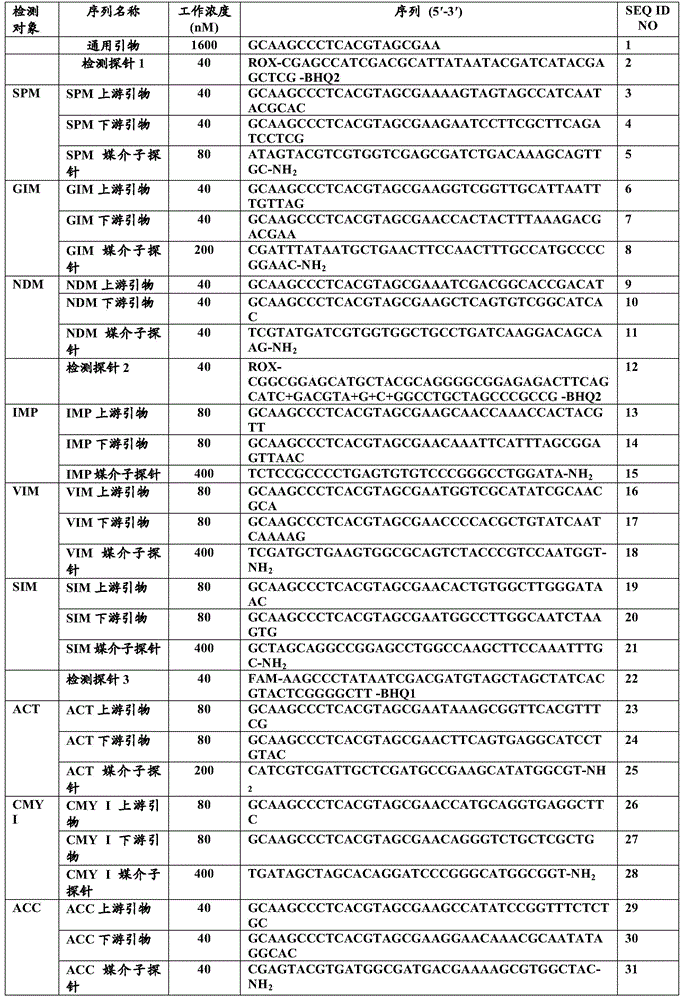


注:前面带有“+”的碱基为锁核酸(Locked Nucleic Acid,LNA)修饰的碱基。Note: The bases preceded by “+” are the bases modified by locked nucleic acid (LNA).
具体实施方式DETAILED DESCRIPTION
现参照下列意在举例说明本发明(而非限定本发明)的实施例来描述本发明。应当理解的是,这些实施例只是用于说明本发明的原理和技术效果,而并不是表示本发明的所有可能性。本发明并不局限于这些实施例中提到的材料、反应条件或参数。本领域技术人员可以根据本发明的原理,利用其它类似的材料或反应条件来实施其他技术方案。此类技术方案没有脱离本发明描述的基本原理和概念,并且涵盖在本发明的范围内。The present invention is now described with reference to the following embodiments which are intended to illustrate the present invention (but not to limit the present invention). It should be understood that these embodiments are only used to illustrate the principles and technical effects of the present invention, and do not represent all possibilities of the present invention. The present invention is not limited to the materials, reaction conditions or parameters mentioned in these embodiments. Those skilled in the art can implement other technical solutions based on the principles of the present invention using other similar materials or reaction conditions. Such technical solutions do not depart from the basic principles and concepts described in the present invention, and are encompassed within the scope of the present invention.
本申请实施例中所使用的检测探针、媒介子探针、上游寡核苷酸(上游引物)、下游寡核苷酸(下游引物)和通用引物的详细信息,以及它们的工作浓度和检测对象已概述于表1中。通过使用表1中提供的试剂(即,8种检测探针、24种媒介子探针、24种上游寡核苷酸(上游引物)、24种下游寡核苷酸(下游引物)和1种通用引物,本发明的方法在只使用8种荧光探针(检测探针)的情况下,即能够对23种耐药基因和1种对照序列进行同时检测(二十四重检测)。所使用的荧光检测通道以及所检测的熔解峰的熔点概述于表2中。The detailed information of the detection probes, mediator probes, upstream oligonucleotides (upstream primers), downstream oligonucleotides (downstream primers) and universal primers used in the examples of the present application, as well as their working concentrations and detection objects are summarized in Table 1. By using the reagents provided in Table 1 (i.e., 8 detection probes, 24 mediator probes, 24 upstream oligonucleotides (upstream primers), 24 downstream oligonucleotides (downstream primers) and 1 universal primer, the method of the present invention can simultaneously detect 23 drug-resistant genes and 1 control sequence (twenty-four-fold detection) using only 8 fluorescent probes (detection probes). The fluorescent detection channels used and the melting points of the detected melting peaks are summarized in Table 2.
在表1描述的各种检测探针和媒介子探针中,检测探针1和2标记有ROX和BHQ2,其荧光信号通过ROX通道进行检测;检测探针3和4标记有FAM和BHQ1,其荧光信号通过FAM通道进行检测;检测探针5和6标记有Cy5和BHQ2,其荧光信号通过Cy5通道进行检测;检测探针7和8标记有HEX和BHQ1,其荧光信号通过HEX通道进行检测。如SEQ ID NO:5、8和11所示的3种媒介子探针中的媒介子序列各自能够与检测探针1结合,且这3种媒介子探针分别用于检测SPM、GIM和NDM耐药基因。如SEQ ID NO:15、18和21所示的3种媒介子探针中的媒介子序列各自能够与检测探针2结合,且这3种媒介子探针分别用于检测IMP、VIM和SIM耐药基因。分别如SEQ ID NO:25、28和31所示的3种媒介子探针中的媒介子序列各自能够与检测探针3结合,且这3种媒介子探针分别用于检测ACT、CMY I和ACC耐药基因。分别如SEQ ID NO:35、38和41所示的3种媒介子探针中的媒介子序列各自能够与检测探针4结合,且这3种媒介子探针分别用于检测CMY II、DHA和FOX耐药基因。分别如SEQ ID NO:45、48和51所示的3种媒介子探针中的媒介子序列各自能够与检测探针5结合,且这3种媒介子探针分别用于检测CTX-M、OXA-51和GES耐药基因。分别如SEQ ID NO:55和58所示的2种媒介子探针中的媒介子序列各自能够与检测探针6结合,且这2种媒介子探针分别用于检测PER和OXA-58耐药基因。分别如SEQ ID NO:62、65、68、71和74所示的5种媒介子探针中的媒介子序列各自能够与检测探针7结合,且这5种媒介子探针分别用于检测OXA-24、KPC、OXA-23、OXA-48和VEB耐药基因。分别如SEQ ID NO:78和81所示的2种媒介子探针中的媒介子序列各自能够与检测探针8结合,且这2种媒介子探针分别用于检测SHV耐药基因和拟南芥Lac8基因(用作对照)。Among the various detection probes and mediator probes described in Table 1, detection probes 1 and 2 are labeled with ROX and BHQ2, and their fluorescence signals are detected through the ROX channel;
表2:检测方案Table 2: Detection scheme


实施例1.DHA耐药基因的检测Example 1. Detection of DHA resistance genes
在本实施例中,使用表1中描述的试剂(8种检测探针、24种媒介子探针、24种上游引物、24种下游引物和1种通用引物)和表2中描述的检测方案,对含有DHA耐药基因细菌的样品进行检测。In this embodiment, samples containing bacteria with DHA resistance genes were detected using the reagents described in Table 1 (8 detection probes, 24 mediator probes, 24 upstream primers, 24 downstream primers and 1 universal primer) and the detection scheme described in Table 2.
简言之,本实施例中使用25μL的PCR反应体系来进行实时PCR,所述PCR反应体系包括:1×PCR buffer(67mM Tris-HCl,50mM KCl和0.085mg/mL BSA),6.0mM MgCl2,0.2mMdNTPs,2.0U的聚合酶TaqHS(Takara),表1中描述的各种试剂(以指定的工作浓度使用),以及5μL的携带DHA耐药基因的细菌DNA和对照DNA(拟南芥Lac8基因)(二者的用量比例为约1:1)。实时PCR的反应条件为:95℃,5min;然后50个循环的(95℃,20s和63℃,1min)。在PCR完成后,按照下述程序进行熔解曲线分析:95℃,2min;40℃,2min;随后按0.4℃/step的升温速率(每个step的维持时间是5s),将反应体系的温度从40℃升温至95℃,并在此过程中采集ROX、FAM、HEX和Cy5通道的荧光信号。所使用的实验仪器为Bio-Rad CFX96实时PCR仪(Bio-Rad,美国)。检测结果如图2所示。In brief, in this example, real-time PCR was performed using a 25 μL PCR reaction system, which included: 1×PCR buffer (67 mM Tris-HCl, 50 mM KCl and 0.085 mg/mL BSA), 6.0 mM MgCl 2 , 0.2 mM dNTPs, 2.0 U of polymerase TaqHS (Takara), various reagents described in Table 1 (used at specified working concentrations), and 5 μL of bacterial DNA carrying a DHA resistance gene and control DNA (Arabidopsis thaliana Lac8 gene) (the ratio of the two was about 1:1). The reaction conditions of real-time PCR were: 95° C., 5 min; then 50 cycles of (95° C., 20 s and 63° C., 1 min). After the PCR was completed, the melting curve analysis was performed according to the following procedure: 95°C, 2 min; 40°C, 2 min; then the temperature of the reaction system was raised from 40°C to 95°C at a heating rate of 0.4°C/step (the maintenance time of each step was 5 s), and the fluorescence signals of the ROX, FAM, HEX and Cy5 channels were collected during this process. The experimental instrument used was the Bio-Rad CFX96 real-time PCR instrument (Bio-Rad, USA). The detection results are shown in Figure 2.
图2的结果显示,在FAM通道采集的荧光信号中,在81.3℃处观察到对应于DHA耐药基因的特征性熔解峰;在HEX通道采集的荧光信号中,在85.0℃处观察到对应于对照DNA的特征性熔解峰;并且,在ROX和Cy5通道采集的荧光信号中,未观察到任何熔解峰。该结果表明,所设计的检测体系可用于特异性检测DHA耐药基因,并且可准确区分DHA耐药基因与对照基因。The results in Figure 2 show that in the fluorescence signal collected by the FAM channel, a characteristic melting peak corresponding to the DHA resistance gene was observed at 81.3°C; in the fluorescence signal collected by the HEX channel, a characteristic melting peak corresponding to the control DNA was observed at 85.0°C; and in the fluorescence signals collected by the ROX and Cy5 channels, no melting peak was observed. This result shows that the designed detection system can be used to specifically detect the DHA resistance gene and can accurately distinguish the DHA resistance gene from the control gene.
实施例2.NDM耐药基因和DHA耐药基因的检测Example 2. Detection of NDM resistance gene and DHA resistance gene
在本实施例中,使用表1中描述的试剂(8种检测探针、24种媒介子探针、24种上游引物、24种下游引物和1种通用引物)和表2中描述的检测方案,对含有DHA耐药基因细菌和NDM耐药基因细菌的样品进行检测。In this embodiment, samples containing bacteria with DHA-resistant genes and bacteria with NDM-resistant genes were detected using the reagents described in Table 1 (8 detection probes, 24 mediator probes, 24 upstream primers, 24 downstream primers and 1 universal primer) and the detection scheme described in Table 2.
简言之,本实施例中使用25μL的PCR反应体系来进行实时PCR,所述PCR反应体系包括:1×PCR buffer(67mM Tris-HCl,50mM KCl和0.085mg/mL BSA),6.0mM MgCl2,0.2mMdNTPs,2.0U的聚合酶TaqHS(Takara),表1中描述的各种试剂(以指定的工作浓度使用),以及5μL的携带NDM耐药基因的细菌DNA、DHA耐药基因的细菌DNA、和对照DNA(拟南芥Lac8基因)的混合物(三者的用量比例为约3:2:1)。实时PCR的反应条件为:95℃,5min;然后50个循环的(95℃,20s和63℃,1min)。在PCR完成后,按照下述程序进行熔解曲线分析:95℃,2min;40℃,2min;随后按0.4℃/step的升温速率(每个step的维持时间是5s),将反应体系的温度从40℃升温至95℃,并在此过程中采集ROX、FAM、HEX和Cy5通道的荧光信号。所使用的实验仪器为Bio-Rad CFX96实时PCR仪(Bio-Rad,美国)。检测结果如图3所示。In brief, in this example, real-time PCR was performed using a 25 μL PCR reaction system, which included: 1×PCR buffer (67 mM Tris-HCl, 50 mM KCl and 0.085 mg/mL BSA), 6.0 mM MgCl 2 , 0.2 mM dNTPs, 2.0 U of polymerase TaqHS (Takara), various reagents described in Table 1 (used at specified working concentrations), and 5 μL of a mixture of bacterial DNA carrying NDM resistance gene, bacterial DNA carrying DHA resistance gene, and control DNA (Arabidopsis thaliana Lac8 gene) (the ratio of the three was about 3:2:1). The reaction conditions of real-time PCR were: 95° C., 5 min; then 50 cycles of (95° C., 20 s and 63° C., 1 min). After the PCR was completed, the melting curve analysis was performed according to the following procedure: 95°C, 2 min; 40°C, 2 min; then the temperature of the reaction system was raised from 40°C to 95°C at a heating rate of 0.4°C/step (the maintenance time of each step was 5 s), and the fluorescence signals of the ROX, FAM, HEX and Cy5 channels were collected during this process. The experimental instrument used was the Bio-Rad CFX96 real-time PCR instrument (Bio-Rad, USA). The detection results are shown in Figure 3.
图3的结果显示,在ROX通道采集的荧光信号中,在69.3℃处观察到对应于NDM耐药基因的特征性熔解峰;在FAM通道采集的荧光信号中,在81.3℃处观察到对应于DHA耐药基因的特征性熔解峰;在HEX通道采集的荧光信号中,在85.0℃处观察到对应于对照DNA的特征性熔解峰;并且,在Cy5通道采集的荧光信号中,未观察到任何熔解峰。该结果表明,所设计的检测体系可用于特异性检测NDM耐药基因和DHA耐药基因,并且可准确区分NDM耐药基因和DHA耐药基因和对照基因。此外,根据NDM耐药基因和DHA耐药基因的特征性熔解峰的峰高,可以确定本实施例所使用的样品中携带NDM耐药基因细菌的含量(DNA拷贝数)高于携带DHA耐药基因细菌的含量(DNA拷贝数),这一结果也表明所设计的检测体系不仅可以定性检测,也可以半定量/定量检测耐药基因。The results of Figure 3 show that in the fluorescence signal collected by the ROX channel, a characteristic melting peak corresponding to the NDM resistance gene was observed at 69.3°C; in the fluorescence signal collected by the FAM channel, a characteristic melting peak corresponding to the DHA resistance gene was observed at 81.3°C; in the fluorescence signal collected by the HEX channel, a characteristic melting peak corresponding to the control DNA was observed at 85.0°C; and, in the fluorescence signal collected by the Cy5 channel, no melting peak was observed. This result shows that the designed detection system can be used to specifically detect NDM resistance genes and DHA resistance genes, and can accurately distinguish NDM resistance genes, DHA resistance genes and control genes. In addition, according to the peak height of the characteristic melting peaks of NDM resistance genes and DHA resistance genes, it can be determined that the content (DNA copy number) of bacteria carrying NDM resistance genes in the sample used in this embodiment is higher than the content (DNA copy number) of bacteria carrying DHA resistance genes. This result also shows that the designed detection system can not only detect qualitatively, but also semi-quantitatively/quantitatively detect resistance genes.
实施例3.二十四重检测Example 3. Twenty-four-fold detection
在本实施例中,使用表1中描述的试剂(8种检测探针、24种媒介子探针、24种上游引物、24种下游引物和1种通用引物)和表2中描述的检测方案,对含有24种细菌耐药基因(分别来自携带SPM、GIM、NDM、IMP、VIM、SIM、CTX-M、OXA-51、GES、PER、OXA-58、ACT、CMY I、ACC、CMY II、DHA、FOX、OXA-24、KPC、OXA-23、OXA-48、VEB和SHV耐药基因的细菌)和对照DNA(拟南芥Lac8基因)的样品进行检测。In this embodiment, the reagents described in Table 1 (8 detection probes, 24 mediator probes, 24 upstream primers, 24 downstream primers and 1 universal primer) and the detection scheme described in Table 2 were used to detect samples containing 24 bacterial resistance genes (from bacteria carrying SPM, GIM, NDM, IMP, VIM, SIM, CTX-M, OXA-51, GES, PER, OXA-58, ACT, CMY I, ACC, CMY II, DHA, FOX, OXA-24, KPC, OXA-23, OXA-48, VEB and SHV resistance genes, respectively) and control DNA (Arabidopsis Lac8 gene).
简言之,本实施例中使用25μL的PCR反应体系来进行实时PCR,所述PCR反应体系包括:1×PCR buffer(67mM Tris-HCl,50mM KCl和0.085mg/mL BSA),6.0mM MgCl2,0.2mMdNTPs,2.0U的聚合酶TaqHS(Takara),表1中描述的各种试剂(以指定的工作浓度使用),以及5μL的核酸混合物(其包含所述23种耐药细菌的DNA以及对照DNA(拟南芥Lac8基因)。实时PCR的反应条件为:95℃,5min;然后50个循环的(95℃,20s和63℃,1min)。在PCR完成后,按照下述程序进行熔解曲线分析:95℃,2min;40℃,2min;随后按0.4℃/step的升温速率(每个step的维持时间是5s),将反应体系的温度从40℃升温至95℃,并在此过程中采集ROX、FAM、HEX和Cy5通道的荧光信号。所使用的实验仪器为Bio-Rad CFX96实时PCR仪(Bio-Rad,美国)。检测结果如图4所示。In brief, in this example, real-time PCR was performed using a 25 μL PCR reaction system, which included: 1× PCR buffer (67 mM Tris-HCl, 50 mM KCl and 0.085 mg/mL BSA), 6.0 mM MgCl 2 , 0.2 mM dNTPs, 2.0 U of polymerase TaqHS (Takara), various reagents described in Table 1 (used at specified working concentrations), and 5 μL of nucleic acid mixture (which contains DNA of the 23 drug-resistant bacteria and control DNA (Arabidopsis Lac8 gene). The reaction conditions of real-time PCR are: 95°C, 5 min; then 50 cycles of (95°C, 20 s and 63°C, 1 min). After the PCR is completed, the melting curve analysis is performed according to the following procedure: 95°C, 2 min; 40°C, 2 min; then the temperature of the reaction system is increased from 40°C to 95°C at a heating rate of 0.4°C/step (the maintenance time of each step is 5 s), and the fluorescence signals of ROX, FAM, HEX and Cy5 channels are collected during this process. The experimental instrument used is Bio-Rad CFX96 real-time PCR instrument (Bio-Rad, USA). The detection results are shown in Figure 4.
图4的结果显示,在ROX通道采集的荧光信号中,在59.0℃、63.8℃、69.3℃、75.0℃、79.0℃、85.7℃处,观察到分别对应于SPM、GIM、NDM、IMP、VIM和SIM 6个耐药基因特征性熔解峰(峰1-6);在Cy5通道采集的荧光信号中,在61.6℃、66.2℃、70.2℃、76.3℃、85.4℃处,观察到分别对应于CTX-M、OXA-51、GES、PER和OXA-58 5个耐药基因特征性熔解峰(峰7-11);在FAM通道采集的荧光信号中,在59.3℃、63.2℃、69.6℃、75.4℃、81.3℃、85.2℃处,观察到分别对应于ACT、CMY I、ACC、CMY II、DHA和FOX 6个耐药基因特征性熔解峰(峰12-17);并且,在HEX通道采集的荧光信号中,在53.9℃、59.6℃、64.9℃、69.5℃、71.8℃、78.5℃、85.0℃处,观察到分别对应于OXA-24、KPC、OXA-23、OXA-48、VEB、SHV 6个耐药基因和内标基因(拟南芥Lac8基因)特征性熔解峰(峰18-24)。该结果表明,所设计的检测体系可用于特异性检测所述23种细菌耐药基因,并且可准确区分这23种细菌耐药基因和对照。The results in Figure 4 show that in the fluorescence signal collected by the ROX channel, at 59.0°C, 63.8°C, 69.3°C, 75.0°C, 79.0°C, and 85.7°C, characteristic melting peaks (peaks 1-6) corresponding to six drug-resistant genes, SPM, GIM, NDM, IMP, VIM, and SIM, were observed respectively; in the fluorescence signal collected by the Cy5 channel, at 61.6°C, 66.2°C, 70.2°C, 76.3°C, and 85.4°C, five drug-resistant genes, CTX-M, OXA-51, GES, PER, and OXA-58, were observed respectively (peaks 7-11); in the fluorescence signal collected by the FAM channel, at 59.3°C, 63.2°C, 69.6°C, 75.4°C, 81.3°C, and 85.2°C, characteristic melting peaks (peaks 7-11) corresponding to five drug-resistant genes, ACT, CMY I, ACC, CMY II, DHA, and FOX, were observed respectively. 6 characteristic melting peaks of drug resistance genes (peaks 12-17); and, in the fluorescence signals collected in the HEX channel, at 53.9°C, 59.6°C, 64.9°C, 69.5°C, 71.8°C, 78.5°C, and 85.0°C, characteristic melting peaks (peaks 18-24) corresponding to OXA-24, KPC, OXA-23, OXA-48, VEB, and
这些实验结果表明,利用所设计的检测体系和试剂(特别是所设计的24条媒介子探针和8条荧光探针),可在单次的测定中实现对24个靶序列(23种细菌耐药基因和1种对照)的同时检测和区分(即,二十四重检测)。由此,本发明的方法和试剂盒可用于快速简便、灵敏特异、稳定可靠地对多种细菌耐药基因(例如,23种或更多种细菌耐药基因)进行同时检测。These experimental results show that the designed detection system and reagents (especially the designed 24 mediator probes and 8 fluorescent probes) can be used to simultaneously detect and distinguish 24 target sequences (23 bacterial resistance genes and 1 control) in a single determination (i.e., 24-fold detection). Therefore, the method and kit of the present invention can be used to simultaneously detect multiple bacterial resistance genes (e.g., 23 or more bacterial resistance genes) quickly, easily, sensitively, specifically, stably and reliably.
尽管本发明的具体实施方式已经得到详细的描述,但本领域技术人员将理解:根据已经公开的所有教导,可以对细节进行各种修改和变动,并且这些改变均在本发明的保护范围之内。本发明的全部范围由所附权利要求及其任何等同物给出。Although the specific embodiments of the present invention have been described in detail, it will be understood by those skilled in the art that various modifications and changes may be made to the details according to all the teachings disclosed, and these changes are within the scope of protection of the present invention. The full scope of the present invention is given by the attached claims and any equivalents thereof.
SEQUENCE LISTINGSEQUENCE LISTING
<110> 厦门大学<110> Xiamen University
<120> 一种细菌耐药基因检测的方法<120> A method for detecting bacterial resistance genes
<130> IDC180260<130> IDC180260
<160> 81<160> 81
<170> PatentIn version 3.5<170> PatentIn version 3.5
<210> 1<210> 1
<211> 20<211> 20
<212> DNA<212> DNA
<213> 人工序列<213> Artificial sequence
<220><220>
<223> 通用引物<223> Universal Primer
<400> 1<400> 1
gcaagccctc acgtagcgaa 20gcaagccctc acgtagcgaa 20
<210> 2<210> 2
<211> 39<211> 39
<212> DNA<212> DNA
<213> 人工序列<213> Artificial sequence
<220><220>
<223> 检测探针1<223>
<400> 2<400> 2
cgagccatcg acgcattata atacgatcat acgagctcg 39cgagccatcg acgcattata atacgatcat acgagctcg 39
<210> 3<210> 3
<211> 43<211> 43
<212> DNA<212> DNA
<213> 人工序列<213> Artificial sequence
<220><220>
<223> SPM上游引物<223> SPM upstream primer
<400> 3<400> 3
gcaagccctc acgtagcgaa aagtagtagc catcaatacg cac 43gcaagccctc acgtagcgaa aagtagtagc catcaatacg cac 43
<210> 4<210> 4
<211> 43<211> 43
<212> DNA<212> DNA
<213> 人工序列<213> Artificial sequence
<220><220>
<223> SPM下游引物<223> SPM downstream primer
<400> 4<400> 4
gcaagccctc acgtagcgaa gaatccttcg cttcagatcc tcg 43gcaagccctc acgtagcgaa gaatccttcg cttcagatcc tcg 43
<210> 5<210> 5
<211> 39<211> 39
<212> DNA<212> DNA
<213> 人工序列<213> Artificial sequence
<220><220>
<223> SPM媒介子探针<223> SPM Mediator Probe
<400> 5<400> 5
atagtacgtc gtggtcgagc gatctgacaa agcagttgc 39atagtacgtc gtggtcgagc gatctgacaa agcagttgc 39
<210> 6<210> 6
<211> 43<211> 43
<212> DNA<212> DNA
<213> 人工序列<213> Artificial sequence
<220><220>
<223> GIM上游引物<223> GIM upstream primer
<400> 6<400> 6
gcaagccctc acgtagcgaa ggtcggttgc attaatttgt tag 43gcaagccctc acgtagcgaa ggtcggttgc attaatttgt tag 43
<210> 7<210> 7
<211> 42<211> 42
<212> DNA<212> DNA
<213> 人工序列<213> Artificial sequence
<220><220>
<223> GIM下游引物<223> GIM downstream primer
<400> 7<400> 7
gcaagccctc acgtagcgaa ccactacttt aaagacgacg aa 42gcaagccctc acgtagcgaa ccactacttt aaagacgacg aa 42
<210> 8<210> 8
<211> 43<211> 43
<212> DNA<212> DNA
<213> 人工序列<213> Artificial sequence
<220><220>
<223> GIM媒介子探针<223> GIM Mediator Probe
<400> 8<400> 8
cgatttataa tgctgaactt ccaactttgc catgccccgg aac 43cgatttataa tgctgaactt ccaactttgc catgccccgg aac 43
<210> 9<210> 9
<211> 37<211> 37
<212> DNA<212> DNA
<213> 人工序列<213> Artificial sequence
<220><220>
<223> NDM上游引物<223> NDM upstream primer
<400> 9<400> 9
gcaagccctc acgtagcgaa atcgacggca ccgacat 37gcaagccctc acgtagcgaa atcgacggca ccgacat 37
<210> 10<210> 10
<211> 38<211> 38
<212> DNA<212> DNA
<213> 人工序列<213> Artificial sequence
<220><220>
<223> NDM下游引物<223> NDM downstream primer
<400> 10<400> 10
gcaagccctc acgtagcgaa gctcagtgtc ggcatcac 38gcaagccctc acgtagcgaa gctcagtgtc ggcatcac 38
<210> 11<210> 11
<211> 39<211> 39
<212> DNA<212> DNA
<213> 人工序列<213> Artificial sequence
<220><220>
<223> NDM媒介子探针<223> NDM mediator probe
<400> 11<400> 11
tcgtatgatc gtggtggctg cctgatcaag gacagcaag 39tcgtatgatc gtggtggctg cctgatcaag gacagcaag 39
<210> 12<210> 12
<211> 66<211> 66
<212> DNA<212> DNA
<213> 人工序列<213> Artificial sequence
<220><220>
<223> 检测探针2<223>
<400> 12<400> 12
cggcggagca tgctacgcag gggcggagag acttcagcat cgacgtagcg gcctgctagc 60cggcggagca tgctacgcag gggcggagag acttcagcat cgacgtagcg gcctgctagc 60
ccgccg 66ccgccg 66
<210> 13<210> 13
<211> 39<211> 39
<212> DNA<212> DNA
<213> 人工序列<213> Artificial sequence
<220><220>
<223> IMP上游引物<223> IMP upstream primer
<400> 13<400> 13
gcaagccctc acgtagcgaa gcaaccaaac cactacgtt 39gcaagccctc acgtagcgaa gcaaccaaac cactacgtt 39
<210> 14<210> 14
<211> 43<211> 43
<212> DNA<212> DNA
<213> 人工序列<213> Artificial sequence
<220><220>
<223> IMP下游引物<223> IMP downstream primer
<400> 14<400> 14
gcaagccctc acgtagcgaa caaattcatt tagcggagtt aac 43gcaagccctc acgtagcgaa caaattcatt tagcggagtt aac 43
<210> 15<210> 15
<211> 33<211> 33
<212> DNA<212> DNA
<213> 人工序列<213> Artificial sequence
<220><220>
<223> IMP媒介子探针<223> IMP Mediator Probe
<400> 15<400> 15
tctccgcccc tgagtgtgtc ccgggcctgg ata 33tctccgcccc tgagtgtgtc ccgggcctgg ata 33
<210> 16<210> 16
<211> 40<211> 40
<212> DNA<212> DNA
<213> 人工序列<213> Artificial sequence
<220><220>
<223> VIM上游引物<223> VIM upstream primer
<400> 16<400> 16
gcaagccctc acgtagcgaa tggtcgcata tcgcaacgca 40gcaagccctc acgtagcgaa tggtcgcata tcgcaacgca 40
<210> 17<210> 17
<211> 43<211> 43
<212> DNA<212> DNA
<213> 人工序列<213> Artificial sequence
<220><220>
<223> VIM下游引物<223> VIM downstream primer
<400> 17<400> 17
gcaagccctc acgtagcgaa ccccacgctg tatcaatcaa aag 43gcaagccctc acgtagcgaa ccccacgctg tatcaatcaa aag 43
<210> 18<210> 18
<211> 37<211> 37
<212> DNA<212> DNA
<213> 人工序列<213> Artificial sequence
<220><220>
<223> VIM媒介子探针<223> VIM Mediator Probe
<400> 18<400> 18
tcgatgctga agtggcgcag tctacccgtc caatggt 37tcgatgctga agtggcgcag tctacccgtc caatggt 37
<210> 19<210> 19
<211> 39<211> 39
<212> DNA<212> DNA
<213> 人工序列<213> Artificial sequence
<220><220>
<223> SIM上游引物<223> SIM upstream primer
<400> 19<400> 19
gcaagccctc acgtagcgaa cactgtggct tgggataac 39gcaagccctc acgtagcgaa cactgtggct tgggataac 39
<210> 20<210> 20
<211> 40<211> 40
<212> DNA<212> DNA
<213> 人工序列<213> Artificial sequence
<220><220>
<223> SIM下游引物<223> SIM downstream primer
<400> 20<400> 20
gcaagccctc acgtagcgaa tggccttggc aatctaagtg 40gcaagccctc acgtagcgaa tggccttggc aatctaagtg 40
<210> 21<210> 21
<211> 38<211> 38
<212> DNA<212> DNA
<213> 人工序列<213> Artificial sequence
<220><220>
<223> SIM媒介子探针<223> SIM Mediator Probe
<400> 21<400> 21
gctagcaggc cggagcctgg ccaagcttcc aaatttgc 38gctagcaggc cggagcctgg ccaagcttcc aaatttgc 38
<210> 22<210> 22
<211> 47<211> 47
<212> DNA<212> DNA
<213> 人工序列<213> Artificial sequence
<220><220>
<223> 检测探针3<223>
<400> 22<400> 22
aagccctata atcgacgatg tagctagcta tcacgtactc ggggctt 47aagccctata atcgacgatg tagctagcta tcacgtactc ggggctt 47
<210> 23<210> 23
<211> 39<211> 39
<212> DNA<212> DNA
<213> 人工序列<213> Artificial sequence
<220><220>
<223> ACT上游引物<223> ACT upstream primer
<400> 23<400> 23
gcaagccctc acgtagcgaa taaagcggtt cacgtttcg 39gcaagccctc acgtagcgaa taaagcggtt cacgtttcg 39
<210> 24<210> 24
<211> 41<211> 41
<212> DNA<212> DNA
<213> 人工序列<213> Artificial sequence
<220><220>
<223> ACT下游引物<223> ACT downstream primer
<400> 24<400> 24
gcaagccctc acgtagcgaa cttcagtgag gcatcctgta c 41gcaagccctc acgtagcgaa cttcagtgag gcatcctgta c 41
<210> 25<210> 25
<211> 35<211> 35
<212> DNA<212> DNA
<213> 人工序列<213> Artificial sequence
<220><220>
<223> ACT媒介子探针<223> ACT Mediator Probe
<400> 25<400> 25
catcgtcgat tgctcgatgc cgaagcatat ggcgt 35catcgtcgat tgctcgatgc cgaagcatat ggcgt 35
<210> 26<210> 26
<211> 38<211> 38
<212> DNA<212> DNA
<213> 人工序列<213> Artificial sequence
<220><220>
<223> CMY I上游引物<223> CMY I upstream primer
<400> 26<400> 26
gcaagccctc acgtagcgaa ccatgcaggt gaggcttc 38gcaagccctc acgtagcgaa ccatgcaggt gaggcttc 38
<210> 27<210> 27
<211> 36<211> 36
<212> DNA<212> DNA
<213> 人工序列<213> Artificial sequence
<220><220>
<223> CMY I下游引物<223> CMY I downstream primer
<400> 27<400> 27
gcaagccctc acgtagcgaa cagggtctgc tcgctg 36gcaagccctc acgtagcgaa cagggtctgc tcgctg 36
<210> 28<210> 28
<211> 33<211> 33
<212> DNA<212> DNA
<213> 人工序列<213> Artificial sequence
<220><220>
<223> CMY I媒介子探针<223> CMY I mediator probe
<400> 28<400> 28
tgatagctag cacaggatcc cgggcatggc ggt 33tgatagctag cacaggatcc cgggcatggc ggt 33
<210> 29<210> 29
<211> 40<211> 40
<212> DNA<212> DNA
<213> 人工序列<213> Artificial sequence
<220><220>
<223> ACC上游引物<223> ACC upstream primer
<400> 29<400> 29
gcaagccctc acgtagcgaa gccatatccg gtttctctgc 40gcaagccctc acgtagcgaa gccatatccg gtttctctgc 40
<210> 30<210> 30
<211> 42<211> 42
<212> DNA<212> DNA
<213> 人工序列<213> Artificial sequence
<220><220>
<223> ACC下游引物<223> ACC downstream primer
<400> 30<400> 30
gcaagccctc acgtagcgaa ggaacaaacg caatataggc ac 42gcaagccctc acgtagcgaa ggaacaaacg caatataggc ac 42
<210> 31<210> 31
<211> 36<211> 36
<212> DNA<212> DNA
<213> 人工序列<213> Artificial sequence
<220><220>
<223> ACC媒介子探针<223> ACC Mediator Probe
<400> 31<400> 31
cgagtacgtg atggcgatga cgaaaagcgt ggctac 36cgagtacgtg atggcgatga cgaaaagcgt ggctac 36
<210> 32<210> 32
<211> 47<211> 47
<212> DNA<212> DNA
<213> 人工序列<213> Artificial sequence
<220><220>
<223> 检测探针4<223>
<400> 32<400> 32
gcgcgccgca tgcaccgtag catgcgcgct agctagctag ggcgcgc 47gcgcgccgca tgcaccgtag catgcgcgct agctagctag ggcgcgc 47
<210> 33<210> 33
<211> 38<211> 38
<212> DNA<212> DNA
<213> 人工序列<213> Artificial sequence
<220><220>
<223> CMY II上游引物<223> CMY II upstream primer
<400> 33<400> 33
gcaagccctc acgtagcgaa gtcgctgccg ttgatgat 38gcaagccctc acgtagcgaa gtcgctgccg ttgatgat 38
<210> 34<210> 34
<211> 40<211> 40
<212> DNA<212> DNA
<213> 人工序列<213> Artificial sequence
<220><220>
<223> CMY II下游引物<223> CMY II downstream primer
<400> 34<400> 34
gcaagccctc acgtagcgaa gtctcgctac tggcgtattg 40gcaagccctc acgtagcgaa gtctcgctac tggcgtattg 40
<210> 35<210> 35
<211> 36<211> 36
<212> DNA<212> DNA
<213> 人工序列<213> Artificial sequence
<220><220>
<223> CMY II媒介子探针<223> CMY II mediator probe
<400> 35<400> 35
gcatgctacg gtcagcggcc agttcagcat ctccca 36gcatgctacg gtcagcggcc agttcagcat ctccca 36
<210> 36<210> 36
<211> 41<211> 41
<212> DNA<212> DNA
<213> 人工序列<213> Artificial sequence
<220><220>
<223> DHA上游引物<223> DHA upstream primer
<400> 36<400> 36
gcaagccctc acgtagcgaa tacggctgaa cctggttgtc t 41gcaagccctc acgtagcgaa tacggctgaa cctggttgtc t 41
<210> 37<210> 37
<211> 44<211> 44
<212> DNA<212> DNA
<213> 人工序列<213> Artificial sequence
<220><220>
<223> DHA下游引物<223> DHA downstream primer
<400> 37<400> 37
gcaagccctc acgtagcgaa tctggaaatg gcaatgtatc tcgc 44gcaagccctc acgtagcgaa tctggaaatg gcaatgtatc tcgc 44
<210> 38<210> 38
<211> 35<211> 35
<212> DNA<212> DNA
<213> 人工序列<213> Artificial sequence
<220><220>
<223> DHA媒介子探针<223> DHA mediator probe
<400> 38<400> 38
gctagcgcgc acggatgcgg ctgcaatgcg acctc 35gctagcgcgc acggatgcgg ctgcaatgcg acctc 35
<210> 39<210> 39
<211> 37<211> 37
<212> DNA<212> DNA
<213> 人工序列<213> Artificial sequence
<220><220>
<223> FOX上游引物<223> FOX upstream primer
<400> 39<400> 39
gcaagccctc acgtagcgaa tcgaatccac ctcatcg 37gcaagccctc acgtagcgaa tcgaatccac ctcatcg 37
<210> 40<210> 40
<211> 37<211> 37
<212> DNA<212> DNA
<213> 人工序列<213> Artificial sequence
<220><220>
<223> FOX下游引物<223> FOX downstream primer
<400> 40<400> 40
gcaagccctc acgtagcgaa ggatgacaag gtgagcc 37gcaagccctc acgtagcgaa ggatgacaag gtgagcc 37
<210> 41<210> 41
<211> 36<211> 36
<212> DNA<212> DNA
<213> 人工序列<213> Artificial sequence
<220><220>
<223> FOX媒介子探针<223> FOX Mediator Probe
<400> 41<400> 41
ctagctagct accacccgca ctgtaggtgg caagct 36ctagctagct accacccgca ctgtaggtgg caagct 36
<210> 42<210> 42
<211> 36<211> 36
<212> DNA<212> DNA
<213> 人工序列<213> Artificial sequence
<220><220>
<223> 检测探针5<223>
<400> 42<400> 42
gctgctagtc agatcgtatt ctcgagctat cgcagc 36gctgctagtc agatcgtatt ctcgagctat cgcagc 36
<210> 43<210> 43
<211> 42<211> 42
<212> DNA<212> DNA
<213> 人工序列<213> Artificial sequence
<220><220>
<223> CTX-M上游引物<223> CTX-M upstream primer
<400> 43<400> 43
gcaagccctc acgtagcgaa gcgacctggt taactacaat cc 42gcaagccctc acgtagcgaa gcgacctggt taactacaat cc 42
<210> 44<210> 44
<211> 37<211> 37
<212> DNA<212> DNA
<213> 人工序列<213> Artificial sequence
<220><220>
<223> CTX-M下游引物<223> CTX-M downstream primer
<400> 44<400> 44
gcaagccctc acgtagcgaa gagcaaacgc cgtcact 37gcaagccctc acgtagcgaa gagcaaacgc cgtcact 37
<210> 45<210> 45
<211> 31<211> 31
<212> DNA<212> DNA
<213> 人工序列<213> Artificial sequence
<220><220>
<223> CTX-M媒介子探针<223> CTX-M mediator probe
<400> 45<400> 45
aatacgatct gacgctggct gagcttggcg c 31aatacgatct gacgctggct gagcttggcg c 31
<210> 46<210> 46
<211> 39<211> 39
<212> DNA<212> DNA
<213> 人工序列<213> Artificial sequence
<220><220>
<223> OXA-51上游引物<223> OXA-51 upstream primer
<400> 46<400> 46
gcaagccctc acgtagcgaa ctcctcagca agaggcaca 39gcaagccctc acgtagcgaa ctcctcagca agaggcaca 39
<210> 47<210> 47
<211> 40<211> 40
<212> DNA<212> DNA
<213> 人工序列<213> Artificial sequence
<220><220>
<223> OXA-51下游引物<223> OXA-51 downstream primer
<400> 47<400> 47
gcaagccctc acgtagcgaa gtctacatcc catccccaac 40gcaagccctc acgtagcgaa gtctacatcc catccccaac 40
<210> 48<210> 48
<211> 45<211> 45
<212> DNA<212> DNA
<213> 人工序列<213> Artificial sequence
<220><220>
<223> OXA-51媒介子探针<223> OXA-51 mediator probe
<400> 48<400> 48
ctcgagaata cgcttccatt tagcccaaaa gtccaagatg aagtg 45ctcgagaata cgcttccatt tagcccaaaa gtccaagatg aagtg 45
<210> 49<210> 49
<211> 39<211> 39
<212> DNA<212> DNA
<213> 人工序列<213> Artificial sequence
<220><220>
<223> GES上游引物<223> GES upstream primer
<400> 49<400> 49
gcaagccctc acgtagcgaa tattactggc agggatcgc 39gcaagccctc acgtagcgaa tattactggc agggatcgc 39
<210> 50<210> 50
<211> 38<211> 38
<212> DNA<212> DNA
<213> 人工序列<213> Artificial sequence
<220><220>
<223> GES下游引物<223> GES downstream primer
<400> 50<400> 50
gcaagccctc acgtagcgaa ctcggtgcct gagtcaat 38gcaagccctc acgtagcgaa ctcggtgcct gagtcaat 38
<210> 51<210> 51
<211> 35<211> 35
<212> DNA<212> DNA
<213> 人工序列<213> Artificial sequence
<220><220>
<223> GES媒介子探针<223> GES Mediator Probe
<400> 51<400> 51
gatagctcga ccgatcttga gaagctagag cgcga 35gatagctcga ccgatcttga gaagctagag cgcga 35
<210> 52<210> 52
<211> 51<211> 51
<212> DNA<212> DNA
<213> 人工序列<213> Artificial sequence
<220><220>
<223> 检测探针6<223>
<400> 52<400> 52
ccggcggcga gcgacggatc gaggcagcac gacgagcacc gagcccgccg g 51ccggcggcga gcgacggatc gaggcagcac gacgagcacc gagcccgccg
<210> 53<210> 53
<211> 37<211> 37
<212> DNA<212> DNA
<213> 人工序列<213> Artificial sequence
<220><220>
<223> PER上游引物<223> PER upstream primer
<400> 53<400> 53
gcaagccctc acgtagcgaa actgcctcga cgctact 37gcaagccctc acgtagcgaa actgcctcga cgctact 37
<210> 54<210> 54
<211> 39<211> 39
<212> DNA<212> DNA
<213> 人工序列<213> Artificial sequence
<220><220>
<223> PER下游引物<223> PER downstream primer
<400> 54<400> 54
gcaagccctc acgtagcgaa cacactgcaa cgcctacag 39gcaagccctc acgtagcgaa cacactgcaa cgcctacag 39
<210> 55<210> 55
<211> 38<211> 38
<212> DNA<212> DNA
<213> 人工序列<213> Artificial sequence
<220><220>
<223> PER媒介子探针<223> PER mediator probe
<400> 55<400> 55
ctgcctcgat agttcattcg aaacctcagc gcaatccc 38ctgcctcgat agttcattcg aaacctcagc gcaatccc 38
<210> 56<210> 56
<211> 41<211> 41
<212> DNA<212> DNA
<213> 人工序列<213> Artificial sequence
<220><220>
<223> OXA-58上游引物<223> OXA-58 upstream primer
<400> 56<400> 56
gcaagccctc acgtagcgaa tatggcacgc atttagaccg a 41gcaagccctc acgtagcgaa tatggcacgc atttagaccg a 41
<210> 57<210> 57
<211> 40<211> 40
<212> DNA<212> DNA
<213> 人工序列<213> Artificial sequence
<220><220>
<223> OXA-58下游引物<223> OXA-58 downstream primer
<400> 57<400> 57
gcaagccctc acgtagcgaa gtggctttcc atcccactta 40gcaagccctc acgtagcgaa gtggctttcc atcccactta 40
<210> 58<210> 58
<211> 49<211> 49
<212> DNA<212> DNA
<213> 人工序列<213> Artificial sequence
<220><220>
<223> OXA-58媒介子探针<223> OXA-58 mediator probe
<400> 58<400> 58
gctcggtgct tcctgcatct acatttaaaa ttgccaatgc actaattgg 49gctcggtgct tcctgcatct acatttaaaa ttgccaatgc actaattgg 49
<210> 59<210> 59
<211> 43<211> 43
<212> DNA<212> DNA
<213> 人工序列<213> Artificial sequence
<220><220>
<223> 检测探针7<223>
<400> 59<400> 59
atcgcctatc gattcacatg ctagctagct acatatcggc gat 43atcgcctatc gattcacatg ctagctagct acatatcggc gat 43
<210> 60<210> 60
<211> 42<211> 42
<212> DNA<212> DNA
<213> 人工序列<213> Artificial sequence
<220><220>
<223> OXA-24上游引物<223> OXA-24 upstream primer
<400> 60<400> 60
gcaagccctc acgtagcgaa atgactttag gtgaggcaat gg 42gcaagccctc acgtagcgaa atgactttag gtgaggcaat gg 42
<210> 61<210> 61
<211> 41<211> 41
<212> DNA<212> DNA
<213> 人工序列<213> Artificial sequence
<220><220>
<223> OXA-24下游引物<223> OXA-24 downstream primer
<400> 61<400> 61
gcaagccctc acgtagcgaa aacccgcttt acttctttct g 41gcaagccctc acgtagcgaa aacccgcttt acttctttct g 41
<210> 62<210> 62
<211> 33<211> 33
<212> DNA<212> DNA
<213> 人工序列<213> Artificial sequence
<220><220>
<223> OXA-24媒介子探针<223> OXA-24 mediator probe
<400> 62<400> 62
gtgatacgat tgcaagacgg actggcctag agc 33gtgatacgat tgcaagacgg actggcctag agc 33
<210> 63<210> 63
<211> 43<211> 43
<212> DNA<212> DNA
<213> 人工序列<213> Artificial sequence
<220><220>
<223> KPC上游引物<223> KPC upstream primer
<400> 63<400> 63
gcaagccctc acgtagcgaa ggaaccattc gctaaactcg aac 43gcaagccctc acgtagcgaa ggaaccattc gctaaactcg aac 43
<210> 64<210> 64
<211> 40<211> 40
<212> DNA<212> DNA
<213> 人工序列<213> Artificial sequence
<220><220>
<223> KPC下游引物<223> KPC downstream primer
<400> 64<400> 64
gcaagccctc acgtagcgaa aatgagctgc acagtgggaa 40gcaagccctc acgtagcgaa aatgagctgc acagtgggaa 40
<210> 65<210> 65
<211> 30<211> 30
<212> DNA<212> DNA
<213> 人工序列<213> Artificial sequence
<220><220>
<223> KPC媒介子探针<223> KPC Mediator Probe
<400> 65<400> 65
gcatgtgaat ggcggctcca tcggtgtgta 30gcatgtgaat ggcggctcca tcggtgtgta 30
<210> 66<210> 66
<211> 41<211> 41
<212> DNA<212> DNA
<213> 人工序列<213> Artificial sequence
<220><220>
<223> OXA-23上游引物<223> OXA-23 upstream primer
<400> 66<400> 66
gcaagccctc acgtagcgaa cagaatatgt gccagcctct a 41gcaagccctc acgtagcgaa cagaatatgt gccagcctct a 41
<210> 67<210> 67
<211> 41<211> 41
<212> DNA<212> DNA
<213> 人工序列<213> Artificial sequence
<220><220>
<223> OXA-23下游引物<223> OXA-23 downstream primer
<400> 67<400> 67
gcaagccctc acgtagcgaa ttcctgatag actgggactg c 41gcaagccctc acgtagcgaa ttcctgatag actgggactg c 41
<210> 68<210> 68
<211> 37<211> 37
<212> DNA<212> DNA
<213> 人工序列<213> Artificial sequence
<220><220>
<223> OXA-23媒介子探针<223> OXA-23 mediator probe
<400> 68<400> 68
gctagcatgt tgaatgccct gatcggattg gagaacc 37gctagcatgt tgaatgccct gatcggattg gagaacc 37
<210> 69<210> 69
<211> 43<211> 43
<212> DNA<212> DNA
<213> 人工序列<213> Artificial sequence
<220><220>
<223> OXA-48上游引物<223> OXA-48 upstream primer
<400> 69<400> 69
gcaagccctc acgtagcgaa agttggaatg ctcactttac tga 43gcaagccctc acgtagcgaa agttggaatg ctcactttac tga 43
<210> 70<210> 70
<211> 41<211> 41
<212> DNA<212> DNA
<213> 人工序列<213> Artificial sequence
<220><220>
<223> OXA-48下游引物<223> OXA-48 downstream primer
<400> 70<400> 70
gcaagccctc acgtagcgaa tcgcccgttt aagattattg g 41gcaagccctc acgtagcgaa tcgcccgttt aagattattg g 41
<210> 71<210> 71
<211> 33<211> 33
<212> DNA<212> DNA
<213> 人工序列<213> Artificial sequence
<220><220>
<223> OXA-48媒介子探针<223> OXA-48 mediator probe
<400> 71<400> 71
agctagctag cacagggcgt agttgtgctc tgg 33agctagctag cacagggcgt agttgtgctc tgg 33
<210> 72<210> 72
<211> 39<211> 39
<212> DNA<212> DNA
<213> 人工序列<213> Artificial sequence
<220><220>
<223> VEB上游引物<223> VEB upstream primer
<400> 72<400> 72
gcaagccctc acgtagcgaa gacttccatt tcccgatgc 39gcaagccctc acgtagcgaa gacttccatt tcccgatgc 39
<210> 73<210> 73
<211> 41<211> 41
<212> DNA<212> DNA
<213> 人工序列<213> Artificial sequence
<220><220>
<223> VEB下游引物<223> VEB downstream primer
<400> 73<400> 73
gcaagccctc acgtagcgaa ggcaaaaggt cttgaggggt a 41gcaagccctc acgtagcgaa ggcaaaaggt cttgaggggt a 41
<210> 74<210> 74
<211> 39<211> 39
<212> DNA<212> DNA
<213> 人工序列<213> Artificial sequence
<220><220>
<223> VEB媒介子探针<223> VEB mediator probe
<400> 74<400> 74
gatatgtagc tccgattgct ttagccgttt tgtctgaga 39gatatgtagc tccgattgct ttagccgttt tgtctgaga 39
<210> 75<210> 75
<211> 45<211> 45
<212> DNA<212> DNA
<213> 人工序列<213> Artificial sequence
<220><220>
<223> 检测探针8<223>
<400> 75<400> 75
cgcgcgtgca gtcgtagcta gcgcggcatc gagggcgacc gcgcg 45cgcgcgtgca gtcgtagcta gcgcggcatc gagggcgacc gcgcg 45
<210> 76<210> 76
<211> 38<211> 38
<212> DNA<212> DNA
<213> 人工序列<213> Artificial sequence
<220><220>
<223> SHV上游引物<223> SHV upstream primer
<400> 76<400> 76
gcaagccctc acgtagcgaa atgacggtcg gcgaactc 38gcaagccctc acgtagcgaa atgacggtcg gcgaactc 38
<210> 77<210> 77
<211> 37<211> 37
<212> DNA<212> DNA
<213> 人工序列<213> Artificial sequence
<220><220>
<223> SHV下游引物<223> SHV downstream primer
<400> 77<400> 77
gcaagccctc acgtagcgaa tttcccagcg gtcaagg 37gcaagccctc acgtagcgaa tttcccagcg gtcaagg 37
<210> 78<210> 78
<211> 30<211> 30
<212> DNA<212> DNA
<213> 人工序列<213> Artificial sequence
<220><220>
<223> SHV媒介子探针<223> SHV mediator probe
<400> 78<400> 78
ctcgatgccg ccgccgccat taccatgagc 30
<210> 79<210> 79
<211> 43<211> 43
<212> DNA<212> DNA
<213> 人工序列<213> Artificial sequence
<220><220>
<223> 内控上游引物<223> Internal control upstream primer
<400> 79<400> 79
gcaagccctc acgtagcgaa agttttgcca tctctctcta tta 43gcaagccctc acgtagcgaa agttttgcca tctctctcta tta 43
<210> 80<210> 80
<211> 44<211> 44
<212> DNA<212> DNA
<213> 人工序列<213> Artificial sequence
<220><220>
<223> 内控下游引物<223> Internal control downstream primer
<400> 80<400> 80
gcaagccctc acgtagcgaa gaggaacgct tgatttgaga gata 44gcaagccctc acgtagcgaa gaggaacgct tgatttgaga gata 44
<210> 81<210> 81
<211> 40<211> 40
<212> DNA<212> DNA
<213> 人工序列<213> Artificial sequence
<220><220>
<223> 内控媒介子探针<223> Internal Control Mediator Probe
<400> 81<400> 81
gtcgccctcg acgcgtacga gtctctcaca aaatcacaag 40gtcgccctcg acgcgtacga gtctctcaca aaatcacaag 40
Claims (68)
Priority Applications (1)
| Application Number | Priority Date | Filing Date | Title |
|---|---|---|---|
| CN201811257679.7A CN111100935B (en) | 2018-10-26 | 2018-10-26 | Method for detecting drug resistance gene of bacteria |
Applications Claiming Priority (1)
| Application Number | Priority Date | Filing Date | Title |
|---|---|---|---|
| CN201811257679.7A CN111100935B (en) | 2018-10-26 | 2018-10-26 | Method for detecting drug resistance gene of bacteria |
Publications (2)
| Publication Number | Publication Date |
|---|---|
| CN111100935A CN111100935A (en) | 2020-05-05 |
| CN111100935B true CN111100935B (en) | 2023-03-31 |
Family
ID=70419109
Family Applications (1)
| Application Number | Title | Priority Date | Filing Date |
|---|---|---|---|
| CN201811257679.7A Active CN111100935B (en) | 2018-10-26 | 2018-10-26 | Method for detecting drug resistance gene of bacteria |
Country Status (1)
| Country | Link |
|---|---|
| CN (1) | CN111100935B (en) |
Families Citing this family (11)
| Publication number | Priority date | Publication date | Assignee | Title |
|---|---|---|---|---|
| CN112094930B (en) * | 2020-08-26 | 2022-05-10 | 厦门大学 | A kind of Streptococcus pneumoniae serotyping kit and typing method |
| CN112430677A (en) * | 2020-12-15 | 2021-03-02 | 深圳市第三人民医院 | Kit for identifying toxicity of Klebsiella pneumoniae and drug resistance of carbapenemase |
| CN114645082B (en) * | 2020-12-17 | 2025-01-10 | 厦门大学 | A method and kit for identifying biological individuals or performing kinship identification on biological individuals |
| CN114645077B (en) * | 2020-12-17 | 2025-06-03 | 厦门大学 | A method and kit for detecting the presence or proportion of a donor in a recipient sample |
| CN114645081B (en) * | 2020-12-17 | 2025-01-14 | 厦门大学 | A method and kit for detecting genetic elements |
| CN114686574B (en) * | 2020-12-25 | 2024-07-02 | 厦门大学 | Method and kit for detecting nucleotide large fragment deletion |
| CN112877409B (en) * | 2021-02-01 | 2023-04-07 | 常州市疾病预防控制中心 | RPA reagent and device for detecting antibiotic resistance gene and detection method thereof |
| CN113444820A (en) * | 2021-06-30 | 2021-09-28 | 宿迁市第一人民医院 | Primer, probe, kit and method for detecting six main carbapenemase genes |
| CN114015795B (en) * | 2022-01-10 | 2022-04-01 | 湖南菲思特精准医疗科技有限公司 | Pyrophosphoric acid detection kit for common pathogenic bacteria and drug-resistant genome, detection method and application thereof |
| CN115786548A (en) * | 2022-09-29 | 2023-03-14 | 武汉明德生物科技股份有限公司 | Primer group, kit and method for detecting drug-resistant gene of pathogenic microorganism |
| CN119842874B (en) * | 2025-03-24 | 2025-06-13 | 北京百力格生物科技有限公司 | Non-target-dependent method for detecting genotype of SNP sites in target genes and kit thereof |
Citations (5)
| Publication number | Priority date | Publication date | Assignee | Title |
|---|---|---|---|---|
| CN102007222A (en) * | 2007-08-13 | 2011-04-06 | 3M创新有限公司 | Methods for detecting drug-resistant microbes |
| WO2013079307A1 (en) * | 2011-11-10 | 2013-06-06 | Albert-Ludwigs-Universität Freiburg | Bifunctional oligonucleotide probe for universal real time multianalyte detection |
| CN107034277A (en) * | 2017-04-27 | 2017-08-11 | 厦门大学 | A kind of method for detecting low abundance gene mutation |
| CN107475421A (en) * | 2017-09-08 | 2017-12-15 | 中国人民解放军总医院 | Pneumonia pathogenic bacteria drug resistant gene quickly identifies genetic chip |
| CN108026568A (en) * | 2016-01-31 | 2018-05-11 | 阿费梅特里克斯公司 | Nucleic acid analysis by binding barcode-labeled polynucleotide probes |
Family Cites Families (2)
| Publication number | Priority date | Publication date | Assignee | Title |
|---|---|---|---|---|
| US20030032029A1 (en) * | 1998-12-21 | 2003-02-13 | Nanogen, Inc. | Three dimensional apparatus and method for integrating sample preparation and multiplex assays |
| US20100304360A1 (en) * | 2008-12-18 | 2010-12-02 | Nanosphere, Inc. | Gold nanoparticle hpv genotyping system and assay |
-
2018
- 2018-10-26 CN CN201811257679.7A patent/CN111100935B/en active Active
Patent Citations (5)
| Publication number | Priority date | Publication date | Assignee | Title |
|---|---|---|---|---|
| CN102007222A (en) * | 2007-08-13 | 2011-04-06 | 3M创新有限公司 | Methods for detecting drug-resistant microbes |
| WO2013079307A1 (en) * | 2011-11-10 | 2013-06-06 | Albert-Ludwigs-Universität Freiburg | Bifunctional oligonucleotide probe for universal real time multianalyte detection |
| CN108026568A (en) * | 2016-01-31 | 2018-05-11 | 阿费梅特里克斯公司 | Nucleic acid analysis by binding barcode-labeled polynucleotide probes |
| CN107034277A (en) * | 2017-04-27 | 2017-08-11 | 厦门大学 | A kind of method for detecting low abundance gene mutation |
| CN107475421A (en) * | 2017-09-08 | 2017-12-15 | 中国人民解放军总医院 | Pneumonia pathogenic bacteria drug resistant gene quickly identifies genetic chip |
Non-Patent Citations (3)
| Title |
|---|
| Mediator Probe PCR: A Novel Approach for Detection of Real-Time PCR Based on Label-Free Primary Probes and Standardized Secondary Universal Fluorogenic Reporters;Bernd Faltin等;《Molecular Diagnostics and Genetics》;20121101;第58卷(第11期);第1546-1556页 * |
| Real-time PCR probe optimization using design of experiments;S. Wadle等;《Biomolecular Detection and Quantification》;20140101;第1-8页 * |
| 探针熔解曲线法快速检测结核分枝杆菌利福平、异烟肼、乙胺丁醇及链霉素耐药突变;严虹等;《临床检验杂志》;20151231;第729-733页 * |
Also Published As
| Publication number | Publication date |
|---|---|
| CN111100935A (en) | 2020-05-05 |
Similar Documents
| Publication | Publication Date | Title |
|---|---|---|
| CN111100935B (en) | Method for detecting drug resistance gene of bacteria | |
| AU2018258752B2 (en) | Method for detecting target nucleic acid sequences | |
| CN112592964B (en) | Method for performing multiplex detection of nucleic acids | |
| CN110273012B (en) | Method for detecting septicemia pathogen | |
| KR102777563B1 (en) | Kits for Detecting Carbapenem Resistant Enterobacteriaceae | |
| CN114622000B (en) | Method for detecting target nucleic acid sequence with high specificity | |
| CN109988865B (en) | Method for detecting respiratory viruses | |
| CN110273013B (en) | Method for detecting respiratory tract pathogen | |
| CN117701557A (en) | Nucleic acid multiplex detection method based on melting curve analysis, probe set and kit | |
| CN111100908B (en) | Method and kit for detecting deletion of nucleotide fragment | |
| CN111100862B (en) | Method for detecting bacterial serotypes | |
| JP7597393B2 (en) | Method for asymmetric amplification of multiple target nucleic acids | |
| JP7704442B2 (en) | Method for asymmetric amplification of target nucleic acid | |
| CN113215290B (en) | Method and kit for detecting serotype of shigella | |
| CN114686574B (en) | Method and kit for detecting nucleotide large fragment deletion | |
| KR20250120312A (en) | Method for detecting a target oligonucleotide using a detection oligonucleotide | |
| KR20230091008A (en) | Modified primers for loop-mediated isothermal amplification and use thereof | |
| CN115109840A (en) | A method for analyzing the presence and types of mutations in a target nucleic acid | |
| CN118765333A (en) | Methods and compositions for nucleic acid amplification |
Legal Events
| Date | Code | Title | Description |
|---|---|---|---|
| PB01 | Publication | ||
| PB01 | Publication | ||
| SE01 | Entry into force of request for substantive examination | ||
| SE01 | Entry into force of request for substantive examination | ||
| GR01 | Patent grant | ||
| GR01 | Patent grant |