CN111091105A - Remote sensing image object detection method based on new bounding box regression loss function - Google Patents
Remote sensing image object detection method based on new bounding box regression loss function Download PDFInfo
- Publication number
- CN111091105A CN111091105A CN201911340541.8A CN201911340541A CN111091105A CN 111091105 A CN111091105 A CN 111091105A CN 201911340541 A CN201911340541 A CN 201911340541A CN 111091105 A CN111091105 A CN 111091105A
- Authority
- CN
- China
- Prior art keywords
- loss function
- network
- candidate
- training
- remote sensing
- Prior art date
- Legal status (The legal status is an assumption and is not a legal conclusion. Google has not performed a legal analysis and makes no representation as to the accuracy of the status listed.)
- Granted
Links
Images

Classifications
-
- G—PHYSICS
- G06—COMPUTING OR CALCULATING; COUNTING
- G06V—IMAGE OR VIDEO RECOGNITION OR UNDERSTANDING
- G06V20/00—Scenes; Scene-specific elements
- G06V20/10—Terrestrial scenes
- G06V20/13—Satellite images
-
- G—PHYSICS
- G06—COMPUTING OR CALCULATING; COUNTING
- G06F—ELECTRIC DIGITAL DATA PROCESSING
- G06F18/00—Pattern recognition
- G06F18/20—Analysing
- G06F18/21—Design or setup of recognition systems or techniques; Extraction of features in feature space; Blind source separation
- G06F18/214—Generating training patterns; Bootstrap methods, e.g. bagging or boosting
-
- G—PHYSICS
- G06—COMPUTING OR CALCULATING; COUNTING
- G06F—ELECTRIC DIGITAL DATA PROCESSING
- G06F18/00—Pattern recognition
- G06F18/20—Analysing
- G06F18/24—Classification techniques
- G06F18/241—Classification techniques relating to the classification model, e.g. parametric or non-parametric approaches
-
- G—PHYSICS
- G06—COMPUTING OR CALCULATING; COUNTING
- G06V—IMAGE OR VIDEO RECOGNITION OR UNDERSTANDING
- G06V10/00—Arrangements for image or video recognition or understanding
- G06V10/20—Image preprocessing
- G06V10/25—Determination of region of interest [ROI] or a volume of interest [VOI]
-
- G—PHYSICS
- G06—COMPUTING OR CALCULATING; COUNTING
- G06V—IMAGE OR VIDEO RECOGNITION OR UNDERSTANDING
- G06V2201/00—Indexing scheme relating to image or video recognition or understanding
- G06V2201/07—Target detection
Landscapes
- Engineering & Computer Science (AREA)
- Theoretical Computer Science (AREA)
- Physics & Mathematics (AREA)
- General Physics & Mathematics (AREA)
- Data Mining & Analysis (AREA)
- Bioinformatics & Cheminformatics (AREA)
- Computer Vision & Pattern Recognition (AREA)
- Evolutionary Biology (AREA)
- Evolutionary Computation (AREA)
- Bioinformatics & Computational Biology (AREA)
- General Engineering & Computer Science (AREA)
- Artificial Intelligence (AREA)
- Life Sciences & Earth Sciences (AREA)
- Multimedia (AREA)
- Astronomy & Astrophysics (AREA)
- Remote Sensing (AREA)
- Image Analysis (AREA)
Abstract
The invention provides a remote sensing image target detection method based on a new frame regression loss function, which comprises the following steps: training a candidate area generation network by taking the high-resolution remote sensing image as a training sample, wherein a frame regression loss function of the candidate area generation network adopts a new loss function; generating a network through the trained candidate area to obtain a candidate target frame serving as a target initial position training area detection network, wherein a new frame regression loss function is adopted as a frame regression loss function of the area detection network; alternately training a candidate area generation network and an area detection network; sharing a backbone network of the candidate area generating network and the area detection network, combining the trained candidate area generating network and the trained area detection network to construct a detection model, and obtaining the position and the category of the target of interest of the high-resolution remote sensing image to be detected. According to the method, the frame regression loss function of the target detection is improved, so that the target detection precision of the high-resolution remote sensing image can be effectively improved.
Description
Technical Field
The invention relates to the technical field of deep learning, in particular to a remote sensing image target detection method based on a new frame regression loss function.
Background
The detection of the high-resolution remote sensing image target is one of the most important tasks in the field of optical remote sensing image processing, and aims to locate and identify the high-value ground object target in the high-resolution remote sensing image. With the implementation of high-score major specials (one of 16 major specials planned for a long time in the national science and technology development), the acquisition technology of the remote sensing data in China is developed quickly, the mining of the remote sensing large data becomes a key link of the high-score major specials, the target detection of the high-score remote sensing image is one of the key technologies of the mining of the remote sensing large data, is also one of the core problems of the applications such as environmental monitoring, disaster prevention and reduction, military reconnaissance, accurate strike and the like, and has important civil and military application values.
The method for detecting the target of the high-resolution remote sensing image has various methods, and can be divided into two categories based on manual characteristics and data driving according to different development stages of the target detection of the high-resolution remote sensing image. The method based on data driving has strong feature expression capability, so the method becomes a mainstream method in the field of high-resolution remote sensing image target detection. The data-driven method can be divided into shallow learning and deep learning according to different depths of network layers. The method based on deep learning has higher detection precision than the method based on shallow learning, so the method based on deep learning is widely applied to the field of target detection of high-resolution remote sensing images.
The target detection method based on deep learning mainly comprises a one-stage method and a two-stage method. Compared with a two-stage method, the one-stage method has relatively low detection precision, so the application of the method in the field of high-resolution remote sensing image target detection is limited to a certain extent. The two-stage target detection method comprises a candidate region generation network part and a detection network part, wherein a frame regression loss function of the detection network mainly adopts a Smooth L1 loss function to optimize the position of a frame, but the loss function cannot directly optimize an evaluation index, so that the optimization effect is limited to a certain extent.
Disclosure of Invention
Aiming at the technical problem that the loss function of the existing high-resolution remote sensing image target detection method cannot directly optimize the evaluation index, the invention provides a remote sensing image target detection method based on a new frame regression loss function, which can directly establish the relation between the loss function and the evaluation index and can change the gradient in a self-adaptive manner in the optimization process, thereby further improving the precision of the high-resolution remote sensing image target detection.
In order to achieve the purpose, the technical scheme of the invention is realized as follows: a remote sensing image target detection method based on a new frame regression loss function comprises the following steps:
the method comprises the following steps: training the candidate area generation network: training a candidate region to generate a network by taking the high-resolution remote sensing image with the label as a training sample, wherein a frame regression loss function of the candidate region generation network adopts a new loss function;
step two: training the area detection network: obtaining a candidate target frame of the sample image through the trained candidate region generation network in the first step, and training a region detection network by taking the candidate target frame as a target initial position, wherein a frame regression loss function of the region detection network adopts a new loss function;
step three: alternately generating a network in the training candidate area in the step one and detecting the network in the training area in the step two, repeating the steps, performing iterative training until convergence, and optimizing network parameters by adopting a random gradient descent method in the training process;
step four: and (3) a testing stage: sharing a backbone network of the candidate area generating network and the area detection network, combining the candidate area generating network and the area detection network trained in the step three to construct a detection model, inputting the high-resolution remote sensing image to be detected into the detection model, and obtaining the position and the category of the target of interest of the high-resolution remote sensing image to be detected. The training sample in the step one is from a data set NWPU VHR-10 and a high-resolution remote sensing image in a data set DIOR.
Training of the candidate area generation network is respectively carried out on a plurality of feature layers; the main network of the candidate area generation network adopts a depth model pre-trained in ImageNet standard data, and parameters of other networks adopt Gaussian distribution with a obedient mean value of 0 and a variance of 0.01 to carry out random initialization; generating a network sharing backbone network by the area detection network and the candidate area, and randomly initializing parameters of the rest part of the area detection network by adopting Gaussian distribution with the obedience mean value of 0 and the variance of 0.01;
when network training is generated in the candidate area, the total number of training samples in each sample image is 256, the ratio of the number of positive samples to the number of negative samples is 1:1, and when the number of positive samples is less than 128, the training samples are filled with negative samples, wherein the positive samples comprise ① anchor boxes with the intersection ratio of the true value boxes exceeding 0.7, ② anchor boxes with the maximum intersection ratio of each true value box, and the negative samples comprise 128 anchor boxes with the minimum intersection ratio among all the anchor boxes with the intersection ratio of the true value boxes less than 0.3;
during the training of the area detection network, the total number of training samples in each image is 512, and the ratio of the number of positive samples to the number of negative samples is 1: 3, namely: the number of positive samples is 128, and the number of negative samples is 384; and selecting the candidate regions with 128 times of intersection in the front of the numerical value as positive samples from all the candidate regions with the intersection ratio of more than 0.5 with the truth value box, and selecting the candidate regions with 384 times of intersection in the rear of the numerical value as negative samples from all the candidate regions with the intersection ratio of less than 0.5 with the truth value box.
Preprocessing the training sample in the step one and the position of the target in the training sample according to the aspect ratio: discarding the high-resolution remote sensing image without the effective target in the data set, taking the marked high-resolution remote sensing image as a sample image, sorting the sample image from small to large according to the aspect ratio, selecting the sample image with the aspect ratio of 0.5-2.0, cutting the sample image with the aspect ratio of less than 0.5 or more than 2.0, setting the short edge of the image as 800 pixels, and automatically adjusting the long edge according to the aspect ratio; the position of the target in the sample image is also adjusted according to the aspect ratio.
The method for training the candidate area to generate the network in the first step comprises the following steps:
step 101: inputting the preprocessed high-resolution remote sensing image into a feature pyramid backbone network, completing feature extraction from bottom to top through multilayer convolution, activation and pooling, and fusing with features from top to bottom through lateral connection to obtain multi-scale features;
step 102: for the fused multi-scale features: performing convolution operation of 3 multiplied by 3 on the features of each scale, then obtaining two feature maps by respectively adopting convolution operation of two 1 multiplied by 1, converting the obtained two feature maps into two one-dimensional vectors, and respectively performing two-classification and frame regression; all convolution operations of each scale share the convolution kernel parameters.
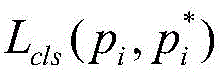
The loss function of the candidate area generation network is the joint loss of the two classification loss functions and the frame regression loss function, and the loss function of the candidate area generation network is as follows:

and is

Wherein p isiAnd respectively representing the probability that the ith sample is predicted as the target in the training samples generated on the single sample image and the corresponding binary true label, tiAnd
 respectively representing the prediction box and the corresponding truth box for the ith sample,
 and
and respectively representing a two-classification loss function and a frame regression loss function, i represents an index of a training sample, and NclsAnd NregRespectively representing the number of training samples and the number of positive samples in the training samples, lambda1The weight coefficient is represented by a weight coefficient,
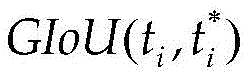 represents the prediction frame tiSum truth box
 Cross-over ratio of (a).
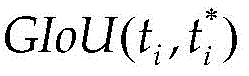
The universal cross-over ratio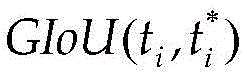 Is defined as:

wherein, represents the prediction frame tiSum truth box
 The cross-over-cross-over ratio of (c),
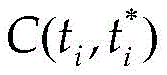 represents the prediction frame tiSum truth box
 The minimum enclosed area of (a) is,
 represents the prediction frame tiSum truth box
 Area of union region;
for a given prediction box tiSum truth box Intersection ratio of two bounding boxes
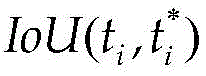 Comprises the following steps:

wherein, represents the prediction frame tiSum truth box
 Area of the intersection region.
The method for training the area detection network in the second step comprises the following steps:
step 201: generation of candidate target frames: taking a high-resolution remote sensing image with a label as a training sample, sending the training sample into a candidate area generation network after preliminary training, generating a large number of anchor frames on the candidate area generation network, then removing the anchor frames exceeding the image boundary, calculating the score of the rest anchor frames by using a softmax classifier, and screening out the anchor frames with the score lower than a set threshold value of 0.05; carrying out non-maximum value inhibition operation on the rest anchor frames according to the scores, and selecting 2000 anchor frames from high to low as candidate target frames according to the anchor frame scores;
step 202: mapping the obtained candidate target box to a feature map of a certain scale:

where w and h represent the width and height of the candidate target box, respectively, k represents the scale order of the feature map to which it is mapped, and k represents0Denotes wh 2242The feature map scale order to which the candidate target box of (a) is mapped, represents rounding down;
step 203: after the scale sequence of the feature map mapped by the candidate target frame is determined, mapping the candidate target frame to the equivalent relative positions of other scale feature maps;
step 204: respectively pooling interested areas of candidate target frames on the multi-scale feature map, splicing and fusing the pooled feature maps along the channel direction to form a multi-scale feature fusion module, wherein the fusion mode of the multi-scale feature fusion module is as follows:

wherein, F represents a multi-scale fusion characteristic diagram of the candidate target frame, FlFeature maps on the ith scale, i ═2,3,4,5, The characteristic diagram is shown to be spliced and fused along the channel direction;
performing convolution operation of 7x7 on F to obtain one-dimensional feature vector FC1For the feature vector FC1One-dimensional characteristic vector FC is obtained by one-time full-connection operation2According to a feature vector FC2And respectively carrying out target classification and frame regression.
The loss function of the area detection network is as follows:
L(p,u,tu,v)=Lcls(p,u)+λ2·Lloc(tu,v)
where p and u represent the prediction score and corresponding classification label of the candidate region, respectively, tuAnd v denote the candidate region-based prediction bounding box and the corresponding truth box, L, respectivelycls(p, u) and Lloc(tuV) representing a multi-class classification loss function and a new bounding box regression loss function, λ, respectively2Representing a weight parameter;
the multi-class classification penalty function is calculated as follows:
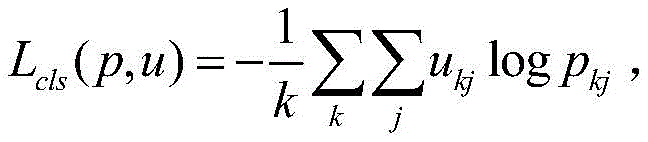
where k denotes the index of the candidate region in each sample image, j denotes the number of object classes, pkjAnd ukjRespectively representing the probability that the kth candidate region is predicted to be the jth class and a corresponding label;
the loss function of the new bounding box regression is defined as follows:
Lloc(tu,v)=3×log2-3×log(1+GIoU(tu,v)),
wherein, tuV represents the final prediction box and the truth box, respectively; GIoU (t)uV) represents a prediction box tuAnd the cross-over ratio of the truth box v.
The alternating training in the third step comprises the following steps: firstly training a candidate area generation network, then training an area detection network by using a candidate target frame output by the candidate area generation network, then training the candidate area generation network on the basis of the parameters of the area detection network, and carrying out cyclic iterative training until convergence.
The invention has the beneficial effects that: the frame regression loss function of the high-resolution remote sensing image target detection is improved, so that the precision of the high-resolution remote sensing image target detection can be effectively improved; the evaluation index can be directly optimized by using the loss function, and the bottleneck that the loss function cannot be directly linked with the evaluation index in the conventional high-resolution remote sensing image target detection is relieved; the gradient can be adaptively changed in the training process, and the training efficiency and the training effect of the model are improved.
Drawings
In order to more clearly illustrate the embodiments of the present invention or the technical solutions in the prior art, the drawings used in the description of the embodiments or the prior art will be briefly described below, it is obvious that the drawings in the following description are only some embodiments of the present invention, and for those skilled in the art, other drawings can be obtained according to the drawings without creative efforts.
FIG. 1 is a schematic model diagram of object detection according to the present invention.
Detailed Description
The technical solutions in the embodiments of the present invention will be clearly and completely described below with reference to the drawings in the embodiments of the present invention, and it is obvious that the described embodiments are only a part of the embodiments of the present invention, and not all of the embodiments. All other embodiments, which can be obtained by a person skilled in the art without inventive effort based on the embodiments of the present invention, are within the scope of the present invention.
As shown in fig. 1, a high resolution remote sensing image target detection method based on a new frame regression loss function includes the following steps:
the method comprises the following steps: training the candidate area generation network: and training the candidate region to generate a network by taking the marked high-resolution remote sensing image as a training sample, wherein a new loss function is adopted as a frame regression loss function of the candidate region generation network.
The candidate area generation network is respectively carried out on a plurality of characteristic layers; the main network of the candidate area generation network adopts a depth model pre-trained in ImageNet, and other network parameters are randomly initialized by adopting Gaussian distribution with the mean value of 0 and the variance of 0.01.
The method for training the candidate area to generate the network in the first step comprises the following steps:
step 1.1: taking the high-resolution remote sensing image with the label as a sample image, and preprocessing the sample image and the target position according to the width-to-height ratio: discarding an image of which the high-resolution remote sensing image data set does not contain an effective target, taking the high-resolution remote sensing image with labels as a sample image, sequencing the sample image from small to large according to an aspect ratio, limiting the aspect ratio of the sample image to be between 0.5 and 2.0, cutting the sample image with the aspect ratio being less than 0.5 or more than 2.0, setting the short edge of the image to be 800 pixels, and automatically adjusting the long edge according to the aspect ratio, wherein the position of the target in the sample image is also adjusted according to the aspect ratio.
The training sample and the test sample are marked high-resolution remote sensing image data. The high-resolution remote sensing image data sets used at this time are NWPU VHR-10 and DIOR, and 130 training sets, 130 verification sets and 390 test sets are arranged in the NWPU VHR-10 data sets; in the DIOR dataset, 5862 training sets, 5863 validation sets, and 11738 test sets. See table 1 for details of the data set.
TABLE 1 Total number of targets of each type in two datasets
| Categories | NWPU VHR-10 (number) | DIOR (number) |
| Aircraft with a flight control device | 757 | 10104 |
| Ship with a detachable hull | 302 | 62400 |
| Oil storage tank | 655 | 26414 |
| Baseball field | 390 | 5817 |
| Tennis court | 524 | 12266 |
| Basketball court | 159 | 3225 |
| Track and field | 163 | 3038 |
| Port port | 224 | 5509 |
| Bridge with a bridge body | 124 | 3967 |
| Vehicle with wheels | 477 | 40370 |
| Airport | / | 1327 |
| Chimney | / | 1681 |
| Dam and its mfg. method | / | 1049 |
| Expressway service area | / | 2165 |
| Expressway toll station | / | 1298 |
| Golf course | / | 1086 |
| Overbridge | / | 3114 |
| Stadium | / | 1268 |
| Railway station | / | 1011 |
| Fan blower | / | 5363 |
| Total number of | 3775 | 192472 |
Step 1.2: inputting the high-resolution remote sensing image preprocessed in the step 1.1 into a feature pyramid trunk network, completing feature extraction from bottom to top through operations such as multilayer convolution, activation, pooling and the like, and fusing with features from top to bottom through lateral connection to obtain multi-scale features.
In specific implementation, the method can be implemented by the following documents [ Lin, T. -Y ]; doll r, P.; girshick, r.; he, k.; hariharan, B.; belongie, S.feature pyramid networks for object detection. Proceedings of the IEEE conference on computer vision and dpattern registration; pp.2117-2125 ].
Step 1.3: and (3) for the multi-scale features fused in the step 1.2: performing convolution operation of 3 multiplied by 3 on the features of each scale, then obtaining two feature maps by respectively adopting convolution operation of two 1 multiplied by 1, converting the obtained two feature maps into two one-dimensional vectors, and respectively performing two-classification and frame regression; all convolution operations of each scale share the convolution kernel parameters.
The candidate region generation network is optimized by adopting a method of back propagation and random gradient descent, the loss function is the combined loss of a binary classification loss function and a frame regression loss function, and the method comprises the following specific steps of:


wherein p isiAnd respectively representing the probability that the ith sample is predicted as the target in the training samples generated on the single sample image and the corresponding binary true label, tiAnd
 respectively representing the prediction box and the corresponding truth box for the ith sample,
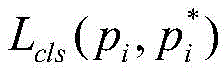 and
and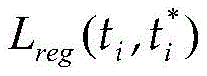 respectively representing a two-classification loss function and a frame regression loss function, i represents an index of a training sample, and NclsAnd NregRespectively representing the number of training samples (here set to 256) and the number of positive samples in the training samples, λ1Representing the weight coefficient (set to 1 here),
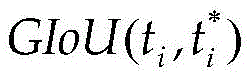 represents the prediction frame tiSum truth box
 Cross-over ratio of (a).
In the network training of the candidate area, the total number of training samples in each sample image is 256, the ratio of the number of positive samples to the number of negative samples is 1:1, and when the number of positive samples is less than 128, the training samples are filled with negative samples, wherein the positive samples comprise ① anchor boxes with the intersection ratio of the true value boxes exceeding 0.7, ② anchor boxes with the maximum intersection ratio of each true value box, and the negative samples comprise 128 anchor boxes with the minimum intersection ratio (if the number of positive samples is less than 128, the number is 256 minus the number of positive samples) in all the anchor boxes with the intersection ratio of the true value boxes less than 0.3.
Cross ratio of general use Is defined as follows:

wherein, represents the prediction frame tiSum truth box
 The cross-over-cross-over ratio of (c),
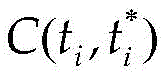 represents the prediction frame tiSum truth box
 The minimum enclosed area of (a) is,
 represents the prediction frame tiSum truth box
 The union region area of (a).
For a given prediction box tiSum truth box Intersection ratio of two bounding boxes
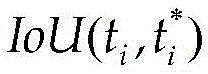 The definition is as follows:

wherein, represents the prediction frame tiSum truth box
 Area of the intersection region.
Step two: training the area detection network: firstly, a sample image in a training sample is sent to the candidate area generation network trained in the step one to obtain a candidate target frame of the sample image, the candidate target frame is used as a target initial position to train the area detection network, and a new loss function is adopted as a frame regression loss function of the area detection network.
The candidate area generation network and the area detection network share the backbone network, and the other network parameters are initialized randomly according to Gaussian distribution with the mean value of 0 and the variance of 0.01.
The implementation method of the second step comprises the following steps:
step 2.1: the method comprises the steps of taking a high-resolution remote sensing image with a label as a training sample, sending the training sample into a candidate area generation network after preliminary training, generating a large number of anchor frames on the candidate area generation network, then removing the anchor frames exceeding the image boundary, calculating scores of the remaining anchor frames by using a softmax classifier, screening out the anchor frames with the scores lower than a set threshold value of 0.05, then carrying out non-maximum value inhibition operation on the remaining anchor frames according to the scores, and finally selecting 2000 anchor frames from high to low according to the border scores on the basis of the non-maximum value inhibition operation, namely selecting a candidate target frame.
Non-maxima inhibition can be achieved by literature [ Girshick, r.; donahue, j.; darrell, t.; in Proceedings of the IEEE conference on computing and pattern recognition; pp.580-587 ].
Step 2.2: and 2, mapping the candidate target frame obtained in the step 2.1 to a feature map of a certain scale, wherein the specific implementation mode is as follows:

wherein w and h respectively represent the width and height of the candidate target frame, k represents the mapping order of the feature map scale and is mapped to the feature map of the k scale, and k represents the mapping order of the feature map scale0Denotes wh 2242The feature map scale order to which the candidate target box of (1) is mapped. The present invention employs a convolutional neural network with an input layer size of 224 x 224 as a backbone network, indicating a rounding down.
Step 2.3: and determining the scale order of the feature maps mapped by the candidate target frames according to the step 2.2, and mapping the candidate target frames to the equivalent relative positions of the feature maps in other scales.
Step 2.4: respectively pooling the interested regions of the candidate target frames on the multilayer characteristic diagram according to the candidate target frames obtained in the step 2.3, wherein the pooling of the interested regions can be realized through a document [ He, K ]; gkioxari, g.; doll r, P.; (ii) Girshick, R.Mask r-cnn.In Proceedings of the IEEE International conference on computer vision; pp.2961-2969 ]. Then splicing and fusing the pooled multiple feature maps along the channel direction to form a multi-scale feature fusion module, wherein the specific fusion mode is as follows:

wherein, F represents a multi-scale fusion characteristic diagram of the candidate target frame, FlThe characteristic diagram on the l-th scale is shown, i.e. 2,3,4,5, and the characteristic diagram is shown to be spliced and fused along the channel direction.
Performing convolution operation of 7x7 on F to obtain one-dimensional feature vector FC1For the feature vector FC1One-dimensional characteristic vector FC is obtained by one-time full-connection operation2AnAccording to the feature vector FC2Target classification (using softmax classifier) and bounding box regression were performed separately.
The loss function of the area detection network is as follows:
L(p,u,tu,v)=Lcls(p,u)+λ2·Lloc(tu,v) (8)
where p and u represent the prediction score and corresponding classification label of the candidate region, respectively, tuAnd v denote the candidate region-based prediction bounding box and the corresponding truth box, L, respectivelycls(p, u) and Lloc(tuV) represents a multi-class classification loss function and a bounding box regression loss function, respectively, lambda2Which represents a weight parameter, here set to 10.
During the training of the area detection network, the total number of training samples in each image is 512, and the ratio of the number of positive samples to the number of negative samples is 1: 3, namely: the number of positive samples is 128, and the number of negative samples is 384; and selecting the candidate regions with 128 times of intersection in the front of the numerical value as positive samples from all the candidate regions with the intersection ratio of more than 0.5 with the truth value box, and selecting the candidate regions with 384 times of intersection in the rear of the numerical value as negative samples from all the candidate regions with the intersection ratio of less than 0.5 with the truth value box.
The multi-class classification loss function is specifically calculated as follows:

where k denotes an index of a candidate region (hereinafter referred to as a candidate region) in each image, j denotes the number of object classes, and pkjAnd ukjRespectively representing the probability that the kth candidate region is predicted as the jth class and the corresponding label.
The loss function of the new bounding box regression is defined as follows:
Lloc(tu,v)=3×log2-3×log(1+GIoU(tu,v)) (10)
wherein, tuAnd v denotes a final prediction box and a true value box, respectively. GIoU (t)uV) represents a prediction box tuAnd the cross-over ratio corresponding to the truth box v.
Step three: and (3) alternately generating a network in the training candidate area in the step one and detecting the network in the training area in the step two, repeating the steps, performing iterative training until convergence, and optimizing network parameters by adopting a random gradient descent method in the training process.
The alternating training step is as follows: firstly training a candidate area to generate a network, then training an area detection network by using a candidate target frame extracted from the candidate area generation network, then training the candidate area generation network on the basis of the parameters of the area detection network, and repeating the steps and performing iterative training until convergence.
Random gradient descent method employs literature [ Rumelhart, d.; hinton, g.; williams, R.Learningrecurring groupings by back-providing errors, Nature 1988,323,696-699 ].
When the loss function value is reduced to 10-2Magnitude, and the model converges when the loss function value changes by a small amount.
Step four: and (3) a testing stage: sharing a backbone network of the candidate area generating network and the detection network, combining the candidate area generating network trained in the step three with the backbone network of the detection network to construct a detection model, inputting the high-resolution remote sensing image to be detected into the detection model, and obtaining the position and the category of the target of interest of the high-resolution remote sensing image to be detected. The high-resolution remote sensing images to be detected are NWPU VHR-10 and DIOR.
The candidate area generation network and the backbone network of the area detection network are shared, and the candidate target frame generated by the candidate area generation network is used for providing an initial position for the detection network to form an end-to-end unified whole, namely a combined detection model. The position of the interested target represents the coordinates of a compact closed bounding box of the target in the image, a coordinate system takes the upper left corner of the image as the origin of coordinates, the horizontal rightward direction is an x-axis, and the vertical downward direction is a y-axis; the categories indicate which category (e.g., aircraft) the object belongs to.
Sending the high-resolution remote sensing image into a regional detection network, finally forming two full-connection layers through operations such as multilayer convolution, pooling, activation and the like, connecting a C (C represents the number of classes) dimensional feature vector behind the second full-connection layer, finally classifying the C dimensional feature vector by using a softmax classifier, and regarding the class with the highest score as the class of the target; and connecting a 4C (a bounding box is predicted for each class) dimensional feature vector behind the second full connection layer, wherein the 4C dimensional feature vector is the coordinate representing the position of the target.
In order to verify the detection accuracy of the invention, the invention performs experiments on a workstation with a hardware environment of E5-2650V4 CPU (2.2GHz 12x2 core), 512GB memory and 8 NVIDIA RTX Titan display cards. 390 images and 11738 images are respectively selected from the NWPU VHR-10 and DIOR data sets for detection, and the results are as follows:
1) the method can detect the position and the type of the target in the high-resolution remote sensing image at a higher speed, and the average detection time of each image is about 0.1 s.
2) The method comprises the steps of obtaining average accuracies of 58.0% and 59.2% on evaluation indexes GIoU and IoU respectively on a NWPU VHR-10 data set as shown in Table 2, obtaining average accuracies of 44.8% and 45.7% on evaluation indexes GIoU and IoU respectively on a DIOR data set as shown in Table 3, and further improving AP50 (measurement index threshold is 0.5) and AP75 (measurement index threshold is 0.75) to a certain extent and improving AP75 to improve the positioning accuracy of high-resolution remote sensing image target detection compared with an original feature pyramid network, wherein M1, M2 and M3 in the following list respectively represent documents [ Ren, S.; He, K.; Girshick, R.; Sun, J.Fas: townrere-time-object-depth-point object-parameter function, and multiple regression functions of the accuracy of the original feature pyramid depth-parameter pyramid depth-depth pyramid depth-20, the original feature pyramid depth-map-depth function respectively represent multiple losses of the original feature pyramid depth-map-depth function, the original feature pyramid network, the original feature pyramid depth-map-depth-map-based network, the multiple-map.
TABLE 2 detection results of NWPU VHR-10 high resolution remote sensing images

TABLE 3 detection results of DIOR data set high resolution remote sensing images

The above description is only for the purpose of illustrating the preferred embodiments of the present invention and is not to be construed as limiting the invention, and any modifications, equivalents, improvements and the like that fall within the spirit and principle of the present invention are intended to be included therein.
Claims (10)






Priority Applications (1)
| Application Number | Priority Date | Filing Date | Title |
|---|---|---|---|
| CN201911340541.8A CN111091105B (en) | 2019-12-23 | 2019-12-23 | Remote sensing image object detection method based on new bounding box regression loss function |
Applications Claiming Priority (1)
| Application Number | Priority Date | Filing Date | Title |
|---|---|---|---|
| CN201911340541.8A CN111091105B (en) | 2019-12-23 | 2019-12-23 | Remote sensing image object detection method based on new bounding box regression loss function |
Publications (2)
| Publication Number | Publication Date |
|---|---|
| CN111091105A true CN111091105A (en) | 2020-05-01 |
| CN111091105B CN111091105B (en) | 2020-10-20 |
Family
ID=70395895
Family Applications (1)
| Application Number | Title | Priority Date | Filing Date |
|---|---|---|---|
| CN201911340541.8A Active CN111091105B (en) | 2019-12-23 | 2019-12-23 | Remote sensing image object detection method based on new bounding box regression loss function |
Country Status (1)
| Country | Link |
|---|---|
| CN (1) | CN111091105B (en) |
Cited By (65)
| Publication number | Priority date | Publication date | Assignee | Title |
|---|---|---|---|---|
| CN111523511A (en) * | 2020-05-08 | 2020-08-11 | 中国科学院合肥物质科学研究院 | Video image Chinese wolfberry branch detection method for Chinese wolfberry harvesting and clamping device |
| CN111597964A (en) * | 2020-05-13 | 2020-08-28 | 云南电网有限责任公司电力科学研究院 | A kind of insulator image detection method |
| CN111652216A (en) * | 2020-06-03 | 2020-09-11 | 北京工商大学 | Multi-scale object detection model method based on metric learning |
| CN111695609A (en) * | 2020-05-26 | 2020-09-22 | 平安科技(深圳)有限公司 | Target damage degree determination method, target damage degree determination device, electronic device, and storage medium |
| CN111723852A (en) * | 2020-05-30 | 2020-09-29 | 杭州迪英加科技有限公司 | Robust training method for target detection network |
| CN111783819A (en) * | 2020-05-08 | 2020-10-16 | 国家电网有限公司 | Improved object detection method based on region of interest training on small-scale datasets |
| CN111783844A (en) * | 2020-06-10 | 2020-10-16 | 东莞正扬电子机械有限公司 | Target detection model training method and device based on deep learning and storage medium |
| CN111797737A (en) * | 2020-06-22 | 2020-10-20 | 重庆高新区飞马创新研究院 | Remote sensing target detection method and device |
| CN111797697A (en) * | 2020-06-10 | 2020-10-20 | 河海大学 | Angle high-resolution remote sensing image target detection method based on improved CenterNet |
| CN111881918A (en) * | 2020-06-11 | 2020-11-03 | 中国人民解放军战略支援部队信息工程大学 | Multi-scale rotating ship target detection algorithm |
| CN111881764A (en) * | 2020-07-01 | 2020-11-03 | 深圳力维智联技术有限公司 | A target detection method, device, electronic device and storage medium |
| CN111931915A (en) * | 2020-08-06 | 2020-11-13 | 中国科学院重庆绿色智能技术研究院 | Method for training network based on DIOU loss function |
| CN111931572A (en) * | 2020-07-07 | 2020-11-13 | 广东工业大学 | Target detection method of remote sensing image |
| CN111950633A (en) * | 2020-08-12 | 2020-11-17 | 深圳市商汤科技有限公司 | Neural network training, target detection method and device and storage medium |
| CN112002131A (en) * | 2020-07-16 | 2020-11-27 | 深圳云游四海信息科技有限公司 | In-road parking behavior detection method and device |
| CN112001428A (en) * | 2020-08-05 | 2020-11-27 | 中国科学院大学 | Anchor frame-free target detection network training method based on feature matching optimization |
| CN112084869A (en) * | 2020-08-10 | 2020-12-15 | 北京航空航天大学 | Compact quadrilateral representation-based building target detection method |
| CN112101277A (en) * | 2020-09-24 | 2020-12-18 | 湖南大学 | Remote sensing target detection method based on image semantic feature constraint |
| CN112132093A (en) * | 2020-09-30 | 2020-12-25 | 湖南省气象科学研究所 | High-resolution remote sensing image target detection method and device and computer equipment |
| CN112232240A (en) * | 2020-10-21 | 2021-01-15 | 南京师范大学 | Road sprinkled object detection and identification method based on optimized intersection-to-parallel ratio function |
| CN112287977A (en) * | 2020-10-06 | 2021-01-29 | 武汉大学 | Target detection method based on key point distance of bounding box |
| CN112329873A (en) * | 2020-11-12 | 2021-02-05 | 苏州挚途科技有限公司 | Training method of target detection model, target detection method and device |
| CN112395975A (en) * | 2020-11-17 | 2021-02-23 | 南京泓图人工智能技术研究院有限公司 | Remote sensing image target detection method based on rotating area generation network |
| CN112395958A (en) * | 2020-10-29 | 2021-02-23 | 中国地质大学(武汉) | Remote sensing image small target detection method based on four-scale depth and shallow layer feature fusion |
| CN112446327A (en) * | 2020-11-27 | 2021-03-05 | 中国地质大学(武汉) | Remote sensing image target detection method based on non-anchor frame |
| CN112465764A (en) * | 2020-11-24 | 2021-03-09 | 泰康保险集团股份有限公司 | Image tampering detection method and device |
| CN112528862A (en) * | 2020-12-10 | 2021-03-19 | 西安电子科技大学 | Remote sensing image target detection method based on improved cross entropy loss function |
| CN112712119A (en) * | 2020-12-30 | 2021-04-27 | 杭州海康威视数字技术股份有限公司 | Method and device for determining detection accuracy of target detection model |
| CN112818840A (en) * | 2021-01-29 | 2021-05-18 | 中国科学院微小卫星创新研究院 | Unmanned aerial vehicle online detection system and method |
| CN113011528A (en) * | 2021-04-28 | 2021-06-22 | 中国电子科技集团公司第五十四研究所 | Remote sensing image small target detection method based on context and cascade structure |
| CN113177503A (en) * | 2021-05-13 | 2021-07-27 | 中国人民解放军陆军炮兵防空兵学院 | Arbitrary orientation target twelve parameter detection method based on YOLOV5 |
| CN113191296A (en) * | 2021-05-13 | 2021-07-30 | 中国人民解放军陆军炮兵防空兵学院 | Method for detecting five parameters of target in any orientation based on YOLOV5 |
| CN113283349A (en) * | 2021-05-28 | 2021-08-20 | 中国公路工程咨询集团有限公司 | Traffic infrastructure construction target monitoring system and method based on target anchor frame optimization strategy |
| CN113313082A (en) * | 2021-07-28 | 2021-08-27 | 北京电信易通信息技术股份有限公司 | Target detection method and system based on multitask loss function |
| CN113378686A (en) * | 2021-06-07 | 2021-09-10 | 武汉大学 | Two-stage remote sensing target detection method based on target center point estimation |
| CN113379738A (en) * | 2021-07-20 | 2021-09-10 | 重庆大学 | Method and system for detecting and positioning epidemic trees based on images |
| CN113378829A (en) * | 2020-12-15 | 2021-09-10 | 浙江大学 | Weak supervision target detection method based on positive and negative sample balance |
| CN113468968A (en) * | 2021-06-02 | 2021-10-01 | 中国地质大学(武汉) | Remote sensing image rotating target detection method based on non-anchor frame |
| CN113469025A (en) * | 2021-06-29 | 2021-10-01 | 阿波罗智联(北京)科技有限公司 | Target detection method and device applied to vehicle-road cooperation, road side equipment and vehicle |
| CN113657232A (en) * | 2021-08-10 | 2021-11-16 | 大连理工大学 | Object detection method in cross-domain remote sensing image based on style-content decoupling |
| CN113723395A (en) * | 2020-05-20 | 2021-11-30 | 北京京东尚科信息技术有限公司 | Sample weighted learning system for object detection of images and method thereof |
| CN113744220A (en) * | 2021-08-25 | 2021-12-03 | 中国科学院国家空间科学中心 | PYNQ-based preselection-frame-free detection system |
| CN113780277A (en) * | 2021-09-08 | 2021-12-10 | 浙江啄云智能科技有限公司 | Training method and device of target detection model, electronic equipment and storage medium |
| CN113780270A (en) * | 2021-03-23 | 2021-12-10 | 京东鲲鹏(江苏)科技有限公司 | Target detection method and device |
| CN113850761A (en) * | 2021-08-30 | 2021-12-28 | 北京工业大学 | Remote sensing image target detection method based on multi-angle detection frame |
| CN113870263A (en) * | 2021-12-02 | 2021-12-31 | 湖南大学 | A real-time monitoring method and system for pavement defect damage |
| CN113947723A (en) * | 2021-09-28 | 2022-01-18 | 浙江大学 | High-resolution remote sensing scene target detection method based on size balance FCOS |
| CN113963246A (en) * | 2021-09-27 | 2022-01-21 | 西北工业大学 | Directed target detection method based on midpoint offset expression |
| CN114417966A (en) * | 2021-12-09 | 2022-04-29 | 金华送变电工程有限公司 | Target detection method based on multiple network fusion in complex environment |
| CN114445371A (en) * | 2022-01-27 | 2022-05-06 | 安徽大学 | Remote sensing image target detection method and device based on ellipse intersection ratio |
| CN114529712A (en) * | 2022-01-13 | 2022-05-24 | 山东师范大学 | Two-stage training-based Logo image low sample detection method and system |
| CN114898178A (en) * | 2022-05-10 | 2022-08-12 | 支付宝(杭州)信息技术有限公司 | Training method and system of image recognition neural network model |
| CN114997268A (en) * | 2022-04-25 | 2022-09-02 | 中国人民解放军战略支援部队航天工程大学 | Method and system for finely detecting rotating target based on Pasteur distance measurement loss function |
| CN115272242A (en) * | 2022-07-29 | 2022-11-01 | 西安电子科技大学 | YOLOv 5-based optical remote sensing image target detection method |
| WO2022252565A1 (en) * | 2021-06-04 | 2022-12-08 | 浙江智慧视频安防创新中心有限公司 | Target detection system, method and apparatus, and device and medium |
| CN115690401A (en) * | 2022-11-10 | 2023-02-03 | 福州大学 | Improved rotating frame target detection method fusing CIOU adaptive sample allocation |
| CN115761259A (en) * | 2022-11-14 | 2023-03-07 | 湖南大学 | Kitchen waste target detection method and system based on class balance loss function |
| CN115775360A (en) * | 2022-12-09 | 2023-03-10 | 西北工业大学 | Small sample aerial image small target detection method based on unbiased suggestion frame filtering |
| CN115830470A (en) * | 2022-12-29 | 2023-03-21 | 中国科学院长春光学精密机械与物理研究所 | A method, device and equipment for detecting weak-intensity and small-scale targets in remote sensing images |
| CN115908897A (en) * | 2022-10-28 | 2023-04-04 | 西南交通大学 | Intelligent identification method of high-speed railway power supply facilities based on high-resolution remote sensing images |
| CN116580232A (en) * | 2023-05-06 | 2023-08-11 | 北京邮电大学 | A method, system and electronic device for automatic image labeling |
| CN117197418A (en) * | 2023-09-08 | 2023-12-08 | 上海交通大学 | A target detection method and system based on the intersection loss function |
| CN118447422A (en) * | 2024-07-08 | 2024-08-06 | 杭州长望智创科技有限公司 | Unmanned aerial vehicle visual angle target detection model and detection method |
| CN118691991A (en) * | 2024-06-06 | 2024-09-24 | 滁州学院 | An intelligent detection method for agricultural waste mulch film based on UAV remote sensing images |
| CN119992334A (en) * | 2025-01-24 | 2025-05-13 | 天津大学 | Single-stage fine-grained target detection method and device based on remote sensing images |
Citations (6)
| Publication number | Priority date | Publication date | Assignee | Title |
|---|---|---|---|---|
| CN110084210A (en) * | 2019-04-30 | 2019-08-02 | 电子科技大学 | The multiple dimensioned Ship Detection of SAR image based on attention pyramid network |
| CN110175993A (en) * | 2019-05-27 | 2019-08-27 | 西安交通大学医学院第一附属医院 | A kind of Faster R-CNN pulmonary tuberculosis sign detection system and method based on FPN |
| CN110502654A (en) * | 2019-08-26 | 2019-11-26 | 长光卫星技术有限公司 | A kind of object library generation system suitable for multi-source heterogeneous remotely-sensed data |
| CN110533691A (en) * | 2019-08-15 | 2019-12-03 | 合肥工业大学 | Method for tracking target, equipment and storage medium based on multi-categorizer |
| CN110555834A (en) * | 2019-09-03 | 2019-12-10 | 明峰医疗系统股份有限公司 | Real-time detection and reconstruction method of CT bad channel based on deep learning network |
| CN110580445A (en) * | 2019-07-12 | 2019-12-17 | 西北工业大学 | An Improved Face Keypoint Detection Method Based on GIoU and Weighted NMS |
-
2019
- 2019-12-23 CN CN201911340541.8A patent/CN111091105B/en active Active
Patent Citations (6)
| Publication number | Priority date | Publication date | Assignee | Title |
|---|---|---|---|---|
| CN110084210A (en) * | 2019-04-30 | 2019-08-02 | 电子科技大学 | The multiple dimensioned Ship Detection of SAR image based on attention pyramid network |
| CN110175993A (en) * | 2019-05-27 | 2019-08-27 | 西安交通大学医学院第一附属医院 | A kind of Faster R-CNN pulmonary tuberculosis sign detection system and method based on FPN |
| CN110580445A (en) * | 2019-07-12 | 2019-12-17 | 西北工业大学 | An Improved Face Keypoint Detection Method Based on GIoU and Weighted NMS |
| CN110533691A (en) * | 2019-08-15 | 2019-12-03 | 合肥工业大学 | Method for tracking target, equipment and storage medium based on multi-categorizer |
| CN110502654A (en) * | 2019-08-26 | 2019-11-26 | 长光卫星技术有限公司 | A kind of object library generation system suitable for multi-source heterogeneous remotely-sensed data |
| CN110555834A (en) * | 2019-09-03 | 2019-12-10 | 明峰医疗系统股份有限公司 | Real-time detection and reconstruction method of CT bad channel based on deep learning network |
Non-Patent Citations (4)
| Title |
|---|
| HAMID REZATOFIGHI 等: "Generalized Intersection over Union: A Metric and A Loss for Bounding Box Regression", 《2019 IEEE/CVF CONFERENCE ON COMPUTER VISION AND PATTERN RECOGNITION》 * |
| SHAOQING REN 等: "Faster R-CNN: Towards Real-Time Object Detection with Region Proposal Networks", 《IEEE TRANSACTIONS ON PATTERN ANALYSIS AND MACHINE INTELLIGENCE》 * |
| TSUNG-YI LIN 等: "Feature Pyramid Networks for Object Detection", 《2017 IEEE CONFERENCE ON COMPUTER VISION AND PATTERN RECOGNITION》 * |
| 吴佳祥 等: "一种应用于高分辨率遥感图像目标检测的尺度自适应卷积神经网络", 《微电子学与计算机》 * |
Cited By (97)
| Publication number | Priority date | Publication date | Assignee | Title |
|---|---|---|---|---|
| CN111523511B (en) * | 2020-05-08 | 2023-03-24 | 中国科学院合肥物质科学研究院 | Video image Chinese wolfberry branch detection method for Chinese wolfberry harvesting and clamping device |
| CN111783819B (en) * | 2020-05-08 | 2024-02-09 | 国家电网有限公司 | Improved target detection method based on region of interest training on small-scale data set |
| CN111783819A (en) * | 2020-05-08 | 2020-10-16 | 国家电网有限公司 | Improved object detection method based on region of interest training on small-scale datasets |
| CN111523511A (en) * | 2020-05-08 | 2020-08-11 | 中国科学院合肥物质科学研究院 | Video image Chinese wolfberry branch detection method for Chinese wolfberry harvesting and clamping device |
| CN111597964A (en) * | 2020-05-13 | 2020-08-28 | 云南电网有限责任公司电力科学研究院 | A kind of insulator image detection method |
| CN111597964B (en) * | 2020-05-13 | 2023-01-20 | 云南电网有限责任公司电力科学研究院 | Insulator image detection method |
| CN113723395A (en) * | 2020-05-20 | 2021-11-30 | 北京京东尚科信息技术有限公司 | Sample weighted learning system for object detection of images and method thereof |
| CN111695609A (en) * | 2020-05-26 | 2020-09-22 | 平安科技(深圳)有限公司 | Target damage degree determination method, target damage degree determination device, electronic device, and storage medium |
| CN111723852A (en) * | 2020-05-30 | 2020-09-29 | 杭州迪英加科技有限公司 | Robust training method for target detection network |
| CN111723852B (en) * | 2020-05-30 | 2022-07-22 | 杭州迪英加科技有限公司 | Robust training method for target detection network |
| CN111652216B (en) * | 2020-06-03 | 2023-04-07 | 北京工商大学 | Multi-scale target detection model method based on metric learning |
| CN111652216A (en) * | 2020-06-03 | 2020-09-11 | 北京工商大学 | Multi-scale object detection model method based on metric learning |
| CN111797697A (en) * | 2020-06-10 | 2020-10-20 | 河海大学 | Angle high-resolution remote sensing image target detection method based on improved CenterNet |
| CN111797697B (en) * | 2020-06-10 | 2022-08-05 | 河海大学 | Angle high-resolution remote sensing image target detection method based on improved CenterNet |
| CN111783844B (en) * | 2020-06-10 | 2024-05-28 | 广东正扬传感科技股份有限公司 | Object detection model training method, device and storage medium based on deep learning |
| CN111783844A (en) * | 2020-06-10 | 2020-10-16 | 东莞正扬电子机械有限公司 | Target detection model training method and device based on deep learning and storage medium |
| CN111881918A (en) * | 2020-06-11 | 2020-11-03 | 中国人民解放军战略支援部队信息工程大学 | Multi-scale rotating ship target detection algorithm |
| CN111797737A (en) * | 2020-06-22 | 2020-10-20 | 重庆高新区飞马创新研究院 | Remote sensing target detection method and device |
| CN111881764A (en) * | 2020-07-01 | 2020-11-03 | 深圳力维智联技术有限公司 | A target detection method, device, electronic device and storage medium |
| CN111881764B (en) * | 2020-07-01 | 2023-11-03 | 深圳力维智联技术有限公司 | A target detection method, device, electronic equipment and storage medium |
| CN111931572A (en) * | 2020-07-07 | 2020-11-13 | 广东工业大学 | Target detection method of remote sensing image |
| CN111931572B (en) * | 2020-07-07 | 2024-01-09 | 广东工业大学 | Target detection method for remote sensing image |
| CN112002131A (en) * | 2020-07-16 | 2020-11-27 | 深圳云游四海信息科技有限公司 | In-road parking behavior detection method and device |
| CN112001428A (en) * | 2020-08-05 | 2020-11-27 | 中国科学院大学 | Anchor frame-free target detection network training method based on feature matching optimization |
| CN111931915A (en) * | 2020-08-06 | 2020-11-13 | 中国科学院重庆绿色智能技术研究院 | Method for training network based on DIOU loss function |
| CN112084869A (en) * | 2020-08-10 | 2020-12-15 | 北京航空航天大学 | Compact quadrilateral representation-based building target detection method |
| CN112084869B (en) * | 2020-08-10 | 2023-04-07 | 北京航空航天大学 | Compact quadrilateral representation-based building target detection method |
| CN111950633A (en) * | 2020-08-12 | 2020-11-17 | 深圳市商汤科技有限公司 | Neural network training, target detection method and device and storage medium |
| CN112101277A (en) * | 2020-09-24 | 2020-12-18 | 湖南大学 | Remote sensing target detection method based on image semantic feature constraint |
| CN112101277B (en) * | 2020-09-24 | 2023-07-28 | 湖南大学 | Remote sensing target detection method based on image semantic feature constraint |
| CN112132093B (en) * | 2020-09-30 | 2024-01-05 | 湖南省气象科学研究所 | High-resolution remote sensing image target detection method and device and computer equipment |
| CN112132093A (en) * | 2020-09-30 | 2020-12-25 | 湖南省气象科学研究所 | High-resolution remote sensing image target detection method and device and computer equipment |
| CN112287977A (en) * | 2020-10-06 | 2021-01-29 | 武汉大学 | Target detection method based on key point distance of bounding box |
| CN112287977B (en) * | 2020-10-06 | 2024-02-09 | 武汉大学 | Target detection method based on bounding box key point distance |
| CN112232240B (en) * | 2020-10-21 | 2024-08-27 | 南京师范大学 | Road casting object detection and identification method based on optimized cross-over ratio function |
| CN112232240A (en) * | 2020-10-21 | 2021-01-15 | 南京师范大学 | Road sprinkled object detection and identification method based on optimized intersection-to-parallel ratio function |
| CN112395958A (en) * | 2020-10-29 | 2021-02-23 | 中国地质大学(武汉) | Remote sensing image small target detection method based on four-scale depth and shallow layer feature fusion |
| CN112329873B (en) * | 2020-11-12 | 2024-09-06 | 苏州挚途科技有限公司 | Training method of target detection model, target detection method and device |
| CN112329873A (en) * | 2020-11-12 | 2021-02-05 | 苏州挚途科技有限公司 | Training method of target detection model, target detection method and device |
| CN112395975A (en) * | 2020-11-17 | 2021-02-23 | 南京泓图人工智能技术研究院有限公司 | Remote sensing image target detection method based on rotating area generation network |
| CN112465764A (en) * | 2020-11-24 | 2021-03-09 | 泰康保险集团股份有限公司 | Image tampering detection method and device |
| CN112446327B (en) * | 2020-11-27 | 2022-06-07 | 中国地质大学(武汉) | Remote sensing image target detection method based on non-anchor frame |
| CN112446327A (en) * | 2020-11-27 | 2021-03-05 | 中国地质大学(武汉) | Remote sensing image target detection method based on non-anchor frame |
| CN112528862B (en) * | 2020-12-10 | 2023-02-10 | 西安电子科技大学 | Remote sensing image target detection method based on improved cross entropy loss function |
| CN112528862A (en) * | 2020-12-10 | 2021-03-19 | 西安电子科技大学 | Remote sensing image target detection method based on improved cross entropy loss function |
| CN113378829A (en) * | 2020-12-15 | 2021-09-10 | 浙江大学 | Weak supervision target detection method based on positive and negative sample balance |
| CN112712119A (en) * | 2020-12-30 | 2021-04-27 | 杭州海康威视数字技术股份有限公司 | Method and device for determining detection accuracy of target detection model |
| CN112712119B (en) * | 2020-12-30 | 2023-10-24 | 杭州海康威视数字技术股份有限公司 | Method and device for determining detection accuracy of target detection model |
| CN112818840A (en) * | 2021-01-29 | 2021-05-18 | 中国科学院微小卫星创新研究院 | Unmanned aerial vehicle online detection system and method |
| CN113780270A (en) * | 2021-03-23 | 2021-12-10 | 京东鲲鹏(江苏)科技有限公司 | Target detection method and device |
| CN113011528A (en) * | 2021-04-28 | 2021-06-22 | 中国电子科技集团公司第五十四研究所 | Remote sensing image small target detection method based on context and cascade structure |
| CN113011528B (en) * | 2021-04-28 | 2022-11-01 | 中国电子科技集团公司第五十四研究所 | Remote sensing image small target detection method based on context and cascade structure |
| CN113177503A (en) * | 2021-05-13 | 2021-07-27 | 中国人民解放军陆军炮兵防空兵学院 | Arbitrary orientation target twelve parameter detection method based on YOLOV5 |
| CN113191296A (en) * | 2021-05-13 | 2021-07-30 | 中国人民解放军陆军炮兵防空兵学院 | Method for detecting five parameters of target in any orientation based on YOLOV5 |
| CN113283349A (en) * | 2021-05-28 | 2021-08-20 | 中国公路工程咨询集团有限公司 | Traffic infrastructure construction target monitoring system and method based on target anchor frame optimization strategy |
| CN113468968B (en) * | 2021-06-02 | 2023-04-07 | 中国地质大学(武汉) | Remote sensing image rotating target detection method based on non-anchor frame |
| CN113468968A (en) * | 2021-06-02 | 2021-10-01 | 中国地质大学(武汉) | Remote sensing image rotating target detection method based on non-anchor frame |
| WO2022252565A1 (en) * | 2021-06-04 | 2022-12-08 | 浙江智慧视频安防创新中心有限公司 | Target detection system, method and apparatus, and device and medium |
| CN113378686B (en) * | 2021-06-07 | 2022-04-15 | 武汉大学 | Two-stage remote sensing target detection method based on target center point estimation |
| CN113378686A (en) * | 2021-06-07 | 2021-09-10 | 武汉大学 | Two-stage remote sensing target detection method based on target center point estimation |
| CN113469025B (en) * | 2021-06-29 | 2024-05-31 | 阿波罗智联(北京)科技有限公司 | Target detection method, device, roadside equipment and vehicle for vehicle-road collaboration |
| CN113469025A (en) * | 2021-06-29 | 2021-10-01 | 阿波罗智联(北京)科技有限公司 | Target detection method and device applied to vehicle-road cooperation, road side equipment and vehicle |
| CN113379738A (en) * | 2021-07-20 | 2021-09-10 | 重庆大学 | Method and system for detecting and positioning epidemic trees based on images |
| CN113313082A (en) * | 2021-07-28 | 2021-08-27 | 北京电信易通信息技术股份有限公司 | Target detection method and system based on multitask loss function |
| CN113657232A (en) * | 2021-08-10 | 2021-11-16 | 大连理工大学 | Object detection method in cross-domain remote sensing image based on style-content decoupling |
| CN113744220B (en) * | 2021-08-25 | 2024-03-26 | 中国科学院国家空间科学中心 | PYNQ-based detection system without preselection frame |
| CN113744220A (en) * | 2021-08-25 | 2021-12-03 | 中国科学院国家空间科学中心 | PYNQ-based preselection-frame-free detection system |
| CN113850761A (en) * | 2021-08-30 | 2021-12-28 | 北京工业大学 | Remote sensing image target detection method based on multi-angle detection frame |
| CN113780277B (en) * | 2021-09-08 | 2023-06-30 | 浙江啄云智能科技有限公司 | Training method and device of target detection model, electronic equipment and storage medium |
| CN113780277A (en) * | 2021-09-08 | 2021-12-10 | 浙江啄云智能科技有限公司 | Training method and device of target detection model, electronic equipment and storage medium |
| CN113963246A (en) * | 2021-09-27 | 2022-01-21 | 西北工业大学 | Directed target detection method based on midpoint offset expression |
| CN113947723A (en) * | 2021-09-28 | 2022-01-18 | 浙江大学 | High-resolution remote sensing scene target detection method based on size balance FCOS |
| CN113947723B (en) * | 2021-09-28 | 2024-07-02 | 浙江大学 | High-resolution remote sensing scene target detection method based on size balance FCOS |
| CN113870263A (en) * | 2021-12-02 | 2021-12-31 | 湖南大学 | A real-time monitoring method and system for pavement defect damage |
| CN113870263B (en) * | 2021-12-02 | 2022-02-25 | 湖南大学 | A real-time monitoring method and system for pavement defect damage |
| CN114417966A (en) * | 2021-12-09 | 2022-04-29 | 金华送变电工程有限公司 | Target detection method based on multiple network fusion in complex environment |
| CN114529712A (en) * | 2022-01-13 | 2022-05-24 | 山东师范大学 | Two-stage training-based Logo image low sample detection method and system |
| CN114445371B (en) * | 2022-01-27 | 2025-04-22 | 安徽大学 | Remote sensing image target detection method and device based on ellipse intersection and union ratio |
| CN114445371A (en) * | 2022-01-27 | 2022-05-06 | 安徽大学 | Remote sensing image target detection method and device based on ellipse intersection ratio |
| CN114997268B (en) * | 2022-04-25 | 2025-04-04 | 中国人民解放军战略支援部队航天工程大学 | Rotation target fine detection method and system based on Bhattacharyya distance metric loss function |
| CN114997268A (en) * | 2022-04-25 | 2022-09-02 | 中国人民解放军战略支援部队航天工程大学 | Method and system for finely detecting rotating target based on Pasteur distance measurement loss function |
| CN114898178A (en) * | 2022-05-10 | 2022-08-12 | 支付宝(杭州)信息技术有限公司 | Training method and system of image recognition neural network model |
| CN115272242A (en) * | 2022-07-29 | 2022-11-01 | 西安电子科技大学 | YOLOv 5-based optical remote sensing image target detection method |
| CN115272242B (en) * | 2022-07-29 | 2024-02-27 | 西安电子科技大学 | YOLOv 5-based optical remote sensing image target detection method |
| CN115908897A (en) * | 2022-10-28 | 2023-04-04 | 西南交通大学 | Intelligent identification method of high-speed railway power supply facilities based on high-resolution remote sensing images |
| CN115908897B (en) * | 2022-10-28 | 2023-09-12 | 西南交通大学 | Intelligent identification method for high-speed railway power supply facilities based on high-resolution remote sensing images |
| CN115690401A (en) * | 2022-11-10 | 2023-02-03 | 福州大学 | Improved rotating frame target detection method fusing CIOU adaptive sample allocation |
| CN115761259A (en) * | 2022-11-14 | 2023-03-07 | 湖南大学 | Kitchen waste target detection method and system based on class balance loss function |
| CN115761259B (en) * | 2022-11-14 | 2023-11-24 | 湖南大学 | Kitchen waste target detection method and system based on class balance loss function |
| CN115775360A (en) * | 2022-12-09 | 2023-03-10 | 西北工业大学 | Small sample aerial image small target detection method based on unbiased suggestion frame filtering |
| CN115830470A (en) * | 2022-12-29 | 2023-03-21 | 中国科学院长春光学精密机械与物理研究所 | A method, device and equipment for detecting weak-intensity and small-scale targets in remote sensing images |
| CN116580232A (en) * | 2023-05-06 | 2023-08-11 | 北京邮电大学 | A method, system and electronic device for automatic image labeling |
| CN117197418A (en) * | 2023-09-08 | 2023-12-08 | 上海交通大学 | A target detection method and system based on the intersection loss function |
| CN118691991A (en) * | 2024-06-06 | 2024-09-24 | 滁州学院 | An intelligent detection method for agricultural waste mulch film based on UAV remote sensing images |
| CN118447422A (en) * | 2024-07-08 | 2024-08-06 | 杭州长望智创科技有限公司 | Unmanned aerial vehicle visual angle target detection model and detection method |
| CN118447422B (en) * | 2024-07-08 | 2024-09-24 | 杭州长望智创科技有限公司 | Unmanned aerial vehicle visual angle target detection model and detection method |
| CN119992334A (en) * | 2025-01-24 | 2025-05-13 | 天津大学 | Single-stage fine-grained target detection method and device based on remote sensing images |
Also Published As
| Publication number | Publication date |
|---|---|
| CN111091105B (en) | 2020-10-20 |
Similar Documents
| Publication | Publication Date | Title |
|---|---|---|
| CN111091105A (en) | Remote sensing image object detection method based on new bounding box regression loss function | |
| CN116503602B (en) | A semantic segmentation method for unstructured 3D point clouds based on multi-level edge enhancement | |
| CN111444821B (en) | Automatic identification method for urban road signs | |
| CN109919108B (en) | Fast Object Detection Method for Remote Sensing Image Based on Deep Hash Assisted Network | |
| CN112488210B (en) | A method for automatic classification of 3D point clouds based on graph convolutional neural networks | |
| CN109614985B (en) | An Object Detection Method Based on Densely Connected Feature Pyramid Network | |
| CN108830188B (en) | Vehicle detection method based on deep learning | |
| CN108416307B (en) | Method, device and equipment for detecting pavement cracks of aerial images | |
| CN106228125B (en) | Method for detecting lane lines based on integrated study cascade classifier | |
| CN113128564B (en) | Typical target detection method and system based on deep learning under complex background | |
| CN111275688A (en) | Small target detection method based on context feature fusion screening of attention mechanism | |
| CN111259930A (en) | General target detection method of self-adaptive attention guidance mechanism | |
| CN110136154A (en) | Semantic Segmentation Method of Remote Sensing Image Based on Fully Convolutional Network and Morphological Processing | |
| CN111539422B (en) | Flight target cooperative identification method based on fast RCNN | |
| CN109858486B (en) | A deep learning-based cloud object recognition method for data centers | |
| CN116469020A (en) | A Method of Object Detection in UAV Images Based on Multi-Scale and Gaussian Wasserstein Distance | |
| CN107229904A (en) | A kind of object detection and recognition method based on deep learning | |
| CN111428625A (en) | A traffic scene target detection method and system based on deep learning | |
| CN110378297A (en) | A kind of Remote Sensing Target detection method based on deep learning | |
| CN113743417A (en) | Semantic segmentation method and semantic segmentation device | |
| CN110879961A (en) | Lane detection method and device using lane model | |
| CN111368769A (en) | Ship multi-target detection method based on improved anchor box generation model | |
| CN111242046B (en) | A Method of Ground Traffic Sign Recognition Based on Image Retrieval | |
| CN110991444A (en) | Complex scene-oriented license plate recognition method and device | |
| CN113159215A (en) | Small target detection and identification method based on fast Rcnn |
Legal Events
| Date | Code | Title | Description |
|---|---|---|---|
| PB01 | Publication | ||
| PB01 | Publication | ||
| SE01 | Entry into force of request for substantive examination | ||
| SE01 | Entry into force of request for substantive examination | ||
| GR01 | Patent grant | ||
| GR01 | Patent grant | ||
| TR01 | Transfer of patent right |
Effective date of registration: 20260128 Address after: No.14, unit 2, building 4, No.24 hanghai East Road, Guancheng District, Zhengzhou City, Henan Province Patentee after: Zhengzhou Fengjia Technology Co.,Ltd. Country or region after: China Address before: 450002 Dongfeng Road, Jinshui District, Henan, Zhengzhou, China, No. 5 Patentee before: Zhengzhou University of light industry Country or region before: China |