CN111057045A - HCV NS3/4A protease inhibitor intermediate, and synthesis method and application thereof - Google Patents
HCV NS3/4A protease inhibitor intermediate, and synthesis method and application thereof Download PDFInfo
- Publication number
- CN111057045A CN111057045A CN201911308642.7A CN201911308642A CN111057045A CN 111057045 A CN111057045 A CN 111057045A CN 201911308642 A CN201911308642 A CN 201911308642A CN 111057045 A CN111057045 A CN 111057045A
- Authority
- CN
- China
- Prior art keywords
- methoxy
- methyl ester
- reaction
- quinoxalinyl
- oxy
- Prior art date
- Legal status (The legal status is an assumption and is not a legal conclusion. Google has not performed a legal analysis and makes no representation as to the accuracy of the status listed.)
- Pending
Links
- 229940124158 Protease/peptidase inhibitor Drugs 0.000 title claims abstract description 12
- 239000000137 peptide hydrolase inhibitor Substances 0.000 title claims abstract description 12
- 238000001308 synthesis method Methods 0.000 title description 9
- AFVFQIVMOAPDHO-UHFFFAOYSA-N Methanesulfonic acid Chemical compound CS(O)(=O)=O AFVFQIVMOAPDHO-UHFFFAOYSA-N 0.000 claims abstract description 82
- 229940098779 methanesulfonic acid Drugs 0.000 claims abstract description 41
- -1 3-chloro-7-methoxy-2-quinoxalinyl Chemical group 0.000 claims abstract description 31
- NFJQDGNCJJPQNV-UHFFFAOYSA-N 2,3-dichloro-6-methoxyquinoxaline Chemical compound N1=C(Cl)C(Cl)=NC2=CC(OC)=CC=C21 NFJQDGNCJJPQNV-UHFFFAOYSA-N 0.000 claims abstract description 26
- 238000001914 filtration Methods 0.000 claims abstract description 18
- KLGSHNXEUZOKHH-JBUOLDKXSA-N hydron;methyl (2s,4r)-4-hydroxypyrrolidine-2-carboxylate;chloride Chemical compound Cl.COC(=O)[C@@H]1C[C@@H](O)CN1 KLGSHNXEUZOKHH-JBUOLDKXSA-N 0.000 claims abstract description 18
- 238000000034 method Methods 0.000 claims abstract description 18
- 239000002994 raw material Substances 0.000 claims abstract description 18
- 239000000376 reactant Substances 0.000 claims abstract description 17
- 238000001035 drying Methods 0.000 claims abstract description 11
- 238000006243 chemical reaction Methods 0.000 claims description 51
- XEKOWRVHYACXOJ-UHFFFAOYSA-N Ethyl acetate Chemical compound CCOC(C)=O XEKOWRVHYACXOJ-UHFFFAOYSA-N 0.000 claims description 33
- ZMANZCXQSJIPKH-UHFFFAOYSA-N Triethylamine Chemical compound CCN(CC)CC ZMANZCXQSJIPKH-UHFFFAOYSA-N 0.000 claims description 30
- YEDUAINPPJYDJZ-UHFFFAOYSA-N 2-hydroxybenzothiazole Chemical compound C1=CC=C2SC(O)=NC2=C1 YEDUAINPPJYDJZ-UHFFFAOYSA-N 0.000 claims description 10
- 230000015572 biosynthetic process Effects 0.000 claims description 10
- NPZTUJOABDZTLV-UHFFFAOYSA-N hydroxybenzotriazole Substances O=C1C=CC=C2NNN=C12 NPZTUJOABDZTLV-UHFFFAOYSA-N 0.000 claims description 10
- 238000003786 synthesis reaction Methods 0.000 claims description 10
- 238000000605 extraction Methods 0.000 claims description 8
- PMZURENOXWZQFD-UHFFFAOYSA-L Sodium Sulfate Chemical compound [Na+].[Na+].[O-]S([O-])(=O)=O PMZURENOXWZQFD-UHFFFAOYSA-L 0.000 claims description 7
- 238000001816 cooling Methods 0.000 claims description 7
- 238000010438 heat treatment Methods 0.000 claims description 7
- XLYOFNOQVPJJNP-UHFFFAOYSA-N water Substances O XLYOFNOQVPJJNP-UHFFFAOYSA-N 0.000 claims description 7
- 230000002194 synthesizing effect Effects 0.000 claims description 5
- 239000003795 chemical substances by application Substances 0.000 claims description 3
- 239000000047 product Substances 0.000 abstract description 15
- 238000009776 industrial production Methods 0.000 abstract description 5
- 230000002349 favourable effect Effects 0.000 abstract description 4
- 239000012467 final product Substances 0.000 abstract description 4
- 238000010189 synthetic method Methods 0.000 abstract description 4
- 239000003814 drug Substances 0.000 abstract description 2
- 229940079593 drug Drugs 0.000 abstract description 2
- 241000711549 Hepacivirus C Species 0.000 description 13
- WYURNTSHIVDZCO-UHFFFAOYSA-N Tetrahydrofuran Chemical compound C1CCOC1 WYURNTSHIVDZCO-UHFFFAOYSA-N 0.000 description 11
- QOSSAOTZNIDXMA-UHFFFAOYSA-N Dicylcohexylcarbodiimide Chemical compound C1CCCCC1N=C=NC1CCCCC1 QOSSAOTZNIDXMA-UHFFFAOYSA-N 0.000 description 9
- 238000004128 high performance liquid chromatography Methods 0.000 description 6
- 230000035484 reaction time Effects 0.000 description 5
- YLQBMQCUIZJEEH-UHFFFAOYSA-N tetrahydrofuran Natural products C=1C=COC=1 YLQBMQCUIZJEEH-UHFFFAOYSA-N 0.000 description 5
- 239000000706 filtrate Substances 0.000 description 4
- 239000007787 solid Substances 0.000 description 4
- 108060004795 Methyltransferase Proteins 0.000 description 2
- 101800001014 Non-structural protein 5A Proteins 0.000 description 2
- 239000006227 byproduct Substances 0.000 description 2
- 238000002474 experimental method Methods 0.000 description 2
- 208000015181 infectious disease Diseases 0.000 description 2
- 239000000126 substance Substances 0.000 description 2
- ASOKPJOREAFHNY-UHFFFAOYSA-N 1-Hydroxybenzotriazole Chemical compound C1=CC=C2N(O)N=NC2=C1 ASOKPJOREAFHNY-UHFFFAOYSA-N 0.000 description 1
- MZMNEDXVUJLQAF-YUMQZZPRSA-N 1-o-tert-butyl 2-o-methyl (2s,4s)-4-hydroxypyrrolidine-1,2-dicarboxylate Chemical compound COC(=O)[C@@H]1C[C@H](O)CN1C(=O)OC(C)(C)C MZMNEDXVUJLQAF-YUMQZZPRSA-N 0.000 description 1
- 102000004190 Enzymes Human genes 0.000 description 1
- 108090000790 Enzymes Proteins 0.000 description 1
- 206010016654 Fibrosis Diseases 0.000 description 1
- 208000005176 Hepatitis C Diseases 0.000 description 1
- 206010019799 Hepatitis viral Diseases 0.000 description 1
- 102000005741 Metalloproteases Human genes 0.000 description 1
- 108010006035 Metalloproteases Proteins 0.000 description 1
- 102000012479 Serine Proteases Human genes 0.000 description 1
- 108010022999 Serine Proteases Proteins 0.000 description 1
- 239000003443 antiviral agent Substances 0.000 description 1
- 230000009286 beneficial effect Effects 0.000 description 1
- 230000007882 cirrhosis Effects 0.000 description 1
- 208000019425 cirrhosis of liver Diseases 0.000 description 1
- 229940125507 complex inhibitor Drugs 0.000 description 1
- 238000010586 diagram Methods 0.000 description 1
- 230000005802 health problem Effects 0.000 description 1
- 208000010710 hepatitis C virus infection Diseases 0.000 description 1
- 206010073071 hepatocellular carcinoma Diseases 0.000 description 1
- 231100000844 hepatocellular carcinoma Toxicity 0.000 description 1
- 239000003112 inhibitor Substances 0.000 description 1
- 208000019423 liver disease Diseases 0.000 description 1
- 238000012986 modification Methods 0.000 description 1
- 230000004048 modification Effects 0.000 description 1
- 230000010076 replication Effects 0.000 description 1
- 230000001225 therapeutic effect Effects 0.000 description 1
- 201000001862 viral hepatitis Diseases 0.000 description 1
Images

Classifications
-
- C—CHEMISTRY; METALLURGY
- C07—ORGANIC CHEMISTRY
- C07D—HETEROCYCLIC COMPOUNDS
- C07D403/00—Heterocyclic compounds containing two or more hetero rings, having nitrogen atoms as the only ring hetero atoms, not provided for by group C07D401/00
- C07D403/02—Heterocyclic compounds containing two or more hetero rings, having nitrogen atoms as the only ring hetero atoms, not provided for by group C07D401/00 containing two hetero rings
- C07D403/12—Heterocyclic compounds containing two or more hetero rings, having nitrogen atoms as the only ring hetero atoms, not provided for by group C07D401/00 containing two hetero rings linked by a chain containing hetero atoms as chain links
-
- A—HUMAN NECESSITIES
- A61—MEDICAL OR VETERINARY SCIENCE; HYGIENE
- A61P—SPECIFIC THERAPEUTIC ACTIVITY OF CHEMICAL COMPOUNDS OR MEDICINAL PREPARATIONS
- A61P31/00—Antiinfectives, i.e. antibiotics, antiseptics, chemotherapeutics
- A61P31/12—Antivirals
- A61P31/14—Antivirals for RNA viruses
Landscapes
- Organic Chemistry (AREA)
- Health & Medical Sciences (AREA)
- Chemical & Material Sciences (AREA)
- Life Sciences & Earth Sciences (AREA)
- Virology (AREA)
- Chemical Kinetics & Catalysis (AREA)
- Communicable Diseases (AREA)
- Oncology (AREA)
- Molecular Biology (AREA)
- General Chemical & Material Sciences (AREA)
- Medicinal Chemistry (AREA)
- Nuclear Medicine, Radiotherapy & Molecular Imaging (AREA)
- Pharmacology & Pharmacy (AREA)
- Animal Behavior & Ethology (AREA)
- General Health & Medical Sciences (AREA)
- Public Health (AREA)
- Veterinary Medicine (AREA)
- Pyrrole Compounds (AREA)
Abstract
The invention belongs to the technical field of medicines, and particularly relates to an HCV NS3/4A protease inhibitor intermediate, a synthetic method and application thereof, wherein the synthetic method comprises the following steps: 2, 3-dichloro-6-methoxy quinoxaline and hydroxyproline methyl ester hydrochloride are used as initial raw materials to react; and extracting, drying and filtering to obtain the (4R) -4- [ (3-chloro-7-methoxy-2-quinoxalinyl) oxy ] -L-proline methyl ester methane sulfonic acid; according to the invention, 2, 3-dichloro-6-methoxy quinoxaline and hydroxyproline methyl ester hydrochloride are selected as initial raw materials, and are combined with subsequently added reactants to react to finally synthesize (4R) -4- [ (3-chloro-7-methoxy-2-quinoxalinyl) oxy ] -L-proline methyl ester methane sulfonic acid, and the purity and yield of the product can be effectively improved by reasonably setting the component content ratio of each raw material; the purity of the final product is as high as 99%, the yield is more than 90%, and the method is favorable for industrial production.
Description
Technical Field
The invention relates to the technical field of medicines, in particular to an HCV NS3/4A protease inhibitor intermediate, a synthetic method and application thereof.
Background
Viral hepatitis c, a viral hepatitis caused by infection with the Hepatitis C Virus (HCV), is a serious health problem. HCV infection causes chronic liver disease, such as cirrhosis and hepatocellular carcinoma, in a significant number of infected individuals. Several virally encoded enzymes are putative targets for therapeutic intervention, including metalloproteases (NS2-3), serine proteases (NS3), helicases (NS3), and RNA-dependent RNA polymerases (NS 5B).
MK-5172(NS3/4A protease inhibitor) + MK-8742(NS5A inhibitor) was published 4 months 10.4.2014 at 11 months 11/biological valley BIOON/- -Moshadong (Merck & Co) for the treatment of HIV and genotype 1 HCV.
Both MK-5172 and MK-8742 belong to a very promising new class of antiviral drugs. MK-5172 is an experimental HCV NS3/4A protease inhibitor and MK-8742 is an experimental HCV NS5A replication complex inhibitor. Previously, the FDA awarded a breakthrough treatment determination for MK-5172/MK-8742 for the full oral regimen at 10 months 2013.
The product 4R) -4- [ (3-chloro-7-methoxy-2-quinoxalinyl) oxy ] -L-proline methyl ester methane sulfonic acid related by the invention is an important intermediate of MK-5172, the existing route is to react 2, 3-dichloro-6-methoxy quinoxaline and BOC-trans-4-hydroxy-L-proline methyl ester in CN103874414A at present, but the reaction steps of the route are complicated, the reaction time is long, and the method is not beneficial to industrial production.

Disclosure of Invention
The invention aims to provide an HCV NS3/4A protease inhibitor intermediate, a synthesis method and application thereof.
In order to solve the technical problem, the invention provides a method for synthesizing 4R) -4- [ (3-chloro-7-methoxy-2-quinoxalinyl) oxy ] -L-proline methyl ester methane sulfonic acid, which comprises the following steps: 2, 3-dichloro-6-methoxy quinoxaline and hydroxyproline methyl ester hydrochloride are used as initial raw materials to react; and extracting, drying and filtering to obtain the (4R) -4- [ (3-chloro-7-methoxy-2-quinoxalinyl) oxy ] -L-proline methyl ester methane sulfonic acid.
Further, the reaction comprises: adding 2, 3-dichloro-6-methoxy quinoxaline and hydroxyproline methyl ester hydrochloride into a reaction kettle, adding triethylamine and THF, adding DCC and HOBT as condensing agents, and heating to 25-30 ℃ for reaction to obtain a reactant.
Further, the reaction formula is:

further, the molar ratio of the 2, 3-dichloro-6-methoxyquinoxaline to the hydroxyproline methyl ester hydrochloride is 1: 1.05-1.2.
Further, the molar ratio of the 2, 3-dichloro-6-methoxyquinoxaline to the triethylamine is 1: 1.05-1.2.
Further, the molar ratio of the 2, 3-dichloro-6-methoxyquinoxaline to the DCC and HOBT is 1:1.1-1.25: 1.1-1.25.
Further, the extracting comprises: water was added to the reaction, followed by extraction with ethyl acetate to obtain an extract.
Further, the drying includes: the obtained extract was dried over anhydrous sodium sulfate to obtain a dried product.
Further, the filtering comprises: adding methanesulfonic acid into the obtained dry matter to carry out normal-temperature reaction, and cooling and crystallizing after the reaction is finished; and filtering and crystallizing to obtain the (4R) -4- [ (3-chloro-7-methoxy-2-quinoxalinyl) oxy ] -L-proline methyl ester methane sulfonic acid.
Further, the molar ratio of the 2, 3-dichloro-6-methoxyquinoxaline to the methanesulfonic acid is 1: 1.15-1.3.
In still another aspect, the present invention provides a 4R) -4- [ (3-chloro-7-methoxy-2-quinoxalinyl) oxy ] -L-proline methyl ester methane sulfonic acid, wherein the structural formula of the 4R) -4- [ (3-chloro-7-methoxy-2-quinoxalinyl) oxy ] -L-proline methyl ester methane sulfonic acid is:
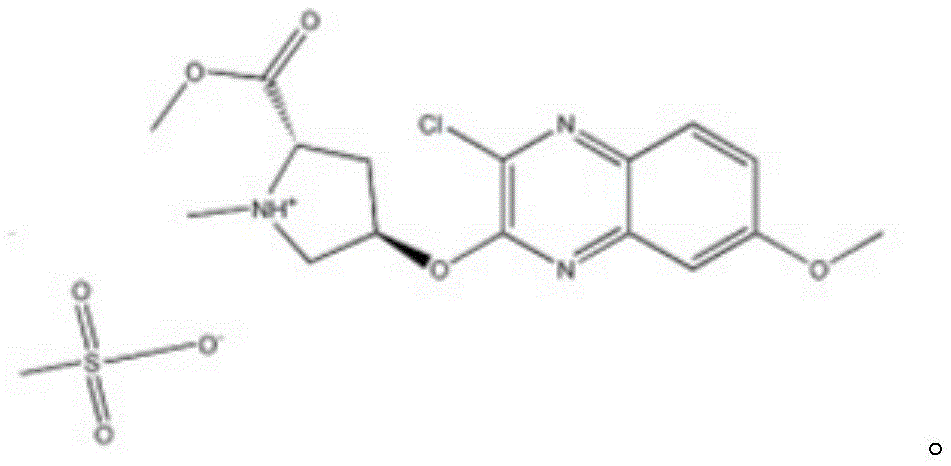
in a third aspect, the invention also provides application of 4R) -4- [ (3-chloro-7-methoxy-2-quinoxalinyl) oxy ] -L-proline methyl ester methane sulfonic acid as an intermediate for synthesizing the HCV NS3/4A protease inhibitor.
The HCV NS3/4A protease inhibitor intermediate, the synthesis method and the application thereof have the advantages that 2, 3-dichloro-6-methoxy quinoxaline and hydroxyproline methyl ester hydrochloride are selected as initial raw materials, and are combined with a reactant added subsequently to react to finally synthesize (4R) -4- [ (3-chloro-7-methoxy-2-quinoxalinyl) oxy ] -L-proline methyl ester methane sulfonic acid, so that the reaction rate can be effectively improved and the reaction time can be shortened by controlling the reaction conditions (such as reaction conditions, reactant adding time, reaction temperature and the like) of the reaction; by reasonably setting the component content proportion of each raw material, the purity and yield of the product can be effectively improved. Therefore, the synthesis method has the advantages of cheap and easily-obtained raw materials, easy treatment of byproducts, short reaction time, high chemical purity of the product, high yield and the like, particularly the purity of the final product is up to 99%, the yield is up to more than 90%, and the synthesis method is favorable for industrial production and has better industrial prospect.
Drawings
The invention is further illustrated with reference to the following figures and examples.
FIG. 1 is a process flow diagram of the synthetic method of the present invention.
Detailed Description
To make the objects, technical solutions and advantages of the embodiments of the present invention clearer, the technical solutions of the present invention will be clearly and completely described below with reference to the accompanying drawings, and it is apparent that the described embodiments are some, but not all embodiments of the present invention. All other embodiments, which can be derived by a person skilled in the art from the embodiments given herein without making any creative effort, shall fall within the protection scope of the present invention.
Example 1
As shown in FIG. 1, this example 1 provides a method for synthesizing 4R) -4- [ (3-chloro-7-methoxy-2-quinoxalinyl) oxy ] -L-proline methyl ester methane sulfonic acid, which comprises: step S1, 2, 3-dichloro-6-methoxy quinoxaline and hydroxyproline methyl ester hydrochloride are used as initial raw materials for reaction; and step S2, extracting, drying and filtering to obtain the (4R) -4- [ (3-chloro-7-methoxy-2-quinoxalinyl) oxy ] -L-proline methyl ester methane sulfonic acid.
Specifically, in this embodiment 1, 2, 3-dichloro-6-methoxyquinoxaline and hydroxyproline methyl ester hydrochloride are selected as initial raw materials, and are combined with subsequently added reactants to perform a reaction, so as to finally synthesize (4R) -4- [ (3-chloro-7-methoxy-2-quinoxalinyl) oxy ] -L-proline methyl ester methane sulfonic acid, and by reasonably setting the component content ratio of each raw material, the purity and yield of the product can be effectively improved; the purity of the final product is as high as 99%, the yield is more than 90%, and the method is favorable for industrial production.
As an alternative embodiment of the reaction.
The reaction comprises the following steps: adding 2, 3-dichloro-6-methoxy quinoxaline and hydroxyproline methyl ester hydrochloride into a reaction kettle, adding triethylamine and THF (tetrahydrofuran), adding DCC (dicyclohexylcarbodiimide) and HOBT (1-hydroxybenzotriazole) as condensing agents, and heating to 25-30 ℃ for reaction to obtain a reactant.
Further, the reaction formula is:

further, the molar ratio of the 2, 3-dichloro-6-methoxyquinoxaline to the hydroxyproline methyl ester hydrochloride is 1: 1.05-1.2.
Further, the molar ratio of the 2, 3-dichloro-6-methoxyquinoxaline to the triethylamine is 1: 1.05-1.2.
Further, the molar ratio of the 2, 3-dichloro-6-methoxyquinoxaline to the DCC and HOBT is 1:1.1-1.25: 1.1-1.25.
Further, the extracting comprises: water was added to the reaction, followed by extraction with ethyl acetate to obtain an extract.
Further, the drying includes: the obtained extract was dried over anhydrous sodium sulfate to obtain a dried product.
Further, the filtering comprises: adding methanesulfonic acid into the obtained dry matter to carry out normal-temperature reaction, and cooling and crystallizing after the reaction is finished; and filtering and crystallizing to obtain the (4R) -4- [ (3-chloro-7-methoxy-2-quinoxalinyl) oxy ] -L-proline methyl ester methane sulfonic acid.
Further, the molar ratio of the 2, 3-dichloro-6-methoxyquinoxaline to the methanesulfonic acid is 1: 1.15-1.3.
Example 2
Based on example 1, this example 2 provides 4R) -4- [ (3-chloro-7-methoxy-2-quinoxalinyl) oxy ] -L-proline methyl ester methane sulfonic acid, wherein the structural formula of the 4R) -4- [ (3-chloro-7-methoxy-2-quinoxalinyl) oxy ] -L-proline methyl ester methane sulfonic acid is:

for the contents of the components of 4R) -4- [ (3-chloro-7-methoxy-2-quinoxalinyl) oxy ] -L-proline methyl ester methane sulfonic acid and the specific implementation process, reference is made to the relevant discussion of example 1, which is not repeated here.
Example 3
Based on example 1, this example 3 provides the use of 4R) -4- [ (3-chloro-7-methoxy-2-quinoxalinyl) oxy ] -L-proline methyl ester methane sulfonic acid as an intermediate for the synthesis of HCV NS3/4A protease inhibitor.
For the contents of the components of 4R) -4- [ (3-chloro-7-methoxy-2-quinoxalinyl) oxy ] -L-proline methyl ester methane sulfonic acid and the specific implementation process, reference is made to the relevant discussion of example 1, which is not repeated here.
Example 4
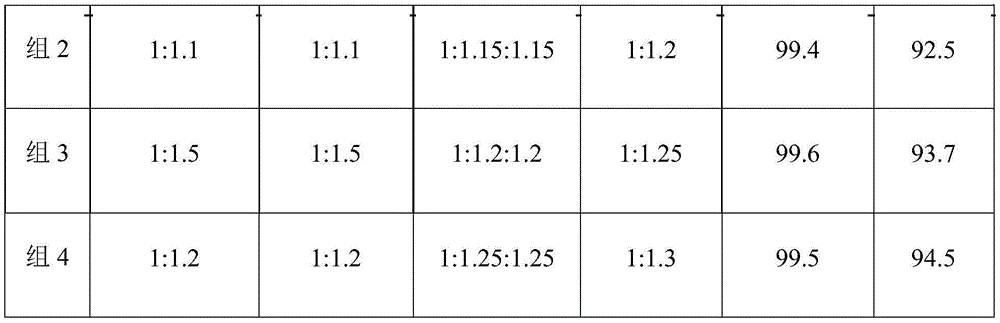
Example 4 illustrates four experiments, and the influence factors of purity and yield of the product 4R) -4- [ (3-chloro-7-methoxy-2-quinoxalinyl) oxy ] -L-proline methyl ester methane sulfonic acid synthesized by the four experiments were investigated, as shown in Table 1.
TABLE 1 component content and product yield

Group 1
(1) Adding 2, 3-dichloro-6-methoxy quinoxaline 50g and hydroxyproline methyl ester hydrochloride 41.5g into a reaction kettle, adding triethylamine 23.1g and THF 250ml, adding DCC 49.5g and HOBT 32.4g, heating to 25-30 ℃ for reaction for 15h, and controlling by HPLC (high performance liquid chromatography) until the raw material is less than 1% to obtain a reactant.
(2) After the reaction is finished, adding 250ml of water into the reactant, extracting the product for 50ml of 3 times by using ethyl acetate, after the extraction is finished, drying an ethyl acetate layer for 1h by using 80g of anhydrous sodium sulfate, filtering out solids, adding 24.1g of methanesulfonic acid into the filtrate, reacting for 10h at the temperature of 20-30 ℃, cooling to 0-10 ℃ after the reaction is finished, crystallizing for 1h, and filtering to obtain 88.2g of 4R) -4- [ (3-chloro-7-methoxy-2-quinoxalinyl) oxy ] -L-proline methyl ester methanesulfonic acid, wherein the purity is 99.1 percent and the yield is 90.3 percent.
Group 2
(1) Adding 50g of 2, 3-dichloro-6-methoxy quinoxaline 43.6g of hydroxyproline methyl ester hydrochloride into a reaction kettle, then adding 24.3g of triethylamine and 250ml of THF, then adding 51.8g of DCC and 34g of HOBT, heating to 25-30 ℃ for reaction for 15h, controlling by HPLC, and obtaining a reactant with the raw material less than 1%.
(2) After the reaction is finished, adding 250ml of water into the reactant, extracting the product for 50ml of 3 times by using ethyl acetate, after the extraction is finished, drying an ethyl acetate layer for 1h by using 80g of anhydrous sodium sulfate, filtering out solids, adding 25.1g of methanesulfonic acid into the filtrate, reacting for 10h at the temperature of 20-30 ℃, cooling to 0-10 ℃ after the reaction is finished, crystallizing for 1h, and filtering to obtain 90.4g of 4R) -4- [ (3-chloro-7-methoxy-2-quinoxalinyl) oxy ] -L-proline methyl ester methanesulfonic acid, wherein the purity is 99.4% and the yield is 92.5%.
Group 3
(1) Adding 50g of 2, 45.6g of hydroxyproline methyl ester hydrochloride of 3-dichloro-6-methoxyquinoxaline into a reaction kettle, then adding 25.4g of triethylamine and 250ml of THF, then adding 54g of DCC and 35.4g of HOBT, heating to 25-30 ℃ for reaction for 15h, controlling by HPLC, and obtaining a reactant with the raw material less than 1%.
(2) After the reaction is finished, adding 250ml of water into the reactant, extracting the product for 50ml of 3 times by using ethyl acetate, after the extraction is finished, drying an ethyl acetate layer for 1h by using 80g of anhydrous sodium sulfate, filtering out solids, adding 26.2g of methanesulfonic acid into the filtrate, reacting for 10h at the temperature of 20-30 ℃, cooling to 0-10 ℃ after the reaction is finished, crystallizing for 1h, and filtering to obtain 91.6g of 4R) -4- [ (3-chloro-7-methoxy-2-quinoxalinyl) oxy ] -L-proline methyl ester methanesulfonic acid, wherein the purity is 99.6 percent, and the yield is 93.7 percent.
Group 4
(1) Adding 2g, 3-dichloro-6-methoxy quinoxaline 47.6g hydroxyproline methyl ester hydrochloride into a reaction kettle, adding 26.5g triethylamine and 250ml THF, adding 56.2g DCC and 36.8g HOBT, heating to 25-30 ℃ for reaction for 15h, and controlling by HPLC (high performance liquid chromatography) until the raw material is less than 1% to obtain a reactant.
(2) After the reaction is finished, adding 250ml of water into the reactant, extracting the product for 50ml of 3 times by using ethyl acetate, after the extraction is finished, drying an ethyl acetate layer for 1h by using 80g of anhydrous sodium sulfate, filtering out solids, adding 27.2g of methanesulfonic acid into the filtrate, reacting for 10h at the temperature of 20-30 ℃, cooling to 0-10 ℃ after the reaction is finished, crystallizing for 1h, and filtering to obtain 92.3g of 4R) -4- [ (3-chloro-7-methoxy-2-quinoxalinyl) oxy ] -L-proline methyl ester methane sulfonic acid, wherein the purity is 99.5 percent, and the yield is 94.5 percent.
In conclusion, the HCV NS3/4A protease inhibitor intermediate, the synthesis method and the application thereof select 2, 3-dichloro-6-methoxy quinoxaline and hydroxyproline methyl ester hydrochloride as initial raw materials, combine the reactants added subsequently to react, finally synthesize (4R) -4- [ (3-chloro-7-methoxy-2-quinoxalinyl) oxy ] -L-proline methyl ester methane sulfonic acid, and can effectively improve the reaction rate and shorten the reaction time by controlling the reaction conditions (such as reaction conditions, reactant adding time, reaction temperature and the like) of the reaction; by reasonably setting the component content proportion of each raw material, the purity and yield of the product can be effectively improved. Therefore, the synthesis method has the advantages of cheap and easily-obtained raw materials, easy treatment of byproducts, short reaction time, high chemical purity of the product, high yield and the like, particularly the purity of the final product is up to 99%, the yield is up to more than 90%, and the synthesis method is favorable for industrial production and has better industrial prospect.
In light of the foregoing description of the preferred embodiment of the present invention, many modifications and variations will be apparent to those skilled in the art without departing from the spirit and scope of the invention. The technical scope of the present invention is not limited to the content of the specification, and must be determined according to the scope of the claims.
Claims (12)
1. A method for synthesizing 4R) -4- [ (3-chloro-7-methoxy-2-quinoxalinyl) oxy ] -L-proline methyl ester methane sulfonic acid is characterized by comprising the following steps:
2, 3-dichloro-6-methoxy quinoxaline and hydroxyproline methyl ester hydrochloride are used as initial raw materials to react; and
extracting, drying and filtering to obtain the (4R) -4- [ (3-chloro-7-methoxy-2-quinoxalinyl) oxy ] -L-proline methyl ester methane sulfonic acid.
2. The method of synthesis according to claim 1,
the reaction comprises the following steps:
adding 2, 3-dichloro-6-methoxy quinoxaline and hydroxyproline methyl ester hydrochloride into a reaction kettle, adding triethylamine and THF, adding DCC and HOBT as condensing agents, and heating to 25-30 ℃ for reaction to obtain a reactant.
3. The method of synthesis according to claim 2,
the reaction formula is as follows:

4. the method of synthesis according to claim 3,
the molar ratio of the 2, 3-dichloro-6-methoxyquinoxaline to the hydroxyproline methyl ester hydrochloride is 1: 1.05-1.2.
5. The method of synthesis according to claim 3,
the molar ratio of the 2, 3-dichloro-6-methoxy quinoxaline to the triethylamine is 1: 1.05-1.2.
6. The method of synthesis according to claim 3,
the molar ratio of the 2, 3-dichloro-6-methoxy quinoxaline to the DCC and HOBT is 1:1.1-1.25: 1.1-1.25.
7. The method of synthesis according to claim 3,
the extraction comprises the following steps:
water was added to the reaction, followed by extraction with ethyl acetate to obtain an extract.
8. The method of synthesis according to claim 7,
the drying comprises the following steps:
the obtained extract was dried over anhydrous sodium sulfate to obtain a dried product.
9. The method of synthesis according to claim 8,
the filtering comprises the following steps:
adding methanesulfonic acid into the obtained dry matter to carry out normal-temperature reaction, and cooling and crystallizing after the reaction is finished; and
filtering and crystallizing to obtain the (4R) -4- [ (3-chloro-7-methoxy-2-quinoxalinyl) oxy ] -L-proline methyl ester methane sulfonic acid.
10. The method of synthesis according to claim 9,
the molar ratio of the 2, 3-dichloro-6-methoxy quinoxaline to the methanesulfonic acid is 1: 1.15-1.3.
11. 4R) -4- [ (3-chloro-7-methoxy-2-quinoxalinyl) oxy ] -L-proline methyl ester methane sulfonic acid, characterized in that,
the structural formula of the 4R) -4- [ (3-chloro-7-methoxy-2-quinoxalinyl) oxy ] -L-proline methyl ester methane sulfonic acid is as follows:

12. application of 4R) -4- [ (3-chloro-7-methoxy-2-quinoxalinyl) oxy ] -L-proline methyl ester methane sulfonic acid as an intermediate for synthesizing HCV NS3/4A protease inhibitor.
Priority Applications (1)
| Application Number | Priority Date | Filing Date | Title |
|---|---|---|---|
| CN201911308642.7A CN111057045A (en) | 2019-12-18 | 2019-12-18 | HCV NS3/4A protease inhibitor intermediate, and synthesis method and application thereof |
Applications Claiming Priority (1)
| Application Number | Priority Date | Filing Date | Title |
|---|---|---|---|
| CN201911308642.7A CN111057045A (en) | 2019-12-18 | 2019-12-18 | HCV NS3/4A protease inhibitor intermediate, and synthesis method and application thereof |
Publications (1)
| Publication Number | Publication Date |
|---|---|
| CN111057045A true CN111057045A (en) | 2020-04-24 |
Family
ID=70302174
Family Applications (1)
| Application Number | Title | Priority Date | Filing Date |
|---|---|---|---|
| CN201911308642.7A Pending CN111057045A (en) | 2019-12-18 | 2019-12-18 | HCV NS3/4A protease inhibitor intermediate, and synthesis method and application thereof |
Country Status (1)
| Country | Link |
|---|---|
| CN (1) | CN111057045A (en) |
Citations (7)
| Publication number | Priority date | Publication date | Assignee | Title |
|---|---|---|---|---|
| EP1375465A1 (en) * | 2001-04-03 | 2004-01-02 | Eisai Co., Ltd. | Cyclooctanone derivative and cyclodecanone derivative, and use thereof |
| CN102159285A (en) * | 2008-07-22 | 2011-08-17 | 默沙东公司 | Macrocyclic quinoxaline compounds as hcv ns3 protease inhibitors |
| CN103874414A (en) * | 2011-08-19 | 2014-06-18 | 默沙东公司 | Process and intermediates for preparing macrolactams |
| CN103917534A (en) * | 2011-10-08 | 2014-07-09 | 诺华股份有限公司 | Carbamate/urea derivatives containing piperidine and piperazine rings as H3 receptor inhibitors |
| EP2764866A1 (en) * | 2013-02-07 | 2014-08-13 | IP Gesellschaft für Management mbH | Inhibitors of nedd8-activating enzyme |
| CN105636923A (en) * | 2013-10-18 | 2016-06-01 | 默沙东公司 | Processes and intermediates for the preparation of macrolide amides |
| CN107949562A (en) * | 2015-06-09 | 2018-04-20 | 拜耳制药股份公司 | The positive allosteric modulators of muscarinic M2 acceptors |
-
2019
- 2019-12-18 CN CN201911308642.7A patent/CN111057045A/en active Pending
Patent Citations (9)
| Publication number | Priority date | Publication date | Assignee | Title |
|---|---|---|---|---|
| EP1375465A1 (en) * | 2001-04-03 | 2004-01-02 | Eisai Co., Ltd. | Cyclooctanone derivative and cyclodecanone derivative, and use thereof |
| CN102159285A (en) * | 2008-07-22 | 2011-08-17 | 默沙东公司 | Macrocyclic quinoxaline compounds as hcv ns3 protease inhibitors |
| CN103874414A (en) * | 2011-08-19 | 2014-06-18 | 默沙东公司 | Process and intermediates for preparing macrolactams |
| CN103889439A (en) * | 2011-08-19 | 2014-06-25 | 默沙东公司 | Crystal forms of a HCV protease inhibitor |
| CN103917534A (en) * | 2011-10-08 | 2014-07-09 | 诺华股份有限公司 | Carbamate/urea derivatives containing piperidine and piperazine rings as H3 receptor inhibitors |
| EP2764866A1 (en) * | 2013-02-07 | 2014-08-13 | IP Gesellschaft für Management mbH | Inhibitors of nedd8-activating enzyme |
| CN105636923A (en) * | 2013-10-18 | 2016-06-01 | 默沙东公司 | Processes and intermediates for the preparation of macrolide amides |
| CN107949562A (en) * | 2015-06-09 | 2018-04-20 | 拜耳制药股份公司 | The positive allosteric modulators of muscarinic M2 acceptors |
| US20180297994A1 (en) * | 2015-06-09 | 2018-10-18 | Bayer Pharma Aktiengesellschaft | Positive allosteric modulators of muscarinic m2 receptor |
Non-Patent Citations (2)
| Title |
|---|
| FENG XU等: "Supporting Information", 《ORGANIC LETTERS》 * |
| FENG XU等: "Synthesis of Grazoprevir, a Potent NS3/4a Protease Inhibitor for the Treatment of Hepatitis C Virus", 《ORGANIC LETTERS》 * |
Similar Documents
| Publication | Publication Date | Title |
|---|---|---|
| WO2016112746A1 (en) | Method for preparing ribofuranose phosphate derivatives | |
| CN103804446A (en) | Preparation method of 3,5-dibenzoyl-2-deoxy-2-fluoro-2-methyl-D-ribo-gamma-lactone | |
| CN110964057B (en) | Method for preparing sofosbuvir intermediate by using microfluid reaction device | |
| CN105669804B (en) | The preparation method of Suo Feibuwei | |
| CN106146588A (en) | A kind of preparation method of Suo Feibuwei | |
| CN106083773B (en) | The preparation method of the fluoro- 2- methyl-D-ribo-gamma lactone of 3,5- dibenzoyl -2- deoxidation -2- | |
| CN117430565B (en) | HDAC8 inhibitor and preparation method and application thereof | |
| CN111057045A (en) | HCV NS3/4A protease inhibitor intermediate, and synthesis method and application thereof | |
| CN105461773B (en) | Preparation method and intermediate of sofosbuvir | |
| CN103342736A (en) | Synthesis method of telaprevir | |
| CN106117077A (en) | A kind of neuraminidase inhibitor and preparation method thereof | |
| CN108129366A (en) | Antiviral compound, preparation method and its usage | |
| CN101558045A (en) | Caspase inhibitors based on pyridazinone scaffold | |
| CN111303007B (en) | Preparation method of (S) -5- (tert-butyloxycarbonyl) -5-azaspiro [2,4] heptane-6-carboxylic acid | |
| CN1271063C (en) | Di (5-formylfurfuryl) ether derivatives, preparations thereof and their uses in medicines | |
| CN105949085A (en) | Synthesis method of N-methoxycarbonyl group-L-valine | |
| CN106749255B (en) | A kind of preparation method of antiviral medicinal entecavir intermediate | |
| CN115010639B (en) | Intermediate compound and preparation method and application thereof | |
| CN115925754B (en) | A catalytic synthesis process of sofosbuvir | |
| CN119350240B (en) | 4-Quinoline anilines main protease inhibitor and preparation method and medical application thereof | |
| CN117105928B (en) | Protease inhibitor and preparation method thereof | |
| CN105175406B (en) | The intermediate of HCV inhibitor and the method that HCV inhibitor is prepared by it | |
| CN110981879A (en) | Method for preparing NS5A inhibitor-wipatasvir | |
| CN108368105A (en) | A kind of substituted quinoline compound and its pharmaceutical composition and application | |
| CN108440597B (en) | Simple and convenient synthesis method of tenofovir disoproxil fumarate |
Legal Events
| Date | Code | Title | Description |
|---|---|---|---|
| PB01 | Publication | ||
| PB01 | Publication | ||
| SE01 | Entry into force of request for substantive examination | ||
| SE01 | Entry into force of request for substantive examination | ||
| RJ01 | Rejection of invention patent application after publication | ||
| RJ01 | Rejection of invention patent application after publication |
Application publication date: 20200424 |