CN111027575B - A Self-Attention Adversarial Learning Approach for Semi-Supervised Semantic Segmentation - Google Patents
A Self-Attention Adversarial Learning Approach for Semi-Supervised Semantic Segmentation Download PDFInfo
- Publication number
- CN111027575B CN111027575B CN201911278533.5A CN201911278533A CN111027575B CN 111027575 B CN111027575 B CN 111027575B CN 201911278533 A CN201911278533 A CN 201911278533A CN 111027575 B CN111027575 B CN 111027575B
- Authority
- CN
- China
- Prior art keywords
- feature map
- layer
- segmentation
- self
- map
- Prior art date
- Legal status (The legal status is an assumption and is not a legal conclusion. Google has not performed a legal analysis and makes no representation as to the accuracy of the status listed.)
- Expired - Fee Related
Links
Images


Classifications
-
- G—PHYSICS
- G06—COMPUTING OR CALCULATING; COUNTING
- G06V—IMAGE OR VIDEO RECOGNITION OR UNDERSTANDING
- G06V10/00—Arrangements for image or video recognition or understanding
- G06V10/40—Extraction of image or video features
- G06V10/44—Local feature extraction by analysis of parts of the pattern, e.g. by detecting edges, contours, loops, corners, strokes or intersections; Connectivity analysis, e.g. of connected components
-
- G—PHYSICS
- G06—COMPUTING OR CALCULATING; COUNTING
- G06F—ELECTRIC DIGITAL DATA PROCESSING
- G06F18/00—Pattern recognition
- G06F18/20—Analysing
- G06F18/21—Design or setup of recognition systems or techniques; Extraction of features in feature space; Blind source separation
- G06F18/214—Generating training patterns; Bootstrap methods, e.g. bagging or boosting
- G06F18/2155—Generating training patterns; Bootstrap methods, e.g. bagging or boosting characterised by the incorporation of unlabelled data, e.g. multiple instance learning [MIL], semi-supervised techniques using expectation-maximisation [EM] or naïve labelling
Landscapes
- Engineering & Computer Science (AREA)
- Theoretical Computer Science (AREA)
- Physics & Mathematics (AREA)
- Computer Vision & Pattern Recognition (AREA)
- General Physics & Mathematics (AREA)
- Data Mining & Analysis (AREA)
- Artificial Intelligence (AREA)
- Bioinformatics & Cheminformatics (AREA)
- Bioinformatics & Computational Biology (AREA)
- Evolutionary Biology (AREA)
- Evolutionary Computation (AREA)
- Life Sciences & Earth Sciences (AREA)
- General Engineering & Computer Science (AREA)
- Multimedia (AREA)
- Image Analysis (AREA)
Abstract
Description
技术领域technical field
本发明涉及计算机视觉技术,具体是一种自注意对抗学习的半监督语义分割方法。The invention relates to computer vision technology, in particular to a semi-supervised semantic segmentation method of self-attention confrontation learning.
背景技术Background technique
语义分割是计算机视觉中最重要也是最有趣的任务之一,近年来,卷积神经网络(Convolutional Neural Networks,简称CNN)的发展有力的推动了语义分割取得了重大进展,现实生活中使用语义分割需要大量的对象类和每个类的标记数据,应用于自动驾驶和图像编辑,然而,这种标记工作的准确性和效率十分昂贵,为解决这个问题,通过将半/弱监督方法应用于语义分割中,使语义分割模型具有更强的可扩展性,然而,当前弱监督分割方法相对于完全监督分割产生较差的结果。Semantic segmentation is one of the most important and interesting tasks in computer vision. In recent years, the development of Convolutional Neural Networks (CNN) has strongly promoted significant progress in semantic segmentation. Semantic segmentation is used in real life. Requires a large number of object classes and labeled data for each class, applied to autonomous driving and image editing, however, the accuracy and efficiency of such labeling work is very expensive, to solve this problem, by applying semi/weakly supervised methods to semantics In segmentation, semantic segmentation models are made more scalable, however, current weakly supervised segmentation methods yield poor results relative to fully supervised segmentation.
随着生成对抗网络的出现,对抗学习开始应用于一些半/弱监督的语义分割方法中,这些方法取得了显著的进展,一个典型的对抗网络由两个子网络组成,即生成器和判别器,这两个子网络在训练过程中进行最小-最大博弈,生成器和判别器的互相博弈学习产生很好的输出。在此背景下,将分割网络的输出在空间上尽可能地靠近ground truth标签映射,然而,基于深度卷积网络的对抗网络依赖于卷积来对不同图像区域的依赖性进行建模,由于卷积运算符具有局部感受域,因此只能在经过多个卷积层之后处理长距离依赖性,这可能会阻止学习远程依赖性,优化算法可能无法发现仔细协调多个层以捕获这些依赖性的参数值,增加卷积核的大小可以增加网络的表示能力,但这样同时也会使通过使用局部卷积结构获得的计算和统计效率有所损失,并且对抗网络训练中的一个持续挑战是鉴别器的性能控制,在高维空间的训练过程中,由鉴别器进行的密度比估计通常是不准确且不稳定的,当模型分布的支持与目标分布的支持不同时,存在一个鉴别器,可以很好地将模型分布与目标区分开来,在这种情况下,一旦产生这样的鉴别器,生成器的训练就完全停止了,这促使我们对鉴别器的选择引入某种形式的限制。With the advent of generative adversarial networks, adversarial learning has begun to be applied to some semi/weakly supervised semantic segmentation methods, which have made significant progress. A typical adversarial network consists of two sub-networks, the generator and the discriminator, The two sub-networks play a min-max game during training, and the mutual game learning between the generator and the discriminator produces good outputs. In this context, the output of the segmentation network is spatially mapped as close to the ground truth label as possible, however, adversarial networks based on deep convolutional networks rely on convolutions to model the dependencies of different image regions, due to the volume The product operator has a local receptive field, so it can only handle long-range dependencies after going through multiple convolutional layers, which may prevent learning of long-range dependencies, and optimization algorithms may fail to discover the effects of carefully coordinating multiple layers to capture these dependencies. parameter value, increasing the size of the convolution kernel can increase the representational power of the network, but it also costs the computational and statistical efficiency gained by using a local convolution structure, and an ongoing challenge in adversarial network training is the discriminator In the training process of high-dimensional space, the density ratio estimation by the discriminator is usually inaccurate and unstable. When the support of the model distribution is different from that of the target distribution, there is a discriminator, which can be very The model distribution is well differentiated from the target, in which case the training of the generator stops completely once such a discriminator is produced, prompting us to introduce some form of restriction on the choice of discriminator.
发明内容SUMMARY OF THE INVENTION
本发明的目的是针对现有技术的不足,而提供一种自注意对抗学习的半监督语义分割方法。这种方法生成的分割模型具有更强的可扩展性,生成图像时可协调好每一个位置与远端的细节,而且训练时计算量少且易于集成到现有实现中。The purpose of the present invention is to provide a semi-supervised semantic segmentation method for self-attention confrontation learning aiming at the deficiencies of the prior art. The segmentation model generated by this method is more scalable, can coordinate the details of each location and remote when generating images, and is computationally less computationally intensive and easy to integrate into existing implementations.
实现本发明目的的技术方案是:The technical scheme that realizes the object of the present invention is:
一种自注意对抗学习的半监督语义分割方法,包括如下步骤:A semi-supervised semantic segmentation method for self-attention adversarial learning, including the following steps:
1)获取训练集和验证集,对训练集预处理:将已知的语义分割数据集Pascal Voc2012和Cityscapes中的图像分别分成训练集和验证集,并对训练集的图像进行预处理,其中数据集中的一部分图像带标记,其余图像不带标记;1) Obtain the training set and the validation set, and preprocess the training set: Divide the images in the known semantic segmentation datasets Pascal Voc2012 and Cityscapes into training set and validation set respectively, and preprocess the images in the training set. Some of the images in the set are marked, and the rest are not marked;
2)构建自注意半监督语义分割的对抗网络:对抗网络由分割网络G和鉴别器D组成,其中2) Build an adversarial network for self-attention semi-supervised semantic segmentation: The adversarial network consists of a segmentation network G and a discriminator D, where
分割网络是任意为语义分割设计的网络,如FCN、DeepLab和膨胀网,去掉分割网络的最后一个卷积层,将分割网络最后两个卷积层的步长由2修改为1,使输出特征图的分辨率达到输入图像大小的1/8,然后分别在第四卷积层和第五卷积层中应用扩展卷积,第四卷积层和第五卷积层的步长分别为2和4,在分割网络的第五卷积层使用Atrous空间金字塔池方法,即得到最终的分割网络:64维的1/2倍下采样层即第一卷积层、128维的1/4倍下采样层即第二卷积层、256维的1/8倍下采样层即第三卷积层、第一个自注意力模块SA1、512维的1/16倍下采样层即第四卷积层、1028维的1/32倍下采样层即第五卷积层、第二个自注意力模块SA2,给定一个H×W×3维的输入图像,采用一个上采样层和softmax输出层来匹配输入图像的大小,然后分割网络输出一个大小为H×W×C的类概率图,其中C为语义类别的个数,The segmentation network is a network arbitrarily designed for semantic segmentation, such as FCN, DeepLab and Dilation Network, remove the last convolutional layer of the segmentation network, and modify the stride of the last two convolutional layers of the segmentation network from 2 to 1, so that the output features The resolution of the graph reaches 1/8 of the input image size, and then dilated convolutions are applied in the fourth and fifth convolutional layers, respectively, with strides of 2 And 4, using the Atrous spatial pyramid pooling method in the fifth convolutional layer of the segmentation network, that is, the final segmentation network: 1/2 times the downsampling layer of 64 dimensions is the first convolutional layer, 1/4 times of 128 dimensions The downsampling layer is the second convolutional layer, the 256-dimensional 1/8 times downsampling layer is the third convolutional layer, the first self-attention module SA1, and the 512-dimensional 1/16 times downsampling layer is the fourth volume Product layer, 1028-dimensional 1/32 times downsampling layer, namely the fifth convolutional layer, the second self-attention module SA2, given a H×W×3-dimensional input image, an upsampling layer and softmax output are used layer to match the size of the input image, and then the segmentation network outputs a class probability map of size H×W×C, where C is the number of semantic categories,
分割网络中的第一自注意力模块SA1与第二自注意力模块SA2的结构相同,将第三卷积层和第五卷积层中的特征图X∈RC×H×W作为输入,并且第三卷积层和第五卷积层每层各生成两个特征图,即Q、K∈RC×H×W,Q为查询,即从特征图中输入一个像素点,查询到特征图上所有像素点对这一点的影响,K代表字典中的键,相当于所查询的数据库,将Q和K进行转置后执行矩阵乘法,以softmax层来计算注意力图S∈RN×N,N=H×W是像素数:The first self-attention module SA1 in the segmentation network has the same structure as the second self-attention module SA2, taking the feature maps X∈R C×H×W in the third and fifth convolutional layers as input, And the third convolutional layer and the fifth convolutional layer each generate two feature maps, namely Q, K∈R C×H×W , Q is the query, that is, input a pixel point from the feature map, query the feature The impact of all the pixels on the graph on this point, K represents the key in the dictionary, which is equivalent to the database being queried, transpose Q and K to perform matrix multiplication, and use the softmax layer to calculate the attention map S ∈ R N×N , N=H×W is the number of pixels:

其中,i为特征图的行数,j为特征图的列数,通过公式(1)得到针对Q的特征图中的某一个位置,计算出特征图K中的所有位置对特征图Q的影响,为学习到更多参数,对特征图X多加了一层卷积映射得到新的特征图V∈RC×H×W,将S和V进行转置后执行矩阵乘法,然后将S和V的相乘结果乘以比例参数α,最后第一自注意力模块和第二自注意力模块逐渐学习到了将注意力加权过的特征图加在特征图X上,得到特征图O:Among them, i is the number of rows of the feature map, j is the number of columns of the feature map, and a certain position in the feature map for Q is obtained by formula (1), and the influence of all positions in the feature map K on the feature map Q is calculated. , in order to learn more parameters, an additional layer of convolution mapping is added to the feature map X to obtain a new feature map V∈R C×H×W , S and V are transposed and matrix multiplication is performed, and then S and V The multiplication result of X is multiplied by the scale parameter α, and finally the first self-attention module and the second self-attention module gradually learn to add the attention-weighted feature map to the feature map X, and obtain the feature map O:

特征图O为所有位置上的特征与原始特征的加权和,The feature map O is the weighted sum of the features at all positions and the original features,
鉴别器使用全卷积神经网络,鉴别器以分割网络输出的H×W×C的类概率图或步骤1)中数据集带标记的图像获取类概率图In作为输入,最后输出H×W×1的置信图,鉴别器由5个4×4核卷积层和{64,128,256,512,1}通道组成,步长为2,最后,应用一个上采样层和softmax输出层来匹配输入图像的大小,然后在鉴别器的前四个卷积层上均使用谱归一化,让鉴别器的映射函数满足Lipschitz约束;The discriminator uses a fully convolutional neural network. The discriminator takes the class probability map of H×W×C output by the segmentation network or the labeled image of the dataset in step 1) to obtain the class probability map In as input, and finally outputs H×W. ×1 confidence map, the discriminator consists of 5 4×4 kernel convolutional layers and {64, 128, 256, 512, 1} channels with stride 2, finally, an upsampling layer and softmax output layer are applied to match the size of the input image, Then spectral normalization is used on the first four convolutional layers of the discriminator, so that the mapping function of the discriminator satisfies the Lipschitz constraint;
3)用自注意半监督语义分割的对抗网络对训练集进行训练,得到分割预测模型;3) Train the training set with an adversarial network of self-attention semi-supervised semantic segmentation to obtain a segmentation prediction model;
4)利用验证集对分割预测模型进行验证,得到最终分割的结果。4) Use the validation set to verify the segmentation prediction model to obtain the final segmentation result.
步骤1)中所述的预处理过程如下:The preprocessing process described in step 1) is as follows:
先对图像进行固定大小的随机裁剪,再将裁剪后的图像进行随机水平翻转和亮度变换,后将翻转后的图像进行归一化。First, randomly crop the image with a fixed size, then perform random horizontal flipping and brightness transformation on the cropped image, and then normalize the flipped image.
步骤3)中所述的训练,包括如下步骤:The training described in step 3) includes the following steps:
步骤1、将带标记图像经过鉴别器5000次的迭代训练,然后对分割网络和鉴别器进行联合更新;Step 1. The labeled image is iteratively trained by the discriminator for 5000 times, and then the segmentation network and the discriminator are jointly updated;
步骤2、对训练集中的图像进行随机抽样训练,使用带标记的图像时,分割网络既受带标记图像的标准交叉熵损失Lce的监督,又受带鉴别器的对抗损失Ladv的监督;Step 2. Perform random sampling training on the images in the training set. When using labeled images, the segmentation network is supervised not only by the standard cross-entropy loss Lce of the labeled images, but also by the adversarial loss Ladv with the discriminator;
步骤3、将未标记图像送入分割网络的64维的1/2倍下采样层中提取图像的卷积特征,再将提取的卷积特征送入最大池化层提取图像的最大池化特征,得到缩小2倍的下采样特征图1;Step 3. Send the unlabeled image to the 64-dimensional 1/2 times downsampling layer of the segmentation network to extract the convolution features of the image, and then send the extracted convolution features to the maximum pooling layer to extract the maximum pooling features of the image. , the down-sampling feature map 1 with a 2-fold reduction is obtained;
步骤4、将特征图1送入128维的1/4倍下采样层进行卷积运算,并应用最大池化层来扩大特征图1的感受野,来获取卷积运算后特征图1的最大池化特征,得到缩小4倍的下采样特征图2;Step 4. Send the feature map 1 into the 128-dimensional 1/4 times downsampling layer for convolution operation, and apply the maximum pooling layer to expand the receptive field of the feature map 1 to obtain the maximum value of the feature map 1 after the convolution operation. Pooling the features to obtain a downsampling feature map 2 that is reduced by a factor of 4;
步骤5、将特征图2送入256维的1/8倍下采样层进行卷积运算,并应用最大池化层来扩大特征图2的感受野,来获取积运算后特征图2的最大池化特征,得到缩小8倍的下采样特征图3;Step 5. Send the feature map 2 into the 256-dimensional 1/8 times downsampling layer for convolution operation, and apply the maximum pooling layer to expand the receptive field of the feature map 2 to obtain the maximum pool of the feature map 2 after the product operation. The features are reduced by 8 times, and the down-sampling feature map 3 is obtained;
步骤6、将特征图3送入第一个自注意力模块捕获特征图3的位置细节,获取特征图3的全局几何特征图4;Step 6, send the feature map 3 into the first self-attention module to capture the location details of the feature map 3, and obtain the global geometric feature map 4 of the feature map 3;
步骤7、将特征图4送入512维的1/16倍下采样层进行卷积运算,并应用最大池化层来扩大特征图4的感受野,来获取卷积运算后特征图4的最大池化特征,得到缩小16倍的下采样特征图5;Step 7. Send the feature map 4 into the 512-dimensional 1/16 times downsampling layer for convolution operation, and apply the maximum pooling layer to expand the receptive field of the feature map 4 to obtain the maximum value of the feature map 4 after the convolution operation. Pooling the features to obtain a 16-fold downsampling feature map 5;
步骤8、将特征图5送入1028维的1/32倍下采样层进行卷积运算,并应用最大池化层来扩大特征图5的感受野,来获取卷积运算后特征图5的最大池化特征,得到缩小32倍的下采样特征图6;Step 8. Send the feature map 5 into the 1028-dimensional 1/32 times downsampling layer for convolution operation, and apply the maximum pooling layer to expand the receptive field of the feature map 5 to obtain the maximum value of the feature map 5 after the convolution operation. Pooling the features to obtain a downsampling feature map 6 that is reduced by 32 times;
步骤9、将特征图6送入第二个自注意力模块捕获特征图6的位置细节,获取特征图6的全局几何特征图7;Step 9, send the feature map 6 into the second self-attention module to capture the location details of the feature map 6, and obtain the global geometric feature map 7 of the feature map 6;
步骤10、将特征图7应用一个上采样层和softmax输出来匹配输入图像的大小,从而得到未标记图像的类概率图;Step 10, apply an upsampling layer and softmax output to the feature map 7 to match the size of the input image, thereby obtaining the class probability map of the unlabeled image;
步骤11、将未标记图像的类概率图送入鉴别器进行分割预测,计算出置信图;Step 11. The class probability map of the unlabeled image is sent to the discriminator for segmentation prediction, and a confidence map is calculated;
步骤12、将置信图作为监控信号,采用自学习的方法训练具有掩蔽交叉熵损失Lsemi的分割网络,该置信图表示预测的分割区域的质量,并使得分割网络在训练过程中可信任;Step 12, using the confidence map as a monitoring signal, using a self-learning method to train a segmentation network with a masked cross-entropy loss Lsemi, the confidence map represents the quality of the predicted segmentation area, and makes the segmentation network credible during the training process;
步骤13、重复步骤1-步骤12的步骤20000次后结束训练,得到分割预测模型。Step 13: Repeat steps 1-12 for 20,000 times and end the training to obtain a segmentation prediction model.
步骤4)中所述的利用验证集对分割预测模型进行验证,其中验证过程只使用分割网络,验证过程如下:The segmentation prediction model is verified using the verification set described in step 4), wherein the verification process only uses the segmentation network, and the verification process is as follows:
step1、将验证集中的未标记图像送入分割网络64维的1/2倍下采样层提取图像的卷积特征,再将提取的卷积特征送入最大池化层提取图像的最大池化特征,得到缩小2倍的下采样特征图8;Step1. Send the unlabeled images in the validation set to the 64-dimensional 1/2 times downsampling layer of the segmentation network to extract the convolution features of the images, and then send the extracted convolution features to the max pooling layer to extract the max pooling features of the images , the downsampling feature map 8 reduced by a factor of 2 is obtained;
step 2、将特征图8送入128维的1/4倍下采样层进行卷积运算,并应用最大池化层来扩大特征图8的感受野,来获取特征图8的最大池化特征,得到缩小4倍的下采样特征图9;Step 2. Send the feature map 8 into the 128-dimensional 1/4 times downsampling layer for convolution operation, and apply the maximum pooling layer to expand the receptive field of the feature map 8 to obtain the maximum pooling feature of the feature map 8. A downsampling feature map 9 reduced by a factor of 4 is obtained;
step 3、将特征图9送入256维的1/8倍下采样层进行卷积运算,并应用最大池化层来扩大特征图9的感受野,来获取特征图9的最大池化特征,得到缩小8倍的下采样特征图10;Step 3. Send the feature map 9 into the 256-dimensional 1/8 times downsampling layer for convolution operation, and apply the maximum pooling layer to expand the receptive field of the feature map 9 to obtain the maximum pooling feature of the feature map 9, A downsampling feature map 10 reduced by 8 times is obtained;
step 4、将特征图10送入第一个自注意力模块捕获特征位置的细节,获取特征图10的全局几何特征图11;Step 4. Send the feature map 10 into the first self-attention module to capture the details of the feature location, and obtain the global geometric feature map 11 of the feature map 10;
step 5、将特征图11送入512维的1/16倍下采样层进行卷积运算,并应用最大池化层来扩大特征图11的感受野,来获取特征图11的最大池化特征,得到缩小16倍的下采样特征图12;Step 5. Send the feature map 11 into the 512-dimensional 1/16 times downsampling layer for convolution operation, and apply the maximum pooling layer to expand the receptive field of the feature map 11 to obtain the maximum pooling feature of the feature map 11. A downsampling feature map 12 reduced by 16 times is obtained;
step 6、将特征图12送入1028维的1/32倍下采样层进行卷积运算,并应用最大池化层来扩大特征图12的感受野,来获取特征图12的最大池化特征,得到缩小32倍的下采样特征图13;Step 6. Send the feature map 12 into the 1028-dimensional 1/32 times downsampling layer for convolution operation, and apply the maximum pooling layer to expand the receptive field of the feature map 12 to obtain the maximum pooling feature of the feature map 12, A downsampling feature map 13 reduced by 32 times is obtained;
step 7、将特征图13送入第二个自注意力模块捕获特征位置的细节,获取特征图13的全局几何特征图14;step 7. Send the feature map 13 to the second self-attention module to capture the details of the feature positions, and obtain the global geometric feature map 14 of the feature map 13;
step 8、将特征图14应用一个上采样层和softmax输出来匹配验证集中的未标记输入图像的大小,输出一个分割图15;step 8. Apply an upsampling layer and softmax output to the feature map 14 to match the size of the unlabeled input image in the validation set, and output a segmentation map 15;
step 9、通过平均交并比函数运算来计算分割图15的分割精度,然后同时加入第一个自注意力模块和第二个自注意力模块再谱归一化(Spectral Normalization,简称SN),得到最终的分割结果。Step 9. Calculate the segmentation accuracy of the segmentation map 15 through the average intersection ratio function operation, and then add the first self-attention module and the second self-attention module at the same time to spectral normalization (Spectral Normalization, referred to as SN), Get the final segmentation result.
这种方法生成的分割模型具有更强的可扩展性,生成图像时可协调好每一个位置与远端的细节,而且训练时计算量少且易于集成到现有实现中。The segmentation model generated by this method is more scalable, can coordinate the details of each location and remote when generating images, and is computationally less computationally intensive and easy to integrate into existing implementations.
附图说明Description of drawings
图1为实施例的结构示意图;Fig. 1 is the structural representation of embodiment;
图2为实施例中第一自注意力模块的结构示意图;2 is a schematic structural diagram of a first self-attention module in an embodiment;
图3为实施例的分割结果示意图。FIG. 3 is a schematic diagram of a segmentation result of an embodiment.
图中,image是原始图像,GT是手工标注的标签图像,AdvSemiSeg是现有方法的分割结果图像,其余图像为实施例的分割结果图像。In the figure, image is the original image, GT is the manually labeled label image, AdvSemiSeg is the segmentation result image of the existing method, and the rest of the images are the segmentation result images of the embodiment.
具体实施方式Detailed ways
下面结合附图及具体实施例对本发明作进一步的详细描述,但不是对本发明的限定。The present invention will be further described in detail below with reference to the accompanying drawings and specific embodiments, but it is not intended to limit the present invention.
实施例:Example:
一种自注意对抗学习的半监督语义分割方法,包括如下步骤:A semi-supervised semantic segmentation method for self-attention adversarial learning, including the following steps:
1)获取训练集和验证集,对训练集预处理:将已知的语义分割数据集Pascal Voc2012和Cityscapes中的图像分别分成训练集和验证集,并对训练集的图像进行预处理,预处理过程为:先对图像进行固定大小的随机裁剪,再将裁剪后的图像进行随机水平翻转和亮度变换,然后将翻转后的图像进行归一化,数据集中的一部分图像带标记,其余图像不带标记,1) Obtain training set and validation set, and preprocess the training set: Divide the images in the known semantic segmentation datasets Pascal Voc2012 and Cityscapes into training set and validation set, respectively, and preprocess the images in the training set. The process is: first randomly crop the image with a fixed size, and then perform random horizontal flip and brightness transformation on the cropped image, and then normalize the flipped image. Some images in the dataset are marked, and the rest are not. mark,
PASCAL VOC 2012数据集包含20个常见对象类,共有12031张图像,利用带注释的图像分割边界数据集获取12031张图像中的10582张图像作为训练集,剩余的1449张图像作为验证集,The PASCAL VOC 2012 dataset contains 20 common object classes with a total of 12,031 images. The annotated image segmentation boundary dataset is used to obtain 10,582 images of the 12,031 images as the training set, and the remaining 1,449 images are used as the validation set.
Cityscapes数据集包含50个驾驶场景视频,从中提取2975张图像作为训练集,1525张图像作为验证集,并分别用19个类对提取的所有图像进行了注释,用于训练和验证。The Cityscapes dataset contains 50 driving scene videos, from which 2975 images are extracted as training set and 1525 images are used as validation set, and all extracted images are annotated with 19 classes respectively for training and validation.
2)构建自注意半监督语义分割的对抗网络:如图1所示,对抗网络由分割网络G和鉴别器D组成,其中2) Building an adversarial network for self-attention semi-supervised semantic segmentation: As shown in Figure 1, the adversarial network consists of a segmentation network G and a discriminator D, where
本例分割网络G采用DeepLab-v2框架,去掉分割网络的最后一个卷积层,将分割网络最后两个卷积层的步长由2修改为1,使输出特征图的分辨率达到输入图像大小的1/8,然后分别在第四卷积层和第五卷积层中应用扩展卷积,第四卷积层和第五卷积层的步长分别为2和4,在分割网络的第五卷积层使用Atrous空间金字塔池方法,即得到最终的分割网络:64维的1/2倍下采样层即第一卷积层、128维的1/4倍下采样层即第二卷积层、256维的1/8倍下采样层即第三卷积层、第一个自注意力模块SA1、512维的1/16倍下采样层即第四卷积层、1028维的1/32倍下采样层即第五卷积层、第二个自注意力模块SA2,给定一个H×W×3维的输入图像,采用一个上采样层和softmax输出层来匹配输入图像的大小,然后分割网络输出一个大小为H×W×C的类概率图,其中C为语义类别的个数,其中第一自注意力模型和第二自注意力模型能够对图像区域的远程、多级依赖关系进行建模,并使分割网络绘制图像,第一自注意力模型和第二自注意力模型对特征图像素每个位置的精细细节与图像的远处部分中的精细细节进行精心协调,In this example, the segmentation network G adopts the DeepLab-v2 framework, removes the last convolutional layer of the segmentation network, and modifies the step size of the last two convolutional layers of the segmentation network from 2 to 1, so that the resolution of the output feature map reaches the size of the input image. 1/8 of the The five convolutional layers use the Atrous spatial pyramid pooling method to obtain the final segmentation network: the 64-dimensional 1/2 times downsampling layer is the first convolutional layer, and the 128-dimensional 1/4 times downsampling layer is the second convolutional layer. layer, 256-dimensional 1/8 times downsampling layer is the third convolutional layer, the first self-attention module SA1, 512-dimensional 1/16 times downsampling layer is the fourth convolutional layer, 1028-dimensional 1/1 The 32-fold downsampling layer is the fifth convolutional layer and the second self-attention module SA2. Given an input image of H×W×3 dimensions, an upsampling layer and a softmax output layer are used to match the size of the input image. Then the segmentation network outputs a class probability map of size H×W×C, where C is the number of semantic categories, where the first self-attention model and the second self-attention model can have long-range, multi-level dependencies on image regions The first self-attention model and the second self-attention model carefully reconcile the fine details at each position of the feature map pixel with the fine details in the distant parts of the image,
如图2所示,分割网络中的第一自注意力模块SA1与第二自注意力模块SA2的结构相同,将第三卷积层和第五卷积层中的特征图X∈RC×H×W作为输入,并且第三卷积层和第五卷积层每层各生成两个特征图,即Q、K∈RC×H×W,Q为查询,即从特征图中输入一个像素点,查询到特征图上所有像素点对这一点的影响,K代表字典中的键,相当于所查询的数据库,将Q和K进行转置后执行矩阵乘法,以softmax层来计算注意力图S∈RN×N,N=H×W是像素数:As shown in Figure 2, the first self-attention module SA1 in the segmentation network has the same structure as the second self-attention module SA2 . H×W is used as input, and the third convolutional layer and the fifth convolutional layer each generate two feature maps, namely Q, K∈R C×H×W , Q is the query, that is, input one from the feature map Pixel points, query the influence of all pixels on the feature map on this point, K represents the key in the dictionary, which is equivalent to the database to be queried, perform matrix multiplication after transposing Q and K, and use the softmax layer to calculate the attention map S∈R N×N , where N=H×W is the number of pixels:
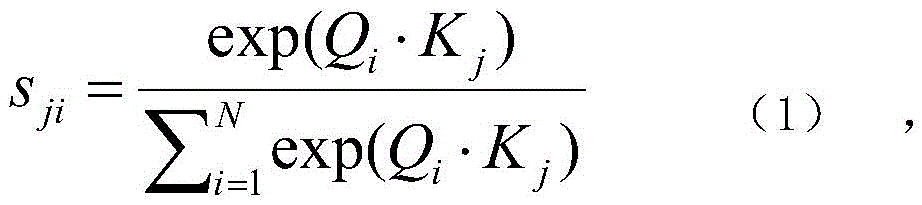
其中,i为特征图的行数,j为特征图的列数,通过公式(1)得到针对Q的特征图中的某一个位置,计算出特征图K中的所有位置对特征图Q的影响,为学习到更多参数,对特征图X多加了一层卷积映射得到新的特征图V∈RC×H×W,将S和V进行转置后执行矩阵乘法,然后将S和V的相乘结果乘以比例参数α,最后第一自注意力模块和第二自注意力模块逐渐学习到了将注意力加权过的特征图加在特征图X上,得到特征图O:Among them, i is the number of rows of the feature map, j is the number of columns of the feature map, and a certain position in the feature map for Q is obtained by formula (1), and the influence of all positions in the feature map K on the feature map Q is calculated. , in order to learn more parameters, an additional layer of convolution mapping is added to the feature map X to obtain a new feature map V∈R C×H×W , S and V are transposed and matrix multiplication is performed, and then S and V The multiplication result of X is multiplied by the scale parameter α, and finally the first self-attention module and the second self-attention module gradually learn to add the attention-weighted feature map to the feature map X, and obtain the feature map O:

特征图O为所有位置上的特征与原始特征的加权和,The feature map O is the weighted sum of the features at all positions and the original features,
鉴别器使用全卷积神经网络,鉴别器以分割网络输出的H×W×C的类概率图或步骤1)中数据集带标记的图像获取类概率图In作为输入,最后输出H×W×1的置信图,鉴别器输出映射的每个像素p表示该像素是来自步骤1)中数据集带标记的图像即p=1采样还是来自分割网络即p=0,鉴别器由5个4×4核卷积层和{64,128,256,512,1}通道组成,步长为2,除最后一层外,每个卷积层后面都有一个参数为0.2的Leaky-ReLU,为将模型转化为一个完全卷积的网络,在最后一层增加一个上采样层,将输出缩放到输入映射的大小,最后,应用一个上采样层和softmax输出层来匹配输入图像的大小,然后在鉴别器的前四个卷积层上均使用谱归一化,谱归一化后鉴别器的最优的形式是:The discriminator uses a fully convolutional neural network. The discriminator takes the class probability map of H×W×C output by the segmentation network or the labeled image of the dataset in step 1) to obtain the class probability map In as input, and finally outputs H×W. ×1 confidence map, each pixel p mapped by the discriminator output indicates whether the pixel is from the labeled image of the dataset in step 1), i.e. p=1 sampling or from the segmentation network, i.e. p=0, the discriminator consists of five 4 ×4 kernel convolutional layers and {64,128,256,512,1} channels, stride 2, except the last layer, each convolutional layer is followed by a Leaky-ReLU with a parameter of 0.2, in order to convert the model into a complete Convolutional network, adding an upsampling layer to the last layer, scaling the output to the size of the input map, finally, applying an upsampling layer and a softmax output layer to match the size of the input image, and then in the first four discriminators Spectral normalization is used on the convolutional layers, and the optimal form of the discriminator after spectral normalization is:


其中qdata为数据分布,pG为要通过对抗性最小-最大优化学习的分割网络的分布,公式(3)没有边界或者无法计算时,需要一定的机制来限定f(x)的导数,where q data is the data distribution, p G is the distribution of the segmentation network to be learned through adversarial min-max optimization, when formula (3) has no boundary or cannot be calculated, a certain mechanism is required to limit the derivative of f(x),
省略鉴别器各个层加上的biase,对于鉴别器的f函数利用一致性有不等式:Omitting the bias added by each layer of the discriminator, there is an inequality for the discriminator's f function utilization consistency:

其中,σ(W)表示的是W的二范式,利用性质线性,对于任意系数β有||βA||=|β|||A||,那么可以得出f的上界为1,Among them, σ(W) represents the second normal form of W. Using the property linearity, for any coefficient β, there is ||βA||=|β|||A||, then it can be concluded that the upper bound of f is 1,
对于矩阵W的谱归一化:For spectral normalization of matrix W:

公式(5)中的每个W代入式(6),如果鉴别器的每层权重W都进行谱归一化,那么将鉴别器看做一个函数隐射f,即将Lipschitz范数约束在1以下,这样就达到了鉴别器的映射函数满足Lipschitz约束的效果,对于鉴别器映射输出的每个像素p,若是来自分割网络则p=0,来自步骤1)中数据集带标记的图像则p=1;Substitute each W in formula (5) into formula (6). If the weights W of each layer of the discriminator are spectrally normalized, then the discriminator is regarded as a function implicature f, that is, the Lipschitz norm is constrained to be less than 1 , which achieves the effect that the mapping function of the discriminator satisfies the Lipschitz constraint. For each pixel p mapped by the discriminator, if it comes from the segmentation network, then p=0, and if it comes from the labeled image of the dataset in step 1), then p= 1;
3)用自注意半监督语义分割的对抗网络对训练集进行训练,训练过程如下:3) The training set is trained with an adversarial network for self-attention semi-supervised semantic segmentation, and the training process is as follows:
步骤1、将带标记图像经过鉴别器5000次的迭代训练,然后对分割网络和鉴别器进行联合更新;Step 1. The labeled image is iteratively trained by the discriminator for 5000 times, and then the segmentation network and the discriminator are jointly updated;
步骤2、对训练集中部分标记和未标记的图像进行随机抽样训练,使用带标记的图像时,分割网络既受带标记图像的标准交叉熵损失Lce的监督,又受带鉴别器的对抗损失Ladv的监督;Step 2. Perform random sampling training on some labeled and unlabeled images in the training set. When using labeled images, the segmentation network is supervised by both the standard cross-entropy loss Lce with labeled images and the adversarial loss Ladv with discriminator. supervision;
步骤3、将未标记图像送入分割网络的64维的1/2倍下采样层中提取图像的卷积特征,再将提取的卷积特征送入最大池化层提取图像的最大池化特征,得到缩小2倍的下采样特征图1;Step 3. Send the unlabeled image to the 64-dimensional 1/2 times downsampling layer of the segmentation network to extract the convolution features of the image, and then send the extracted convolution features to the maximum pooling layer to extract the maximum pooling features of the image. , the down-sampling feature map 1 with a 2-fold reduction is obtained;
步骤4、将特征图1送入128维的1/4倍下采样层进行卷积运算,并应用最大池化层来扩大特征图1的感受野,来获取卷积运算后特征图1的最大池化特征,得到缩小4倍的下采样特征图2;Step 4. Send the feature map 1 into the 128-dimensional 1/4 times downsampling layer for convolution operation, and apply the maximum pooling layer to expand the receptive field of the feature map 1 to obtain the maximum value of the feature map 1 after the convolution operation. Pooling the features to obtain a downsampling feature map 2 that is reduced by a factor of 4;
步骤5、将特征图2送入256维的1/8倍下采样层进行卷积运算,并应用最大池化层来扩大特征图2的感受野,来获取积运算后特征图2的最大池化特征,得到缩小8倍的下采样特征图3;Step 5. Send the feature map 2 into the 256-dimensional 1/8 times downsampling layer for convolution operation, and apply the maximum pooling layer to expand the receptive field of the feature map 2 to obtain the maximum pool of the feature map 2 after the product operation. The features are reduced by 8 times, and the down-sampling feature map 3 is obtained;
步骤6、将特征图3送入第一个自注意力模块捕获特征图3的位置细节,获取特征图3的全局几何特征图4;Step 6, send the feature map 3 into the first self-attention module to capture the location details of the feature map 3, and obtain the global geometric feature map 4 of the feature map 3;
步骤7、将特征图4送入512维的1/16倍下采样层进行卷积运算,并应用最大池化层来扩大特征图4的感受野,来获取卷积运算后特征图4的最大池化特征,得到缩小16倍的下采样特征图5;Step 7. Send the feature map 4 into the 512-dimensional 1/16 times downsampling layer for convolution operation, and apply the maximum pooling layer to expand the receptive field of the feature map 4 to obtain the maximum value of the feature map 4 after the convolution operation. Pooling the features to obtain a 16-fold downsampling feature map 5;
步骤8、将特征图5送入1028维的1/32倍下采样层进行卷积运算,并应用最大池化层来扩大特征图5的感受野,来获取卷积运算后特征图5的最大池化特征,得到缩小32倍的下采样特征图6;Step 8. Send the feature map 5 into the 1028-dimensional 1/32 times downsampling layer for convolution operation, and apply the maximum pooling layer to expand the receptive field of the feature map 5 to obtain the maximum value of the feature map 5 after the convolution operation. Pooling the features to obtain a downsampling feature map 6 that is reduced by 32 times;
步骤9、将特征图6送入第二个自注意力模块捕获特征图6的位置细节,获取特征图6的全局几何特征图7;Step 9, send the feature map 6 into the second self-attention module to capture the location details of the feature map 6, and obtain the global geometric feature map 7 of the feature map 6;
步骤10、将特征图7应用一个上采样层和softmax输出来匹配输入图像的大小,从而得到未标记图像的类概率图;Step 10, apply an upsampling layer and softmax output to the feature map 7 to match the size of the input image, thereby obtaining the class probability map of the unlabeled image;
步骤11、将未标记图像的类概率图送入鉴别器进行分割预测,计算出置信图;Step 11. The class probability map of the unlabeled image is sent to the discriminator for segmentation prediction, and a confidence map is calculated;
步骤12、将置信图作为监控信号,采用自学习的方法训练具有掩蔽交叉熵损失Lsemi的分割网络,该置信度图表示预测的分割区域的质量,并使得分割网络在训练过程中可信任;Step 12, using the confidence map as a monitoring signal, using a self-learning method to train a segmentation network with a masked cross-entropy loss Lsemi, the confidence map represents the quality of the predicted segmentation area, and makes the segmentation network credible during the training process;
步骤13、重复步骤1-步骤12的步骤20000次后结束训练,得到分割预测模型;Step 13: Repeat steps 1-12 for 20,000 times and end the training to obtain a segmentation prediction model;
4)利用验证集对分割预测模型进行验证,验证过程只使用分割网络,且验证过程中自动应用分割预测模型的参数,验证过程如下:4) Use the verification set to verify the segmentation prediction model. The verification process only uses the segmentation network, and the parameters of the segmentation prediction model are automatically applied during the verification process. The verification process is as follows:
step1、将验证集中的未标记图像送入分割网络64维的1/2倍下采样层提取图像的卷积特征,再将提取的卷积特征送入最大池化层提取图像的最大池化特征,得到缩小2倍的下采样特征图8;Step1. Send the unlabeled images in the validation set to the 64-dimensional 1/2 times downsampling layer of the segmentation network to extract the convolution features of the images, and then send the extracted convolution features to the max pooling layer to extract the max pooling features of the images , the downsampling feature map 8 reduced by a factor of 2 is obtained;
step 2、将特征图8送入128维的1/4倍下采样层进行卷积运算,并应用最大池化层来扩大特征图8的感受野,来获取特征图8的最大池化特征,得到缩小4倍的下采样特征图9;Step 2. Send the feature map 8 into the 128-dimensional 1/4 times downsampling layer for convolution operation, and apply the maximum pooling layer to expand the receptive field of the feature map 8 to obtain the maximum pooling feature of the feature map 8. A downsampling feature map 9 reduced by a factor of 4 is obtained;
step 3、将特征图9送入256维的1/8倍下采样层进行卷积运算,并应用最大池化层来扩大特征图9的感受野,来获取特征图9的最大池化特征,得到缩小8倍的下采样特征图10;Step 3. Send the feature map 9 into the 256-dimensional 1/8 times downsampling layer for convolution operation, and apply the maximum pooling layer to expand the receptive field of the feature map 9 to obtain the maximum pooling feature of the feature map 9, A downsampling feature map 10 reduced by 8 times is obtained;
step 4、将特征图10送入第一个自注意力模块捕获特征位置的细节,获取特征图10的全局几何特征图11;Step 4. Send the feature map 10 into the first self-attention module to capture the details of the feature location, and obtain the global geometric feature map 11 of the feature map 10;
step 5、将特征图11送入512维的1/16倍下采样层进行卷积运算,并应用最大池化层来扩大特征图11的感受野,来获取特征图11的最大池化特征,得到缩小16倍的下采样特征图12;Step 5. Send the feature map 11 into the 512-dimensional 1/16 times downsampling layer for convolution operation, and apply the maximum pooling layer to expand the receptive field of the feature map 11 to obtain the maximum pooling feature of the feature map 11. A downsampling feature map 12 reduced by 16 times is obtained;
step 6、将特征图12送入1028维的1/32倍下采样层进行卷积运算,并应用最大池化层来扩大特征图12的感受野,来获取特征图12的最大池化特征,得到缩小32倍的下采样特征图13;Step 6. Send the feature map 12 into the 1028-dimensional 1/32 times downsampling layer for convolution operation, and apply the maximum pooling layer to expand the receptive field of the feature map 12 to obtain the maximum pooling feature of the feature map 12, A downsampling feature map 13 reduced by 32 times is obtained;
step 7、将特征图13送入第二个自注意力模块捕获特征位置的细节,获取特征图13的全局几何特征图14;step 7. Send the feature map 13 to the second self-attention module to capture the details of the feature positions, and obtain the global geometric feature map 14 of the feature map 13;
step 8、将特征图14应用一个上采样层和softmax输出来匹配验证集中的未标记输入图像的大小,输出一个分割图15;step 8. Apply an upsampling layer and softmax output to the feature map 14 to match the size of the unlabeled input image in the validation set, and output a segmentation map 15;
step 9、通过平均交并比函数(mean cross-over-union,mean IU)运算来计算分割图15的分割精度,其中Pascal Voc 2012数据集和Cityscapes数据集的计算结果分别如表1和表2所示,Step 9. Calculate the segmentation accuracy of the segmentation map 15 by means of the mean cross-over-union (mean IU) operation, wherein the calculation results of the Pascal Voc 2012 dataset and the Cityscapes dataset are shown in Table 1 and Table 2, respectively shown,
表1Table 1

表2Table 2


然后加入第一自注意力模块和第二自注意力模块再谱归一化,得到最终的分割结果。Then, the first self-attention module and the second self-attention module are added for spectral normalization to obtain the final segmentation result.
将最终的分割结果与现有的方法得到的分割结果进行对比,本例方法得到的最终分割结果精度比现有的方法得到的分割结果得到较大提升,如图3所示。Comparing the final segmentation result with the segmentation result obtained by the existing method, the accuracy of the final segmentation result obtained by the method in this example is greatly improved compared with the segmentation result obtained by the existing method, as shown in Figure 3.
Claims (4)


Priority Applications (1)
| Application Number | Priority Date | Filing Date | Title |
|---|---|---|---|
| CN201911278533.5A CN111027575B (en) | 2019-12-13 | 2019-12-13 | A Self-Attention Adversarial Learning Approach for Semi-Supervised Semantic Segmentation |
Applications Claiming Priority (1)
| Application Number | Priority Date | Filing Date | Title |
|---|---|---|---|
| CN201911278533.5A CN111027575B (en) | 2019-12-13 | 2019-12-13 | A Self-Attention Adversarial Learning Approach for Semi-Supervised Semantic Segmentation |
Publications (2)
| Publication Number | Publication Date |
|---|---|
| CN111027575A CN111027575A (en) | 2020-04-17 |
| CN111027575B true CN111027575B (en) | 2022-06-17 |
Family
ID=70206739
Family Applications (1)
| Application Number | Title | Priority Date | Filing Date |
|---|---|---|---|
| CN201911278533.5A Expired - Fee Related CN111027575B (en) | 2019-12-13 | 2019-12-13 | A Self-Attention Adversarial Learning Approach for Semi-Supervised Semantic Segmentation |
Country Status (1)
| Country | Link |
|---|---|
| CN (1) | CN111027575B (en) |
Families Citing this family (42)
| Publication number | Priority date | Publication date | Assignee | Title |
|---|---|---|---|---|
| US10678244B2 (en) | 2017-03-23 | 2020-06-09 | Tesla, Inc. | Data synthesis for autonomous control systems |
| US11893393B2 (en) | 2017-07-24 | 2024-02-06 | Tesla, Inc. | Computational array microprocessor system with hardware arbiter managing memory requests |
| US10671349B2 (en) | 2017-07-24 | 2020-06-02 | Tesla, Inc. | Accelerated mathematical engine |
| US11157441B2 (en) | 2017-07-24 | 2021-10-26 | Tesla, Inc. | Computational array microprocessor system using non-consecutive data formatting |
| US11409692B2 (en) | 2017-07-24 | 2022-08-09 | Tesla, Inc. | Vector computational unit |
| US12307350B2 (en) | 2018-01-04 | 2025-05-20 | Tesla, Inc. | Systems and methods for hardware-based pooling |
| US11561791B2 (en) | 2018-02-01 | 2023-01-24 | Tesla, Inc. | Vector computational unit receiving data elements in parallel from a last row of a computational array |
| US11215999B2 (en) | 2018-06-20 | 2022-01-04 | Tesla, Inc. | Data pipeline and deep learning system for autonomous driving |
| US11361457B2 (en) | 2018-07-20 | 2022-06-14 | Tesla, Inc. | Annotation cross-labeling for autonomous control systems |
| US11636333B2 (en) | 2018-07-26 | 2023-04-25 | Tesla, Inc. | Optimizing neural network structures for embedded systems |
| US11562231B2 (en) | 2018-09-03 | 2023-01-24 | Tesla, Inc. | Neural networks for embedded devices |
| CA3115784A1 (en) | 2018-10-11 | 2020-04-16 | Matthew John COOPER | Systems and methods for training machine models with augmented data |
| US11196678B2 (en) | 2018-10-25 | 2021-12-07 | Tesla, Inc. | QOS manager for system on a chip communications |
| US11816585B2 (en) | 2018-12-03 | 2023-11-14 | Tesla, Inc. | Machine learning models operating at different frequencies for autonomous vehicles |
| US11537811B2 (en) | 2018-12-04 | 2022-12-27 | Tesla, Inc. | Enhanced object detection for autonomous vehicles based on field view |
| US11610117B2 (en) | 2018-12-27 | 2023-03-21 | Tesla, Inc. | System and method for adapting a neural network model on a hardware platform |
| US11150664B2 (en) | 2019-02-01 | 2021-10-19 | Tesla, Inc. | Predicting three-dimensional features for autonomous driving |
| US10997461B2 (en) | 2019-02-01 | 2021-05-04 | Tesla, Inc. | Generating ground truth for machine learning from time series elements |
| US11567514B2 (en) | 2019-02-11 | 2023-01-31 | Tesla, Inc. | Autonomous and user controlled vehicle summon to a target |
| US10956755B2 (en) | 2019-02-19 | 2021-03-23 | Tesla, Inc. | Estimating object properties using visual image data |
| CN111563468B (en) * | 2020-05-13 | 2023-04-07 | 电子科技大学 | Driver abnormal behavior detection method based on attention of neural network |
| CN111627080B (en) * | 2020-05-20 | 2022-11-18 | 广西师范大学 | Gray level image coloring method based on convolution nerve and condition generation antagonistic network |
| CN111666953B (en) * | 2020-06-04 | 2022-07-01 | 电子科技大学 | A method and device for tidal zone mapping based on semantic segmentation |
| CN111738922B (en) * | 2020-06-19 | 2024-10-11 | 新希望六和股份有限公司 | Training method and device for density network model, computer equipment and storage medium |
| CN112132777B (en) * | 2020-08-11 | 2024-06-18 | 浙江工业大学 | A central venous catheter segmentation and tip localization method based on multi-resolution perceptual learning |
| CN112017192B (en) * | 2020-08-13 | 2024-02-02 | 杭州师范大学 | Gland cell image segmentation method and system based on improved U-Net network |
| CN114155308B (en) * | 2020-08-21 | 2025-09-09 | 武汉Tcl集团工业研究院有限公司 | Image generation method and device |
| CN112132149B (en) * | 2020-09-10 | 2023-09-05 | 武汉汉达瑞科技有限公司 | A remote sensing image semantic segmentation method and device |
| CN112132006B (en) * | 2020-09-21 | 2022-08-26 | 西南交通大学 | Intelligent forest land and building extraction method for cultivated land protection |
| CN112270644B (en) * | 2020-10-20 | 2024-05-28 | 饶金宝 | Face super-resolution method based on spatial feature transformation and trans-scale feature integration |
| CN112308830B (en) * | 2020-10-27 | 2024-11-08 | 苏州比格威医疗科技有限公司 | An automatic partitioning and recognition method for retinopathy of prematurity based on attention mechanism and deep supervision strategy |
| CN112132844B (en) * | 2020-11-12 | 2025-02-18 | 福建帝视信息科技有限公司 | Image segmentation method based on lightweight recursive non-local self-attention |
| CN113096133A (en) * | 2021-04-30 | 2021-07-09 | 佛山市南海区广工大数控装备协同创新研究院 | Method for constructing semantic segmentation network based on attention mechanism |
| EP4388510A1 (en) | 2021-08-19 | 2024-06-26 | Tesla, Inc. | Vision-based system training with simulated content |
| CN113902807B (en) * | 2021-08-19 | 2024-12-10 | 江苏大学 | A 3D reconstruction method for electronic components based on semi-supervised learning |
| US12462575B2 (en) | 2021-08-19 | 2025-11-04 | Tesla, Inc. | Vision-based machine learning model for autonomous driving with adjustable virtual camera |
| CN113902758B (en) * | 2021-10-14 | 2024-05-24 | 吉林大学 | A brain MR image segmentation method based on dual-path capsule network |
| CN113962972B (en) * | 2021-10-27 | 2025-11-14 | 重庆臻链汇物联网科技有限公司 | A Medical Image Intelligent Recognition Method |
| CN116150561B (en) * | 2021-11-15 | 2025-09-02 | 广州视源电子科技股份有限公司 | Processing method, device, and convolutional neural network model for self-attention mechanism |
| CN115965838A (en) * | 2022-12-14 | 2023-04-14 | 南湖实验室 | Semi-supervised learning-based solid waste detection model construction method and solid waste detection method |
| CN116129117B (en) * | 2023-02-03 | 2023-07-14 | 中国人民解放军海军工程大学 | Method and system for semi-supervised semantic segmentation of sonar small targets based on multi-head attention |
| CN116703905B (en) * | 2023-08-04 | 2023-11-24 | 聚时科技(深圳)有限公司 | Empty material detection method, device, electronic equipment and computer readable storage medium |
Citations (4)
| Publication number | Priority date | Publication date | Assignee | Title |
|---|---|---|---|---|
| CN108549895A (en) * | 2018-04-17 | 2018-09-18 | 深圳市唯特视科技有限公司 | A kind of semi-supervised semantic segmentation method based on confrontation network |
| CN109615632A (en) * | 2018-11-09 | 2019-04-12 | 广东技术师范学院 | A fundus image disc and cup segmentation method based on semi-supervised conditional generative adversarial network |
| US10430946B1 (en) * | 2019-03-14 | 2019-10-01 | Inception Institute of Artificial Intelligence, Ltd. | Medical image segmentation and severity grading using neural network architectures with semi-supervised learning techniques |
| CN110443815A (en) * | 2019-08-07 | 2019-11-12 | 中山大学 | In conjunction with the semi-supervised retina OCT image layer dividing method for generating confrontation network |
-
2019
- 2019-12-13 CN CN201911278533.5A patent/CN111027575B/en not_active Expired - Fee Related
Patent Citations (4)
| Publication number | Priority date | Publication date | Assignee | Title |
|---|---|---|---|---|
| CN108549895A (en) * | 2018-04-17 | 2018-09-18 | 深圳市唯特视科技有限公司 | A kind of semi-supervised semantic segmentation method based on confrontation network |
| CN109615632A (en) * | 2018-11-09 | 2019-04-12 | 广东技术师范学院 | A fundus image disc and cup segmentation method based on semi-supervised conditional generative adversarial network |
| US10430946B1 (en) * | 2019-03-14 | 2019-10-01 | Inception Institute of Artificial Intelligence, Ltd. | Medical image segmentation and severity grading using neural network architectures with semi-supervised learning techniques |
| CN110443815A (en) * | 2019-08-07 | 2019-11-12 | 中山大学 | In conjunction with the semi-supervised retina OCT image layer dividing method for generating confrontation network |
Non-Patent Citations (4)
| Title |
|---|
| Adversarial learning for semi-supervised semantic segmentation;Wei Chih Hung 等;《29th British Machine Vision Conference, BMVC 2018》;20180906;1-12 * |
| Semi-Supervised Deep Learning Using Pseudo Labels for Hyperspectral Image Classification;Hao Wu 等;《IEEE Transactions on Image Processing》;20180331;第27卷(第3期);1259-1270 * |
| 基于生成对抗网络的语义分割方法研究;潘国峰;《中国优秀硕士学位论文全文数据库 信息科技辑》;20190815(第8期);I138-1014 * |
| 基于编码器-解码器的半监督图像语义分割;刘贝贝 等;《计算机系统应用 》;20191115;第28卷(第11期);182-187 * |
Also Published As
| Publication number | Publication date |
|---|---|
| CN111027575A (en) | 2020-04-17 |
Similar Documents
| Publication | Publication Date | Title |
|---|---|---|
| CN111027575B (en) | A Self-Attention Adversarial Learning Approach for Semi-Supervised Semantic Segmentation | |
| US12100192B2 (en) | Method, apparatus, and electronic device for training place recognition model | |
| CN111079532B (en) | A video content description method based on text autoencoder | |
| CN106909924B (en) | Remote sensing image rapid retrieval method based on depth significance | |
| US10115032B2 (en) | Universal correspondence network | |
| CN111583165A (en) | Image processing method, device, equipment and storage medium | |
| WO2022052782A1 (en) | Image processing method and related device | |
| CN114049515A (en) | Image classification method, system, electronic device and storage medium | |
| Fan et al. | HCPVF: Hierarchical cascaded point-voxel fusion for 3D object detection | |
| CN110929080A (en) | An Optical Remote Sensing Image Retrieval Method Based on Attention and Generative Adversarial Networks | |
| CN114780767A (en) | A large-scale image retrieval method and system based on deep convolutional neural network | |
| CN114419406A (en) | Image change detection method, training method, device and computer equipment | |
| CN116703996A (en) | Monocular 3D Object Detection Algorithm Based on Instance-Level Adaptive Depth Estimation | |
| CN113962846A (en) | Image alignment method and apparatus, computer readable storage medium and electronic device | |
| Chen et al. | A hierarchical consensus attention network for feature matching of remote sensing images | |
| CN117237858B (en) | Loop detection method | |
| CN118506101A (en) | A class-incremental image classification method based on virtual feature generation and replay | |
| CN117115855A (en) | Human posture estimation method and system based on multi-scale Transformer learning to enrich visual features | |
| CN118797093B (en) | Remote sensing image text retrieval method based on global-local information interactive attention | |
| CN120496176A (en) | Outdoor shooting auxiliary system and method based on image recognition | |
| Tan et al. | 3D detection transformer: Set prediction of objects using point clouds | |
| CN118918331A (en) | Construction method, recording medium and system of remote sensing image deep learning model | |
| CN116468784B (en) | Visual position identification method, system and device based on attention compression coding feature | |
| CN111062409A (en) | An Unsupervised Image Feature Extraction and Classification Method | |
| Cao et al. | GMNet: Low overlap point cloud registration based on graph matching |
Legal Events
| Date | Code | Title | Description |
|---|---|---|---|
| PB01 | Publication | ||
| PB01 | Publication | ||
| SE01 | Entry into force of request for substantive examination | ||
| SE01 | Entry into force of request for substantive examination | ||
| GR01 | Patent grant | ||
| GR01 | Patent grant | ||
| CF01 | Termination of patent right due to non-payment of annual fee |
Granted publication date: 20220617 |
|
| CF01 | Termination of patent right due to non-payment of annual fee |