CN111012550B - Heart valve tether and heart valve assembly having the same - Google Patents
Heart valve tether and heart valve assembly having the same Download PDFInfo
- Publication number
- CN111012550B CN111012550B CN201911407612.1A CN201911407612A CN111012550B CN 111012550 B CN111012550 B CN 111012550B CN 201911407612 A CN201911407612 A CN 201911407612A CN 111012550 B CN111012550 B CN 111012550B
- Authority
- CN
- China
- Prior art keywords
- heart valve
- tether
- heart
- valve tether
- strain
- Prior art date
- Legal status (The legal status is an assumption and is not a legal conclusion. Google has not performed a legal analysis and makes no representation as to the accuracy of the status listed.)
- Active
Links
Images

Classifications
-
- A—HUMAN NECESSITIES
- A61—MEDICAL OR VETERINARY SCIENCE; HYGIENE
- A61F—FILTERS IMPLANTABLE INTO BLOOD VESSELS; PROSTHESES; DEVICES PROVIDING PATENCY TO, OR PREVENTING COLLAPSING OF, TUBULAR STRUCTURES OF THE BODY, e.g. STENTS; ORTHOPAEDIC, NURSING OR CONTRACEPTIVE DEVICES; FOMENTATION; TREATMENT OR PROTECTION OF EYES OR EARS; BANDAGES, DRESSINGS OR ABSORBENT PADS; FIRST-AID KITS
- A61F2/00—Filters implantable into blood vessels; Prostheses, i.e. artificial substitutes or replacements for parts of the body; Appliances for connecting them with the body; Devices providing patency to, or preventing collapsing of, tubular structures of the body, e.g. stents
- A61F2/02—Prostheses implantable into the body
- A61F2/24—Heart valves ; Vascular valves, e.g. venous valves; Heart implants, e.g. passive devices for improving the function of the native valve or the heart muscle; Transmyocardial revascularisation [TMR] devices; Valves implantable in the body
-
- A—HUMAN NECESSITIES
- A61—MEDICAL OR VETERINARY SCIENCE; HYGIENE
- A61F—FILTERS IMPLANTABLE INTO BLOOD VESSELS; PROSTHESES; DEVICES PROVIDING PATENCY TO, OR PREVENTING COLLAPSING OF, TUBULAR STRUCTURES OF THE BODY, e.g. STENTS; ORTHOPAEDIC, NURSING OR CONTRACEPTIVE DEVICES; FOMENTATION; TREATMENT OR PROTECTION OF EYES OR EARS; BANDAGES, DRESSINGS OR ABSORBENT PADS; FIRST-AID KITS
- A61F2/00—Filters implantable into blood vessels; Prostheses, i.e. artificial substitutes or replacements for parts of the body; Appliances for connecting them with the body; Devices providing patency to, or preventing collapsing of, tubular structures of the body, e.g. stents
- A61F2/02—Prostheses implantable into the body
- A61F2/24—Heart valves ; Vascular valves, e.g. venous valves; Heart implants, e.g. passive devices for improving the function of the native valve or the heart muscle; Transmyocardial revascularisation [TMR] devices; Valves implantable in the body
- A61F2/2412—Heart valves ; Vascular valves, e.g. venous valves; Heart implants, e.g. passive devices for improving the function of the native valve or the heart muscle; Transmyocardial revascularisation [TMR] devices; Valves implantable in the body with soft flexible valve members, e.g. tissue valves shaped like natural valves
Landscapes
- Health & Medical Sciences (AREA)
- Cardiology (AREA)
- Engineering & Computer Science (AREA)
- Biomedical Technology (AREA)
- Heart & Thoracic Surgery (AREA)
- Transplantation (AREA)
- Oral & Maxillofacial Surgery (AREA)
- Vascular Medicine (AREA)
- Life Sciences & Earth Sciences (AREA)
- Animal Behavior & Ethology (AREA)
- General Health & Medical Sciences (AREA)
- Public Health (AREA)
- Veterinary Medicine (AREA)
- Prostheses (AREA)
Abstract
一种心脏瓣膜系绳及具有其的心脏瓣膜组件,心脏瓣膜系绳的一端与植入至心脏内的心脏瓣膜连接,心脏瓣膜系绳的另一端固定于心脏外,所述心脏瓣膜系绳采用弹性材料制成,所述弹性材料在不大于20N的受力的范围内,应变为6%~12%。上述心脏瓣膜系绳可以自适应心脏跳动所需要的弹性连接,系绳能够以自身长度的变化给予心脏瓣膜施加固定张力,防止心脏瓣膜掉入至心房内,同时又可以在心脏跳动的过程中适应大小不同的拉力,防止拉力过大对心脏造成损伤。
A heart valve tether and a heart valve assembly having the same, wherein one end of the heart valve tether is connected with a heart valve implanted in the heart, and the other end of the heart valve tether is fixed outside the heart, and the heart valve tether adopts The elastic material is made of elastic material, and the elastic material has a strain of 6% to 12% within the force range of not more than 20N. The above-mentioned heart valve tether can adapt to the elastic connection required by the beating of the heart. The tether can apply a fixed tension to the heart valve with the change of its own length to prevent the heart valve from falling into the atrium, and at the same time, it can adapt to the heart beating process. Different pulling force can prevent the heart from being damaged by excessive pulling force.
Description
技术领域technical field
本发明涉及医疗器械领域,特别是涉及一种心脏瓣膜系绳及具有其的心脏瓣膜组件。The present invention relates to the field of medical devices, in particular to a heart valve tether and a heart valve assembly having the same.
背景技术Background technique
一些已知的假体心脏瓣膜(例如假体二尖瓣)包括一个或多个系绳,系绳从瓣膜延伸到心脏的外部,并且用心外膜锚固装置固定到心脏的外心室壁。通过系绳的约束力,瓣膜在心脏收缩的过程中不会被挤入到心房内,从而降低血液从二尖瓣处反流至心房内的风险。Some known prosthetic heart valves (eg, prosthetic mitral valves) include one or more tethers that extend from the valve to the exterior of the heart and are secured to the outer ventricular wall of the heart with epicardial anchoring devices. The restraint of the tether prevents the valve from being squeezed into the atrium during systole, thereby reducing the risk of regurgitation of blood from the mitral valve into the atrium.
系绳在心脏中处于拉紧状态,通过可调节的测力机构测量系绳的拉紧程度后将系绳固定在心尖固定装置处。为了保证假体心脏瓣膜与心尖固定装置之间的拉力维持在一个稳定值,现有的假体心脏瓣膜植入手术中使用了测力手柄测量系绳的拉紧程度,但是,假体心脏瓣膜植入手术仍却存在有很多问题:The tether is in a tensioned state in the heart, and the tension of the tether is measured by an adjustable force measuring mechanism, and the tether is fixed at the apical fixation device. In order to ensure that the tension between the prosthetic heart valve and the apex fixation device is maintained at a stable value, the existing prosthetic heart valve implantation uses a force measuring handle to measure the tension of the tether. However, the prosthetic heart valve Implant surgery still has many problems:
1.通过测力手柄测量系绳的拉紧程度会导致假体心脏瓣膜植入手术过程复杂、手术时间长,且长时间麻醉会使得病人的器官出现损伤;1. Measuring the tension of the tether through the force measuring handle will lead to complicated and long operation time for prosthetic heart valve implantation, and prolonged anesthesia will cause damage to the patient's organs;
2.测力手柄在心脏跳动的过程中对系绳的拉力进行测量,干扰因素较多,使系绳维持在稳定值的难度大;2. The force measuring handle measures the pulling force of the tether during the beating of the heart. There are many interference factors, making it difficult to maintain the tether at a stable value;
3.中重度反流病变的病人往往会伴随着心室扩大、心脏扩大等问题,当植入假体心脏瓣膜后,反流消失,此时心脏不需要泵原先体积的血液,心室的空间会逐步减小并恢复正常大小,此时,系绳的原有长度和原有拉力值都将不再适用减小后的心室,更有甚者会影响到心脏恢复。3. Patients with moderate to severe reflux disease are often accompanied by problems such as ventricular enlargement and heart enlargement. When the prosthetic heart valve is implanted, the reflux disappears. At this time, the heart does not need to pump the original volume of blood, and the space of the ventricle will gradually become larger. Reduce and return to normal size, at this time, the original length of the tether and the original tension value will no longer apply to the reduced ventricle, and even worse, it will affect the recovery of the heart.
发明内容SUMMARY OF THE INVENTION
基于此,有必要提供一种心脏瓣膜系绳。Based on this, it is necessary to provide a heart valve tether.
一种心脏瓣膜系绳,所述心脏瓣膜系绳的一端与植入至心脏内的心脏瓣膜连接,所述心脏瓣膜系绳的另一端固定于所述心脏外,所述心脏瓣膜系绳采用弹性材料制成,所述弹性材料在不大于20N的受力的范围内,应变为6%~12%。A heart valve tether, one end of the heart valve tether is connected with a heart valve implanted in the heart, the other end of the heart valve tether is fixed outside the heart, and the heart valve tether adopts elastic The elastic material has a strain of 6% to 12% within the force range of not more than 20N.
在其中一个实施例中,所述弹性材料呈直线状。In one embodiment, the elastic material is linear.
在其中一个实施例中,所述弹性材料的应变量与受力值呈线性变化。In one of the embodiments, the strain amount of the elastic material changes linearly with the force value.
在其中一个实施例中,所述弹性材料为具有超弹性的金属合金,所述金属合金在37℃时达到加载应力平台的应力值为150MPa~200MPa。In one embodiment, the elastic material is a superelastic metal alloy, and the stress value of the metal alloy reaching a loading stress plateau at 37° C. is 150 MPa to 200 MPa.
在其中一个实施例中,所述金属合金在应变为1%~5%时残余应力小于0.1%,在应变大于5%时残余应变不大于0.5%。In one embodiment, the residual stress of the metal alloy is less than 0.1% when the strain is 1% to 5%, and the residual strain is not more than 0.5% when the strain is greater than 5%.
在其中一个实施例中,所述金属合金的应力滞后不大于20MPa。In one of the embodiments, the stress hysteresis of the metal alloy is not greater than 20 MPa.
在其中一个实施例中,所述金属合金包括经过热处理的镍钛合金。In one embodiment, the metal alloy comprises a heat treated Nitinol alloy.
在其中一个实施例中,所述镍钛合金中,镍钛两种元素的原子百分比为(48~52):(52~48)。In one embodiment, in the nickel-titanium alloy, the atomic percentages of the two elements of nickel and titanium are (48-52): (52-48).
在其中一个实施例中,所述心脏瓣膜系绳的线径为0.1mm~0.9mm。In one embodiment, the wire diameter of the heart valve tether is 0.1 mm˜0.9 mm.
一种心脏瓣膜组件,所述心脏瓣膜组件包括心脏瓣膜和上述任一项所述的心脏瓣膜系绳。A heart valve assembly comprising a heart valve and the heart valve tether of any of the above.
上述心脏瓣膜系绳由于心脏收缩导致两端具有拉力时,心脏瓣膜系绳在受力时长度可以被拉长,当心脏舒张时恢复至原始状态,从而使心脏瓣膜系绳能够在心脏跳动的过程中适应大小不同的拉力。When the above-mentioned heart valve tether has tension at both ends due to cardiac contraction, the length of the heart valve tether can be elongated when the force is applied, and returns to the original state when the heart is diastolic, so that the heart valve tether can be used during the beating process of the heart. Adapt to different sizes of pulling force.
上述心脏瓣膜系绳由于材料在受力时具有一定的应变量,其可以自适应心脏跳动所需要的弹性连接,而且通过材料的应变给予心脏瓣膜施加固定张力,防止心脏瓣膜从心室LV掉入至心房LA内,同时又可以在心脏跳动的过程中适应大小不同的拉力,防止拉力过大对心脏造成损伤。与通过形状改变来实现弹性(例如弹簧或其他非线性结构)相比,心脏瓣膜系绳通过材料在受力时的应变实现,本身可以呈直线状,可以减少心脏瓣膜系绳由于其特殊形状而带来的血栓风险。The above-mentioned heart valve tether has a certain amount of strain when the material is stressed, it can adapt to the elastic connection required by the heart beating, and the strain of the material applies a fixed tension to the heart valve to prevent the heart valve from falling from the ventricle LV to the heart valve. In the atrium LA, at the same time, it can adapt to different pulling forces during the beating of the heart, so as to prevent damage to the heart caused by excessive pulling force. Compared to elasticity through shape changes (such as springs or other non-linear structures), the heart valve tether is achieved by the strain of the material under force and can itself be linear, which can reduce the heart valve tether due to its special shape. risk of thrombosis.
此外,上述心脏瓣膜系绳在心脏瓣膜植入手术中可以减少对测力手柄的依赖,或者不需要使用测力手柄测量心脏瓣膜系绳的拉紧程度,以此降低心脏瓣膜植入手术的复杂性,减少心脏瓣膜植入手术的时间。In addition, the above-mentioned heart valve tether can reduce the dependence on the force measuring handle in the heart valve implantation operation, or do not need to use the force measuring handle to measure the tension degree of the heart valve tether, thereby reducing the complexity of the heart valve implantation operation sex and reduce the time of heart valve implantation surgery.
附图说明Description of drawings
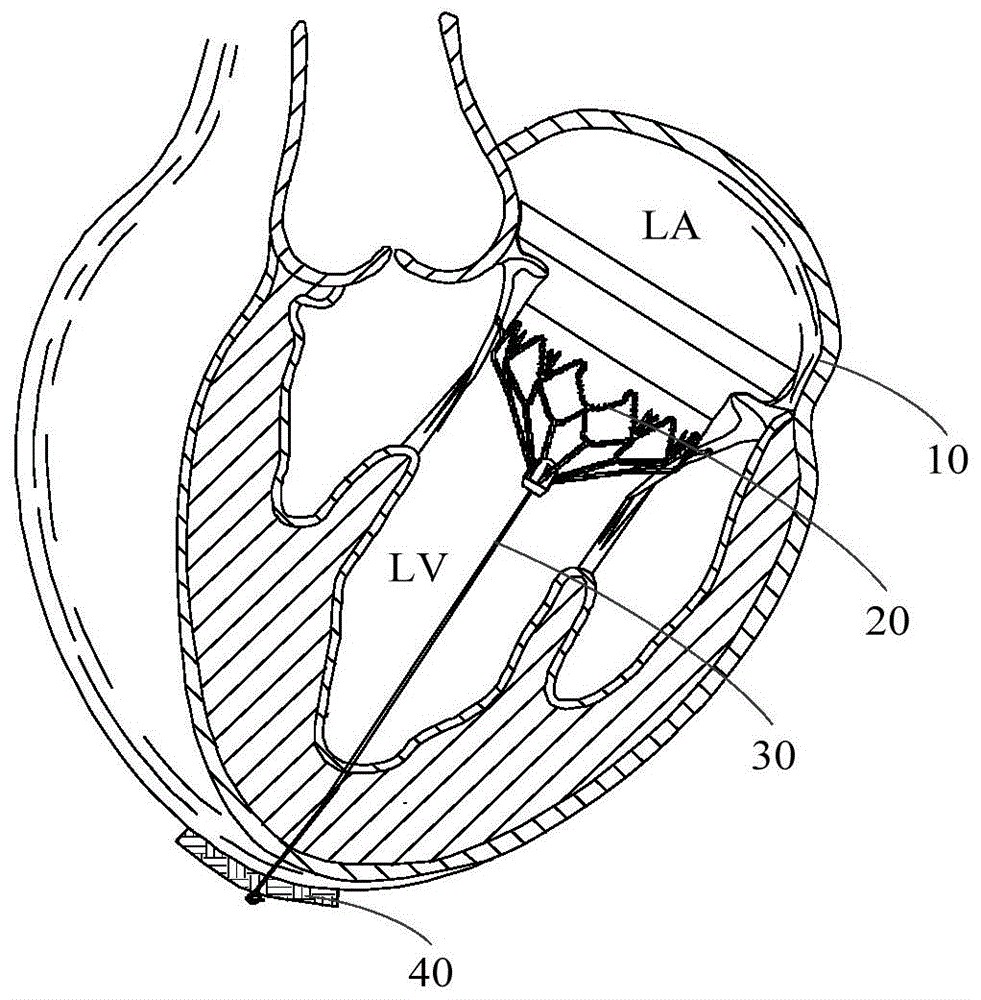
图1为本发明一实施例的心脏瓣膜系绳应用于心脏内的结构示意图。FIG. 1 is a schematic structural diagram of a heart valve tether applied to a heart according to an embodiment of the present invention.
具体实施方式Detailed ways
为了便于理解本发明,下面将参照相关附图对本发明进行更全面的描述。附图中给出了本发明的较佳的实施例。但是,本发明可以以许多不同的形式来实现,并不限于本文所描述的实施例。相反地,提供这些实施例的目的是使对本发明的公开内容的理解更加透彻全面。In order to facilitate understanding of the present invention, the present invention will be described more fully hereinafter with reference to the related drawings. Preferred embodiments of the invention are shown in the accompanying drawings. However, the present invention may be embodied in many different forms and is not limited to the embodiments described herein. Rather, these embodiments are provided so that a thorough and complete understanding of the present disclosure is provided.
需要说明的是,当一个元件被认为是“连接”另一个元件,它可以是直接连接到另一个元件或者可能同时存在居中元件。本文所使用的术语“外”、“内”、“端”、“部分”、“轴向”、“上”、“侧”、“近”、“远”以及类似的表述只是为了说明的目的。It should be noted that when an element is referred to as being "connected" to another element, it can be directly connected to the other element or intervening elements may also be present. The terms "outer", "inner", "end", "portion", "axial", "upper", "lateral", "proximal", "distal" and similar expressions are used herein for the purpose of illustration only .
除非另有定义,本文所使用的所有的技术和科学术语与属于本发明的技术领域的技术人员通常理解的含义相同。本文中在本发明的说明书中所使用的术语只是为了描述具体的实施例的目的,不是旨在于限制本发明。本文所使用的术语“及/或”包括一个或多个相关的所列项目的任意的和所有的组合。Unless otherwise defined, all technical and scientific terms used herein have the same meaning as commonly understood by one of ordinary skill in the art to which this invention belongs. The terms used herein in the description of the present invention are for the purpose of describing specific embodiments only, and are not intended to limit the present invention. As used herein, the term "and/or" includes any and all combinations of one or more of the associated listed items.
为了使本领域的技术人员更好地理解本申请中的技术方案,下面结合不同类型的支架端部结构的实施例,对技术方案进行清晰、完整地描述,更进一步地,此实施例仅仅是本申请中的一部分实施例,而不是全部的实施例。在介入医疗领域,通常定义器械距操作者近的一端为近端,距操作者远的一端为远端,本发明中靠近心尖的位置为近端,靠近心脏瓣膜的位置为远端。心脏瓣膜系绳的具体实施方式如下:In order to make those skilled in the art better understand the technical solutions in this application, the technical solutions will be described clearly and completely below in combination with the embodiments of different types of stent end structures. Further, this embodiment is only Some, but not all, of the embodiments in this application. In the field of interventional medicine, the end of the instrument close to the operator is usually defined as the proximal end, and the end far from the operator is the distal end. Specific embodiments of the heart valve tether are as follows:
如图1所示,心脏瓣膜系绳30的一端与植入至心脏10内的心脏瓣膜20连接,心脏瓣膜系绳30的另一端固定于心脏10外的心尖垫片40,心脏瓣膜系绳30采用弹性材料制成,弹性材料在不大于20N的受力范围内,应变为6%~12%。即,弹性材料在受到外力(不大于20N)时,其长度可以被拉长6~12%,当外力被撤去后,其长度可以恢复至原始状态。As shown in FIG. 1 , one end of the
需要说明的是,在本申请中,应变指的是心脏瓣膜系绳在受力时产生的长度变化值与原始长度之间的比值。It should be noted that, in this application, the strain refers to the ratio between the length change value and the original length of the heart valve tether when it is stressed.
上述心脏瓣膜系绳30由于心脏10收缩导致两端具有拉力时,心脏瓣膜系绳30在受力时长度可以被拉长,当心脏10舒张时恢复至原始状态,从而使心脏瓣膜系绳30能够在心脏10跳动的过程中适应大小不同的拉力。When the
上述心脏瓣膜系绳30由于材料在受力时具有一定的应变量,其可以自适应心脏10跳动所需要的弹性连接,而且通过材料的应变给予心脏瓣膜20施加固定张力,防止心脏瓣膜20从心室LV掉入至心房LA内,同时又可以在心脏10跳动的过程中适应大小不同的拉力,防止拉力过大对心脏10造成损伤。与通过形状改变来实现弹性(例如弹簧或其他非线性结构)相比,心脏瓣膜系绳30通过材料在受力时的应变实现,本身可以呈直线状,可以减少心脏瓣膜系绳由于其特殊形状而带来的血栓风险。The above-mentioned
上述心脏瓣膜系绳30在心脏瓣膜植入手术中可以减少对测力手柄的依赖,或者不需要使用测力手柄测量心脏瓣膜系绳30的拉紧程度,以此降低心脏瓣膜植入手术的复杂性,减少心脏瓣膜植入手术的时间。The above-mentioned
在一实施方式中,心脏瓣膜系绳30呈直线状。即,在心脏瓣膜20植入心脏10后,心脏瓣膜系绳30在心脏10内呈直线,无打折、折弯或其他弯曲结构。这样可以减少血液在心脏瓣膜30处形成血栓和溶血的风险,降低中风和贫血的可能性。In one embodiment, the
在一实施方式中,弹性材料的应变量与受力值呈线性关系,如弹性材料的应变量与受力值之间的关系符合胡克定律。在一实施例中,弹性材料由非金属材料制成,在心脏跳动期间,非金属材料能够实现弹性形变。在一实施例中,心脏瓣膜系绳30由掺杂有显影材料的高分子制成,以使得到心脏瓣膜系绳30在X射线下可见,有助于将心脏瓣膜较好地固定在心脏内。例如,将显影材料分散在生物相容性较好地高分子基质中得到符合弹性变形要求的心脏瓣膜系绳30。In one embodiment, the amount of strain of the elastic material has a linear relationship with the force value, for example, the relationship between the amount of strain and the force value of the elastic material conforms to Hooke's law. In one embodiment, the elastic material is made of a non-metallic material, which is capable of elastic deformation during the beating of the heart. In one embodiment, the
在一实施方式中,弹性材料为具有超弹性的金属合金。在本申请中,超弹性指的是下述机械类型的形状记忆:在该机械类型的形状记忆中,响应于所施加应力的弹性(可逆)是由固-固相变导致的。在一些情况下,当处于奥氏体状态的晶体材料被外力加载直至临界应力并且处于高于马氏体相变最终温度的特定温度范围内时,就会引起超弹性效应,其中,在该特定温度范围处,引起至马氏体相的相变。当进行外力加载时,超弹性材料可以通过这种产生应力的相的形成而可逆地变形至较高的应变。当外力被移除时,马氏体相变得不稳定,并且材料经历反向变形以恢复其原始形状。此外,材料不需要温度变化来经历这种反向变形以及恢复该初始形状。具体的,金属合金在37℃时达到加载应力平台的应力值为150MPa~200MPa,在心脏跳动过程中对心脏瓣膜系绳30施加的作用力可以使得金属合金发生超弹性形变以适应心脏体积的变化,降低心脏瓣膜在心脏跳动过程中出现移位的可能性。In one embodiment, the elastic material is a superelastic metal alloy. In this application, superelasticity refers to a mechanical type of shape memory in which elasticity (reversibility) in response to an applied stress results from a solid-solid phase transition. In some cases, the superelastic effect is induced when a crystalline material in the austenitic state is loaded by an external force up to a critical stress and within a specific temperature range above the final temperature of the martensitic transformation, where in this specific At the temperature range, a phase transformation to the martensitic phase is induced. When loaded by an external force, hyperelastic materials can be reversibly deformed to higher strains through the formation of this stress-generating phase. When the external force is removed, the martensitic phase becomes unstable and the material undergoes reverse deformation to regain its original shape. Furthermore, the material does not require a temperature change to undergo this reverse deformation and return to the original shape. Specifically, the stress value of the metal alloy reaching the loading stress plateau at 37° C. is 150 MPa to 200 MPa, and the force exerted on the
在一实施方式中,金属合金在应变为1%~5%时残余应力小于0.1%,在应变大于5%时残余应变不大于0.5%,降低心脏瓣膜系绳在植入后经过多次拉伸回复后丧失超弹性的可能性。In one embodiment, the residual stress of the metal alloy is less than 0.1% when the strain is 1% to 5%, and the residual strain is not more than 0.5% when the strain is greater than 5%, which reduces the multiple stretching of the heart valve tether after implantation. Possibility of losing hyperelasticity after recovery.
在一实施方式中,金属合金的应力滞后不大于20MPa。在本申请中,应力滞后是指在金属合金的加载和卸载过程中,由于相变过程中晶体界面摩擦耗能,产生卸载值和加载值之间的差值。应力滞后影响到金属合金的疲劳性能。当金属合金的应力滞后不大于20MPa,可以使得心脏瓣膜系绳在植入后不会因为疲劳而断裂。In one embodiment, the stress hysteresis of the metal alloy is no greater than 20 MPa. In this application, stress hysteresis refers to the difference between the unloaded value and the loaded value during the loading and unloading process of the metal alloy, due to the frictional energy dissipation at the crystal interface during the phase transformation process. Stress hysteresis affects the fatigue properties of metal alloys. When the stress hysteresis of the metal alloy is not more than 20MPa, the heart valve tether will not be broken due to fatigue after implantation.
在一实施方式中,金属合金包括经过热处理的镍钛合金。在自然状态下,心脏瓣膜系绳30可以呈互相贯穿的简单立方结构,即奥氏体相,且为直线状态,当奥氏体相的镍钛合金在体温下受到心脏跳动过程中施加的作用力时,镍钛合金会经历相变至马氏体以及长度被拉长。在马氏体相中,镍钛合金的晶体结构转变,从而赋予镍钛合金经受孪生变形而不会破坏原子键的能力。当无外力施加时,镍钛合金会自动恢复到奥氏体相和原始状态。In one embodiment, the metal alloy includes a heat treated Nitinol. In the natural state, the
例如,经过二步热处理的镍钛合金。在一实施例中,镍钛合金首先在400-450℃下加热5~10min,再在250~300℃下加热60~120min,最后自然冷却至室温,得到的镍钛合金在37℃时,在20N的拉力下,应变可以达到8%。For example, nickel-titanium alloys that have undergone a two-step heat treatment. In one embodiment, the nickel-titanium alloy is first heated at 400-450° C. for 5-10 minutes, then heated at 250-300° C. for 60-120 minutes, and finally cooled to room temperature naturally, and the obtained nickel-titanium alloy is at 37° C. Under the tension of 20N, the strain can reach 8%.
在一实施方式中,镍钛合金中,镍钛两种元素的原子百分比为(48~52):(52~48)。In one embodiment, in the nickel-titanium alloy, the atomic percentages of the two elements of nickel and titanium are (48-52): (52-48).
当心脏瓣膜系绳线径超过1mm,对于心脏收缩过程中,会对血液有很强的干涉现象,严重的话可以引起溶血,并且过粗的系绳会引起血栓的形成。在一实施方式中,心脏瓣膜系绳30的线径为0.1mm~0.9mm,这样可以使得心脏瓣膜系绳具有一定的强度,还可以降低心脏瓣膜系绳30对血液的干扰作用,降低溶血和血栓的风险。在一实施方式中,心脏瓣膜系绳30的线径可以为0.2mm、0.3mm、0.4mm、0.5mm、0.6mm、0.7mm或0.8mm。When the diameter of the heart valve tether exceeds 1mm, there will be strong interference with the blood during the systolic process of the heart. In severe cases, it may cause hemolysis, and too thick tether will cause thrombosis. In one embodiment, the wire diameter of the
当心脏瓣膜系绳的横截面为规则的几何形状时,上述线径是指规则的几何形状的边长(对应正方形)、直径(对应圆形)、长轴(对应椭圆)等;当心脏瓣膜系绳的横截面为不规则的几何形状时,上述线径是指横截面任意两点之间的最大距离。以上对线径的定义,适用于全文。在本实施例中,心脏瓣膜系绳30呈圆柱状,线径即直径。When the cross-section of the heart valve tether is a regular geometric shape, the above-mentioned wire diameter refers to the side length (corresponding to a square), diameter (corresponding to a circle), long axis (corresponding to an ellipse), etc. of the regular geometric shape; When the cross-section of the tether has an irregular geometric shape, the above-mentioned wire diameter refers to the maximum distance between any two points of the cross-section. The above definition of wire diameter applies to the full text. In this embodiment, the
如图1所示,基于上述实施例的心脏瓣膜系绳30,本发明的实施例还提供了一种心脏瓣膜组件,心脏瓣膜组件包括心脏瓣膜20和上述实施例所述的心脏瓣膜系绳30,心脏瓣膜组件还包括位于心脏10外的心尖垫片40,心脏瓣膜系绳30的一端与心脏瓣膜20连接,心脏瓣膜系绳30的另一端伸出心脏10外固定于心尖处的心尖垫片40上。心脏瓣膜系绳30可以通过打结固定于心尖垫片40处,或者心尖垫片40通过卡合结构心脏瓣膜系绳30卡住。As shown in FIG. 1 , based on the
以上所述实施例的各技术特征可以进行任意的组合,为使描述简洁,未对上述实施例中的各个技术特征所有可能的组合都进行描述,然而,只要这些技术特征的组合不存在矛盾,都应当认为是本说明书记载的范围。The technical features of the above-described embodiments can be combined arbitrarily. For the sake of brevity, all possible combinations of the technical features in the above-described embodiments are not described. However, as long as there is no contradiction between the combinations of these technical features, All should be regarded as the scope described in this specification.
以上所述实施例仅表达了本发明的几种实施方式,其描述较为具体和详细,但并不能因此而理解为对发明专利范围的限制。应当指出的是,对于本领域的普通技术人员来说,在不脱离本发明构思的前提下,还可以做出若干变形和改进,这些都属于本发明的保护范围。因此,本发明专利的保护范围应以所附权利要求为准。The above-mentioned embodiments only represent several embodiments of the present invention, and the descriptions thereof are specific and detailed, but should not be construed as a limitation on the scope of the invention patent. It should be pointed out that for those of ordinary skill in the art, without departing from the concept of the present invention, several modifications and improvements can also be made, which all belong to the protection scope of the present invention. Therefore, the protection scope of the patent of the present invention should be subject to the appended claims.
Claims (10)
Priority Applications (1)
| Application Number | Priority Date | Filing Date | Title |
|---|---|---|---|
| CN201911407612.1A CN111012550B (en) | 2019-12-31 | 2019-12-31 | Heart valve tether and heart valve assembly having the same |
Applications Claiming Priority (1)
| Application Number | Priority Date | Filing Date | Title |
|---|---|---|---|
| CN201911407612.1A CN111012550B (en) | 2019-12-31 | 2019-12-31 | Heart valve tether and heart valve assembly having the same |
Publications (2)
| Publication Number | Publication Date |
|---|---|
| CN111012550A CN111012550A (en) | 2020-04-17 |
| CN111012550B true CN111012550B (en) | 2022-05-20 |
Family
ID=70196469
Family Applications (1)
| Application Number | Title | Priority Date | Filing Date |
|---|---|---|---|
| CN201911407612.1A Active CN111012550B (en) | 2019-12-31 | 2019-12-31 | Heart valve tether and heart valve assembly having the same |
Country Status (1)
| Country | Link |
|---|---|
| CN (1) | CN111012550B (en) |
Families Citing this family (3)
| Publication number | Priority date | Publication date | Assignee | Title |
|---|---|---|---|---|
| WO2022166063A1 (en) * | 2021-02-05 | 2022-08-11 | 上海臻亿医疗科技有限公司 | Anchoring device and artificial heart valve device |
| CN113262079B (en) * | 2021-06-10 | 2024-12-13 | 启晨(上海)医疗器械有限公司 | A fixing structure for an artificial heart valve |
| CN114271995B (en) * | 2022-01-17 | 2023-06-30 | 上海捍宇医疗科技股份有限公司 | Interventional prosthetic valve by apex anchoring |
Citations (5)
| Publication number | Priority date | Publication date | Assignee | Title |
|---|---|---|---|---|
| CN103826570A (en) * | 2011-09-26 | 2014-05-28 | 爱德华兹生命科学公司 | Prosthetic mitral valve with ventricular tethers and methods for implanting same |
| CN109806028A (en) * | 2017-11-21 | 2019-05-28 | 先健科技(深圳)有限公司 | heart valve |
| CN109925096A (en) * | 2019-04-29 | 2019-06-25 | 上海方维医疗科技有限公司 | For reducing the device of annulus of mitral valve opening area |
| CN109925095A (en) * | 2017-12-18 | 2019-06-25 | 先健科技(深圳)有限公司 | Heart valve |
| CN110582251A (en) * | 2017-05-05 | 2019-12-17 | 爱德华兹生命科学公司 | Papillary muscle bundle |
Family Cites Families (8)
| Publication number | Priority date | Publication date | Assignee | Title |
|---|---|---|---|---|
| US6726715B2 (en) * | 2001-10-23 | 2004-04-27 | Childrens Medical Center Corporation | Fiber-reinforced heart valve prosthesis |
| US7780725B2 (en) * | 2004-06-16 | 2010-08-24 | Sadra Medical, Inc. | Everting heart valve |
| JP2008506470A (en) * | 2004-07-15 | 2008-03-06 | ミカーディア コーポレーション | Implant for forming a heart valve (implant) and method for forming the same |
| CA2783282C (en) * | 2009-12-08 | 2018-04-03 | Avalon Medical Ltd. | Device and system for transcatheter mitral valve replacement |
| US9827092B2 (en) * | 2011-12-16 | 2017-11-28 | Tendyne Holdings, Inc. | Tethers for prosthetic mitral valve |
| US9474600B2 (en) * | 2012-05-24 | 2016-10-25 | Shanghai Cingular Biotech Corporation | Prosthetic heart valve |
| US9986993B2 (en) * | 2014-02-11 | 2018-06-05 | Tendyne Holdings, Inc. | Adjustable tether and epicardial pad system for prosthetic heart valve |
| US11026791B2 (en) * | 2018-03-20 | 2021-06-08 | Medtronic Vascular, Inc. | Flexible canopy valve repair systems and methods of use |
-
2019
- 2019-12-31 CN CN201911407612.1A patent/CN111012550B/en active Active
Patent Citations (5)
| Publication number | Priority date | Publication date | Assignee | Title |
|---|---|---|---|---|
| CN103826570A (en) * | 2011-09-26 | 2014-05-28 | 爱德华兹生命科学公司 | Prosthetic mitral valve with ventricular tethers and methods for implanting same |
| CN110582251A (en) * | 2017-05-05 | 2019-12-17 | 爱德华兹生命科学公司 | Papillary muscle bundle |
| CN109806028A (en) * | 2017-11-21 | 2019-05-28 | 先健科技(深圳)有限公司 | heart valve |
| CN109925095A (en) * | 2017-12-18 | 2019-06-25 | 先健科技(深圳)有限公司 | Heart valve |
| CN109925096A (en) * | 2019-04-29 | 2019-06-25 | 上海方维医疗科技有限公司 | For reducing the device of annulus of mitral valve opening area |
Also Published As
| Publication number | Publication date |
|---|---|
| CN111012550A (en) | 2020-04-17 |
Similar Documents
| Publication | Publication Date | Title |
|---|---|---|
| CN111012550B (en) | Heart valve tether and heart valve assembly having the same | |
| US11191546B2 (en) | Left atrial appendage occluder and fabricating method therefor | |
| EP3158940B1 (en) | Tissue protection device for tricuspid regurgitation surgery | |
| JP5235053B2 (en) | In vivo device for improving ventricular diastolic function | |
| CN112206017B (en) | Easy-to-clamp valve clamp and valve clamping system | |
| CN104352260B (en) | Left atrial appendage occlusion system | |
| CN106456144B (en) | Tissue protectors used in mitral valve cerclage | |
| WO2019076111A1 (en) | Valve clamp | |
| CN204133530U (en) | Occluder for left auricle | |
| CN101091675A (en) | Atrioventricular valve bracket of artificial valve of dual discal straps | |
| WO2006033107A2 (en) | In vivo device for assisting and improving diastolic ventricular function | |
| CN106923885B (en) | Occluder for left auricle | |
| CN110691554A (en) | Double-walled fixed-length stent-like device and method of use | |
| RU134785U1 (en) | DEVICE FOR TRANSMISSION MITRAL ANNULOPLASTY | |
| CN111616837A (en) | A mitral valve annulus retractor | |
| CN208808747U (en) | A kind of valve clamping machine | |
| CN110934664B (en) | Heart valve | |
| CN206214129U (en) | A kind of peplos plugging device | |
| CN107260234B (en) | Braided degradable occluder | |
| CN109925096A (en) | For reducing the device of annulus of mitral valve opening area | |
| AU2012216373B2 (en) | A method and device for treating a stiffened blood vessel | |
| CN212281775U (en) | Mitral valve annular device that contracts | |
| CN105520765A (en) | Recessed left aurcle plugging device | |
| CN209996397U (en) | Left auricle plugging device | |
| CN204133531U (en) | A kind of occluder for left auricle |
Legal Events
| Date | Code | Title | Description |
|---|---|---|---|
| PB01 | Publication | ||
| PB01 | Publication | ||
| SE01 | Entry into force of request for substantive examination | ||
| SE01 | Entry into force of request for substantive examination | ||
| GR01 | Patent grant | ||
| GR01 | Patent grant | ||
| TR01 | Transfer of patent right |
Effective date of registration: 20240104 Address after: 518000 1604, Xianjian technology building, No. 22, Keji South 12th Road, gaoxinyuan community, Yuehai street, Nanshan District, Shenzhen, Guangdong Province Patentee after: Shenzhen Jianxin Medical Technology Co.,Ltd. Address before: 518000 1st-5th Floor of Saiba Research Building, Langshan Second Road, North District of Nanshan High-tech Industrial Park, Shenzhen City, Guangdong Province Patentee before: LIFETECH SCIENTIFIC (SHENZHEN) Co.,Ltd. |
|
| TR01 | Transfer of patent right |