CN110998720A - Voice data processing method and electronic device supporting the same - Google Patents
Voice data processing method and electronic device supporting the same Download PDFInfo
- Publication number
- CN110998720A CN110998720A CN201880053757.3A CN201880053757A CN110998720A CN 110998720 A CN110998720 A CN 110998720A CN 201880053757 A CN201880053757 A CN 201880053757A CN 110998720 A CN110998720 A CN 110998720A
- Authority
- CN
- China
- Prior art keywords
- information
- electronic device
- user
- tasks
- module
- Prior art date
- Legal status (The legal status is an assumption and is not a legal conclusion. Google has not performed a legal analysis and makes no representation as to the accuracy of the status listed.)
- Granted
Links
Images






Classifications
-
- G—PHYSICS
- G10—MUSICAL INSTRUMENTS; ACOUSTICS
- G10L—SPEECH ANALYSIS TECHNIQUES OR SPEECH SYNTHESIS; SPEECH RECOGNITION; SPEECH OR VOICE PROCESSING TECHNIQUES; SPEECH OR AUDIO CODING OR DECODING
- G10L15/00—Speech recognition
- G10L15/22—Procedures used during a speech recognition process, e.g. man-machine dialogue
-
- G—PHYSICS
- G06—COMPUTING OR CALCULATING; COUNTING
- G06F—ELECTRIC DIGITAL DATA PROCESSING
- G06F3/00—Input arrangements for transferring data to be processed into a form capable of being handled by the computer; Output arrangements for transferring data from processing unit to output unit, e.g. interface arrangements
- G06F3/01—Input arrangements or combined input and output arrangements for interaction between user and computer
- G06F3/03—Arrangements for converting the position or the displacement of a member into a coded form
- G06F3/041—Digitisers, e.g. for touch screens or touch pads, characterised by the transducing means
-
- G—PHYSICS
- G06—COMPUTING OR CALCULATING; COUNTING
- G06F—ELECTRIC DIGITAL DATA PROCESSING
- G06F3/00—Input arrangements for transferring data to be processed into a form capable of being handled by the computer; Output arrangements for transferring data from processing unit to output unit, e.g. interface arrangements
- G06F3/16—Sound input; Sound output
-
- G—PHYSICS
- G06—COMPUTING OR CALCULATING; COUNTING
- G06F—ELECTRIC DIGITAL DATA PROCESSING
- G06F3/00—Input arrangements for transferring data to be processed into a form capable of being handled by the computer; Output arrangements for transferring data from processing unit to output unit, e.g. interface arrangements
- G06F3/16—Sound input; Sound output
- G06F3/167—Audio in a user interface, e.g. using voice commands for navigating, audio feedback
-
- G—PHYSICS
- G06—COMPUTING OR CALCULATING; COUNTING
- G06F—ELECTRIC DIGITAL DATA PROCESSING
- G06F40/00—Handling natural language data
- G06F40/30—Semantic analysis
-
- G—PHYSICS
- G10—MUSICAL INSTRUMENTS; ACOUSTICS
- G10L—SPEECH ANALYSIS TECHNIQUES OR SPEECH SYNTHESIS; SPEECH RECOGNITION; SPEECH OR VOICE PROCESSING TECHNIQUES; SPEECH OR AUDIO CODING OR DECODING
- G10L15/00—Speech recognition
- G10L15/04—Segmentation; Word boundary detection
-
- G—PHYSICS
- G10—MUSICAL INSTRUMENTS; ACOUSTICS
- G10L—SPEECH ANALYSIS TECHNIQUES OR SPEECH SYNTHESIS; SPEECH RECOGNITION; SPEECH OR VOICE PROCESSING TECHNIQUES; SPEECH OR AUDIO CODING OR DECODING
- G10L15/00—Speech recognition
- G10L15/08—Speech classification or search
- G10L15/18—Speech classification or search using natural language modelling
- G10L15/1822—Parsing for meaning understanding
-
- G—PHYSICS
- G10—MUSICAL INSTRUMENTS; ACOUSTICS
- G10L—SPEECH ANALYSIS TECHNIQUES OR SPEECH SYNTHESIS; SPEECH RECOGNITION; SPEECH OR VOICE PROCESSING TECHNIQUES; SPEECH OR AUDIO CODING OR DECODING
- G10L15/00—Speech recognition
- G10L15/26—Speech to text systems
-
- G—PHYSICS
- G10—MUSICAL INSTRUMENTS; ACOUSTICS
- G10L—SPEECH ANALYSIS TECHNIQUES OR SPEECH SYNTHESIS; SPEECH RECOGNITION; SPEECH OR VOICE PROCESSING TECHNIQUES; SPEECH OR AUDIO CODING OR DECODING
- G10L15/00—Speech recognition
- G10L15/28—Constructional details of speech recognition systems
-
- G—PHYSICS
- G10—MUSICAL INSTRUMENTS; ACOUSTICS
- G10L—SPEECH ANALYSIS TECHNIQUES OR SPEECH SYNTHESIS; SPEECH RECOGNITION; SPEECH OR VOICE PROCESSING TECHNIQUES; SPEECH OR AUDIO CODING OR DECODING
- G10L15/00—Speech recognition
- G10L15/28—Constructional details of speech recognition systems
- G10L15/30—Distributed recognition, e.g. in client-server systems, for mobile phones or network applications
-
- G—PHYSICS
- G10—MUSICAL INSTRUMENTS; ACOUSTICS
- G10L—SPEECH ANALYSIS TECHNIQUES OR SPEECH SYNTHESIS; SPEECH RECOGNITION; SPEECH OR VOICE PROCESSING TECHNIQUES; SPEECH OR AUDIO CODING OR DECODING
- G10L15/00—Speech recognition
- G10L15/22—Procedures used during a speech recognition process, e.g. man-machine dialogue
- G10L2015/223—Execution procedure of a spoken command
Landscapes
- Engineering & Computer Science (AREA)
- Physics & Mathematics (AREA)
- Human Computer Interaction (AREA)
- Audiology, Speech & Language Pathology (AREA)
- Health & Medical Sciences (AREA)
- Multimedia (AREA)
- Theoretical Computer Science (AREA)
- Computational Linguistics (AREA)
- Acoustics & Sound (AREA)
- General Engineering & Computer Science (AREA)
- General Physics & Mathematics (AREA)
- General Health & Medical Sciences (AREA)
- Artificial Intelligence (AREA)
- User Interface Of Digital Computer (AREA)
Abstract
An electronic device and method are disclosed. The electronic device includes: a touch screen, a microphone, a speaker, wireless communication circuitry, a processor, and memory. The memory stores instructions executable by the processor to: receiving, by a microphone, a first user utterance; transmitting, by the wireless communication circuit, a first user utterance received by the wireless communication circuit to an external server; receiving, by a wireless communication circuit, first text data generated by an external server using Automatic Speech Recognition (ASR); confirming at least one task mapped to at least one pre-stored word, phrase and sentence when the first text data includes at least one pre-stored word, phrase and sentence; and performing the identified at least one task using at least one of sequential execution or parallel execution.
Description
Technical Field
The present disclosure relates to voice data processing techniques.
Background
An artificial intelligence system (or "integrated intelligence system") refers to a system that is self-learning and forms a determination to increase recognition rates as used in operation. One example is a computer system that simulates some form of human intelligence by the computer system
Artificial intelligence techniques can include machine learning (i.e., "deep learning") techniques that use machine learning algorithms that classify and/or learn features of various pieces of input data, working in conjunction with component techniques that simulate human brain functions (e.g., operations to recognize, determine, etc.).
For example, the component technology may include one or more of the following technologies: a language recognition technique of recognizing human language or characters; a visual understanding technique of recognizing an object as human vision; inference or predictive techniques that determine information to logically infer and predict the determined information; a knowledge expression technique that processes human experience information into knowledge data; and an operation control technique of controlling autonomous driving of the vehicle and movement of the robot.
Linguistic understanding between the above-described basic technologies includes natural language processing, machine translation, dialog systems, query response, speech recognition/synthesis, and the like, as techniques for recognizing and applying/processing human languages/characters.
Meanwhile, an electronic device equipped with an artificial intelligence system may analyze voice data input through an utterance of a user, may determine a task to be performed in the electronic device or an external electronic device connected to the electronic device based on the analysis result, and may allow the task to be performed by the electronic device or the external electronic device.
The above information is presented merely as background information to aid in understanding the present disclosure. There is no determination, nor assertion, as to whether any of the above can be used as prior art with respect to the present disclosure.
Disclosure of Invention
Technical problem
However, in the case where an electronic device performs a plurality of tasks by an utterance of a user, the electronic device has no opportunity for each task other than receiving a voice command for requesting the performance of the task. That is, the electronic device has no opportunity to perform only one task in response to only one voice command entered by the user's utterance. In addition, the electronic device may perform a task only if the voice command requesting performance of the task includes an expression (such as a word, phrase, or sentence) associated with the task.
Aspects of the present disclosure are to address at least the above problems and/or disadvantages and to provide at least the advantages described below. Accordingly, an aspect of the present disclosure is to provide a method of processing voice data associated with a voice command for requesting execution of a plurality of tasks and an electronic device supporting the same.
Technical scheme
According to an aspect of the present disclosure, an electronic device includes: a touch screen; a microphone; a wireless communication circuit; at least one processor operatively coupled to the touch screen, the microphone, and the wireless communication circuitry; and at least one memory. The at least one memory stores programming instructions executable by the at least one processor to cause the electronic device to: receiving, by the microphone, a first user utterance; transmitting, by the wireless communication circuitry, the received first user utterance to an external server through the wireless communication circuitry; receiving, by the wireless communication circuit, first text data generated by the external server; when the first text data includes at least one pre-stored word, phrase and sentence, confirming at least one task mapped to the at least one pre-stored word, phrase and sentence; and running the identified at least one task using at least one of sequential or parallel execution.
According to another aspect of the present disclosure, an electronic device includes: a microphone; a communication circuit; at least one processor electrically coupled to the microphone and the communication circuit; and a memory. The memory stores programming instructions executable by the at least one processor to cause the electronic device to: storing a first expression mapped to first information associated with a plurality of first tasks, receiving a first voice input of a user through the microphone, transmitting the first voice input to an external server through the communication circuit; receiving, by the communication circuit from the external server, first text data generated by the external server for the transmitted first voice input; searching the memory for any stored expressions that match the first text data; transmitting, by the communication circuit, the first information associated with the plurality of first tasks to the external server when the first expression is confirmed to match the first text data; receiving, by the communication circuit, second information from the external server, the second information indicating a sequence of states of the electronic device related to running the plurality of first tasks that the external server confirms as matching the first information; and executing the plurality of first tasks according to the second information, wherein the first expression comprises at least one of a designated word, a designated phrase and a designated sentence.
According to another aspect of the present disclosure, a method of voice data processing in an electronic device is disclosed, the method comprising: storing, by a memory, a first representation mapped to first information about a plurality of first tasks; receiving a first voice input of a user through a microphone; transmitting the received first voice input to an external server through a communication circuit; receiving, by the communication circuit from the external server, first text data generated by the external server applying Automatic Speech Recognition (ASR) to the first voice input; searching the memory for any stored expressions that match the first text data; sending the first information associated with the plurality of first tasks to the external server through the communication circuit when the first expression is confirmed to match the first text data; receiving, by the communication circuit, second information from the external server, the second information indicating a sequence of states of the electronic device related to running the plurality of first tasks confirmed by the external server as matching the first information; and executing the plurality of first tasks according to the second information, wherein the first expression comprises at least one of a designated word, a designated phrase and a designated sentence.
According to another aspect of the present disclosure, an electronic device includes: a microphone; a communication circuit; a processor electrically connected to the microphone and the communication circuit; and a memory electrically connected to the processor and storing expressions mapped to information on a plurality of tasks. The memory stores instructions that, when executed, cause the processor to: receiving voice input of the user through the microphone; sending, over the communication circuit, voice data corresponding to the voice input to an external server capable of performing ASR; receiving, by the communication circuit from the external server, the text data generated as a result of the ASR associated with the voice data; searching the memory for the expression corresponding to the text data; performing the plurality of tasks by using information on the plurality of tasks when the representation corresponding to the text data exists. The information on the plurality of tasks includes information on a state sequence of the electronic device for performing the plurality of tasks. The expression includes a specified word, phrase, or sentence that is different from the voice command used to explicitly request the execution of the plurality of tasks.
According to various embodiments of the present disclosure, a voice command requesting performance of a task may be assigned to a specific expression, so that the task is performed through an easy and convenient utterance.
Advantageous effects of the invention
Also, according to various embodiments of the present disclosure, a plurality of tasks may be performed by one utterance specifying an expression, so that the tasks are quickly and conveniently performed by the utterance.
Further, various effects directly or indirectly understood through the present disclosure may be provided.
Other aspects, advantages, and salient features of the disclosure will become apparent to those skilled in the art from the following detailed description, which, taken in conjunction with the annexed drawings, discloses various embodiments of the disclosure.
Drawings
The above and other aspects, features and advantages of certain embodiments of the present disclosure will become more apparent from the following description taken in conjunction with the accompanying drawings in which:
fig. 1 is a diagram illustrating an integrated intelligence system, in accordance with various embodiments of the present disclosure.
Fig. 2 is a block diagram illustrating a user terminal of an integrated intelligence system according to an embodiment of the present disclosure.
Fig. 3 is a view illustrating an intelligent application (app) running a user terminal according to an embodiment of the present disclosure.
FIG. 4 is a diagram illustrating a context module of the intelligent services module collecting current state, according to an embodiment of the present disclosure.
FIG. 5 is a block diagram illustrating a suggestion module of the intelligent services module according to an embodiment of the present disclosure.
Fig. 6 is a block diagram illustrating an intelligent server of an integrated intelligent system according to an embodiment of the present disclosure.
Fig. 7 is a diagram illustrating a path rule generation method of a path planner module according to an embodiment of the present disclosure.
Fig. 8 is a diagram illustrating a role module of an intelligent service module managing information of a user according to an embodiment of the present disclosure.
Fig. 9 is a block diagram of a system associated with voice data processing in accordance with an embodiment of the present disclosure.
Fig. 10 is a diagram illustrating a data structure of a shortcut command according to an embodiment of the present disclosure.
Fig. 11a is a flow chart illustrating a method of operation of an electronic device associated with voice data processing in accordance with an embodiment of the present disclosure.
Fig. 11b is a flow chart illustrating a method of operation of an electronic device associated with voice data processing according to another embodiment of the present disclosure.
FIG. 12 is a flow chart describing a method of performing multiple tasks according to an embodiment of the present disclosure.
Fig. 13 is a flowchart for describing a method of sequentially performing a plurality of tasks according to an embodiment of the present disclosure.
Fig. 14 is a diagram for describing a method of providing feedback according to the execution of a task according to an embodiment of the present disclosure.
Fig. 15 is a diagram for describing a method of outputting an operation result of a last task without providing feedback according to the operation of the task according to an embodiment of the present disclosure.
Fig. 16 is a diagram for describing a method of executing multiple tasks in parallel according to an embodiment of the present disclosure.
Fig. 17a, 17b, and 17c are views for describing a method of generating a shortcut command by recommendation according to an embodiment of the present disclosure.
Fig. 18a and 18b are views for describing a method of generating a shortcut command by recommendation according to an embodiment of the present disclosure.
Fig. 19a to 19f are views for describing a method of generating a shortcut command through utterance history information of a user according to an embodiment of the present disclosure.
Fig. 20a to 20f are views for describing a method of generating a shortcut command by searching for a voice command according to an embodiment of the present disclosure.
Fig. 21a to 21c are views for describing a method of generating a shortcut command based on a pre-stored shortcut command according to an embodiment of the present disclosure.
Fig. 22a to 22d are views for describing a method of editing parameter information included in a voice command according to an embodiment of the present disclosure.
Fig. 23 is a view for describing a method of editing a shortcut command according to an embodiment of the present disclosure.
Fig. 24a to 24d are views for describing a method of setting parameters included in a voice command when a shortcut command is generated by an utterance of a user according to an embodiment of the present disclosure.
Fig. 25 is a view for describing a method of sharing a shortcut command according to an embodiment of the present disclosure.
FIG. 26 is a block diagram illustrating an electronic device in a network environment in accordance with various embodiments of the present disclosure.
Throughout the drawings, it should be noted that like reference numerals are used to depict the same or similar elements, features and structures.
DETAILED DESCRIPTION OF EMBODIMENT (S) OF INVENTION
Before describing embodiments of the present disclosure, an integrated intelligent system to which embodiments of the present disclosure can be applied will be described.
Fig. 1 is a diagram illustrating an integrated intelligence system, in accordance with various embodiments of the present disclosure.
Referring to fig. 1, the integrated intelligent system 10 may include a user terminal 100, an intelligent server 200, a personal information server 300, or a suggestion server 400.
The user terminal 100 may provide a service to the user through an app (or application program) stored in the user terminal 100, for example, an alarm app, a message app, a photo (gallery) app, etc. For example, the user terminal 100 may launch and operate another app through a smart app (or a voice recognition app) stored in the user terminal 100. The user terminal 100 may receive a user input for starting or operating another app through the smart app. For example, user input may be received through physical buttons, a touch pad, voice input, remote input, and the like. According to an embodiment, various types of terminal devices (or electronic devices) connected to the internet, such as a mobile phone, a smart phone, a Personal Digital Assistant (PDA), a notebook computer, and the like, may correspond to the user terminal 100.
According to an embodiment, the user terminal 100 may receive a user utterance as the user input. The user terminal 100 may receive a user utterance and may generate a command for operating the app based on the user utterance. As such, the user terminal 100 may operate the app by using the command.
The smart server 200 may receive a user voice input from the user terminal 100 through a communication network and may convert the voice input into text data. In another embodiment, the smart server 200 may generate (or select) the path rule based on the text data. The path rule may include information about an action (or operation) to execute a function of the app or information about a parameter with which the action is executed. Additionally, the path rule may include a sequence of actions of the app. The user terminal 100 may receive the path rule, may select an app according to the path rule, and may execute an action included in the path rule in the selected app.
In general, the term "path rule" of the present disclosure may refer to, but is not limited to, a sequence of states in which an electronic device performs a task requested by a user. In other words, the path rule may include information about the state sequence. For example, a task may be some action that the smart app is capable of providing. The task may include generating a schedule, sending a photograph to a desired other party, or providing weather information. The user terminal 100 may perform tasks by sequentially having at least one or more states (e.g., an operation state of the user terminal 100).
According to an embodiment, the path rules may be provided or generated by an Artificial Intelligence (AI) system. The artificial intelligence system may be a rule-based system or may be a neural network-based system (e.g., a feed-Forward Neural Network (FNN) or a Recurrent Neural Network (RNN)). Alternatively, the artificial intelligence system may be a combination of the above systems or an artificial intelligence system different from the above systems. According to embodiments, the path rule may be selected from a set of predefined path rules, or may be generated in real-time in response to a user request. For example, the artificial intelligence system can select at least a path rule of a predefined plurality of path rules, or can dynamically (or in real-time) generate a path rule. Further, the user terminal 100 may provide the path rule using a hybrid system.
According to an embodiment, the user terminal 100 may perform an action and may display a screen corresponding to a state of the user terminal 100 performing the action in a display. For another example, the user terminal 100 may perform an action and may not display a result obtained by performing the action in the display. For example, the user terminal 100 may perform a plurality of actions, and may display a result of a part of the plurality of actions in the display. For example, the user terminal 100 may display the result obtained by performing the last action in the display. For another example, the user terminal 100 may receive a user input to display a result obtained by performing an action in a display.
The personal information server 300 may include a database storing user information. For example, the personal information server 300 may receive user information (e.g., context information, information about app execution, etc.) from the user terminal 100 and may store the user information in a database. The smart server 200 may receive user information from the personal information server 300 through a communication network and may use the user information in generating path rules associated with the user input. According to the embodiment, the user terminal 100 may receive user information from the personal information server 300 through a communication network, and may use the user information as information for managing a database.
The suggestion server 400 may include a database storing information about functions in the terminal, introductions of applications, or functions to be provided. For example, the suggestion server 400 may receive user information of the user terminal 100 from the personal information server 300 and may include a database storing information about functions that can be utilized by the user. The user terminal 100 may receive information on a function to be provided from the suggestion server 400 through a communication network and may provide the received information to the user.
Fig. 2 is a block diagram illustrating a user terminal of an integrated intelligence system according to an embodiment of the present disclosure.
Referring to fig. 2, the user terminal 100 may include an input module 110, a display 120, a speaker 130, a memory 140, or a processor 150. The user terminal 100 may also include a housing, and elements of the user terminal 100 may be housed in or located on the housing. The user terminal 100 may also include communication circuitry located in the housing. The user terminal 100 may transmit data (or information) to an external server (e.g., the smart server 200) or receive data (or information) from the external server (e.g., the smart server 200) through a communication circuit.
According to an embodiment, the input module 110 may receive user input from a user. For example, the input module 110 may receive user input from a connected external device (e.g., a keyboard or a headset). As another example, the input module 110 may include a touch screen (e.g., a touch screen display) coupled to the display 120. Also for example, the input module 110 may include hardware keys (or physical keys) disposed in the user terminal 100 (or a housing of the user terminal 100).
According to an embodiment, the input module 110 may include a microphone capable of receiving an utterance of a user as a sound signal. For example, the input module 110 may include a voice input system, and may receive an utterance of a user as a sound signal through the voice input system. For example, the microphone may be exposed through a portion (e.g., a first portion) of the housing.
According to an embodiment, the display 120 may display an image, a video, and/or a running picture of an application. For example, the display 120 may display a Graphical User Interface (GUI) of the app. According to an embodiment, the display 120 may be exposed to a portion (e.g., a second portion) of the housing.
According to an embodiment, speaker 130 may output an acoustic signal. For example, the speaker 130 may output a voice signal generated in the user terminal 100 to the outside. According to an embodiment, the speaker 130 may be exposed to a portion (e.g., a third portion) of the housing.
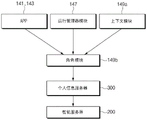
According to an embodiment, the memory 140 may store a plurality of apps (or application programs) 141 and 143. For example, the plurality of apps 141 and 143 may be programs for executing functions corresponding to user inputs. According to embodiments, the memory 140 may store an intelligent agent 145, a run manager module 147, or an intelligent services module 149. For example, the intelligent agent 145, the run manager module 147, and the intelligent services module 149 may be a framework (or application framework) for processing received user input (e.g., user utterances).
According to an embodiment, the memory 140 may include a database capable of storing information utilized to identify user inputs. For example, the memory 140 may include a log database capable of storing log information. As another example, memory 140 may include a character database capable of storing user information.
According to an embodiment, the memory 140 may store a plurality of apps 141 and 143, and may load the plurality of apps 141 and 143 for operation. For example, the plurality of apps 141 and 143 stored in the memory 140 may operate after being loaded by the execution manager module 147. The plurality of apps 141 and 143 may include execution service modules 141a and 143a that perform functions. In an embodiment, the plurality of apps 141 and 143 may perform a plurality of actions (e.g., state sequences) 141b and 143b by running the service modules 141a and 143a for the purpose of performing functions. In other words, the run service modules 141a and 143a may be activated by the run manager module 147 and then may perform the plurality of actions 141b and 143 b.
According to an embodiment, when the actions 141b and 143b of the apps 141 and 143 are executed, an operation state screen according to the execution of the actions 141b and 143b may be displayed in the display 120. For example, the operation state screen may be a screen in a state where the actions 141b and 143b are completed. For another example, the operation state screen may be a screen in a state where the execution of the actions 141b and 143b is in a partial login (for example, in a case where the parameters utilized by the actions 141b and 143b are not input).
According to an embodiment, the runtime service modules 141a and 143a may perform actions 141b and 143b in accordance with the path rules. For example, the run service modules 141a and 143a may be activated by the run manager module 147, may receive an execution request from the run manager module 147 according to the path rule, and may execute the functions of the apps 141 and 143 by executing the actions 141b and 143b according to the execution request. When the execution of the actions 141b and 143b is completed, the run service modules 141a and 143a may send completion information to the run manager module 147.
According to an embodiment, in case of performing the plurality of actions 141b and 143b in the apps 141 and 143, respectively, the plurality of actions 141b and 143b may be sequentially performed. When execution of one action (e.g., action 1 of the first app141 or action 1 of the second app 143) is completed, the run service modules 141a and 143a may open the next action (e.g., action 2 of the first app141 or action 2 of the second app 143) and may send completion information to the run manager module 147. Here, it is understood that opening an arbitrary action is changing the state of the arbitrary action to an operable state or preparing to perform an action. In other words, when any action is not opened, the corresponding action may not be performed. Upon receiving the completion information, the execution manager module 147 may send an execution request associated with a next action (e.g., action 2 of the first app141 or action 2 of the second app 143) to the execution service modules 141a and 143 a. According to an embodiment, in the case where the plurality of apps 141 and 143 are launched, the plurality of apps 141 and 143 may be sequentially launched. For example, when completion information is received after the last action of the first app141 (e.g., action 3 of the first app 141) is performed, the execution manager module 147 may send an execution request of the first action of the second app143 (e.g., action 1 of the second app 143) to the execution service module 143 a.
According to an embodiment, in the case where the plurality of actions 141b and 143b are executed in the apps 141 and 143, a result screen according to the execution of each of the plurality of actions 141b and 143b that have been executed may be displayed in the display 120. According to an embodiment, a portion of the plurality of result screens according to the plurality of actions 141b and 143b that have been performed may be displayed in the display 120.
According to an embodiment, memory 140 may store an intelligent app (e.g., a voice recognition app) that operates in conjunction with intelligent agent 145. An app operating in conjunction with intelligent agent 145 may receive and process the user's utterance as a voice signal. According to an embodiment, the app operating in conjunction with the smart agent 145 may operate according to a specific input (e.g., an input through a hardware key, an input through a touch screen, or a specific voice input) input through the input module 110.
According to an embodiment, the intelligent agent 145, the run manager module 147, or the intelligent services module 149 stored in the memory 140 may be executed by the processor 150. The functions of the intelligent agent 145, the run manager module 147, or the intelligent services module 149 may be implemented by the processor 150. The function of each of the intelligent agent 145, the run manager module 147 and the intelligent services module 149 is described as the operation of the processor 150. According to an embodiment, the intelligent agent 145, the run manager module 147, or the intelligent services module 149 stored in the memory 140 may be implemented in hardware as well as software.
According to an embodiment, the processor 150 may control the overall actions of the user terminal 100. For example, the processor 150 may control the input module 110 to receive user input. The processor 150 may control the display 120 to display an image. Processor 150 may control speaker 130 to output voice signals. The processor 150 may control the memory 140 to run programs and read or store information.
In an embodiment, the processor 150 may run the intelligent agent 145, run manager module 147, or intelligent services module 149 stored in the memory 140. As such, the processor 150 may implement the functionality of the intelligent agent 145, the run manager module 147, or the intelligent services module 149.
According to an embodiment, processor 150 may run intelligent agent 145 to generate a command to launch an app based on a voice signal received as user input. According to an embodiment, processor 150 may run manager module 147 to launch apps 141 and 143 stored in memory 140 in accordance with the generated command. According to an embodiment, the processor 150 may execute the smart service module 149 to manage information of the user, and may process user input by using the information of the user.
According to an embodiment, prior to sending user input to smart server 200, processor 150 may run smart agent 145 to pre-process the user input. According to an embodiment, to pre-process user input, intelligent agent 145 may include an Adaptive Echo Canceller (AEC) module, a Noise Suppression (NS) module, an endpoint detection (EPD) module, or an Automatic Gain Control (AGC) module. The AEC may remove echoes contained in the user input. The NS module may suppress background noise contained in the user input. The EPD module may detect an endpoint of the user voice contained in the user input and may search for a portion where the user voice exists by using the detected endpoint. The AGC module can recognize the user input and can adjust the volume of the user input to be suitable for processing the recognized user input. According to an embodiment, processor 150 may run all preprocessing elements with respect to performance. However, in another embodiment, processor 150 may run a portion of the pre-processing elements to operate at low power.
According to an embodiment, intelligent agent 145 may run a wake up identity module stored in memory 140 for the purpose of identifying the user's call. As such, the processor 150 may recognize a wake command of the user through the wake recognition module and may operate the smart agent 145 for receiving a user input upon receiving the wake command. The wake up identification module may be implemented with a low power processor, such as a processor included in an audio codec. According to an embodiment, processor 150 may run intelligent agent 145 when user input is received through a hardware key. In the case of intelligent agent 145 being executed, an intelligent app (e.g., a voice recognition app) operating in conjunction with intelligent agent 145 may be executed.
According to an embodiment, intelligent agent 145 may include a speech recognition module for performing user input. The processor 150 may recognize user input for running an action in the app through the speech recognition module. For example, processor 150 may recognize limited user (voice) input (e.g., words such as "clicks" for performing shooting operations while running the camera app) through a speech recognition module for performing actions such as wake commands in apps 141 and 143. For example, the processor 150 may assist the smart server 200 to recognize and quickly process a user command that can be processed in the user terminal 100 through a speech recognition module. According to an embodiment, a speech recognition module for running the intelligent agent 145 of the user input may be implemented in the app processor.
According to an embodiment, the speech recognition module of the intelligent agent 145 (including the speech recognition module of the wake-up module) may recognize the user input by using an algorithm for recognizing speech. For example, the algorithm for recognizing the voice may be at least one of a Hidden Markov Model (HMM) algorithm, an Artificial Neural Network (ANN) algorithm, or a Dynamic Time Warping (DTW) algorithm.
According to an embodiment, processor 150 may run intelligent agent 145 to convert the user's voice input to text data. For example, processor 150 may send the user's voice to smart server 200 through smart agent 145 and may receive text data corresponding to the user's voice from smart server 200. As such, the processor 150 may display the converted text data in the display 120.
According to an embodiment, processor 150 may run intelligent agent 145 to receive path rules from intelligent server 200. According to an embodiment, the processor 150 may send the path rules to the run manager module 147 through the intelligent agent 145.
According to an embodiment, the processor 150 may execute the smart agent 145 to transmit the operation result log according to the path rule received from the smart server 200 to the smart service module 149, and may accumulate and manage the transmitted operation result log in the user preference information of the character module 149 b.
According to an embodiment, processor 150 may run manager module 147, may receive path rules from intelligent agent 145, and may run apps 141 and 143; and processor 150 may allow apps 141 and 143 to perform actions 141b and 143b included in the path rules. For example, the processor 150 may transmit command information (e.g., path rule information) for performing the actions 141b and 143b to the apps 141 and 143 through the execution manager module 147; and processor 150 may receive completion information for actions 141b and 143b from apps 141 and 143.
According to an embodiment, the processor 150 may run the execution manager module 147 to transmit command information (e.g., path rule information) for executing the actions 141b and 143b of the apps 141 and 143 between the intelligent agent 145 and the apps 141 and 143. The processor 150 may bind the apps 141 and 143 to be executed according to the path rule by the execution manager module 147 and may transmit command information (e.g., path rule information) of the actions 141b and 143b included in the path rule to the apps 141 and 143. For example, the processor 150 may sequentially transmit the actions 141b and 143b included in the path rule to the apps 141 and 143 through the execution manager module 147, and may sequentially execute the actions 141b and 143b of the apps 141 and 143b according to the path rule.
According to an embodiment, the processor 150 may run the run manager module 147 to manage the running state of the actions 141b and 143b of the apps 141 and 143. For example, the processor 150 may receive information about the operating state of the actions 141b and 143b from the apps 141 and 143 through the operation manager module 147. For example, where the operational state of acts 141b and 143b is a partial login (e.g., where the parameters utilized by acts 141b and 143b are not entered), processor 150 may send information regarding the partial login to intelligent agent 145 via operational manager module 147. Processor 150 may request input information (e.g., parameter information) from a user by using information received through intelligent agent 145. For another example, where the operating state of each of acts 141b and 143b is an operating state, processor 150 may receive an utterance from a user through intelligent agent 145. The processor 150 may transmit information about the running apps 141 and 143 and the running states of the apps 141 and 143 to the intelligent agent 145 through the running manager module 147. Processor 150 may send the user's utterance to intelligent server 200 through intelligent agent 145. Processor 150 may receive parameter information for an utterance of a user from smart server 200 through smart agent 145. The processor 150 may send the received parameter information to the run manager module 147 through the intelligent agent 145. The execution manager module 147 may change the parameter of each of the actions 141b and 143b to a new parameter by using the received parameter information.
According to an embodiment, processor 150 may run manager module 147 to send parameter information included in the path rules to apps 141 and 143. In the case where the plurality of apps 141 and 143 are sequentially run according to the path rule, the run manager module 147 may transmit parameter information included in the path rule from one app to another app.
According to an embodiment, the processor may run the run manager module 147 to receive a plurality of path rules. The processor 150 may receive a plurality of path rules based on the utterance of the user through the run manager module 147. For example, where the user utterance specifies one app141 that performs one action 141b and does not specify another app143 that performs another action 143b, the processor 150 may receive a plurality of different path rules through the run manager module 147 where the same app141 (e.g., gallery app) that performs one action 141b is run and a different app143 (e.g., message app or phone app) that performs another action 143b is run. For example, the processor 150 may perform the same actions 141b and 143b (e.g., the same consecutive actions 141b and 143b) of the plurality of path rules by the run manager module 147. In the case where the execution manager module 147 performs the same action, the processor 150 may display a status screen for selecting different apps 141 and 143 included in the plurality of path rules, respectively, in the display 120 through the execution manager module 147.
According to embodiments, the smart services module 149 may include a context module 149a, a role module 149b, or a suggestion module 149 c.
The processor 150 may operate the character module 149b to manage personal information of a user using the user terminal 100. For example, the processor 150 may operate the character module 149b to collect usage information and operation results of the user terminal 100, and may manage personal information of the user by using the collected usage information and the collected operation results of the user terminal 100.
The processor 150 may run the suggestion module 149c to predict the user's intent and may recommend commands to the user based on the user's intent. For example, the processor 150 may execute the suggestion module 149c to recommend commands to the user depending on the user's current state (e.g., time, place, situation, or app).
Fig. 3 is a view illustrating a smart app running a user terminal according to an embodiment of the present disclosure.
Fig. 3 illustrates that the user terminal 100 receives user input to run an intelligent app (e.g., a voice recognition app) operating in conjunction with the intelligent agent 145.
According to an embodiment, the user terminal 100 may run a smart app for recognizing voice through the hardware keys 112. For example, in a case where the user terminal 100 receives a user input through the hardware keys 112, the user terminal 100 may display the UI 121 of the smart app in the display 120. For example, the user may touch the voice recognition button 121a to the UI 121 of the smart app for the purpose of inputting the voice 120b in a state where the UI 121 of the smart app is displayed in the display 120. As another example, the user may continuously press the hardware key 112 to input speech 120 b.
According to an embodiment, the user terminal 100 may run a voice-recognized smart app through the microphone 111. For example, in case a designated voice (e.g., wake |) is input 120a through the microphone 111, the user terminal 100 may display the UI 121 of the smart app in the display 120.
FIG. 4 is a diagram illustrating a context module of the intelligent services module collecting current state, according to an embodiment of the present disclosure.
Referring to FIG. 4, when receiving a context request (①) from the intelligent agent 145, the processor 150 may request context information indicating the current state of the apps 141 and 143 through the context module 149a (②). according to an embodiment, the processor 150 may receive the context information from the apps 141 and 143 through the context module 149a (③) and may send the context information to the intelligent agent 145 (④).
According to an embodiment, processor 150 may receive pieces of context information from apps 141 and 143 through context module 149 a. The context information may be information about the most recently run apps 141 and 143. For another example, the context information may be information about the current state in the apps 141 and 143 (e.g., information about a picture in the case where the user views the picture through the gallery app).
According to an embodiment, the processor 150 may receive context information indicating the current state of the user terminal 100 from the device platform and apps 141 and 143 through the context module 149 a. The context information may include general context information, user context information, or device context information.
The general context information may include general information of the user terminal 100. The general context information may be verified by an internal algorithm by receiving data via a sensor hub or the like of the device platform. For example, general context information may include information about the current time and space. For example, the information on the current time and space may include information on the current time or current location of the user terminal 100. The current time may be verified by the time on the user terminal 100, and the information on the current location may be verified by a Global Positioning System (GPS). As another example, the general context information may include information about physical motion. For example, the information about physical movement may include information about walking, running, driving, and the like. Information about physical motion may be verified by a motion sensor. Information about driving can be verified by sensing a bluetooth connection in the vehicle, such that boarding and parking is verified and driving is verified by the motion sensor. As another example, the general context information may include user activity information. For example, the user activity information may include information about commutes, shopping, travel, and the like. The user activity information may be verified by using information about the location where the user or app is registered in the database.
The user context information may include information about the user. For example, the user context information may include information about the emotional state of the user. For example, the information about the emotional state of the user may include information about happiness, sadness, anger, and the like of the user. As another example, the user context information may include information about the current state of the user. For example, information about the user's current status may include information about interests, intentions, etc. (e.g., shopping).
The device context information may include information about the state of the user terminal 100. For example, the device context information may include information about path rules executed by the run manager module 147. As another example, the device context information may include information about a battery. For example, information about the battery may be verified by the charge and discharge state of the battery. As another example, the device context information may include information about connected devices and networks. For example, information about a connected device may be verified through a communication interface connected with the device.
FIG. 5 is a block diagram illustrating a suggestion module of the intelligent services module according to an embodiment of the present disclosure.
Referring to FIG. 5, suggestion module 149c may include a prompt provider module 149c _1, a context prompt generation module 149c _2, a condition checking module 149c _3, a condition model module 149c _4, a reuse prompt generation module 149c _5, or an introduction prompt generation module 149c _ 6.
According to an embodiment, the processor 150 may execute the prompt provider module 149c _1 to provide a prompt to the user. For example, the processor 150 may receive the generated prompt from the contextual prompt generation module 149c _2, the reuse prompt generation module 149c _5, or the introduction prompt generation module 149c _6 via the prompt provider module 149c _1 to provide the prompt to the user.
According to an embodiment, the processor 150 may run the condition checking module 149c _3 or the condition model module 149c _4 to generate a prompt that can be recommended depending on the current state. The processor 150 may operate the condition checking module 149c _3 to receive information corresponding to a current state, and may operate the condition model module 149c _4 to set a condition model by using the received information. For example, the processor 150 may run the condition model module 149c _4 to grasp the time, location, situation, app being run, etc. at the point of time when the user is provided with the prompt, so that the user may be provided with the prompts that are likely to be used under the respective conditions in descending order of priority.
According to an embodiment, processor 150 may run reuse hint generation module 149c _5 to generate hints that can be recommended in terms of frequency of use. For example, the processor 150 may run the reuse prompt generation module 149c _5 to generate a prompt based on the usage pattern of the user.
According to an embodiment, the introduction prompt generation module 149c _6 may generate a prompt for introducing a new function and another function that is most frequently used by the user. For example, the prompt to introduce the new functionality may include an introduction (e.g., method of operation) associated with intelligent agent 145.
According to another embodiment, the personal information server 300 may include a context prompt generation module 149c _2, a condition check module 149c _3, a condition model module 149c _4, a reuse prompt generation module 149c _5, or an introduction prompt generation module 149c _6 of the suggestion module 149 c. For example, the processor 150 may receive a prompt from the contextual prompt generation module 149c _2, the reuse prompt generation module 149c _5, or the introductory prompt generation module 149c _6 of the personal information server 300 via the prompt provider module 149c _1 of the suggestion module 149c to provide the received prompt to the user.
According to the embodiment, the user terminal 100 may provide the prompt according to the following series of processes. For example, when a prompt generation request is received from intelligent agent 145, processor 150 may send the prompt generation request to context prompt generation module 149c _2 through prompt provider module 149c _ 1. Upon receiving the prompt generation request, the processor 150 may receive information corresponding to the current state from the context module 149a and the role module 149b through the condition checking module 149c _ 3. The processor 150 may transmit the received information to the condition model module 149c _4 through the condition checking module 149c _3, and may assign a priority to a prompt among prompts to be provided to the user in order of high availability under conditions by using the information through the condition model module 149c _ 4. The processor 150 may verify the condition by the context prompt generation module 149c _2 and may generate a prompt corresponding to the current state. The processor 150 may send the generated hint to the hint provider module 149c _1 through the contextual hint generation module 149c _ 2. Processor 150 may order the hints by hint provider module 149c _1 according to specified rules and may send hints to intelligent agent 145.
According to an embodiment, processor 150 may generate a plurality of context cues through cue provider module 149c _1, and may assign priorities to the plurality of context cues according to specified rules. According to an embodiment, the processor 150 may first provide a plurality of context cues of a higher priority to the user through the cue provider module 149c _ 1.
According to an embodiment, the user terminal 100 may propose a prompt according to the frequency of use. For example, when a hint generation request is received from intelligent agent 145, processor 150 may send a hint generation request to reuse hint generation module 149c _5 through hint provider module 149c _ 1. Upon receiving the prompt generation request, the processor 150 may receive user information from the role module 149b via the reuse prompt generation module 149c _ 5. For example, the processor 150 may receive a path rule included in the user preference information of the character module 149b, a parameter included in the path rule, an operating frequency of the app, and information on time and space in which the app is used, through the reuse hint generation module 149c _ 5. The processor 150 may generate a prompt corresponding to the received user information by reusing the prompt generation module 149c _ 5. The processor 150 may send the generated hint to the hint provider module 149c _1 through the reuse hint generation module 149c _ 5. Processor 150 may sort the hints through hint provider module 149c _1 and may send hints to intelligent agent 145.
According to an embodiment, the user terminal 100 may propose a prompt associated with the new function. For example, when a prompt generation request is received from intelligent agent 145, processor 150 may send the prompt generation request to introduction prompt generation module 149c _6 through prompt provider module 149c _ 1. Processor 150 may send an introduction prompt providing request to suggestion server 400 through introduction prompt generation module 149c _6 and may receive information about functions to be introduced from suggestion server 400. For example, the suggestion server 400 may store information about functions to be introduced and may update a prompt list associated with the functions to be introduced by the service operator. The processor 150 may send the generated prompt to the prompt provider module 149c _1 through the introductory prompt generation module 149c _ 6. Processor 150 may sort the hints through hint provider module 149c _1 and may send hints to intelligent agent 145.
As such, the processor 150 may provide the user with a prompt generated by the contextual prompt generation module 149c _2, the reuse prompt generation module 149c _5, or the introduction prompt generation module 149c _6 through the suggestion module 149 c. For example, processor 150 may display the generated prompt in an app operating intelligent agent 145 through suggestion module 149c, and may receive input from the user through the app to select the prompt.
Fig. 6 is a block diagram illustrating an intelligent server of an integrated intelligent system according to an embodiment of the present disclosure.
Referring to fig. 6, the smart server 200 may include an Automatic Speech Recognition (ASR) module 210, a Natural Language Understanding (NLU) module 220, a path planner module 230, a Dialog Manager (DM) module 240, a Natural Language Generator (NLG) module 250, or a text-to-speech (TTS) module 260. According to an embodiment, the smart server 200 may include communication circuitry, memory, and a processor. The processor may execute instructions stored in the memory to drive the ASR module 210, NLU module 220, path planner module 230, DM module 240, NLG module 250, and TTS module 260. The smart server 200 may transmit data (or information) to an external electronic device (e.g., the user terminal 100) or receive data (or information) from the external electronic device (e.g., the user terminal 100) through a communication circuit.
The NLU module 220 or the path planner module 230 of the smart server 200 may generate the path rules.
According to an embodiment, the ASR module 210 may convert user input (e.g., voice data) received from the user terminal 100 into text data. For example, the ASR module 210 may include a speech recognition module. The speech recognition module can include an acoustic model and a language model. For example, the acoustic model may include information associated with the utterance, and the language model may include unit phoneme information and information about a combination of the unit phoneme information. The speech recognition module may change the user speech into text data by using information associated with the utterance and the unit phoneme information. For example, information about the acoustic model and the language model may be stored in the automatic speech recognition database (ASR DB) 211.
According to an embodiment, the NLU module 220 may grasp the user intention by performing syntax analysis or semantic analysis. Syntactic analysis may divide user input into syntactic units (e.g., words, phrases, morphemes, etc.) and determine which syntactic elements the divided units have. Semantic analysis may be performed by using semantic matching, rule matching, formula matching, and the like. As such, the NLU module 220 may obtain the domain, intent, or parameters (or time slot) with which the user input expresses the intent.
According to an embodiment, the NLU module 220 may determine the user's intention and parameters by using a matching rule divided into parameters (or time slots) with which the domain, intention, and grasp intention are utilized. For example, a domain (e.g., alarm clock) may include a plurality of intentions (e.g., alarm clock setting, alarm clock cancellation, etc.), and an intention may include a plurality of parameters (e.g., time, number of iterations, alarm clock sound, etc.). For example, the plurality of rules may include one or more parameters. The matching rules may be stored in a natural language understanding database (NLU DB) 221.
According to an embodiment, the NLU module 220 may grasp the meaning of a word extracted from a user input by using linguistic features (e.g., syntax elements) such as morphemes, phrases, etc., and may match the grasped meaning of the word to a domain and an intention to determine a user intention. For example, for the purpose of determining a user intent, NLU module 220 may calculate how many words extracted from the user input are included in each of the domain and intent. According to an embodiment, the NLU module 220 may determine the parameters of the user input by using the words as a basis for grasping the intention. According to an embodiment, the NLU module 220 may determine the user intention by using the NLU DB221 storing a language feature for grasping the intention of the user input. According to another embodiment, the NLU module 220 may determine the user intent by using a Personal Language Model (PLM). For example, the NLU module 220 may determine the user intent by using personalized information (e.g., a contact list or music list). For example, the PLM may be stored in the NLU DB 221. According to an embodiment, the ASR module 210 and the NLU module 220 may recognize the voice of the user with reference to the PLM stored in the NLU DB 221.
According to an embodiment, the NLU module 220 may generate the path rule based on the intent and parameters input by the user. For example, NLU module 220 may select an app to run based on an intent input by a user, and may determine an action to perform in the selected app. The NLU module 220 may determine parameters corresponding to the determined action to generate the path rule. According to an embodiment, the path rules generated by NLU module 220 may include information about the app to be run, the actions to be performed in the app (e.g., at least one or more states), and parameters to be utilized to perform the actions.
According to an embodiment, the NLU module 220 may generate a path rule or a plurality of path rules based on the intent and parameters input by the user. For example, the NLU module 220 may receive a path rule set corresponding to the user terminal 100 from the path planner module 230 and may map the intent and parameters input by the user to the received path rule set to determine a path rule.
According to another embodiment, for the purpose of generating a path rule or path rules, NLU module 220 may determine an app to run, an action to be performed in the app, and parameters to utilize to perform the action based on intents and parameters input by a user. For example, the NLU module 220 may arrange an app to be executed and an action to be performed in the app in the form of an ontology or a graphic model according to an intention input by a user by using information of the user terminal 100 for the purpose of generating a path rule. For example, the generated path rules may be stored in a path rules database (PR DB)231 by the path planner module 230. The generated path rule may be added to the path rule set of the PR DB 231.
According to an embodiment, the NLU module 220 may select at least one of the generated plurality of path rules. For example, the NLU module 220 may select an optimal path rule of the plurality of path rules. For another example, where a portion of an action is specified based on a user utterance, the NLU module 220 may select a plurality of path rules. The NLU module 220 may determine one of a plurality of path rules based on additional input from the user.
According to an embodiment, the NLU module 220 may transmit the path rule to the user terminal 100 in response to a request for a user input. For example, the NLU module 220 may transmit one path rule corresponding to the user input to the user terminal 100. For another example, the NLU module 220 may transmit a plurality of path rules corresponding to the user input to the user terminal 100. For example, where a portion of an action is specified based on a user utterance, a plurality of path rules may be generated by the NLU module 220.
According to an embodiment, the path planner module 230 may select at least one path rule of the plurality of path rules.
According to an embodiment, the path planner module 230 may send a path rule set including a plurality of path rules to the NLU module 220. The plurality of path rules of the path rule set may be stored in the form of a table in the PR DB 231 connected to the path planner module 230. For example, the path planner module 230 may transmit a path rule set corresponding to information (e.g., OS information or app information) of the user terminal 100 received from the intelligent agent 145 to the NLU module 220. The table stored in the PR DB 231 may be stored for each domain or for each version of the domain.
According to an embodiment, the path planner module 230 may select a path rule or a plurality of path rules from the set of path rules to send the selected path rule or the selected plurality of path rules to the NLU module 220. For example, the path planner module 230 may map the user intention and the parameters to a path rule set corresponding to the user terminal 100 to select a path rule or path rules, and may transmit the selected path rule or path rules to the NLU module 220.
According to an embodiment, the path planner module 230 may generate a path rule or a plurality of path rules by using the user intent and parameters. For example, for purposes of generating a path rule or path rules, the path planner module 230 may determine an app to run and an action to perform in the app based on user intent and parameters. According to an embodiment, the path planner module 230 may store the generated path rules in the PR DB 231.
According to an embodiment, the path planner module 230 may store the path rules generated by the NLU module 220 in the PRDB 231. The generated path rule may be added to a path rule set stored in the PR DB 231.
According to an embodiment, the table stored in the PR DB 231 may include a plurality of path rules or a plurality of path rule sets. The plurality of path rules or the plurality of path rule sets may reflect the category, version, type or characteristics of the device executing each path rule.
According to an embodiment, the DM module 240 may determine whether the user intention grasped by the NLU module 220 is definite. For example, the DM module 240 may determine whether the user's intention is definite based on whether the information of the parameter is sufficient. DM module 240 may determine whether the parameters learned by NLU module 220 are sufficient to perform the task. According to an embodiment, the DM module 240 may perform feedback for making a request for information to the user in case that the user's intention is unclear. For example, the DM module 240 may perform feedback for requesting information about a parameter for grasping the user's intention.
According to an embodiment, the DM module 240 may include a content provider module. In the case where the content provider module performs an action based on the intention and parameters grasped by the NLU module 220, the content provider module may generate a result obtained by performing a task corresponding to the user input. According to an embodiment, the DM module 240 may transmit the result generated by the content provider module as a response to the user input to the user terminal 100.
According to an embodiment, the NLG module 250 may change the specified information into a text form. The information changed to the text form may be in the form of a natural language utterance. For example, the specified information may be information on additional input, information for guiding completion of an action corresponding to the user input, or information for guiding additional input by the user (e.g., feedback information on the user input). The information changed to the text form may be displayed in the display 120 after being transmitted to the user terminal 100, or may be changed to the voice form after being transmitted to the TTS module 260.
According to an embodiment, TTS module 260 may change information in text form to information in voice form. The TTS module 260 may receive information in a text form from the NLG module 250, may change the information in the text form into information in a voice form, and may transmit the information in the voice form to the user terminal 100. User terminal 100 may output information in the form of speech to speaker 130.
According to an embodiment, the NLU module 220, the path planner module 230, and the DM module 240 may be implemented with one module. For example, the NLU module 220, the path planner module 230, and the DM module 240 may be implemented with one module, may determine user intents and parameters, and may generate a response (e.g., path rules) corresponding to the determined user intents and parameters. As such, the generated response may be transmitted to the user terminal 100.
Fig. 7 is a diagram illustrating a path rule generation method of a path planner module according to an embodiment of the present disclosure.
Referring to fig. 7, the NLU module 220 may divide the function of the app into any one action (e.g., state a to state F) and may store the divided unit actions in the PR DB 231, according to an embodiment. For example, the NLU module 220 may store a path rule set in the PR DB 231 that includes a plurality of path rules (e.g., A-B1-C1, A-B1-C2, A-B1-C3-D-F, and A-B1-C3-D-E-F) divided into one action.
According to an embodiment, the PR DB 231 of the path planner module 230 may store a set of path rules for executing functions of the app. The path rule set may include a plurality of path rules, each path rule including a plurality of actions (e.g., state sequences). The actions performed depending on the parameters input to each of the plurality of actions included in each of the plurality of path rules may be sequentially arranged. According to an embodiment, a plurality of path rules implemented in the form of an ontology or a graphical model are stored in the PR DB 231.
According to an embodiment, the NLU module 220 may select an optimal path rule (e.g., A-B1-C3-D-F) of the plurality of path rules (e.g., A-B1-C1, A-B1-C2, A-B1-C3-D-F, and A-B1-C3-D-E-F) that corresponds to the intent and parameters input by the user.
According to an embodiment, the NLU module 220 may transmit a plurality of rules to the user terminal 100 in case there is no path rule that exactly matches the user input. For example, the NLU module 220 may select a path rule (e.g., a-B1) that corresponds in part to the user input. The NLU module 220 may select one or more path rules (e.g., a-B1-C1, a-B1-C2, a-B1-C3-D-F, and a-B1-C3-D-E-F) including a path rule (e.g., a-B1) corresponding in part to the user input, and may transmit the one or more path rules to the user terminal 100.
According to an embodiment, the NLU module 220 may select one of a plurality of path rules based on an input added by the user terminal 100, and may transmit the selected one to the user terminal 100. For example, the NLU module 220 may select one of a plurality of path rules (e.g., a-B1-C3-D-F) depending on a user input additionally input by the user terminal 100 (e.g., an input for selecting C3), e.g., a-B1-C1, a-B1-C2, a-B1-C3-D-F, and a-B1-C3-D-E-F), and may transmit the selected one to the user terminal 100.
According to another embodiment, the NLU module 220 may determine the user's intention and parameters corresponding to a user input additionally input by the user terminal 100 (e.g., an input for selecting C3), and may transmit the user intention or parameters to the user terminal 100. The user terminal 100 may select one of a plurality of path rules (e.g., a-B1-C3-D-F) based on the transmitted intent or the transmitted parameters (e.g., a-B1-C1, a-B1-C2, a-B1-C3-D-F, and a-B1-C3-D-E-F).
As such, the user terminal 100 may complete the actions of the apps 141 and 143 based on the selected one path rule.
According to an embodiment, in the event that the smart server 200 receives an underinformation user input, the NLU module 220 may generate a path rule that partially corresponds to the received user input. For example, the NLU module 220 may send the partially corresponding path rule to the intelligent agent 145. The processor 150 may run the intelligent agent 145 to receive the path rules and may send the partially corresponding path rules to the run manager module 147. The processor 150 may run the first app141 according to the path rule by the run manager module 147. The processor 150 may transmit information about insufficient parameters to the intelligent agent 145 while the first app141 is being executed by the execution manager module 147. The processor 150 may use the information about the insufficiency of the parameters to make a request for additional input to the user through the smart controller 145. When additional input is received by the user through intelligent agent 145, processor 150 may send and process the user input to intelligent server 200. The NLU module 220 may generate a path rule to be added based on the additionally input user's intention and parameter information, and may transmit the path rule to be added to the intelligent agent 145. The processor 150 may transmit the path rule to the execution manager module 147 through the intelligent agent 145, and may execute the second app143 according to the path rule through the execution manager module 147.
According to an embodiment, the NLU module 220 may send a user information request to the personal information server 300 in case of receiving a user input missing a part of information by the smart server 200. The personal information server 300 may transmit information of the user input, which is input to the character database stored in the NLU module 220. The NLU module 220 may select a path rule corresponding to a user input partially missing a part of an action by using the user information. In this way, even if the smart server 200 receives a user input missing a part of information, the NLU module 220 may request the missing information to receive additional input, or may determine a path rule corresponding to the user input by using the user information.
According to an embodiment, Table 1, attached below, may represent an example form of a path rule associated with a task requested by a user.
[ Table 1]


Referring to table 1, the path rule generated or selected by the smart server 200 according to the user utterance (e.g., "please share pictures") may include at least one state 25, 26, 27, 28, 29, or 30. For example, the at least one state (e.g., an operational state of the terminal) may correspond to at least one of: picture application running picture view 25, picture search function running search view 26, search result display outputting search view results 27, search result display outputting search empty selected view 28 without selected picture, search result display outputting search selected view 29 with at least one picture selected, or sharing application selection screen outputting cross-share 30.
In an embodiment, the parameter information of the path rule may correspond to at least one state. For example, the selected at least one picture may be included in the search selected viewing state 29.
The task requested by the user (e.g., "please share pictures |") may be performed depending on the result of the execution of the path rule including the sequence of states 25, 26, 27, 28, and 29.
Fig. 8 is a diagram illustrating a role module of an intelligent service module managing information of a user according to an embodiment of the present disclosure.
Referring to fig. 8, the processor 150 may receive information of the user terminal 100 from the apps 141 and 143, the execution manager module 147, or the context module 149a through the role module 149 b. The processor 150 may store information about results obtained by executing the actions 141b and 143b of the apps in the action log database through the apps 141 and 143 and the execution manager module 147. The processor 150 may store information about the current state of the user terminal 100 in a context database through the context module 149 a. The processor 150 may receive the stored information from the action log database or the context database through the role module 149 b. For example, data stored in the action log database and the context database may be analyzed by the analysis engine and may be sent to the role module 149 b.
According to an embodiment, the processor 150 may send information received from the apps 141 and 143, the run manager module 147, or the context module 149a to the suggestion module 149c through the role module 149 b. For example, the processor 150 may send data stored in an action log database or a context database to the store suggestion module 149c through the role module 149 b.
According to an embodiment, the processor 150 may transmit information received from the apps 141 and 143, the execution manager module 147, or the context module 149a to the personal information server 300 through the character module 149 b. For example, the processor 150 may periodically transmit the data accumulated and stored in the action log database or the context database to the personal information server 300 through the character module 149 b.
According to an embodiment, the processor 150 may send data stored in an action log database or a context database to the suggestion module 149c through the role module 149 b. The user information generated by the character module 149b may be stored in a character database. The character module 149b may periodically transmit the user information stored in the character database to the personal information server 300. According to an embodiment, the information transmitted to the personal information server 300 through the character module 149b may be stored in a character database. The personal information server 300 can infer user information for generating a path rule of the intelligent server 200 by using information stored in the character database.
According to an embodiment, the user information inferred by using the information transmitted through the character module 149b may include profile information or preference information. Profile information or preference information may be inferred through the user's account and accumulated information.
The profile information may include personal information of the user. For example, the profile information may include demographic information of the user. For example, the demographic information may include the gender, age, etc. of the user. As another example, the profile information may include life event information. For example, life event information may be inferred by comparing log information to life event models, and life event information may be enhanced by analyzing behavioral patterns. As another example, the profile information may include interest information. For example, the interest information may include shopping items of interest, areas of interest (e.g., sports, politics, etc.). As another example, the profile information may include activity area information. For example, the activity area information may include information about a residence, a work site, and the like. The information on the activity area may include information on an area in which a priority is recorded based on the accumulated stay time and the number of visits and information on a location of the place. As another example, the profile information may include activity time information. For example, the activity time information may include information about wake-up time, commute time, sleep time, and the like. Information about commute time may be inferred by using activity area information (e.g., information about residences and work sites). The information on the sleep time may be inferred by the unused time of the user terminal 100.
The preference information may include preference information of the user. For example, the preference information may include information about app preferences. For example, app preferences may be inferred through a log of app usage (e.g., a time and place specific log of usage). The app preferences may be used to determine the app to run depending on the current state of the user (e.g., time or location). As another example, the preference information may include information regarding preferences of the contact. For example, contact preferences may be inferred by analyzing information about contact frequencies (e.g., time and place specific contact frequencies) of contacts. The contact preferences may be used to determine the contacts to contact depending on the current status of the user (e.g., contacts of duplicate names). Also for example, the preference information may include setting information. For example, the setting information can be inferred by analyzing information about the setting frequency of a specific setting value (for example, the time and place-specific frequency at which the setting value is set). The setting information may be used to set a specific setting value depending on the current state (e.g., time, place, or situation) of the user. As another example, the preference information may include a location preference. For example, location preferences can be inferred through a visit history for a particular location (e.g., a time-specific visit history). The location preference may be used to determine a location to visit depending on the current state (e.g., time) of the user. As another example, the preference information may include an indication of a preference. For example, the indicated preferences may be inferred by the indicated frequency of use (e.g., time and location specific frequency of use). The indication preferences may be used to determine the indication mode to use depending on the current state of the user (e.g., time or location). Specifically, the indication preference may include information on a menu that the user most frequently selects in the current state of the running app by analyzing the log information.
Fig. 9 is a block diagram of a system associated with voice data processing in accordance with an embodiment of the present disclosure. The system (electronic device 100 and server 200) shown in fig. 9 may be a text/voice integrated intelligent interface based on a touch UI, and may process voice, multimodal input, etc., as well as touch. Fig. 9 illustrates a structure associated with a method in which the system processes a voice input when a user inputs a voice through an utterance. In fig. 9, a description about elements given in the above-described drawings will be skipped.
Referring to fig. 9, when a user speaks, the user terminal (or electronic device) 100 may receive a voice input according to the user's utterance. In addition, the user terminal 100 may transmit voice data corresponding to the input voice to the smart server 200. According to an embodiment, processor 150 of user terminal 100 may run intelligent agent 145 and may send voice data corresponding to the voice input to intelligent server 200 through intelligent agent 145.
The smart server 200 receiving the voice data may convert the voice data into text data through the ASR module 210. For example, the ASR module 210 may convert the voice data into text data by the speech recognition module by using an acoustic model including information associated with the voice and a language model including unit phoneme information. The converted text data may be sent to the NLU module 220.
The response generation module 270 may generate a response to be transmitted to the user terminal 100 depending on the content of the text data (e.g., the user's intention). According to an embodiment, the path planner module 230 of the response generation module 270 may generate a path rule or rules by using the user intent and parameters. For example, the path planner module 230 may determine an app to run and an action to perform in the app based on user intent and parameters, and may generate a path rule or path rules. According to an embodiment, in the case where the content provider module 280 of the response generation module 270 performs an action based on the intention and parameters grasped by the NLU module 220, the content provider module 280 may generate a result obtained by performing a task corresponding to a voice input. According to an embodiment, the response generation module 270 may transmit the result generated by the content provider module 280 to the user terminal 100 as a response to the voice input. According to an embodiment, the NLG module 250 may change the specified information into a text form. The information changed to the text form may be in the form of a natural language utterance. For example, the specified information may be information about additional input, information for guiding completion of an action corresponding to the voice input, or information for guiding additional input by the user (e.g., voice input). The information changed to the text form may be displayed in the display 120 of the user terminal after being transmitted to the user terminal 100, or may be changed to the voice form after being transmitted to the TTS module 260. According to an embodiment, TTS module 260 may change information in text form to information in voice form. The TTS module 260 may receive information in a text form from the NLG module 250, may change the information in the text form into information in a voice form, and may transmit the information in the voice form to the user terminal 100. The user terminal 100 may output information in the form of voice to the speaker 130 of the user terminal 100.
The user terminal 100 receiving the response from the smart server 200 through the smart agent 145 may transmit the response to the operation manager module 147. In this case, the user terminal 100 may perform an action of the app (e.g., the first app141 or the second app 143) according to the response through the execution manager module 147.
When the operation of the app is completed, the smart agent 145 may send a completion message of the action to the NLG module 250 of the smart server 200. NLG module 250 may generate a response in the form of text data corresponding to the completion message. Additionally, NLG module 250 may send a response in the text data format to TTS module 260. TTS module 260 may change the response in the text data format to a response in the voice data format. Response generation module 270 may send a response in a text data format and a voice data format to intelligent agent 145. In this case, intelligent agent 145 may output a response via display 120 and speaker 130.
According to an embodiment, the shortcut command management module 160 of the user terminal 100 may determine whether a voice input through a user utterance includes a shortcut command. According to an embodiment, the processor 150 of the user terminal 100 may transmit voice data corresponding to the voice input to the smart server 200 through the smart agent 145; the ASR module 210 of the smart server 200 may convert the voice data into text data. Also, the smart agent 145 may receive the converted text data from the smart server 200 and may forward the converted text data to the shortcut command management module 160. The shortcut command management module 160 may determine whether the text data includes a shortcut command. The shortcut command (or shortened command) may include information mapped so that at least one voice command requesting to perform a task can be performed by using a designated (or selected) expression (e.g., a word, phrase, or sentence). For example, at least one voice command may be mapped to an expression assigned to (or selected from) a shortcut command, and the mapped information may be stored and managed in a database included in the shortcut command management module 160. In an embodiment, the shortcut command management module 160 may synchronize mapping information on the shortcut command with the PLM213 of the smart server 200 in real time or periodically.
In the case where the text data includes a shortcut command, i.e., where there is a specified expression mapped to the text data in the database, the shortcut command management module 160 may transmit information associated with at least one task to be performed by the shortcut command (e.g., the identifier 1030 of the path rule or the utterance content 1040 of the user) to the smart server 200. In this case, the smart server 200 may determine information (e.g., the path rule) on a state sequence of the user terminal 100 associated with the execution of the at least one task by using information (e.g., the identifier 1030 of the path rule or the utterance content 1040 of the user) associated with the at least one task through the NLU module 220 or the path planner module 230. In addition, the smart server 200 may transmit the determined information on the state sequence to the user terminal 100, and the user terminal 100 may perform at least one task according to the information.
In an embodiment, the shortcut command management module 160 may determine a path rule associated with execution of at least one task among at least one or more path rules stored in the user terminal 100 by using at least one or more task information (e.g., an identifier 1030 of the path rule or utterance content 1040 of the user) associated with the shortcut command. The user terminal 100 may perform a task according to the determined path rule. For example, the user terminal 100 may perform a task based on the information 1060 defining the state of the device according to the path rule described in fig. 10.
According to an embodiment, in the case where there are a plurality of tasks to be executed by the shortcut command, the shortcut command management module 160 may determine a relationship between the plurality of tasks. For example, in the case of determining whether to execute a second task depending on the execution result of a first task among a plurality of tasks defined as a shortcut command, or in the case of determining that the execution result of the second task is different depending on the execution result of the first task among a plurality of tasks defined as a shortcut command, the shortcut command management module 160 may determine that the first task and the second task are interconnected with each other.
According to an embodiment, in the case where there are a plurality of tasks to be executed by the shortcut command and there is a relationship between the plurality of tasks, the shortcut command management module 160 may sequentially execute the plurality of tasks in a designated order. For another example, in the case where there are a plurality of tasks to be executed by the shortcut command and there is no relationship between the plurality of tasks, the shortcut command management module 160 may execute the plurality of tasks in parallel. For example, the shortcut command management module 160 may execute the second task together while executing the first task.
According to an embodiment, the shortcut command management module 160 may determine the type of the task, and may determine whether to process information associated with the task (e.g., the identifier 1030 of the path rule or the utterance content 1040 of the user), transmit the information to the smart server 200, or transmit the information to another server depending on the type of the task in the user terminal 100. For example, where a task can be performed by a path rule, the shortcut command management module 160 may send information associated with the task (e.g., an identifier 1030 of the path rule or utterance content 1040 of the user) to the smart server 200. Alternatively, the shortcut command management module 160 may determine a path rule associated with the running of the task among at least one or more path rules (or a set of path rules) stored in the user terminal 100 by using information associated with the task without transmitting information associated with the task (e.g., an identifier 1030 of the path rule or utterance content 1040 of the user) to the smart server 200; the shortcut command management module 160 may then execute the task in accordance with the determined path rule. For example, the user terminal 100 may perform a task based on the information 1060 defining the state of the device according to the path rule described in fig. 10. As another example, where the task is performed in a chat robot format or an open QA format, the quick command management module 160 may send information associated with the task (e.g., the user's spoken content 1040) to the chat robot server or the open QA server. The chat robot or the open QA may represent a method of generating a verbal response to a user to provide a response in the form of a widget. In this case, the response may be provided after the response is generated in the user terminal 100; a service provider serving the chat robot or the open QA may generate a response, and the user terminal 100 may receive the response from the service provider to provide the response; or the service provider may generate and provide both a response or result screen.
As described above, according to various embodiments, an electronic device (e.g., user terminal 100) may include: a housing; a touch screen display (e.g., display 120) positioned inside the housing and exposed through a first portion of the housing; a microphone (e.g., microphone 111) positioned inside the housing and exposed through the second portion of the housing; at least one speaker (e.g., speaker 130) located within the housing and exposed through the third portion of the housing; a wireless communication circuit located inside the housing; a processor (e.g., processor 150) located inside the housing and electrically connected to the touch screen display, the microphone, the at least one speaker, and the wireless communication circuitry; and at least one memory (e.g., memory 140) located inside the housing and electrically coupled to the processor. The at least one memory may store instructions that, when executed, cause the processor to: receiving, by a microphone, a first user utterance; sending, by the wireless communication circuitry, first data associated with the first user utterance to an external server (e.g., smart server 200) that includes Automatic Speech Recognition (ASR); receiving, by a wireless communication circuit, first text data generated from an ASR; determining whether the first text data includes at least one selected word, phrase or sentence when the first text data includes the at least one selected word, phrase or sentence, selecting a plurality of tasks mapped to the at least one selected word, phrase or sentence; and performing the plurality of tasks sequentially and/or in parallel using at least a portion of the electronic device. The first user utterance does not include an explicit request to perform all of the multiple tasks.
According to various embodiments, the plurality of tasks may include a first task and a second task. And the at least one memory may store first information associated with the first task and including a first identifier, and second information associated with the second task and including a second identifier.
According to various embodiments, the at least one memory may include information mapped to at least one selected word, phrase, or sentence. Also, the mapped information may include information on a plurality of tasks.
According to various embodiments, the information about the plurality of tasks may include at least one of: types of the plurality of tasks; information about a state sequence of an electronic device for performing a plurality of tasks; a voice command for requesting execution of a plurality of tasks; feedback information according to the operation of the plurality of tasks; or information indicating whether it is a task to be executed last among the plurality of tasks.
According to various embodiments, the at least one memory may further store instructions that, when executed, cause the processor to: depending on the type of the multiple tasks, it is determined whether to process at least a part of the information on the multiple tasks in the electronic device or to send at least a part of the information on the multiple tasks to an external server or another external server.
As described above, according to various embodiments, an electronic device (e.g., user terminal 100) may include a microphone (e.g., microphone 111), communication circuitry, a processor (e.g., processor 150) electrically connected to the microphone and the communication circuitry, and a memory (e.g., memory 140) electrically connected to the processor and configured to store a first representation mapped to first information regarding a plurality of first tasks. The memory may store instructions that, when executed, cause the processor to: receiving a first voice input of a user through a microphone; sending, over a communication circuit, voice data corresponding to a first voice input to an external server capable of performing Automatic Speech Recognition (ASR); receiving, by the communication circuit from the external server, first text data generated as a result of ASR associated with the voice data; searching a memory for a first expression corresponding to the first text data; transmitting, when a first expression corresponding to the first text data exists in the memory, first information on a first task mapped to the first expression to an external server through a communication circuit; second information regarding a state sequence of the electronic device for executing the first task determined based on the first information is received from the external server through the communication circuit, and the first task is executed based on the second information. The first expression may include a specified word, a specified phrase, or a specified sentence so as to be different from the first voice command for explicitly requesting execution of the first task.
According to various embodiments, the first information about the first task may comprise at least one of: the type of the first task, identification information of the second information, the first voice command, parameter information included in the second information, feedback information according to the execution of the first task, the second information, or third information indicating whether it is a last task to be executed among the first tasks.
According to various embodiments, the memory may further store instructions that, when executed, cause the processor to map the second expression to third information regarding a plurality of second tasks that are at least partially different from the first task based on at least one of the recommendation information, utterance history information of the user, at least one second voice command executable by the electronic device and pre-stored in the memory, the first expression, or a second voice input of the user received through the microphone to store the mapping result in the memory. And the second expression may include a specified word, a specified phrase, or a specified sentence, thereby being different from the third voice command for explicitly requesting the execution of the second task.
According to various embodiments, the memory may further store instructions that, when executed, cause the processor to, in mapping the second expression to third information regarding the second task based on the second voice input, provide an interface that allows a user to input fifth information corresponding to a portion of the fourth information regarding a state sequence of the electronic device for performing the second task when the portion of the fourth information does not exist in second text data corresponding to the second voice input.
According to various embodiments, the electronic device may also include at least one of a speaker (e.g., speaker 130) or a touch screen display (e.g., display 120). The interface may include an object to prompt the user to input a third voice input corresponding to the fifth information through the microphone. And the object may be output through at least one of a speaker or a display.
According to various embodiments, the electronic device may also include a touch screen display (e.g., display 120). The interface may include an object to prompt a user to input fifth information through the touch screen display. And the object may be output through the touch screen display.
According to various embodiments, the object may include at least one of an object for providing a prompt associated with the fifth information or an object for displaying a list enabling selection of the fifth information.
According to various embodiments, the memory may further store instructions that, when executed, cause the processor to provide an interface for editing the first expression and the first information regarding the first task mapped to the first expression.
As described above, according to various embodiments, an electronic device (e.g., user terminal 100) may include a microphone (e.g., microphone 111), communication circuitry, a processor (e.g., processor 150) electrically connected to the microphone and the communication circuitry, and a memory (e.g., memory 140) electrically connected to the processor and storing expressions mapped to information about a plurality of tasks. The memory may store instructions that, when executed, allow the processor to: receiving voice input of a user through a microphone; sending voice data corresponding to the voice input to an external server capable of performing ASR over a communication circuit; receiving, from an external server through a communication circuit, text data generated as a result of ASR associated with voice data; searching a memory for an expression corresponding to the text data; the plurality of tasks are performed by using information on the plurality of tasks when there is an expression corresponding to the text data. The information on the plurality of tasks includes information on a state sequence of the electronic device for performing the plurality of tasks. The expressions may include specified words, phrases, or sentences that are different from the voice commands used to explicitly request the execution of the multiple tasks.
Fig. 10 is a diagram illustrating a data structure of a shortcut command according to an embodiment of the present disclosure.
Referring to fig. 10, the data 1000 set as the shortcut command may include an expression 1010 assigned to the shortcut command, a task type 1020, an identifier 1030 of a path rule (i.e., "rule ID"), utterance content 1040 of a user (e.g., a recorded actual voice command), parameter information 1050, information 1060 defining a state of a device according to the path rule, feedback information 1070 (e.g., "NLG result" or natural language generated result), and/or information 1080 indicating whether the task is a last task.
For example, an expression designated as a shortcut command 1010 may include a word, phrase, or sentence mapped to a voice command requesting performance of a task. For example, where the task includes a function to send a text message to a particular person (e.g., mom), a word (e.g., "mom"), phrase, or sentence may be mapped to a voice command (e.g., sending text to "mom"), which may be a designated expression 1010 when a request to perform the function is detected.
The identifier 1030 of the path rule may include an identifier of a path rule for executing the task, corresponding to information set in the case where the task type 1020 corresponds to the path rule. In an embodiment, version information about the path rule may also be included in the identifier 1030 of the path rule.
The spoken content 1040 of the user may include voice commands for requesting performance of a task. For example, where the task includes functionality to send a text message to a particular person, the user's verbal content 1040 may include verbal content such as "sent a textto," followed by an indication of the particular person, such as a stored contact name or contact nickname.
The parameter information 1050 may include information about parameters required to execute the path rule.
The information 1060 defining the state of the device according to the path rule may include information set in the JSON specification (i.e., JavaScript Object notification) by defining a state that can be actually operated in the app to execute the path rule. For example, in the case where a path rule is selected (or generated) to perform a task of deleting all alarms set on the device, the information 1060 defining the state of the device according to the path rule may include information such as a first state (running clock app), a second state (running notification list screen), and a third state (deleting all alarms) of the device.
The feedback information 1070 may include information indicating feedback to be provided to the user after the shortcut command is executed.
The "last command" 1080 indicates whether the task is a last task, and may include information indicating whether at least one task mapped to the expression 1010 assigned to the shortcut command is a task to be executed last. For example, in the case where there are "n" items of tasks mapped to the expression 1010 assigned to the shortcut command, the shortcut command data 1000 corresponding to the nth task to be executed may include information indicating that the shortcut command data 1000 is the last in the information 1080 indicating whether the task is the last task. In an embodiment, the information 1080 indicating whether the task is the last task may further include running order information of the corresponding task. For example, in the case where there are "n" items of tasks mapped to the expression 1010 assigned to the shortcut command, and in the case where the running order of the respective tasks is "mth", the information 1080 indicating whether the task is the last task may include the total number of tasks to be executed (such as "m/n") and the running order information of the corresponding task.
According to an embodiment, multiple tasks may be performed in accordance with the expression 1010 assigned to the shortcut command; in this case, the shortcut command data 1000 may be generated (or set) to correspond to the number of tasks. For example, in the case where three tasks are to be performed when a shortcut command designating expression 1010 as "mom" is input, three shortcut command data 1000 may be generated (or set).
Fig. 11a is a flow chart illustrating a method of operation of an electronic device associated with voice data processing in accordance with an embodiment of the present disclosure.
Referring to fig. 11a, in operation 1110, an electronic device (e.g., user terminal 100) may receive a voice input. According to an embodiment, the user terminal 100 may receive voice input in the form of an utterance of the user, recorded through the microphone 111.
In operation 1120, the electronic device (e.g., smart agent 145) may transmit voice data corresponding to the received voice input to a server (e.g., smart server 200). In this case, the server may convert the received voice data into text data. According to an embodiment, the ASR module 210 of the smart server 200 may convert voice data received from the user terminal 100 into text data. For example, the ASR module 210 may extract equivalent text from the speech data by converting the speech data into text data using information about the utterance and information about the speech. In addition, after the conversion, the server may transmit the converted text data to the electronic device.
In operation 1130, the electronic device (e.g., intelligent agent 145) may receive the converted text data from the server. In addition, the smart agent 145 may transmit the received text data to the shortcut command management module 160.
In operation 1140, the electronic device (e.g., the shortcut command management module 160) may search for a shortcut command corresponding to the received text data. For example, the shortcut command management module 160 may determine whether the text data includes an expression 1010 that has been pre-assigned to a particular shortcut command. In this case, the shortcut command management module 160 may search for a corresponding shortcut command in a database storing information indicating a correlation. For example, the expression 1010 may map to a shortcut command in a database.
Depending on the search results of the shortcut command, the electronic device (e.g., shortcut command management module 160) may determine whether the voice input indicates and/or requests a function of the input via the shortcut command in operation 1150. For example, where a shortcut command corresponding to text data exists in the database, the shortcut command management module 160 may determine that the voice input includes a shortcut command.
In the event that the voice input is a shortcut command, the electronic device (e.g., intelligent agent 145) may send information to the server regarding a plurality of tasks corresponding to the shortcut command in operation 1160. In an embodiment, when there are a plurality of tasks corresponding to the shortcut command, the shortcut command management module 160 of the user terminal 100 may transmit the identifier 1030 of the path rule for performing the plurality of tasks and/or the user's utterance content 1040 to the smart server 200 through the smart agent 145. According to an embodiment, the shortcut command management module 160 may validate information about a plurality of tasks to send the information to the intelligent agent 145.
In an embodiment, the shortcut command management module 160 of the user terminal 100 may determine a type of each task of the plurality of tasks, and may determine whether to process information associated with the task (e.g., the identifier 1030 or the utterance content 1040 of the path rule), whether to transmit the information to the smart server 200, or whether to transmit the information to another server, depending on an identification type of each task of the user terminal 100. For example, in the case where a task can be performed through a path rule, the shortcut command management module 160 may transmit an identifier 1030 of the path rule or the utterance content 1040 of the user to the smart server 200. For another example, the shortcut command management module 160 may determine a path rule associated with the execution of the task among at least one or more path rules (or a set of path rules) stored in the user terminal 100 by using information (e.g., an identifier 1030 of the path rule or the utterance content 1040) associated with the task, and may perform the task according to the determined path rule. For example, the user terminal 100 may perform a task based on the information 1060 defining the state of the device according to the path rule. For another example, in the case where the task is performed in the chat robot format or the open QA format, the shortcut command management module 160 may transmit the user's utterance content 1040 to the chat robot server or the open QA server.
Upon receiving the identifier 1030 of the path rule or the utterance content 1040 of the user for performing the multi-task, the smart server 200 may determine pieces of information (e.g., the path rule) regarding a state sequence of the user terminal 100 associated with the execution of the multi-task by using the identifier 1030 of the path rule or the utterance content 1040 of the user through the NLU module 220 or the path planner module 230. In addition, the smart server 200 may transmit various pieces of information about the determined state sequence to the user terminal 100.
In operation 1170, the electronic device (e.g., intelligent agent 145) may receive information confirming a sequence of states of the electronic device associated with the execution of the plurality of tasks. According to an embodiment, the user terminal 100 may thus receive path rules for performing a plurality of tasks from the smart server 200 through the smart agent 145.
According to an embodiment, an electronic device (e.g., shortcut command management module 160) may search for a path rule for performing a plurality of tasks among at least one or more path rules (or path rule sets) stored in the electronic device.
In operation 1180, the electronic device (e.g., the run manager module 147) may perform a plurality of tasks based on the received information according to the path rules. According to an embodiment, the intelligent agent 145 of the user terminal 100 may transmit the received path rule to the execution manager module 147, and the execution manager module 147 may execute one or more apps according to the path rule.
In the event that the voice input does not include or indicate a shortcut command, the electronic device may perform appropriate processing without the shortcut command at operation 1190. According to an embodiment, in case the received text data does not include the expression 1010 assigned to the shortcut command, the shortcut command management module 160 of the user terminal 100 may inform the smart server 200 that the voice input according to the user's utterance is not a shortcut command. In this case, the NLU module 220 of the smart server 200 may perform a syntax analysis or semantic analysis associated with the text data to determine the user intention. Further, the response generation module 270 of the smart server 200 may generate a response to be transmitted to the user terminal 100 depending on the content of the text data (e.g., the detected intention of the user). For example, the path planner module 230 of the response generation module 270 may determine a path rule or rules by using the user intent and parameters. Thereafter, the smart server 200 may transmit the determined path rule to the user terminal 100, and the user terminal 100 having received the path rule may run one or more apps (e.g., the first app141 and the second app 143) according to the path rule. In an embodiment, in the case where the received text data does not include the expression 1010 assigned to the shortcut command, the shortcut command management module 160 may transmit voice data corresponding to the voice input to the smart server 200 without transmitting the presence or absence of the shortcut command to the smart server 200.
According to an embodiment, the user terminal 100 may convert voice data corresponding to the received voice input through the ASR module included in the user terminal 100, instead of transmitting the voice data to the smart server 200 and receiving the converted text data from the smart server 200 as in operations 1120 and 1130.
According to an embodiment, the user terminal 100 may extract a plurality of pieces of information 1060 defining a state of the user terminal 100 according to each path rule in the shortcut command data 1000, and may perform a task based on the plurality of pieces of information 1060, instead of transmitting information on a plurality of tasks corresponding to the shortcut command to the smart server 200 and receiving information on a state sequence of the user terminal 100 associated with execution of the plurality of tasks from the smart server 200 as in operation 1160 and operation 1170.
Fig. 11b is a flow chart illustrating a method of operation of an electronic device associated with voice data processing according to another embodiment of the present disclosure.
In fig. 11a, in the case of saying an expression assigned to a shortcut command, information on a plurality of tasks set as the shortcut command is transmitted to the smart server 200. In fig. 11b, it is described that information on each task is sequentially transmitted to the smart server 200.
Referring to fig. 11b, when a voice input corresponding to an utterance of a user is detected as including or otherwise indicating a shortcut command, in operation 1161, the electronic device (e.g., the intelligent agent 145) may transmit information indicating at least one task of a plurality of tasks corresponding to the shortcut command (e.g., the identifier 1030 of the path rule or the utterance content 1040 of the user) to the server. In an embodiment, the shortcut command management module 160 may determine the type of the transmitted task, and may determine whether to process information associated with the task (e.g., the identifier 1030 of the path rule or the utterance content 1040 of the user) according to the type of the task in the user terminal 100, whether to transmit the information to the smart server 200, or whether to transmit the information to another server. For example, in the case where a task can be performed through a path rule, the shortcut command management module 160 may transmit an identifier 1030 of the path rule or utterance content 1040 of a user to the smart server 200 through the smart agent 145. For another example, the shortcut command management module 160 may determine a path rule associated with the execution of the task among at least one or more path rules (or a set of path rules) stored in the user terminal 100 by using information (e.g., an identifier 1030 of the path rule or utterance content 1040 of the user) associated with the task, and may execute the task according to the determined path rule. For example, the user terminal 100 may perform a task based on the information 1060 defining the state of the device in accordance with the path rule. For another example, in the case where the task is performed in the chat robot format or the open QA format, the shortcut command management module 160 may transmit the user's utterance content 1040 to the chat robot server or the open QA server.
When receiving the identifier 1030 of the path rule for performing the task or the utterance content 1040 of the user, the smart server 200 may determine information (e.g., the path rule) regarding a sequence of states of the user terminal 100 associated with the execution of the task by using the identifier 1030 of the path rule or the utterance content 1040 of the user. Further, the smart server 200 may transmit the determined information on the state sequence to the user terminal 100.
In operation 1171, an electronic device (e.g., intelligent agent 145) may receive information regarding a sequence of states of the electronic device associated with execution of a task. For example, the user terminal 100 may receive a path rule for performing a task from the smart server 200 through the smart agent 145.
In operation 1181, the electronic device (e.g., the run manager module 147) may perform a task based on the received information. According to an embodiment, the intelligent agent 145 of the user terminal 100 may transmit the received path rule to the run manager module 147, and the run manager module 147 may run the app according to the path rule.
In operation 1183, the electronic device (e.g., the shortcut command management module 160) may determine whether the executed task is indicated as a last task included in the shortcut command. According to an embodiment, the shortcut command management module 160 may verify information 1080 indicating whether the task is the last task of the shortcut command data 1000, and may determine whether the task is the last task. If so, the operation may terminate. In the case where the task is not the last task, the electronic device may return to operation 1161 to perform another task included in the shortcut command.
In the above description, for the purpose of executing a plurality of tasks included in a shortcut command, an embodiment is exemplified in which an electronic device (e.g., the user terminal 100) transmits information associated with the task to the smart server 200 and receives information about a state sequence of the electronic device associated with the task from the smart server 200. However, embodiments of the present disclosure are not limited thereto. According to various embodiments, the electronic device may perform at least one task associated with a shortcut command in the electronic device without interacting with the smart server 200. For example, when speaking the expression 1010 assigned to the shortcut command, the electronic device may search the memory 140 for the shortcut command data 1000 that maps to the specified expression 1010. Also, when there is shortcut command data 1000 mapped to the designated expression 1010, the electronic device may perform a task by using information 1060 defining a state of the device according to a path rule of the shortcut command data 1000.
FIG. 12 is a flow chart describing a method of performing multiple tasks according to an embodiment of the present disclosure.
Referring to fig. 12, when a shortcut command is detected as indicated by an utterance of a user, an electronic device (e.g., the user terminal 100) may determine a relationship between a plurality of tasks corresponding to the shortcut command in operation 1210. According to an embodiment, in the case where there are a plurality of tasks executable in response to a shortcut command, the shortcut command management module 160 of the user terminal 100 may determine a relationship between the plurality of tasks. For example, one such relationship may indicate whether a second task is to be performed depending on the execution result of a first task (e.g., the first task and the second task are among a plurality of tasks corresponding to a shortcut command). In another example, when the execution result of the second task is different depending on the execution result of the first task among the plurality of tasks defined as the shortcut command, the shortcut command management module 160 may determine that the first task and the second task are interconnected in relation to each other.
In operation 1230, the electronic device may determine whether the multiple tasks have interrelationships and whether they are interconnected with each other. For example, the shortcut command management module 160 of the user terminal 100 may distinguish an interconnect task from a non-interconnect task among a plurality of tasks.
When there is a relationship between a plurality of tasks, the electronic device may sequentially perform the tasks according to a designated order in operation 1250. In contrast, when there is no relationship between the plurality of tasks, the electronic device may execute the tasks in parallel in operation 1270. Accordingly, the user terminal 100 may perform tasks having one or more interrelationships based on the order in operation 1250. In contrast, the user terminal 100 may execute the non-interconnected tasks in parallel, as in operation 1270.
As described above, according to various embodiments, a voice data processing method of an electronic device (e.g., user terminal 100) including a memory (e.g., memory 140) storing a first expression mapped to first information on a plurality of first tasks may include: receiving a first voice input of a user through a microphone (e.g., microphone 111); sending voice data corresponding to the first voice input over the communication circuit to an external server (e.g., smart server 200) capable of performing Automatic Speech Recognition (ASR); receiving, by the communication circuit from the external server, first text data generated as a result of ASR associated with the voice data; searching a memory for a first expression corresponding to the first text data; transmitting, to the external server through the communication circuit, first information on a first task mapped to the first expression when the first expression corresponding to the first text data exists in the memory; second information regarding a state sequence of the electronic device for executing the first task determined based on the first information is received from the external server through the communication circuit, and the first task is executed based on the second information. The first expression may include a specified word, a specified phrase, or a specified sentence so as to be different from the first voice command for explicitly requesting execution of the first task.
According to various embodiments, the voice data processing method may further include: mapping the second expression to third information regarding a plurality of second tasks at least partially different from the first task based on at least one of the recommendation information, utterance history information of the user, at least one second voice command executable by the electronic device and pre-stored in the memory, the first expression, or a second voice input of the user received through the microphone to store a mapping result in the memory. And the second expression may comprise a specified word, a specified phrase, or a specified sentence so as to be different from the third voice command for explicitly requesting execution of the second task.
According to various embodiments, the voice data processing method may further include: in mapping the second expression to third information regarding the second task based on the second voice input, when a portion of fourth information regarding a state sequence of the electronic device for performing the second task is not present in the second text data corresponding to the second voice input, an interface is provided that allows a user to input fifth information corresponding to the portion of the fourth information.
According to various embodiments, providing an interface may include: outputting, by at least one of a speaker or a display included in the electronic device, an object for prompting a user to input a third voice input corresponding to the fifth information through a microphone.
According to various embodiments, providing the interface may include outputting, by the display, an object for prompting a user to input the fifth information through a touch screen display (e.g., the display 120) included in the electronic device.
According to various embodiments, the outputting of the object may include outputting at least one of an object for providing a prompt associated with the fifth information or an object for displaying a list enabling selection of the fifth information.
According to various embodiments, the voice data processing method may further include providing an interface for editing the first expression and the first information on the first task mapped to the first expression.
FIG. 13 is an exemplary illustration of a method of sequentially performing multiple tasks according to an embodiment of the disclosure.
According to an embodiment, when receiving voice input corresponding to an utterance of the user 1310, the electronic device 1330 (e.g., the user terminal 100) may send voice data 1311 received via the voice input to the smart server 200. Additionally, the electronic device 1330 may receive a transmission from the smart server 200 of text data resulting from the conversion of the voice data 1311, and may determine whether the received text data includes an expression 1010 pre-assigned to a shortcut command. In an embodiment, rather than sending the speech data 1311 to the smart server 200 for extraction, the electronic device 1330 may convert the speech data 1311 into text data via an ASR module included in the electronic device 1330, and may determine whether the converted text data includes an expression 1010 assigned to a shortcut command.
According to an embodiment, when the voice input of the user 1310 corresponds to a shortcut command, the electronic device 1330 may (responsively) send information (e.g., the identifier 1030 of the path rule or the voice content 1040 of the user) about a plurality of tasks corresponding to the shortcut command to the smart server 200. In addition, the electronic device 1330 may receive path rules for performing a plurality of tasks from the smart server 200, and may run an app according to the path rules. In an embodiment, the electronic device 1330 may extract information 1060 defining a state of the electronic device 1330 according to each path rule in the shortcut command data 1000, and may run an app based on the pieces of information 1060, instead of transmitting the identifier 1030 of the path rule or the utterance content 1040 of the user to the smart server 200.
Fig. 13 illustrates a case where the user 1310 says "good morning" as a shortcut command. In this case, after confirming "good morning" as the shortcut command, the electronic device 1330 may search the database for at least one task to be performed when the shortcut command "good morning" is received. For example, the electronic device 1330 may search the database for all shortcut command data 1000 where the expression assigned to the shortcut command (e.g., 1010 in fig. 10) is "good morning". In addition, the electronic device 1330 may transmit the identifier 1030 of the path rule or the utterance content 1040 of the user (included in the found at least one shortcut command data 1000) to the smart server 200, receive at least one path rule determined based on the identification 1030 of the path rule or the utterance content 1040 of the user from the smart server 200, and perform at least one task according to the received path rule.
According to an embodiment, the electronic device 1330 may determine a path rule corresponding to the identifier 1030 of the path rule or the utterance content 1040 of the user among at least one path rule (or a set of path rules) pre-stored in the electronic device 1330 to perform at least one task according to the determined path rule, instead of transmitting the identifier 1030 of the path rule or the utterance content 1040 of the user to the smart server 200.
According to an embodiment, in the case where there are a plurality of tasks corresponding to the shortcut command, the electronic device 1330 may sequentially perform the plurality of tasks. For example, in the first state 1301, the electronic device 1330 may perform a second task (e.g., retrieve weather information) after performing the first task (e.g., deactivate an alarm clock). Fig. 13 illustrates that after "good morning" is input as the shortcut command, the electronic device 1330 outputs a result screen 1350 in the first state 1301 in which the first task of deactivating the alarm clock is performed, and outputs a result screen 1370 generated from performing the second task as retrieving the daily weather as seen in the second state 1303. Thus, there is no need for "explicit" voice commands, such as a first command stating "turn off alarm clock" and a second command stating "show weather". Instead, these two functions operate according to the non-explicit command "good morning", increasing user convenience.
According to an embodiment, while sequentially executing a plurality of tasks, the electronic device 1330 may display a series of graphic elements corresponding to the executed plurality of tasks (i.e., output the running process of the tasks in the screen). Also, the electronic device 1330 may output the feedback display element 1351 associated with the execution of the task together with an execution result screen (i.e., such as the alarm screen 1350 or the weather screen 1370) of the task itself. That is, the electronic device 1330 may inform the user 1310 as to which task is being performed.
Fig. 14 is a diagram for describing a method of providing feedback according to the execution of a task according to an embodiment of the present disclosure.
Referring to fig. 14, when a voice input 1411 of a user 1410 corresponds to a shortcut command and there are a plurality of tasks corresponding to the shortcut command, an electronic device 1430 (e.g., the user terminal 100) may sequentially perform the plurality of tasks.
Fig. 14 illustrates a case where the user 1410 speaks "drive" as a shortcut command. When "driving" is input as a shortcut command, the electronic device 1430 may sequentially perform a plurality of tasks. For example, the electronic device 1430 may sequentially perform a first task (e.g., turn Wi-Fi off), a second task (e.g., turn bluetooth on), and a third task (e.g., play music).
According to an embodiment, when a plurality of tasks are sequentially performed, the electronic device 1430 may output feedback associated with the execution of the tasks in the screen, instead of outputting all the execution processes of the tasks in the screen. For example, as in the first state 1401, the electronic device 1430 can output a screen 1450 that provides feedback associated with the execution of the task. For example, the screen 1450 may include feedback information 1453b regarding the execution of the first task, feedback information 1455b regarding the execution of the second task, and feedback information 1457b regarding the execution of the third task, an expression 1451 assigned to the shortcut command, a voice command 1453a for executing the first task, a voice command 1455a for executing the second task, and a voice command 1457a for executing the third task.
According to an embodiment, when another app is operated depending on the characteristics of a task in addition to the app occupying the current screen, the electronic device 1430 may switch screens between the apps. For example, when a music play app is started depending on the characteristics of the third task, the electronic device 1430 may switch the screen 1450 providing feedback to the execution screen 1470 of the music play app in the second state 1403.
Fig. 15 is a diagram for describing a method of outputting an operation result of a last task without providing feedback according to the operation of the task according to an embodiment of the present disclosure.
Referring to fig. 15, in a case where the voice input 1511 of the user 1510 corresponds to a shortcut command and there are a plurality of tasks associated with the shortcut command, the electronic device 1530 (e.g., the user terminal 100) may sequentially perform the plurality of tasks.
As with fig. 14, fig. 15 illustrates an example where the user 1510 says "drive" as a shortcut command. The electronic device 1530 may sequentially perform a plurality of tasks associated with the shortcut command "drive". For example, the electronic device 1530 may sequentially perform a first task (e.g., turn Wi-Fi off), a second task (e.g., turn bluetooth on), and a third task (e.g., play music).
According to an embodiment, the electronic device 1530 may output a running result screen of the last task, instead of outputting the running course of the task and the feedback associated with the running of the task in the screen, while sequentially performing a plurality of tasks. That is, the electronic device 1530 may not provide additional information (e.g., operational process information and feedback information) to the user 1510 when performing tasks. For example, as shown in the second state 1503, the electronic device 1530 may output a screen 1570 of a result of execution of the last task, rather than outputting a screen that provides feedback associated with execution of the task. In an embodiment, as in the first state 1501, the electronic device 1530 may output a screen 1550 including information 1553b about the operation progress state of the first task, information 1555b about the operation progress state of the second task, and information 1557b about the operation progress state of the third task and an expression 1551 assigned to the shortcut command, a voice command 1553a for executing the first task, a voice command 1555a for executing the second task, and a voice command 1557a for executing the third task without feedback information according to the operation of the tasks. Also, when another app is operated depending on the characteristics of the task in addition to the app occupying the current screen, the electronic device 1530 may switch screens between the apps. In this case, the electronic device 1530 may output the text 1559 saying "hold" until an execution screen of another app is output.
Fig. 16 is a diagram for describing a method of executing multiple tasks in parallel according to an embodiment of the present disclosure.
Referring to fig. 16, in a case where a voice input of a user corresponds to a shortcut command and there are a plurality of tasks corresponding to the shortcut command, an electronic device 1600 (e.g., the user terminal 100) may determine a relationship between the plurality of tasks. Further, the electronic device 1600 may execute multiple tasks in parallel in the case where there is no relationship between the multiple tasks.
As in fig. 14 and 15, fig. 16 illustrates a case where the user says "drive" as the shortcut command. The electronic device 1600 may determine a relationship between a plurality of tasks to be performed in a case where "driving" is input as a shortcut command; in the case where there is no predetermined relationship between the plurality of tasks associated with the shortcut command "drive", the electronic device 1600 may execute the plurality of tasks in parallel. For example, the electronic device 1600 may perform a first task (e.g., turn Wi-Fi off), a second task (e.g., turn bluetooth on), and a third task (e.g., play music) in parallel rather than sequentially.
According to an embodiment, as in the first state 1601, the electronic device 1600 may output a screen 1610 including information 1613b indicating a running progress state of the first task, information 1615b indicating a running progress state of the second task, and information 1617b indicating a running progress state of the third task, and an expression 1611 assigned to the shortcut command, a voice command 1613a for executing the first task, a voice command 1615a for executing the second task, and a voice command 1617a for executing the third task, the screen 1610.
According to an embodiment, since the electronic device 1600 performs tasks in parallel, the electronic device 1600 may update each piece of information 1613b, 1615b, and 1617b according to the running progress status of the tasks included in the screen 1610. Updates may be generated at the completion of the runtime of each task for the purpose of informing the user whether the execution of a task is completed. For example, the first state 1601 indicates a state in which the execution of the second task is completed, and the second state 1603 indicates a state in which the execution of the second task and the first task is completed. Thus, as in second state 1603, electronic device 1600 may change information 1633b regarding the status of the progress of the first task.
According to an embodiment, when another app is operated depending on the characteristics of a task in addition to the app occupying the current screen, the electronic device 1600 may switch screens between apps. In this case, the electronic device 1600 may output the text 1619 saying "hold" until an execution screen of another app is output. Further, when execution of the other app is complete, as seen in the third state 1605, the electronic device 1600 may output an execution screen 1650 of the other app.
Fig. 17a, 17b, and 17c are diagrams for describing a method of generating a shortcut command by recommendation according to an embodiment of the present disclosure.
Referring to fig. 17a to 17c, an electronic device (e.g., the user terminal 100) may provide a recommended shortcut command, such as a shortcut command pre-configured by a manufacturer of the electronic device for a command that may be used to activate use of the shortcut command of the user. According to an embodiment, the electronic device may output a screen 1700 capable of configuring a shortcut command, as in the first state 1701. The shortcut command description screen 1700 may include a shortcut command list 1710 recommended by a manufacturer and a shortcut command list 1730 set by a user.
The manufacturer-recommended shortcut command list 1710 may include at least one shortcut command item 1711 that is pre-configured (e.g., recommended) by the manufacturer. The recommended quick command item 1711 may include the phrase "home" for requesting that a task be performed and certain information be retrieved. Other examples seen at 1701 include the phrase "change the ring tone of my cell phone to vibrate" corresponding to the first task of activating a vibration mode, the phrase "turn on Wi-Fi" corresponding to the second task of activating Wi-Fi.
The shortcut command list 1730 set by the user may include shortcut command items (e.g., the first shortcut command item 1731 or the second shortcut command item 1733) set by the user. The shortcut command item set by the user may include a designated expression for requesting execution of a task and information on at least one task to be executed when the designated expression is spoken.
According to an embodiment, the shortcut command list 1710 recommended by the manufacturer may change the shortcut command item displayed in the screen 1700 in response to a swipe input. For example, when an input 1740 swiped from right to left occurs in an area where the shortcut command list 1710 recommended by the manufacturer is displayed, the electronic device may change the shortcut command item 1711 displayed in the screen 1700 to a next-order shortcut command item 1713 among shortcut command items included in the shortcut command list 1710, as in the second state 1703. Similarly, when an input 1740 swiped from left to right occurs in an area where the shortcut command list 1710 recommended by the manufacturer is displayed, the electronic device may change the shortcut command item displayed in the current screen 1700 to a shortcut command item in a previous order among shortcut command items included in the shortcut command list 1710.
According to an embodiment, when an additional button 1750 included in the shortcut command item 1713 is selected, then the electronic device may add the selected shortcut command item 1713 to the shortcut command list 1730 set by the user, as shown in the third example state 1705. In this case, the electronic device can display the newly added third shortcut command item 1735 "wake up" (e.g., shortcut command item 1713) closer to the top of the screen 1700 than other shortcut command items (e.g., first shortcut command item 1731 and second shortcut command item 1733).
According to an embodiment, when generating (or setting) a shortcut command, the electronic device may train recognition of the generated (or set) shortcut command. For example, the electronic device can prompt the user to speak the generated (or set) shortcut command more than a specified number of times, and recognition of the corresponding shortcut command can be improved based on repeated analysis of the voice input according to the user's utterance. In this way, the electronic device can train recognition of a shortcut command having a user-specific utterance pattern to improve the ability to execute the shortcut command.
Fig. 18a and 18b are diagrams for describing a method of generating a shortcut command by recommendation according to an embodiment of the present disclosure.
Referring to fig. 18a and 18b, while in the first state 1801, an electronic device (e.g., the user terminal 100) may output a screen 1810 that can facilitate configuring a shortcut command. The shortcut command description screen 1810 may include a list of shortcut commands pre-configured (e.g., recommended) by a manufacturer and a list of shortcut commands custom-configured by a user.
According to an embodiment, when an input 1840 selecting one shortcut command item 1811 included in the shortcut command list is received, the electronic device may output a screen 1830 including detailed information related to the selected shortcut command item 1811, as in the second state 1803.
For example, the detailed content screen 1830 of the shortcut command item 1811 may include a designated expression or activation phrase 1831 (e.g., "home up") for a shortcut command requesting execution of a task, information about at least one task to be executed when a specific expression 1831 is spoken (e.g., information 1833 about a first task, information 1835 about a second task), and a storage button 1860 of the shortcut command item 1811. FIG. 18 illustrates an example of performing two tasks in response to detecting the input of a shortcut command set triggered by the phrase "home-reached". For example, when the user says "home," the electronic device may perform a first task (e.g., change the ring tone of my cell phone to vibrate) and a second task (e.g., turn on Wi-Fi) in sequence or in parallel.
Fig. 19a, 19b, 19c, 19d, 19e, and 19f are diagrams for describing a method of generating a shortcut command through utterance history information of a user according to an embodiment of the present disclosure.
Referring to fig. 19a to 19f, an electronic device (e.g., the user terminal 100) may generate a shortcut command based on utterance history information of a user. As in the first state 1901, the screen 1910 capable of generating (or setting) a shortcut command may include an output button 1911 of utterance history information of the user, a search button 1913 of a voice command, and an output button 1915 of a pre-stored shortcut command.
According to an embodiment, when generating an input 1917 for selecting an output button 1911 of the utterance history information of the user, the electronic device may output a history information screen 1920 associated with the utterance spoken by the user and a task performed by the utterance of the user, as in the second state 1902. For example, the history information screen 1920 may arrange and display history information items generated by utterances of the user performing tasks in the order of utterance time. For example, the first history information 1921 that has been uttered most recently may be output closest to the upper end of the screen 1920, and the second history information 1923, the third history information 1925, and the fourth history information 1927 that have been uttered previously may be sequentially output in order in the direction of the lower end of the screen 1920.
When an input 1929 for selecting one history information item among the history information items is generated, the electronic device may output a screen 1930 for setting the selected history information item as a shortcut command, as in the third state 1903. For example, the screen 1930 may provide an interface capable of setting a specified expression through voice input for the purpose of mapping the content 1931 previously spoken by the user to the specified expression. That is, the screen 1930 may include a voice input button 1933.
When the voice input button 1933 is selected, as in the fourth state 1904, the electronic apparatus can receive a voice input from the user and can output a screen 1940 including the content 1941 of the received voice input, a button 1943 for receiving the voice input again, and a button 1945 for setting the received voice input as a designated expression.
When an input 1947 for selecting a setting button 1945 for designating an expression is received, the electronic apparatus may output a detailed content screen 1950 of shortcut command items as in the fifth state 1905. For example, the detailed contents screen 1950 of the shortcut command item may include a designation expression 1951 (i.e., "vibration") for requesting execution of a task, information 1953 about at least one task to be executed when the designation expression 1951 is spoken, an additional button 1955 of the task, and a storage button 1957 of the shortcut command item.
When the store button 1957 of the shortcut command item is selected, the electronic device may output a screen 1960 in which a shortcut command list set by the user is illustrated, as in the sixth state 1906. The screen 1960 illustrating the shortcut command list set by the user may include preset shortcut command items (e.g., a first shortcut command item 1961, a second shortcut command item 1963, and a newly added third shortcut command item 1965). According to an embodiment, the electronic device may display the newly added third shortcut command item 1965 so as to be closer to the top of the screen 1960 than other shortcut command items (e.g., the first and second shortcut command items 1961 and 1963).
Fig. 20a, 20b, 20c, 20d, 20e, and 20f are diagrams for describing a method of generating a shortcut command by searching for a voice command according to an embodiment of the present disclosure.
Referring to fig. 20a to 20f, an electronic device (e.g., the user terminal 100) may provide a method of generating a shortcut command by searching for a voice command. According to an embodiment, as in the first state 2001, the electronic device may output the detailed content screen 2010 of the shortcut command item. For example, the detailed content screen 2010 of the shortcut command item may include a designation expression 2011 for requesting execution of a task, information 2013 about at least one task to be executed when the designation expression 2011 is spoken, and an additional button 2015 of the task.
When an input 2017 for selecting an additional button 2015 for a task is received, the electronic device may output a screen 2020 capable of generating (or setting) a shortcut command, as in the second state 2002. For example, the screen 2020 capable of generating (or setting) a shortcut command may include an output button 2021 of utterance history information of the user, a search button 2023 of a voice command, and an output button 2025 of a pre-stored shortcut command.
When the input 2027 of the search button 2023 for selecting a voice command is generated, the electronic apparatus may output a screen 2030 capable of searching for a voice command to be used for the electronic apparatus as in the third state 2003. For example, the search screen 2030 of a voice command may include a search word input field 2031 and a voice command list 2033.
According to the embodiment, the voice command item displayed in the screen 2030 can be changed by the scroll input 2035 in the voice command list 2033. In addition, when focusing on the search word input field 2031, the electronic apparatus may display a Soft Input Panel (SIP)2037 for inputting a search word at the lower end of the screen 2030.
When the input 2039 for selecting one voice command item included in the voice command list 2033 is generated, the electronic apparatus can output the detailed content screen 2040 of the selected voice command item as in the fourth state 2004. For example, the detailed content screen 2040 of the voice command item may include the content 2041 of the voice command and a storage button 2043 of the voice command.
When the store button 2043 for voice command is selected, the electronic device can output a detailed content screen 2050 for a shortcut command item (e.g., a detailed content screen 2010 for a shortcut command item) as in the fifth state 2005. The detailed content screen 2050 of the shortcut command item may include: a designation expression 2051 (e.g., designation expression 2011) for requesting execution of a task, information 2053 (e.g., information 2013) about a preset task to be executed when the designation expression 2051 is spoken, information 2055 about a task corresponding to a newly added voice command, and a storage button 2057 of a shortcut command item.
When the store button 2057 of the shortcut command item is selected, the electronic device may output a screen 2060 illustrating a shortcut command list set by the user as in the sixth state 2006. The screen 2060 illustrating the shortcut command list set by the user may include preset shortcut command items (e.g., a first shortcut command item 2061, a second shortcut command item 2063) and a newly added third shortcut command item 2065. According to an embodiment, the electronic device may display the newly added third shortcut command item 2065 so as to be closer to the top of the screen 2060 than other shortcut command items (e.g., the first shortcut command item 2061 and the second shortcut command item 2063).
Fig. 21a to 21c are diagrams for describing a method of generating a shortcut command based on a pre-stored shortcut command according to an embodiment of the present disclosure.
Referring to fig. 21a to 21c, an electronic device (e.g., the user terminal 100) may generate (or set) a new shortcut command based on a pre-stored shortcut command. As in the first state 2101, the screen 2110 capable of generating (or setting) a shortcut command may include an output button 2111 of utterance history information of the user, a search button 2113 of a voice command, and an output button 2115 of a pre-stored shortcut command.
According to an embodiment, when an input 2117 of the output button 2115 for selecting a pre-stored shortcut command is generated, the electronic device may output a screen 2130 including a shortcut command list set by the user as in the second state 2103. The shortcut command list set by the user may include shortcut command items (e.g., a first shortcut command item 2131, a second shortcut command item 2133, a third shortcut command item 2135, or a fourth shortcut command item 2137) set by the user. The shortcut command item set by the user may include a designated expression for requesting execution of a task and information on at least one task to be executed when the designated expression is spoken.
When an input 2139 for selecting one shortcut command item included in the shortcut command list is generated, the electronic device may output a detailed content screen 2150 of the selected shortcut command item, as in the third state 2105. For example, the detailed content screen 2150 of the shortcut command item may include a designation expression 2151 for requesting execution of a task and information (e.g., information 2153 about a first task or information 2155 about a second task) about at least one task to be executed when the designation expression 2151 is spoken. According to an embodiment, when a piece of information on a task is selected, the electronic device may add the selected task to a newly generated (or set) shortcut command.
Fig. 22a to 22d are diagrams for describing a method of editing parameter information included in a voice command according to an embodiment of the present disclosure.
Referring to fig. 22a to 22d, an electronic device (e.g., the user terminal 100) may provide an interface for editing information on a task included in a shortcut command. According to an embodiment, the electronic device may provide an interface to edit parameter information included in a voice command requesting performance of a task. For example, as in the first state 2201, the electronic device may output a detailed information screen 2210 associated with a particular task. For example, the detailed information screen 2210 associated with a specific task may include a content 2211 for requesting execution of the specific task. Further, the electronic device can display changeable portions (e.g., parameter information) of the content 2211 of the voice command to distinguish from other portions. Fig. 22 illustrates a state in which a receiver 2211a (e.g., "hongdong") and a message content 2211b (e.g., "tomorrow see") corresponding to parameter information are highlighted to be distinguished from other parts when a message is transmitted in a case where the content 2211 of a voice command is set to "text saying 'tomorrow see' is transmitted in a message to the hongdong".
When the 2213 is input to select the receiver 2211a (first parameter information), the electronic device may output a screen for editing the first parameter information based on the attribute of the selected first parameter information as in the second state 2203. For example, since the first parameter information has a property of a recipient that the user can contact, the electronic device may output a contact selection screen (or address book) 2230. In an embodiment, the electronic device may output an output soft input panel 2271 at the lower end of the screen 2210, so that the user directly inputs information (e.g., a phone number) about the recipient, instead of outputting the contact selection screen 2230.
When an input 2233 is generated in the contact selection screen 2230 for selecting a contact 2231 associated with a particular person, the electronic device can output a detailed information screen 2250 associated with a particular task (e.g., detailed information screen 2210 associated with the particular task) as in the third state 2205, with the recipient 2211a changing to the particular person 2211 c.
When an input 2251 for selecting the message content 2211b (second parameter information) is generated, as in the fourth state 2207, the electronic device may output a soft input panel 2271 in the lower end of the screen 2270, so that the user edits (or inputs) the message content 2211 b. When the user edits the message content 2211b through the soft input panel 2271, the edited message content 2211d may be applied to the content 2211 for a voice command requesting execution of a specific task in real time or upon completion of the editing.
Fig. 23 is a diagram for describing a method of editing a shortcut command according to an embodiment of the present disclosure.
Referring to fig. 23, an electronic device (e.g., the user terminal 100) may provide an interface enabling editing of a shortcut command item in a detailed content screen 2300 of the shortcut command item. For example, the detailed content screen 2300 of the shortcut command item may include a designation expression 2310 for requesting the task to be run, information on at least one task to be performed when the designation expression 2310 is spoken (e.g., information 2330 on a first task or information 2350 on a second task), and an additional button 2370 of the task. The information about the task may include a voice command to request that the task be performed (e.g., "change handset mode to vibration" or "send a text message saying 'good night' in a message to jinguizhen").
According to an embodiment, the electronic apparatus may display buttons 2331 and 2351 for deleting tasks and buttons 2333 and 2353 for changing the running order of tasks in an area where information on the tasks is displayed or an area adjacent thereto. For example, when the first delete button 2331 is selected, the electronic device can delete the first task from the quick command (e.g., "cell phone change to vibrate"); and when the second delete button 2351 is selected, the electronic device can delete the second task (e.g., "send message") from the quick command. For another example, when the first order changing button 2333 is selected, the electronic device can change the order of execution of the first tasks; and when a second order change button 2335 is selected, the electronic device can change the order of execution of the second tasks. When the portion of the sequence change buttons 2333 and 2353 facing the upper end of the screen 2300 is pressed, the running sequence of the corresponding tasks may be changed to a high level by one step; however, when the portion facing the lower end of the screen 2300 of the order change buttons 2333 and 2353 is pressed, the running order of the corresponding tasks may be changed to a low level by one step. For example, when a portion facing the lower end of the screen 2300 in the first order changing button 2333 is pressed, the order may be changed so that the first task is executed after the second task is executed. For another example, when a portion of the second order changing button 2353 facing the upper end of the screen 2300 is pressed, the order may be changed such that the second task is executed before the first task is executed.
According to an embodiment, in the case where a variable portion (e.g., parameter information) is included in the content of the voice command for requesting execution of the task, the electronic device may display an edit button 2355 associated with the variable portion in an area where information about the task is displayed or in an area adjacent thereto. When edit button 2355 is selected, the electronic device can provide an interface capable of editing the variable portion, as described in fig. 22.
Fig. 24a to 24d are diagrams for describing a method of setting parameters included in a voice command when a shortcut command is generated by an utterance of a user according to an embodiment of the present disclosure.
As shown with reference to fig. 24a through 24d, the electronic device 2400 (e.g., the user terminal 100) may generate (or set) a shortcut command through an utterance of a user. For example, in addition to a method of generating (or setting) a new shortcut command based on a recommendation, utterance history information, a search of a voice command, or pre-stored information of a shortcut command, the electronic device 2400 may provide a method of generating (or setting) a new shortcut command based on a voice command by an utterance of a user.
In the case where a new shortcut command is generated (or set) based on a voice command spoken by the user, the voice command spoken by the user may not include all information to be utilized to perform a particular task. For example, in a case where the user says "send message", since there is no parameter information to be utilized for sending the message, it is difficult to perform a task corresponding to the send message. In this case, the electronic device 2400 may provide an interface for additionally receiving information to be utilized for performing the task.
According to an embodiment, the electronic device 2400 may output a screen 2410 for inputting additional information as in the first state 2401. For example, the screen 2410 for inputting additional information may include a voice command 2411 spoken by the user (e.g., "send message"), text 2413 for guiding the user with the additional information, prompt information 2415 for the additional information, a list selection button 2417 for selecting the additional information, and the additional information (e.g., recipient 2411a or message content 2411 b).
A list selection button 2417 may provide a list for selecting additional information. For example, in a case where it is necessary to add the recipient 2411a, when the list selection button 2417 is selected, an address book may be output.
According to an embodiment, the electronic device 2400 may obtain the additional information through an utterance of the user. In this case, the electronic device 2400 can display the verbal content 2431 of the user in the screen 2410 as in the second state 2403. The second state 2403 may indicate that the recipient 2411a is a state entered through the user's utterance; as a result, as in the third state 2405, text 2451 (e.g., "honkyeast") may be displayed in the field for input recipient 2411a to correspond to the user's verbal content 2431. In addition, in the third state 2405, when the message content 2411b is received through the utterance of the user, the utterance content 2455 of the user may be displayed in the screen 2410; as in the fourth state 2407, text 2471 (e.g., "i will arrive within 5 minutes") may be displayed in the field for the input message content 2411b to correspond to the user's utterance content 2455.
When all pieces of additional information are obtained, the electronic device 2400 may output, in the screen 2410, text 2473 for providing a notification that all pieces of additional information are input and a storage button 2475 of a task corresponding to a voice command, as in the fourth state 2407.
Fig. 25 is a diagram for describing a method of sharing a shortcut command according to an embodiment of the present disclosure.
Referring to fig. 25, an electronic device (e.g., the user terminal 100) may share a set shortcut command with an external electronic device. According to an embodiment, the electronic device may share a shortcut command with an external electronic device through a link function.
According to an embodiment, sharing a shortcut command by a link function may be performed in a table 2500 in which a title 2510 assigned to the shortcut command is listed. According to an embodiment, the elements included in the link may include a title 2510 assigned to the shortcut command, an app version of the user associated with the path rule, and so on. However, the elements included in the link are not limited thereto.
The title 2510 assigned to the shortcut command may be an utterance that briefly displays the user, and may be an utterance that briefly displays a representative utterance or an utterance for performing a task. For example, in a case where the user says "battery use history is displayed in setting", the title 2510 may be displayed as "battery use check" or the like. In an embodiment, the title 2510 may display the original speech content rather than the simplified speech content. For example, in a case where the user says "battery use history is displayed in the setting", the title 2510 may also be displayed as "battery use history is displayed in the setting".
In the case of a link transmitted without authentication information of other parties (e.g., name/version of app installed by other parties, personal information such as contact list information, etc.), the table 2500 may include a deep link 2530 and a title 2510 containing the utterance of the user. In the case where information of the other party is verified to determine whether the shortcut command is properly executed for the link transmitted thereafter, the table 2500 may include a deep link 2530 and a header 2510 containing path rule and parameter information.
The deep link 2530 may include app information (e.g., app name or version information) installed in an electronic device in which a link is generated in addition to the path rule, OS information, information about devices connected to the electronic device (e.g., BT headset, smartphone, internet of things (IOT) device, etc.), and the like. When a task is performed through a link received from an external electronic device that receives the link, the information may be used to reject the transmitted path rule, execute another app having a similar function, or recommend an update of the OS or app based on a result of comparison between the information and information of the electronic device. In addition, the path rule including the parameter may be set in a JSON-form format. Additionally, an identifier of the path rule may be included in deep link 2530.
According to an embodiment, the electronic device may upload a shortcut command generated by a user to a server (e.g., a marketplace), and may download a shortcut command uploaded by another user from the server. For example, the electronic device may upload the shortcut command to the server in the format of the shortcut command data 1000 described in fig. 10.
According to an embodiment, the electronic device may handle errors associated with shortcut commands. For example, the electronic device may normally execute a task according to the shortcut command at a time point when the shortcut command is initially generated; however, the stored shortcut commands may not be normally executed by a change in the electronic device. Since the shortcut command cannot be normally executed, when the partial login is executed, the shortcut command can be modified by reflecting the operation result of the partial login to the shortcut command. For example, the task of "sending a text message saying 'hi' to the philosophy" may be mapped to a shortcut command saying "philosophy". Because the personnel information of the 'golden philosophy' is stored in the address book at the time point of generating the shortcut command, the task can be normally executed; however, in case of subsequently deleting the person information of "gold philosophy" from the address book, the execution may be a partial login since no recipient can be found. In this case, when a task of saying "sending a text message saying 'hi' to the philosophy" is performed after inputting a shortcut command saying "philosophy", a process of searching for "philosophy" in the address book may be in partial login; in this operation, the user is requested to input the recipient again. Thereafter, when the user inputs the recipient, the electronic device may perform the task up to a final action, and may provide the user with a screen for modifying the shortcut command corresponding to the task. In other words, when a shortcut command including a path rule not populated with parameters (or when parameters included in a path rule are not used in the electronic device), the electronic device may perform a final action, may receive a user input in partial login to perform a task up to the final action, and may provide a screen for modifying the shortcut command after execution of the task is completed. Thus, the electronic device may prompt the user to modify the shortcut command by entering a parameter. In this case, the electronic device may provide information previously entered by the user as a prompt in the partial login.
Fig. 26 is a block diagram illustrating an electronic device 2601 in a network environment 2600 in accordance with various embodiments. Referring to fig. 26, the electronic device 2601 in the network environment 2600 may communicate with the electronic device 2602 via a first network 2698 (e.g., a short-range wireless communication network) or may communicate with the electronic device 2604 or a server 2608 via a second network 2699 (e.g., a long-range wireless communication network). According to an embodiment, the electronic device 2601 may communicate with the electronic device 2604 via a server 2608. According to an embodiment, the electronic device 2601 may include a processor 2620, a memory 2630, an input device 2650, a sound output device 2655, a display device 2660, an audio module 2670, a sensor module 2676, an interface 2677, a haptic module 2679, a camera module 2680, a power management module 2688, a battery 2689, a communication module 2690, a Subscriber Identity Module (SIM)2696), or an antenna module 2697. In some embodiments, at least one of these components (e.g., the display device 2660 or the camera module 2680) may be omitted from the electronic device 2601, or one or more other components may be added to the electronic device 2601. In some embodiments, some components may be implemented as a single integrated circuit. For example, the sensor module 2676 (e.g., a fingerprint sensor, an iris sensor, or an illuminance sensor) may be implemented to be embedded in the display device 2660 (e.g., a display).
The processor 2620 may execute, for example, software (e.g., the programs 2640) to control at least one other component (e.g., a hardware or software component) of the electronic device 2601 coupled with the processor 2620 and may perform various data processing or calculations. According to an embodiment, as at least part of the data processing or calculation, the processor 2620 may load a command or data received from another component (e.g., the sensor module 2676 or the communication module 2690) into the volatile memory 2632, process the command or data stored in the volatile memory 2632, and store the resulting data in the non-volatile memory 2634. According to an embodiment, the processor 2620 may include a main processor 2621 (e.g., a Central Processing Unit (CPU) or an Application Processor (AP)) and a sub-processor 2623 (e.g., a Graphics Processing Unit (GPU), an Image Signal Processor (ISP), a sensor hub processor, or a Communication Processor (CP)) operable independently or in conjunction with the main processor 2621. Additionally or alternatively, the secondary processor 2623 may be adapted to consume less power than the primary processor 2621, or be dedicated to a specified function. Secondary processor 2623 may be implemented separately from primary processor 2621 or as part of primary processor 2621.
The secondary processor 2623 may control at least some of the functions or states associated with at least one of the components of the electronic device 2601 (e.g., the display device 2660, the sensor module 2676, or the communication module 2690) in place of the primary processor 2621 when the primary processor 2621 is in an inactive (e.g., sleep) state or with the primary processor 2621 when the primary processor 2621 is in an active state (e.g., running an application). According to an embodiment, the secondary processor 2623 (e.g., an image signal processor or a communication processor) may be implemented as part of another component (e.g., the camera module 2680 or the communication module 2690) that is functionally related to the secondary processor 2623.
The memory 2630 may store various data used by at least one component of the electronic device 2601 (e.g., the processor 2620 or the sensor module 2676). The various data may include, for example, software (e.g., program 2640) and input data or output data for commands associated therewith. The memory 2630 may include volatile memory 2632 or nonvolatile memory 2634.
The programs 2640 may be stored as software in the memory 2630 and may include, for example, an Operating System (OS)2642, middleware 2644, or applications 2646.
The input device 2650 may receive commands or data from outside (e.g., a user) of the electronic device 2601 to be used by other components (e.g., the processor 2620) of the electronic device 2601. The input device 2650 may include, for example, a microphone, a mouse, or a keyboard.
The sound output device 2655 may output a sound signal to the outside of the electronic device 2601. The acoustic output device 2655 may include, for example, a speaker or a receiver. The speaker may be used for general purposes such as playing multimedia or playing a record, while the receiver may be used for incoming calls. Depending on the embodiment, the receiver may be implemented separate from or as part of the speaker.
The display device 2660 may visually provide information to an exterior (e.g., user) of the electronic device 2601. The display device 2660 may include, for example, a display, a hologram device, or a projector, and control circuitry to control a respective one of the display, hologram device, and projector. According to an embodiment, the display device 2660 may include touch circuitry adapted to detect a touch, or sensor circuitry (e.g., pressure sensors) adapted to measure the intensity of a force caused by a touch.
The audio module 2670 may convert sound into electrical signals and vice versa. According to embodiments, audio module 2670 may obtain sound via input device 2650 or output sound via sound output device 2655 or headphones of an external electronic device (e.g., electronic device 2602) coupled directly (e.g., wired) or wirelessly with electronic device 2601.
The sensor module 2676 may detect an operating state (e.g., power or temperature) of the electronic device 2601 or an environmental state (e.g., state of a user) external to the electronic device 2601 and then generate an electrical signal or data value corresponding to the detected state. According to an embodiment, the sensor module 2676 may include, for example, a gesture sensor, a gyroscope sensor, an atmospheric pressure sensor, a magnetic sensor, an acceleration sensor, a grip sensor, a proximity sensor, a color sensor, an Infrared (IR) sensor, a biosensor, a temperature sensor, a humidity sensor, or an illuminance sensor.
The interface 2677 may support one or more specified protocols for coupling the electronic device 2601 directly (e.g., wired) or wirelessly with an external electronic device (e.g., the electronic device 2602). According to an embodiment, interface 2677 may include, for example, a high-definition multimedia interface (HDMI), a Universal Serial Bus (USB) interface, a Secure Digital (SD) card interface, or an audio interface.
The connection terminal 2678 may include a connector via which the electronic device 2601 may be physically connected with an external electronic device (e.g., the electronic device 2602). According to an embodiment, the connection terminal 2678 may include, for example, an HDMI connector, a USB connector, an SD card connector, or an audio connector (e.g., a headphone connector),
the haptic module 2679 may convert the electrical signals into mechanical stimuli (e.g., vibration or motion) or electrical stimuli that the user may recognize via his tactile or kinesthetic senses. According to an embodiment, the haptic module 2679 may include, for example, a motor, a piezoelectric element, or an electrical stimulator.
The camera module 2680 may capture still images or moving images. According to an embodiment, the camera module 2680 may include one or more lenses, image sensors, image signal processors, or flash.
The power management module 2688 may manage power provided to the electronic device 2601. According to an embodiment, the power management module 2688 may be implemented as at least a portion of a Power Management Integrated Circuit (PMIC), for example.
The battery 2689 may provide power to at least one component of the electronic device 2601. According to an embodiment, the battery 2689 may include, for example, a non-rechargeable primary battery, a rechargeable secondary battery, or a fuel cell.
The communication module 2690 may support establishing a direct (e.g., wired) communication channel or a wireless communication channel between the electronic device 2601 and an external electronic device (e.g., the electronic device 2602, the electronic device 2604, or the server 2608), and performing communication via the established communication channel. The communication module 2690 may include one or more communication processors operable independent of the processor 2620 (e.g., an Application Processor (AP)) and supporting direct (e.g., wired) communication or wireless communication. According to an embodiment, the communication module 2690 may include a wireless communication module 2692 (e.g., a cellular communication module, a short-range wireless communication module, or a Global Navigation Satellite System (GNSS) communication module) or a wired communication module 2694. (e.g., a Local Area Network (LAN) communication module or a Power Line Communication (PLC) module). A respective one of the communication modules may communicate with external electronic devices via a first network 2698 (e.g., a short-range communication network, such as a bluetooth short-range communication network, wireless fidelity (Wi-Fi) direct or infrared data association (IrDA)) or a second network 2699 (e.g., a long-range communication network, such as a cellular network, the internet, or a computer network (e.g., a LAN or Wide Area Network (WAN)). these various types of communication modules may be implemented as a single component (e.g., a single chip), or may be implemented as multiple components (e.g., multiple chips) separate from one another, the wireless communication module 2692 may identify and authenticate the electronic device 2601 in a communication network, such as the first network 2698 or the second network 2699, using subscriber information (e.g., International Mobile Subscriber Identity (IMSI)) stored in the subscriber identity module 2696.
The antenna module 2697 may transmit signals or power to or receive signals or power from outside of the electronic device 2601 (e.g., an external electronic device). According to an embodiment, the antenna module 2697 may include one or more antennas, and at least one antenna suitable for a communication scheme used in a communication network such as the first network 2698 or the second network 2699 may be selected from the one or more antennas by, for example, the communication module 2690 (e.g., the wireless communication module 2692). Signals or power may then be transmitted or received between the communication module 2690 and an external electronic device via the selected at least one antenna.
At least some of the above components may be coupled to each other and communicate signals (e.g., one or more instructions or data) therebetween via a peripheral communication scheme (e.g., a bus, a General Purpose Input and Output (GPIO), a serial external interface (SPI), or a Mobile Industry Processor Interface (MIPI)).
According to an embodiment, one or more instructions or data may be transmitted or received between the electronic device 2601 and the external electronic device 2604 via the server 2608 coupled with the second network 2699. Each of the electronic devices 2602 and 2604 may be the same type or a different type of device as the electronic device 2601. According to an embodiment, all or some of the operations to be performed at the electronic device 2601 may be performed at one or more of the external electronic devices 2602, 2604, or 2608. For example, if the electronic device 2601 should perform a function or service automatically or in response to a request from a user or another device, the electronic device 2601 may request one or more external electronic devices to perform at least a portion of the function or service instead of or in addition to performing the function or service. The one or more external electronic devices that receive the request may perform at least a portion of the requested function or service, or an additional function or additional service related to the request, and transmit the result of the execution to the electronic device 2601. Regardless of whether the results are further processed, the electronic device 2601 can provide the results as at least a part of a reply to the request. To this end, for example, cloud computing, distributed computing, or client-server computing techniques may be used.
The electronic device according to various embodiments may be one of various types of electronic devices. The electronic device may comprise, for example, a portable communication device (e.g., a smartphone), a computer device, a portable multimedia device, a portable medical device, a camera, a wearable device, or a home appliance. According to the embodiments of the present disclosure, the electronic apparatus is not limited to those described above.
It is to be understood that the various embodiments of the disclosure and terms used herein are not intended to limit the technology set forth in the disclosure to the particular embodiments, and include various modifications, equivalents, and/or alternatives to the corresponding embodiments. With respect to the description of the figures, like reference numerals may be used to refer to like or related elements. It should be understood that a singular form of a noun corresponding to an item may include one or more things unless the relevant context clearly dictates otherwise. As used herein, each phrase such as "a or B," "at least one of a and B," "at least one of a or B," "A, B or C," "at least one of A, B and C," and "at least one of A, B or C" may include all possible combinations of items listed together in the respective one phrase. As used herein, terms such as "1 st" and "2 nd" or "first" and "second" may be used to simply distinguish a corresponding component from another component, and components are not limited in other respects (e.g., importance or order). It will be understood that if an element (e.g., a first element) is referred to as being "operably" or "communicatively coupled" with, "connected" with, or "connected" to another element (e.g., a second element), with or without the terms "operably" or "communicatively coupled" with the other element (e.g., the second element), it is meant that the element may be directly (e.g., wiredly), wirelessly, or via a third element.
As used herein, the term "module" may include a unit implemented in hardware, software, or firmware, and may be used interchangeably with other terms (e.g., "logic," "logic block," "component," or "circuitry"). A module may be a single unitary component or a minimal unit or component thereof adapted to perform one or more functions. For example, according to an embodiment, the module may be implemented in the form of an Application Specific Integrated Circuit (ASIC).
Various embodiments as set forth herein may be implemented as software (e.g., program 2640) comprising one or more instructions stored in a storage medium (e.g., internal memory 2636 or external memory 2638) readable by a machine (e.g., electronic device 2601). For example, a processor (e.g., processor 2620) of a machine (e.g., electronic device 2601) may invoke at least one of the one or more instructions stored in the storage medium and execute the instruction with or without one or more other components under the control of the processor. This allows the machine to be operated to perform at least one function in accordance with the at least one instruction invoked. The one or more instructions may include code generated by a compiler or code executable by an interpreter. The machine-readable storage medium may be provided in the form of a non-transitory storage medium. In particular, the term "non-transitory" merely means that the storage medium is a tangible device and does not include a signal (e.g., an electromagnetic wave), but the term distinguishes permanent storage of data in the storage medium from temporary storage of data in the storage medium.
According to embodiments, methods according to various embodiments of the present disclosure may be included and provided in a computer program product. The computer program product may be used as a product for conducting a transaction between a seller and a buyer. The computer program product may be distributed in the form of a machine-readable storage medium, such as a compact disc read only memory (CD-ROM), or distributed online (e.g., downloaded or uploaded) via an application store (e.g., a Play store), or distributed directly between two user devices (e.g., smartphones). If distributed online, at least a portion of the computer program product may be temporarily generated or at least temporarily stored in a machine-readable storage medium, such as a memory of a manufacturer server, a server of an application store, or a relay server.
According to various embodiments, each of the above-described components (e.g., modules or programs) may comprise a single entity or multiple entities. According to various embodiments, one or more of the above-described components may be omitted, or one or more other components may be added. Alternatively or additionally, multiple components (e.g., modules or programs) may be integrated into a single component. In such a case, the integrated component may still perform one or more functions of each of the plurality of components in the same or similar manner as the functions performed by the corresponding component of the plurality of components prior to integration, in accordance with various embodiments. Operations performed by a module, program, or another component may be performed sequentially, in parallel, repeatedly, or heuristically, or one or more of the operations may be performed in a different order, or omitted, or one or more other operations may be added, in accordance with various embodiments.
While the disclosure has been shown and described with reference to various embodiments thereof, it will be understood by those skilled in the art that various changes in form and details may be made therein without departing from the disclosure as defined by the appended claims and their equivalents.
Claims (15)
1. An electronic device, the electronic device comprising:
a touch screen;
a microphone;
a wireless communication circuit;
at least one processor operatively coupled to the touch screen, the microphone, and the wireless communication circuitry; and
at least one memory storing programming instructions executable by the at least one processor to cause the electronic device to:
receiving, by the microphone, a first user utterance;
transmitting, by the wireless communication circuit, the received first user utterance to an external server;
receiving, by the wireless communication circuit, first text data generated by the external server;
when the first text data includes at least one pre-stored word, phrase and sentence, confirming at least one task mapped to the at least one pre-stored word, phrase and sentence; and
executing the identified at least one task using at least one of sequential execution or parallel execution.
2. The electronic device of claim 1, wherein the plurality of confirmed tasks includes a first task and a second task, and
wherein the at least one memory stores first information associated with the first task and first identifier and second information associated with the second task and second identifier.
3. The electronic device of claim 1, wherein the at least one memory stores information mapped to the at least one pre-stored word, phrase, and sentence, and wherein the mapped information includes information associated with the plurality of tasks.
4. The electronic device of claim 3, wherein the information associated with the plurality of tasks includes at least one of:
a respective type of each of the plurality of tasks, a sequence of states of the electronic device related to running the plurality of tasks, and a detectable voice command requesting the running of the plurality of tasks, feedback information from the running of the plurality of tasks, and information indicating a last task of the plurality of tasks.
5. The electronic device of claim 4, wherein the at least one memory further stores instructions executable by the at least one processor to cause the electronic device to:
depending on the respective type of each of the plurality of tasks,
determining to process at least a portion of the information associated with the plurality of tasks; or also
Sending the at least a portion of the information associated with the plurality of tasks to at least one of the external server and a second external server.
6. The electronic device of claim 1, wherein the memory further stores instructions executable by the at least one processor to cause the electronic device to:
determining whether a relationship exists between the identified plurality of tasks;
sequentially running the tasks with the relationship among the confirmed multiple tasks; and running the tasks which are confirmed that no relation exists among the multiple tasks in parallel.
7. An electronic device, the electronic device comprising:
a microphone;
a communication circuit;
at least one processor electrically coupled to the microphone and the communication circuit; and
a memory storing programming instructions executable by the at least one processor to cause the electronic device to:
storing a first representation mapped to first information associated with a plurality of first tasks,
receiving a first voice input of a user through the microphone,
transmitting the first voice input to an external server through the communication circuit;
receiving, by the communication circuit from the external server, first text data generated by the external server for the transmitted first voice input;
searching the memory for any stored expressions that match the first text data;
sending the first information associated with the plurality of first tasks to the external server through the communication circuit when the first expression is confirmed to match the first text data;
receiving, by the communication circuit, second information from the external server, the second information indicating a sequence of states of the electronic device related to running the plurality of first tasks that the external server confirms as matching the first information; and
executing the plurality of first tasks according to the second information,
wherein the first expression comprises at least one of a specified word, a specified phrase, and a specified sentence.
8. The electronic device of claim 7, wherein the first information associated with the plurality of first tasks includes at least one of:
a respective type of each of the plurality of tasks, a sequence of states of the electronic device related to running the plurality of tasks, a detectable voice command requesting to run the plurality of tasks, feedback information from the running of the plurality of tasks, and information indicating a last task of the plurality of tasks.
9. The electronic device of claim 7, wherein the memory further stores instructions that, when executed, cause the processor to:
outputting utterance history information stored in the memory when a user input is received;
when one of the history information is selected, verifying at least one second voice command and a plurality of second tasks corresponding to the selected utterance history information;
receiving, by the microphone, a second expression for running the plurality of second tasks; and
mapping and storing the second representation and the plurality of second tasks.
10. The electronic device of claim 7, wherein the memory further stores instructions executable by the at least one processor to cause the electronic device to:
determining one of a plurality of run sequences of the first task based on user input when the second information is related to the run sequences.
11. The electronic device of claim 7, wherein the electronic device,
wherein the memory further stores instructions executable by the at least one processor to cause the electronic device to:
prompting the user to speak the first expression more than a specified number of times; and
the first expression is identified based on repeated analysis of voice input from the utterance of the user.
12. The electronic device of claim 7, wherein the memory further stores instructions executable by the at least one processor to cause the electronic device to:
outputting a prompt to prompt a user to modify a parameter in the sequence of states of the electronic device when the parameter is not used in the electronic device.
13. The electronic device of claim 7, wherein the memory further stores instructions executable by the at least one processor to cause the electronic device to:
generating and displaying an interface for editing the first representation and the first information associated with the plurality of first tasks mapped to the first representation.
14. A method of voice data processing in an electronic device, the method comprising:
storing, by a memory, a first representation mapped to first information about a plurality of first tasks;
receiving a first voice input of a user through a microphone;
transmitting the received first voice input to an external server through a communication circuit;
receiving, by the communication circuit from the external server, first text data generated by the external server applying Automatic Speech Recognition (ASR) to the first voice input;
searching the memory for any stored expressions that match the first text data;
sending the first information associated with the plurality of first tasks to the external server through the communication circuit when the first expression is confirmed to match the first text data;
receiving, by the communication circuit, second information from the external server, the second information indicating a sequence of states of the electronic device related to running the plurality of first tasks confirmed by the external server as matching the first information; and
executing the plurality of first tasks according to the second information,
wherein the first expression comprises at least one of a specified word, a specified phrase, and a specified sentence.
15. The method of claim 14, further comprising:
mapping the second expression to third information associated with a plurality of second tasks that are at least partially different from the plurality of first tasks; and
storing the mapping in the memory in association with at least one of: recommendation information, utterance history information of the user, at least one pre-stored second voice command, the first expression, and a second voice input received through the microphone,
wherein the second expression comprises at least one of a specified word, a specified phrase, and a specified sentence.
Applications Claiming Priority (3)
| Application Number | Priority Date | Filing Date | Title |
|---|---|---|---|
| KR1020170106351A KR102374910B1 (en) | 2017-08-22 | 2017-08-22 | Voice data processing method and electronic device supporting the same |
| KR10-2017-0106351 | 2017-08-22 | ||
| PCT/KR2018/009599 WO2019039834A1 (en) | 2017-08-22 | 2018-08-21 | Voice data processing method and electronic device supporting the same |
Publications (2)
| Publication Number | Publication Date |
|---|---|
| CN110998720A true CN110998720A (en) | 2020-04-10 |
| CN110998720B CN110998720B (en) | 2024-01-09 |
Family
ID=65435229
Family Applications (1)
| Application Number | Title | Priority Date | Filing Date |
|---|---|---|---|
| CN201880053757.3A Active CN110998720B (en) | 2017-08-22 | 2018-08-21 | Voice data processing method and electronic equipment supporting the method |
Country Status (5)
| Country | Link |
|---|---|
| US (1) | US10832674B2 (en) |
| EP (1) | EP3652734B1 (en) |
| KR (1) | KR102374910B1 (en) |
| CN (1) | CN110998720B (en) |
| WO (1) | WO2019039834A1 (en) |
Cited By (4)
| Publication number | Priority date | Publication date | Assignee | Title |
|---|---|---|---|---|
| CN111538814A (en) * | 2020-04-26 | 2020-08-14 | 云知声智能科技股份有限公司 | Method for supporting custom standardization of protocol in semantic understanding |
| CN114376416A (en) * | 2021-12-31 | 2022-04-22 | 珠海格力电器股份有限公司 | Method, device, storage medium, terminal equipment and system for controlling water boiling |
| CN114974235A (en) * | 2022-05-07 | 2022-08-30 | 北京探境科技有限公司 | Voice instruction recognition method and device and electronic equipment |
| CN115221295A (en) * | 2021-04-15 | 2022-10-21 | 苹果公司 | Personal requested digital assistant processing |
Families Citing this family (28)
| Publication number | Priority date | Publication date | Assignee | Title |
|---|---|---|---|---|
| KR20180060328A (en) | 2016-11-28 | 2018-06-07 | 삼성전자주식회사 | Electronic apparatus for processing multi-modal input, method for processing multi-modal input and sever for processing multi-modal input |
| WO2019107145A1 (en) * | 2017-11-28 | 2019-06-06 | ソニー株式会社 | Information processing device and information processing method |
| KR102482589B1 (en) * | 2018-02-12 | 2022-12-30 | 삼성전자주식회사 | Method for operating speech recognition service and electronic device supporting the same |
| CN108492827B (en) * | 2018-04-02 | 2019-07-30 | 百度在线网络技术(北京)有限公司 | Wake-up processing method, device and the storage medium of application program |
| KR102857227B1 (en) * | 2018-11-01 | 2025-09-09 | 삼성전자주식회사 | Electronic apparatus and control method thereof |
| WO2020091503A1 (en) * | 2018-11-01 | 2020-05-07 | Samsung Electronics Co., Ltd. | Electronic apparatus and control method thereof |
| US11694130B2 (en) | 2018-11-21 | 2023-07-04 | Honda Motor Co., Ltd. | System and method for assigning an agent to execute and fulfill a task request |
| US11687850B2 (en) * | 2018-11-21 | 2023-06-27 | Honda Motor Co., Ltd | System and method for processing a task request to be executed and fulfilled |
| US11657801B2 (en) * | 2019-02-27 | 2023-05-23 | Comcast Cable Communications, Llc | Voice command detection and prediction |
| US11488580B2 (en) * | 2019-04-03 | 2022-11-01 | Hyundai Motor Company | Dialogue system and dialogue processing method |
| US11978452B2 (en) | 2019-04-26 | 2024-05-07 | Oracle International Corportion | Handling explicit invocation of chatbots |
| US11416755B2 (en) * | 2019-08-30 | 2022-08-16 | Accenture Global Solutions Limited | Artificial intelligence based system and method for controlling virtual agent task flow |
| CN114008590B (en) * | 2019-10-01 | 2024-04-09 | 谷歌有限责任公司 | Using execution blocks to provide auxiliary user interfaces |
| US11664022B2 (en) * | 2019-11-18 | 2023-05-30 | Lg Electronics Inc. | Method for processing user input of voice assistant |
| KR102705233B1 (en) * | 2019-11-28 | 2024-09-11 | 삼성전자주식회사 | Terminal device, Server and control method thereof |
| CN110853645A (en) * | 2019-12-02 | 2020-02-28 | 三星电子(中国)研发中心 | Method and device for recognizing voice command |
| US11676586B2 (en) | 2019-12-10 | 2023-06-13 | Rovi Guides, Inc. | Systems and methods for providing voice command recommendations |
| CN111243587A (en) * | 2020-01-08 | 2020-06-05 | 北京松果电子有限公司 | Voice interaction method, device, equipment and storage medium |
| US11222075B2 (en) * | 2020-06-12 | 2022-01-11 | Earley Information Science, Inc. | Digital data processing systems and methods for digital content retrieval and generation |
| CN112698872A (en) * | 2020-12-21 | 2021-04-23 | 北京百度网讯科技有限公司 | Voice data processing method, device, equipment and storage medium |
| US11769489B2 (en) | 2021-01-28 | 2023-09-26 | Samsung Electronics Co., Ltd. | Electronic device and method for performing shortcut command in electronic device |
| CN113192490A (en) * | 2021-04-14 | 2021-07-30 | 维沃移动通信有限公司 | Voice processing method and device and electronic equipment |
| KR102825989B1 (en) | 2021-07-08 | 2025-06-26 | 삼성전자주식회사 | Method for controlling ambient sound and electronic device therefor |
| US12400082B2 (en) * | 2021-12-13 | 2025-08-26 | Samsung Electronics Co., Ltd. | Electronic device for providing voice recognition service using user data and operating method thereof |
| EP4582926A4 (en) * | 2022-10-08 | 2025-12-17 | Samsung Electronics Co Ltd | ELECTRONIC DEVICE FOR CONTROLLING THE EXECUTION OF A VOICE COMMAND AND METHOD FOR THIS |
| CN116681408B (en) * | 2023-08-03 | 2023-11-24 | 太平金融科技服务(上海)有限公司 | System management method, device, computer equipment and storage medium |
| WO2025173920A1 (en) * | 2024-02-16 | 2025-08-21 | 삼성전자 주식회사 | Electronic device, operating method thereof, and storage medium |
| WO2025191874A1 (en) * | 2024-03-15 | 2025-09-18 | ファナック株式会社 | Voice content addition device and computer-readable storage medium |
Citations (7)
| Publication number | Priority date | Publication date | Assignee | Title |
|---|---|---|---|---|
| US20080071533A1 (en) * | 2006-09-14 | 2008-03-20 | Intervoice Limited Partnership | Automatic generation of statistical language models for interactive voice response applications |
| US20080243501A1 (en) * | 2007-04-02 | 2008-10-02 | Google Inc. | Location-Based Responses to Telephone Requests |
| CN102693725A (en) * | 2011-03-25 | 2012-09-26 | 通用汽车有限责任公司 | Speech recognition dependent on text message content |
| US9026431B1 (en) * | 2013-07-30 | 2015-05-05 | Google Inc. | Semantic parsing with multiple parsers |
| CN105009203A (en) * | 2013-03-12 | 2015-10-28 | 纽昂斯通讯公司 | Methods and apparatus for detecting a voice command |
| US20150348551A1 (en) * | 2014-05-30 | 2015-12-03 | Apple Inc. | Multi-command single utterance input method |
| CN107004412A (en) * | 2014-11-28 | 2017-08-01 | 微软技术许可有限责任公司 | Device arbitration for listening devices |
Family Cites Families (18)
| Publication number | Priority date | Publication date | Assignee | Title |
|---|---|---|---|---|
| KR19980037030A (en) * | 1996-11-20 | 1998-08-05 | 박병재 | Voice recognition device for vehicle and control method |
| US6615172B1 (en) * | 1999-11-12 | 2003-09-02 | Phoenix Solutions, Inc. | Intelligent query engine for processing voice based queries |
| GB2372864B (en) * | 2001-02-28 | 2005-09-07 | Vox Generation Ltd | Spoken language interface |
| JP3997459B2 (en) * | 2001-10-02 | 2007-10-24 | 株式会社日立製作所 | Voice input system, voice portal server, and voice input terminal |
| US7421390B2 (en) * | 2002-09-13 | 2008-09-02 | Sun Microsystems, Inc. | Method and system for voice control of software applications |
| US7184534B2 (en) * | 2002-12-19 | 2007-02-27 | International Business Machines Corporation | Using a telephony application server for call control with a voice server |
| WO2004066125A2 (en) * | 2003-01-14 | 2004-08-05 | V-Enable, Inc. | Multi-modal information retrieval system |
| US8589156B2 (en) * | 2004-07-12 | 2013-11-19 | Hewlett-Packard Development Company, L.P. | Allocation of speech recognition tasks and combination of results thereof |
| US20060235694A1 (en) * | 2005-04-14 | 2006-10-19 | International Business Machines Corporation | Integrating conversational speech into Web browsers |
| US20070100690A1 (en) * | 2005-11-02 | 2007-05-03 | Daniel Hopkins | System and method for providing targeted advertisements in user requested multimedia content |
| US8386259B2 (en) * | 2006-12-28 | 2013-02-26 | Intel Corporation | Voice interface to NFC applications |
| US8364481B2 (en) | 2008-07-02 | 2013-01-29 | Google Inc. | Speech recognition with parallel recognition tasks |
| US10540976B2 (en) * | 2009-06-05 | 2020-01-21 | Apple Inc. | Contextual voice commands |
| CN102262879B (en) * | 2010-05-24 | 2015-05-13 | 乐金电子(中国)研究开发中心有限公司 | Voice command competition processing method and device as well as voice remote controller and digital television |
| US9953643B2 (en) | 2010-12-23 | 2018-04-24 | Lenovo (Singapore) Pte. Ltd. | Selective transmission of voice data |
| KR20140053760A (en) | 2013-05-21 | 2014-05-08 | 삼성전자주식회사 | Image processing apparatus and control method thereof, image processing system |
| WO2015065379A1 (en) | 2013-10-30 | 2015-05-07 | Hewlett-Packard Development Company, L.P. | Parameter suggestion based on user activity |
| US10509680B2 (en) * | 2016-11-23 | 2019-12-17 | Vmware, Inc. | Methods, systems and apparatus to perform a workflow in a software defined data center |
-
2017
- 2017-08-22 KR KR1020170106351A patent/KR102374910B1/en active Active
-
2018
- 2018-08-21 CN CN201880053757.3A patent/CN110998720B/en active Active
- 2018-08-21 EP EP18848265.7A patent/EP3652734B1/en active Active
- 2018-08-21 US US16/106,929 patent/US10832674B2/en active Active
- 2018-08-21 WO PCT/KR2018/009599 patent/WO2019039834A1/en not_active Ceased
Patent Citations (7)
| Publication number | Priority date | Publication date | Assignee | Title |
|---|---|---|---|---|
| US20080071533A1 (en) * | 2006-09-14 | 2008-03-20 | Intervoice Limited Partnership | Automatic generation of statistical language models for interactive voice response applications |
| US20080243501A1 (en) * | 2007-04-02 | 2008-10-02 | Google Inc. | Location-Based Responses to Telephone Requests |
| CN102693725A (en) * | 2011-03-25 | 2012-09-26 | 通用汽车有限责任公司 | Speech recognition dependent on text message content |
| CN105009203A (en) * | 2013-03-12 | 2015-10-28 | 纽昂斯通讯公司 | Methods and apparatus for detecting a voice command |
| US9026431B1 (en) * | 2013-07-30 | 2015-05-05 | Google Inc. | Semantic parsing with multiple parsers |
| US20150348551A1 (en) * | 2014-05-30 | 2015-12-03 | Apple Inc. | Multi-command single utterance input method |
| CN107004412A (en) * | 2014-11-28 | 2017-08-01 | 微软技术许可有限责任公司 | Device arbitration for listening devices |
Cited By (5)
| Publication number | Priority date | Publication date | Assignee | Title |
|---|---|---|---|---|
| CN111538814A (en) * | 2020-04-26 | 2020-08-14 | 云知声智能科技股份有限公司 | Method for supporting custom standardization of protocol in semantic understanding |
| CN111538814B (en) * | 2020-04-26 | 2024-03-08 | 云知声智能科技股份有限公司 | Method for supporting custom standardization by protocol in semantic understanding |
| CN115221295A (en) * | 2021-04-15 | 2022-10-21 | 苹果公司 | Personal requested digital assistant processing |
| CN114376416A (en) * | 2021-12-31 | 2022-04-22 | 珠海格力电器股份有限公司 | Method, device, storage medium, terminal equipment and system for controlling water boiling |
| CN114974235A (en) * | 2022-05-07 | 2022-08-30 | 北京探境科技有限公司 | Voice instruction recognition method and device and electronic equipment |
Also Published As
| Publication number | Publication date |
|---|---|
| KR102374910B1 (en) | 2022-03-16 |
| EP3652734A1 (en) | 2020-05-20 |
| EP3652734B1 (en) | 2022-05-04 |
| KR20190021143A (en) | 2019-03-05 |
| US20190066677A1 (en) | 2019-02-28 |
| CN110998720B (en) | 2024-01-09 |
| US10832674B2 (en) | 2020-11-10 |
| EP3652734A4 (en) | 2020-07-22 |
| WO2019039834A1 (en) | 2019-02-28 |
Similar Documents
| Publication | Publication Date | Title |
|---|---|---|
| CN110998720B (en) | Voice data processing method and electronic equipment supporting the method | |
| CN110288987B (en) | System for processing sound data and method of controlling the same | |
| KR102731835B1 (en) | Electronic device and method for providing artificial intelligence services based on pre-gathered conversations | |
| CN109243432B (en) | Voice processing method and electronic device supporting the voice processing method | |
| AU2023203454B2 (en) | Electronic device for performing task including call in response to user utterance and operation method thereof | |
| US11120792B2 (en) | System for processing user utterance and controlling method thereof | |
| AU2019201441B2 (en) | Electronic device for processing user voice input | |
| KR20210036527A (en) | Electronic device for processing user utterance and method for operating thereof | |
| KR20210001082A (en) | Electornic device for processing user utterance and method for operating thereof | |
| KR20200042137A (en) | Electronic device providing variation utterance text and operating method thereof | |
| CN111640429A (en) | Method for providing voice recognition service and electronic device therefor | |
| KR102421745B1 (en) | System and device for generating TTS model | |
| US12183327B2 (en) | Voice recognition service operating method and electronic device supporting same | |
| US10976997B2 (en) | Electronic device outputting hints in an offline state for providing service according to user context | |
| CN112219235A (en) | System comprising an electronic device for processing a user's speech and a method for controlling speech recognition on an electronic device | |
| KR20190130202A (en) | Electronic device and method for executing function of electronic device | |
| KR20190083884A (en) | Method for displaying an electronic document for processing a voice command and electronic device thereof | |
| KR20210044606A (en) | Method of generating wakeup model and electronic device therefor |
Legal Events
| Date | Code | Title | Description |
|---|---|---|---|
| PB01 | Publication | ||
| PB01 | Publication | ||
| SE01 | Entry into force of request for substantive examination | ||
| SE01 | Entry into force of request for substantive examination | ||
| GR01 | Patent grant | ||
| GR01 | Patent grant |