CN110943201B - A positive electrode plate and electrochemical device - Google Patents
A positive electrode plate and electrochemical device Download PDFInfo
- Publication number
- CN110943201B CN110943201B CN201910299937.6A CN201910299937A CN110943201B CN 110943201 B CN110943201 B CN 110943201B CN 201910299937 A CN201910299937 A CN 201910299937A CN 110943201 B CN110943201 B CN 110943201B
- Authority
- CN
- China
- Prior art keywords
- layer
- conductive
- active material
- electrode active
- current collector
- Prior art date
- Legal status (The legal status is an assumption and is not a legal conclusion. Google has not performed a legal analysis and makes no representation as to the accuracy of the status listed.)
- Active
Links
Images


Classifications
-
- H—ELECTRICITY
- H01—ELECTRIC ELEMENTS
- H01M—PROCESSES OR MEANS, e.g. BATTERIES, FOR THE DIRECT CONVERSION OF CHEMICAL ENERGY INTO ELECTRICAL ENERGY
- H01M4/00—Electrodes
- H01M4/02—Electrodes composed of, or comprising, active material
- H01M4/13—Electrodes for accumulators with non-aqueous electrolyte, e.g. for lithium-accumulators; Processes of manufacture thereof
-
- H—ELECTRICITY
- H01—ELECTRIC ELEMENTS
- H01M—PROCESSES OR MEANS, e.g. BATTERIES, FOR THE DIRECT CONVERSION OF CHEMICAL ENERGY INTO ELECTRICAL ENERGY
- H01M4/00—Electrodes
- H01M4/02—Electrodes composed of, or comprising, active material
- H01M4/64—Carriers or collectors
- H01M4/66—Selection of materials
- H01M4/661—Metal or alloys, e.g. alloy coatings
- H01M4/662—Alloys
-
- H—ELECTRICITY
- H01—ELECTRIC ELEMENTS
- H01M—PROCESSES OR MEANS, e.g. BATTERIES, FOR THE DIRECT CONVERSION OF CHEMICAL ENERGY INTO ELECTRICAL ENERGY
- H01M10/00—Secondary cells; Manufacture thereof
- H01M10/05—Accumulators with non-aqueous electrolyte
- H01M10/052—Li-accumulators
-
- H—ELECTRICITY
- H01—ELECTRIC ELEMENTS
- H01M—PROCESSES OR MEANS, e.g. BATTERIES, FOR THE DIRECT CONVERSION OF CHEMICAL ENERGY INTO ELECTRICAL ENERGY
- H01M4/00—Electrodes
- H01M4/02—Electrodes composed of, or comprising, active material
- H01M4/62—Selection of inactive substances as ingredients for active masses, e.g. binders, fillers
- H01M4/621—Binders
- H01M4/622—Binders being polymers
- H01M4/623—Binders being polymers fluorinated polymers
-
- H—ELECTRICITY
- H01—ELECTRIC ELEMENTS
- H01M—PROCESSES OR MEANS, e.g. BATTERIES, FOR THE DIRECT CONVERSION OF CHEMICAL ENERGY INTO ELECTRICAL ENERGY
- H01M4/00—Electrodes
- H01M4/02—Electrodes composed of, or comprising, active material
- H01M4/64—Carriers or collectors
- H01M4/66—Selection of materials
- H01M4/661—Metal or alloys, e.g. alloy coatings
-
- H—ELECTRICITY
- H01—ELECTRIC ELEMENTS
- H01M—PROCESSES OR MEANS, e.g. BATTERIES, FOR THE DIRECT CONVERSION OF CHEMICAL ENERGY INTO ELECTRICAL ENERGY
- H01M4/00—Electrodes
- H01M4/02—Electrodes composed of, or comprising, active material
- H01M4/64—Carriers or collectors
- H01M4/66—Selection of materials
- H01M4/663—Selection of materials containing carbon or carbonaceous materials as conductive part, e.g. graphite, carbon fibres
-
- H—ELECTRICITY
- H01—ELECTRIC ELEMENTS
- H01M—PROCESSES OR MEANS, e.g. BATTERIES, FOR THE DIRECT CONVERSION OF CHEMICAL ENERGY INTO ELECTRICAL ENERGY
- H01M4/00—Electrodes
- H01M4/02—Electrodes composed of, or comprising, active material
- H01M4/64—Carriers or collectors
- H01M4/66—Selection of materials
- H01M4/665—Composites
- H01M4/667—Composites in the form of layers, e.g. coatings
-
- H—ELECTRICITY
- H01—ELECTRIC ELEMENTS
- H01M—PROCESSES OR MEANS, e.g. BATTERIES, FOR THE DIRECT CONVERSION OF CHEMICAL ENERGY INTO ELECTRICAL ENERGY
- H01M4/00—Electrodes
- H01M4/02—Electrodes composed of, or comprising, active material
- H01M4/64—Carriers or collectors
- H01M4/66—Selection of materials
- H01M4/668—Composites of electroconductive material and synthetic resins
-
- H—ELECTRICITY
- H01—ELECTRIC ELEMENTS
- H01M—PROCESSES OR MEANS, e.g. BATTERIES, FOR THE DIRECT CONVERSION OF CHEMICAL ENERGY INTO ELECTRICAL ENERGY
- H01M4/00—Electrodes
- H01M4/02—Electrodes composed of, or comprising, active material
- H01M2004/026—Electrodes composed of, or comprising, active material characterised by the polarity
- H01M2004/028—Positive electrodes
-
- Y—GENERAL TAGGING OF NEW TECHNOLOGICAL DEVELOPMENTS; GENERAL TAGGING OF CROSS-SECTIONAL TECHNOLOGIES SPANNING OVER SEVERAL SECTIONS OF THE IPC; TECHNICAL SUBJECTS COVERED BY FORMER USPC CROSS-REFERENCE ART COLLECTIONS [XRACs] AND DIGESTS
- Y02—TECHNOLOGIES OR APPLICATIONS FOR MITIGATION OR ADAPTATION AGAINST CLIMATE CHANGE
- Y02E—REDUCTION OF GREENHOUSE GAS [GHG] EMISSIONS, RELATED TO ENERGY GENERATION, TRANSMISSION OR DISTRIBUTION
- Y02E60/00—Enabling technologies; Technologies with a potential or indirect contribution to GHG emissions mitigation
- Y02E60/10—Energy storage using batteries
Landscapes
- Chemical & Material Sciences (AREA)
- Chemical Kinetics & Catalysis (AREA)
- Electrochemistry (AREA)
- General Chemical & Material Sciences (AREA)
- Engineering & Computer Science (AREA)
- Materials Engineering (AREA)
- Composite Materials (AREA)
- Manufacturing & Machinery (AREA)
- Cell Electrode Carriers And Collectors (AREA)
- Battery Electrode And Active Subsutance (AREA)
Abstract
Description
技术领域technical field
本申请涉及电池领域,具体地讲,涉及一种正极极片和电化学装置。The present application relates to the field of batteries, in particular, to a positive electrode sheet and an electrochemical device.
背景技术Background technique
锂离子电池由于具备能量密度大、输出功率高、循环寿命长和环境污染小等优点而被广泛应用于电动汽车以及消费类电子产品中。随着锂离子电池的应用范围不断扩大,大家对锂离子电池的重量能量密度和体积能量密度的要求也越来越高。Lithium-ion batteries are widely used in electric vehicles and consumer electronic products due to their advantages of high energy density, high output power, long cycle life and low environmental pollution. With the continuous expansion of the application range of lithium-ion batteries, the requirements for the gravimetric energy density and volumetric energy density of lithium-ion batteries are also getting higher and higher.
为了得到质量能量密度和体积能量密度较高的锂离子电池,通常对锂离子电池进行如下改进:(1)选择放电比容量高的正极材料或负极材料;(2)优化锂离子电池的机械设计,使其体积最小化;(3)选择高压实密度的正极极片或负极极片;(4)对锂离子电池的各部件进行减重。In order to obtain lithium-ion batteries with higher mass energy density and volumetric energy density, the following improvements are usually made to lithium-ion batteries: (1) Select cathode materials or anode materials with high discharge specific capacity; (2) Optimize the mechanical design of lithium-ion batteries , to minimize its volume; (3) choose a positive pole piece or a negative pole piece with high compaction density; (4) reduce the weight of each component of the lithium ion battery.
其中,对集流体的改进通常是选择重量较轻或厚度较小的集流体,例如可以采用打孔集流体或镀有金属层的塑料集流体等。Among them, the improvement of the current collector is usually to choose a current collector with a lighter weight or a smaller thickness, for example, a perforated current collector or a plastic current collector with a metal layer can be used.
对于采用镀有金属层的塑料集流体的极片和电池来说,虽然能量密度得以提高,但是有可能带来加工性能和电化学性能等方面的一些性能劣化。要得到电化学性能好的极片和集流体,还需要很多方面的改进。For pole pieces and batteries using metal-coated plastic current collectors, although the energy density is improved, there may be some performance degradation in terms of processability and electrochemical performance. In order to obtain electrodes and current collectors with good electrochemical performance, many improvements are still needed.
为了克服现有技术之不足,特提出本发明。In order to overcome the deficiencies of the prior art, the present invention is proposed.
发明内容SUMMARY OF THE INVENTION
鉴于此,本发明提出一种正极极片和电化学装置。In view of this, the present invention provides a positive electrode sheet and an electrochemical device.
第一方面,本发明涉及一种正极极片,其包括集流体和设置于所述集流体至少一个表面上的电极活性材料层,其中,所述集流体包括支撑层和设置于支撑层至少一个表面上的导电层,所述导电层的单面厚度D2满足:30nm≤D2≤3μm,所述支撑层的厚度D1满足:1μm≤D1≤30μm,且支撑层为高分子材料或高分子复合材料;所述电极活性材料层包括电极活性材料、粘结剂和导电剂,电极活性材料层的总厚度D总为不大于170μm,且所述电极活性材料层的膜片电阻为0.1欧至10欧。In a first aspect, the present invention relates to a positive electrode sheet comprising a current collector and an electrode active material layer disposed on at least one surface of the current collector, wherein the current collector includes a support layer and at least one layer disposed on the support layer The conductive layer on the surface, the single-sided thickness D2 of the conductive layer satisfies: 30nm≤D2≤3μm, the thickness D1 of the support layer satisfies: 1μm≤D1≤30μm, and the support layer is a polymer material or a polymer composite material ; The electrode active material layer includes an electrode active material, a binder and a conductive agent, the total thickness D of the electrode active material layer is not greater than 170 μm, and the sheet resistance of the electrode active material layer is 0.1 ohm to 10 ohms .
第二方面,本发明涉及一种电化学装置,包括正极极片、负极极片、隔离膜和电解液,其中所述正极极片为本发明第一方面所述的正极极片。In a second aspect, the present invention relates to an electrochemical device, comprising a positive pole piece, a negative pole piece, a separator and an electrolyte, wherein the positive pole piece is the positive pole piece described in the first aspect of the present invention.
本发明的技术方案至少具有以下有益的效果:The technical scheme of the present invention has at least the following beneficial effects:
本发明的正极极片和含有该正极极片的电化学装置(例如锂离子电池)兼具优异的能量密度、良好的电化学性能和安全性能。The positive electrode sheet of the present invention and the electrochemical device (eg, lithium ion battery) containing the positive electrode sheet have both excellent energy density, good electrochemical performance and safety performance.
第一,本发明的正极极片采用复合集流体,可以显著改善电化学装置的能量密度,例如重量能量密度;First, the positive electrode of the present invention adopts a composite current collector, which can significantly improve the energy density of the electrochemical device, such as the gravimetric energy density;
第二,本发明的正极复合集流体中的导电层较薄(在发生穿钉等异常情况时产生的金属毛刺也较小)且由于支撑层为高分子材料或高分子复合材料,因此具有较高的短路内阻,因此改善了穿钉安全性能;Second, the conductive layer in the positive electrode composite current collector of the present invention is relatively thin (the metal burr generated when an abnormal situation such as piercing occurs is also relatively small), and since the supporting layer is a polymer material or a polymer composite material, it has a relatively small thickness. High short-circuit internal resistance, thus improving the safety performance of nail penetration;
第三,正极极片的电极活性材料层的膜片电阻为0.1欧至10欧,因此该正极极片和电化学装置具有良好的电化学性能,且还具有良好的穿钉安全性能。Third, the sheet resistance of the electrode active material layer of the positive electrode piece is 0.1 ohm to 10 ohm, so the positive electrode piece and the electrochemical device have good electrochemical performance, and also have good nail penetration safety performance.
此外,根据本发明某些优选实施方式的正极极片的电极活性材料层中的粘结剂的含量和/或导电剂的含量优选在厚度方向上具有不均匀的组成状态,不仅可以很好地克服复合集流体导电能力较差、且复合集流体中的导电层易于破损等缺点,通过有效修补并构筑集流体、导电底涂层与活性物质间的导电网络,提高电子传输效率,降低集流体与电极活性材料层之间的电阻,从而可以有效降低电芯直流内阻,提高电芯功率性能,并保证电芯在长期循环过程中不易于发生较大的极化及析锂等现象,即有效改善了电芯的长期可靠性,还可以明显改善复合集流体与电极活性材料层之间的界面,提高集流体和电极活性材料层之间的结合力,保证电极活性材料层更牢固地设置于复合集流体的表面。In addition, the content of the binder and/or the content of the conductive agent in the electrode active material layer of the positive electrode sheet according to some preferred embodiments of the present invention preferably has a non-uniform composition state in the thickness direction, not only can Overcome the shortcomings of the composite current collector, such as poor conductivity and easy damage to the conductive layer in the composite current collector. By effectively repairing and constructing the conductive network between the current collector, the conductive primer layer and the active material, the electron transfer efficiency is improved and the current collector is reduced. The resistance between the cell and the electrode active material layer can effectively reduce the DC internal resistance of the cell, improve the power performance of the cell, and ensure that the cell is not prone to large polarization and lithium precipitation during long-term cycling. It effectively improves the long-term reliability of the cell, and can also significantly improve the interface between the composite current collector and the electrode active material layer, improve the bonding force between the current collector and the electrode active material layer, and ensure that the electrode active material layer is set more firmly on the surface of the composite current collector.
此外,根据本发明某些优选实施方式的电极极片,电极活性材料层基于压实密度包括2n+1(n=1、2或3)个区域,且中间区域的压实密度高于两侧区域的压实密度,这种特殊的分区设计可以有效抑制复合集流体及电极极片由于辊压等而导致的弧度和边缘翘曲,从而使得电极极片在辊压之后保持较好的极片平整度,且有利于保护导电层不易破损,从而使得极片具有良好的电化学性能。In addition, according to the electrode sheet of some preferred embodiments of the present invention, the electrode active material layer includes 2n+1 (n=1, 2 or 3) regions based on the compaction density, and the compaction density of the middle region is higher than that of the two sides The compaction density of the area, this special partition design can effectively suppress the radian and edge warpage of the composite current collector and the electrode pole piece due to rolling, etc., so that the electrode pole piece can maintain a better pole piece after rolling. Flatness, and is conducive to protecting the conductive layer from damage, so that the pole piece has good electrochemical performance.
因此,本发明的正极极片和电化学装置具有良好且均衡的电化学性能、安全性能和加工性能。Therefore, the positive electrode sheet and the electrochemical device of the present invention have good and balanced electrochemical performance, safety performance and processability.
附图说明Description of drawings
下面结合附图和具体实施方式,对本发明的正极极片、电化学装置及其有益效果进行详细说明。The positive electrode sheet, the electrochemical device and the beneficial effects of the present invention will be described in detail below with reference to the accompanying drawings and specific embodiments.
图1为本发明某一具体实施方式的正极集流体的剖视结构示意图;1 is a schematic cross-sectional structure diagram of a positive electrode current collector according to a specific embodiment of the present invention;
图2为本发明又一具体实施方式的正极集流体的剖视结构示意图;2 is a schematic cross-sectional structural diagram of a positive electrode current collector according to another specific embodiment of the present invention;
图3为本发明又一具体实施方式的正极集流体的剖视结构示意图;3 is a schematic cross-sectional structural diagram of a positive electrode current collector according to another specific embodiment of the present invention;
图4为本发明又一具体实施方式的正极集流体的剖视结构示意图;4 is a schematic cross-sectional structural diagram of a positive electrode current collector according to another specific embodiment of the present invention;
图5为本发明某一具体实施方式的正极极片的剖视结构示意图;5 is a schematic cross-sectional structural diagram of a positive electrode piece according to a specific embodiment of the present invention;
图6为本发明又一具体实施方式的正极极片的剖视结构示意图;6 is a schematic cross-sectional structural diagram of a positive electrode piece according to another specific embodiment of the present invention;
图7为本发明某一具体实施方式的正极极片的俯视结构示意图;7 is a schematic top-view structural diagram of a positive electrode piece according to a specific embodiment of the present invention;
图8为根据本发明测量电极活性材料层的膜片电阻的示意图;8 is a schematic diagram of measuring the sheet resistance of the electrode active material layer according to the present invention;
其中:in:
PP-正极极片;PP-positive pole piece;
10-正极集流体;10- positive current collector;
101-正极支撑层;101- positive electrode support layer;
102-正极导电层;102-anode conductive layer;
103-正极保护层;103- positive electrode protective layer;
11-正极活性材料层;11- positive electrode active material layer;
511-极耳;511 - pole ear;
512-空白区;512 - blank area;
513-第一低压实区域;513 - the first low compaction area;
514-高压实区域;514 - high compaction area;
515-第二低压实区域。515 - Second low compaction area.
具体实施方式Detailed ways
下面结合具体实施方式,进一步阐述本发明。应理解,这些具体实施方式仅用于说明本发明而不用于限制本发明的范围。The present invention will be further described below in conjunction with specific embodiments. It should be understood that these specific embodiments are only used to illustrate the present invention and not to limit the scope of the present invention.
本发明的第一方面涉及一种正极极片,其包括集流体和设置于所述集流体至少一个表面上的电极活性材料层,其中,所述集流体包括支撑层和设置于支撑层至少一个表面上的导电层,所述导电层的单面厚度D2满足:30nm≤D2≤3μm,所述支撑层的厚度D1满足:1μm≤D1≤30μm,且支撑层为高分子材料或高分子复合材料;所述电极活性材料层包括电极活性材料、粘结剂和导电剂,电极活性材料层的总厚度D总为不大于170μm,且电极活性材料层的膜片电阻为0.1欧至10欧。A first aspect of the present invention relates to a positive electrode sheet including a current collector and an electrode active material layer disposed on at least one surface of the current collector, wherein the current collector includes a support layer and at least one of the support layers is disposed The conductive layer on the surface, the single-sided thickness D2 of the conductive layer satisfies: 30nm≤D2≤3μm, the thickness D1 of the support layer satisfies: 1μm≤D1≤30μm, and the support layer is a polymer material or a polymer composite material The electrode active material layer includes electrode active material, a binder and a conductive agent, the total thickness D of the electrode active material layer is always not greater than 170 μm, and the sheet resistance of the electrode active material layer is 0.1 ohms to 10 ohms.
用于本发明第一方面所述正极极片的集流体是一种复合集流体,其由至少两种材料复合而成。在结构上,所述集流体包括支撑层和设置于支撑层至少一个表面上的导电层,所述导电层的单面厚度D2满足:30nm≤D2≤3μm,所述支撑层的厚度D1满足:1μm≤D1≤30μm。因此,所述集流体中起导电作用的是导电层。该导电层厚度D2远小于现有技术中常用的诸如Al箔金属集流体的厚度(常用的Al箔金属集流体的厚度通常为12μm),且支撑层为高分子材料或高分子复合材料,因此可以提高使用该极片的电化学装置(例如锂电池)的重量能量密度。此外,该复合集流体应用于正极集流体时,还可以大大改善正极极片的穿钉安全性能,因为正极集流体中的导电层较薄,在发生穿钉等异常情况时产生的金属毛刺也较小,且由于支撑层的存在,其短路内阻较大,因此更不容易引起短路。The current collector used for the positive electrode sheet in the first aspect of the present invention is a composite current collector, which is composed of at least two materials. Structurally, the current collector includes a support layer and a conductive layer disposed on at least one surface of the support layer, the single-sided thickness D2 of the conductive layer satisfies: 30nm≤D2≤3μm, and the thickness D1 of the support layer satisfies: 1μm≤D1≤30μm. Therefore, it is the conductive layer that plays the role of conducting electricity in the current collector. The thickness D2 of the conductive layer is much smaller than the thickness of the metal current collectors commonly used in the prior art, such as Al foil (the thickness of the commonly used Al foil metal current collectors is usually 12 μm), and the support layer is a polymer material or a polymer composite material, so The gravimetric energy density of electrochemical devices (eg, lithium batteries) using the pole piece can be improved. In addition, when the composite current collector is applied to the positive electrode current collector, it can also greatly improve the safety performance of the positive electrode sheet, because the conductive layer in the positive electrode current collector is relatively thin, and the metal burrs generated when abnormal situations such as piercing the nails occur. It is smaller, and due to the existence of the support layer, its short-circuit internal resistance is relatively large, so it is less likely to cause a short-circuit.
此外,在根据本发明的正极极片中,对于电极活性材料层进行了特殊设计,可以使得该正极极片和含有该正极极片的电化学装置(例如锂离子电池)兼具良好的能量密度、电化学性能和安全性能。具体而言,由于将电极活性材料层的膜片电阻控制在一定范围内,可以进一步改善电化学装置的穿钉安全性能和电化学性能。In addition, in the positive electrode sheet according to the present invention, the electrode active material layer is specially designed, so that the positive electrode sheet and the electrochemical device (such as a lithium ion battery) containing the positive electrode sheet have both good energy density , electrochemical performance and safety performance. Specifically, since the sheet resistance of the electrode active material layer is controlled within a certain range, the safety performance and electrochemical performance of the electrochemical device can be further improved.
另外,由于复合集流体的高分子支撑层的反弹程度较传统金属集流体大,因此如果按照传统工艺,对集流体进行涂布后再经辊压工艺进行压实,还会导致一系列的其它问题。由于支撑层的反弹,会导致极片两侧的边缘上翘,使得极片整体产生弧度,从而导致极片变形。极片变形有可能导致电极活性材料层与复合集流体分离、导电层破损、导电层从支撑层剥离等,进而使极片电化学性能劣化。另一方面,极片的变形也会使得正负极极片无法精确对准。因此,由复合集流体制备的电极极片容易产生内阻偏大、极化较大等技术问题。现有技术中为了解决复合集流体导致的极片变形问题往往要在活性材料浆料干燥过程或者辊压过程中采用一些特殊技术手段来释放应力,或者采用常规工艺而不得不牺牲良品率。鉴于此,在本发明的优选实施方式中,除了对电极极片的厚度方向的材料分布进行设计外,还对电极极片的活性材料层的横向方向(即与极片表面平行的方向)的材料分布进行了特殊设计。根据本发明的该优选实施方式,电极极片的电极活性材料层基于压实密度包括沿极片宽度方向(即与涂布方向垂直的方向)分布的2n+1(n=1、2或3)个区域,且中间区域的压实密度高于两侧区域的压实密度,这种特殊的分区设计可以有效抑制复合集流体及电极极片由于辊压等而导致的弧度和边缘翘曲,从而使得电极极片在辊压之后仍保持较好的极片平整度,消除或减小极片内阻偏大、极化较大等技术问题,且有利于保护导电层不易破损,从而使得极片和电化学装置具有良好的电化学性能。In addition, since the degree of rebound of the polymer support layer of the composite current collector is larger than that of the traditional metal current collector, if the current collector is coated and then compacted by the rolling process according to the traditional process, a series of other question. Due to the rebound of the support layer, the edges on both sides of the pole piece will be upturned, which will cause the pole piece as a whole to generate an arc, thereby causing the pole piece to deform. The deformation of the pole piece may lead to the separation of the electrode active material layer and the composite current collector, the damage of the conductive layer, the peeling of the conductive layer from the support layer, etc., which further deteriorates the electrochemical performance of the pole piece. On the other hand, the deformation of the pole pieces will also make the positive and negative pole pieces cannot be accurately aligned. Therefore, the electrode pole piece prepared from the composite current collector is prone to technical problems such as large internal resistance and large polarization. In the prior art, in order to solve the problem of pole piece deformation caused by the composite current collector, some special technical means are often used to release stress during the drying process or rolling process of the active material slurry, or the yield has to be sacrificed by using a conventional process. In view of this, in the preferred embodiment of the present invention, in addition to designing the material distribution in the thickness direction of the electrode sheet, the lateral direction (ie, the direction parallel to the surface of the electrode sheet) of the active material layer of the electrode sheet is also designed. The material distribution has been specially designed. According to this preferred embodiment of the present invention, the electrode active material layer of the electrode pole piece includes 2n+1 (n=1, 2 or 3) distributed along the width direction of the pole piece (ie, the direction perpendicular to the coating direction) based on the compaction density ) area, and the compaction density of the middle area is higher than that of the two sides. This special partition design can effectively suppress the radian and edge warping of the composite current collector and the electrode pole piece due to rolling, etc., Therefore, the electrode pole piece still maintains a good flatness of the pole piece after rolling, eliminating or reducing technical problems such as large internal resistance and large polarization of the pole piece, and it is beneficial to protect the conductive layer from being damaged, so that the pole piece is not easily damaged. The sheet and electrochemical device have good electrochemical performance.
根据本发明的某些优选实施方式,所述电极活性材料层中的粘结剂的含量和/或导电剂的含量优选在厚度方向上具有不均匀的组成状态。According to some preferred embodiments of the present invention, the content of the binder and/or the content of the conductive agent in the electrode active material layer preferably has a non-uniform composition state in the thickness direction.
其中基于电极活性材料层的总重量,在所述电极活性材料层的靠近所述集流体的内侧区域中的粘结剂的重量百分含量高于所述电极活性材料层的远离所述集流体的外侧区域中的粘结剂的重量百分含量,因此粘结剂含量较高的内侧区域可以明显改善复合集流体与电极活性材料层之间的界面,提高集流体和电极活性材料层之间的结合力,保证电极活性材料层更牢固地设置于复合集流体的表面;另外,由于电极活性材料层可以更牢固地设置于复合集流体的表面,因此在穿钉等异常情况发生时,电极活性材料层可以更有效地包裹导电层中产生的毛刺,更好地改善穿钉安全性能;第三,粘结剂含量较低的外侧区域中电化学活性材料的占比可以较高,因此正极极片的电化学性能(例如电化学容量和能量密度)更好。Wherein, based on the total weight of the electrode active material layer, the weight percentage of the binder in the inner region of the electrode active material layer close to the current collector is higher than that of the electrode active material layer away from the current collector The weight percentage content of the binder in the outer region of The binding force of the electrode active material ensures that the electrode active material layer is more firmly arranged on the surface of the composite current collector; in addition, since the electrode active material layer can be more firmly arranged on the surface of the composite current collector, the electrode active material layer can be more firmly arranged on the surface of the composite current collector. The active material layer can more effectively wrap the burrs generated in the conductive layer and better improve the safety performance of piercing; third, the proportion of electrochemically active materials in the outer region with lower binder content can be higher, so the positive electrode The electrochemical performance of the pole piece (eg electrochemical capacity and energy density) is better.
此外,基于电极活性材料层的总重量,在所述电极活性材料层的靠近所述集流体的内侧区域中的导电剂的重量百分含量高于所述电极活性材料层的远离所述集流体的外侧区域中的导电剂的重量百分含量,从而导电剂含量较高的内侧区域可以发挥集流体的导电层与电极活性材料层之间的导电底涂层的作用,可以很好地克服复合集流体导电能力较差、且复合集流体中的导电层易于破损等缺点。所述内侧区域通过有效修补并构筑集流体、导电底涂层与活性物质间的导电网络,提高电子传输效率,降低含有复合集流体的极片电阻,从而可以有效降低电芯直流内阻(DCR),提高电芯功率性能,并保证电芯在长期循环过程中不易于发生较大的极化及析锂等现象,即有效改善了电芯的长期可靠性。此外,导电剂含量较低的外侧区域中电化学活性材料的占比可以较高,因此正极极片的电化学性能(例如电化学容量和能量密度)更好。In addition, based on the total weight of the electrode active material layer, the weight percent content of the conductive agent in the inner region of the electrode active material layer close to the current collector is higher than that of the electrode active material layer away from the current collector The weight percentage content of the conductive agent in the outer area of The current collector has the disadvantages of poor electrical conductivity, and the conductive layer in the composite current collector is easily damaged. The inner region can effectively repair and build a conductive network between the current collector, the conductive primer layer and the active material, improve the electron transfer efficiency, and reduce the electrode sheet resistance containing the composite current collector, thereby effectively reducing the DC internal resistance (DCR) of the cell. ), improve the power performance of the cell, and ensure that the cell is not prone to large polarization and lithium precipitation during long-term cycling, which effectively improves the long-term reliability of the cell. In addition, the proportion of electrochemically active material in the outer region with lower conductive agent content can be higher, and thus the electrochemical performance (eg, electrochemical capacity and energy density) of the positive electrode sheet is better.
下面对本发明实施方式涉及的正极极片(以及其中的集流体)的结构、材料和性能等进行详细描述。The structure, material, performance, etc. of the positive electrode sheet (and the current collector therein) related to the embodiment of the present invention will be described in detail below.
[集流体导电层][Current collector conductive layer]
相对于传统的金属集流体来说,在本发明实施方式的集流体中,导电层起到导电和集流的作用,用于为电极活性材料层提供电子。Compared with the conventional metal current collectors, in the current collectors of the embodiments of the present invention, the conductive layer plays a role of conducting electricity and current collecting for supplying electrons to the electrode active material layer.
导电层的材料选自金属导电材料、碳基导电材料中的至少一种。The material of the conductive layer is selected from at least one of metal conductive materials and carbon-based conductive materials.
所述金属导电材料优选铝、镍、钛、银、铝锆合金中的至少一种;The metal conductive material is preferably at least one of aluminum, nickel, titanium, silver, and aluminum-zirconium alloy;
所述碳基导电材料优选石墨、乙炔黑、石墨烯、碳纳米管中的至少一种;The carbon-based conductive material is preferably at least one of graphite, acetylene black, graphene, and carbon nanotubes;
导电层的材料优选为金属导电材料,即导电层优选为金属导电层。其中,当集流体为正极集流体时,通常采用铝为导电层的材料。The material of the conductive layer is preferably a metal conductive material, that is, the conductive layer is preferably a metal conductive layer. Wherein, when the current collector is the positive electrode current collector, aluminum is usually used as the material of the conductive layer.
当导电层的导电性较差或厚度太小时,会造成电池的内阻较大、极化较大,当导电层的厚度太大时,则不足以起到改善电池重量能量密度和体积能量密度的效果。When the conductivity of the conductive layer is poor or the thickness is too small, the internal resistance of the battery will be large and the polarization will be large. When the thickness of the conductive layer is too large, it is not enough to improve the weight energy density and volume energy density of the battery. Effect.
所述导电层的单面厚度为D2,D2优选满足:30nm≤D2≤3μm,更优选300nm≤D2≤2μm,最优选为500nm≤D2≤1.5μm;以便更好的保证集流体的轻质性能并兼具良好的导电性能。The single-sided thickness of the conductive layer is D2, and D2 preferably satisfies: 30nm≤D2≤3μm, more preferably 300nm≤D2≤2μm, most preferably 500nm≤D2≤1.5μm; in order to better ensure the lightweight performance of the current collector And has good electrical conductivity.
在本发明优选实施方式中,导电层的单面厚度D2的上限可为3μm、、2.5μm、2μm、1.8μm、1.5μm、1.2μm、1μm、900nm,导电层的单面厚度D2的下限可为800nm、700nm、600nm、500nm、450nm、400nm、350nm、300nm、100nm、50nm、30nm;导电层的单面厚度D2的范围可由上限或下限的任意数值组成。优选地,300nm≤D2≤2μm;更优选为500nm≤D2≤1.5μm。In a preferred embodiment of the present invention, the upper limit of the single-sided thickness D2 of the conductive layer can be 3 μm, 2.5 μm, 2 μm, 1.8 μm, 1.5 μm, 1.2 μm, 1 μm, 900 nm, and the lower limit of the single-sided thickness D2 of the conductive layer can be It is 800nm, 700nm, 600nm, 500nm, 450nm, 400nm, 350nm, 300nm, 100nm, 50nm, 30nm; the range of the single-sided thickness D2 of the conductive layer can be composed of any upper or lower limit. Preferably, 300nm≤D2≤2μm; more preferably, 500nm≤D2≤1.5μm.
由于本发明中导电层的厚度较小,因此在极片制作等过程中,易产生裂纹等破损。Since the thickness of the conductive layer in the present invention is relatively small, damage such as cracks is likely to occur during the process of making the pole piece and the like.
通常,在本申请所述正极极片的导电层中有裂纹存在。导电层中的裂纹通常不规则地存在于导电层中,可以是长条形裂纹、可以为交叉型裂纹、可以为发散状裂纹等;可以是贯穿整个导电层的裂纹,也可以是在导电层的表层形成的裂纹。导电层中的裂纹通常是由于在极片加工过程中的辊压、焊接极耳振幅过大、基材收卷张力过大,等情况造成的。Usually, cracks exist in the conductive layer of the positive electrode sheet described in the present application. Cracks in the conductive layer usually exist irregularly in the conductive layer, which can be long cracks, cross-type cracks, divergent cracks, etc. cracks formed in the surface layer. The cracks in the conductive layer are usually caused by the rolling during the pole piece processing, the excessive amplitude of the welding tabs, and the excessive winding tension of the substrate, etc.
导电层可通过机械辊轧、粘结、气相沉积法(vapor deposition)、化学镀(Electroless plating)中的至少一种形成于支撑层上,气相沉积法优选物理气相沉积法(Physical Vapor Deposition,PVD);物理气相沉积法优选蒸发法、溅射法中的至少一种;蒸发法优选真空蒸镀法(vacuum evaporating)、热蒸发法(Thermal EvaporationDeposition)、电子束蒸发法(electron beam evaporation method,EBEM)中的至少一种,溅射法优选磁控溅射法(Magnetron sputtering)。The conductive layer can be formed on the support layer by at least one of mechanical rolling, bonding, vapor deposition, and electroless plating. The vapor deposition method is preferably Physical Vapor Deposition (PVD). ); the physical vapor deposition method is preferably at least one of an evaporation method and a sputtering method; the evaporation method is preferably a vacuum evaporation method (vacuum evaporating), a thermal evaporation method (Thermal Evaporation Deposition), an electron beam evaporation method (EBEM) At least one of ), the sputtering method is preferably a magnetron sputtering method.
优选气相沉积法或化学镀中的至少一种,以使得支撑层与导电层之间的结合更牢固。At least one of vapor deposition or electroless plating is preferred to make the bond between the support layer and the conductive layer stronger.
[集流体支撑层][Current collector support layer]
在本发明实施方式的集流体中,支撑层对导电层起到支撑和保护的作用。由于支撑层一般采用有机高分子材料或高分子复合材料,因此支撑层的密度通常小于导电层的密度,从而较传统的金属集流体可显著提升电池的重量能量密度。In the current collector of the embodiment of the present invention, the support layer plays a role of supporting and protecting the conductive layer. Since the support layer is generally made of organic polymer materials or polymer composite materials, the density of the support layer is usually lower than that of the conductive layer, so that the weight energy density of the battery can be significantly improved compared with the traditional metal current collectors.
并且,导电层采用厚度较小的金属层,可进一步提高电池的重量能量密度。并且由于支撑层可以对位于其表面的导电层起到良好的承载和保护作用,因而不易产生传统集流体中常见的极片断裂现象。In addition, the conductive layer adopts a metal layer with a smaller thickness, which can further improve the weight energy density of the battery. And because the support layer can play a good bearing and protection role on the conductive layer located on its surface, it is not easy to produce the phenomenon of pole piece fracture common in traditional current collectors.
所述支撑层的材料具体可选自绝缘高分子材料、绝缘高分子复合材料、导电高分子材料、导电高分子复合材料中的至少一种。Specifically, the material of the support layer may be selected from at least one of insulating polymer materials, insulating polymer composite materials, conductive polymer materials, and conductive polymer composite materials.
绝缘高分子材料例如选自聚酰胺、聚对苯二甲酸酯、聚酰亚胺、聚乙烯、聚丙烯、聚苯乙烯、聚氯乙烯、芳纶、聚二甲酰苯二胺、丙烯腈-丁二烯-苯乙烯共聚物、聚对苯二甲酸丁二醇酯、聚对苯二甲酰对苯二胺、聚丙乙烯、聚甲醛、环氧树脂、酚醛树脂、聚四氟乙烯、聚苯硫醚、聚偏氟乙烯、硅橡胶、聚碳酸酯、纤维素及其衍生物、淀粉及其衍生物、蛋白质及其衍生物、聚乙烯醇及其交联物、聚乙二醇及其交联物中的至少一种。The insulating polymer material is for example selected from polyamide, polyethylene terephthalate, polyimide, polyethylene, polypropylene, polystyrene, polyvinyl chloride, aramid, polydiphenylene diamide, acrylonitrile -Butadiene-styrene copolymer, polybutylene terephthalate, polyparaphenylene terephthalate, polypropylene, polyoxymethylene, epoxy resin, phenolic resin, polytetrafluoroethylene, poly Phenyl sulfide, polyvinylidene fluoride, silicone rubber, polycarbonate, cellulose and its derivatives, starch and its derivatives, protein and its derivatives, polyvinyl alcohol and its cross-linked products, polyethylene glycol and its derivatives at least one of the crosslinks.
绝缘高分子复合材料例如选自绝缘高分子材料与无机材料形成的复合材料,其中无机材料优选陶瓷材料、玻璃材料、陶瓷复合材料中的至少一种。The insulating polymer composite material is selected from, for example, a composite material formed by an insulating polymer material and an inorganic material, wherein the inorganic material is preferably at least one of ceramic materials, glass materials, and ceramic composite materials.
导电高分子材料例如选自聚氮化硫类高分子材料或经掺杂的共轭类高分子材料,比如聚吡咯、聚乙炔、聚苯胺、聚噻吩等中的至少一种。The conductive polymer material is, for example, selected from polysulfur nitride-based polymer materials or doped conjugated polymer materials, such as at least one of polypyrrole, polyacetylene, polyaniline, polythiophene, and the like.
导电高分子复合材料例如选自绝缘高分子材料与导电材料形成的复合材料,其中导电材料选自导电碳材料、金属材料、复合导电材料中的至少一种,其中导电碳材料选自碳黑、碳纳米管、石墨、乙炔黑、石墨烯中的至少一种,金属材料选自镍、铁、铜、铝或上述金属的合金中的至少一种,复合导电材料选自镍包覆的石墨粉、镍包覆的碳纤维中的至少一种。For example, the conductive polymer composite material is selected from the composite material formed by an insulating polymer material and a conductive material, wherein the conductive material is selected from at least one of conductive carbon materials, metal materials, and composite conductive materials, wherein the conductive carbon material is selected from carbon black, At least one of carbon nanotubes, graphite, acetylene black, and graphene, the metal material is selected from at least one of nickel, iron, copper, aluminum or an alloy of the above-mentioned metals, and the composite conductive material is selected from nickel-coated graphite powder , at least one of nickel-coated carbon fibers.
根据应用环境的实际需要和成本等因素,本领域技术人员可以合理地选择和确定支撑层的材料。本发明中所述支撑层的材料优选为绝缘高分子材料或绝缘高分子复合材料,尤其是当集流体为正极集流体时。Those skilled in the art can reasonably select and determine the material of the support layer according to the actual needs of the application environment, cost and other factors. The material of the support layer in the present invention is preferably an insulating polymer material or an insulating polymer composite material, especially when the current collector is a positive electrode current collector.
当集流体为正极集流体时,通过采用具有绝缘层支撑、且具有特定厚度的导电层的特殊集流体,可以明显改善电池的安全性能。由于绝缘层不导电,因此其电阻较大,可以提高电池在异常情况下发生短路时的短路电阻,使短路电流大幅度减小,因此可极大地降低短路产热量,从而改善电池的安全性能;且导电层较薄,因此在穿钉等异常情况下,局部的导电网络被切断,防止电化学装置大面积甚至整个电化学装置发生内短路,这就可以将穿钉等造成的电化学装置的损坏局限于刺穿位点,仅形成“点断路”,而不影响电化学装置在一定时间内的正常工作。When the current collector is the positive electrode current collector, the safety performance of the battery can be significantly improved by using a special current collector supported by an insulating layer and having a conductive layer with a specific thickness. Because the insulating layer is non-conductive, its resistance is relatively large, which can improve the short-circuit resistance of the battery when a short-circuit occurs under abnormal conditions, so that the short-circuit current can be greatly reduced, so the short-circuit heat generation can be greatly reduced, thereby improving the safety performance of the battery; And the conductive layer is relatively thin, so in the case of abnormal situations such as piercing nails, the local conductive network is cut off, preventing a large area of the electrochemical device or even the entire electrochemical device from short-circuiting. The damage is limited to the puncture site, and only a "point break" is formed, without affecting the normal operation of the electrochemical device within a certain period of time.
支撑层的厚度为D1,D1优选满足:1μm≤D1≤30μm;更优选1μm≤D1≤15μm。The thickness of the support layer is D1, and D1 preferably satisfies: 1 μm≦D1≦30 μm; more preferably 1 μm≦D1≦15 μm.
若支撑层太薄的话,则支撑层的机械强度不够,很容易在极片加工工艺等过程中发生断裂;支撑层太厚的话,则会降低使用该集流体的电池的体积能量密度。If the support layer is too thin, the mechanical strength of the support layer is insufficient, and it is easy to break during the pole piece processing process; if the support layer is too thick, the volume energy density of the battery using the current collector will be reduced.
其中,支撑层的厚度D1的上限可为30μm、25μm、20μm、15μm、12μm、10μm、8μm,下限可为1μm、1.5μm、2μm、3μm、4μm、5μm、6μm、7μm;支撑层的厚度D1的范围可由上限或下限的任意数值组成。优选的,1μm≤D1≤15μm;更优选2μm≤D1≤10μm;最优选3μm≤D1≤8μm。The upper limit of the thickness D1 of the support layer can be 30 μm, 25 μm, 20 μm, 15 μm, 12 μm, 10 μm, 8 μm, and the lower limit can be 1 μm, 1.5 μm, 2 μm, 3 μm, 4 μm, 5 μm, 6 μm, 7 μm; the thickness of the supporting layer D1 The range of can consist of any numerical value with an upper or lower limit. Preferably, 1 μm≤D1≤15 μm; more preferably 2 μm≤D1≤10 μm; most preferably 3 μm≤D1≤8 μm.
同时,本发明特定的厚度可以进一步保证该集流体具有较大的电阻,显著降低电池在发生内短路时的电池升温,当导电层为铝时,还可显著减少或防止正极集流体的铝热反应,从而保证电池具有良好的安全性能。At the same time, the specific thickness of the present invention can further ensure that the current collector has a large resistance, which can significantly reduce the temperature of the battery when the internal short circuit occurs. When the conductive layer is aluminum, it can also significantly reduce or prevent the aluminum heat of the positive electrode current collector. reaction, so as to ensure that the battery has good safety performance.
此外,当导电层为金属导电层时,优选支撑层的常温杨氏模量满足:20GPa≥E≥4GPa。In addition, when the conductive layer is a metal conductive layer, it is preferable that the Young's modulus of the support layer at room temperature satisfies: 20GPa≥E≥4GPa.
本发明中所述支撑层的常温杨氏模量的测试方法如下:The test method of the Young's modulus at room temperature of the support layer described in the present invention is as follows:
取支撑层样品裁剪成15mm×200mm,用万分尺量取样品的厚度h(μm),常温常压下使用高铁拉力机进行拉伸测试,设置初始位置,并使夹具之间样品为50mm长,拉伸以50mm/min速度进行,记录拉伸至断裂的载荷L(N),设备位移y(mm),则应力ε=L/(15*h)*1000,应变η=y/50*100,绘制应力应变曲线,取初始线性区曲线,该曲线的斜率既为杨氏模量E。Take the sample of the support layer and cut it into 15mm×200mm, measure the thickness h (μm) of the sample with a micrometer, and use a high-speed iron tensile machine to perform the tensile test under normal temperature and pressure. Set the initial position, and make the sample between the clamps 50mm long, The stretching is carried out at a speed of 50mm/min, and the load L (N) from stretching to breaking is recorded, and the equipment displacement y (mm), then the stress ε=L/(15*h)*1000, and the strain η=y/50*100 , draw the stress-strain curve, take the initial linear region curve, the slope of the curve is both Young's modulus E.
由于金属相对于高分子或高分子复合材料刚性较强,即在极片加工的辊压等过程中变形较小,因此为了确保支撑层和导电层之间的形变差别不至于过大,以至于将导电层撕裂,所述支撑层的常温杨氏模量最好满足:20GPa≥E≥4Gpa,从而可以使得支撑层具有一定的刚性,且可进一步提高支撑层与导电层之间的刚性匹配性,从而在集流体、极片的加工过程中,保证支撑层与导电层的形变量不会差别太大。Since the metal is relatively rigid relative to the polymer or polymer composite material, that is, the deformation is small during the rolling process of the pole piece processing, etc., so in order to ensure that the deformation difference between the support layer and the conductive layer is not too large, so that Tear the conductive layer, the room temperature Young's modulus of the support layer preferably meets: 20GPa≥E≥4Gpa, which can make the support layer have a certain rigidity, and can further improve the rigid matching between the support layer and the conductive layer Therefore, during the processing of the current collector and the pole piece, it is ensured that the deformation amount of the support layer and the conductive layer will not be too different.
由于支撑层具有一定的刚性(20GPa≥E≥4GPa),因此在集流体、极片的加工过程中,集流体不易变形或不易延展太大,从而可使得支撑层与导电层之间结合牢固,不易脱离,且可防止导电层“被迫”延展而导致的导电层破损。且根据本发明的集流体具有一定的韧性,从而可使得集流体和极片具有一定的承受变形的能力,不易于断带。Since the support layer has a certain rigidity (20GPa≥E≥4GPa), the current collector is not easy to deform or expand too much during the processing of the current collector and the pole piece, so that the support layer and the conductive layer can be firmly bonded. It is not easy to detach, and can prevent the conductive layer from being damaged due to "forced" extension of the conductive layer. Moreover, the current collector according to the present invention has a certain toughness, so that the current collector and the pole piece can have a certain ability to withstand deformation and are not easy to break.
但是支撑层的杨氏模量不能过大,否则刚性过强,会造成收卷及卷绕困难、可加工性变差。当20GPa≥E,可以保证支撑层具有一定的柔性,还可使得极片具有一定的承受变形的能力。However, the Young's modulus of the support layer should not be too large, otherwise the rigidity will be too strong, which will cause difficulty in winding and winding, and poor workability. When 20GPa≥E, the support layer can be guaranteed to have a certain flexibility, and the pole piece can also have a certain ability to withstand deformation.
此外,优选支撑层在90℃的热收缩率不大于1.5%,从而在极片加工过程中,可以更好的保证集流体的热稳定性。In addition, it is preferred that the thermal shrinkage rate of the support layer at 90° C. is not greater than 1.5%, so that the thermal stability of the current collector can be better ensured during the processing of the pole piece.
[集流体的保护层][Protective layer of current collector]
在本发明的一些优选实施方式中,所述集流体还设置有保护层,所述保护层设置于所述集流体的导电层的一个表面上或设置于所述集流体的导电层的两个表面上,即导电层的远离支撑层的表面上和面对支撑层的表面上。In some preferred embodiments of the present invention, the current collector is further provided with a protective layer, and the protective layer is provided on one surface of the conductive layer of the current collector or on two surfaces of the conductive layer of the current collector On the surface, ie on the surface of the conductive layer facing away from the support layer and on the surface facing the support layer.
保护层可为金属保护层或金属氧化物保护层。保护层可以防止集流体的导电层受到化学腐蚀或机械损坏而导致的破损,此外还可以增强集流体的机械强度。The protective layer may be a metal protective layer or a metal oxide protective layer. The protective layer can prevent the conductive layer of the current collector from being damaged due to chemical corrosion or mechanical damage, and can also enhance the mechanical strength of the current collector.
优选保护层设置于集流体的导电层的两个表面上。导电层的下保护层(即设置于导电层的面对支撑层的表面上的保护层)不仅可以防止导电层受到损坏、增强集流体的机械强度,还可以增强支撑层与导电层之间的结合力,防止脱膜(即支撑层与导电层分离)。Preferably, the protective layer is provided on both surfaces of the conductive layer of the current collector. The lower protective layer of the conductive layer (that is, the protective layer disposed on the surface of the conductive layer facing the supporting layer) can not only prevent the conductive layer from being damaged and enhance the mechanical strength of the current collector, but also enhance the mechanical strength between the supporting layer and the conductive layer. Bonding force to prevent delamination (ie, separation of the support layer from the conductive layer).
导电层的上保护层(即设置于导电层的远离支撑层的表面上的保护层)的技术效果主要是防止加工过程中导电层被破坏、腐蚀等(例如电解液浸泡、辊压等都会对导电层表面造成影响)。The technical effect of the upper protective layer of the conductive layer (that is, the protective layer disposed on the surface of the conductive layer away from the support layer) is mainly to prevent the conductive layer from being damaged and corroded during processing (such as electrolyte soaking, rolling, etc. the surface of the conductive layer).
由于良好的导电性,金属保护层不仅可以进一步改进导电层的机械强度和耐蚀性,还能降低极片的极化。所述金属保护层的材料例如选自镍、铬、镍基合金、铜基合金中的至少一种,优选镍或镍基合金。Due to the good electrical conductivity, the metal protective layer can not only further improve the mechanical strength and corrosion resistance of the conductive layer, but also reduce the polarization of the pole piece. The material of the metal protective layer is, for example, at least one selected from nickel, chromium, nickel-based alloys, and copper-based alloys, preferably nickel or nickel-based alloys.
其中,镍基合金是以纯镍为基体加入一种或几种其他元素所构成的合金。优选为镍铬合金,镍铬合金是金属镍和金属铬形成的合金,可选的,镍元素与铬元素的摩尔比为1:99~99:1。Among them, the nickel-based alloy is an alloy composed of pure nickel as the matrix and one or several other elements added. It is preferably a nickel-chromium alloy, and the nickel-chromium alloy is an alloy formed by metal nickel and metal chromium. Optionally, the molar ratio of nickel element to chromium element is 1:99-99:1.
铜基合金是以纯铜为基体加入一种或几种其他元素所构成的合金。优选为铜镍合金,可选的,在铜镍合金中,镍元素与铜元素的摩尔比为1:99~99:1。Copper-based alloys are alloys formed by adding one or several other elements to the base of pure copper. It is preferably a copper-nickel alloy. Optionally, in the copper-nickel alloy, the molar ratio of nickel element to copper element is 1:99-99:1.
保护层选用金属氧化物时,由于金属氧化物的延展性小、比表面积大、硬度大,同样也可形成对导电层的有效支撑和保护,并对于改善支撑层与导电层之间的结合力具有良好的技术效果。金属氧化物保护层的材料例如选自氧化铝、氧化钴、氧化铬、氧化镍中的至少一种。When metal oxides are used for the protective layer, due to the small ductility, large specific surface area and high hardness of metal oxides, they can also form effective support and protection for the conductive layer, and improve the bonding force between the support layer and the conductive layer. Has a good technical effect. The material of the metal oxide protective layer is, for example, at least one selected from aluminum oxide, cobalt oxide, chromium oxide, and nickel oxide.
根据本发明的复合集流体的保护层优选采用金属氧化物,以在达到良好的支撑和保护的技术效果的同时,进一步改善正极极片和电池的安全性能。The protective layer of the composite current collector according to the present invention preferably adopts metal oxide, so as to further improve the safety performance of the positive electrode and the battery while achieving the technical effect of good support and protection.
所述保护层的厚度为D3,D3优选满足:D3≤1/10D2且1nm≤D3≤200nm。如果保护层太薄,则不足以起到保护导电层的作用;保护层太厚,则会降低电池的重量能量密度和体积能量密度。更优选的,5nm≤D3≤500nm,进一步优选10nm≤D3≤200nm,最优选10nm≤D3≤50nm。The thickness of the protective layer is D3, and D3 preferably satisfies: D3≤1/10D2 and 1nm≤D3≤200nm. If the protective layer is too thin, it will not be enough to protect the conductive layer; if the protective layer is too thick, the weight energy density and volume energy density of the battery will be reduced. More preferably, 5nm≤D3≤500nm, further preferably 10nm≤D3≤200nm, most preferably 10nm≤D3≤50nm.
位于导电层的两个表面上的保护层的材料可相同或不同,厚度可相同或不同。The material of the protective layer on both surfaces of the conductive layer may be the same or different, and the thickness may be the same or different.
优选,下保护层的厚度小于上保护层的厚度,以有利于改善电池的重量能量密度。Preferably, the thickness of the lower protective layer is smaller than that of the upper protective layer, so as to improve the weight energy density of the battery.
进一步可选的,下保护层厚度D3”与上保护层厚度D3'的比例关系为:1/2D3'≤D3”≤4/5D3'。Further optionally, the proportional relationship between the thickness D3" of the lower protective layer and the thickness D3' of the upper protective layer is: 1/2D3'≤D3"≤4/5D3'.
当集流体为正极集流体时,通常采用铝为导电层的材料,下保护层优选选用金属氧化物材料。相对于下保护层的材料选用金属来讲,金属氧化物材料具有较大电阻,因此该类型的下保护层可以在一定程度上进一步增大正极集流体的电阻,从而进一步的提高电池异常情况下发生短路时的短路电阻,改善电池的安全性能。此外,由于金属氧化物的比表面积更大,所以金属氧化物材料的下保护层与支撑层之间的结合力增强;同时由于金属氧化物的比表面积更大,因此下保护层可以增加支撑层表面的粗糙度,起到增强导电层与支撑层之间的结合力的作用,从而提高了集流体整体的强度。因此,当集流体为正极集流体时,下保护层优选为金属氧化物材料,上保护层为金属材料或金属氧化物材料,优选上保护层也为金属氧化物材料。When the current collector is the positive electrode current collector, aluminum is usually used as the material of the conductive layer, and the lower protective layer is preferably selected from a metal oxide material. Compared with the material of the lower protective layer, the metal oxide material has a larger resistance, so this type of lower protective layer can further increase the resistance of the positive electrode current collector to a certain extent, thereby further improving the battery under abnormal conditions. Short-circuit resistance when a short-circuit occurs, improving the safety performance of the battery. In addition, due to the larger specific surface area of the metal oxide, the bonding force between the lower protective layer of the metal oxide material and the supporting layer is enhanced; at the same time, due to the larger specific surface area of the metal oxide, the lower protective layer can increase the supporting layer The roughness of the surface plays the role of enhancing the bonding force between the conductive layer and the support layer, thereby improving the overall strength of the current collector. Therefore, when the current collector is a positive electrode current collector, the lower protective layer is preferably a metal oxide material, the upper protective layer is a metal material or a metal oxide material, and preferably the upper protective layer is also a metal oxide material.
[集流体][collector]
图1至图4示出了根据本发明某些实施方式的正极极片中所采用的集流体的结构示意图。1 to 4 are schematic diagrams showing the structure of the current collector used in the positive electrode sheet according to some embodiments of the present invention.
在图1中,正极集流体10包括正极集流体支撑层101和设置于正极集流体支撑层101相对的两个表面上的正极集流体导电层102,还包括设置于正极集流体导电层102的下表面(即朝向正极集流体支撑层101的面)上的正极集流体保护层103,即下保护层。In FIG. 1 , the positive electrode
在图2中,正极集流体10包括正极集流体支撑层101和设置于正极集流体支撑层101相对的两个表面上的正极集流体导电层102,还包括设置于正极集流体导电层102的相对两个表面上的正极集流体保护层103,即下保护层和上保护层。In FIG. 2 , the positive electrode
在图3中,正极集流体10包括正极集流体支撑层101和设置于正极集流体支撑层101一个表面上的正极集流体导电层102,还包括设置于正极集流体导电层102的朝向正极集流体支撑层101的面上的正极集流体保护层103,即下保护层。In FIG. 3 , the positive electrode
在图4中,正极集流体10包括正极集流体支撑层101和设置于正极集流体支撑层101一个表面上的正极集流体导电层102,还包括设置于正极集流体导电层102的相对两个表面上的正极集流体保护层103,即下保护层和上保护层。In FIG. 4 , the positive electrode
位于导电层的两个相对的表面上的保护层的材料可相同或不同,厚度可相同或不同。The material of the protective layer on the two opposite surfaces of the conductive layer may be the same or different, and the thickness may be the same or different.
其中,对于用于根据本发明的正极极片的集流体而言,如图1、图2所示,可在支撑层的相对的两个表面上均设置有导电层,或者如图3、图4所示,也可在仅支撑层的一面上设置有导电层。Wherein, for the current collector used for the positive electrode sheet according to the present invention, as shown in FIG. 1 and FIG. 2 , conductive layers may be provided on both opposite surfaces of the support layer, or as shown in FIG. 3 and FIG. 2 . As shown in 4, the conductive layer may be provided only on one side of the support layer.
虽然本发明的正极极片所采用的复合集流体优选地如图1至4所示含有集流体保护层,但是应该理解:集流体保护层并非集流体的必须结构,在某些实施方式中所用的集流体可以不含集流体保护层。Although the composite current collector used in the positive electrode sheet of the present invention preferably contains a current collector protective layer as shown in Figs. The current collector may not contain a current collector protective layer.
[正极极片的电极活性材料层][Electrode active material layer of positive electrode sheet]
用于本发明正极极片的电极活性材料层通常包括电极活性材料、粘结剂和导电剂。根据需要,电极活性材料层还可以包括可选的其它添加剂或助剂。The electrode active material layer used for the positive electrode sheet of the present invention generally includes an electrode active material, a binder and a conductive agent. The electrode active material layer may further include optional other additives or auxiliaries as required.
对于本发明的正极极片来说,优选电极活性材料层中的活性材料的平均粒径D50为5μm~15μm。如果D50太小,则压实后,极片的孔隙率较小,不利于电解液的浸润,且其较大的比表面积易与电解液产生较多副反应,降低电芯可靠性;如果D50太大,则易于在极片压实过程中对复合集流体造成较大的损坏。D50指活性材料累计体积百分数达到50%时所对应的粒径,即体积分布中位粒径。D50例如可以使用激光衍射粒度分布测量仪(例如MalvernMastersizer 3000)进行测量。In the positive electrode sheet of the present invention, the average particle diameter D50 of the active material in the electrode active material layer is preferably 5 μm to 15 μm. If D50 is too small, the porosity of the pole piece is small after compaction, which is not conducive to the infiltration of the electrolyte, and its larger specific surface area is prone to more side reactions with the electrolyte, reducing the reliability of the cell; if D50 If it is too large, it is easy to cause greater damage to the composite current collector during the compaction process of the pole piece. D50 refers to the particle size corresponding to the cumulative volume percentage of the active material reaching 50%, that is, the median particle size of the volume distribution. D50 can be measured, for example, using a laser diffraction particle size distribution measuring instrument (eg, Malvern Mastersizer 3000).
对于本发明的正极极片而言,可以选用本领域常用的各种电极活性材料(即正极活性材料)。例如,对于锂电池来说,正极活性材料可选自锂钴氧化物、锂镍氧化物、锂锰氧化物、锂镍锰氧化物、锂镍钴锰氧化物、锂镍钴铝氧化物、过渡金属磷酸盐、磷酸铁锂等,但本发明并不限定于这些材料,还可以使用其他可被用作锂离子电池正极活性物质的传统公知的材料。这些正极活性材料可以仅单独使用一种,也可以将两种以上组合使用。优选地,正极活性材料可选自LiCoO2、LiNiO2、LiMnO2、LiMn2O4、LiNi1/3Co1/3Mn1/3O2(NCM333)、LiNi0.5Co0.2Mn0.3O2(NCM523)、LiNi0.6Co0.2Mn0.2O2(NCM622)、LiNi0.8Co0.1Mn0.1O2(NCM811)、LiNi0.85Co0.15Al0.05O2、LiFePO4、LiMnPO4中的一种或几种。For the positive electrode sheet of the present invention, various electrode active materials (ie, positive electrode active materials) commonly used in the art can be selected. For example, for lithium batteries, the positive active material may be selected from lithium cobalt oxide, lithium nickel oxide, lithium manganese oxide, lithium nickel manganese oxide, lithium nickel cobalt manganese oxide, lithium nickel cobalt aluminum oxide, transition Metal phosphate, lithium iron phosphate, etc., but the present invention is not limited to these materials, and other conventionally known materials that can be used as positive electrode active materials for lithium ion batteries can also be used. These positive electrode active materials may be used alone or in combination of two or more. Preferably, the positive electrode active material may be selected from LiCoO 2 , LiNiO 2 , LiMnO 2 , LiMn 2 O 4 , LiNi 1/3 Co 1/3 Mn 1/3 O 2 (NCM333), LiNi 0.5 Co 0.2 Mn 0.3 O 2 ( One or more of LiNi 0.6 Co 0.2 Mn 0.2 O 2 (NCM622), LiNi 0.8 Co 0.1 Mn 0.1 O 2 (NCM811), LiNi 0.85 Co 0.15 Al 0.05 O 2 , LiFePO 4 , and LiMnPO 4 .
本发明的正极极片的一个重要特征是电极活性材料层的总厚度D总为不大于170μm,D总≤170μm。在本申请中,对于电极活性材料层单面涂布的技术方案而言,电极活性材料层的总厚度D总即是电极活性材料层的单面厚度D4;对于电极活性材料层双面涂布的技术方案而言,电极活性材料层的总厚度D总是电极活性材料层的单面厚度D4的二倍,即2D4。另外,如果电极活性材料层采用多次分层涂布法进行涂布时,则D4和D总的计算要包括所有的(即每一层的)电极活性材料层。若D总>170μm,则电池的动力学性能较差。An important feature of the positive electrode sheet of the present invention is that the total thickness D total of the electrode active material layer is not more than 170 μm, and D total ≤ 170 μm. In this application, for the technical solution of single-sided coating of the electrode active material layer, the total thickness D of the electrode active material layer is always the single-sided thickness D4 of the electrode active material layer; for the double-sided coating of the electrode active material layer As far as the technical solution is concerned, the total thickness D of the electrode active material layer is always twice the single-sided thickness D4 of the electrode active material layer, that is, 2D4. In addition, if the electrode active material layer is coated by a multiple layer coating method, the total calculation of D4 and D should include all (ie, each layer) of the electrode active material layer. If D total > 170 μm, the kinetic performance of the battery is poor.
在D总≤170μm的情况下,本发明的正极极片的另一个重要特征是正极极片的电极活性材料层的膜片电阻为0.1欧至10欧。本申请的发明人发现,当膜片电阻处于适当的范围内时,可以进一步保证电池的穿钉安全性能,且可以保证电池良好的电化学性能。如果膜片电阻太小,则不足以保证穿钉安全,若太大,则电化学性能较差。活性材料的本征电阻率、导电剂的含量、粘结剂的含量、活性材料的粒径、电解液的电导率、压实密度(越大,电阻越小)、活性材料层的厚度等均会对活性材料层的膜片电阻产生影响。因此,可以通过调节或控制这些参数来调整活性材料层的膜片电阻。Another important feature of the positive pole piece of the present invention is that the sheet resistance of the electrode active material layer of the positive pole piece is 0.1 ohm to 10 ohm in the case where D total ≤ 170 μm. The inventors of the present application have found that when the sheet resistance is within an appropriate range, the safety performance of the battery can be further ensured, and the good electrochemical performance of the battery can be ensured. If the membrane resistance is too small, it is not enough to ensure the safety of the nails, and if it is too large, the electrochemical performance is poor. The intrinsic resistivity of the active material, the content of the conductive agent, the content of the binder, the particle size of the active material, the conductivity of the electrolyte, the compaction density (the larger the resistance, the smaller the resistance), the thickness of the active material layer, etc. It affects the sheet resistance of the active material layer. Therefore, the sheet resistance of the active material layer can be adjusted by adjusting or controlling these parameters.
本发明中所述的电极活性材料层的膜片电阻可以例如通过以下的方法进行测试:The sheet resistance of the electrode active material layer described in the present invention can be tested, for example, by the following method:
在5%湿度及室温环境下,取100mm×100mm大小的、浸泡过锂离子电池电解液的极片1片,从中间对折后(这里以双面涂布正极活性材料层的极片为例,对于单面涂布正极活性材料层的极片,则正极活性材料层朝外进行对折)置于膜片电阻仪探针中间(如图8所示),然后进行测试,得到被测极片的活性材料层的膜片电阻,对5个极片样品进行测试后求取平均值,即为活性材料层的膜片电阻。Under the environment of 5% humidity and room temperature, take 1 pole piece of 100mm×100mm size, soaked in lithium-ion battery electrolyte, and fold it in half from the middle (here, take the pole piece coated with positive active material layer on both sides as an example, For the pole piece coated with the positive active material layer on one side, the positive active material layer should be folded in half) and placed in the middle of the probe of the membrane resistance meter (as shown in Figure 8), and then tested to obtain the measured pole piece. For the sheet resistance of the active material layer, the average value is obtained after testing 5 pole piece samples, which is the sheet resistance of the active material layer.
当电极活性材料层的总厚度为不大于170μm且其膜片电阻为0.1欧至10欧时,本发明的正极极片(及电化学装置)可以兼具良好的电化学性能和良好的穿钉安全性能。尤其是当膜片电阻为0.6欧至0.9欧时,可进一步保证极片具有良好的穿钉安全性能,且同时可保证极片具有良好的电化学性能。When the total thickness of the electrode active material layer is not more than 170 μm and its sheet resistance is 0.1 ohm to 10 ohm, the positive electrode sheet (and electrochemical device) of the present invention can have both good electrochemical performance and good nail penetration safety performance. Especially when the diaphragm resistance is 0.6 ohms to 0.9 ohms, it can further ensure that the pole pieces have good nail penetration safety performance, and at the same time can ensure that the pole pieces have good electrochemical performance.
根据本发明的某些优选实施方式,基于电极活性材料层的总重量,电极活性材料层中的粘结剂含量不小于1wt%,优选不小于1.5wt%,更优选不小于2wt%。对于本发明的正极极片来说,当电极活性材料层中的粘结剂的含量较高时,则可以增强活性材料层与复合集流体之间的结合力,从而可以抑制由于加工过程中支撑层的较大反弹而导致的复合集流体与电极活性材料层之间的结合力劣化,并且使得在穿钉等异常情况下,活性材料层可有效地包裹导电层中产生的金属毛刺,以改善电池的穿钉安全性能。粘结剂含量保持在这一范围内,则活性材料层与集流体间的结合力较好,从而使得在穿钉等异常情况下,活性材料层可更有效地包裹导电层中产生的金属毛刺,以改善电池的穿钉安全性能。According to some preferred embodiments of the present invention, the binder content in the electrode active material layer is not less than 1 wt %, preferably not less than 1.5 wt %, more preferably not less than 2 wt %, based on the total weight of the electrode active material layer. For the positive electrode sheet of the present invention, when the content of the binder in the electrode active material layer is relatively high, the binding force between the active material layer and the composite current collector can be enhanced, so that the support due to the support during processing can be suppressed. The bonding force between the composite current collector and the electrode active material layer is deteriorated due to the large rebound of the layer, and the active material layer can effectively wrap the metal burrs generated in the conductive layer under abnormal conditions such as piercing, so as to improve the The safety performance of battery piercing. When the binder content is kept within this range, the bonding force between the active material layer and the current collector is better, so that the active material layer can more effectively wrap the metal burrs generated in the conductive layer under abnormal conditions such as piercing. , in order to improve the safety performance of the battery.
然而当提高电极活性材料层中的粘结剂含量时,活性材料的占比会下降,从而不利于得到电化学容量高和能量密度高的极片和电化学装置。因此,在电极活性材料层的膜片电阻满足0.1欧至10欧的情况下,根据本发明的某些优选实施方式,所述电极活性材料层中的粘结剂的含量和/或导电剂的含量优选在厚度方向上具有不均匀的组成状态。However, when the binder content in the electrode active material layer is increased, the proportion of the active material will decrease, which is not conducive to obtaining electrode sheets and electrochemical devices with high electrochemical capacity and high energy density. Therefore, under the condition that the sheet resistance of the electrode active material layer satisfies 0.1 ohm to 10 ohm, according to some preferred embodiments of the present invention, the content of the binder and/or the conductive agent in the electrode active material layer is The content preferably has a non-uniform composition state in the thickness direction.
电极活性材料层中所用导电剂优选为导电碳材料、金属材料中的至少一种。The conductive agent used in the electrode active material layer is preferably at least one of a conductive carbon material and a metal material.
例如,导电碳材料选自零维导电碳(如乙炔黑、导电炭黑),一维导电碳(如碳纳米管),二维导电碳(如导电石墨、石墨烯),三维导电碳(如还原后的氧化石墨烯)中的至少一种;金属材料选自铝粉,铁粉以及银粉中的至少一种。For example, the conductive carbon material is selected from zero-dimensional conductive carbon (such as acetylene black, conductive carbon black), one-dimensional conductive carbon (such as carbon nanotubes), two-dimensional conductive carbon (such as conductive graphite, graphene), three-dimensional conductive carbon (such as at least one of the reduced graphene oxide); the metal material is selected from at least one of aluminum powder, iron powder and silver powder.
本领域技术人员熟知,将电极活性材料、导电剂和粘结剂等组成的浆料涂覆到电极集流体上,再经干燥等后处理即可得所需的电极活性材料层。It is well known to those skilled in the art that the desired electrode active material layer can be obtained by coating a slurry composed of electrode active materials, conductive agents and binders on the electrode current collector, and then drying and other post-treatments.
本发明的正极极片可以像传统的正极极片那样在整个极片表面的涂覆区域内均匀涂覆电极活性材料层,然后对极片表面整体进行冷压(辊压)操作,由此所得到的极片上的电极活性材料层的压实密度是基本一致的,不会有明显差异。如前所述,由于复合集流体的特殊性,这种涂布方法可能造成极片在辊压过程中边缘上翘、整体形成弧度,从而降低极片的良品率。因此,在本发明的一些优选实施方式中,从所述正极极片被涂布表面的宽度方向看,涂布的电极活性材料层基于压实密度包括2n+1(n=1、2或3)个区域,且中间区域的压实密度高于两侧区域的压实密度。由于在冷压(辊压)等过程之后,极片两侧区域的压实密度低,而中间区域的压实密度高,即在冷压(辊压)等过程中极片两侧区域处承受的压力小于中间区域,由此可以避免极片加工过程中由于复合集流体的反弹而导致的复合集流体和电极极片易于产生的边缘翘曲和弧度,有利于形成表面平整的极片,从而有利于保证电化学装置的电化学性能。The positive electrode sheet of the present invention can be uniformly coated with an electrode active material layer in the coating area of the entire surface of the electrode like a traditional positive electrode sheet, and then cold-pressing (rolling) is performed on the entire surface of the electrode sheet. The compaction densities of the electrode active material layers on the obtained pole pieces are basically the same, and there is no obvious difference. As mentioned above, due to the particularity of the composite current collector, this coating method may cause the edge of the pole piece to be upturned during the rolling process, forming an overall arc, thereby reducing the yield of the pole piece. Therefore, in some preferred embodiments of the present invention, viewed from the width direction of the coated surface of the positive electrode sheet, the coated electrode active material layer includes 2n+1 (n=1, 2 or 3 based on the compaction density) ) regions, and the compaction density of the middle region is higher than that of the two sides. After the cold pressing (rolling) and other processes, the compaction density of the regions on both sides of the pole piece is low, while the compaction density of the middle region is high, that is, during the cold pressing (rolling) process, the regions on both sides of the pole piece are subjected to The pressure is lower than the middle area, which can avoid the warpage and curvature of the edges of the composite current collector and the electrode pole piece caused by the rebound of the composite current collector during the processing of the pole piece, which is conducive to the formation of a flat surface of the pole piece. It is beneficial to ensure the electrochemical performance of the electrochemical device.
在本申请中,电极极片表面的“长度方向”和“宽度方向”分别是指表面的两个维度,其中长度方向是指主要维度方向(即尺寸较大的方向),而宽度方向是指次要维度方向(即尺寸较小的方向)。通常,长度方向与极片加工过程中的各个材料层(例如电极活性材料层)的涂覆方向是一致的,也与电化学装置(例如电池)制造过程中极片的卷绕方向是一致的;而宽度方向是与长度方向垂直的。In this application, the "length direction" and "width direction" of the surface of the electrode sheet refer to the two dimensions of the surface, respectively, wherein the length direction refers to the main dimension direction (ie, the direction of larger size), and the width direction refers to The secondary dimension direction (i.e. the direction of the smaller size). Usually, the length direction is consistent with the coating direction of each material layer (such as electrode active material layer) in the process of pole piece processing, and is also consistent with the winding direction of the pole piece in the process of manufacturing electrochemical devices (such as batteries). ; and the width direction is perpendicular to the length direction.
“中间区域的压实密度高于两侧区域的压实密度”表示中间区域的压实密度最高,两侧区域的压实密度由中间向边缘逐级降低。优选地,两侧对称区域的压实密度是相同的。"The compaction density in the middle area is higher than the compaction density in the two side areas" means that the compaction density in the middle area is the highest, and the compaction density in the two side areas gradually decreases from the middle to the edge. Preferably, the compaction density of the bilaterally symmetrical regions is the same.
要形成根据本发明的基于压实密度的活性材料层的2n+1个区域,可以采用分区涂布的方法实现,即利用挡板或垫片在极片表面划分出不同的区域(或界限),在每个区域涂覆不同重量的电极活性材料浆料,这样在辊压之后就形成了压实密度不同的活性材料层区域。此外,两侧各个区域的压实密度优选为对称相同的,这样的设计有利于更好地保证电极极片的平整度。To form the 2n+1 regions of the active material layer based on the compaction density according to the present invention, it can be realized by the method of partition coating, that is, using baffles or spacers to divide different regions (or boundaries) on the surface of the pole piece , coating different weights of electrode active material slurry in each area, so that after rolling, active material layer areas with different compaction densities are formed. In addition, the compaction density of each area on both sides is preferably symmetrical and the same, and such a design is beneficial to better ensure the flatness of the electrode pole piece.
考虑到工艺复杂性和成本问题,涂布的电极活性材料层基于压实密度优选包括3个(n=1)或5个(n=2)区域,最优选3个区域。Considering process complexity and cost issues, the coated electrode active material layer preferably includes 3 (n=1) or 5 (n=2) regions, most preferably 3 regions, based on the compaction density.
根据本发明的某些优选实施方式,电极活性材料层中的导电剂的含量在厚度方向上具有不均匀的分布,即导电剂在电极活性材料层中的重量百分含量在厚度方向上是不均匀的、有变化的。更具体地说,基于电极活性材料层的总重量,在所述电极活性材料层的内侧区域(也可称“下层电极活性材料”)中的导电剂的重量百分含量高于电极活性材料层的外侧区域(也可称“上层电极活性材料”)中的导电剂的重量百分含量。优选,在内侧区域中的电化学活性材料的重量百分含量低于外侧区域中的电化学活性材料的重量百分含量。According to some preferred embodiments of the present invention, the content of the conductive agent in the electrode active material layer has a non-uniform distribution in the thickness direction, that is, the weight percentage of the conductive agent in the electrode active material layer is not uniform in the thickness direction. uniform and variable. More specifically, based on the total weight of the electrode active material layer, the weight percentage of the conductive agent in the inner region of the electrode active material layer (also referred to as the "lower electrode active material") is higher than that in the electrode active material layer. The weight percentage content of the conductive agent in the outer region (also referred to as "the upper electrode active material"). Preferably, the weight percent of electrochemically active material in the inner region is lower than the weight percent of electrochemically active material in the outer region.
本申请中,在提及电极活性材料的“内侧”时,是指所述电极活性材料层在厚度方向上靠近集流体的一侧,在提及电极活性材料的“外侧”时,是指所述电极活性材料层在厚度方向上远离集流体的一侧。In this application, when referring to the "inside" of the electrode active material, it refers to the side of the electrode active material layer that is close to the current collector in the thickness direction, and when referring to the "outside" of the electrode active material, it refers to the The electrode active material layer is on the side away from the current collector in the thickness direction.
“导电剂在厚度方向上具有不均匀的分布”和“在所述电极活性材料层的内侧区域中的导电剂的重量百分含量高于电极活性材料层的外侧区域中的导电剂的重量百分含量”可以有多种不同实施方式。例如,所述电极活性材料层中导电剂的重量百分含量可以沿着从内侧区域到外侧区域的厚度方向逐渐减小;或者所述电极活性材料层在厚度方向分为两个或更多个区域(即分成两层、三层或更多层),且最靠近集流体的区域中导电剂的重量百分含量都大于每一个远离集流体的区域中导电剂的重量百分含量。在本发明的一个具体实施方式中,所述电极活性材料层在厚度方向分为两个区域(即分成两层电极活性材料层),且下层(内侧)电极活性材料中导电剂的重量百分含量都大于上层(外侧)电极活性材料中导电剂的重量百分含量。"The conductive agent has an uneven distribution in the thickness direction" and "The weight percentage of the conductive agent in the inner region of the electrode active material layer is higher than that in the outer region of the electrode active material layer. "Sub-content" can have many different implementations. For example, the weight percentage content of the conductive agent in the electrode active material layer may gradually decrease along the thickness direction from the inner region to the outer region; or the electrode active material layer may be divided into two or more in the thickness direction Regions (ie, divided into two, three or more layers), and the weight percentage of conductive agent in the regions closest to the current collector is greater than the weight percentage of conductive agent in each of the regions away from the current collector. In a specific embodiment of the present invention, the electrode active material layer is divided into two regions in the thickness direction (that is, divided into two electrode active material layers), and the weight percentage of the conductive agent in the lower (inside) electrode active material The content is greater than the weight percentage content of the conductive agent in the upper (outer) electrode active material.
在本发明的一个优选实施方式中,电极活性材料层在厚度方向分为两个区域,即内侧区域和外侧区域,基于所述电极活性材料层的内侧区域的总重量,内侧区域中导电剂的重量百分含量为10wt%~99wt%,优选20wt%~80wt%,更优选为50wt%~80wt%。基于所述电极活性材料层的外侧区域的总重量,优选外侧区域中的导电剂的重量百分含量为0.5wt%~10wt%。In a preferred embodiment of the present invention, the electrode active material layer is divided into two regions in the thickness direction, namely an inner region and an outer region, and based on the total weight of the inner regions of the electrode active material layer, the amount of the conductive agent in the inner region is The weight percentage is 10wt%-99wt%, preferably 20wt%-80wt%, more preferably 50wt%-80wt%. Based on the total weight of the outer region of the electrode active material layer, the weight percentage of the conductive agent in the outer region is preferably 0.5 wt % to 10 wt %.
因此导电剂含量较高的内侧区域可以发挥集流体的导电层与电极活性材料层之间的导电底涂层的作用,可以很好地克服复合集流体导电能力较差、且复合集流体中的导电层易于破损等缺点。所述内侧区域通过有效修补并构筑集流体、导电底涂层与活性物质间的导电网络,提高电子传输效率,降低含有复合集流体的极片电阻,从而可以有效降低电芯直流内阻(DCR),提高电芯功率性能,并保证电芯在长期循环过程中不易于发生较大的极化及析锂等现象,即有效改善了电芯的长期可靠性。此外,导电剂含量较低的外侧区域中电化学活性材料的占比可以较高,因此正极极片的电化学性能(例如电化学容量和能量密度)更好。Therefore, the inner region with a higher content of conductive agent can play the role of a conductive primer layer between the conductive layer of the current collector and the electrode active material layer, which can well overcome the poor conductivity of the composite current collector and the high conductivity in the composite current collector. The conductive layer is easily damaged and other disadvantages. The inner area can effectively repair and build a conductive network between the current collector, the conductive primer layer and the active material, improve the electron transfer efficiency, and reduce the electrode sheet resistance containing the composite current collector, thereby effectively reducing the DC internal resistance (DCR) of the cell. ), improve the power performance of the cell, and ensure that the cell is not prone to large polarization and lithium precipitation during long-term cycling, which effectively improves the long-term reliability of the cell. In addition, the proportion of electrochemically active material in the outer region with lower conductive agent content can be higher, and thus the electrochemical performance (eg, electrochemical capacity and energy density) of the positive electrode sheet is better.
优选的,内侧区域中的导电剂含有一维导电碳材料(例如碳纳米管)和/或二维导电碳材料。因为加入二维导电碳材料后,在极片压实过程中,电极活性材料层的内侧区域中的二维导电碳材料可以产生“水平滑动”,从而起到缓冲作用,减少压实过程中对集流体的导电层的破坏,从而减少裂纹。优选的二维导电碳材料的粒径D50为0.01~0.1μm。另外由于一维导电碳材料的形貌特殊,因此添加后可以改善内侧区域的导电性,尤其是在导电剂的添加量一定的情况下,一维导电碳材料相较于其他类型的导电材料可以更好的改善内侧区域的导电性。一维导电碳材料优选碳纳米管,其长径比优选为1000~5000。Preferably, the conductive agent in the inner region contains a one-dimensional conductive carbon material (eg, carbon nanotubes) and/or a two-dimensional conductive carbon material. Because after adding the two-dimensional conductive carbon material, the two-dimensional conductive carbon material in the inner area of the electrode active material layer can produce "horizontal sliding" during the compaction process of the pole piece, thereby playing a buffering role and reducing the impact on the compaction process. Destruction of the conductive layer of the current collector, thereby reducing cracks. The preferred particle size D50 of the two-dimensional conductive carbon material is 0.01 to 0.1 μm. In addition, due to the special morphology of the one-dimensional conductive carbon material, the conductivity of the inner region can be improved after addition, especially when the addition amount of the conductive agent is certain, the one-dimensional conductive carbon material can Better to improve the conductivity of the inner area. The one-dimensional conductive carbon material is preferably a carbon nanotube, and its aspect ratio is preferably 1000-5000.
优选地,在内侧区域中一维导电碳材料和/或二维导电碳材料占所述内侧区域中导电剂的1wt%~50wt%,其余的导电剂可以为其他类型的导电剂,优选为零维碳材料。一维导电碳材料和/或二维导电碳材料与零维碳材料可以一起作用,更好地改善内侧区域的导电性能和作为导电底涂层的性能。优选的内侧区域中的导电剂为导电炭黑与碳纳米管的混合材料。Preferably, the one-dimensional conductive carbon material and/or the two-dimensional conductive carbon material in the inner region accounts for 1wt% to 50wt% of the conductive agent in the inner region, and the remaining conductive agents can be other types of conductive agents, preferably zero dimensional carbon material. The one-dimensional conductive carbon material and/or the two-dimensional conductive carbon material and the zero-dimensional carbon material can work together to better improve the electrical conductivity of the inner region and the performance as a conductive primer. The preferred conductive agent in the inner region is a mixed material of conductive carbon black and carbon nanotubes.
当然为了更好地起到缓冲作用,外侧区域中的导电剂也优选含有二维导电碳材料,或者为了更好地起到导电的作用,外侧区域中的导电剂也优选含有一维导电碳材料(例如碳纳米管)。Of course, in order to play a better buffering effect, the conductive agent in the outer region also preferably contains a two-dimensional conductive carbon material, or in order to better conduct electricity, the conductive agent in the outer region also preferably contains a one-dimensional conductive carbon material. (eg carbon nanotubes).
优选地内侧区域和外侧区域中的导电剂均含有碳纳米管;更优选的内侧区域和外侧区域中的导电剂均为碳纳米管与导电炭黑的混合物。Preferably, the conductive agents in the inner region and the outer region both contain carbon nanotubes; more preferably, the conductive agents in the inner region and the outer region are mixtures of carbon nanotubes and conductive carbon black.
由于导电剂含量的不均匀分布,所述电极活性材料中粘结剂和活性材料的含量沿厚度方向也可能有变化。The content of binder and active material in the electrode active material may also vary along the thickness direction due to uneven distribution of the conductive agent content.
电极活性材料层中所用粘结剂例如可选自丁苯橡胶,油性聚偏氟乙烯(PVDF),聚偏氟乙烯共聚物(如PVDF-HFP共聚物、PVDF-TFE共聚物)、羧甲基纤维素钠,聚苯乙烯,聚丙烯酸,聚四氟乙烯,聚丙烯腈、聚酰亚胺、水性PVDF、聚氨酯、聚乙烯醇、聚丙烯酸酯、聚丙烯酸-聚丙烯腈共聚物、聚丙烯酸酯-聚丙烯腈共聚物中的至少一种。The binder used in the electrode active material layer can be selected from, for example, styrene-butadiene rubber, oily polyvinylidene fluoride (PVDF), polyvinylidene fluoride copolymer (such as PVDF-HFP copolymer, PVDF-TFE copolymer), carboxymethyl Cellulose sodium, polystyrene, polyacrylic acid, polytetrafluoroethylene, polyacrylonitrile, polyimide, water-based PVDF, polyurethane, polyvinyl alcohol, polyacrylate, polyacrylic acid-polyacrylonitrile copolymer, polyacrylate - at least one of polyacrylonitrile copolymers.
内侧区域中的粘结剂优选水性粘结剂,如水性PVDF、聚丙烯酸、聚氨酯、聚乙烯醇、聚丙烯酸酯、聚丙烯酸-聚丙烯腈共聚物、聚丙烯酸酯-聚丙烯腈共聚物中的至少一种,这样电化学装置的DCR增长较小。在本发明中,“水性”高分子材料是指高分子分子链完全伸展开分散在水中,“油性”高分子材料是指高分子分子链完全伸展开分散在油性溶剂中。本领域技术人员理解,通过采用合适的表面活性剂可以将同一类的高分子材料分别分散在水中和油中,即通过采用合适的表面活性剂,同一类的高分子材料可以被分别做成水性高分子材料和油性高分子材料。例如,本领域技术人员可以根据需要,将PVDF改性为水性PVDF或油性PVDF。The binder in the inner region is preferably an aqueous binder, such as in water-based PVDF, polyacrylic acid, polyurethane, polyvinyl alcohol, polyacrylate, polyacrylic acid-polyacrylonitrile copolymer, polyacrylate-polyacrylonitrile copolymer. At least one, such that the DCR growth of the electrochemical device is small. In the present invention, "water-based" polymer material means that the polymer molecular chain is completely stretched and dispersed in water, and "oily" polymer material means that the polymer molecular chain is completely stretched and dispersed in an oily solvent. Those skilled in the art understand that the same type of polymer materials can be dispersed in water and oil respectively by using suitable surfactants, that is, by using suitable surfactants, the same type of polymer materials can be made into water-based materials respectively. Polymer materials and oily polymer materials. For example, those skilled in the art can modify PVDF into water-based PVDF or oil-based PVDF as required.
此外,对于本发明的正极极片来说,当电极活性材料层中的粘结剂的含量较高时,则活性材料层与集流体之间的结合力较好从而使得在穿钉等异常情况下,活性材料层可有效地包裹导电层中产生的金属毛刺,以改善电池的穿钉安全性能。然而如果粘结剂含量偏高,活性材料的含量则会降低,从而不利于保证电池具有较高的电化学容量。因此,就进一步改善电池安全性以及保证电池的高容量而言,优选地所述电极活性材料层中的粘结剂的含量在厚度方向上具有不均匀的组成状态,其中基于电极活性材料层的总重量,在所述电极活性材料层的靠近所述集流体的内侧区域中的粘结剂的重量百分含量高于所述电极活性材料层的远离所述集流体的外侧区域中的粘结剂的重量百分含量。In addition, for the positive electrode sheet of the present invention, when the content of the binder in the electrode active material layer is high, the bonding force between the active material layer and the current collector is better, so that in abnormal situations such as nailing The active material layer can effectively wrap the metal burrs generated in the conductive layer to improve the safety performance of the battery. However, if the content of the binder is too high, the content of the active material will be reduced, which is not conducive to ensuring a high electrochemical capacity of the battery. Therefore, in terms of further improving the safety of the battery and ensuring the high capacity of the battery, it is preferable that the content of the binder in the electrode active material layer has a non-uniform composition state in the thickness direction, wherein the content of the binder based on the electrode active material layer is uneven in the thickness direction. The total weight, the weight percentage of the binder in the inner region of the electrode active material layer close to the current collector is higher than that in the outer region of the electrode active material layer away from the current collector The weight percentage of the agent.
在本发明的一个优选实施方式中,电极活性材料层在厚度方向分为两个区域,即内侧区域和外侧区域,其中,基于内侧区域处的电极活性材料层的总重量,内侧区域中粘结剂的重量百分含量为1wt%~90wt%,优选20wt%~80wt%,更优选为20wt%~50wt%。基于外侧区域处的电极活性材料层的总重量,优选外侧区域中的粘结剂的重量百分含量为1wt%~5wt%。In a preferred embodiment of the present invention, the electrode active material layer is divided into two regions in the thickness direction, namely an inner region and an outer region, wherein the bonding in the inner region is based on the total weight of the electrode active material layer at the inner region. The weight percentage of the agent is 1wt%-90wt%, preferably 20wt%-80wt%, more preferably 20wt%-50wt%. Based on the total weight of the electrode active material layer at the outer region, the weight percentage of the binder in the outer region is preferably 1 wt % to 5 wt %.
因此粘结剂含量较高的内侧区域可以明显改善复合集流体与电极活性材料层之间的界面,提高集流体和电极活性材料层之间的结合力,保证电极活性材料层更牢固地设置于复合集流体的表面;另外,由于电极活性材料层可以更牢固地设置于复合集流体的表面,因此在穿钉等异常情况发生时,粘结剂含量较高的内侧区域可以起到胶层的作用,电极活性材料层可以更有效地包裹导电层中产生的毛刺,进一步更好地改善穿钉安全性能;第三,粘结剂含量较低的外侧区域中电化学活性材料的占比可以较高,因此正极极片的电化学性能(例如电化学容量和能量密度)更好。Therefore, the inner region with higher binder content can significantly improve the interface between the composite current collector and the electrode active material layer, improve the bonding force between the current collector and the electrode active material layer, and ensure that the electrode active material layer is more firmly arranged on the electrode active material layer. The surface of the composite current collector; in addition, since the electrode active material layer can be more firmly arranged on the surface of the composite current collector, the inner area with high binder content can act as the glue layer when abnormal situations such as piercing occur. effect, the electrode active material layer can more effectively wrap the burrs generated in the conductive layer, and further improve the safety performance of piercing; third, the proportion of electrochemically active materials in the outer region with lower binder content can be higher than Therefore, the electrochemical performance (such as electrochemical capacity and energy density) of the positive electrode sheet is better.
在本发明的一个优选实施方式中,电极活性材料层在厚度方向分为两个区域,即内侧区域和外侧区域,其中,基于内侧区域处的电极活性材料层的总重量,内侧区域中导电剂的重量百分含量为10wt%~99wt%,优选20wt%~80wt%,更优选为50wt%~80wt%;内侧区域中粘结剂的重量百分含量为1%~90%,优选20%~80%,更优选为20%~50%;而余量为电极活性材料。但是,在此实施方式中,内侧区域中电极活性材料的含量可以为0%。In a preferred embodiment of the present invention, the electrode active material layer is divided into two regions in the thickness direction, namely an inner region and an outer region, wherein, based on the total weight of the electrode active material layer at the inner region, the conductive agent in the inner region The weight percentage of the binder is 10wt% to 99wt%, preferably 20wt% to 80wt%, more preferably 50wt% to 80wt%; the weight percentage of the binder in the inner region is 1% to 90%, preferably 20% to 80%, more preferably 20% to 50%; and the balance is the electrode active material. However, in this embodiment, the content of the electrode active material in the inner region may be 0%.
在本发明的另一个优选实施方式中,基于内侧区域电极(正极)活性材料层的总重量,导电剂的含量优选为10wt%~98wt%,粘结剂的含量优选为1wt%~89wt%,电极(正极)活性材料的含量优选为1wt%~89wt%。In another preferred embodiment of the present invention, based on the total weight of the inner region electrode (positive electrode) active material layer, the content of the conductive agent is preferably 10wt% to 98wt%, and the content of the binder is preferably 1wt% to 89wt%, The content of the electrode (positive electrode) active material is preferably 1 wt % to 89 wt %.
为了进一步改善电池穿钉安全性,优选的电极活性材料层外侧区域中的粘结剂含量(相对于电极活性材料层外侧区域总重量)不小于1wt%,优选的不小于1.5wt%,最优选不小于2wt%。外侧区域中的粘结剂含量保持在一定量,则活性材料层的内侧区域与外侧区域之间的结合力较好,从而使得在穿钉等异常情况下,整个活性材料层可有效地包裹导电层中产生的金属毛刺,以改善电池的穿钉安全性能。In order to further improve the safety of battery piercing, it is preferred that the binder content in the outer region of the electrode active material layer (relative to the total weight of the outer region of the electrode active material layer) is not less than 1 wt %, preferably not less than 1.5 wt %, and most preferably Not less than 2wt%. If the binder content in the outer region is kept at a certain amount, the bonding force between the inner region and the outer region of the active material layer is better, so that the entire active material layer can effectively wrap the conductive material under abnormal conditions such as piercing. Metal burrs generated in the layer to improve the safety performance of the battery.
需注意,在电极活性材料层在厚度方向分为内侧区域和外侧区域两个区域的实施方式中,所述内侧区域和外侧区域所选用的电极活性材料、导电剂和粘结剂可以相同或不同。所述内侧区域优选使用本发明优选的含有一维导电碳材料和/或二维导电碳材料的导电剂和水性粘结剂,而外侧区域可以选用相同或不同的导电剂和粘结剂。对于这种实施方式的正极极片而言,内侧区域中的正极活性材料可以与外侧区域中的正极活性材料相同或不同;内侧区域中的正极活性材料优选为热稳定性高的材料,例如磷酸铁锂、磷酸锰铁锂、锰酸锂、磷酸锰锂、NCM333、NCM523等中的至少一种。It should be noted that, in the embodiment in which the electrode active material layer is divided into two regions in the thickness direction, the inner region and the outer region, the electrode active material, conductive agent and binder selected for the inner region and the outer region may be the same or different. . The inner region preferably uses the preferred conductive agent and aqueous binder containing one-dimensional conductive carbon material and/or two-dimensional conductive carbon material of the present invention, while the outer region can use the same or different conductive agent and binder. For the positive electrode sheet of this embodiment, the positive active material in the inner region may be the same as or different from the positive active material in the outer region; the positive active material in the inner region is preferably a material with high thermal stability, such as phosphoric acid At least one of lithium iron, lithium manganese iron phosphate, lithium manganate, lithium manganese phosphate, NCM333, NCM523, etc.
导电剂/粘结剂在厚度方向上具有不均匀分布的电极活性材料层可以采用本领域已知的方法进行制备,例如可以采用多层涂布法,例如两次涂布法、三次涂布法等,但本发明不限于此。The electrode active material layer in which the conductive agent/binder has uneven distribution in the thickness direction can be prepared by methods known in the art, for example, a multi-layer coating method can be used, such as two-coating method, three-coating method etc., but the present invention is not limited thereto.
[正极极片][Positive pole piece]
图5、图6示出了根据本发明某些实施方式的正极极片的结构示意图。FIG. 5 and FIG. 6 are schematic structural diagrams of a positive electrode sheet according to some embodiments of the present invention.
在图5中,正极极片包括正极集流体10和设置于正极集流体10相对的两个表面上的正极活性材料层11,而正极集流体10包括正极集流体支撑层101和设置于正极集流体支撑层101相对的两个表面上的正极集流体导电层102以及设置于正极导电层102一侧或两侧的正极保护层103(图中未示出)。In FIG. 5 , the positive electrode sheet includes a positive electrode
在图6中,正极极片包括正极集流体10和设置于正极集流体10一个表面上的正极活性材料层11,而正极集流体10包括正极集流体支撑层101和设置于正极集流体支撑层101一个表面上的正极集流体导电层102以及设置于正极导电层102一侧或两侧的正极保护层103(图中未示出)。In FIG. 6 , the positive electrode sheet includes a positive electrode
如图5至图6所示,电极活性材料层可以设置于集流体的一个表面上,也可以设置于集流体的两个表面。As shown in FIGS. 5 to 6 , the electrode active material layer may be provided on one surface of the current collector, or may be provided on both surfaces of the current collector.
本领域技术人员可以理解:当采用设置有双面导电层的集流体时,正极极片既可以双面涂布(即电极活性材料层设置于集流体的两个表面),也可以仅单面涂布(即电极活性材料层仅设置于集流体的一个表面上);而当采用仅设置有单面导电层的集流体时,正极极片也仅能单面涂布,且电极活性材料层仅能涂布在集流体设置有导电层的一面。Those skilled in the art can understand that when a current collector provided with double-sided conductive layers is used, the positive electrode sheet can be coated on both sides (that is, the electrode active material layers are arranged on both surfaces of the current collector), or only one side can be used. Coating (that is, the electrode active material layer is only arranged on one surface of the current collector); and when the current collector only provided with a single-sided conductive layer is used, the positive electrode sheet can only be coated on one side, and the electrode active material layer It can only be applied on the side of the current collector provided with the conductive layer.
图7示出了根据本发明某些实施方式的正极极片的俯视结构示意图。正极极片PP包括极片本体和一个或多个与其电连接的极耳511;根据涂覆的电极活性材料层的不同,极片本体包括四个区域:与极耳511直接相连的空白区512(即集流体的表面未涂覆有活性材料层的区域)、第一低压实区域513、高压实区域514和第二低压实区域515。即,从正极极片PP被涂布表面的宽度方向看,电极活性材料层基于压实密度包括3个区域(即2n+1个区域,其中n=1)。且中间区域514的压实密度高于两侧区域513、515的压实密度。FIG. 7 shows a schematic top view of the structure of a positive electrode sheet according to some embodiments of the present invention. The positive pole piece PP includes a pole piece body and one or
本领域技术人员明白,极片上的空白区是为了加工方便或安全等考虑而设置的,空白区本身是可选的;根据需要,极片可以包含0个、1个、或2个空白区(两个低压实区域外侧各有一个)。Those skilled in the art understand that the blank area on the pole piece is set for the consideration of processing convenience or safety, and the blank area itself is optional; as required, the pole piece can contain 0, 1, or 2 blank areas ( one on the outside of each of the two low compaction regions).
在本发明中,中间高压实区域占涂布总区域的比例(在本例中,即514宽度与513宽度+514宽度+515宽度之和的比值),可以例如为20~80%,优选为30~70%,优选地40~60%,或者更优选地45~55%。两个低压实区域的宽度可以相同或不同,优选相同。In the present invention, the ratio of the middle high-compression area to the total coating area (in this example, the ratio of the 514 width to the sum of the 513 width+514 width+515 width) can be, for example, 20-80%, preferably It is 30-70%, preferably 40-60%, or more preferably 45-55%. The widths of the two low compaction regions may be the same or different, preferably the same.
在本发明中,低压实区域的压实密度比高压实区域的压实密度可以低约5~30%,例如7~25%,例如8~20%,例如8~18%。In the present invention, the compacted density of the low compaction region may be about 5-30% lower than the compacted density of the high compaction region, eg 7-25%, eg 8-20%, eg 8-18%.
[电化学装置][Electrochemical device]
本发明的第二方面涉及一种电化学装置,包括正极极片、负极极片、隔离膜和电解液,其中所述正极极片为根据本发明的第一方面所述的正极极片。A second aspect of the present invention relates to an electrochemical device comprising a positive electrode sheet, a negative electrode sheet, a separator and an electrolyte, wherein the positive electrode sheet is the positive electrode sheet according to the first aspect of the present invention.
所述电化学装置可以为电容器、一次电池或二次电池。例如可以为锂离子电容器、锂离子一次电池或锂离子二次电池。除了使用了本发明的正极极片外,这些电化学装置的构造和制备方法本身是公知的。由于使用了本发明的正极极片,所述电化学装置可以具有高的能量密度、改善的安全性(如穿钉安全性)和电化学性能。并且本发明的正极极片容易加工,因此可以降低使用了本发明的正极极片的电化学装置的制造成本。The electrochemical device may be a capacitor, a primary battery, or a secondary battery. For example, it may be a lithium ion capacitor, a lithium ion primary battery, or a lithium ion secondary battery. The construction and production methods of these electrochemical devices are known per se, except that the positive electrode sheet of the present invention is used. Due to the use of the positive electrode sheet of the present invention, the electrochemical device can have high energy density, improved safety (eg, piercing safety) and electrochemical performance. In addition, since the positive electrode sheet of the present invention is easy to process, the manufacturing cost of an electrochemical device using the positive electrode sheet of the present invention can be reduced.
在本发明的电化学装置中,负极极片、隔离膜以及电解液的具体种类及组成均不受具体的限制,可根据实际需求进行选择。具体地,所述隔离膜可选自聚乙烯膜、聚丙烯膜、聚偏氟乙烯膜以及它们的多层复合膜。当电池为锂离子电池时,通常使用非水电解液作为电解质。作为非水电解液,通常使用在有机溶剂中溶解的锂盐溶液。锂盐例如是LiClO4、LiPF6、LiBF4、LiAsF6、LiSbF6等无机锂盐、或者LiCF3SO3、LiCF3CO2、Li2C2F4(SO3)2、LiN(CF3SO2)2、LiC(CF3SO2)3、LiCnF2n+1SO3(n≥2)等有机锂盐。非水电解液中使用的有机溶剂例如是碳酸乙烯酯、碳酸丙烯酯、碳酸丁烯酯、碳酸亚乙烯酯等环状碳酸酯,碳酸二甲酯、碳酸二乙酯、碳酸甲基乙酯等链状碳酸酯,丙酸甲酯等链状酯,γ-丁内酯等环状酯,二甲氧基乙烷、二乙醚、二甘醇二甲醚、三甘醇二甲醚等链状醚,四氢呋喃、2-甲基四氢呋喃等环状醚,乙腈、丙腈等腈类,或者这些溶剂的混合物。对于负极极片而言,可以选用本领域常用的各种负极活性材料形成的负极极片。例如,对于锂电池来说,负极活性材料可选自例如石墨(人造石墨或天然石墨)、导电炭黑、碳纤维等碳质材料,例如Si、Sn、Ge、Bi、Sn、In等金属或半金属材料或其合金,含锂氮化物或含锂氧化物,锂金属或锂铝合金等。In the electrochemical device of the present invention, the specific types and compositions of the negative pole piece, the separator, and the electrolyte are not specifically limited, and can be selected according to actual needs. Specifically, the separator can be selected from polyethylene films, polypropylene films, polyvinylidene fluoride films and their multi-layer composite films. When the battery is a lithium-ion battery, a non-aqueous electrolyte is generally used as the electrolyte. As the non-aqueous electrolyte solution, a lithium salt solution dissolved in an organic solvent is usually used. The lithium salt is, for example, an inorganic lithium salt such as LiClO 4 , LiPF 6 , LiBF 4 , LiAsF 6 , LiSbF 6 or the like, or LiCF 3 SO 3 , LiCF 3 CO 2 , Li 2 C 2 F 4 (SO 3 ) 2 , LiN(CF 3 ) Organic lithium salts such as SO 2 ) 2 , LiC(CF 3 SO 2 ) 3 , and LiC n F 2n+1 SO 3 (n≥2). The organic solvents used in the non-aqueous electrolyte are, for example, cyclic carbonates such as ethylene carbonate, propylene carbonate, butylene carbonate, and vinylene carbonate, dimethyl carbonate, diethyl carbonate, methyl ethyl carbonate, and the like. Chain carbonates, chain esters such as methyl propionate, cyclic esters such as γ-butyrolactone, chain esters such as dimethoxyethane, diethyl ether, diglyme, and triglyme Ethers, cyclic ethers such as tetrahydrofuran and 2-methyltetrahydrofuran, nitriles such as acetonitrile and propionitrile, or mixtures of these solvents. For the negative pole piece, the negative pole piece formed of various negative active materials commonly used in the art can be selected. For example, for lithium batteries, the negative electrode active material can be selected from carbonaceous materials such as graphite (artificial graphite or natural graphite), conductive carbon black, carbon fibers, etc., metals such as Si, Sn, Ge, Bi, Sn, In, etc. Metal material or its alloy, lithium-containing nitride or lithium-containing oxide, lithium metal or lithium aluminum alloy, etc.
本领域技术人员可以理解:以上提到的本发明的不同实施方式中对于极片、电极活性材料层等的组分选择、组分含量和材料理化性能参数的各种限定或优选范围可以任意组合,其组合而得到的各种实施方式仍然在本发明范围内,且视为本说明书公开内容的一部分。Those skilled in the art can understand that: in the above-mentioned different embodiments of the present invention, various limitations or preferred ranges for the selection of components, component contents and material physical and chemical performance parameters of the pole piece, electrode active material layer, etc. can be combined arbitrarily , various embodiments resulting from their combination are still within the scope of the present invention and are considered to be part of the disclosure of this specification.
除非特别规定,本说明书中涉及的各种参数具有本领域公知的通用含义,可以按本领域公知的方法进行测量。例如,可以按照在本发明的实施例中给出的方法进行测试。另外,各种优选实施方式中给出的各种不同参数的优选范围和选项可以进行任意组合,由此得到的各种组合都视为在本发明的公开范围之内。Unless otherwise specified, various parameters involved in this specification have general meanings known in the art, and can be measured according to methods known in the art. For example, the tests can be performed according to the methods given in the embodiments of the present invention. In addition, the preferred ranges and options of various parameters given in various preferred embodiments can be arbitrarily combined, and various combinations obtained thereby are considered to be within the scope of the disclosure of the present invention.
以下结合实施例进一步说明本发明的有益效果。The beneficial effects of the present invention are further described below in conjunction with the embodiments.
实施例Example
一)集流体的准备a) Preparation of current collectors
各实施例和对比例中的电极极片所用的集流体制备方法如下:The preparation methods of the current collectors used in the electrode pole pieces in each embodiment and the comparative example are as follows:
1、不具有保护层的集流体的制备:1. Preparation of current collector without protective layer:
选取一定厚度的支撑层,在其表面通过真空蒸镀、机械辊轧或粘结的方式形成一定厚度的导电层。A support layer of a certain thickness is selected, and a conductive layer of a certain thickness is formed on its surface by means of vacuum evaporation, mechanical rolling or bonding.
其中,in,
(1)真空蒸镀方式的形成条件如下:将经过表面清洁处理的支撑层置于真空镀室内,以1600℃至2000℃的高温将金属蒸发室内的高纯金属丝熔化蒸发,蒸发后的金属经过真空镀室内的冷却系统,最后沉积于支撑层的表面,形成导电层。(1) The formation conditions of the vacuum evaporation method are as follows: place the support layer after surface cleaning treatment in the vacuum plating chamber, melt and evaporate the high-purity metal wire in the metal evaporation chamber at a high temperature of 1600 ° C to 2000 ° C, and evaporate the metal After passing through the cooling system in the vacuum plating chamber, it is finally deposited on the surface of the support layer to form a conductive layer.
(2)机械辊轧方式的形成条件如下:将导电层材料的箔片置于机械辊中,通过施加20t至40t的压力将其碾压为预定的厚度,然后将其置于经过表面清洁处理的支撑层的表面,最后将两者置于机械辊中,通过施加30t至50t的压力使两者紧密结合。(2) The forming conditions of the mechanical rolling method are as follows: the foil of the conductive layer material is placed in a mechanical roller, rolled to a predetermined thickness by applying a pressure of 20t to 40t, and then placed in a surface cleaning treatment The surface of the supporting layer is finally placed in a mechanical roller, and the two are tightly combined by applying a pressure of 30t to 50t.
(3)粘结方式的形成条件如下:将导电层材料的箔片置于机械辊中,通过施加20t至40t的压力将其碾压为预定的厚度;然后在经过表面清洁处理的支撑层的表面涂布PVDF与NMP的混合溶液;最后将上述预定厚度的导电层粘结于支撑层的表面,并于100℃下烘干。(3) The formation conditions of the bonding method are as follows: the foil of the conductive layer material is placed in a mechanical roller, and it is rolled to a predetermined thickness by applying a pressure of 20t to 40t; The surface is coated with a mixed solution of PVDF and NMP; finally, the above-mentioned conductive layer with a predetermined thickness is bonded to the surface of the support layer, and dried at 100°C.
2、具有保护层的集流体的制备:2. Preparation of current collector with protective layer:
制备具有保护层的集流体有如下几种方式:There are several ways to prepare a current collector with a protective layer:
(1)先通过气相沉积法或涂布法在支撑层表面设置保护层,然后通过真空蒸镀、机械辊轧或粘结的方式,在上述具有保护层的支撑层表面形成一定厚度的导电层,以制备具有保护层的集流体(保护层位于支撑层与导电层之间);此外,也可在上述基础上,再在导电层的远离支撑层方向的表面上通过气相沉积法、原位形成法或涂布法形成另外一层保护层,以制备具有保护层的集流体(保护层位于导电层的两个相对的表面);(1) First, a protective layer is arranged on the surface of the support layer by vapor deposition method or coating method, and then a conductive layer of a certain thickness is formed on the surface of the above-mentioned support layer with a protective layer by vacuum evaporation, mechanical rolling or bonding , to prepare a current collector with a protective layer (the protective layer is located between the support layer and the conductive layer); in addition, on the basis of the above, the surface of the conductive layer away from the direction of the support layer can be deposited by vapor deposition method, in situ forming another protective layer by forming method or coating method to prepare a current collector with protective layer (the protective layer is located on two opposite surfaces of the conductive layer);
(2)先通过气相沉积法、原位形成法或涂布法在导电层的一个表面上形成保护层,然后通过机械辊轧或粘结的方式,将上述具有保护层的导电层设置于支撑层表面,且保护层设置于支撑层与导电层之间,以制备具有保护层的集流体(保护层位于支撑层与导电层之间);此外,也可在上述基础上,再在导电层的远离支撑层方向的表面上通过气相沉积法、原位形成法或涂布法形成另外一层保护层,以制备具有保护层的集流体(保护层位于导电层的两个相对的表面);(2) First, a protective layer is formed on one surface of the conductive layer by vapor deposition method, in-situ formation method or coating method, and then the above-mentioned conductive layer with protective layer is arranged on the support by mechanical rolling or bonding. layer surface, and the protective layer is arranged between the support layer and the conductive layer to prepare a current collector with a protective layer (the protective layer is located between the support layer and the conductive layer); Another layer of protective layer is formed on the surface away from the direction of the support layer by vapor deposition method, in-situ formation method or coating method to prepare a current collector with a protective layer (the protective layer is located on two opposite surfaces of the conductive layer);
(3)先通过气相沉积法、原位形成法或涂布法在导电层的一个表面上形成保护层,然后通过机械辊轧或粘结的方式,将上述具有保护层的导电层设置于支撑层表面,且保护层设置于导电层的远离支撑层的表面上,以制备具有保护层的集流体(保护层位于导电层的远离支撑层的表面);(3) First, a protective layer is formed on one surface of the conductive layer by vapor deposition method, in-situ formation method or coating method, and then the above-mentioned conductive layer with protective layer is arranged on the support by mechanical rolling or bonding. layer surface, and the protective layer is arranged on the surface of the conductive layer away from the support layer to prepare a current collector with the protective layer (the protective layer is located on the surface of the conductive layer away from the support layer);
(4)先通过气相沉积法、原位形成法或涂布法在导电层的两个表面上形成保护层,然后通过机械辊轧或粘结的方式,将上述具有保护层的导电层设置于支撑层表面,以制备具有保护层的集流体(保护层位于导电层的两个相对的表面);(4) First, a protective layer is formed on the two surfaces of the conductive layer by vapor deposition method, in-situ formation method or coating method, and then the above-mentioned conductive layer with protective layer is arranged on the surface of the conductive layer by mechanical rolling or bonding. Supporting the surface of the layer to prepare a current collector with a protective layer (the protective layer is located on two opposite surfaces of the conductive layer);
(5)在上述“不具有保护层的集流体的制备”的基础上,再在导电层的远离支撑层方向的表面上通过气相沉积法、原位形成法或涂布法形成另外一层保护层,以制备具有保护层的集流体(保护层位于导电层的远离支撑层的表面)。(5) On the basis of the above-mentioned "preparation of current collector without protective layer", another layer of protection is formed on the surface of the conductive layer away from the direction of the support layer by vapor deposition method, in-situ formation method or coating method layer to prepare a current collector with a protective layer (the protective layer is located on the surface of the conductive layer away from the support layer).
在制备实例中,气相沉积法采用真空蒸镀方式,原位形成法采用原位钝化方式,涂布法采用刮刀涂布方式。In the preparation example, the vapor deposition method adopts the vacuum evaporation method, the in-situ formation method adopts the in-situ passivation method, and the coating method adopts the blade coating method.
真空蒸镀方式的形成条件如下:将经过表面清洁处理的样品置于真空镀室内,以1600℃至2000℃的高温将蒸发室内的保护层材料熔化蒸发,蒸发后的保护层材料经过真空镀室内的冷却系统,最后沉积于样品的表面,形成保护层。The formation conditions of the vacuum evaporation method are as follows: place the surface-cleaned sample in a vacuum coating chamber, melt and evaporate the protective layer material in the evaporation chamber at a high temperature of 1600 ° C to 2000 ° C, and evaporate the protective layer material through the vacuum coating chamber. The cooling system is finally deposited on the surface of the sample to form a protective layer.
原位钝化法的形成条件如下:将导电层置于高温氧化环境中,温度控制在160℃至250℃,同时在高温环境中维持氧气供应,处理时间为30min,从而形成金属氧化物类的保护层。The formation conditions of the in-situ passivation method are as follows: the conductive layer is placed in a high-temperature oxidizing environment, the temperature is controlled at 160 ° C to 250 ° C, and the oxygen supply is maintained in the high temperature environment at the same time, and the processing time is 30 minutes, thereby forming metal oxides. The protective layer.
凹版涂布方式的形成条件如下:将保护层材料与NMP进行搅拌混合,然后在样品表面涂布上述保护层材料的浆料(固含量为20%至75%),其次用凹版辊控制涂布的厚度,最后在100℃至130℃下进行干燥。The formation conditions of the gravure coating method are as follows: the protective layer material and NMP are stirred and mixed, and then the slurry of the above protective layer material (solid content is 20% to 75%) is coated on the surface of the sample, and then the coating is controlled by a gravure roll. thickness, and finally dried at 100°C to 130°C.
二)电极活性材料层的区域分布对电极极片平整性的影响2) Influence of the regional distribution of the electrode active material layer on the flatness of the electrode sheet
下面说明在本发明的实施方式中,电极活性材料层的不同的涂布方式对于电极极片平整性的影响。本申请分别比较了以下3种不同类型的正极极片的平整度。The following describes the influence of different coating methods of the electrode active material layer on the flatness of the electrode sheet in the embodiments of the present invention. The present application compares the flatness of the following three different types of positive electrode plates.
1)分区涂布的正极极片:1) Partition coated positive pole piece:
采用的复合集流体为:10μm的PET的两个表面上分别气相沉积有1μm厚的Al金属层。The composite current collector used is: Al metal layers with a thickness of 1 μm are vapor-deposited on the two surfaces of 10 μm PET respectively.
将92wt%正极活性材料NCM333、5wt%导电剂Super-P(简称“SP”)和3wt%PVDF,以NMP为溶剂,搅拌均匀配成正极活性材料层浆料。92wt% positive electrode active material NCM333, 5wt% conductive agent Super-P (abbreviated as "SP") and 3wt% PVDF, with NMP as solvent, were stirred to prepare positive electrode active material layer slurry.
在复合集流体的两个表面通过挤压涂布进行分区涂布,即中间为高涂布重量区域,两边为低涂布重量区域(可通过挤压垫片或挡板实现),在85℃下烘干。其中,高涂布重量区域宽度为4cm,低涂布重量区域宽度均为2.1cm。Partition coating is performed by extrusion coating on both surfaces of the composite current collector, that is, the middle is the high coating weight area, and the two sides are the low coating weight area (which can be achieved by extruding gaskets or baffles), at 85°C Dry down. The width of the high coating weight region is 4 cm, and the width of the low coating weight region is both 2.1 cm.
然后进行冷压、切割,再在85℃真空条件下烘干4小时,焊接极耳,得到正极极片。Then, cold pressing and cutting are carried out, and then drying is performed under vacuum conditions of 85° C. for 4 hours, and the tabs are welded to obtain a positive pole piece.
高涂布重量区域的压实密度为3.45g/cm3,低涂布重量区域的压实密度均为3.3g/cm3。The compacted density of the high coat weight area was 3.45 g/cm 3 and the compacted density of the low coat weight area was both 3.3 g/cm 3 .
压实密度测试方法:首先裁取面积为S的集流体小圆片30片测量其重量及厚度,求取重量平均值m1及高度平均值H1,再裁取面积为S的极片小圆片30片,求取重量平均值m2及高度平均值H2,则:Test method of compaction density: First, cut out 30 small current collector discs with area S to measure their weight and thickness, obtain the average weight m 1 and the average height H 1 , and then cut out the pole pieces with area S as small as possible. There are 30 wafers, and the average weight m 2 and the average height H 2 are obtained, then:
压实密度=(m2-m1)/((H2-H1)*S)Compacted density=(m 2 -m 1 )/((H 2 -H 1 )*S)
2)均匀涂布的对比正极极片:2) Uniformly coated comparative positive pole piece:
集流体同样采用上面提到的10μm厚PET镀Al复合集流体,类似于上面的正极极片的制备方法进行制备,但是将正极活性材料层浆料直接均匀涂布到复合集流体的两个表面上,即不进行分区处理,再经后处理得到均匀涂布的对比正极极片。正极活性材料层的压实密度为:3.4g/cm3。The current collector is also prepared using the 10 μm thick PET Al-plated composite current collector mentioned above, which is similar to the preparation method of the positive electrode sheet above, but the positive active material layer slurry is directly and uniformly coated on the two surfaces of the composite current collector. , that is, no partition treatment is performed, and a uniformly coated comparative positive pole piece is obtained after post-processing. The compaction density of the positive electrode active material layer was: 3.4 g/cm 3 .
3)常规正极极片3) Conventional positive pole piece
集流体是厚度为12μm的金属Al箔片,类似于上面对比正极极片的制备方法,将正极活性材料层浆料直接均匀地涂布到Al箔片集流体的两个表面上,再经后处理得到常规正极极片。The current collector is a metal Al foil with a thickness of 12 μm. Similar to the preparation method of the comparative positive electrode sheet above, the positive active material layer slurry is directly and uniformly coated on both surfaces of the Al foil current collector, and then after After the treatment, a conventional positive electrode sheet was obtained.
对以上3种不同的极片测量极片平整度。极片平整度的测试是通过测量极片相对于参考平面的弧高来表征的。弧高的具体测量方法如下:Measure the flatness of the pole pieces for the above 3 different pole pieces. The test of pole piece flatness is characterized by measuring the arc height of the pole piece relative to the reference plane. The specific measurement method of arc height is as follows:
取长度为2m的电极极片样品,将样品置于参考平面上并沿着该平面的宽度方向展开,该平面的宽度略小于电极极片样品的长度,然后在样品的两边各放置一个重量相等(1Kg)的重物,以使样品与该平面紧贴。然后用软尺测量样品中间位置高出该平面的高度,该高出的高度即为弧高。实际生产中,一般认为弧高小于等于2mm的极片是平整的,组装成电池时可以实现正负极片的精确对准。Take the electrode piece sample with a length of 2m, place the sample on the reference plane and spread it along the width direction of the plane, the width of the plane is slightly smaller than the length of the electrode piece sample, and then place one on each side of the sample with an equal weight. (1Kg) weight so that the sample is in close contact with the plane. Then use a soft ruler to measure the height of the middle position of the sample above the plane, and the height above is the arc height. In actual production, it is generally considered that the pole pieces with arc height less than or equal to 2mm are flat, and the positive and negative pole pieces can be accurately aligned when assembled into a battery.
下表为具体测量结果:The following table shows the specific measurement results:
根据上表的测量结果可知,采用金属集流体的常规正极极片是满足极片平整度要求的(弧高小于或等于2mm),可以实现电池组装时的精确对准。而按照常规工艺对于复合集流体进行均匀涂布,则极片的弧高较大(大于5mm),极片平整度不好,在电池组装时难以实现精确对准。而采用本发明的分区涂布工艺后,弧高明显降低,达到与常规极片近似的程度,可以实现电池组装时的精确对准。这说明,采用活性材料层分区涂布的特殊设计,可以消除或降低含有复合集流体的电极极片在辊压之后可能产生的边缘翘曲和弧度,提高极片平整度,从而实现电池组装时的精确对准,同时可以使电池具有复合集流体所带来的优异的电化学性能和安全性能。According to the measurement results in the above table, the conventional positive pole pieces using metal current collectors meet the requirements of the flatness of the pole pieces (the arc height is less than or equal to 2mm), and can achieve precise alignment during battery assembly. However, if the composite current collector is uniformly coated according to the conventional process, the arc height of the pole piece is large (greater than 5 mm), the flatness of the pole piece is not good, and it is difficult to achieve precise alignment during battery assembly. However, after adopting the partitioned coating process of the present invention, the arc height is significantly reduced to a level similar to that of a conventional pole piece, and precise alignment during battery assembly can be achieved. This shows that the use of the special design of the active material layer partition coating can eliminate or reduce the edge warpage and radian that may be generated by the electrode pole piece containing the composite current collector after rolling, improve the flatness of the pole piece, so as to realize the battery assembly process. At the same time, the battery can have the excellent electrochemical performance and safety performance brought by the composite current collector.
三)电极极片的其他结构和组成等因素对于改善电池的电化学性能的作用3) The role of other structure and composition of the electrode sheet on improving the electrochemical performance of the battery
下面说明电极极片的结构和组成(例如集流体的组成、导电底涂层的存在、电极活性材料层的厚度和组成等)对于电池性能的影响。The effect of the structure and composition of the electrode pads (eg, the composition of the current collector, the presence of the conductive primer layer, the thickness and composition of the electrode active material layer, etc.) on the battery performance is described below.
需注意的是,下面使用复合集流体制备极片的实施例中采用了活性材料层分区涂布的方式来保证最终极片的平整度和电化学性能测量结果的准确性,但是本领域技术人员可以明白:活性材料层分区涂布并非实现平整极片的唯一方式,本领域技术人员也可以采用其他替代方式来得到平整的极片。It should be noted that in the following examples of using the composite current collector to prepare the pole piece, the method of partition coating of the active material layer is used to ensure the flatness of the final pole piece and the accuracy of the electrochemical performance measurement results, but those skilled in the art It can be understood that the partitioned coating of the active material layer is not the only way to achieve a flat pole piece, and those skilled in the art can also use other alternative ways to obtain a flat pole piece.
1、极片的制备:1. Preparation of pole pieces:
1)实施例的正极极片(两次涂布):1) The positive pole piece of the embodiment (twice coating):
采用两次涂布法涂布具有下层正极活性材料层(内侧区域)和上层正极活性材料层(外侧区域)的正极极片。The positive electrode sheet having the lower positive electrode active material layer (inner region) and the upper positive electrode active material layer (outer region) was coated by a double coating method.
采用一定配比的导电剂(如导电炭黑)、粘结剂(如PVDF或聚丙烯酸等)和可选的正极活性材料溶于适当的溶剂中(例如NMP或水中),搅拌均匀配成底涂浆料。Dissolve a certain proportion of conductive agent (such as conductive carbon black), binder (such as PVDF or polyacrylic acid, etc.) and optional positive active material in an appropriate solvent (such as NMP or water), stir evenly to form a base Coating slurry.
将底涂浆料(即下层正极活性材料层浆料)均匀双面涂覆于按照上述方法制备的复合集流体上,涂布速度20m/min,并对底涂层进行干燥,烘箱温度为70~100℃,烘干时间为5min。The primer slurry (that is, the lower cathode active material layer slurry) is evenly coated on both sides on the composite current collector prepared according to the above method, and the coating speed is 20m/min, and the primer layer is dried, and the oven temperature is 70 ~100℃, drying time is 5min.
待底涂层(即下层正极活性材料层)完全干燥后,再将92wt%正极活性材料(未指明具体材料的情况下,缺省使用NCM333)、5wt%导电剂Super-P(简称“SP”)和3wt%PVDF,以NMP为溶剂,搅拌均匀配成上层浆料(某些实施例的活性材料层浆料组成可能有所变化,此时以该实施例中特别注明的为准),采用挤压涂布将上层浆料分区涂布于干燥的底涂层表面;在85℃下烘干后得到正极活性材料层。After the primer layer (ie, the lower positive electrode active material layer) is completely dried, 92wt% positive electrode active material (if no specific material is specified, NCM333 is used by default), 5wt% conductive agent Super-P (abbreviated as "SP" ) and 3wt% PVDF, using NMP as a solvent, stir to prepare the upper layer slurry (the composition of the active material layer slurry in some embodiments may vary, at this time, it is subject to the special note in this embodiment), The upper layer slurry was coated on the surface of the dried undercoat layer by extrusion coating; the positive electrode active material layer was obtained after drying at 85°C.
然后对带有各涂层的集流体进行冷压,然后切割,再在85℃真空条件下烘干4小时,焊接极耳,得到正极极片。Then, the current collector with each coating is cold-pressed, then cut, dried under vacuum at 85° C. for 4 hours, and the tabs are welded to obtain a positive pole piece.
2)实施例的正极极片(单次涂布):2) The positive pole piece of the embodiment (single coating):
类似于上面实施例的正极极片(两次涂布)的制备方法进行制备,但是其中将上层浆料直接分区涂布到复合集流体的表面上,而不设置下层正极活性材料层(底涂层)。Similar to the preparation method of the positive electrode sheet (twice coating) of the above embodiment, it is prepared, but wherein the upper layer slurry is directly sub-coated on the surface of the composite current collector, and the lower layer of positive electrode active material layer (primer coating) is not provided. Floor).
3)常规正极极片:3) Conventional positive pole piece:
集流体是厚度为12μm的Al箔片,类似于上面正极极片(单次涂布)的制备方法,将上层浆料直接均匀涂布到Al箔片集流体的表面上,再经后处理得到常规正极极片。The current collector is an Al foil with a thickness of 12 μm, which is similar to the preparation method of the positive electrode (single coating) above. The upper layer slurry is directly and uniformly coated on the surface of the Al foil current collector, and then obtained after post-processing. Conventional positive electrode.
4)常规负极极片:4) Conventional negative pole piece:
将负极活性物质人造石墨、导电剂Super-P、增稠剂CMC、粘接剂SBR按质量比96.5:1.0:1.0:1.5加入到溶剂去离子水中混合均匀制成负极活性材料层浆料;采用挤压涂布将负极活性材料层浆料均匀涂布于厚度为8μm的Cu箔片(负极集流体)两面;在85℃下烘干后得到负极活性材料层,再经后处理得到常规负极极片。The negative electrode active material artificial graphite, conductive agent Super-P, thickener CMC, and binder SBR were added to the solvent deionized water in a mass ratio of 96.5:1.0:1.0:1.5 and mixed uniformly to make the negative electrode active material layer slurry; Squeeze coating The anode active material layer slurry is uniformly coated on both sides of a Cu foil (anode current collector) with a thickness of 8 μm; the anode active material layer is obtained after drying at 85°C, and the conventional anode electrode is obtained after post-processing. piece.
以上正极极片的制备过程中,对于复合集流体,为了能得到平整的极片采用本发明所述的分区涂布方式进行活性材料浆液的涂布,其中分区涂布的具体参数设置,例如各区域宽度和压实密度等,采用类似于前面“分区涂布的正极极片”部分所述的设置。In the preparation process of the above positive pole piece, for the composite current collector, in order to obtain a flat pole piece, the active material slurry is coated by the partitioned coating method of the present invention, wherein the specific parameters of the partitioned coating are set, such as each Area width and compaction density, etc., were set up similar to those previously described in the "Zone-Coated Cathode Plates" section.
2、电池的制备:2. Preparation of battery:
通过常规的电池制作工艺,将正极极片(压实密度:3.4g/cm3)、PP/PE/PP隔膜和负极极片(压实密度:1.6g/cm3)一起卷绕成裸电芯,然后置入电池壳体中,注入电解液(EC:EMC体积比为3:7,LiPF6为1mol/L),随之进行密封、化成等工序,最终得到锂离子二次电池(以下简称电池)。Through the conventional battery manufacturing process, the positive electrode (compacted density: 3.4g/cm 3 ), PP/PE/PP separator and negative electrode (compacted density: 1.6 g/cm 3 ) were wound together to form a bare battery The core is then placed in the battery case, and the electrolyte (EC:EMC volume ratio is 3:7, LiPF 6 is 1mol/L) is injected, followed by sealing, chemical formation and other processes, and finally a lithium ion secondary battery (the following referred to as battery).
3、电池测试方法:3. Battery test method:
1)锂离子电池循环寿命测试方法:1) Lithium-ion battery cycle life test method:
将锂离子电池于45℃下进行充放电,即先以1C的电流充电至4.2V,然后再以1C的电流放电至2.8V,记录下第一周的放电容量;然后使电池进行1C/1C充放电循环1000周,记录第1000周的电池放电容量,将第1000周的放电容量除以第一周的放电容量,得到第1000周的容量保有率。Charge and discharge the lithium-ion battery at 45°C, that is, first charge it to 4.2V at a current of 1C, and then discharge it to 2.8V at a current of 1C, and record the discharge capacity for the first week; then make the battery run at 1C/1C The charge-discharge cycle was 1000 cycles, the battery discharge capacity at the 1000th cycle was recorded, and the discharge capacity at the 1000th cycle was divided by the discharge capacity at the first cycle to obtain the capacity retention rate at the 1000th cycle.
2)DCR增长率的测试方法:2) Test method for DCR growth rate:
在25℃下,以1C电流将二次电池调整至50%SOC,记录电压U1。然后以4C电流放电30秒,记录电压U2。DCR=(U1-U2)/4C。然后使电池进行1C/1C充放电循环500周,记录第500周的DCR,将第500周的DCR除以第一周的DCR并减1,得到第500周的DCR增长率。At 25°C, the secondary battery was adjusted to 50% SOC with a 1 C current, and the voltage U1 was recorded. Then discharge at 4C for 30 seconds and record the voltage U2. DCR=(U1-U2)/4C. The battery was then subjected to 1C/1C charge-discharge cycles for 500 cycles, the DCR at the 500th week was recorded, and the DCR at the 500th week was divided by the DCR of the first week and subtracted by 1 to obtain the DCR growth rate at the 500th week.
3)针刺测试:3) Acupuncture test:
将二次电池(10个样品)以1C电流满充至充电截止电压,再恒压充电至电流降至0.05C,停止充电。用φ8mm的耐高温钢针,以25mm/s的速度,从垂直于电池极板的方向贯穿,贯穿位置宜靠近所刺面的几何中心,钢针停留在电池中,观察电池是否有燃烧、爆炸现象。The secondary batteries (10 samples) were fully charged with a current of 1 C to the charge cut-off voltage, and then charged at a constant voltage until the current dropped to 0.05 C, and the charging was stopped. Use a high temperature resistant steel needle of φ8mm to penetrate from the direction perpendicular to the battery plate at a speed of 25mm/s. The penetration position should be close to the geometric center of the pierced surface. The steel needle stays in the battery to observe whether the battery has combustion or explosion. Phenomenon.
4、测试结果和讨论:4. Test results and discussion:
4.1复合集流体在改善电池重量能量密度方面的作用4.1 The role of composite current collectors in improving battery gravimetric energy density
各实施例的集流体及其极片具体参数如表1所示(表1中所列各实施例的集流体均未设置保护层)。在表1中,集流体重量百分数是指单位面积正极集流体重量除以单位面积常规正极集流体重量的百分数。The specific parameters of the current collectors and their pole pieces of each embodiment are shown in Table 1 (the current collectors of each embodiment listed in Table 1 are not provided with a protective layer). In Table 1, the current collector weight percentage refers to the percentage of the weight of the positive current collector per unit area divided by the weight of the conventional positive current collector per unit area.
表1Table 1

根据表1可知,本申请采用的正极集流体的重量相对于传统的集流体(Al,12μm)都得到了不同程度的减轻,从而可提升电池的重量能量密度。不过当导电层的厚度大于1.5μm以后,对于集流体的减重改善程度变小。It can be seen from Table 1 that the weight of the positive electrode current collector used in the present application has been reduced to varying degrees compared with the traditional current collector (Al, 12 μm), so that the weight energy density of the battery can be improved. However, when the thickness of the conductive layer is greater than 1.5 μm, the weight reduction improvement for the current collector becomes smaller.
另外,还考察了复合集流体对于改善电池穿钉安全的作用。测试的正极极片组成见下表1-1(其中各极片采用了单次涂布),穿钉实验结果见表1-2。In addition, the effect of composite current collectors on improving the safety of battery studs was also investigated. The composition of the tested positive pole pieces is shown in Table 1-1 below (wherein each pole piece is coated with a single coating), and the results of the nail penetration test are shown in Table 1-2.
表1-1Table 1-1
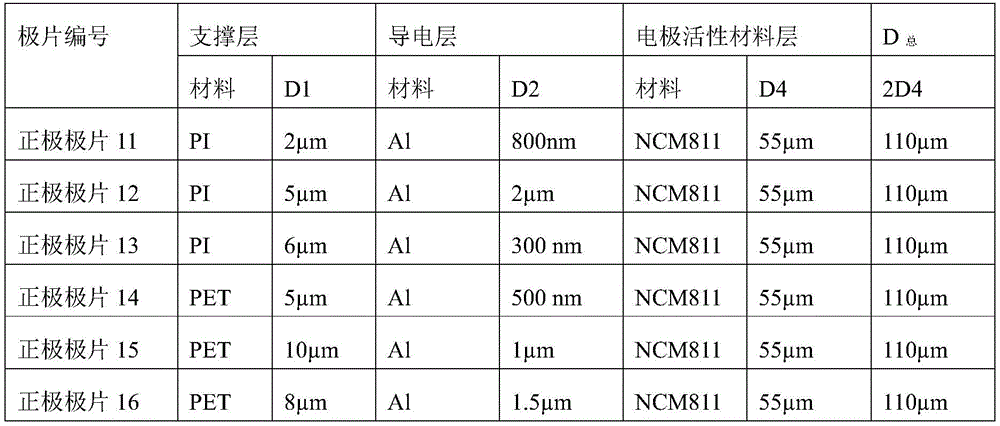
表1-2Table 1-2
采用复合集流体的锂离子电池,由于导电层较传统的金属集流体薄,在穿钉等异常情况下产生的金属毛刺较小,且复合集流体的支撑层具有较大的短路电阻,因此有利于改善电池的穿钉安全性能。从上表中可以看出,常规电池在穿钉情况下会发生热失控和毁坏,不能通过穿钉安全测试。而采用了复合集流体的锂离子电池,均可以通过穿钉安全测试。Lithium-ion batteries using composite current collectors, because the conductive layer is thinner than the traditional metal current collectors, the metal burrs generated under abnormal conditions such as piercing are smaller, and the support layer of the composite current collector has a large short-circuit resistance, so there are It is beneficial to improve the safety performance of the battery for piercing the nails. As can be seen from the above table, conventional batteries will suffer thermal runaway and destruction under the condition of piercing, and cannot pass the piercing safety test. And lithium-ion batteries using composite current collectors can pass the nail penetration safety test.
4.2保护层在改善复合集流体的电化学性能方面的作用4.2 The role of the protective layer in improving the electrochemical performance of the composite current collector
在表1中所列各实施例的集流体基础上,进一步形成保护层,以便研究保护层对于改善复合集流体的电化学性能方面的作用。表2中“正极集流体2-1”表示在表1中“正极集流体2”的基础上形成保护层所得集流体,其它集流体的编号含义类似。Based on the current collectors of the examples listed in Table 1, a protective layer was further formed in order to study the effect of the protective layer on improving the electrochemical performance of the composite current collector. "Positive current collector 2-1" in Table 2 represents a current collector obtained by forming a protective layer on the basis of "Positive current collector 2" in Table 1, and the numbers of other current collectors have similar meanings.
表2Table 2
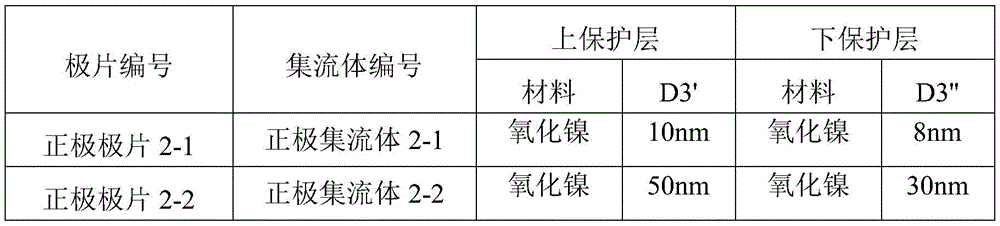
表3示出了以表2中所列极片(单次涂布)组装成电池后测得的循环性能数据。Table 3 shows the cycle performance data measured after assembling the cells with the pole pieces listed in Table 2 (single coat).
表3table 3

如表3所示,与采用常规的正极极片和常规的负极极片的电池1相比,采用复合集流体的电池的循环寿命良好,与常规的电池的循环性能相当。尤其是含有保护层的集流体制成的电池,相对于不含保护层的集流体制成的电池,其电池的容量保有率可进一步获得提升,说明电池的可靠性更好。As shown in Table 3, the cycle life of the battery using the composite current collector is good compared with the battery 1 using the conventional positive electrode and the conventional negative electrode, and the cycle performance is comparable to that of the conventional battery. In particular, the capacity retention rate of the battery made of the current collector with a protective layer can be further improved compared with the battery made of the current collector without the protective layer, indicating that the reliability of the battery is better.
4.3底涂层(即内侧区域)在改善电池的电化学性能方面的作用4.3 The role of the primer layer (i.e. the inner region) in improving the electrochemical performance of the battery
本实施例中采用了双层涂布法来在集流体上形成电极活性材料层来形成极片。因此,电极活性材料层分成了内侧区域(可称为“下层电极活性材料层”)和外侧区域(可称为“上层电极活性材料层”)两部分。由于下层活性材料层导电剂含量高于上层活性材料层的导电剂含量,所以下层电极活性材料层亦可以称之为导电底涂层(或简称底涂层)。In this embodiment, a double-layer coating method is used to form an electrode active material layer on the current collector to form a pole piece. Therefore, the electrode active material layer is divided into two parts, an inner region (may be referred to as a "lower electrode active material layer") and an outer region (may be referred to as an "upper electrode active material layer"). Since the conductive agent content of the lower active material layer is higher than that of the upper active material layer, the lower electrode active material layer can also be called a conductive primer layer (or simply primer layer).
下面说明底涂层、以及底涂层的组成等因素对于改善电池的电化学性能方面的作用。表4示出了各个实施例和对比例的电池以及其中采用的电极极片和集流体的具体组成和相关参数。表5示出了各电池的性能测量结果。The effect of the primer layer and the composition of the primer layer on improving the electrochemical performance of the battery will be described below. Table 4 shows the specific compositions and related parameters of the batteries of each example and comparative example, as well as the electrode pads and current collectors employed therein. Table 5 shows the performance measurement results of each battery.
表4Table 4

表5table 5

从以上测试数据可以看出:From the above test data, it can be seen that:
1)采用导电层较薄的复合集流体时(即没有采用双层涂布法涂布而不含导电底涂层的对比正极极片20),由于复合集流体导电能力较传统的金属集流体差、且复合集流体中的导电层易于破损等缺点,电池的DCR较大、循环容量保持率较低。而在通过双层涂布法引入了导电底涂层后,导电底涂层通过有效修补并构筑集流体、导电底涂层与活性物质间的导电网络,提高电子传输效率,降低集流体与电极活性材料层之间的电阻,从而可以有效降低DCR。1) When a composite current collector with a thinner conductive layer is used (that is, the comparative positive electrode plate 20 without the double-layer coating method is applied and does not contain a conductive primer layer), the conductive ability of the composite current collector is more than that of the traditional metal current collector. The disadvantage is that the conductive layer in the composite current collector is easily damaged, the DCR of the battery is large, and the cycle capacity retention rate is low. After the introduction of the conductive undercoat layer through the double-layer coating method, the conductive undercoat layer effectively repairs and builds the conductive network between the current collector, the conductive undercoat layer and the active material, thereby improving the electron transfer efficiency and reducing the current collector and the electrode. resistance between active material layers, so that DCR can be effectively reduced.
2)随着导电底涂层中的导电剂含量的提高(正极极片21至26),电池的DCR可得到较大程度的改善。2) With the increase of the conductive agent content in the conductive primer layer (positive electrode sheets 21 to 26), the DCR of the battery can be improved to a greater extent.
3)在相同的组成下,水性粘结剂的引入较油性粘结剂可使得DCR的改善程度更明显(正极极片24vs.正极极片27以及正极极片25vs.正极极片28)。3) Under the same composition, the introduction of water-based binder can make the improvement of DCR more obvious than that of oil-based binder (positive pole piece 24 vs. positive pole piece 27 and positive pole piece 25 vs. positive pole piece 28).
4)由于片状石墨可产生“水平滑动”,从而起到缓冲作用,减少压实过程中对集流体的导电层的破坏,从而减少裂纹,因此片状石墨的引入可进一步降低电池DCR(正极极片24vs.正极极片29)。4) Since the flake graphite can produce "horizontal sliding", which can play a buffering role and reduce the damage to the conductive layer of the current collector during the compaction process, thereby reducing cracks, the introduction of flake graphite can further reduce the battery DCR (positive electrode). pole piece 24 vs. positive pole piece 29).
5)随着导电底涂层的厚度的增大(正极极片30至正极极片32),电池的DCR也可得到更明显的改善。但是若导电底涂层的厚度过大,则不利于电池的能量密度的改进。5) With the increase of the thickness of the conductive primer layer (positive pole piece 30 to positive pole piece 32), the DCR of the battery can also be more significantly improved. However, if the thickness of the conductive primer layer is too large, it is not conducive to the improvement of the energy density of the battery.
4.4底涂层中电极活性材料的影响4.4 Influence of electrode active materials in the primer layer
上面的实施例中,为了研究的方便,所有底涂层中未加入电极活性材料。下面测试在底涂层中引入正极活性材料后对于电池性能的影响。具体极片组成和电池组成见表6、表7。In the above examples, for the convenience of research, no electrode active material was added to all the undercoat layers. The effect on the battery performance after the introduction of the cathode active material in the undercoat layer was tested below. The specific pole piece composition and battery composition are shown in Table 6 and Table 7.
表6Table 6

表7Table 7

从以上测试数据可以看出:无论底涂层是否含有电极活性材料,底涂层的引入都可以有效修补并构筑集流体、导电底涂层与活性物质间的导电网络,提高电子传输效率,降低集流体与电极活性材料层之间的电阻,从而可以有效降低DCR。It can be seen from the above test data: no matter whether the primer layer contains electrode active materials or not, the introduction of the primer layer can effectively repair and build the conductive network between the current collector, the conductive primer layer and the active material, improve the electron transfer efficiency and reduce the The resistance between the current collector and the electrode active material layer can effectively reduce the DCR.
4.5电极活性材料层膜片电阻对于改善电池电化学性能方面的作用4.5 The role of the sheet resistance of the electrode active material layer in improving the electrochemical performance of the battery
使用前述集流体来制备正极极片,调整活性材料层的组成,以期调整膜片电阻,将所得正极极片(活性材料层单面厚度D4为55μm)与常规负极极片组装成电池,测量其穿钉性能和循环寿命。结果如下表所示。Use the aforementioned current collector to prepare a positive electrode piece, adjust the composition of the active material layer, in order to adjust the membrane resistance, assemble the obtained positive electrode piece (the thickness D4 of the active material layer is 55 μm on one side) and a conventional negative electrode piece into a battery, and measure its Pinning performance and cycle life. The results are shown in the table below.
表8Table 8

*具体测试方法为:将锂离子电池于25℃下进行充放电,即先以0.5C的电流充电至4.2V,然后再以1C的电流放电至2.8V,记录下第一周的放电容量;然后使电池进行05C/1C充放电循环1000周,记录第1000周的电池放电容量,将第1000周的放电容量除以第一周的放电容量,得到第1000周的容量保有率。*The specific test method is: charge and discharge the lithium-ion battery at 25°C, that is, first charge it to 4.2V with a current of 0.5C, and then discharge it to 2.8V with a current of 1C, and record the discharge capacity of the first week; The battery was then charged and discharged at 05C/1C for 1000 cycles, the battery discharge capacity at the 1000th cycle was recorded, and the 1000th cycle discharge capacity was divided by the first cycle discharge capacity to obtain the 1000th cycle capacity retention rate.
从以上测试结果可知,无论是否设置底涂层,当电极活性材料层的总厚度为不大于170μm且活性材料层的膜片电阻为0.1至10欧时,电池兼具良好的循环性能和良好的穿钉安全性能。尤其是当膜片电阻为0.6欧至0.9欧时,循环性能和穿钉安全性能都非常优异。It can be seen from the above test results that no matter whether the primer layer is provided or not, when the total thickness of the electrode active material layer is not more than 170 μm and the sheet resistance of the active material layer is 0.1 to 10 ohms, the battery has both good cycle performance and good battery life. Nail safety performance. Especially when the diaphragm resistance is 0.6 ohms to 0.9 ohms, the cycle performance and nail penetration safety performance are excellent.
4.6电极活性材料层中的外侧区域的粘结剂的含量在改善电池的电化学性能方面的作用4.6 The role of the binder content in the outer region of the electrode active material layer in improving the electrochemical performance of the battery
内侧区域的底涂层粘结剂含量通常较高,因此底涂层与集流体之间的结合力较强。但是上层电极活性材料层(即外侧区域)与底涂层(即内侧区域)间的结合力受上层活性材料层中的粘结剂含量影响。为了使得在穿钉等异常情况下,整个电极活性材料层可有效地包裹导电层中产生的金属毛刺,以改善电池的穿钉安全性能,上层活性材料(即外侧区域)中的粘结剂含量优选应该高于一个下限值。The primer layer binder content is generally higher in the inner region, so the bond between the primer layer and the current collector is stronger. However, the bonding force between the upper electrode active material layer (ie, the outer region) and the undercoat layer (ie, the inner region) is affected by the binder content in the upper active material layer. In order to enable the entire electrode active material layer to effectively wrap the metal burrs generated in the conductive layer under abnormal conditions such as piercing, so as to improve the safety performance of battery piercing, the binder content in the upper active material (ie, the outer region) It should preferably be higher than a lower limit.
下面以从电池穿钉安全的角度来说明上层电极活性材料层中的粘结剂的含量在改善电池的电化学性能方面的作用。The effect of the content of the binder in the upper electrode active material layer in improving the electrochemical performance of the battery will be described below from the perspective of the safety of battery piercing.
按照前面实施例所述方法制备正极极片,但是调整上层浆料的组成,制得上层正极活性材料层中粘结剂含量不同的多个正极极片。具体极片组成见下表。The positive electrode sheet was prepared according to the method described in the previous example, but the composition of the upper layer slurry was adjusted to obtain a plurality of positive electrode electrode sheets with different binder contents in the upper positive electrode active material layer. The specific pole piece composition is shown in the table below.
表9Table 9

表10Table 10

表10示出了上述不同正极极片组装成电池时的穿钉测试结果。结果表明上层正极活性材料层中的粘结剂的含量越高时,相应电池的穿钉安全性能越好。优选地,基于上层活性材料层的总重量,上层正极活性材料层中的粘结剂含量不小于1wt%,更优选不小于1.5wt%,最优选不小于2wt%。Table 10 shows the nail penetration test results when the above-mentioned different positive electrode pieces are assembled into a battery. The results show that the higher the content of the binder in the upper cathode active material layer, the better the safety performance of the corresponding battery. Preferably, the binder content in the upper positive active material layer is not less than 1 wt %, more preferably not less than 1.5 wt %, most preferably not less than 2 wt %, based on the total weight of the upper active material layer.
本领域技术人员可以理解:以上仅以锂电池为例示出了本发明的极片的应用实例,但是本发明的极片同样可以应用于其它类型的电池或电化学装置,而仍然可以获得本发明的良好技术效果。Those skilled in the art can understand: the above only takes the lithium battery as an example to illustrate the application example of the pole piece of the present invention, but the pole piece of the present invention can also be applied to other types of batteries or electrochemical devices, and the present invention can still be obtained. good technical results.
根据上述说明书的揭示和教导,本发明所属领域的技术人员还可以对上述实施方式进行适当的变更和修改。因此,本发明并不局限于上面揭示和描述的具体实施方式,对本发明的一些修改和变更也应当落入本发明的权利要求的保护范围内。此外,尽管本说明书中使用了一些特定的术语,但这些术语只是为了方便说明,并不对本发明构成任何限制。Based on the disclosure and teaching of the above specification, those skilled in the art to which the present invention pertains can also make appropriate changes and modifications to the above embodiments. Therefore, the present invention is not limited to the specific embodiments disclosed and described above, and some modifications and changes to the present invention should also fall within the protection scope of the claims of the present invention. In addition, although some specific terms are used in this specification, these terms are only for convenience of description and do not constitute any limitation to the present invention.
Claims (35)
Priority Applications (5)
| Application Number | Priority Date | Filing Date | Title |
|---|---|---|---|
| CN201910299937.6A CN110943201B (en) | 2019-04-15 | 2019-04-15 | A positive electrode plate and electrochemical device |
| PCT/CN2019/129354 WO2020211452A1 (en) | 2019-04-15 | 2019-12-27 | Positive pole piece, electrochemical device and device |
| HUE19924802A HUE067520T2 (en) | 2019-04-15 | 2019-12-27 | Positive electrode plate, electrochemical apparatus, and apparatus |
| EP19924802.2A EP3940817B1 (en) | 2019-04-15 | 2019-12-27 | Positive electrode plate, electrochemical apparatus, and apparatus |
| US17/501,895 US12315934B2 (en) | 2019-04-15 | 2021-10-14 | Positive electrode plate, electrochemical apparatus, and apparatus |
Applications Claiming Priority (1)
| Application Number | Priority Date | Filing Date | Title |
|---|---|---|---|
| CN201910299937.6A CN110943201B (en) | 2019-04-15 | 2019-04-15 | A positive electrode plate and electrochemical device |
Publications (2)
| Publication Number | Publication Date |
|---|---|
| CN110943201A CN110943201A (en) | 2020-03-31 |
| CN110943201B true CN110943201B (en) | 2021-02-26 |
Family
ID=69905578
Family Applications (1)
| Application Number | Title | Priority Date | Filing Date |
|---|---|---|---|
| CN201910299937.6A Active CN110943201B (en) | 2019-04-15 | 2019-04-15 | A positive electrode plate and electrochemical device |
Country Status (5)
| Country | Link |
|---|---|
| US (1) | US12315934B2 (en) |
| EP (1) | EP3940817B1 (en) |
| CN (1) | CN110943201B (en) |
| HU (1) | HUE067520T2 (en) |
| WO (1) | WO2020211452A1 (en) |
Families Citing this family (30)
| Publication number | Priority date | Publication date | Assignee | Title |
|---|---|---|---|---|
| CN110660963B (en) | 2018-12-29 | 2021-04-27 | 宁德时代新能源科技股份有限公司 | An electrode pole piece and electrochemical device |
| CN110676460B (en) | 2018-12-29 | 2022-01-18 | 宁德时代新能源科技股份有限公司 | Electrode plate and electrochemical device |
| CN110661002B (en) | 2018-12-29 | 2021-06-29 | 宁德时代新能源科技股份有限公司 | Electrode plate and electrochemical device |
| CN110660957B (en) * | 2018-12-29 | 2020-12-04 | 宁德时代新能源科技股份有限公司 | An electrode pole piece and electrochemical device |
| CN110943200B (en) | 2019-04-15 | 2021-03-09 | 宁德时代新能源科技股份有限公司 | An electrode pole piece and electrochemical device |
| CN110943222B (en) | 2019-04-15 | 2021-01-12 | 宁德时代新能源科技股份有限公司 | Electrode plate and electrochemical device |
| CN110943201B (en) | 2019-04-15 | 2021-02-26 | 宁德时代新能源科技股份有限公司 | A positive electrode plate and electrochemical device |
| CN111180665A (en) | 2019-06-28 | 2020-05-19 | 宁德时代新能源科技股份有限公司 | An electrode pole piece and electrochemical device |
| CN112436103A (en) * | 2020-12-11 | 2021-03-02 | 湖北亿纬动力有限公司 | Double-layer structure pole piece and preparation method and application thereof |
| CN112670444B (en) * | 2020-12-22 | 2024-03-12 | 宁德新能源科技有限公司 | Cathode plates, electrochemical devices and electronic devices |
| CN112750978B (en) * | 2020-12-30 | 2022-03-15 | 珠海冠宇电池股份有限公司 | Pole piece and battery |
| CN113488658B (en) * | 2021-06-30 | 2022-07-08 | 浙江锋锂新能源科技有限公司 | Lithium battery positive current collector and preparation method thereof, lithium battery and positive electrode thereof |
| CN115207274A (en) * | 2021-11-01 | 2022-10-18 | 无锡先导智能装备股份有限公司 | Dry electrode structure and dry electrode forming device |
| WO2023082036A1 (en) * | 2021-11-09 | 2023-05-19 | 宁德时代新能源科技股份有限公司 | Current collector and preparation method therefor, secondary battery, battery module, battery pack, and electrical device |
| CN116364936A (en) * | 2021-12-27 | 2023-06-30 | Oppo广东移动通信有限公司 | Current collector, preparation method thereof, electrode plate, battery and electronic equipment |
| CN114300688B (en) * | 2021-12-28 | 2024-01-16 | 上海恩捷新材料科技有限公司 | Battery containing magnetic current collector and preparation method thereof |
| WO2023184228A1 (en) * | 2022-03-30 | 2023-10-05 | 宁德新能源科技有限公司 | Electrochemical device and electronic device |
| CN116799151B (en) * | 2022-03-31 | 2024-08-09 | 宁德时代新能源科技股份有限公司 | Positive electrode sheet, secondary battery and electricity utilization device |
| CN114824441B (en) * | 2022-05-09 | 2024-11-08 | 江苏正力新能电池技术股份有限公司 | Battery cell, battery module and battery pack |
| CN117219779A (en) * | 2022-06-02 | 2023-12-12 | 荣盛盟固利新能源科技股份有限公司 | Current collector for lithium ion battery, electrode plate and lithium ion battery |
| CN114899356A (en) * | 2022-06-30 | 2022-08-12 | 扬州纳力新材料科技有限公司 | Composite current collector, preparation method, electrode plate, battery and electronic equipment |
| CN115084536B (en) * | 2022-07-14 | 2024-04-12 | 扬州纳力新材料科技有限公司 | Composite current collector and preparation method and application thereof |
| CN115312971A (en) * | 2022-08-18 | 2022-11-08 | 江阴纳力新材料科技有限公司 | Polymer film, preparation method thereof and composite current collector |
| EP4507019A4 (en) * | 2022-11-04 | 2025-12-24 | Contemporary Amperex Technology Hong Kong Ltd | POSITIVE ELECTRODE FILM, SECONDARY BATTERY AND ELECTRICAL DEVICE |
| CN115719812A (en) * | 2022-12-02 | 2023-02-28 | 蜂巢能源科技(马鞍山)有限公司 | Composite current collector, positive plate, preparation methods of composite current collector and positive plate, battery and electric equipment |
| CN117996153A (en) * | 2024-01-18 | 2024-05-07 | 欣旺达动力科技股份有限公司 | Lithium ion battery and electric device |
| CN120613456A (en) * | 2024-03-08 | 2025-09-09 | 宁德时代新能源科技股份有限公司 | Battery cells, batteries and electrical devices |
| CN121039827A (en) * | 2024-03-08 | 2025-11-28 | 宁德时代新能源科技股份有限公司 | Positive electrode sheet, battery cell containing the positive electrode sheet, battery, and electrical device. |
| DE102024131944B3 (en) | 2024-09-05 | 2025-12-04 | GM Global Technology Operations LLC | TWO-BINDER-ACTIVATED, CALANDRED SEMI-DRY ELECTRODE |
| CN119542341B (en) * | 2024-11-13 | 2026-01-06 | 中国电子科技集团公司第十八研究所 | A double-layer high-performance electrode, a storage lithium battery and its preparation method |
Family Cites Families (156)
| Publication number | Priority date | Publication date | Assignee | Title |
|---|---|---|---|---|
| IN155181B (en) | 1979-12-24 | 1985-01-12 | Chloride Silent Power Ltd | |
| US5645959A (en) | 1992-08-20 | 1997-07-08 | Bipolar Power Corporation | Battery plates with self-passivating iron cores and mixed acid electrolyte |
| US5478676A (en) | 1994-08-02 | 1995-12-26 | Rexam Graphics | Current collector having a conductive primer layer |
| JP4038699B2 (en) | 1996-12-26 | 2008-01-30 | 株式会社ジーエス・ユアサコーポレーション | Lithium ion battery |
| JP3478077B2 (en) | 1997-08-21 | 2003-12-10 | 三菱化学株式会社 | Lithium secondary battery |
| US7771870B2 (en) | 2006-03-22 | 2010-08-10 | Sion Power Corporation | Electrode protection in both aqueous and non-aqueous electrochemical cells, including rechargeable lithium batteries |
| US6420066B1 (en) | 2000-07-03 | 2002-07-16 | Wilson Greatbatch Ltd. | Variable density cathode assembly which facilitates winding |
| JP3895932B2 (en) | 2001-01-17 | 2007-03-22 | 三洋電機株式会社 | Negative electrode for lithium secondary battery and method for producing the same |
| JP4944341B2 (en) | 2002-02-26 | 2012-05-30 | 日本電気株式会社 | Method for producing negative electrode for lithium ion secondary battery |
| JP2003282064A (en) | 2002-03-20 | 2003-10-03 | Toyo Kohan Co Ltd | Compound current collector |
| JP4089875B2 (en) * | 2002-06-12 | 2008-05-28 | 共同印刷株式会社 | Electrode device including a recess |
| CN1669163A (en) | 2002-08-29 | 2005-09-14 | 东洋钢钣株式会社 | Composite current collector |
| US6933077B2 (en) * | 2002-12-27 | 2005-08-23 | Avestor Limited Partnership | Current collector for polymer electrochemical cells and electrochemical generators thereof |
| US20040126654A1 (en) | 2002-12-27 | 2004-07-01 | Anthony Sudano | Electrochemical cell laminate for alkali metal polymer batteries and method for making same |
| US7521153B2 (en) | 2004-03-16 | 2009-04-21 | Toyota Motor Engineering & Manufacturing North America, Inc. | Corrosion protection using protected electron collector |
| US7615314B2 (en) | 2004-12-10 | 2009-11-10 | Canon Kabushiki Kaisha | Electrode structure for lithium secondary battery and secondary battery having such electrode structure |
| KR100670507B1 (en) | 2005-04-28 | 2007-01-16 | 삼성에스디아이 주식회사 | Lithium secondary battery |
| TWI467840B (en) | 2005-09-02 | 2015-01-01 | A123 Systems Inc | Nanocomposite electrodes and related devices |
| CN101601150B (en) * | 2006-12-04 | 2015-02-18 | 赛昂能源有限公司 | Separation of electrolytes |
| CN101207197B (en) | 2006-12-22 | 2011-01-12 | 比亚迪股份有限公司 | Lithium-ion battery positive electrode material and positive electrode and lithium-ion battery containing the material |
| JP5261961B2 (en) * | 2007-04-06 | 2013-08-14 | トヨタ自動車株式会社 | Secondary battery positive electrode, secondary battery negative electrode, secondary battery, and vehicle |
| CN101071860A (en) | 2007-06-08 | 2007-11-14 | 大连理工大学 | Flexible current-collecting body |
| CN101174685A (en) | 2007-10-26 | 2008-05-07 | 中南大学 | A kind of lithium-ion battery positive electrode or negative electrode sheet and coating method thereof |
| JP2011501383A (en) | 2007-10-26 | 2011-01-06 | サイオン パワー コーポレイション | Battery electrode primer |
| US8936874B2 (en) | 2008-06-04 | 2015-01-20 | Nanotek Instruments, Inc. | Conductive nanocomposite-based electrodes for lithium batteries |
| JP2010027530A (en) | 2008-07-24 | 2010-02-04 | Seiko Epson Corp | Electrode of battery, manufacturing method for electrode of battery, and battery |
| TWI473130B (en) | 2008-09-23 | 2015-02-11 | Ind Tech Res Inst | Energy storage devices |
| JP4711151B2 (en) | 2008-11-13 | 2011-06-29 | トヨタ自動車株式会社 | Positive electrode current collector and manufacturing method thereof |
| US20110123866A1 (en) * | 2009-09-03 | 2011-05-26 | Pan Lawrence S | Methods and systems for making electrodes having at least one functional gradient therein and devices resulting therefrom |
| WO2011037124A1 (en) | 2009-09-25 | 2011-03-31 | ダイキン工業株式会社 | Positive electrode current collector laminate for lithium secondary battery |
| BR112012012049B1 (en) | 2009-11-20 | 2021-11-23 | Nissan Motor Co., Ltd | CURRENT COLLECTOR FOR BIPOLAR SECONDARY BATTERY, ELECTRODE FOR BIPOLAR SECONDARY BATTERY AND BIPOLAR SECONDARY BATTERY |
| JP2011165388A (en) | 2010-02-05 | 2011-08-25 | Panasonic Corp | Electrode for lithium ion secondary battery, electrode group for lithium ion secondary battery using the electrode and lithium ion secondary battery using the electrode group |
| CN102195032B (en) * | 2010-12-16 | 2016-05-04 | 东莞新能源电子科技有限公司 | Preparation method of lithium ion battery pole piece |
| WO2012127561A1 (en) | 2011-03-18 | 2012-09-27 | 株式会社日立製作所 | Non-aqueous electrolyte battery |
| CN102332558A (en) | 2011-03-22 | 2012-01-25 | 东莞新能源科技有限公司 | Lithium-ion battery and its positive pole piece |
| EP2694373B1 (en) | 2011-03-31 | 2016-12-14 | UMS Skeldar Sweden AB | An aerial vehicle hold-down harpoon |
| CN102306800B (en) | 2011-08-16 | 2015-11-25 | 清华大学 | collector and lithium ion battery |
| CN103131267B (en) | 2011-11-24 | 2015-10-28 | 珠海银隆新能源有限公司 | Affluxion body in lithium ion batteries precoated layer and preparation method thereof |
| US20130171523A1 (en) | 2011-12-28 | 2013-07-04 | Zhi Chen | Lithium-ion secondary battery and the cathode material thereof |
| US20120164528A1 (en) | 2012-02-01 | 2012-06-28 | Electrochemical Materials, LLC | Composite anode with an interfacial film and lithium secondary battery employing the same |
| CN102569816B (en) | 2012-02-14 | 2014-03-12 | 中南大学 | Positive electrode of lithium sulfur battery and preparation method thereof |
| JP5903931B2 (en) | 2012-02-28 | 2016-04-13 | 三菱化学株式会社 | Non-aqueous electrolyte and non-aqueous electrolyte battery using the same |
| CN104321907B (en) | 2012-05-25 | 2017-07-14 | Nec能源元器件株式会社 | The anode electrode and nonaqueous electrolytic solution secondary battery of battery with nonaqueous electrolyte |
| JP5930857B2 (en) | 2012-06-08 | 2016-06-08 | 三菱電機株式会社 | Battery manufacturing method |
| JP6116015B2 (en) | 2012-06-11 | 2017-04-19 | Necエナジーデバイス株式会社 | Electrode manufacturing method |
| KR20150036659A (en) | 2012-07-13 | 2015-04-07 | 후루카와 덴키 고교 가부시키가이샤 | Current collector, electrode, secondary cell, and capacitor |
| CN103545530B (en) | 2012-07-13 | 2016-04-27 | 清华大学 | Collector, lithium ion cell electrode and lithium ion battery |
| US9966632B2 (en) | 2012-07-31 | 2018-05-08 | Ube Industries, Ltd. | Non-aqueous electrolyte and power storage device using same |
| CN102847859B (en) | 2012-08-21 | 2016-04-27 | 东莞新能源科技有限公司 | A kind of rolling method of electrodes of lithium-ion batteries |
| WO2014050653A1 (en) | 2012-09-28 | 2014-04-03 | 古河電気工業株式会社 | Collector, electrode structure, nonaqueous electrolyte battery, conductive filler, and electricity storage component |
| CN103779569A (en) | 2012-10-23 | 2014-05-07 | 海洋王照明科技股份有限公司 | Lithium ion battery anode sheet and preparation method thereof |
| US9166253B2 (en) | 2012-12-06 | 2015-10-20 | Samsung Electronics Co., Ltd. | Solid-state battery |
| CN103165863A (en) | 2012-12-07 | 2013-06-19 | 深圳市海太阳实业有限公司 | Positive pole piece and preparation method thereof and battery |
| CN103094619B (en) | 2013-01-17 | 2015-02-04 | 北京好风光储能技术有限公司 | High-energy density lithium ion battery cell and preparation method thereof |
| US9601745B2 (en) | 2013-03-07 | 2017-03-21 | Nec Energy Devices, Ltd. | Non-aqueous electrolyte secondary battery |
| CN103268942B (en) | 2013-03-19 | 2015-08-19 | 王樑 | The coating modified collector of a kind of nano-graphite |
| CN203218375U (en) | 2013-04-19 | 2013-09-25 | 宁德新能源科技有限公司 | Lithium ion battery pole piece and lithium ion battery |
| WO2014182060A1 (en) | 2013-05-07 | 2014-11-13 | 주식회사 엘지화학 | Electrode for secondary battery, method for manufacturing same, and secondary battery and cable-type secondary battery comprising same |
| KR20140137660A (en) | 2013-05-23 | 2014-12-03 | 주식회사 엘지화학 | Electrode for secondary battery and secondary battery comprising the same |
| CN103326029A (en) | 2013-06-07 | 2013-09-25 | 深圳市海太阳实业有限公司 | Negative electrode sheet, positive electrode sheet, and lithium ion battery |
| KR101586251B1 (en) | 2013-06-24 | 2016-01-18 | 주식회사 제낙스 | Current collector for rechargeable battery and electrode using the same |
| WO2015020338A1 (en) * | 2013-08-05 | 2015-02-12 | 주식회사 아모그린텍 | Flexible current collector, method for manufacturing same, and secondary battery using same |
| TWI569504B (en) | 2013-09-30 | 2017-02-01 | Lg化學股份有限公司 | Electrode having improved deflection motion and secondary battery including the same |
| JP2017021888A (en) | 2013-11-25 | 2017-01-26 | 日産自動車株式会社 | Manufacturing method of negative electrode for nonaqueous electrolyte secondary battery |
| JP6252841B2 (en) | 2013-11-25 | 2017-12-27 | 株式会社Gsユアサ | Electricity storage element |
| CN105794022B (en) * | 2013-12-12 | 2018-07-17 | Nec 能源元器件株式会社 | Secondary battery and manufacturing method thereof |
| JP2015115233A (en) | 2013-12-12 | 2015-06-22 | 昭和電工株式会社 | Negative electrode for magnesium ion secondary battery and magnesium ion secondary battery |
| WO2015115051A1 (en) | 2014-01-31 | 2015-08-06 | 三洋電機株式会社 | Nonaqueous-electrolyte secondary-battery negative electrode |
| US20170033399A1 (en) | 2014-04-11 | 2017-02-02 | Nec Energy Devices, Ltd. | Secondary battery and method for manufacturing the same |
| CN103956499B (en) | 2014-04-15 | 2016-02-10 | 洛阳月星新能源科技有限公司 | A kind of safety coatings preparation method for plus plate current-collecting body in lithium ion battery |
| CN204088469U (en) | 2014-07-28 | 2015-01-07 | 东莞新能源科技有限公司 | Anode current collector of lithium ion battery and the anode pole piece comprising this collector |
| CN105514349B (en) | 2014-09-24 | 2018-04-20 | 比亚迪股份有限公司 | Based lithium-ion battery positive plate and preparation method and lithium ion battery |
| CN104716328A (en) | 2014-11-18 | 2015-06-17 | 恩力能源科技(南通)有限公司 | Composite current collector material and preparation method thereof |
| WO2016086388A1 (en) | 2014-12-04 | 2016-06-09 | GM Global Technology Operations LLC | Plasma battery electrode coating on current collector pretreated with conducive material |
| US20160211524A1 (en) | 2015-01-15 | 2016-07-21 | Nissan North America, Inc. | Electrode structure to reduce polarization and increase power density of batteries |
| KR101783445B1 (en) * | 2015-03-17 | 2017-09-29 | 주식회사 엘지화학 | Multilayer-Structured Electrode and Lithium Secondary Battery Comprising The Same |
| KR102110054B1 (en) | 2015-07-23 | 2020-05-12 | 히타치가세이가부시끼가이샤 | Lithium ion secondary battery |
| KR102101006B1 (en) | 2015-12-10 | 2020-04-14 | 주식회사 엘지화학 | Positive electrode for secondary battery and secondary battery comprising the same |
| CN105489845A (en) | 2015-12-30 | 2016-04-13 | 哈尔滨工业大学 | Method for preparing thin-layer lithium metal anode for all-solid-state lithium-ion battery based on PVD |
| CN106935901A (en) | 2015-12-31 | 2017-07-07 | 东莞新能源科技有限公司 | Lithium-ion battery and its cathode plate |
| CN113725398A (en) | 2016-01-04 | 2021-11-30 | 宁德新能源科技有限公司 | Lithium ion battery and positive pole piece thereof |
| CN105958118A (en) | 2016-05-18 | 2016-09-21 | 东莞市凯欣电池材料有限公司 | Non-aqueous electrolyte solution for high-voltage lithium-ion battery and lithium battery |
| KR101809189B1 (en) | 2016-05-23 | 2017-12-14 | 한국제이씨씨(주) | Metal foil, metal foil manufacturing method and electrode manufacturing method using the same |
| US10142447B2 (en) | 2016-06-02 | 2018-11-27 | Honeywell International Inc. | System having a protocol independent configuration environment |
| KR101816416B1 (en) | 2016-06-22 | 2018-01-08 | 현대자동차주식회사 | A manufacturing method of cathode for all-solid state battery using sol-gel process and slurry-casting process |
| KR102258090B1 (en) | 2016-09-06 | 2021-05-27 | 삼성에스디아이 주식회사 | Electrode for rechargeable lithium battery and rechargeable lithium battery including same |
| JP7042578B2 (en) * | 2016-09-15 | 2022-03-28 | 三洋化成工業株式会社 | Negative electrode for lithium ion secondary battery and lithium ion secondary battery using it |
| JP2018073723A (en) | 2016-11-02 | 2018-05-10 | 株式会社リコー | Electrode and storage element |
| US20180145317A1 (en) | 2016-11-18 | 2018-05-24 | Semiconductor Energy Laboratory Co., Ltd. | Positive electrode active material, method for manufacturing positive electrode active material, and secondary battery |
| CN106654285B (en) | 2016-11-18 | 2021-03-05 | 浙江大学 | Flexible current collector for lithium battery and preparation method thereof |
| CN106684319A (en) | 2016-12-23 | 2017-05-17 | 国联汽车动力电池研究院有限责任公司 | Single-surface similar pole plate, light battery cell containing same and preparation method of single-surface similar pole plate |
| CN106848324B (en) | 2017-01-06 | 2020-08-25 | 深圳市德方纳米科技股份有限公司 | Oily undercoat current collector for lithium ion battery and preparation method and application thereof |
| US11539050B2 (en) * | 2017-01-12 | 2022-12-27 | Contemporary Amperex Technology Co., Limited | Current collector, electrode plate and battery containing the same, and application thereof |
| CN108281662B (en) | 2017-01-12 | 2020-05-05 | 宁德时代新能源科技股份有限公司 | A current collector, its pole piece and battery and application |
| CN106910897A (en) | 2017-03-02 | 2017-06-30 | 宁德时代新能源科技股份有限公司 | Current collector, pole piece thereof and battery |
| CN108539252A (en) * | 2017-03-05 | 2018-09-14 | 谷涛 | A kind of high security lithium ion battery |
| JP2018156787A (en) | 2017-03-16 | 2018-10-04 | 株式会社豊田自動織機 | Electrode and power storage device |
| CN106898729A (en) | 2017-03-27 | 2017-06-27 | 浙江大学 | Flexible current-collecting body, electrode and battery comprising the flexible current-collecting body |
| EP3605666A1 (en) | 2017-03-30 | 2020-02-05 | Showa Denko K.K. | Positive electrode for lithium ion secondary cell, and lithium ion secondary cell |
| JP6855882B2 (en) | 2017-03-31 | 2021-04-07 | Tdk株式会社 | Positive electrode and lithium ion secondary battery |
| CN108666525A (en) | 2017-04-01 | 2018-10-16 | 宁德时代新能源科技股份有限公司 | Negative pole piece, preparation method thereof and secondary battery |
| CN207097950U (en) * | 2017-04-14 | 2018-03-13 | 深圳鑫智美科技有限公司 | A kind of lithium battery containing new current collector |
| CN107154499B (en) * | 2017-04-14 | 2020-05-15 | 宁德时代新能源科技股份有限公司 | A lithium battery containing current collector and preparation method thereof |
| CN106981665A (en) | 2017-04-14 | 2017-07-25 | 深圳鑫智美科技有限公司 | A kind of negative current collector, its preparation method and its application |
| CN107123812B (en) * | 2017-04-14 | 2020-05-19 | 宁德时代新能源科技股份有限公司 | A positive electrode current collector, its preparation method and its application |
| JP6917765B2 (en) | 2017-05-10 | 2021-08-11 | 日産自動車株式会社 | Bipolar secondary battery |
| CN107240721B (en) | 2017-05-27 | 2020-01-31 | 深圳市雄韬电源科技股份有限公司 | Bipolar electrode, lithium ion battery and manufacturing method of lithium ion battery |
| CN107302094B (en) | 2017-06-15 | 2019-10-11 | 常州翊迈新材料科技有限公司 | Superconductive super-corrosion-resistant functional coating of fuel cell metal bipolar plate and preparation method thereof |
| KR102180926B1 (en) | 2017-06-28 | 2020-11-19 | 에스케이넥실리스 주식회사 | Copper foil having improved workability and charge discharge characteristics, electrode comprisng the same, secondary battery comprising the same and method for manufacturing the same |
| CN107221676A (en) | 2017-06-30 | 2017-09-29 | 江苏道赢科技有限公司 | A kind of lithium rechargeable battery of composite current collector and the application collector |
| CN107565137B (en) | 2017-07-03 | 2020-06-23 | 北京卫蓝新能源科技有限公司 | A kind of current collector and pole piece and solid-state battery containing the same |
| KR102473030B1 (en) | 2017-08-30 | 2022-11-30 | 에스케이넥실리스 주식회사 | Copper Film, Manufacturing Methods Thereof, And Anode For Li Secondary Battery Comprising The Same |
| CN107768677A (en) * | 2017-09-18 | 2018-03-06 | 深圳市烯谷能源控股有限公司 | A kind of method for improving lithium ion cell positive colelctor electrode corrosion resisting property |
| CN107732146A (en) * | 2017-10-10 | 2018-02-23 | 中航锂电(洛阳)有限公司 | A kind of electrodes of lithium-ion batteries and preparation method thereof, lithium ion battery |
| CN108110220B (en) | 2017-11-27 | 2020-08-04 | 国联汽车动力电池研究院有限责任公司 | Preparation method of high-load high-compaction-density lithium ion battery pole piece |
| CN109873164B (en) | 2017-12-05 | 2021-08-20 | 宁德时代新能源科技股份有限公司 | A current collector, its pole piece and electrochemical device |
| CN109873166B (en) | 2017-12-05 | 2021-06-29 | 宁德时代新能源科技股份有限公司 | A current collector, its pole piece and electrochemical device |
| CN109873160B (en) | 2017-12-05 | 2021-05-18 | 宁德时代新能源科技股份有限公司 | A current collector, its pole piece and battery |
| CN109873161B (en) | 2017-12-05 | 2021-07-30 | 宁德时代新能源科技股份有限公司 | a battery |
| CN109873163B (en) | 2017-12-05 | 2021-07-06 | 宁德时代新能源科技股份有限公司 | A current collector, its pole piece and battery and application |
| CN108258249B (en) | 2017-12-15 | 2020-04-24 | 深圳宇锵新材料有限公司 | Current collector coating, slurry, preparation method of current collector coating and slurry, battery pole piece and lithium ion battery |
| CN108306013B (en) | 2017-12-25 | 2020-07-31 | 风帆有限责任公司 | Fast-charging and fast-discharging type high-power lithium ion battery and manufacturing method thereof |
| CN108155363B (en) | 2017-12-26 | 2020-11-03 | 深圳先进技术研究院 | Application of polymer coating in aluminum negative electrode, aluminum negative electrode, its preparation method and secondary battery |
| CN108199005B (en) * | 2018-01-03 | 2020-06-23 | 浙江衡远新能源科技有限公司 | Rolling method and equipment for battery pole piece |
| KR20200110740A (en) | 2018-01-31 | 2020-09-25 | 니폰 제온 가부시키가이샤 | A composition for a lithium ion secondary battery separator, a two-component composition for a lithium ion secondary battery separator, and a method for manufacturing a separator for a lithium ion secondary battery, and a method for manufacturing a lithium ion secondary battery |
| JP6870627B2 (en) | 2018-02-05 | 2021-05-12 | トヨタ自動車株式会社 | Manufacturing method of electrode current collector, all-solid-state battery and electrode current collector |
| CN109004171A (en) * | 2018-02-26 | 2018-12-14 | 宁德新能源科技有限公司 | A kind of positive pole piece and lithium ion battery |
| CN108682788A (en) | 2018-04-02 | 2018-10-19 | 合肥国轩高科动力能源有限公司 | A flexible lithium battery electrode |
| CN208298924U (en) | 2018-04-27 | 2018-12-28 | 宁德新能源科技有限公司 | Pole piece and electrochemical appliance |
| CN108598491B (en) | 2018-06-22 | 2020-10-02 | 宁德时代新能源科技股份有限公司 | Secondary battery and its pole piece |
| CN108832134A (en) * | 2018-06-28 | 2018-11-16 | 清陶(昆山)新能源材料研究院有限公司 | A kind of flexible current-collecting body and preparation method thereof and the application in lithium ion battery |
| CN108808072A (en) * | 2018-06-29 | 2018-11-13 | 宁德时代新能源科技股份有限公司 | Lithium ion battery |
| CN208507818U (en) | 2018-06-29 | 2019-02-15 | 宁德时代新能源科技股份有限公司 | Secondary cell and its pole piece |
| CN109103490A (en) | 2018-08-17 | 2018-12-28 | 云南锡业集团(控股)有限责任公司研发中心 | A kind of high magnification iron phosphate polymer lithium battery |
| CN109216675A (en) | 2018-09-05 | 2019-01-15 | 中国科学院物理研究所 | A kind of lithium battery material and its preparation method and application that copper nitride is modified |
| WO2020051560A1 (en) | 2018-09-06 | 2020-03-12 | Sila Nanotechnologies, Inc. | Electrode with conductive interlayer and method thereof |
| CN109216703A (en) * | 2018-09-06 | 2019-01-15 | 珠海光宇电池有限公司 | A kind of flexible, porous collector and preparation method thereof |
| US20220037663A1 (en) | 2018-09-25 | 2022-02-03 | Toray Industries, Inc. | Electrode for secondary batteries and lithium ion secondary battery |
| WO2020067106A1 (en) | 2018-09-27 | 2020-04-02 | 富士フイルム株式会社 | Solid electrolyte composition, sheet for solid-state secondary battery, electrode sheet for solid-state secondary battery, solid-state secondary battery, and methods for producing solid-state secondary battery sheet and solid-state secondary battery |
| CN109273668B (en) | 2018-09-27 | 2021-04-06 | 宁德新能源科技有限公司 | Negative pole piece and electrochemical device comprising same |
| CN208955108U (en) | 2018-10-11 | 2019-06-07 | 宁德时代新能源科技股份有限公司 | Secondary cell and its electrode member |
| CN109546154A (en) | 2018-12-13 | 2019-03-29 | 北京理工大学 | A kind of aluminium ion battery afflux liquid with protective layer |
| CN110660995B (en) | 2018-12-29 | 2021-03-09 | 宁德时代新能源科技股份有限公司 | An electrode pole piece and electrochemical device |
| CN110661003B (en) | 2018-12-29 | 2021-06-29 | 宁德时代新能源科技股份有限公司 | An electrode pole piece and electrochemical device |
| CN110661001B (en) | 2018-12-29 | 2020-12-01 | 宁德时代新能源科技股份有限公司 | An electrode pole piece and electrochemical device |
| CN110676460B (en) | 2018-12-29 | 2022-01-18 | 宁德时代新能源科技股份有限公司 | Electrode plate and electrochemical device |
| CN110661002B (en) | 2018-12-29 | 2021-06-29 | 宁德时代新能源科技股份有限公司 | Electrode plate and electrochemical device |
| CN110660957B (en) | 2018-12-29 | 2020-12-04 | 宁德时代新能源科技股份有限公司 | An electrode pole piece and electrochemical device |
| CN110660963B (en) | 2018-12-29 | 2021-04-27 | 宁德时代新能源科技股份有限公司 | An electrode pole piece and electrochemical device |
| CN110943201B (en) | 2019-04-15 | 2021-02-26 | 宁德时代新能源科技股份有限公司 | A positive electrode plate and electrochemical device |
| CN110943200B (en) | 2019-04-15 | 2021-03-09 | 宁德时代新能源科技股份有限公司 | An electrode pole piece and electrochemical device |
| CN110943222B (en) | 2019-04-15 | 2021-01-12 | 宁德时代新能源科技股份有限公司 | Electrode plate and electrochemical device |
| CN110943223B (en) | 2019-04-15 | 2021-12-24 | 宁德时代新能源科技股份有限公司 | Positive pole piece and electrochemical device |
| WO2020257249A1 (en) | 2019-06-21 | 2020-12-24 | Rogers Corporation | Protective layer for an anode of a lead acid battery |
| CN111180665A (en) | 2019-06-28 | 2020-05-19 | 宁德时代新能源科技股份有限公司 | An electrode pole piece and electrochemical device |
| CN112186195B (en) | 2019-07-01 | 2023-11-03 | 宁德时代新能源科技股份有限公司 | A kind of positive electrode plate and electrochemical device |
-
2019
- 2019-04-15 CN CN201910299937.6A patent/CN110943201B/en active Active
- 2019-12-27 EP EP19924802.2A patent/EP3940817B1/en active Active
- 2019-12-27 HU HUE19924802A patent/HUE067520T2/en unknown
- 2019-12-27 WO PCT/CN2019/129354 patent/WO2020211452A1/en not_active Ceased
-
2021
- 2021-10-14 US US17/501,895 patent/US12315934B2/en active Active
Also Published As
| Publication number | Publication date |
|---|---|
| US12315934B2 (en) | 2025-05-27 |
| EP3940817A4 (en) | 2022-05-25 |
| EP3940817A1 (en) | 2022-01-19 |
| US20220037667A1 (en) | 2022-02-03 |
| EP3940817B1 (en) | 2024-05-08 |
| HUE067520T2 (en) | 2024-10-28 |
| WO2020211452A1 (en) | 2020-10-22 |
| CN110943201A (en) | 2020-03-31 |
Similar Documents
| Publication | Publication Date | Title |
|---|---|---|
| CN110943201B (en) | A positive electrode plate and electrochemical device | |
| CN110943222B (en) | Electrode plate and electrochemical device | |
| CN111180664B (en) | An electrode pole piece and electrochemical device | |
| CN110943200B (en) | An electrode pole piece and electrochemical device | |
| CN111180666B (en) | Electrode plate and electrochemical device | |
| CN110943223B (en) | Positive pole piece and electrochemical device | |
| CN111180738B (en) | An electrode pole piece and electrochemical device | |
| CN110676460B (en) | Electrode plate and electrochemical device | |
| CN110661001B (en) | An electrode pole piece and electrochemical device | |
| CN110661003B (en) | An electrode pole piece and electrochemical device | |
| CN110660995B (en) | An electrode pole piece and electrochemical device | |
| CN110660963B (en) | An electrode pole piece and electrochemical device | |
| CN110661002B (en) | Electrode plate and electrochemical device | |
| CN110660957B (en) | An electrode pole piece and electrochemical device | |
| WO2020258754A1 (en) | Electrode sheet, electrochemical device, and device | |
| CN112186128B (en) | A positive electrode plate and electrochemical device | |
| CN112186195A (en) | Positive pole piece and electrochemical device | |
| CN110660996B (en) | An electrode pole piece and electrochemical device |
Legal Events
| Date | Code | Title | Description |
|---|---|---|---|
| PB01 | Publication | ||
| PB01 | Publication | ||
| SE01 | Entry into force of request for substantive examination | ||
| SE01 | Entry into force of request for substantive examination | ||
| GR01 | Patent grant | ||
| GR01 | Patent grant |